TOPIC 1
INTRODUCTION TO
CHEMISTRY
BAINUN DALI
LEARNING OUTCOMES
At the end of this lecture, students will be able to:
➢Define chemistry and describe the different branches of chemistry
➢State the examples of careers related to chemistry field
➢Define and describe the steps of scientific methods
BAINUN DALI
CHEMISTRY
AND ITS
IMPORTANCE
BAINUN DALI
What is Chemistry?
❖CHEMISTRY is the study of composition of matter
and the changes that matter undergoes
❖Living and non-living things are made of matter,
chemistry affects all parts of life and most natural
events
BAINUN DALI
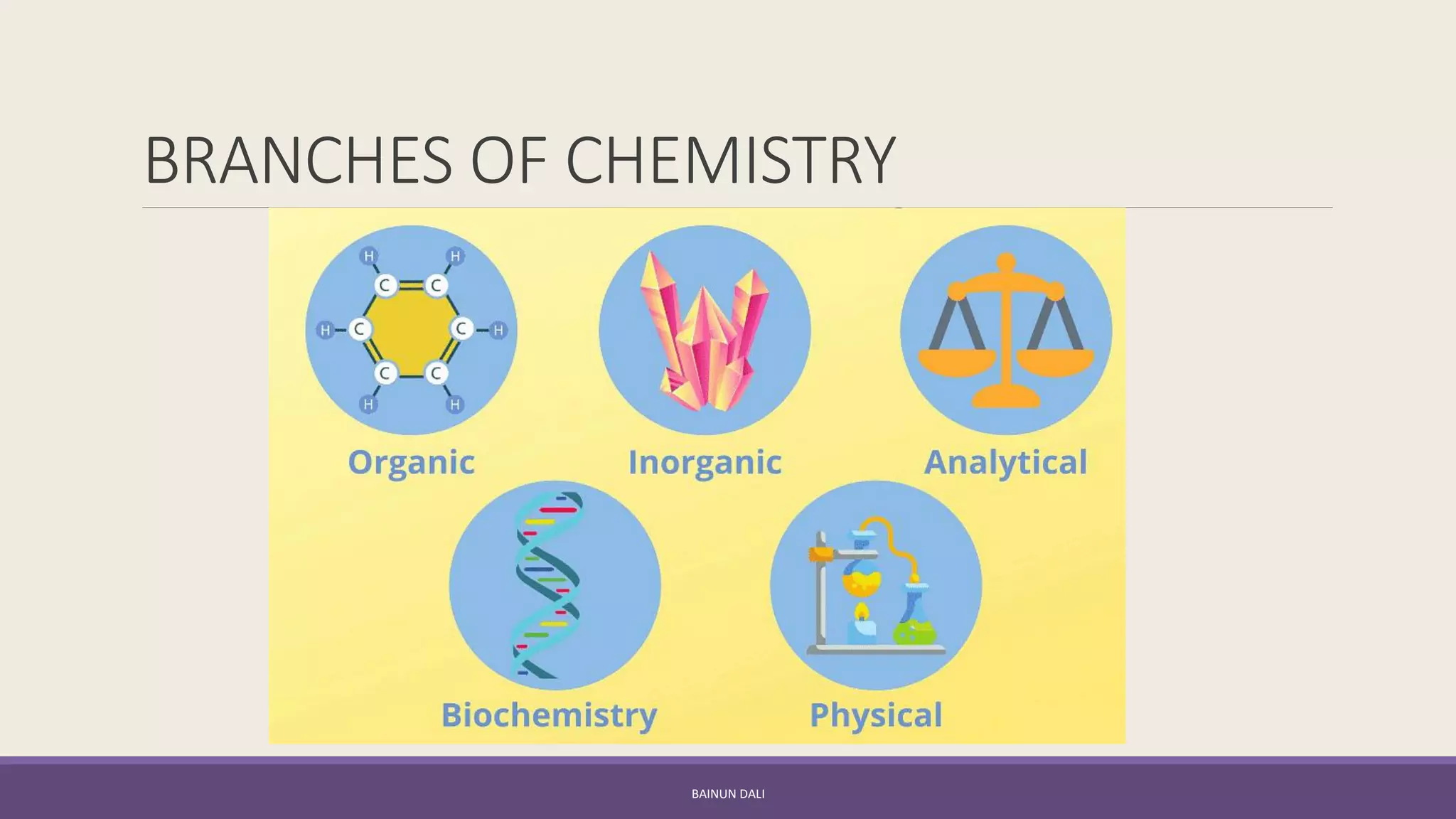
BRANCHES OF CHEMISTRY
BAINUN DALI
Organic Chemistry
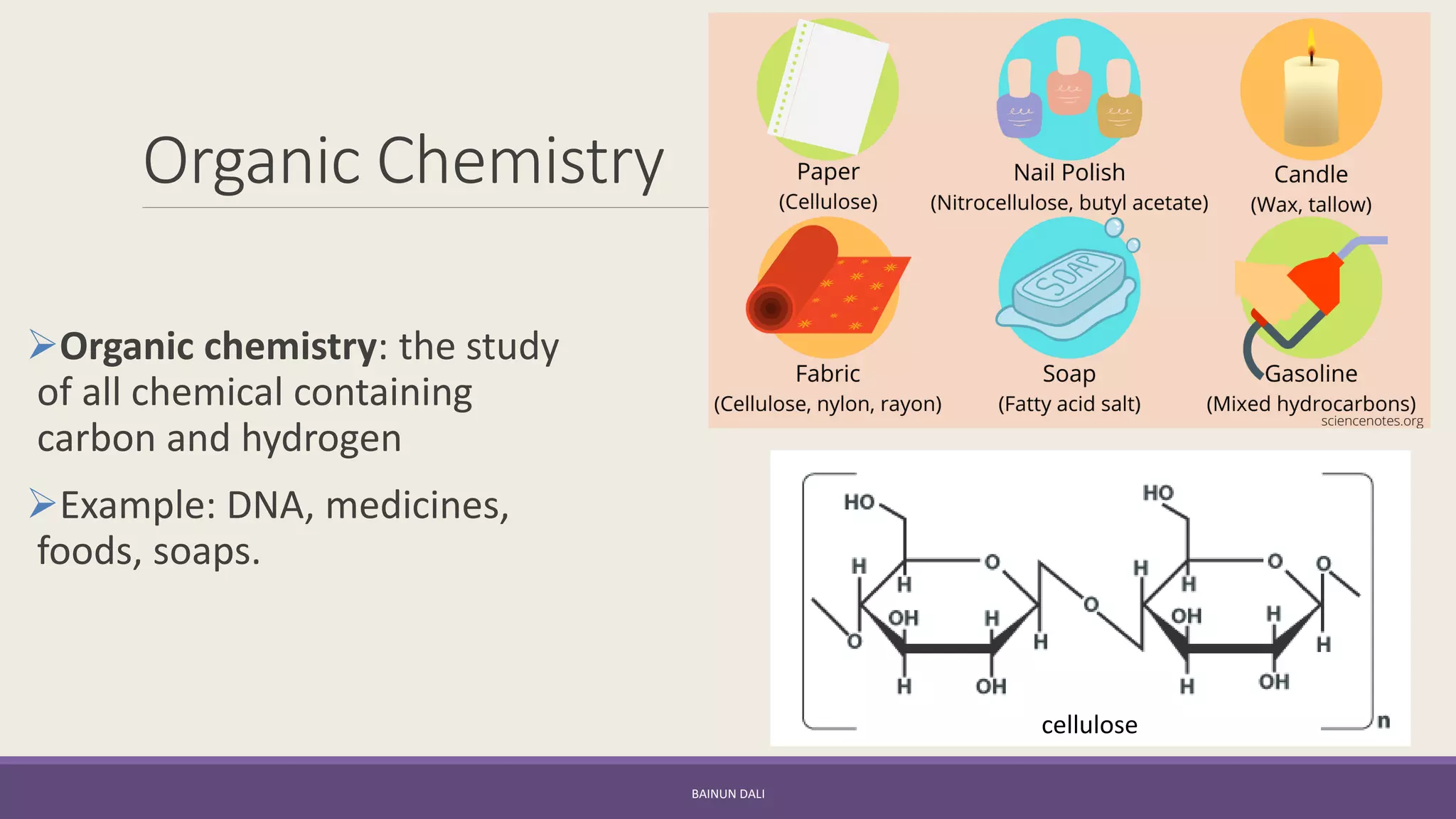
➢Organic chemistry: the study
of all chemical containing
carbon and hydrogen
➢Example: DNA, medicines,
foods, soaps.
BAINUN DALI
cellulose
Inorganic Chemistry
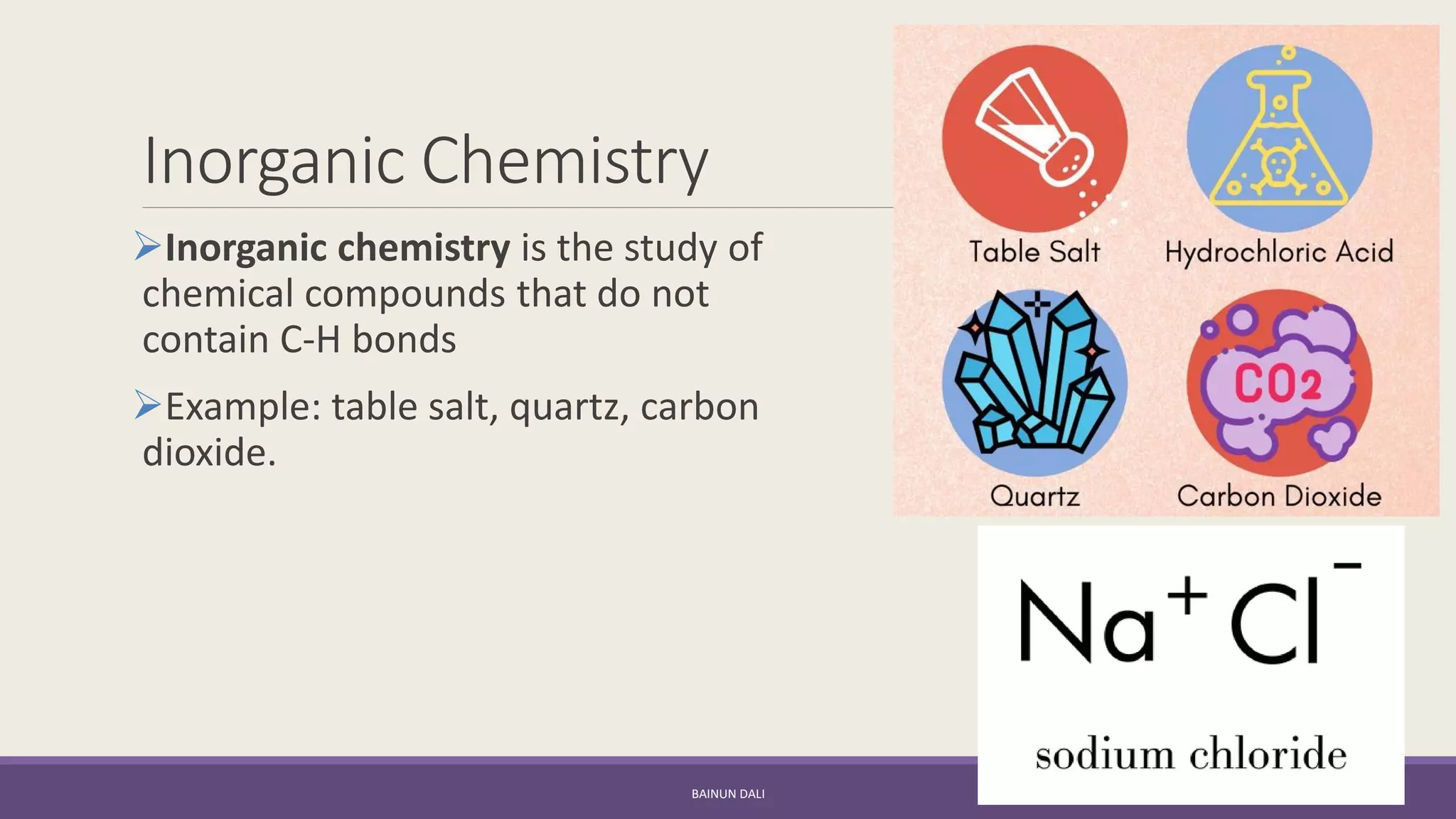
➢Inorganic chemistry is the study of
chemical compounds that do not
contain C-H bonds
➢Example: table salt, quartz, carbon
dioxide.
BAINUN DALI
Biochemistry
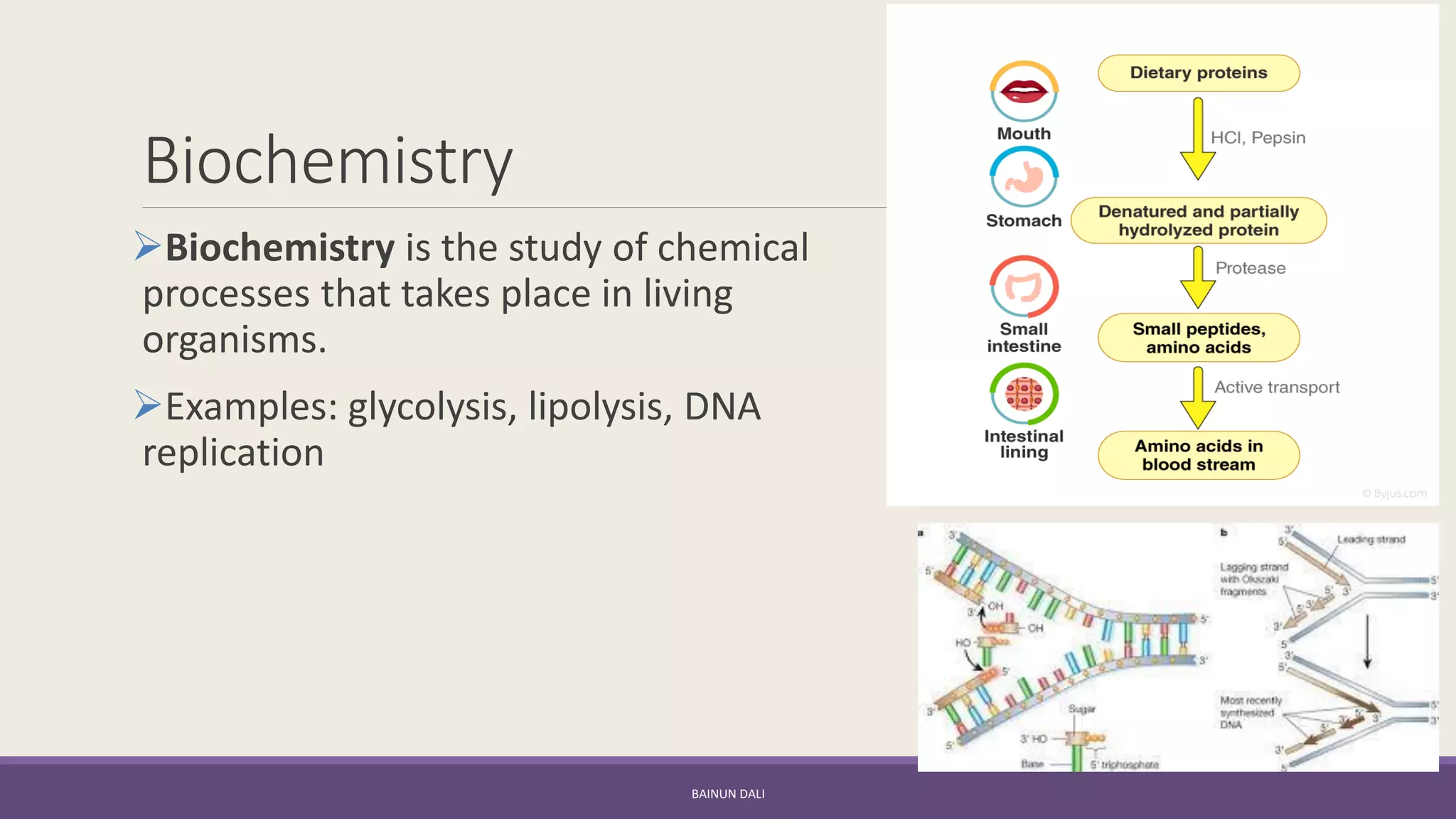
➢Biochemistry is the study of chemical
processes that takes place in living
organisms.
➢Examples: glycolysis, lipolysis, DNA
replication
BAINUN DALI
Analytical Chemistry
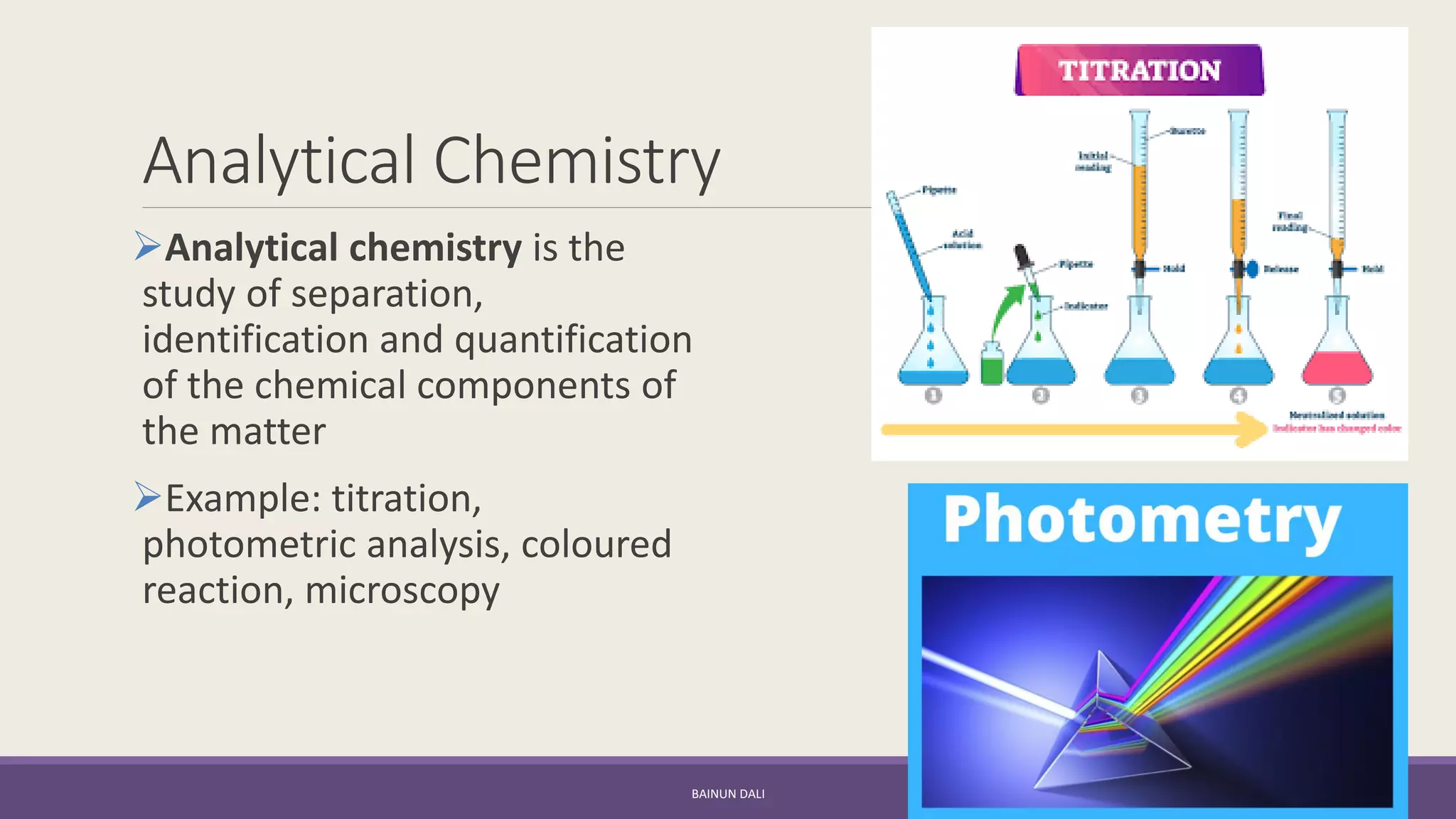
➢Analytical chemistry is the
study of separation,
identification and quantification
of the chemical components of
the matter
➢Example: titration,
photometric analysis, coloured
reaction, microscopy
BAINUN DALI
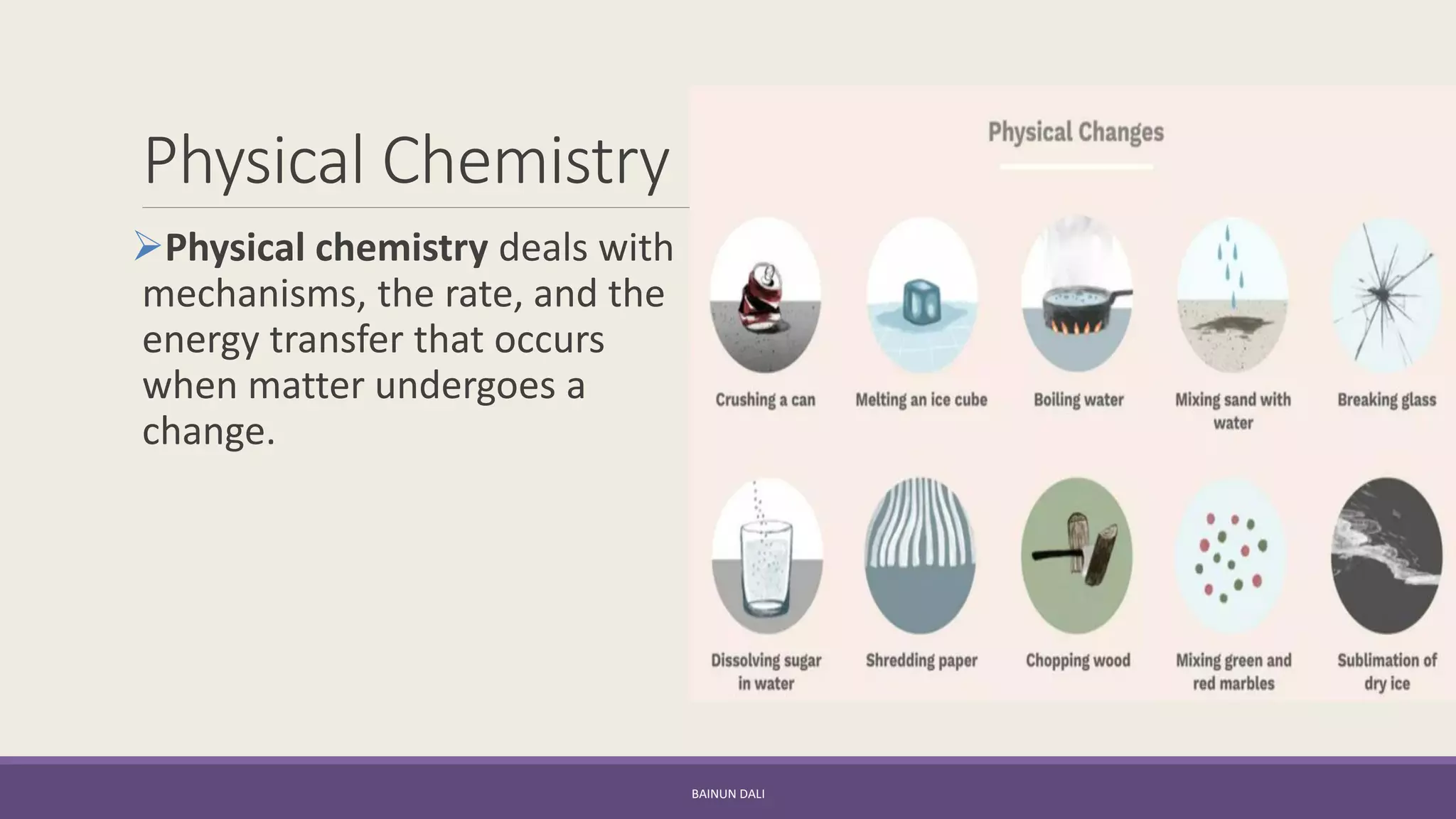
Physical Chemistry
➢Physical chemistry deals with
mechanisms, the rate, and the
energy transfer that occurs
when matter undergoes a
change.
BAINUN DALI
IMPORTANCE OF CHEMISTRY
1. Chemistry is the study of the composition, structure, properties and interactions of
matter.
2. Any form of matter is considered as a chemical. Thus, chemicals or chemical
substances are not only found in laboratories, but all around us.
3. In chemistry, we study what chemical substances are made of, what are their
properties, how they interact among each other and how we can use this knowledge
to produce new useful substances.
4. Chemistry has enabled us to produce many useful chemicals such as metals, glass,
ceramics, plastics, soaps, detergents and medicinal drugs.
5. Chemistry plays a very important role in our life that we cannot live without it. For
example, the water that we drink would not be safe without chemical processes.
BAINUN DALI
CHEMISTRY RELATED CAREER
1. Chemist are found in almost
all industries. For example, food,
textile, detergent, paint and
water treatment industries.
BAINUN DALI
CHEMISTRY RELATED CAREER
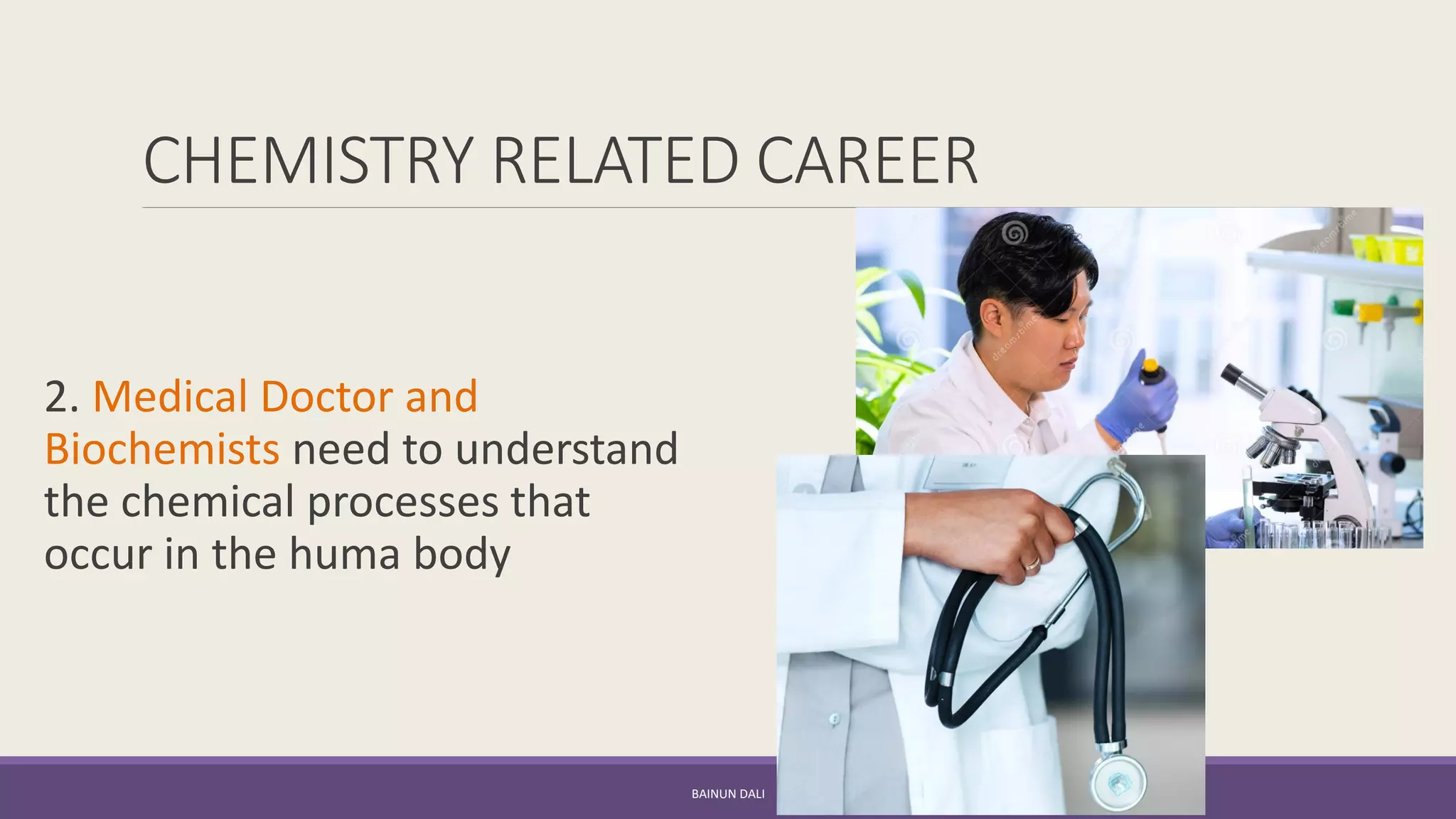
2. Medical Doctor and
Biochemists need to understand
the chemical processes that
occur in the huma body
BAINUN DALI
CHEMISTRY RELATED CAREER
3. Pharmacists are experts in
medicinal drugs.
BAINUN DALI
CHEMISTRY RELATED CAREER
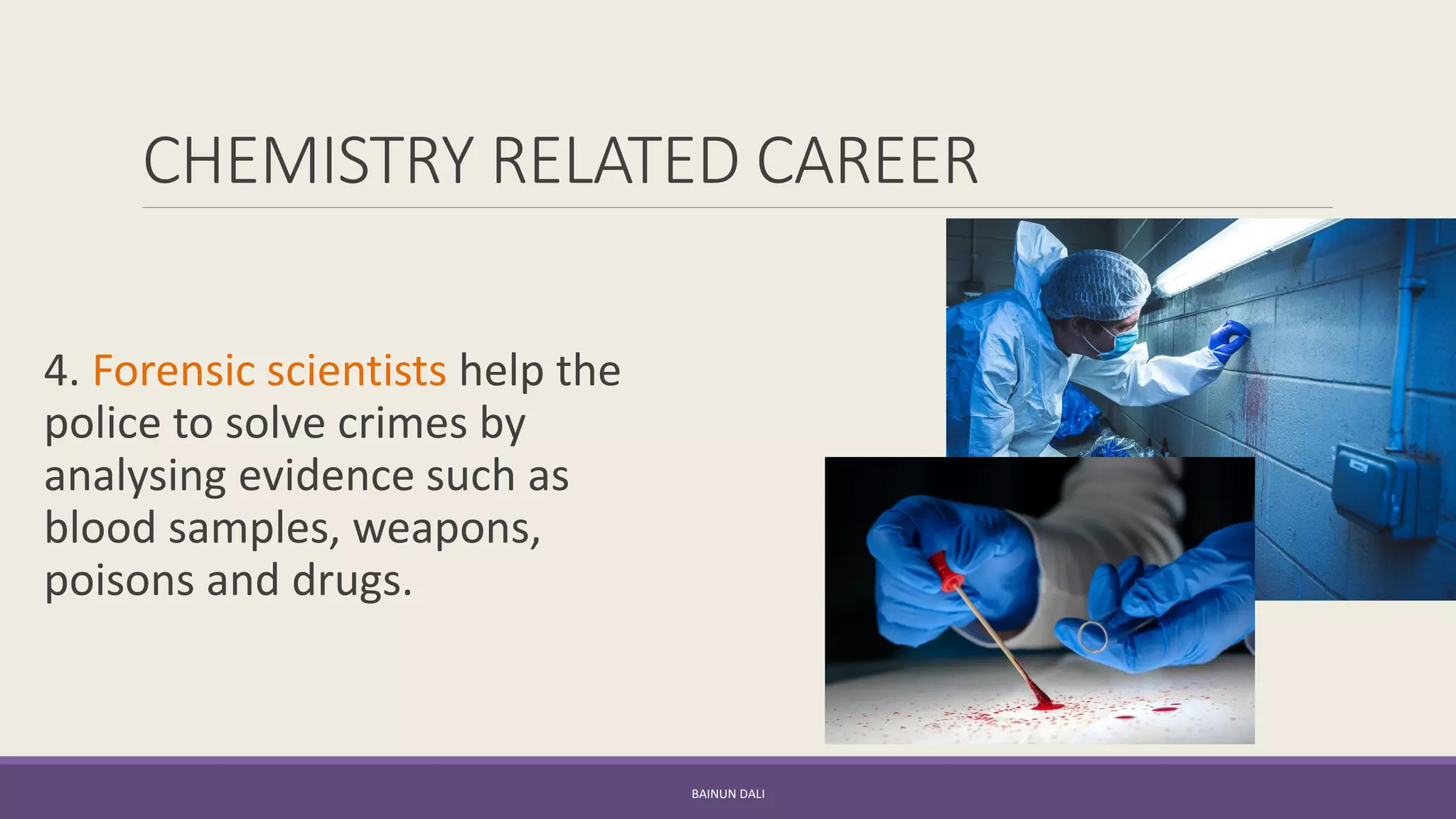
4. Forensic scientists help the
police to solve crimes by
analysing evidence such as
blood samples, weapons,
poisons and drugs.
BAINUN DALI
CHEMISTRY RELATED CAREER
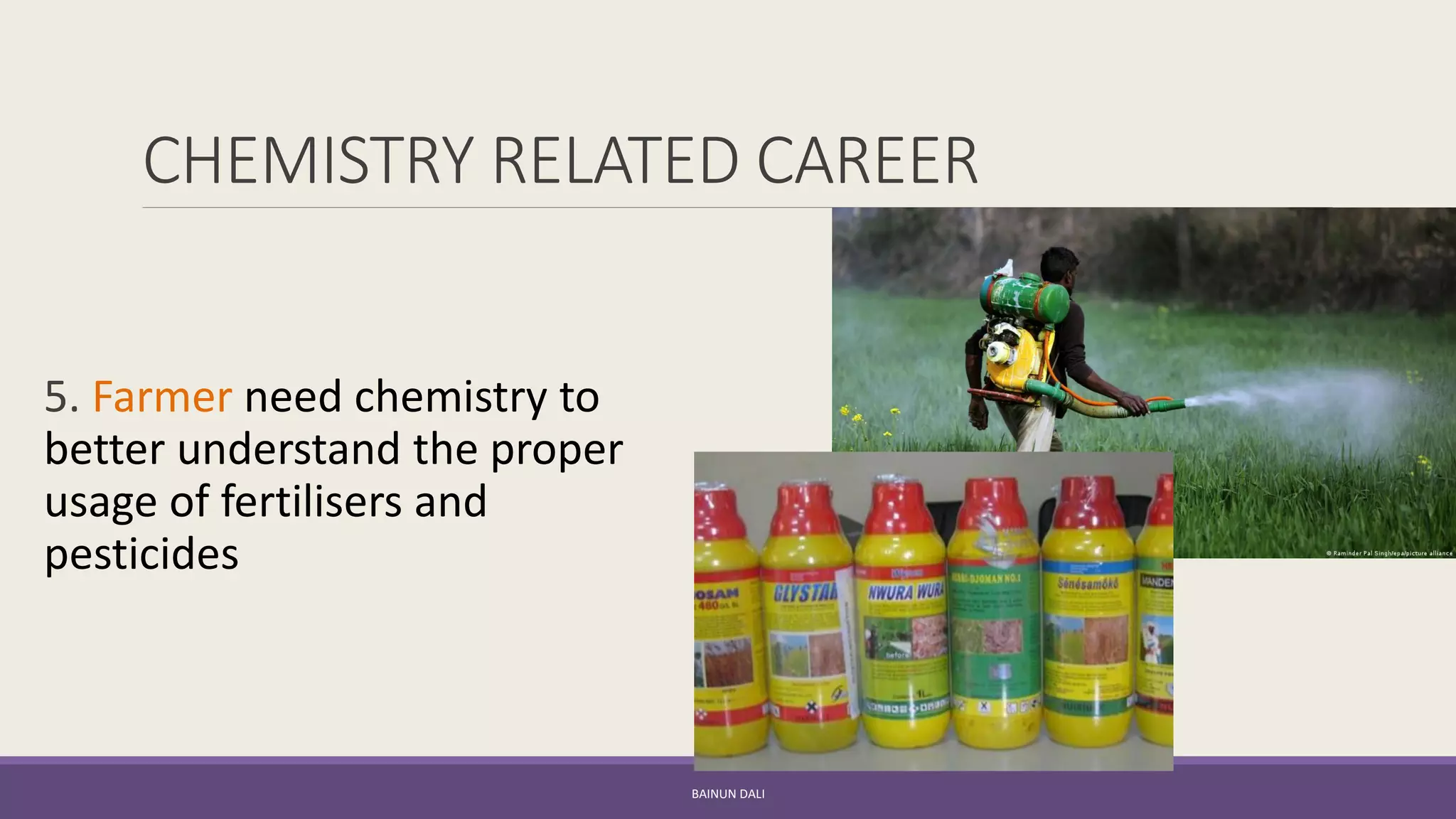
5. Farmer need chemistry to
better understand the proper
usage of fertilisers and
pesticides
BAINUN DALI
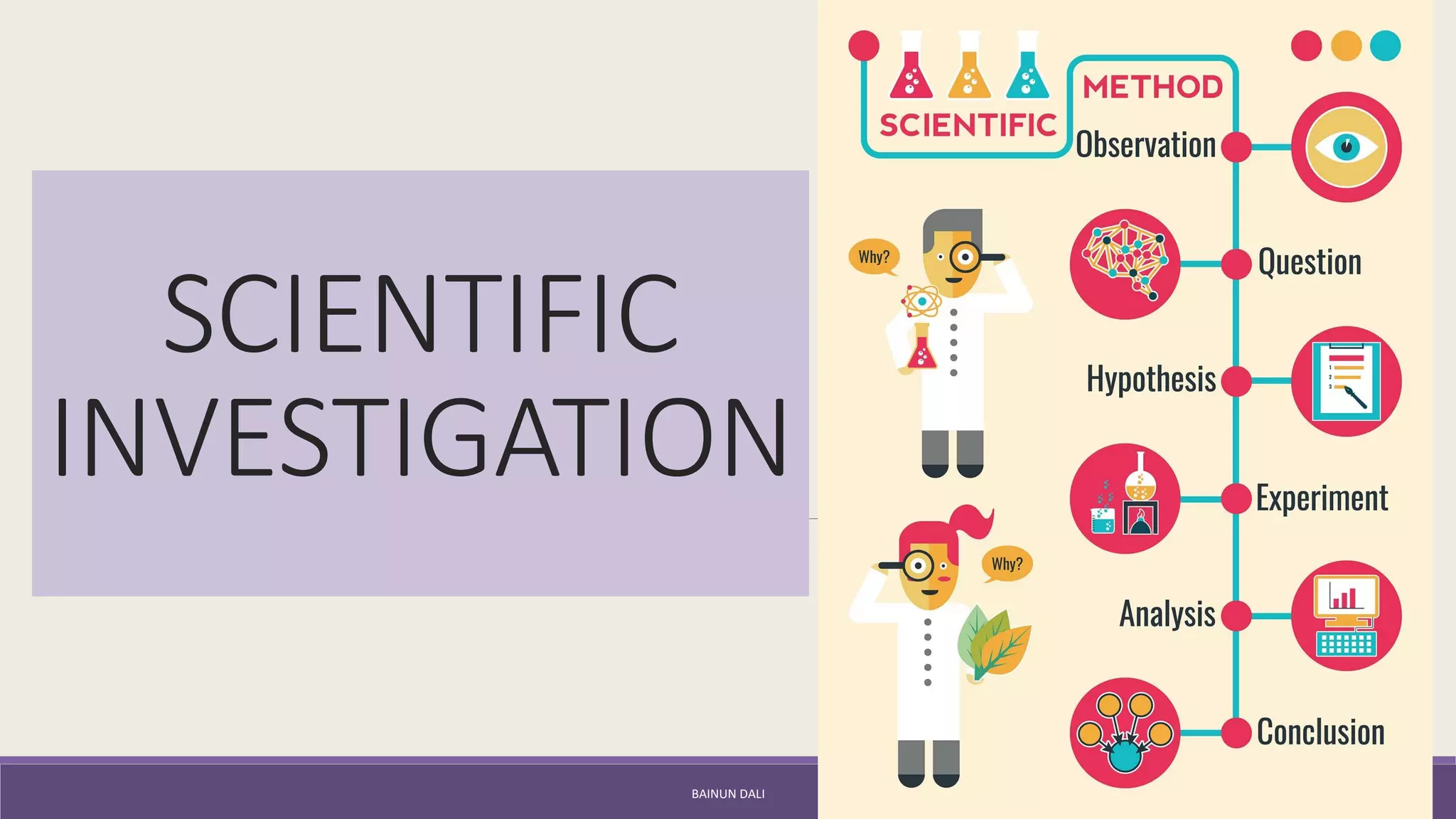
SCIENTIFIC
INVESTIGATION
BAINUN DALI
Scientific Investigation
Scientific investigation is a scientific method used in
solving problems in science.
Generally, the scientific method begins with the
observation of a problem
BAINUN DALI
Scientific Method
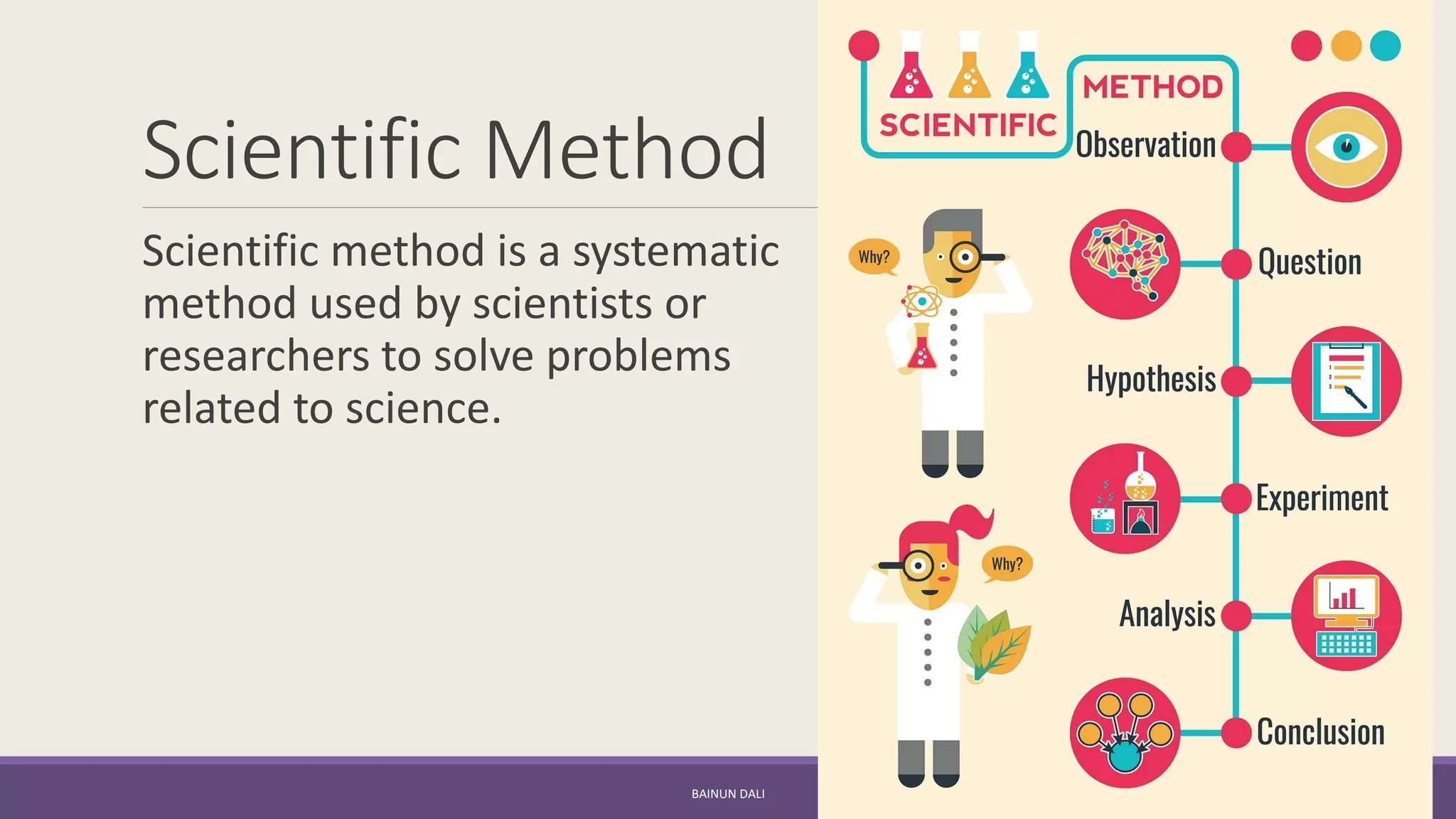
Scientific method is a systematic
method used by scientists or
researchers to solve problems
related to science.
BAINUN DALI
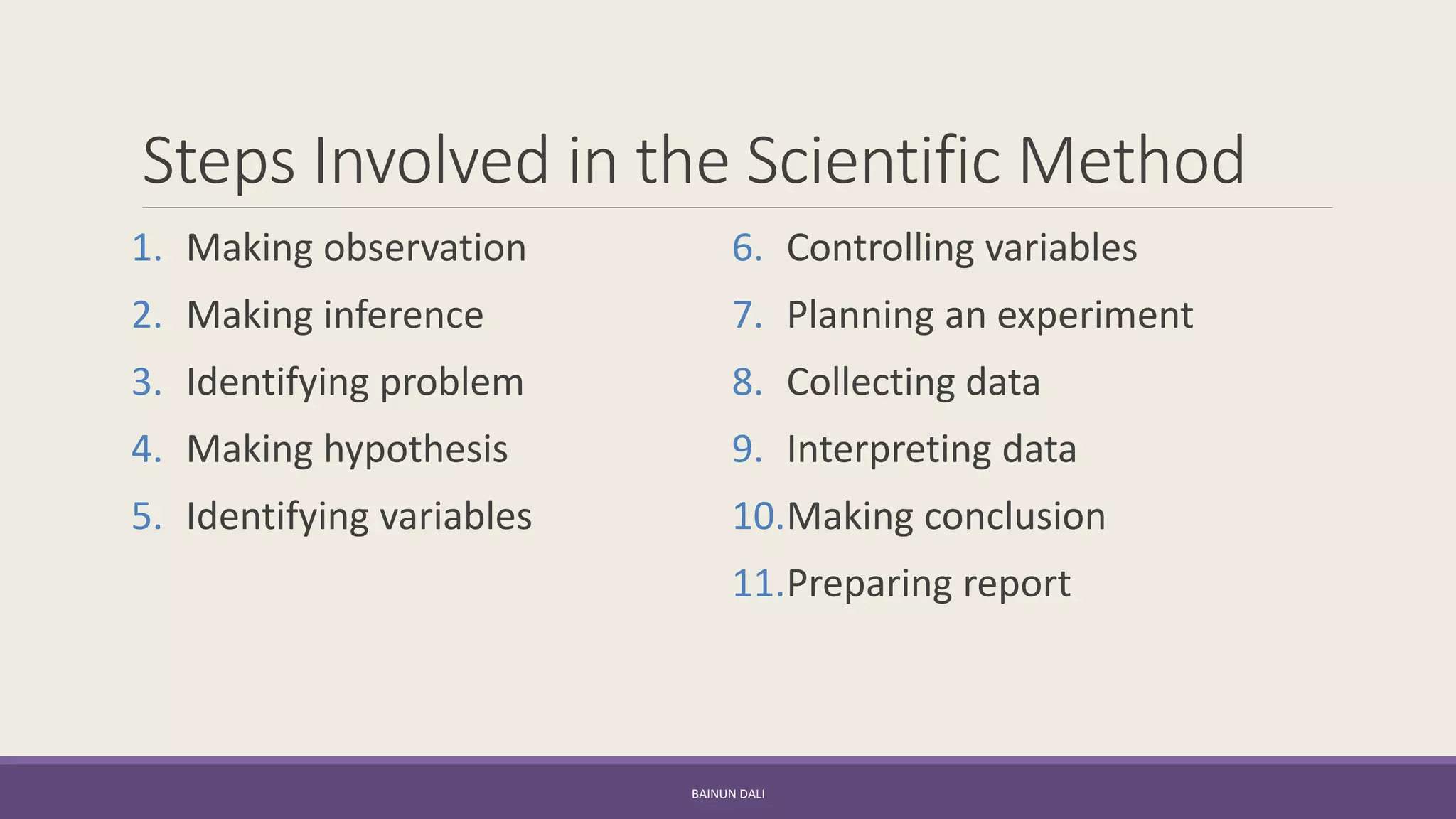
Steps Involved in the Scientific Method
1. Making observation
2. Making inference
3. Identifying problem
4. Making hypothesis
5. Identifying variables
6. Controlling variables
7. Planning an experiment
8. Collecting data
9. Interpreting data
10.Making conclusion
11.Preparing report
BAINUN DALI
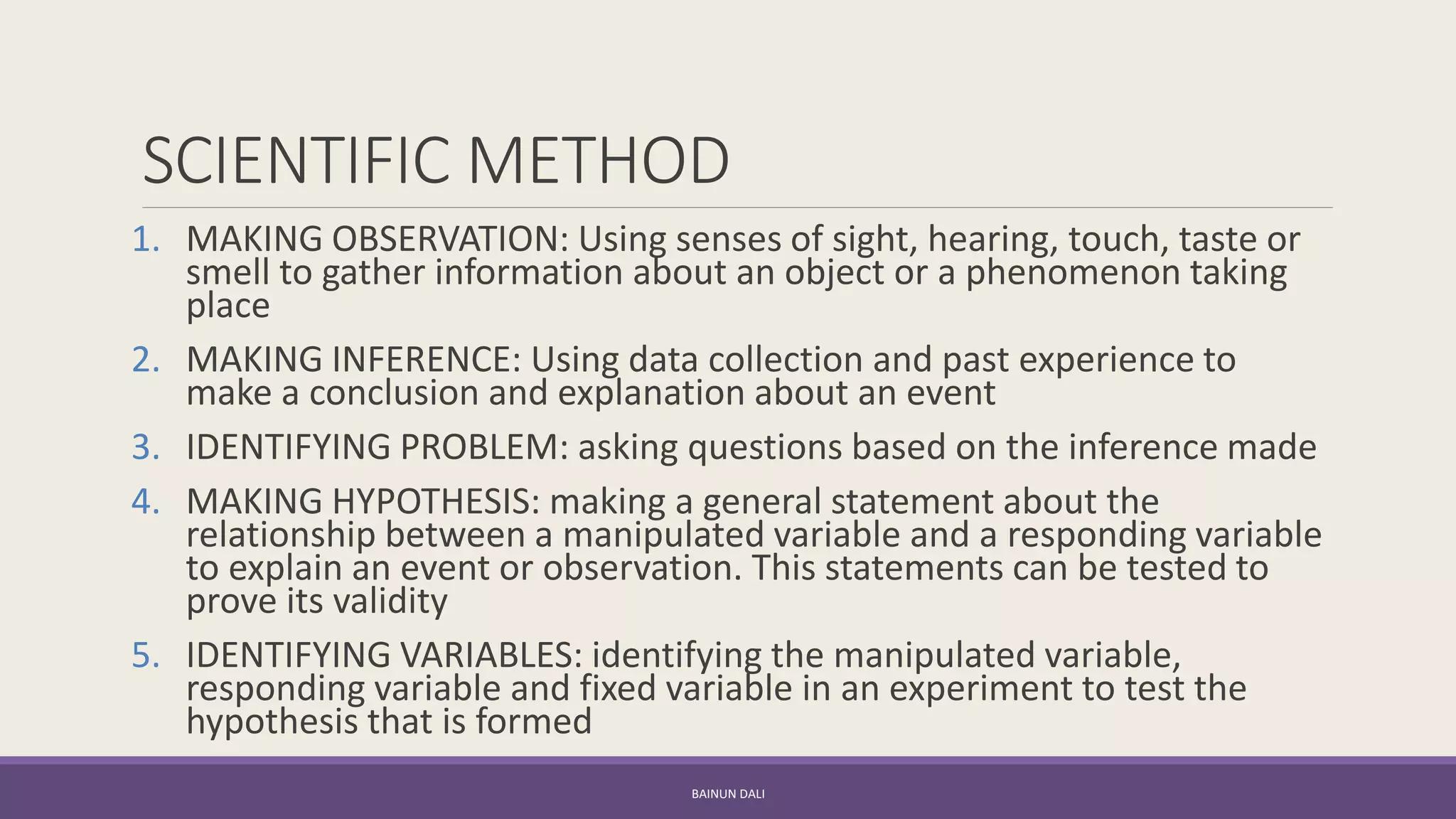
SCIENTIFIC METHOD
1. MAKING OBSERVATION: Using senses of sight, hearing, touch, taste or
smell to gather information about an object or a phenomenon taking
place
2. MAKING INFERENCE: Using data collection and past experience to
make a conclusion and explanation about an event
3. IDENTIFYING PROBLEM: asking questions based on the inference made
4. MAKING HYPOTHESIS: making a general statement about the
relationship between a manipulated variable and a responding variable
to explain an event or observation. This statements can be tested to
prove its validity
5. IDENTIFYING VARIABLES: identifying the manipulated variable,
responding variable and fixed variable in an experiment to test the
hypothesis that is formed
BAINUN DALI
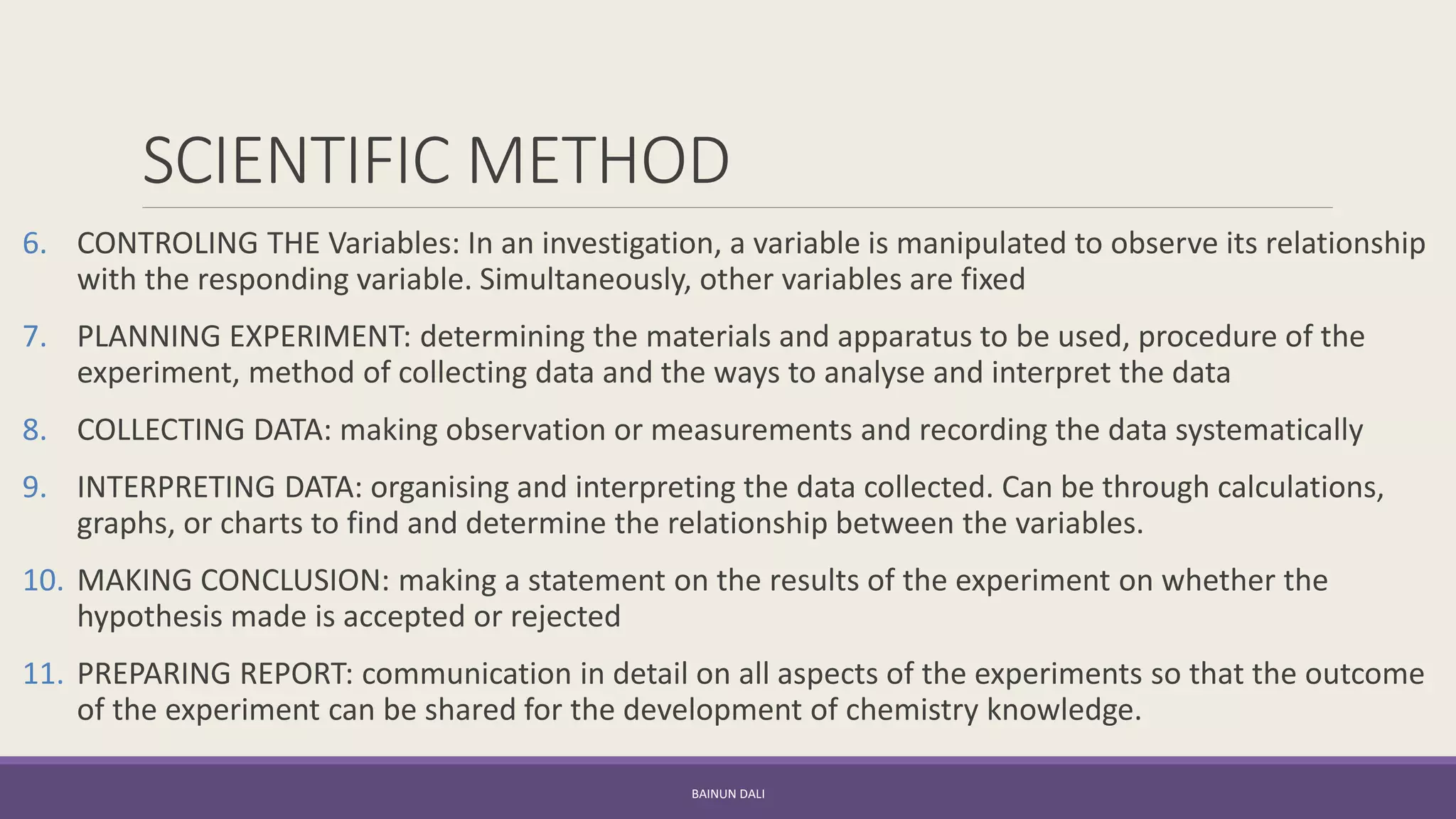
SCIENTIFIC METHOD
6. CONTROLING THE Variables: In an investigation, a variable is manipulated to observe its relationship
with the responding variable. Simultaneously, other variables are fixed
7. PLANNING EXPERIMENT: determining the materials and apparatus to be used, procedure of the
experiment, method of collecting data and the ways to analyse and interpret the data
8. COLLECTING DATA: making observation or measurements and recording the data systematically
9. INTERPRETING DATA: organising and interpreting the data collected. Can be through calculations,
graphs, or charts to find and determine the relationship between the variables.
10. MAKING CONCLUSION: making a statement on the results of the experiment on whether the
hypothesis made is accepted or rejected
11. PREPARING REPORT: communication in detail on all aspects of the experiments so that the outcome
of the experiment can be shared for the development of chemistry knowledge.
BAINUN DALI
Example: to study the effect of temperature
on the solubility of salt in water
BAINUN DALI
THANK YOU
BAINUN DALI

TOPIC 1 INTRODUCTION TO CHEMISRTY.pdf

  • 1.
  • 2.
    LEARNING OUTCOMES At theend of this lecture, students will be able to: ➢Define chemistry and describe the different branches of chemistry ➢State the examples of careers related to chemistry field ➢Define and describe the steps of scientific methods BAINUN DALI
  • 3.
  • 4.
    What is Chemistry? ❖CHEMISTRYis the study of composition of matter and the changes that matter undergoes ❖Living and non-living things are made of matter, chemistry affects all parts of life and most natural events BAINUN DALI
  • 5.
  • 6.
    Organic Chemistry ➢Organic chemistry:the study of all chemical containing carbon and hydrogen ➢Example: DNA, medicines, foods, soaps. BAINUN DALI cellulose
  • 7.
    Inorganic Chemistry ➢Inorganic chemistryis the study of chemical compounds that do not contain C-H bonds ➢Example: table salt, quartz, carbon dioxide. BAINUN DALI
  • 8.
    Biochemistry ➢Biochemistry is thestudy of chemical processes that takes place in living organisms. ➢Examples: glycolysis, lipolysis, DNA replication BAINUN DALI
  • 9.
    Analytical Chemistry ➢Analytical chemistryis the study of separation, identification and quantification of the chemical components of the matter ➢Example: titration, photometric analysis, coloured reaction, microscopy BAINUN DALI
  • 10.
    Physical Chemistry ➢Physical chemistrydeals with mechanisms, the rate, and the energy transfer that occurs when matter undergoes a change. BAINUN DALI
  • 11.
    IMPORTANCE OF CHEMISTRY 1.Chemistry is the study of the composition, structure, properties and interactions of matter. 2. Any form of matter is considered as a chemical. Thus, chemicals or chemical substances are not only found in laboratories, but all around us. 3. In chemistry, we study what chemical substances are made of, what are their properties, how they interact among each other and how we can use this knowledge to produce new useful substances. 4. Chemistry has enabled us to produce many useful chemicals such as metals, glass, ceramics, plastics, soaps, detergents and medicinal drugs. 5. Chemistry plays a very important role in our life that we cannot live without it. For example, the water that we drink would not be safe without chemical processes. BAINUN DALI
  • 12.
    CHEMISTRY RELATED CAREER 1.Chemist are found in almost all industries. For example, food, textile, detergent, paint and water treatment industries. BAINUN DALI
  • 13.
    CHEMISTRY RELATED CAREER 2.Medical Doctor and Biochemists need to understand the chemical processes that occur in the huma body BAINUN DALI
  • 14.
    CHEMISTRY RELATED CAREER 3.Pharmacists are experts in medicinal drugs. BAINUN DALI
  • 15.
    CHEMISTRY RELATED CAREER 4.Forensic scientists help the police to solve crimes by analysing evidence such as blood samples, weapons, poisons and drugs. BAINUN DALI
  • 16.
    CHEMISTRY RELATED CAREER 5.Farmer need chemistry to better understand the proper usage of fertilisers and pesticides BAINUN DALI
  • 17.
  • 18.
    Scientific Investigation Scientific investigationis a scientific method used in solving problems in science. Generally, the scientific method begins with the observation of a problem BAINUN DALI
  • 19.
    Scientific Method Scientific methodis a systematic method used by scientists or researchers to solve problems related to science. BAINUN DALI
  • 20.
    Steps Involved inthe Scientific Method 1. Making observation 2. Making inference 3. Identifying problem 4. Making hypothesis 5. Identifying variables 6. Controlling variables 7. Planning an experiment 8. Collecting data 9. Interpreting data 10.Making conclusion 11.Preparing report BAINUN DALI
  • 21.
    SCIENTIFIC METHOD 1. MAKINGOBSERVATION: Using senses of sight, hearing, touch, taste or smell to gather information about an object or a phenomenon taking place 2. MAKING INFERENCE: Using data collection and past experience to make a conclusion and explanation about an event 3. IDENTIFYING PROBLEM: asking questions based on the inference made 4. MAKING HYPOTHESIS: making a general statement about the relationship between a manipulated variable and a responding variable to explain an event or observation. This statements can be tested to prove its validity 5. IDENTIFYING VARIABLES: identifying the manipulated variable, responding variable and fixed variable in an experiment to test the hypothesis that is formed BAINUN DALI
  • 22.
    SCIENTIFIC METHOD 6. CONTROLINGTHE Variables: In an investigation, a variable is manipulated to observe its relationship with the responding variable. Simultaneously, other variables are fixed 7. PLANNING EXPERIMENT: determining the materials and apparatus to be used, procedure of the experiment, method of collecting data and the ways to analyse and interpret the data 8. COLLECTING DATA: making observation or measurements and recording the data systematically 9. INTERPRETING DATA: organising and interpreting the data collected. Can be through calculations, graphs, or charts to find and determine the relationship between the variables. 10. MAKING CONCLUSION: making a statement on the results of the experiment on whether the hypothesis made is accepted or rejected 11. PREPARING REPORT: communication in detail on all aspects of the experiments so that the outcome of the experiment can be shared for the development of chemistry knowledge. BAINUN DALI
  • 23.
    Example: to studythe effect of temperature on the solubility of salt in water BAINUN DALI
  • 24.