HIV Treatment and PrEP in 2015
Lizzy Schmidt, MSN, CRNP
Director of Lax Women’s Program
1
2
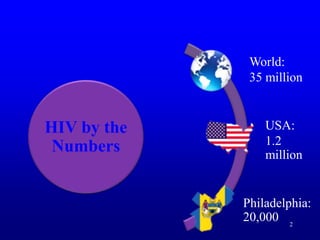
HIV by the
Numbers
World:
35 million
USA:
1.2
million
Philadelphia:
20,000
Total: 35.0 million [33.2 million – 37.2 million]
Middle East & North Africa
230 000
[160 000 – 330 000]
Sub-Saharan Africa
24.7 million
[23.5 million – 26.1 million]
Eastern Europe &
Central Asia
1.1 million
[980 000– 1.3 million]
Asia and the Pacific
4.8 million
[4.1 million – 5.5 million]
North America and Western and Central Europe
2.3 million
[2.0 million – 3.0 million]
Latin America
1.6 million
[1.4 million – 2.1 million]
Caribbean
250 000
[230 000 – 280 000]
Adults and children estimated to be living with HIV2013
UNITED STATES as of 2011
• Over 1 million living with HIV/AIDS (prevalence)
and almost 1 in 5 (18%) are unaware of their
infection.
• Incidence estimate: 41,720 new infections in 2011
- 2/3 in MSM ( 44%) ; decrease in every
demographic except for young MSM (13-24)
and MSM > 45 yrs old
- Black/African American have 8x incidence rates
as whites (44% blacks,21% Latinos)
- 26% in Youth 13-24 yrs
• Much higher rates in urban areas, and rural South
5
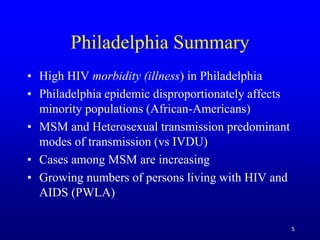
Philadelphia Summary
• High HIV morbidity (illness) in Philadelphia
• Philadelphia epidemic disproportionately affects
minority populations (African-Americans)
• MSM and Heterosexual transmission predominant
modes of transmission (vs IVDU)
• Cases among MSM are increasing
• Growing numbers of persons living with HIV and
AIDS (PWLA)
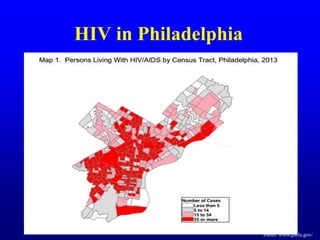
Photo: www.phila.gov/
HIV in Philadelphia
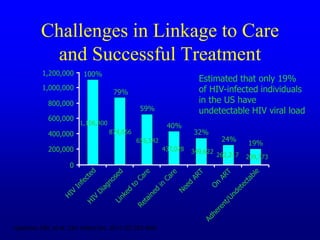
Challenges in Linkage to Care
and Successful Treatment
•Gardner EM, et al. Clin Infect Dis. 2011;52:793-800.
Estimated that only 19%
of HIV-infected individuals
in the US have
undetectable HIV viral load
200,000
600,000
0
800,000
1,000,000
1,200,000
400,000
1,106,400
874,056
655,542
437,028 349,622
262,217 209,773
19%
24%
32%
40%
59%
79%
100%
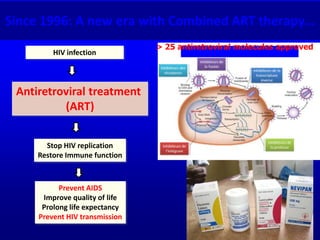
HIV infection
Antiretroviral treatment
(ART)
Stop HIV replication
Restore Immune function
Prevent AIDS
Improve quality of life
Prolong life expectancy
Prevent HIV transmission
Since 1996: A new era with Combined ART therapy…
> 25 antiretroviral molecules approved
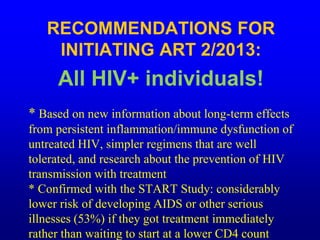
* Based on new information about long-term effects
from persistent inflammation/immune dysfunction of
untreated HIV, simpler regimens that are well
tolerated, and research about the prevention of HIV
transmission with treatment
* Confirmed with the START Study: considerably
lower risk of developing AIDS or other serious
illnesses (53%) if they got treatment immediately
rather than waiting to start at a lower CD4 count
RECOMMENDATIONS FOR
INITIATING ART 2/2013:
All HIV+ individuals!
WHAT TO START WITH?
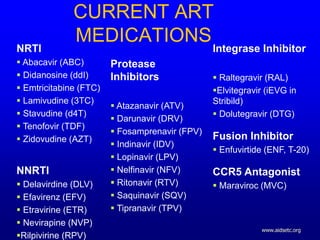
www.aidsetc.org
CURRENT ART
MEDICATIONS
NRTI
 Abacavir (ABC)
 Didanosine (ddI)
 Emtricitabine (FTC)
 Lamivudine (3TC)
 Stavudine (d4T)
 Tenofovir (TDF)
 Zidovudine (AZT)
NNRTI
 Delavirdine (DLV)
 Efavirenz (EFV)
 Etravirine (ETR)
 Nevirapine (NVP)
Rilpivirine (RPV)
Protease
Inhibitors
 Atazanavir (ATV)
 Darunavir (DRV)
 Fosamprenavir (FPV)
 Indinavir (IDV)
 Lopinavir (LPV)
 Nelfinavir (NFV)
 Ritonavir (RTV)
 Saquinavir (SQV)
 Tipranavir (TPV)
Integrase Inhibitor
 Raltegravir (RAL)
Elvitegravir (iEVG in
Stribild)
 Dolutegravir (DTG)
Fusion Inhibitor
 Enfuvirtide (ENF, T-20)
CCR5 Antagonist
 Maraviroc (MVC)
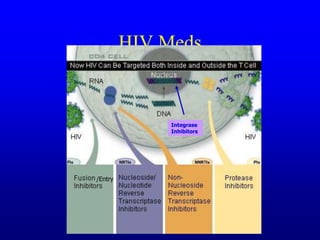
HIV Meds
/Entry
Integrase
Inhibitors
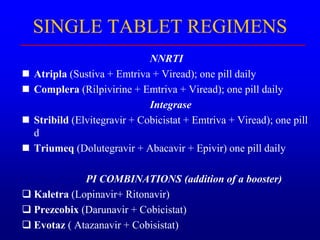
SINGLE TABLET REGIMENS
NNRTI
 Atripla (Sustiva + Emtriva + Viread); one pill daily
 Complera (Rilpivirine + Emtriva + Viread); one pill daily
Integrase
 Stribild (Elvitegravir + Cobicistat + Emtriva + Viread); one pill
d
 Triumeq (Dolutegravir + Abacavir + Epivir) one pill daily
PI COMBINATIONS (addition of a booster)
 Kaletra (Lopinavir+ Ritonavir)
 Prezcobix (Darunavir + Cobicistat)
 Evotaz ( Atazanavir + Cobisistat)
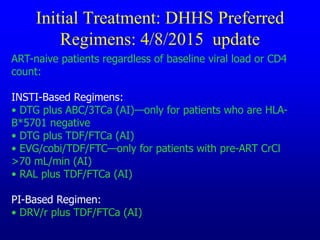
Initial Treatment: DHHS Preferred
Regimens: 4/8/2015 update
ART-naive patients regardless of baseline viral load or CD4
count:
INSTI-Based Regimens:
• DTG plus ABC/3TCa (AI)—only for patients who are HLA-
B*5701 negative
• DTG plus TDF/FTCa (AI)
• EVG/cobi/TDF/FTC—only for patients with pre-ART CrCl
>70 mL/min (AI)
• RAL plus TDF/FTCa (AI)
PI-Based Regimen:
• DRV/r plus TDF/FTCa (AI)
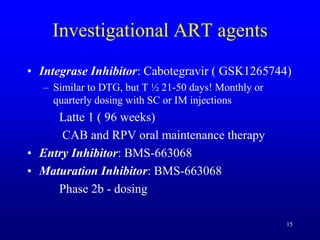
Investigational ART agents
• Integrase Inhibitor: Cabotegravir ( GSK1265744)
– Similar to DTG, but T ½ 21-50 days! Monthly or
quarterly dosing with SC or IM injections
Latte 1 ( 96 weeks)
CAB and RPV oral maintenance therapy
• Entry Inhibitor: BMS-663068
• Maturation Inhibitor: BMS-663068
Phase 2b - dosing
15
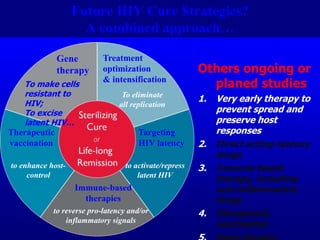
Future HIV Cure Strategies?
A combined approach…
Treatment
optimization
& intensification
To eliminate
all replication
Targeting
HIV latency
to activate/repress
latent HIV
Immune-based
therapies
to reverse pro-latency and/or
inflammatory signals
Therapeutic
vaccination
to enhance host-
control
Gene
therapy
To make cells
resistant to
HIV;
To excise
latent HIV…
Others ongoing or
planed studies
1. Very early therapy to
prevent spread and
preserve host
responses
2. Direct acting-latency
drugs
3. Immune based
therapy, including
anti-inflammatory
drugs
4. Therapeutic
vaccination
PREVENTION
• Is there more we can
do besides ask
people to be
abstinent,
monogamous, or
wear a condom?
• Increasingly, the
answer is “yes”
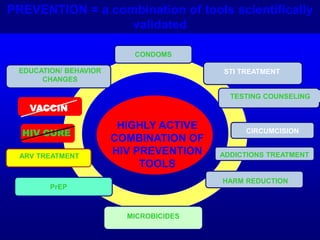
EDUCATION/ BEHAVIOR
CHANGES
CONDOMS
ARV TREATMENT ADDICTIONS TREATMENT
TESTING COUNSELING
STI TREATMENT
CIRCUMCISION
PrEP
HARM REDUCTION
HIV CURE
HIGHLY ACTIVE
COMBINATION OF
HIV PREVENTION
TOOLS
MICROBICIDES
VACCIN
PREVENTION = a combination of tools scientifically
validated
Treat all
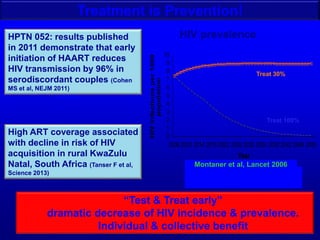
Treatment is Prevention!
HPTN 052: results published
in 2011 demonstrate that early
initiation of HAART reduces
HIV transmission by 96% in
serodiscordant couples (Cohen
MS et al, NEJM 2011)
0
1
2
3
4
5
6
7
8
9
10
2006 2010 2014 2018 2022 2026 2030 2034 2038 2042 2046 2050
Year
HIVinfectionsper1000
population
Treat all Treat 30%
HIV prevalence
Montaner et al, Lancet 2006
Treat 30%
Treat 100%
“Test & Treat early”
dramatic decrease of HIV incidence & prevalence.
Individual & collective benefit
High ART coverage associated
with decline in risk of HIV
acquisition in rural KwaZulu
Natal, South Africa (Tanser F et al,
Science 2013)
PMTCT: Preventing
Mother-to-Child Transmission
 Rate of transmission with no intervention is 25% (1 in 4)
 Rate of transmission reduced to 1-8% with appropriate
interventions
 PMTCT has been an HIV success story, initially in US, but
now elimination of vertical transmission part of UNAIDS
goals by 2015
Preconception Counseling and Care
 Childbearing intentions should be discussed with all clients on
an on-going basis
 Discuss effective & appropriate contraceptive methods to
reduce unintended pregnancy. Long Acting Reversible
Contraceptive (LARC) optimal
 Reproductive options for serodiscordant couples
– Positive woman, negative man: ovulation predictors/timed
home insemination with turkey baster/syringe
– Positive man, negative woman: sperm washing and
artificial insemination (expensive, not always available),
and now PreP
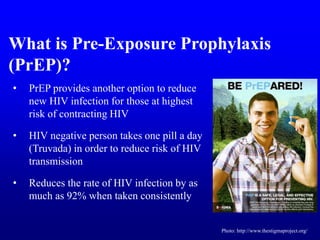
WHAT IS PREP?
• PrEP provides another option to reduce
new HIV infection for those at highest
risk of contracting HIV
• HIV negative person takes one pill a day
(Truvada) in order to reduce risk of HIV
transmission
• Reduces the rate of HIV infection by as
much as 92% when taken consistently
What is Pre-Exposure Prophylaxis
(PrEP)?
Photo: http://www.thestigmaproject.org/
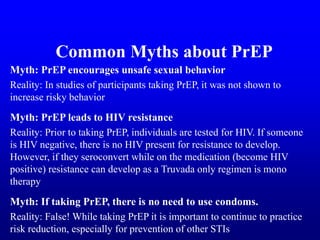
Myth: PrEP encourages unsafe sexual behavior
Reality: In studies of participants taking PrEP, it was not shown to
increase risky behavior
Myth: PrEP leads to HIV resistance
Reality: Prior to taking PrEP, individuals are tested for HIV. If someone
is HIV negative, there is no HIV present for resistance to develop.
However, if they seroconvert while on the medication (become HIV
positive) resistance can develop as a Truvada only regimen is mono
therapy
Myth: If taking PrEP, there is no need to use condoms.
Reality: False! While taking PrEP it is important to continue to practice
risk reduction, especially for prevention of other STIs
Common Myths about PrEP
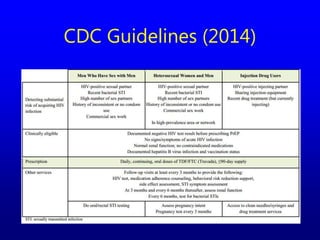
CDC Guidelines (2014)
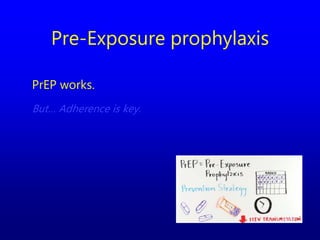
Pre-Exposure prophylaxis
PrEP works.
But… Adherence is key.
4 major PrEP Studies were presented:
– iPERGAY
– PROUD
– PARTNERS Demonstration Project
– FACTS 001
CROI 2015 UPDATE
Conference on Retroviruses and Opportunistic Infections
Dr. Helen Koenig and Caitlin Conyngham
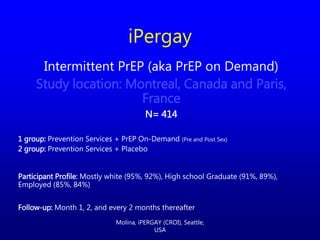
Intermittent PrEP (aka PrEP on Demand)
Study location: Montreal, Canada and Paris,
France
N= 414
1 group: Prevention Services + PrEP On-Demand (Pre and Post Sex)
2 group: Prevention Services + Placebo
Participant Profile: Mostly white (95%, 92%), High school Graduate (91%, 89%),
Employed (85%, 84%)
Follow-up: Month 1, 2, and every 2 months thereafter
iPergay
Molina, iPERGAY (CROI), Seattle,
USA
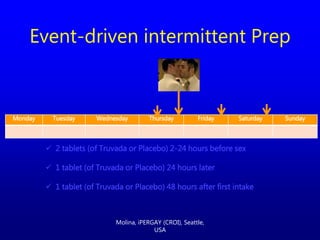
Monday Tuesday Wednesday Thursday Friday Saturday Sunday
Event-driven intermittent Prep
 2 tablets (of Truvada or Placebo) 2-24 hours before sex
 1 tablet (of Truvada or Placebo) 24 hours later
 1 tablet (of Truvada or Placebo) 48 hours after first intake
Molina, iPERGAY (CROI), Seattle,
USA
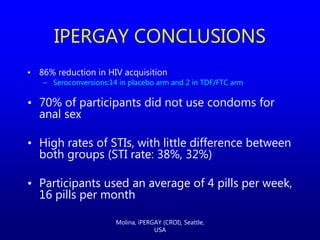
• 86% reduction in HIV acquisition
– Seroconversions:14 in placebo arm and 2 in TDF/FTC arm
• 70% of participants did not use condoms for
anal sex
• High rates of STIs, with little difference between
both groups (STI rate: 38%, 32%)
• Participants used an average of 4 pills per week,
16 pills per month
IPERGAY CONCLUSIONS
Molina, iPERGAY (CROI), Seattle,
USA
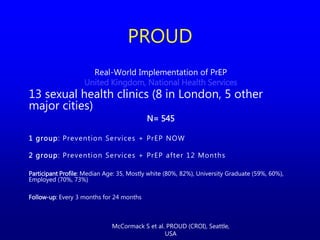
Real-World Implementation of PrEP
United Kingdom, National Health Services
13 sexual health clinics (8 in London, 5 other
major cities)
N= 545
1 group: Prevention Services + PrEP NOW
2 group: Prevention Services + PrEP after 12 Months
Participant Profile: Median Age: 35, Mostly white (80%, 82%), University Graduate (59%, 60%),
Employed (70%, 73%)
Follow-up: Every 3 months for 24 months
PROUD
McCormack S et al. PROUD (CROI), Seattle,
USA
• PrEP works in the real world!
• PrEP reduced HIV incidence by 86%
– Seroconversions: 3 in immediate grp and 19 in deferred
grp
• 5% of immediate group and 31% of deferred group
accessed PEP
• High rates of STIs, with little difference between
both groups(57%, 50%)
PROUD Conclusions
McCormack S et al. PROUD (CROI), Seattle,
USA
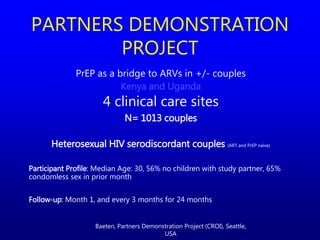
PrEP as a bridge to ARVs in +/- couples
Kenya and Uganda
4 clinical care sites
N= 1013 couples
Heterosexual HIV serodiscordant couples (ART and PrEP naïve)
Participant Profile: Median Age: 30, 56% no children with study partner, 65%
condomless sex in prior month
Follow-up: Month 1, and every 3 months for 24 months
PARTNERS DEMONSTRATION
PROJECT
Baeten, Partners Demonstration Project (CROI), Seattle,
USA
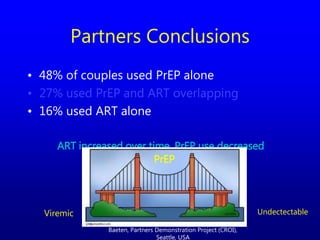
• 48% of couples used PrEP alone
• 27% used PrEP and ART overlapping
• 16% used ART alone
ART increased over time, PrEP use decreased
Partners Conclusions
PrEP
Viremic Undectectable
Baeten, Partners Demonstration Project (CROI),
Seattle, USA
EXPECTED HIV INFECTIONS: 39.7
OBSERVED HIV INFECTIONS: 2
The observed incidence is a 96% reduction
compared to what was expected.
Partners Conclusions
0
5
10
EXPECTED OBSERVED
HIV Incidence
HIV Incidence
Baeten, Partners Demonstration Project (CROI),
Seattle, USA
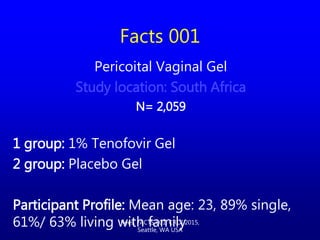
Pericoital Vaginal Gel
Study location: South Africa
N= 2,059
1 group: 1% Tenofovir Gel
2 group: Placebo Gel
Participant Profile: Mean age: 23, 89% single,
61%/ 63% living with family
Facts 001
Rees, FACTS 001, CROI 2015,
Seattle, WA USA
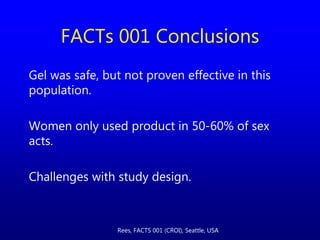
Gel was safe, but not proven effective in this
population.
Women only used product in 50-60% of sex
acts.
Challenges with study design.
FACTs 001 Conclusions
Rees, FACTS 001 (CROI), Seattle, USA
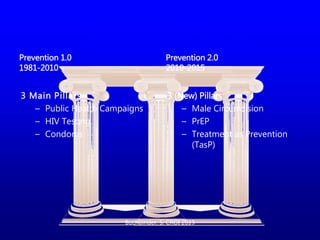
Prevention 1.0
1981-2010
3 Main Pillars
– Public Health Campaigns
– HIV Testing
– Condoms
Prevention 2.0
2010-2015
3 (New) Pillars
– Male Circumcision
– PrEP
– Treatment as Prevention
(TasP)
Why is PrEP so important?
Pro-Active, Responsible, Empowered Pleasure
Buchbinder, S. CROI 2015
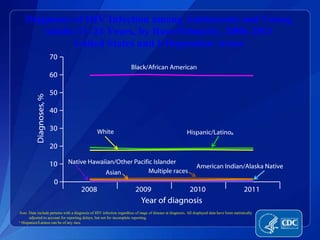
Diagnoses of HIV Infection among Adolescents and Young
Adults 13–24 Years, by Race/Ethnicity, 2008–2011
United States and 6 Dependent Areas
Note. Data include persons with a diagnosis of HIV infection regardless of stage of disease at diagnosis. All displayed data have been statistically
adjusted to account for reporting delays, but not for incomplete reporting.
a Hispanics/Latinos can be of any race.
Team approach
• Medical provider
• Social worker
• PrEP retention counselor, if available
• Prescribing PrEP well requires frequent
discussion about
– Duration of PrEP: Talking about “seasons of
risk”
– Monitoring adherence
Reimbursement & Logistics
• Everyone (mostly) has access to PrEP
– Uninsured: Gilead Patient Assistance
Program
– Insured (Medicaid): Covered ($3 co-pay)
– Insured (Private Insurance): Variable co-
pays, Co-pay card covers up to $250
• ICD9 code is V01.79 (contact
with/exposure to communicable
diseases)
Linkage to Care for New HIV
Diagnoses
• You will likely have patients acquire HIV
on PrEP
– Adherence has been shown to drop during
first 6 months
– Project PrEPare: 20% adherence by 24
weeks
• Imperatives:
– Test for HIV at least every 3 months
– Aim for same day, or next day linkage to
Barriers & Lessons Learned
• Biggest barriers are:
– Accessing populations at greatest need
– Achieving sustained high-level adherence
– Stigma of taking PrEP
• Take-home lessons:
– Prescribing PrEP is easy once you get the
hang of it
– PrEP options are expanding!!
QUESTIONS?
Resources
www.thebody.com General HIV
information
www.projectinform.orgAdvocacy for PLWA’s/HCV
www.aidsinfonet.org Fact sheets, HIV
education
Bedsider.org Contraception options
PWNUSA.woodpress.com Women’s Health
activism
www.aids.gov Epidemiology,
treatments
www.cdc.gov/hiv Slide sets and Information
46
Philadelphia FIGHT

HIV Treatment and PrEP in 2015

  • 1.
    HIV Treatment andPrEP in 2015 Lizzy Schmidt, MSN, CRNP Director of Lax Women’s Program 1
  • 2.
    2 HIV by the Numbers World: 35million USA: 1.2 million Philadelphia: 20,000
  • 3.
    Total: 35.0 million[33.2 million – 37.2 million] Middle East & North Africa 230 000 [160 000 – 330 000] Sub-Saharan Africa 24.7 million [23.5 million – 26.1 million] Eastern Europe & Central Asia 1.1 million [980 000– 1.3 million] Asia and the Pacific 4.8 million [4.1 million – 5.5 million] North America and Western and Central Europe 2.3 million [2.0 million – 3.0 million] Latin America 1.6 million [1.4 million – 2.1 million] Caribbean 250 000 [230 000 – 280 000] Adults and children estimated to be living with HIV2013
  • 4.
    UNITED STATES asof 2011 • Over 1 million living with HIV/AIDS (prevalence) and almost 1 in 5 (18%) are unaware of their infection. • Incidence estimate: 41,720 new infections in 2011 - 2/3 in MSM ( 44%) ; decrease in every demographic except for young MSM (13-24) and MSM > 45 yrs old - Black/African American have 8x incidence rates as whites (44% blacks,21% Latinos) - 26% in Youth 13-24 yrs • Much higher rates in urban areas, and rural South
  • 5.
    5 Philadelphia Summary • HighHIV morbidity (illness) in Philadelphia • Philadelphia epidemic disproportionately affects minority populations (African-Americans) • MSM and Heterosexual transmission predominant modes of transmission (vs IVDU) • Cases among MSM are increasing • Growing numbers of persons living with HIV and AIDS (PWLA)
  • 6.
  • 7.
    Challenges in Linkageto Care and Successful Treatment •Gardner EM, et al. Clin Infect Dis. 2011;52:793-800. Estimated that only 19% of HIV-infected individuals in the US have undetectable HIV viral load 200,000 600,000 0 800,000 1,000,000 1,200,000 400,000 1,106,400 874,056 655,542 437,028 349,622 262,217 209,773 19% 24% 32% 40% 59% 79% 100%
  • 8.
    HIV infection Antiretroviral treatment (ART) StopHIV replication Restore Immune function Prevent AIDS Improve quality of life Prolong life expectancy Prevent HIV transmission Since 1996: A new era with Combined ART therapy… > 25 antiretroviral molecules approved
  • 9.
    * Based onnew information about long-term effects from persistent inflammation/immune dysfunction of untreated HIV, simpler regimens that are well tolerated, and research about the prevention of HIV transmission with treatment * Confirmed with the START Study: considerably lower risk of developing AIDS or other serious illnesses (53%) if they got treatment immediately rather than waiting to start at a lower CD4 count RECOMMENDATIONS FOR INITIATING ART 2/2013: All HIV+ individuals!
  • 10.
  • 11.
    www.aidsetc.org CURRENT ART MEDICATIONS NRTI  Abacavir(ABC)  Didanosine (ddI)  Emtricitabine (FTC)  Lamivudine (3TC)  Stavudine (d4T)  Tenofovir (TDF)  Zidovudine (AZT) NNRTI  Delavirdine (DLV)  Efavirenz (EFV)  Etravirine (ETR)  Nevirapine (NVP) Rilpivirine (RPV) Protease Inhibitors  Atazanavir (ATV)  Darunavir (DRV)  Fosamprenavir (FPV)  Indinavir (IDV)  Lopinavir (LPV)  Nelfinavir (NFV)  Ritonavir (RTV)  Saquinavir (SQV)  Tipranavir (TPV) Integrase Inhibitor  Raltegravir (RAL) Elvitegravir (iEVG in Stribild)  Dolutegravir (DTG) Fusion Inhibitor  Enfuvirtide (ENF, T-20) CCR5 Antagonist  Maraviroc (MVC)
  • 12.
  • 13.
    SINGLE TABLET REGIMENS NNRTI Atripla (Sustiva + Emtriva + Viread); one pill daily  Complera (Rilpivirine + Emtriva + Viread); one pill daily Integrase  Stribild (Elvitegravir + Cobicistat + Emtriva + Viread); one pill d  Triumeq (Dolutegravir + Abacavir + Epivir) one pill daily PI COMBINATIONS (addition of a booster)  Kaletra (Lopinavir+ Ritonavir)  Prezcobix (Darunavir + Cobicistat)  Evotaz ( Atazanavir + Cobisistat)
  • 14.
    Initial Treatment: DHHSPreferred Regimens: 4/8/2015 update ART-naive patients regardless of baseline viral load or CD4 count: INSTI-Based Regimens: • DTG plus ABC/3TCa (AI)—only for patients who are HLA- B*5701 negative • DTG plus TDF/FTCa (AI) • EVG/cobi/TDF/FTC—only for patients with pre-ART CrCl >70 mL/min (AI) • RAL plus TDF/FTCa (AI) PI-Based Regimen: • DRV/r plus TDF/FTCa (AI)
  • 15.
    Investigational ART agents •Integrase Inhibitor: Cabotegravir ( GSK1265744) – Similar to DTG, but T ½ 21-50 days! Monthly or quarterly dosing with SC or IM injections Latte 1 ( 96 weeks) CAB and RPV oral maintenance therapy • Entry Inhibitor: BMS-663068 • Maturation Inhibitor: BMS-663068 Phase 2b - dosing 15
  • 16.
    Future HIV CureStrategies? A combined approach… Treatment optimization & intensification To eliminate all replication Targeting HIV latency to activate/repress latent HIV Immune-based therapies to reverse pro-latency and/or inflammatory signals Therapeutic vaccination to enhance host- control Gene therapy To make cells resistant to HIV; To excise latent HIV… Others ongoing or planed studies 1. Very early therapy to prevent spread and preserve host responses 2. Direct acting-latency drugs 3. Immune based therapy, including anti-inflammatory drugs 4. Therapeutic vaccination
  • 17.
    PREVENTION • Is theremore we can do besides ask people to be abstinent, monogamous, or wear a condom? • Increasingly, the answer is “yes”
  • 18.
    EDUCATION/ BEHAVIOR CHANGES CONDOMS ARV TREATMENTADDICTIONS TREATMENT TESTING COUNSELING STI TREATMENT CIRCUMCISION PrEP HARM REDUCTION HIV CURE HIGHLY ACTIVE COMBINATION OF HIV PREVENTION TOOLS MICROBICIDES VACCIN PREVENTION = a combination of tools scientifically validated
  • 19.
    Treat all Treatment isPrevention! HPTN 052: results published in 2011 demonstrate that early initiation of HAART reduces HIV transmission by 96% in serodiscordant couples (Cohen MS et al, NEJM 2011) 0 1 2 3 4 5 6 7 8 9 10 2006 2010 2014 2018 2022 2026 2030 2034 2038 2042 2046 2050 Year HIVinfectionsper1000 population Treat all Treat 30% HIV prevalence Montaner et al, Lancet 2006 Treat 30% Treat 100% “Test & Treat early” dramatic decrease of HIV incidence & prevalence. Individual & collective benefit High ART coverage associated with decline in risk of HIV acquisition in rural KwaZulu Natal, South Africa (Tanser F et al, Science 2013)
  • 20.
    PMTCT: Preventing Mother-to-Child Transmission Rate of transmission with no intervention is 25% (1 in 4)  Rate of transmission reduced to 1-8% with appropriate interventions  PMTCT has been an HIV success story, initially in US, but now elimination of vertical transmission part of UNAIDS goals by 2015
  • 21.
    Preconception Counseling andCare  Childbearing intentions should be discussed with all clients on an on-going basis  Discuss effective & appropriate contraceptive methods to reduce unintended pregnancy. Long Acting Reversible Contraceptive (LARC) optimal  Reproductive options for serodiscordant couples – Positive woman, negative man: ovulation predictors/timed home insemination with turkey baster/syringe – Positive man, negative woman: sperm washing and artificial insemination (expensive, not always available), and now PreP
  • 22.
  • 23.
    • PrEP providesanother option to reduce new HIV infection for those at highest risk of contracting HIV • HIV negative person takes one pill a day (Truvada) in order to reduce risk of HIV transmission • Reduces the rate of HIV infection by as much as 92% when taken consistently What is Pre-Exposure Prophylaxis (PrEP)? Photo: http://www.thestigmaproject.org/
  • 24.
    Myth: PrEP encouragesunsafe sexual behavior Reality: In studies of participants taking PrEP, it was not shown to increase risky behavior Myth: PrEP leads to HIV resistance Reality: Prior to taking PrEP, individuals are tested for HIV. If someone is HIV negative, there is no HIV present for resistance to develop. However, if they seroconvert while on the medication (become HIV positive) resistance can develop as a Truvada only regimen is mono therapy Myth: If taking PrEP, there is no need to use condoms. Reality: False! While taking PrEP it is important to continue to practice risk reduction, especially for prevention of other STIs Common Myths about PrEP
  • 25.
  • 26.
  • 27.
    4 major PrEPStudies were presented: – iPERGAY – PROUD – PARTNERS Demonstration Project – FACTS 001 CROI 2015 UPDATE Conference on Retroviruses and Opportunistic Infections Dr. Helen Koenig and Caitlin Conyngham
  • 28.
    Intermittent PrEP (akaPrEP on Demand) Study location: Montreal, Canada and Paris, France N= 414 1 group: Prevention Services + PrEP On-Demand (Pre and Post Sex) 2 group: Prevention Services + Placebo Participant Profile: Mostly white (95%, 92%), High school Graduate (91%, 89%), Employed (85%, 84%) Follow-up: Month 1, 2, and every 2 months thereafter iPergay Molina, iPERGAY (CROI), Seattle, USA
  • 29.
    Monday Tuesday WednesdayThursday Friday Saturday Sunday Event-driven intermittent Prep  2 tablets (of Truvada or Placebo) 2-24 hours before sex  1 tablet (of Truvada or Placebo) 24 hours later  1 tablet (of Truvada or Placebo) 48 hours after first intake Molina, iPERGAY (CROI), Seattle, USA
  • 30.
    • 86% reductionin HIV acquisition – Seroconversions:14 in placebo arm and 2 in TDF/FTC arm • 70% of participants did not use condoms for anal sex • High rates of STIs, with little difference between both groups (STI rate: 38%, 32%) • Participants used an average of 4 pills per week, 16 pills per month IPERGAY CONCLUSIONS Molina, iPERGAY (CROI), Seattle, USA
  • 31.
    Real-World Implementation ofPrEP United Kingdom, National Health Services 13 sexual health clinics (8 in London, 5 other major cities) N= 545 1 group: Prevention Services + PrEP NOW 2 group: Prevention Services + PrEP after 12 Months Participant Profile: Median Age: 35, Mostly white (80%, 82%), University Graduate (59%, 60%), Employed (70%, 73%) Follow-up: Every 3 months for 24 months PROUD McCormack S et al. PROUD (CROI), Seattle, USA
  • 32.
    • PrEP worksin the real world! • PrEP reduced HIV incidence by 86% – Seroconversions: 3 in immediate grp and 19 in deferred grp • 5% of immediate group and 31% of deferred group accessed PEP • High rates of STIs, with little difference between both groups(57%, 50%) PROUD Conclusions McCormack S et al. PROUD (CROI), Seattle, USA
  • 33.
    PrEP as abridge to ARVs in +/- couples Kenya and Uganda 4 clinical care sites N= 1013 couples Heterosexual HIV serodiscordant couples (ART and PrEP naïve) Participant Profile: Median Age: 30, 56% no children with study partner, 65% condomless sex in prior month Follow-up: Month 1, and every 3 months for 24 months PARTNERS DEMONSTRATION PROJECT Baeten, Partners Demonstration Project (CROI), Seattle, USA
  • 34.
    • 48% ofcouples used PrEP alone • 27% used PrEP and ART overlapping • 16% used ART alone ART increased over time, PrEP use decreased Partners Conclusions PrEP Viremic Undectectable Baeten, Partners Demonstration Project (CROI), Seattle, USA
  • 35.
    EXPECTED HIV INFECTIONS:39.7 OBSERVED HIV INFECTIONS: 2 The observed incidence is a 96% reduction compared to what was expected. Partners Conclusions 0 5 10 EXPECTED OBSERVED HIV Incidence HIV Incidence Baeten, Partners Demonstration Project (CROI), Seattle, USA
  • 36.
    Pericoital Vaginal Gel Studylocation: South Africa N= 2,059 1 group: 1% Tenofovir Gel 2 group: Placebo Gel Participant Profile: Mean age: 23, 89% single, 61%/ 63% living with family Facts 001 Rees, FACTS 001, CROI 2015, Seattle, WA USA
  • 37.
    Gel was safe,but not proven effective in this population. Women only used product in 50-60% of sex acts. Challenges with study design. FACTs 001 Conclusions Rees, FACTS 001 (CROI), Seattle, USA
  • 38.
    Prevention 1.0 1981-2010 3 MainPillars – Public Health Campaigns – HIV Testing – Condoms Prevention 2.0 2010-2015 3 (New) Pillars – Male Circumcision – PrEP – Treatment as Prevention (TasP) Why is PrEP so important? Pro-Active, Responsible, Empowered Pleasure Buchbinder, S. CROI 2015
  • 39.
    Diagnoses of HIVInfection among Adolescents and Young Adults 13–24 Years, by Race/Ethnicity, 2008–2011 United States and 6 Dependent Areas Note. Data include persons with a diagnosis of HIV infection regardless of stage of disease at diagnosis. All displayed data have been statistically adjusted to account for reporting delays, but not for incomplete reporting. a Hispanics/Latinos can be of any race.
  • 40.
    Team approach • Medicalprovider • Social worker • PrEP retention counselor, if available • Prescribing PrEP well requires frequent discussion about – Duration of PrEP: Talking about “seasons of risk” – Monitoring adherence
  • 41.
    Reimbursement & Logistics •Everyone (mostly) has access to PrEP – Uninsured: Gilead Patient Assistance Program – Insured (Medicaid): Covered ($3 co-pay) – Insured (Private Insurance): Variable co- pays, Co-pay card covers up to $250 • ICD9 code is V01.79 (contact with/exposure to communicable diseases)
  • 42.
    Linkage to Carefor New HIV Diagnoses • You will likely have patients acquire HIV on PrEP – Adherence has been shown to drop during first 6 months – Project PrEPare: 20% adherence by 24 weeks • Imperatives: – Test for HIV at least every 3 months – Aim for same day, or next day linkage to
  • 43.
    Barriers & LessonsLearned • Biggest barriers are: – Accessing populations at greatest need – Achieving sustained high-level adherence – Stigma of taking PrEP • Take-home lessons: – Prescribing PrEP is easy once you get the hang of it – PrEP options are expanding!!
  • 44.
  • 45.
    Resources www.thebody.com General HIV information www.projectinform.orgAdvocacyfor PLWA’s/HCV www.aidsinfonet.org Fact sheets, HIV education Bedsider.org Contraception options PWNUSA.woodpress.com Women’s Health activism www.aids.gov Epidemiology, treatments www.cdc.gov/hiv Slide sets and Information
  • 46.