

IMPROVING DRYING CAPACITY AND PROCESS EFFICIENCY OF BLAST FURNACE
akmistrymistry@gmail.com
8895500177,9968605977
The moisture charged into the furnace with the coke and ore burden must be removed before the reduction process can start. Additional to
the moisture charged (typically 30-40 kg /tHM), there is water generated from the hydrogen produced from the injectants at the tuyeres.
At a coal injection level of 200 kg/tHM and 4.5% hydrogen in coal, about 32 kg of “process” water per ton hot metal comes from the coal. The
amount of water generated from natural gas is even higher: at an injection level of 80 kg/tHM, about 65 kg water comes from the natural gas.
Wall area is important as wall is most difficult place to dry and to melt burden due to high burden thickness and lower gas temperature
caused by cooling losses.
To supplement probes, skin flow (gas flow along the wall) temperatures are measured at three different levels by 4-8 thermocouples. These
thermocouples measure gas flow temperatures at upper - mid stack to ensure adequate drying of burden at the wall and measure uniformity
of gas flow.
However, water circulates in the furnace: part of the moisture condenses on the cold coke and ferrous burden charged, occasionally even at
the cooling staves in the furnace upper stack and throat. This leads to a condensation-evaporation cycle, indicated with blue arrows in fig The
lower the top temperature, the more difficult it is to remove the moisture from the furnace and the larger the quantity of water subject to
the condensation-evaporation cycle.
If the moisture input increases, then it will take longer for the material to dry and the isotherm where the reduction process will start will
descend downwards (Figure 1).
As a consequence the reduction process will be less efficient. More oxygen will remain bound to iron and this oxygen then has to be removed
by direct reduction in the lower part of the furnace.
Fce drying capacity- Water has to be eliminated with the top gas
akmistrymistry@gmail.com,8895500177,9968605977
White line indicates 100°C isotherm. green line fixed in burden probe,red dot skinflo
Phase 1: normal operation with central gas flow
Phase 2: if water vapour cannot completely be eliminated, it condenses as gas temp <
80°C especially in the wall area
Phase 3: 100°C isotherm driven downwards leading to short reduction length in the
wall area and high direct reduction
However, water circulates in
the furnace: part of the
moisture condenses on the
cold coke and ferrous
burden charged,
occasionally even at
the cooling staves in
the furnace upper stack
and throat.(Modern
fces equip with hot
water recirculation in
throat)
This leads to a
condensation-
evaporation cycle,
indicated with blue
arrows
Condensation/evaporation cycle
akmistrymistry@gmail.com,8895500177,9968605977
Process diagnostic approach
Low skin flow temperatures can often be
a good indicator of insufficient moisture
removal. If the skin flow temperatures
decrease and this is followed by low Eta
CO then this indicates that there is
insufficient gas flow/thm to dry the
burden properly.(next slide shown)
what are the off take temperatures
doing? If these are still OK, and you think
there is too much central gas flow, then
it may be possible to move some coke
from centre to wall to ensure adequate
drying.
In burden probe feedback is important to
evaluate moisture loading in the
fce.(next slide to exemplify )If they are
also quite low then the problem is for the
whole furnace and you will need to
reduce moisture loading or oxygen
enrichment to increase gas flow
rate/thm.
akmistrymistry@gmail.com,8895500177,9968605977
Operational example: productivity, top temperature and furnace efficiency
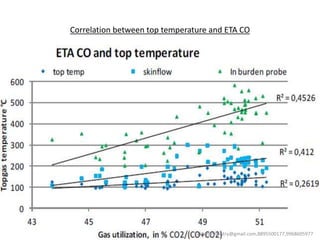
ETA CO and top temperature: Ttop, skinfl A: 2 cm in wall, 2,5 m below stockline ,
IBP: in burden probe (80 cm in burden, 3 m below stockline
Declining IBP,SKIN TEMP,ETA CO
akmistrymistry@gmail.com,8895500177,9968605977
Correlation between top temperature and ETA CO
akmistrymistry@gmail.com,8895500177,9968605977
Example showing the effect of heavy rain on in burden probe temperatures allowing
for corrective action
akmistrymistry@gmail.com,8895500177,9968605977
Burden distribution if not work next---Reducing oxygen is betterway to
combat loss of skin temperatures,top temperature-how?
The most effective action to
increase skin flow and in
burden temperatures, which
are low due to high burden
moisture, is to reduce oxygen
enrichment.
Just putting more coke at the wall
will mean that there is insufficient
gas somewhere else to dry the
burden.
akmistrymistry@gmail.com,8895500177,9968605977
windup
Efficient blast furnace operation demands sufficient drying capacity of the gas.
The evidence is based on the direct reduction rate close to the wall and the burden temperature as measured close to the wall
The best available top temperature indicator is continuous monitoring by in burden temperatures a few meters below the burden level and
50-80 cm inside the burden with short, fixed in burden probes.
Proper gas reduction of ferrous burden helps to prevent upsets arising from poor melting of the burden.
Besides the top temperature, spreading fines over the radius helps to make the gas flow more uniform and contributes to improved gas
reduction.
Some blast furnace upsets are caused by inadequate melting of the burden leading to poor drainage of liquids.
This can be caused by radial variation of the direct reduction of the burden. Data from measurements with retractable in burden probes
indicate that gas in the very center shows low direct reduction rate and in the wall area direct reduction rate is highly variable, (but stable and
low at low production rates).
Radial differences of direct reduction rates are ±15 kg coke/tHM. Since the major part (80%+) of the “superheat” of the raceway gas (>
1400°C) is used to drive the direct reduction, local high direct reduction rates can and will lead to poor and improper melting of the burden on
its way to the tuyeres. This can lead to unstable thermal level, poor burden descent and/or tuyere failures and tuyere tipping.
akmistrymistry@gmail.com,8895500177,9968605977

Blast furnace-Top temperature and process efficiency

  • 1.
    IMPROVING DRYING CAPACITYAND PROCESS EFFICIENCY OF BLAST FURNACE akmistrymistry@gmail.com 8895500177,9968605977
  • 2.
    The moisture chargedinto the furnace with the coke and ore burden must be removed before the reduction process can start. Additional to the moisture charged (typically 30-40 kg /tHM), there is water generated from the hydrogen produced from the injectants at the tuyeres. At a coal injection level of 200 kg/tHM and 4.5% hydrogen in coal, about 32 kg of “process” water per ton hot metal comes from the coal. The amount of water generated from natural gas is even higher: at an injection level of 80 kg/tHM, about 65 kg water comes from the natural gas. Wall area is important as wall is most difficult place to dry and to melt burden due to high burden thickness and lower gas temperature caused by cooling losses. To supplement probes, skin flow (gas flow along the wall) temperatures are measured at three different levels by 4-8 thermocouples. These thermocouples measure gas flow temperatures at upper - mid stack to ensure adequate drying of burden at the wall and measure uniformity of gas flow. However, water circulates in the furnace: part of the moisture condenses on the cold coke and ferrous burden charged, occasionally even at the cooling staves in the furnace upper stack and throat. This leads to a condensation-evaporation cycle, indicated with blue arrows in fig The lower the top temperature, the more difficult it is to remove the moisture from the furnace and the larger the quantity of water subject to the condensation-evaporation cycle. If the moisture input increases, then it will take longer for the material to dry and the isotherm where the reduction process will start will descend downwards (Figure 1). As a consequence the reduction process will be less efficient. More oxygen will remain bound to iron and this oxygen then has to be removed by direct reduction in the lower part of the furnace. Fce drying capacity- Water has to be eliminated with the top gas akmistrymistry@gmail.com,8895500177,9968605977
  • 3.
    White line indicates100°C isotherm. green line fixed in burden probe,red dot skinflo Phase 1: normal operation with central gas flow Phase 2: if water vapour cannot completely be eliminated, it condenses as gas temp < 80°C especially in the wall area Phase 3: 100°C isotherm driven downwards leading to short reduction length in the wall area and high direct reduction However, water circulates in the furnace: part of the moisture condenses on the cold coke and ferrous burden charged, occasionally even at the cooling staves in the furnace upper stack and throat.(Modern fces equip with hot water recirculation in throat) This leads to a condensation- evaporation cycle, indicated with blue arrows Condensation/evaporation cycle akmistrymistry@gmail.com,8895500177,9968605977
  • 4.
    Process diagnostic approach Lowskin flow temperatures can often be a good indicator of insufficient moisture removal. If the skin flow temperatures decrease and this is followed by low Eta CO then this indicates that there is insufficient gas flow/thm to dry the burden properly.(next slide shown) what are the off take temperatures doing? If these are still OK, and you think there is too much central gas flow, then it may be possible to move some coke from centre to wall to ensure adequate drying. In burden probe feedback is important to evaluate moisture loading in the fce.(next slide to exemplify )If they are also quite low then the problem is for the whole furnace and you will need to reduce moisture loading or oxygen enrichment to increase gas flow rate/thm. akmistrymistry@gmail.com,8895500177,9968605977
  • 5.
    Operational example: productivity,top temperature and furnace efficiency ETA CO and top temperature: Ttop, skinfl A: 2 cm in wall, 2,5 m below stockline , IBP: in burden probe (80 cm in burden, 3 m below stockline Declining IBP,SKIN TEMP,ETA CO akmistrymistry@gmail.com,8895500177,9968605977
  • 6.
    Correlation between toptemperature and ETA CO akmistrymistry@gmail.com,8895500177,9968605977
  • 7.
    Example showing theeffect of heavy rain on in burden probe temperatures allowing for corrective action akmistrymistry@gmail.com,8895500177,9968605977
  • 8.
    Burden distribution ifnot work next---Reducing oxygen is betterway to combat loss of skin temperatures,top temperature-how? The most effective action to increase skin flow and in burden temperatures, which are low due to high burden moisture, is to reduce oxygen enrichment. Just putting more coke at the wall will mean that there is insufficient gas somewhere else to dry the burden. akmistrymistry@gmail.com,8895500177,9968605977
  • 9.
    windup Efficient blast furnaceoperation demands sufficient drying capacity of the gas. The evidence is based on the direct reduction rate close to the wall and the burden temperature as measured close to the wall The best available top temperature indicator is continuous monitoring by in burden temperatures a few meters below the burden level and 50-80 cm inside the burden with short, fixed in burden probes. Proper gas reduction of ferrous burden helps to prevent upsets arising from poor melting of the burden. Besides the top temperature, spreading fines over the radius helps to make the gas flow more uniform and contributes to improved gas reduction. Some blast furnace upsets are caused by inadequate melting of the burden leading to poor drainage of liquids. This can be caused by radial variation of the direct reduction of the burden. Data from measurements with retractable in burden probes indicate that gas in the very center shows low direct reduction rate and in the wall area direct reduction rate is highly variable, (but stable and low at low production rates). Radial differences of direct reduction rates are ±15 kg coke/tHM. Since the major part (80%+) of the “superheat” of the raceway gas (> 1400°C) is used to drive the direct reduction, local high direct reduction rates can and will lead to poor and improper melting of the burden on its way to the tuyeres. This can lead to unstable thermal level, poor burden descent and/or tuyere failures and tuyere tipping. akmistrymistry@gmail.com,8895500177,9968605977