1
08.09.2017 | Knowledge Management Group | Sven Hertling | 1
Top-k Shortest Paths in Directed Labeled
Multigraphs
Sven Hertling, Markus Schröder, Christian Jilek, Andreas Dengel
Top-K Shortest Path in
Large Typed RDF Graphs
Challenge
ESWC 2016
1
Motivation
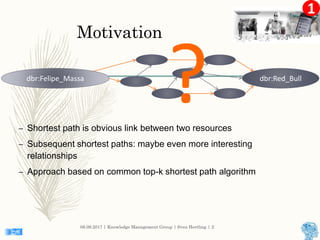
– Shortest path is obvious link between two resources
– Subsequent shortest paths: maybe even more interesting
relationships
– Approach based on common top-k shortest path algorithm
08.09.2017 | Knowledge Management Group | Sven Hertling | 2
dbr:Felipe_Massa dbr:Red_Bull
?
1
Outline
– Top-k shortest path introduction
– Approach based on eppstein algorithm
– Evaluation based on challenge training and test set
– SPARQL implementation
– Conclusion
08.09.2017 | Knowledge Management Group | Sven Hertling | 3
intro | approach | eval | sparql | conclusion
1
INTRODUCTION
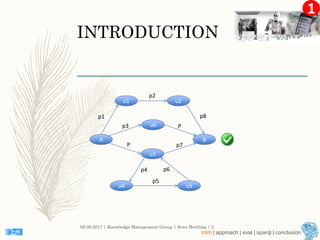
– Finding not only shortest path but also subsequent ones
– Based on knowledge represented as RDF (Resource Description
Framework)
– Additional constraints
– a path is valid only if it contains unique triples
– but can have multiply visited vertices
– Common algorithms cannot be applied
08.09.2017 | Knowledge Management Group | Sven Hertling | 4
intro | approach | eval | sparql | conclusion
1
INTRODUCTION
08.09.2017 | Knowledge Management Group | Sven Hertling | 5
A
u6
u3
u1 u2
B
u4 u5
p1
p2
p3
P
p5
p6
p7
p8
P
p4
intro | approach | eval | sparql | conclusion
1
INTRODUCTION
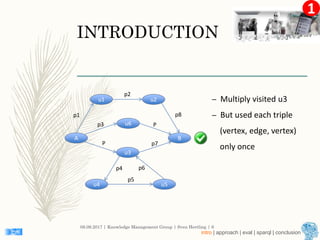
– Multiply visited u3
– But used each triple
(vertex, edge, vertex)
only once
08.09.2017 | Knowledge Management Group | Sven Hertling | 6
A
u6
u3
u1 u2
B
u4 u5
p1
p2
p3
P
p5
p6
p7
p8
P
p4
intro | approach | eval | sparql | conclusion
1
INTRODUCTION
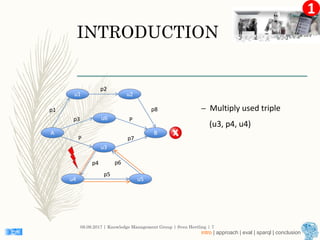
– Multiply used triple
(u3, p4, u4)
08.09.2017 | Knowledge Management Group | Sven Hertling | 7
A
u6
u3
u1 u2
B
u4 u5
p1
p2
p3
P
p5
p6
p7
p8
P
p4
intro | approach | eval | sparql | conclusion
1
INTRODUCTION
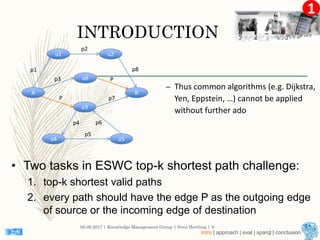
– Thus common algorithms (e.g. Dijkstra,
Yen, Eppstein, …) cannot be applied
without further ado
08.09.2017 | Knowledge Management Group | Sven Hertling | 8
• Two tasks in ESWC top-k shortest path challenge:
1. top-k shortest valid paths
2. every path should have the edge P as the outgoing edge
of source or the incoming edge of destination
A
u6
u3
u1 u2
B
u4 u5
p1
p2
p3
P
p5
p6
p7
p8
P
p4
intro | approach | eval | sparql | conclusion
1
APPROACH
08.09.2017 | Knowledge Management Group | Sven Hertling | 9
A
u6
u3
u1 u2
B
u4 u5
p1
p2
p3
P
p5
p6
p7
p8
P
p4
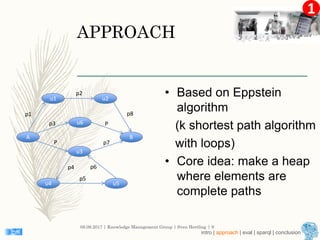
• Based on Eppstein
algorithm
(k shortest path algorithm
with loops)
• Core idea: make a heap
where elements are
complete paths
intro | approach | eval | sparql | conclusion
1
APPROACH
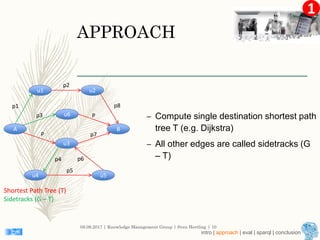
– Compute single destination shortest path
tree T (e.g. Dijkstra)
– All other edges are called sidetracks (G
– T)
08.09.2017 | Knowledge Management Group | Sven Hertling | 10
A
u6
u3
u1 u2
B
u4 u5
p1
p2
p3
P
p5
p6
p7
p8
P
p4
Shortest Path Tree (T)
Sidetracks (G – T)
intro | approach | eval | sparql | conclusion
1
APPROACH
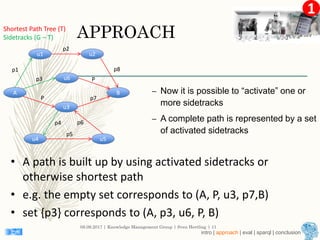
– Now it is possible to “activate” one or
more sidetracks
– A complete path is represented by a set
of activated sidetracks
08.09.2017 | Knowledge Management Group | Sven Hertling | 11
A
u6
u3
u1 u2
B
u4 u5
p1
p2
p3
P
p5
p6
p7
p8
P
Shortest Path Tree (T)
Sidetracks (G – T)
p4
• A path is built up by using activated sidetracks or
otherwise shortest path
• e.g. the empty set corresponds to (A, P, u3, p7,B)
• set {p3} corresponds to (A, p3, u6, P, B)
intro | approach | eval | sparql | conclusion
1
APPROACH
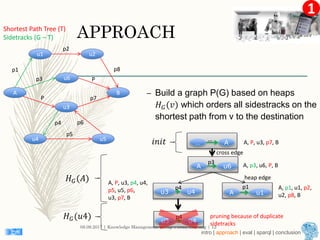
– Build a graph P(G) based on heaps
𝐻 𝐺(𝑣) which orders all sidestracks on the
shortest path from v to the destination
08.09.2017 | Knowledge Management Group | Sven Hertling | 12
A
u6
u3
u1 u2
B
u4 u5
p1
p2
p3
P
p5
p6
p7
p8
P
Shortest Path Tree (T)
Sidetracks (G – T)
p4
… A
…
A u6
p3
u3 u4
p4
A u1
p1
A, P, u3, p7, B
A, p3, u6, P, B
A, P, u3, p4, u4,
p5, u5, p6,
u3, p7, B
A, p1, u1, p2,
u2, p8, B
u3 u4
p4 pruning because of duplicate
sidetracks
𝐻 𝐺(𝐴)
𝑖𝑛𝑖𝑡
𝐻 𝐺(𝑢4)
heap edge
cross edge
intro | approach | eval | sparql | conclusion
1
APPROACH
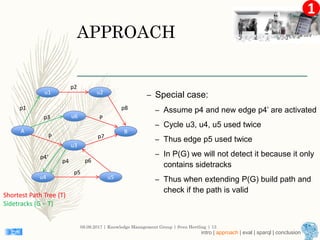
– Special case:
– Assume p4 and new edge p4’ are activated
– Cycle u3, u4, u5 used twice
– Thus edge p5 used twice
– In P(G) we will not detect it because it only
contains sidetracks
– Thus when extending P(G) build path and
check if the path is valid
08.09.2017 | Knowledge Management Group | Sven Hertling | 13
Shortest Path Tree (T)
Sidetracks (G – T)
P
B
p8
A
u6
u3
u1 u2
u4 u5
p1
p2
p3
P
p5
p6
p7
p4
p4‘
intro | approach | eval | sparql | conclusion
1
APPROACH
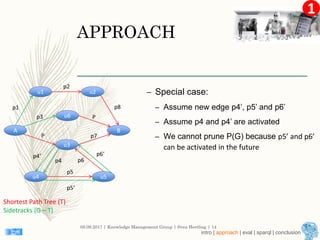
– Special case:
– Assume new edge p4’, p5’ and p6’
– Assume p4 and p4’ are activated
– We cannot prune P(G) because p5’ and p6’
can be activated in the future
08.09.2017 | Knowledge Management Group | Sven Hertling | 14
Shortest Path Tree (T)
Sidetracks (G – T)
A
u6
u3
u1 u2
B
u4 u5
p1
p2
p3
P
p5
p6
p7
p8
P
p4
p4‘
p5‘
p6‘
intro | approach | eval | sparql | conclusion
1
APPROACH
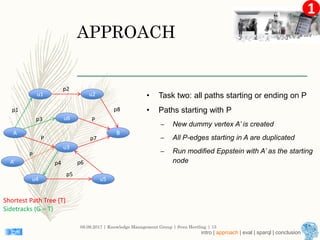
• Task two: all paths starting or ending on P
• Paths starting with P
– New dummy vertex A’ is created
– All P-edges starting in A are duplicated
– Run modified Eppstein with A’ as the starting
node
08.09.2017 | Knowledge Management Group | Sven Hertling | 15
Shortest Path Tree (T)
Sidetracks (G – T)
A
u6
u3
u1 u2
B
u4 u5
p1
p2
p3
P
p5
p6
p7
p8
P
p4A‘
P
intro | approach | eval | sparql | conclusion
1
APPROACH
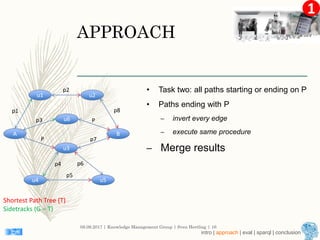
• Task two: all paths starting or ending on P
• Paths ending with P
– invert every edge
– execute same procedure
– Merge results
08.09.2017 | Knowledge Management Group | Sven Hertling | 16
Shortest Path Tree (T)
Sidetracks (G – T)
A
u6
u3
u1 u2
B
u4 u5
p1
p2
p3
P
p5
p6
p7
p8
P
p4
intro | approach | eval | sparql | conclusion
1
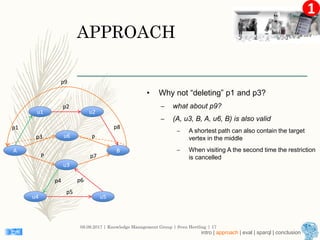
• Why not “deleting” p1 and p3?
– what about p9?
– (A, u3, B, A, u6, B) is also valid
– A shortest path can also contain the target
vertex in the middle
– When visiting A the second time the restriction
is cancelled
08.09.2017 | Knowledge Management Group | Sven Hertling | 17
p9
B
p1
A
u6
u3
u1 u2
u4 u5
p2
p3
P
p5
p6
p7
p8
P
p4
intro | approach | eval | sparql | conclusion
APPROACH
1
EVALUATION
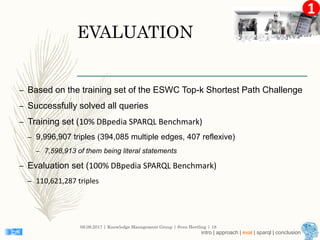
– Based on the training set of the ESWC Top-k Shortest Path Challenge
– Successfully solved all queries
– Training set (10% DBpedia SPARQL Benchmark)
– 9,996,907 triples (394,085 multiple edges, 407 reflexive)
– 7,598,913 of them being literal statements
– Evaluation set (100% DBpedia SPARQL Benchmark)
– 110,621,287 triples
08.09.2017 | Knowledge Management Group | Sven Hertling | 18
intro | approach | eval | sparql | conclusion
1
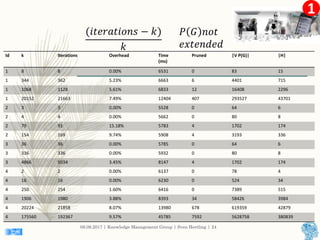
EVALUATION
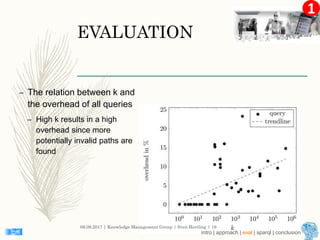
– The relation between k and
the overhead of all queries
– High k results in a high
overhead since more
potentially invalid paths are
found
08.09.2017 | Knowledge Management Group | Sven Hertling | 19
intro | approach | eval | sparql | conclusion
1
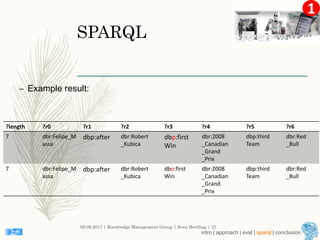
SPARQL
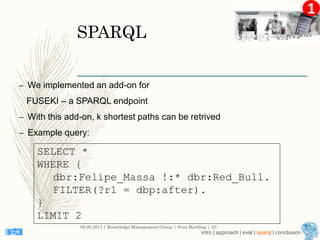
– We implemented an add-on for
FUSEKI – a SPARQL endpoint
– With this add-on, k shortest paths can be retrived
– Example query:
08.09.2017 | Knowledge Management Group | Sven Hertling | 20
SELECT *
WHERE {
dbr:Felipe_Massa !:* dbr:Red_Bull.
FILTER(?r1 = dbp:after).
}
LIMIT 2
intro | approach | eval | sparql | conclusion
1
SPARQL
– Example result:
08.09.2017 | Knowledge Management Group | Sven Hertling | 21
?length ?r0 ?r1 ?r2 ?r3 ?r4 ?r5 ?r6
7 dbr:Felipe_M
assa
dbp:after dbr:Robert
_Kubica
dbp:first
Win
dbr:2008
_Canadian
_Grand
_Prix
dbp:third
Team
dbr:Red
_Bull
7 dbr:Felipe_M
assa
dbp:after dbr:Robert
_Kubica
dbo:first
Win
dbr:2008
_Canadian
_Grand
_Prix
dbp:third
Team
dbr:Red
_Bull
intro | approach | eval | sparql | conclusion
1
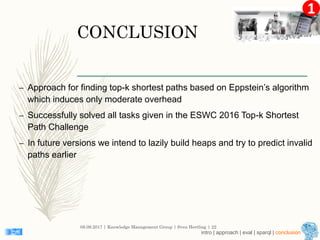
CONCLUSION
– Approach for finding top-k shortest paths based on Eppstein’s algorithm
which induces only moderate overhead
– Successfully solved all tasks given in the ESWC 2016 Top-k Shortest
Path Challenge
– In future versions we intend to lazily build heaps and try to predict invalid
paths earlier
08.09.2017 | Knowledge Management Group | Sven Hertling | 22
intro | approach | eval | sparql | conclusion
1
Thank you
– Questions, opinions, suggestions, discussions
08.09.2017 | Knowledge Management Group | Sven Hertling | 23
?
1
Id k Iterations Overhead Time
(ms)
Pruned |V P(G)| |H|
1 8 8 0.00% 6531 0 83 15
1 344 362 5.23% 6663 6 4401 715
1 1068 1128 5.61% 6833 12 16408 2296
1 20152 21663 7.49% 12404 407 293527 43701
2 3 3 0.00% 5528 0 64 6
2 4 4 0.00% 5662 0 80 8
2 79 91 15.18% 5783 4 1702 174
2 154 169 9.74% 5908 4 3193 336
3 36 36 0.00% 5785 0 64 6
3 336 336 0.00% 5932 0 80 8
3 4866 5034 3.45% 8147 4 1702 174
4 2 2 0.00% 6137 0 78 4
4 16 16 0.00% 6230 0 524 34
4 250 254 1.60% 6416 0 7389 515
4 1906 1980 3.88% 8393 34 58426 3984
4 20224 21858 8.07% 13980 678 619359 42879
4 175560 192367 9.57% 45785 7592 5628758 380839
(𝑖𝑡𝑒𝑟𝑎𝑡𝑖𝑜𝑛𝑠 − 𝑘)
𝑘
𝑃 𝐺 𝑛𝑜𝑡
𝑒𝑥𝑡𝑒𝑛𝑑𝑒𝑑
08.09.2017 | Knowledge Management Group | Sven Hertling | 24

Top k shortest-paths in directed labelled multi-graphs

  • 1.
    1 08.09.2017 | KnowledgeManagement Group | Sven Hertling | 1 Top-k Shortest Paths in Directed Labeled Multigraphs Sven Hertling, Markus Schröder, Christian Jilek, Andreas Dengel Top-K Shortest Path in Large Typed RDF Graphs Challenge ESWC 2016
  • 2.
    1 Motivation – Shortest pathis obvious link between two resources – Subsequent shortest paths: maybe even more interesting relationships – Approach based on common top-k shortest path algorithm 08.09.2017 | Knowledge Management Group | Sven Hertling | 2 dbr:Felipe_Massa dbr:Red_Bull ?
  • 3.
    1 Outline – Top-k shortestpath introduction – Approach based on eppstein algorithm – Evaluation based on challenge training and test set – SPARQL implementation – Conclusion 08.09.2017 | Knowledge Management Group | Sven Hertling | 3 intro | approach | eval | sparql | conclusion
  • 4.
    1 INTRODUCTION – Finding notonly shortest path but also subsequent ones – Based on knowledge represented as RDF (Resource Description Framework) – Additional constraints – a path is valid only if it contains unique triples – but can have multiply visited vertices – Common algorithms cannot be applied 08.09.2017 | Knowledge Management Group | Sven Hertling | 4 intro | approach | eval | sparql | conclusion
  • 5.
    1 INTRODUCTION 08.09.2017 | KnowledgeManagement Group | Sven Hertling | 5 A u6 u3 u1 u2 B u4 u5 p1 p2 p3 P p5 p6 p7 p8 P p4 intro | approach | eval | sparql | conclusion
  • 6.
    1 INTRODUCTION – Multiply visitedu3 – But used each triple (vertex, edge, vertex) only once 08.09.2017 | Knowledge Management Group | Sven Hertling | 6 A u6 u3 u1 u2 B u4 u5 p1 p2 p3 P p5 p6 p7 p8 P p4 intro | approach | eval | sparql | conclusion
  • 7.
    1 INTRODUCTION – Multiply usedtriple (u3, p4, u4) 08.09.2017 | Knowledge Management Group | Sven Hertling | 7 A u6 u3 u1 u2 B u4 u5 p1 p2 p3 P p5 p6 p7 p8 P p4 intro | approach | eval | sparql | conclusion
  • 8.
    1 INTRODUCTION – Thus commonalgorithms (e.g. Dijkstra, Yen, Eppstein, …) cannot be applied without further ado 08.09.2017 | Knowledge Management Group | Sven Hertling | 8 • Two tasks in ESWC top-k shortest path challenge: 1. top-k shortest valid paths 2. every path should have the edge P as the outgoing edge of source or the incoming edge of destination A u6 u3 u1 u2 B u4 u5 p1 p2 p3 P p5 p6 p7 p8 P p4 intro | approach | eval | sparql | conclusion
  • 9.
    1 APPROACH 08.09.2017 | KnowledgeManagement Group | Sven Hertling | 9 A u6 u3 u1 u2 B u4 u5 p1 p2 p3 P p5 p6 p7 p8 P p4 • Based on Eppstein algorithm (k shortest path algorithm with loops) • Core idea: make a heap where elements are complete paths intro | approach | eval | sparql | conclusion
  • 10.
    1 APPROACH – Compute singledestination shortest path tree T (e.g. Dijkstra) – All other edges are called sidetracks (G – T) 08.09.2017 | Knowledge Management Group | Sven Hertling | 10 A u6 u3 u1 u2 B u4 u5 p1 p2 p3 P p5 p6 p7 p8 P p4 Shortest Path Tree (T) Sidetracks (G – T) intro | approach | eval | sparql | conclusion
  • 11.
    1 APPROACH – Now itis possible to “activate” one or more sidetracks – A complete path is represented by a set of activated sidetracks 08.09.2017 | Knowledge Management Group | Sven Hertling | 11 A u6 u3 u1 u2 B u4 u5 p1 p2 p3 P p5 p6 p7 p8 P Shortest Path Tree (T) Sidetracks (G – T) p4 • A path is built up by using activated sidetracks or otherwise shortest path • e.g. the empty set corresponds to (A, P, u3, p7,B) • set {p3} corresponds to (A, p3, u6, P, B) intro | approach | eval | sparql | conclusion
  • 12.
    1 APPROACH – Build agraph P(G) based on heaps 𝐻 𝐺(𝑣) which orders all sidestracks on the shortest path from v to the destination 08.09.2017 | Knowledge Management Group | Sven Hertling | 12 A u6 u3 u1 u2 B u4 u5 p1 p2 p3 P p5 p6 p7 p8 P Shortest Path Tree (T) Sidetracks (G – T) p4 … A … A u6 p3 u3 u4 p4 A u1 p1 A, P, u3, p7, B A, p3, u6, P, B A, P, u3, p4, u4, p5, u5, p6, u3, p7, B A, p1, u1, p2, u2, p8, B u3 u4 p4 pruning because of duplicate sidetracks 𝐻 𝐺(𝐴) 𝑖𝑛𝑖𝑡 𝐻 𝐺(𝑢4) heap edge cross edge intro | approach | eval | sparql | conclusion
  • 13.
    1 APPROACH – Special case: –Assume p4 and new edge p4’ are activated – Cycle u3, u4, u5 used twice – Thus edge p5 used twice – In P(G) we will not detect it because it only contains sidetracks – Thus when extending P(G) build path and check if the path is valid 08.09.2017 | Knowledge Management Group | Sven Hertling | 13 Shortest Path Tree (T) Sidetracks (G – T) P B p8 A u6 u3 u1 u2 u4 u5 p1 p2 p3 P p5 p6 p7 p4 p4‘ intro | approach | eval | sparql | conclusion
  • 14.
    1 APPROACH – Special case: –Assume new edge p4’, p5’ and p6’ – Assume p4 and p4’ are activated – We cannot prune P(G) because p5’ and p6’ can be activated in the future 08.09.2017 | Knowledge Management Group | Sven Hertling | 14 Shortest Path Tree (T) Sidetracks (G – T) A u6 u3 u1 u2 B u4 u5 p1 p2 p3 P p5 p6 p7 p8 P p4 p4‘ p5‘ p6‘ intro | approach | eval | sparql | conclusion
  • 15.
    1 APPROACH • Task two:all paths starting or ending on P • Paths starting with P – New dummy vertex A’ is created – All P-edges starting in A are duplicated – Run modified Eppstein with A’ as the starting node 08.09.2017 | Knowledge Management Group | Sven Hertling | 15 Shortest Path Tree (T) Sidetracks (G – T) A u6 u3 u1 u2 B u4 u5 p1 p2 p3 P p5 p6 p7 p8 P p4A‘ P intro | approach | eval | sparql | conclusion
  • 16.
    1 APPROACH • Task two:all paths starting or ending on P • Paths ending with P – invert every edge – execute same procedure – Merge results 08.09.2017 | Knowledge Management Group | Sven Hertling | 16 Shortest Path Tree (T) Sidetracks (G – T) A u6 u3 u1 u2 B u4 u5 p1 p2 p3 P p5 p6 p7 p8 P p4 intro | approach | eval | sparql | conclusion
  • 17.
    1 • Why not“deleting” p1 and p3? – what about p9? – (A, u3, B, A, u6, B) is also valid – A shortest path can also contain the target vertex in the middle – When visiting A the second time the restriction is cancelled 08.09.2017 | Knowledge Management Group | Sven Hertling | 17 p9 B p1 A u6 u3 u1 u2 u4 u5 p2 p3 P p5 p6 p7 p8 P p4 intro | approach | eval | sparql | conclusion APPROACH
  • 18.
    1 EVALUATION – Based onthe training set of the ESWC Top-k Shortest Path Challenge – Successfully solved all queries – Training set (10% DBpedia SPARQL Benchmark) – 9,996,907 triples (394,085 multiple edges, 407 reflexive) – 7,598,913 of them being literal statements – Evaluation set (100% DBpedia SPARQL Benchmark) – 110,621,287 triples 08.09.2017 | Knowledge Management Group | Sven Hertling | 18 intro | approach | eval | sparql | conclusion
  • 19.
    1 EVALUATION – The relationbetween k and the overhead of all queries – High k results in a high overhead since more potentially invalid paths are found 08.09.2017 | Knowledge Management Group | Sven Hertling | 19 intro | approach | eval | sparql | conclusion
  • 20.
    1 SPARQL – We implementedan add-on for FUSEKI – a SPARQL endpoint – With this add-on, k shortest paths can be retrived – Example query: 08.09.2017 | Knowledge Management Group | Sven Hertling | 20 SELECT * WHERE { dbr:Felipe_Massa !:* dbr:Red_Bull. FILTER(?r1 = dbp:after). } LIMIT 2 intro | approach | eval | sparql | conclusion
  • 21.
    1 SPARQL – Example result: 08.09.2017| Knowledge Management Group | Sven Hertling | 21 ?length ?r0 ?r1 ?r2 ?r3 ?r4 ?r5 ?r6 7 dbr:Felipe_M assa dbp:after dbr:Robert _Kubica dbp:first Win dbr:2008 _Canadian _Grand _Prix dbp:third Team dbr:Red _Bull 7 dbr:Felipe_M assa dbp:after dbr:Robert _Kubica dbo:first Win dbr:2008 _Canadian _Grand _Prix dbp:third Team dbr:Red _Bull intro | approach | eval | sparql | conclusion
  • 22.
    1 CONCLUSION – Approach forfinding top-k shortest paths based on Eppstein’s algorithm which induces only moderate overhead – Successfully solved all tasks given in the ESWC 2016 Top-k Shortest Path Challenge – In future versions we intend to lazily build heaps and try to predict invalid paths earlier 08.09.2017 | Knowledge Management Group | Sven Hertling | 22 intro | approach | eval | sparql | conclusion
  • 23.
    1 Thank you – Questions,opinions, suggestions, discussions 08.09.2017 | Knowledge Management Group | Sven Hertling | 23 ?
  • 24.
    1 Id k IterationsOverhead Time (ms) Pruned |V P(G)| |H| 1 8 8 0.00% 6531 0 83 15 1 344 362 5.23% 6663 6 4401 715 1 1068 1128 5.61% 6833 12 16408 2296 1 20152 21663 7.49% 12404 407 293527 43701 2 3 3 0.00% 5528 0 64 6 2 4 4 0.00% 5662 0 80 8 2 79 91 15.18% 5783 4 1702 174 2 154 169 9.74% 5908 4 3193 336 3 36 36 0.00% 5785 0 64 6 3 336 336 0.00% 5932 0 80 8 3 4866 5034 3.45% 8147 4 1702 174 4 2 2 0.00% 6137 0 78 4 4 16 16 0.00% 6230 0 524 34 4 250 254 1.60% 6416 0 7389 515 4 1906 1980 3.88% 8393 34 58426 3984 4 20224 21858 8.07% 13980 678 619359 42879 4 175560 192367 9.57% 45785 7592 5628758 380839 (𝑖𝑡𝑒𝑟𝑎𝑡𝑖𝑜𝑛𝑠 − 𝑘) 𝑘 𝑃 𝐺 𝑛𝑜𝑡 𝑒𝑥𝑡𝑒𝑛𝑑𝑒𝑑 08.09.2017 | Knowledge Management Group | Sven Hertling | 24