INTRAVITREAL BEVACIZUMAB TREATMENT OF CHOROIDAL NEOVASCULARIZATION SECONDARY TO AGE-RELATED MACULAR DEGENERATION  Spaide RF, et al.  Retina 2006; 26(4), 383-390. Terry J. Alexandrou, MD Department of Ophthalmology and Visual Science University of Chicago Journal Club
Purpose To describe the short-term anatomical and visual acuity responses after intravitreal injection of bevacizumab (Avastin, Genentech) in patients with choroidal neovascularization (CNV) secondary to age-related macular degeneration (AMD).
Choroidal neovascularization secondary to Age-related macular degeneration A variety of methods have been used to stem the loss of vision by targeting the vascular portion of the lesion  Thermal laser PDT Agents that block the effects of vascular endothelial growth factor (VEGF)  pegaptanib (macugen) - aptamer that targets only one of several splice lengths of VEGF (VEGF 165)
Bevacizumab  (Avastin, Genentech) A full-length antibody that binds all isoforms of VEGF Was developed for the treatment of cancer Bevacizumab is currently approved for use in humans but is labeled for cancer treatment  The full-length antibody has two binding sites for VEGF, while the antibody fragment has only one
Methods Retrospective study of 266 eyes of 266 patients with CNV secondary to ARMD who were treated with off-label  intravitreal bevacizumab (avastin)(1.25 mg) Institutional review board approval  Informed consent obtained from all patients (off-label use)
Methods Best-corrected distance visual acuity measurement with a Snellen chart  Ophthalmic examination including slit-lamp biomicroscopy Baseline central retinal thickness was measured by optical coherence tomography (OCT)  Examined at 1 week and 1 month after the first injection and monthly thereafter  Fluorescein angiography was done at the discretion of the examiner
Statistical Analysis  Data for all patients who received injections during the first 3 months of our use of bevacizumab were entered into a database  Visual acuity was converted to logMAR before analysis [chi]2 testing
Main Outcome Measurements  Visual acuity Central retinal thickness measured by OCT
Results Mean age of the patients was 80.3 ± 7.5 years  Mean visual acuity was 20/184  175 patients (69.7%) were previously treated  139 (55.4%) had prior PDT with or without concomitant triamcinolone,  53 (21.1%) had previous pegaptanib treatment  43 (17.1%) had other treatments (anecortave acetate, thermal laser for nonsubfoveal lesions, and intravitreal triamcinolone without concomitant PDT)
Results Baseline OCT was performed for 214 patients  Mean central foveal thickness ± SD was 340 ± 206 µm Cystoid macular edema was present in 120 patients (47.8%)
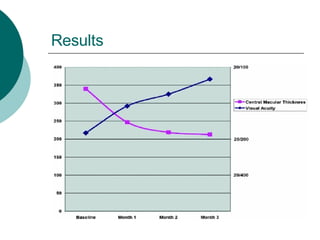
Results – 1 month follow-up Mean visual acuity was 20/131 (P < 0.001), and 67 (33.5%) of patients had improvement in visual acuity as defined by a halving of the visual angle  Thirteen patients (6.1%) had worse visual acuity  Mean central macular thickness was 250 ± 190 µm  n=170 significantly less than the baseline finding (P < 0.001)  Eighty percent of patients had a reduction of their central macular thickness at 1 month 2 patients had mild vitritis one of these patients had a history of previous recurrent uveitis before injection, and the other had spontaneous resolution by the 2-month follow-up
Results – 2 and 3 month follow-up Mean visual acuity was 20/122 At 2 months, 78 patients (31.1%) had better visual acuity, and 17 (8%) had worse visual acuity At 3 months the mean visual acuity was 20/109; 54 patients (38.3%) had improved visual acuity, while 10 (4.7%) had worse vision (n = 141) No endophthalmitis, increased intraocular pressure, retinal tears, or retinal detachment occurred in any patient  Patients previously treated with pegaptanib, PDT, or other forms of therapy had significant improvements in mean visual acuity and in mean central macular thickness at the 1-, 2-, and 3-month follow-ups
Results
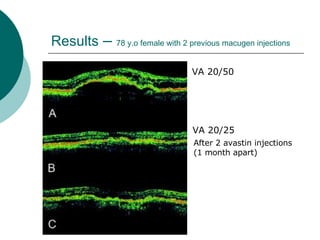
Results  –  78 y.o female with 2 previous macugen injections VA 20/50 After 2 avastin injections  (1 month apart) VA 20/25
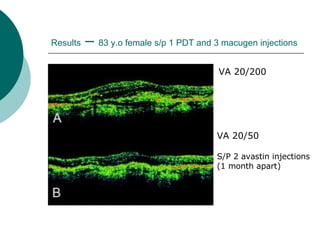
Results  –  83 y.o female s/p 1 PDT and 3 macugen injections VA 20/200 VA 20/50 S/P 2 avastin injections (1 month apart)
Safety One patient developed a nonfatal myocardial infarction one month after the third injection  One patient died of metastatic breast cancer  One patient died of a myocardial infarction (76 y.o smoker with emphysema, single injection)
Conclusions Consecutive eyes with CNV secondary to AMD that were treated with intravitreal bevacizumab in this retrospective study had anatomical as well as functional improvement, even though most did not have a satisfactory response to previous treatment  >30% of patients having visual acuity improvement (defined as a halving of the visual angle at every time point measured in this short-term study).
Conclusions There was a prominent decrease in macular thickness as measured by OCT  There was no significant correlation between the change in macular thickness and the change in visual acuity
Study Limitations short-term follow-up   retrospective design  Nonrandomized Uncontrolled
Discussion Difficult to assess the long-term efficacy of safety of bevacizumad based on this study, however these results are encouraging
Discussion At the time of this study, lucentis had not yet been approved.   These encouraging results warrant further investigation, especially given the enormous discrepancy in price between lucentis and avastin

Avastin for Choroidal Neovascularization 2/2 ARMD

  • 1.
    INTRAVITREAL BEVACIZUMAB TREATMENTOF CHOROIDAL NEOVASCULARIZATION SECONDARY TO AGE-RELATED MACULAR DEGENERATION Spaide RF, et al. Retina 2006; 26(4), 383-390. Terry J. Alexandrou, MD Department of Ophthalmology and Visual Science University of Chicago Journal Club
  • 2.
    Purpose To describethe short-term anatomical and visual acuity responses after intravitreal injection of bevacizumab (Avastin, Genentech) in patients with choroidal neovascularization (CNV) secondary to age-related macular degeneration (AMD).
  • 3.
    Choroidal neovascularization secondaryto Age-related macular degeneration A variety of methods have been used to stem the loss of vision by targeting the vascular portion of the lesion Thermal laser PDT Agents that block the effects of vascular endothelial growth factor (VEGF) pegaptanib (macugen) - aptamer that targets only one of several splice lengths of VEGF (VEGF 165)
  • 4.
    Bevacizumab (Avastin,Genentech) A full-length antibody that binds all isoforms of VEGF Was developed for the treatment of cancer Bevacizumab is currently approved for use in humans but is labeled for cancer treatment The full-length antibody has two binding sites for VEGF, while the antibody fragment has only one
  • 5.
    Methods Retrospective studyof 266 eyes of 266 patients with CNV secondary to ARMD who were treated with off-label intravitreal bevacizumab (avastin)(1.25 mg) Institutional review board approval Informed consent obtained from all patients (off-label use)
  • 6.
    Methods Best-corrected distancevisual acuity measurement with a Snellen chart Ophthalmic examination including slit-lamp biomicroscopy Baseline central retinal thickness was measured by optical coherence tomography (OCT) Examined at 1 week and 1 month after the first injection and monthly thereafter Fluorescein angiography was done at the discretion of the examiner
  • 7.
    Statistical Analysis Data for all patients who received injections during the first 3 months of our use of bevacizumab were entered into a database Visual acuity was converted to logMAR before analysis [chi]2 testing
  • 8.
    Main Outcome Measurements Visual acuity Central retinal thickness measured by OCT
  • 9.
    Results Mean ageof the patients was 80.3 ± 7.5 years Mean visual acuity was 20/184 175 patients (69.7%) were previously treated 139 (55.4%) had prior PDT with or without concomitant triamcinolone, 53 (21.1%) had previous pegaptanib treatment 43 (17.1%) had other treatments (anecortave acetate, thermal laser for nonsubfoveal lesions, and intravitreal triamcinolone without concomitant PDT)
  • 10.
    Results Baseline OCTwas performed for 214 patients Mean central foveal thickness ± SD was 340 ± 206 µm Cystoid macular edema was present in 120 patients (47.8%)
  • 11.
    Results – 1month follow-up Mean visual acuity was 20/131 (P < 0.001), and 67 (33.5%) of patients had improvement in visual acuity as defined by a halving of the visual angle Thirteen patients (6.1%) had worse visual acuity Mean central macular thickness was 250 ± 190 µm n=170 significantly less than the baseline finding (P < 0.001) Eighty percent of patients had a reduction of their central macular thickness at 1 month 2 patients had mild vitritis one of these patients had a history of previous recurrent uveitis before injection, and the other had spontaneous resolution by the 2-month follow-up
  • 12.
    Results – 2and 3 month follow-up Mean visual acuity was 20/122 At 2 months, 78 patients (31.1%) had better visual acuity, and 17 (8%) had worse visual acuity At 3 months the mean visual acuity was 20/109; 54 patients (38.3%) had improved visual acuity, while 10 (4.7%) had worse vision (n = 141) No endophthalmitis, increased intraocular pressure, retinal tears, or retinal detachment occurred in any patient Patients previously treated with pegaptanib, PDT, or other forms of therapy had significant improvements in mean visual acuity and in mean central macular thickness at the 1-, 2-, and 3-month follow-ups
  • 13.
  • 14.
    Results – 78 y.o female with 2 previous macugen injections VA 20/50 After 2 avastin injections (1 month apart) VA 20/25
  • 15.
    Results – 83 y.o female s/p 1 PDT and 3 macugen injections VA 20/200 VA 20/50 S/P 2 avastin injections (1 month apart)
  • 16.
    Safety One patientdeveloped a nonfatal myocardial infarction one month after the third injection One patient died of metastatic breast cancer One patient died of a myocardial infarction (76 y.o smoker with emphysema, single injection)
  • 17.
    Conclusions Consecutive eyeswith CNV secondary to AMD that were treated with intravitreal bevacizumab in this retrospective study had anatomical as well as functional improvement, even though most did not have a satisfactory response to previous treatment >30% of patients having visual acuity improvement (defined as a halving of the visual angle at every time point measured in this short-term study).
  • 18.
    Conclusions There wasa prominent decrease in macular thickness as measured by OCT There was no significant correlation between the change in macular thickness and the change in visual acuity
  • 19.
    Study Limitations short-termfollow-up retrospective design Nonrandomized Uncontrolled
  • 20.
    Discussion Difficult toassess the long-term efficacy of safety of bevacizumad based on this study, however these results are encouraging
  • 21.
    Discussion At thetime of this study, lucentis had not yet been approved. These encouraging results warrant further investigation, especially given the enormous discrepancy in price between lucentis and avastin