

PRESENTED BY:

1.WAN NUR HASYIMAH BT WAN HANAFI
2.SITI NUR NADHIRA BT MUHAMMAD NAFIZON
3.SITI KHAIRUL ATHIRAH BT AZHAN
4.JULIANA BT TAJUDDIN
5.KHAIRUNISA BT KAMARUDIN
ABOUT CIMB
CIMB Group is ASEAN's leading universal banking
franchise. We offer a full range of financial products and
services covering consumer banking, corporate and
investment banking, Islamic banking, asset management,
wealth management, insurance and takaful, and private
banking.

With over 37,000 employees, CIMB Group reaches 81% of
the ASEAN population, representing 89% of the region’s
gross domestic product. Our retail network of over 1,000
branches is the widest in the region.
In addition, we extend our reach and range of products and
services through strategic partnerships. Our partners include
the Principal Financial Group, Aviva plc, Bank of Tokyo-
Mitsubishi UFJ, Standard Bank plc, Daishin Securities and the
Kanoo Group, among others.

Headquartered in Kuala Lumpur, CIMB Group's main markets
are Malaysia, Indonesia, Singapore, Thailand and Cambodia.
Our presence in 13 countries covers ASEAN and major global
financial centres, as well as countries in which our customers
have significant business and investment dealings.
HISTORY CIMB BANK
 1965: Bank Bumiputra Malaysia Berhand (BBMB) was
 incorporated. This was in line with government initiatives to
 increase Bumiputra participation in the national economy. The
 bank grew to be the most prominent bank for all Malaysians with
 branches throughout the country.

 1974: Pertanian Baring Sanwa Multinational Berhad (PBS) was
 incorporated by Bank Pertanian, Baring Brothers of United
 Kingdom, Sanwa Bank of Japan and Multinational bank of the
 United Kingdom. It was managed by the Baring Brothers and
 provided corporate advisory and funding services to
 multinationals.
 1979: Bian Chiang Bank was renamed Bank of Commerce
 Berhad. This was a result of its purchase by the UMNO-
 owned Fleet group. In 1982, the bank became an institution
 with RM367 million in total assets and total shareholders'
 funds of RM12.8 million.

 1986: Pertanian Baring Sanwa Multinational Berhad was
 renamed Commerce International Merchant Bankers
 Berhad (CIMB). This was a result of Bank of Commerce
 Berhad replacing Bank Pertanian as the controlling
 shareholder of PBS. CIMB retained its corporate finance
 focus and added stock broking to its range of services.
2005: Commerce Asset Holdings Berhad (CAHB) announced
its strategic decision to create a universal bank by combining
its commercial and investment banks. Following this
announcement, Bumiputra-Commerce Group was acquired by
CIMB. As part of the exercise, CAHB was renamed Bumiputra-
Commerce Holdings.
2006: In January, CIMB completed its restructuring exercise
under Bumiputra-Commerce Holdings Berhad. The new CIMB
Group was known as a universal bank. It made a transition to a
full-service banking provider serving corporates to individuals.
Then in March, CIMB Group acquired SBB after extensive
negotiations. After the acquisition, in September CIMB Group
was launched by the Prime Minister of Malaysia, YAB Dato'
Seri Abdullah bin Haji Ahmad badawi.
 2007: Launch of CIMB Foundation
 CIMB Foundation is a non-for profit organisation launched
 in November 2007 to carry out the Group’s corporate social
 responsibility and philanthropic initiatives. Its focus is on
 sustainable programmes in community development,
 sports and education. In support of its commitment, CIMB
 Group pledged an initial sum of MYR100 million to CIMB
 Foundation.

 2009- Launch of CIMB Bank Singapore
 CIMB Group set up retail banking services in Singapore in
 September 2009. Through its strong service propositions,
 CIMB Bank Singapore has brought innovative products
 that maximize value for money in a competitive
 environment.
 The retail banking component complements CIMB Group’s
 existing securities, advisory and corporate lending
 businesses in Singapore.
ESTABLISHMENT OF CIMB
 Businesses of CIMB are:
 Consumer banking
 Investment banking
 Islamic banking
 Asset management
 Insurance
OVERVIEW
 CIMB Group Holdings Berhad, is the listed holding
  company for Malaysia's second largest financial services
  provider, CIMB Group. As at 31 December 2010, CIMB
  Group was the largest company on Bursa Malaysia with a
  market capitalisation of RM63.2 billion. CIMB Group's
  primary emphasis is to create long-term value for its
  shareholders. Our management is committed towards
  good corporate governance, organisational effectiveness,
  capabilities enhancements and efficient capital
  management. Within this section, you will be able to find
  the most recent financial and other relevant information
  on CIMB Group.
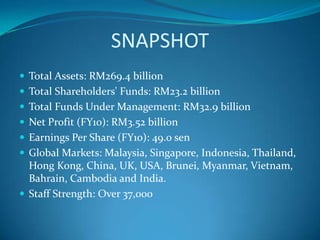
SNAPSHOT
 Total Assets: RM269.4 billion
 Total Shareholders' Funds: RM23.2 billion
 Total Funds Under Management: RM32.9 billion
 Net Profit (FY10): RM3.52 billion
 Earnings Per Share (FY10): 49.0 sen
 Global Markets: Malaysia, Singapore, Indonesia, Thailand,
  Hong Kong, China, UK, USA, Brunei, Myanmar, Vietnam,
  Bahrain, Cambodia and India.
 Staff Strength: Over 37,000
HISTORY AND ESTABLISHMENT OF
            HSBC
  The history of HSBC began in the 19th century when
   Hong Kong and Shanghai Banking Company Limited
   was established in Hong Kong to finance the growing
   trade between China and Europe.
  HSBC Holdings plc is a global financial company
   headquartered in Canary Wharft London,United
   Kingdom
  HSBC (abbreviation origin: the "Hongkong and
   Shanghai Banking Corporation") was founded in the
   former British colony Hong Kong (in March 1865) and
   Shanghai (one month later) by Scotsman Sir Thomas
   Sutherland (1834–1922)
• HSBC Holdings plc was required to relocate its world
    headquarters from Hong Kong to London in 1993
•   In 1980, HSBC acquired a 51% shareholding in Marine
    Midland Bank, which it extended to full ownership in
    1987
•   In May 1999, HSBC continued its US acquisitions with
    the purchase of Republic National Bank of New York
    for $10.3bn
   In July 2001 HSBC bought Demirbank, an
    insolventTurkish bank. Then in August 2002 HSBC
    acquired Grupo Financiero Bital, SA de CV, Mexico's
    third largest retail bank for $1.1bn.
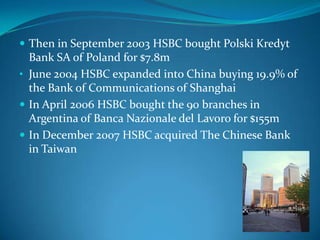
   The new headquarters of HSBC Holdings at 8 Canada
    Square, London officially opened in April 2003.
 Then in September 2003 HSBC bought Polski Kredyt
  Bank SA of Poland for $7.8m
• June 2004 HSBC expanded into China buying 19.9% of
  the Bank of Communications of Shanghai
 In April 2006 HSBC bought the 90 branches in
  Argentina of Banca Nazionale del Lavoro for $155m
 In December 2007 HSBC acquired The Chinese Bank
  in Taiwan
 In February 2008, HSBC was named the world's most
  valuable banking brand by The Banker magazine
 HSBC is more well known in banking circles for its
  conservative and risk-averse approach in its business
  operations
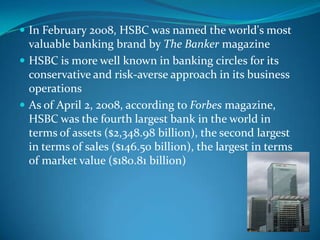
 As of April 2, 2008, according to Forbes magazine,
  HSBC was the fourth largest bank in the world in
  terms of assets ($2,348.98 billion), the second largest
  in terms of sales ($146.50 billion), the largest in terms
  of market value ($180.81 billion)
 It was also the most profitable bank in the world with
  $19.13 billion in net income in 2007 (compared to
  Citigroup's $3.62 billion and Bank of America's $14.98
  billion in the same period)
 The HSBC Group has a significant presence in each of
  the world's major financial markets, with the
  Americas, Asia Pacific and Europe each representing
  around one third of the business
 HSBC arguably has the most international presence
  among the world's multinational banking giants
 The HSBC Group operates as a number of local banks
  around the world, which explains its advertising
  tagline "The World's Local Bank."
PUBLIC BANK
HISTORY OF ESTABLISHMENT OF
          PUBLIC BANK
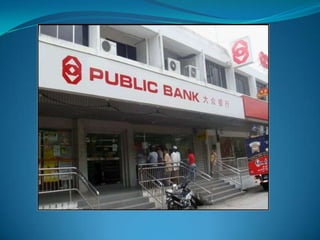
 The Public Bank was established in 1966 by its
  Founder and Chairman, Tan Sri Dato' Sri Dr. Teh Hong
  Piow.
 The Public Bank Group is highly reputed for its
  prudent management, strong balance sheet, superior
  asset quality, superior customer service, strong
  corporate governance and effective corporate culture.
 Public Bank Malaysia is the largest domestic bank in
  Malaysia after Malayan Banking Berhad.
 The Public Bank Group's total assets rose to RM226 billion
  at the end of 2010, contributed by its high business growth
  strategies in the last ten years.
 In the domestic market, Public Bank continues to sustain
  its strong lending and deposit-taking franchise as shown by
  its strong market leadership position in home mortgages,
  auto financing and lending to small- and medium-sized
  enterprises.
 Public Bank has the highest return on equity amongst
  domestic banks.
 From a one-branch bank in 1966, the Group now has
  250 branches in Malaysia and extensive presence in the
  region.
 the Group has 81 branches in Hong Kong, 3 branches
  in the People's Republic of China, 21 branches in
  Cambodia, 7 branches in Vietnam, 3 branches in Laos,
  a branch in Sri Lanka and 3 representative offices in
  Shanghai, Shenyang and Taipei.
ABOUT RHB BANK
•   Known as Rashid Hussein Bank
•   Headquartered in Kuala Lumpur,RHB main products are banking
    and finance service.Specializes in commercial banking,corporate
    and investment banking services
•   Formed after a merger between Kwong Yik Bank and DCB Bank, on
    1st July 1997, and Sime Bank and Bank Utama later.
•    On March 9, 2007, the Employees Provident Fund (EPF) gained
    control of the bank, after winning a bid against EON Capital and a
    Kuwait Finance House-led consortium.RHB Bank is a part of RHB
    Capital Berhad financial conglomerate.
•   Our businesses are offered through our main subsidiaries-RHB
    Bank Bhd and RHB Investment Bank Bhd,which are wholly owned
    by RHB Capital ,RHB Insurances Bhd,which is 79.5% owned by RHB
    Capital
•   Our Islamic banking Unit,RHB Islamic Bank Bhd is wholly owned
    by Rhb Bank,while our asset management and unit trust businesses
    are held under RHB Investment Management Sdn Bhd,a wholly
    owned subsidiary of RHB Investment Bank.
ESTABLISHMENT OF RHB BANK
RHB Bank Banking Group is currently the fourth largest fully
  integrated financial service group in Malaysia.Our core businesses
  are streamlined into seven Strategic Business Groups (SBG)

   Business Banking
   Retail banking
   Group Transaction Banking
   Corporate & Investment Banking
   Islamic Banking
   Global Financing Banking
   Group Treasury
HISTORY OF RHB BANK
•   1913 - Established with a start-up capital of RM300,000 at the
    Old Market Square in Kuala Lumpur, making it Malaya's first
    local bank
•   1959 - A group of businessmen, led by Mr Chang Ming Thien,
    a prominent figure in the rubber industry in Malaya and
    Singapore, sets up the United Malayan Banking Corporation
    Berhad (UMBC)
•   1960 - Officially declared open by Prime Minister Tunku
    Abdul Rahman Putra Al-Haj. It is the first commercial bank to
    be established in independent Malaya
•   1966 - Establishment of Development and Commercial Bank
    (D&C Bank, later renamed DCB Bank)
•   1976 - A licensed commercial bank, is incorporated as a public
    company
•   1983 - Rashid Hussain secures a broker's licence and sets up Rashid
    Hussain Securities Sdn Bhd
•   1996 - UMBC becomes part of Sime Darby Berhad and is renamed
    Sime Bank Berhad
•   1996 - Rashid Hussain acquires a 75% stake in Kwong Yik Bank
    Berhad
•   1997 - Merger of Kwong Yik Bank Berhad and DCB Bank Berhad to
    form RHB Bank, then Malaysia's third largest financial services
    group
•    1997 - Merges with Kwong Yik Bank Berhad to form RHB Bank
    Berhad, turning a medium-sized bank into the third largest
    integrated financial services group in Malaysia
•   1999 - Merger of Sime Bank Berhad and RHB Bank Berhad to form
    the RHB Banking Group
•   1999 - Merges with RHB Bank Berhad and becomes part of the
    RHB Banking Group
•   2003 - Merger of RHB Bank Berhad with Bank Utama Berhad into
    the RHB Banking Group
•   2005 - RHB Banking Group received a license for its Islamic Banking
    arm - RHB Islamic Bank Berhad
MAYBANK
(MALAYAN BANKING BERHAD)
MAYBANK……
 was incorporated in 1960.
 serving customers in 15 countries worldwide .
 founded by Malaysian business tycoon Khoo Teck
  Puat, who died in 2004.
 earliest local banks that initiated and promoted the
  online banking services.
Continue…
 Maybank offers a full range of commercials, corporate,
  and private banking services, with a network of more
  than 450 branch offices.
 As of June 30, 2010, Maybank is the largest Malaysian
  bank, boasting group assets worth USD$106 billion.
 Consumer banking remains one of the Group’s largest
  revenue earners with a variety of services and
  products.
Continue…..
 First to computerize its savings and current accounts
    services.
   First to launch a wireless mobile payment facility.
   LARGEST Financial Services provider in Malaysia.
   NO. 1 Bank in Malaysia by assets and reach.
   FIRST Bank in Malaysia to cross USD100 billion in total
    asset size and USD1 billion in profit after tax in 2010.
   PIONEER in Internet Banking services in Malaysia in 2000.
Continue…..
 Maybank was accorded two awards by Euromoney in
  the latter’s Private Banking and Wealth Management
  Survey 2009.
 the Best Private Banking Services Overall and
  Malaysia’s Best Local Bank.
CHRONOLOGY……
 1960: Khoo Teck Puat founds Malayan Banking Berhad (Maybank).
  1963: Maybank establishes a trustee branch, Mayban Trustees Bhd.
  1973: Aseambankers Malaysia Berhad is founded.
  1975: Aseambankers launches Kota Discount Berhad joint venture.
  1987: Maybank establishes Mayban Securities Sdn Bhd.
  1989: Kora Discount is renamed Mayban Discount Bhd.
  1990: Maybank sets up offshore operations in Labuan, including an offshore
  Islamic banking unit.
  1994: Maybank establishes a subsidiary in Papua New Guinea.
 2001: Maybank opens its first branch office in China, in Shanghai.
    2002: An Islamic insurance subsidiary is launched.
   2007 (Nov) - MNI Insurance and Takaful Nasional were rebranded as Etiqa
    Insurance & Etiqa Takaful respectively. Subsequently, Mayban Takaful
    transferred all its business, assets and liabilities to Etiqa Takaful.
   2008 (May) - Dato' Sri Abdul Wahid Omar, is officially appointed as President
    & CEO of Maybank Group.
   2009 (January) - Renamed its subsidiary Aseambankers to Maybank
    Investment Bank.
   2010 - Introduced a Dividend Reinvestment Plan, the first Malaysian company
    to do so.
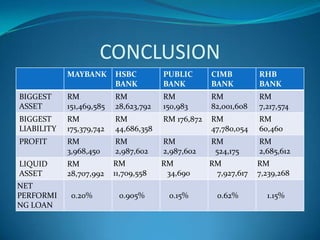
CONCLUSION
            MAYBANK       HSBC         PUBLIC       CIMB         RHB
                          BANK         BANK         BANK         BANK
BIGGEST     RM            RM           RM           RM           RM
ASSET       151,469,585   28,623,792   150,983      82,001,608   7,217,574
BIGGEST     RM            RM           RM 176,872   RM           RM
LIABILITY   175,379,742   44,686,358                47,780,054   60,460
PROFIT      RM            RM           RM           RM           RM
            3,968,450     2,987,602    2,987,602     524,175     2,685,612
LIQUID      RM            RM           RM           RM           RM
ASSET       28,707,992    11,709,558    34,690       7,927,617   7,239,268
NET
PERFORMI     0.20%         0.905%       0.15%         0.62%        1.15%
NG LOAN
THANK YOU

Top 5 commercial bank

  • 1.
    PRESENTED BY: 1.WAN NURHASYIMAH BT WAN HANAFI 2.SITI NUR NADHIRA BT MUHAMMAD NAFIZON 3.SITI KHAIRUL ATHIRAH BT AZHAN 4.JULIANA BT TAJUDDIN 5.KHAIRUNISA BT KAMARUDIN
  • 3.
    ABOUT CIMB CIMB Groupis ASEAN's leading universal banking franchise. We offer a full range of financial products and services covering consumer banking, corporate and investment banking, Islamic banking, asset management, wealth management, insurance and takaful, and private banking. With over 37,000 employees, CIMB Group reaches 81% of the ASEAN population, representing 89% of the region’s gross domestic product. Our retail network of over 1,000 branches is the widest in the region.
  • 4.
    In addition, weextend our reach and range of products and services through strategic partnerships. Our partners include the Principal Financial Group, Aviva plc, Bank of Tokyo- Mitsubishi UFJ, Standard Bank plc, Daishin Securities and the Kanoo Group, among others. Headquartered in Kuala Lumpur, CIMB Group's main markets are Malaysia, Indonesia, Singapore, Thailand and Cambodia. Our presence in 13 countries covers ASEAN and major global financial centres, as well as countries in which our customers have significant business and investment dealings.
  • 5.
    HISTORY CIMB BANK 1965: Bank Bumiputra Malaysia Berhand (BBMB) was incorporated. This was in line with government initiatives to increase Bumiputra participation in the national economy. The bank grew to be the most prominent bank for all Malaysians with branches throughout the country.  1974: Pertanian Baring Sanwa Multinational Berhad (PBS) was incorporated by Bank Pertanian, Baring Brothers of United Kingdom, Sanwa Bank of Japan and Multinational bank of the United Kingdom. It was managed by the Baring Brothers and provided corporate advisory and funding services to multinationals.
  • 6.
     1979: BianChiang Bank was renamed Bank of Commerce Berhad. This was a result of its purchase by the UMNO- owned Fleet group. In 1982, the bank became an institution with RM367 million in total assets and total shareholders' funds of RM12.8 million.  1986: Pertanian Baring Sanwa Multinational Berhad was renamed Commerce International Merchant Bankers Berhad (CIMB). This was a result of Bank of Commerce Berhad replacing Bank Pertanian as the controlling shareholder of PBS. CIMB retained its corporate finance focus and added stock broking to its range of services.
  • 7.
    2005: Commerce AssetHoldings Berhad (CAHB) announced its strategic decision to create a universal bank by combining its commercial and investment banks. Following this announcement, Bumiputra-Commerce Group was acquired by CIMB. As part of the exercise, CAHB was renamed Bumiputra- Commerce Holdings. 2006: In January, CIMB completed its restructuring exercise under Bumiputra-Commerce Holdings Berhad. The new CIMB Group was known as a universal bank. It made a transition to a full-service banking provider serving corporates to individuals. Then in March, CIMB Group acquired SBB after extensive negotiations. After the acquisition, in September CIMB Group was launched by the Prime Minister of Malaysia, YAB Dato' Seri Abdullah bin Haji Ahmad badawi.
  • 8.
     2007: Launchof CIMB Foundation CIMB Foundation is a non-for profit organisation launched in November 2007 to carry out the Group’s corporate social responsibility and philanthropic initiatives. Its focus is on sustainable programmes in community development, sports and education. In support of its commitment, CIMB Group pledged an initial sum of MYR100 million to CIMB Foundation.  2009- Launch of CIMB Bank Singapore CIMB Group set up retail banking services in Singapore in September 2009. Through its strong service propositions, CIMB Bank Singapore has brought innovative products that maximize value for money in a competitive environment. The retail banking component complements CIMB Group’s existing securities, advisory and corporate lending businesses in Singapore.
  • 9.
    ESTABLISHMENT OF CIMB Businesses of CIMB are:  Consumer banking  Investment banking  Islamic banking  Asset management  Insurance
  • 10.
    OVERVIEW  CIMB GroupHoldings Berhad, is the listed holding company for Malaysia's second largest financial services provider, CIMB Group. As at 31 December 2010, CIMB Group was the largest company on Bursa Malaysia with a market capitalisation of RM63.2 billion. CIMB Group's primary emphasis is to create long-term value for its shareholders. Our management is committed towards good corporate governance, organisational effectiveness, capabilities enhancements and efficient capital management. Within this section, you will be able to find the most recent financial and other relevant information on CIMB Group.
  • 11.
    SNAPSHOT  Total Assets:RM269.4 billion  Total Shareholders' Funds: RM23.2 billion  Total Funds Under Management: RM32.9 billion  Net Profit (FY10): RM3.52 billion  Earnings Per Share (FY10): 49.0 sen  Global Markets: Malaysia, Singapore, Indonesia, Thailand, Hong Kong, China, UK, USA, Brunei, Myanmar, Vietnam, Bahrain, Cambodia and India.  Staff Strength: Over 37,000
  • 13.
    HISTORY AND ESTABLISHMENTOF HSBC  The history of HSBC began in the 19th century when Hong Kong and Shanghai Banking Company Limited was established in Hong Kong to finance the growing trade between China and Europe.  HSBC Holdings plc is a global financial company headquartered in Canary Wharft London,United Kingdom  HSBC (abbreviation origin: the "Hongkong and Shanghai Banking Corporation") was founded in the former British colony Hong Kong (in March 1865) and Shanghai (one month later) by Scotsman Sir Thomas Sutherland (1834–1922)
  • 14.
    • HSBC Holdingsplc was required to relocate its world headquarters from Hong Kong to London in 1993 • In 1980, HSBC acquired a 51% shareholding in Marine Midland Bank, which it extended to full ownership in 1987 • In May 1999, HSBC continued its US acquisitions with the purchase of Republic National Bank of New York for $10.3bn  In July 2001 HSBC bought Demirbank, an insolventTurkish bank. Then in August 2002 HSBC acquired Grupo Financiero Bital, SA de CV, Mexico's third largest retail bank for $1.1bn.  The new headquarters of HSBC Holdings at 8 Canada Square, London officially opened in April 2003.
  • 15.
     Then inSeptember 2003 HSBC bought Polski Kredyt Bank SA of Poland for $7.8m • June 2004 HSBC expanded into China buying 19.9% of the Bank of Communications of Shanghai  In April 2006 HSBC bought the 90 branches in Argentina of Banca Nazionale del Lavoro for $155m  In December 2007 HSBC acquired The Chinese Bank in Taiwan
  • 16.
     In February2008, HSBC was named the world's most valuable banking brand by The Banker magazine  HSBC is more well known in banking circles for its conservative and risk-averse approach in its business operations  As of April 2, 2008, according to Forbes magazine, HSBC was the fourth largest bank in the world in terms of assets ($2,348.98 billion), the second largest in terms of sales ($146.50 billion), the largest in terms of market value ($180.81 billion)
  • 17.
     It wasalso the most profitable bank in the world with $19.13 billion in net income in 2007 (compared to Citigroup's $3.62 billion and Bank of America's $14.98 billion in the same period)  The HSBC Group has a significant presence in each of the world's major financial markets, with the Americas, Asia Pacific and Europe each representing around one third of the business  HSBC arguably has the most international presence among the world's multinational banking giants  The HSBC Group operates as a number of local banks around the world, which explains its advertising tagline "The World's Local Bank."
  • 18.
  • 19.
    HISTORY OF ESTABLISHMENTOF PUBLIC BANK  The Public Bank was established in 1966 by its Founder and Chairman, Tan Sri Dato' Sri Dr. Teh Hong Piow.  The Public Bank Group is highly reputed for its prudent management, strong balance sheet, superior asset quality, superior customer service, strong corporate governance and effective corporate culture.
  • 20.
     Public BankMalaysia is the largest domestic bank in Malaysia after Malayan Banking Berhad.  The Public Bank Group's total assets rose to RM226 billion at the end of 2010, contributed by its high business growth strategies in the last ten years.  In the domestic market, Public Bank continues to sustain its strong lending and deposit-taking franchise as shown by its strong market leadership position in home mortgages, auto financing and lending to small- and medium-sized enterprises.
  • 21.
     Public Bankhas the highest return on equity amongst domestic banks.  From a one-branch bank in 1966, the Group now has 250 branches in Malaysia and extensive presence in the region.  the Group has 81 branches in Hong Kong, 3 branches in the People's Republic of China, 21 branches in Cambodia, 7 branches in Vietnam, 3 branches in Laos, a branch in Sri Lanka and 3 representative offices in Shanghai, Shenyang and Taipei.
  • 24.
    ABOUT RHB BANK • Known as Rashid Hussein Bank • Headquartered in Kuala Lumpur,RHB main products are banking and finance service.Specializes in commercial banking,corporate and investment banking services • Formed after a merger between Kwong Yik Bank and DCB Bank, on 1st July 1997, and Sime Bank and Bank Utama later. • On March 9, 2007, the Employees Provident Fund (EPF) gained control of the bank, after winning a bid against EON Capital and a Kuwait Finance House-led consortium.RHB Bank is a part of RHB Capital Berhad financial conglomerate. • Our businesses are offered through our main subsidiaries-RHB Bank Bhd and RHB Investment Bank Bhd,which are wholly owned by RHB Capital ,RHB Insurances Bhd,which is 79.5% owned by RHB Capital • Our Islamic banking Unit,RHB Islamic Bank Bhd is wholly owned by Rhb Bank,while our asset management and unit trust businesses are held under RHB Investment Management Sdn Bhd,a wholly owned subsidiary of RHB Investment Bank.
  • 25.
    ESTABLISHMENT OF RHBBANK RHB Bank Banking Group is currently the fourth largest fully integrated financial service group in Malaysia.Our core businesses are streamlined into seven Strategic Business Groups (SBG)  Business Banking  Retail banking  Group Transaction Banking  Corporate & Investment Banking  Islamic Banking  Global Financing Banking  Group Treasury
  • 26.
    HISTORY OF RHBBANK • 1913 - Established with a start-up capital of RM300,000 at the Old Market Square in Kuala Lumpur, making it Malaya's first local bank • 1959 - A group of businessmen, led by Mr Chang Ming Thien, a prominent figure in the rubber industry in Malaya and Singapore, sets up the United Malayan Banking Corporation Berhad (UMBC) • 1960 - Officially declared open by Prime Minister Tunku Abdul Rahman Putra Al-Haj. It is the first commercial bank to be established in independent Malaya • 1966 - Establishment of Development and Commercial Bank (D&C Bank, later renamed DCB Bank) • 1976 - A licensed commercial bank, is incorporated as a public company
  • 27.
    1983 - Rashid Hussain secures a broker's licence and sets up Rashid Hussain Securities Sdn Bhd • 1996 - UMBC becomes part of Sime Darby Berhad and is renamed Sime Bank Berhad • 1996 - Rashid Hussain acquires a 75% stake in Kwong Yik Bank Berhad • 1997 - Merger of Kwong Yik Bank Berhad and DCB Bank Berhad to form RHB Bank, then Malaysia's third largest financial services group • 1997 - Merges with Kwong Yik Bank Berhad to form RHB Bank Berhad, turning a medium-sized bank into the third largest integrated financial services group in Malaysia • 1999 - Merger of Sime Bank Berhad and RHB Bank Berhad to form the RHB Banking Group
  • 28.
    1999 - Merges with RHB Bank Berhad and becomes part of the RHB Banking Group • 2003 - Merger of RHB Bank Berhad with Bank Utama Berhad into the RHB Banking Group • 2005 - RHB Banking Group received a license for its Islamic Banking arm - RHB Islamic Bank Berhad
  • 29.
  • 30.
    MAYBANK……  was incorporatedin 1960.  serving customers in 15 countries worldwide .  founded by Malaysian business tycoon Khoo Teck Puat, who died in 2004.  earliest local banks that initiated and promoted the online banking services.
  • 31.
    Continue…  Maybank offersa full range of commercials, corporate, and private banking services, with a network of more than 450 branch offices.  As of June 30, 2010, Maybank is the largest Malaysian bank, boasting group assets worth USD$106 billion.  Consumer banking remains one of the Group’s largest revenue earners with a variety of services and products.
  • 32.
    Continue…..  First tocomputerize its savings and current accounts services.  First to launch a wireless mobile payment facility.  LARGEST Financial Services provider in Malaysia.  NO. 1 Bank in Malaysia by assets and reach.  FIRST Bank in Malaysia to cross USD100 billion in total asset size and USD1 billion in profit after tax in 2010.  PIONEER in Internet Banking services in Malaysia in 2000.
  • 33.
    Continue…..  Maybank wasaccorded two awards by Euromoney in the latter’s Private Banking and Wealth Management Survey 2009.  the Best Private Banking Services Overall and Malaysia’s Best Local Bank.
  • 34.
    CHRONOLOGY……  1960: KhooTeck Puat founds Malayan Banking Berhad (Maybank). 1963: Maybank establishes a trustee branch, Mayban Trustees Bhd. 1973: Aseambankers Malaysia Berhad is founded. 1975: Aseambankers launches Kota Discount Berhad joint venture. 1987: Maybank establishes Mayban Securities Sdn Bhd. 1989: Kora Discount is renamed Mayban Discount Bhd. 1990: Maybank sets up offshore operations in Labuan, including an offshore Islamic banking unit. 1994: Maybank establishes a subsidiary in Papua New Guinea.  2001: Maybank opens its first branch office in China, in Shanghai. 2002: An Islamic insurance subsidiary is launched.  2007 (Nov) - MNI Insurance and Takaful Nasional were rebranded as Etiqa Insurance & Etiqa Takaful respectively. Subsequently, Mayban Takaful transferred all its business, assets and liabilities to Etiqa Takaful.  2008 (May) - Dato' Sri Abdul Wahid Omar, is officially appointed as President & CEO of Maybank Group.  2009 (January) - Renamed its subsidiary Aseambankers to Maybank Investment Bank.  2010 - Introduced a Dividend Reinvestment Plan, the first Malaysian company to do so.
  • 35.
    CONCLUSION MAYBANK HSBC PUBLIC CIMB RHB BANK BANK BANK BANK BIGGEST RM RM RM RM RM ASSET 151,469,585 28,623,792 150,983 82,001,608 7,217,574 BIGGEST RM RM RM 176,872 RM RM LIABILITY 175,379,742 44,686,358 47,780,054 60,460 PROFIT RM RM RM RM RM 3,968,450 2,987,602 2,987,602 524,175 2,685,612 LIQUID RM RM RM RM RM ASSET 28,707,992 11,709,558 34,690 7,927,617 7,239,268 NET PERFORMI 0.20% 0.905% 0.15% 0.62% 1.15% NG LOAN
  • 37.