Learning Projects In Glocal Networks:
The Emergence of a Formal and Informal Peer Culture
PhD student, Saara Nissinen saara.nissinen@uef.fi
Dr. Henriikka Vartiainen henriikka.vartiainen@uef.fi
Dr. Petteri Vanninen petteri.vanninen@uef.fi
Professor Sinikka Pöllänen sinikka.pollanen@uef.fi
Connected Learning Summit 2018 | August 1-3, 2018 | MIT Media Lab, Cambridge MA
Challenge
Networking, searching, sharing, and
creating information allows youth to
become active members of a variety
of formal and informal glocal
communities, thus preparing and
supporting them in adapting to their
role as lifelong learners.
(Jenkins, Ito, & Boyd, 2016; Kafai & Peppler, 2011; Roth & Lee,
2004)
Three different forms of participation:
1) hanging out (friendship-driven)
2) messing around (interest-driven)
3) geeking out (expertise oriented).
(Jenkins, Ito, & Boyd, 2016)
Connected Learning Summit 2018 | MIT Media Lab
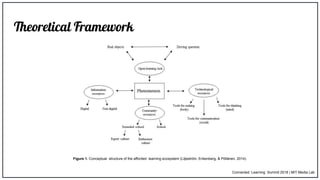
Theoretical Framework
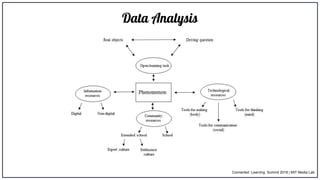
Figure 1. Conceptual structure of the afforded learning ecosystem (Liljeström, Enkenberg, & Pöllänen, 2014).
Connected Learning Summit 2018 | MIT Media Lab
Principles for creation of connected learning ecosystem
1) connecting learners in the pursuit of
shared learning tasks (object)
2) connecting through diverse technological
tools for producing, creating, and
experimenting with peers (tools and
resources)
3) facilitating interest-driven participation in
openly-networked and generative
communities (community)
(Vartiainen, Liljeström, & Enkenberg, 2012)
Connected Learning Summit 2018 | MIT Media Lab
This study aims to
examine the co-creation of international
learning ecosystem of two classes
organised around a shared object of
inquiry
Connected Learning Summit 2018 | MIT Media Lab
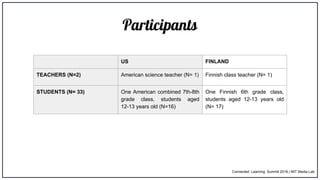
Participants
US FINLAND
TEACHERS (N=2) American science teacher (N= 1) Finnish class teacher (N= 1)
STUDENTS (N= 33) One American combined 7th-8th
grade class, students aged
12-13 years old (N=16)
One Finnish 6th grade class,
students aged 12-13 years old
(N= 17)
Connected Learning Summit 2018 | MIT Media Lab
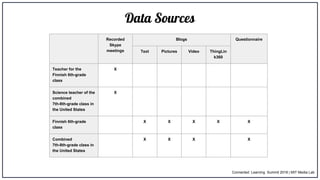
Data Sources
Recorded
Skype
meetings
Blogs Questionnaire
Text Pictures Video ThingLin
k360
Teacher for the
Finnish 6th-grade
class
X
Science teacher of the
combined
7th-8th-grade class in
the United States
X
Finnish 6th-grade
class
X X X X X
Combined
7th-8th-grade class in
the United States
X X X X
Connected Learning Summit 2018 | MIT Media Lab
Data Analysis
Connected Learning Summit 2018 | MIT Media Lab
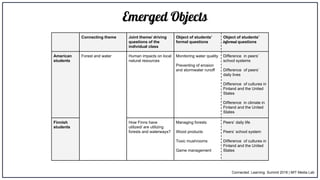
Connecting theme Joint theme/ driving
questions of the
individual class
Object of students’
formal questions
Object of students’
informal questions
American
students
Forest and water Human impacts on local
natural resources
Monitoring water quality
Preventing of erosion
and stormwater runoff
Difference in peers’
school systems
Difference of peers’
daily lives
Difference of cultures in
Finland and the United
States
Difference in climate in
Finland and the United
States
Finnish
students
How Finns have
utilized/ are utilizing
forests and waterways?
Managing forests
Wood products
Toxic mushrooms
Game management
Peers’ daily life
Peers’ school system
Difference of cultures in
Finland and the United
States
Emerged Objects
Connected Learning Summit 2018 | MIT Media Lab
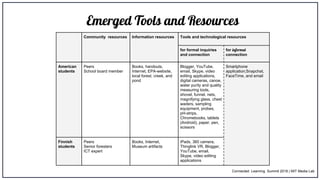
Emerged Tools and Resources
Community resources Information resources Tools and technological resources
for formal inquiries
and connection
for informal
connection
American
students
Peers
School board member
Books, handouts,
Internet, EPA-website,
local forest, creek, and
pond
Blogger, YouTube,
email, Skype, video
editing applications,
digital cameras, canoe,
water purity and quality
measuring tools,
shovel, funnel, nets,
magnifying glass, chest
waders, sampling
equipment, probes,
pH-strips,
Chromebooks, tablets
(Android), paper, pen,
scissors​
Smartphone
application;Snapchat,
FaceTime, and email
Finnish
students
Peers
Senior foresters
ICT expert
Books, Internet,
Museum artifacts
iPads, 360 camera,
Thinglink VR, Blogger,
YouTube, email,
Skype, video editing
applications
Connected Learning Summit 2018 | MIT Media Lab
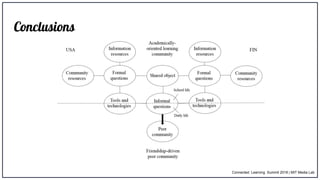
Conclusions
Connected Learning Summit 2018 | MIT Media Lab
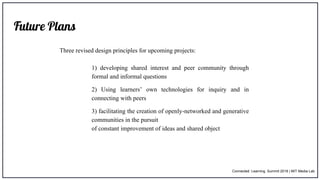
Future Plans
Three revised design principles for upcoming projects:
1) developing shared interest and peer community through
formal and informal questions
2) Using learners’ own technologies for inquiry and in
connecting with peers
3) facilitating the creation of openly-networked and generative
communities in the pursuit
of constant improvement of ideas and shared object
Connected Learning Summit 2018 | MIT Media Lab
We’re looking for new connections!
Thank you!
If you are interested in participating, please contact:
Ma., M.Ed. Saara Nissinen saara.nissinen@uef.fi
Dr. Henriikka Vartiainen henriikka.vartiainen@uef.fi
Dr. Petteri Vanninen petteri.vanninen@uef.fi
Professor Sinikka Pöllänen sinikka.pollanen@uef.fi
Connected Learning Summit 2018 | August 1-3, 2018 | MIT Media Lab, Cambridge MA
References
Ito, M., Gutiérrez, K., Livingstone, S., Penuel, B., Rhodes, J., Salen, K., Schor, J., Sefton-Green,
J., & Watkins, S. C. (2013). Connected learning: An agenda for research and design.
Irvine, CA: Digital Media and Learning Research Hub.
Ito, M., Baumer, S., Bittanti, M., Cody, R., Stephenson, B. H., Horst, H. A.and Perkel, D. (2009),
Hanging out, messing around, and geeking out: Kids living and learning with new media,
MIT press, MA.
Jenkins, H., Ito, M., & Boyd, D. (2016). Participatory culture in a networked era. Cambridge:
Polity.
Kafai, Y. B., & Peppler, K. A. (2011). Youth, technology, and DIY: Developing participatory
competencies in creative media production. Review of Research in Education, 35(1),
89–119.
Liljeström, A., Enkenberg, J., & Pöllänen, S. (2014). The case of design-oriented pedagogy:
What students’ digital video stories say about emerging learning ecosystems. Education
and Information Technologies, 19(3), 583-601.
Roth, W.-M., & Lee, S. (2004). Science education as/for participation in the community. Science
Education, 88, 263–291.
Vartiainen, H., Liljeström, A. and Enkenberg, J. (2012), “Design-oriented pedagogy for
technology-enhanced learning to cross over the borders between formal and informal
environments”, Journal of Universal Computer Science, Vol. 18 No. 15, pp. 2097–2119.

Connected Learning Summit 2018

  • 1.
    Learning Projects InGlocal Networks: The Emergence of a Formal and Informal Peer Culture PhD student, Saara Nissinen saara.nissinen@uef.fi Dr. Henriikka Vartiainen henriikka.vartiainen@uef.fi Dr. Petteri Vanninen petteri.vanninen@uef.fi Professor Sinikka Pöllänen sinikka.pollanen@uef.fi Connected Learning Summit 2018 | August 1-3, 2018 | MIT Media Lab, Cambridge MA
  • 2.
    Challenge Networking, searching, sharing,and creating information allows youth to become active members of a variety of formal and informal glocal communities, thus preparing and supporting them in adapting to their role as lifelong learners. (Jenkins, Ito, & Boyd, 2016; Kafai & Peppler, 2011; Roth & Lee, 2004) Three different forms of participation: 1) hanging out (friendship-driven) 2) messing around (interest-driven) 3) geeking out (expertise oriented). (Jenkins, Ito, & Boyd, 2016) Connected Learning Summit 2018 | MIT Media Lab
  • 3.
    Theoretical Framework Figure 1.Conceptual structure of the afforded learning ecosystem (Liljeström, Enkenberg, & Pöllänen, 2014). Connected Learning Summit 2018 | MIT Media Lab
  • 4.
    Principles for creationof connected learning ecosystem 1) connecting learners in the pursuit of shared learning tasks (object) 2) connecting through diverse technological tools for producing, creating, and experimenting with peers (tools and resources) 3) facilitating interest-driven participation in openly-networked and generative communities (community) (Vartiainen, Liljeström, & Enkenberg, 2012) Connected Learning Summit 2018 | MIT Media Lab
  • 5.
    This study aimsto examine the co-creation of international learning ecosystem of two classes organised around a shared object of inquiry Connected Learning Summit 2018 | MIT Media Lab
  • 6.
    Participants US FINLAND TEACHERS (N=2)American science teacher (N= 1) Finnish class teacher (N= 1) STUDENTS (N= 33) One American combined 7th-8th grade class, students aged 12-13 years old (N=16) One Finnish 6th grade class, students aged 12-13 years old (N= 17) Connected Learning Summit 2018 | MIT Media Lab
  • 7.
    Data Sources Recorded Skype meetings Blogs Questionnaire TextPictures Video ThingLin k360 Teacher for the Finnish 6th-grade class X Science teacher of the combined 7th-8th-grade class in the United States X Finnish 6th-grade class X X X X X Combined 7th-8th-grade class in the United States X X X X Connected Learning Summit 2018 | MIT Media Lab
  • 8.
    Data Analysis Connected LearningSummit 2018 | MIT Media Lab
  • 9.
    Connecting theme Jointtheme/ driving questions of the individual class Object of students’ formal questions Object of students’ informal questions American students Forest and water Human impacts on local natural resources Monitoring water quality Preventing of erosion and stormwater runoff Difference in peers’ school systems Difference of peers’ daily lives Difference of cultures in Finland and the United States Difference in climate in Finland and the United States Finnish students How Finns have utilized/ are utilizing forests and waterways? Managing forests Wood products Toxic mushrooms Game management Peers’ daily life Peers’ school system Difference of cultures in Finland and the United States Emerged Objects Connected Learning Summit 2018 | MIT Media Lab
  • 10.
    Emerged Tools andResources Community resources Information resources Tools and technological resources for formal inquiries and connection for informal connection American students Peers School board member Books, handouts, Internet, EPA-website, local forest, creek, and pond Blogger, YouTube, email, Skype, video editing applications, digital cameras, canoe, water purity and quality measuring tools, shovel, funnel, nets, magnifying glass, chest waders, sampling equipment, probes, pH-strips, Chromebooks, tablets (Android), paper, pen, scissors​ Smartphone application;Snapchat, FaceTime, and email Finnish students Peers Senior foresters ICT expert Books, Internet, Museum artifacts iPads, 360 camera, Thinglink VR, Blogger, YouTube, email, Skype, video editing applications Connected Learning Summit 2018 | MIT Media Lab
  • 11.
  • 12.
    Future Plans Three reviseddesign principles for upcoming projects: 1) developing shared interest and peer community through formal and informal questions 2) Using learners’ own technologies for inquiry and in connecting with peers 3) facilitating the creation of openly-networked and generative communities in the pursuit of constant improvement of ideas and shared object Connected Learning Summit 2018 | MIT Media Lab
  • 13.
    We’re looking fornew connections! Thank you! If you are interested in participating, please contact: Ma., M.Ed. Saara Nissinen saara.nissinen@uef.fi Dr. Henriikka Vartiainen henriikka.vartiainen@uef.fi Dr. Petteri Vanninen petteri.vanninen@uef.fi Professor Sinikka Pöllänen sinikka.pollanen@uef.fi Connected Learning Summit 2018 | August 1-3, 2018 | MIT Media Lab, Cambridge MA
  • 14.
    References Ito, M., Gutiérrez,K., Livingstone, S., Penuel, B., Rhodes, J., Salen, K., Schor, J., Sefton-Green, J., & Watkins, S. C. (2013). Connected learning: An agenda for research and design. Irvine, CA: Digital Media and Learning Research Hub. Ito, M., Baumer, S., Bittanti, M., Cody, R., Stephenson, B. H., Horst, H. A.and Perkel, D. (2009), Hanging out, messing around, and geeking out: Kids living and learning with new media, MIT press, MA. Jenkins, H., Ito, M., & Boyd, D. (2016). Participatory culture in a networked era. Cambridge: Polity. Kafai, Y. B., & Peppler, K. A. (2011). Youth, technology, and DIY: Developing participatory competencies in creative media production. Review of Research in Education, 35(1), 89–119. Liljeström, A., Enkenberg, J., & Pöllänen, S. (2014). The case of design-oriented pedagogy: What students’ digital video stories say about emerging learning ecosystems. Education and Information Technologies, 19(3), 583-601. Roth, W.-M., & Lee, S. (2004). Science education as/for participation in the community. Science Education, 88, 263–291. Vartiainen, H., Liljeström, A. and Enkenberg, J. (2012), “Design-oriented pedagogy for technology-enhanced learning to cross over the borders between formal and informal environments”, Journal of Universal Computer Science, Vol. 18 No. 15, pp. 2097–2119.