1/40
Tools for Research Plotting
01
Mrs. Nimrita Koul
School of Computing & IT
Contents
• Python Plots - matplotlib
• R Plots
3
Download Options for Python
• www.python.org/downloads
• https://www.anaconda.com/download/
• Installing Matplotlib
• python -m pip install -U matplotlib
• conda install -c conda-forge matplotlib
4
matplotlib Dependencies
• Python (>= 3.5)
• FreeType (>= 2.3)
• libpng (>= 1.2)
• NumPy (>= 1.10.0)
• setuptools
• cycler (>= 0.10.0)
• dateutil (>= 2.1)
• kiwisolver (>= 1.0.0)
• pyparsing
5
6
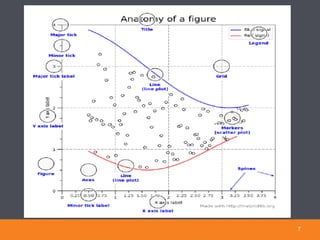
matplotlip
Most used Python
package for 2D-
graphics
pyplot provides a
convenient interface
to the matplotlib
very quick
Publication-
quality figures
in many formats
7
8
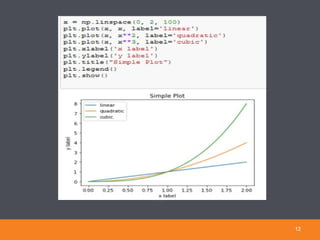
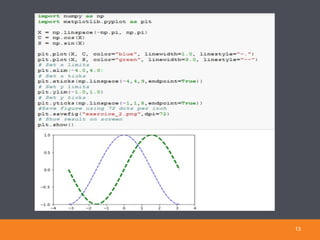
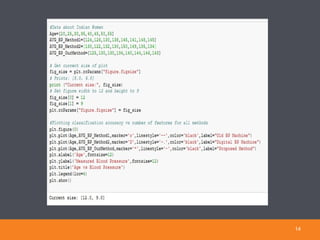
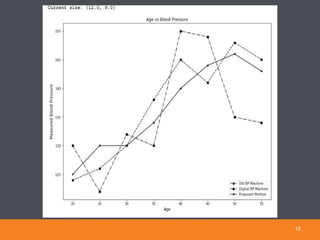
Examples
9
10
11
12
13
14
15
16
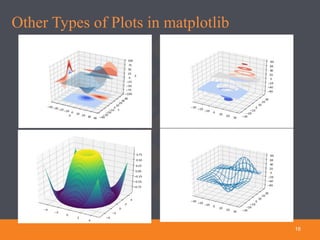
Other Types of Plots in matplotlib
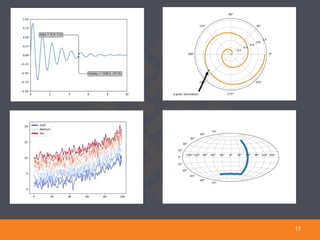
17
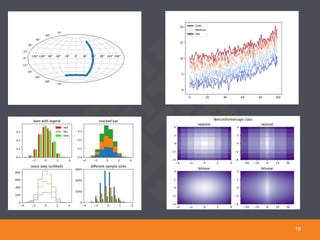
18
R Plots
19
Installing R
20
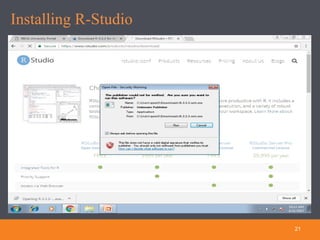
Installing R-Studio
21
R Studio
22
• An IDE for R
• Runs on Windows, Mac OS X and Linux
• RStudio project has following folders for default content
types:
 code: source code
 data: raw data, cleaned data
 figures: charts and graphs
 docs: documents and reports
 models: analytics models
R Plots
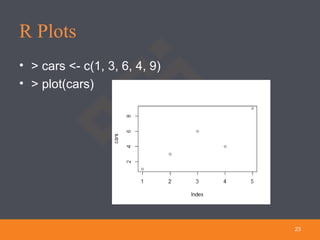
• > cars <- c(1, 3, 6, 4, 9)
• > plot(cars)
23
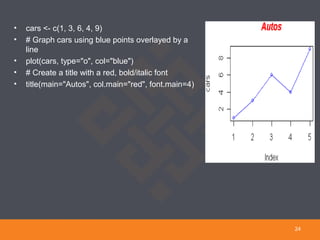
• cars <- c(1, 3, 6, 4, 9)
• # Graph cars using blue points overlayed by a
line
• plot(cars, type="o", col="blue")
• # Create a title with a red, bold/italic font
• title(main="Autos", col.main="red", font.main=4)
24
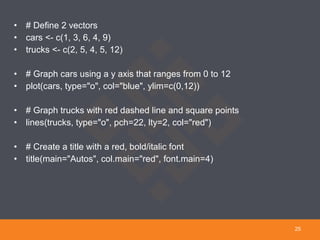
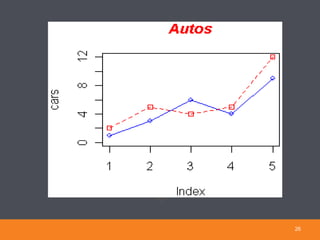
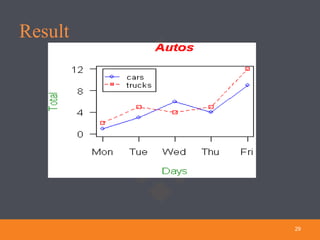
• # Define 2 vectors
• cars <- c(1, 3, 6, 4, 9)
• trucks <- c(2, 5, 4, 5, 12)
• # Graph cars using a y axis that ranges from 0 to 12
• plot(cars, type="o", col="blue", ylim=c(0,12))
• # Graph trucks with red dashed line and square points
• lines(trucks, type="o", pch=22, lty=2, col="red")
• # Create a title with a red, bold/italic font
• title(main="Autos", col.main="red", font.main=4)
25
26
• # Define 2 vectors
• cars <- c(1, 3, 6, 4, 9)
• trucks <- c(2, 5, 4, 5, 12)
• # Calculate range from 0 to max value of cars and trucks
• g_range <- range(0, cars, trucks)
• # Graph autos using y axis that ranges from 0 to max value in cars or trucks vector.
#Turn off axes and annotations (axis labels) so we can specify them our self
• plot(cars, type="o", col="blue", ylim=g_range, axes=FALSE, ann=FALSE)
• # Make x axis using Mon-Fri labels
• axis(1, at=1:5, lab=c("Mon","Tue","Wed","Thu","Fri"))
• # Make y axis with horizontal labels that display ticks at every 4 marks.
#4*0:g_range[2] is equivalent to c(0,4,8,12).
• axis(2, las=1, at=4*0:g_range[2])
27
• # Create box around plot
• box()
• # Graph trucks with red dashed line and square points
• lines(trucks, type="o", pch=22, lty=2, col="red")
• # Create a title with a red, bold/italic font
• title(main="Autos", col.main="red", font.main=4)
• # Label the x and y axes with dark green text
• title(xlab="Days", col.lab=rgb(0,0.5,0))
• title(ylab="Total", col.lab=rgb(0,0.5,0))
• # Create a legend at (1, g_range[2]) that is slightly smaller # (cex) and uses the same
#line colors and points used by the actual plots
• legend(1, g_range[2], c("cars","trucks"), cex=0.8,
• col=c("blue","red"), pch=21:22, lty=1:2);
28
Result
29
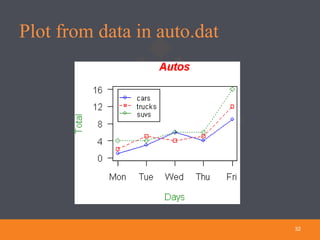
Plotting from a file• # Read car and truck values from tab-delimited autos.dat
• autos_data <- read.table("C:/R/autos.dat", header=T, sep="t")
• # Compute the largest y value used in the data (or we could # just use range again)
• max_y <- max(autos_data)
• # Define colors to be used for cars, trucks, suvs
• plot_colors <- c("blue","red","forestgreen")
• # Start PNG device driver to save output to figure.png
• png(filename="C:/R/figure.png", height=295, width=300, bg="white")
• # Graph autos using y axis that ranges from 0 to max_y. # Turn off axes and annotations (axis labels) so we can
• # specify them ourself
• plot(autos_data$cars, type="o", col=plot_colors[1], ylim=c(0,max_y), axes=FALSE, ann=FALSE)
• # Make x axis using Mon-Fri labels
• axis(1, at=1:5, lab=c("Mon", "Tue", "Wed", "Thu", "Fri"))
• # Make y axis with horizontal labels that display ticks at every 4 marks. 4*0:max_y is equivalent to c(0,4,8,12).
• axis(2, las=1, at=4*0:max_y)
30
• # Create box around plot
• box()
• # Graph trucks with red dashed line and square points
• lines(autos_data$trucks, type="o", pch=22, lty=2, col=plot_colors[2])
• # Graph suvs with green dotted line and diamond points
• lines(autos_data$suvs, type="o", pch=23, lty=3, col=plot_colors[3])
• # Create a title with a red, bold/italic font
• title(main="Autos", col.main="red", font.main=4)
• # Label the x and y axes with dark green text
• title(xlab= "Days", col.lab=rgb(0,0.5,0))
• title(ylab= "Total", col.lab=rgb(0,0.5,0))
• # Create a legend at (1, max_y) that is slightly smaller # (cex) and uses the same line colors and points used by
• # the actual plots
• legend(1, max_y, names(autos_data), cex=0.8, col=plot_colors, pch=21:23, lty=1:3);
•
• # Turn off device driver (to flush output to png)
• dev.off()
31
Plot from data in auto.dat
32
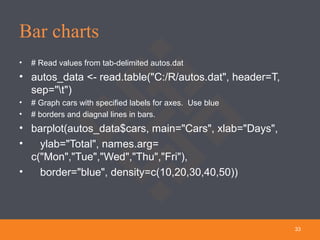
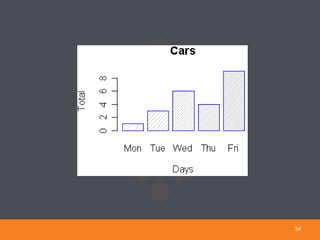
Bar charts
• # Read values from tab-delimited autos.dat
• autos_data <- read.table("C:/R/autos.dat", header=T,
sep="t")
• # Graph cars with specified labels for axes. Use blue
• # borders and diagnal lines in bars.
• barplot(autos_data$cars, main="Cars", xlab="Days",
• ylab="Total", names.arg=
c("Mon","Tue","Wed","Thu","Fri"),
• border="blue", density=c(10,20,30,40,50))
33
34
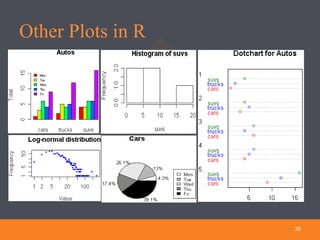
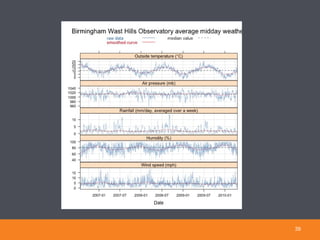
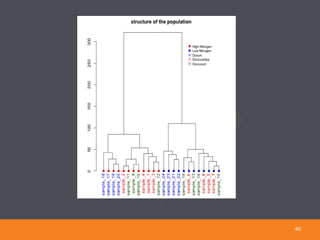
Other Plots in R
35
36
37
38
39
40
Tools for research plotting

Tools for research plotting

  • 1.
  • 2.
    Tools for ResearchPlotting 01 Mrs. Nimrita Koul School of Computing & IT
  • 3.
    Contents • Python Plots- matplotlib • R Plots 3
  • 4.
    Download Options forPython • www.python.org/downloads • https://www.anaconda.com/download/ • Installing Matplotlib • python -m pip install -U matplotlib • conda install -c conda-forge matplotlib 4
  • 5.
    matplotlib Dependencies • Python(>= 3.5) • FreeType (>= 2.3) • libpng (>= 1.2) • NumPy (>= 1.10.0) • setuptools • cycler (>= 0.10.0) • dateutil (>= 2.1) • kiwisolver (>= 1.0.0) • pyparsing 5
  • 6.
    6 matplotlip Most used Python packagefor 2D- graphics pyplot provides a convenient interface to the matplotlib very quick Publication- quality figures in many formats
  • 7.
  • 8.
  • 9.
  • 10.
  • 11.
  • 12.
  • 13.
  • 14.
  • 15.
  • 16.
    16 Other Types ofPlots in matplotlib
  • 17.
  • 18.
  • 19.
  • 20.
  • 21.
  • 22.
    R Studio 22 • AnIDE for R • Runs on Windows, Mac OS X and Linux • RStudio project has following folders for default content types:  code: source code  data: raw data, cleaned data  figures: charts and graphs  docs: documents and reports  models: analytics models
  • 23.
    R Plots • >cars <- c(1, 3, 6, 4, 9) • > plot(cars) 23
  • 24.
    • cars <-c(1, 3, 6, 4, 9) • # Graph cars using blue points overlayed by a line • plot(cars, type="o", col="blue") • # Create a title with a red, bold/italic font • title(main="Autos", col.main="red", font.main=4) 24
  • 25.
    • # Define2 vectors • cars <- c(1, 3, 6, 4, 9) • trucks <- c(2, 5, 4, 5, 12) • # Graph cars using a y axis that ranges from 0 to 12 • plot(cars, type="o", col="blue", ylim=c(0,12)) • # Graph trucks with red dashed line and square points • lines(trucks, type="o", pch=22, lty=2, col="red") • # Create a title with a red, bold/italic font • title(main="Autos", col.main="red", font.main=4) 25
  • 26.
  • 27.
    • # Define2 vectors • cars <- c(1, 3, 6, 4, 9) • trucks <- c(2, 5, 4, 5, 12) • # Calculate range from 0 to max value of cars and trucks • g_range <- range(0, cars, trucks) • # Graph autos using y axis that ranges from 0 to max value in cars or trucks vector. #Turn off axes and annotations (axis labels) so we can specify them our self • plot(cars, type="o", col="blue", ylim=g_range, axes=FALSE, ann=FALSE) • # Make x axis using Mon-Fri labels • axis(1, at=1:5, lab=c("Mon","Tue","Wed","Thu","Fri")) • # Make y axis with horizontal labels that display ticks at every 4 marks. #4*0:g_range[2] is equivalent to c(0,4,8,12). • axis(2, las=1, at=4*0:g_range[2]) 27
  • 28.
    • # Createbox around plot • box() • # Graph trucks with red dashed line and square points • lines(trucks, type="o", pch=22, lty=2, col="red") • # Create a title with a red, bold/italic font • title(main="Autos", col.main="red", font.main=4) • # Label the x and y axes with dark green text • title(xlab="Days", col.lab=rgb(0,0.5,0)) • title(ylab="Total", col.lab=rgb(0,0.5,0)) • # Create a legend at (1, g_range[2]) that is slightly smaller # (cex) and uses the same #line colors and points used by the actual plots • legend(1, g_range[2], c("cars","trucks"), cex=0.8, • col=c("blue","red"), pch=21:22, lty=1:2); 28
  • 29.
  • 30.
    Plotting from afile• # Read car and truck values from tab-delimited autos.dat • autos_data <- read.table("C:/R/autos.dat", header=T, sep="t") • # Compute the largest y value used in the data (or we could # just use range again) • max_y <- max(autos_data) • # Define colors to be used for cars, trucks, suvs • plot_colors <- c("blue","red","forestgreen") • # Start PNG device driver to save output to figure.png • png(filename="C:/R/figure.png", height=295, width=300, bg="white") • # Graph autos using y axis that ranges from 0 to max_y. # Turn off axes and annotations (axis labels) so we can • # specify them ourself • plot(autos_data$cars, type="o", col=plot_colors[1], ylim=c(0,max_y), axes=FALSE, ann=FALSE) • # Make x axis using Mon-Fri labels • axis(1, at=1:5, lab=c("Mon", "Tue", "Wed", "Thu", "Fri")) • # Make y axis with horizontal labels that display ticks at every 4 marks. 4*0:max_y is equivalent to c(0,4,8,12). • axis(2, las=1, at=4*0:max_y) 30
  • 31.
    • # Createbox around plot • box() • # Graph trucks with red dashed line and square points • lines(autos_data$trucks, type="o", pch=22, lty=2, col=plot_colors[2]) • # Graph suvs with green dotted line and diamond points • lines(autos_data$suvs, type="o", pch=23, lty=3, col=plot_colors[3]) • # Create a title with a red, bold/italic font • title(main="Autos", col.main="red", font.main=4) • # Label the x and y axes with dark green text • title(xlab= "Days", col.lab=rgb(0,0.5,0)) • title(ylab= "Total", col.lab=rgb(0,0.5,0)) • # Create a legend at (1, max_y) that is slightly smaller # (cex) and uses the same line colors and points used by • # the actual plots • legend(1, max_y, names(autos_data), cex=0.8, col=plot_colors, pch=21:23, lty=1:3); • • # Turn off device driver (to flush output to png) • dev.off() 31
  • 32.
    Plot from datain auto.dat 32
  • 33.
    Bar charts • #Read values from tab-delimited autos.dat • autos_data <- read.table("C:/R/autos.dat", header=T, sep="t") • # Graph cars with specified labels for axes. Use blue • # borders and diagnal lines in bars. • barplot(autos_data$cars, main="Cars", xlab="Days", • ylab="Total", names.arg= c("Mon","Tue","Wed","Thu","Fri"), • border="blue", density=c(10,20,30,40,50)) 33
  • 34.
  • 35.
  • 36.
  • 37.
  • 38.
  • 39.
  • 40.