Arrays in C & C++ 1
Arrays in C & C++
(including a brief introduction to pointers)
(Slides include materials from The C Programming Language, 2nd edition, by Kernighan and Ritchie and
from C: How to Program, 5th and 6th editions, by Deitel and Deitel)
Arrays in C & C++ 2
Reading Assignment
• Chapter 6 of Deitel & Deitel
• Chapter 5 of Kernighan & Ritchie
Arrays in C & C++ 3
Definition – Array
• A collection of objects of the same type
stored contiguously in memory under one
name
• May be type of any kind of variable
• May even be collection of arrays!
• For ease of access to any member of array
• For passing to functions as a group
Arrays in C & C++ 4
Arrays in C
• By far, the dominant kind of data structure
in C programs
• Many, many uses of all kinds
• Collections of all kinds of data
• Instant access to any element
Arrays in C & C++ 5
Examples
• int A[10]
• An array of ten integers
• A[0], A[1], …, A[9]
• double B[20]
• An array of twenty long floating point numbers
• B[0], B[1], …, B[19]
• Arrays of structs, unions, pointers,
etc., are also allowed
• Array indexes always start at zero in C
Arrays in C & C++ 6
Examples (continued)
• int C[]
• An array of an unknown number of integers
(allowable in a parameter of a function)
• C[0], C[1], …, C[max-1]
• int D[10][20]
• An array of ten rows, each of which is an array of
twenty integers
• D[0][0], D[0][1], …, D[1][0], D[1][1],
…, D[9][19]
• Not used so often as arrays of pointers
Arrays in C & C++ 7
Two-dimensional Arrays
• int D[10][20]
– A one-dimensional array with 10 elements,
each of which is an array with 20 elements
• I.e., int D[10][20] /*[row][col]*/
• Last subscript varies the fastest
– I.e., elements of last subscript are stored
contiguously in memory
• Also, three or more dimensions
Arrays in C & C++ 8
Array Element
• May be used wherever a variable of the
same type may be used
• In an expression (including arguments)
• On left side of assignment
• Examples:–
A[3] = x + y;
x = y – A[3];
z = sin(A[i]) + cos(B[j]);
Arrays in C & C++ 9
Array Elements (continued)
• Generic form:–
• ArrayName[integer-expression]
• ArrayName[integer-expression] [integer-expression]
– Same type as the underlying type of the array
• Definition:– Array Index – the expression
between the square brackets
• Also called an Array Subscript
Arrays in C & C++ 10
Array Elements (continued)
• Array elements are commonly used in loops
• E.g.,
for(i=0; i < max; i++)
A[i] = i*i;
for(sum = 0, j=0; j < max; j++)
sum += B[j];
for (count=0;rc!=EOF;count++)
rc=scanf("%f", &A[count]);
Arrays in C & C++ 11
Caution! Caution! Caution!
• It is the programmer’s responsibility to
avoid indexing off the end of an array
• Likely to corrupt data
• May cause a segmentation fault
• Could expose system to a security hole!
• C does NOT check array bounds
• I.e., whether index points to an element within the
array
• Might be high (beyond the end) or negative (before
the array starts)
Arrays in C & C++ 12
Caution! Caution! Caution!
• It is the programmer’s responsibility to
avoid indexing off the end of an array
• Likely to corrupt data
• May cause a segmentation fault
• Could expose system to a security hole!
• C does NOT check array bounds
• I.e., whether index points to an element within the
array
• Might be high (beyond the end) or negative (before
the array starts)
Arrays in C & C++ 13
Questions
Arrays in C & C++ 14
Declaring Arrays
• Static or automatic
• Array size may be determined explicitly or
implicitly
• Array size may be determined at run-time
• Automatic only
• Not in textbook
Arrays in C & C++ 15
Declaring Arrays (continued)
• Outside of any function – always static
int A[13];
#define CLASS_SIZE 73
double B[CLASS_SIZE];
const int nElements = 25
float C[nElements];
static char S[256]; /*not visible to
linker */
Arrays in C & C++ 16
Declaring Arrays (continued)
• Outside of any function – always static
int A[13];
#define CLASS_SIZE 73
double B[CLASS_SIZE];
const int nElements = 25
float C[nElements];
static char D[256]; /*not visible to
linker */
Static  retains values
across function calls
Arrays in C & C++ 17
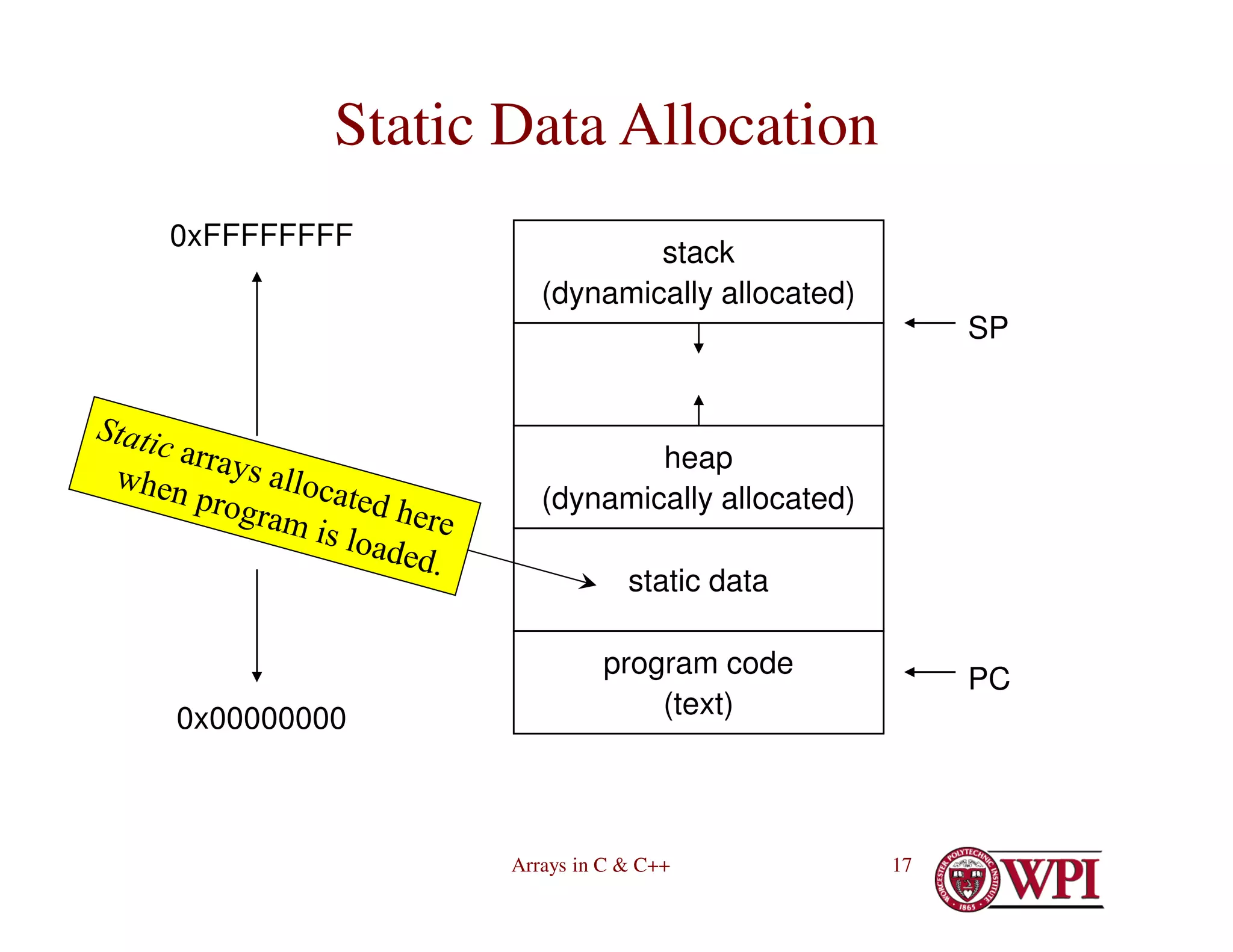
Static Data Allocation
0x00000000
0xFFFFFFFF
address space
program code
(text)
static data
heap
(dynamically allocated)
stack
(dynamically allocated)
PC
SP
Arrays in C & C++ 18
Declaring Arrays (continued)
• Inside function or compound statement – usually
automatic
void f( …) {
int A[13];
#define CLASS_SIZE 73
double B[CLASS_SIZE];
const int nElements = 25
float C[nElements];
static char D[256]; /*static, not visible
outside function */
} //f
Arrays in C & C++ 19
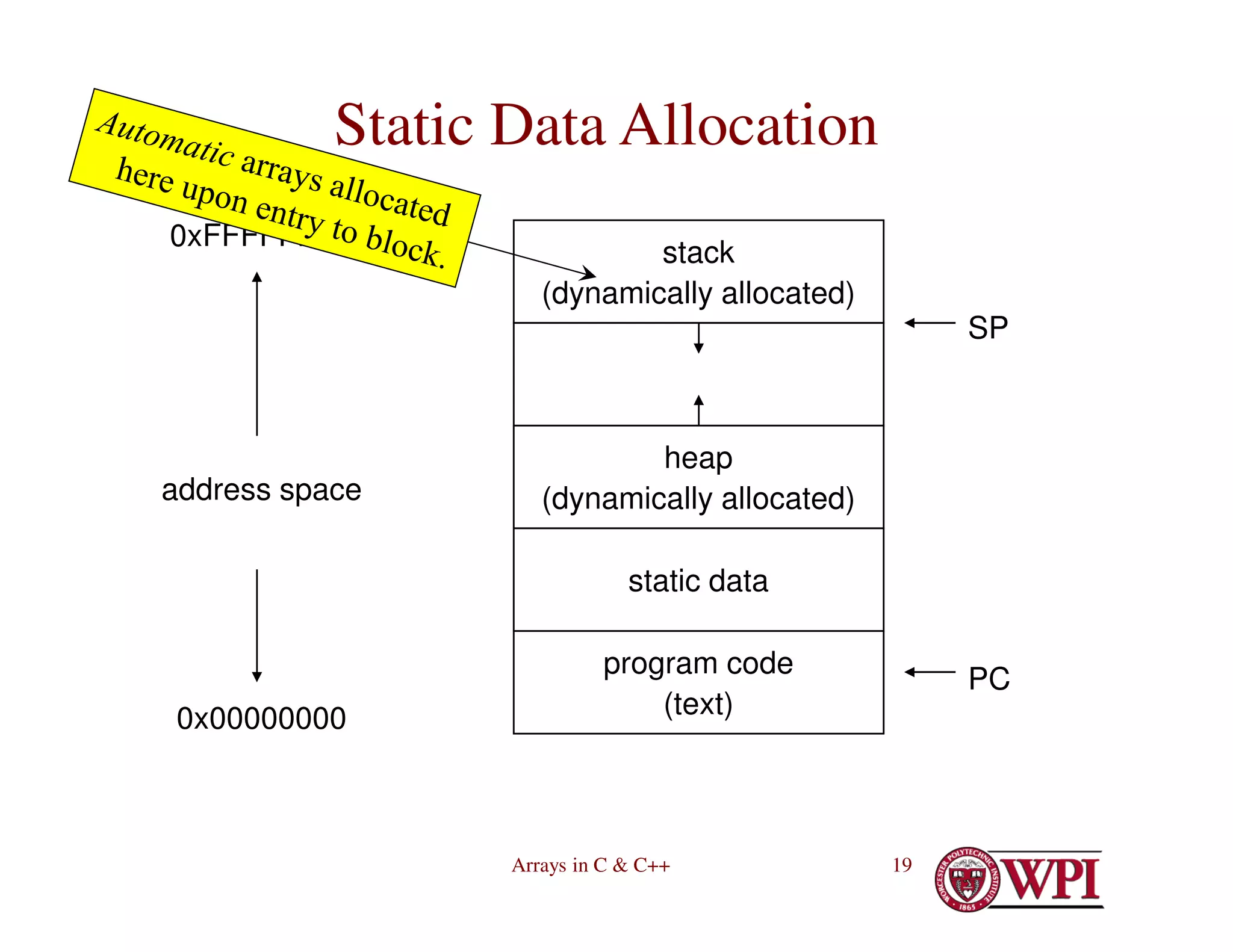
Static Data Allocation
0x00000000
0xFFFFFFFF
address space
program code
(text)
static data
heap
(dynamically allocated)
stack
(dynamically allocated)
PC
SP
Arrays in C & C++ 20
Declaring Arrays (continued)
• Inside function or compound statement – usually
automatic
void f( …) {
int A[13];
#define CLASS_SIZE 73
double B[CLASS_SIZE];
const int nElements = 25
float C[nElements];
static char D[256]; /*static, not visible
outside function */
} //f
Arrays in C & C++ 21
Dynamic Array Size Determination
• gcc supports the following:–
void func(<other parameters>, const int n) {
double Arr[2*n];
} //func
• I.e., array size is determined by evaluating an
expression at run-time
• Automatic allocation on The Stack
• Not in C88 ANSI standard, not in Kernighan & Ritchie
• Part of C99 and C++
Arrays in C & C++ 22
Array Initialization
• int A[5] = {2, 4, 8, 16, 32};
• Static or automatic
• int B[20] = {2, 4, 8, 16, 32};
• Unspecified elements are guaranteed to be zero
• int C[4] = {2, 4, 8, 16, 32};
• Error — compiler detects too many initial values
• int D[5] = {2*n, 4*n, 8*n, 16*n, 32*n};
• Automatically only; array initialized to expressions
• int E[n] = {1};
• gcc, C99, C++
• Dynamically allocated array (automatic only). Zeroth element
initialized to 1; all other elements initialized to 0
Arrays in C & C++ 23
Implicit Array Size Determination
• int days[] = {31, 28, 31, 30, 31,
30, 31, 31, 30, 31, 30, 31};
– Array is created with as many elements as initial values
• In this case, 12 elements
– Values must be compile-time constants (for static
arrays)
– Values may be run-time expressions (for automatic
arrays)
– See p. 86 of K&R
Arrays in C & C++ 24
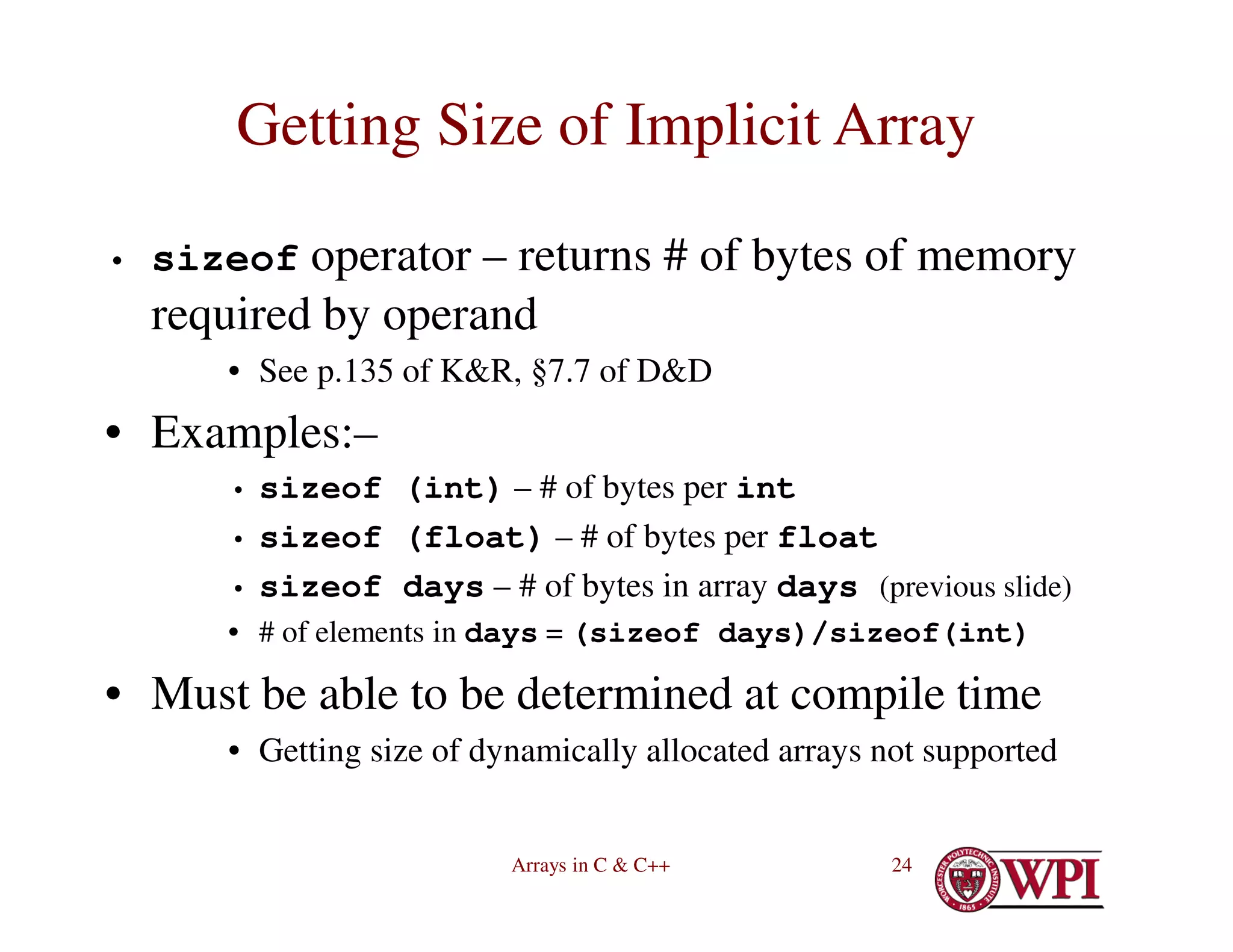
Getting Size of Implicit Array
• sizeof operator – returns # of bytes of memory
required by operand
• See p.135 of K&R, §7.7 of D&D
• Examples:–
• sizeof (int) – # of bytes per int
• sizeof (float) – # of bytes per float
• sizeof days – # of bytes in array days (previous slide)
• # of elements in days = (sizeof days)/sizeof(int)
• Must be able to be determined at compile time
• Getting size of dynamically allocated arrays not supported
Arrays in C & C++ 25
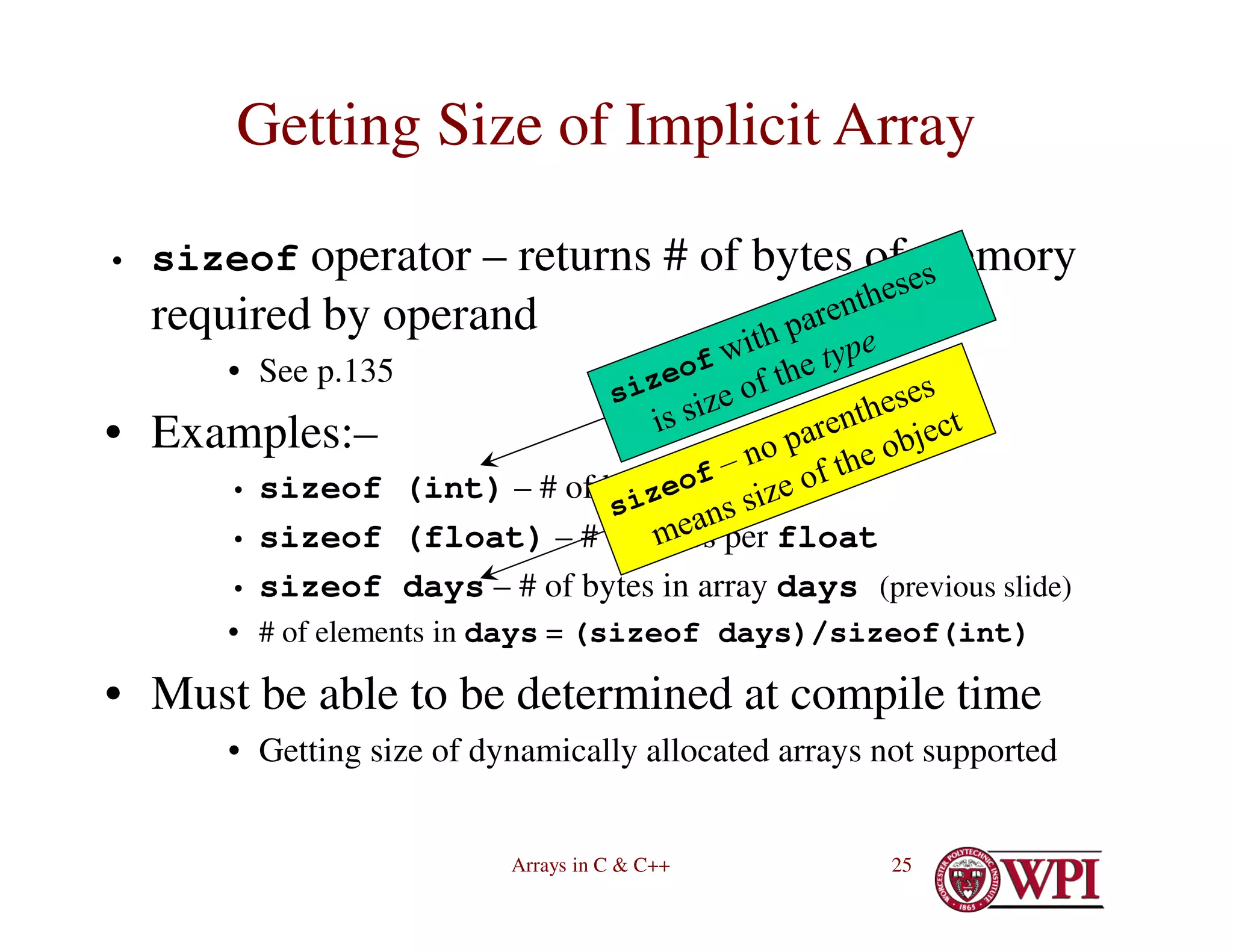
Getting Size of Implicit Array
• sizeof operator – returns # of bytes of memory
required by operand
• See p.135
• Examples:–
• sizeof (int) – # of bytes per int
• sizeof (float) – # of bytes per float
• sizeof days – # of bytes in array days (previous slide)
• # of elements in days = (sizeof days)/sizeof(int)
• Must be able to be determined at compile time
• Getting size of dynamically allocated arrays not supported
Arrays in C & C++ 26
Initializing a Two-Dimensional Array
static char daytab[2][12] = {
{31,28,31,30,31,30,31,31,30,31,30,31},
{31,29,31,30,31,30,31,31,30,31,30,31}
}; // daytab
OR
static char daytab[2][12] = {
31,28,31,30,31,30,31,31,30,31,30,31,
31,29,31,30,31,30,31,31,30,31,30,31
}; // daytab
Arrays in C & C++ 27
Questions?
Arrays in C & C++ 28
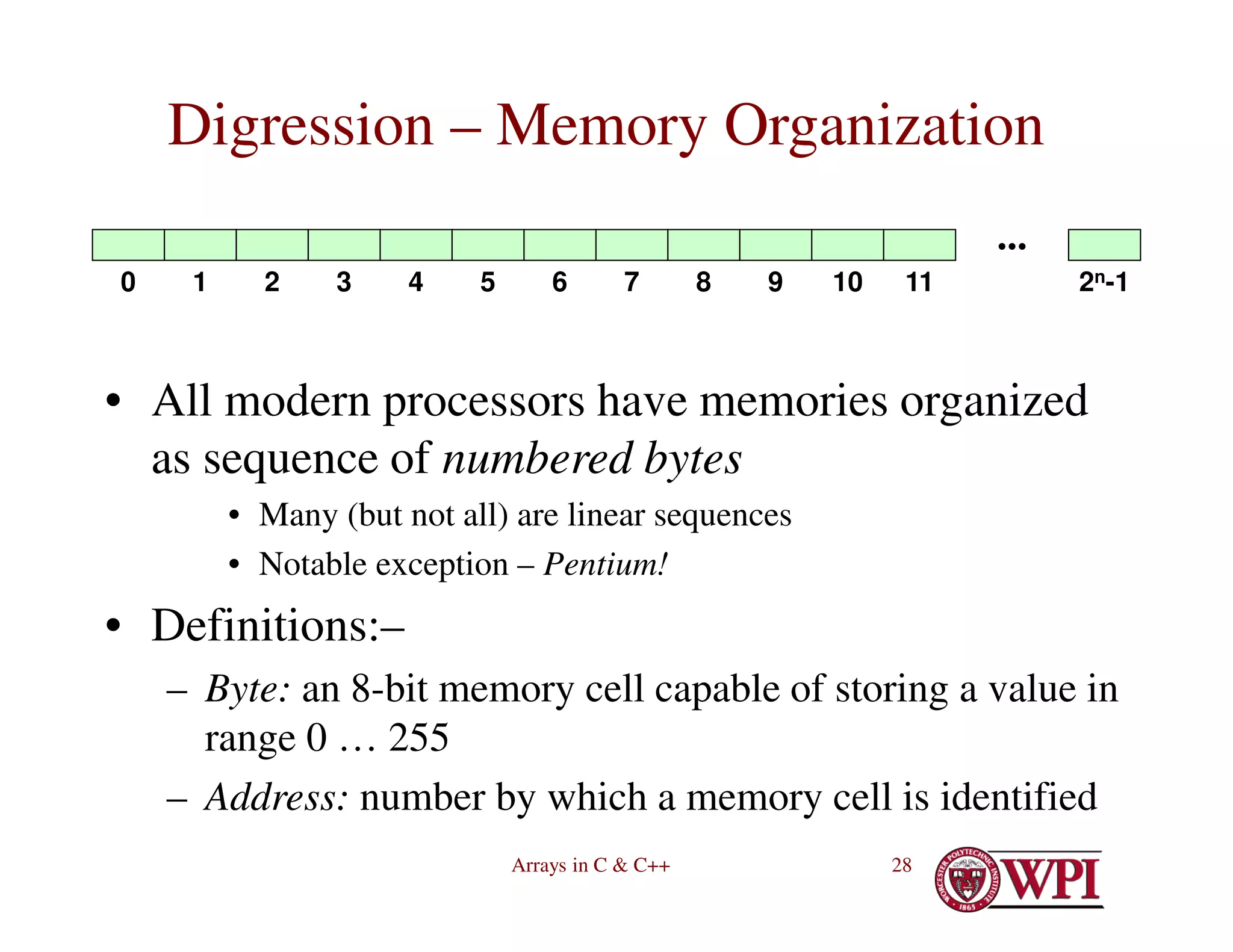
Digression – Memory Organization
• All modern processors have memories organized
as sequence of numbered bytes
• Many (but not all) are linear sequences
• Notable exception – Pentium!
• Definitions:–
– Byte: an 8-bit memory cell capable of storing a value in
range 0 … 255
– Address: number by which a memory cell is identified
∙∙∙
2n-1
0 1 2 3 4 5 6 7 8 9 10 11
Arrays in C & C++ 29
Memory Organization (continued)
• Larger data types are sequences of bytes – e.g.,
• short int – 2 bytes
• int – 2 or 4 bytes
• long – 4 or 8 bytes
• float – 4 bytes
• double – 8 bytes
• (Almost) always aligned to multiple of size in bytes
• Address is “first” byte of sequence (i.e., byte zero)
• May be low-order or high-order byte
• Big endian or Little endian
∙∙∙
2n-1
0 1 2 3 4 5 6 7 8 9 10 11
Arrays in C & C++ 30
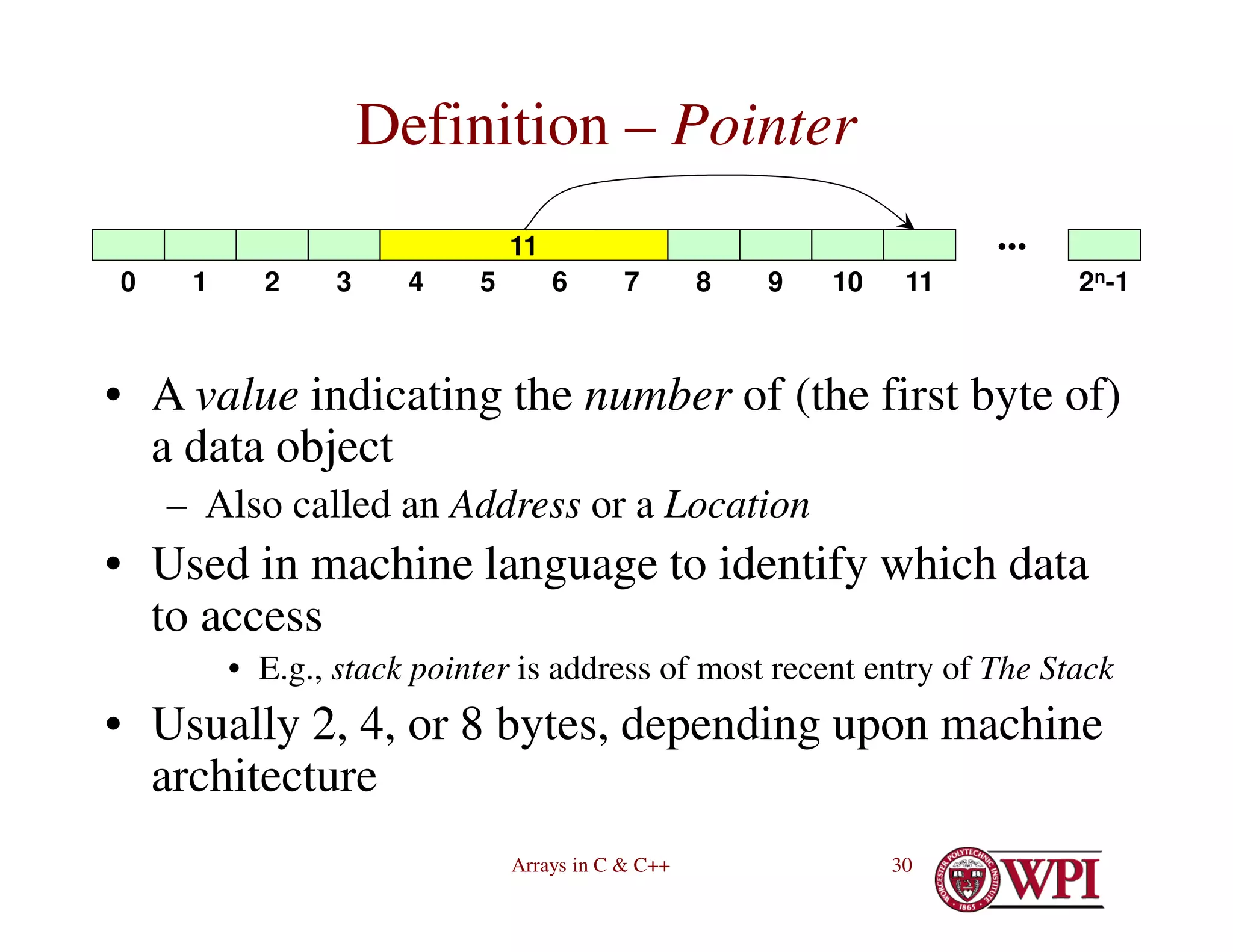
Definition – Pointer
• A value indicating the number of (the first byte of)
a data object
– Also called an Address or a Location
• Used in machine language to identify which data
to access
• E.g., stack pointer is address of most recent entry of The Stack
• Usually 2, 4, or 8 bytes, depending upon machine
architecture
∙∙∙
2n-1
0 1 2 3 4 5 6 7 8 9 10 11
11
Arrays in C & C++ 31
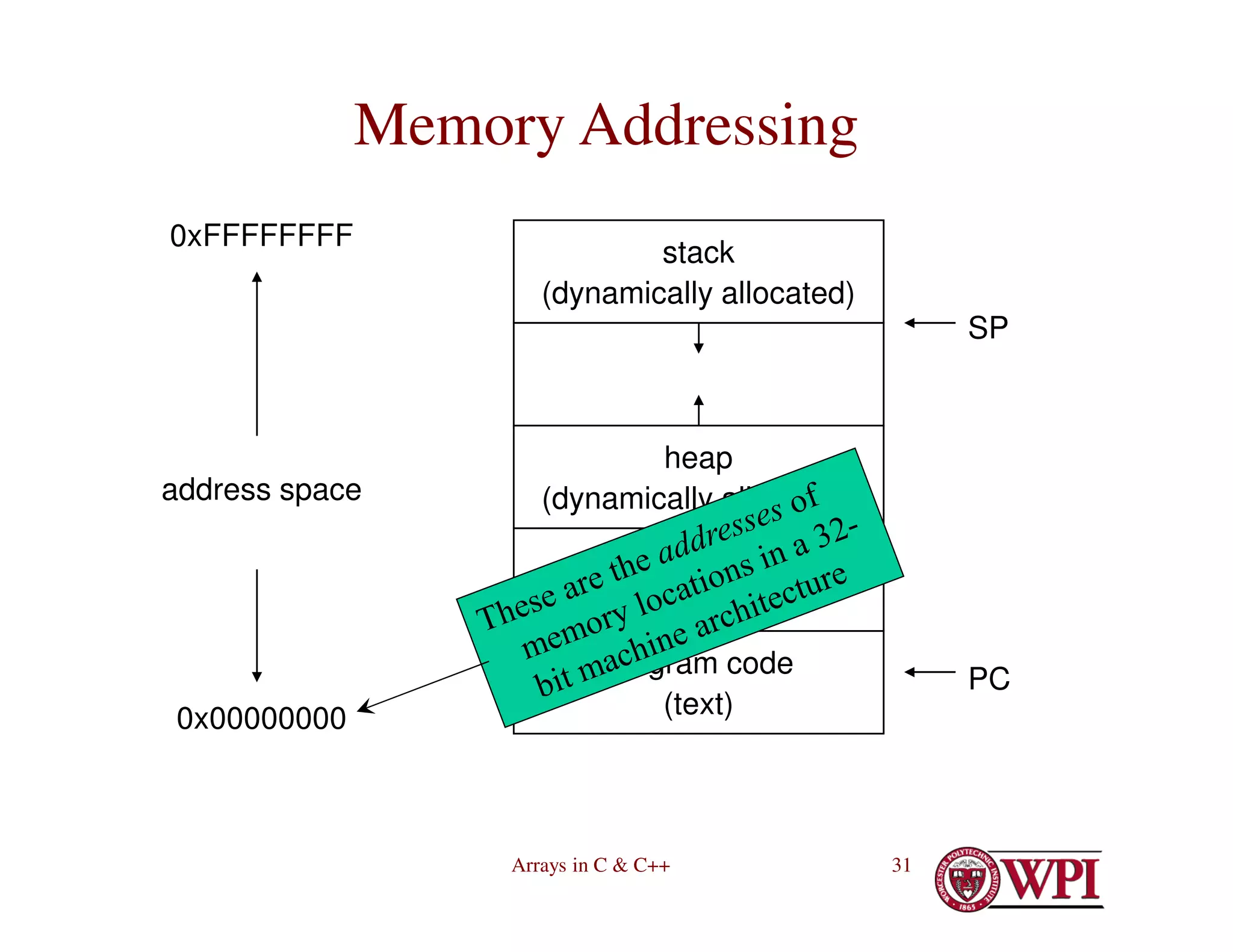
Memory Addressing
0x00000000
0xFFFFFFFF
address space
program code
(text)
static data
heap
(dynamically allocated)
stack
(dynamically allocated)
PC
SP
Arrays in C & C++ 32
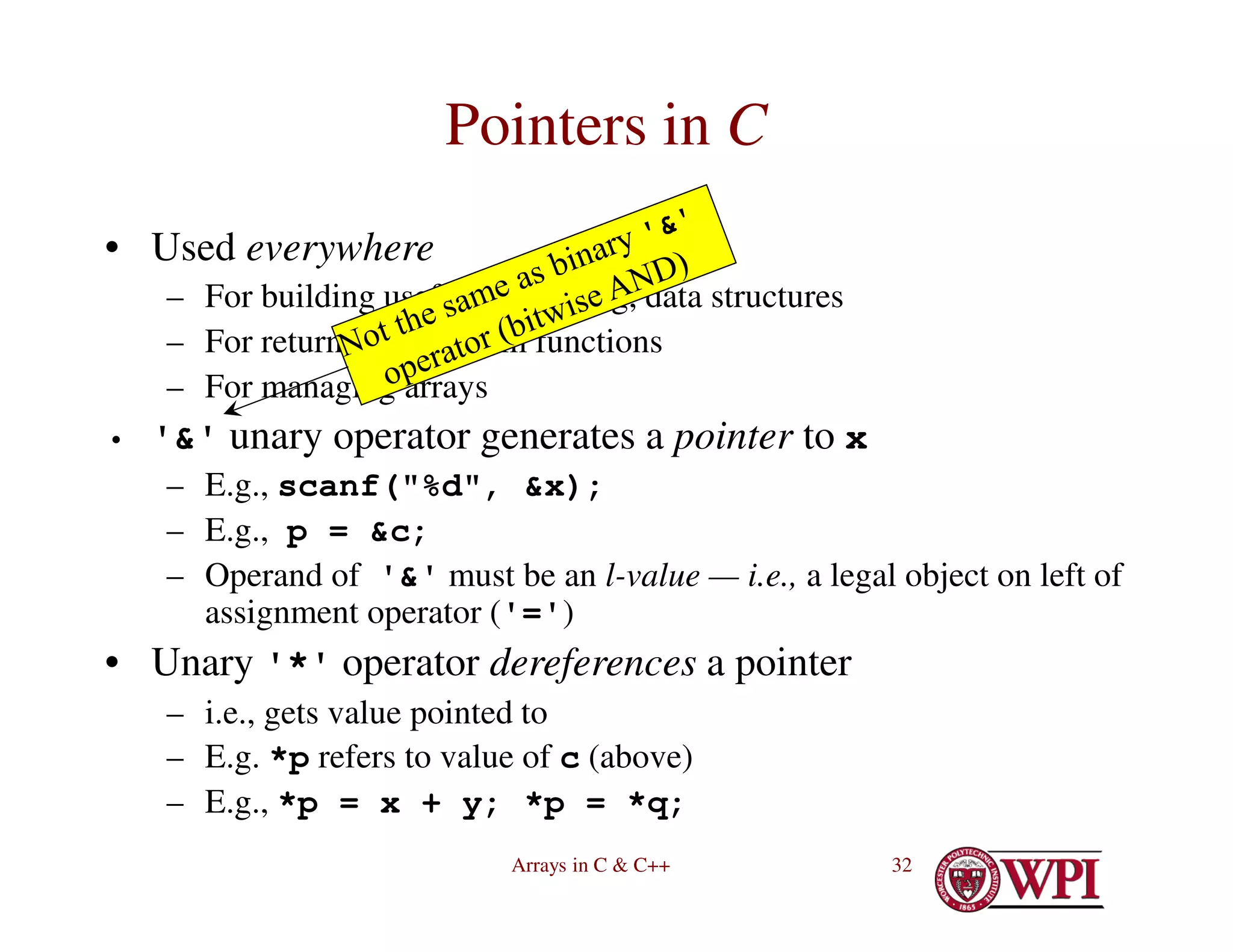
Pointers in C
• Used everywhere
– For building useful, interesting, data structures
– For returning data from functions
– For managing arrays
• '&' unary operator generates a pointer to x
– E.g., scanf("%d", &x);
– E.g., p = &c;
– Operand of '&' must be an l-value — i.e., a legal object on left of
assignment operator ('=')
• Unary '*' operator dereferences a pointer
– i.e., gets value pointed to
– E.g. *p refers to value of c (above)
– E.g., *p = x + y; *p = *q;
Arrays in C & C++ 33
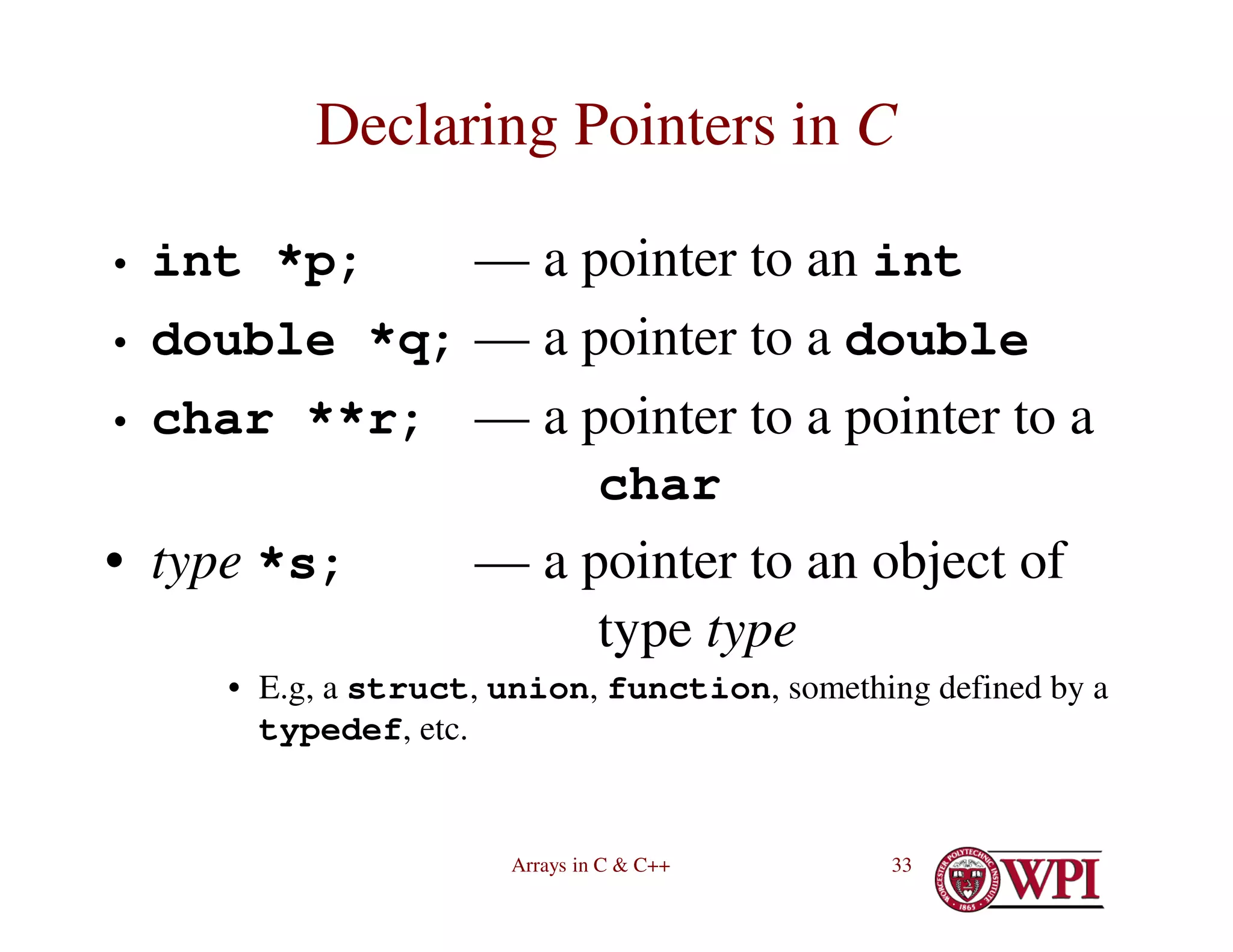
Declaring Pointers in C
• int *p; — a pointer to an int
• double *q; — a pointer to a double
• char **r; — a pointer to a pointer to a
char
• type *s; — a pointer to an object of
type type
• E.g, a struct, union, function, something defined by a
typedef, etc.
Arrays in C & C++ 34
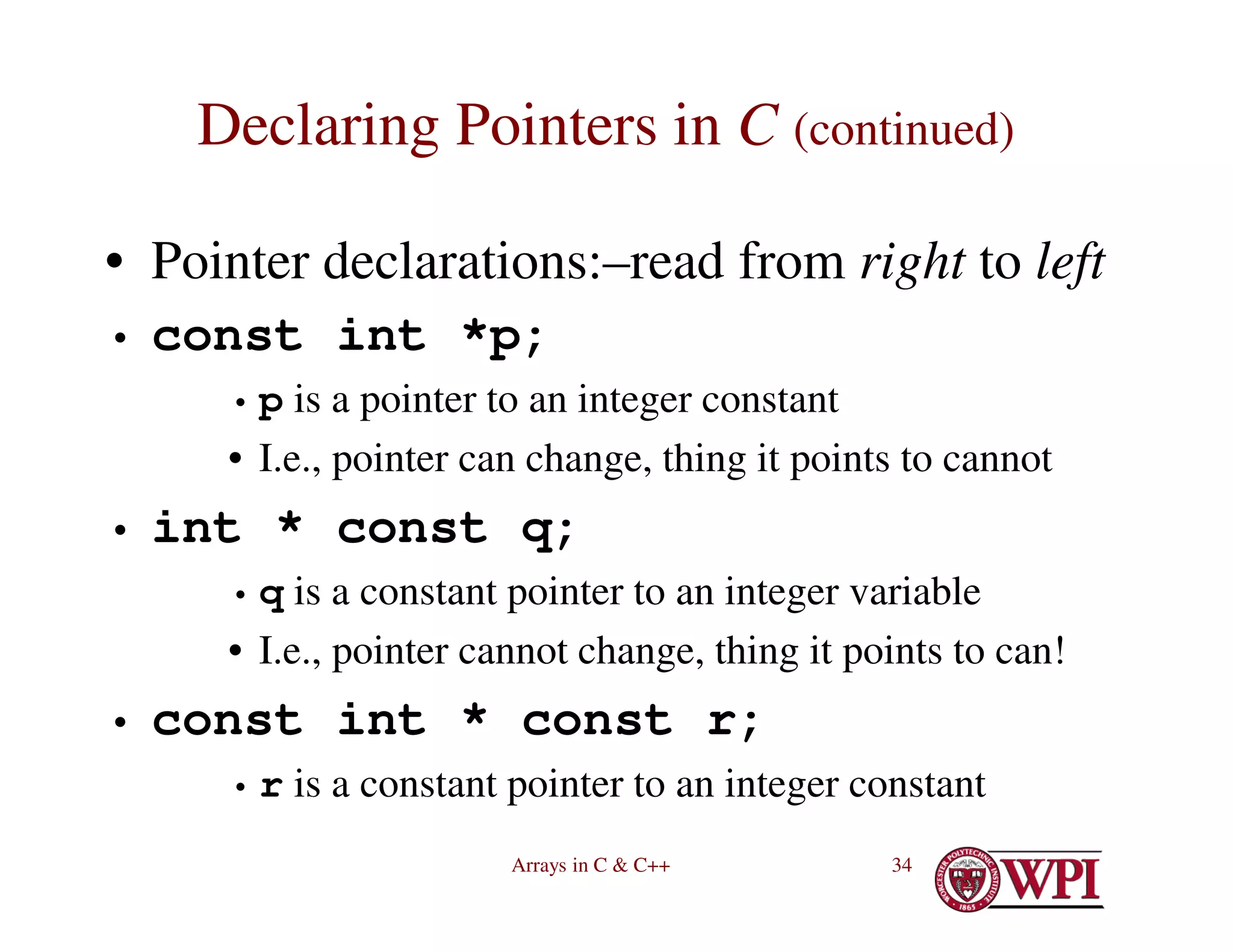
Declaring Pointers in C (continued)
• Pointer declarations:–read from right to left
• const int *p;
• p is a pointer to an integer constant
• I.e., pointer can change, thing it points to cannot
• int * const q;
• q is a constant pointer to an integer variable
• I.e., pointer cannot change, thing it points to can!
• const int * const r;
• r is a constant pointer to an integer constant
Arrays in C & C++ 35
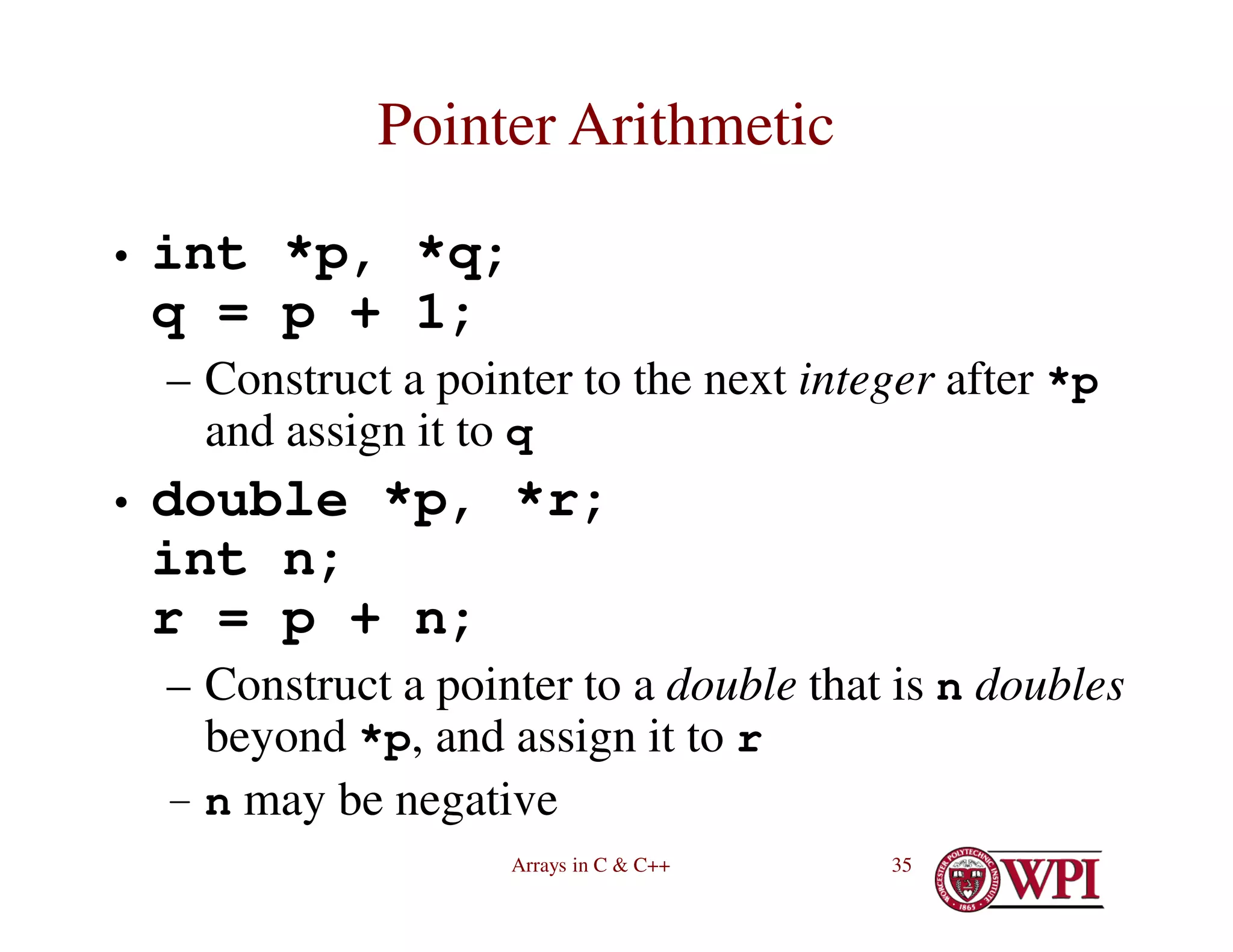
Pointer Arithmetic
• int *p, *q;
q = p + 1;
– Construct a pointer to the next integer after *p
and assign it to q
• double *p, *r;
int n;
r = p + n;
– Construct a pointer to a double that is n doubles
beyond *p, and assign it to r
– n may be negative
Arrays in C & C++ 36
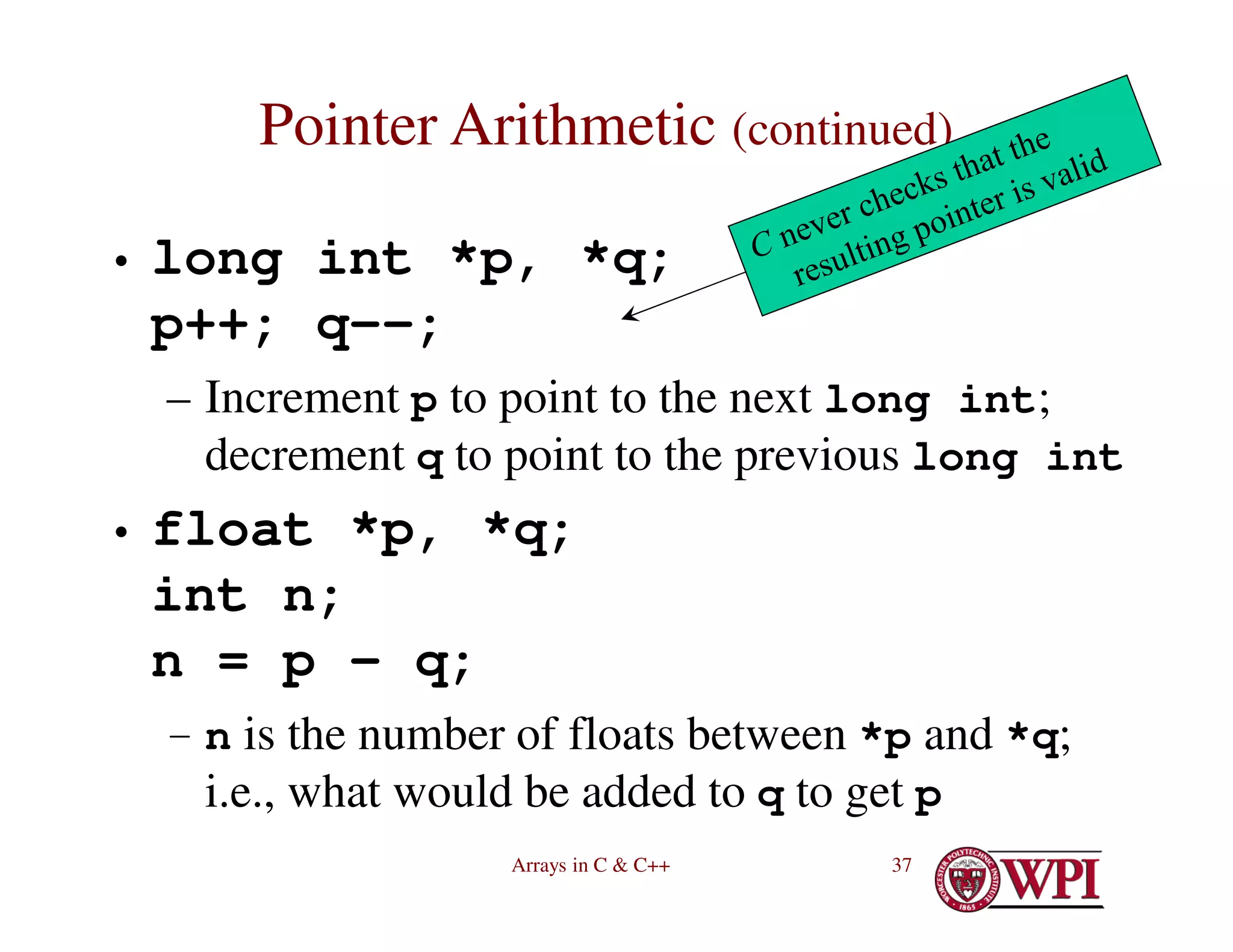
Pointer Arithmetic (continued)
• long int *p, *q;
p++; q--;
– Increment p to point to the next long int;
decrement q to point to the previous long int
• float *p, *q;
int n;
n = p – q;
– n is the number of floats between *p and *q;
i.e., what would be added to q to get p
Arrays in C & C++ 37
Pointer Arithmetic (continued)
• long int *p, *q;
p++; q--;
– Increment p to point to the next long int;
decrement q to point to the previous long int
• float *p, *q;
int n;
n = p – q;
– n is the number of floats between *p and *q;
i.e., what would be added to q to get p
Arrays in C & C++ 38
Why introduce pointers in the middle of a
lesson on arrays?
• Arrays and pointers are closely related in C
– In fact, they are essentially the same thing!
– Esp. when used as parameters of functions
• int A[10];
int *p;
– Type of A is int *
– p = A; and A = p; are legal assignments
– *p refers to A[0]
*(p + n) refers to A[n]
– p = &A[5]; is the same as p = A + 5;
Arrays in C & C++ 39
Arrays and Pointers (continued)
• double A[10]; vs. double *A;
• Only difference:–
– double A[10] sets aside ten units of memory, each
large enough to hold a double, and A is initialized to
point to the zeroth unit.
– double *A sets aside one pointer-sized unit of
memory, not initialized
• You are expected to come up with the memory elsewhere!
– Note:– all pointer variables are the same size in any
given machine architecture
• Regardless of what types they point to
Arrays in C & C++ 40
Note
• C does not assign arrays to each other
• E.g,
– double A[10];
double B[10];
A = B;
• assigns the pointer value B to the pointer value A
• Original contents of array A are untouched (and
possibly unreachable!)
Arrays in C & C++ 41
Arrays as Function Parameters
• void init(float A[], int arraySize);
void init(float *A, int arraySize);
• Are identical function prototypes!
• Pointer is passed by value
• I.e. caller copies the value of a pointer to
float into the parameter A
• Called function can reference through that
pointer to reach thing pointed to
Arrays in C & C++ 42
Arrays as Function Parameters (continued)
• void init(float A[], int arraySize){
int n;
for(n = 0; n < arraySize; n++)
A[n] = (float)n;
} //init
• Assigns values to the array A in place
– So that caller can see the changes!
Arrays in C & C++ 43
Examples
while ((rc = scanf("%lf", &array[count]))
!=EOF && rc!=0)
…
double getLargest(const double A[], const
int sizeA) {
double d;
if (sizeA > 0) {
d = getLargest(&A[1], sizeA-1);
return (d > A[0]) ? d : A[0];
} else
return A[0];
} // getLargest
Arrays in C & C++ 44
Result
• Even though all arguments are passed by
value to functions …
• … pointers allow functions to assign back
to data of caller
• Arrays are pointers passed by value
Arrays in C & C++ 45
Safety Note
• When passing arrays to functions, it is
recommended to specify const if you don’t
want function changing the value of any
elements
• Reason:– you don’t know whether your
function would pass array to another before
returning to you
• Exception – many software packages don’t specify
const in their own headers, so you can’t either!
Arrays in C & C++ 46
Questions?

4.ArraysInC.pdf

  • 1.
    Arrays in C& C++ 1 Arrays in C & C++ (including a brief introduction to pointers) (Slides include materials from The C Programming Language, 2nd edition, by Kernighan and Ritchie and from C: How to Program, 5th and 6th editions, by Deitel and Deitel)
  • 2.
    Arrays in C& C++ 2 Reading Assignment • Chapter 6 of Deitel & Deitel • Chapter 5 of Kernighan & Ritchie
  • 3.
    Arrays in C& C++ 3 Definition – Array • A collection of objects of the same type stored contiguously in memory under one name • May be type of any kind of variable • May even be collection of arrays! • For ease of access to any member of array • For passing to functions as a group
  • 4.
    Arrays in C& C++ 4 Arrays in C • By far, the dominant kind of data structure in C programs • Many, many uses of all kinds • Collections of all kinds of data • Instant access to any element
  • 5.
    Arrays in C& C++ 5 Examples • int A[10] • An array of ten integers • A[0], A[1], …, A[9] • double B[20] • An array of twenty long floating point numbers • B[0], B[1], …, B[19] • Arrays of structs, unions, pointers, etc., are also allowed • Array indexes always start at zero in C
  • 6.
    Arrays in C& C++ 6 Examples (continued) • int C[] • An array of an unknown number of integers (allowable in a parameter of a function) • C[0], C[1], …, C[max-1] • int D[10][20] • An array of ten rows, each of which is an array of twenty integers • D[0][0], D[0][1], …, D[1][0], D[1][1], …, D[9][19] • Not used so often as arrays of pointers
  • 7.
    Arrays in C& C++ 7 Two-dimensional Arrays • int D[10][20] – A one-dimensional array with 10 elements, each of which is an array with 20 elements • I.e., int D[10][20] /*[row][col]*/ • Last subscript varies the fastest – I.e., elements of last subscript are stored contiguously in memory • Also, three or more dimensions
  • 8.
    Arrays in C& C++ 8 Array Element • May be used wherever a variable of the same type may be used • In an expression (including arguments) • On left side of assignment • Examples:– A[3] = x + y; x = y – A[3]; z = sin(A[i]) + cos(B[j]);
  • 9.
    Arrays in C& C++ 9 Array Elements (continued) • Generic form:– • ArrayName[integer-expression] • ArrayName[integer-expression] [integer-expression] – Same type as the underlying type of the array • Definition:– Array Index – the expression between the square brackets • Also called an Array Subscript
  • 10.
    Arrays in C& C++ 10 Array Elements (continued) • Array elements are commonly used in loops • E.g., for(i=0; i < max; i++) A[i] = i*i; for(sum = 0, j=0; j < max; j++) sum += B[j]; for (count=0;rc!=EOF;count++) rc=scanf("%f", &A[count]);
  • 11.
    Arrays in C& C++ 11 Caution! Caution! Caution! • It is the programmer’s responsibility to avoid indexing off the end of an array • Likely to corrupt data • May cause a segmentation fault • Could expose system to a security hole! • C does NOT check array bounds • I.e., whether index points to an element within the array • Might be high (beyond the end) or negative (before the array starts)
  • 12.
    Arrays in C& C++ 12 Caution! Caution! Caution! • It is the programmer’s responsibility to avoid indexing off the end of an array • Likely to corrupt data • May cause a segmentation fault • Could expose system to a security hole! • C does NOT check array bounds • I.e., whether index points to an element within the array • Might be high (beyond the end) or negative (before the array starts)
  • 13.
    Arrays in C& C++ 13 Questions
  • 14.
    Arrays in C& C++ 14 Declaring Arrays • Static or automatic • Array size may be determined explicitly or implicitly • Array size may be determined at run-time • Automatic only • Not in textbook
  • 15.
    Arrays in C& C++ 15 Declaring Arrays (continued) • Outside of any function – always static int A[13]; #define CLASS_SIZE 73 double B[CLASS_SIZE]; const int nElements = 25 float C[nElements]; static char S[256]; /*not visible to linker */
  • 16.
    Arrays in C& C++ 16 Declaring Arrays (continued) • Outside of any function – always static int A[13]; #define CLASS_SIZE 73 double B[CLASS_SIZE]; const int nElements = 25 float C[nElements]; static char D[256]; /*not visible to linker */ Static  retains values across function calls
  • 17.
    Arrays in C& C++ 17 Static Data Allocation 0x00000000 0xFFFFFFFF address space program code (text) static data heap (dynamically allocated) stack (dynamically allocated) PC SP
  • 18.
    Arrays in C& C++ 18 Declaring Arrays (continued) • Inside function or compound statement – usually automatic void f( …) { int A[13]; #define CLASS_SIZE 73 double B[CLASS_SIZE]; const int nElements = 25 float C[nElements]; static char D[256]; /*static, not visible outside function */ } //f
  • 19.
    Arrays in C& C++ 19 Static Data Allocation 0x00000000 0xFFFFFFFF address space program code (text) static data heap (dynamically allocated) stack (dynamically allocated) PC SP
  • 20.
    Arrays in C& C++ 20 Declaring Arrays (continued) • Inside function or compound statement – usually automatic void f( …) { int A[13]; #define CLASS_SIZE 73 double B[CLASS_SIZE]; const int nElements = 25 float C[nElements]; static char D[256]; /*static, not visible outside function */ } //f
  • 21.
    Arrays in C& C++ 21 Dynamic Array Size Determination • gcc supports the following:– void func(<other parameters>, const int n) { double Arr[2*n]; } //func • I.e., array size is determined by evaluating an expression at run-time • Automatic allocation on The Stack • Not in C88 ANSI standard, not in Kernighan & Ritchie • Part of C99 and C++
  • 22.
    Arrays in C& C++ 22 Array Initialization • int A[5] = {2, 4, 8, 16, 32}; • Static or automatic • int B[20] = {2, 4, 8, 16, 32}; • Unspecified elements are guaranteed to be zero • int C[4] = {2, 4, 8, 16, 32}; • Error — compiler detects too many initial values • int D[5] = {2*n, 4*n, 8*n, 16*n, 32*n}; • Automatically only; array initialized to expressions • int E[n] = {1}; • gcc, C99, C++ • Dynamically allocated array (automatic only). Zeroth element initialized to 1; all other elements initialized to 0
  • 23.
    Arrays in C& C++ 23 Implicit Array Size Determination • int days[] = {31, 28, 31, 30, 31, 30, 31, 31, 30, 31, 30, 31}; – Array is created with as many elements as initial values • In this case, 12 elements – Values must be compile-time constants (for static arrays) – Values may be run-time expressions (for automatic arrays) – See p. 86 of K&R
  • 24.
    Arrays in C& C++ 24 Getting Size of Implicit Array • sizeof operator – returns # of bytes of memory required by operand • See p.135 of K&R, §7.7 of D&D • Examples:– • sizeof (int) – # of bytes per int • sizeof (float) – # of bytes per float • sizeof days – # of bytes in array days (previous slide) • # of elements in days = (sizeof days)/sizeof(int) • Must be able to be determined at compile time • Getting size of dynamically allocated arrays not supported
  • 25.
    Arrays in C& C++ 25 Getting Size of Implicit Array • sizeof operator – returns # of bytes of memory required by operand • See p.135 • Examples:– • sizeof (int) – # of bytes per int • sizeof (float) – # of bytes per float • sizeof days – # of bytes in array days (previous slide) • # of elements in days = (sizeof days)/sizeof(int) • Must be able to be determined at compile time • Getting size of dynamically allocated arrays not supported
  • 26.
    Arrays in C& C++ 26 Initializing a Two-Dimensional Array static char daytab[2][12] = { {31,28,31,30,31,30,31,31,30,31,30,31}, {31,29,31,30,31,30,31,31,30,31,30,31} }; // daytab OR static char daytab[2][12] = { 31,28,31,30,31,30,31,31,30,31,30,31, 31,29,31,30,31,30,31,31,30,31,30,31 }; // daytab
  • 27.
    Arrays in C& C++ 27 Questions?
  • 28.
    Arrays in C& C++ 28 Digression – Memory Organization • All modern processors have memories organized as sequence of numbered bytes • Many (but not all) are linear sequences • Notable exception – Pentium! • Definitions:– – Byte: an 8-bit memory cell capable of storing a value in range 0 … 255 – Address: number by which a memory cell is identified ∙∙∙ 2n-1 0 1 2 3 4 5 6 7 8 9 10 11
  • 29.
    Arrays in C& C++ 29 Memory Organization (continued) • Larger data types are sequences of bytes – e.g., • short int – 2 bytes • int – 2 or 4 bytes • long – 4 or 8 bytes • float – 4 bytes • double – 8 bytes • (Almost) always aligned to multiple of size in bytes • Address is “first” byte of sequence (i.e., byte zero) • May be low-order or high-order byte • Big endian or Little endian ∙∙∙ 2n-1 0 1 2 3 4 5 6 7 8 9 10 11
  • 30.
    Arrays in C& C++ 30 Definition – Pointer • A value indicating the number of (the first byte of) a data object – Also called an Address or a Location • Used in machine language to identify which data to access • E.g., stack pointer is address of most recent entry of The Stack • Usually 2, 4, or 8 bytes, depending upon machine architecture ∙∙∙ 2n-1 0 1 2 3 4 5 6 7 8 9 10 11 11
  • 31.
    Arrays in C& C++ 31 Memory Addressing 0x00000000 0xFFFFFFFF address space program code (text) static data heap (dynamically allocated) stack (dynamically allocated) PC SP
  • 32.
    Arrays in C& C++ 32 Pointers in C • Used everywhere – For building useful, interesting, data structures – For returning data from functions – For managing arrays • '&' unary operator generates a pointer to x – E.g., scanf("%d", &x); – E.g., p = &c; – Operand of '&' must be an l-value — i.e., a legal object on left of assignment operator ('=') • Unary '*' operator dereferences a pointer – i.e., gets value pointed to – E.g. *p refers to value of c (above) – E.g., *p = x + y; *p = *q;
  • 33.
    Arrays in C& C++ 33 Declaring Pointers in C • int *p; — a pointer to an int • double *q; — a pointer to a double • char **r; — a pointer to a pointer to a char • type *s; — a pointer to an object of type type • E.g, a struct, union, function, something defined by a typedef, etc.
  • 34.
    Arrays in C& C++ 34 Declaring Pointers in C (continued) • Pointer declarations:–read from right to left • const int *p; • p is a pointer to an integer constant • I.e., pointer can change, thing it points to cannot • int * const q; • q is a constant pointer to an integer variable • I.e., pointer cannot change, thing it points to can! • const int * const r; • r is a constant pointer to an integer constant
  • 35.
    Arrays in C& C++ 35 Pointer Arithmetic • int *p, *q; q = p + 1; – Construct a pointer to the next integer after *p and assign it to q • double *p, *r; int n; r = p + n; – Construct a pointer to a double that is n doubles beyond *p, and assign it to r – n may be negative
  • 36.
    Arrays in C& C++ 36 Pointer Arithmetic (continued) • long int *p, *q; p++; q--; – Increment p to point to the next long int; decrement q to point to the previous long int • float *p, *q; int n; n = p – q; – n is the number of floats between *p and *q; i.e., what would be added to q to get p
  • 37.
    Arrays in C& C++ 37 Pointer Arithmetic (continued) • long int *p, *q; p++; q--; – Increment p to point to the next long int; decrement q to point to the previous long int • float *p, *q; int n; n = p – q; – n is the number of floats between *p and *q; i.e., what would be added to q to get p
  • 38.
    Arrays in C& C++ 38 Why introduce pointers in the middle of a lesson on arrays? • Arrays and pointers are closely related in C – In fact, they are essentially the same thing! – Esp. when used as parameters of functions • int A[10]; int *p; – Type of A is int * – p = A; and A = p; are legal assignments – *p refers to A[0] *(p + n) refers to A[n] – p = &A[5]; is the same as p = A + 5;
  • 39.
    Arrays in C& C++ 39 Arrays and Pointers (continued) • double A[10]; vs. double *A; • Only difference:– – double A[10] sets aside ten units of memory, each large enough to hold a double, and A is initialized to point to the zeroth unit. – double *A sets aside one pointer-sized unit of memory, not initialized • You are expected to come up with the memory elsewhere! – Note:– all pointer variables are the same size in any given machine architecture • Regardless of what types they point to
  • 40.
    Arrays in C& C++ 40 Note • C does not assign arrays to each other • E.g, – double A[10]; double B[10]; A = B; • assigns the pointer value B to the pointer value A • Original contents of array A are untouched (and possibly unreachable!)
  • 41.
    Arrays in C& C++ 41 Arrays as Function Parameters • void init(float A[], int arraySize); void init(float *A, int arraySize); • Are identical function prototypes! • Pointer is passed by value • I.e. caller copies the value of a pointer to float into the parameter A • Called function can reference through that pointer to reach thing pointed to
  • 42.
    Arrays in C& C++ 42 Arrays as Function Parameters (continued) • void init(float A[], int arraySize){ int n; for(n = 0; n < arraySize; n++) A[n] = (float)n; } //init • Assigns values to the array A in place – So that caller can see the changes!
  • 43.
    Arrays in C& C++ 43 Examples while ((rc = scanf("%lf", &array[count])) !=EOF && rc!=0) … double getLargest(const double A[], const int sizeA) { double d; if (sizeA > 0) { d = getLargest(&A[1], sizeA-1); return (d > A[0]) ? d : A[0]; } else return A[0]; } // getLargest
  • 44.
    Arrays in C& C++ 44 Result • Even though all arguments are passed by value to functions … • … pointers allow functions to assign back to data of caller • Arrays are pointers passed by value
  • 45.
    Arrays in C& C++ 45 Safety Note • When passing arrays to functions, it is recommended to specify const if you don’t want function changing the value of any elements • Reason:– you don’t know whether your function would pass array to another before returning to you • Exception – many software packages don’t specify const in their own headers, so you can’t either!
  • 46.
    Arrays in C& C++ 46 Questions?