The A* Algorithm
Maharaj Dey 11500117099
Sandeep Kumar 11500117059
Artificial Intelligence
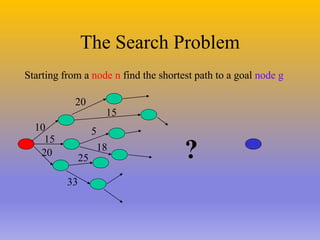
The Search Problem
Starting from a node n find the shortest path to a goal node g
10
15
20 ?
20
15
5
18
25
33
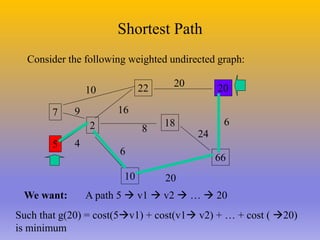
Consider the following weighted undirected graph:
5
2
7
10
18
22
66
20
Shortest Path
10
20
16
4
6
8
24
20
6
9
We want: A path 5  v1  v2  …  20
Such that g(20) = cost(5v1) + cost(v1 v2) + … + cost ( 20)
is minimum
Djikstra Algorithm
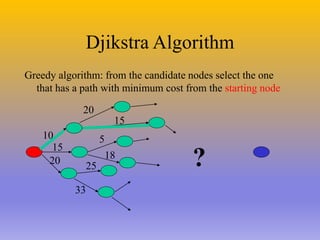
Greedy algorithm: from the candidate nodes select the one
that has a path with minimum cost from the starting node
10
15
20 ?
20
15
5
18
25
33
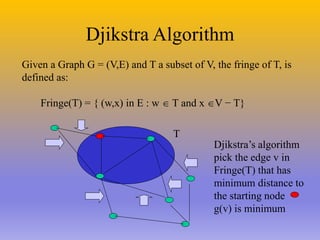
Djikstra Algorithm
T
Given a Graph G = (V,E) and T a subset of V, the fringe of T, is
defined as:
Fringe(T) = { (w,x) in E : w  T and x V − T}
Djikstra’s algorithm
pick the edge v in
Fringe(T) that has
minimum distance to
the starting node
g(v) is minimum
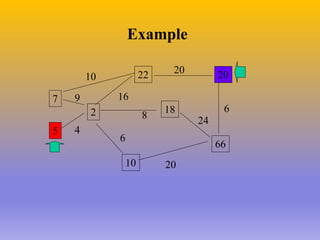
Example
5
2
7
10
18
22
66
20
10
20
16
4
6
8
24
20
6
9
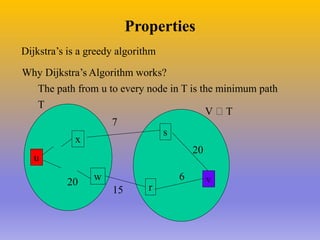
Properties
Dijkstra’s is a greedy algorithm
Why Dijkstra’s Algorithm works?
T
V T
The path from u to every node in T is the minimum path
w
u
r
s
v
6
20
20
x
7
15
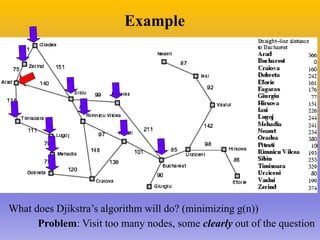
Example
What does Djikstra’s algorithm will do? (minimizing g(n))
Problem: Visit too many nodes, some clearly out of the question
Complexity
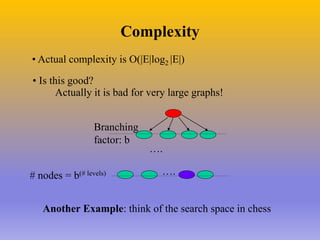
• Actual complexity is O(|E|log2 |E|)
• Is this good?
Actually it is bad for very large graphs!
Branching
factor: b
….
….
# nodes = b(# levels)
Another Example: think of the search space in chess
Better Solution: Make a ‘hunch”!
• Use heuristics to guide the search
– Heuristic: estimation or “hunch” of how to search for a
solution
• We define a heuristic function:
h(n) = “estimate of the cost of the cheapest path from
the starting node to the goal node”
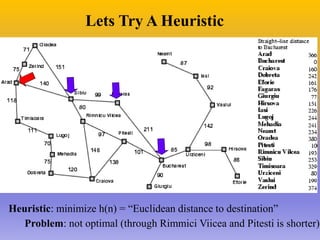
Lets Try A Heuristic
Heuristic: minimize h(n) = “Euclidean distance to destination”
Problem: not optimal (through Rimmici Viicea and Pitesti is shorter)
The A* Search
• Difficulty: we want to still be able to generate the path
with minimum cost
• A* is an algorithm that:
– Uses heuristic to guide search
– While ensuring that it will compute a path with
minimum cost
• A* computes the function f(n) = g(n) + h(n)
“actual cost”
“estimated cost”
A*
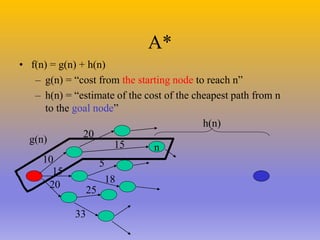
• f(n) = g(n) + h(n)
– g(n) = “cost from the starting node to reach n”
– h(n) = “estimate of the cost of the cheapest path from n
to the goal node”
10
15
20
20
15
5
18
25
33
n
g(n)
h(n)
Example
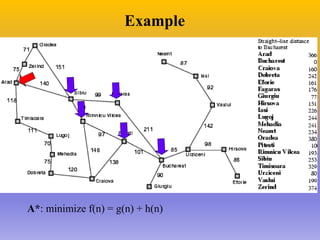
A*: minimize f(n) = g(n) + h(n)
Properties of A*
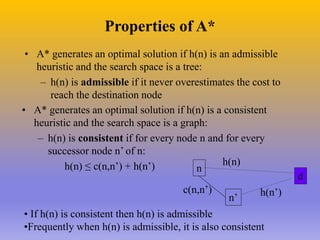
• A* generates an optimal solution if h(n) is an admissible
heuristic and the search space is a tree:
– h(n) is admissible if it never overestimates the cost to
reach the destination node
• A* generates an optimal solution if h(n) is a consistent
heuristic and the search space is a graph:
– h(n) is consistent if for every node n and for every
successor node n’ of n:
h(n) ≤ c(n,n’) + h(n’) n
n’
d
h(n)
c(n,n’) h(n’)
• If h(n) is consistent then h(n) is admissible
•Frequently when h(n) is admissible, it is also consistent
Admissible Heuristics
• A heuristic is admissible if it is too optimistic, estimating
the cost to be smaller than it actually is.
• Example:
In the road map domain,
h(n) = “Euclidean distance to destination”
is admissible as normally cities are not connected by
roads that make straight lines
How to Create Admissible Heuristics
• Relax the conditions of the problem
– This will result in admissible heuristics!
• Lets look at an 8-puzzle game:
http://www.permadi.com/java/puzzle8/
• Possible heuristics?
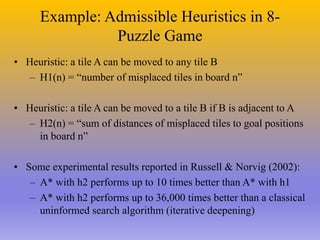
Example: Admissible Heuristics in 8-
Puzzle Game
• Heuristic: a tile A can be moved to any tile B
– H1(n) = “number of misplaced tiles in board n”
• Heuristic: a tile A can be moved to a tile B if B is adjacent to A
– H2(n) = “sum of distances of misplaced tiles to goal positions
in board n”
• Some experimental results reported in Russell & Norvig (2002):
– A* with h2 performs up to 10 times better than A* with h1
– A* with h2 performs up to 36,000 times better than a classical
uninformed search algorithm (iterative deepening)
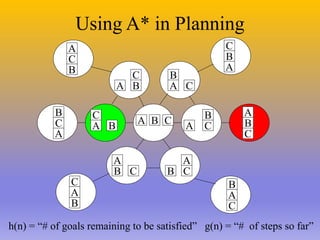
Using A* in Planning
A
C
B A B C
A C
B
C
B
A
B
A
C
B
A
C
B C
A
C
A
B
A
C
B
B
C
A
A B
C
A
B
C
A
B
C
h(n) = “# of goals remaining to be satisfied” g(n) = “# of steps so far”
A* in Games
• Path finding (duh!)
– We will have several presentations on the topic
– We will see that sometimes even A* speed
improvements are not sufficient
– Additional improvements are required
• A* can be used for planning moves computer-controlled
player (e.g., chess)
• F.E.A.R. uses A* to plan its search
A* Algorithm

A* Algorithm

  • 1.
    The A* Algorithm MaharajDey 11500117099 Sandeep Kumar 11500117059 Artificial Intelligence
  • 2.
    The Search Problem Startingfrom a node n find the shortest path to a goal node g 10 15 20 ? 20 15 5 18 25 33
  • 3.
    Consider the followingweighted undirected graph: 5 2 7 10 18 22 66 20 Shortest Path 10 20 16 4 6 8 24 20 6 9 We want: A path 5  v1  v2  …  20 Such that g(20) = cost(5v1) + cost(v1 v2) + … + cost ( 20) is minimum
  • 4.
    Djikstra Algorithm Greedy algorithm:from the candidate nodes select the one that has a path with minimum cost from the starting node 10 15 20 ? 20 15 5 18 25 33
  • 5.
    Djikstra Algorithm T Given aGraph G = (V,E) and T a subset of V, the fringe of T, is defined as: Fringe(T) = { (w,x) in E : w  T and x V − T} Djikstra’s algorithm pick the edge v in Fringe(T) that has minimum distance to the starting node g(v) is minimum
  • 6.
  • 7.
    Properties Dijkstra’s is agreedy algorithm Why Dijkstra’s Algorithm works? T V T The path from u to every node in T is the minimum path w u r s v 6 20 20 x 7 15
  • 8.
    Example What does Djikstra’salgorithm will do? (minimizing g(n)) Problem: Visit too many nodes, some clearly out of the question
  • 9.
    Complexity • Actual complexityis O(|E|log2 |E|) • Is this good? Actually it is bad for very large graphs! Branching factor: b …. …. # nodes = b(# levels) Another Example: think of the search space in chess
  • 10.
    Better Solution: Makea ‘hunch”! • Use heuristics to guide the search – Heuristic: estimation or “hunch” of how to search for a solution • We define a heuristic function: h(n) = “estimate of the cost of the cheapest path from the starting node to the goal node”
  • 11.
    Lets Try AHeuristic Heuristic: minimize h(n) = “Euclidean distance to destination” Problem: not optimal (through Rimmici Viicea and Pitesti is shorter)
  • 12.
    The A* Search •Difficulty: we want to still be able to generate the path with minimum cost • A* is an algorithm that: – Uses heuristic to guide search – While ensuring that it will compute a path with minimum cost • A* computes the function f(n) = g(n) + h(n) “actual cost” “estimated cost”
  • 13.
    A* • f(n) =g(n) + h(n) – g(n) = “cost from the starting node to reach n” – h(n) = “estimate of the cost of the cheapest path from n to the goal node” 10 15 20 20 15 5 18 25 33 n g(n) h(n)
  • 14.
  • 15.
    Properties of A* •A* generates an optimal solution if h(n) is an admissible heuristic and the search space is a tree: – h(n) is admissible if it never overestimates the cost to reach the destination node • A* generates an optimal solution if h(n) is a consistent heuristic and the search space is a graph: – h(n) is consistent if for every node n and for every successor node n’ of n: h(n) ≤ c(n,n’) + h(n’) n n’ d h(n) c(n,n’) h(n’) • If h(n) is consistent then h(n) is admissible •Frequently when h(n) is admissible, it is also consistent
  • 16.
    Admissible Heuristics • Aheuristic is admissible if it is too optimistic, estimating the cost to be smaller than it actually is. • Example: In the road map domain, h(n) = “Euclidean distance to destination” is admissible as normally cities are not connected by roads that make straight lines
  • 17.
    How to CreateAdmissible Heuristics • Relax the conditions of the problem – This will result in admissible heuristics! • Lets look at an 8-puzzle game: http://www.permadi.com/java/puzzle8/ • Possible heuristics?
  • 18.
    Example: Admissible Heuristicsin 8- Puzzle Game • Heuristic: a tile A can be moved to any tile B – H1(n) = “number of misplaced tiles in board n” • Heuristic: a tile A can be moved to a tile B if B is adjacent to A – H2(n) = “sum of distances of misplaced tiles to goal positions in board n” • Some experimental results reported in Russell & Norvig (2002): – A* with h2 performs up to 10 times better than A* with h1 – A* with h2 performs up to 36,000 times better than a classical uninformed search algorithm (iterative deepening)
  • 19.
    Using A* inPlanning A C B A B C A C B C B A B A C B A C B C A C A B A C B B C A A B C A B C A B C h(n) = “# of goals remaining to be satisfied” g(n) = “# of steps so far”
  • 20.
    A* in Games •Path finding (duh!) – We will have several presentations on the topic – We will see that sometimes even A* speed improvements are not sufficient – Additional improvements are required • A* can be used for planning moves computer-controlled player (e.g., chess) • F.E.A.R. uses A* to plan its search