Tools for
Instructional Design
Define Tools
and their Use
Deborah Strong
ADDIE Methodology
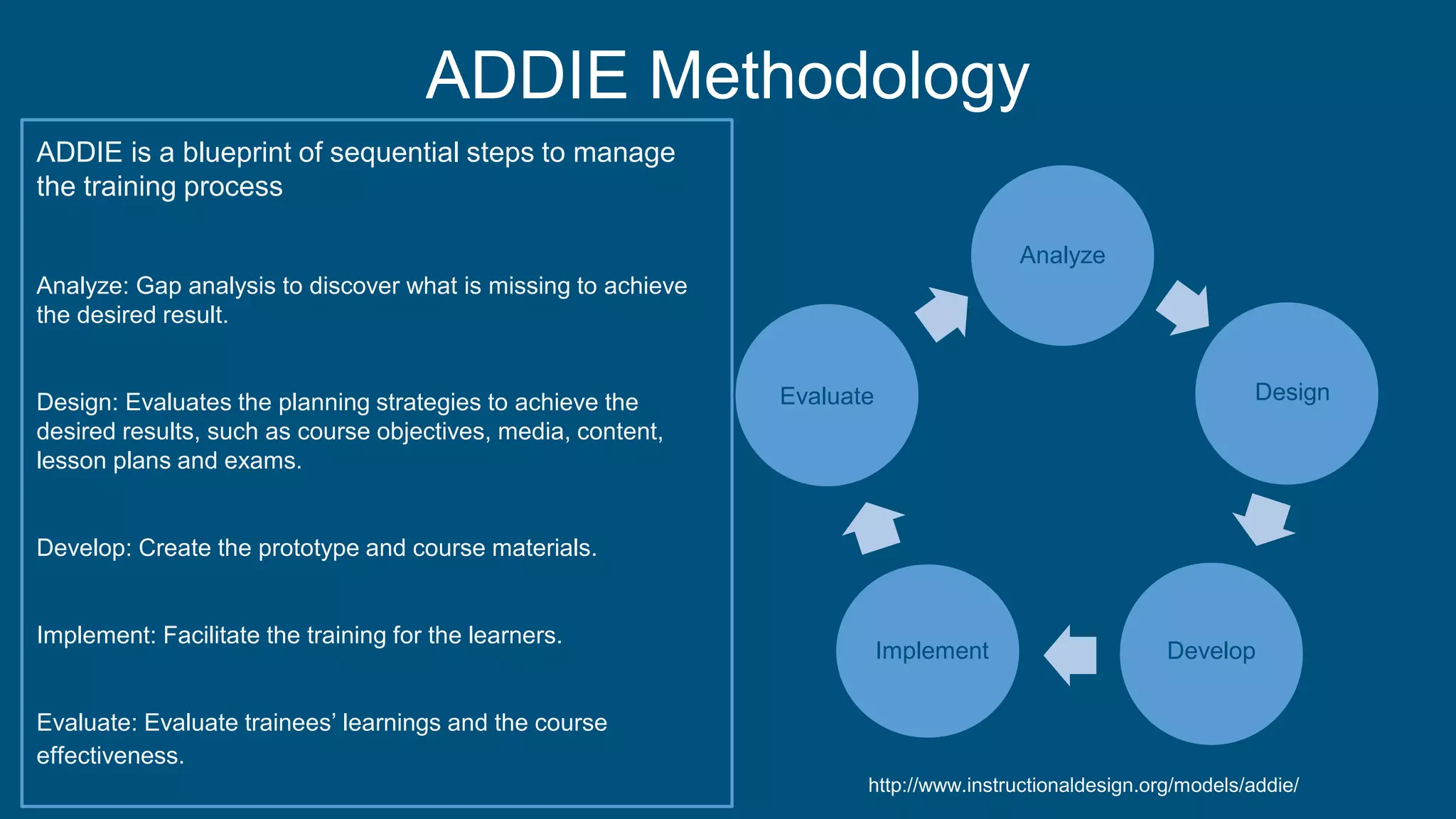
ADDIE is a blueprint of sequential steps to manage
the training process
Analyze: Gap analysis to discover what is missing to achieve
the desired result.
Design: Evaluates the planning strategies to achieve the
desired results, such as course objectives, media, content,
lesson plans and exams.
Develop: Create the prototype and course materials.
Implement: Facilitate the training for the learners.
Evaluate: Evaluate trainees’ learnings and the course
effectiveness.
http://www.instructionaldesign.org/models/addie/
Develop
Design
Implement
Evaluate Design
Analyze
Successive Approximation Model (SAM)
In a fast-paced world, to ensure accuracy SAM is
more agile than ADDIE.
Preparing is the first and quickest of the SAM
phases.
Multiple steps are completed at one time and the
work flows through a development process
repeatedly allowing the product to be analyzed and
refined as the work is in-process.
SAM allows for full product transparency between
product owner, team members, and stakeholders.
http://i.kawstov.com/2018/03/27/learning-methodologies-101-addie-vs-agile-vs-sam/
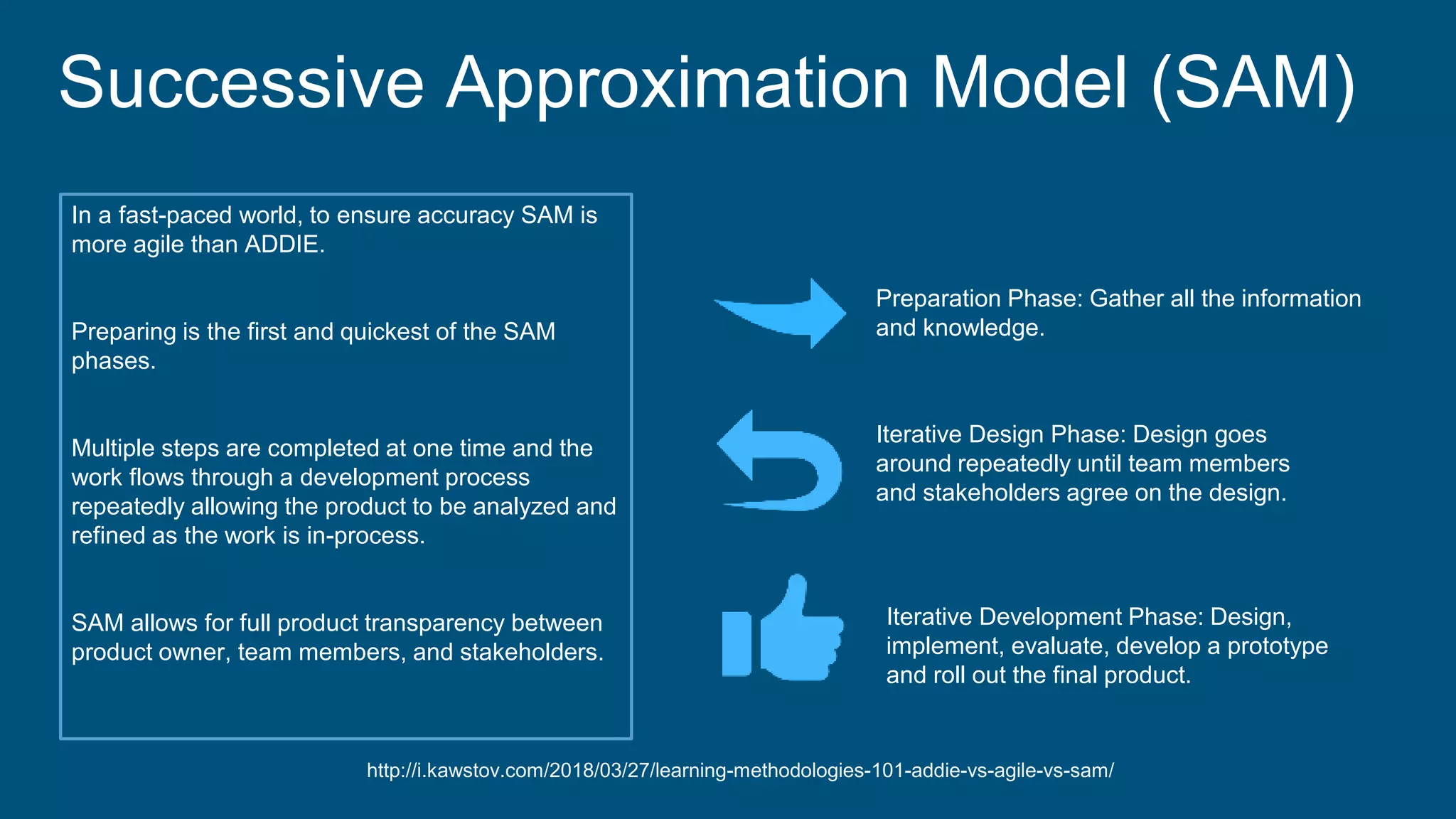
Preparation Phase: Gather all the information
and knowledge.
Iterative Design Phase: Design goes
around repeatedly until team members
and stakeholders agree on the design.
Iterative Development Phase: Design,
implement, evaluate, develop a prototype
and roll out the final product.
Adult Learning Theory
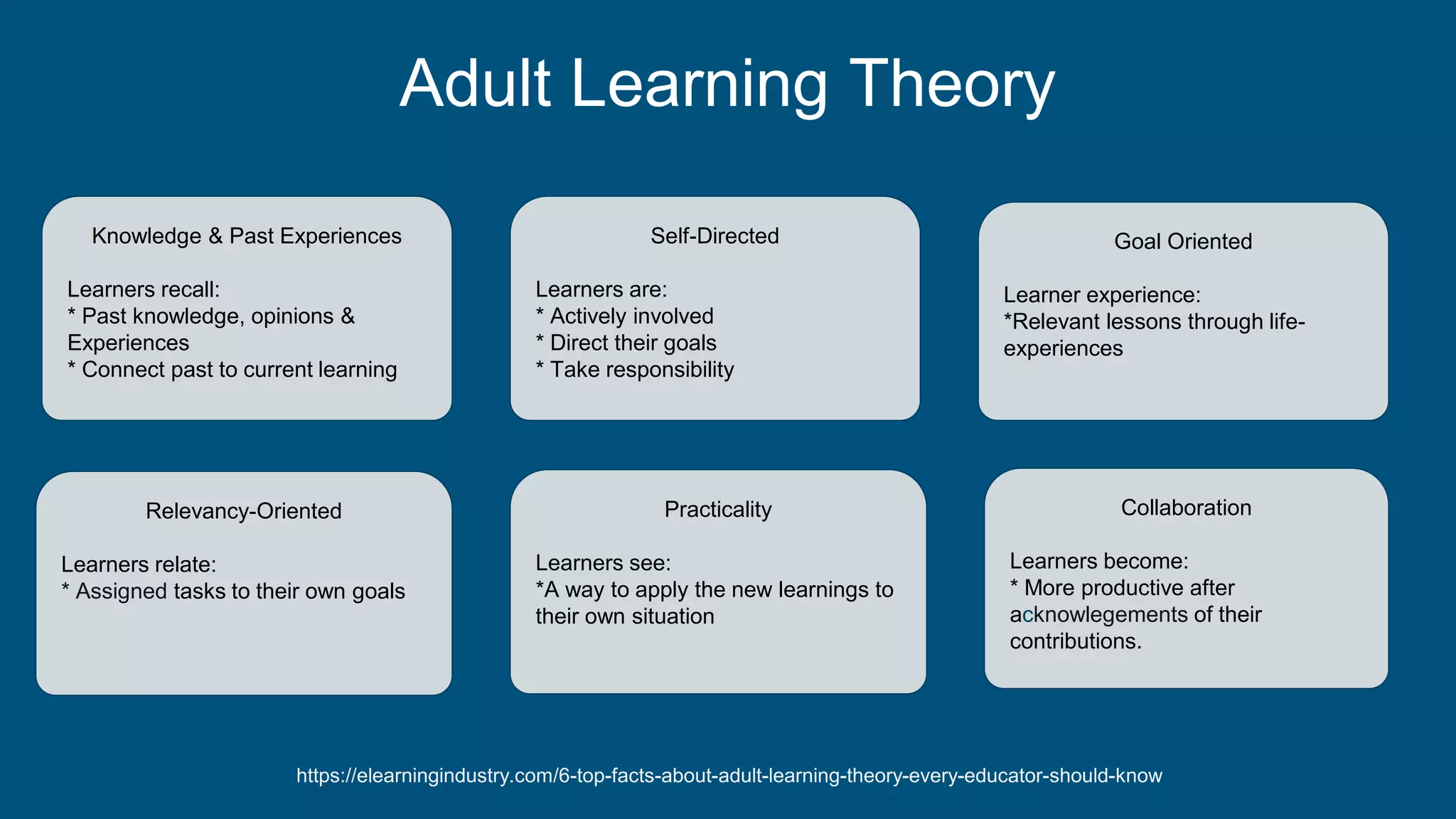
Self-Directed
Learners are:
* Actively involved
* Direct their goals
* Take responsibility
https://elearningindustry.com/6-top-facts-about-adult-learning-theory-every-educator-should-know
Knowledge & Past Experiences
Learners recall:
* Past knowledge, opinions &
Experiences
* Connect past to current learning
Goal Oriented
Learner experience:
*Relevant lessons through life-
experiences
Relevancy-Oriented
Learners relate:
* Assigned tasks to their own goals
Practicality
Learners see:
*A way to apply the new learnings to
their own situation
Collaboration
Learners become:
* More productive after
acknowlegements of their
contributions.
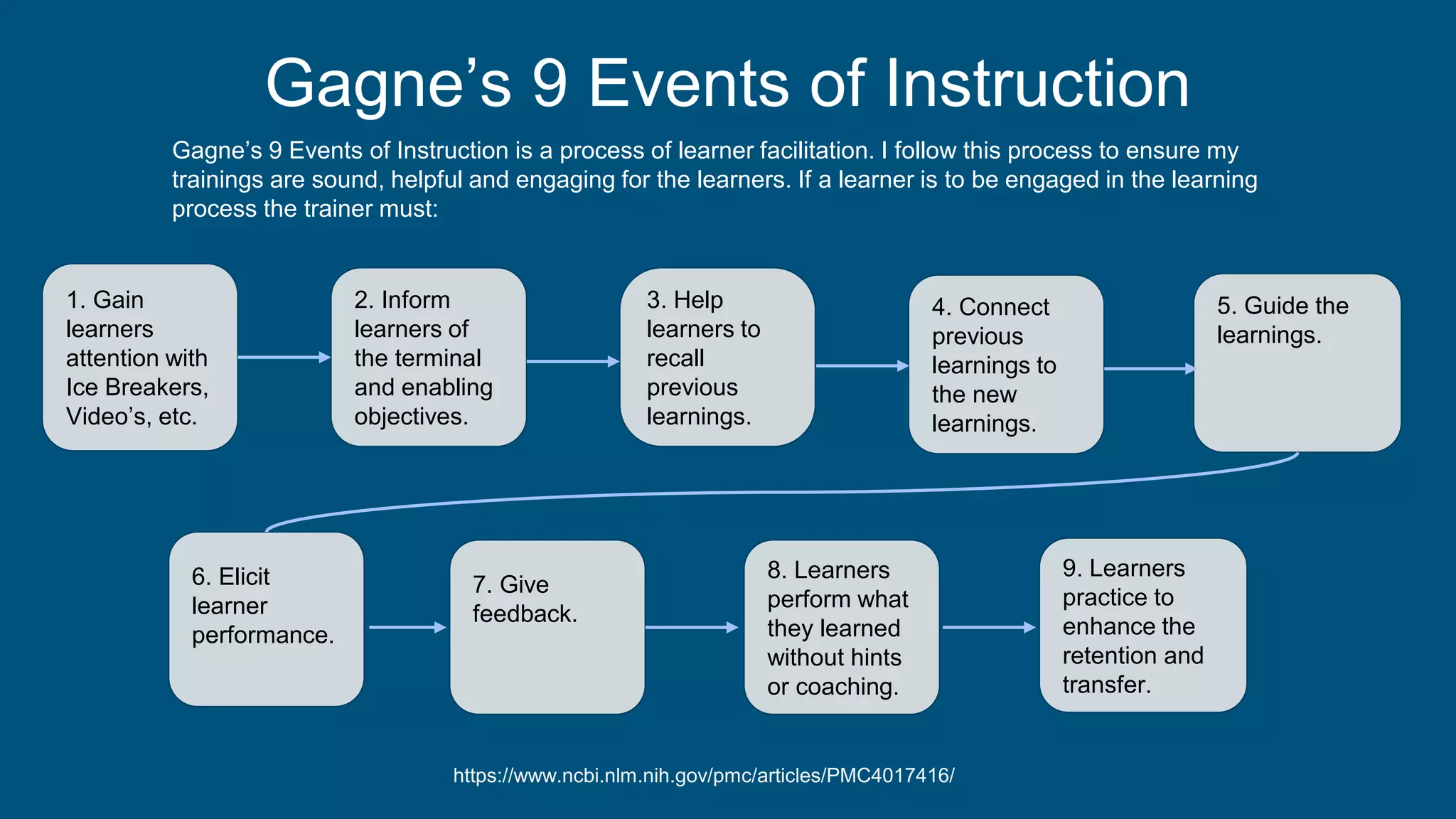
Gagne’s 9 Events of Instruction
1. Gain
learners
attention with
Ice Breakers,
Video’s, etc.
3. Help
learners to
recall
previous
learnings.
4. Connect
previous
learnings to
the new
learnings.
2. Inform
learners of
the terminal
and enabling
objectives.
5. Guide the
learnings.
6. Elicit
learner
performance.
7. Give
feedback.
8. Learners
perform what
they learned
without hints
or coaching.
9. Learners
practice to
enhance the
retention and
transfer.
https://www.ncbi.nlm.nih.gov/pmc/articles/PMC4017416/
Gagne’s 9 Events of Instruction is a process of learner facilitation. I follow this process to ensure my
trainings are sound, helpful and engaging for the learners. If a learner is to be engaged in the learning
process the trainer must:
Bloom’s Taxonomy (Action Verbs)
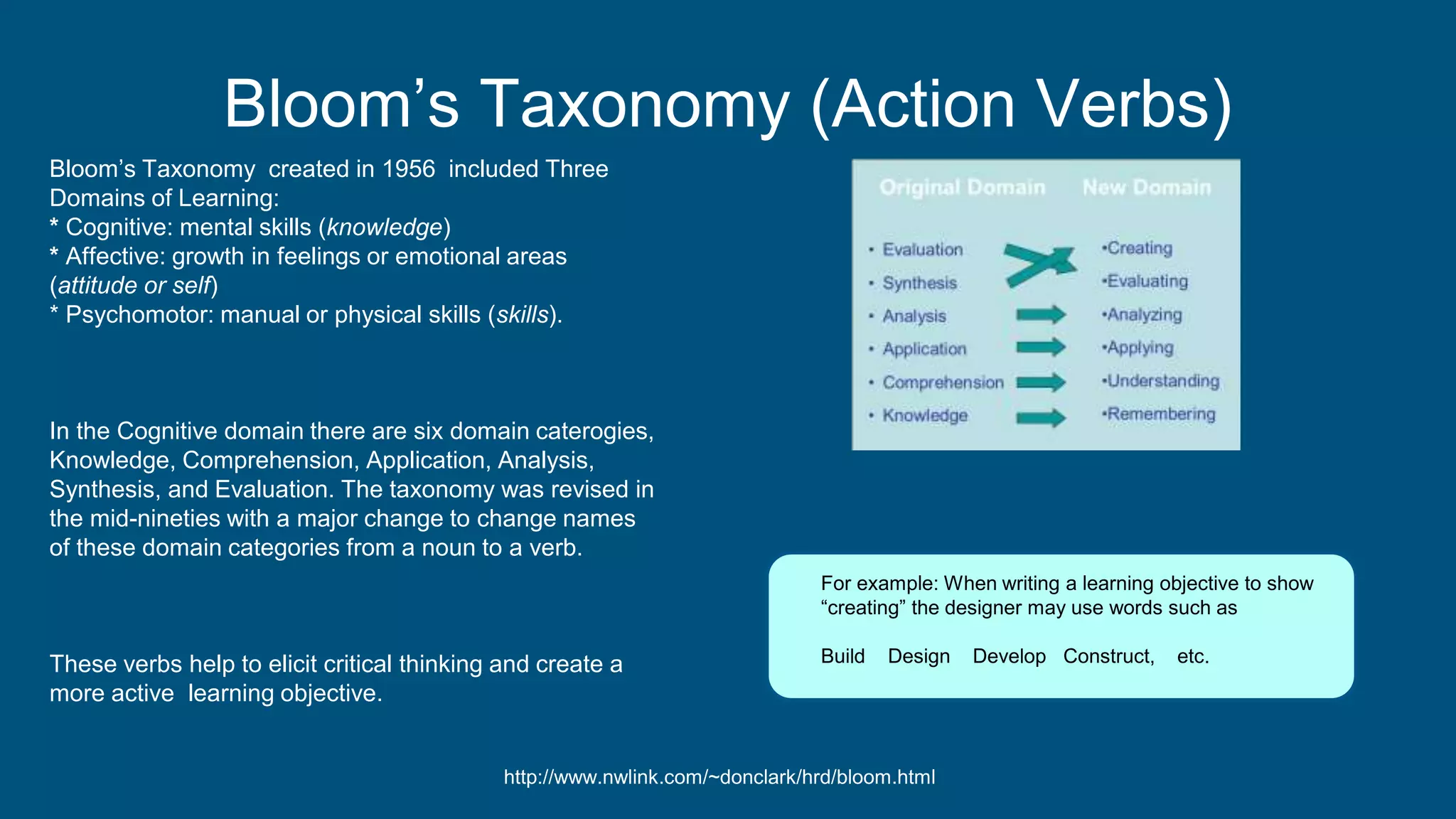
Bloom’s Taxonomy created in 1956 included Three
Domains of Learning:
* Cognitive: mental skills (knowledge)
* Affective: growth in feelings or emotional areas
(attitude or self)
* Psychomotor: manual or physical skills (skills).
In the Cognitive domain there are six domain caterogies,
Knowledge, Comprehension, Application, Analysis,
Synthesis, and Evaluation. The taxonomy was revised in
the mid-nineties with a major change to change names
of these domain categories from a noun to a verb.
These verbs help to elicit critical thinking and create a
more active learning objective.
http://www.nwlink.com/~donclark/hrd/bloom.html
For example: When writing a learning objective to show
“creating” the designer may use words such as
Build Design Develop Construct, etc.
Kirkpatrick Model
Reaction Learning Behavior Results
https://www.kirkpatrickpartners.com/Our-Philosophy/The-Kirkpatrick-Model
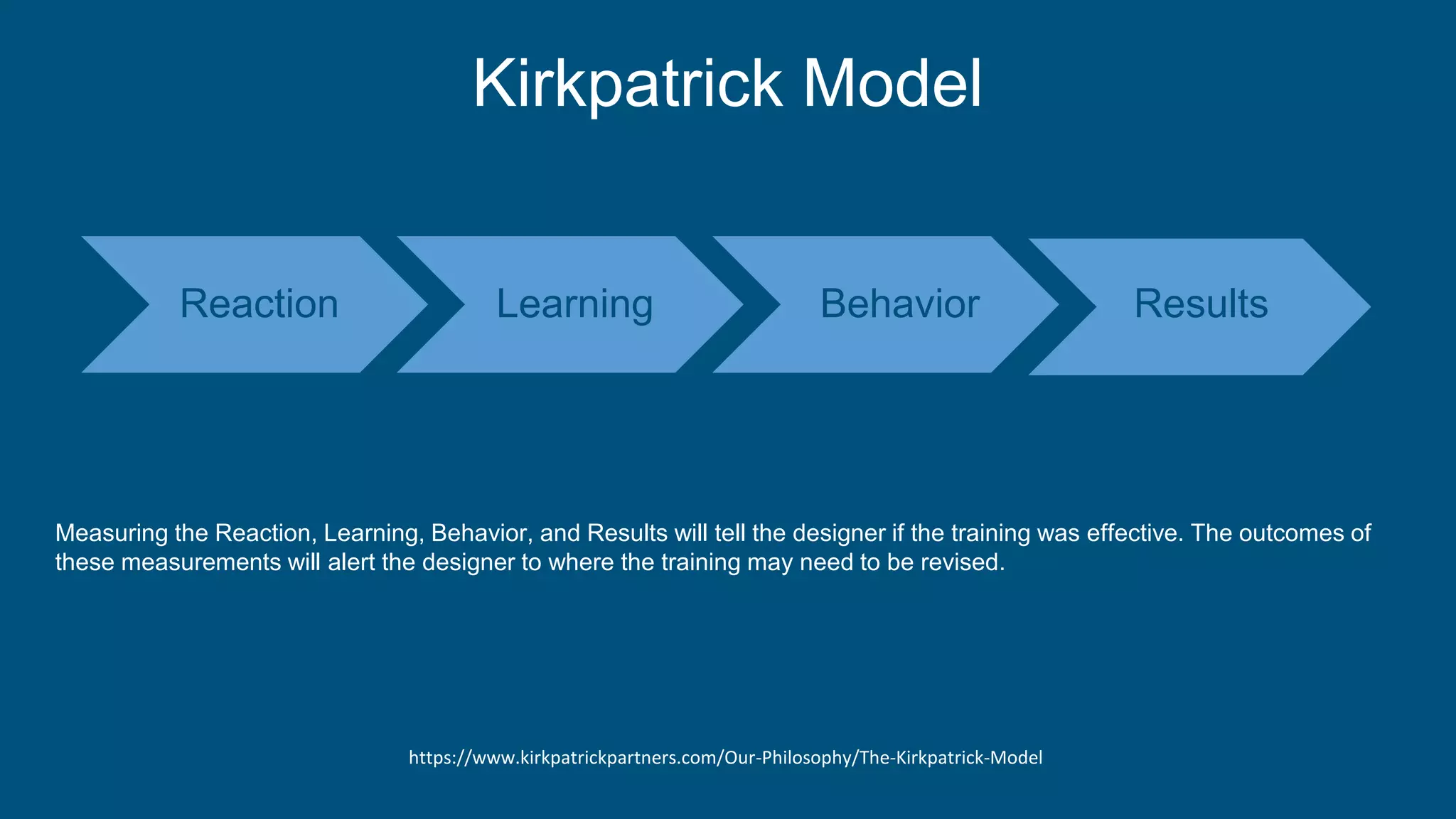
Measuring the Reaction, Learning, Behavior, and Results will tell the designer if the training was effective. The outcomes of
these measurements will alert the designer to where the training may need to be revised.

Tools for instructional design

  • 1.
    Tools for Instructional Design DefineTools and their Use Deborah Strong
  • 2.
    ADDIE Methodology ADDIE isa blueprint of sequential steps to manage the training process Analyze: Gap analysis to discover what is missing to achieve the desired result. Design: Evaluates the planning strategies to achieve the desired results, such as course objectives, media, content, lesson plans and exams. Develop: Create the prototype and course materials. Implement: Facilitate the training for the learners. Evaluate: Evaluate trainees’ learnings and the course effectiveness. http://www.instructionaldesign.org/models/addie/ Develop Design Implement Evaluate Design Analyze
  • 3.
    Successive Approximation Model(SAM) In a fast-paced world, to ensure accuracy SAM is more agile than ADDIE. Preparing is the first and quickest of the SAM phases. Multiple steps are completed at one time and the work flows through a development process repeatedly allowing the product to be analyzed and refined as the work is in-process. SAM allows for full product transparency between product owner, team members, and stakeholders. http://i.kawstov.com/2018/03/27/learning-methodologies-101-addie-vs-agile-vs-sam/ Preparation Phase: Gather all the information and knowledge. Iterative Design Phase: Design goes around repeatedly until team members and stakeholders agree on the design. Iterative Development Phase: Design, implement, evaluate, develop a prototype and roll out the final product.
  • 4.
    Adult Learning Theory Self-Directed Learnersare: * Actively involved * Direct their goals * Take responsibility https://elearningindustry.com/6-top-facts-about-adult-learning-theory-every-educator-should-know Knowledge & Past Experiences Learners recall: * Past knowledge, opinions & Experiences * Connect past to current learning Goal Oriented Learner experience: *Relevant lessons through life- experiences Relevancy-Oriented Learners relate: * Assigned tasks to their own goals Practicality Learners see: *A way to apply the new learnings to their own situation Collaboration Learners become: * More productive after acknowlegements of their contributions.
  • 5.
    Gagne’s 9 Eventsof Instruction 1. Gain learners attention with Ice Breakers, Video’s, etc. 3. Help learners to recall previous learnings. 4. Connect previous learnings to the new learnings. 2. Inform learners of the terminal and enabling objectives. 5. Guide the learnings. 6. Elicit learner performance. 7. Give feedback. 8. Learners perform what they learned without hints or coaching. 9. Learners practice to enhance the retention and transfer. https://www.ncbi.nlm.nih.gov/pmc/articles/PMC4017416/ Gagne’s 9 Events of Instruction is a process of learner facilitation. I follow this process to ensure my trainings are sound, helpful and engaging for the learners. If a learner is to be engaged in the learning process the trainer must:
  • 6.
    Bloom’s Taxonomy (ActionVerbs) Bloom’s Taxonomy created in 1956 included Three Domains of Learning: * Cognitive: mental skills (knowledge) * Affective: growth in feelings or emotional areas (attitude or self) * Psychomotor: manual or physical skills (skills). In the Cognitive domain there are six domain caterogies, Knowledge, Comprehension, Application, Analysis, Synthesis, and Evaluation. The taxonomy was revised in the mid-nineties with a major change to change names of these domain categories from a noun to a verb. These verbs help to elicit critical thinking and create a more active learning objective. http://www.nwlink.com/~donclark/hrd/bloom.html For example: When writing a learning objective to show “creating” the designer may use words such as Build Design Develop Construct, etc.
  • 7.
    Kirkpatrick Model Reaction LearningBehavior Results https://www.kirkpatrickpartners.com/Our-Philosophy/The-Kirkpatrick-Model Measuring the Reaction, Learning, Behavior, and Results will tell the designer if the training was effective. The outcomes of these measurements will alert the designer to where the training may need to be revised.