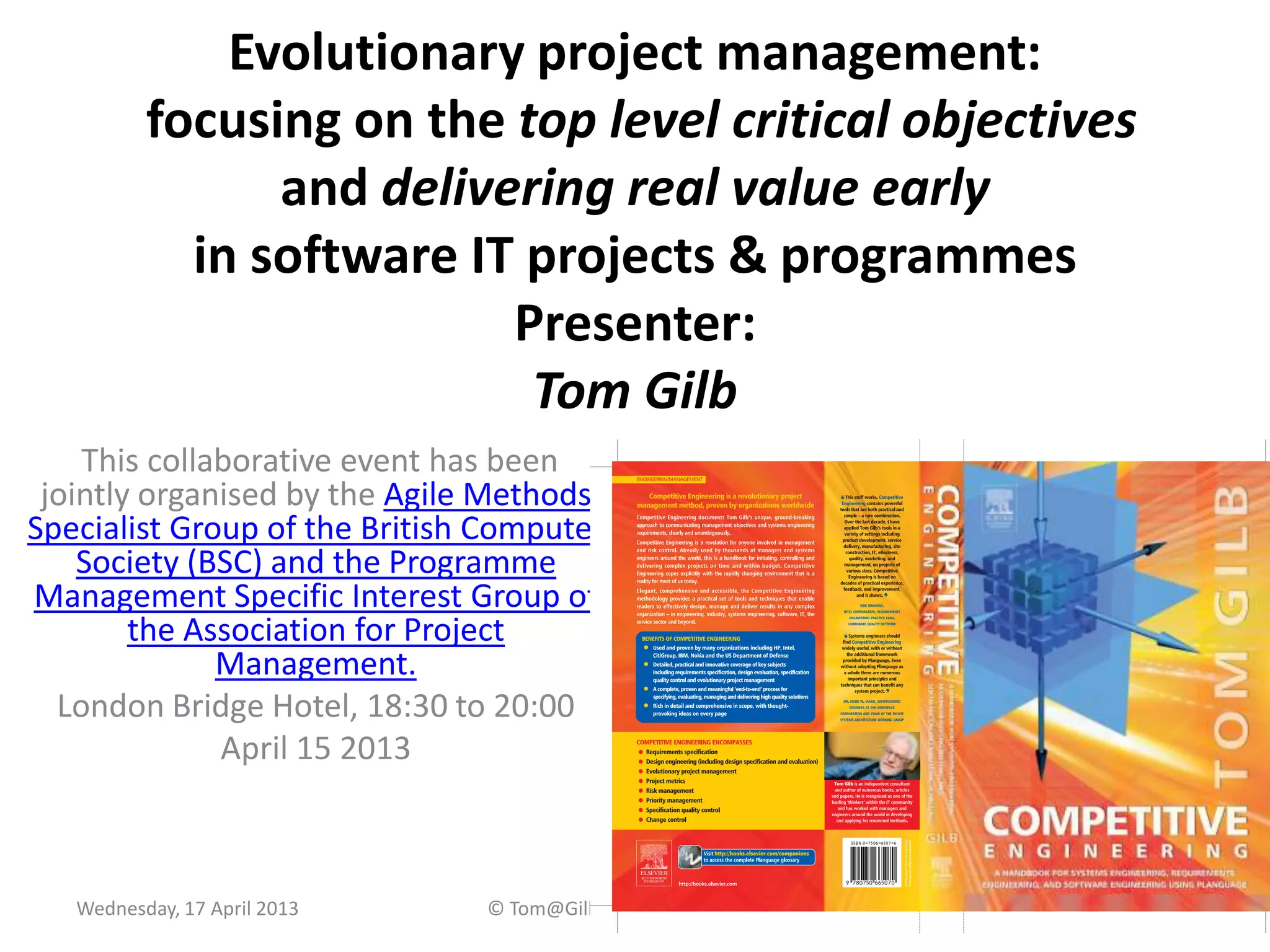
Evolutionary project management:
focusing on the top level critical objectives
and delivering real value early
in software IT projects & programmes
Presenter:
Tom Gilb
This collaborative event has been
jointly organised by the Agile Methods
Specialist Group of the British Computer
Society (BSC) and the Programme
Management Specific Interest Group of
the Association for Project
Management.
London Bridge Hotel, 18:30 to 20:00
April 15 2013
Wednesday, 17 April 2013 © Tom@Gilb.com Top10 Method 1
Talk Summary
• When projects are funded, management will usually list a handful of
justifications or expectations.
– But usually too vaguely.
– Like
• 'Substantially increase productivity',
• 'Much better Flexibility’
• 'More robust system'.
Gilbs ‘practice’
• Methods = (Evo, Planguage, Competitive Engineering)
– is to capture and agree these project ‘critical factors’,
– then quantify them
• so they are crystal clear,
• and can be used to track progress.
• All projects should have such management clarity –
– but practically none do.
– Management likes the idea of this,
• but have never been taught it at 'business school'.
Wednesday, 17 April 2013 © Tom@Gilb.com Top10 Method 2
Case: Multinational Bank 2011
Critical Project Objectives ‘not clear’
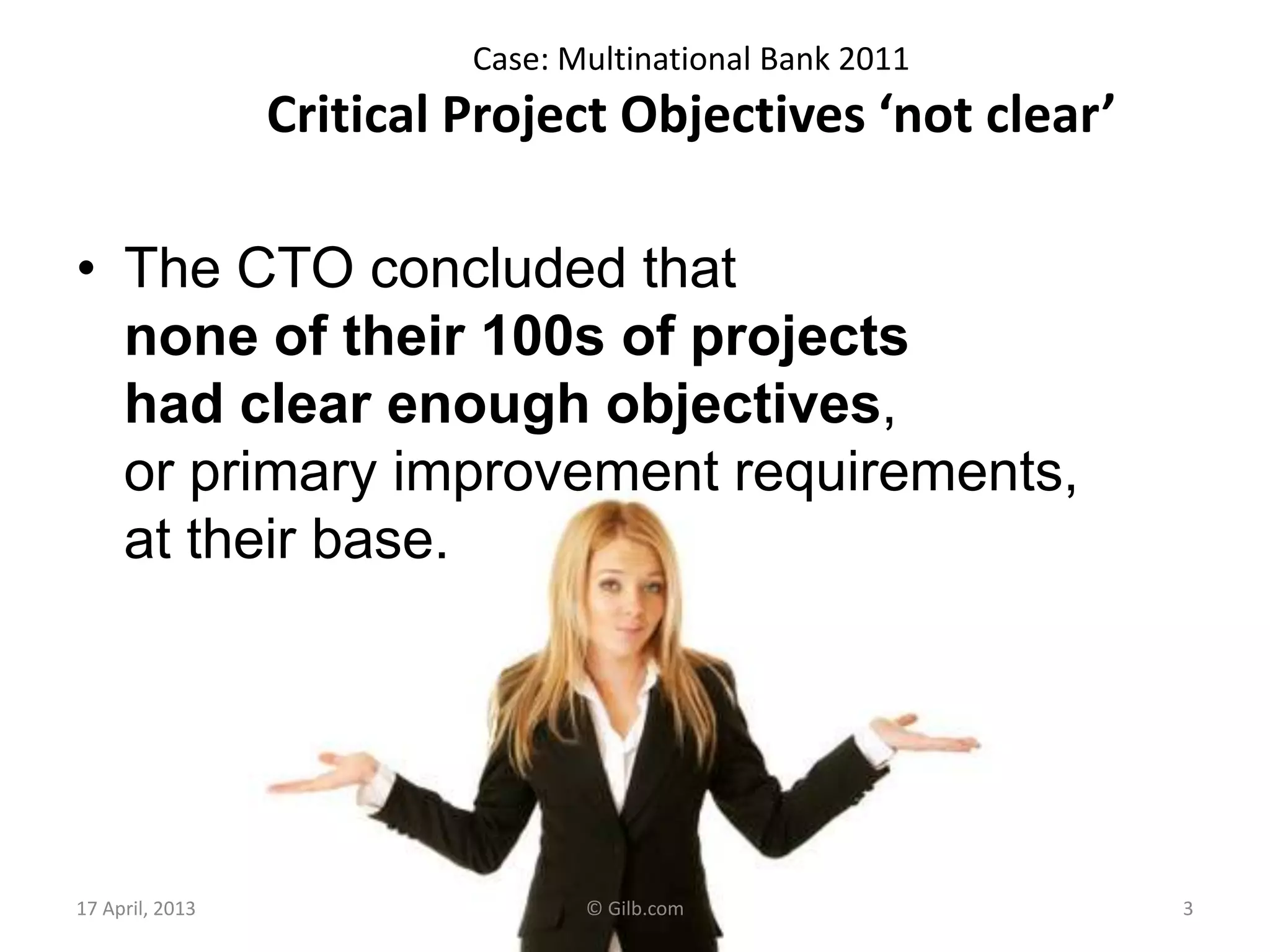
• The CTO concluded that
none of their 100s of projects
had clear enough objectives,
or primary improvement requirements,
at their base.
17 April, 2013 © Gilb.com 3
17 April, 2013 © Gilb.com 4
“ I attended a 3-day course with you and Kai whilst at Citigroup in 2006”
Richard Smith
Previous PM Methods:
No ‘Value delivery tracking’.
No change reaction ability
• “However, (our old project management methodology) main
failings were that
• it almost totally missed the ability to track delivery of actual
value improvements to a project's stakeholders,
• and the ability to react to changes
– in requirements and
– priority
– for the project's duration”
17 April, 2013 © Gilb.com 5
Richard Smith
We only had the illusion of control.
But little help to testers and analysts
• “The (old) toolset generated lots of charts and stats
• that provided the illusion of risk control.
• But actually provided very little help to the
analysts, developers and testers actually doing the
work at the coal face.”
17 April, 2013 © Gilb.com 6
Richard Smith
The proof is in the pudding;
• “The proof is in the pudding;
• I have used Evo
• (albeit in disguise sometimes)
• on two large, high-risk projects in front-office investment
banking businesses,
• and several smaller tasks. “
17 April, 2013 © Gilb.com 7
Richard Smith
Experience: if top level requirements
are separated from design, the
„requirements‟ are stable!
• “On the largest critical project,
• the original business functions & performance
objective requirements document,
• which included no design,
• essentially remained unchanged
• over the 14 months the project took to deliver,….”
17 April, 2013 © Gilb.com 8
“ I attended a 3-day course with you and Kai whilst at Citigroup in 2006”, Richard Smith
Richard Smith
Dynamic (Agile, Evo) design testing:
not unlike ‘Lean Startup’
• “… but the detailed designs
– (of the GUI, business logic, performance characteristics)
• changed many many times,
• guided by lessons learnt
• and feedback gained by
• delivering a succession of early deliveries
• to real users”
17 April, 2013 © Gilb.com 9
“ I attended a 3-day course with you and Kai whilst at Citigroup in 2006”, Richard Smith
Richard Smith
It looks like the stakeholders liked
the top level system qualities,
on first try
– “ In the end, the new system responsible for 10s of
USD billions of notional risk,
– successfully went live
– over one weekend
– for 800 users worldwide,
– and was seen as a big success
– by the sponsoring stakeholders.”
17 April, 2013 © Gilb.com 10
“ I attended a 3-day course with you and Kai whilst at Citigroup in 2006” , Richard Smith
Richard Smith
I conclude
• What we often call
‘requirements’
– Use cases
– User stories
– Functions
– Features
• Are really bad amateur
designs,
– for unclear higher-level
requirements
• Requirement:
– Stakeholder-valued
system state
– Under defined
conditions
• Design: a ‘means’ to
deliver a requirement
Wednesday, 17 April 2013 © Tom@Gilb.com Top10 Method 11
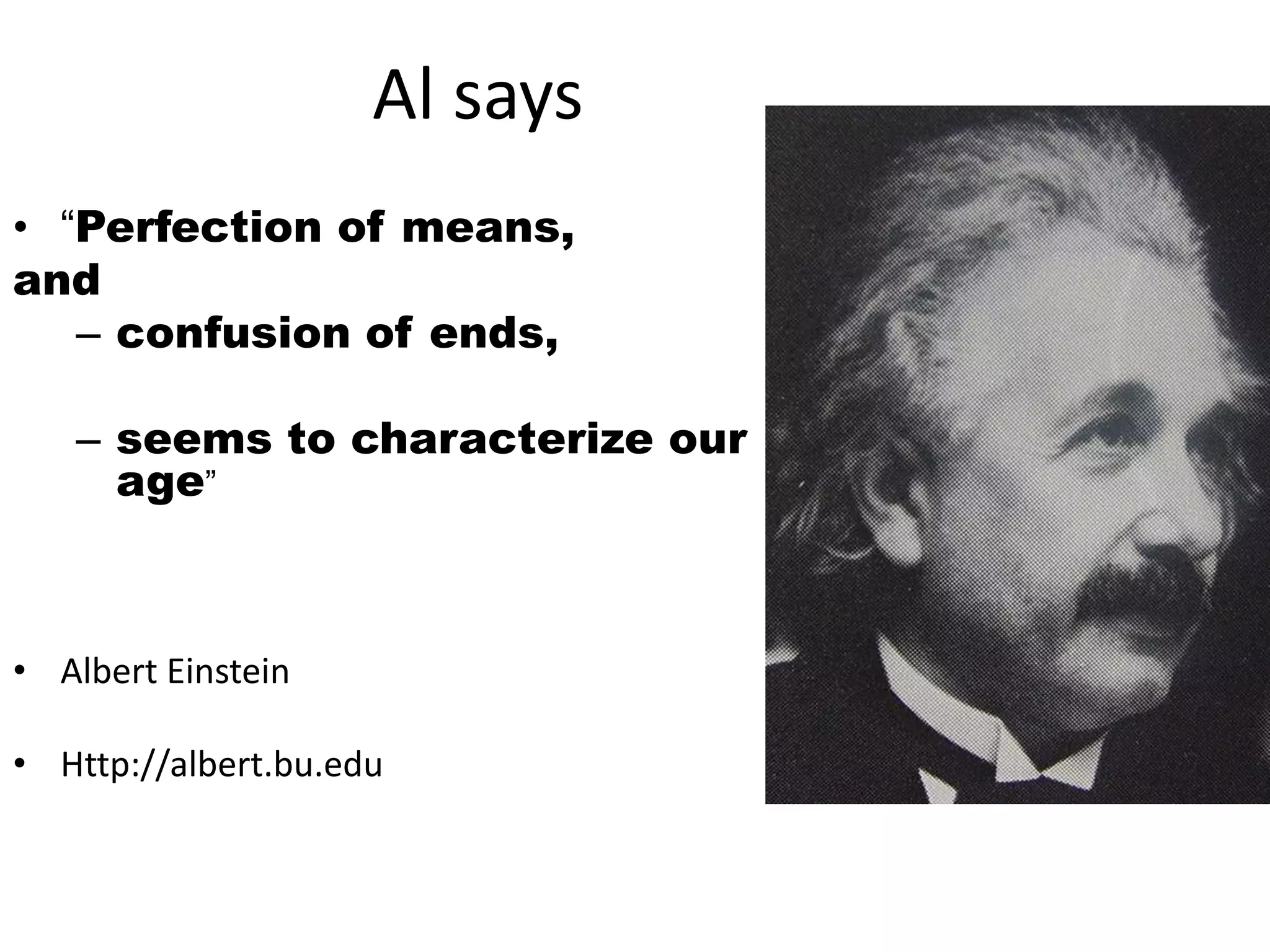
Al says
• “Perfection of means,
and
– confusion of ends,
– seems to characterize our
age”
• Albert Einstein
• Http://albert.bu.edu
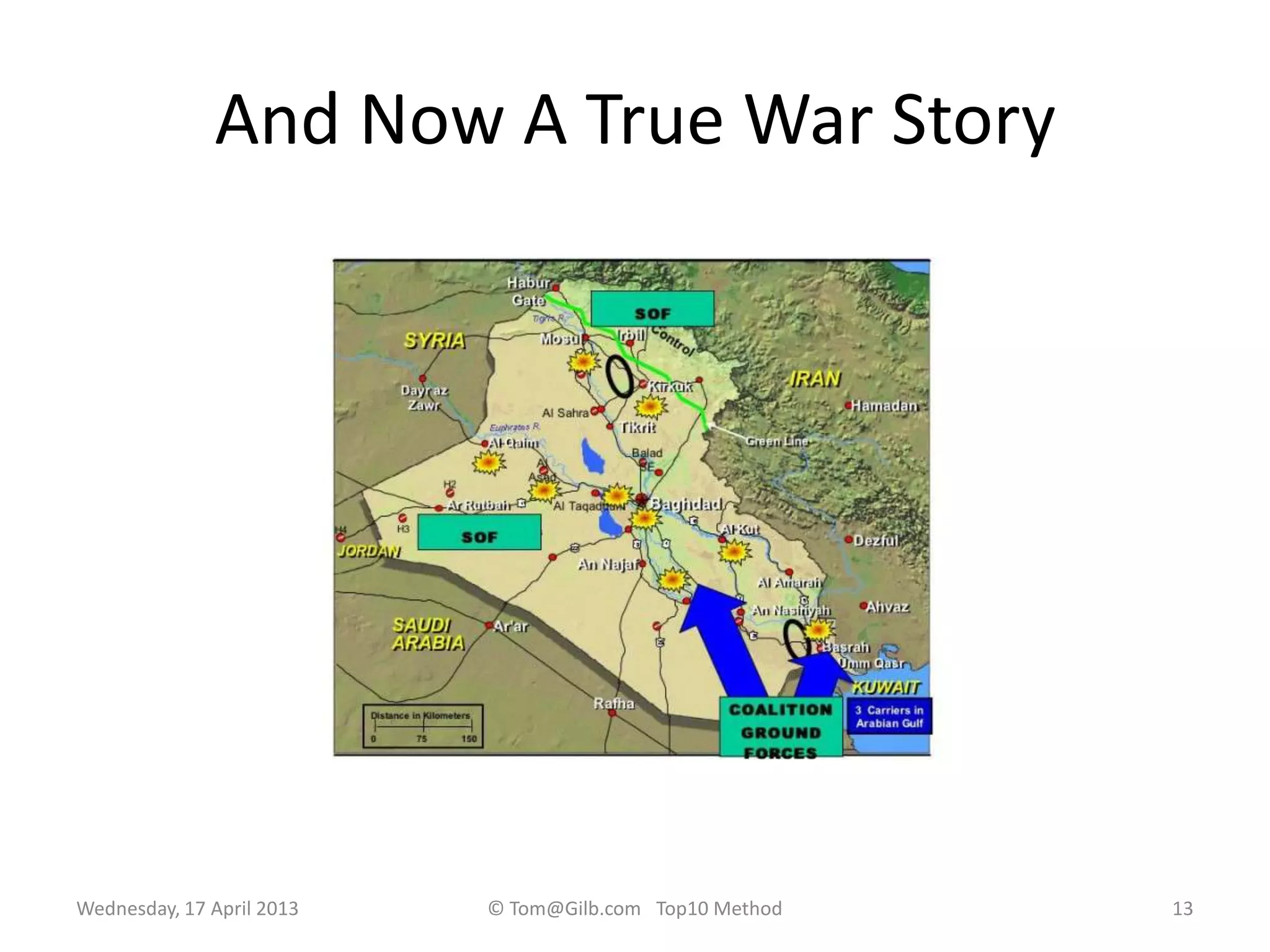
And Now A True War Story
Wednesday, 17 April 2013 © Tom@Gilb.com Top10 Method 13
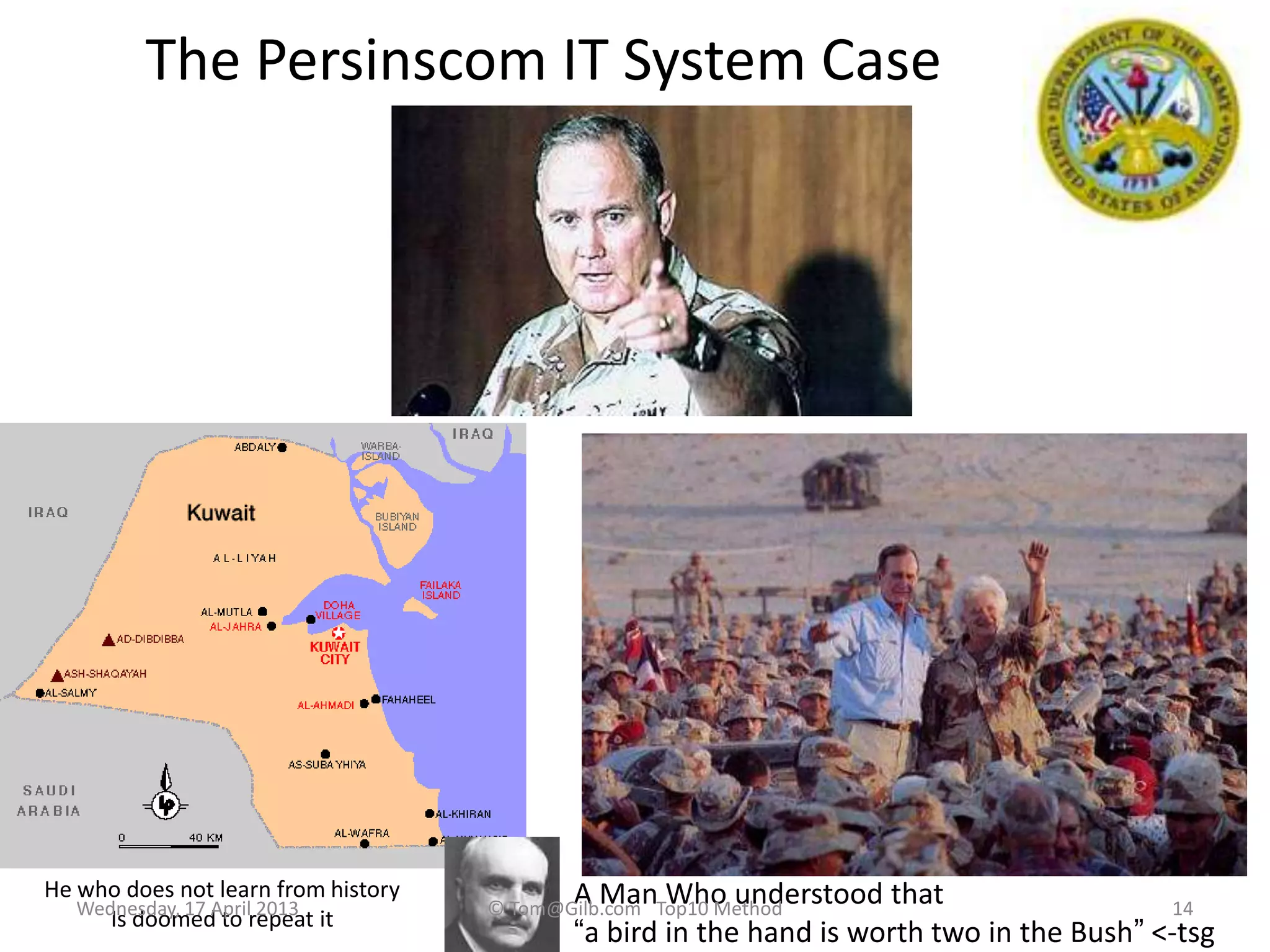
The Persinscom IT System Case
14
A Man Who understood that
“a bird in the hand is worth two in the Bush” <-tsg
He who does not learn from history
Is doomed to repeat itWednesday, 17 April 2013 © Tom@Gilb.com Top10 Method
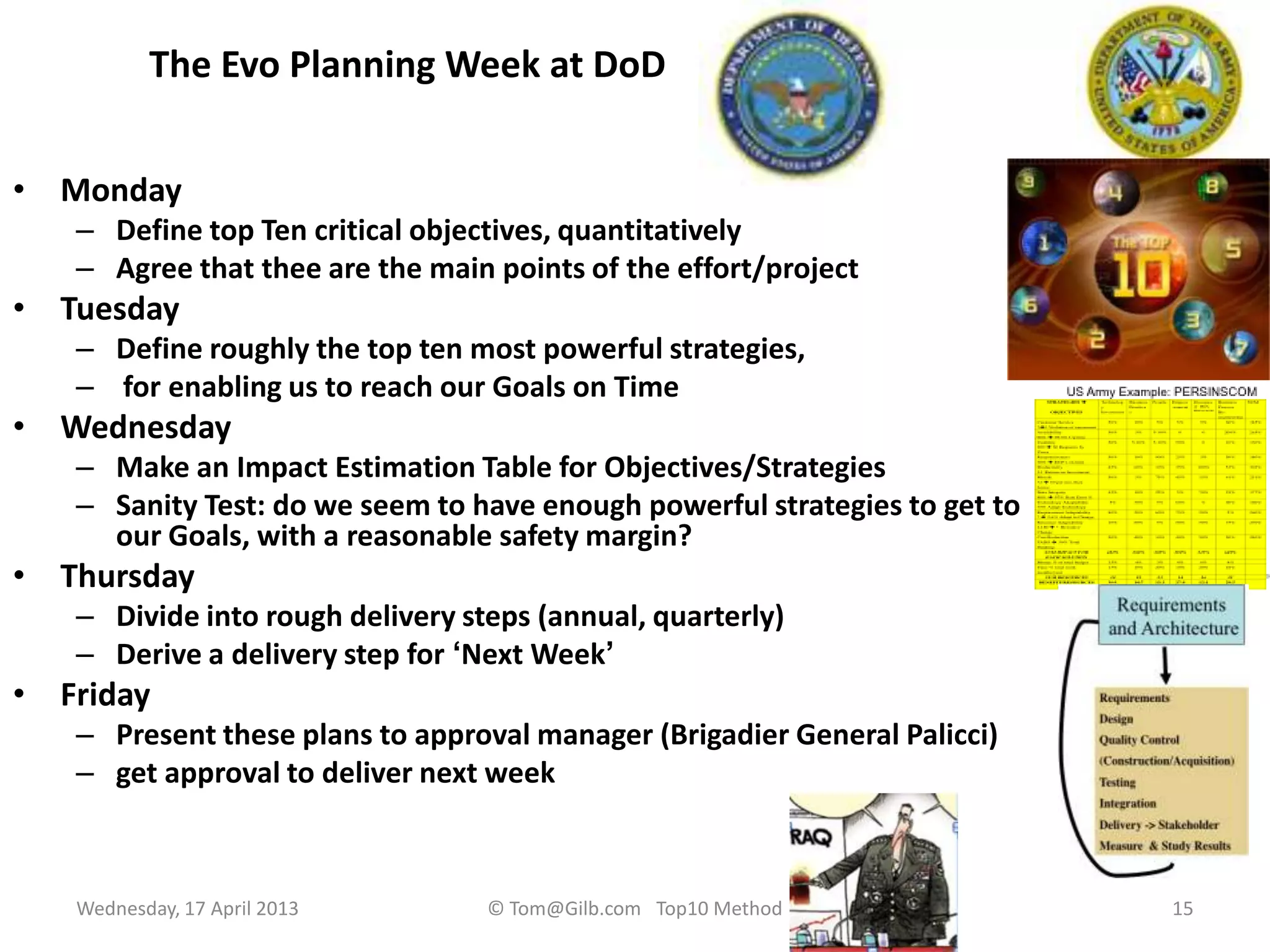
The Evo Planning Week at DoD
• Monday
– Define top Ten critical objectives, quantitatively
– Agree that thee are the main points of the effort/project
• Tuesday
– Define roughly the top ten most powerful strategies,
– for enabling us to reach our Goals on Time
• Wednesday
– Make an Impact Estimation Table for Objectives/Strategies
– Sanity Test: do we seem to have enough powerful strategies to get to
our Goals, with a reasonable safety margin?
• Thursday
– Divide into rough delivery steps (annual, quarterly)
– Derive a delivery step for ‘Next Week’
• Friday
– Present these plans to approval manager (Brigadier General Palicci)
– get approval to deliver next week
15Wednesday, 17 April 2013 © Tom@Gilb.com Top10 Method
Slide 16
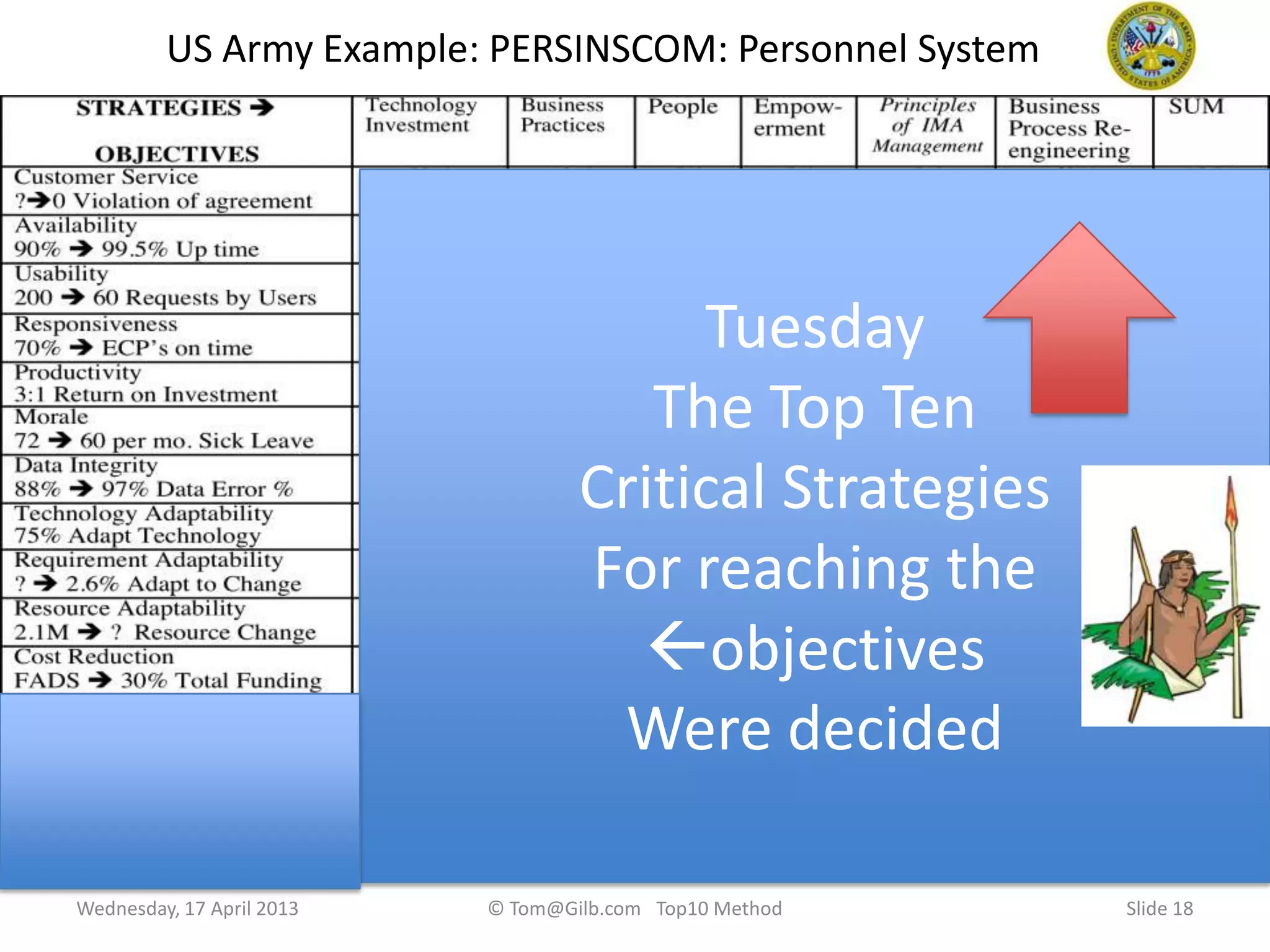
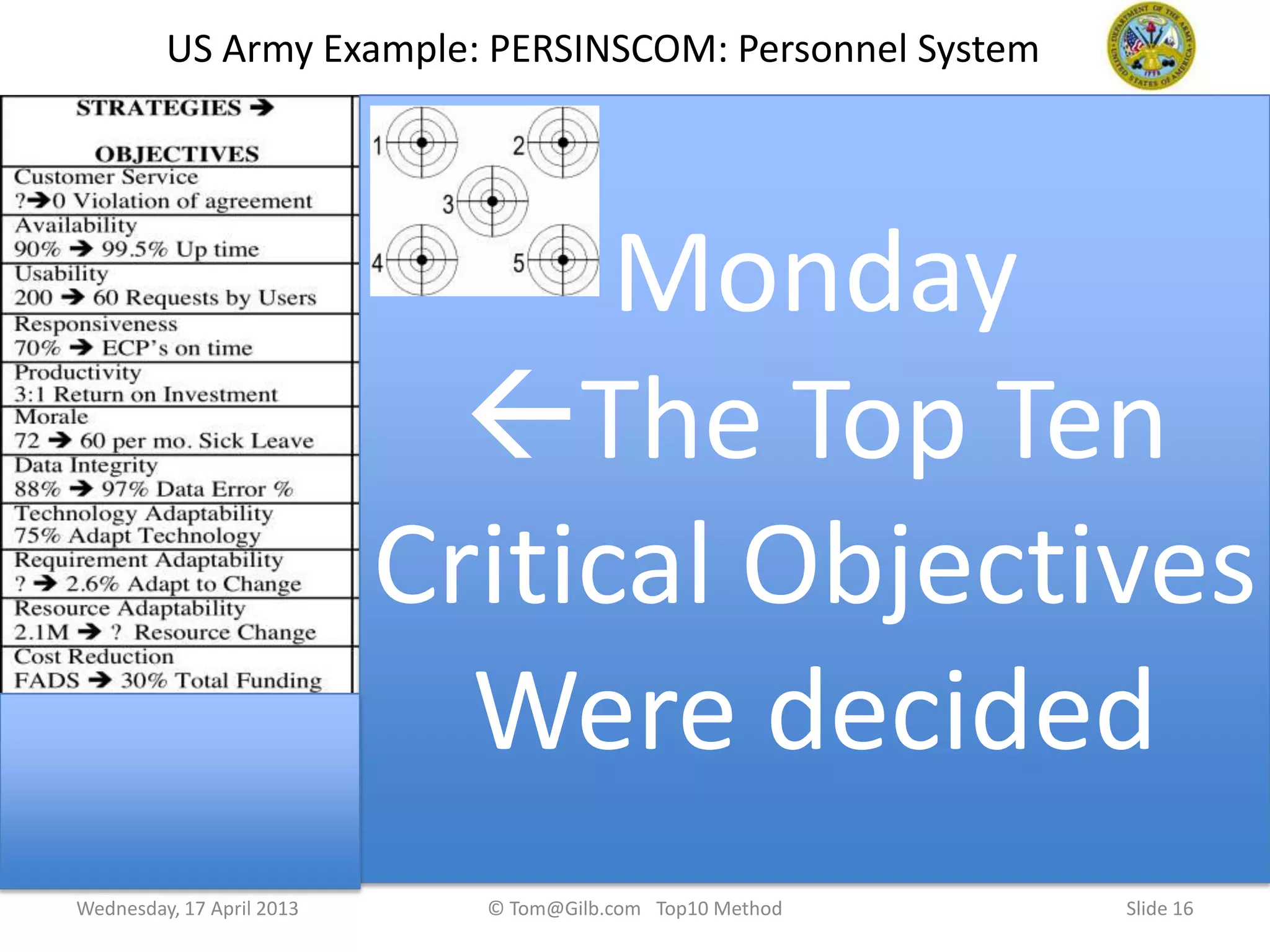
US Army Example: PERSINSCOM: Personnel System
Monday
The Top Ten
Critical Objectives
Were decided
Wednesday, 17 April 2013 © Tom@Gilb.com Top10 Method
Slide 17
Sample of Objectives/Strategy definitions
US Army Example: PERSINSCOM: Personnel System
• Example of one of the Objectives:
Customer Service:
Type: Critical Top level Systems Objective
Gist: Improve customer perception of quality of service
provided.
Scale: Violations of Customer Agreement per Month.
Meter: Log of Violations.
Past [Last Year] Unknown Number State of PERSCOM
Management Review
Record [NARDAC] 0 ?  NARDAC Reports Last Year
Fail : <must be better than Past, Unknown number> CG
Goal [This Year, PERSINCOM] 0 “Go for the Record”  Group
SWAG
.
Wednesday, 17 April 2013 © Tom@Gilb.com Top10 Method
Slide 18
US Army Example: PERSINSCOM: Personnel System
Tuesday
The Top Ten
Critical Strategies
For reaching the
objectives
Were decided
Wednesday, 17 April 2013 © Tom@Gilb.com Top10 Method
Slide 19
Sample of Objectives/Strategy definitions
US Army Example: PERSINSCOM: Personnel System
Example of a real Impact Estimation table from a Pro-Bono Client (US DoD, US Army, PERSINSCOM).
Thanks to the Task Force, LTC Dan Knight and Br. Gen. Jack Pallici for full support in u sing my methods.
Source: Draft, Personnel Enterprise, IMA End-State 95 Plan, Vision 21, 2 Dec. 1991. “Not procurement sensitive”.
Example of one of the Objectives:
Customer Service:
Gist: Improve customer perception of quality of service provided.
Scale: Violations of Customer Agreement per Month.
Meter: Log of Violations.
Past [1991] Unknown Number State of PERSCOM Management Review
Record [NARDAC] 0 ?  NARDAC Reports 1991
Must : <better than Past, Unknown number> CG
Plan [1991, PERSINCOM] 0 “Go for the Record”  Group SWAG
Technology Investment:
Exploit investment in high return technology. Impacts: productivity, customer service and conserves resources.
An example of one of the strategies defined.
A Strategy (Top Level of Detail)
Technology Investment:
Gist: Exploit investment in high
return technology.
Impacts: productivity, customer
service and conserves resources.
Wednesday, 17 April 2013 © Tom@Gilb.com Top10 Method
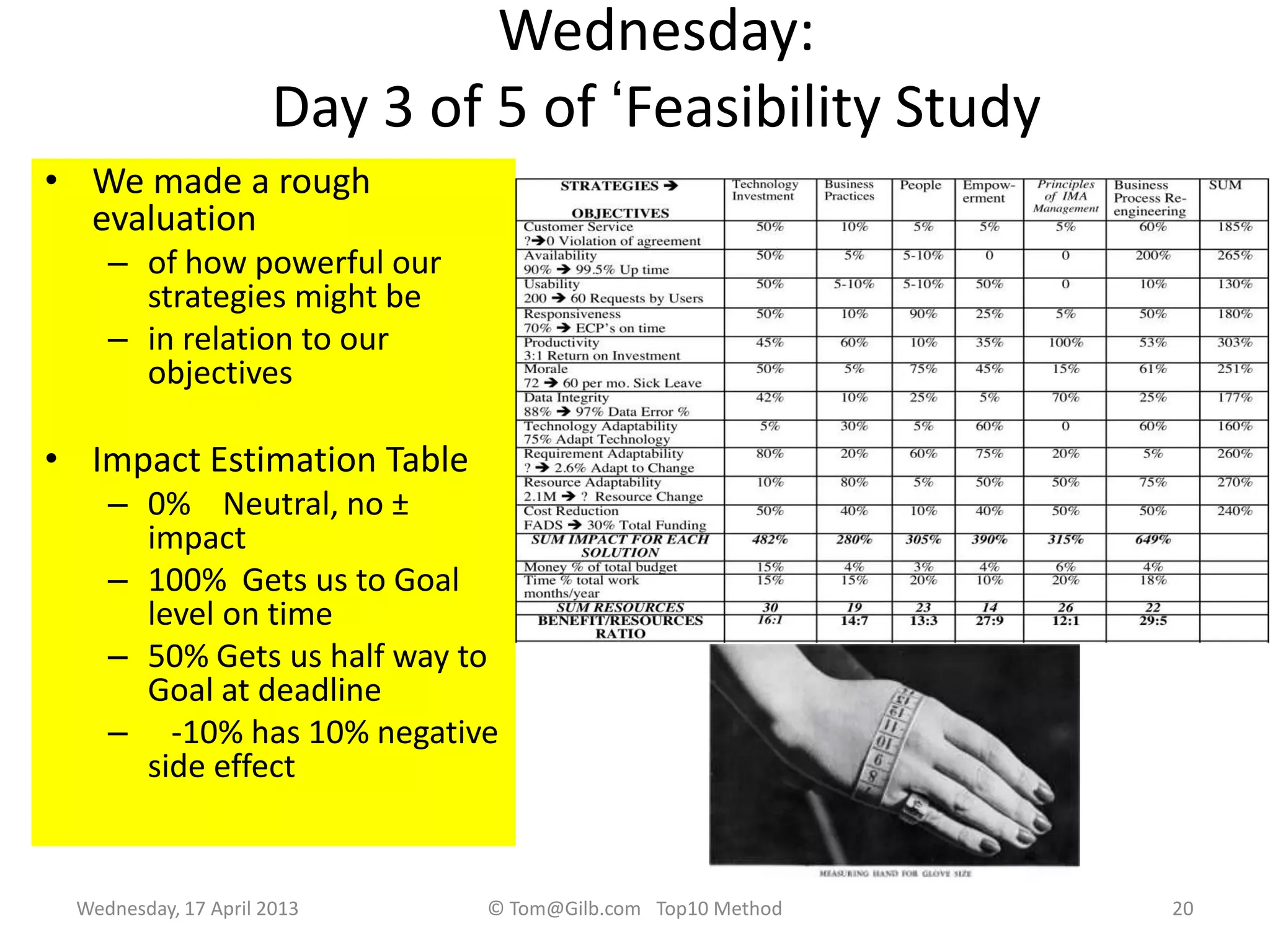
Wednesday:
Day 3 of 5 of „Feasibility Study
• We made a rough
evaluation
– of how powerful our
strategies might be
– in relation to our
objectives
• Impact Estimation Table
– 0% Neutral, no ±
impact
– 100% Gets us to Goal
level on time
– 50% Gets us half way to
Goal at deadline
– -10% has 10% negative
side effect
Wednesday, 17 April 2013 © Tom@Gilb.com Top10 Method 20
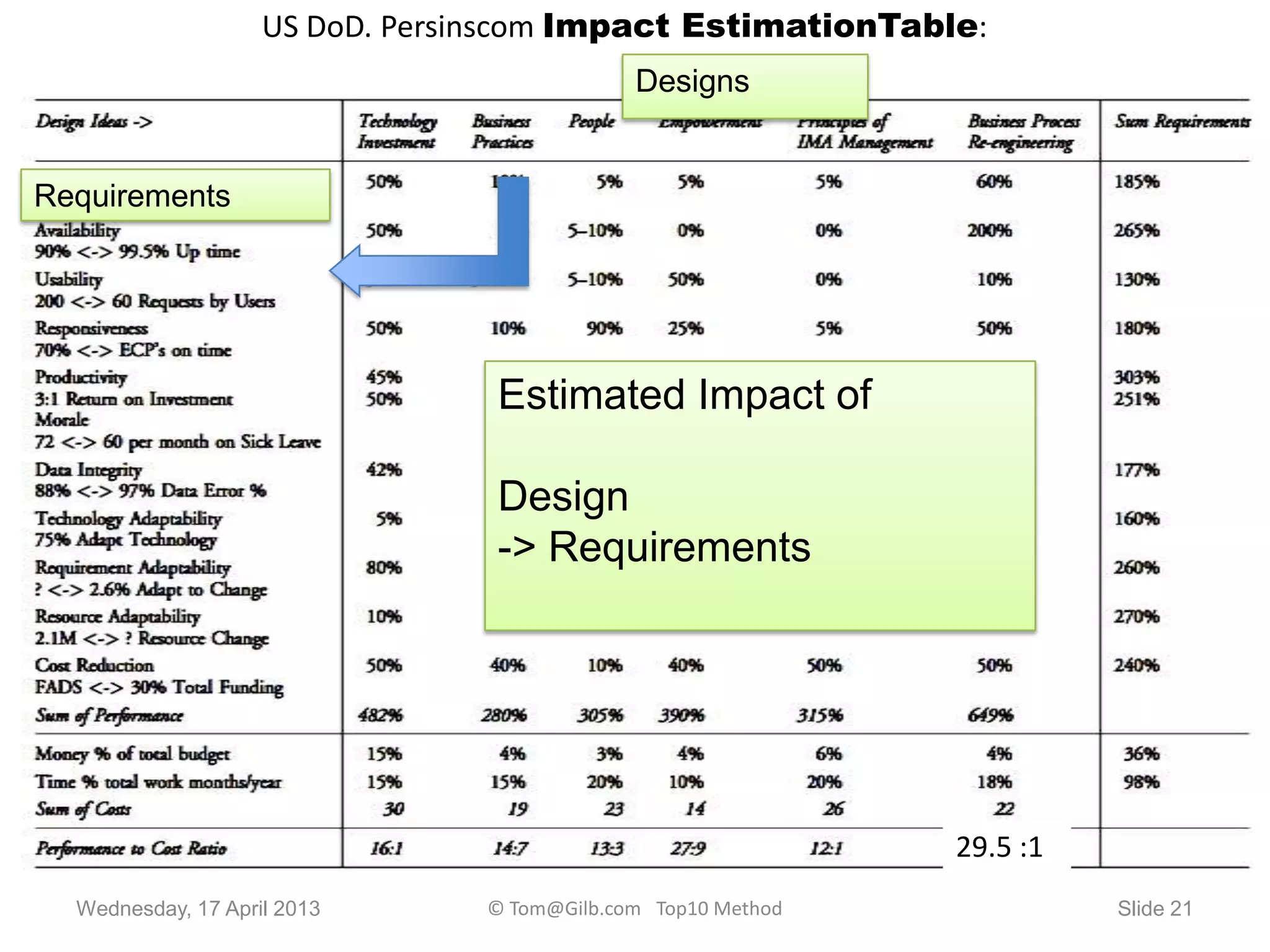
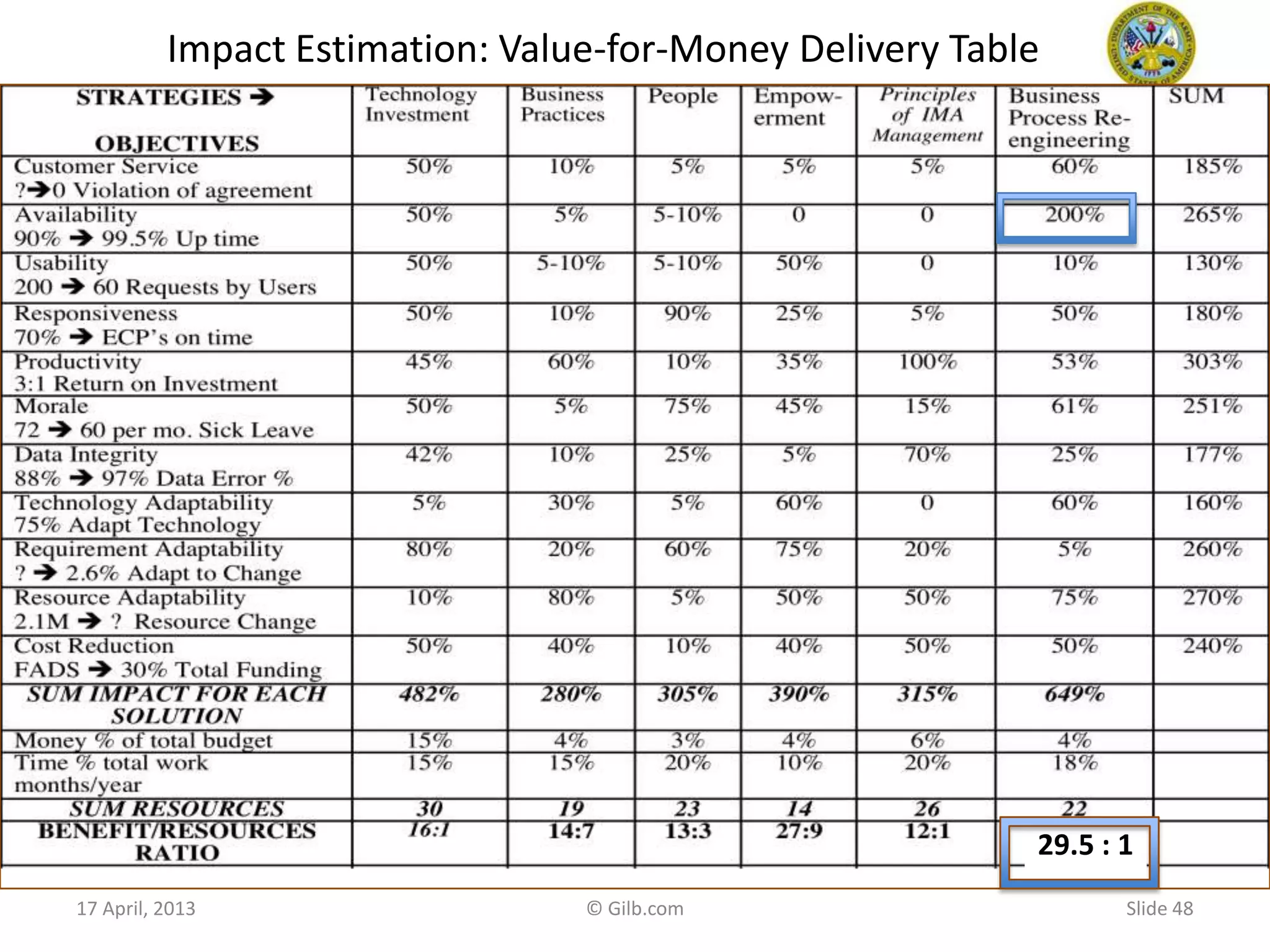
US DoD. Persinscom Impact EstimationTable:
Requirements
Designs
Estimated Impact of
Design
-> Requirements
Wednesday, 17 April 2013 Slide 21© Tom@Gilb.com Top10 Method
29.5 :1
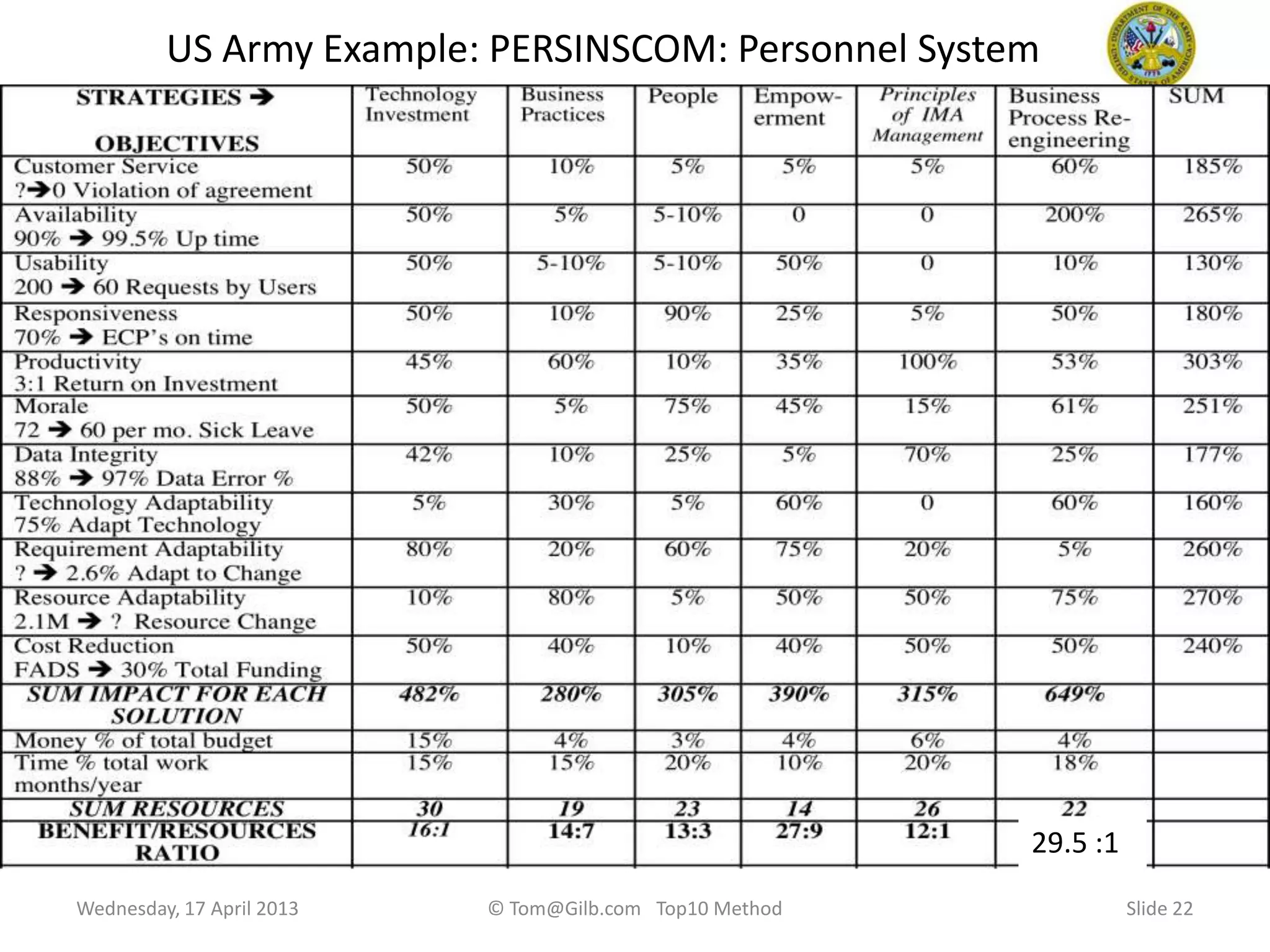
Slide 22
US Army Example: PERSINSCOM: Personnel System
Wednesday, 17 April 2013 © Tom@Gilb.com Top10 Method
29.5 :1
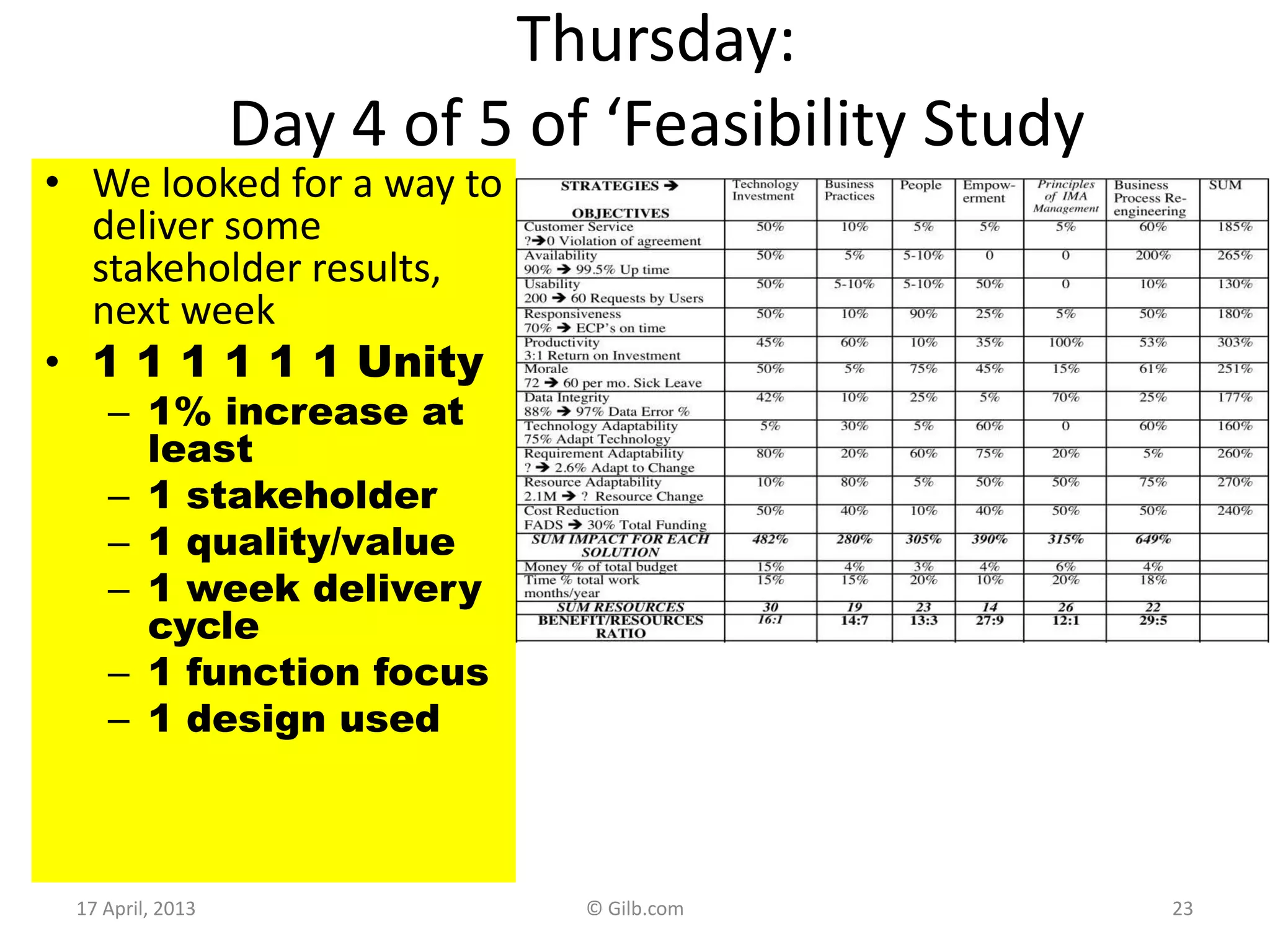
Thursday:
Day 4 of 5 of ‘Feasibility Study
• We looked for a way to
deliver some
stakeholder results,
next week
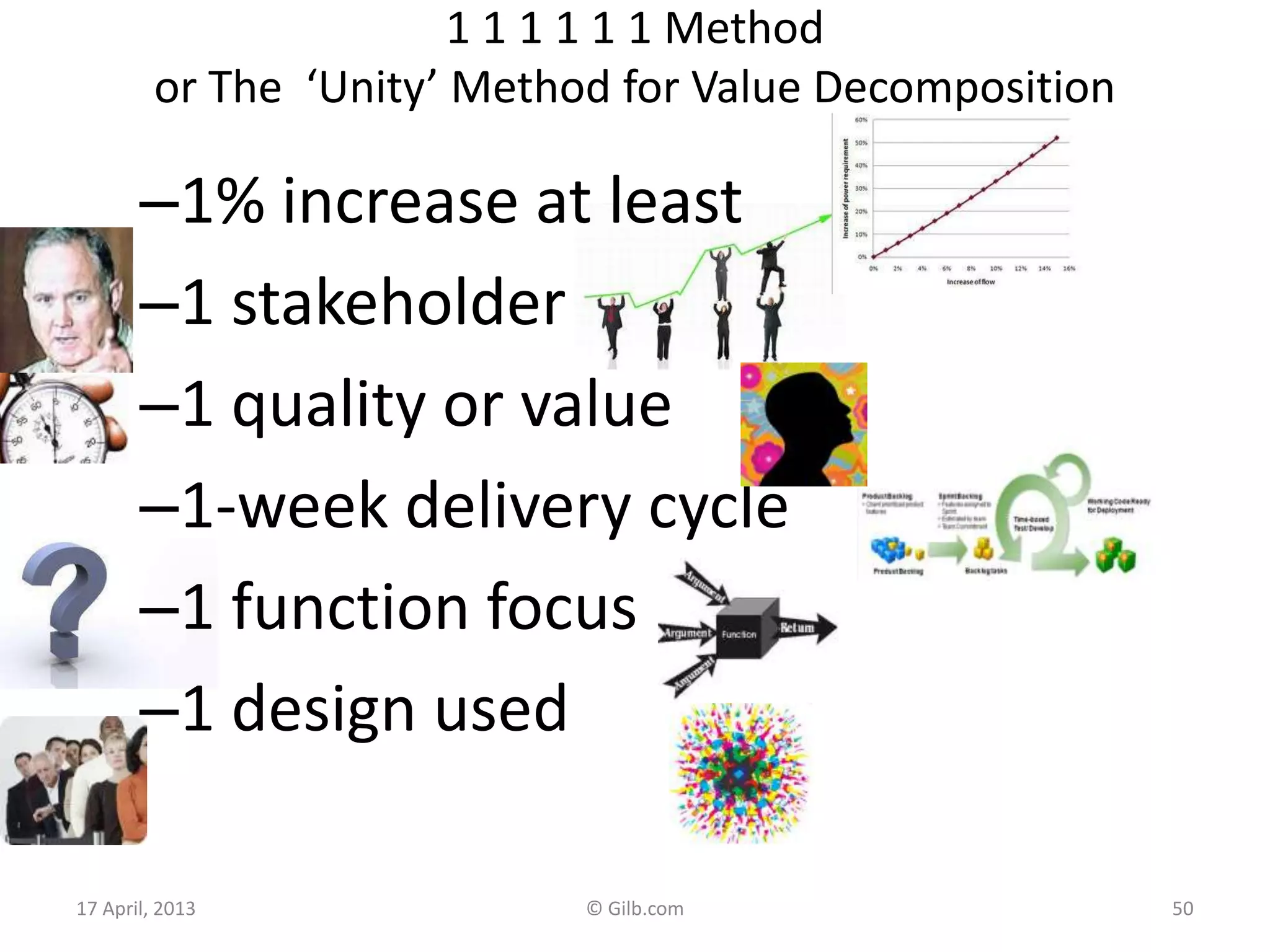
• 1 1 1 1 1 1 Unity
– 1% increase at
least
– 1 stakeholder
– 1 quality/value
– 1 week delivery
cycle
– 1 function focus
– 1 design used
17 April, 2013 © Gilb.com 23
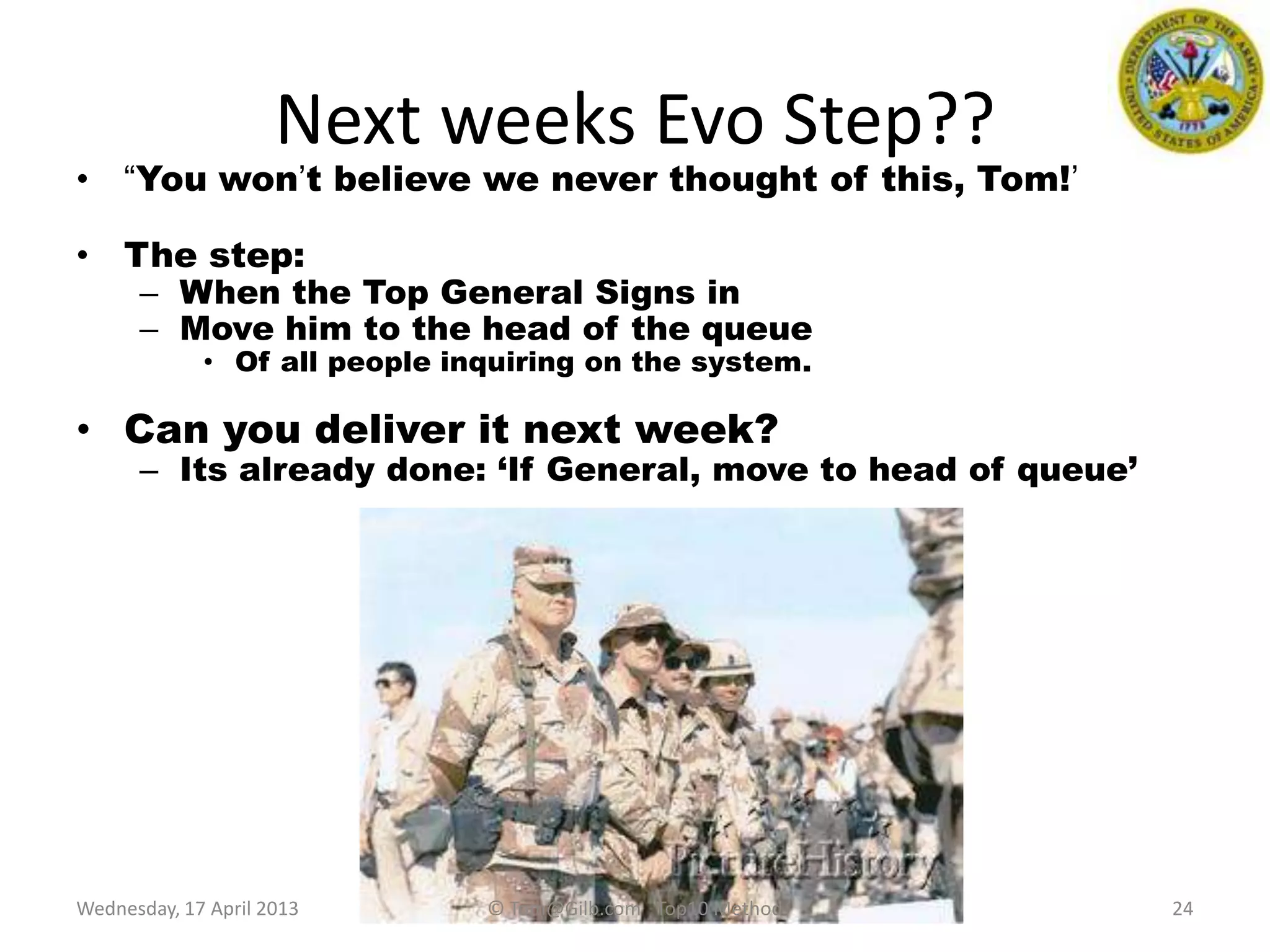
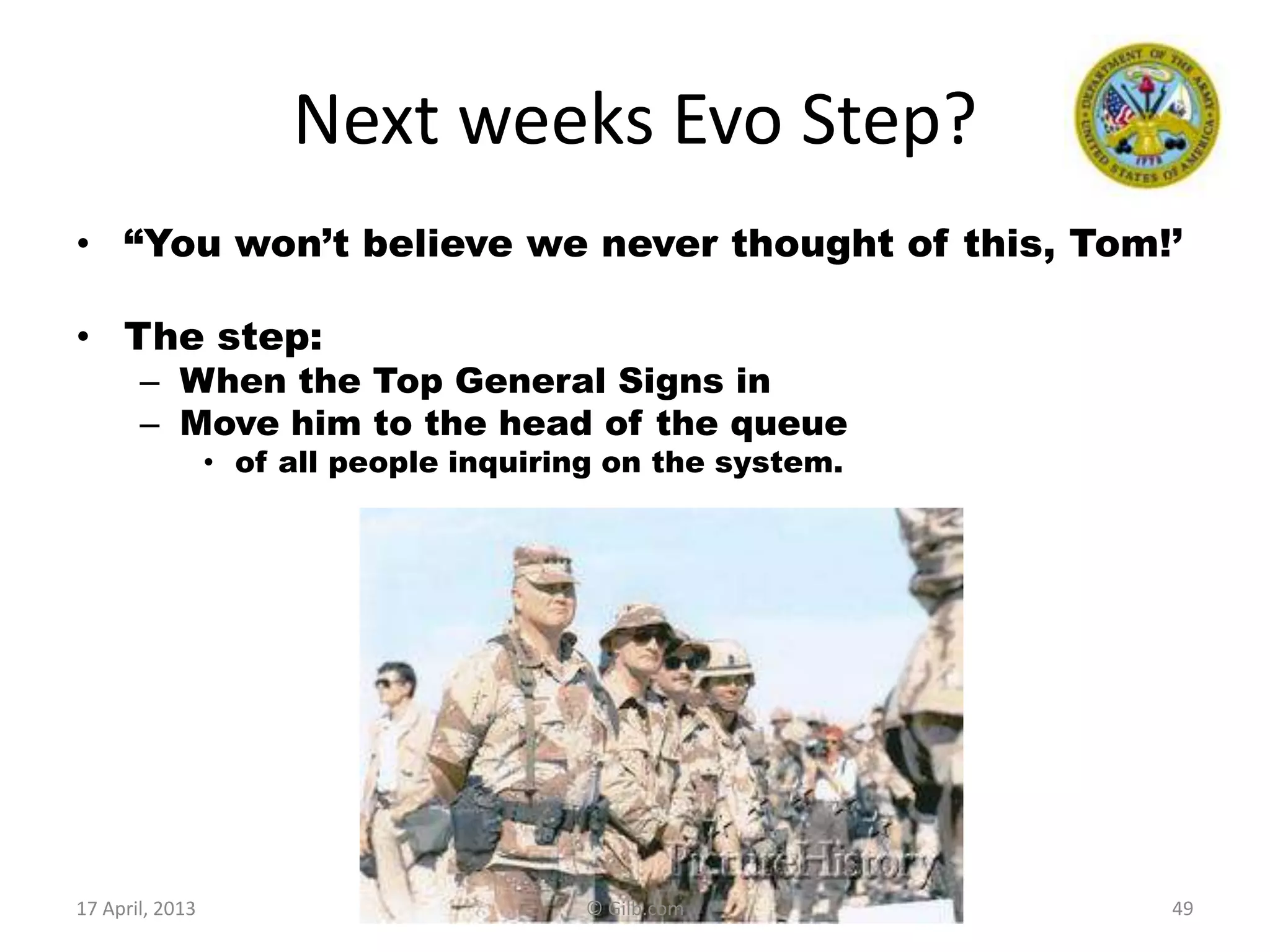
Next weeks Evo Step??
• “You won‟t believe we never thought of this, Tom!‟
• The step:
– When the Top General Signs in
– Move him to the head of the queue
• Of all people inquiring on the system.
• Can you deliver it next week?
– Its already done: „If General, move to head of queue‟
24Wednesday, 17 April 2013 © Tom@Gilb.com Top10 Method
Let’s take a look at
the generic standard
(my guideline for you)
for starting a project in this way.
• Top 10 Critical Business Value Objectives
– Used to drive iterative project value delivery cycles
– Evo Startup Standard, Jan 12 2013
– http://www.gilb.com/dl562
– Evo Project Management Standard, Jan 12 2013
– http://www.gilb.com/dl563
Wednesday, 17 April 2013 © Tom@Gilb.com Top10 Method 25
The 5 day Project Startup Standard for
‘Evo’ Agile Project Management
1 Top 10 Critical Objectives
Quantified
2 Top 10 Strategies identified
3 Impact Estimation of strategy
effect on Objectives
4 Find short term value delivery
steps
5 Get buy in from management to
proceed
Wednesday, 17 April 2013 © Tom@Gilb.com Top10 Method 26
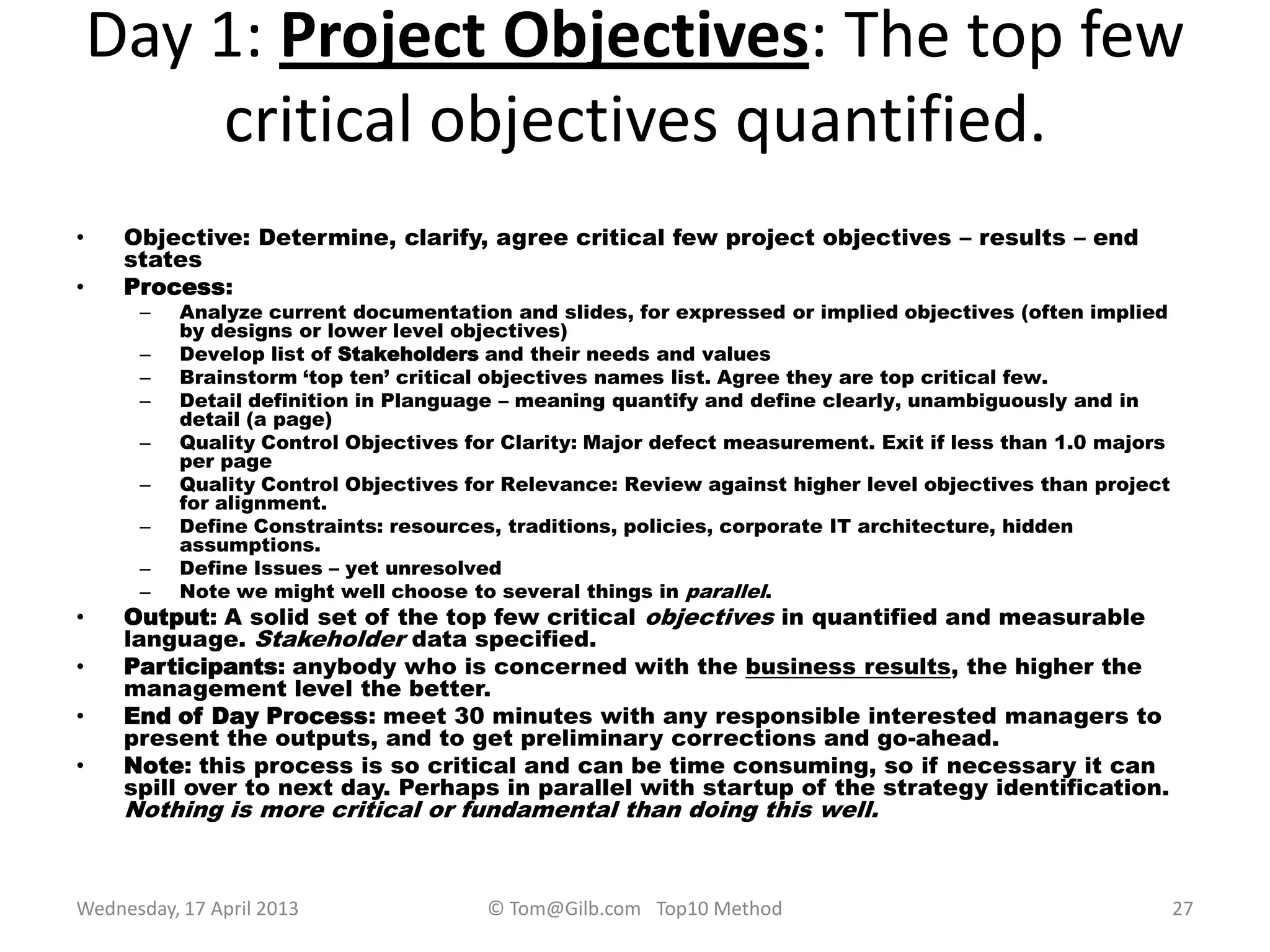
Day 1: Project Objectives: The top few
critical objectives quantified.
• Objective: Determine, clarify, agree critical few project objectives – results – end
states
• Process:
– Analyze current documentation and slides, for expressed or implied objectives (often implied
by designs or lower level objectives)
– Develop list of Stakeholders and their needs and values
– Brainstorm „top ten‟ critical objectives names list. Agree they are top critical few.
– Detail definition in Planguage – meaning quantify and define clearly, unambiguously and in
detail (a page)
– Quality Control Objectives for Clarity: Major defect measurement. Exit if less than 1.0 majors
per page
– Quality Control Objectives for Relevance: Review against higher level objectives than project
for alignment.
– Define Constraints: resources, traditions, policies, corporate IT architecture, hidden
assumptions.
– Define Issues – yet unresolved
– Note we might well choose to several things in parallel.
• Output: A solid set of the top few critical objectives in quantified and measurable
language. Stakeholder data specified.
• Participants: anybody who is concerned with the business results, the higher the
management level the better.
• End of Day Process: meet 30 minutes with any responsible interested managers to
present the outputs, and to get preliminary corrections and go-ahead.
• Note: this process is so critical and can be time consuming, so if necessary it can
spill over to next day. Perhaps in parallel with startup of the strategy identification.
Nothing is more critical or fundamental than doing this well.
Wednesday, 17 April 2013 © Tom@Gilb.com Top10 Method 27
Lack of clear top level project objectives has seen real projects fail
for $100+ million: personal experience, real case
Bad Objectives, for 8 years
1. Central to The Corporations business strategy is to be the
world’s premier integrated <domain> service provider.
2. Will provide a much more efficient user experience
3. Dramatically scale back the time frequently needed after
the last data is acquired to time align, depth
correct, splice, merge, recompute and/or do whatever else is
needed to generate the desired products
4. Make the system much easier to understand and use than
has been the case for previous system.
5. A primary goal is to provide a much more productive system
development environment than was previously the case.
6. Will provide a richer set of functionality for supporting next-
generation logging tools and applications.
7. Robustness is an essential system requirement (see partial
rewrite in example at right)
8. Major improvements in data quality over current practice
Quantified Objectives (in Planguage),
What they should have done
8 years earlier!
Robustness.Testability:
Type: Software Quality Requirement.
Version: 20 Oct 2006-10-20
Status: Demo draft,
Stakeholder: {Operator, Tester}.
Ambition: Rapid-duration automatic testing of
<critical complex tests>, with extreme operator setup
and initiation.
Scale: the duration of a defined
[Volume] of testing, or a defined
[Type], by a defined [Skill Level] of
system operator, under defined
[Operating Conditions].
Goal [All Customer Use, Volume = 1,000,000 data
items, Type = WireXXXX Vs DXX, Skill = First Time
Novice, Operating Conditions = Field, {Sea Or
Desert}. <10 mins.
17 April, 2013 © Gilb.com 28
PROJECT VALUE CLARITY:
2010 Bank top 10 Objectives quantified on day 1
P&L-Consistency&T P&L: Scale: total adjustments btw Flash/Predict and
Actual (T+1) signed off P&L. per day. Past 60 Goal: 15
Speed-To-Deliver: Scale: average Calendar days needed from New Idea
Approved until Idea Operational, for given Tasks, on given Markets.
Past [2009, Market = EURex, Task =Bond Execution] 2-3 months ?
Goal [Deadline =End 20xz, Market = EURex, Task =Bond Execution] 5
days
Operational-Control: Scale: % of trades per day, where the calculated
economic difference between OUR CO and Marketplace/Clients, is less
than “1 Yen”(or equivalent).
Past [April 20xx] 10% change this to 90% NH Goal [Dec. 20xy] 100%
Operational-Control.Consistent: Scale: % of defined [Trades] failing full
STP across the transaction cycle. Past [April 20xx, Trades=Voice Trades]
95%
Past [April 20xx, Trades=eTrades] 93%
Goal [April 20xz, Trades=Voice Trades] <95 ± 2%>
Goal [April 20xz, Trades=eTrades] 98.5 ± 0.5 %
Operational-Control.Timely.End&OvernightP&L Scale: number of
times, per quarter, the P&L information is not delivered timely to the
defined [Bach-Run].
Past [April 20xx, Batch-Run=Overnight] 1 Goal [Dec. 20xy, Batch-
Run=Overnight] <0.5> Past [April 20xx, Batch-Run= T+1] 1 Goal [Dec.
20xy, Batch-Run=End-Of-Day, Delay<1hour] 1
Operational-Control.Timely.IntradayP&L Scale: number of times per
day the intraday P&L process is delayed more than 0.5 sec.
Operational-Control.Timely.Trade-Bookings Scale: number of trades per
day that are not booked on trade date. Past [April 20xx] 20 ?
Front-Office-Trade-Management-Efficiency Scale: Time from Ticket
Launch to trade updating real-time risk view
Past [20xx, Function = Risk Mgt, Region = Global] ~ 80s +/- 45s ??
Goal [End 20xz, Function = Risk Mgt, Region = Global] ~ 50% better?
Managing Risk – Accurate – Consolidated – Real Time
Risk.Cross-Product Scale: % of financial products that risk metrics can
be displayed in a single position blotter in a way appropriate for the
trader (i.e. – around a benchmark vs. across the curve).
Past [April 20xx] 0% 95%. Goal [Dec. 20xy] 100%
Risk.Low-latency Scale: number of times per day the intraday risk
metrics is delayed by more than 0.5 sec. Past [April 20xx, NA] 1% Past
[April 20xx, EMEA] ??% Past [April 20xx, AP] 100% Goal [Dec. 20xy] 0%
Risk.Accuracy
Risk. user-configurable Scale: ??? pretty binary – feature is there or not
– how do we represent?
Past [April 20xx] 1% Goal [Dec. 20xy] 0%
Operational Cost Efficiency Scale: <Increased efficiency (Straight
through processing STP Rates )>
Cost-Per-Trade Scale: % reduction in Cost-Per-Trade
Goal (EOY 20xy, cost type = I 1 – REGION = ALL) Reduce cost by 60%
(BW)
Goal (EOY 20xy, cost type = I 2 – REGION = ALL) Reduce cost by x %
Goal (EOY 20xy, cost type = E1 – REGION = ALL) Reduce cost by x %
Goal (EOY 20xy, cost type = E 2 – REGION = ALL) Reduce cost by 100%
Goal (EOY 20xy, cost type = E 3 – REGION = ALL) Reduce cost by x %
17 April, 2013 © Gilb.com 29
Real Bank Project : Project Progress Testability
Quantification of the most-critical project objectives on day 1
P&L-Consistency&T P&L: Scale: total adjustments btw Flash/Predict and
Actual (T+1) signed off P&L. per day. Past 60 Goal: 15
Speed-To-Deliver: Scale: average Calendar days needed from New Idea
Approved until Idea Operational, for given Tasks, on given Markets.
Past [2009, Market = EURex, Task =Bond Execution] 2-3 months ?
Goal [Deadline =End 20xz, Market = EURex, Task =Bond Execution] 5
days
Operational-Control: Scale: % of trades per day, where the calculated
economic difference between OUR CO and Marketplace/Clients, is less
than “1 Yen”(or equivalent).
Past [April 20xx] 10% change this to 90% NH Goal [Dec. 20xy] 100%
Operational-Control.Consistent: Scale: % of defined [Trades] failing full
STP across the transaction cycle. Past [April 20xx, Trades=Voice Trades]
95%
Past [April 20xx, Trades=eTrades] 93%
Goal [April 20xz, Trades=Voice Trades] <95 ± 2%>
Goal [April 20xz, Trades=eTrades] 98.5 ± 0.5 %
Operational-Control.Timely.End&OvernightP&L Scale: number of
times, per quarter, the P&L information is not delivered timely to the
defined [Bach-Run].
Past [April 20xx, Batch-Run=Overnight] 1 Goal [Dec. 20xy, Batch-
Run=Overnight] <0.5> Past [April 20xx, Batch-Run= T+1] 1 Goal [Dec.
20xy, Batch-Run=End-Of-Day, Delay<1hour] 1
Operational-Control.Timely.IntradayP&L Scale: number of times per
day the intraday P&L process is delayed more than 0.5 sec.
Operational-Control.Timely.Trade-Bookings Scale: number of trades per
day that are not booked on trade date. Past [April 20xx] 20 ?
Front-Office-Trade-Management-Efficiency Scale: Time from Ticket
Launch to trade updating real-time risk view
Past [20xx, Function = Risk Mgt, Region = Global] ~ 80s +/- 45s ??
Goal [End 20xz, Function = Risk Mgt, Region = Global] ~ 50% better?
Managing Risk – Accurate – Consolidated – Real Time
Risk.Cross-Product Scale: % of financial products that risk metrics can
be displayed in a single position blotter in a way appropriate for the
trader (i.e. – around a benchmark vs. across the curve).
Past [April 20xx] 0% 95%. Goal [Dec. 20xy] 100%
Risk.Low-latency Scale: number of times per day the intraday risk
metrics is delayed by more than 0.5 sec. Past [April 20xx, NA] 1% Past
[April 20xx, EMEA] ??% Past [April 20xx, AP] 100% Goal [Dec. 20xy] 0%
Risk.Accuracy
Risk. user-configurable Scale: ??? pretty binary – feature is there or not
– how do we represent?
Past [April 20xx] 1% Goal [Dec. 20xy] 0%
Operational Cost Efficiency Scale: <Increased efficiency (Straight
through processing STP Rates )>
Cost-Per-Trade Scale: % reduction in Cost-Per-Trade
Goal (EOY 20xy, cost type = I 1 – REGION = ALL) Reduce cost by 60%
(BW)
Goal (EOY 20xy, cost type = I 2 – REGION = ALL) Reduce cost by x %
Goal (EOY 20xy, cost type = E1 – REGION = ALL) Reduce cost by x %
Goal (EOY 20xy, cost type = E 2 – REGION = ALL) Reduce cost by 100%
Goal (EOY 20xy, cost type = E 3 – REGION = ALL) Reduce cost by x %
17 April, 2013 © Gilb.com 30
ONE PAGE PROJECT REQUIREMENTS QUANTIFIED
Operational-Control:
Scale: % of trades per day, where the
calculated economic difference between
OUR CO and Marketplace/Clients, is less
than “1 Yen”(or equivalent).
Past [April 20xx] 10%
Goal [Dec. 20xy] 100%
ONE PAGE PROJECT REQUIREMENTS QUANTIFIED
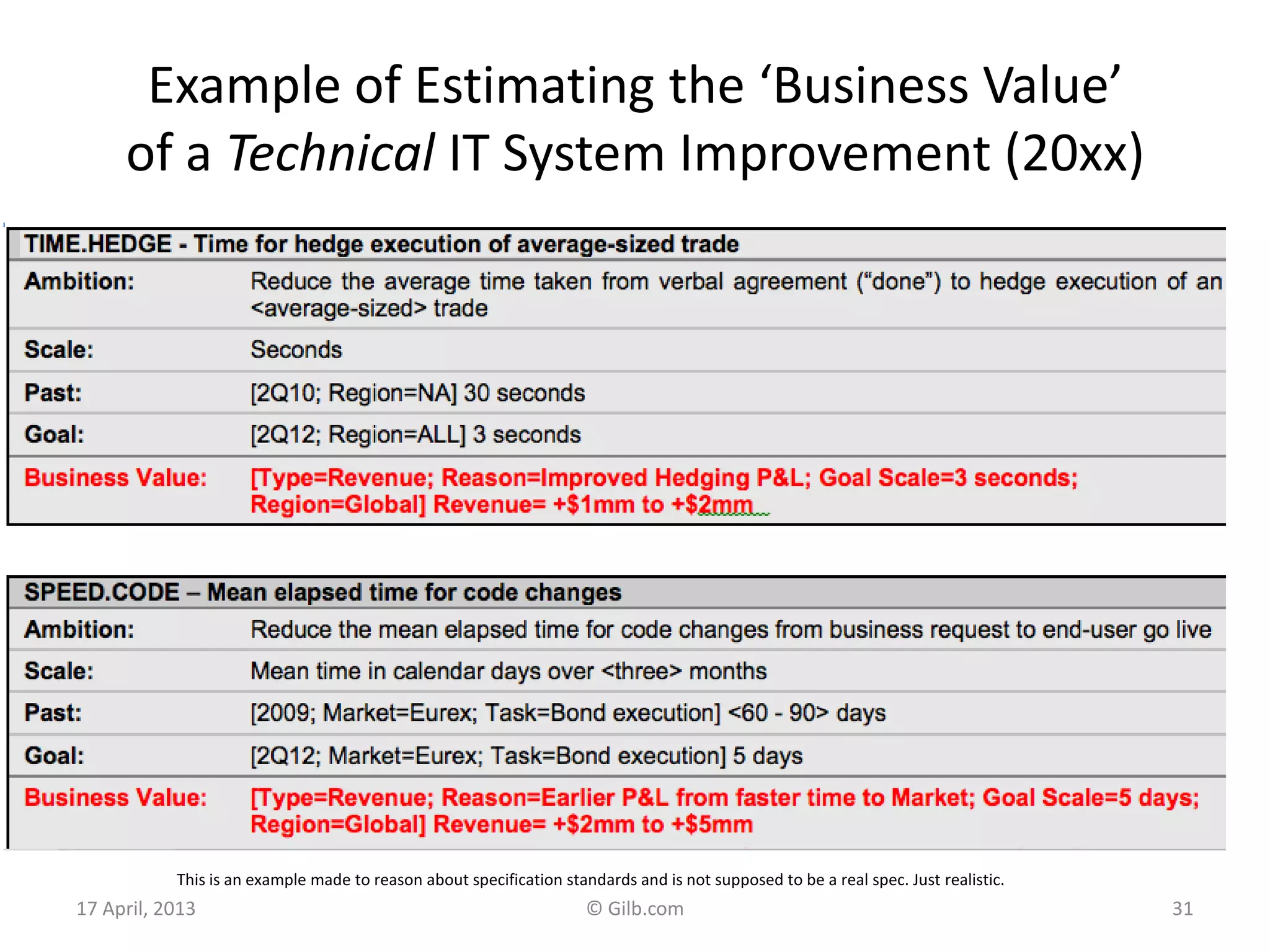
Example of Estimating the ‘Business Value’
of a Technical IT System Improvement (20xx)
17 April, 2013 © Gilb.com 31
This is an example made to reason about specification standards and is not supposed to be a real spec. Just realistic.
Acer: Security Administration Compliance:
Security Administration Compliance:
Ambition: to become compliant and to remain continuously compliant with all current officially binding security administration requirements
both from THE CORP and Regulatory Authorities.
Scope: Account Opening and Entitlement Reporting.
Scale: % compliant with THE CORP Information Security Standards (CISS) [THE CORP Information Security Office (CISO)] on a defined
System or Process.
Note: CISS is an officially binding security administration requirement with which we must become compliant.
========= Benchmarks ===============================
Past [CISS = RSA and IBECS ISAG Compliance Matrix [Regional Security Administration and IBECS Independent Security Administration
Group, October 2003] 25% <- JC, Nov-03
Note: The RSA/IBECS Compliance Matrix originates from Otto Chan and is based on CISS.
========= Targets ===================================
Wish [Deadline = March 2004, Systems = High Criticality Systems] 100%
Wish [Deadline = June 2004, Systems = {Medium & Low} Criticality Systems] 100%
Note: Wishes are stakeholder valued levels that we are not yet sure we can deliver in practice, on time, so we are not promising anything yet,
just acknowledging the desire.
Goal [Deadline = March 2004, Systems = High Criticality Systems] 90% 5%
Goal [Deadline = June 2004, Systems = {Medium & Low} Criticality Systems] 90% 5%
Goal [Midline = February 2004] 50% 10% “intermediary goal short of 100%”
Note: Goal levels are what we think we can really promise and focus on. These types of goals push us into thinking about possible
Evolutionary result delivery steps.
Stretch [Deadline = March 2004, Systems = High Criticality Systems] 95% 5%
Stretch [Deadline = June 2004, Systems = {Medium & Low} Criticality Systems] 95% 5%
Note: Stretch levels are something that we might be able to achieve if we have sufficient resources, focus and technology available, but we
are not sure of that yet. We are NOT promising it now! So this is a way to hold the ideals up in case those things become available.
17 April, 2013 © Gilb.com 32
Quantified
Definition
Benchmarks = Systems Analysis
Values, unknown costs
Realistic Project
Targets Val/€
Values, if
enough
resources left
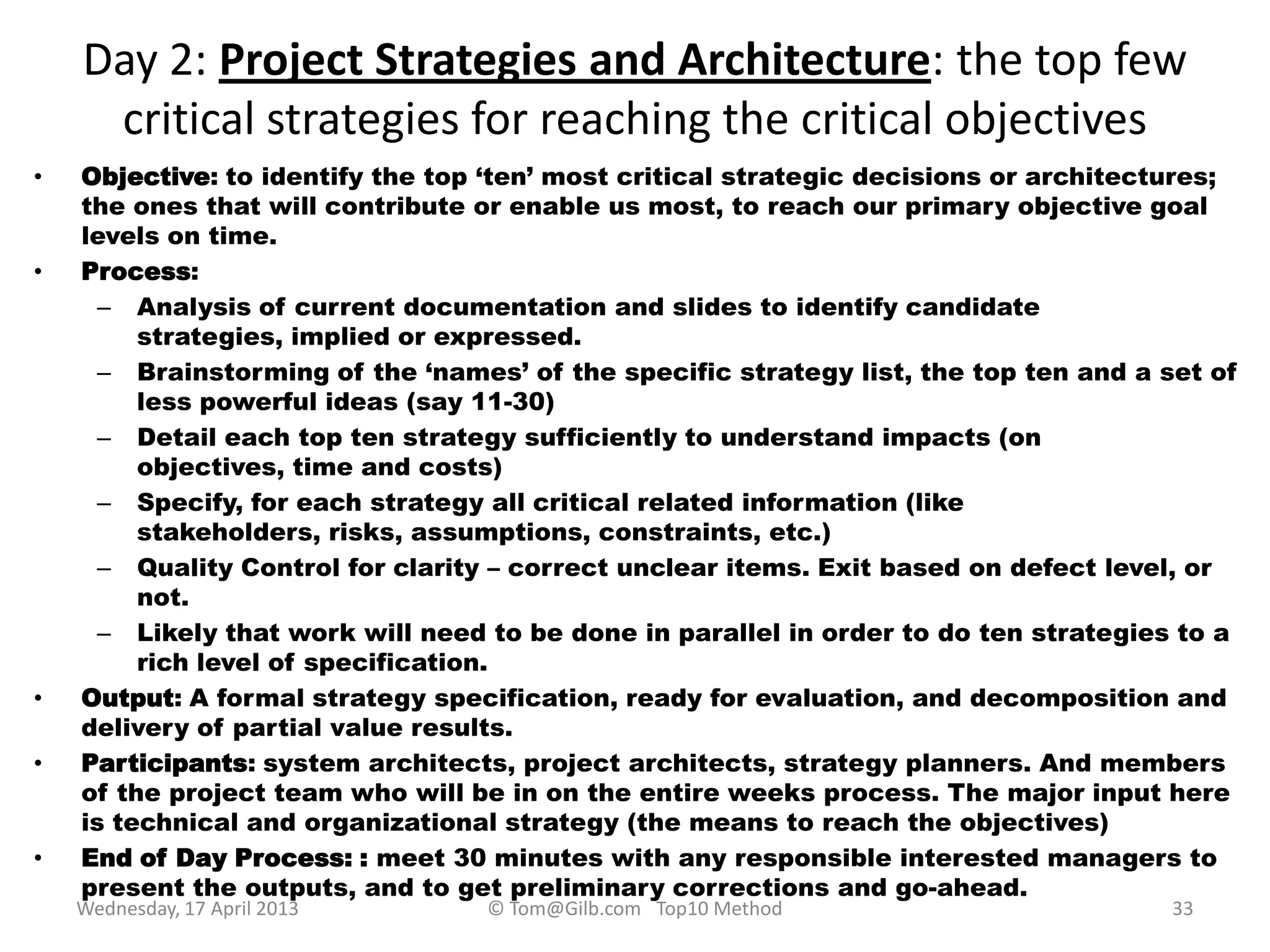
Day 2: Project Strategies and Architecture: the top few
critical strategies for reaching the critical objectives
• Objective: to identify the top „ten‟ most critical strategic decisions or architectures;
the ones that will contribute or enable us most, to reach our primary objective goal
levels on time.
• Process:
– Analysis of current documentation and slides to identify candidate
strategies, implied or expressed.
– Brainstorming of the „names‟ of the specific strategy list, the top ten and a set of
less powerful ideas (say 11-30)
– Detail each top ten strategy sufficiently to understand impacts (on
objectives, time and costs)
– Specify, for each strategy all critical related information (like
stakeholders, risks, assumptions, constraints, etc.)
– Quality Control for clarity – correct unclear items. Exit based on defect level, or
not.
– Likely that work will need to be done in parallel in order to do ten strategies to a
rich level of specification.
• Output: A formal strategy specification, ready for evaluation, and decomposition and
delivery of partial value results.
• Participants: system architects, project architects, strategy planners. And members
of the project team who will be in on the entire weeks process. The major input here
is technical and organizational strategy (the means to reach the objectives)
• End of Day Process: : meet 30 minutes with any responsible interested managers to
present the outputs, and to get preliminary corrections and go-ahead.
Wednesday, 17 April 2013 © Tom@Gilb.com Top10 Method 33
Acer: VERY TOP LEVEL PROJECT STRATEGIES
Note: These very top level project strategies specify how we are going to achieve the top level project goals.
Identify Binding Compliance Requirements Strategy:
Gist: Identify all officially binding security administration requirements with which we must become compliant both from THE CORP and Regulatory
Authorities.
System Control Strategy:
Gist: a formal system or process we can use to decide what characteristics a [system; default = appication] has with regard to our
compliance, performance, availability and cost goals
Note: an inspection process, for instance
Define and implement inspection for security administration-related business requirements specifications
Define and implement inspection for [systems; default = applications] which already exist in CitiTech environments
Note: systems include applications, databases, data service and machines. Project ACER ought to be extensible.
System Implementation Strategy:
Gist: a formal system or process we can use to actually change a [system; default = application] so that it meets our compliance, performance, availability
and cost goals
All systems ought to feed EERS
Publish best practices for developing security administration requirement specifications
Publish a security administration requirement specification template
Application technology managers are service providers in the formal change process, that are required to meet all project goals within defined timescales
Find Services That Meet Our Goals Strategy:
Gist: a formal system or process we can use to evaluate security administration services offered by internal and external services providers so that we can
meet our defined goals
Note: this strategy avoids pre-supposition that one solution is the only option (EG all applications must migrate to RSA and that RSA is the only security
administration services offering)
Use The Lowest Cost Provider Strategy:
Gist: use the services provider that meets all signed-off project goals for the lowest $US cost.
Note: if all project goals can be met by more than one services provider, the provider offering the lowest $US cost for meeting the goals and no more than
the goals ought to be used
17 April, 2013 © Gilb.com 34
How much do these strategies cost?
How much impact on our 4 Goals
do these strategies have?
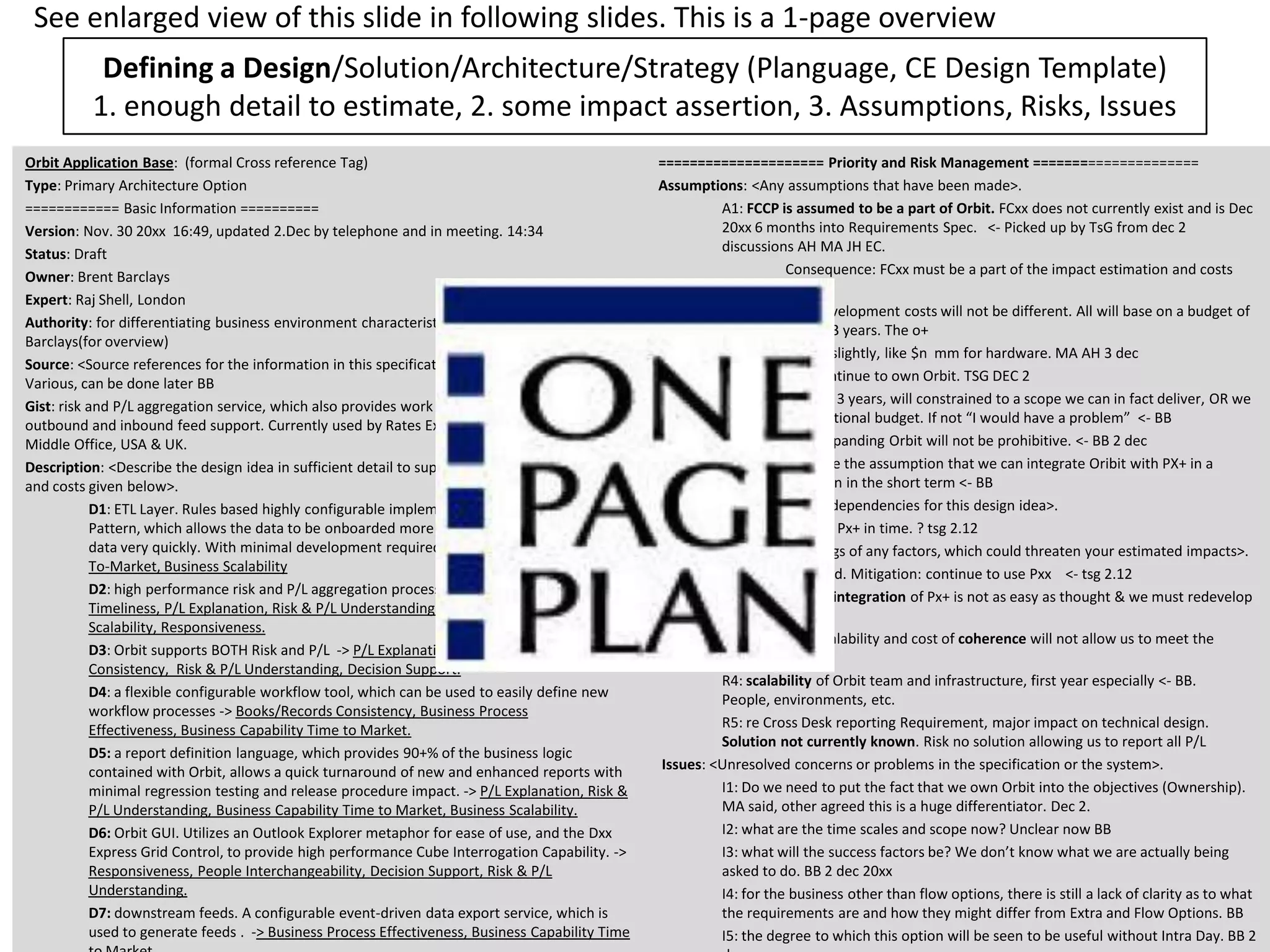
Defining a Design/Solution/Architecture/Strategy (Planguage, CE Design Template)
1. enough detail to estimate, 2. some impact assertion, 3. Assumptions, Risks, Issues
17 April, 2013 © Gilb.com 35
Orbit Application Base: (formal Cross reference Tag)
Type: Primary Architecture Option
============ Basic Information ==========
Version: Nov. 30 20xx 16:49, updated 2.Dec by telephone and in meeting. 14:34
Status: Draft
Owner: Brent Barclays
Expert: Raj Shell, London
Authority: for differentiating business environment characteristics, Raj Shell, Brent
Barclays(for overview)
Source: <Source references for the information in this specification. Could include people>.
Various, can be done later BB
Gist: risk and P/L aggregation service, which also provides work flow/adjustment and
outbound and inbound feed support. Currently used by Rates ExtraBusiness, Front Office and
Middle Office, USA & UK.
Description: <Describe the design idea in sufficient detail to support the estimated impacts
and costs given below>.
D1: ETL Layer. Rules based highly configurable implementation of the ETL
Pattern, which allows the data to be onboarded more quickly. Load and persist new
data very quickly. With minimal development required. -> Business-Capability-Time-
To-Market, Business Scalability
D2: high performance risk and P/L aggregation processing (Cube Building). ->
Timeliness, P/L Explanation, Risk & P/L Understanding, Decision Support, Business
Scalability, Responsiveness.
D3: Orbit supports BOTH Risk and P/L -> P/L Explanation, Risk & P/L
Consistency, Risk & P/L Understanding, Decision Support.
D4: a flexible configurable workflow tool, which can be used to easily define new
workflow processes -> Books/Records Consistency, Business Process
Effectiveness, Business Capability Time to Market.
D5: a report definition language, which provides 90+% of the business logic
contained with Orbit, allows a quick turnaround of new and enhanced reports with
minimal regression testing and release procedure impact. -> P/L Explanation, Risk &
P/L Understanding, Business Capability Time to Market, Business Scalability.
D6: Orbit GUI. Utilizes an Outlook Explorer metaphor for ease of use, and the Dxx
Express Grid Control, to provide high performance Cube Interrogation Capability. ->
Responsiveness, People Interchangeability, Decision Support, Risk & P/L
Understanding.
D7: downstream feeds. A configurable event-driven data export service, which is
used to generate feeds . -> Business Process Effectiveness, Business Capability Time
===================== Priority and Risk Management =====================
Assumptions: <Any assumptions that have been made>.
A1: FCCP is assumed to be a part of Orbit. FCxx does not currently exist and is Dec
20xx 6 months into Requirements Spec. <- Picked up by TsG from dec 2
discussions AH MA JH EC.
Consequence: FCxx must be a part of the impact estimation and costs
rating.
A2: Costs, the development costs will not be different. All will base on a budget of
say $nn mm and 3 years. The o+
costs may differ slightly, like $n mm for hardware. MA AH 3 dec
A3:Boss X will continue to own Orbit. TSG DEC 2
A4: the schedule, 3 years, will constrained to a scope we can in fact deliver, OR we
will be given additional budget. If not “I would have a problem” <- BB
A5: the cost of expanding Orbit will not be prohibitive. <- BB 2 dec
A6: we have made the assumption that we can integrate Oribit with PX+ in a
sensible way, even in the short term <- BB
Dependencies: <State any dependencies for this design idea>.
D1: FCxx replaces Px+ in time. ? tsg 2.12
Risks: <Name or refer to tags of any factors, which could threaten your estimated impacts>.
R1. FCxx is delayed. Mitigation: continue to use Pxx <- tsg 2.12
R2: the technical integration of Px+ is not as easy as thought & we must redevelop
Oribit
R3: the and or scalability and cost of coherence will not allow us to meet the
delivery.
R4: scalability of Orbit team and infrastructure, first year especially <- BB.
People, environments, etc.
R5: re Cross Desk reporting Requirement, major impact on technical design.
Solution not currently known. Risk no solution allowing us to report all P/L
Issues: <Unresolved concerns or problems in the specification or the system>.
I1: Do we need to put the fact that we own Orbit into the objectives (Ownership).
MA said, other agreed this is a huge differentiator. Dec 2.
I2: what are the time scales and scope now? Unclear now BB
I3: what will the success factors be? We don’t know what we are actually being
asked to do. BB 2 dec 20xx
I4: for the business other than flow options, there is still a lack of clarity as to what
the requirements are and how they might differ from Extra and Flow Options. BB
I5: the degree to which this option will be seen to be useful without Intra Day. BB 2
See enlarged view of this slide in following slides. This is a 1-page overview
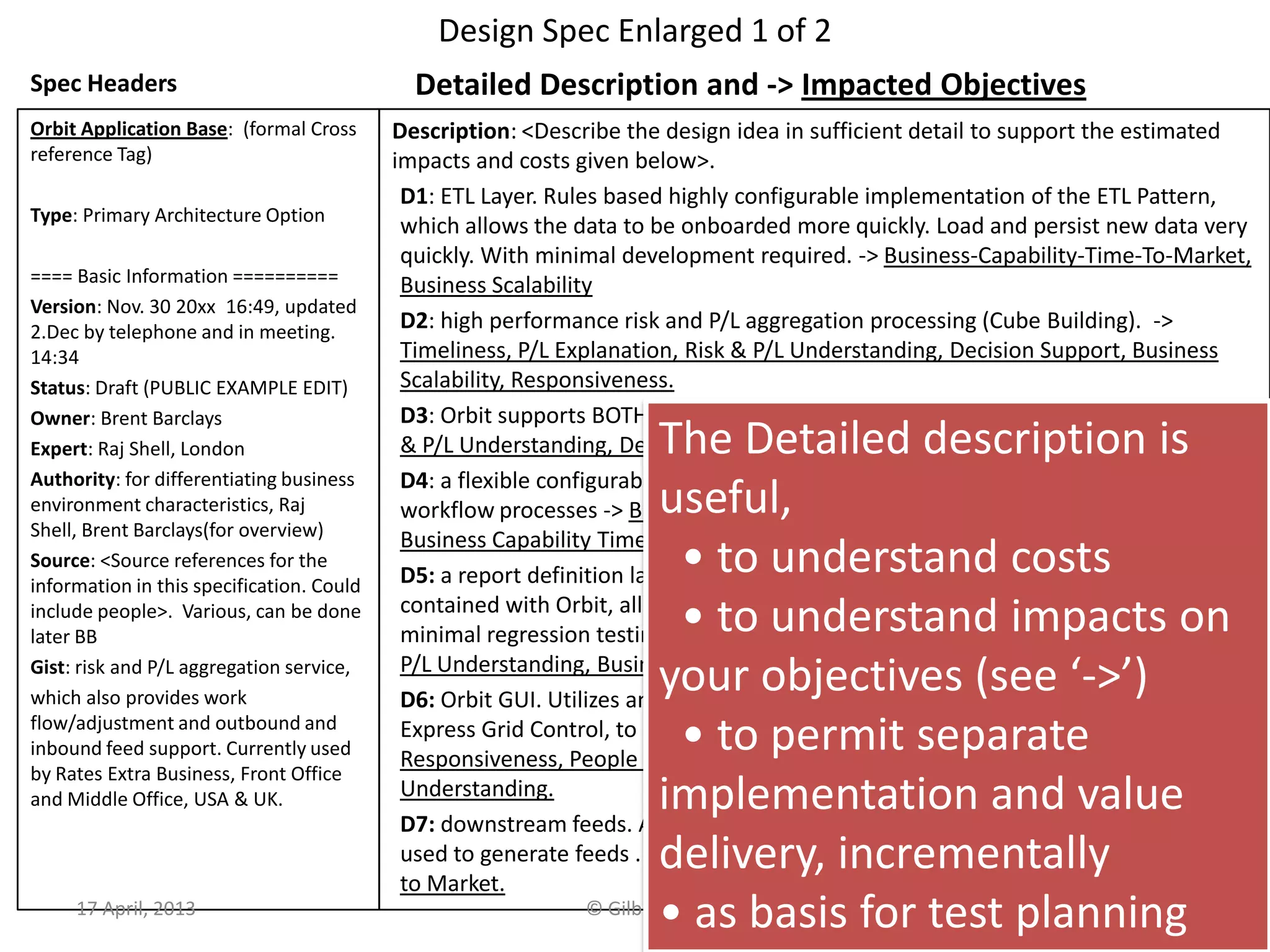
Design Spec Enlarged 1 of 2
Spec Headers
Orbit Application Base: (formal Cross
reference Tag)
Type: Primary Architecture Option
==== Basic Information ==========
Version: Nov. 30 20xx 16:49, updated
2.Dec by telephone and in meeting.
14:34
Status: Draft (PUBLIC EXAMPLE EDIT)
Owner: Brent Barclays
Expert: Raj Shell, London
Authority: for differentiating business
environment characteristics, Raj
Shell, Brent Barclays(for overview)
Source: <Source references for the
information in this specification. Could
include people>. Various, can be done
later BB
Gist: risk and P/L aggregation service,
which also provides work
flow/adjustment and outbound and
inbound feed support. Currently used
by Rates Extra Business, Front Office
and Middle Office, USA & UK.
Detailed Description and -> Impacted Objectives
Description: <Describe the design idea in sufficient detail to support the estimated
impacts and costs given below>.
D1: ETL Layer. Rules based highly configurable implementation of the ETL Pattern,
which allows the data to be onboarded more quickly. Load and persist new data very
quickly. With minimal development required. -> Business-Capability-Time-To-Market,
Business Scalability
D2: high performance risk and P/L aggregation processing (Cube Building). ->
Timeliness, P/L Explanation, Risk & P/L Understanding, Decision Support, Business
Scalability, Responsiveness.
D3: Orbit supports BOTH Risk and P/L -> P/L Explanation, Risk & P/L Consistency, Risk
& P/L Understanding, Decision Support.
D4: a flexible configurable workflow tool, which can be used to easily define new
workflow processes -> Books/Records Consistency, Business Process Effectiveness,
Business Capability Time to Market.
D5: a report definition language, which provides 90+% of the business logic
contained with Orbit, allows a quick turnaround of new and enhanced reports with
minimal regression testing and release procedure impact. -> P/L Explanation, Risk &
P/L Understanding, Business Capability Time to Market, Business Scalability.
D6: Orbit GUI. Utilizes an Outlook Explorer metaphor for ease of use, and the Dxx
Express Grid Control, to provide high performance Cube Interrogation Capability. ->
Responsiveness, People Interchangeability, Decision Support, Risk & P/L
Understanding.
D7: downstream feeds. A configurable event-driven data export service, which is
used to generate feeds . -> Business Process Effectiveness, Business Capability Time
to Market.
17 April, 2013 © Gilb.com 36
The Detailed description is
useful,
• to understand costs
• to understand impacts on
your objectives (see ‘->’)
• to permit separate
implementation and value
delivery, incrementally
• as basis for test planning
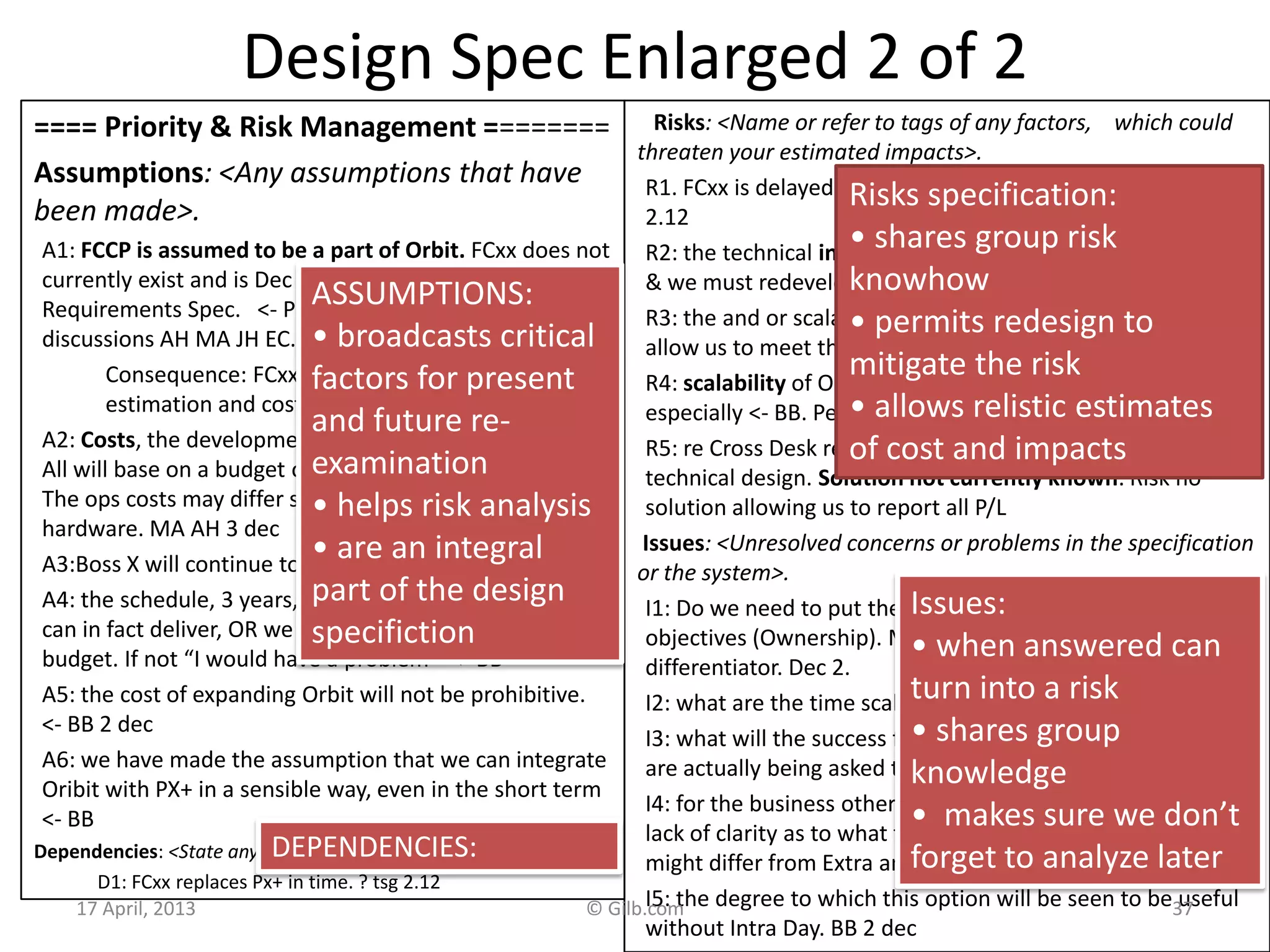
Design Spec Enlarged 2 of 2
==== Priority & Risk Management ========
Assumptions: <Any assumptions that have
been made>.
A1: FCCP is assumed to be a part of Orbit. FCxx does not
currently exist and is Dec 20xx 6 months into
Requirements Spec. <- Picked up by TsG from dec 2
discussions AH MA JH EC.
Consequence: FCxx must be a part of the impact
estimation and costs rating.
A2: Costs, the development costs will not be different.
All will base on a budget of say $ nn mm and 3 years.
The ops costs may differ slightly, like $n mm for
hardware. MA AH 3 dec
A3:Boss X will continue to own Orbit. TSG DEC 2
A4: the schedule, 3 years, will constrained to a scope we
can in fact deliver, OR we will be given additional
budget. If not “I would have a problem” <- BB
A5: the cost of expanding Orbit will not be prohibitive.
<- BB 2 dec
A6: we have made the assumption that we can integrate
Oribit with PX+ in a sensible way, even in the short term
<- BB
Dependencies: <State any dependencies for this design idea>.
D1: FCxx replaces Px+ in time. ? tsg 2.12
Risks: <Name or refer to tags of any factors, which could
threaten your estimated impacts>.
R1. FCxx is delayed. Mitigation: continue to use Pxx<- tsg
2.12
R2: the technical integration of Px+ is not as easy as thought
& we must redevelop Oribit
R3: the and or scalability and cost of coherence will not
allow us to meet the delivery.
R4: scalability of Orbit team and infrastructure, first year
especially <- BB. People, environments, etc.
R5: re Cross Desk reporting Requirement, major impact on
technical design. Solution not currently known. Risk no
solution allowing us to report all P/L
Issues: <Unresolved concerns or problems in the specification
or the system>.
I1: Do we need to put the fact that we own Orbit into the
objectives (Ownership). MA said, other agreed this is a huge
differentiator. Dec 2.
I2: what are the time scales and scope now? Unclear now BB
I3: what will the success factors be? We don’t know what we
are actually being asked to do. BB 2 dec 20xx
I4: for the business other than flow options, there is still a
lack of clarity as to what the requirements are and how they
might differ from Extra and Flow Options. BB
I5: the degree to which this option will be seen to be useful
without Intra Day. BB 2 dec
17 April, 2013 © Gilb.com 37
Risks specification:
• shares group risk
knowhow
• permits redesign to
mitigate the risk
• allows relistic estimates
of cost and impacts
Issues:
• when answered can
turn into a risk
• shares group
knowledge
• makes sure we don’t
forget to analyze later
ASSUMPTIONS:
• broadcasts critical
factors for present
and future re-
examination
• helps risk analysis
• are an integral
part of the design
specifiction
DEPENDENCIES:
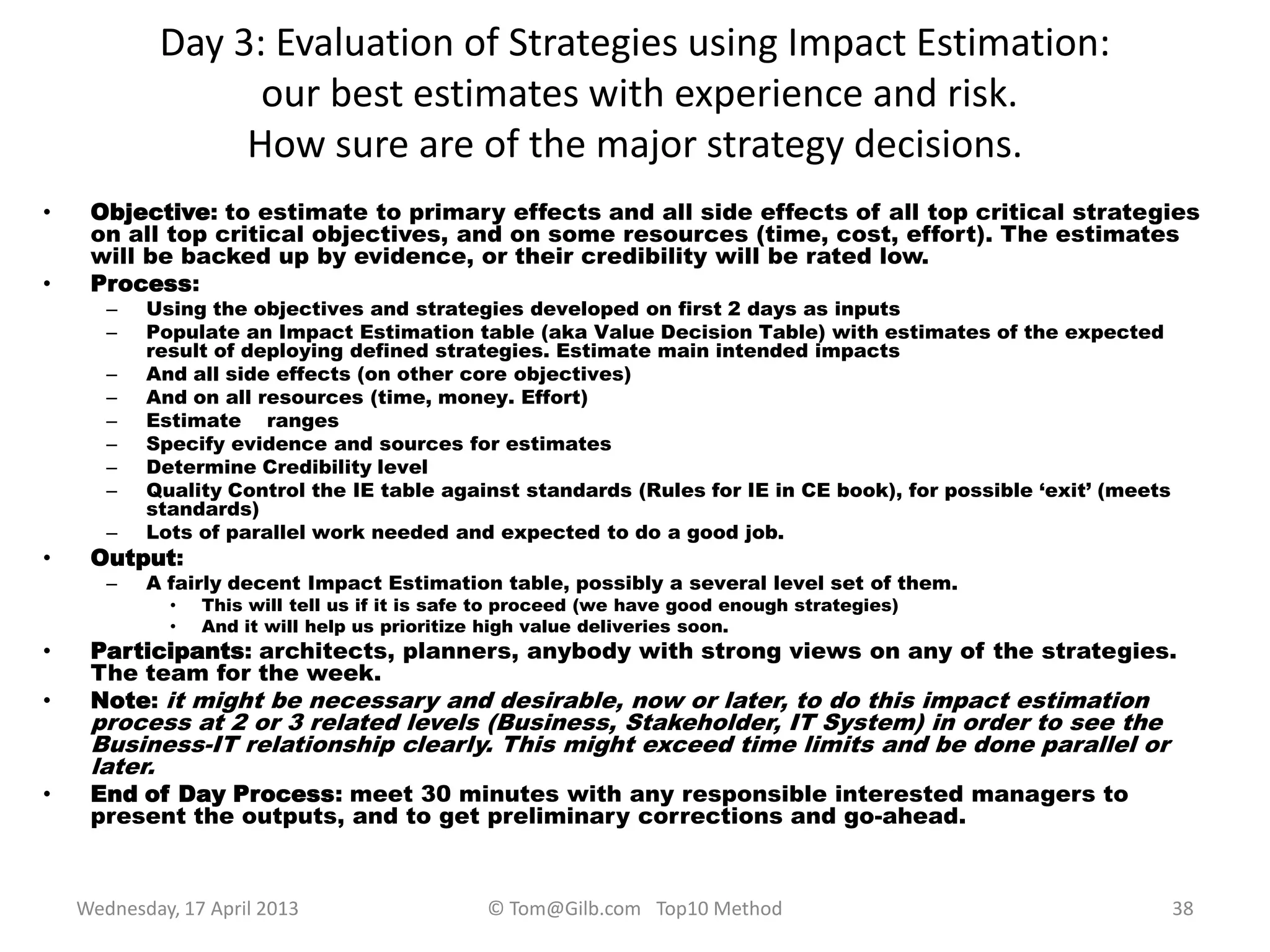
Day 3: Evaluation of Strategies using Impact Estimation:
our best estimates with experience and risk.
How sure are of the major strategy decisions.
• Objective: to estimate to primary effects and all side effects of all top critical strategies
on all top critical objectives, and on some resources (time, cost, effort). The estimates
will be backed up by evidence, or their credibility will be rated low.
• Process:
– Using the objectives and strategies developed on first 2 days as inputs
– Populate an Impact Estimation table (aka Value Decision Table) with estimates of the expected
result of deploying defined strategies. Estimate main intended impacts
– And all side effects (on other core objectives)
– And on all resources (time, money. Effort)
– Estimate ranges
– Specify evidence and sources for estimates
– Determine Credibility level
– Quality Control the IE table against standards (Rules for IE in CE book), for possible „exit‟ (meets
standards)
– Lots of parallel work needed and expected to do a good job.
• Output:
– A fairly decent Impact Estimation table, possibly a several level set of them.
• This will tell us if it is safe to proceed (we have good enough strategies)
• And it will help us prioritize high value deliveries soon.
• Participants: architects, planners, anybody with strong views on any of the strategies.
The team for the week.
• Note: it might be necessary and desirable, now or later, to do this impact estimation
process at 2 or 3 related levels (Business, Stakeholder, IT System) in order to see the
Business-IT relationship clearly. This might exceed time limits and be done parallel or
later.
• End of Day Process: meet 30 minutes with any responsible interested managers to
present the outputs, and to get preliminary corrections and go-ahead.
Wednesday, 17 April 2013 © Tom@Gilb.com Top10 Method 38
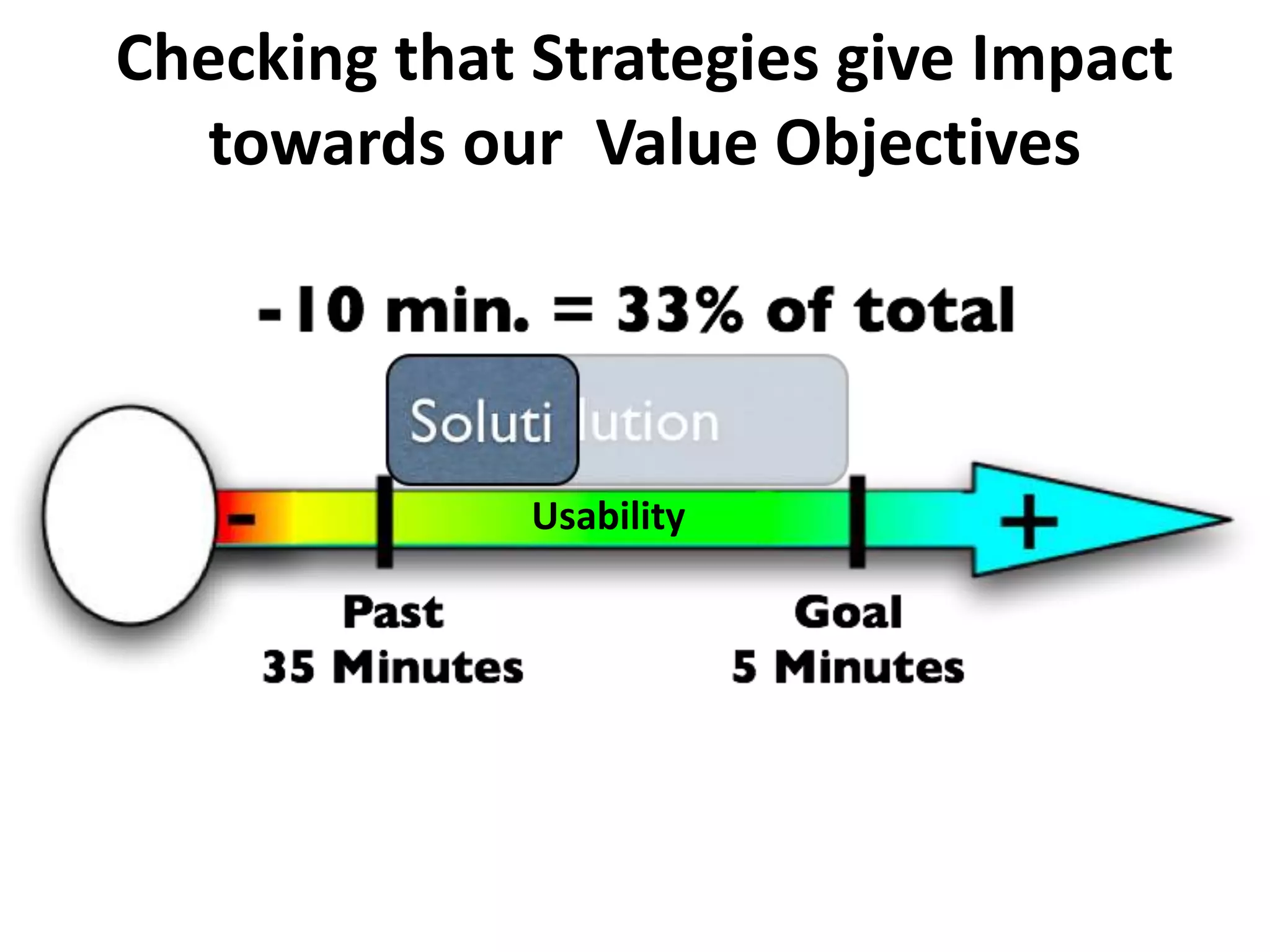
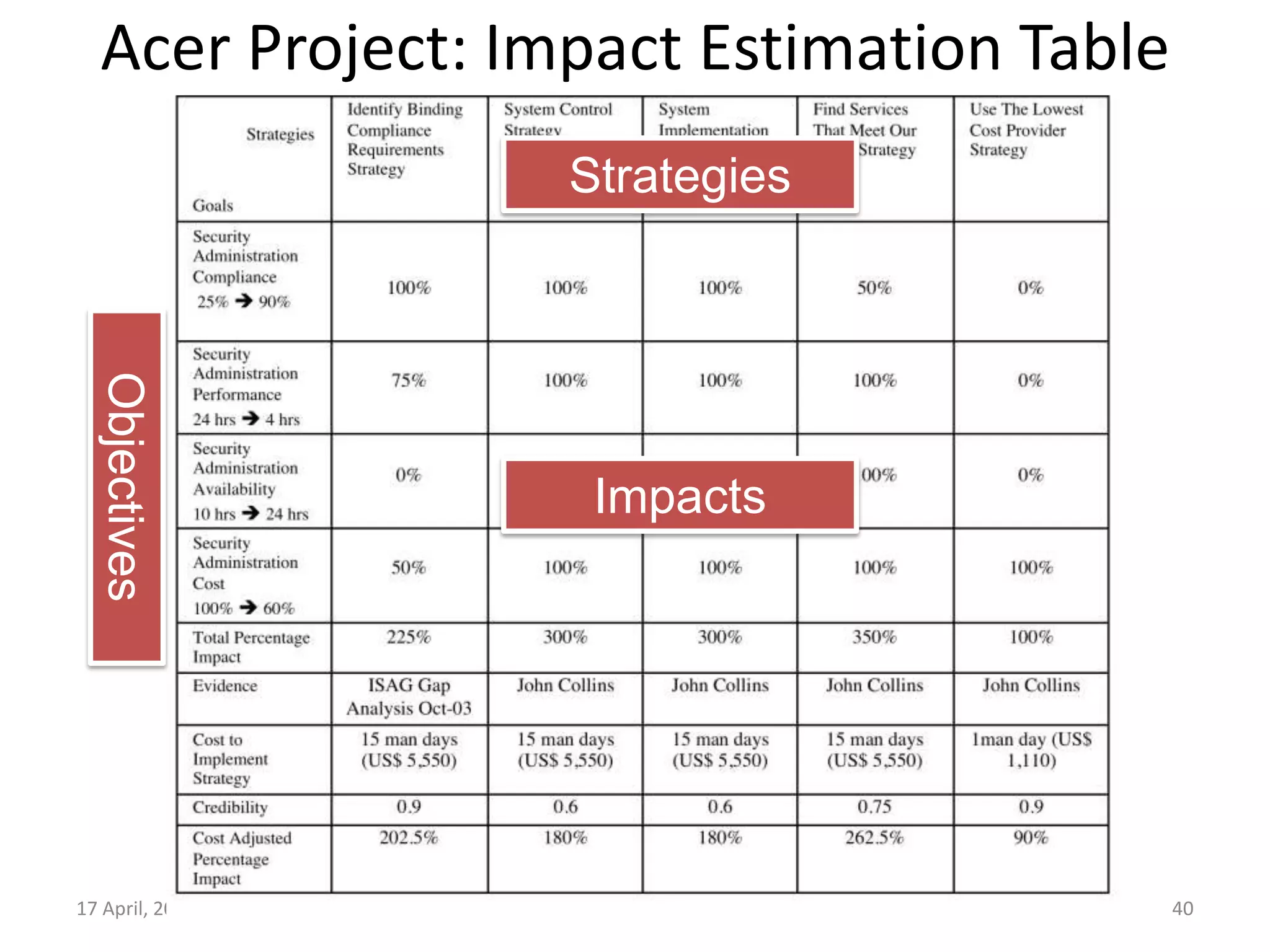
Checking that Strategies give Impact
towards our Value Objectives
Usability
Acer Project: Impact Estimation Table
17 April, 2013 © Gilb.com 40
Strategies
Objectives
Impacts
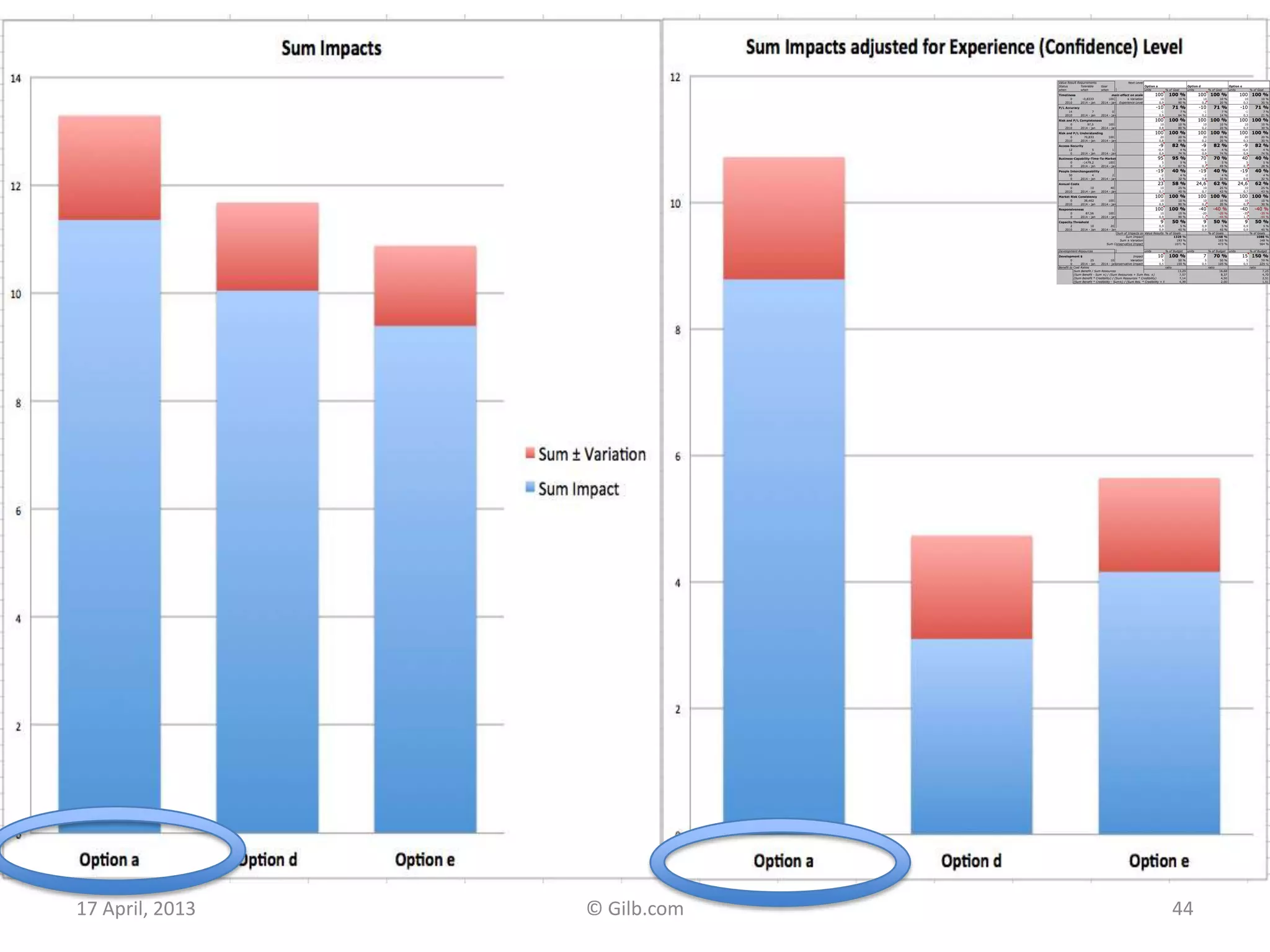
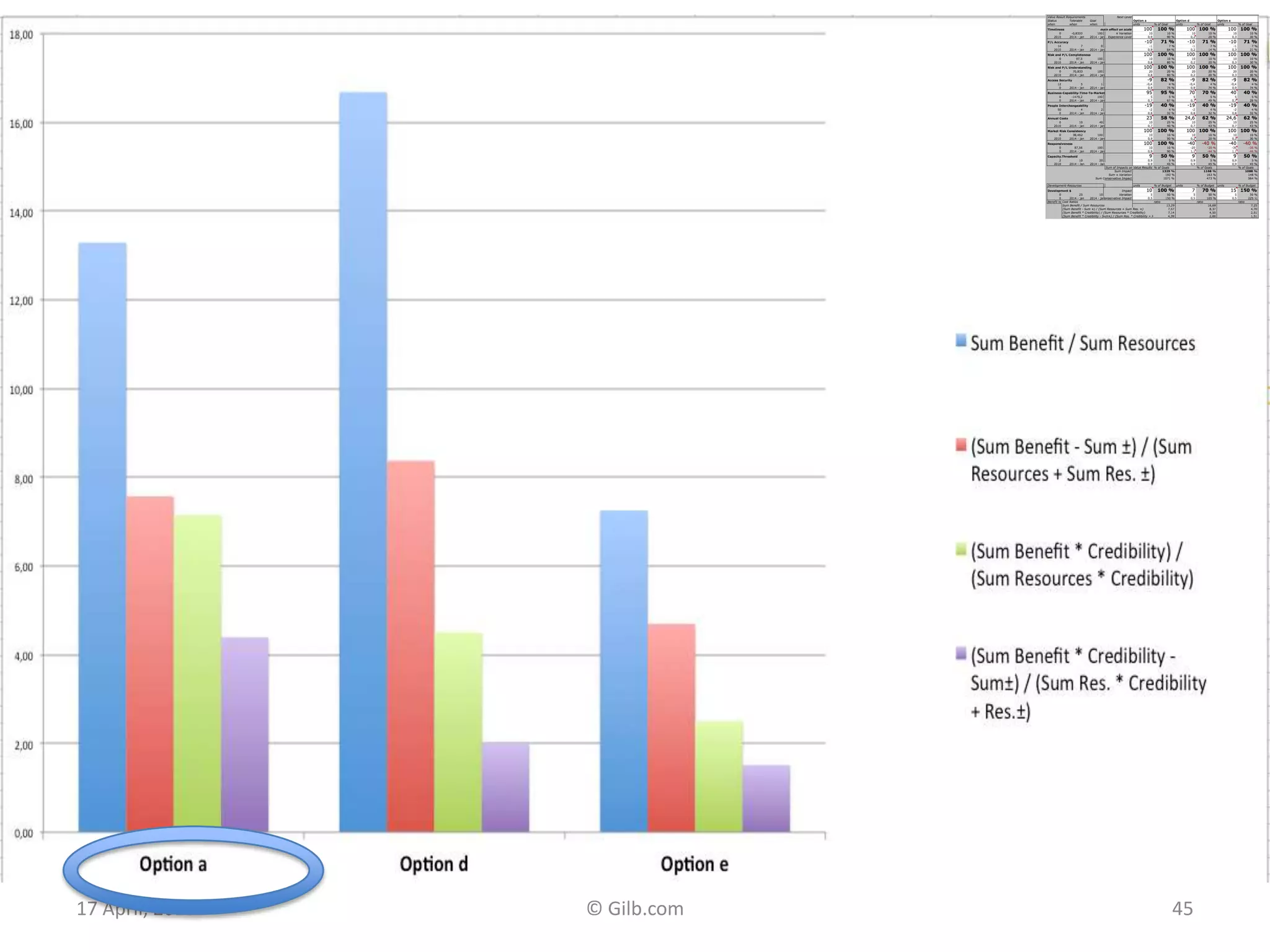
Actual Example
deciding between
5 systems
(named a, b ,c, d, e)
after merging some banks.
Using Kai Gilb’s
Evo Tool
to automate the relationships and
Presentation
17 April, 2013 © Gilb.com 41
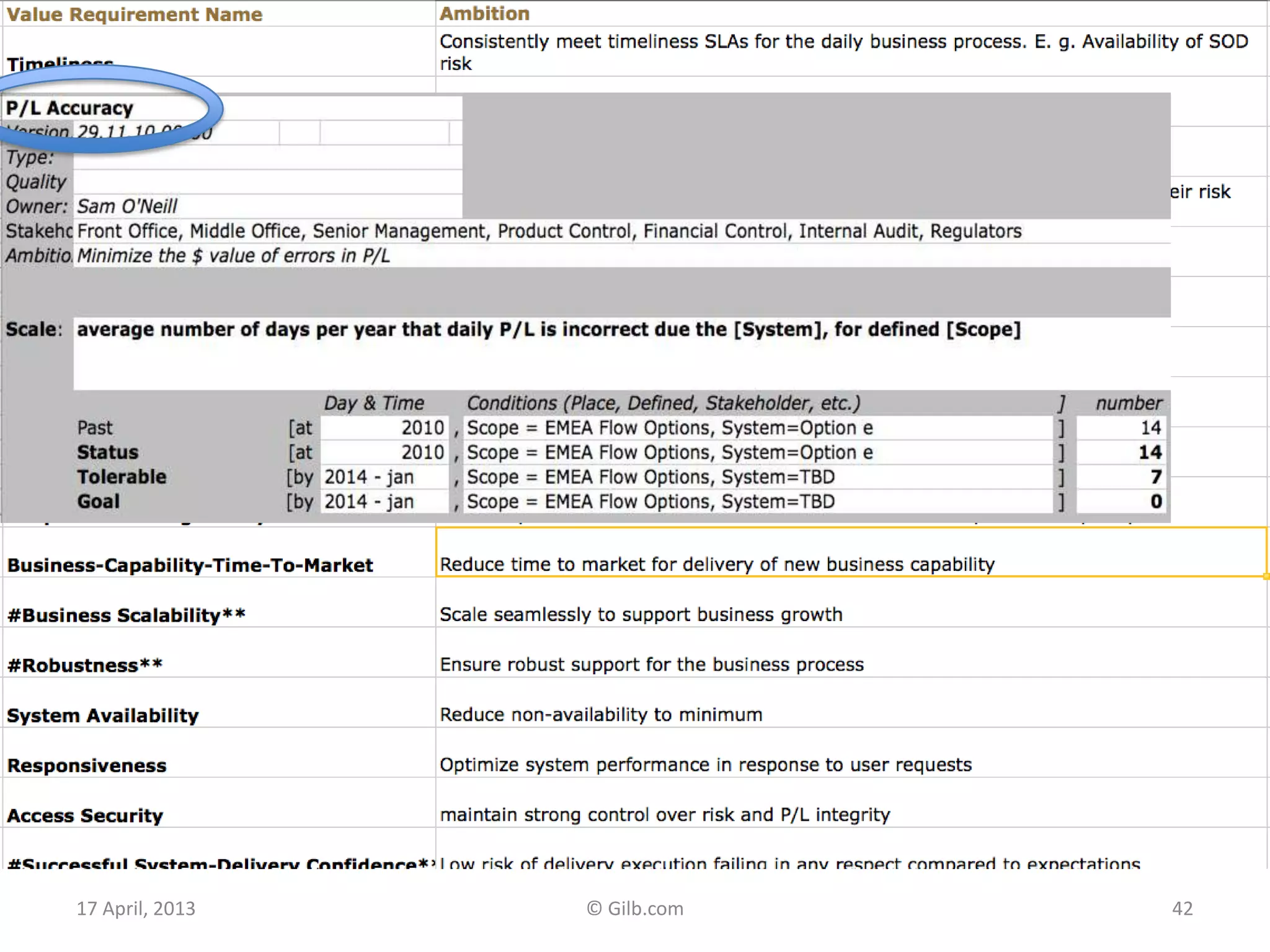
17 April, 2013 © Gilb.com 42
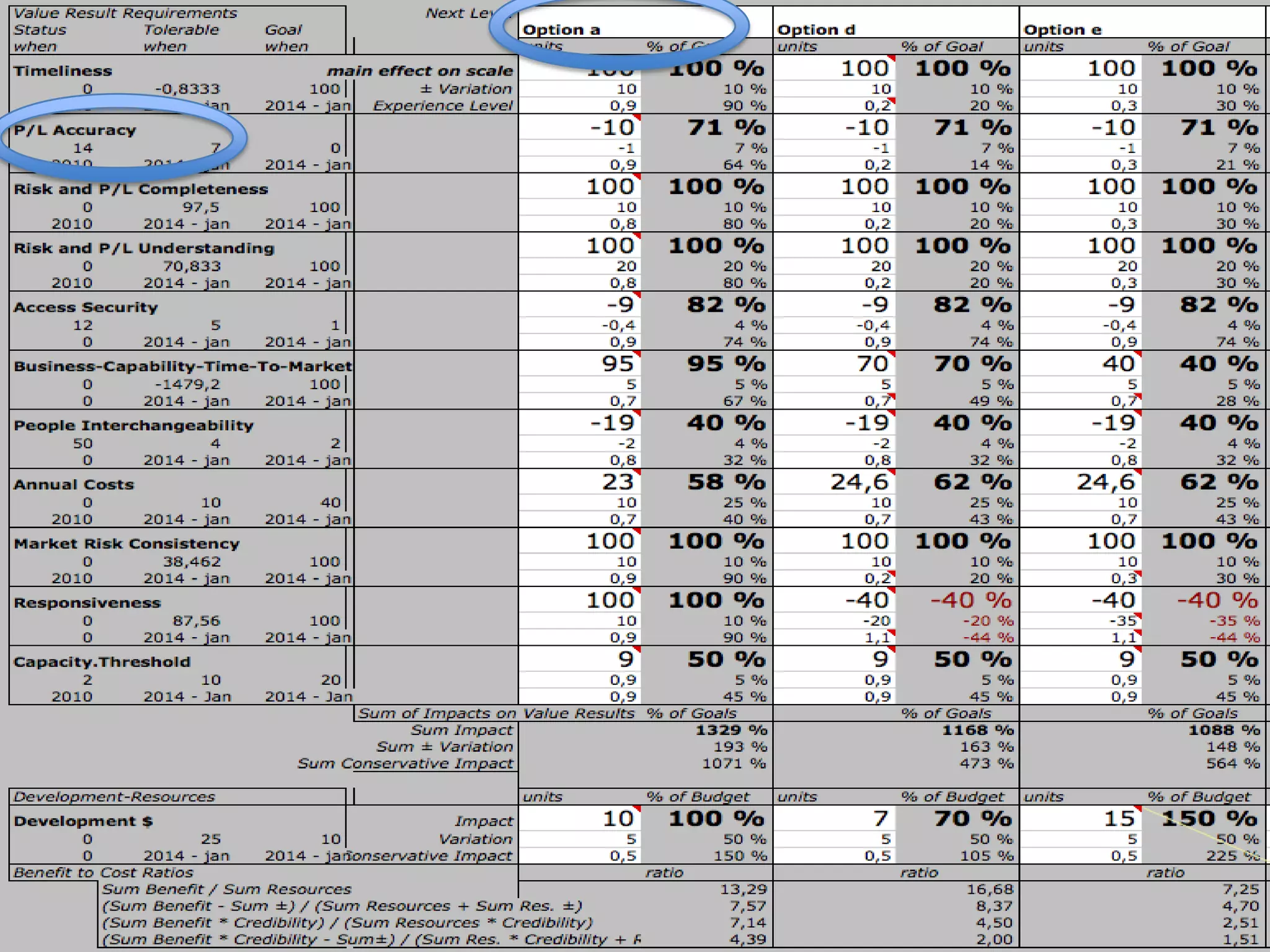
17 April, 2013 © Gilb.com 43
17 April, 2013 © Gilb.com 44
17 April, 2013 © Gilb.com 45
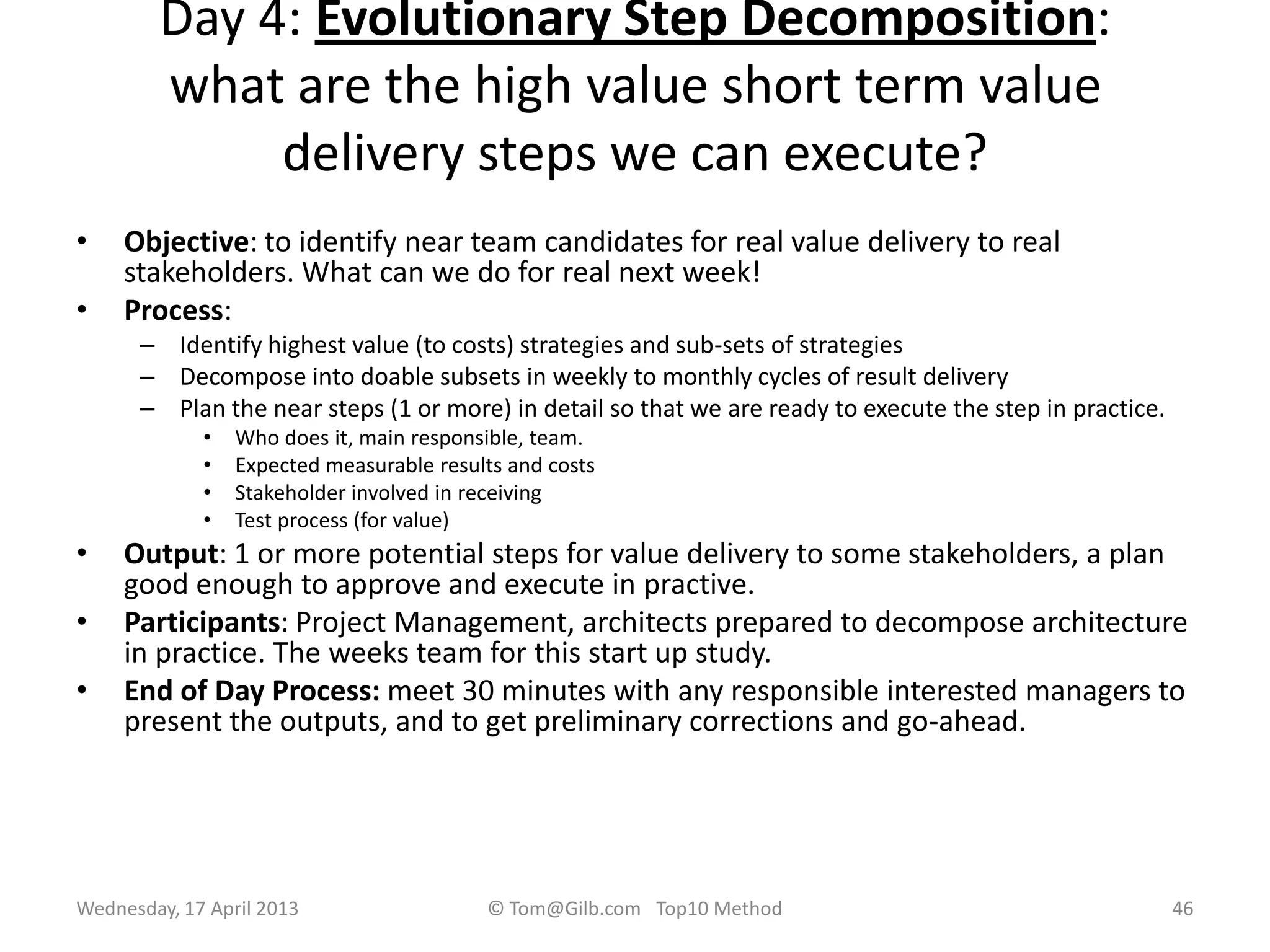
Day 4: Evolutionary Step Decomposition:
what are the high value short term value
delivery steps we can execute?
• Objective: to identify near team candidates for real value delivery to real
stakeholders. What can we do for real next week!
• Process:
– Identify highest value (to costs) strategies and sub-sets of strategies
– Decompose into doable subsets in weekly to monthly cycles of result delivery
– Plan the near steps (1 or more) in detail so that we are ready to execute the step in practice.
• Who does it, main responsible, team.
• Expected measurable results and costs
• Stakeholder involved in receiving
• Test process (for value)
• Output: 1 or more potential steps for value delivery to some stakeholders, a plan
good enough to approve and execute in practive.
• Participants: Project Management, architects prepared to decompose architecture
in practice. The weeks team for this start up study.
• End of Day Process: meet 30 minutes with any responsible interested managers to
present the outputs, and to get preliminary corrections and go-ahead.
Wednesday, 17 April 2013 © Tom@Gilb.com Top10 Method 46
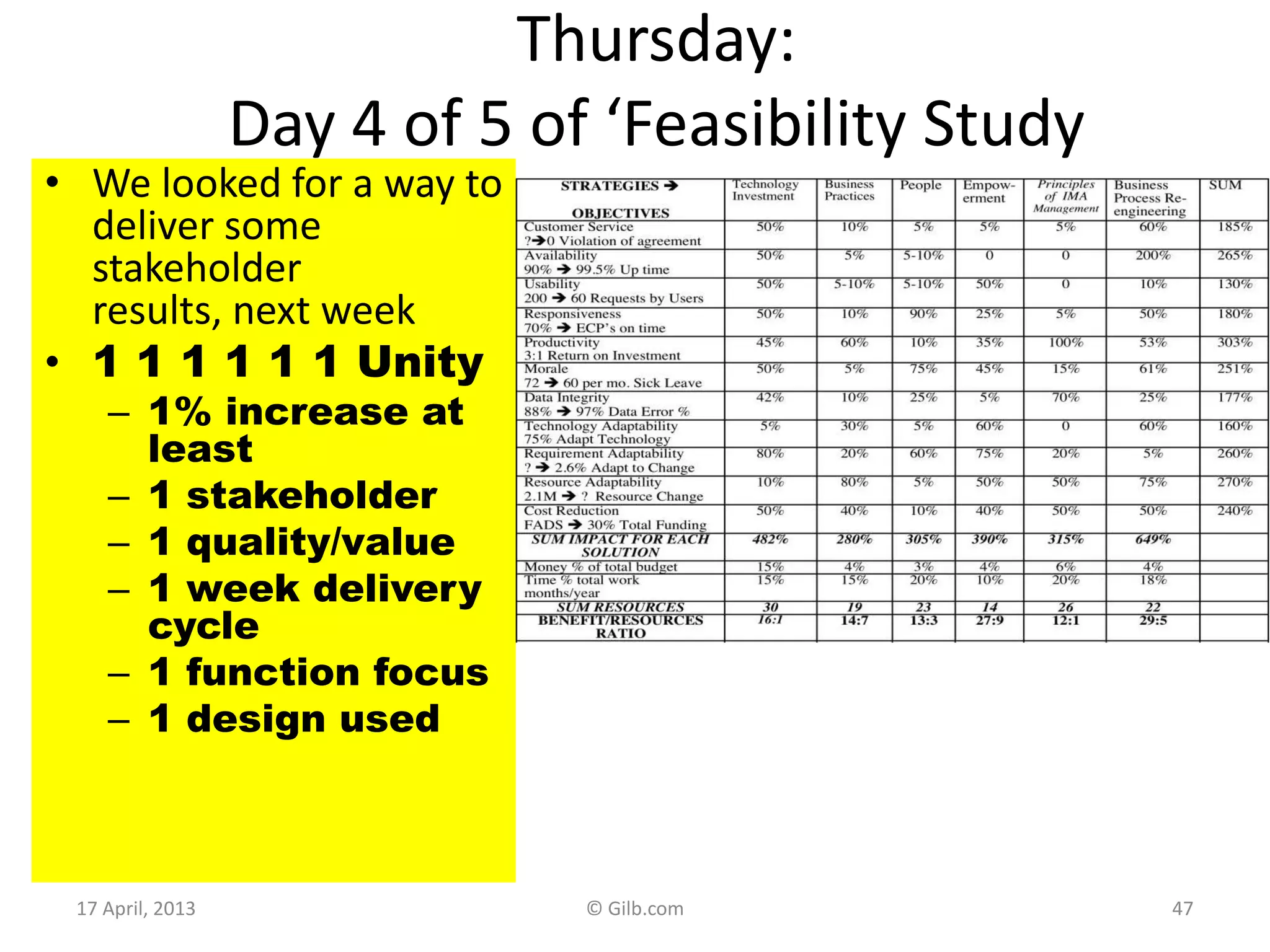
Thursday:
Day 4 of 5 of ‘Feasibility Study
• We looked for a way to
deliver some
stakeholder
results, next week
• 1 1 1 1 1 1 Unity
– 1% increase at
least
– 1 stakeholder
– 1 quality/value
– 1 week delivery
cycle
– 1 function focus
– 1 design used
17 April, 2013 © Gilb.com 47
Slide 48
Impact Estimation: Value-for-Money Delivery Table
17 April, 2013 © Gilb.com
29.5 : 1
Next weeks Evo Step?
• “You won‟t believe we never thought of this, Tom!‟
• The step:
– When the Top General Signs in
– Move him to the head of the queue
• of all people inquiring on the system.
4917 April, 2013 © Gilb.com
1 1 1 1 1 1 Method
or The ‘Unity’ Method for Value Decomposition
–1% increase at least
–1 stakeholder
–1 quality or value
–1-week delivery cycle
–1 function focus
–1 design used
17 April, 2013 © Gilb.com 50
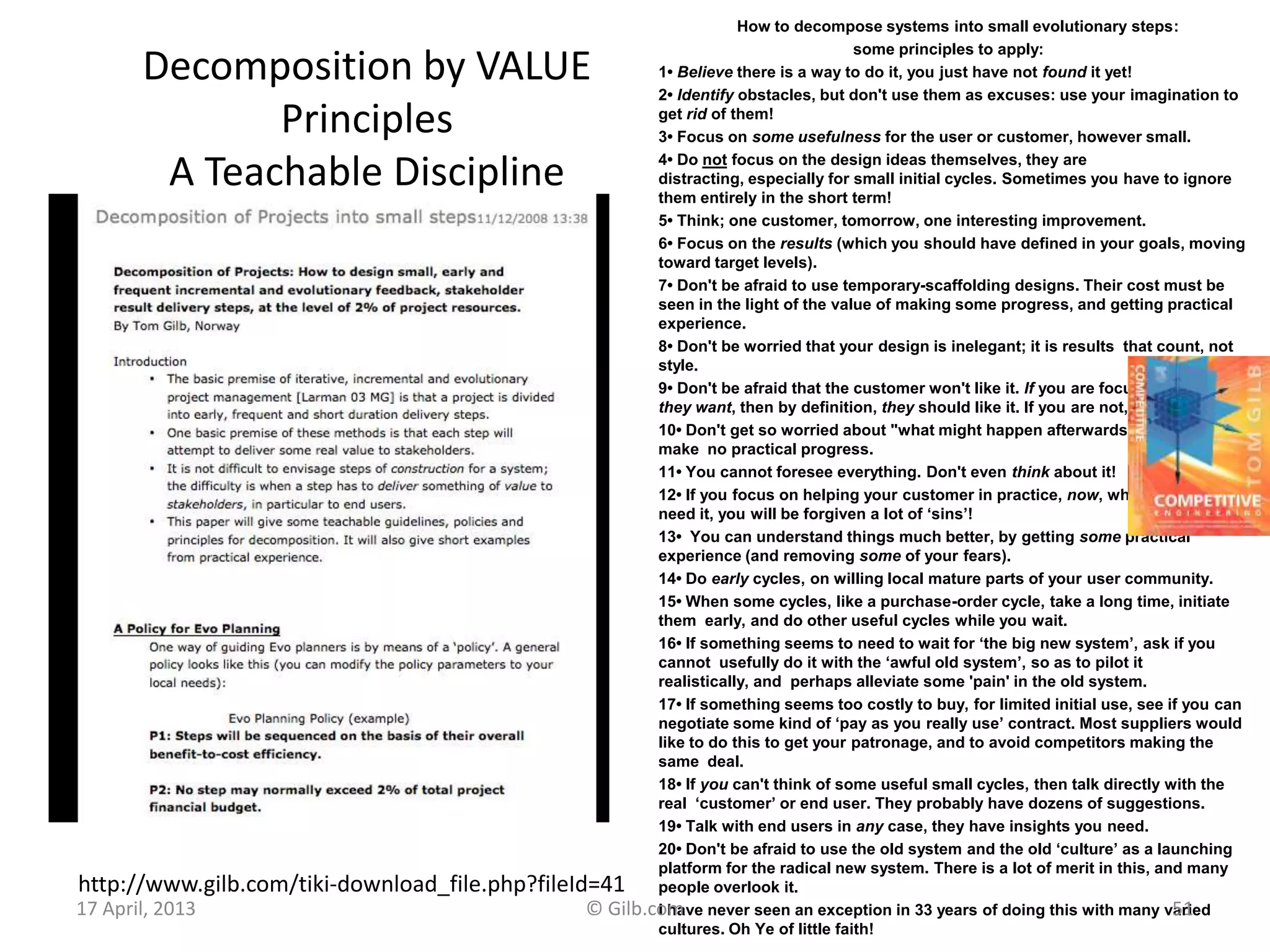
Decomposition by VALUE
Principles
A Teachable Discipline
How to decompose systems into small evolutionary steps:
some principles to apply:
1• Believe there is a way to do it, you just have not found it yet!
2• Identify obstacles, but don't use them as excuses: use your imagination to
get rid of them!
3• Focus on some usefulness for the user or customer, however small.
4• Do not focus on the design ideas themselves, they are
distracting, especially for small initial cycles. Sometimes you have to ignore
them entirely in the short term!
5• Think; one customer, tomorrow, one interesting improvement.
6• Focus on the results (which you should have defined in your goals, moving
toward target levels).
7• Don't be afraid to use temporary-scaffolding designs. Their cost must be
seen in the light of the value of making some progress, and getting practical
experience.
8• Don't be worried that your design is inelegant; it is results that count, not
style.
9• Don't be afraid that the customer won't like it. If you are focusing on results
they want, then by definition, they should like it. If you are not, then do!
10• Don't get so worried about "what might happen afterwards" that you can
make no practical progress.
11• You cannot foresee everything. Don't even think about it!
12• If you focus on helping your customer in practice, now, where they really
need it, you will be forgiven a lot of ‘sins’!
13• You can understand things much better, by getting some practical
experience (and removing some of your fears).
14• Do early cycles, on willing local mature parts of your user community.
15• When some cycles, like a purchase-order cycle, take a long time, initiate
them early, and do other useful cycles while you wait.
16• If something seems to need to wait for ‘the big new system’, ask if you
cannot usefully do it with the ‘awful old system’, so as to pilot it
realistically, and perhaps alleviate some 'pain' in the old system.
17• If something seems too costly to buy, for limited initial use, see if you can
negotiate some kind of ‘pay as you really use’ contract. Most suppliers would
like to do this to get your patronage, and to avoid competitors making the
same deal.
18• If you can't think of some useful small cycles, then talk directly with the
real ‘customer’ or end user. They probably have dozens of suggestions.
19• Talk with end users in any case, they have insights you need.
20• Don't be afraid to use the old system and the old ‘culture’ as a launching
platform for the radical new system. There is a lot of merit in this, and many
people overlook it.
I have never seen an exception in 33 years of doing this with many varied
cultures. Oh Ye of little faith!
http://www.gilb.com/tiki-download_file.php?fileId=41
17 April, 2013 © Gilb.com 51
Day 5 of Evo Startup Week
Present to Management,
Get Go-ahead
• Objective: To present the entire set of plans to responsible
executive(s) and discuss them, with approval if possible, or approve
with changes.
• Process:
– Present all planned outputs
– Discuss them and answer questions
– Take corrections
– Get approval for the next implementation step.
• Output: Approval for next implementation step, corrections
• Participants: project tem + key manager above the project
manager.
• End of Day Process: none, unless corrections needed before
execute OK.
– Possible Corrections and ready to execute a delivery step next week
Wednesday, 17 April 2013 © Tom@Gilb.com Top10 Method 52
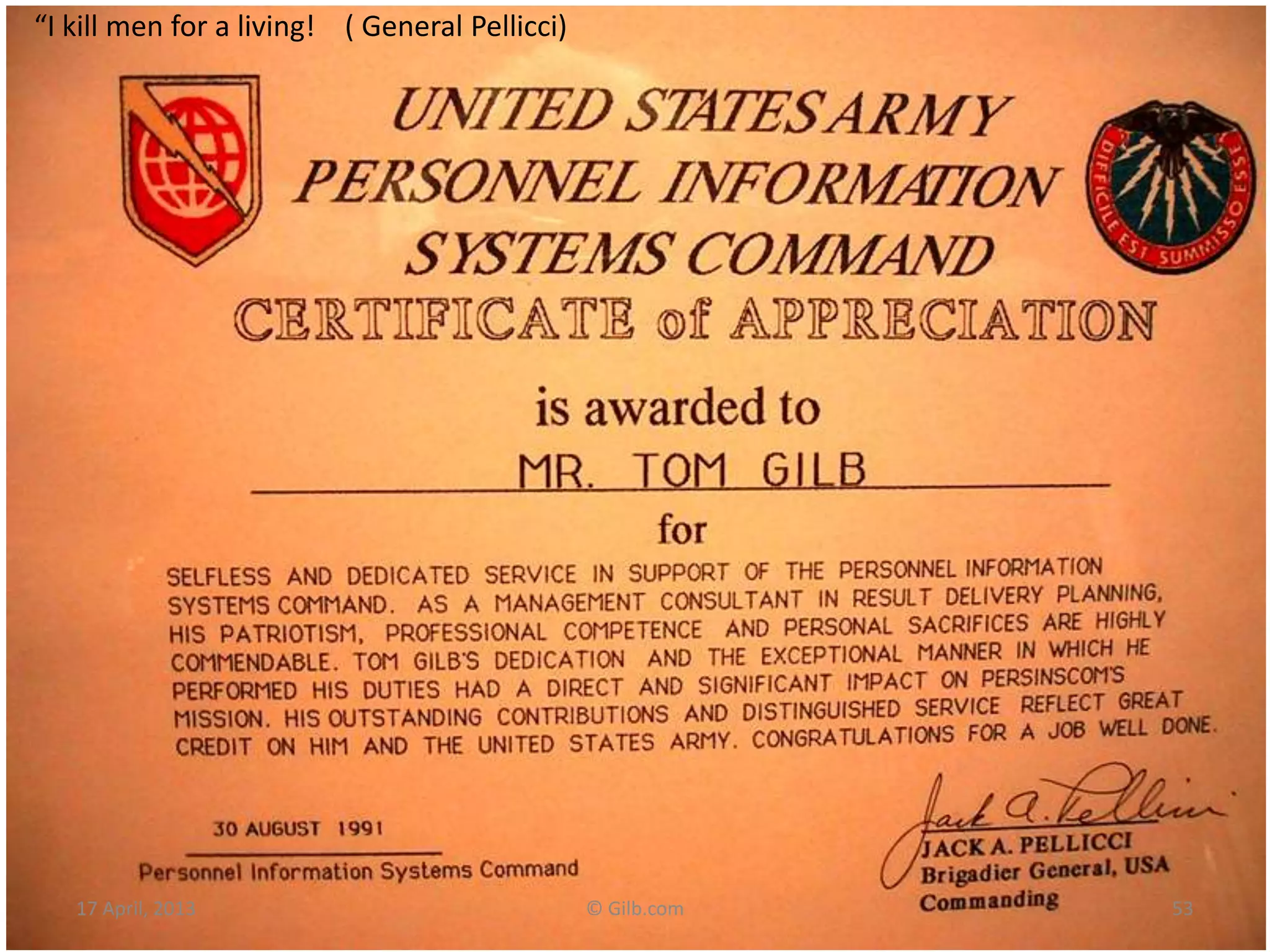
“I kill men for a living! ( General Pellicci)
17 April, 2013 © Gilb.com 53
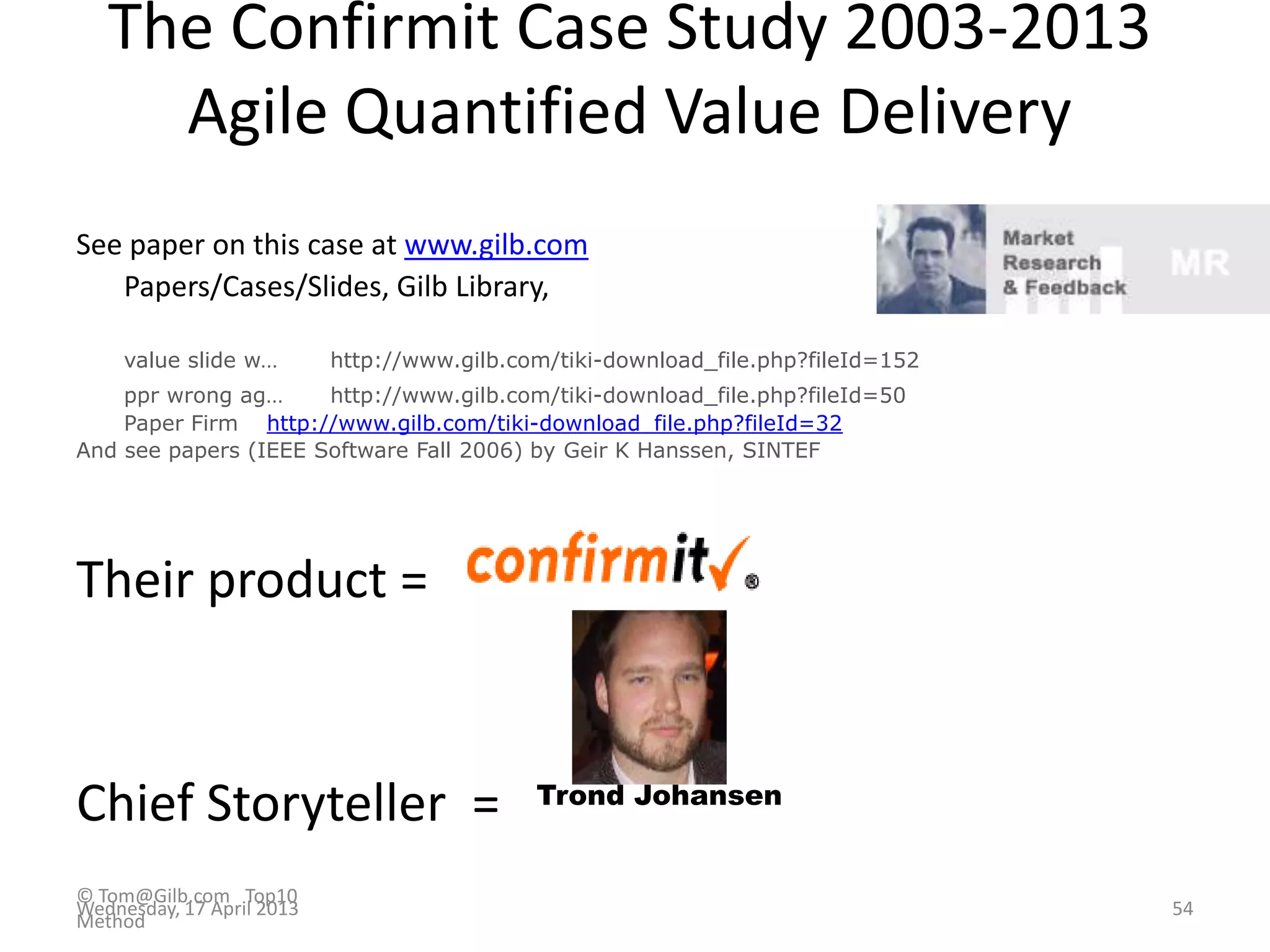
The Confirmit Case Study 2003-2013
Agile Quantified Value Delivery
See paper on this case at www.gilb.com
Papers/Cases/Slides, Gilb Library,
value slide w… http://www.gilb.com/tiki-download_file.php?fileId=152
ppr wrong ag… http://www.gilb.com/tiki-download_file.php?fileId=50
Paper Firm http://www.gilb.com/tiki-download_file.php?fileId=32
And see papers (IEEE Software Fall 2006) by Geir K Hanssen, SINTEF
Their product =
Chief Storyteller = Trond Johansen
© Tom@Gilb.com Top10
Method
Wednesday, 17 April 2013 54
Here are some of the Clients of the
Confirmit Product in 2003heading
© Tom@Gilb.com Top10
Method
Wednesday, 17 April 2013 55
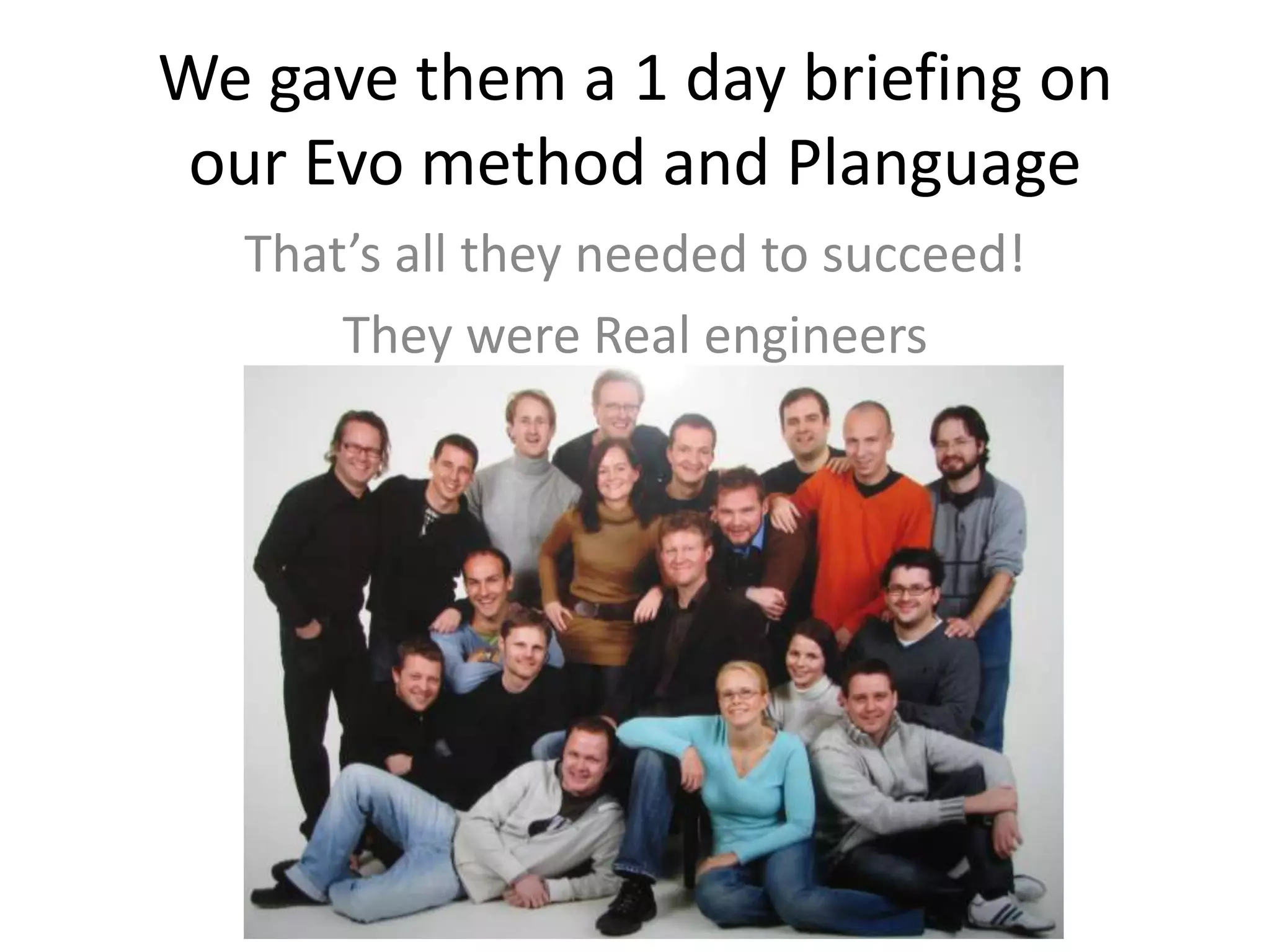
We gave them a 1 day briefing on
our Evo method and Planguage
That’s all they needed to succeed!
They were Real engineers
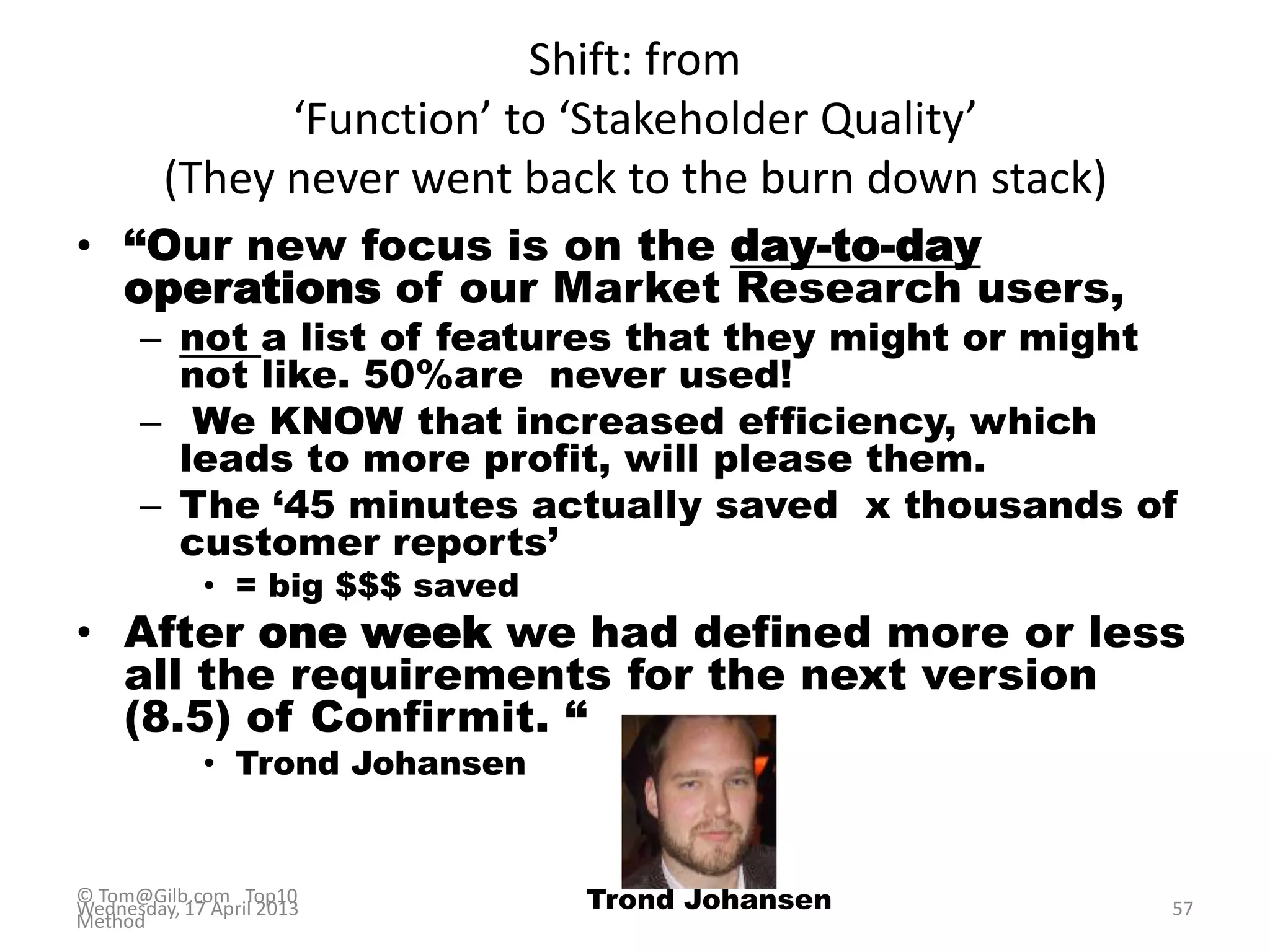
Shift: from
‘Function’ to ‘Stakeholder Quality’
(They never went back to the burn down stack)
• “Our new focus is on the day-to-day
operations of our Market Research users,
– not a list of features that they might or might
not like. 50%are never used!
– We KNOW that increased efficiency, which
leads to more profit, will please them.
– The „45 minutes actually saved x thousands of
customer reports‟
• = big $$$ saved
• After one week we had defined more or less
all the requirements for the next version
(8.5) of Confirmit. “
• Trond Johansen
© Tom@Gilb.com Top10
Method
Wednesday, 17 April 2013 57Trond Johansen
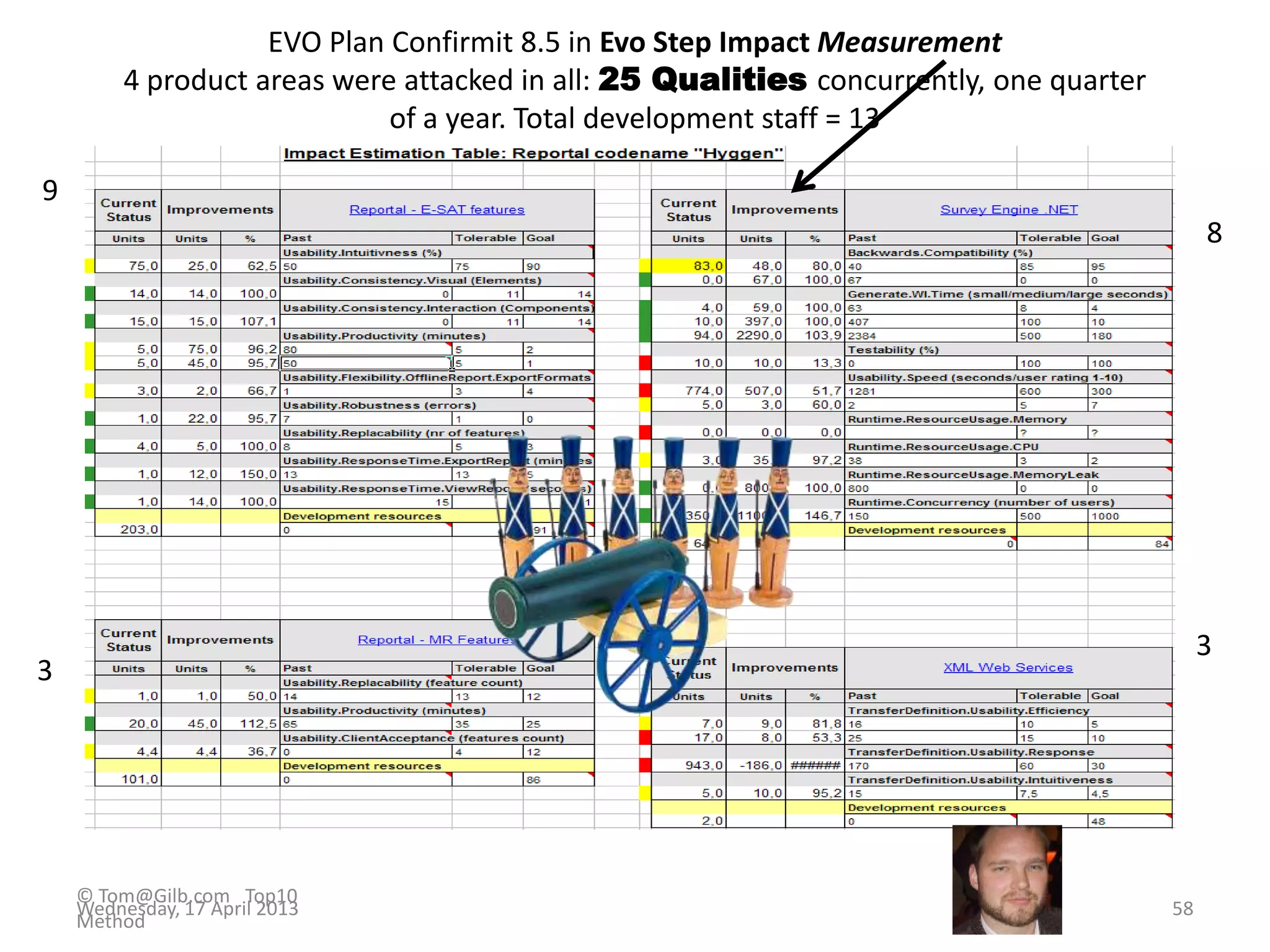
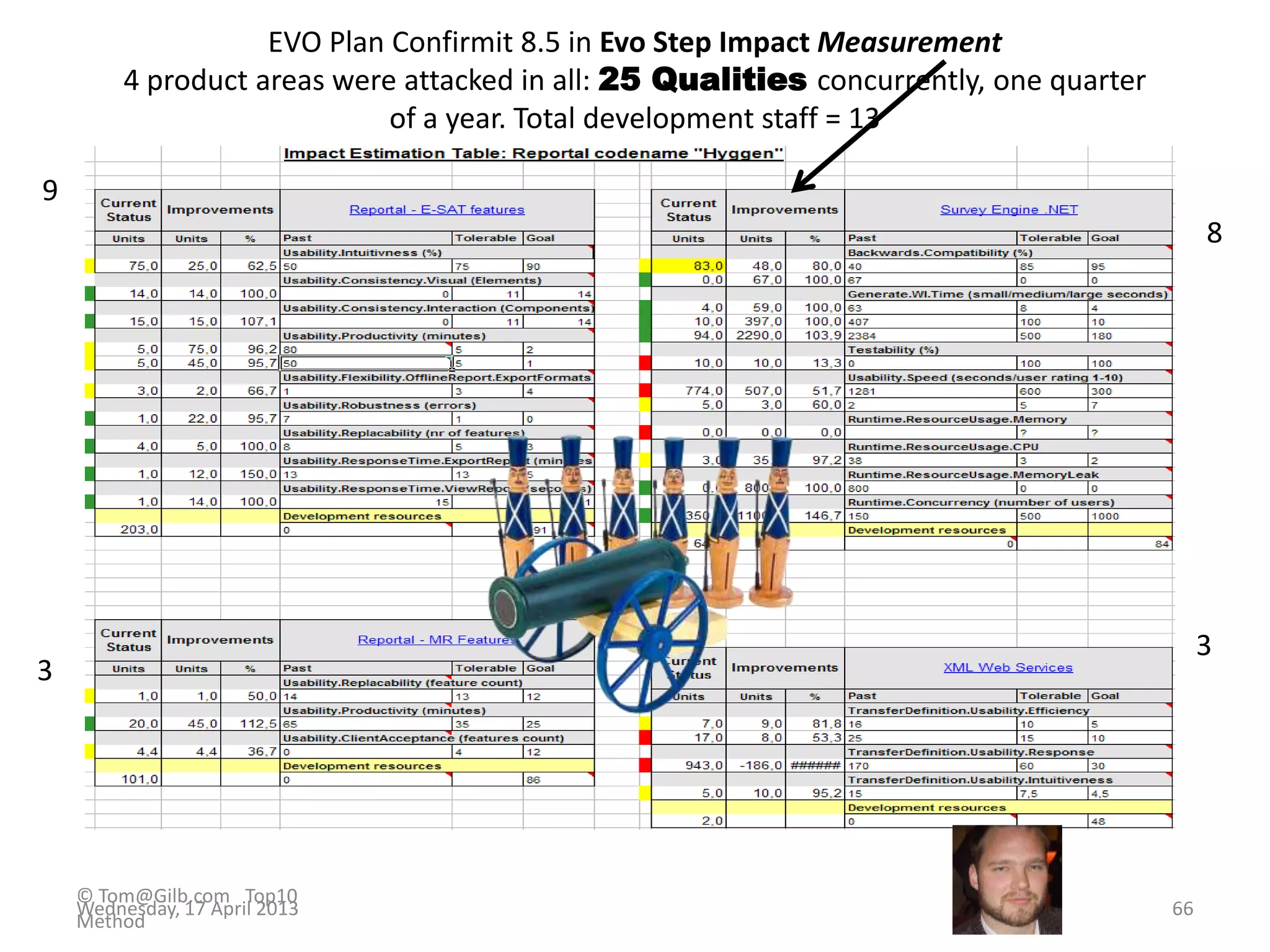
EVO Plan Confirmit 8.5 in Evo Step Impact Measurement
4 product areas were attacked in all: 25 Qualities concurrently, one quarter
of a year. Total development staff = 13
9
8
3
3
© Tom@Gilb.com Top10
Method
Wednesday, 17 April 2013 58
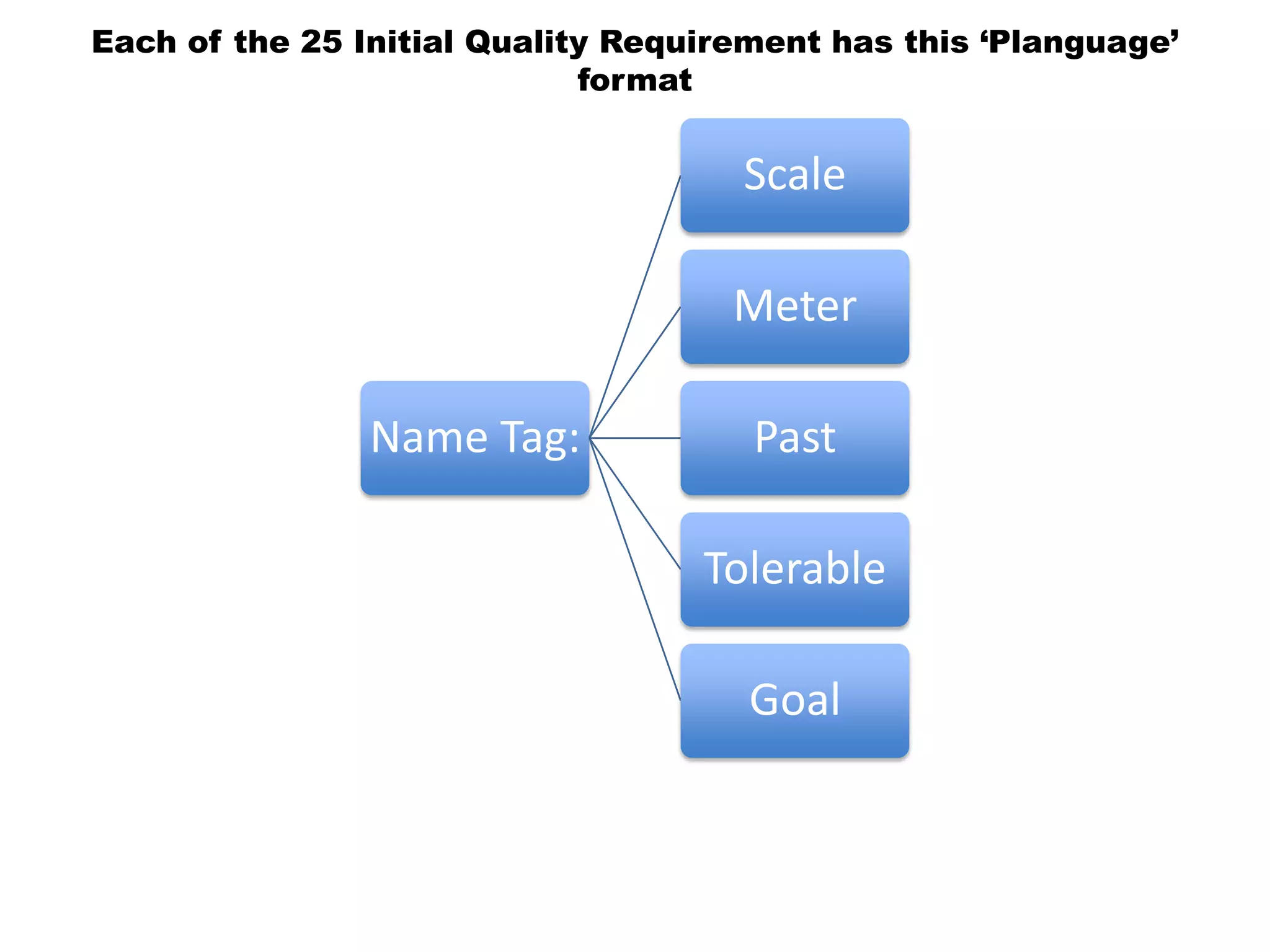
Each of the 25 Initial Quality Requirement has this „Planguage‟
format
Name Tag:
Scale
Meter
Past
Tolerable
Goal
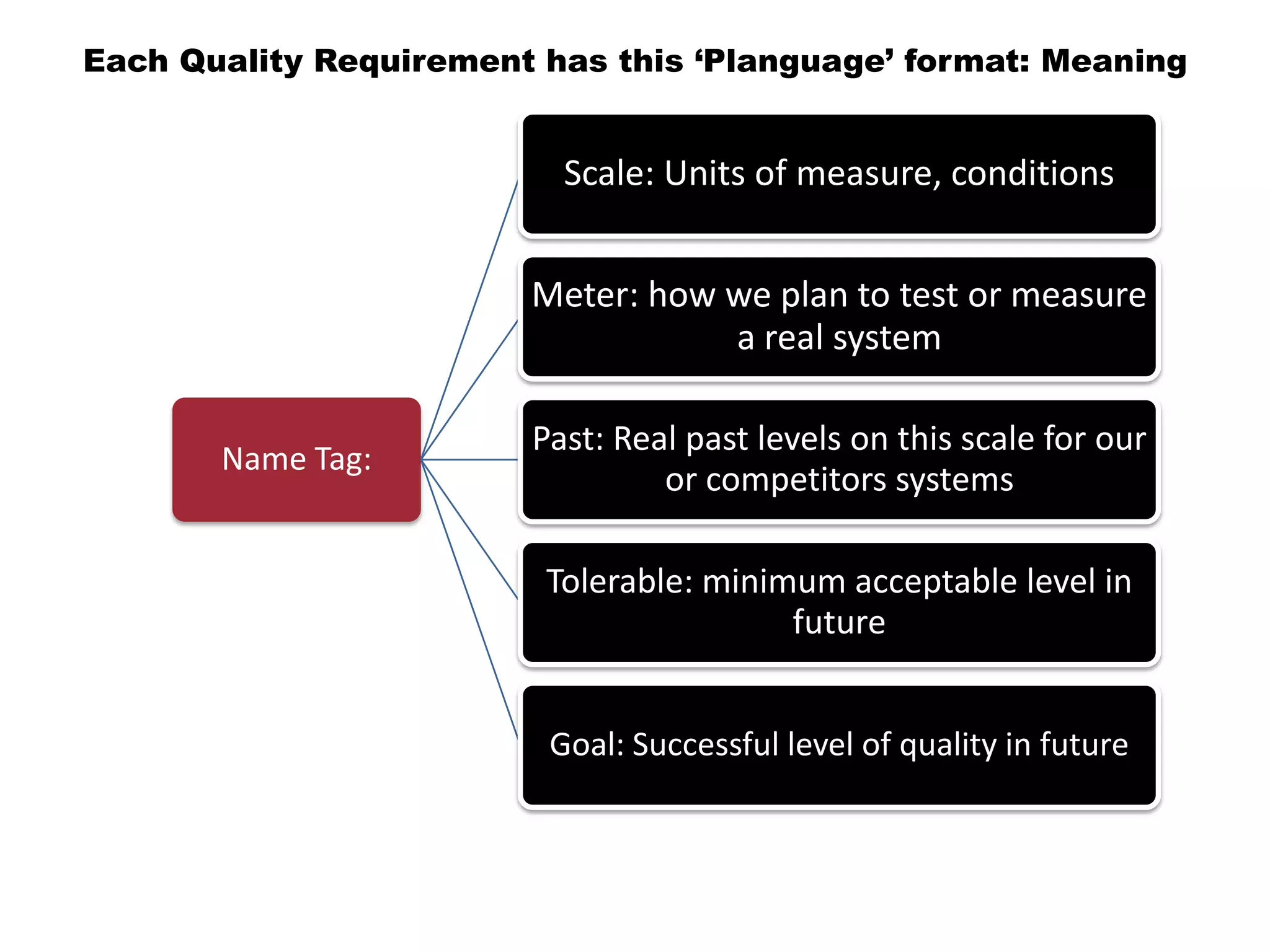
Each Quality Requirement has this „Planguage‟ format: Meaning
Name Tag:
Scale: Units of measure, conditions
Meter: how we plan to test or measure
a real system
Past: Real past levels on this scale for our
or competitors systems
Tolerable: minimum acceptable level in
future
Goal: Successful level of quality in future
Each Quality Requirement has this „Planguage‟ format: Real Example
Usability.
Productivity
Scale: Time in minutes to set up a typical
specified market research-report
Meter [Weekly Step]: Candidates with
Reportal experience, and with
knowledge of MR-specific reporting
features
Past [Release 8.0] 65 minutes
Tolerable [Release 8.5] 35 minutes
Goal [Release 8.5] 25 minutes
Real Example of 1 of the 25 Quality Requirements
Usability.Productivity (taken from Confirmit
8.5, performed a set of predefined steps, to produce a
standard MR Report.
development)
Scale for quantification: Time in minutes to set up a
typical specified Market Research-report
Past Level [Release 8.0]: 65 mins.,
Tolerable Limit [Release 8.5]: 35 mins.,
Goal [Release 8.5]: 25 mins.
Note: end result was actually 20
minutes 
Meter [Weekly Step]: Candidates with Reportal
experience, and with knowledge of MR-specific
reporting features
62
Trond Johansen© Tom@Gilb.com Top10
Method
Wednesday, 17 April 2013
FIRM (Future Information Research Management, Norway)
project step planning and accounting:
using an Impact Estimation Table
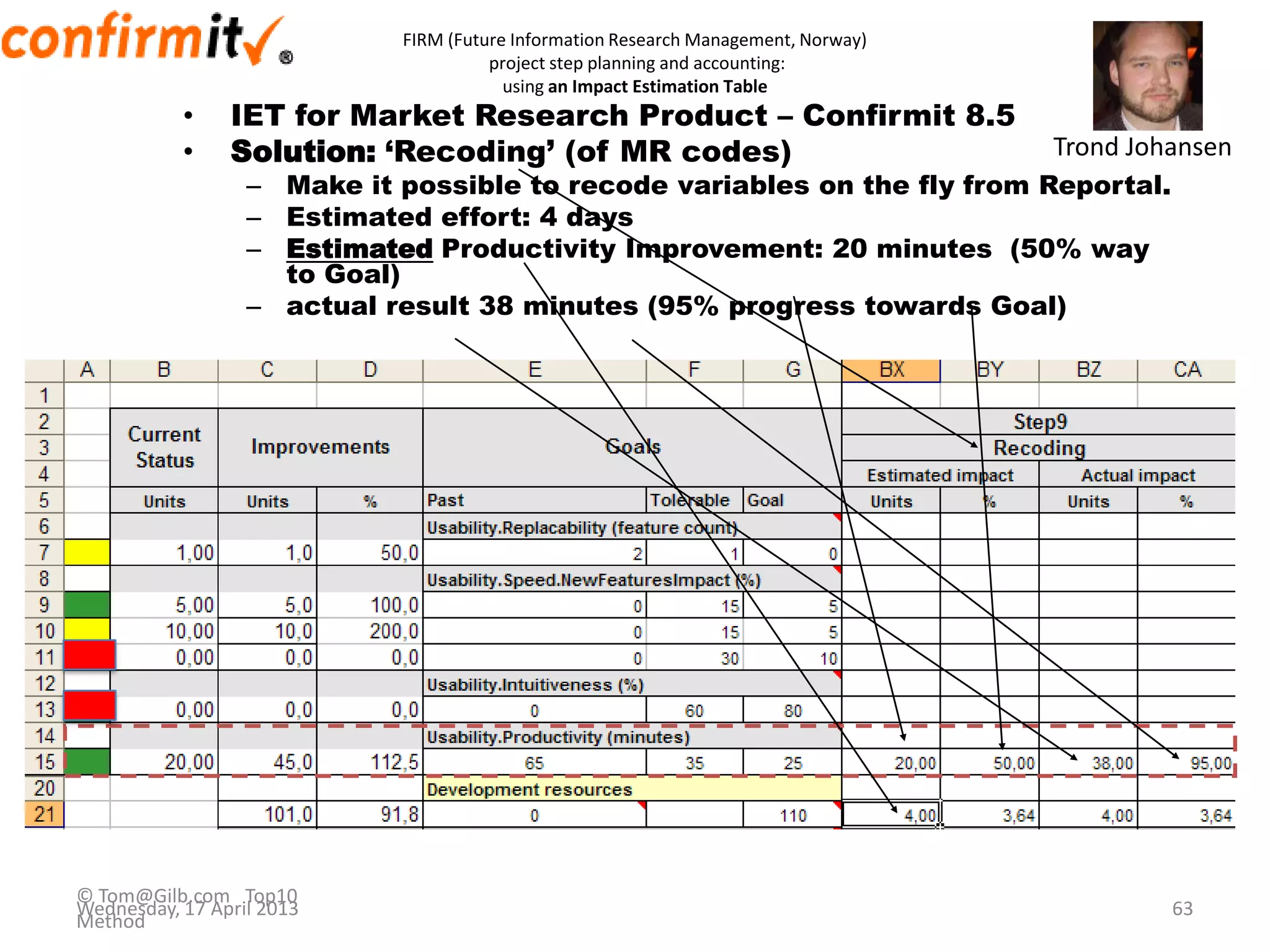
• IET for Market Research Product – Confirmit 8.5
• Solution: „Recoding‟ (of MR codes)
– Make it possible to recode variables on the fly from Reportal.
– Estimated effort: 4 days
– Estimated Productivity Improvement: 20 minutes (50% way
to Goal)
– actual result 38 minutes (95% progress towards Goal)
Trond Johansen
© Tom@Gilb.com Top10
Method
Wednesday, 17 April 2013 63
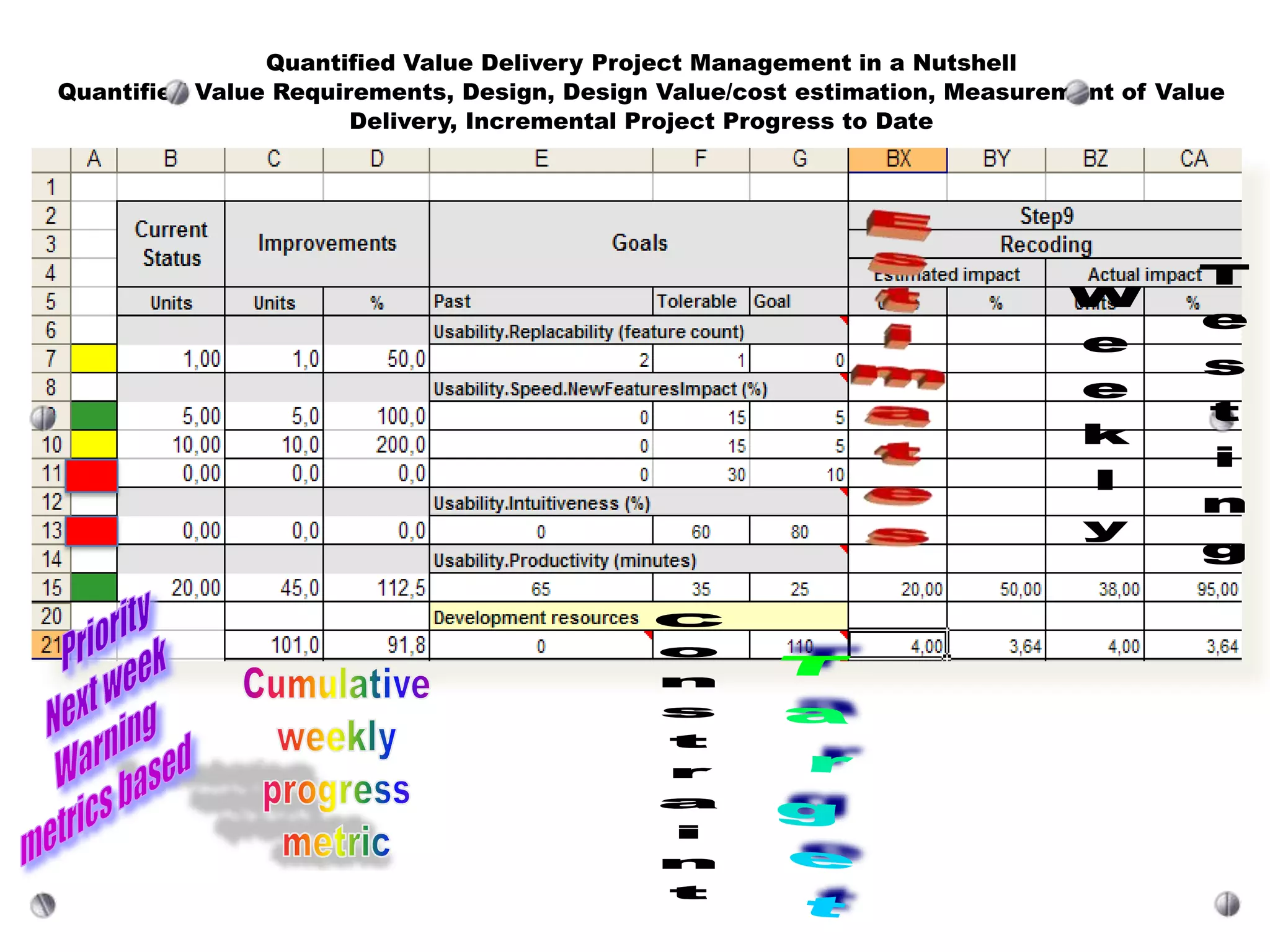
Quantified Value Delivery Project Management in a Nutshell
Quantified Value Requirements, Design, Design Value/cost estimation, Measurement of Value
Delivery, Incremental Project Progress to Date
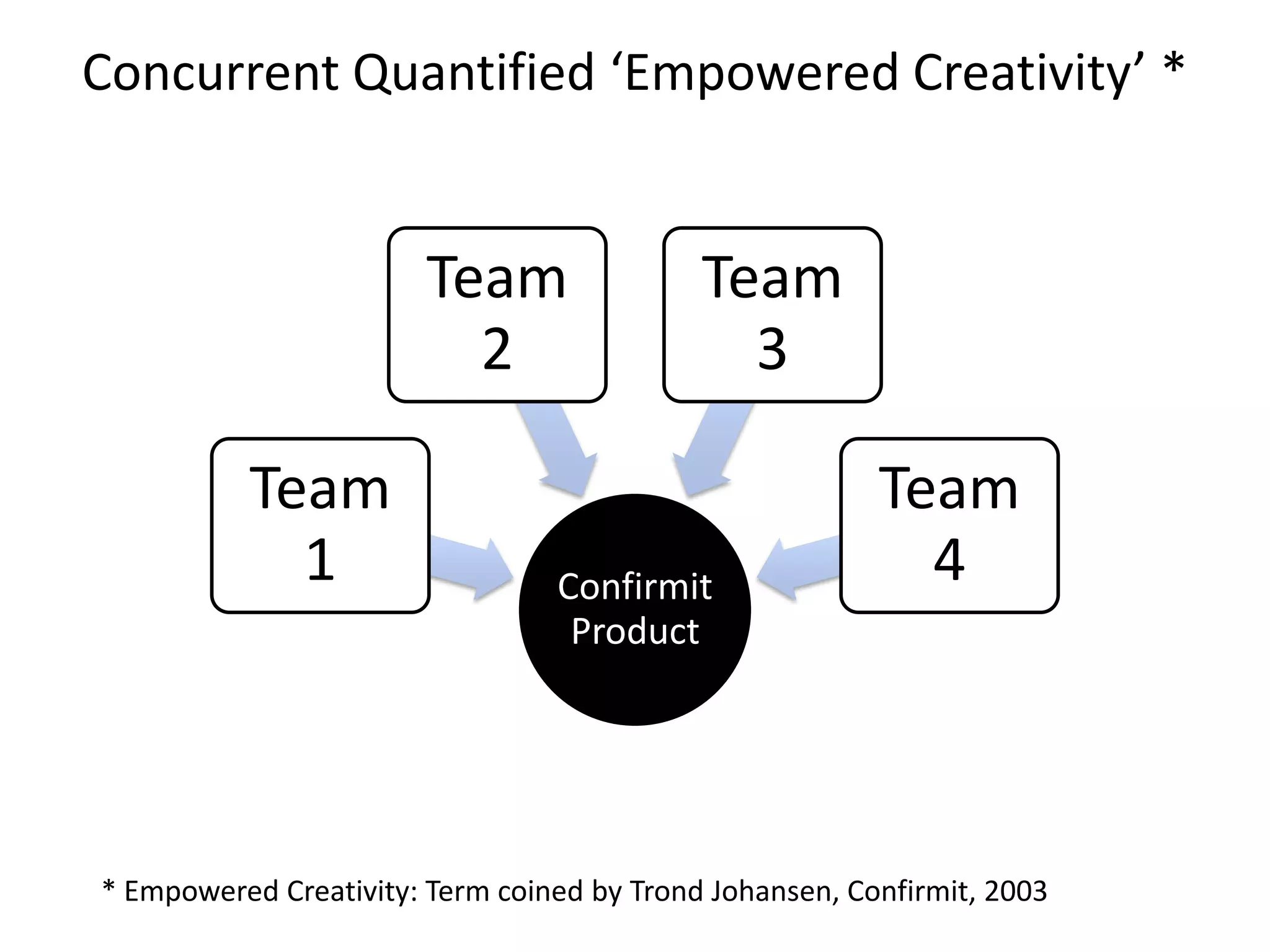
Concurrent Quantified ‘Empowered Creativity’ *
Confirmit
Product
Team
1
Team
2
Team
3
Team
4
* Empowered Creativity: Term coined by Trond Johansen, Confirmit, 2003
EVO Plan Confirmit 8.5 in Evo Step Impact Measurement
4 product areas were attacked in all: 25 Qualities concurrently, one quarter
of a year. Total development staff = 13
9
8
3
3
© Tom@Gilb.com Top10
Method
Wednesday, 17 April 2013 66
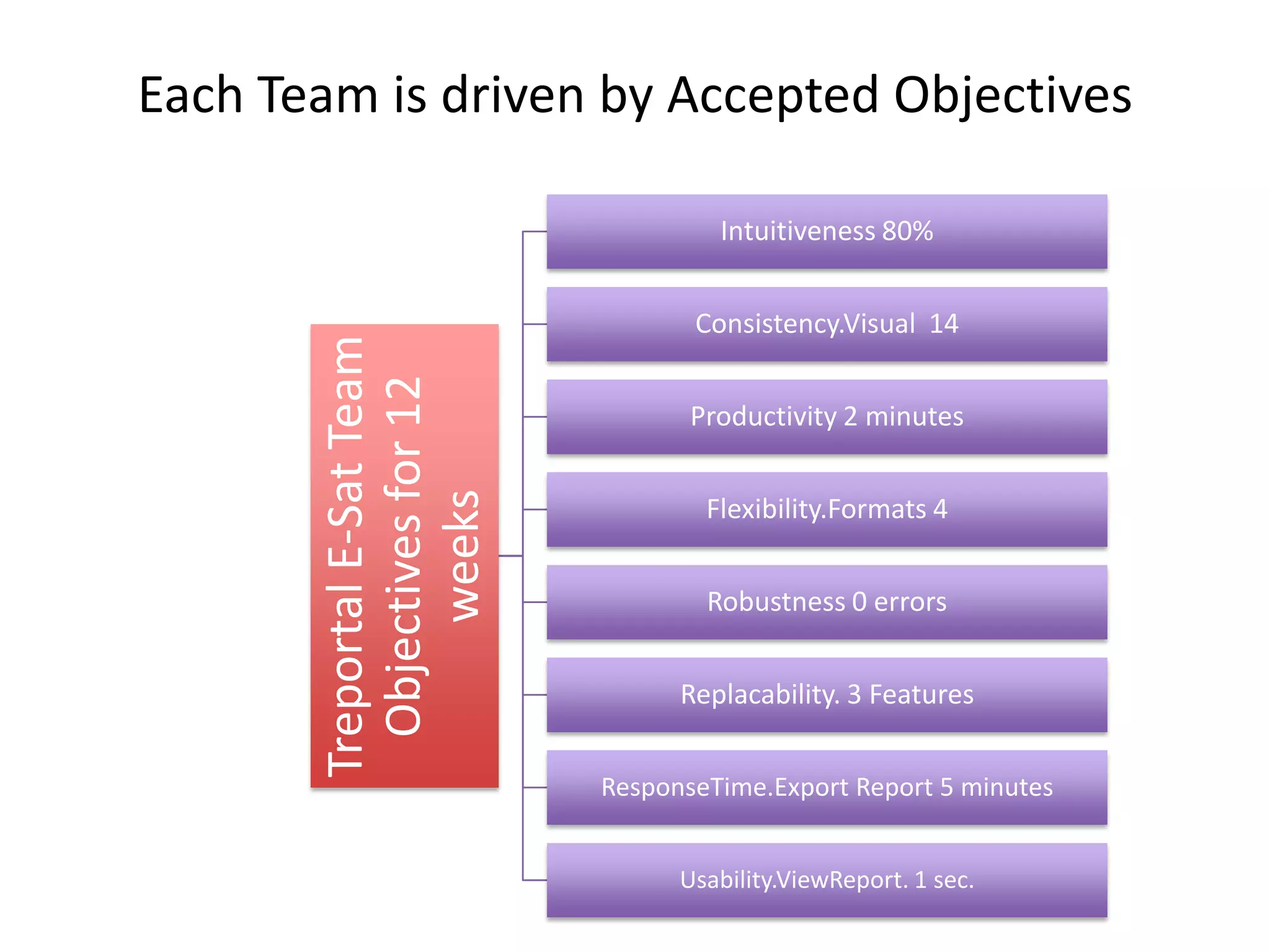
Each Team is driven by Accepted Objectives
TreportalE-SatTeam
Objectivesfor12
weeks
Intuitiveness 80%
Consistency.Visual 14
Productivity 2 minutes
Flexibility.Formats 4
Robustness 0 errors
Replacability. 3 Features
ResponseTime.Export Report 5 minutes
Usability.ViewReport. 1 sec.
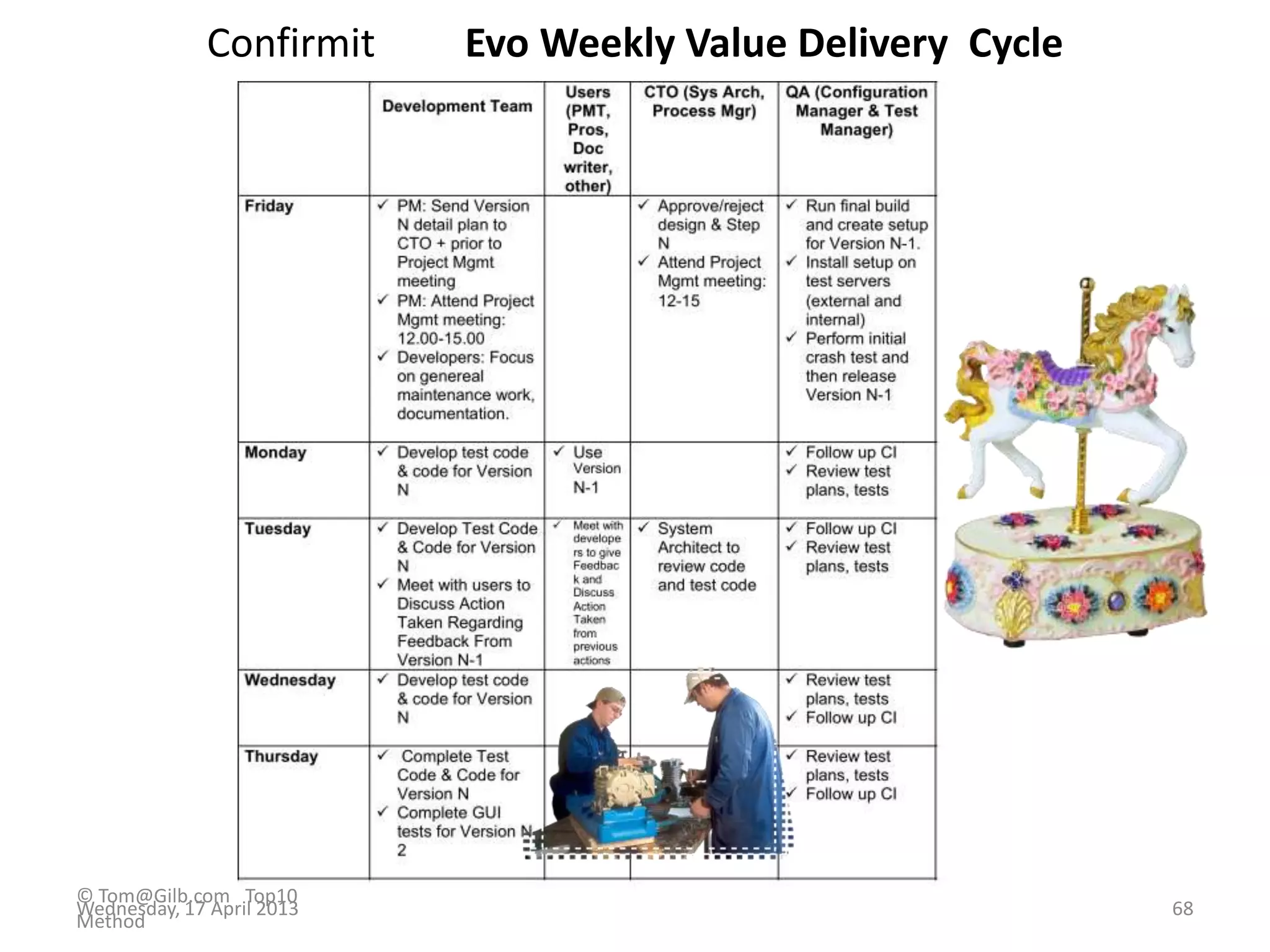
Confirmit Evo Weekly Value Delivery Cycle
© Tom@Gilb.com Top10
Method
Wednesday, 17 April 2013 68
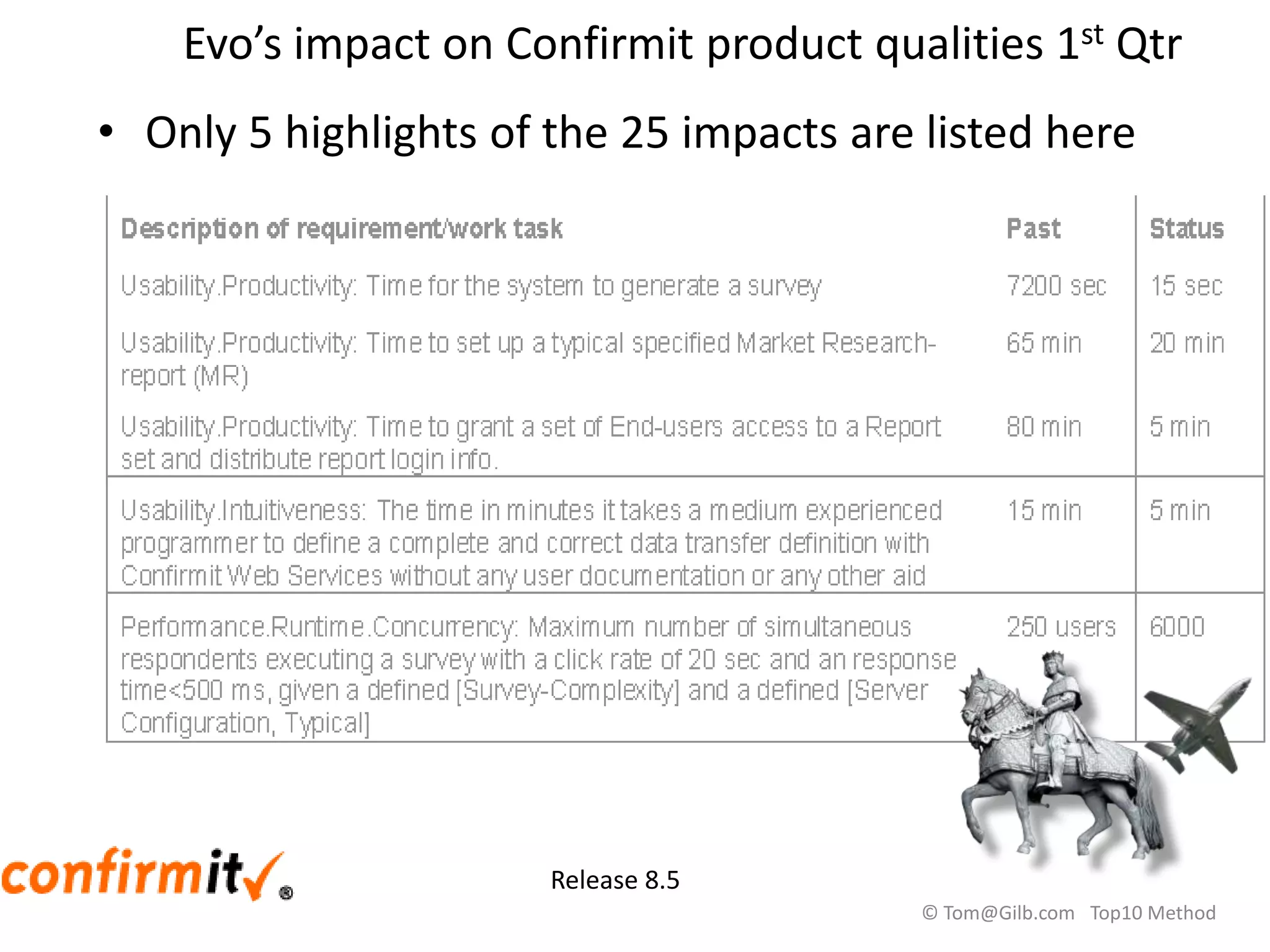
Evo’s impact on Confirmit product qualities 1st Qtr
• Only 5 highlights of the 25 impacts are listed here
Release 8.5
© Tom@Gilb.com Top10 Method
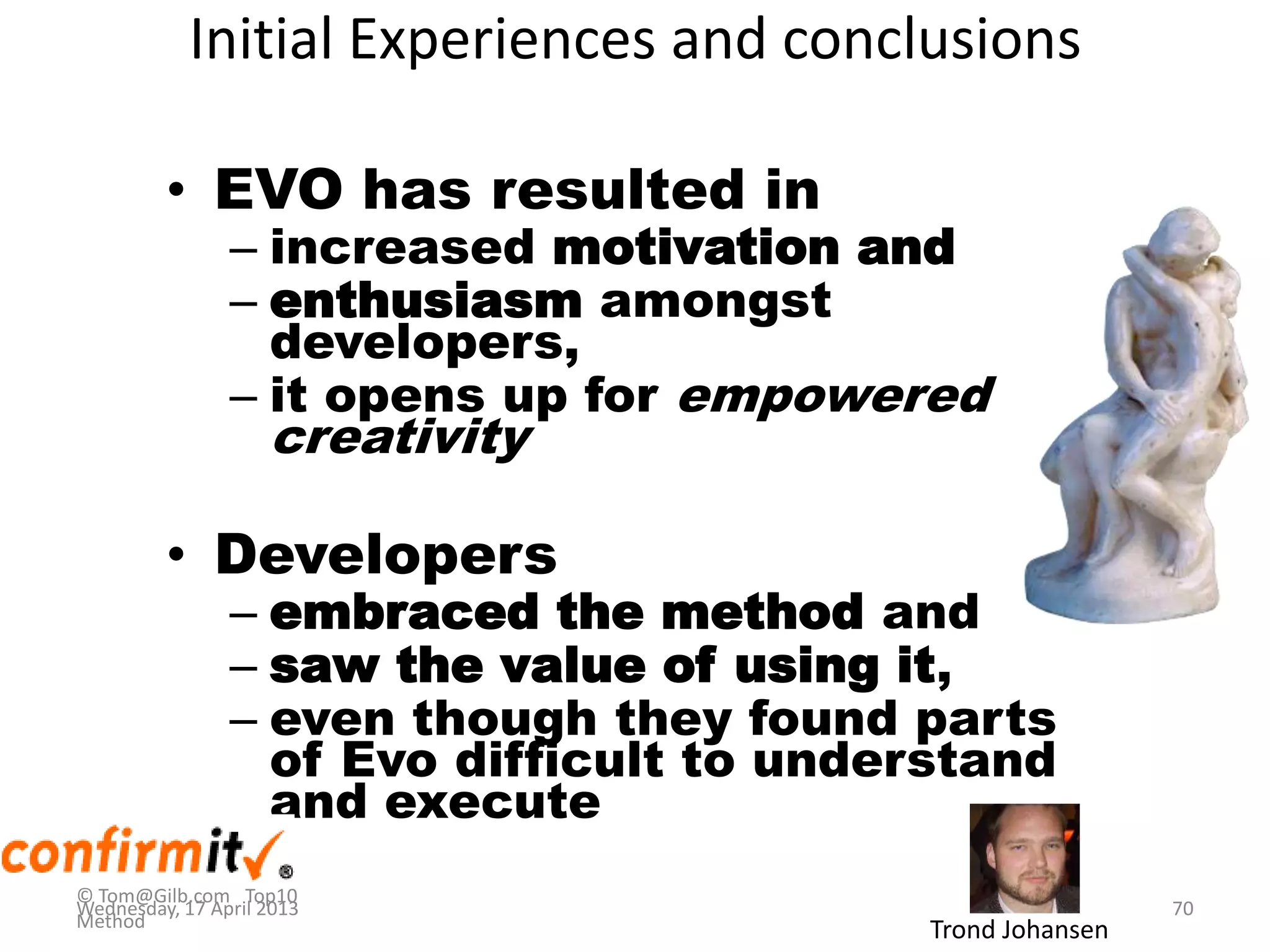
Initial Experiences and conclusions
• EVO has resulted in
– increased motivation and
– enthusiasm amongst
developers,
– it opens up for empowered
creativity
• Developers
– embraced the method and
– saw the value of using it,
– even though they found parts
of Evo difficult to understand
and execute
Trond Johansen
© Tom@Gilb.com Top10
Method
Wednesday, 17 April 2013 70
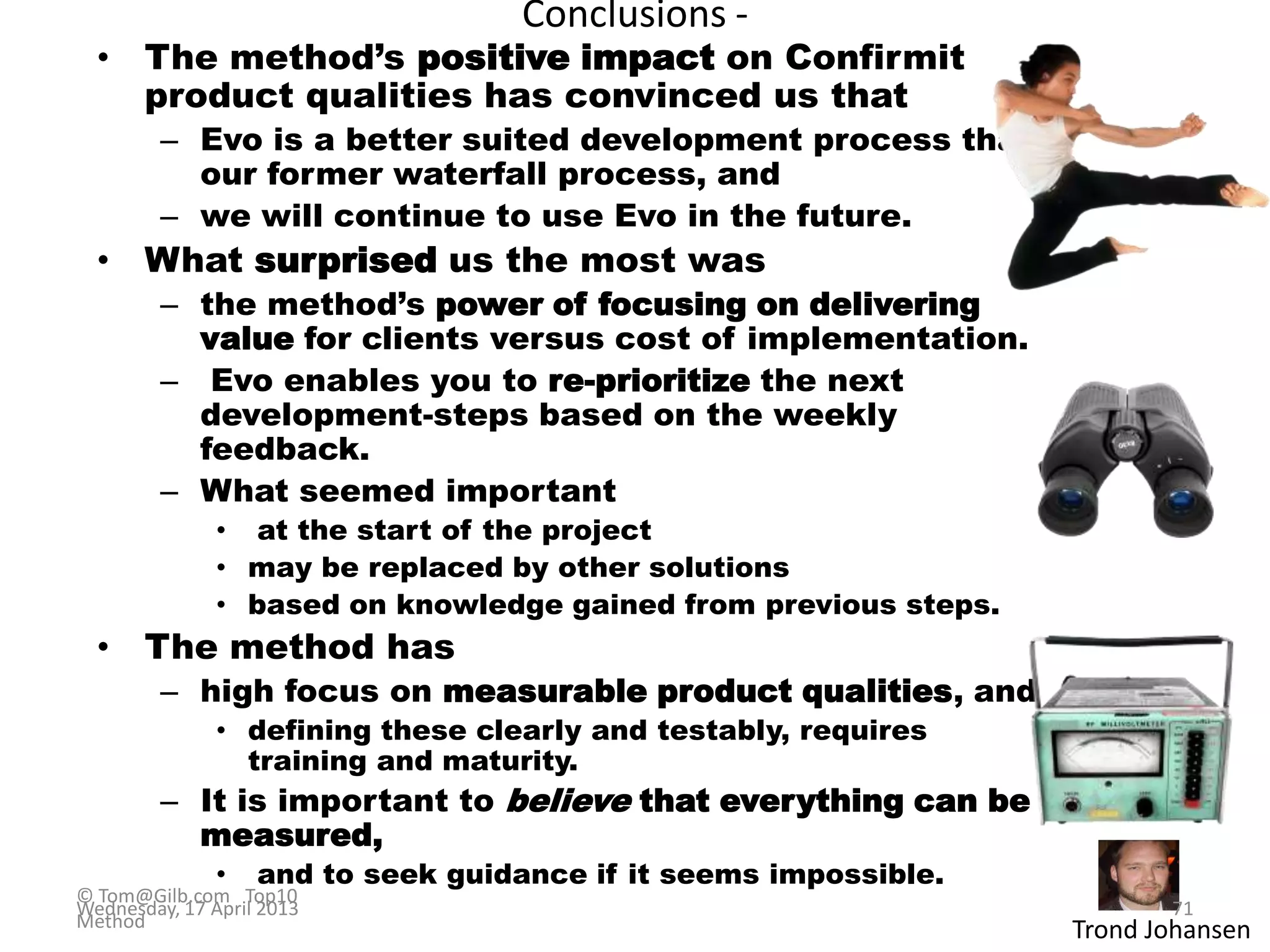
Conclusions -
• The method‟s positive impact on Confirmit
product qualities has convinced us that
– Evo is a better suited development process than
our former waterfall process, and
– we will continue to use Evo in the future.
• What surprised us the most was
– the method‟s power of focusing on delivering
value for clients versus cost of implementation.
– Evo enables you to re-prioritize the next
development-steps based on the weekly
feedback.
– What seemed important
• at the start of the project
• may be replaced by other solutions
• based on knowledge gained from previous steps.
• The method has
– high focus on measurable product qualities, and
• defining these clearly and testably, requires
training and maturity.
– It is important to believe that everything can be
measured,
• and to seek guidance if it seems impossible.
Trond Johansen
© Tom@Gilb.com Top10
Method
Wednesday, 17 April 2013 71
Initial Customer Feedback
on the new Confirmit 9.0
November 24th, 2004
© Tom@Gilb.com Top10
Method
Wednesday, 17 April 2013 72
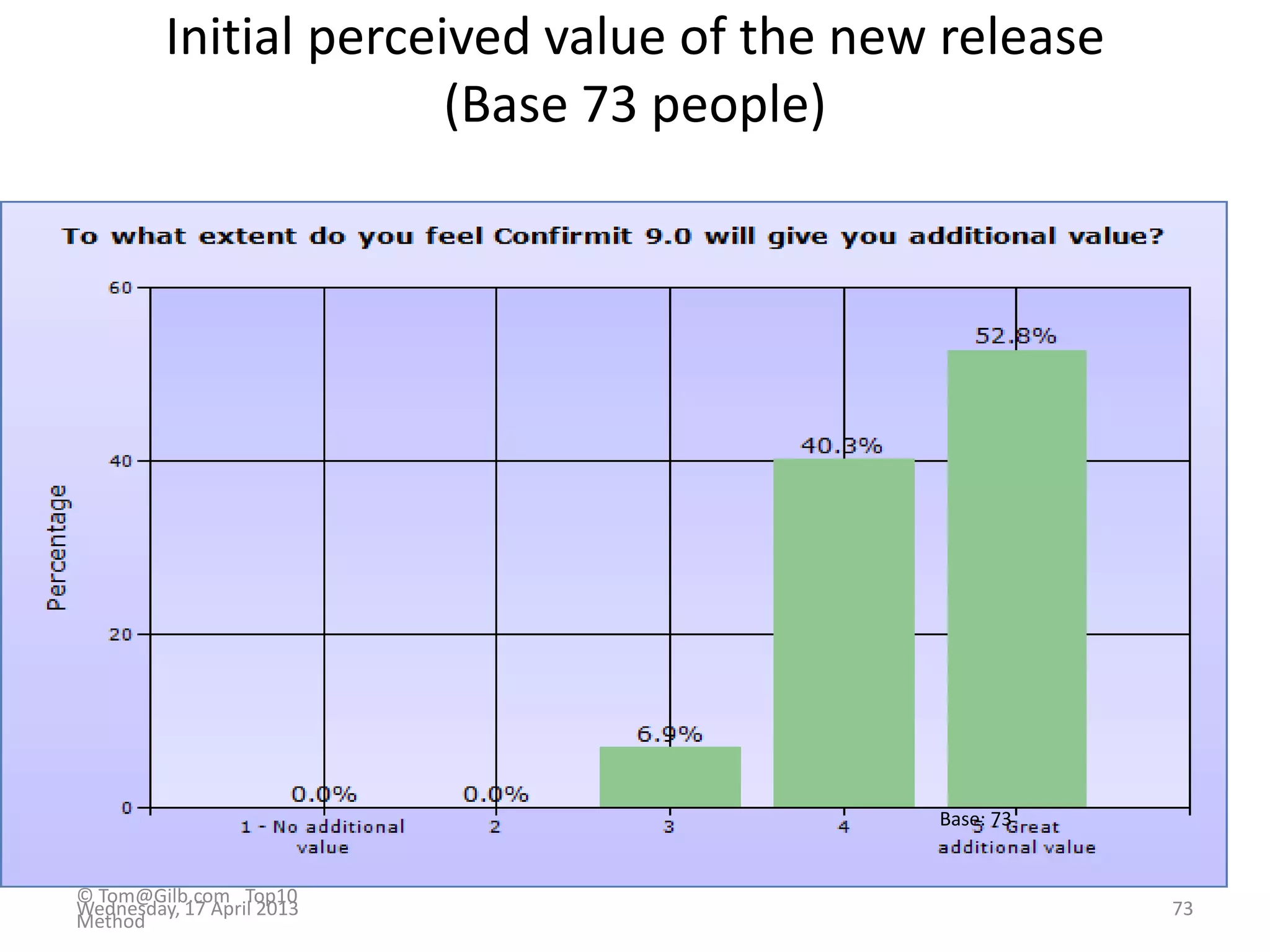
Initial perceived value of the new release
(Base 73 people)
Base: 73
© Tom@Gilb.com Top10
Method
Wednesday, 17 April 2013 73
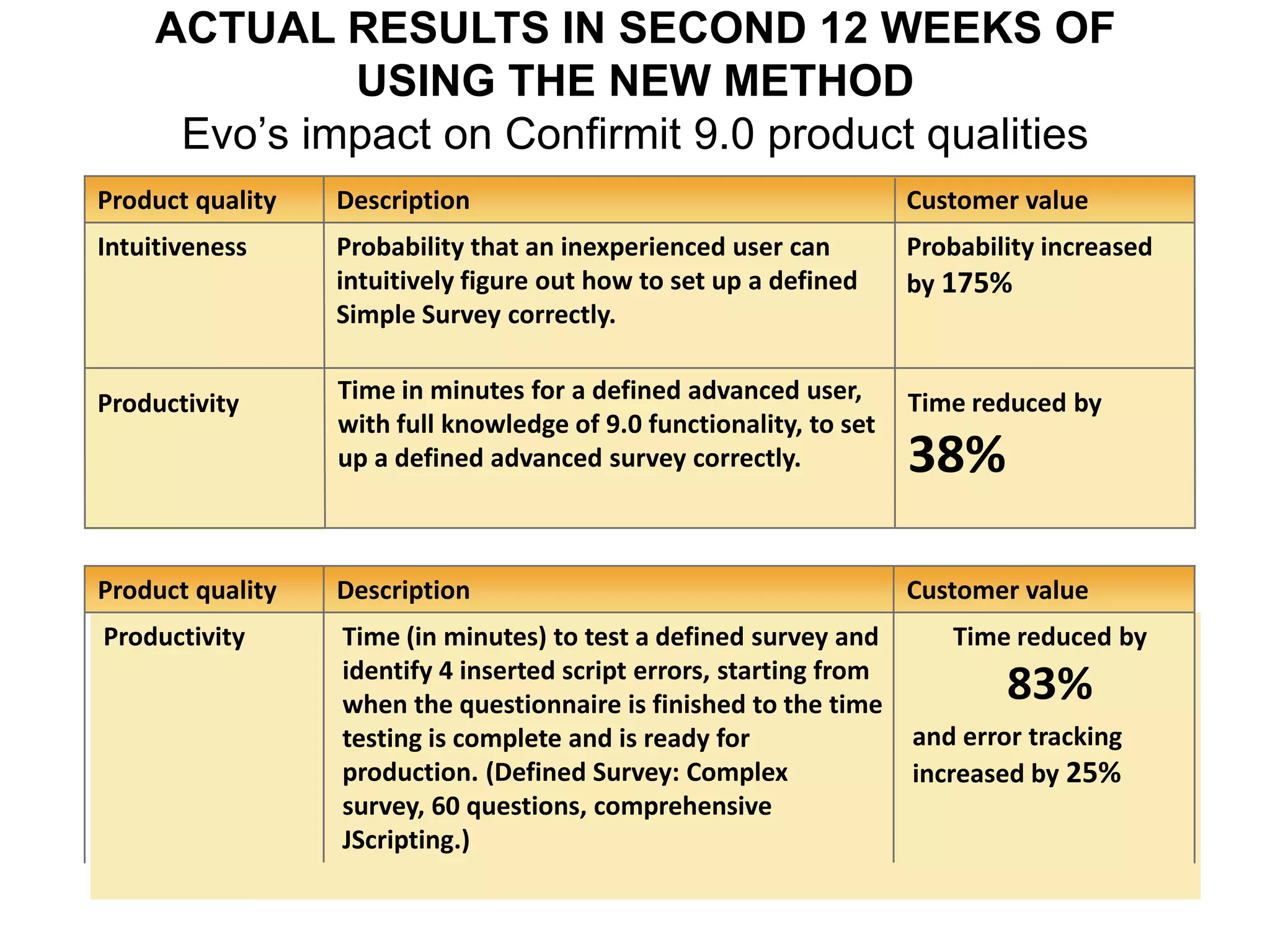
ACTUAL RESULTS IN SECOND 12 WEEKS OF
USING THE NEW METHOD
Evo‟s impact on Confirmit 9.0 product qualities
Productivity
Intuitiveness
Product quality
Time reduced by
38%
Time in minutes for a defined advanced user,
with full knowledge of 9.0 functionality, to set
up a defined advanced survey correctly.
Probability increased
by 175%
Probability that an inexperienced user can
intuitively figure out how to set up a defined
Simple Survey correctly.
Customer valueDescription
Productivity
Product quality
Time reduced by
83%
and error tracking
increased by 25%
Time (in minutes) to test a defined survey and
identify 4 inserted script errors, starting from
when the questionnaire is finished to the time
testing is complete and is ready for
production. (Defined Survey: Complex
survey, 60 questions, comprehensive
JScripting.)
Customer valueDescription
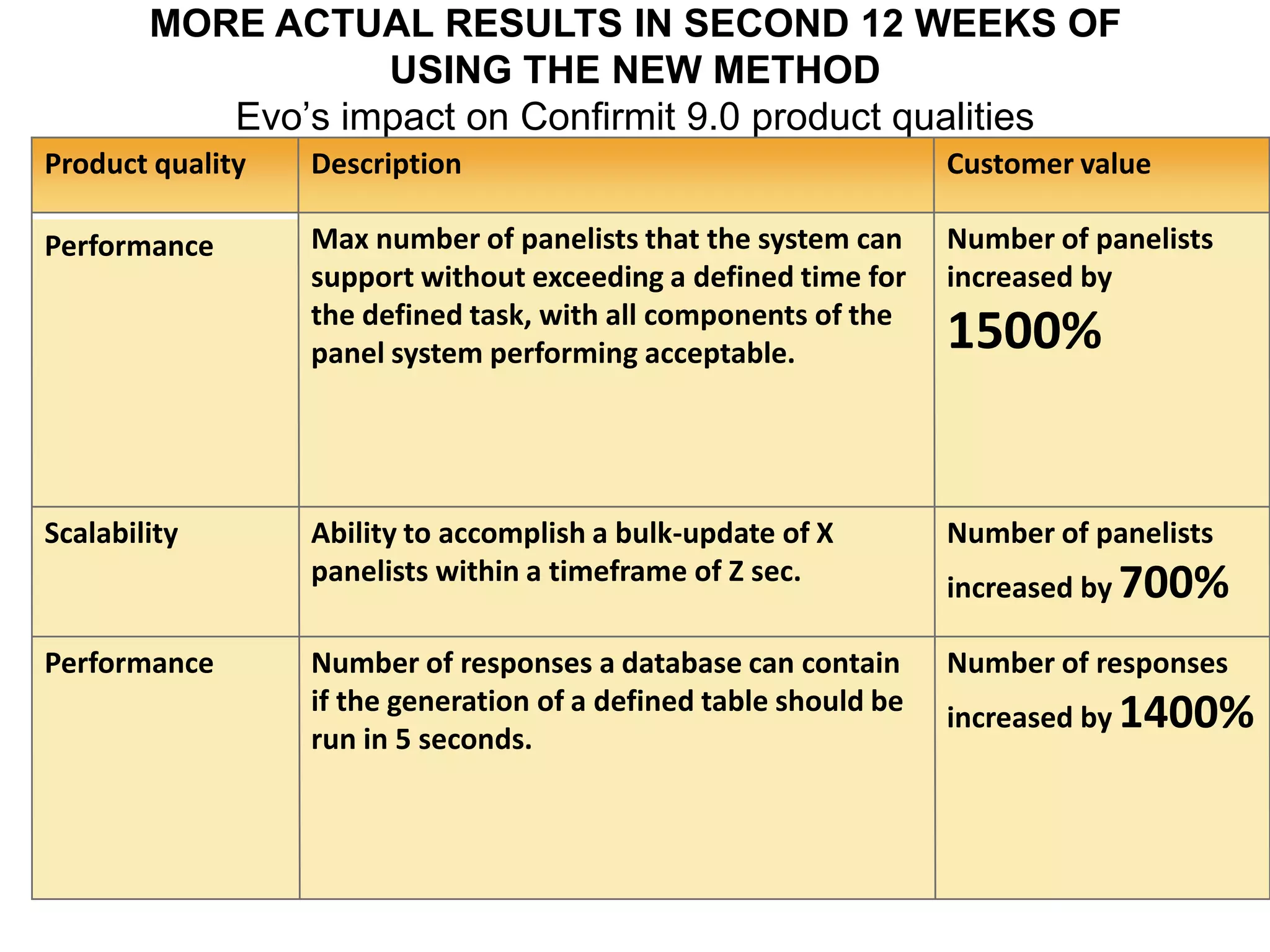
MORE ACTUAL RESULTS IN SECOND 12 WEEKS OF
USING THE NEW METHOD
Evo‟s impact on Confirmit 9.0 product qualities
Number of responses
increased by 1400%
Number of responses a database can contain
if the generation of a defined table should be
run in 5 seconds.
Performance
Number of panelists
increased by 700%
Ability to accomplish a bulk-update of X
panelists within a timeframe of Z sec.
Scalability
Performance
Product quality
Number of panelists
increased by
1500%
Max number of panelists that the system can
support without exceeding a defined time for
the defined task, with all components of the
panel system performing acceptable.
Customer valueDescription
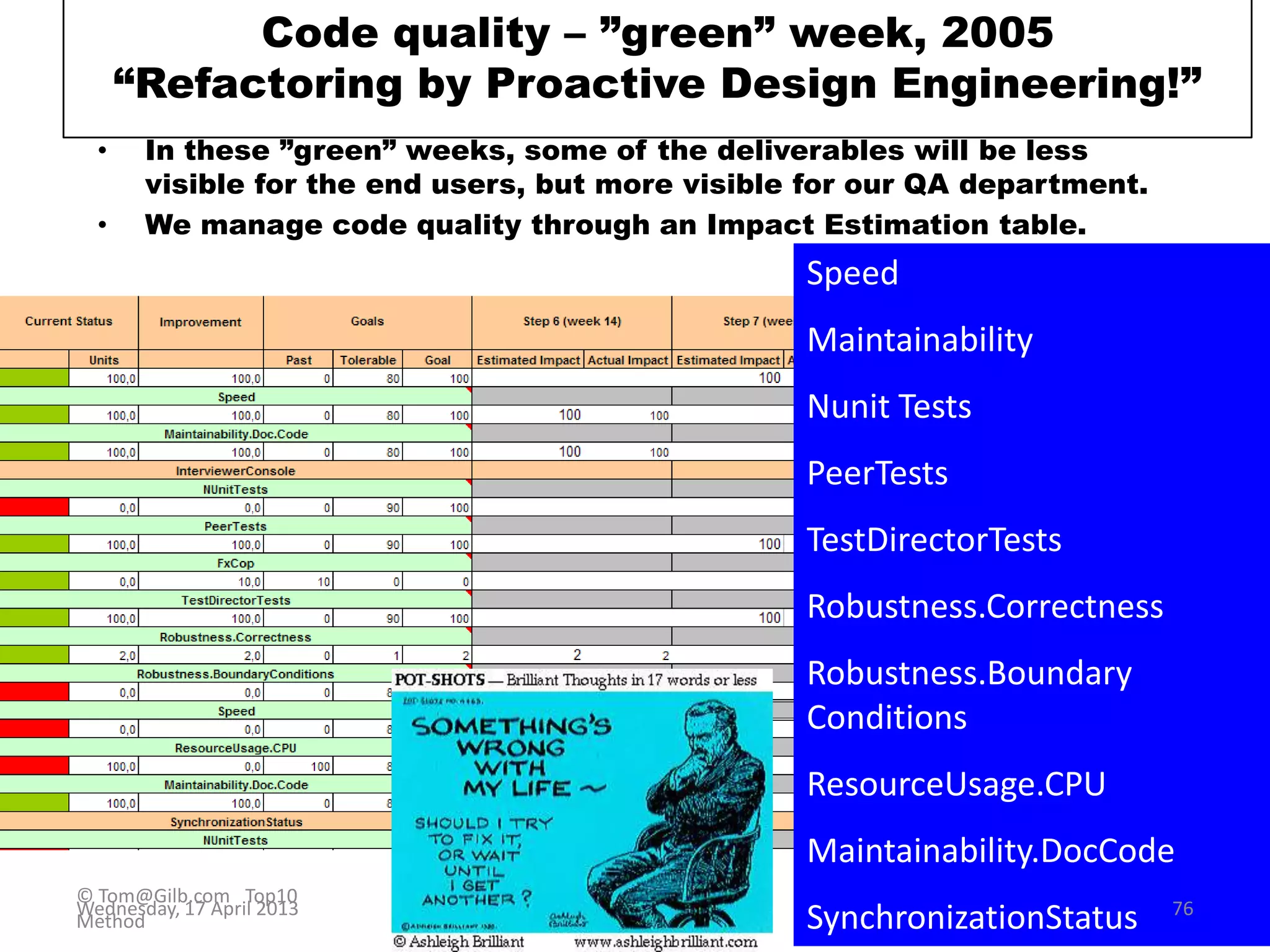
Code quality – ”green” week, 2005
“Refactoring by Proactive Design Engineering!”
• In these ”green” weeks, some of the deliverables will be less
visible for the end users, but more visible for our QA department.
• We manage code quality through an Impact Estimation table.
Speed
Maintainability
Nunit Tests
PeerTests
TestDirectorTests
Robustness.Correctness
Robustness.Boundary
Conditions
ResourceUsage.CPU
Maintainability.DocCode
SynchronizationStatus
© Tom@Gilb.com Top10
Method
Wednesday, 17 April 2013 76
And Now for
• Multilevel
• Numeric
• Logical
• Connection
– from
• Top Management
• To Agile Projects
• In Practice
Wednesday, 17 April 2013 © Tom@Gilb.com Top10 Method 77
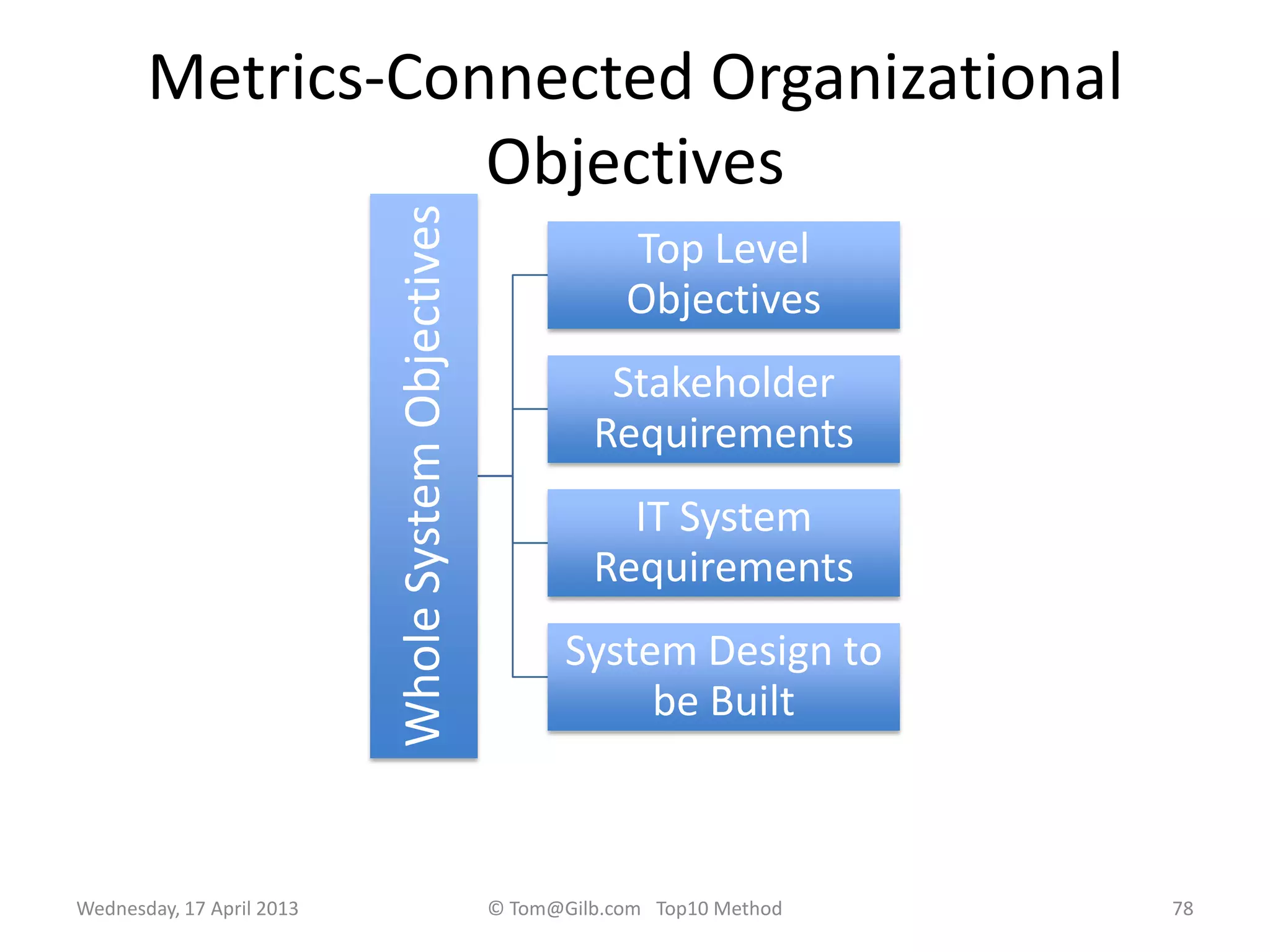
Metrics-Connected Organizational
Objectives
Wednesday, 17 April 2013 © Tom@Gilb.com Top10 Method 78
WholeSystemObjectives
Top Level
Objectives
Stakeholder
Requirements
IT System
Requirements
System Design to
be Built
Value Management
(Evo)
with
Scrum development
•developing a large web portal
www.bring.no
dk/se/nl/co.uk/com/ee
at Posten Norge
79Copyright: Kai@Gilb.com Slides download: http://bit.ly/BringCase
Kai might present this exciting case study,
He is Just back from a Holiday in Maui for 6
months
Wednesday, 17 April 2013 © Tom@Gilb.com Top10 Method 80
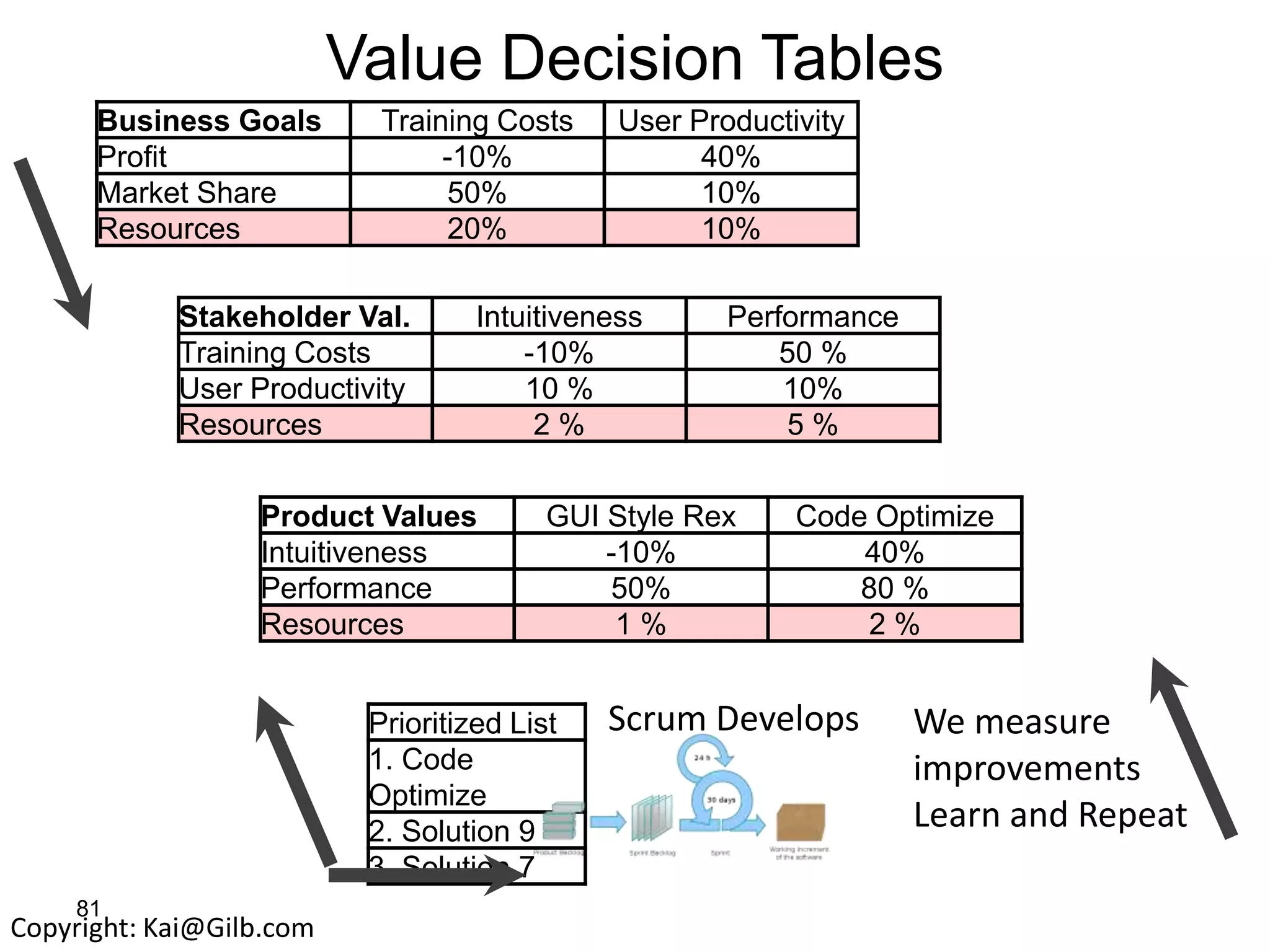
81
Business Goals Training Costs User Productivity
Profit -10% 40%
Market Share 50% 10%
Resources 20% 10%
Stakeholder Val. Intuitiveness Performance
Training Costs -10% 50 %
User Productivity 10 % 10%
Resources 2 % 5 %
Product Values GUI Style Rex Code Optimize
Intuitiveness -10% 40%
Performance 50% 80 %
Resources 1 % 2 %
Prioritized List
1. Code
Optimize
2. Solution 9
3. Solution 7
We measure
improvements
Learn and Repeat
Copyright: Kai@Gilb.com
Value Decision Tables
Scrum Develops
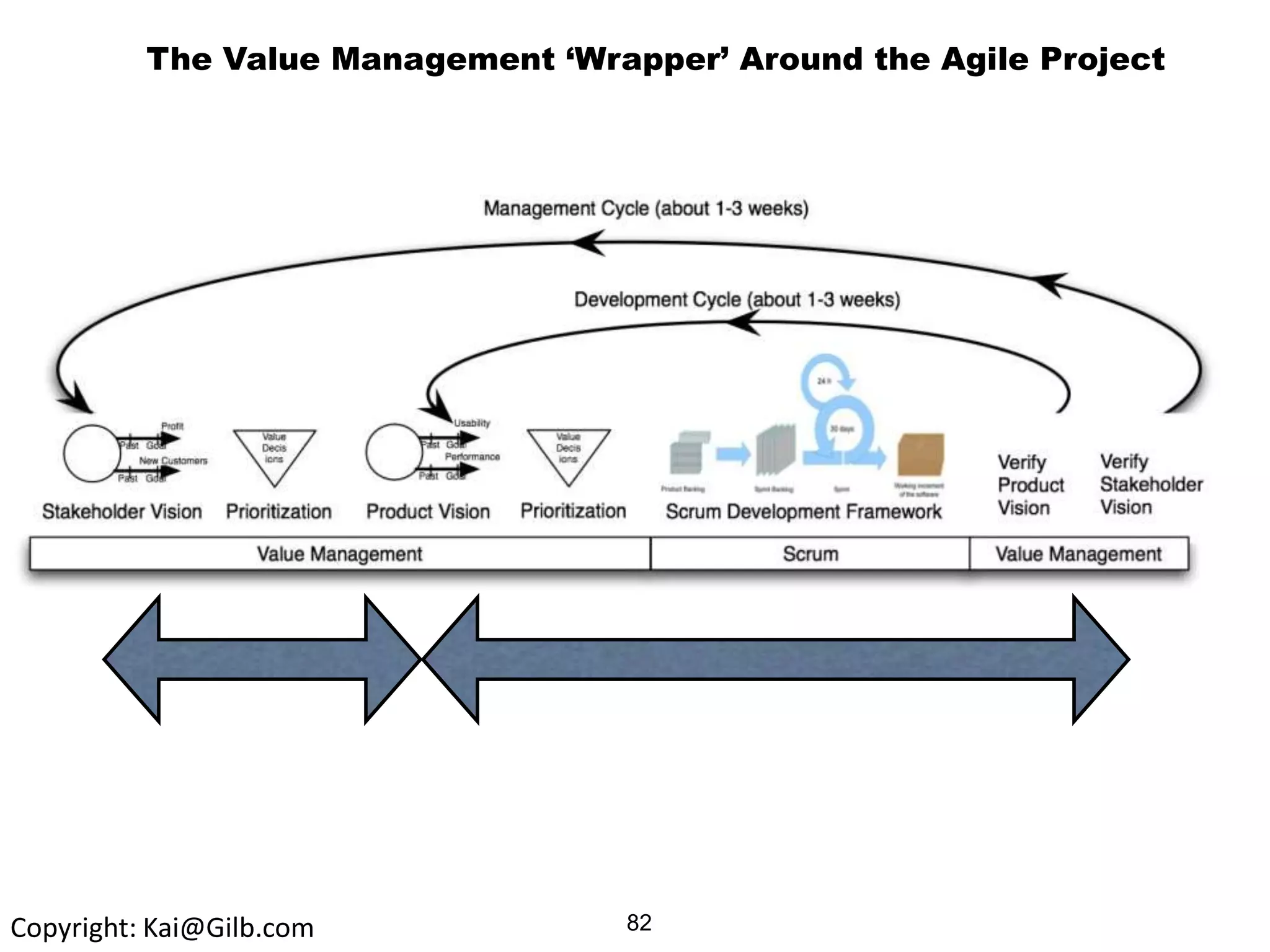
82Copyright: Kai@Gilb.com
The Value Management „Wrapper‟ Around the Agile Project
Last slide
• For free copy of our Books and
Papers, including Competitive
Engineering,
• Email Tom @ Gilb . Com
– with subject „Book‟
17 April, 2013 © Gilb.com 83
Last slide + 1
• See
• Gilb.com
• For lots of free
downloads, papers, slides, cases
Wednesday, 17 April 2013 © Tom@Gilb.com Top10 Method 84

Project management driven by the top ten critical improvements qu…

  • 1.
    Evolutionary project management: focusingon the top level critical objectives and delivering real value early in software IT projects & programmes Presenter: Tom Gilb This collaborative event has been jointly organised by the Agile Methods Specialist Group of the British Computer Society (BSC) and the Programme Management Specific Interest Group of the Association for Project Management. London Bridge Hotel, 18:30 to 20:00 April 15 2013 Wednesday, 17 April 2013 © Tom@Gilb.com Top10 Method 1
  • 2.
    Talk Summary • Whenprojects are funded, management will usually list a handful of justifications or expectations. – But usually too vaguely. – Like • 'Substantially increase productivity', • 'Much better Flexibility’ • 'More robust system'. Gilbs ‘practice’ • Methods = (Evo, Planguage, Competitive Engineering) – is to capture and agree these project ‘critical factors’, – then quantify them • so they are crystal clear, • and can be used to track progress. • All projects should have such management clarity – – but practically none do. – Management likes the idea of this, • but have never been taught it at 'business school'. Wednesday, 17 April 2013 © Tom@Gilb.com Top10 Method 2
  • 3.
    Case: Multinational Bank2011 Critical Project Objectives ‘not clear’ • The CTO concluded that none of their 100s of projects had clear enough objectives, or primary improvement requirements, at their base. 17 April, 2013 © Gilb.com 3
  • 4.
    17 April, 2013© Gilb.com 4 “ I attended a 3-day course with you and Kai whilst at Citigroup in 2006” Richard Smith
  • 5.
    Previous PM Methods: No‘Value delivery tracking’. No change reaction ability • “However, (our old project management methodology) main failings were that • it almost totally missed the ability to track delivery of actual value improvements to a project's stakeholders, • and the ability to react to changes – in requirements and – priority – for the project's duration” 17 April, 2013 © Gilb.com 5 Richard Smith
  • 6.
    We only hadthe illusion of control. But little help to testers and analysts • “The (old) toolset generated lots of charts and stats • that provided the illusion of risk control. • But actually provided very little help to the analysts, developers and testers actually doing the work at the coal face.” 17 April, 2013 © Gilb.com 6 Richard Smith
  • 7.
    The proof isin the pudding; • “The proof is in the pudding; • I have used Evo • (albeit in disguise sometimes) • on two large, high-risk projects in front-office investment banking businesses, • and several smaller tasks. “ 17 April, 2013 © Gilb.com 7 Richard Smith
  • 8.
    Experience: if toplevel requirements are separated from design, the „requirements‟ are stable! • “On the largest critical project, • the original business functions & performance objective requirements document, • which included no design, • essentially remained unchanged • over the 14 months the project took to deliver,….” 17 April, 2013 © Gilb.com 8 “ I attended a 3-day course with you and Kai whilst at Citigroup in 2006”, Richard Smith Richard Smith
  • 9.
    Dynamic (Agile, Evo)design testing: not unlike ‘Lean Startup’ • “… but the detailed designs – (of the GUI, business logic, performance characteristics) • changed many many times, • guided by lessons learnt • and feedback gained by • delivering a succession of early deliveries • to real users” 17 April, 2013 © Gilb.com 9 “ I attended a 3-day course with you and Kai whilst at Citigroup in 2006”, Richard Smith Richard Smith
  • 10.
    It looks likethe stakeholders liked the top level system qualities, on first try – “ In the end, the new system responsible for 10s of USD billions of notional risk, – successfully went live – over one weekend – for 800 users worldwide, – and was seen as a big success – by the sponsoring stakeholders.” 17 April, 2013 © Gilb.com 10 “ I attended a 3-day course with you and Kai whilst at Citigroup in 2006” , Richard Smith Richard Smith
  • 11.
    I conclude • Whatwe often call ‘requirements’ – Use cases – User stories – Functions – Features • Are really bad amateur designs, – for unclear higher-level requirements • Requirement: – Stakeholder-valued system state – Under defined conditions • Design: a ‘means’ to deliver a requirement Wednesday, 17 April 2013 © Tom@Gilb.com Top10 Method 11
  • 12.
    Al says • “Perfectionof means, and – confusion of ends, – seems to characterize our age” • Albert Einstein • Http://albert.bu.edu
  • 13.
    And Now ATrue War Story Wednesday, 17 April 2013 © Tom@Gilb.com Top10 Method 13
  • 14.
    The Persinscom ITSystem Case 14 A Man Who understood that “a bird in the hand is worth two in the Bush” <-tsg He who does not learn from history Is doomed to repeat itWednesday, 17 April 2013 © Tom@Gilb.com Top10 Method
  • 15.
    The Evo PlanningWeek at DoD • Monday – Define top Ten critical objectives, quantitatively – Agree that thee are the main points of the effort/project • Tuesday – Define roughly the top ten most powerful strategies, – for enabling us to reach our Goals on Time • Wednesday – Make an Impact Estimation Table for Objectives/Strategies – Sanity Test: do we seem to have enough powerful strategies to get to our Goals, with a reasonable safety margin? • Thursday – Divide into rough delivery steps (annual, quarterly) – Derive a delivery step for ‘Next Week’ • Friday – Present these plans to approval manager (Brigadier General Palicci) – get approval to deliver next week 15Wednesday, 17 April 2013 © Tom@Gilb.com Top10 Method
  • 16.
    Slide 16 US ArmyExample: PERSINSCOM: Personnel System Monday The Top Ten Critical Objectives Were decided Wednesday, 17 April 2013 © Tom@Gilb.com Top10 Method
  • 17.
    Slide 17 Sample ofObjectives/Strategy definitions US Army Example: PERSINSCOM: Personnel System • Example of one of the Objectives: Customer Service: Type: Critical Top level Systems Objective Gist: Improve customer perception of quality of service provided. Scale: Violations of Customer Agreement per Month. Meter: Log of Violations. Past [Last Year] Unknown Number State of PERSCOM Management Review Record [NARDAC] 0 ?  NARDAC Reports Last Year Fail : <must be better than Past, Unknown number> CG Goal [This Year, PERSINCOM] 0 “Go for the Record”  Group SWAG . Wednesday, 17 April 2013 © Tom@Gilb.com Top10 Method
  • 18.
    Slide 18 US ArmyExample: PERSINSCOM: Personnel System Tuesday The Top Ten Critical Strategies For reaching the objectives Were decided Wednesday, 17 April 2013 © Tom@Gilb.com Top10 Method
  • 19.
    Slide 19 Sample ofObjectives/Strategy definitions US Army Example: PERSINSCOM: Personnel System Example of a real Impact Estimation table from a Pro-Bono Client (US DoD, US Army, PERSINSCOM). Thanks to the Task Force, LTC Dan Knight and Br. Gen. Jack Pallici for full support in u sing my methods. Source: Draft, Personnel Enterprise, IMA End-State 95 Plan, Vision 21, 2 Dec. 1991. “Not procurement sensitive”. Example of one of the Objectives: Customer Service: Gist: Improve customer perception of quality of service provided. Scale: Violations of Customer Agreement per Month. Meter: Log of Violations. Past [1991] Unknown Number State of PERSCOM Management Review Record [NARDAC] 0 ?  NARDAC Reports 1991 Must : <better than Past, Unknown number> CG Plan [1991, PERSINCOM] 0 “Go for the Record”  Group SWAG Technology Investment: Exploit investment in high return technology. Impacts: productivity, customer service and conserves resources. An example of one of the strategies defined. A Strategy (Top Level of Detail) Technology Investment: Gist: Exploit investment in high return technology. Impacts: productivity, customer service and conserves resources. Wednesday, 17 April 2013 © Tom@Gilb.com Top10 Method
  • 20.
    Wednesday: Day 3 of5 of „Feasibility Study • We made a rough evaluation – of how powerful our strategies might be – in relation to our objectives • Impact Estimation Table – 0% Neutral, no ± impact – 100% Gets us to Goal level on time – 50% Gets us half way to Goal at deadline – -10% has 10% negative side effect Wednesday, 17 April 2013 © Tom@Gilb.com Top10 Method 20
  • 21.
    US DoD. PersinscomImpact EstimationTable: Requirements Designs Estimated Impact of Design -> Requirements Wednesday, 17 April 2013 Slide 21© Tom@Gilb.com Top10 Method 29.5 :1
  • 22.
    Slide 22 US ArmyExample: PERSINSCOM: Personnel System Wednesday, 17 April 2013 © Tom@Gilb.com Top10 Method 29.5 :1
  • 23.
    Thursday: Day 4 of5 of ‘Feasibility Study • We looked for a way to deliver some stakeholder results, next week • 1 1 1 1 1 1 Unity – 1% increase at least – 1 stakeholder – 1 quality/value – 1 week delivery cycle – 1 function focus – 1 design used 17 April, 2013 © Gilb.com 23
  • 24.
    Next weeks EvoStep?? • “You won‟t believe we never thought of this, Tom!‟ • The step: – When the Top General Signs in – Move him to the head of the queue • Of all people inquiring on the system. • Can you deliver it next week? – Its already done: „If General, move to head of queue‟ 24Wednesday, 17 April 2013 © Tom@Gilb.com Top10 Method
  • 25.
    Let’s take alook at the generic standard (my guideline for you) for starting a project in this way. • Top 10 Critical Business Value Objectives – Used to drive iterative project value delivery cycles – Evo Startup Standard, Jan 12 2013 – http://www.gilb.com/dl562 – Evo Project Management Standard, Jan 12 2013 – http://www.gilb.com/dl563 Wednesday, 17 April 2013 © Tom@Gilb.com Top10 Method 25
  • 26.
    The 5 dayProject Startup Standard for ‘Evo’ Agile Project Management 1 Top 10 Critical Objectives Quantified 2 Top 10 Strategies identified 3 Impact Estimation of strategy effect on Objectives 4 Find short term value delivery steps 5 Get buy in from management to proceed Wednesday, 17 April 2013 © Tom@Gilb.com Top10 Method 26
  • 27.
    Day 1: ProjectObjectives: The top few critical objectives quantified. • Objective: Determine, clarify, agree critical few project objectives – results – end states • Process: – Analyze current documentation and slides, for expressed or implied objectives (often implied by designs or lower level objectives) – Develop list of Stakeholders and their needs and values – Brainstorm „top ten‟ critical objectives names list. Agree they are top critical few. – Detail definition in Planguage – meaning quantify and define clearly, unambiguously and in detail (a page) – Quality Control Objectives for Clarity: Major defect measurement. Exit if less than 1.0 majors per page – Quality Control Objectives for Relevance: Review against higher level objectives than project for alignment. – Define Constraints: resources, traditions, policies, corporate IT architecture, hidden assumptions. – Define Issues – yet unresolved – Note we might well choose to several things in parallel. • Output: A solid set of the top few critical objectives in quantified and measurable language. Stakeholder data specified. • Participants: anybody who is concerned with the business results, the higher the management level the better. • End of Day Process: meet 30 minutes with any responsible interested managers to present the outputs, and to get preliminary corrections and go-ahead. • Note: this process is so critical and can be time consuming, so if necessary it can spill over to next day. Perhaps in parallel with startup of the strategy identification. Nothing is more critical or fundamental than doing this well. Wednesday, 17 April 2013 © Tom@Gilb.com Top10 Method 27
  • 28.
    Lack of cleartop level project objectives has seen real projects fail for $100+ million: personal experience, real case Bad Objectives, for 8 years 1. Central to The Corporations business strategy is to be the world’s premier integrated <domain> service provider. 2. Will provide a much more efficient user experience 3. Dramatically scale back the time frequently needed after the last data is acquired to time align, depth correct, splice, merge, recompute and/or do whatever else is needed to generate the desired products 4. Make the system much easier to understand and use than has been the case for previous system. 5. A primary goal is to provide a much more productive system development environment than was previously the case. 6. Will provide a richer set of functionality for supporting next- generation logging tools and applications. 7. Robustness is an essential system requirement (see partial rewrite in example at right) 8. Major improvements in data quality over current practice Quantified Objectives (in Planguage), What they should have done 8 years earlier! Robustness.Testability: Type: Software Quality Requirement. Version: 20 Oct 2006-10-20 Status: Demo draft, Stakeholder: {Operator, Tester}. Ambition: Rapid-duration automatic testing of <critical complex tests>, with extreme operator setup and initiation. Scale: the duration of a defined [Volume] of testing, or a defined [Type], by a defined [Skill Level] of system operator, under defined [Operating Conditions]. Goal [All Customer Use, Volume = 1,000,000 data items, Type = WireXXXX Vs DXX, Skill = First Time Novice, Operating Conditions = Field, {Sea Or Desert}. <10 mins. 17 April, 2013 © Gilb.com 28
  • 29.
    PROJECT VALUE CLARITY: 2010Bank top 10 Objectives quantified on day 1 P&L-Consistency&T P&L: Scale: total adjustments btw Flash/Predict and Actual (T+1) signed off P&L. per day. Past 60 Goal: 15 Speed-To-Deliver: Scale: average Calendar days needed from New Idea Approved until Idea Operational, for given Tasks, on given Markets. Past [2009, Market = EURex, Task =Bond Execution] 2-3 months ? Goal [Deadline =End 20xz, Market = EURex, Task =Bond Execution] 5 days Operational-Control: Scale: % of trades per day, where the calculated economic difference between OUR CO and Marketplace/Clients, is less than “1 Yen”(or equivalent). Past [April 20xx] 10% change this to 90% NH Goal [Dec. 20xy] 100% Operational-Control.Consistent: Scale: % of defined [Trades] failing full STP across the transaction cycle. Past [April 20xx, Trades=Voice Trades] 95% Past [April 20xx, Trades=eTrades] 93% Goal [April 20xz, Trades=Voice Trades] <95 ± 2%> Goal [April 20xz, Trades=eTrades] 98.5 ± 0.5 % Operational-Control.Timely.End&OvernightP&L Scale: number of times, per quarter, the P&L information is not delivered timely to the defined [Bach-Run]. Past [April 20xx, Batch-Run=Overnight] 1 Goal [Dec. 20xy, Batch- Run=Overnight] <0.5> Past [April 20xx, Batch-Run= T+1] 1 Goal [Dec. 20xy, Batch-Run=End-Of-Day, Delay<1hour] 1 Operational-Control.Timely.IntradayP&L Scale: number of times per day the intraday P&L process is delayed more than 0.5 sec. Operational-Control.Timely.Trade-Bookings Scale: number of trades per day that are not booked on trade date. Past [April 20xx] 20 ? Front-Office-Trade-Management-Efficiency Scale: Time from Ticket Launch to trade updating real-time risk view Past [20xx, Function = Risk Mgt, Region = Global] ~ 80s +/- 45s ?? Goal [End 20xz, Function = Risk Mgt, Region = Global] ~ 50% better? Managing Risk – Accurate – Consolidated – Real Time Risk.Cross-Product Scale: % of financial products that risk metrics can be displayed in a single position blotter in a way appropriate for the trader (i.e. – around a benchmark vs. across the curve). Past [April 20xx] 0% 95%. Goal [Dec. 20xy] 100% Risk.Low-latency Scale: number of times per day the intraday risk metrics is delayed by more than 0.5 sec. Past [April 20xx, NA] 1% Past [April 20xx, EMEA] ??% Past [April 20xx, AP] 100% Goal [Dec. 20xy] 0% Risk.Accuracy Risk. user-configurable Scale: ??? pretty binary – feature is there or not – how do we represent? Past [April 20xx] 1% Goal [Dec. 20xy] 0% Operational Cost Efficiency Scale: <Increased efficiency (Straight through processing STP Rates )> Cost-Per-Trade Scale: % reduction in Cost-Per-Trade Goal (EOY 20xy, cost type = I 1 – REGION = ALL) Reduce cost by 60% (BW) Goal (EOY 20xy, cost type = I 2 – REGION = ALL) Reduce cost by x % Goal (EOY 20xy, cost type = E1 – REGION = ALL) Reduce cost by x % Goal (EOY 20xy, cost type = E 2 – REGION = ALL) Reduce cost by 100% Goal (EOY 20xy, cost type = E 3 – REGION = ALL) Reduce cost by x % 17 April, 2013 © Gilb.com 29
  • 30.
    Real Bank Project: Project Progress Testability Quantification of the most-critical project objectives on day 1 P&L-Consistency&T P&L: Scale: total adjustments btw Flash/Predict and Actual (T+1) signed off P&L. per day. Past 60 Goal: 15 Speed-To-Deliver: Scale: average Calendar days needed from New Idea Approved until Idea Operational, for given Tasks, on given Markets. Past [2009, Market = EURex, Task =Bond Execution] 2-3 months ? Goal [Deadline =End 20xz, Market = EURex, Task =Bond Execution] 5 days Operational-Control: Scale: % of trades per day, where the calculated economic difference between OUR CO and Marketplace/Clients, is less than “1 Yen”(or equivalent). Past [April 20xx] 10% change this to 90% NH Goal [Dec. 20xy] 100% Operational-Control.Consistent: Scale: % of defined [Trades] failing full STP across the transaction cycle. Past [April 20xx, Trades=Voice Trades] 95% Past [April 20xx, Trades=eTrades] 93% Goal [April 20xz, Trades=Voice Trades] <95 ± 2%> Goal [April 20xz, Trades=eTrades] 98.5 ± 0.5 % Operational-Control.Timely.End&OvernightP&L Scale: number of times, per quarter, the P&L information is not delivered timely to the defined [Bach-Run]. Past [April 20xx, Batch-Run=Overnight] 1 Goal [Dec. 20xy, Batch- Run=Overnight] <0.5> Past [April 20xx, Batch-Run= T+1] 1 Goal [Dec. 20xy, Batch-Run=End-Of-Day, Delay<1hour] 1 Operational-Control.Timely.IntradayP&L Scale: number of times per day the intraday P&L process is delayed more than 0.5 sec. Operational-Control.Timely.Trade-Bookings Scale: number of trades per day that are not booked on trade date. Past [April 20xx] 20 ? Front-Office-Trade-Management-Efficiency Scale: Time from Ticket Launch to trade updating real-time risk view Past [20xx, Function = Risk Mgt, Region = Global] ~ 80s +/- 45s ?? Goal [End 20xz, Function = Risk Mgt, Region = Global] ~ 50% better? Managing Risk – Accurate – Consolidated – Real Time Risk.Cross-Product Scale: % of financial products that risk metrics can be displayed in a single position blotter in a way appropriate for the trader (i.e. – around a benchmark vs. across the curve). Past [April 20xx] 0% 95%. Goal [Dec. 20xy] 100% Risk.Low-latency Scale: number of times per day the intraday risk metrics is delayed by more than 0.5 sec. Past [April 20xx, NA] 1% Past [April 20xx, EMEA] ??% Past [April 20xx, AP] 100% Goal [Dec. 20xy] 0% Risk.Accuracy Risk. user-configurable Scale: ??? pretty binary – feature is there or not – how do we represent? Past [April 20xx] 1% Goal [Dec. 20xy] 0% Operational Cost Efficiency Scale: <Increased efficiency (Straight through processing STP Rates )> Cost-Per-Trade Scale: % reduction in Cost-Per-Trade Goal (EOY 20xy, cost type = I 1 – REGION = ALL) Reduce cost by 60% (BW) Goal (EOY 20xy, cost type = I 2 – REGION = ALL) Reduce cost by x % Goal (EOY 20xy, cost type = E1 – REGION = ALL) Reduce cost by x % Goal (EOY 20xy, cost type = E 2 – REGION = ALL) Reduce cost by 100% Goal (EOY 20xy, cost type = E 3 – REGION = ALL) Reduce cost by x % 17 April, 2013 © Gilb.com 30 ONE PAGE PROJECT REQUIREMENTS QUANTIFIED Operational-Control: Scale: % of trades per day, where the calculated economic difference between OUR CO and Marketplace/Clients, is less than “1 Yen”(or equivalent). Past [April 20xx] 10% Goal [Dec. 20xy] 100% ONE PAGE PROJECT REQUIREMENTS QUANTIFIED
  • 31.
    Example of Estimatingthe ‘Business Value’ of a Technical IT System Improvement (20xx) 17 April, 2013 © Gilb.com 31 This is an example made to reason about specification standards and is not supposed to be a real spec. Just realistic.
  • 32.
    Acer: Security AdministrationCompliance: Security Administration Compliance: Ambition: to become compliant and to remain continuously compliant with all current officially binding security administration requirements both from THE CORP and Regulatory Authorities. Scope: Account Opening and Entitlement Reporting. Scale: % compliant with THE CORP Information Security Standards (CISS) [THE CORP Information Security Office (CISO)] on a defined System or Process. Note: CISS is an officially binding security administration requirement with which we must become compliant. ========= Benchmarks =============================== Past [CISS = RSA and IBECS ISAG Compliance Matrix [Regional Security Administration and IBECS Independent Security Administration Group, October 2003] 25% <- JC, Nov-03 Note: The RSA/IBECS Compliance Matrix originates from Otto Chan and is based on CISS. ========= Targets =================================== Wish [Deadline = March 2004, Systems = High Criticality Systems] 100% Wish [Deadline = June 2004, Systems = {Medium & Low} Criticality Systems] 100% Note: Wishes are stakeholder valued levels that we are not yet sure we can deliver in practice, on time, so we are not promising anything yet, just acknowledging the desire. Goal [Deadline = March 2004, Systems = High Criticality Systems] 90% 5% Goal [Deadline = June 2004, Systems = {Medium & Low} Criticality Systems] 90% 5% Goal [Midline = February 2004] 50% 10% “intermediary goal short of 100%” Note: Goal levels are what we think we can really promise and focus on. These types of goals push us into thinking about possible Evolutionary result delivery steps. Stretch [Deadline = March 2004, Systems = High Criticality Systems] 95% 5% Stretch [Deadline = June 2004, Systems = {Medium & Low} Criticality Systems] 95% 5% Note: Stretch levels are something that we might be able to achieve if we have sufficient resources, focus and technology available, but we are not sure of that yet. We are NOT promising it now! So this is a way to hold the ideals up in case those things become available. 17 April, 2013 © Gilb.com 32 Quantified Definition Benchmarks = Systems Analysis Values, unknown costs Realistic Project Targets Val/€ Values, if enough resources left
  • 33.
    Day 2: ProjectStrategies and Architecture: the top few critical strategies for reaching the critical objectives • Objective: to identify the top „ten‟ most critical strategic decisions or architectures; the ones that will contribute or enable us most, to reach our primary objective goal levels on time. • Process: – Analysis of current documentation and slides to identify candidate strategies, implied or expressed. – Brainstorming of the „names‟ of the specific strategy list, the top ten and a set of less powerful ideas (say 11-30) – Detail each top ten strategy sufficiently to understand impacts (on objectives, time and costs) – Specify, for each strategy all critical related information (like stakeholders, risks, assumptions, constraints, etc.) – Quality Control for clarity – correct unclear items. Exit based on defect level, or not. – Likely that work will need to be done in parallel in order to do ten strategies to a rich level of specification. • Output: A formal strategy specification, ready for evaluation, and decomposition and delivery of partial value results. • Participants: system architects, project architects, strategy planners. And members of the project team who will be in on the entire weeks process. The major input here is technical and organizational strategy (the means to reach the objectives) • End of Day Process: : meet 30 minutes with any responsible interested managers to present the outputs, and to get preliminary corrections and go-ahead. Wednesday, 17 April 2013 © Tom@Gilb.com Top10 Method 33
  • 34.
    Acer: VERY TOPLEVEL PROJECT STRATEGIES Note: These very top level project strategies specify how we are going to achieve the top level project goals. Identify Binding Compliance Requirements Strategy: Gist: Identify all officially binding security administration requirements with which we must become compliant both from THE CORP and Regulatory Authorities. System Control Strategy: Gist: a formal system or process we can use to decide what characteristics a [system; default = appication] has with regard to our compliance, performance, availability and cost goals Note: an inspection process, for instance Define and implement inspection for security administration-related business requirements specifications Define and implement inspection for [systems; default = applications] which already exist in CitiTech environments Note: systems include applications, databases, data service and machines. Project ACER ought to be extensible. System Implementation Strategy: Gist: a formal system or process we can use to actually change a [system; default = application] so that it meets our compliance, performance, availability and cost goals All systems ought to feed EERS Publish best practices for developing security administration requirement specifications Publish a security administration requirement specification template Application technology managers are service providers in the formal change process, that are required to meet all project goals within defined timescales Find Services That Meet Our Goals Strategy: Gist: a formal system or process we can use to evaluate security administration services offered by internal and external services providers so that we can meet our defined goals Note: this strategy avoids pre-supposition that one solution is the only option (EG all applications must migrate to RSA and that RSA is the only security administration services offering) Use The Lowest Cost Provider Strategy: Gist: use the services provider that meets all signed-off project goals for the lowest $US cost. Note: if all project goals can be met by more than one services provider, the provider offering the lowest $US cost for meeting the goals and no more than the goals ought to be used 17 April, 2013 © Gilb.com 34 How much do these strategies cost? How much impact on our 4 Goals do these strategies have?
  • 35.
    Defining a Design/Solution/Architecture/Strategy(Planguage, CE Design Template) 1. enough detail to estimate, 2. some impact assertion, 3. Assumptions, Risks, Issues 17 April, 2013 © Gilb.com 35 Orbit Application Base: (formal Cross reference Tag) Type: Primary Architecture Option ============ Basic Information ========== Version: Nov. 30 20xx 16:49, updated 2.Dec by telephone and in meeting. 14:34 Status: Draft Owner: Brent Barclays Expert: Raj Shell, London Authority: for differentiating business environment characteristics, Raj Shell, Brent Barclays(for overview) Source: <Source references for the information in this specification. Could include people>. Various, can be done later BB Gist: risk and P/L aggregation service, which also provides work flow/adjustment and outbound and inbound feed support. Currently used by Rates ExtraBusiness, Front Office and Middle Office, USA & UK. Description: <Describe the design idea in sufficient detail to support the estimated impacts and costs given below>. D1: ETL Layer. Rules based highly configurable implementation of the ETL Pattern, which allows the data to be onboarded more quickly. Load and persist new data very quickly. With minimal development required. -> Business-Capability-Time- To-Market, Business Scalability D2: high performance risk and P/L aggregation processing (Cube Building). -> Timeliness, P/L Explanation, Risk & P/L Understanding, Decision Support, Business Scalability, Responsiveness. D3: Orbit supports BOTH Risk and P/L -> P/L Explanation, Risk & P/L Consistency, Risk & P/L Understanding, Decision Support. D4: a flexible configurable workflow tool, which can be used to easily define new workflow processes -> Books/Records Consistency, Business Process Effectiveness, Business Capability Time to Market. D5: a report definition language, which provides 90+% of the business logic contained with Orbit, allows a quick turnaround of new and enhanced reports with minimal regression testing and release procedure impact. -> P/L Explanation, Risk & P/L Understanding, Business Capability Time to Market, Business Scalability. D6: Orbit GUI. Utilizes an Outlook Explorer metaphor for ease of use, and the Dxx Express Grid Control, to provide high performance Cube Interrogation Capability. -> Responsiveness, People Interchangeability, Decision Support, Risk & P/L Understanding. D7: downstream feeds. A configurable event-driven data export service, which is used to generate feeds . -> Business Process Effectiveness, Business Capability Time ===================== Priority and Risk Management ===================== Assumptions: <Any assumptions that have been made>. A1: FCCP is assumed to be a part of Orbit. FCxx does not currently exist and is Dec 20xx 6 months into Requirements Spec. <- Picked up by TsG from dec 2 discussions AH MA JH EC. Consequence: FCxx must be a part of the impact estimation and costs rating. A2: Costs, the development costs will not be different. All will base on a budget of say $nn mm and 3 years. The o+ costs may differ slightly, like $n mm for hardware. MA AH 3 dec A3:Boss X will continue to own Orbit. TSG DEC 2 A4: the schedule, 3 years, will constrained to a scope we can in fact deliver, OR we will be given additional budget. If not “I would have a problem” <- BB A5: the cost of expanding Orbit will not be prohibitive. <- BB 2 dec A6: we have made the assumption that we can integrate Oribit with PX+ in a sensible way, even in the short term <- BB Dependencies: <State any dependencies for this design idea>. D1: FCxx replaces Px+ in time. ? tsg 2.12 Risks: <Name or refer to tags of any factors, which could threaten your estimated impacts>. R1. FCxx is delayed. Mitigation: continue to use Pxx <- tsg 2.12 R2: the technical integration of Px+ is not as easy as thought & we must redevelop Oribit R3: the and or scalability and cost of coherence will not allow us to meet the delivery. R4: scalability of Orbit team and infrastructure, first year especially <- BB. People, environments, etc. R5: re Cross Desk reporting Requirement, major impact on technical design. Solution not currently known. Risk no solution allowing us to report all P/L Issues: <Unresolved concerns or problems in the specification or the system>. I1: Do we need to put the fact that we own Orbit into the objectives (Ownership). MA said, other agreed this is a huge differentiator. Dec 2. I2: what are the time scales and scope now? Unclear now BB I3: what will the success factors be? We don’t know what we are actually being asked to do. BB 2 dec 20xx I4: for the business other than flow options, there is still a lack of clarity as to what the requirements are and how they might differ from Extra and Flow Options. BB I5: the degree to which this option will be seen to be useful without Intra Day. BB 2 See enlarged view of this slide in following slides. This is a 1-page overview
  • 36.
    Design Spec Enlarged1 of 2 Spec Headers Orbit Application Base: (formal Cross reference Tag) Type: Primary Architecture Option ==== Basic Information ========== Version: Nov. 30 20xx 16:49, updated 2.Dec by telephone and in meeting. 14:34 Status: Draft (PUBLIC EXAMPLE EDIT) Owner: Brent Barclays Expert: Raj Shell, London Authority: for differentiating business environment characteristics, Raj Shell, Brent Barclays(for overview) Source: <Source references for the information in this specification. Could include people>. Various, can be done later BB Gist: risk and P/L aggregation service, which also provides work flow/adjustment and outbound and inbound feed support. Currently used by Rates Extra Business, Front Office and Middle Office, USA & UK. Detailed Description and -> Impacted Objectives Description: <Describe the design idea in sufficient detail to support the estimated impacts and costs given below>. D1: ETL Layer. Rules based highly configurable implementation of the ETL Pattern, which allows the data to be onboarded more quickly. Load and persist new data very quickly. With minimal development required. -> Business-Capability-Time-To-Market, Business Scalability D2: high performance risk and P/L aggregation processing (Cube Building). -> Timeliness, P/L Explanation, Risk & P/L Understanding, Decision Support, Business Scalability, Responsiveness. D3: Orbit supports BOTH Risk and P/L -> P/L Explanation, Risk & P/L Consistency, Risk & P/L Understanding, Decision Support. D4: a flexible configurable workflow tool, which can be used to easily define new workflow processes -> Books/Records Consistency, Business Process Effectiveness, Business Capability Time to Market. D5: a report definition language, which provides 90+% of the business logic contained with Orbit, allows a quick turnaround of new and enhanced reports with minimal regression testing and release procedure impact. -> P/L Explanation, Risk & P/L Understanding, Business Capability Time to Market, Business Scalability. D6: Orbit GUI. Utilizes an Outlook Explorer metaphor for ease of use, and the Dxx Express Grid Control, to provide high performance Cube Interrogation Capability. -> Responsiveness, People Interchangeability, Decision Support, Risk & P/L Understanding. D7: downstream feeds. A configurable event-driven data export service, which is used to generate feeds . -> Business Process Effectiveness, Business Capability Time to Market. 17 April, 2013 © Gilb.com 36 The Detailed description is useful, • to understand costs • to understand impacts on your objectives (see ‘->’) • to permit separate implementation and value delivery, incrementally • as basis for test planning
  • 37.
    Design Spec Enlarged2 of 2 ==== Priority & Risk Management ======== Assumptions: <Any assumptions that have been made>. A1: FCCP is assumed to be a part of Orbit. FCxx does not currently exist and is Dec 20xx 6 months into Requirements Spec. <- Picked up by TsG from dec 2 discussions AH MA JH EC. Consequence: FCxx must be a part of the impact estimation and costs rating. A2: Costs, the development costs will not be different. All will base on a budget of say $ nn mm and 3 years. The ops costs may differ slightly, like $n mm for hardware. MA AH 3 dec A3:Boss X will continue to own Orbit. TSG DEC 2 A4: the schedule, 3 years, will constrained to a scope we can in fact deliver, OR we will be given additional budget. If not “I would have a problem” <- BB A5: the cost of expanding Orbit will not be prohibitive. <- BB 2 dec A6: we have made the assumption that we can integrate Oribit with PX+ in a sensible way, even in the short term <- BB Dependencies: <State any dependencies for this design idea>. D1: FCxx replaces Px+ in time. ? tsg 2.12 Risks: <Name or refer to tags of any factors, which could threaten your estimated impacts>. R1. FCxx is delayed. Mitigation: continue to use Pxx<- tsg 2.12 R2: the technical integration of Px+ is not as easy as thought & we must redevelop Oribit R3: the and or scalability and cost of coherence will not allow us to meet the delivery. R4: scalability of Orbit team and infrastructure, first year especially <- BB. People, environments, etc. R5: re Cross Desk reporting Requirement, major impact on technical design. Solution not currently known. Risk no solution allowing us to report all P/L Issues: <Unresolved concerns or problems in the specification or the system>. I1: Do we need to put the fact that we own Orbit into the objectives (Ownership). MA said, other agreed this is a huge differentiator. Dec 2. I2: what are the time scales and scope now? Unclear now BB I3: what will the success factors be? We don’t know what we are actually being asked to do. BB 2 dec 20xx I4: for the business other than flow options, there is still a lack of clarity as to what the requirements are and how they might differ from Extra and Flow Options. BB I5: the degree to which this option will be seen to be useful without Intra Day. BB 2 dec 17 April, 2013 © Gilb.com 37 Risks specification: • shares group risk knowhow • permits redesign to mitigate the risk • allows relistic estimates of cost and impacts Issues: • when answered can turn into a risk • shares group knowledge • makes sure we don’t forget to analyze later ASSUMPTIONS: • broadcasts critical factors for present and future re- examination • helps risk analysis • are an integral part of the design specifiction DEPENDENCIES:
  • 38.
    Day 3: Evaluationof Strategies using Impact Estimation: our best estimates with experience and risk. How sure are of the major strategy decisions. • Objective: to estimate to primary effects and all side effects of all top critical strategies on all top critical objectives, and on some resources (time, cost, effort). The estimates will be backed up by evidence, or their credibility will be rated low. • Process: – Using the objectives and strategies developed on first 2 days as inputs – Populate an Impact Estimation table (aka Value Decision Table) with estimates of the expected result of deploying defined strategies. Estimate main intended impacts – And all side effects (on other core objectives) – And on all resources (time, money. Effort) – Estimate ranges – Specify evidence and sources for estimates – Determine Credibility level – Quality Control the IE table against standards (Rules for IE in CE book), for possible „exit‟ (meets standards) – Lots of parallel work needed and expected to do a good job. • Output: – A fairly decent Impact Estimation table, possibly a several level set of them. • This will tell us if it is safe to proceed (we have good enough strategies) • And it will help us prioritize high value deliveries soon. • Participants: architects, planners, anybody with strong views on any of the strategies. The team for the week. • Note: it might be necessary and desirable, now or later, to do this impact estimation process at 2 or 3 related levels (Business, Stakeholder, IT System) in order to see the Business-IT relationship clearly. This might exceed time limits and be done parallel or later. • End of Day Process: meet 30 minutes with any responsible interested managers to present the outputs, and to get preliminary corrections and go-ahead. Wednesday, 17 April 2013 © Tom@Gilb.com Top10 Method 38
  • 39.
    Checking that Strategiesgive Impact towards our Value Objectives Usability
  • 40.
    Acer Project: ImpactEstimation Table 17 April, 2013 © Gilb.com 40 Strategies Objectives Impacts
  • 41.
    Actual Example deciding between 5systems (named a, b ,c, d, e) after merging some banks. Using Kai Gilb’s Evo Tool to automate the relationships and Presentation 17 April, 2013 © Gilb.com 41
  • 42.
    17 April, 2013© Gilb.com 42
  • 43.
    17 April, 2013© Gilb.com 43
  • 44.
    17 April, 2013© Gilb.com 44
  • 45.
    17 April, 2013© Gilb.com 45
  • 46.
    Day 4: EvolutionaryStep Decomposition: what are the high value short term value delivery steps we can execute? • Objective: to identify near team candidates for real value delivery to real stakeholders. What can we do for real next week! • Process: – Identify highest value (to costs) strategies and sub-sets of strategies – Decompose into doable subsets in weekly to monthly cycles of result delivery – Plan the near steps (1 or more) in detail so that we are ready to execute the step in practice. • Who does it, main responsible, team. • Expected measurable results and costs • Stakeholder involved in receiving • Test process (for value) • Output: 1 or more potential steps for value delivery to some stakeholders, a plan good enough to approve and execute in practive. • Participants: Project Management, architects prepared to decompose architecture in practice. The weeks team for this start up study. • End of Day Process: meet 30 minutes with any responsible interested managers to present the outputs, and to get preliminary corrections and go-ahead. Wednesday, 17 April 2013 © Tom@Gilb.com Top10 Method 46
  • 47.
    Thursday: Day 4 of5 of ‘Feasibility Study • We looked for a way to deliver some stakeholder results, next week • 1 1 1 1 1 1 Unity – 1% increase at least – 1 stakeholder – 1 quality/value – 1 week delivery cycle – 1 function focus – 1 design used 17 April, 2013 © Gilb.com 47
  • 48.
    Slide 48 Impact Estimation:Value-for-Money Delivery Table 17 April, 2013 © Gilb.com 29.5 : 1
  • 49.
    Next weeks EvoStep? • “You won‟t believe we never thought of this, Tom!‟ • The step: – When the Top General Signs in – Move him to the head of the queue • of all people inquiring on the system. 4917 April, 2013 © Gilb.com
  • 50.
    1 1 11 1 1 Method or The ‘Unity’ Method for Value Decomposition –1% increase at least –1 stakeholder –1 quality or value –1-week delivery cycle –1 function focus –1 design used 17 April, 2013 © Gilb.com 50
  • 51.
    Decomposition by VALUE Principles ATeachable Discipline How to decompose systems into small evolutionary steps: some principles to apply: 1• Believe there is a way to do it, you just have not found it yet! 2• Identify obstacles, but don't use them as excuses: use your imagination to get rid of them! 3• Focus on some usefulness for the user or customer, however small. 4• Do not focus on the design ideas themselves, they are distracting, especially for small initial cycles. Sometimes you have to ignore them entirely in the short term! 5• Think; one customer, tomorrow, one interesting improvement. 6• Focus on the results (which you should have defined in your goals, moving toward target levels). 7• Don't be afraid to use temporary-scaffolding designs. Their cost must be seen in the light of the value of making some progress, and getting practical experience. 8• Don't be worried that your design is inelegant; it is results that count, not style. 9• Don't be afraid that the customer won't like it. If you are focusing on results they want, then by definition, they should like it. If you are not, then do! 10• Don't get so worried about "what might happen afterwards" that you can make no practical progress. 11• You cannot foresee everything. Don't even think about it! 12• If you focus on helping your customer in practice, now, where they really need it, you will be forgiven a lot of ‘sins’! 13• You can understand things much better, by getting some practical experience (and removing some of your fears). 14• Do early cycles, on willing local mature parts of your user community. 15• When some cycles, like a purchase-order cycle, take a long time, initiate them early, and do other useful cycles while you wait. 16• If something seems to need to wait for ‘the big new system’, ask if you cannot usefully do it with the ‘awful old system’, so as to pilot it realistically, and perhaps alleviate some 'pain' in the old system. 17• If something seems too costly to buy, for limited initial use, see if you can negotiate some kind of ‘pay as you really use’ contract. Most suppliers would like to do this to get your patronage, and to avoid competitors making the same deal. 18• If you can't think of some useful small cycles, then talk directly with the real ‘customer’ or end user. They probably have dozens of suggestions. 19• Talk with end users in any case, they have insights you need. 20• Don't be afraid to use the old system and the old ‘culture’ as a launching platform for the radical new system. There is a lot of merit in this, and many people overlook it. I have never seen an exception in 33 years of doing this with many varied cultures. Oh Ye of little faith! http://www.gilb.com/tiki-download_file.php?fileId=41 17 April, 2013 © Gilb.com 51
  • 52.
    Day 5 ofEvo Startup Week Present to Management, Get Go-ahead • Objective: To present the entire set of plans to responsible executive(s) and discuss them, with approval if possible, or approve with changes. • Process: – Present all planned outputs – Discuss them and answer questions – Take corrections – Get approval for the next implementation step. • Output: Approval for next implementation step, corrections • Participants: project tem + key manager above the project manager. • End of Day Process: none, unless corrections needed before execute OK. – Possible Corrections and ready to execute a delivery step next week Wednesday, 17 April 2013 © Tom@Gilb.com Top10 Method 52
  • 53.
    “I kill menfor a living! ( General Pellicci) 17 April, 2013 © Gilb.com 53
  • 54.
    The Confirmit CaseStudy 2003-2013 Agile Quantified Value Delivery See paper on this case at www.gilb.com Papers/Cases/Slides, Gilb Library, value slide w… http://www.gilb.com/tiki-download_file.php?fileId=152 ppr wrong ag… http://www.gilb.com/tiki-download_file.php?fileId=50 Paper Firm http://www.gilb.com/tiki-download_file.php?fileId=32 And see papers (IEEE Software Fall 2006) by Geir K Hanssen, SINTEF Their product = Chief Storyteller = Trond Johansen © Tom@Gilb.com Top10 Method Wednesday, 17 April 2013 54
  • 55.
    Here are someof the Clients of the Confirmit Product in 2003heading © Tom@Gilb.com Top10 Method Wednesday, 17 April 2013 55
  • 56.
    We gave thema 1 day briefing on our Evo method and Planguage That’s all they needed to succeed! They were Real engineers
  • 57.
    Shift: from ‘Function’ to‘Stakeholder Quality’ (They never went back to the burn down stack) • “Our new focus is on the day-to-day operations of our Market Research users, – not a list of features that they might or might not like. 50%are never used! – We KNOW that increased efficiency, which leads to more profit, will please them. – The „45 minutes actually saved x thousands of customer reports‟ • = big $$$ saved • After one week we had defined more or less all the requirements for the next version (8.5) of Confirmit. “ • Trond Johansen © Tom@Gilb.com Top10 Method Wednesday, 17 April 2013 57Trond Johansen
  • 58.
    EVO Plan Confirmit8.5 in Evo Step Impact Measurement 4 product areas were attacked in all: 25 Qualities concurrently, one quarter of a year. Total development staff = 13 9 8 3 3 © Tom@Gilb.com Top10 Method Wednesday, 17 April 2013 58
  • 59.
    Each of the25 Initial Quality Requirement has this „Planguage‟ format Name Tag: Scale Meter Past Tolerable Goal
  • 60.
    Each Quality Requirementhas this „Planguage‟ format: Meaning Name Tag: Scale: Units of measure, conditions Meter: how we plan to test or measure a real system Past: Real past levels on this scale for our or competitors systems Tolerable: minimum acceptable level in future Goal: Successful level of quality in future
  • 61.
    Each Quality Requirementhas this „Planguage‟ format: Real Example Usability. Productivity Scale: Time in minutes to set up a typical specified market research-report Meter [Weekly Step]: Candidates with Reportal experience, and with knowledge of MR-specific reporting features Past [Release 8.0] 65 minutes Tolerable [Release 8.5] 35 minutes Goal [Release 8.5] 25 minutes
  • 62.
    Real Example of1 of the 25 Quality Requirements Usability.Productivity (taken from Confirmit 8.5, performed a set of predefined steps, to produce a standard MR Report. development) Scale for quantification: Time in minutes to set up a typical specified Market Research-report Past Level [Release 8.0]: 65 mins., Tolerable Limit [Release 8.5]: 35 mins., Goal [Release 8.5]: 25 mins. Note: end result was actually 20 minutes  Meter [Weekly Step]: Candidates with Reportal experience, and with knowledge of MR-specific reporting features 62 Trond Johansen© Tom@Gilb.com Top10 Method Wednesday, 17 April 2013
  • 63.
    FIRM (Future InformationResearch Management, Norway) project step planning and accounting: using an Impact Estimation Table • IET for Market Research Product – Confirmit 8.5 • Solution: „Recoding‟ (of MR codes) – Make it possible to recode variables on the fly from Reportal. – Estimated effort: 4 days – Estimated Productivity Improvement: 20 minutes (50% way to Goal) – actual result 38 minutes (95% progress towards Goal) Trond Johansen © Tom@Gilb.com Top10 Method Wednesday, 17 April 2013 63
  • 64.
    Quantified Value DeliveryProject Management in a Nutshell Quantified Value Requirements, Design, Design Value/cost estimation, Measurement of Value Delivery, Incremental Project Progress to Date
  • 65.
    Concurrent Quantified ‘EmpoweredCreativity’ * Confirmit Product Team 1 Team 2 Team 3 Team 4 * Empowered Creativity: Term coined by Trond Johansen, Confirmit, 2003
  • 66.
    EVO Plan Confirmit8.5 in Evo Step Impact Measurement 4 product areas were attacked in all: 25 Qualities concurrently, one quarter of a year. Total development staff = 13 9 8 3 3 © Tom@Gilb.com Top10 Method Wednesday, 17 April 2013 66
  • 67.
    Each Team isdriven by Accepted Objectives TreportalE-SatTeam Objectivesfor12 weeks Intuitiveness 80% Consistency.Visual 14 Productivity 2 minutes Flexibility.Formats 4 Robustness 0 errors Replacability. 3 Features ResponseTime.Export Report 5 minutes Usability.ViewReport. 1 sec.
  • 68.
    Confirmit Evo WeeklyValue Delivery Cycle © Tom@Gilb.com Top10 Method Wednesday, 17 April 2013 68
  • 69.
    Evo’s impact onConfirmit product qualities 1st Qtr • Only 5 highlights of the 25 impacts are listed here Release 8.5 © Tom@Gilb.com Top10 Method
  • 70.
    Initial Experiences andconclusions • EVO has resulted in – increased motivation and – enthusiasm amongst developers, – it opens up for empowered creativity • Developers – embraced the method and – saw the value of using it, – even though they found parts of Evo difficult to understand and execute Trond Johansen © Tom@Gilb.com Top10 Method Wednesday, 17 April 2013 70
  • 71.
    Conclusions - • Themethod‟s positive impact on Confirmit product qualities has convinced us that – Evo is a better suited development process than our former waterfall process, and – we will continue to use Evo in the future. • What surprised us the most was – the method‟s power of focusing on delivering value for clients versus cost of implementation. – Evo enables you to re-prioritize the next development-steps based on the weekly feedback. – What seemed important • at the start of the project • may be replaced by other solutions • based on knowledge gained from previous steps. • The method has – high focus on measurable product qualities, and • defining these clearly and testably, requires training and maturity. – It is important to believe that everything can be measured, • and to seek guidance if it seems impossible. Trond Johansen © Tom@Gilb.com Top10 Method Wednesday, 17 April 2013 71
  • 72.
    Initial Customer Feedback onthe new Confirmit 9.0 November 24th, 2004 © Tom@Gilb.com Top10 Method Wednesday, 17 April 2013 72
  • 73.
    Initial perceived valueof the new release (Base 73 people) Base: 73 © Tom@Gilb.com Top10 Method Wednesday, 17 April 2013 73
  • 74.
    ACTUAL RESULTS INSECOND 12 WEEKS OF USING THE NEW METHOD Evo‟s impact on Confirmit 9.0 product qualities Productivity Intuitiveness Product quality Time reduced by 38% Time in minutes for a defined advanced user, with full knowledge of 9.0 functionality, to set up a defined advanced survey correctly. Probability increased by 175% Probability that an inexperienced user can intuitively figure out how to set up a defined Simple Survey correctly. Customer valueDescription Productivity Product quality Time reduced by 83% and error tracking increased by 25% Time (in minutes) to test a defined survey and identify 4 inserted script errors, starting from when the questionnaire is finished to the time testing is complete and is ready for production. (Defined Survey: Complex survey, 60 questions, comprehensive JScripting.) Customer valueDescription
  • 75.
    MORE ACTUAL RESULTSIN SECOND 12 WEEKS OF USING THE NEW METHOD Evo‟s impact on Confirmit 9.0 product qualities Number of responses increased by 1400% Number of responses a database can contain if the generation of a defined table should be run in 5 seconds. Performance Number of panelists increased by 700% Ability to accomplish a bulk-update of X panelists within a timeframe of Z sec. Scalability Performance Product quality Number of panelists increased by 1500% Max number of panelists that the system can support without exceeding a defined time for the defined task, with all components of the panel system performing acceptable. Customer valueDescription
  • 76.
    Code quality –”green” week, 2005 “Refactoring by Proactive Design Engineering!” • In these ”green” weeks, some of the deliverables will be less visible for the end users, but more visible for our QA department. • We manage code quality through an Impact Estimation table. Speed Maintainability Nunit Tests PeerTests TestDirectorTests Robustness.Correctness Robustness.Boundary Conditions ResourceUsage.CPU Maintainability.DocCode SynchronizationStatus © Tom@Gilb.com Top10 Method Wednesday, 17 April 2013 76
  • 77.
    And Now for •Multilevel • Numeric • Logical • Connection – from • Top Management • To Agile Projects • In Practice Wednesday, 17 April 2013 © Tom@Gilb.com Top10 Method 77
  • 78.
    Metrics-Connected Organizational Objectives Wednesday, 17April 2013 © Tom@Gilb.com Top10 Method 78 WholeSystemObjectives Top Level Objectives Stakeholder Requirements IT System Requirements System Design to be Built
  • 79.
    Value Management (Evo) with Scrum development •developinga large web portal www.bring.no dk/se/nl/co.uk/com/ee at Posten Norge 79Copyright: Kai@Gilb.com Slides download: http://bit.ly/BringCase
  • 80.
    Kai might presentthis exciting case study, He is Just back from a Holiday in Maui for 6 months Wednesday, 17 April 2013 © Tom@Gilb.com Top10 Method 80
  • 81.
    81 Business Goals TrainingCosts User Productivity Profit -10% 40% Market Share 50% 10% Resources 20% 10% Stakeholder Val. Intuitiveness Performance Training Costs -10% 50 % User Productivity 10 % 10% Resources 2 % 5 % Product Values GUI Style Rex Code Optimize Intuitiveness -10% 40% Performance 50% 80 % Resources 1 % 2 % Prioritized List 1. Code Optimize 2. Solution 9 3. Solution 7 We measure improvements Learn and Repeat Copyright: Kai@Gilb.com Value Decision Tables Scrum Develops
  • 82.
    82Copyright: Kai@Gilb.com The ValueManagement „Wrapper‟ Around the Agile Project
  • 83.
    Last slide • Forfree copy of our Books and Papers, including Competitive Engineering, • Email Tom @ Gilb . Com – with subject „Book‟ 17 April, 2013 © Gilb.com 83
  • 84.
    Last slide +1 • See • Gilb.com • For lots of free downloads, papers, slides, cases Wednesday, 17 April 2013 © Tom@Gilb.com Top10 Method 84

Editor's Notes

  • #2 Created 6 March 2013Add: links to startup and evo standardCopy of evo standard (as for DB)Please also note that we will make sure to keep the times, so we will ask you to finish 5-10 minutes before the next session. If you have any  special concerns about the time, please contact us. 
  • #4 Slide made 14 May 2012CTO = M AR
  • #5 Yes, Richard was trained in Requirements by you and Kai while he was at Citi.From: Tom Gilb [mailto:tom@gilb.com] Sent: 26 February 2009 15:16To: Dick HollandHi Tom,I am honoured to be in contact with you again! I attended a 3-day course with you and Kai whilst at Citigroup in 2006 (I worked in the FX e-commerce front-office team at the time). You may be interested to know that I wrote a detailed business requirements spec (no design, just requirements) adopting many of your ideas shortly after the course including key quantified requirements. This spec ended up staying largely stable for a year as we did an evo – like development process, at the end of which we successfully went live with a brand-new FX order management system in a global big-bang release to 800 Citi users in 20 locations. I hope to continue to use and expand competitive engineering practises at my new home here at LZ, with Dick’s help!Many regards,Richard.Hi Tom,Thought you might like to know I have just completed a review of Competitive Engineering on my own company&apos;s blog:http://rsbatechnology.co.uk/blog:8As I tried to do when I worked with Dick at LatentZero, I continue to try and spread the word to a world of (initial) unbelievers! I actually have an interesting opportunity right now to demonstrate the benefits of early &amp; often delivery of value to stakeholders in a couple of new projects. Look forward to meeting you and Kai again sometime ...Regards,Richard Smith.sept 10 2011
  • #6 Yes, Richard was trained in Requirements by you and Kai while he was at Citi.From: Tom Gilb [mailto:tom@gilb.com] Sent: 26 February 2009 15:16To: Dick HollandHi Tom,I am honoured to be in contact with you again! I attended a 3-day course with you and Kai whilst at Citigroup in 2006 (I worked in the FX e-commerce front-office team at the time). You may be interested to know that I wrote a detailed business requirements spec (no design, just requirements) adopting many of your ideas shortly after the course including key quantified requirements. This spec ended up staying largely stable for a year as we did an evo – like development process, at the end of which we successfully went live with a brand-new FX order management system in a global big-bang release to 800 Citi users in 20 locations. I hope to continue to use and expand competitive engineering practises at my new home here at LZ, with Dick’s help!Many regards,Richard.Hi Tom,Thought you might like to know I have just completed a review of Competitive Engineering on my own company&apos;s blog:http://rsbatechnology.co.uk/blog:8As I tried to do when I worked with Dick at LatentZero, I continue to try and spread the word to a world of (initial) unbelievers! I actually have an interesting opportunity right now to demonstrate the benefits of early &amp; often delivery of value to stakeholders in a couple of new projects. Look forward to meeting you and Kai again sometime ...Regards,Richard Smith.sept 10 2011
  • #7 Yes, Richard was trained in Requirements by you and Kai while he was at Citi.From: Tom Gilb [mailto:tom@gilb.com] Sent: 26 February 2009 15:16To: Dick HollandHi Tom,I am honoured to be in contact with you again! I attended a 3-day course with you and Kai whilst at Citigroup in 2006 (I worked in the FX e-commerce front-office team at the time). You may be interested to know that I wrote a detailed business requirements spec (no design, just requirements) adopting many of your ideas shortly after the course including key quantified requirements. This spec ended up staying largely stable for a year as we did an evo – like development process, at the end of which we successfully went live with a brand-new FX order management system in a global big-bang release to 800 Citi users in 20 locations. I hope to continue to use and expand competitive engineering practises at my new home here at LZ, with Dick’s help!Many regards,Richard.Hi Tom,Thought you might like to know I have just completed a review of Competitive Engineering on my own company&apos;s blog:http://rsbatechnology.co.uk/blog:8As I tried to do when I worked with Dick at LatentZero, I continue to try and spread the word to a world of (initial) unbelievers! I actually have an interesting opportunity right now to demonstrate the benefits of early &amp; often delivery of value to stakeholders in a couple of new projects. Look forward to meeting you and Kai again sometime ...Regards,Richard Smith.sept 10 2011
  • #8 Yes, Richard was trained in Requirements by you and Kai while he was at Citi.From: Tom Gilb [mailto:tom@gilb.com] Sent: 26 February 2009 15:16To: Dick HollandHi Tom,I am honoured to be in contact with you again! I attended a 3-day course with you and Kai whilst at Citigroup in 2006 (I worked in the FX e-commerce front-office team at the time). You may be interested to know that I wrote a detailed business requirements spec (no design, just requirements) adopting many of your ideas shortly after the course including key quantified requirements. This spec ended up staying largely stable for a year as we did an evo – like development process, at the end of which we successfully went live with a brand-new FX order management system in a global big-bang release to 800 Citi users in 20 locations. I hope to continue to use and expand competitive engineering practises at my new home here at LZ, with Dick’s help!Many regards,Richard.Hi Tom,Thought you might like to know I have just completed a review of Competitive Engineering on my own company&apos;s blog:http://rsbatechnology.co.uk/blog:8As I tried to do when I worked with Dick at LatentZero, I continue to try and spread the word to a world of (initial) unbelievers! I actually have an interesting opportunity right now to demonstrate the benefits of early &amp; often delivery of value to stakeholders in a couple of new projects. Look forward to meeting you and Kai again sometime ...Regards,Richard Smith.sept 10 2011
  • #9 Yes, Richard was trained in Requirements by you and Kai while he was at Citi.Thi was I believe a book rviewputon Amazon for CE book.From: Tom Gilb [mailto:tom@gilb.com] Sent: 26 February 2009 15:16To: Dick HollandHi Tom,I am honoured to be in contact with you again! I attended a 3-day course with you and Kai whilst at Citigroup in 2006 (I worked in the FX e-commerce front-office team at the time). You may be interested to know that I wrote a detailed business requirements spec (no design, just requirements) adopting many of your ideas shortly after the course including key quantified requirements. This spec ended up staying largely stable for a year as we did an evo – like development process, at the end of which we successfully went live with a brand-new FX order management system in a global big-bang release to 800 Citi users in 20 locations. I hope to continue to use and expand competitive engineering practises at my new home here at LZ, with Dick’s help!Many regards,Richard.Hi Tom,Thought you might like to know I have just completed a review of Competitive Engineering on my own company&apos;s blog:http://rsbatechnology.co.uk/blog:8As I tried to do when I worked with Dick at LatentZero, I continue to try and spread the word to a world of (initial) unbelievers! I actually have an interesting opportunity right now to demonstrate the benefits of early &amp; often delivery of value to stakeholders in a couple of new projects. Look forward to meeting you and Kai again sometime ...Regards,Richard Smith.sept 10 2011
  • #10 Yes, Richard was trained in Requirements by you and Kai while he was at Citi.From: Tom Gilb [mailto:tom@gilb.com] Sent: 26 February 2009 15:16To: Dick HollandHi Tom,I am honoured to be in contact with you again! I attended a 3-day course with you and Kai whilst at Citigroup in 2006 (I worked in the FX e-commerce front-office team at the time). You may be interested to know that I wrote a detailed business requirements spec (no design, just requirements) adopting many of your ideas shortly after the course including key quantified requirements. This spec ended up staying largely stable for a year as we did an evo – like development process, at the end of which we successfully went live with a brand-new FX order management system in a global big-bang release to 800 Citi users in 20 locations. I hope to continue to use and expand competitive engineering practises at my new home here at LZ, with Dick’s help!Many regards,Richard.Hi Tom,Thought you might like to know I have just completed a review of Competitive Engineering on my own company&apos;s blog:http://rsbatechnology.co.uk/blog:8As I tried to do when I worked with Dick at LatentZero, I continue to try and spread the word to a world of (initial) unbelievers! I actually have an interesting opportunity right now to demonstrate the benefits of early &amp; often delivery of value to stakeholders in a couple of new projects. Look forward to meeting you and Kai again sometime ...Regards,Richard Smith.sept 10 2011
  • #11 Yes, Richard was trained in Requirements by you and Kai while he was at Citi.From: Tom Gilb [mailto:tom@gilb.com] Sent: 26 February 2009 15:16To: Dick HollandHi Tom,I am honoured to be in contact with you again! I attended a 3-day course with you and Kai whilst at Citigroup in 2006 (I worked in the FX e-commerce front-office team at the time). You may be interested to know that I wrote a detailed business requirements spec (no design, just requirements) adopting many of your ideas shortly after the course including key quantified requirements. This spec ended up staying largely stable for a year as we did an evo – like development process, at the end of which we successfully went live with a brand-new FX order management system in a global big-bang release to 800 Citi users in 20 locations. I hope to continue to use and expand competitive engineering practises at my new home here at LZ, with Dick’s help!Many regards,Richard.Hi Tom,Thought you might like to know I have just completed a review of Competitive Engineering on my own company&apos;s blog:http://rsbatechnology.co.uk/blog:8As I tried to do when I worked with Dick at LatentZero, I continue to try and spread the word to a world of (initial) unbelievers! I actually have an interesting opportunity right now to demonstrate the benefits of early &amp; often delivery of value to stakeholders in a couple of new projects. Look forward to meeting you and Kai again sometime ...Regards,Richard Smith.sept 10 2011
  • #12 ;arch 12 2013 tsg
  • #14 http://bbsnews.net/bbsn_photos/topics/US_Iraq_War/030322iraq_war_map.sized.jpg
  • #15 news.bbc.co.uk/1/ hi/england/2309205.stmhttp://www.lclark.edu/~krauss/culturecapsulessp2001/AlUsaimiweb/images/map-pop-kuwait.gifGeorge Santayana (1863 - 1952)Quotes:&gt;  George Santayana (1863 - 1952), was Spanish writer and philosopher. He was, however, raised and educated in the United States and both studied and taught at Harvard. As a philosopher, he wrote &apos;The Sense of Beauty&apos; , &apos;The Life of Reason&apos; and &apos;The Realms of Being&apos;.A Man Who understood that a bird in the hand is worth ten in the BUshhttp://www.psywarrior.com/BushGulfWar.jpg
  • #16 Added to Evo slides by TG April 8 2008 Krakowhttp://a52.g.akamaitech.net/f/52/827/1d/www.space.com/template_images/top10/spc_top10_mainimg_440.jpghttp://farm2.static.flickr.com/1236/1373197020_6eab10997a_o.jpg
  • #21 http://vintagesewing.info/1950s/50-hmg/hmg-02.html
  • #24 http://vintagesewing.info/1950s/50-hmg/hmg-02.htmlDecomposition of Projects - How to design small incremental result steps, 2008 Paperhttp://www.gilb.com/tiki-download_file.php?fileId=41111111 Unity Method of Decomposition into weekly increments of value delivery. (10 min slides)http://www.gilb.com/tiki-download_file.php?fileId=451
  • #25 Added April 8 2008 Krakow TGhttp://www.picturehistory.com/images/products/1/3/0/prod_13087.jpgAdded text Can you deliver it next week?Its already done: If General, move to head of queueMarch 12 2013 Stockholm
  • #26 Done 12 3 2013 stockholmtsg
  • #29 Design Hypothesis: Tool Simulators, Reverse Cracking Tool, Generation of simulated telemetry frames entirely in software, Application specific sophistication, for drilling – recorded mode simulation by playing back the dump file, Application test harness console &lt;-6.2.1 HFA
  • #30 These are real 20xx one page summary objectives. They were made from scratch in 2 days and this set was extracted from about 10 pages of detailed objectives to give a one page summary.They were evolved in the next few months, and these no longer represent current objectives. This is a non confidential set. Some numbers are changed at random, but the example is the same.
  • #31 These are real 20xx one page summary objectives. They were made from scratch ib 2 days and this set was extracted from about 10 pages of detailed objectives to give a one page summary.They were evolved in the next few months, and these no longer represent current objectives. This is a non confidential set. Some numbers are changed at random, but the example is the same.
  • #32 By DH for B (his idea to add value). This is an example made to reason about specification standards and is not supposed to be a real spec. Just realistic.
  • #33 These Acer sides made first in May 2012 tsg
  • #35 Made 13 May 2012 tsg
  • #36 Based on real solution spec Done Dec 20xx London, but modified here for confidentiality. Tom Gilb
  • #38 Got to slide 66 in 45 minutes 16 May 2012,
  • #40 Tsgsept 8 2010
  • #41 These Acer sides made first in May 2012 tsgDetails of objecitves in slides for Finance and Testing conf 16 May 2012 LondonAnd details of Strategies in Bank Case/Collins Impact Estimation Table Notes: The table below shows the estimated impacts of each of our top level strategies on our top level goalsThe % estimated impact of a strategy is on a scale where 100% means the strategy brings us to the stated goal level on time and 0% means there is no impact. The estimated impact ought to be based on a benchmark, such as a previous system state or the view of a qualified commentatorTotal % impact shows which of our strategies brings us most benefit in terms of achieving all of our defined goalsEvidence is the source of the facts used to make the impact estimate - a person of authority in the matter or a document for exampleCost is the USD amount that is known or estimated for implementation of the strategy. The degree to which the cost estimate is certain is reflected in the credibility ratingCredibility is a rating between 0 and 1 of the quality of the basis for the estimate, where credibility = 1 means that the basis of the estimate is regarded to be completely reliable and credibility = 0 means the basis of the estimate is completely unreliable. The rating is used as a multiplierVery Top Level Project Strategies Note: These very top level project strategies specify how we are going to achieve the top level project goals.  Identify Binding Compliance Requirements Strategy:Gist: Identify all officially binding security administration requirements with which we must become compliant both from THE CORP and Regulatory Authorities. System Control Strategy:Gist: a formal system or process we can use to decide what characteristics a [system; default = appication] has with regard to our compliance, performance, availability and cost goalsNote: an inspection process, for instanceDefine and implement inspection for security administration-related business requirements specificationsDefine and implement inspection for [systems; default = applications] which already exist in CitiTech environmentsNote: systems include applications, databases, data service and machines. Project ACER ought to be extensible. System Implementation Strategy:Gist: a formal system or process we can use to actually change a [system; default = application] so that it meets our compliance, performance, availability and cost goalsAll systems ought to feed EERSPublish best practices for developing security administration requirement specificationsPublish a security administration requirement specification templateApplication technology managers are service providers in the formal change process, that are required to meet all project goals within defined timescales Find Services That Meet Our Goals Strategy:Gist: a formal system or process we can use to evaluate security administration services offered by internal and external services providers so that we can meet our defined goalsNote: this strategy avoids pre-supposition that one solution is the only option (EG all applications must migrate to RSA and that RSA is the only security administration services offering) Use The Lowest Cost Provider Strategy:Gist: use the services provider that meets all signed-off project goals for the lowest $US cost. Note: if all project goals can be met by more than one services provider, the provider offering the lowest $US cost for meeting the goals and no more than the goals ought to be used
  • #48 http://vintagesewing.info/1950s/50-hmg/hmg-02.html
  • #49 29.5 to 1 fixed and 2 rectangles moved to right 12 3 2013 stockholm
  • #50 Added April 8 2008 Krakow TGhttp://www.picturehistory.com/images/products/1/3/0/prod_13087.jpg
  • #52 Decomposition of Projects: How to Design Small Incremental Steps INCOSE 2008http://www.gilb.com/tiki-download_file.php?fileId=41http://www.gilb.com/tiki-download_file.php?fileId=350Decomposition Slides Aug 2010
  • #56 Heading changed March 2013 tsg
  • #60 Created Mar 11 2013 Stk Lean Conftsg
  • #61 Created Mar 11 2013 Stk Lean Conftsg
  • #62 Created Mar 11 2013 Stk Lean Conftsg
  • #66 Originated March 12 2013 Stockholm tsg
  • #68 11 March 2013 tsg Stockholm