THE SCIENCE OF RISKSM
1
Agile for the real World
Roland Leibundgut
Head of Enterprise Portfolio Management, Office of the CIO
Contents
Topic Slides
1 Agile Level-set : What Agile is all about 3
2 Agile Adoption : the easy way 8
3 Agile Adoption : In the real world 10
T H E S C I E N C E O F R I S K S M
2
4 Common Pitfalls 18
5 One More : Automation 25
6 The Agile Manifesto – 10 years on 27
7 Q&A 28
T H E S C I E N C E O F R I S K S M
WHAT AGILE IS ALL ABOUT
Agile level-set
3
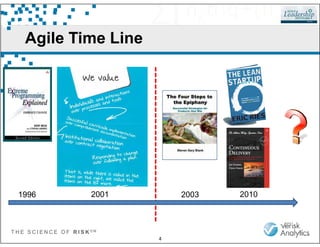
Agile Time Line
T H E S C I E N C E O F R I S K S M
4
20011996 2003 2010
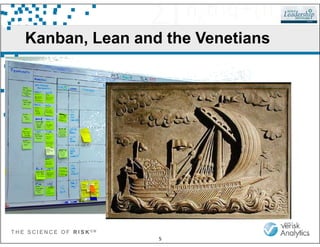
Kanban, Lean and the Venetians
T H E S C I E N C E O F R I S K S M
5
The Agile Manifesto
• Individuals and interactions over processes and tools
• Working software over comprehensive documentation
• Customer collaboration over contract negotiation
• Responding to change over following a plan
T H E S C I E N C E O F R I S K S M
6
That is, while there is value in the items on the right, we value the items on the left more.
(Selected) Principles behind the Agile Manifesto (http://agilemanifesto.org/principles.html)
– #1: Our highest priority is to satisfy the customer through early and
continuous delivery of value[able software].
– #4: Business people and developers must work together daily throughout the project.
– #5: Build projects around motivated individuals. Give them the environment and
support they need, and trust them to get the job done.
– #11: The best architectures, requirements, and designs emerge
from self-organizing teams.
– #12: At regular intervals, the team reflects on how to become more effective,
then tunes and adjusts its behavior accordingly.
Agile Core Values
• Individuals and interactions over processes and tools
• Working software over comprehensive documentation
• Customer collaboration over contract negotiation
• Responding to change over following a plan
T H E S C I E N C E O F R I S K S M
7
That is, while there is value in the items on the right, we value the items on the left more.
(Selected) Principles behind the Agile Manifesto (http://agilemanifesto.org/principles.html)
– #1: Our highest priority is to satisfy the customer through early and
continuous delivery of value[able software].
– #4: Business people and developers must work together daily throughout the project.
– #5: Build projects around motivated individuals. Give them the environment and
support they need, and trust them to get the job done.
– #11: The best architectures, requirements, and designs emerge
from self-organizing teams.
– #12: At regular intervals, the team reflects on how to become more effective,
then tunes and adjusts its behavior accordingly.
T H E S C I E N C E O F R I S K S M
THE EASY WAY
Agile Adoption
8
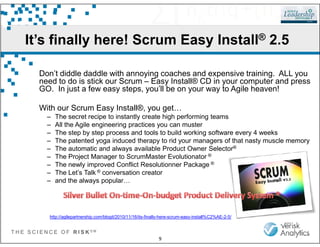
It’s finally here! Scrum Easy Install® 2.5
Don’t diddle daddle with annoying coaches and expensive training. ALL you
need to do is stick our Scrum – Easy Install® CD in your computer and press
GO. In just a few easy steps, you’ll be on your way to Agile heaven!
With our Scrum Easy Install®, you get…
– The secret recipe to instantly create high performing teams
– All the Agile engineering practices you can muster
T H E S C I E N C E O F R I S K S M
9
– All the Agile engineering practices you can muster
– The step by step process and tools to build working software every 4 weeks
– The patented yoga induced therapy to rid your managers of that nasty muscle memory
– The automatic and always available Product Owner Selector®
– The Project Manager to ScrumMaster Evolutionator ®
– The newly improved Conflict Resolutionner Package ®
– The Let’s Talk ® conversation creator
– and the always popular…
http://agilepartnership.com/blogit/2010/11/16/its-finally-here-scrum-easy-install%C2%AE-2-5/
T H E S C I E N C E O F R I S K S M
IN THE REAL WORLD
Agile Adoption
10
Key ingredients…
• Time (typically 3-5 years)
• Tie to the organizations’ strategy
–Need to make investments over a long time
• Executive sponsorship / commitment
T H E S C I E N C E O F R I S K S M
11
• Executive sponsorship / commitment
–A “…yeah yeah go on - do what makes you
guys happy” is NOT good enough !
• Thought leaders
–(considerate) use of consultants – initially only !
• COMMON SENSE & PATIENCE
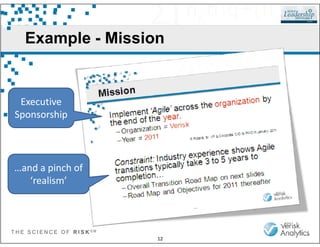
Example - Mission
Executive
Sponsorship
T H E S C I E N C E O F R I S K S M
12
…and a pinch of
‘realism’
Example - Tie to Strategy
1.5 years into the program:
Agile used for major projects
across […] Operating Units
Drive Revenue Through
Innovation
Optimize Our Business
Target: 90% of new
products delivered
T H E S C I E N C E O F R I S K S M
13
across […] Operating Units products delivered
within 9 months
Underlying Beliefs and Assumptions:
Adoption of agile techniques by Operating Units
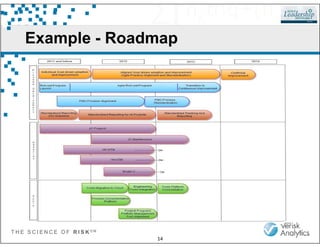
Example - Roadmap
T H E S C I E N C E O F R I S K S M
14
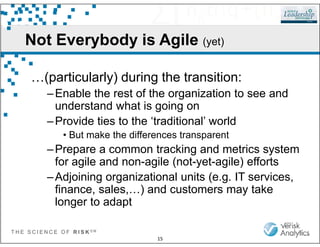
Not Everybody is Agile (yet)
…(particularly) during the transition:
–Enable the rest of the organization to see and
understand what is going on
–Provide ties to the ‘traditional’ world
T H E S C I E N C E O F R I S K S M
15
–Provide ties to the ‘traditional’ world
• But make the differences transparent
–Prepare a common tracking and metrics system
for agile and non-agile (not-yet-agile) efforts
–Adjoining organizational units (e.g. IT services,
finance, sales,…) and customers may take
longer to adapt
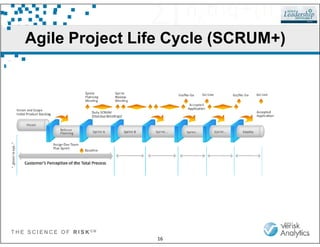
Agile Project Life Cycle (SCRUM+)
INCEPTION
Objectives
ELABORATION
Build
CONSTRUCTION
Build
TRANSITION
Release
PRODUCTION
Operate
LIFECYCLE OBJECTIVES
& Tollgate 1
LIFECYCLE ARCHITECTURE
& Tollgate 2
INITIAL OPERATIONAL
CAPABILITY
PRODUCT
RELEASE
T H E S C I E N C E O F R I S K S M
16
Risks Architecture
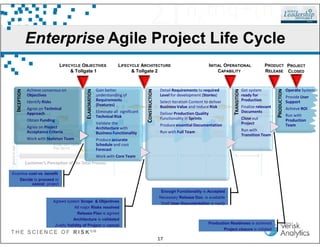
Enterprise Agile Project Life Cycle
INCEPTION
Achieve consensus on
Objectives
Identify Risks
Agree on Technical
Approach
Obtain Funding
ELABORATION Gain better
understanding of
Requirements
(Features)
Eliminate all significant
Technical Risk
Validate the
CONSTRUCTION
Detail Requirements to required
Level for development (Stories)
Select Iteration Content to deliver
Business Value and reduce Risk
Deliver Production Quality
Functionality in Sprints
Produce essential Documentation
TRANSITION
Get system
ready for
Production
Finalize relevant
Documents
Close out
Project
PRODUCTION
Operate System
Provide User
Support
Achieve ROI
Run with
Production
Team
LIFECYCLE OBJECTIVES
& Tollgate 1
LIFECYCLE ARCHITECTURE
& Tollgate 2
INITIAL OPERATIONAL
CAPABILITY
PRODUCT
RELEASE
PROJECT
CLOSED
T H E S C I E N C E O F R I S K S M
17
Agree on Project
Acceptance Criteria
Work with Skeleton Team
Validate the
Architecture with
Business Functionality
Produce accurate
Schedule and cost
Forecast
Work with Core Team
Produce essential Documentation
Run with Full Team
Project
Run with
Transition Team
Team
Examine cost vs. benefit
Decide to proceed or
cancel project
Agreed system Scope & Objectives
All major Risks resolved
Release Plan is agreed
Architecture is validated
Justify Validity of Project or cancel
Enough Functionality is Accepted
Necessary Release Doc. is available
Draft User Documentation is ready
Production Readiness is achieved
Project closure is initiated
T H E S C I E N C E O F R I S K S M
PITFALLS
Common Agile Adoption
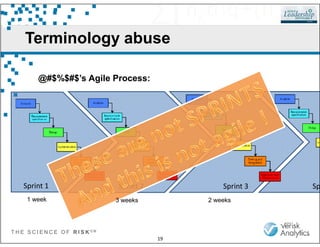
Terminology abuse
@#$%$#$’s Agile Process:
T H E S C I E N C E O F R I S K S M
19
SpSprint 3Sprint 1 Sprint 2
1 week 3 weeks 2 weeks
User Stories are Central…
• Agile Development in one sentence:
“Define a user value story, implement and test it in a short iteration,
demonstrate/and or deliver it to the user, repeat forever!”
• A user story is a brief statement of intent that describes something the
system needs to do for the user e.g.
– “Log in to my web project management portal”
T H E S C I E N C E O F R I S K S M
20
– “Log in to my web project management portal”
– “See my tasks for today”
• User Stories drive…
– How much we expect the project/release to cost (estimation)
– What gets done in what order in the project (backlog)
– What the team commits to in a sprint (sprint planning)
– What work items the team performs (tasks)
– Continuous product review & acceptance (acceptance criteria)
– Whether we (the team) can keep our commitments (burndown)
– Forecast when we are going to deliver the release (release burndown)
– Foster communication between business and development team
…but are not Requirements !
• Stories are rather negotiable expressions of intent
– (it needs to do something about like this)
• They are short, easy to read, and understandable
– to developers
– (to stakeholders)
T H E S C I E N C E O F R I S K S M
21
– to users
• They represent small increments of valued functionality that
can be developed in a period of days to weeks
– Less than one sprint
• They are relatively easy to estimate
• They need little or no maintenance and can be safely
discarded after implementation
21
…and are not enough !
Looking beyond the sprint…
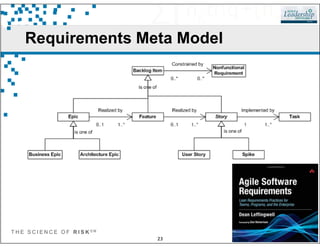
• (User) Stories do not address
–Product management
T H E S C I E N C E O F R I S K S M
22
–Product management
• What product documentation does the product
manager need ?
• How is it linked to the software ?
–Long term (product / software) maintenance
–Non-Functional requirements
Requirements Meta Model
T H E S C I E N C E O F R I S K S M
23
Common Adoption Pitfalls
• Ab-using the terminology
–Call things by what they really are
• Agile is NOT a process or framework
–We need to change the cultural values
T H E S C I E N C E O F R I S K S M
24
–We need to change the cultural values
• Yes it’s cool …
…but not always as simple as it looks
–‘Book Agile’ is seldom suitable
• Too-much, too-fast
–Measure, Improve, Learn, Start-over
T H E S C I E N C E O F R I S K S M
AUTOMATE, AUTOMATE
One More…
25
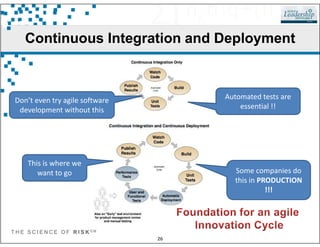
Continuous Integration and Deployment
Don’t even try agile software
development without this
Automated tests are
essential !!
T H E S C I E N C E O F R I S K S M
26
This is where we
want to go Some companies do
this in PRODUCTION
!!!
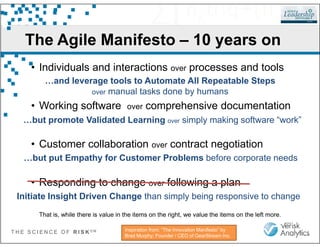
The Agile Manifesto – 10 years on
• Individuals and interactions over processes and tools
• Working software over comprehensive documentation
…and leverage tools to Automate All Repeatable Steps
over manual tasks done by humans
…but promote Validated Learning over simply making software “work”
T H E S C I E N C E O F R I S K S M
27
• Customer collaboration over contract negotiation
• Responding to change over following a plan
That is, while there is value in the items on the right, we value the items on the left more.
…but promote Validated Learning over simply making software “work”
…but put Empathy for Customer Problems before corporate needs
Initiate Insight Driven Change than simply being responsive to change
Inspiration from: “The Innovation Manifesto” by
Brad Murphy; Founder / CEO of GearStream Inc.
T H E S C I E N C E O F R I S K S M
Q&A
Open
28
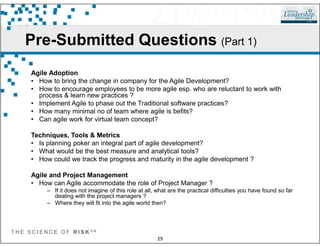
Pre-Submitted Questions (Part 1)
Agile Adoption
• How to bring the change in company for the Agile Development?
• How to encourage employees to be more agile esp. who are reluctant to work with
process & learn new practices ?
• Implement Agile to phase out the Traditional software practices?
• How many minimal no of team where agile is befits?
• Can agile work for virtual team concept?
T H E S C I E N C E O F R I S K S M
29
Techniques, Tools & Metrics
• Is planning poker an integral part of agile development?
• What would be the best measure and analytical tools?
• How could we track the progress and maturity in the agile development ?
Agile and Project Management
• How can Agile accommodate the role of Project Manager ?
– If it does not imagine of this role at all, what are the practical difficulties you have found so far
dealing with the project managers ?
– Where they will fit into the agile world then?
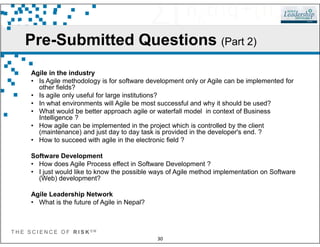
Pre-Submitted Questions (Part 2)
Agile in the industry
• Is Agile methodology is for software development only or Agile can be implemented for
other fields?
• Is agile only useful for large institutions?
• In what environments will Agile be most successful and why it should be used?
• What would be better approach agile or waterfall model in context of Business
Intelligence ?
• How agile can be implemented in the project which is controlled by the client
T H E S C I E N C E O F R I S K S M
30
• How agile can be implemented in the project which is controlled by the client
(maintenance) and just day to day task is provided in the developer's end. ?
• How to succeed with agile in the electronic field ?
Software Development
• How does Agile Process effect in Software Development ?
• I just would like to know the possible ways of Agile method implementation on Software
(Web) development?
Agile Leadership Network
• What is the future of Agile in Nepal?
Visit us online at...
www.agile-nepal.org
www.verisk.com
Thank You
T H E S C I E N C E O F R I S K S M
31
www.verisk.com
www.veriskit.com

ALN_Nepal-Agile_for_the_real_world

  • 1.
    THE SCIENCE OFRISKSM 1 Agile for the real World Roland Leibundgut Head of Enterprise Portfolio Management, Office of the CIO
  • 2.
    Contents Topic Slides 1 AgileLevel-set : What Agile is all about 3 2 Agile Adoption : the easy way 8 3 Agile Adoption : In the real world 10 T H E S C I E N C E O F R I S K S M 2 4 Common Pitfalls 18 5 One More : Automation 25 6 The Agile Manifesto – 10 years on 27 7 Q&A 28
  • 3.
    T H ES C I E N C E O F R I S K S M WHAT AGILE IS ALL ABOUT Agile level-set 3
  • 4.
    Agile Time Line TH E S C I E N C E O F R I S K S M 4 20011996 2003 2010
  • 5.
    Kanban, Lean andthe Venetians T H E S C I E N C E O F R I S K S M 5
  • 6.
    The Agile Manifesto •Individuals and interactions over processes and tools • Working software over comprehensive documentation • Customer collaboration over contract negotiation • Responding to change over following a plan T H E S C I E N C E O F R I S K S M 6 That is, while there is value in the items on the right, we value the items on the left more. (Selected) Principles behind the Agile Manifesto (http://agilemanifesto.org/principles.html) – #1: Our highest priority is to satisfy the customer through early and continuous delivery of value[able software]. – #4: Business people and developers must work together daily throughout the project. – #5: Build projects around motivated individuals. Give them the environment and support they need, and trust them to get the job done. – #11: The best architectures, requirements, and designs emerge from self-organizing teams. – #12: At regular intervals, the team reflects on how to become more effective, then tunes and adjusts its behavior accordingly.
  • 7.
    Agile Core Values •Individuals and interactions over processes and tools • Working software over comprehensive documentation • Customer collaboration over contract negotiation • Responding to change over following a plan T H E S C I E N C E O F R I S K S M 7 That is, while there is value in the items on the right, we value the items on the left more. (Selected) Principles behind the Agile Manifesto (http://agilemanifesto.org/principles.html) – #1: Our highest priority is to satisfy the customer through early and continuous delivery of value[able software]. – #4: Business people and developers must work together daily throughout the project. – #5: Build projects around motivated individuals. Give them the environment and support they need, and trust them to get the job done. – #11: The best architectures, requirements, and designs emerge from self-organizing teams. – #12: At regular intervals, the team reflects on how to become more effective, then tunes and adjusts its behavior accordingly.
  • 8.
    T H ES C I E N C E O F R I S K S M THE EASY WAY Agile Adoption 8
  • 9.
    It’s finally here!Scrum Easy Install® 2.5 Don’t diddle daddle with annoying coaches and expensive training. ALL you need to do is stick our Scrum – Easy Install® CD in your computer and press GO. In just a few easy steps, you’ll be on your way to Agile heaven! With our Scrum Easy Install®, you get… – The secret recipe to instantly create high performing teams – All the Agile engineering practices you can muster T H E S C I E N C E O F R I S K S M 9 – All the Agile engineering practices you can muster – The step by step process and tools to build working software every 4 weeks – The patented yoga induced therapy to rid your managers of that nasty muscle memory – The automatic and always available Product Owner Selector® – The Project Manager to ScrumMaster Evolutionator ® – The newly improved Conflict Resolutionner Package ® – The Let’s Talk ® conversation creator – and the always popular… http://agilepartnership.com/blogit/2010/11/16/its-finally-here-scrum-easy-install%C2%AE-2-5/
  • 10.
    T H ES C I E N C E O F R I S K S M IN THE REAL WORLD Agile Adoption 10
  • 11.
    Key ingredients… • Time(typically 3-5 years) • Tie to the organizations’ strategy –Need to make investments over a long time • Executive sponsorship / commitment T H E S C I E N C E O F R I S K S M 11 • Executive sponsorship / commitment –A “…yeah yeah go on - do what makes you guys happy” is NOT good enough ! • Thought leaders –(considerate) use of consultants – initially only ! • COMMON SENSE & PATIENCE
  • 12.
    Example - Mission Executive Sponsorship TH E S C I E N C E O F R I S K S M 12 …and a pinch of ‘realism’
  • 13.
    Example - Tieto Strategy 1.5 years into the program: Agile used for major projects across […] Operating Units Drive Revenue Through Innovation Optimize Our Business Target: 90% of new products delivered T H E S C I E N C E O F R I S K S M 13 across […] Operating Units products delivered within 9 months Underlying Beliefs and Assumptions: Adoption of agile techniques by Operating Units
  • 14.
    Example - Roadmap TH E S C I E N C E O F R I S K S M 14
  • 15.
    Not Everybody isAgile (yet) …(particularly) during the transition: –Enable the rest of the organization to see and understand what is going on –Provide ties to the ‘traditional’ world T H E S C I E N C E O F R I S K S M 15 –Provide ties to the ‘traditional’ world • But make the differences transparent –Prepare a common tracking and metrics system for agile and non-agile (not-yet-agile) efforts –Adjoining organizational units (e.g. IT services, finance, sales,…) and customers may take longer to adapt
  • 16.
    Agile Project LifeCycle (SCRUM+) INCEPTION Objectives ELABORATION Build CONSTRUCTION Build TRANSITION Release PRODUCTION Operate LIFECYCLE OBJECTIVES & Tollgate 1 LIFECYCLE ARCHITECTURE & Tollgate 2 INITIAL OPERATIONAL CAPABILITY PRODUCT RELEASE T H E S C I E N C E O F R I S K S M 16 Risks Architecture
  • 17.
    Enterprise Agile ProjectLife Cycle INCEPTION Achieve consensus on Objectives Identify Risks Agree on Technical Approach Obtain Funding ELABORATION Gain better understanding of Requirements (Features) Eliminate all significant Technical Risk Validate the CONSTRUCTION Detail Requirements to required Level for development (Stories) Select Iteration Content to deliver Business Value and reduce Risk Deliver Production Quality Functionality in Sprints Produce essential Documentation TRANSITION Get system ready for Production Finalize relevant Documents Close out Project PRODUCTION Operate System Provide User Support Achieve ROI Run with Production Team LIFECYCLE OBJECTIVES & Tollgate 1 LIFECYCLE ARCHITECTURE & Tollgate 2 INITIAL OPERATIONAL CAPABILITY PRODUCT RELEASE PROJECT CLOSED T H E S C I E N C E O F R I S K S M 17 Agree on Project Acceptance Criteria Work with Skeleton Team Validate the Architecture with Business Functionality Produce accurate Schedule and cost Forecast Work with Core Team Produce essential Documentation Run with Full Team Project Run with Transition Team Team Examine cost vs. benefit Decide to proceed or cancel project Agreed system Scope & Objectives All major Risks resolved Release Plan is agreed Architecture is validated Justify Validity of Project or cancel Enough Functionality is Accepted Necessary Release Doc. is available Draft User Documentation is ready Production Readiness is achieved Project closure is initiated
  • 18.
    T H ES C I E N C E O F R I S K S M PITFALLS Common Agile Adoption
  • 19.
    Terminology abuse @#$%$#$’s AgileProcess: T H E S C I E N C E O F R I S K S M 19 SpSprint 3Sprint 1 Sprint 2 1 week 3 weeks 2 weeks
  • 20.
    User Stories areCentral… • Agile Development in one sentence: “Define a user value story, implement and test it in a short iteration, demonstrate/and or deliver it to the user, repeat forever!” • A user story is a brief statement of intent that describes something the system needs to do for the user e.g. – “Log in to my web project management portal” T H E S C I E N C E O F R I S K S M 20 – “Log in to my web project management portal” – “See my tasks for today” • User Stories drive… – How much we expect the project/release to cost (estimation) – What gets done in what order in the project (backlog) – What the team commits to in a sprint (sprint planning) – What work items the team performs (tasks) – Continuous product review & acceptance (acceptance criteria) – Whether we (the team) can keep our commitments (burndown) – Forecast when we are going to deliver the release (release burndown) – Foster communication between business and development team
  • 21.
    …but are notRequirements ! • Stories are rather negotiable expressions of intent – (it needs to do something about like this) • They are short, easy to read, and understandable – to developers – (to stakeholders) T H E S C I E N C E O F R I S K S M 21 – to users • They represent small increments of valued functionality that can be developed in a period of days to weeks – Less than one sprint • They are relatively easy to estimate • They need little or no maintenance and can be safely discarded after implementation 21
  • 22.
    …and are notenough ! Looking beyond the sprint… • (User) Stories do not address –Product management T H E S C I E N C E O F R I S K S M 22 –Product management • What product documentation does the product manager need ? • How is it linked to the software ? –Long term (product / software) maintenance –Non-Functional requirements
  • 23.
    Requirements Meta Model TH E S C I E N C E O F R I S K S M 23
  • 24.
    Common Adoption Pitfalls •Ab-using the terminology –Call things by what they really are • Agile is NOT a process or framework –We need to change the cultural values T H E S C I E N C E O F R I S K S M 24 –We need to change the cultural values • Yes it’s cool … …but not always as simple as it looks –‘Book Agile’ is seldom suitable • Too-much, too-fast –Measure, Improve, Learn, Start-over
  • 25.
    T H ES C I E N C E O F R I S K S M AUTOMATE, AUTOMATE One More… 25
  • 26.
    Continuous Integration andDeployment Don’t even try agile software development without this Automated tests are essential !! T H E S C I E N C E O F R I S K S M 26 This is where we want to go Some companies do this in PRODUCTION !!!
  • 27.
    The Agile Manifesto– 10 years on • Individuals and interactions over processes and tools • Working software over comprehensive documentation …and leverage tools to Automate All Repeatable Steps over manual tasks done by humans …but promote Validated Learning over simply making software “work” T H E S C I E N C E O F R I S K S M 27 • Customer collaboration over contract negotiation • Responding to change over following a plan That is, while there is value in the items on the right, we value the items on the left more. …but promote Validated Learning over simply making software “work” …but put Empathy for Customer Problems before corporate needs Initiate Insight Driven Change than simply being responsive to change Inspiration from: “The Innovation Manifesto” by Brad Murphy; Founder / CEO of GearStream Inc.
  • 28.
    T H ES C I E N C E O F R I S K S M Q&A Open 28
  • 29.
    Pre-Submitted Questions (Part1) Agile Adoption • How to bring the change in company for the Agile Development? • How to encourage employees to be more agile esp. who are reluctant to work with process & learn new practices ? • Implement Agile to phase out the Traditional software practices? • How many minimal no of team where agile is befits? • Can agile work for virtual team concept? T H E S C I E N C E O F R I S K S M 29 Techniques, Tools & Metrics • Is planning poker an integral part of agile development? • What would be the best measure and analytical tools? • How could we track the progress and maturity in the agile development ? Agile and Project Management • How can Agile accommodate the role of Project Manager ? – If it does not imagine of this role at all, what are the practical difficulties you have found so far dealing with the project managers ? – Where they will fit into the agile world then?
  • 30.
    Pre-Submitted Questions (Part2) Agile in the industry • Is Agile methodology is for software development only or Agile can be implemented for other fields? • Is agile only useful for large institutions? • In what environments will Agile be most successful and why it should be used? • What would be better approach agile or waterfall model in context of Business Intelligence ? • How agile can be implemented in the project which is controlled by the client T H E S C I E N C E O F R I S K S M 30 • How agile can be implemented in the project which is controlled by the client (maintenance) and just day to day task is provided in the developer's end. ? • How to succeed with agile in the electronic field ? Software Development • How does Agile Process effect in Software Development ? • I just would like to know the possible ways of Agile method implementation on Software (Web) development? Agile Leadership Network • What is the future of Agile in Nepal?
  • 31.
    Visit us onlineat... www.agile-nepal.org www.verisk.com Thank You T H E S C I E N C E O F R I S K S M 31 www.verisk.com www.veriskit.com