PRESENTED BY
SHREYA JHA
 also known as OPC-41061
 is a selective, competitive vasopressin receptor 2
antagonist
 Mainly used to treat hyponatremia (euvolemic and
hypervolemic) in cases of congestive cardiac failure,
cirrhosis of liver and SIADH.
 Tolvaptan was approved by the U.S. Food and Drug
Administration (FDA) on May 19, 2009.
 is sold by Otsuka Pharmaceutical Co. under the trade
name Samsca
 In India is manufactured & sold by MSN laboratories
Ltd. under the trade name Tolsama & Tolvat and by
Lupin under the brand name Resodim
MECHANISM
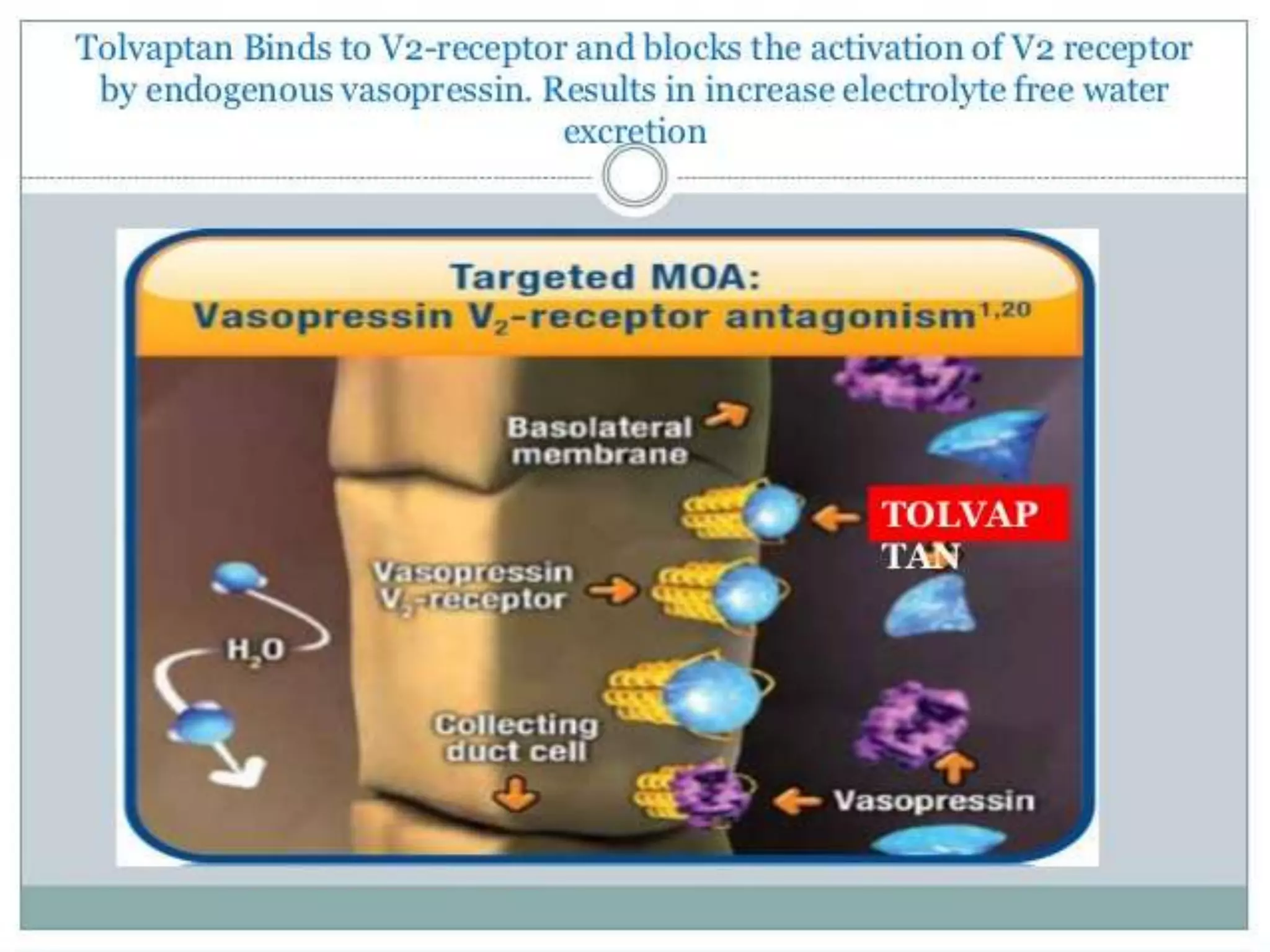
 selective vasopressor V2 receptor antagonist without
intrinsic agonist properties.
 29 times more affinity for v2 receptors than v1
receptors.
 Produces adequate aquaresis (water diuresis without
electrolyte excretion)
 Antagonism at the V2 receptor causes a decrease in the
number of aquaporin-2 channels in the renal
collecting tubules, resulting in decreased water
reabsorption, a net increase in free water excretion and
an increase in serum sodium concentrations.
Advantages of Tolvaptan
 Improves signs and symptoms of congestion
 Improves hyponatremia
 No effect on renal functions
 No effect on blood pressure
 No effect on electrolytes
 Oral route of administration
 No adverse effect on mortality
PHARMACOKINETICS
 The absolute bioavailability of a dose of tolvaptan is
unknown, but at least 40% of the drug is absorbed
after oral administration.
 The onset of effect is two to four hours after a dose is
taken, and peak effects occur four to eight hours after
administration.
 After absorption, it is 99% bound to circulating
plasma proteins.
 Volume of distribution is approximately 3 L/kg
 Tolvaptan is eliminated by the liver almost entirely by
CYP 3A4 to inactive metabolites, and it is an inhibitor
of P-glycoprotein.
 The plasma half-life is 12 hours;
 Increased serum sodium concentrations persist at 24
hours post-dose despite a return to baseline free water
excretion.
INDICATION
 Used in patient with hyponatremia < 125 meq /l in heart
failure (NYHA class III and IV)
 Used in SIADH for fluid restriction
 Patients with a serum sodium level of 125 to 134 mEq/L may
be treated if they have symptoms and have not responded
to fluid restriction
 Tolvaptan is also in fast-track clinical trials for polycystic
kidney disease
Starting dose is 15 mg per day and may be increased to
30 to 60 mg per day.
 Initiate therapy only in a hospital where serum sodium
levels can be monitored
 Too rapid correction of serum sodium can cause
serious neurologic sequel
 Do not administer it for more than 30 days to
minimize the risk of liver injury
 During initiation and titration, frequently monitor for
changes in serum electrolytes and volume
 Too rapid correction of serum sodium can cause
osmotic demyelination resulting in dysarthria,
mutism, dysphagia, lethargy, affective changes, spastic
quadriparesis, seizures, coma and death.
 In susceptible patients, including those with severe
malnutrition, alcoholism or advanced liver disease,
slower rates of correction may be advisable.
ADVERSE EFFECTS
 Most common are thirst(7.8 -16 %), dry mouth(4.2 –
13%) and polyuria(3.3%).
 It may cause fatal liver injury.
 GI bleeding may occur when prescribed in cirrhosis of
liver
 constipation
 Hyperglycemia
Should be used during pregnancy only if the potential
benefit justifies the potential risk to the fetus.
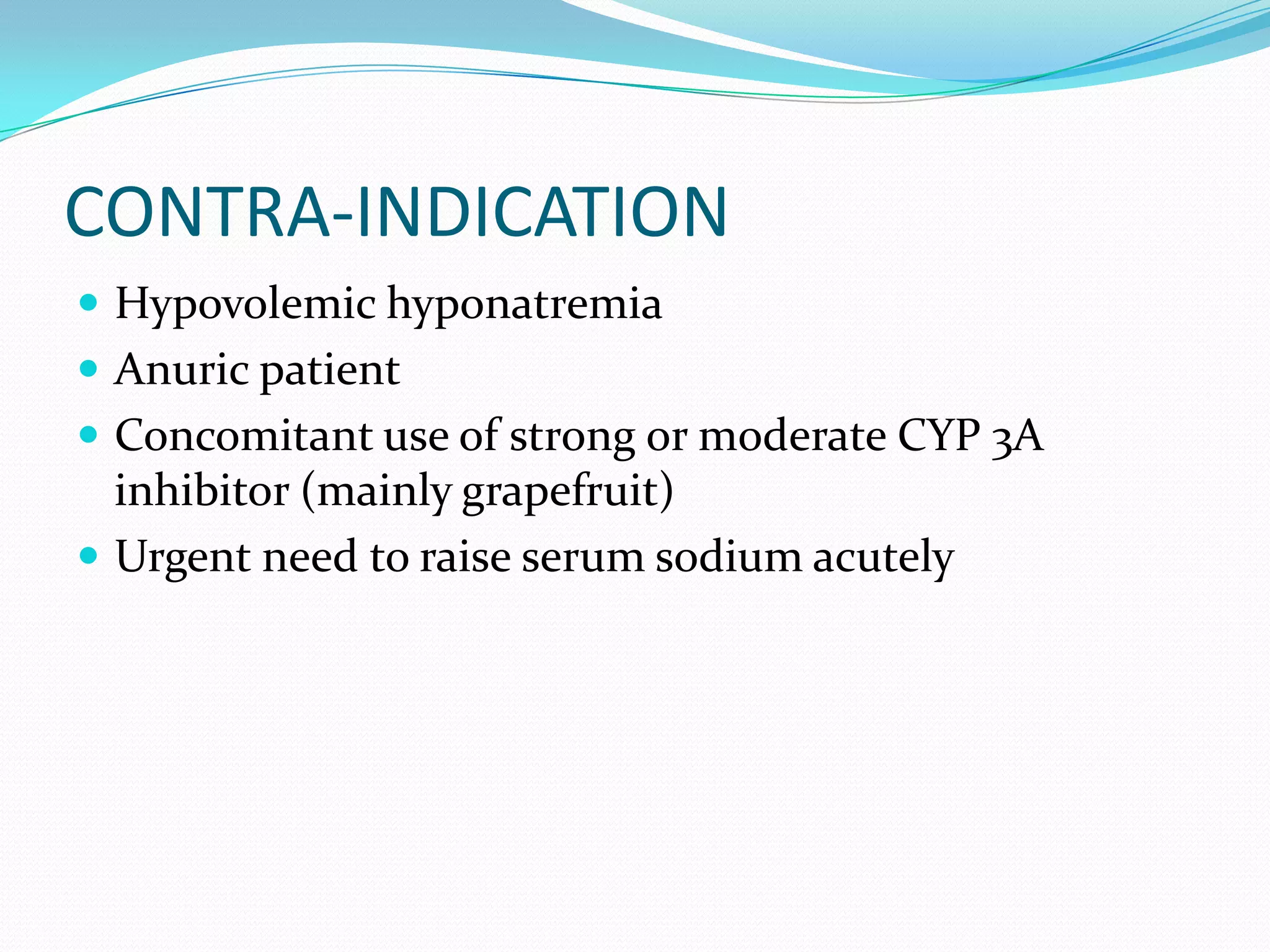
CONTRA-INDICATION
 Hypovolemic hyponatremia
 Anuric patient
 Concomitant use of strong or moderate CYP 3A
inhibitor (mainly grapefruit)
 Urgent need to raise serum sodium acutely
THANK YOU !!!!!!!!!

Tolvaptan

  • 1.
  • 2.
     also knownas OPC-41061  is a selective, competitive vasopressin receptor 2 antagonist  Mainly used to treat hyponatremia (euvolemic and hypervolemic) in cases of congestive cardiac failure, cirrhosis of liver and SIADH.
  • 3.
     Tolvaptan wasapproved by the U.S. Food and Drug Administration (FDA) on May 19, 2009.  is sold by Otsuka Pharmaceutical Co. under the trade name Samsca  In India is manufactured & sold by MSN laboratories Ltd. under the trade name Tolsama & Tolvat and by Lupin under the brand name Resodim
  • 4.
    MECHANISM  selective vasopressorV2 receptor antagonist without intrinsic agonist properties.  29 times more affinity for v2 receptors than v1 receptors.  Produces adequate aquaresis (water diuresis without electrolyte excretion)  Antagonism at the V2 receptor causes a decrease in the number of aquaporin-2 channels in the renal collecting tubules, resulting in decreased water reabsorption, a net increase in free water excretion and an increase in serum sodium concentrations.
  • 6.
    Advantages of Tolvaptan Improves signs and symptoms of congestion  Improves hyponatremia  No effect on renal functions  No effect on blood pressure  No effect on electrolytes  Oral route of administration  No adverse effect on mortality
  • 7.
    PHARMACOKINETICS  The absolutebioavailability of a dose of tolvaptan is unknown, but at least 40% of the drug is absorbed after oral administration.  The onset of effect is two to four hours after a dose is taken, and peak effects occur four to eight hours after administration.  After absorption, it is 99% bound to circulating plasma proteins.  Volume of distribution is approximately 3 L/kg
  • 8.
     Tolvaptan iseliminated by the liver almost entirely by CYP 3A4 to inactive metabolites, and it is an inhibitor of P-glycoprotein.  The plasma half-life is 12 hours;  Increased serum sodium concentrations persist at 24 hours post-dose despite a return to baseline free water excretion.
  • 9.
    INDICATION  Used inpatient with hyponatremia < 125 meq /l in heart failure (NYHA class III and IV)  Used in SIADH for fluid restriction  Patients with a serum sodium level of 125 to 134 mEq/L may be treated if they have symptoms and have not responded to fluid restriction  Tolvaptan is also in fast-track clinical trials for polycystic kidney disease
  • 10.
    Starting dose is15 mg per day and may be increased to 30 to 60 mg per day.  Initiate therapy only in a hospital where serum sodium levels can be monitored  Too rapid correction of serum sodium can cause serious neurologic sequel  Do not administer it for more than 30 days to minimize the risk of liver injury  During initiation and titration, frequently monitor for changes in serum electrolytes and volume
  • 11.
     Too rapidcorrection of serum sodium can cause osmotic demyelination resulting in dysarthria, mutism, dysphagia, lethargy, affective changes, spastic quadriparesis, seizures, coma and death.  In susceptible patients, including those with severe malnutrition, alcoholism or advanced liver disease, slower rates of correction may be advisable.
  • 12.
    ADVERSE EFFECTS  Mostcommon are thirst(7.8 -16 %), dry mouth(4.2 – 13%) and polyuria(3.3%).  It may cause fatal liver injury.  GI bleeding may occur when prescribed in cirrhosis of liver  constipation  Hyperglycemia Should be used during pregnancy only if the potential benefit justifies the potential risk to the fetus.
  • 13.
    CONTRA-INDICATION  Hypovolemic hyponatremia Anuric patient  Concomitant use of strong or moderate CYP 3A inhibitor (mainly grapefruit)  Urgent need to raise serum sodium acutely
  • 14.