Securing Web Applications
with Token Authentication
Les Hazlewood @lhazlewood
PMC Chair, Apache Shiro
Expert Group Member, JEE Application Security (JSR-375)
Founder & CTO, Stormpath
About Stormpath
• Authentication & User Management API
• Hosted data store w/ advanced crypto
• Centralize user login across your applications
• Multi-tenant support for your SaaS
• Active Directory, LDAP, social connections
• API authentication & token authentication
• Supported, Free tier for developers
Overview
• Security Concerns for Modern Web Apps
• Cookies: need to know
• Session ID Problems
• Token Authentication to the rescue!
• Java Example
Security Concerns for Modern Web Apps
• SPAs and Mobile apps are ‘Untrusted Clients’
• Prevent malicious code
• Secure user credentials
• Secure server endpoints (API)
• Expose Access Control rules to the Client
Learn more at Stormpath.com
Prevent Malicious Code
• Cross-Site Scripting (XSS) attacks are a real,
huge threat
Learn more at Stormpath.com
Prevent Malicious Code
Cross-Site Scripting (XSS) attacks
https://www.owasp.org/index.php/XSS
Learn more at Stormpath.com
XSS Attack
Demo
https://www.google.com/about/appsecurity/lear
ning/xss/#BasicExample
Learn more at Stormpath.com
XSS Attack – What Can I Do?
Read EVERYTHING on this page:
https://www.owasp.org/index.php/XSS
And then do these things:
https://www.owasp.org/index.php/XSS_(Cross_Sit
e_Scripting)_Prevention_Cheat_Sheet
Learn more at Stormpath.com
XSS Attack – What Can I Do?
Escape Content!
Dynamic HTML: use well-known, trusted
libraries. Do NOT roll your own.
DOM attacks: escape user input
Learn more at Stormpath.com
XSS Attack – What Can I Do?
SPAs: frameworks like Angular probably do a
lot of work for you (e.g. preventing DOM
attacks by escaping user input).
You should still read up on it.
Learn more at Stormpath.com
Secure User Credentials
• Traditionally, we have used Session IDs
• This is OK, as long as you do cookies ‘right’
• Authentication Tokens are better  (more on
this later)
Learn more at Stormpath.com
Overview
• Security Concerns for Modern Web Apps
• Cookies: need to know
• Session ID Problems
• Token Authentication to the rescue!
• Java Example
Learn more at Stormpath.com
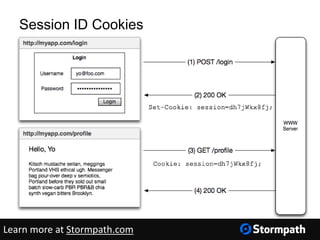
Session ID Cookies
Learn more at Stormpath.com
Secure Server (API) Endpoints
• Traditionally use Session ID Cookies
• Session ID  Session  User identity
• Use framework like Apache Shiro or Spring
Security to assert security rules
Learn more at Stormpath.com
Expose Access Control Rules to the Client
• Traditional solution:
• Session ID  Session  User data in your DB
• Provide a /me or /profile endpoint
• Access Tokens are better!
Learn more at Stormpath.com
Let’s talk about cookies...
Learn more at Stormpath.com
Cookies are OK! If you do them correctly
Cookies can be easily compromised:
• Man-in-the-Middle (MITM) attacks
• Cross-Site Request Forgery (CSRF)
Learn more at Stormpath.com
Man In The Middle (MITM) attacks
Someone ‘listening on the wire’ between the
browser and server can see and copy the
cookie.
Solutions
• Use HTTPS everywhere
• TLS everywhere on internal networks
Learn more at Stormpath.com
Cross-Site Request Forgery (CSRF)
“... occurs when a malicious web site, email,
blog, instant message or program causes a
user’s web browser to perform an unwanted
action on a trusted site for which the user is
currently authenticated”
https://www.owasp.org/index.php/CrossSite_Re
quest_Forgery_(CSRF)_Prevention_Cheat_Sh
eet
Learn more at Stormpath.com
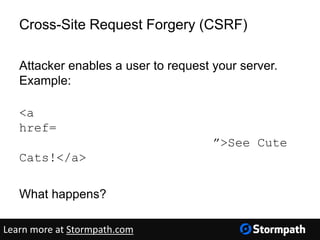
Cross-Site Request Forgery (CSRF)
Attacker enables a user to request your server.
Example:
<a
href=“https://yoursite.com/transferMo
ney?to=BadGuy&amount=10000”>See Cute
Cats!</a>
What happens?
Learn more at Stormpath.com
Cross-Site Request Forgery (CSRF)
• The attacker cannot see your cookie values,
BUT:
• The browser says, “The request is going to your
server, so I’ll happily send you your cookies.”
• Your server transfers the money because it
‘sees’ a valid, non-expired session id cookie for
an authenticated session.
Learn more at Stormpath.com
Cross-Site Request Forgery (CSRF)
Solutions
• Synchronizer Token
• Double-Submit Cookie
• Origin header check
Learn more at Stormpath.com
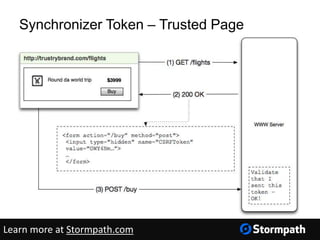
Synchronizer Token – Trusted Page
Learn more at Stormpath.com
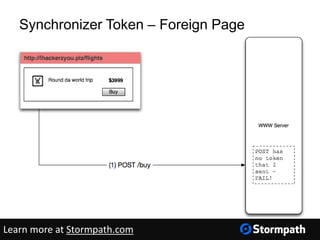
Synchronizer Token – Foreign Page
Learn more at Stormpath.com
Synchronizer Token - Considerations
• Requires cooperation from your rendering
layer
• Requires you to store tokens in a data store
or cache
• Difficult to do with static SPA content
• Only protects against forged POST requests,
not GETs!
Pro tip: never allow GETs to modify server state!
Learn more at Stormpath.com
Double Submit Cookie
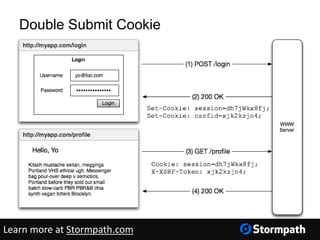
• Send two cookies: Session ID + Random
Value
• Send random value explicitly, browser Same-
Origin-Policy
• Best Way: send as a custom header
Learn more at Stormpath.com
Double Submit Cookie
Learn more at Stormpath.com
Double Submit Cookie Considerations
• Custom HTTP header, do what makes sense
for your app
• Still vulnerable to XSS - Random Value still
accessible to the JS environment.
• Protect against XSS!
Learn more at Stormpath.com
Origin header check
• Browsers send Origin header
• Header value is the domain of the page
initiating the request
• Cannot be hacked via browser JS
(could still be modified by a malicious HTTP proxy
server)
Learn more at Stormpath.com
Overview
• Security Concerns for Modern Web Apps
• Cookies: need to know
• Session ID Problems
• Token Authentication to the rescue!
• Java Example
Learn more at Stormpath.com
Session ID Problems
• They’re opaque and have no meaning
themselves (they’re just ‘pointers’).
• Service-oriented architectures might need a
centralized ID de-referencing service
Learn more at Stormpath.com
Session ID Problems
• Opaque IDs mean clients can’t inspect them
and find out what it is allowed to do or not - it
needs to make more requests for this
information.
Learn more at Stormpath.com
Session ID Problems
• Sessions = Server State!
• You need to store that state somewhere
• Session ID  look up server state on *every
request*.
• Really not good for distributed/clustered apps
• Really not good for scale
Learn more at Stormpath.com
Overview
• Security Concerns for Modern Web Apps
• Cookies: need to know
• Session ID Problems
• Token Authentication to the rescue!
• Java Example
Learn more at Stormpath.com
Token Authentication
• What is Authentication?
• What is a Token?
Learn more at Stormpath.com
JSON Web Tokens (JWT)
• A URL-safe, compact, self-contained string with
meaningful information that is usually digitally
signed or encrypted.
• The string is ‘opaque’ and can be used as a
‘token’.
• Many OAuth2 implementations use JWTs as
OAuth2 Access Tokens.
Learn more at Stormpath.com
JSON Web Tokens (JWT)
• You can store them in cookies! But all those
cookie rules still apply.
• You can entirely replace your session ID with
a JWT.
Learn more at Stormpath.com
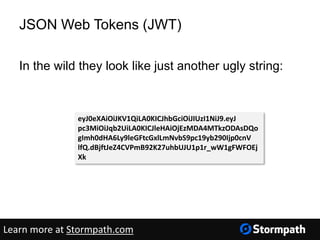
JSON Web Tokens (JWT)
In the wild they look like just another ugly string:
eyJ0eXAiOiJKV1QiLA0KICJhbGciOiJIUzI1NiJ9.eyJ
pc3MiOiJqb2UiLA0KICJleHAiOjEzMDA4MTkzODAsDQo
gImh0dHA6Ly9leGFtcGxlLmNvbS9pc19yb290Ijp0cnV
lfQ.dBjftJeZ4CVPmB92K27uhbUJU1p1r_wW1gFWFOEj
Xk
Learn more at Stormpath.com
JSON Web Tokens (JWT)
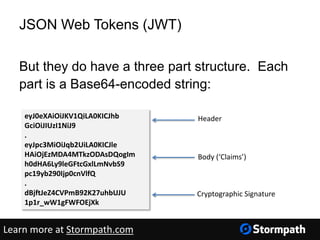
But they do have a three part structure. Each
part is a Base64-encoded string:
eyJ0eXAiOiJKV1QiLA0KICJhb
GciOiJIUzI1NiJ9
.
eyJpc3MiOiJqb2UiLA0KICJle
HAiOjEzMDA4MTkzODAsDQogIm
h0dHA6Ly9leGFtcGxlLmNvbS9
pc19yb290Ijp0cnVlfQ
.
dBjftJeZ4CVPmB92K27uhbUJU
1p1r_wW1gFWFOEjXk
Header
Body (‘Claims’)
Cryptographic Signature
Learn more at Stormpath.com
JSON Web Tokens (JWT)
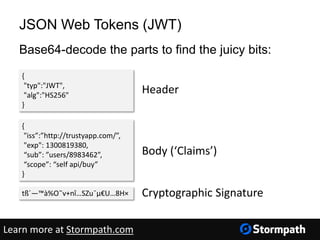
Base64-decode the parts to find the juicy bits:
{
"typ":"JWT",
"alg":"HS256"
}
{
"iss”:”http://trustyapp.com/”,
"exp": 1300819380,
“sub”: ”users/8983462”,
“scope”: “self api/buy”
}
tß´—™à%O˜v+nî…SZu¯µ€U…8H×
Header
Body (‘Claims’)
Cryptographic Signature
Learn more at Stormpath.com
JSON Web Tokens (JWT)
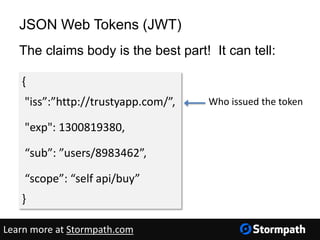
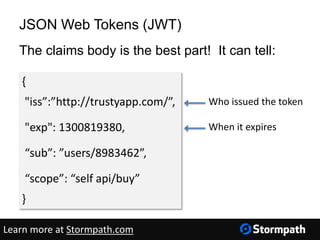
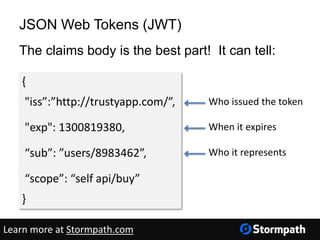
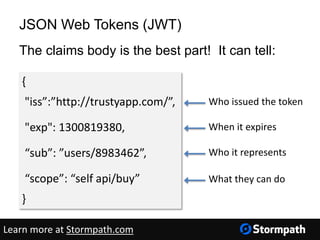
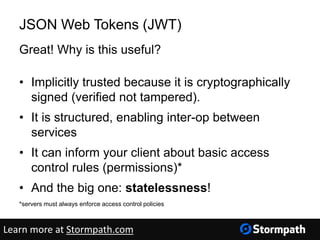
The claims body is the best part! It can tell:
{
"iss”:”http://trustyapp.com/”,
"exp": 1300819380,
“sub”: ”users/8983462”,
“scope”: “self api/buy”
}
Who issued the token
Learn more at Stormpath.com
JSON Web Tokens (JWT)
The claims body is the best part! It can tell:
{
"iss”:”http://trustyapp.com/”,
"exp": 1300819380,
“sub”: ”users/8983462”,
“scope”: “self api/buy”
}
Who issued the token
When it expires
Learn more at Stormpath.com
JSON Web Tokens (JWT)
The claims body is the best part! It can tell:
{
"iss”:”http://trustyapp.com/”,
"exp": 1300819380,
“sub”: ”users/8983462”,
“scope”: “self api/buy”
}
Who issued the token
When it expires
Who it represents
Learn more at Stormpath.com
JSON Web Tokens (JWT)
The claims body is the best part! It can tell:
{
"iss”:”http://trustyapp.com/”,
"exp": 1300819380,
“sub”: ”users/8983462”,
“scope”: “self api/buy”
}
Who issued the token
When it expires
Who it represents
What they can do
Learn more at Stormpath.com
JSON Web Tokens (JWT)
Great! Why is this useful?
• Implicitly trusted because it is cryptographically
signed (verified not tampered).
• It is structured, enabling inter-op between
services
• It can inform your client about basic access
control rules (permissions)*
• And the big one: statelessness!
*servers must always enforce access control policies
Learn more at Stormpath.com
JSON Web Tokens (JWT)
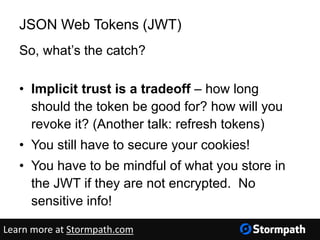
So, what’s the catch?
• Implicit trust is a tradeoff – how long
should the token be good for? how will you
revoke it? (Another talk: refresh tokens)
• You still have to secure your cookies!
• You have to be mindful of what you store in
the JWT if they are not encrypted. No
sensitive info!
Learn more at Stormpath.com
How do you do it on the JVM?
JJWT is awesome
https://github.com/jwtk/jjwt
Learn more at Stormpath.com
How do you do it on the JVM?
import io.jsonwebtoken.Jwts;
import io.jsonwebtoken.SignatureAlgorithm;
byte[] key = getSignatureKey();
String jwt =
Jwts.builder().setIssuer(“http://trustyapp.com/”)
.setSubject(“users/1300819380”)
.setExpiration(expirationDate)
.put(“scope”, “self api/buy”)
.signWith(SignatureAlgorithm.HS256,key)
.compact();
Create a JWT:
Learn more at Stormpath.com
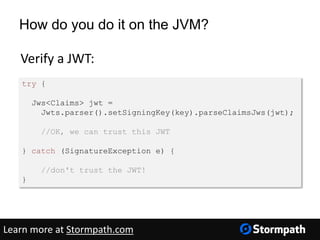
How do you do it on the JVM?
Verify a JWT:
try {
Jws<Claims> jwt =
Jwts.parser().setSigningKey(key).parseClaimsJws(jwt);
//OK, we can trust this JWT
} catch (SignatureException e) {
//don't trust the JWT!
}
Learn more at Stormpath.com
Demo!
Learn more at Stormpath.com
Thanks!
@lhazlewood @goStormpath
• Token Authentication for Java, Spring and Spring Boot
• Free Supported Developer Tier
• Elegant API
• OSS Java SDKs + Tutorials
Get a Free-Forever Account: Stormpath.com
Learn more at Stormpath.com

Token Authentication for Java Applications

  • 1.
    Securing Web Applications withToken Authentication Les Hazlewood @lhazlewood PMC Chair, Apache Shiro Expert Group Member, JEE Application Security (JSR-375) Founder & CTO, Stormpath
  • 2.
    About Stormpath • Authentication& User Management API • Hosted data store w/ advanced crypto • Centralize user login across your applications • Multi-tenant support for your SaaS • Active Directory, LDAP, social connections • API authentication & token authentication • Supported, Free tier for developers
  • 3.
    Overview • Security Concernsfor Modern Web Apps • Cookies: need to know • Session ID Problems • Token Authentication to the rescue! • Java Example
  • 4.
    Security Concerns forModern Web Apps • SPAs and Mobile apps are ‘Untrusted Clients’ • Prevent malicious code • Secure user credentials • Secure server endpoints (API) • Expose Access Control rules to the Client Learn more at Stormpath.com
  • 5.
    Prevent Malicious Code •Cross-Site Scripting (XSS) attacks are a real, huge threat Learn more at Stormpath.com
  • 6.
    Prevent Malicious Code Cross-SiteScripting (XSS) attacks https://www.owasp.org/index.php/XSS Learn more at Stormpath.com
  • 7.
  • 8.
    XSS Attack –What Can I Do? Read EVERYTHING on this page: https://www.owasp.org/index.php/XSS And then do these things: https://www.owasp.org/index.php/XSS_(Cross_Sit e_Scripting)_Prevention_Cheat_Sheet Learn more at Stormpath.com
  • 9.
    XSS Attack –What Can I Do? Escape Content! Dynamic HTML: use well-known, trusted libraries. Do NOT roll your own. DOM attacks: escape user input Learn more at Stormpath.com
  • 10.
    XSS Attack –What Can I Do? SPAs: frameworks like Angular probably do a lot of work for you (e.g. preventing DOM attacks by escaping user input). You should still read up on it. Learn more at Stormpath.com
  • 11.
    Secure User Credentials •Traditionally, we have used Session IDs • This is OK, as long as you do cookies ‘right’ • Authentication Tokens are better  (more on this later) Learn more at Stormpath.com
  • 12.
    Overview • Security Concernsfor Modern Web Apps • Cookies: need to know • Session ID Problems • Token Authentication to the rescue! • Java Example Learn more at Stormpath.com
  • 13.
    Session ID Cookies Learnmore at Stormpath.com
  • 14.
    Secure Server (API)Endpoints • Traditionally use Session ID Cookies • Session ID  Session  User identity • Use framework like Apache Shiro or Spring Security to assert security rules Learn more at Stormpath.com
  • 15.
    Expose Access ControlRules to the Client • Traditional solution: • Session ID  Session  User data in your DB • Provide a /me or /profile endpoint • Access Tokens are better! Learn more at Stormpath.com
  • 16.
    Let’s talk aboutcookies... Learn more at Stormpath.com
  • 17.
    Cookies are OK!If you do them correctly Cookies can be easily compromised: • Man-in-the-Middle (MITM) attacks • Cross-Site Request Forgery (CSRF) Learn more at Stormpath.com
  • 18.
    Man In TheMiddle (MITM) attacks Someone ‘listening on the wire’ between the browser and server can see and copy the cookie. Solutions • Use HTTPS everywhere • TLS everywhere on internal networks Learn more at Stormpath.com
  • 19.
    Cross-Site Request Forgery(CSRF) “... occurs when a malicious web site, email, blog, instant message or program causes a user’s web browser to perform an unwanted action on a trusted site for which the user is currently authenticated” https://www.owasp.org/index.php/CrossSite_Re quest_Forgery_(CSRF)_Prevention_Cheat_Sh eet Learn more at Stormpath.com
  • 20.
    Cross-Site Request Forgery(CSRF) Attacker enables a user to request your server. Example: <a href=“https://yoursite.com/transferMo ney?to=BadGuy&amount=10000”>See Cute Cats!</a> What happens? Learn more at Stormpath.com
  • 21.
    Cross-Site Request Forgery(CSRF) • The attacker cannot see your cookie values, BUT: • The browser says, “The request is going to your server, so I’ll happily send you your cookies.” • Your server transfers the money because it ‘sees’ a valid, non-expired session id cookie for an authenticated session. Learn more at Stormpath.com
  • 22.
    Cross-Site Request Forgery(CSRF) Solutions • Synchronizer Token • Double-Submit Cookie • Origin header check Learn more at Stormpath.com
  • 23.
    Synchronizer Token –Trusted Page Learn more at Stormpath.com
  • 24.
    Synchronizer Token –Foreign Page Learn more at Stormpath.com
  • 25.
    Synchronizer Token -Considerations • Requires cooperation from your rendering layer • Requires you to store tokens in a data store or cache • Difficult to do with static SPA content • Only protects against forged POST requests, not GETs! Pro tip: never allow GETs to modify server state! Learn more at Stormpath.com
  • 26.
    Double Submit Cookie •Send two cookies: Session ID + Random Value • Send random value explicitly, browser Same- Origin-Policy • Best Way: send as a custom header Learn more at Stormpath.com
  • 27.
    Double Submit Cookie Learnmore at Stormpath.com
  • 28.
    Double Submit CookieConsiderations • Custom HTTP header, do what makes sense for your app • Still vulnerable to XSS - Random Value still accessible to the JS environment. • Protect against XSS! Learn more at Stormpath.com
  • 29.
    Origin header check •Browsers send Origin header • Header value is the domain of the page initiating the request • Cannot be hacked via browser JS (could still be modified by a malicious HTTP proxy server) Learn more at Stormpath.com
  • 30.
    Overview • Security Concernsfor Modern Web Apps • Cookies: need to know • Session ID Problems • Token Authentication to the rescue! • Java Example Learn more at Stormpath.com
  • 31.
    Session ID Problems •They’re opaque and have no meaning themselves (they’re just ‘pointers’). • Service-oriented architectures might need a centralized ID de-referencing service Learn more at Stormpath.com
  • 32.
    Session ID Problems •Opaque IDs mean clients can’t inspect them and find out what it is allowed to do or not - it needs to make more requests for this information. Learn more at Stormpath.com
  • 33.
    Session ID Problems •Sessions = Server State! • You need to store that state somewhere • Session ID  look up server state on *every request*. • Really not good for distributed/clustered apps • Really not good for scale Learn more at Stormpath.com
  • 34.
    Overview • Security Concernsfor Modern Web Apps • Cookies: need to know • Session ID Problems • Token Authentication to the rescue! • Java Example Learn more at Stormpath.com
  • 35.
    Token Authentication • Whatis Authentication? • What is a Token? Learn more at Stormpath.com
  • 36.
    JSON Web Tokens(JWT) • A URL-safe, compact, self-contained string with meaningful information that is usually digitally signed or encrypted. • The string is ‘opaque’ and can be used as a ‘token’. • Many OAuth2 implementations use JWTs as OAuth2 Access Tokens. Learn more at Stormpath.com
  • 37.
    JSON Web Tokens(JWT) • You can store them in cookies! But all those cookie rules still apply. • You can entirely replace your session ID with a JWT. Learn more at Stormpath.com
  • 38.
    JSON Web Tokens(JWT) In the wild they look like just another ugly string: eyJ0eXAiOiJKV1QiLA0KICJhbGciOiJIUzI1NiJ9.eyJ pc3MiOiJqb2UiLA0KICJleHAiOjEzMDA4MTkzODAsDQo gImh0dHA6Ly9leGFtcGxlLmNvbS9pc19yb290Ijp0cnV lfQ.dBjftJeZ4CVPmB92K27uhbUJU1p1r_wW1gFWFOEj Xk Learn more at Stormpath.com
  • 39.
    JSON Web Tokens(JWT) But they do have a three part structure. Each part is a Base64-encoded string: eyJ0eXAiOiJKV1QiLA0KICJhb GciOiJIUzI1NiJ9 . eyJpc3MiOiJqb2UiLA0KICJle HAiOjEzMDA4MTkzODAsDQogIm h0dHA6Ly9leGFtcGxlLmNvbS9 pc19yb290Ijp0cnVlfQ . dBjftJeZ4CVPmB92K27uhbUJU 1p1r_wW1gFWFOEjXk Header Body (‘Claims’) Cryptographic Signature Learn more at Stormpath.com
  • 40.
    JSON Web Tokens(JWT) Base64-decode the parts to find the juicy bits: { "typ":"JWT", "alg":"HS256" } { "iss”:”http://trustyapp.com/”, "exp": 1300819380, “sub”: ”users/8983462”, “scope”: “self api/buy” } tß´—™à%O˜v+nî…SZu¯µ€U…8H× Header Body (‘Claims’) Cryptographic Signature Learn more at Stormpath.com
  • 41.
    JSON Web Tokens(JWT) The claims body is the best part! It can tell: { "iss”:”http://trustyapp.com/”, "exp": 1300819380, “sub”: ”users/8983462”, “scope”: “self api/buy” } Who issued the token Learn more at Stormpath.com
  • 42.
    JSON Web Tokens(JWT) The claims body is the best part! It can tell: { "iss”:”http://trustyapp.com/”, "exp": 1300819380, “sub”: ”users/8983462”, “scope”: “self api/buy” } Who issued the token When it expires Learn more at Stormpath.com
  • 43.
    JSON Web Tokens(JWT) The claims body is the best part! It can tell: { "iss”:”http://trustyapp.com/”, "exp": 1300819380, “sub”: ”users/8983462”, “scope”: “self api/buy” } Who issued the token When it expires Who it represents Learn more at Stormpath.com
  • 44.
    JSON Web Tokens(JWT) The claims body is the best part! It can tell: { "iss”:”http://trustyapp.com/”, "exp": 1300819380, “sub”: ”users/8983462”, “scope”: “self api/buy” } Who issued the token When it expires Who it represents What they can do Learn more at Stormpath.com
  • 45.
    JSON Web Tokens(JWT) Great! Why is this useful? • Implicitly trusted because it is cryptographically signed (verified not tampered). • It is structured, enabling inter-op between services • It can inform your client about basic access control rules (permissions)* • And the big one: statelessness! *servers must always enforce access control policies Learn more at Stormpath.com
  • 46.
    JSON Web Tokens(JWT) So, what’s the catch? • Implicit trust is a tradeoff – how long should the token be good for? how will you revoke it? (Another talk: refresh tokens) • You still have to secure your cookies! • You have to be mindful of what you store in the JWT if they are not encrypted. No sensitive info! Learn more at Stormpath.com
  • 47.
    How do youdo it on the JVM? JJWT is awesome https://github.com/jwtk/jjwt Learn more at Stormpath.com
  • 48.
    How do youdo it on the JVM? import io.jsonwebtoken.Jwts; import io.jsonwebtoken.SignatureAlgorithm; byte[] key = getSignatureKey(); String jwt = Jwts.builder().setIssuer(“http://trustyapp.com/”) .setSubject(“users/1300819380”) .setExpiration(expirationDate) .put(“scope”, “self api/buy”) .signWith(SignatureAlgorithm.HS256,key) .compact(); Create a JWT: Learn more at Stormpath.com
  • 49.
    How do youdo it on the JVM? Verify a JWT: try { Jws<Claims> jwt = Jwts.parser().setSigningKey(key).parseClaimsJws(jwt); //OK, we can trust this JWT } catch (SignatureException e) { //don't trust the JWT! } Learn more at Stormpath.com
  • 50.
    Demo! Learn more atStormpath.com
  • 51.
    Thanks! @lhazlewood @goStormpath • TokenAuthentication for Java, Spring and Spring Boot • Free Supported Developer Tier • Elegant API • OSS Java SDKs + Tutorials Get a Free-Forever Account: Stormpath.com Learn more at Stormpath.com