

Building a Node.js Client
for Your REST+JSON API
Les Hazlewood @lhazlewood
CTO, Stormpath stormpath.com
.com
• User Management and Authentication
API
• Security for your applications
• User security workflows
• Security best practices
• Developer tools, SDKs, libraries
Overview
• Resources
• Public / Private API
• Proxy Design
• Active Record
• Fluent API
• Configuration
• Caching
• Authentication
• Pluggability
• Lessons Learned
HATEOAS
• Hypermedia
• As
• The
• Engine
• Of
• Application
• State
Learn more at Stormpath.com
Resources
Learn more at Stormpath.com
Resources
• Nouns, not verbs
• Coarse-grained, not fine-grained
• Support many use cases
• Globally unique HREF
Learn more at Stormpath.com
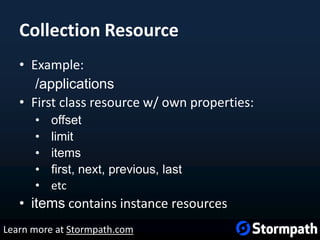
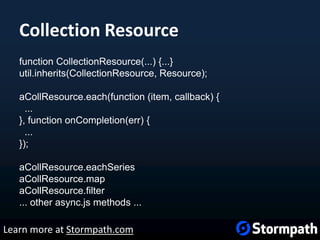
Collection Resource
• Example:
/applications
• First class resource w/ own properties:
• offset
• limit
• items
• first, next, previous, last
• etc
• items contains instance resources
Learn more at Stormpath.com
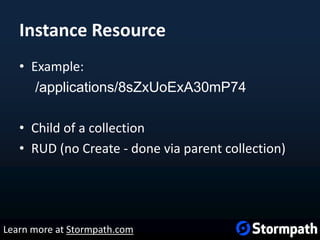
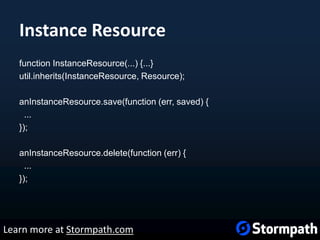
Instance Resource
• Example:
/applications/8sZxUoExA30mP74
• Child of a collection
• RUD (no Create - done via parent collection)
Learn more at Stormpath.com
Translating to Code
Learn more at Stormpath.com
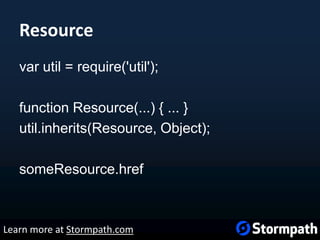
Resource
var util = require('util');
function Resource(...) { ... }
util.inherits(Resource, Object);
someResource.href
Learn more at Stormpath.com
Instance Resource
function InstanceResource(...) {...}
util.inherits(InstanceResource, Resource);
anInstanceResource.save(function (err, saved) {
...
});
anInstanceResource.delete(function (err) {
...
});
Learn more at Stormpath.com
Collection Resource
function CollectionResource(...) {...}
util.inherits(CollectionResource, Resource);
aCollResource.each(function (item, callback) {
...
}, function onCompletion(err) {
...
});
aCollResource.eachSeries
aCollResource.map
aCollResource.filter
... other async.js methods ...
Learn more at Stormpath.com
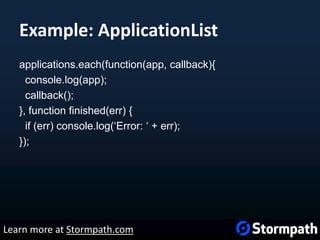
Example: ApplicationList
applications.each(function(app, callback){
console.log(app);
callback();
}, function finished(err) {
if (err) console.log(„Error: „ + err);
});
Learn more at Stormpath.com
Design!
Learn more at Stormpath.com
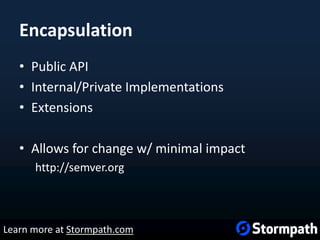
Encapsulation
• Public API
• Internal/Private Implementations
• Extensions
• Allows for change w/ minimal impact
http://semver.org
Learn more at Stormpath.com
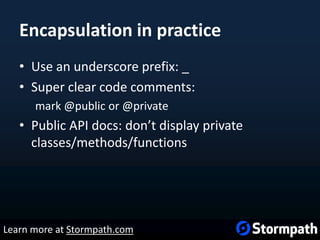
Encapsulation in practice
• Use an underscore prefix: _
• Super clear code comments:
mark @public or @private
• Public API docs: don’t display private
classes/methods/functions
Learn more at Stormpath.com
Public API
Learn more at Stormpath.com
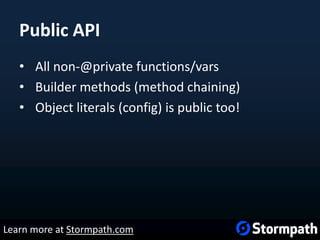
Public API
• All non-@private functions/vars
• Builder methods (method chaining)
• Object literals (config) is public too!
Learn more at Stormpath.com
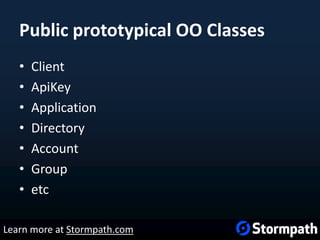
Public prototypical OO Classes
• Client
• ApiKey
• Application
• Directory
• Account
• Group
• etc
Learn more at Stormpath.com
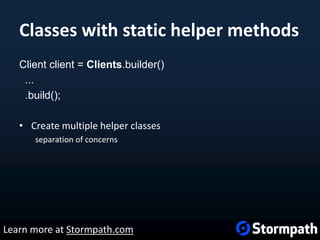
Classes with static helper methods
Client client = Clients.builder()
...
.build();
• Create multiple helper classes
separation of concerns
Learn more at Stormpath.com
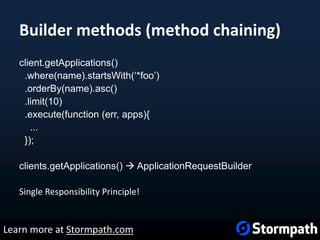
Builder methods (method chaining)
client.getApplications()
.where(name).startsWith(„*foo‟)
.orderBy(name).asc()
.limit(10)
.execute(function (err, apps){
...
});
clients.getApplications()  ApplicationRequestBuilder
Single Responsibility Principle!
Learn more at Stormpath.com
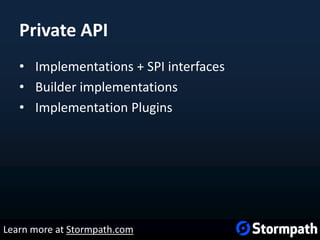
Private API
• Implementations + SPI interfaces
• Builder implementations
• Implementation Plugins
Learn more at Stormpath.com
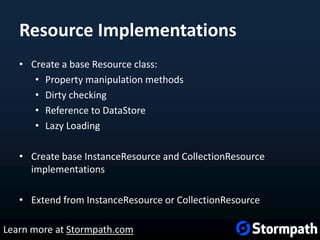
Resource Implementations
• Create a base Resource class:
• Property manipulation methods
• Dirty checking
• Reference to DataStore
• Lazy Loading
• Create base InstanceResource and CollectionResource
implementations
• Extend from InstanceResource or CollectionResource
Learn more at Stormpath.com
Resource
var utils = require(‟utils');
function Resource(data, dataStore) {
var DataStore = require('../ds/DataStore');
if (!dataStore && data instanceof DataStore){
dataStore = data;
data = null;
}
data = data || {};
for (var key in data) {
if (data.hasOwnProperty(key)) {
this[key] = data[key];
}
}
var ds = null; //private var, not enumerable
Object.defineProperty(this, 'dataStore', {
get: function getDataStore() {
return ds;
},
set: function setDataStore(dataStore) {
ds = dataStore;
}
});
if (dataStore) {
this.dataStore = dataStore;
}
}
utils.inherits(Resource, Object);
module.exports = Resource;
Learn more at Stormpath.com
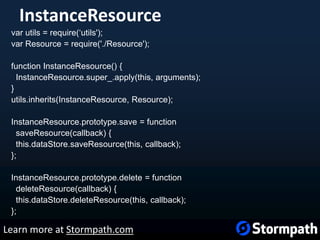
InstanceResource
var utils = require(„utils');
var Resource = require('./Resource');
function InstanceResource() {
InstanceResource.super_.apply(this, arguments);
}
utils.inherits(InstanceResource, Resource);
InstanceResource.prototype.save = function
saveResource(callback) {
this.dataStore.saveResource(this, callback);
};
InstanceResource.prototype.delete = function
deleteResource(callback) {
this.dataStore.deleteResource(this, callback);
};
Learn more at Stormpath.com
Application
var utils = require(„utils');
var InstanceResource = require('./InstanceResource');
function Application() {
Application.super_.apply(this, arguments);
}
utils.inherits(Application, InstanceResource);
Application.prototype.getAccounts = function
getApplicationAccounts(/* [options,] callback */) {
var self = this;
var args = Array.prototype.slice.call(arguments);
var callback = args.pop();
var options = (args.length > 0) ? args.shift() : null;
return self.dataStore.getResource(self.accounts.href, options,
require('./Account'), callback);
};
Learn more at Stormpath.com
Usage Paradigm
Learn more at Stormpath.com
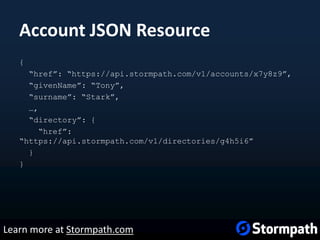
Account JSON Resource
{
“href”: “https://api.stormpath.com/v1/accounts/x7y8z9”,
“givenName”: “Tony”,
“surname”: “Stark”,
…,
“directory”: {
“href”:
“https://api.stormpath.com/v1/directories/g4h5i6”
}
}
Learn more at Stormpath.com
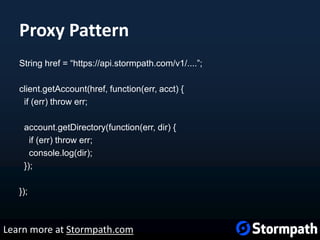
Proxy Pattern
String href = “https://api.stormpath.com/v1/....”;
client.getAccount(href, function(err, acct) {
if (err) throw err;
account.getDirectory(function(err, dir) {
if (err) throw err;
console.log(dir);
});
});
Learn more at Stormpath.com
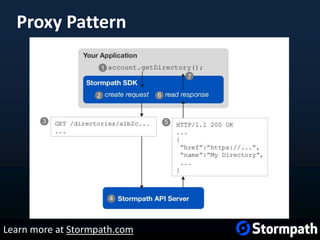
Proxy Pattern
Learn more at Stormpath.com
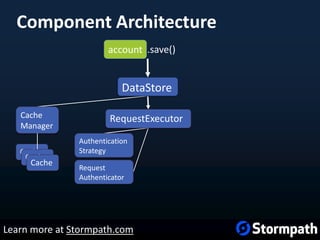
Component Architecture
Learn more at Stormpath.com
Component Architecture
account .save()
Learn more at Stormpath.com
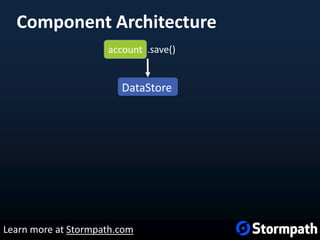
Component Architecture
account .save()
DataStore
Learn more at Stormpath.com
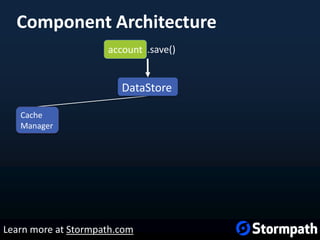
Component Architecture
account .save()
Cache
Manager
DataStore
Learn more at Stormpath.com
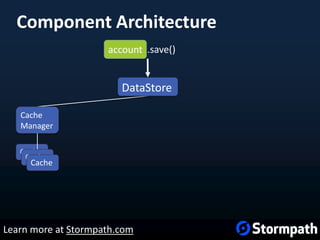
Component Architecture
account .save()
Cache
Manager
DataStore
Cache
Cache
Cache
Learn more at Stormpath.com
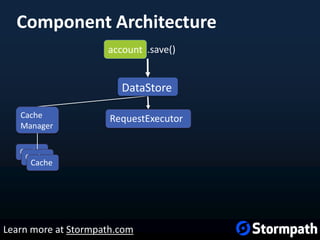
Component Architecture
account .save()
RequestExecutorCache
Manager
DataStore
Cache
Cache
Cache
Learn more at Stormpath.com
Component Architecture
account .save()
RequestExecutor
Authentication
Strategy
Cache
Manager
DataStore
Request
Authenticator
Cache
Cache
Cache
Learn more at Stormpath.com
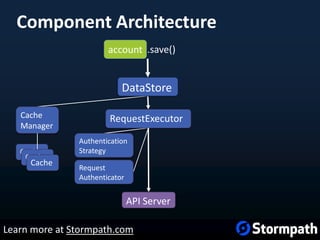
Component Architecture
account
API Server
.save()
RequestExecutor
Authentication
Strategy
Cache
Manager
DataStore
Request
Authenticator
Cache
Cache
Cache
Learn more at Stormpath.com
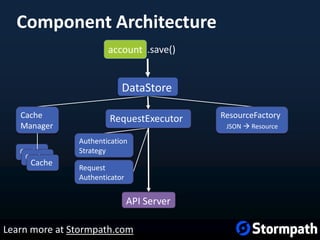
Component Architecture
account
API Server
.save()
RequestExecutor ResourceFactory
JSON  Resource
Authentication
Strategy
Cache
Manager
DataStore
Request
Authenticator
Cache
Cache
Cache
Learn more at Stormpath.com
Caching
Learn more at Stormpath.com
Caching
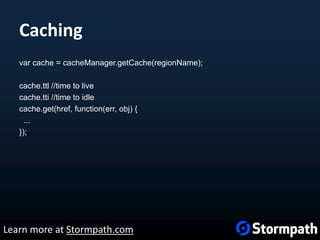
var cache = cacheManager.getCache(regionName);
cache.ttl //time to live
cache.tti //time to idle
cache.get(href, function(err, obj) {
...
});
Learn more at Stormpath.com
Caching
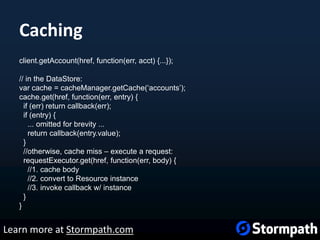
client.getAccount(href, function(err, acct) {...});
// in the DataStore:
var cache = cacheManager.getCache(„accounts‟);
cache.get(href, function(err, entry) {
if (err) return callback(err);
if (entry) {
... omitted for brevity ...
return callback(entry.value);
}
//otherwise, cache miss – execute a request:
requestExecutor.get(href, function(err, body) {
//1. cache body
//2. convert to Resource instance
//3. invoke callback w/ instance
}
}
Learn more at Stormpath.com
Queries
Learn more at Stormpath.com
Queries
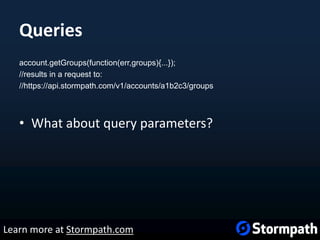
account.getGroups(function(err,groups){...});
//results in a request to:
//https://api.stormpath.com/v1/accounts/a1b2c3/groups
• What about query parameters?
Learn more at Stormpath.com
Queries
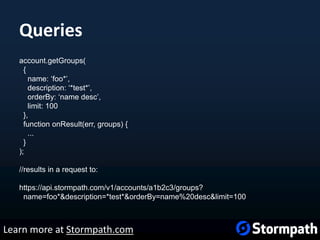
account.getGroups(
{
name: „foo*‟,
description: „*test*‟,
orderBy: „name desc‟,
limit: 100
},
function onResult(err, groups) {
...
}
);
//results in a request to:
https://api.stormpath.com/v1/accounts/a1b2c3/groups?
name=foo*&description=*test*&orderBy=name%20desc&limit=100
Learn more at Stormpath.com
Queries
Use a Fluent API!
Learn more at Stormpath.com
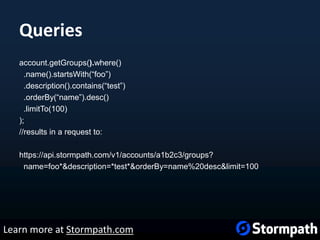
Queries
account.getGroups().where()
.name().startsWith(“foo”)
.description().contains(“test”)
.orderBy(“name”).desc()
.limitTo(100)
);
//results in a request to:
https://api.stormpath.com/v1/accounts/a1b2c3/groups?
name=foo*&description=*test*&orderBy=name%20desc&limit=100
Learn more at Stormpath.com
Authentication
Learn more at Stormpath.com
Authentication
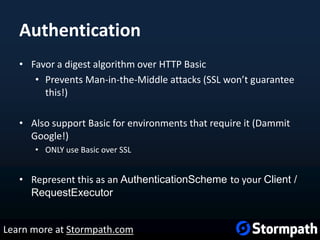
• Favor a digest algorithm over HTTP Basic
• Prevents Man-in-the-Middle attacks (SSL won’t guarantee
this!)
• Also support Basic for environments that require it (Dammit
Google!)
• ONLY use Basic over SSL
• Represent this as an AuthenticationScheme to your Client /
RequestExecutor
Learn more at Stormpath.com
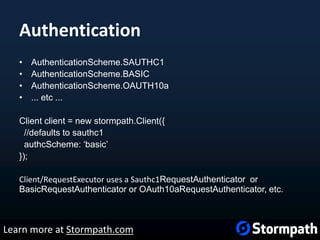
Authentication
• AuthenticationScheme.SAUTHC1
• AuthenticationScheme.BASIC
• AuthenticationScheme.OAUTH10a
• ... etc ...
Client client = new stormpath.Client({
//defaults to sauthc1
authcScheme: „basic‟
});
Client/RequestExecutor uses a Sauthc1RequestAuthenticator or
BasicRequestAuthenticator or OAuth10aRequestAuthenticator, etc.
Learn more at Stormpath.com
Plugins
Learn more at Stormpath.com
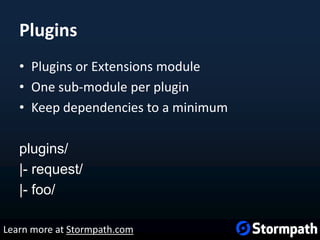
Plugins
• Plugins or Extensions module
• One sub-module per plugin
• Keep dependencies to a minimum
plugins/
|- request/
|- foo/
Learn more at Stormpath.com
Lessons Learned
Learn more at Stormpath.com
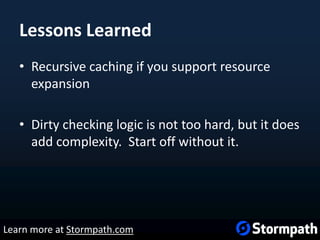
Lessons Learned
• Recursive caching if you support resource
expansion
• Dirty checking logic is not too hard, but it does
add complexity. Start off without it.
Learn more at Stormpath.com
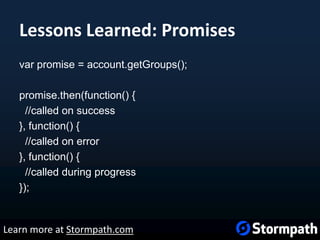
Lessons Learned: Promises
var promise = account.getGroups();
promise.then(function() {
//called on success
}, function() {
//called on error
}, function() {
//called during progress
});
Learn more at Stormpath.com
Lessons Learned: async.js
async.waterfall([
function(callback){
callback(null, 'one', 'two');
},
function(arg1, arg2, callback){
// arg1 now equals 'one' and arg2 now equals 'two'
callback(null, 'three');
},
function(arg1, callback){
// arg1 now equals 'three'
callback(null, 'done');
}
], function (err, result) {
// result now equals 'done'
});
Learn more at Stormpath.com
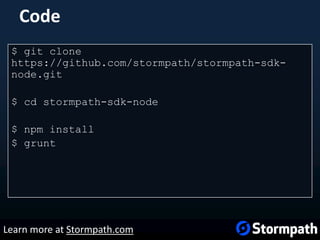
Code
$ git clone
https://github.com/stormpath/stormpath-sdk-
node.git
$ cd stormpath-sdk-node
$ npm install
$ grunt
Learn more at Stormpath.com
Thank You!
• les@stormpath.com
• Twitter: @lhazlewood
• http://www.stormpath.com
Learn more at Stormpath.com

Build a Node.js Client for Your REST+JSON API