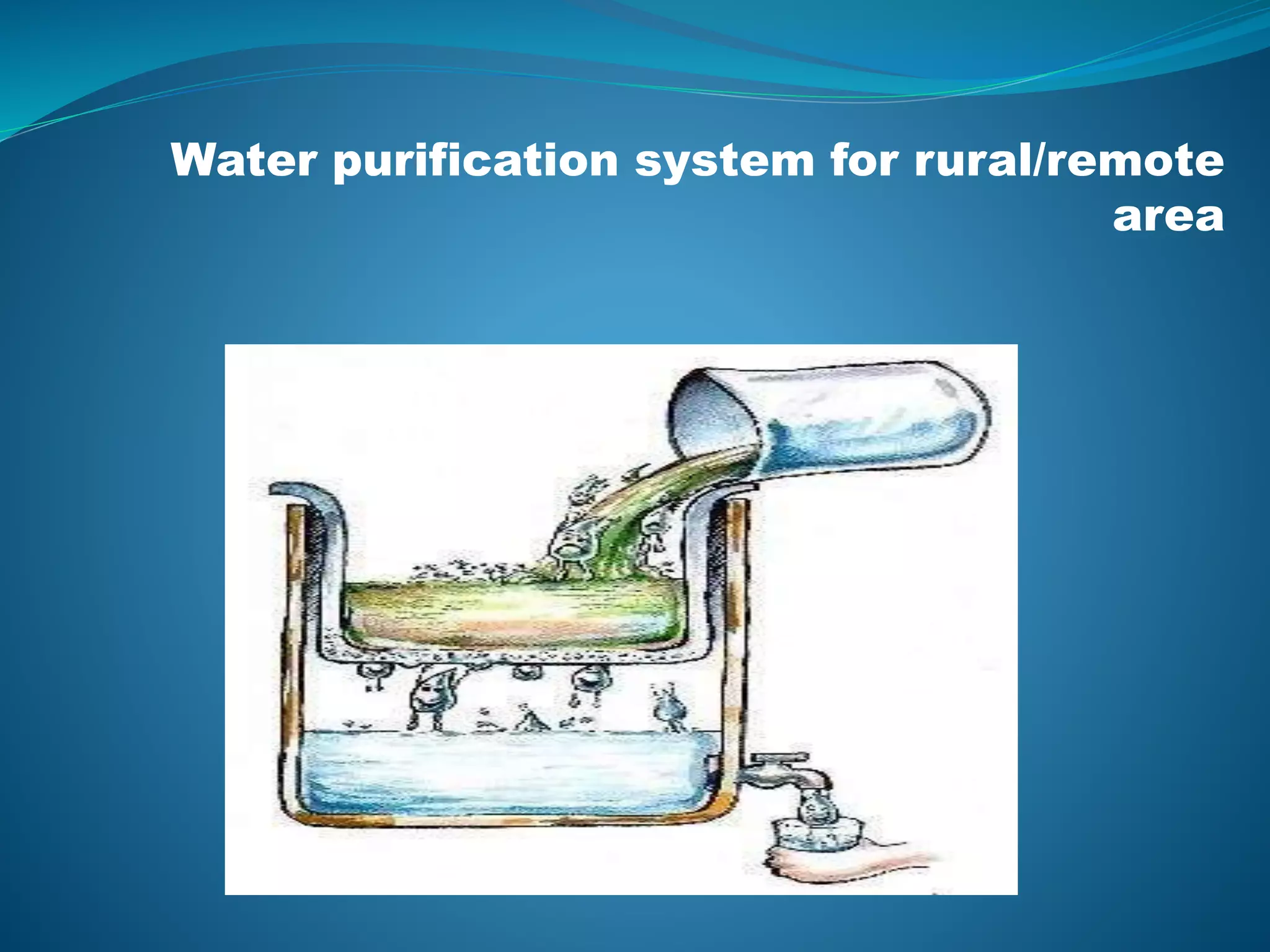
Water purification system for rural/remote
area
KANHAIYA KUMAR
AYUSH
5th sem mechanical branch
(INSTITUTE OF TECHNOLOGY GURU GHASIDAS VISHWAVIDYALAYA ,
BILASPUR, CHHATISGARH)
Abstract
 Water purification is a process of removing undesirable chemicals,
biological contaminated, suspended solids and gases from contaminated
water.propose water purification system for remote area focus on providing
a pure drinking water at low cost with high reliability to the rural
families.It involves the research, design and manufacture of water
purification system using renewable energy.It consist a combination of
natural substances ( moringo seed, papaya seed, tulsi leaves, neem leaves,
sugarcane bagase, rice husk).It is an effective method to deactive bacteria,
viruses and protozoan in contaminated water. This method can be made
portable, cost effective, user compliant and energy efficient enough to
meet the drinking water needs.Experimentation is carried out for testing
six different water samples.Water samples selected are tap water, well
water,river water, lake water, muddy water and colour water.All water are
analyzed and tested in a laboratory for different range. This paper will be
helpful for those who are working in the area of water purification system
and their use in remote area.
 KEYWORD: Moringo seed, tulsi leaves , neem leaves.
PROBLEM STATEMENT
 TO DEVELOPE WATER PURIFICATION SYSTEM
FOR RURAL/REMOTE AREA USING NATURAL
METHOD
INTRODUCTION
 Water is the most common liquid on the earth pure
drinking water is necessary for human survival.The water
supply for drinking water is either ground or surface water.
The water from each source contains sediments and other
solids.Many different process are used to obtain the finised
product of clean water.In remote villages in india, there is
lack of of developed infrastructure due to poor economic
situation. These remote area do not have pure drinking
water,electrical power etc. It is necessary to provide pure
drinking water at low cost with high reliability. To
accomplish this objective impurities such as sediments
must be remove and bacteria must be killied along other
microorganism.
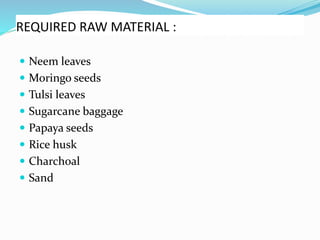
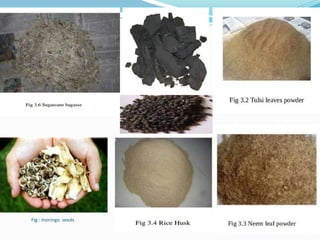
REQUIRED RAW MATERIAL :
 Neem leaves
 Moringo seeds
 Tulsi leaves
 Sugarcane baggage
 Papaya seeds
 Rice husk
 Charchoal
 Sand
Fig : moringo seeds
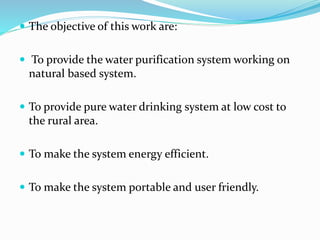
 The objective of this work are:
 To provide the water purification system working on
natural based system.
 To provide pure water drinking system at low cost to
the rural area.
 To make the system energy efficient.
 To make the system portable and user friendly.
EXPERIMENTAL SETUP AND
PROCEDURE
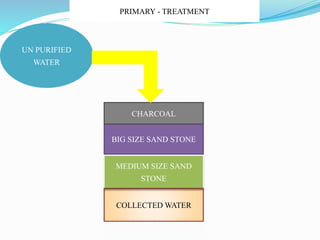
PRIMARY - TREATMENT
UN PURIFIED
WATER
BIG SIZE SAND STONE
MEDIUM SIZE SAND
STONE
COLLECTED WATER
CHARCOAL
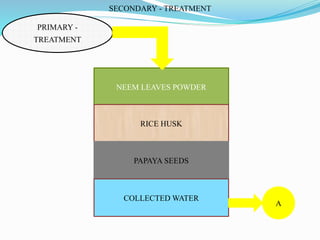
NEEM LEAVES POWDER
RICE HUSK
PAPAYA SEEDS
COLLECTED WATER
PRIMARY -
TREATMENT
SECONDARY - TREATMENT
A
MORINGA SEEDS POWDER
MORINGA SEEDS
POWDER
COLLECTED WATER
TULSHI LEAVES POWDER
A
B
B
sugarcane baggage
Pure Water
DESCRICPTION:
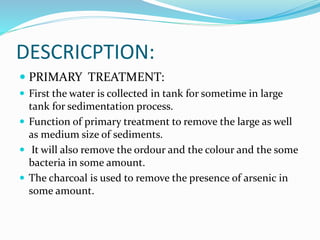
 PRIMARY TREATMENT:
 First the water is collected in tank for sometime in large
tank for sedimentation process.
 Function of primary treatment to remove the large as well
as medium size of sediments.
 It will also remove the ordour and the colour and the some
bacteria in some amount.
 The charcoal is used to remove the presence of arsenic in
some amount.
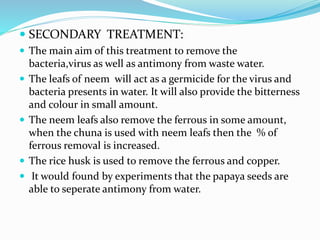
 SECONDARY TREATMENT:
 The main aim of this treatment to remove the
bacteria,virus as well as antimony from waste water.
 The leafs of neem will act as a germicide for the virus and
bacteria presents in water. It will also provide the bitterness
and colour in small amount.
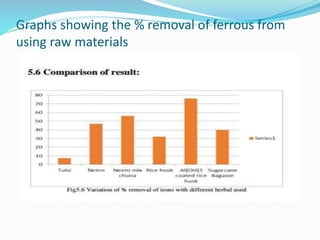
 The neem leafs also remove the ferrous in some amount,
when the chuna is used with neem leafs then the % of
ferrous removal is increased.
 The rice husk is used to remove the ferrous and copper.
 It would found by experiments that the papaya seeds are
able to seperate antimony from water.
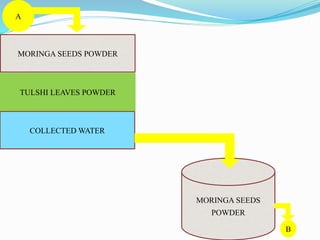
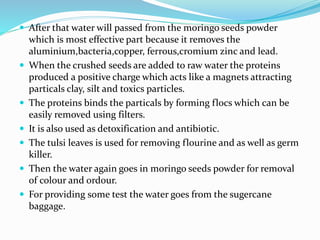
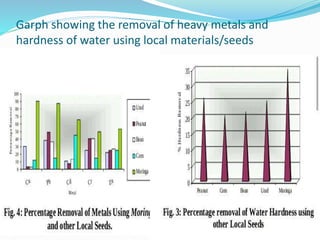
 After that water will passed from the moringo seeds powder
which is most effective part because it removes the
aluminium,bacteria,copper, ferrous,cromium zinc and lead.
 When the crushed seeds are added to raw water the proteins
produced a positive charge which acts like a magnets attracting
particals clay, silt and toxics particles.
 The proteins binds the particals by forming flocs which can be
easily removed using filters.
 It is also used as detoxification and antibiotic.
 The tulsi leaves is used for removing flourine and as well as germ
killer.
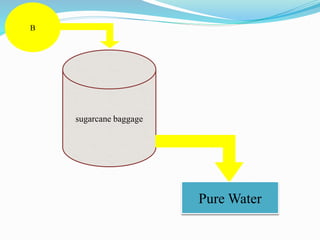
 Then the water again goes in moringo seeds powder for removal
of colour and ordour.
 For providing some test the water goes from the sugercane
baggage.
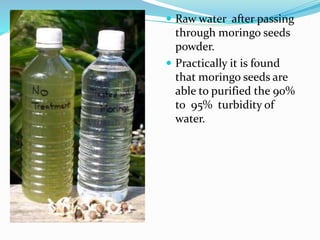
 Raw water after passing
through moringo seeds
powder.
 Practically it is found
that moringo seeds are
able to purified the 90%
to 95% turbidity of
water.
Graphs showing the % removal of ferrous from
using raw materials
Garph showing the removal of heavy metals and
hardness of water using local materials/seeds
 ADVANTAGES OF THIS METHOD:
 The process is very economical.
 The raw material is easily available in India at low cost.
 The process is based on natural things.
 The moringo trees and sugarcane also provide methane
which is used as bio-gas.
 The method also promotes the plantation of trees which
have great profits for us.
 The waste product is reusable and at last we can use it as
manure.
 The water we get at last is herbal and good for health.
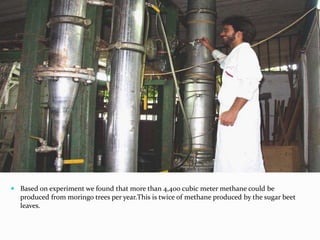
 Based on experiment we found that more than 4,400 cubic meter methane could be
produced from moringo trees per year.This is twice of methane produced by the sugar beet
leaves.
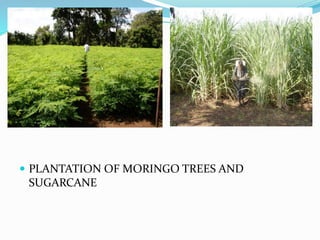
 PLANTATION OF MORINGO TREES AND
SUGARCANE
 DISADVANTAGES:
 The process is time taking.
 Depend on availability of raw materials.

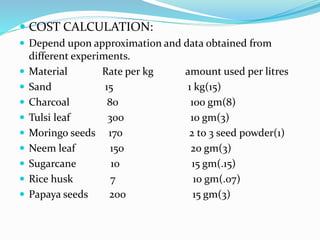
 COST CALCULATION:
 Depend upon approximation and data obtained from
different experiments.
 Material Rate per kg amount used per litres
 Sand 15 1 kg(15)
 Charcoal 80 100 gm(8)
 Tulsi leaf 300 10 gm(3)
 Moringo seeds 170 2 to 3 seed powder(1)
 Neem leaf 150 20 gm(3)
 Sugarcane 10 15 gm(.15)
 Rice husk 7 10 gm(.07)
 Papaya seeds 200 15 gm(3)
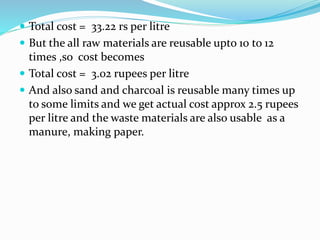
 Total cost = 33.22 rs per litre
 But the all raw materials are reusable upto 10 to 12
times ,so cost becomes
 Total cost = 3.02 rupees per litre
 And also sand and charcoal is reusable many times up
to some limits and we get actual cost approx 2.5 rupees
per litre and the waste materials are also usable as a
manure, making paper.
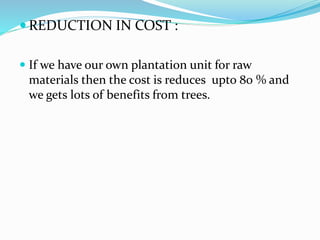
 REDUCTION IN COST :
 If we have our own plantation unit for raw
materials then the cost is reduces upto 80 % and
we gets lots of benefits from trees.
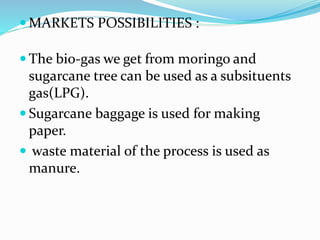
 MARKETS POSSIBILITIES :
 The bio-gas we get from moringo and
sugarcane tree can be used as a subsituents
gas(LPG).
 Sugarcane baggage is used for making
paper.
 waste material of the process is used as
manure.
THANKYOU

To develop a water purification system especially designed

  • 1.
    Water purification systemfor rural/remote area
  • 2.
    KANHAIYA KUMAR AYUSH 5th semmechanical branch (INSTITUTE OF TECHNOLOGY GURU GHASIDAS VISHWAVIDYALAYA , BILASPUR, CHHATISGARH)
  • 3.
    Abstract  Water purificationis a process of removing undesirable chemicals, biological contaminated, suspended solids and gases from contaminated water.propose water purification system for remote area focus on providing a pure drinking water at low cost with high reliability to the rural families.It involves the research, design and manufacture of water purification system using renewable energy.It consist a combination of natural substances ( moringo seed, papaya seed, tulsi leaves, neem leaves, sugarcane bagase, rice husk).It is an effective method to deactive bacteria, viruses and protozoan in contaminated water. This method can be made portable, cost effective, user compliant and energy efficient enough to meet the drinking water needs.Experimentation is carried out for testing six different water samples.Water samples selected are tap water, well water,river water, lake water, muddy water and colour water.All water are analyzed and tested in a laboratory for different range. This paper will be helpful for those who are working in the area of water purification system and their use in remote area.  KEYWORD: Moringo seed, tulsi leaves , neem leaves.
  • 4.
    PROBLEM STATEMENT  TODEVELOPE WATER PURIFICATION SYSTEM FOR RURAL/REMOTE AREA USING NATURAL METHOD
  • 5.
    INTRODUCTION  Water isthe most common liquid on the earth pure drinking water is necessary for human survival.The water supply for drinking water is either ground or surface water. The water from each source contains sediments and other solids.Many different process are used to obtain the finised product of clean water.In remote villages in india, there is lack of of developed infrastructure due to poor economic situation. These remote area do not have pure drinking water,electrical power etc. It is necessary to provide pure drinking water at low cost with high reliability. To accomplish this objective impurities such as sediments must be remove and bacteria must be killied along other microorganism.
  • 6.
    REQUIRED RAW MATERIAL:  Neem leaves  Moringo seeds  Tulsi leaves  Sugarcane baggage  Papaya seeds  Rice husk  Charchoal  Sand
  • 7.
  • 8.
     The objectiveof this work are:  To provide the water purification system working on natural based system.  To provide pure water drinking system at low cost to the rural area.  To make the system energy efficient.  To make the system portable and user friendly.
  • 9.
  • 10.
    PRIMARY - TREATMENT UNPURIFIED WATER BIG SIZE SAND STONE MEDIUM SIZE SAND STONE COLLECTED WATER CHARCOAL
  • 11.
    NEEM LEAVES POWDER RICEHUSK PAPAYA SEEDS COLLECTED WATER PRIMARY - TREATMENT SECONDARY - TREATMENT A
  • 12.
    MORINGA SEEDS POWDER MORINGASEEDS POWDER COLLECTED WATER TULSHI LEAVES POWDER A B
  • 13.
  • 14.
    DESCRICPTION:  PRIMARY TREATMENT: First the water is collected in tank for sometime in large tank for sedimentation process.  Function of primary treatment to remove the large as well as medium size of sediments.  It will also remove the ordour and the colour and the some bacteria in some amount.  The charcoal is used to remove the presence of arsenic in some amount.
  • 15.
     SECONDARY TREATMENT: The main aim of this treatment to remove the bacteria,virus as well as antimony from waste water.  The leafs of neem will act as a germicide for the virus and bacteria presents in water. It will also provide the bitterness and colour in small amount.  The neem leafs also remove the ferrous in some amount, when the chuna is used with neem leafs then the % of ferrous removal is increased.  The rice husk is used to remove the ferrous and copper.  It would found by experiments that the papaya seeds are able to seperate antimony from water.
  • 16.
     After thatwater will passed from the moringo seeds powder which is most effective part because it removes the aluminium,bacteria,copper, ferrous,cromium zinc and lead.  When the crushed seeds are added to raw water the proteins produced a positive charge which acts like a magnets attracting particals clay, silt and toxics particles.  The proteins binds the particals by forming flocs which can be easily removed using filters.  It is also used as detoxification and antibiotic.  The tulsi leaves is used for removing flourine and as well as germ killer.  Then the water again goes in moringo seeds powder for removal of colour and ordour.  For providing some test the water goes from the sugercane baggage.
  • 17.
     Raw waterafter passing through moringo seeds powder.  Practically it is found that moringo seeds are able to purified the 90% to 95% turbidity of water.
  • 18.
    Graphs showing the% removal of ferrous from using raw materials
  • 19.
    Garph showing theremoval of heavy metals and hardness of water using local materials/seeds
  • 20.
     ADVANTAGES OFTHIS METHOD:  The process is very economical.  The raw material is easily available in India at low cost.  The process is based on natural things.  The moringo trees and sugarcane also provide methane which is used as bio-gas.  The method also promotes the plantation of trees which have great profits for us.  The waste product is reusable and at last we can use it as manure.  The water we get at last is herbal and good for health.
  • 21.
     Based onexperiment we found that more than 4,400 cubic meter methane could be produced from moringo trees per year.This is twice of methane produced by the sugar beet leaves.
  • 22.
     PLANTATION OFMORINGO TREES AND SUGARCANE
  • 23.
     DISADVANTAGES:  Theprocess is time taking.  Depend on availability of raw materials.
  • 24.
     COST CALCULATION: Depend upon approximation and data obtained from different experiments.  Material Rate per kg amount used per litres  Sand 15 1 kg(15)  Charcoal 80 100 gm(8)  Tulsi leaf 300 10 gm(3)  Moringo seeds 170 2 to 3 seed powder(1)  Neem leaf 150 20 gm(3)  Sugarcane 10 15 gm(.15)  Rice husk 7 10 gm(.07)  Papaya seeds 200 15 gm(3)
  • 25.
     Total cost= 33.22 rs per litre  But the all raw materials are reusable upto 10 to 12 times ,so cost becomes  Total cost = 3.02 rupees per litre  And also sand and charcoal is reusable many times up to some limits and we get actual cost approx 2.5 rupees per litre and the waste materials are also usable as a manure, making paper.
  • 26.
     REDUCTION INCOST :  If we have our own plantation unit for raw materials then the cost is reduces upto 80 % and we gets lots of benefits from trees.
  • 27.
     MARKETS POSSIBILITIES:  The bio-gas we get from moringo and sugarcane tree can be used as a subsituents gas(LPG).  Sugarcane baggage is used for making paper.  waste material of the process is used as manure.
  • 28.