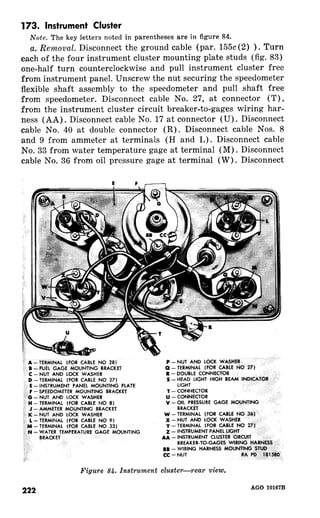
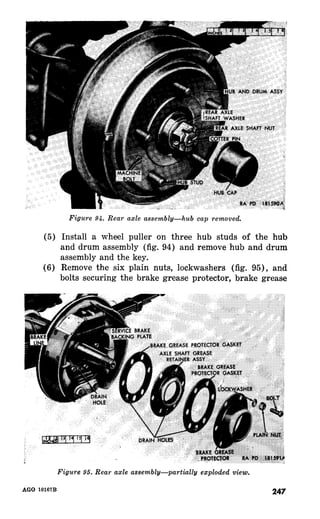
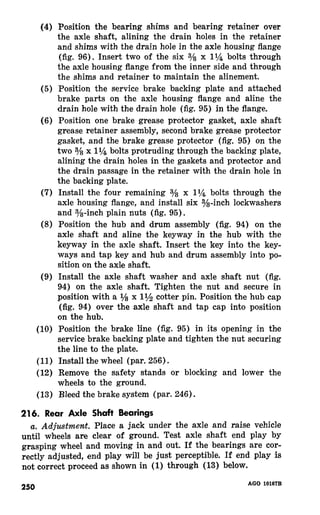
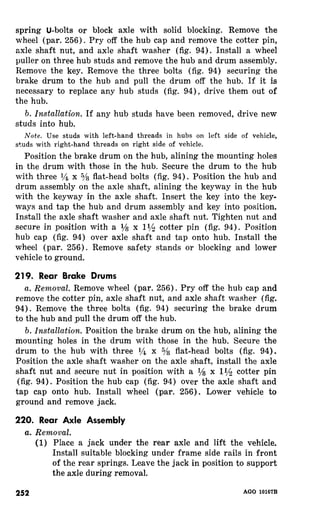
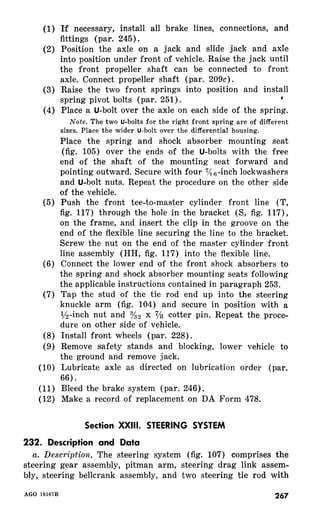
DEPARTMENTS OF THE ARMY AND 
No. 9-6012 THE AIR FORCE 
No. 96A6%41 
CHAPrER 
“h-TON 4 X 4 UTILITY TRUCK 
ParcrgroPPbw e 
major item. 
P
_ 
INDeL-- ____-_--_-___--_____---~~~ ____--__--____-__--_~~
These instructions are published for the use of personnel to 
whom this materiel is issued. They contain information on the 
operation and organizational maintenance of the materiel as well 
as descriptions of major units and their functions in relation to 
other components of the materiel. 
b. The appendix contains a list of current references, including 
supply manuals, forms, technical manuals, and other available 
publications applicable to the materiel. 
c. This manual differs from TM 9-804, September 1950, as 
indicated in (1)) (2)) and (3) below. 
(1) Adds information on- 
(a) 
(b) 
Cc) 
Cd) 
(e) 
(f) 
(9) 
(h) 
(9 
W 
Plate showing “OFF” and “ON” positions under ig-nition 
switch, beginning with vehicle serial No. 26273. 
A changed submersible starter mounting, beginning 
with vehicle serial No. 53262. 
A submersible generator, beginning with vehicle serial 
No. 53262. 
A sealed or pressurized bell housing, beginning with 
vehicle serial No. 53262. 
A waterproof clutch linkage, beginning with vehicle 
serial No. 53262. 
A l/s-inch hole in crankshaft pulley for timing pur-poses, 
beginning with vehicle serial No. 22296. 
Vent lines to bell housing, transfer case and trans-mission 
case, beginning with vehicle serial No. 53262. 
Decalcomania above deep water fording vent valve 
control, for locating bell housing drain plug and ford-ing 
information, beginning with vehicle serial No. 
53262. 
New engine rear plate for use with the changed starter 
mounting, beginning with vehicle serial No. 78513. 
Decalcomania on fuel tank cap, beginning with vehicle 
serial No. 14693. 
3
the supporting ordnance maintenance unit should be informed 
in order that trained personnel with suitable tools and equipment 
may be provided or other proper instructions issued, 
Note. The replacement of certain assemblies, that is, engine, transmission, 
transfer, and power-take-off assemblies, winch assembly, front axle, rear 
axle, and steering gear is normally an ordnance maintenance operation, but 
may be performed in an emergency by the using organization, provided 
approval for performing these replacements is obtained from the support-ing 
ordnance officer. A replacement assembly, any tools needed for the op-eration 
which are not carried by the using organization, any necessary 
special instructions regarding associated accessories, etc., may be obtained 
from the supporting organizational maintenance unit. 
General. Responsibility for the proper execution of forms, 
records, and reports rests upon the officers of all units maintain-ing 
this equipment. However, the value of accurate records must 
be fully appreciated by all persons responsible for their compila-tion, 
maintenance, and use. Records, reports, and authorized 
forms are normally utilized to indicate the type, quantity, and 
condition of materiel to be inspected, to be repaired, or to be used 
in repair. Properly executed forms convey authorization and 
serve as records for repair or replacement of materiel in the 
hands of troops and for delivery of materiel requiring further 
repair to ordnance shops in arsenals, depots, etc. The forms, 
records, and reports establish the work required, the progress of 
the work within the shops, and the status of the materiel upon 
completion of its repair. 
b. Authorized Forms. The forms generally applicable to units 
operating and maintaining these vehicles are listed in the ap-pendix. 
No forms other than those approved for the Department 
of the Army will be used. For a complete listing of all forms, 
see DA Pam 310-Z 
c. Field Report of Accidents. The reports necessary to comply 
with the requirements of the Army safety program are pre-scribed 
in detail in the SR 385-1040 series of special regulations. 
These reports are required whenever accidents involving injury 
to personnel or damage to materiel occur. 
d. Report of Unsatisfactory Equipment or Materials. Any sug-gestions 
for improvement in design and maintenance of equip-ment 
and spare parts, safety and efficiency of operation, or 
pertaining to the application of prescribed petroleum fuels, lubri-cants, 
and/or preserving materials or technical inaccuracies noted 
in Department of Army Publications, will be reported through 
technical channels, as prescribed in AR 700-38, to the Chief of 
AGO 10167B 5
Ordnance, Washington 25, DC, ATTN: ORDFM, using DA Form 
468, Unsatisfactory Equipment Report. Such suggestions are en-couraged 
in order that other organizations may benefit. 
Note. Do not report all failures that occur. Report only REPEATED or 
RECURRENT failures or malfunctions which indicate unsatisfactory de-sign 
or material. However, reports will always be made in the event that 
exceptionally costly equipment is involved. See also AR 700-38 and printed 
instructions on DA Form 468. 
Section II. DESCRIPTION AND DATA 
4. Description 
CL. General. The $&-ton 4 x 4 utility truck M38 is equipped with 
one front axle and one rear axle, with four driving wheels. The 
design of this vehicle locates the four-cylinder gasoline engine 
forward of the driving compartment, under the hood, and pro-vides 
a four-passenger, open-type body. The body may be inclosed 
with removable canvas top, side curtains, and doors which are 
held in place and supported by suitable metal rods, braces, and 
canvas straps. The vehicle is used as a general purpose personnel 
or cargo carrier especially designed for adaptation to general 
reconnaissance, command, communications, or other special duties. 
The windshield can be folded forward to lie flat on the hood for 
low silhouette and forward firing. The spare wheel and tire are 
mounted on the rear of the body. Suitable brackets and com-partments 
are incorporated in and on the body for carrying 
equipment. The frame is equipped with a towing pintle at the 
rear and lifting shackles at the front and rear to permit towing 
or lifting the vehicle. General physical characteristics of the 
vehicle are shown in figures 1, 2, and 3. The terms “right,” “left,” 
“front,” and “rear” are established with reference to the operator 
sitting in the driver’s seat. “Right” indicates the side to the right 
of the operator. “Left” indicates the side to the left of the opera-tor. 
“Front” indicates the radiator end of the vehicle. “Rear” 
indicates the end opposite the radiator. 
b. Power for the vehicle is supplied by an L-head, four-cylinder 
gasoline engine, mounted at three points on cushion 
mounts on the frame. The engine, with accessories, is accessible 
when the hood is in the raised position. 
c. The conventional three-speed, selective-gear 
transmission is mounted directly to the rear of the engine and 
clutch assemblies. The transmission has three forward and one 
reverse speeds as indicated on the shifting instruction plate (fig. 
4). These speeds are manually selected by the driver by means 
of the transmission gearshift lever. The lever is mounted on top 
4 AGO 10167B
Figure 1. X-ton 4 CT 4 utility truck M38-left front view-top up.
00
ro %-ton 4 1: 4 utility
of the transmission and extends into the driver’s compartment. 
d. To supplement the gear ratio of the transmission, 
a two-speed transfer is mounted on the rear of the transmission. 
The transfer provides additional gear reduction for negotiating 
difficult terrain, a power-take-off for the winch, and a means of 
transmitting power to the front axle. The transfer is manually 
operated by the driver through a set of transfer gearshift levers 
on top of the transfer. The levers extend into the driving com-partment 
to the right of the transmission gearshift lever. 
e. The front axle is a full-floating, 
single-reduction-type with hypoid drive gears. Incorporated in 
the front axle are constant velocity-type universal joints at the 
steering knuckles. A propeller shaft provides a connection from 
the front axle to the transfer for the transmission of power. 
Power through the transfer is controlled by a transfer gearshift 
lever in the driving compartment. Suspension of the front axle 
consists of two semielliptic springs, shackled to the frame at the 
front of the spring, secured to the frame at the rear of the spring 
by pivot bolts, and attached to the front axle by U-bolts. 
f. The rear axle is a semifloating, 
single-reduction-type with hypoid drive gears. The rear axle is 
connected to the transfer by a propeller shaft for the transmis-sion 
of power. Suspension of the rear axle consists of two semi-elliptic 
springs shackled to the frame at the rear of the spring, 
secured to the frame at the front of the spring by pivot bolts, 
and attached to the rear axle by U-bolts. 
g. The service brakes are actuated hydraulically 
using full-floating brake shoes. Service brakes are on all four 
wheels and are operated by the brake pedal in the driving com-partment. 
The hand brake is a mechanical brake at the rear of 
the transfer and is operated by pulling the hand brake handle 
outward from the instrument panel. A ratchet holds the handle 
in a locked position which can ‘be released by a quarter turn in 
either direction. 
h. The electrical system furnishes current 
for ignition, lights, sending units, etcetera. Current is gener-ated 
by a 24-volt, belt-driven generator, and stored in two 12-volt 
storage batteries connected in series. 
5. Name, Data, Caution, and Instruction Plates 
(1) The vehicle identi-fication 
plate is located on the instrument panel at the 
right of the instrument cluster. The plate includes ve- 
10 AGO 10167B
hicle name, serial number, manufacturer’s name, ord-nance 
stock number, part number, model number, con-tract 
number, and year manufactured. 
(2) The 
vehicle servicing data instruction plate is located on the 
instrument panel at the right of the instrument cluster. 
This plate includes servicing information of the electrical 
system, fuel octane, tire inflation pressures, engine, gear 
oil, chassis grease, and instructions for cooling system. 
If data plate specifies gear oil (GO) grade 90 for tem-peratures 
of +40” to -10” F., it should be changed to 
grade 75. Tire pressure for highway driving should be 
changed from 28 to 25 pounds. 
(3) The responsible agency 
plate is located on the instrument panel at the right of 
the instrument cluster. The plate gives a list of the agen-cies 
responsible for maintenance of various parts of 
the vehicle. 
(4) The vehicle ship-ping 
data plate is located on the instrument panel at the 
right of the instrument cluster. The plate provides in-formation 
on vehicle dimensions, weights, and maximum 
towed load. 
(5) 
The distributor and ignition coil assem-bly 
name and data plate is located on the right side of 
distributor and ignition coil assembly. The plate includes 
manufacturer’s name, model number, and voltage data. 
(6) The starter name 
and data plate is located on the left side of the starter. 
The plate includes the voltage, direction of rotation, 
ordnance part number, manufacturer’s name, serial, and 
model numbers. 
(7) The generator 
name and data plate is located on the right side of the 
generator. The plate includes the ordnance part number, 
voltage, amperage, manufacturer’s name, serial, and 
model numbers. 
(8) The generator 
regulator data plate is located on the left side of the 
generator regulator base. The plate gives data on volt-age 
rating, capacity and serial, model, and ordnance 
numbers. 
AGO 10167B 11
Figure 1. Vehicle name, data, caution, and instruction plates.
(9) The 
name, patent, and serial number plate is located on the 
inside of the body on the front of right rear wheel 
fender well. 
Figure 5. Instruction decalcomania and data plates. 
(1) The engine serial number 
is stamped on the engine cylinder block behind the water 
pump and below the thermostat housing at the front 
of the engine. 
13
Figure 6. Data plates and engine serial number location. 
(2) 
(3) 
(4) 
(5) 
(6) 
14 
The manufacturer’s serial number is stamped at the top 
right corner of the transmission case. The name and 
model number are cast into the right rear side of the 
transmission case. 
The manu-facturer’s 
serial number (fig. 32) is stamped on top of 
the front flange on the left side of the transfer case. 
The name and model number are cast into the rear 
of the transfer case (fig. 90). 
The 
carburetor name and model number are cast into the 
carburetor float bowl. 
The generator regulator name 
is stamped on the top of the generator regulator cover. 
This plate 
is held by two of the screws securing the steering 
knuckle oil seal assembly, and identifies the type of joint 
used in the front axle. 
AGO
(1) The vehicle 
road speed caution plate is located on the instrument 
panel at the right of the instrument cluster. This plate 
gives information on permissible speeds for- various 
selected gear positions. 
(2) A warning is stamped on 
the top of tthe generator regulator cover. This warning 
instructs operator to disconnect the battery ground cable 
before attempting to remove generator or generator 
regulator. 
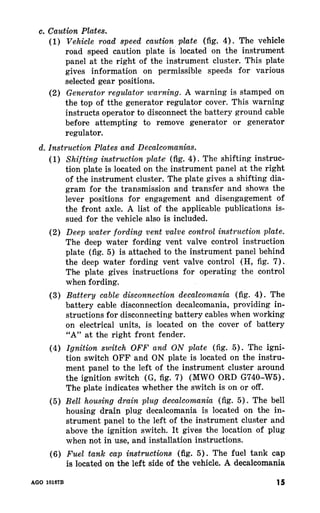
(1) The shifting instruc-tion 
plate is located on the instrument panel at the right 
of the instrument cluster. The plate gives a shifting dia-gram 
for the transmission and transfer and shows the 
lever positions for engagement and disengagement of 
the front axle. A list of the applicable publications is-sued 
for the vehicle also is included. 
(2) 
The deep water fording vent valve control instruction 
plate (fig. 5) is attached to the instrument panel behind 
the deep water fording vent valve control (H, fig. 7). 
The plate gives instructions for operating the control 
when fording. 
(3) The 
battery cable disconnection decalcomania, providing in-structions 
for disconnecting battery cables when working 
on electrical units, is located on the cover of battery 
“A” at the right front fender. 
(4) The igni-tion 
switch OFF and ON plate is located on the instru-ment 
panel to the left of the instrument cluster around 
the ignition switch (G, fig. 7) (MWO ORD G740-W5). 
The plate indicates whether the switch is on or off. 
(5) The bell 
housing drain plug decalcomania is located on the in-strument 
panel to the left of the instrument cluster and 
above the ignition switch. It gives the location of plug 
when not in use, and installation instructions. 
(6) The fuel tank cap 
is located on the left side of the vehicle. A decalcomania 
AGO 10167B 15
on early production v+icles and a stamping in late pro-duction 
vehicle caps warns that the tank is pressurized 
and the cap must be removed slowly. See paragraph 127 
for description of fuel tank cap. 
Capacities : 
Cooling system _~_ ~_________I________________ lllh qt 
Crankcase (refill) ~_-.___.________________-~~__ 4 qt 
Differentials (ea) __~___________________.._____ 2% pt 
Fuel tanks ___~~____~~____~____~__~~_~~_~~~_~~- 13 gal 
Transfer case ______________~~__. _______~___..__ 
Transmission .._____________________~_______--- 
3 Pt 
2 Pt 
Winch _____~__________________~-~__---------- 2 Pt 
Crew _____________~__~_____-~______________--____--- 2 
Cylinders (in line) ______~__.._____~~~~~______----- 4 
Dimensions : 
Height (top up) _..~_________~~___~___~___-_--- 74 in. 
Height (top down) ~__~~_______~~_~~_~~________ 68 in. 
Length _____~_~~~~______________-_..-_--_---_-~ 133 in. 
Width ____~___~~__~_~____________~~~__-~_---- 62 in. 
Electrical system ____ ~_~~_~~~~~__~~~_~~________..___ 24 v 
Engine ___________~_~~~~____~____-_____-~__~-~---~ Model MC 
Ground clearance (min) (rear axle) __..________~____ 9% in. 
Loading height (empty) (top down) __~___~_____~~__ 44 in. 
Number of batteries ______~_____________~_--~~----- 2 
Passengers (incl crew) ~~~____________________----~ 4 
Pintle height (rear) : 
Empty ___________________~_~~___-~--~------.-_ 20 in. 
Loaded (cross-country) __. __~_____~_____~______ 18% in. 
Loaded (highway) __________~__.._~___~___~~ ___ 17% in. 
Tires : 
Size and type-Military nondirectional mud and 6 ply, 7.00 x 16 
snow. 
Pressure : 
Highway ~~_~~~ ~_~~__~~~____~~___ ~_________ 25 psi 
Cross-country _. ___~~__~________________-~- 25 psi 
Mud, sand, or snow _____~_______________--- 10 psi 
Weight: 
Gross : 
On highway ________..___~ ____ __________.-__ 3,950 lb 
Off highway _ ~_~~~_________~_~~_________-- 3,550 lb 
Net _______~~~~~__~~___________---_-------____ 2,750 lb 
Pay load: 
On highway ____ _____________________..~-- $200 lb 
Off highway _____________________--___-__- 800 lb 
Wheelbase _______________________-___--_---___-___ 80 in. 
16 AGO
Allowable speed : 
1st 2d Sd Rf9JC378t? 
Transfer case in high range ___ 21____40 .___60__ 16 mph 
Transfer case in low range _~_ 6____12___-22__ 5 mph 
Angle : 
Approach _______~_____________-------_----.-- 55 deg 
Departure _____________________-----_-_-----__ 35 deg 
Cruising range (loaded) ____________________---__-- 225 mi at 35 mph 
Cruising speed ____________________--__----_-__--__ 55 mph 
Engine horsepower (bhp) : 
At 2,000 rpm ___~__________~_~_____~_--___---_ 40 bhp 
At 4,000 rpm ____________________-~~__-_--_~_-_ 60 bhp 
Fording depth (max) (w/fording equipment) ________ 74 in. 
Fording depth (max) (w/o fording equipment) _~____ 30 in. 
Fuel consumption (loaded) _________~____________-- 17.3 mpg 
Grade ascending ability (max) ___________~_________ 66.2 per cent 
Recommended towed load : 
On highway (max) ____.._____~______________ 2,000 lb 
Cross-country (max) ____________________---_-- 1,500 lb 
Turning circle (diam) (right or left) (min) ________ 19 ft 
Winch capacity ______________________. __-.___________ 3,500 lb 
c. Additional detailed tabulated data 
pertaining to individual components and systems are contained 
in the following paragraphs: 
Paragraph 
Body and frame _____________________-----------_-----___-____ 258 
Brake system _________~_____________----__-_--__-----_---____ 240 
Cooling system ____________________--___--_-~_--_-_-----_----- 120 
Electrical system : 
Battery and lighting system ________~_____________------__ 154 
Generating system ~__~__~___~______________________________ 151 
Ignition system __________ _____________________----_----_- 140 
Starting system ___~_________________________--____---____ 147 
Engine _~____________________-----_-----------__-_--_--_---_ 101 
Front axle ____________________-___________________-_____-_____ 221 
Fuel and air intake system ______________.._________-_____--_-_- 12’7 
Propeller shafts and universal joints ~____________________-_____ 208 
Rear axle _______________~_~________________________-__----_ 212 
Springs and shock absorbers _____________________-----_---___- 248 
Steering system ______..__~__~________-----__--__-------_----- 232 
Transfer _____________________--_-__-___________-___________- 197 
Transmission and power-take-off _~_______________________----_- 203 
Wheels and tires ___~__________-_-___--_-___----__------------ 254 
Winch___________-_~----_~---------_--_--__--__-_-____---~--- 54 
AGO 10167B 17
Tools, equipment, and spare parts are issued to the using or-ganization 
for maintaining the materiel. Tools and equipment 
should not be used for purposes other than prescribed and, when 
not in use, should be properly stored in the chest and/or roll 
provided for them. 
Spare parts are supplied to the using organization for replace-ment 
of those parts most likely to become worn, broken, or 
otherwise unserviceable providing replacement of these parts is 
within the scope of organizational maintenance functions. Spare 
I-Figure 
13. Special tools. 
48 10167B
parts, tools, and equipment for the v!-ton 4 x 4 utility truck M38 
are listed in ORD 7 SNL G-740, which is the authority for requi-sitioning 
replacements. 
64. Common Tools and Equipment 
Standard and commonly used tools and equipment having gen-eral 
application to this materiel are authorized for issue to 1st 
echelon by ORD 7 SNL G-740. Common tools and equipment for 
2d echelon are listed in ORD 6 SNL J-7, Sections 1, 2, and 3; 
ORD 6 SNL J-10, Section 4; and are authorized for issue by 
TA and TOE. 
65. Special Tools and Equipment 
Certain tools and equipment specially designed for operation 
and organizational maintenance, repair and general use with the 
materiel, are listed in table I for information only. This list is 
not to be used for requisitioning replacements. 
Item 
ADAPTER, puller, 
steering wheel. 
PULLER, water 
pump pulley. 
REMOVER and RE-PLACER, 
bearing 
cup (spindle pin, 
used w/screw 41-S- 
1047-300). 
REMOVER and RE-PLACER, 
bearing 
cup (wheel, used 
w/screw 41-S- 
1047-330). 
SCREW, remover and 
replacer (bearing 
cup) threaded, %- 
16NF-2, length 6 in. 
SCREW, remover and 
replacer (bearing 
cup) threaded, I%- 
12NF-2. 
WRENCH, wheel 
bearing nut, size of 
opening 2% in., 
length 3.56 in. 
AGO 10167B 
Identifying 
No. 
41-A-18-251 
41-P-2908-240 
41-R-2374-750 
41-R-2374-845 
41-s-1047-300 
41-s-1047-330 
41-W-3825-200 
I- References 
Fig. 
13, 111 
13, 42 
13, 104 
13, 100 
13, 104 
13, 100 
13, 98 
Par. 
239 
114 
230 
225 
230 
225 
224 
Use 
Removing steer-ing 
wheel. 
Removing water 
pump pulley. 
Removing or in-stalling 
steer-ing 
knuckle 
flange bearing 
cup. 
Removing or in-stalling 
front 
hub bearing 
cup. 
Used w/RE-MOVER 
and 
REPLACER 
41-R-2374-750. 
Used w/RE-MOVER 
and 
REPLACER 
41-R-2374-845. 
Removing or re-placing 
wheel 
bearing nut.
Section II. LUBRICATION AND PAINTING 
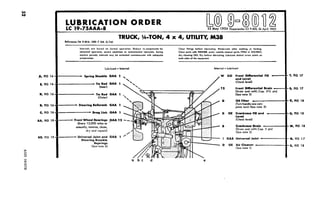
66. lubrication Order 
Lubrication Order 9-8012 (figs. 14 and 15) prescribes cleaning 
and lubricating procedures as to locations, intervals, and proper 
materiels for this vehicle. The official lubrication order will be 
carried with the vehicle at all times. In the event the vehicle is 
received without a copy, the using organization shall immediately 
requisition one. See DA Pam 310-4 for lubrication order of cur-rent 
date. Lubrication which is to be performed by ordnance 
maintenance personnel is listed on the lubrication order in the 
“NOTES” (fig. X), and in a few instances are contained in the 
pertinent section. 
67. General Lubrication Instructions 
n. Gencml. Any special lubricating instructions required for 
specific mechanisms or parts are covered in the pertinent sections. 
6. Usual Conditions. Service intervals specified on the lubrica-tion 
order are for normal operation and where moderate tem-perature, 
humidity, and atmospheric conditions prevail. 
c. I,ub7ication Equipwent. Organizational maintenance tdol sets 
contain lubrication equipment adequate for maintenance. Clean 
this equipment both before and after use. Operate the lubricating 
guns carefully and in such a manner as to insure a proper dis-tribution 
of the lubricant. 
d. Points of Application. 
(1) Lubrication points are shown in figures 16 through 19 
and are referenced to the lubrication order. Clean fit-tings 
and surrounding surfaces as prescribed in lubri-cation 
general notes (fig. 14). 
(2) A :jI,<-inch red circle should be painted around all lubri-cating 
fittings, oil can points, and refill plug holes. 
(3) Clean and lubricate unsealed bearings as in (a), (b), 
and (c) below. 
(a) Wash all the old lubricant out of the bearings and 
from the inside of the hubs with volatile mineral 
spirits or dry-cleaning solvent and dry the parts 
thoroughly. 
Cnutiorc: Bearings must not be dried or spun with 
compressed air. See TM 37-265 for care and mainte-nance 
of bearings. 
50 AGO 10167B
(b) Pack the bearings by hand or with a mechanical 
packer introducing the lubricant carefully between 
the rollers. Do not smear grease only on the outside 
of the bearings and expect it to work in. Great care 
must be exercised to insure that dirt, grit, lint, or 
other contaminants are not introduced into the bear-ings. 
If the bearings are not to be installed immedi-ately 
after repacking, they should be wrapped in clean 
oilproof paper to protect them from contaminants. 
(c) After the bearings are properly lubricated, pack the 
hub with a sufficient amount of lubricant to uniformly 
fill it to the inside diameters of the inner and outer 
bearing races. Coat the spindles and hub caps with 
a thin layer of lubricant (not over % 6 in.) to prevent 
rusting. Do not fill the hub caps to serve as grease 
cups under any circumstances. They should be lightly 
coated, however, to prevent rusting. 
Note. For normal operation, lubricate wheel bearings at 12,000 
miles or at annual intervals, whichever comes first. 
e. 
(1) Report unsatisfactory performance of prescribed pe-troleum 
fuels, lubricant, or preserving materials, using 
DA Form 468, Unsatisfactory Equipment Report. 
(2) Maintain a record of lubrication of the vehicle on DA 
Form 461, Preventive Maintenance Service and Inspec-tion 
for Wheeled and Half-Track Vehicles. 
68. lubrication Under Unusual Conditions 
Reduce service intervals specified on 
lubrication chart, that is lubricate more frequently, to compen-sate 
for abnormal or extreme conditions, such as high or low 
temperatures, prolonged periods of high speed operation, con-tinued 
operation in sand or dust, immersion in water, or exposure 
to moisture. Any one of these operations or conditions may cause 
contamination and quickly destroy the protective qualities of the 
lubricants. Intervals may be extended during inactive periods 
commensurate with adequate preservation. 
Lubricants are prescribed 
in the “Key” in the lubrication order (fig. 15) in accordance with 
three temperature ranges; above f32” F., f40” F. to -10” F. 
and from 0” F. to -65” F. Change the grade of lubricants when-ever 
weather forecast data indicate that air temperatures will be 
consistently in the next higher or lower temperature range or 
when sluggish starting caused by lubricant thickening occurs. 
51
F, 16 
E, FIG 16 
FIG 16 
AA, HG 15 
AS, FIG IS 
LC 19-75AAA-8 LoI$Dl4 8ul2 9.804. 26 Ad 19511 
TRUCK, %-TON, 4 x 4, UTILITY, M38 
Reference. TM 9.804; OK? 7 SNL G-740 
miles or 
annually, remove, dean, 
dry and repack1 
- Universal Joint and 
Steering Knuckle 
Bearings 
(See-note 6) 
D 
(Check level) 
Front 
ID&n and refilLCop. ptJ 
Eee note 
(Turn handle cae corn-plete 
turn1 (See nc.+e 3) 
I ) 
Crankcar. 
[Check level) 
Crankcase 
(Drain and WilLCap. 
FIG 
FIG 18 
‘abc
Transmission 
and Level 
(Check level) 
obc d 
GAA 1 
GO 
GAA 
Shaft 
(Check level) 
refilLCap. ptr) 
(See note 
o”n”olly, renlove, clean, 
dry and repack) 
Rew 
Figure 14. Lubrication order. 
RA PD 364009
Figure 15. Lubrication order key.
AGO 10167B 
55
56 
Figure 17. Localized lubrication points J through T. 
AC0
Figure 18. Localized lubrication points U through 2. 
No change in grade will be made when a temporary rise in tem-perature 
is encountered. 
c. Maintaining Proper Lubricant Levels. Lubricant levels must 
be observed closely and necessary steps taken to replenish in order 
to maintain proper levels at all times. 
69. lubrication For Continued Operation Below 0” F. 
Refer to TM 9-2855 for instructions on necessary special pre-liminary 
lubrication of the vehicle, and to TB 9-2855-3 for in-structions 
on installation of the winterization kit. 
70. lubrication After Fording Operations I 
a. After any fording operation, in water 12 inches or over, 
lubricate all chassis points to cleanse bearings of water or grit 
as well as any other points required in accordance with paragraph 
275, for maintenance operations after fording. 
10167B 57
If the vehicle has been in deep water for a considerable length 
of time, or was submerged beyond its fording capabilities, pre-cautions 
must be taken as soon as practicable to avoid damage 
to the engine and other vehicle components in (1)) (2)) and (3) 
below. 
(I) 
(2) 
Perform a complete lubrication service (par. 66). 
Inspect engine crankcase oil. If water or sludge is 
found, drain the oil and flush the engine with preserva-tive 
engine oil PE-30. Before putting in new oil, drain 
the oil filter and perform maintenance operation (par. 
111). 
(3) 
58 
If preservative engine oil is not available, engiue lubricat-ing 
oil OE-30 may be used. 
Operation in bodies of salt water enhances the rapid 
growth of rust and corrosion, especially on unpainted 
AGO 10167B
surfaces. It is most important to remove all traces of 
salt water or salt deposits from every part of the vehicle 
or equipment. For assemblies which have to be disas-sembled, 
cleaned, dried, and relubricated, perform these 
operations as soon as the situation permits. Wheel bear-ings 
must be disassembled and repacked (par. 67d (3) ) 
after each submersion. Regardless of the temporary 
measures taken, the vehicle must be delivered as soon 
as practicable to the ordnance maintenance unit. 
71. lubrication After Operation Under Dusty or Sandy 
Conditions 
After operation under dusty or sandy conditions, clean and 
inspect all points of lubrication for fouled lubricants and re-lubricate 
as necessary. Special attention should be given to the 
air cleaner and maintenance performed according to lubrication 
order (“NOTES,” fig. 15). 
Note. A lubricant which is fouled by dust and sand makes an abrasive mix-ture 
that causes rapid wear of parts. 
72. Painting 
Instructions for the preparation of material for painting, meth-ods 
of painting, and materials to be used are contained in TM 
9-2851. Instructions for camouflage are contained in FM 5-20B. 
Materials for painting are listed in ORD 7 SNL G-740. 
Section III. PREVENTIVE MAINTENANCE SERVICES 
73. General 
a. Responsibilities and Intervals. Preventive maintenance serv-ices 
are the responsibility of the using organization. These serv-ices 
consist generally of daily operator’s services (daily “A” 
services) performed by the operator or crew, and of biweekly 
services (biweekly “B” services) performed by the crew (under 
supervision of the squad, section, and platoon leaders) ; and of 
the scheduled services to be performed by organizational mainte-nance 
personnel (“C” and “D” services). Intervals are based on 
normal operations. Reduce intervals for abnormal operations or 
severe conditions. Intervals during inactive periods may be ex-tended 
accordingly. 
b. Definition of Terms. Inspections to see if items are in good 
condition, correctly assembled or stowed, secure, not excessively 
worn, not leaking, and adequately lubricated apply to most items 
in the preventive maintenance and inspection procedures. Any or 
AGO 10167B 59
all of these checks that are pertinent to any item (including sup-porting, 
attaching, or connecting members) will be performed 
automatically, as general procedures, in addition to any specific 
procedures given. 
(1) Inspection for “good condition” is usually visual inspec-tion 
to determine if the unit is safe or serviceable. 
“Good condition” is explained further as meaning: not 
bent or twisted, not chafed or burned, not broken or 
cracked, not bare or frayed, not dented or collapsed, not 
torn or cut and not deteriorated. 
(2) Inspection of a unit to see if it is “correctly assembled 
or stowed” is usually a visual inspection to see if the unit 
is in its normal position in the vehicle and if all its parts 
are present and in their correct relative positions. 
(3) Inspection of a unit to see if it is “secure” is usually a 
visual, hand-feel, pry-bar, wrench, or screwdriver in-spection 
for looseness in the unit. This inspection will 
include any brackets, lockwashers, locknuts, locking 
wires, and cotter pins as well as any connecting tubes, 
hoses or. wires. 
(4) “Excessively worn” is understood to mean worn beyond 
serviceable limits, or likely to fail if not replaced before 
the next scheduled inspection. Excessive wear of mating 
parts or linkage connections is usually evidenced by too 
much play (lash or lost motion). It includes illegibility 
as applied to markings, data and caution plates, and 
printed matter. 
(5) Where the instruction “tighten” appears in the pro-cedures, 
it means tighten with a wrench, even if the 
item appears to be secure. 
(6) Such expressions as “adjust if necessary” or “replace 
if necessary” are not used in the specific procedures. It 
is understood that whenever inspection reveals the need 
of adjustments, repairs, or replacements, the necessary 
action will be taken. 
74. Cleaning 
a. General. Any special cleaning instructions required for spe-cific 
mechanisms or parts are contained in the pertinent section. 
General cleaning instructions are as shown in (1) through (5) 
below. 
(1) Nameplates, caution plates, and instruction plates made 
of steel rust very rapidly. When they are found to be 
in a rusty condition, they should be thoroughly cleaned 
and heavily coated with an application of lacquer. 
AGO 10167B
(2) Use dry-cleaning solvent or volatile mineral spirits to 
clean or wash grease or oil from all parts of the vehicle. 
(3) A solution of one part grease-cleaning compound to four 
parts of dry-cleaning solvent or volatile mineral spirits 
may be used for dissolving grease and oil from engine 
blocks, chassis, and other parts. Use cold water to rinse 
off any solution which remains after cleaning. 
(4) After the parts are cleaned, rinse and dry them thorough-ly. 
Apply a light grade of oil to all polished metal 
surfaces to prevent rusting. 
(5) Before installing new parts, remove any preservative 
materials, such as rust-preventive compound, protective 
grease, etc. ; prepare parts as required (oil seals, 
etc.) ; and for those parts requiring lubrication, apply 
the lubricant prescribed in the lubrication order (par. 
66 and figs. 14 and 15). 
Dry-cleaning solvent and volatile mineral spirits are 
inflammable and should not be used near an open flame. 
Fire extinguishers should be provided when these mate-rials 
are used. Use only in well ventilated places. 
(2) These cleaners evaporate quickly and have a drying ef-fect 
on the skin. If used without gloves, they may cause 
cracks in the skin or a mild irritation or inflammation. 
(3) Avoid getting petroleum products, such as dry-cleaning 
solvent, volatile mineral spirits, engine fuels, or lubri-cants 
on rubber parts as they will deteriorate the rubber. 
(4) The use of diesel fuel oil, gasoline, or benzene (benzol) 
for cleaning is prohibited. 
75. Preventive Maintenance by Driver or Operator(s) 
To insure efficient operation, it is necessary that 
the vehicle be systematically inspected at intervals every day 
it is operated and also biweekly, so defects may be discovered and 
corrected before they result in serious damage or failure. Certain 
scheduled maintenance services will be performed at these desig-nated 
intervals. Any defects or unsatisfactory operating char-acteristics 
beyond the scope of the driver or operator(s) to cor-rect 
must be reported at the earliest opportunity to the designated 
individual in authority. 
b. Services. Driver or operators preventive-maintenance serv-ices 
are listed in table II. Every organization must thoroughly 
school its personnel in performing the maintenance procedures 
for this vehicle as set forth in this manual. 
AGO 10167B 61
Services. 
Intervals 
Daily “A” 
X 
X 
X 
62 
_-_- 
- 
X 
___~ 
X 
Procedure 
__-_ 
Caution: Place all tags describing condition 
of vehicle in the driver’s compartment in a 
conspicuous location so they will not be over-looked. 
%el, oil, and Check the amount of fuel 
in the fuel tank (par. 26) and note any indi-cation 
of leaks. Add fuel if necessary and 
check the spare fuel containers. Check en-gine 
oil level and add oil if necessary. Check 
coolant level in the cooling system and note 
any indication of leaks. When water is added 
(par. 121) during period that antifreeze is 
in use, a hydrometer test must be made and 
antifreeze added, if necessary, to provide safe 
operation to meet lowest anticipated tempera-tures 
(TM 9-2855). 
Tires. Gage all tires, including spare, for correct 
pressure (par. 6a). 
Remove all penetrating objects such as nails or 
glass. Examine tires for signs of low pressure, 
abnormal tread wear, cuts or missing valve 
caps. 
Look under the vehicle and in 
engine compartment for indications of fuel, 
engine oil, gear oil, water or brake fluid leaks. 
Visually inspect fire extin-guishers 
and make sure vehicle publications 
and necessary forms are present and in good 
condition. 
3ee that fire extinguishers are charged. 
3perate lights, horn (if tactical situation per-mits) 
, and windshield wipers. Visually inspect 
mirrors, reflectors, lights, body, towing con-nections, 
paulins, tools, etc. 
Check for any tampering or damage that may 
have occurred since last inspection. 
Observe for normal readings dur-ing 
warm-up and during operation of vehicle. 
Caution: If oil pressure is zero or excessively 
low, stop engine immediately and investigate 
cause (par. 782). 
General Be alert for any unusual 
noises or improper operation of steering, 
clutch, brakes, or gear shifting. 
AGO 10167B
Intervals 
Daily “A” 
Procedure 
faults. Investigate and correct or re-port 
any faults noted during operation. 
Springs Look at springs and 
shock absorbers to see if they have been dam-aged. 
Oil filter. On Cuno-type filter, turn the handle 
one complete turn. Check filter for leaks. 
Remove drain plug and drain sediment. 
Lubricate items specified on lubrica-tion 
order (par. 66). 
Clean. Clean glass vision devices and inside of 
vehicle. Wipe off exterior of vehicle. 
Wash vehicle, clean engine and engine compart-ment. 
. 
Clean, check water level, inspect ter-minals 
for corrosion, tightness, and coating 
of grease (TM 9-2857). 
Inspect assemblies such 
as carburetor, generator, starter, coil, dis-tributor, 
water pump, and hose for loose con-nections 
or mountings. Check adjustment of 
drive belts (par. 123). 
Check all accessible electrical 
wiring, conduits, and shielding to see that it 
is securely connected and in good condition. 
Inspect for clogging. 
The indicated frequency of the prescribed preven-tive- 
maintenance services is considered a minimum requirement 
for normal operation of vehicle. Under unusual operating con-ditions, 
such as extreme temperatures, dust or sand, or extremely 
wet terrain, it may be necessary to perform certain maintenance 
services more frequently. 
The drivers or operators 
should accompany vehicle and assist the mechanics while periodic 
organizational preventive-maintenance services are performed. 
Ordinarily, the driver should present the vehicle for scheduled 
preventive-maintenance service in a reasonably clean condition. 
AGO 1016’7B
c. These are indicated by the item numbers 
in the columns which show the interval at which the services are 
to be performed, and show that the parts or assemblies are to 
receive certain mandatory services. For example, an item number 
in one or both columns opposite a “Tighten” procedure means 
that the actual tightening of the object must be performed. The 
special services are as shown in (1) through (5) below. 
(1) Make all necessary adjustments in accordance 
with instructions contained in the pertinent section of 
this manual, information contained in changes to the 
subject publication, or technical bulletins. 
(2) Clean the unit as outlined in paragraph 74 to 
remove old lubricant, dirt, and other foreign material. 
(3) This applies either to lubrication 
operations that do not appear on the vehicle lubrication 
order (par. 66) or to items that do appear but which 
should be performed in connection with the maintenance 
operations if parts have to be disassembled for inspec-tion 
or service. 
(4) Service. This usually consists of performing special 
operations, such as replenishing battery water, draining 
and refilling units with oil, and changing or cleaning 
the oil filter, air cleaner, or cartridges. 
(5) All tightening operations should be performed 
with sufficient wrench torque (force on the wrench 
handle) to tighten the unit according to good mechanical 
practice. Use a torque-indicating wrench where specified. 
Do not overtighten, as this may strip threads or cause 
distortion. Tightening will always be understood to in-clude 
the correct installation of lockwasher, locknuts, 
locking wire, or cotter pins to secure the tightened nut. 
d. When conditions make it difficult to per-form 
the complete preventive maintenance procedures at one 
time, they can sometimes be handled in sections. Plan to complete 
all operations within the week if possible. All available time at 
halts and in bivouac areas must be utilized, if necessary, to assure 
that maintenance operations are completed. When limited by the 
tactical situation, items with special services in the columns 
should be given first consideration. 
e. DA Form 461. The numbers of the preventive maintenance 
procedures that follow are identical with those outlined on DA 
Form 461, Preventive Maintenance Service and Inspection for 
AGO 10167B
Wheeled and Half-Track Vehicles. Certain items on the form that 
do not apply to this vehicle are not included in the procedures 
in this manual. In general, the sequence of items on the form is 
followed, but in some instances there is deviation for conserva-tion 
of the mechanic’s time and effort. 
f. Procedures. Table III lists the services to be performed by 
the organizational mechanic or maintenance crew at the desig-nated 
intervals. Each page of the table has two columns at its 
left edge for designated intervals of every 1,000 miles (“(7’ 
service) and 6,000 miles or 6 months whichever occurs first 
(“D” service). Very often it will be found that a particular pro-cedure 
does not apply to both scheduled intervals. In order to 
determine which procedure to follow, look down the column cor-responding 
to the maintenance procedure and wherever an item 
number appears, perform the operations indicated opposite the 
number. 
Organizational Mechanic or Maintenance Crew “C” and “D” 
Preventive Maintenance Services. 
Interval 
“C” 
(every 1,000 
miles) 
“D” 
(6 montha or 
6,000 miles 
whichever 
oeeum Amt) 
Procedure 
AGO 10167B 
INSPECTION AND ROAD TEST 
Note. When the tactical situation does not permit 
L full road tit, perform only those items that re-pire 
little or no movement of the vehicle. 
BEFORE OPERATION: Fuel, oil, water, 
Perform the services 
listed in table II. 
3ash and gages, oil 
pressure, 
ignitjon 
Note generator output on the am-meter 
immediately after starting engine, 
before generator regulator has reduced the 
charging rate. Observe all instruments for 
normal readings. Notice if ignition switch 
operates freely and makes positive contact, 
and check all other controls for normal op-eration 
(figs. 7 and 11). 
Horns, mirrors, and Sound 
horn to see if signal is normal (if tactical 
situation permits). Test windshield wipers 
for satisfactory operation. Examine mirrors 
and reflectors. 
65
Procedure 
In 
INSPECTION AND ROAD TEST-Con. 
warming up the engine, observe if it starts 
easily and if action of choke control and 
throttle control (CC and BB, fig. 7) are 
satisfactory. Notice if idling speed is cor-rect. 
Listen for any unusual noises at idle 
and higher speeds. When operating the 
vehicle, notice if it has normal power and 
acceleration in each speed. Listen for any 
unusual noises when the engine is under 
load. 
(par. 99). With 
the vehicle moving straightahead, see if the 
steering wheel has excessive free play and 
if there is any tendency to wander, shimmy, 
or pull to the side. Turn the steering wheel 
through its entire range and note any bind. 
Examine steering gear jacket and wheel. 
drag, noise, grab, 
if clutch pedal has specified free 
travel (par. 196) and if action of pedal 
return spring is satisfactory. Note whether 
clutch disengages completely or has a tend-ency 
to drag. Observe smoothness of en-gagement 
and tendency to chatter, grab, 
or slip and any unusual noise. With trans-mission 
in neutral, depress and release 
clutch pedal (EE, fig. 7) listening for de-fective 
release bearing. 
Brakes (service and 
hand 96). See if 
brake pedal has specified free travel and if 
action of return spring is satisfactory. Ob-serve 
if pedal goes too close to floor. Make 
several stops noting side pull, noise, chat-ter, 
or any other unusual conditions. Ob-serve 
if ratchet of hand brake holds and if 
the handle requires more than three-quar-ters 
travel for full application. Stop the 
vehicle on an incline and apply the hand 
brake to see if it holds the vehicle or if 
application of hand brake at a speed of 10 
mph stops the vehicle within a reasonable 
distance. 
66 AGO
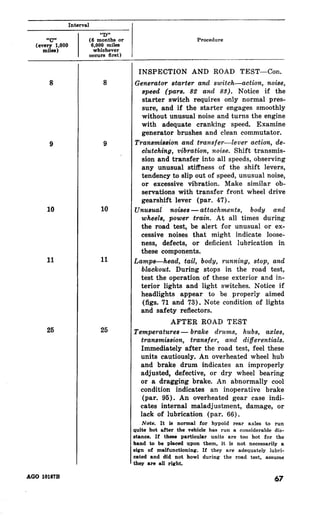
8 8 
9 
10 
26 
9 
10 
11 
25 
AGO 
INSPECTION AND ROAD TEST-Con. 
Generator starter and switch-action, noise, 
speed (pars. 82 and 85). Notice if the 
starter switch requires only normal pres-sure, 
and if the starter engages smoothly 
without unusual noise and turns the engine 
with adequate cranking speed. Examine 
generator brushes and clean commutator. 
Transmission and transfer-lever action, de-clutching, 
vibration, noise. Shift transmis-sion 
and transfer into all speeds, observing 
any unusual stiffness of the shift levers, 
tendency to slip out of speed, unusual noise, 
or excessive vibration. Make similar ob-servations 
with transfer front wheel drive 
gearshift lever (par. 47). 
Unusual noises - attachments, body and 
wheels, power train. At all times during 
the road test, be alert for unusual or ex-cessive 
noises that might indicate loose-ness, 
defects, or deficient lubrication in 
these components. 
Lamps-head, tail, body, running, stop, and 
blackout. During stops in the road test, 
test the operation of these exterior and in-terior 
lights and light switches. Notice if 
headlights appear to be properly aimed 
(figs. ‘71 and 73). Note condition of lights 
and safety reflectors. 
AFTER ROAD TEST 
Temperatures - brake drums, hubs, axles, 
transmission, transfer, and differentials. 
Immediately after the road test, feel these 
units cautiously. An overheated wheel hub 
and brake drum indicates an improperly 
adjusted, defective, or dry wheel bearing 
or a dragging brake. An abnormally cool 
condition indicates an inoperative brake 
(par. 96). An overheated gear case indi-cates 
internal maladjustment, damage, or 
lack of lubrication (par. 66). 
Note. 
Dhced upon
“C” 
(every 1,000 
mile% ) 
“D” 
(6 montlla or 
6,000 miles 
whichever 
oceum first) 
Procedure 
26 
26 26 
27 
27 
27 
27 
27 
28 28 
29 
29 
29 
AFTER ROAD TEST-Continued 
Inspect propeller shafts (figs. 91 and 92). 
Tighten universal joint assembly and flange 
units (par. 92). 
transmission, 
Make general observations in the engine 
compartment and underneath the vehicle 
for oil, water, fuel, and exhaust leaks. Look 
at spark plug, manifold, and cylinder head 
gaskets. 
Caution: Do not tighten the cylinder head 
or manifold unless there is evidence of 
looseness or leakage. 
If cylinder head requires tightening, use a 
torque indicating wrench and tighten in 
the sequence (fig. 25) and to the torque 
specified in paragraph 103. 
accordance 
lubrication order (par. Coordi-nate 
with inspection and disassembly op-erations 
to avoid duplication. 
During lubrication, inspect tires for unusual 
wear, penetrating objects, and proper 
matching. 
Rotate and match tires according to tread 
design and degree of wear (par. 255). See 
TM 31-200 for acceptable limits in match-ing 
tires. Tighten axle flange nuts. 
MAINTENANCE OPERATION 
Make hydrometer 
test of electrolyte in each cell (TM 9-2857) 
and record specific gravity in space pro-vided 
on DA Form 461. 
Perform a high-rate dis-charge 
test according to instructions in TM 
9-2857 or accompanying test instrument. 
Record voltage of each cell in space pro-vided 
on DA Form 461. 
After battery test, clean top of battery, coat 
terminals lightly with grease, repaint car-rier 
if corroded. Look to see if battery re-quires 
water. 
If distilled or approved water is not available, 
clean water. preferably rain water, may be used. 
68 AGO 10167B
(6 months or 
6,000 milea 
whichever 
occllrs first) 
Procedure 
30 
31 
31 
32 
32 
33 
34 
AGO 10167B 
MAINTENANCE OPERATION-Continued 
Compression. Test compression in each cylin-der 
(par. ) , with throttle and choke 
wide open, and record in s’pace provided on 
DA Form 461. It is preferable to make com-pression 
test with engine at operating tem-perature. 
cleaner, 
Clean and inspect air cleaner, crank-case 
ventilator, and control valve (par. 
107). 
Clean and service these items in accordance 
with the lubrication order (par. 66), or in-structions 
in the pertinent section of this 
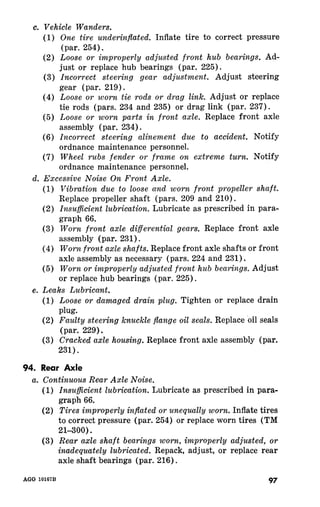
manual. 
Inspect these items, noticing particularly 
if the radiator core is clogged with foreign 
matter or if fins are bent. Test the opera-tion 
of the pressure cap. Observe coolant 
level (par. 121) and examine coolant for 
contamination. In cold weather, test coolant 
with a hydrometer to see if it contains suf-ficient 
antifreeze. 
:f need is indicated, drain radiator and block 
(fig. 40), clean, flush, refill (par. 121), 
and add rust inhibitor, unless antifreeze, 
which contains inhibitor, is used. Tighten 
radiator mountings and hose clamps. 
pump, fan, drive 
Inspect pulleys and fan for aline-ment 
and drive belts for proper tension 
(par. 123 and fig. 42). Notice if water 
pump is leaking. 
mechanism-clearance, cover 
Gage intake and exhaust valve tappet 
clearance (par. 105) and look for broken 
or weak valve springs if need is indicated 
by engine performance, low compression, or 
tappet noise. If clearance is found in-correct, 
adjust (par. 105), and recheck en-gine 
compression (par. ) . Inspect 
cover gaskets. 
69
(6 months or 
6,000 miles 
whichever 
occurs a73t) 
37 
70 
35 
35 
36 
37 
37 
Procedure 
MAINTENANCE OPERATION-Continued 
Spark 
points, 
Remove 
and inspect spark plugs (par. 145). In-spect 
distributor cap, rotor, and breaker 
points and test operation of centrifugal 
and vacuum advance mechanism by hand. 
Test distributor shaft for looseness by 
hand feel. Test ignition coil and distribu-tor 
capacitor with high-tension ignition-circuit 
tester, if available, according to 
instructions accompanying the test instru-ment. 
Using neon timing light, observe 
if ignition timing (figs. 58 and 59) is 
correct (par. 142) and if spark advances 
automatically as engine is accelerated. 
Test generator regulator with a low-volt-age 
circuit tester following instructions 
accompanying the test instrument. 
Zlean spark plugs and adjust gaps (par. 
145). Check distributor breaker points 
and adjust gap (par. 143), (figs. 57 and 
61). If points are badly pitted, repIace 
both points and capacitor. 
and heat Inspect these 
items. Look particularly for signs of 
leakage at manifold gaskets. If heat con-trol 
is automatic, see if shaft operates 
freely and if bimetal spring controls it 
properly. If it is manually controlled, 
check seasonal adjustment. 
linkage 
lines. Inspect these items notic-ing 
particularly if the shafts and linkage 
operate freely and are not excessively 
worn. Observe if the choke valve plate 
opens fully when the choke control is 
released and if the throttle valve plate 
opens fully when the accelerator is fully 
depressed. 
ffake an engine vacuum test (par. 79c(6) ), 
and adjust carburetor idle mixture (par. 
129). Test fuel pump pressure (par. 
AGO 10167B
Interval 
“C” 
(every 1,000 
miles ) 
“D” 
(6 months or 
6,000 miles 
whichever 
occurs first) 
Procedure 
AGO 10167B 
tiAINTENANCE OPERATION-Continued 
examine fuel lines and connections for evi-dence 
of leaks. Clean the filter element 
of fuel filter; drain water and sediment 
from fuel tank if there is evidence of 
contamination, using a container to catch 
the drainings. 
Inspect; listen 
for excessive or unusual noises and look 
for exhaust leaks. 
righten mountings. 
Inspect flexible and rigid brake lines and 
test brake linkage for freedom of action. 
lemove wheels (par. 256a) and brake drums 
(par. (3) and e (3) ) and examine 
drums, shoes, linings, guides, anchors, 
supports, retractor springs, and cylinders 
and cams. 
Wheel bearings will be disassembled, cleaned 
and repacked (pars. 215~ and c, 
and and 67) in every mile 
inspection or annually. If the wheel bear-ings 
are due for repacking, remove wheels 
and hubs and make observations of the 
brake internal components as in the pre-ceding 
paragraph. Clean the anchor plates 
and tighten the anchor-plate bolts. If the 
wheel bearings are not due for repacking, 
inspect the internal brake components only 
on vehicles from which the brake drum 
can be removed without removing the hubs 
and bearings. Adjust brakes (par. 242). 
If wheels have not been disassembled from 
brake drums, tighten wheel nuts. 
Inspect 
these items, paying particular attention 
to body mountings and springs. Test op-eration 
of windshield, hood hinges, and 
fasteners. Observe seat mountings and 
upholstery. Make a general inspection of 
the body including glass, panels, tops, 
fenders, running boards, chains, bows,
Interval 
“c” 
(every 1,000 
miles ) 
“D” 
(6 months or 
6,000 miles 
whichever 
occur* first) 
Procedure 
MAINTENANCE OPERATION-Continued 
paulins, curtains, and grille guard. Examine 
condition of paint and legibility of mark-ings 
and identification and caution plates. 
Tighten body mounting bolts. Loosen the 
steering gear jacket clamp before tight-ening 
body mounting bolts and tighten 
afterward. Tighten spring U-bolts and 
spring leaf clips. 
and 
Inspect these items including lifting 
shackles. Test operation of towing pintle 
(fig. 10). 
Inspect power-take-off 
and winch drive lines (pars. 54 and 
202). Test operation of winch. Clean 
and oil winch cable in accordance with 
lubrication order (par. 66). 
This section contains troubleshooting information and tests 
for locating and correcting some of the troubles which may de-velop 
in the vehicle. Troubleshooting is a systematic isolation of 
defective components by means of an analysis of vehicle trouble 
symptoms; testing to determine the defective component and ap-plying 
the remedies. Each symptom of trouble given for an in-dividual 
unit or system is followed by a list of probable causes of 
the trouble and suggested~ro@zdures to be followed. 
This manual cannot cover all possible troubles and deficiencies 
that may occur under the many conditions of operation. If a 
specific trouble, test, and remedy therefor are not covered herein, 
proceed to isolate the system in which the trouble occurs and 
then locate the defective component. Do not neglect use of any 
test instruments such as voltmeter, ammeter, test lamp, hy-drometer, 
and pressure and vacuum gages that are available. 
Standard automotive theories and principles of operation apply 
in troubleshooting the vehicle. Question vehicle driver or operator 
to obtain maximum number of observed symptoms. The greater 
72 AGO 10167B
the number of symptoms of troubles that can be evaluated, the 
easier will be the isolation of the defect. 
a. Engine Will Not Turn. 
(1) Weak or discharged batteries. Test batteries and re-place 
if necessary (par. 155). 
(2) Loose battery ground cable. Clean and tighten battery 
ground cabl’e (par. 155). 
(3) Loose or corroded battery terminals. Clean and tighten 
battery terminals (par. 155). 
(4) Faulty starter switch. Refer to paragraph 82. 
(5) Faulty starter. Refer to paragraph 82. 
(6) Incorrect oil viscosity. Inspect engine oil. Check records 
of oil changes and if found to be improper grade, drain 
and refill with correct grade of engine oil (par. 66). 
(7) Mechanical seizure of engine parts. Refer to ordnance 
maintenance personnel. 
b. Engine Turns But Will Not Start. 
(1) Lack of fuel. Check fuel gage on instrument panel 
with ignition switch turned on, and also check actual 
level in fuel tank to be sure there is sufficient fuel for 
operation and that fuel gage is operative. 
(2) Engine is wet. Although engine is waterproofed, it 
is possible for moisture to collect due to seepage, loose 
connections, or condensation. Wipe all moisture from 
distributor terminal housing, distributor cap, coil, and 
spark plugs. 
(3) Engine is too hot. If engine is hot, either vapor lock 
or “percolation” might exist. Vapor lock is due to the 
vaporization of fuel before it reaches the carburetor and 
as a result the engine is starved for fuel. “Percolation” 
is caused by the fuel vaporizing in the carburetor pas-sages. 
The bubbles rise, pushing the fuel above them 
into the carburetor throat. Vapor lock may occur when 
the vehicle is under load and can slow or completely 
stop vehicle. “Percolation” occurs only as the engine 
speed is reduced or when the vehicle is standing and 
engine is idling. To start a vehicle which has vapor 
locked or “percolated,” press the accelerator pedal to 
floor board and crank engine until it starts. Do not 
pump accelerator pedal as this action will cause flood-ing 
of the engine. 
(4) Engine is flooded. Press accelerator pedal to floor board 
and crank engine until it starts. 
AGO 10167B 73
(5) 
(6) 
(7) 
(8) 
(9) 
Refer to paragraph 82~. 
of Refer to paragraph 81. 
Refer to paragraph 79. 
Refer to paragraph 142. 
engine compression. Perform an engine compres-sion 
test as follows-remove all spark plugs and spark 
plug gaskets (par. 145). Block carburetor throttle link-age 
in open position to assure a full charge of air in the 
cylinders. With ignition switch off and a compression 
gage in position in one cylinder (fig. 20), crank engine 
with starter until compression gage pointer no longer 
rises. Note compression r,eading on gage. Reset com-pression 
gage to zero after checking each cylinder. 
Record compression pressure for each cylinder on DA 
Form 461. Compare the compression pressures of the 
cylinders. Normal compression pressure is 135 psi. Mini-mum 
compression pressure is 100 psi. Cylinder compres-sion 
pressures should not vary more than 20 psi. If 
pressures do vary more than 20 psi, or are lower than 
100 psi, notify ordnance maintenance personnel. 
74 AGO 10167B
(1) Check 
spark plug cables and make sure cables are attached 
to correct spark plugs (fig. 54). 
(2) Check 
spark plug cables at distributor cover and make sure 
they are in correct positions (fig. 54). 
(3) Remove distributor cap (par. 
143) and inspect for cracks or burned contacts. Replace 
cap if necessary (par. 143). 
(4) Time engine (par. 142). 
(5) Re-move 
distributor cap (par. 143) and check rotor for 
proper seating on distributor shaft. Replace rotor if 
damaged (par. 143). 
(1) Refer to paragraph 79a. 
(2) 
Refer to paragraph 81. 
e. 
(1) Inspect spark 
plug cables for cracks which would allow cable to short 
out. Replace spark plug cables if necessary. Check spark 
plug cables for proper location at distributor cover and 
at spark plugs. 
(2) Remove distributor cover 
(par. 143) and inspect rotor for cracks or evidence of 
shorting. Replace distributor rotor if necessary (par. 
143). 
(3) Adjust carburetor (par. 129). 
(4) Replace cylinder head 
gasket (par. 103). 
(5) Perform an engine compres-sion 
test (9) above). 
(6) Run engine at idle speed and observe 
if any of the valves are noticeably noisy. Adjust valve 
clearance if necessary (par. 105). 
(7) Refer to ordnance maintenance 
personnel. 
f. 
(1) Examine throttle 
linkage for kinks or breaks. Press accelerator pedal to 
floor board and note if throttle opens fully. If replace-ment 
of throttle linkage is necessary, notify ordnance 
maintenance personnel. 
AGO 10167B 75
(2) 
(3) 
(4) 
(5) 
(6) 
(7) 
(3) 
(9) 
(10) 
(11) 
(12) 
(13) 
(14) 
(15) 
(16) 
(17) 
(13) 
76 
Inspect choke 
control linkage for kinks or breaks. Inspect choke valve 
plate to see that it is completely open when choke con-trol 
button on instrument panel is pushed in. Choke con-trol 
linkage should have enough free play so that normal 
movement of the engine on its flexible mounts will not 
cause a partial closing of the choke valve plate. 
Perform an engine com-pression 
test (b (9) above). 
Remove, clean, and, 
inspect spark plugs, replace if necessary (par. 
Test coil by substitution (par. 81). 
Refer to para-graph 
79. 
Refer to paragraph 79. 
Adjust carburetor (par. 
129). 
Adjust clutch pedal free travel (par. 196). 
If clutch must be replaced, refer to ordnance mainte-nance 
personnel. 
Adjust brakes (par. 242) 
and inflate tires to correct pressure (par. 257). 
or Re-place 
exhaust pipe or exhaust pipe extension (par. 138). 
Clogged mufier. Replace muffler (par. 139). 
Adjust toe-in (par. 234). 
Inspect engine oil. Check records 
of oil changes and if found to be improper grade, drain 
and refill with correct grade of engine oil (par. 66). 
If engine has just received major re-pairs, 
it may be tight, and top speed and power will 
be reduced until the new parts are run-in and normal 
working clearances have been established. 
cleaner or Clean air cleaner and 
precleaner (par. 132). 
Inspect fuel lines for kinks 
or pinches, replace lines if necessary (par. 135). 
The fuel line from fuel tank to inlet 
side of fuel pump is under vacuum when engine is run-ning. 
If a small air leak is present, it will reduce quan-tity 
of fuel being delivered to fuel pump. Inspect fuel 
line and replace if necessary (par. 135). 
AGO 10167B
(1) Replace carburetor (par. 129). 
Refer to paragraph 
Clean, gap, and in-spect 
spark plugs (par. Replace spark plugs if 
necessary (par. 145). 
(4) Perform a compression test (b (9) 
above). 
(5) Run engine at idle speed and 
observe if any of the valves are noticeably noisy. Adjust 
valve clearance if necessary (par. 105). 
(1) Refer to paragraph 81. 
(2) Check valve clearances and 
adjust as necessary (par. 105). 
(3) Replace cylinder head 
gasket (par. 103). 
(4) Test fuel pump pressure (par. 79). 
Replace fuel pump if necessary (par. 131). 
(5) Adjust car-buretor 
(par. 129a). If condition is not improved, re-place 
carburetor (par. 129). 
i. 
(1) Refer to paragraph 
129. 
(2) Refer to paragraph 129. 
(3) Clean, adjust, and in-spect 
spark plugs. Replace spark plugs if necessary (par. 
145). 
(4) Refer to paragraph 81. 
(5) Time engine (par. 142). 
(6) Tighten all 
connections in ignition primary circuit. 
j. 
(1) Refer to (3) above and paragraph 
85. 
(2) Inspect engine, engine compartment, and ground 
beneath engine for indications of oil leakage. Tighten 
any leaking connections, repair or replace broken oil 
lines, or notify ordnance maintenance personnel. 
(3) Refer to above. 
(4) Maintain proper oil level. Oil 
level may be raised by fuel being forced into crankcase 
past carburetor needle valve, through primer pump, or 
AGO 10167B 77
around fuel pump diaphragm when the pressure re-lief 
valve in the fuel tank fails and pressure in the tank 
is built up at high temperatures. Check for odor of 
gasoline on dipstick. Check relief valve (par. 127a). 
(5) Inspect en-gine 
oil. Check records of oil changes and if found to be 
improper, drain and refill with correct grade of engine 
oil (par. 66). 
(6) Avoid unnecessary and excessive 
speeds. 
(7) Operate vehicle in proper 
gear for desired speed and terrain (par. 45). 
k. Refer to (3) above and paragraph 85. 
1. Inspect engine oil level and refill as 
directed on lubrication order (par. 66) if necessary. If trouble 
is not corrected by filling crankcase, piston rings, or connecting 
rod bearings, or crankshaft bearings are worn, refer to ordnance 
maintenance personnel. 
Fuel and Air Intake System 
(1) Inspect fuel 
and vacuum pump for evidence of leakage. Tighten all 
connections. Inspect fuel lines for evidence of leaks. 
Replace lines if necessary (par. 135). 
(2) Refer to above and paragraph 
85. 
(3) Remove fuel line 
from inlet side of carburetor. With ignition switch in 
OFF position, crank engine and observe action of fuel 
pump. If fuel spurts from fuel line, the fuel and vacuum 
pump is operative. If no fuel is observed spurting from 
fuel line, the fuel and vacuum pump is faulty and should 
be modified or replaced (par. 131). 
Caution: Provide container for fuel, as this is a fire 
hazard. 
Remove air cleaner, 
operate choke, and observe if carburetor choke valve 
opens freely. If choke action is faulty, adjust choke 
linkage. 
(2) Disconnect fuel line 
from outlet side of fuel and vacuum pump. Install a 
pressure gage (fig. 2i j in fuel and va-c_u u_r_d_ __ piiiiip ixitkt. 
AGO 10167B
With ignition switch in OFF position, crank engine 
until pointer on pressure gage no longer rises. Observe 
reading on pressure gage. Fuel and vacuum pump pres-sure 
is normally 41/i to 5 psi. If pressure is not correct, 
replace pump (par. 131). If new pump gives incorrect 
pressure, notify ordnance maintenance personnel. 
Figure 21. Testing fuel and vacuu,m pump pressure. 
(3) Faulty carburetor. Replace carburetor (par. 129). 
c. Fuel Mixture Too Lean. 
(1) Incorrect carburetor adjustment. Adjust carburetor 
(par. 129). 
(2) Leaky fuel lines. Inspect fuel lines and fittings. Replace 
lines or fittings if necessary (par. 135). 
(3) Obstruction in fuel lines. Disconnect fuel line at inlet 
side of fuel and vacuum pump. Remove fuel tank filler 
cap, and blow compressed air back through fuel line 
to remove any obstructions. 
(4) Faulty fuel pump. Perform fuel and vacuum pump test 
(b (2) above). Replace fuel and vacuum pump if neces-sary 
(par. 131). 
(5) Faulty carburetor. Replace carburetor (par. 129). 
79
(‘3) Faulty engine vacuum. Peform engine vacuum test as 
follows-disconnect fuel and vacuum pump vacuum line 
at elbow located on exhaust manifold, and install vacuum 
gage adapter in elbow (fig. 22). Start engine and run 
at idling speed until minimum operating temperature 
(160” F.) is reached. Make sure the carburetor is ad-justed 
properly. Adjust if necessary (par. 127). With 
engine operating at normal idling speed, vacuum gage 
should show a reading of 18 to 21 inches of mercury. A 
pointer fluctuating between 10 and 15 inches of mer-cury 
may indicate a leaking valve or defective cylinder-head 
gasket. An abnormally low reading with the pointer 
steady may indicate a leak at the carburetor. Accelerate 
and decelerate engine rapidly. Vacuum should drop to 
approximately 2 inches of mercury with rapid accelera-tion, 
and should rise to 24 inches of mercury as accelera-tion 
is decreased quickly. 
Note. Above readings are for sea level operation. Vacuum read-ings 
will be lowered approximately i inch of mercury for 1,000 
feet increase in altitude. 
Figure 22. Testing engine vacuum. 
d. Fuel Mixture Too Rich. 
(1) Incorrect carburetor adjustment. Adjust carburetor 
(par. 129). 
80 AGO 10167B
Clean air cleaner (par. 132). 
(3) Remove air cleaner 
and observe if choke valve plate is fully open. Make sure 
choke linkage has enough free play so that normal move-ment 
of the engine on its flexible mounts will not cause 
a partial closing of the choke valve plate. 
(4) Refer to above. 
Replace carburetor (par. 129). 
e. 
Adjust brakes (par. 242). 
(2) Inflate tires to correct pressure 
(par. 254). 
(3) Re-place 
exhaust pipe or exhaust pipe extension (par. 138). 
(4) Replace muffler (par. 139). 
(5) Adjust toe-in (par. 234). 
(6) Remove, clean, and adjust 
spark plugs (par. 145). 
(7) Refer to paragraph 81. 
(8) Time ignition (par. 142). 
Clean air cleaner (par. 132). 
(10) Perform an engine compres-sion 
test (par. ) . 
(11) Perform a fuel pump 
pressure test (2) above). 
(12) Adjust or replace carburetor (par. 
129). 
(13) Make sure brake pedal has 
necessary free travel (par. 242). 
(14) Adjust valve 
clearance (par. 105). 
(1) Replace muffler (par. 139). 
(2) A leak-ing 
intake and exhaust manifold gasket may be noted 
by carbon streaks on the cylinder block around the 
manifold or by the rush of exhaust gases felt against 
the hand. Tighten exhaust manifold or replace mani-fold 
gasket (par. 109). 
(3) 
Replace exhaust pipe or exhaust pipe exten-sion 
(par. 138). 
AGO 10167B 81
b. Odor of Exhaust Fumes in Driver’s Compartment. Leak in 
exhaust system. Replace defective parts (a above). 
Replace defective exhaust system parts immediately, 
as exhaust gas (carbon monoxide) is poisonous. 
81. 
a. No Spark (Ammeter Registers Zero When Ignition Switch 
Is Turned On). 
(1) Low or faulty batteries. Test batteries (TM 9-2857) and, 
if excessively low, replace (par. 155). 
Loose or corroded battery cables. Clean cable terminals 
and tighten bolts (par. 155). 
(3) Faulty ignition switch. Check ignition switch circuit 
with suitable test equipment or replace old switch (par. 
181) with one known to be operating. If, with switch 
on, ammeter now registers a slight discharge, old igni-tion 
switch was faulty. 
(4) Faulty ammeter. Check ammeter circuit with suitable 
test equipment or replace old ammeter (par. 174) with 
one known to be operating. If, with ignition switch on, 
ammeter now registers a slight discharge, old ammeter 
was faulty. 
(5) Broken primary circuit from ignition switch to ignition 
coil or from ignition coil to distributor. An ammeter 
reading of zero while ignition switch is turned on and 
engine is being cranked indicates that no current is 
flowing in the primary circuit. 
(a) With ignition switch in OFF position, disconnect 
cable at battery side of ammeter and use test light 
or low voltage circuit tester to determine if current 
is flowing. If current is not flowing to the ammeter, 
check connection and cable for looseness or breaks. 
(b) Check wiring circuit for signs of looseness or breaks 
from ammeter to ignition switch, and through igni-tion 
switch, with switch turned off. Replace cables 
if faulty. Clean and tighten all connections. 
(c) Check wiring circuit for signs of looseness or breaks 
through primary cable from ignition switch to igni-tion 
coil and from coil to distributor. If current flows 
through primary cable from ignition switch to igni-tion 
coil, but not from ignition coil to distributor, re-place 
coil (par. 144). If current flows through primary 
cable and ignition coil to the distributor, the trouble 
lies within the distributor. 
AGO 10167B
(d) If breaker points are faulty, remove distributor cover 
and distributor cap (par. 143) and inspect breaker 
points for burned or pitted contact surfaces. Replace 
points if necessary (par. 143). If points are satisfac-tory, 
check gap opening (par. 142). 
(e) If capacitor is faulty and a capacitor tester is available, 
test capacitor. Reading should be 25 to 26 mfd 2 10 
percent. Replace capacitor (par. 143) if reading is not 
within these limits. If capacitor tester is not available, 
check capacitor by substitution. 
If ammeter shows normal discharge with 
ignition switch turned on, the primary circuit is functioning and 
the trouble is in the secondary circuit. 
(1) Remove distributor cap (par. 143) 
and inspect for cracks or carbonized paths indicating 
current leaks. Inspect all carbon tips in cap for signs of 
excessive wear. Replace cap if necessary (par. 143). 
(2) Inspect rotor for signs of cracks or extreme 
wear. Replace rotor if necessary (par. 143). 
(3) Inspect spark plug cables for 
cracks, breaks, or corrosion. Replace cables if necessary 
(par. 145). 
c. 
(1) Clean and tighten all con-nections 
from starter to distributor and ignition coil as-sembly. 
(2) Check coil by substitution. Obtain 
a coil which is known to be operative. Remove coil and 
install test coil (par. 144). If spark is now satisfactory, 
old coil was faulty. 
(3) Refer to (1) above. 
(4) Refer to a(5) (e) above. 
(5) Refer to a(5) above. 
Refer to paragraph 78c, e, and g. 
e. Refer to paragraph 
(1) Test batteries and charge 
or replace if necessary (par. 155). 
(2) Clean cable terminals and 
tighten bolts (par. 155). 
AGO 10167B 83
(3) 
(4) 
Check starter switch circuit with 
suitable test equipment or replace old switch (par. 149) 
with one known to be operating. If starter now operates, 
old starter switch was at fault. 
If the above operations have been com-pleted 
and the starter still fails to operate, the starter is 
faulty and must be replaced (par. 148). 
c. 
is still noisy, replace (par. 148). 
(3) starter. Replace starter (par. 148). 
Slow 
(1) 
(2) 
(3) 
(4) 
Refer to a(1) above. 
Clean and tighten ground 
cable. 
Inspect engine oil. Check records 
of oil changes and if found to be improper grade, drain 
and refill with correct grade of engine oil (par. 66). 
Replace starter (par. 148). 
83. 
a. 
(1) Tighten all attaching parts. 
(2) Lack of Lubricate starter (par. 66). If starter 
(1) 
(2) 
(3) 
(4) 
a4 
General. Before performing any generator system tests, 
check battery for discharge (par. 155). Some of the com-mon 
conditions under which batteries become discharged 
are : the battery is worn out and will not hold a charge ; 
more current has been used than supplied by the gen-erator 
; battery solution has been allowed to become low ; 
accidental discharge of the battery due to light, acces-sories, 
or ignition switch left on when generator was not 
charging; engine oil too heavy for the prevailing tempera-tures. 
Many of the so-called generating system failures 
may be attributed to the conditions mentioned above. 
Clean cable termi-nals 
and tighten bolts (par. 155). 
If there is low or no charging 
rate with low battery, replace regulator (par. 153). 
Check ammeter circuit with suitable 
test equipment or replace old ammeter (par. 1’74) with 
one known to be operating. If, with engine running, 
ammeter now registers a charging rate, old ammeter 
was faulty. 
AGO 10167B
Adjust generator drive belts 
(par. 123). 
(6) If the generating system still fails to 
operate properly, replace the generator (par. 152). 
Replace 
generator regulator (par. 153). 
(1) Lubricate generator (par. 66). 
(2) Tighten generator mounting 
bolts (par. 152). 
(3) Adjust drive belts (par. 
123). 
(4) Replace generator (par. 152). 
84. Battery and lighting System 
When checking or troubleshooting the battery light-ing 
system, refer to the vehicle wiring diagram (fig. 80). 
Refer to paragraphs 83a and 155. 
c. 
(1) Test battery specific gravi-ty 
and charge or replace batteries if necessary (par. 155). 
(2) Test light switch by substitution. 
Remove light switch (par. 182) and install a switch which 
is known to be serviceable. If lights now operate, old 
switch was faulty. 
(3) Notify ordnance maintenance 
personnel. 
(4) Replace generator regulator 
(par. 153). 
(5) 
Inspect all 
cables in lighting circuit (fig. 80) and repair, replace, or 
notify ordnance maintenance personnel. 
(6) Clean 
corroded lamp contacts. Replace all lamps or lamp units 
which are broken or damaged (pars. 15’7-160 and 180). 
(1) Inspect ground connection and 
tighten or repair if necessary. 
(2) Replace burned out lamp 
unit or lamp (pars. 157-160 and 180). 
(3) 
Inspect cable for grounded or shorted condition, 
frayed insulation, loose 
pair, replace, or tighten cable. 
AGO 10167B as
Replace light switch (par. 182). 
e. 
(1) Dirty Clean light lens. 
(2) Test batteries and charge 
or replace batteries if necessary (par. 155). 
(3) Inspect ground cable or con-nection 
and repair or tighten ground cable if necessary 
(par. 163). 
(4) Clean and tighten terminals 
(par. 163). 
f. 
(1) Replace generator regulator 
(par. 153). 
(2) Inspect cable for frayed insula-tion, 
loose terminals, or breaks. Repair, tighten, or re-place 
cables if necessary. 
g. 
(1) Replace stop light lamp (par. 160). 
(2) Replace light switch (par. 182). 
(3) Test stop light switch by sub-stitution. 
Remove switch (par. 186) and install one which 
is known to be operative. If stop light now operates, old 
switch was faulty. 
(4) Inspect stop light circuit for 
grounded or broken cables. Repair or replace cables if 
necessary (par. 163). 
(5) Clean and tighten terminals 
(par. 163). 
85. Cooling System 
a. 
Fill cooling system and idle engine. In-spect 
radiator hose and connections for signs of leaks. 
Tighten hose connections or replace hose (par. 125) if 
necessary. Check area around water pump for damp spots 
or rust stains. Tighten water pump or replace (par. 124) 
if necessary. Inspect area around cylinder head for damp-ness 
or rust stains. Tighten cylinder head or replace cylin-der- 
head gasket (par. 103). Inspect radiator core for 
dampness or rust spots and if leakage is found, replace 
radiator (par. 122). Inspect area around thermostat 
housing for evidence of leakage. Tighten thermostat hous-ing 
or replace thermostat housing gasket (par. 126). 
(2) Adjust drive belt (par. 123). 
AGO 10167B
Inspect exhaust pipe, exhaust 
,pipe extension, and muffler for signs of dents, kinks, col-lapse, 
or restrictions of any kind. Replace any faulty 
parts (pars. 138 and 139). 
(4) If air flow through radiator core is 
restricted due to insects, leaves, grease, dirt, etc., 
clean fins and air passages by blowing them out with 
compressed air. 
(5) Time ignition (par. 142). 
(6) Adjust carburetor (par. 129). 
(7) Inspect radiator hose and replace 
any hose that has become soft or collapsed (par. 125). 
(8) Replace thermostat (par. 126). 
(9) Clogged Flush radiator as directed in TM 9- 
2858. 
(10) Drain crankcase oil into a suitable con-tainer 
and observe if there is water in the oil. (Water 
being heavier than oil, will go to the bottom of the con-tainer. 
In moderate quantities, it will look like an air 
bubble at the bottom of the oil.) If water is found in the 
oil, remove the spark plugs (par. 145) and observe if 
water is present at the plug holes. Install spark plugs 
(par. 145) and refill crankcase with correct grade of en-gine 
oil (par. 66). With engine cold, fill radiator. Remove 
drive belts (par. 123) so that water pump is inoperative. 
Start engine and run at a fast idle for 60 seconds. If 
water runs out radiator filler pipe or overflow tube, or 
if bubbles come to the surface of the water in the radiator, 
leakage exists between one or more of the cylinders and 
the cooling system. If leakage is evident from any of 
these inspections, check cylinder-head nuts, using a torque 
wrench. If the nuts do .not show evidence of looseness, 
remove the cylinder head (par. 103) and inspect for a 
faulty gasket. Examine cylinder block and head for 
cracks, paying particular attention to the area around 
the valve ports. Replace cylinder-head gasket (par. 103)) 
or in the case of a cracked head or cylinder block, notify 
ordnance maintenance personnel. 
Start engine and allow to idle until temperature is at least normal 
(this can be determined by placing the hand on the radiator). If 
the gage still reads cold, the gage or sending unit is faulty. Test 
the gage and sending unit by substitution. Remove the water tem- 
-~,.e-r^aLU..l-r^t : y_z^l,g..;^e : [Ip,.a..r. . 1l,”“P,  anu,. I 1:,&1I.J.-l.J1i1t“^ lll_i t^: In_l_l^”_w_l_l _ cL-.” LL,i. t:“^ J_J,..a .l‘.acl:l.,l,” G 
AGO 10167B a7
If gage now registers, the old gage was faulty. If gage still does 
not register, remove sending unit (par. 187) and install one known 
to be operative. If gage now registers, sending unit was faulty. 
86. Horn and Horn Button 
(1) Refer to vehicle wiring diagram (fig. 
80) for wiring arrangement, and connect all cables. 
(2) Remove horn (par. 185a) and 
clean contacting surfaces. Install horn (par. 185b). 
(3) Disconnect main feed cable at 
horn switch and ground it momentarily. Note whether a 
spark occurs when cable is grounded. If no spark occurs, 
there is an open circuit between the main feed cable and 
the battery. Inspect main feed wire and make necessary 
repairs. 
(4) Disconnect main feed cable at switch and 
touch end of main feed cable to horn terminal of switch. 
If horn now sounds, switch is faulty. Replace horn switch 
(par. 184). 
(5) If, after the above steps have been per-formed, 
horn does not sound, horn is faulty and must be 
replaced (par. 185). 
(1) Remove 
and check horn button and horn switch push rod (par. 
184). 
(2) Replace horn 
switch assembly (par. 184b). 
87. Instruments, Gages, Switches, and. Sending Units 
(1) Turn off all lights and electrical acces-sories, 
start engine and run it at a speed equivalent to a 
vehicle speed of 20 mph. If ammeter pointer fails to move 
to charge side of for at least the time required to 
restore the current used in starting, either the generat-ing 
system (par. 83) or ammeter is at fault. Stop engine 
and turn on headlights. Ammeter pointer should move 
to discharge side of gage. If pointer does not indicate on 
either side of gage, replace ammeter (par. 174). 
(2) Connect an ammeter which is known 
to be n“rnUor-a-“+-i.v e _ in series with ammeter on vehicle, Start 
AGO
engine and observe ammeter pointer location on each am-meter. 
If pointer location varies between the two am-meters, 
replace ammeter (par. 174). 
(3) Incorrect cable connections. Refer to 
instruments, gages, switches, and sending units identifi-cation 
diagram (fig. 83) and paragraph 163 for correct 
cabIe connecting points. 
(1) Refer to instruments, gages, switches, 
and sending units identification diagram (fig. 85) and 
paragraph 163 for location of cables. Inspect cables for 
frayed insulation, loose connections, cracks, or breaks. 
Tighten connections or repair cables if necessary. 
(2) Test sending unit by 
substitution. Obtain a sending unit which is known to be 
operative. Remove sending unit (par. 189) from fuel 
tank and install sending unit to be used for test. If, with 
ignition switch on, fuel gage now operates, old sending 
unit was at fault. 
(3) Test fuel gage by substitution. Obtain 
a fuel gage which is known to be operative. Remove fuel 
gage (par. 175) from vehicle and install test fuel gage. 
If, with ignition switch on, fuel gage now registers, old 
fuel gage was faulty. 
c. 
(1) Refer to instruments, gages, switches, and 
sending units identification diagram (fig. 85) and para-graph 
163 for location of cables. Inspect cables for frayed 
insulation, loose connection, cracks, or breaks. Tighten 
or repair cables if necessary. 
(2) Test sending unit 
by substitution. Obtain a sending unit which is known to 
be operative. Remove sending unit (par. 187) from ve-hicle 
and install sending unit to be used for test. If, with 
ignition switch on, temperature gage now registers, old 
gage was faulty. 
(3) Test gage by substitu-tion. 
Obtain a gage which is known to be operative. Re-move 
gage (par. 176) and install gage to be used for test. 
If, with ignition switch on, temperature gage now regis-ters, 
old gage was faulty. 
(1) Refer to instruments, gages, switches and 
sending units identification diagram (fig. 85j and para- 
89
graph 163 for location of cables. Inspect cables for frayed 
insulation, cracks, breaks, or loose connections. Repair 
cables if necessary. 
(2) Faulty oil pressure sending unit. Test sending unit by 
substitution. Obtain a sending unit which is known to be 
operative. Remove sending unit (par. 188) from vehicle 
and install sending unit to be used for test. If, with en-gine 
running, pressure gage now registers, old sending 
unit was faulty. 
(3) Fault3 oil pressure gage. Test gage by substitution. Ob-tain 
a gage which is known to be operative. Remove gage 
(par. 177) and install gage which is to be used for test. 
If, with engine running, gage now registers, old gage was 
faulty. 
e. Speedometer. 
(1) Speedometer fails to show either speed or mileage or 
pointer fluctuates. 
(a) Kinked or broken flexible shaft assembly or core. Re-fer 
to ordnance maintenance personnel. 
(b) Binding in speedometer. Disconnect flexible shaft at 
speedometer. Obtain a short piece of flexible shaft core 
about 2 or 3 inches long with a tip to fit the speedometer 
socket. Insert the piece of core into speedometer socket 
and spin core between the thumb and forefinger in the 
proper direction to cause speedometer pointer to indi-cate 
speed on speedometer dial. If there is a tendency 
for the speedometer to bind, replace speedometer (par. 
178). 
(2) Speedometer fails to show either speed or mileage or 
pointer will not return to zero. Faulty speedometer. Re-place 
speedometer (par. 178). 
f. Headlight High Beam Indicator Light. 
(1) Fails to light. 
(a) Lamp burned out. Replace lamp (par. 179). 
(b) Faulty wiring. Refer to paragraph 163 for correct cable 
and connection. Inspect cable for frayed insulation, 
cracks, breaks, or loose connections. Tighten connec-tions 
or repair if necessary. 
(2) Lamp flickers. Loose cable connections or lamp loose in 
socket. Tighten lamp and cable connections. 
g. Headlight Dimmer Switch. 
(1) Fails to operate. 
(a) Loose cable connections or faulty wiring. Refer to 
paragraph 163 for correct cables and connections. In-spect 
cables for frayed insulation, cracks, or breaks. 
AGO
(b) 
Inspect cable connections for tightness. Tighten con-nections 
or repair cables if necessary. 
Faulty switch. Test switch by substitution. Obtain a 
switch which is known to be operative. Remove switch 
(par. 183) and install switch which is to be used for 
test. If, with headlights on, switch now operates, old 
switch was faulty. 
(2) Switch can be depressed but will not return. Dirty or 
faulty switch. Remove switch (par. 183) and clean with 
volatile mineral spirits. If cleaning does not correct the 
trouble, replace the switch (par. 183). 
h. Instrument Panel Lights. 
(1) One lamp fails to light. 
(a) Burned out lamp. Replace defective lamp (par. 180). 
(b) Loose or faulty cable. Inspect cable connections at in-strument 
panel light and at light switch for evidence 
of loose or faulty cable. Tighten terminal connections 
or replace defective cable. 
(c) Faulty instrument panel light. If the above conditions 
were checked and lamp still does not burn, the light is 
faulty and must be replaced (par. 180). 
(2) Both instrument panel lamps fail to light. 
(a) Burned out lamps. Replace defective lamps (par. 180). 
(b) Loose or faulty cable. Refer to (1) (b) above. 
(c) Faulty instrument panel light. Refer to (1) (c) above. 
(d) Faulty light switch. If the above conditions were 
checked and instrument panel lamps still do not operate, 
it indicates a faulty switch which must be replaced 
(par. 182). 
i. Ignition Switch Fails To Operate. 
(1) 
(2) 
Loose or faulty wiring. Inspect cables for loose connec-tions, 
frayed insulation, cracks, or breaks. Tighten con-nections 
or repair cables if necessary. 
Faulty switch. Replace ignition switch (par. 181). 
88. Radio Interference Suppression System 
a. Locate Source of Noise. To locate source of radio interfer-ences 
emanating from the vehicle, the use of a radio receiver in 
the vehicle or adjacent vehicle will be necessary. Determining the 
type of interference present in the receiver will heIp to determine 
the cause of the trouble. To determine if the noise is coming from 
the vehicle or from an outside source, drive the vehicle at least 100 
feet from any other vehicle, Turn the ignition switch off and turn 
the radio on. Any noise heard in the radio will be coming from an 
AGO 91
outside source. Start the engine and any other noise heard in the 
radio will be coming from the vehicle itself. 
b. Engine. 
(1) Start the engine and run it at an idle speed and listen for 
noises in the radio receiver. If a crackling or clicking 
sound is present, accelerate engine and turn ignition 
switch off. If the noise stops immediately, the trouble is 
in the ignition circuit (c below). If an irregular click-ing 
or chattering sound continues for a few seconds after 
the ignition switch is turned off, the trouble is being 
caused by the generating circuit (d below). If the inter-ference 
is in the form of a whining or whirring sound 
which varies with the engine speed, turn ignition switch 
off. If the tone of the sound lowers in pitch but continues 
for a few seconds after the switch is turned off, it is 
caused by the generator (e below). 
(2) Start the engine and put the vehicle in motion and note 
if there is any interference present in the receiver. If a 
clicking or scratching noise is present, stop vehicle but 
leave engine running. If the noise stops when the motion 
of the vehicle stops, the trouble is caused by loose con-nections 
or frayed cable insulation in vehicle wiring (f 
below). 
c. Ignition Circuit. Make sure the ignition system is functioning 
properly (par. 81’). Incorrect spark plug gaps, distributor breaker 
point adjustment, or worn parts will affect the suppression sys-tem, 
Clean and tighten all electrical connections and engine mount-ings. 
Disconnect cable from one spark plug and start engine, note 
if interference is reduced or eliminated by this action. Test the re-maining 
three spark plug cables. If removal of any one or more 
cables eliminates the interference, the trouble is in the spark plug 
resistor or the ignition filter. Replace the spark plug (par. i45) or 
the ignition filter (par. 143e). 
d. Generating Circuit. Check generator regulator mounting bolts 
and tighten if necessary. Check wiring harness connecting the 
generator to the generator regulator for broken or damaged in-sulation. 
Replace generator (par. 152) or generator regulator 
(par. 153) if necessary. 
e. Generator. Check generator mounting bolts and tighten if 
necessary. If noise still persists, replace generator (par. 152). 
f. Wiring. Inspect all wiring cables for worn, frayed, or other- 
. 
92 AGO
89. Clutch 
(1) Start engine and run 
it at an idle. Depress clutch pedal to full released posi-tion, 
and allow clutch time to stop rotating. Shift trans-mission 
into first or reverse gear. If the shift cannot be 
made without clashing of gears or after engagement of 
gears, there is a jumping or creeping movement of the 
vehicle with clutch pedal fully depressed, the clutch is 
dragging. Adjust clutch pedal free travel (par. 196). 
(2) Refer to ord-nance 
maintenance personnel. 
Adjust pedal free 
travel (par. 196). 
(2) Refer to ordnance mainte-nance 
personnel. 
(3) Grease Refer to ordnance 
maintenance personnel. Slippage and .failures may be 
caused by engine and transmission lubricants that be-come 
trapped in the flywheel housing and cover the clutch 
components. To eliminate this source of trouble, remove 
flywheel housing drain plug and store in map (glove) 
compartment. Be sure to install plug before undergoing 
fording operations. 
(4) Refer to ordnance maintenance person-nel. 
c. 
(1) Adjust pedal free travel (par. 
196). 
(2) Oil or grease Refer to ordnance 
maintenance personnel. 
(3) Inspect transmission mountings, 
propeller shafts, universal joints, and engine mountings 
for loose connections. Tighten all connections. 
(1) Oil or grease on Refer to ordnance main-tenance 
personnel. 
Notify ordnance maintenance per-sonnel. 
(3) Dry Refer to ordnance 
maintenance personnel. 
AGO 10167B
(1) Lubricate linkage (par. 
66). 
(2) Refer to ordnance 
maintenance personnel. 
(3) Refer to ordnance maintenance personnel. 
90. Transmission 
Shift 
(1) Adjust clutch pedal 
free travel (par. 196). 
(2) If this condition occurs in extreme 
cold weather, transmission lubricant may be of incorrect 
viscosity. Check records of lubricant changes and if found 
to be improper grade, drain and refill with correct lubri-cant 
(par. 66). 
(3) Refer to ordnance maintenance personnel. 
(4) Replace (pars. 206 and 
207) or refer to ordnance maintenance personnel. 
(1) Check transmission lubricant level and 
refill if necessary (par. 66). 
(2) Replace (pars. 206 and 
207) or refer to ordnance maintenance personnel. 
(3) Noises originating in the 
vicinity of the transmission are sometimes due to a faulty 
transfer. Place transmission shift lever in N (neutral) 
position and start engine. If noise is now excessive, trou-ble 
is in transmission. If noise is excessive only when 
transfer is engaged, trouble lies in transfer. Replace 
either transmission (pars. 206 and 207) or transfer 
(pars. 200 and 201)) or notify ordnance maintenance 
personnel. 
c. 
(1) Adjust pedal free travel (par. 
196). 
(2) Refer to paragraph 66 for lubrica-tion 
instructions. 
(3) Replace (pars. 206 and 
207) or refer to ordnance maintenance personnel. 
(1) Refer to ordnance maintenance per-sonnel. 
94 AGO 10167B
shift Replace transmis-sion 
(pars. and 20’7) or refer to ordnance mainte-nance 
personnel. 
(3) Replace transmis-sion 
(pars. 206 and 207) or notify ordnance maintenance 
personnel. 
(4) 
Replace transmission (pars. 206 and 207) 
or notify ordnance maintenance personnel. 
e. 
(1) Tighten or replace drain 
plug. 
(2) Tighten mounting connec-tions. 
(3) Notify ord-nance 
maintenance personnel. 
91. Transfer 
or 
(1) 
Check lubricant level. Drain and fill transfer with proper 
grade of lubricant (par. 66). 
Remove 
transfer (par. 200), aline, and install (par. 201). 
(3) Replace transfer (pars. 200 
and 201) or notify ordnance maintenance personnel. 
(1) Check lubricant level. Drain and 
refill transfer with proper grade of lubricant (par. 66). 
(2) Replace transfer (pars. 200 
and 201) or notify ordnance maintenance personnel. 
(3) Re-move 
transfer (par. 200)) aline, and install (par. 201). 
(4) Replace either front 
or rear propeller shafts (pars. 209 and 210) if necessary. 
(5) 
(par. 119). 
c. 
(1) Refer to ordnance maintenance 
personnel. 
(2) Replace trans-fer 
(pars. 200 and 201) or refer to ordnance maintenance 
personnel. 
95
Replace transfer 
(pars. 200 and 201) or refer to ordnance maintenance 
personnel. 
(1) Tighten or replace drain 
plug. 
(2) Tighten attaching parts. 
(3) Replace transfer (pars. 
200 and 201) or notify ordnance maintenance personnel. 
92. Propeller Shafts and Universal Joints 
(1) 
Replace universal joints or propeller shafts 
(pars. 209 and 210) if excessive backlash is noted. 
(2) 
Tighten companion flange bolts and 
U-bolts. 
Replace universal 
joints (pars. 209 and 210). 
(2) Replace propeller 
shaft (pars. 209 and 210). 
(3) Lubricate universal joints and 
propeller shafts (par. 66). 
(4) Tighten com-panion 
flange bolts and U-bolts. 
(5) Re-place 
propeller shaft and universal joint sleeve yokes 
(pars. 209 and 211) if necessary. 
93. Front Axle 
Lubricate as prescribed in 
paragraph 66. 
(2) Adjust steering gear (par. 234). 
(3) Refer to ordnance mainte-nance 
personnel. 
(4) Check and adjust toe-in (par. 234). 
(5) Inflate tires to correct pressure 
(par. 254). 
(6) Notify ordnance maintenance person-nel. 
6. Refer to paragraph 
AGO 10167B
c. Vehicle Wanders. 
(1) One tire underinflated. Inflate tire to correct pressure 
(par. 254). 
(2) Loose or improperly adjusted front hub bearings. Ad-just 
or replace hub bearings (par. 225). 
(3) Incorrect steering gear adjustment. Adjust steering 
gear (par. 219). 
(4) Loose or worn tie rods or drag link. Adjust or replace 
tie rods (pars. 234 and 235) or drag link (par. 237). 
(5) Loose or worn parts in front axle. Replace front axle 
assembly (par. 234). 
(6) Incorrect steering alinement due to accident. Notify 
ordnance maintenance personnel. 
(7) Wheel rubs fender or frame on extreme turn. Notify 
ordnance maintenance personnel. 
d. Excessive Noise On Front Axle. 
(1) Vibration due to loose and worn front propeller shaft. 
Replace propeller shaft (pars. 209 and 210). 
(2) Insufficient lubrication. Lubricate as prescribed in para-graph 
66. 
(3) Worn front axle differential gears. Replace front axle 
assembly (par. 231). 
(4) Worn fron,t axle shafts. Replace front axle shafts or front 
axle assembly as necessary (pars. 224 and 231). 
(5) Worn or improperly adjusted front hub bearings. Adjust 
or replace hub bearings (par. 225). 
e. Leaks Lubricant. 
(1) Loose or damaged drain plug. Tighten or replace drain 
plug. 
(2) Faulty steering knuckle flange oil seals. Replace oil seals 
(par. 229). 
(3) Cracked axle housing. Replace front axle assembly (par. 
231). 
a. Continuous Rear Axle Noise. 
(1) Insufficient lubrication. Lubricate as prescribed in para-graph 
66. 
(2) Tires improperly inflated or unequally worn. Inflate tires 
to correct pressure (par. 254) or replace worn tires (TM 
21300). 
(3) Rear axle shaft bearings worn, improperly adjusted, or 
inadequately lubricated. Repack, adjust, or replace rear 
axle shaft bearings (par. 216). 
AGO 10167B 97
Replace rear axle assembly (par. 220). 
(5) Replace propeller 
shaft (pars. 209 and 210). 
Refer to a(3) above. 
(2) 
Replace rear axle assembly (par. 220). 
c. 
(1) Tighten all attaching 
parts. 
(2) worn or 
Replace rear axle assembly (par. 220). 
(1) Tighten or replace drain 
Plug. 
Replace oil seals (par. 215 a(l)- 
(9) and c). 
(3) Replace rear axle assembly (par. 
220). 
Service Brakes 
(1) Replace master 
cylinder (par. 244). 
(2) Adjust brakes (par. 242). 
(3) Disconnect brake line at master 
cylinder and lines at wheel cylinders. Clean brake lines by 
blowing out with compressed air. Remove master cylinder 
(par. 244) and clean with brake fluid. Install master 
cylinder (par. 244)) connect lines at wheel cylinders and 
master cylinder. Refill brake system with fluid and bleed 
brakes (par. 246). 
Note. If brakes are locked preventing movement of the vehicle, 
momentarily open bleeder valve (fig. 115) at any wheel cylinder. 
A few drops of brake fluid will come out; thus pressure will be 
relieved and the brakes freed. This is a temporary measure and 
does not correct the cause of the trouble. 
(1) Adjust brakes (par. 242). 
(2) Inspect all lines and 
connections for signs of leakage. Tighten or replace faulty 
lines or connections (par. 245). 
AGO 10167B
Replace master cylinder (par. 
244). 
(4) Inspect wheel cylinders for evi-dence 
of leaks. Replace any faulty wheel cylinder (par. 
243). 
(5) Bleed brake system (par. 246). 
c. 
(1) Adjust brakes (par. 242). 
(2) Replace brake shoes (par. 242). 
(1) Replace brake shoes (par. 
242). 
(2) Replace brake 
shoes (par. 242). 
(3) Replace brake drums (par. 242). 
(4) Replace retracting 
springs (par. 242). 
(1) Adjust brakes (par. 242). 
(2) Replace brake shoes (par. 242). 
Handbrake 
(1) Adjust brake (par. 247). 
(2) Replace brake shoes (par. 247). 
(3) Notify ordnance maintenance 
personnel. 
(1) Adjust brake (par. 247). 
(2) Replace brake shoes (par. 247). 
(3) Replace brake shoes (par. 
247). 
c. 
(1) 
Be sure brake is completely released before putting 
vehicle in motion. 
(2) Adjust brake (par. 247). 
(3) Replace brake drum (par. 
247). 
97. Wheels and Tires 
(1) Inflate tires to correct pressure 
(par. 254). 
AGO 10167B
(2) Improper front wheel alinement. Check front wheel 
alinement and correct if necessary (par. 234). 
(3) Bent wheel. Replace any bent or distorted wheels (par. 
256). 
(4) Damaged or improperly adjusted front hub bearings. In-spect 
hub bearings and adjust or replace if necessary 
(par. 225). 
(5) Wheel stud nuts loose. Tighten stud nuts (par. 256). 
(6) Wheel out of balance. Remove (par. 256) and remount 
tire in a different position. If trouble is not corrected, 
replace wheel (par. 256) or tire (par. 257). 
b. Wheel Wobbles. 
(1) Bent wheel. Replace any bent or damaged wheels (par. 
256). 
(2) Damaged or improperly adjusted front hub bearings. 
Adjust or replace hub bearings (par. 225). 
(3) Wheel loose on hub. Tighten stud nuts (par. 256). 
(4) Wheel out of balance. Remove (par. 256) and remount 
tire in different position. If trouble is not corrected, 
replace wheel (par. 256) or tire (TM 21-300). 
c. Wheel Pounds. 
(1) Damaged or improperly adjusted front hub bearings. 
Adjust or replace hub bearings (par. 225). 
(2) Bent wh,eel. Replace any bent or damaged wheels (par. 
256). 
(3) Damaged tire. Inspect tire for breaks or bulges, replace 
tire (TM 21-300)) if necessary. 
a. Insufficient Flexibility. 
(1) Lack of lubrication. Lubricate in accordance with para-graph 
66. 
(2) Frozen spring shackles. Free shackle and lubricate 
(par. 66). 
(3) Faulty shock absorbers. Disconnect shock absorbers 
(par. 253) and test action by compressing lower section 
into upper section. If little or no effort is necessary to 
compress shock absorbers, replace (par. 253). 
b. Excessive Flexibility. 
(1) Over lubrication. Clean excess lubricant from springs 
and lubricate in accordance with paragraph 66. 
(2) Faulty shock absorbers. Refer to a(3) above. 
(3) Broken spring leaves. Inspect springs for evidence of 
broken leaves. Replace sprifigs (par. OV"KV:,O i iIfI n'o.otni~.~dcb~"aYrUxLrJ . 
AGO 10167B
c. Vehicle Sags to One Side. 
(1) Improper load distribution. Check load for correct 
weight distribution and relocate load if necessary. 
(2) Weak springs. Inspect springs for extreme sag, replace 
any weak springs (par. 252). 
(3) Broken spring leaf. Inspect springs for broken leaves 
and replace (par. 252) if necessary. 
(4) Underinflated tires. Inflate tires to correct pressure 
(par. 254). 
d. Excessive Spring Noise. 
(1) Inadequate lubrication. Lubricate in accordance with 
paragraph 66. 
(2) Worn spring pivot bolts or spring shackles. Use a pry 
bar to test wear of shackles and pivot bolts. If excessive 
movement is noted, replace shackles (par. 250) or pivot 
bolts (par. 251). 
(3) Worn or faulty shock absorbers. Replace shock absorbers 
(par. 253). 
(4) Loose or worn spring center bolt. Replace spring (par. 
252). 
e. Repeated Spring Leaf Failure. 
(1) Loose spring U-bolts. Tighten spring U-bolts. 
(2) Overloading or improper operation on rough terrain. 
Refer to vehicle shipping data plate (fig. 4) for maxi-mum 
load and reduce vehicle speed when driving over 
rough terrain. 
(3) Spring leaf failure at spring eye. Improperly adjusted 
spring shackles or frozen pivot bolts. Free and lubricate 
pivot bolts (par. 66) and adjust spring shackles (par. 
250). 
(4) Spring leaf failure at cerzter section of spring. Loose 
spring U-bolts. Tighten spring U-bolts. 
99. Steering 
a. Vehicle Wanders. 
(1) Tight steering knuckle flange cap bearings. Adjust bear-ings 
(par. 230~ (5) ) . 
(2) Improper tire pressure. Inflate tires to correct pressure 
(par. 254). 
(3) Steering gear bind. Adjust steering gear (par. 239). 
(4) Caster lower than standard. Notify ordnance mainte-nance 
personnel. 
I(0K,  f“lUNi.)-f.ilt”s_I “U ,“,“‘G“..~.~V“t^j,I ‘Y.7 “ ,L+l:lcJ_ . “,.1,, UJ,I,,I,c, IIIc;-It-l:Zl a-Llll ~^e_ll^SYI.^1^1 -~1^;et-r-: ^su^I-l^r-l^a1 l . 
(6) Incorrect toe-in. Adjust toe-in (par. 234). 
AGO 10167B 101
Replace drag link (par. 
237). 
(8) Replace tie rods (par. 235). 
(9) Replace spring (par. 252). 
(10) Tighten U-bolts. 
(11) Tighten mounting 
bolts. 
(12) Notify 
ordnance maintenance personnel. 
(1) Uneven Notify ordnance maintenance personnel. 
(2) Inflate tire to correct 
pressure (par. 254). 
(3) Adjust brakes (par. 242). 
(4) Ad-just 
or replace hub bearings (par. 225). 
(5) Replace any broken or weak 
springs (par. 252). 
(6) Replace rear axle assembly 
(par. 220). 
(7) Notify ordnance maintenance per-sonnel. 
(8) steering Notify 
ordnance maintenance personnel. 
c. 
(1) Remount tire in dif-ferent 
position (par. 255) or replace tire and wheel 
(par. 256 and TM 31-200). 
Tighten shock absorber 
mountings or replace (par. 253) if necessary. 
(3) Replace drag link or tie 
rods (pars. 235 and 237). 
(4) Tighten mounting 
bolts. 
(5) Tighten U-bolts. 
(6) Replace faulty spring (par. 
252). 
(7) Inflate tires to prescribed pres-sure 
(par. 254). 
d. 
(1) Inflate tires to correct pressure 
(par. 254). 
-Adjust bear-ings 
(par. 230~ (5) ) . 
AGO
Tighten shock absorber 
mounting nuts or replace shock absorbers (par. 253) 
if necessary. 
(4) Adjust steering gear (par. 239). 
(5) Tighten mounting 
bolts. 
(6) U-bolts. Tighten U-bolts. 
(7) Weak Replace faulty spring (par. 
252). 
e. 
(1) Notify ordnance maintenance 
personnel. 
(2) Adjust drag link (par. 
237). 
(3) Inspect tires and replace (TM 21-300) if 
necessary. 
(4) Notify ordnance maintenance person-nel. 
(5) Notify 
ordnance maintenance personnel. 
(6) Replace steering gear (par. 239). 
f. 
(1) Inflate tires to correct pressure 
(par. 254). 
(2) 
Adjust bearings (par. 230~ (5) ) . 
(3) Replace drag link (par. 237). 
(4) Tighten mounting 
bolts. 
(5) Tighten U-bolts. 
(6) Replace faulty springs (par. 
252). 
Adjust bearings (par. 230~ (3) ) . 
Replace drag link (TM 21300). 
(3) Replace faulty tie rod ends (par. 
235). 
(4) Tighten mounting 
bolts. 
(5) Tighten U-bolts.
Replace faulty spring (par. 
252). 
(7) Replace brake drum (par. 
228). 
h. 
(1) Lubricate as prescribed in para-graph 
66. 
(2) Inflate tires to correct pressure (par. 
254). 
(3) Adjust 
bearings (par. 230~ (5) ) . 
(4) Adjust steering gear (par 239). 
(5) Notify ordnance maintenance 
personnel. 
(6) 
paragraph 239. 
Be sure valve 
is completely turned on. 
(2) Free blades from 
windshield. Replace blades if damaged (par. 266). 
(3) Inspect 
for loose connections or broken or cracked lines. Replace 
lines or connections if necessary. 
(4) 
Disconnect line at 
fuel and vacuum pump and at windshield wiper motor. 
Blow compressed air through line to clear it of any 
obstructions. If line cannot be cleared, replace. 
(5) Move 
windshield wiper handle to loosen paddles. Disconnect 
hose at windshield wiper motor and insert a few drops 
of engine oil into motor. Work wiper handle to dis-tribute 
the oil and connect vacuum line. Start engine and 
operate wipers. If trouble is not corrected, replace wiper 
motors (par. 265). 
Examine hose at connections and along entire 
length for nicks, cracks, or breaks. Tighten connections 
or replace hose or connections. 
._. 
(2) Refer to a (5 j above. 
104 AGO
Section V. ENGINE DESCRIPTION AND MAINTENANCE 
IN VEHICLE 
101. Description and Data 
a. The engine is a conventional L-head, four-cylin-der, 
four-cycle, liquid-cooled, gasoline-fueled unit. The engine, 
transmission, transfer, and radiator are mounted on a subframe 
which can be removed and installed as a single unit and which 
is termed the power plant (figs. 31 and 32). The electrical sys-tem 
is waterproofed. The power plant is sealed and vented for 
deep water and underwater fording operation. The oil filler pipe 
assembly is a steel tube projecting from the upper portion of 
the crankcase on the right side of the engine. The pipe has a 
sealed cap, at the top, which is removed to add engine oil. A 
bayonet-type oil level gage is fastened to the underside of the 
cap. The control valve hose, for deep water fording, is connected 
to the oil filler pipe near the top. 
b. 
Manufacturer ____________________-__---_---__-- Willys Motors Inc 
Model ____________________----------__------_-- MC 
Engine : 
Type ____________________-----------_----__ L-head 
Number of cylinders ____________________-__- 4 
Bore and stroke ____________________-__----__ 3% x 4% 
Piston displacement _________~~_____________ 134.2 cu-in. 
Brake horsepower at 4,000 rpm ~_____~_______ 60 
Torque at 2,000 rpm _______~_____________--- 105 lb-ft 
Compression at cranking speed _______________ 110 psi 
Firingorder _~___________________---__----__ l-3-4-2 
Valve clearance ________________________-___ 0.016 in. 
Weights : 
Power plant _____~__________________--_--_-_ 663 lb 
c Engine, less accessories _____________________ 351 lb 
Engine, with accessories _____________________ 483 lb 
Crankcase oil capacity ____________________--_-__ 5 qt 
Drain plugs : 
Crankcase ____________________-------__----- Left side, front 
Transmission ____________________-_-----_--- Left side, front 
Transfer _______________________------------ Bottom, right front 
102. Operations Performed With Engine in Vehicle 
Following is a reference list of engine components and the para-graphs 
which cover removal, installation, or maintenance proce- 
AGO 10167B 105
Paragragh 
Air cleaner ....................................... 132 
Batteries and cables ........................... 155, 156 
Carburetor ....................................... 129 
Carburetor controls ................................ 130 
Clutch linkage adjustment .......................... 196 
Cylinder-head gasket .............. : ............... 103 
Cylinder-head replacement ......................... 104 
Deep-water fording vent metering and control valves ... 107 
Drive belts (fan and generator) .................... 123 
External lines and fittings .......................... 113 
Fuel and vacuum pump ............................ 131 
Generator.. ...................................... 152 
Generator regulator ............................... 153 
Ignition system ................................ 140-146 
Intake and exhaust manifolds ................... 108-109 
Lines and fittings ............................ 113, 135 
Oil filler pipe ..................................... 112 
Oil filter ......................................... 110 
Oil filter cartridge ................................. 111 
Radiator ......................................... 122 
Radiatorhose ..................................... 125 
Starter and starter switch ..................... 148, 149 
Thermostat ....................................... 126 
Valve tappet clearance adjustment ................... 105 
Valve tappet compartment cover and gasket .......... 106 
Water pump, fan, and fan and water pump pulley ..... 124 
The key letters noted in parentheses are in figure 24, except where 
otherwise indicated. 
(1) 
(2) 
(3) 
106 
Drain the cooling system (par. 121). 
Loosen hose clamp screws at both ends of the water in-let 
hose (P, fig. 23) and remove the hose. Loosen hose 
clamp screws at each end of the bypass hose (L, fig. 23) 
and remove the hose. 
Remove the vent line (C, fig. 23) between the carbu-retor 
assembly (J, fig. 23) and the air intake pipe with 
vent valve and bracket assembly (B, fig. 23) by un-screwing 
the nut at each end of the line. Remove the 
vent line (Q) , between the distributor with coil assem-bly 
(M) and the air intake pipe, by unscrewing the 
nut at each end of the line. Remove the vacuum hose 
/IP’, d.a & Es), !xhvx!r? the distribute and t.he tee (H; 
AGO 1016'7B
Cylinder installation-left side. 
(4) 
(5) 
fig. 23), by unscrewing the nuts at both ends of the 
line and removing the speed nut (E, fig. 23) and clip 
(D, fig. 23) on top of the cylinder-head stud nut. 
Loosen the setscrew (F) securing the air cleaner con-trol 
valve control wire (C) to the swivel (G) and pull 
the wire out of the swivel. Loosen the hose clamp screw 
(J), on the control valve hose (H), at the crankcase 
oil filler pipe assembly 
Remove the cylinder-head stud nut securing the air in-take 
pipe bracket (R) to the top of the cylinder head. 
Loosen the hose clamp screws (G, fig. 23) and slide the 
air intake pipe with vent valve and bracket assembly (B, 
fig. 23) off the carburetor and at the air cleaner. Lift 
the air intake pipe assembly upward, sliding the con-trol 
valve hose off at the oil filler pipe connection, and 
remove the pipe assembly. 
107
R- moti J - HOSE CLAMP $(cREW 
+A10 1NTAKE PIPE WRi VENT VALVE K -~~UNTlN~ BRACKET (ON ENGlNEf 
At40 BRACKET ASSY, L-FLAT 
CLEANER CONTROL VALVE ASSY UNIT CABLE 
IE - CONfRM VALVE LWER F-WATER 
D-AIR CLEANUI CONTMOL VAtVE R -AIR 
181521 
Figure 24. Qylinder head removal and installdtion--right side. 
(6) 
(7) 
108 
Unscrew the spark plug cable terminal nuts (N, fig. 
23) securing the cables to the spark plugs (R, fig. 23). 
Remove cables from the plugs and pull them toward the 
right side of the vehicle and away from the cylinder 
head. Remove the plugs, using a deep socket, and dis-card 
the spark plug gaskets. Disconnect the water tem-perature 
sending unit cable (N) from the water tem-perature 
sending unit (P) by turning the connector 
plug on the end of the cable counterclockwise and pull-ing 
it out. 
Remove the flat washer screw (L) securing the crankcase 
oil filler pipe support bracket and the mounting bracket 
AGO 1016’7B
(8) 
(9) 
(10) 
(on engine) (K) to the right side of the cylinder head. 
Remove the three cylinder-head stud nuts securing the 
mounting bracket (on engine) to the cylinder head and 
swing the oil filter assembly, with the mounting bracket 
attached, toward the front of the vehicle and away from 
the cylinder head. 
Remove the second cylinder-head stud nut from the 
right rear of the cylinder head. Remove the second and 
third nuts securing the lifting hook (A) at the rear 
center of the head and remove the lifting hook. 
Remove the remaining cylinder-head stud nuts and lift 
the cylinder head up and off the cylinder block. , 
Remove and discard the cylinder head gasket. 
Clean the cylinder-head gasket 
contact surfaces of the cylinder block and cylinder head thorough-ly, 
checking for, and smoothing any, burs or nicks. Clean carbon 
deposits from the cylinder head and the top of the pistons, mak-ing 
sure no loose carbon is left on top of the pistons. Check the 
cylinder-head studs in the cylinder block for rust or corrosion 
and clean if necessary. 
c. 
(1) 
(2) 
Using cylinder-head studs 10 and 12 (fig. 25) as pilot 
studs for correct positioning, place a new cylinder-head 
gasket over the cylinder head studs. Position cylinder 
head on top of gasket being careful not to damage the 
threads on the studs. 
Start eight %,-inch cylinder-head stud nuts on studs 
3, 4, 6, 8, 11, 12, 13, and 14 (fig. 25) and screw the 
nuts on fingertight. 
AGO 109
(3) Place the mounting bracket (on engine) (K) , with 
oil filter assembly over cylinder-head studs 9, 10, and 
15 (fig. 25) and screw nuts on studs fingertight. 
(4) Place the lifting hook (A) over the cylinder-head studs 
1, 2, and ‘7 (fig. 25) and screw xc-inch nuts on studs 
fingertight. 
(5) Position the air intake pipe with vent valve and bracket 
assembly (B) in the vehicle. Slide the control valve 
hose (H) onto the hose connection on the crankcase oil 
filler pipe assembly (S) and place the air intake pipe 
bracket (R) over the No. 5 stud (fig. 25) and screw 
K,-inch nut on stud fingertight. Tighten the hose clamp 
screw (J) securing the control valve hose (H) to the 
filler pipe. Slide the air intake pipe hose onto the car-buretor 
and the air cleaner. Secure the hose clamp screws 
(G, fig. 23) at each end of the pipe assembly. 
(6) Slide the air cleaner control valve control wire (C) into 
the air cleaner control valve control wire swivel (G) 
on the control valve lever (E). Make sure deep-water 
fording vent valve control (H, fig. 7) on instrument 
panel is pushed all the way in. Position control valve 
lever with the swivel toward the front of the vehicle. 
Tighten the set screw (F) securing the control wire 
to the swivel. 
(7) Tighten all cylinder-head stud nuts to torque of 65- 
75 pound-feet in the sequence shown in figure 25 to 
secure the cylinder head to the cylinder block and the 
mounting bracket (on engine), lifting hook, and air 
intake pipe bracket to the cylinder head. 
(8) Install the 5/le x 54 flat washer screw (L) through the 
crankcase oil filler pipe support bracket into the mount-ing 
bracket (on engine) (K) and tighten. 
(9) Clean, adjust, and install the spark plugs and connect 
the spark plug cables (par. 145). Connect the water 
temperature sending unit cable (N) by pushing the 
connector plug on the end of the cable into the sending 
unit receptacle and turning the connector clockwise to 
secure it to the sending unit. 
(10) Position the vent line (Q), between the distributor 
and the air intake pipe with vent valve and bracket 
assembly (B), in place and screw the nuts on both ends 
of the line into the fittings. Position the vacuum hose (F, 
fig. 23)) between the distributor and the tee (H, fig. 23)) 
in place with clip (D, fig. 23) over cylinder-head stud 
110 AGO 10167B
nut No. 2 (fig. 25). Screw speed nut (E, fig. 23) onto 
the stud to secure the clip. Screw nuts at both ends of 
the line into fittings. Position the vent line (C, fig. 23) 
between the carburetor assembly (5, fig. 23) and the 
air intake pipe with vent valve and bracket assembly 
(B, fig. 23) and screw the nuts at each end of the line 
into the fittings. 
(11) Install the bypass hose (L, fig. 23) between the water 
pump assembly (K, fig. 23) and the cylinder head (M, 
fig. 23) and the water inlet hose (P, fig. 23) between 
the radiator and thermostat housing (Q, fig. 23). Tighten 
the four hose clamp screws securing the bypass and 
inlet hose. 
(12) Fill the cooling system (par. 121) and check for water 
leaks. Start and warm up the engine until normal op-erating 
temperature is reached (par. 120). After warm-ing 
up the engine, shut the engine off and tighten 
cylinder-head stud nuts again (7) above. 
104. Cylinder Head Replacement 
ct. 
(1) Remove the cylinder head (par. 
(2) Remove thermostat housing (Q, fig. 23 and par. 126a). 
(3) Remove the water temperature sending unit (P, fig. 
24) by unscrewing the unit from the cylinder head. 
Clean and inspect (par. 
(1) Install the water temperature sending unit (P, fig. 24) 
in the cylinder head. 
(2) Install the thermostat housing (Q, fig. 23 and par. 
Install the cylinder head on the engine (par. 103~). 
105. Valve Tappet Clearance Adjustment 
(fig. 26) 
a. Remove the spark plugs (par. 145). 
Remove the valve tappet compartment cover and gasket 
(par. 106). 
c. When valve adjustment is made, valve must be fully closed. 
To be sure both valves of any particular cylinder are closed, 
move the piston of that cylinder to top dead center of compres-sion 
stroke. This is done as follows-place a thumb over the 
spark plug hole and press slightly. Turn the crankshaft by hand. 
When pressure is felt against the thumb, the compression stroke 
has started. Continue turning the crankshaft, allowing the pres-sure 
to escape slowly past the thumb, until the top of the com- 
AGO 10167B 111
Figure 86. Adjusting valve tappets. 
pression stroke is reached, at which point, the pressure against 
the thumb will cease to build up further. Do not turn crankshaft 
beyond this point. Both valves for this cylinder are now fully 
closed. 
d. Check the clearance between each valve tappet adjusting 
screw and the bottom of the valve stem with a feeler gage. The 
clearance should be 0.016 inch. If the clearance is not correct, 
hold the tappet from turning with an open end wrench and turn 
the adjusting screw with another wrench. Turn the screw clock-wise, 
as viewed from the top, to increase clearance and counter-clockwise 
to decrease clearance. Turn screw only a slight amount 
at a time and check clearance after each change. Continue proc-ess 
until the clearance of both valves is correct. 
e. Repeat operations c and d above for each of the other three 
cylinders. 
f. Install the valve tappet compartment cover and gasket 
(par. 106). 
g. Install- the spark plugs (par. 146). 
h. Start the engine, warm to operating temperature, and check 
for smooth operation. ChGf valve tappet compartment cover for 
oil leaks. 
112 AGO 10167B
106. Valve Tappet Compartment Cover and Gasket 
27). 
(1) Unscrew the vent line nut from the elbow on the crank-case 
control valve assembly. Remove the front cover bolt 
securing the crankcase vent body and valve tappet com-partment 
cover to the cylinder block. Remove the vent 
body and gasket with the elbow and the vent line con-necting 
the compartment cover and the elbow on the 
control valve assembly. Discard gasket. 
Crankcase 
(2) 
(3) 
Remove the compartment cover screw securing the cov-er 
to the cylinder block at the rear of the cover. 
Slide the rear of the cover toward the rear of the 
vehicle and down toward the transmission until the front 
of the cover has cleared the rear of the intake and 
exhaust manifold assembly. Pull the front of the cover 
out from the cylinder block to clear the manifold as-sembly, 
then pull the cover forward, or toward the front, 
to remove from the vehicle ; remove the old gasket. 
AGO 10167B 113
Clean the valve tappet compartment cover gasket sur-faces 
on the cylinder block and the cover, removing any 
particles of the old gasket. Place a new gasket, secur-ing 
it with plastic-type gasket cement, on the cover. 
(2) Slide the rear of the cover by the rear of the intake 
and exhaust manifold assembly, toward the rear of the 
vehicle, and down toward the transmission. When the 
front of the cover has cleared the rear of the mani-fold, 
push the front toward the cylinder block and be-hind 
the manifold and slide the cover forward into posi-tion 
on the block. 
(3) Install X6 x 2% 6 compartment cover screw through 
the cover at the rear end and turn it into the cylinder 
block fingertight to secure the cover and the gasket to 
the block. 
(4) Place a new gasket between the crankcase vent body and 
the cover. Slide a new gasket on the front cover bolt and 
insert the 5/1s x 3 l l/l6 bolt through the vent body, the 
cover, and gasket and screw the bolt into the cylinder 
block fingertight. Line up the vent body and gasket on 
the compartment cover; the compartment cover and 
gasket on the cylinder block, and the vent line with the 
elbow and tighten the cover bolt and the compartment 
cover screw to secure the vent body and cover to the 
cylinder block. 
(5) Screw the vent line nut into the elbow on the crank-case 
control valve assembly and tighten. 
107. Crankcase Control Valve, Air Cleaner Control Valve, and 
Crankcase Vent Metering Valve Assemblies 
(1) 
Loosen the set screw securing the air cleaner control 
valve control wire to the air cleaner control valve con-trol 
wire swivel and pull the wire out of swivel. 
(b) Loosen the hose clamp screw at both ends of the con-trol 
valve hose and remove the hose. 
(c) Unscrew the air cleaner control valve assembly from 
the air intake pipe and remove the valve assembly. 
(2) 
Screw the air cleaner control valve assembly onto the 
air intake pipe with the control valve lever at top, 
AGO 10167B
(5) Remove the vent line (M) between the crankcase con-trol 
valve assembly (G) and the crankcase vent body 
(fig. 27) by unscrewing nut at each end of the line. 
(6) Remove the crankcase control valve and vent metering 
valve assemblies (G and E) by unscrewing the pipe 
nipple from the intake manifold. 
(7) Remove the nut from the bolt and nut (L) from 
the stud, connecting the exhaust pipe to the exhaust 
manifold. 
(8) Remove the four nuts (B) one at the front of the intake 
manifold ; one at the rear of the intake manifold ; and 
two, with flat washers, at the center securing the intake 
and exhaust manifold assembly to the cylinder block. 
Remove the three nuts (A) securing the exhaust mani-fold 
to cylinder block. 
(9) Slide the intake and exhaust manifold assembly away 
from the block and off the studs and lift out of the vehicle. 
(10) Remove the- four lockwasher screws (J) attaching the 
intake and exhaust manifolds (Q and R). Remove heat 
control valve spring stop (H) . Remove gasket between 
the intake and exhaust manifolds and clean the con-tacting 
surfaces. Also clean the gasket contacting sur-faces 
on cylinder block and intake and exhaust mani-fold 
assembly. 
b. 
(1) Before installation, the new intake and exhaust mani-folds 
must be fastened together. Place the surfaces 
which contact the cylinder block on a flat surface or 
plate. Insert a new intake-to-exhaust manifold gasket 
between the intake and the exhaust manifolds. Place 
heat control valve spring stop (H) over one 5//ls x 1 
lockwasher screw (J) and screw into the left front 
hole fingertight. Start the other three ?$ 6 x 1 lockwasher 
screws (J) through the exhaust manifold and into the 
intake manifold and tighten all four screws with equal 
tension. 
(2) Place a new intake and exhaust manifold gasket over 
studs on cylinder block. Place intake and exhaust mani-fold 
assembly over studs. 
(3) Screw the three s/s-inch nuts (A) onto the manifold 
studs but do not tighten. Place 1ys2 ID flat washers on 
the two center studs and screw on two s-inch nuts (B) . 
Screw one $&inch nut (B) on stud at front of the intake 
manifold and one 3/s-inch nut (B) on stud at rear of the 
intake manifold. After all nuts (A and B) are in place 
AGO 117
on the studs, tighten them a little at a time and with 
equal tension to secure intake and exhaust manifold 
assembly to cylinder block. 
(4) Insert a new exhaust pipe flange gasket between the 
pipe flange and the exhaust manifold flange. Lift the 
exhaust pipe up and over the stud in the exhaust mani-fold 
flange and screw s/8-inch nut (L) onto the stud part 
way. Insert 3/x x ll/(L bolt (K) through the exhaust mani-fold 
flange, gasket, and pipe flange and screw on :j/8- 
inch nut. Tighten nut (L) and the nut on the bolt (K) 
with equal tension to secure exhaust pipe to the mani-fold 
assembly. 
(5) Install the crankcase control valve and vent metering 
valve assemblies (G and E) on intake manifold by 
screwing the pipe nipple into the manifold to the posi-tion 
shown. 
(6) Insert the crankcase control valve control wire (N) 
through the crankcase control valve control wire swivel 
(F) and tighten the set screw securing wire to swivel. 
Position the vent line (M) between the crankcase con-trol 
valve and the crankcase vent body (fig. 27). Screw 
nut into the fitting at both ends of the line and tighten. 
(7) Position fuel and vacuum pump-to-tee line (D) between 
the fuel and vacuum pump and the tee and tighten the 
two nuts. 
(8) Position fuel and vacuum pump-to-intake manifold line 
(C) between the fuel and vacuum pump and the intake 
manifold and tighten the two nuts. 
(9) Install carburetor (par. 129c). 
Replace the intake and exhaust manifold gasket (mani-fold- 
to-cylinder block) (par. 108). 
b. 
Replace intake and exhaust manifold gasket (manifold-to-mani-fold) 
(par. 108) except that the old manifolds are used instead 
of new ones. 
110. 
30) 
a. 
(1) Disconnect the oil filter inlet flexible oil line assembly and 
fitting from the oil filter head with cartridge assembly 
118 AGO 10167B
by unscrewing the nut from the fitting and unscrewing 
the fitting from the head. Disconnect the oil filter outlet 
flexible oil line assembly by unscrewing the nut from 
the fitting on the timing gear cover assembly. Remove 
the oil filter outlet flexible oil line assembly and elbow 
from the head with cartridge assembly by unscrewing 
the elbow from the head. 
Figure 30. Oil filter assemblp-installed. 
(2) Remove the two flat washer screws with large flat wash-ers, 
holding the mounting bracket (on oil filter) to the 
mounting bracket (on engine), from the two speed nuts. 
Remove the oil filter assembly with the mounting bracket 
(on oil filter) from the vehicle. Loosen the screw 
and nut securing the mounting bracket to the filter 
and slide the bracket off the filter. 
(1) Screw the oil filter inlet flexible oil line fitting into 
the oil filter head with cartridge assembly at the position 
indicated by an arrow pointing toward the center of 
AGO 10167B 119
(2) 
the head. Screw the oil filter outlet flexible oil line elbow, 
with flexible oil line, into the oil filter head with cartridge 
at the position indicated by an arrow pointing to the 
outside edge of the head. 
Put the oil filter assembly into the mounting bracket 
(on oil filter) but do not tighten the screw and nut in 
the bracket. Position the mounting bracket (on oil filter) 
on the mounting bracket (on engine). Place a I+& 
inch flat washer on each of the two 5/16-10 x s/s (Acme) 
flat washer screws. Put the screws through the holes 
in the mounting bracket (on oil filter) and screw into 
the J-type speed nuts on mounting bracket (on engine). 
Position the oil filter in the mounting bracket, alining 
the inlet fitting on the oil filter with the inlet flexible 
oil line, and tighten the screw and nut securing the 
mounting bracket to the oil filter assembly. 
Connect the inlet flexible oil line to the oil filter by 
screwing the nut on the end of the line into the fitting 
on the oil filter. Connect the outlet flexible oil line to 
the timing gear cover assembly by screwing the nut 
on the end of the line into the fitting in the cover. 
Start the engine and run it for a few minutes to fill 
the oil filter assembly and check for oil leaks around 
the flexible oil line connections and the filter. 
Note. The oil filter inlet flexible oil line is slack enough to 
permit the engine fan blast to force the line into constant contact 
with the manifold elbow. To prevent damage by burning, move 
the oil filter clockwise within its mounting bracket to shorten 
the line enough to keep it clear of the manifold elbow. 
(1) 
(2) 
120 
Disconnect the oil filter inlet flexible oil line assembly 
and fitting from the oil filter head with cartridge as-sembly 
by unscrewing the nut from the fitting and un-screwing 
the fitting from the head. Disconnect the oil 
filter outlet flexible oil line assembly by unscrewing the 
nut from the fitting on the timing gear cover assembly. 
Remove the oil filter outlet flexible oil line assembly 
and elbow from the head with cartridge assembly by 
unscrewing the elbow from the head. 
Remove six bolts and nuts securing the head and the 
reinforcing ring to the sump and lift the head with 
cartridge assembly out of the sump.
Remove the pipe plug from the bottom of the 
sump. Drain the sump thoroughly and wipe dry. Wash the oil 
filter head with cartridge assembly in dry-cleaning solvent or 
volatile mineral spirits. While cartridge is submerged in clean-ing 
agent, hold the head and rotate the handle to work all dirt 
out of the cartridge. Allow the cartridge to drain. 
Caution: Never use compressed air to dry cartridge, as air un-der 
pressure can cause serious damage. 
c. 
Screw the elbow with outlet flexible oil line into the 
cartridge head at the position indicated by an arrow 
pointing to the outer edge and tighten elbow. Place a new 
gasket in the recess of the head. Insert the head with 
cartridge assembly in the sump with the outlet pointing 
forward as shown in figure 30. Aline the holes in the 
reinforcing ring with the holes in the cartridge head, 
insert six No. 12 x s/4 bolts through the head and rein-forcing 
ring, and screw into the six No. 12 nuts on the 
underside of the reinforcing ring. Screw the inlet fitting 
into the head and screw the nut on the end of the inlet 
flexible oil line into the fitting. 
(2) Screw the nut in the end of the outlet flexible oil 
line into the fitting in the timing gear cover assembly. 
(3) Start the engine to fill the oil filter assembly with 
)- oil and check the assembly and flexible oil lines for pos-sible 
leaks. 
a. Remove the oil level gage with cap assembly 
from the crankcase oil filler pipe assembly. Loosen the hose 
clamp screws on the control valve hose connecting the oil filler 
pipe to the air cleaner control valve assembly and remove the 
hose. Remove the flat washer screw securing the oil filler pipe 
support bracket to the mounting bracket (on engine) and cylin-der 
head, and remove the oil filler pipe. 
Note. The fdler pipe is a drive fit in crankcase. Some difficulty may be 
experienced in removal. The pipe may be loosened by tapping front and 
rear side alternately and, at the same time, pulling straight up on pipe. 
Do not install a used filler pipe, as a tight 
fit in crankcase is necessary to prevent oil leakage. Insert end 
of new pipe in crankcase opening, with the tlat side, at center 
portion of pipe, facing the generator. Tap pipe into place, using 
a soft hammer or wood block. Use care to avoid damage to 
upper end of pipe. Install the control valve hose connecting the 
AGO 10167B 121
filler pipe to the air cleaner control valve assembly. Tighten hose 
clamp screws securing the hose. Install and tighten y/l6 x 5/s 
flat washer screw securing the oil filler pipe support bracket to 
the mounting bracket (on engine). Install the oil level gage with 
cap assembly on filler pipe. Run engine until normal operating 
temperature (160”-180” F.) is reached and check oil filler pipe 
at lower end for leaks. 
113. External lines and Fittings 
a. External lines consist of flexible and solid types. 
b. Fittings, as termed, consist of elbows, nipples, tees, and 
a shutoff valve. 
c. The lines and fittings for various systems are covered 
in (1) through (6) below. 
(1) paragraph 245. 
(2) paragraph 135. 
(3) Oil paragraph 110. 
(4) paragraphs 135 and 
143. 
(5) cleaner 
paragraph 107. 
(6) paragraphs 143 and 265. 
Section VI. ENGINE REMOVAL AND INSTALLATION 
114. General 
For ease of maintenance, the engine, clutch, transmission, trans-fer, 
and radiator are removed as a unit, referred to as the power 
plant (figs. 31 and 32). The power plant must be removed be-fore 
the engine can be separated from the other units. 
115. Coordination With Ordnance Maintenance Unit 
Refer to paragraph 2 for information on coordination with an 
ordnance maintenance unit. 
116. Power Plant Removal 
Remove the hood (par. 261). Disconnect battery-to- 
battery ground cable (fig. 68) from battery “A” located in the 
engine compartment. 
Note. It is not necessary to drain the radiator, crankcase, transmission, 
or transfer before removing the power plant unless vehicle is equipped 
with winch and power-take-off. 
Close the fuel shutoff valve (P, fig. 34). 
AGO 10167B
as
lt_A 18%530 
Figure 32. Left front view of power plant as removed.
Remove radiator--guard (par. 263). 
(2) Remove the two nuts and flat washers from the radiator 
hold-down studs (fig. 41) securing the radiator to the 
vehicle frame and remove the radiator cushions. 
c. 
The key letters noted in parenthesis are in figure 33, except where 
otherwise indicated. 
(1) Pull windshield wiper hose (A) off windshield wiper vent 
line (B) and unscrew vent line nut from tee (E) 
(2) Unscrew nut on master cylinder vent line (F) and re-move 
line from the connector in tee (E) 
AGO 10167B 125
(3) Unscrew nut on fuel tank vent line (H) , and remove Ime 
from connector (G) . 
(4) Loosen hose clamps (J) securing the air cleaner-to-air 
intake pipe flexible hose (L) in position and remove 
hose. 
(5) Loosen the two wing screws securing the air cleaner as-sembly 
(D) to the left support bracket assembly. Remove 
the two wing screws and lockwashers securing air cleaner 
assembly to the right support bracket assembly (C) and 
remove air cleaner assembly. 
(6) Disconnect cable No. 33 (fig. 85) from the water tem-perature 
sending unit (M) by turning cable plug counter-clockwise 
and withdrawing from receptacle. 
(7) Loosen the set screw securing air cleaner control valve 
control wire (N) to swivel and withdraw wire from 
swivel. 
(8) Disconnect cable No. 12 from the wiring harness filter 
receptacle assembly by unscrewing nut (T) from hous-ing. 
(9) Unscrew the connectors securing the generator-to-gen-erator 
regulator cable (R) from generator (S) and gen-erator 
regulator (V) and remove cable. 
(10) Remove the nut and lockwasher securing the battery-to-starter 
cable and generator regulator cable (fig. 63) to 
starter switch (U) and remove cables from switch. 
(11) Remove the self-locking nut, flat washer, and bolt secur-ing 
the engine front plate-to-frame ground strap (Q) . 
Remove the self-locking nut, flat washers, and bolt secur-ing 
the front mounting support cushion (P) to vehicle 
frame. 
d. Operations at Left Side of Vehicle. 
The key letters noted in parentheses are in figure 34, except where 
otherwise indicated. 
(1) Loosen the nuts securing the brace rod (A) to radiator, 
and remove the nut and lockwasher securing rod to ve-hicle 
cowl. Remove rod and install washer and nut to pre-vent 
loss. 
(2) Unscrew the nut securing the fuel line to the flexible 
fuel line (S) and separate the lines. 
(3) Remove the nuts from the stud and bolt securing the ex-haust 
pipe (V) to the exhaust manifold (B) and remove 
the bolt. Press on flange of exhaust pipe to free it from 
the stud in the exhaust manifold and remove exhaust 
pipe flange gasket. 
AGO 10167B
(4) 
(5) 
Figure 34. Disconnect points at left side of vehicle. 
Loosen the setscrew securing the crankcase control valve 
control wire (U) to the crankcase control valve control 
wire swivel (Q) and withdraw wire from swivel. Re-move 
the nut and bolt from the clip securing the conduit 
for the control wire (fig. 27) to the support strap located 
at carburetor front mounting stud and tie control wire 
to vehicle cowl. Replace the nut and bolt on clip to prevent 
loss. 
Loosen the set screw securing the stop to the throttle 
control wire (C) and withdraw wire from shaft (W). 
Loosen set screw securing the choke control wire (D) to 
the swivel on the choke valve shaft and withdraw wire 
from shaft. Remove plain nut and bolt securing the choke 
control conduit (G) and clamp to the throttle control 
conduit bracket (E) and remove the choke control con-duit. 
Spread the opening in the throttle control conduit 
bracket and pull the throttle control conduit free. Tie the 
conduits to the cowl to prevent damage. 
AGO 10167B 127
(6) Unhook the accelerator pedal return spring (J) from 
the accelerator control rod (H) . Remove the cotter pin 
and flat washer securing control rod to accelerator cross 
shaft (K) . Secure cotter pin and washer to control rod 
to prevent loss. 
(7) Disconnect cable No. 36 (fig. 85) from oil pressure gage 
sending unit (L) by turning cable plug counterclockwise 
and withdrawing it from receptacle. 
(8) Pull windshield wiper hose (N) from windshield wiper 
line (M). 
(9) Remove the two self-locking nuts, four flat washers, and 
two bolts securing the front mounting support cushion 
(R) to vehicle frame. 
(10) Loosen the bolt in the upper end of the brake pedal as-sembly, 
pull the pad assembly from the pedal assembly 
and remove the draft pad and draft pad spring from be-neath 
the upper front floor pan cover. 
e. 
The key letters noted in parentheses are in figure 35, except where 
otherwise indicated. 
(1) Remove the gearshift lever knob from gearshift lever 
(A) and the gearshift lever knobs (B) from the high and 
low range gearshift lever (J) and front wheel drive gear-shift 
lever (P) . 
(2) Loosen the hose clamps (Q and S) and slide transmission 
gearshift lever boot (R) off gearshift lever (A). Unscrew 
gearshift lever housing cap and withdraw lever from 
transmission. Stuff a clean rag in transmission case open-ing 
to prevent foreign material from entering. 
(3) Remove the sheet metal screws securing the shift Iever 
housing cover boot ring (L) and slide ring and transfer 
gearshift levers-to-floor board boot (K) off shift levers. 
(4) Loosen the two lockwasher bolts securing the transfer 
case bolt access plate (M) to lower front floor pan cover 
(N) and swing plate to the rear. Reach through access 
plate opening, unscrew the pivot pin and remove pin and 
lock washer. Remove the high and low range and front 
wheel drive gearshift levers (J and P) and gearshift 
lever springs from transfer. 
(5) Remove the lockwasher bolts securing the steering gear 
jacket access plate (E) and steering gear jacket access 
plate seal (D) in position. Separate and remove the ac-cess 
plate, and slide the seal up on the steering gear 
jacket. 
AGO 10167B
JKKE‘I ACCESS 
R - 
(6) 
(7) 
(8) 
(9) 
(10) 
Remove the lockwasher bolts securing the brake master 
cylinder inspection cover (T) to the lower front floor 
pan cover (N) and remove inspection cover. 
Remove the remaining lockwasher bolts securing the up-per 
front floor pan cover (H) in position and remove 
cover with starter pedal attached. 
Remove the lockwasher bolts and accelerator foot rest 
(F) securing the transmission cover (G) in position and 
remove cover. 
Remove the remaining lockwasher bolts securing the low-er 
front floor pan cover (N) in position and remove cover. 
Disconnect universal joint at rear of front propeller 
shaft (par. 209). Push joint forward on shaft, swing to-ward 
right side of vehicle, and tie up out of the way. 
AGO 129
(11) Remove plain nut, bolt, flat washer, and plain washer 
securing the case support insulator, case support insula-tor 
snubber (C, fig. 36)) and case support insulator re-taining 
cup in position and remove insulator, snubber, 
and cup. 
(12) Remove the cotter pin and clevis pin from the clutch con-trol 
lever tube cable adjustable yoke (fig. 32) and dis-connect 
yoke from the control lever tube. 
(13) Unhook and remove the brake pedal retracting spring 
(Q, fig. 36). 
(14) For vehicles equipped with winch and power-take-off, 
unscrew the knob from the power-take-off gearshift con-trol 
lever (HH, fig. ‘7). Unscrew the four screws from 
the grommet retaining plate (NN, fig. 7) and slide the 
plate and the grommets (LL and MM, fig. 7) up off the 
gearshift lever. Remove the four screws from the power-take- 
off shift lever plate and lift the plate with gearshift 
lever out of the power-take-off. 
f. 
Note. The key letters noted in parentheses are in figure 36, except where 
othewise indicated. 
(1) Remove the plain nuts, plain washers, lockwashers and 
carriage bolts securing the skid plate to engine rear sup-port 
cross member (F) and remove skid plate. 
(2) Loosen the adjusting nut securing the engine stay cable 
(H) and lift cable end out of bracket (G) . 
(3) Remove the two self-locking nuts from the studs on the 
rear mounting support cushion (L) to loosen cushion 
from the engine rear support cross member (F) . 
(4) Remove the four plain nuts, flat washers, and lockwash-ers 
from bolts (D) securing the engine rear support cross 
member (F) to the vehicle frame and remove the cross 
member. 
(5) Unhook and remove the cable retracting spring (R) . 
(6) Remove the plain nut and bolt securing the cable hous-ing 
clamp (J) to the rear mounting bracket (K) . 
(7) Remove the cotter pin and clevis pin securing the hand 
brake rod end yoke (N) to the operating lever (M) . 
Spread open the clip securing the hand brake cable to bell 
housing and slide cable out of clip. 
(8) Disconnect speedometer cable (E) from the speedometer 
driven gear sleeve (fig. 90). 
(9) Remove the four nuts and lockwashers securing the uni-versal 
joint (A), located at the front of the rear propeller 
130 AGO 10167B
Figure 36. Disconnect points 
shaft, to the hand brake drum (B) . Slide the universal 
joint back and tie propeller shaft to vehicle frame to pre-vent 
damage. 
(10) For vehicles equipped with winch and power-take-off, 
perform operations (a) through (d) below. 
(G 
(b) 
(c) 
(4 
AGO 10167B 
Drain the transmission, transfer, and the power-take- 
Off. 
Remove the winch hanger bearing assembly (par. 
171a). 
Loosen the setscrew (Q, fig. 82) securing the universal 
joint assembly (M, fig. 82) to the power-take-off out-put 
shaft (N, fig. 82) and remove the short drive shaft 
(L, fig. 82) with universal joints. 
Remove the five bolts and lock washers holding the 
power-take-off to the transfer and pull the unit toward 
the rear of the vehicle to clear the transfer and remove 
the power-take-off from the vehicle. 
131
(1) Use a pry bar to move rear of power plant to the right to 
disconnect the clutch control lever (P, fig. 36) from the 
ball stud located on transfer case. 
(2) Connect a suitable lifting device in the rear lifting hook 
(fig. 37)) and carefully lift power plant until engine front 
mounting support cushions clear vehicle frame. Continue 
to lift power plant and, at the same time, roll vehicle back. 
Place power plant on a suitable stand. 
117. Engine Removal From Power Planf 
CL. Drain transmission and 
transfer. Unscrew the nut securing the transfer case vent line 
(fig. 31) to the elbow located on transfer case. Remove the four 
bolts (fig. 31), lockwashers, and flat washers securing the trans-mission 
to the clutch bell housing, and remove transmission and 
transfer. Discard gasket. 
Drain the cooling system (par. 121). Re-move 
radiator hose (par. 125). Lift the radiator off the radiator 
left and right support rods (figs. 31 and 32). 
c. If inspection of pulley shows that inside 
flanges are separating at the hub, apply corrective procedure .de-scribed 
in (1) through (4) below. 
132 AGO
(1) Remove pulley from engine. 
(2) Lay out three holes in the pulley on a 23/4inch diameter 
circle, 30” from centerline of key slot (fig. 38). 
Caution: Absolute accuracy of spacing is essential to 
prevent an unbalanced pulley. 
(3) Drill three x-inch holes in pulley. 
(4) Install three x x 7/ls flat-head steel rivets 118055 and 
rivet securely in place. 
118. Engine Installation in Power Plant 
a. Position radiator on radiator left and right 
support rods. Install radiator hose (par. 125). 
b. Using a new gasket be-tween 
the transmission and clutch bell housing, install transmis-sion 
on the bell housing, guiding spline of the transmission main 
gear shaft into the splines of the clutch assembly. Secure the 
transmission to the bell housing with four 15/3,-inch flat washers, 
X6-inch lockwashers, and 7/la x 1% bolts (fig. 31). 
119. Power Plant Installation 
(1) Connect a suitable lifting device to the rear lifting hook 
(fig. 37) and raise power plant until it clears front of 
vehicle. 
(2) Lower power plant into engine compartment, tilting 
down transfer end of power plant. 
(3) Use a pry bar to move power plant to left side of vehicle, 
and enter clutch control lever (P, fig. 36) on ball stud 
located on transfer case. Install radiator cushions (fig. 
41) on radiator hold-down studs. Aline studs with holes 
in cross member and aline studs on front mounting sup-port 
cushions with holes in vehicle frame. Lower front 
of power plant into position in engine compartment. 
The key letters noted in parentheses are in figure 36, except where 
otherwise indicated. 
(1) Untie rear propeller shaft from vehicle frame and 
position universal joint (A) on handbrake drum (B) . 
Secure in position with four a/s-inch lockwashers and 
nuts. 
(2) Screw speedometer cable (E) to the speedometer driven 
gear sleeve. 
AGO 10167B 133
RIVETS, FL-HD, l/4 
RAPD 359101 
Figure 38. of rivets in pulley.
(3) Untie handbrake cable from the vehicle frame and posi-tion 
handbrake rod end yoke (N) on operating lever 
(M). Screw in position with a K 6 x 1 clevis pin and 
yS2 x 1 cotter pin. 
(4) Position the cable housing clamp (J) on the rear mount-ing 
bracket (K) and secure in position with a 5/16 x ‘/s 
bolt and %,-inch plain nut inserting bolt through rear 
mounting bracket (K) . 
(5) Position the handbrake cable in the clip mounted on 
the clutch bell housing and close clip with a pair of pliers. 
(6) Hook the cable retracting spring (R) to the extension 
located on the operating lever (M) and to the hook 
secured to the bracket welded to floor panel. 
(7) Install the engine rear support cross member (F) and 
secure in position with four a/s x 7/a bolts, lyY/,,-inch flat 
washers, a/a-inch lockwashers, and a/s-inch plain nuts. 
(8) Install two s-inch self-locking nuts on the studs on rear 
mounting support cushion (L) securing the cushion to 
the engine rear support cross member (F) . 
(9) Insert the ball end of the engine stay cable (H) in the 
bracket (G) located on the engine rear support cross 
member (F) . 
(10) Position skid plate on engine rear support cross mem-ber 
(F) and secure with four 3h x 7/ carriage bolts, 
13/32-inch plain washers, $,&inch lockwashers, and 3/8- 
inch plain nuts. 
(11) For vehicles equipped with winch and power-take-off, 
perform operations (a) through (d) below. 
(a) Use a new gasket between the power-take-off and the 
transfer and position the power-take-off on the rear 
of the transfer. Place a/s-inch lockwashers over the 
s/s x 1 bolts and push the bolts through the case of the 
power-take-off and screw into the transfer. 
(b) Install the short drive shaft (L, fig. 82) with uni-versal 
joints (par. 169b (4) ) . 
(c) Install the hanger bearing assembly (par. 169b (1)) 
(2), and (3)). 
(d) Tighten the setscrew (Q, fig. 82) securing the univer-sal 
joint assembly (M, fig. 82) to the power-take-off 
output shaft (N, fig. 82). 
(12) For vehicles equipped with winch and power-take-off, 
perform operations (a), (b) , and (c) below. 
135
(a) Install the power-take-off gearshift control lever (HH, 
fig. ‘7) with the shift lever plate in the power-take-off 
and install four No. 10 x s/s screws in the plate. 
(b) Slide the grommet (LL, fig. 7) over the gearshift 
control lever. Slide the grommet (MM, fig. 7) over 
the control lever and the grommet (LL, fig. 7). Slide 
the grommet retaining plate (NN, fig. 7) over the 
control lever and screw the four No. 10 x 5/g screws 
through the plate and into the floor pan. Screw the 
knob onto the control lever. 
(c) Fill the power-take-off with correct grade of lubricant 
(par. 66). 
c. 
Note. The key letters noted in parentheses are in figure 35, except where 
otherwise indicated. 
(1) Hook the brake pedal retracting spring (Q, fig. 36) at 
bracket welded to engine rear support cross member 
and at brake pedal shank. 
(2) Position the control lever tube cable adjustable yoke 
(fig. 32) on control lever tube and secure in position 
with 5/16 x 27h2 clevis pin and aA2 x 1 cotter pin. 
(3) Position the case support insulator retaining cup and 
case support insulator snubber (C, fig. 36) between 
the transfer and engine rear support cross member. 
Position the case support insulator underneath the en-gine 
rear support cross member and install a 21/,,-inch 
plain washer and l/s x 3 bolt. Secure the snubber in po-sition 
with l/s-inch flat washer and plain nut. 
(4) Untie the front propeller shaft from vehicle and connect 
the universal joint at rear of propeller shaft (par. 209). 
(5) Install the upper and lower front floor pan covers (H 
and N) and secure in position with twenty-four jh x r/IL 
lockwasher bolts. Install the draft pad and the draft 
pad spring beneath the upper front floor pan cover. 
Push the brake pad assembly through the draft pad and 
the spring into the brake pedal assembly, and tighten 
the bolt. 
(6) Position the ‘brake master cylinder inspection cover (T) 
on the lower front floor pan cover (N) and secure in 
position with four rh x l/2 lockwasher bolts. 
(7) Slide the steering gear jacket access plate seal (D) 
down the steering gear jacket and into position on the 
upper front floor pan cover (H) . Install the steering 
gear jacket access plate (E) over the seal and secure 
in position with four 1h x l/g lockwasher bolts. 
136 AGO 10167B
(8) Position the high and low range gearshift lever (J) in 
transfer output shaft front bearing cap, being sure 
lower end of lever is in the slot of the shifter shaft. 
Position the front wheel drive gearshift lever (P) in 
the cap, being sure the lower end of the lever is in the 
slot of the shifter shaft. Install a s/s-inch lockwasher 
on the gearshift lever pivot pin and reach through the 
opening of the transfer case bolt access plate (M) and 
insert the pin through the right side of the cap and 
both shift levers and screw pin loosely into cap. Install 
one gearshift lever spring on the left side of the transfer 
high and low range gearshift lever (J), with the tangs 
of the spring facing to the right of the vehicle, and seat 
spring on gearshift lever pivot pin. Install the second 
gearshift lever spring between the high and low range 
gearshift lever and the front wheel drive gearshift lever 
(P) , with the tangs of the spring facing to the right of 
the vehicle, and seat spring on gearshift lever pivot pin. 
Tighten the pivot pin. 
(9) Install the transfer case bolt access plate (M) on the 
lower front floor pan cover (N) and secure in position 
with two l/4 x l/s lockwasher bolts. 
(10) Position the gearshift lever (A) in the transmission and 
secure with gearshift lever housing cap. Slide the trans-mission 
gearshift lever boot (R) down into position and 
tighten the two hose clamps (Q and Slide the trans-mission 
cover (G) over the shift lever and secure in 
position with seven lockwasher bolts. Install the ac-celerator 
foot rest (F) in the upper left corner of the 
transmission cover (G) . Install the three gearshift lever 
knobs. 
(11) Slide the transfer gearshift levers-to-floor board boot 
(K) down into position. Slide the shift lever housing 
cover boot ring (L) over the shift levers and secure in 
position with four No. 10 x $42 sheet metal screws. 
If the clearance between the front wheel drive high and 
low range shift lever (fig. 35) and floor board is insufficient and 
noise is caused by vibration of lever against the board, proceed 
as described in (12) below. 
(12) Engage the lever in the high range position (rearward). 
Mark or scribe cover boot ring (fig. 35) and floor board 
at location of contact. Remove the ring and rubber grom-met 
and using a file or cutting torch, cut circular notch 
(approx l/s in.) in the ring and floor board. 
137
cl. Operations At Left Side of Vehicle. 
Note. The key letters noted in parentheses are in figure 34, except where 
otherwise indicated. 
(1) Install the two ISa-inch flat washers, 5/ls x 1 bolts, 
11/a,,-inch flat washers, and 5/116-inch self-locking nuts 
securing the front mounting support cushion (R) to the 
vehicle frame. 
(2) Insert the windshield wiper hose (N) over the wind-shield 
wiper line (M) . 
(3) Connect cable No. 36 (fig. 85) to the oil pressure gage 
sending unit (L) by inserting cable plug in receptacle 
and turning plug clockwise. 
(4) Install the accelerator control rod (H) on the accelerator 
cross shaft (K) and secure in position with a No. 8 
flat washer and l/is x l/s cotter pin. 
(5) Untie the throttle control conduit (F) and choke con-trol 
conduit (G) from the cowl. Make certain that the 
throttle and choke controls are pushed in on instrument 
panel and insert the throttle control wire (C) into 
throttle valve shaft (W) and stop. Tighten set screw 
in the stop. 
Note. Throttle must be fully closed and stop against throttle 
valve shaft (W) when screw is tightened. 
Insert choke control wire (D) in swivel on choke valve 
shaft and tighten set screw. Position the throttle con-trol 
conduit in throttle control conduit bracket (E) . 
Position choke control conduit clamp, with the conduit, 
on throttle control conduit bracket, and secure with a 
No. 10 x sh bolt and No. 10 plain nut. 
(6) Untie the crankcase control valve control wire (U) 
from the cowl. Make certain control button is pushed in 
on instrument panel and insert wire into the crankcase 
control valve control wire swivel (Q) and tighten set-screw. 
Insert the conduit for the control wire into the 
clip securing the conduit to the support strap, located 
at the carburetor front mounting stud, and secure con-duit 
in position with a No. 10 x 1/2 bolt and No. 10 
plain nut. 
(7) Position the exhaust pipe flange gasket on the exhaust 
pipe. Position exhaust pipe (V) on stud in exhaust 
manifold (B) and secure pipe to manifold with a s/s-inch 
nut. Install a 3/3 x 11/g bolt and a/s-inch nut on other 
end of flange. Tighten nuts evenly to prevent distortion 
of the gasket. 
AGO 10167B
(8) 
(9) 
Screw the nut on the fuel line into the fitting on flexible 
fuel line (S) and tighten the nut. 
Position brace rod (A) in the bracket welded to radiator 
and in hole in vehicle cowl. Secure cowl end of rod with 
ylG-inch lockwasher and nut. Position one ylG-inch 
nut and flat washer on engine side of brace rod bracket 
and one 5k6-inch flat washer, lockwasher, and nut on 
radiator side of bracket. Tighten nut on radiator side 
until radiator is rigid in vehicle. Tighten the nut on the 
engine side of brace rod bracket. 
Note. The key letters noted in parentheses are in figure 33, except where 
otherwise indicated. 
(1) 
(2) 
Install the two 17/32-inch flat washers, Xs x 1 bolts, one 
1 I/! -inch flat washer, and y16-inch self-locking nut 
secjiring front mounting support cushion (P) to the 
vehicle frame. Install the engine front plate-to-frame 
ground strap (Q) on the remaining support cushion 
bolt and secure in position with an 1y!2-inch flat washer 
and 5/116-inch self-locking nut. 
Install the battery-to-starter cable (fig. 63) and gen-erator 
regulator cable on the starter switch (U) and se-cure 
in position with a a/s-inch lockwasher and nut. 
Position the generator-to-generator regulator cable (R) 
at generator (S) and generator regulator (V) and 
tighten cable connectors. 
Connect cable No. 12 to the wiring harness filter re-ceptacle 
assembly by inserting cable plug in receptacle 
and installing nut (T) . 
Insert air cleaner control valve control wire (N) into 
swivel and tighten setscrew. 
Connect cable No. 33 (fig. 85) to receptacle on water 
temperature sending unit (M) by inserting cable plug 
into receptacle and turning plug clockwise. 
Position the air cleaner assembly (D) in the right sup-port 
bracket assembly (C) and install two n/3a-inch lock-washers 
and r/4 x sj4 wing screws. Position air cleaner 
assembly in left support bracket assembly and tighten 
the two wing screws. 
Install the air cleaner-to-air intake pipe flexible hose 
(L) and tighten hose clamps (J) . 
Screw the nut on fuel tank vent line (H) into connector 
(C). 
AGO 10167B 139
(10) Screw the nut on the master cylinder vent line (F) into 
tee (E). 
(11) Screw the nut on the windshield wiper vent line (B) 
into tee (E) and slide windshield wiper hose (A) over 
vent line. 
(12) Connect battery-to-battery ground cable to battery “A” 
located in the engine compartment. 
f. 
(1) Secure radiator to vehicle frame cross member by in-stalling 
two ll/,z-inch flat washers and yli/,,-inch nuts on 
radiator holddown studs (fig. 41). 
(2) Install radiator guard (par. 263). 
(1) Open fuel shutoff valve (P, fig. 34) by turning valve 
handle counterclockwise. 
(2) Tighten engine stay cable (H, fig. 36) adjusting nut, 
located at engine side of bell housing, until cable is taut. 
(3) Fill cooling system (par. 121). 
(4) Install hood (par. 261). 
(5) Fill crankcase with correct grade of lubricant (par. 68). 
(6) Fill transmission and transfer tith correct grade of 
lubricant (par. 68). 
(7) Start engine and check for fuel, oil, or water leaks. 
(8) Make a record of replacement on DA Form 478. 
(1) The cooling system (fig. 39) is fully sealed 
and pressurized. The system consists of a water pump, 
water pump bypass, fan, drive belts, radiator, thermo-stat, 
and connecting hose. Water is drawn down through 
the radiator to the bottom thence through the water 
outlet hose to the water pump which forces it through 
the cylinder block, cylinder head, and the water inlet 
hose to the top of the radiator. Air, for cooling the water, 
is drawn through the radiator by the fan. Correct op-erating 
temperature is maintained by the thermostat. 
(2) and 32). The radiator is the cellular-type, 
with upper and lower tanks. The filler cap has a 
spring-loaded seal to maintain a pressure of approxi-mately 
4112 psi when the engine is running. The cap seal 
acts as a safety valve by lifting off its seat to relieve 
excessive pressure. 
140 AGO
(3) 
(4) 
(5) 
Figure $9. Cooling system. 
The thermostat is a bellows-type construct-ed 
to maintain an operating temperature of 160” to 
180” F. It is located on top of the cylinder head in the 
thermostat housing (T, fig. 24). 
The water pump assembly (fig. 
39) is the centrifugal-type, located at the front of the 
cylinder block. 
The fan has four blades and is mounted on the 
fan and water pump pulley. The water pump and fan 
are driven by a matched pair of V-belts. 
AGO 141
Radiator: 
Manufacturer _______________________~~ Blackstone Mfg CO 
Type __~ _ ~~_~_____________~~~__. . Cellular 
Capacity ~. 11% qt 
Filler cap ~~ 4% psi pressure-type 
Water pump and fan: 
Water pump type__~~_________-____- Centrifugal 
Fan _~_ _. ~~~ ~~~~~_______~_____~____ Four blade, 15-in diam 
Drive ________~___________________~-~ Double belt 
Location ____________________---~~-~~~ Front of cylinder block 
Drive belts : 
Type ________________________-----_-- “V”, matched pair 
Width _~___________________---__--_~ %-in. 
Length ________________________--_~~~ 457/s-in. outside circumference 
Thermostat: 
Location ____________________---_---- Thermostat housing 
Range (opening) ~~_______~~~~~~_ _ ~~ 148” to 155” F. 
Caution: The cooling system is pressurized. Use care when 
removing radiator cap. 
a. 
(1) To drain the cooling system, open the hood 
and remove the radiator cap slowly to relieve any pres-sure 
within the system. If the coolant is to be saved, 
place a suitable container under the drain cocks (fig. 
40) of the radiator and cylinder block. One drain cock 
is located on the right side of the cylinder block just 
forward of the starter, and the other is located at the 
bottom of the radiator on the left side of the water 
outlet hose fitting. Open both drain cocks, allow cooling 
system to drain completely, and close drain cocks. 
(2) Be sure that both drain cocks (fig. 40) are closed. 
Fill the cooling system with water, or antifreeze solu-tion, 
of sufficient strength to protect the system against 
the lowest anticipated temperature, to a level approxi-mately 
1 inch below the bottom of the filler neck. Run 
the engine to circulate the coolant and expel air from the 
system, and recheck the coolant level. 
Caution: When adding coolant to the system, be sure 
that the engine water temperature is below 200” F. 
before removing the radiator cap. 
For directions for cleaning and flush-ing, 
refer to TM 9-2858. 
AGO 10167B
Figure 40. Cooling system drain cocks. 
(1) 
(2) 
Drain the cooling system (par. 121). 
Remove the radiator guard (par. 263). 
Loosen the nut on the rear end of the brace rod (fig. 
39). Loosen the nut on the front end of the brace rod, 
securing the rod to the bracket, sufficiently to permit 
the rod to be pulled up out of the bracket. Lift the rod 
out of the bracket and swing it toward the rear of the 
vehicle to clear the radiator assembly. 
Loosen the two hose clamp screws on the water inlet 
hose (fig. 39) and remove hose. Loosen the two hose 
clamp screws on the water outlet hose (fig. 39) and 
remove the hose. 
Remove nuts and flat washers from two radiator hold-down 
studs (fig. 41) holding radiator assembly to frame 
front cross member. 
Lift radiator assembly straight up, being careful not 
to rub it against fan. When studs (fig. 41) are clear 
of frame front cross member, tip radiator forward at 
the top and remove from vehicle. Remove radiator cush-ions 
from studs (fig. 41). 
143
Figure 41. Radiator hold-down studs. 
(1) 
(2) 
Place radiator cushions on radiator hold-down studs 
(fig. 41). Carefully lower radiator assembly into place, 
positioning holes in brackets (fig. 32) on radiator over 
radiator left and right support rods. 
Install two ii/3a-inch flat washers and x6-inch nuts 
(fig. 41) on studs securing the radiator to the frame front 
cross member and tighten evenly. 
Install water inlet hose (fig. 39) and tighten both hose 
clamp screws. Install water outlet hose (fig. 39) and 
tighten both hose clamp screws. 
Swing the brace rod (fig. 39) toward the front of the 
vehicle and aline rod with slot in bracket on the radiator 
assembly. Position flat washer against the rear nut at 
the front end of the rod, position lockwasher and flat 
washer against the front nut at the front end of the rod. 
Slide the rod down into the slot. Make sure that one 
flat washer is at the rear of the bracket and one flat 
washer at the front. Adjust the rear nut so that the 
washer is snug against the rear of the bracket. Tighten 
the nut at the front end of the rod. Fill the cooling 
system (par. 121) and check for leaks. Install the radia-tor 
cap. Start the engine and run until normal operating 
temperature is reached. Recheck the coolant level. 
123. Fan and Generator Drive Belts 
a. Loosen the lockwasher screw holding the belt 
tension adjustment brace to the drive end head of the generator. 
144 AGO 10167B
Move generator toward or away from the engine, as required, 
until a firm push on belts will deflect them 1 inch as shown in 
figure 42. When adjustment is correct, tighten screw holding brace 
to top of generator. If inspection of pulley shows inside flanges 
being separated at hub, rivet the pulley as described in para-graph 
117. 
Figure 42. Adjusting drive belts. 
Loosen lockwasher screw holding belt tension ad-justment 
brace to drive end head of the generator and push 
generator toward engine as far as possible. Remove forward drive 
belt by working it over forward edge of generator drive pulley, 
off fan and generator drive pulley, over fan blade, and off fan 
and water pump pulley. Remove rear drive belt by first working 
it into forward groove in generator drive pulley, fan and gener-ator 
drive pulley, and fan and water pump pulley. When belt is in 
forward groove of each pulley, follow procedure used to remove 
forward belt. 
AGO 10167B 145
c. Installation. Place belt over fan, into forward groove of fan 
and water pump pulley, into forward groove of fan and generator 
drive pulley, and into forward groove of generator drive pulley. 
Start at generator drive pulley and work belt into rear groove of 
each pulley. Install the second belt in the forward grooves. When 
the belts are in place, adjust as directed in a above. 
124. Water Pump Assembly, Fan Blade, and Fan and Water 
Pump Pulley 
a. 
(1) Drain the cooling system (par. 121). 
(2) Remove the fan and generator drive belts (par. 123b). 
(3) Remove the water outlet hose (par. 122a (4) ) . 
(4) Loosen the hose clamp screws securing the water pump 
bypass hose (fig. 39) to the water pump assembly and 
cylinder head and remove the hose. 
(5) Remove four lockwasher bolts (fig. 42) securing the fan 
blade to the fan and water pump pulley and remove the 
fan blade. 
(6) Remove four bolts and lockwashers securing the water 
pump (fig. 39) to the cylinder block and remove the 
pump and gasket. 
(7) Clamp the water pump in a vise with soft jaws. Install 
a water pump pulley puller 41-P-2908-240 (fig. 43) on 
water pump pulley. Hold puller with wrench and turn 
puller screw to remove pulley. 
(1) Place fan and water pump 
pulley (fig. 42) on end of water pump shaft and press 
onto shaft until front face of pulley hub is flush with 
end of shaft. 
(2) 
Make sure that gasket surfaces are clean. Place a new 
gasket on water pump body, with bolt holes in gasket 
alined with bolt holes in water pump body. 
Position pump in opening in front of cylinder block, 
at the same time, sliding water pump bypass hose 
(fig. 39), with clamps in place, over connections on 
water pump and cylinder head. 
(c) Insert one 5/ 16 x 21.~5 bolt, with lockwasher, through 
hole in water pump body, adjacent to pump inlet. 
Start threads, but do not tighten. Insert three 5/ls x 7/8 
bolts and lockwashers through holes in pump. Start 
all threads, and tighten all bolts evenly. 
146 AGO lC167B
(4 
(4 
(f) 
(9) 
(h) 
Figure 43. Removing fan and water pump pulley. 
Tighten hose clamps securing the water pump bypass 
hose (fig. 39) to the water pump and the cylinder 
head. 
Install the water outlet hose (fig. 39)) with hose 
clamps, on the radiator outlet and the water pump 
connections, and tighten the hose clamp screws se-curing 
the hose. 
Put the fan in place on the front of the fan and water 
pump pulley with concave side of blades toward the 
engine and secure in place with four l/s x 5/g lock-washer 
bolts (fig. 42). 
Install and adjust fan and generator drive belts (par. 
123). 
Fill cooling system (par. 121). Check all hose con-nections 
for water leaks. 
125. Radiator and Water Pump Bypass Hose 
(fig. 39) 
a. Water Outlet Hose. 
(1) Removal. Drain cooling system (par. 121). Loosen hose 
clamp screws securing the water outlet hose to radiator 
and water pump assembly and remove hose. Remove 
hose clamps if necessary. 
AGO 147
(2) Installation. Make sure that connections are clean and 
free from rust or scale. Place hose clamps over ends of 
hose. Make sure that reinforcement is in place inside 
the hose. Place lower end of water outlet hose over con-nection 
on radiator. Place upper end of hose over con-nection 
on water pump. Tighten hose clamp screws 
securing the hose to the connections. Fill cooling system 
(par. 121) and check all connections for leaks. 
b. Water Inlet Hose. 
(1) Removal. Drain cooling system (par. 121). Loosen hose 
clamp screws securing the water inlet hose to radiator 
connection and thermostat housing, and remove hose 
by pulling from radiator and thermostat housing. Re-move 
hose clamps if necessary. 
(2) Installation. Make sure that connections at radiator and 
thermostat housing are clean and free from rust or scale. 
Place hose clamps over ends of hose. Place hose over 
connections on thermostat housing and radiator. Tighten 
hose clamp screws securing the hose to the connections. 
Fill cooling system (par. 121) and check all connections 
for leaks. 
c. Water Pump Bypass Hose. 
(1) Removal. Drain cooling system (par. 121). Loosen hose 
clamp screws at both ends of the water pump bypass 
hose. Remove end of hose from cylinder head, and re-move 
other end from water pump. Remove hose clamps 
if necessary. 
(2) Installation. Make sure connections are clean and free 
from rust or scale. Place hose clamps over ends of hose. 
Place hose on water pump and cylinder head connec-tions 
and tighten hose clamp screws securing hose to 
connection. Fill cooling system (par. 121) and check all 
connections for leaks. 
126. Thermostat 
a. Removal. Drain cooling system (par. 121). Remove three 
screws and lockwashers holding thermostat housing (fig. 39) 
to cylinder head. Loosen hose clamp screw on radiator end of 
water inlet hose (fig. 39). Lift thermostat housing from cylinder 
head, being careful not to damage thermostat, and pull inlet hose 
from radiator. Use pliers to remove thermostat retainer from 
housing and remove thermostat. Discard gasket. 
b. Installation. Be sure that gasket surfaces on cylinder head 
and thermostat housing are clean. Be sure that connection on 
148 AGO 10167B
radiator is clean, and free from rust or scale. Place thermostat 
in housing and install the retainer holding thermostat in place. 
If retainer extends beyond the surface of the thermostat housing, 
remove the retainer and grind until flush with the housing mount-ing 
surface to prevent loss of engine coolant. Place a new thermo-stat 
housing gasket on cylinder head with screw holes alined. 
Position hose clamp on radiator end of water inlet hose. Slide 
hose onto radiator. Carefully insert the projecting end of thermo-stat 
into cylinder head and aline the screw holes in the thermostat 
housing with screw holes in cylinder head being careful not to 
disturb gasket. Install three a/s x 1’,s screws and lockwashers 
to secure thermostat housing to cylinder head. Tighten screws 
evenly. Tighten hose clamp screw securing the water inlet hose 
to radiator. Fill cooling system (par. 121) and check all connec-tions 
for leaks. Start engine and run until normal operating 
temperature (par. 120~ (3) ) is reached. Check operation of ther-mostat 
by removing radiator cap and watching water in radiator. 
Water should start to flow when 160” F. is reached. Check for 
leaks with engine running. 
Section VIII. FUEL AND AIR INTAKE SYSTEM 
127. Description and Data 
CLD. es&p tion. 
(1) General. Components of the fuel and air intake system 
include the carburetor assembly, fuel and vacuum pump, 
air cleaner assembly, accelerator, throttle and choke 
controls, fuel filter assembly, fuel tank, fuel gage, fuel 
tank level sending unit assembly, and fuel lines and 
fittings. 
(2) Air cleaner assembly (D, fig. 33). The air cleaner as-sembly, 
an oil bath-type with a removable element, is 
fully sealed for underwater operation. The assembly is 
mounted at the right rear of the engine compartment 
and is connected to the carburetor by a hose pipe with 
vent valve. Air is drawn through the air precleaner with 
rain deflector assembly and against the oil in the oil 
cup where most of the dust is deposited. The air then 
passes through the element and through the connecting 
pipe to the carburetor. 
(3) Carburetor assembly (fig. 32). The carburetor assem-bly 
is a waterproof, single-venturi, downdraft balanced- 
AGO 10167B 149
type, sealed at all control and adjustment points. The 
float chamber is also fully sealed. The carburetor as-sembly 
is mounted over the center of the intake manifold. 
(4) The fuel and vacuum 
pump is the diaphragm-type, providing constant of 
fuel to the carburetor when the engine is running. The 
vacuum pump is incorporated to assist the windshield 
wiper motor action. The pump used in early model 
vehicles was equipped with a hand priming lever for 
manually pumping fuel to the carburetor. 
(5) (P, fig. The fuel shutoff valve 
is located at the left of the steering gear assembly. This 
valve shuts off the fuel supply from the fuel tank to the 
fuel pump. 
(6) The fuel tank is located on 
the left side of the vehicle, under the driver’s seat. The 
filler cap is located in a recess in the left side of the 
body panel. The fuel tank level sending unit assembly 
is located on top of the fuel tank. The fuel filter assem-bly 
is located in the top of the fuel tank. The fuel tank 
is equipped with a relief pressure valve which will 
permit pressure to build up in the tank to a maximum 
of 4 psi. The cap (fig. 5) is a solid-type pressure cap de-signed 
for only with this vehicle and should not 
be interchanged with the vented-type pressure cap, used 
with s/h-ton trucks, which open and release excess pres-sure. 
The solid-type cap used with truck M38 (fig. 5) 
has a cup about 31/2 inches in diameter, inside of the 
shell, with a rivet in the center of the cup and a safety 
chain about 1 inch off center. The vented-type 
filler cap used on the $&-ton trucks is of a spoke-like 
design, has a 31/2-inch diameter cup inside the cap with 
a vent hole approximately r/!-inch in diameter in the 
center, and a fastener out to which a chain clip 
is attached. The cap used on the truck M38 is marked 
either embossed letters or decalcomania with the word 
pressurized and instructions to open slowly while the 
vented-type cap is stamped with the words PRESSURE 
CAP. 
(7) Fittings and solid and flex-ible 
lines connect the various parts of the system. Vent 
lines from the fuel tank and carburetor are connected 
directly to the air cleaner assembly. 
AGO 10167B
A fuel filter assembly 
installed in the top of the fuel tank. The assembly is 
removable for cleaning or replacement of the fuel filter 
element. 
Carburetor assembly: 
Manufacturer _~________ Carter Carburetor Corp 
Model __~~______________ YS637S 
Type ____~____~________ Downdraft 
Venturi ________________ Single 
Adjustments _________.___ Mixture and speed 
Fuel and vacuum pump: 
Manufacturer __________ AC Spark Plug Div, GMC 
Model___~____________~_ 1539585 
Type __________________ Diaphragm 
Drive _~________________ Camshaft 
Pressure _______________ 4 to 5% psi at 1,800 rpm 
Vacuum _~~~_~~_________ 10 in. at 200 rpm, 12 in. at 1,500 rpm 
Air cleaner assembly : 
Manufacturer ~_~_______ Houdaille-Hershey Corp, Oakes Products Div 
Model___~_~____________ OKS-X-615980 
Type ___~___~~_________ Oil bath 
Capacity (oil) __________ 1% pt 
Fuel tank: 
Capacity _______________ 13 gal 
Type __________________ Pressurized 
Filler cap location----.--- Left side 
Adjustment of the idle mixture and idle speed, or replacement 
of the carburetor assembly, are organizational maintenance op-erations. 
Repair or overhaul of the carburetor assembly is per-formed 
by the supporting ordnance maintenance unit. 
Note. The key letters noted in parentheses are in figure 44, except where 
otherwise indicated. 
Adjustment screws are provided to adjust the 
idle air-fuel mixture and the idle speed. Make both adjustments 
with the engine running at normal operating temperature (160” 
to 180” F.), and an idle speed of approximately 600 rpm. Adjust 
the air-fuel mixture by turning the idle adjusting screw (F) 
clockwise or counterclockwise until the engine idles smoothly and 
evenly. 
Note. Do not jam the idle adjusting screw against the seat in the car-buretor 
assembly as the seat and the idle adjusting screw threads are easily 
damaged. If damage to screw occurs, replace screw before making adjust-ment. 
If the seat is damaged, replace the carburetor assembly. 
151
Figure 44: Carburetor removal or installation-front view. 
To adjust the idle speed, turn the throttle lever adjusting 
(G) clockwise to increase the speed and counterclockwise 
crease the speed of the engine. 
b. 
(1) 
(2) 
screw 
to de- 
Loosen the setscrew (K) securing the ,throttle control 
wire (L) to the stop (J) and remove the stop from the 
throttle control wire. 
Loosen the setscrew (Q) securing the choke control 
wire (N) to the swivel (P). 
Remove the cotter pin and flat washer from the accel-erator 
control rod (M) and slide the rod out of the hole 
in the throttle lever (H) . 
AGO 10167B
(4) 
(5) 
(6) 
(7) 
Disconnect the vent line (A) from the elbow (B) on 
the carburetor and unscrew the elbow from the car-buretor. 
Disconnect the fuel line (D) from the elbow (C) on the 
carburetor and unscrew the elbow from the carburetor. 
Remove the nut securing the support strap (E) and the 
carburetor assembly to the intake manifold and remove 
the strap from the manifold stud. 
Loosen the hose clamp screw (fig. 45) securing the 
moulded hose to the carburetor. 
(8) 
(9) 
(10) 
Figure 45. Carburetor removal or installation-left side. 
Remove the plain nut and bolt securing the choke .con-trol 
conduit (fig. 45) and clamp to the throttle control 
conduit bracket and slide the choke control wire (N) 
out of the swivel (P) . 
Spread the opening in the throttle control conduit bracket 
(fig. 45) sufficiently to pull the throttle control conduit 
out of the bracket and the throttle control wire (L) out 
of the swivel of the throttle lever. 
Unhook the accelerator pedal return spring from the 
accelerator pedal return spring clip (fig. 45). 
AGO 10167B 153
(11) Remove the nut securing the accelerator pedal return 
spring clip and the carburetor to the manifold stud and 
remove the clip from the stud. Lift the carburetor off the 
studs and remove from the vehicle. Remove the old 
throttle valve body-to-insulator gasket and the throttle 
valve body-to-manifold insulator (fig. 45) from the mani-fold 
studs. 
c. Installation. 
(1) Place a new throttle valve body-to-manifold insulator 
(fig. 45) and a new throttle valve body-to-insulator 
gasket over the studs in the manifold. Place the car-buretor 
over the studs and into the moulded hose. 
(2) Place the support strap (E) over the front manifold 
stud and screw nut onto stud fingertight. Place the ac-celerator 
pedal return spring clip (fig. 45) over the 
intake manifold stud and screw the nut on the stud 
fingertight. Tighten the front and rear nuts on the mani-fold 
studs evenly. Hook the accelerator pedal return 
spring into the clip. 
(3) Slide the throttle control wire (L) through the throttle 
control conduit bracket (fig. 45) and through the swivel 
on the throttle lever (H) . Make sure that the throttle 
control (BB, fig. 7) is pushed all the way into the in-strument 
panel. Place the stop (J) over the end of the 
throttle control wire (L) and push it up to the swivel on 
the throttle lever Tighten the setscrew 
(4) Slide the choke control wire (N) through the swivel 
(P). Make sure that the choke control (CC, fig. 7) is 
pushed all the way into the instrument panel. Push the 
choke lever (R) toward the front of the vehicle as far 
as it will go and tighten the setscrew (Q). Position the 
choke control conduit clamp (fig. 45) on the throttle 
control conduit bracket. Put the No. 10 x ah bolt through 
the throttle control conduit bracket and the choke control 
conduit clamp. Screw No. 10 plain nut on the bolt and 
tighten with a screwdriver. 
(5) Tighten the hose clamp screw (fig. 45) securing the 
moulded hose to the carburetor. 
(6) Push the end of the accelerator control rod (M) through 
the hole in the throttle lever Place a flat washer 
over the end of the rod and install a cotter pin. 
(7) Screw the elbow (C) into the carburetor and connect 
the fuel line (D) to the elbow. Screw the elbow (B) into 
the carburetor and vent line (A) into the elbow. 
AGO 1016'7B
(8) Start the engine and warm up to operating temperature. 
Check the controls for proper operation. Check for 
smooth, even operation of the engine or air leaks around 
the throttle valve flange insulator. 
(1) 
Disconnect the fuel line (D), between the fuel and 
vacuum pump and the carburetor, by unscrewing the 
nut at the carburetor end of the line. Disconnect the 
vent line (A), between the air intake pipe and the 
carburetor, by unscrewing the nut at the carburetor 
end of the line. 
(b) Unhook the accelerator pedal return spring from the 
accelerator pedal return spring clip. Remove the nut 
and accelerator pedal return spring clip (fig. 45) 
from the manifold stud at the rear of the carburetor. 
Remove the nut and support strap (E) from the 
manifold stud at the front of the carburetor. 
(c) Loosen the hose clamp screw (fig. 45) securing the 
moulded hose to the carburetor and slide the hose 
from the carburetor. Raise the carburetor until it 
clears the studs in the intake manifold. Remove and 
discard the throttle valve body-to-manifold insulator 
and throttle valve body-to-insulator gasket and clean 
the contact surfaces on the intake manifold and the 
throttle valve flange. 
(2) 
Install new throttle valve body-to-manifold insulator 
and throttle valve body-to-insulator gasket over the 
intake manifold studs and place the carburetor over 
the studs. 
(b) Place the support strap (E) over the front stud and 
screw a nut on the stud fingertight. Place the ac-celerator 
pedal return spring clip over the rear stud 
and screw a nut on the stud fingertight. Tighten the 
front and rear stud nuts evenly securing the clip, 
support strap, and carburetor to the intake manifold. 
Hook the accelerator pedal return spring into the clip. 
(c) Connect the vent line (A) to the carburetor by screw-ing 
the nut at the carburetor end of the line into the 
fitting on the carburetor. Connect the fuel line (D) 
to the carburetor by screwing the nut at the carburetor 
AGO 10167B 155
end of the line into the fitting on the carburetor. Slide 
the moulded hose onto the carburetor and tighten the 
hose clamp screw securing the hose to the carburetor. 
130. Accelerator, Choke, and Throttle Controls 
Note. The key letters noted in parentheses are in figure 46, except where 
otherwise indicated. 
a. 
(1) The accelerator pedal ad-justment 
is made through the threaded accelerator con-trol 
rod adjusting block (M) of the threaded accelerator 
control rod with block and spring clip assembly (P) . 
(a) Unhook the accelerator pedal return spring (R) from 
the accelerator pedal return spring clip 
Remove the cotter pin and flat washer from the ac-celerator 
control rod adjusting block (M) and separate 
the block from the accelerator cross shaft with lever 
and bracket assembly (T) . 
(c) Loosen the nut on the accelerator control rod and screw 
the adjusting block forward or backward on the rod 
until the desired position is attained. When the block 
is properly adjusted, and the accelerator pedal (FF) 
is depressed all the way, the top end of the throttle 
valve shaft lever (Q) is as far back as it will travel 
toward the rear of the vehicle. When the block is 
properly adjusted, tighten the locknut (N) on the ac-celerator 
control rod. Connect the accelerator control 
rod adjusting block (M) to the accelerator cross shaft, 
install a No. 8 flat washer on the adjusting block, insert 
y16 x 1h cotter pin, and spread the pin. 
(2) 
Pull the accelerator pedal assembly (FF) out of the 
accelerator link boot (X) and the cross shaft lever-to-accelerator 
pedal link connector (Y) . 
Remove the cotter pin from the accelerator pedal hinge 
pin (DD) and remove the pin, accelerator pedal hinge 
spring, and pedal from the accelerator pedal-to-floor 
board hinge (EE) . 
(3) 
Position the accelerator pedal assembly (FF) in the 
accelerator pedal-to-floor board hinge (EE) . Position 
the accelerator pedal hinge spring between the pedal 
and the hinge. Push the accelerator hinge pin (DD) 
through the hinge, over the top of the spring, through 
156
Figure 46. Aceelemto~, choke, nnrl throttle controls.
the hinge, over the top of the spring, through the pedal, 
and install a l/1 fi x I/ cotter pin in the hinge pin. 
(b) Push the link (W) of the pedal through the accelerator 
link boot (X) and into the cross shaft lever-to-acceler-ator 
pedal link connector (Y) . 
b. 
(1) 
Remove the accelerator pedal assembly above). 
(b) Unscrew the two bolts (BB) from the nuts (CC) and 
remove the accelerator pedal-to-floor board hinge 
(EE). 
(2) 
Position the accelerator pedal-to-floor board hinge 
(EE) on the floor board. Install two No. 10 x 1/2 
bolts (BB) through the hinge and the floor board and 
install the No. 10 nuts (CC) on the bolts. 
(b) Install the accelerator pedal assembly (a (3) above). 
c. 
(1) Remove the accelerator pedal assembly (a(2) 
above) and remove the spring. 
(2) Install the spring and the accelerator pedal 
assembly above). 
(1) 
Remove the upper front floor plan cover, (H, fig. 35) 
(par. 116e(5)-(‘7) ). 
(b) Unhook the accelerator pedal return spring (R) from 
the accelerator pedal return spring clip 
(c) Pull the link (W) of the accelerator pedal assembly 
(FF) out of the cross shaft lever-to-accelerator pedal 
link connector (Y) . 
Remove the cotter pin and flat washer from the accel-erator 
control rod adjusting block (M) and remove 
the block from the accelerator cross shaft with lever 
and bracket assembly (T) . 
(e) Unscrew the two bolts (V) from the bracket of the 
cross shaft and remove the bolt and lock washers (U) . 
Remove the cross shaft from the vehicle. 
(2) 
Position the bracket of the accelerator cross shaft with 
lever and bracket assembly (T.) on the rear of the 
engine. Place a l/,-inch lockwasher on the two % x y1’/16 
bolts, push the bolts through the bracket, and screw 
into the engine. 
AGO 10167B
(b) Position the accelerator control rod adjusting block 
(M) in the cross shaft with lever and bracket assem-bly 
(T) and install a No. 8 flat washer and a 1/16 x $4 
cotter pin. Hook the accelerator pedal return spring 
(R) into the accelerator pedal return spring clip 
(c) Install the upper front floor pan cover (H, fig. 35) 
par. 119c(5), (6), and (7) ). 
e. Accelerator Control Rod With Block and Spring Clip As-sembly. 
(1) Removal. 
(a) Unhook the accelerator pedal return spring (d (1) 
above). 
Disconnect the accelerator control rod adjusting block 
(d(1) (c) above). 
(c) Remove the cotter pin and flat washer from the rod of 
the accelerator control rod with block and spring clip 
assembly (P) and remove the rod from the throttle 
shaft lever (Q) . 
(2) Installation. 
(a) Install the rod of the accelerator control rod with 
block and spring clip assembly (P) into the throttle 
valve shaft lever (Q) and install a No. 8 flat washer 
and a l/is x 1/2 cotter pin in the rod. 
(b) Install the accelerator control rod adjusting block 
(d(2) (b) above). 
f. Accelerator Control Rod Adjusting 
Remove the block from the accelerator cross shaft with 
lever and bracket asembly (d (1) (a) and (c) above). 
(b) Loosen the lock nut (N) and unscrew the block (M) 
from the rod. 
(2) Installation. Screw the accelerator control rod adjusting 
block (M) on the control rod. 
(3) Adjustment. Adjust the block (a(3) above). 
g. Cross Shaft Lever-To-Accelerator Pedal Link Connector. 
(1) 
Pull the link of the accelerator pedal assembly (FF) 
out of the cross shaft lever-to-accelerator pedal link 
connector (Y) . 
(6) Unscrew the nut (Z) and remove the lockwasher 
(AA). Remove the connector (Y) from the lever of 
the cross shaft with lever and bracket assembly (T) . 
(2) Installation. Push the stud of the cross shaft lever-to-accelerator 
pedal link connector (Y) through the hole in 
AGO 10167B 159
the lever of the cross shaft with lever and bracket assem-bly 
(T) from the top. Place a No. 10 lockwasher over the 
stud and install a No. 10 nut. 
h. Throttle Control Assembly. 
(1) Adjustment. Push the throttle control (BB, fig. 7) all the 
way into the instrument panel. Loosen the bolt (A) in the 
hand throttle control wire stop with bolt assembly 
Slide the stop up to the pivot on the throttle valve shaft 
lever (Q), slide the stop away from the lever slightly, 
and tighten the bolt. 
(2) Removal. 
(a) Loosen the bolt (A) in the hand throttle control wire 
stop with bolt assembly (B) and slide the stop off the 
wire. Loosen the bolt and nut in the choke control con-duit 
clamp (F) 
(b) Unscrew the lockwasher nut (J) from the throttle con-trol 
assembly on the reverse side of the instrument 
panel. 
(c) Pull the throttle control assembly out of the pivot of 
the throttle valve shaft lever, the clamp (F) , the grom-met 
(G) in the dash, the lockwasher nut (J) , and the 
instrument panel. 
(3) Installation. 
(a) Push the end of the throttle control assembly (H) 
through the hole in the instrument panel part way and 
slide the y&inch lockwasher nut (J) over the end of 
the control. 
(b) Push the end of the control through the grommet (G) , 
the choke control conduit clamp (F) , and the pivot on 
the throttle valve shaft lever (Q) . 
(c) Screw the 3/X-inch lockwasher nut (J) onto the throttle 
control assembly on the reverse side of the instrument 
panel. Leave a little slack in the throttle control assem-bly 
between the instrument panel and the choke control 
conduit clamp (F) and tighten the bolt and nut in the 
clamp. 
(d) Slide the hand throttle control wire stop with bolt (B) 
over the end of the control wire and adjust ( (1) 
above). 
i. Choke Control Assembly. 
(1) Adjustment. Loosen the screw (D) in the pivot (C) on 
the choke valve shaft lever (E‘,) Push the choke control 
assembly (CC, fig. 7) all the way into the instrument 
panel. Push the lever (E) of the choke valve shaft to- 
160 AGO 10167B
ward the front of the vehicle as far as it will go. Tighten 
the screw (D) in the pivot. 
(2) 
Loosen ‘the screw (D) in the pivot (C) . Loosen the 
bolt and nut in the choke control conduit clamp (F) . 
(b) Unscrew the lockwasher nut (K) from the choke con-trol 
assembly on the reverse side of the instrument 
panel. 
(c) Pull the choke control assembly (L) out of the pivot 
(C), clamp (F) , grommet (G) , lockwasher nut (K), 
and instrument panel. 
(3) 
Push the end of the choke control assembly (L) 
through the hole in the instrument panel part way and 
slide the y&inch lockwasher nut (K) over the end of 
the assembly. 
(b) Push the end of the choke control assembly (L) 
through the grommet (‘G), the choke control conduit 
clamp ‘(F) , and the pivot (C) . 
(c) Screw the Sk-inch lockwasher nut (K) onto the choke 
control assembly on the reverse side of the instrument 
panel. Leave a little slack in the assembly between the 
instrument panel and the choke control conduit clamp 
(F) and tighten the bolt and nut in the choke control 
conduit clamp. 
(d) Adjust the choke control assembly ( (1) above). 
131. Fuel and Vacuum Pump 
(fig. 
the shutoff valve (N, fig. 52). 
(2) Disconnect the fuel line to carburetor at the fuel and 
vacuum pump by unscrewing the nut on the line from the 
elbow in the pump. Unscrew the elbow from the pump 
only if necessary. Disconnect the two vacuum lines from 
the pump by unscrewing the nuts on the lines from the 
connectors in the pump. Unscrew the two connectors 
from the pump only if necessary. Disconnect the vent 
line by unscrewing the nut on the line from the connector 
in the elbow. Disconnect the flexible fuel line by unscrew-ing 
the nut on the line from the fitting on the flexible 
line. Unscrew the flexible line from the pump only if 
necessary. 
AGO 10167B 161
Figure 47. Fuel and vacuum ~mp-installed. 
(3) Remove the two screws securing the fuel and vacuum 
pump, rocker arm link spacer, and gaskets to the crank-case 
and remove the parts. 
b. Modification of Fuel Pump (fig. 48). To minimize premature 
failures of fuel pumps caused by excessive pressures within the 
fuel pump and the trapped oil in the lower section of the upper 
body, modify the pump as described in (1) through (8) below. 
(1) 
(2) 
(3) 
162 
Remove machine scre& and lockwashers which secure 
the flanges of the upper and lower section bodies. 
Note. Scribe marks on outer edge of flanges for alinement dur-ing 
assembly. 
Remove upper fuel section body, diaphragm with pull 
rod, spring retainer, and diaphragm spring. 
Using a hook-shaped tool, remove oil seal retainer and 
oil seal. Exercise care during this operation to prevent 
damage to oil seal retainer. 
Note. If oil seal retainer is staked in place, remove the staking 
with a small chisel, round file, or grinding wheel before pulling 
the retainer and oil seal from the pump. 
AGO 10167B
Discard the oil seal but retain the oil seal retainer if fuel 
pump repair kit G740-73’75384 is used. Discard the oil 
seal and retainer if fuel pump repair kit G758-8329981 
is used. 
(4) Drill a l/s-inch hole in deck of body (fig. 48) to act as an 
oi1 return and pressure relief hole. Metal clips resulting 
from the drilling should be blown from the fuel pump 
with compressed air. 
(5) Install new oil seal and original retainer when using fuel 
pump repair kit G740-7375384; if fuel pump repair kit 
G758-8329981 is used, install oil seal retainer G758- 
8329706. 
(6) Install diaphragm spring and spring retainer. 
(7) Install new diaphragm with pull rod after soaking it in 
clean kerosene. While holding the diaphragm flange in 
the upward position, insert the pull rod through the 
spring retainer, spring, and oil seal retainer in the lower 
fuel section body. The flat of the pull rod must be at 
right angles to the fuel link. Hook the pull rod to the 
short (outer) fuel link. 
(8) Aline the upper fuel section body on the lower fuel sec-tion 
body in accordance with marks scribed in (1) above. 
Push on rocker arm until diaphragm is flat across body 
flange. Install original screws and lockwashers until 
screws just engage lockwashers. Push rocker arm in 
a full stroke and tighten screws securely. 
Note. Diaphragm must be in fixed (down) position while tight-ening 
cover screws, or pump will deliver too much pressure. 
(1) Insert the two 5/16 x 1Th screws in the fuel and vacuum 
pump from the outside. Place a gasket over the screws. 
Place the rocker arm link spacer over the screws. Place 
a second gasket over the screws. Position the pump with 
spacer and gaskets on the engine. Be sure the rocker arm 
link is over the top of the cam on the camshaft. Start the 
screws into the engine and tighten evenly. 
(2) Screw the flexible fuel line into the pump, if removed, 
and connect the fuel line to the flexible fuel line by screw-ing 
the nut on the end of the fuel line into the flexible 
fuel line. Screw the elbow and connector into the pump, 
if removed, and connect the vent line to the connector 
by screwing the nut on the vent line into the connector. 
Screw the two connectors into the pump, if removed, and 
connect the two vacuum lines to the pump by screwing 
163
(3) 
(4) 
(5) 
the nuts on the ends of the lines into the connectors on 
the pump. Screw the elbow into the pump, if removed, 
and connect the fuel line to carburetor to the elbow by 
screwing the nut on the line into the elbow. 
Carburetor to fuel pump line being too close to exhaust 
manifold has caused vapor lock. To avoid this condition, 
the line should be reversed in position, thus increasing 
distance between the line and manifold. 
Open the shutoff valve (N, fig. 52). 
Start the engine and check the fuel lines for leaks. Open 
the windshield wiper motor air regulating valve (A, fig. 
7) and check for proper operation of windshield wiper 
motors. If sluggish or slow, check for vacuum line leaks. 
132. Air Cleaner Assembly 
(fig. 43) 
a. Servicing. Refer to paragraph 66. 
b. Removal. 
(1) Loosen hose clamp screw securing air intake pipe flexible 
hose to air cleaner. 
FUEL SIDE OIL SEAL REMOVED 
DIAPHRAGM W/PULL ROD-UPPER 
FUEL SECTION B 
LOWER FUEL SECTI 
ARM SPRING 
RETURN HOLE 
ROCKER ARM RA PD 358879A 
Figure .48. Sectional view of lower fuel section body of fuel pump showing 
oil return hole. 
(2) Disconnect the fuel tank vent line from the air cleaner. 
Disconnect the master cylinder vent line by unscrewing 
the nut on the line from the connector in the tee on the 
air cleaner. Pull the windshield wiper hose from the 
windshield wiper vent line. 
(3) Loosen the two wing screws securing the air cleaner 
extension bracket to the left support bracket assembly. 
164 AGO 10167B
Figure 49. Air cleaner assembly. 
Remove the two wing screws and lockwashers securing 
the extension bracket to the right support bracket as-sembly. 
(4) Remove the air cleaner and extension bracket by sliding 
to the right, off the wing screws, and out of the flexible 
hose. 
c. 
(1) 
(2) 
Position the air cleaner assembly in the vehicle with the 
air outlet inserted inside the air intake pipe flexible hose. 
Position slotted openings in the extension bracket on the 
wing screws in the left support bracket assembly and 
slide the air cleaner toward engine. Aline the holes in 
the bracket on the air cleaner with the holes in the right 
support bracket assembly and install the two ya2-inch 
lockwashers and 1/4 x 3/4 wing screws. Tighten all four 
wing screws. 
Slide the windshield wiper hose onto the windshield 
wiper vent line. Connect the master cylinder vent line to 
the connector in the tee on the air cleaner. Connect the 
fuel tank vent line to the air cleaner. 
Tighten the hose clamp screw securing the air intake 
pipe flexible hose to the air cleaner. 
133. Fuel Filter Assembly 
(1) Remove 
AGO 
the driver’s seat (par.
(2) Disconnect the fuel line by unscrewing the nut on the 
end of the line from the fuel filter assembly. Disconnect 
the vent line by unscrewing the nut on the end of the line 
from the connector in the fuel filter assembly. Unscrew 
the connector from the filter only if necessary. 
Figure 50. Fuel tank, fuel filter and fuel tank level sending unit-seat 
removed. 
(3) Remove the 12 bolts and soft copper sealing washers se-curing 
the fuel filter to the fuel tank and remove the filter 
and the neoprene cover gasket from the tank. Discard 
gasket. 
b. Installation. 
(1) 
(2) 
(3) 
Place a new neoprene gasket on the fuel tank at the 
opening for the fuel filter assembly. Insert the filter in 
the tank and aline the holes in the gasket, filter, and tank 
and install the 12 soft copper sealing washers and No. 8 
x 7/ls bolts, tightening bolts evenly. 
Put the end of the fuel line in place in the filter assembly 
and screw the nut into the fitting. Screw the connector 
(if removed) into the filter. Put the end of the vent line 
into the connector and screw the nut into the fitting. 
Install the driver’s seat (par. 268). 
AGO 10167B
134. Fuel Filter Element 
(fig. 51) 
(1) Remove the fuel filter assembly (par. 133a). 
Figure 51. Removing fuel filter element. 
Unscrew the nut on the upper end plate with line, from 
the cover plate with vent assembly. 
Loosen the screw clamp and slide the fuel filter element 
out of the clamp. 
Remove the nut and lockwasher from the screw in the 
element. Pull the screw out of the element, and remove 
the end plates from the element. 
After removing the element, wash thoroughly in volatile 
mineral spirits or dry-cleaning solvent. To dry the ele-ment, 
apply compressed air from inside the element to 
the outside. 
(1) 
(2) 
(3) 
AGO 10167B 
Slide the end plate over the No. 10 x 6 screw. Slide the 
fuel filter element over the screw and position on the end 
plate. Slide the end plate with line over the screw and 
position on the element. Install a No. 10 lockwasher and 
nut on the screw. 
Slide the element into the clamp. Screw the nut on the 
end of the line into the cover plate. Tighten the screw in 
the clamp. 
Install the fuel filter assembly (par. 133b). 
167
Note. The key letters noted in parentheses are in figure 52, except where 
otherwise indicated. 
(1) Unscrew the nut (U) on the fuel line (T) from 
the fitting on the flexible fuel line (AA). Unscrew the 
flexible fuel line (AA) from the elbow (BB) on the fuel 
and vacuum pump (V) 
(2) Screw the flexible fuel line (AA) into the 
elbow (BB) on the fuel and vacuum pump (V). Screw 
the nut (U) , on the end of the fuel line (T) , into the fit-ting 
on the end of the flexible fuel line (AA). 
(1) Unscrew the nut (U), on the end of the fuel 
line from the fitting on the flexible fuel line (AA). 
Unscrew the nut (R) from the connector (Q) in the pipe 
tee (P) . Remove the bolt, nut, and lockwasher securing 
the fuel line-to-fender splasher clip (S) and remove the 
line. 
(2) Screw the nut (R) into the connector (Q) 
in the pipe tee (P) . Screw the nut (U) , on the end of the 
fuel line (T), into the fitting on the flexible fuel line 
(AA). Position the fuel line-to-fender splasher clip 
over the hole in the fender splasher, insert bolt through 
clip and splasher, and install lockwasher and nut on bolt. 
c. 
(1) Unscrew the nut on the rear end of the fuel 
line (J) from the elbow (D). Unscrew the nut (L) on the 
front end of the fuel line (J) from the connector 
Remove the nut and bolt securing the fuel line-to-dash 
bracket clip (K) . Remove the screws securing the two 
fuel line-to-floor pan clips (F and H) to the underside of 
the floor pan and remove the line. 
(2) Position the fuel line (J) in the vehicle. 
Screw the nut (L) on the front end of the line into the 
connector (M) on the shutoff valve (N) . Screw the nut 
on the rear end of the fuel line (J) onto the elbow (D) . 
Position the fuel line-to-dash bracket clip (K) on the 
dash bracket, insert bolt through the clip and the bracket, 
and install the nut on the bolt. Working underneath the 
vehicle, position the two fuel line-to-floor pan clips (F 
and H) on the floor pan and install the screws through 
the clips and into floor pan. 
168 AGO 1016TB
Figure 52. Fuel and air intake system.
(1) Unscrew the nut on the rear of the fuel line 
(B) from the elbow (D) . Unscrew the nut on the front 
end of the fuel line (fig. 50) from the fuel filter assem-bly. 
Bend the clip (fig. 50) securing the fuel line to the 
tank and remove the line by pulling it through the floor 
pan from the top. 
(2) Position the fuel line (fig. 50) in the vehicle 
by inserting through the floor pan from the top. Screw 
the nut on the front end of the line into the fuel filter 
assembly, and bend the clip on the top of the tank down 
over the fuel line. Screw the nut on the rear end of the 
fuel line (B) onto the elbow (D) . On early production 
vehicles, install fuel and vent lines as described in (a) 
through (c) below, to prevent chafing by the driver’s 
seat frame support gusset. 
(a) Bend fuel and vent lines upward, at fuel tank, so that 
vent line will locate above the fuel line (fig. 48). 
(b) Bend fuel and vent lines away from seat frame support 
gusset and against fuel tank after the lines are con-nected 
to the fuel tank. 
c) Secure lines together with friction tape at point of 
contact with fuel tank to prevent chafing. 
e. 
(1) Unscrew the nuts (W and Y) on the ends of 
of the fuel line (X) , from the elbow on the pump, and 
the elbow on the carburetor assembly, and remove the 
line. 
(2) Position the fuel line (X) between the fuel 
and vacuum pump and the carburetor assembly. Screw 
the nuts (W and Y) on the ends of the line into the el-bow 
on the carburetor and the elbow on the fuel and 
vacuum pump respectively. 
f. 
(1) Unscrew the nut (L) on the front end of the 
fuel line (J) from the connector and unscrew the 
connector from the shutoff valve (N) . Unscrew the shut-off 
valve from the pipe tee (P) . 
(2) Screw the shutoff valve (N) into the pipe 
tee (P) with shutoff valve handle at the top. Screw the 
connector (M) into the shutoff valve. Position the fuel 
line (J) in the connector (M) and screw the nut (L) 
into the connector.
g. Pipe Tee. 
(1) Removal. Unscrew the nut (R) from the connector (Q) . 
Unscrew the connector from the pipe tee (P) . If primer 
line is connected to the pipe tee, disconnect the line from 
the pipe tee. Unscrew the pipe tee from the shut-off valve 
(N). 
(2) InstaZZation. Screw the pipe tee (P) onto the shutoff 
valve (N). Screw the connector (Q) into the pipe tee. 
Screw the nut (R) into the connector (Q) . If primer 
pump is installed in vehicle, connect the line to the pipe 
tee. 
136. Fuel Tank Replacement 
(fig. 50) 
a. Removal. 
(1) Remove the drain plug (E, fig. 52) from the bottom of 
the tank and drain the fuel into a suitable container. 
(2) Remove the driver’s seat (par. 268). 
(3) Remove the fuel tank level sending unit assembly (par. 
189). 
(4) Remove the fuel filter assembly (par. 133~~). 
(5) Bend up the clip on the vent line and swing the line up 
and out toward the left side of the vehicle. 
(6) Bend up the clip on the fuel line. Loosen the nut con-necting 
the line to the elbow (D, fig. 52). Swing the line 
at the top of the tank toward the right rear of the vehicle 
to clear the top of the tank. 
(7) Remove the fuel tank filler cap with chain assembly by 
turning the cap counterclockwise and unhooking the 
chain from inside the fuel tank filler neck. 
(8) Remove the bolt, lockwasher, and hold-down clamps at 
the rear of the tank. Remove the bolt and nut from the 
end clamp and the hold-down strap with antisqueak and 
swing the strap up toward the right side of the vehicle. 
(9) Slide the tank to the right until the filler neck has cleared 
the grommet in the filler neck opening in the side of the 
body and remove the tank. Remove the five fuel tank 
antisqueaks and one end clamp antisqueak. These will 
stick on the tank, the vehicle body, or the end clamp. 
b. Installation. 
(1) Before installing the new tank, make sure that the four 
fuel tank antisqueaks and one end clamp antisqueak are 
in place as indicated by marks on the tank which was 
removed. Position the tank in the vehicle and carefully 
171
slide the filler neck through the grommet in the opening 
in the side of the body. 
(2) Install the hold-down clamp at the rear of the tank, and 
secure in place with 9$,-M x 7,s bolt and lockwasher. 
Place the hold-down strap in position on the top of the 
tank over the antisqueak, install the bolt through the end 
clamp and the hold-down strap, and screw the nut onto 
the bolt. 
(3) Install the fuel tank level sending unit assembly (par. 
189). 
(4) Install a new fuel filter element (par. 134) and the fuel 
filter assembly (par. 133). 
(5) Connect the vent line to the fuel filter by screwing the 
nut on the end of the line into the fitting on the filter. 
Bend the clip on the tank over the line. Connect the fuel 
line to the fuel filter by screwing the nut on the end of 
the line into the filter. Bend the clip on the tank over the 
line. Connect the fuel line to the elbow (D, fig. 52) by 
tightening the nut on the end of the line. 
(6) Install the drain plug (s-in. pipe plug) (E, fig. 52) in 
the bottom of the tank. Install the fuel tank filler cap 
with chain assembly by hooking the chain into the loop 
inside the filler neck. Fill the tank with fuel and install 
filler cap on fuel tank turning clockwise to lock cap on 
tank. 
(7) Start the engine and make sure there are no leaks at 
fuel line connections. Check the fuel gage for proper 
operation of the fuel tank level sending unit. 
(8) Install the driver’s seat (par. 268). 
Section IX. EXHAUST SYSTEM 
137. Description 
The exhaust system (fig. 53) consists of the exhaust pipe, ex-haust 
pipe extension, muffler, exhaust pipe extension support 
bracket, and muffler support clamp bracket. The tail pipe is part 
of the muffler and has a flange at the rear end for attaching the 
fording kit extension. 
138. Exhaust Pipe and Extension 
(fig. 53) 
a. 
Remove the nut from the stud in the flange of 
the exhaust manifold. Remove the nut and bolt holding 
the flange of the exhaust pipe to the exhaust manifold. 
172 AGO 10167B
Figure 53. Exhaust system. 
Remove the three nuts and bolts holding the flange of 
exhaust pipe to the flange of the exhaust pipe extension. 
Separate these flanges, drop the exhaust pipe straight 
down, and remove. Remove and discard the two gaskets. 
Installation. Clean the gasket surfaces of the flanges. 
Place a new gasket on the front flange of the exhaust 
pipe. Position the exhaust pipe over the stud in the ex-haust 
manifold and start the g-inch nut on the stud but 
do not tighten. Insert yh x 1 1/2’ bolt through the flanges 
and.gasket, entering the bolt from the top. Start y&inch 
nut on the bolt. Place a new gasket on the flange on the 
rear of the exhaust pipe, position against the exhaust pipe 
extension flange, insert three y8 x 1% bolts through the 
flanges and gasket, and start the three 3/,-inch nuts onto 
the bolts. Tighten both nuts securing the exhaust pipe 
to the exhaust manifold. Tighten the three nuts and bolts 
securing the exhaust pipe extension to the exhaust pipe. 
b. Exhaust Pipe Extension. 
(1) Removal. Remove the three nuts and bolts securing the 
exhaust pipe extension to the exhaust pipe. Remove the 
three nuts and bolts securing the exhaust pipe extension 
to the muffler. Remove the nut, bolt, and spacer securing 
the exaust pipe extension support bracket to the frame 
cross member. Loosen the bolt securing the muffler sup-port 
clamp bracket to the frame rear cross member and 
slide the muffler back about one inch. Separate flanges at 
both ends of the exhaust pipe extension and remove the 
pipe and bracket. Discard gaskets. 
173
(2) Installation. Clean the gasket surfaces of flanges. Place 
exhaust pipe extension in approximate position under 
the vehicle, with the offset end toward the muffler. In-sert 
the 4( F x 1 bolt through the hole in the frame cross 
member, from the top, and place the spacer over the bolt. 
Raise the exhaust pipe extension into place, insert the 
bolt through the exhaust pipe extension support bracket 
and start the 5/,,-inch nut onto the bolt. Place a new 
gasket on the front flange of the exhaust pipe extension 
and insert three yq x I’/, bolts through the exhaust pipe 
flange, gasket, and exhaust pipe extension front flange. 
Start the $/,-inch nuts onto the bolts but do not tighten. 
Place a new gasket on the muffler front flange. Insert 
three $(j x 1% bolts through the muffler flange, gasket, 
and exhaust pipe extension rear flange. Slide the muffler 
forward until flanges are together. Start the %-inch nuts 
on the bolts but do not tighten. Tighten bolts and nuts 
securing the exhaust pipe extension to the exhaust pipe. 
Tighten bolts and nuts securing the muffler to the exhaust 
pipe extension. Tighten the bolt and nut securing the 
exhaust pipe extension support bracket to the frame 
cross member. Tighten the clamp bolt and nut in the ex-haust 
pipe extension support. Tighten the bolt securing 
the muffler support clamp bracket to the frame rear cross 
member. Start engine and check all exhaust connections 
for leaks. 
139. Muffler and Bracket 
(fig. 53) 
a. Removal. Remove three nuts and bolts securing the muffler 
to the exhaust pipe extension. Remove the bolt and Iockwasher 
securing the muffler support clamp bracket to the frame rear cross 
member and remove the muffler. 
b. Installation. Insert three s x 1% bolts through the muffler 
flange and place a new gasket over the bolts. Raise the mufller into 
position and insert the bolts through the exhaust pipe extension 
flange. Start the s-inch nuts onto the bolts but do not tighten. 
Insert the 5/16 x 1% bolt with lockwasher through the muffler sup-port 
clamp bracket and start the threads into the hole in the frame 
rear cross member. Tighten the three bolts securing the muffler 
to the exhaust pipe extension. Tighten the bolt securing the muf-fler 
support clamp bracket to the frame rear cross member. Start 
the engine and check all exhaust connections for leaks. 
174 AGO
Section X. IGNITION SYSTEM 
140. Description and Data 
a. 
(1) The ignition system (fig. 54) consists of the 
batteries, ignition switch, distributor with coil assem-bly, 
spark plugs, and primary and secondary circuit 
cables. The distributor with coil assembly supplies high 
voltage current to the spark plugs at timed intervals. 
The entire system is shielded for radio interference sup-pression 
and is completely waterproofed. 
Note. The batteries are necessarily a part of each of the various 
electrical systems. The operations on batteries are in paragraphs 
154 through 164. 
(2) The distribu-tor, 
capacitor, and ignition coil comprise a single unit 
with automatic spark advance built-in to vary the igni-tion 
timing for most efficient operation. The assembly 
is located on the right side of the engine and is driven 
from the camshaft. 
(3) The 14-mm spark plugs are shielded and 
waterproof, with built-in resistors for radio interference 
suppression. 
(4) The spark plug 
cable assemblies are fully shielded and waterproof, with 
threaded connectors on each end. 
(5) 54). There are two distinct circuits in the 
ignition system, the primary circuit and the secondary 
circuit. The primary, or low voltage circuit, consists of 
the batteries, ignition switch, distributor points, capaci-tor, 
and the primary winding of the ignition coil. The 
secondary, or high voltage circuit, consists of the sec-ondary 
winding of the ignition coil, distributor rotor, 
distributor cover assembly, distributor cap assembly, 
spark plug cable assemblies, and spark plugs. 
Distributor with coil assembly: 
Manufacturer ~~__~~~. ~~~~~~___~____~~______~_ Electric Auto-Lite Co 
Model ____________~~________-_-------------~- IAU-4006UT 
Rotation ___________~~_______~~~~~~_~_~_~--~ Counterclockwise 
Type advance __.__~~~~ ~~.~~~~________________. _ Centrifugal 
Breaker point opening------ __~~_______________ 0.020 in. 
Breaker arm spring tension_~~~____________--__ 1’7 to 20 oz 
Firing order __~~~~-.... ____~~~~______________~~ l-3-4-2 
Voltage _______~_____________-___------------ 24 
Cam angle _____________~__~_____------------ 38 deg 
175
Ignition coil: 
Manufacturer ______________________-__--_-__- Electric Auto-Lit@ Co 
Model ____~~________________---_--__--___--_- CT-4002 
Voltage _~_____~_______________----__---__-- 24 
Spark plugs : 
Ordnance number ~_~_~______~~______~_~__. _.~ 7524258 
Thread size ___~ ~~~. _~~___~_____________~~_14 -mm 
Electrode gap ~~~~ ~~~~~_ _~~~~__________~~__0 .030 in. 
Periodic inspection and lubrication of the ignition system is 
the responsibility of the using organization. See lubrication order 
(par. 66) for detailed instructions. Information and data for ig-nition 
system maintenance are given in paragraphs 142 through 
146. Operations not described are the responsibility of ordnance 
maintenance units. However, in an emergency, using organizations 
may perform ordnance maintenance unit operations, provided 
permission is obtained from the ordnance maintenance unit. 
The ignition is timed by adjusting the distributor so the 
distributor points open at the correct firing intervals. Since the 
distributor with coil assembly is sealed, a special adapter (fig. 
59) is required to connect the timing light. 
b. Mark the position of No. 1 spark plug cable assembly (fig. 
55) on the side of the distributor with coil assembly, to aid in 
determining the position of the distributor rotor after the dis-tributor 
cover and cap assemblies are removed. 
c. Remove six lockwasher screws securing the distributor cover 
and cap assemblies (fig. 55) and remove the assemblies. Turn the 
crankshaft until the distributor points are open, with the breaker 
lever (fig. 56) on one of the four high points of the cam. Loosen 
the screw securing the stationary contact bracket to the breaker 
plate. Adjust the point gap by turning the adjusting eccentric 
(fig. 57) until a 0.020-inch feeler gage will enter between the 
points with a slight drag on the gage. Tighten the screw securing 
the stationary contact bracket to the breaker plate and again 
check the point gap. 
On early production vehicles, turn the crankshaft with a 
crank, or suitable socket wrench, until the distributor rotor points 
to the mark (b above) and the timing mark “5 BTC” on the 
flywheel is alined with the pointer in the timing hole in the fly-wheel 
housing. On late production vehicles, aline the hole in the 
back of the fan and generator drive pulley (fig. 57) with the 
“5” mark on the timing gear cover (fig. 57). 
AGO 10167B
T0- 
0 
0 
_& 
% 
‘L’ 
8 
Figure 54. circuit. 
+ 
I I
removed. 
178 
AGO 10167B
57. 
marks on timing 
gear cover. 
AGO 10167B
e. Loosen the mounting clamp screw located under the dis-tributor 
with coil assembly toward the rear of the distributor 
mounting bracket. Turn the distributor counterclockwise until 
the distributor points are closed, and the distributor rotor is 
pointed to the No. 1 position (11 above). Turn the distributor 
clockwise slowly until the points start to open. Tighten the mount-ing 
clamp screw. The ignition timing is now roughly adjusted. 
f. Be sure that the rubber gasket (fig. 56) is seated in its 
groove. Position the distributor cover and cap assemblies over 
the gasket and secure with six No. 10 x ll/lG lockwasher screws 
(fig. 55). 
g. Unscrew the terminal nut securing the spark plug cable 
assembly to No. 1 spark plug (fig. 59). Push the timing light 
adapter (fig. 59) over the spark plug and connect the No. 1 cable 
to the adapter. Connect one terminal of the timing light to the 
adapter and the other terminal to ground at any convenient place 
on the engine. 
Timing 
h. Start the engine and run it at idle speed. Direct the beam 
from the timing light toward the timing marks (fig. 58). Loosen 
the mounting clamp screw under the distributor with coil as-sembly 
and turn the distributor until the timing marks appear 
together. When the timing marks appear together, tighten the 
mounting clamp screw. 
AGO 10167B
i. Stop the engine and remove the timing light. Pull the timing 
light adapter (fig. 59) from the spark plug and unscrew the 
terminal nut from the adapter. Install No. 1 spark plug cable 
assembly by screwing the terminal nut onto the spark plug. 
143. Distributor 
a. Distributor Cap A.sww~~/~J (fig. 60). 
(1) Removal. Remove the six lockwasher screws (fig. 55) 
securing the distributor cover and cap assemblies and 
remove the assemblies. Remove the three screws and 
lockwashers holding the distributor cap assembly to the 
distributor cover assembly and remove the cap. Do not 
lose the four cap sealing washers between the cover and 
cap assemblies. 
Figure 60. Distributor cover and cap assemblies. 
(2) Installation. Install the four cap sealing washers on the 
four projections on the top of the cap assembly. Position 
cap assembly inside the cover assembly and secure in 
place with three No. 8-32 x 1 screws and internal-teeth 
lockwashers. Install the distributor cover and cap as-semblies 
on the distributor (par. 142f). 
AGO 1016i'B 181
(1) 
(2) 
Remove six Iockwasher screws (fig. 55) se-curing 
the distributor cover and cap assemblies and 
remove the assemblies. Loosen the screw securing the 
breaker lever spring clip and slide the breaker lever 
spring up and out of the clip. Lift the breaker lever up 
and off the pin. Remove the screw securing the sta-tionary 
contact bracket and remove the bracket. 
Place the stationary contact bracket over 
the pin in the breaker plate, and over the adjusting ec-centric. 
Install the No. 8 x 3/116 screw securing the 
bracket to the plate, but do not tighten. Place the breaker 
lever onto the pin on the breaker plate and position the 
slot in the breaker lever spring over the screw, inside 
the breaker lever spring clip. Push the breaker lever 
onto the pin as far as it will go and tighten the screw 
securing the clip, making sure that the spring and 
terminals are alined. 
Test the distributor breaker lever spring 
tension with a contact spring gage as shown in figure 
61. The points should start to open with a pull of 17 
to 21 ounces. Adjust the tension by bending the breaker 
lever spring if necessary. Always have gage at right 
angle to the points, as shown in figure 61. Check the 
point adjustment (par. 142~). Install the distributor 
cover and cap assemblies (par. 142f). 
AGO 10167B
(1) Removal. Remove the six lockwasher screws (fig. 55)) 
and remove the distributor cover and cap assemblies. 
Loosen the screw securing the breaker lever spring clip, 
and lift the capacitor cable terminal from the screw. 
Remove the screw securing the capacitor to the breaker 
plate and remove the capacitor. 
(2) Position the capacitor on the breaker plate 
and secure it with one No. 6 x 3//ls screw. Place the 
capacitor cable terminal on the screw securing the 
breaker lever spring clip and tighten the screw. Install 
the distributor cover and cap assemblies (par. 142f). 
cl. 56). 
(1) Remove the six lockwasher screws (fig. 55)) 
and remove the distributor cover and cap assemblies. 
Lift the rotor up and off the cam. 
Note. If the rotor is tight, use care in removing as it is easily 
broken. 
Place the rotor on top of the cam, with 
the flat spot in the bore of the rotor alined with the flat 
spot on the cam. Press the rotor into place by hand. Do 
not hammer on top of the rotor. Install the distributor 
cover and cap assemblies (par. 142f). 
The ignition filter assembly is a separate unit mounted in the en-gine 
compartment in vehicles before serial No. 20601. Beginning with vehicle 
serial No. 20601, the filter is installed in the wiring harness filter receptacle 
assembly on the distributor body. 
(1) In vehicles before serial No. 20601, unscrew 
the nuts securing the cables to the connectors on both 
ends of the ignition filter assembly. Remove four screws 
and lockwashers securing the filter assembly and remove 
the assembly. 
(2) Place the ignition filter assembly in position 
(on the fire wall below the air cleaner assembly), and 
secure with four screws and lockwashers. Screw the 
cables onto the connectors on the filter assembly. 
f. 
(1) In vehicles after serial No. 20601, unscrew and 
remove the six lockwasher screws (fig. 53) securing the 
distributor cover assembly to the distributor housing 
and remove the assembly. Loosen the nut (fig. 56) on 
the positive terminal of the ignition coil and remove nut, 
washer, and terminal of ignition coil primary cable. 
AGO 10167B 183
Loosen the coil bracket mounting bolt securing the cable 
clip, for the primary cable, to the coil mounting bracket 
and remove bolt, lockwasher, and clip. Unscrew the nut 
(T, fig. 33) securing the primary cable to the wiring 
harness filter receptacle, and pull the cable from the 
receptacle. Remove the four lockwasher screws secur-ing 
the wiring harness filter receptacle (fig. 55) to the 
distributor housing. Pull the receptacle assembly from 
the distributor housing, and separate the capacitor 
from the receptacle. 
(2) Insert the wiring harness filter into the 
wiring harness filter receptacle, contact end first, until 
the flange of the filter rests against the flange of the 
receptacle. Insert the terminal end of the ignition coil 
primary cable in the distributor housing. Pull the cable 
through sufficiently to place the cable terminal over the 
positive terminal of the ignition coil and secure with 
No. 10 washer and No. lo-32 nut. Secure the receptacle 
to the distributor housing with four No. 6-32 x 11/3a 
lockwasher screws. Position and secure the ignition coil 
primary cable into the distributor housing. Pull the cable 
clip, No. 10 lockwasher, and a No. lo-32 x 7/ls fillister-head 
bolt. Insert the primary cable plug into the re-ceptacle, 
and install the nut. Position the distributor 
cover assembly on the top of the distributor housing and 
secure with six No. 10-11/116 fillister-head, internal-teeth 
lockwasher screws. 
a. Remove the six lockwasher screws (fig. 55) and 
remove the cover and cap assemblies. Remove the two coil termi-nal 
stud nuts, and lift the terminals from the%tuds. Remove the 
coil bracket mounting bolts and two cable clips. Lift the coil 
straight out and remove. 
b. Slide the coil into position, with terminals 
spaced as shown in figure 56. Place the cable terminals on the coil 
terminal studs. Arrange the cables as shown in figure 56 and 
secure each terminal with a No. 10 coil terminal stud nut and 
lockwasher. Place the cable clips in position to hold cables. Install 
one No. 10 x Ws coil bracket mounting bolt, through each cable 
clip and hole in the coil bracket and into the hole in the distributor 
base. Install the distributor cover and cap assemblies (par. 142f). 
184 AGO 10167B
(1) Unscrew the terminal nuts securing the spark 
plug cable assemblies to the spark plugs. Remove all dirt 
from the recesses in the cylinder head around the spark 
plugs. Loosen the spark plugs with a deep socket wrench 
and remove the plugs. Discard the spark plug gaskets. 
(2) Measure the electrode gap with a wire 
feeler gage, and adjust to 0.030 inch. Place new gaskets 
over the spark plug threads. Install the plugs and tighten 
to torque of 25-30 pound-feet. Screw the terminal nuts 
of the spark plug cable assemblies onto the spark plugs. 
(1) Mark the spark plug cable assemblies for 
identification. Unscrew the terminal nuts (fig. 55) and 
disconnect the cables from the distributor cover assem-bly. 
Unscrew the terminal nuts and disconnect the cables 
from the spark plugs, and remove the cables. 
(2) Place the spark plug cable assemblies in 
position, with the long cable for No. 1 cylinder. Start 
the terminal nuts onto the threads on the spark plugs, 
but do not tighten until the cables are alined. Start the 
terminal nuts onto the threads on the distributor cover 
assembly (fig. 55), making certain that the correct firing 
order is maintained. Aline the cables at the distributor 
cover and spark plugs, to avoid kinks or sharp bends. 
Tighten the terminal nuts on both ends of the cables. 
Mark the spark plug cable assemblies for identification 
at installation. 
(2) Unscrew the terminal nuts securing the spark plug 
cable assemblies to the distributor cover assembly, and 
disconnect the cable assemblies. 
(3) Unscrew the nut securing the distributor-to-carburetor 
air intake pipe vent line assembly to the connector on 
the distributor, and pull the line from the connector. 
Unscrew the connector. Unscrew the nut securing the 
distributor-to-windshield wiper fitting vent line assem-bly 
to the elbow and pull the line from the elbow. Un-screw 
the elbow. 
AGO 10167B
(4) Unscrew the nut securing cable No. 12 (fig. 54) to the 
wiring harness filter receptacle assembly, and disconnect 
the cable. 
(5) Remove the mounting clamp screw and flat washer se-curing 
the distributor with coil assembly to the spark 
advance control arm, located under the distributor. Re-move 
the distributor by lifting up and toward the right 
side of the vehicle. Do not lose the spark advance control 
arm thrust washer located between the distributor and 
the spark advance control arm. 
b. Installation. 
(1) Make sure that the distributor drive shaft friction 
spring is in place on the lower end of the distributor 
drive shaft assembly. Place the spark advance control 
arm thrust washer onto the bottom of the distributor. 
Insert the drive shaft into the bore in the side of the 
cylinder block, and lower the distributor with coil as-sembly 
into position. Make sure that the offset tang on 
the end of the drive shaft enters the slot in the oil pump 
drive gear. When the tang is seated properly, the dis-tributor 
will rest on the spark advance control arm. 
(2) Put the flat washer onto the G x $$ mounting clamp 
screw and start the screw through the spark advance 
control arm into the bottom of the distributor with coil 
assembly. Do not tighten this screw until the ignition 
has been timed. 
(3) Insert the No. 12 cable terminal plug into the wiring 
harness filter receptacle assembly. Start the terminal nut 
onto the receptacle and tighten with a wrench. 
(4) Screw the elbow into the side of the assembly. Install 
the distributor-to-windshield wiper fitting vent line as-sembly 
in the elbow and screw the nut into the elbow. 
Screw the connector into the side of the assembly. Install 
the distributor-to-carburetor air intake pipe vent line 
assembly in the connector and screw the nut into the 
connector. 
Note. If the other end of the vent line is retained by a mount-ing 
clip held under the cylinder stud nut, remove the nut and lift 
off the vent line clip. Install the nut and tighten to 65 to 75 pound-feet 
with torque wrench. Install vent line mounting clip over stud 
and secure on stud with a 7he-20NF jamnut 107824. Installation 
of the clip on top of stud nut will eliminate bending and twisting 
of the vent line when nut is tightened. 
186
(5) 
(6) 
Connect the spark plug cable assemblies to the distribu-tor 
cover assembly by screwing the terminal nuts onto 
the cover assembly. Be sure that the cables are installed 
in correct firing order. 
Set the ignition timing (par. 142). 
The starting system (fig. 62) consists of the 
starter, the starter switch, and starter pedal assemblies; the 
batteries, connecting linkage and electrical cables, and in some 
cases an auxiliary power receptacle for cold-weather starting. 
The batteries are necessarily a part of each of the various electrical 
systems. The operations on batteries are in paragraphs 154 through 164. 
The auxiliary power cable receptacle with connecting cables is 
considered a part of the starting system as it is the connection 
for the application of any outside power source such as a booster 
battery or a charging and starting power unit. The starter pedal 
assembly engages the starter drive pinion with the flywheel ring 
gears, and also operates the starter switch assembly. The starter 
assembly (fig. 64) is a fully sealed, waterproof unit, mounted on 
the front of the flywheel housing, at the right side. The starter 
switch assembly (fig. 64) is a separate unit, mounted on top of 
the starter assembly. The drive incorporates an over-running 
clutch, which automatically disengages when the engine starts. 
The starter bearings are lubricated at assembly and require no 
further lubrication. 
187 
Figure 62.
b. Data for Starter Assembly. 
Manufacturer ~~~___~__~~~__~~_____________---_____Electric Auto-Lite Co 
Model _~__~~~_______~___________-------~~---~-_~_~MCI-40OlUT 
Voltage __~~~~_____~_____________________---_------24 
Cranking speed ____~__.._~_~___________-~-~--__----185 rpm 
Drive _______~__~~___~~~ _~ _________~_~~_~_~~_Overruning clutch 
Switch ____~__~_____~~~__~ ___~~_~~_~_~~~~ Mounted on starter 
a. Removal. Loosen the lead-coated nut securing the battery-to- 
starter cable No. 82 terminal to the positive terminal of bat-tery 
“B” (fig. 62)) and remove the cable from the terminal stud. 
Full the cable out of the battery box to avoid accidental contact 
with the battery terminal. Remove the terminal nut, lockwasher, 
battery-to-starter cable, generator regulator cable, and auxiliary 
power receptacle cable (if vehicle is equipped with an auxiliary 
power receptacle) from the starter switch terminal (fig. 63). 
Remove the bolt and lockwasher securing the starter assembly 
to the starter support (fig. 64). Remove the nut and copper washer 
(fig. 64) from bolt, and remove the bolt and copper washer from 
the starter clutch and pinion housing assembly and the flywheel 
housing. Remove the screw and lockwasher in the upper hole of 
the clutch and pinion housing assembly securing the starter as- 
Figure 63. Starter switch terminal-cable No. 
188 AGO lOlG7B
Figure 64. Starter installed on engine. 
sembly to the flywheel housing. Remove the starter assembly by 
pulling straight toward the front of the vehicle until the drive 
pinion is clear of the flywheel housing. 
Insert the drive pinion end of the starter as-sembly 
into the flywheel housing, and position the starter. Place 
a $&inch copper washer on the l/rL x 3ih~ bolt and insert the bolt 
through the flywheel housing, through the starter clutch and 
pinion housing assembly, and install a l/L-inch copper washer 
and j/&inch nut on the bolt. Install the i/(L x 11, screw and lock 
washer through the upper hole in the clutch and pinion housing 
assembly and screw into the flywheel housing. Secure the front 
of the starter to the starter support (fig. 64) with a/a x 7/8 bolt 
and lockwasher. Place the battery-to-starter cable, generator 
regulator cable, and the auxiliary power receptacle cable, if used, 
on the starter switch terminal (fig. 63) and install the TAG-inch 
lock washer and terminal nut. Coat the starter switch terminal 
and cable terminals with ignition insulation compound. Insert the 
battery-to-starter cable through the rubber grommet in the bat-tery 
box, place the cable terminal onto the stud on the battery 
“B” positive terminal (fig. 62)) and install the %,-inch lead-coated 
nut. Coat the battery terminal with artillery and auto-motive 
grease (GAA) . 
AGO 1016’7B
149. Starter Switch Assembijr 
a. Loosen the nut securing the battery-to-starter cable 
, No. 82 terminal to the positive terminal of battery “B” (fig. 62) 
and remove the cable, from the terminal stud. Remove the termi-nal 
nut and lockwasher securing the battery-to-starter cable 
(fig. 63), generator regulator cable, and auxiliary power re-ceptacle 
cable, if used, to the starter switch terminal, and remove 
the cables. Remove the nut and lockwasher from the terminal 
stud (fig. 63) on the starter assembly. Remove the nut and lock-washer 
from the terminal stud (fig. 63) on the starter switch 
assembly, and remove the switch-to-terminal stud connector (fig. 
63). Remove four bolts and lockwashers securing the starter 
switch assembly to the starter assembly and remove the starter 
switch assembly. 
b. Place the starter switch assembly on the starter 
assembly and install four No. 10 x s/s bolts and lockwashers 
holding switch to starter. Place the switch-to-terminal stud con-nector 
(fig. 63) over the terminal studs on the starter and starter 
switch. Install the 7/;fi-inch nuts and lockwashers securing the 
connector to the terminal studs. Place the battery-to-starter cable, 
generator regulator cable, and the auxiliary power receptacle 
cable, if used, on the starter switch terminal. Install ylG-inch 
lockwasher and terminal nut. Insert the battery-to-starter cable 
t.hrough the grommet in the battery box and place the terminal 
over the positive terminal stud on battery “B” (fig. 62). Install 
the s ,-inch lead-coated nut securing the battery-to-starter cable 
to the terminal, Coat terminal with artillery and automotive 
grease (GAA) and check the operation of the starter switch 
assembly. If the switch does not make contact so that starter 
operates, adjust (c below). 
c. Loosen the jamnut (fig. 63) on the setbolt in 
the drive pinion shifting yoke shifting lever. Depress the starter 
pedal as far as possible. Adjust the setbolt in or out until the 
starter switch makes a good contact, and tighten the jamnut. 
Release the starter pedal, wait a few seconds, and try the pedal 
again. If adjustment is correct, the starter will operate properly. 
150. Auxiliary Power Receptacle _,and Cable Assembly 
(1) Unscrew the lockwasher bolt in the starter support from 
the support and the commutator end head assembly and 
remove the bolt, two internal- and external-teeth lock- 
190 AGO 10167B
washers, and the ground cable. (If the auxiliary power 
receptacle is not to be installed, insert the a/s-inch lock-washer 
bolt through the support and screw into the 
commutator end head.) 
(2) Unscrew the nut from the starter terminal. Remove the 
lockwasher and cable from the terminal. (If the auxilary 
power receptacle is not to be installed, place the 5/,,-inch 
lockwasher over the terminal and screw on the 5/,,-inch 
nut.) 
(3) Remove the screw, nut, lockwasher, and the two clips 
used to secure the two cables to the fender splash apron. 
(4) Remove the four lockwasher screws holding the auxiliary 
power receptacle to the mounting bracket and remove 
the receptacle. 
(5) Remove the four lockwasher screws and nuts holding 
the bracket to the fender and remove the bracket. 
b. Ins talla tion. 
(1) Position the auxiliary power receptacle mounting bracket 
on the top of the right front fender and aline the holes 
in the bracket with the four holes in the fender. Push 
the four No. 12 x v~ lockwasher screws through the holes 
in the bracket and the fender and screw a No. 12 nut 
on each bolt. 
(2) Push the two cables of the auxiliary power receptacle 
through the hole in the mounting bracket from the out-side. 
Position the receptacle on the bracket, aline the 
holes in the receptacle with the holes in the bracket, 
and install the four No. 12 x 5/a lockwasher screws. 
(3) (If the auxiliary power receptacle was not removed from 
the vehicle, remove the lockwasher bolt from the starter 
support and commutator end head assembly, and the 
nut from the starter terminal.) Install a s/s-inch internal-and 
external-teeth lockwasher, and ground cable, and 
a second a/a-inch internal- and external-teeth lockwasher 
over the 3/3 x 7/3 lockwasher bolt, and install the bolt 
through the support and into the commutator end head. 
Install the auxiliary power receptacle cable on the starter 
terminal and install the 5,/,6-inch lockwasher and nut. 
(4) Install a No. 10 x J$ screw through the hole in the two 
s/s-inch clips. Position the clips over the two cables, 
push the screw through the hole in the splash apron, 
and install a No. 10 lockwasher and nut on the screw. 
AGO 1016’7B 191
151. 
The generating system (fig. 65) consists of 
the generator assembly, generator regulator assembly, 
batteries, and connecting cables. The system is sealed 
and waterproof. It is a 24-volt, single-wire system, de-signed 
to automatically increase or decrease the charging 
rate to keep the battery fully charged without over-charging. 
Note. The batteries are necessarily a part of the various elec-trical 
systems. The operations on batteries are included in para-graphs 
154 through 164. 
(2) The generator assembly (Z, fig. 
66) is a 25-ampere, 24-volt, constant-duty-type, sealed, 
and waterproof. It is located at the right side of the 
engine and is driven from the crankshaft by a matched 
pair of V-belts. The mounting support (R, fig. 66) per-mits 
adjustment of the drive belts. All external electrical 
connections are made by a single waterproof wiring 
harness receptacle assembly. 
(3) The generator regulator 
assembly consists of three units: the voltage regulator, 
which controls the generator output voltage to prevent 
overcharging the batteries ; the current regulator, which 
prevents overloading the generator; and the circuit 
breaker, which opens to prevent discharging the bat-teries 
when the generator output falls below the level 
required to charge the batteries. The regulator assembly 
is a waterproof unit. 
Generator assembly: 
Manufacturer ___~_________________--__-________- Electric Auto-Lite Co 
Voltage ____________________-__--_---___--_--_~-_ 24 
Polarity __________~_~__~__~_____________________ negative ground 
Controlled output __~__~___~____..__________--___- 25 amp 
Generator regulator assembly: 
Manufacturer ______~___~__~__________----_--_--_ Electric Auto-Lite Co 
Voltage ___________~_.~~_~_~_____---~--~----__~--_ 24 
Polarity _____________________--_---___-_-_----_- negative ground 
Amperes ____________________-___-___--____---__- 25 
192 AGO 10167B
/ 
t II 3
Remove the wiring harness (A) by unscrewing 
the nut on the connector (B) securing the wiring harness to the 
wiring harness receptacle assembly (C) with a spanner wrench. 
Remove the lockwasher screw (D) and flat washer (E) securing 
the belt tension brace (G) to the drive end head (H) of the 
generator assembly. Swing the generator assembly (Z) toward 
the engine as far as it will go and remove both drive belts (F) 
from the generator pulley. 
Note. Flat washers (L, P, T, and V) may drop when bolts (Q and S) 
are removed. Recover or remove the flat washers after removing the gen-erator 
assembly. 
Remove nut (J) , lockwashers bolt (Q) , and flat washer (P) 
securing the drive end head (H) of the generator assembly to the 
engine front mounting support assembly (N) . Remove the nut 
(X) , lockwasher bolt (S), and flat washer (T) securing 
the commutator end head (Y) of the generator assembly to the 
mounting support (R) . Remove the generator assembly (2) 
by lifting straight up until it clears the brace insulators (M and 
U) and lifting the commutator end up and out between the bat-tery 
box and the air cleaner assembly. Examine both brace in-sulators 
in the mounting support (R). Do not remove unless 
damaged or deteriorated. 
Lower the generator assembly (Z), drive end 
first, between the battery box and the air cleaner assembly, and 
work generator forward into position over the mounting support 
(R). Aided by a helper working underneath the vehicle, start 
the X6 x 21/a bolt (S) and lT&-inch ID flat washer (T) through 
the brace insulator (U) . Place the 15/3a-inch ID flat washer (V) 
between the brace insulator and the commutator end head (Y) 
of the generator and push the bolt (S) through the flat washer 
(V) and the commutator end head (Y) . Place 7/,e-inch lock-washer 
(W) over ‘the end of the bolt (S) and install the The-inch 
nut (X) but do not tighten. Have the helper start the x B x 
21&. bolt (Q) and 17/&-inch ID flat washer (P) through the brace 
insulator Place the 1X2-inch ID flat washer (L) between 
the brace insulator (M) and the drive end head (H) of the gen-erator 
and push the bolt through the flat washer and drive end 
head. Place the 7/,,-inch lockwasher (K) over end of the bolt and 
install the 7/,,-inch nut (J) but do not tighten. Position the drive 
belts (F) over the drive pulley and pull the generator away from 
the engine until the drive belts are snug in place in all pulleys. 
Place ah-inch flat washer (E) over the 3/g x 1 lockwasher screw 
194 AGO 10167B
__4.“=._... 
66. 
(D) and insert through the belt tension brace (G) and into the 
drive end head (H) of the generator assembly. Start bolt into 
threads but do not tighten. Adjust belt tension (par. 123). Tighten 
nut (J) and bolt (Q) securing the drive end head (H) of the 
generator to the engine front mounting support assembly (N). 
Tighten the nut (X) and bolt (S) securing the commutator end 
head (Y) of the generator to the mounting support (R). Posi-tion 
the wiring harness (A) in the wiring harness receptacle 
assembly (C) by alining the slot in the connector (B) with the 
pin in the receptacle. Push the connector in as far as possible 
and screw the nut of the connector onto the receptacle with a 
spanner wrench. 
195
153. Generator Regulator Assembly 
(fig. 67) 
Caution: Disconnect battery ground cable (par. 155c(2) ) be-fore 
attempting any work on the generator regulator assembly. 
See warning on top of regulator cover. 
a. Use a spanner wrench to unscrew the two cable 
connector coupling nuts, and pull the cables from the receptacles. 
Remove four nuts and lockwashers securing the generator regu-lator 
assembly to the mounting bracket cushions, and remove 
the regulator. 
Figure 67. Generator regulator assembly-installed. 
Place the generator regulator assembly in posi-tion 
over the studs of the mounting bracket cushions, with the 
cable receptacles to the rear. Install four 5/1c-inch lockwashers 
and nuts securing the regulator. Push the cable connector plugs 
into their receptacles, being careful to enter the keys on the plugs 
into the slots in the receptacles. Install the cable connector 
coupling nuts and tighten with spanner wrench. 
Section XIII. BATTERIES AND LIGHTING SYSTEM 
154. Description and Data 
Lighting system current is furnished by two 
12-volt batteries connected in series to supply 24 volts 
196 AGO 101676
to all units. All units and connecting cables are sealed 
and waterproof. Cables are connected to the various 
units with bayonet-type connectors, joined together by 
interlocking sleeves or threaded couplings. All lighting 
circuits are controlled by the light switch (E, fig. ‘7) 
on the instrument panel. Starting, lighting, and ignition 
circuits are protected by the three circuit breakers lo-cated 
in the passenger compartment on the rear of the 
instrument panel. 
(2) One battery is located in the right side of 
the cowl (fig. 69) and is accessible through a door on 
the top of the cowl. The other battery is located in the 
right side of the engine compartment (fig. 68). Termi-nals 
are waterproofed by applying a thick coating of 
artillery and automotive grease (GAA) after installation. 
(3) The headlights are adjustable 
sealed lamp-units located on the front of the vehicle and 
controlled by switches in the passenger compartment. 
(4) The blackout headlight is 
an adjustable, sealed lamp-unit located on top of the 
left front fender. It is controlled by a switch in the 
passenger compartment. 
(5) A 
blackout marker and service parking light is located 
beneath each headlight. These lights are controlled by 
the light switch. 
(6) The 
blackout taillight and stoplight is mounted on the right 
rear corner of the body. The assembly includes a blackout 
stop lamp in the upper portion, and a blackout taillamp 
in the lower portion. The stop lamp is controlled by the 
stoplight switch. The taillamp is controlled by the light 
switch. 
(7) The 
service taillight and stoplight is mounted on the left rear 
corner of the body. The assembly includes a stop lamp 
and a service taillamp in the upper portion, and a black-out 
taillamp in the lower portion. The stoplamp is con-trolled 
by the stoplight switch. The service taillamp and 
the blackout taillamp are controlled by the light switch. 
(8) 
The trailer coupling connector receptacle assembly is 
located on the body rear panel, above the service tail- 
AGO 10167B
supplying current to the trailer lights. Current to the 
receptacle is controlled by the light switch (E, fig. 7). 
b. Battery Data. 
Manufacturer ~________~________~__~ __________ The Electric Auto-Lite Co 
Model __________________~_______-_-----~-_~-- 2HH 
Voltage _______.._____________-_--_-----_-__-_ 12 
Plates per cell ~______~_~____ ~_ _ 11 
Type _____~___ .______~_______~_~_____---____ waterproof 
Number of batteries used ~_ .~_.._~-..~.~__~.~_~.~. 2 
How connected ___~~_.___~__~__~_~_-.~_______~. series for 24 v 
155. Batteries 
a. General. For purposes of identifying the individual batteries 
in the procedures given in this paragraph, the battery located 
in the engine compartment is identified as battery “A” (fig. 68) 
and the battery located in the cowl is identified as battery “B” 
(fig. 69). 
b. Battery Maintenance. Refer to TM 9-2857 for specific gravity 
test, adding water, and cleaning. 
c. Battery “A” Removal (fig. 68). 
(1) Lift and release the ring latches securing the insulating 
box cover and open the cover. 
(2) Remove the terminal nut and disconnect the ground 
cable from the clamp-type terminal on the negative post. 
(3) Remove the terminal nut and disconnect the battery-to-battery 
cable from the clamp-type terminal on the posi-tive 
post. 
(4) Remove the two wing nuts and flat washers securing 
the hold-down frame to the battery, and the wing nuts 
and flat washers securing the battery box-to-fender 
straps to the battery box and hold-down frame. Remove 
the box-to-fender strap bolts and remove the hold-down 
frame. 
(5) Lift the battery straight up and out of the battery box. 
Note. Do not use a lifting strap that fastens to the battery posts 
as it m’ay result in damage to the battery. 
d. Battery “A” Installation (fig. 68). 
(1) Lower the battery into the battery box, with the battery 
posts toward the engine side of the box. 
Note. Replacement batteries may not be equipped with clamp-type 
terminals. If not, remove the terminals from the old bat-tery 
and install on the replacement battery. Be sure that battery 
posts and terminals are clean. 
198 AGO 10167B
Figure Battery “A” located in compartment. 
(2) 
(3) 
(4) 
(5) 
(6) 
Install the hold-down frame and install the two y/l6 x 
ah bolts through the hold-down frame, the battery box, 
and the battery box-to-fender strap. Secure the hold-down 
frame and box-to-fender straps with four s8-inch 
plain washers and y16-inch wing nuts. 
Connect the battery-to-battery cable to the clamp-type 
terminal on the positive post, and secure with a s-inch 
terminal nut. 
Connect the ground cable to the clamp-type terminal 
on the negative post, and secure with a a/a-inch terminal 
nut. 
Check polarity (9 below). 
Close the insulating box cover and secure with the ring 
latches. 
e. Battery “B” Removal (fig. 69). 
(1) Open battery “A” insulating box cover (c (1) above). 
(2) Disconnect the ground cable from battery “A” (c (2) 
above). 
(3) Turn the wing nuts securing the battery box door one-quarter 
turn and open the door. 
(4) Remove the terminal nut and disconnect the battery-to-battery 
cable from the clamp-type terminal on the 
negative post.
(5) 
(6) 
(7) 
Remove the terminal nut and disconnect the battery-to-starter 
cable from the clamp-type terminal on the posi-tive 
post. 
Remove two wing nuts securing the hold-down frame 
and remove the frame. 
Remove the battery (c (5) above). 
Figure 69. Battery “B” located in cowl. 
f. Battery “B” Installation (fig. 69). 
(1) 
(2) 
(3) 
(4) 
(5) 
(6) 
(7) 
200 
Lower the battery into the 
above). 
Install the hold-down frame 
inch wing nuts. 
cowl (see Note in d (1) 
and secure with two 5//ls- 
Connect the battery-to-starter cable to the clamp-type 
terminal on the positive post and secure with a ye-inch 
terminal nut. 
Connect the battery-to-battery cable to the clamp-type 
terminal on the negative post and secure with a s/a-inch 
terminal nut. 
Close the battery box door and secure by turning the 
wing nuts one-quarter turn. 
Connect the ground cable to battery “A” (d (4) above). 
Check polarity (9 below).
(8) Close the battery “A” insulating cover and secure with 
the ring latches. 
g. Check polarity by turning on headlights. If 
they light, and the ammeter shows discharge, the polarity is cor-rect. 
If headlights do not light and ammeter shows no appreciable 
reading, one battery is reversed. If headlights light and ammeter 
shows charge, both batteries are reversed. Correct installation 
as necessary. 
and 69) 
a. 
(1) Open the insulating box cover (par. 155~ (1) ) . 
(2) Disconnect the ground cable (par. 155~ (2) ) . 
(3) Remove the nut, bolt, and two lockwashers securing the 
other end of the ground cable to the battery box support 
and remove the cable. 
(1) Install a s-inch internal-external tooth lockwasher over 
a a/s x 7/s bolt. Position the ground cable terminal over 
the hole in the battery box support and insert the bolt 
with lockwasher through the terminal and support. 
Secure with a ah-inch lockwasher and nut. 
(2) Insert the other end of the cable through the rubber 
grommet in the insulating box. 
(3) Connect the ground cable to the battery (par. 155d (4) ) . 
(4) Close and secure the insulating box cover (par. 155d (6) ) . 
c. 68) 
(1) Open battery “A” insulating box cover (par. 155~ (1) ) . 
(2) Disconnect the ground cable at battery “A” (par. 
155c (2) ) . 
(3) Disconnect the battery-to-battery cable at battery “A” 
(par. 155c(3)). 
(4) Open battery “B” box door (par. 155e (3) ) . 
(5) Disconnect the battery-to-battery cable at battery “B” 
(par. 155e (4) ). 
(6) Remove the nut, lockwasher, and bolt securing the bat-tery- 
to-battery cable closed clip to the fender splash 
shield and remove the cable. 
(1) Install the battery-to-battery cable closed clip over the 
cable and secure to the fender splash shield with a No. 10 
x 5/g bolt, lockwasher, and nut. 
201
(2) Position the battery-to-battery cable through the holes 
in the battery boxes, being sure that the rubber grom-mets 
are in place. 
(3) Connect the cable at battery “A” (par. 155d (3) ). 
(4) Connect the cable at battery “B” (par. 155f (4) ) . 
(5) Connect the ground cable to battery “A” (par. 155d (4) ) . 
(6) Close both battery boxes (par. 155d (6) and f (8) ) . 
(1) Open both battery boxes and disconnect the ground cable 
at battery “A” (par. 155~ (2) ). 
(2) Disconnect the battery-to-starter cable at battery “B” 
(par. 155e(5)). 
(3) Remove the nut and lockwasher securing the other end 
of the cable to its terminal on the starter switch (fig. 
64) and remove the cable. 
f. 
(1) Install one end of the battery-to-starter cable on its 
terminal at the starter switch (fig. 62) and secure with 
a a/s-inch lockwasher and nut. 
(2) Insert the other end of the cable through the rubber 
grommets in the cowl and battery “B” box. 
(3) Connect the cable at battery “B” (par. 155f(3) ) . 
(4) Connect the ground cable at battery “A” (par. 155d (4) ) . 
(5) Close both battery boxes (par. 155d(6) and f (8) ). 
157. Headlights 
(1) Remove two lockwasher screws securing the 
headlight guard to the radiator guard. Unscrew three 
screws securing the door assembly to the housing assem-bly 
and remove the door and door gasket. The screws 
are fastened in the door to prevent loss. Loosen the three 
screws securing the lamp-unit retaining ring to the 
housing assembly, and remove the retaining ring by 
turning counterclockwise. Pull the sealed lamp-unit from 
the housing. Pull the three cable connectors from the 
clips in the housing, and disconnect the cables at the 
connectors. Remove the sealed lamp-unit. 
(2) Connect cable Nos. 17, 18, and 91 on the 
sealed lamp-unit to cable Nos. 17, 18, and 91 at the 
connectors in the housing assembly and clip the con-nectors 
in the housing. Place the sealed lamp-unit in the 
housing with the projections on the edge of the lamp-unit 
in the notches in the rim of the housing. Place 
AGO 10167B
Figure 70. Headlight-partially exploded view. 
the lamp-unit retaining rim over the lamp-unit and 
under the heads of the three screws in the housing. 
Turn the ring clockwise and tighten the screws. Be 
certain that the door gasket is in place in the door as-sembly. 
If gasket was damaged during removal, use a 
new gasket. Place the door assembly against the hous-ing. 
Start the three screws securing the door assembly 
to the housing assembly. Draw the screws up gradually 
and evenly until the door assembly is seated against the 
housing. Place the headlight guard in position and secure 
it with two l/* x s/s lockwasher screws. 
Place the vehicle on a level surface 
and arrange a wall target as shown in figure ‘71. Remove the 
headlight guard and door assembly (a above). Cover head-light 
not being adjusted. Turn on the headlights (par. 33) and 
be sure that the high beam is on (par. 40). Aim the headlight by 
turning the adjustment screws (fig. 72)) as required, until the 
headlight beam conforms with the headlight beam pattern (fig. 
73). Turn off the headlights. Install the door and guard 
above). 
c. The 
same for both headlights. 
(1) Remove the headlight sealed 
AGO 
removal procedure is the 
lamp-unit ((I. (1) above). 
203
I 
(2) 
I 
Remove the rubber grommet from the top of the head-light 
housing. 
Remove the headlight cables from the headlight housing. 
Remove eight lockwasher screws securing the headlight 
housing to the radiator grille. 
Remove headlight housing and mounting pad. 
The installation procedure 
is the same for both headlights. 
(1) 
(2) 
(3) 
(4) 
Position the mounting pad on the rear of the headlight 
housing with the mounting holes in the pad alined with 
those in the housing. 
Position the housing with mounting pad in the radiator 
grille and secure with eight No. 10 x 175 lockwasher 
screws (fig. 78). 
Slip the rubber grommet over the headlight cables, and 
insert cables and grommet in headlight housing. 
Install the headlight sealed lamp-unit (2) above). 
a. 
(1) Unscrew three screws securing the door as-sembly 
to the housing assembly, and pull the door and 
sealed lamp-unit from the housing assembly. Pull the 
cable connectors from the clips in the housing assembly 
and disconnect both cables. Remove three retaining 
springs securing the sealed lamp-unit in the door as-sembly 
and remove the unit. 
AGO
Figwre 7.4. Blackol*t headlight assembly-partially exploded view. 
(2) Place the sealed lamp-unit in the door as-sembly, 
with the pad on the edge of the lamp-unit in the 
notch in the door assembly, and secure with three re-taining 
springs. Place the door and lamp-unit in front 
of the guard with support, and fasten the connectors 
on the lamp-unit cables to the connectors inside the 
housing assembly. Place the connectors in the clips in-side 
the housing. Position the door and lamp-unit on 
the housing assembly and secure the door assembly to 
the housing assembly with three No. 8 x 3/s screws, 
which are retained in the door. 
b. 
(1) 
(2) 
206 
Note. Three bolts, lockwashers, and nuts secure the cable clips 
and ground terminal to the fender. The bolts are installed from 
the top and the nuts are under the fender. 
Remove the bolt, nut, and lockwasher securing the horn 
and ground cables to the fender splash shield. Remove 
two bolts, nuts, and lockwashers securing the cable clips 
to the fender. Disconnect cable No. 91 at the connector 
adjacent to the ground cable terminal. Remove the nut, 
lockwasher, and bearing washer securing the light as-sembly 
to the guard with support, and remove the light 
assembly. 
Place the light assembly on the guard with 
support, with the stud on the housing through the hole 
in the support, and install the bearing washer (convex 
AGO
Figwe 75. Blackout headlight assembly-installed. 
side up), lockwasher, and nut. Point the light straight-ahead 
and tighten the nut. Insert one No. 10 x $42 bolt 
through each cable clip and the holes in the fender. 
Install a lockwasher and nut on each bolt from beneath 
the fender. Secure the terminal on cable No. 91, together 
with the horn ground cable, to the fender splash shield 
with one No. 10 x rho bolt, lockwasher, and nut. 
Note. Instructions in a and b below apply to both right and left lights. 
CL. Remove two screws securing the door with 
lens assembly and gasket to the housing assembly and remove. 
Push the lamp in, turn counterclockwise, and remove. 
Note. Gasket should stay in the door assembly. 
Insert the new lamp into the socket and 
turn clockwise to lock in place. Examine the gasket in the door 
with lens assembly. If damaged, replace. Place the door against 
the housing assembly and secure with two No. 8 x 1h screws. 
c. 
The removal procedure is the same for both blackout 
marker and service parking lights. 
AGO 10167B 207
marker and service 
(1) Disconnect cable No. 20 from the wiring harness clipped 
to the side of the radiator grille. 
(2) Remove the lockwasher nut securing the light to the 
mounting bracket on the radiator guard and remove the 
light and mounting pad. 
The installation procedure is the same for both black-out 
marker and service parking lights. 
(1) Position the mounting pad on the mounting stud of the 
assembly. 
(2) Insert the stud through the hole in the mounting bracket 
on the radiator guard and secure the light assembly with 
a 5/i6-inch lockwasher nut. 
(3) Connect cable No. 20 to the wiring harness. 
160. Taillight, Stop, and Blackout lights 
(1) Unscrew the six screws securing the 
door with lens and screws assembly to the housing as-sembly 
and remove the door and gasket. Push defective 
lamp in and turn counterclockwise to remove. Insert the 
new lamp and turn clockwise to lock in place. Examine 
208 liao 10167B
the gasket and replace if necessary. Position the door 
with lens and screws assembly against the housing as-sembly 
and start the six No. 10 x 11/3a screws. Tighten 
the screws evenly. 
(3) 
Remove two cables from the clip on the back 
of the housing assembly, pull the cables out until the 
cable connectors are exposed, and uncouple both con-nectors. 
Remove two bolts and lockwashers securing 
the blackout taillight and stoplight assembly and remove 
the assembly. 
Insert the connectors through the hole in 
the blackout taillight and stoplight assembly mounting 
bracket, position the assembly on the bracket, and se-cure 
with two s/s x 5/s bolts and lockwashers. Couple 
the connectors in accordance with the cable numbers. 
Refer to a (1) above. 
(2) Remove two lockwasher screws securing the 
taillight and trailer connection guard to the body left 
rear panel. These screws are located near the left rear 
corner of the body, one screw below the reflector and one 
above the reflector. Remove two lockwasher screws se-curing 
the guard to the body side panel. These screws
(3) 
are located adjacent to the left edge of the rear seat in 
the passenger compartment. Remove the guard from 
the left rear wheel housing. Disconnect the three tail-light 
and stoplight cable connectors (fig. 79). Remove 
two bolts and lockwashers securing the service taillight 
and stoplight assembly to the service. taillight and stop-light 
bracket and remove the assembly. 
Place the service taillight and stoplight 
assembly in position on the service taillight and stop-light 
bracket and secure with two 3/ x 5/8 bolts and 
lockwashers. Connect the taillight and stoplight cable 
connectors in accordance with the numbers on the cables. 
Place the taillight and trailer connection guard in posi-tion 
inside the left rear wheel housing. Start the two 
l/b x 5/8 lockwasher screws through the body left rear 
panel and into the guard. Start the two 1h x 5/s lock-washer 
screws through the body side panel and into the 
guard. Tighten all four screws. 
161. Instrument Panel tights 
Refer to paragraph 39 for description and location, and para-graph 
165 for removal and installation of the instrument panel 
lights. 
210 AGO lli167B
Figure 79. Taillight and trailer connection guard assembly removed to show 
trailer coupling, and taillight and service stoplight cable connectors. 
162. Trailer Coupling Connector Receptacle Assembly 
(fig. 79) 
a. Follow instructions in paragraph 160b(2) for re-moval 
of the taillight and trailer connection guard. Disconnect 
the three trailer coupling cable connectors and the double con-nector 
by pushing the halves of the connectors together and 
rotating them left hand. Remove the bolt, nut, and lockwasher 
securing the ground cable to the body rear panel. Remove four 
bolts and lockwashers securing the trailer coupling connector 
receptacle assembly to the body rear panel and remove the as-sembly 
and polarizing bracket (fig. 9). The receptacle cover and 
receptacle connector assemblies will separate after removal. Pull 
the cables through the body rear panel, one at a time, to avoid 
damaging the connectors. 
AGO 10167B 211
b. Installation. 
trouble is experienced with the receptacle cover striking and 
damaging reflex reflector when inter-vehicular cable is plugged into recep-tacle, 
rotate the entire receptacle and cover as a unit, 90” clockwise before 
installing. 
Place the receptacle cover assembly on the receptacle connector 
assembly. Position the polarizing bracket (fig. 9) behind the 
receptacle with the longest prong of the bracket downward and 
directly opposite the hinge of the receptacle cover. Insert the 
connectors through the hole in the body rear panel and position 
the assembly against the panel, with the cover hinge at the top. 
Install four $!! x 5/8 bolts and lockwashers securing the assembly 
to the panel. Insert a No. 10 x 5/s bolt through the hole below 
the assembly, and place the ground cable terminal over the bolt, 
securing with a No. 10 lockwasher and nut. Push the two halves 
of the double connector together and turn right hand to lock. 
Place the two halves of each trailer coupling cable connector to-gether, 
as numbered, and turn right hand to lock. Install the tail-light 
and trailer connection guard (par. 160b (3) ) . 
Table IV lists each circuit number in the electrical system and 
traces each circuit from source to end as shown on figure 80. 
A point-to-point check for circuit continuity can be made, using 
a standard low-voltage circuit tester equipped with long cables. 
Multiple contact connectors are used at the light switch, the 
voltage regulator and trailer electric receptacle. In these units 
the circuits are identified in both the plugs and sockets by letters 
mou!ded into the insulating material. 
Numbers 
Circuit 
number I Circuit description 
Voltage regulator output A terminal to starter 
Battery to ground 
Voltage regulator output B terminal to positive ammeter 
terminal 
9 VoItage reguIator output D termina1 to negative ammeter 
10 
11 
12 
15 
16 
17 
18 
terminal 
Voltage regulator output C terminal to horn switch, ignition 
switch, and light switch connector 
Ignition switch to light switch F terminal 
Distributor and ignition coil to ignition switch 
Generator regulator C terminal to light switch F terminal 
Light switch M terminal to dimmer switch 
Headlight to dimmer switch and high beam indicator 
Headlight to dimmer switch 
212 AGO 10167B
Circuit 
number 
19 
20 
21 
22 
23 
24 
25 
27 
28 
33 
36 
40 
68 
75 
82 
85 
90 
91 
Circuit description 
Light switch D terminal to blackout headlight 
Light switch E terminal to blackout marker lights 
Light switch H terminal to trailer coupling connector recep-tacle 
E terminal and left taillight 
Light switch C terminal to trailer coupling connector recep-tacle 
B terminal and left taillight 
Light switch N terminal to trailer coupling connector recep-tacle 
F terminal and right taillight 
Light switch E terminal to trailer coupling connector recep-tacle 
A and C terminals and right and left taillights 
Horn circuit from voltage regulator C terminal to horn 
switch, horn, and horn ground 
Instrument panel to ignition switch 
Fuel gage to fuel gage sending unit 
Water temperature gage to water temperature gage sending 
unit 
Oil pressure gage to oil pressure gage sending unit 
Light switch B terminal to instrument cluster lights 
Battery “B” positive terminal to battery “A” negative 
terminal 
Light switch A and K terminal to stop light switch 
Battery “A” to starter 
Ignition switch to open connector 
Trailer coupling connector receptacle to ground 
Blackout driving light and headlights to ground 
164. Headlight High Beam Indicator light 
Refer to paragraph 40 for description and location, and para-graph 
179 for removal and installation of the headlight high 
beam indicator light. 
Section XIV. WINCH ASSEMBLY 
165. ,Description 
a. Description. The horizontal drum-type winch assembly is 
mounted between the frame side members at the front of the 
vehicle as shown in figure 81. The winch is driven from the power-take- 
off (par. 202) on the rear of the transfer through a system 
of shafts and universal joints. 
b. The operation and data of the winch 
and power-take-off are discussed in paragraphs 54 and 55. 
166. Coordination With Ordnance Maintenance Unit 
Replacement of the winch assembly is normally an ordnance 
maintenance unit responsibility, but may be performed in an 
AGO 10167B 213
Figure 80. 
ii
Figure 81. Winch installed. 
emergency by the using organization, provided authority for per-forming 
this replacement is obtained from the supporting ord-nance 
officer. Tools and equipment needed for this operation 
which are not carried by the using organization may be obtained 
from the supporting ordnance unit. 
167. 
The using organization is responsible for the lubrication of the 
winch assembly as covered in paragraph 66. 
Note. The key letters noted in parentheses are in figure 82, except where 
otherwise indicated. 
a. 
(1) 
(2) 
Loosen the setscrew (Z) securing the universal joint 
to the shaft of worm gear (A). Slide the long drive shaft 
(C) with universal joint toward the rear of the vehicle 
into the universal slip joint assembly (D) and off the 
shaft of worm gear and the key. Lower to floor. 
Remove the four bolts (fig. 81) and lockwashers secur-ing 
the winch frame to the frame support brackets, and 
raise the winch with frame up and out of the vehicle. 
Position the winch with the winch frame (fig. 81) on the 
frame support brackets and aline the holes in the frame 
with the holes in the brackets. Place a l$z-inch lockwasher 
over each of the four l/r, x 1 bolts. Insert the bolts with 
washers through the holes in the winch frame and screw 
into the frame support brackets. 
AGO 101670 215
E - 
F - 
shafts and universal
(2) Raise the long drive shaft (C) with universal joint and 
slide the drive shaft toward the rear of the vehicle and 
into the universal slip joint assembly (D) . Aline the 
universal joint with the shaft of worm gear (A). Aline 
the keyway in the universal joint assembly (B) with the 
key in the shaft of worm gear. Slide the universal joint 
and drive shaft forward and onto the shaft of worm gear 
and the key, and tighten setscrew (Z). 
c. Adjustment of Worm Brake. With the winch operating in the 
forward direction (drawing in cable), loosen the brake adjusting 
screw locknut, and turn the adjusting screw until it begins to 
tighten. Tighten the locknut. 
169. Drive Shafts 
(fig. 82) 
a. Remove Long and Short Drive Shafts. 
(1) Remove the long drive shaft (C) with universal joint 
assemblies by loosening the setscrew (V) securing the 
universal slip joint assembly (D) to the front end of 
hanger bearing shaft (E) . Loosen the setscrew (Z) se-curing 
the universal joint assembly (B) to the shaft of 
worm gear (A). Slide the shaft with universal joint to-ward 
the rear of the vehicle into the universal slip joint 
and off the shaft of worm gear and the key. Pull the 
universal slip joint off the front end of hanger bearing 
shaft and the key, and remove the drive shaft with uni-versal 
joint assemblies from the vehicle. 
(2) Remove the universal joint assemblies (par. 170a(2) 
and (3) ) if necessary. 
(3) To remove the short drive shaft (L) with universal 
joint assemblies, loosen the setscrew (T) securing the 
universal joint assembly (K) to the rear end of hanger 
bearing shaft (E) and loosen the setscrew (Q) securing 
the universal joint assembly (M) on the power-takeoff 
output shaft (N) . 
(4) Unscrew the bolt (J) securing the hanger bearing brace 
(H) to the flywheel housing (F) and remove the bolt 
and lockwasher. Unscrew the bolt (G) securing the 
hanger bearing assembly (U) to the flywheel housing 
and remove the bolt and lockwasher. Slide the hanger 
bearing assembly with the short drive shaft (L) and 
universal joint assemblies toward the front of the ve-hicle 
on the splines of the long drive shaft (C) and off 
the power-take-off output shaft (N) and key. Pull the
short drive shaft with universal joint assemblies off the 
rear end of hanger bearing shaft (E) and key, and re-move 
the shaft with the universal joint assemblies from 
the vehicle. 
(5) Remove the universal joint assemblies (par. 170b (2) ) 
if necessary. 
(1) Install the universal joint assemblies on the long drive 
shaft (par. 17Oc( 1) and (2) ) if removed. 
(2) Aline the keyway in the universal slip joint assembly 
(D) with the key in the front end of hanger bearing 
shaft (E) and slide the universal slip joint onto the shaft 
and key. Aline the keyway in the universal joint assem-bly 
(B) with the key in the shaft of worm gear (A) and 
slide the universal joint onto the shaft and key. Tighten 
the setscrew (Z) securing the universal joint assembly 
(B) to the shaft of worm gear. Tighten the setscrew (V) 
securing the universal slip joint to the front end of 
hanger bearing shaft. 
(3) Install the universal joint assemblies on the short drive 
shaft (par. 170d (1) ) if removed. 
(4) Aline the keyway in the universal joint assembly (M) 
with the key in the power-take-off output shaft (N) and 
slide the universal joint onto the shaft and key. 
(5) Slide the hanger bearing assembly (U) and universal 
slip joint assembly (D) onto the splines of the long drive 
shaft (C) . Aline the keyway in the universal joint as-sembly 
(K) with the key in the rear end of hanger bear-ing 
shaft (E) . Slide the rear end of hanger bearing shaft 
into the universal joint assembly (K) . 
(6) Position the hanger bearing assembly (U) on the fly-wheel 
housing (F) . Place a yI c-inch lockwasher over the 
y16 x 11/2 bolt (G) , insert the bolt with washer through 
the hole in the hanger bearing and screw the bolt into 
the flywheel housing. Place a 7/ls-inch lockwasher over 
the 7/ls x 1% bolt (J) , insert the bolt with washer 
through the hanger bearing brace (H) , and screw the 
bolt into the flywheel housing. 
(7) Tighten the setscrew (Q) securing the universal joint 
assembly (M) to the power-take-off output shaft (N) . 
Tighten the setscrew (T) securing the universal joint 
assembly (K) to the rear end of hanger bearing shaft 
(E). 
2ia AGO 10167B
170. Universal Joint Assemblies 
(fig. 82) 
(1) Remove the long drive shaft with universal joint assem-blies 
(par. 169a( 1) ) . 
(2) Remove the universal joint assembly (B) by loosening 
the setscrew (Y) securing the joint to the shaft and pull 
the joint off the shaft and key. 
(3) Remove the universal slip joint assembly (D) by remov-ing 
the drive shaft seal clamp (W) securing the drive 
shaft seal (X) to the joint and pull the joint off the 
splines of the shaft and out of the seal. 
b. 
Remove the short drive shaft with the universal joint 
assemblies (par. 169a (3) and (4) ) . 
(2) Loosen the setscrews (R and S) securing the universal 
joint assemblies (K and M) to the shaft, and pull the 
joints off the shaft and keys. 
c. 
(1) Line up the keyway in the universal joint assembly (B) 
with the key in the long drive shaft (C) , and slide the 
joint onto the shaft and key. 
(2) Slide the splined end of the universal slip joint assembly 
(D) into the drive shaft seal (X) and onto the splined 
end of the long drive shaft. 
(3) Install the shaft with universal joint assemblies (par. 
169b(2) ). 
(4) Tighten the setscrew (Y) securing the universal joint 
assembly (B) to the shaft. Install the drive shaft seal 
clamp (W) securing the drive shaft seal (X) to the 
universal slip joint. 
(1) Line up the keyways in the universal joint assemblies 
(K and M) with the keys in the short drive shaft (L), 
and slide the universal joints onto the shaft and key. 
(2) Install the short drive shaft with universal joints (par. 
169b (4)-(7) ). 
(3) Tighten the setscrews (R and S) securing the joints to 
the shaft. 
171. Hanger Bearing Assembly 
(fig. 82) 
(1) Loosen the setscrew (V) securing the universal slip 
Jin..i*n-+-’ -n.q.,s-e m_blv_ _~ (D) on the front end of hanger bearing 
AGO 219
shaft (E) . Loosen the setscrew (T) securing the univer-sal 
joint assembly (K) on the rear end of hanger bearing 
shaft 
(2) Unscrew the bolt (J) securing the hanger bearing brace 
(H) to the flywheel housing (F) , and remove the bolt 
and lockwasher. Unscrew the bolt (G) securing the 
hanger bearing assembly (U) to the flywheel housing, 
and remove the bolt and lockwasher. 
(3) Pull the rear end of hanger bearing shaft (E) and key 
out from the universal joint assembly (K) . Pull the 
front end of hanger bearing shaft (E) and key out from 
the universal slip joint assembly (K) and remove from 
the vehicle. 
(1) Line up the front end of hanger bearing shaft (E) with 
the universal slip joint assembly (D) , position the key 
in the shaft with the keyway in the joint, and slide the 
shaft and key into the joint. Line up the rear end of 
hanger bearing shaft (E) with the universal joint assem-bly 
position the key in the shaft with the keyway 
in the joint, and slide the shaft and key into the joint. 
(2) Position the hanger bearing assembly (U) on the fly-wheel 
housing (F) . Place a y16-inch lockwasher over the 
y16 x 11/2 bolt (G) and insert the bolt through the hole 
in the hanger bearing and screw the bolt into the fly-wheel 
housing. Place a 7/16-inch lockwasher over the 7/16 
x 11/2 bolt (J) , insert the bolt through the hanger bear-ing 
brace (H) , and screw the bolt into the flywheel 
housing. 
(3) Tighten the setscrews (T and V) securing the universal 
slip joint assembly (D) and the universal joint assembly 
(K) to the hanger bearing shaft. 
The speedometer, ammeter, oil 
pressure gage, water temperature gage, fuel gage, two instrument 
panel lights, and headlight high beam indicator light are mounted 
in the instrument panel mounting plate located in the instrument 
panel. This assembly is referred to as the instrument cluster. The 
location and function of the various units in the instrument cluster 
are described in paragraphs 25, 26, 29, 30, 31, 39, and 40.
Figure 83. Instrument cluster-front view. 
b. Switches. The location and function of the various switches, 
except for the stop light switch, are described in paragraphs 32, 
33, and 34. The stoplight switch is attached to the front of the 
brake master cylinder, and is hydraulically operated by the action 
of the brake pedal. 
c. Sending Units. 
(1) 
(2) 
(3) 
Water tempe+rature sending unit. The water temperature 
sending unit is mounted on the right side of the cylinder 
head. It electrically transmits the water temperature to 
the water temperature gage through cable No. 33. 
Oil pressure sending unit. The oil pressure sending unit, 
mounted on the lower left rear side of the cylinder block, 
electrically transmits the engine oil pressure to the oil 
pressure gage through cable No. 36. 
Fuel tank level sending unit. The fuel tank level sending 
unit, mounted in the top section of the fuel tank, electri-cally 
transmits the level of the fuel in the tank to the fuel 
gage through cable No. 28. 
d. Horn. The horn is of the vibrator-type, electrically operated, 
and fully waterproofed. It is mounted underneath the hood and 
attached to the left front fender by a mounting bracket. The horn 
is connected to the horn button by the two cables No. 25. 
e. Cable Numbers. Standard circuit or cable numbers are used 
throughout. These cable numbers are stamped on small metal tags 
attached near the ends of each cable. These numbers are shown in 
the identification diagram (fig. 85). 
AGO 221
173. Instrument Cluster 
Note. The key letters noted in parentheses are in figure 84. 
a. Disconnect the ground cable (par. 155~ (2) ) . Turn 
each of the four instrument cluster mounting plate studs (fig. 83) 
one-half turn counterclockwise and pull instrument cluster free 
from instrument panel. Unscrew the nut securing the speedometer 
flexible shaft assembly to the speedometer and pull shaft free 
from speedometer. Disconnect cable No. 2’7, at connector (T) , 
from the instrument cluster circuit breaker-to-gages wiring har-ness 
(AA). Disconnect cable No. 1’7 at connector (U) . Disconnect 
cable No. 40 at double connector (R). Disconnect cable Nos. 8 
and 9 from ammeter at terminals (H and L) . Disconnect cable 
No. 33 from water temperature gage at terminal Disconnect 
cable No. 36 from oil pressure gage at terminal Disconnect 
E - 
H-TERMINAL 
K -NUT 
Figure 84. Instrument cluster--rear view. 
222 1016'7B
R / v 
I
cable No. 28 from fuel gage at terminal (A). Remove instrument 
cluster from instrument panel. 
Position instrument cluster at instrument panel 
so that cables may be connected. Connect cable No. 36 to oil pres-sure 
gage at terminal (W) , and cable No. 33 to water temperature 
gage at terminal (&!I). Connect cable No. 28 to fuel gage at termi-nal 
(A). Connect cable No. 8 to terminal (H) and cable No. 9 to 
terminal (L) of ammeter. Connect cable No. 40 to double connector 
Connect cable No. 17 to connector (U) . Connect cable No. 
27 to connector (T) . Position speedometer flexible shaft assembly 
in speedometer and tighten nut securing shaft to speedometer. 
Install instrument cluster in instrument panel and secure in posi-tion 
by turning the four instrument cluster mounting plate studs 
(fig. 83) one-half turn clockwise. Connect the ground cable (par. 
155d(4) ). 
174. 
Note. The key letters noted in parentheses are in figure 84. 
Disconnect ground cable (par. 155~ (2) ) . Turn the 
four instrument cluster mounting plate studs (fig. 85) one-half 
turn counterclockwise and pull instrument cluster free from in-strument 
panel. Disconnect cable Nos. 8 and 9 from terminals (H 
and L) . Remove the two nuts and lockwashers (K) securing the 
ammeter and ammeter mounting bracket (J) to the instrument 
panel mounting plate (E) and remove ammeter and bracket. 
Position ammeter on the instrument panel 
mounting plate (E) and rotate ammeter until it engages the lo-cating 
slot in the plate. Position ammeter mounting bracket (J) 
over the ammeter and secure ammeter and bracket to plate with 
two No. 8 lockwashers and nuts (K) . Connect cable No. 8 to 
terminal (H) and cable No. 9 to terminal (L) . Position the instru-ment 
cluster on the instrument panel and turn the four instrument 
cluster mounting plate studs (fig. 83) one-half turn clockwise. 
Connect ground cable (par. 155d (4) ) . 
175. 
The removal procedure for the fuel gage is the same 
as the removal procedure for the ammeter (par. 1’74a) with the 
exception of the mounting bracket and the cables. The fuel gage 
is mounted on the fuel gage mounting bracket (B). Disconnect 
cable Nos. 27 and 28 from fuel gage terminals (D and A). 
The installation procedure for the fuel gage is 
the same as installation procedure for the ammeter (par. 174b) 
AGO
with the exception of mounting bracket and the cables. Connect 
cable No. 28 to terminal (A) and cable No. 2’7 to terminal (D) 
of the fuel gage mounting bracket. 
176. WTEgr l$mperature Gage 
. 
a. The removal procedure for the water temperature 
gage is the same as the removal procedure for the ammeter (par. 
174a) with the exception of the mounting bracket and the cables. 
Disconnect cable No. 27 from terminal (Q) and cable No. 33 from 
terminal (M) on water temperature gage mounting bracket (N) . 
The installation procedure for the water tem-perature 
gage is the same as installation procedure for the am-meter 
(par. 1’74b) with the exception of the mounting bracket 
and the cables. Connect cable No. 33 to terminal (M) and cable 
No.. 27 to terminal (Q) on water temperature gage mounting 
bracket (N) . 
177. Oil Pressure Gage 
(fig. 34) 
a. The removal procedure for the oil pressure gage 
is the same as removal procedure for the ammeter (par. 174a) 
except for the mounting bracket and the cables. Disconnect cable 
No. 27 from terminal (Y) and cable No. 36 from terminal (W) 
on oil pressure gage mounting bracket (V) . 
Installation of the oil pressure gage is the same 
as installation of the ammeter (par. 174b) with the exception of 
the mounting bracket and the cables. Connect cable No. 36 to 
terminal (W) and cable No. 27 to terminal (Y) on oil pressure 
gage mounting bracket (V) . 
178. Speedometer 
Note. The key letters noted in parentheses are in figure 84. 
Turn the four instrument cluster mounting plate 
studs (fig. 33) one-half turn counterclockwise and pull the instru-ament 
cluster free from instrument panel. Unscrew the nut secur-ing 
the speedometer flexible shaft assembly to the speedometer 
and pull shaft free from speedometer. Remove the nut (CC), lock-washer, 
and plain washer securing the instrument cluster circuit 
breaker-to-gages wiring harness (AA) to the wiring harness 
mounting stud (BB) and detach harness from the stud. Remove 
the plain washer, stud, and lockwasher from the speedometer 
mounting stud. Remove the nut and lockwasher (G) from the re-maining 
speedometer mounting stud and remove speedometer 
AGO 10167B 225
mounting bracket (F) and speedometer from instrument panel 
mounting plate 
Position the speedometer in the instrument panel 
mounting plate (E) and locate speedometer mounting bracket (F) 
over speedometer mounting studs. Install a No. 8 lockwasher on 
speedometer lower mounting stud, and install the wiring harness 
mounting stud (BB) . Install the 0.322-inch ID, 0.582-inch OD 
plain washer, instrument cluster circuit breaker-to-gages wiring 
harness (AA), 0.203-inch ID, 0.50-inch OD plain washer, No. 8 
lockwasher, and No. 8 nut (CC). Install a No. 8 lockwasher and 
nut (G) on remaining speedometer mounting stud. Install the 
speedometer flexible shaft assembly in speedometer and tighten 
nut. Position instrument cluster on instrument panel and turn the 
four instrument cluster mounting plate studs (fig. 81) one-half 
turn clockwise. When replacing speedometer flexible shaft assem-bly 
on vehicles with serial numbers below 44034 use shaft assem-bly- 
7522480 which is 54% inches long. When replacing the shaft 
assembly in vehicles with serial numbers 44031 use shaft as-sembly- 
7389881 which is 56sh inches long. 
179. Headlight High Beam Indicator light 
Note. The key letters noted in parentheses are in figure 84. 
Disconnect the ground cable (par. 155~ (2) ) . Turn 
the four instrument cluster mounting plate studs (fig. 83) one-half 
turn counterclockwise and pull instrument cluster free from 
instrument panel. Disconnect cable No. 17 at connector Re-move 
the two screws and lockwashers securing the headlight high 
beam indicator light and cover to the instrument panel mounting 
plate (E) and remove indicator light (S) . 
Position the headlight high beam indicator light 
on the instrument panel mounting plate (E) and secure in posi-tion 
with two No. 8 x 1/2 screws and lockwashers. Connect cable 
No. 17 to connector (T). Position instrument cluster on instru-ment 
panel and turn the four instrument cluster mounting plate 
studs (fig. Sl) one-half turn clockwise. Connect the ground cable 
(par. 155d (4) ). 
c. Disconnect the ground cable (par. 
155~ (2) ) . Turn the four instrument cluster mounting plate 
studs (fig. 83) one-half turn counterclockwise and pull instru-ment 
cluster free from instrument panel. Turn the cover of the 
headlight high beam indicator light (S) counterclockwise and 
pull cover out of light body. Press in and turn lamp counterclock-wise 
to disengage it from lamp socket. Install new lamp by press-ing 
it into lamp socket and rotating clockwise. Position indicator 
AGO 10167-B
light cover on light body, press in and turn cover clockwise to 
engage with light body. Position instrument cluster on instru-ment 
panel and turn the four instrument cluster mounting plate 
studs (fig. 83) one-half turn clockwise. Connect the ground cable 
(par. 155d(4) ). 
180. Instrument Panel Lights 
Note. The key letters noted in parentheses are in figure 84. 
a. Disconnect the ground cable (par. 155~ (2) ) . Turn 
the four instrument cluster mounting plate studs (fig. 83) one-half 
turn counterclockwise, and pull instrument cluster free from in-strument 
panel. The two instrument panel lights with cables are 
permanently connected together in connector (R) and must be 
replaced as one unit. Disconnect cable No. 40 at connector (R) . 
Remove the four screws and lockwashers securing the instrument 
panel lights to the instrument panel mounting plate (E) and re-move 
lights (Z) and light shields (fig. 83). 
Position the light shields in the instrument panel 
mounting plate (E) . Position the two instrument panel lights on 
the plate and secure each with two No. 8 x 5/16 screws and lock-washers. 
Connect cable No. 40 to connector (R) . Position instru-ment 
cluster on instrument panel and turn the four instrument 
cluster mounting plate studs (fig. 83) one-half turn clockwise. 
Connect the ground cable (par. 155d (4) ) . 
c. Disconnect the ground cable (par. 
155~ (2) ) . Turn the four instrument cluster mounting plate studs 
(fig. 83) one-half turn counterclockwise and pull instrument 
cluster free from instrument panel. Press in on the cover of the 
instrument panel light (Z), turn counterclockwise and pull cover 
out of light body. Press in and turn lamp counterclockwise to dis-engage 
it from lamp socket and remove lamp. Install new lamp 
by pressing lamp into socket and turning clockwise. Install in-strument 
panel light cover by pressing in and turning clockwise 
in lamp body. Position instrument cluster on instrument panel 
and turn the four instrument cluster mounting plate studs (fig. 83) 
one-half turn clockwise. Connect the ground cable (par.,155d (4) ). 
181. Ignition Switch 
a. Disconnect ground cable (par. 155c(2) ). Remove 
the bolt and lockwasher securing the ignition switch lever to the 
ignition switch (G, fig. 7) and remove lever. Remove the plain 
nut and lockwasher securing the ignition switch to the instrument 
panel and push switch out of instrument panel. Disconnect con-nectors 
on cable Nos. 11,12, and 27 (fig. 80). Remove switch from 
reverse face of instrument panel.
Position switch and connect connectors on cable 
Nos. l&12, and 2’7 (fig. 80). Cable No. 85 (fig. 80) is an auxiliary 
cable and is not connected to any unit. Position ignition switch 
in instrument panel and secure with a l/,-inch lockwasher and 
plain nut. Position ignition switch lever on the ignition switch and 
secure with a No. 8 lockwasher and No. 8 x l/z bolt. Connect ground 
cable (par. 155d (4) ) . 
182. light Switch 
Disconnect ground cable (par. 155~ (2) ) . Remove 
the four lockwasher bolts securing the light switch (E, fig. 7) to 
the instrument panel. Pull switch out from instrument panel and 
disconnect cable plug from the receptacle in the switch. 
b. Connect cable plug to receptacle in light switch. 
Install light switch through instrument panel and secure in posi-tion 
with four No. 10 x l/IL lockwasher bolts. Connect ground cable 
(par. 155d (4) ). 
86. dimmer 
183. Headlight Dimmer Switch 
(fig. 86) 
Disconnect ground cable (par. 155c(2) ). Discon-nect 
connector on cable No. 1’7. Disconnect connectors on cable 
Nos. 16 and 18. Remove the two lockwasher screws securing the 
switch to the underside of floor pan and remove switch. 
b. Position headlight dimmer switch in floor pan 
and secure with two I/! x j,LL lockwasher screws. Connect cable 
228 AGO 1016'7B
Nos. 16 and 18 to switch. Connect cable No. 1’7 to double con-nector. 
Connect ground cable (par. 155d (4) ) . 
184. Horn Button and Switch 
(1) Pull the horn button cap off the steering wheel 
nut. Pull the rod extending from the horn button to the 
horn switch out of the steering gear. 
(2) Slide the rod extending from the horn but-ton 
to the horn switch into the steering gear. Snap the 
horn button over the top of and into the groove in the 
steering wheel nut. 
(1) Disconnect the ground cable (par. 155c(2) ). 
Disconnect the connectors on the two cables No. 25 (fig. 
80). This disconnects the horn switch from the wiring 
harness. Slide the two spring clips to the rear off the 
horn switch harness and the left front fender splash 
shield. Unscrew switch from bottom of steering gear 
housing and remove switch, using care that the rod does 
not slide out of the steering gear. 
(2) If necessary, push the rod back into the 
steering gear and screw horn switch into bottom of steer-ing 
gear housing. Position the switch wiring harness 
against the inside of the left front fender splash shield 
and slide the two clips onto the harness and shield. Con-nect 
the connectors in the two cables No. 25 (fig. 80). 
Connect ground cable (par. 155d(4) ). 
185. Horn 
Disconnect the connectors in the two cables No. 25 
(fig. 86). Remove the two cap screws and lockwashers securing 
the horn to the horn bracket and remove horn. 
Position the horn on the horn bracket and secure 
with two l/b-inch lockwashers and l/a x s/s cap screws. Connect 
the connectors in the two cables No. 25 (fig. 80). 
186. Stoplight Switch 
U-k. 80) 
cc. Disconnect the connectors near the stoplight switch 
in the two cables No. 75. Unscrew the stoplight switch from the 
front of the brake master cylinder. 
Screw the stoplight switch into the front of the 
brake master cylinder. Connect the connectors in the two cables 
No. 75. Bleed brake system (par. 246), 
AGO 10167B
(1) 
(2) 
To replace old-type switch 7760414 with new-type switch 
7388813, sever the electric cables from the old-type 
switch as close as possible to the switch body and strip 
these cable ends to permit the installation of two male 
terminals 572929, the waterproof cable connector grom-met 
573005, the grommet adapting bushing 572999, and 
the female Y connector waterproof shell 573008. Utiliz-ing 
this modified portion of the old-type switch and two 
electrical connector terminal sleeves 573000, connect the 
new-type switch to the chassis harness. 
To replace new-type switch 7388813 with old-type switch 
7760414, cut the male waterproof cable connector shell 
573010 and the female waterproof cable connector shell 
573007 off the old-type switch. Replace with the male 
waterproof connector shell 573009, utilizing the termi-nals, 
grommets, and bushings of the old-type switch. Con-nect 
the chassis harness to the old-type stoplight switch. 
187. Water Temperature Sending Unit 
(fig. 87) 
a. Disconnect cable No. 33 from the water temperature 
sending unit. Unscrew sending unit from cylinder head. 
b. Screw sending unit into cylinder head. Connect 
cable No. 33 to the sending unit. 
Figure s?‘. 
188. Oil Pressure Sending Unit 
(fig. 
Disconnect cable No. 36 from oil pressure sending 
unit. Remove the nut and bolt from the clip securing the fuel and 
AGO 10167B
vacuum pump vent line to the oil pressure sending unit support. 
Free vent line and clip from support. Remove the nut and lock-washer 
from the bolt securing the support to the engine, and lift 
support off sending unit. Unscrew sending unit from elbow. 
b. Screw the oil pressure sending unit into the el-bow. 
Position the oil pressure sending unit support around the 
sending unit and over the mounting bolt and secure support to 
engine with a s/s-inch lockwasher and nut. Position the clip secur-ing 
fuel and vacuum pump vent line in the sending unit support 
and secure in position with a 1h x a/4 bolt and $&-inch plain nut. 
Connect cable No. 36 to the sending unit. 
189. Fuel Tank level Sending Unit 
(fig. 56) 
Remove driver’s seat (par. 268). Disconnect cable 
No. 28 from the sending unit. Remove the five bolts and sealing 
washers securing the sending unit to fuel tank and remove send-ing 
unit and gasket. Discard gasket. 
b. Position a new sending unit gasket on the fuel 
tank and aline the mounting holes in the gasket with those in the 
fuel tank. Install the sending unit in the fuel tank and aline the 
mounting holes in the unit. Secure the sending unit in position 
with five copper sealing washers and No. 8 x 7/ls bolts. Connect 
cable No. 28 to the sending unit. Install driver’s seat (par. 268). 
Section XVI. RADIO INTERFERENCE SUPPRESSION 
190. Purpose 
a. Radio interference suppression is the elimination or mini-mizing 
of electrical disturbances which interfere with radio re-ception 
or disclose the location of the vehicle to sensitive electrical 
detectors. It is important that all vehicles, with or without radio 
equipment, be suppressed properly to prevent interference with 
radio reception of neighboring vehicles. 
b. Radio interference suppression is accomplished in this ve-hicle 
by use of filters, capacitors, resistors, ground straps, and 
metallic sheathing on any cable carrying currents that may cause 
interference. 
191. Description 
Ignition system suppression is achieved by 
an ignition filter assembly, spark plug resistors, and shielding the 
spark plug cables. 
231
b. Generating System. Generating system suppression is accom-plished 
by capacitors, a filter at the generator regulator, shielding 
the generator regulator cables, and bond straps at the generator 
regulator. 
192. 
a. The ignition filter assembly is a fully-sealed, waterproof unit. 
In vehicles before serial No. 20601, it is located in the engine com-partment, 
on the fire wall above the starter assembly. Beginning 
with serial No. 20601, the filter is installed in the wiring harness 
filter receptacle on the distributor body. The filter is connected in 
the ignition primary circuit, to suppress any stray current origi-nating 
in the circuit. 
b. All spark plugs are equipped with solid type resistors. 
c. The spark plug cables are shielded. The shielding is grounded 
to the spark plug body at one end and the distributor cover, cap 
assembly at the other end. 
a. Generator Assembly. The generator assembly is a sealed, 
waterproof, shielded unit with a built-in capacitor which may be 
replaced, if necessary, by ordnance maintenance units. 
b. Generator Regulator Assembly. The generator regulator as-sembly 
is a sealed, waterproof, shielded unit, with built-in resis-tors, 
one for each unit in the assembly. The cushioned regulator 
assembly is grounded to the regulator base. All connecting cables 
are shielded and grounded. 
a. Fasteners. Cables in the primary and secondary ignition cir-cuits, 
and generator assembly-to-generator regulator assembly 
circuits are shielded. The shielding is grounded to the various units 
by threaded connectors (fasteners). The units are also grounded 
to the engine and/or vehicle frame by the mountings and mount-ing 
bolts. 
b. Ground Straps. Four ground straps (fig. 67) ground the gen-erator 
regulator assembly to the mounting support, one strap for 
each mounting bolt. The engine is grounded to the vehicle frame 
by a ground strap at the right front of the engine. The entire elec-trical 
system is grounded through the battery “B” negative ter-minal 
and cable No. 7. See figure 80 and table IV. 
232 
-- ____-- 
AtiU 1”1B7D
Section XVII. CLUTCH 
195. Description and Data 
a. Description. The clutch is located between the engine and 
transmission and, on early production vehicles, inclosed in a stand-ard 
automotive bell housing. Late production vehicles are equipped 
with a pressurized-type bell housing to prevent entrance of water 
when fording. The clutch is a single plate-type, composed (in 
addition to the engine flywheel) of two major units, the clutch 
pressure plate and driven disk assemblies. The clutch serves to 
engage or disengage the engine and the power train. The pressure 
plate assembly is adjusted when manufactured and requires no 
other adjustment. 
b. Data. 
Pressure plate assembly: 
Manufacturer _ ~__~___________________--__--_----_- __ -Auburn Mfg Co 
Manufacturer’s No __-___-__-___--_-______--__-__ABF-80501-38 
Ordnance No ~--__---__----~-__~~_____--________7372664 
Type _~~ ~____________________----_~~~__~----~~_-. __~s ingle dry plate 
Size _~_~~~_____._____________-___--____-----_---_--~- 8% in. 
Driven disk assembly : 
Manufacturer ___~~______________~___..~___--~-~--~~ _ Borg and Beck 
Manufacturer’s No --_---_-----___--__--_-----------_-BB-1196 
Ordnance No .~~_~__-_~~_-____-~~__--~__-______--_-___737Z66l 
196. Clutch linkage Adjustment 
The clutch pedal must have at least lx-inch free travel (fig. 
88). To adjust clutch pedal free travel, loosen jamnut (fig. 89) 
_i- 
AWJ 10167B 233
Figure 89. Clutch pedal linkage adjustment. 
on control lever tube cable. Unscrew cable until pedal has a 11/a-inch 
free travel. When correct adjustment has been obtained, 
tighten jamnut. 
31, 32, and 90). The transfer assembly, an 
added gear unit attached to the rear of the transmission, provides 
either a direct drive, or an additional gear reduction for opera-tion 
on unusual terrain. The transfer provides a means of en-gaging 
or disengaging the front axle drive. On the rear of the 
transfer assembly are mounted the hand brake assembly and, on 
some vehicles, a power-take-off assembly. The power-take-off as-sembly, 
when supplied, transmits power from the transfer to a 
winch (par. 165). The single-speed power-take-off is engaged or 
disengaged by the power-take-off gearshift control lever (fig. 12). 
b. 
Transfer assembly: 
Manufacturer ~_~-_____-_---_---___-____-_____-Spicer Mfg Corp 
Ratio : 
High range ____~__________________-__-____ __l.OO:l 
Low range ___-____--__--_---_-___-------_---2.43:1 
Lubricant capacity __-___________________-------3 pt 
Power-take-off: 
Manufacturer ___-_~_-__-__________-...._--.~_.__Ramsey Winch Mfg Co 
AGO 10167B
Refer to paragraph 2 for coordination with an ordnance mainte-nance 
unit. 
Organizational maintenance of the transfer assembly consists 
of lubrication (par. 66)) inspection for looseness or noise, and the 
testing of the controls for proper operation (pars. 17 and 18). 
Remove the power plant (par. 116). 
b. Remove five lockwasher screws securing the transfer rear 
cover and remove the cover. (If the vehicle is equipped with a 
power-take-off instead of a transfer rear cover, loosen setscrew 
(Q, fig. 82) securing universal joint assembly (M, fig. 82) to 
power-take-off output shaft (N, fig. 82). Remove five lockwasher 
screws securing power-take-off to the transfer assembly. Pull the 
power-take-off straight back until the main drive gear is clear of 
the transfer assembly and the output shaft is out of the universal 
joint.) Discard gasket. Working through the hole in the rear of 
the transfer assembly, remove the cotter pin, nut, plain washer, 
and transfer input gear from the transmission main shaft. Re-move 
five bolts and lockwashers securing the transfer assembly 
to the transmission assembly and remove the transfer. Discard 
gasket. Make certain that the transmission mainshaft bearing is 
in place against the rear face of the transmission. 
Position .a new gasket on the rear face of the transmission 
assembly. Make certain that the transmission main shaft bearing 
is in place. Position the transfer assembly against the rear of the 
transmission. Install the 3/ x 1% bolt with lockwasher at the 
bottom just over the rear motor mount. Install two vs x 1 bolts 
and lockwashers on the left side and one on the right side at the 
top through the transfer flange and into the transmission. Install 
the s/s x 1 bolt and lockwasher on the right side at the bottom 
through the flange of the transmission and into the transfer. Draw 
the bolts up evenly. 
b. Working through the opening at the rear of the transfer as-sembly, 
place the transfer input gear onto the transmission main 
shaft and install the plain washer, 7/,,-inch nut, and cotter pin 
securing the gear to the main shaft. Place a new gasket around 
the opening and position the transfer rear cover on the gasket. 
AGO 10167B 235
Figure go. Transmission and transfer installed on engine. 
(If the vehicle is equipped with a power-take-off instead of a 
transfer rear cover, aline the key in the power-take-off output 
shaft (N, fig. 82) with the keyway in universal joint assembly 
(M, fig. 82) and slide the shaft into the joint.) Install five 3/ x 1 
lockwasher screws securing the cover on the power-take-off. If 
power-take-off was installed, tighten setscrew (Q, fig. 82) secur-ing 
the power-take-off output shaft to the universal joint. 
c. Install the power plant (par. 119). 
202. Power-Take-Off Assembly 
Unscrew and remove the knob from the power-take- 
off gearshift control lever (fig. 12). Remove the four screws 
AGO 10167B
(fig. 12) securing the grommet retaining plate (NN, fig. 7) to 
the floor pan and remove the plate and the two grommets by lift-ing 
straight up and off the lever. Remove the four screws from 
the power-take-off shift lever plate and lift the plate with the 
power-take-off gearshift lever out of the power-take-off. Loosen 
setscrew (Q, fig. 82) securing universal joint assembly (M, fig. 
80) to the power-take-off output shaft (N, fig. 82). Remove five 
bolts and lockwashers securing the power-take-off assembly to 
the transfer assembly. Pull the power-take-off straight back until 
the main drive gear is clear of the transfer assembly and the 
power-take-off output shaft is out of universal joint assembly. 
Lower the power-take-off to the floor and remove from under the 
vehicle. Discard the power-take-off housing cover gasket and the 
gasket between the power-take-off housing and the transfer. 
Place a new gasket between the power-take-off 
and the transfer and position the power-take-off at the rear of 
the transfer. Aline the key in the power-take-off output shaft (N, 
fig. 82) with the keyway in the universal joint assembly (M, fig. 
82). Push the shaft into the universal joint and position the power-take- 
off on the transfer. Place i7/8-inch lockwashers over ah x 1 
bolts and push the bolts through the case of the power-take-off 
and screw into the transfer. Tighten the setscrew (Q, fig. 82) 
securing the universal joint assembly (M, fig. 82) to the power-take- 
off output shaft (N, fig. 82). Install the power-take-off gear-shift 
control lever (HH, fig. ‘7)) with the shift lever plate, in the 
power-take-off and install four No. 10 screws in the plate. Slide 
the grommet (LL, fig. 7), the grommet (MM, fig. 7)) and the 
grommet retaining plate (NN, fig. 7) over the gearshift lever in 
the above order and screw the four No. 10 x $/s screws through 
the plate and into the floor pan. Screw the knob onto the gear-shift 
control lever. Start the engine and test the power-take-off 
assembly for proper shifting or noise. 
Section XIX. TRANSMISSION ASSEMBLY 
203. Description and Data 
and 90). The transmission assembly 
is three-speed, selective sliding gear-type, with synchromesh sec-ond 
and third speed gears. The gears are shifted (see shifting 
instructions plate on dash) by a cane-type ball and socket shifting 
lever, located to the right of the driver. The transmission is sealed 
for underwater operation. 
AGO 10167B
Data. 
Manufacturer -__-___________-_____.--Borg-Warner Corp, Warner Gear Div 
Type ________________________-_-___synchromesh 
Speeds .___________________---~-~-- -three forward, one reverse 
Ratios : 
Low ______-_-______________-_--__2.798:1 
Intermediate --___________________1.55l:l 
High _____________________---_----l.OOO:l 
Reverse ______~___________________3.798:1 
Lubricant capacity ______--__________2 pt 
204. Coordination With Ordnance Maintenance Unit 
Refer to paragraph 2 for coordination with an ordance mainte-nance 
unit. 
205. Organizational Maintenance 
Organizational maintenance of the transmission assembly con-sists 
of lubrication (par. 66), inspection for looseness or noise, 
and proper operation of the controls (par. 19). 
206. Removal 
a. Remove the power plant (par. 116). 
b. Remove the transfer assembly (par. 200b). 
c. Remove the two bolts and lockwashers securing the clutch 
linkage inspection cover (fig. 31) and remove the cover. Reach 
through the inspection hole and disconnect the clutch release 
bearing carrier spring from the carrier and the bracket on the 
clutch housing and remove the spring. Remove four bolts and 
lockwashers (fig. 90) securing the transmission assembly to the 
clutch housing and remove the transmission by sliding straight 
back until the input shaft is clear of the housing. 
207. Installation 
a. Insert the transmission input shaft into the clutch housing, 
through the clutch release bearing and clutch disk, and into the 
clutch pilot bearing. Install four 7/ls x 11/a bolts and lockwashers 
(fig. 90) securing the transmission to the clutch housing. Work-ing 
through the inspection hole in the top of the housing, install 
the clutch release bearing carrier spring by hooking one end to 
the bracket on the housing and the other end in the hole in the 
carrier. Place the clutch linkage inspection cover (fig. 31) over 
the inspection hole and secure with two ‘/a x 1h bolts and lock-washers. 
b. Install the transfer assembly (par. 201). 
c. Install the power plant (par. 119). 
2 nnnirr. 
238 AGO 10167B
Major Unit Assembly Replacement Record and Organizational 
Equipment File. 
Section XX. PROPELLER SHAFTS WITH UNIVERSAL JOINT 
ASSEMBLIES 
208. ,Description and Data 
a. Description. The front propeller shaft with universal joint 
assemblies (fig. 91) transmits power from the transfer to the 
front axle. The rear propeller shaft with universal joint assem-blies 
(fig. 92) transmits power from the transfer to the rear 
axle. Each assembly includes a propeller shaft, a universal joint 
sleeve assembly, and two universal joint assemblies. Correspond-ing 
parts of both the front and rear assemblies are the same 
except for the length of the shaft and the front universal joint 
assembly of the rear propeller shaft. This universal joint assem-bly 
includes the propeller shaft flange yoke, and is modified ac-cordingly. 
The four universal joint assemblies are roller bearing-types. 
b. Data. 
Manufacturer ~~_____--______~-_--_______-______--_-___Spicer Mfg Carp 
Type of shaft _______-~________~_______---_-__________tube, welded seam 
Type of joints ~_~~~~~____~______~_~~~~....~___________roller bearing 
209. Propeller Shafts With Universal Joint Assemblies 
a. Remove Front Propeller Shaft with Universal Joint As-semblies 
(fig. 91). 
(1) Remove the four nuts from the two U-bolts holding the 
universal joint assembly to the transfer front axle out-put 
shaft yoke. Remove the two U-bolts and separate the 
joint from the yoke. 
91. universal 
AGO
(2) Remove the four nuts from the two U-bolts holding the 
universal joint assembly to the front axle end yoke. Re-move 
the two U-bolts and remove the front propeller 
shaft with universal joint assemblies from the vehicle, 
b. 
(1) Remove the four nuts from the two U-bolts holding the 
universal joint to the rear axle end yoke. Remove the two 
U-bolts and separate the joint from the yoke, 
Figure 92. Rear propeller shaft with universal joint assemblies-installed. 
(2) Remove the four nuts and lockwashers holding the 
propeller shaft flange yoke to the rear companion flange 
and remove the rear propeller shaft with universal joint 
assemblies from the vehicle. 
G. l&all 
91). 
(1) 
(2) 
240 
Position the universal joint assembly, on the end of the 
front propeller shaft, on the front axle end yoke. Install 
the two U-bolts over the ends of the universal joint and 
through the holes in the yoke, and secure in place with 
four 5/16-inch nuts. 
Position the universal joint assembly, on the end of the 
universal joint sleeve yoke assembly, on the transfer 
front axle output shaft yoke. Install the two U-bolts 
over the ends of the universal joint and through the 
holes in the yoke, and secure in place with four y16-inch 
nuts. 
AGO 1016'7B
(1) Position the propeller shaft flange yoke on the bolts 
projecting from the rear companion flange and secure 
in place with four lockwashers and nuts. 
(2) Position the universal joint assembly, on the end of 
the propeller shaft, on the rear axle end yoke. Install the 
two U-bolts over the ends of the universal joint and 
through the holes in the yoke, and secure in place with 
four x6-inch nuts. 
2 10. Universal Joint Assemblies 
(fig. 93) 
Note. The operations for removing and installing the universal joint as-semblies 
from the front end of the front propeller shaft, the rear end of the 
rear propeller shaft, and the universal joint sleeve yoke assembly of the front 
shaft are exactly the same and will therefore be referred to figure 91 which 
shows the rear propeller shaft. 
(1) Remove rear propeller shaft with universal joint assem-blies 
from vehicle (par. 
Remove the two journal bearing snap rings (A) from 
the propeller shaft flange yoke (Y) by squeezing the 
open ends together with a pair of pliers. Place a brass 
drift against the end of one of the bearings (B) and 
drive it into the propeller shaft flange yoke (Y) until 
the bearing on the other end of the journal (F) is driven 
out of the yoke. Pull the bearing (B), journal bearing 
oil seal (C) , and journal bearing oil seal retainer (D) 
from the journal, being careful not to lose the rollers. 
Using the brass drift against the end of the journal from 
which the bearing has just been removed, drive the 
journal back until the second bearing (B) has been 
driven* out of the yoke. Pull the second bearing (B), 
journal bearing oil seal (C), and journal bearing oil 
seal retainer (D) from the journal, being careful not 
to lose the rollers. Slide the yoke to one side of the journal 
and work the journal out of the yoke. 
(3) Remove the two journal bearing snap rings (A), bear-ings 
(B), journal bearing oil seals (C), and journal 
bearing oil seal retainers (D) , holding the journal (F) 
to the universal joint sleeve yoke (G), following the 
procedures given in (2) above.
view. 
s 
s 
“m
b. Remove Universal Joint Assembly From Rear PropelleT Shaft. 
(1) Remove rear propeller shaft with universal joint assem-blies 
from the vehicle (par. 209b). 
(2) Remove the two journal bearing snap rings (M) from 
the propeller shaft (L) by squeezing the open ends to-gether 
with a pair of pliers. Place a brass drift against 
the end of one of the bearings (N) and drive it into the 
propeller shaft yoke until the bearing on the other end 
of the journal (S) is driven out of the propeller shaft. 
Pull the latter bearing (N), journal bearing oil seal 
(P), and journal bearing oil seal retainer (Q) from the 
journal being careful not to lose the rollers. Using 
the brass drift against the end of the journal from which 
the bearing has just been removed, drive the journal 
back until the second bearing (N) has been driven out 
of the propeller shaft yoke. Pull the second bearing (N) , 
journal bearing oil seal (P) , and journal bearing oil 
seal retainer (Q) from the journal, being careful not 
to lose the rollers. Slide the yoke to one side of the journal 
and work the journal out of the yoke. 
c. Remove Universal Joint Assembly From Front Unive+rsal 
Joint Sleeve Yoke Assembly. 
(1) Remove front propeller shaft with universal joint as-semblies 
from the vehicle (par. 209a). 
(2) Remove the universal joint assembly (fig. 91) from the 
front universal joint sleeve yoke assembly following 
the procedure given in b (2) above. 
d. Remove Universal Joint Assembly From Front Propeller 
Shaft. 
(1) Remove front propeller shaft with universal joint as-semblies 
from the vehicle (par. 209a). 
(2) Remove universal joint assembly (fig. 91) from the 
front propeller shaft following the procedures given in 
b (2) above. 
e. Install Universal Joint Assembly in Front Propeller Shaft. 
Push a journal bearing oil seal retainer (Q) onto each of the two 
trunnions of the journal (S) , convex side first. Push a journal 
bearing oil seal (P) onto each trunnion of the journal and into 
the concave side of the retainer. Insert the journal (S) into the 
propeller shaft (L) so that the trunnions will be inside the holes 
in the yoked end of the shaft, and the universal joint tie bar (T) 
will face away from the shaft. Apply grease to the rollers in the 
two bearings (N) so that the rollers will not fall out. Carefully 
_sLLa..1_ bL LLLne,^ cL-W-.,.” Lue,.a.-l.I.l.,:gW;o. .-.-I LhT1, onl4,v, +c1h1,,. Z+b rI, U~~IInI:I,1-”.~IIoU Cn -&.=I4IU :In1 CIbr” +LhZnll GII ”IGiY 
AGO 10167B 243
in the yoked end of the propeller shaft (L) . Using a brass drift, 
carefully tap the bearings in until their outer ends are just inside 
the snap ring grooves in the holes. Install the two journal bear-ing 
snap rings to hold the bearings in place by squeezing the 
ends together with a pair of pliers. 
Install the universal joint assembly (fig. 
91) in the front universal joint sleeve yoke assembly following 
the procedures given in e above. 
g. 
Install the universal joint assembly in the propeller shaft (L) 
following the procedures given in e above. 
(1) Install the universal joint assembly in the universal 
joint sleeve yoke (G) following the procedures given in 
e above. 
(2) Install the propeller shaft flange yoke (Y) on the two 
remaining bearings (B) of the universal joint assembly 
installed in (1) above. Follow procedures given in e 
above. 
211. Universal Joint Sleeve Yoke Assemblies 
(fig. 93) 
The universal joint sleeve yoke assemblies (figs. 91 
and 92) used on the front and rear propeller shafts are practically 
identical and removal and installation procedures will be refer-enced 
to the rear sleeve yoke illustrated in figure 91. 
(1) Disconnect the universal joint from the transfer front 
axIe output shaft yoke (fig. 89) (par. 209a (1) ), and 
lower the rear end of the shaft assembly to the ground. 
(2) Unscrew the universal joint sleeve yoke dust cap (K) 
from the universal joint sleeve yoke and slide the yoke 
off the splined shaft. Remove the universal joint sleeve 
yoke dust cap (cork) packing washer (H) and the uni-versal 
joint sleeve yoke dust cap split washer (J) 
from the universal joint sleeve yoke dust cap (K). 
Work the two washers and cap off the shaft over the 
splines. 
(3) If necessary, remove the universal joint assembly from 
the universal joint sleeve yoke (G) following the pro-cedures 
given in paragraph 210~ (2). 
AGO 10167B
Remove the four nuts and lockwashers holding the pro-peller 
shaft flange yoke to the rear companion flange and 
lower the rear end of the shaft assembly to the ground. 
(2) Unscrew the universal joint sleeve yoke dust cap (K) 
from the universal joint sleeve yoke (G) and slide the 
yoke with universal joint assembly and flange yoke off 
the splined shaft. Remove the universal joint sleeve yoke 
dust cap (cork) packing washer (H) and the universal 
joint sleeve yoke dust cap split washer (J) from 
the universal joint sleeve yoke dust cap (K) . Work the 
two washers and cap off the splines. 
(3) If necessary, remove the universal joint assembly with 
propeller shaft flange yoke (Y) following the procedures 
given in paragraph (3). 
If rear universal joint assembly and propeller shaft 
flange yoke (Y) were removed, assemble them with the 
universal joint sleeve yoke (G) following procedures 
given in paragraph 210h (1). 
(2) Slide universal joint sleeve yoke dust cap over splines 
on end of propeller shaft (L) convex side first. Slide 
universal joint sleeve yoke dust cap split washer (J) 
over splines and install in dust cap (K) . Slide universal 
joint sleeve yoke dust cap (cork) packing washer (H) 
over splines and install in dust cap. Slide the universal 
joint sleeve yoke (G) onto the splined end of the pro-peller 
shaft in such a position that the yoke is parallel 
with the yoke on the propeller shaft (L). Screw the 
universal joint sleeve yoke dust cap (K) , with the two 
washers inclosed, onto the end of the yoke. 
(3) Lift the front end of the shaft, position the propeller 
shaft flange yoke (Y) on four bolts protruding from the 
rear companion flange, and install four lockwashers 
and nuts holding the yoke to the flange. 
e. 
(1) If the universal joint assembly was removed from the 
front universal joint sleeve yoke, install by following 
procedures given in paragraph 210f. 
(2) Install front universal joint sleeve yoke assembly on 
front propeller shaft following procedures given in (2) 
above. 
(3) Lift the rear end of the shaft, position the universal 
joint assembly on the transfer front axle output shaft 
245
yoke (fig. 91), put the two U-bolts over the bearings and 
through the holes in the shaft yoke, and install the four 
5/I,6-inch nuts. 
Section XXI. REAR AXLE 
212. Description and Data 
a. The rear axle is of the semifloating-type and 
transmits power from the propeller shaft to the rear wheels. The 
axle with suspension supports the rear-end load on the wheels. 
The axle consists of a housing which extends the width of the 
vehicle tread and contains two rear axle shafts, one for each wheel, 
a set of drive gears, a differential gear train, and brake mech-anisms. 
The differential housing is offset to the right to permit 
a straight line of drive from the transfer to the differential. 
Manufacturer -__-___-___-_____-___-_____--_--_--_---_-Spicer Mfg Corp 
Model __-___-_____________-_----------___-----_----.---~~-Z 
Drive gear ratio ______________________--------_--_-_---5.38:l 
Drive ____________________--_--_---______-_-_-_---~--_Hotchkiss 
Type ___~_~________________-_-____-__-_-~-___----__...- semifloating 
Differential type __~___~_______~_____~__~..~ .______-_-_-two pinion 
213. Coordination With Ordnance Maintenance Unit 
Refer to paragraph 2 for information regarding coordination 
with an ordnance maintenance unit. 
2 14. Organizational Maintenance 
The using organization is responsible for the correction of 
lubricant leakage, provided complete disassembly of the rear 
axle is not necessary. Keep the mounting bolts tight and replace 
any damaged axle shafts, wheel hubs, or brake drums. Lubricate 
differential and wheel bearings as prescribed on lubrication order 
(par. 66). Report any unusual noise to ordnance maintenance unit. 
215. Rear Axle Shafts 
(1) 
(2) 
The removal procedure is the same for the left or right 
rear axle shafts. 
Place a jack under the rear axle and raise the vehicle 
until the wheels are clear of the ground. Place safety 
stands under both ends of the axle outside the spring 
U-bolts or block axle with solid blocking. 
Remove wheel (par. 256). 
Pry off hub cap, and remove cotter pin, axle shaft nut, 
and axle shaft washer (fig. 94). 
Ai33 iOiG?B
axle removed. 
(5) Install a wheel puller on three hub studs of the hub 
and drum assembly (fig. 94) and remove hub and drum 
assembly and the key. 
(6) Remove the six plain nuts, lockwashers (fig. 95)) and 
bolts securing the brake grease protector, brake grease 
Rear axle 
AGO 10167B 247
(7) 
(8) 
protector gaskets, and axle shaft grease retainer assem-bly 
to the service brake backing plate and remove the 
grease protector, gaskets, and grease retainer assembly. 
Unscrew the nut securing the brake line (fig. 95) to 
service brake backing plate and pull line free. Pull the 
backing plate with attached brake parts off the axle. 
Remove the bearing retainer and bearing shims from 
the axle housing flange (fig. 96). 
Figure 96. Rear axle shaft, bearing shims, and bearing retainer. 
(9) 
(10) 
Withdraw the axle shaft and bearing cup and cone from 
the axle housing. Pry the inner oil seal out of its seat 
in the housing. 
Pull the bearing cup off the bearing cone and pull the 
cone off the axle shaft. 
Clean bearing cones with dry-cleaning 
solvent or volatile mineral spirits. Pack bearing cones (par. 67). 
c. 
(1) Position a new inner oil seal, with the lip facing inward, 
in the axle housing and carefully tap into place as shown 
in figure 98. Be sure that the seal is seated on the flange 
in the housing. 
AGO 10167B
Figure 97. Removing rear uxle shaft with bearing cup and cone. 
Figure 98. Installing inner oil seal in axle housing. 
(2) Insert the axle shaft into the axle housing and rotate 
shaft until the spline enters the differential side gear. 
(3) Position the bearing cone on the axle shaft with the 
small end of the bearing taper facing out. Position the 
bearing cup over the cone and tap the cup and cone on 
the axle shaft until the cone seats. 
AGO 10167B 249
Position the bearing shims and bearing retainer over 
the axle shaft, alining the drain holes in the retainer 
and shims with the drain hole in the axle housing flange 
(fig. 96). Insert two of the six 3/8 x 1% bolts through 
the axle housing flange from the inner side and through 
the shims and retainer to maintain the alinement. 
Position the service brake backing plate and attached 
brake parts on the axle housing flange and aline the 
drain hole with the drain hole (fig. 95) in the flange. 
Position one brake grease protector gasket, axle shaft 
grease retainer assembly, second brake grease protector 
gasket, and the brake grease protector (fig. 95) the 
two 3/ x ll/a bolts protruding through the backing plate, 
alining the drain holes in the gaskets and protector and 
the drain passage in the retainer with the drain hole in 
the backing plate. 
Install the four remaining s/8 x ll$& bolts through the 
axle housing flange, and install six s/s-inch lockwashers 
and s/-inch plain nuts (fig. 95). 
Position the hub and drum assembly (fig. 94) on the 
axle shaft and aline the keyway in the hub with the 
keyway in the axle shaft. Insert the key into the key-ways 
and tap key and hub and drum assembly into po-sition 
on the axle shaft. 
Install the axle shaft washer and axle shaft nut (fig. 
94) on the axle shaft. Tighten the nut and secure in 
position with a 1/ x 11/2 cotter pin. Position the hub cap 
(fig. 94) over the axle shaft and tap cap into position 
on the hub. 
Position the brake line (fig. 95) in its opening in the 
service brake backing plate and tighten the nut securing 
the line to the plate. 
Install the wheel (par. 256). 
Remove the safety stands or blocking and lower the 
wheels to the ground. 
Bleed the brake system (par. 246). 
216. Rear Axle Shaft Bearings 
Place a jack under the axle and raise vehicle 
until wheels are clear of ground. Test axle shaft end play by 
grasping wheel and moving in and out. If the bearings are cor-rectly 
adjusted, end play will be just perceptible. If end play is 
not correct proceed as shown in (1) through (13) below. 
250 AGO 10167B
(1) Unscrew the five nuts and remove the wheel. 
(2) Pry off the hub cap (fig. 94). 
(3) Remove the cotter pin from the axle shaft nut, unscrew 
the nut, and remove the axle shaft washer (fig. 94). 
(4) Install a puller on three of the hub studs and pull the 
hub and drum assembly from the axle. Remove the key. 
(5) Unscrew the nut on the end of the brake line from the 
wheel cylinder. Remove six nuts and lockwashers from 
the bolts and remove brake grease protector, brake 
grease protector gasket, axle shaft grease retainer as-sembly, 
brake grease protector gasket, and service brake 
backing plate (fig. 95). 
(6) Pull the bearing retainer (fig. 96) off the bolts and re-move 
or install shims to adjust the axle bearing to pro-vide 
0.003- to 0.007-inch end play of the axle shaft. 
(7) Install the bearing retainer (fig. 96) over the shims 
making sure the drain hole is at the bottom. 
(8) Install the service brake backing plate, brake grease 
protector gasket, axle shaft grease retainer assembly, 
brake grease protector gasket, and brake grease pro-tector 
(fig. 95) in the order named and with drain holes 
at the bottom and install the six lockwashers and nuts 
on the bolts. 
(9) Install the key in the axle shaft, and put the hub and 
drum assembly onto the shaft. Install the axle shaft 
washer, screw on the axle shaft nut, and install the 
cotter pin (fig. 94). 
(10) Push the hub cap into place. 
(11) Position the wheel on the hub studs and secure with 
five nuts. 
(12) Position the brake line in the wheel cylinder and tighten 
the nut. 
(13) Bleed the brake system (par. 246). 
b. Remove the bearings (par. 215~~). Clean and pack 
bearings (par. 215b). 
c. Install the bearings (par. 215~). 
217. Inner Oil Seals 
a. Remove inner oil seal (par. 215a( 1) through (9) ). 
b. Install inner oil seal (par. 215~). 
218. Rear Hubs 
a. Place a jack under axle and raise vehicle until 
tire is off the ground. Place safety stand under axle at outside 
AGO 10167B
spring U-bolts or block axle with solid blocking. Remove the 
wheel (par. 256). Pry off the hub cap and remove the cotter pin, 
axle shaft nut, and axle shaft washer (fig. 94). Install a wheel 
puller on three hub studs and remove the hub and drum assembly. 
Remove the key. Remove the three bolts (fig. 94) securing the 
brake drum to the hub and pull the drum off the hub. If it is 
necessary to replace any hub studs (fig. 94), drive them out of 
the hub. 
b. Installation. If any hub studs have been removed, drive new 
studs into hub. 
Note. Use studs with left-hand threads in hubs on left side of vehicle, 
studs with right-hand threads on right side of vehicle. 
Position the brake drum on the hub, alining the mounting holes 
in the drum with those in the hub. Secure the drum to the hub 
with three l/b x s/s flat-head bolts (fig. 94). Position the hub and 
drum assembly on the axle shaft, alining the keyway in the hub 
with the keyway in the axle shaft. Insert the key into the key-ways 
and tap the hub and drum assembly and key into position. 
Install the axle shaft washer and axle shaft nut. Tighten nut and 
secure in position with a l/a x 11/s cotter pin (fig. 94). Position 
hub cap (fig. 94) over axle shaft and tap onto hub. Install the 
wheel (par. 256). Remove safety stands or blocking and lower 
vehicle to ground. 
219. Rear Brake Drums 
a. Removal. Remove wheel (par. 256). Pry off the hub cap and 
remove the cotter pin, axle shaft nut, and axle shaft washer (fig. 
94). Remove the three bolts (fig. 94) securing the brake drum 
to the hub and pull the drum off the hub. 
b. Installation. Position the brake drum on the hub, alining the 
mounting holes in the drum with those in the hub. Secure the 
drum to the hub with three r,!$ x s/s flat-head bolts (fig. 94). 
Position the axle shaft washer on the axle shaft, install the axle 
shaft nut and secure nut in position with a l/s x 11/s cotter pin 
(fig. 94). Position the hub cap (fig. 94) over the axle shaft and 
tap cap onto hub. Install wheel (par. 256). Lower vehicle to 
ground and remove jack. 
220. Rear Axle Assembly 
a. Removal. 
(1) Place a jack under the rear axle and lift the vehicle. 
Install suitable blocking under frame side rails in front 
of the rear springs. Leave the jack in position to support 
the axle during removal. 
252 AGO 10167B
(2) Remove both rear whe.els (par. 256). 
(3) Unscrew the nut that secures the flexible line (W, fig. 
117) to the rear axle tee. Remove the clip that secures 
the end of the flexible line to the bracket on the frame 
cross member. 
(4) Disconnect the universal joint from the rear axle (par. 
209b). 
(5) Loosen the four U-bolt nuts on the two U-bolts securing 
the U-bolt plate to the axle housing. Remove nuts, lock-washers, 
and U-bolts. Swing the lower end of the shock 
absorber, with U-bolt plate, toward the front of the ve-hicle. 
Repeat procedure on other side of vehicle. 
(6) Remove spring shackles from both spring assemblies 
(par. 250)) and lower ends of springs to the ground. 
(7) Remove axle from rear of vehicle. 
(8) If required, remove all brake lines, connections, and 
fittings from the axle assembly (par. 245). 
b. Installation. Any parts not supplied with the new axle should 
be removed from old axle. 
(1) If necessary, install all brake lines, connections, and 
fittings on the axle assembly (par. 245). 
(2) Position the axle assembly between the rear springs 
and frame. 
(3) Raise the ends of the springs, making certain that each 
spring center bolt enters the recess in the spring saddle. 
Install spring shackles (par. 250). 
(4) Swing the lower end of one shock absorber, with U-bolt 
plate, toward the rear and under the axle. Install two 
U-bolts over housing and through plate and secure with 
four xc-inch lockwashers and se-inch U-bolt nuts. Re-peat 
on other side of vehicle. 
(5) Connect the universal joint at the rear axle (par. 209d). 
(6) Insert the end of the flexible line (W, fig. 117) through 
the bracket on the frame cross member. Push the spring 
clip into the groove on the end of the flexible line. In-sert 
the end of the flexible line into the rear axle tee 
and tighten the nut. 
(7) Install the wheels (par. 256). 
(8) Remove blocking and lower vehicle. 
(9) Bleed and refill the brake system (par. 246). 
(10) Make a record of replacement on DA Form 478. 
AGO 10167B 253
Section XXII. FRONT AXLE 
221. Description and Data 
a. The front axle is a full-floating, Hotchkiss drive-type, 
with single-reduction hypoid gears transmitting the power 
from the transfer through constant velocity universal joints to 
the front wheels. The front axle differential housing is offset to 
the right to permit a straight line of drive from the transfer to 
the differential. 
Manufacturer ______________________--__--__----_-___--Spicer Mfg Corp 
Model __.-_________________--______--____--____------~-25 
Drive gear ratio ____________________--------__--___ .__5.38:1 
Drive type ___~~__________________-__------_---_------Hotchkiss 
Axle type ~___~__________~_______---------------~-~----full-floating 
Differential type ________________________--------------2 pinion 
Differential drive gear-type ________________________hypoid 
Turning angle ______________________--_____-_-------_-22% to 25 deg 
Lubricant capacity ~~~~____~~~_____~_~___~~___~__~~~__11/4 qt 
222. Coordination With Ordnance Maintenance Unit 
Refer to paragraph 2 for information on coordination with an 
ordnance maintenance unit. 
223. Organizational Maintenance 
The using organization is responsible for the maintenance 
and/or replacement of filler or drain plugs, steering knuckle flange 
oil seals, vent valves, axle shaft assemblies, correct lubrication 
at proper intervals (par. 66), and tightening of mounting bolts. 
Any unusual noise should be reported to the ordnance mainte-nance 
unit. 
224. Front Axle Shafts 
(1) The removal procedures contained in this paragraph 
apply to either left or right axle shaft assemblies. 
(2) Place the front wheels in the straight ahead position. 
(3) Place a jack under the front axle and raise the vehicle 
until the tires clear the ground. Place safety stands or 
suitable blocking under the axle to support the weight of 
the vehicle. 
(4) Pry off the hub cap and remove the six screws and lock-washers 
securing the shaft drive flange to the hub 
(fig. 99). 
254 AGO 10167'B
Figure 99. Front axle assembly-partially exploded view.
(5) 
(6) 
(7) 
(8) 
Install a suitable puller over the lip of the shaft drive 
flange and pull the flange off the axle shaft assembly. 
Separate the shaft drive flange gasket from the shaft 
drive flange (fig. 99). 
Remove the wheel (par. 228). 
Remove the brake drum (par. 228). 
Straighten the lip of the hub bearing nut lockwasher 
(fig. 99) to clear the hub bearing jamnut (fig. 99). 
Position wheel bearing nut wrench 41-W-3825-200 (fig. 
100) on the jamnut and unscrew the nut from the spindle 
assembly (fig. 99). Slide the bearing nut lockwasher 
(fig. 99) off the spindle assembly. 
(9) 
Figure 100. Removing front hub bearing jamnut. 
Position the wheel bearing nut wrench 4I-W-3825-200 
(fig. 100) on the hub bearing adjusting nut and unscrew 
the nut from the spindle assembly. Slide the hub bearing 
washer off the spindle assembly (fig. 99). 
AGO 10167B
(10) Pull the hub from the spindle assembly. Lift the hub 
outer bearing cone out of the hub (fig. 99). The hub 
outer bearing cup will remain in the hub. 
Note. It is not necessary to remove the hub inner bearing or 
hub bearing oil seal to replace the axle shaft assembly. 
(11) Unscrew the nut of the front wheel cylinder line (fig. 
101) from the wheel cylinder assembly. 
(12) Remove the six bolts and lockwashers securing the brake 
assembly and spindle assembly to the steering knuckle 
flange with arm assembly (fig. 101) and pull the brake 
off the spindle. 
(13) Pull spindle (fig. 101) from steering knuckle. 
(14) Pull the shaft with universal joint assembly out of the 
axle housing. 
(1) Insert the shaft with universal joint assembly through 
the steering knuckle flange with arm assembly (fig. 101) 
and into the axle housing. Rotate the shaft until the 
splines on the shaft enter the differential side gear. 
With a soft mallet, tap axle shaft into axle housing 
until it seats. 
(2) Position the spindle assembly (fig. 101) on the shaft, 
aline the spindle mounting holes with the mounting 
holes in the steering knuckle flange and tap the spindle 
into position against the flange. 
(3) Position the brake assembly on the shaft, aline the 
mounting holes in the brake with the mounting holes in 
the spindle and press brake against the spindle. Secure 
the brake and spindle to the steering knuckle flange with 
six s/s-inch lockwashers and 3/s x 33h bolts (fig. 101). 
(4) Position the hub (fig. 99) on the spindle. Insert the 
hub outer bearing cone (fig. 99) into the hub, with the 
small end of the bearing taper facing toward the vehicle. 
Slide the hub and bearing on the spindle until hub ‘seats 
against the spindle shoulder. Work the hub up and down 
on spindle and, at the same time, press bearing cone 
into position in hub. 
(5) Position the brake drum on the hub with the bolt holes 
in the drum and hub alined. Install the three l/b x 5/s 
bolts (fig. 99). 
(6) Position hub bearing washer on the spindle shaft, alin-ing 
the tang on the washer with the slot in the shaft, 
and slide washer onto shaft. Screw hub bearing adjusting 
nut (fig. 99) onto the spindle shaft fingertight.
brake
(7) Position the hub bearing nut wrench 41-W-3825-200 
(fig. 98) over the hub bearing adjusting nut and tighten 
nut. Rotate wheel in alternate directions while taking 
up on adjusting nut until a bind is noted in wheel rota-tion. 
Back off adjusting nut % to $!% turn or sufficiently 
to allow free rotation. Lock adjustment in this position. 
Caution: Insure that brakes are completely released 
and that-shoes are not rubbing on brake drum. 
(8) Position the hub bearing nut lockwasher on the spindle 
shaft, alining the tang on the washer with the slot in 
the shaft, and slide washer onto shaft. Screw hub bear-ing 
jamnut (fig. 97) on the spindle shaft and tighten 
with wheel bearing nut wrench 41-W-3825-200 (fig. 
100). Bend lip of lockwasher over wheel bearing housing 
adjusting and jamnuts. 
(9) Apply a little grease to the gasket surface of the shaft 
drive flange. Position a new shaft drive flange gasket 
(fig. 99) on the drive flange, alining the mounting holes 
in the gasket with the mounting holes in the flange. 
(10) Position the shaft drive flange and gasket on the shaft 
assembly, alining the splines in the flange with the 
splines in the shaft. With a soft mallet, tap flange and 
gasket part way onto the shaft. Rotate the hub and drum 
until the mounting holes in the drive flange aline with 
the mounting holes in the hub. Tap drive flange com-pletely 
onto shaft and secure to hub with six ah-inch 
lockwashers and s/8 x 2l/r2 screws (fig. 99). 
(11) Screw the nut of the front wheel cylinder line (fig. 101) 
into the wheel cylinder assembly. 
(12) Position the hub cap over the shaft drive flange and tap 
into position. 
(13) Install wheel (par. 228). 
(14) Remove the safety stands or blocking and lower vehicle 
to ground. 
(15) Bleed brakes (par. 246). 
225. Front Hub Bea.rings 
a. Adjust front hub bearings by following direc-tions 
given in paragraphs 224a and b. 
Perform the operations outlined in paragraph 
(2) Lift the hub outer bearing cone (fig. 99) out of the hub. 
(3) Remove the hub inner bearing cone and drive the hub 
bearing oil seal (fig. 99) out of the hub. 
AGO 10167B 259
Position remover and replacer 41-R-2374-845 and screw 
41-S-1047-330 (fig. 102) in the hub and drive out hub 
inner bearing cup. Reverse the hub, position remover and 
replacer 41-R-2374-845 and screw 41-S-1047-330 in 
hub and drive out hub outer bearing cup. 
Figure 10%. Removing front hub bearing cup with remower and replacer 
41-R-2374-845 and screw 41-s-1047-330. 
c. Cleaning and Packing. Clean all lubricant from front hub 
inner and outer bearing cups and cones with dry-cleaning solvent 
or volatile mineral spirits. Pack bearing cones (par. 67). 
Installation. 
(1) 
(2) 
(3) 
Position the hub outer bearing cup (fig. 99) in the brake 
drum side of the hub. Install the remover and replacer 
41-R-2374-845 and screw 41-S-1047-330 (fig. 102) in 
the hub and drive cup into position. 
Position the hub inner bearing cup (fig. 99) in the brake 
assembly side of the hub. Install the remover and replacer 
41-R-2374-845 and screw 41-S-1047-330 (fig. 102) in 
the hub and drive cup into position. 
Position the hub inner bearing cone (fig. 99) in the hub 
with the small end of the bearing cone taper facing 
toward the brake drum. 
AGO 10167B
(4) Place a new hub bearing oil seal (fig. 99) in the brake 
assembly side of the hub (fig. 99) with the lip of the seal 
facing the hub inner bearing cone. With a soft mallet, 
tap the seal into the hub until it is flush with the hub. 
(5) Perform operations as outlined in paragraph 2243. 
226. Front Hubs 
(1) Follow the procedures given in paragraph 224a(2) 
through (10). 
(2) Remove the hub inner and outer bearings (par. 2253 (2)- 
(4) ) . Clean and pack bearings (par. 225~). 
Install the hub inner and outer bearings (par. 
225d(l)-(4) ). Install the hub as outlined in paragraph 
227. front Hub Bearing Oil Seal 
a. Remove the hub as outlined in paragraph 224a, 
Drive the oil seal out of the inside end of the hub. 
Drive the oil seal into the inside end of the hub 
with the lip of the seal facing the bearing cone. Install the hub 
as outlined in paragraph 
228. Brake Drums 
Jack up the vehicle until the tire clears the ground. 
Remove the five hub nuts (nuts on left wheels are threaded left 
hand and those on right wheels are threaded right hand). Pull the 
wheel off the hub and studs. Unscrew the three bolts (fig. 99) 
and pull the drum from the hub. 
Position the brake drum on the hub with the 
bolt holes in the drum and hub alined. Install the three 1$ x 5/s 
bolts. Put the wheel in place over the hub and studs and install 
five x-inch nuts (nuts on left wheels are threaded left hand 
and nuts on right wheels are threaded right hand). 
229. Steering Knuckle Flange Oil Seal Assembly 
Place a jack under the front axle and 
raise vehicle until the tire clears the ground. Remove the eight 
screws and lockwashers securing the two halves of the steering 
knuckle flange oil seal assembly to the steering knuckle assembly. 
Pull the two halves of the oil seal, with the front axle shaft 
assembly identification plate (fig. 5) and steering knuckle flange 
oil seal gasket off the steering knuckle flange, 
261
Apply a little grease to the gasket 
surface of the steering knuckle flange assembly. Position a new 
steering knuckle flange oil seal gasket on the steering knuckle 
flange and aline the mounting holes in the gasket with those 
in the flange. Position the two halves of the steering knuckle 
flange oil seal on the flange and secure in position with eight 
5/16-inch lockwashers and !A6 x t/8 screws, positioning the front 
axle shaft assembly identification plate (fig. 5) on the upper 
section. Lower vehicle to ground and remove jack. 
230. Steering Knuckle Flange Cap Bearings 
(1) 
(2) 
(3) 
(4) 
262 
Remove the front axle shaft assembly (par. 224~). 
Withdraw the cotter pin and unscrew the nut securing 
the steering tie rod end (fig. 104) to the steering knuckle 
arm. 
Unscrew the nut securing the line between the front 
tee and the front brake flexible line (fig. 104) to the 
flexible line. 
Remove the two bolts and lockwashers securing the 
front brake flexible line guard to the flange cap and 
remove guard and front brake flexible line (fig. 104). 
AGO 10167B
(5) 
(6) 
(7) 
(3) 
(9) 
(10) 
Figure 104. Steerin.g knuckle flange with arm assembly. 
Remove the two remaining bolts and lockwashers se-curing 
the steering knuckle flange cap in position and 
pry the cap and shims (fig. 105) out of the steering 
knuckle flange. 
Remove the four bolts and lockwashers securing the 
(lower) steering knuckle flange cap in position and 
pry the cap out of the steering knuckle flange (fig. 105). 
Remove the steering knuckle flange oil seal assembly 
(par. 229a). 
Pull the steering knuckle flange off the front axle 
housing and steering tie rod end. 
Lift one steering knuckle flange cap bearing cone out 
of the steering knuckle flange and the other cone out 
of the front axle housing. 
Position the remover and replacer 41-R-2374-750 and 
screw 41-S-1047-300 (fig. 106) in the front axle hous-ing 
and drive the steering knuckle flange cap bearing 
cup out of the housing. Remove the lower steering knuckle 
flange cap bearing cup in the same manner. 
AGO 10167B 263
Clean the steering knuckle flange 
cap bearing cups and cones with dry-cleaning solvent or volatile 
mineral spirits. Pack bearing cones with the grease prescribed 
on lubrication order (par. 66). If a bearing packer is not avail-able, 
work grease into cones by hand. Keep cones and grease 
clean. 
c. 
(1) Position a steering knuckle flange cap bearing cup 
in upper section of the front axle housing with the small 
end of the bearing taper facing down. Place the re-mover 
and replacer 41-R-2374-750 (fig. 106) in the 
bearing cup. Install the screw 41-S-1047-300 (fig. 106) 
in the remover and replacer and drive the bearing cup 
into the housing until upper edge of cup is flush with 
housing. 
(2) Position a steering knuckle flange cap bearing cup in 
the lower section of front axle housing with small end 
of bearing taper facing up. Place the remover and re-placer 
41-R-2374-750 (fig. 106) in the cup. Install the 
screw 41-S-1047-300 (fig. 106) in the remover and re-placer 
and drive the cup into the housing until the 
upper edge of the cup is flush with the housing. 
(3) Position a steering knuckle flange cap bearing cone 
in its cup in the upper section of the housing. Position 
the steering knuckle flange arm (fig. 104) on the stud 
of the tie rod end and swing the flange into position 
on the housing. Tilt the flange up and slide the second 
steering knuckle flange cap bearing cone in from the 
rear of the flange and between the flange and housing. 
Seat the bearing cones in their cups by working the 
flange up and down. 
(4) Insert one steering knuckle flange cap up through the 
lower section of the steering knuckle flange (fig. 105). 
Secure the cap to the flange with four v&inch lockwash-ers 
and 3/3 x 11/s bolts. 
(5) Insert a steering knuckle flange cap and shims (fig. 
105) into the upper section of the steering knuckle 
flange. Secure the cap to the flange with two ?&inch 
lockwashers and 3/s x i5/s bolts, in the two outside holes. 
The thickness of shims must be adjusted until vertical 
movement of the flange is eliminated and there is 
only slight drag when the flange is turned. 
AGO 10167B 265
(6) Position the front brake flexible line guard (fig. 104) 
on the steering knuckle flange cap and secure in posi-tion 
with two y&inch lockwashers and s$ x II/r2 bolts. 
(7) Screw the nut on the line between the front tee and 
the front brake flexible line into the fitting of the front 
brake flexible line (fig. 104). 
(8) Screw the S&inch nut (fig. 104) onto the stud of the 
steering tie rod end and insert a yaa x 7/8 cotter pin 
through slots in nut and hole in the stud. 
(9) Install the steering knuckle flange oil seal (par. 229b). 
(10) Install front axle shaft assembly (par. 224b). 
231. Front Axle Assembly 
a. 
(1) Place a jack under the front axle and raise vehicle 
until tires clear the ground. Place safety stands or suit-able 
blocking under vehicle frame side rails. Leave the 
jack in position to support weight of axle during re-moval 
procedures. 
(2) Remove front wheels (par. 228). 
(3) Withdraw the cotter pin and unscrew steering tie rod 
end nut (fig. 104). Tap the stud of the tie rod end out 
of the steering knuckle arm (fig. 104). Repeat the pro-cedure 
at the other side of the vehicle. 
(4) Disconnect the two front shock absorbers at the 
lower end only (par. 253). 
(5) Unscrew the nut on the end of the master cylinder 
front line assembly (HH, fig. 117) from the front tee-to- 
master cylinder front line (T, fig. 117). Remove the 
clip, securing the line to the bracket (S, fig. 117) on 
the vehicle frame, from the groove in the end of the 
flexible line. 
(6) Disconnect the lower end of each shock absorber (par. 
(7) Remove the spring pivot bolts (par. 251). Lower front 
springs to ground. 
(8) Disconnect the front propeller shaft at the front axle 
(par. 209a). 
(9) Lower the jack supporting the axle and remove axle 
from under vehicle. 
(10) If required, remove all brake lines, connections, and 
fittings (par. 245). 
b. Any parts not supplied with a new axle as-sembly 
should be removed from the old axle. 
266 AGO
(I) If necessary, install all brake lines, connections, and 
fittings (par. 245). 
(2) Position the axle on a jack and slide jack and axle 
into position under front of vehicle. Raise the jack until 
the front propeller shaft can be connected to front 
axle. Connect propeller shaft (par. 209c). 
(3) Raise the two front springs into position and install 
spring pivot bolts (par. 251). , 
(4) Place a U-bolt over the axle on each side of the spring. 
Note. The two U-bolts for the right front spring are of different 
sizes. Place the wider U-bolt over the differential housing. 
Place the spring and shock absorber mounting seat 
(fig. 105) over the ends of the U-bolts with the free 
end of the shaft of the mounting seat forward and 
pointing outward. Secure with four 7/: ,-inch lockwashers 
and U-bolt nuts. Repeat the procedure on the other side 
of the vehicle. 
(5) Push the front tee-to-master cylinder front line (T, 
fig. 117) through the hole in the bracket (S, fig. 117)) 
on the frame, and insert the clip in the groove on the 
end of the flexible line securing the line to the bracket. 
Screw the nut on the end of the master cylinder front 
line assembly (HH, fig. 117) into the flexible line. 
(6) Connect the lower end of the front shock absorbers to 
the spring and shock absorber mounting seats following 
the applicable instructions contained in paragraph 253. 
(7) Tap the stud of the tie rod end up into the steering 
knuckle arm (fig. 104) and secure in position with a 
?&inch nut and K2 x 7/s cotter pin. Repeat the proce-d&- 
e on other side of vehicle. 
(8) Install front wheels (par. 228). 
(9) Remove safety stands and blocking, lower vehicle to 
the ground and remove jack. 
(10) Lubricate axle as directed on lubrication order (par. 
66). 
(11) Bleed the brake system (par. 246). 
(12) Make a record of replacement on DA Form 478. 
Section XXIII. STEERING SYSTEM 
232. Description and Data 
a. Description. The steering system (fig. 107) comprises the 
steering gear assembly, pitman arm, steering drag link assem-bly, 
steering bellcrank assembly, and two steering tie rod with 
267
end assemblies. These units are interconnected, and serve to 
turn the front wheels as the steering wheel is turned. The 
steering gear assembly is the cam and twin-pin lever-type, and 
carries a conventional pitman arm. The drag link is the conven-tional 
ball and socket-type, with spring-loaded adjustment. The 
bellcrank assembly has needle bearings between the bellcrank and 
bellcrank shaft. The right tie rod assembly connects the bell-crank 
assembly to the right steering knuckle arm. The left tie 
rod assembly is fastened to the left tie rod end of the right 
tie rod assembly, and the left steering knuckle arm. 
Figure 107. Steering system linkage. 
b. Data. 
Manufacturer .___________________-_-----__-_-- _--Ross Gear and Tool Co, 
Model _-___..~~_-______-______-__-___--___--..-----TA 13077 
Type _- _____ _ ________ ____-----___________--_-_--cam and twin-pin lever 
Ratio ___..___ .~_ .___--____-----_________----_----variable high point-type 
Steering geometry : 
King pin inclination _-____----___-_-____-_______7~ deg 
Wheel camber ---~~--_______--__--______-___-..__l~ deg 
Wheel caster -~__---_______--____-_____--__----3 deg 
Wheel toe-in __-___________________--__----_---_Nz to KG in 
Organizational maintenance consists of lubrication (par. 66)) 
periodic inspection (pars. ‘73-76), and toe-in adjustment (par. 
234) as required. Any operation involving correction of steer-ing 
factors (except toe-in) is the responsibility of the ordnance 
maintenance unit. 
268 AGO
234. Toe-In Adjustment 
(figs. 10’7, 108, and 109) 
Loose wheel bearings, worn bushings in steering knuckle sup-ports, 
damaged wheels and bent steering knuckles, a bent axle 
housing, or a bent or improperly adjusted tie rod will effect 
toe-in. Inspect and correct any damaged units found. 
a. Inflate tires to correct pressure (par. 254)) and check 
for proper wheel bearing adjustment. With the vehicle on a 
smooth, level surface, turn the steering wheel until the steering 
bellcrank is at right angles with the front axle. Place straight-edge 
or line against outside of left wheels ; check to see if left 
front wheel is in line with or straightahead of the left rear 
wheel. If left front wheel is not straightahead, loosen the two 
nuts and screws securing the left tie rod and clamp (fig. llO), 
and turn tie rod to obtain straightahead position. 
Note. Tie rod end on right side of vehicle has left-hand threads; the one 
on the left side has right-hand threads. 
Repeat same operation to check right front wheel; use right tie 
rod to adjust right front wheel. 
After both wheels are at straightahead position, place 
toe-in adjustment gage (fig. 108) between the wheels ahead of the 
axle, with the ends of the gage bearing against the tire side 
walls and with both pendant chains just touching the ground. 
Set gage so that pointer registers zero. Move the vehicle for-ward 
until gage is brought into position in back of the axle 
(fig. log), with both pendant chains just touching the ground. 
The pointer will indicate the amount of toe-in or toe-out. Cor-rect 
toe-in is 3/& to 3/ls inch. 
AGO 
Figure 108. Toe-in gage in place ahead of axle. 
269
Figure 109. Toe-in gage in plucc behind rtrcle. 
c. If toe-in is not correct, loosen the nut and screw securing 
the right tie rod end clamp (fig. 110) and turn tie rod to obtain 
correct adjustment. Make sure that clamp nuts and screws are 
tightened after adjustment has been made. 
110) 
(1) 
(2) 
(3) 
(4) 
(5) 
(6) 
(7) 
(3) 
(9) 
270 
Place the vehicle on a hard level surface and apply 
the hand brake. 
Remove the cotter pin and nut securing the right end 
of the left tie rod with ends assembly to the left of the 
right tie rod with ends assembly. 
Using a suitable puller, separate the two tie rod ends. 
Note. Do not hammer on the tie rod ends to separate them. 
Remove the cotter pin and nut securing the left tie 
rod with ends assembly to the left steering knuckle arm. 
With a suitable puller, separate the tie rod end from 
the arm and remove the left tie rod with ends assembly. 
Remove the cotter pin and nut securing the right tie 
rod with ends assembly to the bellcrank. 
Using a suitable puller, separate the right tie rod end 
from the bellcrank. 
Remove the cotter pin and nut securing the right tie 
rod with ends assembly to the right steering knuckle arm. 
Using a suitable puller, separate the tie rod end from 
the arm and remove the right tie rod with ends assembly. 
AGO
Figure Steering tie rod with ends assemblies and bellcrank with bearing and oil seal assembly installed.
Section I. SHIPMENT OF MATERIEL 
277. Shipping Instructions 
a. shipping the IL-ton 4x4 utility trucks M38, 
the officer in charge of preparing the shipment will 
for furnishing the vehicles to carriers for transport in a service-condition, 
adequately protected against corrosion, deteriora-tion, 
and damage during shipment from the supply source to the 
tirst receiving activity for immediate use (Level C Packaging and 
Packing of AR 740-15)) as prescribed in SB 9-4 (type I process-ing) 
and in paragraphs 279 and 280 (loading and blocking). 
Note. Type I processing of SB 9-4 is considered as meeting the require-ments 
of Level C of AR 740-15. 
Personnel withdrawing vehicles from storage for shipment 
remove other than to insure that the ve-hicles 
are complete and serviceable. If it has been determined that 
preservatives have been removed, they must be restored to the 
prescribed level prior to shipment. Removal of preservatives is 
the responsibility of depots, ports, and field installations (posts, 
camps, and stations) receiving shipments. 
c. It will be the respon-sibility 
of the officer in charge of the organization performing 
arctic lubrication to insure that the equipment is marked as pre-scribed 
in SR 746-30-10. It will be the responsibility of the officer 
in charge of the organization shipping arctic-lubricated equip-ment 
to insure that each item is so marked. Commanders of using 
organizations will insure that such markings are not obliterated 
while the equipment is arctic-lubricated. When the equipment is 
deprocessed of the special lubrication, such marking will be im-mediately 
and thoroughly obliterated. 
Prepare all Army shipping docu-ments 
accompanying the vehicles in accordance with TM 38-705. 
e. If deep-water fording is anticipated dur-ing 
shipment, prepare vehicles in accordance with TM 9-2853. 
AGO x?:GB
278. Receiving Instruments 
a. If vehicles are received in a damaged condition or improperly 
processed, notify the transportation officer and prepare a DD 
Form 6 in accordance with SR 745-45-5. 
Prior to use, deprocess the vehicles as prescribed in SB 94 
and service the vehicles as prescribed in paragraphs 
279. loading the %-TON 4x4 Utility Truck M38 on Railroad 
Flatcars 
When vehicles are shipped by rail, every precaution must 
be taken to see that they are properly loaded and securely 
fastened and blocked to floor of flatcar. 
(2) On-vehicle materiel (OVM) will be thoroughly cleaned, 
preserved, packed (boxed or crated), and securely stowed 
in or on the vehicle as prescribed in SB 94. Publications 
will be packed in heavy duty, type 1 heat sealable, grade 
A, waterproof, class b bags (Method lC-3) and packed 
in the OVM container. Publications provided by separate 
technical services will be packed in the same OVM con-tainer 
as the material to which they are applicable. 
(3) Load vehicle on flatcars so they will not form an un-balanced 
load. 
(4) After a vehicle has been finally spotted on flatcar, apply 
parking brakes. 
(5) Increase tire pressure slightly higher than normal, ex-cept 
when vehicles are exposed to extremely hot-weather 
conditions. 
For method of loading and general loading rules pertaining to 
rail shipment of ordnance vehicles, see TM 9-1005 and TB 9- 
OSSC-G. 
Warning: The height and width of vehicles, when prepared for 
rail transportation, must not exceed the limitations indicated by 
the loading table in AR 700-105 (see II). Whenever possible, local 
transportation officers must be consulted about the limitations of 
the particular railroad lines to be used for the movement in order 
to avoid delays, dangerous conditions, or damage to equipment. 
280. Blocking the %-TON 4x4 Utility Truck M38 for Rail 
Shipment 
All blocking instructions specified herein are mini-mum 
and are in accordance with “Pamphlet No MD-7, Rules Gov-erning 
the Loading of Defense Materiel on Open Top Cars” of the 
AGO 10167B
Association of American Railroads. Additional blocking may be 
added, as required, at the discretion of the officer in charge. Double-headed 
nails may be used, except in the lower piece of two piece 
cleats. All reference letters in h through (? below refer to details 
and locations in figures 136 and 137. The number of vehicles to 
be loaded will depend upon the length of flatcar. 
Note. Any other loading instructions, regardless of source, which are in 
conflict with this publication or existing loading rules of the carriers, must be 
submitted for approval to the Chief of Ordnance, Washington 26, D. C. 
b. Brake Wheel Clearance “A.” Load vehicles on flatcars, with a 
minimum clearance of at least 4 inches below and 6 inches above, 
behind, and to each side of the brake wheel. Increase clearance 
provided it is consistent with proper location of load. 
Note. Three methods of blocking are given herein; the method to be used 
will depend on dimensions of flatcars and availability of required blocking 
materials. The instructions herein are for vehicles, double-loaded, as shown 
in figure 136. Vehicles may be single-loaded, double-deck loaded, or incline-loaded 
(with the front wheels of the second vehicle positioned in the rear body 
of the first vehicle and the front wheels of the third vehicle positioned in the 
rear body of the second vehicle, etc). 
c. Method I. 
(1) Chock blocks “B” (6 x 9 x 12, six rqr per truck, con-structed 
as shown in detail 1, fig. 2). Locate the 53” sur-face 
of blocks against the front and rear of each outside 
wheel, against the front of each inside front wheel, and 
against the rear of each inside rear wheel. Nail heel of 
each block to car floor with three fortypenny nails and 
toenail both sides of blocks to car floor with one forty-penny 
nail each. 
Note. Alternate type B-l or B-2 chock blocks may be constructed 
as shown in details 2 and 3, figure 131, and located against tires as 
shown in details 1 and 2, figure 136. Single-loaded vehicles require 
chock blocks at the front and rear of all four wheels. 
(2) Inside wheel blocks “c” (6 x 9 x 12, four rqr per truck 
constructed as shown in detail 1, fig. 137). Locate the 
6 x 9 surface of block flush against the inside of each 
wheel, as shown in figure 136. Nail heel of each block to 
car floor with four fortypenny nails and toenail each 
side to floor with one fortypenny nail. 
Note. Alternate type inside wheel blocks C-l, may be constructed 
as shown in detail 4, figure 137, and located against tires as shown 
in detail 2, figure 136. When inside wheel blocks C-l are used, 
cushioning material “D” (wtrprf paper or burlap) will be placed 
between blocks C-l and inside of tire. The material should extend 
2 inches beyond block on car floor and 2 inches above block against 
side of tire; 
AGO 10167B 325
Figure 136.
Figure ld7. Methods of blocking the x-ton 4x4 utility trucks M38 on flatcars (details).
Methods of blocking the %-ton .4x.4 utility trucks M38 on flatcars (details)-Continued.
(3) 
(4) 
Vehicle strapping “E” (1 in. No. 14 BW ga, hot-rolled 
steel, lgh to suit, two rqr per truck). Locate strapping 
“E” over front bumper of vehicle and through rear pull-ing 
hook of vehicle, as shown in figure 136. Pass strap-ping 
through two anchor plates (detail 5, fig. 137) and 
nail anchor plates to car floor with eight twentypenny 
nails. Substitute, if desired, four strands of No. 8 gage, 
black annealed wire, E-l, twist-tie to form cables. Pass 
the cable over the bumper or through the pulling hook 
underneath and around ramdom 2 x 4 cleat “F” (detail 
6, fig. 137). Nail cleat lengthwise to car floor and twist-tighten 
cables to remove all slack. 
Vehicle ties “G” (6 strands, 3 wrappings, No. 8 ga, black 
anld wire, lgh to suit). Pass cables around frame (bump-ers, 
hooks, brackets, etc.) at front and rear of every 
two side-by-side vehicles as shown in figure 136. Twist-tighten 
cables to remove all slack. 
d. Method II. 
(1) 
(2) 
(3) 
(4) 
Wheel cleats “N” (4 in. wd, 6 in. high, 8 in. longer than 
width of car, four rqr per truck). Locate a cleat “N” 
across the front and rear of front and rear wheels as 
shown in detail 3, figure 136, and toenail each to car 
floor with four thirtypenny nails. 
Wheel supports “Q” (2 x 4, 2 in. longer than distance 
between ouside faces of cleats “N”, four rqr per truck). 
Locate the two-inch side of support “Q” against each 
side of car floor. Secure each end to cleats “N” with 
l$$-inch diameter bolt, nut, and washer, as shown in de-tail 
3, figure 136. 
Wheel cleats “J” (2 x 4, 2 in. longer than distance be-tween 
outside faces of cleats “N”, four v*qr per truck). 
Locate cleat “J” across top cleats “N” with sides of 
d&s “J” flush against inside of tires as shown in 
detail 3, figure 136. Nail end of each cleat “J” to cleats 
“N” with three twentypenny nails. 
Support cleats “P” (2 x 4 x 18, eight rqr per truck). 
Locate four cleats “P” equidistant across car floor, with 
ends flush against cleats “N”, as shown in detail 3, fig-ure 
136. Nail cleat to car floor with four thirtypenny 
nails. Locate one cleat on top of each lower cleat and 
nail with four thirtypenny nails. 
e. Method III. 
(1) Wheel cleats “H” (2 x 4, lgh to suit, eight rqr for every 
two side-by-side vehicles). Locate a cleat “H” across 
flatcar, close to front and rear of front and rear wheels, 
AGO 329
and nail to car floor with ten thirtypenny nails ; locate 
a cleat on each lower cleat and nail with ten thirtypenny 
nails as shown in detail 4, figure 136. 
(2) 4, 4 in. longer 
Locate a cleat “J” against inside or outside of 
wheels as shown in detail 4, figure 136, and nail each 
end to cleats “H” with three twentypenny nails. 
(3) 
Locate a cleat “K” on top of cleats “H,” with end flush 
against cleat “J,” and nail to cleats “H” with two twenty-penny 
nails as shown in detail 4, figure 136. 
Note. If flatcar is too narrow, cleats “J” will be placed on the 
inside of wheels and cleats “K” will be placed on the outside of 
cleats “J”. If flatcars are wide enough, cleats “J” will be placed 
on the outside of wheels and cleats “K” will be on the inside of 
cleats “J” 
Locate a cleat “L” across cleats “J” and nail 
to cleats “J” and “K” with three twentypenny nails at 
each end as shown in detail 4, figure 136. 
(5) Locate a 
cleat “M” on car floor at each end of load, with end flush 
against cleat “H,” near each side of car, and secure with 
four thirtypenny nails. Locate one cleat “M” on top of 
each lower cleat and secure with four thirtypenny nails 
as shown in detail 4, figure 136. 
a. Identification marking will be stamped on metal tags after 
which tags will be dipped in ordnance yellow paint, and securely 
attached with soft wire on the front and rear of each vehicle. 
Marking will consist of nomenclature, stock number, gross weight, 
cubage, and shipping dimensions. 
Processing directive (identifying number), symbol of in-stallation 
performing processing, and date processed, will be 
stenciled with gasoline-soluble white or yellow paint on the inside 
surface of the windshield, opposite to the driver. 
c. The complete coded oversea address (where applicable) will 
be stenciled in an unobstructed location (front and rear) with 
gasoline-soluble paint (white or yellow on OD surfaces). The 
stenciling will be in letters not more than 11/s inches nor less than 
3/a inch high. An equilateral triangle (ordnance yellow) not more 
than 3 inches nor less than 11/2 inches high will be stenciled on 
each vehicle adjacent to the oversea address. 
Marking of boxed items will be in accordance with TM g-1005. 
330 AGO 10167B
Destruction of the utility truck M38, when subject to capture 
or abandonment in the combat zone, will be undertaken by the 
using arm only when, in the judgment of the unit commander 
concerned, such action is necessary in accordance with orders of, 
or policy established by, the army commander. When in the pos-session 
of ordnance maintenance personnel, destruction will be in 
accordance with FM 9-5 and the information below as applicable. 
b. The information which follows is for guidance only. Certain 
of the procedures outlined require the use of explosives and in-cendiary 
grenades which normally may not be authorized items 
for the trailer. The issue of these and related materials, and the 
conditions under which destruction will be effected, are command 
decisions in each case, according to the tactical situation. Of the 
several means of destruction, those most generally applicable are- 
Mechanical -Requires axe, pick mattock, sledge, crowbar, 
or similar implement. 
Burning -Requires gasoline, oil, incendiary grenades, or 
other flammables. 
Demolition -Requires suitable explosives or ammunition. 
Gunfire -Includes artillery, machineguns, rifles using 
rifle grenades, and launchers using antitank 
rockets. Under some circumstances hand 
grenades may be used. 
In general, destruction of essential parts, followed by burning 
will usually be sufficient to render the material useless. However, 
selection of the particular method of destruction requires imagi-nation 
and resourcefulness in the utilization of the facilities at 
hand under the existing conditions. Time is usually critical. 
c. If destruction to prevent enemy use is resorted to, the ma-teriel 
must be so badly damaged that it cannot be restored to a 
usable condition in the combat zone either by repair or cannibali-zation. 
Adequate destruction requires that all parts essential to 
the operation of the materiel, including essential spare parts, be 
destroyed or damaged beyond repair. However, when lack of time 
and personnel prevents destruction of all parts, priority is given 
to the destruction of those parts most difficult to replace. Equally 
important, the same essential parts must be destroyed on all like 
materiel so that the enemy cannot construct one complete unit 
from several damaged ones. 
If destruction is directed, due consideration should be given 
to : 
331
(1) Selection of a point of destruction that will cause greatest 
obstruction to enemy movement and also prevent hazard 
to friendly troops from fragments or ricocheting projec-tiles 
which may occur incidental to the destruction. 
(2) Observance of appropriate safety precautions. 
283. Method No. l-Destruction by Burning 
a. Remove and empty portable fire extinguishers. 
b. Using an axe, pick mattock, sledge, or other heavy implement, 
smash all vital elements such as distributor, carburetor, gen-erator, 
ignition coil, fuel pump, spark plugs, air cleaner, lights, 
instruments, and controls. If time permits, and a sufficiently heavy 
implement is available, smash the engine cylinder block and head, 
crankcase, and transmission. 
c. Slash tires. If tires are inflated, exercise care to prevent 
injury should the tire blow out while being slashed. Whenever 
practicable, it is usually preferable to deflate tires before slashing. 
d. Remove the drain plug from the fuel tank or puncture the 
tank as near the bottom as possible, collecting gasoline for use 
as outlined in f below. 
e. Explosive ammunition, if available nearby, should be removed 
from packing or other protective material. Place ammunition on 
and about the entire utility truck so that it will be fully exposed to 
the fire and in such locations that the greatest damage will result 
from its detonation. Remove any safety devices from the am-munition. 
f. Pour gasoline or oil in and over the entire utility truck. Ig-nite 
by means of an incendiary grenade fired from a safe distance, 
by a burst from a flame thrower, a combustible train of suitable 
length, or other appropriate means. Take cover immediately. 
Caution: Cover must be taken without delay since an early 
explosion of the explosive ammunition, if present, may be caused 
by the fire. Due consideration should be given to the highly flam-mable 
nature of gasoline and its vapor. Carelessness in its use 
may result in painful burns. 
If explosive ammunition is present, the danger zone is approxi-mately 
250 yards. Elapsed time: about 6 minutes. 
284. Method No. 2-Destruction by Demolition 
a. Remove and empty portable fire extinguishers. 
b. Smash all vital elements as outlined in paragraph 283b. 
332 AGO
c. Prepare two 2-pound charges of EXPLOSIVE, TNT (using 
two l-lb blocks or equivalent together with the necessary detonat-ing 
cord to make up each charge). Place the charges as follows: 
(1) Set the first charge on top of the clutch housing. 
(2) Set the second charge as low on the left side of the en-gine 
as possible. 
d. Connect the two charges for simultaneous detonation with 
detonating cord. 
e. Provide for dual priming to minimize the possibility of a 
misfire. For priming, either a nonelectric blasting cap crimped 
to at least 5 feet of safety fuse (safety fuse burns at the rate of 
1 ft in approx 40 set; test before using) or an electric blasting 
cap and firing wire may be used. Safety fuse, which contains 
black powder, and nonelectric blasting caps must be protected 
from moisture at all times. The safety fuse may be ignited by a 
fuse lighter or a match; the electric blasting cap requires a 
blasting machine or equivalent source of electricity. 
Caution: Keep the blasting caps, detonating cord, and safety 
fuse separated from the charges until required for use. 
Note. For the successful execution of methods of destruction involving the 
use of demolition materials, all personnel concerned will be thoroughly familiar 
with the pertinent provisions of FM 5-25. Training and careful planning are 
essential. 
f. Destroy the tires by placing an incendiary grenade under 
each tire. The detonation of the explosive charges should be de-layed 
until the incendiary fires are well started. This will prevent 
the fires from being extinguished by the blast when the charges 
are detonated. 
g. Detonate the charges. If primed with nonelectric blasting cap 
and safety fuse, ignite and take cover. If primed with electric 
blasting cap, take cover before firing. The danger zone is ap-proximately 
250 yards. Elapsed time: about 6 minutes. 
285. Method No. 3-Destruction by Gunfire 
a. Remove and empty portable fire extinguishers. 
b. Ordinarily destruction of the tires is effected incidental to 
and in conjunction with the destruction of the utility truck by 
gunfire. However, if such destruction is not practicable, destroy 
the tires as outlined in paragraph 283~ or 284f. 
c. Drain or puncture the fuel tank, unless incendiary grenades 
are to be used to destroy the tires.
d. Destroy the utility truck by gunfire using artillery, machine 
guns, rifles using rifle grenades, or launchers using antitank 
rockets. Fire on the utility truck aiming at the engine, axles, and 
wheels. Although one well-placed direct hit may render the utility 
truck temporarily useless, several hits are usually required for 
complete destruction unless an intense fire is started, in which case 
the materiel may be considered destroyed. 
Caution: Firing artillery at ranges of 500 yards or less should 
be from cover. Firing rifle grenades or antitank rockets should 
be from cover. Elapsed time: about 4 minutes. 
334 AGO 10167B
Indexes 
DA pamphlets of the 310-series and DA Pam 108-l should be 
consulted frequently for latest changes or revisions of references 
given in this appendix and for new publications relating to ma-teriel 
covered in this manual. 
2. 
The following manuals of the Department of the Army Supply 
manual pertain to this materiel: 
Explosives and Demolitions. . . . . . . . . . 
Land Mines and Components; Demoli-tion 
Explosives and Related Items ; 
and Ammunition for Simulated Ar-tillery, 
Booby Trap, Hand Grenade, 
and Land Mine Fire. 
Regulations for Firing Ammunition for 
Training, Target Practice, and Com-bat. 
Report of Malfunctions and Accidents 
Involving Ammunition and Explo-sives 
(During Training and Combat). 
Safety : Accident Reporting. . . . . . . . . . 
Index of Supply Manuals-Ordnance 
Corps. 
Introduction . . . . . . . . . . . . . . . . . . . . . . . 
c. 
Cleaners, Preservatives, Lubricants, Re-coil 
Fluids, Special Oils, and Related 
Maintenance Materiels. 
Items of Soldering, Metallizing, Braz-ing 
and Welding Materiels: Gases 
and Related Items. 
FM 5-25 
ORD 3 SNL R-7 
SR 385-310-l 
AFR 50-13 
SR 700-45-6 
SR 385-10-40 
DA Pam 310-29 
ORD 1 
ORD 3 SNL K-l 
ORD 3 SNL K-2 
335
Lubricating Equipment, Accessories, 
and Related Dispensers. 
ORD (*) SNL K-3 
Lubricating Fittings, Oil Filters, and 
Oil Filter Elements. 
ORD 5 SNL H-16 
d. 
Truck, I$$-Ton, 4 x 4 Utility, M38. . . . . . ORD 7, 8, 9, SNL G-740 
Winterization Equipment . . . . . . . . . . , . ORD 9, SNL G-249 Sec. 9 
3. Forms 
The following forms pertain to this materiel : 
Standard Form 91, Operator’s Report of Motor Vehicle Accident 
Standard Form 94, Statement of Witness 
DA Form 9-3, Processing Record for Shipment and Storage of 
Vehicles and Boxed Engines 
DA Form 9-4, Vehicular Storage and Servicing Record 
DA Form 9-68, Spot Check Inspection Report for Wheeled and 
Half-Track Vehicles 
DA Form 9-75, Daily Dispatching Record of Motor Vehicles 
DA Form 348, Driver Qualification Record 
DA Form 452-1, Placard-Documents Covering Shipment Are on 
Other Side of Car 
DA Form 452-2, Placard-Documents Covering Shipment Are on 
This Side of Car 
DA Form 460, Preventive Maintenance Roster 
DA Form 461, Preventive Maintenance Service and Inspection 
for Wheeled and Half-Track Vehicles 
DA Form 461-5, Limited Technical Inspection 
DA Form 468, Unsatisfactory Equipment Report 
DA Form 478, Organizational Equipment File 
DA Form 811 and 811-1, Work Request and Job Order and Receipt 
DA Form 1208, Report of Claims Officer (cut sheet) 
DD Form 6, Report of Damaged or Improper Shipment 
DD Form 313, U. S. Government Operator’s Permit 
DD Form 317, Preventive Maintenance Service 
4. Other Publications 
The following explanatory publications contain information 
pertinent to this materiel and associated equipment: 
Camouflage, Basic Principles. . . . . . . . . . . . . . . . . . . FM 5-20 
Camouflage of Vehicles. . . . . . . . . . . . . . . . . . . . . . . . FM 5-20B 
(*) See DA Pam 31049, Index of Supply Manuals-Ordnance Corps, for published types of 
manuals of the Ordnance section of the Department of the Army supply manual. 
336 AGO 1016’7B
b. Decontamination. 
Decontamination . . . . . . . . . . . . . . . . . . . . . . . . . . . . . TM 3-220 
Defense Against Chemical Attack. . . . . . . . . . . . . . . FM 21-40 
c. Destruction to Prevent Enemy Use. 
Explosives and Demolitions. . . . . . . . . . . . . . . . . . . . FM 5-25 
d. General. 
Artillery Materiel and Associated Equipment. . . . . 
Association of American Railroad Rules Governing 
the Loading of Department of Defense Materiel 
on Open Top Cars.l-Pamphlet 
TM 9-2300 
No. MD-7 
Chassis Coating Compound (Underbody Corn- TB ORD 401 
pound), Description, Method of Application, and 
Equipment Used. 
Cooling Systems: Vehicles and Powered Ground 
Equipment. 
TM 9-2858 
Driver’s Manual . . . . . . . . . . . . . . . . . . . . . . . . . . . . . 
Driver Selection, Training and Supervision. . . . . . 
Fuel-Burning Heaters for Winterization Equipment 
Inspection of Ordnance Materiel in the Hands of 
Troops. 
TM 21-305 
TM 21-300 
TM 9-8662 
TM 9-1100 
Instruction Guide : Operation and Maintenance of 
Ordnance Materiel in Extreme Cold (0” to -65” 
F.) . 
TM 9-2855 
Military Vehicles . . . . . . . . . . . . . . . . . . . . . . . . . . . . 
Motor Transportation, Operations. 
Motor Transport . . . . . . . . . . . . . . . . . . . . . . . . . . . . . 
Mountain Operations . . . . . . . . . . . . . . . . . . . . . . . . . 
Operations in the Arctic. . . . . . . . . . . . . . . . . . . . . . . 
Precautions in Handling Gasoline. . . . . . . . . . . . . . . 
Preparation of Ordnance Materiel for Deep-Water 
TM 9-2800 
FM 25-10 
FM 70-10 
FM 31-71 
AR 850-20 
TM 9-2853 
Fording. 
Principles of Automotive Vehicles. ............. TM 9-8000-l 
(TM g-2700) 
Prevention of Motor Vehicle Accidents. .......... AR 385-55 
Reports of Accident Experience. ............... SR 385-10-40 
Sparkplugs.. ............................... TB ORD 313 
Storage Batteries, Lead-Acid Type. ............. TM 9-2857 
Motor Vehicles .............................. AR 700-105 
Unsatisfactory Equipment Report. ............. AR 700-38 
1 Copies may be obtained from Aberdeen Proving Ground, Aberdeen, Md. 
AGO 10167B 337
Abrasive, Cleaning, Preserving, Sealing, Adhesive, 
and Related Materiels Issued for Ordnance Ma-teriel. 
TM 9-850 
Cleaning Lead-Acid Type Storage Batteries. . . . . . TB ORD 557 
Hand, Measuring, and Power Tools. . . . . . . . . . . . TM 10-590 
Instruction Guide: Care and Maintenance of Ball TM 37-265 
and Roller Bearings. 
Lubrication . . , . . . . . . . , . . . . . . . . . . . . . . . . . . . . . . TM 9-2835 
Lubrication Order . . . . . . . . . . . . . . . . . . . . . . . . . . . . LO 9-8012 
Maintenance and Care of Hand Tools. . . . . . . . . . . . TM 9-867 
Maintenance and Care of Pneumatic Tires and TM 31-200 
Rubber Treads. 
Inspection and Reports Ordnance Corp Materiel. . AR 750-925 
Maintenance Responsibilities and Shop Operation. . AR 750-5 
Painting Instructions for Field Use. . . . . . . . . . . . . TM 9-2851 
Preparation of Ordnance Materiel for Deep Water TM 9-2853 
Fording. 
Tactical Motor Vehicle Inspection and Preventive TM 9-2810 
Maintenance Services. 
Wheeled and Half-Track Vehicles, Trailers, and TB 9-2835-12 
Towed Artillery : Lubrication of Wheel Bearings. 
Note. For a complete listing of cleaning, preservation, packaging, and pack-ing 
specifications, consult the Operational List of Packaging Specifications 
and Instructions (General Supply). Copies may be obtained from Command-ing 
Officer, Rossford Ordnance Depot, Toledo 1, Ohio, Attention: ORDWD-P. 
f. 
Army Shipping Document. . . . . . . . . . . . . . . . . . . . . TM 38-705 
Instruction Guide : Ordnance Packaging and Ship- TM 9-1005 
ping (Posts, Camps, and Stations). 
Marking and Packing of Supplies and Equipment: SR 746-30-10 
Marking of Arctic-Lubricated Materiel and 
Equipment. 
Marking and Packing of Supplies and Equipment: SR 746-30-6 
Shipment and Digit Marking. 
Marking and Packing of Supplies and Equipment: SR 746-30-5 
-Marking of Oversea Supply. 
Marking for Shipment and Storage. . . . . . . . . . .MIL STD 129A’ 
Ordnance Storage and Shipment Chart-Group G . TB 9-OSSC-G 
Preparation of Supplies and Equipment : Process- AR 747-30 
ing of Unboxed and Uncrated Equipment for 
Oversea Shipment. 
1 Copies may be obtained from Philadelphia Quartermaster Depot, 2800 S. 20th St. Philadel-phia, 
Pa. 
338 AGO 10167B
Preservation, Packaging, and Packing of Military TM 38-230 
Supplies and Equipment. 
Processing of Motor Vehicles and Related Unboxed SB 9-4 
Materiel for Shipment and Storage. 
Protection of Ordnance General Supplies in Open TB ORD 379 
Storage. 
Reusable Shipping Containers for Tank and Auto- SB 9-69 
motive Assemblies: Proper Use and Care. 
Shed and Open Storage of Supplies. . . . . . . . . . . . . . SR 743-5-10 
Report of Damaged or Improper Shipment. . . . . . . SR 745-45-5 
Standards for Oversea Shipment and Domestic TB ORD 385 
Issue of Ordnance Materiel Other than Ammuni-tion 
and Army Aircraft. 
Station Supply Procedure. . . . . . . . . . . . . . . . . . . . . . TM 38-403 
Storage in the Zone of Interior. . . . . . . . . . . . . . . . . TM 38-402 
Loading Rules, Test Loadings, and Test Shipments SR 55-155-1 
AGO 10167B 339
Paragraph Page. 
Accelerator control __~~~ ___~_______~_~________~_-_~- 
Accelerator pedal _____~___~_~___~__~______--_--_~_.~_ 
Air cleaner ______~.________~~____~_-..~~-~~-~--. ~~_~_ 
Air intake system. (See Fuel and air intake system.) 
Air intake, troubleshooting _.___~~_~_.~~_~-~.~~_. _~_~__~ 
Ammeter ________________~___~.-________~ 
Auxiliary power receptacle _~.._ ~~~ ._~_~~_~~~~_~__ .___ 
Axle, front: 
130 156 
15 22 
127,132 149,164 
79 78 
30,174 25,224 
150 190 
Coordination with ordnance maintenance unit ~____ 
Data ____________________--~_---~_-~-_~---_-_-- 
Description _______________.____-.----~-~-------_~ 
Organization maintenance _~_______~_~____.._____~ 
Shafts _~_____~.________~______---~~--------__--- 
Troubleshooting _______~_____________------__._-- 
Axle, rear: 
Assembly ______________________---_----_-----~- 
Bearings, hub ____________________-_. ___________ 
Bearings, knuckle flange cap __________________.__.- 
Bearings, shaft _~.._____~_____________---__--.---- 
Brakedrum ~_~_____________________________~--__- 
Coordination with ordnance maintenance unit __~___ 
Data _____________.___________________________ 
Description _____~_____~~___~________---_-----~~ 
Drum, brake ____________________-~--~_---~__--- 
Flange seal ____~__________~_____~__--____-__-._ 
Hub ____________~___~_~~_~___-~-__----_---___-~ 
Oil seals, inner ___~~__~~~__~..___~___~_~______-~- 
Organizational maintenance ~____~~~_.-_~_____~___ 
Seal, hub bearing ~_~_~~___~__~_~~_~______~____ 
Seal, knuckle flange __~___~_____~___~_~~______-- 
Seal, oil, inner _____~.___~__~______~__~___------_ 
Shaft ______________________-___---~---__---_-- 
Troubleshooting ____________________---~.-----_-- 
222 254 
221 254 
4,221 6,254 
223 254 
224 254 
93 96 
220,231 252,266 
225 259 
230 262 
216 250 
219,228 252,261 
213 246 
212 246 
4,212 6,246 
219,228 252,261 
229 261 
218,226 251,261 
217 251 
214 246 
227 261 
229 261 
217 251 
215 246 
94 97 
Battery: 
Cables ____________________--_-----------_--__-- 156 201 
Data ____________________------~~_----__--___-- 154 196 
Description ____________~_~____~_______________ 154 196 
Installation ____~__~____~__~~_____~__~_-_---___- 155 198 
Removal ________~___.___~___~~___----___---__-__ 155 198 
Troubleshooting _____.________~____~___--__------ 84 85 
Belt, fan, and generator drive ____~___~___~___________ 123 144 
Blackout headlight _______~__________~___-----__---- 158 205 
Blackout light _____________.-______--__---__-_--_--- 160 208 
Blackout marker light _____~~_~~..__ ______~__________ 159 207 
Blocking for rail shipment ____...____~~~___________-__ 280 324 
340 AGO 10167B
Body and frame : 
Bumper _~______~______________-____--_~--~__~- 
Data ___~~~___-.___~___~________--~_----~_-----_ 
Description 
Fenders ____________~_~___~~~~__~~__---~~_---~~ 
Hood _______~_. _~~~~_~_______~~~~___~~~~_.-__~__ 
Mirror __________..____~__ -~~.~~_____-.~____~~~~_ 
Organizational maintenance ~~ ~~ ._ ~___~_ __~~___~ 
Pintle ___________~__ _~ ~~~~~ ~~..~__~~____________ 
Radiator guard ~__~__~__~~~~~___~_____.~ ~.._______ 
Reflectors __.~_____~_________~______~________ 
Seats and cushions _________ __..__~~~__~~ ~________ 
Shackles ____________________-~~~----~~-.-----__- 
Top, doors, and side curtains ~__~~~~~__~~.-________ 
Windshield .~________________~~_~__-~-------~_- 
Windshield wiper _____~~~~__~~~______,___.-____~~~ 
Brake, hand. (See Brake system.) 
Brake system: 
Paragraph Page 
269 317 
258 302 
258 302 
262 305 
261 304 
271 318 
259 303 
267 312 
263 307 
270 318 
268 314 
267 312 
264 307 
260 303 
265,266 311,312 
Bleed _______________~~__~~___------_----------~ 246 290 
Cylinder, master ____________________~~~--~~_~~~. 244 283 
Cylinder, wheel _____________~___~____---___~ 243 283 
Data _______.-_____________-___________---__---~_- 240 277 
Description _____________~______~_-_._..-----_---.~ 240 277 
Fittings _________~~___ _ _~___~_____~_~__________ 245 285 
Handbrake __~____~~_____~.___~__~~~__--___--___~ 247 291 
Handbrake handle ~~~ ~~__~____~~~_____~_~_____ 20 23 
Lines and fittings .~__ ~_~.~~ ~_~~~_~ ~ ___ ~~_.__ ~_.__~___ 245 285 
Master cylinder _~_. _~~ ~ __~____~___~~__~_~_~ 244 283 
Organizational maintenance ~________~__________ 241 278 
Service brakes ~~ ~~~~.~~~ ~.___~~~.~__~~___~___~.._. 242 278 
Troubleshooting _~_~~._~~ ~~ _~~...~~~~~.. ~~ .~.~~~__~ 95, 96 98, 99 
Wheel cylinder ___~~__ ~_ _ .~~~~~~~ ~~ _ .~.._~~~ 243 283 
Bumpers _______~_______~____~_____~~~___--___-____- 269 317 
Button, horn __~~__~_~~_____________._~ _~______~__~~ _ 184 229 
Cables, battery __~__ _____ ____~_~_________~_~_____..-. 
Carburetor __________~_________~~__~~~ ~_____-._____~ 
Caution plates ________________~___ __~_____~____~~__ 
Choke control __. __.__. ~__.____________~_______--__~~- 
Cleaning _____-~.___~_~____~._~___-.--~~~-~..~~~~..-~~ ~__ 
Clutch : 
Data _~___~_~__~~~~~~_______~__~~_~~_.._-~_~_-___ 
Description _~__~~_.-~_~~~___~~____~~_______-~~-- 
Linkage adjustment ~_~~~~__~_~~~~~_________~___ 
Pedal __________~____~______---_--___---------_ 
Troubleshooting _~_~_____~__~~~~~~~~_~-.~~___~_~_ 
Coil, ignition __________~_____~_____-~~---~~---_~~~-.. 
Cold weather _______~___~__~_~_~~______--~_---~~---_ 
Common tools and equipment____________________----_ 
Controls and instruments : 
Accelerator pedal ~~~~____~_~ ~~~~~._~___~________ 
Ammeter __~~___~~___~~____~~__ ~_~.___~_______ 
156 201 
127,129 149,151 
5 10 
22,130 23,156 
74 60 
195 233 
195 233 
196 233 
14 22 
89 93 
144,146 184,185 
272,273 318,319 
64 49 
15 
30 
22 
25 
341
Controls and Instruments-Continued 
Brake pedal ~_~_~______~~__~~__~________--_--_-_ 
Choke control __~ _~_.~____. ______________________ 
Clutch pedal _~_~~~_~ _~_~____~ __ ~_~ ~~~_~___~_____~ 
Dimmer switch ..~__________..___~_~___~__---_---- 
Fuel filter ______________~_~_~________________ 
Fuel gage ____________________-_---_-~_--_-__-_- 
Fuel tank level sending unit__--__ ~_~_~___~__~___ 
General ________________~__~ ~_________________ 
Handbrake handle __~__~_~~_ ~-~.~ ~__~~.____~_~__ 
Headlight dimmer switch-__-- .~______~____ ._____ 
Headlight indicator light______..__________--_---- 
Hornbutton __________________________________ 
Ignition switch ___________~_ ~____~____~_____ ____ 
Instrument panel lights__ __~_______~~_________~__ 
Lights, instrument panel-__---. ~__~____~____~____ 
Light switch ___~_______ ~~. ~__.~~~________~___ 
Map compartment lock-_ .~ ~.~~ __~______~__~______ 
Oil pressure gage--..-~_~~ _.~~. _____~_________~~____ 
Speedometer ~__~~_~_____.~~______.-____----_---_- 
Starter pedal______-_____~~__--__-___---------_-- 
Steering wheel ____ ~~_~___~__~~_~_~_~_______~__ 
Temperature gage _______~__~_________~__------- 
Throttle control ________~_~_~_~~__~___~_~~______ 
Transfer front wheel drive gearshift lever-- .~_~__ 
Transfer high and low range gearshift lever_______ 
Transmission gearshift lever____.~-~____~__~_~____ 
Valve, vent ~ontrol~_______~___~_._~ ~~_~__~___~___ 
Vent control’valve _______~ ____..__~_~____________ 
Water temperature gage--_--_---_------ _~~______ 
Winch controls _____________~__~_____-_--__--.._- 
Windshield lock ~___~_ __~_.____~_ .~ ~__~~_________ 
Windshield wiper manual controll ~_~~__~_________ 
Windshield wiper regulating valve--~ ~__~_~_______ 
Cooling system : 
Belts, fan and generator drive _~ ~~__~_ 
Data ___________~~~~__~.-.~~_~_~~~__~_--_---~--_-- 
Description ______~__~_____~~_ ~~____________~___ 
Fan ____________~~~_~ __~___________~~____~____ 
Hose ________~__~~_~~_~__~___~___~-~~-__~-_~-__ 
Organizational maintenance _~ ~~_~~__~~__~_____~ 
Radiator ________~~~___~_~~_~_~~__~~_~___-_--__- 
Thermostat ____________~ ~_~___________________ 
Troubleshooting ________~~__~~_~_________~~~__~__ 
Water pump ___________~__~_______---_----__--_ 
Paragraph Page 
13 20 
22 23 
14 22 
34 26 
28 25 
26 24 
27 25 
11 20 
20 23 
34 26 
40 27 
35 27 
32 26 
39 27 
39 27 
33 26 
41 28 
25 24 
31 25 
16 22 
12 20 
29 25 
21 23 
17 22 
18 22 
19 23 
23 24 
23 24 
29 25 
24 24 
38 27 
37 27 
36 27 
123 144 
120 140 
120 140 
124 146 
125 147 
121 142 
122 143 
126 148 
85 86 
124 146 
Data : 
Axle, front _____~__~_~____~_~_____~_. ~~_~..______ 221 254 
Axle, rear ______________________-__--_~-__-__-- 212 246 
Battery ________~____________-------__-________ 154 196 
Body and frame.~._~______-~___~.._____--_~~__~___ 258 302 
Brake system __~_~ ~~~~ ~__~ ~~~~__~_..~~_~___~_ __ 5 10 
Clutch _~____~_____ -._ __~_ ._____~_____________ 195 233 
342 AGO 10167B
Data-Continued 
Cooling system _____________________---__------_ 
Engine ..__ ____________________-----___-~~--___- 
Fuel and air intake system______~____-____------_ 
Generating system ________~~______________-----_ 
Ignition system _________~_~~___________________ 
Lighting system ______~_~~____________~_------_- 
Power-take-off _______~~___~____~~~___~___----___~ 
Propeller shafts and universal joints ~~________~~__ 
Springs and shock absorbers .___~_~~~ ~_~_________._ 
Starting system _~~~__~_____~_~___~_~_______--~_ 
Steering system ____________________------__--_- 
Transfer ____________________________________ 
Transmission __~~________________~_~~_-----__-_ 
Winch ____________________-___----------------_ 
Data plates ________~___~___~______---------~-----_- 
Data, tabulated __________________________-_________ 
Decalcomanias ______________~_______------____-___ 
Deficiencies, correction ___________~__________________ 
Description _____________~____~____-----~~~-____---_ 
Destruction : 
Burning ________________~___~~~_~.-_______ 
Demolition __________~__~~~~~~________---_~-----_ 
General_______-__-__________.~--_--_- 
Gunfire _____~~_~~_______~~_______-------__----_ 
Distributor____~__________~_-~---__----------___~~~__ 
Distributor with coil___~~_~_______~~_____-----___ 
Drive shaft, winch~_________--_____-----__------~--_ 
Paragraph 
120 140 
101 105 
127 149 
151 192 
140 175 
154 196 
197 234 
208 239 
248 293 
147 187 
232 267 
197 234 
203 237 
54 37 
5 10 
6 16 
5 10 
10 20 
4 6 
283 
284 
282 
285 
143 
146 
169 
332 
332 
331 
333 
181 
185 
217 
29,30, 
32,33 
Driving vehicle ___~______~_______________-~-__~~ ~~__ 44,45,46, 
48, 49, 50, 51 
Electrical system, description____--__-___-----_---_--_ 4 
Engine : 
Air cleaner control valve- ~__~_ ~~_~~_________~~___ 107 
Crankcase control valve____--__-___ __~___~_______ 107 
Cylinder head __~__________.-~_~___. _______~_~___ 104 
Data ___~_______________~__--~-~-~~----__~__~-_ 101 
Description ________~~~____..~~__~~~~_~~____----_ 4,101 
Fittings __.____~________~~~~_-.___~_~_~_~______ .__ 113 
Gasket, cylinder head_~__~_~~~...____~~~_~_____---_ 103 
Installation _~______~______~_~_____~_----------~ 118,119 
Lines ____~_~____~__~~____~__~~_~_--~~-___--~~-~ 113 
Manifold gasket replacement______~___---_------- 109 
Manifold replacement _~_~ ~~_____~_______~_~~~~~ 108 
Metering valves ~_______~~____~_~_~~__~_~____-~_ 107 
Oil filter replacement _~~__~~~_~___~~__~_~_~_. _ 110,111 
Operations performed while in vehicle----------__- 102 
Removal ____________________-~---~~~~---~~~ 114,116,117 
Serial number ____________________--~-__-______- 5 
Starting _______________~_____----------~-----_- 43 
Stopping __________~__________-__------__----_- 51 
Troubleshooting ____________________-___--_____- 78 
Valve adjustment ____________________--_----___- 105,106 
6 
114 
114 
111 
105 
6,105 
122 
106 
133 
122 
118 
115 
114 
118, 120 
105 
122,123 
10 
28 
33 
73 
111,113 
343
130 156 
132 164 
129 151 
130 156 
127 149 
127 149 
131 161 
28, 133, 25,165, 
134 167 
135 168 
136 171 
130 156 
79 78 
131 161 
175 224 
Gage. (See Item for which used.) 
(See Instrument cluster.) 
Gages, troubleshooting ~~___~_____-.___~__~_-._~___---~. 
Gasket, cylinder head_-___-----~._~ ______~~ __~____~___ 
Gasket, manifold replacement-___. ~~____~__~~~_~_~___ 
Generating system: 
Data ~~______~~~__~~~___~~__~~~ ____~~~~_~~_____~_ 
Description ~~~__ _~~~___~~____~_~~___~~~_____~~~ 
Generator .__~~ ~~~..~~___~~~ ~_~___ __.. _~____~ 
Radio interference suppression___--____--_-_____-- 
Regulator _~~~~~_~~__~~____~_..~~_~~~___________--. 
Troubleshooting _ ____-___________________------_ 
Generator ________________________---_____---____-_- 
Ground straps ___----___-_______________--.--_-----__ 
87 88 
103 106 
109 118 
151 192 
151 192 
152 194 
183 228 
153 196 
83 84 
152 194 
194 232 
Head, cylinder, replacement~_.~~~~..-~__--_____---_____ 104 111 
Headlight ~___~~__~_~~.___~_________~~~~_---___-----_ 157 202 
Hood __~~~____~~____~~~~_~~~~~_~_~_~~_____-_-~---__ 261 304 
Horn. (See also Instrument cluster.) 86,185 88,229 
Hose .~_~__~~~~__~________~~___ _~~__~__._________ 125 146 
344 AGO 1016'7B
Paragmph Page 
Ignition system: 
Cables ____________________-----__----~-- 145 
Capacitor ~~~~~~________._.._~~~_______--------._ 143 
Coil ~~~~~_~~~~~~~~~~_~_____~~~. ~_~ ~~~~~__ ___ 144,146 
Data _..~~__ .~____~_~~~~~~~ .~_ ..-._ 
Description ~~~~_____~ ~~~~ 
Distributor _~~..~~__~__~~_~ _.~-~._.._~~____~___~___ 
Distributor with coil ~~~~~ ~ _ ~~ ___-._~~~~~~~ __ 
Organizational maintenance _~ 
Plugs ___- ---- ______~~_. .~~ 
Radio interference suppression ~~~~~~_________ 
Timing .~__~__~_~~__~~~~~_~___~ ~~~~~~~____~~~____-._ 
Troubleshooting ~~~~ ___~ ~~~~_~_~_~_~~. ___~~_____ 
Indicator light, headlight ~~ _~~...__~~~~~~_~~~~~.._~~__~._ 
Instruction plates ~~ 
Instrument cluster, instruments, gages, switches, sending 
units, and horn: 
Water temperature gage 
Light. (See also Lighting system.) 
Light, beam indicator ~~~~~~___. _ _.._____________~~~_ 
Lighting system : 
Blackout headlight _~~_~~~_~~_~~~_____________~ 
Blackout light ~_~~~_____ ~~~__~___~~___~~~_~_.~ 
Blackout marker light .~_~ 
Cables ~_~.~___~_~~~~ ._~ ~~~~~_______-~.-.__~_~_~~~~ 
Circuits __~~~~~~~~__~_~~ __~~__~~__~~__ ~~~_ ~~ 
Data ~~~____~~~~~~_______.________-~-- ~___~_~__~~ 
Description ___~~~~~~_ ~_ ___~__~~~_~_ 
Headlight __._~~~~~~~_~ 
Headlight beam indicator light 
Instrument panel light--- ~~~ ~~ ._~_ 
Service parking lights-_- ~.._~ _..__________ 
Stop light ____________~~~_. 
Taillight ____~______~_~~~~~~ _ ._ ._____~_~ ~~~____ _ 
Trailer coupling connector receptacle~~___-_______ 
AGO 1016i'B 
140 
140 
143 
146 
141 
145 
192 
142 
81 
179 
5 
185 
181 
184,185 
175 
175 
181 
185 
176 
185 
232 
176 
82 
226 
10 
174 224 
184 229 
175 224 
172 220 
185 229 
179 226 
173 222 
161,180 210,227 
177 225 
189 231 
87 88 
187 230 
178 225 
183 228 
184 229 
181 227 
182 228 
87 88 
176 225 
40 27 
158 205 
160 208 
159 207 
163 212 
163 212 
154 196 
154 196 
157 202 
164 213 
161 210 
159 207 
160 208 
160 208 
162 211 
345
Lights, instrument panel_______-____-__--__--_-----_- 
Lights, troubleshooting ______ _____________________-_- 
Lines, fuel ___~_________________-------------____-__ 
Loading for rail shipment____________________________ 
Lock, map compartmental_________---_---_-----_-_--- 
Lock, windshield _____________________--__--___---_-- 
Lubrication : 
After dusty or sandy conditions __________________ 
After fording _________________~___-_____-_-_-__ 
Below 0" F._______~___~____________-_------____- 
Order ___________~__________---_---_--__---__-- 
Instructions _____________________---__-------_- 
Unusual conditions ___~___..______________---__-- 
Maintenance under unusual conditions : 
39 27 
84 85 
135 168 
279 324 
41 28 
38 27 
71 59 
70 57 
69 57 
66 50 
67 50 
68 51 
Extreme-cold weather _________~___________--_-- 272,273 
Fording ____________~__~_____~~_---_-~~-___--_~ 275 
Operation on unusual terrain ~__.______~___________ 276 
Manifold replacement __~_~ __~~~_~__~___~___________~ 108 
Mirror __________~___~~_________________________ 271 
Muffler __________~___________------------_---__--__ 139 
318,319 
320 
322 
115 
318 
174 
Nameplates _~___________________--__---_---_----_-- 5 10 
Oilpressuregage..________~__________~---_----_----__ 
Operation : 
Cold weather ~____~____~_______~_____--__---__-- 
Fording ~_____________________--_--~-_---___-__ 
General________-___-_______-_------_--_-____-__ 
Hot weather __~__________________--_--------_-- 
Unusual conditions ___~~____~________..____---_-- 
Unusual terrain _~___~____~___~___~__ .~_________ 
Operations performed with engine in vehicle .~_______ 
Organizational maintenance : 
Allocation __~__________~________-_-------__-_-- 
Body ____________________-_----_---_--------__- 
Brakes _______~____~_______~____-----_---_--__- 
Cooling system __~______~____________--------_-- 
Frame _______~___~__~_____~_..--__ ~____________ 
Front axle ~___________~__~_______---__---_---_- 
Fuel and air intake system~___~___~________-__-_ 
General__~___~_____-___-____---_---_----_-____- 
Ignition system ________________~__~~___---___-- 
Power-take-off __________________~__----------_-- 
Rear axle __________________~________________--__-- 
Springs and shock absorbers ~~_~_~___~__________ _ 
Tires ____________________-~_-----------_------_ 
Transfer ___~_________________--__---_---__---- 
Transmission ____________________---_-_--__--__- 
Wheels _____________________-___--__-__-_-___-- 
Winch ____________________-______--_----_---_-_ 
177 225 
57, 58 41, 42 
61 46 
42 28 
59 44 
56 40 
276 322 
102 105 
2 4 
259 303 
241 278 
121 142 
259 303 
223 254 
128 151 
233 268 
141 1’76 
199 235 
214 246 
249 294 
254 299 
199 235 
205 238 
255 299 
167 215 
Painting ____________________---_--__--__--___------ 72 59 
Parts _________~___________-~----__-_--------_----__ 62 48 
346
Parapraph Pane 
Pintle ______________________--__----__----_________ 
Plates, name, caution, data, and instruction____________ 
Plugs, spark. (See Spark plug.) 
Power plant installation ~__ ~~~~_~~ 
Power plant removals____ ___~~___~_~~~~ 
Power-take-off: 
Coordination with ordnance maintenance unit__ ._.._ 
Data ________~~_____~_~~~~~~~~~____~~__..-~~___~~ 
Description ~~~~~~~~~~~~~~~___~___~____~__~_______ 
Installation ______~~~_..-.__~_______~_----~_~ ~____ 
Organizational maintenance __~_____~____________ 
Removal ________~~ _~~____~_________~~______--- 
Preventive maintenance service : 
Cleaning __________~~~~_..~~~~~____~____------___ 
Daily “A” and biweekly “B”__.._____________---- 
General ______~_______ _. ..__ .__~_~~____________ 
Mileage “C” and semiannual-mileage “D”______-_ 
Propeller shafts and universal joints: 
Data ____~_~___________~~~. ~~___~~~~______ 
Description ___~_~_____~~ ~~~~~ ~_~~.._____________ 
Installation _____~_____~_~__~~~~~~_____~__--____ 
Removal ___~.~_________~~~~__~~_~__~~__--__~_--- 
Sleeve yokes ____~__________~~_~~~~~____~_-_---~ 
Troubleshooting __~~~~_____~~~. _~~~~~~-._~_~~____ 
Universal joints ~~_~___.-______~~~_________~-~--- 
Pump, fuel, and vacuum .._~ ~~~__~~~_. ~_..~~~_~_~~__~~ 
Pump, water ____________________--~------~~----~~-- 
Radiator ____________~~~_~~~~~~____~~___-~~----~~_~ 
Radiator guard ~__~_~_~~_~~__~___..___~ __~~_________ 
Radio interference suppression : 
Description ~~~~~~~_~_~~~~~_______~~_..~~____~_~_ 
Fasteners _________~~~__~___~~~~~______-------~_ 
Generating system ~_____~_~~____~~-..__~___~____ 
Ground straps ~____~_____________~~__~~_--~-~~~ 
Ignition system ____________~ ~___~~~_~~~__~____~~~ 
Purpose _______~________~~_~~____-~~-------~-~ 
Rail shipment ____~__~__~~____~_____~___--------.. _~~ 
Rear axle. (See Axle, rear.) 
Receptacle, trailer coupling __ ~__~~____~___~~_~____~~ 
Records ____~____________~~____--______________--__-- 
Reflectors _~_____~~~~____~______________________ 
Regulator,generator _~_~__________________-_-----~-- 
Reports _~___~~_~_____~___________________________ 
Seats and cushions______________-- ~. ~_~~~_ ~________ 
Sending unit. (See Item for which used.) 
(See Instrument cluster.) 
Serial number plate-____________- 
Service parking light~___________~ .._. ~. __~~_________ 
Service upon receipt of material: 
Break-in _______~________~~_____----------_----- 
Correction of deficiencies ___..~________________-- 
267 312 
5 10 
119 133 
114,116 122 
198 235 
197 234 
24,197 24,234 
202 236 
199 235 
202 236 
74 60 
75 61 
73 59 
76 63 
208 239 
208 239 
209 239 
209 239 
211 244 
92 96 
210 241 
127,131 149,161 
124 146 
122 143 
263 307 
88,191 91,231 
194 232 
193 232 
194 232 
192 232 
190 231 
279,280 324 
162 211 
3 5 
270 318 
153 196 
3 5 
268 314 
5 
159 
9 
10 
10 
207 
19 
20 
347
Paragraph Page 
Service upon receipt of material-Continued 
Preliminary ~~__.~~~~~~~~~~~_~ ~_________ 8 18 
Purpose ________________~ ~~. .~ ~~ ~- 7 18 
Shackles _.._~~~~~~~~~__~~~ ._. 267 312 
Shifting gears ___~_~___~ ~~~~~~ 46, 47,48 30, 31,32 
Shipping instructions, domestic 
Shock absorbers : 
Troubleshooting ________________~_______------__ 
Spark plug ____~~~________~______.._~--______ 
Special tools and equipment________-----_-__--_--_---- 
Speedometer __~~_._~~~~~~~~~~__~~~~_~~____~~~_~_~~~ ~ 
Springs and shock absorbers : 
Data ________~~__~~.~.._..__ ~_~~~_~ ~~~~~~__~____~~ 
Description __~___~_~~_~__~~~~..~~________~~~_~~.._ 
Organizational maintenance ~~__~___~___~______ 
Pivot bolts _~~~~~~~_~~~~~~~ ~._~ ~ ~~~_____________ 
Shackles ___~~~_~______~~~___~~_~~~~______~~~__~__ 
Shock absorbers _~__.._______-.__~~_~~______---___ 
Springs ______~~__~_____~~___________----_--_-_ 
Troubleshooting ~~_~_____~._____________--___-_ 
277 323 
98 100 
145 185 
65 49 
31,178 25,225 
248 293 
248 293 
249 294 
251 296 
250 294 
253 298 
252 297 
98 100 
Starting system : 
Auxiliary power receptacle~~_~~__~~~__--~-----___ 
Data _________~~_~~_~ _~~_~~___~_______________~_- 
Description _~_____~__~~ .___~__-._~__.~~_~________ 
Pedal ______..______________----___-_-------_-__ 
Switch ______~_~~___~~~_~~_~~ ~~ ~~~_~.._._._~__~____ 
Starter __~~~~~______~_~~_~________~~__--------_ 
Troubleshooting ______~~____~_.~~~_~~_______~__-_ 
Steering system : 
Adjustment, toe-in ~~__~__~~_~~__~_____~__~~______ 
Bellcrank __~-...._~_____~__..__~~~~__--------_~___ 
Data _.-~_~~__________~~____~~~.-_____________~ 
Description ~_________~_~_______~~_~__-----~_~ __ 
Drag link ~~~~_~__~~~..~~~~_~~~__~_~~_________~__ 
Ends, tie rod ~_~_~_ _~~~~~~~_~__~_______~_____~.. 
Organizational maintenance ~_~_~~____.._~___~___~ 
Steering gear ___~~_~~~~_.._~______~_______----~~_ 
Tie rod __~________~__________--~~~~~~~---~~__-- 
Tie rod ends__________-------___------_------___ 
Toe-in adjustment _____________-.~~__~~____--_--.- 
Troubleshooting ______~_______________~_________ 
Stoplight _____~~....___~_~ ~~~~..___ .__~_______________ 
Storage instructions ~_~__ ~~ ~_ -_--- 
Switch. (See also Instrument cluster.) 
Switch : 
Dimmer ____________~___. ~~_~_~ ~~_~__.._______~ 
Horn ______________~______~~____-----_--_-_-- _ 
Ignition __________.._~___~_____~~..-~~ __~_____~~ 
150 190 
147 187 
147 187 
16 22 
149 190 
148 182 
82 83 
234 269 
238 273 
232 267 
232 267 
237 272 
236 272 
233 268 
239 274 
235 270 
236 272 
234 269 
99 101 
160 208 
278 324 
33,183 
184 
32,181 
26,228 
229 
26,227 
Light ______________________---------_---_----- 33,52,182 26,33,228 
Starter ____~__~________________----_____---____ 149 190 
Stoplight ____________________--____-------_---- 186 229 
Troubleshooting ______________________________-- 87 88 
348 AGO
ParaQmph Page 
Tables : 
I. Special Tools and Equipment for Organizational 65 
Maintenance. 
II. Driver’s or Operator’s Preventive Maintenance 75 
Services. 
III. Organizational Mechanic or Maintenance Crew ‘76 
“C” and “D” Preventive Maintenance Services. 
IV. Circuit Numbers and Descriptions ~_~ _~ ..-_~- 163 
Taillight _____~________~~~~_~-.___~ ~~.. ~_~ .~~~ ~....~ _~ __ 160 
Tank, fuel ______________~~_________________ 127,136 
Tank sending unit ~~~~~_ ~~~~_~__ ~~__~_~_~ _~__~____~__ 27 
Thermostat __~~~~__~~ ..__~_____~____~__ _~___________ 126 
Throttle control ____~___~_~_____~~__~~_~~~~_~____--- 130 
Timing ignition ~______________~__~_________________ 142 
Tires : 
Data ____________~________________~--______ 254 
Description _____________~._~_______---_------__- 254 
Instructions regarding ~_________~_______~~~~__~~ 257 
Organizational maintenance ~~_~~~__~____________ 255 
Troubleshooting __________________________---___ 97 
Top, doors, and side curtains-~-~~~~~~~~..__~_______--- 264 
Towing vehicle __~~._~~~_~__ _~_~~~~____. ____________ 53 
Transfer: 
Coordination with ordnance maintenance unit______ 198,204 
Data ________~~____~~~~_~~~~~ ~~~~__~~~~~~~ _____ 197 
Description _______________~__~_~~_____________ 197 
Gearshift lever _~_____~_~__~~~~___~________-__~_- 17,18 
Installation __~_~__~~___~__~~_________________~ 118,119, 
201,207 
Organizational maintenance __~ ~~~___~~ ~~__~__ 199,205 
Removal ~~___~________ ____~_____ _______________ 114,116, 
117,200,206 
Shifting gears _~.._________~_________--______ 47 
Troubleshooting _~~_~ ~___________________~_-~-_-_ 91 
Transmission: 
Data __________________~__~--_____---~------___ 203 
Description ____~_________~_~~_____-.-----..~~-_~- 4,203 
Gearshift lever __________________~______________ 19 
Installation ___________~____~~~_____~~~___~__--- 118,119 
Removal ____~___~_____________----___------ 114,116,117 
Shifting gears __________________.~__-__----_-_--- 46, 50 
Troubleshooting ____________________-_-----_-___ 90 
Troubleshooting : 
Air intake and fuel system_-________--.-.------_--- 79 
Battery ______________________-----____-----_-__ 84 
Brake,hand ~_~_______~______~~________________ 96 
Brake, service _____~_______________~_~_____ 95 
Clutch ____________________________----------___ 89 
Cooling system ____________________------------- 85 
Engine _____________..______-------_------______ 77 
Exhaust system ___~~~ __~__________________-____ 80 
Front axle ~~__~__~_~..___~__________~__----_____ 93 
Fuel and air intake system_-------__-___-___..____ 79 
AGO 
49 
61 
63 
212 
208 
149,171 
25 
148 
156 
176 
299 
299 
302 
299 
99 
307 
34 
235,238 
234 
234 
22 
133,235, 
238 
235,238 
122, 132, 
235,238 
31 
95 
237 
6,237 
23 
133 
122,132 
30, 33 
94 
78 
85 
99 
98 
93 
86 
72 
81 
96 
78 
349
Paraayraph Page 
Troubleshooting-Continued 
Gages ______~~___~______________-___________--- 
Generating system ~____~____________ ____________ 
Horn _____~_~~_~~~~~~~~~~__~_~_~~~ _.~_________ 
Ignition system __~___~_~___~______~_____-___---- 
Instruments ___~~_~~.._~___~_ ~~~__~_____~__~.._____ 
Lighting ____________~________~~-___--.-__----- 
Propeller shafts ~_~_~~____~_~~_________________.. 
Rear axle ________.-___________---_--------_----- 
Scope ________~_________~_____~---____________--_- 
Sending units _______________~_____-.__---____--- 
Springs and shock absorbers-_------__-----------. 
Starting system ______~ __..___~______________--_ 
Steering ____________________----_.------____---- 
Switches _______~_____________-_---_-----_----__ 
Tires _______________________----_--_-_--_____-- 
Transfer ________________~_~___-__----_-_-_---- 
Transmission _~_________~______~~~_~~___~___~__- 
Universal joints ___~~_________________--_..-_--- 
Wheels ______~__ ~_~ ___~___~_______~._________ 
Windshield wipers _~~~~___~________________------ 
87 88 
83 84 
86 88 
81 82 
87 88 
84 85 
92 96 
94 97 
77 72 
87 88 
98 100 
32 83 
99 101 
87 88 
97 99 
91 95 
90 94 
92 96 
97 99 
100 104 
Universal joint, winch ..~____________________---_-- 170 
Vacuum pump ___________________---_-_--___----_-_ 
Valve : 
Adjustment _____.___. ~____________________--_ _ ._ 
Control _______~_._ ~_ .___________________----- 
Fuel shutoff __~_~ ~~_~ __~~~ _ _.._ ~~~..~ .._. __~_~.._~ 
Metering ___~___~~____~~_~~~~~_ __..____________ 
Windshield wiper motor _~~ _ ~_~__ _-.~___ 
131 161 
105,106 111,113 
107 114 
127 149 
107 114 
36 27 
Water pump _________~~~__~_________----_---_-----_ 
Water temperature gage~_____~---__-_----___-----__ 
Wheels : 
Data _________~____________----___------_------ 
Description ____________________---- ____________ 
Installation _________~_____________------______- 
Organizational maintenance _____________________ 
Removal ____________________-----______-_______ 
Troubleshooting ___~___________________--_______ 
Winch : 
Adjustment ____~__~________________----________ 
Controls _________~___________---_-___-_-_______ 
Coordination with ordnance maintenance unit----_- 
Data ______________~___________________------____- 
Description _~__~~~_______~~~___________________ 
Drive shaft ____________________-..-__-----__---- 
Hanger bearing _~~_____________________-______- 
Installation ____________________-__----_-_------ 
Operation ____________________----______________ 
Removal ____________________---_-_-_----_____-_ 
124 146 
29,176 25,225 
254 29s 
254 299 
256 300 
255 299 
256 300 
97 99 
168 
24 
166 
54 
54,165 
169 
171 
168 
55 
168 
____________________-_--_---__--- 170 
Windshield_---_------_---------_--__--------___---_ 260 
219 
215 
24 
213 
37 
37,213 
217 
219 
215 
38 
215 
219 
303 
AGO 10167B
Windshield wipers ____________________--___-__------ 100,266, 104,311, 
266 312 
Wiring circuits and cables___--_-__-_-__________-_-__ 163 212 
[AG 451.2 (2 Sep 56)] 
BY ORDER THE SECRETARIES OF THE ARMY 
AND THE AIR FORCE: 
OFFICIAL : 
JOHN A. KLEIN, 
MAXWELL D. TAYLOR, 
F. TWINING, 
OFFICIAL: 
E. E. TORO, 
Active Army: 
CNGB (1) 
Tee Svc, DA (1) except 
COFOBD (25). 
Ord Bd (2) 
Hq, CONARC (3) 
Army AA Comd (2) 
OS Maj Comd (2) 
OS Base Comd (2) 
Log Comd (3) 
MDW (1) 
229R, 9-347R, 9-3673, 9-387R (1). 
Ft & Cp (2) 
Gen & Br Svc Sch (2) except Ord 
Sch (SO). 
PMST Ord ROTC Units (1) 
Gen Depots (2) except Atlanta Gen 
Armies (3) 
Corps (2) 
Div (2) 
Brig (2) 
Depot (None). 
Ord Set, Gen Depots (5) 
Ord Depot (10) except Rossford Ord 
Depot (12)) Anniston Ord Depot 
(16). 
POE (2) 
OS Sup Agencies (1) 
Ord PG (10) 
Regt Gp (1) except Ord 
GP (2). 
Bn (1) except Ord Bn (2) 
except TOE: D-45R (1). 
Ord Co (2) except TOE Q- 
12R, 9-17R, 9-46R, B- 
47R, 9-49R, 9-57R, 9- 
ZVt3: State AG (6): units-same 
one eopy to each unit. 
USA R : None. 
Ord Arsenal (5) except Raritan Ar-senal 
(100)) Benicia Arsenal (20). 
Mil Dist (1) 
Ord Proc Diet (10) 
MAAG (1) 
Mil Men (1) 
as Active Army except allowance is 
For explanation of abbreviations used, see SR 326-50-l. 
* U. S. Cov*mment Printing O&e: 1966-8677tO 
AGO

TM 9-8012

  • 2.
    DEPARTMENTS OF THEARMY AND No. 9-6012 THE AIR FORCE No. 96A6%41 CHAPrER “h-TON 4 X 4 UTILITY TRUCK ParcrgroPPbw e major item. P
  • 3.
  • 4.
    These instructions arepublished for the use of personnel to whom this materiel is issued. They contain information on the operation and organizational maintenance of the materiel as well as descriptions of major units and their functions in relation to other components of the materiel. b. The appendix contains a list of current references, including supply manuals, forms, technical manuals, and other available publications applicable to the materiel. c. This manual differs from TM 9-804, September 1950, as indicated in (1)) (2)) and (3) below. (1) Adds information on- (a) (b) Cc) Cd) (e) (f) (9) (h) (9 W Plate showing “OFF” and “ON” positions under ig-nition switch, beginning with vehicle serial No. 26273. A changed submersible starter mounting, beginning with vehicle serial No. 53262. A submersible generator, beginning with vehicle serial No. 53262. A sealed or pressurized bell housing, beginning with vehicle serial No. 53262. A waterproof clutch linkage, beginning with vehicle serial No. 53262. A l/s-inch hole in crankshaft pulley for timing pur-poses, beginning with vehicle serial No. 22296. Vent lines to bell housing, transfer case and trans-mission case, beginning with vehicle serial No. 53262. Decalcomania above deep water fording vent valve control, for locating bell housing drain plug and ford-ing information, beginning with vehicle serial No. 53262. New engine rear plate for use with the changed starter mounting, beginning with vehicle serial No. 78513. Decalcomania on fuel tank cap, beginning with vehicle serial No. 14693. 3
  • 6.
    the supporting ordnancemaintenance unit should be informed in order that trained personnel with suitable tools and equipment may be provided or other proper instructions issued, Note. The replacement of certain assemblies, that is, engine, transmission, transfer, and power-take-off assemblies, winch assembly, front axle, rear axle, and steering gear is normally an ordnance maintenance operation, but may be performed in an emergency by the using organization, provided approval for performing these replacements is obtained from the support-ing ordnance officer. A replacement assembly, any tools needed for the op-eration which are not carried by the using organization, any necessary special instructions regarding associated accessories, etc., may be obtained from the supporting organizational maintenance unit. General. Responsibility for the proper execution of forms, records, and reports rests upon the officers of all units maintain-ing this equipment. However, the value of accurate records must be fully appreciated by all persons responsible for their compila-tion, maintenance, and use. Records, reports, and authorized forms are normally utilized to indicate the type, quantity, and condition of materiel to be inspected, to be repaired, or to be used in repair. Properly executed forms convey authorization and serve as records for repair or replacement of materiel in the hands of troops and for delivery of materiel requiring further repair to ordnance shops in arsenals, depots, etc. The forms, records, and reports establish the work required, the progress of the work within the shops, and the status of the materiel upon completion of its repair. b. Authorized Forms. The forms generally applicable to units operating and maintaining these vehicles are listed in the ap-pendix. No forms other than those approved for the Department of the Army will be used. For a complete listing of all forms, see DA Pam 310-Z c. Field Report of Accidents. The reports necessary to comply with the requirements of the Army safety program are pre-scribed in detail in the SR 385-1040 series of special regulations. These reports are required whenever accidents involving injury to personnel or damage to materiel occur. d. Report of Unsatisfactory Equipment or Materials. Any sug-gestions for improvement in design and maintenance of equip-ment and spare parts, safety and efficiency of operation, or pertaining to the application of prescribed petroleum fuels, lubri-cants, and/or preserving materials or technical inaccuracies noted in Department of Army Publications, will be reported through technical channels, as prescribed in AR 700-38, to the Chief of AGO 10167B 5
  • 7.
    Ordnance, Washington 25,DC, ATTN: ORDFM, using DA Form 468, Unsatisfactory Equipment Report. Such suggestions are en-couraged in order that other organizations may benefit. Note. Do not report all failures that occur. Report only REPEATED or RECURRENT failures or malfunctions which indicate unsatisfactory de-sign or material. However, reports will always be made in the event that exceptionally costly equipment is involved. See also AR 700-38 and printed instructions on DA Form 468. Section II. DESCRIPTION AND DATA 4. Description CL. General. The $&-ton 4 x 4 utility truck M38 is equipped with one front axle and one rear axle, with four driving wheels. The design of this vehicle locates the four-cylinder gasoline engine forward of the driving compartment, under the hood, and pro-vides a four-passenger, open-type body. The body may be inclosed with removable canvas top, side curtains, and doors which are held in place and supported by suitable metal rods, braces, and canvas straps. The vehicle is used as a general purpose personnel or cargo carrier especially designed for adaptation to general reconnaissance, command, communications, or other special duties. The windshield can be folded forward to lie flat on the hood for low silhouette and forward firing. The spare wheel and tire are mounted on the rear of the body. Suitable brackets and com-partments are incorporated in and on the body for carrying equipment. The frame is equipped with a towing pintle at the rear and lifting shackles at the front and rear to permit towing or lifting the vehicle. General physical characteristics of the vehicle are shown in figures 1, 2, and 3. The terms “right,” “left,” “front,” and “rear” are established with reference to the operator sitting in the driver’s seat. “Right” indicates the side to the right of the operator. “Left” indicates the side to the left of the opera-tor. “Front” indicates the radiator end of the vehicle. “Rear” indicates the end opposite the radiator. b. Power for the vehicle is supplied by an L-head, four-cylinder gasoline engine, mounted at three points on cushion mounts on the frame. The engine, with accessories, is accessible when the hood is in the raised position. c. The conventional three-speed, selective-gear transmission is mounted directly to the rear of the engine and clutch assemblies. The transmission has three forward and one reverse speeds as indicated on the shifting instruction plate (fig. 4). These speeds are manually selected by the driver by means of the transmission gearshift lever. The lever is mounted on top 4 AGO 10167B
  • 8.
    Figure 1. X-ton4 CT 4 utility truck M38-left front view-top up.
  • 9.
  • 10.
    ro %-ton 41: 4 utility
  • 11.
    of the transmissionand extends into the driver’s compartment. d. To supplement the gear ratio of the transmission, a two-speed transfer is mounted on the rear of the transmission. The transfer provides additional gear reduction for negotiating difficult terrain, a power-take-off for the winch, and a means of transmitting power to the front axle. The transfer is manually operated by the driver through a set of transfer gearshift levers on top of the transfer. The levers extend into the driving com-partment to the right of the transmission gearshift lever. e. The front axle is a full-floating, single-reduction-type with hypoid drive gears. Incorporated in the front axle are constant velocity-type universal joints at the steering knuckles. A propeller shaft provides a connection from the front axle to the transfer for the transmission of power. Power through the transfer is controlled by a transfer gearshift lever in the driving compartment. Suspension of the front axle consists of two semielliptic springs, shackled to the frame at the front of the spring, secured to the frame at the rear of the spring by pivot bolts, and attached to the front axle by U-bolts. f. The rear axle is a semifloating, single-reduction-type with hypoid drive gears. The rear axle is connected to the transfer by a propeller shaft for the transmis-sion of power. Suspension of the rear axle consists of two semi-elliptic springs shackled to the frame at the rear of the spring, secured to the frame at the front of the spring by pivot bolts, and attached to the rear axle by U-bolts. g. The service brakes are actuated hydraulically using full-floating brake shoes. Service brakes are on all four wheels and are operated by the brake pedal in the driving com-partment. The hand brake is a mechanical brake at the rear of the transfer and is operated by pulling the hand brake handle outward from the instrument panel. A ratchet holds the handle in a locked position which can ‘be released by a quarter turn in either direction. h. The electrical system furnishes current for ignition, lights, sending units, etcetera. Current is gener-ated by a 24-volt, belt-driven generator, and stored in two 12-volt storage batteries connected in series. 5. Name, Data, Caution, and Instruction Plates (1) The vehicle identi-fication plate is located on the instrument panel at the right of the instrument cluster. The plate includes ve- 10 AGO 10167B
  • 12.
    hicle name, serialnumber, manufacturer’s name, ord-nance stock number, part number, model number, con-tract number, and year manufactured. (2) The vehicle servicing data instruction plate is located on the instrument panel at the right of the instrument cluster. This plate includes servicing information of the electrical system, fuel octane, tire inflation pressures, engine, gear oil, chassis grease, and instructions for cooling system. If data plate specifies gear oil (GO) grade 90 for tem-peratures of +40” to -10” F., it should be changed to grade 75. Tire pressure for highway driving should be changed from 28 to 25 pounds. (3) The responsible agency plate is located on the instrument panel at the right of the instrument cluster. The plate gives a list of the agen-cies responsible for maintenance of various parts of the vehicle. (4) The vehicle ship-ping data plate is located on the instrument panel at the right of the instrument cluster. The plate provides in-formation on vehicle dimensions, weights, and maximum towed load. (5) The distributor and ignition coil assem-bly name and data plate is located on the right side of distributor and ignition coil assembly. The plate includes manufacturer’s name, model number, and voltage data. (6) The starter name and data plate is located on the left side of the starter. The plate includes the voltage, direction of rotation, ordnance part number, manufacturer’s name, serial, and model numbers. (7) The generator name and data plate is located on the right side of the generator. The plate includes the ordnance part number, voltage, amperage, manufacturer’s name, serial, and model numbers. (8) The generator regulator data plate is located on the left side of the generator regulator base. The plate gives data on volt-age rating, capacity and serial, model, and ordnance numbers. AGO 10167B 11
  • 13.
    Figure 1. Vehiclename, data, caution, and instruction plates.
  • 14.
    (9) The name,patent, and serial number plate is located on the inside of the body on the front of right rear wheel fender well. Figure 5. Instruction decalcomania and data plates. (1) The engine serial number is stamped on the engine cylinder block behind the water pump and below the thermostat housing at the front of the engine. 13
  • 15.
    Figure 6. Dataplates and engine serial number location. (2) (3) (4) (5) (6) 14 The manufacturer’s serial number is stamped at the top right corner of the transmission case. The name and model number are cast into the right rear side of the transmission case. The manu-facturer’s serial number (fig. 32) is stamped on top of the front flange on the left side of the transfer case. The name and model number are cast into the rear of the transfer case (fig. 90). The carburetor name and model number are cast into the carburetor float bowl. The generator regulator name is stamped on the top of the generator regulator cover. This plate is held by two of the screws securing the steering knuckle oil seal assembly, and identifies the type of joint used in the front axle. AGO
  • 16.
    (1) The vehicle road speed caution plate is located on the instrument panel at the right of the instrument cluster. This plate gives information on permissible speeds for- various selected gear positions. (2) A warning is stamped on the top of tthe generator regulator cover. This warning instructs operator to disconnect the battery ground cable before attempting to remove generator or generator regulator. (1) The shifting instruc-tion plate is located on the instrument panel at the right of the instrument cluster. The plate gives a shifting dia-gram for the transmission and transfer and shows the lever positions for engagement and disengagement of the front axle. A list of the applicable publications is-sued for the vehicle also is included. (2) The deep water fording vent valve control instruction plate (fig. 5) is attached to the instrument panel behind the deep water fording vent valve control (H, fig. 7). The plate gives instructions for operating the control when fording. (3) The battery cable disconnection decalcomania, providing in-structions for disconnecting battery cables when working on electrical units, is located on the cover of battery “A” at the right front fender. (4) The igni-tion switch OFF and ON plate is located on the instru-ment panel to the left of the instrument cluster around the ignition switch (G, fig. 7) (MWO ORD G740-W5). The plate indicates whether the switch is on or off. (5) The bell housing drain plug decalcomania is located on the in-strument panel to the left of the instrument cluster and above the ignition switch. It gives the location of plug when not in use, and installation instructions. (6) The fuel tank cap is located on the left side of the vehicle. A decalcomania AGO 10167B 15
  • 17.
    on early productionv+icles and a stamping in late pro-duction vehicle caps warns that the tank is pressurized and the cap must be removed slowly. See paragraph 127 for description of fuel tank cap. Capacities : Cooling system _~_ ~_________I________________ lllh qt Crankcase (refill) ~_-.___.________________-~~__ 4 qt Differentials (ea) __~___________________.._____ 2% pt Fuel tanks ___~~____~~____~____~__~~_~~_~~~_~~- 13 gal Transfer case ______________~~__. _______~___..__ Transmission .._____________________~_______--- 3 Pt 2 Pt Winch _____~__________________~-~__---------- 2 Pt Crew _____________~__~_____-~______________--____--- 2 Cylinders (in line) ______~__.._____~~~~~______----- 4 Dimensions : Height (top up) _..~_________~~___~___~___-_--- 74 in. Height (top down) ~__~~_______~~_~~_~~________ 68 in. Length _____~_~~~~______________-_..-_--_---_-~ 133 in. Width ____~___~~__~_~____________~~~__-~_---- 62 in. Electrical system ____ ~_~~_~~~~~__~~~_~~________..___ 24 v Engine ___________~_~~~~____~____-_____-~__~-~---~ Model MC Ground clearance (min) (rear axle) __..________~____ 9% in. Loading height (empty) (top down) __~___~_____~~__ 44 in. Number of batteries ______~_____________~_--~~----- 2 Passengers (incl crew) ~~~____________________----~ 4 Pintle height (rear) : Empty ___________________~_~~___-~--~------.-_ 20 in. Loaded (cross-country) __. __~_____~_____~______ 18% in. Loaded (highway) __________~__.._~___~___~~ ___ 17% in. Tires : Size and type-Military nondirectional mud and 6 ply, 7.00 x 16 snow. Pressure : Highway ~~_~~~ ~_~~__~~~____~~___ ~_________ 25 psi Cross-country _. ___~~__~________________-~- 25 psi Mud, sand, or snow _____~_______________--- 10 psi Weight: Gross : On highway ________..___~ ____ __________.-__ 3,950 lb Off highway _ ~_~~~_________~_~~_________-- 3,550 lb Net _______~~~~~__~~___________---_-------____ 2,750 lb Pay load: On highway ____ _____________________..~-- $200 lb Off highway _____________________--___-__- 800 lb Wheelbase _______________________-___--_---___-___ 80 in. 16 AGO
  • 18.
    Allowable speed : 1st 2d Sd Rf9JC378t? Transfer case in high range ___ 21____40 .___60__ 16 mph Transfer case in low range _~_ 6____12___-22__ 5 mph Angle : Approach _______~_____________-------_----.-- 55 deg Departure _____________________-----_-_-----__ 35 deg Cruising range (loaded) ____________________---__-- 225 mi at 35 mph Cruising speed ____________________--__----_-__--__ 55 mph Engine horsepower (bhp) : At 2,000 rpm ___~__________~_~_____~_--___---_ 40 bhp At 4,000 rpm ____________________-~~__-_--_~_-_ 60 bhp Fording depth (max) (w/fording equipment) ________ 74 in. Fording depth (max) (w/o fording equipment) _~____ 30 in. Fuel consumption (loaded) _________~____________-- 17.3 mpg Grade ascending ability (max) ___________~_________ 66.2 per cent Recommended towed load : On highway (max) ____.._____~______________ 2,000 lb Cross-country (max) ____________________---_-- 1,500 lb Turning circle (diam) (right or left) (min) ________ 19 ft Winch capacity ______________________. __-.___________ 3,500 lb c. Additional detailed tabulated data pertaining to individual components and systems are contained in the following paragraphs: Paragraph Body and frame _____________________-----------_-----___-____ 258 Brake system _________~_____________----__-_--__-----_---____ 240 Cooling system ____________________--___--_-~_--_-_-----_----- 120 Electrical system : Battery and lighting system ________~_____________------__ 154 Generating system ~__~__~___~______________________________ 151 Ignition system __________ _____________________----_----_- 140 Starting system ___~_________________________--____---____ 147 Engine _~____________________-----_-----------__-_--_--_---_ 101 Front axle ____________________-___________________-_____-_____ 221 Fuel and air intake system ______________.._________-_____--_-_- 12’7 Propeller shafts and universal joints ~____________________-_____ 208 Rear axle _______________~_~________________________-__----_ 212 Springs and shock absorbers _____________________-----_---___- 248 Steering system ______..__~__~________-----__--__-------_----- 232 Transfer _____________________--_-__-___________-___________- 197 Transmission and power-take-off _~_______________________----_- 203 Wheels and tires ___~__________-_-___--_-___----__------------ 254 Winch___________-_~----_~---------_--_--__--__-_-____---~--- 54 AGO 10167B 17
  • 19.
    Tools, equipment, andspare parts are issued to the using or-ganization for maintaining the materiel. Tools and equipment should not be used for purposes other than prescribed and, when not in use, should be properly stored in the chest and/or roll provided for them. Spare parts are supplied to the using organization for replace-ment of those parts most likely to become worn, broken, or otherwise unserviceable providing replacement of these parts is within the scope of organizational maintenance functions. Spare I-Figure 13. Special tools. 48 10167B
  • 20.
    parts, tools, andequipment for the v!-ton 4 x 4 utility truck M38 are listed in ORD 7 SNL G-740, which is the authority for requi-sitioning replacements. 64. Common Tools and Equipment Standard and commonly used tools and equipment having gen-eral application to this materiel are authorized for issue to 1st echelon by ORD 7 SNL G-740. Common tools and equipment for 2d echelon are listed in ORD 6 SNL J-7, Sections 1, 2, and 3; ORD 6 SNL J-10, Section 4; and are authorized for issue by TA and TOE. 65. Special Tools and Equipment Certain tools and equipment specially designed for operation and organizational maintenance, repair and general use with the materiel, are listed in table I for information only. This list is not to be used for requisitioning replacements. Item ADAPTER, puller, steering wheel. PULLER, water pump pulley. REMOVER and RE-PLACER, bearing cup (spindle pin, used w/screw 41-S- 1047-300). REMOVER and RE-PLACER, bearing cup (wheel, used w/screw 41-S- 1047-330). SCREW, remover and replacer (bearing cup) threaded, %- 16NF-2, length 6 in. SCREW, remover and replacer (bearing cup) threaded, I%- 12NF-2. WRENCH, wheel bearing nut, size of opening 2% in., length 3.56 in. AGO 10167B Identifying No. 41-A-18-251 41-P-2908-240 41-R-2374-750 41-R-2374-845 41-s-1047-300 41-s-1047-330 41-W-3825-200 I- References Fig. 13, 111 13, 42 13, 104 13, 100 13, 104 13, 100 13, 98 Par. 239 114 230 225 230 225 224 Use Removing steer-ing wheel. Removing water pump pulley. Removing or in-stalling steer-ing knuckle flange bearing cup. Removing or in-stalling front hub bearing cup. Used w/RE-MOVER and REPLACER 41-R-2374-750. Used w/RE-MOVER and REPLACER 41-R-2374-845. Removing or re-placing wheel bearing nut.
  • 21.
    Section II. LUBRICATIONAND PAINTING 66. lubrication Order Lubrication Order 9-8012 (figs. 14 and 15) prescribes cleaning and lubricating procedures as to locations, intervals, and proper materiels for this vehicle. The official lubrication order will be carried with the vehicle at all times. In the event the vehicle is received without a copy, the using organization shall immediately requisition one. See DA Pam 310-4 for lubrication order of cur-rent date. Lubrication which is to be performed by ordnance maintenance personnel is listed on the lubrication order in the “NOTES” (fig. X), and in a few instances are contained in the pertinent section. 67. General Lubrication Instructions n. Gencml. Any special lubricating instructions required for specific mechanisms or parts are covered in the pertinent sections. 6. Usual Conditions. Service intervals specified on the lubrica-tion order are for normal operation and where moderate tem-perature, humidity, and atmospheric conditions prevail. c. I,ub7ication Equipwent. Organizational maintenance tdol sets contain lubrication equipment adequate for maintenance. Clean this equipment both before and after use. Operate the lubricating guns carefully and in such a manner as to insure a proper dis-tribution of the lubricant. d. Points of Application. (1) Lubrication points are shown in figures 16 through 19 and are referenced to the lubrication order. Clean fit-tings and surrounding surfaces as prescribed in lubri-cation general notes (fig. 14). (2) A :jI,<-inch red circle should be painted around all lubri-cating fittings, oil can points, and refill plug holes. (3) Clean and lubricate unsealed bearings as in (a), (b), and (c) below. (a) Wash all the old lubricant out of the bearings and from the inside of the hubs with volatile mineral spirits or dry-cleaning solvent and dry the parts thoroughly. Cnutiorc: Bearings must not be dried or spun with compressed air. See TM 37-265 for care and mainte-nance of bearings. 50 AGO 10167B
  • 22.
    (b) Pack thebearings by hand or with a mechanical packer introducing the lubricant carefully between the rollers. Do not smear grease only on the outside of the bearings and expect it to work in. Great care must be exercised to insure that dirt, grit, lint, or other contaminants are not introduced into the bear-ings. If the bearings are not to be installed immedi-ately after repacking, they should be wrapped in clean oilproof paper to protect them from contaminants. (c) After the bearings are properly lubricated, pack the hub with a sufficient amount of lubricant to uniformly fill it to the inside diameters of the inner and outer bearing races. Coat the spindles and hub caps with a thin layer of lubricant (not over % 6 in.) to prevent rusting. Do not fill the hub caps to serve as grease cups under any circumstances. They should be lightly coated, however, to prevent rusting. Note. For normal operation, lubricate wheel bearings at 12,000 miles or at annual intervals, whichever comes first. e. (1) Report unsatisfactory performance of prescribed pe-troleum fuels, lubricant, or preserving materials, using DA Form 468, Unsatisfactory Equipment Report. (2) Maintain a record of lubrication of the vehicle on DA Form 461, Preventive Maintenance Service and Inspec-tion for Wheeled and Half-Track Vehicles. 68. lubrication Under Unusual Conditions Reduce service intervals specified on lubrication chart, that is lubricate more frequently, to compen-sate for abnormal or extreme conditions, such as high or low temperatures, prolonged periods of high speed operation, con-tinued operation in sand or dust, immersion in water, or exposure to moisture. Any one of these operations or conditions may cause contamination and quickly destroy the protective qualities of the lubricants. Intervals may be extended during inactive periods commensurate with adequate preservation. Lubricants are prescribed in the “Key” in the lubrication order (fig. 15) in accordance with three temperature ranges; above f32” F., f40” F. to -10” F. and from 0” F. to -65” F. Change the grade of lubricants when-ever weather forecast data indicate that air temperatures will be consistently in the next higher or lower temperature range or when sluggish starting caused by lubricant thickening occurs. 51
  • 23.
    F, 16 E,FIG 16 FIG 16 AA, HG 15 AS, FIG IS LC 19-75AAA-8 LoI$Dl4 8ul2 9.804. 26 Ad 19511 TRUCK, %-TON, 4 x 4, UTILITY, M38 Reference. TM 9.804; OK? 7 SNL G-740 miles or annually, remove, dean, dry and repack1 - Universal Joint and Steering Knuckle Bearings (See-note 6) D (Check level) Front ID&n and refilLCop. ptJ Eee note (Turn handle cae corn-plete turn1 (See nc.+e 3) I ) Crankcar. [Check level) Crankcase (Drain and WilLCap. FIG FIG 18 ‘abc
  • 24.
    Transmission and Level (Check level) obc d GAA 1 GO GAA Shaft (Check level) refilLCap. ptr) (See note o”n”olly, renlove, clean, dry and repack) Rew Figure 14. Lubrication order. RA PD 364009
  • 25.
  • 26.
  • 27.
    56 Figure 17.Localized lubrication points J through T. AC0
  • 28.
    Figure 18. Localizedlubrication points U through 2. No change in grade will be made when a temporary rise in tem-perature is encountered. c. Maintaining Proper Lubricant Levels. Lubricant levels must be observed closely and necessary steps taken to replenish in order to maintain proper levels at all times. 69. lubrication For Continued Operation Below 0” F. Refer to TM 9-2855 for instructions on necessary special pre-liminary lubrication of the vehicle, and to TB 9-2855-3 for in-structions on installation of the winterization kit. 70. lubrication After Fording Operations I a. After any fording operation, in water 12 inches or over, lubricate all chassis points to cleanse bearings of water or grit as well as any other points required in accordance with paragraph 275, for maintenance operations after fording. 10167B 57
  • 29.
    If the vehiclehas been in deep water for a considerable length of time, or was submerged beyond its fording capabilities, pre-cautions must be taken as soon as practicable to avoid damage to the engine and other vehicle components in (1)) (2)) and (3) below. (I) (2) Perform a complete lubrication service (par. 66). Inspect engine crankcase oil. If water or sludge is found, drain the oil and flush the engine with preserva-tive engine oil PE-30. Before putting in new oil, drain the oil filter and perform maintenance operation (par. 111). (3) 58 If preservative engine oil is not available, engiue lubricat-ing oil OE-30 may be used. Operation in bodies of salt water enhances the rapid growth of rust and corrosion, especially on unpainted AGO 10167B
  • 30.
    surfaces. It ismost important to remove all traces of salt water or salt deposits from every part of the vehicle or equipment. For assemblies which have to be disas-sembled, cleaned, dried, and relubricated, perform these operations as soon as the situation permits. Wheel bear-ings must be disassembled and repacked (par. 67d (3) ) after each submersion. Regardless of the temporary measures taken, the vehicle must be delivered as soon as practicable to the ordnance maintenance unit. 71. lubrication After Operation Under Dusty or Sandy Conditions After operation under dusty or sandy conditions, clean and inspect all points of lubrication for fouled lubricants and re-lubricate as necessary. Special attention should be given to the air cleaner and maintenance performed according to lubrication order (“NOTES,” fig. 15). Note. A lubricant which is fouled by dust and sand makes an abrasive mix-ture that causes rapid wear of parts. 72. Painting Instructions for the preparation of material for painting, meth-ods of painting, and materials to be used are contained in TM 9-2851. Instructions for camouflage are contained in FM 5-20B. Materials for painting are listed in ORD 7 SNL G-740. Section III. PREVENTIVE MAINTENANCE SERVICES 73. General a. Responsibilities and Intervals. Preventive maintenance serv-ices are the responsibility of the using organization. These serv-ices consist generally of daily operator’s services (daily “A” services) performed by the operator or crew, and of biweekly services (biweekly “B” services) performed by the crew (under supervision of the squad, section, and platoon leaders) ; and of the scheduled services to be performed by organizational mainte-nance personnel (“C” and “D” services). Intervals are based on normal operations. Reduce intervals for abnormal operations or severe conditions. Intervals during inactive periods may be ex-tended accordingly. b. Definition of Terms. Inspections to see if items are in good condition, correctly assembled or stowed, secure, not excessively worn, not leaking, and adequately lubricated apply to most items in the preventive maintenance and inspection procedures. Any or AGO 10167B 59
  • 31.
    all of thesechecks that are pertinent to any item (including sup-porting, attaching, or connecting members) will be performed automatically, as general procedures, in addition to any specific procedures given. (1) Inspection for “good condition” is usually visual inspec-tion to determine if the unit is safe or serviceable. “Good condition” is explained further as meaning: not bent or twisted, not chafed or burned, not broken or cracked, not bare or frayed, not dented or collapsed, not torn or cut and not deteriorated. (2) Inspection of a unit to see if it is “correctly assembled or stowed” is usually a visual inspection to see if the unit is in its normal position in the vehicle and if all its parts are present and in their correct relative positions. (3) Inspection of a unit to see if it is “secure” is usually a visual, hand-feel, pry-bar, wrench, or screwdriver in-spection for looseness in the unit. This inspection will include any brackets, lockwashers, locknuts, locking wires, and cotter pins as well as any connecting tubes, hoses or. wires. (4) “Excessively worn” is understood to mean worn beyond serviceable limits, or likely to fail if not replaced before the next scheduled inspection. Excessive wear of mating parts or linkage connections is usually evidenced by too much play (lash or lost motion). It includes illegibility as applied to markings, data and caution plates, and printed matter. (5) Where the instruction “tighten” appears in the pro-cedures, it means tighten with a wrench, even if the item appears to be secure. (6) Such expressions as “adjust if necessary” or “replace if necessary” are not used in the specific procedures. It is understood that whenever inspection reveals the need of adjustments, repairs, or replacements, the necessary action will be taken. 74. Cleaning a. General. Any special cleaning instructions required for spe-cific mechanisms or parts are contained in the pertinent section. General cleaning instructions are as shown in (1) through (5) below. (1) Nameplates, caution plates, and instruction plates made of steel rust very rapidly. When they are found to be in a rusty condition, they should be thoroughly cleaned and heavily coated with an application of lacquer. AGO 10167B
  • 32.
    (2) Use dry-cleaningsolvent or volatile mineral spirits to clean or wash grease or oil from all parts of the vehicle. (3) A solution of one part grease-cleaning compound to four parts of dry-cleaning solvent or volatile mineral spirits may be used for dissolving grease and oil from engine blocks, chassis, and other parts. Use cold water to rinse off any solution which remains after cleaning. (4) After the parts are cleaned, rinse and dry them thorough-ly. Apply a light grade of oil to all polished metal surfaces to prevent rusting. (5) Before installing new parts, remove any preservative materials, such as rust-preventive compound, protective grease, etc. ; prepare parts as required (oil seals, etc.) ; and for those parts requiring lubrication, apply the lubricant prescribed in the lubrication order (par. 66 and figs. 14 and 15). Dry-cleaning solvent and volatile mineral spirits are inflammable and should not be used near an open flame. Fire extinguishers should be provided when these mate-rials are used. Use only in well ventilated places. (2) These cleaners evaporate quickly and have a drying ef-fect on the skin. If used without gloves, they may cause cracks in the skin or a mild irritation or inflammation. (3) Avoid getting petroleum products, such as dry-cleaning solvent, volatile mineral spirits, engine fuels, or lubri-cants on rubber parts as they will deteriorate the rubber. (4) The use of diesel fuel oil, gasoline, or benzene (benzol) for cleaning is prohibited. 75. Preventive Maintenance by Driver or Operator(s) To insure efficient operation, it is necessary that the vehicle be systematically inspected at intervals every day it is operated and also biweekly, so defects may be discovered and corrected before they result in serious damage or failure. Certain scheduled maintenance services will be performed at these desig-nated intervals. Any defects or unsatisfactory operating char-acteristics beyond the scope of the driver or operator(s) to cor-rect must be reported at the earliest opportunity to the designated individual in authority. b. Services. Driver or operators preventive-maintenance serv-ices are listed in table II. Every organization must thoroughly school its personnel in performing the maintenance procedures for this vehicle as set forth in this manual. AGO 10167B 61
  • 33.
    Services. Intervals Daily“A” X X X 62 _-_- - X ___~ X Procedure __-_ Caution: Place all tags describing condition of vehicle in the driver’s compartment in a conspicuous location so they will not be over-looked. %el, oil, and Check the amount of fuel in the fuel tank (par. 26) and note any indi-cation of leaks. Add fuel if necessary and check the spare fuel containers. Check en-gine oil level and add oil if necessary. Check coolant level in the cooling system and note any indication of leaks. When water is added (par. 121) during period that antifreeze is in use, a hydrometer test must be made and antifreeze added, if necessary, to provide safe operation to meet lowest anticipated tempera-tures (TM 9-2855). Tires. Gage all tires, including spare, for correct pressure (par. 6a). Remove all penetrating objects such as nails or glass. Examine tires for signs of low pressure, abnormal tread wear, cuts or missing valve caps. Look under the vehicle and in engine compartment for indications of fuel, engine oil, gear oil, water or brake fluid leaks. Visually inspect fire extin-guishers and make sure vehicle publications and necessary forms are present and in good condition. 3ee that fire extinguishers are charged. 3perate lights, horn (if tactical situation per-mits) , and windshield wipers. Visually inspect mirrors, reflectors, lights, body, towing con-nections, paulins, tools, etc. Check for any tampering or damage that may have occurred since last inspection. Observe for normal readings dur-ing warm-up and during operation of vehicle. Caution: If oil pressure is zero or excessively low, stop engine immediately and investigate cause (par. 782). General Be alert for any unusual noises or improper operation of steering, clutch, brakes, or gear shifting. AGO 10167B
  • 34.
    Intervals Daily “A” Procedure faults. Investigate and correct or re-port any faults noted during operation. Springs Look at springs and shock absorbers to see if they have been dam-aged. Oil filter. On Cuno-type filter, turn the handle one complete turn. Check filter for leaks. Remove drain plug and drain sediment. Lubricate items specified on lubrica-tion order (par. 66). Clean. Clean glass vision devices and inside of vehicle. Wipe off exterior of vehicle. Wash vehicle, clean engine and engine compart-ment. . Clean, check water level, inspect ter-minals for corrosion, tightness, and coating of grease (TM 9-2857). Inspect assemblies such as carburetor, generator, starter, coil, dis-tributor, water pump, and hose for loose con-nections or mountings. Check adjustment of drive belts (par. 123). Check all accessible electrical wiring, conduits, and shielding to see that it is securely connected and in good condition. Inspect for clogging. The indicated frequency of the prescribed preven-tive- maintenance services is considered a minimum requirement for normal operation of vehicle. Under unusual operating con-ditions, such as extreme temperatures, dust or sand, or extremely wet terrain, it may be necessary to perform certain maintenance services more frequently. The drivers or operators should accompany vehicle and assist the mechanics while periodic organizational preventive-maintenance services are performed. Ordinarily, the driver should present the vehicle for scheduled preventive-maintenance service in a reasonably clean condition. AGO 1016’7B
  • 35.
    c. These areindicated by the item numbers in the columns which show the interval at which the services are to be performed, and show that the parts or assemblies are to receive certain mandatory services. For example, an item number in one or both columns opposite a “Tighten” procedure means that the actual tightening of the object must be performed. The special services are as shown in (1) through (5) below. (1) Make all necessary adjustments in accordance with instructions contained in the pertinent section of this manual, information contained in changes to the subject publication, or technical bulletins. (2) Clean the unit as outlined in paragraph 74 to remove old lubricant, dirt, and other foreign material. (3) This applies either to lubrication operations that do not appear on the vehicle lubrication order (par. 66) or to items that do appear but which should be performed in connection with the maintenance operations if parts have to be disassembled for inspec-tion or service. (4) Service. This usually consists of performing special operations, such as replenishing battery water, draining and refilling units with oil, and changing or cleaning the oil filter, air cleaner, or cartridges. (5) All tightening operations should be performed with sufficient wrench torque (force on the wrench handle) to tighten the unit according to good mechanical practice. Use a torque-indicating wrench where specified. Do not overtighten, as this may strip threads or cause distortion. Tightening will always be understood to in-clude the correct installation of lockwasher, locknuts, locking wire, or cotter pins to secure the tightened nut. d. When conditions make it difficult to per-form the complete preventive maintenance procedures at one time, they can sometimes be handled in sections. Plan to complete all operations within the week if possible. All available time at halts and in bivouac areas must be utilized, if necessary, to assure that maintenance operations are completed. When limited by the tactical situation, items with special services in the columns should be given first consideration. e. DA Form 461. The numbers of the preventive maintenance procedures that follow are identical with those outlined on DA Form 461, Preventive Maintenance Service and Inspection for AGO 10167B
  • 36.
    Wheeled and Half-TrackVehicles. Certain items on the form that do not apply to this vehicle are not included in the procedures in this manual. In general, the sequence of items on the form is followed, but in some instances there is deviation for conserva-tion of the mechanic’s time and effort. f. Procedures. Table III lists the services to be performed by the organizational mechanic or maintenance crew at the desig-nated intervals. Each page of the table has two columns at its left edge for designated intervals of every 1,000 miles (“(7’ service) and 6,000 miles or 6 months whichever occurs first (“D” service). Very often it will be found that a particular pro-cedure does not apply to both scheduled intervals. In order to determine which procedure to follow, look down the column cor-responding to the maintenance procedure and wherever an item number appears, perform the operations indicated opposite the number. Organizational Mechanic or Maintenance Crew “C” and “D” Preventive Maintenance Services. Interval “C” (every 1,000 miles) “D” (6 montha or 6,000 miles whichever oeeum Amt) Procedure AGO 10167B INSPECTION AND ROAD TEST Note. When the tactical situation does not permit L full road tit, perform only those items that re-pire little or no movement of the vehicle. BEFORE OPERATION: Fuel, oil, water, Perform the services listed in table II. 3ash and gages, oil pressure, ignitjon Note generator output on the am-meter immediately after starting engine, before generator regulator has reduced the charging rate. Observe all instruments for normal readings. Notice if ignition switch operates freely and makes positive contact, and check all other controls for normal op-eration (figs. 7 and 11). Horns, mirrors, and Sound horn to see if signal is normal (if tactical situation permits). Test windshield wipers for satisfactory operation. Examine mirrors and reflectors. 65
  • 37.
    Procedure In INSPECTIONAND ROAD TEST-Con. warming up the engine, observe if it starts easily and if action of choke control and throttle control (CC and BB, fig. 7) are satisfactory. Notice if idling speed is cor-rect. Listen for any unusual noises at idle and higher speeds. When operating the vehicle, notice if it has normal power and acceleration in each speed. Listen for any unusual noises when the engine is under load. (par. 99). With the vehicle moving straightahead, see if the steering wheel has excessive free play and if there is any tendency to wander, shimmy, or pull to the side. Turn the steering wheel through its entire range and note any bind. Examine steering gear jacket and wheel. drag, noise, grab, if clutch pedal has specified free travel (par. 196) and if action of pedal return spring is satisfactory. Note whether clutch disengages completely or has a tend-ency to drag. Observe smoothness of en-gagement and tendency to chatter, grab, or slip and any unusual noise. With trans-mission in neutral, depress and release clutch pedal (EE, fig. 7) listening for de-fective release bearing. Brakes (service and hand 96). See if brake pedal has specified free travel and if action of return spring is satisfactory. Ob-serve if pedal goes too close to floor. Make several stops noting side pull, noise, chat-ter, or any other unusual conditions. Ob-serve if ratchet of hand brake holds and if the handle requires more than three-quar-ters travel for full application. Stop the vehicle on an incline and apply the hand brake to see if it holds the vehicle or if application of hand brake at a speed of 10 mph stops the vehicle within a reasonable distance. 66 AGO
  • 38.
    8 8 9 10 26 9 10 11 25 AGO INSPECTION AND ROAD TEST-Con. Generator starter and switch-action, noise, speed (pars. 82 and 85). Notice if the starter switch requires only normal pres-sure, and if the starter engages smoothly without unusual noise and turns the engine with adequate cranking speed. Examine generator brushes and clean commutator. Transmission and transfer-lever action, de-clutching, vibration, noise. Shift transmis-sion and transfer into all speeds, observing any unusual stiffness of the shift levers, tendency to slip out of speed, unusual noise, or excessive vibration. Make similar ob-servations with transfer front wheel drive gearshift lever (par. 47). Unusual noises - attachments, body and wheels, power train. At all times during the road test, be alert for unusual or ex-cessive noises that might indicate loose-ness, defects, or deficient lubrication in these components. Lamps-head, tail, body, running, stop, and blackout. During stops in the road test, test the operation of these exterior and in-terior lights and light switches. Notice if headlights appear to be properly aimed (figs. ‘71 and 73). Note condition of lights and safety reflectors. AFTER ROAD TEST Temperatures - brake drums, hubs, axles, transmission, transfer, and differentials. Immediately after the road test, feel these units cautiously. An overheated wheel hub and brake drum indicates an improperly adjusted, defective, or dry wheel bearing or a dragging brake. An abnormally cool condition indicates an inoperative brake (par. 96). An overheated gear case indi-cates internal maladjustment, damage, or lack of lubrication (par. 66). Note. Dhced upon
  • 39.
    “C” (every 1,000 mile% ) “D” (6 montlla or 6,000 miles whichever oceum first) Procedure 26 26 26 27 27 27 27 27 28 28 29 29 29 AFTER ROAD TEST-Continued Inspect propeller shafts (figs. 91 and 92). Tighten universal joint assembly and flange units (par. 92). transmission, Make general observations in the engine compartment and underneath the vehicle for oil, water, fuel, and exhaust leaks. Look at spark plug, manifold, and cylinder head gaskets. Caution: Do not tighten the cylinder head or manifold unless there is evidence of looseness or leakage. If cylinder head requires tightening, use a torque indicating wrench and tighten in the sequence (fig. 25) and to the torque specified in paragraph 103. accordance lubrication order (par. Coordi-nate with inspection and disassembly op-erations to avoid duplication. During lubrication, inspect tires for unusual wear, penetrating objects, and proper matching. Rotate and match tires according to tread design and degree of wear (par. 255). See TM 31-200 for acceptable limits in match-ing tires. Tighten axle flange nuts. MAINTENANCE OPERATION Make hydrometer test of electrolyte in each cell (TM 9-2857) and record specific gravity in space pro-vided on DA Form 461. Perform a high-rate dis-charge test according to instructions in TM 9-2857 or accompanying test instrument. Record voltage of each cell in space pro-vided on DA Form 461. After battery test, clean top of battery, coat terminals lightly with grease, repaint car-rier if corroded. Look to see if battery re-quires water. If distilled or approved water is not available, clean water. preferably rain water, may be used. 68 AGO 10167B
  • 40.
    (6 months or 6,000 milea whichever occllrs first) Procedure 30 31 31 32 32 33 34 AGO 10167B MAINTENANCE OPERATION-Continued Compression. Test compression in each cylin-der (par. ) , with throttle and choke wide open, and record in s’pace provided on DA Form 461. It is preferable to make com-pression test with engine at operating tem-perature. cleaner, Clean and inspect air cleaner, crank-case ventilator, and control valve (par. 107). Clean and service these items in accordance with the lubrication order (par. 66), or in-structions in the pertinent section of this manual. Inspect these items, noticing particularly if the radiator core is clogged with foreign matter or if fins are bent. Test the opera-tion of the pressure cap. Observe coolant level (par. 121) and examine coolant for contamination. In cold weather, test coolant with a hydrometer to see if it contains suf-ficient antifreeze. :f need is indicated, drain radiator and block (fig. 40), clean, flush, refill (par. 121), and add rust inhibitor, unless antifreeze, which contains inhibitor, is used. Tighten radiator mountings and hose clamps. pump, fan, drive Inspect pulleys and fan for aline-ment and drive belts for proper tension (par. 123 and fig. 42). Notice if water pump is leaking. mechanism-clearance, cover Gage intake and exhaust valve tappet clearance (par. 105) and look for broken or weak valve springs if need is indicated by engine performance, low compression, or tappet noise. If clearance is found in-correct, adjust (par. 105), and recheck en-gine compression (par. ) . Inspect cover gaskets. 69
  • 41.
    (6 months or 6,000 miles whichever occurs a73t) 37 70 35 35 36 37 37 Procedure MAINTENANCE OPERATION-Continued Spark points, Remove and inspect spark plugs (par. 145). In-spect distributor cap, rotor, and breaker points and test operation of centrifugal and vacuum advance mechanism by hand. Test distributor shaft for looseness by hand feel. Test ignition coil and distribu-tor capacitor with high-tension ignition-circuit tester, if available, according to instructions accompanying the test instru-ment. Using neon timing light, observe if ignition timing (figs. 58 and 59) is correct (par. 142) and if spark advances automatically as engine is accelerated. Test generator regulator with a low-volt-age circuit tester following instructions accompanying the test instrument. Zlean spark plugs and adjust gaps (par. 145). Check distributor breaker points and adjust gap (par. 143), (figs. 57 and 61). If points are badly pitted, repIace both points and capacitor. and heat Inspect these items. Look particularly for signs of leakage at manifold gaskets. If heat con-trol is automatic, see if shaft operates freely and if bimetal spring controls it properly. If it is manually controlled, check seasonal adjustment. linkage lines. Inspect these items notic-ing particularly if the shafts and linkage operate freely and are not excessively worn. Observe if the choke valve plate opens fully when the choke control is released and if the throttle valve plate opens fully when the accelerator is fully depressed. ffake an engine vacuum test (par. 79c(6) ), and adjust carburetor idle mixture (par. 129). Test fuel pump pressure (par. AGO 10167B
  • 42.
    Interval “C” (every1,000 miles ) “D” (6 months or 6,000 miles whichever occurs first) Procedure AGO 10167B tiAINTENANCE OPERATION-Continued examine fuel lines and connections for evi-dence of leaks. Clean the filter element of fuel filter; drain water and sediment from fuel tank if there is evidence of contamination, using a container to catch the drainings. Inspect; listen for excessive or unusual noises and look for exhaust leaks. righten mountings. Inspect flexible and rigid brake lines and test brake linkage for freedom of action. lemove wheels (par. 256a) and brake drums (par. (3) and e (3) ) and examine drums, shoes, linings, guides, anchors, supports, retractor springs, and cylinders and cams. Wheel bearings will be disassembled, cleaned and repacked (pars. 215~ and c, and and 67) in every mile inspection or annually. If the wheel bear-ings are due for repacking, remove wheels and hubs and make observations of the brake internal components as in the pre-ceding paragraph. Clean the anchor plates and tighten the anchor-plate bolts. If the wheel bearings are not due for repacking, inspect the internal brake components only on vehicles from which the brake drum can be removed without removing the hubs and bearings. Adjust brakes (par. 242). If wheels have not been disassembled from brake drums, tighten wheel nuts. Inspect these items, paying particular attention to body mountings and springs. Test op-eration of windshield, hood hinges, and fasteners. Observe seat mountings and upholstery. Make a general inspection of the body including glass, panels, tops, fenders, running boards, chains, bows,
  • 43.
    Interval “c” (every1,000 miles ) “D” (6 months or 6,000 miles whichever occur* first) Procedure MAINTENANCE OPERATION-Continued paulins, curtains, and grille guard. Examine condition of paint and legibility of mark-ings and identification and caution plates. Tighten body mounting bolts. Loosen the steering gear jacket clamp before tight-ening body mounting bolts and tighten afterward. Tighten spring U-bolts and spring leaf clips. and Inspect these items including lifting shackles. Test operation of towing pintle (fig. 10). Inspect power-take-off and winch drive lines (pars. 54 and 202). Test operation of winch. Clean and oil winch cable in accordance with lubrication order (par. 66). This section contains troubleshooting information and tests for locating and correcting some of the troubles which may de-velop in the vehicle. Troubleshooting is a systematic isolation of defective components by means of an analysis of vehicle trouble symptoms; testing to determine the defective component and ap-plying the remedies. Each symptom of trouble given for an in-dividual unit or system is followed by a list of probable causes of the trouble and suggested~ro@zdures to be followed. This manual cannot cover all possible troubles and deficiencies that may occur under the many conditions of operation. If a specific trouble, test, and remedy therefor are not covered herein, proceed to isolate the system in which the trouble occurs and then locate the defective component. Do not neglect use of any test instruments such as voltmeter, ammeter, test lamp, hy-drometer, and pressure and vacuum gages that are available. Standard automotive theories and principles of operation apply in troubleshooting the vehicle. Question vehicle driver or operator to obtain maximum number of observed symptoms. The greater 72 AGO 10167B
  • 44.
    the number ofsymptoms of troubles that can be evaluated, the easier will be the isolation of the defect. a. Engine Will Not Turn. (1) Weak or discharged batteries. Test batteries and re-place if necessary (par. 155). (2) Loose battery ground cable. Clean and tighten battery ground cabl’e (par. 155). (3) Loose or corroded battery terminals. Clean and tighten battery terminals (par. 155). (4) Faulty starter switch. Refer to paragraph 82. (5) Faulty starter. Refer to paragraph 82. (6) Incorrect oil viscosity. Inspect engine oil. Check records of oil changes and if found to be improper grade, drain and refill with correct grade of engine oil (par. 66). (7) Mechanical seizure of engine parts. Refer to ordnance maintenance personnel. b. Engine Turns But Will Not Start. (1) Lack of fuel. Check fuel gage on instrument panel with ignition switch turned on, and also check actual level in fuel tank to be sure there is sufficient fuel for operation and that fuel gage is operative. (2) Engine is wet. Although engine is waterproofed, it is possible for moisture to collect due to seepage, loose connections, or condensation. Wipe all moisture from distributor terminal housing, distributor cap, coil, and spark plugs. (3) Engine is too hot. If engine is hot, either vapor lock or “percolation” might exist. Vapor lock is due to the vaporization of fuel before it reaches the carburetor and as a result the engine is starved for fuel. “Percolation” is caused by the fuel vaporizing in the carburetor pas-sages. The bubbles rise, pushing the fuel above them into the carburetor throat. Vapor lock may occur when the vehicle is under load and can slow or completely stop vehicle. “Percolation” occurs only as the engine speed is reduced or when the vehicle is standing and engine is idling. To start a vehicle which has vapor locked or “percolated,” press the accelerator pedal to floor board and crank engine until it starts. Do not pump accelerator pedal as this action will cause flood-ing of the engine. (4) Engine is flooded. Press accelerator pedal to floor board and crank engine until it starts. AGO 10167B 73
  • 45.
    (5) (6) (7) (8) (9) Refer to paragraph 82~. of Refer to paragraph 81. Refer to paragraph 79. Refer to paragraph 142. engine compression. Perform an engine compres-sion test as follows-remove all spark plugs and spark plug gaskets (par. 145). Block carburetor throttle link-age in open position to assure a full charge of air in the cylinders. With ignition switch off and a compression gage in position in one cylinder (fig. 20), crank engine with starter until compression gage pointer no longer rises. Note compression r,eading on gage. Reset com-pression gage to zero after checking each cylinder. Record compression pressure for each cylinder on DA Form 461. Compare the compression pressures of the cylinders. Normal compression pressure is 135 psi. Mini-mum compression pressure is 100 psi. Cylinder compres-sion pressures should not vary more than 20 psi. If pressures do vary more than 20 psi, or are lower than 100 psi, notify ordnance maintenance personnel. 74 AGO 10167B
  • 46.
    (1) Check sparkplug cables and make sure cables are attached to correct spark plugs (fig. 54). (2) Check spark plug cables at distributor cover and make sure they are in correct positions (fig. 54). (3) Remove distributor cap (par. 143) and inspect for cracks or burned contacts. Replace cap if necessary (par. 143). (4) Time engine (par. 142). (5) Re-move distributor cap (par. 143) and check rotor for proper seating on distributor shaft. Replace rotor if damaged (par. 143). (1) Refer to paragraph 79a. (2) Refer to paragraph 81. e. (1) Inspect spark plug cables for cracks which would allow cable to short out. Replace spark plug cables if necessary. Check spark plug cables for proper location at distributor cover and at spark plugs. (2) Remove distributor cover (par. 143) and inspect rotor for cracks or evidence of shorting. Replace distributor rotor if necessary (par. 143). (3) Adjust carburetor (par. 129). (4) Replace cylinder head gasket (par. 103). (5) Perform an engine compres-sion test (9) above). (6) Run engine at idle speed and observe if any of the valves are noticeably noisy. Adjust valve clearance if necessary (par. 105). (7) Refer to ordnance maintenance personnel. f. (1) Examine throttle linkage for kinks or breaks. Press accelerator pedal to floor board and note if throttle opens fully. If replace-ment of throttle linkage is necessary, notify ordnance maintenance personnel. AGO 10167B 75
  • 47.
    (2) (3) (4) (5) (6) (7) (3) (9) (10) (11) (12) (13) (14) (15) (16) (17) (13) 76 Inspect choke control linkage for kinks or breaks. Inspect choke valve plate to see that it is completely open when choke con-trol button on instrument panel is pushed in. Choke con-trol linkage should have enough free play so that normal movement of the engine on its flexible mounts will not cause a partial closing of the choke valve plate. Perform an engine com-pression test (b (9) above). Remove, clean, and, inspect spark plugs, replace if necessary (par. Test coil by substitution (par. 81). Refer to para-graph 79. Refer to paragraph 79. Adjust carburetor (par. 129). Adjust clutch pedal free travel (par. 196). If clutch must be replaced, refer to ordnance mainte-nance personnel. Adjust brakes (par. 242) and inflate tires to correct pressure (par. 257). or Re-place exhaust pipe or exhaust pipe extension (par. 138). Clogged mufier. Replace muffler (par. 139). Adjust toe-in (par. 234). Inspect engine oil. Check records of oil changes and if found to be improper grade, drain and refill with correct grade of engine oil (par. 66). If engine has just received major re-pairs, it may be tight, and top speed and power will be reduced until the new parts are run-in and normal working clearances have been established. cleaner or Clean air cleaner and precleaner (par. 132). Inspect fuel lines for kinks or pinches, replace lines if necessary (par. 135). The fuel line from fuel tank to inlet side of fuel pump is under vacuum when engine is run-ning. If a small air leak is present, it will reduce quan-tity of fuel being delivered to fuel pump. Inspect fuel line and replace if necessary (par. 135). AGO 10167B
  • 48.
    (1) Replace carburetor(par. 129). Refer to paragraph Clean, gap, and in-spect spark plugs (par. Replace spark plugs if necessary (par. 145). (4) Perform a compression test (b (9) above). (5) Run engine at idle speed and observe if any of the valves are noticeably noisy. Adjust valve clearance if necessary (par. 105). (1) Refer to paragraph 81. (2) Check valve clearances and adjust as necessary (par. 105). (3) Replace cylinder head gasket (par. 103). (4) Test fuel pump pressure (par. 79). Replace fuel pump if necessary (par. 131). (5) Adjust car-buretor (par. 129a). If condition is not improved, re-place carburetor (par. 129). i. (1) Refer to paragraph 129. (2) Refer to paragraph 129. (3) Clean, adjust, and in-spect spark plugs. Replace spark plugs if necessary (par. 145). (4) Refer to paragraph 81. (5) Time engine (par. 142). (6) Tighten all connections in ignition primary circuit. j. (1) Refer to (3) above and paragraph 85. (2) Inspect engine, engine compartment, and ground beneath engine for indications of oil leakage. Tighten any leaking connections, repair or replace broken oil lines, or notify ordnance maintenance personnel. (3) Refer to above. (4) Maintain proper oil level. Oil level may be raised by fuel being forced into crankcase past carburetor needle valve, through primer pump, or AGO 10167B 77
  • 49.
    around fuel pumpdiaphragm when the pressure re-lief valve in the fuel tank fails and pressure in the tank is built up at high temperatures. Check for odor of gasoline on dipstick. Check relief valve (par. 127a). (5) Inspect en-gine oil. Check records of oil changes and if found to be improper, drain and refill with correct grade of engine oil (par. 66). (6) Avoid unnecessary and excessive speeds. (7) Operate vehicle in proper gear for desired speed and terrain (par. 45). k. Refer to (3) above and paragraph 85. 1. Inspect engine oil level and refill as directed on lubrication order (par. 66) if necessary. If trouble is not corrected by filling crankcase, piston rings, or connecting rod bearings, or crankshaft bearings are worn, refer to ordnance maintenance personnel. Fuel and Air Intake System (1) Inspect fuel and vacuum pump for evidence of leakage. Tighten all connections. Inspect fuel lines for evidence of leaks. Replace lines if necessary (par. 135). (2) Refer to above and paragraph 85. (3) Remove fuel line from inlet side of carburetor. With ignition switch in OFF position, crank engine and observe action of fuel pump. If fuel spurts from fuel line, the fuel and vacuum pump is operative. If no fuel is observed spurting from fuel line, the fuel and vacuum pump is faulty and should be modified or replaced (par. 131). Caution: Provide container for fuel, as this is a fire hazard. Remove air cleaner, operate choke, and observe if carburetor choke valve opens freely. If choke action is faulty, adjust choke linkage. (2) Disconnect fuel line from outlet side of fuel and vacuum pump. Install a pressure gage (fig. 2i j in fuel and va-c_u u_r_d_ __ piiiiip ixitkt. AGO 10167B
  • 50.
    With ignition switchin OFF position, crank engine until pointer on pressure gage no longer rises. Observe reading on pressure gage. Fuel and vacuum pump pres-sure is normally 41/i to 5 psi. If pressure is not correct, replace pump (par. 131). If new pump gives incorrect pressure, notify ordnance maintenance personnel. Figure 21. Testing fuel and vacuu,m pump pressure. (3) Faulty carburetor. Replace carburetor (par. 129). c. Fuel Mixture Too Lean. (1) Incorrect carburetor adjustment. Adjust carburetor (par. 129). (2) Leaky fuel lines. Inspect fuel lines and fittings. Replace lines or fittings if necessary (par. 135). (3) Obstruction in fuel lines. Disconnect fuel line at inlet side of fuel and vacuum pump. Remove fuel tank filler cap, and blow compressed air back through fuel line to remove any obstructions. (4) Faulty fuel pump. Perform fuel and vacuum pump test (b (2) above). Replace fuel and vacuum pump if neces-sary (par. 131). (5) Faulty carburetor. Replace carburetor (par. 129). 79
  • 51.
    (‘3) Faulty enginevacuum. Peform engine vacuum test as follows-disconnect fuel and vacuum pump vacuum line at elbow located on exhaust manifold, and install vacuum gage adapter in elbow (fig. 22). Start engine and run at idling speed until minimum operating temperature (160” F.) is reached. Make sure the carburetor is ad-justed properly. Adjust if necessary (par. 127). With engine operating at normal idling speed, vacuum gage should show a reading of 18 to 21 inches of mercury. A pointer fluctuating between 10 and 15 inches of mer-cury may indicate a leaking valve or defective cylinder-head gasket. An abnormally low reading with the pointer steady may indicate a leak at the carburetor. Accelerate and decelerate engine rapidly. Vacuum should drop to approximately 2 inches of mercury with rapid accelera-tion, and should rise to 24 inches of mercury as accelera-tion is decreased quickly. Note. Above readings are for sea level operation. Vacuum read-ings will be lowered approximately i inch of mercury for 1,000 feet increase in altitude. Figure 22. Testing engine vacuum. d. Fuel Mixture Too Rich. (1) Incorrect carburetor adjustment. Adjust carburetor (par. 129). 80 AGO 10167B
  • 52.
    Clean air cleaner(par. 132). (3) Remove air cleaner and observe if choke valve plate is fully open. Make sure choke linkage has enough free play so that normal move-ment of the engine on its flexible mounts will not cause a partial closing of the choke valve plate. (4) Refer to above. Replace carburetor (par. 129). e. Adjust brakes (par. 242). (2) Inflate tires to correct pressure (par. 254). (3) Re-place exhaust pipe or exhaust pipe extension (par. 138). (4) Replace muffler (par. 139). (5) Adjust toe-in (par. 234). (6) Remove, clean, and adjust spark plugs (par. 145). (7) Refer to paragraph 81. (8) Time ignition (par. 142). Clean air cleaner (par. 132). (10) Perform an engine compres-sion test (par. ) . (11) Perform a fuel pump pressure test (2) above). (12) Adjust or replace carburetor (par. 129). (13) Make sure brake pedal has necessary free travel (par. 242). (14) Adjust valve clearance (par. 105). (1) Replace muffler (par. 139). (2) A leak-ing intake and exhaust manifold gasket may be noted by carbon streaks on the cylinder block around the manifold or by the rush of exhaust gases felt against the hand. Tighten exhaust manifold or replace mani-fold gasket (par. 109). (3) Replace exhaust pipe or exhaust pipe exten-sion (par. 138). AGO 10167B 81
  • 53.
    b. Odor ofExhaust Fumes in Driver’s Compartment. Leak in exhaust system. Replace defective parts (a above). Replace defective exhaust system parts immediately, as exhaust gas (carbon monoxide) is poisonous. 81. a. No Spark (Ammeter Registers Zero When Ignition Switch Is Turned On). (1) Low or faulty batteries. Test batteries (TM 9-2857) and, if excessively low, replace (par. 155). Loose or corroded battery cables. Clean cable terminals and tighten bolts (par. 155). (3) Faulty ignition switch. Check ignition switch circuit with suitable test equipment or replace old switch (par. 181) with one known to be operating. If, with switch on, ammeter now registers a slight discharge, old igni-tion switch was faulty. (4) Faulty ammeter. Check ammeter circuit with suitable test equipment or replace old ammeter (par. 174) with one known to be operating. If, with ignition switch on, ammeter now registers a slight discharge, old ammeter was faulty. (5) Broken primary circuit from ignition switch to ignition coil or from ignition coil to distributor. An ammeter reading of zero while ignition switch is turned on and engine is being cranked indicates that no current is flowing in the primary circuit. (a) With ignition switch in OFF position, disconnect cable at battery side of ammeter and use test light or low voltage circuit tester to determine if current is flowing. If current is not flowing to the ammeter, check connection and cable for looseness or breaks. (b) Check wiring circuit for signs of looseness or breaks from ammeter to ignition switch, and through igni-tion switch, with switch turned off. Replace cables if faulty. Clean and tighten all connections. (c) Check wiring circuit for signs of looseness or breaks through primary cable from ignition switch to igni-tion coil and from coil to distributor. If current flows through primary cable from ignition switch to igni-tion coil, but not from ignition coil to distributor, re-place coil (par. 144). If current flows through primary cable and ignition coil to the distributor, the trouble lies within the distributor. AGO 10167B
  • 54.
    (d) If breakerpoints are faulty, remove distributor cover and distributor cap (par. 143) and inspect breaker points for burned or pitted contact surfaces. Replace points if necessary (par. 143). If points are satisfac-tory, check gap opening (par. 142). (e) If capacitor is faulty and a capacitor tester is available, test capacitor. Reading should be 25 to 26 mfd 2 10 percent. Replace capacitor (par. 143) if reading is not within these limits. If capacitor tester is not available, check capacitor by substitution. If ammeter shows normal discharge with ignition switch turned on, the primary circuit is functioning and the trouble is in the secondary circuit. (1) Remove distributor cap (par. 143) and inspect for cracks or carbonized paths indicating current leaks. Inspect all carbon tips in cap for signs of excessive wear. Replace cap if necessary (par. 143). (2) Inspect rotor for signs of cracks or extreme wear. Replace rotor if necessary (par. 143). (3) Inspect spark plug cables for cracks, breaks, or corrosion. Replace cables if necessary (par. 145). c. (1) Clean and tighten all con-nections from starter to distributor and ignition coil as-sembly. (2) Check coil by substitution. Obtain a coil which is known to be operative. Remove coil and install test coil (par. 144). If spark is now satisfactory, old coil was faulty. (3) Refer to (1) above. (4) Refer to a(5) (e) above. (5) Refer to a(5) above. Refer to paragraph 78c, e, and g. e. Refer to paragraph (1) Test batteries and charge or replace if necessary (par. 155). (2) Clean cable terminals and tighten bolts (par. 155). AGO 10167B 83
  • 55.
    (3) (4) Checkstarter switch circuit with suitable test equipment or replace old switch (par. 149) with one known to be operating. If starter now operates, old starter switch was at fault. If the above operations have been com-pleted and the starter still fails to operate, the starter is faulty and must be replaced (par. 148). c. is still noisy, replace (par. 148). (3) starter. Replace starter (par. 148). Slow (1) (2) (3) (4) Refer to a(1) above. Clean and tighten ground cable. Inspect engine oil. Check records of oil changes and if found to be improper grade, drain and refill with correct grade of engine oil (par. 66). Replace starter (par. 148). 83. a. (1) Tighten all attaching parts. (2) Lack of Lubricate starter (par. 66). If starter (1) (2) (3) (4) a4 General. Before performing any generator system tests, check battery for discharge (par. 155). Some of the com-mon conditions under which batteries become discharged are : the battery is worn out and will not hold a charge ; more current has been used than supplied by the gen-erator ; battery solution has been allowed to become low ; accidental discharge of the battery due to light, acces-sories, or ignition switch left on when generator was not charging; engine oil too heavy for the prevailing tempera-tures. Many of the so-called generating system failures may be attributed to the conditions mentioned above. Clean cable termi-nals and tighten bolts (par. 155). If there is low or no charging rate with low battery, replace regulator (par. 153). Check ammeter circuit with suitable test equipment or replace old ammeter (par. 1’74) with one known to be operating. If, with engine running, ammeter now registers a charging rate, old ammeter was faulty. AGO 10167B
  • 56.
    Adjust generator drivebelts (par. 123). (6) If the generating system still fails to operate properly, replace the generator (par. 152). Replace generator regulator (par. 153). (1) Lubricate generator (par. 66). (2) Tighten generator mounting bolts (par. 152). (3) Adjust drive belts (par. 123). (4) Replace generator (par. 152). 84. Battery and lighting System When checking or troubleshooting the battery light-ing system, refer to the vehicle wiring diagram (fig. 80). Refer to paragraphs 83a and 155. c. (1) Test battery specific gravi-ty and charge or replace batteries if necessary (par. 155). (2) Test light switch by substitution. Remove light switch (par. 182) and install a switch which is known to be serviceable. If lights now operate, old switch was faulty. (3) Notify ordnance maintenance personnel. (4) Replace generator regulator (par. 153). (5) Inspect all cables in lighting circuit (fig. 80) and repair, replace, or notify ordnance maintenance personnel. (6) Clean corroded lamp contacts. Replace all lamps or lamp units which are broken or damaged (pars. 15’7-160 and 180). (1) Inspect ground connection and tighten or repair if necessary. (2) Replace burned out lamp unit or lamp (pars. 157-160 and 180). (3) Inspect cable for grounded or shorted condition, frayed insulation, loose pair, replace, or tighten cable. AGO 10167B as
  • 57.
    Replace light switch(par. 182). e. (1) Dirty Clean light lens. (2) Test batteries and charge or replace batteries if necessary (par. 155). (3) Inspect ground cable or con-nection and repair or tighten ground cable if necessary (par. 163). (4) Clean and tighten terminals (par. 163). f. (1) Replace generator regulator (par. 153). (2) Inspect cable for frayed insula-tion, loose terminals, or breaks. Repair, tighten, or re-place cables if necessary. g. (1) Replace stop light lamp (par. 160). (2) Replace light switch (par. 182). (3) Test stop light switch by sub-stitution. Remove switch (par. 186) and install one which is known to be operative. If stop light now operates, old switch was faulty. (4) Inspect stop light circuit for grounded or broken cables. Repair or replace cables if necessary (par. 163). (5) Clean and tighten terminals (par. 163). 85. Cooling System a. Fill cooling system and idle engine. In-spect radiator hose and connections for signs of leaks. Tighten hose connections or replace hose (par. 125) if necessary. Check area around water pump for damp spots or rust stains. Tighten water pump or replace (par. 124) if necessary. Inspect area around cylinder head for damp-ness or rust stains. Tighten cylinder head or replace cylin-der- head gasket (par. 103). Inspect radiator core for dampness or rust spots and if leakage is found, replace radiator (par. 122). Inspect area around thermostat housing for evidence of leakage. Tighten thermostat hous-ing or replace thermostat housing gasket (par. 126). (2) Adjust drive belt (par. 123). AGO 10167B
  • 58.
    Inspect exhaust pipe,exhaust ,pipe extension, and muffler for signs of dents, kinks, col-lapse, or restrictions of any kind. Replace any faulty parts (pars. 138 and 139). (4) If air flow through radiator core is restricted due to insects, leaves, grease, dirt, etc., clean fins and air passages by blowing them out with compressed air. (5) Time ignition (par. 142). (6) Adjust carburetor (par. 129). (7) Inspect radiator hose and replace any hose that has become soft or collapsed (par. 125). (8) Replace thermostat (par. 126). (9) Clogged Flush radiator as directed in TM 9- 2858. (10) Drain crankcase oil into a suitable con-tainer and observe if there is water in the oil. (Water being heavier than oil, will go to the bottom of the con-tainer. In moderate quantities, it will look like an air bubble at the bottom of the oil.) If water is found in the oil, remove the spark plugs (par. 145) and observe if water is present at the plug holes. Install spark plugs (par. 145) and refill crankcase with correct grade of en-gine oil (par. 66). With engine cold, fill radiator. Remove drive belts (par. 123) so that water pump is inoperative. Start engine and run at a fast idle for 60 seconds. If water runs out radiator filler pipe or overflow tube, or if bubbles come to the surface of the water in the radiator, leakage exists between one or more of the cylinders and the cooling system. If leakage is evident from any of these inspections, check cylinder-head nuts, using a torque wrench. If the nuts do .not show evidence of looseness, remove the cylinder head (par. 103) and inspect for a faulty gasket. Examine cylinder block and head for cracks, paying particular attention to the area around the valve ports. Replace cylinder-head gasket (par. 103)) or in the case of a cracked head or cylinder block, notify ordnance maintenance personnel. Start engine and allow to idle until temperature is at least normal (this can be determined by placing the hand on the radiator). If the gage still reads cold, the gage or sending unit is faulty. Test the gage and sending unit by substitution. Remove the water tem- -~,.e-r^aLU..l-r^t : y_z^l,g..;^e : [Ip,.a..r. . 1l,”“P, anu,. I 1:,&1I.J.-l.J1i1t“^ lll_i t^: In_l_l^”_w_l_l _ cL-.” LL,i. t:“^ J_J,..a .l‘.acl:l.,l,” G AGO 10167B a7
  • 59.
    If gage nowregisters, the old gage was faulty. If gage still does not register, remove sending unit (par. 187) and install one known to be operative. If gage now registers, sending unit was faulty. 86. Horn and Horn Button (1) Refer to vehicle wiring diagram (fig. 80) for wiring arrangement, and connect all cables. (2) Remove horn (par. 185a) and clean contacting surfaces. Install horn (par. 185b). (3) Disconnect main feed cable at horn switch and ground it momentarily. Note whether a spark occurs when cable is grounded. If no spark occurs, there is an open circuit between the main feed cable and the battery. Inspect main feed wire and make necessary repairs. (4) Disconnect main feed cable at switch and touch end of main feed cable to horn terminal of switch. If horn now sounds, switch is faulty. Replace horn switch (par. 184). (5) If, after the above steps have been per-formed, horn does not sound, horn is faulty and must be replaced (par. 185). (1) Remove and check horn button and horn switch push rod (par. 184). (2) Replace horn switch assembly (par. 184b). 87. Instruments, Gages, Switches, and. Sending Units (1) Turn off all lights and electrical acces-sories, start engine and run it at a speed equivalent to a vehicle speed of 20 mph. If ammeter pointer fails to move to charge side of for at least the time required to restore the current used in starting, either the generat-ing system (par. 83) or ammeter is at fault. Stop engine and turn on headlights. Ammeter pointer should move to discharge side of gage. If pointer does not indicate on either side of gage, replace ammeter (par. 174). (2) Connect an ammeter which is known to be n“rnUor-a-“+-i.v e _ in series with ammeter on vehicle, Start AGO
  • 60.
    engine and observeammeter pointer location on each am-meter. If pointer location varies between the two am-meters, replace ammeter (par. 174). (3) Incorrect cable connections. Refer to instruments, gages, switches, and sending units identifi-cation diagram (fig. 83) and paragraph 163 for correct cabIe connecting points. (1) Refer to instruments, gages, switches, and sending units identification diagram (fig. 85) and paragraph 163 for location of cables. Inspect cables for frayed insulation, loose connections, cracks, or breaks. Tighten connections or repair cables if necessary. (2) Test sending unit by substitution. Obtain a sending unit which is known to be operative. Remove sending unit (par. 189) from fuel tank and install sending unit to be used for test. If, with ignition switch on, fuel gage now operates, old sending unit was at fault. (3) Test fuel gage by substitution. Obtain a fuel gage which is known to be operative. Remove fuel gage (par. 175) from vehicle and install test fuel gage. If, with ignition switch on, fuel gage now registers, old fuel gage was faulty. c. (1) Refer to instruments, gages, switches, and sending units identification diagram (fig. 85) and para-graph 163 for location of cables. Inspect cables for frayed insulation, loose connection, cracks, or breaks. Tighten or repair cables if necessary. (2) Test sending unit by substitution. Obtain a sending unit which is known to be operative. Remove sending unit (par. 187) from ve-hicle and install sending unit to be used for test. If, with ignition switch on, temperature gage now registers, old gage was faulty. (3) Test gage by substitu-tion. Obtain a gage which is known to be operative. Re-move gage (par. 176) and install gage to be used for test. If, with ignition switch on, temperature gage now regis-ters, old gage was faulty. (1) Refer to instruments, gages, switches and sending units identification diagram (fig. 85j and para- 89
  • 61.
    graph 163 forlocation of cables. Inspect cables for frayed insulation, cracks, breaks, or loose connections. Repair cables if necessary. (2) Faulty oil pressure sending unit. Test sending unit by substitution. Obtain a sending unit which is known to be operative. Remove sending unit (par. 188) from vehicle and install sending unit to be used for test. If, with en-gine running, pressure gage now registers, old sending unit was faulty. (3) Fault3 oil pressure gage. Test gage by substitution. Ob-tain a gage which is known to be operative. Remove gage (par. 177) and install gage which is to be used for test. If, with engine running, gage now registers, old gage was faulty. e. Speedometer. (1) Speedometer fails to show either speed or mileage or pointer fluctuates. (a) Kinked or broken flexible shaft assembly or core. Re-fer to ordnance maintenance personnel. (b) Binding in speedometer. Disconnect flexible shaft at speedometer. Obtain a short piece of flexible shaft core about 2 or 3 inches long with a tip to fit the speedometer socket. Insert the piece of core into speedometer socket and spin core between the thumb and forefinger in the proper direction to cause speedometer pointer to indi-cate speed on speedometer dial. If there is a tendency for the speedometer to bind, replace speedometer (par. 178). (2) Speedometer fails to show either speed or mileage or pointer will not return to zero. Faulty speedometer. Re-place speedometer (par. 178). f. Headlight High Beam Indicator Light. (1) Fails to light. (a) Lamp burned out. Replace lamp (par. 179). (b) Faulty wiring. Refer to paragraph 163 for correct cable and connection. Inspect cable for frayed insulation, cracks, breaks, or loose connections. Tighten connec-tions or repair if necessary. (2) Lamp flickers. Loose cable connections or lamp loose in socket. Tighten lamp and cable connections. g. Headlight Dimmer Switch. (1) Fails to operate. (a) Loose cable connections or faulty wiring. Refer to paragraph 163 for correct cables and connections. In-spect cables for frayed insulation, cracks, or breaks. AGO
  • 62.
    (b) Inspect cableconnections for tightness. Tighten con-nections or repair cables if necessary. Faulty switch. Test switch by substitution. Obtain a switch which is known to be operative. Remove switch (par. 183) and install switch which is to be used for test. If, with headlights on, switch now operates, old switch was faulty. (2) Switch can be depressed but will not return. Dirty or faulty switch. Remove switch (par. 183) and clean with volatile mineral spirits. If cleaning does not correct the trouble, replace the switch (par. 183). h. Instrument Panel Lights. (1) One lamp fails to light. (a) Burned out lamp. Replace defective lamp (par. 180). (b) Loose or faulty cable. Inspect cable connections at in-strument panel light and at light switch for evidence of loose or faulty cable. Tighten terminal connections or replace defective cable. (c) Faulty instrument panel light. If the above conditions were checked and lamp still does not burn, the light is faulty and must be replaced (par. 180). (2) Both instrument panel lamps fail to light. (a) Burned out lamps. Replace defective lamps (par. 180). (b) Loose or faulty cable. Refer to (1) (b) above. (c) Faulty instrument panel light. Refer to (1) (c) above. (d) Faulty light switch. If the above conditions were checked and instrument panel lamps still do not operate, it indicates a faulty switch which must be replaced (par. 182). i. Ignition Switch Fails To Operate. (1) (2) Loose or faulty wiring. Inspect cables for loose connec-tions, frayed insulation, cracks, or breaks. Tighten con-nections or repair cables if necessary. Faulty switch. Replace ignition switch (par. 181). 88. Radio Interference Suppression System a. Locate Source of Noise. To locate source of radio interfer-ences emanating from the vehicle, the use of a radio receiver in the vehicle or adjacent vehicle will be necessary. Determining the type of interference present in the receiver will heIp to determine the cause of the trouble. To determine if the noise is coming from the vehicle or from an outside source, drive the vehicle at least 100 feet from any other vehicle, Turn the ignition switch off and turn the radio on. Any noise heard in the radio will be coming from an AGO 91
  • 63.
    outside source. Startthe engine and any other noise heard in the radio will be coming from the vehicle itself. b. Engine. (1) Start the engine and run it at an idle speed and listen for noises in the radio receiver. If a crackling or clicking sound is present, accelerate engine and turn ignition switch off. If the noise stops immediately, the trouble is in the ignition circuit (c below). If an irregular click-ing or chattering sound continues for a few seconds after the ignition switch is turned off, the trouble is being caused by the generating circuit (d below). If the inter-ference is in the form of a whining or whirring sound which varies with the engine speed, turn ignition switch off. If the tone of the sound lowers in pitch but continues for a few seconds after the switch is turned off, it is caused by the generator (e below). (2) Start the engine and put the vehicle in motion and note if there is any interference present in the receiver. If a clicking or scratching noise is present, stop vehicle but leave engine running. If the noise stops when the motion of the vehicle stops, the trouble is caused by loose con-nections or frayed cable insulation in vehicle wiring (f below). c. Ignition Circuit. Make sure the ignition system is functioning properly (par. 81’). Incorrect spark plug gaps, distributor breaker point adjustment, or worn parts will affect the suppression sys-tem, Clean and tighten all electrical connections and engine mount-ings. Disconnect cable from one spark plug and start engine, note if interference is reduced or eliminated by this action. Test the re-maining three spark plug cables. If removal of any one or more cables eliminates the interference, the trouble is in the spark plug resistor or the ignition filter. Replace the spark plug (par. i45) or the ignition filter (par. 143e). d. Generating Circuit. Check generator regulator mounting bolts and tighten if necessary. Check wiring harness connecting the generator to the generator regulator for broken or damaged in-sulation. Replace generator (par. 152) or generator regulator (par. 153) if necessary. e. Generator. Check generator mounting bolts and tighten if necessary. If noise still persists, replace generator (par. 152). f. Wiring. Inspect all wiring cables for worn, frayed, or other- . 92 AGO
  • 64.
    89. Clutch (1)Start engine and run it at an idle. Depress clutch pedal to full released posi-tion, and allow clutch time to stop rotating. Shift trans-mission into first or reverse gear. If the shift cannot be made without clashing of gears or after engagement of gears, there is a jumping or creeping movement of the vehicle with clutch pedal fully depressed, the clutch is dragging. Adjust clutch pedal free travel (par. 196). (2) Refer to ord-nance maintenance personnel. Adjust pedal free travel (par. 196). (2) Refer to ordnance mainte-nance personnel. (3) Grease Refer to ordnance maintenance personnel. Slippage and .failures may be caused by engine and transmission lubricants that be-come trapped in the flywheel housing and cover the clutch components. To eliminate this source of trouble, remove flywheel housing drain plug and store in map (glove) compartment. Be sure to install plug before undergoing fording operations. (4) Refer to ordnance maintenance person-nel. c. (1) Adjust pedal free travel (par. 196). (2) Oil or grease Refer to ordnance maintenance personnel. (3) Inspect transmission mountings, propeller shafts, universal joints, and engine mountings for loose connections. Tighten all connections. (1) Oil or grease on Refer to ordnance main-tenance personnel. Notify ordnance maintenance per-sonnel. (3) Dry Refer to ordnance maintenance personnel. AGO 10167B
  • 65.
    (1) Lubricate linkage(par. 66). (2) Refer to ordnance maintenance personnel. (3) Refer to ordnance maintenance personnel. 90. Transmission Shift (1) Adjust clutch pedal free travel (par. 196). (2) If this condition occurs in extreme cold weather, transmission lubricant may be of incorrect viscosity. Check records of lubricant changes and if found to be improper grade, drain and refill with correct lubri-cant (par. 66). (3) Refer to ordnance maintenance personnel. (4) Replace (pars. 206 and 207) or refer to ordnance maintenance personnel. (1) Check transmission lubricant level and refill if necessary (par. 66). (2) Replace (pars. 206 and 207) or refer to ordnance maintenance personnel. (3) Noises originating in the vicinity of the transmission are sometimes due to a faulty transfer. Place transmission shift lever in N (neutral) position and start engine. If noise is now excessive, trou-ble is in transmission. If noise is excessive only when transfer is engaged, trouble lies in transfer. Replace either transmission (pars. 206 and 207) or transfer (pars. 200 and 201)) or notify ordnance maintenance personnel. c. (1) Adjust pedal free travel (par. 196). (2) Refer to paragraph 66 for lubrica-tion instructions. (3) Replace (pars. 206 and 207) or refer to ordnance maintenance personnel. (1) Refer to ordnance maintenance per-sonnel. 94 AGO 10167B
  • 66.
    shift Replace transmis-sion (pars. and 20’7) or refer to ordnance mainte-nance personnel. (3) Replace transmis-sion (pars. 206 and 207) or notify ordnance maintenance personnel. (4) Replace transmission (pars. 206 and 207) or notify ordnance maintenance personnel. e. (1) Tighten or replace drain plug. (2) Tighten mounting connec-tions. (3) Notify ord-nance maintenance personnel. 91. Transfer or (1) Check lubricant level. Drain and fill transfer with proper grade of lubricant (par. 66). Remove transfer (par. 200), aline, and install (par. 201). (3) Replace transfer (pars. 200 and 201) or notify ordnance maintenance personnel. (1) Check lubricant level. Drain and refill transfer with proper grade of lubricant (par. 66). (2) Replace transfer (pars. 200 and 201) or notify ordnance maintenance personnel. (3) Re-move transfer (par. 200)) aline, and install (par. 201). (4) Replace either front or rear propeller shafts (pars. 209 and 210) if necessary. (5) (par. 119). c. (1) Refer to ordnance maintenance personnel. (2) Replace trans-fer (pars. 200 and 201) or refer to ordnance maintenance personnel. 95
  • 67.
    Replace transfer (pars.200 and 201) or refer to ordnance maintenance personnel. (1) Tighten or replace drain plug. (2) Tighten attaching parts. (3) Replace transfer (pars. 200 and 201) or notify ordnance maintenance personnel. 92. Propeller Shafts and Universal Joints (1) Replace universal joints or propeller shafts (pars. 209 and 210) if excessive backlash is noted. (2) Tighten companion flange bolts and U-bolts. Replace universal joints (pars. 209 and 210). (2) Replace propeller shaft (pars. 209 and 210). (3) Lubricate universal joints and propeller shafts (par. 66). (4) Tighten com-panion flange bolts and U-bolts. (5) Re-place propeller shaft and universal joint sleeve yokes (pars. 209 and 211) if necessary. 93. Front Axle Lubricate as prescribed in paragraph 66. (2) Adjust steering gear (par. 234). (3) Refer to ordnance mainte-nance personnel. (4) Check and adjust toe-in (par. 234). (5) Inflate tires to correct pressure (par. 254). (6) Notify ordnance maintenance person-nel. 6. Refer to paragraph AGO 10167B
  • 68.
    c. Vehicle Wanders. (1) One tire underinflated. Inflate tire to correct pressure (par. 254). (2) Loose or improperly adjusted front hub bearings. Ad-just or replace hub bearings (par. 225). (3) Incorrect steering gear adjustment. Adjust steering gear (par. 219). (4) Loose or worn tie rods or drag link. Adjust or replace tie rods (pars. 234 and 235) or drag link (par. 237). (5) Loose or worn parts in front axle. Replace front axle assembly (par. 234). (6) Incorrect steering alinement due to accident. Notify ordnance maintenance personnel. (7) Wheel rubs fender or frame on extreme turn. Notify ordnance maintenance personnel. d. Excessive Noise On Front Axle. (1) Vibration due to loose and worn front propeller shaft. Replace propeller shaft (pars. 209 and 210). (2) Insufficient lubrication. Lubricate as prescribed in para-graph 66. (3) Worn front axle differential gears. Replace front axle assembly (par. 231). (4) Worn fron,t axle shafts. Replace front axle shafts or front axle assembly as necessary (pars. 224 and 231). (5) Worn or improperly adjusted front hub bearings. Adjust or replace hub bearings (par. 225). e. Leaks Lubricant. (1) Loose or damaged drain plug. Tighten or replace drain plug. (2) Faulty steering knuckle flange oil seals. Replace oil seals (par. 229). (3) Cracked axle housing. Replace front axle assembly (par. 231). a. Continuous Rear Axle Noise. (1) Insufficient lubrication. Lubricate as prescribed in para-graph 66. (2) Tires improperly inflated or unequally worn. Inflate tires to correct pressure (par. 254) or replace worn tires (TM 21300). (3) Rear axle shaft bearings worn, improperly adjusted, or inadequately lubricated. Repack, adjust, or replace rear axle shaft bearings (par. 216). AGO 10167B 97
  • 69.
    Replace rear axleassembly (par. 220). (5) Replace propeller shaft (pars. 209 and 210). Refer to a(3) above. (2) Replace rear axle assembly (par. 220). c. (1) Tighten all attaching parts. (2) worn or Replace rear axle assembly (par. 220). (1) Tighten or replace drain Plug. Replace oil seals (par. 215 a(l)- (9) and c). (3) Replace rear axle assembly (par. 220). Service Brakes (1) Replace master cylinder (par. 244). (2) Adjust brakes (par. 242). (3) Disconnect brake line at master cylinder and lines at wheel cylinders. Clean brake lines by blowing out with compressed air. Remove master cylinder (par. 244) and clean with brake fluid. Install master cylinder (par. 244)) connect lines at wheel cylinders and master cylinder. Refill brake system with fluid and bleed brakes (par. 246). Note. If brakes are locked preventing movement of the vehicle, momentarily open bleeder valve (fig. 115) at any wheel cylinder. A few drops of brake fluid will come out; thus pressure will be relieved and the brakes freed. This is a temporary measure and does not correct the cause of the trouble. (1) Adjust brakes (par. 242). (2) Inspect all lines and connections for signs of leakage. Tighten or replace faulty lines or connections (par. 245). AGO 10167B
  • 70.
    Replace master cylinder(par. 244). (4) Inspect wheel cylinders for evi-dence of leaks. Replace any faulty wheel cylinder (par. 243). (5) Bleed brake system (par. 246). c. (1) Adjust brakes (par. 242). (2) Replace brake shoes (par. 242). (1) Replace brake shoes (par. 242). (2) Replace brake shoes (par. 242). (3) Replace brake drums (par. 242). (4) Replace retracting springs (par. 242). (1) Adjust brakes (par. 242). (2) Replace brake shoes (par. 242). Handbrake (1) Adjust brake (par. 247). (2) Replace brake shoes (par. 247). (3) Notify ordnance maintenance personnel. (1) Adjust brake (par. 247). (2) Replace brake shoes (par. 247). (3) Replace brake shoes (par. 247). c. (1) Be sure brake is completely released before putting vehicle in motion. (2) Adjust brake (par. 247). (3) Replace brake drum (par. 247). 97. Wheels and Tires (1) Inflate tires to correct pressure (par. 254). AGO 10167B
  • 71.
    (2) Improper frontwheel alinement. Check front wheel alinement and correct if necessary (par. 234). (3) Bent wheel. Replace any bent or distorted wheels (par. 256). (4) Damaged or improperly adjusted front hub bearings. In-spect hub bearings and adjust or replace if necessary (par. 225). (5) Wheel stud nuts loose. Tighten stud nuts (par. 256). (6) Wheel out of balance. Remove (par. 256) and remount tire in a different position. If trouble is not corrected, replace wheel (par. 256) or tire (par. 257). b. Wheel Wobbles. (1) Bent wheel. Replace any bent or damaged wheels (par. 256). (2) Damaged or improperly adjusted front hub bearings. Adjust or replace hub bearings (par. 225). (3) Wheel loose on hub. Tighten stud nuts (par. 256). (4) Wheel out of balance. Remove (par. 256) and remount tire in different position. If trouble is not corrected, replace wheel (par. 256) or tire (TM 21-300). c. Wheel Pounds. (1) Damaged or improperly adjusted front hub bearings. Adjust or replace hub bearings (par. 225). (2) Bent wh,eel. Replace any bent or damaged wheels (par. 256). (3) Damaged tire. Inspect tire for breaks or bulges, replace tire (TM 21-300)) if necessary. a. Insufficient Flexibility. (1) Lack of lubrication. Lubricate in accordance with para-graph 66. (2) Frozen spring shackles. Free shackle and lubricate (par. 66). (3) Faulty shock absorbers. Disconnect shock absorbers (par. 253) and test action by compressing lower section into upper section. If little or no effort is necessary to compress shock absorbers, replace (par. 253). b. Excessive Flexibility. (1) Over lubrication. Clean excess lubricant from springs and lubricate in accordance with paragraph 66. (2) Faulty shock absorbers. Refer to a(3) above. (3) Broken spring leaves. Inspect springs for evidence of broken leaves. Replace sprifigs (par. OV"KV:,O i iIfI n'o.otni~.~dcb~"aYrUxLrJ . AGO 10167B
  • 72.
    c. Vehicle Sagsto One Side. (1) Improper load distribution. Check load for correct weight distribution and relocate load if necessary. (2) Weak springs. Inspect springs for extreme sag, replace any weak springs (par. 252). (3) Broken spring leaf. Inspect springs for broken leaves and replace (par. 252) if necessary. (4) Underinflated tires. Inflate tires to correct pressure (par. 254). d. Excessive Spring Noise. (1) Inadequate lubrication. Lubricate in accordance with paragraph 66. (2) Worn spring pivot bolts or spring shackles. Use a pry bar to test wear of shackles and pivot bolts. If excessive movement is noted, replace shackles (par. 250) or pivot bolts (par. 251). (3) Worn or faulty shock absorbers. Replace shock absorbers (par. 253). (4) Loose or worn spring center bolt. Replace spring (par. 252). e. Repeated Spring Leaf Failure. (1) Loose spring U-bolts. Tighten spring U-bolts. (2) Overloading or improper operation on rough terrain. Refer to vehicle shipping data plate (fig. 4) for maxi-mum load and reduce vehicle speed when driving over rough terrain. (3) Spring leaf failure at spring eye. Improperly adjusted spring shackles or frozen pivot bolts. Free and lubricate pivot bolts (par. 66) and adjust spring shackles (par. 250). (4) Spring leaf failure at cerzter section of spring. Loose spring U-bolts. Tighten spring U-bolts. 99. Steering a. Vehicle Wanders. (1) Tight steering knuckle flange cap bearings. Adjust bear-ings (par. 230~ (5) ) . (2) Improper tire pressure. Inflate tires to correct pressure (par. 254). (3) Steering gear bind. Adjust steering gear (par. 239). (4) Caster lower than standard. Notify ordnance mainte-nance personnel. I(0K, f“lUNi.)-f.ilt”s_I “U ,“,“‘G“..~.~V“t^j,I ‘Y.7 “ ,L+l:lcJ_ . “,.1,, UJ,I,,I,c, IIIc;-It-l:Zl a-Llll ~^e_ll^SYI.^1^1 -~1^;et-r-: ^su^I-l^r-l^a1 l . (6) Incorrect toe-in. Adjust toe-in (par. 234). AGO 10167B 101
  • 73.
    Replace drag link(par. 237). (8) Replace tie rods (par. 235). (9) Replace spring (par. 252). (10) Tighten U-bolts. (11) Tighten mounting bolts. (12) Notify ordnance maintenance personnel. (1) Uneven Notify ordnance maintenance personnel. (2) Inflate tire to correct pressure (par. 254). (3) Adjust brakes (par. 242). (4) Ad-just or replace hub bearings (par. 225). (5) Replace any broken or weak springs (par. 252). (6) Replace rear axle assembly (par. 220). (7) Notify ordnance maintenance per-sonnel. (8) steering Notify ordnance maintenance personnel. c. (1) Remount tire in dif-ferent position (par. 255) or replace tire and wheel (par. 256 and TM 31-200). Tighten shock absorber mountings or replace (par. 253) if necessary. (3) Replace drag link or tie rods (pars. 235 and 237). (4) Tighten mounting bolts. (5) Tighten U-bolts. (6) Replace faulty spring (par. 252). (7) Inflate tires to prescribed pres-sure (par. 254). d. (1) Inflate tires to correct pressure (par. 254). -Adjust bear-ings (par. 230~ (5) ) . AGO
  • 74.
    Tighten shock absorber mounting nuts or replace shock absorbers (par. 253) if necessary. (4) Adjust steering gear (par. 239). (5) Tighten mounting bolts. (6) U-bolts. Tighten U-bolts. (7) Weak Replace faulty spring (par. 252). e. (1) Notify ordnance maintenance personnel. (2) Adjust drag link (par. 237). (3) Inspect tires and replace (TM 21-300) if necessary. (4) Notify ordnance maintenance person-nel. (5) Notify ordnance maintenance personnel. (6) Replace steering gear (par. 239). f. (1) Inflate tires to correct pressure (par. 254). (2) Adjust bearings (par. 230~ (5) ) . (3) Replace drag link (par. 237). (4) Tighten mounting bolts. (5) Tighten U-bolts. (6) Replace faulty springs (par. 252). Adjust bearings (par. 230~ (3) ) . Replace drag link (TM 21300). (3) Replace faulty tie rod ends (par. 235). (4) Tighten mounting bolts. (5) Tighten U-bolts.
  • 75.
    Replace faulty spring(par. 252). (7) Replace brake drum (par. 228). h. (1) Lubricate as prescribed in para-graph 66. (2) Inflate tires to correct pressure (par. 254). (3) Adjust bearings (par. 230~ (5) ) . (4) Adjust steering gear (par 239). (5) Notify ordnance maintenance personnel. (6) paragraph 239. Be sure valve is completely turned on. (2) Free blades from windshield. Replace blades if damaged (par. 266). (3) Inspect for loose connections or broken or cracked lines. Replace lines or connections if necessary. (4) Disconnect line at fuel and vacuum pump and at windshield wiper motor. Blow compressed air through line to clear it of any obstructions. If line cannot be cleared, replace. (5) Move windshield wiper handle to loosen paddles. Disconnect hose at windshield wiper motor and insert a few drops of engine oil into motor. Work wiper handle to dis-tribute the oil and connect vacuum line. Start engine and operate wipers. If trouble is not corrected, replace wiper motors (par. 265). Examine hose at connections and along entire length for nicks, cracks, or breaks. Tighten connections or replace hose or connections. ._. (2) Refer to a (5 j above. 104 AGO
  • 76.
    Section V. ENGINEDESCRIPTION AND MAINTENANCE IN VEHICLE 101. Description and Data a. The engine is a conventional L-head, four-cylin-der, four-cycle, liquid-cooled, gasoline-fueled unit. The engine, transmission, transfer, and radiator are mounted on a subframe which can be removed and installed as a single unit and which is termed the power plant (figs. 31 and 32). The electrical sys-tem is waterproofed. The power plant is sealed and vented for deep water and underwater fording operation. The oil filler pipe assembly is a steel tube projecting from the upper portion of the crankcase on the right side of the engine. The pipe has a sealed cap, at the top, which is removed to add engine oil. A bayonet-type oil level gage is fastened to the underside of the cap. The control valve hose, for deep water fording, is connected to the oil filler pipe near the top. b. Manufacturer ____________________-__---_---__-- Willys Motors Inc Model ____________________----------__------_-- MC Engine : Type ____________________-----------_----__ L-head Number of cylinders ____________________-__- 4 Bore and stroke ____________________-__----__ 3% x 4% Piston displacement _________~~_____________ 134.2 cu-in. Brake horsepower at 4,000 rpm ~_____~_______ 60 Torque at 2,000 rpm _______~_____________--- 105 lb-ft Compression at cranking speed _______________ 110 psi Firingorder _~___________________---__----__ l-3-4-2 Valve clearance ________________________-___ 0.016 in. Weights : Power plant _____~__________________--_--_-_ 663 lb c Engine, less accessories _____________________ 351 lb Engine, with accessories _____________________ 483 lb Crankcase oil capacity ____________________--_-__ 5 qt Drain plugs : Crankcase ____________________-------__----- Left side, front Transmission ____________________-_-----_--- Left side, front Transfer _______________________------------ Bottom, right front 102. Operations Performed With Engine in Vehicle Following is a reference list of engine components and the para-graphs which cover removal, installation, or maintenance proce- AGO 10167B 105
  • 77.
    Paragragh Air cleaner....................................... 132 Batteries and cables ........................... 155, 156 Carburetor ....................................... 129 Carburetor controls ................................ 130 Clutch linkage adjustment .......................... 196 Cylinder-head gasket .............. : ............... 103 Cylinder-head replacement ......................... 104 Deep-water fording vent metering and control valves ... 107 Drive belts (fan and generator) .................... 123 External lines and fittings .......................... 113 Fuel and vacuum pump ............................ 131 Generator.. ...................................... 152 Generator regulator ............................... 153 Ignition system ................................ 140-146 Intake and exhaust manifolds ................... 108-109 Lines and fittings ............................ 113, 135 Oil filler pipe ..................................... 112 Oil filter ......................................... 110 Oil filter cartridge ................................. 111 Radiator ......................................... 122 Radiatorhose ..................................... 125 Starter and starter switch ..................... 148, 149 Thermostat ....................................... 126 Valve tappet clearance adjustment ................... 105 Valve tappet compartment cover and gasket .......... 106 Water pump, fan, and fan and water pump pulley ..... 124 The key letters noted in parentheses are in figure 24, except where otherwise indicated. (1) (2) (3) 106 Drain the cooling system (par. 121). Loosen hose clamp screws at both ends of the water in-let hose (P, fig. 23) and remove the hose. Loosen hose clamp screws at each end of the bypass hose (L, fig. 23) and remove the hose. Remove the vent line (C, fig. 23) between the carbu-retor assembly (J, fig. 23) and the air intake pipe with vent valve and bracket assembly (B, fig. 23) by un-screwing the nut at each end of the line. Remove the vent line (Q) , between the distributor with coil assem-bly (M) and the air intake pipe, by unscrewing the nut at each end of the line. Remove the vacuum hose /IP’, d.a & Es), !xhvx!r? the distribute and t.he tee (H; AGO 1016'7B
  • 78.
    Cylinder installation-left side. (4) (5) fig. 23), by unscrewing the nuts at both ends of the line and removing the speed nut (E, fig. 23) and clip (D, fig. 23) on top of the cylinder-head stud nut. Loosen the setscrew (F) securing the air cleaner con-trol valve control wire (C) to the swivel (G) and pull the wire out of the swivel. Loosen the hose clamp screw (J), on the control valve hose (H), at the crankcase oil filler pipe assembly Remove the cylinder-head stud nut securing the air in-take pipe bracket (R) to the top of the cylinder head. Loosen the hose clamp screws (G, fig. 23) and slide the air intake pipe with vent valve and bracket assembly (B, fig. 23) off the carburetor and at the air cleaner. Lift the air intake pipe assembly upward, sliding the con-trol valve hose off at the oil filler pipe connection, and remove the pipe assembly. 107
  • 79.
    R- moti J- HOSE CLAMP $(cREW +A10 1NTAKE PIPE WRi VENT VALVE K -~~UNTlN~ BRACKET (ON ENGlNEf At40 BRACKET ASSY, L-FLAT CLEANER CONTROL VALVE ASSY UNIT CABLE IE - CONfRM VALVE LWER F-WATER D-AIR CLEANUI CONTMOL VAtVE R -AIR 181521 Figure 24. Qylinder head removal and installdtion--right side. (6) (7) 108 Unscrew the spark plug cable terminal nuts (N, fig. 23) securing the cables to the spark plugs (R, fig. 23). Remove cables from the plugs and pull them toward the right side of the vehicle and away from the cylinder head. Remove the plugs, using a deep socket, and dis-card the spark plug gaskets. Disconnect the water tem-perature sending unit cable (N) from the water tem-perature sending unit (P) by turning the connector plug on the end of the cable counterclockwise and pull-ing it out. Remove the flat washer screw (L) securing the crankcase oil filler pipe support bracket and the mounting bracket AGO 1016’7B
  • 80.
    (8) (9) (10) (on engine) (K) to the right side of the cylinder head. Remove the three cylinder-head stud nuts securing the mounting bracket (on engine) to the cylinder head and swing the oil filter assembly, with the mounting bracket attached, toward the front of the vehicle and away from the cylinder head. Remove the second cylinder-head stud nut from the right rear of the cylinder head. Remove the second and third nuts securing the lifting hook (A) at the rear center of the head and remove the lifting hook. Remove the remaining cylinder-head stud nuts and lift the cylinder head up and off the cylinder block. , Remove and discard the cylinder head gasket. Clean the cylinder-head gasket contact surfaces of the cylinder block and cylinder head thorough-ly, checking for, and smoothing any, burs or nicks. Clean carbon deposits from the cylinder head and the top of the pistons, mak-ing sure no loose carbon is left on top of the pistons. Check the cylinder-head studs in the cylinder block for rust or corrosion and clean if necessary. c. (1) (2) Using cylinder-head studs 10 and 12 (fig. 25) as pilot studs for correct positioning, place a new cylinder-head gasket over the cylinder head studs. Position cylinder head on top of gasket being careful not to damage the threads on the studs. Start eight %,-inch cylinder-head stud nuts on studs 3, 4, 6, 8, 11, 12, 13, and 14 (fig. 25) and screw the nuts on fingertight. AGO 109
  • 81.
    (3) Place themounting bracket (on engine) (K) , with oil filter assembly over cylinder-head studs 9, 10, and 15 (fig. 25) and screw nuts on studs fingertight. (4) Place the lifting hook (A) over the cylinder-head studs 1, 2, and ‘7 (fig. 25) and screw xc-inch nuts on studs fingertight. (5) Position the air intake pipe with vent valve and bracket assembly (B) in the vehicle. Slide the control valve hose (H) onto the hose connection on the crankcase oil filler pipe assembly (S) and place the air intake pipe bracket (R) over the No. 5 stud (fig. 25) and screw K,-inch nut on stud fingertight. Tighten the hose clamp screw (J) securing the control valve hose (H) to the filler pipe. Slide the air intake pipe hose onto the car-buretor and the air cleaner. Secure the hose clamp screws (G, fig. 23) at each end of the pipe assembly. (6) Slide the air cleaner control valve control wire (C) into the air cleaner control valve control wire swivel (G) on the control valve lever (E). Make sure deep-water fording vent valve control (H, fig. 7) on instrument panel is pushed all the way in. Position control valve lever with the swivel toward the front of the vehicle. Tighten the set screw (F) securing the control wire to the swivel. (7) Tighten all cylinder-head stud nuts to torque of 65- 75 pound-feet in the sequence shown in figure 25 to secure the cylinder head to the cylinder block and the mounting bracket (on engine), lifting hook, and air intake pipe bracket to the cylinder head. (8) Install the 5/le x 54 flat washer screw (L) through the crankcase oil filler pipe support bracket into the mount-ing bracket (on engine) (K) and tighten. (9) Clean, adjust, and install the spark plugs and connect the spark plug cables (par. 145). Connect the water temperature sending unit cable (N) by pushing the connector plug on the end of the cable into the sending unit receptacle and turning the connector clockwise to secure it to the sending unit. (10) Position the vent line (Q), between the distributor and the air intake pipe with vent valve and bracket assembly (B), in place and screw the nuts on both ends of the line into the fittings. Position the vacuum hose (F, fig. 23)) between the distributor and the tee (H, fig. 23)) in place with clip (D, fig. 23) over cylinder-head stud 110 AGO 10167B
  • 82.
    nut No. 2(fig. 25). Screw speed nut (E, fig. 23) onto the stud to secure the clip. Screw nuts at both ends of the line into fittings. Position the vent line (C, fig. 23) between the carburetor assembly (5, fig. 23) and the air intake pipe with vent valve and bracket assembly (B, fig. 23) and screw the nuts at each end of the line into the fittings. (11) Install the bypass hose (L, fig. 23) between the water pump assembly (K, fig. 23) and the cylinder head (M, fig. 23) and the water inlet hose (P, fig. 23) between the radiator and thermostat housing (Q, fig. 23). Tighten the four hose clamp screws securing the bypass and inlet hose. (12) Fill the cooling system (par. 121) and check for water leaks. Start and warm up the engine until normal op-erating temperature is reached (par. 120). After warm-ing up the engine, shut the engine off and tighten cylinder-head stud nuts again (7) above. 104. Cylinder Head Replacement ct. (1) Remove the cylinder head (par. (2) Remove thermostat housing (Q, fig. 23 and par. 126a). (3) Remove the water temperature sending unit (P, fig. 24) by unscrewing the unit from the cylinder head. Clean and inspect (par. (1) Install the water temperature sending unit (P, fig. 24) in the cylinder head. (2) Install the thermostat housing (Q, fig. 23 and par. Install the cylinder head on the engine (par. 103~). 105. Valve Tappet Clearance Adjustment (fig. 26) a. Remove the spark plugs (par. 145). Remove the valve tappet compartment cover and gasket (par. 106). c. When valve adjustment is made, valve must be fully closed. To be sure both valves of any particular cylinder are closed, move the piston of that cylinder to top dead center of compres-sion stroke. This is done as follows-place a thumb over the spark plug hole and press slightly. Turn the crankshaft by hand. When pressure is felt against the thumb, the compression stroke has started. Continue turning the crankshaft, allowing the pres-sure to escape slowly past the thumb, until the top of the com- AGO 10167B 111
  • 83.
    Figure 86. Adjustingvalve tappets. pression stroke is reached, at which point, the pressure against the thumb will cease to build up further. Do not turn crankshaft beyond this point. Both valves for this cylinder are now fully closed. d. Check the clearance between each valve tappet adjusting screw and the bottom of the valve stem with a feeler gage. The clearance should be 0.016 inch. If the clearance is not correct, hold the tappet from turning with an open end wrench and turn the adjusting screw with another wrench. Turn the screw clock-wise, as viewed from the top, to increase clearance and counter-clockwise to decrease clearance. Turn screw only a slight amount at a time and check clearance after each change. Continue proc-ess until the clearance of both valves is correct. e. Repeat operations c and d above for each of the other three cylinders. f. Install the valve tappet compartment cover and gasket (par. 106). g. Install- the spark plugs (par. 146). h. Start the engine, warm to operating temperature, and check for smooth operation. ChGf valve tappet compartment cover for oil leaks. 112 AGO 10167B
  • 84.
    106. Valve TappetCompartment Cover and Gasket 27). (1) Unscrew the vent line nut from the elbow on the crank-case control valve assembly. Remove the front cover bolt securing the crankcase vent body and valve tappet com-partment cover to the cylinder block. Remove the vent body and gasket with the elbow and the vent line con-necting the compartment cover and the elbow on the control valve assembly. Discard gasket. Crankcase (2) (3) Remove the compartment cover screw securing the cov-er to the cylinder block at the rear of the cover. Slide the rear of the cover toward the rear of the vehicle and down toward the transmission until the front of the cover has cleared the rear of the intake and exhaust manifold assembly. Pull the front of the cover out from the cylinder block to clear the manifold as-sembly, then pull the cover forward, or toward the front, to remove from the vehicle ; remove the old gasket. AGO 10167B 113
  • 85.
    Clean the valvetappet compartment cover gasket sur-faces on the cylinder block and the cover, removing any particles of the old gasket. Place a new gasket, secur-ing it with plastic-type gasket cement, on the cover. (2) Slide the rear of the cover by the rear of the intake and exhaust manifold assembly, toward the rear of the vehicle, and down toward the transmission. When the front of the cover has cleared the rear of the mani-fold, push the front toward the cylinder block and be-hind the manifold and slide the cover forward into posi-tion on the block. (3) Install X6 x 2% 6 compartment cover screw through the cover at the rear end and turn it into the cylinder block fingertight to secure the cover and the gasket to the block. (4) Place a new gasket between the crankcase vent body and the cover. Slide a new gasket on the front cover bolt and insert the 5/1s x 3 l l/l6 bolt through the vent body, the cover, and gasket and screw the bolt into the cylinder block fingertight. Line up the vent body and gasket on the compartment cover; the compartment cover and gasket on the cylinder block, and the vent line with the elbow and tighten the cover bolt and the compartment cover screw to secure the vent body and cover to the cylinder block. (5) Screw the vent line nut into the elbow on the crank-case control valve assembly and tighten. 107. Crankcase Control Valve, Air Cleaner Control Valve, and Crankcase Vent Metering Valve Assemblies (1) Loosen the set screw securing the air cleaner control valve control wire to the air cleaner control valve con-trol wire swivel and pull the wire out of swivel. (b) Loosen the hose clamp screw at both ends of the con-trol valve hose and remove the hose. (c) Unscrew the air cleaner control valve assembly from the air intake pipe and remove the valve assembly. (2) Screw the air cleaner control valve assembly onto the air intake pipe with the control valve lever at top, AGO 10167B
  • 88.
    (5) Remove thevent line (M) between the crankcase con-trol valve assembly (G) and the crankcase vent body (fig. 27) by unscrewing nut at each end of the line. (6) Remove the crankcase control valve and vent metering valve assemblies (G and E) by unscrewing the pipe nipple from the intake manifold. (7) Remove the nut from the bolt and nut (L) from the stud, connecting the exhaust pipe to the exhaust manifold. (8) Remove the four nuts (B) one at the front of the intake manifold ; one at the rear of the intake manifold ; and two, with flat washers, at the center securing the intake and exhaust manifold assembly to the cylinder block. Remove the three nuts (A) securing the exhaust mani-fold to cylinder block. (9) Slide the intake and exhaust manifold assembly away from the block and off the studs and lift out of the vehicle. (10) Remove the- four lockwasher screws (J) attaching the intake and exhaust manifolds (Q and R). Remove heat control valve spring stop (H) . Remove gasket between the intake and exhaust manifolds and clean the con-tacting surfaces. Also clean the gasket contacting sur-faces on cylinder block and intake and exhaust mani-fold assembly. b. (1) Before installation, the new intake and exhaust mani-folds must be fastened together. Place the surfaces which contact the cylinder block on a flat surface or plate. Insert a new intake-to-exhaust manifold gasket between the intake and the exhaust manifolds. Place heat control valve spring stop (H) over one 5//ls x 1 lockwasher screw (J) and screw into the left front hole fingertight. Start the other three ?$ 6 x 1 lockwasher screws (J) through the exhaust manifold and into the intake manifold and tighten all four screws with equal tension. (2) Place a new intake and exhaust manifold gasket over studs on cylinder block. Place intake and exhaust mani-fold assembly over studs. (3) Screw the three s/s-inch nuts (A) onto the manifold studs but do not tighten. Place 1ys2 ID flat washers on the two center studs and screw on two s-inch nuts (B) . Screw one $&inch nut (B) on stud at front of the intake manifold and one 3/s-inch nut (B) on stud at rear of the intake manifold. After all nuts (A and B) are in place AGO 117
  • 89.
    on the studs,tighten them a little at a time and with equal tension to secure intake and exhaust manifold assembly to cylinder block. (4) Insert a new exhaust pipe flange gasket between the pipe flange and the exhaust manifold flange. Lift the exhaust pipe up and over the stud in the exhaust mani-fold flange and screw s/8-inch nut (L) onto the stud part way. Insert 3/x x ll/(L bolt (K) through the exhaust mani-fold flange, gasket, and pipe flange and screw on :j/8- inch nut. Tighten nut (L) and the nut on the bolt (K) with equal tension to secure exhaust pipe to the mani-fold assembly. (5) Install the crankcase control valve and vent metering valve assemblies (G and E) on intake manifold by screwing the pipe nipple into the manifold to the posi-tion shown. (6) Insert the crankcase control valve control wire (N) through the crankcase control valve control wire swivel (F) and tighten the set screw securing wire to swivel. Position the vent line (M) between the crankcase con-trol valve and the crankcase vent body (fig. 27). Screw nut into the fitting at both ends of the line and tighten. (7) Position fuel and vacuum pump-to-tee line (D) between the fuel and vacuum pump and the tee and tighten the two nuts. (8) Position fuel and vacuum pump-to-intake manifold line (C) between the fuel and vacuum pump and the intake manifold and tighten the two nuts. (9) Install carburetor (par. 129c). Replace the intake and exhaust manifold gasket (mani-fold- to-cylinder block) (par. 108). b. Replace intake and exhaust manifold gasket (manifold-to-mani-fold) (par. 108) except that the old manifolds are used instead of new ones. 110. 30) a. (1) Disconnect the oil filter inlet flexible oil line assembly and fitting from the oil filter head with cartridge assembly 118 AGO 10167B
  • 90.
    by unscrewing thenut from the fitting and unscrewing the fitting from the head. Disconnect the oil filter outlet flexible oil line assembly by unscrewing the nut from the fitting on the timing gear cover assembly. Remove the oil filter outlet flexible oil line assembly and elbow from the head with cartridge assembly by unscrewing the elbow from the head. Figure 30. Oil filter assemblp-installed. (2) Remove the two flat washer screws with large flat wash-ers, holding the mounting bracket (on oil filter) to the mounting bracket (on engine), from the two speed nuts. Remove the oil filter assembly with the mounting bracket (on oil filter) from the vehicle. Loosen the screw and nut securing the mounting bracket to the filter and slide the bracket off the filter. (1) Screw the oil filter inlet flexible oil line fitting into the oil filter head with cartridge assembly at the position indicated by an arrow pointing toward the center of AGO 10167B 119
  • 91.
    (2) the head.Screw the oil filter outlet flexible oil line elbow, with flexible oil line, into the oil filter head with cartridge at the position indicated by an arrow pointing to the outside edge of the head. Put the oil filter assembly into the mounting bracket (on oil filter) but do not tighten the screw and nut in the bracket. Position the mounting bracket (on oil filter) on the mounting bracket (on engine). Place a I+& inch flat washer on each of the two 5/16-10 x s/s (Acme) flat washer screws. Put the screws through the holes in the mounting bracket (on oil filter) and screw into the J-type speed nuts on mounting bracket (on engine). Position the oil filter in the mounting bracket, alining the inlet fitting on the oil filter with the inlet flexible oil line, and tighten the screw and nut securing the mounting bracket to the oil filter assembly. Connect the inlet flexible oil line to the oil filter by screwing the nut on the end of the line into the fitting on the oil filter. Connect the outlet flexible oil line to the timing gear cover assembly by screwing the nut on the end of the line into the fitting in the cover. Start the engine and run it for a few minutes to fill the oil filter assembly and check for oil leaks around the flexible oil line connections and the filter. Note. The oil filter inlet flexible oil line is slack enough to permit the engine fan blast to force the line into constant contact with the manifold elbow. To prevent damage by burning, move the oil filter clockwise within its mounting bracket to shorten the line enough to keep it clear of the manifold elbow. (1) (2) 120 Disconnect the oil filter inlet flexible oil line assembly and fitting from the oil filter head with cartridge as-sembly by unscrewing the nut from the fitting and un-screwing the fitting from the head. Disconnect the oil filter outlet flexible oil line assembly by unscrewing the nut from the fitting on the timing gear cover assembly. Remove the oil filter outlet flexible oil line assembly and elbow from the head with cartridge assembly by unscrewing the elbow from the head. Remove six bolts and nuts securing the head and the reinforcing ring to the sump and lift the head with cartridge assembly out of the sump.
  • 92.
    Remove the pipeplug from the bottom of the sump. Drain the sump thoroughly and wipe dry. Wash the oil filter head with cartridge assembly in dry-cleaning solvent or volatile mineral spirits. While cartridge is submerged in clean-ing agent, hold the head and rotate the handle to work all dirt out of the cartridge. Allow the cartridge to drain. Caution: Never use compressed air to dry cartridge, as air un-der pressure can cause serious damage. c. Screw the elbow with outlet flexible oil line into the cartridge head at the position indicated by an arrow pointing to the outer edge and tighten elbow. Place a new gasket in the recess of the head. Insert the head with cartridge assembly in the sump with the outlet pointing forward as shown in figure 30. Aline the holes in the reinforcing ring with the holes in the cartridge head, insert six No. 12 x s/4 bolts through the head and rein-forcing ring, and screw into the six No. 12 nuts on the underside of the reinforcing ring. Screw the inlet fitting into the head and screw the nut on the end of the inlet flexible oil line into the fitting. (2) Screw the nut in the end of the outlet flexible oil line into the fitting in the timing gear cover assembly. (3) Start the engine to fill the oil filter assembly with )- oil and check the assembly and flexible oil lines for pos-sible leaks. a. Remove the oil level gage with cap assembly from the crankcase oil filler pipe assembly. Loosen the hose clamp screws on the control valve hose connecting the oil filler pipe to the air cleaner control valve assembly and remove the hose. Remove the flat washer screw securing the oil filler pipe support bracket to the mounting bracket (on engine) and cylin-der head, and remove the oil filler pipe. Note. The fdler pipe is a drive fit in crankcase. Some difficulty may be experienced in removal. The pipe may be loosened by tapping front and rear side alternately and, at the same time, pulling straight up on pipe. Do not install a used filler pipe, as a tight fit in crankcase is necessary to prevent oil leakage. Insert end of new pipe in crankcase opening, with the tlat side, at center portion of pipe, facing the generator. Tap pipe into place, using a soft hammer or wood block. Use care to avoid damage to upper end of pipe. Install the control valve hose connecting the AGO 10167B 121
  • 93.
    filler pipe tothe air cleaner control valve assembly. Tighten hose clamp screws securing the hose. Install and tighten y/l6 x 5/s flat washer screw securing the oil filler pipe support bracket to the mounting bracket (on engine). Install the oil level gage with cap assembly on filler pipe. Run engine until normal operating temperature (160”-180” F.) is reached and check oil filler pipe at lower end for leaks. 113. External lines and Fittings a. External lines consist of flexible and solid types. b. Fittings, as termed, consist of elbows, nipples, tees, and a shutoff valve. c. The lines and fittings for various systems are covered in (1) through (6) below. (1) paragraph 245. (2) paragraph 135. (3) Oil paragraph 110. (4) paragraphs 135 and 143. (5) cleaner paragraph 107. (6) paragraphs 143 and 265. Section VI. ENGINE REMOVAL AND INSTALLATION 114. General For ease of maintenance, the engine, clutch, transmission, trans-fer, and radiator are removed as a unit, referred to as the power plant (figs. 31 and 32). The power plant must be removed be-fore the engine can be separated from the other units. 115. Coordination With Ordnance Maintenance Unit Refer to paragraph 2 for information on coordination with an ordnance maintenance unit. 116. Power Plant Removal Remove the hood (par. 261). Disconnect battery-to- battery ground cable (fig. 68) from battery “A” located in the engine compartment. Note. It is not necessary to drain the radiator, crankcase, transmission, or transfer before removing the power plant unless vehicle is equipped with winch and power-take-off. Close the fuel shutoff valve (P, fig. 34). AGO 10167B
  • 94.
  • 95.
    lt_A 18%530 Figure32. Left front view of power plant as removed.
  • 96.
    Remove radiator--guard (par.263). (2) Remove the two nuts and flat washers from the radiator hold-down studs (fig. 41) securing the radiator to the vehicle frame and remove the radiator cushions. c. The key letters noted in parenthesis are in figure 33, except where otherwise indicated. (1) Pull windshield wiper hose (A) off windshield wiper vent line (B) and unscrew vent line nut from tee (E) (2) Unscrew nut on master cylinder vent line (F) and re-move line from the connector in tee (E) AGO 10167B 125
  • 97.
    (3) Unscrew nuton fuel tank vent line (H) , and remove Ime from connector (G) . (4) Loosen hose clamps (J) securing the air cleaner-to-air intake pipe flexible hose (L) in position and remove hose. (5) Loosen the two wing screws securing the air cleaner as-sembly (D) to the left support bracket assembly. Remove the two wing screws and lockwashers securing air cleaner assembly to the right support bracket assembly (C) and remove air cleaner assembly. (6) Disconnect cable No. 33 (fig. 85) from the water tem-perature sending unit (M) by turning cable plug counter-clockwise and withdrawing from receptacle. (7) Loosen the set screw securing air cleaner control valve control wire (N) to swivel and withdraw wire from swivel. (8) Disconnect cable No. 12 from the wiring harness filter receptacle assembly by unscrewing nut (T) from hous-ing. (9) Unscrew the connectors securing the generator-to-gen-erator regulator cable (R) from generator (S) and gen-erator regulator (V) and remove cable. (10) Remove the nut and lockwasher securing the battery-to-starter cable and generator regulator cable (fig. 63) to starter switch (U) and remove cables from switch. (11) Remove the self-locking nut, flat washer, and bolt secur-ing the engine front plate-to-frame ground strap (Q) . Remove the self-locking nut, flat washers, and bolt secur-ing the front mounting support cushion (P) to vehicle frame. d. Operations at Left Side of Vehicle. The key letters noted in parentheses are in figure 34, except where otherwise indicated. (1) Loosen the nuts securing the brace rod (A) to radiator, and remove the nut and lockwasher securing rod to ve-hicle cowl. Remove rod and install washer and nut to pre-vent loss. (2) Unscrew the nut securing the fuel line to the flexible fuel line (S) and separate the lines. (3) Remove the nuts from the stud and bolt securing the ex-haust pipe (V) to the exhaust manifold (B) and remove the bolt. Press on flange of exhaust pipe to free it from the stud in the exhaust manifold and remove exhaust pipe flange gasket. AGO 10167B
  • 98.
    (4) (5) Figure34. Disconnect points at left side of vehicle. Loosen the setscrew securing the crankcase control valve control wire (U) to the crankcase control valve control wire swivel (Q) and withdraw wire from swivel. Re-move the nut and bolt from the clip securing the conduit for the control wire (fig. 27) to the support strap located at carburetor front mounting stud and tie control wire to vehicle cowl. Replace the nut and bolt on clip to prevent loss. Loosen the set screw securing the stop to the throttle control wire (C) and withdraw wire from shaft (W). Loosen set screw securing the choke control wire (D) to the swivel on the choke valve shaft and withdraw wire from shaft. Remove plain nut and bolt securing the choke control conduit (G) and clamp to the throttle control conduit bracket (E) and remove the choke control con-duit. Spread the opening in the throttle control conduit bracket and pull the throttle control conduit free. Tie the conduits to the cowl to prevent damage. AGO 10167B 127
  • 99.
    (6) Unhook theaccelerator pedal return spring (J) from the accelerator control rod (H) . Remove the cotter pin and flat washer securing control rod to accelerator cross shaft (K) . Secure cotter pin and washer to control rod to prevent loss. (7) Disconnect cable No. 36 (fig. 85) from oil pressure gage sending unit (L) by turning cable plug counterclockwise and withdrawing it from receptacle. (8) Pull windshield wiper hose (N) from windshield wiper line (M). (9) Remove the two self-locking nuts, four flat washers, and two bolts securing the front mounting support cushion (R) to vehicle frame. (10) Loosen the bolt in the upper end of the brake pedal as-sembly, pull the pad assembly from the pedal assembly and remove the draft pad and draft pad spring from be-neath the upper front floor pan cover. e. The key letters noted in parentheses are in figure 35, except where otherwise indicated. (1) Remove the gearshift lever knob from gearshift lever (A) and the gearshift lever knobs (B) from the high and low range gearshift lever (J) and front wheel drive gear-shift lever (P) . (2) Loosen the hose clamps (Q and S) and slide transmission gearshift lever boot (R) off gearshift lever (A). Unscrew gearshift lever housing cap and withdraw lever from transmission. Stuff a clean rag in transmission case open-ing to prevent foreign material from entering. (3) Remove the sheet metal screws securing the shift Iever housing cover boot ring (L) and slide ring and transfer gearshift levers-to-floor board boot (K) off shift levers. (4) Loosen the two lockwasher bolts securing the transfer case bolt access plate (M) to lower front floor pan cover (N) and swing plate to the rear. Reach through access plate opening, unscrew the pivot pin and remove pin and lock washer. Remove the high and low range and front wheel drive gearshift levers (J and P) and gearshift lever springs from transfer. (5) Remove the lockwasher bolts securing the steering gear jacket access plate (E) and steering gear jacket access plate seal (D) in position. Separate and remove the ac-cess plate, and slide the seal up on the steering gear jacket. AGO 10167B
  • 100.
    JKKE‘I ACCESS R- (6) (7) (8) (9) (10) Remove the lockwasher bolts securing the brake master cylinder inspection cover (T) to the lower front floor pan cover (N) and remove inspection cover. Remove the remaining lockwasher bolts securing the up-per front floor pan cover (H) in position and remove cover with starter pedal attached. Remove the lockwasher bolts and accelerator foot rest (F) securing the transmission cover (G) in position and remove cover. Remove the remaining lockwasher bolts securing the low-er front floor pan cover (N) in position and remove cover. Disconnect universal joint at rear of front propeller shaft (par. 209). Push joint forward on shaft, swing to-ward right side of vehicle, and tie up out of the way. AGO 129
  • 101.
    (11) Remove plainnut, bolt, flat washer, and plain washer securing the case support insulator, case support insula-tor snubber (C, fig. 36)) and case support insulator re-taining cup in position and remove insulator, snubber, and cup. (12) Remove the cotter pin and clevis pin from the clutch con-trol lever tube cable adjustable yoke (fig. 32) and dis-connect yoke from the control lever tube. (13) Unhook and remove the brake pedal retracting spring (Q, fig. 36). (14) For vehicles equipped with winch and power-take-off, unscrew the knob from the power-take-off gearshift con-trol lever (HH, fig. ‘7). Unscrew the four screws from the grommet retaining plate (NN, fig. 7) and slide the plate and the grommets (LL and MM, fig. 7) up off the gearshift lever. Remove the four screws from the power-take- off shift lever plate and lift the plate with gearshift lever out of the power-take-off. f. Note. The key letters noted in parentheses are in figure 36, except where othewise indicated. (1) Remove the plain nuts, plain washers, lockwashers and carriage bolts securing the skid plate to engine rear sup-port cross member (F) and remove skid plate. (2) Loosen the adjusting nut securing the engine stay cable (H) and lift cable end out of bracket (G) . (3) Remove the two self-locking nuts from the studs on the rear mounting support cushion (L) to loosen cushion from the engine rear support cross member (F) . (4) Remove the four plain nuts, flat washers, and lockwash-ers from bolts (D) securing the engine rear support cross member (F) to the vehicle frame and remove the cross member. (5) Unhook and remove the cable retracting spring (R) . (6) Remove the plain nut and bolt securing the cable hous-ing clamp (J) to the rear mounting bracket (K) . (7) Remove the cotter pin and clevis pin securing the hand brake rod end yoke (N) to the operating lever (M) . Spread open the clip securing the hand brake cable to bell housing and slide cable out of clip. (8) Disconnect speedometer cable (E) from the speedometer driven gear sleeve (fig. 90). (9) Remove the four nuts and lockwashers securing the uni-versal joint (A), located at the front of the rear propeller 130 AGO 10167B
  • 102.
    Figure 36. Disconnectpoints shaft, to the hand brake drum (B) . Slide the universal joint back and tie propeller shaft to vehicle frame to pre-vent damage. (10) For vehicles equipped with winch and power-take-off, perform operations (a) through (d) below. (G (b) (c) (4 AGO 10167B Drain the transmission, transfer, and the power-take- Off. Remove the winch hanger bearing assembly (par. 171a). Loosen the setscrew (Q, fig. 82) securing the universal joint assembly (M, fig. 82) to the power-take-off out-put shaft (N, fig. 82) and remove the short drive shaft (L, fig. 82) with universal joints. Remove the five bolts and lock washers holding the power-take-off to the transfer and pull the unit toward the rear of the vehicle to clear the transfer and remove the power-take-off from the vehicle. 131
  • 103.
    (1) Use apry bar to move rear of power plant to the right to disconnect the clutch control lever (P, fig. 36) from the ball stud located on transfer case. (2) Connect a suitable lifting device in the rear lifting hook (fig. 37)) and carefully lift power plant until engine front mounting support cushions clear vehicle frame. Continue to lift power plant and, at the same time, roll vehicle back. Place power plant on a suitable stand. 117. Engine Removal From Power Planf CL. Drain transmission and transfer. Unscrew the nut securing the transfer case vent line (fig. 31) to the elbow located on transfer case. Remove the four bolts (fig. 31), lockwashers, and flat washers securing the trans-mission to the clutch bell housing, and remove transmission and transfer. Discard gasket. Drain the cooling system (par. 121). Re-move radiator hose (par. 125). Lift the radiator off the radiator left and right support rods (figs. 31 and 32). c. If inspection of pulley shows that inside flanges are separating at the hub, apply corrective procedure .de-scribed in (1) through (4) below. 132 AGO
  • 104.
    (1) Remove pulleyfrom engine. (2) Lay out three holes in the pulley on a 23/4inch diameter circle, 30” from centerline of key slot (fig. 38). Caution: Absolute accuracy of spacing is essential to prevent an unbalanced pulley. (3) Drill three x-inch holes in pulley. (4) Install three x x 7/ls flat-head steel rivets 118055 and rivet securely in place. 118. Engine Installation in Power Plant a. Position radiator on radiator left and right support rods. Install radiator hose (par. 125). b. Using a new gasket be-tween the transmission and clutch bell housing, install transmis-sion on the bell housing, guiding spline of the transmission main gear shaft into the splines of the clutch assembly. Secure the transmission to the bell housing with four 15/3,-inch flat washers, X6-inch lockwashers, and 7/la x 1% bolts (fig. 31). 119. Power Plant Installation (1) Connect a suitable lifting device to the rear lifting hook (fig. 37) and raise power plant until it clears front of vehicle. (2) Lower power plant into engine compartment, tilting down transfer end of power plant. (3) Use a pry bar to move power plant to left side of vehicle, and enter clutch control lever (P, fig. 36) on ball stud located on transfer case. Install radiator cushions (fig. 41) on radiator hold-down studs. Aline studs with holes in cross member and aline studs on front mounting sup-port cushions with holes in vehicle frame. Lower front of power plant into position in engine compartment. The key letters noted in parentheses are in figure 36, except where otherwise indicated. (1) Untie rear propeller shaft from vehicle frame and position universal joint (A) on handbrake drum (B) . Secure in position with four a/s-inch lockwashers and nuts. (2) Screw speedometer cable (E) to the speedometer driven gear sleeve. AGO 10167B 133
  • 105.
    RIVETS, FL-HD, l/4 RAPD 359101 Figure 38. of rivets in pulley.
  • 106.
    (3) Untie handbrakecable from the vehicle frame and posi-tion handbrake rod end yoke (N) on operating lever (M). Screw in position with a K 6 x 1 clevis pin and yS2 x 1 cotter pin. (4) Position the cable housing clamp (J) on the rear mount-ing bracket (K) and secure in position with a 5/16 x ‘/s bolt and %,-inch plain nut inserting bolt through rear mounting bracket (K) . (5) Position the handbrake cable in the clip mounted on the clutch bell housing and close clip with a pair of pliers. (6) Hook the cable retracting spring (R) to the extension located on the operating lever (M) and to the hook secured to the bracket welded to floor panel. (7) Install the engine rear support cross member (F) and secure in position with four a/s x 7/a bolts, lyY/,,-inch flat washers, a/a-inch lockwashers, and a/s-inch plain nuts. (8) Install two s-inch self-locking nuts on the studs on rear mounting support cushion (L) securing the cushion to the engine rear support cross member (F) . (9) Insert the ball end of the engine stay cable (H) in the bracket (G) located on the engine rear support cross member (F) . (10) Position skid plate on engine rear support cross mem-ber (F) and secure with four 3h x 7/ carriage bolts, 13/32-inch plain washers, $,&inch lockwashers, and 3/8- inch plain nuts. (11) For vehicles equipped with winch and power-take-off, perform operations (a) through (d) below. (a) Use a new gasket between the power-take-off and the transfer and position the power-take-off on the rear of the transfer. Place a/s-inch lockwashers over the s/s x 1 bolts and push the bolts through the case of the power-take-off and screw into the transfer. (b) Install the short drive shaft (L, fig. 82) with uni-versal joints (par. 169b (4) ) . (c) Install the hanger bearing assembly (par. 169b (1)) (2), and (3)). (d) Tighten the setscrew (Q, fig. 82) securing the univer-sal joint assembly (M, fig. 82) to the power-take-off output shaft (N, fig. 82). (12) For vehicles equipped with winch and power-take-off, perform operations (a), (b) , and (c) below. 135
  • 107.
    (a) Install thepower-take-off gearshift control lever (HH, fig. ‘7) with the shift lever plate in the power-take-off and install four No. 10 x s/s screws in the plate. (b) Slide the grommet (LL, fig. 7) over the gearshift control lever. Slide the grommet (MM, fig. 7) over the control lever and the grommet (LL, fig. 7). Slide the grommet retaining plate (NN, fig. 7) over the control lever and screw the four No. 10 x 5/g screws through the plate and into the floor pan. Screw the knob onto the control lever. (c) Fill the power-take-off with correct grade of lubricant (par. 66). c. Note. The key letters noted in parentheses are in figure 35, except where otherwise indicated. (1) Hook the brake pedal retracting spring (Q, fig. 36) at bracket welded to engine rear support cross member and at brake pedal shank. (2) Position the control lever tube cable adjustable yoke (fig. 32) on control lever tube and secure in position with 5/16 x 27h2 clevis pin and aA2 x 1 cotter pin. (3) Position the case support insulator retaining cup and case support insulator snubber (C, fig. 36) between the transfer and engine rear support cross member. Position the case support insulator underneath the en-gine rear support cross member and install a 21/,,-inch plain washer and l/s x 3 bolt. Secure the snubber in po-sition with l/s-inch flat washer and plain nut. (4) Untie the front propeller shaft from vehicle and connect the universal joint at rear of propeller shaft (par. 209). (5) Install the upper and lower front floor pan covers (H and N) and secure in position with twenty-four jh x r/IL lockwasher bolts. Install the draft pad and the draft pad spring beneath the upper front floor pan cover. Push the brake pad assembly through the draft pad and the spring into the brake pedal assembly, and tighten the bolt. (6) Position the ‘brake master cylinder inspection cover (T) on the lower front floor pan cover (N) and secure in position with four rh x l/2 lockwasher bolts. (7) Slide the steering gear jacket access plate seal (D) down the steering gear jacket and into position on the upper front floor pan cover (H) . Install the steering gear jacket access plate (E) over the seal and secure in position with four 1h x l/g lockwasher bolts. 136 AGO 10167B
  • 108.
    (8) Position thehigh and low range gearshift lever (J) in transfer output shaft front bearing cap, being sure lower end of lever is in the slot of the shifter shaft. Position the front wheel drive gearshift lever (P) in the cap, being sure the lower end of the lever is in the slot of the shifter shaft. Install a s/s-inch lockwasher on the gearshift lever pivot pin and reach through the opening of the transfer case bolt access plate (M) and insert the pin through the right side of the cap and both shift levers and screw pin loosely into cap. Install one gearshift lever spring on the left side of the transfer high and low range gearshift lever (J), with the tangs of the spring facing to the right of the vehicle, and seat spring on gearshift lever pivot pin. Install the second gearshift lever spring between the high and low range gearshift lever and the front wheel drive gearshift lever (P) , with the tangs of the spring facing to the right of the vehicle, and seat spring on gearshift lever pivot pin. Tighten the pivot pin. (9) Install the transfer case bolt access plate (M) on the lower front floor pan cover (N) and secure in position with two l/4 x l/s lockwasher bolts. (10) Position the gearshift lever (A) in the transmission and secure with gearshift lever housing cap. Slide the trans-mission gearshift lever boot (R) down into position and tighten the two hose clamps (Q and Slide the trans-mission cover (G) over the shift lever and secure in position with seven lockwasher bolts. Install the ac-celerator foot rest (F) in the upper left corner of the transmission cover (G) . Install the three gearshift lever knobs. (11) Slide the transfer gearshift levers-to-floor board boot (K) down into position. Slide the shift lever housing cover boot ring (L) over the shift levers and secure in position with four No. 10 x $42 sheet metal screws. If the clearance between the front wheel drive high and low range shift lever (fig. 35) and floor board is insufficient and noise is caused by vibration of lever against the board, proceed as described in (12) below. (12) Engage the lever in the high range position (rearward). Mark or scribe cover boot ring (fig. 35) and floor board at location of contact. Remove the ring and rubber grom-met and using a file or cutting torch, cut circular notch (approx l/s in.) in the ring and floor board. 137
  • 109.
    cl. Operations AtLeft Side of Vehicle. Note. The key letters noted in parentheses are in figure 34, except where otherwise indicated. (1) Install the two ISa-inch flat washers, 5/ls x 1 bolts, 11/a,,-inch flat washers, and 5/116-inch self-locking nuts securing the front mounting support cushion (R) to the vehicle frame. (2) Insert the windshield wiper hose (N) over the wind-shield wiper line (M) . (3) Connect cable No. 36 (fig. 85) to the oil pressure gage sending unit (L) by inserting cable plug in receptacle and turning plug clockwise. (4) Install the accelerator control rod (H) on the accelerator cross shaft (K) and secure in position with a No. 8 flat washer and l/is x l/s cotter pin. (5) Untie the throttle control conduit (F) and choke con-trol conduit (G) from the cowl. Make certain that the throttle and choke controls are pushed in on instrument panel and insert the throttle control wire (C) into throttle valve shaft (W) and stop. Tighten set screw in the stop. Note. Throttle must be fully closed and stop against throttle valve shaft (W) when screw is tightened. Insert choke control wire (D) in swivel on choke valve shaft and tighten set screw. Position the throttle con-trol conduit in throttle control conduit bracket (E) . Position choke control conduit clamp, with the conduit, on throttle control conduit bracket, and secure with a No. 10 x sh bolt and No. 10 plain nut. (6) Untie the crankcase control valve control wire (U) from the cowl. Make certain control button is pushed in on instrument panel and insert wire into the crankcase control valve control wire swivel (Q) and tighten set-screw. Insert the conduit for the control wire into the clip securing the conduit to the support strap, located at the carburetor front mounting stud, and secure con-duit in position with a No. 10 x 1/2 bolt and No. 10 plain nut. (7) Position the exhaust pipe flange gasket on the exhaust pipe. Position exhaust pipe (V) on stud in exhaust manifold (B) and secure pipe to manifold with a s/s-inch nut. Install a 3/3 x 11/g bolt and a/s-inch nut on other end of flange. Tighten nuts evenly to prevent distortion of the gasket. AGO 10167B
  • 110.
    (8) (9) Screwthe nut on the fuel line into the fitting on flexible fuel line (S) and tighten the nut. Position brace rod (A) in the bracket welded to radiator and in hole in vehicle cowl. Secure cowl end of rod with ylG-inch lockwasher and nut. Position one ylG-inch nut and flat washer on engine side of brace rod bracket and one 5k6-inch flat washer, lockwasher, and nut on radiator side of bracket. Tighten nut on radiator side until radiator is rigid in vehicle. Tighten the nut on the engine side of brace rod bracket. Note. The key letters noted in parentheses are in figure 33, except where otherwise indicated. (1) (2) Install the two 17/32-inch flat washers, Xs x 1 bolts, one 1 I/! -inch flat washer, and y16-inch self-locking nut secjiring front mounting support cushion (P) to the vehicle frame. Install the engine front plate-to-frame ground strap (Q) on the remaining support cushion bolt and secure in position with an 1y!2-inch flat washer and 5/116-inch self-locking nut. Install the battery-to-starter cable (fig. 63) and gen-erator regulator cable on the starter switch (U) and se-cure in position with a a/s-inch lockwasher and nut. Position the generator-to-generator regulator cable (R) at generator (S) and generator regulator (V) and tighten cable connectors. Connect cable No. 12 to the wiring harness filter re-ceptacle assembly by inserting cable plug in receptacle and installing nut (T) . Insert air cleaner control valve control wire (N) into swivel and tighten setscrew. Connect cable No. 33 (fig. 85) to receptacle on water temperature sending unit (M) by inserting cable plug into receptacle and turning plug clockwise. Position the air cleaner assembly (D) in the right sup-port bracket assembly (C) and install two n/3a-inch lock-washers and r/4 x sj4 wing screws. Position air cleaner assembly in left support bracket assembly and tighten the two wing screws. Install the air cleaner-to-air intake pipe flexible hose (L) and tighten hose clamps (J) . Screw the nut on fuel tank vent line (H) into connector (C). AGO 10167B 139
  • 111.
    (10) Screw thenut on the master cylinder vent line (F) into tee (E). (11) Screw the nut on the windshield wiper vent line (B) into tee (E) and slide windshield wiper hose (A) over vent line. (12) Connect battery-to-battery ground cable to battery “A” located in the engine compartment. f. (1) Secure radiator to vehicle frame cross member by in-stalling two ll/,z-inch flat washers and yli/,,-inch nuts on radiator holddown studs (fig. 41). (2) Install radiator guard (par. 263). (1) Open fuel shutoff valve (P, fig. 34) by turning valve handle counterclockwise. (2) Tighten engine stay cable (H, fig. 36) adjusting nut, located at engine side of bell housing, until cable is taut. (3) Fill cooling system (par. 121). (4) Install hood (par. 261). (5) Fill crankcase with correct grade of lubricant (par. 68). (6) Fill transmission and transfer tith correct grade of lubricant (par. 68). (7) Start engine and check for fuel, oil, or water leaks. (8) Make a record of replacement on DA Form 478. (1) The cooling system (fig. 39) is fully sealed and pressurized. The system consists of a water pump, water pump bypass, fan, drive belts, radiator, thermo-stat, and connecting hose. Water is drawn down through the radiator to the bottom thence through the water outlet hose to the water pump which forces it through the cylinder block, cylinder head, and the water inlet hose to the top of the radiator. Air, for cooling the water, is drawn through the radiator by the fan. Correct op-erating temperature is maintained by the thermostat. (2) and 32). The radiator is the cellular-type, with upper and lower tanks. The filler cap has a spring-loaded seal to maintain a pressure of approxi-mately 4112 psi when the engine is running. The cap seal acts as a safety valve by lifting off its seat to relieve excessive pressure. 140 AGO
  • 112.
    (3) (4) (5) Figure $9. Cooling system. The thermostat is a bellows-type construct-ed to maintain an operating temperature of 160” to 180” F. It is located on top of the cylinder head in the thermostat housing (T, fig. 24). The water pump assembly (fig. 39) is the centrifugal-type, located at the front of the cylinder block. The fan has four blades and is mounted on the fan and water pump pulley. The water pump and fan are driven by a matched pair of V-belts. AGO 141
  • 113.
    Radiator: Manufacturer _______________________~~Blackstone Mfg CO Type __~ _ ~~_~_____________~~~__. . Cellular Capacity ~. 11% qt Filler cap ~~ 4% psi pressure-type Water pump and fan: Water pump type__~~_________-____- Centrifugal Fan _~_ _. ~~~ ~~~~~_______~_____~____ Four blade, 15-in diam Drive ________~___________________~-~ Double belt Location ____________________---~~-~~~ Front of cylinder block Drive belts : Type ________________________-----_-- “V”, matched pair Width _~___________________---__--_~ %-in. Length ________________________--_~~~ 457/s-in. outside circumference Thermostat: Location ____________________---_---- Thermostat housing Range (opening) ~~_______~~~~~~_ _ ~~ 148” to 155” F. Caution: The cooling system is pressurized. Use care when removing radiator cap. a. (1) To drain the cooling system, open the hood and remove the radiator cap slowly to relieve any pres-sure within the system. If the coolant is to be saved, place a suitable container under the drain cocks (fig. 40) of the radiator and cylinder block. One drain cock is located on the right side of the cylinder block just forward of the starter, and the other is located at the bottom of the radiator on the left side of the water outlet hose fitting. Open both drain cocks, allow cooling system to drain completely, and close drain cocks. (2) Be sure that both drain cocks (fig. 40) are closed. Fill the cooling system with water, or antifreeze solu-tion, of sufficient strength to protect the system against the lowest anticipated temperature, to a level approxi-mately 1 inch below the bottom of the filler neck. Run the engine to circulate the coolant and expel air from the system, and recheck the coolant level. Caution: When adding coolant to the system, be sure that the engine water temperature is below 200” F. before removing the radiator cap. For directions for cleaning and flush-ing, refer to TM 9-2858. AGO 10167B
  • 114.
    Figure 40. Coolingsystem drain cocks. (1) (2) Drain the cooling system (par. 121). Remove the radiator guard (par. 263). Loosen the nut on the rear end of the brace rod (fig. 39). Loosen the nut on the front end of the brace rod, securing the rod to the bracket, sufficiently to permit the rod to be pulled up out of the bracket. Lift the rod out of the bracket and swing it toward the rear of the vehicle to clear the radiator assembly. Loosen the two hose clamp screws on the water inlet hose (fig. 39) and remove hose. Loosen the two hose clamp screws on the water outlet hose (fig. 39) and remove the hose. Remove nuts and flat washers from two radiator hold-down studs (fig. 41) holding radiator assembly to frame front cross member. Lift radiator assembly straight up, being careful not to rub it against fan. When studs (fig. 41) are clear of frame front cross member, tip radiator forward at the top and remove from vehicle. Remove radiator cush-ions from studs (fig. 41). 143
  • 115.
    Figure 41. Radiatorhold-down studs. (1) (2) Place radiator cushions on radiator hold-down studs (fig. 41). Carefully lower radiator assembly into place, positioning holes in brackets (fig. 32) on radiator over radiator left and right support rods. Install two ii/3a-inch flat washers and x6-inch nuts (fig. 41) on studs securing the radiator to the frame front cross member and tighten evenly. Install water inlet hose (fig. 39) and tighten both hose clamp screws. Install water outlet hose (fig. 39) and tighten both hose clamp screws. Swing the brace rod (fig. 39) toward the front of the vehicle and aline rod with slot in bracket on the radiator assembly. Position flat washer against the rear nut at the front end of the rod, position lockwasher and flat washer against the front nut at the front end of the rod. Slide the rod down into the slot. Make sure that one flat washer is at the rear of the bracket and one flat washer at the front. Adjust the rear nut so that the washer is snug against the rear of the bracket. Tighten the nut at the front end of the rod. Fill the cooling system (par. 121) and check for leaks. Install the radia-tor cap. Start the engine and run until normal operating temperature is reached. Recheck the coolant level. 123. Fan and Generator Drive Belts a. Loosen the lockwasher screw holding the belt tension adjustment brace to the drive end head of the generator. 144 AGO 10167B
  • 116.
    Move generator towardor away from the engine, as required, until a firm push on belts will deflect them 1 inch as shown in figure 42. When adjustment is correct, tighten screw holding brace to top of generator. If inspection of pulley shows inside flanges being separated at hub, rivet the pulley as described in para-graph 117. Figure 42. Adjusting drive belts. Loosen lockwasher screw holding belt tension ad-justment brace to drive end head of the generator and push generator toward engine as far as possible. Remove forward drive belt by working it over forward edge of generator drive pulley, off fan and generator drive pulley, over fan blade, and off fan and water pump pulley. Remove rear drive belt by first working it into forward groove in generator drive pulley, fan and gener-ator drive pulley, and fan and water pump pulley. When belt is in forward groove of each pulley, follow procedure used to remove forward belt. AGO 10167B 145
  • 117.
    c. Installation. Placebelt over fan, into forward groove of fan and water pump pulley, into forward groove of fan and generator drive pulley, and into forward groove of generator drive pulley. Start at generator drive pulley and work belt into rear groove of each pulley. Install the second belt in the forward grooves. When the belts are in place, adjust as directed in a above. 124. Water Pump Assembly, Fan Blade, and Fan and Water Pump Pulley a. (1) Drain the cooling system (par. 121). (2) Remove the fan and generator drive belts (par. 123b). (3) Remove the water outlet hose (par. 122a (4) ) . (4) Loosen the hose clamp screws securing the water pump bypass hose (fig. 39) to the water pump assembly and cylinder head and remove the hose. (5) Remove four lockwasher bolts (fig. 42) securing the fan blade to the fan and water pump pulley and remove the fan blade. (6) Remove four bolts and lockwashers securing the water pump (fig. 39) to the cylinder block and remove the pump and gasket. (7) Clamp the water pump in a vise with soft jaws. Install a water pump pulley puller 41-P-2908-240 (fig. 43) on water pump pulley. Hold puller with wrench and turn puller screw to remove pulley. (1) Place fan and water pump pulley (fig. 42) on end of water pump shaft and press onto shaft until front face of pulley hub is flush with end of shaft. (2) Make sure that gasket surfaces are clean. Place a new gasket on water pump body, with bolt holes in gasket alined with bolt holes in water pump body. Position pump in opening in front of cylinder block, at the same time, sliding water pump bypass hose (fig. 39), with clamps in place, over connections on water pump and cylinder head. (c) Insert one 5/ 16 x 21.~5 bolt, with lockwasher, through hole in water pump body, adjacent to pump inlet. Start threads, but do not tighten. Insert three 5/ls x 7/8 bolts and lockwashers through holes in pump. Start all threads, and tighten all bolts evenly. 146 AGO lC167B
  • 118.
    (4 (4 (f) (9) (h) Figure 43. Removing fan and water pump pulley. Tighten hose clamps securing the water pump bypass hose (fig. 39) to the water pump and the cylinder head. Install the water outlet hose (fig. 39)) with hose clamps, on the radiator outlet and the water pump connections, and tighten the hose clamp screws se-curing the hose. Put the fan in place on the front of the fan and water pump pulley with concave side of blades toward the engine and secure in place with four l/s x 5/g lock-washer bolts (fig. 42). Install and adjust fan and generator drive belts (par. 123). Fill cooling system (par. 121). Check all hose con-nections for water leaks. 125. Radiator and Water Pump Bypass Hose (fig. 39) a. Water Outlet Hose. (1) Removal. Drain cooling system (par. 121). Loosen hose clamp screws securing the water outlet hose to radiator and water pump assembly and remove hose. Remove hose clamps if necessary. AGO 147
  • 119.
    (2) Installation. Makesure that connections are clean and free from rust or scale. Place hose clamps over ends of hose. Make sure that reinforcement is in place inside the hose. Place lower end of water outlet hose over con-nection on radiator. Place upper end of hose over con-nection on water pump. Tighten hose clamp screws securing the hose to the connections. Fill cooling system (par. 121) and check all connections for leaks. b. Water Inlet Hose. (1) Removal. Drain cooling system (par. 121). Loosen hose clamp screws securing the water inlet hose to radiator connection and thermostat housing, and remove hose by pulling from radiator and thermostat housing. Re-move hose clamps if necessary. (2) Installation. Make sure that connections at radiator and thermostat housing are clean and free from rust or scale. Place hose clamps over ends of hose. Place hose over connections on thermostat housing and radiator. Tighten hose clamp screws securing the hose to the connections. Fill cooling system (par. 121) and check all connections for leaks. c. Water Pump Bypass Hose. (1) Removal. Drain cooling system (par. 121). Loosen hose clamp screws at both ends of the water pump bypass hose. Remove end of hose from cylinder head, and re-move other end from water pump. Remove hose clamps if necessary. (2) Installation. Make sure connections are clean and free from rust or scale. Place hose clamps over ends of hose. Place hose on water pump and cylinder head connec-tions and tighten hose clamp screws securing hose to connection. Fill cooling system (par. 121) and check all connections for leaks. 126. Thermostat a. Removal. Drain cooling system (par. 121). Remove three screws and lockwashers holding thermostat housing (fig. 39) to cylinder head. Loosen hose clamp screw on radiator end of water inlet hose (fig. 39). Lift thermostat housing from cylinder head, being careful not to damage thermostat, and pull inlet hose from radiator. Use pliers to remove thermostat retainer from housing and remove thermostat. Discard gasket. b. Installation. Be sure that gasket surfaces on cylinder head and thermostat housing are clean. Be sure that connection on 148 AGO 10167B
  • 120.
    radiator is clean,and free from rust or scale. Place thermostat in housing and install the retainer holding thermostat in place. If retainer extends beyond the surface of the thermostat housing, remove the retainer and grind until flush with the housing mount-ing surface to prevent loss of engine coolant. Place a new thermo-stat housing gasket on cylinder head with screw holes alined. Position hose clamp on radiator end of water inlet hose. Slide hose onto radiator. Carefully insert the projecting end of thermo-stat into cylinder head and aline the screw holes in the thermostat housing with screw holes in cylinder head being careful not to disturb gasket. Install three a/s x 1’,s screws and lockwashers to secure thermostat housing to cylinder head. Tighten screws evenly. Tighten hose clamp screw securing the water inlet hose to radiator. Fill cooling system (par. 121) and check all connec-tions for leaks. Start engine and run until normal operating temperature (par. 120~ (3) ) is reached. Check operation of ther-mostat by removing radiator cap and watching water in radiator. Water should start to flow when 160” F. is reached. Check for leaks with engine running. Section VIII. FUEL AND AIR INTAKE SYSTEM 127. Description and Data CLD. es&p tion. (1) General. Components of the fuel and air intake system include the carburetor assembly, fuel and vacuum pump, air cleaner assembly, accelerator, throttle and choke controls, fuel filter assembly, fuel tank, fuel gage, fuel tank level sending unit assembly, and fuel lines and fittings. (2) Air cleaner assembly (D, fig. 33). The air cleaner as-sembly, an oil bath-type with a removable element, is fully sealed for underwater operation. The assembly is mounted at the right rear of the engine compartment and is connected to the carburetor by a hose pipe with vent valve. Air is drawn through the air precleaner with rain deflector assembly and against the oil in the oil cup where most of the dust is deposited. The air then passes through the element and through the connecting pipe to the carburetor. (3) Carburetor assembly (fig. 32). The carburetor assem-bly is a waterproof, single-venturi, downdraft balanced- AGO 10167B 149
  • 121.
    type, sealed atall control and adjustment points. The float chamber is also fully sealed. The carburetor as-sembly is mounted over the center of the intake manifold. (4) The fuel and vacuum pump is the diaphragm-type, providing constant of fuel to the carburetor when the engine is running. The vacuum pump is incorporated to assist the windshield wiper motor action. The pump used in early model vehicles was equipped with a hand priming lever for manually pumping fuel to the carburetor. (5) (P, fig. The fuel shutoff valve is located at the left of the steering gear assembly. This valve shuts off the fuel supply from the fuel tank to the fuel pump. (6) The fuel tank is located on the left side of the vehicle, under the driver’s seat. The filler cap is located in a recess in the left side of the body panel. The fuel tank level sending unit assembly is located on top of the fuel tank. The fuel filter assem-bly is located in the top of the fuel tank. The fuel tank is equipped with a relief pressure valve which will permit pressure to build up in the tank to a maximum of 4 psi. The cap (fig. 5) is a solid-type pressure cap de-signed for only with this vehicle and should not be interchanged with the vented-type pressure cap, used with s/h-ton trucks, which open and release excess pres-sure. The solid-type cap used with truck M38 (fig. 5) has a cup about 31/2 inches in diameter, inside of the shell, with a rivet in the center of the cup and a safety chain about 1 inch off center. The vented-type filler cap used on the $&-ton trucks is of a spoke-like design, has a 31/2-inch diameter cup inside the cap with a vent hole approximately r/!-inch in diameter in the center, and a fastener out to which a chain clip is attached. The cap used on the truck M38 is marked either embossed letters or decalcomania with the word pressurized and instructions to open slowly while the vented-type cap is stamped with the words PRESSURE CAP. (7) Fittings and solid and flex-ible lines connect the various parts of the system. Vent lines from the fuel tank and carburetor are connected directly to the air cleaner assembly. AGO 10167B
  • 122.
    A fuel filterassembly installed in the top of the fuel tank. The assembly is removable for cleaning or replacement of the fuel filter element. Carburetor assembly: Manufacturer _~________ Carter Carburetor Corp Model __~~______________ YS637S Type ____~____~________ Downdraft Venturi ________________ Single Adjustments _________.___ Mixture and speed Fuel and vacuum pump: Manufacturer __________ AC Spark Plug Div, GMC Model___~____________~_ 1539585 Type __________________ Diaphragm Drive _~________________ Camshaft Pressure _______________ 4 to 5% psi at 1,800 rpm Vacuum _~~~_~~_________ 10 in. at 200 rpm, 12 in. at 1,500 rpm Air cleaner assembly : Manufacturer ~_~_______ Houdaille-Hershey Corp, Oakes Products Div Model___~_~____________ OKS-X-615980 Type ___~___~~_________ Oil bath Capacity (oil) __________ 1% pt Fuel tank: Capacity _______________ 13 gal Type __________________ Pressurized Filler cap location----.--- Left side Adjustment of the idle mixture and idle speed, or replacement of the carburetor assembly, are organizational maintenance op-erations. Repair or overhaul of the carburetor assembly is per-formed by the supporting ordnance maintenance unit. Note. The key letters noted in parentheses are in figure 44, except where otherwise indicated. Adjustment screws are provided to adjust the idle air-fuel mixture and the idle speed. Make both adjustments with the engine running at normal operating temperature (160” to 180” F.), and an idle speed of approximately 600 rpm. Adjust the air-fuel mixture by turning the idle adjusting screw (F) clockwise or counterclockwise until the engine idles smoothly and evenly. Note. Do not jam the idle adjusting screw against the seat in the car-buretor assembly as the seat and the idle adjusting screw threads are easily damaged. If damage to screw occurs, replace screw before making adjust-ment. If the seat is damaged, replace the carburetor assembly. 151
  • 123.
    Figure 44: Carburetorremoval or installation-front view. To adjust the idle speed, turn the throttle lever adjusting (G) clockwise to increase the speed and counterclockwise crease the speed of the engine. b. (1) (2) screw to de- Loosen the setscrew (K) securing the ,throttle control wire (L) to the stop (J) and remove the stop from the throttle control wire. Loosen the setscrew (Q) securing the choke control wire (N) to the swivel (P). Remove the cotter pin and flat washer from the accel-erator control rod (M) and slide the rod out of the hole in the throttle lever (H) . AGO 10167B
  • 124.
    (4) (5) (6) (7) Disconnect the vent line (A) from the elbow (B) on the carburetor and unscrew the elbow from the car-buretor. Disconnect the fuel line (D) from the elbow (C) on the carburetor and unscrew the elbow from the carburetor. Remove the nut securing the support strap (E) and the carburetor assembly to the intake manifold and remove the strap from the manifold stud. Loosen the hose clamp screw (fig. 45) securing the moulded hose to the carburetor. (8) (9) (10) Figure 45. Carburetor removal or installation-left side. Remove the plain nut and bolt securing the choke .con-trol conduit (fig. 45) and clamp to the throttle control conduit bracket and slide the choke control wire (N) out of the swivel (P) . Spread the opening in the throttle control conduit bracket (fig. 45) sufficiently to pull the throttle control conduit out of the bracket and the throttle control wire (L) out of the swivel of the throttle lever. Unhook the accelerator pedal return spring from the accelerator pedal return spring clip (fig. 45). AGO 10167B 153
  • 125.
    (11) Remove thenut securing the accelerator pedal return spring clip and the carburetor to the manifold stud and remove the clip from the stud. Lift the carburetor off the studs and remove from the vehicle. Remove the old throttle valve body-to-insulator gasket and the throttle valve body-to-manifold insulator (fig. 45) from the mani-fold studs. c. Installation. (1) Place a new throttle valve body-to-manifold insulator (fig. 45) and a new throttle valve body-to-insulator gasket over the studs in the manifold. Place the car-buretor over the studs and into the moulded hose. (2) Place the support strap (E) over the front manifold stud and screw nut onto stud fingertight. Place the ac-celerator pedal return spring clip (fig. 45) over the intake manifold stud and screw the nut on the stud fingertight. Tighten the front and rear nuts on the mani-fold studs evenly. Hook the accelerator pedal return spring into the clip. (3) Slide the throttle control wire (L) through the throttle control conduit bracket (fig. 45) and through the swivel on the throttle lever (H) . Make sure that the throttle control (BB, fig. 7) is pushed all the way into the in-strument panel. Place the stop (J) over the end of the throttle control wire (L) and push it up to the swivel on the throttle lever Tighten the setscrew (4) Slide the choke control wire (N) through the swivel (P). Make sure that the choke control (CC, fig. 7) is pushed all the way into the instrument panel. Push the choke lever (R) toward the front of the vehicle as far as it will go and tighten the setscrew (Q). Position the choke control conduit clamp (fig. 45) on the throttle control conduit bracket. Put the No. 10 x ah bolt through the throttle control conduit bracket and the choke control conduit clamp. Screw No. 10 plain nut on the bolt and tighten with a screwdriver. (5) Tighten the hose clamp screw (fig. 45) securing the moulded hose to the carburetor. (6) Push the end of the accelerator control rod (M) through the hole in the throttle lever Place a flat washer over the end of the rod and install a cotter pin. (7) Screw the elbow (C) into the carburetor and connect the fuel line (D) to the elbow. Screw the elbow (B) into the carburetor and vent line (A) into the elbow. AGO 1016'7B
  • 126.
    (8) Start theengine and warm up to operating temperature. Check the controls for proper operation. Check for smooth, even operation of the engine or air leaks around the throttle valve flange insulator. (1) Disconnect the fuel line (D), between the fuel and vacuum pump and the carburetor, by unscrewing the nut at the carburetor end of the line. Disconnect the vent line (A), between the air intake pipe and the carburetor, by unscrewing the nut at the carburetor end of the line. (b) Unhook the accelerator pedal return spring from the accelerator pedal return spring clip. Remove the nut and accelerator pedal return spring clip (fig. 45) from the manifold stud at the rear of the carburetor. Remove the nut and support strap (E) from the manifold stud at the front of the carburetor. (c) Loosen the hose clamp screw (fig. 45) securing the moulded hose to the carburetor and slide the hose from the carburetor. Raise the carburetor until it clears the studs in the intake manifold. Remove and discard the throttle valve body-to-manifold insulator and throttle valve body-to-insulator gasket and clean the contact surfaces on the intake manifold and the throttle valve flange. (2) Install new throttle valve body-to-manifold insulator and throttle valve body-to-insulator gasket over the intake manifold studs and place the carburetor over the studs. (b) Place the support strap (E) over the front stud and screw a nut on the stud fingertight. Place the ac-celerator pedal return spring clip over the rear stud and screw a nut on the stud fingertight. Tighten the front and rear stud nuts evenly securing the clip, support strap, and carburetor to the intake manifold. Hook the accelerator pedal return spring into the clip. (c) Connect the vent line (A) to the carburetor by screw-ing the nut at the carburetor end of the line into the fitting on the carburetor. Connect the fuel line (D) to the carburetor by screwing the nut at the carburetor AGO 10167B 155
  • 127.
    end of theline into the fitting on the carburetor. Slide the moulded hose onto the carburetor and tighten the hose clamp screw securing the hose to the carburetor. 130. Accelerator, Choke, and Throttle Controls Note. The key letters noted in parentheses are in figure 46, except where otherwise indicated. a. (1) The accelerator pedal ad-justment is made through the threaded accelerator con-trol rod adjusting block (M) of the threaded accelerator control rod with block and spring clip assembly (P) . (a) Unhook the accelerator pedal return spring (R) from the accelerator pedal return spring clip Remove the cotter pin and flat washer from the ac-celerator control rod adjusting block (M) and separate the block from the accelerator cross shaft with lever and bracket assembly (T) . (c) Loosen the nut on the accelerator control rod and screw the adjusting block forward or backward on the rod until the desired position is attained. When the block is properly adjusted, and the accelerator pedal (FF) is depressed all the way, the top end of the throttle valve shaft lever (Q) is as far back as it will travel toward the rear of the vehicle. When the block is properly adjusted, tighten the locknut (N) on the ac-celerator control rod. Connect the accelerator control rod adjusting block (M) to the accelerator cross shaft, install a No. 8 flat washer on the adjusting block, insert y16 x 1h cotter pin, and spread the pin. (2) Pull the accelerator pedal assembly (FF) out of the accelerator link boot (X) and the cross shaft lever-to-accelerator pedal link connector (Y) . Remove the cotter pin from the accelerator pedal hinge pin (DD) and remove the pin, accelerator pedal hinge spring, and pedal from the accelerator pedal-to-floor board hinge (EE) . (3) Position the accelerator pedal assembly (FF) in the accelerator pedal-to-floor board hinge (EE) . Position the accelerator pedal hinge spring between the pedal and the hinge. Push the accelerator hinge pin (DD) through the hinge, over the top of the spring, through 156
  • 128.
    Figure 46. Aceelemto~,choke, nnrl throttle controls.
  • 129.
    the hinge, overthe top of the spring, through the pedal, and install a l/1 fi x I/ cotter pin in the hinge pin. (b) Push the link (W) of the pedal through the accelerator link boot (X) and into the cross shaft lever-to-acceler-ator pedal link connector (Y) . b. (1) Remove the accelerator pedal assembly above). (b) Unscrew the two bolts (BB) from the nuts (CC) and remove the accelerator pedal-to-floor board hinge (EE). (2) Position the accelerator pedal-to-floor board hinge (EE) on the floor board. Install two No. 10 x 1/2 bolts (BB) through the hinge and the floor board and install the No. 10 nuts (CC) on the bolts. (b) Install the accelerator pedal assembly (a (3) above). c. (1) Remove the accelerator pedal assembly (a(2) above) and remove the spring. (2) Install the spring and the accelerator pedal assembly above). (1) Remove the upper front floor plan cover, (H, fig. 35) (par. 116e(5)-(‘7) ). (b) Unhook the accelerator pedal return spring (R) from the accelerator pedal return spring clip (c) Pull the link (W) of the accelerator pedal assembly (FF) out of the cross shaft lever-to-accelerator pedal link connector (Y) . Remove the cotter pin and flat washer from the accel-erator control rod adjusting block (M) and remove the block from the accelerator cross shaft with lever and bracket assembly (T) . (e) Unscrew the two bolts (V) from the bracket of the cross shaft and remove the bolt and lock washers (U) . Remove the cross shaft from the vehicle. (2) Position the bracket of the accelerator cross shaft with lever and bracket assembly (T.) on the rear of the engine. Place a l/,-inch lockwasher on the two % x y1’/16 bolts, push the bolts through the bracket, and screw into the engine. AGO 10167B
  • 130.
    (b) Position theaccelerator control rod adjusting block (M) in the cross shaft with lever and bracket assem-bly (T) and install a No. 8 flat washer and a 1/16 x $4 cotter pin. Hook the accelerator pedal return spring (R) into the accelerator pedal return spring clip (c) Install the upper front floor pan cover (H, fig. 35) par. 119c(5), (6), and (7) ). e. Accelerator Control Rod With Block and Spring Clip As-sembly. (1) Removal. (a) Unhook the accelerator pedal return spring (d (1) above). Disconnect the accelerator control rod adjusting block (d(1) (c) above). (c) Remove the cotter pin and flat washer from the rod of the accelerator control rod with block and spring clip assembly (P) and remove the rod from the throttle shaft lever (Q) . (2) Installation. (a) Install the rod of the accelerator control rod with block and spring clip assembly (P) into the throttle valve shaft lever (Q) and install a No. 8 flat washer and a l/is x 1/2 cotter pin in the rod. (b) Install the accelerator control rod adjusting block (d(2) (b) above). f. Accelerator Control Rod Adjusting Remove the block from the accelerator cross shaft with lever and bracket asembly (d (1) (a) and (c) above). (b) Loosen the lock nut (N) and unscrew the block (M) from the rod. (2) Installation. Screw the accelerator control rod adjusting block (M) on the control rod. (3) Adjustment. Adjust the block (a(3) above). g. Cross Shaft Lever-To-Accelerator Pedal Link Connector. (1) Pull the link of the accelerator pedal assembly (FF) out of the cross shaft lever-to-accelerator pedal link connector (Y) . (6) Unscrew the nut (Z) and remove the lockwasher (AA). Remove the connector (Y) from the lever of the cross shaft with lever and bracket assembly (T) . (2) Installation. Push the stud of the cross shaft lever-to-accelerator pedal link connector (Y) through the hole in AGO 10167B 159
  • 131.
    the lever ofthe cross shaft with lever and bracket assem-bly (T) from the top. Place a No. 10 lockwasher over the stud and install a No. 10 nut. h. Throttle Control Assembly. (1) Adjustment. Push the throttle control (BB, fig. 7) all the way into the instrument panel. Loosen the bolt (A) in the hand throttle control wire stop with bolt assembly Slide the stop up to the pivot on the throttle valve shaft lever (Q), slide the stop away from the lever slightly, and tighten the bolt. (2) Removal. (a) Loosen the bolt (A) in the hand throttle control wire stop with bolt assembly (B) and slide the stop off the wire. Loosen the bolt and nut in the choke control con-duit clamp (F) (b) Unscrew the lockwasher nut (J) from the throttle con-trol assembly on the reverse side of the instrument panel. (c) Pull the throttle control assembly out of the pivot of the throttle valve shaft lever, the clamp (F) , the grom-met (G) in the dash, the lockwasher nut (J) , and the instrument panel. (3) Installation. (a) Push the end of the throttle control assembly (H) through the hole in the instrument panel part way and slide the y&inch lockwasher nut (J) over the end of the control. (b) Push the end of the control through the grommet (G) , the choke control conduit clamp (F) , and the pivot on the throttle valve shaft lever (Q) . (c) Screw the 3/X-inch lockwasher nut (J) onto the throttle control assembly on the reverse side of the instrument panel. Leave a little slack in the throttle control assem-bly between the instrument panel and the choke control conduit clamp (F) and tighten the bolt and nut in the clamp. (d) Slide the hand throttle control wire stop with bolt (B) over the end of the control wire and adjust ( (1) above). i. Choke Control Assembly. (1) Adjustment. Loosen the screw (D) in the pivot (C) on the choke valve shaft lever (E‘,) Push the choke control assembly (CC, fig. 7) all the way into the instrument panel. Push the lever (E) of the choke valve shaft to- 160 AGO 10167B
  • 132.
    ward the frontof the vehicle as far as it will go. Tighten the screw (D) in the pivot. (2) Loosen ‘the screw (D) in the pivot (C) . Loosen the bolt and nut in the choke control conduit clamp (F) . (b) Unscrew the lockwasher nut (K) from the choke con-trol assembly on the reverse side of the instrument panel. (c) Pull the choke control assembly (L) out of the pivot (C), clamp (F) , grommet (G) , lockwasher nut (K), and instrument panel. (3) Push the end of the choke control assembly (L) through the hole in the instrument panel part way and slide the y&inch lockwasher nut (K) over the end of the assembly. (b) Push the end of the choke control assembly (L) through the grommet (‘G), the choke control conduit clamp ‘(F) , and the pivot (C) . (c) Screw the Sk-inch lockwasher nut (K) onto the choke control assembly on the reverse side of the instrument panel. Leave a little slack in the assembly between the instrument panel and the choke control conduit clamp (F) and tighten the bolt and nut in the choke control conduit clamp. (d) Adjust the choke control assembly ( (1) above). 131. Fuel and Vacuum Pump (fig. the shutoff valve (N, fig. 52). (2) Disconnect the fuel line to carburetor at the fuel and vacuum pump by unscrewing the nut on the line from the elbow in the pump. Unscrew the elbow from the pump only if necessary. Disconnect the two vacuum lines from the pump by unscrewing the nuts on the lines from the connectors in the pump. Unscrew the two connectors from the pump only if necessary. Disconnect the vent line by unscrewing the nut on the line from the connector in the elbow. Disconnect the flexible fuel line by unscrew-ing the nut on the line from the fitting on the flexible line. Unscrew the flexible line from the pump only if necessary. AGO 10167B 161
  • 133.
    Figure 47. Fueland vacuum ~mp-installed. (3) Remove the two screws securing the fuel and vacuum pump, rocker arm link spacer, and gaskets to the crank-case and remove the parts. b. Modification of Fuel Pump (fig. 48). To minimize premature failures of fuel pumps caused by excessive pressures within the fuel pump and the trapped oil in the lower section of the upper body, modify the pump as described in (1) through (8) below. (1) (2) (3) 162 Remove machine scre& and lockwashers which secure the flanges of the upper and lower section bodies. Note. Scribe marks on outer edge of flanges for alinement dur-ing assembly. Remove upper fuel section body, diaphragm with pull rod, spring retainer, and diaphragm spring. Using a hook-shaped tool, remove oil seal retainer and oil seal. Exercise care during this operation to prevent damage to oil seal retainer. Note. If oil seal retainer is staked in place, remove the staking with a small chisel, round file, or grinding wheel before pulling the retainer and oil seal from the pump. AGO 10167B
  • 134.
    Discard the oilseal but retain the oil seal retainer if fuel pump repair kit G740-73’75384 is used. Discard the oil seal and retainer if fuel pump repair kit G758-8329981 is used. (4) Drill a l/s-inch hole in deck of body (fig. 48) to act as an oi1 return and pressure relief hole. Metal clips resulting from the drilling should be blown from the fuel pump with compressed air. (5) Install new oil seal and original retainer when using fuel pump repair kit G740-7375384; if fuel pump repair kit G758-8329981 is used, install oil seal retainer G758- 8329706. (6) Install diaphragm spring and spring retainer. (7) Install new diaphragm with pull rod after soaking it in clean kerosene. While holding the diaphragm flange in the upward position, insert the pull rod through the spring retainer, spring, and oil seal retainer in the lower fuel section body. The flat of the pull rod must be at right angles to the fuel link. Hook the pull rod to the short (outer) fuel link. (8) Aline the upper fuel section body on the lower fuel sec-tion body in accordance with marks scribed in (1) above. Push on rocker arm until diaphragm is flat across body flange. Install original screws and lockwashers until screws just engage lockwashers. Push rocker arm in a full stroke and tighten screws securely. Note. Diaphragm must be in fixed (down) position while tight-ening cover screws, or pump will deliver too much pressure. (1) Insert the two 5/16 x 1Th screws in the fuel and vacuum pump from the outside. Place a gasket over the screws. Place the rocker arm link spacer over the screws. Place a second gasket over the screws. Position the pump with spacer and gaskets on the engine. Be sure the rocker arm link is over the top of the cam on the camshaft. Start the screws into the engine and tighten evenly. (2) Screw the flexible fuel line into the pump, if removed, and connect the fuel line to the flexible fuel line by screw-ing the nut on the end of the fuel line into the flexible fuel line. Screw the elbow and connector into the pump, if removed, and connect the vent line to the connector by screwing the nut on the vent line into the connector. Screw the two connectors into the pump, if removed, and connect the two vacuum lines to the pump by screwing 163
  • 135.
    (3) (4) (5) the nuts on the ends of the lines into the connectors on the pump. Screw the elbow into the pump, if removed, and connect the fuel line to carburetor to the elbow by screwing the nut on the line into the elbow. Carburetor to fuel pump line being too close to exhaust manifold has caused vapor lock. To avoid this condition, the line should be reversed in position, thus increasing distance between the line and manifold. Open the shutoff valve (N, fig. 52). Start the engine and check the fuel lines for leaks. Open the windshield wiper motor air regulating valve (A, fig. 7) and check for proper operation of windshield wiper motors. If sluggish or slow, check for vacuum line leaks. 132. Air Cleaner Assembly (fig. 43) a. Servicing. Refer to paragraph 66. b. Removal. (1) Loosen hose clamp screw securing air intake pipe flexible hose to air cleaner. FUEL SIDE OIL SEAL REMOVED DIAPHRAGM W/PULL ROD-UPPER FUEL SECTION B LOWER FUEL SECTI ARM SPRING RETURN HOLE ROCKER ARM RA PD 358879A Figure .48. Sectional view of lower fuel section body of fuel pump showing oil return hole. (2) Disconnect the fuel tank vent line from the air cleaner. Disconnect the master cylinder vent line by unscrewing the nut on the line from the connector in the tee on the air cleaner. Pull the windshield wiper hose from the windshield wiper vent line. (3) Loosen the two wing screws securing the air cleaner extension bracket to the left support bracket assembly. 164 AGO 10167B
  • 136.
    Figure 49. Aircleaner assembly. Remove the two wing screws and lockwashers securing the extension bracket to the right support bracket as-sembly. (4) Remove the air cleaner and extension bracket by sliding to the right, off the wing screws, and out of the flexible hose. c. (1) (2) Position the air cleaner assembly in the vehicle with the air outlet inserted inside the air intake pipe flexible hose. Position slotted openings in the extension bracket on the wing screws in the left support bracket assembly and slide the air cleaner toward engine. Aline the holes in the bracket on the air cleaner with the holes in the right support bracket assembly and install the two ya2-inch lockwashers and 1/4 x 3/4 wing screws. Tighten all four wing screws. Slide the windshield wiper hose onto the windshield wiper vent line. Connect the master cylinder vent line to the connector in the tee on the air cleaner. Connect the fuel tank vent line to the air cleaner. Tighten the hose clamp screw securing the air intake pipe flexible hose to the air cleaner. 133. Fuel Filter Assembly (1) Remove AGO the driver’s seat (par.
  • 137.
    (2) Disconnect thefuel line by unscrewing the nut on the end of the line from the fuel filter assembly. Disconnect the vent line by unscrewing the nut on the end of the line from the connector in the fuel filter assembly. Unscrew the connector from the filter only if necessary. Figure 50. Fuel tank, fuel filter and fuel tank level sending unit-seat removed. (3) Remove the 12 bolts and soft copper sealing washers se-curing the fuel filter to the fuel tank and remove the filter and the neoprene cover gasket from the tank. Discard gasket. b. Installation. (1) (2) (3) Place a new neoprene gasket on the fuel tank at the opening for the fuel filter assembly. Insert the filter in the tank and aline the holes in the gasket, filter, and tank and install the 12 soft copper sealing washers and No. 8 x 7/ls bolts, tightening bolts evenly. Put the end of the fuel line in place in the filter assembly and screw the nut into the fitting. Screw the connector (if removed) into the filter. Put the end of the vent line into the connector and screw the nut into the fitting. Install the driver’s seat (par. 268). AGO 10167B
  • 138.
    134. Fuel FilterElement (fig. 51) (1) Remove the fuel filter assembly (par. 133a). Figure 51. Removing fuel filter element. Unscrew the nut on the upper end plate with line, from the cover plate with vent assembly. Loosen the screw clamp and slide the fuel filter element out of the clamp. Remove the nut and lockwasher from the screw in the element. Pull the screw out of the element, and remove the end plates from the element. After removing the element, wash thoroughly in volatile mineral spirits or dry-cleaning solvent. To dry the ele-ment, apply compressed air from inside the element to the outside. (1) (2) (3) AGO 10167B Slide the end plate over the No. 10 x 6 screw. Slide the fuel filter element over the screw and position on the end plate. Slide the end plate with line over the screw and position on the element. Install a No. 10 lockwasher and nut on the screw. Slide the element into the clamp. Screw the nut on the end of the line into the cover plate. Tighten the screw in the clamp. Install the fuel filter assembly (par. 133b). 167
  • 139.
    Note. The keyletters noted in parentheses are in figure 52, except where otherwise indicated. (1) Unscrew the nut (U) on the fuel line (T) from the fitting on the flexible fuel line (AA). Unscrew the flexible fuel line (AA) from the elbow (BB) on the fuel and vacuum pump (V) (2) Screw the flexible fuel line (AA) into the elbow (BB) on the fuel and vacuum pump (V). Screw the nut (U) , on the end of the fuel line (T) , into the fit-ting on the end of the flexible fuel line (AA). (1) Unscrew the nut (U), on the end of the fuel line from the fitting on the flexible fuel line (AA). Unscrew the nut (R) from the connector (Q) in the pipe tee (P) . Remove the bolt, nut, and lockwasher securing the fuel line-to-fender splasher clip (S) and remove the line. (2) Screw the nut (R) into the connector (Q) in the pipe tee (P) . Screw the nut (U) , on the end of the fuel line (T), into the fitting on the flexible fuel line (AA). Position the fuel line-to-fender splasher clip over the hole in the fender splasher, insert bolt through clip and splasher, and install lockwasher and nut on bolt. c. (1) Unscrew the nut on the rear end of the fuel line (J) from the elbow (D). Unscrew the nut (L) on the front end of the fuel line (J) from the connector Remove the nut and bolt securing the fuel line-to-dash bracket clip (K) . Remove the screws securing the two fuel line-to-floor pan clips (F and H) to the underside of the floor pan and remove the line. (2) Position the fuel line (J) in the vehicle. Screw the nut (L) on the front end of the line into the connector (M) on the shutoff valve (N) . Screw the nut on the rear end of the fuel line (J) onto the elbow (D) . Position the fuel line-to-dash bracket clip (K) on the dash bracket, insert bolt through the clip and the bracket, and install the nut on the bolt. Working underneath the vehicle, position the two fuel line-to-floor pan clips (F and H) on the floor pan and install the screws through the clips and into floor pan. 168 AGO 1016TB
  • 140.
    Figure 52. Fueland air intake system.
  • 141.
    (1) Unscrew thenut on the rear of the fuel line (B) from the elbow (D) . Unscrew the nut on the front end of the fuel line (fig. 50) from the fuel filter assem-bly. Bend the clip (fig. 50) securing the fuel line to the tank and remove the line by pulling it through the floor pan from the top. (2) Position the fuel line (fig. 50) in the vehicle by inserting through the floor pan from the top. Screw the nut on the front end of the line into the fuel filter assembly, and bend the clip on the top of the tank down over the fuel line. Screw the nut on the rear end of the fuel line (B) onto the elbow (D) . On early production vehicles, install fuel and vent lines as described in (a) through (c) below, to prevent chafing by the driver’s seat frame support gusset. (a) Bend fuel and vent lines upward, at fuel tank, so that vent line will locate above the fuel line (fig. 48). (b) Bend fuel and vent lines away from seat frame support gusset and against fuel tank after the lines are con-nected to the fuel tank. c) Secure lines together with friction tape at point of contact with fuel tank to prevent chafing. e. (1) Unscrew the nuts (W and Y) on the ends of of the fuel line (X) , from the elbow on the pump, and the elbow on the carburetor assembly, and remove the line. (2) Position the fuel line (X) between the fuel and vacuum pump and the carburetor assembly. Screw the nuts (W and Y) on the ends of the line into the el-bow on the carburetor and the elbow on the fuel and vacuum pump respectively. f. (1) Unscrew the nut (L) on the front end of the fuel line (J) from the connector and unscrew the connector from the shutoff valve (N) . Unscrew the shut-off valve from the pipe tee (P) . (2) Screw the shutoff valve (N) into the pipe tee (P) with shutoff valve handle at the top. Screw the connector (M) into the shutoff valve. Position the fuel line (J) in the connector (M) and screw the nut (L) into the connector.
  • 142.
    g. Pipe Tee. (1) Removal. Unscrew the nut (R) from the connector (Q) . Unscrew the connector from the pipe tee (P) . If primer line is connected to the pipe tee, disconnect the line from the pipe tee. Unscrew the pipe tee from the shut-off valve (N). (2) InstaZZation. Screw the pipe tee (P) onto the shutoff valve (N). Screw the connector (Q) into the pipe tee. Screw the nut (R) into the connector (Q) . If primer pump is installed in vehicle, connect the line to the pipe tee. 136. Fuel Tank Replacement (fig. 50) a. Removal. (1) Remove the drain plug (E, fig. 52) from the bottom of the tank and drain the fuel into a suitable container. (2) Remove the driver’s seat (par. 268). (3) Remove the fuel tank level sending unit assembly (par. 189). (4) Remove the fuel filter assembly (par. 133~~). (5) Bend up the clip on the vent line and swing the line up and out toward the left side of the vehicle. (6) Bend up the clip on the fuel line. Loosen the nut con-necting the line to the elbow (D, fig. 52). Swing the line at the top of the tank toward the right rear of the vehicle to clear the top of the tank. (7) Remove the fuel tank filler cap with chain assembly by turning the cap counterclockwise and unhooking the chain from inside the fuel tank filler neck. (8) Remove the bolt, lockwasher, and hold-down clamps at the rear of the tank. Remove the bolt and nut from the end clamp and the hold-down strap with antisqueak and swing the strap up toward the right side of the vehicle. (9) Slide the tank to the right until the filler neck has cleared the grommet in the filler neck opening in the side of the body and remove the tank. Remove the five fuel tank antisqueaks and one end clamp antisqueak. These will stick on the tank, the vehicle body, or the end clamp. b. Installation. (1) Before installing the new tank, make sure that the four fuel tank antisqueaks and one end clamp antisqueak are in place as indicated by marks on the tank which was removed. Position the tank in the vehicle and carefully 171
  • 143.
    slide the fillerneck through the grommet in the opening in the side of the body. (2) Install the hold-down clamp at the rear of the tank, and secure in place with 9$,-M x 7,s bolt and lockwasher. Place the hold-down strap in position on the top of the tank over the antisqueak, install the bolt through the end clamp and the hold-down strap, and screw the nut onto the bolt. (3) Install the fuel tank level sending unit assembly (par. 189). (4) Install a new fuel filter element (par. 134) and the fuel filter assembly (par. 133). (5) Connect the vent line to the fuel filter by screwing the nut on the end of the line into the fitting on the filter. Bend the clip on the tank over the line. Connect the fuel line to the fuel filter by screwing the nut on the end of the line into the filter. Bend the clip on the tank over the line. Connect the fuel line to the elbow (D, fig. 52) by tightening the nut on the end of the line. (6) Install the drain plug (s-in. pipe plug) (E, fig. 52) in the bottom of the tank. Install the fuel tank filler cap with chain assembly by hooking the chain into the loop inside the filler neck. Fill the tank with fuel and install filler cap on fuel tank turning clockwise to lock cap on tank. (7) Start the engine and make sure there are no leaks at fuel line connections. Check the fuel gage for proper operation of the fuel tank level sending unit. (8) Install the driver’s seat (par. 268). Section IX. EXHAUST SYSTEM 137. Description The exhaust system (fig. 53) consists of the exhaust pipe, ex-haust pipe extension, muffler, exhaust pipe extension support bracket, and muffler support clamp bracket. The tail pipe is part of the muffler and has a flange at the rear end for attaching the fording kit extension. 138. Exhaust Pipe and Extension (fig. 53) a. Remove the nut from the stud in the flange of the exhaust manifold. Remove the nut and bolt holding the flange of the exhaust pipe to the exhaust manifold. 172 AGO 10167B
  • 144.
    Figure 53. Exhaustsystem. Remove the three nuts and bolts holding the flange of exhaust pipe to the flange of the exhaust pipe extension. Separate these flanges, drop the exhaust pipe straight down, and remove. Remove and discard the two gaskets. Installation. Clean the gasket surfaces of the flanges. Place a new gasket on the front flange of the exhaust pipe. Position the exhaust pipe over the stud in the ex-haust manifold and start the g-inch nut on the stud but do not tighten. Insert yh x 1 1/2’ bolt through the flanges and.gasket, entering the bolt from the top. Start y&inch nut on the bolt. Place a new gasket on the flange on the rear of the exhaust pipe, position against the exhaust pipe extension flange, insert three y8 x 1% bolts through the flanges and gasket, and start the three 3/,-inch nuts onto the bolts. Tighten both nuts securing the exhaust pipe to the exhaust manifold. Tighten the three nuts and bolts securing the exhaust pipe extension to the exhaust pipe. b. Exhaust Pipe Extension. (1) Removal. Remove the three nuts and bolts securing the exhaust pipe extension to the exhaust pipe. Remove the three nuts and bolts securing the exhaust pipe extension to the muffler. Remove the nut, bolt, and spacer securing the exaust pipe extension support bracket to the frame cross member. Loosen the bolt securing the muffler sup-port clamp bracket to the frame rear cross member and slide the muffler back about one inch. Separate flanges at both ends of the exhaust pipe extension and remove the pipe and bracket. Discard gaskets. 173
  • 145.
    (2) Installation. Cleanthe gasket surfaces of flanges. Place exhaust pipe extension in approximate position under the vehicle, with the offset end toward the muffler. In-sert the 4( F x 1 bolt through the hole in the frame cross member, from the top, and place the spacer over the bolt. Raise the exhaust pipe extension into place, insert the bolt through the exhaust pipe extension support bracket and start the 5/,,-inch nut onto the bolt. Place a new gasket on the front flange of the exhaust pipe extension and insert three yq x I’/, bolts through the exhaust pipe flange, gasket, and exhaust pipe extension front flange. Start the $/,-inch nuts onto the bolts but do not tighten. Place a new gasket on the muffler front flange. Insert three $(j x 1% bolts through the muffler flange, gasket, and exhaust pipe extension rear flange. Slide the muffler forward until flanges are together. Start the %-inch nuts on the bolts but do not tighten. Tighten bolts and nuts securing the exhaust pipe extension to the exhaust pipe. Tighten bolts and nuts securing the muffler to the exhaust pipe extension. Tighten the bolt and nut securing the exhaust pipe extension support bracket to the frame cross member. Tighten the clamp bolt and nut in the ex-haust pipe extension support. Tighten the bolt securing the muffler support clamp bracket to the frame rear cross member. Start engine and check all exhaust connections for leaks. 139. Muffler and Bracket (fig. 53) a. Removal. Remove three nuts and bolts securing the muffler to the exhaust pipe extension. Remove the bolt and Iockwasher securing the muffler support clamp bracket to the frame rear cross member and remove the muffler. b. Installation. Insert three s x 1% bolts through the muffler flange and place a new gasket over the bolts. Raise the mufller into position and insert the bolts through the exhaust pipe extension flange. Start the s-inch nuts onto the bolts but do not tighten. Insert the 5/16 x 1% bolt with lockwasher through the muffler sup-port clamp bracket and start the threads into the hole in the frame rear cross member. Tighten the three bolts securing the muffler to the exhaust pipe extension. Tighten the bolt securing the muf-fler support clamp bracket to the frame rear cross member. Start the engine and check all exhaust connections for leaks. 174 AGO
  • 146.
    Section X. IGNITIONSYSTEM 140. Description and Data a. (1) The ignition system (fig. 54) consists of the batteries, ignition switch, distributor with coil assem-bly, spark plugs, and primary and secondary circuit cables. The distributor with coil assembly supplies high voltage current to the spark plugs at timed intervals. The entire system is shielded for radio interference sup-pression and is completely waterproofed. Note. The batteries are necessarily a part of each of the various electrical systems. The operations on batteries are in paragraphs 154 through 164. (2) The distribu-tor, capacitor, and ignition coil comprise a single unit with automatic spark advance built-in to vary the igni-tion timing for most efficient operation. The assembly is located on the right side of the engine and is driven from the camshaft. (3) The 14-mm spark plugs are shielded and waterproof, with built-in resistors for radio interference suppression. (4) The spark plug cable assemblies are fully shielded and waterproof, with threaded connectors on each end. (5) 54). There are two distinct circuits in the ignition system, the primary circuit and the secondary circuit. The primary, or low voltage circuit, consists of the batteries, ignition switch, distributor points, capaci-tor, and the primary winding of the ignition coil. The secondary, or high voltage circuit, consists of the sec-ondary winding of the ignition coil, distributor rotor, distributor cover assembly, distributor cap assembly, spark plug cable assemblies, and spark plugs. Distributor with coil assembly: Manufacturer ~~__~~~. ~~~~~~___~____~~______~_ Electric Auto-Lite Co Model ____________~~________-_-------------~- IAU-4006UT Rotation ___________~~_______~~~~~~_~_~_~--~ Counterclockwise Type advance __.__~~~~ ~~.~~~~________________. _ Centrifugal Breaker point opening------ __~~_______________ 0.020 in. Breaker arm spring tension_~~~____________--__ 1’7 to 20 oz Firing order __~~~~-.... ____~~~~______________~~ l-3-4-2 Voltage _______~_____________-___------------ 24 Cam angle _____________~__~_____------------ 38 deg 175
  • 147.
    Ignition coil: Manufacturer______________________-__--_-__- Electric Auto-Lit@ Co Model ____~~________________---_--__--___--_- CT-4002 Voltage _~_____~_______________----__---__-- 24 Spark plugs : Ordnance number ~_~_~______~~______~_~__. _.~ 7524258 Thread size ___~ ~~~. _~~___~_____________~~_14 -mm Electrode gap ~~~~ ~~~~~_ _~~~~__________~~__0 .030 in. Periodic inspection and lubrication of the ignition system is the responsibility of the using organization. See lubrication order (par. 66) for detailed instructions. Information and data for ig-nition system maintenance are given in paragraphs 142 through 146. Operations not described are the responsibility of ordnance maintenance units. However, in an emergency, using organizations may perform ordnance maintenance unit operations, provided permission is obtained from the ordnance maintenance unit. The ignition is timed by adjusting the distributor so the distributor points open at the correct firing intervals. Since the distributor with coil assembly is sealed, a special adapter (fig. 59) is required to connect the timing light. b. Mark the position of No. 1 spark plug cable assembly (fig. 55) on the side of the distributor with coil assembly, to aid in determining the position of the distributor rotor after the dis-tributor cover and cap assemblies are removed. c. Remove six lockwasher screws securing the distributor cover and cap assemblies (fig. 55) and remove the assemblies. Turn the crankshaft until the distributor points are open, with the breaker lever (fig. 56) on one of the four high points of the cam. Loosen the screw securing the stationary contact bracket to the breaker plate. Adjust the point gap by turning the adjusting eccentric (fig. 57) until a 0.020-inch feeler gage will enter between the points with a slight drag on the gage. Tighten the screw securing the stationary contact bracket to the breaker plate and again check the point gap. On early production vehicles, turn the crankshaft with a crank, or suitable socket wrench, until the distributor rotor points to the mark (b above) and the timing mark “5 BTC” on the flywheel is alined with the pointer in the timing hole in the fly-wheel housing. On late production vehicles, aline the hole in the back of the fan and generator drive pulley (fig. 57) with the “5” mark on the timing gear cover (fig. 57). AGO 10167B
  • 148.
    T0- 0 0 _& % ‘L’ 8 Figure 54. circuit. + I I
  • 149.
  • 150.
    57. marks ontiming gear cover. AGO 10167B
  • 151.
    e. Loosen themounting clamp screw located under the dis-tributor with coil assembly toward the rear of the distributor mounting bracket. Turn the distributor counterclockwise until the distributor points are closed, and the distributor rotor is pointed to the No. 1 position (11 above). Turn the distributor clockwise slowly until the points start to open. Tighten the mount-ing clamp screw. The ignition timing is now roughly adjusted. f. Be sure that the rubber gasket (fig. 56) is seated in its groove. Position the distributor cover and cap assemblies over the gasket and secure with six No. 10 x ll/lG lockwasher screws (fig. 55). g. Unscrew the terminal nut securing the spark plug cable assembly to No. 1 spark plug (fig. 59). Push the timing light adapter (fig. 59) over the spark plug and connect the No. 1 cable to the adapter. Connect one terminal of the timing light to the adapter and the other terminal to ground at any convenient place on the engine. Timing h. Start the engine and run it at idle speed. Direct the beam from the timing light toward the timing marks (fig. 58). Loosen the mounting clamp screw under the distributor with coil as-sembly and turn the distributor until the timing marks appear together. When the timing marks appear together, tighten the mounting clamp screw. AGO 10167B
  • 152.
    i. Stop theengine and remove the timing light. Pull the timing light adapter (fig. 59) from the spark plug and unscrew the terminal nut from the adapter. Install No. 1 spark plug cable assembly by screwing the terminal nut onto the spark plug. 143. Distributor a. Distributor Cap A.sww~~/~J (fig. 60). (1) Removal. Remove the six lockwasher screws (fig. 55) securing the distributor cover and cap assemblies and remove the assemblies. Remove the three screws and lockwashers holding the distributor cap assembly to the distributor cover assembly and remove the cap. Do not lose the four cap sealing washers between the cover and cap assemblies. Figure 60. Distributor cover and cap assemblies. (2) Installation. Install the four cap sealing washers on the four projections on the top of the cap assembly. Position cap assembly inside the cover assembly and secure in place with three No. 8-32 x 1 screws and internal-teeth lockwashers. Install the distributor cover and cap as-semblies on the distributor (par. 142f). AGO 1016i'B 181
  • 153.
    (1) (2) Removesix Iockwasher screws (fig. 55) se-curing the distributor cover and cap assemblies and remove the assemblies. Loosen the screw securing the breaker lever spring clip and slide the breaker lever spring up and out of the clip. Lift the breaker lever up and off the pin. Remove the screw securing the sta-tionary contact bracket and remove the bracket. Place the stationary contact bracket over the pin in the breaker plate, and over the adjusting ec-centric. Install the No. 8 x 3/116 screw securing the bracket to the plate, but do not tighten. Place the breaker lever onto the pin on the breaker plate and position the slot in the breaker lever spring over the screw, inside the breaker lever spring clip. Push the breaker lever onto the pin as far as it will go and tighten the screw securing the clip, making sure that the spring and terminals are alined. Test the distributor breaker lever spring tension with a contact spring gage as shown in figure 61. The points should start to open with a pull of 17 to 21 ounces. Adjust the tension by bending the breaker lever spring if necessary. Always have gage at right angle to the points, as shown in figure 61. Check the point adjustment (par. 142~). Install the distributor cover and cap assemblies (par. 142f). AGO 10167B
  • 154.
    (1) Removal. Removethe six lockwasher screws (fig. 55)) and remove the distributor cover and cap assemblies. Loosen the screw securing the breaker lever spring clip, and lift the capacitor cable terminal from the screw. Remove the screw securing the capacitor to the breaker plate and remove the capacitor. (2) Position the capacitor on the breaker plate and secure it with one No. 6 x 3//ls screw. Place the capacitor cable terminal on the screw securing the breaker lever spring clip and tighten the screw. Install the distributor cover and cap assemblies (par. 142f). cl. 56). (1) Remove the six lockwasher screws (fig. 55)) and remove the distributor cover and cap assemblies. Lift the rotor up and off the cam. Note. If the rotor is tight, use care in removing as it is easily broken. Place the rotor on top of the cam, with the flat spot in the bore of the rotor alined with the flat spot on the cam. Press the rotor into place by hand. Do not hammer on top of the rotor. Install the distributor cover and cap assemblies (par. 142f). The ignition filter assembly is a separate unit mounted in the en-gine compartment in vehicles before serial No. 20601. Beginning with vehicle serial No. 20601, the filter is installed in the wiring harness filter receptacle assembly on the distributor body. (1) In vehicles before serial No. 20601, unscrew the nuts securing the cables to the connectors on both ends of the ignition filter assembly. Remove four screws and lockwashers securing the filter assembly and remove the assembly. (2) Place the ignition filter assembly in position (on the fire wall below the air cleaner assembly), and secure with four screws and lockwashers. Screw the cables onto the connectors on the filter assembly. f. (1) In vehicles after serial No. 20601, unscrew and remove the six lockwasher screws (fig. 53) securing the distributor cover assembly to the distributor housing and remove the assembly. Loosen the nut (fig. 56) on the positive terminal of the ignition coil and remove nut, washer, and terminal of ignition coil primary cable. AGO 10167B 183
  • 155.
    Loosen the coilbracket mounting bolt securing the cable clip, for the primary cable, to the coil mounting bracket and remove bolt, lockwasher, and clip. Unscrew the nut (T, fig. 33) securing the primary cable to the wiring harness filter receptacle, and pull the cable from the receptacle. Remove the four lockwasher screws secur-ing the wiring harness filter receptacle (fig. 55) to the distributor housing. Pull the receptacle assembly from the distributor housing, and separate the capacitor from the receptacle. (2) Insert the wiring harness filter into the wiring harness filter receptacle, contact end first, until the flange of the filter rests against the flange of the receptacle. Insert the terminal end of the ignition coil primary cable in the distributor housing. Pull the cable through sufficiently to place the cable terminal over the positive terminal of the ignition coil and secure with No. 10 washer and No. lo-32 nut. Secure the receptacle to the distributor housing with four No. 6-32 x 11/3a lockwasher screws. Position and secure the ignition coil primary cable into the distributor housing. Pull the cable clip, No. 10 lockwasher, and a No. lo-32 x 7/ls fillister-head bolt. Insert the primary cable plug into the re-ceptacle, and install the nut. Position the distributor cover assembly on the top of the distributor housing and secure with six No. 10-11/116 fillister-head, internal-teeth lockwasher screws. a. Remove the six lockwasher screws (fig. 55) and remove the cover and cap assemblies. Remove the two coil termi-nal stud nuts, and lift the terminals from the%tuds. Remove the coil bracket mounting bolts and two cable clips. Lift the coil straight out and remove. b. Slide the coil into position, with terminals spaced as shown in figure 56. Place the cable terminals on the coil terminal studs. Arrange the cables as shown in figure 56 and secure each terminal with a No. 10 coil terminal stud nut and lockwasher. Place the cable clips in position to hold cables. Install one No. 10 x Ws coil bracket mounting bolt, through each cable clip and hole in the coil bracket and into the hole in the distributor base. Install the distributor cover and cap assemblies (par. 142f). 184 AGO 10167B
  • 156.
    (1) Unscrew theterminal nuts securing the spark plug cable assemblies to the spark plugs. Remove all dirt from the recesses in the cylinder head around the spark plugs. Loosen the spark plugs with a deep socket wrench and remove the plugs. Discard the spark plug gaskets. (2) Measure the electrode gap with a wire feeler gage, and adjust to 0.030 inch. Place new gaskets over the spark plug threads. Install the plugs and tighten to torque of 25-30 pound-feet. Screw the terminal nuts of the spark plug cable assemblies onto the spark plugs. (1) Mark the spark plug cable assemblies for identification. Unscrew the terminal nuts (fig. 55) and disconnect the cables from the distributor cover assem-bly. Unscrew the terminal nuts and disconnect the cables from the spark plugs, and remove the cables. (2) Place the spark plug cable assemblies in position, with the long cable for No. 1 cylinder. Start the terminal nuts onto the threads on the spark plugs, but do not tighten until the cables are alined. Start the terminal nuts onto the threads on the distributor cover assembly (fig. 55), making certain that the correct firing order is maintained. Aline the cables at the distributor cover and spark plugs, to avoid kinks or sharp bends. Tighten the terminal nuts on both ends of the cables. Mark the spark plug cable assemblies for identification at installation. (2) Unscrew the terminal nuts securing the spark plug cable assemblies to the distributor cover assembly, and disconnect the cable assemblies. (3) Unscrew the nut securing the distributor-to-carburetor air intake pipe vent line assembly to the connector on the distributor, and pull the line from the connector. Unscrew the connector. Unscrew the nut securing the distributor-to-windshield wiper fitting vent line assem-bly to the elbow and pull the line from the elbow. Un-screw the elbow. AGO 10167B
  • 157.
    (4) Unscrew thenut securing cable No. 12 (fig. 54) to the wiring harness filter receptacle assembly, and disconnect the cable. (5) Remove the mounting clamp screw and flat washer se-curing the distributor with coil assembly to the spark advance control arm, located under the distributor. Re-move the distributor by lifting up and toward the right side of the vehicle. Do not lose the spark advance control arm thrust washer located between the distributor and the spark advance control arm. b. Installation. (1) Make sure that the distributor drive shaft friction spring is in place on the lower end of the distributor drive shaft assembly. Place the spark advance control arm thrust washer onto the bottom of the distributor. Insert the drive shaft into the bore in the side of the cylinder block, and lower the distributor with coil as-sembly into position. Make sure that the offset tang on the end of the drive shaft enters the slot in the oil pump drive gear. When the tang is seated properly, the dis-tributor will rest on the spark advance control arm. (2) Put the flat washer onto the G x $$ mounting clamp screw and start the screw through the spark advance control arm into the bottom of the distributor with coil assembly. Do not tighten this screw until the ignition has been timed. (3) Insert the No. 12 cable terminal plug into the wiring harness filter receptacle assembly. Start the terminal nut onto the receptacle and tighten with a wrench. (4) Screw the elbow into the side of the assembly. Install the distributor-to-windshield wiper fitting vent line as-sembly in the elbow and screw the nut into the elbow. Screw the connector into the side of the assembly. Install the distributor-to-carburetor air intake pipe vent line assembly in the connector and screw the nut into the connector. Note. If the other end of the vent line is retained by a mount-ing clip held under the cylinder stud nut, remove the nut and lift off the vent line clip. Install the nut and tighten to 65 to 75 pound-feet with torque wrench. Install vent line mounting clip over stud and secure on stud with a 7he-20NF jamnut 107824. Installation of the clip on top of stud nut will eliminate bending and twisting of the vent line when nut is tightened. 186
  • 158.
    (5) (6) Connectthe spark plug cable assemblies to the distribu-tor cover assembly by screwing the terminal nuts onto the cover assembly. Be sure that the cables are installed in correct firing order. Set the ignition timing (par. 142). The starting system (fig. 62) consists of the starter, the starter switch, and starter pedal assemblies; the batteries, connecting linkage and electrical cables, and in some cases an auxiliary power receptacle for cold-weather starting. The batteries are necessarily a part of each of the various electrical systems. The operations on batteries are in paragraphs 154 through 164. The auxiliary power cable receptacle with connecting cables is considered a part of the starting system as it is the connection for the application of any outside power source such as a booster battery or a charging and starting power unit. The starter pedal assembly engages the starter drive pinion with the flywheel ring gears, and also operates the starter switch assembly. The starter assembly (fig. 64) is a fully sealed, waterproof unit, mounted on the front of the flywheel housing, at the right side. The starter switch assembly (fig. 64) is a separate unit, mounted on top of the starter assembly. The drive incorporates an over-running clutch, which automatically disengages when the engine starts. The starter bearings are lubricated at assembly and require no further lubrication. 187 Figure 62.
  • 159.
    b. Data forStarter Assembly. Manufacturer ~~~___~__~~~__~~_____________---_____Electric Auto-Lite Co Model _~__~~~_______~___________-------~~---~-_~_~MCI-40OlUT Voltage __~~~~_____~_____________________---_------24 Cranking speed ____~__.._~_~___________-~-~--__----185 rpm Drive _______~__~~___~~~ _~ _________~_~~_~_~~_Overruning clutch Switch ____~__~_____~~~__~ ___~~_~~_~_~~~~ Mounted on starter a. Removal. Loosen the lead-coated nut securing the battery-to- starter cable No. 82 terminal to the positive terminal of bat-tery “B” (fig. 62)) and remove the cable from the terminal stud. Full the cable out of the battery box to avoid accidental contact with the battery terminal. Remove the terminal nut, lockwasher, battery-to-starter cable, generator regulator cable, and auxiliary power receptacle cable (if vehicle is equipped with an auxiliary power receptacle) from the starter switch terminal (fig. 63). Remove the bolt and lockwasher securing the starter assembly to the starter support (fig. 64). Remove the nut and copper washer (fig. 64) from bolt, and remove the bolt and copper washer from the starter clutch and pinion housing assembly and the flywheel housing. Remove the screw and lockwasher in the upper hole of the clutch and pinion housing assembly securing the starter as- Figure 63. Starter switch terminal-cable No. 188 AGO lOlG7B
  • 160.
    Figure 64. Starterinstalled on engine. sembly to the flywheel housing. Remove the starter assembly by pulling straight toward the front of the vehicle until the drive pinion is clear of the flywheel housing. Insert the drive pinion end of the starter as-sembly into the flywheel housing, and position the starter. Place a $&inch copper washer on the l/rL x 3ih~ bolt and insert the bolt through the flywheel housing, through the starter clutch and pinion housing assembly, and install a l/L-inch copper washer and j/&inch nut on the bolt. Install the i/(L x 11, screw and lock washer through the upper hole in the clutch and pinion housing assembly and screw into the flywheel housing. Secure the front of the starter to the starter support (fig. 64) with a/a x 7/8 bolt and lockwasher. Place the battery-to-starter cable, generator regulator cable, and the auxiliary power receptacle cable, if used, on the starter switch terminal (fig. 63) and install the TAG-inch lock washer and terminal nut. Coat the starter switch terminal and cable terminals with ignition insulation compound. Insert the battery-to-starter cable through the rubber grommet in the bat-tery box, place the cable terminal onto the stud on the battery “B” positive terminal (fig. 62)) and install the %,-inch lead-coated nut. Coat the battery terminal with artillery and auto-motive grease (GAA) . AGO 1016’7B
  • 161.
    149. Starter SwitchAssembijr a. Loosen the nut securing the battery-to-starter cable , No. 82 terminal to the positive terminal of battery “B” (fig. 62) and remove the cable, from the terminal stud. Remove the termi-nal nut and lockwasher securing the battery-to-starter cable (fig. 63), generator regulator cable, and auxiliary power re-ceptacle cable, if used, to the starter switch terminal, and remove the cables. Remove the nut and lockwasher from the terminal stud (fig. 63) on the starter assembly. Remove the nut and lock-washer from the terminal stud (fig. 63) on the starter switch assembly, and remove the switch-to-terminal stud connector (fig. 63). Remove four bolts and lockwashers securing the starter switch assembly to the starter assembly and remove the starter switch assembly. b. Place the starter switch assembly on the starter assembly and install four No. 10 x s/s bolts and lockwashers holding switch to starter. Place the switch-to-terminal stud con-nector (fig. 63) over the terminal studs on the starter and starter switch. Install the 7/;fi-inch nuts and lockwashers securing the connector to the terminal studs. Place the battery-to-starter cable, generator regulator cable, and the auxiliary power receptacle cable, if used, on the starter switch terminal. Install ylG-inch lockwasher and terminal nut. Insert the battery-to-starter cable t.hrough the grommet in the battery box and place the terminal over the positive terminal stud on battery “B” (fig. 62). Install the s ,-inch lead-coated nut securing the battery-to-starter cable to the terminal, Coat terminal with artillery and automotive grease (GAA) and check the operation of the starter switch assembly. If the switch does not make contact so that starter operates, adjust (c below). c. Loosen the jamnut (fig. 63) on the setbolt in the drive pinion shifting yoke shifting lever. Depress the starter pedal as far as possible. Adjust the setbolt in or out until the starter switch makes a good contact, and tighten the jamnut. Release the starter pedal, wait a few seconds, and try the pedal again. If adjustment is correct, the starter will operate properly. 150. Auxiliary Power Receptacle _,and Cable Assembly (1) Unscrew the lockwasher bolt in the starter support from the support and the commutator end head assembly and remove the bolt, two internal- and external-teeth lock- 190 AGO 10167B
  • 162.
    washers, and theground cable. (If the auxiliary power receptacle is not to be installed, insert the a/s-inch lock-washer bolt through the support and screw into the commutator end head.) (2) Unscrew the nut from the starter terminal. Remove the lockwasher and cable from the terminal. (If the auxilary power receptacle is not to be installed, place the 5/,,-inch lockwasher over the terminal and screw on the 5/,,-inch nut.) (3) Remove the screw, nut, lockwasher, and the two clips used to secure the two cables to the fender splash apron. (4) Remove the four lockwasher screws holding the auxiliary power receptacle to the mounting bracket and remove the receptacle. (5) Remove the four lockwasher screws and nuts holding the bracket to the fender and remove the bracket. b. Ins talla tion. (1) Position the auxiliary power receptacle mounting bracket on the top of the right front fender and aline the holes in the bracket with the four holes in the fender. Push the four No. 12 x v~ lockwasher screws through the holes in the bracket and the fender and screw a No. 12 nut on each bolt. (2) Push the two cables of the auxiliary power receptacle through the hole in the mounting bracket from the out-side. Position the receptacle on the bracket, aline the holes in the receptacle with the holes in the bracket, and install the four No. 12 x 5/a lockwasher screws. (3) (If the auxiliary power receptacle was not removed from the vehicle, remove the lockwasher bolt from the starter support and commutator end head assembly, and the nut from the starter terminal.) Install a s/s-inch internal-and external-teeth lockwasher, and ground cable, and a second a/a-inch internal- and external-teeth lockwasher over the 3/3 x 7/3 lockwasher bolt, and install the bolt through the support and into the commutator end head. Install the auxiliary power receptacle cable on the starter terminal and install the 5,/,6-inch lockwasher and nut. (4) Install a No. 10 x J$ screw through the hole in the two s/s-inch clips. Position the clips over the two cables, push the screw through the hole in the splash apron, and install a No. 10 lockwasher and nut on the screw. AGO 1016’7B 191
  • 163.
    151. The generatingsystem (fig. 65) consists of the generator assembly, generator regulator assembly, batteries, and connecting cables. The system is sealed and waterproof. It is a 24-volt, single-wire system, de-signed to automatically increase or decrease the charging rate to keep the battery fully charged without over-charging. Note. The batteries are necessarily a part of the various elec-trical systems. The operations on batteries are included in para-graphs 154 through 164. (2) The generator assembly (Z, fig. 66) is a 25-ampere, 24-volt, constant-duty-type, sealed, and waterproof. It is located at the right side of the engine and is driven from the crankshaft by a matched pair of V-belts. The mounting support (R, fig. 66) per-mits adjustment of the drive belts. All external electrical connections are made by a single waterproof wiring harness receptacle assembly. (3) The generator regulator assembly consists of three units: the voltage regulator, which controls the generator output voltage to prevent overcharging the batteries ; the current regulator, which prevents overloading the generator; and the circuit breaker, which opens to prevent discharging the bat-teries when the generator output falls below the level required to charge the batteries. The regulator assembly is a waterproof unit. Generator assembly: Manufacturer ___~_________________--__-________- Electric Auto-Lite Co Voltage ____________________-__--_---___--_--_~-_ 24 Polarity __________~_~__~__~_____________________ negative ground Controlled output __~__~___~____..__________--___- 25 amp Generator regulator assembly: Manufacturer ______~___~__~__________----_--_--_ Electric Auto-Lite Co Voltage ___________~_.~~_~_~_____---~--~----__~--_ 24 Polarity _____________________--_---___-_-_----_- negative ground Amperes ____________________-___-___--____---__- 25 192 AGO 10167B
  • 164.
  • 165.
    Remove the wiringharness (A) by unscrewing the nut on the connector (B) securing the wiring harness to the wiring harness receptacle assembly (C) with a spanner wrench. Remove the lockwasher screw (D) and flat washer (E) securing the belt tension brace (G) to the drive end head (H) of the generator assembly. Swing the generator assembly (Z) toward the engine as far as it will go and remove both drive belts (F) from the generator pulley. Note. Flat washers (L, P, T, and V) may drop when bolts (Q and S) are removed. Recover or remove the flat washers after removing the gen-erator assembly. Remove nut (J) , lockwashers bolt (Q) , and flat washer (P) securing the drive end head (H) of the generator assembly to the engine front mounting support assembly (N) . Remove the nut (X) , lockwasher bolt (S), and flat washer (T) securing the commutator end head (Y) of the generator assembly to the mounting support (R) . Remove the generator assembly (2) by lifting straight up until it clears the brace insulators (M and U) and lifting the commutator end up and out between the bat-tery box and the air cleaner assembly. Examine both brace in-sulators in the mounting support (R). Do not remove unless damaged or deteriorated. Lower the generator assembly (Z), drive end first, between the battery box and the air cleaner assembly, and work generator forward into position over the mounting support (R). Aided by a helper working underneath the vehicle, start the X6 x 21/a bolt (S) and lT&-inch ID flat washer (T) through the brace insulator (U) . Place the 15/3a-inch ID flat washer (V) between the brace insulator and the commutator end head (Y) of the generator and push the bolt (S) through the flat washer (V) and the commutator end head (Y) . Place 7/,e-inch lock-washer (W) over ‘the end of the bolt (S) and install the The-inch nut (X) but do not tighten. Have the helper start the x B x 21&. bolt (Q) and 17/&-inch ID flat washer (P) through the brace insulator Place the 1X2-inch ID flat washer (L) between the brace insulator (M) and the drive end head (H) of the gen-erator and push the bolt through the flat washer and drive end head. Place the 7/,,-inch lockwasher (K) over end of the bolt and install the 7/,,-inch nut (J) but do not tighten. Position the drive belts (F) over the drive pulley and pull the generator away from the engine until the drive belts are snug in place in all pulleys. Place ah-inch flat washer (E) over the 3/g x 1 lockwasher screw 194 AGO 10167B
  • 166.
    __4.“=._... 66. (D)and insert through the belt tension brace (G) and into the drive end head (H) of the generator assembly. Start bolt into threads but do not tighten. Adjust belt tension (par. 123). Tighten nut (J) and bolt (Q) securing the drive end head (H) of the generator to the engine front mounting support assembly (N). Tighten the nut (X) and bolt (S) securing the commutator end head (Y) of the generator to the mounting support (R). Posi-tion the wiring harness (A) in the wiring harness receptacle assembly (C) by alining the slot in the connector (B) with the pin in the receptacle. Push the connector in as far as possible and screw the nut of the connector onto the receptacle with a spanner wrench. 195
  • 167.
    153. Generator RegulatorAssembly (fig. 67) Caution: Disconnect battery ground cable (par. 155c(2) ) be-fore attempting any work on the generator regulator assembly. See warning on top of regulator cover. a. Use a spanner wrench to unscrew the two cable connector coupling nuts, and pull the cables from the receptacles. Remove four nuts and lockwashers securing the generator regu-lator assembly to the mounting bracket cushions, and remove the regulator. Figure 67. Generator regulator assembly-installed. Place the generator regulator assembly in posi-tion over the studs of the mounting bracket cushions, with the cable receptacles to the rear. Install four 5/1c-inch lockwashers and nuts securing the regulator. Push the cable connector plugs into their receptacles, being careful to enter the keys on the plugs into the slots in the receptacles. Install the cable connector coupling nuts and tighten with spanner wrench. Section XIII. BATTERIES AND LIGHTING SYSTEM 154. Description and Data Lighting system current is furnished by two 12-volt batteries connected in series to supply 24 volts 196 AGO 101676
  • 168.
    to all units.All units and connecting cables are sealed and waterproof. Cables are connected to the various units with bayonet-type connectors, joined together by interlocking sleeves or threaded couplings. All lighting circuits are controlled by the light switch (E, fig. ‘7) on the instrument panel. Starting, lighting, and ignition circuits are protected by the three circuit breakers lo-cated in the passenger compartment on the rear of the instrument panel. (2) One battery is located in the right side of the cowl (fig. 69) and is accessible through a door on the top of the cowl. The other battery is located in the right side of the engine compartment (fig. 68). Termi-nals are waterproofed by applying a thick coating of artillery and automotive grease (GAA) after installation. (3) The headlights are adjustable sealed lamp-units located on the front of the vehicle and controlled by switches in the passenger compartment. (4) The blackout headlight is an adjustable, sealed lamp-unit located on top of the left front fender. It is controlled by a switch in the passenger compartment. (5) A blackout marker and service parking light is located beneath each headlight. These lights are controlled by the light switch. (6) The blackout taillight and stoplight is mounted on the right rear corner of the body. The assembly includes a blackout stop lamp in the upper portion, and a blackout taillamp in the lower portion. The stop lamp is controlled by the stoplight switch. The taillamp is controlled by the light switch. (7) The service taillight and stoplight is mounted on the left rear corner of the body. The assembly includes a stop lamp and a service taillamp in the upper portion, and a black-out taillamp in the lower portion. The stoplamp is con-trolled by the stoplight switch. The service taillamp and the blackout taillamp are controlled by the light switch. (8) The trailer coupling connector receptacle assembly is located on the body rear panel, above the service tail- AGO 10167B
  • 169.
    supplying current tothe trailer lights. Current to the receptacle is controlled by the light switch (E, fig. 7). b. Battery Data. Manufacturer ~________~________~__~ __________ The Electric Auto-Lite Co Model __________________~_______-_-----~-_~-- 2HH Voltage _______.._____________-_--_-----_-__-_ 12 Plates per cell ~______~_~____ ~_ _ 11 Type _____~___ .______~_______~_~_____---____ waterproof Number of batteries used ~_ .~_.._~-..~.~__~.~_~.~. 2 How connected ___~~_.___~__~__~_~_-.~_______~. series for 24 v 155. Batteries a. General. For purposes of identifying the individual batteries in the procedures given in this paragraph, the battery located in the engine compartment is identified as battery “A” (fig. 68) and the battery located in the cowl is identified as battery “B” (fig. 69). b. Battery Maintenance. Refer to TM 9-2857 for specific gravity test, adding water, and cleaning. c. Battery “A” Removal (fig. 68). (1) Lift and release the ring latches securing the insulating box cover and open the cover. (2) Remove the terminal nut and disconnect the ground cable from the clamp-type terminal on the negative post. (3) Remove the terminal nut and disconnect the battery-to-battery cable from the clamp-type terminal on the posi-tive post. (4) Remove the two wing nuts and flat washers securing the hold-down frame to the battery, and the wing nuts and flat washers securing the battery box-to-fender straps to the battery box and hold-down frame. Remove the box-to-fender strap bolts and remove the hold-down frame. (5) Lift the battery straight up and out of the battery box. Note. Do not use a lifting strap that fastens to the battery posts as it m’ay result in damage to the battery. d. Battery “A” Installation (fig. 68). (1) Lower the battery into the battery box, with the battery posts toward the engine side of the box. Note. Replacement batteries may not be equipped with clamp-type terminals. If not, remove the terminals from the old bat-tery and install on the replacement battery. Be sure that battery posts and terminals are clean. 198 AGO 10167B
  • 170.
    Figure Battery “A”located in compartment. (2) (3) (4) (5) (6) Install the hold-down frame and install the two y/l6 x ah bolts through the hold-down frame, the battery box, and the battery box-to-fender strap. Secure the hold-down frame and box-to-fender straps with four s8-inch plain washers and y16-inch wing nuts. Connect the battery-to-battery cable to the clamp-type terminal on the positive post, and secure with a s-inch terminal nut. Connect the ground cable to the clamp-type terminal on the negative post, and secure with a a/a-inch terminal nut. Check polarity (9 below). Close the insulating box cover and secure with the ring latches. e. Battery “B” Removal (fig. 69). (1) Open battery “A” insulating box cover (c (1) above). (2) Disconnect the ground cable from battery “A” (c (2) above). (3) Turn the wing nuts securing the battery box door one-quarter turn and open the door. (4) Remove the terminal nut and disconnect the battery-to-battery cable from the clamp-type terminal on the negative post.
  • 171.
    (5) (6) (7) Remove the terminal nut and disconnect the battery-to-starter cable from the clamp-type terminal on the posi-tive post. Remove two wing nuts securing the hold-down frame and remove the frame. Remove the battery (c (5) above). Figure 69. Battery “B” located in cowl. f. Battery “B” Installation (fig. 69). (1) (2) (3) (4) (5) (6) (7) 200 Lower the battery into the above). Install the hold-down frame inch wing nuts. cowl (see Note in d (1) and secure with two 5//ls- Connect the battery-to-starter cable to the clamp-type terminal on the positive post and secure with a ye-inch terminal nut. Connect the battery-to-battery cable to the clamp-type terminal on the negative post and secure with a s/a-inch terminal nut. Close the battery box door and secure by turning the wing nuts one-quarter turn. Connect the ground cable to battery “A” (d (4) above). Check polarity (9 below).
  • 172.
    (8) Close thebattery “A” insulating cover and secure with the ring latches. g. Check polarity by turning on headlights. If they light, and the ammeter shows discharge, the polarity is cor-rect. If headlights do not light and ammeter shows no appreciable reading, one battery is reversed. If headlights light and ammeter shows charge, both batteries are reversed. Correct installation as necessary. and 69) a. (1) Open the insulating box cover (par. 155~ (1) ) . (2) Disconnect the ground cable (par. 155~ (2) ) . (3) Remove the nut, bolt, and two lockwashers securing the other end of the ground cable to the battery box support and remove the cable. (1) Install a s-inch internal-external tooth lockwasher over a a/s x 7/s bolt. Position the ground cable terminal over the hole in the battery box support and insert the bolt with lockwasher through the terminal and support. Secure with a ah-inch lockwasher and nut. (2) Insert the other end of the cable through the rubber grommet in the insulating box. (3) Connect the ground cable to the battery (par. 155d (4) ) . (4) Close and secure the insulating box cover (par. 155d (6) ) . c. 68) (1) Open battery “A” insulating box cover (par. 155~ (1) ) . (2) Disconnect the ground cable at battery “A” (par. 155c (2) ) . (3) Disconnect the battery-to-battery cable at battery “A” (par. 155c(3)). (4) Open battery “B” box door (par. 155e (3) ) . (5) Disconnect the battery-to-battery cable at battery “B” (par. 155e (4) ). (6) Remove the nut, lockwasher, and bolt securing the bat-tery- to-battery cable closed clip to the fender splash shield and remove the cable. (1) Install the battery-to-battery cable closed clip over the cable and secure to the fender splash shield with a No. 10 x 5/g bolt, lockwasher, and nut. 201
  • 173.
    (2) Position thebattery-to-battery cable through the holes in the battery boxes, being sure that the rubber grom-mets are in place. (3) Connect the cable at battery “A” (par. 155d (3) ). (4) Connect the cable at battery “B” (par. 155f (4) ) . (5) Connect the ground cable to battery “A” (par. 155d (4) ) . (6) Close both battery boxes (par. 155d (6) and f (8) ) . (1) Open both battery boxes and disconnect the ground cable at battery “A” (par. 155~ (2) ). (2) Disconnect the battery-to-starter cable at battery “B” (par. 155e(5)). (3) Remove the nut and lockwasher securing the other end of the cable to its terminal on the starter switch (fig. 64) and remove the cable. f. (1) Install one end of the battery-to-starter cable on its terminal at the starter switch (fig. 62) and secure with a a/s-inch lockwasher and nut. (2) Insert the other end of the cable through the rubber grommets in the cowl and battery “B” box. (3) Connect the cable at battery “B” (par. 155f(3) ) . (4) Connect the ground cable at battery “A” (par. 155d (4) ) . (5) Close both battery boxes (par. 155d(6) and f (8) ). 157. Headlights (1) Remove two lockwasher screws securing the headlight guard to the radiator guard. Unscrew three screws securing the door assembly to the housing assem-bly and remove the door and door gasket. The screws are fastened in the door to prevent loss. Loosen the three screws securing the lamp-unit retaining ring to the housing assembly, and remove the retaining ring by turning counterclockwise. Pull the sealed lamp-unit from the housing. Pull the three cable connectors from the clips in the housing, and disconnect the cables at the connectors. Remove the sealed lamp-unit. (2) Connect cable Nos. 17, 18, and 91 on the sealed lamp-unit to cable Nos. 17, 18, and 91 at the connectors in the housing assembly and clip the con-nectors in the housing. Place the sealed lamp-unit in the housing with the projections on the edge of the lamp-unit in the notches in the rim of the housing. Place AGO 10167B
  • 174.
    Figure 70. Headlight-partiallyexploded view. the lamp-unit retaining rim over the lamp-unit and under the heads of the three screws in the housing. Turn the ring clockwise and tighten the screws. Be certain that the door gasket is in place in the door as-sembly. If gasket was damaged during removal, use a new gasket. Place the door assembly against the hous-ing. Start the three screws securing the door assembly to the housing assembly. Draw the screws up gradually and evenly until the door assembly is seated against the housing. Place the headlight guard in position and secure it with two l/* x s/s lockwasher screws. Place the vehicle on a level surface and arrange a wall target as shown in figure ‘71. Remove the headlight guard and door assembly (a above). Cover head-light not being adjusted. Turn on the headlights (par. 33) and be sure that the high beam is on (par. 40). Aim the headlight by turning the adjustment screws (fig. 72)) as required, until the headlight beam conforms with the headlight beam pattern (fig. 73). Turn off the headlights. Install the door and guard above). c. The same for both headlights. (1) Remove the headlight sealed AGO removal procedure is the lamp-unit ((I. (1) above). 203
  • 176.
    I (2) I Remove the rubber grommet from the top of the head-light housing. Remove the headlight cables from the headlight housing. Remove eight lockwasher screws securing the headlight housing to the radiator grille. Remove headlight housing and mounting pad. The installation procedure is the same for both headlights. (1) (2) (3) (4) Position the mounting pad on the rear of the headlight housing with the mounting holes in the pad alined with those in the housing. Position the housing with mounting pad in the radiator grille and secure with eight No. 10 x 175 lockwasher screws (fig. 78). Slip the rubber grommet over the headlight cables, and insert cables and grommet in headlight housing. Install the headlight sealed lamp-unit (2) above). a. (1) Unscrew three screws securing the door as-sembly to the housing assembly, and pull the door and sealed lamp-unit from the housing assembly. Pull the cable connectors from the clips in the housing assembly and disconnect both cables. Remove three retaining springs securing the sealed lamp-unit in the door as-sembly and remove the unit. AGO
  • 177.
    Figwre 7.4. Blackol*theadlight assembly-partially exploded view. (2) Place the sealed lamp-unit in the door as-sembly, with the pad on the edge of the lamp-unit in the notch in the door assembly, and secure with three re-taining springs. Place the door and lamp-unit in front of the guard with support, and fasten the connectors on the lamp-unit cables to the connectors inside the housing assembly. Place the connectors in the clips in-side the housing. Position the door and lamp-unit on the housing assembly and secure the door assembly to the housing assembly with three No. 8 x 3/s screws, which are retained in the door. b. (1) (2) 206 Note. Three bolts, lockwashers, and nuts secure the cable clips and ground terminal to the fender. The bolts are installed from the top and the nuts are under the fender. Remove the bolt, nut, and lockwasher securing the horn and ground cables to the fender splash shield. Remove two bolts, nuts, and lockwashers securing the cable clips to the fender. Disconnect cable No. 91 at the connector adjacent to the ground cable terminal. Remove the nut, lockwasher, and bearing washer securing the light as-sembly to the guard with support, and remove the light assembly. Place the light assembly on the guard with support, with the stud on the housing through the hole in the support, and install the bearing washer (convex AGO
  • 178.
    Figwe 75. Blackoutheadlight assembly-installed. side up), lockwasher, and nut. Point the light straight-ahead and tighten the nut. Insert one No. 10 x $42 bolt through each cable clip and the holes in the fender. Install a lockwasher and nut on each bolt from beneath the fender. Secure the terminal on cable No. 91, together with the horn ground cable, to the fender splash shield with one No. 10 x rho bolt, lockwasher, and nut. Note. Instructions in a and b below apply to both right and left lights. CL. Remove two screws securing the door with lens assembly and gasket to the housing assembly and remove. Push the lamp in, turn counterclockwise, and remove. Note. Gasket should stay in the door assembly. Insert the new lamp into the socket and turn clockwise to lock in place. Examine the gasket in the door with lens assembly. If damaged, replace. Place the door against the housing assembly and secure with two No. 8 x 1h screws. c. The removal procedure is the same for both blackout marker and service parking lights. AGO 10167B 207
  • 179.
    marker and service (1) Disconnect cable No. 20 from the wiring harness clipped to the side of the radiator grille. (2) Remove the lockwasher nut securing the light to the mounting bracket on the radiator guard and remove the light and mounting pad. The installation procedure is the same for both black-out marker and service parking lights. (1) Position the mounting pad on the mounting stud of the assembly. (2) Insert the stud through the hole in the mounting bracket on the radiator guard and secure the light assembly with a 5/i6-inch lockwasher nut. (3) Connect cable No. 20 to the wiring harness. 160. Taillight, Stop, and Blackout lights (1) Unscrew the six screws securing the door with lens and screws assembly to the housing as-sembly and remove the door and gasket. Push defective lamp in and turn counterclockwise to remove. Insert the new lamp and turn clockwise to lock in place. Examine 208 liao 10167B
  • 180.
    the gasket andreplace if necessary. Position the door with lens and screws assembly against the housing as-sembly and start the six No. 10 x 11/3a screws. Tighten the screws evenly. (3) Remove two cables from the clip on the back of the housing assembly, pull the cables out until the cable connectors are exposed, and uncouple both con-nectors. Remove two bolts and lockwashers securing the blackout taillight and stoplight assembly and remove the assembly. Insert the connectors through the hole in the blackout taillight and stoplight assembly mounting bracket, position the assembly on the bracket, and se-cure with two s/s x 5/s bolts and lockwashers. Couple the connectors in accordance with the cable numbers. Refer to a (1) above. (2) Remove two lockwasher screws securing the taillight and trailer connection guard to the body left rear panel. These screws are located near the left rear corner of the body, one screw below the reflector and one above the reflector. Remove two lockwasher screws se-curing the guard to the body side panel. These screws
  • 181.
    (3) are locatedadjacent to the left edge of the rear seat in the passenger compartment. Remove the guard from the left rear wheel housing. Disconnect the three tail-light and stoplight cable connectors (fig. 79). Remove two bolts and lockwashers securing the service taillight and stoplight assembly to the service. taillight and stop-light bracket and remove the assembly. Place the service taillight and stoplight assembly in position on the service taillight and stop-light bracket and secure with two 3/ x 5/8 bolts and lockwashers. Connect the taillight and stoplight cable connectors in accordance with the numbers on the cables. Place the taillight and trailer connection guard in posi-tion inside the left rear wheel housing. Start the two l/b x 5/8 lockwasher screws through the body left rear panel and into the guard. Start the two 1h x 5/s lock-washer screws through the body side panel and into the guard. Tighten all four screws. 161. Instrument Panel tights Refer to paragraph 39 for description and location, and para-graph 165 for removal and installation of the instrument panel lights. 210 AGO lli167B
  • 182.
    Figure 79. Taillightand trailer connection guard assembly removed to show trailer coupling, and taillight and service stoplight cable connectors. 162. Trailer Coupling Connector Receptacle Assembly (fig. 79) a. Follow instructions in paragraph 160b(2) for re-moval of the taillight and trailer connection guard. Disconnect the three trailer coupling cable connectors and the double con-nector by pushing the halves of the connectors together and rotating them left hand. Remove the bolt, nut, and lockwasher securing the ground cable to the body rear panel. Remove four bolts and lockwashers securing the trailer coupling connector receptacle assembly to the body rear panel and remove the as-sembly and polarizing bracket (fig. 9). The receptacle cover and receptacle connector assemblies will separate after removal. Pull the cables through the body rear panel, one at a time, to avoid damaging the connectors. AGO 10167B 211
  • 183.
    b. Installation. troubleis experienced with the receptacle cover striking and damaging reflex reflector when inter-vehicular cable is plugged into recep-tacle, rotate the entire receptacle and cover as a unit, 90” clockwise before installing. Place the receptacle cover assembly on the receptacle connector assembly. Position the polarizing bracket (fig. 9) behind the receptacle with the longest prong of the bracket downward and directly opposite the hinge of the receptacle cover. Insert the connectors through the hole in the body rear panel and position the assembly against the panel, with the cover hinge at the top. Install four $!! x 5/8 bolts and lockwashers securing the assembly to the panel. Insert a No. 10 x 5/s bolt through the hole below the assembly, and place the ground cable terminal over the bolt, securing with a No. 10 lockwasher and nut. Push the two halves of the double connector together and turn right hand to lock. Place the two halves of each trailer coupling cable connector to-gether, as numbered, and turn right hand to lock. Install the tail-light and trailer connection guard (par. 160b (3) ) . Table IV lists each circuit number in the electrical system and traces each circuit from source to end as shown on figure 80. A point-to-point check for circuit continuity can be made, using a standard low-voltage circuit tester equipped with long cables. Multiple contact connectors are used at the light switch, the voltage regulator and trailer electric receptacle. In these units the circuits are identified in both the plugs and sockets by letters mou!ded into the insulating material. Numbers Circuit number I Circuit description Voltage regulator output A terminal to starter Battery to ground Voltage regulator output B terminal to positive ammeter terminal 9 VoItage reguIator output D termina1 to negative ammeter 10 11 12 15 16 17 18 terminal Voltage regulator output C terminal to horn switch, ignition switch, and light switch connector Ignition switch to light switch F terminal Distributor and ignition coil to ignition switch Generator regulator C terminal to light switch F terminal Light switch M terminal to dimmer switch Headlight to dimmer switch and high beam indicator Headlight to dimmer switch 212 AGO 10167B
  • 184.
    Circuit number 19 20 21 22 23 24 25 27 28 33 36 40 68 75 82 85 90 91 Circuit description Light switch D terminal to blackout headlight Light switch E terminal to blackout marker lights Light switch H terminal to trailer coupling connector recep-tacle E terminal and left taillight Light switch C terminal to trailer coupling connector recep-tacle B terminal and left taillight Light switch N terminal to trailer coupling connector recep-tacle F terminal and right taillight Light switch E terminal to trailer coupling connector recep-tacle A and C terminals and right and left taillights Horn circuit from voltage regulator C terminal to horn switch, horn, and horn ground Instrument panel to ignition switch Fuel gage to fuel gage sending unit Water temperature gage to water temperature gage sending unit Oil pressure gage to oil pressure gage sending unit Light switch B terminal to instrument cluster lights Battery “B” positive terminal to battery “A” negative terminal Light switch A and K terminal to stop light switch Battery “A” to starter Ignition switch to open connector Trailer coupling connector receptacle to ground Blackout driving light and headlights to ground 164. Headlight High Beam Indicator light Refer to paragraph 40 for description and location, and para-graph 179 for removal and installation of the headlight high beam indicator light. Section XIV. WINCH ASSEMBLY 165. ,Description a. Description. The horizontal drum-type winch assembly is mounted between the frame side members at the front of the vehicle as shown in figure 81. The winch is driven from the power-take- off (par. 202) on the rear of the transfer through a system of shafts and universal joints. b. The operation and data of the winch and power-take-off are discussed in paragraphs 54 and 55. 166. Coordination With Ordnance Maintenance Unit Replacement of the winch assembly is normally an ordnance maintenance unit responsibility, but may be performed in an AGO 10167B 213
  • 185.
  • 186.
    Figure 81. Winchinstalled. emergency by the using organization, provided authority for per-forming this replacement is obtained from the supporting ord-nance officer. Tools and equipment needed for this operation which are not carried by the using organization may be obtained from the supporting ordnance unit. 167. The using organization is responsible for the lubrication of the winch assembly as covered in paragraph 66. Note. The key letters noted in parentheses are in figure 82, except where otherwise indicated. a. (1) (2) Loosen the setscrew (Z) securing the universal joint to the shaft of worm gear (A). Slide the long drive shaft (C) with universal joint toward the rear of the vehicle into the universal slip joint assembly (D) and off the shaft of worm gear and the key. Lower to floor. Remove the four bolts (fig. 81) and lockwashers secur-ing the winch frame to the frame support brackets, and raise the winch with frame up and out of the vehicle. Position the winch with the winch frame (fig. 81) on the frame support brackets and aline the holes in the frame with the holes in the brackets. Place a l$z-inch lockwasher over each of the four l/r, x 1 bolts. Insert the bolts with washers through the holes in the winch frame and screw into the frame support brackets. AGO 101670 215
  • 187.
    E - F- shafts and universal
  • 188.
    (2) Raise thelong drive shaft (C) with universal joint and slide the drive shaft toward the rear of the vehicle and into the universal slip joint assembly (D) . Aline the universal joint with the shaft of worm gear (A). Aline the keyway in the universal joint assembly (B) with the key in the shaft of worm gear. Slide the universal joint and drive shaft forward and onto the shaft of worm gear and the key, and tighten setscrew (Z). c. Adjustment of Worm Brake. With the winch operating in the forward direction (drawing in cable), loosen the brake adjusting screw locknut, and turn the adjusting screw until it begins to tighten. Tighten the locknut. 169. Drive Shafts (fig. 82) a. Remove Long and Short Drive Shafts. (1) Remove the long drive shaft (C) with universal joint assemblies by loosening the setscrew (V) securing the universal slip joint assembly (D) to the front end of hanger bearing shaft (E) . Loosen the setscrew (Z) se-curing the universal joint assembly (B) to the shaft of worm gear (A). Slide the shaft with universal joint to-ward the rear of the vehicle into the universal slip joint and off the shaft of worm gear and the key. Pull the universal slip joint off the front end of hanger bearing shaft and the key, and remove the drive shaft with uni-versal joint assemblies from the vehicle. (2) Remove the universal joint assemblies (par. 170a(2) and (3) ) if necessary. (3) To remove the short drive shaft (L) with universal joint assemblies, loosen the setscrew (T) securing the universal joint assembly (K) to the rear end of hanger bearing shaft (E) and loosen the setscrew (Q) securing the universal joint assembly (M) on the power-takeoff output shaft (N) . (4) Unscrew the bolt (J) securing the hanger bearing brace (H) to the flywheel housing (F) and remove the bolt and lockwasher. Unscrew the bolt (G) securing the hanger bearing assembly (U) to the flywheel housing and remove the bolt and lockwasher. Slide the hanger bearing assembly with the short drive shaft (L) and universal joint assemblies toward the front of the ve-hicle on the splines of the long drive shaft (C) and off the power-take-off output shaft (N) and key. Pull the
  • 189.
    short drive shaftwith universal joint assemblies off the rear end of hanger bearing shaft (E) and key, and re-move the shaft with the universal joint assemblies from the vehicle. (5) Remove the universal joint assemblies (par. 170b (2) ) if necessary. (1) Install the universal joint assemblies on the long drive shaft (par. 17Oc( 1) and (2) ) if removed. (2) Aline the keyway in the universal slip joint assembly (D) with the key in the front end of hanger bearing shaft (E) and slide the universal slip joint onto the shaft and key. Aline the keyway in the universal joint assem-bly (B) with the key in the shaft of worm gear (A) and slide the universal joint onto the shaft and key. Tighten the setscrew (Z) securing the universal joint assembly (B) to the shaft of worm gear. Tighten the setscrew (V) securing the universal slip joint to the front end of hanger bearing shaft. (3) Install the universal joint assemblies on the short drive shaft (par. 170d (1) ) if removed. (4) Aline the keyway in the universal joint assembly (M) with the key in the power-take-off output shaft (N) and slide the universal joint onto the shaft and key. (5) Slide the hanger bearing assembly (U) and universal slip joint assembly (D) onto the splines of the long drive shaft (C) . Aline the keyway in the universal joint as-sembly (K) with the key in the rear end of hanger bear-ing shaft (E) . Slide the rear end of hanger bearing shaft into the universal joint assembly (K) . (6) Position the hanger bearing assembly (U) on the fly-wheel housing (F) . Place a yI c-inch lockwasher over the y16 x 11/2 bolt (G) , insert the bolt with washer through the hole in the hanger bearing and screw the bolt into the flywheel housing. Place a 7/ls-inch lockwasher over the 7/ls x 1% bolt (J) , insert the bolt with washer through the hanger bearing brace (H) , and screw the bolt into the flywheel housing. (7) Tighten the setscrew (Q) securing the universal joint assembly (M) to the power-take-off output shaft (N) . Tighten the setscrew (T) securing the universal joint assembly (K) to the rear end of hanger bearing shaft (E). 2ia AGO 10167B
  • 190.
    170. Universal JointAssemblies (fig. 82) (1) Remove the long drive shaft with universal joint assem-blies (par. 169a( 1) ) . (2) Remove the universal joint assembly (B) by loosening the setscrew (Y) securing the joint to the shaft and pull the joint off the shaft and key. (3) Remove the universal slip joint assembly (D) by remov-ing the drive shaft seal clamp (W) securing the drive shaft seal (X) to the joint and pull the joint off the splines of the shaft and out of the seal. b. Remove the short drive shaft with the universal joint assemblies (par. 169a (3) and (4) ) . (2) Loosen the setscrews (R and S) securing the universal joint assemblies (K and M) to the shaft, and pull the joints off the shaft and keys. c. (1) Line up the keyway in the universal joint assembly (B) with the key in the long drive shaft (C) , and slide the joint onto the shaft and key. (2) Slide the splined end of the universal slip joint assembly (D) into the drive shaft seal (X) and onto the splined end of the long drive shaft. (3) Install the shaft with universal joint assemblies (par. 169b(2) ). (4) Tighten the setscrew (Y) securing the universal joint assembly (B) to the shaft. Install the drive shaft seal clamp (W) securing the drive shaft seal (X) to the universal slip joint. (1) Line up the keyways in the universal joint assemblies (K and M) with the keys in the short drive shaft (L), and slide the universal joints onto the shaft and key. (2) Install the short drive shaft with universal joints (par. 169b (4)-(7) ). (3) Tighten the setscrews (R and S) securing the joints to the shaft. 171. Hanger Bearing Assembly (fig. 82) (1) Loosen the setscrew (V) securing the universal slip Jin..i*n-+-’ -n.q.,s-e m_blv_ _~ (D) on the front end of hanger bearing AGO 219
  • 191.
    shaft (E) .Loosen the setscrew (T) securing the univer-sal joint assembly (K) on the rear end of hanger bearing shaft (2) Unscrew the bolt (J) securing the hanger bearing brace (H) to the flywheel housing (F) , and remove the bolt and lockwasher. Unscrew the bolt (G) securing the hanger bearing assembly (U) to the flywheel housing, and remove the bolt and lockwasher. (3) Pull the rear end of hanger bearing shaft (E) and key out from the universal joint assembly (K) . Pull the front end of hanger bearing shaft (E) and key out from the universal slip joint assembly (K) and remove from the vehicle. (1) Line up the front end of hanger bearing shaft (E) with the universal slip joint assembly (D) , position the key in the shaft with the keyway in the joint, and slide the shaft and key into the joint. Line up the rear end of hanger bearing shaft (E) with the universal joint assem-bly position the key in the shaft with the keyway in the joint, and slide the shaft and key into the joint. (2) Position the hanger bearing assembly (U) on the fly-wheel housing (F) . Place a y16-inch lockwasher over the y16 x 11/2 bolt (G) and insert the bolt through the hole in the hanger bearing and screw the bolt into the fly-wheel housing. Place a 7/16-inch lockwasher over the 7/16 x 11/2 bolt (J) , insert the bolt through the hanger bear-ing brace (H) , and screw the bolt into the flywheel housing. (3) Tighten the setscrews (T and V) securing the universal slip joint assembly (D) and the universal joint assembly (K) to the hanger bearing shaft. The speedometer, ammeter, oil pressure gage, water temperature gage, fuel gage, two instrument panel lights, and headlight high beam indicator light are mounted in the instrument panel mounting plate located in the instrument panel. This assembly is referred to as the instrument cluster. The location and function of the various units in the instrument cluster are described in paragraphs 25, 26, 29, 30, 31, 39, and 40.
  • 192.
    Figure 83. Instrumentcluster-front view. b. Switches. The location and function of the various switches, except for the stop light switch, are described in paragraphs 32, 33, and 34. The stoplight switch is attached to the front of the brake master cylinder, and is hydraulically operated by the action of the brake pedal. c. Sending Units. (1) (2) (3) Water tempe+rature sending unit. The water temperature sending unit is mounted on the right side of the cylinder head. It electrically transmits the water temperature to the water temperature gage through cable No. 33. Oil pressure sending unit. The oil pressure sending unit, mounted on the lower left rear side of the cylinder block, electrically transmits the engine oil pressure to the oil pressure gage through cable No. 36. Fuel tank level sending unit. The fuel tank level sending unit, mounted in the top section of the fuel tank, electri-cally transmits the level of the fuel in the tank to the fuel gage through cable No. 28. d. Horn. The horn is of the vibrator-type, electrically operated, and fully waterproofed. It is mounted underneath the hood and attached to the left front fender by a mounting bracket. The horn is connected to the horn button by the two cables No. 25. e. Cable Numbers. Standard circuit or cable numbers are used throughout. These cable numbers are stamped on small metal tags attached near the ends of each cable. These numbers are shown in the identification diagram (fig. 85). AGO 221
  • 193.
    173. Instrument Cluster Note. The key letters noted in parentheses are in figure 84. a. Disconnect the ground cable (par. 155~ (2) ) . Turn each of the four instrument cluster mounting plate studs (fig. 83) one-half turn counterclockwise and pull instrument cluster free from instrument panel. Unscrew the nut securing the speedometer flexible shaft assembly to the speedometer and pull shaft free from speedometer. Disconnect cable No. 2’7, at connector (T) , from the instrument cluster circuit breaker-to-gages wiring har-ness (AA). Disconnect cable No. 1’7 at connector (U) . Disconnect cable No. 40 at double connector (R). Disconnect cable Nos. 8 and 9 from ammeter at terminals (H and L) . Disconnect cable No. 33 from water temperature gage at terminal Disconnect cable No. 36 from oil pressure gage at terminal Disconnect E - H-TERMINAL K -NUT Figure 84. Instrument cluster--rear view. 222 1016'7B
  • 194.
  • 195.
    cable No. 28from fuel gage at terminal (A). Remove instrument cluster from instrument panel. Position instrument cluster at instrument panel so that cables may be connected. Connect cable No. 36 to oil pres-sure gage at terminal (W) , and cable No. 33 to water temperature gage at terminal (&!I). Connect cable No. 28 to fuel gage at termi-nal (A). Connect cable No. 8 to terminal (H) and cable No. 9 to terminal (L) of ammeter. Connect cable No. 40 to double connector Connect cable No. 17 to connector (U) . Connect cable No. 27 to connector (T) . Position speedometer flexible shaft assembly in speedometer and tighten nut securing shaft to speedometer. Install instrument cluster in instrument panel and secure in posi-tion by turning the four instrument cluster mounting plate studs (fig. 83) one-half turn clockwise. Connect the ground cable (par. 155d(4) ). 174. Note. The key letters noted in parentheses are in figure 84. Disconnect ground cable (par. 155~ (2) ) . Turn the four instrument cluster mounting plate studs (fig. 85) one-half turn counterclockwise and pull instrument cluster free from in-strument panel. Disconnect cable Nos. 8 and 9 from terminals (H and L) . Remove the two nuts and lockwashers (K) securing the ammeter and ammeter mounting bracket (J) to the instrument panel mounting plate (E) and remove ammeter and bracket. Position ammeter on the instrument panel mounting plate (E) and rotate ammeter until it engages the lo-cating slot in the plate. Position ammeter mounting bracket (J) over the ammeter and secure ammeter and bracket to plate with two No. 8 lockwashers and nuts (K) . Connect cable No. 8 to terminal (H) and cable No. 9 to terminal (L) . Position the instru-ment cluster on the instrument panel and turn the four instrument cluster mounting plate studs (fig. 83) one-half turn clockwise. Connect ground cable (par. 155d (4) ) . 175. The removal procedure for the fuel gage is the same as the removal procedure for the ammeter (par. 1’74a) with the exception of the mounting bracket and the cables. The fuel gage is mounted on the fuel gage mounting bracket (B). Disconnect cable Nos. 27 and 28 from fuel gage terminals (D and A). The installation procedure for the fuel gage is the same as installation procedure for the ammeter (par. 174b) AGO
  • 196.
    with the exceptionof mounting bracket and the cables. Connect cable No. 28 to terminal (A) and cable No. 2’7 to terminal (D) of the fuel gage mounting bracket. 176. WTEgr l$mperature Gage . a. The removal procedure for the water temperature gage is the same as the removal procedure for the ammeter (par. 174a) with the exception of the mounting bracket and the cables. Disconnect cable No. 27 from terminal (Q) and cable No. 33 from terminal (M) on water temperature gage mounting bracket (N) . The installation procedure for the water tem-perature gage is the same as installation procedure for the am-meter (par. 1’74b) with the exception of the mounting bracket and the cables. Connect cable No. 33 to terminal (M) and cable No.. 27 to terminal (Q) on water temperature gage mounting bracket (N) . 177. Oil Pressure Gage (fig. 34) a. The removal procedure for the oil pressure gage is the same as removal procedure for the ammeter (par. 174a) except for the mounting bracket and the cables. Disconnect cable No. 27 from terminal (Y) and cable No. 36 from terminal (W) on oil pressure gage mounting bracket (V) . Installation of the oil pressure gage is the same as installation of the ammeter (par. 174b) with the exception of the mounting bracket and the cables. Connect cable No. 36 to terminal (W) and cable No. 27 to terminal (Y) on oil pressure gage mounting bracket (V) . 178. Speedometer Note. The key letters noted in parentheses are in figure 84. Turn the four instrument cluster mounting plate studs (fig. 33) one-half turn counterclockwise and pull the instru-ament cluster free from instrument panel. Unscrew the nut secur-ing the speedometer flexible shaft assembly to the speedometer and pull shaft free from speedometer. Remove the nut (CC), lock-washer, and plain washer securing the instrument cluster circuit breaker-to-gages wiring harness (AA) to the wiring harness mounting stud (BB) and detach harness from the stud. Remove the plain washer, stud, and lockwasher from the speedometer mounting stud. Remove the nut and lockwasher (G) from the re-maining speedometer mounting stud and remove speedometer AGO 10167B 225
  • 197.
    mounting bracket (F)and speedometer from instrument panel mounting plate Position the speedometer in the instrument panel mounting plate (E) and locate speedometer mounting bracket (F) over speedometer mounting studs. Install a No. 8 lockwasher on speedometer lower mounting stud, and install the wiring harness mounting stud (BB) . Install the 0.322-inch ID, 0.582-inch OD plain washer, instrument cluster circuit breaker-to-gages wiring harness (AA), 0.203-inch ID, 0.50-inch OD plain washer, No. 8 lockwasher, and No. 8 nut (CC). Install a No. 8 lockwasher and nut (G) on remaining speedometer mounting stud. Install the speedometer flexible shaft assembly in speedometer and tighten nut. Position instrument cluster on instrument panel and turn the four instrument cluster mounting plate studs (fig. 81) one-half turn clockwise. When replacing speedometer flexible shaft assem-bly on vehicles with serial numbers below 44034 use shaft assem-bly- 7522480 which is 54% inches long. When replacing the shaft assembly in vehicles with serial numbers 44031 use shaft as-sembly- 7389881 which is 56sh inches long. 179. Headlight High Beam Indicator light Note. The key letters noted in parentheses are in figure 84. Disconnect the ground cable (par. 155~ (2) ) . Turn the four instrument cluster mounting plate studs (fig. 83) one-half turn counterclockwise and pull instrument cluster free from instrument panel. Disconnect cable No. 17 at connector Re-move the two screws and lockwashers securing the headlight high beam indicator light and cover to the instrument panel mounting plate (E) and remove indicator light (S) . Position the headlight high beam indicator light on the instrument panel mounting plate (E) and secure in posi-tion with two No. 8 x 1/2 screws and lockwashers. Connect cable No. 17 to connector (T). Position instrument cluster on instru-ment panel and turn the four instrument cluster mounting plate studs (fig. Sl) one-half turn clockwise. Connect the ground cable (par. 155d (4) ). c. Disconnect the ground cable (par. 155~ (2) ) . Turn the four instrument cluster mounting plate studs (fig. 83) one-half turn counterclockwise and pull instru-ment cluster free from instrument panel. Turn the cover of the headlight high beam indicator light (S) counterclockwise and pull cover out of light body. Press in and turn lamp counterclock-wise to disengage it from lamp socket. Install new lamp by press-ing it into lamp socket and rotating clockwise. Position indicator AGO 10167-B
  • 198.
    light cover onlight body, press in and turn cover clockwise to engage with light body. Position instrument cluster on instru-ment panel and turn the four instrument cluster mounting plate studs (fig. 83) one-half turn clockwise. Connect the ground cable (par. 155d(4) ). 180. Instrument Panel Lights Note. The key letters noted in parentheses are in figure 84. a. Disconnect the ground cable (par. 155~ (2) ) . Turn the four instrument cluster mounting plate studs (fig. 83) one-half turn counterclockwise, and pull instrument cluster free from in-strument panel. The two instrument panel lights with cables are permanently connected together in connector (R) and must be replaced as one unit. Disconnect cable No. 40 at connector (R) . Remove the four screws and lockwashers securing the instrument panel lights to the instrument panel mounting plate (E) and re-move lights (Z) and light shields (fig. 83). Position the light shields in the instrument panel mounting plate (E) . Position the two instrument panel lights on the plate and secure each with two No. 8 x 5/16 screws and lock-washers. Connect cable No. 40 to connector (R) . Position instru-ment cluster on instrument panel and turn the four instrument cluster mounting plate studs (fig. 83) one-half turn clockwise. Connect the ground cable (par. 155d (4) ) . c. Disconnect the ground cable (par. 155~ (2) ) . Turn the four instrument cluster mounting plate studs (fig. 83) one-half turn counterclockwise and pull instrument cluster free from instrument panel. Press in on the cover of the instrument panel light (Z), turn counterclockwise and pull cover out of light body. Press in and turn lamp counterclockwise to dis-engage it from lamp socket and remove lamp. Install new lamp by pressing lamp into socket and turning clockwise. Install in-strument panel light cover by pressing in and turning clockwise in lamp body. Position instrument cluster on instrument panel and turn the four instrument cluster mounting plate studs (fig. 83) one-half turn clockwise. Connect the ground cable (par.,155d (4) ). 181. Ignition Switch a. Disconnect ground cable (par. 155c(2) ). Remove the bolt and lockwasher securing the ignition switch lever to the ignition switch (G, fig. 7) and remove lever. Remove the plain nut and lockwasher securing the ignition switch to the instrument panel and push switch out of instrument panel. Disconnect con-nectors on cable Nos. 11,12, and 27 (fig. 80). Remove switch from reverse face of instrument panel.
  • 199.
    Position switch andconnect connectors on cable Nos. l&12, and 2’7 (fig. 80). Cable No. 85 (fig. 80) is an auxiliary cable and is not connected to any unit. Position ignition switch in instrument panel and secure with a l/,-inch lockwasher and plain nut. Position ignition switch lever on the ignition switch and secure with a No. 8 lockwasher and No. 8 x l/z bolt. Connect ground cable (par. 155d (4) ) . 182. light Switch Disconnect ground cable (par. 155~ (2) ) . Remove the four lockwasher bolts securing the light switch (E, fig. 7) to the instrument panel. Pull switch out from instrument panel and disconnect cable plug from the receptacle in the switch. b. Connect cable plug to receptacle in light switch. Install light switch through instrument panel and secure in posi-tion with four No. 10 x l/IL lockwasher bolts. Connect ground cable (par. 155d (4) ). 86. dimmer 183. Headlight Dimmer Switch (fig. 86) Disconnect ground cable (par. 155c(2) ). Discon-nect connector on cable No. 1’7. Disconnect connectors on cable Nos. 16 and 18. Remove the two lockwasher screws securing the switch to the underside of floor pan and remove switch. b. Position headlight dimmer switch in floor pan and secure with two I/! x j,LL lockwasher screws. Connect cable 228 AGO 1016'7B
  • 200.
    Nos. 16 and18 to switch. Connect cable No. 1’7 to double con-nector. Connect ground cable (par. 155d (4) ) . 184. Horn Button and Switch (1) Pull the horn button cap off the steering wheel nut. Pull the rod extending from the horn button to the horn switch out of the steering gear. (2) Slide the rod extending from the horn but-ton to the horn switch into the steering gear. Snap the horn button over the top of and into the groove in the steering wheel nut. (1) Disconnect the ground cable (par. 155c(2) ). Disconnect the connectors on the two cables No. 25 (fig. 80). This disconnects the horn switch from the wiring harness. Slide the two spring clips to the rear off the horn switch harness and the left front fender splash shield. Unscrew switch from bottom of steering gear housing and remove switch, using care that the rod does not slide out of the steering gear. (2) If necessary, push the rod back into the steering gear and screw horn switch into bottom of steer-ing gear housing. Position the switch wiring harness against the inside of the left front fender splash shield and slide the two clips onto the harness and shield. Con-nect the connectors in the two cables No. 25 (fig. 80). Connect ground cable (par. 155d(4) ). 185. Horn Disconnect the connectors in the two cables No. 25 (fig. 86). Remove the two cap screws and lockwashers securing the horn to the horn bracket and remove horn. Position the horn on the horn bracket and secure with two l/b-inch lockwashers and l/a x s/s cap screws. Connect the connectors in the two cables No. 25 (fig. 80). 186. Stoplight Switch U-k. 80) cc. Disconnect the connectors near the stoplight switch in the two cables No. 75. Unscrew the stoplight switch from the front of the brake master cylinder. Screw the stoplight switch into the front of the brake master cylinder. Connect the connectors in the two cables No. 75. Bleed brake system (par. 246), AGO 10167B
  • 201.
    (1) (2) Toreplace old-type switch 7760414 with new-type switch 7388813, sever the electric cables from the old-type switch as close as possible to the switch body and strip these cable ends to permit the installation of two male terminals 572929, the waterproof cable connector grom-met 573005, the grommet adapting bushing 572999, and the female Y connector waterproof shell 573008. Utiliz-ing this modified portion of the old-type switch and two electrical connector terminal sleeves 573000, connect the new-type switch to the chassis harness. To replace new-type switch 7388813 with old-type switch 7760414, cut the male waterproof cable connector shell 573010 and the female waterproof cable connector shell 573007 off the old-type switch. Replace with the male waterproof connector shell 573009, utilizing the termi-nals, grommets, and bushings of the old-type switch. Con-nect the chassis harness to the old-type stoplight switch. 187. Water Temperature Sending Unit (fig. 87) a. Disconnect cable No. 33 from the water temperature sending unit. Unscrew sending unit from cylinder head. b. Screw sending unit into cylinder head. Connect cable No. 33 to the sending unit. Figure s?‘. 188. Oil Pressure Sending Unit (fig. Disconnect cable No. 36 from oil pressure sending unit. Remove the nut and bolt from the clip securing the fuel and AGO 10167B
  • 202.
    vacuum pump ventline to the oil pressure sending unit support. Free vent line and clip from support. Remove the nut and lock-washer from the bolt securing the support to the engine, and lift support off sending unit. Unscrew sending unit from elbow. b. Screw the oil pressure sending unit into the el-bow. Position the oil pressure sending unit support around the sending unit and over the mounting bolt and secure support to engine with a s/s-inch lockwasher and nut. Position the clip secur-ing fuel and vacuum pump vent line in the sending unit support and secure in position with a 1h x a/4 bolt and $&-inch plain nut. Connect cable No. 36 to the sending unit. 189. Fuel Tank level Sending Unit (fig. 56) Remove driver’s seat (par. 268). Disconnect cable No. 28 from the sending unit. Remove the five bolts and sealing washers securing the sending unit to fuel tank and remove send-ing unit and gasket. Discard gasket. b. Position a new sending unit gasket on the fuel tank and aline the mounting holes in the gasket with those in the fuel tank. Install the sending unit in the fuel tank and aline the mounting holes in the unit. Secure the sending unit in position with five copper sealing washers and No. 8 x 7/ls bolts. Connect cable No. 28 to the sending unit. Install driver’s seat (par. 268). Section XVI. RADIO INTERFERENCE SUPPRESSION 190. Purpose a. Radio interference suppression is the elimination or mini-mizing of electrical disturbances which interfere with radio re-ception or disclose the location of the vehicle to sensitive electrical detectors. It is important that all vehicles, with or without radio equipment, be suppressed properly to prevent interference with radio reception of neighboring vehicles. b. Radio interference suppression is accomplished in this ve-hicle by use of filters, capacitors, resistors, ground straps, and metallic sheathing on any cable carrying currents that may cause interference. 191. Description Ignition system suppression is achieved by an ignition filter assembly, spark plug resistors, and shielding the spark plug cables. 231
  • 203.
    b. Generating System.Generating system suppression is accom-plished by capacitors, a filter at the generator regulator, shielding the generator regulator cables, and bond straps at the generator regulator. 192. a. The ignition filter assembly is a fully-sealed, waterproof unit. In vehicles before serial No. 20601, it is located in the engine com-partment, on the fire wall above the starter assembly. Beginning with serial No. 20601, the filter is installed in the wiring harness filter receptacle on the distributor body. The filter is connected in the ignition primary circuit, to suppress any stray current origi-nating in the circuit. b. All spark plugs are equipped with solid type resistors. c. The spark plug cables are shielded. The shielding is grounded to the spark plug body at one end and the distributor cover, cap assembly at the other end. a. Generator Assembly. The generator assembly is a sealed, waterproof, shielded unit with a built-in capacitor which may be replaced, if necessary, by ordnance maintenance units. b. Generator Regulator Assembly. The generator regulator as-sembly is a sealed, waterproof, shielded unit, with built-in resis-tors, one for each unit in the assembly. The cushioned regulator assembly is grounded to the regulator base. All connecting cables are shielded and grounded. a. Fasteners. Cables in the primary and secondary ignition cir-cuits, and generator assembly-to-generator regulator assembly circuits are shielded. The shielding is grounded to the various units by threaded connectors (fasteners). The units are also grounded to the engine and/or vehicle frame by the mountings and mount-ing bolts. b. Ground Straps. Four ground straps (fig. 67) ground the gen-erator regulator assembly to the mounting support, one strap for each mounting bolt. The engine is grounded to the vehicle frame by a ground strap at the right front of the engine. The entire elec-trical system is grounded through the battery “B” negative ter-minal and cable No. 7. See figure 80 and table IV. 232 -- ____-- AtiU 1”1B7D
  • 204.
    Section XVII. CLUTCH 195. Description and Data a. Description. The clutch is located between the engine and transmission and, on early production vehicles, inclosed in a stand-ard automotive bell housing. Late production vehicles are equipped with a pressurized-type bell housing to prevent entrance of water when fording. The clutch is a single plate-type, composed (in addition to the engine flywheel) of two major units, the clutch pressure plate and driven disk assemblies. The clutch serves to engage or disengage the engine and the power train. The pressure plate assembly is adjusted when manufactured and requires no other adjustment. b. Data. Pressure plate assembly: Manufacturer _ ~__~___________________--__--_----_- __ -Auburn Mfg Co Manufacturer’s No __-___-__-___--_-______--__-__ABF-80501-38 Ordnance No ~--__---__----~-__~~_____--________7372664 Type _~~ ~____________________----_~~~__~----~~_-. __~s ingle dry plate Size _~_~~~_____._____________-___--____-----_---_--~- 8% in. Driven disk assembly : Manufacturer ___~~______________~___..~___--~-~--~~ _ Borg and Beck Manufacturer’s No --_---_-----___--__--_-----------_-BB-1196 Ordnance No .~~_~__-_~~_-____-~~__--~__-______--_-___737Z66l 196. Clutch linkage Adjustment The clutch pedal must have at least lx-inch free travel (fig. 88). To adjust clutch pedal free travel, loosen jamnut (fig. 89) _i- AWJ 10167B 233
  • 205.
    Figure 89. Clutchpedal linkage adjustment. on control lever tube cable. Unscrew cable until pedal has a 11/a-inch free travel. When correct adjustment has been obtained, tighten jamnut. 31, 32, and 90). The transfer assembly, an added gear unit attached to the rear of the transmission, provides either a direct drive, or an additional gear reduction for opera-tion on unusual terrain. The transfer provides a means of en-gaging or disengaging the front axle drive. On the rear of the transfer assembly are mounted the hand brake assembly and, on some vehicles, a power-take-off assembly. The power-take-off as-sembly, when supplied, transmits power from the transfer to a winch (par. 165). The single-speed power-take-off is engaged or disengaged by the power-take-off gearshift control lever (fig. 12). b. Transfer assembly: Manufacturer ~_~-_____-_---_---___-____-_____-Spicer Mfg Corp Ratio : High range ____~__________________-__-____ __l.OO:l Low range ___-____--__--_---_-___-------_---2.43:1 Lubricant capacity __-___________________-------3 pt Power-take-off: Manufacturer ___-_~_-__-__________-...._--.~_.__Ramsey Winch Mfg Co AGO 10167B
  • 206.
    Refer to paragraph2 for coordination with an ordnance mainte-nance unit. Organizational maintenance of the transfer assembly consists of lubrication (par. 66)) inspection for looseness or noise, and the testing of the controls for proper operation (pars. 17 and 18). Remove the power plant (par. 116). b. Remove five lockwasher screws securing the transfer rear cover and remove the cover. (If the vehicle is equipped with a power-take-off instead of a transfer rear cover, loosen setscrew (Q, fig. 82) securing universal joint assembly (M, fig. 82) to power-take-off output shaft (N, fig. 82). Remove five lockwasher screws securing power-take-off to the transfer assembly. Pull the power-take-off straight back until the main drive gear is clear of the transfer assembly and the output shaft is out of the universal joint.) Discard gasket. Working through the hole in the rear of the transfer assembly, remove the cotter pin, nut, plain washer, and transfer input gear from the transmission main shaft. Re-move five bolts and lockwashers securing the transfer assembly to the transmission assembly and remove the transfer. Discard gasket. Make certain that the transmission mainshaft bearing is in place against the rear face of the transmission. Position .a new gasket on the rear face of the transmission assembly. Make certain that the transmission main shaft bearing is in place. Position the transfer assembly against the rear of the transmission. Install the 3/ x 1% bolt with lockwasher at the bottom just over the rear motor mount. Install two vs x 1 bolts and lockwashers on the left side and one on the right side at the top through the transfer flange and into the transmission. Install the s/s x 1 bolt and lockwasher on the right side at the bottom through the flange of the transmission and into the transfer. Draw the bolts up evenly. b. Working through the opening at the rear of the transfer as-sembly, place the transfer input gear onto the transmission main shaft and install the plain washer, 7/,,-inch nut, and cotter pin securing the gear to the main shaft. Place a new gasket around the opening and position the transfer rear cover on the gasket. AGO 10167B 235
  • 207.
    Figure go. Transmissionand transfer installed on engine. (If the vehicle is equipped with a power-take-off instead of a transfer rear cover, aline the key in the power-take-off output shaft (N, fig. 82) with the keyway in universal joint assembly (M, fig. 82) and slide the shaft into the joint.) Install five 3/ x 1 lockwasher screws securing the cover on the power-take-off. If power-take-off was installed, tighten setscrew (Q, fig. 82) secur-ing the power-take-off output shaft to the universal joint. c. Install the power plant (par. 119). 202. Power-Take-Off Assembly Unscrew and remove the knob from the power-take- off gearshift control lever (fig. 12). Remove the four screws AGO 10167B
  • 208.
    (fig. 12) securingthe grommet retaining plate (NN, fig. 7) to the floor pan and remove the plate and the two grommets by lift-ing straight up and off the lever. Remove the four screws from the power-take-off shift lever plate and lift the plate with the power-take-off gearshift lever out of the power-take-off. Loosen setscrew (Q, fig. 82) securing universal joint assembly (M, fig. 80) to the power-take-off output shaft (N, fig. 82). Remove five bolts and lockwashers securing the power-take-off assembly to the transfer assembly. Pull the power-take-off straight back until the main drive gear is clear of the transfer assembly and the power-take-off output shaft is out of universal joint assembly. Lower the power-take-off to the floor and remove from under the vehicle. Discard the power-take-off housing cover gasket and the gasket between the power-take-off housing and the transfer. Place a new gasket between the power-take-off and the transfer and position the power-take-off at the rear of the transfer. Aline the key in the power-take-off output shaft (N, fig. 82) with the keyway in the universal joint assembly (M, fig. 82). Push the shaft into the universal joint and position the power-take- off on the transfer. Place i7/8-inch lockwashers over ah x 1 bolts and push the bolts through the case of the power-take-off and screw into the transfer. Tighten the setscrew (Q, fig. 82) securing the universal joint assembly (M, fig. 82) to the power-take- off output shaft (N, fig. 82). Install the power-take-off gear-shift control lever (HH, fig. ‘7)) with the shift lever plate, in the power-take-off and install four No. 10 screws in the plate. Slide the grommet (LL, fig. 7), the grommet (MM, fig. 7)) and the grommet retaining plate (NN, fig. 7) over the gearshift lever in the above order and screw the four No. 10 x $/s screws through the plate and into the floor pan. Screw the knob onto the gear-shift control lever. Start the engine and test the power-take-off assembly for proper shifting or noise. Section XIX. TRANSMISSION ASSEMBLY 203. Description and Data and 90). The transmission assembly is three-speed, selective sliding gear-type, with synchromesh sec-ond and third speed gears. The gears are shifted (see shifting instructions plate on dash) by a cane-type ball and socket shifting lever, located to the right of the driver. The transmission is sealed for underwater operation. AGO 10167B
  • 209.
    Data. Manufacturer -__-___________-_____.--Borg-WarnerCorp, Warner Gear Div Type ________________________-_-___synchromesh Speeds .___________________---~-~-- -three forward, one reverse Ratios : Low ______-_-______________-_--__2.798:1 Intermediate --___________________1.55l:l High _____________________---_----l.OOO:l Reverse ______~___________________3.798:1 Lubricant capacity ______--__________2 pt 204. Coordination With Ordnance Maintenance Unit Refer to paragraph 2 for coordination with an ordance mainte-nance unit. 205. Organizational Maintenance Organizational maintenance of the transmission assembly con-sists of lubrication (par. 66), inspection for looseness or noise, and proper operation of the controls (par. 19). 206. Removal a. Remove the power plant (par. 116). b. Remove the transfer assembly (par. 200b). c. Remove the two bolts and lockwashers securing the clutch linkage inspection cover (fig. 31) and remove the cover. Reach through the inspection hole and disconnect the clutch release bearing carrier spring from the carrier and the bracket on the clutch housing and remove the spring. Remove four bolts and lockwashers (fig. 90) securing the transmission assembly to the clutch housing and remove the transmission by sliding straight back until the input shaft is clear of the housing. 207. Installation a. Insert the transmission input shaft into the clutch housing, through the clutch release bearing and clutch disk, and into the clutch pilot bearing. Install four 7/ls x 11/a bolts and lockwashers (fig. 90) securing the transmission to the clutch housing. Work-ing through the inspection hole in the top of the housing, install the clutch release bearing carrier spring by hooking one end to the bracket on the housing and the other end in the hole in the carrier. Place the clutch linkage inspection cover (fig. 31) over the inspection hole and secure with two ‘/a x 1h bolts and lock-washers. b. Install the transfer assembly (par. 201). c. Install the power plant (par. 119). 2 nnnirr. 238 AGO 10167B
  • 210.
    Major Unit AssemblyReplacement Record and Organizational Equipment File. Section XX. PROPELLER SHAFTS WITH UNIVERSAL JOINT ASSEMBLIES 208. ,Description and Data a. Description. The front propeller shaft with universal joint assemblies (fig. 91) transmits power from the transfer to the front axle. The rear propeller shaft with universal joint assem-blies (fig. 92) transmits power from the transfer to the rear axle. Each assembly includes a propeller shaft, a universal joint sleeve assembly, and two universal joint assemblies. Correspond-ing parts of both the front and rear assemblies are the same except for the length of the shaft and the front universal joint assembly of the rear propeller shaft. This universal joint assem-bly includes the propeller shaft flange yoke, and is modified ac-cordingly. The four universal joint assemblies are roller bearing-types. b. Data. Manufacturer ~~_____--______~-_--_______-______--_-___Spicer Mfg Carp Type of shaft _______-~________~_______---_-__________tube, welded seam Type of joints ~_~~~~~____~______~_~~~~....~___________roller bearing 209. Propeller Shafts With Universal Joint Assemblies a. Remove Front Propeller Shaft with Universal Joint As-semblies (fig. 91). (1) Remove the four nuts from the two U-bolts holding the universal joint assembly to the transfer front axle out-put shaft yoke. Remove the two U-bolts and separate the joint from the yoke. 91. universal AGO
  • 211.
    (2) Remove thefour nuts from the two U-bolts holding the universal joint assembly to the front axle end yoke. Re-move the two U-bolts and remove the front propeller shaft with universal joint assemblies from the vehicle, b. (1) Remove the four nuts from the two U-bolts holding the universal joint to the rear axle end yoke. Remove the two U-bolts and separate the joint from the yoke, Figure 92. Rear propeller shaft with universal joint assemblies-installed. (2) Remove the four nuts and lockwashers holding the propeller shaft flange yoke to the rear companion flange and remove the rear propeller shaft with universal joint assemblies from the vehicle. G. l&all 91). (1) (2) 240 Position the universal joint assembly, on the end of the front propeller shaft, on the front axle end yoke. Install the two U-bolts over the ends of the universal joint and through the holes in the yoke, and secure in place with four 5/16-inch nuts. Position the universal joint assembly, on the end of the universal joint sleeve yoke assembly, on the transfer front axle output shaft yoke. Install the two U-bolts over the ends of the universal joint and through the holes in the yoke, and secure in place with four y16-inch nuts. AGO 1016'7B
  • 212.
    (1) Position thepropeller shaft flange yoke on the bolts projecting from the rear companion flange and secure in place with four lockwashers and nuts. (2) Position the universal joint assembly, on the end of the propeller shaft, on the rear axle end yoke. Install the two U-bolts over the ends of the universal joint and through the holes in the yoke, and secure in place with four x6-inch nuts. 2 10. Universal Joint Assemblies (fig. 93) Note. The operations for removing and installing the universal joint as-semblies from the front end of the front propeller shaft, the rear end of the rear propeller shaft, and the universal joint sleeve yoke assembly of the front shaft are exactly the same and will therefore be referred to figure 91 which shows the rear propeller shaft. (1) Remove rear propeller shaft with universal joint assem-blies from vehicle (par. Remove the two journal bearing snap rings (A) from the propeller shaft flange yoke (Y) by squeezing the open ends together with a pair of pliers. Place a brass drift against the end of one of the bearings (B) and drive it into the propeller shaft flange yoke (Y) until the bearing on the other end of the journal (F) is driven out of the yoke. Pull the bearing (B), journal bearing oil seal (C) , and journal bearing oil seal retainer (D) from the journal, being careful not to lose the rollers. Using the brass drift against the end of the journal from which the bearing has just been removed, drive the journal back until the second bearing (B) has been driven* out of the yoke. Pull the second bearing (B), journal bearing oil seal (C), and journal bearing oil seal retainer (D) from the journal, being careful not to lose the rollers. Slide the yoke to one side of the journal and work the journal out of the yoke. (3) Remove the two journal bearing snap rings (A), bear-ings (B), journal bearing oil seals (C), and journal bearing oil seal retainers (D) , holding the journal (F) to the universal joint sleeve yoke (G), following the procedures given in (2) above.
  • 213.
    view. s s “m
  • 214.
    b. Remove UniversalJoint Assembly From Rear PropelleT Shaft. (1) Remove rear propeller shaft with universal joint assem-blies from the vehicle (par. 209b). (2) Remove the two journal bearing snap rings (M) from the propeller shaft (L) by squeezing the open ends to-gether with a pair of pliers. Place a brass drift against the end of one of the bearings (N) and drive it into the propeller shaft yoke until the bearing on the other end of the journal (S) is driven out of the propeller shaft. Pull the latter bearing (N), journal bearing oil seal (P), and journal bearing oil seal retainer (Q) from the journal being careful not to lose the rollers. Using the brass drift against the end of the journal from which the bearing has just been removed, drive the journal back until the second bearing (N) has been driven out of the propeller shaft yoke. Pull the second bearing (N) , journal bearing oil seal (P) , and journal bearing oil seal retainer (Q) from the journal, being careful not to lose the rollers. Slide the yoke to one side of the journal and work the journal out of the yoke. c. Remove Universal Joint Assembly From Front Unive+rsal Joint Sleeve Yoke Assembly. (1) Remove front propeller shaft with universal joint as-semblies from the vehicle (par. 209a). (2) Remove the universal joint assembly (fig. 91) from the front universal joint sleeve yoke assembly following the procedure given in b (2) above. d. Remove Universal Joint Assembly From Front Propeller Shaft. (1) Remove front propeller shaft with universal joint as-semblies from the vehicle (par. 209a). (2) Remove universal joint assembly (fig. 91) from the front propeller shaft following the procedures given in b (2) above. e. Install Universal Joint Assembly in Front Propeller Shaft. Push a journal bearing oil seal retainer (Q) onto each of the two trunnions of the journal (S) , convex side first. Push a journal bearing oil seal (P) onto each trunnion of the journal and into the concave side of the retainer. Insert the journal (S) into the propeller shaft (L) so that the trunnions will be inside the holes in the yoked end of the shaft, and the universal joint tie bar (T) will face away from the shaft. Apply grease to the rollers in the two bearings (N) so that the rollers will not fall out. Carefully _sLLa..1_ bL LLLne,^ cL-W-.,.” Lue,.a.-l.I.l.,:gW;o. .-.-I LhT1, onl4,v, +c1h1,,. Z+b rI, U~~IInI:I,1-”.~IIoU Cn -&.=I4IU :In1 CIbr” +LhZnll GII ”IGiY AGO 10167B 243
  • 215.
    in the yokedend of the propeller shaft (L) . Using a brass drift, carefully tap the bearings in until their outer ends are just inside the snap ring grooves in the holes. Install the two journal bear-ing snap rings to hold the bearings in place by squeezing the ends together with a pair of pliers. Install the universal joint assembly (fig. 91) in the front universal joint sleeve yoke assembly following the procedures given in e above. g. Install the universal joint assembly in the propeller shaft (L) following the procedures given in e above. (1) Install the universal joint assembly in the universal joint sleeve yoke (G) following the procedures given in e above. (2) Install the propeller shaft flange yoke (Y) on the two remaining bearings (B) of the universal joint assembly installed in (1) above. Follow procedures given in e above. 211. Universal Joint Sleeve Yoke Assemblies (fig. 93) The universal joint sleeve yoke assemblies (figs. 91 and 92) used on the front and rear propeller shafts are practically identical and removal and installation procedures will be refer-enced to the rear sleeve yoke illustrated in figure 91. (1) Disconnect the universal joint from the transfer front axIe output shaft yoke (fig. 89) (par. 209a (1) ), and lower the rear end of the shaft assembly to the ground. (2) Unscrew the universal joint sleeve yoke dust cap (K) from the universal joint sleeve yoke and slide the yoke off the splined shaft. Remove the universal joint sleeve yoke dust cap (cork) packing washer (H) and the uni-versal joint sleeve yoke dust cap split washer (J) from the universal joint sleeve yoke dust cap (K). Work the two washers and cap off the shaft over the splines. (3) If necessary, remove the universal joint assembly from the universal joint sleeve yoke (G) following the pro-cedures given in paragraph 210~ (2). AGO 10167B
  • 216.
    Remove the fournuts and lockwashers holding the pro-peller shaft flange yoke to the rear companion flange and lower the rear end of the shaft assembly to the ground. (2) Unscrew the universal joint sleeve yoke dust cap (K) from the universal joint sleeve yoke (G) and slide the yoke with universal joint assembly and flange yoke off the splined shaft. Remove the universal joint sleeve yoke dust cap (cork) packing washer (H) and the universal joint sleeve yoke dust cap split washer (J) from the universal joint sleeve yoke dust cap (K) . Work the two washers and cap off the splines. (3) If necessary, remove the universal joint assembly with propeller shaft flange yoke (Y) following the procedures given in paragraph (3). If rear universal joint assembly and propeller shaft flange yoke (Y) were removed, assemble them with the universal joint sleeve yoke (G) following procedures given in paragraph 210h (1). (2) Slide universal joint sleeve yoke dust cap over splines on end of propeller shaft (L) convex side first. Slide universal joint sleeve yoke dust cap split washer (J) over splines and install in dust cap (K) . Slide universal joint sleeve yoke dust cap (cork) packing washer (H) over splines and install in dust cap. Slide the universal joint sleeve yoke (G) onto the splined end of the pro-peller shaft in such a position that the yoke is parallel with the yoke on the propeller shaft (L). Screw the universal joint sleeve yoke dust cap (K) , with the two washers inclosed, onto the end of the yoke. (3) Lift the front end of the shaft, position the propeller shaft flange yoke (Y) on four bolts protruding from the rear companion flange, and install four lockwashers and nuts holding the yoke to the flange. e. (1) If the universal joint assembly was removed from the front universal joint sleeve yoke, install by following procedures given in paragraph 210f. (2) Install front universal joint sleeve yoke assembly on front propeller shaft following procedures given in (2) above. (3) Lift the rear end of the shaft, position the universal joint assembly on the transfer front axle output shaft 245
  • 217.
    yoke (fig. 91),put the two U-bolts over the bearings and through the holes in the shaft yoke, and install the four 5/I,6-inch nuts. Section XXI. REAR AXLE 212. Description and Data a. The rear axle is of the semifloating-type and transmits power from the propeller shaft to the rear wheels. The axle with suspension supports the rear-end load on the wheels. The axle consists of a housing which extends the width of the vehicle tread and contains two rear axle shafts, one for each wheel, a set of drive gears, a differential gear train, and brake mech-anisms. The differential housing is offset to the right to permit a straight line of drive from the transfer to the differential. Manufacturer -__-___-___-_____-___-_____--_--_--_---_-Spicer Mfg Corp Model __-___-_____________-_----------___-----_----.---~~-Z Drive gear ratio ______________________--------_--_-_---5.38:l Drive ____________________--_--_---______-_-_-_---~--_Hotchkiss Type ___~_~________________-_-____-__-_-~-___----__...- semifloating Differential type __~___~_______~_____~__~..~ .______-_-_-two pinion 213. Coordination With Ordnance Maintenance Unit Refer to paragraph 2 for information regarding coordination with an ordnance maintenance unit. 2 14. Organizational Maintenance The using organization is responsible for the correction of lubricant leakage, provided complete disassembly of the rear axle is not necessary. Keep the mounting bolts tight and replace any damaged axle shafts, wheel hubs, or brake drums. Lubricate differential and wheel bearings as prescribed on lubrication order (par. 66). Report any unusual noise to ordnance maintenance unit. 215. Rear Axle Shafts (1) (2) The removal procedure is the same for the left or right rear axle shafts. Place a jack under the rear axle and raise the vehicle until the wheels are clear of the ground. Place safety stands under both ends of the axle outside the spring U-bolts or block axle with solid blocking. Remove wheel (par. 256). Pry off hub cap, and remove cotter pin, axle shaft nut, and axle shaft washer (fig. 94). Ai33 iOiG?B
  • 218.
    axle removed. (5)Install a wheel puller on three hub studs of the hub and drum assembly (fig. 94) and remove hub and drum assembly and the key. (6) Remove the six plain nuts, lockwashers (fig. 95)) and bolts securing the brake grease protector, brake grease Rear axle AGO 10167B 247
  • 219.
    (7) (8) protectorgaskets, and axle shaft grease retainer assem-bly to the service brake backing plate and remove the grease protector, gaskets, and grease retainer assembly. Unscrew the nut securing the brake line (fig. 95) to service brake backing plate and pull line free. Pull the backing plate with attached brake parts off the axle. Remove the bearing retainer and bearing shims from the axle housing flange (fig. 96). Figure 96. Rear axle shaft, bearing shims, and bearing retainer. (9) (10) Withdraw the axle shaft and bearing cup and cone from the axle housing. Pry the inner oil seal out of its seat in the housing. Pull the bearing cup off the bearing cone and pull the cone off the axle shaft. Clean bearing cones with dry-cleaning solvent or volatile mineral spirits. Pack bearing cones (par. 67). c. (1) Position a new inner oil seal, with the lip facing inward, in the axle housing and carefully tap into place as shown in figure 98. Be sure that the seal is seated on the flange in the housing. AGO 10167B
  • 220.
    Figure 97. Removingrear uxle shaft with bearing cup and cone. Figure 98. Installing inner oil seal in axle housing. (2) Insert the axle shaft into the axle housing and rotate shaft until the spline enters the differential side gear. (3) Position the bearing cone on the axle shaft with the small end of the bearing taper facing out. Position the bearing cup over the cone and tap the cup and cone on the axle shaft until the cone seats. AGO 10167B 249
  • 221.
    Position the bearingshims and bearing retainer over the axle shaft, alining the drain holes in the retainer and shims with the drain hole in the axle housing flange (fig. 96). Insert two of the six 3/8 x 1% bolts through the axle housing flange from the inner side and through the shims and retainer to maintain the alinement. Position the service brake backing plate and attached brake parts on the axle housing flange and aline the drain hole with the drain hole (fig. 95) in the flange. Position one brake grease protector gasket, axle shaft grease retainer assembly, second brake grease protector gasket, and the brake grease protector (fig. 95) the two 3/ x ll/a bolts protruding through the backing plate, alining the drain holes in the gaskets and protector and the drain passage in the retainer with the drain hole in the backing plate. Install the four remaining s/8 x ll$& bolts through the axle housing flange, and install six s/s-inch lockwashers and s/-inch plain nuts (fig. 95). Position the hub and drum assembly (fig. 94) on the axle shaft and aline the keyway in the hub with the keyway in the axle shaft. Insert the key into the key-ways and tap key and hub and drum assembly into po-sition on the axle shaft. Install the axle shaft washer and axle shaft nut (fig. 94) on the axle shaft. Tighten the nut and secure in position with a 1/ x 11/2 cotter pin. Position the hub cap (fig. 94) over the axle shaft and tap cap into position on the hub. Position the brake line (fig. 95) in its opening in the service brake backing plate and tighten the nut securing the line to the plate. Install the wheel (par. 256). Remove the safety stands or blocking and lower the wheels to the ground. Bleed the brake system (par. 246). 216. Rear Axle Shaft Bearings Place a jack under the axle and raise vehicle until wheels are clear of ground. Test axle shaft end play by grasping wheel and moving in and out. If the bearings are cor-rectly adjusted, end play will be just perceptible. If end play is not correct proceed as shown in (1) through (13) below. 250 AGO 10167B
  • 222.
    (1) Unscrew thefive nuts and remove the wheel. (2) Pry off the hub cap (fig. 94). (3) Remove the cotter pin from the axle shaft nut, unscrew the nut, and remove the axle shaft washer (fig. 94). (4) Install a puller on three of the hub studs and pull the hub and drum assembly from the axle. Remove the key. (5) Unscrew the nut on the end of the brake line from the wheel cylinder. Remove six nuts and lockwashers from the bolts and remove brake grease protector, brake grease protector gasket, axle shaft grease retainer as-sembly, brake grease protector gasket, and service brake backing plate (fig. 95). (6) Pull the bearing retainer (fig. 96) off the bolts and re-move or install shims to adjust the axle bearing to pro-vide 0.003- to 0.007-inch end play of the axle shaft. (7) Install the bearing retainer (fig. 96) over the shims making sure the drain hole is at the bottom. (8) Install the service brake backing plate, brake grease protector gasket, axle shaft grease retainer assembly, brake grease protector gasket, and brake grease pro-tector (fig. 95) in the order named and with drain holes at the bottom and install the six lockwashers and nuts on the bolts. (9) Install the key in the axle shaft, and put the hub and drum assembly onto the shaft. Install the axle shaft washer, screw on the axle shaft nut, and install the cotter pin (fig. 94). (10) Push the hub cap into place. (11) Position the wheel on the hub studs and secure with five nuts. (12) Position the brake line in the wheel cylinder and tighten the nut. (13) Bleed the brake system (par. 246). b. Remove the bearings (par. 215~~). Clean and pack bearings (par. 215b). c. Install the bearings (par. 215~). 217. Inner Oil Seals a. Remove inner oil seal (par. 215a( 1) through (9) ). b. Install inner oil seal (par. 215~). 218. Rear Hubs a. Place a jack under axle and raise vehicle until tire is off the ground. Place safety stand under axle at outside AGO 10167B
  • 223.
    spring U-bolts orblock axle with solid blocking. Remove the wheel (par. 256). Pry off the hub cap and remove the cotter pin, axle shaft nut, and axle shaft washer (fig. 94). Install a wheel puller on three hub studs and remove the hub and drum assembly. Remove the key. Remove the three bolts (fig. 94) securing the brake drum to the hub and pull the drum off the hub. If it is necessary to replace any hub studs (fig. 94), drive them out of the hub. b. Installation. If any hub studs have been removed, drive new studs into hub. Note. Use studs with left-hand threads in hubs on left side of vehicle, studs with right-hand threads on right side of vehicle. Position the brake drum on the hub, alining the mounting holes in the drum with those in the hub. Secure the drum to the hub with three l/b x s/s flat-head bolts (fig. 94). Position the hub and drum assembly on the axle shaft, alining the keyway in the hub with the keyway in the axle shaft. Insert the key into the key-ways and tap the hub and drum assembly and key into position. Install the axle shaft washer and axle shaft nut. Tighten nut and secure in position with a l/a x 11/s cotter pin (fig. 94). Position hub cap (fig. 94) over axle shaft and tap onto hub. Install the wheel (par. 256). Remove safety stands or blocking and lower vehicle to ground. 219. Rear Brake Drums a. Removal. Remove wheel (par. 256). Pry off the hub cap and remove the cotter pin, axle shaft nut, and axle shaft washer (fig. 94). Remove the three bolts (fig. 94) securing the brake drum to the hub and pull the drum off the hub. b. Installation. Position the brake drum on the hub, alining the mounting holes in the drum with those in the hub. Secure the drum to the hub with three r,!$ x s/s flat-head bolts (fig. 94). Position the axle shaft washer on the axle shaft, install the axle shaft nut and secure nut in position with a l/s x 11/s cotter pin (fig. 94). Position the hub cap (fig. 94) over the axle shaft and tap cap onto hub. Install wheel (par. 256). Lower vehicle to ground and remove jack. 220. Rear Axle Assembly a. Removal. (1) Place a jack under the rear axle and lift the vehicle. Install suitable blocking under frame side rails in front of the rear springs. Leave the jack in position to support the axle during removal. 252 AGO 10167B
  • 224.
    (2) Remove bothrear whe.els (par. 256). (3) Unscrew the nut that secures the flexible line (W, fig. 117) to the rear axle tee. Remove the clip that secures the end of the flexible line to the bracket on the frame cross member. (4) Disconnect the universal joint from the rear axle (par. 209b). (5) Loosen the four U-bolt nuts on the two U-bolts securing the U-bolt plate to the axle housing. Remove nuts, lock-washers, and U-bolts. Swing the lower end of the shock absorber, with U-bolt plate, toward the front of the ve-hicle. Repeat procedure on other side of vehicle. (6) Remove spring shackles from both spring assemblies (par. 250)) and lower ends of springs to the ground. (7) Remove axle from rear of vehicle. (8) If required, remove all brake lines, connections, and fittings from the axle assembly (par. 245). b. Installation. Any parts not supplied with the new axle should be removed from old axle. (1) If necessary, install all brake lines, connections, and fittings on the axle assembly (par. 245). (2) Position the axle assembly between the rear springs and frame. (3) Raise the ends of the springs, making certain that each spring center bolt enters the recess in the spring saddle. Install spring shackles (par. 250). (4) Swing the lower end of one shock absorber, with U-bolt plate, toward the rear and under the axle. Install two U-bolts over housing and through plate and secure with four xc-inch lockwashers and se-inch U-bolt nuts. Re-peat on other side of vehicle. (5) Connect the universal joint at the rear axle (par. 209d). (6) Insert the end of the flexible line (W, fig. 117) through the bracket on the frame cross member. Push the spring clip into the groove on the end of the flexible line. In-sert the end of the flexible line into the rear axle tee and tighten the nut. (7) Install the wheels (par. 256). (8) Remove blocking and lower vehicle. (9) Bleed and refill the brake system (par. 246). (10) Make a record of replacement on DA Form 478. AGO 10167B 253
  • 225.
    Section XXII. FRONTAXLE 221. Description and Data a. The front axle is a full-floating, Hotchkiss drive-type, with single-reduction hypoid gears transmitting the power from the transfer through constant velocity universal joints to the front wheels. The front axle differential housing is offset to the right to permit a straight line of drive from the transfer to the differential. Manufacturer ______________________--__--__----_-___--Spicer Mfg Corp Model __.-_________________--______--____--____------~-25 Drive gear ratio ____________________--------__--___ .__5.38:1 Drive type ___~~__________________-__------_---_------Hotchkiss Axle type ~___~__________~_______---------------~-~----full-floating Differential type ________________________--------------2 pinion Differential drive gear-type ________________________hypoid Turning angle ______________________--_____-_-------_-22% to 25 deg Lubricant capacity ~~~~____~~~_____~_~___~~___~__~~~__11/4 qt 222. Coordination With Ordnance Maintenance Unit Refer to paragraph 2 for information on coordination with an ordnance maintenance unit. 223. Organizational Maintenance The using organization is responsible for the maintenance and/or replacement of filler or drain plugs, steering knuckle flange oil seals, vent valves, axle shaft assemblies, correct lubrication at proper intervals (par. 66), and tightening of mounting bolts. Any unusual noise should be reported to the ordnance mainte-nance unit. 224. Front Axle Shafts (1) The removal procedures contained in this paragraph apply to either left or right axle shaft assemblies. (2) Place the front wheels in the straight ahead position. (3) Place a jack under the front axle and raise the vehicle until the tires clear the ground. Place safety stands or suitable blocking under the axle to support the weight of the vehicle. (4) Pry off the hub cap and remove the six screws and lock-washers securing the shaft drive flange to the hub (fig. 99). 254 AGO 10167'B
  • 226.
    Figure 99. Frontaxle assembly-partially exploded view.
  • 227.
    (5) (6) (7) (8) Install a suitable puller over the lip of the shaft drive flange and pull the flange off the axle shaft assembly. Separate the shaft drive flange gasket from the shaft drive flange (fig. 99). Remove the wheel (par. 228). Remove the brake drum (par. 228). Straighten the lip of the hub bearing nut lockwasher (fig. 99) to clear the hub bearing jamnut (fig. 99). Position wheel bearing nut wrench 41-W-3825-200 (fig. 100) on the jamnut and unscrew the nut from the spindle assembly (fig. 99). Slide the bearing nut lockwasher (fig. 99) off the spindle assembly. (9) Figure 100. Removing front hub bearing jamnut. Position the wheel bearing nut wrench 4I-W-3825-200 (fig. 100) on the hub bearing adjusting nut and unscrew the nut from the spindle assembly. Slide the hub bearing washer off the spindle assembly (fig. 99). AGO 10167B
  • 228.
    (10) Pull thehub from the spindle assembly. Lift the hub outer bearing cone out of the hub (fig. 99). The hub outer bearing cup will remain in the hub. Note. It is not necessary to remove the hub inner bearing or hub bearing oil seal to replace the axle shaft assembly. (11) Unscrew the nut of the front wheel cylinder line (fig. 101) from the wheel cylinder assembly. (12) Remove the six bolts and lockwashers securing the brake assembly and spindle assembly to the steering knuckle flange with arm assembly (fig. 101) and pull the brake off the spindle. (13) Pull spindle (fig. 101) from steering knuckle. (14) Pull the shaft with universal joint assembly out of the axle housing. (1) Insert the shaft with universal joint assembly through the steering knuckle flange with arm assembly (fig. 101) and into the axle housing. Rotate the shaft until the splines on the shaft enter the differential side gear. With a soft mallet, tap axle shaft into axle housing until it seats. (2) Position the spindle assembly (fig. 101) on the shaft, aline the spindle mounting holes with the mounting holes in the steering knuckle flange and tap the spindle into position against the flange. (3) Position the brake assembly on the shaft, aline the mounting holes in the brake with the mounting holes in the spindle and press brake against the spindle. Secure the brake and spindle to the steering knuckle flange with six s/s-inch lockwashers and 3/s x 33h bolts (fig. 101). (4) Position the hub (fig. 99) on the spindle. Insert the hub outer bearing cone (fig. 99) into the hub, with the small end of the bearing taper facing toward the vehicle. Slide the hub and bearing on the spindle until hub ‘seats against the spindle shoulder. Work the hub up and down on spindle and, at the same time, press bearing cone into position in hub. (5) Position the brake drum on the hub with the bolt holes in the drum and hub alined. Install the three l/b x 5/s bolts (fig. 99). (6) Position hub bearing washer on the spindle shaft, alin-ing the tang on the washer with the slot in the shaft, and slide washer onto shaft. Screw hub bearing adjusting nut (fig. 99) onto the spindle shaft fingertight.
  • 229.
  • 230.
    (7) Position thehub bearing nut wrench 41-W-3825-200 (fig. 98) over the hub bearing adjusting nut and tighten nut. Rotate wheel in alternate directions while taking up on adjusting nut until a bind is noted in wheel rota-tion. Back off adjusting nut % to $!% turn or sufficiently to allow free rotation. Lock adjustment in this position. Caution: Insure that brakes are completely released and that-shoes are not rubbing on brake drum. (8) Position the hub bearing nut lockwasher on the spindle shaft, alining the tang on the washer with the slot in the shaft, and slide washer onto shaft. Screw hub bear-ing jamnut (fig. 97) on the spindle shaft and tighten with wheel bearing nut wrench 41-W-3825-200 (fig. 100). Bend lip of lockwasher over wheel bearing housing adjusting and jamnuts. (9) Apply a little grease to the gasket surface of the shaft drive flange. Position a new shaft drive flange gasket (fig. 99) on the drive flange, alining the mounting holes in the gasket with the mounting holes in the flange. (10) Position the shaft drive flange and gasket on the shaft assembly, alining the splines in the flange with the splines in the shaft. With a soft mallet, tap flange and gasket part way onto the shaft. Rotate the hub and drum until the mounting holes in the drive flange aline with the mounting holes in the hub. Tap drive flange com-pletely onto shaft and secure to hub with six ah-inch lockwashers and s/8 x 2l/r2 screws (fig. 99). (11) Screw the nut of the front wheel cylinder line (fig. 101) into the wheel cylinder assembly. (12) Position the hub cap over the shaft drive flange and tap into position. (13) Install wheel (par. 228). (14) Remove the safety stands or blocking and lower vehicle to ground. (15) Bleed brakes (par. 246). 225. Front Hub Bea.rings a. Adjust front hub bearings by following direc-tions given in paragraphs 224a and b. Perform the operations outlined in paragraph (2) Lift the hub outer bearing cone (fig. 99) out of the hub. (3) Remove the hub inner bearing cone and drive the hub bearing oil seal (fig. 99) out of the hub. AGO 10167B 259
  • 231.
    Position remover andreplacer 41-R-2374-845 and screw 41-S-1047-330 (fig. 102) in the hub and drive out hub inner bearing cup. Reverse the hub, position remover and replacer 41-R-2374-845 and screw 41-S-1047-330 in hub and drive out hub outer bearing cup. Figure 10%. Removing front hub bearing cup with remower and replacer 41-R-2374-845 and screw 41-s-1047-330. c. Cleaning and Packing. Clean all lubricant from front hub inner and outer bearing cups and cones with dry-cleaning solvent or volatile mineral spirits. Pack bearing cones (par. 67). Installation. (1) (2) (3) Position the hub outer bearing cup (fig. 99) in the brake drum side of the hub. Install the remover and replacer 41-R-2374-845 and screw 41-S-1047-330 (fig. 102) in the hub and drive cup into position. Position the hub inner bearing cup (fig. 99) in the brake assembly side of the hub. Install the remover and replacer 41-R-2374-845 and screw 41-S-1047-330 (fig. 102) in the hub and drive cup into position. Position the hub inner bearing cone (fig. 99) in the hub with the small end of the bearing cone taper facing toward the brake drum. AGO 10167B
  • 232.
    (4) Place anew hub bearing oil seal (fig. 99) in the brake assembly side of the hub (fig. 99) with the lip of the seal facing the hub inner bearing cone. With a soft mallet, tap the seal into the hub until it is flush with the hub. (5) Perform operations as outlined in paragraph 2243. 226. Front Hubs (1) Follow the procedures given in paragraph 224a(2) through (10). (2) Remove the hub inner and outer bearings (par. 2253 (2)- (4) ) . Clean and pack bearings (par. 225~). Install the hub inner and outer bearings (par. 225d(l)-(4) ). Install the hub as outlined in paragraph 227. front Hub Bearing Oil Seal a. Remove the hub as outlined in paragraph 224a, Drive the oil seal out of the inside end of the hub. Drive the oil seal into the inside end of the hub with the lip of the seal facing the bearing cone. Install the hub as outlined in paragraph 228. Brake Drums Jack up the vehicle until the tire clears the ground. Remove the five hub nuts (nuts on left wheels are threaded left hand and those on right wheels are threaded right hand). Pull the wheel off the hub and studs. Unscrew the three bolts (fig. 99) and pull the drum from the hub. Position the brake drum on the hub with the bolt holes in the drum and hub alined. Install the three 1$ x 5/s bolts. Put the wheel in place over the hub and studs and install five x-inch nuts (nuts on left wheels are threaded left hand and nuts on right wheels are threaded right hand). 229. Steering Knuckle Flange Oil Seal Assembly Place a jack under the front axle and raise vehicle until the tire clears the ground. Remove the eight screws and lockwashers securing the two halves of the steering knuckle flange oil seal assembly to the steering knuckle assembly. Pull the two halves of the oil seal, with the front axle shaft assembly identification plate (fig. 5) and steering knuckle flange oil seal gasket off the steering knuckle flange, 261
  • 233.
    Apply a littlegrease to the gasket surface of the steering knuckle flange assembly. Position a new steering knuckle flange oil seal gasket on the steering knuckle flange and aline the mounting holes in the gasket with those in the flange. Position the two halves of the steering knuckle flange oil seal on the flange and secure in position with eight 5/16-inch lockwashers and !A6 x t/8 screws, positioning the front axle shaft assembly identification plate (fig. 5) on the upper section. Lower vehicle to ground and remove jack. 230. Steering Knuckle Flange Cap Bearings (1) (2) (3) (4) 262 Remove the front axle shaft assembly (par. 224~). Withdraw the cotter pin and unscrew the nut securing the steering tie rod end (fig. 104) to the steering knuckle arm. Unscrew the nut securing the line between the front tee and the front brake flexible line (fig. 104) to the flexible line. Remove the two bolts and lockwashers securing the front brake flexible line guard to the flange cap and remove guard and front brake flexible line (fig. 104). AGO 10167B
  • 234.
    (5) (6) (7) (3) (9) (10) Figure 104. Steerin.g knuckle flange with arm assembly. Remove the two remaining bolts and lockwashers se-curing the steering knuckle flange cap in position and pry the cap and shims (fig. 105) out of the steering knuckle flange. Remove the four bolts and lockwashers securing the (lower) steering knuckle flange cap in position and pry the cap out of the steering knuckle flange (fig. 105). Remove the steering knuckle flange oil seal assembly (par. 229a). Pull the steering knuckle flange off the front axle housing and steering tie rod end. Lift one steering knuckle flange cap bearing cone out of the steering knuckle flange and the other cone out of the front axle housing. Position the remover and replacer 41-R-2374-750 and screw 41-S-1047-300 (fig. 106) in the front axle hous-ing and drive the steering knuckle flange cap bearing cup out of the housing. Remove the lower steering knuckle flange cap bearing cup in the same manner. AGO 10167B 263
  • 236.
    Clean the steeringknuckle flange cap bearing cups and cones with dry-cleaning solvent or volatile mineral spirits. Pack bearing cones with the grease prescribed on lubrication order (par. 66). If a bearing packer is not avail-able, work grease into cones by hand. Keep cones and grease clean. c. (1) Position a steering knuckle flange cap bearing cup in upper section of the front axle housing with the small end of the bearing taper facing down. Place the re-mover and replacer 41-R-2374-750 (fig. 106) in the bearing cup. Install the screw 41-S-1047-300 (fig. 106) in the remover and replacer and drive the bearing cup into the housing until upper edge of cup is flush with housing. (2) Position a steering knuckle flange cap bearing cup in the lower section of front axle housing with small end of bearing taper facing up. Place the remover and re-placer 41-R-2374-750 (fig. 106) in the cup. Install the screw 41-S-1047-300 (fig. 106) in the remover and re-placer and drive the cup into the housing until the upper edge of the cup is flush with the housing. (3) Position a steering knuckle flange cap bearing cone in its cup in the upper section of the housing. Position the steering knuckle flange arm (fig. 104) on the stud of the tie rod end and swing the flange into position on the housing. Tilt the flange up and slide the second steering knuckle flange cap bearing cone in from the rear of the flange and between the flange and housing. Seat the bearing cones in their cups by working the flange up and down. (4) Insert one steering knuckle flange cap up through the lower section of the steering knuckle flange (fig. 105). Secure the cap to the flange with four v&inch lockwash-ers and 3/3 x 11/s bolts. (5) Insert a steering knuckle flange cap and shims (fig. 105) into the upper section of the steering knuckle flange. Secure the cap to the flange with two ?&inch lockwashers and 3/s x i5/s bolts, in the two outside holes. The thickness of shims must be adjusted until vertical movement of the flange is eliminated and there is only slight drag when the flange is turned. AGO 10167B 265
  • 237.
    (6) Position thefront brake flexible line guard (fig. 104) on the steering knuckle flange cap and secure in posi-tion with two y&inch lockwashers and s$ x II/r2 bolts. (7) Screw the nut on the line between the front tee and the front brake flexible line into the fitting of the front brake flexible line (fig. 104). (8) Screw the S&inch nut (fig. 104) onto the stud of the steering tie rod end and insert a yaa x 7/8 cotter pin through slots in nut and hole in the stud. (9) Install the steering knuckle flange oil seal (par. 229b). (10) Install front axle shaft assembly (par. 224b). 231. Front Axle Assembly a. (1) Place a jack under the front axle and raise vehicle until tires clear the ground. Place safety stands or suit-able blocking under vehicle frame side rails. Leave the jack in position to support weight of axle during re-moval procedures. (2) Remove front wheels (par. 228). (3) Withdraw the cotter pin and unscrew steering tie rod end nut (fig. 104). Tap the stud of the tie rod end out of the steering knuckle arm (fig. 104). Repeat the pro-cedure at the other side of the vehicle. (4) Disconnect the two front shock absorbers at the lower end only (par. 253). (5) Unscrew the nut on the end of the master cylinder front line assembly (HH, fig. 117) from the front tee-to- master cylinder front line (T, fig. 117). Remove the clip, securing the line to the bracket (S, fig. 117) on the vehicle frame, from the groove in the end of the flexible line. (6) Disconnect the lower end of each shock absorber (par. (7) Remove the spring pivot bolts (par. 251). Lower front springs to ground. (8) Disconnect the front propeller shaft at the front axle (par. 209a). (9) Lower the jack supporting the axle and remove axle from under vehicle. (10) If required, remove all brake lines, connections, and fittings (par. 245). b. Any parts not supplied with a new axle as-sembly should be removed from the old axle. 266 AGO
  • 238.
    (I) If necessary,install all brake lines, connections, and fittings (par. 245). (2) Position the axle on a jack and slide jack and axle into position under front of vehicle. Raise the jack until the front propeller shaft can be connected to front axle. Connect propeller shaft (par. 209c). (3) Raise the two front springs into position and install spring pivot bolts (par. 251). , (4) Place a U-bolt over the axle on each side of the spring. Note. The two U-bolts for the right front spring are of different sizes. Place the wider U-bolt over the differential housing. Place the spring and shock absorber mounting seat (fig. 105) over the ends of the U-bolts with the free end of the shaft of the mounting seat forward and pointing outward. Secure with four 7/: ,-inch lockwashers and U-bolt nuts. Repeat the procedure on the other side of the vehicle. (5) Push the front tee-to-master cylinder front line (T, fig. 117) through the hole in the bracket (S, fig. 117)) on the frame, and insert the clip in the groove on the end of the flexible line securing the line to the bracket. Screw the nut on the end of the master cylinder front line assembly (HH, fig. 117) into the flexible line. (6) Connect the lower end of the front shock absorbers to the spring and shock absorber mounting seats following the applicable instructions contained in paragraph 253. (7) Tap the stud of the tie rod end up into the steering knuckle arm (fig. 104) and secure in position with a ?&inch nut and K2 x 7/s cotter pin. Repeat the proce-d&- e on other side of vehicle. (8) Install front wheels (par. 228). (9) Remove safety stands and blocking, lower vehicle to the ground and remove jack. (10) Lubricate axle as directed on lubrication order (par. 66). (11) Bleed the brake system (par. 246). (12) Make a record of replacement on DA Form 478. Section XXIII. STEERING SYSTEM 232. Description and Data a. Description. The steering system (fig. 107) comprises the steering gear assembly, pitman arm, steering drag link assem-bly, steering bellcrank assembly, and two steering tie rod with 267
  • 239.
    end assemblies. Theseunits are interconnected, and serve to turn the front wheels as the steering wheel is turned. The steering gear assembly is the cam and twin-pin lever-type, and carries a conventional pitman arm. The drag link is the conven-tional ball and socket-type, with spring-loaded adjustment. The bellcrank assembly has needle bearings between the bellcrank and bellcrank shaft. The right tie rod assembly connects the bell-crank assembly to the right steering knuckle arm. The left tie rod assembly is fastened to the left tie rod end of the right tie rod assembly, and the left steering knuckle arm. Figure 107. Steering system linkage. b. Data. Manufacturer .___________________-_-----__-_-- _--Ross Gear and Tool Co, Model _-___..~~_-______-______-__-___--___--..-----TA 13077 Type _- _____ _ ________ ____-----___________--_-_--cam and twin-pin lever Ratio ___..___ .~_ .___--____-----_________----_----variable high point-type Steering geometry : King pin inclination _-____----___-_-____-_______7~ deg Wheel camber ---~~--_______--__--______-___-..__l~ deg Wheel caster -~__---_______--____-_____--__----3 deg Wheel toe-in __-___________________--__----_---_Nz to KG in Organizational maintenance consists of lubrication (par. 66)) periodic inspection (pars. ‘73-76), and toe-in adjustment (par. 234) as required. Any operation involving correction of steer-ing factors (except toe-in) is the responsibility of the ordnance maintenance unit. 268 AGO
  • 240.
    234. Toe-In Adjustment (figs. 10’7, 108, and 109) Loose wheel bearings, worn bushings in steering knuckle sup-ports, damaged wheels and bent steering knuckles, a bent axle housing, or a bent or improperly adjusted tie rod will effect toe-in. Inspect and correct any damaged units found. a. Inflate tires to correct pressure (par. 254)) and check for proper wheel bearing adjustment. With the vehicle on a smooth, level surface, turn the steering wheel until the steering bellcrank is at right angles with the front axle. Place straight-edge or line against outside of left wheels ; check to see if left front wheel is in line with or straightahead of the left rear wheel. If left front wheel is not straightahead, loosen the two nuts and screws securing the left tie rod and clamp (fig. llO), and turn tie rod to obtain straightahead position. Note. Tie rod end on right side of vehicle has left-hand threads; the one on the left side has right-hand threads. Repeat same operation to check right front wheel; use right tie rod to adjust right front wheel. After both wheels are at straightahead position, place toe-in adjustment gage (fig. 108) between the wheels ahead of the axle, with the ends of the gage bearing against the tire side walls and with both pendant chains just touching the ground. Set gage so that pointer registers zero. Move the vehicle for-ward until gage is brought into position in back of the axle (fig. log), with both pendant chains just touching the ground. The pointer will indicate the amount of toe-in or toe-out. Cor-rect toe-in is 3/& to 3/ls inch. AGO Figure 108. Toe-in gage in place ahead of axle. 269
  • 241.
    Figure 109. Toe-ingage in plucc behind rtrcle. c. If toe-in is not correct, loosen the nut and screw securing the right tie rod end clamp (fig. 110) and turn tie rod to obtain correct adjustment. Make sure that clamp nuts and screws are tightened after adjustment has been made. 110) (1) (2) (3) (4) (5) (6) (7) (3) (9) 270 Place the vehicle on a hard level surface and apply the hand brake. Remove the cotter pin and nut securing the right end of the left tie rod with ends assembly to the left of the right tie rod with ends assembly. Using a suitable puller, separate the two tie rod ends. Note. Do not hammer on the tie rod ends to separate them. Remove the cotter pin and nut securing the left tie rod with ends assembly to the left steering knuckle arm. With a suitable puller, separate the tie rod end from the arm and remove the left tie rod with ends assembly. Remove the cotter pin and nut securing the right tie rod with ends assembly to the bellcrank. Using a suitable puller, separate the right tie rod end from the bellcrank. Remove the cotter pin and nut securing the right tie rod with ends assembly to the right steering knuckle arm. Using a suitable puller, separate the tie rod end from the arm and remove the right tie rod with ends assembly. AGO
  • 242.
    Figure Steering tierod with ends assemblies and bellcrank with bearing and oil seal assembly installed.
  • 294.
    Section I. SHIPMENTOF MATERIEL 277. Shipping Instructions a. shipping the IL-ton 4x4 utility trucks M38, the officer in charge of preparing the shipment will for furnishing the vehicles to carriers for transport in a service-condition, adequately protected against corrosion, deteriora-tion, and damage during shipment from the supply source to the tirst receiving activity for immediate use (Level C Packaging and Packing of AR 740-15)) as prescribed in SB 9-4 (type I process-ing) and in paragraphs 279 and 280 (loading and blocking). Note. Type I processing of SB 9-4 is considered as meeting the require-ments of Level C of AR 740-15. Personnel withdrawing vehicles from storage for shipment remove other than to insure that the ve-hicles are complete and serviceable. If it has been determined that preservatives have been removed, they must be restored to the prescribed level prior to shipment. Removal of preservatives is the responsibility of depots, ports, and field installations (posts, camps, and stations) receiving shipments. c. It will be the respon-sibility of the officer in charge of the organization performing arctic lubrication to insure that the equipment is marked as pre-scribed in SR 746-30-10. It will be the responsibility of the officer in charge of the organization shipping arctic-lubricated equip-ment to insure that each item is so marked. Commanders of using organizations will insure that such markings are not obliterated while the equipment is arctic-lubricated. When the equipment is deprocessed of the special lubrication, such marking will be im-mediately and thoroughly obliterated. Prepare all Army shipping docu-ments accompanying the vehicles in accordance with TM 38-705. e. If deep-water fording is anticipated dur-ing shipment, prepare vehicles in accordance with TM 9-2853. AGO x?:GB
  • 295.
    278. Receiving Instruments a. If vehicles are received in a damaged condition or improperly processed, notify the transportation officer and prepare a DD Form 6 in accordance with SR 745-45-5. Prior to use, deprocess the vehicles as prescribed in SB 94 and service the vehicles as prescribed in paragraphs 279. loading the %-TON 4x4 Utility Truck M38 on Railroad Flatcars When vehicles are shipped by rail, every precaution must be taken to see that they are properly loaded and securely fastened and blocked to floor of flatcar. (2) On-vehicle materiel (OVM) will be thoroughly cleaned, preserved, packed (boxed or crated), and securely stowed in or on the vehicle as prescribed in SB 94. Publications will be packed in heavy duty, type 1 heat sealable, grade A, waterproof, class b bags (Method lC-3) and packed in the OVM container. Publications provided by separate technical services will be packed in the same OVM con-tainer as the material to which they are applicable. (3) Load vehicle on flatcars so they will not form an un-balanced load. (4) After a vehicle has been finally spotted on flatcar, apply parking brakes. (5) Increase tire pressure slightly higher than normal, ex-cept when vehicles are exposed to extremely hot-weather conditions. For method of loading and general loading rules pertaining to rail shipment of ordnance vehicles, see TM 9-1005 and TB 9- OSSC-G. Warning: The height and width of vehicles, when prepared for rail transportation, must not exceed the limitations indicated by the loading table in AR 700-105 (see II). Whenever possible, local transportation officers must be consulted about the limitations of the particular railroad lines to be used for the movement in order to avoid delays, dangerous conditions, or damage to equipment. 280. Blocking the %-TON 4x4 Utility Truck M38 for Rail Shipment All blocking instructions specified herein are mini-mum and are in accordance with “Pamphlet No MD-7, Rules Gov-erning the Loading of Defense Materiel on Open Top Cars” of the AGO 10167B
  • 296.
    Association of AmericanRailroads. Additional blocking may be added, as required, at the discretion of the officer in charge. Double-headed nails may be used, except in the lower piece of two piece cleats. All reference letters in h through (? below refer to details and locations in figures 136 and 137. The number of vehicles to be loaded will depend upon the length of flatcar. Note. Any other loading instructions, regardless of source, which are in conflict with this publication or existing loading rules of the carriers, must be submitted for approval to the Chief of Ordnance, Washington 26, D. C. b. Brake Wheel Clearance “A.” Load vehicles on flatcars, with a minimum clearance of at least 4 inches below and 6 inches above, behind, and to each side of the brake wheel. Increase clearance provided it is consistent with proper location of load. Note. Three methods of blocking are given herein; the method to be used will depend on dimensions of flatcars and availability of required blocking materials. The instructions herein are for vehicles, double-loaded, as shown in figure 136. Vehicles may be single-loaded, double-deck loaded, or incline-loaded (with the front wheels of the second vehicle positioned in the rear body of the first vehicle and the front wheels of the third vehicle positioned in the rear body of the second vehicle, etc). c. Method I. (1) Chock blocks “B” (6 x 9 x 12, six rqr per truck, con-structed as shown in detail 1, fig. 2). Locate the 53” sur-face of blocks against the front and rear of each outside wheel, against the front of each inside front wheel, and against the rear of each inside rear wheel. Nail heel of each block to car floor with three fortypenny nails and toenail both sides of blocks to car floor with one forty-penny nail each. Note. Alternate type B-l or B-2 chock blocks may be constructed as shown in details 2 and 3, figure 131, and located against tires as shown in details 1 and 2, figure 136. Single-loaded vehicles require chock blocks at the front and rear of all four wheels. (2) Inside wheel blocks “c” (6 x 9 x 12, four rqr per truck constructed as shown in detail 1, fig. 137). Locate the 6 x 9 surface of block flush against the inside of each wheel, as shown in figure 136. Nail heel of each block to car floor with four fortypenny nails and toenail each side to floor with one fortypenny nail. Note. Alternate type inside wheel blocks C-l, may be constructed as shown in detail 4, figure 137, and located against tires as shown in detail 2, figure 136. When inside wheel blocks C-l are used, cushioning material “D” (wtrprf paper or burlap) will be placed between blocks C-l and inside of tire. The material should extend 2 inches beyond block on car floor and 2 inches above block against side of tire; AGO 10167B 325
  • 297.
  • 298.
    Figure ld7. Methodsof blocking the x-ton 4x4 utility trucks M38 on flatcars (details).
  • 299.
    Methods of blockingthe %-ton .4x.4 utility trucks M38 on flatcars (details)-Continued.
  • 300.
    (3) (4) Vehiclestrapping “E” (1 in. No. 14 BW ga, hot-rolled steel, lgh to suit, two rqr per truck). Locate strapping “E” over front bumper of vehicle and through rear pull-ing hook of vehicle, as shown in figure 136. Pass strap-ping through two anchor plates (detail 5, fig. 137) and nail anchor plates to car floor with eight twentypenny nails. Substitute, if desired, four strands of No. 8 gage, black annealed wire, E-l, twist-tie to form cables. Pass the cable over the bumper or through the pulling hook underneath and around ramdom 2 x 4 cleat “F” (detail 6, fig. 137). Nail cleat lengthwise to car floor and twist-tighten cables to remove all slack. Vehicle ties “G” (6 strands, 3 wrappings, No. 8 ga, black anld wire, lgh to suit). Pass cables around frame (bump-ers, hooks, brackets, etc.) at front and rear of every two side-by-side vehicles as shown in figure 136. Twist-tighten cables to remove all slack. d. Method II. (1) (2) (3) (4) Wheel cleats “N” (4 in. wd, 6 in. high, 8 in. longer than width of car, four rqr per truck). Locate a cleat “N” across the front and rear of front and rear wheels as shown in detail 3, figure 136, and toenail each to car floor with four thirtypenny nails. Wheel supports “Q” (2 x 4, 2 in. longer than distance between ouside faces of cleats “N”, four rqr per truck). Locate the two-inch side of support “Q” against each side of car floor. Secure each end to cleats “N” with l$$-inch diameter bolt, nut, and washer, as shown in de-tail 3, figure 136. Wheel cleats “J” (2 x 4, 2 in. longer than distance be-tween outside faces of cleats “N”, four v*qr per truck). Locate cleat “J” across top cleats “N” with sides of d&s “J” flush against inside of tires as shown in detail 3, figure 136. Nail end of each cleat “J” to cleats “N” with three twentypenny nails. Support cleats “P” (2 x 4 x 18, eight rqr per truck). Locate four cleats “P” equidistant across car floor, with ends flush against cleats “N”, as shown in detail 3, fig-ure 136. Nail cleat to car floor with four thirtypenny nails. Locate one cleat on top of each lower cleat and nail with four thirtypenny nails. e. Method III. (1) Wheel cleats “H” (2 x 4, lgh to suit, eight rqr for every two side-by-side vehicles). Locate a cleat “H” across flatcar, close to front and rear of front and rear wheels, AGO 329
  • 301.
    and nail tocar floor with ten thirtypenny nails ; locate a cleat on each lower cleat and nail with ten thirtypenny nails as shown in detail 4, figure 136. (2) 4, 4 in. longer Locate a cleat “J” against inside or outside of wheels as shown in detail 4, figure 136, and nail each end to cleats “H” with three twentypenny nails. (3) Locate a cleat “K” on top of cleats “H,” with end flush against cleat “J,” and nail to cleats “H” with two twenty-penny nails as shown in detail 4, figure 136. Note. If flatcar is too narrow, cleats “J” will be placed on the inside of wheels and cleats “K” will be placed on the outside of cleats “J”. If flatcars are wide enough, cleats “J” will be placed on the outside of wheels and cleats “K” will be on the inside of cleats “J” Locate a cleat “L” across cleats “J” and nail to cleats “J” and “K” with three twentypenny nails at each end as shown in detail 4, figure 136. (5) Locate a cleat “M” on car floor at each end of load, with end flush against cleat “H,” near each side of car, and secure with four thirtypenny nails. Locate one cleat “M” on top of each lower cleat and secure with four thirtypenny nails as shown in detail 4, figure 136. a. Identification marking will be stamped on metal tags after which tags will be dipped in ordnance yellow paint, and securely attached with soft wire on the front and rear of each vehicle. Marking will consist of nomenclature, stock number, gross weight, cubage, and shipping dimensions. Processing directive (identifying number), symbol of in-stallation performing processing, and date processed, will be stenciled with gasoline-soluble white or yellow paint on the inside surface of the windshield, opposite to the driver. c. The complete coded oversea address (where applicable) will be stenciled in an unobstructed location (front and rear) with gasoline-soluble paint (white or yellow on OD surfaces). The stenciling will be in letters not more than 11/s inches nor less than 3/a inch high. An equilateral triangle (ordnance yellow) not more than 3 inches nor less than 11/2 inches high will be stenciled on each vehicle adjacent to the oversea address. Marking of boxed items will be in accordance with TM g-1005. 330 AGO 10167B
  • 302.
    Destruction of theutility truck M38, when subject to capture or abandonment in the combat zone, will be undertaken by the using arm only when, in the judgment of the unit commander concerned, such action is necessary in accordance with orders of, or policy established by, the army commander. When in the pos-session of ordnance maintenance personnel, destruction will be in accordance with FM 9-5 and the information below as applicable. b. The information which follows is for guidance only. Certain of the procedures outlined require the use of explosives and in-cendiary grenades which normally may not be authorized items for the trailer. The issue of these and related materials, and the conditions under which destruction will be effected, are command decisions in each case, according to the tactical situation. Of the several means of destruction, those most generally applicable are- Mechanical -Requires axe, pick mattock, sledge, crowbar, or similar implement. Burning -Requires gasoline, oil, incendiary grenades, or other flammables. Demolition -Requires suitable explosives or ammunition. Gunfire -Includes artillery, machineguns, rifles using rifle grenades, and launchers using antitank rockets. Under some circumstances hand grenades may be used. In general, destruction of essential parts, followed by burning will usually be sufficient to render the material useless. However, selection of the particular method of destruction requires imagi-nation and resourcefulness in the utilization of the facilities at hand under the existing conditions. Time is usually critical. c. If destruction to prevent enemy use is resorted to, the ma-teriel must be so badly damaged that it cannot be restored to a usable condition in the combat zone either by repair or cannibali-zation. Adequate destruction requires that all parts essential to the operation of the materiel, including essential spare parts, be destroyed or damaged beyond repair. However, when lack of time and personnel prevents destruction of all parts, priority is given to the destruction of those parts most difficult to replace. Equally important, the same essential parts must be destroyed on all like materiel so that the enemy cannot construct one complete unit from several damaged ones. If destruction is directed, due consideration should be given to : 331
  • 303.
    (1) Selection ofa point of destruction that will cause greatest obstruction to enemy movement and also prevent hazard to friendly troops from fragments or ricocheting projec-tiles which may occur incidental to the destruction. (2) Observance of appropriate safety precautions. 283. Method No. l-Destruction by Burning a. Remove and empty portable fire extinguishers. b. Using an axe, pick mattock, sledge, or other heavy implement, smash all vital elements such as distributor, carburetor, gen-erator, ignition coil, fuel pump, spark plugs, air cleaner, lights, instruments, and controls. If time permits, and a sufficiently heavy implement is available, smash the engine cylinder block and head, crankcase, and transmission. c. Slash tires. If tires are inflated, exercise care to prevent injury should the tire blow out while being slashed. Whenever practicable, it is usually preferable to deflate tires before slashing. d. Remove the drain plug from the fuel tank or puncture the tank as near the bottom as possible, collecting gasoline for use as outlined in f below. e. Explosive ammunition, if available nearby, should be removed from packing or other protective material. Place ammunition on and about the entire utility truck so that it will be fully exposed to the fire and in such locations that the greatest damage will result from its detonation. Remove any safety devices from the am-munition. f. Pour gasoline or oil in and over the entire utility truck. Ig-nite by means of an incendiary grenade fired from a safe distance, by a burst from a flame thrower, a combustible train of suitable length, or other appropriate means. Take cover immediately. Caution: Cover must be taken without delay since an early explosion of the explosive ammunition, if present, may be caused by the fire. Due consideration should be given to the highly flam-mable nature of gasoline and its vapor. Carelessness in its use may result in painful burns. If explosive ammunition is present, the danger zone is approxi-mately 250 yards. Elapsed time: about 6 minutes. 284. Method No. 2-Destruction by Demolition a. Remove and empty portable fire extinguishers. b. Smash all vital elements as outlined in paragraph 283b. 332 AGO
  • 304.
    c. Prepare two2-pound charges of EXPLOSIVE, TNT (using two l-lb blocks or equivalent together with the necessary detonat-ing cord to make up each charge). Place the charges as follows: (1) Set the first charge on top of the clutch housing. (2) Set the second charge as low on the left side of the en-gine as possible. d. Connect the two charges for simultaneous detonation with detonating cord. e. Provide for dual priming to minimize the possibility of a misfire. For priming, either a nonelectric blasting cap crimped to at least 5 feet of safety fuse (safety fuse burns at the rate of 1 ft in approx 40 set; test before using) or an electric blasting cap and firing wire may be used. Safety fuse, which contains black powder, and nonelectric blasting caps must be protected from moisture at all times. The safety fuse may be ignited by a fuse lighter or a match; the electric blasting cap requires a blasting machine or equivalent source of electricity. Caution: Keep the blasting caps, detonating cord, and safety fuse separated from the charges until required for use. Note. For the successful execution of methods of destruction involving the use of demolition materials, all personnel concerned will be thoroughly familiar with the pertinent provisions of FM 5-25. Training and careful planning are essential. f. Destroy the tires by placing an incendiary grenade under each tire. The detonation of the explosive charges should be de-layed until the incendiary fires are well started. This will prevent the fires from being extinguished by the blast when the charges are detonated. g. Detonate the charges. If primed with nonelectric blasting cap and safety fuse, ignite and take cover. If primed with electric blasting cap, take cover before firing. The danger zone is ap-proximately 250 yards. Elapsed time: about 6 minutes. 285. Method No. 3-Destruction by Gunfire a. Remove and empty portable fire extinguishers. b. Ordinarily destruction of the tires is effected incidental to and in conjunction with the destruction of the utility truck by gunfire. However, if such destruction is not practicable, destroy the tires as outlined in paragraph 283~ or 284f. c. Drain or puncture the fuel tank, unless incendiary grenades are to be used to destroy the tires.
  • 305.
    d. Destroy theutility truck by gunfire using artillery, machine guns, rifles using rifle grenades, or launchers using antitank rockets. Fire on the utility truck aiming at the engine, axles, and wheels. Although one well-placed direct hit may render the utility truck temporarily useless, several hits are usually required for complete destruction unless an intense fire is started, in which case the materiel may be considered destroyed. Caution: Firing artillery at ranges of 500 yards or less should be from cover. Firing rifle grenades or antitank rockets should be from cover. Elapsed time: about 4 minutes. 334 AGO 10167B
  • 306.
    Indexes DA pamphletsof the 310-series and DA Pam 108-l should be consulted frequently for latest changes or revisions of references given in this appendix and for new publications relating to ma-teriel covered in this manual. 2. The following manuals of the Department of the Army Supply manual pertain to this materiel: Explosives and Demolitions. . . . . . . . . . Land Mines and Components; Demoli-tion Explosives and Related Items ; and Ammunition for Simulated Ar-tillery, Booby Trap, Hand Grenade, and Land Mine Fire. Regulations for Firing Ammunition for Training, Target Practice, and Com-bat. Report of Malfunctions and Accidents Involving Ammunition and Explo-sives (During Training and Combat). Safety : Accident Reporting. . . . . . . . . . Index of Supply Manuals-Ordnance Corps. Introduction . . . . . . . . . . . . . . . . . . . . . . . c. Cleaners, Preservatives, Lubricants, Re-coil Fluids, Special Oils, and Related Maintenance Materiels. Items of Soldering, Metallizing, Braz-ing and Welding Materiels: Gases and Related Items. FM 5-25 ORD 3 SNL R-7 SR 385-310-l AFR 50-13 SR 700-45-6 SR 385-10-40 DA Pam 310-29 ORD 1 ORD 3 SNL K-l ORD 3 SNL K-2 335
  • 307.
    Lubricating Equipment, Accessories, and Related Dispensers. ORD (*) SNL K-3 Lubricating Fittings, Oil Filters, and Oil Filter Elements. ORD 5 SNL H-16 d. Truck, I$$-Ton, 4 x 4 Utility, M38. . . . . . ORD 7, 8, 9, SNL G-740 Winterization Equipment . . . . . . . . . . , . ORD 9, SNL G-249 Sec. 9 3. Forms The following forms pertain to this materiel : Standard Form 91, Operator’s Report of Motor Vehicle Accident Standard Form 94, Statement of Witness DA Form 9-3, Processing Record for Shipment and Storage of Vehicles and Boxed Engines DA Form 9-4, Vehicular Storage and Servicing Record DA Form 9-68, Spot Check Inspection Report for Wheeled and Half-Track Vehicles DA Form 9-75, Daily Dispatching Record of Motor Vehicles DA Form 348, Driver Qualification Record DA Form 452-1, Placard-Documents Covering Shipment Are on Other Side of Car DA Form 452-2, Placard-Documents Covering Shipment Are on This Side of Car DA Form 460, Preventive Maintenance Roster DA Form 461, Preventive Maintenance Service and Inspection for Wheeled and Half-Track Vehicles DA Form 461-5, Limited Technical Inspection DA Form 468, Unsatisfactory Equipment Report DA Form 478, Organizational Equipment File DA Form 811 and 811-1, Work Request and Job Order and Receipt DA Form 1208, Report of Claims Officer (cut sheet) DD Form 6, Report of Damaged or Improper Shipment DD Form 313, U. S. Government Operator’s Permit DD Form 317, Preventive Maintenance Service 4. Other Publications The following explanatory publications contain information pertinent to this materiel and associated equipment: Camouflage, Basic Principles. . . . . . . . . . . . . . . . . . . FM 5-20 Camouflage of Vehicles. . . . . . . . . . . . . . . . . . . . . . . . FM 5-20B (*) See DA Pam 31049, Index of Supply Manuals-Ordnance Corps, for published types of manuals of the Ordnance section of the Department of the Army supply manual. 336 AGO 1016’7B
  • 308.
    b. Decontamination. Decontamination. . . . . . . . . . . . . . . . . . . . . . . . . . . . . TM 3-220 Defense Against Chemical Attack. . . . . . . . . . . . . . . FM 21-40 c. Destruction to Prevent Enemy Use. Explosives and Demolitions. . . . . . . . . . . . . . . . . . . . FM 5-25 d. General. Artillery Materiel and Associated Equipment. . . . . Association of American Railroad Rules Governing the Loading of Department of Defense Materiel on Open Top Cars.l-Pamphlet TM 9-2300 No. MD-7 Chassis Coating Compound (Underbody Corn- TB ORD 401 pound), Description, Method of Application, and Equipment Used. Cooling Systems: Vehicles and Powered Ground Equipment. TM 9-2858 Driver’s Manual . . . . . . . . . . . . . . . . . . . . . . . . . . . . . Driver Selection, Training and Supervision. . . . . . Fuel-Burning Heaters for Winterization Equipment Inspection of Ordnance Materiel in the Hands of Troops. TM 21-305 TM 21-300 TM 9-8662 TM 9-1100 Instruction Guide : Operation and Maintenance of Ordnance Materiel in Extreme Cold (0” to -65” F.) . TM 9-2855 Military Vehicles . . . . . . . . . . . . . . . . . . . . . . . . . . . . Motor Transportation, Operations. Motor Transport . . . . . . . . . . . . . . . . . . . . . . . . . . . . . Mountain Operations . . . . . . . . . . . . . . . . . . . . . . . . . Operations in the Arctic. . . . . . . . . . . . . . . . . . . . . . . Precautions in Handling Gasoline. . . . . . . . . . . . . . . Preparation of Ordnance Materiel for Deep-Water TM 9-2800 FM 25-10 FM 70-10 FM 31-71 AR 850-20 TM 9-2853 Fording. Principles of Automotive Vehicles. ............. TM 9-8000-l (TM g-2700) Prevention of Motor Vehicle Accidents. .......... AR 385-55 Reports of Accident Experience. ............... SR 385-10-40 Sparkplugs.. ............................... TB ORD 313 Storage Batteries, Lead-Acid Type. ............. TM 9-2857 Motor Vehicles .............................. AR 700-105 Unsatisfactory Equipment Report. ............. AR 700-38 1 Copies may be obtained from Aberdeen Proving Ground, Aberdeen, Md. AGO 10167B 337
  • 309.
    Abrasive, Cleaning, Preserving,Sealing, Adhesive, and Related Materiels Issued for Ordnance Ma-teriel. TM 9-850 Cleaning Lead-Acid Type Storage Batteries. . . . . . TB ORD 557 Hand, Measuring, and Power Tools. . . . . . . . . . . . TM 10-590 Instruction Guide: Care and Maintenance of Ball TM 37-265 and Roller Bearings. Lubrication . . , . . . . . . . , . . . . . . . . . . . . . . . . . . . . . . TM 9-2835 Lubrication Order . . . . . . . . . . . . . . . . . . . . . . . . . . . . LO 9-8012 Maintenance and Care of Hand Tools. . . . . . . . . . . . TM 9-867 Maintenance and Care of Pneumatic Tires and TM 31-200 Rubber Treads. Inspection and Reports Ordnance Corp Materiel. . AR 750-925 Maintenance Responsibilities and Shop Operation. . AR 750-5 Painting Instructions for Field Use. . . . . . . . . . . . . TM 9-2851 Preparation of Ordnance Materiel for Deep Water TM 9-2853 Fording. Tactical Motor Vehicle Inspection and Preventive TM 9-2810 Maintenance Services. Wheeled and Half-Track Vehicles, Trailers, and TB 9-2835-12 Towed Artillery : Lubrication of Wheel Bearings. Note. For a complete listing of cleaning, preservation, packaging, and pack-ing specifications, consult the Operational List of Packaging Specifications and Instructions (General Supply). Copies may be obtained from Command-ing Officer, Rossford Ordnance Depot, Toledo 1, Ohio, Attention: ORDWD-P. f. Army Shipping Document. . . . . . . . . . . . . . . . . . . . . TM 38-705 Instruction Guide : Ordnance Packaging and Ship- TM 9-1005 ping (Posts, Camps, and Stations). Marking and Packing of Supplies and Equipment: SR 746-30-10 Marking of Arctic-Lubricated Materiel and Equipment. Marking and Packing of Supplies and Equipment: SR 746-30-6 Shipment and Digit Marking. Marking and Packing of Supplies and Equipment: SR 746-30-5 -Marking of Oversea Supply. Marking for Shipment and Storage. . . . . . . . . . .MIL STD 129A’ Ordnance Storage and Shipment Chart-Group G . TB 9-OSSC-G Preparation of Supplies and Equipment : Process- AR 747-30 ing of Unboxed and Uncrated Equipment for Oversea Shipment. 1 Copies may be obtained from Philadelphia Quartermaster Depot, 2800 S. 20th St. Philadel-phia, Pa. 338 AGO 10167B
  • 310.
    Preservation, Packaging, andPacking of Military TM 38-230 Supplies and Equipment. Processing of Motor Vehicles and Related Unboxed SB 9-4 Materiel for Shipment and Storage. Protection of Ordnance General Supplies in Open TB ORD 379 Storage. Reusable Shipping Containers for Tank and Auto- SB 9-69 motive Assemblies: Proper Use and Care. Shed and Open Storage of Supplies. . . . . . . . . . . . . . SR 743-5-10 Report of Damaged or Improper Shipment. . . . . . . SR 745-45-5 Standards for Oversea Shipment and Domestic TB ORD 385 Issue of Ordnance Materiel Other than Ammuni-tion and Army Aircraft. Station Supply Procedure. . . . . . . . . . . . . . . . . . . . . . TM 38-403 Storage in the Zone of Interior. . . . . . . . . . . . . . . . . TM 38-402 Loading Rules, Test Loadings, and Test Shipments SR 55-155-1 AGO 10167B 339
  • 311.
    Paragraph Page. Acceleratorcontrol __~~~ ___~_______~_~________~_-_~- Accelerator pedal _____~___~_~___~__~______--_--_~_.~_ Air cleaner ______~.________~~____~_-..~~-~~-~--. ~~_~_ Air intake system. (See Fuel and air intake system.) Air intake, troubleshooting _.___~~_~_.~~_~-~.~~_. _~_~__~ Ammeter ________________~___~.-________~ Auxiliary power receptacle _~.._ ~~~ ._~_~~_~~~~_~__ .___ Axle, front: 130 156 15 22 127,132 149,164 79 78 30,174 25,224 150 190 Coordination with ordnance maintenance unit ~____ Data ____________________--~_---~_-~-_~---_-_-- Description _______________.____-.----~-~-------_~ Organization maintenance _~_______~_~____.._____~ Shafts _~_____~.________~______---~~--------__--- Troubleshooting _______~_____________------__._-- Axle, rear: Assembly ______________________---_----_-----~- Bearings, hub ____________________-_. ___________ Bearings, knuckle flange cap __________________.__.- Bearings, shaft _~.._____~_____________---__--.---- Brakedrum ~_~_____________________________~--__- Coordination with ordnance maintenance unit __~___ Data _____________.___________________________ Description _____~_____~~___~________---_-----~~ Drum, brake ____________________-~--~_---~__--- Flange seal ____~__________~_____~__--____-__-._ Hub ____________~___~_~~_~___-~-__----_---___-~ Oil seals, inner ___~~__~~~__~..___~___~_~______-~- Organizational maintenance ~____~~~_.-_~_____~___ Seal, hub bearing ~_~_~~___~__~_~~_~______~____ Seal, knuckle flange __~___~_____~___~_~~______-- Seal, oil, inner _____~.___~__~______~__~___------_ Shaft ______________________-___---~---__---_-- Troubleshooting ____________________---~.-----_-- 222 254 221 254 4,221 6,254 223 254 224 254 93 96 220,231 252,266 225 259 230 262 216 250 219,228 252,261 213 246 212 246 4,212 6,246 219,228 252,261 229 261 218,226 251,261 217 251 214 246 227 261 229 261 217 251 215 246 94 97 Battery: Cables ____________________--_-----------_--__-- 156 201 Data ____________________------~~_----__--___-- 154 196 Description ____________~_~____~_______________ 154 196 Installation ____~__~____~__~~_____~__~_-_---___- 155 198 Removal ________~___.___~___~~___----___---__-__ 155 198 Troubleshooting _____.________~____~___--__------ 84 85 Belt, fan, and generator drive ____~___~___~___________ 123 144 Blackout headlight _______~__________~___-----__---- 158 205 Blackout light _____________.-______--__---__-_--_--- 160 208 Blackout marker light _____~~_~~..__ ______~__________ 159 207 Blocking for rail shipment ____...____~~~___________-__ 280 324 340 AGO 10167B
  • 312.
    Body and frame: Bumper _~______~______________-____--_~--~__~- Data ___~~~___-.___~___~________--~_----~_-----_ Description Fenders ____________~_~___~~~~__~~__---~~_---~~ Hood _______~_. _~~~~_~_______~~~~___~~~~_.-__~__ Mirror __________..____~__ -~~.~~_____-.~____~~~~_ Organizational maintenance ~~ ~~ ._ ~___~_ __~~___~ Pintle ___________~__ _~ ~~~~~ ~~..~__~~____________ Radiator guard ~__~__~__~~~~~___~_____.~ ~.._______ Reflectors __.~_____~_________~______~________ Seats and cushions _________ __..__~~~__~~ ~________ Shackles ____________________-~~~----~~-.-----__- Top, doors, and side curtains ~__~~~~~__~~.-________ Windshield .~________________~~_~__-~-------~_- Windshield wiper _____~~~~__~~~______,___.-____~~~ Brake, hand. (See Brake system.) Brake system: Paragraph Page 269 317 258 302 258 302 262 305 261 304 271 318 259 303 267 312 263 307 270 318 268 314 267 312 264 307 260 303 265,266 311,312 Bleed _______________~~__~~___------_----------~ 246 290 Cylinder, master ____________________~~~--~~_~~~. 244 283 Cylinder, wheel _____________~___~____---___~ 243 283 Data _______.-_____________-___________---__---~_- 240 277 Description _____________~______~_-_._..-----_---.~ 240 277 Fittings _________~~___ _ _~___~_____~_~__________ 245 285 Handbrake __~____~~_____~.___~__~~~__--___--___~ 247 291 Handbrake handle ~~~ ~~__~____~~~_____~_~_____ 20 23 Lines and fittings .~__ ~_~.~~ ~_~~~_~ ~ ___ ~~_.__ ~_.__~___ 245 285 Master cylinder _~_. _~~ ~ __~____~___~~__~_~_~ 244 283 Organizational maintenance ~________~__________ 241 278 Service brakes ~~ ~~~~.~~~ ~.___~~~.~__~~___~___~.._. 242 278 Troubleshooting _~_~~._~~ ~~ _~~...~~~~~.. ~~ .~.~~~__~ 95, 96 98, 99 Wheel cylinder ___~~__ ~_ _ .~~~~~~~ ~~ _ .~.._~~~ 243 283 Bumpers _______~_______~____~_____~~~___--___-____- 269 317 Button, horn __~~__~_~~_____________._~ _~______~__~~ _ 184 229 Cables, battery __~__ _____ ____~_~_________~_~_____..-. Carburetor __________~_________~~__~~~ ~_____-._____~ Caution plates ________________~___ __~_____~____~~__ Choke control __. __.__. ~__.____________~_______--__~~- Cleaning _____-~.___~_~____~._~___-.--~~~-~..~~~~..-~~ ~__ Clutch : Data _~___~_~__~~~~~~_______~__~~_~~_.._-~_~_-___ Description _~__~~_.-~_~~~___~~____~~_______-~~-- Linkage adjustment ~_~~~~__~_~~~~~_________~___ Pedal __________~____~______---_--___---------_ Troubleshooting _~_~_____~__~~~~~~~~_~-.~~___~_~_ Coil, ignition __________~_____~_____-~~---~~---_~~~-.. Cold weather _______~___~__~_~_~~______--~_---~~---_ Common tools and equipment____________________----_ Controls and instruments : Accelerator pedal ~~~~____~_~ ~~~~~._~___~________ Ammeter __~~___~~___~~____~~__ ~_~.___~_______ 156 201 127,129 149,151 5 10 22,130 23,156 74 60 195 233 195 233 196 233 14 22 89 93 144,146 184,185 272,273 318,319 64 49 15 30 22 25 341
  • 313.
    Controls and Instruments-Continued Brake pedal ~_~_~______~~__~~__~________--_--_-_ Choke control __~ _~_.~____. ______________________ Clutch pedal _~_~~~_~ _~_~____~ __ ~_~ ~~~_~___~_____~ Dimmer switch ..~__________..___~_~___~__---_---- Fuel filter ______________~_~_~________________ Fuel gage ____________________-_---_-~_--_-__-_- Fuel tank level sending unit__--__ ~_~_~___~__~___ General ________________~__~ ~_________________ Handbrake handle __~__~_~~_ ~-~.~ ~__~~.____~_~__ Headlight dimmer switch-__-- .~______~____ ._____ Headlight indicator light______..__________--_---- Hornbutton __________________________________ Ignition switch ___________~_ ~____~____~_____ ____ Instrument panel lights__ __~_______~~_________~__ Lights, instrument panel-__---. ~__~____~____~____ Light switch ___~_______ ~~. ~__.~~~________~___ Map compartment lock-_ .~ ~.~~ __~______~__~______ Oil pressure gage--..-~_~~ _.~~. _____~_________~~____ Speedometer ~__~~_~_____.~~______.-____----_---_- Starter pedal______-_____~~__--__-___---------_-- Steering wheel ____ ~~_~___~__~~_~_~_~_______~__ Temperature gage _______~__~_________~__------- Throttle control ________~_~_~_~~__~___~_~~______ Transfer front wheel drive gearshift lever-- .~_~__ Transfer high and low range gearshift lever_______ Transmission gearshift lever____.~-~____~__~_~____ Valve, vent ~ontrol~_______~___~_._~ ~~_~__~___~___ Vent control’valve _______~ ____..__~_~____________ Water temperature gage--_--_---_------ _~~______ Winch controls _____________~__~_____-_--__--.._- Windshield lock ~___~_ __~_.____~_ .~ ~__~~_________ Windshield wiper manual controll ~_~~__~_________ Windshield wiper regulating valve--~ ~__~_~_______ Cooling system : Belts, fan and generator drive _~ ~~__~_ Data ___________~~~~__~.-.~~_~_~~~__~_--_---~--_-- Description ______~__~_____~~_ ~~____________~___ Fan ____________~~~_~ __~___________~~____~____ Hose ________~__~~_~~_~__~___~___~-~~-__~-_~-__ Organizational maintenance _~ ~~_~~__~~__~_____~ Radiator ________~~~___~_~~_~_~~__~~_~___-_--__- Thermostat ____________~ ~_~___________________ Troubleshooting ________~~__~~_~_________~~~__~__ Water pump ___________~__~_______---_----__--_ Paragraph Page 13 20 22 23 14 22 34 26 28 25 26 24 27 25 11 20 20 23 34 26 40 27 35 27 32 26 39 27 39 27 33 26 41 28 25 24 31 25 16 22 12 20 29 25 21 23 17 22 18 22 19 23 23 24 23 24 29 25 24 24 38 27 37 27 36 27 123 144 120 140 120 140 124 146 125 147 121 142 122 143 126 148 85 86 124 146 Data : Axle, front _____~__~_~____~_~_____~_. ~~_~..______ 221 254 Axle, rear ______________________-__--_~-__-__-- 212 246 Battery ________~____________-------__-________ 154 196 Body and frame.~._~______-~___~.._____--_~~__~___ 258 302 Brake system __~_~ ~~~~ ~__~ ~~~~__~_..~~_~___~_ __ 5 10 Clutch _~____~_____ -._ __~_ ._____~_____________ 195 233 342 AGO 10167B
  • 314.
    Data-Continued Cooling system_____________________---__------_ Engine ..__ ____________________-----___-~~--___- Fuel and air intake system______~____-____------_ Generating system ________~~______________-----_ Ignition system _________~_~~___________________ Lighting system ______~_~~____________~_------_- Power-take-off _______~~___~____~~~___~___----___~ Propeller shafts and universal joints ~~________~~__ Springs and shock absorbers .___~_~~~ ~_~_________._ Starting system _~~~__~_____~_~___~_~_______--~_ Steering system ____________________------__--_- Transfer ____________________________________ Transmission __~~________________~_~~_-----__-_ Winch ____________________-___----------------_ Data plates ________~___~___~______---------~-----_- Data, tabulated __________________________-_________ Decalcomanias ______________~_______------____-___ Deficiencies, correction ___________~__________________ Description _____________~____~____-----~~~-____---_ Destruction : Burning ________________~___~~~_~.-_______ Demolition __________~__~~~~~~________---_~-----_ General_______-__-__________.~--_--_- Gunfire _____~~_~~_______~~_______-------__----_ Distributor____~__________~_-~---__----------___~~~__ Distributor with coil___~~_~_______~~_____-----___ Drive shaft, winch~_________--_____-----__------~--_ Paragraph 120 140 101 105 127 149 151 192 140 175 154 196 197 234 208 239 248 293 147 187 232 267 197 234 203 237 54 37 5 10 6 16 5 10 10 20 4 6 283 284 282 285 143 146 169 332 332 331 333 181 185 217 29,30, 32,33 Driving vehicle ___~______~_______________-~-__~~ ~~__ 44,45,46, 48, 49, 50, 51 Electrical system, description____--__-___-----_---_--_ 4 Engine : Air cleaner control valve- ~__~_ ~~_~~_________~~___ 107 Crankcase control valve____--__-___ __~___~_______ 107 Cylinder head __~__________.-~_~___. _______~_~___ 104 Data ___~_______________~__--~-~-~~----__~__~-_ 101 Description ________~~~____..~~__~~~~_~~____----_ 4,101 Fittings __.____~________~~~~_-.___~_~_~_~______ .__ 113 Gasket, cylinder head_~__~_~~~...____~~~_~_____---_ 103 Installation _~______~______~_~_____~_----------~ 118,119 Lines ____~_~____~__~~____~__~~_~_--~~-___--~~-~ 113 Manifold gasket replacement______~___---_------- 109 Manifold replacement _~_~ ~~_____~_______~_~~~~~ 108 Metering valves ~_______~~____~_~_~~__~_~____-~_ 107 Oil filter replacement _~~__~~~_~___~~__~_~_~_. _ 110,111 Operations performed while in vehicle----------__- 102 Removal ____________________-~---~~~~---~~~ 114,116,117 Serial number ____________________--~-__-______- 5 Starting _______________~_____----------~-----_- 43 Stopping __________~__________-__------__----_- 51 Troubleshooting ____________________-___--_____- 78 Valve adjustment ____________________--_----___- 105,106 6 114 114 111 105 6,105 122 106 133 122 118 115 114 118, 120 105 122,123 10 28 33 73 111,113 343
  • 315.
    130 156 132164 129 151 130 156 127 149 127 149 131 161 28, 133, 25,165, 134 167 135 168 136 171 130 156 79 78 131 161 175 224 Gage. (See Item for which used.) (See Instrument cluster.) Gages, troubleshooting ~~___~_____-.___~__~_-._~___---~. Gasket, cylinder head_-___-----~._~ ______~~ __~____~___ Gasket, manifold replacement-___. ~~____~__~~~_~_~___ Generating system: Data ~~______~~~__~~~___~~__~~~ ____~~~~_~~_____~_ Description ~~~__ _~~~___~~____~_~~___~~~_____~~~ Generator .__~~ ~~~..~~___~~~ ~_~___ __.. _~____~ Radio interference suppression___--____--_-_____-- Regulator _~~~~~_~~__~~____~_..~~_~~~___________--. Troubleshooting _ ____-___________________------_ Generator ________________________---_____---____-_- Ground straps ___----___-_______________--.--_-----__ 87 88 103 106 109 118 151 192 151 192 152 194 183 228 153 196 83 84 152 194 194 232 Head, cylinder, replacement~_.~~~~..-~__--_____---_____ 104 111 Headlight ~___~~__~_~~.___~_________~~~~_---___-----_ 157 202 Hood __~~~____~~____~~~~_~~~~~_~_~_~~_____-_-~---__ 261 304 Horn. (See also Instrument cluster.) 86,185 88,229 Hose .~_~__~~~~__~________~~___ _~~__~__._________ 125 146 344 AGO 1016'7B
  • 316.
    Paragmph Page Ignitionsystem: Cables ____________________-----__----~-- 145 Capacitor ~~~~~~________._.._~~~_______--------._ 143 Coil ~~~~~_~~~~~~~~~~_~_____~~~. ~_~ ~~~~~__ ___ 144,146 Data _..~~__ .~____~_~~~~~~~ .~_ ..-._ Description ~~~~_____~ ~~~~ Distributor _~~..~~__~__~~_~ _.~-~._.._~~____~___~___ Distributor with coil ~~~~~ ~ _ ~~ ___-._~~~~~~~ __ Organizational maintenance _~ Plugs ___- ---- ______~~_. .~~ Radio interference suppression ~~~~~~_________ Timing .~__~__~_~~__~~~~~_~___~ ~~~~~~~____~~~____-._ Troubleshooting ~~~~ ___~ ~~~~_~_~_~_~~. ___~~_____ Indicator light, headlight ~~ _~~...__~~~~~~_~~~~~.._~~__~._ Instruction plates ~~ Instrument cluster, instruments, gages, switches, sending units, and horn: Water temperature gage Light. (See also Lighting system.) Light, beam indicator ~~~~~~___. _ _.._____________~~~_ Lighting system : Blackout headlight _~~_~~~_~~_~~~_____________~ Blackout light ~_~~~_____ ~~~__~___~~___~~~_~_.~ Blackout marker light .~_~ Cables ~_~.~___~_~~~~ ._~ ~~~~~_______-~.-.__~_~_~~~~ Circuits __~~~~~~~~__~_~~ __~~__~~__~~__ ~~~_ ~~ Data ~~~____~~~~~~_______.________-~-- ~___~_~__~~ Description ___~~~~~~_ ~_ ___~__~~~_~_ Headlight __._~~~~~~~_~ Headlight beam indicator light Instrument panel light--- ~~~ ~~ ._~_ Service parking lights-_- ~.._~ _..__________ Stop light ____________~~~_. Taillight ____~______~_~~~~~~ _ ._ ._____~_~ ~~~____ _ Trailer coupling connector receptacle~~___-_______ AGO 1016i'B 140 140 143 146 141 145 192 142 81 179 5 185 181 184,185 175 175 181 185 176 185 232 176 82 226 10 174 224 184 229 175 224 172 220 185 229 179 226 173 222 161,180 210,227 177 225 189 231 87 88 187 230 178 225 183 228 184 229 181 227 182 228 87 88 176 225 40 27 158 205 160 208 159 207 163 212 163 212 154 196 154 196 157 202 164 213 161 210 159 207 160 208 160 208 162 211 345
  • 317.
    Lights, instrument panel_______-____-__--__--_-----_- Lights, troubleshooting ______ _____________________-_- Lines, fuel ___~_________________-------------____-__ Loading for rail shipment____________________________ Lock, map compartmental_________---_---_-----_-_--- Lock, windshield _____________________--__--___---_-- Lubrication : After dusty or sandy conditions __________________ After fording _________________~___-_____-_-_-__ Below 0" F._______~___~____________-_------____- Order ___________~__________---_---_--__---__-- Instructions _____________________---__-------_- Unusual conditions ___~___..______________---__-- Maintenance under unusual conditions : 39 27 84 85 135 168 279 324 41 28 38 27 71 59 70 57 69 57 66 50 67 50 68 51 Extreme-cold weather _________~___________--_-- 272,273 Fording ____________~__~_____~~_---_-~~-___--_~ 275 Operation on unusual terrain ~__.______~___________ 276 Manifold replacement __~_~ __~~~_~__~___~___________~ 108 Mirror __________~___~~_________________________ 271 Muffler __________~___________------------_---__--__ 139 318,319 320 322 115 318 174 Nameplates _~___________________--__---_---_----_-- 5 10 Oilpressuregage..________~__________~---_----_----__ Operation : Cold weather ~____~____~_______~_____--__---__-- Fording ~_____________________--_--~-_---___-__ General________-___-_______-_------_--_-____-__ Hot weather __~__________________--_--------_-- Unusual conditions ___~~____~________..____---_-- Unusual terrain _~___~____~___~___~__ .~_________ Operations performed with engine in vehicle .~_______ Organizational maintenance : Allocation __~__________~________-_-------__-_-- Body ____________________-_----_---_--------__- Brakes _______~____~_______~____-----_---_--__- Cooling system __~______~____________--------_-- Frame _______~___~__~_____~_..--__ ~____________ Front axle ~___________~__~_______---__---_---_- Fuel and air intake system~___~___~________-__-_ General__~___~_____-___-____---_---_----_-____- Ignition system ________________~__~~___---___-- Power-take-off __________________~__----------_-- Rear axle __________________~________________--__-- Springs and shock absorbers ~~_~_~___~__________ _ Tires ____________________-~_-----------_------_ Transfer ___~_________________--__---_---__---- Transmission ____________________---_-_--__--__- Wheels _____________________-___--__-__-_-___-- Winch ____________________-______--_----_---_-_ 177 225 57, 58 41, 42 61 46 42 28 59 44 56 40 276 322 102 105 2 4 259 303 241 278 121 142 259 303 223 254 128 151 233 268 141 1’76 199 235 214 246 249 294 254 299 199 235 205 238 255 299 167 215 Painting ____________________---_--__--__--___------ 72 59 Parts _________~___________-~----__-_--------_----__ 62 48 346
  • 318.
    Parapraph Pane Pintle______________________--__----__----_________ Plates, name, caution, data, and instruction____________ Plugs, spark. (See Spark plug.) Power plant installation ~__ ~~~~_~~ Power plant removals____ ___~~___~_~~~~ Power-take-off: Coordination with ordnance maintenance unit__ ._.._ Data ________~~_____~_~~~~~~~~~____~~__..-~~___~~ Description ~~~~~~~~~~~~~~~___~___~____~__~_______ Installation ______~~~_..-.__~_______~_----~_~ ~____ Organizational maintenance __~_____~____________ Removal ________~~ _~~____~_________~~______--- Preventive maintenance service : Cleaning __________~~~~_..~~~~~____~____------___ Daily “A” and biweekly “B”__.._____________---- General ______~_______ _. ..__ .__~_~~____________ Mileage “C” and semiannual-mileage “D”______-_ Propeller shafts and universal joints: Data ____~_~___________~~~. ~~___~~~~______ Description ___~_~_____~~ ~~~~~ ~_~~.._____________ Installation _____~_____~_~__~~~~~~_____~__--____ Removal ___~.~_________~~~~__~~_~__~~__--__~_--- Sleeve yokes ____~__________~~_~~~~~____~_-_---~ Troubleshooting __~~~~_____~~~. _~~~~~~-._~_~~____ Universal joints ~~_~___.-______~~~_________~-~--- Pump, fuel, and vacuum .._~ ~~~__~~~_. ~_..~~~_~_~~__~~ Pump, water ____________________--~------~~----~~-- Radiator ____________~~~_~~~~~~____~~___-~~----~~_~ Radiator guard ~__~_~_~~_~~__~___..___~ __~~_________ Radio interference suppression : Description ~~~~~~~_~_~~~~~_______~~_..~~____~_~_ Fasteners _________~~~__~___~~~~~______-------~_ Generating system ~_____~_~~____~~-..__~___~____ Ground straps ~____~_____________~~__~~_--~-~~~ Ignition system ____________~ ~___~~~_~~~__~____~~~ Purpose _______~________~~_~~____-~~-------~-~ Rail shipment ____~__~__~~____~_____~___--------.. _~~ Rear axle. (See Axle, rear.) Receptacle, trailer coupling __ ~__~~____~___~~_~____~~ Records ____~____________~~____--______________--__-- Reflectors _~_____~~~~____~______________________ Regulator,generator _~_~__________________-_-----~-- Reports _~___~~_~_____~___________________________ Seats and cushions______________-- ~. ~_~~~_ ~________ Sending unit. (See Item for which used.) (See Instrument cluster.) Serial number plate-____________- Service parking light~___________~ .._. ~. __~~_________ Service upon receipt of material: Break-in _______~________~~_____----------_----- Correction of deficiencies ___..~________________-- 267 312 5 10 119 133 114,116 122 198 235 197 234 24,197 24,234 202 236 199 235 202 236 74 60 75 61 73 59 76 63 208 239 208 239 209 239 209 239 211 244 92 96 210 241 127,131 149,161 124 146 122 143 263 307 88,191 91,231 194 232 193 232 194 232 192 232 190 231 279,280 324 162 211 3 5 270 318 153 196 3 5 268 314 5 159 9 10 10 207 19 20 347
  • 319.
    Paragraph Page Serviceupon receipt of material-Continued Preliminary ~~__.~~~~~~~~~~~_~ ~_________ 8 18 Purpose ________________~ ~~. .~ ~~ ~- 7 18 Shackles _.._~~~~~~~~~__~~~ ._. 267 312 Shifting gears ___~_~___~ ~~~~~~ 46, 47,48 30, 31,32 Shipping instructions, domestic Shock absorbers : Troubleshooting ________________~_______------__ Spark plug ____~~~________~______.._~--______ Special tools and equipment________-----_-__--_--_---- Speedometer __~~_._~~~~~~~~~~__~~~~_~~____~~~_~_~~~ ~ Springs and shock absorbers : Data ________~~__~~.~.._..__ ~_~~~_~ ~~~~~~__~____~~ Description __~___~_~~_~__~~~~..~~________~~~_~~.._ Organizational maintenance ~~__~___~___~______ Pivot bolts _~~~~~~~_~~~~~~~ ~._~ ~ ~~~_____________ Shackles ___~~~_~______~~~___~~_~~~~______~~~__~__ Shock absorbers _~__.._______-.__~~_~~______---___ Springs ______~~__~_____~~___________----_--_-_ Troubleshooting ~~_~_____~._____________--___-_ 277 323 98 100 145 185 65 49 31,178 25,225 248 293 248 293 249 294 251 296 250 294 253 298 252 297 98 100 Starting system : Auxiliary power receptacle~~_~~__~~~__--~-----___ Data _________~~_~~_~ _~~_~~___~_______________~_- Description _~_____~__~~ .___~__-._~__.~~_~________ Pedal ______..______________----___-_-------_-__ Switch ______~_~~___~~~_~~_~~ ~~ ~~~_~.._._._~__~____ Starter __~~~~~______~_~~_~________~~__--------_ Troubleshooting ______~~____~_.~~~_~~_______~__-_ Steering system : Adjustment, toe-in ~~__~__~~_~~__~_____~__~~______ Bellcrank __~-...._~_____~__..__~~~~__--------_~___ Data _.-~_~~__________~~____~~~.-_____________~ Description ~_________~_~_______~~_~__-----~_~ __ Drag link ~~~~_~__~~~..~~~~_~~~__~_~~_________~__ Ends, tie rod ~_~_~_ _~~~~~~~_~__~_______~_____~.. Organizational maintenance ~_~_~~____.._~___~___~ Steering gear ___~~_~~~~_.._~______~_______----~~_ Tie rod __~________~__________--~~~~~~~---~~__-- Tie rod ends__________-------___------_------___ Toe-in adjustment _____________-.~~__~~____--_--.- Troubleshooting ______~_______________~_________ Stoplight _____~~....___~_~ ~~~~..___ .__~_______________ Storage instructions ~_~__ ~~ ~_ -_--- Switch. (See also Instrument cluster.) Switch : Dimmer ____________~___. ~~_~_~ ~~_~__.._______~ Horn ______________~______~~____-----_--_-_-- _ Ignition __________.._~___~_____~~..-~~ __~_____~~ 150 190 147 187 147 187 16 22 149 190 148 182 82 83 234 269 238 273 232 267 232 267 237 272 236 272 233 268 239 274 235 270 236 272 234 269 99 101 160 208 278 324 33,183 184 32,181 26,228 229 26,227 Light ______________________---------_---_----- 33,52,182 26,33,228 Starter ____~__~________________----_____---____ 149 190 Stoplight ____________________--____-------_---- 186 229 Troubleshooting ______________________________-- 87 88 348 AGO
  • 320.
    ParaQmph Page Tables: I. Special Tools and Equipment for Organizational 65 Maintenance. II. Driver’s or Operator’s Preventive Maintenance 75 Services. III. Organizational Mechanic or Maintenance Crew ‘76 “C” and “D” Preventive Maintenance Services. IV. Circuit Numbers and Descriptions ~_~ _~ ..-_~- 163 Taillight _____~________~~~~_~-.___~ ~~.. ~_~ .~~~ ~....~ _~ __ 160 Tank, fuel ______________~~_________________ 127,136 Tank sending unit ~~~~~_ ~~~~_~__ ~~__~_~_~ _~__~____~__ 27 Thermostat __~~~~__~~ ..__~_____~____~__ _~___________ 126 Throttle control ____~___~_~_____~~__~~_~~~~_~____--- 130 Timing ignition ~______________~__~_________________ 142 Tires : Data ____________~________________~--______ 254 Description _____________~._~_______---_------__- 254 Instructions regarding ~_________~_______~~~~__~~ 257 Organizational maintenance ~~_~~~__~____________ 255 Troubleshooting __________________________---___ 97 Top, doors, and side curtains-~-~~~~~~~~..__~_______--- 264 Towing vehicle __~~._~~~_~__ _~_~~~~____. ____________ 53 Transfer: Coordination with ordnance maintenance unit______ 198,204 Data ________~~____~~~~_~~~~~ ~~~~__~~~~~~~ _____ 197 Description _______________~__~_~~_____________ 197 Gearshift lever _~_____~_~__~~~~___~________-__~_- 17,18 Installation __~_~__~~___~__~~_________________~ 118,119, 201,207 Organizational maintenance __~ ~~~___~~ ~~__~__ 199,205 Removal ~~___~________ ____~_____ _______________ 114,116, 117,200,206 Shifting gears _~.._________~_________--______ 47 Troubleshooting _~~_~ ~___________________~_-~-_-_ 91 Transmission: Data __________________~__~--_____---~------___ 203 Description ____~_________~_~~_____-.-----..~~-_~- 4,203 Gearshift lever __________________~______________ 19 Installation ___________~____~~~_____~~~___~__--- 118,119 Removal ____~___~_____________----___------ 114,116,117 Shifting gears __________________.~__-__----_-_--- 46, 50 Troubleshooting ____________________-_-----_-___ 90 Troubleshooting : Air intake and fuel system_-________--.-.------_--- 79 Battery ______________________-----____-----_-__ 84 Brake,hand ~_~_______~______~~________________ 96 Brake, service _____~_______________~_~_____ 95 Clutch ____________________________----------___ 89 Cooling system ____________________------------- 85 Engine _____________..______-------_------______ 77 Exhaust system ___~~~ __~__________________-____ 80 Front axle ~~__~__~_~..___~__________~__----_____ 93 Fuel and air intake system_-------__-___-___..____ 79 AGO 49 61 63 212 208 149,171 25 148 156 176 299 299 302 299 99 307 34 235,238 234 234 22 133,235, 238 235,238 122, 132, 235,238 31 95 237 6,237 23 133 122,132 30, 33 94 78 85 99 98 93 86 72 81 96 78 349
  • 321.
    Paraayraph Page Troubleshooting-Continued Gages ______~~___~______________-___________--- Generating system ~____~____________ ____________ Horn _____~_~~_~~~~~~~~~~__~_~_~~~ _.~_________ Ignition system __~___~_~___~______~_____-___---- Instruments ___~~_~~.._~___~_ ~~~__~_____~__~.._____ Lighting ____________~________~~-___--.-__----- Propeller shafts ~_~_~~____~_~~_________________.. Rear axle ________.-___________---_--------_----- Scope ________~_________~_____~---____________--_- Sending units _______________~_____-.__---____--- Springs and shock absorbers-_------__-----------. Starting system ______~ __..___~______________--_ Steering ____________________----_.------____---- Switches _______~_____________-_---_-----_----__ Tires _______________________----_--_-_--_____-- Transfer ________________~_~___-__----_-_-_---- Transmission _~_________~______~~~_~~___~___~__- Universal joints ___~~_________________--_..-_--- Wheels ______~__ ~_~ ___~___~_______~._________ Windshield wipers _~~~~___~________________------ 87 88 83 84 86 88 81 82 87 88 84 85 92 96 94 97 77 72 87 88 98 100 32 83 99 101 87 88 97 99 91 95 90 94 92 96 97 99 100 104 Universal joint, winch ..~____________________---_-- 170 Vacuum pump ___________________---_-_--___----_-_ Valve : Adjustment _____.___. ~____________________--_ _ ._ Control _______~_._ ~_ .___________________----- Fuel shutoff __~_~ ~~_~ __~~~ _ _.._ ~~~..~ .._. __~_~.._~ Metering ___~___~~____~~_~~~~~_ __..____________ Windshield wiper motor _~~ _ ~_~__ _-.~___ 131 161 105,106 111,113 107 114 127 149 107 114 36 27 Water pump _________~~~__~_________----_---_-----_ Water temperature gage~_____~---__-_----___-----__ Wheels : Data _________~____________----___------_------ Description ____________________---- ____________ Installation _________~_____________------______- Organizational maintenance _____________________ Removal ____________________-----______-_______ Troubleshooting ___~___________________--_______ Winch : Adjustment ____~__~________________----________ Controls _________~___________---_-___-_-_______ Coordination with ordnance maintenance unit----_- Data ______________~___________________------____- Description _~__~~~_______~~~___________________ Drive shaft ____________________-..-__-----__---- Hanger bearing _~~_____________________-______- Installation ____________________-__----_-_------ Operation ____________________----______________ Removal ____________________---_-_-_----_____-_ 124 146 29,176 25,225 254 29s 254 299 256 300 255 299 256 300 97 99 168 24 166 54 54,165 169 171 168 55 168 ____________________-_--_---__--- 170 Windshield_---_------_---------_--__--------___---_ 260 219 215 24 213 37 37,213 217 219 215 38 215 219 303 AGO 10167B
  • 322.
    Windshield wipers ____________________--___-__------100,266, 104,311, 266 312 Wiring circuits and cables___--_-__-_-__________-_-__ 163 212 [AG 451.2 (2 Sep 56)] BY ORDER THE SECRETARIES OF THE ARMY AND THE AIR FORCE: OFFICIAL : JOHN A. KLEIN, MAXWELL D. TAYLOR, F. TWINING, OFFICIAL: E. E. TORO, Active Army: CNGB (1) Tee Svc, DA (1) except COFOBD (25). Ord Bd (2) Hq, CONARC (3) Army AA Comd (2) OS Maj Comd (2) OS Base Comd (2) Log Comd (3) MDW (1) 229R, 9-347R, 9-3673, 9-387R (1). Ft & Cp (2) Gen & Br Svc Sch (2) except Ord Sch (SO). PMST Ord ROTC Units (1) Gen Depots (2) except Atlanta Gen Armies (3) Corps (2) Div (2) Brig (2) Depot (None). Ord Set, Gen Depots (5) Ord Depot (10) except Rossford Ord Depot (12)) Anniston Ord Depot (16). POE (2) OS Sup Agencies (1) Ord PG (10) Regt Gp (1) except Ord GP (2). Bn (1) except Ord Bn (2) except TOE: D-45R (1). Ord Co (2) except TOE Q- 12R, 9-17R, 9-46R, B- 47R, 9-49R, 9-57R, 9- ZVt3: State AG (6): units-same one eopy to each unit. USA R : None. Ord Arsenal (5) except Raritan Ar-senal (100)) Benicia Arsenal (20). Mil Dist (1) Ord Proc Diet (10) MAAG (1) Mil Men (1) as Active Army except allowance is For explanation of abbreviations used, see SR 326-50-l. * U. S. Cov*mment Printing O&e: 1966-8677tO AGO