3 
1UMJ 
crl 
WAR DEPARTMENT TECHNICAL MANUAL 
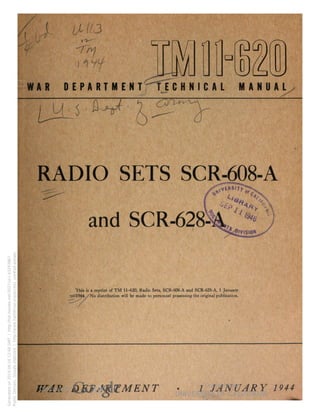
RADIO SETS SCR-608-A 
and SCR-628 
This is a reprint of TM H-620, Radio Sets, SCR-608-A and SCR-628-A, 1 January 
1944. No distribution will be made to personnel possessing the original publication. 
WAR DEPARTMENT • 1 JANUARY 1944 
Generated on 2014-06-16 12:48 GMT / http://hdl.handle.net/2027/uc1.b3243867 
Public Domain, Google-digitized / http://www.hathitrust.org/access_use#pd-google
WA R DEPARTMENT TECHNICAL MANUAL 
T M 11-620 
RADIO SETS SCR-608-A 
and SCR-628-A 
WAR DEPARTMENT • / JANUARY 1944 
United States Government Printing Office 
: 1945 
Generated on 2014-06-16 12:51 GMT / http://hdl.handle.net/2027/uc1.b3243867 
Public Domain, Google-digitized / http://www.hathitrust.org/access_use#pd-google
WAR DEPARTMENT 
WASHINGTON 25, D. C, 1 January, 1944. 
TM 11-620, Radio Sets SCR-608-A and SCR-628-A, is published for the 
information and guidance of all concerned. 
[A. G. 300.7 (6 August, 1943).] 
By order of the Secretary of War: 
G. C. MARSHALL, 
Chief of Staff. 
Official: 
J. A. ULIO, 
Major General, 
The Adjutant General. 
Distribution: 
CandH6(4);Bn 18(4); ICl8(2), 11(10). 
(For explanation of symbols see FM 21-6.) 
H  
' 
II 
Generated on 2014-06-16 12:52 GMT / http://hdl.handle.net/2027/uc1.b3243867 
Public Domain, Google-digitized / http://www.hathitrust.org/access_use#pd-google
TABLE OF CONTENTS 
SECTION I. Description. / Page 
Paragraph 1. Purpose ..... ............... <JL, , . . 1 
2. Performance Characteristics ..............." .^7 . . 1 
3. General Features ....................... 1 
4. Associated Items ....................... 7 
5. Frequency Modulation . ._, , .................. 9 
6. Mounting FT-237-(*) . . ....... ............ 11 
7. Radio Receiver BC-683-A .................... 11 
8. Radio Transmitter BC-684-A ................... 12 
9. Remote Control Unit RM-29-D .................. 25 
10. Dynamotors DM-34-(*), DM-35-(*), DM-36-(*), DM-37-(*) ....... 25 
77. Cabinet CH-74-A ....................... 27 
12. Mountings FT-284-(*) and FT-285-(*) and Frame FM-43 ......... 27 
73. Mast Bases ......................... 27 
14. Mast Base Bracket MP-52 .................... 27 
15. Mast Sections ........................ 27 
16. Cords and Cordage ...................... 27 
II. Installation and Operation. 
17. Initial Procedure ....................... 29 
18. Installation .......................... 29 
19. Preparation for Use ...................... 30 
20. Operation ......................... 32 
21. Presetting Push Buttons ..................... 36 
22. System Operation ....................... 41 
III. Functioning of Parts. 
23. Functioning of Radio Receiver BC-68 3- A ............... 43 
24. Functioning of Radio Transmitter BC-684-A .............. 57 
25. Functioning of Remote Control Unit RM-29-D ............. 63 
26. Functioning of Dynamotors DM-34-(*), DM-35-(*), DM-36-(*), DM-37-(*) . 63 
27. Functioning of Control Circuits .................. 63 
IV. Maintenance. 
28. General Maintenance Information ............. .... 71 
29. Routine Check of Mounting ................... 73 
30. Routine Check of Radio Receiver BC-683-A .............. 73 
3/. Routine Check of Radio Transmitter BC-684-A .... ......... 77 
32. Routine Check of System .................... 84 
33. Emergency Check of Receiver Output Volume and Circuit Alignment ...... 84 
34. Emergency Alignment of Radio Receiver BC-683-A ........... 86 
)5. Emergency Alignment of Radio Transmitter BC-684-A .......... 95 
36. Emergency Sources of Test Tones .................. 100 
37. Precision Alignment of Radio Receiver BC-683-A ............ 100 
38. Precision Alignment of Radio Transmitter BC-684-A ........... 105 
39. Location of Trouble in Radio Receiver BC-683-A ............ 109 
40. Location of Trouble in Radio Transmitter BC-684-A ........... 1 24 
41. Maintenance of Dynamotors ................... 130 
V. Supplementary Data. 
42. Replacement of Parts ...................... 133 
43. Modifications During Manufacture ................. 139 
44. Color Codes on Components ................... 149 
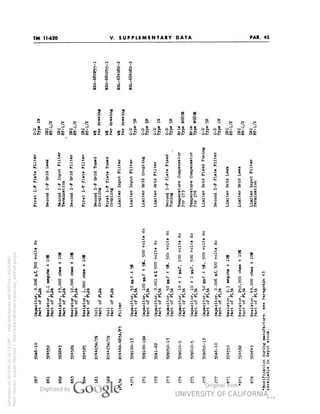
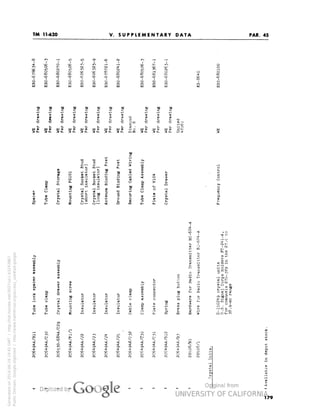
45. Table of Replaceable Parts .................... 156 
III 
Generated on 2014-06-16 12:52 GMT / http://hdl.handle.net/2027/uc1.b3243867 
Public Domain, Google-digitized / http://www.hathitrust.org/access_use#pd-google
LIST OF ILLUSTRATIONS 
grouped according to components 
Fig. Title Page 
General: 
1 Radio Set SCR-608-A: Front View of Cabinet CH-74-A with Associated Components . . . VIII 
2 Radio Set SCR-628-A: Front View of Cabinet CH-74-A with Associated Components .... 2 
3 Radio Set SCR-608-A: Over-all and Unit Dimensions 8 
23 Radio Set SCR-608-A: System Block Diagram -41 
69 Radio Set SCR-608-A: System Schematic Diagram 189 
Radio Receiver BC-683-A: 
6 Front View 12 
7 Oblique Rear View 13 
8 Left-hand Interior View 14 
9 Right-hand Interior View 15 
10 Push-button Assembly, Right-side View 16 
11 Push-button Assembly, Front View 16 
24 Block Diagram 43 
25 Functional Diagram of R-f Amplifier, Modulator, and R-f Oscillator 44 
26 Functional Diagram of I-f Amplifier and Limiter 46 
27a Functional Diagram of Discriminator 48 
27b, c, d Vector Diagrams Showing Phase Relations in the Discriminator 49 
28 Functional Diagram of A-f Amplifier 51 
29 Functional Diagram of Delayed-automatic-volume-control Circuit 52 
30 Functional Diagram of Squelch Circuit 54 
31 Functional Diagram of I-f Oscillator 56 
32 Functional Diagram of the Heater Circuits 57 
43 Wiring Diagram of Front Panel 72 
44 Apparatus Location Diagram, Front View of Panel 73 
45 Apparatus Location Diagram, Left-side View 74 
46 Apparatus Location Diagram, Right-side View 75 
51 Location of Alignment and Tuning Controls . . . .; 93 
57 Voltage Diagram 117 
58 Resistance Diagram 119 
70 Schematic Diagram Showing Modifications During Manufacture 191 
71 Schematic Diagram 193 
72 Wiring Diagram Without Front Panel i . 195 
Radio Transmitter BC-684-A: 
12 Front View With Crystal Compartment Open 17 
13 Assembly and Exploded View of Crystals 18 
14 Right-hand End View with Cover Plate Removed 19 
15 Interior View with Top Cover and Dynamotor Removed . 20 
16 Push-button Assembly, Left-side View 21 
17 Push-button Assembly, Right-side View 21 
18 Interior View with Bottom Cover Removed 22 
33 Block Diagram 58 
34 Functional Diagram of Oscillator and First R-f Amplifier 58 
35 Functional Diagram of Modulator and Rectifier .- 59 
36 Method of Modulation 60 
37 Functional Diagram of Tripler, Doubler, Power Amplifier, and Antenna Coupling Circuits . . 61 
38 Functional Diagram of A-f Amplifier 62 
47 Apparatus Location Diagram, End View and Detail Through Section A-A 78 
48 Apparatus Location Diagram, Top View 79 
IV 
Generated on 2014-06-16 12:52 GMT / http://hdl.handle.net/2027/uc1.b3243867 
Public Domain, Google-digitized / http://www.hathitrust.org/access_use#pd-google
LIST OF ILLUSTRATIONS-C0»/»'»««* 
. 
Fig. Title 
49 Apparatus Location Diagram, Front View 80 
50 Apparatus Location Diagram, Bottom View 82 
52 Location of Alignment and Tuning Controls 97 
59 Voltage Diagram 125 
60 Resistance Diagram 127 
73 Schematic Diagram Showing Modifications During Manufacture 197 
74 Schematic Diagram 199 
75 Wiring Diagram 201 
77 Artificial Antenna Used for Testing 205 
Mounting FT-237-(*): 
4 Oblique Front View • 10 
5 Details 10 
61 Schematic Diagram 133 
62 Wiring Diagram 135 
Remote Control Unit RM-29-D: 
19 Front View 23 
20 Interior View 23 
76 Schematic and Wiring Diagram 203 
Dynamotors DM-34-(*), DM-35-(*), DM-36-(*), DM-37-(*): 
21a DynamotorDM-34-(*) or Dynamotor DM-36-(*) 24 
21b Dynamotor DM- 34- (*) or Dynamotor DM- 36-(*): Sub-base View 24 
22a Dynamotor DM-35-(*) or Dynamotor DM-37-(*^ 26 
22b Dynamotor DM-35-(*) or Dynamotor DM-37-(*): Sub-base View 26 
39 Schematic and Wiring Diagrams , 64-65 
40 Apparatus Location Diagrams 66 
41 Dynamotor DM-34-(*) or Dynamotor DM-36-(*): Exploded View 67 
42 Dynamotor DM-35-(*) or Dynamotor DM-37-(*): Exploded View 68 
Adapter FT-384-(*): 
53 Front View 101 
54 Back View 101 
55 Application to Radio Receiver BC-683-A 102 
56 Schematic and Wiring Diagram , 103 
Capacitors and Resistors: 
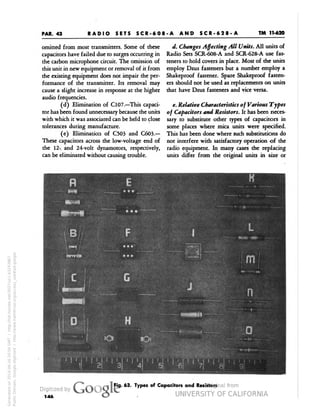
63 Types of Capacitors and Resistors 146 
64 Molded Mica Capacitors: Three-dot Color Code 150 
65 Molded Mica Capacitors: RMA Six-dot Color Code 151 
66a Molded Mica Capacitors: AWS Six-dot Color Code 152 
66b Molded Paper Capacitors: AWS Six-dot Color Code 153 
67 Tubular Ceramic Capacitors: RMA Color Code 153 
68 Fixed Resistors: RMA and AWS Color Codes 154 
Artificial Antenna: 
77 For Testing Radio Transmitter BC-684-A 205 
V 
Generated on 2014-06-16 12:52 GMT / http://hdl.handle.net/2027/uc1.b3243867 
Public Domain, Google-digitized / http://www.hathitrust.org/access_use#pd-google
LIST OF TABLES AND CHARTS 
Table Title Page 
I List of Components and Other Items Required 3 
II Channel and Crystal Frequencies 6 
III Battery Currents 9 
IV Selection of Dynamotors 29 
V Meter Switch Readings (RECEIVER TUNE-OPERATE switch at OPERATE) 32 
VI Meter Switch Readings (RECEIVER TUNE-OPERATE switch at RECEIVER TUNE) . . .129 
VII Capacitor Characteristics 147 
VIII Table of Replaceable Parts 156 
IX List of Manufacturers 187 
Chart 
I Equipment Required for Servicing of Radio Receiver BC-683-A 121 
II Servicing Procedure for Radio Receivers BC-683-A Not Mounted in a Vehicle 122 
III Servicing Procedure for Radio Receivers BC-683-A Mounted in a Vehicle 123 
VI 
Generated on 2014-06-16 12:52 GMT / http://hdl.handle.net/2027/uc1.b3243867 
Public Domain, Google-digitized / http://www.hathitrust.org/access_use#pd-google
DESTRUCTION NOTICE 
WHY To prevent the enemy from using or salvaging this equipment for his benefit. 
WHEN When ordered by your commander, or when you are in immediate danger of 
capture. 
HOW 1. Smash— Use sledges, axes, hand-axes, pick axes, hammers, crowbars, 
heavy tools, etc. 
2. Cut— Use axes, hand-axes, machete, etc. 
3. Bum— Use gasoline, kerosene, oil, flame-throwers, incendiary gre-nades, 
etc. 
4. Explosives— Use firearms, grenades, TNT, etc. 
5. Disposal— Bury in slit trenches, foxholes, other holes. Throw in sycams. 
Scatter. 
6. Use anything immediately available for destruction of this equipment. 
WHAT . Smash— Crystals, meter, plugs, tuning controls, tubes, capacitors, resis-tors, 
sockets, insulators, microphones, headsets, and relays. 
2. Cut— Cords, wiring, and cables. 
3. Bend and/or 
Break— Antenna sections, panels, mounting, and nameplate. 
4. Burn— Circuit label, technical manual and all papers, cords, wiring, 
cable, dynamotors, capacitors, resistors, and nameplate. 
5. Bury and/or 
Scatter— Any or all of the above pieces after breaking. 
DESTROY EVERYTHING 
SAFETY NOTICE 
THIS EQUIPMENT USES DANGEROUSLY HIGH VOLTAGES. IT CAN KICK 
LIKE A MULE AND IS A DARN SIGHT MORE DANGEROUS. DONT CHANGE 
VACUUM TUBES OR WORK IN THE EQUIPMENT WITH THE DYNAMOTOR 
RUNNING, EXCEPT AS SPECIFICALLY DIRECTED IN THIS MANUAL. BE 
CAREFUL, DONT TAKE CHANCES. 
SPECIAL NOTICE 
Certain schematic and wiring diagrams in this manual include modifications during 
manufacture which are discussed in Paragraph 43. Not all these changes are included 
in the functional diagrams, Figs. 25 through 38. Any discrepancies between these two 
groups of figures are explained under appropriate heading in Paragraph 43. In case 
of such discrepancies, follow the circuit label on the equipment. 
VII 
Generated on 2014-06-16 12:52 GMT / http://hdl.handle.net/2027/uc1.b3243867 
Public Domain, Google-digitized / http://www.hathitrust.org/access_use#pd-google
MAST SECTION MS-53 
MAST BASE MP-37 
MAST BASE BRACKET MP-52 
CABINET CH-74-A 
RADIO SET 
SCR-608-A 
MOUNTING FT-384-(#) 
Fig. 1. Radio Set SCR-608-A: Front View of Cabinet CH-74-A with Associated Components 
VIII 
Generated on 2014-06-16 12:52 GMT / http://hdl.handle.net/2027/uc1.b3243867 
Public Domain, Google-digitized / http://www.hathitrust.org/access_use#pd-google
TM 11-620 
PARS. 1-3 
I. DESCRIPTION 
SECTION I. DESCRIPTION 
1. Purpose. Radio Sets SCR-608-A and 
SCR-628-A provide frequency-modulated radio 
telephone communication for anti-aircraft and 
anti-tank warning and control nets, for base sta-tions 
at battalion command posts for fire control 
and fire direction nets, and for intra-battalion 
communication. The radio sets may be installed 
and operated in combat vehicles such as command 
cars, half-tracks, or any other authorized vehicle. 
The sets are designed to operate within a 
temperature range of minus 40 degrees to plus 
130 degrees Fahrenheit around the set. Don't 
operate this equipment for long periods of time 
in enclosed spaces where the temperature may 
rise too high. Watch this. 
2. Performance Characteristics. 
a. System. 
(1) Frequency range 27.0 to 38.9 megacycles 
(2) Channel spacing 100 kilocycles 
(3) Number of channels available 120 
(4) Channel numbers 270 to 389 inclusive 
()) Number of preset channels 10 • 
(6) Communication range 5 to 15 miles 
(7) Power supply 12- or 24-voIt vehicular 
battery (see Note) 
Note: Radio Sets SCR-608-A and SCR-628-A are 
equipped with dynamotors for operation from a 
12-volt battery. If authorized, they may be op-erated 
from a 24-volt battery by substitution of 
the proper dynamotor. This is explained fully in 
Paragraph 10f. Be sure you don't operate your 
set from a battery of the wrong voltage. You'll 
burn out tubes, dynamotor, and capacitors. 
b. Radio Receiver BC-683-A. 
(1) Sensitivity 1 microvolt 
Generated on 2014-06-16 12:52 GMT / http://hdl.handle.net/2027/uc1.b3243867 
Public Domain, Google-digitized / http://www.hathitrust.org/access_use#pd-google 
(2) Intermediate frequency 2.65 megacycles 
(3) Band width 80 kilocycles 
(4) Power output, speaker 2 watts 
(5) Power output, headset 0.2 watt 
(6) Call signal „ Lamp 
(7) Noise suppression - "Squelch" 
(8) Battery drain, 12-volt supply 4 amperes 
(9) Battery drain, 24-volt supply 2 amperes 
(see Note under Paragraph 2a.) 
c. Radio Transmitter BC-684-A. 
(1) Nominal power output 20 watts 
(2) Nominal frequency 
deviation ± 40 kilocycles 
(3) Crystal frequency range 375.000 to 
540.277 kilocycles 
(4) Frequency multiplication 72 
(5) Battery drain, 12-volt supply 20 amperes 
(6) Battery drain, 24-volt supply 12 amperes 
(see Note under Paragraph 2a.) 
3. General Features. 
a. Arrangement and Weight of Major Com-ponents, 
The general construction and arrange-ment 
of Radio Sets SCR-608-A and SCR-628-A 
are shown in Figs. 1 and 2. Over-all component 
and assembly dimensions are shown in Fig. 3. 
The radio sets consist of these combinations of 
major units: 
(1) Radio Set SCR-608-A. 
2 Radio Receivers BC-683-A with 
12-volt Dynamotor DM-34-(*) 70 Ibs. 
1 Radio Transmitter BC-684-A with
MAST SECTION MS-53 
 
MAST BASE BRACKET MP-52 
RADIO SET 
SCR-628-A 
MOUNT INC FT-284-(#) 
Fig. 2. Radio Set SCR-628-A Front View of Cabinet CH-74 A with Associated Components 
Generated on 2014-06-16 12:53 GMT / http://hdl.handle.net/2027/uc1.b3243867 
Public Domain, Google-digitized / http://www.hathitrust.org/access_use#pd-google
TM 11-620 
PAR. 3 
I. DESCRIPTION 
Quant itj 
Table I. List of Components and Other Items Required 
Article 
Adapter Kit MC-471; includes: 
1 Adapter plate; 15 in. x 35 in. x 1% in. 
1 Reinforced plate; 16 in. x ll/2 in x TS3 in. 
Necessary hardware 
Antenna A-83-(*) (Phantom) 
Battery Bracket BA-27 [for Remote Control Unit RM-29- (*) ]; 1 in Use, 1 Running Spare 
Box BX-40 [for 30 crystal Holders FT-241-(*)]; includes 30 Holders FT-24l-(*) 
Bracket (extension for Mounting FT-285) 
Bracket (Cabinet CH-74-A) 
Cabinet CH-74-A 
Case CS-76-(*) [for Remote Control Unit RM-29-(*) ] 
Chest CH-96 [for Microphone T-17, Headset HS-30-(*), 
Box BX-40, spare tubes, technical manuals, etc.] 
Clamp MC-423 (for Mast Section MS-51); 1 in Use, 1 Running Spare 
Clamp MC-424 (for Mast Section MS-52); 1 in Use, 1 Running Spare 
Cord CD-307-A [65-in. long, for Headset HS-30-(*)]; 1 in Use, 1 Running Spare 
Connector and Bondnut; Appleton Electric Co. No. 61004 and BL-50 respectively 
Connector and Bondnut; Appleton Electric Co. No. 61007 and BL-50 respectively 
Cord CD-604 [for Headset HS-30-(*)]; 1 in Use, 1 Running Spare 
Cord CD-689 (for Mast Base MP-48-A) 
Cable WC-562 
Cord CD-318-A (for Microphone T-45) 
Cordage CO-212 
Cordage CO-218 [for connecting slip ring to 
Interphone Control Box BC-606-(*) in turret.] 
Cover BG-96 (for radio set) 
Cover BG-108 (for Mast Base MP-48-A) 
Dynamotor DM-34-(*) [for Radio Receiver BC-683-(*)]; 12 volts; 
includes the following Running Spare in BAG attached to dynamotor: 
4-BRUSH (L.V.) INCLUDES SPRINGS 
4-BRUSH (H.V.) INCLUDES SPRINGS 
Dynamotor DM-35-(*) [for Radio Transmittet BC-684-(*)]; 12 volts; 
includes the following Running Spare in BAG attached to dynamotor: 
4-BRUSH (L.V.) INCLUDES SPRING 
4-BRUSH (H.V.) INCLUDES SPRING 
Frame FM-43 [for Cabinet CH-74-A or Mounting FT-237-(*) ] 
Hardware Kit: Miscellaneous items 
Headset HS-30-(*); 1 in Use, 1 Running Spare 
(When Headset HS-30-(*) is not available, Headset HS-18 or HS-23 may be issued.) 
Insulator IN-101 
Insulator IN-104 
Insulator IN-121 (1%-in. long, for insulating antenna wire through metal partition.) 
Interphone Control Box BC-606-(*); includes attached hardware as follows: screws, 
washers, clamps, clips, and hooks. 
1 
2 
1 
* 
* 
* 
1 
1 
2 
2 
2 
* 
» 
2 
1 
* 
» 
* 
* 
1 
Generated on 2014-06-16 12:53 GMT / http://hdl.handle.net/2027/uc1.b3243867 
Public Domain, Google-digitized / http://www.hathitrust.org/access_use#pd-google
PAR. 3 RADIO SETS SCR-608-A AND SCR-628-A TM 11-620 
Table I. List of Components and Other Items Required—Continued 
Quantity Article 
1 Mast Base MP-48-A 
* Mast Base Bracket MP-52 (Cabinet CH-74-A) 
* Mast Base Bracket MP-54 
* Mast Section MS-51 
2 Mast Section MS-52; 1 in Use, 1 Running Spare , 
2 Mast Section MS-53; 1 in Use, 1 Running Spate 
* Microphone T-17 (hand-type) 
* Microphone T-45 (lip-type) 
(When Microphone T-17 or T-45 is not available, Microphone T-30 may be issued.) 
3 Microphone Cover M-367; 2 in Use, 1 Running Spare 
1 , Mounting FT-237-(*); includes: 
1 Cord CO-278 (for power) 
1 set dust covers for receptacles 
All necessary mounting bolts, nuts, and lock washers. 
* Mounting FT-284 (for Cabinet CH-74-A) 
* Mounting FT-285 (for Cabinet CH-74-A); includes: mounting bolts, nuts, screws, 
straps, and bracket. 
* Mounting FT-326 
2 Radio Receiver BC-683-(*); includes: 
10 Fuse FU-24; 1 in Use, 9 Running Spare 
3 Lamp LM-63; 1 in Use, 2 Running Spare 
2 Tube JAN-6H6 (VT-90); 1 fn Use, 1 Running Spare 
2 Tube JAN-6J5 (VT-94)-, I in Use, 1 Running Spare 
2 Tube JAN-6V6GT/G (VT-107.-A); 1 in Use, 1 Running Spare 
4 Tube JAN-6AC7/1852 (VT-112); 3 in Use, 1 Running Spare 
3 Tube JAN-12SG7 (VT-209); 2 in Use, 1 Running Spare 
3 Tube JAN-6SL7GT (VT-229); 2 in Use, 1 Running Spare 
1 Radio Transmitter BC-684-(*); includes: 
120 Crystal Holder FT-241-(*) with Crystal (10 in Sockets, 80 in Drawer Compartment, 
30 in Box BX-40) 
10 Fuse FU-64; 1 in Use, 9 Running Spare 
3 Lamp LM-38; 1 in Use, 2 Running Spare 
11 Tube JAN-1619 (VT-164); 7 in Use, 4 Running Spare 
2 Tube JAN-1624 (VT-165); 1 in Use, 1 Running Spare 
1 Remote Control Unit RM-29- ( * ) 
1 Roll BG-56-A (for antenna mast sections) 
Generated on 2014-06-16 12:53 GMT / http://hdl.handle.net/2027/uc1.b3243867 
Public Domain, Google-digitized / http://www.hathitrust.org/access_use#pd-google 
2 Technical Manual TM 11-620 for Radio Sets SCR-608-(*) and SCR-628-(*) 
6ft. WireW-128 
The asterisk within parentheses (*) indicates that items so indicated are 
interchangeable with those marked with a different suffix letter. 
An asterisk in the column headed Quantity indicates that the item is issued 
in quantities authorized, depending upon the type of installation to be made.
TM 11-620 
PAR. 3 
I. DESCRIPTION 
set of vacuum tubes in place. The tube comple-ment 
of each component follows: 
(1) Radio Receiver BC-683-A. 
Circuit 
Signal Corps 
Commercial 
Designation 
Function 
Designation 
Designation 
VI 
R-f amplifier 
VT-112 
6AC7 
V2 
Modulator 
VT-112 
6AC7 
V3 
R-f oscillator 
VT-94 
6J5 
V4 
I-f amplifier 
VT-209 
12SG7 
. V5 
I-f amplifier 
VT-209 
12SG7 
V6 
Limiter 
VT-112 
6AC7 
V7 
Detector (dis- 
Generated on 2014-06-16 12:53 GMT / http://hdl.handle.net/2027/uc1.b3243867 
Public Domain, Google-digitized / http://www.hathitrust.org/access_use#pd-google 
VT-90 
6H6 
criminator) 
V8 
Second a-f 
VT-107-A 
6V6-GT 
amplifier 
V9 
AVC and 
VT-229 
6SL7-GT 
squelch 
VlO 
First a-f 
VT-229 
6SL7-GT 
amplifier and 
i-f oscillator 
(2) Radio Transmitter BC-684-A. 
Circuit 
Designation 
Signal Corps 
Designation 
Commercial 
Designation 
Function 
V101 
First r-f 
VT-164 
1619
PAR. 3 
TM 11-620 
RADIO SETS SCR-608-A AND SCR-628-A 
Table II. Channel and Crystal Frequencies 
Crystal frequency 
(kilocycles) 
Output Frequency 
(megacycles) 
Crystal Frequency 
(kilocycles) 
Output Frequency 
(megacycles) 
Channel 
Channel 
270 
375.000 
27.0 
330 
458.333 
33.0 
271 
376.388 
27.1 
331 
459.722 
33.1 
272 
377.777 
27.2 
332 
461.111 
33.2 
273 
379.166 
27.3 
333 
462.500 
33.3 
274 
Generated on 2014-06-16 12:53 GMT / http://hdl.handle.net/2027/uc1.b3243867 
Public Domain, Google-digitized / http://www.hathitrust.org/access_use#pd-google 
380.555 
27.4 
334 
463.888 
33.4 
275 
381.944 
27.5 
335 
465.277 
33.5 
276 
383.333 
27.6 
336 
466.666 
33.6 
277 
384.722 
27.7 
337 
468.055 
33.7 
278 
386.111 
27.8 
338 
469.444 
33.8 
279 
387.500
TM 
PAR. 4 
I. DESCRIPTION 
4. Associated Items. 
a. Antenna System. 
(1) Mast Base MP-48 or MP-37 is used 
and must be mounted in such a way that the an-tenna 
will normally be in a vertical position. 
Mast Base MP-48 is equipped with a coaxial con-nector 
cable running up through the center. An 
antenna terminal is provided at the top of the 
mast base. Another terminal is provided on the 
lower end of the coaxial connector cable for con-necting 
to the set by means of Wire W-128. A 
coaxial cable fitting is also furnished with 
MP-48 for the purpose of joining the lower end 
of the coaxial connector cable of MP-48 to a 
coaxial line from the set. 
(2) Three mast sections (MS-51, MS-52, 
MS-53) must be used, except that only two mast 
sections (MS-52, MS-53) are to be used with 
Mast Base Bracket MP-52. (Mast Base Bracket 
MP-52 is used in half-track installations and is 
mounted on the top of Cabinet CH-74-A at the 
left front corner.) Mast joints should be tight-ened 
securely by use of gas pliers or other suit-able 
tools, and should be taped to prevent loss 
of mast sections. Put on two servings of friction 
tape as tightly as possible. The first serving 
should be applied counterclockwise, starting on 
the lower half of the joint and taping upwards 
from the left to the right. If available, Clamps 
MC-423 and MC-424 should be used instead 
of tape. 
(3) Wire W-128 should be used between 
the mast base and the set when the length of the 
run is less than 40 inches. Do not use more 
W-128 than is necessary. This wire can be con-nected 
to either the top or the bottom terminal 
Generated on 2014-06-16 12:53 GMT / http://hdl.handle.net/2027/uc1.b3243867 
Public Domain, Google-digitized / http://www.hathitrust.org/access_use#pd-google 
of MP-48, or may be fed up through the center 
of MP-48 after removal of the center coaxial 
connector cable. In the latter case the maximum 
permissible length of W-128 is 52 inches. The 
center coaxial cable must always be removed 
when connection is made to the top terminal; 
otherwise the range of the set will be reduced 
greatly. When passing W-128 through the side 
of the vehicle, chests, etc., always insert an insu-lating 
bushing, such as IN-101 or IN-111, in the 
hole to protect the wire. Wire should be run and 
supported in such a way that it is protected from 
damage and will not be subject to chafing due to 
vibration. 
(4) Coaxial cable, Cordage CO-282, should 
be used between the mast base and the set when 
the length of run is over 40 inches. The length 
of CO-282 must always be 7 feet (plus or minus 
1 foot). If 7 feet is more than is needed, tape up 
the excess in a coil. The sheath of CO-282 must 
be grounded at both ends. When MP-37 is used, 
a short ground lead at the mast base is required 
to ground the sheath. When MP-48 is used, the 
coaxial cable fitting that joins CO-282 to the 
center coaxial cable connector of MP-48 provides 
for sheath grounding at the mast base. When 
passing CO-282 through the side of the vehicle, 
chests, etc., always insert an insulating bushing, 
such as IN-101 or IN-111, in the hole. Cable 
should be run and supported in such a way that 
it is protected from damage and will not be sub-ject
I 
i 
| 
-, y 
• 
tn 
iiifi 
rt 
4 
5y 
-*r 
* 
H 
o 
~s 
o 
5 
r~ 
n 
cM 
I 
ZuJ 
/ 
> 
2 
8 A 
B 
U. 
o 
t-p 
0 
o 
3 
U 
A 
7 
$ 
A- 
& 
1 
fl 
.J s 
3 
cr 
cs 
n z 
z 
i 
». 
|[j 
i 
u. 
E 
1 
o 
a 
S 
^^ 
U- 
£ 
DC 
4 
t 
W^ 
•^ 
O 
V 
. 
~ 
Generated on 2014-06-16 12:53 GMT / http://hdl.handle.net/2027/uc1.b3243867 
Public Domain, Google-digitized / http://www.hathitrust.org/access_use#pd-google
TM 11-620 _ _ I. DESCRIPTION _ PARS. 4-5 
dimensions that the circuits of the transmitter This system of communication, which is com-and 
the receiver can be resonated at the author- paratively new, has one important advantage 
ized frequencies. Make the ground connection over the older amplitude modulation systems: 
for the antenna system through the contact be- Within the limit of its useful range, trouble from 
tween the mounting and the frame of the vehicle. static is greatly reduced. Of course, static is not 
Where there is no direct connection to the frame, completely eliminated, but within the normal 
or where the connection is unsuitable, connect it 5- to 15-mile range it is much less troublesome. 
to the frame through short lengths of braided If static becomes strong when talking to another 
copper strap l/2'incn wide. Make certain that station, it is generally a sign that you are hear 
there is good electrical contact at both ends of the limit of your working range. (See Paragraph 
the straps and allow sufficient slack to permit 20d for good and bad places for radio communi-free 
movement of the unit in the shock mount- cation.) Some of the technical features of f re-ing. 
If your ground lead is too short, vibration quency modulation (FM) are explained in 
will soon break it. Section III of this manual. The basic idea is out-b. 
Microphones and Headsets. One Headset lined briefly in the following paragraphs. 
HS-30-(*), HS-18, or HS-23 and one Micro- b. Communication is effected by modulation 
phone T-17, T-30, or T-33 are required for each of the carrier frequency. That is to say, the car-person 
using the equipment. Microphone T-17 rier frequency is made to vary with the loudness 
is the carbon hand type, Microphone T-30 is the and fitch of the voice signal. Loud speech causes 
carbon throat type, and Microphone T-33 is the greater variation of the carrier frequency, soft 
magnetic hand type. Separate jacks are provided speech causes less variation. High-pitched sounds 
for use with either the carbon or the magnetic cause the carrier frequency to vary more rapidly 
type of microphone. than do low-pitched sounds. The amplitude and 
c . Battery Power Supply. Your radio sets op- power of the transmitted wave remain substanti-erate 
from either a 12- or 24-volt battery power ally constant during modulation. 
source (depending upon the transmitter and re- These characteristics are quite different from 
ceiver dynamotors furnished; see Paragraph 10) . those of amplitude modulation such as used by 
The battery used is the one already installed in Radio ^K SCR-245-(*) and SCR-299-(*) in 
your vehicle. You must have sufficient battery which the **P**** and modulating frequency 
capacity and charging rate to maintain essentially of the transmi"ed wave varY wi'h the speech 
full charge in the battery under all operating con- 'loudness and t*ch, while the carrier frequency 
ditions. The battery current required to operate remains constant- Static noise 1S more closely re-all 
units of the radio sets is given in Table III. lated to amflltude modulation than it is to fre- 
Keep it in mind. Don't let your battery become Iuenc1 modulat'on: therefore interference with 
discharged. If it does your communications will Signals 1S reduced throu£h the use of frequency-fail 
and your vehicle stall. modulation receiver circuits which suppress amp-litude 
variations. This "discrimination" against 
Table III. Battery Currents received static noise gives you improved com- 
Generated on 2014-06-16 13:02 GMT / http://hdl.handle.net/2027/uc1.b3243867 
Public Domain, Google-digitized / http://www.hathitrust.org/access_use#pd-google 
Battery Drain (Amperes) munication within your set's range. But at the 
-Volt Battery 24-Volt Battery end of your range and beyond it, frequencymod- 
(22-30 volts) when 
SCR-608-A 28 16 static gets bad, you're either at the end of your 
"628'A - 24 _ 14 _ range, or your receiver isn't getting much of a 
5. Frequency Modulation. sig"f l f "^ *e Statio" ?™ a/C "^f tO 
The methods employed for modulation and 
a. Radio Sets SCR-608-A and SCR-628-A op- demodulation are explained in Paragraphs 23 
crate on the principle of frequency modulation, and 24 of this technical manual. 
85S334 O - « - 1
Fig. 4. Mounting FT-237-(*): Oblique Front View 
Fig. 5. Mounting FT-237-(*): Details 
10 
Generated on 2014-06-16 13:02 GMT / http://hdl.handle.net/2027/uc1.b3243867 
Public Domain, Google-digitized / http://www.hathitrust.org/access_use#pd-google
TM 
PARS. 6-7 
I. DESCRIPTION 
6. Mounting FT-237-(*). 
a. General. This mounting (Fig. 4), will hold 
either: 
(1) Radio Set SCR608-A. One Radio 
Transmitter BC-684-A and two Radio Receivers 
BC-683-A. 
(2) Radio Set SCR-628-A. One Radio 
Transmitter BC-684-A and one Radio Receiver 
BC-683-A. 
The transmitter must be installed in its allotted 
place at the left end of the mounting, but the 
receiver may be installed in either of the two 
right-hand positions. Each unit is secured to the 
mounting by thnmbscrew clamps and may be 
quickly removed without tools. 
Dust covers are provided for protection of the 
unused receptacles. Screw the dust covers to the 
rear of the mounting when removed from the 
receptacles. (See Fig. 4.) 
A reversible nameplate bearing the words 
BATTERY VOLTAGE 12 v on one side, and BATTERY 
VOLTAGE 24 v on the other side, is screwed to 
the front of the mounting near the right-hand 
end. (This plate will normally show BATTERY 
VOLTAGE 12 v for Radio Sets SCR-608-A and 
SCR-628-A. Don't reverse the nameplate unless 
24-volt operation is authorized.) 
b. Fastening of Mounting. Secure the mount-ing 
to the vehicle frame or other support by bolts 
passed through two heavy bedplates on the 
mounting. There are four bolt holes in each bed-plate. 
Each bedplate supports the mounting through 
two sets of rubber shock absorbers. In addition, 
two rubber snubbers on each bedplate prevent 
excessive movement of the equipment on the 
Generated on 2014-06-16 13:02 GMT / http://hdl.handle.net/2027/uc1.b3243867 
Public Domain, Google-digitized / http://www.hathitrust.org/access_use#pd-google 
mounting. Electrical bonding straps are con-nected 
across each rubber shock absorber to pro-vide 
a good ground connection to the bedplates. 
c. Terminals. There are two terminals at the 
left end of the mounting. Connect the antenna 
system to the terminal designated TR for radio 
transmission and reception (Radio Sets SCR- 
608-A and SCR-628-A) or to the terminal desig-nated 
REC for reception only. A ground terminal 
is provided by a screw on the mounting. Later 
mountings have a ground binding post located 
near the antenna terminals for grounding the 
sheath of coaxial cable (Cordage CO-282). 
A door in the base plate of the mounting per-mits 
access to the battery fuse (F401), and a ter-minal 
strip (TS401). (See Fig. 5.) One of the 
spare battery fuses is held in a clip on the under 
side of the door. The positive battery connection 
is made at the right-hand end of fuse F401. The 
negative battery connection is made at a screw 
on the under side of the mounting base plate, 
which is marked x in Fig. 5. Three methods of 
running the battery cable, through the right end, 
front, or rear of Mounting FT-237-(*), are 
illustrated in Fig. 3- 
d. Interconnections Between Units. All con-nections 
between the transmitter and receiver 
units and the mounting are made through multi-contact 
plugs and receptacles which are auto-matically 
engaged when the units are inserted 
into their proper positions on the mounting. The
PARS. 7-8 
TM 11-620 
RADIO SETS SCR-608-A AND SCR-628-A 
Fig. 6. Radio Receiver BC-683-A: Front View 
tons released), the receiver may be tuned by 
pushing the PUSH TO TUNE push button while 
rotating the TUNINQ control. 
Two jacks, marked PHONES, are provided for 
headset operation. The output of the receiver 
may be connected to the headset circuit by throw-ing 
the OUTPUT TO PHONES switch to ON. When 
the OUTPUT TO PHONES switch is at OFF, the 
headset circuit is disconnected from the radio 
receiver. The loudspeaker, however, will still be 
connected to the receiver output. To use the loud-speaker, 
place the SPEAKER switch at ON. Regu-late 
the headset and loudspeaker volume by ad-justing 
the VOLUME control. 
A noise suppression or "squelch" circuit is 
switched on or off by the SQUELCH switch. When 
the SQUELCH switch is at ON, the sensitivity of 
the receiver is adjusted by the SENSITIVITY con-trol. 
When the SQUELCH switch is at OFF, the 
receiver sensitivity is restored to maximum and 
cannot be adjusted. 
The CALL SIGNAL lamp indicates that a signal 
is being received provided the SQUELCH switch 
is at ON and the SENSITIVITY control has been ad-justed 
to prevent operation of the squelch circuit 
by received noise. 
The TUNE-OPERATE switch starts a preset in-termediate- 
frequency oscillator when at TUNE 
to assist in the adjustment of the channel selector 
mechanism or to aid in tuning to weak signals. 
The intermediate-frequency oscillator is also 
used when aligning or servicing the receiver. 
Active and spare fuses are contained in the 
two fuse receptacles designated FUSE and SPARE. 
Antenna and ground binding posts, designated 
Public Domain, Google-digitized / http://www.hathitrust.org/access_use#pd-google 
A and G, are provided for testing purposes and 
12 Generated on 2014-06-16 13:02 GMT / http://hdl.handle.net/2027/uc1.b3243867 
special services. These connections are not used 
when the receiver is installed for operation. 
To remove the receiver dust cover turn the 
fastener on the rear of the cover (see Fig. 7) 
one-fourth turn to the left and slide the cover 
off the rear of the receiver. Figure 8 is a view of 
the left-hand side of the receiver, and Fig. 9 
shows the right-hand side of the receiver after 
removal of the dust cover. Figures 10 and 11 
show the receiver push button assembly, viewed 
from the right side and the front respectively. 
b. Power Supply. Radio Receiver BG683-A 
is issued with Dynamotor DM-34-(*) for op-eration 
from a 12-volt vehicle battery. If author-ized, 
the receiver may be operated from a 24-volt 
vehicle battery by merely substituting Dynamotor 
DM- 36- ( * ) in place of Dynamotor DM-34- ( * ). 
This is the only change necessary since a multi-contact 
jack on the base of each dynamotor is 
wired to make the necessary circuit changes. 
8. Radio Transmitter BC-684-A. 
a. Description of Functions. The transmitter 
operates in the frequency band from 27.0 to 38.9 
megacycles and delivers a nominal power output 
of 20 watts to its antenna system. The carrier is 
frequency-modulated. A maximum frequency 
deviation of plus or minus 80 kilocycles (total 
frequency swing, 160 kilocycles) can be ob-
ANTENNA TRIMMER 
CAPACITOR 
Fig. 7. Radio Receiver BC-683-A: Oblique Rear View 
Generated on 2014-06-16 13:02 GMT / http://hdl.handle.net/2027/uc1.b3243867 
Public Domain, Google-digitized / http://www.hathitrust.org/access_use#pd-google
Fig. 8. Radio Receiver BC-683-A: Left-hand Interior View 
14 
Generated on 2014-06-16 13:02 GMT / http://hdl.handle.net/2027/uc1.b3243867 
Public Domain, Google-digitized / http://www.hathitrust.org/access_use#pd-google
Fig. 9. Radio Receiver BC-683-A: Right-hand Interior View 
15 
Generated on 2014-06-16 13:03 GMT / http://hdl.handle.net/2027/uc1.b3243867 
Public Domain, Google-digitized / http://www.hathitrust.org/access_use#pd-google
Fig. 10. Radio Receiver BC-683-A: Push-button Assembly, Right-side View 
Fig. 11. Radio Receiver BC-683-A: Push-button Assembly, Front View 
16 
Generated on 2014-06-16 13:03 GMT / http://hdl.handle.net/2027/uc1.b3243867 
Public Domain, Google-digitized / http://www.hathitrust.org/access_use#pd-google
Fig. 12. Radio Transmitter BC-684-A: Front View with Crystal Compartment Open 
17 
Generated on 2014-06-16 13:03 GMT / http://hdl.handle.net/2027/uc1.b3243867 
Public Domain, Google-digitized / http://www.hathitrust.org/access_use#pd-google
PAR. 8 
TM 11-620 
RADIO SETS SCR-608-A AND SCR-628-A 
! 1 
•r I 
Fig. 13. Radio Transmitter BC-684-A: Assembly 
and Exploded View of Crystals 
tuined; ordinarily, however, the frequency devi-ation 
is much less than this. Under most operat-ing 
conditions the deviation, even on voice peaks, 
is less than plus or minus 40 kilocycles (total 
swing, 80 kilocycles). 
A front oblique view of the transmitter is 
shown in Fig. 1 (large unit at the left). Figure 
12 is a closer front view and Fig. 13 shows as-sembly 
and exploded views of typical crystals. A 
view of the right-hand end of the transmitter 
showing the various controls and access openings 
is given in Fig. 14. 
The front panel contains ten push buttons by 
means of which any of ten preadjusted transmit-ting 
channels may be immediately selected. This 
operates exactly like the push-button type of 
broadcast radio for the home. Like the receivers, 
you merely push one of several buttons on the 
front of the set to select the channel you want. 
Antenna and ground binding posts, designated 
A and G, are provided for test purposes, and they 
are not normally used when the transmitter is 
installed for operation. The RECEIVER TUNE-OPERATE 
switch makes it possible to use the 
transmitter as a source of known signal frequency 
for adjustment and testing of associated radio 
receivers. The transmitter filaments and relay 
circuits are energized by the ON-OFF switch and 
transmission is started by operating the control 
switch on the operator's microphone. The pilot 
lamp lights when the TRANSMITTER switch is at 
ON. Plug microphones of the carbon type, such 
Generated on 2014-06-16 13:03 GMT / http://hdl.handle.net/2027/uc1.b3243867 
Public Domain, Google-digitized / http://www.hathitrust.org/access_use#pd-google 
as Microphone T-17 and Microphone T-30, into 
the CARB MIC jack. Connect Microphone T-33, 
which is of the magnetic type, at the MAGNETIC 
MIC jack. 
Active and spare fuses are contained in the 
two fuse receptacles designated FUSE and SPARE. 
The panel meter may be connected in various 
circuits by means of the TUNE-ANT CUR switch on 
the panel and the six-position METER SWITCH 
(Fig. 14) to observe transmitter output and cir-cuit 
operating conditions. The meter is not cali-brated 
in milliamperes or other standard uqit of 
measure as it is used only as an indicator of rela-tive 
current flow. 
The SIDETONE control shown in Fig. 14 ad-justs 
the volume of transmitted speech heard in 
the operator's headset. The ten screwdriver-operated 
controls are for antenna tuning adjust-ments. 
Remove the top or bottom cover plates for 
access to the interior of the transmitter. Figure 
15 is a view of the interfor with the top cover 
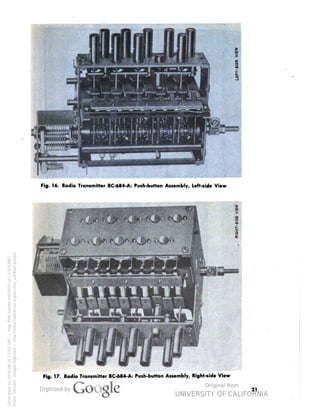
plate removed. Figures 16 and 17 show the 
transmitter push-button assembly viewed from 
the left and from the right side respectively. A 
view of the interior with the bottom cover plate 
removed is shown in Fig. 18. 
b. Power Supply. Radio Transmitter BC-684- 
A is furnished with a dynamotor, Dynamotor 
DM-35-(*), suitable for operation from a 12- 
volt vehicle battery. If authorized, the transmitter
Fig. 14. Radio Transmitter BC-684-A: Right-hand End View with Cover Plate Removed 
19 
Generated on 2014-06-16 13:03 GMT / http://hdl.handle.net/2027/uc1.b3243867 
Public Domain, Google-digitized / http://www.hathitrust.org/access_use#pd-google
Fig. 15. Radio Transmitter QC-684-A: Interior View with Top Cover and Dynamotor Removed 
20 
Generated on 2014-06-16 13:03 GMT / http://hdl.handle.net/2027/uc1.b3243867 
Public Domain, Google-digitized / http://www.hathitrust.org/access_use#pd-google
Fig. 16. Radio Transmitter BC-684-A: Push-button Assembly, Left-side View 
Fig. 17. Radio Transmitter BC-684-A: Push-button Assembly, Right-side View 
21 
Generated on 2014-06-16 13:03 GMT / http://hdl.handle.net/2027/uc1.b3243867 
Public Domain, Google-digitized / http://www.hathitrust.org/access_use#pd-google
Fig. 18. Radio Transmitter BC-684-A: Interior View with Bottom Cover Removed 
22 
Generated on 2014-06-16 13:04 GMT / http://hdl.handle.net/2027/uc1.b3243867 
Public Domain, Google-digitized / http://www.hathitrust.org/access_use#pd-google
Fig. 19. Remote Control Unit RM-29-D: Front View 
Fig. 20. Remote Control Unit RM-29-D: Interior View 
Generated on 2014-06-16 13:04 GMT / http://hdl.handle.net/2027/uc1.b3243867 
Public Domain, Google-digitized / http://www.hathitrust.org/access_use#pd-google
Fig. 21a. Dynamotor DM-34-(*) or Dynamotor DM-36-(*) 
Fig. 21b. Dynamotor DM-34-(*) or Dynamotor DM-35-(*): Sub-base View 
Generated on 2014-06-16 13:04 GMT / http://hdl.handle.net/2027/uc1.b3243867 
Public Domain, Google-digitized / http://www.hathitrust.org/access_use#pd-google
TM 
PARS. 9-10 
I. DESCRIPTION 
9. Remote Control Unit RM>29-D. 
Note: The information regarding Remote Con-trol 
Unit RM-29-D in this and subsequent para-graphs 
is given to assist radio operators in setting 
up Radio Sets SCR-608-A and SCR-628-A for 
remote control operation. Do not regard this 
information as complete, but refer to Technical 
Manual TM 11-308, covering the remote control 
unit, for detailed information and instructions. 
a. Description of Functions. Remote Control 
Unit RM-29-D provides for remote control of the 
radio equipment and operates in conjunction 
with Telephone EE-8-(*) over a two-wire tele-phone 
line. A front view of the remote control 
unit is shown in Fig. 19, and an internal view 
with the housing removed is shown in Fig. 20. 
Two plug-terminated cords are provided to 
connect the remote control unit to the radio trans-mitter 
and radio receiver. The two-wire tele-phone 
line from the remotely located field Tele-phone 
EE-8-(*) terminates at binding posts LI 
and L2 on the remote control unit. Microphone 
T-17 and a headset, when plugged into the re-mote 
control unit, are used for transmission and 
reception of signals via the radio set, for moni-toring 
signals between the telephone and the 
radio set, and for direct communication with 
Telephone EE-8-(*). 
The three modes of operation are selected by 
the switch marked RADIO-THROUGH-TELEPHONE 
on the front of the remote control unit. Opera-tion 
is as follows: 
(1) Switch at RADIO. The radio set is con-trolled 
entirely by the operator stationed at the 
remote control unit, with the switch at RADIO. 
The operator Can transmit and receive signals 
Generated on 2014-06-16 13:04 GMT / http://hdl.handle.net/2027/uc1.b3243867 
Public Domain, Google-digitized / http://www.hathitrust.org/access_use#pd-google 
via the radio set. 
(2) Switch at THROUGH. The radio set is 
still under control of the operator at the remote 
control unit with the switch at THROUGH. How-ever, 
this operator can no longer transmit via 
the radio set, but can only monitor all signals 
passing over the line, bom from the radio re-ceiver 
to any Telephone EE-8-(*) connected to 
the telephone line from the remote control unit, 
and from any telephone to the radio transmitter. 
(3) Switch at TELEPHONE. The remote 
control unit functions as a telephone very similar 
to Telephone EE-8-(*) with the switch at TELE-PHONE, 
and the operator can communicate with 
any telephone connected to the telephone line, 
but is disconnected from the radio equipment. 
b. Power Supply. One Battery BA-27 (41/2 
volts) is mounted inside the remote control unit 
for operation of Microphone T-17 The current 
drain from this battery is from 50 to 95 milli-amperes, 
depending on the position of the micro-phone. 
10. Dynamotors DM-34-(*), DM-35-(*), 
DM-36-(*), DM-37-(*). 
a. Dynamotors DM-34-(*) and DM-36-(*). 
Each of these dyhamotors provides about 200 
volts for operation of the receiver. The dyna-motors 
are of similar appearance; and two views 
are shown in Fig. 2la and Fig. 2lb. The dyna-motors 
are totally enclosed. Their armatures are 
dynamically balanced and are supported by two
Fig. 22a. Dynamotor DM-35-1') or Dynamotor DM-37-C ) 
••A 
Fig. 22b. Dynamotor DM-35-D or Dynamotor DM-37-(*): Sub-base View 
Generated on 2014-06-16 13:10 GMT / http://hdl.handle.net/2027/uc1.b3243867 
Public Domain, Google-digitized / http://www.hathitrust.org/access_use#pd-google
TM 11-620 
PARS. 10-16 
I. DESCRIPTION 
c. 72- or 24-Volt Operation. Dynamotor DM- 
34-(*) for the receiver and Dynamotor DM-3 5- 
(*) for the transmitter are designed for opera-tion 
from a 12-volt vehicle battery supply. These 
dynamotors are issued with Radio Sets SCR-608- 
A and SCR-628-A which will normally be oper-ated 
from a 12-volt battery. However, as men-tioned 
in Paragraphs ib and Sb, the receiver and 
transmitter can be operated in vehicles having a 
24-volt battery supply. To do this, it is only 
necessary to substitute Dynamotors DM-36-(*) 
and DM-37-(*) for Dynamotors DM-34-(*) 
and DM-35-(*) in the receiver and transmitter, 
respectively. Dynamotors DM-36- ( * ) and DM- 
37-(*) operate from a 24-volt battery supply. 
11. Cabinet CH-74-A. Cabinet CH-74-A is a 
protective housing for the radio equipment in 
installations where the equipment would other-wise 
be exposed to the elements (see Fig. 1). 
Cabinet CH-74-A is supported within the vehicle 
by Mounting FT-284-(*), Mounting FT-285- 
(*), or Frame FM-43, depending upon which 
vehicle is being used. Mounting FT-237-(*) is 
bolted in place in the cabinet. The top of the 
cabinet extends somewhat over the front of the 
radio equipment. A canvas cover assembly is 
provided for the front of the cabinet to com-pletely 
enclose the radio equipment, if desired. 
The canvas cover may be rolled back over the 
top of the cabinet, or it may be supported by a 
bracket which telescopes into the top of the cab-inet. 
Except in an emergency, do not operate the 
equipment during hot weather with the canvas 
cover completely closed. Even in an emergency, 
do not operate either the transmitter or the re-ceiver 
long enough for the equipment to over-heat 
Generated on 2014-06-16 13:10 GMT / http://hdl.handle.net/2027/uc1.b3243867 
Public Domain, Google-digitized / http://www.hathitrust.org/access_use#pd-google 
before the cover is raised. 
12. Mountings FT-284-(«) and FT-285-(*) 
and Frame FM-43. Mountings FT-284-(*) and 
FT-285-(*) and Frame FM-43 are used to sup-port 
Cabinet CH-74-A in vehicles where the 
cabinet is used. The choice among these mount-ings 
depends upon the particular vehicle in which 
the radio equipment is to be installed. (See Para-graph 
U.) Figure 1 shows an installation using 
Mounting FT-284- ( * ). 
13. Mast Bases. 
a. Mast Base MP-37. This mast base provides 
an insulated and flexible mounting for the an-tenna; 
it is rigidly mounted on the vehicle but 
includes a large helical spring for flexibility. 
Mast Section MS-53, the largest, screws into this 
base. 
b. Mast Base MP-48. Another way to have a 
flexible antenna support is to use Mast Base MP- 
48. Use this base with a coaxial transmission line 
such as Cordage CO-282. Two binding posts 
permit use of a single wire lead (Wire W-128). 
14. Mast Base Bracket MP-52. Mast Base Brack-et 
MP-52 serves to support an antenna and mast 
base about two feet above Cabinet CH-74-A. 
Clamp the mast base to the bracket cover plate 
and bring the antenna lead down through insu-lating 
guides into the cabinet for connection to 
the radio equipment. The bracket is fastened to 
the cabinet by 12 bolts. (See Fig. 1.) 
15. Mast Sections. Mast Sections MS-51, MS-52,
PAR. 16 
TM 11-620 
RADIO SETS SCR-608-A AND SCR-628-A 
of Cordage CO-212 to which connection ter-minals 
have been soldered. The inner conductor 
is connected to the positive side of the battery 
and the outer conductor is grounded. 
b. Cord CD-307-A. Cord CD-307-A in two 
lengths, 48 inches and 65 inches, extends the 
radius within which the crew of the vehicle may 
receive signals in their headsets. Plug PL-55 at 
one end of Cord CD-307-A plugs into the radio 
receiver. The headset plug is connected into 
Jack JK-26 at the other end of Cord CD-307-A. 
c. Cord CD-318. Cord CD-318 is a 7-foot 
cord assembly for connection between the short 
cord supplied with Microphone T-30 and the 
radio equipment or a remote control box. The 
assembly includes Switch SW-141-E for control 
of the microphone current, provided with a neck 
strap for its support. The neck strap quickly 
detaches from the switch. 
d. Cord CD-786. The auxiliary Cord CD-786 
provides for making thirteen connections to a 
receiver or transmitter when not installed in the 
mounting. One such use is testing a receiver on 
a bench. The cord consists of 
(1) A male plug for insertion in the socket 
J401, J402, or J403 of Mounting FT-237-(*). 
(2) A receptacle for connection to the plug 
PGl of the receiver, or PGlOl of the transmitter. 
(3) Six feet of cordage containing conduc-tors 
to connect corresponding numbers in these 
two plugs. 
Terminals 1 and 2 of the plug are connected to 
corresponding numbers in the receptacle by 10- 
gauge stranded wires. This constitutes the power 
connection and is suitable for carrying several 
amperes. A 22-gauge twisted, shielded pair of 
stranded wire is used for terminals 4 and 5. The 
other terminals used are numbers^, 8, 9, 10, 19, 
20, 21, 22, and 25. 
e. Cordage CO-212. Cordage CO-212 is com-posed 
of two concentric conductors and is used 
in making Cord CO-278-A. Cordage CO-212 is 
supplied in bulk lengths and is used to replace 
damaged Cords CO-278-A or where a longer 
cord is needed. The cordage is installed so that 
the inner conductor is positive and the outer 
conductor is at ground potential. 
/. Cordage CO-282. Cordage CO-282 is a 
flexible two-conductor coaxial cordage intended 
for transmission of high-frequency currents. It 
is used in all installations of Radio Sets SCR- 
608-A and SCR-628-A where the distance be-tween 
the binding post on Mounting FT-237- 
(*) and the mast base is more than 40 inches. 
The length of Cordage CO-282 must always be 
7 feet (plus or minus 1 foot). If 7 feet is more 
than is needed, tape up the excess in a coil. Be 
sure to ground the sheath at both ends. 
28 
Generated on 2014-06-16 13:10 GMT / http://hdl.handle.net/2027/uc1.b3243867 
Public Domain, Google-digitized / http://www.hathitrust.org/access_use#pd-google
TM 11-620 
PARS. 17-18 
II. INSTALLATION AND OPERATION 
SECTION II. INSTALLATION AND OPERATION 
17. Initial Procedure. 
a. Unpacking. Check the containers before 
opening them. Be careful when unpacking or 
handling the equipment. Avoid damage. Care-fully 
inspect each unit for damage incurred in 
shipment and for loose parts. Remove all dust 
covers and inspect the interiors. Very carefully 
blow or brush out any dust or dirt. If an air gun 
is used, be sure that the air is free from water, 
oil, and grit. Avoid displacing or damaging any 
apparatus or wiring. Manually check operation 
of the push buttons and other controls on each 
unit. 
b. Preparation for Installation. 
(1) Determine whether the vehicle battery 
is 12 or 24 volts and set the reversible voltage 
designation plate on the front of the mounting 
so that it properly describes the battery in use. 
(See Fig. 4.) 
(2) Open the hinged door on the mounting 
and check for the presence of a 75-ampere fuse in 
the circuit and in the spare fuse clip on the door. 
(See Fig. 5.) 
(3) Remove the unnecessary dust covers 
from the receptacles on the mounting and mount 
them in the positions provided at the back of the 
mounting. 
(4) Using Table IV, select the proper dyna-motor 
for installation in each of the units. 
Table IV. Selection of Dynamotors 
Dynamotor for Use With a 
Unit in Which Vehicle Battery of 
Dynamotor is Required 12 Volts 24 Vaits 
Receiver . _ DM-34-(*) DM-36-(*) 
Transmitter - DM-35-(*) DM-37-(*) 
Generated on 2014-06-16 13:10 GMT / http://hdl.handle.net/2027/uc1.b3243867 
Public Domain, Google-digitized / http://www.hathitrust.org/access_use#pd-google 
(5) Remove the dust cover from the re-ceiver, 
insert the proper dynamotor in place, and 
make certain that the dynamotor receptacles 
properly engage the plugs on the receiver. 
Tighten the four hold-down screws of the dyna-motor 
and replace the receiver dust cover. 
(6) Remove the top cover plate from the 
transmitter. Take out the crystal storage drawer 
by pulling the drawer all the way out and lifting 
up the front end. Insert the proper dynamotor 
and make certain that the dynamotor receptacles 
properly engage the plugs on the transmitter. 
Tighten the four hold-down screws, using a long, 
thin screwdriver. Replace all parts that were 
removed. 
(7) Open the cover of the transmitter 
crystal storage drawer and remove the crystal 
compartment cover plate. Check the number of 
crystal holders in both places. Do not remove 
any crystals found in the crystal compartment, 
since they will be used for subsequent installa-tion 
tests. 
18. Installation. 
a. Preparation of Vehicle. Detailed informa-tion 
on installation of the radio sets in various 
types of vehicles are to be found in the installa-tion 
instructions for the particular type of ve-hicle 
concerned. 
b. Installation of Equipment. 
(1) Check the vehicle battery and the bat-tery 
designation plate on the mounting. Shine up
PARS. 18-19 
TM 11-620 
RADIO SETS SCR-608-A AND SCR-628-A 
DON'T DESIGN YOUR OWN ANTENNA/ 
-STICK TO WHAT'S MCOMMEMDII 
make possible the entrance of Cord CO-278-A 
from any one of three directions, as shown in 
Fig. 3. Use the holes which will result in the 
cleanest and shortest installation. The center con-ductor 
connects to the positive or ungrounded 
side of the terminal box. The outer conductor 
connects to the negative or grounded side of the 
terminal box. One end of the cord has smaller 
terminal lugs than the other end. Connect the 
smaller lugs to the mounting with the lug on the 
center conductor connecting to fuse F401 and 
the lug on the outer conductor connecting to the 
ground screw on the mounting (marked X in 
Fig. 5). Do not connect the battery (terminal 
box) end of Cord CO-278-A without checking 
for accidental ground on the mounting. Check 
the polarity. 
(3) Antenna and ground connections differ 
somewhat for each type of vehicle, but make the 
installation in accordance with the general in-formation 
contained in Paragraph 4a. The TR 
binding post on Mounting FT-237-(*) is used 
for the antenna connection when both trans-mission 
and reception are desired. Use the REC 
binding post for reception only. 
(4) Check the dynamotor installed in the 
transmitter to make sure it is of the proper type 
for the vehicle battery voltage. If not, replace 
the -dynamotor with one of the proper voltage 
rating. Replace the cover plate. Place the trans-mitter 
on the mounting base with the push but-tons 
toward the front of the mounting. Slide the 
transmitter to the left until the transmitter plug 
firmly engages the receptacle on the end of the 
Generated on 2014-06-16 13:11 GMT / http://hdl.handle.net/2027/uc1.b3243867 
Public Domain, Google-digitized / http://www.hathitrust.org/access_use#pd-google 
mounting. The guides and tapered pins on the 
mounting properly align the transmitter as it is 
pushed into place. The two thumbscrews at the 
right-hand end of the transmitter may then be 
pressed down to engage the threaded holes in 
the mounting and firmly turned to the right to 
lock the transmitter in place. 
(5) Make certain that the dynamotor in-stalled 
in each receiver is correct for the vehicle 
battery employed. If two receivers are to be used 
(Radio Set SCR-608-A), they may be placed in 
either of the two positions on the mounting (see 
Fig. 1). When only one receiver is used (Radio 
Set SCR-628-A), place it in the right-hand po-sition 
to give yourself enough room to get at the 
adjustments on the right end of the transmitter 
(see Fig. 2). Slide the receiver toward the rear 
of the mounting until its plug engages with the 
receptacle. The tapered pins properly align the 
receiver to engage the receptacle. Engage the 
cupped edges of the thumbscrews on the mount-ing 
with the hold-down brackets. Then tighten 
the thumbscrews. 
(6) To install Remote Control Unit RM- 
29-D follow the instructions provided with this 
unit. 
19. Preparation for Use. 
a. Receiver. 
(1) Performance Check. Here's how to 
check receiver performance: 
(a) Turn the REC switch to ON and make
TM 11-620 
PAR. 19 
II. INSTALLATION AND OPERATION 
(*), HS-18, or HS-23 into one of the PHONE 
jacks. 
(c) Turn the VOLUME control all the way 
to the right. If it's on the air, you should hear 
noise, or a signal, from the loudspeaker and in 
the headset. The volume of sound may be varied 
by adjusting the VOLUME control. The CALL SIG-NAL 
lamp should light. 
(d) Turn the SQUELCH switch to ON and 
observe the CALL SIGNAL lamp while turning the 
SENSITIVITY control. It should be possible to ex-tinguish 
the CALL SIGNAL lamp by turning the 
SENSITIVITY control to the left; the CALL SIGNAL 
lamp may not always light when no signal is be-ing 
received. The noise, or signal, from the loud-speaker 
should cease whenever the CALL SIGNAL 
lamp goes out. 
(e) Turn the SQUELCH switch to OFF 
and listen to the noise while pressing the PUSH 
TO TUNE push button and operating the TUNING 
control. Noise or signals should be heard at any 
dial setting. An unmodulated signal (a station 
on the air but not talking) will sometimes cause 
a reduction of noise at one dial setting. The 
noise should increase as the dial is turned either 
side of such a station. 
(2) Receiver Antenna Tuning. In making 
the following adjustments, place the receiver in 
the vehicle and connect the antenna. Don't let 
the antenna touch anything and locate your ve-hicle 
in the open, but only to the extent permitted 
by camouflage requirements. 
(a) Install the receiver in the right-hand 
position on the mounting and set the ON-OFF 
switch to ON. The left-hand position must be 
vacant. 
Generated on 2014-06-16 13:11 GMT / http://hdl.handle.net/2027/uc1.b3243867 
Public Domain, Google-digitized / http://www.hathitrust.org/access_use#pd-google 
(b) Set the SQUELCH switch to OFF and 
the TUNE-OPERATE Switch tO OPERATE. 
(c) Set the SPEAKER switch to ON. (If 
you wish you may use a headset instead of the 
loudspeaker, in which case set the SPEAKER 
switch to OFF and the OUTPUT TO PHONES switch 
to ON.) 
(d) Release the push buttons (see Para-graph 
7). 
(e) Manually tune the receiver to a fre-quency 
near the high-frequency end where there 
is noise (not a signal). To manually tune the re-ceiver 
hold in the PUSH TO TUNE button and 
rotate the TUNING control. 
(f) Adjust the VOLUME control so that 
noise is just audible. 
(g) Adjust the antenna trimmer (acces-sible 
through port hole on left side of receiver) 
for maximum noise in your headset or loudspeak-er. 
Use a small insulated screwdriver or an insu-lated 
hexagonal socket wrench. 
(h) Set the ON-OFF switch to OFF. 
b. Transmitter. Here's how to check transmit-ter 
performance: 
(1) Remove the antenna lead from the 
antenna post on the mounting and connect An-tenna 
A-83 between the TR binding post and the 
ground screw on the mounting. 
(2) Connect either Microphone T-17 or 
T-33 to the transmitter. 
(3) Throw the RECEIVER TUNE-OPERATE
PARS. 19-20 
TM 11-620 
.RADIO SETS SCR-608-A AND SCR-628-A 
Table V. Meter Switch Readings* 
Switch position 
Doubter 
Circuit Grid 
First R-f Rectifier 
Grid Grid 
Triplet 
Grid 
Power Amplifier Total Plate 
Grid and Screen 
Meter reading (27.0 me) 30 
Meter reading (38.9 me) 20 
30 
23 
20 
20 
25 
15 
15 
65 
65 
•Transmitter RECEIVER TUNE-OPERATE 
switch at OPERATE. 
25 
speaker's voice should be heard in the headset. 
The headset volume may be adjusted to the de-sired 
level by turning the SIDETONE control on 
the end of the transmitter. 
(9) Press in a channel selector push button 
on the transmitter, and throw the transmitter 
RECEIVER TUNE-OPERATE Switch to RECEIVER 
TUNE. The transmitter dynamotor should start 
when this latter switch is operated. 
Caution: Don't run the dynamotor for long 
periods. It may overheat. 
(10) Manually tune the associated receiver 
Generated on 2014-06-16 13:11 GMT / http://hdl.handle.net/2027/uc1.b3243867 
Public Domain, Google-digitized / http://www.hathitrust.org/access_use#pd-google 
to the transmitter channel frequency. Throw the 
SPEAKER Switch tO ON. 
(11) Operate the microphone switch and 
speak into the microphone. The speaker's voice 
should be heard in the receiver loudspeaker at a 
receiver dial setting within about one half a 
channel of the transmitter frequency. Restore the 
transmitter RECEIVER TUNE-OPERATE switch to 
OPERATE. 
c. frequency Check on Receiver Dial. 
(1) Throw the transmitter and the receiver 
. ON-OFF switches to ON. 
(2) Throw the receiver TUNE-OPERATE 
switch to TUNE. 
(3) Throw the SPEAKER switch to ON and 
turn the VOLUME control to the right. 
(4) Throw the SQUELCH switch to ON and 
set the SENSITIVITY control to minimum. 
(5) Latch (depress) corresponding trans-mitter 
and receiver push buttons. 
(6) Set the transmitter RECEIVER TUNE-OPERATE 
switch to RECEIVER TUNE. A beat note 
should be heard and the receiver dial setting 
should correspond to the transmitter frequency 
within one half a dial division. 
(7) If a beat note is not obtained hold in 
the PUSH TO TUNE button and rotate the dial 
slightly to obtain a beat note. 
(8) Repeat steps (5) through (7) for the 
remaining push buttons, noting all channels 
upon which note is not obtained.
TM 11-620 
PAR. 20 
II. INSTALLATION AND OPERATION 
speaker reception, throw the SPEAKER switch to 
ON, turn the VOLUME control to the extreme 
right, and throw the TUNE-OPERATE switch to OP-ERATE. 
For headset reception, plug the headset 
into a PHONES jack, throw the SPEAKER switch 
to OFF, turn the VOLUME control to the extreme 
left, set the TUNE-OPERATE switch to OPERATE, 
and the OUTPUT TO PHONES switch to ON. 
To start the receiver, throw the REC switch to 
ON. It takes about 15 seconds for the vacuum 
tube cathodes to heat. If the receiver controls are 
set for loudspeaker operation, noise (or possibly 
a signal) will be heard when the tubes have 
heated. Regulate the volume with the VOLUME 
control. If the receiver controls are set for head-set 
operation, and sufficient time has elapsed for 
the tubes to heat, noise (or a signal) will be 
heard upon advancing the VOLUME control. 
Depress the push button corresponding to the 
channel upon which reception is desired. The 
TUNING adjustment is supplementary to the se-lector 
push buttons, the selector having previous-ly 
been set to the desired channels. However, the 
receiver may be manually tuned to any desired 
channel by releasing all push buttons (see Para-graph 
7) and adjusting the TUNING control 
while pushing the PUSH TO TUNE button. Tuning 
is facilitated in this case by throwing the TUNE-OPERATE 
switch to TUNE and adjusting the TUN-ING 
control for a beat note at the transmitter 
frequency. When the tuning is correct, restore 
the TUNE-OPERATE Switch to OPERATE. 
(2) SQUELCH Switch at ON. When the 
SQUELCH switch is at ON, the gain of the receiver 
may be varied by adjusting the SENSITIVITY con-trol. 
(With the SQUELCH switch at OFF, the re-ceiver 
Generated on 2014-06-16 13:11 GMT / http://hdl.handle.net/2027/uc1.b3243867 
Public Domain, Google-digitized / http://www.hathitrust.org/access_use#pd-google 
operates at full gain and the SENSITIVITY 
control is inoperative.) When the squelch cir-cuit 
is used (SQUELCH switch at ON), adjust the 
SENSITIVITY control for the highest possible gain 
without operation of the CALL SIGNAL lamp and 
loudspeaker (or headset) by radio noise. Incor-rect 
adjustment of the SENSITIVITY control re-duces 
the operating range of the receiver. If there 
is any doubt about the SENSITIVITY adjustment, 
throw the SQUELCH switch to OFF. When re-ceiving 
weak signals throw the SQUELCH switch 
to OFF and leave it there. Don't take a chance. If 
it isn't adjusted on the nose you may miss incom-ing 
calls. 
For proper adjustment with the SQUELCH 
switch at ON, set the SENSITIVITY control as far 
to the right as possible for satisfactory opera-tion. 
When receiving a weak signal (as evi-denced 
by static with the incoming signal) rotate 
the SENSITIVITY control carefully to the left until 
the CALL SIGNAL light just goes out as soon as the 
incoming signal goes off the air. The SENSITIVITY 
control setting is correct if the SQUELCH switch 
may be thrown off and on again without inter-rupting 
a weak signal. 
b. Operation of the Transmitter. Here's how 
to put the transmitter in operation: 
(1) Set the TUNE-ANT CUR switch to ANT 
CUR. (Large differences between the meter read-ings 
as observed during operation of the trans-mitter 
on various channels and the readings
THESE PLACES ARE BAD FOR RADIO! 
VALLEY 
HIGH TENSION LINES 
STEEL BRIDGE 
UNDERPASS 
THESE PLACES ARE GOOD FOR RADIO! 
LEVEL GROUND 
SLIGHT RISE 
HILL 
IBC-56 
34 
Generated on 2014-06-16 13:12 GMT / http://hdl.handle.net/2027/uc1.b3243867 
Public Domain, Google-digitized / http://www.hathitrust.org/access_use#pd-google
TM 11-620 
PAR. 20 
II. INSTALLATION AND OPERATION 
d. Operating Precautions. 
(1) Transmission Conditions. The range at 
which your radio set will work depends on ter-rain, 
interference, and radio noise. Under most 
conditions you should expect 5 to 7 miles except 
in valleys, and under or close to underpasses, 
overhead steel bridges, and other obstructions 
which box-in your signals. 
Dips, depressions, valleys, and low places are 
poor for radio transmission and reception. The 
surrounding higher terrain tends to absorb radio 
energy. 
Good places for sending and receiving are 
hills, elevations, and slight rises in ground. Flat 
terrain is also good. But avoid high-tension lines, 
overhead wires, and locations near electrical 
machinery which create interference and may 
blot out even the best of reception. In general, 
your radio works best in the clear. 
You can conceal your vehicle under trees or 
camouflage, however. Trees and shrubbery won't 
cut your range. But don't let your aerial rest on 
tOft LIT YOtm ABTHBA MST MAIMT 
•RANCHIS/ TMIrti CUT YOU* MM«.. 
DONT EXPECT DISTANCE 
FROM A VALLEY / 
branches or shrubbery when sending or receiv-ing. 
They will leak off your radio power. 
Here's another good operating tip to remem-ber: 
When you come to the fringe of your oper-ating 
range—say 10 miles out—static and ignition 
noise may begin to blot out your reception. If 
you can do it, try shutting off your vehicle's 
motor. You'll hear farther. But your battery must 
be well-charged as your radio draws heavily on 
it. Keep this in mind if you need a mile or two 
Generated on 2014-06-16 13:12 GMT / http://hdl.handle.net/2027/uc1.b3243867 
Public Domain, Google-digitized / http://www.hathitrust.org/access_use#pd-google 
more range. 
(2) Overheating. If the entire equipment is 
mounted in a tightly-enclosed space without 
enough ventilation, there is danger of overheat-ing 
after extended periods of operation. Try to 
operate the equipment for as short intervals as 
practicable under such conditions. 
(3) Receiver. Take care when using the 
squelch circuit and adjusting the SENSITIVITY 
control. Improper use of these features will result 
in seriously reducing the range of the set. If there 
is any doubt whatever about use of the SQUELCH, 
turn it to OFF and reduce the receiver output
PARS. 20-21 
TM 11-620 
RADIO SETS SCR-608-A AND SCR-628-A 
volume sufficiently to prevent fatigue on long 
stand-by periods but not enough to prevent hear-ing 
a signal. Watch this. For weak signals and 
important incoming calls turn the SQUELCH to 
OFF and leave it at OFF. Don't take a chance. 
(4) Transmitter. Always press a CHANNEL 
SELECTOR push button before starting the dyna-motor 
by operating the microphone control 
switch or by throwing the RECEIVER TUNE-OPERATE 
switch to RECEIVER TUNE. 
Operation of the transmitter filaments for 
long periods without application of plate voltage 
tends to evaporate the active material from their 
surface and reduce their useful life. Therefore, 
the TRANSMITTER switch should be at OFF if the 
transmitter is not to be used for an extended 
period. 
(5) How to Use Your Microphone. These 
radio sets have been designed to work under 
noisy conditions such as in a tank or other noisy 
vehicle. To get best results, hold the microphone 
in a nearly vertical position with your lips just 
touching the surface. You don't have to shout; 
but it is necessary to make your voice go into the 
microphone at a higher level than the surround-ing 
noise. Complete each word before starting 
the next and put a slight emphasis on all sibilants, 
such as c, s, and z, and terminal letters, such as 
t and g. Speak slowly. Although the equipment 
has been designed to reduce as much as possible 
the effects of the mechanical noise, these instruc-tions 
will help you obtain satisfactory communi-cation 
with a remote station, especially under 
poor receiving conditions. Remember, don't 
mumble away from your mike. Sound off, direct-ly 
into it. 
Generated on 2014-06-16 13:12 GMT / http://hdl.handle.net/2027/uc1.b3243867 
Public Domain, Google-digitized / http://www.hathitrust.org/access_use#pd-google 
2l. Presetting Push Buttons. Presetting the 
push buttons simply means tuning the channels 
ahead of time to the required frequencies and 
locking the settings, so from there on tuning 
may be accomplished by merely depressing the 
necessary push buttons. This process is exactly 
that used in a home "push button" radio. It's fast 
and simple to operate. 
a. Presetting the Transmitter. The presetting 
procedure is divided into two parts: First—set-ting 
the push buttons. Second—tuning the an-tenna 
circuit. 
(1) Setting the Push Buttons. The push but-tons 
may be set with the transmitter in the vehicle 
or removed. However, if the transmitter is re-moved 
a suitable source of d-c power and a 
Mounting FT-237-(*) or other means of con-necting 
the source of power to the transmitter 
are required. 
(a) Set the ON-OFF switch to ON. Note: 
Allow the transmitter to warm for five minutes 
before setting the push buttons. Perform steps 
(b) through (k) while waiting. 
(b) Remove receivers. (If the receivers 
are to be preset also you can save time by leaving 
the right-hand receiver in position and setting its 
ON-OFF Switch tO ON.) 
(c) Remove the crystal holders from the 
crystal compartment and put them in the crystal 
storage drawer. 
(d) Select the required crystal holders
TM 11-620 
PAR. 21 
II. INSTALLATION AND OPERATION 
(k) "Set the METER SWITCH to position 3. 
(I) Latch the push button for the fre-quency 
to be set. You will find it easier to set 
the highest frequency (highest channel number) 
first. 
(m) Then, if five minutes have elapsed 
since the ON-OFF switch was set to ON, start the 
dynamotor by setting the RECEIVER TUNE-OPER-ATE 
Switch tO RECEIVER TUNE. 
Caution: Do not operate the dynamotor any 
longer than necessary. Always stop the dyna-motor 
when any pause is made in the pro-cedure. 
Don't let it overheat. 
(n) Slowly turn the tuning capacitor con-trol 
to the right until the panel meter indicates a 
peak value. Then continue to rotate the control 
for about one-eighth turn. If two or more peaks 
are obtained set the control for the highest one. 
(o) Set the METER SWITCH to position 1 
and carefully readjust the tuning capacitor con-trol 
for the peak. 
Caution: When the METER SWITCH is in po-sition 
1, the tuning capacitor adjustment is 
very critical and the control requires little or 
no change from the setting that was obtained 
for the highest peak in step (n). 
(p) Stop the transmitter by setting the 
RECEIVER TUNE-OPERATE Switch to OPERATE. 
(q) Release the latched push button by 
slightly depressing an adjacent push button. 
While doing this step keep your finger on the 
button being released to prevent it from snap-ping 
out with such force as to disturb the setting. 
(r) Repeat steps (k) through (q) for 
the remaining push buttons, preferably going 
each time from a higher to the next lower fre-quency 
Generated on 2014-06-16 13:12 GMT / http://hdl.handle.net/2027/uc1.b3243867 
Public Domain, Google-digitized / http://www.hathitrust.org/access_use#pd-google 
channel. 
(s) After the last push button is set, Care-fully 
release it. (Use two fingers.) 
(t) Turn the tuning capacitor control to 
the maximum front position and tighten the 
locking screw. 
(u) Check each push button setting by 
turning the METER SWITCH to position 1, depress-ing 
the push button, setting the RECEIVER TUNE-OPERATE 
switch to RECEIVER TUNE, and moving 
the tuning capacitor control slightly. If the set-ting 
is correct the meter reading should decrease 
when the tuning capacitor control is moved 
slightly to each side of that position to which it 
has been set by the push button. Repeat steps (f ) 
through (t) for all settings that are not correct. 
(2) Tuning the Antenna Circuit. When tun-ing 
the antenna circuit use Antenna A-83 to pre-vent 
radiation. If Antenna A-83 is not available 
the transmitter must be in place in the vehicle, 
the mast antenna must not touch anything, and 
the vehicle should preferably be located well 
away from trees, trucks, and other large objects, 
but only to the extent permitted by camouflage 
requirements. 
Caution: Never tune or operate the transmit-ter 
without the regular or a suitable artificial 
antenna (such as Antenna A-83) connected to 
the antenna post. Large currents developed in 
the antenna meter circuit with the antenna dis-connected 
would burn out the thermocouple.
PAR. 21 
TM 11-620 
RADIO SETS SCR-608-A AND SCR-628-A 
(g) Readjust the antenna trimmer ca-pacitor 
that corresponds to the latched push but-ton 
for maximum on the panel meter. 
(h) Latch remaining push buttons one at 
a time and adjust the1 corresponding antenna 
trimmer capacitor for maximum on the panel 
meter. (Do not readjust the coupling control.) 
Caution: Do not run the dynamotor any more 
than necessary. 
(i) Make the frequency check outlined 
in Paragraph 19f. 
(j) Remove Antenna A-83 (if used) and 
connect the mast antenna. 
(k) If practical, check settings by estab-lishing 
communication with another vehicle. (If 
desired, this check need not be made until after 
the receiver push buttons have been preset.) 
b. Presetting the Receiver. The presetting 
procedure may be divided into two parts: First-setting 
the push buttons. Second—tuning the an-tenna 
circuit. 
(1) Setting the Push Buttons. The push but-tons 
may be set with the receiver in the vehicle 
or removed. However, if the receiver is removed 
a suitable source of d-c power and a Mounting 
FT-237-(*) or other means of connecting the 
source of power is required. An unmodulated 
signal at the frequency or frequencies to which 
the receiver is to be tuned must be available. The 
signal may be from either a remote transmitter 
or an associated transmitter. The changes neces-sary 
to adapt the procedure for use with a remote 
transmitter are obvious. 
(a) Set the transmitter and receiver ON-OFF 
switches to ON. Note: Before setting the re-ceiver 
push buttons the transmitter should warm 
Generated on 2014-06-16 13:12 GMT / http://hdl.handle.net/2027/uc1.b3243867 
Public Domain, Google-digitized / http://www.hathitrust.org/access_use#pd-google 
up for at least 5 minutes and the receiver at 
least 15 minutes. If you had left the right-hand 
receiver in place, and it was warming while the 
transmitter was being preset, it would not be 
necessary to wait long. However, you may per-form 
steps (b) to (h) while waiting. 
(b) Release the receiver push buttons by 
partially pressing any one of them. 
(c) Press the PUSH-TO-TUNE button and 
while holding it in, turn the TUNING control 
toward the high frequency end of the tuning dial 
until the word LOCK appears under the hairline. 
(d) Insert a screwdriver in the hole 
above the push buttons and turn the locking 
screw to the left until it binds slightly; then turn 
it right one-half turn. 
(e) Set the receiver controls as follows: 
(1) SPEAKER switch to ON. (You may 
use a headset instead of the loudspeaker if you 
wish.) 
(2) VOLUME control about two thirds 
to the right. 
(3) SENSITIVITY control to minimum 
(to the left position). 
(4) SQUELCH Switch tO ON. 
(5) TUNE-OPERATE Switch tO TUNE. 
(f) If a second receiver is to be preset, 
place it in position and make the following set-tings. 
(These settings are necessary to eliminate 
all probability of interference by this receiver.) 
(1) ON-OFF switch to ON. (Allow the
TM 11-620 
PAR. 21 
II. INSTALLATION AND OPERATION 
(j) Hold in the PUSH-TO-TUNE button 
and latch the receiver push button correspond-ing 
to the transmitter frequency. 
(k) Slowly release the PUSH-TO-TUNE 
button while rotating the TUNING control just 
enough in either direction to maintain approxi-mately 
zero beat (very low pitched note). 
(1) Press the latched push button against 
its stop two or three times. If the beat note is 
still very low-pitched depress an adjacent push 
button slightly and carefully ease the latched 
push button out. (Use two fingers.) 
(m) If the setting is still correct turathe 
transmitter RECEIVER TUNE-OPERATE switch to 
OPERATE. 
(n) Repeat steps (g) through (m) for 
the remaining push buttons, preferably each time 
going from a lower to a higher frequency. 
Caution: Always stop the transmitter dyna-motor 
during any pause in the procedure. 
(o) After the last push button is set, 
carefully release it (using two fingers) and ro-tate 
the dial to the LOCK position. 
(p) Lock the setting by tightening the 
locking screw. The screw should be firmly tight-ened 
but not enough to damage the push-button 
mechanism. 
(q) Make the frequency check outlined 
in Paragraph I9c. 
(r) Set the controls for operation as fol-lows: 
(1) TUNE-OPERATE Switch to OPER-ATE. 
(2) Adjust the SENSITIVITY control so 
the CALL SIGNAL lamp just goes out when no 
signal is being received. (See Paragraph 20a.) 
(s) If practical, check settings by estab-lishing 
communication with another vehicle. 
(2) Tuning the Antenna Circuit. You must 
tune the receiver antenna circuit when the set is 
first installed in the vehicle. Ordinarily it will 
not require tuning again unless you make some 
change in the antenna. You can tune it before 
setting the push buttons if you wish. See Para-graph 
I9a(2) for the prescribed method of tun-ing 
the antenna circuit. 
39 
Generated on 2014-06-16 13:12 GMT / http://hdl.handle.net/2027/uc1.b3243867 
Public Domain, Google-digitized / http://www.hathitrust.org/access_use#pd-google
PAR. 21 RADIO SETS SCR-608-A AND SCR-628-A TM 11-610 
REMEMBER THESE NINE POINTS- 
7. Keep your antenna vertical. It sends and receives better that 
way. Be sure you use the right number of sections. 
2. Don't talk away from your mike. Speak directly into it. Sound 
off! 
3. If you want distance, head for the high spots. Watch out for 
steel bridges, valleys, dips, and low places. Your radio will 
work, but not so far. 
4. Conceal your vehicle but don't let your antenna rest against 
tree branches when sending or receiving. They will leak off 
your radio power. 
5. Watch out for the SQUELCH switch. For weak signals or im-portant 
calls, turn it off and leave it off. Play it close to the vest. 
6. Don't let your radio sit out in the rain. Try to cover it. Rain may 
ruin radio equipment in a hurry. 
7. Don't install your radio in a tightly inclosed space. Give it air. 
8. Don't run your dynamotors unnecessarily long. They get hot 
and, abused, may burn out. 
9. The operation of your set is basically simple. Practice it a few 
times and it will become second nature. 
Generated on 2014-06-16 13:12 GMT / http://hdl.handle.net/2027/uc1.b3243867 
Public Domain, Google-digitized / http://www.hathitrust.org/access_use#pd-google
TM 11-620 
PAR. 22 
II. INSTALLATION AND OPERATION 
22. System Operation. 
a. Radio Set SCR-608-A. Each radio set may 
transmit on any one of 10 preset channels and 
receive on any one of 20 preset channels. Two-way 
communication between two radio sets may 
be established by use of a single channel or by 
use of two channels. 
The radio set may be used in either of two 
communications systems: (1) radio communica-tion 
only, or (2) radio-plus-wire telephone com-munication. 
In the first instance the radio equip-ment 
needs no auxiliary apparatus other than 
Microphone T-17, T-30, .or T-33 and Headset 
HS-30-(*), HS-18, or HS-23. In the second in-stance 
Remote Control Unit RM-29-D is used 
to connect a remotely located field Telephone 
EE-8-(*) to the radio equipment. Figure 23 
shows a system block diagram. 
(1) Radio Communication Only. When the 
two ends of the radio system (5 to 15 miles 
apart) have been placed in operating condition, 
it is necessary only to choose the channel fre-quency 
by pressing the proper channel selector 
button on the respective radio transmitter and 
radio receiver and press the microphone control 
switch when transmission is desired. 
(2) Radio-Plus-Wire Telephone Communi-cation. 
In this case the twisted pair from the 
remotely located field Telephone EE-8-(*) is 
connected to the LI and L2 binding posts of Re-mote 
Control Unit RM-29-D, and Plugs PL-55 
and PL-68 of the RECEIVER and MICROPHONE 
cords, respectively, are inserted into the receiver 
PHONES and the transmitter CARB MIC jacks. 
The radio operator's Headset HS-30-(*), 
HS-18, or HS-23 and Microphone T-17 or T-30 
HEADSET 
HANDSET TS-9 
EAST STATION 
Fig. 23. Radio Set SCR-oOS-A: System Block Diagram 
EAST TO WEST 
OUTPUT TO PHONES 
SWITCHES 
WEST STATION 
fUIM 0-46-4 
41 
Generated on 2014-06-16 13:13 GMT / http://hdl.handle.net/2027/uc1.b3243867 
Public Domain, Google-digitized / http://www.hathitrust.org/access_use#pd-google
PAR. 22 
TM 11-620 
RADIO SETS SCR-608-A AND SCR-628-A 
are plugged into the HEADSET and MICROPHONE 
jacks on Remote Control Unit RM-29-D. The 
radio operator may communicate with the field 
telephone operator by throwing the three-posi-tion 
key to TELEPHONE. The ringing generator 
and ringer are connected at all times and are 
operative regardless of the position of the three-position 
key. When the key is at TELEPHONE, the 
radio equipment is disconnected from the tele-phone 
line and from the radio operator's headset 
and microphone. When the local operator 
wishes to communicate with the distant field 
operator, he may do so by throwing the three-position 
key to RADIO and pressing the micro-phone 
push button while speaking. Operation of 
the key to the RADIO position disconnects. the 
wire line from the radio equipment and from 
the local operator's headset and microphone. 
When the three-position key is at THROUGH, 
the fielcl telephone is connected to the radio 
transmitter and the radio receiver, and the 
local operator's microphone is rendered inopera-tive 
except for the push button switch mounted 
thereon. The field telephone operator cannot 
start the radio transmitter when he desires to 
talk and it is necessary, therefore, for the local 
operator to monitor all conversations and press 
and release his microphone push button as re-quired 
by the two speakers. 
b. Radio Set SCR-628-A. This radio set oper-ates 
exactly like Radio Set SCR-608-A except 
that it is only possible to receive on 10 channels 
instead of 20, since there is only one receiver. 
42 
Generated on 2014-06-16 13:13 GMT / http://hdl.handle.net/2027/uc1.b3243867 
Public Domain, Google-digitized / http://www.hathitrust.org/access_use#pd-google
TM 11-620 
PAR. 23 
III. FUNCTIONING OF PARTS 
SECTION HI. FUNCTIONING OF PARTS 
TUMW CONTROL 
Fig. 24. Radio Receiver BC-683-A: Block Diagram 
23. Functioning of Radio Receiver BC-683-A. 
a. General Circuits Used. A block diagram 
of Radio Receiver BC-683-A is shown in Fig. 24. 
The receiver employs the superheterodyne 
principle of operation. The high-frequency cir-cuits 
include one stage of tuned radio-frequency 
amplification (Vl), a modulator (V2), and a 
radio-frequency oscillator (V3). The intermedi-ate- 
frequency amplifier comprises two stages 
(V4 and V5), the second of which (V5) pro-vides 
some limiting action on strong signals. The 
limiter stage ( V6) not only functions as a limiter 
on moderate signals, but it also reduces ampli-tude 
modulation. The detector or discriminator 
(V7) is followed by two stages of audio-fre-quency 
amplification (VlO' and V8). An inter-mediate- 
frequency oscillator (VlO") permits 
checking the receiver tuning. A single dual-pur-pose 
vacuum tube (VlO) functions as the first 
audio stage (VlO') and the intermediate-fre-quency 
oscillator (VlO"). A second dual-pur-pose 
tube (V9) provides delayed automatic 
volume control (V9') and "squelch" (V9") 
which suppresses noise by disabling the receiver 
output when no signal is being received. 
b. Schematic, Wiring, and Apparatus Loca-tion 
Diagrams. Complete schematic, wiring, and 
apparatus location diagrams are shown in Figs. 
43, 44,45, 46, 71, and 72. The system schematic, 
Fig. 69, shows (with some of the minor details 
omitted) the general arrangement of the control 
circuits; this drawing will be useful in studying 
the basic operation of these circuits. 
Generated on 2014-06-16 13:31 GMT / http://hdl.handle.net/2027/uc1.b3243867 
Public Domain, Google-digitized / http://www.hathitrust.org/access_use#pd-google 
c. R-f Amplifier, Modulator, and R-f Os-cillator. 
Figure 25 is a functional diagram of the 
radio-frequency amplifier (Vl), modulator 
(V2), and radio-frequency oscillator (V3) cir-cuits. 
The antenna is coupled to the input of the 
radio-frequency amplifier stage by the antenna 
tuning unit, LCUlA. Current flowing through 
the primary winding LCUlA induces a voltage 
across the tuned secondary winding. The voltage 
thus developed is impressed between the grid and 
cathode of Vl through by-pass capacitor C35. 
Decoupling resistor R37, along with this capaci-tor, 
prevents interstage coupling through the 
automatic-volume-control wiring. These by-pass 
capacitors are needed because the d-c grid return 
is made to the automatic-volume-control lead in-stead 
of to ground. The amplified radio-fre-quency 
voltage from Vl is impressed across the 
tuned primary winding of the interstage tuning 
unit, LCU2A, through by-pass capacitor C39. 
Trimmer capacitor C1.l is used to compensate 
for variations in the antenna systems of various 
installations. 
Current flowing through the tuned primary 
winding, L33, induces a voltage across the tuned 
secondary winding, L34, that is impressed be-tween 
the grid and the cathode of the modulator 
tube V2, through by-pass capacitor C3. Capaci-tors 
C36 and C38 provide temperature compen-sation. 
The bias potential for V2 is determined
PAR. 23 
TM 11-620 
RADIO SETS SCR-608-A AND SCR-628-A 
TO V4 
| l-—. 
Fig. 25. Radio Receiver BC-683-A: Functional Diagram of R-f Amplifier, Modulator, and R-f Oscillator 
quency, 2.65 megacycles, by heterodyning be-tween 
the signal-frequency voltage and a fre-quency 
(2.65 megacycles higher) derived from 
the radio-frequency oscillator, V3, in the modu-lator 
(or mixer) tube, V2. The radio-frequency 
oscillator voltage is supplied to the suppressor 
grid of V2. Several modulation frequencies are 
available in the output of V2; but the first inter-mediate- 
frequency filter, FL1A, selects the lower 
sideband and rejects the undesired frequencies. 
The radio-frequency oscillator employs a 
shunt-fed Hartley circuit. The oscillator em-bodies 
three negative coefficient capacitors C42, 
C44, and C46 in order to compensate for tem-perature 
changes and to enable the oscillator to 
maintain a high degree of frequency stability. 
Capacitors C4l and C42 are padding capacitors 
and capacitor C44 is a blocking capacitor. En-ergy 
fed back to the grid circuit through coupling 
capacitor C43 causes the tube to oscillate. Recti-fied 
grid current passing through grid leak re-sistor 
R4 provides grid bias for V3. 
Radio-frequency voltage for the suppressor 
grid of V2 is derived from the plate circuit of 
V3 through a coupling capacitor, C45. Resistor 
R5 and capacitor C5 prevent radio frequency be-ing 
fed from the plate of V3 to the plus B lead. 
L42 is the oscillator plate choke inductor. 
Capacitors C1.2, C1.4, C1.6, and C1.8 are 
ganged to permit simultaneous adjustment of all 
four tuned circuits. Alignment of the circuits is 
assured by trimmer capacitors C1.1, C1.3, C1.5, 
and C1.7 and adjustable iron dust slugs in in-ductors 
Generated on 2014-06-16 13:31 GMT / http://hdl.handle.net/2027/uc1.b3243867 
Public Domain, Google-digitized / http://www.hathitrust.org/access_use#pd-google 
L32, L33, L34, and L4l. 
d. I-f Amplifier and Limiter. The essential 
circuits of the intermediate-frequency amplifier 
and limiter stages are shown in Fig. 26. Band-pass 
filters FL1A, FL2A, and FL3A suppress un-desired 
frequencies outside an 80-kilocycle trans-mission 
band which is centered at 2.65 mega-cycles, 
the intermediate frequency. Each filter is 
aligned by the adjustment of a magnetic core 
within each coil. Resistors R52, R62, and R72 
in the three filters aid in securing the desired 
band-pass frequency characteristic. 
Intermediate-frequency filter units FL1A, 
FL2A, FL3A, and FL4 are all provided with 
temperature compensation in the form of ceramic 
capacitors with negative temperature coefficients. 
See Paragraph 43b(lO). 
The arrangement used in later production is
TM 11-620 
PAR. 23 
III. FUNCTIONING OF PARTS 
shown in Fig. 26. Capacitors C53, C56, C63, 
C66, C73, C76, and C87 are all negative coeffici-ent 
ceramic capacitors with a nominal capacitance 
of 60 micromicrofarads. In each case, the capaci-tor 
compensates for the positive temperature co-efficient 
of the coil across which it is connected. 
The details of the filters used in earlier pro-duction 
are shown in Fig. 70. In this case, the 
resonating capacitance for the coils was secured 
by the use of two parallel capacitors: a 50-micro-microfarad 
molded mica unit and a 10-micro-microfarad 
ceramic unit. This latter unit was so 
constructed that its negative coefficient compen-sated 
for the positive coefficients of both its as-sociated 
coil and the mica capacitor. 
The first intermediate-frequency amplifier 
(V4) is subject to delayed-automatic-volume-control 
action, its grid bias being supplied 
through decoupling resistors R51 and R53. The 
remaining potentials applied to the vacuum tube 
are such as to allow the tube to operate as a con-ventional 
amplifier. 
The second intermediate-frequency amplifier 
(V5) differs from the first in the method of grid 
bias supply and in the relationships between the 
screen and plate operating potentials. The signal 
voltage developed across the secondary (L6l) 
in FL2A is applied to the control grid of V5 
through coupling capacitor C61. Grid bias is 
supplied through the decoupling resistor, R63, 
and the grid leak resistor, R61, from the nega-tive 
high-voltage lead. The plate decoupling 
resistor, R74, is returned to the voltage divider 
at the common function of R21, R28, and R29; 
the plate voltage, under no-signal conditions, is 
approximately 60 volts. As a result of this low 
Generated on 2014-06-16 13:31 GMT / http://hdl.handle.net/2027/uc1.b3243867 
Public Domain, Google-digitized / http://www.hathitrust.org/access_use#pd-google 
plate-supply voltage, the output of this stage is 
limited to a relatively low amplitude, even with 
a large input from the first intermediate-fre-quency 
stage. (Positive peaks are limited by 
plate saturation conditions; negative peaks are 
limited, or "clipped," by plate cutoff.) 
The screen of V5 is connected to the plate 
return of the first intermediate-frequency stage 
(V4) through dropping resistor R8. Under the 
no-signal condition, the screen potential is ap-proximately 
90 volts. This results in a fairly high-voltage 
gain on weak signals in spite of the low 
plate voltage. On strong signals, however, the in-creased 
screen current causes a relatively large 
voltage drop in resistor R8 (70,000 ohms) ; this 
reduces the screen potential, thereby reducing 
the gain. Consequently, the screen circuit serves 
as a form of automatic gain control. 
On strong signals, rectified grid current flow-ing 
through R6l and R63 holds a negative 
charge on capacitor C6l. The values of R61, 
R63, C61, and C63 are such that their time con-stant 
is high with respect to the intermediate 
frequency. As the input signal swings positive in 
each half cycle, grid current flowing through 
R6l charges C6l. The charge is retained during 
the negative half cycle because of the high time 
constant. The negative bias from the rectified 
grid current flowing through R61 and R63 limits 
the positive swing on the grid of V5, thus limit-ing 
the peak excitation. The negative half-cycle
Fig. 26. Radio Receiver BC-683-A: Functional Diagram of l-f Amplifier and Limiter 
Generated on 2014-06-16 13:31 GMT / http://hdl.handle.net/2027/uc1.b3243867 
Public Domain, Google-digitized / http://www.hathitrust.org/access_use#pd-google
TM 11-620 III. FUNCTIONING OF PARTS PAR. 23 
The feedback method is based on the idea of amplitudes. As long as the disturbing frequencies 
balancing out a disturbance in the audio-fre- interact with the carrier to produce frequencies 
quency range by means of an equal and opposite which are in the audio range (and the amplitude 
impulse. This is very effective on disturbances of is not large enough to reach the ceiling of the 
an audio-frequency nature which are not large peak limiting action), feedback caused by the 
enough to be taken care of by the overload lim- coil will occur and smoothing of the ripple will 
iter. It is less effective but still helpful in the be produced, 
range between signals strong enough to start 
partial peak limiting and those of sufficient am- e. Discriminator. The purpose of the dis-plitude 
to cause complete peak limiting. The neg- criminator is to transform the received interme-ative 
feedback method operates by means of the diate-frequency currents (which are frequency-coil 
L1 and the small parallel capacitor C8, pre- modulated) into amplitude variations at audio 
senting a low radio-frequency impedance and a frequencies. A functional diagram is shown in 
high audio-frequency impedance. Coil L1 is con- Fig- 27a. 
nected in series with the cathode of V6 and low- The discriminator uses the phase shift be-frequency 
amplitude variations in the plate cir- tween the primary and secondary windings of 
cuit flow through this coil. The effect of tHis the intermediate-frequency transformer at the 
current flow is to develop a voltage across the input of V7. Look at the diagram, Fig. 27a; the 
coil between ground and the cathode. This volt- signal voltage across the primary L82 is shown 
age is therefore effectively applied across the as Ep. The tapped secondary winding L81 is 
grid-cathode circuit of the tube. The voltage de- shown as two windings in series. The induced 
veloped across the coil and applied to the cathode voltage across these two windings is shown as 
opposes the effect of the audio-frequency varia- Eg. Voltage Es is developed across the capacitors 
tions in the grid circuit. When the grid voltage C85 and C86 in series. Since C85 and C86 are 
increases at an audio-frequency rate due to an very closely matched, their junction is at the 
increase in the undesired "ripple," the cathode same voltage as the midpoint of the secondary 
bias will oppose the increase. When it decreases tuned circuit of FL4. The voltage across C85 is 
due to a decrease in the ripple, the bias will op- impressed on one diode (terminals 5 and 8 of 
pose the decrease. This action tends to smooth V7). The return path is through capacitors 
out the ripple. Amplitude variations at the car- C20.3 (which is paralleled by C82), ground, 
rier frequency will be by-passed by the capacitor C83, C87 (which is paralleled by C88), and 
C8 and will produce negligible feedback. At back to the junction of C85 and C86. The other 
frequencies below the audible range the cathode half of the secondary voltage (developed across 
choke Ll represents negligible impedance and C86) is impressed on the other diode (terminals 
does not affect the bias of the tube. For these 3 and 4 of V7). The return is through C81, 
slower changes the delayed automatic volume C20.3, ground, C83, C87, and back to the junc-control 
is effective provided the signal is suffici- tion of C85 and C86. 
ently large to overcome the delay bias. On the In addition to these secondary voltages, the 
other hand, delayed automatic volume control primary voltage is also impressed on these two 
does not respond to audio-frequency changes in diodes. The junction of C85 and C86 also con-amplitude, 
due to automatic-volume-control fil- nects directly to the plate of V6 (the limiter). 
ter circuits. The primary voltage is developed from this point 
In this discussion the noise producing disturb- to ground. Thus, Ep is impressed across a circuit 
ance has been considered as a single frequency consisting of C85, then the diode (terminals 5 
having a more or less steady value. In practice, and 8 of V7), then C20.3, to ground. The path 
however, the disturbance will probably consist through the other side of V7 is through C86, 
of a number of varying frequencies of varying through terminals 3 and 4 of V7, through C81 
47 
Generated on 2014-06-16 13:32 GMT / http://hdl.handle.net/2027/uc1.b3243867 
Public Domain, Google-digitized / http://www.hathitrust.org/access_use#pd-google
PAR. 23 
TM 11-620 
RADIO SETS SCR-608-A AND SCR-628-A 
TO VOLTAGE 
DIVIDER 
R8I 
RIO CM 
vvv—1| 
DISCRIMINATOR 
V7 
1ST A-F AMP 
VIO 
LIMITER 
V& 
W 
TO R28 ANOR29 
OF VOLTAGE DIVIDER 
Fig. 27a. Radio Receiver BC-683-A: Functional Diagram of Discriminator 
and C20.3, to ground. These are all a-c paths. 
Since a diode is a tube that is unidirectional, that 
is, current flows in only one direction, these im-pressed 
alternating currents are rectified and 
this direct current flows through resistors R81 
and R83 to the tap at the middle point of L81. 
This is merely a d-c return. 
From this description, it is seen that each 
diode has impressed on it the primary voltage 
developed across C87 in series with one half the 
secondary voltage developed across C85 andC86. 
The action of the discriminator depends upon 
the phase relations between these voltages. At 
resonant frequency (see Fig. 27b), EA and En 
are each almost exactly 90 degrees out of phase 
with the primary voltage Er. Consequently, Wn, 
the total voltage across R83, and Yn, the total 
voltage across R81, are equal in magnitude; 
since the rectified voltages appearing across the 
two resistors are opposite in sign, the resultant 
d-c voltage is zero. When the impressed signal 
Generated on 2014-06-16 13:32 GMT / http://hdl.handle.net/2027/uc1.b3243867 
Public Domain, Google-digitized / http://www.hathitrust.org/access_use#pd-google 
is either above or below the resonant frequency, 
however (see Figs. 27c and 27d), the 90-degree 
phase relationship no longer holds, and the d-c 
voltages across R83 and R81 no longer balance 
out. The net result is that the discriminator out-put 
voltage follows the variations in frequency 
of the incoming signal; the original frequency 
modulation is translated into amplitude modu-lation 
of the discriminator output voltage. This 
voltage is then impressed upon the grid of the 
first audio-frequency amplifier tube. 
A somewhat more detailed explanation of the 
discriminator phase relations follows: Consider 
first the conditions when the output of the inter-mediate- 
frequency amplifier and limiter is at the 
resonant frequency to which both the primary 
and secondary circuits of FL4 are tuned. This is 
the case when the signal from the distant trans-mitter 
is at the mean or resting carrier frequency 
(i.e., no modulation is taking place). Voltage Er 
(see Fig. 27b) exists across primary winding 
L82; the primary current, I1M lags E,, by very 
nearly 90 degrees; the resulting flux, <£, which 
links the secondary winding is exactly in phase 
with the current, so it also lags 90 degrees be-hind 
the voltage, E,.. Now this flux induces, in 
secondary winding L81, an electromotive force 
which drives a current, Is, through the secondary 
circuit. (Note that this electromotive force or 
inducing voltage is not Es, the secondary voltage 
which would be measured by a voltmeter con-nected
PAR. 23 
TM 11-620 
III. FUNCTIONING OF PARTS 
by 90 degrees; it therefore lags the primary volt-age, 
Ep, by 180 degrees, as shown in Fig. 27b. 
As mentioned before, the secondary circuit is 
resonated exactly to the frequency of the signal; 
consequently, the impedance which is presented 
to the induced electromotive force is a pure re-sistance 
and the resulting current, Ig, is in phase 
with the electromotive force, as indicated in Fig. 
26b. Now consider voltages E8, EA, and EB. Since 
secondary winding L81 is a nearly pure induc-tance, 
the voltage, Es, appearing across its ter-minals 
will be almost in quadrature (90-degree 
phase relation) with the current through it. But 
the two components of E8, namely, EA and EB, 
higher than resonance; the essential phase rela-tions 
within the discriminator circuit are shown 
in Fig. 27c. The relations of EP, IP, <£, and the 
induced electromotive force in the secondary 
are as they were in the case of resonance. Now, 
however, the impedance presented to the induced 
electromotive force is no longer purely resistive; 
it has an inductive component and consequently 
the secondary current lags the electromotive 
force. Consequently, EA and EB are related to Ep 
as indicated in the figure and the voltages across 
R83 and R81 (Wc and Yc, respectively) are no 
longer equal in magnitude; they do not cancel 
out. 
27b. AT RESONANCE 
27C. ABOVE RESONANCE 
27d. BELOW RESONANCE 
Figs. 27b, 27c, 27d. Radio Receiver BC-683-A: Vector Diagrams Showing Phase Relations in 
the Discriminator for Variations in Received Frequency 
are 180 degrees out of phase with each other 
(remember that each is measured with respect to 
the mid-point of the two capacitors, or, what is 
Generated on 2014-06-16 13:32 GMT / http://hdl.handle.net/2027/uc1.b3243867 
Public Domain, Google-digitized / http://www.hathitrust.org/access_use#pd-google 
the equivalent, the center tap of the secondary 
coil). It follows, then, that one of the two volt-ages 
must lead Is by 90 degrees and the other 
must lag by 90 degrees, as indicated in Fig. 27b. 
As explained previously, the total voltage im-pressed 
upon the left-hand diode of V? is 
made up of EP (across C87) in series with EA 
(across C85); the total voltage impressed upon 
the right-hand diode is made up of Ep in series 
with EB (across C86). These total voltages are 
shown in Fig. 27b as WB and YB, respectively. 
It will be noticed that under the condition as-sumed 
(namely, the tuned circuits resonant at 
the frequency of the impressed signal), the ab-solute 
magnitudes, or lengths, of WB and YB 
are the same. 
Now assume that the signal frequency is 
When the signal frequency is below resonance 
the phase relations are as shown in Fig. 27d. The 
series impedance of the secondary circuit is ca-pacitive 
and accordingly the secondary current, 
Is, leads the induced electromotive force with 
the result shown. Notice that whereas in the pre-ceding 
case (frequency above resonance) Wc 
was greater than Yc, in this case, YD is greater 
than WD. 
The functions of the various units are de-scribed 
as follows: The tuned circuit comprising 
L82, C87, and C88 tunes the plate circuit of the 
limiter tube V6 to the intermediate frequency. 
The capacitors C83 and C8 in series complete
PAR. 23 RADIO SETS SCR-608-A AND SCR-628-A TM 11-620 
tube, V6, through the decoupling resistor R85 is, electrically, the equivalent of a single resistor 
from the junction of R28 and R29 on the voltage of 12,000 ohms. The combination of three re-divider. 
L81 (the tapped secondary), which is sistors is used, rather than a single 12,000-ohm 
coupled to L82, is resonated with capacitors C85, resistor, because of convenience in mounting and 
C86, and C84. (C84 is small and provides tern- heat dissipation. The junction points between 
perature compensation for the tuned circuit.) the resistors provide taps giving various volt- 
This secondary tuned circuit feeds through the ages which are progressively less positive go-double 
diode V7 to the load resistors R81 and ing from R31 to the junction point of R24 
R83 of the discriminator. Capacitor C81, con- and R25, which point is grounded. (It is useful 
nected across resistors R81 and R83, serves as an to bear in mind that neither terminal of the dyna-intermediate- 
frequency by-pass and also con- motor is grounded.) The voltage becomes pro-tributes 
somewhat to the shaping of the audio- gressively more negative as we go from the 
frequency response characteristic. (R82 and R84 ground point through R24 and P2. These two 
are discussed in connection with the automatic- resistors are in the circuit which supplied bias 
volume-control and squelch circuits; they play to the grids of the first two amplifier tubes. R24 
no part in the discriminator action.) is fixed but P2 is adjustable. Since an increase in 
One side of the discriminator load circuit is this resistance causes an increase in the voltage 
connected to ground through the radio-frequency developed across it, an adjustment of P2 changes 
by-pass capacitor C82 and the audio-frequency the negative bias applied to the first two ampli-by- 
pass capacitor C20.3 connected in parallel. fying tubes and thus changes the sensitivity of 
The other side of the discriminator load circuit the receiver. 
connects to the audio-frequency amplifier A , A .,./• , /• , •• f , 
1 ,'! v. A-f Amplifier. A functional diagram or the 
through series resistor R10 and coupling ca- 5- r -c • u • c- ->0 
. „ re audio-frequency amplifier is shown in Fie. 28. 
pacitorC1l. ~- j• r c u j- • • 
The audio-frequency output or the discnmma- 
/. Voltage Divider. The voltage divider which K>r is developed across the load (R81 and R83 in 
is shown in the lower part of Fig. 29 serves three series) as described in Paragraph 23*. It is con-general 
functions: nected through the series resistor R10 and series 
(1) It constitutes a bleeder across the high- capacitor C1l to the grid of vacuum tube Vl0'. 
voltage direct current from the filter to discharge The other Slde goes to ground through the radlo-the 
capacitors when the power supply is not in frequenc7 bypass capacitor C82, which has 
use C20.3 shunted across it to reduce the audio- 
(2) It provides the reduced positive volt- frequencv impedance of this part of the ground 
ages required by the second intermediate-fre- return. The orcuit to the cathode of Vl0' is 
quency amplifier, the limiter, the delayed-auto- through C20'2- Capacitor C13 is shunted from 
matic-volume-control, and the squelch circuits. the gnd of Vl0' to ground and shapes the audlo-frequency 
Generated on 2014-06-16 13:32 GMT / http://hdl.handle.net/2027/uc1.b3243867 
Public Domain, Google-digitized / http://www.hathitrust.org/access_use#pd-google 
response curve. The resistor Rl0, in 
(3) It provides negative grid bias for the conjunction with C13, is a radio-frequency filter 
radio-frequency and intermediate-frequency which a other thi ms intermediate. 
amplifiers as well as the limiter. frequency currents from appearing on the grid 
Current flowing from the positive brush of the of Vl0'. C1l is an audio-coupling capacitor, 
dynamotor must pass through audio- and radio- C26 is part of the intermediate-frequency oscilla-frequency 
choke coils and through R31, R29, tor circuit. Plate current flowing through cathode 
R28, R27, R26, R25, R24, and P2 (provided the resistor R12 serves to bias the grid of Vl0' when 
SQUELCH switch is in the ON position) to the the receiver is operated with the SQUELCH switch 
negative brush of the dynamotor. It will be noted at OFF. Since R12 is not by-passed there will be 
that R29 (13,000 ohms) and R31 (6,800 ohms) a small amount of negative feedback in the first 
in series are shunted by R21 ( 30,000 ohms); this stage of this audio amplifier which causes some
TM 11-620 
PAR. 23 
III. FUNCTIONING OF PARTS 
reduction in the gain of V10'. (Negative feed-back 
is incorporated in this circuit not primarily 
to reduce distortion but rather to reduce the gain 
of VlO', the full amplification of which is not 
required for this application.) Grid return is 
completed through the grid leak R1l and the 
squelch circuit resistor, R17, to one side of R12. 
The function of R17 is described in Paragraph 
23/. A portion of the SQUELCH switch D4 con- 
I I ST A-F AMP. 
sufficient to extinguish the CALL SIGNAL lamp. 
At very high signal levels, which normally cause 
overloading, the lamp may be extinguished over 
part of the cycle due to that overload. This con-dition 
results in some distortion which is not 
usually objectionable. 
The plate of VlO' is connected through the 
coupling capacitor C21 to one side of the volume 
control Pi, the wiper of this control being con- 
TO RECEIVER DISABLING 
t RELAY IN ASSOCIATED 
^ RADIO TRANSMITTER 
BC-«M-A 
..SIDE TONE 
Fig. 28. Radio Receiver BC-683-A: Functional Diagram of A-f Amplifier 
nects the junction of R12 and R17 to ground 
when the SQUELCH switch is at OFF (removing 
any additional bias that might be developed 
across R17 by the squelch circuit). The plate 
circuit of VlO' connects through R18 and R19 
to the B supply voltage, which is by-passed to 
ground by C16. The 2-megohm resistor R19 is 
shunted by the CALL SIGNAL lamp E1, a neon 
lamp which has an impedance of about 200,000 
ohms when normal lighting current is passing 
through it. When a signal is received the plate 
current flows and develops a voltage across R19, 
which increases up to the breakdown potential 
of the lamp. The lamp then breaks down, greatly 
reducing the impedance in series with the plate 
and lighting the lamp. At normal signal levels, 
the plate current variations of VlO' are not 
nected directly jto the control grid of the second 
audio amplifier (beam power). V8. The grid 
circuit of V8 is completed from the other'side 
of the volume control Pi to the minus B lead. 
A high-capacity electrolytic capacitor, C23, pre-vents 
audio-frequency feedback across the cath-ode 
bias resistor R20, which connects to the 
minus B lead. Capacitor C19 is connected across 
Pi to reduce further the higher audio fre-quencies, 
and to prevent the possibility of pickup 
of unwanted intermediate-frequency currents 
which might otherwise be amplified by V8. 
The value of C21 as well as the value of C1l 
previously referred to were chosen to reduce the 
gain of the audio amplifier at frequencies below 
400 cycles. 
The screen grid supply for V8 is obtained 
51 
Generated on 2014-06-16 13:32 GMT / http://hdl.handle.net/2027/uc1.b3243867 
Public Domain, Google-digitized / http://www.hathitrust.org/access_use#pd-google
PAR. 23 
TM 11-620 
RADIO SETS SCR-608-A AND SCR-628-A 
LIMITER 
V6 
Fig. 29. Radio Receiver BC-683-A: Functional Diagram of Delayed-automatic-volume-control Circuit 
through the series resistor R23 from the plate 
power-supply circuit. Capacitor C24 is the screen 
by-pass capacitor. The plate circuit of V8 is con-nected 
through the primary winding of the out-put 
transformer Tl to the power supply which 
is by-passed at this point by capacitor C25 to 
complete the return circuit to the minus B lead. 
Capacitor C22, connected across the primary 
winding of the output transformer T1, serves to 
reduce the higher audio frequencies. It also serves 
to reduce transient voltages that may be devel-oped 
in the plate circuit of V8 under overload 
conditions, which would tend to drive the grid 
voltage beyond cutoff. The bias for V8 is devel-oped 
by plate current flowing through the cath-ode 
resistor R20. One of the secondary windings 
of the output transformer Tl may be connected 
through the speaker switch D3 to the loud-speaker. 
With switch D3 at OFF, resistor R30 is 
connected across this winding to prevent changes 
in headset level taking place when the loud-speaker 
is turned on and off. Resistor R30 also 
provides a constant load on the output of V8, 
further reducing effects of transient voltage. 
The remaining winding of the output trans-former 
Tl connects through the parallel resistors 
R22, R32, and R33 to the OUTPUT TO PHONES 
switch D2. This switch connects in turn to the 
PHONES jacks Jl and J2. (A parallel connection 
is provided from these jacks to terminal 21 of 
the plug PGl.) The return circuit to this wind-ing 
is completed through ground from Jl and 
J2. The series resistors R22, R32, and R33 in this 
circuit prevent the sidetone circuit (which is 
also connected to the PHONES jacks Jl and J2 
through terminal 21 of PGl) from being short-circuited 
by the disabling relay in the transmitter. 
The disabling relay in the associated transmitter 
functions during periods of transmission to 
short-circuit this latter winding of Tl. 
When background noise is high, particularly 
at the point of transmission, the operator should 
make sure to talk directly into his microphone in 
a loud tone of voice in order to override local 
noise. This will increase the volume of the re-ceiver 
output considerably. Under actual service 
conditions the overloading due to loud talking 
does not reduce the degree of intelligibility very 
much, but the decreased volume caused by fail-ure 
to talk loudly and directly into the micro- 
52 
Generated on 2014-06-16 13:32 GMT / http://hdl.handle.net/2027/uc1.b3243867 
Public Domain, Google-digitized / http://www.hathitrust.org/access_use#pd-google
TM 11-620 
PAR. 23 
III. FUNCTIONING OF PARTS 
phone will often result in poor reception of your 
signals. 
h. Delayed-automatic-volume-control Cir-cuit. 
A functional diagram of the delayed-auto-matic- 
volume-control circuit is shown in Fig. 29. 
As already mentioned it is very important that 
the signals reaching the discriminator be of uni-form 
amplitude. In order to accomplish this, 
peak limiting is provided in the second inter-mediate- 
frequency amplifier (V5) and both 
peak limiting and feedback limiting are pro-vided 
in the limiter stage (V6). In addition, the 
automatic volume control is used to take care 
of the variations below the audio-frequency 
range which are too slow to be handled by the 
feedback limiter and too small for the overload 
limiter. The detailed circuit arrangements will 
be described following a discussion of the gen-eral 
method by which the delayed-automatic-volume- 
control arrangement functions. 
Since this is delayed automatic volume control, 
there must be a delay bias. This is provided by 
connecting the plate of the delayed-automatic-volume- 
control tube V9' to a point which is neg-ative 
with respect to the cathode connection. 
This fixed bias prevents plate current from flow-ing 
in V9' when there is no output from the 
limiter V6. This fixed bias is the sum of the volt-ages 
across P2, R24, R25, and R26. 
When there is output from the limiter, the 
intermediate-frequency voltage developed across 
FL4 is impressed across the plate and cathode of 
V9' (as described in more detail later). When 
this is sufficient in magnitude to overcome the 
fixed bias on V9', plate current will flow in that 
tube during part of each half cycle. This plate 
Generated on 2014-06-16 13:32 GMT / http://hdl.handle.net/2027/uc1.b3243867 
Public Domain, Google-digitized / http://www.hathitrust.org/access_use#pd-google 
current flows through a high resistor (R14) 
which is in the common grid return of the radio-frequency 
and first intermediate-frequency am-plifier 
tubes (Vl and V4). This causes a voltage 
to be developed in that resistance, thus increasing 
the negative bias applied to the grids of those 
amplifier tubes. 
It will be noted that the cathode circuit of V9' 
includes R81 and R83 which form the discrim-inator 
load resistor. Direct current flowing 
through these resistors due to discriminator ac-tion 
makes their junction negative with respect 
to the outer ends of the combination. Since the 
negative end of this developed voltage is toward 
the cathode of V9', this effect tends to reduce 
the delay bias materially as the signal strength 
increases. 
In addition, intermediate-frequency current 
flowing through resistors R81 and R83 (from 
the plate of V6 through C85, C86, and tuned 
circuit of L81, returning to the cathode of V6 
through C81, C82, and C8) causes an interme-diate- 
frequency voltage to be applied directly 
to the cathode of V9'. This intermediate-fre-quency 
voltage is rectified when the peaks exceed 
the reduced delay bias. It will be noted that since 
this rectified current divides equally through the 
discriminator load resistors, it does not affect the 
audio-frequency discriminator output. 
The net result of these factors is that the 
automatic-volume-control tube, V9', is biased so
PAR. 23 
TM 11-620 
RADIO SETS SCR-608-A AND SCR-628-A 
Fig. 30. Radio Receiver BC-683-A: Functional Diagram of Squelch Circuit 
no signal is being received. This rectifier circuit 
is completed to ground through R14 (P2 when 
the SQUELCH switch is at ON), and R24. These 
resistors are also in the circuit which provides 
bias to the first radio-frequency and first interme-diate- 
frequency amplifying tubes, Vl and V4. 
The intermediate-frequency voltage developed 
across FL4 appears between the plate of V6 and 
ground. The plate of V6 is connected directly 
to the junction of C85 and C86. As far as relation 
to ground potential is concerned, this junction is 
equivalent to the midpoint of L81 which is con-nected 
directly to the cathode of V9'. Thus the 
cathode of V9' is connected effectively to the 
plate of V6. The return circuit from the plate 
of V9 is through C14. The intermediate-fre-quency 
voltage is thus impressed across the rec-tifier 
V9'. When the amplitude is sufficient, half-wave 
rectification occurs, which causes plate 
current to flow through R14. This causes the 
point (x) to become increasingly negative as the 
output of V6 increases. Since the potential of 
point (x) determines the bias applied to VI and 
V4 (radio-frequency and first intermediate-fre-quency 
amplifiers), it is apparent that increasing 
the input to the receiver causes a decrease in the 
gain and thus tends to keep the output of V6 
constant. 
Currents reaching the discriminator cause d-c 
voltages across R81 and R83, by discriminator 
action. The junction of these two resistors is the 
negative end of each. R82 and R84 are connected 
in such a way that R81 and R82 are effectively in 
parallel with R83 and R84 for this application, 
and the negative end of the voltage developed 
Generated on 2014-06-16 13:32 GMT / http://hdl.handle.net/2027/uc1.b3243867 
Public Domain, Google-digitized / http://www.hathitrust.org/access_use#pd-google 
across this combination is connected to the cath-ode 
of V9'. This voltage is not large enough to 
overcome the fixed bias but reduces it materially. 
R82 and R84 are provided to permit introducing 
the fixed bias on V9' without affecting discrim-inator 
action and also without short-circuiting 
the audio-frequency output across R81 and R83. 
The grid bias lead for Vl and V4 is supplied 
through resistor R13 with capacitors Cl4 and 
C15 connected to ground at its two ends to pre-vent 
radio- and audio-frequency feedback to the 
grid of these tubes. Vl and V4 also have indi-vidual 
filter resistors R37 and R53 respectively, 
between the grid and the common grid bias sup-ply. 
Each of these two tubes has an individual 
radio-frequency by-pass capacitor connected 
from the grid end of its filter resistor to ground. 
i. Squelch Circuit. A functional diagram of 
the squelch circuit is shown in Fig. 30. 
The squelch circuit is designed to disable the 
receiver output when the desired carrier is not 
received. In this manner, hiss and undesirable
TM 11-620 III. FUNCTIONING OF PARTS PAR. 23 
background noise (normally present under a no- R26 while the grid is eventually returned to the 
signal condition) are eliminated in the "no- junction of R26 and R27. This return path is 
transmission" intervals. In order to accomplish through resistors R15 and R16, then through 
this more efficiently over a wide range of possible R81 and R82 in parallel with R83 and R84, to 
signal and background levels, a sensitivity con- the voltage divider. Also the plate is returned 
trol is provided. This is effective only when the through R17 and the switch D4 (at ON) to the 
squelch circuit is turned on, and normally enables junction of R27 and R28 which is positive with 
the operator to adjust the threshold level (oper- respect to both the cathode and the grid. There-ating 
point) of the squelch circuit in such a way fore, plate current flows in the squelch tube V9" 
that the average background interference alone and through resistor R17 to produce a voltage 
will not maintain the receiver in operating con- drop through R17. The negative end of this volt-dition. 
Desired signals, however, not only will age drop is at the junction with R1l and thus 
cause the set to become operative but also will applies negative bias through R1l to the grid 
light the CALL SIGNAL lamp. of the first audio-frequency amplifier V10'. This 
The operation of the squelch circuit is accom- voltage is sufficient to bias V10' below cutoff; 
plished by having plate current flow in the hence, no plate current flows and the amplifier 
squelch tube V9" when no carrier is being re- is "disabled." The by-pass capacitors C17 and 
ceived. This plate current in V9" flowing C18 are connected to ground from either side of 
through resistor (R17) produces a d-c voltage Rl6, to prevent intermediate-frequency or audio-which 
is applied as negative bias to the first au- frequency currents from flowing through R15 
dio-frequency amplifier VlO'. This bias is suffici- and R16 and actuating the squelch tube, since 
ent to prevent any signal transmission beyond operation of this circuit is controlled mainly by 
that point. Thus there is no receiver output, the d-c component of the rectified input signal. 
When carrier voltage is received, the current Capacitor C12 serves to filter the plate circuit of 
flowing through resistors R81 and R83 from dis- V9" in a similar way. Capacitor C20.2 provides 
criminator action sets up a d-c potential which is an audio-frequency return path to ground from 
applied to the grid of the squelch tube V9" to the cathode circuit of the first audio-frequency 
prevent the flow of plate current. Thus the bias stage. 
caused by that plate current is removed from the When a signal is being received, a voltage of 
grid of VlO' and the audio amplifier .operates intermediate frequency is developed across the 
normally. The following discussion shows in tapped secondary L81 of filter unit FL4. This is 
more detail how this is accomplished: applied to the two diodes of the discriminator 
When there is no input to the discriminator, V7. In one case a resulting electron flow occurs 
no signal voltage will be built up across either from the cathode (4) to the plate (3), through 
R81 or R83. With no signal voltage being re- L81 (upper winding), R81, and back to the 
ceived, noise voltage is developed across R81 cathode. The other circuit is from the cathode 
and R83. If the SQUELCH switch is at ON, the (8) to the plate (5), through L81 (lower wind-amount 
of noise voltage is adjustable by means ing), R83, and back to the cathode. The voltages 
of P2, and the audio-frequency amplifier VlO' built up across R83 and R81 are such that the 
(Fig. 30) is then biased beyond cutoff by reason negative terminal of each is at the junction of 
of the current (from the plate circuit of the the two resistors. For bias purposes, these two 
squelch tube V9") flowing through R17. The voltages are effectively connected in parallel by 
CALL SIGNAL light is then extinguished since no connecting two high resistors, R84 and R82, 
current flows in the plate circuit of VlO'. It will from the positive terminals of R81 and R83. The 
be observed that the control grid of the squelch other ends of both R82 and R84 are then con-tube 
is positive with respect to the cathode (grid nected to the junction of R26 and R27 on the 
current flow is limited by R15 and R16). The voltage divider, 
cathode is connected to the junction of R25 and The negative end of this potential effectively 
55 
Generated on 2014-06-16 13:33 GMT / http://hdl.handle.net/2027/uc1.b3243867 
Public Domain, Google-digitized / http://www.hathitrust.org/access_use#pd-google
PAR. 23 
TM 11-620 
RADIO SETS SCR-608-A AND SCR-628-A 
C26 
LIMITER 
V6 
CIO 
C' 
1ST A-FAMP 
VIO1 
Fig. 31. Radio Receiver BC-683-A: Functional Diagram of l-f Oscillator 
developed across R81 and R83 in parallel is ap-plied 
through resistors R15 and R16 to the grid 
of the squelch tube V9". It will be noted that 
this potential is in opposition to the grid bias 
(the voltage drop across R26 and R27) which 
is applied to V9" whenever the SQUELCH switch 
is at ON. When no input exists at the discrim-inator, 
plate current will flow in V9". When a 
signal is being received, however, the voltage 
developed across resistors R81 and R83 is suffici-ent 
to overcome the fixed bias and stop the flow 
of plate current in V9"; thus the effect of the 
squelch is eliminated and the audio-frequency 
amplifier will function normally. 
The SENSITIVITY control is described as part 
of the voltage divider. It regulates the radio-frequency 
gain of the receiver to make it as high 
as possible without providing enough average 
noise voltage to "trip" the squelch tube. 
/. /-/ Oscillator. A functional diagram of the 
intermediate-frequency oscillator is shown in 
Fig. 31. . 
The intermediate-frequency oscillator employs 
a Hartley circuit which is quite similar to the 
radio-frequency oscillator of the receiver. Coil 
L91 is adjustable to permit tuning to 2.65 mega-cycles. 
Capacitor C93 provides the bulk of the 
tuning capacitance. Capacitor C92 provides, tem-perature 
compensation and C94 is a blocking 
capacitor. Capacitor C91 provides feedback and 
resistor R91 provides grid bias. 
The intermediate-frequency oscillator operates 
as an autodyne detector. Some intermediate-fre-quency 
energy from limiter V6 is impressed 
upon the plate of the oscillator through a small 
coupling capacitor, C10. This energy modulates 
the oscillator, and the audio-frequency beat note 
produced is passed on to the first audio-fre-quency 
amplifier through R6 and C26. C26 is a 
coupling capacitor. R6 prevents a short circuit 
of the audio amplifier. The coupling capacitor 
C1O is small enough to prevent audio frequencies 
from appearing on the plate of the limiter. The 
oscillator is controlled by the TUNE-OPERATE 
switch, D5, which supplies plate voltage to VlO" 
through the load resistors R92 and R93. 
k. Vacuum Tube Heater Circuits. A func-tional 
diagram of the vacuum tube heater cir-cuits 
in the receiver is shown in Fig. 32. 
These circuits are permanently grounded to 
the receiver chassis at three points, i.e., terminal 
2 of V1, terminal 7 of V4, and terminal 2 of 
V3. Terminal 1 of plug PG2 is grounded also. 
When the dynamotor is installed in the receiver, 
the strap connections shown (which are included 
in the base of the dynamotor) modify the circuii 
as required for operation at the battery voltag. 
indicated on the dynamotor. Thus, if 24-volt ba 
56 
Generated on 2014-06-16 13:33 GMT / http://hdl.handle.net/2027/uc1.b3243867 
Public Domain, Google-digitized / http://www.hathitrust.org/access_use#pd-google
TM 11-620 
PARS. 23-24 
III. FUNCTIONING OF PARTS 
tery operation with Dynamotor DM-36-(*) is 
assumed, J801 of the dynamotor connects ter-minal 
3 on plug PG2 to terminal 2; and the 24- 
volt battery is impressed across three parallel 
circuits (of series heaters) to ground: (V9, V7, 
V10, and V3), (V5 and V4), and (V8, V6, V2, 
and Vl). If 12-volt battery operation with 
Dynamotor DM-34-(*) is assumed, J701 of the 
dynamotor connects terminal 3 on PG2 to ter-minals 
12, 9, and 15 and straps terminal 1 to 
terminal 2. By these connections, the 12-volt 
battery is impressed across six combinations of 
accomplish a similar function on the high-voltage 
end. L701 together with C25 constitutes an audio 
filter to remove the audio-frequency ripple 
which exists at the output of the dynamotor. 
For Dynamotor DM-36-(*), the correspond-ing 
components in the 800 series perform similar 
functions. 
24. Functioning of Radio Transmitter 
BC-684-A. - 
a. Block Diagram. A block diagram of the 
transmitter is shown in Fig. 33. 
, 'o o o o o o i 
3 Tnz z 9 is i 
L..JT. j 
3 I It 2 9 B 
J80I 
J70I 
IW 
Fig. 32. Radio Receiver BC-683-A: Functional Diagram of the Heater Circuits 
heaters to ground: (V2 and Vl), (V6 and V8), 
(VlOandV3),(V7andV9), (V4), and (V5). 
As mentioned in Paragraph ib, a 12-volt dyna-motor 
must be used with a 12-volt battery and a 
24-volt dynamotor with a 24-volt battery. The 
Generated on 2014-06-16 13:33 GMT / http://hdl.handle.net/2027/uc1.b3243867 
Public Domain, Google-digitized / http://www.hathitrust.org/access_use#pd-google 
connections within a dynamotor are so arranged 
that the circuit is automatically changed to adapt 
it to the battery voltage. 
/. Dynamotor Filter Circuits. Filter circuits 
are provided in both the low- and the high-voltage 
sides of the dynamotors to overcome in-terference 
caused by the commutator as well as 
to provide the required degree of filtering. In 
the case of Dynamotor DM-34-(*), capacitors 
C703 and C704 together with L702 constitute a 
low-voltage filter to prevent commutator inter-ference 
from the low-voltage end. C701, C702, 
C705, and C706 together with L703 and L704 
The gang-tuning control, operated by the push 
button selector, selects any one of ten preselected 
crystals and connects it to the oscillator (V107). 
The oscillator output frequency (f*) is amplified 
by the first radio-frequency amplifier (V101) 
and, along with the audio-frequency signals, is 
impressed upon a saturated iron-core modulation 
coil (MOD COIL). 
The output of the modulation coil is rich in 
harmonics of the crystal frequency. After recti-fication 
by V102, the reason for which will be 
given later, the twelfth harmonic of the crystal 
frequency (12 f*) is selected and impressed 
upon a frequency tripler (V108). The tripler 
output (36 fx) excites a frequency doubler 
(V103). The doubler output (72 fx) drives the 
power amplifier (V104) at the carrier frequency 
(fc~72 k). The proper one of ten pretuned an-
PAR. 24 
TM 11-620 
RADIO SETS SCR-608-A AND SCR-628-A 
—/--- T ~ / V r 7 ~f 7 , 
/ / / / / / / / / i 
TUNING CONTROL 
 
10 
CRYSTALS 
Fx 
OSC 
F, 
R-F AMP 
V 101 
1 ST 
Fx MOD RECTI- |2FX TMPLER36Fx0ou| 
SLER 72fv POWER ANTENNA 
V 107 
COIL v I02 FC/B Fc/2 ¥" 
FC V 104 CKT 
k-F SIGNAL 
INPUT 
*- 
1 ST 
A-FAMP 
V 109 
— 
A-F AMP 
V 106 
2 ND 
F,« CARRIER FREQUENCY 
FK- CRYSTAL FREQUENCY 
Fig. 33. Radio Transmitter BC-684-A; Block Diagram 
tenna coupling circuits is selected by the gang-tuning 
control and connected to the antenna. 
Speech signals from a microphone associated 
with the transmitter are amplified by a two-stage 
audio-frequency amplifier (V105 and V106). 
A small amount of audio output from V106 
Generated on 2014-06-16 13:33 GMT / http://hdl.handle.net/2027/uc1.b3243867 
Public Domain, Google-digitized / http://www.hathitrust.org/access_use#pd-google 
is caused to pass through the headset circuit. This 
is called "sidetone." It enables the commander 
to hear all that goes out from his radio transmit-ter 
and prevents confusion where two people 
have microphones for the same transmitting set. 
Also, when the operator's ears are covered by a 
headset he does not have the normal sensation 
of hearing himself talk unless sidetone is pro-vided. 
b. Schematic, Wiring, and Apparatus Loca-tion 
Diagrams. Complete schematic, wiring, and 
apparatus location diagrams are given in Figs. 
47-50, 74, and 75. 
c. Crystal Oscillator and First R-f Amplifier. 
A functional diagram of the crystal oscillator 
CI50 
(V107) and the first radio-frequency amplifier 
(V101) is shown in Fig. 34. 
The frequency of the oscillator (V107) is 
controlled by any one of ten crystals in Holders 
FT-241-A placed in the crystal compartment. 
The crystal frequencies are in the range of 375 
to 540 kilocycles, as listed accurately in Para-graph 
3d, Table II. In the functional diagram 
the important components of the oscillator are 
the crystal, YlOl to YllO, capacitor C151 from 
the control grid of V107 to ground, and the 
tuned circuit C105-L102 in series with capacitor 
C104. The crystal is connected between the con-trol 
grid and the junction of the tuned circuit 
and C104. The remaining components provide
TM 11-620 
PAR. 24 
III. FUNCTIONING OF PARTS 
capacitor is such that some additional feedback 
is obtained, over that occurring in the usual grid-ground 
circuit. This causes more rapid crystal 
starting and increases the output. 
The parallel-connected inductor and capacitor 
in the plate circuit of the oscillator, L102 and 
C105, are proportioned to increase the excitation 
on the grid of VlOl at the higher frequencies 
over that which would be obtained otherwise. 
Capacitor C150 prevents the oscillator plate d-c 
voltage from appearing on the grid of VlOl. 
Grid bias for the first radio-frequency ampli-fier 
VlOl flows through resistor R139. The 
screen of VlOl is kept at radio-frequency ground 
potential by by-pass capacitor C1Ol. The d-c 
supply for the screen is obtained from the 400- 
A-F INPUT 
R-f INPUT 
C 106 
audio signal (output of the second audio-fre-quency 
amplifier, V106). 
The radio-frequency input derived from the 
first radio-frequency amplifier causes a current 
of about 0.3 ampere to flow through parallel-resonant 
circuit L103A, L104, C106, and C147. 
L104 becomes magnetically saturated at a much 
lower current than this. When the instantaneous 
radio-frequency current exceeds the saturation 
value there is no appreciable increase of flux 
density and the inductance of the coil drops to 
a low value. Consequently very little voltage ap-pears 
across it when the instantaneous current 
through it is higher than the saturation value. 
Between the saturation value and zero cur-rent, 
the coil has a high inductance, and a change 
LII8 
Generated on 2014-06-16 13:33 GMT / http://hdl.handle.net/2027/uc1.b3243867 
Public Domain, Google-digitized / http://www.hathitrust.org/access_use#pd-google 
C 156 
C 157 
;C 155 
-C +B 
Fig. 35. Radio Transmitter BC-684-A: Functional Diagram of Modulator and Rectifier 
volt supply through resistor R103. The plate 
circuit is fed through radio-frequency choke coil 
LlO1, and the load circuit (L103A, L104, and 
C106), is isolated by blocking capacitor C103. 
d. Modulator and Rectifier. A functional 
diagram of the modulator and rectifier stages 
is given in Fig. 35. 
Two important functions are performed by 
inductor L104, which is a small nonlinear coil 
specially designed for use in this transmitter. 
The coil, together with its associated tuning in-ductor 
and capacitors (L103A, C106, C147), 
serves as a harmonic producer; at the same time, 
it functions as a modulating element which 
causes the carrier-frequency output of the first 
radio-frequency amplifier to be phase-modulated 
in conformity with amplitude variations of the 
in current causes a relatively large change of flux 
density. Under this condition (that is, when the 
current passes through the magnetization range 
of the coil) there is a large change in the mag-netic 
field; a high counter-voltage is induced 
across the coil. The current through L104, there-fore, 
produces sharp voltage peaks each half 
cycle as the radio-frequency current wave passes 
through zero. The voltage peaks alternate in
V/ftVftVVV'V,V-1V 
FIG.Ma-CARRIER CURRENT 
I I 
I FIG. J«b-VOICE CURRENT 
A A 
V 
V 
1 A 
V" 
I I 
FIG.36C-CARRIER AND VOICE CURRENT 
Sffi 
V 
1 
I 
5 
v 
V/4 
Te 
I I 
FI0.3ed-INDUCTIVE KICKS GENERATED IN THE MODULATOR COIL 
I I 
FIG 3««-RECTIFIER OUTPUT 
AuA 
V 
/ A A A 
V V !V !V [v 
FiG.3«f -FUNDAMENTAL PHASE MODULATED WAVE 
Fig. 36. Radio Transmitter BC-684-A: Method of Modulation 
60 
Generated on 2014-06-16 13:39 GMT / http://hdl.handle.net/2027/uc1.b3243867 
Public Domain, Google-digitized / http://www.hathitrust.org/access_use#pd-google
Fig. 37. Radio Transmitter BC-684-A: Functional Diagram of Tripler, Doubler, 
Power Amplifier, and Antenna Coupling Circuits 
Generated on 2014-06-16 13:39 GMT / http://hdl.handle.net/2027/uc1.b3243867 
Public Domain, Google-digitized / http://www.hathitrust.org/access_use#pd-google
PAR. 24 
TM 11-620 
RADIO SETS SCR-608-A AND SCR-628-A 
T KM 
'38 R ,20 R ,2, C 139 
h 
J I02 
L 104 
PG 101 
+A +8 
Fig. 38. Radio Transmitter BC-684-A: Functional Diagram of A-f Amplifier 
quency) in the absence of any modulating signal. 
An audio-frequency (sine wave) signal is shown 
in Fig. 36b. As shown in Fig. 35, the two currents 
pass through L104 to ground. The combined 
current is shown in Fig. 36c. Figure 36d shows 
the inductive voltage peaks generated in L104 
(near zero instantaneous coil current) by the 
combined current. 
The peaked voltage across L104 is rectified by 
a biased rectifier, V102, as shown in Fig. 35. The 
fixed bias on the grid of V102 is sufficient to 
eliminate all portions of the wave shown in Fig. 
36d except the upper peaks. The rectified output 
of V102 is illustrated in Fig. 36e. The wave 
shown in Fig. 36f is representative of the funda-mental 
component of the wave in Fig. 36e. The 
difference between the evenly spaced intervals 
on the "time axis" and the points of "zero cur-rent" 
represents the amount by which modula-tion 
has shifted the wave. 
The wave in Fig. 36e contains a large number 
of harmonic frequencies, each of which is sim-ilarly 
phase-modulated. A tuned filter (C152, 
C153, L119, L118, C156, and C157) suppresses 
all but the twelfth harmonic of the crystal fre-quency. 
This is passed on to the tripler stage of 
the transmitter. 
e. Tripler, Doubter, Power Amplifier, and 
Public Domain, Google-digitized / http://www.hathitrust.org/access_use#pd-google 
Antenna Coupling Circuits. A functional dia-gram 
b3243867 
of the tripler (V108), doubler (V103), 
power amplifier (V104), and antenna coupling 
circuits is shown in Fig. 37. 
The input to the tripler tube, the voltage 
uc1.across tuning capacitors C156 and C157, is at 
2027/net/handle.hdl.http:/// GMT 39 13:16 06-2014-on Generated T-17 or T-30) connected to J102, or a magnetic- twelve times the crystal frequency, or one sixth 
of the output carrier frequency. Coupled anti-resonant 
circuits (C113, C1l4, L106 and C115, 
Cl 16, L107) in the plate circuit of V108 and the 
grid circuit of V103 select the thirty-sixth har-monic 
of the crystal frequency and impress it 
upon the doubler stage, V103. The doubler out-put 
is tuned to the output carrier frequency by 
anti-resonant circuit L108, C119, C120. While 
capacitor C121 is included in the tuned circuit, 
it is of low reactance and is used only as a d-c 
blocking capacitor. The power amplifier, V104, 
is coupled to the antenna by coupled circuits 
C125, C126, L110 and L1l1, C127-C136. L122- 
R158 is included in the grid lead of V104 to sup-press 
high-frequency parasitic oscillations. 
/. A-f Amplifier and Microphone Circuits. 
The essential circuits of the audio-frequency 
amplifier and the microphone circuits are shown 
in Fig. 38. 
The first audio-frequency amplifier tube, 
V105, may be excited by a microphone. This may 
be a carbon-type microphone (either Microphone
TM 11-620 
PARS. 24-27 
III. FUNCTIONING OF PARTS 
type microphone (Microphone T-33) connected 
to J101. In either case, pressing the switch on the 
microphone energizes the dynamotor relay wind-ing 
(S102) and closes its contacts to start the 
transmitter dynamotor. The voltage from a mag-netic- 
type microphone is impressed across the 
primary of input transformer TlOl. The second-ary 
of TlOl is loaded by resistor R115. The volt-age 
across R115 is impressed upon the input of 
V105 through capacitor C137. 
Since the output of a carbon-type microphone 
exceeds that of a magnetic-type microphone, 
means are provided to care for this difference. A 
magnetic-type microphone may be plugged into 
jack JlOl or a carbon-type microphone may be 
plugged into jack J102. The desired uniformity 
of excitation of V105 (in spite of differences in 
microphone output) is obtained by the voltage 
divider action of capacitors C137 and C138. 
C138 is smaller than C137 and the audio signal 
voltage across C137, which is the excitation for 
V105, is proportionally smaller. The d-c micro-phone 
current is obtained through a ripple filter 
(R120, C140, and R121), from the vehicle bat-tery. 
The output of V105 is coupled to the grid of 
V106 by capacitor C14l and resistors R151 and 
R125. R123 is a noise filter resistor for the plate 
of V105. Capacitor C145 serves as a ground re-turn 
for the plate circuits of V105 and V106. 
Output transformer T102 has two series-con-nected 
secondary windings. One winding sup-plies 
sidetone to terminal 21 on plug PGlOl 
through resistor R128. The sidetone volume is 
adjusted by varying the setting of potentiometer 
P101. The second winding supplies modulating 
Generated on 2014-06-16 13:39 GMT / http://hdl.handle.net/2027/uc1.b3243867 
Public Domain, Google-digitized / http://www.hathitrust.org/access_use#pd-google 
signals to the modulation coil, L104, through 
radio-frequency choke coil L105A. 
g. Metering Circuits. A single meter, MlOl 
(Fig. 74), may be switched to any one of several 
circuits in the transmitter by operation of switch 
D125. The panel switch D121 is used to connect 
the meter to D125 or to the thermocouple 
TClOl for indicating antenna current. The fol-lowing 
six circuits may be checked by use of 
D125. 
Switch Position 
1 
2 
3 
4 
5 
6 
Circuit 
Doublet grid 
First r-f amplifier grid 
Rectifier grid 
Triplet grid 
Power amplifier grid 
Total plate and screen 
25. Functioning of Remote Control Unit 
RM-29-D. A combined schematic and wiring 
diagram for the remote control unit is given in 
Fig. 76. The association of this unit with Radio 
Set SCR-608-A is also shown in the detailed sys-tem 
schematic diagram, Fig. 69, and is explained 
.in Paragraph 27. For more detailed information
WHITE-RED 
SEE NOTE 
OVNAMOTOR DM-34-(-»), WIRING DIAGRAM 
WHITE-RED 
OF SOCKET 
SEE NOTE 
DYNAMOTOR DM-36-1*). WIRING DIAGRAM 
NOTE: 
THESE WIRES SHOULD BE KEPT AS FAR AS POSSIBLE 
FROM ALL OTHER WIRES. 
Fig. 39. Dynamotors: Schematic and Wiring Diagrams 
Generated on 2014-06-16 13:39 GMT / http://hdl.handle.net/2027/uc1.b3243867 
Public Domain, Google-digitized / http://www.hathitrust.org/access_use#pd-google
SERIES FIELD 
I 2345 6 7 8 9 1O II 12 13 14 15 16 17 18 
DYNAMOTOR DM-3A-(*) 
SCHEMATIC DIAGRAM 
WIRING SIDE 
OF SOCKET 
SHIELDED PAIR 
GROUNDED AT 8OTH* 
ENDS OF SHIELD 
MG5OI 
DYNAMOTOR OM-35-HH, COMBINATION WIRING 
AND SCHEMATIC DIAGRAM 
SERIES FIELD 
I 2 3 4 5 6 7 8 9 1O II 12 13 14 15 16 17 18 
DYNAMOTOR DM-36-1*) 
SCHEMATIC DIAGRAM 
WIRING SIDE 
OF SOCKET 
— -D 
• 
7 
J6O2 
GROUND 
TERMINAL 
SHIELDED PAIR 
GROUNDED AT BOTH 
ENDS OF SHIELD 
Q« 
0» 
0' 
MG6OI 
J6OI 
DYNAMOTOR OM-37-OO, COMBINATION WIRING 
AND SCHEMATIC DIAGRAM 
NOTE: 
THE HIGH VOLTAGE LEADS FROM THE GROUNDED END 
OF SHIELDING TO THE PLUG TERMINALS SHALL BE 
COVERED WITH OIEFLEX FLEXIBLE VARNISHED 
TUBING NO. 9 OR EQUIVALENT. 
Generated on 2014-06-16 13:39 GMT / http://hdl.handle.net/2027/uc1.b3243867 
Public Domain, Google-digitized / http://www.hathitrust.org/access_use#pd-google 
Fig. 39. Dynamotors: Schematic and Wiring Diagrams
LV. 
END 
D 
-* 
V 
Jl I 
HIGH VOLTAGE END 
CAP REMOVED 
H* 
— 'ftA - - 
LV. 
END 
I 
£ 
i: 
ffj 
'=-1 
DYNAMOTOR•DM-34-^) AND DYNAMOTOR 
H.V. SOCKET 
41 MAX 
LOW VOLTAGE END. 
CAP REMOVED 
LOCATION OF 
TERMINAL 6 
BOTTOM VIEW 
DYNAMOTOR DM-35-(*)AND DYNAMOTOR DM-37-(#) 
Fig. 40. Dynamotors: Apparatus Location Diagrams 
Generated on 2014-06-16 13:40 GMT / http://hdl.handle.net/2027/uc1.b3243867 
Public Domain, Google-digitized / http://www.hathitrust.org/access_use#pd-google
Fig. 41. Dynamotor DM-34-(*) or Dynamotor DM-36-C): Exploded View 
67 
Generated on 2014-06-16 13:40 GMT / http://hdl.handle.net/2027/uc1.b3243867 
Public Domain, Google-digitized / http://www.hathitrust.org/access_use#pd-google
Fig. 42. Dynamotor DM-35-C) or Dynamotor DM-37-C): Exploded View 
Generated on 2014-06-16 13:40 GMT / http://hdl.handle.net/2027/uc1.b3243867 
Public Domain, Google-digitized / http://www.hathitrust.org/access_use#pd-google
TM 11-620 
PAR. 27 
III. FUNCTIONING OF PARTS 
EE-8-(*), so that the wiring of a complete sys-tem 
is included. Refer to Fig. 69 for the discus-sion 
which follows. 
Connections to the vehicle battery are shown 
at the lower right of the mounting. The negative 
side is grounded and the positive lead goes to 
terminal 1 of mounting receptacles J401, J402, 
and J403. On the corresponding plugs of the 
receivers (PGl), terminal 1 connects to the ON-OFF 
switches D1, and on plug PGlOl of the 
transmitter, terminal 1 connects to the ON-OFF 
switch D124. 
When a receiver ON-OFF switch Dl is closed, 
the receiver vacuum tube cathodes are heated 
and the receiver dynamotor starts. The output 
of either or both receivers is available at receiver 
headset jacks Jl and J2, when the OUTPUT TO 
PHONES switches D2 are at ON. Interconnection 
between headset jacks of the two receivers is 
over the lead connecting to terminal 21 of PGl. 
This lead also connects through the mounting 
to terminal 21 of the transmitter plug PGlO1, 
which goes to a winding on transformer T102 of 
the transmitter to provide sidetone in the receiver 
headsets when transmitting. Receiver output 
volume is adjusted by VOLUME control Pi, and 
sidetone level is adjusted by potentiometer PlOl 
in the transmitter. The receiver loudspeakers are 
turned on or off by switches D3. The antenna 
connection to the receivers is from the TR bind-ing 
post on the mounting through terminal Al 
of J403 and PGlO1, through a break contact of 
the transmitter anrenna relay S1O1, through ter-minal 
A2 of PGlOl and J403, through terminals 
Al of J401 or J402 and PG1, to the grid of 
vacuum tube Vl. Transmitter relay S1Ol is en-ergized 
Generated on 2014-06-16 13:40 GMT / http://hdl.handle.net/2027/uc1.b3243867 
Public Domain, Google-digitized / http://www.hathitrust.org/access_use#pd-google 
when transmitting, so that the receivers 
are disconnected from the antenna. 
When the transmitter ON-OFF switch D124 
is closed, the pilot lamp lights and the vacuum 
tube filaments are heated. When a carbon-type 
Microphone T-17 (or T-30) is plugged into 
jack J102 and the RECEIVER TUNE-OPERATE 
switch D122 is at OPERATE, the transmitter is 
ready for operation. Closing the microphone 
switch energizes dynamotor relay S102, thus 
starting the transmitter dynamotor. At the same 
time relays S1Ol and S103 in the transmitter are 
energized. S1Ol is the antenna relay which trans-fers 
the antenna connection from the receiver to 
the transmitter, applies plate voltage to the 
power amplifier tube V104, and grounds the bias 
lead of the oscillator VT07. S103 is the receiver 
disabling relay which, when operated, short-circuits 
the output of both receivers (leads from 
S103 contacts through terminals 7 and 22 of 
PGlOl and J403, through terminal 7 of J402, 
J401, and PG1, to transformers Tl in receivers). 
Speech signals from the microphone through 
J102 are amplified in the audio amplifier tubes 
V105 and V106 and are impressed on the radio-frequency 
tubes via transformer T102. The lower 
secondary winding on T102 provides sidetone to 
the receiver headsets as previously described. 
If a magnetic-type Microphone T-33 is used, 
it is plugged into jack JlOl instead of J102. 
Closing the microphone switch grounds the dyna-motor
PAR. 27 
TM 11-620 
RADIO SETS SCR-608-A AND SCR-628-A 
plugged into Jack JK-34-A of the remote control 
unit and a carbon-type microphone is plugged 
into Jack JK-33-A. Leads to the field telephone 
are connected at terminals Ll and L2. With 
Switch SW-185 of the remote control unit at 
RADIO, Jacks JK-33-A and JK-34-A are connected 
directly through to Plugs PL-68 and PL-55, re-spectively. 
When the transmitter and the receiv-er 
are turned on, operation is as previously de-scribed, 
except that speech signals pass through 
the remote control unit. The secondary of trans-former 
C280 is not connected, so that no voice 
communication with field Telephone EE-8-(*) 
is possible. The field telephone station may ring 
the Ringer MC-131 in the remote control unit, 
however. 
To communicate with a remote station, Switch 
SW-185 of the remote control unit is thrown to 
TELEPHONE, which disconnects Jacks JK-33-A 
and JK-34-A from Plugs PL-68 and PL-55 and 
connects them to transformer C280, also connect-ing 
Battery BA-27 in series to provide talking 
battery supply for the microphone at the remote 
control unit. When a remote station is to be 
called, the handle on the crank of Generator 
GN-38 is lifted and rotated to the right. 
To allow the remote station to transmit and 
receive over Radio Set SCR-608-A, Switch 
SW-185 in the remote control unit is set to 
THROUGH. In this position, the speech signals 
from the field telephone may be passed to the 
transmitter by pressing the ANTI-HOWL switch 
SW-175 in the remote control unit. The ANTI-HOWL 
switch must be released for speech signals 
from the receiver to be passed to the field tele-phone. 
It is not possible to transmit from the 
remote control unit when Switch SW-185 is at 
THROUGH, but the speech signals can and must 
be monitored with a headset in Jack JK-34-A. 
b. Radio Set SCR-628-A. The functions of 
Radio Set SCR-628-A are exactly the same as 
Radio Set SCR-608-A except that only one re-ceiver 
is furnished. With this difference the fore-going 
discussion of the functioning of Radio Set 
SCR-608-A applies to Radio Set SCR-628-A. 
70 
Generated on 2014-06-16 13:40 GMT / http://hdl.handle.net/2027/uc1.b3243867 
Public Domain, Google-digitized / http://www.hathitrust.org/access_use#pd-google
TM 11-620 
PAR. 28 
IV. MAINTENANCE 
SECTION IV. MAINTENANCE 
Special Notice to Maintenance Personnel: Be-fore 
making replacement of any parts in this 
equipment, read Section V and particularly Par-agraph 
43 for changes in circuit components. 
28. General Maintenance Information. 
a. Precautions. Use care in servicing this 
equipment. Servicing should be done only by 
competent personnel who are supplied with 
adequate tools and test equipment. An inex-perienced 
operator, in attempting to locate and 
repair a minor trouble which a competent serv-iceman 
could care for in a few moments, might 
misalign or damage the equipment to such an 
extent as to require its being sent to a repair 
depot. 
When working with the transmitter, either 
in use or in testing, make sure that one of the 
push buttons is always depressed when the dyna-motor 
is running. Also, turn the transmitter off 
whenever possible. 
In the following instructions it is necessary in 
some cases to give values of voltage and current 
for certain conditions. Because of variations in 
tubes and other apparatus items, consider such 
values to be only approximations in most cases. 
As long as the result obtained does not differ 
greatly from the typical figure, it is probable 
that the unit in question is not in trouble. 
Several drawings will be useful in connection 
with maintenance work on this equipment, par-ticularly 
the location of trouble. The following 
are included in addition to those mentioned in 
previous paragraphs: 
Fig. 51. Radio Receiver BC-683-A: Location of 
Alignment and Tuning Controls. This 
Generated on 2014-06-16 13:40 GMT / http://hdl.handle.net/2027/uc1.b3243867 
Public Domain, Google-digitized / http://www.hathitrust.org/access_use#pd-google 
shows where the various knobs and 
screws are located for use in aligning 
the tuned circuits and in making other 
necessary adjustments. 
Fig. 52. Radio Transmitter BC-684-A: Location 
of Alignment and Tuning Controls. 
This shows where the various adjust-ments 
are located for use in aligning 
the tuned circuits and in making other 
necessary adjustments. 
Fig. 57. Radio Receiver BC-683-A: Voltage 
Diagram. This shows the voltages to 
be expected under normal conditions 
from various points to the chassis. 
Fig. 58. Radio Receiver BC-683-A: Resistance 
Diagram. This shows the resistance 
values to be expected from various 
points on the receiver to the chassis. 
All resistance measurements are made 
with the dynamotor removed from the 
receiver. 
Fig. 59. Radio Transmitter BC-684-A: Voltage 
Diagram. This shows the voltages to 
be expected under normal conditions 
from various points to the chassis. 
Fig. 60. Radio Transmitter BC-684-A: Resist-ance 
Diagram. This shows the resist-ance 
values to be expected from various 
points on the receiver to the chassis. 
All resistance measurements are made 
with the dynamotor in place in the
en cn «n <n cn * in S 
''' UI kJX UJX 
. o: cuctuj 
2 iiiiiicfis! 
Fig. 43. Radio Receiver BC-683-A: Wiring Diagram of Front Panel 
Generated on 2014-06-16 13:40 GMT / http://hdl.handle.net/2027/uc1.b3243867 
Public Domain, Google-digitized / http://www.hathitrust.org/access_use#pd-google
TM 11-620 
PARS. 29-30 
IV. MAINTENANCE 
29. Routine Check of Mounting. Check the 
mounting and prepare it for testing of the radio 
set as follows: 
a. Be sure that the main fuse is intact and 
that the screws are tight. 
b. See that the spare fuse is in place. 
c. Inspect the transmitter and the receiver re-ceptades. 
Repair or replace any that are dam-aged. 
d. Inspect the insulators and the lead-in, and 
the connection at the left-hand end of the 
mounting. 
30. RoutineCheckofRadioReceiverBC-683-A. 
a. Cleaning and Inspecting. 
(1) Remove the receiver from the mount-ing. 
(2) Clean the outside of the cover and the 
front panel. 
(3) Remove the cover and see that the cir-cuit 
label is secure. 
(4) Clean and inspect plug PGl. Make sure 
that there is a slight play in the plug mounting. 
Carefully shake or blow out dust and 
dirt from the interior of the receiver. Avoid 
bringing a rag in contact with receiver parts as 
this may damage them. 
Note: If an air hose is used be sure that any 
water condensed in it is blown out before apply-ing 
the air stream to the equipment. Use only 
air intended for cleaning purposes and do not 
blow hard enough to misplace or damage any 
apparatus. 
(6) Inspect the set for: 
(a) Loose or broken connections. 
(b) Damaged parts. 
(c) Evidence of excessive heating, such as 
Generated on 2014-06-16 13:40 GMT / http://hdl.handle.net/2027/uc1.b3243867 
Public Domain, Google-digitized / http://www.hathitrust.org/access_use#pd-google 
burned resistors or melted wax. Such troubles 
can often be located by the sense of smell. Use 
your nose as well as your eyes. 
Fig. 44. Radio Receiver BC-683-A: Apparatus 
Location Diagram, Front View of Panel 
(7) Check both fuses and replace if neces-sary. 
(8) Dust off the push-button assembly with 
compressed air or a bellows. 
(9) Lubricate the push-button assembly as 
directed in Paragraph 30/. 
Caution: Do not get oil on the locking wedge or 
friction washers. 
(10) Make sure all screws and nuts are 
tight. Check each socket mounting screw and 
each grounding screw with a screwdriver. 
Caution: Do not use abnormal force when tight-ening 
screws. Take it easy. 
(52334 O - 45 - «
PG2 
FL3A 
L®.®®, 
vW 
VI 
C2S 
LCU3A 
(R.FOSCILLATOR) 
LCU2A 
©0© 
LJCUIA 
CIS 
CI5 
CZ3 
0: 
CL7 
FL4 
PGI 
5) ® ® 
LCU4 
ID 
U 
u 
C24 
CIS 
Tl 
0 D D 0 D 0 
FUSE Fl 
SMRE FUSE 
CI6 
CU 
RESISTANCE STRIP 
Fig. 45. Radio Receiver BC-683-A: Apparatus Location Diagram, Left-side View 
74 
Generated on 2014-06-16 13:41 GMT / http://hdl.handle.net/2027/uc1.b3243867 
Public Domain, Google-digitized / http://www.hathitrust.org/access_use#pd-google
Fig. 46. Radio Receiver BC-683-A: Apparatus Location Diagram, Right-side View 
75 
Generated on 2014-06-16 13:41 GMT / http://hdl.handle.net/2027/uc1.b3243867 
Public Domain, Google-digitized / http://www.hathitrust.org/access_use#pd-google
PAR. 30 
TM 
RADIO SETS SCR-608-A AND SCR-628-A 
(11) Inspect the sockets for dirty or dam-aged 
prong grips. 
b. Dynamotor Routine. Remove the dyna-motor 
end bells and dust off the commutator and 
brushes. The receiver dynamotor may be serv-iced 
in accordance with Paragraph 41 of this 
section. Make sure that the dynamotor voltage 
rating is correct for the vehicle battery. 
c. Vacuum lube Check. 
(1) Check the radio-frequency amplifier 
rube, VI, for tightness in its socket. 
(2) Remove the tube and clean the prongs. 
(3) Repair or replace the socket if the con-tact 
pins on the tube are not gripped properly 
by the socket receptacles. 
(4) Make sure that the tube is of the type 
specified, VT-112. 
(5) Test the tube, if possible, in the tube 
checker unit of Test Set I-56-(*) in accordance 
with instructions furnished with the tube checker. 
Do not neglect the short-circuit test. 
(6) If the tube is satisfactory put it back 
in the socket from which it was removed. 
(Otherwise install a new tube.) 
(7) Repeat steps (1) through (6) for the 
remaining tubes. 
Caution: Return each tube to the socket from 
which it was taken. It is important that even 
tubes of the same type shall not be interchanged. 
d. Voltage Check. 
(1) Place all switches on the receiver panel 
in the downward position. Remove cover. 
(2) Connect the receiver to power, prefer-ably 
with a test cord (such as Cord CD-786, one 
end of which plugs into a receptacle on the 
mounting and the other into the receiver under 
Generated on 2014-06-16 13:41 GMT / http://hdl.handle.net/2027/uc1.b3243867 
Public Domain, Google-digitized / http://www.hathitrust.org/access_use#pd-google 
test). Otherwise insert the receiver into a mount-ing. 
(3) Connect a 1000-ohms-per-volt volt-meter 
of a vacuum-tube voltmeter (250- or 300- 
volt scale) across capacitor C25, minus (—) to 
the blue lead and plus (+) to the red-white lead. 
(4) Turn the REC switch to ON. Observe the 
wiring side of the chassis for smoke or sparks. 
If any are observed, turn the REC switch to OFF 
at once and check the set completely to remedy 
the trouble. Then proceed with the following 
tests: 
Caution: High voltages are exposed. 
(5) Make sure that, after the tubes are 
warmed up, the potential across C25 is approxi-mately 
200 volts when the supply battery is in 
good condition. 
(6) Check the voltages at each terminal of 
V6 (limiter) as shown in Fig. 57. The values 
obtained should be reasonably close to those 
specified for V6. Approximate agreement with 
the values given in Fig. 57 indicates that normal 
voltages are being supplied to a representative 
tube. 
e. Operation Check. 
(1) Place all switches on the receiver panel 
in the downward position. Replace cover. 
(2) Insert the receiver into a mounting in 
which a transmitter is mounted. 
(3) Depress the first channel selector but-tons 
on the transmitter and the receiver.
TM 11-620 
PARS. 30-31 
IV. MAINTENANCE 
(8) Throw the SQUELCH switch to ON and 
observe that the CALL SIGNAL lamp remains 
lighted. If necessary, adjust the SENSITIVITY con-trol 
as described in Paragraph 20a(2). 
(9) Repeat steps (5) through (7) for each 
channel set up on the receiver. Turn the RECEIVER 
TUNE-OPERATE switch on the transmitter back to 
OPERATE whenever the output is not needed. 
(10) Check the operation of the manual 
tuning mechanism. 
(11) Throw the RECEIVER TUNE-OPERATE 
Switch to OPERATE. 
(12) Throw the RECEIVER TUNE-OPERATE 
switch of the transmitter to RECEIVER TUNE. Op-erate 
the microphone push button and speak into 
the microphone. Check the loudspeaker output 
for normal volume and quality. 
Note: The receiver output will be short-circuited 
by the disabling relay S103 in the transmitter if 
the RECEIVER TUNE-OPERATE Switch is at OPER-ATE, 
(13) Check the sidetbne volume in the head-set 
(OUTPUT TO PHONES switch in the OFF po-sition) 
while talking into the microphone. If 
sidetone is not heard there may be trouble in 
either the receiver or the transmitter. Check 
them in accordance with Paragraph 39 or 40. 
(14) Throw the RECEIVER TUNE-OPERATE 
switch on the transmitter to OPERATE, operate 
the microphone push button, and speak into the 
microphone. The sidetone volume should be 
satisfactory in the headset when the OUTPUT To 
PHONES switch is set to ON. 
(15) Release the microphone push button 
and check the volume of noise in the headset. 
Turn the SPEAKER switch to OFF and note that 
Generated on 2014-06-16 18:30 GMT / http://hdl.handle.net/2027/uc1.b3243867 
Public Domain, Google-digitized / http://www.hathitrust.org/access_use#pd-google 
the noise volume in the headset remains the same. 
/. Lubrication of Push-button Mechanism. 
Inspect the push-button mechanism occasionally. 
The push-button plungers should be'lubricated 
with a very small amount of Univis 40 oil, or its 
equivalent. The rack and gears should be lubri-cated 
with Univis 115 oil, or its equivalent. Use 
pnly a slight amount of oil, since too much oil 
may cause the plungers to stick under low-tem-perature 
conditions. If it is found necessary to 
clean the push-button mechanism, kerosene is 
the preferred cleaning fluid. Under field condi-tions, 
where the recommended lubricants may 
not be available, cleaning should be done with 
great care and lubricant omitted if the equip-ment 
is to be used under low-temperature con-ditions. 
Do not get oil on the locking wedge or 
the friction washers. 
31. Routine Check of Radio Transmitter 
BC-684-A. 
a. Cleaning and Inspecting. 
(1) Remove the transmitter from the 
mounting. 
(2) Clean the case and the panel. 
(3) Clean and inspect plug PGlOl. Make 
certain that there is a slight play in the plug 
mounting. 
(4) Turn the transmitter upside down and 
remove the bottom cover plate. 
Important: After any repair, adjustment, or re-placement 
of parts is made inside Radio Trans-mitter
SKX 
TO V1O4 
SECTION A-A 
" 
CD 
 
—Jl 
_ 
P., 16 
2 l 
JL'li 
Fig. 47. Radio Transmitter BC-684-A: Apparatus Location Diagram, End View and 
Detail Through Section A-A 
78 
Generated on 2014-06-16 18:30 GMT / http://hdl.handle.net/2027/uc1.b3243867 
Public Domain, Google-digitized / http://www.hathitrust.org/access_use#pd-google
DIIITODIBOINCL. 
Fig. 48. Radio Transmitter BC-684-A: Apparatus Location Diagram, Top View 
79 
Generated on 2014-06-16 18:31 GMT / http://hdl.handle.net/2027/uc1.b3243867 
Public Domain, Google-digitized / http://www.hathitrust.org/access_use#pd-google
a 
I 
5 
!! 
1 
* 
ii 
@ © © ® @ ©,© 
CRYSTAL STORAGE 
DR4WER 
L-014 
MB SOI 
 1 1 
/ MI 
 
x 
/ 
11" 
I III 
CIJT 
|C I 
- 
CI9* 
CI4I 
CMS 
k-CHASMS PLATE 
Fig. 49. Radio Transmitter BC-684-A: Apparatus Location Diagram, Front View 
flO 
Generated on 2014-06-16 18:31 GMT / http://hdl.handle.net/2027/uc1.b3243867 
Public Domain, Google-digitized / http://www.hathitrust.org/access_use#pd-google
TM 11-620 
PAR. 31 
IV. MAINTENANCE 
(8) Clean the bottom of the transmitter. 
(9) Replace the bottom cover plate and 
turn the transmitter right side up. 
(10) Remove the top cover plate and the 
crystal storage drawer. See that the circuit label 
is secure. (When the drawer has been pulled 
out to its most extended position it can be re-moved 
by raising the back portion and then ro-tating 
the front upwards to clear the catch under 
the back of the drawer.) 
(11) Inspect the top of the transmitter for: 
(a) Loose nuts, bolts, or screws. 
(b) Loose or broken connections. 
(c) Damaged or worn parts. 
(d) Dirt. 
(e) Excessive heating. 
(12) Carefully inspect relay SlOl. If this 
relay requires servicing, refer to Paragraph 3 1/. 
(13) Clean the push-button assembly with 
compressed air or a bellows. Use of an air hose 
requires caution as noted in Paragraph '3Qa(5). 
(14) Lubricate the push-button assembly as 
directed in Paragraph 
Caution: Do not get oil on the locking wedge or 
friction washers. 
Check each socket mounting screw 
with a screwdriver. 
Caution: Do not use abnormal force when tight-ening 
the screws. 
(16) Check the security of the grounding 
points. 
(1 7) Inspect the tube clamps. 
b. Dynamotor Routine. The transmitter dyna-motor 
may be serviced in accordance with Para-graph 
41. Make sure that the dynamotor voltage 
rating is correct for the vehicle battery. 
Generated on 2014-06-16 18:31 GMT / http://hdl.handle.net/2027/uc1.b3243867 
Public Domain, Google-digitized / http://www.hathitrust.org/access_use#pd-google 
c. Vacuum Tube Check. 
(1) Loosen the tube clamp and check the 
power amplifier tube, V104, for tightness in its 
socket. 
(2) Remove the tube and clean its prongs. 
(3) Repair or replace the socket if the con-tact 
pins on the tube are not gripped properly by 
the socket receptacles. 
(4) Make sure that the tube is of the speci-fied 
type, VT-165. 
(5) Check the tube with a tube tester. Do 
not neglect the short-circuit test. 
(6) If the tube is satisfactory, put it back 
in the socket from which it was taken and re-tighten 
the tube clamp. (Otherwise install a new 
tube.) 
(7) Repeat steps (1) through (6) for the 
remaining tubes. The tubes in the remaining 
sockets are marked VT-164. Replace each tube 
in the socket from which it was removed. 
d. Crystal Check. 
(1) Open the crystal storage drawer and 
the crystal operating compartment and check the 
number of crystal holders issued. 
(2) See that the required crystal holders are 
properly placed in the crystal operating com-partment. 
(3) Check each operating crystal for firm-ness 
in its socket. 
(4) Replace the crystal storage drawer and 
the crystal operating compartment cover plate.
mil 
RI4S 
Fig. 50. Radio Transmitter BC-684-A: Apparatus Location Diagram, Bottom View 
82 
Generated on 2014-06-16 18:31 GMT / http://hdl.handle.net/2027/uc1.b3243867 
Public Domain, Google-digitized / http://www.hathitrust.org/access_use#pd-google
TM 
PAR. 31 
IV. MAINTENANCE 
simulates the actual antenna; it is therefore 
doubly important to readjust the antenna trim-mers, 
as covered in paragraph (11) following, 
after connecting to the real antenna. 
(3) Plug in a microphone and a headset. 
(4) Turn the transmitter and the receiver on 
and note that the transmitter pilot lamp lights. 
Throw the transmitter RECEIVER TUNE-OPERATE 
switch to OPERATE and1 the receiver 
OUTPUT TO PHONES Switch to OFF. 
(6) Press the microphone button, observe 
that the dynamotor starts, and talk into the micro-phone. 
(7) Note that sidetone is heard in the head-set 
and that its volume may be varied by adjust-ing 
the transmitter SIDETONE control. 
(8) Tune the transmitter and the receiver 
to the same channel and throw the OUTPUT TO 
PHONES switch on the receiver to ON. 
(9) Speak into the microphone and observe 
that the speaker's voice is heard in the headset. 
(10) Turn the SPEAKER switch to ON and 
see that the speaker's voice is not heard. Throw 
the RECEIVER TUNE-OPERATE switch on the trans-mitter 
to RECEIVER TUNE and note the speech 
output is then obtained from the loudspeaker. 
Return to OPERATE at the transmitter. 
(11) For each push button, check the meter 
readings in accordance with Paragraph l9/>, 
Table V, for each of the METER SWITCH posi-tions 
(TUNE-ANT CUR switch on TUNE) and for 
the ANT CUR position of the TUNE-ANT CUR 
switch. It may be necessary to adjust the antenna 
trimmers (C127 to C136) because of possible 
differences between the real antenna and the 
phantom antenna. There will be considerable 
Generated on 2014-06-16 18:31 GMT / http://hdl.handle.net/2027/uc1.b3243867 
Public Domain, Google-digitized / http://www.hathitrust.org/access_use#pd-google 
variation in meter readings among different 
transmitters due to power supply, vacuum tube, 
and circuit variations. Experience with a number 
of transmitters is the best way to learn which 
readings are satisfactory and which are not. 
When the transmitter is set to RECEIVER TUNE 
the meter current for METER SWITCH position 5 
will rise to about twice that shown in Table V 
and the current for METER SWITCH position 6 
will drop to about half that shown in Table V. 
Paragraph 40e gives further information on 
these differences. 
(12) If this check is made in cold weather, 
notice that the thermostat which controls the 
heaters in the crystal compartment operates at 
approximately 70 degrees Fahrenheit. 
/. Relay Maintenance. 
(1) General. Burnish the relay contacts 
with a burnishing tool or other thin flat piece of 
smooth metal. Never use abrasive papers or 
cloths. If the contacts become pitted, a fine file 
may be used to remove the rougher spots, after 
which the contacts should be burnished. Take 
precautions against metallic filings falling or 
being blown into the apparatus. 
No provision is made for adjusting contacts 
and it should not be necessary under ordinary 
conditions. The contacts should be parallel when 
brought together. If some special situation makes 
it necessary to adjust the contacts, it is preferable 
to bend the contact arm rather than the spring
PARS. 31-33 
TM 11-620 
RADIO SETS SCR-608-A AND SCR-628-A 
should be somewhat more than the amount nec-essary 
to close the points. Then the contact 
springs will be bent slightly and will exert some 
pressure to hold the points in good contact. 
(4) Receiver Disabling Relay S103. The 
points should be kept clean. 
g. Lubrication of the Push-button Mech-anism. 
Inspect push-button mechanisms occa-sionally. 
Lubricate the push-button plungers 
with a very small amount of Univis 40 oil, or its 
equivalent, and the rack and gears with Univis 
115 oil, or its equivalent. Use only a slight 
amount of oil. Too much oil may cause the 
plungers to stick under low-temperature condi-tions. 
(Caution: Do not get oil on the locking 
wedge or friction washers.) If necessary, clean 
the push-button mechanism with kerosene. 
Under field conditions, where the recommended 
lubricants may not be available, cleaning should 
be done with great care and lubricant omitted if 
the equipment is to be used under low-tempera-ture 
conditions. 
32. Routine Check of System. 
a. Inspection of Antenna System. 
(1) See that Wire W-128 or Coaxial Cord 
CO-282 between the antenna mast base and the 
binding post of the mounting is properly sup-ported 
and that the connections are firm and not 
short-circuited. 
(2) Be sure the proper antenna mast sec-tions 
are installed and that their couplings are 
firmly joined. 
(3) Inspect the antenna mast base carefully. 
Wipe off all dust and any vegetation that may 
have caught in the springs. Flex the base to be 
sure the springs are not broken and that the lead 
Generated on 2014-06-16 18:31 GMT / http://hdl.handle.net/2027/uc1.b3243867 
Public Domain, Google-digitized / http://www.hathitrust.org/access_use#pd-google 
to the radio equipment is in good order. 
(4) Carefully inspect all ground straps, if 
used, and all bolted connections in the ground 
system. Tighten or resolder any doubtful con-nections. 
b. Talking Tests. Upon completion of the 
routine tests described in Paragraphs 28 to 52,.-, 
inclusive, it is desirable, if practicable to do so, to 
talk between two vehicles. Make this test with 
Antenna A-83 (phantom) instead of the regu-lar 
radiating system to prevent excessive signal 
radiation from either equipment. (If no Anten-na 
A-83 is available, use an antenna constructed 
according to Fig. 77; if this is not possible, use a 
40-watt, 115-volt Mazda lamp.) A two-way con-versation 
test should be made with vehicles 
equipped with Radio Set SCR-608-A or Radio 
Set SCR-628-A. 
33. Emergency Check of Receiver Output Vol-ume 
and Circuit Alignment. 
a. General. When the testing equipment for 
precision servicing of a receiver is not available, 
make a rough check of the alignment of the re-ceiver 
circuits. The tests described may be made 
with the receiver mounted in the vehicle. Mis-aligned 
circuits so found may be realigned with 
a minimum of testing apparatus by following 
the directions in Paragraph 34. The location of 
the alignment controls is shown in Fig. 51. 
b. Testing Apparatus Required. 
1—Radio Transmitter BC-684-A known to be in
TM 11-620 
PAR. 33 
IV. MAINTENANCE 
(4) Turn the SPEAKER switch to ON, 
throw the TUNE-OPERATE switch to OPERATE, the 
OUTPUT TO PHONES switch to ON, and the 
SQUELCH Switch to OFF. Adjust the SENSITIVITY 
and VOLUME controls to the extreme right (max-imum 
volume). 
(5) Turn on the transmitter and the receiver 
and, after the vacuum tubes are hot, throw the 
RECEIVER TUNE-OPERATE switch on the trans-mitter 
to RECEIVER TUNE. 
(6) Operate the microphone switch and 
whistle or shout for about three seconds into the 
microphone. The output meter should indicate 
12 volts or more; if it does not, check the receiver 
in accordance with Paragraph 39. (Tune the re-ceiver 
to the transmitter frequency.) 
(7) Check the receiver VOLUME control by 
turning the control to the extreme left while 
whistling or shouting. The output meter read-ing 
should decrease uniformly to 1.0 volt or 
less; if it does not, it indicates that the VOLUME 
control may be defective or the amplifiers may 
be noisy. 
d. Check of Circuit Alignment. 
(1) Remove the receiver dust cover and 
place the receiver in the right-hand position of 
the mounting. Leave the left-hand position 
vacant. 
(2) Turn the SPEAKER switch to ON, throw 
the TUNE-OPERATE switch to TUNE, and the 
SQUELCH switch to ON. Adjust the SENSITIVITY 
and VOLUME controls to the extreme right. 
(3) Press any convenient channel push but-ton 
on the transmitter. Operate both transmitter 
and receiver ON-OFF switches to ON. Operate the 
RECEIVER TUNE-OPERATE Switch to RECEIVER 
Generated on 2014-06-16 18:31 GMT / http://hdl.handle.net/2027/uc1.b3243867 
Public Domain, Google-digitized / http://www.hathitrust.org/access_use#pd-google 
TUNE. 
(4) Manually tune the receiver to zero-beat 
with the transmitter frequency. Make sure that 
the CALL SIGNAL lamp lights. Read the setting 
of the receiver dial. 
(")) Carefully adjust the tuning dial to each 
side of the zero-beat setting until the CALL SIG-NAL 
lamp goes out. Note the two dial readings 
at which the lamp goes out. The lamp should re-main 
lighted over approximately three channel 
divisions, and the zero-beat setting should be 
close to the center of this tuning range. 
(6) Set the SENSITIVITY control to the ex-treme 
left (minimum sensitivity) and carefully 
adjust the tuning dial to each side of the zero-beat 
setting. The lamp should remain lighted 
over approximately two channel divisions; and 
the zero-beat setting should be at the center of 
this tuning range, within plus or minus one-half 
channel. 
(7) If the zero-beat setting is found to be 
not centered, in steps (5) and (6), obtain the 
"reduced-voltage" points as described in Para-graph 
33f following and realign the circuits as 
outlined in this paragraph. 
e. Reduced-voltage Points. 
(1) Connect the voltmeter across the limiter 
cathode choke (L1), with the minus (—) ter-minal 
of the meter connected to ground. (See 
Fig. 51.) 
(2) Turn the SPEAKER switch to OFF, set the
PARS. 33-34 
TM 11-620 
RADIO SETS SCR-608-A AND SCR-628-A 
(6) Tune for zero beat with the transmitter 
frequency. The zero-beat setting of the dial 
should be centered between the "reduced-volt-age" 
points. If the zero-beat setting is not 
centered, the intermediate-frequency oscillator 
should be adjusted as described in Paragraph 34. 
If the zero-beat setting is centered with respect 
to the "reduced-voltage" points but not centered 
with respect to the dial settings at which the CALL 
SIGNAL lamp goes out, realign the discriminator 
circuit, FL4, as described in Paragraph 34. 
34. Emergency Alignment of Radio Receiver 
BC-683-A. 
a. General. When a receiver is found to be 
out of alignment it can be put into serviceable 
condition if another receiver or another trans-mitter 
in good condition is available. Whenever 
possible, check such emergency alignment in ac-cordance 
with Paragraph 37. The method using 
a good receiver is described first as it permits 
alignment of all stages. 
b. Method Using Good Receiver. 
(1) Testing Apparatus Required. The fol-lowing 
testing equipment is required: 
1—Radio Receiver BC-683-A known to be in 
good condition. 
1-Mounting FT-273-(*). 
1—Insulated 1/^-inch hexagon socket wrench. 
1—Resistor, 1000 ohms (not critical), equipped 
with clips. (To avoid accidental short cir-cuits, 
the clips should be insulated, if pos-sible.) 
1—Voltmeter of Test Set I-56-(*) or other volt-meter 
of 1000 ohms or more per volt, equip-ped 
with approximately 3-foot leads (prefer-ably 
twisted), and clips. 
Generated on 2014-06-16 18:31 GMT / http://hdl.handle.net/2027/uc1.b3243867 
Public Domain, Google-digitized / http://www.hathitrust.org/access_use#pd-google 
1—Twisted pair (one wire with tracer) about 
3 feet long, with clips on both ends, one 
wire to have a capacitor of 0.001 microfarad 
or larger between the wire and the clip. 
1—Wire about eight inches long, with clips at 
both ends. 
3—Wires each about one inch long, with a clip 
at each end of each wire. 
1-Cord CD-786. 
Caution: When connecting or disconnecting 
these wires, turn the receiver off each time to 
avoid shocks or equipment damage. 
(2) Preliminary Steps. The following steps 
in receiver alignment are divided functionally for 
convenience in description and understanding; 
but remember that in most cases a change in the 
alignment of any of the parts involves checking 
the adjustment of the other parts. The receiver 
under test will be referred to as the "trouble" 
receiver in the following discussion. 
(a) Remove the covers from both re-ceivers. 
(b) Place all switches at OFF (or down-ward) 
in both sets. (The SQUELCH switch may 
have to be turned on subsequently as explained 
in paragraph (3)(a) following.) 
(c) Secure the good receiver in the right-hand 
position of the mounting. Apply appropri-ate 
power to the trouble receiver by means of 
Cord CD-786 or equivalent. 
(d) Turn both sets on and set the TUNE-OPERATE
TM 11-620 
PAR. 34 
IV. MAINTENANCE 
frequency oscillator can be tuned to zero-beat 
with that in the good receiver. As a quantitative 
indicator for tuning the intermediate-frequency 
circuits, a 3-volt (1000-or-more-ohms-per-volt) 
voltmeter is bridged across L1, step (e). A 
rough adjustment of FL1A, FL2A, FL3A, step 
(f), may be necessary in order to pass enough 
intermediate-frequency tone for beating with the 
intermediate-frequency oscillator. Unless the in-termediate- 
frequency amplifier in the good re-ceiver 
is shorted, step (b), noise will be super-imposed 
on the test signal. In order to avoid 
undesirable interference in the alignment, the 
radio-frequency oscillator in the trouble receiver 
is disabled by increasing the bias on the grid, 
step (a). In order to avoid flattened response 
and consequent errors in alignment, the delayed-automatic- 
volume-control load resistor, R14, is 
shorted, step (a). It may be necessary to turn the 
SQUELCH switch to ON and adjust the SENSITIV-ITY 
control until an accurate tuning indication is 
obtained. In aligning the secondary of an FL unit 
a 1000-ohm resistor is connected across the pri-mary 
to improve the accuracy of the adjustment. 
Similarly, in aligning the primary the resistoi is 
connected across the secondary. 
(a) Short-circuit R14 of the trouble re-ceiver. 
Also connect terminal 5 of V 3 to C25— 
the side to which blue-tracer wires are attached. 
(It may be necessary to turn the SQUELCH switch 
to ON and adjust the SENSITIVITY control to ob-tain 
a usable reading on the voltmeter when 
tuning the FL units.) 
(b) Short terminals 1 and 2 of FL3A of 
the good receiver with a short clip lead. 
(c) Connect terminal 7 of FL4 in the 
Generated on 2014-06-16 18:32 GMT / http://hdl.handle.net/2027/uc1.b3243867 
Public Domain, Google-digitized / http://www.hathitrust.org/access_use#pd-google 
good receiver through the series capacitor to 
terminal 4 of V2 in the trouble receiver. Use for 
this the remaining wire of the twisted pair, the 
wire which has the capacitor in series. The un-twisted 
part at the ends should be as short as 
possible. The capacitor should be nearest to the 
good receiver. 
(d) Place the SPEAKER switch of the 
trouble receiver at ON. 
(e) Clip the 3-volt meter across L1 of 
the trouble receiver with the negative side on 
the ground lug. 
(f) If the receiver is seriously misaligned, 
obtain a rough alignment by adjusting the slugs 
in FL3A, FL2A, and FLlA, in that order, for 
maximum meter reading. (The 1000-ohm shunt 
is not used in this procedure.) 
Note: If no change in meter reading is observed 
when the slugs of FL3A are adjusted, turn the 
good receiver on and off and note the deflection 
of the meter. If this does not cause any change 
in deflection the trouble receiver may be faulty 
and require service. If the deflection is too small 
for satisfactory reading, the connection at ter-minal 
7 of FL4 may be moved to terminal 2 of 
FL4 to obtain a larger reading for the prelim-' 
inary adjustment. After that preliminary adjust-ment 
it should be returned to terminal 7 of FL4 
which gives a signal strength more appropriate 
for the subsequent tests. 
Caution: The lock washers on the tuning slugs
PAR. 34 
TM 11-620 
RADIO SETS SCR-608-A AND SCR-628-A 
(4) Tuning of FL4: The Discriminator Cir-cuit. 
The voltmeter is connected across the dis-criminator 
load resistors, step (a). The second-ary 
is adjusted for zero d-c output in this meter, 
step (b). As the secondary slug is adjusted 
through the proper point, the d-c reading will 
change polarity. The automatic volume control 
is restored to operation and the delay bias re-moved, 
step (c), and the meter is connected 
across the resistor (R38) in the plate circuit of 
V1, step (e), thus giving an indication of auto-matic- 
volume-control action amplified through 
VI. The primary of FL4 can then be adjusted 
for a minimum reading in the meter. The 1000- 
ohm shunt is used across the output of FLlA, 
step (d), to control the gain. 
(a) Remove the meter and bridge it 
across terminals 3 and 7 of FL4. Polarity of the 
meter cannot be specified as it will depend on 
the adjustment. 
(b) Align the secondary of FL4 for zero 
reading on the meter. Note that as the slug is 
varied in either direction from the zero reading, 
the alignment meter should move up scale for 
one direction and down scale for the other. 
(c) Remove the short from R14, and 
ground terminal 1 of FL4. 
(d) Place the 1000-ohm shunt between 
terminals 3 and 4 of FLlA. 
(e) Remove the meter and bridge it be-tween 
terminals 2 and 3 of LCU2A, the posi-tive 
lead going to terminal 3- It may be neces-sary 
to use the 30-volt scale. 
(f ) Align the primary of FL4 for mini-mum 
meter reading. 
(g) Remove both the 1000-ohm shunt 
Generated on 2014-06-16 18:32 GMT / http://hdl.handle.net/2027/uc1.b3243867 
Public Domain, Google-digitized / http://www.hathitrust.org/access_use#pd-google 
and the meter. 
(h) Remove the short between C25 and 
terminal 5 of V3. 
(i) Remove the lead from terminal 4 of 
V2 of the trouble receiver, and from terminal 7 
of FL4 of the good receiver. 
(j) Remove the short between terminal 
1 of FL4 and ground. 
Tuning of the R-f Oscillator, Assum-ing 
the Intermediate Frequency to be Exactly 
2.65 MC. This involves beating the radio-fre-quency 
oscillator of the trouble receiver with 
that of the good receiver to give zero-beat in the 
loudspeaker. The stray pickup in the trouble 
receiver from the good receiver is sufficient so 
that no direct connection of the radio frequency 
between the two receivers is required. The inter-mediate- 
frequency oscillator of the trouble re-ceiver 
has been adjusted and is thus suitable for 
beating purposes. The meter is bridged across 
L11 , step (a), as an indicator to show when the 
current through the intermediate-frequency am-plifier 
is increasing even though the frequencies 
are not close enough together to give an audible 
beat. It is left in this position to show when 
LCUlA and LCU2A are properly adjusted. The 
short is placed across R14, step (b), to avoid a 
flattened response curve, as discussed in Para-graph 
34b(3). The intermediate-frequency os-cillator 
is turned on, step (c), to provide a beat-note. 
At the upper end of the scale the oscillator
TM 11-620 IV. MAINTENANCE PAR. 34 
ceiver at (39 — 2.65 =) 36.35 megacycles and ceiver. (If the beat note cannot be found readily, 
the trouble receiver at 39 megacycles. due to insufficient pickup, connect the bared end 
(e) Adjust the radio-frequency oscillator of a piece of insulated wire to the A post of 
trimmer capacitor C1.7 of the trouble receiver the trouble receiver and extend it across the top 
to give zero-beat in the loudspeaker. of the good receiver to act as an antenna. Remove 
(f) Still assuming the intermediate fre- this wire when the observation is complete.) 
quency to be 2.65 megacycles, set the good re- This dial setting should be between 35.6 and 
ceiver at 27 megacycles and the trouble receiver 35.7 megacycles. This allows for the 0.05-mega-at 
(27 + 2.65 =) 29-65 megacycles, and, in the cycle tolerance at (33 + 2.65 =) 35.65 mega-same 
way, adjust the slug in LCU3A for zero- cycles. If it falls within that range, the radio-beat. 
frequency oscillator is properly tuned and no 
(g) Repeat the preceding two steps until further work on it is necessary. If not, steps (d) 
the radio-frequency oscillator tracks at both ends through (g) should be followed. Assume, as an 
of the band. example, that the two dial settings giving zero- 
(6) Check of the Intermediate Frequency beat were 3°-35 and 35-35 megacycles. Half the 
and Readjustment of the R-f Oscillator. In the difference between these frequencies represents 
foregoing procedure it was assumed that both the the true intermediate frequency which, in this 
intermediate-frequency amplifier stages and the examp'e, comes out as 2.5 megacycles. This 
intermediate-frequency oscillator were adjusted figure 1S ±en used instead of 2-65 in stePs (d) to 
to exactly 2.65 megacycles. Actually, a variation (g) • Ordinarily, the necessary correction will be 
in this frequency over a moderate range will not obtained by a slight change in the trimmer C1.7 
interfere with satisfactory operation as long as at the high end of the scale- The procedure to be 
the adjustment of the radio-frequency oscillator followed if a correction is necessary is described 
is consistent with the intermediate frequency. m stePs (a) through (g). 
For example, if the dial of the trouble receiver (a) Set the dial of the trouble receiver 
is set at 39 when the intermediate-frequency am- to 33 megacycles. 
plifier (and oscillator) circuits of the good re- (b) Adjust the dial of the good receiver 
ceiver and the trouble receiver are tuned for to give zero-beat at approximately 30.35 mega- 
2.5 megacycles, then set the dial of the good re- cycles and note the dial reading at which it occurs. 
ceiver at (39 — 2.5 = ) 36.5 megacycles for (c) Leaving the trouble receiver tuned to 
aligning the radio-frequency oscillator in the 3 3 megacycles, retune the good receiver to obtain 
trouble receiver. Otherwise, the dial calibration the (somewhat weaker) beat note between 35 
will not be correct. For this reason, it is desirable and 36 megacycles. Note the dial reading. 
to make the following tests which supplement (d) By subtraction, obtain the difference 
Paragraph $4b(5) rather than supersede it. The between the two dial readings obtained in steps 
trouble receiver is set (in the middle of the (b) and (c). 
range) at 33 megacycles and the good receiver (e) Divide this difference by two. 
is adjusted to a frequency which will give zero- (f ) The value obtained in this way is the 
Generated on 2014-06-16 18:32 GMT / http://hdl.handle.net/2027/uc1.b3243867 
Public Domain, Google-digitized / http://www.hathitrust.org/access_use#pd-google 
beat with the intermediate-frequency oscillator actual intermediate frequency. 
in the trouble receiver. The reading on the dial of (g) Repeat the alignment procedure, 
the good receiver should .be very close to (33 — (5)(&) through (g), for the radio-frequency 
2.6-5 =) 30.35 megacycles. (This reading serves oscillator, using this value in place of 2.65 mega-as 
a guide. The second beat, to be obtained near cycles, 
35.65, is a better indication of the accuracy of (h) Make certain that the radio-fre-adjustment.) 
A similar beat, though not so quency oscillator tracks at both ends of the band. 
strong, can be obtained by tuning the good re- (i) Remove the short from terminals 1 
ceiver the same distance above the trouble re- and 2 of FL3A in the good receiver. 
652334 O - 45 - 7
PAR. 34 
TM 11-620 
RADIO SETS SCR-608-A AND SCR-628-A 
(j) Replace the cover on the good re-ceiver. 
(7) Adjusting LCUlA and LCU2A. In tun-ing 
the radio-frequency circuits a shunt is placed 
across FL1A, step (a), to avoid limiting action. 
Also, R14 is shorted and the SQUELCH switch 
turned to ON for the reasons just discussed. If 
the trouble receiver is not in a mounting, the 
ground on the primary at LCUlA is floating. 
Therefore, terminal 2 of LCUlA must be shorted 
directly to ground, step (b). Also, short the an-tenna 
post (terminal 3 of LCUlA) to terminal 
2 and ground, step (b), as its effect on the ad-justment 
of the secondary would be noticeable if 
it were allowed to float. Without the ground, this 
floating condition would exist as there is no ter-mination 
across the primary of LCUlA when we 
are relying on stray pickup for the test signal. 
For preliminary alignment, at the top of the fre-quency 
band, adjust the trimmers C1.1, C1.3, 
and Cl.5 to give maximum reading in the meter; 
at the bottom of the band, adjust the slugs of 
LCUlA and LCU2A for maximum meter read-ing. 
For final alignment, the 1000-ohm shunt 
should be removed, the good receiver turned 
off, and the final alignment of LCUlA and 
LCU2A made on noise alone at both ends of the 
scale. This procedure is given as step (k). 
(a) Place a 1000-ohm shunt between ter-minals 
1 and 2 of FL1A. Connect the 3-volt meter 
across Ll of the receiver with the negative side 
on ground lug. Short R14. 
(b) Short terminals 3 and 2 of LCUlA 
to ground, using the shortest wires. 
(c) Set the dial of the trouble receiver 
to 39 megacycles. 
Generated on 2014-06-16 18:32 GMT / http://hdl.handle.net/2027/uc1.b3243867 
Public Domain, Google-digitized / http://www.hathitrust.org/access_use#pd-google 
(d) Tune the good receiver at approxi-mately 
36.35 megacycles on the dial to give a 
beat note on the loudspeaker. 
(e) Align C1.1, C1.3, and C1.5 for max-imum 
reading on the meter. 
(f) Set the dial of the good receiver at 
27 megacycles. 
(g) Tune the trouble receiver at approx-imately 
29.65 megacycles to give a beat note. 
(h) Adjust the slugs in both the primary 
and secondary of LCU2A and the slug in LCUlA 
for maximum reading of the meter. 
(i) Repeat steps (c) through (h) until 
these units track at both ends of the band. (This 
completes the rough adjustment.) 
(j) Turn the good receiver off. Turn 
the SQUELCH switch of the trouble receiver to 
OFF. Remove the 1000-ohm shunt from FLlA of 
the trouble receiver. 
(k) Repeat the alignment steps for 
LCUlA and LCU2A using noise background 
alone for maximum meter reading at both ends 
of the dial (27 and 39 megacycles). 
(1) Remove the short circuit from Rl4. 
Remove also the meter, and the short circuits 
from terminals 3 and 2 of LCUlA to ground. 
(m) Replace all cover plates securely. 
(n) Replace the dust cover. 
(o) Reset the push buttons using a trans-mitter 
as described in Paragraph 2 la. 
(p) Place the set in its installation and
TM 11-620 
PAR. 34 
IV. MAINTENANCE 
transmitter dynamotor only when reading the 
meter or making an adjustment which requires 
power from the dynamotor. 
(2) Testing Apparatus Required. 
1—Radio Transmitter BC-684-A known to be 
in good condition. 
1—Mounting FT-237-(*). 
1—Volt-ohmmeter of Test Set I-56-(*), or a 
1000-ohm-per-volt voltmeter, or a vacuum-tube 
voltmeter. Meter to have a 3-volt scale 
and also a 10- o: 30-volt scale. 
1—Insulated 1^-inch hexagon socket wrench. 
1—IRC BT-1/^, 5000-ohm resistor or its equiva-lent 
with clips and short leads. 
1—500-micromicrofarad mica capacitor with 
small clips and very short leads. 
2—Wires, each ll/2-inches long, with a small 
clip on each end of each wire. 
1—Wire, 6-inches long, with small clip on each 
end. 
(3) Emergency'Alignment of I-f Oscillator. 
Align a defective or replacement LCU4 tuning 
unit as follows: 
(a) Install transmitter and receiver on 
the mounting. Place the receiver in the right-hand 
position. 
(b) Find the "reduced-voltage" points 
as directed by Paragraph 33*, and make your set-ting 
halfway between. 
(c) Remove the cover plate which per-mits 
access to the adjusting screw in LCU4. 
(d) Vary the setting of this screw until 
a beat note is heard. Carefully adjust for zero-beat. 
This step brings the replacement tuning 
unit, J.CU4, into alignment with the intermedi-ate- 
frequency amplifier. 
Generated on 2014-06-16 18:32 GMT / http://hdl.handle.net/2027/uc1.b3243867 
Public Domain, Google-digitized / http://www.hathitrust.org/access_use#pd-google 
(4) Emergency Alignment of I-f Amplifier. 
Emergency alignment of an intermediate-fre-quency 
filter unit (FLlA, FL2A, FL3A) may be 
accomplished as follows: 
(a) Install the transmitter and the re-ceiver 
in the mounting, with the receiver in the 
right-hand position. 
(b) Connect the voltmeter (3-volt scale) 
across the limiter cathode choke, L1, as shown 
in Fig. 51. 
(c) Disable the automatic-volume-con-trol 
circuit by short-circuiting resistor R14. Use 
the short jumper wire with a clip on each end. 
(d) Using the 6-inch jumper, wind a coil 
of four turns of l/^-inch diameter about l/2-'ndi 
long. Connect this coil between terminal 4 (con-trol 
grid) of modulator tube V2 and the adja-cent 
socket ground terminal. This shunt is to 
reduce the input to the intermediate-frequency 
amplifier to a point where the action of the lim-iter 
circuits will not mask the tuning point during 
tests. It may be found necessary to adjust the 
number of turns or the spacing to secure suit-able 
values, step (h). 
(e) Turn the receiver ON-OFF switch to 
ON; the TUNE-OPERATE switch to TUNE; the 
SPEAKER switch to ON; the SQUELCH switch to 
OFF; the VOLUME control to the extreme right. 
Release the tuning dial by depressing one of the 
CHANNEL SELECTOR push buttons part way. 
(f) Adjust the transmitter to a channel
PAR. 34 
TM 11-620 
RADIO SETS SCR-608-A AND SCR-628-A 
ing. (The voltmeter is effective as a tuning indi-cator 
only if its deflection is kept between the 
minimum value and the "three-fourths" reading, 
step (h). Therefore, keep the deflection within 
this range at all times during this procedure.) 
(k) Remove the cover plates from the 
tuning unit (FL1A, FL2A, or FL3A) to be 
aligned. 
(1) Adjust the P (primary) and s (sec-ondary) 
adjusting screws of the tuning unit for 
a rough approximation of the maximum volt-meter 
deflection. 
(m) Connect the 5000-ohm resistor be-tween 
terminals 3 and 4 of the tuning unit being 
adjusted. 
(n) Adjust the P screw for a maximum 
voltmeter reading. See the Note following step 
(P)- 
(o) Remove the resistor from terminals 
3 and 4 and connect it between terminals 1 and 2. 
(p) Adjust the s screw for maximum 
voltmeter reading. 
Note: Check the zero-beat setting occasionally 
as the work progresses. Also, keep the voltmeter 
within the limits given in step (j) by adjusting 
the shunting coil as necessary. Remove the coil 
and the 5000-ohm resistor. 
(5) Emergency Alignment of R-f Amplifier. 
Make an emergency alignment of a radio-fre-quency 
tuning unit (LCUlA or LCU2A) as 
follows: 
(a) Install the transmitter and the re-ceiver 
in the mounting, with the receiver in the 
right-hand position. 
(b) Connect the voltmeter (3-volt scale) 
across the limiter cathode choke, L11, as shown in 
Generated on 2014-06-16 18:32 GMT / http://hdl.handle.net/2027/uc1.b3243867 
Public Domain, Google-digitized / http://www.hathitrust.org/access_use#pd-google 
Fig. 5l. 
(c) Disable the automatic-volume-con-trol 
circuit by short-circuiting resistor R14. Use 
the short jumper wire with a clip on each end. 
(d) Connect the 500-micromicrofarad 
capacitor between terminals 1 and 2 of filter unit 
FLlA. (The capacitor reduces the signal input 
to the intermediate-frequency amplifier suffici-ently 
to prevent limiter action from masking the 
desired tuning point in the test.) 
(e) Remove the cover plates from the 
LCUlA and LCU2A tuning units and from the 
trimmer capacitors, C1.3, C1.5, and C1.7. (The 
cover plate of C1.7 is beside C24.) 
Caution: Do not disturb the setting of the oscilla-tor 
trimmer capacitor C1.7 during this alignment. 
(f) Turn the SPEAKER switch to ON, set 
the TUNE-OPERATE switch to TUNE, and turn the 
SQUELCH switch to OFF. Turn the VOLUME con-trol 
to the extreme right. 
(g) Adjust the transmitter for operation 
near the 39-megacycle end of its frequency range 
and start the transmitter and the receiver. Place 
the transmitter in the RECEIVER TUNE condition. 
(h) After the receiver has warmed up, 
carefully adjust the receiver dial for zero-beat 
with the transmitter (the receiver dial should 
read the frequency to which the transmitter is 
set). Adjust each of trimmer capacitors C1.l 
C1,3, and C1.5, for maximum voltmeter deflec-tion. 
If the 500-micromicrofarad capacitor
CONNECTIONS OF SIGNAL GENERATOR 
FOR I-F CIRCUIT ALIGNMENT: 
HIGH SIDE GROUND SIDE 
REMOVE COVER FOR 
TRIMMER ADJUSTMENT 
CONNECT + SIDE OF (OOO-OHM-PER-VOLT VOLTMETER TO THIS POINT WHEN VOLT-METER 
IS USED AS A TUNING INDICATOR FOR EMERGENCY ALIGNMENT PROCEDURE 
NOTES: 
1. WHEN THE SHUNTING RESISTOR IS CONNECTED 
ACROSS TERMINALS I AND 2, ADJUST SCREW'S". 
2. WHEN THE SHUNTING RESISTOR IS CONNECTED 
ACROSS TERMINALS 3 AND 4, ADJUST SCREW "P". 
(THE ADJUSTING SCREWS REFERRED TO IN NOTES 
I AND 2 ARE ACCESSIBLE THROUGH THE TOP OF 
THE FILTER COVER ON THE OTHER SIDE OF THE 
CHASSIS, AND THE SHUNTING RESISTOR IS CON-NECTED 
AS DESCRIBED IN PARAGRAPHS 34 b, 
34C, AND 37d). 
3. ADJUSTING SCREWS ARE ACCESSIBLE THROUGH 
THE COVER ON THE OTHER SIDE OF THE 
CHASSIS. 
4. CONNECT THE HIGH SIDE OF THE SIGNAL-GEN-ERATOR 
OUTPUT TO TERMINAL 6 OF FL3 THROUGH 
A 0.OO6-MF MICA CAPACITOR FOR DISCRIMINATOR 
(FL4) ADJUSTMENT. 
CONNECT THE LOW SIDE OF THE SIGNAL GENER-ATOR 
TO CHASSIS. 
Fig. 51. Radio Receiver BC-683-A: Location of Alignment and Tuning Controls 
93 
Generated on 2014-06-16 18:34 GMT / http://hdl.handle.net/2027/uc1.b3243867 
Public Domain, Google-digitized / http://www.hathitrust.org/access_use#pd-google
TM 11-620 
PARS. 34-35 
IV. MAINTENANCE 
(1) Adjust the P (primary) and s (sec-ondary) 
adjusting screws in tuning unit LCU2A 
and the single adjusting screw in LCUlA for 
maximum deflection of the voltmeter. 
(m) Readjust the transmitter and re-ceiver 
to the higher test frequency and trim 
Cl.l, Cl.3, and C1.5 for maximum voltmeter 
deflection. 
(n) Check back and forth between the 
two test frequencies, repeating steps (1) and 
(m) until no further improvement can be made. 
(o) Restore the receiver to normal and 
check the antenna trimmer capacitor as described 
in Paragraph 
(6) Emergency Alignment of Discrimina-tor. 
Align a discriminator filter unit (FL4) in an 
emergency as follows: 
(a) Install the transmitter and the re-ceiver 
in the mounting, with the receiver in the 
right-hand position. 
(b) Connect the voltmeter (3-volt scale) 
across the limiter cathode choke, L11, as shown 
in Fig. 5l. 
(c) Disable the automatic-volume-con-trol 
circuit by short-circuiting resistor R14. Use 
the short jumper wire with a clip on each end. 
(d) Connect the 500-micromicrofarad 
capacitor between terminals 1 and 2 of filter unit 
FL2A. (The capacitor reduces the signal input 
to the intermediate-frequency amplifier suffici-ently 
to prevent limiter action from masking the 
desired tuning point in the test.) 
(e) Remove the cover plate from filter 
FL4. 
(f) Turn the SPEAKER switch to ON, 
turn the TUNE-OPERATE switch to TUNE, and 
Generated on 2014-06-16 18:34 GMT / http://hdl.handle.net/2027/uc1.b3243867 
Public Domain, Google-digitized / http://www.hathitrust.org/access_use#pd-google 
turn the SQUELCH switch to OFF. Turn the VOL-UME 
control to the extreme right. 
(g) Adjust the transmitter for operation 
near the 27-megacycle end of its frequency range 
and start the transmitter and the receiver. Place 
the transmitter in the RECEIVER TUNE condition. 
(h) After the receiver has warmed up, 
carefully adjust the receiver tuning dial for zero-beat 
with the transmitter frequency. Observe that 
zero-beat occurs at maximum deflection of the 
voltmeter and note the maximum reading. 
(i) Remove the capacitor from FL2A 
and note the new voltmeter reading. The volt-meter 
reading with the capacitor connected to 
FL2A should not exceed three fourths of the 
reading with the capacitor removed. If it does, 
the capacitor leads are too long, or the clips are 
not making good contact. 
(j) Reconnect the capacitor to terminals 
1 and 2 of FL2A. 
(k) Ground terminal 1 of FL4 to the 
chassis with a short jumper wire. Remove the 
voltmeter from across Ll and connect it between 
terminals 3 and 7 of filter FL4 (10-volt or 30- 
volt scale, + terminal to terminal 3 of the filter). 
(1) Check the zero-beat setting of the 
dial while observing the voltmeter. The meter 
should read zero at zero-beat and reverse polar-ity 
as the receiver is tuned through the zero-beat 
point. If this is not the case, align the secondary 
by adjusting the s (secondary) adjusting screw
PAR. 35 
TM 11-620 
RADIO SETS SCR-608-A AND SCR-628-A 
C119, C125, C152, and C156; and trimmer ca-pacitors 
C107 (if used in the transmitter under 
test), C1 14, C116, C120, C126, C153, and C157. 
Replacement of capacitor C147 or the channel 
seleaor assembly also necessitates checking 
alignment of the circuits. The location of the 
alignment controls for the transmitter is shown 
in Fig. 52. 
Note: During the following tests operate .the 
dynamotor only when reading the meter or 
making an adjustment which requires power 
from the dynamotor. Paragraph 2Qb should be 
read and understood before the following or 
other servicing tests are made. 
b. Testing Apparatus Required. 
1—Narrow-blade (V^-inch) screwdriver or, pref-erably, 
a long-handled hexagon adjusting 
tool. 
1—Rule (6-inches long x A-inch wide). 
c. Preliminary to Alignment. It is desirable 
to check the operation of the oscillator and 
metering circuits prior to emergency alignment 
of the transmitter circuits. This may be done as 
follows: 
(1) Insert a low-numbered and a high-numbered 
crystal (preferably Channel 270 and 
Channel 389) in sockets numbered 1 and 10, 
respectively, in the crystal operating compart-ment. 
(2) Set the METER SWITCH to position 2 
(first radio-frequency amplifier grid current), 
turn the TUNE-ANT CUR switch to TUNE, and 
unlock the channel selector. This is described in 
Paragraph 21a. 
(3) Press CHANNEL SELECTOR push button 
no. 1, start the transmitter, and operate the RE-CEIVER 
Generated on 2014-06-16 18:40 GMT / http://hdl.handle.net/2027/uc1.b3243867 
Public Domain, Google-digitized / http://www.hathitrust.org/access_use#pd-google 
TUNE-OPERATE Switch to RECEIVER TUNE. 
(4) Observe the reading on the panel meter. 
(5) Repeat steps (3) and (4) for push but-ton 
no. 10. If meter readings are noted for both 
these frequencies the oscillator is operating 
properly. 
d. Emergency Alignment of R-f Amplifier. 
(1) In later transmitters C107 has been 
omitted, but if there is a C107 in the transmitter 
under test, see that it is set to the minimum ca-pacitance 
position (open end of slot to left as 
viewed from the front of the transmitter). 
.(2) Press CHANNEL SELECTOR push-button 
no. 10. Set the METER SWITCH to position 3 
(grid current of rectifier) and the RECEIVER 
TUNE-OPERATE Switch to RECEIVER TUNE. 
(3) Adjust the gang capacitor assembly for 
maximum deflection of the meter. 
(4) Press push button no. 1 and repeat step 
(3). 
(5) Carefully release push button no. 1, 
carefully turn the gang capacitor control to the 
extreme front, and lock the selector unit as also 
described in Paragraph 2 la. 
(6) Check the CHANNEL SELECTOR adjust-ments 
by pressing the no. 1 and no. 10 push but-tons 
and observing the maximum meter deflec-tion 
at each frequency as the gang capacitor 
assembly is rotated slightly against the restoring 
force of the selector. Do not attempt to rotate 
the capacitor assembly more than a few degrees.
s 
* 
rr 
Generated on 2014-06-16 18:40 GMT / http://hdl.handle.net/2027/uc1.b3243867 
Public Domain, Google-digitized / http://www.hathitrust.org/access_use#pd-google
TM 11-620 
PAR. 35 
IV. MAINTENANCE 
throwing the RECEIVER TUNE-OPERATE switch to 
RECEIVER TUNE) . 
(4) Adjust C153 and C157, respectively, 
for maximum deflection of the meter. 
()) Adjust the transmitter to the low-fre-quency 
end of its range (by pressing the appro-priate 
CHANNEL SELECTOR push button and 
throwing the RECEIVER TUNE-OPERATE switch to 
RECEIVER TUNE) and adjust L119 and.L1l8, in 
turn, for maximum meter deflection. 
(6) Repeat steps (3), (4), and (5) until 
no further increase in meter deflection can be 
obtained. 
(7) Start a nearby receiver, throw the 
SPEAKER switch to ON, the TUNE-OPERATE Switch 
to TUNE, and the SQUELCH switch to ON. Adjust 
the SENSITIVITY control so that- the receiver is 
operated by only one frequency from the trans-mitter. 
This frequency, as determined from the 
receiver dial calibration, should be that for which 
the transmitter is tuned. If it is not, readjust the 
filter circuits but with a somewhat different in-itial 
setting of the tuning slugs in L118 and L119 
until the receiver (used as a wavemeter) indi-cates 
that this stage has been aligned properly 
and the correct harmonic has been chosen by the 
L118, L119 and C153, C157 circuits. 
/. Emergency Alignment of Triplet. 
(1) If L106 or L107 has been replaced, ad-just 
the tuning slugs to about three-fourths inch 
from the open end of the coil. 
(2) Set the METER SWITCH to position 1 
(grid current of doubler). 
(3) Adjust the transmitter at the high-fre-quency 
end of its range. (See Paragraph 35c.) 
(4) Adjust C114 and C1l6, in turn, for 
Generated on 2014-06-16 18:40 GMT / http://hdl.handle.net/2027/uc1.b3243867 
Public Domain, Google-digitized / http://www.hathitrust.org/access_use#pd-google 
maximum deflection of the meter. 
(5) Adjust the transmitter to the low-fre-quency 
end of its range and adjust L106 and 
L107 for maximum meter deflection. 
(6) Repeat steps (3), (4), and (5) until 
no further increase in meter deflection is ob-tainable. 
g. Emergency Alignment of Doubler. 
(1) If L108 has been replaced, adjust the 
tuning slug to about % inch from the open end 
of the coil. 
(2) Set the METER SWITCH to position 5 
(grid current of power amplifier). 
(3) Adjust the transmitter at the high-fre-quency 
end of its range and adjust C120 for 
maximum meter deflection. 
(4) Adjust the transmitter to the low-fre-quency 
end of its range and adjust L108 for 
maximum deflection of the meter. 
(5) Repeat steps (3) and (4) until no fur-ther 
increase in meter deflection is possible. 
h. Emergency Alignment of Power Ampli-fier. 
(1) If the L1lO-L1ll coil assembly has 
been replaced, adjust the tuning slug at the bot-tom 
of Ll 10 to the center of its range of varia-tion. 
(2) Set the METER SWITCH to position 6 
(total plate and screen current) and make sure 
the RECEIVER TUNE-OPERATE Switch IS at OPER-ATE 
and left there for the following power am-plifier
PARS. 35-37 
TM 11-620 
RADIO SETS SCR-608-A AND SCR-628-A 
(6) Adjust C126 at the higher frequency Antenna A-83 (phantom), or the antenna shown 
and L1lO at the lower frequency until no further in Fig. 77, or a 40-watt Mazda lamp, instead of 
reduction in the meter deflection can be made the regular antenna structure, are strong enough 
at either end. for testing purposes. 
36. Emergency Sources of Test Tones. In 
the absence of a test oscillator, test tones can be 
obtained from a receiver or a transmitter known 
to be in good condition. The methods of doing 
this are discussed in detail in Paragraph 39g(6) 
for the receiver and Paragraph 39g(7) for the 
transmitter. Signal sources other than a signal 
generator may be summarized as follows: 
a. A-f Signal. 
(1) A. good receiver will provide audio-frequency 
noise when there is no input signal. 
(2) If two good receivers are available they 
can be used together to provide a beat note. 
(3) A good transmitter may be used with 
a microphone into which the operator hums or 
whistles. The resulting audio output can be 
picked up for test purposes. 
b. I-f Signal. This may be obtained from a 
good receiver. 
c. R-f Signal. This may be obtained from 
either a receiver or a transmitter. 
d. Atmospheric Noise. Atmospheric noise 
may be used as a signal source in the absence of 
other signal source. Since noise is an indefinite 
sort of signal (no precise frequency) and the 
intermediate-frequency band width is consider-ably 
wider than the range of frequency which 
may be heard, the number of circuits aligned by 
this means should be a minimum. 
e. Signals from Distant Vehicle. Signals 
from a vehicle about 10 miles distant may be 
used as a rough check of receiver sensitivity, par-ticularly 
Generated on 2014-06-16 18:40 GMT / http://hdl.handle.net/2027/uc1.b3243867 
Public Domain, Google-digitized / http://www.hathitrust.org/access_use#pd-google 
when such signals are compared to the 
noise background when the distant transmitter 
is off the air. 
/. Signals from Nearby Vehicle. Signals 
from a nearby vehicle which is operating into 
37. Precision Alignment of Radio Receiver 
BC-683-A. 
a. General. Whenever a complete inspection 
of a receiver is made, check alignment of the 
tuned circuits in accordance with the following 
procedure: 
b. Testing Apparatus Required. 
l-AdapterFT-384-(*). 
1—Insulated l/^-inch hexagon socket wrench. 
1—Output meter from Test Set I-56-(*), or its 
equivalent. 
1—Volt-ohmmeter 1-107-(*), or its equivalent. 
1—Signal generator (frequency-modulated). 
1—Cornell-Dubilier capacitor, Type 1W, 0.006- 
microfarad, or its equivalent, with suitable 
clips. 
1—IRC resistor, Type BT-1/^, 1000 ohms, or its 
equivalent, equipped with insulated clip con 
nectors. 
Caution: When connecting or disconnecting 
these wires, turn the receiver off each time to 
avoid shocks. 
Adapter FT-384-(*) is a switching box for 
connecting test meters in various parts of the 
circuit to facilitate alignment procedure. Photo-graphs 
and a circuit diagram are shown in the
TM 11-620 
PAR. 37 
IV. MAINTENANCE 
Fig. 53. Adapter FT-384-(*): Front View 
available and disturbing interference from near-by 
electrical equipment is observed, this inter-ference 
can be minimized by connecting a short 
strap lead from terminal 5 of V3 to C25 (the 
terminal to which blue-tracer wires are con-nected), 
whenever using the intermediate fre-quency. 
(1) Remove the dust cover from the re-ceiver. 
(2) Make sure that a dynamotor of the cor-rect 
primary voltage rating is in place. 
(3) Loosen the cover plates from LCUlA, 
LCU2A, FL1A, FL2A, FL3A, FL4, and LCU4. 
(The plates may be loosened by removing the 
cotter pin at one end.) 
Caution: Do not remove the cover from LCU3A. 
(4) Set the receiver controls as follows: 
The SPEAKER switch at ON, the SENSITIVITY and 
VOLUME controls to the extreme right, the TUNE-OPERATE 
switch at OPERATE, the REC switch at 
OFF until ready, the OUTPUT TO PHONES switch 
at ON, and the SQUELCH switch at OFF. 
(5) Set up Volt-ohmmeter I-107- ( * ) as fol-lows: 
Connect the battery plug attached to the 
short cable at the bottom of the volt-ohmmeter 
to a Battery BA-40. Set the SELECTOR switch for 
—VOLTS and the RANGE switch for 3 V.D.C. Short 
the COMMON and D.c. VOLTS leads together and 
turn the ZERO ADJ knob for zero indication on 
the meter. It is advisable to leave Volt-ohmmeter 
lllii J jJuUil hit 1111 n 111111 li 
Fig. 54. Adapter FT-384-(*): Back View 
I-107-(*) on for approximately five minutes be-fore 
using it, to allow the zero adjustment of the 
meter to become stable. Connect the volt-ohm-meter 
Generated on 2014-06-16 18:40 GMT / http://hdl.handle.net/2027/uc1.b3243867 
Public Domain, Google-digitized / http://www.hathitrust.org/access_use#pd-google 
leads to the V.T.V.M. posts of Adapter 
FT-384-(*). 
(6) Connect the high side of the signal gen-erator 
output through the 0.006-microfarad ca-pacitor 
to the limiter control grid (terminal 6 of 
FL3A) and connect the low side of the generator 
to the chassis. 
(7) Adjust the generator for an output of 
between l.0 and 2 volts at 2.65 megacycles. 
(8) Plug Adapter FT-384-(*) into recep-tacle 
PGl of the receiver and connect to the bat-tery. 
Turn the switch of the adapter to DISC (dis-criminator 
output voltage). 
(9) Turn the receiver to ON and, after al-lowing 
sufficient time for the vacuum tubes to 
heat, adjust screw s (secondary) in filter FL4 for 
zero current in the voltmeter. The meter should 
reverse polarity as s is varied to either side of 
the zero-current point. The selector switch of 
Volt-ohmmeter I-107-(*) can be turned from 
—VOLTS to +VOLTS to note this effect. This is an 
accurate indication of frequency and can be used 
as a check during the test. A check may be made 
from time to time to make sure that this meter 
still reads zero. If it does not, the signal gener-ator 
should be readjusted to restore the reading 
to zero. 
(10) Throw the TUNE-OPERATE switch to 
TUNE. Adjust the slug in tuning unit LCU4 for
Fig. 55. Adapter FT-384-('): Application to Radio Receiver BC-683-A 
102 
Generated on 2014-06-16 18:40 GMT / http://hdl.handle.net/2027/uc1.b3243867 
Public Domain, Google-digitized / http://www.hathitrust.org/access_use#pd-google
TM 11-620 
PAR. 37 
IV. MAINTENANCE 
zero-beat. Set the TUNE-OPERATE switch to 
OPERATE. 
(11) Turn the switch of the adapter to 
ALIGN and adjust the P (primary) adjusting 
screw in FL4 for maximum indication on the 
volt-ohmmeter. 
(12) Restore the adapter switch to DISC and 
trim the s screw setting for zero meter current. 
Adjust the signal generator 50 kilocycles above 
and 50 kilocycles below 2.65 megacycles and 
make sure that the readings of the volt-ohm-meter 
are approximately the same (but of op-posite 
polarity). 
(13) Vary the signal generator frequency 
above 2.65 megacycles until the test meter de-flection 
is greatest. Note the meter reading and 
the generator frequency. The frequency should 
be between 2.725 and 2.745 megacycles. 
(14) Repeat step (13) below 2.65 mega-cycles. 
The meter reading should be within 0.75 
volt of the previous reading and the frequency 
should be between 2.560 and 2.580 megacycles. 
(15) Place the switch of the adapter at 
CATH, with the signal generator set for 1.0-volt 
output at 2.65 megacycles and note the reading 
of the volt-ohmmeter for 4ater use in testing the 
intermediate-frequency amplifier. 
d. Alignment of I-f Amplifier. 
(1) Reduce the signal generator output to 
zero and connect its shielded cord to the control 
grid of the modulator (terminal 4 of V2). Ex-posed 
unshielded wires are dangerous and 
should be kept as short as possible, preferably 
less than 2 inches, including the clip. 
(2) Adjust the generator to a small output 
at 2.65 megacycles and adjust it for zero-beat 
Generated on 2014-06-16 18:41 GMT / http://hdl.handle.net/2027/uc1.b3243867 
Public Domain, Google-digitized / http://www.hathitrust.org/access_use#pd-google 
with the intermediate-frequency oscillator when 
the TUNE-OPERATE switch is set at TUNE. Then 
restore the switch to OPERATE. 
£3) With the switch of the adapter at CATH, 
increase the generator output sufficiently to cause 
a reading of 0.9 on the volt-ohmmeter. Adjust 
the generator output from time to time during 
the following alignment to maintain a meter 
reading of between 0.6 and 0.9 volt. 
MALLORY NO.3234J 
SELECTOR SWITCH 
-~f— 
31 1O 
2.5 OR 3.O-VOLT RANGE 
OF VACUUM-TUBE 
VOLTMETER t-1O7-(*X 
OR R.C.A. 165, OR 
HICKOK 312 
OUTPUT VOLT-METER 
[TEST 
O SET I-56-C*)] 
Fig. 56. Adapter FT-384-(*): Schematic 
and Wiring Diagram 
(4) Connect the 1000-ohm resistor between 
terminals 3 and 4 of filter unit FL3A and adjust 
the primary of FL3A designated P, for maximum 
voltmeter reading. 
Connect the resistor between terminals 
1 and 2 of FL3A and tune the secondary of 
FL3A, designated s, for maximum voltmeter in-dication.
PAR. 37 
TM 11-620 
RADIO SETS SCR-608-A AND SCR-628-A 
be not less than 75 kilocycles and the mid-band 
frequency should be within 5 kilocycles of 2.65 
megacycles. 
(10) Repeat steps (8) and (9) for a 1000- 
fold voltage increase (60 db) of generator out-put. 
The band width between the two "60 db 
down" frequencies shall not exceed 350 kilo-cycles. 
(11) Remove the strap between C25 and 
terminal 5 of V3. 
e. Alignment of R-f Oscillator (LCU3A) 
and R-f Amplifier Circuits (LCU1A and 
LCU2A). 
(1) Reduce the signal-generator output to 
zero and connect its shielded output cord direct-ly 
to the A and G binding posts on the receiver, 
with short leads. (This will be a test through 
the whole receiver except the connections from 
the front A and G binding posts to the regular 
A and G terminals in the plug PGl. It may be 
wise, therefore, to test for continuity between 
these two sets of terminals.) 
(2) Rotate the tuning dial to the stop at the 
27-megacycle end of the scale. The reference 
line on the dial should be in approximate align-ment 
with the tuning index. If the error is 
y% inch or more, repair the unit. This involves 
removing the front panel and adjusting the glass 
with the hairline on it. It should be done only 
if unavoidable. 
(3) Adjust the dial and the signal generator 
to 39 megacycles. 
(4) Loosen the cover plate (near C24) 
from Cl.3, C1.5, and C1.7 and the cover plate 
of LCU3A. 
(3) Turn the switch of Adapter FT-384- (* ) 
Generated on 2014-06-16 18:41 GMT / http://hdl.handle.net/2027/uc1.b3243867 
Public Domain, Google-digitized / http://www.hathitrust.org/access_use#pd-google 
to DISC. 
(6) Place the TUNE-OPERATE switch of the 
receiver at TUNE. 
(7) Adjust the trimmer C1.7 for zero-beat 
in the loudspeaker. The (discriminator) volt-meter 
should read zero when the frequency is 
correct. This is an additional check on the fre-quency 
of the intermediate-frequency oscillator. 
(8) Set the signal generator and the receiver 
dial at 27 megacycles and adjust the slug in 
LCU3A for zero-beat. 
(9) Repeat steps (7) and (8) until the os-cillator 
tracks satisfactorily at both ends of the 
band. 
(10) When the oscillator is satisfactory at 
both ends of the band, check the 36-, 33-, and 30- 
megacycle points also. Zero-beat should be ob-tained 
within one-half dial division at each of 
these frequencies. If tracking at these frequencies 
is not satisfactory repeat step (7) using 38 mega-cycles 
and step (8) using 28 megacycles. After 
the dial tracking is regarded as satisfactory, take 
care to avoid touching C1.7 and the slug of 
LCU3A, when making further adjustments. 
(11) Turn the switch of Adapter 
FT-384-(*) to CATHODE and restore the TUNE-OPERATE 
Switch to OPERATE. 
(12) Increase the signal generator output 
sufficiently to cause a meter reading of 0.9 volt. 
Adjust the generator during the course of the 
following procedure to maintain a reading of
TM 11-620 
PARS. 37-38 
IV. MAINTENANCE 
/. Check of Sensitivity and Stability. 
(1) Set the signal generator to 39 mega-cycles 
and adjust the receiver to zero-beat at 39 
megacycles. Then reduce the signal generator 
to zero output. 
(2) Switch the SQUELCH control to ON and 
adjust the SENSITIVITY control so that the CALL 
SIGNAL lamp is barely extinguished. 
(3) Increase the generator output suffici-ently 
to illuminate the CALL SIGNAL lamp. A 
signal of 1.0 microvolt or less should suffice. 
(4) Repeat steps (2) and (3) at 27 mega-cycles. 
(5) Set the signal generator to give 3 micro-volts 
output at 39 megacycles. It should be pos-sible 
to extinguish the CALL SIGNAL lamp by 
turning the SENSITIVITY control to the left. Re-peat 
this test at 27 megacycles. 
(6) Throw the TUNE-OPERATE switch to 
TUNE and adjust the tuning dial for a low-pitched 
beat note. 
(7) Vary the signal-generator output from 
about 1.0 to 1000 microvolts. The pitch of the 
beat note should remain within audibility over 
the entire range of signal voltage. 
g. Output Power Measurement. 
(1) Adjust the signal-generator frequency 
to 27 megacycles and 1.0-microvolt output. 
(2) With the SPEAKER switch at ON, and 
the TUNE-OPERATE switch at TUNE, set the OUT-PUT 
TO PHONES switch to ON, and the SQUELCH 
switch to ON. Turn the SENSITIVITY and VOLUME 
controls to the extreme right. 
(3) Tune to zero beat with the signal gen-erator 
and operate the TUNE-OPERATE switch to 
OPERATE. Turn the SPEAKER switch to OFF. 
Generated on 2014-06-16 18:41 GMT / http://hdl.handle.net/2027/uc1.b3243867 
Public Domain, Google-digitized / http://www.hathitrust.org/access_use#pd-google 
(4) Modulate the signal generator with 400 
cycles with a frequency deviation of 15 kilo-cycles 
and read the output meter. The meter 
should read over 18 volts. 
h. Noise Test. With the signal-generator out-put 
at 1.0 microvolt, remove the modulation 
from the signal. The output meter should not 
read more than one fifth of the reading obtained 
in Paragraph 51g(5). 
i. Check of Limiter Action. 
(1) With conditions as in Paragraph 37£, 
increase the signal-generator output to 10 micro-volts 
and observe the reading of the output 
meter. 
(2) Increase the signal-generator output to 
100, 1000, and 10,000 microvolts successively. 
The voltmeter reading should stay within ± 5 
volts of the reading obtained in (1). 
j. Volume Control. Remodulate the signal 
with 400 cycles with a frequency deviation of 15 
kilocycles and 1.0-microvolt input, and gradually 
rotate the VOLUME control to the left. The out-put 
meter should decrease progressively to less 
than 1.0 volt. After restoring the volume to max-imum, 
turn the SPEAKER switch to ON. The out-put 
meter reading should remain approximately 
constant. Observe the tone from the loudspeaker 
as a check on its operation. A very weak response 
or a bad rattle may indicate that the speaker 
cone has been damaged. 
38. Precision Alignment of Radio Transmitter
PAR. 38 
TM 11-620 
RADIO SETS SCR-608-A AND SCR-628-A 
1—Cord CD-786 for connection of the transmit-ter 
under test to the power supply through a 
convenient mounting or equivalent. 
c. Preliminary to Alignment. 
(1) Throw the TRANSMITTER switch to OFF, 
the RECEIVER TUNE-OPERATE Switch to OPERATE, 
and the TUNE-ANT CUR switch to TUNE. 
(2) Insert Crystal Holder FT-241-A, Chan-nel 
270, into socket no. 1 and Crystal Holder 
FT-241-A, Channel 389, into socket no. 10 in the 
crystal operating compartment. If these particu-lar 
crystals are unavailable, others within five 
channels of these may be used. 
(3) Remove the top and. bottom cover 
plates from the transmitter and lay the transmit-ter 
on its back so the bottom and top sections are 
accessible. Plug one end of Cord CD-786 into 
the left end of the transmitter and the other end 
into the left connector of the mounting which is 
connected to a large 12- or 24-volt battery supply. 
Make sure a dynamotor of the correct input volt-age 
rating has been inserted in the transmitter. 
(4) Unlock the channel selector (see Para-graph 
21<z) and then set the gang capacitor for 
minimum capacitance (plates all out). 
d. Alignment of First R-f Amplifier. 
(1) Set the METER SWITCH to position 2 
(grid current in the first radio-frequency ampli-fier) 
and turn the TRANSMITTER switch to ON. 
(2) Set C107 to the minimum capacitance 
position (open end of slot at left as viewed 
from front of the transmitter). 
Note: Capacitor C107 has been omitted from 
later transmitters. 
(3) Press push button no. 10 and start the 
dynamotor by placing the RECEIVER TUNE-OPER-ATE 
Generated on 2014-06-16 18:41 GMT / http://hdl.handle.net/2027/uc1.b3243867 
Public Domain, Google-digitized / http://www.hathitrust.org/access_use#pd-google 
switch on RECEIVER TUNE. If the oscillator 
and metering circuit are working, the meter will 
deflect, indicating current in the first radio-fre-quency 
amplifier grid circuit. Stop the dynamotor 
by throwing the RECEIVER TUNE-OPERATE switch 
to OPERATE. Do not let the dynamotor run for 
long periods of time during the following tests. 
(4) Set the METER SWITCH, to position 3 
(grid current in rectifier) . 
Start the dynamotor (RECEIVER TUNE-OPERATE 
switch to RECEIVER TUNE) . Adjust the 
gang capacitor for maximum meter deflection 
and observe the relative position of the capacitor 
plates. Rotate the gang capacitor by inserting a 
screwdriver in the slot on the end of the gang 
capacitor shaft (located near the handle on the 
right end of the transmitter) or by the associated 
small knob. 
(6) Press push button no. 1 and repeat step 
(5). The observed rotation of the gang capacitor 
in passing from no. 10 to no. 1 should be at least 
75 per cent of the total possible rotation. 
(7) Carefully release push button no. 1, 
turn the gang capacitor to the extreme right, and 
lock the selector unit. 
(8) Start the transmitter (dynamotor). 
Check the selector adjustment by pressing the 
no. 1 and then the no. 10 push button. Observe 
the maximum meter deflection at each frequency 
as the gang capacitor is varied slightly against 
the restoring force of the selector springs. Do
TM 11-620 
PAR. 38 
IV. MAINTENANCE 
Note: Steps e(2) and e(3) are unnecessary if 
there is reason to believe that there has been no 
major change in the coils or capacitors in this 
stage. 
(4) Adjust the wavemeter to one sixth of 
the output frequency (38.9/6 = 6.48 mega-cycles) 
and place the pickup coil near L118 and 
L119. 
Caution: The wavemeter may affect the tuning 
of L118 and L119 if it is coupled too closely to 
these coils. 
(5) Press push button no. 10, start the dyna-motor, 
and adjust C153 and C157 for a maxi-mum 
deflection of the transmitter panel meter at 
the wavemeter frequency. Take care that the 
circuits are being tuned to the correct frequency. 
Wavemeter resonance is indicated by a dip in 
panel meter reading. If the circuits cannot be 
tuned, try a different setting of the L119 and 
L118 tuning slugs. Repeat this procedure until 
a panel meter deflection is obtained, and with the 
wavemeter determine the frequency to which the 
circuits are tuned. If the tuned frequency is 
higher than the correct frequency, increase the 
tuning inductance or capacity, or both; if the 
tuned frequency is lower than the correct fre-quency, 
decrease the tuning inductance or ca-pacity, 
or both, until the correct frequency is 
obtained. The transmitter employs copper tun-ing 
slugs in the coils and, therefore, the coil in-ductance 
is decreased as the slug is inserted 
farther into the coil winding. 
(6) Press push button no. 1 and adjust the 
slugs in L119 and L118, respectively, for maxi-mum 
deflection of the panel meter. Do not ad-just 
C153 and C157. Check the frequency being 
Generated on 2014-06-16 18:41 GMT / http://hdl.handle.net/2027/uc1.b3243867 
Public Domain, Google-digitized / http://www.hathitrust.org/access_use#pd-google 
tuned (27.0/6 = 4.50 megacycles) with the 
wavemeter and proceed as in step (5) if the 
frequency is incorrect. 
(7) Repeat step (5) (adjusting only the 
capacitance trimmers on button 10) and step 
(6) (adjusting only the coil slugs on button 1) 
until no further adjustment is required. In some 
cases where the circuits do not appear to align 
properly at both ends of the band it may be de-sirable 
(with the METER SWITCH in position 3) 
to adjust and lock selector button 5 at some fre-quency 
near the middle of the band (say 33 
megacycles) and align between buttons 10 and 5 
to get the coil slugs and capacitors near their cor-rect 
positions. Then finally align between but-tons 
10 and 1 as described. 
/. Alignment of Tripler. 
(1) Set the METER SWITCH to position 1 
(grid current in doublet). 
(2) Adjust the tuning slugs in L106 and 
L107 to about % inch from the open end of 
the coils. 
(3) Set C114 and C116 to the mid-capaci-tance 
position (open end of slot toward rear of 
set). 
Note: Steps f(2) and f(3) are unnecessary if 
there has been no major change in the coils or 
capacitors in this stage. 
(4) Adjust the wavemeter to one half of the 
output frequency (38.9/2 = 19.45 megacycles) 
and place the pickup coil near L106 and L107.
PAR. 38 
TM 11-620 
RADIO SETS SCR-608-A AND SCR-628-A 
g. Alignment of Doubter* 
(1) Set the METER SWITCH to position 5 
(grid current in power amplifier) . 
(2) Adjust the tuning slug in L108 to about 
% inch from the open end of the coil. 
Note: This step is unnecessary if there has been 
no major change in the coil or capacitor in this 
stage. 
(3) Press push button no. 10, start the dyna-motor, 
and adjust C120 for a maximum deflec-tion 
of the meter. If a tuning point cannot be 
found, try a different setting of the L108 tuning 
slug. Frequency measurements are not required 
in this stage if the alignment of the preceding 
circuits has been done correctly. 
(4) Press push button no. 1 and adjust the 
slug in L108 for a maximum meter deflection. 
Repeat step (3) (adjusting only C120 
on button 10), and step (4) (adjusting only 
L108 on button 1), until no further adjustment 
is required. 
(6) Replace the bottom cover plate of the 
transmitter and trim all alignment adjustments 
previously made, by repeating the procedure 
described in Paragraphs 38d, e, f, and g. The 
bottom cover makes only small changes in the 
circuit capacitances or inductances and so only 
small changes in the trimmer capacitors or coil 
slugs will be required. They are necessary, how-ever, 
if most satisfactory performance and tube 
life are to be obtained. 
b. Alignment of Power Amplifier. 
(1) Set the METER SWITCH to position 6 
(total plate current) . 
(2) Throw the RECEIVER TUNE-OPERATE 
Switch tO OPERATE. 
Generated on 2014-06-16 18:41 GMT / http://hdl.handle.net/2027/uc1.b3243867 
Public Domain, Google-digitized / http://www.hathitrust.org/access_use#pd-google 
(3) Adjust the coupling of L1ll to L1lO 
until the center of coil Llll is opposite the top 
of coil L1lO as seen through the vertical slot in 
Lll0. This may be accomplished by rotation of 
the knurled "finger wheel accessible through a 
rectangular hole in the right end panel. (See 
Fig- 52.) 
(4) Connect an antenna (artificial or real; 
see Paragraph 38£) to the transmitter. (During 
manufacture this stage is adjusted with the ar-tificial 
antenna (Fig. 77) plugged into the A 
and G posts on the front panel of the trans-mitter.) 
(5) Press push button no. 10, plug in a 
microphone, and start the dynamotor by oper-ating 
the microphone switch. Immediately ad-just 
C126 on top of the selector unit for mini-mum 
deflection of the panel meter (minimum 
plate current). 
(6) Adjust antenna trimmer capacitor C136 
(marked as no. 10 on the right-end panel of the 
transmitter) for maximum antenna current in 
the artificial antenna meter. 
Note: If an Antenna A-83 (phantom) or a real 
antenna is used for these coupling adjustments 
it will be necessary, in order to have an indica-tion 
of antenna current, to throw the TUNE-ANT 
CUR switch to ANT CUR and observe the deflec-tion 
of the panel meter. Restore the TUNE-ANT 
CUR switch to the TUNE position whenever ad-justments 
are to be made to capacitor C126 or to
TM 11-620 
PARS. 38-39 
IV. MAINTENANCE 
C126 is required. When on button no. 1, adjust 
the tuning slug LllO for minimum plate cur-rent, 
and adjust the antenna trimmer, C127, for 
maximum antenna current. When on button no. 
10, adjust the trimmer capacitor, C126, for mini-mum 
plate current and adjust the antenna trim-mer, 
C136, for maximum antenna current. 
As the minimum meter reading may not be 
sharply defined when the inductance trimmer is 
turned, it is sometimes easier to adjust the ca-pacity 
trimmer C126 for minimum plate current 
when on selector button no. 10, then operate 
selector button no. 1, and again adjust C126 for 
minimum plate current. Then adjust the induc-tance 
trimmer by a few turns and repeat the pro-cedure 
already outlined, noting the position of 
C126 for each selector button. Turn the in-ductance 
trimmer of L1lO one way or the other 
until the position of C126 for minimum plate 
current is the same at both ends of the band 
(selector buttons 1 and 10). 
The radio-frequency stages have now been 
ganged and should track satisfactorily at all fre-quencies. 
i. Coupling to the Antenna Circuit. When 
the procedure in Paragraph 38^ has been prop-erly 
accomplished, the transmitter is ready for 
coupling to a suitable antenna. The method of 
making coupling adjustments is described in 
Paragraph 2a. 
39. Location of Trouble in Radio Receiver 
BC-683-A. 
a. General. The following tests aid in iso-lating 
the source of trouble. To be effective the 
procedure should be followed in the order given 
here. A faulty receiver will be referred to here-after 
Generated on 2014-06-16 18:41 GMT / http://hdl.handle.net/2027/uc1.b3243867 
Public Domain, Google-digitized / http://www.hathitrust.org/access_use#pd-google 
as the "trouble" receiver. 
Refer to the following figures to aid in the 
locating of trouble in the receiver: 
Figs. 44-46. Apparatus Location Diagrams. 
Fig. 51. Location of Alignment and Tuning 
Controls. 
Fig. 57. Voltage Diagram. 
Fig. 58. Resistance Diagram. 
Figs. 43, 72. Wiring Diagrams. 
Remember first, servicing procedure should 
cause no further injury to the receiver. Second, 
trouble should be localized to a single stage or 
circuit. Third, the trouble may then be isolated 
within that stage or circuit by appropriate volt-age, 
resistance, and continuity measurements. 
The relationship of the various steps of this sug-gested 
procedure to these considerations, graph-ically 
illustrated in Charts 2 and 3 at the end of 
Paragraph 39, may be summarized as follows: 
The purpose of inspection is to locate any 
visible trouble. Through this inspection alone, 
you may frequently discover the trouble, or de-termine 
the stage in which the trouble exists. 
This inspection is valuable in avoiding additional 
damage to the receiver which might occur 
through improper servicing methods, and in 
forestalling future failures. 
The power supply test prevents further dam-age 
to the receiver or the dynamotor from certain 
possible short circuits. Since this test gives an 
indication of the operation of the dynamotor
PAR. 39 
TM 11-620 
RADIO SETS SCR-608-A AND SCR-628-A 
(1) With the cover removed, dangerous 
voltages are exposed when the set is operating. 
(2) Whenever a receiver is suspected of 
being in trouble, make the inspection and power 
supply test. Be sure to remedy the cause of any 
abnormal heating before continuing the pro-cedure. 
(3) Don't allow the dynamotor to run for 
any appreciable period of time at the start of the 
inspection until you are sure there are no short 
circuits which will cause burning of receiver 
parts. 
(4) When making resistance and continuity 
measurements, first remove the power plug and 
dynamotor. 
(5) Don't remove the shield can of the 
tuned units (LCU or FL) from any unit unless 
you definitely know that trouble exists within 
that unit. Whenever one part of the tuned cir-cuit 
is replaced, realign the unit. 
(6) Whenever you suspect intermittent 
trouble, make a thorough check of wiring and 
parts. In many cases you can make intermittent 
troubles appear by jarring the receiver. 
(7) Take care, when inspecting wiring and 
soldered connections, not to damage the insula-tion. 
Don't leave the insulation in a broken or 
frayed condition. Don't pull or bend wires un-necessarily, 
nor pry cable open to trace wiring. 
(8) Don't remove more than one vacuum 
tube from a receiver at one time. Remember to 
return each tube to the socket from which it was 
removed, unless it is defective. 
c. Inspection. When a receiver is brought in 
from the field for check or repair, remove the 
cover and make the following inspection. 
Generated on 2014-06-16 18:42 GMT / http://hdl.handle.net/2027/uc1.b3243867 
Public Domain, Google-digitized / http://www.hathitrust.org/access_use#pd-google 
(1) Examine for burnt insulation and re-sistances. 
Examine for wax leakage and any dis-coloration 
of apparatus and wire. Notice any 
odor caused by overheated apparatus. 
Note: These symptoms may have been caused 
by a trouble previously repaired and serve only 
as a guide. In general, confine examination to 
parts readily visible with the cover removed. 
Usually more harm than good will be caused by 
the removal of the front panel, the FL or LCU 
can covers, and other enclosed parts. Trouble in 
these parts should be localized by signal tracing 
and voltage and resistance measurements. 
(2) Inspect for broken connections to tube 
sockets, plugs, and other apparatus as well as 
for defective soldered connections. Examine for 
bare wires touching the chassis or other wires. 
(3) Be sure that the labels on the tubes in 
the various sockets correspond to the correct 
tube numbers given in the technical manual for 
these positions. Replace any tubes which have 
the wrong numbers. Inspect for loose tube 
sockets. 
(4) Inspect the active and spare fuses. 
Check carefully for short circuits whenever a 
receiver with a blown fuse is encountered. 
(5) Inspect the selector mechanism for 
loose or bent parts. Be sure that the dial turns 
smoothly and that the push buttons operate satis-factorily. 
(6) Inspect the power plug and replace or
TM 11-620 
PAR. 39 
IV. MAINTENANCE 
receiver, using Mounting FT-237-(*) or Cord 
CD-786. 
(4) Throw the SPEAKER switch to ON. 
(5) Place the voltmeter across C25 (the 
positive side should go to the terminal to which 
the wire with the red tracer is attached). Turn 
the power switch to ON. Note that the meter 
rises immediately to approximately 200 volts 
when the switch is turned on. If it does not, turn 
the set off quickly and check C25 and Cl6 for 
a possible short circuit. Also, check the voltage 
divider, the dynamotor, and the associated equip-ment. 
A low reading of the voltmeter may in-dicate 
a faulty dynamotor or a short circuit in 
the system. 
(6) If the dynamotor fails to start or if the 
fuse blows, turn the set off, and inspect the 
dynamotor and the associated equipment, as well 
as the fuse, plug PG2, the filament wiring, etc. 
(7) Assuming that the dynamotor starts 
correctly and that the voltage is satisfactory, in-spect 
the inside of the receiver with the dyna-motor 
running. See that no sparks occur and that 
nothing smokes. Stop the dynamotor immediate-ly 
and repair the fault if trouble is indicated. 
(8) After the dynamotor has been running 
for a few moments, feel the tubes cautiously to 
see if they are all warm. No other tube should 
be as hot as V8, which is a VT-107-A (6V6-GT) 
tube. No tube should remain cold. If a tube re-mains 
cold after the others have warmed up, 
examine the wiring associated with the tube 
socket in question and examine the socket con-tacts. 
If there is no wiring trouble and the tube 
does not warm up, test it (or replace it if no 
vacuum-tube test set is available). 
Generated on 2014-06-16 18:42 GMT / http://hdl.handle.net/2027/uc1.b3243867 
Public Domain, Google-digitized / http://www.hathitrust.org/access_use#pd-google 
e. Vacuum Tube Testing Procedure. As the 
space around a vacuum tube is often small it is 
desirable either to use a tube extractor or to rock 
the tube with the fingers at the top while pushing 
it up gently from the bottom. To test a vacuum 
tube, use a test set if available. If not, try the 
tube in a receiver which is operating satisfac-torily. 
If another receiver is not available, try re-placing 
the tube by another one. 
/. Operational Test. To make an operational 
test, you will need a headset and a weak signal 
between 27 and 39 megacycles. A signal gener-ator, 
or a transmitter with its RECEIVER TUNE-OPERATE 
switch at RECEIVER TUNE, is a good sig-nal 
source. The transmitter requires no metallic 
connection with the receiver. A second receiver 
with. a lead to bring the radio frequency to the 
A (antenna) post of the receiver under test is 
satisfactory. See Paragraph 39g(6) (c) . 
Serious distortion and abnormally low output 
are trouble indications. Compare with a good re-ceiver 
for output, if the condition of the trouble 
receiver permits. Irregularities of operation help 
to localize the trouble. Operating personnel may 
supply useful supplementary data. 
(1) Turn the trouble receiver to ON and 
allow it sufficient time to warm up. All other 
switches should be at OFF (down). 
(2) CALL SIGNAL Lamp. With the 
SQUELCH switch at OFF, the CALL SIGNAL lamp 
should be lighted.
PAR. 39 
TM 11-620 
RADIO SETS SCR-608-A AND SCR-628-A 
(9) Turn on a source of radio-frequency 
signal and wait for it to warm up. 
(10) Beat-Note Indication. Now place 
the TUNE-OPERATE switch at TUNE. Roughly 
check the tuning of the receiver, both manual 
and push-button, against the radio-frequency 
test signal, using the beat note produced by the 
intermediate-frequency oscillator as a tuning in-dication. 
The dial should turn freely. 
(11) Beat-Note Indication, with Squelch. 
With the SQUELCH switch at ON and the SENSI-TIVITY 
control adjusted for maximum sensitivity 
(full right rotation), repeat the beat-note test at 
one frequency. 
.(12) Squelch Operation. With conditions 
as in (11), the CALL SIGNAL lamp should light 
when the signal is tuned in. If it does not go out 
when the signal is tuned out, turn the SENSI-TIVITY 
control to the left to reduce the sensitivity 
until it does. The noise from the loudspeaker 
should cease whenever the CALL SIGNAL lamp is 
extinguished. When the signal is tuned in again 
the lamp should light. 
(13) Sensitivity Control. Reduce the sig-nal, 
with conditions as in (12), just short of 
the frequency where the CALL SIGNAL lamp 
would go out. Turn the SENSITIVITY control to 
the left and the lamp should go out. 
(14) Intermittent's. Test the receiver for in-termittents 
by jarring it while listening to a beat 
note. 
(15) Tests Involving Transmitter and Re-ceiver. 
If the tests are being made in a mounting 
with a transmitter as a source of radio frequency, 
the following checks may be made quickly: 
(a) Disabling Action.—Turn the trans-mitter 
Generated on 2014-06-16 18:42 GMT / http://hdl.handle.net/2027/uc1.b3243867 
Public Domain, Google-digitized / http://www.hathitrust.org/access_use#pd-google 
RECEIVER TUNE-OPERATE Switch to OPER-ATE. 
Pressing the microphone button should cut 
off the rushing noise in the receiver. 
(b) Sidetone.—Plug into either PHONE 
jack and set the SIDETONE control on the right 
end of the transmitter (Fig. 14) to give suffi-cient 
headset volume. Sidetone should be heard 
when someone is speaking into the microphone. 
g. Signal Tracing. 
(1) General. Signal tracing tests require 
one of the following signal sources, listed in 
order of preference: 
A signal generator. 
A good receiver. (See (6) of this paragraph for 
instructions.) 
A good transmitter (provides audio and radio 
frequencies only). (See (7) of this paragraph 
for instructions.) 
Caution: When connecting or disconnecting 
these sources, turn the receiver off each time 
to avoid shock or equipment damage. 
You will also'need a voltmeter (not less than 
1000-ohms-per-volt), an ohmmeter, and a head-set. 
If no vacuum-tube test set is available, check 
the tubes in a good receiver, or substitute new 
tubes. (See Paragraph 39e.) This recommended 
procedure begins at the output and works back. 
For the location of parts, see Figs. 43, 45, 46, 51, 
and 72. An output meter plugged into one of 
the PHONES jacks, as described in Paragraph 
33c(3), or an alignment meter bridged across
TM 11-620 
PAR. 39 
IV. MAINTENANCE 
one side of the signal generator and connect the 
other side to the receiver being tested. 
(e) Note the volume, and listen for seri-ous 
distortion from the loudspeaker at the vari-ous 
points in the signal tracing procedure. Ex-perience 
helps. If possible, compare with a re-ceiver 
known to be in good condition. 
(f) Check the wiring and soldering in 
each stage as you proceed. 
(g) Misalignment of one or more stages 
of the receiver will cause reduced output. Mis-alignment 
of the radio-frequency oscillator may, 
however, prevent any output. 
(h) In this outline, "no signal" or "no 
beat note" means either no signal from the loud-speaker, 
a signal that is weaker than it should be, 
or a seriously distorted signal. 
(i) When trouble is localized in a given 
stage, first test the tube if such a test is indicated 
in the procedure, then the voltage, and finally 
the resistance (Paragraph 39b(4)), at the tube 
socket of that stage. 
(j) Trouble in a circuit or stage may not 
show in voltage and resistance measurements at 
the tube socket. Hints included in this section 
are merely a guide and should suggest other pro-cedures, 
such as voltage and resistance measure-ments 
on individual parts. 
(k) Remove only one tube at a time when 
testing. Check the number of the tube, test it, and 
return it to its proper socket before another tube 
is removed. 
(1) If the receiver appears to be good, 
test the control circuits of the associated trans-mitter 
for short or open circuits. Check the wir-ing 
in Mounting FT-237-(*), as well as the 
Generated on 2014-06-16 18:42 GMT / http://hdl.handle.net/2027/uc1.b3243867 
Public Domain, Google-digitized / http://www.hathitrust.org/access_use#pd-google 
remote circuit wiring. 
(m) It frequently helps to connect (with 
a clip lead) terminal 5 of V3 to the negative 
side of C25 (to which blue-tracer leads are at-tached) 
when performing the audio- and inter-mediate- 
frequency tests outlined in Paragraphs 
59g(2) and (3). This stops the radio-frequency 
oscillator and reduces interference. Be sure to 
remove this clip lead before proceeding with the 
radio-frequency tests. 
(n) Each step assumes you have satis-factorily 
completed all previous steps. Isolate 
and clear any trouble located before you proceed 
with the next step. 
(o) When you have found all sources of 
trouble, follow the procedure for routine check 
of the receiver as described in Paragraph 30. 
(2) A-f Tests. For reference to audio-fre-quency- 
test signal sources, see Paragraph 39g 
(1) 
(a) Secondary of Tl (Speaker Circuit). 
—Throw the SPEAKER switch to ON and connect 
an audio signal through a series capacitor to the 
blue-brown tracer (fifth terminal counting from 
the front panel) on the output transformer Tl. 
Listen for noise output in the speaker. Notice 
that it is not necessary to remove the front panel 
in order to gain access to the terminals of trans-former 
Tl. 
The volume of noise will be very low. 
If no output is heard, check the circuit ele-ments
PAR. 39 
TM 11-620 
RADIO SETS SCR-608-A AND SCR-628-A 
(d) Terminal 5 of V8 (Grid of Second 
Audio Amplifier).— Turn the receiver on. Put 
the signal on terminal 5 of V8. Listen for output 
in the speaker. If there is no output, test the tube 
and the voltages at the socket terminals (see 
Figs. 57 and 58). C21, R19, or R18 may be 
faulty. Check continuity to terminals 5, 6, and 
10 of PG3 or J3. 
(e) Terminal 2 of VlO (Plate of First 
Audio Amplifier).— Introduce the signal at ter-minal 
2 of VlO*, and listen for a signal from the 
loudspeaker. If there is no signal, R18, C19, or 
C21 may be at fault. Check terminals 5, 6, and 10 
of PG3 or J3 for continuity. 
(f) Terminal 1 of Vl0 (Grid of First 
Audio Amplifier) .—Put the signal on terminal 
1 of Vl0. Reduce the signal input. If there is no 
signal from the loudspeaker, test the tube. Cir-cuit 
elements such as C1I, C12, C13, C26, or 
R10 may be faulty. Note that v/hen the SQUELCH 
switch is at OFF it should connect ground to R12 
—the side away from the tube. 
(g) Terminal 5 of Vl0 (Plate of the I-f 
Oscillator) .—Place the signal on terminal 5 of 
Vl0. Throw the TUNE-OPERATE switch to OPER-ATE. 
If there is no signal from the loudspeaker, 
R6, C26, C10, or D5 may be faulty. 
(h) Junction of C1l and R10.— Put the 
signal at the junction of Cl 1 and R10. If the sig-nal 
is not heard from the speaker, R10 or C1l 
may be faulty. 
(i) Terminal 4 of V7 (Output of the Dis-criminator) 
.—Place the signal across the output 
resistance (R81 in series with R83) of the dis-criminator 
(terminal 4 of V7). If there is no 
signal in the loudspeaker, check circuit elements 
Generated on 2014-06-16 19:44 GMT / http://hdl.handle.net/2027/uc1.b3243867 
Public Domain, Google-digitized / http://www.hathitrust.org/access_use#pd-google 
such as V7, C81, C82, R81, R82, R83, or R84. 
(3) I-f Tests. For reference to intermediate-frequency- 
test signal sources, see Paragraph 
(a) Terminal 8 of V6 (Plate of the 
Limiter) .—With the intermediate-frequency sig-nal 
applied through a series capacitor to the 
plate of the limiter (terminal 8 of V6) , place the 
SQUELCH switch at OFF and the TUNE-OPERATE 
switch at TUNE and listen for a beat note from 
the loudspeaker. If this beat note is not heard, 
note the setting and then vary the slug adjust-ment 
in LCU4 to obtain a beat note. If the beat 
note cannot be obtained, such circuit elements as 
C10, LCU4, FL4, or D5 may be faulty. Retune 
the slug in LCU4 for a beat note with the inter-mediate- 
frequency source after the trouble has 
been cleared. 
(b) Terminal 4 of V6 (Grid of the Lim-iter).— 
Put the signal on terminal 4 of V6. If 
there is no beat note from the speaker, with the 
TUNE-OPERATE switch at TUNE, test V6 and 
other circuit elements. Voltage and resistance 
measurements at the tube socket terminals may 
be useful. (See Figs. 57 and 58.) 
(c) Terminal 8 of V5 (Plate of the 
Second I-f Amplifier).—With the signal on ter-minal 
8 of V5 repeat the procedure given for the 
preceding stage. If there is no signal, FL3A may 
be misaligned or faulty. If the alignment is not 
at fault, test such elements as V5, R13, C14, Cl5 
or C7. If the alignment has been altered, re-align
TM 11-620 
PAR. 39 
IV. MAINTENANCE 
If a beat note is not obtained, test the tube. The 
trouble may be in LCU2A. Check for a short 
circuit of C1.5 or C1.6. 
(i) Terminal 4 of V2 (Discriminator 
Test) .—With the intermediate-frequency signal 
still on the grid of the modulator (terminal 4 of 
V2), measure the voltage across the series com-bination 
of R81 and R83 (between terminals 4 
and 8 of V7, or between 3 and 7 of FL4) . Turn 
off the intermediate-frequency oscillator by set-ting 
the TUNE-OPERATE Switch at OPERATE. 
Align the secondary of FL4 to obtain a zero read-ing 
on the voltmeter. As the alignment is varied 
either way from this point, the reading of the 
voltmeter should change polarity. In order to 
test the primary of FL4, connect the meter be-tween 
terminals 3 and 8 of FL4. Adjust the 
primary slug of FL4 for maximum reading on 
the voltmeter. This is not an alignment but mere-ly 
a check on the alignment capability of this 
circuit. Leave the circuit in approximate align-ment 
after clearing any trouble that may have 
been present in FL4 or associated circuits. 
(4) R-f Tests. For reference to radio-fre-quency- 
test signal sources, see Paragraph 
(a) Terminal 4 of V2 (Grid of the Mod-ulator). 
— Apply a radio-frequency signal 
through a capacitor to the grid of the modulator 
(terminal 4 of V2). Set the TUNE-OPERATE 
switch to TUNE. Manually set the dial of the 
trouble receiver to approximately the frequency 
of the radio-frequency source and tune for a beat 
note. If it is impossible to obtain a beat note, 
either the source of radio frequency is not pro-viding 
voltage on the grid of V2 or the radio-frequency 
oscillator of the trouble receiver is 
Generated on 2014-06-16 19:44 GMT / http://hdl.handle.net/2027/uc1.b3243867 
Public Domain, Google-digitized / http://www.hathitrust.org/access_use#pd-google 
not functioning. In the latter case check V3, 
LCU3A, R4, R5, C5, and associated circuit ele-ments. 
Cl.7 and C1.8 may be shorted. Make 
resistance and voltage measurements at the tube 
socket terminals. (See Figs. 57 and 58.) In order 
to isolate the trouble in the oscillator stage, put 
the radio-frequency signal on the suppressor grid 
of the modulator (terminal 3 of V2). If the 
characteristic no-signal rushing noise is heard 
from the loudspeaker with the test signal but is 
not heard when the test signal is absent, then the 
oscillator stage is faulty. However, if the oscil-lator 
stage is operating but not properly aligned, 
the rushing noise may be present, but a weak 
beat note may appear more than one channel 
away from the proper setting. A realignment of 
the oscillator is indicated. 
Caution: Any attempt to vary the adjustment of 
the slug in LCU3A will result in a change in the 
tracking of the oscillator stage. This stage prob-ably 
will then require careful alignment. This 
procedure is described in Paragraphs ~bb(5) 
and yie. No adjustment of LCU3A and Cl.7 
should be attempted until the method is fully 
understood. 
(b) Terminal 8 of Vl (Plate of the R-f 
Amplifier) .—Place the signal on terminal 8 of 
VI. If no beat note is heard in the speaker, test 
VI. It may be that LCU2A, C1.3, or C1.4 are 
shorted. Make voltage and resistance measure-ments.
PAR. 39 
TM 11-620 
RADIO SETS SCR-608-A AND SCR-628-A 
units have been changed or there is any question 
of alignment, the whole receiver should be re-aligned. 
(5) Short Cuts. Signal tracing procedure 
may be simplified by determining at the outset, 
whether the trouble is in the audio-, intermedi-ate-, 
or radio-frequency circuits. This may be 
determined in the following order: 
(a) A-f Circuits.—Put an audio-frequency 
signal on the output of the discriminator (ter-minal 
4 of V7). If output from the speakei is 
missing or weak, the trouble is probably located 
in the audio-frequency circuit. 
Caution: Unless you are familiar with these sets, 
you may fail to recognize a loss of amplification 
in the set in these tests. It's a good idea to make 
a comparison with a receiver known to be in 
good condition. 
(b) I-f Circuits.—Put an intermediate-frequency 
signal on the grid of the modulator 
(terminal 4 of V2). When the TUNE-OPERATE 
switch is at TUNE, a beat note should be heard. 
If step (a) gave a beat note but none is heard 
now, the trouble is probably in the intermediate-frequency 
part of the circuit. 
(c) R-f Circuits.—Place a radio-frequency 
signal on the A (antenna) post. Tune the receiver 
to the frequency of the test signal. Throw the 
SQUELCH switch to ON. The squelch circuit 
should operate satisfactorily with the SENSITIV-ITY 
control near its minimum or extreme left po-sition. 
Throw the SQUELCH switch to OFF; a beat 
note should be heard from the speaker. The tun-ing 
dial setting should agree approximately with 
the test signal frequency. Test the squelch and 
sensitivity control operation as described in Para-graphs 
Generated on 2014-06-16 19:44 GMT / http://hdl.handle.net/2027/uc1.b3243867 
Public Domain, Google-digitized / http://www.hathitrust.org/access_use#pd-google 
f(12) and f(13) preceding. 
(6) Use of a Second Receiver as a Signal 
Generator. If you have no signal generator, it 
will help a lot to have a second receiver handy. 
Keep it in good operating condition at all times 
to use as a source of test signals. The audio-, in-termediate-, 
and radio-frequency signals may be 
obtained from the following points in the good 
receiver, in the following manner: 
(a) Audio Frequency.—Audio-frequency 
signals may be obtained from one of the PHONES 
jacks of the good receiver. The VOLUME control 
of this receiver may be adjusted to give a satis-factory 
level of no-signal noise for use in testing 
the audio stages of the trouble receiver. If the 
signal strength is too great, the audio stages of 
the trouble receiver may be overloaded, thereby 
giving deceptive results. Connect the tip of a 
plug to a capacitor of 0.001 microfarad or great-er 
capacitance. Insert the plug into one of the 
PHONES jacks to obtain an audio-frequency 
source. Connect the chassis of the two receivers 
together to complete the circuit. Throw the OUT-PUT 
TO PHONES Switch to ON. 
(b) Intermediate Frequency.—You may 
obtain the intermediate frequencies from the sec-ond 
receiver, with the TUNE-OPERATE switch at 
TUNE, at terminal 7 of FL4. You can pick up 
a somewhat higher output on terminal 2 of 
FL4; use the former (lower level) point for 
all cases except where the circuits are badly mis-aligned.
"FOR TROUBLE LXX 
CATION 
'CAUTION: Q**i*ow VOLT 
ttES ARE IXPOKD IT REOWEO FOR EOUIV. 
HOGE METER REAOINOStM 
OUTPUT METER 
NEAOMC* «* 
1 VOLT 
t« VOLTS (APPROX.) 4OO CPS. 
O.OS VOLT (APPHOXJ 
16 VOLTS (APPROX.) 4OO CM. 
/• pTJ MICROVOLTS (APPROW 
'(< 
It VOLTS (APPROX,) 4OO CPS. 
^-iJ^ 'So MKROVOLTS (MAX.) 
M) VOLT] (APPRO.) 4OD CPS. 
/t"»oft | 
1° f~* % 1 JO MICROVOLTS (APPHOX.) 
16 VOLTf£|APPROX.)400 CPS. 
lo'LAc?],'*' 
r (_, 
JO *>/ ] O MICROVOLTS (APPROX.) 
W VOLTS (APPHOXJ 4OO CPS. 
foijfoAfoi) IS-3 MICROVOLTS lAPPROX) 
1 , 
It VOLTS (APPROX.) 4OO CPS. 
(n^nii (^! f.T INPUT 
II VOLTS (AfPNOX.) ISO CPS. 
2O • • 4OO CPS. 
1 . 
2O • • IOOO 
(72t (7^ (^ i — 
II • • tSOO 
 "_ 
4 • • MOO 
i ^ T . 
"VoJcis! 
t • • IOOO 
j 
!• • • coo 
r— -— -------- 
i/Cf X-N Q 1 ^ 
^ ^ 
x-s 1 / ) ») 1 
(0*1 O^^J3/I . 
I x-E MADE THROUGH A .OOt Mf SERCS CONDENSER. 
I vfW 4 OF Vt AND CHASSIS TO OBTAM THE EOUIVA- 
4 AND B MICROAMPERES SHOULD BE DBTAINED. 
i ( OM CLOCKWISE POSITION. A FREQUENCY MOOULA- 
! VJUIRED FOR OUTPUT MEASUREMENTS MVOLVINt 
IN OFF POSITION WHEN MEASUREMENTS ARE MADE. 
SOURCE IS AVAILABLE. 
'o'o 
NOTES 
I. ALL VOLTAtES SHOULD B 
t. ALL SWITCHES EXCEPT' 
1 VOLTAtES OVEN ARE AVERAtE REAOINtS. 
NOT BE SERVICED JUST BECAI 
MANUFACTURED EQUIPMENT Ci 
ARE BASED ON 
GIVEN SHOULD I 
S. ACCURACY REQUIRES THAT ON M 
READMt MUST BE M4HER THAN 
•52394 O - 45 (Face p. 118) No. 1 
VOLTAGES AT VACUUM TUBE SOCKET IU»«N»Li 
FL4 (o± 
IOOO OHM PER VOLT VOLTMETER MEASUREMENTS 
(SEE NOTES S • T) 
12 VOLT BATTERY 
»» 
Generated on 2014-06-16 19:44 GMT / http://hdl.handle.net/2027/uc1.b3243867 
Public Domain, Google-digitized / http://www.hathitrust.org/access_use#pd-google
t«LS (OHMS) 
RESISTANCE AT TERMINALS OF 
PG2IOHMS) 
TEHMHAL 
RESISTANCE VALUES 
1 
O 
t 
6 
1016 
OPEN 
7 
5O 
a 
OPEN 
t 
6 
1O,11 
OPEN 
12 
5.4 
13 
11,OOO 
14 
OPEN 
IS 
* 
K,ir,i« 
OPEN 
SIDE C^ 
V7 
va 
wj 
VIO 
)ie g» on 
O 
O 
2 MEG 
1. 1 MEG 
Generated on 2014-06-16 19:44 GMT / http://hdl.handle.net/2027/uc1.b3243867 
Public Domain, Google-digitized / http://www.hathitrust.org/access_use#pd-google 
1 0 D 
S** 
5> * 
O2SMEG 
1 MEG 
165,OOO 
OPEN 
2£OO 
2,0OO 
1. * H» 
155,OOO 
£5.OOO 
2SOOOO 
KXXOOO 
165.OOO 
1OO,O0O 
2SO,OOO 
4O,OOO 
OPEN 
OPEN 
165,OOO 
O 
• 
.5** 
3+* 
5** 
4** 
ITION WITH HEAT 
155,OOO 
35O 
5«»
TM 11-620 
PAR. 39 
IV. MAINTENANCE 
ends connected through a capacitor or wrapped 
together for about 18 inches where they overlap, 
(c) Radio Frequency.—The radio fre-quency 
may be obtained from the good receiver 
at the suppressor grid of the modulator (ter-minal 
3 of V2). For most alignment purposes, 
the stray pickup between two receivers placed 
about 2 feet apart is sufficient. For signal tracing, 
more pickup may be necessary. In this event, 
connection may be made by using a capacitor or 
two wires twisted together as described in (b). 
This frequency will be about 2.65 megacycles 
above the frequency indicated by the dj,al. There-fore, 
tune the receiver being tested to a frequency 
which is approximately 2.65 megacycles above 
that to which the good receiver is tuned. 
(7) Use of a Radio Transmitter BC-684-A 
as a Signal Generator. If neither a signal gener-ator 
nor a good receiver is available, you may 
use a transmitter in good operating order to pro-vide 
a tone for tracing signals in the audio- or 
radio-frequency stages of a trouble receiver. 
(a) Audio Frequency.—If the transmit-ter 
is in a mounting, an audio-frequency tone can 
be obtained from terminal 1 of the terminal strip 
TS401. You can see this terminal in the base of 
the mounting when the door in the mounting at 
the left receiver position is opened. 
Caution: Use a 0.001 to 1.0-microfarad capacitor 
in series with the lead, as one side of the audio 
source is grounded. 
If the receiver is placed in a Mounting 
FT-237-(*) with this transmitter, throw the 
OUTPUT TO PHONES switch of the receiver to 
OFF. Turn the transmitter on. Audio frequencies 
will be available if the operator presses the mi-crophone 
Generated on 2014-06-16 19:45 GMT / http://hdl.handle.net/2027/uc1.b3243867 
Public Domain, Google-digitized / http://www.hathitrust.org/access_use#pd-google 
button of the transmitter and whistles 
or hums into the microphone. Use a throat 
microphone if you have it. 
(b) Intermediate Frequency.—Since no 
source of 2.65 megacycles is available in the 
transmitter, no direct method of signal tracing 
in the intermediate-frequency section is avail-able 
with the transmitter. 
(c) Radio Frequency.—In general no di-rect 
connection between transmitter and receiver 
is necessary for picking up test radio frequencies 
for alignment work. In signal tracing where di-rect 
connection may be needed, use a shielded 
wire, with one end connected to the antenna ter-minal 
and the other hung near the transmitter. 
Connect a capacitor in series with this wire to 
prevent accidental short circuits. 
Chart I. Equipment Required for Servicing of Radio Receiver BC-683-A 
1. Schematic Diagram of Circuit 
2. Voltage Measurements 
Multirange d-c voltmeter of at least 1,000-ohms-per-volt 
Maximum range required: 0-250 volts 
Intermediate range: 0-30 volts approximately 
Low range: 0-3 volts approximately 
3. Resistance Measurements 
Ohmmeter with a maximum range of 5 megohms 
4. Tube Tests 
a. Suitable tube tester with short circuit tests, or 
b. A second Radio Receiver BC-683-A in good condition, or 
c. Complete set of new tubes. 
5. Signal Tracing
PAR. 39 
TM 11-620 
RADIO SETS SCR-608-A AND SCR-628-A 
>> C i 
i i 
o ii >»jC 
7^ - 5 
e oc i ~ 
1-flfi 
o . 2 «,'ge 
u w fc- *^ 
1 
a-11 
S 
3 S 
S- u 
<c 
c: oo . o ^ 
2 cs^v•ts-s 
13 5> ••* TJ y S 
.* 
s|| 
- 
1 
D ^ »> H S 
5 
- 1 
J. b 
N .S <G > «TJ 
.S «. § 
2 S S E "§ 
5 oo 2 u g u 
u 
Sl^ 
K,60 c S 
2 8b 
° 2 •= : g.s< 
-c 
•s Jj 5 K 2 2 5 
§ 
c^^g 
(« o y •? 
H 
ll IS 
5 2 Ji Jii^^g 
U-i 
(/) D U -X 
ij 
u^ "T1 • VI 
§ ^ 2 3 S -34<T: 
O 
O 
'"* .^ u ti 
^•S .si 
{= ^ | l-s-J7? g 
s a- § 
M si 
c.. uSIS^'U-*'1 
•g Jig -a 
U -3 -£. .£ 
u u 
1 
* 
SJgj 
D§ 
5S ^^ 
J^ 00 -^ "* S~ y^N ^™V 
.S 
-° s 
^2 
Generated on 2014-06-16 19:45 GMT / http://hdl.handle.net/2027/uc1.b3243867 
Public Domain, Google-digitized / http://www.hathitrust.org/access_use#pd-google
TM 11-620 
PAR. 39 
IV. MAINTENANCE 
1 
§•§ 
11 
H 
S -S „ 
^ 2 § 
t- M M'"' 
U & 
.88 -9 1^: 
u .- v) WC 
— ^ **^ ^^l^«. . -J ^_ -- ^J , 
4> -S3 cj c" •- 
^ « s .go 
8s I si 
| 
OS H H * 
* 
1 
! e 
iji 
0 
i 
a. 
e 
y 
t^ 
i 
o 3 go 
* > 
.S J3 3 Jj 
1 § 
S'St | 
V > O P 
g^'5 e « 
| 
! s 
Generated on 2014-06-16 19:45 GMT / http://hdl.handle.net/2027/uc1.b3243867 
Public Domain, Google-digitized / http://www.hathitrust.org/access_use#pd-google 
1 — 5 £ 2 * 
•R e 
"v 2 
c 
OT ° — 
2 ° 
Ota 
-. - 
J= e 
S3 <3 .. c 
C ~ 
i 8 ^ •§ 
.2 c •— ao 
si 
•- JZ* a 
c2 5,--" 
_> .S 
O Q « ^Tj 
rti r*i — - - ii 
"" 
u 'o 
p . 2J *i 
S cn S 
i£| u *3 
-T3 .S 
•*• 
Be .S 
8 S 
11 - 
c£ ^ 
00 3
PAR. 40 
TM 11-620 
RADIO SETS SCR-608-A AND SCR-628-A 
40. Location of Trouble in Radio Transmitter 
BC684-A. 
a. General. The following procedure is de-signed 
to locate trouble quickly and with as little 
damage as possible to the transmitter. A report 
from the operating personnel on the trouble ex-perienced 
will usually aid in making repairs. 
Refer to the following figures as an additional 
aid in locating trouble: 
Figs. 47-50. Apparatus Location Diagrams. 
Fig. 52. Location of Alignment and Tuning 
Controls. 
Fig. 59. Voltage Diagram. 
Fig. 60. Resistance Diagram. 
Fig. 75. Wiring Diagram. 
b. Inspection. Remove all covers from the 
transmitter and inspect for obvious defects. 
These may include broken parts, burned resistors, 
bent capacitor plates, bent pins on the connection 
plugs, or loose pieces of wire or metal. Smell for 
evidence of overheated parts. There may be 
broken gears, or the rack connecting the selector 
to the tuning capacitors may be out of align-ment. 
Check for loose tubes or looseness in the 
grip of the socket receptacles on the contact pins 
of the tubes. Check for loose wires and repair 
any broken leads. Clean the inside, both top and 
bottom, with compressed air, paying especial at-tention 
to the selector mechanism. 
Note: If an air hose is used, be sure any water 
condensed in it is blown out before applying the 
air stream to the equipment. Use only air in-tended 
for cleaning purposes and don't blow 
hard enough to dislodge or damage any appa-ratus. 
c. Preliminary Precautions. 
Generated on 2014-06-16 19:45 GMT / http://hdl.handle.net/2027/uc1.b3243867 
Public Domain, Google-digitized / http://www.hathitrust.org/access_use#pd-google 
Caution: When the transmitter is operated 
with covers removed, dangerous voltages are 
exposed. Be careful. 
Never run the dynamotor for long periods in 
either the RECEIVER TUNE or OPERATE position. 
The design requirements of the dynamotor are 
based upon 5 minutes operation with 15 minutes 
off. In addition to this, prolonged operation of 
the set may cause objectionable heating effects 
within the transmitter. Never start the dyna-motor 
with the transmitter ON-OFF switch (fila-ment 
switch). Start the dynamotor with the RE-CEIVER 
TUNE-OPERATE switch or the microphone 
switch after the filaments have been heated for 
about 5 seconds (by closing the ON-OFF switch). 
d. Power Supply Check. Lay the transmitter 
on its side with the panel up so you can read the 
meter and see the under chassis parts. Don't 
connect a microphone to the set. 
Plug in auxiliary Cord CD-786 to connect the 
battery to the power receptacle on the transmit-ter. 
If the dynamotor starts, look for a stuck dyna-motor 
relay or shorted relay contacts. 
Turn the main ON-OFF switch to ON. The 
green signal lamp should light. If the lamp does 
not light, check for a burned-oul; pilot lamp or 
loose wiring at terminals 1 and 2 of PGlOl. 
Watch carefully for other obvious trouble as 
soon as the switch is turned on. 
If desired, a voltmeter may be connected across 
the power supply during these tests. Operating
?! 
V 
!i 
i 
? 
! ?5 
flifi 
** 
ss 
go 
so i 
1 
} 
I 
.2 
si 
i? 
652334 0-45-9 
125 
Generated on 2014-06-16 19:45 GMT / http://hdl.handle.net/2027/uc1.b3243867 
Public Domain, Google-digitized / http://www.hathitrust.org/access_use#pd-google
6 6 
? - - n 
s i 11 nil 11 lii 11 
0 
~~ti otana M 
•to o o o o o o cSJ 
P 
92 a K « X 
O O O O O W 
o 
n a n M si 
?o o o o o o o 
» S S i • 6 O1 
0 
5 
i 
8 
i 
M 
o 
S 
o 
i 
ff^ 
i 
O 
i 
i 
M 
M 
* ° 
•» 
- 
O 
S 
n 
5 
•i 
i ^ 
N 
M 
A 
• 
* 
2 
* 
O 
e 
* 
• 
t 
N 
M 
s 
M 
8 
I 
HI 
I 
i 
a* 
II 
P 
SI 
> 
6 
i 
I? 
3M 
! 
Generated on 2014-06-16 19:45 GMT / http://hdl.handle.net/2027/uc1.b3243867 
Public Domain, Google-digitized / http://www.hathitrust.org/access_use#pd-google
TM 11-620 
PAR. 40 
IV. MAINTENANCE 
Switch position 
Table VI. Meter Switch Readings* 
234 
Doubter First R-f 
Grid Grid 
Rectifier 
Grid 
Tripler 
Grid 
Power Amplifier 
Grid 
Total Plate 
and Screen 
Circuit 
Meter reading (27.0 me) 
Mecer reading (38.9 me) 
30 30 
20 25 
20 
25 
20 
25 
30 
30 
•Transmitter RECEIVER TUNE-OPERATE switch at RECEIVER TUNE. 
30 
30 
and determine where the short circuit is and 
check the dynamotor. 
e. Check of R-f Stages. Assuming that the 
dynamotor starts satisfactorily and that no other 
trouble is noticed upon operating the microphone 
push button, proceed to a rough check of the 
operation of the radio-frequency stages. 
Check that all crystals are in place. 
Caution: High voltage is present on the crys-tal 
Generated on 2014-06-16 19:46 GMT / http://hdl.handle.net/2027/uc1.b3243867 
Public Domain, Google-digitized / http://www.hathitrust.org/access_use#pd-google 
pin-jacks when the transmitter is operating. 
Don't take chances. 
Operate the push button for the highest fre-quency 
channel. Place the RECEIVER TUNE-OPER-ATE 
switch on RECEIVER TUNE and the TUNE-ANT 
CUR switch on TUNE. Turn the METER 
SWITCH on the right end of the transmitter to 
position 2 and observe the oscillator output to 
the first radio-frequency stage. This current will 
be considerably diffe ent for crystals of different 
activity. Any reading is probably satisfactory. 
(Note: This current may be high for sets with a 
1000-ohm resistor R106; see Paragraph 44.) Op-erate 
the METER SWITCH successively to positions 
3, 4, 1, and 5, observing the grid current to the 
rectifier, tripler, doubler, and power amplifier. 
The current readings given in Table VI may be 
used as a guide, but it is recommended (on ac-count 
of possible wide tube and circuit varia-tions) 
that the normal current readings for each 
transmitter be recorded for use in locating 
trouble. (Also see Paragraph 31f.) If you obtain 
a considerably different reading from that shown 
in Table VI at one point, your trouble may be 
near the point of such reading. Voltage and re-sistance 
readings in accordance with Figs. 59 and 
60 should be made at the stage in which trouble 
is suspected to be present; if necessary, replace 
the tube in that stage. Low-voltage readings 
indicate short circuits or high series resistance; 
high-voltage readings in general indicate defec-tive
PARS. 40-41 
TM 11-620 
RADIO SETS SCR-608-A AND SCR-628-A 
variation of the antenna trimmer capacitor. An 
antenna (see Paragraph 38&) must be connected 
for this test. Also read the plate current (METER 
SWITCH in position 6 and TUNE-ANT CUR switch 
on TUNE) with the RECEIVER TUNE-OPERATE 
switch first at RECEIVER TUNE and then at OPER-ATE 
(microphone button pressed). The differ-ence 
in readings should give the normal power 
amplifier plate current. Watch for sparking and 
overheating in the power amplifier tube itself. 
If there is output from the preceding stage and 
none from the power amplifier, check the volt-age 
and resistance readings for the stage and the 
tube itself. Also check alignment of the power 
amplifier stage. 
h. Check of Audio Stages. Replace the bot-tom 
cover plate and place the transmitter on the 
mounting for check with the associated receiver. 
Turn the SIDETONE control to maximum. Speak 
into a microphone. Sidetone should be heard in 
the associated receiver. As an over-all check of 
the audio stages and the transmitter itself, oper-ate 
the transmitter and listen on the receiver of 
another set. This should give a satisfactory check 
for both operation and noise in the transmitter. 
If there is trouble in the audio stages, make a 
voltage and resistance check of both stages. Op-erating 
the transmitter with its own receiver will 
also give you a satisfactory check of the operation 
of the control circuits. 
/'. Intermittent Trouble. Whenever a com-plete 
inspection of a transmitter is made, every 
effort should be made to locate and clear inter-mittent 
trouble. Do this by complete inspection 
of parts and wiring and by gently shaking or 
jarring the transmitter. 
Generated on 2014-06-16 19:46 GMT / http://hdl.handle.net/2027/uc1.b3243867 
Public Domain, Google-digitized / http://www.hathitrust.org/access_use#pd-google 
4l. Maintenance of Dynamotors. 
a. Service Tools. No special tools are required 
for the ordinary care of Dynamotors DM-34- ( * ), 
DM-35-(*),DM-36-(*),andDM-37-(*).The 
following tools and material are desirable: 
1—3'/^-inch cabinet screwdriver. 
1—Small pair of pliers. 
1—Toothbrush. 
1—Clean cloth. 
1—Gin of light machine oil. 
1—Can or tube of Type S-58 lubricant, or its 
equivalent. 
1—Light hammer. 
1—Center punch. 
A few sheets of grade 0000 (4/0) sandpaper. 
b. Troubles and their Remedy. 
(1) Failure to Start, or Dynamotor Stops: 
Correction 
Check d-c supply and 
tighten connections. 
Possible Cause 
No d-c supply; open or 
Joose connection. 
Brushes not seating 
properly; dirty, sticking, 
or worn brushes. 
Poor commutation; dirty 
or rough commutator. 
Worn bearings; arma-ture 
strikes pole faces or 
connections.
TM 11-620 
PAR. 41 
IV. MAINTENANCE 
(4) Excessive Noise Picked Up in Radio 
Receiver BC-683-A: 
Possible Cause 
Sparking at commutator. 
Loose connections. 
Capacitor open- or short-circuited. 
Correction 
See (2). 
Tighten connections. 
Replace capacitor. 
(5) Excessive Noise and Vibration: 
Possible Cause 
Armature striking in-ternal 
wiring. 
Armature striking pole 
pieces. 
Worn bearings. 
Correction 
Rearrange wiring. 
Replace dynamotor. 
Replace dynamotor. 
If there is grit in the bearings, you can clean 
them temporarily by removing the armature and 
swishing the bearings back and forth in cleaning 
fluid, such as petroleum spirits, kerosene, gaso-line, 
or carbon tetrachloride. Be careful not to 
insert the armature far enough into the fluid to 
permit the windings to become wet. After clean-ing, 
shake off as much cleaning fluid as possible, 
then insert the bearings into a bath of light ma-chine 
oil, remove, and allow to drain before 
repacking with grease as outlined in Paragraph 
c. Routine Maintenance. If the radio equip-ment 
is operating normally, the dynamotors 
should need servicing (including lubrication) 
Generated on 2014-06-16 19:46 GMT / http://hdl.handle.net/2027/uc1.b3243867 
Public Domain, Google-digitized / http://www.hathitrust.org/access_use#pd-google 
only about every 300 hours of use. The life of 
the dynamotor will be extended substantially if 
the end bells are removed and the dust wiped 
from the commutators and the brush holders 
every 100 hours or oftener. Unnecessary dress-ing 
of commutators, manipulating of brushes, or 
excessive greasing is likely to be harmful. 
Note: In the following paragraphs, numbers in 
parentheses correspond to numbers in Figs. 41 
and 42, exploded views of the two dynamotors, 
which are found on pages 67-68. 
(1) Lubrication. Remove the end covers 
(13) by cutting the safety wires on the ends of 
the dynamotor and removing screws (14), wash-ers 
(16), and lock washers (15). Wipe out loose 
dust and dirt. Take out the screws (28) holding 
the bearing bracket end plate (27) and remove 
the end plate, being careful not to lose any shims 
from the end of the shaft. With the toothbrush 
and cloth remove all old and hardened grease. 
Apply two or three drops of light machine oil 
to the ball bearings, and repack the outer side 
of the bearing with a small amount of Type S-58 
lubricant as made by the New York and New 
Jersey Lubricant Company, or the equivalent. 
Do not get oil or grease on the commutator or 
brushes. 
(2) Commutators. A highly polished com-mutator 
surface is very desirable. Don't mistake 
a dark color for a burned condition. If the sur-face 
is smooth and is polished and the commu-tation
PAR. 41 RADIO SETS SCR-6 08-A AND SCR-628-A TM 11-620 
spective holders with the polarity mark facing as low as possible, so make sure the brush pig-upwards. 
When checking or replacing brushes tail is in good condition. If a brush pigtail is 
make sure they slide easily in the brush holder; broken or loose in the brush or end cap, the cur-if 
they do not, the spring cannot force the brush rent has a tendency to go through the brush 
against the commutator. spring. This causes the spring to overheat, lose 
It is very important to keep brush resistance its temper, and give low brush pressure. 
Generated on 2014-06-16 19:46 GMT / http://hdl.handle.net/2027/uc1.b3243867 
Public Domain, Google-digitized / http://www.hathitrust.org/access_use#pd-google
TM 11-620 
PAR. 42 
V. SUPPLEMENTARY DATA 
SECTION V. SUPPLEMENTARY DATA 
42. Replacement of Parts. 
a. Mounting FT-237-(*). 
(I) Method of Removing Coaxial Cables 
from L and T Connectors. 
(a) Remove the covers from the rear and 
end channels of the mounting. 
(b) Unsolder at the ground clips the 
ground wires running from the ferrule of the 
coaxial cable to the ground clips in the channel; 
remove the varnished sleeving and bend the 
wires back from the channel. 
(c) Remove the cover clips from the 
connectors and unsolder the connections inside 
the connectors. 
(d) Loosen the Bristo set screw on the 
under side of the connectors, cut the tie strings 
which hold the coaxial cable in position, and 
pull out the coaxial cable and connectors from 
the rear channel. 
TO RADIO RECEIVER BC-683-A 
24 5 7 8 9 19 2O 21 25 Al 
TO RADIO RECEIVER BC-683-A 
24 5 78 9 19 2O 21 25 Al 
(D 
U3 
J402 i f 
) C 
) C 
) C 
) 0 
ffi 
V 
o c 
0 
0 
c 
Q 
C 
C 
c 
c 
c 
* 
c 
c 
) C 
) C 
r 
> c 
1 
i 
fj 
1 
J403 
K 
) 
I 
-< 
) 
1 
1 
1 
2 
O-l 
O_ 
i 1 
Generated on 2014-06-16 19:46 GMT / http://hdl.handle.net/2027/uc1.b3243867 
Public Domain, Google-digitized / http://www.hathitrust.org/access_use#pd-google
PAR. 42 
TM 11-620 
RADIO SETS SCR-608-A AND SCR-628-A 
(e) Cut the tie strings holding the co-axial 
cable in position in the end channel, un-solder 
the connection between the coaxial cable 
and the capacitor, remove the screw and nut 
from the coaxial cable ground clamp, and pull 
out the coaxial cable from the end channel. 
(f) With the connector held in a pair of 
gas pliers in the left hand, place the connector 
against the tip of a 200-watt soldering iron (held 
stationary), and remove the cable from the con-nector 
by pulling with the right hand when the 
solder in the connector has been heated suffici-ently 
to become fluid. Remove the excess solder 
from the connector by tapping it while hot 
against a solid object. (This permits ready re-use 
of the connector). The ground clip at the end 
of the coaxial cable may be removed and pre-pared 
for re-use in the same manner as for con-nectors. 
(2) Method of Soldering Coaxial Cables to 
L and T Connectors. 
(a) Assemble the ground wire to the 
ferrule by wrapping bare, tinned 22-gauge wire 
approximately three quarters of a turn around 
the cable close to the ferrule and approximately 
"three turns around the ferrule as close to the end 
of the ferrule as practicable. (The wire should 
be twisted around the open, or flat, bead end of 
the cable.) Spot solder the wire to. the ferrule 
(one spot) and cut off the wire end wrapped 
around the cable. The other end of the wire 
should be left approximately 3 inches long. Do 
not heat the coaxial any more than is absolutely 
necessary to solder it, otherwise the beads in the 
coaxial cable will soften. 
(b) Insert the cable into the connector (L 
Generated on 2014-06-16 19:46 GMT / http://hdl.handle.net/2027/uc1.b3243867 
Public Domain, Google-digitized / http://www.hathitrust.org/access_use#pd-google 
or T) far enough so that the bead is approxi-mately 
iV-inch inside of the milled-out portion 
of the connector. Hold the connector and the 
cable in a vertical position; solder the ferrule 
of the cable and the ground wire to the con-nector, 
using a 200-watt soldering iron. Avoid 
unnecessary heating of the cable. 
(c) With the cable in a horizontal po-sition, 
solder the ground clamp to the ferrule at 
the end of the cable. To avoid twisting the cable, 
solder the ground clamp at approximately 90 
degrees to the long axis of the portion of the 
connector having the Bristo set screw. 
(d) Place the cable in a position adjacent 
to and approximately parallel with the rear 
channel. Assemble the varnished tubing on the 
ferrule ground wires and connect and solder the 
ground wires to the ground clip at the J401 and 
J402 receptacles. 
(e) Place the coaxial cable in the chan-nel, 
push the connectors into position on the 
radio-frequency terminals of the J401 and J402 
receptacles, and tighten the Bristo set screws with 
a aVinch Bristo hexagonal wrench. Assemble the 
ground clamp in the end channel with the screw 
and nut. 
(f) Inside the connectors, twist together, 
solder, and clip the coaxial cable wires and the 
wires from the radio-frequency terminal on the 
J401 and J402 receptacles. 
Note: Be sure the beads are in position on the
g 
£ 
s 
s 
135 
Generated on 2014-06-16 20:01 GMT / http://hdl.handle.net/2027/uc1.b3243867 
Public Domain, Google-digitized / http://www.hathitrust.org/access_use#pd-google
TM 11-620 
PAR. 42 
V. SUPPLEMENTARY DATA 
of the tuner, releasing the tuner unit from the 
receiver chassis. 
(c) Method of Replacing Channel Se-lector. 
(1) With the front panel guard and 
front panel removed from the receiver, insert 
the tuner unit through the front panel opening 
into the chassis. 
(2) Loosely fasten the unit to the 
chassis by five screws. Do not tighten these 
screws. See operation ( 5) for tightening. 
(3) With the tuner loosely in place 
add the front panel with its apparatus, and fas-ten 
securely to the chassis (six screws) and the 
tuner unit (two screws). 
(4) Add the front panel guard to the 
receiver, secure it firmly with four screws. 
(5) Supplement operation (2) by se-curing 
the tuner firmly to the chassis with the 
five screws in the rear of the tuner. Be sure to 
follow this procedure of fastening the five rear 
screws as it avoids setting up a strain while 
tightening the two front screws which hold the 
tuner in position: (The six other screws which 
hold the front panel do not affect the tuner.) 
Such possible strain might permanently impair 
the accuracy of the tuner. Check to see that all 
push buttons operate smoothly and do not bind 
on the receiver panel. 
(6) Resolder the seven (sometimes 
eight) electrical connections at the tuner unit. 
(2) Replacement of a Push-button (Plun-ger) 
Assembly in a Channel Selector. 
(a) Release the push, button setting as 
described in Paragraph 2b. Release all push 
buttons. 
Generated on 2014-06-16 20:02 GMT / http://hdl.handle.net/2027/uc1.b3243867 
Public Domain, Google-digitized / http://www.hathitrust.org/access_use#pd-google 
(b) Screw Removal Operation. 
(1) Remove four screws to release the 
front panel guard. 
(2) Remove eight screws to release the 
front panel. 
(3) Remove four flathead screws to 
release the tuner front plate and the latch-plate 
assembly. 
(c) Removal of Latch-plate and Push-button 
Assembly.—Pull the lower end of the 
latch-plate assembly outward slightly. Grasp the 
edges of the latch plate just behind the face plate 
and pull the latch plate downward. Pull the en-tire 
assembly outward gently to prevent jam-ming, 
and nurse the top end of the latch plate 
past the edge of the mounting bracket. Pull the 
assembly further until it separates from the con-necting 
.rods. 
(d) Substitution of Push Button.—With 
the push buttons hanging downward, pull the 
latch plate back against its spring. Remove the 
faulty button and replace it with a new button 
making sure that the notch is in line with the 
notch on other buttons. Allow the latch plate 
to return to normal. 
(e) Replacement of Latch-plate and 
Push-button Assembly.—Line up the latch-plate 
assembly with the connecting rods. Release the 
latch plate and mesh each button separately, 
starting at the top. When all are properly 
meshed, pull all buttons forward so that the
PAR. 42 
TM 11-620 
RADIO SETS SCR-608-A AND SCR-628-A 
(5) Unsolder, at the bottom of the 
L1l0 output coil, the bare wire (covered with 
varnished tubing) which leads to the power am-plifier 
screen resistor (R114) located in the bot-tom 
compartment of the chassis. Also unsolder 
the black-red wire leading from the coil to the 
local cable of the transmitter. 
(6) Unsolder, at the insulated stud E, 
the bare wire leading to the bottom of the left-hand 
tuner contact spring assembly. 
(7) Unsolder, at the crystal oven, the 
ten electrical connections to the tuner spring 
contact assembly. 
(b) Screws to be Removed. 
(1) Remove the screw on top of the 
selector to release the ground terminal lug and 
wire leading to ground post G on the rear of the 
front panel. 
(2) Remove six screws from the ther-mocouple, 
releasing it from its electrical connec-tions 
and mounting. 
(3) Remove the screw which secures 
the ground lug to the top of the tuner,—the lug 
to which the ground wires leading to the short 
and long coaxial cables ferrules are connected. 
(4) Remove the screw from the top of 
the tuner, releasing the clamp that holds the 
long coaxial cable in place across the top of the 
unit. Carefully bend this cable to the left so that 
it will not interfere with vertical movement of 
the tuner. 
(5) Remove four screws; releasing the 
antenna relay (Sl0l) from its location. Rotate 
the relay upward and to the right. 
(6) Remove the gear from the bottom 
end of the tuner shaft by loosening the set screws 
Generated on 2014-06-16 20:02 GMT / http://hdl.handle.net/2027/uc1.b3243867 
Public Domain, Google-digitized / http://www.hathitrust.org/access_use#pd-google 
with the Bristo wrench, and remove the rack 
connecting the tuner to the six-gang capacitor. 
(7) Remove the three screws at the 
base of the tuner, releasing it from the chassis. 
(8) Remove the four screws in the 
panel guard and remove the guard; unscrew the 
seven front panel screws and rotate the panel 
about its right-hand edge (where cables are lo-cated) 
to remove the panel apparatus from the 
panel opening. Lift the channel selector unit out 
through the top opening of the transmitter. 
(c) Method of Replacing Channel Se-lector. 
(1) With the front panel guard re-moved 
and the front panel swung out of the 
way, insert the selector unit into the chassis 
through the top opening of the transmitter. 
(2) Loosely fasten the unit to the 
chassis by the three screws applied into the base 
of the selector through the bottom opening of 
the transmitter. 
(3) Repeat, in reverse order, the re-maining 
steps of (a) and (b) preceding with 
the exception of (b) (6). 
Caution: When fastening the tuner firmly in' 
position (after the front panel and its apparatus 
have been secured to the transmitter), observe 
that the tuner shaft rotates freely; if it does not, 
loosen the three mounting screws and shift the 
tuner until the tuner shaft is free to rotate with-out 
binding action. When locating the front
TM 11-620 
PARS. 42-43 
V. SUPPLEMENTARY DATA 
(2) Through the bottom of the trans-mitter 
remove four screws from the trimmer 
capacitor assembly bracket, releasing the entire 
capacitor assembly from the chassis. 
(c) Replacement of Capacitor Assembly. 
—Remove the capacitor assembly, replace with a 
new unit, and reassemble in reverse order from 
(a) and (b). 
(3) Replacement of Gang Capacitor in the 
Gang-capacitor Assembly. 
(a) Repeat operations of (2) (a) and 
(2) (b) preceding to release the entire capacitor 
assembly from the transmitter chassis. 
(b) Unsolder all electrical connections 
between the six-gang capacitor assembly and the 
trimmer capacitors. 
(c) Remove four elastic stop nuts on the 
six-gang capacitor assembly to release the brack-et 
on which the associated trimmer capacitors are 
mounted. 
(d) Separate the six-gang capacitor from 
the trimmer capacitor assembly bracket released 
by the stop nuts. 
(e) Replace the six-gang capacitor with 
a new unit and reassemble, with the trimmer 
capacitor assembly, into the transmitter chassis. 
(4) Replacement of Trimmer Capacitor 
Assembly. 
(a) Repeat the operations of (3) (a) 
and (3)(d) preceding. 
(b) Replace the trimmer capacitor sec-tion 
with a new unit and reassemble, with the 
six-gang capacitor assembly, into the transmitter 
chassis. 
(5) Replacement of a Push-button (Plun-ger) 
Assembly in a Transmitter Channel Selector. 
Generated on 2014-06-16 20:02 GMT / http://hdl.handle.net/2027/uc1.b3243867 
Public Domain, Google-digitized / http://www.hathitrust.org/access_use#pd-google 
To replace a channel selector push button in a 
transmitter, perform the following operations. 
(a) Unsolder the long and short coaxial 
cables at antenna post A on the rear of the front 
panel. 
(b) Remove the screw from the frame at 
the top of the selector unit to release the ground 
terminal wire leading to ground post G on the 
rear of the front panel. 
(c) Remove the tie-string which supports 
the short coaxial cable in the position near the 
left-hand post of. the panel meter. 
(d) Remove the four screws holding the 
front panel guard. 
(e) Remove the seven screws holding the 
front panel and rotate the panel outward about 
its right-hand edge. 
(f) Remove the four screws on the tuner 
front plate and latch-plate assembly in order 
to release the push buttons. 
(g) Pull the defective plunger (pushbut-ton) 
forward to separate it from its associated 
rod. 
(h) Replace plunger and reassemble. 
(6) Removal of Tuning Coils in Low Power 
Stages.. 
(a) Unsolder the leads to the upper and 
lower terminals of the defective coil winding 
(L106, L107, L108, L118, or L119). 
(b) Break the Glyptal seal at the bottom 
of the cylindrical metal tube in the top compart-ment.
PAR. 43 
TM 11-620 
RADIO SETS SCR-608-A AND SCR-628-A 
ing this period the equipments have been under 
continual study in the manufacturing plants and 
in the field. Some changes in the equipment have 
resulted from these studies. By far the greatest 
number of changes has been due to the neces-sity 
of using a different material, or a part from 
a different manufacturer. In general, you will 
find that the units which comprise your radio 
set will differ in some slight respect from other 
similar units bearing the same order number. 
This apparatus has not only been made in 
large quantities but also has been constructed by 
a number of different subcontractors, which 
means that there may be minor differences in 
construction or parts. Watch for these variations 
although" in most cases they will not affect serv-icing 
procedure. 
Changes in materials or in the source from 
which similar parts are obtained do not in general 
affect the servicing procedure, so this type of 
change is not described in this manual. Circuit 
and apparatus changes which should be known 
to aid the proper servicing of the unit are de-scribed 
in some detail in Paragraph 43£ for the 
receiver and Paragraph 43f for the transmitter. 
Figure 70 is a schematic diagram of the re-ceiver 
showing how it was before these changes 
were made. The parts that have been changed 
are crossed out and the new arrangements shown. 
Figure 73 gives corresponding information for 
the transmitter. 
If you wish to make any of these changes in 
an earlier equipment and if the change has been 
authorized, all the items listed under a particular 
minor heading in the change must be made as a 
group in order to obtain the desired improve-ing 
Generated on 2014-06-16 20:03 GMT / http://hdl.handle.net/2027/uc1.b3243867 
Public Domain, Google-digitized / http://www.hathitrust.org/access_use#pd-google 
in the plate circuit of V5. L71 should be the 
secondary winding in the grid circuit of V6. 
(3) Changes Ajecting Cll. Cll has been 
reduced from 0.01 to 0.006 microfarad. The pur-pose 
of this change was to reduce the number of 
0.01 -microfarad capacitors. 
(4) Changes Ajecting C82 and C20.3. C82 
has bean reduced from 0.01 to 0.006 microfarad. 
C20.3 has been connected in parallel with C82. 
(It was previously in parallel with C20.2.) The 
purpose of this change was to reduce the number 
of 0.01-microfarad capacitors. It was found that 
the audio-frequency impedance of the circuit at 
the points across which C82 is connected should 
be reduced to improve circuit operation. This 
was accomplished by connecting C20.3 across 
C82 after which C82 could be reduced. It was 
found, also, that when C20.3 was so connected, 
the stability of the circuit was better than it had 
been with C20.3 connected across C20.2. 
ment. 
b. Radio Receiver BC-683-A. 
(1) Changes Affecting Rl7 and R19.R17 
has been changed from 1 megohm to 0.25 meg-ohm. 
R19 has been changed from 1 megohm to 
2 megohms. The purpose of this change was to 
increase the voltage on the CALL SIGNAL lamp. 
(2) Changes Affecting L72 and Lll. In 
earlier drawings these two inductors were shown 
interchanged. L72 should be the primary wind- 
Changes Involving R8, R21, R71, R72,
TM 11-620 
PAR. 43 
V. SUPPLEMENTARY DATA 
quired. R71 was increased to improve the limit-ing 
action. This necessitated reducing C71 to 
maintain the proper time constant. R72 was de-creased 
to obtain optimum load cross L7l. 
To remove the second intermediate-frequency 
amplifier from the influence of the delayed-auto-viatic- 
volume-control circuit. This improved re-ception 
through strong noise. It involved moving 
the grid return of V5 from the automatic-vol-ume- 
control circuit to the negative end of the 
dynamotor. 
These changes are indicated graphically in 
Fig. 70 which shows the old arrangement crossed 
out and the new arrangement added. 
The actual changes in wiring are as follows: 
(a) Move one pigtail of R8 from ter-minal 
5 of FL2A to terminal 2 of FL2A. 
(b) Remove a wire (covered with a black 
sleeve) from terminal 6 of VS5 and terminal 5 
of FL3A. 
(c) Connect one pigtail of R21 to ter-minal 
5 of FL2A and the other pigtail to terminal 
5 of FL3A. 
(d) Remove the green (tracer) wire 
from terminal 4 of VS9 and connect it to that 
terminal of C25 to which the blue (tracer) leads 
are connected. 
(e) Add a blue-brown (tracer) wire 
from terminal 5 of FL3A to terminal 5 of FL4. 
(6) Change Involving C44. This 30-micro-microfarad 
capacitor ia the radio-frequency os-cillator 
circuit was changed from silver mica to 
an N-080 Ceramicon. The change was made to 
improve temperature stability. 
(7) Change Involving C26. C26 has been 
reduced from 0.001 to 0.0005 microfarad. This 
Generated on 2014-06-16 20:03 GMT / http://hdl.handle.net/2027/uc1.b3243867 
Public Domain, Google-digitized / http://www.hathitrust.org/access_use#pd-google 
was done to permit the use of a ceramic capacitor 
as an alternate. This change also improved the 
operation of the beat oscillator by reducing the 
pull-in at low frequencies. 
(8) Changes in Capacitors of Dynamotors. 
In Dynamotors DM-34-(*) and DM-36-(*), 
all the filter capacitors in some units have been 
reduced from 0.005 to 0.003 microfarad. No re-duction 
in circuit performance results from this 
change. Where a replacement problem involves 
a substitution of a filter capacitor, either a 0.003 
or*a 0.005-microfarad unit may be used in any 
position in the dynamotor without regard to the 
capacitance of the remaining units, but the re-placements 
must meet the voltage rating pre-scribed 
in Paragraph 45, Table of Replaceable 
Parts. 
(9) Change in C35. This unit was reduced 
from 0.01 to 0.006 microfarad. 
(10) Changes Affecting C53, C54, C55, C56, 
C63, C64, C65, C66, C73, C74, Cl5, C76, C84, 
C85, C86, C87, C88. These changes are tabulated 
as follows: 
Capacitance Value 
Filter 
Original Unit 
Original 
Replacing 
FLlA 
C53andC54 
*50 + flO
PAR. 43 
TM 11-620 
RADIO SETS SCR-608-A AND SCR-628-A 
farad silver-mica capacitor) were in series and 
C84 (a 5-micromicrofarad Ceramicon) was in 
parallel with the combination, making a total 
of 30 micromicrofarads. C85 and C86 have been 
changed to 60-micromicrof arad Ceramicons with 
the desired temperature coefficient which makes 
C84 unnecessary. 
(11) Change in Designation of Switch D2. 
Switch D2 on the receiver was originally desig-nated 
RADIO & EXT-EXT ONLY This designation 
was changed to OUTPUT TO PHONES ON-OFF to 
provide a better conception of the function of 
this switch. 
(12) Change to Sealed Unit LCU3-C. 
LCU3-C units are sometimes supplied as spare 
parts in place of LCU3-A units to replace the 
LCU3-A oscillator unit. The LCU3-C unit is es-sentially 
the same as the LCU3-A unit, except 
that it has been sealed to exclude moisture, there-by 
improving frequency stability of the receiver 
under high humidity conditions. The terminal 
numbers molded in the bakelite seals of the 
LCU3-C unit correspond to the terminal num-bers 
of the unsealed LCU3-A unit. 
If difficulty is encountered with frequency 
stability of a receiver under high humidity con-ditions, 
replace the LCU3-A unit with an 
LCU3-C sealed unit as follows: 
Wire the LCU3-C unit in place without dis-turbing 
the cap. The adjustable slug of the 
LCU3 C unit has been preset at the factory and 
should seldom require adjustment during the 
alignment procedure. The capacity trimmer C1.7 
should be adjusted for dial tracking at 38 mega-cycles 
and the dial tracking checked at 28, 32, 
and 35 megacycles. In many instances a slight 
Generated on 2014-06-16 20:03 GMT / http://hdl.handle.net/2027/uc1.b3243867 
Public Domain, Google-digitized / http://www.hathitrust.org/access_use#pd-google 
readjustment of C1.7 will improve alignment. 
A maximum dial tracking error at any fre-quency 
of three-fourths channel division is con-sidered 
quite satisfactory providing the maxi-mum 
error at the other two check frequencies is 
less than one-half dial division. When dial errors 
somewhat in excess of these values are found, 
they can frequently be tolerated; in such cases, it 
is preferable to avoid tampering with the seal of 
the unit, even though the tracking is not all that 
might be desired. 
Caution: This unit is sealed against moisture. 
Do not remove the cap unless absolutely neces-sary. 
Should a slug adjustment at 28 megacycles be 
found necessary, use the following procedure: 
(a) Find as dry a place as possible. 
(b) Run the receiver about an hour with 
the dust cover in place to warm the unit. 
(c) To remove the cap, heat the single 
point solder seal of the cap with a soldering iron 
while exerting a turning motion on the cap. 
(d) Complete the alignment as quickly 
as possible. 
(e) Replace the cap and re-solder in 
place. 
(f) If the cap was off for more than five 
minutes, run the receiver at least an hour with 
the dust cover in place and the cap off the unit. 
(g) Remove dust cover, replace cap, and 
re-solder.
TM 11-620 
PAR. 43 
V. SUPPLEMENTARY DATA 
sure in the operated position. The latter unit is 
preferable but either can be used as available. 
(c) Change in R107.—R107 was changed 
from 1/2-watt to 1-watt raring at 30,000 ohms in 
order to care for the higher current taken by 
some vacuum tubes. 
(d) Changes in Resistors R119 and 
R155.—Two resistors R119 and R155 were 
originally specified as IRC Type F resistors. The 
IRC BT or BW types are just as satisfactory at 
these places and are or may be used interchange-ably 
with Type F. The BT and BW types 
are preferred, however, because they mount in 
the transmitter more easily and with less chance 
of short-circuiting to adjacent parts or the chas-sis. 
(e) Changes in Capacitors C138 and 
C142.—Capacitors C138 and C142 have been 
obtained from a number of different manufac-turers 
and therefore it will be found that the 
"common" terminal (marked c on the capacitor 
can and in the wiring diagrams) will be located 
at one end of some capacitors and on the other 
end of other capacitors. Be careful in replacing 
a capacitor of this type to see that the c terminal 
is connected to the proper wires as shown in the 
wiring diagram of the transmitter. 
(f) Changes in Transformers TlOl and 
T102.—Some of these transformers were wound 
in the reverse direction from the majority. In 
many instances this will not cause poor operation 
but in some transmitters a reverse-wound trans-former 
will be indicated by a high noise level on 
the radio carrier or on the interphone output. 
This can be cured by reversing (interchanging) 
the leads (red and blue) to terminals 5 and 6 
Generated on 2014-06-16 20:03 GMT / http://hdl.handle.net/2027/uc1.b3243867 
Public Domain, Google-digitized / http://www.hathitrust.org/access_use#pd-google 
on transformer T102. Transmitters using re-versed 
transformers will have the wires inter-changed 
at these terminals. Replacement trans-formers 
should be checked in this respect. 
(3) Changes in Arrangement. 
(a) Change in Connections of C122 and 
C123 and Addition of L123.—C122 was con-nected 
previously from the screen of V104 
(power amplifier) to ground. Its ground termi-nal 
has been moved to the ungrounded side of the 
filamentof V104. C123 was connected previously 
from the ungrounded side of the filament of 
V104 to ground. It has been changed to connect 
between ground and the filament of V103. L123 
has been added in the filament lead between 
V103 and V104. The purpose of these changes 
was to eliminate a tendency to spurious oscilla-tion 
at very high frequency, which occurred in 
tube V104 of a few transmitters if a selector 
button was not depressed. 
(b) Change in R118 and Addition of 
R162 and R163.—RH8 has been changed to de-crease 
the power dissipated in it. It was a 30,000- 
ohm, 2-watt unit, but has been changed to a 
100,000-ohm, 2-watt unit, shunted by two other 
similar units (R162 and R163) mounted in the 
same resistance group. Thus the total resistance 
of the combination is not greatly changed but 
the power capacity is substantially increased. If 
a field replacement becomes necessary, it is de-sirable 
to use three 100,000-ohm, 2-watt units if
PAR. 43 
TM 11-620 
RADIO SETS SCR-608-A AND SCR-628-A 
of the coupling is obtained by mutual inductance 
between the two coils and additional coupling is 
obtained by the capacitor network C164, Oi1, 
and Cl 12. It will be noted in the wiring diagram 
that in order to assure satisfactory operation, the 
leads to Oi1, C112, and O64 must be held to 
the length indicated. The tolerances of these 
capacitors must be held to those shown in Para-graph 
45, Table of Replaceable Parts. If these 
capacitors are properly placed as shown by the 
wiring diagram and the leads correctly dimen-sioned, 
there should be no trouble in making this 
change in the field. This change need not be 
made in transmitters which are operating satis-factorily. 
(f) Change in Wiring of R109.—One 
end of R109 was formerly connected to the bot-tom 
terminal of L106. This connection was 
moved in later transmitters to terminal 6 of 
VS108 in order to reduce the current through re-sistor 
R157. 
(g) Shortening of Studs E and F and Re-location 
of L117-R149.—In the early production 
these studs were longer than necessary. This ex-cess 
length produced coupling which caused 
poor oscillator operation in a few cases. Along 
with the shortening of the studs there were some 
wiring changes which are discussed in paragraph 
(3) following. The arrangements can be visual-ized 
by reference to Figs. 50 and 75. If this 
change is found necessary it will be facilitated 
by inspection of a late model transmitter as a 
guide. The steps in making the change are as 
follows: 
(1) On stud F, interchange the top and 
bottom halves of the stud insulator and clip off 
Generated on 2014-06-16 20:03 GMT / http://hdl.handle.net/2027/uc1.b3243867 
Public Domain, Google-digitized / http://www.hathitrust.org/access_use#pd-google 
the unnecessary part of the stud at the under 
side. 
(2) On stud E, interchange the top 
and bottom halves of the stud insulator and clip 
off the unnecessary part of the stud at the under 
side. 
(3) The coil-resistor combination 
(L117-R149) was previously connected from 
the end of stud E to R10l (the end away from 
the chassis). It crossed L102 on the side away 
from the chassis. This unit should be reconnected 
from the shortened stud E to R10l—the end 
nearest to the chassis. The wire previously con-nected 
to that end of R10l should be removed 
and reconnected to Rl0l at the end away from 
the chassis. With this rearrangement the coil-resistor 
combination passes between the chassis 
and coil L102. 
(4) The two wires coming to L102 
should be interchanged. 
(h) Arrangement of Thermocouple Con-nections.— 
In order to permit adjusting the an-tenna 
current (TUNE-ANT CUR) meter reading 
over a wider range, the slide-wire adjustment 
was removed from between the terminals of the 
thermocouple and placed between the ends of 
the short coaxial transmission line connecting 
the antenna relay and the antenna binding post 
(A) on the front panel of the transmitter. This 
change cannot be made unless the replacement 
metering length of coaxial line is available. In
TM 11-620 V. SUPPLEMENTARY DATA PAR. 43 
The lower stud is not and should not be used 0.003 to 0.002 microfarad. The same is true for 
(see the wiring diagram, Fig. 75). In later meters C601 and C602 in the 24-volt dynamotor. Either 
this third stud has been eliminated. During the value (0.002 or 0.003 microfarad) is satisfactory, 
change-over from three to two studs, a number of however. 
the meters (about 1000) were incorrectly con- (b)Change in the Voltage Rating of the 
structed to include a strap connection from the Postage-stamp Capacitors.—Some of the postage-moving 
coil to the magnet and scale plate. This stamp type of mica capacitors were changed to 
does not affect its operation at the TUNE position ones having a higher voltage rating. Capacitors 
of D121 nor its operation with vacuum thermo- having the voltage ratings shown in Paragraph 
couples for ANT CUR position of D121. How- 45, Table of Replaceable Parts, should be used 
ever, in some transmitters a Weston meter hav- for replacement purposes. Many capacitors of 
ing the incorrect connection may not operate this type used in sets of early production did not 
properly with a Weston thermocouple. This will show a designation as to voltage rating. More 
be indicated by very sluggish action of the meter recently the voltage rating has been color coded, 
when the antenna trimmer (usually at the high- as shown in Paragraph 44. The sixth dot on the 
est frequency) is tuned. The meter reading will capacitor indicates the voltage rating—green for 
not drop to low values as it should when the an- 500 volts, gray for 800 volts, and gold for 1000 
tenna circuit is detuned by the trimmer. The volts. 
approximately 1000 transmitters which have (c) Change in Resistor R106.—R106 has 
the incorrectly wired meter are satisfactory be- been decreased from 1000 ohms to 100 ohms. 
cause they are equipped with vacuum thermo- The purpose was to keep the meter reading from 
couples. When a Weston thermocouple is to be going off scale when the battery voltage is high 
substituted for a vacuum thermocouple, tests as and switch D125 is in position 2. The resistor 
mentioned should be made to check the opera- furnished in the spare parts has a resistance of 
tion of the thermocouple-meter combination. If 100 ohms. Replacement of a good existing 1000- 
the trouble appears to be present, three methods ohm unit is not necessary unless the meter read-of 
correction are available. ing goes off scale when the battery voltage is 
(1) Use a vacuum thermocouple if high- Smce this affects the meter reading you 
available; or should allow for this when checking the opera- 
(2) Use a Hickok or Triplett meter if tion of different transmi«ers. 
available; or (5) Elimination and Addition of Parts. 
(3) Remove the Weston meter and (a) Addition of R15S>.—R159 was added 
unscrew and lift off the front portion of the case; in later transmitters from the screen of the 
open-circuit the connection between the scale doublet V103 to ground, in order to make this 
plate and moving coil by clipping the strap which tube operate more uniformly with wide varia-runs 
from the left screw and nut on the moving tions of input voltage. 
coil support and under the scale plate to the (b) Elimination of Capacitors C102 and 
scale plate screw. Do not remove the nut on the C1 10.—C102, formerly connected to the filament 
Generated on 2014-06-16 20:03 GMT / http://hdl.handle.net/2027/uc1.b3243867 
Public Domain, Google-digitized / http://www.hathitrust.org/access_use#pd-google 
moving coil support as that might cause the of VlO1, and C1lO, formerly connected to the 
moving coil to become incorrectly positioned in filament of V102, have been eliminated from 
its bearings and cause unsatisfactory operation the later transmitters. The purpose of this change 
of the meter. was to reduce the use of mica capacitors. Either 
,,, -, , or both of these units may be omitted or removed 
(4) Changes tn Values. . . , . . . ,' . , , 
without impairing the .operation of the trans 
(a) Reduction in the Capacitance of mitter. 
C501, C502, C601, and C602.-C501 and C502 (c) Elimination of C160. - Capacitor 
in the 12-volt dynamotor have been reduced from C160 (across the primary of T102) has been
PAR. 43 
TM 11-620 
RADIO SETS SCR-608-A AND SCR-628-A 
omitted from most transmitters. Some of these 
capacitors have failed due to surges occurring in 
the carbon microphone circuit. The omission of 
this unit in new equipment or removal of it from 
the existing equipment does not impair the per-formance 
of the transmitter. Its removal may 
cause a slight increase in response at the higher 
audio frequencies. 
(d) Elimination of C107.—This capaci-tor 
has been found unnecessary because the units 
with which it was associated can be held to close 
tolerances during manufacture. 
(e) Elimination of C503 and C603.— 
These capacitors across the low-voltage end of 
the 12- and 24-volt dynamotors, respectively, 
can be eliminated without causing trouble. 
d. Changes Affecting All Units. All units of 
Radio Sets SCR-608-A and SCR-628-A use fas-teners 
to hold covers in place. Most of the units 
employ Dzus fasteners but a number employ a 
Shakeproof fastener. Spare Shakeproof fasten-ers 
should not be used as replacements on units 
that have Dzus fasteners and vice versa. 
e. Relative Characteristics of Various Types 
of Capacitors and Resistors. It has been neces-sary 
to substitute other types of capacitors in 
some places where mica units were specified. 
This has been done where such substitutions do 
not interfere with satisfactory operation of the 
radio equipment. In many cases the replacing 
units differ from the original units in size or 
Fig. 63. Types of Capacitors and Resistors 
146 
Generated on 2014-06-16 20:04 GMT / http://hdl.handle.net/2027/uc1.b3243867 
Public Domain, Google-digitized / http://www.hathitrust.org/access_use#pd-google
TM 11-620 
PAR. 43 
V. SUPPLEMENTARY DATA 
shape or both. The relative appearance of the 
various capacitors and resistors used in these 
radio sets is shown in Fig. 63. The first column 
(A-D) shows ceramic capacitors. The second 
(E-H) shows mica capacitors and the third 
(I-J) shows oiled paper capacitors. In the fourth 
column (K-O) are various kinds of resistors. 
The general characteristics of such units are 
given in Table VII and discussed in more de-tail 
later. While Fig. 63 covers the range of 
types, it does not necessarily include all the vari-ations 
produced by different manufacturers. 
The units listed in Paragraph 45, Table of 
Replaceable Parts, have been selected because 
they are the most suitable for the use for which 
they are specified. Other units, particularly ce-ramic 
capacitors, should not be used indiscrim-inately 
as replacements. 
There are two general types of dielectric (in-sulation) 
which are often used in capacitors in 
place of mica. They are (1) ceramic material 
and (2) oiled paper. The ceramic capacitor con-sists 
of silver fired on ceramic insulation, the 
composition of the ceramic being varied to ob-tain 
different temperature coefficients. These are 
extremely stable and can be made to cover a wide 
range of values of temperature coefficients 
(from plus 120 to minus 750 parts per million 
Table VII. Capacitor Characteristics 
Maximum as Used in 
This Equipment 
D-C Volts 
Working 
Rating 
/w 
Group Letter (Fig. 63) Type 
Generated on 2014-06-16 20:04 GMT / http://hdl.handle.net/2027/uc1.b3243867 
Public Domain, Google-digitized / http://www.hathitrust.org/access_use#pd-google 
Capacitance 
Advantages 
Disadvantages Typical Use 
First Column 
A 
Insulared 
800 
200 
Ceramicon 
(trade name) 
Stability and 
choice of 
.temperature 
compensation 
Size limitation Temperature 
for large compensation 
capacitance; also and replacement 
B, C, and D must for small silver-not 
touch metal mica units 
B 
C 
Uninsulated 
ceramic 
800 
800 
500 
500 
Uninsulated 
Ceramicon 
D 
Uninsulated
PAR. 43 
TM 11-620 
RADIO SETS SCR-608-A AND SCR-628-A 
per degree Centigrade.) For a given size of unit, 
the capacitance increases as the temperature 
coefficient becomes more negative. Therefore, 
no range of capacitance values can be assigned 
to a particular size without specifying the tem-perature 
coefficient. For a given temperature 
coefficient, the capacitance of a ceramic unit can 
be increased only by increasing the length or 
diameter of the tube. 
The three sizes shown under group A (Fig. 
63) cover the range of physical sizes in which 
these insulated ceramic capacitors are manu-factured. 
These units were supplied originally 
in small sizes to provide temperature compensa-tion 
for the combination of coil and mica capaci-tor 
in a tuned circuit. More recently, they have 
been specified in larger sizes in some tuned cir-cuits 
to eliminate the need for a mica capacitor 
and provide temperature compensation for the 
coil. Since ceramic units with equal capacitance 
may differ greatly in temperature coefficient, it 
is not safe to use a ceramic unit for a replace-ment 
(where stability is needed) unless the 
temperature coefficient is known to be correct 
for that use. 
The units illustrated under A and C have the 
value, tolerance, and temperature coefficient 
stamped on the unit. The black units shown 
under D are stamped with the capacitance and 
a letter signifying the temperature coefficient. 
Those shown under B are marked with dots in 
accordance with the color code described in 
Paragraph 44. Of all these ceramics, the A items 
are the only ones having adequate insulation to 
permit installing them where they might touch 
metal parts. Groups B and C are merely en-ameled. 
Generated on 2014-06-16 20:04 GMT / http://hdl.handle.net/2027/uc1.b3243867 
Public Domain, Google-digitized / http://www.hathitrust.org/access_use#pd-google 
Group D has a black bakelite coating 
for moistureproofing but this is not sufficient 
insulation tc permit contact with metal. 
Five sizes of ceramic capacitors are shown in 
Fig. 63. The two smallest are those in B. The 
next two are those in C, and the largest is the 
lower unit in D. Except for insulation the largest 
unit in group A corresponds in characteristics 
to the small unit in group C. 
It will be noticed that with uninsulated 
ceramic capacitors, the leads are sometimes at 
unequal distances from the ends of the unit. The 
lead which is farther from the end is connected 
to the outer surface of the capacitor. Whenever 
possible, this lead should be connected to the 
ground, or low potential, side of the circuit. 
In the conventional type of mica capacitor, 
strips of metal foil are interleaved between 
sheets of mica dielectric (insulation). Changes 
in temperature cause an undesirable amount of 
variation in the capacitance of such units. The 
silver-mica unit gives a much more stable capaci-tor 
which is suitable for tuned circuits. It con-sists 
of sheets of mica with electrodes of silver 
bonded to each surface. 
Groups E and F illustrate the two types of 
color code discussed in Paragraph 44. Groups 
E, F, and G are made in both foil-mica and 
silver-mica units. Group H is used in the trans-mitter. 
It is a larger capacitor with higher volt-age 
rating and has a more rigid mounting ar-rangement.
TM 11-620 
PARS. 43-44 
V. SUPPLEMENTARY DATA 
Group J shows tubular-shaped units. The top 
unit has a thin bakelite cover and may be allowed 
to touch metal. The second unit in this group 
has a metal case and may have either one or both 
leads insulated from this case. If one lead is not 
insulated, it should be connected to ground or 
the lower voltage connection. The bottom unit in 
group J is identical with the second except for 
a cover which gives some insulating protection 
but is not sufficient to permit resting the unit 
against metal. 
In summary, the unit specified in the Table 
of Replaceable Parts for a particular circuit sym-bol 
may be different in appearance from the one 
which it replaces and may require some ingenuity 
in mounting. Groups I and J are intended to 
take the place of F and G in some applications. 
Groups A, B, C, and D replace silver-mica units 
of groups E, F, and G where stability is required 
but must be used only as specified because of 
the wide range of temperature coefficients which 
they cover. As described in Paragraph 43b(10), 
sometimes a single ceramic unit is used to re-place 
a silver-mica plus a small ceramic. 
The fourth column (groups K-O) shows vari-ous 
small resistors. They vary considerably in 
size and shape for the same wattage ratings due 
to differences in manufacture. The units shown 
in group K are 1/2 watt, 1 watt, and 2 watts, 
respectively. They are bakelite-insulated and 
may touch metal. The unit shown under L is a 
1-watt unit. The unit shown at M with side leads 
is a high-frequency resistor. This has metal ends 
and is not insulated. This unit is used only in a 
few places in the transmitter. It is rated at l/^ 
watt. The units shown at group N (brown body) 
Generated on 2014-06-16 20:05 GMT / http://hdl.handle.net/2027/uc1.b3243867 
Public Domain, Google-digitized / http://www.hathitrust.org/access_use#pd-google 
are bakelite-insulated resistors of the l/^- and 1- 
watt sizes made by another manufacturer. (This 
manufacturer also makes a similar uninsulated 
resistor with a black body.) These are directly in-terchangeable 
with the upper two units in group 
K, above. The units shown at O are y2- and 1- 
watt sizes from still another manufacturer and 
are interchangeable with corresponding units al-ready 
mentioned. 
Similar units of other manufacture not shown 
may be used to replace those illustrated. 
44. Color Codes on Components. The various 
types of capacitors and resistors used in Radio 
Sets SCR-608-A and SCR-628-A are illustrated 
in Fig. 63 and discussed in Paragraph 4$e. Some 
capacitors and resistors have their values 
stamped on the unit, but in many cases colored 
dots and bands are used instead. The various 
color codes used for capacitors and resistors are 
shown in Figs. 64 to 68 inclusive, and are dis-cussed 
in the following paragraphs. 
a. Molded Mica Dielectric Capacitors. Ca-pacitors 
of this type are illustrated in groups E, 
F, G, and H of Fig. 63. Three different color 
codes are used on these units: 
The three-dot code. 
The RMA (Radio Manufacturers Association) 
six-dot code. 
The AWS (American War Standard) six-dot 
code. 
(1) Three-dot Code for Molded Mica Ca-pacitors.
PAR. 44 
TM 11420 
RADIO SETS SCR-608-A AND SCR-628-A 
The voltage dot, when used, is ordinarily lo-cated 
above or below the first (first digit) dot. 
The various colors tell, according to the code of 
Fig. 64, the d-c working voltage. 
When either or both of the auxiliary dots are 
omitted, it indicates that the capacitance toler-ance 
is plus or minus 20 per cent and that the 
d-c working voltage is the lowest rating for the 
particular type and size of capacitor. 
(2) RMA Code for Molded Mica Capaci-tors. 
The RMA (Radio Manufacturers Associa-tion) 
code illustrated in Fig. 65 is used to a lim-ited 
extent. It uses six colored dots with an- ar-row 
to show the sequence. The first three dots 
give the first three digits of the capacitance in 
micromicrofarads; the fourth dot (directly be-low 
the third) gives the decimal multiplier. The 
fifth indicates the tolerance in capacitance, and 
the sixth, the d-c working voltage. For example: 
a capacitor of 0.006 microfarad (6000 micromi-crofarads) 
plus or minus 10 per cent, 800 volts 
d-c, working, would be marked with dots in the 
following order: blue (6); black (0); black 
(0); brown (multiplier 10); silver (plus or 
minus 10 per cent); gray (800 volts). 
(3) AWS Code for Molded Mica Capaci-tors. 
The AWS (American War Standard) code 
for molded mica capacitors is shown in Fig. 66a. 
Like the RMA code, it uses six colored dots, but 
with somewhat different significance. The first 
four dots give the capacitance in micromicro-farads, 
as follows: first significant figure; second 
significant figure; third significant figure; deci-mal 
multiplier. It will be noted that this scheme 
makes provision for marking units in three sig-nificant 
figures. For example, consider a capaci- 
Generated on 2014-06-16 20:05 GMT / http://hdl.handle.net/2027/uc1.b3243867 
Public Domain, Google-digitized / http://www.hathitrust.org/access_use#pd-google 
DOT DOT DOT 
VOLTAGE NO 
1 2 3 
RATING COLOR TOLERANCE 
1 1 1 
1 1 1 
1 1 .I* 
i ii I 
16 * A) 
rz: * zzo 
R— ti = 
T??' 
'T T y 
1 1 1 
i i i 
VOLTAOE NO TOLERANCE 
DOT DOT DOT 
RATHW COLOR 
1 * 3 
Pint Dot Second Dot Third Dot . f/. /( 
Color Pint Digit Second Digit Decimal Multiplier Tolerance Rating 
Black 0 0 
1 ±20% 
Brown 1 1 
10 ± 1% 100 
Red 2 2 
100 ± 2% 200 
Orange 3 3 
1,000 ± 3% 300 
Yellow 4 4 
10,000 ± 4% 400
TM 11-620 
PAR. 44 
V. SUPPLEMENTARY DATA 
tor of 1,250 micromicrofarads. With the AWS 
code, the 1,250-micromicrofarad capacitor would 
be marked: brown (l), red (2), green (5), 
brown (10); the precise value of 1,250 micro-microfarads 
would thus be shown by the color 
code. 
In practice, the precision markings just de-scribed 
are seldom necessary. In fact, none of 
the capacitors standardized under the AWS code 
requires more than two significant digits to spec-ify 
its capacitance. For example, molded-mica-dielectric 
capacitors of the size known as 
"CM30" are standard in capacitances of 1000, 
1100, 1200, 1300, 1500, 1600, etc., micromicro-faradv 
Intermediate values, such as 1,250 or 
1,530, are not at present incorporated in the 
code. This is taken advantage of, as follows: 
The first dot on all capacitors now standard is 
black (0), and the two necessary significant fig-ures 
are given by the second and third dots. The 
black first dot thus becomes a distinguishing fea-ture 
or identification symbol, as it were, for a 
capacitor marked according to the AWS code. A 
couple of examples may serve to make this 
clear. Take, first, a 120-micromicrofarad ca-pacitor; 
it is marked: black (0); brown (1); 
red (2); brown (10)—0120 micromicrofarads. 
Or, consider a 9,100-micromicrofarad capacitor: 
black (0); white (9); brown (l); red (100) — 
09100 micromicrofarads. It will be noticed that 
in both these instances the first dot is black. 
The fifth dot in the AWS code indicates the 
capacitance tolerance in per cent of nominal ca-pacitance. 
The sixth dot indicates the design 
characteristics. The principal design character-istic, 
as indicated in Fig. 66a, is the temperature 
coefficient. For example a 0.006-microfarad 
(6000 micromicrofarads) plus or minus 10 per 
cent mica by-pass capacitor would be marked: 
.black (0); blue (6); black (0); red (100); 
silver (plus or minus 10 per cent); black (mica 
by-pass, with no temperature coefficient speci-fied). 
It will be noted that this color code does not 
include the voltage rating. This is considered 
DOT DOT DOT 
I 2 3 
DOT DOT DOT 
654 
First Dot 
Second Dot 
Third Dot 
Fourth Dot 
Fifth Dot 
Sixth Dot 
Color 
First Digit 
Second Digit 
Third Digit 
Decimal Multiplier 
Tolerance 
Voltage 
Black 
0 
0 
0 
1 
Generated on 2014-06-16 20:05 GMT / http://hdl.handle.net/2027/uc1.b3243867 
Public Domain, Google-digitized / http://www.hathitrust.org/access_use#pd-google
PAR. 44 
TM 
RADIO SETS SCR-608-A AND SCR-628-A 
unnecessary, since with few exceptions, all ca-pacitors 
marked with this color code are rated 
at 500 d-c working volts. The exceptions, all of 
which are rated at 300 volts, are: 
b. Molded Paper Dielectric Capacitors. A 
Type CM3 5 capacitors (53/64-inch maximum 
length) with capacitances of 6,800, 7,500, 
and 8,200 micromicrofarads. 
Type CM40 capacitors (1-1/32 inch maximum 
length) with capacitances of 9,100 and 
10,000 micromicrofarads. 
new AWS color code for small molded paper 
dielectric capacitors is shown in Fig. 66b. Al-though 
this code has found little application to 
date, it is possible that some units so marked may 
be encountered in future equipment or stocks. 
Like the code for mica capacitors just discussed, 
it employs six colored dots, together with an ar-row 
to indicate the sequence. Units marked ac-cording 
to this system can readily be identified 
by the fact that both the first and fifth dots are 
always silver. The other dots are used as follows: 
the second dot gives the first digit of the capaci-tance 
in micromicrofarads; the third dot gives 
the second significant figure; the fourth dot in-dicates 
the decimal multiplier; the sixth tells 
vhecher the unit has a maximum operating tem-perature 
of 167 degrees or 185 degrees Fahren-heit. 
No indication of the working voltage is given 
by the color code. In general, it can be said that 
molded paper dielectric capacitors meeting the 
AWS specification have d-c working voltages be- 
Further details of the American War Stand-ard 
for fixed-mica-dielectric capacitors will be 
found in Standard C75•3 of the American 
Generated on 2014-06-16 20:05 GMT / http://hdl.handle.net/2027/uc1.b3243867 
Public Domain, Google-digitized / http://www.hathitrust.org/access_use#pd-google 
Standards Association. 
DOT DOT DOT 
1 2 3 
il . .1 . 
1 1 * 
KlANUIr. NAME 
© * > 
T ? T 
1 1 1 
DOT DOT DOT 
654 
First Dot Second Dot Third Dot 
Fourth Dot Fifth Dot * Sixth Do! 
Color First Digit Svcond Digit Third Digit 
Decimal Multiplier Tolerance Characteristics 
Black 000 
Brown 111 
Red 222 
Orange 333 
Yellow 444 
Green 555 
Blue 666 
Violet 111 
Gray 888 
White 999 
Gold - - 
Silver — — — 
1 ±20% A 
10 - B 
100 ±2% C 
1,000 D
TM 11-620 
PAR. 44 
V. SUPPLEMENTARY DATA 
First Dot Second Dot Third Dot Fourth Dot 
F/7/A Do< Sixth Dot 
Color 
First Digit Second Digit Decimal Multiplier Characteristics 
Black 
00 1 
*A 
Brown 
1 1 10 
tB 
Red 
2 2 100 
0 ~~ 
Orange 
| § 3 3 1,000 
.§ « - 
Yellow 
•S '§ 4 4 
•sl 
Green 
s 8- 
B a 5 5 
2 8- 
^ J£ 6 6 - 
.§ cl 
Blue 
's SL 
Violet 
•1 g 7 7 
Gray 
g < 8 8 
£ < 
White 
9 9 
E 
Gold 
Generated on 2014-06-16 20:12 GMT / http://hdl.handle.net/2027/uc1.b3243867 
Public Domain, Google-digitized / http://www.hathitrust.org/access_use#pd-google 
_ _ _ 
— 
Silver 
_ _ _ 
— 
DOT DOT DOT 
•A. Operating tei 
fB. Operating te 
nperature range, —67 to +185 F. 
•nperature range, —67 to -H67F. 
1 2 3 
1 1 1 
f 1 I" 
6 4 *> 
MAKUlMUVMt * ^ 
?o © 
- 
• "1 "T 
i 
© © © © — 
DOT DOT DOT 
I 
T T T T 
654 
T 
I 1 1 1 Fig. 66b. 
Molded Paper Capacitors: 
T!P DOT DOT DOT DOT AWS »*•** Color Code 
Tip 
First Dot Setond Dot 
Third Dot Fourth Dot
PAR. 44 
TM 11-620 
RADIO SETS SCR-608-A AND SCR-628-A 
tween 300 and 800 volts. The lower voltage ap c. Tubular Ceramic Dielectric Capacitors. 
plies to units with high-capacitance ratings; the Tubular treramic dielectric capacitors, which are 
higher voltage applies to units with low<apaci- widely used for temperature compensation, are 
tance ratings. Further details will be found in sometimes marked according to the RMA color 
Standard C75/221 of the American Standards code shown in Fig. 67. As will be seen from the 
Association. figure, the negative temperature coefficient is in- 
SIGNIFIC 
FIRST-ANT 
FIGURES: 
-. .-SECOND BODY 
I 
f 
i 
c= 
— 
= 
DEC 
MULT 
MAL' 
IFUER 
LTOLERANCE 
SIGNIFICANT FIGURES: 
FIRST (BODY) SECOND 
SIGNIFICANT FIGURES'. 
FIRST (BODY) SECOND 
SIGNIFICANT FIGURES'. 
FIRST (BODY) SECOND 
= m 
1 m n 
t  ^ 
ryl 
* ^ 11 
1 "0% ' if 
t  
TOLERANCE DECK 
MULTII 
Generated on 2014-06-16 20:12 GMT / http://hdl.handle.net/2027/uc1.b3243867 
Public Domain, Google-digitized / http://www.hathitrust.org/access_use#pd-google 
*AL TOLERANCE-' It DE< 
»LIER W IIUL1 
:iMAL U TOLERANCE II 
riPLIER 
DECIMAL If 
MULTIPLIER 
First Second 
Significant Significant 
Color Figure Figure 
B] 
62 
83 
Decimal Multiplier 
Tolerant 
Black 0 
0 
1 
— 
Brown 1 
1 
10 
± 1% 
Red 2 
2 
100 
± 2% 
Orange 3 
3 
1,000 
•± 3% 
Yellow 4
TM 11-620 
PAR. 44 
V. SUPPLEMENTARY DATA 
dicated by the color of the band or dp at one end 
of the unit; the capacitance in micromicrofarads 
is shown by the first three dots; the capacitance 
tolerance, either in per cent or tenths of a micro-microfarad, 
depending upon the size of the unit, 
is indicated by the fourth and last dot. Example: 
a 30 micromicrofarad plus or minus 5-per-cent 
capacitor with a negative temperature coefficient 
of 80 parts per million per degree Centigrade 
would be marked as follows: tip, red (—80); 
first dot, orange (3); second dot, black (0); 
third dot, black (l); fourth dot, green (plus or 
minus 5 per cent). 
d. fixed Resistors. Small fixed resistors, both 
composition-type and wire-wound, are frequent-ly 
marked with colored bands and dots to indi-cate 
the resistance and tolerance. Two color 
codes are widely used: the RMA and the AWS. 
The two codes are not identical in all particu-lars, 
but they are similar in many respects. One 
chart, applicable to both, is shown in Fig. 68. It 
will be seen that in all cases the various combina-tions 
of body color, bands, and dots indicate the 
resistance to two significant figures (the first two 
digits), the decimal multiplier, and the per cent 
tolerance in resistance. 
As illustrated by Fig. 68, two basic methods 
are used for indicating the resistance and toler-ance: 
Method A. This uses four colored bands, starting at 
one end of the unit, to show resistance and 
tolerance. The bands, reading from left to 
right, indicate: first significant figure; sec-ond 
significant figure; decimal multiplier; 
per cent tolerance. (The significance of 
the body color under this method will be 
Generated on 2014-06-16 20:12 GMT / http://hdl.handle.net/2027/uc1.b3243867 
Public Domain, Google-digitized / http://www.hathitrust.org/access_use#pd-google 
explained later.) 
Method B. Several variations of this method are in 
use (Bl, B2, B3 of Fig. 68). With all of 
these, however, the interpretation of the 
code is practically the same: left end, toler-ance; 
body, first significant figure; right 
end, second significant figure; central dot 
or bond, decimal multiplier. 
To illustrate the basic schemes, consider a 
5,600-ohm ± 10-per-cent fixed resistor. It would 
be marked; 
Method A. First band, green (5); second band, blue 
(6); third band, red (100); fourth band, 
silver (± 10 per cent). 
Method B. Left end, silver (± 10 per cent); body, 
green (5); right end, blue (6); central 
band or dot, red (100). 
In Method A, where the body color plays no 
part in indicating resistance or tolerance, it may 
be used to indicate the type of resistor unit. 
Under the RMA code, a black body is frequently 
used to indicate an uninsulated composition 
unit; a tan, olive, or white body, an insulated 
composition unit; and a dark brown body, an in-sulated 
wire-wound unit. The AWS code re-quires 
that an uninsulated unit using Method A 
have a black body; the body of an insulated unit 
may be any color, although a natural tan is pre-ferred. 
When there is doubt as to whether a particu-lar 
resistor is composition or wire-wound, it is
PAR. 45 
TM 11-620 
RADIO SETS SCR-608-A AND SCR-628-A 
ll 
O 
83 
B > 
O OJ 
. 
U> 0) 
rt 
3 
51 
o 3 
3 
t ., 
* 
* > 
5, 
> 
S 
Q 
m o 
j 
" 
" 
rH 
•ii 
S" S g S! i£ 
•»* t S 
, O EH 
a 5. 
s& s& 
i >> 
Si? 
H& 
Q S. 
OH 
OtH 
(4 
O 
4J 
n n 
rH 
8, 
n 
3 8, 
i 
I 
*H 
a 
a i 
n 
£ 
h 
B 
3 
J 
« 
M 
p» « 
a 
& 
H 
O, 
O 
n 
r* 
3 
5 a 
Generated on 2014-06-16 20:12 GMT / http://hdl.handle.net/2027/uc1.b3243867 
Public Domain, Google-digitized / http://www.hathitrust.org/access_use#pd-google
TM 11-620 
PAR. 45 
V. SUPPLEMENTARY DATA 
CM 
foltage Filter ^ VC_9J2 KSO-6-033'-' 
H K 
1 1 
1 
1 
1 
to to 
O O 
I 
OO CO 
VOVO 
1 1 
o o 
to CQ 
HH 
g 
M 
O 
O 
O 
O 
i-H 
in 
o 
CM 
O 
VO 
1 
to 
i 
Q 
rH 
q 
Q 
H 
? 
1 
rH 
m 
rH 
rH 
rHJ 
?5 
Q& 
Q& 
Generated on 2014-06-16 20:12 GMT / http://hdl.handle.net/2027/uc1.b3243867 
Public Domain, Google-digitized / http://www.hathitrust.org/access_use#pd-google 
OEH 
a& 
rH 
O I 
r-H 
rH 
U 1 
Q t, 
1 O 
Q a 
O 1 
i ;-, 
i ;-> 
es 
es 
eg 
Utt 
OEH 
OtH 
00, 
OEH
PAR. 45 
TM 11-620 
RADIO SETS SCR-608-A AND SCR-628-A 
-nl 
£E 
S3 
a * 
o d 
ft2 
•81 
-"B 
O I O I 
U I O I 
eg eg eg eg eg eg eg eg eg sg eg eg eg eg eg eg eg es 
4J -a 
d •H 
§ 
o 
d 03 
9 H 
CO (X, 
° 
a 
&, 
•a 
c 
o 
I 
§• 
TJ 
1H 
s 
o 
- 
H 
I 
M 
a 
3 
4 
o 
iH 
m 
5 
I 
3 
o 
H a 
Generated on 2014-06-16 20:12 GMT / http://hdl.handle.net/2027/uc1.b3243867 
Public Domain, Google-digitized / http://www.hathitrust.org/access_use#pd-google 
ft. a 
o 
O 
a-n 
I 
M 
PH 
O 
*4 
1 
n 
e 
I 
» 
* 
* * 
* 
rH 
» $ 
* 
ft f-1
TM 11-620 
PAR. 45 
V. SUPPLEMENTARY DATA 
68L -6-082-3 
(ring 
K 
1 
0t 
S 
K,--712 
.* 
CO 
25 
i 
M 
^ 
< SL < 
^ ^ tr. 
« DS 
S 
A 
H 
O 1 
u i o i o i 
Ot 01 Ot Ot J u 0 i Ot 
o^ H M ri aft 
o! 
si 
58. 
ss 
Sg 
as ss eg 
PS EH PS H *C EH ffil EH 1 ;•» ps FH PCt* 
Mm HO) MO H<q 3tn Rffl Ha 
5g i i" OH 
m t*> 
s 
W H 
i 
rH rt rt 
2 s 1 
V i> 
S o 1 S s S 
! 
V 
•0 
K 
< 
1 
111 
K K K «5 g K 
I 1 
o a 
rH 
VI 
C 
i 
III 
o 
*H 
ft 
0 
I 
co •r} H 
o 3 3 
TJ 3 T) 
O O. <H 
3 
O 
rt 
Generated on 2014-06-16 20:12 GMT / http://hdl.handle.net/2027/uc1.b3243867 
Public Domain, Google-digitized / http://www.hathitrust.org/access_use#pd-google
PAR. 45 
TM 11-620 
RADIO SETS SCR-608-A AND SCR-628-A 
b 
»Jg 
,H 
rH 
rH 
f. § 
1 
1 
1 
o 3 
m 
m 
CM 
o 
in 
m 
S3 
CM 
CM 
0 
o 
*t 
c :• 
• 
1 
o d 
O 
o 
^ 
o t. 
m 
Q 
04 
H 
a t. 
.£ 
U 
to 
„ 
Si 
M 
4 
3 
g 
g 
02 
1 
R 
S 
I 
! 
5 
s 
3 
» 
S" 
• 
R 
• • 
n Q 
Generated on 2014-06-16 20:13 GMT / http://hdl.handle.net/2027/uc1.b3243867 
Public Domain, Google-digitized / http://www.hathitrust.org/access_use#pd-google 
CM CM 
< 
< ^ 
P. H 
- H P, 
n o. 
O I O 1
TM 11-620 
PAR. 45 
V. SUPPLEMENTARY DATA 
HI 
i 
CD CO 
>Z VO 
irt 
ITv 
CM 
O 
o 
tn 
M 
O 
to 
M 
CM CM 
8 8 
* .* 
O I O I 
fig fig fig fig 
I 
3 
4 a « 
« 3 * 
R 
fig fig fig 
•> 
ft. 
a 
•a 
i 
&. 
H 
Ik 
•O 
0 b d 
MO rH 
a. 
IN 
t, 
*4 
ft, 
•O TJ CO 
R i t ft 9 
• • M 2 
6 6 rH H A 
it it a 
S 5 * * S 
SO 4J 4J 
rH 3 3 rt 
IX a U. "H 
ft. cat, 
i ft, M rt e 
M V I to 
d M d b b b 
•a^l *1 • o o 
3 rH 4J r-l 4J 4J 4J 
O A n p. •rt •H *H 
o 3 L 3 Q a s 
• 5 3 S 3 5 5 
o 
a 
^ 
I 
1 
o o 
&h 
IN 
Generated on 2014-06-16 20:13 GMT / http://hdl.handle.net/2027/uc1.b3243867 
Public Domain, Google-digitized / http://www.hathitrust.org/access_use#pd-google
PAR. 45 
TM 11-620 
RADIO SETS SCR-608-A AND SCR-628-A 
n 9 
h 8 
1 
i 
1 
4J BQ 
in 
in 
O 
in 
CM 
CM 
o 
O 
£- 
H 
S 
S 
CO 
1 
t 
1 
o 
o 
n 
(n 
M 
•a 
M 
M 
§fe 
0.0 
I 
UJ 
I 
A 
g 
g 
oe 
> 
> 
-"! 
§ 
S S > ^ 
1 
1 
ft 
3 
S 
• 
R 
R 
A 
• • 
•* p* 
^ 
^ 
rH 
0 1 
O 1 O 1 O 1 O fa 
b 
fa 
«& 
O & 
a p. 
5& 
P& 
Generated on 2014-06-16 20:13 GMT / http://hdl.handle.net/2027/uc1.b3243867 
Public Domain, Google-digitized / http://www.hathitrust.org/access_use#pd-google
TM 11-620 
PAR. 45 
V. SUPPLEMENTARY DATA 
WE -'-6-'E3-1 
Per drawing 
,l,g WE 68O-6-'E3-' 
Per drawing 
WE 68,-6-'"-1 
Per drawing 
In 
1 
WE 68,-6-5'-1 
Per drawing 
ng WE 68O-6-ft-3-1 
Per drawing 
WE E'-6-0'-1 
Per drawing 
UnW WE E,-6-079-1 
Per drawing 
UnW WE 68-,,'-1 
Per drawing 
m 
S 
i 
i 
o 
n 
w 
! 
3 
CO 
j* 
Co 
* 
( 
C 
§ 
^ 
«t 
S 
• 
rH 
S 
CM 
H 
O 1 
rH 
rH 
0 1 
• • 
•H p. 
0 9 
O 
Oa 
ci£ 
es 
§s 
ss 
•H , 
o 
» -o 
o 
3 
•rH 
f 
3 
(0 
•a 
rH 
& 
Generated on 2014-06-16 20:13 GMT / http://hdl.handle.net/2027/uc1.b3243867 
Public Domain, Google-digitized / http://www.hathitrust.org/access_use#pd-google
PAR. 45 
TM 11-620 
RADIO SETS SCR-608-A AND SCR-628-A 
o 
w 
s 
CO 
w 
o 
OJ 
M 
M 
I 
R' 
tD O 0) r-T 
p p. - H a o i 
R 
eg sfi g£ 
A 
OK 
O 
n 
O 
4-> £L 
So 
« o 
•O 
O 
X 
Si? 
rH .H 
H H 
- H P, 
o 3 
• o 
o o 
Hs 
ft. 0) 
n 
t, a 
o o 
*J rt 
aj B 
H O 
rH O 
O o 
SH 
tea 
fc 
o 
t, 
a 
PI 
0 
n 
!| 3 
•bS 
IS 
! 
•as 
SjS 
T» 
coo 
c o 
flu. 
d T3 
ID d 
m a 
o 
4> 
Generated on 2014-06-16 20:13 GMT / http://hdl.handle.net/2027/uc1.b3243867 
Public Domain, Google-digitized / http://www.hathitrust.org/access_use#pd-google
TM 11-620 
PAR. 45 
V. SUPPLEMENTARY DATA 
p 
O1 o o 
CM H to 
t- rH 
H 
H n't 
H 
H CM 
CM 
III 
O t- O 
A vo 
I 
1 1 
^ 
1 
1 1 
677*09- 
? 8 § 
C6 
co co 
K r~t 
Ot O 
H H 
CO cf co 
to o to 
cr> o 
H in 
o o 
Sco 
to 
§ 
s g 
§CO 
to 
t"- co t-t2 
v3 
H> SO VJD 
tO VO to 
i T 
O O 
i T 
T 
Q 
i T 
1 
1 t i 
i 1 i 
Q 
ill 
o o 
in n 
M H 
O 
n in 
in 
M 
tn co 
tn 
M 
i 
9 
III 
y y 
3 I 
1 
9 9 
Generated on 2014-06-16 20:13 GMT / http://hdl.handle.net/2027/uc1.b3243867 
Public Domain, Google-digitized / http://www.hathitrust.org/access_use#pd-google
PAR. 45 
TM 11-620 
RADIO SETS SCR-608-A AND SCR-628-A 
o 
KOrH 
KMO 
COCC 
J.J, 
in in in in 
o o o o 
o o o o 
an n t» 
M H M 
I 
*4 -u 
;tn *t t, 
!^ S£ 
f. 
£ 
S 5 
O. «H 
S S 
0 
(H t. 
ID O 
•H -H 
«H *-t 
•H -H 
rH rH 
Oi A 
t« 
S 
t 
o 
o 
CO 
I 
£ 
o 
o 
I I 
i § 
Generated on 2014-06-16 20:13 GMT / http://hdl.handle.net/2027/uc1.b3243867 
Public Domain, Google-digitized / http://www.hathitrust.org/access_use#pd-google 
EH EH 
•CO 
OtH 
O 6 
4-> 
n 8 
09 CD 
S 
^^ 
CT) 4> 
•O C <J 
O O O ID 
0. 
in 
3« 3 
(H -P (U *J 
0 
H XI 
O 0) O 0) 
(~ 
o 
O t^ 1 
fl) rH 0) rH 
, 0. 
O 
rH 
1 
•3 rH 01 Vt
TM 
PAR. 45 
V. SUPPLEMENTARY DATA 
o 
I 
M-I 
Q 
m 
M 
p 
n 
H 
o 
n 
w 
.* 
o 
CO 
o 
to 
H 
CM 
ft 
O 
s 
A 
m 
H 
s 
W 
S 
A 
01 
OO 
t~ 
VO 
I 
o 
CO 
W 
ir drawing 
ir drawing 
ir drawing 
ir drawing 
ir drawing 
,r drawing 
: 
>r drawing 
: 
ir drawing 
t 
t 
t 
t 
I! 
CO 
0. 
H W io HO HO> w ii wo |«i <u U o H 6 H Ho wo wo 
7 > 0* ,* Cl- r* <*" 5 !*•« ,* > ^ '* ^ i* &• r*^ Q r*^ 7.°^ -* a- 
WE 
CO 
3 
(J> n 
i S, Q a 
Front Pane 
Antenna Connection 
Securing Receiver 
Vol 
S 
g 
Generated on 2014-06-16 20:13 GMT / http://hdl.handle.net/2027/uc1.b3243867 
Public Domain, Google-digitized / http://www.hathitrust.org/access_use#pd-google
PAR. 45 
TM 11-620 
RADIO SETS SCR-608-A AND SCR-628-A 
co 8 
CU 
CO CO 
I* f 
OEH :*&« 
9 
Ofrt 
OEH O EH 
I 
a 
2 
• 
I 
q 
o 
a 
i. 
1 
| 
cd 
03 
•a 
•a 
0) 
n 
0 
) 
rH 
H 
*H 
-H 
d 
o 
4 
B 
fa 
fa 
O 
h 
tt 
3 
o 
n 
cd 
0 
rH 
fa 
O 
O 
O 
B. 
*-> 
0) 
q) 
*H 
•H 
•rt 
fa 
fa 
fa 
H 
rH 
«H 
O 
O 
07 
H 
Generated on 2014-06-16 20:13 GMT / http://hdl.handle.net/2027/uc1.b3243867 
Public Domain, Google-digitized / http://www.hathitrust.org/access_use#pd-google
PAR. 45 
TM 11-620 
RADIO SETS SCR-608-A AND SCR-628-A 
£ 
W*t Vf 
I a 
I 9 
_ 9 _ * 
Q Pi P Pi Q 
i K i p» i 
O EH OEH O 
SS 
0) 
•a 
~t 
6 
o 
al 
r-t 
PLI 
I 
I 
Pla 
ttrH rH 
§Pi - 
H 
3 O 
O B 
PL, U O 
O 
0) 
K 
•H 
O 
PC 
a 
O« 
& 
•H 
«H 
*4 
o 
« 
• 
a I 
r> 
n 
ft 
•O 
t. 
r-t 
a 
•H 
£ 
h 
O 
H 
O, 
I 
& 
i* 
&, 
t, 
ct 
ft 
8 
3 
o 
* 
8 
Generated on 2014-06-19 19:44 GMT / http://hdl.handle.net/2027/uc1.b3243867 
Public Domain, Google-digitized / http://www.hathitrust.org/access_use#pd-google
TM 11-620 
PAR. 45 
V. SUPPLEMENTARY DATA 
•§!. -SI. -^. -51. •5! -51. .M 
•-IrHiHHrHrHHWHrHrHrH. 
CJ I Oi Ot 01 01 (Hi '), Ot Ot Ut 01 Oi 
eg eg eg eg eg 49 eg eg eg eg es eg 
r r 
O J 01 OtUt 
eg eg eg eg 
ft. 
K 
*> 
o 
o 
K 
Ik 
K 
•a 
•H 
s 
h 
01 
•a 
rH 
£ 
! 
4> 
£ 
•a 
t. 
.3 
XI 
as 
•a 
•a 
- 
H 
s 
h 
• 
O, 
I 
•O 
*H 
6 
0 
p. 
I 
rH 
h 
O 
t, « 
3 I 
* 
O 
1 
•H 
41 O 
H 
41 41 41 
41 
o 
41 
44 
« 
•H 
O 
8 
:'' n 
Generated on 2014-06-19 19:44 GMT / http://hdl.handle.net/2027/uc1.b3243867 
Public Domain, Google-digitized / http://www.hathitrust.org/access_use#pd-google
PAR. 45 
TM 11-420 
RADIO SETS SCR-608-A AND SCR-628-A 
1 
£ 
eg 
OrH U 
Si 3 
Ot Ot Ot Ot Ot Ot Ot 
eg fis eg eg eg eg eg 
O? ^& 
fig p£ 
*S •?£ 
3tEH * H 
O 
t; 
i 
o 
4> 
s 
H 
o 
• 
U 
o 
o 
n 
O 
£ 
£ 
5 
rt 
O 
g 
a 
O 
ID 
O 
i 
a 
4> 
&, 
• 
ft, 
o 
** 
fc 
•a 
O 
o 
8 
n 
1 
j 
(t 
r* 
| 
4> 
§ 
9 
„ 
„ 
u * °i !ft !ft 
T 
H 
^. 
g. 
H 
rH H O H rH 5 
1 
Generated on 2014-06-19 19:44 GMT / http://hdl.handle.net/2027/uc1.b3243867 
Public Domain, Google-digitized / http://www.hathitrust.org/access_use#pd-google
TM 11-620 
PAR. 45 
V. SUPPLEMENTARY DATA 
n| o? ,H- 
*£• eg * 
O I 
eg 
^ 
>& 
O I 01 
tM 
01 
gg 
j 
rHtTt 
Ot Ot 
s 
« 
8 
rent 
o 
3 
o. 
1 I 
5 8 
Q n m 
fa 
£ 
8 
4J 
£ 
g 
•H 
O 
• 
o 
& 
K 
41 
a 
fa 
fa 
£ 
Ser 
i 
a 
| 9 
"I it 
£ * 5 
I s s 
s g 
ft 
(4 
fa 
rt 
1 
OS 
£ 
3 
tor Or 
o 
o 
(L, 
O 
- 
H 
1 
o 
fa 
o 
Generated on 2014-06-19 19:44 GMT / http://hdl.handle.net/2027/uc1.b3243867 
Public Domain, Google-digitized / http://www.hathitrust.org/access_use#pd-google
PAR. 45 
TM 11-620 
RADIO SETS SCR-608-A AND SCR-628-A 
fc 
1 
o| 
tM 
VO K ^ Ol 
t1 III 
JT * .* t- 
£ 
ill 
§ 
o 
o 
* 
a >| 
*? 
vo vo vo vo 
1 III 
H> 
1 
5ll 
§ 
§03 OQ M 
M H H 
S rtl 
fi 
B 
3333 
a.5 5 5 5 
M M U H 
I 
S 
M» X 
^5 s s s 
rH iH iH 
 rH 0 rH CM W 
ft 1 
O 1 O 1 O 1 
0 i 
0 rH t, 01 |4 Bk O 1 01 01 
II! s! s! gS 
rH 
BIS Bg Bg 
SS 
K i • pefrt i K pc E, K t> WH 
5£ 
MIXo. Bm >EH Rm urn n« 
i '* 
S | 1 
1 i 
JB 
5 
i S 
4> 
S L ri 
o 
I 
rH 
no • • 
| 5 5 . 
ft, 
IN 
a 
f, 0 4> 4> 
s s i i s s 
§ 5 ^ rl 
o 
I 
Generated on 2014-06-19 19:44 GMT / http://hdl.handle.net/2027/uc1.b3243867 
Public Domain, Google-digitized / http://www.hathitrust.org/access_use#pd-google
TM 11-620 
PAR. 45 
V. SUPPLEMENTARY DATA 
150-6-*53-1! 
rin,' 
1 
CM 
1 
rH) 
1 
CVt 
KSO-6-0330-2 
ring 
H 
1 
O 
r-I 
0 rH 
rH CM IO 
1 1 1 
1 
I 
•V 
1 
i 
r" 
in 
o 
K 
o 
0 
in 
I 
in 
ir 
in 
m 
cu 
CM 
CO 
S 
O O IO 
CO CO 10 
vp VO Q 
CO 
Q 
I 
to 
i 
0 
CO 
CO 
vo 
1 
rt 
rHJ 
H 
CO 
0 
CO 
o 
VO 
I 
O 
va 
i 
vo 
t-co 
r— 
Generated on 2014-06-19 19:44 GMT / http://hdl.handle.net/2027/uc1.b3243867 
Public Domain, Google-digitized / http://www.hathitrust.org/access_use#pd-google
PAR. 45 
TM 1T-620 
RADIO SETS SCR-608-A AND SCR-628-A 
and Contractor's 
>r Drawing Number 
K 
t-- in 
i i 
H 
t~ 
BSO-6-0302-7 
BSO-677'09-19 
K 
$ 
K t< 
J* .» 
CM CM 
rH 
rH 
S 
J* 
CM 
O 
CO 
VO 
-* 
vo 
VO VO 
1 1 
VO 
1 
O 
o 
So 
CO 
§ 
CO 
n 
CM 
rH 
CM 
CM 
H 
M 
H H 
H 
H 
CM 
S 3 
o> a 
n s 
o 3 
rt 
O 
K 
I 
*4 
m u 
q 
1 
I 
| 
USe 
0 
to 
•35 
CO 
9« > 
EH m as 
O f 
Generated on 2014-06-19 19:44 GMT / http://hdl.handle.net/2027/uc1.b3243867 
Public Domain, Google-digitized / http://www.hathitrust.org/access_use#pd-google
TM 11-620 
PAR. 45 
V. SUPPLEMENTARY DATA 
€ 
in 
in 
o 
CO 
vo 
oo 
vo 
W H 
O 
A 
H 
•^ O O O ON O T3 
CM rH rH rH rH -P 
5VO <<^O <!VO *<VO <Ct-O -H rt 
rH OrH OH O rH OrH B O 
flC,-* K— «"— PS"—" K^- &&. 
§3 
•H O 
II? £ 
er 
*4 O ,H 
Am5 
o 
ft. 
3 o 
5 13 
1 3 
Socke 
O 
n 
Tuning 
I 
- 
H 
£ § 
Generated on 2014-06-19 19:45 GMT / http://hdl.handle.net/2027/uc1.b3243867 
Public Domain, Google-digitized / http://www.hathitrust.org/access_use#pd-google 
4J »H 
O « 
h O 
O, 0 
a o 
o -P 
£ 3 
I § I 
Vacu 
Vacu 
A 
3 
B i ! 1 
0OOO 
d d d o 
> > > « 
.Ch26, 
assembly 
1ft0115, 
157) 
t>» « O tH 
rH • d O • 
flrH P, -t^ 
B o d ffj>in 
W *H rH O 
n t3 o ^ 
d o C -o 
CM 03 v£) CM 
(,rH O rH 
0>Q -.HO 
C 1 -O •
PAR. 45 
TM 11-620 
RADIO SETS SCR-608-A AND SCR-628-A 
"• ft 
ON 
m 
CO 
C~ I< 
^ 
iH 
O rH rH rH 
CM H Ol 
ol 
rH 
rH 
CM 
rH 
1 1 1 
i 
1 
OM 
1 
1 1 
CM CD 
1 
I 
1 1 1 1 
O H" f^ CM 
ON -* rH 
«> 
.=*- 
* 
rH 
r^ 
i? 
i 
f" 
KN 
0 
^- 
Generated on 2014-06-19 19:45 GMT / http://hdl.handle.net/2027/uc1.b3243867 
Public Domain, Google-digitized / http://www.hathitrust.org/access_use#pd-google 
p* K 
VO CO 
CO CO 
*r 
m 
^ t1^ O VO 
8CM T* Ot 
000 
CO CO CO CO 
VO VO VO VO 
I I 1 1 
CM t- O 
.* CM K 
O O O 
t^ CO CO 
VO VO VO 
1 1 • 
CO 
S 
u- 
K 
o 
t- 
VO 
0 
CO 
vo 
1 
§ 
t- co
TM 11-620 
PAR. 45 
V. SUPPLEMENTARY DATA 
CO KN 
I I 
-* SO 
rH 
m 
o 
in 
O 
1 
VO 
CM 
K 
rH 
1 
ft 
1 
1 
K o 
O tn 
tx> o 
o 
CM 
r-t 
CM 
fH 
t^ 
K 
68O-6-0100 
CM 
f- 
K- 
^1- 
CM 
O 
CO 
in 
: o 
P- CO 
V£> VO 
1 1 
s 
« 
co 
t- 
0 
CO 
rH 
CO 
CO 
CO .* 
vo vD 
VO 
vo 
,JD 
0 
D 
1 
1 
i 
i 35 
o o 
8 
O 
0 
o 
o 
0 
Generated on 2014-06-19 19:45 GMT / http://hdl.handle.net/2027/uc1.b3243867 
Public Domain, Google-digitized / http://www.hathitrust.org/access_use#pd-google
PAR. 45 
TM 11-620 
RADIO SETS SCR-608-A AND SCR-628-A 
m O 
b 
CO 
E*7 
oo 
- O 
CO 
f"_ 
i-t 
,_) 
rH. 
f *S 
^9 
i, B 
J 
ck 
1 
J. 
ck 
| 
| 
o 3 
o 
o 
§ 
tf 
iH 
v> 2 
O 
o 
o 
o 
Y£ 
£ 
VB 
c5 
{* 
t£ 
£ 
£ 
rH 
o 
?. 
d bo 
CO 
CO 
§ 
§ 
§ 
t. C 
t-t-t- 
CO 
4J *H 
,o 
UD 
VJD 
I 
vo 
1 
1 
G > 
1 
1 
1 
1 
Generated on 2014-06-19 19:45 GMT / http://hdl.handle.net/2027/uc1.b3243867 
Public Domain, Google-digitized / http://www.hathitrust.org/access_use#pd-google
TM 11-620 
PAR. 45 
V. SUPPLEMENTARY DATA 
S 
s 
s 
3 
i 
8 
W 
K 
O 
CO 
VO 
r-v t-o 
CD 
co c— 
vo o 
CO 
c-> 
in 
CO CO CO CO CO 
VO VO VQ VO O 
ft co rt oo to 
M W W W W 
5o 
I 
ft 
g 
*o 
•H il *H 
I 
S 
i 
i 
1* 
1! 
4> 
o 
I 
o 
s 
o 
°r7 
si 
•o 
I 
n 
t, 
o 
4> 
O 
e 
I 
! 
a o 
rH 01 
O O 
« | 
5 § 
rH • 
i a 
g 
o 
o 
b 
K 
Cover 
o 
o 
Generated on 2014-06-19 19:45 GMT / http://hdl.handle.net/2027/uc1.b3243867 
Public Domain, Google-digitized / http://www.hathitrust.org/access_use#pd-google
PAR. 45 
TM 11-620 
RADIO SE.TS SCR-608-A AND SCR- 628- A 
CO-H K 
3m 
If4» B 
h I «0 • 
0l CO -H 4> 
!, 
si 
| 
•oo 
ain 
<?e 
UEH 
ID 
Q 5, 
i K 
OCO 
C I 
o co 
n 
n 
g s e s s£ s£ 
t» 
o 
t-. 
(Q 
I 
I 
1 
o 
o 
o 
> 
o 
o 
X 
n 
I 
<? 
•> • 
• *> 
IS 
a 
• 
u e 
II 
^ 
>,7 
fi 
O 
v7 
e dynamotc 
o 
armature f 
H 
#. 
H 
bearings 
rr 
0 
0 
S 
tf,t 
w 
o 
0 
0 
o 
Generated on 2014-06-19 19:45 GMT / http://hdl.handle.net/2027/uc1.b3243867 
Public Domain, Google-digitized / http://www.hathitrust.org/access_use#pd-google
TM 11-620 
PAR. 45 
V. SUPPLEMENTARY DATA 
OrH . 
CD< 
• in 
rJ 
4J 
vs 
as 
n i • i 
• a • «oo ceo 
Q , Qft Q, a i B I 
i K i K IK O co o m 
OH OH OH rjCO rjtfl 
•-, 
KiTt 
-- 
g g g 
, , 
g. ;a. 
S. , & , 
s <§ 
M 
K 
n 
i'. 
i 
K 
r»> 
m 
&. 
K 
K 
n 
h 
• 
K 
4> 
rH 
O 
P 
o 
0O 
S S 
S 3 
3 £ 
1 
O 
o 
CO 
o 
s 
o 
o 
CO 
CM 
§ 
M rT 
o o 
P «• 
*H P 
» Z 
3 r^ 
1 
Q 
I 
T3 
C 
H 
Generated on 2014-06-19 19:45 GMT / http://hdl.handle.net/2027/uc1.b3243867 
Public Domain, Google-digitized / http://www.hathitrust.org/access_use#pd-google
PAR. 45 
TM 11-620 
RADIO SETS SCR-608-A AND SCR-628-A 
" 
o 3 
4J -H 
B > 
o a 
ft 
O 
CO 
VO 
f 
O 
CO 
8 
M 
Si 
Of OH Of Of Of Of OH Of Of OEH Of 
s s£ 
& & 
& & & 
n 
&, 
n 
ft. 
IE 
ft. 
« 
ft. 
K 
M 
Ik 
K 
>, 
IP 
ft, 
tB 
lii&lll} 
t. £ S .8 2 
a i > i > 
A J A i 
"• 5 S s £ 
I *ri O «ri O 
K H M H M 
t» 
n 
ft, 
gs 
s, 
ft, 
K 
M 
Ik 
K 
*3 
P 
o 
I 
o 
o 
« 
5 
o 
1 
« 
% 
1 
•a 
•a 
Generated on 2014-06-19 19:46 GMT / http://hdl.handle.net/2027/uc1.b3243867 
Public Domain, Google-digitized / http://www.hathitrust.org/access_use#pd-google
TM 11-620 
PAR. 45 
V. S'UPPLEMENTARY DATA 
• M 
Tj-3 
SI 
n 
O.HI 
as 
ft 
m 
Q 
g £ s s 
3 
*H 
I 
3 "T 
*" 
o. (5 EH 
I S 
f fc 
ft 
* * a 
•H COO 
'K -P^U 4 
& 8. 
1: 
i & 
I 
S, & 
& 
K 
^ A 
K t 
1 1 
1 
K 
£, A 
» t>> 
A 
** 45s? fc 
0) m 
m c 
a pa 
m 
«. a's.j. i 
1 1 
1 
i i 
I 
1 t 
8 H »cN K 
K OS 
K S 
S K 
M 
K K 
K 
9 
i 
o 
S H 
55555 5 
K KN i^ K r^ K o 
vo ,o vo vo o ^> Is-i- 
t rH rH H rH rH SO 
• •• M •• • tn o 
KS KS K R ft ft 0 
I 
•a 
Generated on 2014-06-19 19:46 GMT / http://hdl.handle.net/2027/uc1.b3243867 
Public Domain, Google-digitized / http://www.hathitrust.org/access_use#pd-google
PAR. 45 
TM 11-620 
RADIO SETS SCR-608-A AND SCR-628-A 
1 
O 
CO 
O 
o 
CO 
w 
r^ 
CM 
I 
O 
CO 
U 
a CO 
H 
K 
«H « 
OCM - 
con 
n in 
^ ma 
t, i o 
0! CO v> 
ft, MM 
ol 
md 
I 43 
CO (D 
1, 
li 
I I 
5 
•O 
, , , , , 
M we w co u o> O1 U w pd u u co w « 
S So. So. So. >->n S S S S So, 5ft. 
-CO 
Bin 
*& 
t» 
CO 
4, 
H 
-H 
Gn 
9 
O 
2 
6 
*> 
H 
^1 
ft, 
o 
,-) 
S 
O 
ft. 
O 
CO 
a 
4J 
n 
n a 
9 
O 
4J 
Generated on 2014-06-19 19:46 GMT / http://hdl.handle.net/2027/uc1.b3243867 
Public Domain, Google-digitized / http://www.hathitrust.org/access_use#pd-google
TM 11-620 
PAR. 45 
V. SUPPLEMENTARY DATA 
nfleld Avenu' -ilwa"e' Wls 
reet, New York, N.Y. 
n Street, Chi"go, 111. 
ue 33, ,os Angeles, Calif. 
bard Street, Chi"go, 111. 
ad Street, Philadelphia, Pa. 
rH 
rH 
Ind. 
chlAvn Avenu' Chi"go, 111. 
et, Mount Vernon, N.Y. 
uysen Avenue, Newark, N.J. 
enu' New York, N.Y. 
M 
Avenu' Chi"go, 111. 
od Avenue, Chi"go, 111. 
O 
Avenue, Chi"go, 111. 
Street, Chi"go, 111. 
31 
Street, Newark, N.J. 
!H 
rH S 
= § 
0 
*-t 
O 
- C 
X O 
> 
rt > 
0) 
O < 
Z 
>H 
> - 
H 
Generated on 2014-06-19 20:18 GMT / http://hdl.handle.net/2027/uc1.b3243867 
Public Domain, Google-digitized / http://www.hathitrust.org/access_use#pd-google 
0) S 
o 
• 0) 
4J 
O 
rH 
ID 
a. 
E 2 
I £ 
O 4> 
0- C 
iH 
ft 
a o 
. 5 
p* »-i 
0 
a o 
* -H 
1 § 
z ^ 
01 J3 > 
O CO 
b *> 
£ 
O d 
^ > 
a SS 
n >»
REMOTE CONTROL UNIT 
RM-29-D 
-.-WIRE W-IIO 
REMOTE STATION 
T-33 
MAGNETIC1 
MICROPHONE! I "L I 
r 
^&' 
I A TO BE SAME AS SHOWN EXCEPT 
ttVER BC-6B3-A'IS USED. 
•MMMIMW1 
DH-3T-(»I(VO«J1 
OYNAMOTOR 
RADIO T< 
BC- 
189 
Generated on 2014-06-19 20:19 GMT / http://hdl.handle.net/2027/uc1.b3243867 
Public Domain, Google-digitized / http://www.hathitrust.org/access_use#pd-google
J I T C I S « 19 3 9 13 II 6 10 !• It W" 
TP9P99999P9P9999(?S 
' 
191 
Generated on 2014-06-19 20:19 GMT / http://hdl.handle.net/2027/uc1.b3243867 
Public Domain, Google-digitized / http://www.hathitrust.org/access_use#pd-google
1 
K 
LCU4 
9? 
LCI 
It A 
i 
r 
j 
1C 1 
SOUCLCH 
m. > 
2NOA 
V 
UOIO AMP 
r 
~ 
J 
R F AUP 
V 1 
JLi 
vt 
1 
7 
 
it . 
 
"3? 
-H 
.[ 
i 
i 
N 
^ 
f> 
8; 
J) 
-f 
1 ^ 
i 
r 
I 
3 
ffi5 
, 
If 
' 
-» 
i 
-VA^ 
r» 
* 
i; 
. 
L 
j 
"f 
r 
i 
3 
4 
I 
«S 
c 
. 
9 
C 4 
i 
i-i 
Generated on 2014-06-19 20:19 GMT / http://hdl.handle.net/2027/uc1.b3243867 
Public Domain, Google-digitized / http://www.hathitrust.org/access_use#pd-google
NOTES' 
1 WWE COLORS SPEOFEO AM TRACER COLORS ON WHITE WOE. 
2 WIRES MARKED'A' ARE FURNSHEC WITH APPARATUS 
WWES MARKED "C'ARE NO. IB AIM. "T" Wl«8 COVERED WITH NO.I» BLACK 
FLEXBLE VARNISHED TJBWO 
WISES MARKED'D'ARE NOW AWC STRANDED WME. 
WOES MARKED 'E" ARE V WMES COVERED WITH NO 18 BLACK FLEXBLE 
VAHNSHED TUBMG 
WIRES MARKED'T'ARE NO»ORNOZOAJ«1. TWNEO COPPER WIRE. SEE 
NOTE O. 
WIRES MARKED T ARE M CABLE NO. I 
WRES MARKED "f ARE IN CABLE NOS 
WRES MARKED 'G' ARE COVERED WTTH YELLOW FLEXIBLE VkRMBHED 
TUBWG, UN LONG AT PS I 
1O WIRES MARKED *H, ARE COVERED WITH YELLOW FLEXIBLE VMWBHED 
TUBING.2IN.LONa AT PC 
11 WIRES MARKED Y'ARE COVERED WITH YELLOW FLEXBLE VARMSHED 
TL6KG.I/21N LONG AT POI 
12 AFTER PLACING YELLOW TUBNG OVER LEADS AT PGI, SOLDER LEADS 
TO TERMINALS AND SLIP TUBMO OVER SOLDERED JOMT UNTIL IT (EARS 
AGAINST FACE OF RECEPTACLE 
13 WIRES NOT DESIGNATED ARE NO 2O A.WO. SOLO WE 
14 WIRES MARKED'W ARE COVERED WTTH YELLOW FLEXIBLE VARNISHED 
TUBING 1/2 IN LONG AT PC I. 
15 LEADS TO BE AS SHORT AND AS STRAIGHT AS POSSBLE HOWEVER 
LEADS MAY BE FORMED WHERE NECESSARY TO INSURE AGAINST 
ACCIDENTAL SHORTS. 
652334 O - 45 (Pie* p. 188) No. 4 
195 
Generated on 2014-06-19 20:20 GMT / http://hdl.handle.net/2027/uc1.b3243867 
Public Domain, Google-digitized / http://www.hathitrust.org/access_use#pd-google
ANTENNA 
RECEIVER (RF) 
BATTERY l«) 
o I 2 GROUND (-BATT) 
DtSABLINC 
RECEIVER A 
DISABLING 
LOCAL MIC 
CONTROL 
LOCAL 
CARBON MIC 
REMOTE 
MIC 
/REMOTE 
MAC- MIC 
OVEN HEATERS 
J6OI DM-37-1 ) 24 VOLT DYNAMOTOR J SO2 
* f. °. °i "^ °» °»!; °« ?« °* °?' 
,I — " —---- [-—r^ 
197 
Generated on 2014-06-19 20:20 GMT / http://hdl.handle.net/2027/uc1.b3243867 
Public Domain, Google-digitized / http://www.hathitrust.org/access_use#pd-google
I RECCJVCR (HF) 
'BATTERY 14) 
CRCXM) (-BATT-, 
JiO2 
CvCN HCATCRS 
J 6OI DM -17- ( ] ?« VOLT DYNAUOTOR 
OVEN 
THERMOSTAT 
199 
Generated on 2014-06-19 20:20 GMT / http://hdl.handle.net/2027/uc1.b3243867 
Public Domain, Google-digitized / http://www.hathitrust.org/access_use#pd-google
652394 O - 45 (Face p. 188) 
201 
Generated on 2014-06-19 20:20 GMT / http://hdl.handle.net/2027/uc1.b3243867 
Public Domain, Google-digitized / http://www.hathitrust.org/access_use#pd-google
CAUTION! 
REMOVE BATTERIES 
BEFORE STORING 
BLK 
LI 
o 
BR 
APPARATUS LEGEND 
PftRT 
TYPE 
DESCRIPTION 
1 
BA-27 
BATTERY 4.5V 
2 
CA-389 
CAR&CITOR 
3 
CA-275 
CAPACtTOR 
4 
CA-389 
CAPACITOR 
5 
GN-38 
GENERATOR 
6 
JK-34A 
JACK 
7 
JK-33A 
JACK 
8 
PL- 55 
PLUG 
9 
PL- 68 
PLUG 
10 
Generated on 2014-06-19 20:21 GMT / http://hdl.handle.net/2027/uc1.b3243867 
Public Domain, Google-digitized / http://www.hathitrust.org/access_use#pd-google 
MC-I3I 
RINGER 
II 
SW-175 
SWITCH 
12 
SW-185 
SWITCH 
13 
C-280 
TRANSFORMER 
Fig - 76. Remote Control Unit RM-29-D: Schematic and Wiring Diagram 
652334 O - 45 - IS 
203
rAAAr 
^ 
11 
i 
d 
$ 
AAAr* 
s 
• 
• 
0. 
a 
• 
3 
I 
6 
AAV 
s 
1 
5 = 
d 
o 
V) 
AAAr 
3 
• 
t 
g 
AJ 
§ 
a; 
AA/V 
| 
O 
u 
h- 
2 
(BAKELI1 
u 
Q. 
F 3, EACH 
WESTON 
AAAr 
p 
g 
u 
B 
S 
AAAr 
5 
0 
•c 
d 
*> 
? 
1 
AAAr 
n" 
1 
AAAr 
d 
n 
1 
d 
n 
E 
AAAr 
d 
r 
C 
Generated on 2014-06-19 20:21 GMT / http://hdl.handle.net/2027/uc1.b3243867 
Public Domain, Google-digitized / http://www.hathitrust.org/access_use#pd-google
Generated on 2014-06-19 20:21 GMT / http://hdl.handle.net/2027/uc1.b3243867 
Public Domain, Google-digitized / http://www.hathitrust.org/access_use#pd-google

TM 11-620

  • 1.
    3 1UMJ crl WAR DEPARTMENT TECHNICAL MANUAL RADIO SETS SCR-608-A and SCR-628 This is a reprint of TM H-620, Radio Sets, SCR-608-A and SCR-628-A, 1 January 1944. No distribution will be made to personnel possessing the original publication. WAR DEPARTMENT • 1 JANUARY 1944 Generated on 2014-06-16 12:48 GMT / http://hdl.handle.net/2027/uc1.b3243867 Public Domain, Google-digitized / http://www.hathitrust.org/access_use#pd-google
  • 2.
    WA R DEPARTMENTTECHNICAL MANUAL T M 11-620 RADIO SETS SCR-608-A and SCR-628-A WAR DEPARTMENT • / JANUARY 1944 United States Government Printing Office : 1945 Generated on 2014-06-16 12:51 GMT / http://hdl.handle.net/2027/uc1.b3243867 Public Domain, Google-digitized / http://www.hathitrust.org/access_use#pd-google
  • 3.
    WAR DEPARTMENT WASHINGTON25, D. C, 1 January, 1944. TM 11-620, Radio Sets SCR-608-A and SCR-628-A, is published for the information and guidance of all concerned. [A. G. 300.7 (6 August, 1943).] By order of the Secretary of War: G. C. MARSHALL, Chief of Staff. Official: J. A. ULIO, Major General, The Adjutant General. Distribution: CandH6(4);Bn 18(4); ICl8(2), 11(10). (For explanation of symbols see FM 21-6.) H ' II Generated on 2014-06-16 12:52 GMT / http://hdl.handle.net/2027/uc1.b3243867 Public Domain, Google-digitized / http://www.hathitrust.org/access_use#pd-google
  • 4.
    TABLE OF CONTENTS SECTION I. Description. / Page Paragraph 1. Purpose ..... ............... <JL, , . . 1 2. Performance Characteristics ..............." .^7 . . 1 3. General Features ....................... 1 4. Associated Items ....................... 7 5. Frequency Modulation . ._, , .................. 9 6. Mounting FT-237-(*) . . ....... ............ 11 7. Radio Receiver BC-683-A .................... 11 8. Radio Transmitter BC-684-A ................... 12 9. Remote Control Unit RM-29-D .................. 25 10. Dynamotors DM-34-(*), DM-35-(*), DM-36-(*), DM-37-(*) ....... 25 77. Cabinet CH-74-A ....................... 27 12. Mountings FT-284-(*) and FT-285-(*) and Frame FM-43 ......... 27 73. Mast Bases ......................... 27 14. Mast Base Bracket MP-52 .................... 27 15. Mast Sections ........................ 27 16. Cords and Cordage ...................... 27 II. Installation and Operation. 17. Initial Procedure ....................... 29 18. Installation .......................... 29 19. Preparation for Use ...................... 30 20. Operation ......................... 32 21. Presetting Push Buttons ..................... 36 22. System Operation ....................... 41 III. Functioning of Parts. 23. Functioning of Radio Receiver BC-68 3- A ............... 43 24. Functioning of Radio Transmitter BC-684-A .............. 57 25. Functioning of Remote Control Unit RM-29-D ............. 63 26. Functioning of Dynamotors DM-34-(*), DM-35-(*), DM-36-(*), DM-37-(*) . 63 27. Functioning of Control Circuits .................. 63 IV. Maintenance. 28. General Maintenance Information ............. .... 71 29. Routine Check of Mounting ................... 73 30. Routine Check of Radio Receiver BC-683-A .............. 73 3/. Routine Check of Radio Transmitter BC-684-A .... ......... 77 32. Routine Check of System .................... 84 33. Emergency Check of Receiver Output Volume and Circuit Alignment ...... 84 34. Emergency Alignment of Radio Receiver BC-683-A ........... 86 )5. Emergency Alignment of Radio Transmitter BC-684-A .......... 95 36. Emergency Sources of Test Tones .................. 100 37. Precision Alignment of Radio Receiver BC-683-A ............ 100 38. Precision Alignment of Radio Transmitter BC-684-A ........... 105 39. Location of Trouble in Radio Receiver BC-683-A ............ 109 40. Location of Trouble in Radio Transmitter BC-684-A ........... 1 24 41. Maintenance of Dynamotors ................... 130 V. Supplementary Data. 42. Replacement of Parts ...................... 133 43. Modifications During Manufacture ................. 139 44. Color Codes on Components ................... 149 45. Table of Replaceable Parts .................... 156 III Generated on 2014-06-16 12:52 GMT / http://hdl.handle.net/2027/uc1.b3243867 Public Domain, Google-digitized / http://www.hathitrust.org/access_use#pd-google
  • 5.
    LIST OF ILLUSTRATIONS grouped according to components Fig. Title Page General: 1 Radio Set SCR-608-A: Front View of Cabinet CH-74-A with Associated Components . . . VIII 2 Radio Set SCR-628-A: Front View of Cabinet CH-74-A with Associated Components .... 2 3 Radio Set SCR-608-A: Over-all and Unit Dimensions 8 23 Radio Set SCR-608-A: System Block Diagram -41 69 Radio Set SCR-608-A: System Schematic Diagram 189 Radio Receiver BC-683-A: 6 Front View 12 7 Oblique Rear View 13 8 Left-hand Interior View 14 9 Right-hand Interior View 15 10 Push-button Assembly, Right-side View 16 11 Push-button Assembly, Front View 16 24 Block Diagram 43 25 Functional Diagram of R-f Amplifier, Modulator, and R-f Oscillator 44 26 Functional Diagram of I-f Amplifier and Limiter 46 27a Functional Diagram of Discriminator 48 27b, c, d Vector Diagrams Showing Phase Relations in the Discriminator 49 28 Functional Diagram of A-f Amplifier 51 29 Functional Diagram of Delayed-automatic-volume-control Circuit 52 30 Functional Diagram of Squelch Circuit 54 31 Functional Diagram of I-f Oscillator 56 32 Functional Diagram of the Heater Circuits 57 43 Wiring Diagram of Front Panel 72 44 Apparatus Location Diagram, Front View of Panel 73 45 Apparatus Location Diagram, Left-side View 74 46 Apparatus Location Diagram, Right-side View 75 51 Location of Alignment and Tuning Controls . . . .; 93 57 Voltage Diagram 117 58 Resistance Diagram 119 70 Schematic Diagram Showing Modifications During Manufacture 191 71 Schematic Diagram 193 72 Wiring Diagram Without Front Panel i . 195 Radio Transmitter BC-684-A: 12 Front View With Crystal Compartment Open 17 13 Assembly and Exploded View of Crystals 18 14 Right-hand End View with Cover Plate Removed 19 15 Interior View with Top Cover and Dynamotor Removed . 20 16 Push-button Assembly, Left-side View 21 17 Push-button Assembly, Right-side View 21 18 Interior View with Bottom Cover Removed 22 33 Block Diagram 58 34 Functional Diagram of Oscillator and First R-f Amplifier 58 35 Functional Diagram of Modulator and Rectifier .- 59 36 Method of Modulation 60 37 Functional Diagram of Tripler, Doubler, Power Amplifier, and Antenna Coupling Circuits . . 61 38 Functional Diagram of A-f Amplifier 62 47 Apparatus Location Diagram, End View and Detail Through Section A-A 78 48 Apparatus Location Diagram, Top View 79 IV Generated on 2014-06-16 12:52 GMT / http://hdl.handle.net/2027/uc1.b3243867 Public Domain, Google-digitized / http://www.hathitrust.org/access_use#pd-google
  • 6.
    LIST OF ILLUSTRATIONS-C0»/»'»««* . Fig. Title 49 Apparatus Location Diagram, Front View 80 50 Apparatus Location Diagram, Bottom View 82 52 Location of Alignment and Tuning Controls 97 59 Voltage Diagram 125 60 Resistance Diagram 127 73 Schematic Diagram Showing Modifications During Manufacture 197 74 Schematic Diagram 199 75 Wiring Diagram 201 77 Artificial Antenna Used for Testing 205 Mounting FT-237-(*): 4 Oblique Front View • 10 5 Details 10 61 Schematic Diagram 133 62 Wiring Diagram 135 Remote Control Unit RM-29-D: 19 Front View 23 20 Interior View 23 76 Schematic and Wiring Diagram 203 Dynamotors DM-34-(*), DM-35-(*), DM-36-(*), DM-37-(*): 21a DynamotorDM-34-(*) or Dynamotor DM-36-(*) 24 21b Dynamotor DM- 34- (*) or Dynamotor DM- 36-(*): Sub-base View 24 22a Dynamotor DM-35-(*) or Dynamotor DM-37-(*^ 26 22b Dynamotor DM-35-(*) or Dynamotor DM-37-(*): Sub-base View 26 39 Schematic and Wiring Diagrams , 64-65 40 Apparatus Location Diagrams 66 41 Dynamotor DM-34-(*) or Dynamotor DM-36-(*): Exploded View 67 42 Dynamotor DM-35-(*) or Dynamotor DM-37-(*): Exploded View 68 Adapter FT-384-(*): 53 Front View 101 54 Back View 101 55 Application to Radio Receiver BC-683-A 102 56 Schematic and Wiring Diagram , 103 Capacitors and Resistors: 63 Types of Capacitors and Resistors 146 64 Molded Mica Capacitors: Three-dot Color Code 150 65 Molded Mica Capacitors: RMA Six-dot Color Code 151 66a Molded Mica Capacitors: AWS Six-dot Color Code 152 66b Molded Paper Capacitors: AWS Six-dot Color Code 153 67 Tubular Ceramic Capacitors: RMA Color Code 153 68 Fixed Resistors: RMA and AWS Color Codes 154 Artificial Antenna: 77 For Testing Radio Transmitter BC-684-A 205 V Generated on 2014-06-16 12:52 GMT / http://hdl.handle.net/2027/uc1.b3243867 Public Domain, Google-digitized / http://www.hathitrust.org/access_use#pd-google
  • 7.
    LIST OF TABLESAND CHARTS Table Title Page I List of Components and Other Items Required 3 II Channel and Crystal Frequencies 6 III Battery Currents 9 IV Selection of Dynamotors 29 V Meter Switch Readings (RECEIVER TUNE-OPERATE switch at OPERATE) 32 VI Meter Switch Readings (RECEIVER TUNE-OPERATE switch at RECEIVER TUNE) . . .129 VII Capacitor Characteristics 147 VIII Table of Replaceable Parts 156 IX List of Manufacturers 187 Chart I Equipment Required for Servicing of Radio Receiver BC-683-A 121 II Servicing Procedure for Radio Receivers BC-683-A Not Mounted in a Vehicle 122 III Servicing Procedure for Radio Receivers BC-683-A Mounted in a Vehicle 123 VI Generated on 2014-06-16 12:52 GMT / http://hdl.handle.net/2027/uc1.b3243867 Public Domain, Google-digitized / http://www.hathitrust.org/access_use#pd-google
  • 8.
    DESTRUCTION NOTICE WHYTo prevent the enemy from using or salvaging this equipment for his benefit. WHEN When ordered by your commander, or when you are in immediate danger of capture. HOW 1. Smash— Use sledges, axes, hand-axes, pick axes, hammers, crowbars, heavy tools, etc. 2. Cut— Use axes, hand-axes, machete, etc. 3. Bum— Use gasoline, kerosene, oil, flame-throwers, incendiary gre-nades, etc. 4. Explosives— Use firearms, grenades, TNT, etc. 5. Disposal— Bury in slit trenches, foxholes, other holes. Throw in sycams. Scatter. 6. Use anything immediately available for destruction of this equipment. WHAT . Smash— Crystals, meter, plugs, tuning controls, tubes, capacitors, resis-tors, sockets, insulators, microphones, headsets, and relays. 2. Cut— Cords, wiring, and cables. 3. Bend and/or Break— Antenna sections, panels, mounting, and nameplate. 4. Burn— Circuit label, technical manual and all papers, cords, wiring, cable, dynamotors, capacitors, resistors, and nameplate. 5. Bury and/or Scatter— Any or all of the above pieces after breaking. DESTROY EVERYTHING SAFETY NOTICE THIS EQUIPMENT USES DANGEROUSLY HIGH VOLTAGES. IT CAN KICK LIKE A MULE AND IS A DARN SIGHT MORE DANGEROUS. DONT CHANGE VACUUM TUBES OR WORK IN THE EQUIPMENT WITH THE DYNAMOTOR RUNNING, EXCEPT AS SPECIFICALLY DIRECTED IN THIS MANUAL. BE CAREFUL, DONT TAKE CHANCES. SPECIAL NOTICE Certain schematic and wiring diagrams in this manual include modifications during manufacture which are discussed in Paragraph 43. Not all these changes are included in the functional diagrams, Figs. 25 through 38. Any discrepancies between these two groups of figures are explained under appropriate heading in Paragraph 43. In case of such discrepancies, follow the circuit label on the equipment. VII Generated on 2014-06-16 12:52 GMT / http://hdl.handle.net/2027/uc1.b3243867 Public Domain, Google-digitized / http://www.hathitrust.org/access_use#pd-google
  • 9.
    MAST SECTION MS-53 MAST BASE MP-37 MAST BASE BRACKET MP-52 CABINET CH-74-A RADIO SET SCR-608-A MOUNTING FT-384-(#) Fig. 1. Radio Set SCR-608-A: Front View of Cabinet CH-74-A with Associated Components VIII Generated on 2014-06-16 12:52 GMT / http://hdl.handle.net/2027/uc1.b3243867 Public Domain, Google-digitized / http://www.hathitrust.org/access_use#pd-google
  • 10.
    TM 11-620 PARS.1-3 I. DESCRIPTION SECTION I. DESCRIPTION 1. Purpose. Radio Sets SCR-608-A and SCR-628-A provide frequency-modulated radio telephone communication for anti-aircraft and anti-tank warning and control nets, for base sta-tions at battalion command posts for fire control and fire direction nets, and for intra-battalion communication. The radio sets may be installed and operated in combat vehicles such as command cars, half-tracks, or any other authorized vehicle. The sets are designed to operate within a temperature range of minus 40 degrees to plus 130 degrees Fahrenheit around the set. Don't operate this equipment for long periods of time in enclosed spaces where the temperature may rise too high. Watch this. 2. Performance Characteristics. a. System. (1) Frequency range 27.0 to 38.9 megacycles (2) Channel spacing 100 kilocycles (3) Number of channels available 120 (4) Channel numbers 270 to 389 inclusive ()) Number of preset channels 10 • (6) Communication range 5 to 15 miles (7) Power supply 12- or 24-voIt vehicular battery (see Note) Note: Radio Sets SCR-608-A and SCR-628-A are equipped with dynamotors for operation from a 12-volt battery. If authorized, they may be op-erated from a 24-volt battery by substitution of the proper dynamotor. This is explained fully in Paragraph 10f. Be sure you don't operate your set from a battery of the wrong voltage. You'll burn out tubes, dynamotor, and capacitors. b. Radio Receiver BC-683-A. (1) Sensitivity 1 microvolt Generated on 2014-06-16 12:52 GMT / http://hdl.handle.net/2027/uc1.b3243867 Public Domain, Google-digitized / http://www.hathitrust.org/access_use#pd-google (2) Intermediate frequency 2.65 megacycles (3) Band width 80 kilocycles (4) Power output, speaker 2 watts (5) Power output, headset 0.2 watt (6) Call signal „ Lamp (7) Noise suppression - "Squelch" (8) Battery drain, 12-volt supply 4 amperes (9) Battery drain, 24-volt supply 2 amperes (see Note under Paragraph 2a.) c. Radio Transmitter BC-684-A. (1) Nominal power output 20 watts (2) Nominal frequency deviation ± 40 kilocycles (3) Crystal frequency range 375.000 to 540.277 kilocycles (4) Frequency multiplication 72 (5) Battery drain, 12-volt supply 20 amperes (6) Battery drain, 24-volt supply 12 amperes (see Note under Paragraph 2a.) 3. General Features. a. Arrangement and Weight of Major Com-ponents, The general construction and arrange-ment of Radio Sets SCR-608-A and SCR-628-A are shown in Figs. 1 and 2. Over-all component and assembly dimensions are shown in Fig. 3. The radio sets consist of these combinations of major units: (1) Radio Set SCR-608-A. 2 Radio Receivers BC-683-A with 12-volt Dynamotor DM-34-(*) 70 Ibs. 1 Radio Transmitter BC-684-A with
  • 11.
    MAST SECTION MS-53 MAST BASE BRACKET MP-52 RADIO SET SCR-628-A MOUNT INC FT-284-(#) Fig. 2. Radio Set SCR-628-A Front View of Cabinet CH-74 A with Associated Components Generated on 2014-06-16 12:53 GMT / http://hdl.handle.net/2027/uc1.b3243867 Public Domain, Google-digitized / http://www.hathitrust.org/access_use#pd-google
  • 12.
    TM 11-620 PAR.3 I. DESCRIPTION Quant itj Table I. List of Components and Other Items Required Article Adapter Kit MC-471; includes: 1 Adapter plate; 15 in. x 35 in. x 1% in. 1 Reinforced plate; 16 in. x ll/2 in x TS3 in. Necessary hardware Antenna A-83-(*) (Phantom) Battery Bracket BA-27 [for Remote Control Unit RM-29- (*) ]; 1 in Use, 1 Running Spare Box BX-40 [for 30 crystal Holders FT-241-(*)]; includes 30 Holders FT-24l-(*) Bracket (extension for Mounting FT-285) Bracket (Cabinet CH-74-A) Cabinet CH-74-A Case CS-76-(*) [for Remote Control Unit RM-29-(*) ] Chest CH-96 [for Microphone T-17, Headset HS-30-(*), Box BX-40, spare tubes, technical manuals, etc.] Clamp MC-423 (for Mast Section MS-51); 1 in Use, 1 Running Spare Clamp MC-424 (for Mast Section MS-52); 1 in Use, 1 Running Spare Cord CD-307-A [65-in. long, for Headset HS-30-(*)]; 1 in Use, 1 Running Spare Connector and Bondnut; Appleton Electric Co. No. 61004 and BL-50 respectively Connector and Bondnut; Appleton Electric Co. No. 61007 and BL-50 respectively Cord CD-604 [for Headset HS-30-(*)]; 1 in Use, 1 Running Spare Cord CD-689 (for Mast Base MP-48-A) Cable WC-562 Cord CD-318-A (for Microphone T-45) Cordage CO-212 Cordage CO-218 [for connecting slip ring to Interphone Control Box BC-606-(*) in turret.] Cover BG-96 (for radio set) Cover BG-108 (for Mast Base MP-48-A) Dynamotor DM-34-(*) [for Radio Receiver BC-683-(*)]; 12 volts; includes the following Running Spare in BAG attached to dynamotor: 4-BRUSH (L.V.) INCLUDES SPRINGS 4-BRUSH (H.V.) INCLUDES SPRINGS Dynamotor DM-35-(*) [for Radio Transmittet BC-684-(*)]; 12 volts; includes the following Running Spare in BAG attached to dynamotor: 4-BRUSH (L.V.) INCLUDES SPRING 4-BRUSH (H.V.) INCLUDES SPRING Frame FM-43 [for Cabinet CH-74-A or Mounting FT-237-(*) ] Hardware Kit: Miscellaneous items Headset HS-30-(*); 1 in Use, 1 Running Spare (When Headset HS-30-(*) is not available, Headset HS-18 or HS-23 may be issued.) Insulator IN-101 Insulator IN-104 Insulator IN-121 (1%-in. long, for insulating antenna wire through metal partition.) Interphone Control Box BC-606-(*); includes attached hardware as follows: screws, washers, clamps, clips, and hooks. 1 2 1 * * * 1 1 2 2 2 * » 2 1 * » * * 1 Generated on 2014-06-16 12:53 GMT / http://hdl.handle.net/2027/uc1.b3243867 Public Domain, Google-digitized / http://www.hathitrust.org/access_use#pd-google
  • 13.
    PAR. 3 RADIOSETS SCR-608-A AND SCR-628-A TM 11-620 Table I. List of Components and Other Items Required—Continued Quantity Article 1 Mast Base MP-48-A * Mast Base Bracket MP-52 (Cabinet CH-74-A) * Mast Base Bracket MP-54 * Mast Section MS-51 2 Mast Section MS-52; 1 in Use, 1 Running Spare , 2 Mast Section MS-53; 1 in Use, 1 Running Spate * Microphone T-17 (hand-type) * Microphone T-45 (lip-type) (When Microphone T-17 or T-45 is not available, Microphone T-30 may be issued.) 3 Microphone Cover M-367; 2 in Use, 1 Running Spare 1 , Mounting FT-237-(*); includes: 1 Cord CO-278 (for power) 1 set dust covers for receptacles All necessary mounting bolts, nuts, and lock washers. * Mounting FT-284 (for Cabinet CH-74-A) * Mounting FT-285 (for Cabinet CH-74-A); includes: mounting bolts, nuts, screws, straps, and bracket. * Mounting FT-326 2 Radio Receiver BC-683-(*); includes: 10 Fuse FU-24; 1 in Use, 9 Running Spare 3 Lamp LM-63; 1 in Use, 2 Running Spare 2 Tube JAN-6H6 (VT-90); 1 fn Use, 1 Running Spare 2 Tube JAN-6J5 (VT-94)-, I in Use, 1 Running Spare 2 Tube JAN-6V6GT/G (VT-107.-A); 1 in Use, 1 Running Spare 4 Tube JAN-6AC7/1852 (VT-112); 3 in Use, 1 Running Spare 3 Tube JAN-12SG7 (VT-209); 2 in Use, 1 Running Spare 3 Tube JAN-6SL7GT (VT-229); 2 in Use, 1 Running Spare 1 Radio Transmitter BC-684-(*); includes: 120 Crystal Holder FT-241-(*) with Crystal (10 in Sockets, 80 in Drawer Compartment, 30 in Box BX-40) 10 Fuse FU-64; 1 in Use, 9 Running Spare 3 Lamp LM-38; 1 in Use, 2 Running Spare 11 Tube JAN-1619 (VT-164); 7 in Use, 4 Running Spare 2 Tube JAN-1624 (VT-165); 1 in Use, 1 Running Spare 1 Remote Control Unit RM-29- ( * ) 1 Roll BG-56-A (for antenna mast sections) Generated on 2014-06-16 12:53 GMT / http://hdl.handle.net/2027/uc1.b3243867 Public Domain, Google-digitized / http://www.hathitrust.org/access_use#pd-google 2 Technical Manual TM 11-620 for Radio Sets SCR-608-(*) and SCR-628-(*) 6ft. WireW-128 The asterisk within parentheses (*) indicates that items so indicated are interchangeable with those marked with a different suffix letter. An asterisk in the column headed Quantity indicates that the item is issued in quantities authorized, depending upon the type of installation to be made.
  • 14.
    TM 11-620 PAR.3 I. DESCRIPTION set of vacuum tubes in place. The tube comple-ment of each component follows: (1) Radio Receiver BC-683-A. Circuit Signal Corps Commercial Designation Function Designation Designation VI R-f amplifier VT-112 6AC7 V2 Modulator VT-112 6AC7 V3 R-f oscillator VT-94 6J5 V4 I-f amplifier VT-209 12SG7 . V5 I-f amplifier VT-209 12SG7 V6 Limiter VT-112 6AC7 V7 Detector (dis- Generated on 2014-06-16 12:53 GMT / http://hdl.handle.net/2027/uc1.b3243867 Public Domain, Google-digitized / http://www.hathitrust.org/access_use#pd-google VT-90 6H6 criminator) V8 Second a-f VT-107-A 6V6-GT amplifier V9 AVC and VT-229 6SL7-GT squelch VlO First a-f VT-229 6SL7-GT amplifier and i-f oscillator (2) Radio Transmitter BC-684-A. Circuit Designation Signal Corps Designation Commercial Designation Function V101 First r-f VT-164 1619
  • 15.
    PAR. 3 TM11-620 RADIO SETS SCR-608-A AND SCR-628-A Table II. Channel and Crystal Frequencies Crystal frequency (kilocycles) Output Frequency (megacycles) Crystal Frequency (kilocycles) Output Frequency (megacycles) Channel Channel 270 375.000 27.0 330 458.333 33.0 271 376.388 27.1 331 459.722 33.1 272 377.777 27.2 332 461.111 33.2 273 379.166 27.3 333 462.500 33.3 274 Generated on 2014-06-16 12:53 GMT / http://hdl.handle.net/2027/uc1.b3243867 Public Domain, Google-digitized / http://www.hathitrust.org/access_use#pd-google 380.555 27.4 334 463.888 33.4 275 381.944 27.5 335 465.277 33.5 276 383.333 27.6 336 466.666 33.6 277 384.722 27.7 337 468.055 33.7 278 386.111 27.8 338 469.444 33.8 279 387.500
  • 16.
    TM PAR. 4 I. DESCRIPTION 4. Associated Items. a. Antenna System. (1) Mast Base MP-48 or MP-37 is used and must be mounted in such a way that the an-tenna will normally be in a vertical position. Mast Base MP-48 is equipped with a coaxial con-nector cable running up through the center. An antenna terminal is provided at the top of the mast base. Another terminal is provided on the lower end of the coaxial connector cable for con-necting to the set by means of Wire W-128. A coaxial cable fitting is also furnished with MP-48 for the purpose of joining the lower end of the coaxial connector cable of MP-48 to a coaxial line from the set. (2) Three mast sections (MS-51, MS-52, MS-53) must be used, except that only two mast sections (MS-52, MS-53) are to be used with Mast Base Bracket MP-52. (Mast Base Bracket MP-52 is used in half-track installations and is mounted on the top of Cabinet CH-74-A at the left front corner.) Mast joints should be tight-ened securely by use of gas pliers or other suit-able tools, and should be taped to prevent loss of mast sections. Put on two servings of friction tape as tightly as possible. The first serving should be applied counterclockwise, starting on the lower half of the joint and taping upwards from the left to the right. If available, Clamps MC-423 and MC-424 should be used instead of tape. (3) Wire W-128 should be used between the mast base and the set when the length of the run is less than 40 inches. Do not use more W-128 than is necessary. This wire can be con-nected to either the top or the bottom terminal Generated on 2014-06-16 12:53 GMT / http://hdl.handle.net/2027/uc1.b3243867 Public Domain, Google-digitized / http://www.hathitrust.org/access_use#pd-google of MP-48, or may be fed up through the center of MP-48 after removal of the center coaxial connector cable. In the latter case the maximum permissible length of W-128 is 52 inches. The center coaxial cable must always be removed when connection is made to the top terminal; otherwise the range of the set will be reduced greatly. When passing W-128 through the side of the vehicle, chests, etc., always insert an insu-lating bushing, such as IN-101 or IN-111, in the hole to protect the wire. Wire should be run and supported in such a way that it is protected from damage and will not be subject to chafing due to vibration. (4) Coaxial cable, Cordage CO-282, should be used between the mast base and the set when the length of run is over 40 inches. The length of CO-282 must always be 7 feet (plus or minus 1 foot). If 7 feet is more than is needed, tape up the excess in a coil. The sheath of CO-282 must be grounded at both ends. When MP-37 is used, a short ground lead at the mast base is required to ground the sheath. When MP-48 is used, the coaxial cable fitting that joins CO-282 to the center coaxial cable connector of MP-48 provides for sheath grounding at the mast base. When passing CO-282 through the side of the vehicle, chests, etc., always insert an insulating bushing, such as IN-101 or IN-111, in the hole. Cable should be run and supported in such a way that it is protected from damage and will not be sub-ject
  • 17.
    I i | -, y • tn iiifi rt 4 5y -*r * H o ~s o 5 r~ n cM I ZuJ / > 2 8 A B U. o t-p 0 o 3 U A 7 $ A- & 1 fl .J s 3 cr cs n z z i ». |[j i u. E 1 o a S ^^ U- £ DC 4 t W^ •^ O V . ~ Generated on 2014-06-16 12:53 GMT / http://hdl.handle.net/2027/uc1.b3243867 Public Domain, Google-digitized / http://www.hathitrust.org/access_use#pd-google
  • 18.
    TM 11-620 __ I. DESCRIPTION _ PARS. 4-5 dimensions that the circuits of the transmitter This system of communication, which is com-and the receiver can be resonated at the author- paratively new, has one important advantage ized frequencies. Make the ground connection over the older amplitude modulation systems: for the antenna system through the contact be- Within the limit of its useful range, trouble from tween the mounting and the frame of the vehicle. static is greatly reduced. Of course, static is not Where there is no direct connection to the frame, completely eliminated, but within the normal or where the connection is unsuitable, connect it 5- to 15-mile range it is much less troublesome. to the frame through short lengths of braided If static becomes strong when talking to another copper strap l/2'incn wide. Make certain that station, it is generally a sign that you are hear there is good electrical contact at both ends of the limit of your working range. (See Paragraph the straps and allow sufficient slack to permit 20d for good and bad places for radio communi-free movement of the unit in the shock mount- cation.) Some of the technical features of f re-ing. If your ground lead is too short, vibration quency modulation (FM) are explained in will soon break it. Section III of this manual. The basic idea is out-b. Microphones and Headsets. One Headset lined briefly in the following paragraphs. HS-30-(*), HS-18, or HS-23 and one Micro- b. Communication is effected by modulation phone T-17, T-30, or T-33 are required for each of the carrier frequency. That is to say, the car-person using the equipment. Microphone T-17 rier frequency is made to vary with the loudness is the carbon hand type, Microphone T-30 is the and fitch of the voice signal. Loud speech causes carbon throat type, and Microphone T-33 is the greater variation of the carrier frequency, soft magnetic hand type. Separate jacks are provided speech causes less variation. High-pitched sounds for use with either the carbon or the magnetic cause the carrier frequency to vary more rapidly type of microphone. than do low-pitched sounds. The amplitude and c . Battery Power Supply. Your radio sets op- power of the transmitted wave remain substanti-erate from either a 12- or 24-volt battery power ally constant during modulation. source (depending upon the transmitter and re- These characteristics are quite different from ceiver dynamotors furnished; see Paragraph 10) . those of amplitude modulation such as used by The battery used is the one already installed in Radio ^K SCR-245-(*) and SCR-299-(*) in your vehicle. You must have sufficient battery which the **P**** and modulating frequency capacity and charging rate to maintain essentially of the transmi"ed wave varY wi'h the speech full charge in the battery under all operating con- 'loudness and t*ch, while the carrier frequency ditions. The battery current required to operate remains constant- Static noise 1S more closely re-all units of the radio sets is given in Table III. lated to amflltude modulation than it is to fre- Keep it in mind. Don't let your battery become Iuenc1 modulat'on: therefore interference with discharged. If it does your communications will Signals 1S reduced throu£h the use of frequency-fail and your vehicle stall. modulation receiver circuits which suppress amp-litude variations. This "discrimination" against Table III. Battery Currents received static noise gives you improved com- Generated on 2014-06-16 13:02 GMT / http://hdl.handle.net/2027/uc1.b3243867 Public Domain, Google-digitized / http://www.hathitrust.org/access_use#pd-google Battery Drain (Amperes) munication within your set's range. But at the -Volt Battery 24-Volt Battery end of your range and beyond it, frequencymod- (22-30 volts) when SCR-608-A 28 16 static gets bad, you're either at the end of your "628'A - 24 _ 14 _ range, or your receiver isn't getting much of a 5. Frequency Modulation. sig"f l f "^ *e Statio" ?™ a/C "^f tO The methods employed for modulation and a. Radio Sets SCR-608-A and SCR-628-A op- demodulation are explained in Paragraphs 23 crate on the principle of frequency modulation, and 24 of this technical manual. 85S334 O - « - 1
  • 19.
    Fig. 4. MountingFT-237-(*): Oblique Front View Fig. 5. Mounting FT-237-(*): Details 10 Generated on 2014-06-16 13:02 GMT / http://hdl.handle.net/2027/uc1.b3243867 Public Domain, Google-digitized / http://www.hathitrust.org/access_use#pd-google
  • 20.
    TM PARS. 6-7 I. DESCRIPTION 6. Mounting FT-237-(*). a. General. This mounting (Fig. 4), will hold either: (1) Radio Set SCR608-A. One Radio Transmitter BC-684-A and two Radio Receivers BC-683-A. (2) Radio Set SCR-628-A. One Radio Transmitter BC-684-A and one Radio Receiver BC-683-A. The transmitter must be installed in its allotted place at the left end of the mounting, but the receiver may be installed in either of the two right-hand positions. Each unit is secured to the mounting by thnmbscrew clamps and may be quickly removed without tools. Dust covers are provided for protection of the unused receptacles. Screw the dust covers to the rear of the mounting when removed from the receptacles. (See Fig. 4.) A reversible nameplate bearing the words BATTERY VOLTAGE 12 v on one side, and BATTERY VOLTAGE 24 v on the other side, is screwed to the front of the mounting near the right-hand end. (This plate will normally show BATTERY VOLTAGE 12 v for Radio Sets SCR-608-A and SCR-628-A. Don't reverse the nameplate unless 24-volt operation is authorized.) b. Fastening of Mounting. Secure the mount-ing to the vehicle frame or other support by bolts passed through two heavy bedplates on the mounting. There are four bolt holes in each bed-plate. Each bedplate supports the mounting through two sets of rubber shock absorbers. In addition, two rubber snubbers on each bedplate prevent excessive movement of the equipment on the Generated on 2014-06-16 13:02 GMT / http://hdl.handle.net/2027/uc1.b3243867 Public Domain, Google-digitized / http://www.hathitrust.org/access_use#pd-google mounting. Electrical bonding straps are con-nected across each rubber shock absorber to pro-vide a good ground connection to the bedplates. c. Terminals. There are two terminals at the left end of the mounting. Connect the antenna system to the terminal designated TR for radio transmission and reception (Radio Sets SCR- 608-A and SCR-628-A) or to the terminal desig-nated REC for reception only. A ground terminal is provided by a screw on the mounting. Later mountings have a ground binding post located near the antenna terminals for grounding the sheath of coaxial cable (Cordage CO-282). A door in the base plate of the mounting per-mits access to the battery fuse (F401), and a ter-minal strip (TS401). (See Fig. 5.) One of the spare battery fuses is held in a clip on the under side of the door. The positive battery connection is made at the right-hand end of fuse F401. The negative battery connection is made at a screw on the under side of the mounting base plate, which is marked x in Fig. 5. Three methods of running the battery cable, through the right end, front, or rear of Mounting FT-237-(*), are illustrated in Fig. 3- d. Interconnections Between Units. All con-nections between the transmitter and receiver units and the mounting are made through multi-contact plugs and receptacles which are auto-matically engaged when the units are inserted into their proper positions on the mounting. The
  • 21.
    PARS. 7-8 TM11-620 RADIO SETS SCR-608-A AND SCR-628-A Fig. 6. Radio Receiver BC-683-A: Front View tons released), the receiver may be tuned by pushing the PUSH TO TUNE push button while rotating the TUNINQ control. Two jacks, marked PHONES, are provided for headset operation. The output of the receiver may be connected to the headset circuit by throw-ing the OUTPUT TO PHONES switch to ON. When the OUTPUT TO PHONES switch is at OFF, the headset circuit is disconnected from the radio receiver. The loudspeaker, however, will still be connected to the receiver output. To use the loud-speaker, place the SPEAKER switch at ON. Regu-late the headset and loudspeaker volume by ad-justing the VOLUME control. A noise suppression or "squelch" circuit is switched on or off by the SQUELCH switch. When the SQUELCH switch is at ON, the sensitivity of the receiver is adjusted by the SENSITIVITY con-trol. When the SQUELCH switch is at OFF, the receiver sensitivity is restored to maximum and cannot be adjusted. The CALL SIGNAL lamp indicates that a signal is being received provided the SQUELCH switch is at ON and the SENSITIVITY control has been ad-justed to prevent operation of the squelch circuit by received noise. The TUNE-OPERATE switch starts a preset in-termediate- frequency oscillator when at TUNE to assist in the adjustment of the channel selector mechanism or to aid in tuning to weak signals. The intermediate-frequency oscillator is also used when aligning or servicing the receiver. Active and spare fuses are contained in the two fuse receptacles designated FUSE and SPARE. Antenna and ground binding posts, designated Public Domain, Google-digitized / http://www.hathitrust.org/access_use#pd-google A and G, are provided for testing purposes and 12 Generated on 2014-06-16 13:02 GMT / http://hdl.handle.net/2027/uc1.b3243867 special services. These connections are not used when the receiver is installed for operation. To remove the receiver dust cover turn the fastener on the rear of the cover (see Fig. 7) one-fourth turn to the left and slide the cover off the rear of the receiver. Figure 8 is a view of the left-hand side of the receiver, and Fig. 9 shows the right-hand side of the receiver after removal of the dust cover. Figures 10 and 11 show the receiver push button assembly, viewed from the right side and the front respectively. b. Power Supply. Radio Receiver BG683-A is issued with Dynamotor DM-34-(*) for op-eration from a 12-volt vehicle battery. If author-ized, the receiver may be operated from a 24-volt vehicle battery by merely substituting Dynamotor DM- 36- ( * ) in place of Dynamotor DM-34- ( * ). This is the only change necessary since a multi-contact jack on the base of each dynamotor is wired to make the necessary circuit changes. 8. Radio Transmitter BC-684-A. a. Description of Functions. The transmitter operates in the frequency band from 27.0 to 38.9 megacycles and delivers a nominal power output of 20 watts to its antenna system. The carrier is frequency-modulated. A maximum frequency deviation of plus or minus 80 kilocycles (total frequency swing, 160 kilocycles) can be ob-
  • 22.
    ANTENNA TRIMMER CAPACITOR Fig. 7. Radio Receiver BC-683-A: Oblique Rear View Generated on 2014-06-16 13:02 GMT / http://hdl.handle.net/2027/uc1.b3243867 Public Domain, Google-digitized / http://www.hathitrust.org/access_use#pd-google
  • 23.
    Fig. 8. RadioReceiver BC-683-A: Left-hand Interior View 14 Generated on 2014-06-16 13:02 GMT / http://hdl.handle.net/2027/uc1.b3243867 Public Domain, Google-digitized / http://www.hathitrust.org/access_use#pd-google
  • 24.
    Fig. 9. RadioReceiver BC-683-A: Right-hand Interior View 15 Generated on 2014-06-16 13:03 GMT / http://hdl.handle.net/2027/uc1.b3243867 Public Domain, Google-digitized / http://www.hathitrust.org/access_use#pd-google
  • 25.
    Fig. 10. RadioReceiver BC-683-A: Push-button Assembly, Right-side View Fig. 11. Radio Receiver BC-683-A: Push-button Assembly, Front View 16 Generated on 2014-06-16 13:03 GMT / http://hdl.handle.net/2027/uc1.b3243867 Public Domain, Google-digitized / http://www.hathitrust.org/access_use#pd-google
  • 26.
    Fig. 12. RadioTransmitter BC-684-A: Front View with Crystal Compartment Open 17 Generated on 2014-06-16 13:03 GMT / http://hdl.handle.net/2027/uc1.b3243867 Public Domain, Google-digitized / http://www.hathitrust.org/access_use#pd-google
  • 27.
    PAR. 8 TM11-620 RADIO SETS SCR-608-A AND SCR-628-A ! 1 •r I Fig. 13. Radio Transmitter BC-684-A: Assembly and Exploded View of Crystals tuined; ordinarily, however, the frequency devi-ation is much less than this. Under most operat-ing conditions the deviation, even on voice peaks, is less than plus or minus 40 kilocycles (total swing, 80 kilocycles). A front oblique view of the transmitter is shown in Fig. 1 (large unit at the left). Figure 12 is a closer front view and Fig. 13 shows as-sembly and exploded views of typical crystals. A view of the right-hand end of the transmitter showing the various controls and access openings is given in Fig. 14. The front panel contains ten push buttons by means of which any of ten preadjusted transmit-ting channels may be immediately selected. This operates exactly like the push-button type of broadcast radio for the home. Like the receivers, you merely push one of several buttons on the front of the set to select the channel you want. Antenna and ground binding posts, designated A and G, are provided for test purposes, and they are not normally used when the transmitter is installed for operation. The RECEIVER TUNE-OPERATE switch makes it possible to use the transmitter as a source of known signal frequency for adjustment and testing of associated radio receivers. The transmitter filaments and relay circuits are energized by the ON-OFF switch and transmission is started by operating the control switch on the operator's microphone. The pilot lamp lights when the TRANSMITTER switch is at ON. Plug microphones of the carbon type, such Generated on 2014-06-16 13:03 GMT / http://hdl.handle.net/2027/uc1.b3243867 Public Domain, Google-digitized / http://www.hathitrust.org/access_use#pd-google as Microphone T-17 and Microphone T-30, into the CARB MIC jack. Connect Microphone T-33, which is of the magnetic type, at the MAGNETIC MIC jack. Active and spare fuses are contained in the two fuse receptacles designated FUSE and SPARE. The panel meter may be connected in various circuits by means of the TUNE-ANT CUR switch on the panel and the six-position METER SWITCH (Fig. 14) to observe transmitter output and cir-cuit operating conditions. The meter is not cali-brated in milliamperes or other standard uqit of measure as it is used only as an indicator of rela-tive current flow. The SIDETONE control shown in Fig. 14 ad-justs the volume of transmitted speech heard in the operator's headset. The ten screwdriver-operated controls are for antenna tuning adjust-ments. Remove the top or bottom cover plates for access to the interior of the transmitter. Figure 15 is a view of the interfor with the top cover plate removed. Figures 16 and 17 show the transmitter push-button assembly viewed from the left and from the right side respectively. A view of the interior with the bottom cover plate removed is shown in Fig. 18. b. Power Supply. Radio Transmitter BC-684- A is furnished with a dynamotor, Dynamotor DM-35-(*), suitable for operation from a 12- volt vehicle battery. If authorized, the transmitter
  • 28.
    Fig. 14. RadioTransmitter BC-684-A: Right-hand End View with Cover Plate Removed 19 Generated on 2014-06-16 13:03 GMT / http://hdl.handle.net/2027/uc1.b3243867 Public Domain, Google-digitized / http://www.hathitrust.org/access_use#pd-google
  • 29.
    Fig. 15. RadioTransmitter QC-684-A: Interior View with Top Cover and Dynamotor Removed 20 Generated on 2014-06-16 13:03 GMT / http://hdl.handle.net/2027/uc1.b3243867 Public Domain, Google-digitized / http://www.hathitrust.org/access_use#pd-google
  • 30.
    Fig. 16. RadioTransmitter BC-684-A: Push-button Assembly, Left-side View Fig. 17. Radio Transmitter BC-684-A: Push-button Assembly, Right-side View 21 Generated on 2014-06-16 13:03 GMT / http://hdl.handle.net/2027/uc1.b3243867 Public Domain, Google-digitized / http://www.hathitrust.org/access_use#pd-google
  • 31.
    Fig. 18. RadioTransmitter BC-684-A: Interior View with Bottom Cover Removed 22 Generated on 2014-06-16 13:04 GMT / http://hdl.handle.net/2027/uc1.b3243867 Public Domain, Google-digitized / http://www.hathitrust.org/access_use#pd-google
  • 32.
    Fig. 19. RemoteControl Unit RM-29-D: Front View Fig. 20. Remote Control Unit RM-29-D: Interior View Generated on 2014-06-16 13:04 GMT / http://hdl.handle.net/2027/uc1.b3243867 Public Domain, Google-digitized / http://www.hathitrust.org/access_use#pd-google
  • 33.
    Fig. 21a. DynamotorDM-34-(*) or Dynamotor DM-36-(*) Fig. 21b. Dynamotor DM-34-(*) or Dynamotor DM-35-(*): Sub-base View Generated on 2014-06-16 13:04 GMT / http://hdl.handle.net/2027/uc1.b3243867 Public Domain, Google-digitized / http://www.hathitrust.org/access_use#pd-google
  • 34.
    TM PARS. 9-10 I. DESCRIPTION 9. Remote Control Unit RM>29-D. Note: The information regarding Remote Con-trol Unit RM-29-D in this and subsequent para-graphs is given to assist radio operators in setting up Radio Sets SCR-608-A and SCR-628-A for remote control operation. Do not regard this information as complete, but refer to Technical Manual TM 11-308, covering the remote control unit, for detailed information and instructions. a. Description of Functions. Remote Control Unit RM-29-D provides for remote control of the radio equipment and operates in conjunction with Telephone EE-8-(*) over a two-wire tele-phone line. A front view of the remote control unit is shown in Fig. 19, and an internal view with the housing removed is shown in Fig. 20. Two plug-terminated cords are provided to connect the remote control unit to the radio trans-mitter and radio receiver. The two-wire tele-phone line from the remotely located field Tele-phone EE-8-(*) terminates at binding posts LI and L2 on the remote control unit. Microphone T-17 and a headset, when plugged into the re-mote control unit, are used for transmission and reception of signals via the radio set, for moni-toring signals between the telephone and the radio set, and for direct communication with Telephone EE-8-(*). The three modes of operation are selected by the switch marked RADIO-THROUGH-TELEPHONE on the front of the remote control unit. Opera-tion is as follows: (1) Switch at RADIO. The radio set is con-trolled entirely by the operator stationed at the remote control unit, with the switch at RADIO. The operator Can transmit and receive signals Generated on 2014-06-16 13:04 GMT / http://hdl.handle.net/2027/uc1.b3243867 Public Domain, Google-digitized / http://www.hathitrust.org/access_use#pd-google via the radio set. (2) Switch at THROUGH. The radio set is still under control of the operator at the remote control unit with the switch at THROUGH. How-ever, this operator can no longer transmit via the radio set, but can only monitor all signals passing over the line, bom from the radio re-ceiver to any Telephone EE-8-(*) connected to the telephone line from the remote control unit, and from any telephone to the radio transmitter. (3) Switch at TELEPHONE. The remote control unit functions as a telephone very similar to Telephone EE-8-(*) with the switch at TELE-PHONE, and the operator can communicate with any telephone connected to the telephone line, but is disconnected from the radio equipment. b. Power Supply. One Battery BA-27 (41/2 volts) is mounted inside the remote control unit for operation of Microphone T-17 The current drain from this battery is from 50 to 95 milli-amperes, depending on the position of the micro-phone. 10. Dynamotors DM-34-(*), DM-35-(*), DM-36-(*), DM-37-(*). a. Dynamotors DM-34-(*) and DM-36-(*). Each of these dyhamotors provides about 200 volts for operation of the receiver. The dyna-motors are of similar appearance; and two views are shown in Fig. 2la and Fig. 2lb. The dyna-motors are totally enclosed. Their armatures are dynamically balanced and are supported by two
  • 35.
    Fig. 22a. DynamotorDM-35-1') or Dynamotor DM-37-C ) ••A Fig. 22b. Dynamotor DM-35-D or Dynamotor DM-37-(*): Sub-base View Generated on 2014-06-16 13:10 GMT / http://hdl.handle.net/2027/uc1.b3243867 Public Domain, Google-digitized / http://www.hathitrust.org/access_use#pd-google
  • 36.
    TM 11-620 PARS.10-16 I. DESCRIPTION c. 72- or 24-Volt Operation. Dynamotor DM- 34-(*) for the receiver and Dynamotor DM-3 5- (*) for the transmitter are designed for opera-tion from a 12-volt vehicle battery supply. These dynamotors are issued with Radio Sets SCR-608- A and SCR-628-A which will normally be oper-ated from a 12-volt battery. However, as men-tioned in Paragraphs ib and Sb, the receiver and transmitter can be operated in vehicles having a 24-volt battery supply. To do this, it is only necessary to substitute Dynamotors DM-36-(*) and DM-37-(*) for Dynamotors DM-34-(*) and DM-35-(*) in the receiver and transmitter, respectively. Dynamotors DM-36- ( * ) and DM- 37-(*) operate from a 24-volt battery supply. 11. Cabinet CH-74-A. Cabinet CH-74-A is a protective housing for the radio equipment in installations where the equipment would other-wise be exposed to the elements (see Fig. 1). Cabinet CH-74-A is supported within the vehicle by Mounting FT-284-(*), Mounting FT-285- (*), or Frame FM-43, depending upon which vehicle is being used. Mounting FT-237-(*) is bolted in place in the cabinet. The top of the cabinet extends somewhat over the front of the radio equipment. A canvas cover assembly is provided for the front of the cabinet to com-pletely enclose the radio equipment, if desired. The canvas cover may be rolled back over the top of the cabinet, or it may be supported by a bracket which telescopes into the top of the cab-inet. Except in an emergency, do not operate the equipment during hot weather with the canvas cover completely closed. Even in an emergency, do not operate either the transmitter or the re-ceiver long enough for the equipment to over-heat Generated on 2014-06-16 13:10 GMT / http://hdl.handle.net/2027/uc1.b3243867 Public Domain, Google-digitized / http://www.hathitrust.org/access_use#pd-google before the cover is raised. 12. Mountings FT-284-(«) and FT-285-(*) and Frame FM-43. Mountings FT-284-(*) and FT-285-(*) and Frame FM-43 are used to sup-port Cabinet CH-74-A in vehicles where the cabinet is used. The choice among these mount-ings depends upon the particular vehicle in which the radio equipment is to be installed. (See Para-graph U.) Figure 1 shows an installation using Mounting FT-284- ( * ). 13. Mast Bases. a. Mast Base MP-37. This mast base provides an insulated and flexible mounting for the an-tenna; it is rigidly mounted on the vehicle but includes a large helical spring for flexibility. Mast Section MS-53, the largest, screws into this base. b. Mast Base MP-48. Another way to have a flexible antenna support is to use Mast Base MP- 48. Use this base with a coaxial transmission line such as Cordage CO-282. Two binding posts permit use of a single wire lead (Wire W-128). 14. Mast Base Bracket MP-52. Mast Base Brack-et MP-52 serves to support an antenna and mast base about two feet above Cabinet CH-74-A. Clamp the mast base to the bracket cover plate and bring the antenna lead down through insu-lating guides into the cabinet for connection to the radio equipment. The bracket is fastened to the cabinet by 12 bolts. (See Fig. 1.) 15. Mast Sections. Mast Sections MS-51, MS-52,
  • 37.
    PAR. 16 TM11-620 RADIO SETS SCR-608-A AND SCR-628-A of Cordage CO-212 to which connection ter-minals have been soldered. The inner conductor is connected to the positive side of the battery and the outer conductor is grounded. b. Cord CD-307-A. Cord CD-307-A in two lengths, 48 inches and 65 inches, extends the radius within which the crew of the vehicle may receive signals in their headsets. Plug PL-55 at one end of Cord CD-307-A plugs into the radio receiver. The headset plug is connected into Jack JK-26 at the other end of Cord CD-307-A. c. Cord CD-318. Cord CD-318 is a 7-foot cord assembly for connection between the short cord supplied with Microphone T-30 and the radio equipment or a remote control box. The assembly includes Switch SW-141-E for control of the microphone current, provided with a neck strap for its support. The neck strap quickly detaches from the switch. d. Cord CD-786. The auxiliary Cord CD-786 provides for making thirteen connections to a receiver or transmitter when not installed in the mounting. One such use is testing a receiver on a bench. The cord consists of (1) A male plug for insertion in the socket J401, J402, or J403 of Mounting FT-237-(*). (2) A receptacle for connection to the plug PGl of the receiver, or PGlOl of the transmitter. (3) Six feet of cordage containing conduc-tors to connect corresponding numbers in these two plugs. Terminals 1 and 2 of the plug are connected to corresponding numbers in the receptacle by 10- gauge stranded wires. This constitutes the power connection and is suitable for carrying several amperes. A 22-gauge twisted, shielded pair of stranded wire is used for terminals 4 and 5. The other terminals used are numbers^, 8, 9, 10, 19, 20, 21, 22, and 25. e. Cordage CO-212. Cordage CO-212 is com-posed of two concentric conductors and is used in making Cord CO-278-A. Cordage CO-212 is supplied in bulk lengths and is used to replace damaged Cords CO-278-A or where a longer cord is needed. The cordage is installed so that the inner conductor is positive and the outer conductor is at ground potential. /. Cordage CO-282. Cordage CO-282 is a flexible two-conductor coaxial cordage intended for transmission of high-frequency currents. It is used in all installations of Radio Sets SCR- 608-A and SCR-628-A where the distance be-tween the binding post on Mounting FT-237- (*) and the mast base is more than 40 inches. The length of Cordage CO-282 must always be 7 feet (plus or minus 1 foot). If 7 feet is more than is needed, tape up the excess in a coil. Be sure to ground the sheath at both ends. 28 Generated on 2014-06-16 13:10 GMT / http://hdl.handle.net/2027/uc1.b3243867 Public Domain, Google-digitized / http://www.hathitrust.org/access_use#pd-google
  • 38.
    TM 11-620 PARS.17-18 II. INSTALLATION AND OPERATION SECTION II. INSTALLATION AND OPERATION 17. Initial Procedure. a. Unpacking. Check the containers before opening them. Be careful when unpacking or handling the equipment. Avoid damage. Care-fully inspect each unit for damage incurred in shipment and for loose parts. Remove all dust covers and inspect the interiors. Very carefully blow or brush out any dust or dirt. If an air gun is used, be sure that the air is free from water, oil, and grit. Avoid displacing or damaging any apparatus or wiring. Manually check operation of the push buttons and other controls on each unit. b. Preparation for Installation. (1) Determine whether the vehicle battery is 12 or 24 volts and set the reversible voltage designation plate on the front of the mounting so that it properly describes the battery in use. (See Fig. 4.) (2) Open the hinged door on the mounting and check for the presence of a 75-ampere fuse in the circuit and in the spare fuse clip on the door. (See Fig. 5.) (3) Remove the unnecessary dust covers from the receptacles on the mounting and mount them in the positions provided at the back of the mounting. (4) Using Table IV, select the proper dyna-motor for installation in each of the units. Table IV. Selection of Dynamotors Dynamotor for Use With a Unit in Which Vehicle Battery of Dynamotor is Required 12 Volts 24 Vaits Receiver . _ DM-34-(*) DM-36-(*) Transmitter - DM-35-(*) DM-37-(*) Generated on 2014-06-16 13:10 GMT / http://hdl.handle.net/2027/uc1.b3243867 Public Domain, Google-digitized / http://www.hathitrust.org/access_use#pd-google (5) Remove the dust cover from the re-ceiver, insert the proper dynamotor in place, and make certain that the dynamotor receptacles properly engage the plugs on the receiver. Tighten the four hold-down screws of the dyna-motor and replace the receiver dust cover. (6) Remove the top cover plate from the transmitter. Take out the crystal storage drawer by pulling the drawer all the way out and lifting up the front end. Insert the proper dynamotor and make certain that the dynamotor receptacles properly engage the plugs on the transmitter. Tighten the four hold-down screws, using a long, thin screwdriver. Replace all parts that were removed. (7) Open the cover of the transmitter crystal storage drawer and remove the crystal compartment cover plate. Check the number of crystal holders in both places. Do not remove any crystals found in the crystal compartment, since they will be used for subsequent installa-tion tests. 18. Installation. a. Preparation of Vehicle. Detailed informa-tion on installation of the radio sets in various types of vehicles are to be found in the installa-tion instructions for the particular type of ve-hicle concerned. b. Installation of Equipment. (1) Check the vehicle battery and the bat-tery designation plate on the mounting. Shine up
  • 39.
    PARS. 18-19 TM11-620 RADIO SETS SCR-608-A AND SCR-628-A DON'T DESIGN YOUR OWN ANTENNA/ -STICK TO WHAT'S MCOMMEMDII make possible the entrance of Cord CO-278-A from any one of three directions, as shown in Fig. 3. Use the holes which will result in the cleanest and shortest installation. The center con-ductor connects to the positive or ungrounded side of the terminal box. The outer conductor connects to the negative or grounded side of the terminal box. One end of the cord has smaller terminal lugs than the other end. Connect the smaller lugs to the mounting with the lug on the center conductor connecting to fuse F401 and the lug on the outer conductor connecting to the ground screw on the mounting (marked X in Fig. 5). Do not connect the battery (terminal box) end of Cord CO-278-A without checking for accidental ground on the mounting. Check the polarity. (3) Antenna and ground connections differ somewhat for each type of vehicle, but make the installation in accordance with the general in-formation contained in Paragraph 4a. The TR binding post on Mounting FT-237-(*) is used for the antenna connection when both trans-mission and reception are desired. Use the REC binding post for reception only. (4) Check the dynamotor installed in the transmitter to make sure it is of the proper type for the vehicle battery voltage. If not, replace the -dynamotor with one of the proper voltage rating. Replace the cover plate. Place the trans-mitter on the mounting base with the push but-tons toward the front of the mounting. Slide the transmitter to the left until the transmitter plug firmly engages the receptacle on the end of the Generated on 2014-06-16 13:11 GMT / http://hdl.handle.net/2027/uc1.b3243867 Public Domain, Google-digitized / http://www.hathitrust.org/access_use#pd-google mounting. The guides and tapered pins on the mounting properly align the transmitter as it is pushed into place. The two thumbscrews at the right-hand end of the transmitter may then be pressed down to engage the threaded holes in the mounting and firmly turned to the right to lock the transmitter in place. (5) Make certain that the dynamotor in-stalled in each receiver is correct for the vehicle battery employed. If two receivers are to be used (Radio Set SCR-608-A), they may be placed in either of the two positions on the mounting (see Fig. 1). When only one receiver is used (Radio Set SCR-628-A), place it in the right-hand po-sition to give yourself enough room to get at the adjustments on the right end of the transmitter (see Fig. 2). Slide the receiver toward the rear of the mounting until its plug engages with the receptacle. The tapered pins properly align the receiver to engage the receptacle. Engage the cupped edges of the thumbscrews on the mount-ing with the hold-down brackets. Then tighten the thumbscrews. (6) To install Remote Control Unit RM- 29-D follow the instructions provided with this unit. 19. Preparation for Use. a. Receiver. (1) Performance Check. Here's how to check receiver performance: (a) Turn the REC switch to ON and make
  • 40.
    TM 11-620 PAR.19 II. INSTALLATION AND OPERATION (*), HS-18, or HS-23 into one of the PHONE jacks. (c) Turn the VOLUME control all the way to the right. If it's on the air, you should hear noise, or a signal, from the loudspeaker and in the headset. The volume of sound may be varied by adjusting the VOLUME control. The CALL SIG-NAL lamp should light. (d) Turn the SQUELCH switch to ON and observe the CALL SIGNAL lamp while turning the SENSITIVITY control. It should be possible to ex-tinguish the CALL SIGNAL lamp by turning the SENSITIVITY control to the left; the CALL SIGNAL lamp may not always light when no signal is be-ing received. The noise, or signal, from the loud-speaker should cease whenever the CALL SIGNAL lamp goes out. (e) Turn the SQUELCH switch to OFF and listen to the noise while pressing the PUSH TO TUNE push button and operating the TUNING control. Noise or signals should be heard at any dial setting. An unmodulated signal (a station on the air but not talking) will sometimes cause a reduction of noise at one dial setting. The noise should increase as the dial is turned either side of such a station. (2) Receiver Antenna Tuning. In making the following adjustments, place the receiver in the vehicle and connect the antenna. Don't let the antenna touch anything and locate your ve-hicle in the open, but only to the extent permitted by camouflage requirements. (a) Install the receiver in the right-hand position on the mounting and set the ON-OFF switch to ON. The left-hand position must be vacant. Generated on 2014-06-16 13:11 GMT / http://hdl.handle.net/2027/uc1.b3243867 Public Domain, Google-digitized / http://www.hathitrust.org/access_use#pd-google (b) Set the SQUELCH switch to OFF and the TUNE-OPERATE Switch tO OPERATE. (c) Set the SPEAKER switch to ON. (If you wish you may use a headset instead of the loudspeaker, in which case set the SPEAKER switch to OFF and the OUTPUT TO PHONES switch to ON.) (d) Release the push buttons (see Para-graph 7). (e) Manually tune the receiver to a fre-quency near the high-frequency end where there is noise (not a signal). To manually tune the re-ceiver hold in the PUSH TO TUNE button and rotate the TUNING control. (f) Adjust the VOLUME control so that noise is just audible. (g) Adjust the antenna trimmer (acces-sible through port hole on left side of receiver) for maximum noise in your headset or loudspeak-er. Use a small insulated screwdriver or an insu-lated hexagonal socket wrench. (h) Set the ON-OFF switch to OFF. b. Transmitter. Here's how to check transmit-ter performance: (1) Remove the antenna lead from the antenna post on the mounting and connect An-tenna A-83 between the TR binding post and the ground screw on the mounting. (2) Connect either Microphone T-17 or T-33 to the transmitter. (3) Throw the RECEIVER TUNE-OPERATE
  • 41.
    PARS. 19-20 TM11-620 .RADIO SETS SCR-608-A AND SCR-628-A Table V. Meter Switch Readings* Switch position Doubter Circuit Grid First R-f Rectifier Grid Grid Triplet Grid Power Amplifier Total Plate Grid and Screen Meter reading (27.0 me) 30 Meter reading (38.9 me) 20 30 23 20 20 25 15 15 65 65 •Transmitter RECEIVER TUNE-OPERATE switch at OPERATE. 25 speaker's voice should be heard in the headset. The headset volume may be adjusted to the de-sired level by turning the SIDETONE control on the end of the transmitter. (9) Press in a channel selector push button on the transmitter, and throw the transmitter RECEIVER TUNE-OPERATE Switch to RECEIVER TUNE. The transmitter dynamotor should start when this latter switch is operated. Caution: Don't run the dynamotor for long periods. It may overheat. (10) Manually tune the associated receiver Generated on 2014-06-16 13:11 GMT / http://hdl.handle.net/2027/uc1.b3243867 Public Domain, Google-digitized / http://www.hathitrust.org/access_use#pd-google to the transmitter channel frequency. Throw the SPEAKER Switch tO ON. (11) Operate the microphone switch and speak into the microphone. The speaker's voice should be heard in the receiver loudspeaker at a receiver dial setting within about one half a channel of the transmitter frequency. Restore the transmitter RECEIVER TUNE-OPERATE switch to OPERATE. c. frequency Check on Receiver Dial. (1) Throw the transmitter and the receiver . ON-OFF switches to ON. (2) Throw the receiver TUNE-OPERATE switch to TUNE. (3) Throw the SPEAKER switch to ON and turn the VOLUME control to the right. (4) Throw the SQUELCH switch to ON and set the SENSITIVITY control to minimum. (5) Latch (depress) corresponding trans-mitter and receiver push buttons. (6) Set the transmitter RECEIVER TUNE-OPERATE switch to RECEIVER TUNE. A beat note should be heard and the receiver dial setting should correspond to the transmitter frequency within one half a dial division. (7) If a beat note is not obtained hold in the PUSH TO TUNE button and rotate the dial slightly to obtain a beat note. (8) Repeat steps (5) through (7) for the remaining push buttons, noting all channels upon which note is not obtained.
  • 42.
    TM 11-620 PAR.20 II. INSTALLATION AND OPERATION speaker reception, throw the SPEAKER switch to ON, turn the VOLUME control to the extreme right, and throw the TUNE-OPERATE switch to OP-ERATE. For headset reception, plug the headset into a PHONES jack, throw the SPEAKER switch to OFF, turn the VOLUME control to the extreme left, set the TUNE-OPERATE switch to OPERATE, and the OUTPUT TO PHONES switch to ON. To start the receiver, throw the REC switch to ON. It takes about 15 seconds for the vacuum tube cathodes to heat. If the receiver controls are set for loudspeaker operation, noise (or possibly a signal) will be heard when the tubes have heated. Regulate the volume with the VOLUME control. If the receiver controls are set for head-set operation, and sufficient time has elapsed for the tubes to heat, noise (or a signal) will be heard upon advancing the VOLUME control. Depress the push button corresponding to the channel upon which reception is desired. The TUNING adjustment is supplementary to the se-lector push buttons, the selector having previous-ly been set to the desired channels. However, the receiver may be manually tuned to any desired channel by releasing all push buttons (see Para-graph 7) and adjusting the TUNING control while pushing the PUSH TO TUNE button. Tuning is facilitated in this case by throwing the TUNE-OPERATE switch to TUNE and adjusting the TUN-ING control for a beat note at the transmitter frequency. When the tuning is correct, restore the TUNE-OPERATE Switch to OPERATE. (2) SQUELCH Switch at ON. When the SQUELCH switch is at ON, the gain of the receiver may be varied by adjusting the SENSITIVITY con-trol. (With the SQUELCH switch at OFF, the re-ceiver Generated on 2014-06-16 13:11 GMT / http://hdl.handle.net/2027/uc1.b3243867 Public Domain, Google-digitized / http://www.hathitrust.org/access_use#pd-google operates at full gain and the SENSITIVITY control is inoperative.) When the squelch cir-cuit is used (SQUELCH switch at ON), adjust the SENSITIVITY control for the highest possible gain without operation of the CALL SIGNAL lamp and loudspeaker (or headset) by radio noise. Incor-rect adjustment of the SENSITIVITY control re-duces the operating range of the receiver. If there is any doubt about the SENSITIVITY adjustment, throw the SQUELCH switch to OFF. When re-ceiving weak signals throw the SQUELCH switch to OFF and leave it there. Don't take a chance. If it isn't adjusted on the nose you may miss incom-ing calls. For proper adjustment with the SQUELCH switch at ON, set the SENSITIVITY control as far to the right as possible for satisfactory opera-tion. When receiving a weak signal (as evi-denced by static with the incoming signal) rotate the SENSITIVITY control carefully to the left until the CALL SIGNAL light just goes out as soon as the incoming signal goes off the air. The SENSITIVITY control setting is correct if the SQUELCH switch may be thrown off and on again without inter-rupting a weak signal. b. Operation of the Transmitter. Here's how to put the transmitter in operation: (1) Set the TUNE-ANT CUR switch to ANT CUR. (Large differences between the meter read-ings as observed during operation of the trans-mitter on various channels and the readings
  • 43.
    THESE PLACES AREBAD FOR RADIO! VALLEY HIGH TENSION LINES STEEL BRIDGE UNDERPASS THESE PLACES ARE GOOD FOR RADIO! LEVEL GROUND SLIGHT RISE HILL IBC-56 34 Generated on 2014-06-16 13:12 GMT / http://hdl.handle.net/2027/uc1.b3243867 Public Domain, Google-digitized / http://www.hathitrust.org/access_use#pd-google
  • 44.
    TM 11-620 PAR.20 II. INSTALLATION AND OPERATION d. Operating Precautions. (1) Transmission Conditions. The range at which your radio set will work depends on ter-rain, interference, and radio noise. Under most conditions you should expect 5 to 7 miles except in valleys, and under or close to underpasses, overhead steel bridges, and other obstructions which box-in your signals. Dips, depressions, valleys, and low places are poor for radio transmission and reception. The surrounding higher terrain tends to absorb radio energy. Good places for sending and receiving are hills, elevations, and slight rises in ground. Flat terrain is also good. But avoid high-tension lines, overhead wires, and locations near electrical machinery which create interference and may blot out even the best of reception. In general, your radio works best in the clear. You can conceal your vehicle under trees or camouflage, however. Trees and shrubbery won't cut your range. But don't let your aerial rest on tOft LIT YOtm ABTHBA MST MAIMT •RANCHIS/ TMIrti CUT YOU* MM«.. DONT EXPECT DISTANCE FROM A VALLEY / branches or shrubbery when sending or receiv-ing. They will leak off your radio power. Here's another good operating tip to remem-ber: When you come to the fringe of your oper-ating range—say 10 miles out—static and ignition noise may begin to blot out your reception. If you can do it, try shutting off your vehicle's motor. You'll hear farther. But your battery must be well-charged as your radio draws heavily on it. Keep this in mind if you need a mile or two Generated on 2014-06-16 13:12 GMT / http://hdl.handle.net/2027/uc1.b3243867 Public Domain, Google-digitized / http://www.hathitrust.org/access_use#pd-google more range. (2) Overheating. If the entire equipment is mounted in a tightly-enclosed space without enough ventilation, there is danger of overheat-ing after extended periods of operation. Try to operate the equipment for as short intervals as practicable under such conditions. (3) Receiver. Take care when using the squelch circuit and adjusting the SENSITIVITY control. Improper use of these features will result in seriously reducing the range of the set. If there is any doubt whatever about use of the SQUELCH, turn it to OFF and reduce the receiver output
  • 45.
    PARS. 20-21 TM11-620 RADIO SETS SCR-608-A AND SCR-628-A volume sufficiently to prevent fatigue on long stand-by periods but not enough to prevent hear-ing a signal. Watch this. For weak signals and important incoming calls turn the SQUELCH to OFF and leave it at OFF. Don't take a chance. (4) Transmitter. Always press a CHANNEL SELECTOR push button before starting the dyna-motor by operating the microphone control switch or by throwing the RECEIVER TUNE-OPERATE switch to RECEIVER TUNE. Operation of the transmitter filaments for long periods without application of plate voltage tends to evaporate the active material from their surface and reduce their useful life. Therefore, the TRANSMITTER switch should be at OFF if the transmitter is not to be used for an extended period. (5) How to Use Your Microphone. These radio sets have been designed to work under noisy conditions such as in a tank or other noisy vehicle. To get best results, hold the microphone in a nearly vertical position with your lips just touching the surface. You don't have to shout; but it is necessary to make your voice go into the microphone at a higher level than the surround-ing noise. Complete each word before starting the next and put a slight emphasis on all sibilants, such as c, s, and z, and terminal letters, such as t and g. Speak slowly. Although the equipment has been designed to reduce as much as possible the effects of the mechanical noise, these instruc-tions will help you obtain satisfactory communi-cation with a remote station, especially under poor receiving conditions. Remember, don't mumble away from your mike. Sound off, direct-ly into it. Generated on 2014-06-16 13:12 GMT / http://hdl.handle.net/2027/uc1.b3243867 Public Domain, Google-digitized / http://www.hathitrust.org/access_use#pd-google 2l. Presetting Push Buttons. Presetting the push buttons simply means tuning the channels ahead of time to the required frequencies and locking the settings, so from there on tuning may be accomplished by merely depressing the necessary push buttons. This process is exactly that used in a home "push button" radio. It's fast and simple to operate. a. Presetting the Transmitter. The presetting procedure is divided into two parts: First—set-ting the push buttons. Second—tuning the an-tenna circuit. (1) Setting the Push Buttons. The push but-tons may be set with the transmitter in the vehicle or removed. However, if the transmitter is re-moved a suitable source of d-c power and a Mounting FT-237-(*) or other means of con-necting the source of power to the transmitter are required. (a) Set the ON-OFF switch to ON. Note: Allow the transmitter to warm for five minutes before setting the push buttons. Perform steps (b) through (k) while waiting. (b) Remove receivers. (If the receivers are to be preset also you can save time by leaving the right-hand receiver in position and setting its ON-OFF Switch tO ON.) (c) Remove the crystal holders from the crystal compartment and put them in the crystal storage drawer. (d) Select the required crystal holders
  • 46.
    TM 11-620 PAR.21 II. INSTALLATION AND OPERATION (k) "Set the METER SWITCH to position 3. (I) Latch the push button for the fre-quency to be set. You will find it easier to set the highest frequency (highest channel number) first. (m) Then, if five minutes have elapsed since the ON-OFF switch was set to ON, start the dynamotor by setting the RECEIVER TUNE-OPER-ATE Switch tO RECEIVER TUNE. Caution: Do not operate the dynamotor any longer than necessary. Always stop the dyna-motor when any pause is made in the pro-cedure. Don't let it overheat. (n) Slowly turn the tuning capacitor con-trol to the right until the panel meter indicates a peak value. Then continue to rotate the control for about one-eighth turn. If two or more peaks are obtained set the control for the highest one. (o) Set the METER SWITCH to position 1 and carefully readjust the tuning capacitor con-trol for the peak. Caution: When the METER SWITCH is in po-sition 1, the tuning capacitor adjustment is very critical and the control requires little or no change from the setting that was obtained for the highest peak in step (n). (p) Stop the transmitter by setting the RECEIVER TUNE-OPERATE Switch to OPERATE. (q) Release the latched push button by slightly depressing an adjacent push button. While doing this step keep your finger on the button being released to prevent it from snap-ping out with such force as to disturb the setting. (r) Repeat steps (k) through (q) for the remaining push buttons, preferably going each time from a higher to the next lower fre-quency Generated on 2014-06-16 13:12 GMT / http://hdl.handle.net/2027/uc1.b3243867 Public Domain, Google-digitized / http://www.hathitrust.org/access_use#pd-google channel. (s) After the last push button is set, Care-fully release it. (Use two fingers.) (t) Turn the tuning capacitor control to the maximum front position and tighten the locking screw. (u) Check each push button setting by turning the METER SWITCH to position 1, depress-ing the push button, setting the RECEIVER TUNE-OPERATE switch to RECEIVER TUNE, and moving the tuning capacitor control slightly. If the set-ting is correct the meter reading should decrease when the tuning capacitor control is moved slightly to each side of that position to which it has been set by the push button. Repeat steps (f ) through (t) for all settings that are not correct. (2) Tuning the Antenna Circuit. When tun-ing the antenna circuit use Antenna A-83 to pre-vent radiation. If Antenna A-83 is not available the transmitter must be in place in the vehicle, the mast antenna must not touch anything, and the vehicle should preferably be located well away from trees, trucks, and other large objects, but only to the extent permitted by camouflage requirements. Caution: Never tune or operate the transmit-ter without the regular or a suitable artificial antenna (such as Antenna A-83) connected to the antenna post. Large currents developed in the antenna meter circuit with the antenna dis-connected would burn out the thermocouple.
  • 47.
    PAR. 21 TM11-620 RADIO SETS SCR-608-A AND SCR-628-A (g) Readjust the antenna trimmer ca-pacitor that corresponds to the latched push but-ton for maximum on the panel meter. (h) Latch remaining push buttons one at a time and adjust the1 corresponding antenna trimmer capacitor for maximum on the panel meter. (Do not readjust the coupling control.) Caution: Do not run the dynamotor any more than necessary. (i) Make the frequency check outlined in Paragraph 19f. (j) Remove Antenna A-83 (if used) and connect the mast antenna. (k) If practical, check settings by estab-lishing communication with another vehicle. (If desired, this check need not be made until after the receiver push buttons have been preset.) b. Presetting the Receiver. The presetting procedure may be divided into two parts: First-setting the push buttons. Second—tuning the an-tenna circuit. (1) Setting the Push Buttons. The push but-tons may be set with the receiver in the vehicle or removed. However, if the receiver is removed a suitable source of d-c power and a Mounting FT-237-(*) or other means of connecting the source of power is required. An unmodulated signal at the frequency or frequencies to which the receiver is to be tuned must be available. The signal may be from either a remote transmitter or an associated transmitter. The changes neces-sary to adapt the procedure for use with a remote transmitter are obvious. (a) Set the transmitter and receiver ON-OFF switches to ON. Note: Before setting the re-ceiver push buttons the transmitter should warm Generated on 2014-06-16 13:12 GMT / http://hdl.handle.net/2027/uc1.b3243867 Public Domain, Google-digitized / http://www.hathitrust.org/access_use#pd-google up for at least 5 minutes and the receiver at least 15 minutes. If you had left the right-hand receiver in place, and it was warming while the transmitter was being preset, it would not be necessary to wait long. However, you may per-form steps (b) to (h) while waiting. (b) Release the receiver push buttons by partially pressing any one of them. (c) Press the PUSH-TO-TUNE button and while holding it in, turn the TUNING control toward the high frequency end of the tuning dial until the word LOCK appears under the hairline. (d) Insert a screwdriver in the hole above the push buttons and turn the locking screw to the left until it binds slightly; then turn it right one-half turn. (e) Set the receiver controls as follows: (1) SPEAKER switch to ON. (You may use a headset instead of the loudspeaker if you wish.) (2) VOLUME control about two thirds to the right. (3) SENSITIVITY control to minimum (to the left position). (4) SQUELCH Switch tO ON. (5) TUNE-OPERATE Switch tO TUNE. (f) If a second receiver is to be preset, place it in position and make the following set-tings. (These settings are necessary to eliminate all probability of interference by this receiver.) (1) ON-OFF switch to ON. (Allow the
  • 48.
    TM 11-620 PAR.21 II. INSTALLATION AND OPERATION (j) Hold in the PUSH-TO-TUNE button and latch the receiver push button correspond-ing to the transmitter frequency. (k) Slowly release the PUSH-TO-TUNE button while rotating the TUNING control just enough in either direction to maintain approxi-mately zero beat (very low pitched note). (1) Press the latched push button against its stop two or three times. If the beat note is still very low-pitched depress an adjacent push button slightly and carefully ease the latched push button out. (Use two fingers.) (m) If the setting is still correct turathe transmitter RECEIVER TUNE-OPERATE switch to OPERATE. (n) Repeat steps (g) through (m) for the remaining push buttons, preferably each time going from a lower to a higher frequency. Caution: Always stop the transmitter dyna-motor during any pause in the procedure. (o) After the last push button is set, carefully release it (using two fingers) and ro-tate the dial to the LOCK position. (p) Lock the setting by tightening the locking screw. The screw should be firmly tight-ened but not enough to damage the push-button mechanism. (q) Make the frequency check outlined in Paragraph I9c. (r) Set the controls for operation as fol-lows: (1) TUNE-OPERATE Switch to OPER-ATE. (2) Adjust the SENSITIVITY control so the CALL SIGNAL lamp just goes out when no signal is being received. (See Paragraph 20a.) (s) If practical, check settings by estab-lishing communication with another vehicle. (2) Tuning the Antenna Circuit. You must tune the receiver antenna circuit when the set is first installed in the vehicle. Ordinarily it will not require tuning again unless you make some change in the antenna. You can tune it before setting the push buttons if you wish. See Para-graph I9a(2) for the prescribed method of tun-ing the antenna circuit. 39 Generated on 2014-06-16 13:12 GMT / http://hdl.handle.net/2027/uc1.b3243867 Public Domain, Google-digitized / http://www.hathitrust.org/access_use#pd-google
  • 49.
    PAR. 21 RADIOSETS SCR-608-A AND SCR-628-A TM 11-610 REMEMBER THESE NINE POINTS- 7. Keep your antenna vertical. It sends and receives better that way. Be sure you use the right number of sections. 2. Don't talk away from your mike. Speak directly into it. Sound off! 3. If you want distance, head for the high spots. Watch out for steel bridges, valleys, dips, and low places. Your radio will work, but not so far. 4. Conceal your vehicle but don't let your antenna rest against tree branches when sending or receiving. They will leak off your radio power. 5. Watch out for the SQUELCH switch. For weak signals or im-portant calls, turn it off and leave it off. Play it close to the vest. 6. Don't let your radio sit out in the rain. Try to cover it. Rain may ruin radio equipment in a hurry. 7. Don't install your radio in a tightly inclosed space. Give it air. 8. Don't run your dynamotors unnecessarily long. They get hot and, abused, may burn out. 9. The operation of your set is basically simple. Practice it a few times and it will become second nature. Generated on 2014-06-16 13:12 GMT / http://hdl.handle.net/2027/uc1.b3243867 Public Domain, Google-digitized / http://www.hathitrust.org/access_use#pd-google
  • 50.
    TM 11-620 PAR.22 II. INSTALLATION AND OPERATION 22. System Operation. a. Radio Set SCR-608-A. Each radio set may transmit on any one of 10 preset channels and receive on any one of 20 preset channels. Two-way communication between two radio sets may be established by use of a single channel or by use of two channels. The radio set may be used in either of two communications systems: (1) radio communica-tion only, or (2) radio-plus-wire telephone com-munication. In the first instance the radio equip-ment needs no auxiliary apparatus other than Microphone T-17, T-30, .or T-33 and Headset HS-30-(*), HS-18, or HS-23. In the second in-stance Remote Control Unit RM-29-D is used to connect a remotely located field Telephone EE-8-(*) to the radio equipment. Figure 23 shows a system block diagram. (1) Radio Communication Only. When the two ends of the radio system (5 to 15 miles apart) have been placed in operating condition, it is necessary only to choose the channel fre-quency by pressing the proper channel selector button on the respective radio transmitter and radio receiver and press the microphone control switch when transmission is desired. (2) Radio-Plus-Wire Telephone Communi-cation. In this case the twisted pair from the remotely located field Telephone EE-8-(*) is connected to the LI and L2 binding posts of Re-mote Control Unit RM-29-D, and Plugs PL-55 and PL-68 of the RECEIVER and MICROPHONE cords, respectively, are inserted into the receiver PHONES and the transmitter CARB MIC jacks. The radio operator's Headset HS-30-(*), HS-18, or HS-23 and Microphone T-17 or T-30 HEADSET HANDSET TS-9 EAST STATION Fig. 23. Radio Set SCR-oOS-A: System Block Diagram EAST TO WEST OUTPUT TO PHONES SWITCHES WEST STATION fUIM 0-46-4 41 Generated on 2014-06-16 13:13 GMT / http://hdl.handle.net/2027/uc1.b3243867 Public Domain, Google-digitized / http://www.hathitrust.org/access_use#pd-google
  • 51.
    PAR. 22 TM11-620 RADIO SETS SCR-608-A AND SCR-628-A are plugged into the HEADSET and MICROPHONE jacks on Remote Control Unit RM-29-D. The radio operator may communicate with the field telephone operator by throwing the three-posi-tion key to TELEPHONE. The ringing generator and ringer are connected at all times and are operative regardless of the position of the three-position key. When the key is at TELEPHONE, the radio equipment is disconnected from the tele-phone line and from the radio operator's headset and microphone. When the local operator wishes to communicate with the distant field operator, he may do so by throwing the three-position key to RADIO and pressing the micro-phone push button while speaking. Operation of the key to the RADIO position disconnects. the wire line from the radio equipment and from the local operator's headset and microphone. When the three-position key is at THROUGH, the fielcl telephone is connected to the radio transmitter and the radio receiver, and the local operator's microphone is rendered inopera-tive except for the push button switch mounted thereon. The field telephone operator cannot start the radio transmitter when he desires to talk and it is necessary, therefore, for the local operator to monitor all conversations and press and release his microphone push button as re-quired by the two speakers. b. Radio Set SCR-628-A. This radio set oper-ates exactly like Radio Set SCR-608-A except that it is only possible to receive on 10 channels instead of 20, since there is only one receiver. 42 Generated on 2014-06-16 13:13 GMT / http://hdl.handle.net/2027/uc1.b3243867 Public Domain, Google-digitized / http://www.hathitrust.org/access_use#pd-google
  • 52.
    TM 11-620 PAR.23 III. FUNCTIONING OF PARTS SECTION HI. FUNCTIONING OF PARTS TUMW CONTROL Fig. 24. Radio Receiver BC-683-A: Block Diagram 23. Functioning of Radio Receiver BC-683-A. a. General Circuits Used. A block diagram of Radio Receiver BC-683-A is shown in Fig. 24. The receiver employs the superheterodyne principle of operation. The high-frequency cir-cuits include one stage of tuned radio-frequency amplification (Vl), a modulator (V2), and a radio-frequency oscillator (V3). The intermedi-ate- frequency amplifier comprises two stages (V4 and V5), the second of which (V5) pro-vides some limiting action on strong signals. The limiter stage ( V6) not only functions as a limiter on moderate signals, but it also reduces ampli-tude modulation. The detector or discriminator (V7) is followed by two stages of audio-fre-quency amplification (VlO' and V8). An inter-mediate- frequency oscillator (VlO") permits checking the receiver tuning. A single dual-pur-pose vacuum tube (VlO) functions as the first audio stage (VlO') and the intermediate-fre-quency oscillator (VlO"). A second dual-pur-pose tube (V9) provides delayed automatic volume control (V9') and "squelch" (V9") which suppresses noise by disabling the receiver output when no signal is being received. b. Schematic, Wiring, and Apparatus Loca-tion Diagrams. Complete schematic, wiring, and apparatus location diagrams are shown in Figs. 43, 44,45, 46, 71, and 72. The system schematic, Fig. 69, shows (with some of the minor details omitted) the general arrangement of the control circuits; this drawing will be useful in studying the basic operation of these circuits. Generated on 2014-06-16 13:31 GMT / http://hdl.handle.net/2027/uc1.b3243867 Public Domain, Google-digitized / http://www.hathitrust.org/access_use#pd-google c. R-f Amplifier, Modulator, and R-f Os-cillator. Figure 25 is a functional diagram of the radio-frequency amplifier (Vl), modulator (V2), and radio-frequency oscillator (V3) cir-cuits. The antenna is coupled to the input of the radio-frequency amplifier stage by the antenna tuning unit, LCUlA. Current flowing through the primary winding LCUlA induces a voltage across the tuned secondary winding. The voltage thus developed is impressed between the grid and cathode of Vl through by-pass capacitor C35. Decoupling resistor R37, along with this capaci-tor, prevents interstage coupling through the automatic-volume-control wiring. These by-pass capacitors are needed because the d-c grid return is made to the automatic-volume-control lead in-stead of to ground. The amplified radio-fre-quency voltage from Vl is impressed across the tuned primary winding of the interstage tuning unit, LCU2A, through by-pass capacitor C39. Trimmer capacitor C1.l is used to compensate for variations in the antenna systems of various installations. Current flowing through the tuned primary winding, L33, induces a voltage across the tuned secondary winding, L34, that is impressed be-tween the grid and the cathode of the modulator tube V2, through by-pass capacitor C3. Capaci-tors C36 and C38 provide temperature compen-sation. The bias potential for V2 is determined
  • 53.
    PAR. 23 TM11-620 RADIO SETS SCR-608-A AND SCR-628-A TO V4 | l-—. Fig. 25. Radio Receiver BC-683-A: Functional Diagram of R-f Amplifier, Modulator, and R-f Oscillator quency, 2.65 megacycles, by heterodyning be-tween the signal-frequency voltage and a fre-quency (2.65 megacycles higher) derived from the radio-frequency oscillator, V3, in the modu-lator (or mixer) tube, V2. The radio-frequency oscillator voltage is supplied to the suppressor grid of V2. Several modulation frequencies are available in the output of V2; but the first inter-mediate- frequency filter, FL1A, selects the lower sideband and rejects the undesired frequencies. The radio-frequency oscillator employs a shunt-fed Hartley circuit. The oscillator em-bodies three negative coefficient capacitors C42, C44, and C46 in order to compensate for tem-perature changes and to enable the oscillator to maintain a high degree of frequency stability. Capacitors C4l and C42 are padding capacitors and capacitor C44 is a blocking capacitor. En-ergy fed back to the grid circuit through coupling capacitor C43 causes the tube to oscillate. Recti-fied grid current passing through grid leak re-sistor R4 provides grid bias for V3. Radio-frequency voltage for the suppressor grid of V2 is derived from the plate circuit of V3 through a coupling capacitor, C45. Resistor R5 and capacitor C5 prevent radio frequency be-ing fed from the plate of V3 to the plus B lead. L42 is the oscillator plate choke inductor. Capacitors C1.2, C1.4, C1.6, and C1.8 are ganged to permit simultaneous adjustment of all four tuned circuits. Alignment of the circuits is assured by trimmer capacitors C1.1, C1.3, C1.5, and C1.7 and adjustable iron dust slugs in in-ductors Generated on 2014-06-16 13:31 GMT / http://hdl.handle.net/2027/uc1.b3243867 Public Domain, Google-digitized / http://www.hathitrust.org/access_use#pd-google L32, L33, L34, and L4l. d. I-f Amplifier and Limiter. The essential circuits of the intermediate-frequency amplifier and limiter stages are shown in Fig. 26. Band-pass filters FL1A, FL2A, and FL3A suppress un-desired frequencies outside an 80-kilocycle trans-mission band which is centered at 2.65 mega-cycles, the intermediate frequency. Each filter is aligned by the adjustment of a magnetic core within each coil. Resistors R52, R62, and R72 in the three filters aid in securing the desired band-pass frequency characteristic. Intermediate-frequency filter units FL1A, FL2A, FL3A, and FL4 are all provided with temperature compensation in the form of ceramic capacitors with negative temperature coefficients. See Paragraph 43b(lO). The arrangement used in later production is
  • 54.
    TM 11-620 PAR.23 III. FUNCTIONING OF PARTS shown in Fig. 26. Capacitors C53, C56, C63, C66, C73, C76, and C87 are all negative coeffici-ent ceramic capacitors with a nominal capacitance of 60 micromicrofarads. In each case, the capaci-tor compensates for the positive temperature co-efficient of the coil across which it is connected. The details of the filters used in earlier pro-duction are shown in Fig. 70. In this case, the resonating capacitance for the coils was secured by the use of two parallel capacitors: a 50-micro-microfarad molded mica unit and a 10-micro-microfarad ceramic unit. This latter unit was so constructed that its negative coefficient compen-sated for the positive coefficients of both its as-sociated coil and the mica capacitor. The first intermediate-frequency amplifier (V4) is subject to delayed-automatic-volume-control action, its grid bias being supplied through decoupling resistors R51 and R53. The remaining potentials applied to the vacuum tube are such as to allow the tube to operate as a con-ventional amplifier. The second intermediate-frequency amplifier (V5) differs from the first in the method of grid bias supply and in the relationships between the screen and plate operating potentials. The signal voltage developed across the secondary (L6l) in FL2A is applied to the control grid of V5 through coupling capacitor C61. Grid bias is supplied through the decoupling resistor, R63, and the grid leak resistor, R61, from the nega-tive high-voltage lead. The plate decoupling resistor, R74, is returned to the voltage divider at the common function of R21, R28, and R29; the plate voltage, under no-signal conditions, is approximately 60 volts. As a result of this low Generated on 2014-06-16 13:31 GMT / http://hdl.handle.net/2027/uc1.b3243867 Public Domain, Google-digitized / http://www.hathitrust.org/access_use#pd-google plate-supply voltage, the output of this stage is limited to a relatively low amplitude, even with a large input from the first intermediate-fre-quency stage. (Positive peaks are limited by plate saturation conditions; negative peaks are limited, or "clipped," by plate cutoff.) The screen of V5 is connected to the plate return of the first intermediate-frequency stage (V4) through dropping resistor R8. Under the no-signal condition, the screen potential is ap-proximately 90 volts. This results in a fairly high-voltage gain on weak signals in spite of the low plate voltage. On strong signals, however, the in-creased screen current causes a relatively large voltage drop in resistor R8 (70,000 ohms) ; this reduces the screen potential, thereby reducing the gain. Consequently, the screen circuit serves as a form of automatic gain control. On strong signals, rectified grid current flow-ing through R6l and R63 holds a negative charge on capacitor C6l. The values of R61, R63, C61, and C63 are such that their time con-stant is high with respect to the intermediate frequency. As the input signal swings positive in each half cycle, grid current flowing through R6l charges C6l. The charge is retained during the negative half cycle because of the high time constant. The negative bias from the rectified grid current flowing through R61 and R63 limits the positive swing on the grid of V5, thus limit-ing the peak excitation. The negative half-cycle
  • 55.
    Fig. 26. RadioReceiver BC-683-A: Functional Diagram of l-f Amplifier and Limiter Generated on 2014-06-16 13:31 GMT / http://hdl.handle.net/2027/uc1.b3243867 Public Domain, Google-digitized / http://www.hathitrust.org/access_use#pd-google
  • 56.
    TM 11-620 III.FUNCTIONING OF PARTS PAR. 23 The feedback method is based on the idea of amplitudes. As long as the disturbing frequencies balancing out a disturbance in the audio-fre- interact with the carrier to produce frequencies quency range by means of an equal and opposite which are in the audio range (and the amplitude impulse. This is very effective on disturbances of is not large enough to reach the ceiling of the an audio-frequency nature which are not large peak limiting action), feedback caused by the enough to be taken care of by the overload lim- coil will occur and smoothing of the ripple will iter. It is less effective but still helpful in the be produced, range between signals strong enough to start partial peak limiting and those of sufficient am- e. Discriminator. The purpose of the dis-plitude to cause complete peak limiting. The neg- criminator is to transform the received interme-ative feedback method operates by means of the diate-frequency currents (which are frequency-coil L1 and the small parallel capacitor C8, pre- modulated) into amplitude variations at audio senting a low radio-frequency impedance and a frequencies. A functional diagram is shown in high audio-frequency impedance. Coil L1 is con- Fig- 27a. nected in series with the cathode of V6 and low- The discriminator uses the phase shift be-frequency amplitude variations in the plate cir- tween the primary and secondary windings of cuit flow through this coil. The effect of tHis the intermediate-frequency transformer at the current flow is to develop a voltage across the input of V7. Look at the diagram, Fig. 27a; the coil between ground and the cathode. This volt- signal voltage across the primary L82 is shown age is therefore effectively applied across the as Ep. The tapped secondary winding L81 is grid-cathode circuit of the tube. The voltage de- shown as two windings in series. The induced veloped across the coil and applied to the cathode voltage across these two windings is shown as opposes the effect of the audio-frequency varia- Eg. Voltage Es is developed across the capacitors tions in the grid circuit. When the grid voltage C85 and C86 in series. Since C85 and C86 are increases at an audio-frequency rate due to an very closely matched, their junction is at the increase in the undesired "ripple," the cathode same voltage as the midpoint of the secondary bias will oppose the increase. When it decreases tuned circuit of FL4. The voltage across C85 is due to a decrease in the ripple, the bias will op- impressed on one diode (terminals 5 and 8 of pose the decrease. This action tends to smooth V7). The return path is through capacitors out the ripple. Amplitude variations at the car- C20.3 (which is paralleled by C82), ground, rier frequency will be by-passed by the capacitor C83, C87 (which is paralleled by C88), and C8 and will produce negligible feedback. At back to the junction of C85 and C86. The other frequencies below the audible range the cathode half of the secondary voltage (developed across choke Ll represents negligible impedance and C86) is impressed on the other diode (terminals does not affect the bias of the tube. For these 3 and 4 of V7). The return is through C81, slower changes the delayed automatic volume C20.3, ground, C83, C87, and back to the junc-control is effective provided the signal is suffici- tion of C85 and C86. ently large to overcome the delay bias. On the In addition to these secondary voltages, the other hand, delayed automatic volume control primary voltage is also impressed on these two does not respond to audio-frequency changes in diodes. The junction of C85 and C86 also con-amplitude, due to automatic-volume-control fil- nects directly to the plate of V6 (the limiter). ter circuits. The primary voltage is developed from this point In this discussion the noise producing disturb- to ground. Thus, Ep is impressed across a circuit ance has been considered as a single frequency consisting of C85, then the diode (terminals 5 having a more or less steady value. In practice, and 8 of V7), then C20.3, to ground. The path however, the disturbance will probably consist through the other side of V7 is through C86, of a number of varying frequencies of varying through terminals 3 and 4 of V7, through C81 47 Generated on 2014-06-16 13:32 GMT / http://hdl.handle.net/2027/uc1.b3243867 Public Domain, Google-digitized / http://www.hathitrust.org/access_use#pd-google
  • 57.
    PAR. 23 TM11-620 RADIO SETS SCR-608-A AND SCR-628-A TO VOLTAGE DIVIDER R8I RIO CM vvv—1| DISCRIMINATOR V7 1ST A-F AMP VIO LIMITER V& W TO R28 ANOR29 OF VOLTAGE DIVIDER Fig. 27a. Radio Receiver BC-683-A: Functional Diagram of Discriminator and C20.3, to ground. These are all a-c paths. Since a diode is a tube that is unidirectional, that is, current flows in only one direction, these im-pressed alternating currents are rectified and this direct current flows through resistors R81 and R83 to the tap at the middle point of L81. This is merely a d-c return. From this description, it is seen that each diode has impressed on it the primary voltage developed across C87 in series with one half the secondary voltage developed across C85 andC86. The action of the discriminator depends upon the phase relations between these voltages. At resonant frequency (see Fig. 27b), EA and En are each almost exactly 90 degrees out of phase with the primary voltage Er. Consequently, Wn, the total voltage across R83, and Yn, the total voltage across R81, are equal in magnitude; since the rectified voltages appearing across the two resistors are opposite in sign, the resultant d-c voltage is zero. When the impressed signal Generated on 2014-06-16 13:32 GMT / http://hdl.handle.net/2027/uc1.b3243867 Public Domain, Google-digitized / http://www.hathitrust.org/access_use#pd-google is either above or below the resonant frequency, however (see Figs. 27c and 27d), the 90-degree phase relationship no longer holds, and the d-c voltages across R83 and R81 no longer balance out. The net result is that the discriminator out-put voltage follows the variations in frequency of the incoming signal; the original frequency modulation is translated into amplitude modu-lation of the discriminator output voltage. This voltage is then impressed upon the grid of the first audio-frequency amplifier tube. A somewhat more detailed explanation of the discriminator phase relations follows: Consider first the conditions when the output of the inter-mediate- frequency amplifier and limiter is at the resonant frequency to which both the primary and secondary circuits of FL4 are tuned. This is the case when the signal from the distant trans-mitter is at the mean or resting carrier frequency (i.e., no modulation is taking place). Voltage Er (see Fig. 27b) exists across primary winding L82; the primary current, I1M lags E,, by very nearly 90 degrees; the resulting flux, <£, which links the secondary winding is exactly in phase with the current, so it also lags 90 degrees be-hind the voltage, E,.. Now this flux induces, in secondary winding L81, an electromotive force which drives a current, Is, through the secondary circuit. (Note that this electromotive force or inducing voltage is not Es, the secondary voltage which would be measured by a voltmeter con-nected
  • 58.
    PAR. 23 TM11-620 III. FUNCTIONING OF PARTS by 90 degrees; it therefore lags the primary volt-age, Ep, by 180 degrees, as shown in Fig. 27b. As mentioned before, the secondary circuit is resonated exactly to the frequency of the signal; consequently, the impedance which is presented to the induced electromotive force is a pure re-sistance and the resulting current, Ig, is in phase with the electromotive force, as indicated in Fig. 26b. Now consider voltages E8, EA, and EB. Since secondary winding L81 is a nearly pure induc-tance, the voltage, Es, appearing across its ter-minals will be almost in quadrature (90-degree phase relation) with the current through it. But the two components of E8, namely, EA and EB, higher than resonance; the essential phase rela-tions within the discriminator circuit are shown in Fig. 27c. The relations of EP, IP, <£, and the induced electromotive force in the secondary are as they were in the case of resonance. Now, however, the impedance presented to the induced electromotive force is no longer purely resistive; it has an inductive component and consequently the secondary current lags the electromotive force. Consequently, EA and EB are related to Ep as indicated in the figure and the voltages across R83 and R81 (Wc and Yc, respectively) are no longer equal in magnitude; they do not cancel out. 27b. AT RESONANCE 27C. ABOVE RESONANCE 27d. BELOW RESONANCE Figs. 27b, 27c, 27d. Radio Receiver BC-683-A: Vector Diagrams Showing Phase Relations in the Discriminator for Variations in Received Frequency are 180 degrees out of phase with each other (remember that each is measured with respect to the mid-point of the two capacitors, or, what is Generated on 2014-06-16 13:32 GMT / http://hdl.handle.net/2027/uc1.b3243867 Public Domain, Google-digitized / http://www.hathitrust.org/access_use#pd-google the equivalent, the center tap of the secondary coil). It follows, then, that one of the two volt-ages must lead Is by 90 degrees and the other must lag by 90 degrees, as indicated in Fig. 27b. As explained previously, the total voltage im-pressed upon the left-hand diode of V? is made up of EP (across C87) in series with EA (across C85); the total voltage impressed upon the right-hand diode is made up of Ep in series with EB (across C86). These total voltages are shown in Fig. 27b as WB and YB, respectively. It will be noticed that under the condition as-sumed (namely, the tuned circuits resonant at the frequency of the impressed signal), the ab-solute magnitudes, or lengths, of WB and YB are the same. Now assume that the signal frequency is When the signal frequency is below resonance the phase relations are as shown in Fig. 27d. The series impedance of the secondary circuit is ca-pacitive and accordingly the secondary current, Is, leads the induced electromotive force with the result shown. Notice that whereas in the pre-ceding case (frequency above resonance) Wc was greater than Yc, in this case, YD is greater than WD. The functions of the various units are de-scribed as follows: The tuned circuit comprising L82, C87, and C88 tunes the plate circuit of the limiter tube V6 to the intermediate frequency. The capacitors C83 and C8 in series complete
  • 59.
    PAR. 23 RADIOSETS SCR-608-A AND SCR-628-A TM 11-620 tube, V6, through the decoupling resistor R85 is, electrically, the equivalent of a single resistor from the junction of R28 and R29 on the voltage of 12,000 ohms. The combination of three re-divider. L81 (the tapped secondary), which is sistors is used, rather than a single 12,000-ohm coupled to L82, is resonated with capacitors C85, resistor, because of convenience in mounting and C86, and C84. (C84 is small and provides tern- heat dissipation. The junction points between perature compensation for the tuned circuit.) the resistors provide taps giving various volt- This secondary tuned circuit feeds through the ages which are progressively less positive go-double diode V7 to the load resistors R81 and ing from R31 to the junction point of R24 R83 of the discriminator. Capacitor C81, con- and R25, which point is grounded. (It is useful nected across resistors R81 and R83, serves as an to bear in mind that neither terminal of the dyna-intermediate- frequency by-pass and also con- motor is grounded.) The voltage becomes pro-tributes somewhat to the shaping of the audio- gressively more negative as we go from the frequency response characteristic. (R82 and R84 ground point through R24 and P2. These two are discussed in connection with the automatic- resistors are in the circuit which supplied bias volume-control and squelch circuits; they play to the grids of the first two amplifier tubes. R24 no part in the discriminator action.) is fixed but P2 is adjustable. Since an increase in One side of the discriminator load circuit is this resistance causes an increase in the voltage connected to ground through the radio-frequency developed across it, an adjustment of P2 changes by-pass capacitor C82 and the audio-frequency the negative bias applied to the first two ampli-by- pass capacitor C20.3 connected in parallel. fying tubes and thus changes the sensitivity of The other side of the discriminator load circuit the receiver. connects to the audio-frequency amplifier A , A .,./• , /• , •• f , 1 ,'! v. A-f Amplifier. A functional diagram or the through series resistor R10 and coupling ca- 5- r -c • u • c- ->0 . „ re audio-frequency amplifier is shown in Fie. 28. pacitorC1l. ~- j• r c u j- • • The audio-frequency output or the discnmma- /. Voltage Divider. The voltage divider which K>r is developed across the load (R81 and R83 in is shown in the lower part of Fig. 29 serves three series) as described in Paragraph 23*. It is con-general functions: nected through the series resistor R10 and series (1) It constitutes a bleeder across the high- capacitor C1l to the grid of vacuum tube Vl0'. voltage direct current from the filter to discharge The other Slde goes to ground through the radlo-the capacitors when the power supply is not in frequenc7 bypass capacitor C82, which has use C20.3 shunted across it to reduce the audio- (2) It provides the reduced positive volt- frequencv impedance of this part of the ground ages required by the second intermediate-fre- return. The orcuit to the cathode of Vl0' is quency amplifier, the limiter, the delayed-auto- through C20'2- Capacitor C13 is shunted from matic-volume-control, and the squelch circuits. the gnd of Vl0' to ground and shapes the audlo-frequency Generated on 2014-06-16 13:32 GMT / http://hdl.handle.net/2027/uc1.b3243867 Public Domain, Google-digitized / http://www.hathitrust.org/access_use#pd-google response curve. The resistor Rl0, in (3) It provides negative grid bias for the conjunction with C13, is a radio-frequency filter radio-frequency and intermediate-frequency which a other thi ms intermediate. amplifiers as well as the limiter. frequency currents from appearing on the grid Current flowing from the positive brush of the of Vl0'. C1l is an audio-coupling capacitor, dynamotor must pass through audio- and radio- C26 is part of the intermediate-frequency oscilla-frequency choke coils and through R31, R29, tor circuit. Plate current flowing through cathode R28, R27, R26, R25, R24, and P2 (provided the resistor R12 serves to bias the grid of Vl0' when SQUELCH switch is in the ON position) to the the receiver is operated with the SQUELCH switch negative brush of the dynamotor. It will be noted at OFF. Since R12 is not by-passed there will be that R29 (13,000 ohms) and R31 (6,800 ohms) a small amount of negative feedback in the first in series are shunted by R21 ( 30,000 ohms); this stage of this audio amplifier which causes some
  • 60.
    TM 11-620 PAR.23 III. FUNCTIONING OF PARTS reduction in the gain of V10'. (Negative feed-back is incorporated in this circuit not primarily to reduce distortion but rather to reduce the gain of VlO', the full amplification of which is not required for this application.) Grid return is completed through the grid leak R1l and the squelch circuit resistor, R17, to one side of R12. The function of R17 is described in Paragraph 23/. A portion of the SQUELCH switch D4 con- I I ST A-F AMP. sufficient to extinguish the CALL SIGNAL lamp. At very high signal levels, which normally cause overloading, the lamp may be extinguished over part of the cycle due to that overload. This con-dition results in some distortion which is not usually objectionable. The plate of VlO' is connected through the coupling capacitor C21 to one side of the volume control Pi, the wiper of this control being con- TO RECEIVER DISABLING t RELAY IN ASSOCIATED ^ RADIO TRANSMITTER BC-«M-A ..SIDE TONE Fig. 28. Radio Receiver BC-683-A: Functional Diagram of A-f Amplifier nects the junction of R12 and R17 to ground when the SQUELCH switch is at OFF (removing any additional bias that might be developed across R17 by the squelch circuit). The plate circuit of VlO' connects through R18 and R19 to the B supply voltage, which is by-passed to ground by C16. The 2-megohm resistor R19 is shunted by the CALL SIGNAL lamp E1, a neon lamp which has an impedance of about 200,000 ohms when normal lighting current is passing through it. When a signal is received the plate current flows and develops a voltage across R19, which increases up to the breakdown potential of the lamp. The lamp then breaks down, greatly reducing the impedance in series with the plate and lighting the lamp. At normal signal levels, the plate current variations of VlO' are not nected directly jto the control grid of the second audio amplifier (beam power). V8. The grid circuit of V8 is completed from the other'side of the volume control Pi to the minus B lead. A high-capacity electrolytic capacitor, C23, pre-vents audio-frequency feedback across the cath-ode bias resistor R20, which connects to the minus B lead. Capacitor C19 is connected across Pi to reduce further the higher audio fre-quencies, and to prevent the possibility of pickup of unwanted intermediate-frequency currents which might otherwise be amplified by V8. The value of C21 as well as the value of C1l previously referred to were chosen to reduce the gain of the audio amplifier at frequencies below 400 cycles. The screen grid supply for V8 is obtained 51 Generated on 2014-06-16 13:32 GMT / http://hdl.handle.net/2027/uc1.b3243867 Public Domain, Google-digitized / http://www.hathitrust.org/access_use#pd-google
  • 61.
    PAR. 23 TM11-620 RADIO SETS SCR-608-A AND SCR-628-A LIMITER V6 Fig. 29. Radio Receiver BC-683-A: Functional Diagram of Delayed-automatic-volume-control Circuit through the series resistor R23 from the plate power-supply circuit. Capacitor C24 is the screen by-pass capacitor. The plate circuit of V8 is con-nected through the primary winding of the out-put transformer Tl to the power supply which is by-passed at this point by capacitor C25 to complete the return circuit to the minus B lead. Capacitor C22, connected across the primary winding of the output transformer T1, serves to reduce the higher audio frequencies. It also serves to reduce transient voltages that may be devel-oped in the plate circuit of V8 under overload conditions, which would tend to drive the grid voltage beyond cutoff. The bias for V8 is devel-oped by plate current flowing through the cath-ode resistor R20. One of the secondary windings of the output transformer Tl may be connected through the speaker switch D3 to the loud-speaker. With switch D3 at OFF, resistor R30 is connected across this winding to prevent changes in headset level taking place when the loud-speaker is turned on and off. Resistor R30 also provides a constant load on the output of V8, further reducing effects of transient voltage. The remaining winding of the output trans-former Tl connects through the parallel resistors R22, R32, and R33 to the OUTPUT TO PHONES switch D2. This switch connects in turn to the PHONES jacks Jl and J2. (A parallel connection is provided from these jacks to terminal 21 of the plug PGl.) The return circuit to this wind-ing is completed through ground from Jl and J2. The series resistors R22, R32, and R33 in this circuit prevent the sidetone circuit (which is also connected to the PHONES jacks Jl and J2 through terminal 21 of PGl) from being short-circuited by the disabling relay in the transmitter. The disabling relay in the associated transmitter functions during periods of transmission to short-circuit this latter winding of Tl. When background noise is high, particularly at the point of transmission, the operator should make sure to talk directly into his microphone in a loud tone of voice in order to override local noise. This will increase the volume of the re-ceiver output considerably. Under actual service conditions the overloading due to loud talking does not reduce the degree of intelligibility very much, but the decreased volume caused by fail-ure to talk loudly and directly into the micro- 52 Generated on 2014-06-16 13:32 GMT / http://hdl.handle.net/2027/uc1.b3243867 Public Domain, Google-digitized / http://www.hathitrust.org/access_use#pd-google
  • 62.
    TM 11-620 PAR.23 III. FUNCTIONING OF PARTS phone will often result in poor reception of your signals. h. Delayed-automatic-volume-control Cir-cuit. A functional diagram of the delayed-auto-matic- volume-control circuit is shown in Fig. 29. As already mentioned it is very important that the signals reaching the discriminator be of uni-form amplitude. In order to accomplish this, peak limiting is provided in the second inter-mediate- frequency amplifier (V5) and both peak limiting and feedback limiting are pro-vided in the limiter stage (V6). In addition, the automatic volume control is used to take care of the variations below the audio-frequency range which are too slow to be handled by the feedback limiter and too small for the overload limiter. The detailed circuit arrangements will be described following a discussion of the gen-eral method by which the delayed-automatic-volume- control arrangement functions. Since this is delayed automatic volume control, there must be a delay bias. This is provided by connecting the plate of the delayed-automatic-volume- control tube V9' to a point which is neg-ative with respect to the cathode connection. This fixed bias prevents plate current from flow-ing in V9' when there is no output from the limiter V6. This fixed bias is the sum of the volt-ages across P2, R24, R25, and R26. When there is output from the limiter, the intermediate-frequency voltage developed across FL4 is impressed across the plate and cathode of V9' (as described in more detail later). When this is sufficient in magnitude to overcome the fixed bias on V9', plate current will flow in that tube during part of each half cycle. This plate Generated on 2014-06-16 13:32 GMT / http://hdl.handle.net/2027/uc1.b3243867 Public Domain, Google-digitized / http://www.hathitrust.org/access_use#pd-google current flows through a high resistor (R14) which is in the common grid return of the radio-frequency and first intermediate-frequency am-plifier tubes (Vl and V4). This causes a voltage to be developed in that resistance, thus increasing the negative bias applied to the grids of those amplifier tubes. It will be noted that the cathode circuit of V9' includes R81 and R83 which form the discrim-inator load resistor. Direct current flowing through these resistors due to discriminator ac-tion makes their junction negative with respect to the outer ends of the combination. Since the negative end of this developed voltage is toward the cathode of V9', this effect tends to reduce the delay bias materially as the signal strength increases. In addition, intermediate-frequency current flowing through resistors R81 and R83 (from the plate of V6 through C85, C86, and tuned circuit of L81, returning to the cathode of V6 through C81, C82, and C8) causes an interme-diate- frequency voltage to be applied directly to the cathode of V9'. This intermediate-fre-quency voltage is rectified when the peaks exceed the reduced delay bias. It will be noted that since this rectified current divides equally through the discriminator load resistors, it does not affect the audio-frequency discriminator output. The net result of these factors is that the automatic-volume-control tube, V9', is biased so
  • 63.
    PAR. 23 TM11-620 RADIO SETS SCR-608-A AND SCR-628-A Fig. 30. Radio Receiver BC-683-A: Functional Diagram of Squelch Circuit no signal is being received. This rectifier circuit is completed to ground through R14 (P2 when the SQUELCH switch is at ON), and R24. These resistors are also in the circuit which provides bias to the first radio-frequency and first interme-diate- frequency amplifying tubes, Vl and V4. The intermediate-frequency voltage developed across FL4 appears between the plate of V6 and ground. The plate of V6 is connected directly to the junction of C85 and C86. As far as relation to ground potential is concerned, this junction is equivalent to the midpoint of L81 which is con-nected directly to the cathode of V9'. Thus the cathode of V9' is connected effectively to the plate of V6. The return circuit from the plate of V9 is through C14. The intermediate-fre-quency voltage is thus impressed across the rec-tifier V9'. When the amplitude is sufficient, half-wave rectification occurs, which causes plate current to flow through R14. This causes the point (x) to become increasingly negative as the output of V6 increases. Since the potential of point (x) determines the bias applied to VI and V4 (radio-frequency and first intermediate-fre-quency amplifiers), it is apparent that increasing the input to the receiver causes a decrease in the gain and thus tends to keep the output of V6 constant. Currents reaching the discriminator cause d-c voltages across R81 and R83, by discriminator action. The junction of these two resistors is the negative end of each. R82 and R84 are connected in such a way that R81 and R82 are effectively in parallel with R83 and R84 for this application, and the negative end of the voltage developed Generated on 2014-06-16 13:32 GMT / http://hdl.handle.net/2027/uc1.b3243867 Public Domain, Google-digitized / http://www.hathitrust.org/access_use#pd-google across this combination is connected to the cath-ode of V9'. This voltage is not large enough to overcome the fixed bias but reduces it materially. R82 and R84 are provided to permit introducing the fixed bias on V9' without affecting discrim-inator action and also without short-circuiting the audio-frequency output across R81 and R83. The grid bias lead for Vl and V4 is supplied through resistor R13 with capacitors Cl4 and C15 connected to ground at its two ends to pre-vent radio- and audio-frequency feedback to the grid of these tubes. Vl and V4 also have indi-vidual filter resistors R37 and R53 respectively, between the grid and the common grid bias sup-ply. Each of these two tubes has an individual radio-frequency by-pass capacitor connected from the grid end of its filter resistor to ground. i. Squelch Circuit. A functional diagram of the squelch circuit is shown in Fig. 30. The squelch circuit is designed to disable the receiver output when the desired carrier is not received. In this manner, hiss and undesirable
  • 64.
    TM 11-620 III.FUNCTIONING OF PARTS PAR. 23 background noise (normally present under a no- R26 while the grid is eventually returned to the signal condition) are eliminated in the "no- junction of R26 and R27. This return path is transmission" intervals. In order to accomplish through resistors R15 and R16, then through this more efficiently over a wide range of possible R81 and R82 in parallel with R83 and R84, to signal and background levels, a sensitivity con- the voltage divider. Also the plate is returned trol is provided. This is effective only when the through R17 and the switch D4 (at ON) to the squelch circuit is turned on, and normally enables junction of R27 and R28 which is positive with the operator to adjust the threshold level (oper- respect to both the cathode and the grid. There-ating point) of the squelch circuit in such a way fore, plate current flows in the squelch tube V9" that the average background interference alone and through resistor R17 to produce a voltage will not maintain the receiver in operating con- drop through R17. The negative end of this volt-dition. Desired signals, however, not only will age drop is at the junction with R1l and thus cause the set to become operative but also will applies negative bias through R1l to the grid light the CALL SIGNAL lamp. of the first audio-frequency amplifier V10'. This The operation of the squelch circuit is accom- voltage is sufficient to bias V10' below cutoff; plished by having plate current flow in the hence, no plate current flows and the amplifier squelch tube V9" when no carrier is being re- is "disabled." The by-pass capacitors C17 and ceived. This plate current in V9" flowing C18 are connected to ground from either side of through resistor (R17) produces a d-c voltage Rl6, to prevent intermediate-frequency or audio-which is applied as negative bias to the first au- frequency currents from flowing through R15 dio-frequency amplifier VlO'. This bias is suffici- and R16 and actuating the squelch tube, since ent to prevent any signal transmission beyond operation of this circuit is controlled mainly by that point. Thus there is no receiver output, the d-c component of the rectified input signal. When carrier voltage is received, the current Capacitor C12 serves to filter the plate circuit of flowing through resistors R81 and R83 from dis- V9" in a similar way. Capacitor C20.2 provides criminator action sets up a d-c potential which is an audio-frequency return path to ground from applied to the grid of the squelch tube V9" to the cathode circuit of the first audio-frequency prevent the flow of plate current. Thus the bias stage. caused by that plate current is removed from the When a signal is being received, a voltage of grid of VlO' and the audio amplifier .operates intermediate frequency is developed across the normally. The following discussion shows in tapped secondary L81 of filter unit FL4. This is more detail how this is accomplished: applied to the two diodes of the discriminator When there is no input to the discriminator, V7. In one case a resulting electron flow occurs no signal voltage will be built up across either from the cathode (4) to the plate (3), through R81 or R83. With no signal voltage being re- L81 (upper winding), R81, and back to the ceived, noise voltage is developed across R81 cathode. The other circuit is from the cathode and R83. If the SQUELCH switch is at ON, the (8) to the plate (5), through L81 (lower wind-amount of noise voltage is adjustable by means ing), R83, and back to the cathode. The voltages of P2, and the audio-frequency amplifier VlO' built up across R83 and R81 are such that the (Fig. 30) is then biased beyond cutoff by reason negative terminal of each is at the junction of of the current (from the plate circuit of the the two resistors. For bias purposes, these two squelch tube V9") flowing through R17. The voltages are effectively connected in parallel by CALL SIGNAL light is then extinguished since no connecting two high resistors, R84 and R82, current flows in the plate circuit of VlO'. It will from the positive terminals of R81 and R83. The be observed that the control grid of the squelch other ends of both R82 and R84 are then con-tube is positive with respect to the cathode (grid nected to the junction of R26 and R27 on the current flow is limited by R15 and R16). The voltage divider, cathode is connected to the junction of R25 and The negative end of this potential effectively 55 Generated on 2014-06-16 13:33 GMT / http://hdl.handle.net/2027/uc1.b3243867 Public Domain, Google-digitized / http://www.hathitrust.org/access_use#pd-google
  • 65.
    PAR. 23 TM11-620 RADIO SETS SCR-608-A AND SCR-628-A C26 LIMITER V6 CIO C' 1ST A-FAMP VIO1 Fig. 31. Radio Receiver BC-683-A: Functional Diagram of l-f Oscillator developed across R81 and R83 in parallel is ap-plied through resistors R15 and R16 to the grid of the squelch tube V9". It will be noted that this potential is in opposition to the grid bias (the voltage drop across R26 and R27) which is applied to V9" whenever the SQUELCH switch is at ON. When no input exists at the discrim-inator, plate current will flow in V9". When a signal is being received, however, the voltage developed across resistors R81 and R83 is suffici-ent to overcome the fixed bias and stop the flow of plate current in V9"; thus the effect of the squelch is eliminated and the audio-frequency amplifier will function normally. The SENSITIVITY control is described as part of the voltage divider. It regulates the radio-frequency gain of the receiver to make it as high as possible without providing enough average noise voltage to "trip" the squelch tube. /. /-/ Oscillator. A functional diagram of the intermediate-frequency oscillator is shown in Fig. 31. . The intermediate-frequency oscillator employs a Hartley circuit which is quite similar to the radio-frequency oscillator of the receiver. Coil L91 is adjustable to permit tuning to 2.65 mega-cycles. Capacitor C93 provides the bulk of the tuning capacitance. Capacitor C92 provides, tem-perature compensation and C94 is a blocking capacitor. Capacitor C91 provides feedback and resistor R91 provides grid bias. The intermediate-frequency oscillator operates as an autodyne detector. Some intermediate-fre-quency energy from limiter V6 is impressed upon the plate of the oscillator through a small coupling capacitor, C10. This energy modulates the oscillator, and the audio-frequency beat note produced is passed on to the first audio-fre-quency amplifier through R6 and C26. C26 is a coupling capacitor. R6 prevents a short circuit of the audio amplifier. The coupling capacitor C1O is small enough to prevent audio frequencies from appearing on the plate of the limiter. The oscillator is controlled by the TUNE-OPERATE switch, D5, which supplies plate voltage to VlO" through the load resistors R92 and R93. k. Vacuum Tube Heater Circuits. A func-tional diagram of the vacuum tube heater cir-cuits in the receiver is shown in Fig. 32. These circuits are permanently grounded to the receiver chassis at three points, i.e., terminal 2 of V1, terminal 7 of V4, and terminal 2 of V3. Terminal 1 of plug PG2 is grounded also. When the dynamotor is installed in the receiver, the strap connections shown (which are included in the base of the dynamotor) modify the circuii as required for operation at the battery voltag. indicated on the dynamotor. Thus, if 24-volt ba 56 Generated on 2014-06-16 13:33 GMT / http://hdl.handle.net/2027/uc1.b3243867 Public Domain, Google-digitized / http://www.hathitrust.org/access_use#pd-google
  • 66.
    TM 11-620 PARS.23-24 III. FUNCTIONING OF PARTS tery operation with Dynamotor DM-36-(*) is assumed, J801 of the dynamotor connects ter-minal 3 on plug PG2 to terminal 2; and the 24- volt battery is impressed across three parallel circuits (of series heaters) to ground: (V9, V7, V10, and V3), (V5 and V4), and (V8, V6, V2, and Vl). If 12-volt battery operation with Dynamotor DM-34-(*) is assumed, J701 of the dynamotor connects terminal 3 on PG2 to ter-minals 12, 9, and 15 and straps terminal 1 to terminal 2. By these connections, the 12-volt battery is impressed across six combinations of accomplish a similar function on the high-voltage end. L701 together with C25 constitutes an audio filter to remove the audio-frequency ripple which exists at the output of the dynamotor. For Dynamotor DM-36-(*), the correspond-ing components in the 800 series perform similar functions. 24. Functioning of Radio Transmitter BC-684-A. - a. Block Diagram. A block diagram of the transmitter is shown in Fig. 33. , 'o o o o o o i 3 Tnz z 9 is i L..JT. j 3 I It 2 9 B J80I J70I IW Fig. 32. Radio Receiver BC-683-A: Functional Diagram of the Heater Circuits heaters to ground: (V2 and Vl), (V6 and V8), (VlOandV3),(V7andV9), (V4), and (V5). As mentioned in Paragraph ib, a 12-volt dyna-motor must be used with a 12-volt battery and a 24-volt dynamotor with a 24-volt battery. The Generated on 2014-06-16 13:33 GMT / http://hdl.handle.net/2027/uc1.b3243867 Public Domain, Google-digitized / http://www.hathitrust.org/access_use#pd-google connections within a dynamotor are so arranged that the circuit is automatically changed to adapt it to the battery voltage. /. Dynamotor Filter Circuits. Filter circuits are provided in both the low- and the high-voltage sides of the dynamotors to overcome in-terference caused by the commutator as well as to provide the required degree of filtering. In the case of Dynamotor DM-34-(*), capacitors C703 and C704 together with L702 constitute a low-voltage filter to prevent commutator inter-ference from the low-voltage end. C701, C702, C705, and C706 together with L703 and L704 The gang-tuning control, operated by the push button selector, selects any one of ten preselected crystals and connects it to the oscillator (V107). The oscillator output frequency (f*) is amplified by the first radio-frequency amplifier (V101) and, along with the audio-frequency signals, is impressed upon a saturated iron-core modulation coil (MOD COIL). The output of the modulation coil is rich in harmonics of the crystal frequency. After recti-fication by V102, the reason for which will be given later, the twelfth harmonic of the crystal frequency (12 f*) is selected and impressed upon a frequency tripler (V108). The tripler output (36 fx) excites a frequency doubler (V103). The doubler output (72 fx) drives the power amplifier (V104) at the carrier frequency (fc~72 k). The proper one of ten pretuned an-
  • 67.
    PAR. 24 TM11-620 RADIO SETS SCR-608-A AND SCR-628-A —/--- T ~ / V r 7 ~f 7 , / / / / / / / / / i TUNING CONTROL 10 CRYSTALS Fx OSC F, R-F AMP V 101 1 ST Fx MOD RECTI- |2FX TMPLER36Fx0ou| SLER 72fv POWER ANTENNA V 107 COIL v I02 FC/B Fc/2 ¥" FC V 104 CKT k-F SIGNAL INPUT *- 1 ST A-FAMP V 109 — A-F AMP V 106 2 ND F,« CARRIER FREQUENCY FK- CRYSTAL FREQUENCY Fig. 33. Radio Transmitter BC-684-A; Block Diagram tenna coupling circuits is selected by the gang-tuning control and connected to the antenna. Speech signals from a microphone associated with the transmitter are amplified by a two-stage audio-frequency amplifier (V105 and V106). A small amount of audio output from V106 Generated on 2014-06-16 13:33 GMT / http://hdl.handle.net/2027/uc1.b3243867 Public Domain, Google-digitized / http://www.hathitrust.org/access_use#pd-google is caused to pass through the headset circuit. This is called "sidetone." It enables the commander to hear all that goes out from his radio transmit-ter and prevents confusion where two people have microphones for the same transmitting set. Also, when the operator's ears are covered by a headset he does not have the normal sensation of hearing himself talk unless sidetone is pro-vided. b. Schematic, Wiring, and Apparatus Loca-tion Diagrams. Complete schematic, wiring, and apparatus location diagrams are given in Figs. 47-50, 74, and 75. c. Crystal Oscillator and First R-f Amplifier. A functional diagram of the crystal oscillator CI50 (V107) and the first radio-frequency amplifier (V101) is shown in Fig. 34. The frequency of the oscillator (V107) is controlled by any one of ten crystals in Holders FT-241-A placed in the crystal compartment. The crystal frequencies are in the range of 375 to 540 kilocycles, as listed accurately in Para-graph 3d, Table II. In the functional diagram the important components of the oscillator are the crystal, YlOl to YllO, capacitor C151 from the control grid of V107 to ground, and the tuned circuit C105-L102 in series with capacitor C104. The crystal is connected between the con-trol grid and the junction of the tuned circuit and C104. The remaining components provide
  • 68.
    TM 11-620 PAR.24 III. FUNCTIONING OF PARTS capacitor is such that some additional feedback is obtained, over that occurring in the usual grid-ground circuit. This causes more rapid crystal starting and increases the output. The parallel-connected inductor and capacitor in the plate circuit of the oscillator, L102 and C105, are proportioned to increase the excitation on the grid of VlOl at the higher frequencies over that which would be obtained otherwise. Capacitor C150 prevents the oscillator plate d-c voltage from appearing on the grid of VlOl. Grid bias for the first radio-frequency ampli-fier VlOl flows through resistor R139. The screen of VlOl is kept at radio-frequency ground potential by by-pass capacitor C1Ol. The d-c supply for the screen is obtained from the 400- A-F INPUT R-f INPUT C 106 audio signal (output of the second audio-fre-quency amplifier, V106). The radio-frequency input derived from the first radio-frequency amplifier causes a current of about 0.3 ampere to flow through parallel-resonant circuit L103A, L104, C106, and C147. L104 becomes magnetically saturated at a much lower current than this. When the instantaneous radio-frequency current exceeds the saturation value there is no appreciable increase of flux density and the inductance of the coil drops to a low value. Consequently very little voltage ap-pears across it when the instantaneous current through it is higher than the saturation value. Between the saturation value and zero cur-rent, the coil has a high inductance, and a change LII8 Generated on 2014-06-16 13:33 GMT / http://hdl.handle.net/2027/uc1.b3243867 Public Domain, Google-digitized / http://www.hathitrust.org/access_use#pd-google C 156 C 157 ;C 155 -C +B Fig. 35. Radio Transmitter BC-684-A: Functional Diagram of Modulator and Rectifier volt supply through resistor R103. The plate circuit is fed through radio-frequency choke coil LlO1, and the load circuit (L103A, L104, and C106), is isolated by blocking capacitor C103. d. Modulator and Rectifier. A functional diagram of the modulator and rectifier stages is given in Fig. 35. Two important functions are performed by inductor L104, which is a small nonlinear coil specially designed for use in this transmitter. The coil, together with its associated tuning in-ductor and capacitors (L103A, C106, C147), serves as a harmonic producer; at the same time, it functions as a modulating element which causes the carrier-frequency output of the first radio-frequency amplifier to be phase-modulated in conformity with amplitude variations of the in current causes a relatively large change of flux density. Under this condition (that is, when the current passes through the magnetization range of the coil) there is a large change in the mag-netic field; a high counter-voltage is induced across the coil. The current through L104, there-fore, produces sharp voltage peaks each half cycle as the radio-frequency current wave passes through zero. The voltage peaks alternate in
  • 69.
    V/ftVftVVV'V,V-1V FIG.Ma-CARRIER CURRENT I I I FIG. J«b-VOICE CURRENT A A V V 1 A V" I I FIG.36C-CARRIER AND VOICE CURRENT Sffi V 1 I 5 v V/4 Te I I FI0.3ed-INDUCTIVE KICKS GENERATED IN THE MODULATOR COIL I I FIG 3««-RECTIFIER OUTPUT AuA V / A A A V V !V !V [v FiG.3«f -FUNDAMENTAL PHASE MODULATED WAVE Fig. 36. Radio Transmitter BC-684-A: Method of Modulation 60 Generated on 2014-06-16 13:39 GMT / http://hdl.handle.net/2027/uc1.b3243867 Public Domain, Google-digitized / http://www.hathitrust.org/access_use#pd-google
  • 70.
    Fig. 37. RadioTransmitter BC-684-A: Functional Diagram of Tripler, Doubler, Power Amplifier, and Antenna Coupling Circuits Generated on 2014-06-16 13:39 GMT / http://hdl.handle.net/2027/uc1.b3243867 Public Domain, Google-digitized / http://www.hathitrust.org/access_use#pd-google
  • 71.
    PAR. 24 TM11-620 RADIO SETS SCR-608-A AND SCR-628-A T KM '38 R ,20 R ,2, C 139 h J I02 L 104 PG 101 +A +8 Fig. 38. Radio Transmitter BC-684-A: Functional Diagram of A-f Amplifier quency) in the absence of any modulating signal. An audio-frequency (sine wave) signal is shown in Fig. 36b. As shown in Fig. 35, the two currents pass through L104 to ground. The combined current is shown in Fig. 36c. Figure 36d shows the inductive voltage peaks generated in L104 (near zero instantaneous coil current) by the combined current. The peaked voltage across L104 is rectified by a biased rectifier, V102, as shown in Fig. 35. The fixed bias on the grid of V102 is sufficient to eliminate all portions of the wave shown in Fig. 36d except the upper peaks. The rectified output of V102 is illustrated in Fig. 36e. The wave shown in Fig. 36f is representative of the funda-mental component of the wave in Fig. 36e. The difference between the evenly spaced intervals on the "time axis" and the points of "zero cur-rent" represents the amount by which modula-tion has shifted the wave. The wave in Fig. 36e contains a large number of harmonic frequencies, each of which is sim-ilarly phase-modulated. A tuned filter (C152, C153, L119, L118, C156, and C157) suppresses all but the twelfth harmonic of the crystal fre-quency. This is passed on to the tripler stage of the transmitter. e. Tripler, Doubter, Power Amplifier, and Public Domain, Google-digitized / http://www.hathitrust.org/access_use#pd-google Antenna Coupling Circuits. A functional dia-gram b3243867 of the tripler (V108), doubler (V103), power amplifier (V104), and antenna coupling circuits is shown in Fig. 37. The input to the tripler tube, the voltage uc1.across tuning capacitors C156 and C157, is at 2027/net/handle.hdl.http:/// GMT 39 13:16 06-2014-on Generated T-17 or T-30) connected to J102, or a magnetic- twelve times the crystal frequency, or one sixth of the output carrier frequency. Coupled anti-resonant circuits (C113, C1l4, L106 and C115, Cl 16, L107) in the plate circuit of V108 and the grid circuit of V103 select the thirty-sixth har-monic of the crystal frequency and impress it upon the doubler stage, V103. The doubler out-put is tuned to the output carrier frequency by anti-resonant circuit L108, C119, C120. While capacitor C121 is included in the tuned circuit, it is of low reactance and is used only as a d-c blocking capacitor. The power amplifier, V104, is coupled to the antenna by coupled circuits C125, C126, L110 and L1l1, C127-C136. L122- R158 is included in the grid lead of V104 to sup-press high-frequency parasitic oscillations. /. A-f Amplifier and Microphone Circuits. The essential circuits of the audio-frequency amplifier and the microphone circuits are shown in Fig. 38. The first audio-frequency amplifier tube, V105, may be excited by a microphone. This may be a carbon-type microphone (either Microphone
  • 72.
    TM 11-620 PARS.24-27 III. FUNCTIONING OF PARTS type microphone (Microphone T-33) connected to J101. In either case, pressing the switch on the microphone energizes the dynamotor relay wind-ing (S102) and closes its contacts to start the transmitter dynamotor. The voltage from a mag-netic- type microphone is impressed across the primary of input transformer TlOl. The second-ary of TlOl is loaded by resistor R115. The volt-age across R115 is impressed upon the input of V105 through capacitor C137. Since the output of a carbon-type microphone exceeds that of a magnetic-type microphone, means are provided to care for this difference. A magnetic-type microphone may be plugged into jack JlOl or a carbon-type microphone may be plugged into jack J102. The desired uniformity of excitation of V105 (in spite of differences in microphone output) is obtained by the voltage divider action of capacitors C137 and C138. C138 is smaller than C137 and the audio signal voltage across C137, which is the excitation for V105, is proportionally smaller. The d-c micro-phone current is obtained through a ripple filter (R120, C140, and R121), from the vehicle bat-tery. The output of V105 is coupled to the grid of V106 by capacitor C14l and resistors R151 and R125. R123 is a noise filter resistor for the plate of V105. Capacitor C145 serves as a ground re-turn for the plate circuits of V105 and V106. Output transformer T102 has two series-con-nected secondary windings. One winding sup-plies sidetone to terminal 21 on plug PGlOl through resistor R128. The sidetone volume is adjusted by varying the setting of potentiometer P101. The second winding supplies modulating Generated on 2014-06-16 13:39 GMT / http://hdl.handle.net/2027/uc1.b3243867 Public Domain, Google-digitized / http://www.hathitrust.org/access_use#pd-google signals to the modulation coil, L104, through radio-frequency choke coil L105A. g. Metering Circuits. A single meter, MlOl (Fig. 74), may be switched to any one of several circuits in the transmitter by operation of switch D125. The panel switch D121 is used to connect the meter to D125 or to the thermocouple TClOl for indicating antenna current. The fol-lowing six circuits may be checked by use of D125. Switch Position 1 2 3 4 5 6 Circuit Doublet grid First r-f amplifier grid Rectifier grid Triplet grid Power amplifier grid Total plate and screen 25. Functioning of Remote Control Unit RM-29-D. A combined schematic and wiring diagram for the remote control unit is given in Fig. 76. The association of this unit with Radio Set SCR-608-A is also shown in the detailed sys-tem schematic diagram, Fig. 69, and is explained .in Paragraph 27. For more detailed information
  • 73.
    WHITE-RED SEE NOTE OVNAMOTOR DM-34-(-»), WIRING DIAGRAM WHITE-RED OF SOCKET SEE NOTE DYNAMOTOR DM-36-1*). WIRING DIAGRAM NOTE: THESE WIRES SHOULD BE KEPT AS FAR AS POSSIBLE FROM ALL OTHER WIRES. Fig. 39. Dynamotors: Schematic and Wiring Diagrams Generated on 2014-06-16 13:39 GMT / http://hdl.handle.net/2027/uc1.b3243867 Public Domain, Google-digitized / http://www.hathitrust.org/access_use#pd-google
  • 74.
    SERIES FIELD I2345 6 7 8 9 1O II 12 13 14 15 16 17 18 DYNAMOTOR DM-3A-(*) SCHEMATIC DIAGRAM WIRING SIDE OF SOCKET SHIELDED PAIR GROUNDED AT 8OTH* ENDS OF SHIELD MG5OI DYNAMOTOR OM-35-HH, COMBINATION WIRING AND SCHEMATIC DIAGRAM SERIES FIELD I 2 3 4 5 6 7 8 9 1O II 12 13 14 15 16 17 18 DYNAMOTOR DM-36-1*) SCHEMATIC DIAGRAM WIRING SIDE OF SOCKET — -D • 7 J6O2 GROUND TERMINAL SHIELDED PAIR GROUNDED AT BOTH ENDS OF SHIELD Q« 0» 0' MG6OI J6OI DYNAMOTOR OM-37-OO, COMBINATION WIRING AND SCHEMATIC DIAGRAM NOTE: THE HIGH VOLTAGE LEADS FROM THE GROUNDED END OF SHIELDING TO THE PLUG TERMINALS SHALL BE COVERED WITH OIEFLEX FLEXIBLE VARNISHED TUBING NO. 9 OR EQUIVALENT. Generated on 2014-06-16 13:39 GMT / http://hdl.handle.net/2027/uc1.b3243867 Public Domain, Google-digitized / http://www.hathitrust.org/access_use#pd-google Fig. 39. Dynamotors: Schematic and Wiring Diagrams
  • 75.
    LV. END D -* V Jl I HIGH VOLTAGE END CAP REMOVED H* — 'ftA - - LV. END I £ i: ffj '=-1 DYNAMOTOR•DM-34-^) AND DYNAMOTOR H.V. SOCKET 41 MAX LOW VOLTAGE END. CAP REMOVED LOCATION OF TERMINAL 6 BOTTOM VIEW DYNAMOTOR DM-35-(*)AND DYNAMOTOR DM-37-(#) Fig. 40. Dynamotors: Apparatus Location Diagrams Generated on 2014-06-16 13:40 GMT / http://hdl.handle.net/2027/uc1.b3243867 Public Domain, Google-digitized / http://www.hathitrust.org/access_use#pd-google
  • 76.
    Fig. 41. DynamotorDM-34-(*) or Dynamotor DM-36-C): Exploded View 67 Generated on 2014-06-16 13:40 GMT / http://hdl.handle.net/2027/uc1.b3243867 Public Domain, Google-digitized / http://www.hathitrust.org/access_use#pd-google
  • 77.
    Fig. 42. DynamotorDM-35-C) or Dynamotor DM-37-C): Exploded View Generated on 2014-06-16 13:40 GMT / http://hdl.handle.net/2027/uc1.b3243867 Public Domain, Google-digitized / http://www.hathitrust.org/access_use#pd-google
  • 78.
    TM 11-620 PAR.27 III. FUNCTIONING OF PARTS EE-8-(*), so that the wiring of a complete sys-tem is included. Refer to Fig. 69 for the discus-sion which follows. Connections to the vehicle battery are shown at the lower right of the mounting. The negative side is grounded and the positive lead goes to terminal 1 of mounting receptacles J401, J402, and J403. On the corresponding plugs of the receivers (PGl), terminal 1 connects to the ON-OFF switches D1, and on plug PGlOl of the transmitter, terminal 1 connects to the ON-OFF switch D124. When a receiver ON-OFF switch Dl is closed, the receiver vacuum tube cathodes are heated and the receiver dynamotor starts. The output of either or both receivers is available at receiver headset jacks Jl and J2, when the OUTPUT TO PHONES switches D2 are at ON. Interconnection between headset jacks of the two receivers is over the lead connecting to terminal 21 of PGl. This lead also connects through the mounting to terminal 21 of the transmitter plug PGlO1, which goes to a winding on transformer T102 of the transmitter to provide sidetone in the receiver headsets when transmitting. Receiver output volume is adjusted by VOLUME control Pi, and sidetone level is adjusted by potentiometer PlOl in the transmitter. The receiver loudspeakers are turned on or off by switches D3. The antenna connection to the receivers is from the TR bind-ing post on the mounting through terminal Al of J403 and PGlO1, through a break contact of the transmitter anrenna relay S1O1, through ter-minal A2 of PGlOl and J403, through terminals Al of J401 or J402 and PG1, to the grid of vacuum tube Vl. Transmitter relay S1Ol is en-ergized Generated on 2014-06-16 13:40 GMT / http://hdl.handle.net/2027/uc1.b3243867 Public Domain, Google-digitized / http://www.hathitrust.org/access_use#pd-google when transmitting, so that the receivers are disconnected from the antenna. When the transmitter ON-OFF switch D124 is closed, the pilot lamp lights and the vacuum tube filaments are heated. When a carbon-type Microphone T-17 (or T-30) is plugged into jack J102 and the RECEIVER TUNE-OPERATE switch D122 is at OPERATE, the transmitter is ready for operation. Closing the microphone switch energizes dynamotor relay S102, thus starting the transmitter dynamotor. At the same time relays S1Ol and S103 in the transmitter are energized. S1Ol is the antenna relay which trans-fers the antenna connection from the receiver to the transmitter, applies plate voltage to the power amplifier tube V104, and grounds the bias lead of the oscillator VT07. S103 is the receiver disabling relay which, when operated, short-circuits the output of both receivers (leads from S103 contacts through terminals 7 and 22 of PGlOl and J403, through terminal 7 of J402, J401, and PG1, to transformers Tl in receivers). Speech signals from the microphone through J102 are amplified in the audio amplifier tubes V105 and V106 and are impressed on the radio-frequency tubes via transformer T102. The lower secondary winding on T102 provides sidetone to the receiver headsets as previously described. If a magnetic-type Microphone T-33 is used, it is plugged into jack JlOl instead of J102. Closing the microphone switch grounds the dyna-motor
  • 79.
    PAR. 27 TM11-620 RADIO SETS SCR-608-A AND SCR-628-A plugged into Jack JK-34-A of the remote control unit and a carbon-type microphone is plugged into Jack JK-33-A. Leads to the field telephone are connected at terminals Ll and L2. With Switch SW-185 of the remote control unit at RADIO, Jacks JK-33-A and JK-34-A are connected directly through to Plugs PL-68 and PL-55, re-spectively. When the transmitter and the receiv-er are turned on, operation is as previously de-scribed, except that speech signals pass through the remote control unit. The secondary of trans-former C280 is not connected, so that no voice communication with field Telephone EE-8-(*) is possible. The field telephone station may ring the Ringer MC-131 in the remote control unit, however. To communicate with a remote station, Switch SW-185 of the remote control unit is thrown to TELEPHONE, which disconnects Jacks JK-33-A and JK-34-A from Plugs PL-68 and PL-55 and connects them to transformer C280, also connect-ing Battery BA-27 in series to provide talking battery supply for the microphone at the remote control unit. When a remote station is to be called, the handle on the crank of Generator GN-38 is lifted and rotated to the right. To allow the remote station to transmit and receive over Radio Set SCR-608-A, Switch SW-185 in the remote control unit is set to THROUGH. In this position, the speech signals from the field telephone may be passed to the transmitter by pressing the ANTI-HOWL switch SW-175 in the remote control unit. The ANTI-HOWL switch must be released for speech signals from the receiver to be passed to the field tele-phone. It is not possible to transmit from the remote control unit when Switch SW-185 is at THROUGH, but the speech signals can and must be monitored with a headset in Jack JK-34-A. b. Radio Set SCR-628-A. The functions of Radio Set SCR-628-A are exactly the same as Radio Set SCR-608-A except that only one re-ceiver is furnished. With this difference the fore-going discussion of the functioning of Radio Set SCR-608-A applies to Radio Set SCR-628-A. 70 Generated on 2014-06-16 13:40 GMT / http://hdl.handle.net/2027/uc1.b3243867 Public Domain, Google-digitized / http://www.hathitrust.org/access_use#pd-google
  • 80.
    TM 11-620 PAR.28 IV. MAINTENANCE SECTION IV. MAINTENANCE Special Notice to Maintenance Personnel: Be-fore making replacement of any parts in this equipment, read Section V and particularly Par-agraph 43 for changes in circuit components. 28. General Maintenance Information. a. Precautions. Use care in servicing this equipment. Servicing should be done only by competent personnel who are supplied with adequate tools and test equipment. An inex-perienced operator, in attempting to locate and repair a minor trouble which a competent serv-iceman could care for in a few moments, might misalign or damage the equipment to such an extent as to require its being sent to a repair depot. When working with the transmitter, either in use or in testing, make sure that one of the push buttons is always depressed when the dyna-motor is running. Also, turn the transmitter off whenever possible. In the following instructions it is necessary in some cases to give values of voltage and current for certain conditions. Because of variations in tubes and other apparatus items, consider such values to be only approximations in most cases. As long as the result obtained does not differ greatly from the typical figure, it is probable that the unit in question is not in trouble. Several drawings will be useful in connection with maintenance work on this equipment, par-ticularly the location of trouble. The following are included in addition to those mentioned in previous paragraphs: Fig. 51. Radio Receiver BC-683-A: Location of Alignment and Tuning Controls. This Generated on 2014-06-16 13:40 GMT / http://hdl.handle.net/2027/uc1.b3243867 Public Domain, Google-digitized / http://www.hathitrust.org/access_use#pd-google shows where the various knobs and screws are located for use in aligning the tuned circuits and in making other necessary adjustments. Fig. 52. Radio Transmitter BC-684-A: Location of Alignment and Tuning Controls. This shows where the various adjust-ments are located for use in aligning the tuned circuits and in making other necessary adjustments. Fig. 57. Radio Receiver BC-683-A: Voltage Diagram. This shows the voltages to be expected under normal conditions from various points to the chassis. Fig. 58. Radio Receiver BC-683-A: Resistance Diagram. This shows the resistance values to be expected from various points on the receiver to the chassis. All resistance measurements are made with the dynamotor removed from the receiver. Fig. 59. Radio Transmitter BC-684-A: Voltage Diagram. This shows the voltages to be expected under normal conditions from various points to the chassis. Fig. 60. Radio Transmitter BC-684-A: Resist-ance Diagram. This shows the resist-ance values to be expected from various points on the receiver to the chassis. All resistance measurements are made with the dynamotor in place in the
  • 81.
    en cn «n<n cn * in S ''' UI kJX UJX . o: cuctuj 2 iiiiiicfis! Fig. 43. Radio Receiver BC-683-A: Wiring Diagram of Front Panel Generated on 2014-06-16 13:40 GMT / http://hdl.handle.net/2027/uc1.b3243867 Public Domain, Google-digitized / http://www.hathitrust.org/access_use#pd-google
  • 82.
    TM 11-620 PARS.29-30 IV. MAINTENANCE 29. Routine Check of Mounting. Check the mounting and prepare it for testing of the radio set as follows: a. Be sure that the main fuse is intact and that the screws are tight. b. See that the spare fuse is in place. c. Inspect the transmitter and the receiver re-ceptades. Repair or replace any that are dam-aged. d. Inspect the insulators and the lead-in, and the connection at the left-hand end of the mounting. 30. RoutineCheckofRadioReceiverBC-683-A. a. Cleaning and Inspecting. (1) Remove the receiver from the mount-ing. (2) Clean the outside of the cover and the front panel. (3) Remove the cover and see that the cir-cuit label is secure. (4) Clean and inspect plug PGl. Make sure that there is a slight play in the plug mounting. Carefully shake or blow out dust and dirt from the interior of the receiver. Avoid bringing a rag in contact with receiver parts as this may damage them. Note: If an air hose is used be sure that any water condensed in it is blown out before apply-ing the air stream to the equipment. Use only air intended for cleaning purposes and do not blow hard enough to misplace or damage any apparatus. (6) Inspect the set for: (a) Loose or broken connections. (b) Damaged parts. (c) Evidence of excessive heating, such as Generated on 2014-06-16 13:40 GMT / http://hdl.handle.net/2027/uc1.b3243867 Public Domain, Google-digitized / http://www.hathitrust.org/access_use#pd-google burned resistors or melted wax. Such troubles can often be located by the sense of smell. Use your nose as well as your eyes. Fig. 44. Radio Receiver BC-683-A: Apparatus Location Diagram, Front View of Panel (7) Check both fuses and replace if neces-sary. (8) Dust off the push-button assembly with compressed air or a bellows. (9) Lubricate the push-button assembly as directed in Paragraph 30/. Caution: Do not get oil on the locking wedge or friction washers. (10) Make sure all screws and nuts are tight. Check each socket mounting screw and each grounding screw with a screwdriver. Caution: Do not use abnormal force when tight-ening screws. Take it easy. (52334 O - 45 - «
  • 83.
    PG2 FL3A L®.®®, vW VI C2S LCU3A (R.FOSCILLATOR) LCU2A ©0© LJCUIA CIS CI5 CZ3 0: CL7 FL4 PGI 5) ® ® LCU4 ID U u C24 CIS Tl 0 D D 0 D 0 FUSE Fl SMRE FUSE CI6 CU RESISTANCE STRIP Fig. 45. Radio Receiver BC-683-A: Apparatus Location Diagram, Left-side View 74 Generated on 2014-06-16 13:41 GMT / http://hdl.handle.net/2027/uc1.b3243867 Public Domain, Google-digitized / http://www.hathitrust.org/access_use#pd-google
  • 84.
    Fig. 46. RadioReceiver BC-683-A: Apparatus Location Diagram, Right-side View 75 Generated on 2014-06-16 13:41 GMT / http://hdl.handle.net/2027/uc1.b3243867 Public Domain, Google-digitized / http://www.hathitrust.org/access_use#pd-google
  • 85.
    PAR. 30 TM RADIO SETS SCR-608-A AND SCR-628-A (11) Inspect the sockets for dirty or dam-aged prong grips. b. Dynamotor Routine. Remove the dyna-motor end bells and dust off the commutator and brushes. The receiver dynamotor may be serv-iced in accordance with Paragraph 41 of this section. Make sure that the dynamotor voltage rating is correct for the vehicle battery. c. Vacuum lube Check. (1) Check the radio-frequency amplifier rube, VI, for tightness in its socket. (2) Remove the tube and clean the prongs. (3) Repair or replace the socket if the con-tact pins on the tube are not gripped properly by the socket receptacles. (4) Make sure that the tube is of the type specified, VT-112. (5) Test the tube, if possible, in the tube checker unit of Test Set I-56-(*) in accordance with instructions furnished with the tube checker. Do not neglect the short-circuit test. (6) If the tube is satisfactory put it back in the socket from which it was removed. (Otherwise install a new tube.) (7) Repeat steps (1) through (6) for the remaining tubes. Caution: Return each tube to the socket from which it was taken. It is important that even tubes of the same type shall not be interchanged. d. Voltage Check. (1) Place all switches on the receiver panel in the downward position. Remove cover. (2) Connect the receiver to power, prefer-ably with a test cord (such as Cord CD-786, one end of which plugs into a receptacle on the mounting and the other into the receiver under Generated on 2014-06-16 13:41 GMT / http://hdl.handle.net/2027/uc1.b3243867 Public Domain, Google-digitized / http://www.hathitrust.org/access_use#pd-google test). Otherwise insert the receiver into a mount-ing. (3) Connect a 1000-ohms-per-volt volt-meter of a vacuum-tube voltmeter (250- or 300- volt scale) across capacitor C25, minus (—) to the blue lead and plus (+) to the red-white lead. (4) Turn the REC switch to ON. Observe the wiring side of the chassis for smoke or sparks. If any are observed, turn the REC switch to OFF at once and check the set completely to remedy the trouble. Then proceed with the following tests: Caution: High voltages are exposed. (5) Make sure that, after the tubes are warmed up, the potential across C25 is approxi-mately 200 volts when the supply battery is in good condition. (6) Check the voltages at each terminal of V6 (limiter) as shown in Fig. 57. The values obtained should be reasonably close to those specified for V6. Approximate agreement with the values given in Fig. 57 indicates that normal voltages are being supplied to a representative tube. e. Operation Check. (1) Place all switches on the receiver panel in the downward position. Replace cover. (2) Insert the receiver into a mounting in which a transmitter is mounted. (3) Depress the first channel selector but-tons on the transmitter and the receiver.
  • 86.
    TM 11-620 PARS.30-31 IV. MAINTENANCE (8) Throw the SQUELCH switch to ON and observe that the CALL SIGNAL lamp remains lighted. If necessary, adjust the SENSITIVITY con-trol as described in Paragraph 20a(2). (9) Repeat steps (5) through (7) for each channel set up on the receiver. Turn the RECEIVER TUNE-OPERATE switch on the transmitter back to OPERATE whenever the output is not needed. (10) Check the operation of the manual tuning mechanism. (11) Throw the RECEIVER TUNE-OPERATE Switch to OPERATE. (12) Throw the RECEIVER TUNE-OPERATE switch of the transmitter to RECEIVER TUNE. Op-erate the microphone push button and speak into the microphone. Check the loudspeaker output for normal volume and quality. Note: The receiver output will be short-circuited by the disabling relay S103 in the transmitter if the RECEIVER TUNE-OPERATE Switch is at OPER-ATE, (13) Check the sidetbne volume in the head-set (OUTPUT TO PHONES switch in the OFF po-sition) while talking into the microphone. If sidetone is not heard there may be trouble in either the receiver or the transmitter. Check them in accordance with Paragraph 39 or 40. (14) Throw the RECEIVER TUNE-OPERATE switch on the transmitter to OPERATE, operate the microphone push button, and speak into the microphone. The sidetone volume should be satisfactory in the headset when the OUTPUT To PHONES switch is set to ON. (15) Release the microphone push button and check the volume of noise in the headset. Turn the SPEAKER switch to OFF and note that Generated on 2014-06-16 18:30 GMT / http://hdl.handle.net/2027/uc1.b3243867 Public Domain, Google-digitized / http://www.hathitrust.org/access_use#pd-google the noise volume in the headset remains the same. /. Lubrication of Push-button Mechanism. Inspect the push-button mechanism occasionally. The push-button plungers should be'lubricated with a very small amount of Univis 40 oil, or its equivalent. The rack and gears should be lubri-cated with Univis 115 oil, or its equivalent. Use pnly a slight amount of oil, since too much oil may cause the plungers to stick under low-tem-perature conditions. If it is found necessary to clean the push-button mechanism, kerosene is the preferred cleaning fluid. Under field condi-tions, where the recommended lubricants may not be available, cleaning should be done with great care and lubricant omitted if the equip-ment is to be used under low-temperature con-ditions. Do not get oil on the locking wedge or the friction washers. 31. Routine Check of Radio Transmitter BC-684-A. a. Cleaning and Inspecting. (1) Remove the transmitter from the mounting. (2) Clean the case and the panel. (3) Clean and inspect plug PGlOl. Make certain that there is a slight play in the plug mounting. (4) Turn the transmitter upside down and remove the bottom cover plate. Important: After any repair, adjustment, or re-placement of parts is made inside Radio Trans-mitter
  • 87.
    SKX TO V1O4 SECTION A-A " CD —Jl _ P., 16 2 l JL'li Fig. 47. Radio Transmitter BC-684-A: Apparatus Location Diagram, End View and Detail Through Section A-A 78 Generated on 2014-06-16 18:30 GMT / http://hdl.handle.net/2027/uc1.b3243867 Public Domain, Google-digitized / http://www.hathitrust.org/access_use#pd-google
  • 88.
    DIIITODIBOINCL. Fig. 48.Radio Transmitter BC-684-A: Apparatus Location Diagram, Top View 79 Generated on 2014-06-16 18:31 GMT / http://hdl.handle.net/2027/uc1.b3243867 Public Domain, Google-digitized / http://www.hathitrust.org/access_use#pd-google
  • 89.
    a I 5 !! 1 * ii @ © © ® @ ©,© CRYSTAL STORAGE DR4WER L-014 MB SOI 1 1 / MI x / 11" I III CIJT |C I - CI9* CI4I CMS k-CHASMS PLATE Fig. 49. Radio Transmitter BC-684-A: Apparatus Location Diagram, Front View flO Generated on 2014-06-16 18:31 GMT / http://hdl.handle.net/2027/uc1.b3243867 Public Domain, Google-digitized / http://www.hathitrust.org/access_use#pd-google
  • 90.
    TM 11-620 PAR.31 IV. MAINTENANCE (8) Clean the bottom of the transmitter. (9) Replace the bottom cover plate and turn the transmitter right side up. (10) Remove the top cover plate and the crystal storage drawer. See that the circuit label is secure. (When the drawer has been pulled out to its most extended position it can be re-moved by raising the back portion and then ro-tating the front upwards to clear the catch under the back of the drawer.) (11) Inspect the top of the transmitter for: (a) Loose nuts, bolts, or screws. (b) Loose or broken connections. (c) Damaged or worn parts. (d) Dirt. (e) Excessive heating. (12) Carefully inspect relay SlOl. If this relay requires servicing, refer to Paragraph 3 1/. (13) Clean the push-button assembly with compressed air or a bellows. Use of an air hose requires caution as noted in Paragraph '3Qa(5). (14) Lubricate the push-button assembly as directed in Paragraph Caution: Do not get oil on the locking wedge or friction washers. Check each socket mounting screw with a screwdriver. Caution: Do not use abnormal force when tight-ening the screws. (16) Check the security of the grounding points. (1 7) Inspect the tube clamps. b. Dynamotor Routine. The transmitter dyna-motor may be serviced in accordance with Para-graph 41. Make sure that the dynamotor voltage rating is correct for the vehicle battery. Generated on 2014-06-16 18:31 GMT / http://hdl.handle.net/2027/uc1.b3243867 Public Domain, Google-digitized / http://www.hathitrust.org/access_use#pd-google c. Vacuum Tube Check. (1) Loosen the tube clamp and check the power amplifier tube, V104, for tightness in its socket. (2) Remove the tube and clean its prongs. (3) Repair or replace the socket if the con-tact pins on the tube are not gripped properly by the socket receptacles. (4) Make sure that the tube is of the speci-fied type, VT-165. (5) Check the tube with a tube tester. Do not neglect the short-circuit test. (6) If the tube is satisfactory, put it back in the socket from which it was taken and re-tighten the tube clamp. (Otherwise install a new tube.) (7) Repeat steps (1) through (6) for the remaining tubes. The tubes in the remaining sockets are marked VT-164. Replace each tube in the socket from which it was removed. d. Crystal Check. (1) Open the crystal storage drawer and the crystal operating compartment and check the number of crystal holders issued. (2) See that the required crystal holders are properly placed in the crystal operating com-partment. (3) Check each operating crystal for firm-ness in its socket. (4) Replace the crystal storage drawer and the crystal operating compartment cover plate.
  • 91.
    mil RI4S Fig.50. Radio Transmitter BC-684-A: Apparatus Location Diagram, Bottom View 82 Generated on 2014-06-16 18:31 GMT / http://hdl.handle.net/2027/uc1.b3243867 Public Domain, Google-digitized / http://www.hathitrust.org/access_use#pd-google
  • 92.
    TM PAR. 31 IV. MAINTENANCE simulates the actual antenna; it is therefore doubly important to readjust the antenna trim-mers, as covered in paragraph (11) following, after connecting to the real antenna. (3) Plug in a microphone and a headset. (4) Turn the transmitter and the receiver on and note that the transmitter pilot lamp lights. Throw the transmitter RECEIVER TUNE-OPERATE switch to OPERATE and1 the receiver OUTPUT TO PHONES Switch to OFF. (6) Press the microphone button, observe that the dynamotor starts, and talk into the micro-phone. (7) Note that sidetone is heard in the head-set and that its volume may be varied by adjust-ing the transmitter SIDETONE control. (8) Tune the transmitter and the receiver to the same channel and throw the OUTPUT TO PHONES switch on the receiver to ON. (9) Speak into the microphone and observe that the speaker's voice is heard in the headset. (10) Turn the SPEAKER switch to ON and see that the speaker's voice is not heard. Throw the RECEIVER TUNE-OPERATE switch on the trans-mitter to RECEIVER TUNE and note the speech output is then obtained from the loudspeaker. Return to OPERATE at the transmitter. (11) For each push button, check the meter readings in accordance with Paragraph l9/>, Table V, for each of the METER SWITCH posi-tions (TUNE-ANT CUR switch on TUNE) and for the ANT CUR position of the TUNE-ANT CUR switch. It may be necessary to adjust the antenna trimmers (C127 to C136) because of possible differences between the real antenna and the phantom antenna. There will be considerable Generated on 2014-06-16 18:31 GMT / http://hdl.handle.net/2027/uc1.b3243867 Public Domain, Google-digitized / http://www.hathitrust.org/access_use#pd-google variation in meter readings among different transmitters due to power supply, vacuum tube, and circuit variations. Experience with a number of transmitters is the best way to learn which readings are satisfactory and which are not. When the transmitter is set to RECEIVER TUNE the meter current for METER SWITCH position 5 will rise to about twice that shown in Table V and the current for METER SWITCH position 6 will drop to about half that shown in Table V. Paragraph 40e gives further information on these differences. (12) If this check is made in cold weather, notice that the thermostat which controls the heaters in the crystal compartment operates at approximately 70 degrees Fahrenheit. /. Relay Maintenance. (1) General. Burnish the relay contacts with a burnishing tool or other thin flat piece of smooth metal. Never use abrasive papers or cloths. If the contacts become pitted, a fine file may be used to remove the rougher spots, after which the contacts should be burnished. Take precautions against metallic filings falling or being blown into the apparatus. No provision is made for adjusting contacts and it should not be necessary under ordinary conditions. The contacts should be parallel when brought together. If some special situation makes it necessary to adjust the contacts, it is preferable to bend the contact arm rather than the spring
  • 93.
    PARS. 31-33 TM11-620 RADIO SETS SCR-608-A AND SCR-628-A should be somewhat more than the amount nec-essary to close the points. Then the contact springs will be bent slightly and will exert some pressure to hold the points in good contact. (4) Receiver Disabling Relay S103. The points should be kept clean. g. Lubrication of the Push-button Mech-anism. Inspect push-button mechanisms occa-sionally. Lubricate the push-button plungers with a very small amount of Univis 40 oil, or its equivalent, and the rack and gears with Univis 115 oil, or its equivalent. Use only a slight amount of oil. Too much oil may cause the plungers to stick under low-temperature condi-tions. (Caution: Do not get oil on the locking wedge or friction washers.) If necessary, clean the push-button mechanism with kerosene. Under field conditions, where the recommended lubricants may not be available, cleaning should be done with great care and lubricant omitted if the equipment is to be used under low-tempera-ture conditions. 32. Routine Check of System. a. Inspection of Antenna System. (1) See that Wire W-128 or Coaxial Cord CO-282 between the antenna mast base and the binding post of the mounting is properly sup-ported and that the connections are firm and not short-circuited. (2) Be sure the proper antenna mast sec-tions are installed and that their couplings are firmly joined. (3) Inspect the antenna mast base carefully. Wipe off all dust and any vegetation that may have caught in the springs. Flex the base to be sure the springs are not broken and that the lead Generated on 2014-06-16 18:31 GMT / http://hdl.handle.net/2027/uc1.b3243867 Public Domain, Google-digitized / http://www.hathitrust.org/access_use#pd-google to the radio equipment is in good order. (4) Carefully inspect all ground straps, if used, and all bolted connections in the ground system. Tighten or resolder any doubtful con-nections. b. Talking Tests. Upon completion of the routine tests described in Paragraphs 28 to 52,.-, inclusive, it is desirable, if practicable to do so, to talk between two vehicles. Make this test with Antenna A-83 (phantom) instead of the regu-lar radiating system to prevent excessive signal radiation from either equipment. (If no Anten-na A-83 is available, use an antenna constructed according to Fig. 77; if this is not possible, use a 40-watt, 115-volt Mazda lamp.) A two-way con-versation test should be made with vehicles equipped with Radio Set SCR-608-A or Radio Set SCR-628-A. 33. Emergency Check of Receiver Output Vol-ume and Circuit Alignment. a. General. When the testing equipment for precision servicing of a receiver is not available, make a rough check of the alignment of the re-ceiver circuits. The tests described may be made with the receiver mounted in the vehicle. Mis-aligned circuits so found may be realigned with a minimum of testing apparatus by following the directions in Paragraph 34. The location of the alignment controls is shown in Fig. 51. b. Testing Apparatus Required. 1—Radio Transmitter BC-684-A known to be in
  • 94.
    TM 11-620 PAR.33 IV. MAINTENANCE (4) Turn the SPEAKER switch to ON, throw the TUNE-OPERATE switch to OPERATE, the OUTPUT TO PHONES switch to ON, and the SQUELCH Switch to OFF. Adjust the SENSITIVITY and VOLUME controls to the extreme right (max-imum volume). (5) Turn on the transmitter and the receiver and, after the vacuum tubes are hot, throw the RECEIVER TUNE-OPERATE switch on the trans-mitter to RECEIVER TUNE. (6) Operate the microphone switch and whistle or shout for about three seconds into the microphone. The output meter should indicate 12 volts or more; if it does not, check the receiver in accordance with Paragraph 39. (Tune the re-ceiver to the transmitter frequency.) (7) Check the receiver VOLUME control by turning the control to the extreme left while whistling or shouting. The output meter read-ing should decrease uniformly to 1.0 volt or less; if it does not, it indicates that the VOLUME control may be defective or the amplifiers may be noisy. d. Check of Circuit Alignment. (1) Remove the receiver dust cover and place the receiver in the right-hand position of the mounting. Leave the left-hand position vacant. (2) Turn the SPEAKER switch to ON, throw the TUNE-OPERATE switch to TUNE, and the SQUELCH switch to ON. Adjust the SENSITIVITY and VOLUME controls to the extreme right. (3) Press any convenient channel push but-ton on the transmitter. Operate both transmitter and receiver ON-OFF switches to ON. Operate the RECEIVER TUNE-OPERATE Switch to RECEIVER Generated on 2014-06-16 18:31 GMT / http://hdl.handle.net/2027/uc1.b3243867 Public Domain, Google-digitized / http://www.hathitrust.org/access_use#pd-google TUNE. (4) Manually tune the receiver to zero-beat with the transmitter frequency. Make sure that the CALL SIGNAL lamp lights. Read the setting of the receiver dial. (")) Carefully adjust the tuning dial to each side of the zero-beat setting until the CALL SIG-NAL lamp goes out. Note the two dial readings at which the lamp goes out. The lamp should re-main lighted over approximately three channel divisions, and the zero-beat setting should be close to the center of this tuning range. (6) Set the SENSITIVITY control to the ex-treme left (minimum sensitivity) and carefully adjust the tuning dial to each side of the zero-beat setting. The lamp should remain lighted over approximately two channel divisions; and the zero-beat setting should be at the center of this tuning range, within plus or minus one-half channel. (7) If the zero-beat setting is found to be not centered, in steps (5) and (6), obtain the "reduced-voltage" points as described in Para-graph 33f following and realign the circuits as outlined in this paragraph. e. Reduced-voltage Points. (1) Connect the voltmeter across the limiter cathode choke (L1), with the minus (—) ter-minal of the meter connected to ground. (See Fig. 51.) (2) Turn the SPEAKER switch to OFF, set the
  • 95.
    PARS. 33-34 TM11-620 RADIO SETS SCR-608-A AND SCR-628-A (6) Tune for zero beat with the transmitter frequency. The zero-beat setting of the dial should be centered between the "reduced-volt-age" points. If the zero-beat setting is not centered, the intermediate-frequency oscillator should be adjusted as described in Paragraph 34. If the zero-beat setting is centered with respect to the "reduced-voltage" points but not centered with respect to the dial settings at which the CALL SIGNAL lamp goes out, realign the discriminator circuit, FL4, as described in Paragraph 34. 34. Emergency Alignment of Radio Receiver BC-683-A. a. General. When a receiver is found to be out of alignment it can be put into serviceable condition if another receiver or another trans-mitter in good condition is available. Whenever possible, check such emergency alignment in ac-cordance with Paragraph 37. The method using a good receiver is described first as it permits alignment of all stages. b. Method Using Good Receiver. (1) Testing Apparatus Required. The fol-lowing testing equipment is required: 1—Radio Receiver BC-683-A known to be in good condition. 1-Mounting FT-273-(*). 1—Insulated 1/^-inch hexagon socket wrench. 1—Resistor, 1000 ohms (not critical), equipped with clips. (To avoid accidental short cir-cuits, the clips should be insulated, if pos-sible.) 1—Voltmeter of Test Set I-56-(*) or other volt-meter of 1000 ohms or more per volt, equip-ped with approximately 3-foot leads (prefer-ably twisted), and clips. Generated on 2014-06-16 18:31 GMT / http://hdl.handle.net/2027/uc1.b3243867 Public Domain, Google-digitized / http://www.hathitrust.org/access_use#pd-google 1—Twisted pair (one wire with tracer) about 3 feet long, with clips on both ends, one wire to have a capacitor of 0.001 microfarad or larger between the wire and the clip. 1—Wire about eight inches long, with clips at both ends. 3—Wires each about one inch long, with a clip at each end of each wire. 1-Cord CD-786. Caution: When connecting or disconnecting these wires, turn the receiver off each time to avoid shocks or equipment damage. (2) Preliminary Steps. The following steps in receiver alignment are divided functionally for convenience in description and understanding; but remember that in most cases a change in the alignment of any of the parts involves checking the adjustment of the other parts. The receiver under test will be referred to as the "trouble" receiver in the following discussion. (a) Remove the covers from both re-ceivers. (b) Place all switches at OFF (or down-ward) in both sets. (The SQUELCH switch may have to be turned on subsequently as explained in paragraph (3)(a) following.) (c) Secure the good receiver in the right-hand position of the mounting. Apply appropri-ate power to the trouble receiver by means of Cord CD-786 or equivalent. (d) Turn both sets on and set the TUNE-OPERATE
  • 96.
    TM 11-620 PAR.34 IV. MAINTENANCE frequency oscillator can be tuned to zero-beat with that in the good receiver. As a quantitative indicator for tuning the intermediate-frequency circuits, a 3-volt (1000-or-more-ohms-per-volt) voltmeter is bridged across L1, step (e). A rough adjustment of FL1A, FL2A, FL3A, step (f), may be necessary in order to pass enough intermediate-frequency tone for beating with the intermediate-frequency oscillator. Unless the in-termediate- frequency amplifier in the good re-ceiver is shorted, step (b), noise will be super-imposed on the test signal. In order to avoid undesirable interference in the alignment, the radio-frequency oscillator in the trouble receiver is disabled by increasing the bias on the grid, step (a). In order to avoid flattened response and consequent errors in alignment, the delayed-automatic- volume-control load resistor, R14, is shorted, step (a). It may be necessary to turn the SQUELCH switch to ON and adjust the SENSITIV-ITY control until an accurate tuning indication is obtained. In aligning the secondary of an FL unit a 1000-ohm resistor is connected across the pri-mary to improve the accuracy of the adjustment. Similarly, in aligning the primary the resistoi is connected across the secondary. (a) Short-circuit R14 of the trouble re-ceiver. Also connect terminal 5 of V 3 to C25— the side to which blue-tracer wires are attached. (It may be necessary to turn the SQUELCH switch to ON and adjust the SENSITIVITY control to ob-tain a usable reading on the voltmeter when tuning the FL units.) (b) Short terminals 1 and 2 of FL3A of the good receiver with a short clip lead. (c) Connect terminal 7 of FL4 in the Generated on 2014-06-16 18:32 GMT / http://hdl.handle.net/2027/uc1.b3243867 Public Domain, Google-digitized / http://www.hathitrust.org/access_use#pd-google good receiver through the series capacitor to terminal 4 of V2 in the trouble receiver. Use for this the remaining wire of the twisted pair, the wire which has the capacitor in series. The un-twisted part at the ends should be as short as possible. The capacitor should be nearest to the good receiver. (d) Place the SPEAKER switch of the trouble receiver at ON. (e) Clip the 3-volt meter across L1 of the trouble receiver with the negative side on the ground lug. (f) If the receiver is seriously misaligned, obtain a rough alignment by adjusting the slugs in FL3A, FL2A, and FLlA, in that order, for maximum meter reading. (The 1000-ohm shunt is not used in this procedure.) Note: If no change in meter reading is observed when the slugs of FL3A are adjusted, turn the good receiver on and off and note the deflection of the meter. If this does not cause any change in deflection the trouble receiver may be faulty and require service. If the deflection is too small for satisfactory reading, the connection at ter-minal 7 of FL4 may be moved to terminal 2 of FL4 to obtain a larger reading for the prelim-' inary adjustment. After that preliminary adjust-ment it should be returned to terminal 7 of FL4 which gives a signal strength more appropriate for the subsequent tests. Caution: The lock washers on the tuning slugs
  • 97.
    PAR. 34 TM11-620 RADIO SETS SCR-608-A AND SCR-628-A (4) Tuning of FL4: The Discriminator Cir-cuit. The voltmeter is connected across the dis-criminator load resistors, step (a). The second-ary is adjusted for zero d-c output in this meter, step (b). As the secondary slug is adjusted through the proper point, the d-c reading will change polarity. The automatic volume control is restored to operation and the delay bias re-moved, step (c), and the meter is connected across the resistor (R38) in the plate circuit of V1, step (e), thus giving an indication of auto-matic- volume-control action amplified through VI. The primary of FL4 can then be adjusted for a minimum reading in the meter. The 1000- ohm shunt is used across the output of FLlA, step (d), to control the gain. (a) Remove the meter and bridge it across terminals 3 and 7 of FL4. Polarity of the meter cannot be specified as it will depend on the adjustment. (b) Align the secondary of FL4 for zero reading on the meter. Note that as the slug is varied in either direction from the zero reading, the alignment meter should move up scale for one direction and down scale for the other. (c) Remove the short from R14, and ground terminal 1 of FL4. (d) Place the 1000-ohm shunt between terminals 3 and 4 of FLlA. (e) Remove the meter and bridge it be-tween terminals 2 and 3 of LCU2A, the posi-tive lead going to terminal 3- It may be neces-sary to use the 30-volt scale. (f ) Align the primary of FL4 for mini-mum meter reading. (g) Remove both the 1000-ohm shunt Generated on 2014-06-16 18:32 GMT / http://hdl.handle.net/2027/uc1.b3243867 Public Domain, Google-digitized / http://www.hathitrust.org/access_use#pd-google and the meter. (h) Remove the short between C25 and terminal 5 of V3. (i) Remove the lead from terminal 4 of V2 of the trouble receiver, and from terminal 7 of FL4 of the good receiver. (j) Remove the short between terminal 1 of FL4 and ground. Tuning of the R-f Oscillator, Assum-ing the Intermediate Frequency to be Exactly 2.65 MC. This involves beating the radio-fre-quency oscillator of the trouble receiver with that of the good receiver to give zero-beat in the loudspeaker. The stray pickup in the trouble receiver from the good receiver is sufficient so that no direct connection of the radio frequency between the two receivers is required. The inter-mediate- frequency oscillator of the trouble re-ceiver has been adjusted and is thus suitable for beating purposes. The meter is bridged across L11 , step (a), as an indicator to show when the current through the intermediate-frequency am-plifier is increasing even though the frequencies are not close enough together to give an audible beat. It is left in this position to show when LCUlA and LCU2A are properly adjusted. The short is placed across R14, step (b), to avoid a flattened response curve, as discussed in Para-graph 34b(3). The intermediate-frequency os-cillator is turned on, step (c), to provide a beat-note. At the upper end of the scale the oscillator
  • 98.
    TM 11-620 IV.MAINTENANCE PAR. 34 ceiver at (39 — 2.65 =) 36.35 megacycles and ceiver. (If the beat note cannot be found readily, the trouble receiver at 39 megacycles. due to insufficient pickup, connect the bared end (e) Adjust the radio-frequency oscillator of a piece of insulated wire to the A post of trimmer capacitor C1.7 of the trouble receiver the trouble receiver and extend it across the top to give zero-beat in the loudspeaker. of the good receiver to act as an antenna. Remove (f) Still assuming the intermediate fre- this wire when the observation is complete.) quency to be 2.65 megacycles, set the good re- This dial setting should be between 35.6 and ceiver at 27 megacycles and the trouble receiver 35.7 megacycles. This allows for the 0.05-mega-at (27 + 2.65 =) 29-65 megacycles, and, in the cycle tolerance at (33 + 2.65 =) 35.65 mega-same way, adjust the slug in LCU3A for zero- cycles. If it falls within that range, the radio-beat. frequency oscillator is properly tuned and no (g) Repeat the preceding two steps until further work on it is necessary. If not, steps (d) the radio-frequency oscillator tracks at both ends through (g) should be followed. Assume, as an of the band. example, that the two dial settings giving zero- (6) Check of the Intermediate Frequency beat were 3°-35 and 35-35 megacycles. Half the and Readjustment of the R-f Oscillator. In the difference between these frequencies represents foregoing procedure it was assumed that both the the true intermediate frequency which, in this intermediate-frequency amplifier stages and the examp'e, comes out as 2.5 megacycles. This intermediate-frequency oscillator were adjusted figure 1S ±en used instead of 2-65 in stePs (d) to to exactly 2.65 megacycles. Actually, a variation (g) • Ordinarily, the necessary correction will be in this frequency over a moderate range will not obtained by a slight change in the trimmer C1.7 interfere with satisfactory operation as long as at the high end of the scale- The procedure to be the adjustment of the radio-frequency oscillator followed if a correction is necessary is described is consistent with the intermediate frequency. m stePs (a) through (g). For example, if the dial of the trouble receiver (a) Set the dial of the trouble receiver is set at 39 when the intermediate-frequency am- to 33 megacycles. plifier (and oscillator) circuits of the good re- (b) Adjust the dial of the good receiver ceiver and the trouble receiver are tuned for to give zero-beat at approximately 30.35 mega- 2.5 megacycles, then set the dial of the good re- cycles and note the dial reading at which it occurs. ceiver at (39 — 2.5 = ) 36.5 megacycles for (c) Leaving the trouble receiver tuned to aligning the radio-frequency oscillator in the 3 3 megacycles, retune the good receiver to obtain trouble receiver. Otherwise, the dial calibration the (somewhat weaker) beat note between 35 will not be correct. For this reason, it is desirable and 36 megacycles. Note the dial reading. to make the following tests which supplement (d) By subtraction, obtain the difference Paragraph $4b(5) rather than supersede it. The between the two dial readings obtained in steps trouble receiver is set (in the middle of the (b) and (c). range) at 33 megacycles and the good receiver (e) Divide this difference by two. is adjusted to a frequency which will give zero- (f ) The value obtained in this way is the Generated on 2014-06-16 18:32 GMT / http://hdl.handle.net/2027/uc1.b3243867 Public Domain, Google-digitized / http://www.hathitrust.org/access_use#pd-google beat with the intermediate-frequency oscillator actual intermediate frequency. in the trouble receiver. The reading on the dial of (g) Repeat the alignment procedure, the good receiver should .be very close to (33 — (5)(&) through (g), for the radio-frequency 2.6-5 =) 30.35 megacycles. (This reading serves oscillator, using this value in place of 2.65 mega-as a guide. The second beat, to be obtained near cycles, 35.65, is a better indication of the accuracy of (h) Make certain that the radio-fre-adjustment.) A similar beat, though not so quency oscillator tracks at both ends of the band. strong, can be obtained by tuning the good re- (i) Remove the short from terminals 1 ceiver the same distance above the trouble re- and 2 of FL3A in the good receiver. 652334 O - 45 - 7
  • 99.
    PAR. 34 TM11-620 RADIO SETS SCR-608-A AND SCR-628-A (j) Replace the cover on the good re-ceiver. (7) Adjusting LCUlA and LCU2A. In tun-ing the radio-frequency circuits a shunt is placed across FL1A, step (a), to avoid limiting action. Also, R14 is shorted and the SQUELCH switch turned to ON for the reasons just discussed. If the trouble receiver is not in a mounting, the ground on the primary at LCUlA is floating. Therefore, terminal 2 of LCUlA must be shorted directly to ground, step (b). Also, short the an-tenna post (terminal 3 of LCUlA) to terminal 2 and ground, step (b), as its effect on the ad-justment of the secondary would be noticeable if it were allowed to float. Without the ground, this floating condition would exist as there is no ter-mination across the primary of LCUlA when we are relying on stray pickup for the test signal. For preliminary alignment, at the top of the fre-quency band, adjust the trimmers C1.1, C1.3, and Cl.5 to give maximum reading in the meter; at the bottom of the band, adjust the slugs of LCUlA and LCU2A for maximum meter read-ing. For final alignment, the 1000-ohm shunt should be removed, the good receiver turned off, and the final alignment of LCUlA and LCU2A made on noise alone at both ends of the scale. This procedure is given as step (k). (a) Place a 1000-ohm shunt between ter-minals 1 and 2 of FL1A. Connect the 3-volt meter across Ll of the receiver with the negative side on ground lug. Short R14. (b) Short terminals 3 and 2 of LCUlA to ground, using the shortest wires. (c) Set the dial of the trouble receiver to 39 megacycles. Generated on 2014-06-16 18:32 GMT / http://hdl.handle.net/2027/uc1.b3243867 Public Domain, Google-digitized / http://www.hathitrust.org/access_use#pd-google (d) Tune the good receiver at approxi-mately 36.35 megacycles on the dial to give a beat note on the loudspeaker. (e) Align C1.1, C1.3, and C1.5 for max-imum reading on the meter. (f) Set the dial of the good receiver at 27 megacycles. (g) Tune the trouble receiver at approx-imately 29.65 megacycles to give a beat note. (h) Adjust the slugs in both the primary and secondary of LCU2A and the slug in LCUlA for maximum reading of the meter. (i) Repeat steps (c) through (h) until these units track at both ends of the band. (This completes the rough adjustment.) (j) Turn the good receiver off. Turn the SQUELCH switch of the trouble receiver to OFF. Remove the 1000-ohm shunt from FLlA of the trouble receiver. (k) Repeat the alignment steps for LCUlA and LCU2A using noise background alone for maximum meter reading at both ends of the dial (27 and 39 megacycles). (1) Remove the short circuit from Rl4. Remove also the meter, and the short circuits from terminals 3 and 2 of LCUlA to ground. (m) Replace all cover plates securely. (n) Replace the dust cover. (o) Reset the push buttons using a trans-mitter as described in Paragraph 2 la. (p) Place the set in its installation and
  • 100.
    TM 11-620 PAR.34 IV. MAINTENANCE transmitter dynamotor only when reading the meter or making an adjustment which requires power from the dynamotor. (2) Testing Apparatus Required. 1—Radio Transmitter BC-684-A known to be in good condition. 1—Mounting FT-237-(*). 1—Volt-ohmmeter of Test Set I-56-(*), or a 1000-ohm-per-volt voltmeter, or a vacuum-tube voltmeter. Meter to have a 3-volt scale and also a 10- o: 30-volt scale. 1—Insulated 1^-inch hexagon socket wrench. 1—IRC BT-1/^, 5000-ohm resistor or its equiva-lent with clips and short leads. 1—500-micromicrofarad mica capacitor with small clips and very short leads. 2—Wires, each ll/2-inches long, with a small clip on each end of each wire. 1—Wire, 6-inches long, with small clip on each end. (3) Emergency'Alignment of I-f Oscillator. Align a defective or replacement LCU4 tuning unit as follows: (a) Install transmitter and receiver on the mounting. Place the receiver in the right-hand position. (b) Find the "reduced-voltage" points as directed by Paragraph 33*, and make your set-ting halfway between. (c) Remove the cover plate which per-mits access to the adjusting screw in LCU4. (d) Vary the setting of this screw until a beat note is heard. Carefully adjust for zero-beat. This step brings the replacement tuning unit, J.CU4, into alignment with the intermedi-ate- frequency amplifier. Generated on 2014-06-16 18:32 GMT / http://hdl.handle.net/2027/uc1.b3243867 Public Domain, Google-digitized / http://www.hathitrust.org/access_use#pd-google (4) Emergency Alignment of I-f Amplifier. Emergency alignment of an intermediate-fre-quency filter unit (FLlA, FL2A, FL3A) may be accomplished as follows: (a) Install the transmitter and the re-ceiver in the mounting, with the receiver in the right-hand position. (b) Connect the voltmeter (3-volt scale) across the limiter cathode choke, L1, as shown in Fig. 51. (c) Disable the automatic-volume-con-trol circuit by short-circuiting resistor R14. Use the short jumper wire with a clip on each end. (d) Using the 6-inch jumper, wind a coil of four turns of l/^-inch diameter about l/2-'ndi long. Connect this coil between terminal 4 (con-trol grid) of modulator tube V2 and the adja-cent socket ground terminal. This shunt is to reduce the input to the intermediate-frequency amplifier to a point where the action of the lim-iter circuits will not mask the tuning point during tests. It may be found necessary to adjust the number of turns or the spacing to secure suit-able values, step (h). (e) Turn the receiver ON-OFF switch to ON; the TUNE-OPERATE switch to TUNE; the SPEAKER switch to ON; the SQUELCH switch to OFF; the VOLUME control to the extreme right. Release the tuning dial by depressing one of the CHANNEL SELECTOR push buttons part way. (f) Adjust the transmitter to a channel
  • 101.
    PAR. 34 TM11-620 RADIO SETS SCR-608-A AND SCR-628-A ing. (The voltmeter is effective as a tuning indi-cator only if its deflection is kept between the minimum value and the "three-fourths" reading, step (h). Therefore, keep the deflection within this range at all times during this procedure.) (k) Remove the cover plates from the tuning unit (FL1A, FL2A, or FL3A) to be aligned. (1) Adjust the P (primary) and s (sec-ondary) adjusting screws of the tuning unit for a rough approximation of the maximum volt-meter deflection. (m) Connect the 5000-ohm resistor be-tween terminals 3 and 4 of the tuning unit being adjusted. (n) Adjust the P screw for a maximum voltmeter reading. See the Note following step (P)- (o) Remove the resistor from terminals 3 and 4 and connect it between terminals 1 and 2. (p) Adjust the s screw for maximum voltmeter reading. Note: Check the zero-beat setting occasionally as the work progresses. Also, keep the voltmeter within the limits given in step (j) by adjusting the shunting coil as necessary. Remove the coil and the 5000-ohm resistor. (5) Emergency Alignment of R-f Amplifier. Make an emergency alignment of a radio-fre-quency tuning unit (LCUlA or LCU2A) as follows: (a) Install the transmitter and the re-ceiver in the mounting, with the receiver in the right-hand position. (b) Connect the voltmeter (3-volt scale) across the limiter cathode choke, L11, as shown in Generated on 2014-06-16 18:32 GMT / http://hdl.handle.net/2027/uc1.b3243867 Public Domain, Google-digitized / http://www.hathitrust.org/access_use#pd-google Fig. 5l. (c) Disable the automatic-volume-con-trol circuit by short-circuiting resistor R14. Use the short jumper wire with a clip on each end. (d) Connect the 500-micromicrofarad capacitor between terminals 1 and 2 of filter unit FLlA. (The capacitor reduces the signal input to the intermediate-frequency amplifier suffici-ently to prevent limiter action from masking the desired tuning point in the test.) (e) Remove the cover plates from the LCUlA and LCU2A tuning units and from the trimmer capacitors, C1.3, C1.5, and C1.7. (The cover plate of C1.7 is beside C24.) Caution: Do not disturb the setting of the oscilla-tor trimmer capacitor C1.7 during this alignment. (f) Turn the SPEAKER switch to ON, set the TUNE-OPERATE switch to TUNE, and turn the SQUELCH switch to OFF. Turn the VOLUME con-trol to the extreme right. (g) Adjust the transmitter for operation near the 39-megacycle end of its frequency range and start the transmitter and the receiver. Place the transmitter in the RECEIVER TUNE condition. (h) After the receiver has warmed up, carefully adjust the receiver dial for zero-beat with the transmitter (the receiver dial should read the frequency to which the transmitter is set). Adjust each of trimmer capacitors C1.l C1,3, and C1.5, for maximum voltmeter deflec-tion. If the 500-micromicrofarad capacitor
  • 102.
    CONNECTIONS OF SIGNALGENERATOR FOR I-F CIRCUIT ALIGNMENT: HIGH SIDE GROUND SIDE REMOVE COVER FOR TRIMMER ADJUSTMENT CONNECT + SIDE OF (OOO-OHM-PER-VOLT VOLTMETER TO THIS POINT WHEN VOLT-METER IS USED AS A TUNING INDICATOR FOR EMERGENCY ALIGNMENT PROCEDURE NOTES: 1. WHEN THE SHUNTING RESISTOR IS CONNECTED ACROSS TERMINALS I AND 2, ADJUST SCREW'S". 2. WHEN THE SHUNTING RESISTOR IS CONNECTED ACROSS TERMINALS 3 AND 4, ADJUST SCREW "P". (THE ADJUSTING SCREWS REFERRED TO IN NOTES I AND 2 ARE ACCESSIBLE THROUGH THE TOP OF THE FILTER COVER ON THE OTHER SIDE OF THE CHASSIS, AND THE SHUNTING RESISTOR IS CON-NECTED AS DESCRIBED IN PARAGRAPHS 34 b, 34C, AND 37d). 3. ADJUSTING SCREWS ARE ACCESSIBLE THROUGH THE COVER ON THE OTHER SIDE OF THE CHASSIS. 4. CONNECT THE HIGH SIDE OF THE SIGNAL-GEN-ERATOR OUTPUT TO TERMINAL 6 OF FL3 THROUGH A 0.OO6-MF MICA CAPACITOR FOR DISCRIMINATOR (FL4) ADJUSTMENT. CONNECT THE LOW SIDE OF THE SIGNAL GENER-ATOR TO CHASSIS. Fig. 51. Radio Receiver BC-683-A: Location of Alignment and Tuning Controls 93 Generated on 2014-06-16 18:34 GMT / http://hdl.handle.net/2027/uc1.b3243867 Public Domain, Google-digitized / http://www.hathitrust.org/access_use#pd-google
  • 103.
    TM 11-620 PARS.34-35 IV. MAINTENANCE (1) Adjust the P (primary) and s (sec-ondary) adjusting screws in tuning unit LCU2A and the single adjusting screw in LCUlA for maximum deflection of the voltmeter. (m) Readjust the transmitter and re-ceiver to the higher test frequency and trim Cl.l, Cl.3, and C1.5 for maximum voltmeter deflection. (n) Check back and forth between the two test frequencies, repeating steps (1) and (m) until no further improvement can be made. (o) Restore the receiver to normal and check the antenna trimmer capacitor as described in Paragraph (6) Emergency Alignment of Discrimina-tor. Align a discriminator filter unit (FL4) in an emergency as follows: (a) Install the transmitter and the re-ceiver in the mounting, with the receiver in the right-hand position. (b) Connect the voltmeter (3-volt scale) across the limiter cathode choke, L11, as shown in Fig. 5l. (c) Disable the automatic-volume-con-trol circuit by short-circuiting resistor R14. Use the short jumper wire with a clip on each end. (d) Connect the 500-micromicrofarad capacitor between terminals 1 and 2 of filter unit FL2A. (The capacitor reduces the signal input to the intermediate-frequency amplifier suffici-ently to prevent limiter action from masking the desired tuning point in the test.) (e) Remove the cover plate from filter FL4. (f) Turn the SPEAKER switch to ON, turn the TUNE-OPERATE switch to TUNE, and Generated on 2014-06-16 18:34 GMT / http://hdl.handle.net/2027/uc1.b3243867 Public Domain, Google-digitized / http://www.hathitrust.org/access_use#pd-google turn the SQUELCH switch to OFF. Turn the VOL-UME control to the extreme right. (g) Adjust the transmitter for operation near the 27-megacycle end of its frequency range and start the transmitter and the receiver. Place the transmitter in the RECEIVER TUNE condition. (h) After the receiver has warmed up, carefully adjust the receiver tuning dial for zero-beat with the transmitter frequency. Observe that zero-beat occurs at maximum deflection of the voltmeter and note the maximum reading. (i) Remove the capacitor from FL2A and note the new voltmeter reading. The volt-meter reading with the capacitor connected to FL2A should not exceed three fourths of the reading with the capacitor removed. If it does, the capacitor leads are too long, or the clips are not making good contact. (j) Reconnect the capacitor to terminals 1 and 2 of FL2A. (k) Ground terminal 1 of FL4 to the chassis with a short jumper wire. Remove the voltmeter from across Ll and connect it between terminals 3 and 7 of filter FL4 (10-volt or 30- volt scale, + terminal to terminal 3 of the filter). (1) Check the zero-beat setting of the dial while observing the voltmeter. The meter should read zero at zero-beat and reverse polar-ity as the receiver is tuned through the zero-beat point. If this is not the case, align the secondary by adjusting the s (secondary) adjusting screw
  • 104.
    PAR. 35 TM11-620 RADIO SETS SCR-608-A AND SCR-628-A C119, C125, C152, and C156; and trimmer ca-pacitors C107 (if used in the transmitter under test), C1 14, C116, C120, C126, C153, and C157. Replacement of capacitor C147 or the channel seleaor assembly also necessitates checking alignment of the circuits. The location of the alignment controls for the transmitter is shown in Fig. 52. Note: During the following tests operate .the dynamotor only when reading the meter or making an adjustment which requires power from the dynamotor. Paragraph 2Qb should be read and understood before the following or other servicing tests are made. b. Testing Apparatus Required. 1—Narrow-blade (V^-inch) screwdriver or, pref-erably, a long-handled hexagon adjusting tool. 1—Rule (6-inches long x A-inch wide). c. Preliminary to Alignment. It is desirable to check the operation of the oscillator and metering circuits prior to emergency alignment of the transmitter circuits. This may be done as follows: (1) Insert a low-numbered and a high-numbered crystal (preferably Channel 270 and Channel 389) in sockets numbered 1 and 10, respectively, in the crystal operating compart-ment. (2) Set the METER SWITCH to position 2 (first radio-frequency amplifier grid current), turn the TUNE-ANT CUR switch to TUNE, and unlock the channel selector. This is described in Paragraph 21a. (3) Press CHANNEL SELECTOR push button no. 1, start the transmitter, and operate the RE-CEIVER Generated on 2014-06-16 18:40 GMT / http://hdl.handle.net/2027/uc1.b3243867 Public Domain, Google-digitized / http://www.hathitrust.org/access_use#pd-google TUNE-OPERATE Switch to RECEIVER TUNE. (4) Observe the reading on the panel meter. (5) Repeat steps (3) and (4) for push but-ton no. 10. If meter readings are noted for both these frequencies the oscillator is operating properly. d. Emergency Alignment of R-f Amplifier. (1) In later transmitters C107 has been omitted, but if there is a C107 in the transmitter under test, see that it is set to the minimum ca-pacitance position (open end of slot to left as viewed from the front of the transmitter). .(2) Press CHANNEL SELECTOR push-button no. 10. Set the METER SWITCH to position 3 (grid current of rectifier) and the RECEIVER TUNE-OPERATE Switch to RECEIVER TUNE. (3) Adjust the gang capacitor assembly for maximum deflection of the meter. (4) Press push button no. 1 and repeat step (3). (5) Carefully release push button no. 1, carefully turn the gang capacitor control to the extreme front, and lock the selector unit as also described in Paragraph 2 la. (6) Check the CHANNEL SELECTOR adjust-ments by pressing the no. 1 and no. 10 push but-tons and observing the maximum meter deflec-tion at each frequency as the gang capacitor assembly is rotated slightly against the restoring force of the selector. Do not attempt to rotate the capacitor assembly more than a few degrees.
  • 105.
    s * rr Generated on 2014-06-16 18:40 GMT / http://hdl.handle.net/2027/uc1.b3243867 Public Domain, Google-digitized / http://www.hathitrust.org/access_use#pd-google
  • 106.
    TM 11-620 PAR.35 IV. MAINTENANCE throwing the RECEIVER TUNE-OPERATE switch to RECEIVER TUNE) . (4) Adjust C153 and C157, respectively, for maximum deflection of the meter. ()) Adjust the transmitter to the low-fre-quency end of its range (by pressing the appro-priate CHANNEL SELECTOR push button and throwing the RECEIVER TUNE-OPERATE switch to RECEIVER TUNE) and adjust L119 and.L1l8, in turn, for maximum meter deflection. (6) Repeat steps (3), (4), and (5) until no further increase in meter deflection can be obtained. (7) Start a nearby receiver, throw the SPEAKER switch to ON, the TUNE-OPERATE Switch to TUNE, and the SQUELCH switch to ON. Adjust the SENSITIVITY control so that- the receiver is operated by only one frequency from the trans-mitter. This frequency, as determined from the receiver dial calibration, should be that for which the transmitter is tuned. If it is not, readjust the filter circuits but with a somewhat different in-itial setting of the tuning slugs in L118 and L119 until the receiver (used as a wavemeter) indi-cates that this stage has been aligned properly and the correct harmonic has been chosen by the L118, L119 and C153, C157 circuits. /. Emergency Alignment of Triplet. (1) If L106 or L107 has been replaced, ad-just the tuning slugs to about three-fourths inch from the open end of the coil. (2) Set the METER SWITCH to position 1 (grid current of doubler). (3) Adjust the transmitter at the high-fre-quency end of its range. (See Paragraph 35c.) (4) Adjust C114 and C1l6, in turn, for Generated on 2014-06-16 18:40 GMT / http://hdl.handle.net/2027/uc1.b3243867 Public Domain, Google-digitized / http://www.hathitrust.org/access_use#pd-google maximum deflection of the meter. (5) Adjust the transmitter to the low-fre-quency end of its range and adjust L106 and L107 for maximum meter deflection. (6) Repeat steps (3), (4), and (5) until no further increase in meter deflection is ob-tainable. g. Emergency Alignment of Doubler. (1) If L108 has been replaced, adjust the tuning slug to about % inch from the open end of the coil. (2) Set the METER SWITCH to position 5 (grid current of power amplifier). (3) Adjust the transmitter at the high-fre-quency end of its range and adjust C120 for maximum meter deflection. (4) Adjust the transmitter to the low-fre-quency end of its range and adjust L108 for maximum deflection of the meter. (5) Repeat steps (3) and (4) until no fur-ther increase in meter deflection is possible. h. Emergency Alignment of Power Ampli-fier. (1) If the L1lO-L1ll coil assembly has been replaced, adjust the tuning slug at the bot-tom of Ll 10 to the center of its range of varia-tion. (2) Set the METER SWITCH to position 6 (total plate and screen current) and make sure the RECEIVER TUNE-OPERATE Switch IS at OPER-ATE and left there for the following power am-plifier
  • 107.
    PARS. 35-37 TM11-620 RADIO SETS SCR-608-A AND SCR-628-A (6) Adjust C126 at the higher frequency Antenna A-83 (phantom), or the antenna shown and L1lO at the lower frequency until no further in Fig. 77, or a 40-watt Mazda lamp, instead of reduction in the meter deflection can be made the regular antenna structure, are strong enough at either end. for testing purposes. 36. Emergency Sources of Test Tones. In the absence of a test oscillator, test tones can be obtained from a receiver or a transmitter known to be in good condition. The methods of doing this are discussed in detail in Paragraph 39g(6) for the receiver and Paragraph 39g(7) for the transmitter. Signal sources other than a signal generator may be summarized as follows: a. A-f Signal. (1) A. good receiver will provide audio-frequency noise when there is no input signal. (2) If two good receivers are available they can be used together to provide a beat note. (3) A good transmitter may be used with a microphone into which the operator hums or whistles. The resulting audio output can be picked up for test purposes. b. I-f Signal. This may be obtained from a good receiver. c. R-f Signal. This may be obtained from either a receiver or a transmitter. d. Atmospheric Noise. Atmospheric noise may be used as a signal source in the absence of other signal source. Since noise is an indefinite sort of signal (no precise frequency) and the intermediate-frequency band width is consider-ably wider than the range of frequency which may be heard, the number of circuits aligned by this means should be a minimum. e. Signals from Distant Vehicle. Signals from a vehicle about 10 miles distant may be used as a rough check of receiver sensitivity, par-ticularly Generated on 2014-06-16 18:40 GMT / http://hdl.handle.net/2027/uc1.b3243867 Public Domain, Google-digitized / http://www.hathitrust.org/access_use#pd-google when such signals are compared to the noise background when the distant transmitter is off the air. /. Signals from Nearby Vehicle. Signals from a nearby vehicle which is operating into 37. Precision Alignment of Radio Receiver BC-683-A. a. General. Whenever a complete inspection of a receiver is made, check alignment of the tuned circuits in accordance with the following procedure: b. Testing Apparatus Required. l-AdapterFT-384-(*). 1—Insulated l/^-inch hexagon socket wrench. 1—Output meter from Test Set I-56-(*), or its equivalent. 1—Volt-ohmmeter 1-107-(*), or its equivalent. 1—Signal generator (frequency-modulated). 1—Cornell-Dubilier capacitor, Type 1W, 0.006- microfarad, or its equivalent, with suitable clips. 1—IRC resistor, Type BT-1/^, 1000 ohms, or its equivalent, equipped with insulated clip con nectors. Caution: When connecting or disconnecting these wires, turn the receiver off each time to avoid shocks. Adapter FT-384-(*) is a switching box for connecting test meters in various parts of the circuit to facilitate alignment procedure. Photo-graphs and a circuit diagram are shown in the
  • 108.
    TM 11-620 PAR.37 IV. MAINTENANCE Fig. 53. Adapter FT-384-(*): Front View available and disturbing interference from near-by electrical equipment is observed, this inter-ference can be minimized by connecting a short strap lead from terminal 5 of V3 to C25 (the terminal to which blue-tracer wires are con-nected), whenever using the intermediate fre-quency. (1) Remove the dust cover from the re-ceiver. (2) Make sure that a dynamotor of the cor-rect primary voltage rating is in place. (3) Loosen the cover plates from LCUlA, LCU2A, FL1A, FL2A, FL3A, FL4, and LCU4. (The plates may be loosened by removing the cotter pin at one end.) Caution: Do not remove the cover from LCU3A. (4) Set the receiver controls as follows: The SPEAKER switch at ON, the SENSITIVITY and VOLUME controls to the extreme right, the TUNE-OPERATE switch at OPERATE, the REC switch at OFF until ready, the OUTPUT TO PHONES switch at ON, and the SQUELCH switch at OFF. (5) Set up Volt-ohmmeter I-107- ( * ) as fol-lows: Connect the battery plug attached to the short cable at the bottom of the volt-ohmmeter to a Battery BA-40. Set the SELECTOR switch for —VOLTS and the RANGE switch for 3 V.D.C. Short the COMMON and D.c. VOLTS leads together and turn the ZERO ADJ knob for zero indication on the meter. It is advisable to leave Volt-ohmmeter lllii J jJuUil hit 1111 n 111111 li Fig. 54. Adapter FT-384-(*): Back View I-107-(*) on for approximately five minutes be-fore using it, to allow the zero adjustment of the meter to become stable. Connect the volt-ohm-meter Generated on 2014-06-16 18:40 GMT / http://hdl.handle.net/2027/uc1.b3243867 Public Domain, Google-digitized / http://www.hathitrust.org/access_use#pd-google leads to the V.T.V.M. posts of Adapter FT-384-(*). (6) Connect the high side of the signal gen-erator output through the 0.006-microfarad ca-pacitor to the limiter control grid (terminal 6 of FL3A) and connect the low side of the generator to the chassis. (7) Adjust the generator for an output of between l.0 and 2 volts at 2.65 megacycles. (8) Plug Adapter FT-384-(*) into recep-tacle PGl of the receiver and connect to the bat-tery. Turn the switch of the adapter to DISC (dis-criminator output voltage). (9) Turn the receiver to ON and, after al-lowing sufficient time for the vacuum tubes to heat, adjust screw s (secondary) in filter FL4 for zero current in the voltmeter. The meter should reverse polarity as s is varied to either side of the zero-current point. The selector switch of Volt-ohmmeter I-107-(*) can be turned from —VOLTS to +VOLTS to note this effect. This is an accurate indication of frequency and can be used as a check during the test. A check may be made from time to time to make sure that this meter still reads zero. If it does not, the signal gener-ator should be readjusted to restore the reading to zero. (10) Throw the TUNE-OPERATE switch to TUNE. Adjust the slug in tuning unit LCU4 for
  • 109.
    Fig. 55. AdapterFT-384-('): Application to Radio Receiver BC-683-A 102 Generated on 2014-06-16 18:40 GMT / http://hdl.handle.net/2027/uc1.b3243867 Public Domain, Google-digitized / http://www.hathitrust.org/access_use#pd-google
  • 110.
    TM 11-620 PAR.37 IV. MAINTENANCE zero-beat. Set the TUNE-OPERATE switch to OPERATE. (11) Turn the switch of the adapter to ALIGN and adjust the P (primary) adjusting screw in FL4 for maximum indication on the volt-ohmmeter. (12) Restore the adapter switch to DISC and trim the s screw setting for zero meter current. Adjust the signal generator 50 kilocycles above and 50 kilocycles below 2.65 megacycles and make sure that the readings of the volt-ohm-meter are approximately the same (but of op-posite polarity). (13) Vary the signal generator frequency above 2.65 megacycles until the test meter de-flection is greatest. Note the meter reading and the generator frequency. The frequency should be between 2.725 and 2.745 megacycles. (14) Repeat step (13) below 2.65 mega-cycles. The meter reading should be within 0.75 volt of the previous reading and the frequency should be between 2.560 and 2.580 megacycles. (15) Place the switch of the adapter at CATH, with the signal generator set for 1.0-volt output at 2.65 megacycles and note the reading of the volt-ohmmeter for 4ater use in testing the intermediate-frequency amplifier. d. Alignment of I-f Amplifier. (1) Reduce the signal generator output to zero and connect its shielded cord to the control grid of the modulator (terminal 4 of V2). Ex-posed unshielded wires are dangerous and should be kept as short as possible, preferably less than 2 inches, including the clip. (2) Adjust the generator to a small output at 2.65 megacycles and adjust it for zero-beat Generated on 2014-06-16 18:41 GMT / http://hdl.handle.net/2027/uc1.b3243867 Public Domain, Google-digitized / http://www.hathitrust.org/access_use#pd-google with the intermediate-frequency oscillator when the TUNE-OPERATE switch is set at TUNE. Then restore the switch to OPERATE. £3) With the switch of the adapter at CATH, increase the generator output sufficiently to cause a reading of 0.9 on the volt-ohmmeter. Adjust the generator output from time to time during the following alignment to maintain a meter reading of between 0.6 and 0.9 volt. MALLORY NO.3234J SELECTOR SWITCH -~f— 31 1O 2.5 OR 3.O-VOLT RANGE OF VACUUM-TUBE VOLTMETER t-1O7-(*X OR R.C.A. 165, OR HICKOK 312 OUTPUT VOLT-METER [TEST O SET I-56-C*)] Fig. 56. Adapter FT-384-(*): Schematic and Wiring Diagram (4) Connect the 1000-ohm resistor between terminals 3 and 4 of filter unit FL3A and adjust the primary of FL3A designated P, for maximum voltmeter reading. Connect the resistor between terminals 1 and 2 of FL3A and tune the secondary of FL3A, designated s, for maximum voltmeter in-dication.
  • 111.
    PAR. 37 TM11-620 RADIO SETS SCR-608-A AND SCR-628-A be not less than 75 kilocycles and the mid-band frequency should be within 5 kilocycles of 2.65 megacycles. (10) Repeat steps (8) and (9) for a 1000- fold voltage increase (60 db) of generator out-put. The band width between the two "60 db down" frequencies shall not exceed 350 kilo-cycles. (11) Remove the strap between C25 and terminal 5 of V3. e. Alignment of R-f Oscillator (LCU3A) and R-f Amplifier Circuits (LCU1A and LCU2A). (1) Reduce the signal-generator output to zero and connect its shielded output cord direct-ly to the A and G binding posts on the receiver, with short leads. (This will be a test through the whole receiver except the connections from the front A and G binding posts to the regular A and G terminals in the plug PGl. It may be wise, therefore, to test for continuity between these two sets of terminals.) (2) Rotate the tuning dial to the stop at the 27-megacycle end of the scale. The reference line on the dial should be in approximate align-ment with the tuning index. If the error is y% inch or more, repair the unit. This involves removing the front panel and adjusting the glass with the hairline on it. It should be done only if unavoidable. (3) Adjust the dial and the signal generator to 39 megacycles. (4) Loosen the cover plate (near C24) from Cl.3, C1.5, and C1.7 and the cover plate of LCU3A. (3) Turn the switch of Adapter FT-384- (* ) Generated on 2014-06-16 18:41 GMT / http://hdl.handle.net/2027/uc1.b3243867 Public Domain, Google-digitized / http://www.hathitrust.org/access_use#pd-google to DISC. (6) Place the TUNE-OPERATE switch of the receiver at TUNE. (7) Adjust the trimmer C1.7 for zero-beat in the loudspeaker. The (discriminator) volt-meter should read zero when the frequency is correct. This is an additional check on the fre-quency of the intermediate-frequency oscillator. (8) Set the signal generator and the receiver dial at 27 megacycles and adjust the slug in LCU3A for zero-beat. (9) Repeat steps (7) and (8) until the os-cillator tracks satisfactorily at both ends of the band. (10) When the oscillator is satisfactory at both ends of the band, check the 36-, 33-, and 30- megacycle points also. Zero-beat should be ob-tained within one-half dial division at each of these frequencies. If tracking at these frequencies is not satisfactory repeat step (7) using 38 mega-cycles and step (8) using 28 megacycles. After the dial tracking is regarded as satisfactory, take care to avoid touching C1.7 and the slug of LCU3A, when making further adjustments. (11) Turn the switch of Adapter FT-384-(*) to CATHODE and restore the TUNE-OPERATE Switch to OPERATE. (12) Increase the signal generator output sufficiently to cause a meter reading of 0.9 volt. Adjust the generator during the course of the following procedure to maintain a reading of
  • 112.
    TM 11-620 PARS.37-38 IV. MAINTENANCE /. Check of Sensitivity and Stability. (1) Set the signal generator to 39 mega-cycles and adjust the receiver to zero-beat at 39 megacycles. Then reduce the signal generator to zero output. (2) Switch the SQUELCH control to ON and adjust the SENSITIVITY control so that the CALL SIGNAL lamp is barely extinguished. (3) Increase the generator output suffici-ently to illuminate the CALL SIGNAL lamp. A signal of 1.0 microvolt or less should suffice. (4) Repeat steps (2) and (3) at 27 mega-cycles. (5) Set the signal generator to give 3 micro-volts output at 39 megacycles. It should be pos-sible to extinguish the CALL SIGNAL lamp by turning the SENSITIVITY control to the left. Re-peat this test at 27 megacycles. (6) Throw the TUNE-OPERATE switch to TUNE and adjust the tuning dial for a low-pitched beat note. (7) Vary the signal-generator output from about 1.0 to 1000 microvolts. The pitch of the beat note should remain within audibility over the entire range of signal voltage. g. Output Power Measurement. (1) Adjust the signal-generator frequency to 27 megacycles and 1.0-microvolt output. (2) With the SPEAKER switch at ON, and the TUNE-OPERATE switch at TUNE, set the OUT-PUT TO PHONES switch to ON, and the SQUELCH switch to ON. Turn the SENSITIVITY and VOLUME controls to the extreme right. (3) Tune to zero beat with the signal gen-erator and operate the TUNE-OPERATE switch to OPERATE. Turn the SPEAKER switch to OFF. Generated on 2014-06-16 18:41 GMT / http://hdl.handle.net/2027/uc1.b3243867 Public Domain, Google-digitized / http://www.hathitrust.org/access_use#pd-google (4) Modulate the signal generator with 400 cycles with a frequency deviation of 15 kilo-cycles and read the output meter. The meter should read over 18 volts. h. Noise Test. With the signal-generator out-put at 1.0 microvolt, remove the modulation from the signal. The output meter should not read more than one fifth of the reading obtained in Paragraph 51g(5). i. Check of Limiter Action. (1) With conditions as in Paragraph 37£, increase the signal-generator output to 10 micro-volts and observe the reading of the output meter. (2) Increase the signal-generator output to 100, 1000, and 10,000 microvolts successively. The voltmeter reading should stay within ± 5 volts of the reading obtained in (1). j. Volume Control. Remodulate the signal with 400 cycles with a frequency deviation of 15 kilocycles and 1.0-microvolt input, and gradually rotate the VOLUME control to the left. The out-put meter should decrease progressively to less than 1.0 volt. After restoring the volume to max-imum, turn the SPEAKER switch to ON. The out-put meter reading should remain approximately constant. Observe the tone from the loudspeaker as a check on its operation. A very weak response or a bad rattle may indicate that the speaker cone has been damaged. 38. Precision Alignment of Radio Transmitter
  • 113.
    PAR. 38 TM11-620 RADIO SETS SCR-608-A AND SCR-628-A 1—Cord CD-786 for connection of the transmit-ter under test to the power supply through a convenient mounting or equivalent. c. Preliminary to Alignment. (1) Throw the TRANSMITTER switch to OFF, the RECEIVER TUNE-OPERATE Switch to OPERATE, and the TUNE-ANT CUR switch to TUNE. (2) Insert Crystal Holder FT-241-A, Chan-nel 270, into socket no. 1 and Crystal Holder FT-241-A, Channel 389, into socket no. 10 in the crystal operating compartment. If these particu-lar crystals are unavailable, others within five channels of these may be used. (3) Remove the top and. bottom cover plates from the transmitter and lay the transmit-ter on its back so the bottom and top sections are accessible. Plug one end of Cord CD-786 into the left end of the transmitter and the other end into the left connector of the mounting which is connected to a large 12- or 24-volt battery supply. Make sure a dynamotor of the correct input volt-age rating has been inserted in the transmitter. (4) Unlock the channel selector (see Para-graph 21<z) and then set the gang capacitor for minimum capacitance (plates all out). d. Alignment of First R-f Amplifier. (1) Set the METER SWITCH to position 2 (grid current in the first radio-frequency ampli-fier) and turn the TRANSMITTER switch to ON. (2) Set C107 to the minimum capacitance position (open end of slot at left as viewed from front of the transmitter). Note: Capacitor C107 has been omitted from later transmitters. (3) Press push button no. 10 and start the dynamotor by placing the RECEIVER TUNE-OPER-ATE Generated on 2014-06-16 18:41 GMT / http://hdl.handle.net/2027/uc1.b3243867 Public Domain, Google-digitized / http://www.hathitrust.org/access_use#pd-google switch on RECEIVER TUNE. If the oscillator and metering circuit are working, the meter will deflect, indicating current in the first radio-fre-quency amplifier grid circuit. Stop the dynamotor by throwing the RECEIVER TUNE-OPERATE switch to OPERATE. Do not let the dynamotor run for long periods of time during the following tests. (4) Set the METER SWITCH, to position 3 (grid current in rectifier) . Start the dynamotor (RECEIVER TUNE-OPERATE switch to RECEIVER TUNE) . Adjust the gang capacitor for maximum meter deflection and observe the relative position of the capacitor plates. Rotate the gang capacitor by inserting a screwdriver in the slot on the end of the gang capacitor shaft (located near the handle on the right end of the transmitter) or by the associated small knob. (6) Press push button no. 1 and repeat step (5). The observed rotation of the gang capacitor in passing from no. 10 to no. 1 should be at least 75 per cent of the total possible rotation. (7) Carefully release push button no. 1, turn the gang capacitor to the extreme right, and lock the selector unit. (8) Start the transmitter (dynamotor). Check the selector adjustment by pressing the no. 1 and then the no. 10 push button. Observe the maximum meter deflection at each frequency as the gang capacitor is varied slightly against the restoring force of the selector springs. Do
  • 114.
    TM 11-620 PAR.38 IV. MAINTENANCE Note: Steps e(2) and e(3) are unnecessary if there is reason to believe that there has been no major change in the coils or capacitors in this stage. (4) Adjust the wavemeter to one sixth of the output frequency (38.9/6 = 6.48 mega-cycles) and place the pickup coil near L118 and L119. Caution: The wavemeter may affect the tuning of L118 and L119 if it is coupled too closely to these coils. (5) Press push button no. 10, start the dyna-motor, and adjust C153 and C157 for a maxi-mum deflection of the transmitter panel meter at the wavemeter frequency. Take care that the circuits are being tuned to the correct frequency. Wavemeter resonance is indicated by a dip in panel meter reading. If the circuits cannot be tuned, try a different setting of the L119 and L118 tuning slugs. Repeat this procedure until a panel meter deflection is obtained, and with the wavemeter determine the frequency to which the circuits are tuned. If the tuned frequency is higher than the correct frequency, increase the tuning inductance or capacity, or both; if the tuned frequency is lower than the correct fre-quency, decrease the tuning inductance or ca-pacity, or both, until the correct frequency is obtained. The transmitter employs copper tun-ing slugs in the coils and, therefore, the coil in-ductance is decreased as the slug is inserted farther into the coil winding. (6) Press push button no. 1 and adjust the slugs in L119 and L118, respectively, for maxi-mum deflection of the panel meter. Do not ad-just C153 and C157. Check the frequency being Generated on 2014-06-16 18:41 GMT / http://hdl.handle.net/2027/uc1.b3243867 Public Domain, Google-digitized / http://www.hathitrust.org/access_use#pd-google tuned (27.0/6 = 4.50 megacycles) with the wavemeter and proceed as in step (5) if the frequency is incorrect. (7) Repeat step (5) (adjusting only the capacitance trimmers on button 10) and step (6) (adjusting only the coil slugs on button 1) until no further adjustment is required. In some cases where the circuits do not appear to align properly at both ends of the band it may be de-sirable (with the METER SWITCH in position 3) to adjust and lock selector button 5 at some fre-quency near the middle of the band (say 33 megacycles) and align between buttons 10 and 5 to get the coil slugs and capacitors near their cor-rect positions. Then finally align between but-tons 10 and 1 as described. /. Alignment of Tripler. (1) Set the METER SWITCH to position 1 (grid current in doublet). (2) Adjust the tuning slugs in L106 and L107 to about % inch from the open end of the coils. (3) Set C114 and C116 to the mid-capaci-tance position (open end of slot toward rear of set). Note: Steps f(2) and f(3) are unnecessary if there has been no major change in the coils or capacitors in this stage. (4) Adjust the wavemeter to one half of the output frequency (38.9/2 = 19.45 megacycles) and place the pickup coil near L106 and L107.
  • 115.
    PAR. 38 TM11-620 RADIO SETS SCR-608-A AND SCR-628-A g. Alignment of Doubter* (1) Set the METER SWITCH to position 5 (grid current in power amplifier) . (2) Adjust the tuning slug in L108 to about % inch from the open end of the coil. Note: This step is unnecessary if there has been no major change in the coil or capacitor in this stage. (3) Press push button no. 10, start the dyna-motor, and adjust C120 for a maximum deflec-tion of the meter. If a tuning point cannot be found, try a different setting of the L108 tuning slug. Frequency measurements are not required in this stage if the alignment of the preceding circuits has been done correctly. (4) Press push button no. 1 and adjust the slug in L108 for a maximum meter deflection. Repeat step (3) (adjusting only C120 on button 10), and step (4) (adjusting only L108 on button 1), until no further adjustment is required. (6) Replace the bottom cover plate of the transmitter and trim all alignment adjustments previously made, by repeating the procedure described in Paragraphs 38d, e, f, and g. The bottom cover makes only small changes in the circuit capacitances or inductances and so only small changes in the trimmer capacitors or coil slugs will be required. They are necessary, how-ever, if most satisfactory performance and tube life are to be obtained. b. Alignment of Power Amplifier. (1) Set the METER SWITCH to position 6 (total plate current) . (2) Throw the RECEIVER TUNE-OPERATE Switch tO OPERATE. Generated on 2014-06-16 18:41 GMT / http://hdl.handle.net/2027/uc1.b3243867 Public Domain, Google-digitized / http://www.hathitrust.org/access_use#pd-google (3) Adjust the coupling of L1ll to L1lO until the center of coil Llll is opposite the top of coil L1lO as seen through the vertical slot in Lll0. This may be accomplished by rotation of the knurled "finger wheel accessible through a rectangular hole in the right end panel. (See Fig- 52.) (4) Connect an antenna (artificial or real; see Paragraph 38£) to the transmitter. (During manufacture this stage is adjusted with the ar-tificial antenna (Fig. 77) plugged into the A and G posts on the front panel of the trans-mitter.) (5) Press push button no. 10, plug in a microphone, and start the dynamotor by oper-ating the microphone switch. Immediately ad-just C126 on top of the selector unit for mini-mum deflection of the panel meter (minimum plate current). (6) Adjust antenna trimmer capacitor C136 (marked as no. 10 on the right-end panel of the transmitter) for maximum antenna current in the artificial antenna meter. Note: If an Antenna A-83 (phantom) or a real antenna is used for these coupling adjustments it will be necessary, in order to have an indica-tion of antenna current, to throw the TUNE-ANT CUR switch to ANT CUR and observe the deflec-tion of the panel meter. Restore the TUNE-ANT CUR switch to the TUNE position whenever ad-justments are to be made to capacitor C126 or to
  • 116.
    TM 11-620 PARS.38-39 IV. MAINTENANCE C126 is required. When on button no. 1, adjust the tuning slug LllO for minimum plate cur-rent, and adjust the antenna trimmer, C127, for maximum antenna current. When on button no. 10, adjust the trimmer capacitor, C126, for mini-mum plate current and adjust the antenna trim-mer, C136, for maximum antenna current. As the minimum meter reading may not be sharply defined when the inductance trimmer is turned, it is sometimes easier to adjust the ca-pacity trimmer C126 for minimum plate current when on selector button no. 10, then operate selector button no. 1, and again adjust C126 for minimum plate current. Then adjust the induc-tance trimmer by a few turns and repeat the pro-cedure already outlined, noting the position of C126 for each selector button. Turn the in-ductance trimmer of L1lO one way or the other until the position of C126 for minimum plate current is the same at both ends of the band (selector buttons 1 and 10). The radio-frequency stages have now been ganged and should track satisfactorily at all fre-quencies. i. Coupling to the Antenna Circuit. When the procedure in Paragraph 38^ has been prop-erly accomplished, the transmitter is ready for coupling to a suitable antenna. The method of making coupling adjustments is described in Paragraph 2a. 39. Location of Trouble in Radio Receiver BC-683-A. a. General. The following tests aid in iso-lating the source of trouble. To be effective the procedure should be followed in the order given here. A faulty receiver will be referred to here-after Generated on 2014-06-16 18:41 GMT / http://hdl.handle.net/2027/uc1.b3243867 Public Domain, Google-digitized / http://www.hathitrust.org/access_use#pd-google as the "trouble" receiver. Refer to the following figures to aid in the locating of trouble in the receiver: Figs. 44-46. Apparatus Location Diagrams. Fig. 51. Location of Alignment and Tuning Controls. Fig. 57. Voltage Diagram. Fig. 58. Resistance Diagram. Figs. 43, 72. Wiring Diagrams. Remember first, servicing procedure should cause no further injury to the receiver. Second, trouble should be localized to a single stage or circuit. Third, the trouble may then be isolated within that stage or circuit by appropriate volt-age, resistance, and continuity measurements. The relationship of the various steps of this sug-gested procedure to these considerations, graph-ically illustrated in Charts 2 and 3 at the end of Paragraph 39, may be summarized as follows: The purpose of inspection is to locate any visible trouble. Through this inspection alone, you may frequently discover the trouble, or de-termine the stage in which the trouble exists. This inspection is valuable in avoiding additional damage to the receiver which might occur through improper servicing methods, and in forestalling future failures. The power supply test prevents further dam-age to the receiver or the dynamotor from certain possible short circuits. Since this test gives an indication of the operation of the dynamotor
  • 117.
    PAR. 39 TM11-620 RADIO SETS SCR-608-A AND SCR-628-A (1) With the cover removed, dangerous voltages are exposed when the set is operating. (2) Whenever a receiver is suspected of being in trouble, make the inspection and power supply test. Be sure to remedy the cause of any abnormal heating before continuing the pro-cedure. (3) Don't allow the dynamotor to run for any appreciable period of time at the start of the inspection until you are sure there are no short circuits which will cause burning of receiver parts. (4) When making resistance and continuity measurements, first remove the power plug and dynamotor. (5) Don't remove the shield can of the tuned units (LCU or FL) from any unit unless you definitely know that trouble exists within that unit. Whenever one part of the tuned cir-cuit is replaced, realign the unit. (6) Whenever you suspect intermittent trouble, make a thorough check of wiring and parts. In many cases you can make intermittent troubles appear by jarring the receiver. (7) Take care, when inspecting wiring and soldered connections, not to damage the insula-tion. Don't leave the insulation in a broken or frayed condition. Don't pull or bend wires un-necessarily, nor pry cable open to trace wiring. (8) Don't remove more than one vacuum tube from a receiver at one time. Remember to return each tube to the socket from which it was removed, unless it is defective. c. Inspection. When a receiver is brought in from the field for check or repair, remove the cover and make the following inspection. Generated on 2014-06-16 18:42 GMT / http://hdl.handle.net/2027/uc1.b3243867 Public Domain, Google-digitized / http://www.hathitrust.org/access_use#pd-google (1) Examine for burnt insulation and re-sistances. Examine for wax leakage and any dis-coloration of apparatus and wire. Notice any odor caused by overheated apparatus. Note: These symptoms may have been caused by a trouble previously repaired and serve only as a guide. In general, confine examination to parts readily visible with the cover removed. Usually more harm than good will be caused by the removal of the front panel, the FL or LCU can covers, and other enclosed parts. Trouble in these parts should be localized by signal tracing and voltage and resistance measurements. (2) Inspect for broken connections to tube sockets, plugs, and other apparatus as well as for defective soldered connections. Examine for bare wires touching the chassis or other wires. (3) Be sure that the labels on the tubes in the various sockets correspond to the correct tube numbers given in the technical manual for these positions. Replace any tubes which have the wrong numbers. Inspect for loose tube sockets. (4) Inspect the active and spare fuses. Check carefully for short circuits whenever a receiver with a blown fuse is encountered. (5) Inspect the selector mechanism for loose or bent parts. Be sure that the dial turns smoothly and that the push buttons operate satis-factorily. (6) Inspect the power plug and replace or
  • 118.
    TM 11-620 PAR.39 IV. MAINTENANCE receiver, using Mounting FT-237-(*) or Cord CD-786. (4) Throw the SPEAKER switch to ON. (5) Place the voltmeter across C25 (the positive side should go to the terminal to which the wire with the red tracer is attached). Turn the power switch to ON. Note that the meter rises immediately to approximately 200 volts when the switch is turned on. If it does not, turn the set off quickly and check C25 and Cl6 for a possible short circuit. Also, check the voltage divider, the dynamotor, and the associated equip-ment. A low reading of the voltmeter may in-dicate a faulty dynamotor or a short circuit in the system. (6) If the dynamotor fails to start or if the fuse blows, turn the set off, and inspect the dynamotor and the associated equipment, as well as the fuse, plug PG2, the filament wiring, etc. (7) Assuming that the dynamotor starts correctly and that the voltage is satisfactory, in-spect the inside of the receiver with the dyna-motor running. See that no sparks occur and that nothing smokes. Stop the dynamotor immediate-ly and repair the fault if trouble is indicated. (8) After the dynamotor has been running for a few moments, feel the tubes cautiously to see if they are all warm. No other tube should be as hot as V8, which is a VT-107-A (6V6-GT) tube. No tube should remain cold. If a tube re-mains cold after the others have warmed up, examine the wiring associated with the tube socket in question and examine the socket con-tacts. If there is no wiring trouble and the tube does not warm up, test it (or replace it if no vacuum-tube test set is available). Generated on 2014-06-16 18:42 GMT / http://hdl.handle.net/2027/uc1.b3243867 Public Domain, Google-digitized / http://www.hathitrust.org/access_use#pd-google e. Vacuum Tube Testing Procedure. As the space around a vacuum tube is often small it is desirable either to use a tube extractor or to rock the tube with the fingers at the top while pushing it up gently from the bottom. To test a vacuum tube, use a test set if available. If not, try the tube in a receiver which is operating satisfac-torily. If another receiver is not available, try re-placing the tube by another one. /. Operational Test. To make an operational test, you will need a headset and a weak signal between 27 and 39 megacycles. A signal gener-ator, or a transmitter with its RECEIVER TUNE-OPERATE switch at RECEIVER TUNE, is a good sig-nal source. The transmitter requires no metallic connection with the receiver. A second receiver with. a lead to bring the radio frequency to the A (antenna) post of the receiver under test is satisfactory. See Paragraph 39g(6) (c) . Serious distortion and abnormally low output are trouble indications. Compare with a good re-ceiver for output, if the condition of the trouble receiver permits. Irregularities of operation help to localize the trouble. Operating personnel may supply useful supplementary data. (1) Turn the trouble receiver to ON and allow it sufficient time to warm up. All other switches should be at OFF (down). (2) CALL SIGNAL Lamp. With the SQUELCH switch at OFF, the CALL SIGNAL lamp should be lighted.
  • 119.
    PAR. 39 TM11-620 RADIO SETS SCR-608-A AND SCR-628-A (9) Turn on a source of radio-frequency signal and wait for it to warm up. (10) Beat-Note Indication. Now place the TUNE-OPERATE switch at TUNE. Roughly check the tuning of the receiver, both manual and push-button, against the radio-frequency test signal, using the beat note produced by the intermediate-frequency oscillator as a tuning in-dication. The dial should turn freely. (11) Beat-Note Indication, with Squelch. With the SQUELCH switch at ON and the SENSI-TIVITY control adjusted for maximum sensitivity (full right rotation), repeat the beat-note test at one frequency. .(12) Squelch Operation. With conditions as in (11), the CALL SIGNAL lamp should light when the signal is tuned in. If it does not go out when the signal is tuned out, turn the SENSI-TIVITY control to the left to reduce the sensitivity until it does. The noise from the loudspeaker should cease whenever the CALL SIGNAL lamp is extinguished. When the signal is tuned in again the lamp should light. (13) Sensitivity Control. Reduce the sig-nal, with conditions as in (12), just short of the frequency where the CALL SIGNAL lamp would go out. Turn the SENSITIVITY control to the left and the lamp should go out. (14) Intermittent's. Test the receiver for in-termittents by jarring it while listening to a beat note. (15) Tests Involving Transmitter and Re-ceiver. If the tests are being made in a mounting with a transmitter as a source of radio frequency, the following checks may be made quickly: (a) Disabling Action.—Turn the trans-mitter Generated on 2014-06-16 18:42 GMT / http://hdl.handle.net/2027/uc1.b3243867 Public Domain, Google-digitized / http://www.hathitrust.org/access_use#pd-google RECEIVER TUNE-OPERATE Switch to OPER-ATE. Pressing the microphone button should cut off the rushing noise in the receiver. (b) Sidetone.—Plug into either PHONE jack and set the SIDETONE control on the right end of the transmitter (Fig. 14) to give suffi-cient headset volume. Sidetone should be heard when someone is speaking into the microphone. g. Signal Tracing. (1) General. Signal tracing tests require one of the following signal sources, listed in order of preference: A signal generator. A good receiver. (See (6) of this paragraph for instructions.) A good transmitter (provides audio and radio frequencies only). (See (7) of this paragraph for instructions.) Caution: When connecting or disconnecting these sources, turn the receiver off each time to avoid shock or equipment damage. You will also'need a voltmeter (not less than 1000-ohms-per-volt), an ohmmeter, and a head-set. If no vacuum-tube test set is available, check the tubes in a good receiver, or substitute new tubes. (See Paragraph 39e.) This recommended procedure begins at the output and works back. For the location of parts, see Figs. 43, 45, 46, 51, and 72. An output meter plugged into one of the PHONES jacks, as described in Paragraph 33c(3), or an alignment meter bridged across
  • 120.
    TM 11-620 PAR.39 IV. MAINTENANCE one side of the signal generator and connect the other side to the receiver being tested. (e) Note the volume, and listen for seri-ous distortion from the loudspeaker at the vari-ous points in the signal tracing procedure. Ex-perience helps. If possible, compare with a re-ceiver known to be in good condition. (f) Check the wiring and soldering in each stage as you proceed. (g) Misalignment of one or more stages of the receiver will cause reduced output. Mis-alignment of the radio-frequency oscillator may, however, prevent any output. (h) In this outline, "no signal" or "no beat note" means either no signal from the loud-speaker, a signal that is weaker than it should be, or a seriously distorted signal. (i) When trouble is localized in a given stage, first test the tube if such a test is indicated in the procedure, then the voltage, and finally the resistance (Paragraph 39b(4)), at the tube socket of that stage. (j) Trouble in a circuit or stage may not show in voltage and resistance measurements at the tube socket. Hints included in this section are merely a guide and should suggest other pro-cedures, such as voltage and resistance measure-ments on individual parts. (k) Remove only one tube at a time when testing. Check the number of the tube, test it, and return it to its proper socket before another tube is removed. (1) If the receiver appears to be good, test the control circuits of the associated trans-mitter for short or open circuits. Check the wir-ing in Mounting FT-237-(*), as well as the Generated on 2014-06-16 18:42 GMT / http://hdl.handle.net/2027/uc1.b3243867 Public Domain, Google-digitized / http://www.hathitrust.org/access_use#pd-google remote circuit wiring. (m) It frequently helps to connect (with a clip lead) terminal 5 of V3 to the negative side of C25 (to which blue-tracer leads are at-tached) when performing the audio- and inter-mediate- frequency tests outlined in Paragraphs 59g(2) and (3). This stops the radio-frequency oscillator and reduces interference. Be sure to remove this clip lead before proceeding with the radio-frequency tests. (n) Each step assumes you have satis-factorily completed all previous steps. Isolate and clear any trouble located before you proceed with the next step. (o) When you have found all sources of trouble, follow the procedure for routine check of the receiver as described in Paragraph 30. (2) A-f Tests. For reference to audio-fre-quency- test signal sources, see Paragraph 39g (1) (a) Secondary of Tl (Speaker Circuit). —Throw the SPEAKER switch to ON and connect an audio signal through a series capacitor to the blue-brown tracer (fifth terminal counting from the front panel) on the output transformer Tl. Listen for noise output in the speaker. Notice that it is not necessary to remove the front panel in order to gain access to the terminals of trans-former Tl. The volume of noise will be very low. If no output is heard, check the circuit ele-ments
  • 121.
    PAR. 39 TM11-620 RADIO SETS SCR-608-A AND SCR-628-A (d) Terminal 5 of V8 (Grid of Second Audio Amplifier).— Turn the receiver on. Put the signal on terminal 5 of V8. Listen for output in the speaker. If there is no output, test the tube and the voltages at the socket terminals (see Figs. 57 and 58). C21, R19, or R18 may be faulty. Check continuity to terminals 5, 6, and 10 of PG3 or J3. (e) Terminal 2 of VlO (Plate of First Audio Amplifier).— Introduce the signal at ter-minal 2 of VlO*, and listen for a signal from the loudspeaker. If there is no signal, R18, C19, or C21 may be at fault. Check terminals 5, 6, and 10 of PG3 or J3 for continuity. (f) Terminal 1 of Vl0 (Grid of First Audio Amplifier) .—Put the signal on terminal 1 of Vl0. Reduce the signal input. If there is no signal from the loudspeaker, test the tube. Cir-cuit elements such as C1I, C12, C13, C26, or R10 may be faulty. Note that v/hen the SQUELCH switch is at OFF it should connect ground to R12 —the side away from the tube. (g) Terminal 5 of Vl0 (Plate of the I-f Oscillator) .—Place the signal on terminal 5 of Vl0. Throw the TUNE-OPERATE switch to OPER-ATE. If there is no signal from the loudspeaker, R6, C26, C10, or D5 may be faulty. (h) Junction of C1l and R10.— Put the signal at the junction of Cl 1 and R10. If the sig-nal is not heard from the speaker, R10 or C1l may be faulty. (i) Terminal 4 of V7 (Output of the Dis-criminator) .—Place the signal across the output resistance (R81 in series with R83) of the dis-criminator (terminal 4 of V7). If there is no signal in the loudspeaker, check circuit elements Generated on 2014-06-16 19:44 GMT / http://hdl.handle.net/2027/uc1.b3243867 Public Domain, Google-digitized / http://www.hathitrust.org/access_use#pd-google such as V7, C81, C82, R81, R82, R83, or R84. (3) I-f Tests. For reference to intermediate-frequency- test signal sources, see Paragraph (a) Terminal 8 of V6 (Plate of the Limiter) .—With the intermediate-frequency sig-nal applied through a series capacitor to the plate of the limiter (terminal 8 of V6) , place the SQUELCH switch at OFF and the TUNE-OPERATE switch at TUNE and listen for a beat note from the loudspeaker. If this beat note is not heard, note the setting and then vary the slug adjust-ment in LCU4 to obtain a beat note. If the beat note cannot be obtained, such circuit elements as C10, LCU4, FL4, or D5 may be faulty. Retune the slug in LCU4 for a beat note with the inter-mediate- frequency source after the trouble has been cleared. (b) Terminal 4 of V6 (Grid of the Lim-iter).— Put the signal on terminal 4 of V6. If there is no beat note from the speaker, with the TUNE-OPERATE switch at TUNE, test V6 and other circuit elements. Voltage and resistance measurements at the tube socket terminals may be useful. (See Figs. 57 and 58.) (c) Terminal 8 of V5 (Plate of the Second I-f Amplifier).—With the signal on ter-minal 8 of V5 repeat the procedure given for the preceding stage. If there is no signal, FL3A may be misaligned or faulty. If the alignment is not at fault, test such elements as V5, R13, C14, Cl5 or C7. If the alignment has been altered, re-align
  • 122.
    TM 11-620 PAR.39 IV. MAINTENANCE If a beat note is not obtained, test the tube. The trouble may be in LCU2A. Check for a short circuit of C1.5 or C1.6. (i) Terminal 4 of V2 (Discriminator Test) .—With the intermediate-frequency signal still on the grid of the modulator (terminal 4 of V2), measure the voltage across the series com-bination of R81 and R83 (between terminals 4 and 8 of V7, or between 3 and 7 of FL4) . Turn off the intermediate-frequency oscillator by set-ting the TUNE-OPERATE Switch at OPERATE. Align the secondary of FL4 to obtain a zero read-ing on the voltmeter. As the alignment is varied either way from this point, the reading of the voltmeter should change polarity. In order to test the primary of FL4, connect the meter be-tween terminals 3 and 8 of FL4. Adjust the primary slug of FL4 for maximum reading on the voltmeter. This is not an alignment but mere-ly a check on the alignment capability of this circuit. Leave the circuit in approximate align-ment after clearing any trouble that may have been present in FL4 or associated circuits. (4) R-f Tests. For reference to radio-fre-quency- test signal sources, see Paragraph (a) Terminal 4 of V2 (Grid of the Mod-ulator). — Apply a radio-frequency signal through a capacitor to the grid of the modulator (terminal 4 of V2). Set the TUNE-OPERATE switch to TUNE. Manually set the dial of the trouble receiver to approximately the frequency of the radio-frequency source and tune for a beat note. If it is impossible to obtain a beat note, either the source of radio frequency is not pro-viding voltage on the grid of V2 or the radio-frequency oscillator of the trouble receiver is Generated on 2014-06-16 19:44 GMT / http://hdl.handle.net/2027/uc1.b3243867 Public Domain, Google-digitized / http://www.hathitrust.org/access_use#pd-google not functioning. In the latter case check V3, LCU3A, R4, R5, C5, and associated circuit ele-ments. Cl.7 and C1.8 may be shorted. Make resistance and voltage measurements at the tube socket terminals. (See Figs. 57 and 58.) In order to isolate the trouble in the oscillator stage, put the radio-frequency signal on the suppressor grid of the modulator (terminal 3 of V2). If the characteristic no-signal rushing noise is heard from the loudspeaker with the test signal but is not heard when the test signal is absent, then the oscillator stage is faulty. However, if the oscil-lator stage is operating but not properly aligned, the rushing noise may be present, but a weak beat note may appear more than one channel away from the proper setting. A realignment of the oscillator is indicated. Caution: Any attempt to vary the adjustment of the slug in LCU3A will result in a change in the tracking of the oscillator stage. This stage prob-ably will then require careful alignment. This procedure is described in Paragraphs ~bb(5) and yie. No adjustment of LCU3A and Cl.7 should be attempted until the method is fully understood. (b) Terminal 8 of Vl (Plate of the R-f Amplifier) .—Place the signal on terminal 8 of VI. If no beat note is heard in the speaker, test VI. It may be that LCU2A, C1.3, or C1.4 are shorted. Make voltage and resistance measure-ments.
  • 123.
    PAR. 39 TM11-620 RADIO SETS SCR-608-A AND SCR-628-A units have been changed or there is any question of alignment, the whole receiver should be re-aligned. (5) Short Cuts. Signal tracing procedure may be simplified by determining at the outset, whether the trouble is in the audio-, intermedi-ate-, or radio-frequency circuits. This may be determined in the following order: (a) A-f Circuits.—Put an audio-frequency signal on the output of the discriminator (ter-minal 4 of V7). If output from the speakei is missing or weak, the trouble is probably located in the audio-frequency circuit. Caution: Unless you are familiar with these sets, you may fail to recognize a loss of amplification in the set in these tests. It's a good idea to make a comparison with a receiver known to be in good condition. (b) I-f Circuits.—Put an intermediate-frequency signal on the grid of the modulator (terminal 4 of V2). When the TUNE-OPERATE switch is at TUNE, a beat note should be heard. If step (a) gave a beat note but none is heard now, the trouble is probably in the intermediate-frequency part of the circuit. (c) R-f Circuits.—Place a radio-frequency signal on the A (antenna) post. Tune the receiver to the frequency of the test signal. Throw the SQUELCH switch to ON. The squelch circuit should operate satisfactorily with the SENSITIV-ITY control near its minimum or extreme left po-sition. Throw the SQUELCH switch to OFF; a beat note should be heard from the speaker. The tun-ing dial setting should agree approximately with the test signal frequency. Test the squelch and sensitivity control operation as described in Para-graphs Generated on 2014-06-16 19:44 GMT / http://hdl.handle.net/2027/uc1.b3243867 Public Domain, Google-digitized / http://www.hathitrust.org/access_use#pd-google f(12) and f(13) preceding. (6) Use of a Second Receiver as a Signal Generator. If you have no signal generator, it will help a lot to have a second receiver handy. Keep it in good operating condition at all times to use as a source of test signals. The audio-, in-termediate-, and radio-frequency signals may be obtained from the following points in the good receiver, in the following manner: (a) Audio Frequency.—Audio-frequency signals may be obtained from one of the PHONES jacks of the good receiver. The VOLUME control of this receiver may be adjusted to give a satis-factory level of no-signal noise for use in testing the audio stages of the trouble receiver. If the signal strength is too great, the audio stages of the trouble receiver may be overloaded, thereby giving deceptive results. Connect the tip of a plug to a capacitor of 0.001 microfarad or great-er capacitance. Insert the plug into one of the PHONES jacks to obtain an audio-frequency source. Connect the chassis of the two receivers together to complete the circuit. Throw the OUT-PUT TO PHONES Switch to ON. (b) Intermediate Frequency.—You may obtain the intermediate frequencies from the sec-ond receiver, with the TUNE-OPERATE switch at TUNE, at terminal 7 of FL4. You can pick up a somewhat higher output on terminal 2 of FL4; use the former (lower level) point for all cases except where the circuits are badly mis-aligned.
  • 124.
    "FOR TROUBLE LXX CATION 'CAUTION: Q**i*ow VOLT ttES ARE IXPOKD IT REOWEO FOR EOUIV. HOGE METER REAOINOStM OUTPUT METER NEAOMC* «* 1 VOLT t« VOLTS (APPROX.) 4OO CPS. O.OS VOLT (APPHOXJ 16 VOLTS (APPROX.) 4OO CM. /• pTJ MICROVOLTS (APPROW '(< It VOLTS (APPROX,) 4OO CPS. ^-iJ^ 'So MKROVOLTS (MAX.) M) VOLT] (APPRO.) 4OD CPS. /t"»oft | 1° f~* % 1 JO MICROVOLTS (APPHOX.) 16 VOLTf£|APPROX.)400 CPS. lo'LAc?],'*' r (_, JO *>/ ] O MICROVOLTS (APPROX.) W VOLTS (APPHOXJ 4OO CPS. foijfoAfoi) IS-3 MICROVOLTS lAPPROX) 1 , It VOLTS (APPROX.) 4OO CPS. (n^nii (^! f.T INPUT II VOLTS (AfPNOX.) ISO CPS. 2O • • 4OO CPS. 1 . 2O • • IOOO (72t (7^ (^ i — II • • tSOO "_ 4 • • MOO i ^ T . "VoJcis! t • • IOOO j !• • • coo r— -— -------- i/Cf X-N Q 1 ^ ^ ^ x-s 1 / ) ») 1 (0*1 O^^J3/I . I x-E MADE THROUGH A .OOt Mf SERCS CONDENSER. I vfW 4 OF Vt AND CHASSIS TO OBTAM THE EOUIVA- 4 AND B MICROAMPERES SHOULD BE DBTAINED. i ( OM CLOCKWISE POSITION. A FREQUENCY MOOULA- ! VJUIRED FOR OUTPUT MEASUREMENTS MVOLVINt IN OFF POSITION WHEN MEASUREMENTS ARE MADE. SOURCE IS AVAILABLE. 'o'o NOTES I. ALL VOLTAtES SHOULD B t. ALL SWITCHES EXCEPT' 1 VOLTAtES OVEN ARE AVERAtE REAOINtS. NOT BE SERVICED JUST BECAI MANUFACTURED EQUIPMENT Ci ARE BASED ON GIVEN SHOULD I S. ACCURACY REQUIRES THAT ON M READMt MUST BE M4HER THAN •52394 O - 45 (Face p. 118) No. 1 VOLTAGES AT VACUUM TUBE SOCKET IU»«N»Li FL4 (o± IOOO OHM PER VOLT VOLTMETER MEASUREMENTS (SEE NOTES S • T) 12 VOLT BATTERY »» Generated on 2014-06-16 19:44 GMT / http://hdl.handle.net/2027/uc1.b3243867 Public Domain, Google-digitized / http://www.hathitrust.org/access_use#pd-google
  • 125.
    t«LS (OHMS) RESISTANCEAT TERMINALS OF PG2IOHMS) TEHMHAL RESISTANCE VALUES 1 O t 6 1016 OPEN 7 5O a OPEN t 6 1O,11 OPEN 12 5.4 13 11,OOO 14 OPEN IS * K,ir,i« OPEN SIDE C^ V7 va wj VIO )ie g» on O O 2 MEG 1. 1 MEG Generated on 2014-06-16 19:44 GMT / http://hdl.handle.net/2027/uc1.b3243867 Public Domain, Google-digitized / http://www.hathitrust.org/access_use#pd-google 1 0 D S** 5> * O2SMEG 1 MEG 165,OOO OPEN 2£OO 2,0OO 1. * H» 155,OOO £5.OOO 2SOOOO KXXOOO 165.OOO 1OO,O0O 2SO,OOO 4O,OOO OPEN OPEN 165,OOO O • .5** 3+* 5** 4** ITION WITH HEAT 155,OOO 35O 5«»
  • 126.
    TM 11-620 PAR.39 IV. MAINTENANCE ends connected through a capacitor or wrapped together for about 18 inches where they overlap, (c) Radio Frequency.—The radio fre-quency may be obtained from the good receiver at the suppressor grid of the modulator (ter-minal 3 of V2). For most alignment purposes, the stray pickup between two receivers placed about 2 feet apart is sufficient. For signal tracing, more pickup may be necessary. In this event, connection may be made by using a capacitor or two wires twisted together as described in (b). This frequency will be about 2.65 megacycles above the frequency indicated by the dj,al. There-fore, tune the receiver being tested to a frequency which is approximately 2.65 megacycles above that to which the good receiver is tuned. (7) Use of a Radio Transmitter BC-684-A as a Signal Generator. If neither a signal gener-ator nor a good receiver is available, you may use a transmitter in good operating order to pro-vide a tone for tracing signals in the audio- or radio-frequency stages of a trouble receiver. (a) Audio Frequency.—If the transmit-ter is in a mounting, an audio-frequency tone can be obtained from terminal 1 of the terminal strip TS401. You can see this terminal in the base of the mounting when the door in the mounting at the left receiver position is opened. Caution: Use a 0.001 to 1.0-microfarad capacitor in series with the lead, as one side of the audio source is grounded. If the receiver is placed in a Mounting FT-237-(*) with this transmitter, throw the OUTPUT TO PHONES switch of the receiver to OFF. Turn the transmitter on. Audio frequencies will be available if the operator presses the mi-crophone Generated on 2014-06-16 19:45 GMT / http://hdl.handle.net/2027/uc1.b3243867 Public Domain, Google-digitized / http://www.hathitrust.org/access_use#pd-google button of the transmitter and whistles or hums into the microphone. Use a throat microphone if you have it. (b) Intermediate Frequency.—Since no source of 2.65 megacycles is available in the transmitter, no direct method of signal tracing in the intermediate-frequency section is avail-able with the transmitter. (c) Radio Frequency.—In general no di-rect connection between transmitter and receiver is necessary for picking up test radio frequencies for alignment work. In signal tracing where di-rect connection may be needed, use a shielded wire, with one end connected to the antenna ter-minal and the other hung near the transmitter. Connect a capacitor in series with this wire to prevent accidental short circuits. Chart I. Equipment Required for Servicing of Radio Receiver BC-683-A 1. Schematic Diagram of Circuit 2. Voltage Measurements Multirange d-c voltmeter of at least 1,000-ohms-per-volt Maximum range required: 0-250 volts Intermediate range: 0-30 volts approximately Low range: 0-3 volts approximately 3. Resistance Measurements Ohmmeter with a maximum range of 5 megohms 4. Tube Tests a. Suitable tube tester with short circuit tests, or b. A second Radio Receiver BC-683-A in good condition, or c. Complete set of new tubes. 5. Signal Tracing
  • 127.
    PAR. 39 TM11-620 RADIO SETS SCR-608-A AND SCR-628-A >> C i i i o ii >»jC 7^ - 5 e oc i ~ 1-flfi o . 2 «,'ge u w fc- *^ 1 a-11 S 3 S S- u <c c: oo . o ^ 2 cs^v•ts-s 13 5> ••* TJ y S .* s|| - 1 D ^ »> H S 5 - 1 J. b N .S <G > «TJ .S «. § 2 S S E "§ 5 oo 2 u g u u Sl^ K,60 c S 2 8b ° 2 •= : g.s< -c •s Jj 5 K 2 2 5 § c^^g (« o y •? H ll IS 5 2 Ji Jii^^g U-i (/) D U -X ij u^ "T1 • VI § ^ 2 3 S -34<T: O O '"* .^ u ti ^•S .si {= ^ | l-s-J7? g s a- § M si c.. uSIS^'U-*'1 •g Jig -a U -3 -£. .£ u u 1 * SJgj D§ 5S ^^ J^ 00 -^ "* S~ y^N ^™V .S -° s ^2 Generated on 2014-06-16 19:45 GMT / http://hdl.handle.net/2027/uc1.b3243867 Public Domain, Google-digitized / http://www.hathitrust.org/access_use#pd-google
  • 128.
    TM 11-620 PAR.39 IV. MAINTENANCE 1 §•§ 11 H S -S „ ^ 2 § t- M M'"' U & .88 -9 1^: u .- v) WC — ^ **^ ^^l^«. . -J ^_ -- ^J , 4> -S3 cj c" •- ^ « s .go 8s I si | OS H H * * 1 ! e iji 0 i a. e y t^ i o 3 go * > .S J3 3 Jj 1 § S'St | V > O P g^'5 e « | ! s Generated on 2014-06-16 19:45 GMT / http://hdl.handle.net/2027/uc1.b3243867 Public Domain, Google-digitized / http://www.hathitrust.org/access_use#pd-google 1 — 5 £ 2 * •R e "v 2 c OT ° — 2 ° Ota -. - J= e S3 <3 .. c C ~ i 8 ^ •§ .2 c •— ao si •- JZ* a c2 5,--" _> .S O Q « ^Tj rti r*i — - - ii "" u 'o p . 2J *i S cn S i£| u *3 -T3 .S •*• Be .S 8 S 11 - c£ ^ 00 3
  • 129.
    PAR. 40 TM11-620 RADIO SETS SCR-608-A AND SCR-628-A 40. Location of Trouble in Radio Transmitter BC684-A. a. General. The following procedure is de-signed to locate trouble quickly and with as little damage as possible to the transmitter. A report from the operating personnel on the trouble ex-perienced will usually aid in making repairs. Refer to the following figures as an additional aid in locating trouble: Figs. 47-50. Apparatus Location Diagrams. Fig. 52. Location of Alignment and Tuning Controls. Fig. 59. Voltage Diagram. Fig. 60. Resistance Diagram. Fig. 75. Wiring Diagram. b. Inspection. Remove all covers from the transmitter and inspect for obvious defects. These may include broken parts, burned resistors, bent capacitor plates, bent pins on the connection plugs, or loose pieces of wire or metal. Smell for evidence of overheated parts. There may be broken gears, or the rack connecting the selector to the tuning capacitors may be out of align-ment. Check for loose tubes or looseness in the grip of the socket receptacles on the contact pins of the tubes. Check for loose wires and repair any broken leads. Clean the inside, both top and bottom, with compressed air, paying especial at-tention to the selector mechanism. Note: If an air hose is used, be sure any water condensed in it is blown out before applying the air stream to the equipment. Use only air in-tended for cleaning purposes and don't blow hard enough to dislodge or damage any appa-ratus. c. Preliminary Precautions. Generated on 2014-06-16 19:45 GMT / http://hdl.handle.net/2027/uc1.b3243867 Public Domain, Google-digitized / http://www.hathitrust.org/access_use#pd-google Caution: When the transmitter is operated with covers removed, dangerous voltages are exposed. Be careful. Never run the dynamotor for long periods in either the RECEIVER TUNE or OPERATE position. The design requirements of the dynamotor are based upon 5 minutes operation with 15 minutes off. In addition to this, prolonged operation of the set may cause objectionable heating effects within the transmitter. Never start the dyna-motor with the transmitter ON-OFF switch (fila-ment switch). Start the dynamotor with the RE-CEIVER TUNE-OPERATE switch or the microphone switch after the filaments have been heated for about 5 seconds (by closing the ON-OFF switch). d. Power Supply Check. Lay the transmitter on its side with the panel up so you can read the meter and see the under chassis parts. Don't connect a microphone to the set. Plug in auxiliary Cord CD-786 to connect the battery to the power receptacle on the transmit-ter. If the dynamotor starts, look for a stuck dyna-motor relay or shorted relay contacts. Turn the main ON-OFF switch to ON. The green signal lamp should light. If the lamp does not light, check for a burned-oul; pilot lamp or loose wiring at terminals 1 and 2 of PGlOl. Watch carefully for other obvious trouble as soon as the switch is turned on. If desired, a voltmeter may be connected across the power supply during these tests. Operating
  • 130.
    ?! V !i i ? ! ?5 flifi ** ss go so i 1 } I .2 si i? 652334 0-45-9 125 Generated on 2014-06-16 19:45 GMT / http://hdl.handle.net/2027/uc1.b3243867 Public Domain, Google-digitized / http://www.hathitrust.org/access_use#pd-google
  • 131.
    6 6 ?- - n s i 11 nil 11 lii 11 0 ~~ti otana M •to o o o o o o cSJ P 92 a K « X O O O O O W o n a n M si ?o o o o o o o » S S i • 6 O1 0 5 i 8 i M o S o i ff^ i O i i M M * ° •» - O S n 5 •i i ^ N M A • * 2 * O e * • t N M s M 8 I HI I i a* II P SI > 6 i I? 3M ! Generated on 2014-06-16 19:45 GMT / http://hdl.handle.net/2027/uc1.b3243867 Public Domain, Google-digitized / http://www.hathitrust.org/access_use#pd-google
  • 132.
    TM 11-620 PAR.40 IV. MAINTENANCE Switch position Table VI. Meter Switch Readings* 234 Doubter First R-f Grid Grid Rectifier Grid Tripler Grid Power Amplifier Grid Total Plate and Screen Circuit Meter reading (27.0 me) Mecer reading (38.9 me) 30 30 20 25 20 25 20 25 30 30 •Transmitter RECEIVER TUNE-OPERATE switch at RECEIVER TUNE. 30 30 and determine where the short circuit is and check the dynamotor. e. Check of R-f Stages. Assuming that the dynamotor starts satisfactorily and that no other trouble is noticed upon operating the microphone push button, proceed to a rough check of the operation of the radio-frequency stages. Check that all crystals are in place. Caution: High voltage is present on the crys-tal Generated on 2014-06-16 19:46 GMT / http://hdl.handle.net/2027/uc1.b3243867 Public Domain, Google-digitized / http://www.hathitrust.org/access_use#pd-google pin-jacks when the transmitter is operating. Don't take chances. Operate the push button for the highest fre-quency channel. Place the RECEIVER TUNE-OPER-ATE switch on RECEIVER TUNE and the TUNE-ANT CUR switch on TUNE. Turn the METER SWITCH on the right end of the transmitter to position 2 and observe the oscillator output to the first radio-frequency stage. This current will be considerably diffe ent for crystals of different activity. Any reading is probably satisfactory. (Note: This current may be high for sets with a 1000-ohm resistor R106; see Paragraph 44.) Op-erate the METER SWITCH successively to positions 3, 4, 1, and 5, observing the grid current to the rectifier, tripler, doubler, and power amplifier. The current readings given in Table VI may be used as a guide, but it is recommended (on ac-count of possible wide tube and circuit varia-tions) that the normal current readings for each transmitter be recorded for use in locating trouble. (Also see Paragraph 31f.) If you obtain a considerably different reading from that shown in Table VI at one point, your trouble may be near the point of such reading. Voltage and re-sistance readings in accordance with Figs. 59 and 60 should be made at the stage in which trouble is suspected to be present; if necessary, replace the tube in that stage. Low-voltage readings indicate short circuits or high series resistance; high-voltage readings in general indicate defec-tive
  • 133.
    PARS. 40-41 TM11-620 RADIO SETS SCR-608-A AND SCR-628-A variation of the antenna trimmer capacitor. An antenna (see Paragraph 38&) must be connected for this test. Also read the plate current (METER SWITCH in position 6 and TUNE-ANT CUR switch on TUNE) with the RECEIVER TUNE-OPERATE switch first at RECEIVER TUNE and then at OPER-ATE (microphone button pressed). The differ-ence in readings should give the normal power amplifier plate current. Watch for sparking and overheating in the power amplifier tube itself. If there is output from the preceding stage and none from the power amplifier, check the volt-age and resistance readings for the stage and the tube itself. Also check alignment of the power amplifier stage. h. Check of Audio Stages. Replace the bot-tom cover plate and place the transmitter on the mounting for check with the associated receiver. Turn the SIDETONE control to maximum. Speak into a microphone. Sidetone should be heard in the associated receiver. As an over-all check of the audio stages and the transmitter itself, oper-ate the transmitter and listen on the receiver of another set. This should give a satisfactory check for both operation and noise in the transmitter. If there is trouble in the audio stages, make a voltage and resistance check of both stages. Op-erating the transmitter with its own receiver will also give you a satisfactory check of the operation of the control circuits. /'. Intermittent Trouble. Whenever a com-plete inspection of a transmitter is made, every effort should be made to locate and clear inter-mittent trouble. Do this by complete inspection of parts and wiring and by gently shaking or jarring the transmitter. Generated on 2014-06-16 19:46 GMT / http://hdl.handle.net/2027/uc1.b3243867 Public Domain, Google-digitized / http://www.hathitrust.org/access_use#pd-google 4l. Maintenance of Dynamotors. a. Service Tools. No special tools are required for the ordinary care of Dynamotors DM-34- ( * ), DM-35-(*),DM-36-(*),andDM-37-(*).The following tools and material are desirable: 1—3'/^-inch cabinet screwdriver. 1—Small pair of pliers. 1—Toothbrush. 1—Clean cloth. 1—Gin of light machine oil. 1—Can or tube of Type S-58 lubricant, or its equivalent. 1—Light hammer. 1—Center punch. A few sheets of grade 0000 (4/0) sandpaper. b. Troubles and their Remedy. (1) Failure to Start, or Dynamotor Stops: Correction Check d-c supply and tighten connections. Possible Cause No d-c supply; open or Joose connection. Brushes not seating properly; dirty, sticking, or worn brushes. Poor commutation; dirty or rough commutator. Worn bearings; arma-ture strikes pole faces or connections.
  • 134.
    TM 11-620 PAR.41 IV. MAINTENANCE (4) Excessive Noise Picked Up in Radio Receiver BC-683-A: Possible Cause Sparking at commutator. Loose connections. Capacitor open- or short-circuited. Correction See (2). Tighten connections. Replace capacitor. (5) Excessive Noise and Vibration: Possible Cause Armature striking in-ternal wiring. Armature striking pole pieces. Worn bearings. Correction Rearrange wiring. Replace dynamotor. Replace dynamotor. If there is grit in the bearings, you can clean them temporarily by removing the armature and swishing the bearings back and forth in cleaning fluid, such as petroleum spirits, kerosene, gaso-line, or carbon tetrachloride. Be careful not to insert the armature far enough into the fluid to permit the windings to become wet. After clean-ing, shake off as much cleaning fluid as possible, then insert the bearings into a bath of light ma-chine oil, remove, and allow to drain before repacking with grease as outlined in Paragraph c. Routine Maintenance. If the radio equip-ment is operating normally, the dynamotors should need servicing (including lubrication) Generated on 2014-06-16 19:46 GMT / http://hdl.handle.net/2027/uc1.b3243867 Public Domain, Google-digitized / http://www.hathitrust.org/access_use#pd-google only about every 300 hours of use. The life of the dynamotor will be extended substantially if the end bells are removed and the dust wiped from the commutators and the brush holders every 100 hours or oftener. Unnecessary dress-ing of commutators, manipulating of brushes, or excessive greasing is likely to be harmful. Note: In the following paragraphs, numbers in parentheses correspond to numbers in Figs. 41 and 42, exploded views of the two dynamotors, which are found on pages 67-68. (1) Lubrication. Remove the end covers (13) by cutting the safety wires on the ends of the dynamotor and removing screws (14), wash-ers (16), and lock washers (15). Wipe out loose dust and dirt. Take out the screws (28) holding the bearing bracket end plate (27) and remove the end plate, being careful not to lose any shims from the end of the shaft. With the toothbrush and cloth remove all old and hardened grease. Apply two or three drops of light machine oil to the ball bearings, and repack the outer side of the bearing with a small amount of Type S-58 lubricant as made by the New York and New Jersey Lubricant Company, or the equivalent. Do not get oil or grease on the commutator or brushes. (2) Commutators. A highly polished com-mutator surface is very desirable. Don't mistake a dark color for a burned condition. If the sur-face is smooth and is polished and the commu-tation
  • 135.
    PAR. 41 RADIOSETS SCR-6 08-A AND SCR-628-A TM 11-620 spective holders with the polarity mark facing as low as possible, so make sure the brush pig-upwards. When checking or replacing brushes tail is in good condition. If a brush pigtail is make sure they slide easily in the brush holder; broken or loose in the brush or end cap, the cur-if they do not, the spring cannot force the brush rent has a tendency to go through the brush against the commutator. spring. This causes the spring to overheat, lose It is very important to keep brush resistance its temper, and give low brush pressure. Generated on 2014-06-16 19:46 GMT / http://hdl.handle.net/2027/uc1.b3243867 Public Domain, Google-digitized / http://www.hathitrust.org/access_use#pd-google
  • 136.
    TM 11-620 PAR.42 V. SUPPLEMENTARY DATA SECTION V. SUPPLEMENTARY DATA 42. Replacement of Parts. a. Mounting FT-237-(*). (I) Method of Removing Coaxial Cables from L and T Connectors. (a) Remove the covers from the rear and end channels of the mounting. (b) Unsolder at the ground clips the ground wires running from the ferrule of the coaxial cable to the ground clips in the channel; remove the varnished sleeving and bend the wires back from the channel. (c) Remove the cover clips from the connectors and unsolder the connections inside the connectors. (d) Loosen the Bristo set screw on the under side of the connectors, cut the tie strings which hold the coaxial cable in position, and pull out the coaxial cable and connectors from the rear channel. TO RADIO RECEIVER BC-683-A 24 5 7 8 9 19 2O 21 25 Al TO RADIO RECEIVER BC-683-A 24 5 78 9 19 2O 21 25 Al (D U3 J402 i f ) C ) C ) C ) 0 ffi V o c 0 0 c Q C C c c c * c c ) C ) C r > c 1 i fj 1 J403 K ) I -< ) 1 1 1 2 O-l O_ i 1 Generated on 2014-06-16 19:46 GMT / http://hdl.handle.net/2027/uc1.b3243867 Public Domain, Google-digitized / http://www.hathitrust.org/access_use#pd-google
  • 137.
    PAR. 42 TM11-620 RADIO SETS SCR-608-A AND SCR-628-A (e) Cut the tie strings holding the co-axial cable in position in the end channel, un-solder the connection between the coaxial cable and the capacitor, remove the screw and nut from the coaxial cable ground clamp, and pull out the coaxial cable from the end channel. (f) With the connector held in a pair of gas pliers in the left hand, place the connector against the tip of a 200-watt soldering iron (held stationary), and remove the cable from the con-nector by pulling with the right hand when the solder in the connector has been heated suffici-ently to become fluid. Remove the excess solder from the connector by tapping it while hot against a solid object. (This permits ready re-use of the connector). The ground clip at the end of the coaxial cable may be removed and pre-pared for re-use in the same manner as for con-nectors. (2) Method of Soldering Coaxial Cables to L and T Connectors. (a) Assemble the ground wire to the ferrule by wrapping bare, tinned 22-gauge wire approximately three quarters of a turn around the cable close to the ferrule and approximately "three turns around the ferrule as close to the end of the ferrule as practicable. (The wire should be twisted around the open, or flat, bead end of the cable.) Spot solder the wire to. the ferrule (one spot) and cut off the wire end wrapped around the cable. The other end of the wire should be left approximately 3 inches long. Do not heat the coaxial any more than is absolutely necessary to solder it, otherwise the beads in the coaxial cable will soften. (b) Insert the cable into the connector (L Generated on 2014-06-16 19:46 GMT / http://hdl.handle.net/2027/uc1.b3243867 Public Domain, Google-digitized / http://www.hathitrust.org/access_use#pd-google or T) far enough so that the bead is approxi-mately iV-inch inside of the milled-out portion of the connector. Hold the connector and the cable in a vertical position; solder the ferrule of the cable and the ground wire to the con-nector, using a 200-watt soldering iron. Avoid unnecessary heating of the cable. (c) With the cable in a horizontal po-sition, solder the ground clamp to the ferrule at the end of the cable. To avoid twisting the cable, solder the ground clamp at approximately 90 degrees to the long axis of the portion of the connector having the Bristo set screw. (d) Place the cable in a position adjacent to and approximately parallel with the rear channel. Assemble the varnished tubing on the ferrule ground wires and connect and solder the ground wires to the ground clip at the J401 and J402 receptacles. (e) Place the coaxial cable in the chan-nel, push the connectors into position on the radio-frequency terminals of the J401 and J402 receptacles, and tighten the Bristo set screws with a aVinch Bristo hexagonal wrench. Assemble the ground clamp in the end channel with the screw and nut. (f) Inside the connectors, twist together, solder, and clip the coaxial cable wires and the wires from the radio-frequency terminal on the J401 and J402 receptacles. Note: Be sure the beads are in position on the
  • 138.
    g £ s s 135 Generated on 2014-06-16 20:01 GMT / http://hdl.handle.net/2027/uc1.b3243867 Public Domain, Google-digitized / http://www.hathitrust.org/access_use#pd-google
  • 139.
    TM 11-620 PAR.42 V. SUPPLEMENTARY DATA of the tuner, releasing the tuner unit from the receiver chassis. (c) Method of Replacing Channel Se-lector. (1) With the front panel guard and front panel removed from the receiver, insert the tuner unit through the front panel opening into the chassis. (2) Loosely fasten the unit to the chassis by five screws. Do not tighten these screws. See operation ( 5) for tightening. (3) With the tuner loosely in place add the front panel with its apparatus, and fas-ten securely to the chassis (six screws) and the tuner unit (two screws). (4) Add the front panel guard to the receiver, secure it firmly with four screws. (5) Supplement operation (2) by se-curing the tuner firmly to the chassis with the five screws in the rear of the tuner. Be sure to follow this procedure of fastening the five rear screws as it avoids setting up a strain while tightening the two front screws which hold the tuner in position: (The six other screws which hold the front panel do not affect the tuner.) Such possible strain might permanently impair the accuracy of the tuner. Check to see that all push buttons operate smoothly and do not bind on the receiver panel. (6) Resolder the seven (sometimes eight) electrical connections at the tuner unit. (2) Replacement of a Push-button (Plun-ger) Assembly in a Channel Selector. (a) Release the push, button setting as described in Paragraph 2b. Release all push buttons. Generated on 2014-06-16 20:02 GMT / http://hdl.handle.net/2027/uc1.b3243867 Public Domain, Google-digitized / http://www.hathitrust.org/access_use#pd-google (b) Screw Removal Operation. (1) Remove four screws to release the front panel guard. (2) Remove eight screws to release the front panel. (3) Remove four flathead screws to release the tuner front plate and the latch-plate assembly. (c) Removal of Latch-plate and Push-button Assembly.—Pull the lower end of the latch-plate assembly outward slightly. Grasp the edges of the latch plate just behind the face plate and pull the latch plate downward. Pull the en-tire assembly outward gently to prevent jam-ming, and nurse the top end of the latch plate past the edge of the mounting bracket. Pull the assembly further until it separates from the con-necting .rods. (d) Substitution of Push Button.—With the push buttons hanging downward, pull the latch plate back against its spring. Remove the faulty button and replace it with a new button making sure that the notch is in line with the notch on other buttons. Allow the latch plate to return to normal. (e) Replacement of Latch-plate and Push-button Assembly.—Line up the latch-plate assembly with the connecting rods. Release the latch plate and mesh each button separately, starting at the top. When all are properly meshed, pull all buttons forward so that the
  • 140.
    PAR. 42 TM11-620 RADIO SETS SCR-608-A AND SCR-628-A (5) Unsolder, at the bottom of the L1l0 output coil, the bare wire (covered with varnished tubing) which leads to the power am-plifier screen resistor (R114) located in the bot-tom compartment of the chassis. Also unsolder the black-red wire leading from the coil to the local cable of the transmitter. (6) Unsolder, at the insulated stud E, the bare wire leading to the bottom of the left-hand tuner contact spring assembly. (7) Unsolder, at the crystal oven, the ten electrical connections to the tuner spring contact assembly. (b) Screws to be Removed. (1) Remove the screw on top of the selector to release the ground terminal lug and wire leading to ground post G on the rear of the front panel. (2) Remove six screws from the ther-mocouple, releasing it from its electrical connec-tions and mounting. (3) Remove the screw which secures the ground lug to the top of the tuner,—the lug to which the ground wires leading to the short and long coaxial cables ferrules are connected. (4) Remove the screw from the top of the tuner, releasing the clamp that holds the long coaxial cable in place across the top of the unit. Carefully bend this cable to the left so that it will not interfere with vertical movement of the tuner. (5) Remove four screws; releasing the antenna relay (Sl0l) from its location. Rotate the relay upward and to the right. (6) Remove the gear from the bottom end of the tuner shaft by loosening the set screws Generated on 2014-06-16 20:02 GMT / http://hdl.handle.net/2027/uc1.b3243867 Public Domain, Google-digitized / http://www.hathitrust.org/access_use#pd-google with the Bristo wrench, and remove the rack connecting the tuner to the six-gang capacitor. (7) Remove the three screws at the base of the tuner, releasing it from the chassis. (8) Remove the four screws in the panel guard and remove the guard; unscrew the seven front panel screws and rotate the panel about its right-hand edge (where cables are lo-cated) to remove the panel apparatus from the panel opening. Lift the channel selector unit out through the top opening of the transmitter. (c) Method of Replacing Channel Se-lector. (1) With the front panel guard re-moved and the front panel swung out of the way, insert the selector unit into the chassis through the top opening of the transmitter. (2) Loosely fasten the unit to the chassis by the three screws applied into the base of the selector through the bottom opening of the transmitter. (3) Repeat, in reverse order, the re-maining steps of (a) and (b) preceding with the exception of (b) (6). Caution: When fastening the tuner firmly in' position (after the front panel and its apparatus have been secured to the transmitter), observe that the tuner shaft rotates freely; if it does not, loosen the three mounting screws and shift the tuner until the tuner shaft is free to rotate with-out binding action. When locating the front
  • 141.
    TM 11-620 PARS.42-43 V. SUPPLEMENTARY DATA (2) Through the bottom of the trans-mitter remove four screws from the trimmer capacitor assembly bracket, releasing the entire capacitor assembly from the chassis. (c) Replacement of Capacitor Assembly. —Remove the capacitor assembly, replace with a new unit, and reassemble in reverse order from (a) and (b). (3) Replacement of Gang Capacitor in the Gang-capacitor Assembly. (a) Repeat operations of (2) (a) and (2) (b) preceding to release the entire capacitor assembly from the transmitter chassis. (b) Unsolder all electrical connections between the six-gang capacitor assembly and the trimmer capacitors. (c) Remove four elastic stop nuts on the six-gang capacitor assembly to release the brack-et on which the associated trimmer capacitors are mounted. (d) Separate the six-gang capacitor from the trimmer capacitor assembly bracket released by the stop nuts. (e) Replace the six-gang capacitor with a new unit and reassemble, with the trimmer capacitor assembly, into the transmitter chassis. (4) Replacement of Trimmer Capacitor Assembly. (a) Repeat the operations of (3) (a) and (3)(d) preceding. (b) Replace the trimmer capacitor sec-tion with a new unit and reassemble, with the six-gang capacitor assembly, into the transmitter chassis. (5) Replacement of a Push-button (Plun-ger) Assembly in a Transmitter Channel Selector. Generated on 2014-06-16 20:02 GMT / http://hdl.handle.net/2027/uc1.b3243867 Public Domain, Google-digitized / http://www.hathitrust.org/access_use#pd-google To replace a channel selector push button in a transmitter, perform the following operations. (a) Unsolder the long and short coaxial cables at antenna post A on the rear of the front panel. (b) Remove the screw from the frame at the top of the selector unit to release the ground terminal wire leading to ground post G on the rear of the front panel. (c) Remove the tie-string which supports the short coaxial cable in the position near the left-hand post of. the panel meter. (d) Remove the four screws holding the front panel guard. (e) Remove the seven screws holding the front panel and rotate the panel outward about its right-hand edge. (f) Remove the four screws on the tuner front plate and latch-plate assembly in order to release the push buttons. (g) Pull the defective plunger (pushbut-ton) forward to separate it from its associated rod. (h) Replace plunger and reassemble. (6) Removal of Tuning Coils in Low Power Stages.. (a) Unsolder the leads to the upper and lower terminals of the defective coil winding (L106, L107, L108, L118, or L119). (b) Break the Glyptal seal at the bottom of the cylindrical metal tube in the top compart-ment.
  • 142.
    PAR. 43 TM11-620 RADIO SETS SCR-608-A AND SCR-628-A ing this period the equipments have been under continual study in the manufacturing plants and in the field. Some changes in the equipment have resulted from these studies. By far the greatest number of changes has been due to the neces-sity of using a different material, or a part from a different manufacturer. In general, you will find that the units which comprise your radio set will differ in some slight respect from other similar units bearing the same order number. This apparatus has not only been made in large quantities but also has been constructed by a number of different subcontractors, which means that there may be minor differences in construction or parts. Watch for these variations although" in most cases they will not affect serv-icing procedure. Changes in materials or in the source from which similar parts are obtained do not in general affect the servicing procedure, so this type of change is not described in this manual. Circuit and apparatus changes which should be known to aid the proper servicing of the unit are de-scribed in some detail in Paragraph 43£ for the receiver and Paragraph 43f for the transmitter. Figure 70 is a schematic diagram of the re-ceiver showing how it was before these changes were made. The parts that have been changed are crossed out and the new arrangements shown. Figure 73 gives corresponding information for the transmitter. If you wish to make any of these changes in an earlier equipment and if the change has been authorized, all the items listed under a particular minor heading in the change must be made as a group in order to obtain the desired improve-ing Generated on 2014-06-16 20:03 GMT / http://hdl.handle.net/2027/uc1.b3243867 Public Domain, Google-digitized / http://www.hathitrust.org/access_use#pd-google in the plate circuit of V5. L71 should be the secondary winding in the grid circuit of V6. (3) Changes Ajecting Cll. Cll has been reduced from 0.01 to 0.006 microfarad. The pur-pose of this change was to reduce the number of 0.01 -microfarad capacitors. (4) Changes Ajecting C82 and C20.3. C82 has bean reduced from 0.01 to 0.006 microfarad. C20.3 has been connected in parallel with C82. (It was previously in parallel with C20.2.) The purpose of this change was to reduce the number of 0.01-microfarad capacitors. It was found that the audio-frequency impedance of the circuit at the points across which C82 is connected should be reduced to improve circuit operation. This was accomplished by connecting C20.3 across C82 after which C82 could be reduced. It was found, also, that when C20.3 was so connected, the stability of the circuit was better than it had been with C20.3 connected across C20.2. ment. b. Radio Receiver BC-683-A. (1) Changes Affecting Rl7 and R19.R17 has been changed from 1 megohm to 0.25 meg-ohm. R19 has been changed from 1 megohm to 2 megohms. The purpose of this change was to increase the voltage on the CALL SIGNAL lamp. (2) Changes Affecting L72 and Lll. In earlier drawings these two inductors were shown interchanged. L72 should be the primary wind- Changes Involving R8, R21, R71, R72,
  • 143.
    TM 11-620 PAR.43 V. SUPPLEMENTARY DATA quired. R71 was increased to improve the limit-ing action. This necessitated reducing C71 to maintain the proper time constant. R72 was de-creased to obtain optimum load cross L7l. To remove the second intermediate-frequency amplifier from the influence of the delayed-auto-viatic- volume-control circuit. This improved re-ception through strong noise. It involved moving the grid return of V5 from the automatic-vol-ume- control circuit to the negative end of the dynamotor. These changes are indicated graphically in Fig. 70 which shows the old arrangement crossed out and the new arrangement added. The actual changes in wiring are as follows: (a) Move one pigtail of R8 from ter-minal 5 of FL2A to terminal 2 of FL2A. (b) Remove a wire (covered with a black sleeve) from terminal 6 of VS5 and terminal 5 of FL3A. (c) Connect one pigtail of R21 to ter-minal 5 of FL2A and the other pigtail to terminal 5 of FL3A. (d) Remove the green (tracer) wire from terminal 4 of VS9 and connect it to that terminal of C25 to which the blue (tracer) leads are connected. (e) Add a blue-brown (tracer) wire from terminal 5 of FL3A to terminal 5 of FL4. (6) Change Involving C44. This 30-micro-microfarad capacitor ia the radio-frequency os-cillator circuit was changed from silver mica to an N-080 Ceramicon. The change was made to improve temperature stability. (7) Change Involving C26. C26 has been reduced from 0.001 to 0.0005 microfarad. This Generated on 2014-06-16 20:03 GMT / http://hdl.handle.net/2027/uc1.b3243867 Public Domain, Google-digitized / http://www.hathitrust.org/access_use#pd-google was done to permit the use of a ceramic capacitor as an alternate. This change also improved the operation of the beat oscillator by reducing the pull-in at low frequencies. (8) Changes in Capacitors of Dynamotors. In Dynamotors DM-34-(*) and DM-36-(*), all the filter capacitors in some units have been reduced from 0.005 to 0.003 microfarad. No re-duction in circuit performance results from this change. Where a replacement problem involves a substitution of a filter capacitor, either a 0.003 or*a 0.005-microfarad unit may be used in any position in the dynamotor without regard to the capacitance of the remaining units, but the re-placements must meet the voltage rating pre-scribed in Paragraph 45, Table of Replaceable Parts. (9) Change in C35. This unit was reduced from 0.01 to 0.006 microfarad. (10) Changes Affecting C53, C54, C55, C56, C63, C64, C65, C66, C73, C74, Cl5, C76, C84, C85, C86, C87, C88. These changes are tabulated as follows: Capacitance Value Filter Original Unit Original Replacing FLlA C53andC54 *50 + flO
  • 144.
    PAR. 43 TM11-620 RADIO SETS SCR-608-A AND SCR-628-A farad silver-mica capacitor) were in series and C84 (a 5-micromicrofarad Ceramicon) was in parallel with the combination, making a total of 30 micromicrofarads. C85 and C86 have been changed to 60-micromicrof arad Ceramicons with the desired temperature coefficient which makes C84 unnecessary. (11) Change in Designation of Switch D2. Switch D2 on the receiver was originally desig-nated RADIO & EXT-EXT ONLY This designation was changed to OUTPUT TO PHONES ON-OFF to provide a better conception of the function of this switch. (12) Change to Sealed Unit LCU3-C. LCU3-C units are sometimes supplied as spare parts in place of LCU3-A units to replace the LCU3-A oscillator unit. The LCU3-C unit is es-sentially the same as the LCU3-A unit, except that it has been sealed to exclude moisture, there-by improving frequency stability of the receiver under high humidity conditions. The terminal numbers molded in the bakelite seals of the LCU3-C unit correspond to the terminal num-bers of the unsealed LCU3-A unit. If difficulty is encountered with frequency stability of a receiver under high humidity con-ditions, replace the LCU3-A unit with an LCU3-C sealed unit as follows: Wire the LCU3-C unit in place without dis-turbing the cap. The adjustable slug of the LCU3 C unit has been preset at the factory and should seldom require adjustment during the alignment procedure. The capacity trimmer C1.7 should be adjusted for dial tracking at 38 mega-cycles and the dial tracking checked at 28, 32, and 35 megacycles. In many instances a slight Generated on 2014-06-16 20:03 GMT / http://hdl.handle.net/2027/uc1.b3243867 Public Domain, Google-digitized / http://www.hathitrust.org/access_use#pd-google readjustment of C1.7 will improve alignment. A maximum dial tracking error at any fre-quency of three-fourths channel division is con-sidered quite satisfactory providing the maxi-mum error at the other two check frequencies is less than one-half dial division. When dial errors somewhat in excess of these values are found, they can frequently be tolerated; in such cases, it is preferable to avoid tampering with the seal of the unit, even though the tracking is not all that might be desired. Caution: This unit is sealed against moisture. Do not remove the cap unless absolutely neces-sary. Should a slug adjustment at 28 megacycles be found necessary, use the following procedure: (a) Find as dry a place as possible. (b) Run the receiver about an hour with the dust cover in place to warm the unit. (c) To remove the cap, heat the single point solder seal of the cap with a soldering iron while exerting a turning motion on the cap. (d) Complete the alignment as quickly as possible. (e) Replace the cap and re-solder in place. (f) If the cap was off for more than five minutes, run the receiver at least an hour with the dust cover in place and the cap off the unit. (g) Remove dust cover, replace cap, and re-solder.
  • 145.
    TM 11-620 PAR.43 V. SUPPLEMENTARY DATA sure in the operated position. The latter unit is preferable but either can be used as available. (c) Change in R107.—R107 was changed from 1/2-watt to 1-watt raring at 30,000 ohms in order to care for the higher current taken by some vacuum tubes. (d) Changes in Resistors R119 and R155.—Two resistors R119 and R155 were originally specified as IRC Type F resistors. The IRC BT or BW types are just as satisfactory at these places and are or may be used interchange-ably with Type F. The BT and BW types are preferred, however, because they mount in the transmitter more easily and with less chance of short-circuiting to adjacent parts or the chas-sis. (e) Changes in Capacitors C138 and C142.—Capacitors C138 and C142 have been obtained from a number of different manufac-turers and therefore it will be found that the "common" terminal (marked c on the capacitor can and in the wiring diagrams) will be located at one end of some capacitors and on the other end of other capacitors. Be careful in replacing a capacitor of this type to see that the c terminal is connected to the proper wires as shown in the wiring diagram of the transmitter. (f) Changes in Transformers TlOl and T102.—Some of these transformers were wound in the reverse direction from the majority. In many instances this will not cause poor operation but in some transmitters a reverse-wound trans-former will be indicated by a high noise level on the radio carrier or on the interphone output. This can be cured by reversing (interchanging) the leads (red and blue) to terminals 5 and 6 Generated on 2014-06-16 20:03 GMT / http://hdl.handle.net/2027/uc1.b3243867 Public Domain, Google-digitized / http://www.hathitrust.org/access_use#pd-google on transformer T102. Transmitters using re-versed transformers will have the wires inter-changed at these terminals. Replacement trans-formers should be checked in this respect. (3) Changes in Arrangement. (a) Change in Connections of C122 and C123 and Addition of L123.—C122 was con-nected previously from the screen of V104 (power amplifier) to ground. Its ground termi-nal has been moved to the ungrounded side of the filamentof V104. C123 was connected previously from the ungrounded side of the filament of V104 to ground. It has been changed to connect between ground and the filament of V103. L123 has been added in the filament lead between V103 and V104. The purpose of these changes was to eliminate a tendency to spurious oscilla-tion at very high frequency, which occurred in tube V104 of a few transmitters if a selector button was not depressed. (b) Change in R118 and Addition of R162 and R163.—RH8 has been changed to de-crease the power dissipated in it. It was a 30,000- ohm, 2-watt unit, but has been changed to a 100,000-ohm, 2-watt unit, shunted by two other similar units (R162 and R163) mounted in the same resistance group. Thus the total resistance of the combination is not greatly changed but the power capacity is substantially increased. If a field replacement becomes necessary, it is de-sirable to use three 100,000-ohm, 2-watt units if
  • 146.
    PAR. 43 TM11-620 RADIO SETS SCR-608-A AND SCR-628-A of the coupling is obtained by mutual inductance between the two coils and additional coupling is obtained by the capacitor network C164, Oi1, and Cl 12. It will be noted in the wiring diagram that in order to assure satisfactory operation, the leads to Oi1, C112, and O64 must be held to the length indicated. The tolerances of these capacitors must be held to those shown in Para-graph 45, Table of Replaceable Parts. If these capacitors are properly placed as shown by the wiring diagram and the leads correctly dimen-sioned, there should be no trouble in making this change in the field. This change need not be made in transmitters which are operating satis-factorily. (f) Change in Wiring of R109.—One end of R109 was formerly connected to the bot-tom terminal of L106. This connection was moved in later transmitters to terminal 6 of VS108 in order to reduce the current through re-sistor R157. (g) Shortening of Studs E and F and Re-location of L117-R149.—In the early production these studs were longer than necessary. This ex-cess length produced coupling which caused poor oscillator operation in a few cases. Along with the shortening of the studs there were some wiring changes which are discussed in paragraph (3) following. The arrangements can be visual-ized by reference to Figs. 50 and 75. If this change is found necessary it will be facilitated by inspection of a late model transmitter as a guide. The steps in making the change are as follows: (1) On stud F, interchange the top and bottom halves of the stud insulator and clip off Generated on 2014-06-16 20:03 GMT / http://hdl.handle.net/2027/uc1.b3243867 Public Domain, Google-digitized / http://www.hathitrust.org/access_use#pd-google the unnecessary part of the stud at the under side. (2) On stud E, interchange the top and bottom halves of the stud insulator and clip off the unnecessary part of the stud at the under side. (3) The coil-resistor combination (L117-R149) was previously connected from the end of stud E to R10l (the end away from the chassis). It crossed L102 on the side away from the chassis. This unit should be reconnected from the shortened stud E to R10l—the end nearest to the chassis. The wire previously con-nected to that end of R10l should be removed and reconnected to Rl0l at the end away from the chassis. With this rearrangement the coil-resistor combination passes between the chassis and coil L102. (4) The two wires coming to L102 should be interchanged. (h) Arrangement of Thermocouple Con-nections.— In order to permit adjusting the an-tenna current (TUNE-ANT CUR) meter reading over a wider range, the slide-wire adjustment was removed from between the terminals of the thermocouple and placed between the ends of the short coaxial transmission line connecting the antenna relay and the antenna binding post (A) on the front panel of the transmitter. This change cannot be made unless the replacement metering length of coaxial line is available. In
  • 147.
    TM 11-620 V.SUPPLEMENTARY DATA PAR. 43 The lower stud is not and should not be used 0.003 to 0.002 microfarad. The same is true for (see the wiring diagram, Fig. 75). In later meters C601 and C602 in the 24-volt dynamotor. Either this third stud has been eliminated. During the value (0.002 or 0.003 microfarad) is satisfactory, change-over from three to two studs, a number of however. the meters (about 1000) were incorrectly con- (b)Change in the Voltage Rating of the structed to include a strap connection from the Postage-stamp Capacitors.—Some of the postage-moving coil to the magnet and scale plate. This stamp type of mica capacitors were changed to does not affect its operation at the TUNE position ones having a higher voltage rating. Capacitors of D121 nor its operation with vacuum thermo- having the voltage ratings shown in Paragraph couples for ANT CUR position of D121. How- 45, Table of Replaceable Parts, should be used ever, in some transmitters a Weston meter hav- for replacement purposes. Many capacitors of ing the incorrect connection may not operate this type used in sets of early production did not properly with a Weston thermocouple. This will show a designation as to voltage rating. More be indicated by very sluggish action of the meter recently the voltage rating has been color coded, when the antenna trimmer (usually at the high- as shown in Paragraph 44. The sixth dot on the est frequency) is tuned. The meter reading will capacitor indicates the voltage rating—green for not drop to low values as it should when the an- 500 volts, gray for 800 volts, and gold for 1000 tenna circuit is detuned by the trimmer. The volts. approximately 1000 transmitters which have (c) Change in Resistor R106.—R106 has the incorrectly wired meter are satisfactory be- been decreased from 1000 ohms to 100 ohms. cause they are equipped with vacuum thermo- The purpose was to keep the meter reading from couples. When a Weston thermocouple is to be going off scale when the battery voltage is high substituted for a vacuum thermocouple, tests as and switch D125 is in position 2. The resistor mentioned should be made to check the opera- furnished in the spare parts has a resistance of tion of the thermocouple-meter combination. If 100 ohms. Replacement of a good existing 1000- the trouble appears to be present, three methods ohm unit is not necessary unless the meter read-of correction are available. ing goes off scale when the battery voltage is (1) Use a vacuum thermocouple if high- Smce this affects the meter reading you available; or should allow for this when checking the opera- (2) Use a Hickok or Triplett meter if tion of different transmi«ers. available; or (5) Elimination and Addition of Parts. (3) Remove the Weston meter and (a) Addition of R15S>.—R159 was added unscrew and lift off the front portion of the case; in later transmitters from the screen of the open-circuit the connection between the scale doublet V103 to ground, in order to make this plate and moving coil by clipping the strap which tube operate more uniformly with wide varia-runs from the left screw and nut on the moving tions of input voltage. coil support and under the scale plate to the (b) Elimination of Capacitors C102 and scale plate screw. Do not remove the nut on the C1 10.—C102, formerly connected to the filament Generated on 2014-06-16 20:03 GMT / http://hdl.handle.net/2027/uc1.b3243867 Public Domain, Google-digitized / http://www.hathitrust.org/access_use#pd-google moving coil support as that might cause the of VlO1, and C1lO, formerly connected to the moving coil to become incorrectly positioned in filament of V102, have been eliminated from its bearings and cause unsatisfactory operation the later transmitters. The purpose of this change of the meter. was to reduce the use of mica capacitors. Either ,,, -, , or both of these units may be omitted or removed (4) Changes tn Values. . . , . . . ,' . , , without impairing the .operation of the trans (a) Reduction in the Capacitance of mitter. C501, C502, C601, and C602.-C501 and C502 (c) Elimination of C160. - Capacitor in the 12-volt dynamotor have been reduced from C160 (across the primary of T102) has been
  • 148.
    PAR. 43 TM11-620 RADIO SETS SCR-608-A AND SCR-628-A omitted from most transmitters. Some of these capacitors have failed due to surges occurring in the carbon microphone circuit. The omission of this unit in new equipment or removal of it from the existing equipment does not impair the per-formance of the transmitter. Its removal may cause a slight increase in response at the higher audio frequencies. (d) Elimination of C107.—This capaci-tor has been found unnecessary because the units with which it was associated can be held to close tolerances during manufacture. (e) Elimination of C503 and C603.— These capacitors across the low-voltage end of the 12- and 24-volt dynamotors, respectively, can be eliminated without causing trouble. d. Changes Affecting All Units. All units of Radio Sets SCR-608-A and SCR-628-A use fas-teners to hold covers in place. Most of the units employ Dzus fasteners but a number employ a Shakeproof fastener. Spare Shakeproof fasten-ers should not be used as replacements on units that have Dzus fasteners and vice versa. e. Relative Characteristics of Various Types of Capacitors and Resistors. It has been neces-sary to substitute other types of capacitors in some places where mica units were specified. This has been done where such substitutions do not interfere with satisfactory operation of the radio equipment. In many cases the replacing units differ from the original units in size or Fig. 63. Types of Capacitors and Resistors 146 Generated on 2014-06-16 20:04 GMT / http://hdl.handle.net/2027/uc1.b3243867 Public Domain, Google-digitized / http://www.hathitrust.org/access_use#pd-google
  • 149.
    TM 11-620 PAR.43 V. SUPPLEMENTARY DATA shape or both. The relative appearance of the various capacitors and resistors used in these radio sets is shown in Fig. 63. The first column (A-D) shows ceramic capacitors. The second (E-H) shows mica capacitors and the third (I-J) shows oiled paper capacitors. In the fourth column (K-O) are various kinds of resistors. The general characteristics of such units are given in Table VII and discussed in more de-tail later. While Fig. 63 covers the range of types, it does not necessarily include all the vari-ations produced by different manufacturers. The units listed in Paragraph 45, Table of Replaceable Parts, have been selected because they are the most suitable for the use for which they are specified. Other units, particularly ce-ramic capacitors, should not be used indiscrim-inately as replacements. There are two general types of dielectric (in-sulation) which are often used in capacitors in place of mica. They are (1) ceramic material and (2) oiled paper. The ceramic capacitor con-sists of silver fired on ceramic insulation, the composition of the ceramic being varied to ob-tain different temperature coefficients. These are extremely stable and can be made to cover a wide range of values of temperature coefficients (from plus 120 to minus 750 parts per million Table VII. Capacitor Characteristics Maximum as Used in This Equipment D-C Volts Working Rating /w Group Letter (Fig. 63) Type Generated on 2014-06-16 20:04 GMT / http://hdl.handle.net/2027/uc1.b3243867 Public Domain, Google-digitized / http://www.hathitrust.org/access_use#pd-google Capacitance Advantages Disadvantages Typical Use First Column A Insulared 800 200 Ceramicon (trade name) Stability and choice of .temperature compensation Size limitation Temperature for large compensation capacitance; also and replacement B, C, and D must for small silver-not touch metal mica units B C Uninsulated ceramic 800 800 500 500 Uninsulated Ceramicon D Uninsulated
  • 150.
    PAR. 43 TM11-620 RADIO SETS SCR-608-A AND SCR-628-A per degree Centigrade.) For a given size of unit, the capacitance increases as the temperature coefficient becomes more negative. Therefore, no range of capacitance values can be assigned to a particular size without specifying the tem-perature coefficient. For a given temperature coefficient, the capacitance of a ceramic unit can be increased only by increasing the length or diameter of the tube. The three sizes shown under group A (Fig. 63) cover the range of physical sizes in which these insulated ceramic capacitors are manu-factured. These units were supplied originally in small sizes to provide temperature compensa-tion for the combination of coil and mica capaci-tor in a tuned circuit. More recently, they have been specified in larger sizes in some tuned cir-cuits to eliminate the need for a mica capacitor and provide temperature compensation for the coil. Since ceramic units with equal capacitance may differ greatly in temperature coefficient, it is not safe to use a ceramic unit for a replace-ment (where stability is needed) unless the temperature coefficient is known to be correct for that use. The units illustrated under A and C have the value, tolerance, and temperature coefficient stamped on the unit. The black units shown under D are stamped with the capacitance and a letter signifying the temperature coefficient. Those shown under B are marked with dots in accordance with the color code described in Paragraph 44. Of all these ceramics, the A items are the only ones having adequate insulation to permit installing them where they might touch metal parts. Groups B and C are merely en-ameled. Generated on 2014-06-16 20:04 GMT / http://hdl.handle.net/2027/uc1.b3243867 Public Domain, Google-digitized / http://www.hathitrust.org/access_use#pd-google Group D has a black bakelite coating for moistureproofing but this is not sufficient insulation tc permit contact with metal. Five sizes of ceramic capacitors are shown in Fig. 63. The two smallest are those in B. The next two are those in C, and the largest is the lower unit in D. Except for insulation the largest unit in group A corresponds in characteristics to the small unit in group C. It will be noticed that with uninsulated ceramic capacitors, the leads are sometimes at unequal distances from the ends of the unit. The lead which is farther from the end is connected to the outer surface of the capacitor. Whenever possible, this lead should be connected to the ground, or low potential, side of the circuit. In the conventional type of mica capacitor, strips of metal foil are interleaved between sheets of mica dielectric (insulation). Changes in temperature cause an undesirable amount of variation in the capacitance of such units. The silver-mica unit gives a much more stable capaci-tor which is suitable for tuned circuits. It con-sists of sheets of mica with electrodes of silver bonded to each surface. Groups E and F illustrate the two types of color code discussed in Paragraph 44. Groups E, F, and G are made in both foil-mica and silver-mica units. Group H is used in the trans-mitter. It is a larger capacitor with higher volt-age rating and has a more rigid mounting ar-rangement.
  • 151.
    TM 11-620 PARS.43-44 V. SUPPLEMENTARY DATA Group J shows tubular-shaped units. The top unit has a thin bakelite cover and may be allowed to touch metal. The second unit in this group has a metal case and may have either one or both leads insulated from this case. If one lead is not insulated, it should be connected to ground or the lower voltage connection. The bottom unit in group J is identical with the second except for a cover which gives some insulating protection but is not sufficient to permit resting the unit against metal. In summary, the unit specified in the Table of Replaceable Parts for a particular circuit sym-bol may be different in appearance from the one which it replaces and may require some ingenuity in mounting. Groups I and J are intended to take the place of F and G in some applications. Groups A, B, C, and D replace silver-mica units of groups E, F, and G where stability is required but must be used only as specified because of the wide range of temperature coefficients which they cover. As described in Paragraph 43b(10), sometimes a single ceramic unit is used to re-place a silver-mica plus a small ceramic. The fourth column (groups K-O) shows vari-ous small resistors. They vary considerably in size and shape for the same wattage ratings due to differences in manufacture. The units shown in group K are 1/2 watt, 1 watt, and 2 watts, respectively. They are bakelite-insulated and may touch metal. The unit shown under L is a 1-watt unit. The unit shown at M with side leads is a high-frequency resistor. This has metal ends and is not insulated. This unit is used only in a few places in the transmitter. It is rated at l/^ watt. The units shown at group N (brown body) Generated on 2014-06-16 20:05 GMT / http://hdl.handle.net/2027/uc1.b3243867 Public Domain, Google-digitized / http://www.hathitrust.org/access_use#pd-google are bakelite-insulated resistors of the l/^- and 1- watt sizes made by another manufacturer. (This manufacturer also makes a similar uninsulated resistor with a black body.) These are directly in-terchangeable with the upper two units in group K, above. The units shown at O are y2- and 1- watt sizes from still another manufacturer and are interchangeable with corresponding units al-ready mentioned. Similar units of other manufacture not shown may be used to replace those illustrated. 44. Color Codes on Components. The various types of capacitors and resistors used in Radio Sets SCR-608-A and SCR-628-A are illustrated in Fig. 63 and discussed in Paragraph 4$e. Some capacitors and resistors have their values stamped on the unit, but in many cases colored dots and bands are used instead. The various color codes used for capacitors and resistors are shown in Figs. 64 to 68 inclusive, and are dis-cussed in the following paragraphs. a. Molded Mica Dielectric Capacitors. Ca-pacitors of this type are illustrated in groups E, F, G, and H of Fig. 63. Three different color codes are used on these units: The three-dot code. The RMA (Radio Manufacturers Association) six-dot code. The AWS (American War Standard) six-dot code. (1) Three-dot Code for Molded Mica Ca-pacitors.
  • 152.
    PAR. 44 TM11420 RADIO SETS SCR-608-A AND SCR-628-A The voltage dot, when used, is ordinarily lo-cated above or below the first (first digit) dot. The various colors tell, according to the code of Fig. 64, the d-c working voltage. When either or both of the auxiliary dots are omitted, it indicates that the capacitance toler-ance is plus or minus 20 per cent and that the d-c working voltage is the lowest rating for the particular type and size of capacitor. (2) RMA Code for Molded Mica Capaci-tors. The RMA (Radio Manufacturers Associa-tion) code illustrated in Fig. 65 is used to a lim-ited extent. It uses six colored dots with an- ar-row to show the sequence. The first three dots give the first three digits of the capacitance in micromicrofarads; the fourth dot (directly be-low the third) gives the decimal multiplier. The fifth indicates the tolerance in capacitance, and the sixth, the d-c working voltage. For example: a capacitor of 0.006 microfarad (6000 micromi-crofarads) plus or minus 10 per cent, 800 volts d-c, working, would be marked with dots in the following order: blue (6); black (0); black (0); brown (multiplier 10); silver (plus or minus 10 per cent); gray (800 volts). (3) AWS Code for Molded Mica Capaci-tors. The AWS (American War Standard) code for molded mica capacitors is shown in Fig. 66a. Like the RMA code, it uses six colored dots, but with somewhat different significance. The first four dots give the capacitance in micromicro-farads, as follows: first significant figure; second significant figure; third significant figure; deci-mal multiplier. It will be noted that this scheme makes provision for marking units in three sig-nificant figures. For example, consider a capaci- Generated on 2014-06-16 20:05 GMT / http://hdl.handle.net/2027/uc1.b3243867 Public Domain, Google-digitized / http://www.hathitrust.org/access_use#pd-google DOT DOT DOT VOLTAGE NO 1 2 3 RATING COLOR TOLERANCE 1 1 1 1 1 1 1 1 .I* i ii I 16 * A) rz: * zzo R— ti = T??' 'T T y 1 1 1 i i i VOLTAOE NO TOLERANCE DOT DOT DOT RATHW COLOR 1 * 3 Pint Dot Second Dot Third Dot . f/. /( Color Pint Digit Second Digit Decimal Multiplier Tolerance Rating Black 0 0 1 ±20% Brown 1 1 10 ± 1% 100 Red 2 2 100 ± 2% 200 Orange 3 3 1,000 ± 3% 300 Yellow 4 4 10,000 ± 4% 400
  • 153.
    TM 11-620 PAR.44 V. SUPPLEMENTARY DATA tor of 1,250 micromicrofarads. With the AWS code, the 1,250-micromicrofarad capacitor would be marked: brown (l), red (2), green (5), brown (10); the precise value of 1,250 micro-microfarads would thus be shown by the color code. In practice, the precision markings just de-scribed are seldom necessary. In fact, none of the capacitors standardized under the AWS code requires more than two significant digits to spec-ify its capacitance. For example, molded-mica-dielectric capacitors of the size known as "CM30" are standard in capacitances of 1000, 1100, 1200, 1300, 1500, 1600, etc., micromicro-faradv Intermediate values, such as 1,250 or 1,530, are not at present incorporated in the code. This is taken advantage of, as follows: The first dot on all capacitors now standard is black (0), and the two necessary significant fig-ures are given by the second and third dots. The black first dot thus becomes a distinguishing fea-ture or identification symbol, as it were, for a capacitor marked according to the AWS code. A couple of examples may serve to make this clear. Take, first, a 120-micromicrofarad ca-pacitor; it is marked: black (0); brown (1); red (2); brown (10)—0120 micromicrofarads. Or, consider a 9,100-micromicrofarad capacitor: black (0); white (9); brown (l); red (100) — 09100 micromicrofarads. It will be noticed that in both these instances the first dot is black. The fifth dot in the AWS code indicates the capacitance tolerance in per cent of nominal ca-pacitance. The sixth dot indicates the design characteristics. The principal design character-istic, as indicated in Fig. 66a, is the temperature coefficient. For example a 0.006-microfarad (6000 micromicrofarads) plus or minus 10 per cent mica by-pass capacitor would be marked: .black (0); blue (6); black (0); red (100); silver (plus or minus 10 per cent); black (mica by-pass, with no temperature coefficient speci-fied). It will be noted that this color code does not include the voltage rating. This is considered DOT DOT DOT I 2 3 DOT DOT DOT 654 First Dot Second Dot Third Dot Fourth Dot Fifth Dot Sixth Dot Color First Digit Second Digit Third Digit Decimal Multiplier Tolerance Voltage Black 0 0 0 1 Generated on 2014-06-16 20:05 GMT / http://hdl.handle.net/2027/uc1.b3243867 Public Domain, Google-digitized / http://www.hathitrust.org/access_use#pd-google
  • 154.
    PAR. 44 TM RADIO SETS SCR-608-A AND SCR-628-A unnecessary, since with few exceptions, all ca-pacitors marked with this color code are rated at 500 d-c working volts. The exceptions, all of which are rated at 300 volts, are: b. Molded Paper Dielectric Capacitors. A Type CM3 5 capacitors (53/64-inch maximum length) with capacitances of 6,800, 7,500, and 8,200 micromicrofarads. Type CM40 capacitors (1-1/32 inch maximum length) with capacitances of 9,100 and 10,000 micromicrofarads. new AWS color code for small molded paper dielectric capacitors is shown in Fig. 66b. Al-though this code has found little application to date, it is possible that some units so marked may be encountered in future equipment or stocks. Like the code for mica capacitors just discussed, it employs six colored dots, together with an ar-row to indicate the sequence. Units marked ac-cording to this system can readily be identified by the fact that both the first and fifth dots are always silver. The other dots are used as follows: the second dot gives the first digit of the capaci-tance in micromicrofarads; the third dot gives the second significant figure; the fourth dot in-dicates the decimal multiplier; the sixth tells vhecher the unit has a maximum operating tem-perature of 167 degrees or 185 degrees Fahren-heit. No indication of the working voltage is given by the color code. In general, it can be said that molded paper dielectric capacitors meeting the AWS specification have d-c working voltages be- Further details of the American War Stand-ard for fixed-mica-dielectric capacitors will be found in Standard C75•3 of the American Generated on 2014-06-16 20:05 GMT / http://hdl.handle.net/2027/uc1.b3243867 Public Domain, Google-digitized / http://www.hathitrust.org/access_use#pd-google Standards Association. DOT DOT DOT 1 2 3 il . .1 . 1 1 * KlANUIr. NAME © * > T ? T 1 1 1 DOT DOT DOT 654 First Dot Second Dot Third Dot Fourth Dot Fifth Dot * Sixth Do! Color First Digit Svcond Digit Third Digit Decimal Multiplier Tolerance Characteristics Black 000 Brown 111 Red 222 Orange 333 Yellow 444 Green 555 Blue 666 Violet 111 Gray 888 White 999 Gold - - Silver — — — 1 ±20% A 10 - B 100 ±2% C 1,000 D
  • 155.
    TM 11-620 PAR.44 V. SUPPLEMENTARY DATA First Dot Second Dot Third Dot Fourth Dot F/7/A Do< Sixth Dot Color First Digit Second Digit Decimal Multiplier Characteristics Black 00 1 *A Brown 1 1 10 tB Red 2 2 100 0 ~~ Orange | § 3 3 1,000 .§ « - Yellow •S '§ 4 4 •sl Green s 8- B a 5 5 2 8- ^ J£ 6 6 - .§ cl Blue 's SL Violet •1 g 7 7 Gray g < 8 8 £ < White 9 9 E Gold Generated on 2014-06-16 20:12 GMT / http://hdl.handle.net/2027/uc1.b3243867 Public Domain, Google-digitized / http://www.hathitrust.org/access_use#pd-google _ _ _ — Silver _ _ _ — DOT DOT DOT •A. Operating tei fB. Operating te nperature range, —67 to +185 F. •nperature range, —67 to -H67F. 1 2 3 1 1 1 f 1 I" 6 4 *> MAKUlMUVMt * ^ ?o © - • "1 "T i © © © © — DOT DOT DOT I T T T T 654 T I 1 1 1 Fig. 66b. Molded Paper Capacitors: T!P DOT DOT DOT DOT AWS »*•** Color Code Tip First Dot Setond Dot Third Dot Fourth Dot
  • 156.
    PAR. 44 TM11-620 RADIO SETS SCR-608-A AND SCR-628-A tween 300 and 800 volts. The lower voltage ap c. Tubular Ceramic Dielectric Capacitors. plies to units with high-capacitance ratings; the Tubular treramic dielectric capacitors, which are higher voltage applies to units with low<apaci- widely used for temperature compensation, are tance ratings. Further details will be found in sometimes marked according to the RMA color Standard C75/221 of the American Standards code shown in Fig. 67. As will be seen from the Association. figure, the negative temperature coefficient is in- SIGNIFIC FIRST-ANT FIGURES: -. .-SECOND BODY I f i c= — = DEC MULT MAL' IFUER LTOLERANCE SIGNIFICANT FIGURES: FIRST (BODY) SECOND SIGNIFICANT FIGURES'. FIRST (BODY) SECOND SIGNIFICANT FIGURES'. FIRST (BODY) SECOND = m 1 m n t ^ ryl * ^ 11 1 "0% ' if t TOLERANCE DECK MULTII Generated on 2014-06-16 20:12 GMT / http://hdl.handle.net/2027/uc1.b3243867 Public Domain, Google-digitized / http://www.hathitrust.org/access_use#pd-google *AL TOLERANCE-' It DE< »LIER W IIUL1 :iMAL U TOLERANCE II riPLIER DECIMAL If MULTIPLIER First Second Significant Significant Color Figure Figure B] 62 83 Decimal Multiplier Tolerant Black 0 0 1 — Brown 1 1 10 ± 1% Red 2 2 100 ± 2% Orange 3 3 1,000 •± 3% Yellow 4
  • 157.
    TM 11-620 PAR.44 V. SUPPLEMENTARY DATA dicated by the color of the band or dp at one end of the unit; the capacitance in micromicrofarads is shown by the first three dots; the capacitance tolerance, either in per cent or tenths of a micro-microfarad, depending upon the size of the unit, is indicated by the fourth and last dot. Example: a 30 micromicrofarad plus or minus 5-per-cent capacitor with a negative temperature coefficient of 80 parts per million per degree Centigrade would be marked as follows: tip, red (—80); first dot, orange (3); second dot, black (0); third dot, black (l); fourth dot, green (plus or minus 5 per cent). d. fixed Resistors. Small fixed resistors, both composition-type and wire-wound, are frequent-ly marked with colored bands and dots to indi-cate the resistance and tolerance. Two color codes are widely used: the RMA and the AWS. The two codes are not identical in all particu-lars, but they are similar in many respects. One chart, applicable to both, is shown in Fig. 68. It will be seen that in all cases the various combina-tions of body color, bands, and dots indicate the resistance to two significant figures (the first two digits), the decimal multiplier, and the per cent tolerance in resistance. As illustrated by Fig. 68, two basic methods are used for indicating the resistance and toler-ance: Method A. This uses four colored bands, starting at one end of the unit, to show resistance and tolerance. The bands, reading from left to right, indicate: first significant figure; sec-ond significant figure; decimal multiplier; per cent tolerance. (The significance of the body color under this method will be Generated on 2014-06-16 20:12 GMT / http://hdl.handle.net/2027/uc1.b3243867 Public Domain, Google-digitized / http://www.hathitrust.org/access_use#pd-google explained later.) Method B. Several variations of this method are in use (Bl, B2, B3 of Fig. 68). With all of these, however, the interpretation of the code is practically the same: left end, toler-ance; body, first significant figure; right end, second significant figure; central dot or bond, decimal multiplier. To illustrate the basic schemes, consider a 5,600-ohm ± 10-per-cent fixed resistor. It would be marked; Method A. First band, green (5); second band, blue (6); third band, red (100); fourth band, silver (± 10 per cent). Method B. Left end, silver (± 10 per cent); body, green (5); right end, blue (6); central band or dot, red (100). In Method A, where the body color plays no part in indicating resistance or tolerance, it may be used to indicate the type of resistor unit. Under the RMA code, a black body is frequently used to indicate an uninsulated composition unit; a tan, olive, or white body, an insulated composition unit; and a dark brown body, an in-sulated wire-wound unit. The AWS code re-quires that an uninsulated unit using Method A have a black body; the body of an insulated unit may be any color, although a natural tan is pre-ferred. When there is doubt as to whether a particu-lar resistor is composition or wire-wound, it is
  • 158.
    PAR. 45 TM11-620 RADIO SETS SCR-608-A AND SCR-628-A ll O 83 B > O OJ . U> 0) rt 3 51 o 3 3 t ., * * > 5, > S Q m o j " " rH •ii S" S g S! i£ •»* t S , O EH a 5. s& s& i >> Si? H& Q S. OH OtH (4 O 4J n n rH 8, n 3 8, i I *H a a i n £ h B 3 J « M p» « a & H O, O n r* 3 5 a Generated on 2014-06-16 20:12 GMT / http://hdl.handle.net/2027/uc1.b3243867 Public Domain, Google-digitized / http://www.hathitrust.org/access_use#pd-google
  • 159.
    TM 11-620 PAR.45 V. SUPPLEMENTARY DATA CM foltage Filter ^ VC_9J2 KSO-6-033'-' H K 1 1 1 1 1 to to O O I OO CO VOVO 1 1 o o to CQ HH g M O O O O i-H in o CM O VO 1 to i Q rH q Q H ? 1 rH m rH rH rHJ ?5 Q& Q& Generated on 2014-06-16 20:12 GMT / http://hdl.handle.net/2027/uc1.b3243867 Public Domain, Google-digitized / http://www.hathitrust.org/access_use#pd-google OEH a& rH O I r-H rH U 1 Q t, 1 O Q a O 1 i ;-, i ;-> es es eg Utt OEH OtH 00, OEH
  • 160.
    PAR. 45 TM11-620 RADIO SETS SCR-608-A AND SCR-628-A -nl £E S3 a * o d ft2 •81 -"B O I O I U I O I eg eg eg eg eg eg eg eg eg sg eg eg eg eg eg eg eg es 4J -a d •H § o d 03 9 H CO (X, ° a &, •a c o I §• TJ 1H s o - H I M a 3 4 o iH m 5 I 3 o H a Generated on 2014-06-16 20:12 GMT / http://hdl.handle.net/2027/uc1.b3243867 Public Domain, Google-digitized / http://www.hathitrust.org/access_use#pd-google ft. a o O a-n I M PH O *4 1 n e I » * * * * rH » $ * ft f-1
  • 161.
    TM 11-620 PAR.45 V. SUPPLEMENTARY DATA 68L -6-082-3 (ring K 1 0t S K,--712 .* CO 25 i M ^ < SL < ^ ^ tr. « DS S A H O 1 u i o i o i Ot 01 Ot Ot J u 0 i Ot o^ H M ri aft o! si 58. ss Sg as ss eg PS EH PS H *C EH ffil EH 1 ;•» ps FH PCt* Mm HO) MO H<q 3tn Rffl Ha 5g i i" OH m t*> s W H i rH rt rt 2 s 1 V i> S o 1 S s S ! V •0 K < 1 111 K K K «5 g K I 1 o a rH VI C i III o *H ft 0 I co •r} H o 3 3 TJ 3 T) O O. <H 3 O rt Generated on 2014-06-16 20:12 GMT / http://hdl.handle.net/2027/uc1.b3243867 Public Domain, Google-digitized / http://www.hathitrust.org/access_use#pd-google
  • 162.
    PAR. 45 TM11-620 RADIO SETS SCR-608-A AND SCR-628-A b »Jg ,H rH rH f. § 1 1 1 o 3 m m CM o in m S3 CM CM 0 o *t c :• • 1 o d O o ^ o t. m Q 04 H a t. .£ U to „ Si M 4 3 g g 02 1 R S I ! 5 s 3 » S" • R • • n Q Generated on 2014-06-16 20:13 GMT / http://hdl.handle.net/2027/uc1.b3243867 Public Domain, Google-digitized / http://www.hathitrust.org/access_use#pd-google CM CM < < ^ P. H - H P, n o. O I O 1
  • 163.
    TM 11-620 PAR.45 V. SUPPLEMENTARY DATA HI i CD CO >Z VO irt ITv CM O o tn M O to M CM CM 8 8 * .* O I O I fig fig fig fig I 3 4 a « « 3 * R fig fig fig •> ft. a •a i &. H Ik •O 0 b d MO rH a. IN t, *4 ft, •O TJ CO R i t ft 9 • • M 2 6 6 rH H A it it a S 5 * * S SO 4J 4J rH 3 3 rt IX a U. "H ft. cat, i ft, M rt e M V I to d M d b b b •a^l *1 • o o 3 rH 4J r-l 4J 4J 4J O A n p. •rt •H *H o 3 L 3 Q a s • 5 3 S 3 5 5 o a ^ I 1 o o &h IN Generated on 2014-06-16 20:13 GMT / http://hdl.handle.net/2027/uc1.b3243867 Public Domain, Google-digitized / http://www.hathitrust.org/access_use#pd-google
  • 164.
    PAR. 45 TM11-620 RADIO SETS SCR-608-A AND SCR-628-A n 9 h 8 1 i 1 4J BQ in in O in CM CM o O £- H S S CO 1 t 1 o o n (n M •a M M §fe 0.0 I UJ I A g g oe > > -"! § S S > ^ 1 1 ft 3 S • R R A • • •* p* ^ ^ rH 0 1 O 1 O 1 O 1 O fa b fa «& O & a p. 5& P& Generated on 2014-06-16 20:13 GMT / http://hdl.handle.net/2027/uc1.b3243867 Public Domain, Google-digitized / http://www.hathitrust.org/access_use#pd-google
  • 165.
    TM 11-620 PAR.45 V. SUPPLEMENTARY DATA WE -'-6-'E3-1 Per drawing ,l,g WE 68O-6-'E3-' Per drawing WE 68,-6-'"-1 Per drawing In 1 WE 68,-6-5'-1 Per drawing ng WE 68O-6-ft-3-1 Per drawing WE E'-6-0'-1 Per drawing UnW WE E,-6-079-1 Per drawing UnW WE 68-,,'-1 Per drawing m S i i o n w ! 3 CO j* Co * ( C § ^ «t S • rH S CM H O 1 rH rH 0 1 • • •H p. 0 9 O Oa ci£ es §s ss •H , o » -o o 3 •rH f 3 (0 •a rH & Generated on 2014-06-16 20:13 GMT / http://hdl.handle.net/2027/uc1.b3243867 Public Domain, Google-digitized / http://www.hathitrust.org/access_use#pd-google
  • 166.
    PAR. 45 TM11-620 RADIO SETS SCR-608-A AND SCR-628-A o w s CO w o OJ M M I R' tD O 0) r-T p p. - H a o i R eg sfi g£ A OK O n O 4-> £L So « o •O O X Si? rH .H H H - H P, o 3 • o o o Hs ft. 0) n t, a o o *J rt aj B H O rH O O o SH tea fc o t, a PI 0 n !| 3 •bS IS ! •as SjS T» coo c o flu. d T3 ID d m a o 4> Generated on 2014-06-16 20:13 GMT / http://hdl.handle.net/2027/uc1.b3243867 Public Domain, Google-digitized / http://www.hathitrust.org/access_use#pd-google
  • 167.
    TM 11-620 PAR.45 V. SUPPLEMENTARY DATA p O1 o o CM H to t- rH H H n't H H CM CM III O t- O A vo I 1 1 ^ 1 1 1 677*09- ? 8 § C6 co co K r~t Ot O H H CO cf co to o to cr> o H in o o Sco to § s g §CO to t"- co t-t2 v3 H> SO VJD tO VO to i T O O i T T Q i T 1 1 t i i 1 i Q ill o o in n M H O n in in M tn co tn M i 9 III y y 3 I 1 9 9 Generated on 2014-06-16 20:13 GMT / http://hdl.handle.net/2027/uc1.b3243867 Public Domain, Google-digitized / http://www.hathitrust.org/access_use#pd-google
  • 168.
    PAR. 45 TM11-620 RADIO SETS SCR-608-A AND SCR-628-A o KOrH KMO COCC J.J, in in in in o o o o o o o o an n t» M H M I *4 -u ;tn *t t, !^ S£ f. £ S 5 O. «H S S 0 (H t. ID O •H -H «H *-t •H -H rH rH Oi A t« S t o o CO I £ o o I I i § Generated on 2014-06-16 20:13 GMT / http://hdl.handle.net/2027/uc1.b3243867 Public Domain, Google-digitized / http://www.hathitrust.org/access_use#pd-google EH EH •CO OtH O 6 4-> n 8 09 CD S ^^ CT) 4> •O C <J O O O ID 0. in 3« 3 (H -P (U *J 0 H XI O 0) O 0) (~ o O t^ 1 fl) rH 0) rH , 0. O rH 1 •3 rH 01 Vt
  • 169.
    TM PAR. 45 V. SUPPLEMENTARY DATA o I M-I Q m M p n H o n w .* o CO o to H CM ft O s A m H s W S A 01 OO t~ VO I o CO W ir drawing ir drawing ir drawing ir drawing ir drawing ,r drawing : >r drawing : ir drawing t t t t I! CO 0. H W io HO HO> w ii wo |«i <u U o H 6 H Ho wo wo 7 > 0* ,* Cl- r* <*" 5 !*•« ,* > ^ '* ^ i* &• r*^ Q r*^ 7.°^ -* a- WE CO 3 (J> n i S, Q a Front Pane Antenna Connection Securing Receiver Vol S g Generated on 2014-06-16 20:13 GMT / http://hdl.handle.net/2027/uc1.b3243867 Public Domain, Google-digitized / http://www.hathitrust.org/access_use#pd-google
  • 170.
    PAR. 45 TM11-620 RADIO SETS SCR-608-A AND SCR-628-A co 8 CU CO CO I* f OEH :*&« 9 Ofrt OEH O EH I a 2 • I q o a i. 1 | cd 03 •a •a 0) n 0 ) rH H *H -H d o 4 B fa fa O h tt 3 o n cd 0 rH fa O O O B. *-> 0) q) *H •H •rt fa fa fa H rH «H O O 07 H Generated on 2014-06-16 20:13 GMT / http://hdl.handle.net/2027/uc1.b3243867 Public Domain, Google-digitized / http://www.hathitrust.org/access_use#pd-google
  • 171.
    PAR. 45 TM11-620 RADIO SETS SCR-608-A AND SCR-628-A £ W*t Vf I a I 9 _ 9 _ * Q Pi P Pi Q i K i p» i O EH OEH O SS 0) •a ~t 6 o al r-t PLI I I Pla ttrH rH §Pi - H 3 O O B PL, U O O 0) K •H O PC a O« & •H «H *4 o « • a I r> n ft •O t. r-t a •H £ h O H O, I & i* &, t, ct ft 8 3 o * 8 Generated on 2014-06-19 19:44 GMT / http://hdl.handle.net/2027/uc1.b3243867 Public Domain, Google-digitized / http://www.hathitrust.org/access_use#pd-google
  • 172.
    TM 11-620 PAR.45 V. SUPPLEMENTARY DATA •§!. -SI. -^. -51. •5! -51. .M •-IrHiHHrHrHHWHrHrHrH. CJ I Oi Ot 01 01 (Hi '), Ot Ot Ut 01 Oi eg eg eg eg eg 49 eg eg eg eg es eg r r O J 01 OtUt eg eg eg eg ft. K *> o o K Ik K •a •H s h 01 •a rH £ ! 4> £ •a t. .3 XI as •a •a - H s h • O, I •O *H 6 0 p. I rH h O t, « 3 I * O 1 •H 41 O H 41 41 41 41 o 41 44 « •H O 8 :'' n Generated on 2014-06-19 19:44 GMT / http://hdl.handle.net/2027/uc1.b3243867 Public Domain, Google-digitized / http://www.hathitrust.org/access_use#pd-google
  • 173.
    PAR. 45 TM11-420 RADIO SETS SCR-608-A AND SCR-628-A 1 £ eg OrH U Si 3 Ot Ot Ot Ot Ot Ot Ot eg fis eg eg eg eg eg O? ^& fig p£ *S •?£ 3tEH * H O t; i o 4> s H o • U o o n O £ £ 5 rt O g a O ID O i a 4> &, • ft, o ** fc •a O o 8 n 1 j (t r* | 4> § 9 „ „ u * °i !ft !ft T H ^. g. H rH H O H rH 5 1 Generated on 2014-06-19 19:44 GMT / http://hdl.handle.net/2027/uc1.b3243867 Public Domain, Google-digitized / http://www.hathitrust.org/access_use#pd-google
  • 174.
    TM 11-620 PAR.45 V. SUPPLEMENTARY DATA n| o? ,H- *£• eg * O I eg ^ >& O I 01 tM 01 gg j rHtTt Ot Ot s « 8 rent o 3 o. 1 I 5 8 Q n m fa £ 8 4J £ g •H O • o & K 41 a fa fa £ Ser i a | 9 "I it £ * 5 I s s s g ft (4 fa rt 1 OS £ 3 tor Or o o (L, O - H 1 o fa o Generated on 2014-06-19 19:44 GMT / http://hdl.handle.net/2027/uc1.b3243867 Public Domain, Google-digitized / http://www.hathitrust.org/access_use#pd-google
  • 175.
    PAR. 45 TM11-620 RADIO SETS SCR-608-A AND SCR-628-A fc 1 o| tM VO K ^ Ol t1 III JT * .* t- £ ill § o o * a >| *? vo vo vo vo 1 III H> 1 5ll § §03 OQ M M H H S rtl fi B 3333 a.5 5 5 5 M M U H I S M» X ^5 s s s rH iH iH rH 0 rH CM W ft 1 O 1 O 1 O 1 0 i 0 rH t, 01 |4 Bk O 1 01 01 II! s! s! gS rH BIS Bg Bg SS K i • pefrt i K pc E, K t> WH 5£ MIXo. Bm >EH Rm urn n« i '* S | 1 1 i JB 5 i S 4> S L ri o I rH no • • | 5 5 . ft, IN a f, 0 4> 4> s s i i s s § 5 ^ rl o I Generated on 2014-06-19 19:44 GMT / http://hdl.handle.net/2027/uc1.b3243867 Public Domain, Google-digitized / http://www.hathitrust.org/access_use#pd-google
  • 176.
    TM 11-620 PAR.45 V. SUPPLEMENTARY DATA 150-6-*53-1! rin,' 1 CM 1 rH) 1 CVt KSO-6-0330-2 ring H 1 O r-I 0 rH rH CM IO 1 1 1 1 I •V 1 i r" in o K o 0 in I in ir in m cu CM CO S O O IO CO CO 10 vp VO Q CO Q I to i 0 CO CO vo 1 rt rHJ H CO 0 CO o VO I O va i vo t-co r— Generated on 2014-06-19 19:44 GMT / http://hdl.handle.net/2027/uc1.b3243867 Public Domain, Google-digitized / http://www.hathitrust.org/access_use#pd-google
  • 177.
    PAR. 45 TM1T-620 RADIO SETS SCR-608-A AND SCR-628-A and Contractor's >r Drawing Number K t-- in i i H t~ BSO-6-0302-7 BSO-677'09-19 K $ K t< J* .» CM CM rH rH S J* CM O CO VO -* vo VO VO 1 1 VO 1 O o So CO § CO n CM rH CM CM H M H H H H CM S 3 o> a n s o 3 rt O K I *4 m u q 1 I | USe 0 to •35 CO 9« > EH m as O f Generated on 2014-06-19 19:44 GMT / http://hdl.handle.net/2027/uc1.b3243867 Public Domain, Google-digitized / http://www.hathitrust.org/access_use#pd-google
  • 178.
    TM 11-620 PAR.45 V. SUPPLEMENTARY DATA € in in o CO vo oo vo W H O A H •^ O O O ON O T3 CM rH rH rH rH -P 5VO <<^O <!VO *<VO <Ct-O -H rt rH OrH OH O rH OrH B O flC,-* K— «"— PS"—" K^- &&. §3 •H O II? £ er *4 O ,H Am5 o ft. 3 o 5 13 1 3 Socke O n Tuning I - H £ § Generated on 2014-06-19 19:45 GMT / http://hdl.handle.net/2027/uc1.b3243867 Public Domain, Google-digitized / http://www.hathitrust.org/access_use#pd-google 4J »H O « h O O, 0 a o o -P £ 3 I § I Vacu Vacu A 3 B i ! 1 0OOO d d d o > > > « .Ch26, assembly 1ft0115, 157) t>» « O tH rH • d O • flrH P, -t^ B o d ffj>in W *H rH O n t3 o ^ d o C -o CM 03 v£) CM (,rH O rH 0>Q -.HO C 1 -O •
  • 179.
    PAR. 45 TM11-620 RADIO SETS SCR-608-A AND SCR-628-A "• ft ON m CO C~ I< ^ iH O rH rH rH CM H Ol ol rH rH CM rH 1 1 1 i 1 OM 1 1 1 CM CD 1 I 1 1 1 1 O H" f^ CM ON -* rH «> .=*- * rH r^ i? i f" KN 0 ^- Generated on 2014-06-19 19:45 GMT / http://hdl.handle.net/2027/uc1.b3243867 Public Domain, Google-digitized / http://www.hathitrust.org/access_use#pd-google p* K VO CO CO CO *r m ^ t1^ O VO 8CM T* Ot 000 CO CO CO CO VO VO VO VO I I 1 1 CM t- O .* CM K O O O t^ CO CO VO VO VO 1 1 • CO S u- K o t- VO 0 CO vo 1 § t- co
  • 180.
    TM 11-620 PAR.45 V. SUPPLEMENTARY DATA CO KN I I -* SO rH m o in O 1 VO CM K rH 1 ft 1 1 K o O tn tx> o o CM r-t CM fH t^ K 68O-6-0100 CM f- K- ^1- CM O CO in : o P- CO V£> VO 1 1 s « co t- 0 CO rH CO CO CO .* vo vD VO vo ,JD 0 D 1 1 i i 35 o o 8 O 0 o o 0 Generated on 2014-06-19 19:45 GMT / http://hdl.handle.net/2027/uc1.b3243867 Public Domain, Google-digitized / http://www.hathitrust.org/access_use#pd-google
  • 181.
    PAR. 45 TM11-620 RADIO SETS SCR-608-A AND SCR-628-A m O b CO E*7 oo - O CO f"_ i-t ,_) rH. f *S ^9 i, B J ck 1 J. ck | | o 3 o o § tf iH v> 2 O o o o Y£ £ VB c5 {* t£ £ £ rH o ?. d bo CO CO § § § t. C t-t-t- CO 4J *H ,o UD VJD I vo 1 1 G > 1 1 1 1 Generated on 2014-06-19 19:45 GMT / http://hdl.handle.net/2027/uc1.b3243867 Public Domain, Google-digitized / http://www.hathitrust.org/access_use#pd-google
  • 182.
    TM 11-620 PAR.45 V. SUPPLEMENTARY DATA S s s 3 i 8 W K O CO VO r-v t-o CD co c— vo o CO c-> in CO CO CO CO CO VO VO VQ VO O ft co rt oo to M W W W W 5o I ft g *o •H il *H I S i i 1* 1! 4> o I o s o °r7 si •o I n t, o 4> O e I ! a o rH 01 O O « | 5 § rH • i a g o o b K Cover o o Generated on 2014-06-19 19:45 GMT / http://hdl.handle.net/2027/uc1.b3243867 Public Domain, Google-digitized / http://www.hathitrust.org/access_use#pd-google
  • 183.
    PAR. 45 TM11-620 RADIO SE.TS SCR-608-A AND SCR- 628- A CO-H K 3m If4» B h I «0 • 0l CO -H 4> !, si | •oo ain <?e UEH ID Q 5, i K OCO C I o co n n g s e s s£ s£ t» o t-. (Q I I 1 o o o > o o X n I <? •> • • *> IS a • u e II ^ >,7 fi O v7 e dynamotc o armature f H #. H bearings rr 0 0 S tf,t w o 0 0 o Generated on 2014-06-19 19:45 GMT / http://hdl.handle.net/2027/uc1.b3243867 Public Domain, Google-digitized / http://www.hathitrust.org/access_use#pd-google
  • 184.
    TM 11-620 PAR.45 V. SUPPLEMENTARY DATA OrH . CD< • in rJ 4J vs as n i • i • a • «oo ceo Q , Qft Q, a i B I i K i K IK O co o m OH OH OH rjCO rjtfl •-, KiTt -- g g g , , g. ;a. S. , & , s <§ M K n i'. i K r»> m &. K K n h • K 4> rH O P o 0O S S S 3 3 £ 1 O o CO o s o o CO CM § M rT o o P «• *H P » Z 3 r^ 1 Q I T3 C H Generated on 2014-06-19 19:45 GMT / http://hdl.handle.net/2027/uc1.b3243867 Public Domain, Google-digitized / http://www.hathitrust.org/access_use#pd-google
  • 185.
    PAR. 45 TM11-620 RADIO SETS SCR-608-A AND SCR-628-A " o 3 4J -H B > o a ft O CO VO f O CO 8 M Si Of OH Of Of Of Of OH Of Of OEH Of s s£ & & & & & n &, n ft. IE ft. « ft. K M Ik K >, IP ft, tB lii&lll} t. £ S .8 2 a i > i > A J A i "• 5 S s £ I *ri O «ri O K H M H M t» n ft, gs s, ft, K M Ik K *3 P o I o o « 5 o 1 « % 1 •a •a Generated on 2014-06-19 19:46 GMT / http://hdl.handle.net/2027/uc1.b3243867 Public Domain, Google-digitized / http://www.hathitrust.org/access_use#pd-google
  • 186.
    TM 11-620 PAR.45 V. S'UPPLEMENTARY DATA • M Tj-3 SI n O.HI as ft m Q g £ s s 3 *H I 3 "T *" o. (5 EH I S f fc ft * * a •H COO 'K -P^U 4 & 8. 1: i & I S, & & K ^ A K t 1 1 1 K £, A » t>> A ** 45s? fc 0) m m c a pa m «. a's.j. i 1 1 1 i i I 1 t 8 H »cN K K OS K S S K M K K K 9 i o S H 55555 5 K KN i^ K r^ K o vo ,o vo vo o ^> Is-i- t rH rH H rH rH SO • •• M •• • tn o KS KS K R ft ft 0 I •a Generated on 2014-06-19 19:46 GMT / http://hdl.handle.net/2027/uc1.b3243867 Public Domain, Google-digitized / http://www.hathitrust.org/access_use#pd-google
  • 187.
    PAR. 45 TM11-620 RADIO SETS SCR-608-A AND SCR-628-A 1 O CO O o CO w r^ CM I O CO U a CO H K «H « OCM - con n in ^ ma t, i o 0! CO v> ft, MM ol md I 43 CO (D 1, li I I 5 •O , , , , , M we w co u o> O1 U w pd u u co w « S So. So. So. >->n S S S S So, 5ft. -CO Bin *& t» CO 4, H -H Gn 9 O 2 6 *> H ^1 ft, o ,-) S O ft. O CO a 4J n n a 9 O 4J Generated on 2014-06-19 19:46 GMT / http://hdl.handle.net/2027/uc1.b3243867 Public Domain, Google-digitized / http://www.hathitrust.org/access_use#pd-google
  • 188.
    TM 11-620 PAR.45 V. SUPPLEMENTARY DATA nfleld Avenu' -ilwa"e' Wls reet, New York, N.Y. n Street, Chi"go, 111. ue 33, ,os Angeles, Calif. bard Street, Chi"go, 111. ad Street, Philadelphia, Pa. rH rH Ind. chlAvn Avenu' Chi"go, 111. et, Mount Vernon, N.Y. uysen Avenue, Newark, N.J. enu' New York, N.Y. M Avenu' Chi"go, 111. od Avenue, Chi"go, 111. O Avenue, Chi"go, 111. Street, Chi"go, 111. 31 Street, Newark, N.J. !H rH S = § 0 *-t O - C X O > rt > 0) O < Z >H > - H Generated on 2014-06-19 20:18 GMT / http://hdl.handle.net/2027/uc1.b3243867 Public Domain, Google-digitized / http://www.hathitrust.org/access_use#pd-google 0) S o • 0) 4J O rH ID a. E 2 I £ O 4> 0- C iH ft a o . 5 p* »-i 0 a o * -H 1 § z ^ 01 J3 > O CO b *> £ O d ^ > a SS n >»
  • 189.
    REMOTE CONTROL UNIT RM-29-D -.-WIRE W-IIO REMOTE STATION T-33 MAGNETIC1 MICROPHONE! I "L I r ^&' I A TO BE SAME AS SHOWN EXCEPT ttVER BC-6B3-A'IS USED. •MMMIMW1 DH-3T-(»I(VO«J1 OYNAMOTOR RADIO T< BC- 189 Generated on 2014-06-19 20:19 GMT / http://hdl.handle.net/2027/uc1.b3243867 Public Domain, Google-digitized / http://www.hathitrust.org/access_use#pd-google
  • 190.
    J I TC I S « 19 3 9 13 II 6 10 !• It W" TP9P99999P9P9999(?S ' 191 Generated on 2014-06-19 20:19 GMT / http://hdl.handle.net/2027/uc1.b3243867 Public Domain, Google-digitized / http://www.hathitrust.org/access_use#pd-google
  • 191.
    1 K LCU4 9? LCI It A i r j 1C 1 SOUCLCH m. > 2NOA V UOIO AMP r ~ J R F AUP V 1 JLi vt 1 7 it . "3? -H .[ i i N ^ f> 8; J) -f 1 ^ i r I 3 ffi5 , If ' -» i -VA^ r» * i; . L j "f r i 3 4 I «S c . 9 C 4 i i-i Generated on 2014-06-19 20:19 GMT / http://hdl.handle.net/2027/uc1.b3243867 Public Domain, Google-digitized / http://www.hathitrust.org/access_use#pd-google
  • 192.
    NOTES' 1 WWECOLORS SPEOFEO AM TRACER COLORS ON WHITE WOE. 2 WIRES MARKED'A' ARE FURNSHEC WITH APPARATUS WWES MARKED "C'ARE NO. IB AIM. "T" Wl«8 COVERED WITH NO.I» BLACK FLEXBLE VARNISHED TJBWO WISES MARKED'D'ARE NOW AWC STRANDED WME. WOES MARKED 'E" ARE V WMES COVERED WITH NO 18 BLACK FLEXBLE VAHNSHED TUBMG WIRES MARKED'T'ARE NO»ORNOZOAJ«1. TWNEO COPPER WIRE. SEE NOTE O. WIRES MARKED T ARE M CABLE NO. I WRES MARKED "f ARE IN CABLE NOS WRES MARKED 'G' ARE COVERED WTTH YELLOW FLEXIBLE VkRMBHED TUBWG, UN LONG AT PS I 1O WIRES MARKED *H, ARE COVERED WITH YELLOW FLEXIBLE VMWBHED TUBING.2IN.LONa AT PC 11 WIRES MARKED Y'ARE COVERED WITH YELLOW FLEXBLE VARMSHED TL6KG.I/21N LONG AT POI 12 AFTER PLACING YELLOW TUBNG OVER LEADS AT PGI, SOLDER LEADS TO TERMINALS AND SLIP TUBMO OVER SOLDERED JOMT UNTIL IT (EARS AGAINST FACE OF RECEPTACLE 13 WIRES NOT DESIGNATED ARE NO 2O A.WO. SOLO WE 14 WIRES MARKED'W ARE COVERED WTTH YELLOW FLEXIBLE VARNISHED TUBING 1/2 IN LONG AT PC I. 15 LEADS TO BE AS SHORT AND AS STRAIGHT AS POSSBLE HOWEVER LEADS MAY BE FORMED WHERE NECESSARY TO INSURE AGAINST ACCIDENTAL SHORTS. 652334 O - 45 (Pie* p. 188) No. 4 195 Generated on 2014-06-19 20:20 GMT / http://hdl.handle.net/2027/uc1.b3243867 Public Domain, Google-digitized / http://www.hathitrust.org/access_use#pd-google
  • 193.
    ANTENNA RECEIVER (RF) BATTERY l«) o I 2 GROUND (-BATT) DtSABLINC RECEIVER A DISABLING LOCAL MIC CONTROL LOCAL CARBON MIC REMOTE MIC /REMOTE MAC- MIC OVEN HEATERS J6OI DM-37-1 ) 24 VOLT DYNAMOTOR J SO2 * f. °. °i "^ °» °»!; °« ?« °* °?' ,I — " —---- [-—r^ 197 Generated on 2014-06-19 20:20 GMT / http://hdl.handle.net/2027/uc1.b3243867 Public Domain, Google-digitized / http://www.hathitrust.org/access_use#pd-google
  • 194.
    I RECCJVCR (HF) 'BATTERY 14) CRCXM) (-BATT-, JiO2 CvCN HCATCRS J 6OI DM -17- ( ] ?« VOLT DYNAUOTOR OVEN THERMOSTAT 199 Generated on 2014-06-19 20:20 GMT / http://hdl.handle.net/2027/uc1.b3243867 Public Domain, Google-digitized / http://www.hathitrust.org/access_use#pd-google
  • 195.
    652394 O -45 (Face p. 188) 201 Generated on 2014-06-19 20:20 GMT / http://hdl.handle.net/2027/uc1.b3243867 Public Domain, Google-digitized / http://www.hathitrust.org/access_use#pd-google
  • 196.
    CAUTION! REMOVE BATTERIES BEFORE STORING BLK LI o BR APPARATUS LEGEND PftRT TYPE DESCRIPTION 1 BA-27 BATTERY 4.5V 2 CA-389 CAR&CITOR 3 CA-275 CAPACtTOR 4 CA-389 CAPACITOR 5 GN-38 GENERATOR 6 JK-34A JACK 7 JK-33A JACK 8 PL- 55 PLUG 9 PL- 68 PLUG 10 Generated on 2014-06-19 20:21 GMT / http://hdl.handle.net/2027/uc1.b3243867 Public Domain, Google-digitized / http://www.hathitrust.org/access_use#pd-google MC-I3I RINGER II SW-175 SWITCH 12 SW-185 SWITCH 13 C-280 TRANSFORMER Fig - 76. Remote Control Unit RM-29-D: Schematic and Wiring Diagram 652334 O - 45 - IS 203
  • 197.
    rAAAr ^ 11 i d $ AAAr* s • • 0. a • 3 I 6 AAV s 1 5 = d o V) AAAr 3 • t g AJ § a; AA/V | O u h- 2 (BAKELI1 u Q. F 3, EACH WESTON AAAr p g u B S AAAr 5 0 •c d *> ? 1 AAAr n" 1 AAAr d n 1 d n E AAAr d r C Generated on 2014-06-19 20:21 GMT / http://hdl.handle.net/2027/uc1.b3243867 Public Domain, Google-digitized / http://www.hathitrust.org/access_use#pd-google
  • 198.
    Generated on 2014-06-1920:21 GMT / http://hdl.handle.net/2027/uc1.b3243867 Public Domain, Google-digitized / http://www.hathitrust.org/access_use#pd-google