M 
«rl 
d 
WAR DEPARTMENT TECHNICAL MANUAL 
RADIO SET AN/TRC-7 
DEPARTMENT 22 FEBRUARY 1945 
Generated on 2014-06-12 14:34 GMT / http://hdl.handle.net/2027/uc1.b3243866 
Public Domain, Google-digitized / http://www.hathitrust.org/access_use#pd-google
WAR DEPARTMENT TECHNICAL MANUAL 
TM 11-617 
RADIO SETAN/TRC-7 
WAR DEPARTMENT 
FEBRUARY 1945 
RESTRICTED. DISSEMINATION OF RESTRICTED MATTER. 
No person is entitled solely by virtue of his grade or position to knowledge 
or possession of classified matter. Such matter is entrusted only to those 
individuals whose official duties require such knowledge or possession. (See 
also paragraph 23b, AR 380-5, 15 March 1944.) 
Generated on 2014-06-12 14:34 GMT / http://hdl.handle.net/2027/uc1.b3243866 
Public Domain, Google-digitized / http://www.hathitrust.org/access_use#pd-google
WAR DEPARTMENT, 
WASHINGTON 25, D. C., 22 FEBRUARY 1945. 
TM 11-617, Radio Set AN/TRC-7, is published for the information 
and guidance of all concerned. 
G. C. MARSHALL, 
Chief of Staff. 
[A. G. 300.7 (18 Oct. 44).] 
BY ORDER OF THE SECRETARY OF WAR: 
OFFICIAL: 
J. A. ULIO, 
Major General, 
The Adjutant General. 
DISTRIBUTION: 
AAF (2); AGF (2); ASF (2); T of Opn (2); Dept (2) DefComd 
(2); Arm & Sv Bd (2); S Div ASF (1); Tech Sv (2); SvC (2); 
PE (2); Gen Overseas SOS Dep (Sig Sec) (2); Dep 11 (2); Gen 
& Sp SvSch (2); USMA (10); WDGS Lib (5); Lab 11 (2); A 
(2); T/O-E 11-107 (3); 11-127 (a); 11-237 (3); 11-287 (3); 
11-587 (3); 11-592 (3); 11-597 (3). 
(For explanation of symbols see FM 21-6.) 
Generated on 2014-06-12 14:35 GMT / http://hdl.handle.net/2027/uc1.b3243866 
Public Domain, Google-digitized / http://www.hathitrust.org/access_use#pd-google
13 
, 
TABLE OF CONTENTS ^ 
JL 
Paragraph Pa 
PART ONE. Introduction. 
SECTION I. Description of Radio Set 
AN/TRC-7. 
General ...................... 1 1 
Application ................... 2 1 
Technical characteristics ....... 3 3 
Communication with other radio 
sets ........................ 4 4 
Table of components ........... 5 6 
Packaging data ............... 6 10 
Receiver-Transmitter 
RT-53/TRC-7 .............. 7 10 
Antenna Assembly 
AS-110/TRC-7 ............. 8 11 
Antenna AT-59/TRC-7 ........ 9 13 
Handset H-23( )/U .......... 10 14 
Headset HS-30-( ) .......... 11 14 
Microphone T-45 .............. 12 14 
Remote control equipment ...... 13 16 
Battery BA-70 ................ 14 16 
Generator G-3/TRC-7 ......... 15 16 
II. Installation of Radio Set 
AN/TRC-7. 
Unpacking, uncrating, and 16 17 
checking '. 17 18 
Connections and interconnections 
Receiver-Transmitter 
RT-53/TRC-7 '. 18 21 
Antenna Assembly 
AS-110/TRC-7 19 21 
Antenna AT-59/TRC-7 20 26 
M574745 
Generated on 2014-06-12 14:35 GMT / http://hdl.handle.net/2027/uc1.b3243866 
Public Domain, Google-digitized / http://www.hathitrust.org/access_use#pd-google
TABLE OF CONTENTS 
Paragraph Page 
SECTION II. Installation of Radio Set 
AN/TRC-7 (contd). 
Handset H-23( )/U, Headset 
HS-30-( ), and Microphone 
T-45 21 28 
Remote control equipment 22 32 
Battery BA-70 23 32 
Bias Batteries BA-58 24 32 
Crystal Units CR-1/AR 25 33 
Generator G-3/TRC-7 26 33 
Repacking information 27 36 
PART TWO. Operating instructions. 
SECTION III. Controls and their use. 
Receiver-transmitter panel 
controls 28 39 
IV. Operation. 
Siting 29 45 
Starting procedure 30 45 
Precise operating instructions... 31 45 
Stopping procedure 32 47 
V. Equipment performance check list. 
Purpose and use of check list.... 33 47 
Equipment performance-check list 34 49 
PART THREE. Preventive maintenance. 
SECTION VI. Preventive maintenance techniques. 
Meaning of preventive 
maintenance 35 51 
Description of preventive main-tenance 
techniques 36 51 
Vacuum tubes 37 53 
Capacitors 38 54 
Resistors 39 54 
Bushings and insulators 40 55 
Generated on 2014-06-12 14:36 GMT / http://hdl.handle.net/2027/uc1.b3243866 
Public Domain, Google-digitized / http://www.hathitrust.org/access_use#pd-google
TABLE OF CONTENTS 
Paragraph Page, 
SECTION VI. Preventive maintenance 
techniques (contd). 
Relay 41 56 
Switches 42 57 
Coils 43 58 
Rheostats and potentiometers... 44 58 
Terminal blocks 45 58 
Multiple connectors 46 59 
Cords and cables 47 59 
Meter 48 59 
Jacks and plugs 49 60 
Generator 50 60 
Cabinets, chassis, and mountings. 51 61 
Handset, headset, and microphone 52 61 
Coupling shafts and control knobs 53 62 
Gears 54 62 
VII. Itemized preventive maintenance. 
Introduction 55 62 
Common materials needed 56 63 
Item 1, exterior of Radio Set 
AN/TRC-7 57 63 
Item 2, antennas 58 64 
Item 3, Battery BA-70 59 64 
Item 4, generator and cable 60 64 
Item 5, handset 61 64 
Item 6, headset . 62 65 
Item 7, microphone 63 65 
Item 8, receiver-transmitter .... 64 65 
Preventive maintenance check list 65 66 
VIII. Lubrication. 
Lubrication 66 67 
IX. Special tools. 
Alignment Tool TL-314/U 67 67 
Tube Puller TL-310/U 68 67 
Allen wrench 69 68 
Soldering tip 70 68 
Generated on 2014-06-12 14:36 GMT / http://hdl.handle.net/2027/uc1.b3243866 
Public Domain, Google-digitized / http://www.hathitrust.org/access_use#pd-google
TABLE OF CONTENTS 
Paragraph Page 
SECTION X. Moistureproofing and fungiproofing. 
Moistureproofing and fungiproof-ing 
Radio Set AN/TRC-7 71 68 
PART FOUR. Auxiliary equipment. 
PART FIVE. Repair instructions. 
SECTION XI. Theory of equipment. 
Theory of operation 72 69 
Receiver section, functioning of 
parts 73 71 
Receiver radio-frequency ampli-fier 
stage 74 71 
Receiver mixer stage 75 72 
Receiver first intermediate-fre-quency 
amplifier 76 73 
Receiver second intermediate-fre-quency 
amplifier 77 74 
Receiver third intermediate-fre-quency 
amplifier 78 75 
Receiver diode detector 79 76 
Receiver noise limiter circuit.... 80 77 
Receiver first audio-frequency 
amplifier stage 81 78 
Receiver second audio-frequency 
amplifier stage 82 78 
Receiver crystal oscillator 83 79 
Receiver harmonic generator.... 84 80 
Receiver harmonic amplifier.... 85 81 
Transmitter oscillator 86 82 
Transmitter first tripler 87 83 
Transmitter second tripler 88 84 
Transmitter doubler-driver stage 89 85 
Transmitter power amplifier.... 90 86 
Antenna system 91 87 
Transmitter speech amplifier.... 92 87 
Transmitter modulator 93 88 
Power supply circuits 94 89 
Meter circuit 95 90 
Generated on 2014-06-12 14:36 GMT / http://hdl.handle.net/2027/uc1.b3243866 
Public Domain, Google-digitized / http://www.hathitrust.org/access_use#pd-google 
Over-all system functioning 96 92
TABLE OF CONTENTS 
Paragraph Page 
SECTION XII. Trouble shooting. 
General trouble-shooting 
information 97 93 
Test equipment 98 96 
Trouble-shooting procedures .... 99 96 
Instrument test methods 100 98 
Trouble-shooting charts 101 100 
XIII. Repairs. 
General 102 107 
Handling of tools 103 107 
Construction of soldering tip.... 104 108 
Tube checking and replacement.. 105 108 
Testing tubes with Test Set 
; I-56-( ) 106 108 
Battery checking and replacement 107 109 
Replacement of CHANNEL SE-LECTOR 
switch wafers 108 109 
Replacement of jacks 109 109 
Replacement of other parts 110 109 
Antenna scale 111 111 
Rustproofing and repainting. ... 112 111 
Unsatisfactory equipment report113 111 
XIV. Alignment and adjustment. 
Alignment of receiver section of 
Receiver-Transmitter 
RT-53/TRC-7 114 113 
Neutralization of transmitter 
power amplifier 115 114 
XV. Presetting. 
Transmitter presetting 116 114 
Receiver presetting 117 116 
vii 
Generated on 2014-06-12 14:36 GMT / http://hdl.handle.net/2027/uc1.b3243866 
Public Domain, Google-digitized / http://www.hathitrust.org/access_use#pd-google
TABLE OF CONTENTS 
Paragraph Page 
APPENDIX. 
SECTION XVI. Maintenance parts. 
Maintenance parts for Radio Set 
AN/TRC-7 118 118 
XVII. References. 
Army regulations 119 133 
Maintenance parts 120 133 
Technical manuals on auxiliary 
equipment and test equipment . 121 133 
Painting, preserving, and 
lubricating 122 133 
Shipping instructions 123 134 
Decontamination 124 134 
Demolition 125 134 
Camouflage , 126 134 
Other technical publications 127 134 
Abbreviations 128 135 
Glossary 129 135 
Till 
Generated on 2014-06-12 14:36 GMT / http://hdl.handle.net/2027/uc1.b3243866 
Public Domain, Google-digitized / http://www.hathitrust.org/access_use#pd-google
LIST OF ILLUSTRATIONS 
Fig. No. Title Page 
1 Radio Set AN/TRC-7 xiv 
2 Radio Set AN/TRC-7, simplified block diagram 2 
3 Radio Set AN/TRC-7, simplified block diagram with remote 
control equipment 2 
4 Radio Set AN/TRC-7, frequency spectrum chart 4 
5 Radio Set AN/TRC-7, over-all illustration, whip antenna and 
battery in place 5 
6 Radio Set AN/TRC-7, with accessories, disassembled 5 
7 Radio Set AN/TRC-7, outline dimensional drawing 8 
8 Receiver-Transmitter RT-53/TRC-7, with Battery BA-70 
attached 9 
9 Antenna Assembly AS-110/TRC-7 10 
10 Antenna Assembly AS-110/TRC-7, components 11 
11 Antenna AT-59/TRC-7 and Antenna Base AB-37/TRC-7. .. . 12 
12 Handset H-23( )/U 12 
13 Headset HS-30-( ) 13 
14 Microphone T-45 and Cord CD-318-A 14 
15 Remote Control Unit RM-52 and Control Unit RM-53 15 
16 Generator G-3/TRC-7, set up for operation 17 
17 Radio Set AN/TRC-7, disassembled 19 
18 Radio Set AN/TRC-7 20 
19 Antenna installation, stake layout 21 
20 Antenna Assembly AS-112/TRC-7 22 
21 Antenna Assembly AS-110/TRC-7, erection by two men 24 
22 Antenna Assembly AS-110/TRC-7, erection by two men 24 
Generated on 2014-06-12 14:36 GMT / http://hdl.handle.net/2027/uc1.b3243866 
Public Domain, Google-digitized / http://www.hathitrust.org/access_use#pd-google
LIST OF ILLUSTRATIONS 
Fig. No. Title Page 
23 Antenna Assembly AS-110/TRC-7, erection by one man 25 
24 Antenna Assembly AS-110/TRC-7, erection by one man 26 
25 Antenna Assembly AS-110/TRC-7, installed 27 
26 Headset HS-30- ( ), as worn by operator 28 
27 Microphone T-45, as worn by operator 29 
28 Cord CD-318-A 30 
29 Battery BA-70, top view 30 
30 Radio Set AN/TRC-7, showing battery plug and receptacle. . 31 
31 Bag CW-47/TRC-7 33 
32 Bag CW-48/TRC-7 .- 34 
33 Bag CW-49/TRC-7 35 
34 Roll CW-50/TRC-7, with Generator G-3/TRC-7 and ac-cessories 
37 
35 Roll CW-50/TRC-7, with Antenna Assembly AS-110/TRC-7. 38 
36 Radio Set AN/TRC-7, front panel 40 
37 POWER VOLUME control 41 
38 POWER switch 41 
39 CHANNEL SELECTOR switch 42 
40 MONITOR VOLUME control 42 
41 Receiver-Transmitter RT-53/TRC-7, front panel, showing ref-erence 
symbols 43 
42 Siting 44 
43 Antenna AT-59/TRC-7, adjustment for proper frequency 46 
44 Alignment Tool TL-314/U 67 
45 Tube Puller TL-310/U 67 
46 Allen wrench 68 
47 Soldering tip 68 
48 Transmitter, simplified block diagram 69 
Generated on 2014-06-12 14:36 GMT / http://hdl.handle.net/2027/uc1.b3243866 
Public Domain, Google-digitized / http://www.hathitrust.org/access_use#pd-google
LIST OF ILLUSTRATIONS 
Fig. No. Title Page 
49 Receiver, simplified block diagram 70 
50 Receiver r-f amplifier 72 
51 Receiver mixer 73 
52 Receiver first i-f amplifier 74 
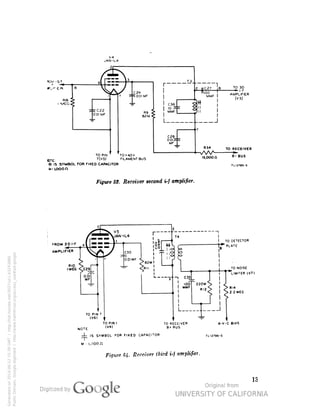
53 Receiver second i-f amplifier 75 
54 Receiver third i-f amplifier 75 
55 Receiver diode detector and first audio amplifier 76 
56 Receiver noise limiter 77 
57 Receiver second a-f amplifier 78 
58 Receiver oscillator and harmonic generator 80 
59 Receiver harmonic amplifier 81 
60 Transmitter oscillator and speech amplifier 82 
61 Transmitter first tripler 83 
62 Transmitter second tripler 84 
63 Transmitter doubler 85 
64 Transmitter power amplifier 86 
65 Transmitter modulator 88 
66 Control and power supply circuits 90 
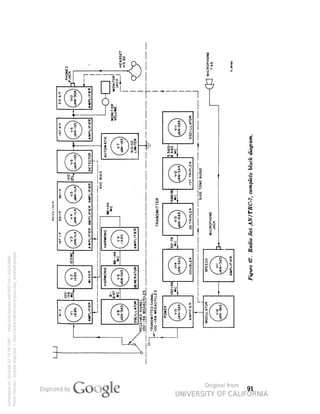
67 Radio Set AN/TRC-7, complete block diagram 91 
68 Resistance chart 104 
69 Voltage chart , 105 
70 Tube base chart 106 
71 Waterseal jack assembly 109 
72 Antenna scale 110 
73 Unsatisfactory equipment report 112 
74 Radio Set AN/TRC-7, right side of set 136 
75 Radio Set AN/TRC-7, chassis top 142 
xi 
Generated on 2014-06-12 14:37 GMT / http://hdl.handle.net/2027/uc1.b3243866 
Public Domain, Google-digitized / http://www.hathitrust.org/access_use#pd-google
LIST OF ILLUSTRATIONS 
Fig. No. Title Page 
76 Radio Set AN/TRC-7, chassis bottom 138 
77 Radio Set AN/TRC-7, chassis right side 139 
78 Radio Set AN/TRC-7, chassis oblique right side view 140 
79 Radio Set AN/TRC-7, chassis left side 141 
80 Radio Set AN/TRC-7, chassis tuning controls 142 
81 Location of resistors 143 
82 Location of capacitors 144 
83 Location of coils and chokes 145 
84 Resistor color codes 146 
85 Capacitor color codes 147 
86 Battery cable plug 148 
87 Generator G-3/TRC-7, wiring diagram 149 
88 Antenna Assembly AS-110/TRC-7, assembly of components.. 151 
89 Radio Set AN/TRC-7, schematic diagram 153 
Generated on 2014-06-12 14:37 GMT / http://hdl.handle.net/2027/uc1.b3243866 
Public Domain, Google-digitized / http://www.hathitrust.org/access_use#pd-google
DESTRUCTION NOTICE 
WHY—To prevent the enemy from using or salvaging this equipment for 
his benefit. 
WHEN—When ordered by your commander. 
HOW—1. Smash—Use sledges, axes, handaxes, pickaxes, hammers, 
crowbars, heavy tools. 
2. Cut—Use axes, handaxes, machetes. 
3. Burn—Use gasoline, kerosene, oil, flame throwers, incendiary 
grenades. 
4. Explosives—Use firearms, grenades, TNT. 
5. Disposal—Bury in slit trenches, fox holes, other holes. Throw 
in streams. Scatter. 
USE ANYTHING IMMEDIATELY AVAILABLE FOR 
DESTRUCTION OF THIS EQUIPMENT 
WHAT—1. Smash—Tubes, crystals, capacitors, resistors, coils, chokes, 
transformers, meter, sockets, generator, batteries, 
connectors. 
2. Cut—All wiring, cabling, coils, transformer windings. 
3. Burn—All parts. 
4. Bend—All mast sections, antenna sections, all cases, cab-inets. 
5. Bury or scatter—All parts. 
DESTROY EVERYTHING 
XI 
Generated on 2014-06-12 14:37 GMT / http://hdl.handle.net/2027/uc1.b3243866 
Public Domain, Google-digitized / http://www.hathitrust.org/access_use#pd-google
Figure 1. Radio Set AN/TRC-7. 
Generated on 2014-06-12 14:37 GMT / http://hdl.handle.net/2027/uc1.b3243866 
Public Domain, Google-digitized / http://www.hathitrust.org/access_use#pd-google
RESTRICTED 
PART ONE 
INTRODUCTION 
SECTION I 
DESCRIPTION OF RADIO SET AN/TRC-7 
1. GENERAL. 
a. Radio Set AN/TRC-7 (fig. 1) is a 16-tube, portable, low-power 
receiver-transmitter, operated by battery, hand generator, or a combina-tion 
of both. It is designed for a-m (amplitude-modulated), two-way 
communication over short distances in the v-h-f (very-high-frequency) 
range. This equipment is intended primarily to provide communication 
from ground troops to aircraft using transmitting and receiving equip-ment 
which operates in the same r-f (radio-frequency) range. It may 
be operated with either whip Antenna AT-59/TRC-7 or Antenna Assem-bly 
AS-110/TRC-7, using Battery BA-70, hand Generator G-3/TRC-7, 
or a combination of both as the source of power. Radio Set AN/TRC-7 
may be operated from a remote position by Remote Control Unit RM-52 
and Control Unit RM-53. 
b. Throughout this manual, basic nomenclature followed by ( ) 
refers to all models of an item of equipment. For example, Crank GC-7- 
( ) refers to Cranks GC-7 and GC-7-AW. 
2. APPLICATION. 
a. General. The main component of Radio Set AN/TRC-7 (fig. 1) 
is Receiver-Transmitter RT-53/TRC-7. The receiver uses a single super-heterodyne 
circuit; the transmitter is amplitude-modulated. For a block 
diagram of the receiver, see figure 49; for a block diagram of the trans-mitter, 
see figure 48. Either one of the two channels provided is selected 
by means of the CHANNEL SELECTOR switch on the front panel of 
Generated on 2014-06-12 14:37 GMT / http://hdl.handle.net/2027/uc1.b3243866 
Public Domain, Google-digitized / http://www.hathitrust.org/access_use#pd-google
the receiver-transmitter unit. The circuits of the receiver and the trans-mitter 
are switched simultaneously, so that transmission and reception 
are always maintained on the same frequency. Each channel is crystal-controlled 
separately in the receiver and the transmitter (par. 25). 
HEADSET H9-30-C) 
TL I8777 
Figure 2. Radio Set ANITRC-7, simplified block diagram. 
HEADSET HS-30-C) 
HANDSET 
H-23C 5/U 
TL I8778 
Figure 3. Radio Set ANITRC-7, simplified block diagram with 
remote control equipment. 
Generated on 2014-06-12 14:38 GMT / http://hdl.handle.net/2027/uc1.b3243866 
Public Domain, Google-digitized / http://www.hathitrust.org/access_use#pd-google
b. Receiver-transmit Switch. Change-over from reception *o trans-mission 
is accomplished by operating the receiver-transmit switch lo-cated 
on the microphone cord (fig. 14) or on the handle of the handset 
(fig. 12), depending upon the particular installation. 
c. Type of Antenna. Radio Set AN/TRC-7 is designed for transmis-sion 
and reception with a vertically polarized antenna (figs. 1 and 18). 
d. Application of Power. Two series switches control the application 
of power to the set. Since these switches are in series, both must be closed 
to make the set function. Inserting the plug into the jack marked 
PHONES closes one switch, and turning the POWER VOLUME control 
in a clockwise direction closes the other. 
3. TECHNICAL CHARACTERISTICS. 
Frequency range: 
Transmitter 100 to 156 me 
Receiver 100 to 156 mc 
Types of signals emitted a-m, voice 
Types of signals which can be received a-m, voice 
Type of modulation amplitude modulation 
Antenna type whip or ground-plane conical 
Number of tubes 16 
Type of transmitter a-m, with crystal-controlled oscillator 
Type of receiver superheterodyne 
Sidetone in set yes 
Power output: 
Transmitter 0.5 to 1.5 watts 
Power supply Battery BA-70, Generator G-3/TRC-7, or both 
Power input: 
Transmitter: 
Filaments 600 ma (normal) 510 ma (min) 600 ma (rriax) 
Plate 106 ma (normal) 68 ma (min) 106 ma (max) 
Receiver: 
Filaments 370 ma (normal) 325 ma (min) 370 ma (max) 
Plate 30 ma (normal) 19 ma (min) 30 ma (max) 
Generated on 2014-06-12 14:38 GMT / http://hdl.handle.net/2027/uc1.b3243866 
Public Domain, Google-digitized / http://www.hathitrust.org/access_use#pd-google
FREQUENCY SPECTRUM 
-I.F. CI2.0 MCI 
STV 
BROA 
C55C 
vNDARD U.S. 
DCAST BAND 
) -I,500 KC) 
AI* 
J/TRC-7 
-I56 MO 
(IOC 
'I I — i — r~ 
m 
I 'I 1 
"— i 1 — i — r~i 
.1 .2 .4 
(I00 KC) 
.8.6I.0 2.0 4.0 6.0 8X) I0.0 20 40 6080I00 200 40O6008OOF. 
(I,000 KC) (I0.000 KC) (I00.000 KC) (l.OOO,OOC 
Figure 4- Radio Set AN/TRC-7, frequency spectrum chart. 
4. COMMUNICATION WITH OTHER RADIO SETS. 
a. Radio Set AN/TRC-7 has a frequency coverage (fig. 4) of 100 to 
156 mc (megacycles) which is the same as used by standard v-h-f equip-ment. 
It will therefore communicate with any v-h-f set which operates 
in that range and uses amplitude modulation. 
b. Some of the radio sets which can be used for communication with 
Radio Set AN/TRC-7 are: 
Radio Set SCR-522-( ) 
Radio Set SCR-542-( ) 
Radio Set AN/VRC-1 
Radio Set SCR-562-(. ) 
Radio Set SCR-563-( ) 
Radio Set SCR-567-( ) 
Radio Set SCR-632-( ) 
Radio Set SCR-633-( ) 
Radio Set SCR-637-( ) 
Radio Set SCR-643-( ) 
Radio Set SCR-644-( ) 
Generated on 2014-06-12 14:38 GMT / http://hdl.handle.net/2027/uc1.b3243866 
Public Domain, Google-digitized / http://www.hathitrust.org/access_use#pd-google 
Radio Set SCR-573-( ) 
Radio Set SCR-574-( )
Figure 6. Radio Set AN/TRC-7, oner-all illustration, whip antenna 
and battery in place. 
RECEIVER - TRANSIirTTER 
RT-S3/THC-7 
BATTERY 8A-70 
Figure 8. -Radio Set AN/TRC-7, with accessories, disassembled. 
Generated on 2014-06-12 14:38 GMT / http://hdl.handle.net/2027/uc1.b3243866 
Public Domain, Google-digitized / http://www.hathitrust.org/access_use#pd-google
5. TABLE OF COMPONENTS. 
Quantity Component 
1 Antenna AT-59/TRC-7. 
1 Antenna Assembly AS-110/TRC-7; consisting of: 
1 Antenna Assembly AS-112/TRC-7: 
1 Mast Base AB-77/TRC-7. 
8 Mast Sections AB-78/TRC-7; 6 in use, 2 running spares. 
1 base plate. 
2 Cords CG-102/TRC-7. 
4 ground stakes; 3 in use, 1 running spare. 
2 guy plates (upper); 1 in use, 1 running spare. 
2 guy plates (lower); 1 in use, 1 running spare. 
8 guy ropes, nylon; 6 in use, 2 running spares. 
4 guy straps; 3 in use, 1 running spare. 
4 Mast Sections AB-34/TRC-7 (1Vi in.). 
5 Mast Sections AB-35/TRC-7 (1y2 in.). 
3 Mast Sections AB-36/TRC-7 (1 in.). 
1 Mallet MX-185/TRC-7. 
3 Plugs PL-258; 1 in use, 2 running spares. 
4 Reels RL-28; for guy ropes (2 per reel). 
1 swivel ground stake. 
1 Antenna Base AB-37/TRC-7. 
1 Battery BA-70. 
2 Bags CW-47/TRC-7; carries Bag CW-49/TRC-7 and contents. 
2 Bags CW-48/TRC-7; carries Roll CW-50/TRC-7 and con-tents. 
2 Bags CW-49/TRC-7; carries: 
1 Receiver-Transmitter RT-53/TRC-7 and accessories. 
1 Battery BA-70, test cords, Control Unit RM-52, and Re-mote 
Control Unit RM-53. 
1 Case CY-275/TRC-7; for running spare tubes. 
1 Control Unit RM-53: 
4 Batteries BA-30; 2 in use, 2 running spares. 
1 Cord CX-220/TRC-7; connects generator to receiver-trans-mitter. 
1 Cord CD-318-A; for Microphone T-45. 
1 Cord CD-604; for Headset HS-30-( ). 
1 Cord CG-127/U; (test). 
1 Cord CD-307-A; headset extension cord. 
Generated on 2014-06-12 14:38 GMT / http://hdl.handle.net/2027/uc1.b3243866 
Public Domain, Google-digitized / http://www.hathitrust.org/access_use#pd-google
Quantity Component 
1 Cord CX-240/U; (test). 
2 Cranks CG-7-( ). 
1 Generator G-3/TRC-7; includes: 
1 voltage regulator, plug-in. 
1 set brushes, running spare. 
1 Headset HS-30-( ). 
1 Handset H-23-( )/U (or Handset TS-15). 
1 Leg LG-2-B. 
2 Legs LG-3-B. 
1 Microphone T-45. 
1 Phantom Antenna TS-281/TRC-7. 
3 Plugs PL-57; 2 in use, 1 running spare. 
1 Receiver-Transmitter RT-53/TRC-7; 
4 Crystal Unit CR-1/AR (or Crystal Unit DC-11). 
3 Tubes 1AB5. 
3 Tubes JAN-1L4. 
1 Tube JAN-1S5. 
1 Tube JAN-1A3. 
1 Tube JAN-3Q4. 
5 Tubes JAN-3A5. 
2 Tubes JAN-3A4. 
1 Alignment Tool TL-314/U. 
1 wrench. 
5 Batteries BA-58. 
1 Remote Control Unit RM-52: 
8 Batteries BA-30; 4 in use, 4 running spares. 
2 Rolls CW-50/TRC-7; carries: 
1 Antenna Assembly AS-110/TRC-7. 
1 Generator G-3/TRC-7 and accessories. 
1 set Spare tubes; in Case CY-275/TRC-7; includes: 
1 tube 1AB5. 
1 Tube JAN-1L4. 
1 TubeJAN-1S5. 
1 Tube JAN-1A3. 
1 Tube JAN-3Q4. 
2 Tubes JAN-3A5. 
1 TubeJAN-3A4. 
1 Tube Puller TL-310/U. 
Generated on 2014-06-12 14:39 GMT / http://hdl.handle.net/2027/uc1.b3243866 
Public Domain, Google-digitized / http://www.hathitrust.org/access_use#pd-google
TLI87BI 
Figure 7. Radio Set AN/TRC-7, outline dimensional drauing. 
8 
Generated on 2014-06-12 14:39 GMT / http://hdl.handle.net/2027/uc1.b3243866 
Public Domain, Google-digitized / http://www.hathitrust.org/access_use#pd-google
ANTENNA 
BASE 
AB-37/TRC-7 
RECEIVER 
TRANSMITTER 
RT-53/TRC-7 
Figure 8. Receiver-Transmitter RT-53/TRC-7, with Battery BA-70 attached. 
9 
Generated on 2014-06-12 14:39 GMT / http://hdl.handle.net/2027/uc1.b3243866 
Public Domain, Google-digitized / http://www.hathitrust.org/access_use#pd-google
6. PACKAGING DATA. 
Eadio Set AN/TRC-7 is packed in two wooden boxes. Case 1 is 251/4" 
long, 18%" wide, 171/^" deep, and weighs 96 pounds when packed. Case 
2 is 41" long, 22" wide, 15V&" deep, and weighs 150 pounds when packed. 
For dimensions of the unpacked set see figure 7. 
7. RECEIVER-TRANSMITTER RT-53/TRC-7 (fig. 8). 
Receiver-Transmitter RT-53/TRC-7 consists of the radio chassis 
mounted in a metal case. All the controls, jacks, and terminals are 
mounted on the front panel (fig. 36). 
a. Housing. The one-piece waterproof housing has a dual purpose. 
The top section (part of the receiver-transmitter unit) houses the radio 
chassis. The bottom of the housing (fig. 8) covers, waterproofs, and 
carries the weight of Battery BA-70. On the bottom of the chassis case, 
a socket with a captive cover provides connection to Battery BA-70 
(fig. 30). 
Figure 9. Antenna Assembly AS-110/TRC-7. 
Generated on 2014-06-12 14:39 GMT / http://hdl.handle.net/2027/uc1.b3243866 
Public Domain, Google-digitized / http://www.hathitrust.org/access_use#pd-google
b. Controls. For a description of the controls of Receiver-Trans-mitter 
RT-53/TRC-7 see paragraph 28. 
c. Waterseals. Synthetic rubber gaskets act as waterseajs to provide 
protection against moisture. Special jack waterseal assemblies prevent 
moisture from entering through the jacks on the front panel (fig. 71). 
d. Bags. The receiver-transmitter and accessories are carried in Bag 
CW-49/TRC-7 (fig. 33) which is carried in Bag CW-47/TRC-7 
(fig. 31). 
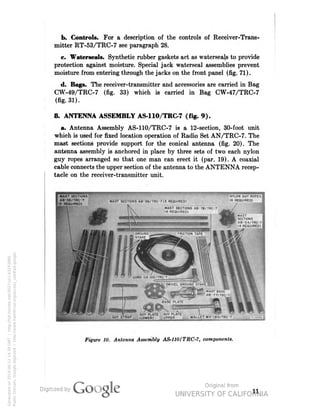
8. ANTENNA ASSEMBLY AS-110/TRC-7 (fig. 9). 
a. Antenna Assembly AS-110/TRC-7 is a 12-section, 30-foot unit 
which is used for fixed location operation of Radio Set AN/TRC-7. The 
mast sections provide support for the conical antenna (fig. 20). The 
antenna assembly is anchored in place by three sets of two each nylon 
guy ropes arranged so that one man can erect it (par. 19). A coaxial 
cable connects the upper section of the antenna to the ANTENNA recep-tacle 
on the receiver-transmitter unit. 
OUY PLATE GUY PLATE 
GUY STRAP (LOWER) UPPER MALLET MX-I85/TRC-7 
Figure 1O. Antenna Assembly AS-110/TRC-7, components. 
11 
Generated on 2014-06-12 14:39 GMT / http://hdl.handle.net/2027/uc1.b3243866 
Public Domain, Google-digitized / http://www.hathitrust.org/access_use#pd-google
ANTENNA BASE AB-37/TRC-? 
[TLI90491 
Figure 11. Antenna AT-69/TRC-7 and Antenna Base AB-37/TRC-7. 
b. The antenna assembly is packed in the pockets provided (fig. 35) 
in a canvas Roll CW-50/TRC-7. Then the whole roll is secured and 
placed in outer Bag CW-48/TRC-7 (fig. 32). 
c. Antenna Assembly AS-110/TRC-7 is used in place of Antenna 
AT-59/TRC-7 to obtain greater range. 
Figure 12. Handset H-13( )/U. 
Generated on 2014-06-12 14:43 GMT / http://hdl.handle.net/2027/uc1.b3243866 
Public Domain, Google-digitized / http://www.hathitrust.org/access_use#pd-google
'RECEIVER R-3CH 
RECEIVER 
INSERTS M-300 
Figure 13. Headset HS-30-( ). 
9. ANTENNA AT-59/TRC-7 (fig. 11). 
Whip Antenna AT-59/TRC-7 is an adjustable, 28-inch, telescopic 
antenna used with Radio Set AN/TRC-7 when it is necessary to put the 
set into operation quickly, to limit range, or to conceal the set. It is also 
used before Antenna Assembly AS-110/TRC-7 is erected. Antenna Base 
AB-37/TRC-7 (fig. 11) using coaxial cable connects the radio set and 
the antenna. 
13 
Generated on 2014-06-12 14:43 GMT / http://hdl.handle.net/2027/uc1.b3243866 
Public Domain, Google-digitized / http://www.hathitrust.org/access_use#pd-google
10. HANDSET H-23( )/U (fig. 12). 
a. Handset H-23( )/U may be used with Radio Set AN-TRC-7 in 
place of Microphone T-45 and Headset HS-30-( ). The handset uses 
Cord CD-494 which terminates in Plugs PL-55 (receiver) and PL-68 
(microphone). A receive-transmit butterfly switch is incorporated in the 
handle of the handset. 
b. If Handset H-23( )/U is not available, Handset TS-15 will be 
issued. These two handsets are identical in physical design. They differ 
only in the electrical wiring of the receive-transmit wafer switch. This 
difference does not affect the operation with the set. 
11. HEADSET HS-30( ) (fig. 13). 
The headset is lightweight and close-fitting. Special soft rubber ear-pieces 
snapped to the receivers of the headset are designed to fit snugly 
into the ear cavities. These earpieces exclude outside noises and aid in 
receiving weak signals. The headband is a thin, steel band, adjustable 
to the contours of the operator's head. Attach the clip on the headset-cord 
to the operator's clothing to relieve the pull of the cord (fig. 13). 
12. MICROPHONE T-45 (fig. 14). 
a. Description. Microphone T-45 is a noise-cancelling, single-button, 
carbon microphone designed to be worn on the upper lip (fig. 27). The 
Figure 1/f. Microphone T-45 and Cord CD-318-A. 
14 
Generated on 2014-06-12 14:43 GMT / http://hdl.handle.net/2027/uc1.b3243866 
Public Domain, Google-digitized / http://www.hathitrust.org/access_use#pd-google
3 
a? 
3 
K 
c 
c 
i 
' 
ft 
15 
Generated on 2014-06-12 14:43 GMT / http://hdl.handle.net/2027/uc1.b3243866 
Public Domain, Google-digitized / http://www.hathitrust.org/access_use#pd-google
design of the microphone reduces background noise and allows speech 
to be reproduced clearly under all conditions. This microphone is used 
with Radio Set AN/TRC-7 in conjunction with Cord CD-318-A, which 
contains Switch SW-141, the receive-transmit switch (fig. 14). Switch 
SW-141 is used in a manner similar to the button on the handle of 
Microphone T-17 and the switch on the handle of Handset H-23 ( ) /U. 
b. Components. Microphone T-45 consists of differential Micro-phone 
Unit MC-419, a breath shield, a microphone bracket, right and 
left face straps comprising Strap ST-53, and a short cord terminating in 
Plug PL-291. Cord CD-318-A includes Jack JK-48 into which micro-phone 
Plug PL-291 is inserted; Switch SW-141; Plug PL-68 for insertion 
into a microphone jack; cords connecting these items; and a leather 
neck strap for support of the switch. 
13. REMOTE CONTROL EQUIPMENT (fig. 15). 
Remote control equipment comprising local Control Unit RM-53 at 
the radio set end of the system and Remote Control Unit RM-52 at the 
remote station, is carried in Bag CW-49/TRC-7 (par. 27) along with 
Battery BA-70 and test cords. Bag CW-49/TRC-7 is carried in Bag 
CW-47/TRC-7 (fig. 31). Two cords attached to Control Unit RM-53 
connect to Radio Set AN/TRC-7. Plug PL-55 is inserted into the 
PHONES jack, and Plug PL-68 into the MIC. jack. Control Unit 
RM-53 and Remote Control Unit RM-52 are part of Remote Control 
Equipment RC-261. See TM 11-2632, 28 October 1944. 
14. BATTERY BA-70. 
Battery BA-70, which provides power for operation of Radio Set 
AN/TRC-7, gives 20 to 25 hours of service in moderate climates. This 
battery consists of three dry battery sections of 4.5 volts, 60 volts, and 
90 volts each. The first section supplies the necessary voltage to the 
microphone circuit and to the filaments of the receiver and transmitter 
tubes. The second and third sections, connected in series, supply 150 
volts to the plate circuits of the transmitter and receiver. Receiver plate 
voltage is dropped to 90 volts by internal resistors in the receiver. The 
battery is electrically connected to the radio chassis by a receptacle and 
plug assembly, and is fastened to the case with straps. If necessary, 
Battery BA-80 may be used in place of Battery BA-70, but it has a 
shorter life. 
15. GENERATOR G-3/TRC-7 (fig. 16). 
Generator G-3/TRC-7 is a hand-cranked generator which supplies all 
or part (in conjunction with Battery BA-70) of the voltages required 
Generated on 2014-06-12 14:43 GMT / http://hdl.handle.net/2027/uc1.b3243866 
Public Domain, Google-digitized / http://www.hathitrust.org/access_use#pd-google
Figure 16. Generator G-S/TRC-7, set up /or operation. 
for the operation of Radio Set AN/TRC-7. The accessories required by 
the generator: Leg LG-2-B, two Legs LG-3-B, two Cranks GC-7-( ), 
and Cord CX-220/TRC-7; along with the generator are carried in Roll 
CW-50/TRC-7 (fig. 34) which, in turn, is carried in Bag CW-48/TRC-7 
(fig. 32). 
SECTION II 
INSTALLATION OF RADIO SET AN/TRC-7 
16. UNPACKING, UNCRATING, AND CHECKING (par. 27). 
Use particular care when packing or handling the equipment, because 
it may be easily damaged when not protected by the packing case. Check 
each item as it is removed from the packed bag against the packing list. 
The list in paragraph 5 is supplied as a guide and is not to be used as 
a basis for issue. In unpacking the equipment, follow the steps below. 
a. Place the wooden boxes (or canvas bags, if export packaging has 
been removed) as near the operating location as possible. 
17 
Generated on 2014-06-12 14:44 GMT / http://hdl.handle.net/2027/uc1.b3243866 
Public Domain, Google-digitized / http://www.hathitrust.org/access_use#pd-google
b. Cut the steel straps. 
c. Remove the nails with a nail puller, then remove the sides of the 
packing case. Do not pry the aides off. It may injure the equipment. 
d. Remove the top of the packing case and all protective wrappings. 
e. Lift out the two bags from each carton. 
f. Receiver-Transmitter RT-53/TRC-7. 
(1) Unzip Bag CW-47/TRC-7. Lift the inner rubber insulation, 
and remove inner Bag CW-49/TRC-7. 
(2) Unsnap the inner bag and remove the set. Remove the cloth 
bags which contain the silica gel. 
g. Battery BA-70 and Remote Control Equipment. 
(1) Open the remaining Bag CW-49/TRC-7. 
(2) Lift out the remote control accessories: Control Unit RM-53, 
and Remote Control Unit RM-52. 
(3) Lift up the flap which separates the remote control equipment 
from the battery, and lift out the battery. 
(4) Remove the silica gel containers. 
h. Antenna Assembly AS-110/TRC-7. 
(1) Unzip Bag CW-48/TRC-7. 
(-2) Remove Roll CW-50/TRC-7. 
(3) Remove the silica gel containers. 
(4) Open Bag CW-50/TRC-7 and remove the antenna assembly 
components from their compartments. 
i. Generator G-3/TRC-7. 
(1) Open Bag CW-48/TRC-7. 
(2) Remove,Roll CW-50/TRC-7. 
(3) Remove the bags containing the silica gel. 
(4) Open Roll CW-50/TRC-7. 
(5) Remove the generator and its components. 
17. CONNECTIONS AND INTERCONNECTIONS. 
a. For instructions on connecting the battery to the receiver-transmit-ter, 
refer to paragraph 23. The battery receptacle on the bottom of the 
18 
Generated on 2014-06-12 14:45 GMT / http://hdl.handle.net/2027/uc1.b3243866 
Public Domain, Google-digitized / http://www.hathitrust.org/access_use#pd-google
-5 
.O 
P 
-w 
»C 
19 
Generated on 2014-06-12 14:45 GMT / http://hdl.handle.net/2027/uc1.b3243866 
Public Domain, Google-digitized / http://www.hathitrust.org/access_use#pd-google
ANTENNA AT-59/TRC-7- 
ANTENNA BASE 
AB-37/TRC-7' 
RECEIVER-TRANSMITTER 
RT-S3/TRC-7 
Figure 1S. Radio Set AN/TRC-7. 
20 
Generated on 2014-06-12 14:45 GMT / http://hdl.handle.net/2027/uc1.b3243866 
Public Domain, Google-digitized / http://www.hathitrust.org/access_use#pd-google
set is connected by wiring on the interior of the case to the back of the 
housing and thence by plug P1 to the receiver-transmitter. 
b. The generator is connected to the receiver-transmitter by plugging 
Cord CX-220/TRC-7 into the GENERATOR receptacle on the front 
panel, and tightening the connector securely. 
18. RECEIVER-TRANSMITTER RT-53/TRC-7. 
Receiver-Transmitter RT-53/TRC-7 is shipped in Bag CW-49/ 
TRC-7 with all tubes installed, but it is necessary to install the crystals 
(fig. 78). The receiver and transmitter circuits must be preset (pars. 
116 and 117). Installation of the battery and the antenna, and connec-tion 
of Handset H-23( )/U or a combination of Headset HS-30-( ) 
and Microphone T-45 are required for a complete installation. 
19. ANTENNA ASSEMBLY AS-110/TRC-7. 
a. Siting (fig. 19). After selecting a site for the operation of the 
radio set (fig. 42), locate a clearance in the center of it of at least 45 
feet in diameter for erecting Antenna Assembly AS-110/TRC-7. There 
must be a clear line of sight between sets for ground operation. 
STAKE 
Figure 10. Antenna installation, stake layout. 
Generated on 2014-06-12 14:45 GMT / http://hdl.handle.net/2027/uc1.b3243866 
Public Domain, Google-digitized / http://www.hathitrust.org/access_use#pd-google
RADIATING ELEMENT 
MAST SECTIONS 
AB-78/TRC-7 
MAST BASE AB-77/TRG-7 
GROUND PLANE ELEMENT 
MAST SECTIONS 
AB-78/TRC-7 
Figure SO. Antenna Assembly AS-112/TRC-7. 
22 
Generated on 2014-06-12 14:45 GMT / http://hdl.handle.net/2027/uc1.b3243866 
Public Domain, Google-digitized / http://www.hathitrust.org/access_use#pd-google
b. Preparation. 
(1) In the approximate center of the antenna location, place the 
base plate. With the mallet provided, drive the swivel ground stake 
through the center hole in the base plate. 
(2) Pace off 15 feet from the base plate in the three directions indi-cated 
by the tabs on the plate (fig. 19). Drive each ground stake at the 
15-foot mark. 
(3) Anchor the straps as shown in figure 88. 
(4) If possible, erect the antenna assembly with two or more men. 
However, in an emergency, one man can assemble the antenna as 
follows: 
c. Assembly. Assemble the antenna mast flat on the ground, laid out 
so the assembly bisects the angle made by any two ground stakes. 
(1) Mast Sections and Guy Plates. 
(a) Fit the five Mast Sections AB-35/TRC-7 into one another 
and the bottom one into the swivel ground stake. 
(b) Fit two Mast Sections AB-34/TRC-7 together and into the 
top Mast Section AB-35/TRC-7. Slip the lower (larger) guy plate on the 
second section, then add the remaining two Mast Sections AB-34 
TRC-7. e 
'(c) Fit two of the three Mast Sections AB-36/rnRC-7 togethe 
add them to the mast assembly, slip the upper (smaller) guy plate OL 
the second section, then add the final mast section. 
(2) Antenna. 
(a) Screw the six Mast Sections AB-78/TRC-7 into Mast Base 
AB-77/TRC-7. 
(b) Connect the assembled antenna to the assembled mast with 
the clamp and wingnut provided. 
(3) Cord. 
(a) Connect Cord CG-102/TRC-7 to Mast Base AB-77/TRC-7 
with Plug PL-258. 
(b) Between the antenna connection and the joint of the first 
mast section, make a large radius bend in the cord and lash it to Mast 
Section AB-36/TRC-7 with friction tape. This will relieve the strain o-the 
connector and plug. 
(c) Twist the cord around the mast about three times. 
(4) Guy Ropes. 
(a) Snap the nylon guy ropes into place on the upper and lower 
guy plates. 
Generated on 2014-06-12 14:45 GMT / http://hdl.handle.net/2027/uc1.b3243866 
Public Domain, Google-digitized / http://www.hathitrust.org/access_use#pd-google
Figure S1. Antenna Assembly AS-110/TRC-7, erection by two men. 
Figure S3. Antenna Assembly AS-110/TRC-7, erection'fty two men. 
24 
Generated on 2014-06-12 14:45 GMT / http://hdl.handle.net/2027/uc1.b3243866 
Public Domain, Google-digitized / http://www.hathitrust.org/access_use#pd-google
(b) Carefully thread the guys through the respective ground 
stake strap (one upper guy rope and one lower guy rope to each strap), 
then pass the two side sets through the corresponding openings on the 
base plate. 
(c) Pull the two sets of side guys taut and tie them at the base 
plate. 
d. Erection by Two Men. 
(1) One man should stand at the end of the antenna mast which 
inserts into the swivel ground stake. From this position he will be able 
to control antenna movement during erection by pulling the guy ropes 
as the other man walks the antenna up (figs. 21 and 22). 
(2) The second man should stand near the lower guy plate and 
raise the antenna as high as possible. 
(3) While the man at the guy ropes raises the top of the antenna 
mast, the second man walks toward the antenna base, raising the mast as 
he goes. 
(4) When the antenna mast is vertical, tie the third set of guy 
ropes to the base plate and readjust the other two sets. 
Figure S3. Antenna Assembly AS-110/TRC-7, erection by one man. 
2f 
Generated on 2014-06-12 14:45 GMT / http://hdl.handle.net/2027/uc1.b3243866 
Public Domain, Google-digitized / http://www.hathitrust.org/access_use#pd-google
Figure 24. Antenna Assembly AS-110/TRC-7, erection by one man. 
e. Erection by One Man. 
(1) Hold the third set of guy ropes, which are through only the 
stake strap, in your left hand. With your right hand, grasp the upper guy. 
Slowly and steadily pull the antenna toward you until it snaps upward 
into a perpendicular position (figs. 23 and 24). 
NOTE: Do not jerk the antenna into place. The slow, steady pull will 
straighten the deep bow into a vertical antenna assembly. 
(2) Tie the third set of guy ropes to the base plate, and readjust 
the first two sets. 
f. Operation. Connect the antenna to the radio set by plugging the 
connector into ANTENNA receptacle on front panel of the set. 
g. Disassembly. Perform assembly in reverse order, but walk an-tenna 
mast down, rather than lowering it with the guy ropes. 
20. ANTENNA AT-59/TRC-7. 
Before installing Antenna AT-59/TRC-7, refer to paragraph 30b for 
the proper length of the antenna. 
Generated on 2014-06-12 14:46 GMT / http://hdl.handle.net/2027/uc1.b3243866 
Public Domain, Google-digitized / http://www.hathitrust.org/access_use#pd-google
Figure 25. Antenna Assembly AS-110/TRC-7, installed. 
a. Loosen the wingnut on Antenna Base AB-37/TRC-7 one or two 
turns. Slip the antenna base into the slot in the bracket on the receiver-transmitter 
case. The large washer beside the wingnut should remain on 
the outside of the bracket. 
b. Tighten the large wingnut to hold the antenna base securely. 
c. Pull the cable around the receiver-transmitter unit to the panel. 
d. Remove the cap covering the receptacle marked ANTENNA in the 
upper right-hand corner of the panel. This cover will remain on the chain. 
Generated on 2014-06-12 14:46 GMT / http://hdl.handle.net/2027/uc1.b3243866 
Public Domain, Google-digitized / http://www.hathitrust.org/access_use#pd-google
e. Insert the coaxial connector on the antenna base cable into the an-tenna 
receptacle. Tighten the plug securely. 
f. Screw Antenna AT-59/TRC-7 to the threaded fitting on Antenna 
Base AB-37/TRC-7 and tighten securely. 
21. HANDSET H-23( )/U, HEADSET HS-30-( ),AND 
MICROPHONE T-45. 
The headset and microphone accessories used with this radio set may 
HEADBAND 
HB-30-( 
RECEIVER 
R-30-U 
SHAPE TO FIT CONTOUR 
OF HEAD ESPECIALLY 
IN THIS REGION 
-TERMINALS TM-I63 
Figure 26. Headset HS-30-( ), as worn by operator. 
TLI3554 
28 
Generated on 2014-06-12 14:46 GMT / http://hdl.handle.net/2027/uc1.b3243866 
Public Domain, Google-digitized / http://www.hathitrust.org/access_use#pd-google
Figure 27. Microphone T-45, as worn by operator. 
be either Handset H-23 ( ) /U, or a combination of Headset HS-30- ( ) 
and Microphone T-45. 
a. Handset H-23 ( ) /U is installed by inserting Plug PL-55 into the 
jack marked PHONES, and Plug PL-68 into the jack marked MIC. 
b. Headset HS-30-( ) (fig. 26) is installed by inserting Plug PL-55 
into the jack marked PHONES. 
c. Microphone T-45 (fig. 27) when used with Radio Set AN/TRC-7, 
is worn in conjunction with Headset HS-30-( ). The correct procedure 
for assembling and wearing Microphone T-45 and Cord CD-318-A 
(fig. 28) follows: 
29 
Generated on 2014-06-12 14:46 GMT / http://hdl.handle.net/2027/uc1.b3243866 
Public Domain, Google-digitized / http://www.hathitrust.org/access_use#pd-google
JTLI492I • 
Figure 38. Cord CD-318-A. 
(1) Place the assembly on the head and adjust Strap ST-50-A so 
that Microphone Unit MC-419 (fig. 14) rests on the upper lip. 
(2) Adjust the two drawstrings to provide a comfortable and se-cure 
fit so that the microphone remains in place despite movement of the 
head. If the drawstrings do not move easily, moisten them slightly with 
water. Once correctly adjusted, Microphone T-45 can be removed and 
worn again without further adjustment. 
MATCH ARROWS 
POINT TO POINT 
+ 60 
+90 
FRONT 
Figure 20. Battery BA-70, top view. 
Generated on 2014-06-12 14:46 GMT / http://hdl.handle.net/2027/uc1.b3243866 
Public Domain, Google-digitized / http://www.hathitrust.org/access_use#pd-google
8 
-w 
£ 
• 
.0 
Q> 
1 
31 
Generated on 2014-06-12 14:47 GMT / http://hdl.handle.net/2027/uc1.b3243866 
Public Domain, Google-digitized / http://www.hathitrust.org/access_use#pd-google
(3) Center Microphone T-45 so that the breath shield is directly 
under the nose. The top of Microphone Unit MC-419 should touch the 
nose. Microphone T-45 is designed to work as close to the mouth as pos-sible. 
If it does not remain within 3/16 inch of the mouth, bend the metal 
uprights of the microphone bracket inward (toward the face) until it is 
in the correct position. 
(4) Insert Plug PL-68 into the MIC. jack on the front panel of 
Radio Set AN/TRC-7. 
22. REMOTE CONTROL EQUIPMENT. 
For installation of Control Unit RM-53 and Remote Control Unit 
RM-52, refer to TM 11-2632. 
23. BATTERY BA-70. 
a. Place the receiver-transmitter unit upside down on a smooth sur-face 
with the panel to the right and the side with the buckles attached 
facing the operator. 
b. After removing Battery BA-70 from Bag CW-49/TRC-7 (which 
also contains the test cords and remote control equipment), place it up-side 
down on the receiver-transmitter unit with the side bearing the label 
away from the operator. Note that the arrow next to the receptacle on 
the battery coincides with the arrow molded on the neoprene plug on the 
receiver-transmitter case. Push the battery gently onto the plug until 
the edge of the battery comes against the neoprene gasket on the receiver-transmitter 
case. 
c. Open the clip-catches on the sides of the receiver-transmitter, then 
pass the straps over the battery from the far side and through the buckles 
on the side nearest the operator. Open the buckles on the web straps and 
pull the straps tight. Close the buckles and pull the straps outward, one 
after the other, steadying the battery with the other hand. This equal-izes 
the tension on the two sides of the battery. Close the clip-catches to 
complete the battery installation. Place the assembled battery and re-ceiver- 
transmitter unit right side up. 
24. BIAS BATTERIES BA-58. 
a. Remove receiver-transmitter from the case. Install five Batteries 
BA-58 as shown in figure 79. All positive ends of the cells face the front 
of the chassis. Make sure that the connector is inserted -between the 
second and third cells from the rear. 
b. These batteries are bias cells with an operating life of approximate 
shelf duration. 
32 
Generated on 2014-06-12 14:47 GMT / http://hdl.handle.net/2027/uc1.b3243866 
Public Domain, Google-digitized / http://www.hathitrust.org/access_use#pd-google
25. CRYSTAL UNITS CR-l/AR. 
a. Channel No. 1. Install crystal units in sockets marked REC. 
CHAN. 1 and TRANS. CHAN. 1 on the panel of the receiver-transmit-ter. 
Tighten clamps securely by hand; use no tools. 
b. Channel No. 2. Install crystal units in sockets marked REC. 
CHAN. 2 and TRANS. CHAN. 2 on the panel. Tighten clamps securely 
by hand; use no tools. 
26. GENERATOR G-3/TRC-7 (fig. 16). 
The hand generator and accessories are carried in Roll CW-50/TRC-7 
(fig. 34), which is carried by Bag CW-48/TRC-7 (fig. 32). To mount the 
legs of the generator, proceed as follows: 
Figure 31. Bag CW-47/TRC-7. 
Generated on 2014-06-12 14:47 GMT / http://hdl.handle.net/2027/uc1.b3243866 
Public Domain, Google-digitized / http://www.hathitrust.org/access_use#pd-google
a. Insert two Legs LG-3-B upward through the metal loops on the 
front of the generator and under the retaining springs. 
b. Rest the generator on the two legs and slip the bottom of the at-tachment 
of Leg LG-2-B into its retainer. Drop the metal loop over 
the top of the attachment on the back of the generator. Lift up the seat 
until the lock catches to provide a secure rest. 
c. Unscrew the waterseals, then insert two Cranks GC-7-( ) into 
the sockets on the sides of the generator. The long shafts of the cranks 
should be at an angle of 180° to each other. 
Figure 32. Bag .CW-4S/TRC-7. 
TL.73I4 
J4 
Generated on 2014-06-12 14:47 GMT / http://hdl.handle.net/2027/uc1.b3243866 
Public Domain, Google-digitized / http://www.hathitrust.org/access_use#pd-google
I 
Figure 33. Bag CW-49/TRC-7. 
35 
Generated on 2014-06-12 14:47 GMT / http://hdl.handle.net/2027/uc1.b3243866 
Public Domain, Google-digitized / http://www.hathitrust.org/access_use#pd-google
d. Unscrew the waterseal on the bottom of the generator; let it hang. 
Insert Cord CX-220/TRC-7. 
e. Unscrew the waterseal, then insert the plug of Cord CX-220/TRC-7 
into the GENERATOR receptacle on the receiver-transmitter panel. 
Generator G-3/TRC-7 is now ready for operation. 
27. REPACKING INFORMATION. 
When it is necessary to move the set, repack the components in, the 
bags from which they were unpacked. The bags and their contents are 
listed below: 
a. Bag CW-47/TRC-7. There are two Bags CW-47/TRC-7 (fig. 31-A 
and -B) with this equipment. Each carries Bag CW-49/TRC-7 and its 
contents (fig. 31-C and -D). 
b. Bag CW-48/TRC-7. There are two Bags CW-48/TRC-7 (fig. 32-A 
and -B) with this equipment. Each carries Roll CW-50/TRC-7 and its 
contents (fig. 32-C). 
c. Bag CW-49/TRC-7. Two of these bags (fig. 33) are used: one for 
the receiver-transmitter and accessories, the other for Battery BA-70 
and the remote control equipment. 
Bag 1 Bag 2 
Receiver-Transmitter RT-53/ Battery BA-70 
TRC-7 Control Unit RM-53 
Antenna AT-59-TRC-7 Remote Control Unit RM-52 
Microphone T-45 
Antenna Base AB-37/TRC-7 
Handset H-23( )/U 
Case CY-275/TRC-7 
Phantom Antenna TS-281/TRC-1 
Cord CD-318-A 
Cord CX-240/U 
Cord CD-604 
Headset HS-30-( ) 
Cord CG-127/U 
Tube Puller TL-310/U 
Cord CD-307-A 
36 
Generated on 2014-06-12 14:53 GMT / http://hdl.handle.net/2027/uc1.b3243866 
Public Domain, Google-digitized / http://www.hathitrust.org/access_use#pd-google
d. Roll CW-50/TRC-7 (fig. 35-A and -C). Two of these rolls are 
used: one for the antenna assembly, the other for the generator and 
accessories. 
Roll 1 (fig. 35) 
Roll 2 (fig. 34) 
Antenna Assembly AS-110/TRC-7 Generator G-3/TRC-7 
(Check paragraph 5 for com-ponents.) 
Leg LG-2-B 
Leg LG-3-B 
Cord CX-220/TRC-7 
Crank GC-7-( ) 
1 set brushes (spare) 
TLI750O 
Figure 34. Roll CW-50/TRC-7, with Generator G-3/TRC-7 and accessories. 
37 
Generated on 2014-06-12 14:53 GMT / http://hdl.handle.net/2027/uc1.b3243866 
Public Domain, Google-digitized / http://www.hathitrust.org/access_use#pd-google
,»; 
Figure 36. Roll CW-50/TRC-7, with Antenna Assembly AS-110/TRC-7. 
Generated on 2014-06-12 14:53 GMT / http://hdl.handle.net/2027/uc1.b3243866 
Public Domain, Google-digitized / http://www.hathitrust.org/access_use#pd-google
PART TWO 
OPERATING INSTRUCTIONS 
NOTE; For information on destroying the equipment to prevent enemy 
use, refer to the destruction notice at the front of the manual. 
SECTION III 
CONTROLS AND THEIR USE 
28. RECEIVER-TRANSMITTER PANEL CONTROLS. 
The functions of the various controls, jacks, and terminals which are 
mounted on the front panel of Receiver-Transmitter RT-53/TRC-7 
(fig. 36) are briefly described below. 
a. POWER VOLUME Control (fig. 37). The POWER VOLUME 
control knob controls the main power switch and varies the volume of 
the receiver. The volume control circuit is so designed that this control 
has no effect on the transmitter after the switch is tripped. 
b. POWER Switch (fig. 38). A selection of battery power, gener-ator, 
or combination of battery and generator may be made with the 
POWER switch. With the switch at BAT. the battery supplies both the 
receiver and the transmitter. With the switch at GEN., the generator 
supplies both the receiver and the transmitter. With the switch at 
COMB., the battery supplies the receiver and the generator supplies the 
transmitter. 
c. CHANNEL SELECTOR Switch (fig. 39). The CHANNEL SE-LECTOR 
switch has two positions, giving a selection of two preset 
channels in the 100- to 156-mc range. 
d. MONITOR VOLUME Control (fig. 40). The MONITOR VOL-UME 
control is used with Radio Sets AN/PPN-1 and AN/PPN-2. 
e. MIC. Jack. The microphone or MIC. jack provides a connection 
to the microphone and to the receive-transmit switch. 
f. PHONES Jack. The PHONES jack provides a connection for the 
headset or the receiver of the handset. 
Generated on 2014-06-12 14:53 GMT / http://hdl.handle.net/2027/uc1.b3243866 
Public Domain, Google-digitized / http://www.hathitrust.org/access_use#pd-google
POWER 
OFF 
POWER 
VOLUME 
CHANNEL 
SELECTOR 
OFF 
MONlTOR 
VOLUME 
(SIGNAL CORPS U.S. ARMY 
"REG-TRANS. RT-53/TRC-7' 
ISER* I ORD?*I0847-PH-45-08 
RADIO ENGINEERING LAB'S.Inc 
MlC. MONlTOR PHONES GENERATOR 
TL 18768 
Figure 36. Radio Set AN/TRC-7, front panel. 
40 
Generated on 2014-06-12 14:53 GMT / http://hdl.handle.net/2027/uc1.b3243866 
Public Domain, Google-digitized / http://www.hathitrust.org/access_use#pd-google
o 
OFF 
P 
POWER 
VOLUME 
TLI8776 
Figure 37. POWER VOLUME control. 
GEN. 
BAT. _ COMB. 
POWER 
O 
TLI8774 
Figure 38. POWER switch. 
Generated on 2014-06-12 14:54 GMT / http://hdl.handle.net/2027/uc1.b3243866 
Public Domain, Google-digitized / http://www.hathitrust.org/access_use#pd-google
CHANNEL 
SELECTOR 
Figure 39. CHANNEL SELECTOR switch. 
OFF 
P 
MONITOR 
POWER 
Figure 40. MONITOR VOLUME control. 
42 
Generated on 2014-06-12 14:54 GMT / http://hdl.handle.net/2027/uc1.b3243866 
Public Domain, Google-digitized / http://www.hathitrust.org/access_use#pd-google
g. MONITOR Jack. The MONITOR jack is used with Radio Sets 
AN/PPN-1 and AN/PPN-2. 
h. GENERATOR Receptacle. Connection from hand generator cable 
Cord CX-220/TRC-7 is made here. The plug is screwed into the re-ceptacle 
and tightened securely. 
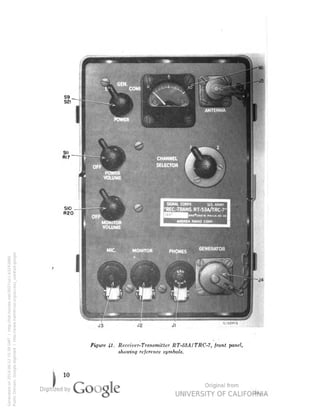
i. ANTENNA Receptacle. Connection is made from Antenna AT- 
59/TRC-7 or Antenna Assembly AS-110/TRC-7 by plugging the an-tenna 
coaxial connector into the receptacle (fig. 41) and turning the 
threaded portion of the connector until it is secure. 
Figure 41. Receiver-Transmitter RT-53/TRC-7, front 
panel, showing reference symbols. 
43 
Generated on 2014-06-12 14:54 GMT / http://hdl.handle.net/2027/uc1.b3243866 
Public Domain, Google-digitized / http://www.hathitrust.org/access_use#pd-google
IN v«uro—sso 
ON HU.S OR RISES—GOOD 
Siting. 
44 
Generated on 2014-06-12 14:54 GMT / http://hdl.handle.net/2027/uc1.b3243866 
Public Domain, Google-digitized / http://www.hathitrust.org/access_use#pd-google
SECTION IV 
OPERATION 
29. SITING. 
Best communication results when Radio Set AN/TRC-7 is operated 
in a high open location with no hills or large structures to interfere with 
communication. When possible, avoid operation under bridges, in gulleys, 
and in dense woods. Be sure the antenna is always in a vertical position. 
Do not allow the antenna to touch branches or other objects when trans-mitting 
or receiving. Because this set operates on very high frequencies, 
moving the set a few inches may provide good communication where 
none existed before. 
• 
30. STARTING PROCEDURE. 
a. Select desired channel by means of the CHANNEL SELECTOR 
knob on the front panel. See paragraphs 116 and 117 for presetting 
instructions. 
b. To adjust Antenna AT-59/TRC-7, use the calibration chart on 
top of the cabinet (fig. 43). Loosen the antenna locknut one-quarter turn, 
place the locknut firmly against the front edge of the cabinet, and slide 
the movable rod in or out until it reads the desired frequency on the 
chart. When antenna is adjusted, hand-tighten the locknut securely. 
Do not use any tools. 
c. Set the POWER switch to BAT. position. 
d. Turn on the set by rotating the POWER VOLUME control in a 
clockwise direction (fig. 37). A click indicates that the set has been 
turned on. A hissing sound is heard after a moment, usually indicating 
that the receiver is operating properly. 
e. Allow the set to warm up for 30 seconds before proceeding. 
31. PRECISE OPERATING INSTRUCTIONS. 
a. Turn the POWER VOLUME knob in a clockwise direction until 
the desired output level is reached. 
b. To transmit, press the push-to-talk switch of Microphone T-45. 
This turns on transmitter power and turns the receiver off. Wait about 
1 second before beginning to talk into the microphone. Release the 
microphone switch as soon as the transmission is completed. This places 
the set in the receiving position again. 
Generated on 2014-06-12 14:54 GMT / http://hdl.handle.net/2027/uc1.b3243866 
Public Domain, Google-digitized / http://www.hathitrust.org/access_use#pd-google
105 
I 10 
I I 5 
120 
TLI9IOO 
Figure 43. Antenna AT-59/TRC-7, adjustment lor proper frequency. 
Generated on 2014-06-12 14:54 GMT / http://hdl.handle.net/2027/uc1.b3243866 
Public Domain, Google-digitized / http://www.hathitrust.org/access_use#pd-google
c. For operation with the hand generator as the only power supply, 
the POWER switch knob is set to the GEN. position. In this case, the 
hand generator must be cranked during the entire period of transmission 
and reception. 
d. In some cases it may be necessary to stand by, or listen for signals 
for long periods of time. To avoid turning the hand generator for these 
long periods, the combination power supply arrangement may be used 
by setting the POWER switch to COMB. In this position, the receiver 
obtains power from the battery, and the transmitter from the hand 
generator. It is necessary then to operate the hand generator only while 
transmitting. The hand generator should be started, however, shortly 
before the microphone switch is operated so that power will be available 
to the transmitter when it is needed. Never use the battery for trans-mitting 
when it can be avoided, as the power consumed by the trans-mitter 
is much greater than that required by the receiver. 
e. Remote Control Unit RM-52 and Control Unit RM-53 with the 
necessary cordage are furnished to operate the equipment from a remote 
position. This equipment provides for operation of Radio Set AN/TRC7- 
on a preset frequency with a preset adjustment of the volume contro1 
for distances up to V2 mile. See TM 11-2632. 
32. STOPPING PROCEDURE. 
a. Transmitter. The receive-transmit switch located in the handle 
of Handset H-23- ( ) /U controls transmitting. Release of this switch 
takes the set off the air. 
b. Receiver. To turn off the receiver, rotate the POWER VOLUME 
control counterclockwise to OFF. 
SECTION V 
EQUIPMENT PERFORMANCE CHECK LIST 
33. PURPOSE AND USE OF CHECK LIST. 
a. General. The equipment performance check list (par. 34) will help 
the operator to determine whether Radio Set AN/TRC-7 is operating 
properly. The check list gives the item to be checked, the condition 
under which the item is checked, the normal indications and tolerances 
of correct operation, and the corrective measures that the operator can 
take. Items 1 to 5 are checked before starting, items 6 and 7 when start- 
47 
Generated on 2014-06-12 14:55 GMT / http://hdl.handle.net/2027/uc1.b3243866 
Public Domain, Google-digitized / http://www.hathitrust.org/access_use#pd-google
ing, items 8 to 10 during operation, and item 11 when stopping. Items 
6 to 10 on this list should be checked at least once during a normal 
operating period or at least four times a day during continuous opera-tion. 
b. Action or Condition. For some items the information given in 
the action or condition column consists of the settings of various switches 
and controls under which the item is to be checked. For other items it 
represents an action that must be taken to check the normal indication 
given in the normal indication column. 
c. Normal Indications. The normal indications listed include the 
visible and audible signs the operator will perceive when he checks the 
items. In the case of meter readings, the allowable tolerances of read-ings 
are given. When a meter reads as specified, operation can be con-sidered 
satisfactory. The fact that it does not, is a sign of impending 
trouble. If the indications are not normal, apply the recommended cor-rective 
measures. 
d. Corrective Measures. The corrective measures listed are those 
that the operator can make without turning the equipment in for re-pairs. 
Reference to part five in the table indicates that the correction of 
the trouble cannot be effected during operation and that trouble shoot-ing 
by an experienced repairman is called for. If the set is completely 
inoperative or if the recommended corrective measures do not yield 
results, trouble shooting is necessary. However, if the tactical situation 
requires that communication be maintained and if the set is not com-pletely 
inoperative, the operator must maintain the set in operation as 
long as it is possible to do so. 
e. Items 1 to 7. Items 1 to 7 should be checked each time the equip-ment 
is put into operation. 
f. Item 8. Item 8 shows the correct meter reading on the panel when 
the set is properly tuned and in operation. 
g. Items 8 to 10. These items represent general operating character-istics 
of the set. The operator must become familiar with the charac-teristics 
of the set during normal operation; he must use that knowledge 
as a basis for recognizing changes in audible and visible indications when 
the set is not operating properly. 
h. Item 11. Item 11 is checked whenever the station is taken out 
of operation. Any abnormal indications at this time are probably caused 
by trouble in the set and should be corrected before the next expected 
period of operation. 
'S 
Generated on 2014-06-12 14:55 GMT / http://hdl.handle.net/2027/uc1.b3243866 
Public Domain, Google-digitized / http://www.hathitrust.org/access_use#pd-google
34. EQUIPMENT PERFORMANCE CHECK LIST. 
Radio Set AN/TRC-7. 
Item 
Action or 
Normal 
Corrective 
No. 
Item 
condition 
indications 
measures 
I 
Handset or 
Plugged into 
headset and 
respective 
microphone. 
jacks. 
a 
CHANNEL 
Set to proper 
>< 
SELECTOR 
channel. 
OS 
switch. 
g 
a 
Antenna. 
Desired anten-a 
na connected 
1 
ft. 
to set. 
4 
Generator G-3/ 
Desired power 
£ 
Generated on 2014-06-12 14:55 GMT / http://hdl.handle.net/2027/uc1.b3243866 
Public Domain, Google-digitized / http://www.hathitrust.org/access_use#pd-google 
TRC-7, Bat-source 
con-tery 
BA-70, 
nected. 
or both. 
6 
POWER con- 
Set to proper 
trol. 
power source. 
8 
POWER VOL-Turn 
on. 
Rushing noise 
Preset channel. 
UME control. 
heard in 
See par. 117, 
H 
headset. 
part five. 
1 
fe 
7 
Push-to-talk 
Press. 
Rushing noise 
See par. 101, 
switch. 
stops. 
part five.
34. EQUIPMENT PERFORMANCE CHECK LIST (contd). 
Radio Set AN/TRC-7. 
Item Action or 
No. Item condition 
Normal Corrective 
indications measures 
11 POWER VOL- Turn OFF. 
UME control. 
No signal 
heard. 
04 
i 
Generated on 2014-06-12 14:55 GMT / http://hdl.handle.net/2027/uc1.b3243866 
Public Domain, Google-digitized / http://www.hathitrust.org/access_use#pd-google
PART THREE 
PREVENTIVE MAINTENANCE 
SECTION VI 
PREVENTIVE MAINTENANCE TECHNIQUES 
35. MEANING OF PREVENTIVE MAINTENANCE. 
Preventive maintenance is a systematic series of operations per-formed 
at regular intervals on equipment, when turned off, to eliminate 
major break-downs and unwanted interruptions in service, and to keep 
the equipment operating at top efficiency. To understand what is meant 
by preventive maintenance, it is necessary to distinguish between pre-ventive 
maintenance, trouble shooting, and repair. The prime function 
of preventive maintenance is to prevent break-downs and, therefore, 
the need for repair. On the other hand, the prime function of trouble 
shooting and repair is to locate and correct existing defects. The im-portance 
of preventive maintenance cannot be overemphasized. An 
entire system of radio communication depends upon each set's being 
on the air when it is needed and upon its operating efficiently. It is 
therefore vitally important that radio operators and repairmen main-tain 
their radio sets properly. See TB SIG 123, Preventive Maintenance 
Practices for Ground Signal Equipment. 
NOTE: The operation in sections VI and VII are first and second echelon 
(organization operators and repairmen) maintenance. Some operations in 
section VII are higher echelon maintenance. 
36. DESCRIPTION OF PREVENTIVE MAINTENANCE 
TECHNIQUES. 
a. General. Most of the electrical parts used in Radio Set AN/TRC-7 
require routine preventive maintenance. Those requiring maintenance 
differ in the amount and kind required. Because hit-or-miss main-tenance 
techniques cannot be applied, definite and specific instructions 
are needed. This section of the manual contains these specific instruc-tions 
and serves as a guide for personnel assigned to perform the six 
basic maintenance operations namely: Feel, Inspect, Tighten, Clean, 
51 
Generated on 2014-06-12 14:55 GMT / http://hdl.handle.net/2027/uc1.b3243866 
Public Domain, Google-digitized / http://www.hathitrust.org/access_use#pd-google
Adjust, and Lubricate. Throughout this manual the lettering system for 
the six operations will be as follows: 
F—Feel. 
I—Inspect. 
T—Tighten. 
C—Clean. 
A—Adjust. 
L—Lubricate. 
The first two operations establish the need for the other four. The selec-tion 
of operations is based on a general knowledge of field needs. For 
example, the dust encountered on dirt roads during cross-country travel 
filters into the equipment no matter how much care is taken to prevent 
it. Rapid changes in weather (such as heavy rain followed by blistering 
heat), excessive dampness, snow, and ice tend to cause corrosion of 
exposed surfaces and parts. Without frequent inspections and the neces-sary 
perfermance of tightening, cleaning, and lubricating operations, 
equipment becomes undependable and subject to break-down when the 
equipment is most needed. 
b. Feel. The feel operation is used most often to check rotating ma-chinery, 
such as blower motors, drive motors, etc., and to determine if 
electrical connections, bushings, etc., are overheated. Feeling indicates 
the need for lubrication or the existence of similar types of defects re-quiring 
correction. The maintenance man must become familiar with 
the normal operating temperatures of motors, etc., in order to recognize 
signs of overheating. 
NOTE: It is important that the feel operation be performed as soon 
as possible after shut-down and always before any other maintenance 
is done. 
c. Inspect. Inspection is the most important operation in the pre-ventive 
maintenance program. A careless observer will overlook evi-dences 
of minor trouble. Although these defects may not interfere with 
performance of the equipment, valuable time and effort can be saved if 
they are corrected before they lead to major break-downs. Make every 
effort to become thoroughly familiar with indications of normal function-ing, 
to be able to recognize the signs of a defective set. Inspection consists 
of carefully observing all parts of the equipment, noticing their color, 
placement, state of cleanliness, etc. Inspect for the following conditions: 
(1) Overheating, as indicated by discoloration, blistering, or bulg-ing 
of the parts or surface of the container; leakage of insulating com-pounds; 
and oxidation of metal contact surfaces. 
52 
Generated on 2014-06-12 14:55 GMT / http://hdl.handle.net/2027/uc1.b3243866 
Public Domain, Google-digitized / http://www.hathitrust.org/access_use#pd-google
(2) Placement, by observing that all leads and cabling are in their 
original positions. 
(3) Cleanliness, by carefully examining all recesses in the units for 
accumulation of dust, especially between connecting terminals. Parts, 
connections, and joints should be free of dust, corrosion, and other for-eign 
matter. In tropical and high-humidity locations, look for fungus 
growth and mildew. 
(4) Tightness, by testing any connection or mounting which ap-pears 
to be loose. 
d. Tighten, Clean, and Adjust. These operations are self-explana-tory. 
Specific procedures to be followed in performing them are given 
wherever necessary throughout part three. 
CAUTION: Screws, bolts, and nuts should not be tightened care-lessly. 
Fittings tightened beyond the pressure for which they are 
designed will be damaged or broken. 
e. Lubricate. Lubrication refers to the application of grease or oil 
to the bearings of motors or other rotating shafts. It may also mean the 
application of a light oil to door hinges or other sliding surfaces on the 
equipment. 
37. VACUUM TUBES, 
a. Inspect (I). 
(1) Inspect tube envelopes for accumulation of dirt and for cor-rosion. 
(2) Inspect the firmness of tubes in their sockets. Make the in-spection 
by pressing the tubes down in the sockets and testing them in 
that position, and not by partially withdrawing the tubes and jiggling 
them from side to side. Movement of a tube tends to weaken the pins 
'in the base and unnecessarily spread the contacts in the socket. It is 
desirable to inspect the sockets of the tubes at the time the tubes are 
removed. 
(3) When it is necessary to remove a tube from its socket, great 
care must be used. Never jar a warm tube. Use Tube Puller TL-310/U 
(par. 68). 
J». Tighten (T). Tighten all loose connections to the tube sockets. 
If the connections are dirty or corroded, clean them before tightening. 
c. Clean (C). 
(1) Clean the tubes, but only if inspection shows cleaning to be 
necessary. Tubes operating at low voltage and not having exposed grid 
53 
Generated on 2014-06-12 14:56 GMT / http://hdl.handle.net/2027/uc1.b3243866 
Public Domain, Google-digitized / http://www.hathitrust.org/access_use#pd-google
caps and plate caps do not require frequent cleaning. However, do not 
permit dirt to accumulate on low-voltage tubes. 
(2) Remove dust and dirt from the glass envelopes with a clean, 
lint-free, dry cloth. 
(3) When tube sockets are cleaned and the contacts are accessible, 
fine sandpaper may be used to remove corrosion, oxidation, and dirt. 
38. CAPACITORS. 
a. Inspect (I). 
(1) Inspect the terminals 01 large fixed capacitors for corrosion 
and loose connections. Carefully inspect the mountings to discover loose 
mounting screws, studs, or brackets. Examine the leads for poor insula-tion, 
for cracks, and for evidences of dry rot. Frayed strands on the 
insulation should be cut away. If the wire is exposed, wrap it with fric-tion 
tape. The terminals of the capacitors should not be cracked or 
broken. 
(2) Thoroughly inspect the case of each large fixed capacitor for 
leaks, bulges, and discoloration. 
(3) Inspect the plates of variable capacitors for dirt, dust, or lint. 
Examine the movable set of plates for signs of damage or misalignment 
that would cause them to touch the fixed plates during tuning. Rotate 
the movable plates, using the .tuning control, and thus check for proper 
operation of the capacitor. 
b. Tighten (T). Tighten loose terminals, mountings, and connections 
on the capacitors, whenever they are observed. Do not break the bush-ing 
or damage the gasket. 
c. Clean (C). 
(1) Clean the case of fixed capacitors, the insulating bushings, and 
dirty or corroded connections. The capacitor cases and bushings can 
usually be cleaned with a dry cloth, but if the deposit of dirt is hard to 
remove, moisten the cloth in a dry-cleaning solvent. 
(2) Clean the plates of variable capacitors with a small brush, re-moving 
all dust and lint. 
d. Lubricate (L). The bearings of variable capacitors are usually of 
the ball-bearing type, lubricated and sealed at the factory. These bear-ings 
will not need relubrication during the life of the equipment. 
39. RESISTORS. 
a. General. Various types of resistors are used in Radio Set AN/ 
Generated on 2014-06-12 14:56 GMT / http://hdl.handle.net/2027/uc1.b3243866 
Public Domain, Google-digitized / http://www.hathitrust.org/access_use#pd-google
TRC-7. The connections to the various resistors are either of the pigtail 
or solder-lug type. 
b. Inspect (I). Inspect the coating of the vitreous-enameled resistors 
for signs of cracks and chipping, especially at the ends. Examine the 
bodies of all types of resistors for blistering, discoloration, and other 
indications of overheating. Inspect leads and all other connections for 
corrosion, dirt, dust, looseness, and broken strands in the connecting 
wires. Check the security of all mountings. Do not attempt to move 
resistors with pigtail connections, because there is danger of breaking 
the connections at the point where they enter the body of the resistor. 
Such defects cannot be repaired. 
 
c. Tighten (T). Tighten resistor connections and mountings when-ever 
they are loose. If a resistor is allowed to remain loose, vibration 
may break the connection or damage the body. 
d. Clean (C). 
(1) Clean all carbon resistors with a small brush. 
(2) The vitreous-enameled resistors must be kept clean to avoid 
leakage between the terminals. Ordinarily, they will be wiped with a 
dry cloth. However, if the dirt deposit is unusually hard to remove, use 
a dry-cleaning solvent. 
(3) Resistors with discolored bodies cannot be cleaned. Discolora-tion 
indicates that there has been overloading and overheating at some 
time prior to the inspection. The discoloration is probably due to circuit 
trouble which requires analysis and correction. Trouble-shooting pro-cedures 
are described in part five. 
40. BUSHINGS AND INSULATORS, 
a. Description. 
(1) Insulated bushings are used in the high-voltage and r-f circuits. 
They are constructed of ceramic material with a glazed surface. An 
insulator is no better than its surface, so deposits of foreign substances 
on the surface will materially reduce the insulation value of the bushing. 
Therefore, it is very important that all bushings used in the high-voltage 
circuits be inspected frequently. 
(2) Insulating bushings are used as supports for high-voltage ter-minals 
of capacitors and for tank coils. They are used as mountings for 
resistors in high-voltage circuits and as supports for panels which mount 
other parts. The condition of insulator bushings that are used solely as 
5* 
Generated on 2014-06-12 14:56 GMT / http://hdl.handle.net/2027/uc1.b3243866 
Public Domain, Google-digitized / http://www.hathitrust.org/access_use#pd-google
panel supports is not too critical, but the condition of bushings used as 
high-voltage insulators is extremely important. 
b. Inspect (I). Inspect the physical condition of the insulator bush-ings. 
They should be clean without cracks or chips. It is possible for a 
highly glazed insulator to develop fine-line surface cracks where mois-ture 
and dust will accumulate and eventually form a leakage for a high-voltage 
flash-over. Consequently, the surface of the bushings must be 
inspected to detect such cracks. As a rule, the bushings are held in posi-tion 
with nuts screwed onto the threaded conductors. These can be re-placed 
very easily. If replacement is not possible because of a shortage 
of supplies, frequently clean the defective bushing thoroughly with dry-cleaning 
solvent. Sometimes it is difficult to see dust on a glazed surface. 
A satisfactory check can be made by sliding a clean finger across the 
bushing. 
c. Tighten (T). The procedure to be used in tightening loose bush-ings 
is self-evident. However, one precaution must be observed. Avoid 
forcing the nuts or screws down too tight. If excessive pressure is 
exerted on the bushings, damage or breakage is almost certain. Some-times 
the threads on bushing stud bolts may be found stripped so they 
cannot be tightened. The only solution is replacement of the entire 
bushing. 
d. Clean (C). Insulating bushings are easily cleaned. Never use 
abrasive materials because the glazed finish will be destroyed, thus per-mitting 
moisture to be absorbed. A clean cloth is usually satisfactory. 
If deposits of grime or dirt on the surface of a bushing are hard to 
remove, use dry-cleaning solvent. After the surface has been cleaned 
with a solvent, it should be carefully polished with a dry cloth. Other-wise, 
a thin film of the solvent will be left which may impair the effec-tiveness 
of the bushing as a high-voltage insulator. 
41. RELAY. 
Relay K1 is considered normal if: the exterior is free from dirt or 
dust; the contacts are not burned, pitted, or corroded; the contacts are 
lined up and correctly spaced; the moving parts travel freely and func-tion 
in a satisfactory manner; the connections to the relay are tight; the 
wire insulation is not frayed or torn; the relay assembly is securely 
mounted; the field coil shows no signs of overheating. 
a. Inspect (I). 
(1) Inspect the relay to detect defects. The contacts may be exam-ined 
with the aid of a flashlight and mirror. 
Generated on 2014-06-12 14:56 GMT / http://hdl.handle.net/2027/uc1.b3243866 
Public Domain, Google-digitized / http://www.hathitrust.org/access_use#pd-google
(2) The mechanical action of the relay should be checked to make 
certain that the moving and stationary contacts make positive contact 
and are directly in line with each other when they come together. 
b. Tighten (T). Tighten all loose connections and mounting screws, 
but do not apply enough force to damage the screw or to break the parts 
it holds. 
c. Clean (C). 
(1) Relay Exterior. Brush the exterior of the relay with a soft 
brush. If it is very dirty, clean it with a brush dipped in dry-cleaning 
solvent. If loose connections are found, they should be inspected. If they 
are dirty or corroded, remove and clean them and replace carefully. 
(2) Relay Contacts. Hard-alloy (palladium) contacts are cleaned 
by drawing a strip of thin clean cloth or paper between them while 
holding them together. In some cases, it may be necessary to moisten 
the cloth with dry-cleaning solvent. Use a dry cloth or paper strip for 
polishing. Corroded, burned, or pitted contacts must be cleaned with 
the point file or burnishing tool and crocus cloth. 
42. SWITCHES. 
a. Inspect (I). 
(1) Inspect the mechanical action of each switch and, while so 
doing, look for signs of dirt or corrosion on all exposed elements. In some 
cases, it will be necessary to examine the elements of the switch visually; 
in others, check the action of the switch by flipping the control knob. 
(2) Examine ganged switches 81, 82, S3, 84, 85, 86, 812, S13, S14, 
S15, S16, S17, S18, S19, and S22 to see if they are properly lubricated 
and if the contacts are clean. Inspection is visual. Do not pry the leaves 
of the switches apart. The rotary members should make good contact 
with the stationary members; and as the former slides into the latter, 
a spreading of the stationary contact leaves should be visible. Switch 
action should be free. Wiping action of contacts usually removes any 
dirt at the point of contact. 
b. Clean (C). Clean the exterior surfaces of switches with a stiff 
brush moistened with dry-cleaning solvent. 
c. Lubricate (L). If necessary, lubricate bearings or detent mechan-ism 
with Oil Lubricating, Preservative, Special, U. S. Army Spec. No. 
2-120. 
CAUTION: Apply sparingly with a pipe cleaner or small brush. 
Wipe off the excess with a cloth. Oil forms an insulating film; keep 
it off contacts. 
57 
Generated on 2014-06-12 14:56 GMT / http://hdl.handle.net/2027/uc1.b3243866 
Public Domain, Google-digitized / http://www.hathitrust.org/access_use#pd-google
43. COILS. 
a. Inspect (I). Inspect coils L1 through L16 for cleanliness of the 
ceramic coil forms and mounting supports. 
b. Tighten (T). Tighten any coil mounting or connection found loose 
by resoldering wires or tightening screws. 
c. Clean (C). Clean the coil form and coil with a soft brush. The 
ceramic coil form is actually performing the function of a high-voltage 
insulator, therefore the same preventive maintenance will apply to the 
coil as to high-voltage insulators and bushings. 
44. RHEOSTATS AND POTENTIOMETERS. 
a. Inspect (I). 
(1) Inspect the mechanical condition of rheostats R17 and R20. 
The arm should be keyed tightly to the shaft, and the shaft should turn 
easily in the bushing which supports it. 
(2) Inspect the assembly and mounting screws, setscrews, and nuts. 
(3) Examine the insulating body of the rheostats for dust, dirt, 
cracks, and chipped places. 
(4) Examine all metallic parts for dust, dirt, and corrosion. 
b. Tighten (T). Tighten loose assembly or mounting screws. 
45. TERMINAL BLOCKS. 
a. Inspect (I). 
(1) Inspect terminal blocks for cracks, breakage, dirt, and loose 
connections or mounting screws. 
(2) Carefully examine connections for mechanical defects, dirt, 
and corrosion. 
b. Tighten (T). Tighten loose screws, lugs, and mounting bolts. 
When tightening screws, be sure to select a screwdriver of correct size; 
do not exert too much pressure. Remove loose connections and clean 
them when they are dirty or corroded. 
c. Clean (C). Clean terminal blocks, when they require it, with a 
dry brush. When necessary, use a cloth moistened with a dry-cleaning 
solvent. If a solvent is used, the block must be thoroughly wiped with 
a cloth and then brushed to remove the lint. 
Generated on 2014-06-12 14:56 GMT / http://hdl.handle.net/2027/uc1.b3243866 
Public Domain, Google-digitized / http://www.hathitrust.org/access_use#pd-google
46. MULTIPLE CONNECTORS. 
a. Inspect (I). Inspect the female ends of the connectors for corro-sion 
and dust. Inspect the mountings for cracks and loose connections. 
Inspect the male ends for loose and broken pins and for proper spring 
in the banana plugs. 
b. Clean (C). Clean the male and female ends of the connectors with 
a brush moistened in dry-cleaning solvent. Remove corrosion with 
#0000 sandpaper, then wipe with a clean cloth. 
47. CORDS AND CABLES. 
The cables in Radio Set AN/TRC-7 are the life lines of the equipment. 
Condition of the cabling must be closely observed. Equipment operated 
in all kinds of weather and moved on all kinds of roads subjects cabling 
to a great deal of punishment. 
a. Inspect (I). Inspect the cables for cracked or deteriorated insula-tion, 
frayed or cut insulation at the connecting and supporting points, 
and improper placement which places the cables or connections under 
strain. Also watch for kinks and improper supports. 
b. Tighten (T). Tighten loose cable clamps, coupling rings, and cable 
connections. 
c. Clean (C). Clean connections on cables when they are dirty or 
corroded. Clean corroded connectors with #0000 sandpaper. It is 
important that the entire surface of the connector be cleaned. No at-tempt 
should be made to remove individual prongs from cable plugs. 
48. METER. 
Meters are extremely delicate instruments and must be handled very 
carefully. They require very little maintenance. They are precision in-struments 
and ordinarily cannot be repaired in the field. 
a. Inspect (I). Inspect the leads and connections of the meter. Look 
for loose, dirty, and corroded connections. Look for cracked or broken 
cover glasses. Since the movement of a meter is extremely delicate, its 
accuracy will be seriously affected if the glass is broken and dirt and 
water filter through. 
b. Tighten (T). Tighten all connections found loose. Any loose meter 
wires should be inspected for dirt or corrosion before they are tightened. 
The tightening of meter connections requires a special technique because 
careless handling can easily crack the meter case. 
59 
Generated on 2014-06-12 14:56 GMT / http://hdl.handle.net/2027/uc1.b3243866 
Public Domain, Google-digitized / http://www.hathitrust.org/access_use#pd-google
c. Clean (C). Meter cases can be cleaned with a dry cloth. If clean-ing 
is difficult, the cloth should be dampened with a dry-cleaning solvent. 
Dirty connections may be cleaned with a small brush dipped in dry-cleaning 
solvent, or with a small piece of cloth dipped in the solvent. 
49. JACKS AND PLUGS. 
Jacks require very little attention, and then only at infrequent inter-vals. 
Occasionally it will be necessary to tighten the mounting nut, clean 
the contacts, or increase the spring tension. Remove dirt with a brush 
and dry-cleaning solvent; remove corrosion with a piece of crocus cloth 
followed by a clean cloth. Increase spring tension, when necessary. To 
do this it will be necessary to remove the jack so that the waterseal can 
be pulled back to make the contact accesible. Check the action of the 
jack after each adjustment. Be careful to keep all soldered connections 
intact. For cleaning telephone-type plugs use Polish, Metal, Paste, Sig-nal 
Corps stock No. 6G1516. After cleaning, use a clean dry cloth to 
remove all traces of polish remaining on the plugs. 
50. GENERATOR. 
a. Generating Unit. Generating units are essentially the same type 
of mechanism as motors, and are inspected and lubricated in the same 
manner. The generating unit is located in the hand generator housing. 
The generating unit in Radio Set AN/TRC-7 operates with carbon 
brushes which mount in the motor frame and ride against a segmented 
commutator. The brushes and commutators require preventive main-tenance 
as described below. 
(1) Inspect (I). 
(a) Inspect the brushes and the commutators at regular intervals. 
The brushes should be long enough to make firm contact with the com-mutator. 
The brush springs must have adequate tension and be in firm 
contact with the brushes. The brush caps must be tight. The commu-tators 
must be clean and smooth. The covers and straps must be in place. 
(b) The maintenance of brushes and the cleaning of commu-tators 
are both important tasks. The operating life of the average brush 
is approximately 1,000 hours, but it will vary to some extent, depending 
upon climatic conditions. 
(2) Clean (C). 
(a) Remove the endplates or the brush-cover straps. Press a 
piece of canvas, folded to the exact width of the commutator, against 
the commutator and turn the armature by hand. 
60 
Generated on 2014-06-12 14:56 GMT / http://hdl.handle.net/2027/uc1.b3243866 
Public Domain, Google-digitized / http://www.hathitrust.org/access_use#pd-google
(b) If the commutator has been burned or pitted, hold a piece of 
No. 0000 sandpaper against the commutator and turn it by hand. 
(c) If necessary, a cloth moistened in dry-cleaning solvent may 
be used to remove caked dirt and grease. 
(d) Polish the commutator with crocus cloth and wipe with a 
clean dry cloth. 
(3) Lubricate (L). The generator bearings are double-sealed. Do 
not lubricate. 
b. Gears. 
(1) Inspect (I). Inspect the teeth of the gears in the generator for 
dirt or corrosion. 
(2) Clean (C). If the gears are dirty, clean them with a pipe 
cleaner or small brush dipped in dry-cleaning solvent. 
(3) Lubricate (L). 
(a) Coat the gear teeth liberally with Grease, Lubricating, Spe-cial 
Ordnance AXS-637. Do not leave any excess in the gear case. 
(b) Apply Oil, Lubricating, Preservative, Special, U. S. Army 
Spec. No. 2-120 to the oil-permeated bearing surrounding the stud on 
the idler arm of the idler pulley assembly. Allow oil to penetrate, then 
wipe off excess. 
(c) The idler-pulley bearing is double-sealed. Do not lubricate. 
51. CABINETS, CHASSIS, AND MOUNTINGS. 
The cabinets which house the various components of Radio Set AN/ 
TRC-7 are constructed of sheet aluminum, coated with olive drab paint. 
a. Inspect (I). Inspect the outside and inside of the case thoroughly, 
paying strict attention to every detail. Check the mountings and the 
panel screws. Inspect the panel for loose knobs, switches, and jacks. 
b. Clean (C). Clean case, outside and in, with a clean dry cloth. Use 
dry compressed air to blow out all accumulated dirt and dust. Repaint 
any surface that is found scratched, rusted, or chipped. 
c. Tighten (T). Tighten all panel screws, plugs, and control knobs 
found loose. 
52. HANDSET, HEADSET, AND MICROPHONE. 
These auxiliary items of equipment are essential to the operation of 
the radio set, therefore the operator must give them the same care as the 
radio itself. 
Generated on 2014-06-12 14:57 GMT / http://hdl.handle.net/2027/uc1.b3243866 
Public Domain, Google-digitized / http://www.hathitrust.org/access_use#pd-google
a. Inspect (I). Inspect all external surfaces for dirt and corrosion. 
See that all cable connections are tight and that plugs and jacks fit to-gether 
properly. 
b. Clean (C). Clean all items of the equipment in accordance with 
the instructions outlined previously for relays, cords, jacks, cabinets, etc. 
53. COUPLING SHAFTS AND CONTROL KNOBS. 
The control of various switches and resistors found throughout the 
set is effected through coupling shafts that connect these items to control 
knobs located on the front panel. It is important that these shafts and 
control knobs be kept tight at all times. Use the Allen wrench furnished 
(par. 69) to tighten these items whenever they are found loose. Lubri-cate 
the bearings of these control shafts with Oil, Lubricating, Preserva-tive, 
Special, U. S. Army Spec No. 2-120. 
54. GEARS. 
a. Inspect (I). Inspect the teeth of the gears on the gang switches 
and in the generator for dirt or corrosion. 
b. Clean (C). If the gears are dirty, clean them with a pipe cleaner 
or small brush dipped in dry-cleaning solvent. 
SECTION VII 
ITEMIZED PREVENTIVE MAINTENANCE 
55. INTRODUCTION. 
For ease and efficiency of performance, preventive maintenance for 
Radio Set AN/TRC-7 will be broken down into operations that can be 
performed at different time intervals. In this section the preventive main-tenance 
work to be performed on the radio set at specified time intervals 
is broken down into units of work called items. The general techniques 
involved and the application of the FITCAL operations in performing 
preventive maintenance on individual parts are discussed in section VI. 
These general instructions are not repeated in this section. When per-forming 
preventive maintenance, refer to section VI if more information 
is required for the following items. Perform all work with the power 
removed from the equipment. After preventive maintenance has been 
performed on a given day, the equipment should be put in operation and 
checked for satisfactory performance. (See par. 34, Equipment Per-formance 
Check List.) 
Generated on 2014-06-12 14:57 GMT / http://hdl.handle.net/2027/uc1.b3243866 
Public Domain, Google-digitized / http://www.hathitrust.org/access_use#pd-google
56. COMMON MATERIALS NEEDED. 
The following materials are needed in performing preventive main-tenance: 
Common hand tools (TE-41 or equivalent). 
Clean cloth, 
#0000 sandpaper. 
Crocus cloth. 
Fine file or relay burnishing tool. 
Solvent, Dry-cleaning, Federal Specification P-S-661a. 
Polish, Metal, Paste, Sig. C stock No. 6G1516. 
NOTE: Gasoline will not be used as a cleaning fluid for any purpose. 
Solvent, Dry-cleaning, Federal Specification P-S-661a is available as a 
cleaning fluid through established supply channels. Oil, Fuel, Diesel, U. S. 
Army Specification 2-102B, may be used for cleaning purposes when dry-cleaning 
solvent is not at hand. Carbon tetrachloride or fire-extinguishing 
liquid (carbon tetrachloride base) will be used, if necessary, only on con-tact 
parts of electronic equipment. 
57. ITEM 1, EXTERIOR OF RADIO SET AN/TRC-7 (fig. 6). 
OPERATIONS. 
1C Cabinet. 
ITC Jacks. 
ITA Control knobs. 
1C Meter. 
1C Straps. 
ITC Panel cover. 
T Loose screws, nuts, and bolts. 
ICL Metal accessories. 
I Waterseal gaskets. 
I Rivets. 
IT Nuts. 
REMARKS. Check paint for scratches, chips, and blisters. Check for 
dents, cuts, or bends in the panel. Replace all knobs that are chipped 
63 
Generated on 2014-06-12 14:57 GMT / http://hdl.handle.net/2027/uc1.b3243866 
Public Domain, Google-digitized / http://www.hathitrust.org/access_use#pd-google
or broken. Remove all dirt, dust, rust, fungus, and other foreign matter. 
Use a dry-cleaning solvent on exposed metal parts. Use a damp cloth 
on painted parts. On web straps use soap and water. 
58. ITEM 2, ANTENNAS. 
a. Antenna AT-59/TRC-7 (fig. 11). 
OPERATIONS. 
1C Insulator. 
I Mounting. 
b. Antenna Assembly AS-110/TRC-7 (fig. 10). 
OPERATIONS. 
1C Insulator. 
I Mounting. 
ITC Mast sections. 
59. ITEM 3, BATTERY BA-70 (fig. 6). 
PRELIMINARY STEPS. Remove Battery BA-70 from Receiver- 
Transmitter RT-53/TRC-7. 
OPERATIONS. 
1C Battery receptacle. 
60. ITEM 4, GENERATOR AND CABLE (fig. 16). 
OPERATIONS. 
1C Generator receptacle. 
1C Cable and connections. 
T Nuts in receptacle. 
61. ITEM 5, HANDSET (fig. 12). 
OPERATIONS. 
C Handset. 
I Switch. 
1C Cabinets and external surfaces. 
ITC Cords and plugs. 
IT Mounting screws. 
I Covers of receiver and microphone. 
54 
Generated on 2014-06-12 14:57 GMT / http://hdl.handle.net/2027/uc1.b3243866 
Public Domain, Google-digitized / http://www.hathitrust.org/access_use#pd-google
62. ITEM 6, HEADSET (fig. 13). 
OPERATIONS. 
I Rubber of ear plugs. 
1C Breast clamp. 
IT Loose sleeve on phone plugs. 
IL Metal part of headband. 
REMARKS. Tighten any loose sleeve of a phone plug by hand only. 
63. ITEM 7, MICROPHONE (fig. 14). 
OPERATIONS. 
1C Cords. 
1C Jack. 
1C Switch. 
ICA Straps. 
I Microphone unit. 
ITC Plugs. 
T Screws on switch cover. 
REMARKS. Tighten the sleeve of Plug PL-68 by hand only. 
64. ITEM 8, RECEIVER-TRANSMITTER (fig. 18). 
PRELIMINARY STEPS. Remove the receiver-transmitter from its 
case. 
OPERATIONS. 
I Chassis. 
I Wiring and solder joints. 
ITCA Tubes and sockets. 
I Transformer shields. 
ITC Capacitors. 
I Crystal units. 
ITC Resistors. 
I Jack waterseals. 
IT Rheostats and potentiometers. 
I Power plug and test receptacle. 
Generated on 2014-06-12 14:57 GMT / http://hdl.handle.net/2027/uc1.b3243866 
Public Domain, Google-digitized / http://www.hathitrust.org/access_use#pd-google
ITC Bushings and insulators. 
I Chokes. 
ICL Switches. 
I Cables. 
ITC Relay. 
ITL Couplings. 
T Nuts and screws. 
ITC Coils. 
ICL Gears. 
1C Terminal blocks. 
REMARKS. Do not touch adjusting screws on any transformer. 
65. PREVENTIVE MAINTENANCE CHECK LIST. 
The following check list is a summary of the preventive maintenance 
operations to be performed on Radio Set AN/TRC-7. The time inter-vals 
shown on the check list may be reduced at any time by the local 
commander. For the best performance of the equipment, perform the 
operations at least as frequently as called for in the check list. The 
echelon column indicates which operations are first echelon main-tenance 
and which operations are second echelon maintenance. Opera-tions 
are indicated by the letters of the word FITCAL. For example, if 
the letters ITCA appear in the "Operations" column, the item to be 
treated must be inspected (I), tightened (T), cleaned (C), and ad-justed 
(A). 
Item 
No Operations 
When performed 
Item 
~ S 
5 J 
§ 4S 
1 
ITCAL 
Exterior of Radio Set 
X 
1st 
AN/TRC-7. 
2 
ITC 
Antennas. X X 
X 
1at 
3 
1C 
Battery BA-70. X X 
X 
1st 
4 
ITC 
Generator cable. 
X 2d 
6 
ITC 
Handset. 
X 
1st 
0 
ITCL 
Headset. 
X 
1st 
7 
ITCA 
Microphone. 
X 
1st 
8 
ITCA 
Receiver-transmitter. 
X 
ad 
Generated on 2014-06-12 14:57 GMT / http://hdl.handle.net/2027/uc1.b3243866 
Public Domain, Google-digitized / http://www.hathitrust.org/access_use#pd-google
SECTION VIII 
LUBRICATION 
66. LUBRICATION. 
No War Department Lubrication Order is prescribed for Radio Set, 
AN/TRC-7, but lubrication instructions are given in the preventive 
maintenance sections of this manual. 
SECTION IX 
SPECIAL TOOLS 
67. ALIGNMENT TOOL TL-314/U. 
This plastic tool has a screwdriver on one end and an insert-type 
alignment tool on the other. Do not force the tool; it breaks easily. The 
alignment tool is packed with the receiver-transmitter unit (fig. 77). 
Figure 44. Alignment Tool TL-314/U. 
68. TUBE PULLER TL-310/U. 
One end of this double-ended tube puller is for the larger tubes of 
the set; the other end for the smaller. Push the tube puller down over 
the tube and pull straight up. The tube will come out easily. Do not 
force or exert any side thrust on the tubes. 
TL706I9 
Figure 46. Tube Puller TL-SW/U. 
67 
Generated on 2014-06-12 14:58 GMT / http://hdl.handle.net/2027/uc1.b3243866 
Public Domain, Google-digitized / http://www.hathitrust.org/access_use#pd-google
Figure 46. Allen wrench. 
69. ALLEN WRENCH. 
An % 2-inch Allen setscrew wrench is furnished with the equipment 
to facilitate removal of knobs and CHANNEL SELECTOR switch 
shafts. This wrench is located in the left rear corner of the tube side 
of the chassis. See figure 79 for location of the Allen wrench. 
I 
3/16 OD 
Figure 47. Soldering tip. 
70. SOLDERING TIP. 
For instructions on the preparation of this tool, see paragraph 104. 
SECTION X 
MOISTUREPROOFING AND FUNGIPROOFING 
71. MOISTUREPROOFING AND FUNGIPROOFING RADIO SET 
AN/TRC-7. 
Moistureproofing and fungiproofing is deleterious to Radio Set AN/ 
TRC-7 and must not be attempted. 
PART FOUR —AUXILIARY EQUIPMENT 
NOT USED 
Generated on 2014-06-12 14:58 GMT / http://hdl.handle.net/2027/uc1.b3243866 
Public Domain, Google-digitized / http://www.hathitrust.org/access_use#pd-google
PART FIVE 
REPAIR INSTRUCTIONS 
NOTE: Failure or unsatisfactory performance of equipment used by Army 
Ground Forces and Army Services Forces will be reported on W.D., 
A.G.O. Form No. 468 (Unsatisfactory Equipment Report); by Army Air 
Forces on Army Air Forces Form No. 54 (unsatisfactory report). If either 
form is not available, prepare the data according to the sample form 
reproduced in figure 73. 
SECTION XI 
THEORY OF EQUIPMENT 
72. THEORY OF OPERATION. 
Radio Set AN/TRC-7 is designed to give voice communication over 
a line-of-sight distance of approximately 35 miles. The transmitter is 
amplitude-modulated and transmits on either of two preset frequencies 
between 100 and 156 mc. The receiver is a superheterodyne operating 
over the same frequency range. 
VIZ 
OSCILLATOR 
JAN-3A5 
IST 
TRIPLES 
20 
TRIPLER 
DOUBLER 
JAN-3A5 
POWER 
AMPLIFIER 
JAN-3A4 
JAN-3A4 
JAN-3AS 
VIS 
SPEECH 
AMPLIFIER 
MODULATOR 
JAN-3A5 
JAN-3A5 
Figure 48. Transmitter, simplified block diagram. 
Generated on 2014-06-12 14:58 GMT / http://hdl.handle.net/2027/uc1.b3243866 
Public Domain, Google-digitized / http://www.hathitrust.org/access_use#pd-google
70 
Generated on 2014-06-12 14:58 GMT / http://hdl.handle.net/2027/uc1.b3243866 
Public Domain, Google-digitized / http://www.hathitrust.org/access_use#pd-google
a. Figure 48 is a simplified block diagram of the transmitter. Oscil-lations 
generated in tube V11 are fed to the first tripler stage, V12. The 
output of tube V12 is applied to second tripler tube V13 then to the 
doubler-driver stage, tube V14. The doubler-driver output is fed to p-a 
(power-amplifier) stage tube V15. Modulator stage tube V16 modulates 
the power amplifier in the plate circuit and supplies sidetone to the 
headset. The modulator is driven by speech amplifier tube V11. The 
output of the p-a stage is applied to the antenna through a coaxial cable. 
b. A simplified block diagram of the receiver section is illustrated in 
figure 49. The received signal is first amplified in r-f amplifier tube V1. 
The output of V1 is mixed with the output of harmonic amplifier tube 
V9 and applied to mixer tube V2. The i-f (intermediate-frequency) out-put 
of the mixer is amplified in the three i-f amplifier stages and applied 
to the diode detector tube V6. The audio output from the detector is 
amplified in two a-f (audio-frequency) amplifier stages, tubes V6 and 
V10, and applied to tne headset. Noise limiter stage tube V7 aids in 
reducing noises caused by static, and other sudden noise pulses. 
73. RECEIVER SECTION, FUNCTIONING OF PARTS. 
A complete analysis of the operation of the receiver section of Re-ceiver- 
Transmitter RT-53/TRC-7 is given in paragraphs 74 to 85 
below. Each stage is discussed separately and a detailed description of 
the function of each circuit element is given. 
74. RECEIVER RADIO-FREQUENCY AMPLIFIER STAGE. 
a. The receiver r-f amplifier (fig. 50) increases the amplitude of the 
received signal before it is applied to the mixer. It also improves the 
selectivity of the receiver by providing an additional circuit which is 
tuned to the frequency of the desired signal. Unwanted signals are thus 
rejected to a large extent before reaching the mixer. 
b. The incoming signal is applied through the contacts of antenna 
switching relay K1 and capacitor C54 to a tap on grid coil L1. The 
voltage applied to the grid of tube 1AB5 (V1) is developed across the 
parallel combination of coil L1 and the tuning capacitor. Either 
capacitor C1 or C2 may tune the circuit, depending on the setting of 
the CHANNEL SELECTOR switch. Capacitor C1 is used on channel 1, 
and capacitor C2 on channel 2 (odd-numbered circuit elements are 
always associated with channel 1 and even-numbered with channel 2). 
When the parallel combination of coil L1 and the tuning capacitor is 
tuned to resonance with the desired signal, it presents a higher im-pedance 
to this signal than to any other frequency; the voltage caused 
by the desired signal is greater than that due to any other frequency 
T 
Generated on 2014-06-12 14:58 GMT / http://hdl.handle.net/2027/uc1.b3243866 
Public Domain, Google-digitized / http://www.hathitrust.org/access_use#pd-google
X 
/ 
if' 
/ C9 
/ I00 MMF 
-r^H 
»3 S2 
r" 
6V 
A 
o 
 
n TO GRID 
OF MIXER 
(V2) 
CII 
2Z~ 
MMF' 
£ 
/C2 
g 
I.200 
MMF 
'7 
1 22 MMF 
C7 
27 = 
i 
^ 
£|67 
> 
C54 
C5 
K 
-7^ 
MMF' 
.-, 
MMF gJL2 
I0 ~ 
Generated on 2014-06-12 14:58 GMT / http://hdl.handle.net/2027/uc1.b3243866 
Public Domain, Google-digitized / http://www.hathitrust.org/access_use#pd-google 
MMF 
t MMFP 
I.20O 
C3 
C8? 
~ 
I — 
-~ 
~ I,200 < 
MMF < 
ILM 
I.200 
MMF-LI3 
1 
| 
1 
TO B+ 
1 -L. 
BUS 
L 
TO ANTENNA 
SWITCHING 
RELAY Kl 
Ifl 
TO AVC LINE 
'•' TO PIN 8 
(V2) 
TO P 
OF HARMON 
-ATE
V2 
IAB 5 
'/" 
t 
Tl 
•• 
I' 
r 
RECEIVER HIOO 
6 
1. 
i U 
R-F AMPLIFIER MMF 
PL4TE 
J 
, 
•» 
.X 
Tl,2OO 
T=tr MMF 
1 
| 
* 11 
OF 
IST I-F 
il I00 
S" MMF 
R5i 
'' 1 
_CI4 < 
— I0 c 
3' 
AMPLIFIER 
- CIO 
'I 
1 
MMF c 
3 I "6J 
n i I MEG. 
R4; 
Generated on 2014-06-12 14:58 GMT / http://hdl.handle.net/2027/uc1.b3243866 
Public Domain, Google-digitized / http://www.hathitrust.org/access_use#pd-google 
IMES « 
» -= 
I.2OO 
f^ ^" 
Tl 
Pit 
) 
It 
__ 
I.200 
_MMF 
1 
z^ 
V 
TO 
PIN 7 
9 
C23 
0.0I 
M F - 
1 
T 
XO.OI 
MF 
NOTE 
^ IS SYMBOL FOR 
FIXED CAPACITOR. 
RECEIVER 
B+ BUS 
TO AVC LINE
circuit while capacitor C16 bypasses the intermediate frequency to 
ground. The filament is bypassed by capacitor C17. 
b. The amplified signal is developed across the plate load impedance 
which consists of fixed capacitor C34 and the variable inductance in T2. 
The inductance is tuned with a movable powdered iron slug to a resonant 
frequency of 12 mc. Capacitor C20 is the bypass capacitor for the plate 
circuit. Screen voltage is applied through voltage-dropping resistor R7. 
The screen supply is bypassed by capacitor C1S. The output of the first 
i-f amplifier is coupled to the second i-f stage through capacitor C21. 
2D 
IFIER 
Figure 52. Receiver first i-j amplifier. 
77. RECEIVER SECOND INTERMEDIATE-FREQUENCY 
AMPLIFIER. 
The second i-f amplifier stage (fig. 53) is similar to the first. Tube V4 
(JAN-1L4) is used exactly as in the first stage, the input signal voltage 
is developed across grid resistor R8 and appears between the grid and 
filament. The tube operates with zero bias instead of with a-v-c bias 
as in the case of the first stage, because the grid is returned directly to 
the filament through resistor R8. The filament is bypassed for the inter-mediate 
frequency by capacitor C22. The plate load impedance is tuned 
in the same manner as in the previous stage and consists of capacitor 
C36 in parallel with the tunable inductance in T3. The plate is by- 
J 
74 
Generated on 2014-06-12 14:58 GMT / http://hdl.handle.net/2027/uc1.b3243866 
Public Domain, Google-digitized / http://www.hathitrust.org/access_use#pd-google
V4 
JAN-IL4 
FROM IST 
A 
•§• 
1 i3 
r 
T3 
AMPLIFIER 
B 
"~ 
X 
MM 
'/ 
C24 
E I/C27 B TO 3D 
Rl(MMF AM(PVL5'ER 
I MEo3 
k 
n 
7 5 
-Q.OIMF 
C36 
- I 
511 
II 
| 
-C22 
I0 ~ 
0.0I MF 
82M « 
: 
J 
C26 
o.oi- 
C 
MF 
TO PIN 
7(V5) 
Generated on 2014-06-12 14:59 GMT / http://hdl.handle.net/2027/uc1.b3243866 
Public Domain, Google-digitized / http://www.hathitrust.org/access_use#pd-google 
IS SYMBOL TOR FIXED CAPACITOR 
kuiooon 
TO + 45V 
FILAMENT BUS 
TO RECEIVER 
B+ BUS 
Figure 53. Receiver second i-f amplifier. 
passed by capacitor C26, and the screen by capacitor C22. Resistor R9 
is the screen voltage-dropping resistor. The output of the stage is 
coupled to the third i-f amplifier through capacitor C27. 
78. RECEIVER THIRD INTERMEDIATE-FREQUENCY 
AMPLIFIER. 
a. The output of the second i-f amplifier is applied to the grid of the 
third amplifier tube (fig. 54) through capacitor C27 (fig. 53). The grid 
FROM 20 I-F - 
- 
AMPLIFIER 
! TO DETECTOR 
*"PLATE 
TO NOISE 
IlMITER (V7) 
A-V-C BIAS 
Figure 64- Receiver third i-f amplifier.
circuit of the second and third stages are identical. Resistor R1O is the 
grid resistor for the third stage and is connected directly to the filament. 
The filament is bypassed by capacitor C29. The screen voltage is ap-plied 
through resistor R11 which is bypassed by capacitor C30. 
b. The plate load is the primary of transformer T4. The primary is 
tuned to the intermediate frequency by a movable powdered iron slug. 
The output of this stage is taken from the secondary of the transformer 
and applied to the diode detector. 
79. RECEIVER DIODE DETECTOR. 
a. The diode detector (fig. 55) is the diode section of diode-pentode 
Tube JAN-1S5, V6. The voltage appearing across the secondary of trans-former 
T4 is applied between the diode plate and filament. The diode 
circuit goes from ground at the filament, through the tube to the diode 
plate, through the secondary of transformer T4, through resistor R12 
and capacitor C33 in parallel, and back to ground. 
b. When the polarity of the signal voltage at the secondary of the 
transformer is such that the plate of the diode is positive with respect 
to the filament, the tube conducts. The direction of current flow is 
down through resistor R12 to ground. This causes a negative signal to 
appear at point C (fig. 55). Capacitor C33 bypasses the i-f component 
of the signal and only the audio component appears across resistor R12. 
This audio voltage is applied to the noise limiter circuit. 
FROM 3D t-F E 
AMPLIFIER PLATE 
FROM AUTOMATIC 
NOISE LIMITER 
CIS 
TO 20 A-F 
AMPLIFIER GRID 
Figure 65. Receiver diode detector and first audio amplifier. 
Generated on 2014-06-12 14:59 GMT / http://hdl.handle.net/2027/uc1.b3243866 
Public Domain, Google-digitized / http://www.hathitrust.org/access_use#pd-google
VT 
JAN-IA3 
AUDIO AMPLIFIER .--...- - ^» 0.5 MEG 
TO PIN I (V8) 
TL I8786 
Figure 66. Receiver noise limiter. 
c. The voltage developed at point C by the rectified signal is applied 
through the a-v-c circuit to the grids of r-f amplifier tube V1 and first 
i-f tube V3. The audio component of the signal is filtered out by the 
combination of resistor R14 and capacitor C31. The voltage applied to 
the grids of the tubes thus depends on the average signal strength and 
does not vary at an audio rate. Coil L15 is an r-f choke (fig. 89). The 
a-v-c voltage applied to V1 is obtained from the voltage divider made 
up of resistors R2 and R3. Any increase in signal strength causes an 
increase in the negative bias on the grids of tubes V1 and V3. The gain 
of these two stages is thus reduced, and the signal applied to the diode 
detector is reduced correspondingly. 
80. RECEIVER NOISE LIMITER CIRCUIT. 
a. The noise limiter circuit (fig. 56) is designed to cut down sudden 
increases in signal volume caused by noise impulses due to static or 
near-by electrical machinery. Under normal signal conditions the plate 
of diode Tube JAN-1A3, V7, is held at a negative potential by the charge 
on C35. This capacitor is charged to the average negative potential of 
the signal at point C (fig. 55) through resistor R16. The time constant 
of the RC combination of capacitor C35 and resistor R16 is long com-pared 
to audio frequencies, and the capacitor holds a charge which fol-lows 
the average signal potential and not the audio variations. The 
cathode of the diode is at d-c ground potential because of the blocking 
action of capacitor C38. The diode cannot conduct under these con- 
Generated on 2014-06-12 14:59 GMT / http://hdl.handle.net/2027/uc1.b3243866 
Public Domain, Google-digitized / http://www.hathitrust.org/access_use#pd-google
ditions, because the cathode is positive with respect to the plate. All of 
the signal voltage, therefore, appears across resistor R17. 
b. When a sudden noise pulse is received, point C (fig. 55) is driven 
sharply negative. The negative pulse is coupled to the noise limiter tube 
through capacitor C38. The cathode of tube V7 goes more negative than 
the plate and the tube conducts. Resistor R17 is thus effectively shunted 
by a low-impedance path through the diode and capacitor C35 to ground 
for the duration of the noise pulse. The noise pulse voltage, therefore, 
is greatly reduced across resistor R17. 
c. Noise pulses are usually of extremely short duration and end before 
capacitor C35 charges up to any great extent. At the end of the pulse, 
the diode can no longer conduct, and the capacitor loses any charge due 
to the pulse, through resistor R16. 
81. RECEIVER FIRST AUDIO-FREQUENCY AMPLIFIER STAGE. 
A portion of the audio signal across resistor R17 is applied to the con-trol 
grid of the pentode section of Tube JAN-1S5, V6, through a shielded 
lead (fig. 55). This signal is amplified in the plate circuit and appears 
across plate load resistor R32. The plate is bypassed for radio frequency 
by capacitor C13 while capacitor C94 acts as a decoupling capacitor for 
the plate supply circuit. Screen voltage is applied through dropping 
resistor R15 which is bypassed for audio frequency by capacitor C37. 
82. RECEIVER SECOND AUDIO-FREQUENCY AMPLIFIER 
STAGE. 
a. The output of the first a-f amplifier is coupled from the plate of 
tube V6 to the second a-f amplifier stage through capacitor C95 (fig. 
55). Grid voltage for second amplifier Tube JAN-3Q4, V10 (fig. 57), 
TO FILAMENTS 
FROM IST 
A-F 
C99 
"O.OIMF 
• 
TO P 
IN 7 TO- 
-; 
4.5V 
TO RE 
» 
V 3 FILAMENT C40 B 
Generated on 2014-06-12 14:59 GMT / http://hdl.handle.net/2027/uc1.b3243866 
Public Domain, Google-digitized / http://www.hathitrust.org/access_use#pd-google 
LINE ..00, MF 
F 
GRID BIAS LINE NOTE: 
-T- IS SYMBOL FOR FIXED CAPACITOR 
M -- i.ooo n 
TC + 4SV 
FIUAMENT LINE 
Figure 67. Receiver second a-f amplifier.
is developed across resistors R30 and R31 in series. The tube is biased 
to —4.5 volts from the fixed bias supply. This insures Class A operation 
and minimum distortion. The filament is bypassed for radio frequency 
by capacitors C97 and C98. 
b. Plate voltage is applied through the primary of output transformer 
T5. Capacitor C28 bypasses the plate supply to ground. The primary 
of the output transformer is shunted by capacitor C96 which reduces 
the response of the amplifier at the higher audio frequencies. The turns 
ratio of transformer T5 is such that the impedance in the secondary 
circuit is reflected back into the primary so that the impedance of the 
primary matches that of the plate circuit of the tube. The secondary is 
designed for use with a 250-ohm headset. The screen voltage is supplied 
directly from the plate supply and is bypassed for af by capacitor C99. 
c. The audio output from the secondary of transformer T5 is con-nected 
to the headset through PHONES jack J1 on the front panel of 
the set. An auxiliary contact in the jack ppens the filament circuits of all 
tubes in the receiver when the headset plug is removed. 
83. RECEIVER CRYSTAL OSCILLATOR. 
a. The receiver crystal oscillator (fig. 58) uses one section of twin-triode 
Tube JAN-3A5, V8. The oscillator is the source of the local fre-quency 
which is mixed with the incoming signal to produce the inter-mediate 
frequency of 12 mc. The oscillator is connected in a tuned plate 
circuit with the crystal as the resonant circuit for the grid. The setting 
of the CHANNEL SELECTOR switch determines which crystal is in 
use, Y1 in channel 1 and Y2 in channel 2. A fixed bias of —4.5 volts is 
applied to the grid from the bias supply through resistor R21. 
b. The plate circuit is tuned to the crystal frequency by means of 
capacitor C46 or C47 in parallel with coil L4. The coil is equipped with 
a powdered iron core which is adjusted at the factory and should need no 
attention under ordinary conditions. Coupling between the plate and 
grid circuits is accomplished through the grid-plate capacitance of the 
tube supplemented by capacitor C43. Plate voltage of 150 volts is 
applied through the meter circuit to coil L4. Plate current is indicated 
by meter M1 when the meter switch is set to position 2. The plate is 
bypassed by capacitor C48. 
c. The filament circuit is bypassed by capacitors C39 and C41. A 
shunt resistor R23 is connected across the filaments to allow enough cur-rent 
for the heater of tube V7, as the filaments of the two tubes are in 
series. Resistor R22 is a cathode bypass for section 1-4 of the cathode 
as this section requires less current than the section of filament 
from 4 to 7. 
79 
Generated on 2014-06-12 14:59 GMT / http://hdl.handle.net/2027/uc1.b3243866 
Public Domain, Google-digitized / http://www.hathitrust.org/access_use#pd-google
84. RECEIVER HARMONIC GENERATOR. 
a. The output from the plate of the crystal oscillator is applied to 
the grid of the harmonic generator tube, the second section of twin-triode 
Tube JAN-3A5, V8, through capacitor C45 (fig. 58). The grid is oper-ated 
at a fixed protective bias of —7.5 volts. The grid leak resistor R24 
Generated on 2014-06-12 14:59 GMT / http://hdl.handle.net/2027/uc1.b3243866 
Public Domain, Google-digitized / http://www.hathitrust.org/access_use#pd-google
is 1 megohm which allows a high negative bias to be developed. This 
causes the amplifier to operate Class C, insuring an output rich in 
harmonics. 
b. The plate circuit is tuned to resonate with a harmonic of the fre-quency 
applied to the grid. This may be from the eleventh to the 
seventeenth harmonic, depending on the crystal in use and the channel 
selected. Tuning is accomplished by means of capacitor C49 or C50 in 
parallel with plate-tank coil L5. Plate voltage of 150 volts is applied 
directly to the coil from the plate supply. The plate is bypassed by 
capacitors C51 and C102. 
85. RECEIVER HARMONIC AMPLIFIER. 
a. The amplified harmonic of the crystal oscillator is applied from 
the plate circuit of the harmonic generator to harmonic amplifier tube 
TO R-F AMPLIFIER 
PLATE (V2) 
TO RECEIVER B + 
BUS 
TO 
MIXER GRID 
(V2) 
C52 
TO IOOMMF 
HARMONIC « |( & 
GENERATOR n 
(V8) 
470 M 
PIN-I +4.5V 
V2 FILAMENT 
BUS 
T 
IS SYMBOL FOR FIXED CAPACITOR. 
IS SYMBOL FOR VARIABLE CAPACITOR. 
M - I,000 a. 
Figure 59. Receiver harmonic amplifier. 
TLI6791 
Generated on 2014-06-12 14:59 GMT / http://hdl.handle.net/2027/uc1.b3243866 
Public Domain, Google-digitized / http://www.hathitrust.org/access_use#pd-google
TO MODULATOR 
(VI6) 
NOTE: 
M = i.ooon 
IS SYMBOL FOR FIXED CAPACITOR 
IS SYMBOL FOR VARIABLE CAPACITOR 
TO 
POSITION 3 
ON METER 
SWITCH 
TO RELAY 
CONTROL R46 
I80/1 
TO-4.8V 
(VIS) 
TO PIN 5 
(VIZ) TO-4.5V 
BIAS BUS 
TO +4.SV FILAMENT BUS TL mil 
Figure 60. Transmitter oscillator and speech amplifier. 
V9 (1AB5) through capacitor C52 (fig. 59). This tube is a pentode oper-ating 
Class A. The input voltage is developed across resistor R25 and is 
applied directly between grid and filament. The filament is bypassed by 
capacitor C53. Resistor R47 is placed in series with the filament as a 
voltage-dropping resistor for tubes V1, V2, and V9 which require only 
1.2 volts each while the filament supply is 4.5 volts. 
b. The plate load is coil L3 and is tuned to resonance by means of 
capacitor C56 or C57. Plate voltage is applied through r-f choke L13. 
Capacitor C58 is the plate bypass capacitor. The output of the stage if 
coupled inductively to coil L2, the plate coil of the r-f amplifier stage of 
the receiver. Screen voltage is applied through voltage-dropping resistor 
R26, which is bypassed by capacitor C55. 
86. TRANSMITTER OSCILLATOR. 
a. The transmitter oscillator (fig. 60) consists of half of Tube JAN- 
3A5, V11, a twin diode, connected in a crystal-controlled, tuned plate 
circuit. The crystals form the resonant circuit for the grid, Y3 for channel 
1 and Y4 for channel 2. The grid is biased to —6 volts, —4.5 volts from 
the fixed bias supply and +1-5 on the filament which is obtained from 
the voltage drop in the filament of tube V13. Resistor R35 is the grid-leak 
resistor. 
82 
Generated on 2014-06-12 15:04 GMT / http://hdl.handle.net/2027/uc1.b3243866 
Public Domain, Google-digitized / http://www.hathitrust.org/access_use#pd-google
b. Plate voltage of +150 volts is applied through coil L6. The plate 
circuit is tuned to the crystal frequency by either capacitor C61 or C62, 
one of which is in parallel with coil L6. The coil is provided with a 
powdered iron core, proper adjustment of which enables the tuning 
capacitors to cover the frequency range of the crystals. This adjustment 
is made, at the factory and requires no attention under ordinary condi-tions. 
The plate supply is bypassed to ground by capacitor C64 and the 
filament by capacitor C92. Plate current is read on meter M1 when the 
meter switch is in position 3. 
87. TRANSMITTER FIRST TRIPLER. 
a. The output from the transmitter oscillator is applied to the grid of 
Tube JAN-3A4, V12, through capacitor C63 (fig. 61). The grid is biased 
to —7.5 volts from the bias supply battery. An additional 1.5 volts is 
obtained from the voltage drop in the filament of tube V13. This bias 
prevents damage to the tube in case the excitation fails. The total fixed 
bias of —9 volts and the additional bias developed across grid resistor 
R36 causes the output of the tube to be greatly distorted, and therefore 
rich in harmonics. 
b. The plate circuit is tuned to the third harmonic of the input fre-quency 
by means of capacitor C65 or C66 in parallel with coil L7. The 
output signal across the plate load coil L7 is therefore three times the 
frequency of the oscillator. Plate voltage of 150 volts is applied directly 
VIZ 
JAN-3A4 
C68 
I00 MMF 
TO 
TRANS 
MITTER ZD 
TRIPLER (VI3) 
+ I50V 
C63 
47 MMF 
TRANSMITTER 
OSCILLATOR (VII) 
TO-7.5 V BIAS 
BUS 
+4.5V 
IS SYMBOL FOR VARIABLE 
Generated on 2014-06-12 15:05 GMT / http://hdl.handle.net/2027/uc1.b3243866 
Public Domain, Google-digitized / http://www.hathitrust.org/access_use#pd-google 
CAPACITOR 
M = I,0001) 
TO PIN 7 
(VII) 
Figure 61. Transmitter first tripler.
to coil L6 from the plate supply which is bypassed by capacitor C67. 
Screen voltage is applied through resistor R38 which together with 
capacitor C60 acts as a decoupling circuit for the screen. The filament 
is bypassed by capacitor C59. Resistor R28 acts as a shunt for the fila-ment 
as tube V12 requires less current than tube V11 which is in series 
with it. 
88. TRANSMITTER SECOND TRIPLER. 
a. The output from the first tripler stage is applied to the second 
tripler through capacitor C68. Pentode Tube JAN-3A4 (fig. 62) is used 
and is connected in a circuit similar to the first tripler. A fixed protective 
bias of —7.5 volts is applied through grid leak resistor R39. The signal 
from the plate of tube V12 is developed across resistor R39 and applied 
to the grid of tube V13. The tube operates at a high negative bias which 
insures an output rich in harmonics. The grid is bypassed to ground by 
capacitor C42. 
b. The plate load consists of coil L8 in parallel with capacitor C70 
or C71. The plate circuit is tuned to resonance with the third harmonic 
of the input signal. The frequency is, therefore, three times that of the 
FROM 
~2Luc'ST TRIPLE* 
I00 MMF (VIZ) 
+ I50V 
. + IDUV 
NOTE: i IS SYMBOL FOR FIXED CAPACITOR 
Jf=. IS SYMBOL FOR VARIABLE CAPACITOR 
M* l,000 A 
Figure 62. Transmitter second tripler. 
Generated on 2014-06-12 15:05 GMT / http://hdl.handle.net/2027/uc1.b3243866 
Public Domain, Google-digitized / http://www.hathitrust.org/access_use#pd-google
L9 _C78 _ 
1 35MMF7 35MMF 
NOTE 
I M=I,OOO/X 
d^ IS SYMBOL FOR 
1 FIXED CAPACITOR 
^fc IS SYMBOL FOR 
I VARIABLE CAPACITOR 
Figure 63. Transmitter doubler. 
first tripler, or nine times that of the crystal oscillator. The plate supply 
is bypassed by capacitors C72 and C83. Screen voltage is applied 
through voltage-dropping resistor R41 bypassed by capacitor C69. The 
filament is bypassed by capacitor C19 and is shunted by resistor R40. 
Resistor R40 performs the same function as resistor R38 in the first 
tripler. 
89. TRANSMITTER DOUBLER-DRIVER STAGE. 
a. The doubler-driver stage (fig. 63) consists of a cwin-triode Tube 
JAN-3A5, V14, both sections of which are used connected in parallel. The 
output of the second tripler is applied to one grid through capacitor C74 
and across resistor R42, and to the other through capacitor C101 and 
across R44. Separate grid resistors are used because the characteristics 
of the two triodes are not identical and the same bias voltage is not suit-able. 
By using separate grid resistors, each tube operates at its most 
efficient bias and is not affected by the other. A protective bias of —7.5 
volts is applied from the bias supply battery and 1.5 volts is obtained 
from the drop in the filament circuit of tube V15, making a total fixed 
bias of —9 volts. The grid supply is bypassed by capacitor C87 and the 
filament by capacitors C73 and C76. 
Generated on 2014-06-12 15:05 GMT / http://hdl.handle.net/2027/uc1.b3243866 
Public Domain, Google-digitized / http://www.hathitrust.org/access_use#pd-google
b. The plate circuit is tuned to resonate with the second harmonic 
of the input signal. Thus, the output frequency to the power amplifier is 
twice that of the second tripler and eighteen times that of the crystal 
oscillator. Plate voltage of 150 volts is applied through the meter cir-cuit 
and r-f choke L16. Plate current is indicated on meter M1 when 
the meter switch is set to position 4. The plate supply is bypassed for 
radio frequency by capacitor C75. The plate load consists of coil L9 in 
parallel with tuning capacitor C77 or C78. 
90. TRANSMITTER POWER AMPLIFIER. 
a. The output of the doubler-driver is inductively coupled to p-a 
Tube JAN-3A5, V15 (fig. 64). Tube V15 is a twin-triode connected in a 
push-pull neutralized circuit. The grid circuits are tuned by means of 
split-stator capacitor C79 or C80 in parallel with coupling coil L10. The 
coil is coupled to the plate coil of the doubler-driver. A protective bias 
of —4.5 volts is applied through the meter circuit and resistor R43. The 
rotors of the tuning capacitors are grounded, thus fixing the electrical 
center of the grid circuit at the center of coil L10. This insures the proper 
out-of-phase condition for the two grids necessary for push-pull opera-tion. 
The grid supply is bypassed for radio frequency by capacitor C44, 
and the filaments by capacitor C86. 
IS SYMBOL FOR FIXED CAPACITOR 
SYMBOL FOR VARIABLE CAPACITOR 
TO 
NO 6 METER 
SWITCH 
POSITION 
Figure 84- Transmitter power amplifier. 
Generated on 2014-06-12 15:05 GMT / http://hdl.handle.net/2027/uc1.b3243866 
Public Domain, Google-digitized / http://www.hathitrust.org/access_use#pd-google
b. The plate circuit is tuned by plate tuning capacitor C81 or C82. 
These are split-stator capacitors in parallel with plate load coil L11. The 
rotors of the capacitors are grounded. Plate voltage is applied through 
the secondary of modulation transformer T8, resistor R50, and the 
metering circuit. The plate supply is bypassed by capacitor C88. Plate 
current is indicated on the meter when the meter switch is set to posi-tion 
6. Resistor R50 is a plate filter resistor wllieh aids in isolating the 
plate supply from radio frequency.-The amplifier is neutralized by feeding 
back through capacitors C84 and C85 sufficient out-of-phase voltage to 
cancel that which is coupled through the grid-plate capacitance of the 
triodes. Proper adjustment of these neutralizing capacitors insures that 
no self-oscillation will take place in the amplifier. 
c. The plate is modulated by the audio variation in the voltage ap-plied 
to the center point of coil L11 through the secondary of modulation 
transformer T8. 
91. ANTENNA SYSTEM. 
a. The output of p-a tube V15 is applied to the antenna system 
through coil L12 (fig. 89), a three-turn coil closely coupled to plate-tank 
coil L11. The antenna circuit is completed through capacitor C89 or C90 
and the contacts of antenna switching relay K1 to antenna jack J5 on 
the front panel. When relay K1 is operated by means of the press-to-talk 
switch on the microphone, the antenna is connected to the trans-mitter. 
Capacitor C89 or C90 is used to tune the antenna to resonance 
with the output frequency of the power amplifier. By proper adjustment 
of these capacitors and the tank tuning capacitor C81 or C82, a resistive 
load can be presented to the plate circuit of the amplifier and maximum 
antenna current can be obtained. The adjustment of these capacitors is 
not critical and is preset at the factory. 
b. Power is fed to the antenna jack through a coaxial cable whose 
impedance is 50 ohms. This is the impedance also of the coaxial cable in 
Antenna Base AB-37/TRC-7 which connects quarter-wave Antenna 
AT-59/TRC-7 to the antenna jack, and of Antenna Assembly AS- 
112/TRC-7. The input impedance of the antenna is 50 ohms, therefore 
the system is matched and maximum power is applied to the antenna. 
The antenna is adjusted to the proper length by using the rule on the 
top of the case of the radio set. 
92. TRANSMITTER SPEECH AMPLIFIER. 
a. The speech amplifier uses one section of Tube JAN-3A5, V11, a 
twin triode (fig. 60). The tube is biased to —6 volts by means of —4.5 
volts from the bias battery and 1.5 volts on the filament from the drop 
8: 
Generated on 2014-06-12 15:05 GMT / http://hdl.handle.net/2027/uc1.b3243866 
Public Domain, Google-digitized / http://www.hathitrust.org/access_use#pd-google
in the filament of tube V13. The input is the voltage in the secondary of 
the microphone transformer T6. Micfls^hone current is obtained from 
the filament supply of the radio set through the winding of relay K1 and 
the primary of transformer T6. Thus the transmitter is connected to the 
antenna by operating the press-to-talk switch on the carbon microphone. 
Resistor R46 is a current limiting resistor for the microphone. The A 
voltage supply is bypassed for audio frequencies by capacitor C91, and 
the microphone is bypassed for radio frequency by capacitor C100. 
b. The signal from the secondary of transformer T6 is amplified in 
the plate circuit and appears across the primary of transformer 17 
through which the plate voltage of 150 volts is applied. 
93. TRANSMITTER MODULATOR. 
a. The modulator stage uses Tube JAN-3A5, V16, a twin triode, in a 
push-pull circuit operating Class B (fig. 65). A fixed bias of —7.5 volt? 
is applied to the grids through a connection to the center point of the 
secondary of coupling transformer T7. An additional 3 volts is obtained 
from the voltage drop across the filaments of tubes V14 and V15. The 
input signal to the grids of tube V16 is the voltage induced in the secon-dary 
of transformer T7 by the audio signal, developed in the plate circuit 
of the speech amplifier, flowing through the primary. Since the center 
point of the secondary is grounded through the bias supply, the 180° 
out-of-phase relationship of the two grids, necessary for push-pull opera-tion, 
is obtained. 
+ I50V 
TO-7.5V BIAS BUS 
TO TRANSMITTER 
POWER -* 
AMPLIFIER (VIS) 
PLATES 
TO SPEECH 
AMPLIFIER (VII) 
TO METER SWITCH 
POSITION NO 6 
TO + 4.5V 
FILAMENT BUS 
Figure 65. Transmitter modulator. 
88 
Generated on 2014-06-12 15:05 GMT / http://hdl.handle.net/2027/uc1.b3243866 
Public Domain, Google-digitized / http://www.hathitrust.org/access_use#pd-google
b. The primary of the modulation transformer T8 forms the plate 
load for the modulator. Plate voltage is applied to the center tap from 
the 150-volt plate supply. The turns ratio of the primary to secondary 
of transformer is 3/2, the proper ratio to reflect the impedance of the 
secondary into the primary circuit to match the output impedance of 
the tube. This match is necessary for maximum power transfer to the 
plate of p-a tube V15. Plate voltage to tube V15 is applied through the 
secondary of modulation transformer T8. The audio signal induced in 
the secondary of the transformer adds to or subtracts from the plate 
voltage of the power amplifier, thus modulating the output of the ampli-fier 
at the audio rate. 
c. A portion of the audio signal is applied through capacitor C25 and 
resistor R49 to the primary of transformer T5 to provide sidetone to the 
headset. 
94. POWER SUPPLY CIRCUITS. 
a. Power required by Receiver-Transmitter RT-53/TRC-7 is fur-nished 
by Battery BA-70 or Generator G-3/TRC-7 or a combination of 
the two, depending on the setting of the POWER switch on the front 
panel. With the switch set to BAT., the battery furnishes all power for 
the radio set. The 150-volt plate supply is connected to contact 9 on the 
rear of switch S9 and through contacts 10 and 11 to the plate circuits 
of both the receiver and transmitter (fig. 66). The 4.5-volt source is 
connected to contact 5 on the front section of the switch, S21, through 
contact 6 to the filament circuits and contact 8 to antenna switching 
relay K1 and the microphone. 
b. When the POWER switch is set to GEN., contacts 10, 11, and 12 
on the rear switch, S9, are connected and the generator supplies plate 
voltage to both transmitter and receiver. Contacts 6, 7, and 8 are con-nected 
on the front section of the switch which connects the generator 
to all the 4.5-volt circuits. 
c. The POWER switch, when in the COMB, position, connects con-tact 
9 to 10, and contact 11 to 12 on the rear section of the switch. In 
this position, the generator supplies plate power to the transmitter, and 
the battery to the receiver. The front section of the switch connects con-tact 
7 to 8, and the generator supplies current for the transmitter fila-ment 
circuits, while the battery through contacts 5 and 6 supplies all 
receiver filaments. 
d. Antenna switching relay K1 is controlled by the press-to-talk 
switch on the microphone. When the microphone switch is operated, a 
circuit is completed from the 4.5-volt supply through switch S9, the wind-ing 
of relay K1, and the press-to-talk switch to ground. Relay K1 then 
89 
Generated on 2014-06-12 15:05 GMT / http://hdl.handle.net/2027/uc1.b3243866 
Public Domain, Google-digitized / http://www.hathitrust.org/access_use#pd-google
TO HEADSET 
PLATE VOLTAGE FOR 
V8, VI, V2.V3, V4, V5.V9. 
LvwJ ww 
TO TO 
MICROPHONE PRIMARY OF 
PRESS-TO-TALK MICROPHONE 
SWITCH TRANSFORMER 
TS 
Figure 66. Control and power supply circuits. 
operates, completing the 4.5-volt circuit to the primary of the micro-phone 
transformer, opening the filament supply to the receiver, and con-necting 
the antenna to the transmitter. When the microphone press-to-talk 
switch is released, filament voltage is applied to the receiver through 
the contacts in PHONES jack J1. These contacts are closed when the 
headset plug is inserted in the jack. The release of relay K1 also opens 
the voltage supply to the microphone transformer and connects the 
antenna to the receiver. 
95. METER CIRCUIT. 
Meter M1 is connected through switch S7-8 in a circuit that enables 
the meter to be used to indicate the current in five separate circuits as 
well as the voltage of another (fig. 89). The various circuits in which 
the meter may be used are as follows: 
a. With switch S7-8 in position 1, the meter is- connected between 
ground and the 150-volt supply in series with 220,000-ohm resistor-R37. 
In this position the meter indicates the voltage of the B supply. 
b. In position 2 of the meter switch, the meter indicates the voltage 
"op across meter shunt resistor R29, and thus the plate current of 
jeiver oscillator tube V8. 
Generated on 2014-06-12 15:06 GMT / http://hdl.handle.net/2027/uc1.b3243866 
Public Domain, Google-digitized / http://www.hathitrust.org/access_use#pd-google
91 
Generated on 2014-06-12 15:06 GMT / http://hdl.handle.net/2027/uc1.b3243866 
Public Domain, Google-digitized / http://www.hathitrust.org/access_use#pd-google
c. With switch S7-8 set to position 3, meter shunt resistor R34 is across 
the meter and the current in the plate of transmitter oscillator tube V11 
is indicated. 
d. Position 4 of the meter switch connects shunt resistor R33 in the 
plate supply lead of transmitter doubler tube V14. The meter then indi-cates 
the plate current of tube V14. 
e. Meter M1 indicates the transmitter final amplifier grid current 
when the meter switch is set to position 5. Resistor R48 is the meter 
shunt in this position. 
£. Final amplifier plate current is indicated when the meter switch is 
in position 6. The meter is shunted by resistor R45 through which the 
plate current to tube V15 flows. 
96. OVER-ALL SYSTEM FUNCTIONING. 
a. Complete Block Diagram. A complete block diagram of Receiver- 
Transmitter RT-53/TRC-7 is shown in figure 67. Each major component 
is shown with the interconnections to other components. The arrow on 
the connecting lines indicate the direction of the signal through the set. 
b. Receiver Functioning. The received signal from the antenna is 
applied through a coaxial line and the contacts of the antenna switching 
relay to the r-f amplifier. The amplified signal is applied, together with 
the output of the harmonic amplifier, to the grid circuit of mixer tube V2. 
The output of the mixer is the intermediate frequency of 12 me and is 
amplified in three stages of i-f amplification, tubes V3, V4, and V5. From 
the third i-f amplifier stage, the signal is fed into the diode detector which 
is part of tube V6. Noise limiter tube V7 is a diode which shunts sudden 
noise impulses, caused by static or ignition noise, to ground. The audio 
signal from the diode detector is then applied to the amplifier section 
of tube V6 where it is still further amplified. Tube V10 is the final audio 
stage and after passing through this stage, the signal is coupled to the 
headset. Oscillator tube V8 is crystal-controlled and furnishes the input 
to the harmonic generator which uses the other part of the same tube. 
The harmonic generator is operated with a high negative bias and the 
output contains many harmonics. The plate circuit of the harmonic gen-erator 
is tuned to a harmonic 11 to 17 times the frequency of the oscil-lator. 
The output of the harmonic generator is amplified in harmonic 
amplifier stage tube V9 and applied to the grid of the mixer tube V2 
where it combines with the received signal to form the intermediate 
frequency. 
c. Transmitter Functioning. The frequency of the transmitted sig-nal 
Generated on 2014-06-12 15:06 GMT / http://hdl.handle.net/2027/uc1.b3243866 
Public Domain, Google-digitized / http://www.hathitrust.org/access_use#pd-google 
is controlled by the oscillator stage which uses one section of tube
Vll. The tube is connected in a crystal-controlled tuned plate circuit. The 
signal from the oscillator is applied to- first tripler tube V12 where the 
frequency is increased to three times the crystal frequency. Second 
tripler stage tube V13 again multiplies the input frequency by three. The 
output of the second tripler is fed to the doubler stage which consists 
of both sections of twin-triode tube V14 operating in parallel. The fre-quency 
of the output signal from the second tripler is doubled in this 
circuit. The output signal of the doubler is therefore 18 times that of the 
oscillator. The doubler output drives the p-a stage. This stage consists of 
tube V15, a twin-triode operating in a push-pull circuit. The amplified 
signal from the power amplifier is fed to the antenna through the con-tacts 
of the antenna switching relay when the push-to-talk switch on 
the microphone is operated. The transmitter is modulated by Micro-phone 
T-45. Audio voltage developed in the microphone is amplified in 
tube V11, the speech amplifier stage. The output of the speech amplifier 
is applied to modulator stage tube V16 operating push-pull. Voltage 
developed in the plate circuit is applied to the plate of tube V15, the 
power amplifier, and thus modulates the r-f signal to the antenna. A por-tion 
of the signal from the modulator is fed to the headset to furnish 
sidetone for the operator. 
SECTION XII 
TROUBLE SHOOTING 
97. GENERAL TROUBLESHOOTING INFORMATION. 
No matter how well equipment is designed and manufactured, faults 
occur in service. When such faults occur, the repairman must locate and 
correct them as rapidly as possible. This section contains general infor-mation 
to aid personnel engaged in the important duty of trouble 
shooting. 
a. Trouble-shooting Data. Take advantage of the material supplied 
in this manual to help in the rapid location of faults. Consult the fol-lowing 
trouble-shooting data when necessary: 
(1) Block diagram of Radio Set AN/TRC-7 (fig. 67). 
(2) Complete schematic diagram (fig. 89). 
(3) Simplified and partial schematic diagrams. These diagrams are 
particularly useful in trouble shooting, because the repairman can fol-low 
the electrical functioning of the circuits more easily than on the 
regular schematics, thus speeding trouble location. 
(4) Voltage and resistance data for all socket connections. 
Generated on 2014-06-12 15:06 GMT / http://hdl.handle.net/2027/uc1.b3243866 
Public Domain, Google-digitized / http://www.hathitrust.org/access_use#pd-google
(5) Illustrations of components. Front, top, and bottom views 
which aid in locating and identifying parts. 
(6) Pin connections. Pin connections on sockets, plugs, and re-ceptacles 
are numbered or lettered on the various diagrams. 
(a) Seen from the bottom, pin connections are numbered in a 
clockwise direction around the sockets. On octal sockets the first pin 
clockwise from the keyway is pin No. 1. 
(b) Plugs and receptacles are numbered on the side to which the 
associated connector is attached. To avoid confusion, some individual 
pins are identified by letters which appear directly on the connector. 
b. Trouble-shooting Steps. The first step in servicing a defective 
radio set is to sectionalize the fault. Sectionalization means tracing the 
fault to the component or circuit responsible for the abnormal operation 
of the set. The second step is to localize the fault. Localization means 
tracing the fault to the defective part responsible for the abnormal con-dition. 
Some faults such as burned-out resistors, r-f arcing, and shorted 
transformers .can be located by sight, smell, and hearing. The majority 
of faults, however, must be located by checking voltage and resistance. 
c. Localization. The method of localizing faults within the individual 
components is described below. These paragraphs are accompanied by 
trouble-shooting charts which list abnormal symptoms and their prob-able 
causes. The charts also give the procedure for determining which 
of the probable locations of the fault is the exact one. In addition, there 
are a number of drawings which show the resistance and voltage at every 
socket pin connection. 
d. Voltage Measurements. Voltage measurements are an almost in-dispensable 
aid to the repairman, because most troubles either result 
from abnormal voltages or produce abnormal voltages. Voltage measure-ments 
are taken easily, because they are always made between two 
points in a circuit and the circuit need not be interrupted. 
(1) Unless otherwise specified, the voltages listed on the voltage 
charts are measured between the indicated points and ground. 
(2) Always begin by setting the voltmeter on the highest range 
so that the voltmeter will not be overloaded. Then, if it is necessary to 
obtain increased accuracy, set the voltmeter to a lower range. 
(3) In checking cathode voltage, remember that a reading can be 
obtained when the cathode resistor is actually open. The resistance of 
the meter may act as a cathode resistor. Thus, the cathode voltage may 
be approximately normal only as long as the voltmeter is connected 
Generated on 2014-06-12 15:06 GMT / http://hdl.handle.net/2027/uc1.b3243866 
Public Domain, Google-digitized / http://www.hathitrust.org/access_use#pd-google
between cathode and ground. Before the cathode voltage is measured, 
make a resistance check with a cold circuit to determine whether the 
cathode resistor is normal. 
e. Precautions Against High Voltage. Certain precautions must be 
followed when measuring voltages above a few hundred volts. High 
voltages are dangerous and can be fatal. When it is necessary to measure 
high voltages, observe the following rules: 
(1) Connect the ground lead to the voltmeter. 
(2) Place one hand in your pocket. This will eliminate the possi-bility 
of making accidental contact with either ground or another part 
of the circuit thus causing the electricity to travel from one hand to 
the other. 
(3) With voltages less than 300 volts, connect the test lead to the 
hot terminal (which may be either positive or negative with respect to 
ground). 
f. Voltmeter Loading. It is essential that the voltmeter resistance 
be at least 10 times as large as the resistance of the circuit across which 
the voltage is measured. If the voltmeter resistance is comparable to the 
circuit resistance, the voltmeter will indicate a voltage lower than the 
actual voltage present when the voltmeter is removed from the circuit. 
(1) The resistance of the voltmeter on any range can always be 
calculated by the following simple rule: Resistance of the voltmeter 
equals the ohms per volt multiplied by the full-scale range in volts. For 
example: The resistance of a 1,000-ohm-per-volt meter on the 300-volt 
range is 300,000 ohms (R = 1,000 ohms per volt times 300 volts = 
300,000 ohms). 
(2) To minimize the voltmeter loading in high-resistance circuits, 
use the highest voltmeter range. Although only a small deflection will be 
obtained (possibly only 5 divisions on a 100-division scale), the accuracy 
of the voltage measurement will be increased. The decreased loading of 
the voltmeter will more than compensate for the inaccuracy which 
results from reading only a small deflection on the scale of the voltmeter. 
(3) When a voltmeter is loading a circuit, the effect can always 
be noted by comparing the voltage reading on two successive ranges. If 
the voltage readings on the two ranges do not agree, voltmeter loading 
is excessive. The reading (not the deflection) on the highest range will 
be greater than that on the lowest range. If the voltmeter is loading the 
circuit heavily, the deflection of the pointer will remain nearly the same 
when the voltmeter is shifted from one range to another. 
Generated on 2014-06-12 15:06 GMT / http://hdl.handle.net/2027/uc1.b3243866 
Public Domain, Google-digitized / http://www.hathitrust.org/access_use#pd-google
(4) The ohm-per-volt sensitivity of the voltmeter used to obtain 
the readings recorded on the voltage and resistance charts in this manual 
is printed on each chart. Use a meter having the same ohm-per-volt 
sensitivity; otherwise it will be necessary to consider the effect of loading. 
98. TEST EQUIPMENT. 
The following test equipment is used to repair Radio Set AN/TRC-7. 
a. Maintenance Equipment. 
(1) Phantom Antenna TS-281/TRC-7. 
(2) Tube Puller TL-310/U. 
(3) Spintite wrenches. 
(4) Screwdriver, small tip. 
(5) Alignment Tool TL-314/U. 
(6) Battery cable assembly Cord CX-240/U. 
(7) One Case CY-275/TRC-7, spare tubes. 
(8) One 8-32 Allen wrench. 
(9) Signal generator test Cord CG-127/U. 
(10) Signal generator. 
b. Repair Equipment and Miscellaneous Tools. 
(1) Signal generator having a 12.0-mc output such as Signal Gen-erator 
I-72-G. Signal generator having 100 to 156-mc output, such as in 
Test Set IE-19-( ). 
(2) Combination d-c voltmeter and ohmmeter, range 0 to 150 volts, 
resistances up to 5 megohms. 
(3) Electronic voltmeter, up to 150 volts. 
(4) Soldering iron with small tip. 
(5) Long-nose pliers, one pair. 
(6) Diagonal pliers, one pair. 
99. TROUBLE-SHOOTING PROCEDURES. 
a. When Radio Set AN/TRC-7 becomes defective or inoperative, the 
trouble can quickly be isolated to either the control circuits or to 
Receiver-Transmitter RT-53/TRC-7. To test for trouble in the control 
circuit, remove Plugs PL-55 and PL-68 from PHONES and MIC. jacks 
% t 
Generated on 2014-06-12 15:07 GMT / http://hdl.handle.net/2027/uc1.b3243866 
Public Domain, Google-digitized / http://www.hathitrust.org/access_use#pd-google
on the front panel of Receiver-Transmitter RT-53/TRC-7. Plug the 
microphone and headset or handset directly into these jacks. If the 
receiver and transmitter operate properly, the trouble is in one of the 
control circuits or in the connecting cord. If trouble still is apparent, the 
following trouble-shooting procedure should be adopted: 
(1) Be certain that the volume control is turned on. 
(2) Be certain that Plug PL-55 is plugged all the way into the 
PHONES jack and that Plug PL-68 is plugged all the way into the 
MIC. jack. 
(3) If the headset and microphone are used, replace with the 
Handset or vice versa, since the particular unit used may be defective. 
(4) Be certain that the battery plug contacts are clean and plugged 
in as far as they can go. 
(5) With the ear close to the unit push the push-to-talk switch on 
the microphone or handset. If the relay is operating properly, a click 
will be heard when the switch is closed, and again when it is open. 
(6) The set may be inoperative because of a run-down battery, 
therefore, as a check, replace with a fresh unit. If the meter selector 
switch on the chassis is left in position 1 when the set is sealed in the 
case, the meter on the front panel gives an indication of battery voltage. 
When the meter reads less than one-half scale, the battery voltage is 
down and the Battery BA-70 should be replaced. 
b. Attempt to localize the trouble by examining the equipment care-fully, 
noting abnormal effects. To analyze and inspect without test equip-ment, 
proceed as follows: 
(1) Remove the chassis from the case and examine the wiring for 
poorly soldered connections, damaged wiring, parts shorting against each 
other or against the chassis case, and bad sockets or socket connections. 
Make certain tubes are not cracked or broken, and that they are plugged 
all the way into their proper sockets. Any tube exhibiting a milky color 
on the inside of the glass envelope can be assumed to be bad, either 
cracked or gassy, even if the crack is not visible. Such a tube should be 
replaced. 
(2) Examine the component parts for those which appear abnor-mal, 
such as bloated capacitors, charred or broken resistors, broken 
sockets, tubes, controls, etc. 
(3) If no tube checker or continuity tester is available replace the 
tubes one at a time with a substitute tube known to be in good condition. 
97 
Generated on 2014-06-12 15:07 GMT / http://hdl.handle.net/2027/uc1.b3243866 
Public Domain, Google-digitized / http://www.hathitrust.org/access_use#pd-google
(4) Connect Battery BA-70 to the set by means of Cord CX- 
240/U. This enables the set to be operated while out of its case. 
(5) Feel the various components for signs of excessive heating. 
(6) Shorted parts, or any part through which excessive current is 
passing usually give off a strong odor. Examine for the presence of 
unusual odors. Sometimes a shorted resistor will show heat by a blister- 
Jng of the finish. 
(7) With the antenna in position and the set turned on, listen for 
excessive hum, distortion, fading, etc. 
(8) Make sure that the location is ideal for correct operation of 
this equipment. That is, with correct antenna position, no high tension 
wires in the immediate vicinity, etc. 
c. If the above methods fail to localize the trouble, test equipment 
must be used. 
100. INSTRUMENT TEST METHODS. 
a. Preliminary Precautions. 
(1) Do not check filament continuity with an ohmmeter unless the 
highest scale is used. 
(2) Do not remove tubes unless there is an indication that one or 
more is defective. 
(3) When using a test prod to take voltage measurements cover 
most of the prod with tape so that only the point is exposed. This pre-vents 
short circuits. 
(4) Before connecting the Battery BA-70 always check for shorts 
between A positive and the high-voltage prongs on the power input 
plug. There should be a high resistance of at least 500,000 ohms. 
(5) Before repairing a set, get the operator's report on the trouble, 
but do not depend entirely on this report. 
(6) Always check the alignment of set before removing circuit 
elements. 
(7) Never replace any tube or circuit element until the cause for 
failure of the damaged element has been determined and corrected. 
Failure to observe this precaution may result in almost immediate 
failure of the new part. 
b. General. After the trouble has been localized to one section of the 
set, use test instruments to find the exact part causing the trouble. To 
98 
Generated on 2014-06-12 15:07 GMT / http://hdl.handle.net/2027/uc1.b3243866 
Public Domain, Google-digitized / http://www.hathitrust.org/access_use#pd-google
assist in testing the set, tables of normal values of resistances and volt-ages 
are provided in figures 68 and 69 respectively. Resistance tables 
indicating the resistance between socket contacts and ground and be-tween 
terminals and ground are furnished. Voltage test tables are sup-plied 
also, which indicate voltages from all sockets to ground, and all 
terminals to ground. 
c. Signal Tracing and Substitution. Signal tracing and signal sub-stitution 
may be used to localize trouble that cannot be found by voltage 
and resistance checks. For further information and instructions in the 
use of test instruments involved in resistance and voltage measurements 
and for signal generators and other instruments used in signal tracing 
and signal substitution, refer to the technical manuals supplied with 
these instruments. 
d. Panel Meter. Radio Set AN/TRC-7 is equipped with a meter on 
the front panel, which may be inserted into any one of six circuits in the 
set by means of a six-position selector switch mounted on the chassis. 
These positions connect the meter as follows: 
Position Indicates 
1 Battery voltage 
2 Receiver oscillator plate current 
3 Transmitter oscillator place current 
^ 
4 Doubler plate current 
5 R-f p-a grid current 
6 R-f p-a plate current 
Standard readings of this meter for the various positions are as follows: 
Position Reading 
1 Above half-scale (BA-70 should be replaced when meter 
in this position reads less than half scale) 
2 Three divisions 
3 Three divisions 
4 One-half to three-quarters full scale 
5 Half-scale 
6 Full-scale (normal if slightly off scale) 
Generated on 2014-06-12 15:16 GMT / http://hdl.handle.net/2027/uc1.b3243866 
Public Domain, Google-digitized / http://www.hathitrust.org/access_use#pd-google
101. TROUBLE-SHOOTING CHARTS. 
The accompanying trouble-shooting charts, if properly used, simplify 
trouble shooting. The charts are arranged in two groups. The first group 
of charts localizes the trouble to the various components and circuit 
elements, thus saving time that otherwise might be lost in checking 
components that are free of trouble. The second group of charts (figs. 
68, 69 and 70) shows the resistance and voltage at various easily reached 
points in the circuit. This enables the repairman to rapidly check various 
circuits and circuit elements. 
Symptoms 
1. Receiver dead. 
2. Weak receiver. 
Probable Trouble 
1. Power switch off. 
Plug PL-55 not in 
phone jack. 
Relay stuck. 
Set always transmit^ 
ting. 
Defective handset or 
headset. 
Dead or low Battery 
BA-70. 
Hand generator not 
operating. 
Defective crystal. 
Antenna insulator 
shorted by water 
or dirt. 
Antenna touching 
wet foliage or 
overhead wire. 
Defective or burned-out 
tube. 
Corrections 
1. Turn VOLUME con-trol 
to right. 
Plug headset into 
PHONES jack. 
Generated on 2014-06-12 15:17 GMT / http://hdl.handle.net/2027/uc1.b3243866 
Public Domain, Google-digitized / http://www.hathitrust.org/access_use#pd-google 
Attempt to free with 
probe. If this fails 
replace relay. 
Replace push - to - talk 
switch if defective, or 
relay if defective. 
Replace. 
Replace battery. 
Replace hand genera-tor. 
Replace crystal. 
Clean. 
Move antenna. 
Replace. 
2. Receiver misaligned. 2. Realign. 
Receiver not preset. 
Weak Battery BA-70. 
High resistance short 
across antenna in-sulator 
caused by 
water or dirt. 
Defective antenna. 
Antenna touching 
overhead wires or 
wet foliage. 
Preset. 
Replace battery. 
Wipe off insulator. 
Replace antenna. 
Move antenna. 
100
101. TROUBLE-SHOOTING CHARTS (contd). 
Symptoms 
3. Receiver noise. 
Probable Trouble 
Receiver out of range 
of transmitter. 
Defective Handset 
H-23-( )/Uor 
Headset HS-30-C ). 
Poor location. 
Defective or burned-out 
tube. 
Corrections 
3. Insufficient input 
signal. 
Antenna shorted. 
Defective tubes. 
Nearby electrical 
interference. 
Move closer 
mitter. 
Replace. 
to trans- 
Change location. 
(Replace tube. 
3. Move closer to trans-mitting 
station. 
Replace antenna. 
Check unit; replace 
tubes. 
Change location. 
4. Intermittent recep-tion. 
5. Transmitter dead. 
Loose antenna con-nection. 
Plugs not completely 
inserted in jacks. 
Poor contact on 
Generated on 2014-06-12 15:17 GMT / http://hdl.handle.net/2027/uc1.b3243866 
Public Domain, Google-digitized / http://www.hathitrust.org/access_use#pd-google 
CHANNEL SE-LECTOR 
switch. 
Loose connections. 
5. No Plug PL-68 in 
MIC. jack. 
Defective push-to-talk 
switch on 
handset. 
Defective micro-phone. 
Defective crystal in 
crystal oscillator. 
Transmitter not 
preset. 
Defective or burned-out 
tubes. 
Antenna touching 
overhead wires or 
wet foliage. 
Dead or low Battery 
BA-70. 
Shorted bypass ca-pacitor, 
or open 
resistor. 
4. Tighten antenna con-nections. 
Push plugs in all the 
way. 
Replace CHANNEL 
SELECTOR switch. 
Check and resolder any
101. TROUBLE-SHOOTING CHARTS (contd). 
Symptoms Probable Trouble Corrections 
6. Transmitter weak. 
7. Distortion. 
8. Intermittent trans-mission. 
9. No sidetone. 
10. 
CHANNEL SE-LECTOR 
switch 
stuck. 
6. Weak Battery BA-70. 
Weak tube. 
Defective or broken 
antenna. 
Link coupling for an-tenna 
bent out of 
place. 
7. Not neutralized. 
Defective audio tvibe, 
receiver or trans-mitter. 
Weak bias battery. 
Defective microphone, 
driver, or modula-tion 
transformer 
(T6, T7, or T8). 
8. Loose connections. 
Defective push-to-talk 
switch. 
Defective antenna 
(intermittent 
ground). 
9. Resistor R49 or coup-ling 
capacitor C25 
open. Speech am-plifier 
tube VIl de-fective. 
6. Replace Battery BA-70 
Generated on 2014-06-12 15:17 GMT / http://hdl.handle.net/2027/uc1.b3243866 
Public Domain, Google-digitized / http://www.hathitrust.org/access_use#pd-google 
Replace tube. 
Replace. 
Put in proper position. 
7. Neutralize. 
Replace defective tube. 
Replace bias cells. 
Check and replace if 
defective. 
8. Tighten connections. 
Replace push - to - talk 
switch or entire mi-crophone. 
Replace antenna. 
9. Replace defective unit. 
11. No headset noise in 
one or both chan-nel 
positions. 
10. Gear teeth on dial 
mechanism broken, 
worn, or extremely 
dirty. 
Bearing badly worn; 
side thrust prevents 
operation. 
10. Replace or clean. 
Replace defective bear-ing. 
11. Switch contacts on 11. Replace contacts. 
wafers broken. 
Switch contacts on 
wafers dirty.
101. TROUBLE-SHOOTING CHARTS (contd). 
Symptoms Probable Trouble Corrections 
12. Phanton Antenna 12. Defective transmitter 12. Check and replace 
TS-281/TRC-7 does 
not light when push-to- 
talk switch de-pressed 
on either 
channel. 
tube. 
Both channels 
detuned. 
Oscillator not 
oscillating. 
tubes if necessary. 
Preset. 
Check oscillator tube. 
Check oscillator circuit 
elements including 
Resistor R-22. 
13. Phantom Antenna 
TS-281/TRC-7 
lights on one chan-nel, 
but not on 
other. 
13. One channel detuned. 
Defective or dirty 
contact on trans-mitter 
wafer sec-tion. 
Dirt in one or more 
tuning capacitors 
for the defective 
channel. 
13. Preset. 
Replace or clean. 
Clean. 
14. Phantom Antenna 
TS-281/TRC-7 does 
not brighten when 
Generated on 2014-06-12 15:17 GMT / http://hdl.handle.net/2027/uc1.b3243866 
Public Domain, Google-digitized / http://www.hathitrust.org/access_use#pd-google 
speaking into micro-phone. 
14. Defective driver tube 
V14 or modulator 
tube V16. 
Microphone trans-former 
T6, driver 
transformer T7, or 
modulation trans-former 
T8 defec-tive. 
Defective micro-phone. 
14. Check and replace 
tubes if necessary. 
Replace defective unit. 
Replace.
I 
-z 
w 
ft! 
~Z 2 tT 
r^Sgl 
o^r z 5 i-ro 
j ~ u o 
yi a) w ^ f 
tn z 
o s 
50 
Q I 
< >- O 
5=0 
"S8S 
t O z 
c'SiSo 
104 
Generated on 2014-06-12 15:17 GMT / http://hdl.handle.net/2027/uc1.b3243866 
Public Domain, Google-digitized / http://www.hathitrust.org/access_use#pd-google
: 0"S = 
-iPiic 
_) UJ O O - 
< I 0.0.1 
ts 
105 
Generated on 2014-06-12 15:17 GMT / http://hdl.handle.net/2027/uc1.b3243866 
Public Domain, Google-digitized / http://www.hathitrust.org/access_use#pd-google
TUBES 
IAB5 
VI, V2 
Vt 
TUBE 
BASE 
V3.V4 
VS 
TUBE 
BASE 
6AR 
INTERNAL SHIELD 
TUBE 
JAN-IS5 
V* 
TUBE 
BASE 
6AU 
JAN-IA3 
V7 
TUBE 
BASE 
SAP 
TUBES 
JAN-3A5 
V8.VII 
VI4.VI5 
VI6 
TUBE 
BASE 
7BC 
JAN-304 
VIO 
TUBE 
BASE 
7BA 
TUBES 
JAN-3A4 
VI2, VI3 
Generated on 2014-06-12 15:17 GMT / http://hdl.handle.net/2027/uc1.b3243866 
Public Domain, Google-digitized / http://www.hathitrust.org/access_use#pd-google 
TUBE 
BASE 
7BB 
TYPE 
I A BS 
J4N-IL4 
JAN-IS5 
JAN-IA3 
JAN-3A5 
JAN-304 
JAN-3A4 
DESIGN 
PENTODE 
PENTODE 
DIODE- PENTODE 
DIODE 
TWIN TRIODE 
BEAM POWER 
SEAM POWER 
Figure 70. Tube base connections. 
106
SECTION XIII 
REPAIRS 
102. GENERAL. 
a. Only competent personnel supplied with adequate tools and instru-ments 
are authorized to service and repair this equipment. An inexperi-enced 
operator attempting to make repairs which should be made by a 
competent repairman may damage the equipment to such an extent that 
it has to be sent to a higher echelon for repair. 
b. The removal and replacement of defective parts or circuit elements 
in this radio set is very difficult; great care must be taken to avoid further 
damage to the set or to the new part being installed. Before attempting 
repairs, make every effort to obtain the proper tools for the job. 
c. Often it may be necessary to remove other circuit elements to gain 
access to the defective part. A record should be made of the connection 
to each element removed and its position in a set. Tag each wire that 
has been removed so that the wire can be returned to its original 
position. 
d. Clip all leads as short as possible and avoid using more solder than 
is necessary to make a good secure connection. The slightest amount of 
solder accidentally dropped inside the set can cause a short circuit. 
Exercise extreme care when soldering. Do not heat lugs or connections 
more than is absolutely necessary. Excessive heat damages nearby 
chokes, capacitors, coil forms, and wiring. When connecting a wire to a 
tube socket, use a wire long enough to prevent pull on the socket. Before 
removing a part that appears to be defective, make a thorough elec-trical 
check. 
CAUTION: Never change the location of parts or wiring leads; 
undesirable feed back and oscillations may result. 
e. Use extreme care in disassembling and reassembling mechanical 
units. Secure bolts snugly, but do not overtighten them. 
103. HANDLING OF TOOLS. 
a. Careful handling of tools is essential in the maintenance of signal 
equipment. Grasp tools firmly. Do not drop or jar them against break-able 
parts of the set. A tool dropped on the chassis of Receiver-Trans-mitter 
RT-53/TRC-7 may damage tubes, resistors, or other delicate 
components. Do not strain wires, cables, connections, or couplings un-necessarily. 
Do not provide space for working on a part by carelessly 
pushing aside other parts which are in the way. 
107 
Generated on 2014-06-12 15:17 GMT / http://hdl.handle.net/2027/uc1.b3243866 
Public Domain, Google-digitized / http://www.hathitrust.org/access_use#pd-google
b. Work can be performed rapidly and efficiently with well-kept tools. 
When a job has been completed, wipe the tools with a cloth slightly 
dampened with oil. Occasionally oil the hinge rivets of pliers and simi-lar 
tools to keep them working freely. Inspect the handles of driving 
tools to see that they are tight and free from chips and splinters. When 
tools are to be stored for a long time, cover the surfaces with heavy grease 
(type GL) as a preservative. Do not use thin oil because its tendency 
to break down may permit moisture to corrode or rust the metal. 
104. CONSTRUCTION OF SOLDERING TIP. 
The mechanical compactness of Receiver-Transmitter RT-53/TRC-7 
makes it difficult to solder and unsolder certain parts. To perform 
soldering operations at ease with close quarters, reshape a standard size 
soldering iron tip to a chiselpoint (fig. 47). 
105. TUBE CHECKING AND REPLACEMENT. 
a. Loosen Receiver-Transmitter RT-53/TRC-7 in the chassis case by 
unfastening the two clip catches on either side of the front panel. Remove 
chassis from case. 
b. While the set is out of the case, supply power by plugging Cord 
CX-240/U into the battery and connecting to the set. Set may then be 
operated while out of the case. 
c. If a tube checker is not available, check tubes by replacing them 
one at a time with another tube known to be in good working condition. 
Only replace defective tubes. If the trouble is not caused by a burned-out 
or broken tube, do not attempt further analysis unless complete test 
equipment is available. When checking tubes by this method, always be 
certain that an exact replacement for the tube in question is used. Check 
this by reading the type number of the tube removed from the socket, 
and also by comparing the new tube with the type number stamped on 
the chassis. The tube layout is shown in figure 80. To remove a tube 
shield, press down on the shield, twist it slightly to the left, and lift it 
off. To replace tube shield, place the shield over the tube, line up the 
slots, press the tube shield down, and twist it to the right to lock it in 
place. The tube shield must be replaced because it prevents interaction 
between circuits and helps to hold the tubes in their sockets. 
106. TESTING TUBES WITH TEST SET 1-56-( ). 
When using Test Set 1-56-( ), consult the following technical 
manuals for tube testing information: 
Test Sets 1-56, -C, -D, -H, and -J TM 11-303 
Test Set I-56-E. TM 11-321 
Test Set I-56-K TM 11-2627 
18 
Generated on 2014-06-12 15:17 GMT / http://hdl.handle.net/2027/uc1.b3243866 
Public Domain, Google-digitized / http://www.hathitrust.org/access_use#pd-google
107. BATTERY CHECKING AND REPLACEMENT. 
The battery is checked by putting the meter selector switch in position 
1. If the meter reads less than half-scale (five divisions), the battery has 
exceeded its useful life and must be replaced. Battery BA-70 is replaced 
by loosening the two straps that hold it in place, lifting the chassis case 
off the battery, and replacing it with a new one. 
108. REPLACEMENT OF CHANNEL SELECTOR SWITCH 
WAFERS. 
Remove chassis from case and place it bottom side up. Using the Allen 
wrench furnished, loosen hexagonal screws in shaft coupling of shaft 
passing through wafer to be replaced. Slide shaft out through waters 
and hole in chassis near crystal sockets. Unsolder wires from wafer, 
remove bolts holding wafer, and remove wafer. To replace, follow above 
instructions in reverse. 
CAP 
Figure 71. Waterseal jack assembly. 
109. REPLACEMENT OF JACKS. 
Remove chassis from case. Open jack plug and remove wire ring hold-ing 
the neoprene gasket. Remove the gasket, then the nut holding the 
jack is accessible. Remove nut and jack is free. To replace follow pro-cedure 
in reverse taking care to make all surfaces tight and waterproof 
(fig. 71). 
110. REPLACEMENT OF OTHER PARTS. 
All other parts are readily accessible. Before removing some parts it 
will be necessary to remove the gang switch shaft and some of the wafer 
switches. 
109 
Generated on 2014-06-12 15:18 GMT / http://hdl.handle.net/2027/uc1.b3243866 
Public Domain, Google-digitized / http://www.hathitrust.org/access_use#pd-google
0.375"-*- 
-*)*. 
•- 0.375" 
J i L 
_ e 
0 250 - — 
T-- 
- 0.250" 
A 
6 
— i — 
t 
IDS 
J 
N 
O 
a 
. 
~. 
I 
i 
II0 
'« 
T 
OJ 
i 
.] 
"T 
a 
o 
I 
I20 
"^ 
2 
0 
+ 
~T" 
f 
"JO 
b 
o S t 
t 
I30 
2 « =1 
— 
_ o» to 
6 
t 
_TS_ 
1 
"OJ 
6 
I 
I40 
J 
"w 
1 
I45 
.i 
ri 
6 
t 
I50 
4 
s 
I 
b 
^ 
I56 
! 
Generated on 2014-06-12 15:18 GMT / http://hdl.handle.net/2027/uc1.b3243866 
Public Domain, Google-digitized / http://www.hathitrust.org/access_use#pd-google
111. ANTENNA SCALE. 
If the antenna scale on the top of the cabinet becomes obliterated, it 
can be replaced by referring to figure 72. 
112. RUSTPROOFING AND REPAINTING. 
a. If the finish on the case is badly scarred or damaged, the repairman 
should touch up the exposed surfaces to prevent rust and corrosion. 
Using #00 or #000 sandpaper, clean the surface down to the bare 
metal until the finish is bright and smooth. Apply paint with a small 
brush 
CAUTION: The use of steel wool is not recommended. Although 
it removes rust rapidly, the small particles of metal which often 
fall into the case cause internal electrical shorting or grounding 
of circuits. 
b. If a complete repainting job is necessary, proceed as follows: 
(1) Remove the chassis from the case. 
(2) Loosen rust and corrosion with dry-cleaning solvent. 
(3) Using #00 or #000 sandpaper, clean the surface down to the 
bare metal until the finish is bright and smooth. 
(4) Spray-paint the entire case using a paint which is authorized 
by existing regulations. 
113. UNSATISFACTORY EQUIPMENT REPORT. 
a. When trouble in equipment used by Army Ground Forces or Army 
Service Forces occurs more often than repair personnel feel is normal, 
War Department Unsatisfactory Report, W.D., A.G.O. Form No. 468 
should be filled out and forwarded through channels to the Office of the 
Chief Signal Officer, Washington 25, D.C. 
b. When trouble in equipment used by Army Air Forces occurs more 
often than repair personnel feel is normal, Army Air Forces Form No. 
54 should be filled out and forwarded through channels. 
c. If either form is not available, Form No. 468 (fig. 73) may be re-produced, 
filled out, and forwarded through channels. When Army Air 
Forces Form No. 54 is required but unavailable, reproduce Form No. 
468 and forward it through channels in accordance with directions on 
Form No. 468. 
111 
Generated on 2014-06-12 15:18 GMT / http://hdl.handle.net/2027/uc1.b3243866 
Public Domain, Google-digitized / http://www.hathitrust.org/access_use#pd-google
WAR DEPARTMENT 
UNSATISFACTORY EQUIPMENT REPORT 
COMPLETE MAJOR ITEM 
"BC-IOOO-A 
C&>. 
U. ». A. RBQ. NO. 
£.43 
NOMENCLATURE OF mnXJTIVE COMPONENT 
SWfa.Kk>. £Z3S43-43CO Ciuf«W UHJT FT-Z43 4.30O 
MANUFACTURER **J t 
"P'Valeo 
LENOTH OF SERVICE 
14 
44 
^j 
bO 
DESCRIPTION OF TROUBLE AMD PROBABLE CAUSE 
URE. MCCHANiCAU SUCTRiCAi. WORKMANSHIP. MATERtAL O 
umt>> 
SERVICE COMD1TIOHS 
q 
lNlfifi C 
Kru. OF UBiNO PERSONNEJ. (oiccx OMK] 
Itfrm C-gMolcAt. cKcck, bt.wiflu.ic.qvt c*M<4tti OchfoKi «."-Hmc oP ^c^uftLcKutx. 
t*T DCD. "*^ *^ OUOtMATXXO omcnt 
INSTRUCTIONS 
I It i. imperative that the Chlel el Technical Service 
at (be eaiLi«t practical mament af anv aatutnicttaaal, dee*jn, ar apera' 
deltx^ ia mattrlel. ThU farm li deeJaned to iacilttote ych repart, and to pi 
"D uethad al •ubmimno the required di' 
praitd« 
2. Thli lam will be tued far repartng mauuiacturing, de*ifn ar aperatlaBaI 
deUatoln mat trie] with a view to lmpraiina and canectlng inchdetecn, and lar 
Me tn TMXnmeadlna madlbcananc af mattrnl 
3. Thii hum will nat be ueed lar reparting ta^*IM, t»lQted material defecte at 
«ar lar the replacement, repair, ar the leiae al parti and equipment. tt daM nat 
lepluce cunently aathartted aperaHanal 01 pntarmance recordi. 
4. Reparti al oalhinctiOai and aaakUnH iBvahrlaa nmmnnman will oanttniie 
ta be nibmltted 01 directed tn the manner deearlbed ln AB 78O-10 (Cnua« 
Generated on 2014-06-12 15:18 GMT / http://hdl.handle.net/2027/uc1.b3243866 
Public Domain, Google-digitized / http://www.hathitrust.org/access_use#pd-google 
'W. D., A. 0^0. Form Bio. Mt 
S. It wtll nat t» piacttcablo ar dMlrable tn 
at U>e r^art. Ha*«er. th. repart -iauld be 
to «r*di!. MOe«anr aarreaHve actian. / '' 
pttntdad fai tn the blank ipacM ikauld tw „ __ _ 
Fkatoaraphi, ^etch« a. ol« illuttativ. mat. rial 
8. Whuii COMe artee wh.tre n to 
e tn arder ta QMUIe >afety 
to fill aQ blank • 
- -^J< 
ai at a**. 
pOrtiM.- 
BUalcanan .,r. auth.inied. TUe lam ihauli be ueed ti 
7. Thli torn will be made aut by udna ar wrvlae argaatoattaaei and fcniiiii.»* 
in duplicate thrauah cammand channeli to lhe chlel al technical eerriae. Tke 
HOa capy ta the Cnmmandina Geneial, Army GraundFaraee ar Army Air Faraw 
whichever t* applicable, aad ta the Ccmmaadlng General, Army Serrtre Fun™. 
6. Heceedty (at mlag Ihle farm will be determined by the uitng ar eeniae Ui ^ 
TLI3596 
Figure 73. Unsatisfactory Equipment Report. 
112
SECTION XIV 
ALIGNMENT AND ADJUSTMENT 
114. ALIGNMENT OF RECEIVER SECTION OF RECEIVER-TRANSMITTER 
RT-53/TRC-7. 
a. General. The only alignment procedure required on the receiver 
is that of the i-f stages. All other adjustments are given in paragraph 117 
under presetting- The following equipment is necessary to align the i-f 
stages: A signal generator capable of providing a 12-mc signal modu-lated 
at an audio frequency, an output meter, and Alignment Tool 
TL-314/U. Headset HS-30-( ) may be used if no output meter is 
available. Cord CX-240/U is used to connect the chassis to the battery 
when the chassis is removed from the case. 
b. Alignment Procedure. 
(1) Remove the chassis from the case by releasing the four clamps 
on the sides. 
(2) Connect the GENERATOR receptacle on the chassis to the 
battery with Cord CX-240/U. 
(3) Connect the output meter to the PHONES jack or plug in the 
headset if no meter is available. 
(4) Set the signal generator to 12 me modulated by a 400-cps 
(cycles per second) audio frequency, and connect the output by means 
of a 50-mmf (micromicrofarad) capacitor to the plate of tube V4 (pin 
2). Connect the ground lead of the signal generator to the chassis of the 
set. 
(5) Turn on the set by rotating the POWER VOLUME control 
fully clockwise to maximum volume. 
(6) Adjust the output of the signal generator until the tone in the 
headset is barely audible or until the reading of the output meter is very 
low. If no output is obtained, adjust the signal generator for maximum 
output. 
(7) With the alignment tool turn the screw protruding from the 
bottom of transformer T4 (fig. 77) until the output at the PHONES 
jack is maximum. As the output signal increases in volume, the output 
of the signal generator should be decreased, keeping the output volume 
of the set at a low value. 
(8) Couple the signal generator to pin 2 of tube V3 and repeat the 
procedure outlined in (6) and (7) above, tuning the coupling impedance 
coil T3 for maximum output. 
113 
Generated on 2014-06-12 15:18 GMT / http://hdl.handle.net/2027/uc1.b3243866 
Public Domain, Google-digitized / http://www.hathitrust.org/access_use#pd-google
(9) Repeat the same procedure with the signal generator con-nected 
to the plate of tube V2 (pin 2), and tune coil T2 for maximum 
output. 
(10) Connect the signal generator to the plate of tube V1 (pin 2), 
and tune coil T1 for maximum output. Now, with the signal still con-nected 
to tube V1, retune transformer T4, coil T3, coil T2, and coil T1 
until maximum output is obtained. The i-f stages are now aligned. 
115. NEUTRALIZATION OF TRANSMITTER POWER 
AMPLIFIER. 
a. General. Neutralizing capacitors C84 and C85 are adjusted at the 
factory and should need no attention in the field. If it is known that 
the neutralization is out of adjustment, the following procedure may 
be followed in an emergency. 
b. Neutralization Procedure. 
(1) Align the transmitter using a crystal corresponding to a fre-quency 
lower than 130 mc. Follow the method outlined in paragraph 116 
on presetting. Detune the plate circuit of the power amplifier by chang-ing 
the adjustment of plate tuning capacitor C81 or C82 from the 
setting given minimum reading on the meter when the meter switch is 
set to position 6. Then set the meter switch to position 5. The meter now 
reads grid current of the final amplifier. 
(2) Adjust the final amplifier plate tuning control capacitor C81 
or C82 for minimum meter deflection. 
(3) With the insulated blade of the Tuning Tool TL-314/U, adjust 
capacitors C84 and C85 for maximum meter deflection. 
(4) Recheck the adjustments of (2) and (3) above. 
(5) Recheck the presetting of the transmitter by following the pro-cedure 
given in paragraph 116 on presetting. 
SECTION XV 
PRESETTING 
116. TRANSMITTER PRESETTING, 
a. Preliminary Procedure. 
(1) Remove the chassis of Receiver-Transmitter RT-53/TRC-7 
by opening the four clamps and carefully sliding the unit out of the case. 
(2) Check all tubes for emission and shorts on a tube tester. 
114 
Generated on 2014-06-12 15:18 GMT / http://hdl.handle.net/2027/uc1.b3243866 
Public Domain, Google-digitized / http://www.hathitrust.org/access_use#pd-google
(3) Connect Receiver-Transmitter RT-53/TRC-7 to Battery 
BA-70 by plugging one end of test Cord CX-240/U into Battery BA-70 
and the other end into the generator receptacle on the front panel of 
the set. 
(4) Plug Handset H-23( )/U (or Microphone T-45 and Head-set 
HS-30-( )) into the MIC. and PHONES jacks on the front panel. 
(5) Turn on the set by turning the POWER switch to BAT. and 
turning the POWER VOLUME switch clockwise from the OFF position. 
(6) Remove the cap from the ANTENNA socket and plug in 
phantom Antenna TS-281/TRC-7. 
b. Presetting Transmitter Stages. 
(1) Transmitter Crystal Oscillator. 
(a) To align either channel, insert a crystal into TRANS. 
CHAN. 1 or TRANS. CHAN. 2 in the rear of the chassis (fig. 77) and 
turn the CHANNEL SELECTOR switch on the front panel to the 
channel in which the crystal has been inserted. 
(b) Set the meter selector switch (found at the rear top of 
chassis, fig. 75) to position 3 (transmitter crystal oscillator current) 
with a screwdriver. 
(c) Depress the press-to-talk switch on Handset H-23( )/U 
(or Microphone T-45), and rotate either capacitor C61 or C62 (upper 
rear corner of the left side, fig. 79) until a slight rise in oscillator plate 
current is noted on the panel meter. 
(2) First Tripler, Second Tripler, and Doubler Stages. 
(a) If presetting channel 1, adjust trimmer capacitors C65, C71, 
C77, C79, and C81 to the approximate frequency as calibrated on each 
capacitor. If presetting channel 2, adjust trimmer capacitors C66, C70, 
C78, C80, and C82 to approximate frequency. These capacitors are 
located on the upper left side of the chassis (fig. 79). 
(b) Set the meter selector switch to position 4 (doubler plate 
current). 
(c) If the adjustment of second tripler tuning capacitor C70 or 
C71 is approximately correct, the doubler plate current may be peaked 
by adjusting first tripler plate tuning capacitor C65 or C66 for maximum 
deflection of the meter. 
(d) Adjust second tripler plate tuning capacitor C70 or C71 for 
maximum current as indicated by the meter. 
(e) Adjust doubler plate tuning capacitor C77 or C78 for mini-mum 
current as indicated by the meter. 
Generated on 2014-06-12 15:25 GMT / http://hdl.handle.net/2027/uc1.b3243866 
Public Domain, Google-digitized / http://www.hathitrust.org/access_use#pd-google 
115
(3) Radio-frequency Power-amplifier Stage. 
(a) Set meter selector switch to position 5 (r-f p-a grid current). 
(b) Adjust p-a grid tuning capacitor C79 or C80 for maximum 
meter reading. 
(c) Leaving the meter switch in position 5, readjust capacitors 
C65, C71, C77, C79, and C81, or capacitors C66, C70, C78, C80, and 
C82 for maximum reading. 
(d) Set the meter selector switch to postion 6 (p-a plate current). 
(e) Adjust the p-a plate tuning capacitor C81 or C82 for mini-mum 
plate current as indicated on the panel meter. 
(f ) Readjust all tuning capacitors previously adjusted for maxi-mum 
brilliance of phantom Antenna TS-281/TRC-7. 
c. Antenna Tuning. Adjustment of antenna tuning capacitors C89 
or C90 is.done at the factory and should not be disturbed. 
117. RECEIVER PRESETTING, 
a. Preliminary Procedure. 
(1) Remove the chassis from the case by opening the four clamps 
and carefully sliding the unit out of the case. 
(2) Plug one end of Cord CX-240/U into the battery and the other 
end to the GENERATOR receptacle on the front panel of the set. 
(3) Insert the proper crystal, into either the REG. CHAN. 1 or 
REC. CHAN. 2 socket, depending upon which channel is to be preset. 
The proper frequency for the crystal is determined from the following 
equation: 
Fr = 1000 (F, - 12) 
H 
Where: Fr = crystal frequency in kilocycles 
Fc = carrier frequency to be received in megacycles and 
H (harmonic) is taken from the following table: 
Fc H 
100—107.99 11 
108—115.99 12 
116—123.99 13 
124—131.99 14 
132—139.99 15 
140—147.99 16 
148—155.99 17 
116 
Generated on 2014-06-12 15:25 GMT / http://hdl.handle.net/2027/uc1.b3243866 
Public Domain, Google-digitized / http://www.hathitrust.org/access_use#pd-google
(4) Set the CHANNEL SELECTOR switch to the channel in 
which the crystal has been inserted. 
(5) Set oscillator tuning capacitor C46 or C47 for maximum ca-pacity 
(plates fully meshed). Use alignment Tool TL-314/U for this 
and all other tuning adjustments. 
(6) Adjust the remaining receiver tuning capacitors C1, C7, C49, 
and C57, or C2, C6, C50, and C56 approximately to the desired fre-quency 
as indicated by the calibration marked on each capacitor. The 
odd-numbered controls tune channel 1 and the even-numbered controls 
tune channel 2. 
(7) Connect Handset H-23( )/U or Headset HS-30( ). 
b. Presetting Procedure. 
(1) Set the meter switch to position 2. Turn receiver on. The meter 
now indicates receiver oscillator plate current. Turn C46 or C47, de-pending 
on which channel is being preset, slowly until a point is reached 
where the meter reading suddenly increases. At this point the oscillator 
starts oscillating. Do not turn the tuning adjustment beyond the point 
at which the meter indicates about two-thirds full scale. Turning the 
adjustment too far will cause the meter indication to reach a peak and 
then decrease again. Always maintain the adjustment on the high-capacity 
side of this peak. 
(2) Couple the output of Signal Generator I-130-A (part of Test 
Equipment IE-19-( )) to the antenna receptacle by means of Cord 
CG-127/U. Set the generator to the modulated position, turn on, and 
let warm up for approximately 15 minutes. Set the generator to the 
desired frequency and maximum output. 
(3) Set the POWER VOLUME control to the minimum position 
giving an audible headset signal. 
(4) Adjust harmonic generator plate tuning capacitor C49 or C50 
until maximum signal is heard in the headphones. 
(5) Adjust harmonic amplifier plate tuning capacitor C56 or C57 
until maximum signal is heard in the headphones. 
(6) Reduce the output of the signal generator so that the output 
of the headphones is barely audible at all times. 
(7) Adjust r-f amplifier plate tuning capacitor C6 or C7 for maxi-mum 
headset signal. 
(8) Adjust r-f amplifier grid tuning capacitor C1 or C2 for maxi-mum 
headset signal. 
(9) Disconnect signal generator from set and replace chassis in 
Generated on 2014-06-12 15:25 GMT / http://hdl.handle.net/2027/uc1.b3243866 
Public Domain, Google-digitized / http://www.hathitrust.org/access_use#pd-google 
case. 
117
APPENDIX 
SECTION XVI 
MAINTENANCE PARTS 
118. MAINTENANCE PARTS FOR RADIO SET AN/TRC-7. 
The following information was compiled on 23 February 1945. The 
appropriate sections of the ASF Signal Supply Catalog for Radio Set 
AN/TRC-7 are: 
SIG 7-AN/TRC-7 
SIG 7-HS-30 
SIG 8-AN/TRC-7 
SIG 8-AS-110/TRC-7 
SIG 8-G-3/TRC-7 
SIG 8-HS-30 
SIG 8-RT-53/TRC-7 
SIG 8-H-23/U 
Radio Set AN/TRC-7 
Headset HS-30 
Radio Set AN/TRC-7 
Antenna System 
AS-110/TRC-7 
Generator G-3/TRC-7 
Headset HS-30 
Radio Transmitter 
RT-53/TRC-7 
Handset H-23/U 
Organizational Spare Parts, when 
published 
Organizational Spare Parts 
Higher Echelon Spare Parts, 
when published 
Higher Echelon Spare Parts, 
when published 
Higher Echelon Spare Parts, 
when published 
Higher Echelon Spare Parts 
Higher Echelon Spare Parts, 
when published 
Higher Echelon Spare Parts, 
when published 
Generated on 2014-06-12 15:25 GMT / http://hdl.handle.net/2027/uc1.b3243866 
Public Domain, Google-digitized / http://www.hathitrust.org/access_use#pd-google 
a. Maintenance Parts for Radio Set AN/TRC-7. 
Re) 
symbol 
Signal Corps 
stock No. 
Name of part and description 
6Q341-314 
2A284-1IO 
2A203-59 
2A282-37 
ALIGNMENT TOOL TL-314/U: black bakelite; 4V 
lg x 5/16" diam; %" wd; insulated screwdriver on one 
end; standard Insuline screwdriver pin No. 1004 on 
other end; Sig C spec No. 271-3103. 
ANTENNA AS-UO/TRC-7, sectionalized; 30' high; 
with 3 radiating and 3 ground elements. 
ANTENNA AT-59/TRC-7: whip; tubular steel; tele-scopic; 
27-11/16" extended, 15%" collapsed, 0.14T 
OD; Sig C dwg No. SC-D-16847, spec No. 271-3103. 
ANTENNA BASE AB-37/TRC-7: olive drab finish; 
Sig C dwg No. SC-D-16846, spec No. 271-3103; (with 
Socket SO-239 for connection of Plug PL-259, and 12* 
coaxial terminating in Plug PL-259). 
i 
118
a. Maintenance Parts for Radio Set AN/TRC-7. 
Ref 
symbol 
Signal Corps 
stock No. 
Name of part and description 
:W-48 
2A203A-281 
3H160-47 
2Z553-48 
3B295-49 
3A30 
3A58 
3A70 
1F430-127 
3E6000-220 
3E6000-240 
2Z1891-175 
3E1307A 
3E1318 
3E1604 
ANTENNA, phantom: Army-Navy Jftantom Antenna 
TS-281/TRC-7; Sig C spec No. 271-3103; (Plug PL- 
259 one end with miniature screw-type socket across 
term; socket holds 6-v, 150-ma pilot lamp). 
BAG CW-47/TRC-7: canvas, olive drab finish; 14%" 
lg x 8%" thk x 16" h; felt padding 1" thk; Sig C 
spec No. 271-3103; (for receiver-transmitter and ac-cessories). 
BAG CW-48/TRC-7: canvas; olive drab finish; 37" lg 
x 14" wd x 10" thk; Sig C spec No. 271-3103; (for 
antenna roll and contents). 
BAG CW-49/TRC-7: canvas; olive drab finish; 12%" 
wd x 6%" thk x 14" h; Sig C spec No. 271-3103; (for 
receiver-transmitter and accessories). 
BATTERY BA-30: dry; portable; metal can; 1.5-v; 
2-13/32" h x 1-11/32" diam; (for Remote Control 
Units RM-52 and RM-53). 
BATTERY BA-58: dry; 1%-v; C battery bias; Pen-light 
Generated on 2014-06-12 15:25 GMT / http://hdl.handle.net/2027/uc1.b3243866 
Public Domain, Google-digitized / http://www.hathitrust.org/access_use#pd-google 
cell type No. T1AA. 
BATTERY BA-70: dry; A unit 4.5-v, B unit No. 160 v, 
B unit No. 2 90 v; rectangular; 7%" h x 10" wd x 
4%" d. 
CABLE ASSEMBLY, RF: Sig C Cord CG-127/U; 
rubber jacketed; 48" lg; RF Cable RG-5/U; Sig C 
dwg No. SC-D-14126; (width Plug PL-259 one end, 
socket No. 46-P6 other end). 
CABLE ASSEMBLY, power: Sig C Cord CX-220/ 
TRC-7; rubber jacketed; 15 ft lg; 3-cond; shielded; 
Sin C dwg No. SC-D-16852; (with AN-3106-14S-7S 
connector on one end; AN-3106-16S-5P connector on 
other end); (connects generator to receiver trans-mitter). 
CABLE ASSEMBLY, power: Sig C Cord CX-240/U; 
rubber jacketed; 48" lg; Sig C dwg No. SC-D-14127; 
(4-prong male connector one end, female plug on 
other end); (for test). 
CASE CY-275/TRC-7: aluminum; empty; for spare 
tubes; 12%" lg x 4%" wd x 2%" h; Sig C dwg No. 
8C-D-16849. 
CORD CD-307-A: headset; RC; %" diam x 65" ]g; 
two No. 20 stranded copper cond; Sig C dwg No. 
SC-D-2019; spec No. 71-1105; (with Plug PL-55 one 
end; J.ick JK-26 other end). 
CORD CD-318: micronhone; RC; Sig C spec No. 71- 
971; (7 ft Cordage CO-145 with Plug PL-68 on one 
end: 8 ft Cordage CO-119-B with Jack JK-55 on one 
end); (for Microphone T-45). 
CORD CD-604: headset; RC; round: 0570" diam; 6 
ft lg; 2-cond; Sig C spec No. 71-1525: (with trans-former
a. Maintenance Part* for Radio Set AN/TRC-7. 
Ref 
symbol 
Signal Corps 
stock No. 
Name oj part and description 
3H1407 
CRANK GC-7: generator; 7" throw; (for Generator 
G-3/TRC-7). 
2X4-8007.69 
CRYSTAL UNIT CR-1A/AR: quartz; single-wafer; 
freq 8007.69 kc; (receiving crystal). 
2X4-8155.71 
CRYSTAL UNIT CR-1A/AR: quartz; single-wafer; 
freq 8155.71 kc; (receiving crystal). 
2X4-6450 
CRYSTAL UNIT CR-1A/AR: quartz; single-wafer; 
freq 6450 kc; (transmitter). 
2X4-7010 
CRYSTAL UNIT CR-1A/AR: quartz; single-wafer; 
freq 7010 kc; (transmitter). 
G-3 
3H2320-3 
GENERATOR G-3/TRC-7: hand operated; 23-w; 
4.7-v dc 2-wire Iv side; 145 v dc, 2-wire hv side; 
closed frame; equipped with gear chain; 4Vi" Ig x 3" 
wd x 3" h; Sig C spec No. 71-3169; (inclosed in water-tight 
housing 7%" Ig x 6%" wd x 7V h). 
4B1115 
HANDSET TS-15: telephone; transmitter impedance 
50 ohms; receiver impedance 250 ohms; black phe-nolic; 
9-1/16" Ig x 2%" wd x 3-15/16" d; per SC-D- 
6307; (with 60" Ig Cord CD-494 and Plugs PL-55 and 
PL-68). 
2B620-23 
HANDSET H-23/U: telephone; transmitter impedance 
approx 100 ohms; receiver impedance 250 ohm-black 
phenolic; 9-1/16" Ig x 2%" wd x 3-15/16" 
diam; Sig C spec No. 71-3157, dwg No. SC-D-14651; 
Generated on 2014-06-12 15:26 GMT / http://hdl.handle.net/2027/uc1.b3243866 
Public Domain, Google-digitized / http://www.hathitrust.org/access_use#pd-google 
(with cord and two plugs). 
2B830 
HANDSET HS-30-U: radio; magnetic; approx 250 
ohms; 2 receivers 0.895" diam x 0.68" h; headband 
6%" max; with cord and 2 Insert M-300; Sig C spec 
No. 71-1518-B. 
LG-2 
2Z6102B 
LEG LG-2-B: aluminum tube; with aluminum plate 
3Mi" diam on bottom; wooden seat 16" Ig x 6" wd, 
attached 10%" from top of tube; 31%" Ig over-all x 
1%" to %" taper: Sig C spec No. 71-512; (used with 
generator G-3/TRC-7). 
LG-3 
2Z6103B 
LEG LG-3-B: aluminum tube; with aluminum plate 
3%" diam at bottom; top of tube tapered; 22-11/32" 
Ig x •%" diam: Sig C spec No. 71-513; (used with gen-erator 
G-3/TRC-7). 
2B1645 
MICROPHONE T-45: carbon; lip type; mounts by 
ear straps; Sig C spec No. 71-1603. 
2Z7157 
PLUG PL-57: telephone; male; one prong; bakelite; 
1-11/16" Ig x %" wd; Sic C dwg No. SC-D-4213; 
(with special large bakelite shell, includes two Eby 
type binding posts). 
2C680-52 
REMOTE CONTROL UNIT RM-52: receiver-trans-mitter; 
remote; 5-11/16" IK x 4-7/16" h x 2-13/16" 
wd; Sig C dwg No. SC-D-7849, spec No. 271-3043.
a. Maintenance Parts for Radio Set AN/TRC-7. 
Ret 
symbol 
Signal Corps 
stock No. 
Name of part and description 
2A312-50 
2B1589/1 
6R7442-310 
6R57400 
ROLL CW-50/TRC-7: canvas; olive drab finish; for 
antenna; 35" Ig x 12" wd x 8" h; with shoulder strap; 
Sig C spec No. 271-3103. 
SHIELD, breath: microphone; steel; black enamel 
finish; approx %" wd x 9/32" h x 13/32" d; Sig C 
dwg No. SC-D-9974 item 3; (for Microphone T-45). 
TUBE PULLER TL-310/U: steel; olive drab enamel; 
3-13/16" Ig x 1%" diam; Rad Eng Lab dwg No. 
PB-176. 
WRENCH: setscrew; 2" Ig x 1/16" diam; L shaped; 
bottom of L 94" Ig; Sig C spec No. 271-3103. 
b. Receiver-Transmitter RT-53/TRC-7. 
C43 
C63. C74, 
101 
2Z9401 93 
2Z9402.273 
2Z9402.272 
2Z9403.176 
2Z9408 141 
2Z9409.47 
2Z1409-59 
3F4325-125/C2 
2Z1607-26 
2Z1612 26 
3D9005-54 
3D9010-84 
3D9047-16 
BOARD, terminal: one turret lug; laminated phenolic; 
Generated on 2014-06-12 15:26 GMT / http://hdl.handle.net/2027/uc1.b3243866 
Public Domain, Google-digitized / http://www.hathitrust.org/access_use#pd-google 
11/16" Ig x 5/16" wd x 1/16" thk; Insuline No. 
SK-13-30. 
BOARD, terminal: 2 turret lugs; laminated phenolic; 
11/16" sq x 1/16" thk; Insuline No. SK-13-33. 
BOARD, terminal: 2 turret lugs; laminated phenolic; 
1/16" Ig x 5/16" wd x 1/16" thk; Insuline No. 
SK-13-30. 
BOARD, terminal: 3 turret lugs; laminated phenolic; 
1-7/16" Ig x 5/16" wd x 1/16" thk; Insuline No 
SK/13-30. 
BOARD, terminal: 8 turret lugs; laminated phenolic 
1%" Ig x 1" wd x 1/16" thk; Insuline No. SK-13-34 
BOARD, terminal: 9 turret lugs; laminated phenolic; 
2%" Ig x 1-25/32" wd x 1/16" thk; Insuline No. 
SK-13-44. 
BUSHING, spacer: steel; 1.793" Ig x 0.250" diam; 
tapped No. 10-32 each end; Rad Eng Lab dwg No. 
SK13-2. 
CAP, antenna: aluminum; 13/16" diam x 9/16" h, with 
chain; Amohenol type No. 9760-10; Rad Eng Lab 
part No. 5000-A5. 
CAP: battery socket; aluminum; olive drab finish; 
2%" OD x 29/32" h; Rad Eng Lab dwg No. SK-13-3. 
CAP. connector: aluminum; 1-1/6" diam x 9/16" h, 
with chain; Amnhenol type No. 9760-14; Rad Eng 
Lab part No. 5001-A5; (generator). 
CAPACITOR, fixed: ceramic; 5.0-mmf ±2%; zero 
temp coef: 500 vdcw; max dimen 0562" Ig x OJ250" 
diam; CC21CH050G. 
CAPACITOR, fixed: ceramic: 10-mmf ±10%; zero 
temp coef: 500 vdcw; max dimen 0.562" Ig x 0550"
b. Receiver-Transmitter RT-53/TRC-7. 
Rej 
symbol 
Signal Corps 
stock No. 
Name oj part and description 
C9, C45, 
C52, C68 
3D9100-185 
CAPACITOR, fixed: ceramic; 100-mmf ±10%: neg 
temp coef 750 mmf/mmf/°C; 500 vdcw; max dimen 
0.690" Ig x 0.240" diam; CC25UJ101K. 
C3.C4, 
C5.C8, 
3DA1. 200-8 
CAPACITOR, fixed: ceramic; 1,200-mmf ±20%; temp 
coef —40 +50 mmf/mnif/°C; 300 vdcw; 0.625" Ig 
x 0.121" diam; Muter type BK1200; Rad EHK Lab 
part C-5000-M5. 
cio.cn, 
C12, C19, 
C39, C41, 
C42,C44, 
C51, C53, 
C55, C58, 
C60, C69, 
C72, C73, 
C75, C76, 
C83, C86, 
C87, C93, 
C96, 
C100, 
C102 
C91, C94 
3DB8-163 
CAPACITOR, fixed: electrolytic; 8-mf; 200 vdcw; 
1-3/16" Ig x %" diam; Sprague No. D11220DEAA- 
1W; Rad Eng Lab part No. C-5018-S7. 
C13 
Generated on 2014-06-12 15:26 GMT / http://hdl.handle.net/2027/uc1.b3243866 
Public Domain, Google-digitized / http://www.hathitrust.org/access_use#pd-google 
3K2022111 
CAPACITOR, fixed: mica; 220-mmf ±10%; 500 vdcw; 
max dimen 51/64" Ig x 15/32" wd x 7/32" thk; 
CM20A221K. 
CSS 
3K3010214 
CAPACITOR, fixed: mica; 1,000-mmf ±20%; 500 
vdcw; max dimen 51/64" Ig x 15/32" wd x 7/32" 
thk; CM30A102M. 
C16.C17, 
3DA 10-323 
CAPACITOR, fixed: paper; 10,000-mmf ±20%; 300 
CIS, C22, 
vdcw; 1W IK x 5/16" diam; Aerovox type 338; Rad 
C23.C24, 
Eng Lab part No. C-5020-A1. 
C25, C26, 
C29.C30, 
C31.C32, 
C40, C48, 
C59, C64. 
C67, C92, 
C95, C97, 
C98 
C28, C38, 
3DA10-322 
CAPACITOR, fixed: paper: 10000-mmf +60% 
C99 
-20%: 300 vdcw: max dimen 53/64" Ig x 53/64" wd 
x 9/32" thk; CN36A103. 
C 35, C37
b. Receiver-Transmitter RT-53/TRC-7. 
Ref 
symbol 
Signal Corps 
stock No. 
Name of part and description 
C56, C57 
C77.C78 
C49,C50 
C46, C47 
C65,C66 
C70, C71 
C84, C85 
C79, C80. 
C81, C82 
C89, C90 
L1 
L13, L14, 
L15, L16 
t,3 
L4 
L6 
3D9031V-4 
3D9035V-39 
3D9042V-2 
3D9047V-2 
3D9047V-1 
3D9007V-9 
3D9034V 
3D9045V-1 
3C370-68 
3C307-64 
3C323-69D 
3C370-70 
3C323-69F 
3C323-69C 
CAPACITOR, variable; air; 2.8-mmf to 31-mmf: 
0.016" air gap; 8 plates; body 1-7/16" IK x 15/16" wd 
x 1-7/32" h, shaft %" lg x 13/64" diam; Sickles part 
Generated on 2014-06-12 15:26 GMT / http://hdl.handle.net/2027/uc1.b3243866 
Public Domain, Google-digitized / http://www.hathitrust.org/access_use#pd-google 
No. C-5028-S5. 
CAPACITOR, variable: air; 2.8-mmf to 35-mmf; 
0.016" air gap; 9 plates; body 1-7/16" lg x 15/16" 
wd x 1-7/32" h, shaft %" lg x 13/64" diam; Sickles 
part No. C-5029-S5. 
CAPACITOR, variable: air; 3.2-mmf to 42-mmf; air 
gap 0.016"; 11 plates; body 1%" lg x 15/16" wd x 
1-7/32" h, shaft %" lg x 13/64" diam; .Sickles part 
No. C-5027-S6. 
CAPACITOR, variable: air; 3.5-mmf to 47-mmf; 
0.012" air gap; 11 plates; body 1-7/16" lg x 15/16" 
wd x 1-7/32" h, shaft %" lg x 13/64" diam; Sickles 
part No. C-5030-S5. 
CAPACITOR, variable: air; 35-mmf to 47-mmf; 
0.016" air gap; 11 plates; body 1%" lg x 15/16" wd 
x 1-7/32" h, shaft %" lg x 13/64" diam; Sickles No. 
C-5026-S5. 
CAPACITOR, variable: ceramic; 1.5-mmf to 7-mmf; 
zero temp coef; 500 vdcw; 54/64" lg x 41/64" wd x 
%" thk; Erie type TS2A-NPO; Rad Eng Lab part 
No. C-5010-E5. 
CAPACITOR, variable: air; 2-sect, each 5-mmf to 
34-mmf; 0.012" air gap; 8 plates per sect; body 1%" 
lg x 15/16" wd x 1-3/16" h, shaft 7/32" lK x 13/64" 
diam; Hammerlund No. M-430304-2; Rad Eng Lab 
part No. C-5021-H2; (rotor connection to left side). 
CAPACITOR, variable: ceramic; 7-mmf to 45-mmf; 
500 vdcw; 57/64" ig x 41/64" wd x %" thk; Erie 
type TS-2A-N500; Rad Eng Lab part C-5011-E5. 
COIL, RF: antenna; single-winding; air wound; un-shielded; 
3V4 turns 0.0508" diam wire; %" lg x %"
b. Receiver-Transmitter RT-53/TRC-7. 
Re} 
symbol 
Signal Corps 
stock No. 
Name of part and description 
L12 
3C370-71 
COIL, RF: transmitter; antenna coupling; single-winding, 
close wound; unshielded; 1%" turns 0.0508" 
diam; copper tinned wire; %" lg x 5/16" h x 5/16" 
ID; Rad Eng Lab dwg No. 13-84. 
L10.L11 
3C370-72 
COIL, RF: transmitter; final grid and plate; single 
split winding, 2 sect of 2 turns; 0.0508" diam wire; 
unshielded; 1%" lg x 1-5/16" h x %" ID; Rad Eng 
Lab dwg No. 13-86. 
L7 
3C323-69B 
COIL, RF: transmitter; first tripler; single-winding; 
unshielded; 13 turns No. 36 E copper wire; 1%" lg x 
5/16" OD; Sickles No. SK12-160. 
L8 
3C323-69G 
COIL, RF: transmitter; second tripler; single-wind-ing; 
air wound; unshielded; 4% turns; W lg x %" 
h x 7/16" wd; Rad Eng Lab dwg No. 13-87. 
L9 
3C323-69E 
COIL, RF: transmitter; doubler plate; air wound; un-shielded; 
1 turn wire %" ID; Rad Eng Lab dwg No 
13-82. 
L2 
3C370-69 
COIL, RF: tuning; single-wound; unshielded; 4 turns 
0.0508" diam wire; 1-9/16" lg x %" ID; Rad Eng 
Lab dwg No. SK13-90. 
2Z8799-239 
Generated on 2014-06-12 15:26 GMT / http://hdl.handle.net/2027/uc1.b3243866 
Public Domain, Google-digitized / http://www.hathitrust.org/access_use#pd-google 
CONNECTOR, female contact: Socket SO-239; single-cont; 
straight; %" lg x 1" sq; Amphenol No. SO-239; 
Rad Eng Lab part J-5001A-5. 
2Z3023-5 
CONNECTOR, female contact: 3-cont; straight; 
1-1/16" lg x 1-3/16" sq; Amphenol AN-3102-14S-7P; 
Rad Eng Lab J-5001-A5. 
2Z6820 58 
CONNECTOR, female contact: 3 GR banana jacks; 
2V4" lg x 1%" wd x Vs" thk; Rad Eng Lab dwg No 
SK-13-46. 
2Z6820 57 
CONNECTOR, male contact: 3 GR banana plugs; 
2%" lg x 1%" wd x %" thk; Rad Eng Lab dwg No 
SK-13-31. 
2Z3028-24 
CONNECTOR, male contact: 8-pin cont; straight 
2%" diam x 1-1/16" thk; Rad Eng Lab dwg No 
SK-13-1. 
6Z6918-6 
FASTENER, latch: cabinet; steel, lusterless finish; 
2-1/16" ld x 9/16" wd x 7/16" thk; Corbin No 
15840-1; Rad Eng Lab dwg No. SK13-35. 
6Z6012 5 
FASTENER, latch: cabinet; steel, lusterless finish; 
2-1/16" lK x 9/16" wd x 7/16" thk; Corbin No 
15840-2; Rad Eng Lab dwg No. SK13-35. 
6Z3810-50 
FASTENER, slide: strap: aluminum: 1%" lg x 1" wd 
x %" thk; Rad Eng Lab dwg No. BP-168. 
2Z4867.219
b. Receiver-Transmitter RT-53/TRC-7. 
Ref 
symbol 
Signal Corps 
stock No. 
Name of part and description 
J2 
J1 
J3 
M1 
Kl 
R50 
R28, R40, 
R48 
R23 
R22, R46 
R26 
R38 
R43 
R13, R27 
1(41 
R42, R44 
R30 
R7, R9, 
R11 
4C4312-16 
4C4312-17 
4C4312-16 
2Z5824 70 
3F891-60 
2Z7591-36 
3RC20BE220K 
3RC10BF390J 
3RC10BF680K 
3RC10BF181K 
3RC10BF102K 
3RC10BF392K 
3RC20BF392K 
3RC40BF622J 
Generated on 2014-06-12 15:26 GMT / http://hdl.handle.net/2027/uc1.b3243866 
Public Domain, Google-digitized / http://www.hathitrust.org/access_use#pd-google 
3RC10BF682K 
3RC10BF473K 
3RC10BF683K 
3RC10BF823K 
x 
Sad 
JACK, telephone: for 2 cond; 025" diam plug; 2" lg 
x 1" wd x 1-7/16" h; Galvin part No. 1X1853; Rad 
Eng Lab No. J-5005-G-5; (single ckt). 
JACK, telephone: for 2 cond; 025" diam plug; 2" lg 
1" wd x 1-7/16" h; Galvin part No. 1X1852; Ra_ 
Eng Lab part No. J-5004-G-5; (two ckts, one open, 
one closed). 
JACK, telephone: for 3 cond; 0.210" diam plug; 2" lg 
x 1" wd x 1-7/16" h; Galvin part No. 1X41864; Rad 
Eng Lab J-5006-G-5; (microphone). 
KNOB, round: aluminum; black wrinkle finish; for 
%" diam shaft; two No. 8-32 Allen setscrews; %" 
diam x %" h with bar extending %" on one side; 
Otis Elevator Corp No. SK12-211; Rad Eng Lab dwg 
No. SK12-211. 
METER, milliammeter: dc; 0-1 ma; flush mtg case 
w/11/-," sq face; GE type DN1 Model ABB4; Rad 
Eng Lab M-5000-G2. 
RELAY, general purpose: 2-sect; one SPDT, other 
SPST; one normally open, one normally closed; 
1-7/16" lg x 1-9/16" h x 1" wd; Allied Cont type TK; 
Rad Eng Lab part No. K-5000-A2. 
RESISTOR, fixed: composition; 22-ohm ±10%; %-w; 
max dimen 0.468" lg x 0.249" diam; RC20BF220K. 
RESISTOR, fixed: composition; 39-ohm ±5%; %-w;
b. Receiver-Transmitter RT-53/TRC-7. 
Ref 
symbol 
Signal Corps 
stock No. 
Name oj part and description 
R21,R35 
3RC20BF823K 
RESISTOR, fixed: composition; 82,000-ohm ±10%; 
V2-w; max dimen 0.468" Ig x 0.249" diam; RC20BF- 
823 1C. 
R31.R37 
3RC10BF224K 
RESISTOR, fixed: composition; 220,000-ohm -i-10%- 
%-w; max dimen 0.406" Ig x 0.170" diam; RC10BF-R39 
3RC10BF334K 
RESISTOR, fixed: composition; 330,000-ohm ±10%; 
%-w; max dimen 0.406" Ig x 0.170" diam; RC10BF- 
334K. 
R36 
3RC10BF394K 
RESISTOR, fixed: composition; 390,000-ohm +10%$ 
%-w; max dimen 0.406" Ig x 0.170" diam; RC10BF- 
394K. 
R25.R32 
3RC10BF474K 
RESISTOR, fixed: composition; 470,000-ohm ±10%; 
Vi-w; max dimen 0.406" Ig x 0.170" diam; RC10BF- 
474K. 
/ 
R49 
3RC20BF474K 
RESISTOR, fixed: composition; 470,000-ohm ±10%; 
Mi-w; max dimen 0.468" Ig x 0549" diam; RC20BF- 
474K. 
R4, R8, 
RIO, R24 
3RC10BF105K 
Generated on 2014-06-12 15:26 GMT / http://hdl.handle.net/2027/uc1.b3243866 
Public Domain, Google-digitized / http://www.hathitrust.org/access_use#pd-google 
RESISTOR, fixed: composition; 1-meg ±10%; %-w; 
max dimen 0.406" Ig x 0.170" diam; RC10BF105K. 
R2. R5. 
3RC10BF225K 
RESISTOR, fixed: composition; 2.2-meg ±10%; %-w; 
max dimen 0.406" Ig x 0.170" diam; RC10BF225K. 
R14, R16 
R15 
3RC10BF335K 
RESISTOR, fixed; composition; 3.3-meg. ±10%; H-w; 
max dimen 0.406" Ig x 0.170 diam; RC10BF335K. 
R3 
3RC10BF395K 
RESISTOR, fixed: composition; 3.9-meg ±10%; %-w; 
max dimen 0.406" Ig x 0.170" diam; RC10BF395K. 
R33, R45 
3Z5992-43 
RESISTOR, fixed: wire-wound; 2.7-ohm ±5%; %-w; 
%" Ig x 3/16" diam; IRC type BW1/2; Rad Eng 
Lab R5013-12. 
R29.R34 
3Z5995F6-2 
RESISTOR, fixed: wire-wound; 5.6-ohm ±5%; %-w; 
%" Ig x 3/16" diam; IRC type BW1/2; Rad Eng 
Lab R5011-12. 
R47 
3Z5996H8-4 
RESISTOR, fixed: wire-wound; 6.8-ohm ±5%; %-w; 
%" Ig x 3/16" diam; IRC No. BW 1/2; Rad Eng 
Lab A5019-12. 
R20, S10,
b. Receiver-Transmitter RT-53/TRC-7. 
Rej 
symbol 
Signal Corps 
stock No. 
Name of part and description 
6Z8448-7 
STRAP, battery: olive drab cotton webbing; 20%" k 
x 1" wd x W thk; Rad Eng Lab No. BP-170. 
87,88 
3Z9825-55 76 
SWITCH, rotary: 2-pole; 6-position; single-sect; metal 
body, %" Ig x 1Vi" diam, shaft *4" diam x 5/32" Ig; 
Mallory No. B117294; Rad Eng Lab part No. 8- 
5000-M1. 
81 
3Z9903E-3.15 
SWITCH SECTION, rotary: SPDT; isolantite con-struction; 
1%" x %"; Oak No. 28599-HC-l; Rad 
Eng Lab No. S-5001-02-RW1; (wax impregnated; 
cents 9 & 10 normal make). 
82 
86 
3Z9903E-3.16 
3Z9903E-3.23 
SWITCH SECTION, rotary: SPDT; single-sect; iso-lantite 
construction; 1%" Ig x 1%" wd x %" thk; 
Oak No. 28599-HC-2; Rad Eng Lab No. S-5001-02- 
RW2; (wax impregnated; cont 8 & 9 normal make). 
SWITCH SECTION, rotary: SPDT; single-sect; iso-lantite 
construction; 1%" Ig x 1%" wd x %" thk; 
Oak No. 28599-HC-3; Rad Eng Lab part No. 8- 
5001-02-RW3. 
822 
3Z9903E-3.17 
SWITCH SECTION, rotary: SPDT; single-sect; iso-lantite 
construction; 1%" Ig x 1%" diam x %" thk: 
Oak No. 28601-HC-I; Rad Eng Lab No. S-5002-02 
TW1. 
Generated on 2014-06-12 15:26 GMT / http://hdl.handle.net/2027/uc1.b3243866 
Public Domain, Google-digitized / http://www.hathitrust.org/access_use#pd-google 
819,820 
3Z9903E-3.18 
SWITCH SECTION, rotary: SPDT; single-sect; iso 
lantite construction; 1%" Ig x 1%" diam x %" thk, 
Oak No. 28601-HC-2; Rad Eng Lab No. S-5002-02- 
TWA2. 
I 
817,818 
3Z9903E-3.19 
SWITCH SECTION, rotary: SPDT; single-sect; iso-lantite 
construction; 1%" Ig x 1%" diam x %" thk; 
Oak No. 28601-HC-3; Rad Eng Lab No. S-5002^02- 
TW3. 
816 
3Z9903E-3 20 
SWITCH SECTION, rotary: SPDT; single-sect; iso-lantite 
construction; 1%" Ig x 1%" diam x %" thk; 
Oak No. 28601-HC-4; Rad Eng Lab part No. 8- 
5002-02-TW4. 
812,813, 
814,815 
3Z9903E-3 21 
SWITCH SECTION, rotary: SPDT; single-sect; iso-lantite 
construction; 1%" Ig x 1%" diam x %" thk; 
Oak No. 28601-HC-5; Rad Eng Lab S-5002-02-TW5. 
83,84, 
85 
3Z9903E-3 24 
SWITCH SECTION, rotary: SPDT; single-sect; iso-lantite 
construction; 1%" Ig x 1%" wd x %" thk; 
Oak No. 28599-HC-4; Rad Eng Lab 5001-02-RW4;
b. Receiver-Transmitter RT-53/TRC-7. 
Rel 
symbol 
Signal Corps 
stock No. 
Name of part and description 
T8 
2Z9634.95 
TRANSFORMER, AF: modulation; pri 13,200-ohm; 
sec 5,500-ohm impedance; turns ratio of pri to sec 
3:2; shielded; 1-9/16" diam x 2%" h; Rad Eng part 
No. X-5003-U2. 
T5 
2Z9632 374 
TRANSFORMER, AF: output; pri 12,000-ohm; sec 
4,000-ohm; shielded; IW lg x 1-7/16" wd x 1-1/16" 
d; Rad Eng Lab part No. T-5000-U2. 
T1 
2Z9643 186 
TRANSFORMER, IF: 12-mc; input; shielded; 
1-5/32" sq x 2-3/16" h; Sickles No. Z-5000-S5. 
T2 
2Z9643 187 
TRANSFORMER, IF: 12-mc; 2d interstage; shielded; 
1-5/32" sq x 2-3/16" h; Sickles No. Z-5001-S5. 
T3 
2Z9643.187 
TRANSFORMER, IF: 12-mc; 3d interstage; shielded; 
1-5/32" sq x 2-3/16" h; Sickles No. Z-5002-S5. 
T4 
2Z9643 188 
TRANSFORMER, IF: 12-mc; output; shielded; 
1-5/32" sq x 2-3/16" h; Sickles No. Z-5003-S5. 
V7 
2J1A3 
TUBE, electron: JAN-1A3. 
V1, V2, 
2J1AB5 
TUBE, electron: JAN-1AB5. 
V9 
Generated on 2014-06-12 15:27 GMT / http://hdl.handle.net/2027/uc1.b3243866 
Public Domain, Google-digitized / http://www.hathitrust.org/access_use#pd-google 
V3, V4, 
2J1L4 
TUBE, electron: JAN-1L4. 
V5 
V6 
2J1S5 
TUBE, electron: JAN-1S5. 
V12.V13 
2J3A4 
TUBE, electron: JAN-3A4. 
V8.V11, 
2J3A5 
TUBE, electron: JAN-3A5. 
V14, V15, 
V16 
V10 
2J3Q4 
TUBE, electron: JAN-3Q4. 
c. Antenna Assembly AS-110/TRC-7. 
2A264-110 
2A264-112 
IF430-102 
2Z7226-258 
2A1344-5 
6R375-185 
2A2081-77 
ANTENNA ASSEMBLY AS-110/TRC-7: sectional-ized; 
30 ft h; with 3 radiating and 3 ground elements. 
ANTENNA ASSEMBLY AS-112/TRC-7: 3 radiating 
and 3 ground elements; ea 5/32" phosphor bronze
c. Antenna Assembly AS-1 10/TRC-7. 
Ret 
symbol 
Signal Corps 
stock No. 
Name of part and description 
2A2450-34 
MAST SECTION AB-34/TRC-7: light wt metal tub-ing; 
olive drab finish; 36" lg x 1&" OD x 0.065" thk: 
Sig C dwg SC-D-16841; spec No. 271-3103. 
2A2450-35 
MAST SECTION AB-35/TRC-7: aluminum; olive 
drab finish; 33" lg x W diam x 0.065" thk; Sig C 
dwg SC-D-16842. 
2A2450-36 
MAST SECTION AB-36/TRC-7: light wt metal tub-ing; 
33" lg x 1" OD x 0.065" thk; Sig C dwg SC-D- 
16843; spec No. 271-3103. 
2A2450-78 
MAST SECTION AB-78/TRC-7: chrome molybde-num; 
tube; 21-5/16" lg x 0.246" diam; tapered to 
0.130"; Sig C dwg SC-D-16862. 
2A2819-4 
PLATE, base: aluminum; olive drab finish; antenna 
assembly; 5%" lg x 1-3/16" h x 3/16" thk; Sig C 
dwg SC-D-16845. 
2A2819-3 
PLATE, guy: lower; aluminum; olive drab finish; 
2%" OD x %" thk; Sig C dwg SC-D-16845. 
2A2819-2 
PLATE, guy: upper; aluminum; olive drab finish; 
2%" OD x %" thk; Sig C dwg SC-D-16845. 
RL28 
2A3128 
REEL RL-28: guy; aluminum plate; 6Mi" lg x 2%" 
wd x 0.0747" thk; Sig C dwg SC-D-1064; (cond No. 
14 USS Gauge). 
2A3330-2 
STAKE, ground: aluminum; olive drab finish; 18%" 
Generated on 2014-06-12 15:27 GMT / http://hdl.handle.net/2027/uc1.b3243866 
Public Domain, Google-digitized / http://www.hathitrust.org/access_use#pd-google 
lg x %" diam; Sig C dwg SC-D-16853. 
d. Generator G-3/TRC-7. 
2A3330-3 
STAKE, ground: swivel; aluminum alloy; 12" lg x 
0.625" diam; Sig C dwg SC-D-16854. 
01 
6Z879-13 
BELT, V type: synthetic rubber; outside circumfer-ence 
15%"; %" wd x 0.135" thk; Gates Rub No. 
3Y-48: GE part dwg No. K-2263432; (generator 
drive belt). 
E701 
2Z9405.114 
BOARD, terminal: 5 brass screw term; textolite board; 
2-3/16" lg x 1-3/16" wd x %" h, over-all; GE part 
dwg No. K-2263497. 
2Z760-2 
BOOT, synthetic rubber: watertight closure for crank-shaft 
opening; 1%" diam x 1-7/32" lg; GE part dwg 
No. K-2263419. 
E601 
3H525-95 
BRUSH, electrical contact: carbon, hv side; %" x 
3/32" x %" lg; brush with pigtail and spring; GE 
part dwg No. K-5893583AD-2. 
E602 
3H525-96 
BRUSH, electrical contact: carbon, lv side; 5/16" x 
5/32" x %" lg; brush with pigtail and spring; GE 
part dwg No. K-8100699AC-2. 
H101
d. Generator G-3/TBC-7. 
Rel 
symbol 
Signal Corps 
stock No. 
Name of part and description 
C601 
3DA1-181 
CAPACITOR, fixed: mica; 1,000-mmf; 400-v; %" lg 
x %" wd x %" thk; Electro Motive Mfg Co type 
102M; GE part dwg No. K-2263431. 
C703 
3DB50-45, 
CAPACITOR, fixed: electrolytic; 50-mf +75% 
-20%; 250 vdcw; 1" diam x 2%" lg; Solar type 
DFM; GE part dwg No. K-2263430 Pt 1. 
C701 
3DA1-183 
CAPACITOR, fixed: electrolytic; 1,000-mf -4- 75% 
— 10%; 6 vdcw; 1" diam x 3V lg; Solar type DFM; 
GE part dwg No. K-2263428 Pt 2. 
C702 
3DA1-182 
CAPACITOR, fixed: electrolytic; 1,000-mf -(-75% 
— 10%; 12 vdcw; 1" diam x 3V4" lg; Solar type 
DFM; GE part dwg No. K-2263429 Pt 1. 
L701 
3C324-109 
COIL, AF: filter; single-winding; 50-mh, 60-c, as with 
0.55 amp dc flowing through it; 0.49 ohms dc resist-ance; 
3" wd x 1Vi" thk x 1%" h; GE part dwg No. 
M-2266406; (filter assembly). 
L101 
3C307-63 
COIL, RF: choke; single-winding; unshielded; 45 
turns No. 30 E copper wire; 5/16" OD x %" lg over-all; 
Sickles FW, part dwg REL SK-12-160, GE part 
dwg No. K-2263426. 
.1101 
Generated on 2014-06-12 15:27 GMT / http://hdl.handle.net/2027/uc1.b3243866 
Public Domain, Google-digitized / http://www.hathitrust.org/access_use#pd-google 
2Z8673 33 
CONNECTOR, female contact: 3 round polarized 
cont; straight; 1-9/32" sq x 29/32" lg less cont; 
Amphenol part No. AN 3102-16S-5S; GE part dwg 
No. K-2263417. 
3H1380 3 
COVER: shaft; aluminum; zinc chromate and olive 
drab finish; 2%" lg x 1%" wd x %" thk; Warwick 
part dwg No. 2134, No. 83350 & No. 56173; GE part 
dwg No. K-2263424; (with rubber seal and thumb 
screw). 
H102 
6Z3S10-26 
FASTENER, latch: cover: steel, bonderized, olive 
drab; body closed 1-15/16" lg x 9/32" wd x 31/64" 
h, ring 1-3/16" lg x 1-5/16" wd; Amer Cabt Hdwe 
No. WX-6889; GE part dwg No. K-2263452. 
ZI 
3H5357 
FILTER ASSEMBLY: dc power; 3 capacitors and 
iron core coil, mtd on aluminum panel; 055 amp at 
4.4 v dc and 0.130 amp at 145 v dc; 5" lg x 3te" wd 
x 6Ms" h over-all; GE part dwg No. T-2266903; 
(equipped with socket for voltage regulator). 
2Z4867.216 
GASKET: paper; thrust bearing plate; %" OD x %" 
ID x 0.006" thk; GE part dwg No. K-2263467; (gear 
case). 
3H2358/G11 
GASKET: rubber; 1-1/16" OD x %" ID x 9/16" thk, 
3/64" webb thk; Warwick part dwg No. US-83350>
d. Generator G-3/TRC-7. 
Rej 
symbol 
Signal Corps 
stock No. 
Name of part and description 
E702 
E101 
0301 
H302 
H301 
Hi 
2Z4871-81 
3H2403-3 
6G673.7 
3G1795-8 
3G1837-24.14 
6L996-2-1C 
6D16791 
6L3612-24 3 
3H4280 1 
6LK3610-32 6 
6L974-3-16 
3H2358/P10 
3H4600P1 
3H4600P2 
3H4600P3 
3H4993-1 
GEAR ASSEMBLY: steel pinions and testolite gears, 
with magnesium castings, barrier coat; speed chang-ing 
unit; case 6" Ig x 4" wd over-all, with 5Mj" Ig 
cranking shaft through thickness; cranking shaft for 
0.385" sq crank arm; GE part dwg No. P-2266809. 
GENERATOR, DC: 23-w; 4.7-v dc, 2-wire, Iv side, 
145-v dc, 2-wire, hv side; closed frame; 4V6" Ig x 3" 
wd x 3" h, excluding shaft; 0.1562" diam x 11/16" Ig 
shaft ext; GE part dwg No. K-2268400. 
GREASE: 8-oz tube; Ordnance spec AXS-637; (gear-case). 
Generated on 2014-06-12 15:27 GMT / http://hdl.handle.net/2027/uc1.b3243866 
Public Domain, Google-digitized / http://www.hathitrust.org/access_use#pd-google 
INSULATOR, bushing; round; synthetic rubber; 1M>" 
diam x 25/64" thk over-all; GE part dwg No. K- 
2268411; (insulator cup for Capacitor C-703). 
INSULATOR, stand-off: cylindrical; textolite; %" 
OD x %" Ig; GE part dwg No. K-2223423; (No. 4-40 
tap through center). 
KEY, machine: Woodruff; steel, cadmium plate; 0.156" 
arc depth on 0.171" radius, 0.0948" thk; GE part dwg 
No. K-2263465; (gearcase pulley). 
LABEL, circuit: 50 Ib white book paper; 
3%" wd; GE part dwg No. S-4178218. 
NUT, hexagon: steel, cadmium pI; No. 12-24; 
7/16" across flats; GE part dwg No. K-! 
(gearcase mounting). 
PLATE, thrust: steel; %" diam x 1/16" thk; GE part 
dwg No. K-2263458; (gearcase). 
NUT, lock: aluminum, No. 10-32; 11/64" thk; %" 
across hex flats; Esna No. 69TM02; (gearcase mount-ing). 
Ig x 
"thk; 
PIN, cotter: steel; 3/64" diam x 
dwg No. K-2263483. 
Ig shank; GE part 
diam x 
pI; 0.084 
1-5/32" Ig; Warwick part dwg No. 7260; GE part 
PIN, straight: steel; cadmium 
1-5/32" Ig; T-dwg 
No. K-2263481. 
PULLEY: grooved; magnesium; 1230" x %" thk over-all;
tl. Generator G-3/TRC-7. 
Rej 
symbol 
Signal Corps 
stock No. 
Name o] part and description 
3H5041 2-2 
RING, retainer: steel; for fixing pulley to shaft- 
0.173" ID; sect 0.025" sq; GE part dwg No. K- 
2263482. 
H303 
6L6832-8 3AL 
SCREW, machine: fil H; aluminum; anodized; No. 
8-32 x W lg; (gearcase). 
H304 
6L6832-16 3AL 
SCREW, machine: fil H; aluminum; anodized; No. 
8-32 x 1" lg; (gearcase). 
H305 
6L6256-3-1AL 
SCREW, machine: flat H; aluminum; anodized; No. 
2-56 x 7/32" lg; (gearcase). 
H306 
6L6832-8AL 
SCREW, machine: flat H; aluminum; anodized; No. 
8-32 x %" lg; (gearcase). 
H2 
6L6832-8 81CS 
SCREW, machine: hex hd; steel, cadmium pI; No. 
8-32; %" lg w/ 13/64" lg thd; head %" across flats, 
%" thk; GE part dwg No. K-2263445; (hinge bolt 
for generating unit). 
H601 
6L6632-3-1 49S 
SCREW, machine: RH; steel, zinc pI; No. 6-32 x 
7/32" lg; GE part dwg No. K-2268418; (special head 
0.231" diam x 0.071" thk, slotted); (capacitor mount-ing). 
H3 
Generated on 2014-06-12 15:35 GMT / http://hdl.handle.net/2027/uc1.b3243866 
Public Domain, Google-digitized / http://www.hathitrust.org/access_use#pd-google 
6L18505-5 41 
SCREW, set: headless; hex socket type, self locking; 
steel; cadmium pI; No. 5-40; 5/16" lg over-all; GE 
part dwg No. K-2268422; (for grooved pulley). 
X701 
2ZK8666-15 
SOCKET, tube: o'ctal; molded bakelite or steatite; 
bodv, 1%" diam x %" h; Vicinite No. 115015-2, 
Amphenol No. SS8M on S-STM; GE part dwg No. 
K-2263421; (voltage regulator mounting). 
3H2358/S15 
SPRING: helical; 0.025" OD music wire; 8 turns close 
wound with %" projection of wire at ends of spring; 
0.206" ID x 0525" lg; Warwick part dwg No. US- 
70135; GE part dwg No. K-2263480. 
3H5280 3 
SPRING: helical; phosphor bronze; %" OD x W lg 
with 05-lb pull and 1%" lg with 0.7-lb pull; GE part 
dwg No. K-2263498; (tension for idler pulley assem-bly). 
6L58022-12C 
WASHER, flat: steel, cadmium pI; 0.159" ID x 9/32" 
OD x 0.031" thk; GE part dwg No. K-2263499; (idler 
pulley). 
6L58023C 
WASHER, flat: steel, cadmium pI; 0.187" ID x 11/32" 
OD x 0.031" thk; GE part dwg No. K-2263484-1; 
(idler pulley). 
H307 
3G 1838-8 19 
WASHER, flat: textolite: %" OD x 0.257" ID x 0.062"
SECTION XVII 
REFERENCES 
119. ARMY REGULATIONS. 
AR 380-5 Safeguarding Military Information. 
20. MAINTENANCE PARTS. 
SIG 1 Introduction to ASF Signal Supply Catalogue. 
SIG 2 Complete Index to ASF Signal Supply Catalogue. 
SIG 3 List of Items for Troop Issue. 
SIG 4-1 Allowances of Expendable Supplies. 
SIG 4-2 Allowances of Expendable Supplies for Schools, Train-ing 
Centers, and Boards. 
SIG 5 Stock List of All Items. 
SIG 7 Organizational Spare Parts. 
SIG 8 Higher Echelon Spare Parts. 
SB 11-6 Dry Battery Supply Data. 
SB 11-8 Chests for Running Spares. 
121. TECHNICAL MANUALS ON AUXILIARY EQUIPMENT AND 
TEST EQUIPMENT. 
TM 11-303 Test Sets I-56-C. I-56-D, I-56-H, and 
I-56-J. 
TM 11-321 Test Set I-56-E. 
TM 11-472 Repair and Calibration of Electrical 
Measuring Instruments. 
TM 11-2613 Voltohmmeter I-166. 
TM 11-2626 Test Unit I-176. 
TM 11-2627 Tube Tester I-177. 
122. PAINTING, PRESERVING, AND LUBRICATING. 
TB SIG 6 A Method of Prolonging the Life of 
Dry Batteries. 
133 
Generated on 2014-06-12 15:35 GMT / http://hdl.handle.net/2027/uc1.b3243866 
Public Domain, Google-digitized / http://www.hathitrust.org/access_use#pd-google
123. SHIPPING INSTRUCTIONS. 
U. S. Army Spec No. 100-14A. . Army-Navy General Specification for 
Packaging and Packing for Over-seas 
Shipment. 
124. DECONTAMINATION. 
TM 3-220 Decontamination. 
125. DEMOLITION. 
FM 5-25 Explosives and Demolitions. 
126. CAMOUFLAGE. 
FM 5-20 Camouflage, Basic Principles. 
127. OTHER TECHNICAL PUBLICATIONS. 
FM 21-6 List of Publication for Training. 
FM 21-7 List of Training Films, Film Strips, 
and Film Bulletins. 
FM 21-8 Military Training Aids. 
FM 21-40 Defense Against Chemical Attacks. 
FM 24-6 Radio Operator's Manual, Army 
Ground Forces. 
FM 24-11 Combined Operating Signals. 
FM 24-18 Radio Communication. 
TB SIG 5 Defense Against Radio Jamming. 
TB SIG 25 Preventive Maintenance of Power 
Cords. 
TB SIG 66 Winter Maintenance of Ground Signal 
Equipment. 
TB SIG 69 Lubrication of Ground Signal Equip-ment. 
TB SIG 72 Tropical Maintenance of Ground Sig-nal 
Equipment. 
TB SIG 75 Desert Maintenance of Ground Sig-nal 
Equipment. 
134 
Generated on 2014-06-12 15:35 GMT / http://hdl.handle.net/2027/uc1.b3243866 
Public Domain, Google-digitized / http://www.hathitrust.org/access_use#pd-google
TB SIG 123 Preventive Maintenance Practices for 
Ground Signal Equipment. 
TM 1-455 Electrical Fundamentals. 
TM 11-227 Signal Communication Equipment 
Directory, Radio Communication 
Equipment. 
TM 11-310 Schematic Diagrams for Maintenance 
of Ground Radio Communications 
Sets. 
TM 11-314 Antennas and Antenna Systems. 
TM 11-453 Shop Work. 
TM 11-454 The Radio Operator. 
TM 11-455 Radio Fundamentals. 
TM 11-462 Reference Data. 
TM 11-483 Suppression of Radio Noises. 
TM 11-496 Training Text and Laboratory Exer-cise 
for Amplitude-modulated Radio 
Sets. 
TM 11-499 Radio Propagation. 
TM 38-250 Basic Maintenance Manual. 
128. ABBREVIATIONS. 
a-f audio-frequency 
a-m amplitude-modulated 
a-v-c automatic-volume-control 
cps .• cycles per second 
d-c direct-current 
i-f intermediate-frequency 
ma milliampere 
mc megacycle 
mmf micromicrofarad 
r-f radio-frequency 
129. GLOSSARY. 
Refer to the glossary in TM 11-455. 
Generated on 2014-06-12 15:35 GMT / http://hdl.handle.net/2027/uc1.b3243866 
Public Domain, Google-digitized / http://www.hathitrust.org/access_use#pd-google
8-33 
ALLEN 
WRENCH 
Figure 74. Radio Set AN/TRC-7, right side. 
136 
Generated on 2014-06-12 15:35 GMT / http://hdl.handle.net/2027/uc1.b3243866 
Public Domain, Google-digitized / http://www.hathitrust.org/access_use#pd-google
METER I , 
SWITCH - 
S7-S8 
CRYSTAL 
HOLDER 
CLAMPS, 
Figure 75. Radio Set AN ITKC-7, chassis top. 
137 
Generated on 2014-06-12 15:35 GMT / http://hdl.handle.net/2027/uc1.b3243866 
Public Domain, Google-digitized / http://www.hathitrust.org/access_use#pd-google
Figure 70. Radio Set AN/TRC-7, chassis bottom. 
138 
Generated on 2014-06-12 15:36 GMT / http://hdl.handle.net/2027/uc1.b3243866 
Public Domain, Google-digitized / http://www.hathitrust.org/access_use#pd-google
Figure 77. Radio Set ANITRC-7, chassis right side. 
139 
Generated on 2014-06-12 15:36 GMT / http://hdl.handle.net/2027/uc1.b3243866 
Public Domain, Google-digitized / http://www.hathitrust.org/access_use#pd-google
-c 
S 
•s 
*f 
£ 
o 
140 
Generated on 2014-06-12 15:36 GMT / http://hdl.handle.net/2027/uc1.b3243866 
Public Domain, Google-digitized / http://www.hathitrust.org/access_use#pd-google
Figure 70. Radio Set AN/TRC-7, chassis left side. 
141 
Generated on 2014-06-12 15:36 GMT / http://hdl.handle.net/2027/uc1.b3243866 
Public Domain, Google-digitized / http://www.hathitrust.org/access_use#pd-google
Generated on 2014-06-12 15:36 GMT / http://hdl.handle.net/2027/uc1.b3243866 
Public Domain, Google-digitized / http://www.hathitrust.org/access_use#pd-google
143 
Generated on 2014-06-12 15:36 GMT / http://hdl.handle.net/2027/uc1.b3243866 
Public Domain, Google-digitized / http://www.hathitrust.org/access_use#pd-google
144 
Generated on 2014-06-12 15:37 GMT / http://hdl.handle.net/2027/uc1.b3243866 
Public Domain, Google-digitized / http://www.hathitrust.org/access_use#pd-google
145 
Generated on 2014-06-12 15:37 GMT / http://hdl.handle.net/2027/uc1.b3243866 
Public Domain, Google-digitized / http://www.hathitrust.org/access_use#pd-google
ttSKflft 
COLOR CODK 
RMA COLOR CODE FOR 
FIXED COMPOSITION RESISTORS 
AWS COLOR CODE FOR 
FIXED COMPOSITION RESISTORS 
SIGNIFICANT FIGURES 
FIRST I BODY I SECOND I TIP I 
V 
FUST SECOND 
SIGNIFICANT FIGURES 
TOLERANCE 
MULTIPLIER 
TOLERANCE 
SIGNIFICANT FIGURES 
FIRST SECOND 
SIGNIFICANT FIGURES 
FIRST SECOND 
if 
MULTIPLIER 
J= 
Insulated fixed composition resistors with axial 
leads are designated by a natural tan background 
color. Non-insulated fixed composition resistors with 
axial leads are designated by a black background 
color. 
The exterior body color of insulated resislors may 
be any color except black. The usual color is natural 
tan. The exterior body color of uninsulated resistors 
with axial leads may be either black or white. The 
exterior body color of uninsulated resistors with 
radial leads may be black or it may be the color of 
the first significant figure of the resistance value. 
COLOR 
SIGNIFICANT 
FIGURE 
MULTIPLIER 
TOLERANCE 
I PERCENT I 
Generated on 2014-06-12 15:37 GMT / http://hdl.handle.net/2027/uc1.b3243866 
Public Domain, Google-digitized / http://www.hathitrust.org/access_use#pd-google 
BLACK 
0 
1 
BROWN 
1 
10 
RED 
1 
100 
ORANGE 
3 
1000 
YELLOW 
4 
1 0,000 
GREEN 
5 
100,000 
BLUE 
6 
1,000,000 
VIOLET 
7 
10,000,000 
GRAY 
1 
100,000,000 
WHITE 
9 
1,000,000,000 
GOLD
147 
Generated on 2014-06-12 15:37 GMT / http://hdl.handle.net/2027/uc1.b3243866 
Public Domain, Google-digitized / http://www.hathitrust.org/access_use#pd-google
FRONT 
TOP VIEW 
BATTERY CABLE PLUG 
PIN VIEW 
NOTE. 
NUMBERS ON TERMINALS (I-6) 
DO NOT APPEAR ON PARTS AND 
ARE FOR REFERENCE ONLY. 
Bt 
"L'o 
— 0 
CND 
? 
 
BATTERY CABLE SOCKET 
TOP VIEW g 
Figure 86. Battery cable plug. 
148 
Generated on 2014-06-12 15:37 GMT / http://hdl.handle.net/2027/uc1.b3243866 
Public Domain, Google-digitized / http://www.hathitrust.org/access_use#pd-google
VOLTAGE PECULATOR 
VARIABLES RES Rl= 25.0 OHMS AT 25°C 
COIL RES= 5.4 OHMS AT 25°C 
NEC TEMP COEFF RES'I5.5 OHMS AT 25°C 
FIXED RES (R2M'6 OHMS AT ?5°C 
r IALU KC.J I D -a . -j n OHMS AT ?S C 
DO NOT ATTEMPT READJUSTMENT 
UNLESS ABSOLUTELY NECESSARY 
TO ADJUST-REMOVE TOP COVER AND SHELL 
AND ROTATE KNURLED NUT TO GIVE RATED 
VOLTAGE AT FULL LOAD 
LIOI 
C 6OI 0.00I MF 4OOV 
C 7OI IPOO MF 6V 
C7O2 I000 MF I2V 
C7O3 50 MF 250V 
, .-. / RES'0.3 OHMS AT 25°C 
LIOI L=OI6|Jh 
-.. / RES' 0.5 OHMS AT 25°C 
L70I lL=>50juh 
FIELD COIL RES= 3.56 OHMS 
TOTAL AT 25°C 
NOTE: 
SYMBOL FOR FIXED CAPACITOR 
Figures?. Generator G-S/TRC-7, wiring diagram. 
Generated on 2014-06-12 15:37 GMT / http://hdl.handle.net/2027/uc1.b3243866 
Public Domain, Google-digitized / http://www.hathitrust.org/access_use#pd-google
Generated on 2014-06-12 15:37 GMT / http://hdl.handle.net/2027/uc1.b3243866 
Public Domain, Google-digitized / http://www.hathitrust.org/access_use#pd-google
I 
i 
S 
151 
Generated on 2014-06-12 15:38 GMT / http://hdl.handle.net/2027/uc1.b3243866 
Public Domain, Google-digitized / http://www.hathitrust.org/access_use#pd-google
Generated on 2014-06-12 15:38 GMT / http://hdl.handle.net/2027/uc1.b3243866 
Public Domain, Google-digitized / http://www.hathitrust.org/access_use#pd-google
[HIS SUPPLEMENT WILL REMAIN IN 
EFFECT ONLY UNTIL THE INFORMA-nON 
IS PUBLISHED IN AN OFFICIAL 
NAR DEPARTMENT PUBLICATION. 21 JULY 1945 
SUPPLEMENT 
SUPPLEMENT TO 
TM 11-617 
RADIO SET AN/TRC-7 
The following information, published on Order No. 29016-Phila-45-08, 
supplements TM 11-617, 22 February 1945. The serial numbers of the 
•quipment covered in this supplement are: 
NAME SERIAL NO. 
Radio Set AN/TRC-7A 1 to 3144 incl 
(Personnel using the equipment and having custody of this technical 
nanual will enter suitable notations beside each affected para-graph 
and figure in the technical manual to indicate the presence 
>f this supplementary information. 
Make the following changes in nomenclature throughout the manual: 
Change "AN/TRC-7" to read: AN/TRC-7A. 
Change "RT-53/TRC-7" to read: RT-53A/TRC-7. 
Change "AS-110/TRC-7" to read: AS-110A/TRC-7. 
Page 3. Par. 3. In line 13, change "0.5 to 1.5 watts" to read: 0.4 to 
1.5 watts. 
•'age 5. Figs. 5 and 6. Add the following note under the captions of 
figures 5 and 6: 
NOTE: Cord CD-604 which should be included in this illustration appears 
in figure 6.1. 
Page 5. Fig. 6. Add figure 6.1 after figure 6. 
1 
RESTRICTED 
Generated on 2014-06-12 15:38 GMT / http://hdl.handle.net/2027/uc1.b3243866 
Public Domain, Google-digitized / http://www.hathitrust.org/access_use#pd-google
Figure 6.1. Cord CD-604; for use with Headset HS-30-( ). 
Page 6. Par. 5. In lines 27 and 28, change "Control Unit RM-52 anc 
Remote Control Unit RM-53" to read: Control Unit RM-53 anc 
Remote Control Unit RM-52. 
Page 7. Par. 5. In the last line, delete "1 Tube Puller TL-310/U" and 
insert the following material therefor: 
2 tube pullers No. 11-16. 
2 tube pullers No. 1-125. 
Page 21. Par. 17. In the last line of subparagraph a, change "plug PI' 
to read: connector J6. 
'age 36. Par. 27. In subparagraph c, under components listed in Bag 1, 
delete "Tube Puller TL-310/U" and insert: 
1 tube pullers No. 11-16 
2 tube pullers No. 1-125 
Page 39. Par. 28. Delete subparagraph a and substitute the following 
therefor: 
a. POWER VOLUME Control (fig. 37). The POWER VOLUME 
control knob actuates the receiver filament switch S11, and controls the 
volume of the receiver with variable resistor R17. This knob has no effect 
on the transmitter. 
>ge 40. Fig. 36. Delete figure 36 and substitute new figure 36 located 
in back of supplement. 
Page 43. Fig. 41. Delete figure 41 and substitute new figure 41 located 
in back of supplement. 
Page 53. Par. 37. In subparagraph a(3), delete "Use Tube Puller 
TL-310/U (par. 68)." and substitute the following therefor: 
Use tube puller No. 11-16, or tube puller No. 1-125 (pars. 68 and 68.1). 
2 
Generated on 2014-06-12 15:38 GMT / http://hdl.handle.net/2027/uc1.b3243866 
Public Domain, Google-digitized / http://www.hathitrust.org/access_use#pd-google
Page 67. Par. 68. Delete paragraph 68 and substitute the following 
therefor: 
68. TUBE PULLER NO. 11-16. 
This tube puller (fig. 45) is used for removing the miniature type tubes 
from the receiver-transmitter unit. Push the round woven end of the 
tube puller over the tube. TAKE CARE NOT TO STRIKE THE SEAL-OFF 
TIP WITH YOUR FINGER. Pull straight up on handle of puller. 
Do not wiggle puller from side to side. 
68.1. TUBE PULLER NO. 1-125. 
This tube puller (fig. 45) is used for removing the larger tubes (lock-in 
type) from the receiver-transmitter unit. Push the round woven end of 
Ithe tube puller over the tube. Pull straight up on handle of puller. Do 
I not wiggle puller from side to side. 
I 
Page 67. Fig. 45. Delete figure 45 and substitute new figure 45 located 
in back of supplement. 
Page 70. Fig. 49. In the V10 section of the block diagram, change 
"JAN-3A4" to read: JAN-3Q4. 
Page 72. Fig. 50. Delete figure 50 and substitute new figure 50 located 
in back of supplement. 
Page 72. Par. 74. In the next to last line of subparagraph b, chanj 
"(automatic -voltage - control)" to read: (automatic - volume 
control). 
Page 73. Fig. 51. Delete figure 51 and substitute new figure 51 located 
in back of supplement. 
Page 74. Fig. 52. Delete figure 52 and substitute new figure 52 located 
in back of supplement. 
Page 75. Fig. 53. Delete figure 53 and substitute new figure 53 located 
in back of supplement. 
Page 75. Par. 77. In the first line on page 75, change "C22" to read: C2 
Page 75. Fig. 54. Delete figure 54 and substitute new figure 54 locate 
in back of supplement. . 
Page 76. Par. 78. Add the following material at the end of the first sen-tence 
in subparagraph b: 
in parallel with fixed capacitor C103. 
Generated on 2014-06-12 15:38 GMT / http://hdl.handle.net/2027/uc1.b3243866 
Public Domain, Google-digitized / http://www.hathitrust.org/access_use#pd-google
Page 76. Fig. 55. Delete figure 55' and substitute new figure 55 located 
in back of supplement. 
Page 78. Fig. 57. Delete figure 57 and substitute new figure 57 located 
in back of supplement. 
Page 79. Par. 82. In subparagraph b, change "The secondary is 
designed for use with a 250-ohm headset." to read: 
The secondary is designed for use with either a 250-ohm headset or a 
4,000-ohm headset. 
Page 79. Par. 82. Delete subparagraph c and substitute the following 
therefor: 
c. The audio output from either the 250-ohm or the 4,000-ohm sec-ondary 
of transformer T5 is connected to the headset through PHONES 
jack J1 on the front panel of the set. A small reversible nameplate or 
the PHONES jack cover is marked 250 OHMS on one side and 400C 
OHMS on the other. The nameplate indicates which secondary is con-nected. 
If it becomes necessary to change the connection to the tap on 
the secondary of transformer T5, the nameplate should be- reversec 
accordingly. An auxiliary contact in the jack opens the filament circuits 
of all tubes in the receiver when the headset plug is removed. 
Page 79. Par. 83. In subparagraph a, change the second sentence to 
read: 
The oscillator is the source of the harmonic used as the local frequency 
which is mixed with the incoming signal to produce the intermediate fre-quency 
of 12 me. 
Page 79. Par. 83. In subparagraph b, change the last sentence to read: 
The plate supply is bypassed by capacitor C48. 
Page 81. Par. 84. In subparagraph b, change the last sentence to read 
The plate supply is bypassed by capacitors C51 and C102. 
Page 81. Fig. 59. Delete figure 59 and substitute new figure 59 locatet 
in back of supplement. 
Page 82. Fig. 60. Delete figure 60 and substitute new figure 60 locatec 
in back of supplement. 
Generated on 2014-06-12 15:38 GMT / http://hdl.handle.net/2027/uc1.b3243866 
Public Domain, Google-digitized / http://www.hathitrust.org/access_use#pd-google
Page 82. Par. 85. In line 3 of subparagraph b, change "Capacitor C58 
is the plate bypass capacitor", to read: 
Capacitor C58 is the plate supply bypass capacitor. 
Page 83. Fig. 61. Add the reference symbol L7 to the variable 
inductance. 
Page 84. Par. 87. In the top line, change "L6" to read: L7. 
Page 84. Par. 88. In subparagraph a, change the last sentence to read: 
The grid supply is bypassed to ground by capacitor C42. 
Page 84. Fig. 62. Change "TO 7.5 VOLT BIAS BUS" to read: 
TO -7.5 VOLT BIAS BUS. 
Page 86. Fig. 64. Delete figure 64 and substitute new figure 64 located 
in back of supplement. 
Page 87. Par. 91. In the last sentence of subparagraph a, delete th' 
word "not". 
Page 90. Fig. 66. Delete figure 66 and substitute new figure 66 locatec 
in back of supplement. 
Page 91. Fig. 67. In the V13 section of the block diagram, change 
"JAN-3A5" to read: JAN-3A4. 
Page 96. Par. 98. Delete subparagraph a (2) and substitute the fol-lowing 
therefor: 
(2) Two tube pullers No. 11-16, for miniature tubes. 
Page 96. Par. 98. Add the following to subparagraph a: 
(11) Two tube pullers No. 1-125, for lock-in type tubes. 
Page 97. Par. 99. In the last sentence of subparagraph a (5), chanp 
"open" to read: opened. 
Page 104. Fig. 68. Delete figure 68 and substitute new figure 68 locate 
in back of supplement. 
Page 105. Fig. 69. Delete figure 69 and substitute new figure 69 located 
in back of supplement. 
Generated on 2014-06-12 15:38 GMT / http://hdl.handle.net/2027/uc1.b3243866 
Public Domain, Google-digitized / http://www.hathitrust.org/access_use#pd-google
Page 110. Fig. 72. Change the dimension in the lower left-hand corn 
from 2.000" to 1.750"; change the over-all dimension from 11.65( 
to 11.406". 
Page 114. Par. 115. Delete paragraph 115 and substitute the follo-v 
ing therefor: 
115. NEUTRALIZATION OF TRANSMITTER POWER 
AMPLIFIER. 
a. General. Neutralizing capacitors C84 and C85 are adjusted at t 
factory and should need no attention in the field. However, if tube V] 
is replaced it may upset the neutralization. When the neutralization 
out of adjustment the power-amplifier stage will go into oscillation. Tl 
condition can be recognized if the brightness of phantom Anteni 
TS-281/TRC-7 does not change as capacitor C61 (or C62) is adjuste 
If it is certain that the neutralization is out of adjustment, the followii 
procedure may be followed. 
b. Neutralization Procedure. 
(1) Align the transmitter using a crystal corresponding to a fn 
quency lower than 130 me. Follow the method outlined in paragraph 11 
up to and including the adjustment of capacitor C79 (or C80) describe 
in subparagraph b(3) (c). Remove the plate supply voltage of tube Vl 
by opening the connection between terminal 4 of transformer T8 ar 
capacitor C88. This is most easily done by unsoldering the green les 
from the main wiring cable at terminal clip 5 on switch wafer B. S 
capacitor C81 (or C82) at 100 me. Set the meter switch to position 
The meter now reads grid current of the final amplifier. 
(2) Set neutralizing capacitors C84 and C85 at half maximui 
capacitance. 
(3) Retime the grid circuit of tube V15 by adjusting capacitor C7 
(or C80) for maximum meter deflection. 
(4) Tune slowly through resonance of tube V15 plate circuit b 
adjusting capacitor C81 (or C82). The meter deflection dips when passin 
through plate circuit resonance. Observe the amount of dip produce* 
Reset capacitor C81 (or C82) to 100 me. 
(5) Increase the capacitance of capacitors C84 and C85, each bv 
small amount, by using the insulated blade of Alignment Tool TL-314/t 
(6) Repeat steps (3) and (4) above. If the meter dip has decrease( 
continue to increase the capacitance of capacitors C84 and C85 in smal 
equal amounts, each time repeating steps1 (3) and (4). If the meter di 
6 
Generated on 2014-06-12 15:39 GMT / http://hdl.handle.net/2027/uc1.b3243866 
Public Domain, Google-digitized / http://www.hathitrust.org/access_use#pd-google
has increased, decrease the capacitance of capacitors C84 and C85 in 
small, equal amounts, each time repeating steps (3) and (4). 
. 
(7) Complete neutralization is indicated by a very slight dip when 
ning the plate circuit through resonance by means of capacitor C81 
lorO82). 
(8) Reconnect the plate supply voltage removed in step (1) above. 
(9) Recheck the presetting of the transmitter by following the pro-cedure 
given in paragraph 116. 
Page 115. Par. 116. In the third line of subparagraph b(1) (c) change 
"fig. 79" to read: figs. 79 and 80. 
' 
Page 115. Par. 116. In the last line of subparagraph b(2) (a) change 
"fig. 79 "to read: figs. 79 and 80. 
Page 136. Fig. 74. Delete figure 74 and substitute new figure 74 located 
in back of supplement. 
Page 137. Fig. 75. Delete caption for figure 75 and substitute the fol-lowing 
therefor: 
Figure 75. Receiver-Transmitter RT-63A/TRC-7, chasm top. 
Page 138. Fig. 76. Change "PI" to read: J6. 
Page 138. Fig. 76. Delete caption for figure 76 and substitute the fol-lowing 
therefor: 
Figure 76. Receiver-Transmitter RT-53A/TRC-7, chassis bottom. 
Page 139. Fig. 77. Delete figure 77 and substitute new figure 77 located 
in back of supplement. 
Page 140. Fig. 78. Delete caption for figure 78 and substitute the fol-lowing 
therefor: 
Figure 78. Receiver-Transmitter RT-53A/TRC-7, chassis oblique right side view. 
Page 141. Fig. 79. Delete figure 79 and substitute new figure 79 located 
in back of supplement. 
Page 142. Fig. 80. Delete figure 80 and substitute new figure 80 locatec 
in back of supplement. 
Generated on 2014-06-12 15:39 GMT / http://hdl.handle.net/2027/uc1.b3243866 
Public Domain, Google-digitized / http://www.hathitrust.org/access_use#pd-google
Page 143. Fig. 81. Delete figure 81 and substitute new figure 81 locate 
in back of supplement. 
Page 144. Fig. 82. Delete figure 82 and substitute new figure 82 locate 
in back of supplement. 
Page 148. Fig. 86. Delete figure 86 and substitute new figure 86 loca 
ted in back of supplement. 
Page 153. Fig. 89. Delete figure 89 and substitute new figure 89 locate 
in back of supplement. 
Generated on 2014-06-12 15:39 GMT / http://hdl.handle.net/2027/uc1.b3243866 
Public Domain, Google-digitized / http://www.hathitrust.org/access_use#pd-google
OFF 
POWER 
POWER 
VOLUME 
CHANNEL 
SELECTOR 
O FF 
MONITOR 
VOLUME 
MIC. 
SIGNAL CORPS U.S. ARMY 
"REC.-TRANS. RT-53A/TRC-71 
:R* |ORD*29OI6PHIL»-4S-O8 
ANDREA RADIO CORP. 
MONITOR 
PHONES GENERATOR 
TL 12290-S 
Figure 36. Radio Set AN/TRC-7A, front panel. 
Generated on 2014-06-12 15:39 GMT / http://hdl.handle.net/2027/uc1.b3243866 
Public Domain, Google-digitized / http://www.hathitrust.org/access_use#pd-google
ji 
Figure 41. Receiver-Transmitter RT-53A/TRC-7, front panel, 
showing reference symbols. 
10 
Generated on 2014-06-12 15:39 GMT / http://hdl.handle.net/2027/uc1.b3243866 
Public Domain, Google-digitized / http://www.hathitrust.org/access_use#pd-google
No. 1-125 
Figure 45. Tube puller No. 1-1S5 and tube -puller No. 11-16. 
/ 
VI ^ 
ft /x 
SI/ 
/ 
jT- 
11 * 
...  / IDOMMf 
. I "^ If . 
-fc A 
2*2:5 ~ * 
<C2 
N 
^^ I r^— 
I.200 
MMF 
A 
'» TO GRID 
OF MIXER 
(V2) 
MMF'' 
CUM 
MF 
yce 
-5 
i 
27' 3 t ^ 
^27 
C54 
J MMF^fc 
C5 
I.200 
C3 
MMF' 
MMF g]L2 
CJL3 
I0; 
-I,200 S)L|4 
MMF S 
C8 -— »~. 
I.200 
MMF-J-MMT 
| 
I -i- 
-^ 
LI3 RBI 
| 
I 
6BOOA 
1" 
TO ANTENNA 
SWITCHING 
RELAY Kl 
> 
TO AVC LINE 
»-TO PINB T0 PLATE 
(V2j OF HARMONIC AMPLIFIER 
NOTE: 
=T= IS SYMBOL FOR FIXED CAPACITOR 
# IS SYMBOL FOR VARIABLE CAPACITOR 
Figure 60. Receiver r-j amplifier. 
11 
Generated on 2014-06-12 15:39 GMT / http://hdl.handle.net/2027/uc1.b3243866 
Public Domain, Google-digitized / http://www.hathitrust.org/access_use#pd-google
V2 
• 
IAB 5 
C9 r 
~~ - V « i 
Tl 
FROM— If' «  
J T 
. 
0I5 | TO 
| 
r n v ™ i™» [ -t i — - — . -w- 
RECEIVER 'MOO 6 
X^^V^X -T- CI2 I' 
'|( I' » PIN 6 
11 I00 ' OF 
R -F AMPLIFIER MMF 
PLATE 
r— r I.200 
.... i 
i±r MMF 
R5< -LCI* °{! I AMPLIF 
S' M MF i I QT I -r 
'" It T T 1 - - * "T" I0 <" 
~X 1 
^^ 22MEG< UMC 
00 MMF C 
0 i IM^| 1 
"4 % -=-» 
/IMF J_ 
/ !' WLG> | 
IMEG> 
T^i i 
.200 '' 
MMF 
I 
1 
1 
TO - 
J_ 
Generated on 2014-06-12 15:39 GMT / http://hdl.handle.net/2027/uc1.b3243866 
Public Domain, Google-digitized / http://www.hathitrust.org/access_use#pd-google 
PIN i 
vi r' 
C23 -L -i 
00I -T~ < 
t M F _L < 
Jwooon -pS'g, 
TO PIN 7 -- 
1_ MF 
v ® /A/* — * 
R5I 
680O fl 
,, 
NOTE J_ 
"BE.CBU!R T0 Avc LINE 
_ IS SYMBOL FOR 
| FIXED CAPACITOR TL 12793-s 
Figure 61. Receiver mixer. 
Vi 
JAN- L4 
/£ 
rROM _, 61 
3 | — - - 
'1 I-F AMPLIFIER 
nCZI (V4-) 
100 
_. . MMF 
., ~IB TO ao 
— 
100I MF 
— -L^34 L
"DM IST «J fill i^-l 
r 
Tl 
E I/C27 "JB TO 3D 
-F -• • 
X A' 
XS 
£VX 
C24 
i 
I*' "" 
l<IOO' A p C C 
^00I MF 
1 
RS > 
1 C36 
c 
I0 - 
3 I 
— r 3 p 
R9 > j MMh 
c 
00I MF 
82 U < 1 
L 
, 1 
I 
C26_ 
MF_^ 
r~ 
R54 TO RECEIV 
TO PIN 
OTF 7<V« 
TO + 4.5 
FILAME 
V 
NT BUS 
I5,000 n B' Bus 
IS SYMBOL TOR FIXED CAPACITOR 
M--i.ooon 
Figure 53. Receiver second »-/ amplifier. 
I TO DETECTOR 
I*" PLATE 
TO NOISE 
LIMITER (V7) 
TO PIN 7 
(V6> 
IS SYMBOL FOR FIXED CAPACITOR 
TO RECEIVER 
Bt BUS 
A-V-C BI«S 
M I,000/1 
iffurfi 64. Receiver third i-j amplifier. 
13 
Generated on 2014-06-12 15:39 GMT / http://hdl.handle.net/2027/uc1.b3243866 
Public Domain, Google-digitized / http://www.hathitrust.org/access_use#pd-google
TO 2DA-F 
AMPLIFIER GRID 
AMPLIFIER PLATE 
NOTE 
T=IS SYMBOL FOR 
FIXED CAPACITOR 
M'I,000/1 
TO Bt BUS 
OR i—-4.—- 
TOR J* 
NOISE LIMITER 
7, 
TO RECEIVER 
8+ BUS 
A-V-C BIAS BUS 
Figure 66. Receiver diode detector and first audio amplifier 
TO FILAMENTS 
VIO 
JAN-3Q4 
FROM IST 
A-F „— 
o<ooon 
:r V 
C96;: 
I.200 
'C 
C 
2<= 
II = 
C 
& 
J 
= 
7 C98 
I.OIMF 
'R55 > 
i 
_L 
I5000 > _ 
fl *•> ~ 
I, 
C99 < 
"O.OIMF i -= 
C28 
: O.OIMF 
TO PIN 7 TO+45V 
V 3 FILAMENT 
LINE 
C40 
/O.OI UF 
TO - 45V 
GRID BIAS LINE 
T01-45V 
FILAMENT LINE 
=t= IS SYMF30L FOR FIXED CAPACITOR 
M : I.000 0 
Figure 67. Receiver second a-j amplifier. 
14 
Generated on 2014-06-12 15:40 GMT / http://hdl.handle.net/2027/uc1.b3243866 
Public Domain, Google-digitized / http://www.hathitrust.org/access_use#pd-google
TO R-F AMPLI 
PLATE (VI) 
nER, 
J I1 "'" 
XtR 0 
OP, i°L2'"""" 
(va) - 
A_Ym 
LI3 7f L3 
V9 
1 T ''. . 
i>6: 
TO IOOMMF [ |. 
C52 / * 
-IJ 
: 
GENERATOR IX 
(V8) 
I ^ 
A 
R25< 
470 M< 
• 
7 
% 
MMF 
< 
>R47 
>R26 ;£C5«; 
I'000" 1 M3MF * 
< 
jSen. 
-CS3 
^1200 
MMF 
;C55 
1200 I 
^ 
* 
Generated on 2014-06-12 15:40 GMT / http://hdl.handle.net/2027/uc1.b3243866 
Public Domain, Google-digitized / http://www.hathitrust.org/access_use#pd-google 
MMF * * 
~ C56. 
L?00' 
MMF 
T 
PIN 
V2 
) 1 
0 
4.5V 
ILAMENT 
US 
-I + 
F 
V 
e 
IS SYMBOL FOR FIXED CAPACITOR. 
at IS SYMBOL FOR VARIABLE CAPACITOR. 
M = I.000 Q. rL 
Figure 69. Receiver harmonic amplifier. 
TO MODULATOR 
(VI6) 
NOTE: 
M • I.OOOJ1 
- IS SYMBOL FOR FIXED CAPACITOR 
IS SYMBOL FOR VARIABLE CAPACITOR 
TO RELAY 
CONTROL R46 
ISOA 
TO-4.SV 
(VIS)
ANTENNA^ 
SYMBOL FOR VARIABLE CAPACITOR 
Figure 64. Transmitter power amplifier. 
TO T5 
TO 
NO 5 METER 
SWITCH 
POSITION 
TLI2B53-S 
PLATE VOLTA6E FOR 
VI , VZ, V3,V4,V5,V6,V8,V9,VIO. 
CHASSIS CONNECTOR J6 
IRZBJ 
TO TO 39n 
MICROPHONE PRIMARY Of 
PRESS-TO-TALK MICROPHONE 
SWITCH TRANSFORMER 
T6 
TL I286I'5 
Figure 66. Control and power supply circuits. 
16 
Generated on 2014-06-12 15:40 GMT / http://hdl.handle.net/2027/uc1.b3243866 
Public Domain, Google-digitized / http://www.hathitrust.org/access_use#pd-google
s f i s i i g a ii 
W CM O2 
~ g ~ "IT 
< »? 
= •? >5 'CS <n a' * 
K) o 
~ S 
EU x 
*S 8 
5* ~* 
"<n 
< S_ S? 
!^§iiI»Ma i 
Generated on 2014-06-12 15:45 GMT / http://hdl.handle.net/2027/uc1.b3243866 
Public Domain, Google-digitized / http://www.hathitrust.org/access_use#pd-google
>z 
O O Ot O O 
= t- -* o »0 -{« 
s2i-« -%<<* 
i °£ «* —52f- 
5 i£">z_$Sw 
l?8§vi«5| 
lilliisii 
o 
£ 
I 
18 
Generated on 2014-06-12 15:45 GMT / http://hdl.handle.net/2027/uc1.b3243866 
Public Domain, Google-digitized / http://www.hathitrust.org/access_use#pd-google
Figure 74- Receiver-Transmitter RT-53A/TRC-7, left side. 
19 
Generated on 2014-06-12 15:45 GMT / http://hdl.handle.net/2027/uc1.b3243866 
Public Domain, Google-digitized / http://www.hathitrust.org/access_use#pd-google
Figure 77. Receiver-Transmitter RT-63A/TRC-7, chassis right side. 
20 
Generated on 2014-06-12 15:45 GMT / http://hdl.handle.net/2027/uc1.b3243866 
Public Domain, Google-digitized / http://www.hathitrust.org/access_use#pd-google
Figure 79. Receiver-Transmitter RT-63A/TRC-7, chassis left side. 
21 
Generated on 2014-06-12 15:46 GMT / http://hdl.handle.net/2027/uc1.b3243866 
Public Domain, Google-digitized / http://www.hathitrust.org/access_use#pd-google
22 
Generated on 2014-06-12 15:46 GMT / http://hdl.handle.net/2027/uc1.b3243866 
Public Domain, Google-digitized / http://www.hathitrust.org/access_use#pd-google
Generated on 2014-06-12 15:46 GMT / http://hdl.handle.net/2027/uc1.b3243866 
Public Domain, Google-digitized / http://www.hathitrust.org/access_use#pd-google
24 
Generated on 2014-06-12 15:46 GMT / http://hdl.handle.net/2027/uc1.b3243866 
Public Domain, Google-digitized / http://www.hathitrust.org/access_use#pd-google
FRONT 
TOP VIEW 
NOTE: 
NUMBERS ON TERMINALS (I-8) 
DO NOT APPEAR ON PARTS AND 
ARE FOR REFERENCE ONLY. 
1 
B+ FILt 1 
— o c 
1 / 
CMC 
r^ i 
BATTERY CABLE PLUG 
PIN VIEW 
KEY PIN 
BATTERY CABLE SOCKET 
TOP VIEW Q 
Tl t4«».S 
Figure 86. Battery cable plug. 
25 
Generated on 2014-06-12 15:46 GMT / http://hdl.handle.net/2027/uc1.b3243866 
Public Domain, Google-digitized / http://www.hathitrust.org/access_use#pd-google
Order No. 29016-Phila.^5-08; 13,986 copies, April 18, 1945. 
Generated on 2014-06-12 15:47 GMT / http://hdl.handle.net/2027/uc1.b3243866 
Public Domain, Google-digitized / http://www.hathitrust.org/access_use#pd-google
Generated on 2014-06-12 15:47 GMT / http://hdl.handle.net/2027/uc1.b3243866 
Public Domain, Google-digitized / http://www.hathitrust.org/access_use#pd-google

TM 11-617

  • 1.
    M «rl d WAR DEPARTMENT TECHNICAL MANUAL RADIO SET AN/TRC-7 DEPARTMENT 22 FEBRUARY 1945 Generated on 2014-06-12 14:34 GMT / http://hdl.handle.net/2027/uc1.b3243866 Public Domain, Google-digitized / http://www.hathitrust.org/access_use#pd-google
  • 2.
    WAR DEPARTMENT TECHNICALMANUAL TM 11-617 RADIO SETAN/TRC-7 WAR DEPARTMENT FEBRUARY 1945 RESTRICTED. DISSEMINATION OF RESTRICTED MATTER. No person is entitled solely by virtue of his grade or position to knowledge or possession of classified matter. Such matter is entrusted only to those individuals whose official duties require such knowledge or possession. (See also paragraph 23b, AR 380-5, 15 March 1944.) Generated on 2014-06-12 14:34 GMT / http://hdl.handle.net/2027/uc1.b3243866 Public Domain, Google-digitized / http://www.hathitrust.org/access_use#pd-google
  • 3.
    WAR DEPARTMENT, WASHINGTON25, D. C., 22 FEBRUARY 1945. TM 11-617, Radio Set AN/TRC-7, is published for the information and guidance of all concerned. G. C. MARSHALL, Chief of Staff. [A. G. 300.7 (18 Oct. 44).] BY ORDER OF THE SECRETARY OF WAR: OFFICIAL: J. A. ULIO, Major General, The Adjutant General. DISTRIBUTION: AAF (2); AGF (2); ASF (2); T of Opn (2); Dept (2) DefComd (2); Arm & Sv Bd (2); S Div ASF (1); Tech Sv (2); SvC (2); PE (2); Gen Overseas SOS Dep (Sig Sec) (2); Dep 11 (2); Gen & Sp SvSch (2); USMA (10); WDGS Lib (5); Lab 11 (2); A (2); T/O-E 11-107 (3); 11-127 (a); 11-237 (3); 11-287 (3); 11-587 (3); 11-592 (3); 11-597 (3). (For explanation of symbols see FM 21-6.) Generated on 2014-06-12 14:35 GMT / http://hdl.handle.net/2027/uc1.b3243866 Public Domain, Google-digitized / http://www.hathitrust.org/access_use#pd-google
  • 4.
    13 , TABLEOF CONTENTS ^ JL Paragraph Pa PART ONE. Introduction. SECTION I. Description of Radio Set AN/TRC-7. General ...................... 1 1 Application ................... 2 1 Technical characteristics ....... 3 3 Communication with other radio sets ........................ 4 4 Table of components ........... 5 6 Packaging data ............... 6 10 Receiver-Transmitter RT-53/TRC-7 .............. 7 10 Antenna Assembly AS-110/TRC-7 ............. 8 11 Antenna AT-59/TRC-7 ........ 9 13 Handset H-23( )/U .......... 10 14 Headset HS-30-( ) .......... 11 14 Microphone T-45 .............. 12 14 Remote control equipment ...... 13 16 Battery BA-70 ................ 14 16 Generator G-3/TRC-7 ......... 15 16 II. Installation of Radio Set AN/TRC-7. Unpacking, uncrating, and 16 17 checking '. 17 18 Connections and interconnections Receiver-Transmitter RT-53/TRC-7 '. 18 21 Antenna Assembly AS-110/TRC-7 19 21 Antenna AT-59/TRC-7 20 26 M574745 Generated on 2014-06-12 14:35 GMT / http://hdl.handle.net/2027/uc1.b3243866 Public Domain, Google-digitized / http://www.hathitrust.org/access_use#pd-google
  • 5.
    TABLE OF CONTENTS Paragraph Page SECTION II. Installation of Radio Set AN/TRC-7 (contd). Handset H-23( )/U, Headset HS-30-( ), and Microphone T-45 21 28 Remote control equipment 22 32 Battery BA-70 23 32 Bias Batteries BA-58 24 32 Crystal Units CR-1/AR 25 33 Generator G-3/TRC-7 26 33 Repacking information 27 36 PART TWO. Operating instructions. SECTION III. Controls and their use. Receiver-transmitter panel controls 28 39 IV. Operation. Siting 29 45 Starting procedure 30 45 Precise operating instructions... 31 45 Stopping procedure 32 47 V. Equipment performance check list. Purpose and use of check list.... 33 47 Equipment performance-check list 34 49 PART THREE. Preventive maintenance. SECTION VI. Preventive maintenance techniques. Meaning of preventive maintenance 35 51 Description of preventive main-tenance techniques 36 51 Vacuum tubes 37 53 Capacitors 38 54 Resistors 39 54 Bushings and insulators 40 55 Generated on 2014-06-12 14:36 GMT / http://hdl.handle.net/2027/uc1.b3243866 Public Domain, Google-digitized / http://www.hathitrust.org/access_use#pd-google
  • 6.
    TABLE OF CONTENTS Paragraph Page, SECTION VI. Preventive maintenance techniques (contd). Relay 41 56 Switches 42 57 Coils 43 58 Rheostats and potentiometers... 44 58 Terminal blocks 45 58 Multiple connectors 46 59 Cords and cables 47 59 Meter 48 59 Jacks and plugs 49 60 Generator 50 60 Cabinets, chassis, and mountings. 51 61 Handset, headset, and microphone 52 61 Coupling shafts and control knobs 53 62 Gears 54 62 VII. Itemized preventive maintenance. Introduction 55 62 Common materials needed 56 63 Item 1, exterior of Radio Set AN/TRC-7 57 63 Item 2, antennas 58 64 Item 3, Battery BA-70 59 64 Item 4, generator and cable 60 64 Item 5, handset 61 64 Item 6, headset . 62 65 Item 7, microphone 63 65 Item 8, receiver-transmitter .... 64 65 Preventive maintenance check list 65 66 VIII. Lubrication. Lubrication 66 67 IX. Special tools. Alignment Tool TL-314/U 67 67 Tube Puller TL-310/U 68 67 Allen wrench 69 68 Soldering tip 70 68 Generated on 2014-06-12 14:36 GMT / http://hdl.handle.net/2027/uc1.b3243866 Public Domain, Google-digitized / http://www.hathitrust.org/access_use#pd-google
  • 7.
    TABLE OF CONTENTS Paragraph Page SECTION X. Moistureproofing and fungiproofing. Moistureproofing and fungiproof-ing Radio Set AN/TRC-7 71 68 PART FOUR. Auxiliary equipment. PART FIVE. Repair instructions. SECTION XI. Theory of equipment. Theory of operation 72 69 Receiver section, functioning of parts 73 71 Receiver radio-frequency ampli-fier stage 74 71 Receiver mixer stage 75 72 Receiver first intermediate-fre-quency amplifier 76 73 Receiver second intermediate-fre-quency amplifier 77 74 Receiver third intermediate-fre-quency amplifier 78 75 Receiver diode detector 79 76 Receiver noise limiter circuit.... 80 77 Receiver first audio-frequency amplifier stage 81 78 Receiver second audio-frequency amplifier stage 82 78 Receiver crystal oscillator 83 79 Receiver harmonic generator.... 84 80 Receiver harmonic amplifier.... 85 81 Transmitter oscillator 86 82 Transmitter first tripler 87 83 Transmitter second tripler 88 84 Transmitter doubler-driver stage 89 85 Transmitter power amplifier.... 90 86 Antenna system 91 87 Transmitter speech amplifier.... 92 87 Transmitter modulator 93 88 Power supply circuits 94 89 Meter circuit 95 90 Generated on 2014-06-12 14:36 GMT / http://hdl.handle.net/2027/uc1.b3243866 Public Domain, Google-digitized / http://www.hathitrust.org/access_use#pd-google Over-all system functioning 96 92
  • 8.
    TABLE OF CONTENTS Paragraph Page SECTION XII. Trouble shooting. General trouble-shooting information 97 93 Test equipment 98 96 Trouble-shooting procedures .... 99 96 Instrument test methods 100 98 Trouble-shooting charts 101 100 XIII. Repairs. General 102 107 Handling of tools 103 107 Construction of soldering tip.... 104 108 Tube checking and replacement.. 105 108 Testing tubes with Test Set ; I-56-( ) 106 108 Battery checking and replacement 107 109 Replacement of CHANNEL SE-LECTOR switch wafers 108 109 Replacement of jacks 109 109 Replacement of other parts 110 109 Antenna scale 111 111 Rustproofing and repainting. ... 112 111 Unsatisfactory equipment report113 111 XIV. Alignment and adjustment. Alignment of receiver section of Receiver-Transmitter RT-53/TRC-7 114 113 Neutralization of transmitter power amplifier 115 114 XV. Presetting. Transmitter presetting 116 114 Receiver presetting 117 116 vii Generated on 2014-06-12 14:36 GMT / http://hdl.handle.net/2027/uc1.b3243866 Public Domain, Google-digitized / http://www.hathitrust.org/access_use#pd-google
  • 9.
    TABLE OF CONTENTS Paragraph Page APPENDIX. SECTION XVI. Maintenance parts. Maintenance parts for Radio Set AN/TRC-7 118 118 XVII. References. Army regulations 119 133 Maintenance parts 120 133 Technical manuals on auxiliary equipment and test equipment . 121 133 Painting, preserving, and lubricating 122 133 Shipping instructions 123 134 Decontamination 124 134 Demolition 125 134 Camouflage , 126 134 Other technical publications 127 134 Abbreviations 128 135 Glossary 129 135 Till Generated on 2014-06-12 14:36 GMT / http://hdl.handle.net/2027/uc1.b3243866 Public Domain, Google-digitized / http://www.hathitrust.org/access_use#pd-google
  • 10.
    LIST OF ILLUSTRATIONS Fig. No. Title Page 1 Radio Set AN/TRC-7 xiv 2 Radio Set AN/TRC-7, simplified block diagram 2 3 Radio Set AN/TRC-7, simplified block diagram with remote control equipment 2 4 Radio Set AN/TRC-7, frequency spectrum chart 4 5 Radio Set AN/TRC-7, over-all illustration, whip antenna and battery in place 5 6 Radio Set AN/TRC-7, with accessories, disassembled 5 7 Radio Set AN/TRC-7, outline dimensional drawing 8 8 Receiver-Transmitter RT-53/TRC-7, with Battery BA-70 attached 9 9 Antenna Assembly AS-110/TRC-7 10 10 Antenna Assembly AS-110/TRC-7, components 11 11 Antenna AT-59/TRC-7 and Antenna Base AB-37/TRC-7. .. . 12 12 Handset H-23( )/U 12 13 Headset HS-30-( ) 13 14 Microphone T-45 and Cord CD-318-A 14 15 Remote Control Unit RM-52 and Control Unit RM-53 15 16 Generator G-3/TRC-7, set up for operation 17 17 Radio Set AN/TRC-7, disassembled 19 18 Radio Set AN/TRC-7 20 19 Antenna installation, stake layout 21 20 Antenna Assembly AS-112/TRC-7 22 21 Antenna Assembly AS-110/TRC-7, erection by two men 24 22 Antenna Assembly AS-110/TRC-7, erection by two men 24 Generated on 2014-06-12 14:36 GMT / http://hdl.handle.net/2027/uc1.b3243866 Public Domain, Google-digitized / http://www.hathitrust.org/access_use#pd-google
  • 11.
    LIST OF ILLUSTRATIONS Fig. No. Title Page 23 Antenna Assembly AS-110/TRC-7, erection by one man 25 24 Antenna Assembly AS-110/TRC-7, erection by one man 26 25 Antenna Assembly AS-110/TRC-7, installed 27 26 Headset HS-30- ( ), as worn by operator 28 27 Microphone T-45, as worn by operator 29 28 Cord CD-318-A 30 29 Battery BA-70, top view 30 30 Radio Set AN/TRC-7, showing battery plug and receptacle. . 31 31 Bag CW-47/TRC-7 33 32 Bag CW-48/TRC-7 .- 34 33 Bag CW-49/TRC-7 35 34 Roll CW-50/TRC-7, with Generator G-3/TRC-7 and ac-cessories 37 35 Roll CW-50/TRC-7, with Antenna Assembly AS-110/TRC-7. 38 36 Radio Set AN/TRC-7, front panel 40 37 POWER VOLUME control 41 38 POWER switch 41 39 CHANNEL SELECTOR switch 42 40 MONITOR VOLUME control 42 41 Receiver-Transmitter RT-53/TRC-7, front panel, showing ref-erence symbols 43 42 Siting 44 43 Antenna AT-59/TRC-7, adjustment for proper frequency 46 44 Alignment Tool TL-314/U 67 45 Tube Puller TL-310/U 67 46 Allen wrench 68 47 Soldering tip 68 48 Transmitter, simplified block diagram 69 Generated on 2014-06-12 14:36 GMT / http://hdl.handle.net/2027/uc1.b3243866 Public Domain, Google-digitized / http://www.hathitrust.org/access_use#pd-google
  • 12.
    LIST OF ILLUSTRATIONS Fig. No. Title Page 49 Receiver, simplified block diagram 70 50 Receiver r-f amplifier 72 51 Receiver mixer 73 52 Receiver first i-f amplifier 74 53 Receiver second i-f amplifier 75 54 Receiver third i-f amplifier 75 55 Receiver diode detector and first audio amplifier 76 56 Receiver noise limiter 77 57 Receiver second a-f amplifier 78 58 Receiver oscillator and harmonic generator 80 59 Receiver harmonic amplifier 81 60 Transmitter oscillator and speech amplifier 82 61 Transmitter first tripler 83 62 Transmitter second tripler 84 63 Transmitter doubler 85 64 Transmitter power amplifier 86 65 Transmitter modulator 88 66 Control and power supply circuits 90 67 Radio Set AN/TRC-7, complete block diagram 91 68 Resistance chart 104 69 Voltage chart , 105 70 Tube base chart 106 71 Waterseal jack assembly 109 72 Antenna scale 110 73 Unsatisfactory equipment report 112 74 Radio Set AN/TRC-7, right side of set 136 75 Radio Set AN/TRC-7, chassis top 142 xi Generated on 2014-06-12 14:37 GMT / http://hdl.handle.net/2027/uc1.b3243866 Public Domain, Google-digitized / http://www.hathitrust.org/access_use#pd-google
  • 13.
    LIST OF ILLUSTRATIONS Fig. No. Title Page 76 Radio Set AN/TRC-7, chassis bottom 138 77 Radio Set AN/TRC-7, chassis right side 139 78 Radio Set AN/TRC-7, chassis oblique right side view 140 79 Radio Set AN/TRC-7, chassis left side 141 80 Radio Set AN/TRC-7, chassis tuning controls 142 81 Location of resistors 143 82 Location of capacitors 144 83 Location of coils and chokes 145 84 Resistor color codes 146 85 Capacitor color codes 147 86 Battery cable plug 148 87 Generator G-3/TRC-7, wiring diagram 149 88 Antenna Assembly AS-110/TRC-7, assembly of components.. 151 89 Radio Set AN/TRC-7, schematic diagram 153 Generated on 2014-06-12 14:37 GMT / http://hdl.handle.net/2027/uc1.b3243866 Public Domain, Google-digitized / http://www.hathitrust.org/access_use#pd-google
  • 14.
    DESTRUCTION NOTICE WHY—Toprevent the enemy from using or salvaging this equipment for his benefit. WHEN—When ordered by your commander. HOW—1. Smash—Use sledges, axes, handaxes, pickaxes, hammers, crowbars, heavy tools. 2. Cut—Use axes, handaxes, machetes. 3. Burn—Use gasoline, kerosene, oil, flame throwers, incendiary grenades. 4. Explosives—Use firearms, grenades, TNT. 5. Disposal—Bury in slit trenches, fox holes, other holes. Throw in streams. Scatter. USE ANYTHING IMMEDIATELY AVAILABLE FOR DESTRUCTION OF THIS EQUIPMENT WHAT—1. Smash—Tubes, crystals, capacitors, resistors, coils, chokes, transformers, meter, sockets, generator, batteries, connectors. 2. Cut—All wiring, cabling, coils, transformer windings. 3. Burn—All parts. 4. Bend—All mast sections, antenna sections, all cases, cab-inets. 5. Bury or scatter—All parts. DESTROY EVERYTHING XI Generated on 2014-06-12 14:37 GMT / http://hdl.handle.net/2027/uc1.b3243866 Public Domain, Google-digitized / http://www.hathitrust.org/access_use#pd-google
  • 15.
    Figure 1. RadioSet AN/TRC-7. Generated on 2014-06-12 14:37 GMT / http://hdl.handle.net/2027/uc1.b3243866 Public Domain, Google-digitized / http://www.hathitrust.org/access_use#pd-google
  • 16.
    RESTRICTED PART ONE INTRODUCTION SECTION I DESCRIPTION OF RADIO SET AN/TRC-7 1. GENERAL. a. Radio Set AN/TRC-7 (fig. 1) is a 16-tube, portable, low-power receiver-transmitter, operated by battery, hand generator, or a combina-tion of both. It is designed for a-m (amplitude-modulated), two-way communication over short distances in the v-h-f (very-high-frequency) range. This equipment is intended primarily to provide communication from ground troops to aircraft using transmitting and receiving equip-ment which operates in the same r-f (radio-frequency) range. It may be operated with either whip Antenna AT-59/TRC-7 or Antenna Assem-bly AS-110/TRC-7, using Battery BA-70, hand Generator G-3/TRC-7, or a combination of both as the source of power. Radio Set AN/TRC-7 may be operated from a remote position by Remote Control Unit RM-52 and Control Unit RM-53. b. Throughout this manual, basic nomenclature followed by ( ) refers to all models of an item of equipment. For example, Crank GC-7- ( ) refers to Cranks GC-7 and GC-7-AW. 2. APPLICATION. a. General. The main component of Radio Set AN/TRC-7 (fig. 1) is Receiver-Transmitter RT-53/TRC-7. The receiver uses a single super-heterodyne circuit; the transmitter is amplitude-modulated. For a block diagram of the receiver, see figure 49; for a block diagram of the trans-mitter, see figure 48. Either one of the two channels provided is selected by means of the CHANNEL SELECTOR switch on the front panel of Generated on 2014-06-12 14:37 GMT / http://hdl.handle.net/2027/uc1.b3243866 Public Domain, Google-digitized / http://www.hathitrust.org/access_use#pd-google
  • 17.
    the receiver-transmitter unit.The circuits of the receiver and the trans-mitter are switched simultaneously, so that transmission and reception are always maintained on the same frequency. Each channel is crystal-controlled separately in the receiver and the transmitter (par. 25). HEADSET H9-30-C) TL I8777 Figure 2. Radio Set ANITRC-7, simplified block diagram. HEADSET HS-30-C) HANDSET H-23C 5/U TL I8778 Figure 3. Radio Set ANITRC-7, simplified block diagram with remote control equipment. Generated on 2014-06-12 14:38 GMT / http://hdl.handle.net/2027/uc1.b3243866 Public Domain, Google-digitized / http://www.hathitrust.org/access_use#pd-google
  • 18.
    b. Receiver-transmit Switch.Change-over from reception *o trans-mission is accomplished by operating the receiver-transmit switch lo-cated on the microphone cord (fig. 14) or on the handle of the handset (fig. 12), depending upon the particular installation. c. Type of Antenna. Radio Set AN/TRC-7 is designed for transmis-sion and reception with a vertically polarized antenna (figs. 1 and 18). d. Application of Power. Two series switches control the application of power to the set. Since these switches are in series, both must be closed to make the set function. Inserting the plug into the jack marked PHONES closes one switch, and turning the POWER VOLUME control in a clockwise direction closes the other. 3. TECHNICAL CHARACTERISTICS. Frequency range: Transmitter 100 to 156 me Receiver 100 to 156 mc Types of signals emitted a-m, voice Types of signals which can be received a-m, voice Type of modulation amplitude modulation Antenna type whip or ground-plane conical Number of tubes 16 Type of transmitter a-m, with crystal-controlled oscillator Type of receiver superheterodyne Sidetone in set yes Power output: Transmitter 0.5 to 1.5 watts Power supply Battery BA-70, Generator G-3/TRC-7, or both Power input: Transmitter: Filaments 600 ma (normal) 510 ma (min) 600 ma (rriax) Plate 106 ma (normal) 68 ma (min) 106 ma (max) Receiver: Filaments 370 ma (normal) 325 ma (min) 370 ma (max) Plate 30 ma (normal) 19 ma (min) 30 ma (max) Generated on 2014-06-12 14:38 GMT / http://hdl.handle.net/2027/uc1.b3243866 Public Domain, Google-digitized / http://www.hathitrust.org/access_use#pd-google
  • 19.
    FREQUENCY SPECTRUM -I.F.CI2.0 MCI STV BROA C55C vNDARD U.S. DCAST BAND ) -I,500 KC) AI* J/TRC-7 -I56 MO (IOC 'I I — i — r~ m I 'I 1 "— i 1 — i — r~i .1 .2 .4 (I00 KC) .8.6I.0 2.0 4.0 6.0 8X) I0.0 20 40 6080I00 200 40O6008OOF. (I,000 KC) (I0.000 KC) (I00.000 KC) (l.OOO,OOC Figure 4- Radio Set AN/TRC-7, frequency spectrum chart. 4. COMMUNICATION WITH OTHER RADIO SETS. a. Radio Set AN/TRC-7 has a frequency coverage (fig. 4) of 100 to 156 mc (megacycles) which is the same as used by standard v-h-f equip-ment. It will therefore communicate with any v-h-f set which operates in that range and uses amplitude modulation. b. Some of the radio sets which can be used for communication with Radio Set AN/TRC-7 are: Radio Set SCR-522-( ) Radio Set SCR-542-( ) Radio Set AN/VRC-1 Radio Set SCR-562-(. ) Radio Set SCR-563-( ) Radio Set SCR-567-( ) Radio Set SCR-632-( ) Radio Set SCR-633-( ) Radio Set SCR-637-( ) Radio Set SCR-643-( ) Radio Set SCR-644-( ) Generated on 2014-06-12 14:38 GMT / http://hdl.handle.net/2027/uc1.b3243866 Public Domain, Google-digitized / http://www.hathitrust.org/access_use#pd-google Radio Set SCR-573-( ) Radio Set SCR-574-( )
  • 20.
    Figure 6. RadioSet AN/TRC-7, oner-all illustration, whip antenna and battery in place. RECEIVER - TRANSIirTTER RT-S3/THC-7 BATTERY 8A-70 Figure 8. -Radio Set AN/TRC-7, with accessories, disassembled. Generated on 2014-06-12 14:38 GMT / http://hdl.handle.net/2027/uc1.b3243866 Public Domain, Google-digitized / http://www.hathitrust.org/access_use#pd-google
  • 21.
    5. TABLE OFCOMPONENTS. Quantity Component 1 Antenna AT-59/TRC-7. 1 Antenna Assembly AS-110/TRC-7; consisting of: 1 Antenna Assembly AS-112/TRC-7: 1 Mast Base AB-77/TRC-7. 8 Mast Sections AB-78/TRC-7; 6 in use, 2 running spares. 1 base plate. 2 Cords CG-102/TRC-7. 4 ground stakes; 3 in use, 1 running spare. 2 guy plates (upper); 1 in use, 1 running spare. 2 guy plates (lower); 1 in use, 1 running spare. 8 guy ropes, nylon; 6 in use, 2 running spares. 4 guy straps; 3 in use, 1 running spare. 4 Mast Sections AB-34/TRC-7 (1Vi in.). 5 Mast Sections AB-35/TRC-7 (1y2 in.). 3 Mast Sections AB-36/TRC-7 (1 in.). 1 Mallet MX-185/TRC-7. 3 Plugs PL-258; 1 in use, 2 running spares. 4 Reels RL-28; for guy ropes (2 per reel). 1 swivel ground stake. 1 Antenna Base AB-37/TRC-7. 1 Battery BA-70. 2 Bags CW-47/TRC-7; carries Bag CW-49/TRC-7 and contents. 2 Bags CW-48/TRC-7; carries Roll CW-50/TRC-7 and con-tents. 2 Bags CW-49/TRC-7; carries: 1 Receiver-Transmitter RT-53/TRC-7 and accessories. 1 Battery BA-70, test cords, Control Unit RM-52, and Re-mote Control Unit RM-53. 1 Case CY-275/TRC-7; for running spare tubes. 1 Control Unit RM-53: 4 Batteries BA-30; 2 in use, 2 running spares. 1 Cord CX-220/TRC-7; connects generator to receiver-trans-mitter. 1 Cord CD-318-A; for Microphone T-45. 1 Cord CD-604; for Headset HS-30-( ). 1 Cord CG-127/U; (test). 1 Cord CD-307-A; headset extension cord. Generated on 2014-06-12 14:38 GMT / http://hdl.handle.net/2027/uc1.b3243866 Public Domain, Google-digitized / http://www.hathitrust.org/access_use#pd-google
  • 22.
    Quantity Component 1Cord CX-240/U; (test). 2 Cranks CG-7-( ). 1 Generator G-3/TRC-7; includes: 1 voltage regulator, plug-in. 1 set brushes, running spare. 1 Headset HS-30-( ). 1 Handset H-23-( )/U (or Handset TS-15). 1 Leg LG-2-B. 2 Legs LG-3-B. 1 Microphone T-45. 1 Phantom Antenna TS-281/TRC-7. 3 Plugs PL-57; 2 in use, 1 running spare. 1 Receiver-Transmitter RT-53/TRC-7; 4 Crystal Unit CR-1/AR (or Crystal Unit DC-11). 3 Tubes 1AB5. 3 Tubes JAN-1L4. 1 Tube JAN-1S5. 1 Tube JAN-1A3. 1 Tube JAN-3Q4. 5 Tubes JAN-3A5. 2 Tubes JAN-3A4. 1 Alignment Tool TL-314/U. 1 wrench. 5 Batteries BA-58. 1 Remote Control Unit RM-52: 8 Batteries BA-30; 4 in use, 4 running spares. 2 Rolls CW-50/TRC-7; carries: 1 Antenna Assembly AS-110/TRC-7. 1 Generator G-3/TRC-7 and accessories. 1 set Spare tubes; in Case CY-275/TRC-7; includes: 1 tube 1AB5. 1 Tube JAN-1L4. 1 TubeJAN-1S5. 1 Tube JAN-1A3. 1 Tube JAN-3Q4. 2 Tubes JAN-3A5. 1 TubeJAN-3A4. 1 Tube Puller TL-310/U. Generated on 2014-06-12 14:39 GMT / http://hdl.handle.net/2027/uc1.b3243866 Public Domain, Google-digitized / http://www.hathitrust.org/access_use#pd-google
  • 23.
    TLI87BI Figure 7.Radio Set AN/TRC-7, outline dimensional drauing. 8 Generated on 2014-06-12 14:39 GMT / http://hdl.handle.net/2027/uc1.b3243866 Public Domain, Google-digitized / http://www.hathitrust.org/access_use#pd-google
  • 24.
    ANTENNA BASE AB-37/TRC-7 RECEIVER TRANSMITTER RT-53/TRC-7 Figure 8. Receiver-Transmitter RT-53/TRC-7, with Battery BA-70 attached. 9 Generated on 2014-06-12 14:39 GMT / http://hdl.handle.net/2027/uc1.b3243866 Public Domain, Google-digitized / http://www.hathitrust.org/access_use#pd-google
  • 25.
    6. PACKAGING DATA. Eadio Set AN/TRC-7 is packed in two wooden boxes. Case 1 is 251/4" long, 18%" wide, 171/^" deep, and weighs 96 pounds when packed. Case 2 is 41" long, 22" wide, 15V&" deep, and weighs 150 pounds when packed. For dimensions of the unpacked set see figure 7. 7. RECEIVER-TRANSMITTER RT-53/TRC-7 (fig. 8). Receiver-Transmitter RT-53/TRC-7 consists of the radio chassis mounted in a metal case. All the controls, jacks, and terminals are mounted on the front panel (fig. 36). a. Housing. The one-piece waterproof housing has a dual purpose. The top section (part of the receiver-transmitter unit) houses the radio chassis. The bottom of the housing (fig. 8) covers, waterproofs, and carries the weight of Battery BA-70. On the bottom of the chassis case, a socket with a captive cover provides connection to Battery BA-70 (fig. 30). Figure 9. Antenna Assembly AS-110/TRC-7. Generated on 2014-06-12 14:39 GMT / http://hdl.handle.net/2027/uc1.b3243866 Public Domain, Google-digitized / http://www.hathitrust.org/access_use#pd-google
  • 26.
    b. Controls. Fora description of the controls of Receiver-Trans-mitter RT-53/TRC-7 see paragraph 28. c. Waterseals. Synthetic rubber gaskets act as waterseajs to provide protection against moisture. Special jack waterseal assemblies prevent moisture from entering through the jacks on the front panel (fig. 71). d. Bags. The receiver-transmitter and accessories are carried in Bag CW-49/TRC-7 (fig. 33) which is carried in Bag CW-47/TRC-7 (fig. 31). 8. ANTENNA ASSEMBLY AS-110/TRC-7 (fig. 9). a. Antenna Assembly AS-110/TRC-7 is a 12-section, 30-foot unit which is used for fixed location operation of Radio Set AN/TRC-7. The mast sections provide support for the conical antenna (fig. 20). The antenna assembly is anchored in place by three sets of two each nylon guy ropes arranged so that one man can erect it (par. 19). A coaxial cable connects the upper section of the antenna to the ANTENNA recep-tacle on the receiver-transmitter unit. OUY PLATE GUY PLATE GUY STRAP (LOWER) UPPER MALLET MX-I85/TRC-7 Figure 1O. Antenna Assembly AS-110/TRC-7, components. 11 Generated on 2014-06-12 14:39 GMT / http://hdl.handle.net/2027/uc1.b3243866 Public Domain, Google-digitized / http://www.hathitrust.org/access_use#pd-google
  • 27.
    ANTENNA BASE AB-37/TRC-? [TLI90491 Figure 11. Antenna AT-69/TRC-7 and Antenna Base AB-37/TRC-7. b. The antenna assembly is packed in the pockets provided (fig. 35) in a canvas Roll CW-50/TRC-7. Then the whole roll is secured and placed in outer Bag CW-48/TRC-7 (fig. 32). c. Antenna Assembly AS-110/TRC-7 is used in place of Antenna AT-59/TRC-7 to obtain greater range. Figure 12. Handset H-13( )/U. Generated on 2014-06-12 14:43 GMT / http://hdl.handle.net/2027/uc1.b3243866 Public Domain, Google-digitized / http://www.hathitrust.org/access_use#pd-google
  • 28.
    'RECEIVER R-3CH RECEIVER INSERTS M-300 Figure 13. Headset HS-30-( ). 9. ANTENNA AT-59/TRC-7 (fig. 11). Whip Antenna AT-59/TRC-7 is an adjustable, 28-inch, telescopic antenna used with Radio Set AN/TRC-7 when it is necessary to put the set into operation quickly, to limit range, or to conceal the set. It is also used before Antenna Assembly AS-110/TRC-7 is erected. Antenna Base AB-37/TRC-7 (fig. 11) using coaxial cable connects the radio set and the antenna. 13 Generated on 2014-06-12 14:43 GMT / http://hdl.handle.net/2027/uc1.b3243866 Public Domain, Google-digitized / http://www.hathitrust.org/access_use#pd-google
  • 29.
    10. HANDSET H-23()/U (fig. 12). a. Handset H-23( )/U may be used with Radio Set AN-TRC-7 in place of Microphone T-45 and Headset HS-30-( ). The handset uses Cord CD-494 which terminates in Plugs PL-55 (receiver) and PL-68 (microphone). A receive-transmit butterfly switch is incorporated in the handle of the handset. b. If Handset H-23( )/U is not available, Handset TS-15 will be issued. These two handsets are identical in physical design. They differ only in the electrical wiring of the receive-transmit wafer switch. This difference does not affect the operation with the set. 11. HEADSET HS-30( ) (fig. 13). The headset is lightweight and close-fitting. Special soft rubber ear-pieces snapped to the receivers of the headset are designed to fit snugly into the ear cavities. These earpieces exclude outside noises and aid in receiving weak signals. The headband is a thin, steel band, adjustable to the contours of the operator's head. Attach the clip on the headset-cord to the operator's clothing to relieve the pull of the cord (fig. 13). 12. MICROPHONE T-45 (fig. 14). a. Description. Microphone T-45 is a noise-cancelling, single-button, carbon microphone designed to be worn on the upper lip (fig. 27). The Figure 1/f. Microphone T-45 and Cord CD-318-A. 14 Generated on 2014-06-12 14:43 GMT / http://hdl.handle.net/2027/uc1.b3243866 Public Domain, Google-digitized / http://www.hathitrust.org/access_use#pd-google
  • 30.
    3 a? 3 K c c i ' ft 15 Generated on 2014-06-12 14:43 GMT / http://hdl.handle.net/2027/uc1.b3243866 Public Domain, Google-digitized / http://www.hathitrust.org/access_use#pd-google
  • 31.
    design of themicrophone reduces background noise and allows speech to be reproduced clearly under all conditions. This microphone is used with Radio Set AN/TRC-7 in conjunction with Cord CD-318-A, which contains Switch SW-141, the receive-transmit switch (fig. 14). Switch SW-141 is used in a manner similar to the button on the handle of Microphone T-17 and the switch on the handle of Handset H-23 ( ) /U. b. Components. Microphone T-45 consists of differential Micro-phone Unit MC-419, a breath shield, a microphone bracket, right and left face straps comprising Strap ST-53, and a short cord terminating in Plug PL-291. Cord CD-318-A includes Jack JK-48 into which micro-phone Plug PL-291 is inserted; Switch SW-141; Plug PL-68 for insertion into a microphone jack; cords connecting these items; and a leather neck strap for support of the switch. 13. REMOTE CONTROL EQUIPMENT (fig. 15). Remote control equipment comprising local Control Unit RM-53 at the radio set end of the system and Remote Control Unit RM-52 at the remote station, is carried in Bag CW-49/TRC-7 (par. 27) along with Battery BA-70 and test cords. Bag CW-49/TRC-7 is carried in Bag CW-47/TRC-7 (fig. 31). Two cords attached to Control Unit RM-53 connect to Radio Set AN/TRC-7. Plug PL-55 is inserted into the PHONES jack, and Plug PL-68 into the MIC. jack. Control Unit RM-53 and Remote Control Unit RM-52 are part of Remote Control Equipment RC-261. See TM 11-2632, 28 October 1944. 14. BATTERY BA-70. Battery BA-70, which provides power for operation of Radio Set AN/TRC-7, gives 20 to 25 hours of service in moderate climates. This battery consists of three dry battery sections of 4.5 volts, 60 volts, and 90 volts each. The first section supplies the necessary voltage to the microphone circuit and to the filaments of the receiver and transmitter tubes. The second and third sections, connected in series, supply 150 volts to the plate circuits of the transmitter and receiver. Receiver plate voltage is dropped to 90 volts by internal resistors in the receiver. The battery is electrically connected to the radio chassis by a receptacle and plug assembly, and is fastened to the case with straps. If necessary, Battery BA-80 may be used in place of Battery BA-70, but it has a shorter life. 15. GENERATOR G-3/TRC-7 (fig. 16). Generator G-3/TRC-7 is a hand-cranked generator which supplies all or part (in conjunction with Battery BA-70) of the voltages required Generated on 2014-06-12 14:43 GMT / http://hdl.handle.net/2027/uc1.b3243866 Public Domain, Google-digitized / http://www.hathitrust.org/access_use#pd-google
  • 32.
    Figure 16. GeneratorG-S/TRC-7, set up /or operation. for the operation of Radio Set AN/TRC-7. The accessories required by the generator: Leg LG-2-B, two Legs LG-3-B, two Cranks GC-7-( ), and Cord CX-220/TRC-7; along with the generator are carried in Roll CW-50/TRC-7 (fig. 34) which, in turn, is carried in Bag CW-48/TRC-7 (fig. 32). SECTION II INSTALLATION OF RADIO SET AN/TRC-7 16. UNPACKING, UNCRATING, AND CHECKING (par. 27). Use particular care when packing or handling the equipment, because it may be easily damaged when not protected by the packing case. Check each item as it is removed from the packed bag against the packing list. The list in paragraph 5 is supplied as a guide and is not to be used as a basis for issue. In unpacking the equipment, follow the steps below. a. Place the wooden boxes (or canvas bags, if export packaging has been removed) as near the operating location as possible. 17 Generated on 2014-06-12 14:44 GMT / http://hdl.handle.net/2027/uc1.b3243866 Public Domain, Google-digitized / http://www.hathitrust.org/access_use#pd-google
  • 33.
    b. Cut thesteel straps. c. Remove the nails with a nail puller, then remove the sides of the packing case. Do not pry the aides off. It may injure the equipment. d. Remove the top of the packing case and all protective wrappings. e. Lift out the two bags from each carton. f. Receiver-Transmitter RT-53/TRC-7. (1) Unzip Bag CW-47/TRC-7. Lift the inner rubber insulation, and remove inner Bag CW-49/TRC-7. (2) Unsnap the inner bag and remove the set. Remove the cloth bags which contain the silica gel. g. Battery BA-70 and Remote Control Equipment. (1) Open the remaining Bag CW-49/TRC-7. (2) Lift out the remote control accessories: Control Unit RM-53, and Remote Control Unit RM-52. (3) Lift up the flap which separates the remote control equipment from the battery, and lift out the battery. (4) Remove the silica gel containers. h. Antenna Assembly AS-110/TRC-7. (1) Unzip Bag CW-48/TRC-7. (-2) Remove Roll CW-50/TRC-7. (3) Remove the silica gel containers. (4) Open Bag CW-50/TRC-7 and remove the antenna assembly components from their compartments. i. Generator G-3/TRC-7. (1) Open Bag CW-48/TRC-7. (2) Remove,Roll CW-50/TRC-7. (3) Remove the bags containing the silica gel. (4) Open Roll CW-50/TRC-7. (5) Remove the generator and its components. 17. CONNECTIONS AND INTERCONNECTIONS. a. For instructions on connecting the battery to the receiver-transmit-ter, refer to paragraph 23. The battery receptacle on the bottom of the 18 Generated on 2014-06-12 14:45 GMT / http://hdl.handle.net/2027/uc1.b3243866 Public Domain, Google-digitized / http://www.hathitrust.org/access_use#pd-google
  • 34.
    -5 .O P -w »C 19 Generated on 2014-06-12 14:45 GMT / http://hdl.handle.net/2027/uc1.b3243866 Public Domain, Google-digitized / http://www.hathitrust.org/access_use#pd-google
  • 35.
    ANTENNA AT-59/TRC-7- ANTENNABASE AB-37/TRC-7' RECEIVER-TRANSMITTER RT-S3/TRC-7 Figure 1S. Radio Set AN/TRC-7. 20 Generated on 2014-06-12 14:45 GMT / http://hdl.handle.net/2027/uc1.b3243866 Public Domain, Google-digitized / http://www.hathitrust.org/access_use#pd-google
  • 36.
    set is connectedby wiring on the interior of the case to the back of the housing and thence by plug P1 to the receiver-transmitter. b. The generator is connected to the receiver-transmitter by plugging Cord CX-220/TRC-7 into the GENERATOR receptacle on the front panel, and tightening the connector securely. 18. RECEIVER-TRANSMITTER RT-53/TRC-7. Receiver-Transmitter RT-53/TRC-7 is shipped in Bag CW-49/ TRC-7 with all tubes installed, but it is necessary to install the crystals (fig. 78). The receiver and transmitter circuits must be preset (pars. 116 and 117). Installation of the battery and the antenna, and connec-tion of Handset H-23( )/U or a combination of Headset HS-30-( ) and Microphone T-45 are required for a complete installation. 19. ANTENNA ASSEMBLY AS-110/TRC-7. a. Siting (fig. 19). After selecting a site for the operation of the radio set (fig. 42), locate a clearance in the center of it of at least 45 feet in diameter for erecting Antenna Assembly AS-110/TRC-7. There must be a clear line of sight between sets for ground operation. STAKE Figure 10. Antenna installation, stake layout. Generated on 2014-06-12 14:45 GMT / http://hdl.handle.net/2027/uc1.b3243866 Public Domain, Google-digitized / http://www.hathitrust.org/access_use#pd-google
  • 37.
    RADIATING ELEMENT MASTSECTIONS AB-78/TRC-7 MAST BASE AB-77/TRG-7 GROUND PLANE ELEMENT MAST SECTIONS AB-78/TRC-7 Figure SO. Antenna Assembly AS-112/TRC-7. 22 Generated on 2014-06-12 14:45 GMT / http://hdl.handle.net/2027/uc1.b3243866 Public Domain, Google-digitized / http://www.hathitrust.org/access_use#pd-google
  • 38.
    b. Preparation. (1)In the approximate center of the antenna location, place the base plate. With the mallet provided, drive the swivel ground stake through the center hole in the base plate. (2) Pace off 15 feet from the base plate in the three directions indi-cated by the tabs on the plate (fig. 19). Drive each ground stake at the 15-foot mark. (3) Anchor the straps as shown in figure 88. (4) If possible, erect the antenna assembly with two or more men. However, in an emergency, one man can assemble the antenna as follows: c. Assembly. Assemble the antenna mast flat on the ground, laid out so the assembly bisects the angle made by any two ground stakes. (1) Mast Sections and Guy Plates. (a) Fit the five Mast Sections AB-35/TRC-7 into one another and the bottom one into the swivel ground stake. (b) Fit two Mast Sections AB-34/TRC-7 together and into the top Mast Section AB-35/TRC-7. Slip the lower (larger) guy plate on the second section, then add the remaining two Mast Sections AB-34 TRC-7. e '(c) Fit two of the three Mast Sections AB-36/rnRC-7 togethe add them to the mast assembly, slip the upper (smaller) guy plate OL the second section, then add the final mast section. (2) Antenna. (a) Screw the six Mast Sections AB-78/TRC-7 into Mast Base AB-77/TRC-7. (b) Connect the assembled antenna to the assembled mast with the clamp and wingnut provided. (3) Cord. (a) Connect Cord CG-102/TRC-7 to Mast Base AB-77/TRC-7 with Plug PL-258. (b) Between the antenna connection and the joint of the first mast section, make a large radius bend in the cord and lash it to Mast Section AB-36/TRC-7 with friction tape. This will relieve the strain o-the connector and plug. (c) Twist the cord around the mast about three times. (4) Guy Ropes. (a) Snap the nylon guy ropes into place on the upper and lower guy plates. Generated on 2014-06-12 14:45 GMT / http://hdl.handle.net/2027/uc1.b3243866 Public Domain, Google-digitized / http://www.hathitrust.org/access_use#pd-google
  • 39.
    Figure S1. AntennaAssembly AS-110/TRC-7, erection by two men. Figure S3. Antenna Assembly AS-110/TRC-7, erection'fty two men. 24 Generated on 2014-06-12 14:45 GMT / http://hdl.handle.net/2027/uc1.b3243866 Public Domain, Google-digitized / http://www.hathitrust.org/access_use#pd-google
  • 40.
    (b) Carefully threadthe guys through the respective ground stake strap (one upper guy rope and one lower guy rope to each strap), then pass the two side sets through the corresponding openings on the base plate. (c) Pull the two sets of side guys taut and tie them at the base plate. d. Erection by Two Men. (1) One man should stand at the end of the antenna mast which inserts into the swivel ground stake. From this position he will be able to control antenna movement during erection by pulling the guy ropes as the other man walks the antenna up (figs. 21 and 22). (2) The second man should stand near the lower guy plate and raise the antenna as high as possible. (3) While the man at the guy ropes raises the top of the antenna mast, the second man walks toward the antenna base, raising the mast as he goes. (4) When the antenna mast is vertical, tie the third set of guy ropes to the base plate and readjust the other two sets. Figure S3. Antenna Assembly AS-110/TRC-7, erection by one man. 2f Generated on 2014-06-12 14:45 GMT / http://hdl.handle.net/2027/uc1.b3243866 Public Domain, Google-digitized / http://www.hathitrust.org/access_use#pd-google
  • 41.
    Figure 24. AntennaAssembly AS-110/TRC-7, erection by one man. e. Erection by One Man. (1) Hold the third set of guy ropes, which are through only the stake strap, in your left hand. With your right hand, grasp the upper guy. Slowly and steadily pull the antenna toward you until it snaps upward into a perpendicular position (figs. 23 and 24). NOTE: Do not jerk the antenna into place. The slow, steady pull will straighten the deep bow into a vertical antenna assembly. (2) Tie the third set of guy ropes to the base plate, and readjust the first two sets. f. Operation. Connect the antenna to the radio set by plugging the connector into ANTENNA receptacle on front panel of the set. g. Disassembly. Perform assembly in reverse order, but walk an-tenna mast down, rather than lowering it with the guy ropes. 20. ANTENNA AT-59/TRC-7. Before installing Antenna AT-59/TRC-7, refer to paragraph 30b for the proper length of the antenna. Generated on 2014-06-12 14:46 GMT / http://hdl.handle.net/2027/uc1.b3243866 Public Domain, Google-digitized / http://www.hathitrust.org/access_use#pd-google
  • 42.
    Figure 25. AntennaAssembly AS-110/TRC-7, installed. a. Loosen the wingnut on Antenna Base AB-37/TRC-7 one or two turns. Slip the antenna base into the slot in the bracket on the receiver-transmitter case. The large washer beside the wingnut should remain on the outside of the bracket. b. Tighten the large wingnut to hold the antenna base securely. c. Pull the cable around the receiver-transmitter unit to the panel. d. Remove the cap covering the receptacle marked ANTENNA in the upper right-hand corner of the panel. This cover will remain on the chain. Generated on 2014-06-12 14:46 GMT / http://hdl.handle.net/2027/uc1.b3243866 Public Domain, Google-digitized / http://www.hathitrust.org/access_use#pd-google
  • 43.
    e. Insert thecoaxial connector on the antenna base cable into the an-tenna receptacle. Tighten the plug securely. f. Screw Antenna AT-59/TRC-7 to the threaded fitting on Antenna Base AB-37/TRC-7 and tighten securely. 21. HANDSET H-23( )/U, HEADSET HS-30-( ),AND MICROPHONE T-45. The headset and microphone accessories used with this radio set may HEADBAND HB-30-( RECEIVER R-30-U SHAPE TO FIT CONTOUR OF HEAD ESPECIALLY IN THIS REGION -TERMINALS TM-I63 Figure 26. Headset HS-30-( ), as worn by operator. TLI3554 28 Generated on 2014-06-12 14:46 GMT / http://hdl.handle.net/2027/uc1.b3243866 Public Domain, Google-digitized / http://www.hathitrust.org/access_use#pd-google
  • 44.
    Figure 27. MicrophoneT-45, as worn by operator. be either Handset H-23 ( ) /U, or a combination of Headset HS-30- ( ) and Microphone T-45. a. Handset H-23 ( ) /U is installed by inserting Plug PL-55 into the jack marked PHONES, and Plug PL-68 into the jack marked MIC. b. Headset HS-30-( ) (fig. 26) is installed by inserting Plug PL-55 into the jack marked PHONES. c. Microphone T-45 (fig. 27) when used with Radio Set AN/TRC-7, is worn in conjunction with Headset HS-30-( ). The correct procedure for assembling and wearing Microphone T-45 and Cord CD-318-A (fig. 28) follows: 29 Generated on 2014-06-12 14:46 GMT / http://hdl.handle.net/2027/uc1.b3243866 Public Domain, Google-digitized / http://www.hathitrust.org/access_use#pd-google
  • 45.
    JTLI492I • Figure38. Cord CD-318-A. (1) Place the assembly on the head and adjust Strap ST-50-A so that Microphone Unit MC-419 (fig. 14) rests on the upper lip. (2) Adjust the two drawstrings to provide a comfortable and se-cure fit so that the microphone remains in place despite movement of the head. If the drawstrings do not move easily, moisten them slightly with water. Once correctly adjusted, Microphone T-45 can be removed and worn again without further adjustment. MATCH ARROWS POINT TO POINT + 60 +90 FRONT Figure 20. Battery BA-70, top view. Generated on 2014-06-12 14:46 GMT / http://hdl.handle.net/2027/uc1.b3243866 Public Domain, Google-digitized / http://www.hathitrust.org/access_use#pd-google
  • 46.
    8 -w £ • .0 Q> 1 31 Generated on 2014-06-12 14:47 GMT / http://hdl.handle.net/2027/uc1.b3243866 Public Domain, Google-digitized / http://www.hathitrust.org/access_use#pd-google
  • 47.
    (3) Center MicrophoneT-45 so that the breath shield is directly under the nose. The top of Microphone Unit MC-419 should touch the nose. Microphone T-45 is designed to work as close to the mouth as pos-sible. If it does not remain within 3/16 inch of the mouth, bend the metal uprights of the microphone bracket inward (toward the face) until it is in the correct position. (4) Insert Plug PL-68 into the MIC. jack on the front panel of Radio Set AN/TRC-7. 22. REMOTE CONTROL EQUIPMENT. For installation of Control Unit RM-53 and Remote Control Unit RM-52, refer to TM 11-2632. 23. BATTERY BA-70. a. Place the receiver-transmitter unit upside down on a smooth sur-face with the panel to the right and the side with the buckles attached facing the operator. b. After removing Battery BA-70 from Bag CW-49/TRC-7 (which also contains the test cords and remote control equipment), place it up-side down on the receiver-transmitter unit with the side bearing the label away from the operator. Note that the arrow next to the receptacle on the battery coincides with the arrow molded on the neoprene plug on the receiver-transmitter case. Push the battery gently onto the plug until the edge of the battery comes against the neoprene gasket on the receiver-transmitter case. c. Open the clip-catches on the sides of the receiver-transmitter, then pass the straps over the battery from the far side and through the buckles on the side nearest the operator. Open the buckles on the web straps and pull the straps tight. Close the buckles and pull the straps outward, one after the other, steadying the battery with the other hand. This equal-izes the tension on the two sides of the battery. Close the clip-catches to complete the battery installation. Place the assembled battery and re-ceiver- transmitter unit right side up. 24. BIAS BATTERIES BA-58. a. Remove receiver-transmitter from the case. Install five Batteries BA-58 as shown in figure 79. All positive ends of the cells face the front of the chassis. Make sure that the connector is inserted -between the second and third cells from the rear. b. These batteries are bias cells with an operating life of approximate shelf duration. 32 Generated on 2014-06-12 14:47 GMT / http://hdl.handle.net/2027/uc1.b3243866 Public Domain, Google-digitized / http://www.hathitrust.org/access_use#pd-google
  • 48.
    25. CRYSTAL UNITSCR-l/AR. a. Channel No. 1. Install crystal units in sockets marked REC. CHAN. 1 and TRANS. CHAN. 1 on the panel of the receiver-transmit-ter. Tighten clamps securely by hand; use no tools. b. Channel No. 2. Install crystal units in sockets marked REC. CHAN. 2 and TRANS. CHAN. 2 on the panel. Tighten clamps securely by hand; use no tools. 26. GENERATOR G-3/TRC-7 (fig. 16). The hand generator and accessories are carried in Roll CW-50/TRC-7 (fig. 34), which is carried by Bag CW-48/TRC-7 (fig. 32). To mount the legs of the generator, proceed as follows: Figure 31. Bag CW-47/TRC-7. Generated on 2014-06-12 14:47 GMT / http://hdl.handle.net/2027/uc1.b3243866 Public Domain, Google-digitized / http://www.hathitrust.org/access_use#pd-google
  • 49.
    a. Insert twoLegs LG-3-B upward through the metal loops on the front of the generator and under the retaining springs. b. Rest the generator on the two legs and slip the bottom of the at-tachment of Leg LG-2-B into its retainer. Drop the metal loop over the top of the attachment on the back of the generator. Lift up the seat until the lock catches to provide a secure rest. c. Unscrew the waterseals, then insert two Cranks GC-7-( ) into the sockets on the sides of the generator. The long shafts of the cranks should be at an angle of 180° to each other. Figure 32. Bag .CW-4S/TRC-7. TL.73I4 J4 Generated on 2014-06-12 14:47 GMT / http://hdl.handle.net/2027/uc1.b3243866 Public Domain, Google-digitized / http://www.hathitrust.org/access_use#pd-google
  • 50.
    I Figure 33.Bag CW-49/TRC-7. 35 Generated on 2014-06-12 14:47 GMT / http://hdl.handle.net/2027/uc1.b3243866 Public Domain, Google-digitized / http://www.hathitrust.org/access_use#pd-google
  • 51.
    d. Unscrew thewaterseal on the bottom of the generator; let it hang. Insert Cord CX-220/TRC-7. e. Unscrew the waterseal, then insert the plug of Cord CX-220/TRC-7 into the GENERATOR receptacle on the receiver-transmitter panel. Generator G-3/TRC-7 is now ready for operation. 27. REPACKING INFORMATION. When it is necessary to move the set, repack the components in, the bags from which they were unpacked. The bags and their contents are listed below: a. Bag CW-47/TRC-7. There are two Bags CW-47/TRC-7 (fig. 31-A and -B) with this equipment. Each carries Bag CW-49/TRC-7 and its contents (fig. 31-C and -D). b. Bag CW-48/TRC-7. There are two Bags CW-48/TRC-7 (fig. 32-A and -B) with this equipment. Each carries Roll CW-50/TRC-7 and its contents (fig. 32-C). c. Bag CW-49/TRC-7. Two of these bags (fig. 33) are used: one for the receiver-transmitter and accessories, the other for Battery BA-70 and the remote control equipment. Bag 1 Bag 2 Receiver-Transmitter RT-53/ Battery BA-70 TRC-7 Control Unit RM-53 Antenna AT-59-TRC-7 Remote Control Unit RM-52 Microphone T-45 Antenna Base AB-37/TRC-7 Handset H-23( )/U Case CY-275/TRC-7 Phantom Antenna TS-281/TRC-1 Cord CD-318-A Cord CX-240/U Cord CD-604 Headset HS-30-( ) Cord CG-127/U Tube Puller TL-310/U Cord CD-307-A 36 Generated on 2014-06-12 14:53 GMT / http://hdl.handle.net/2027/uc1.b3243866 Public Domain, Google-digitized / http://www.hathitrust.org/access_use#pd-google
  • 52.
    d. Roll CW-50/TRC-7(fig. 35-A and -C). Two of these rolls are used: one for the antenna assembly, the other for the generator and accessories. Roll 1 (fig. 35) Roll 2 (fig. 34) Antenna Assembly AS-110/TRC-7 Generator G-3/TRC-7 (Check paragraph 5 for com-ponents.) Leg LG-2-B Leg LG-3-B Cord CX-220/TRC-7 Crank GC-7-( ) 1 set brushes (spare) TLI750O Figure 34. Roll CW-50/TRC-7, with Generator G-3/TRC-7 and accessories. 37 Generated on 2014-06-12 14:53 GMT / http://hdl.handle.net/2027/uc1.b3243866 Public Domain, Google-digitized / http://www.hathitrust.org/access_use#pd-google
  • 53.
    ,»; Figure 36.Roll CW-50/TRC-7, with Antenna Assembly AS-110/TRC-7. Generated on 2014-06-12 14:53 GMT / http://hdl.handle.net/2027/uc1.b3243866 Public Domain, Google-digitized / http://www.hathitrust.org/access_use#pd-google
  • 54.
    PART TWO OPERATINGINSTRUCTIONS NOTE; For information on destroying the equipment to prevent enemy use, refer to the destruction notice at the front of the manual. SECTION III CONTROLS AND THEIR USE 28. RECEIVER-TRANSMITTER PANEL CONTROLS. The functions of the various controls, jacks, and terminals which are mounted on the front panel of Receiver-Transmitter RT-53/TRC-7 (fig. 36) are briefly described below. a. POWER VOLUME Control (fig. 37). The POWER VOLUME control knob controls the main power switch and varies the volume of the receiver. The volume control circuit is so designed that this control has no effect on the transmitter after the switch is tripped. b. POWER Switch (fig. 38). A selection of battery power, gener-ator, or combination of battery and generator may be made with the POWER switch. With the switch at BAT. the battery supplies both the receiver and the transmitter. With the switch at GEN., the generator supplies both the receiver and the transmitter. With the switch at COMB., the battery supplies the receiver and the generator supplies the transmitter. c. CHANNEL SELECTOR Switch (fig. 39). The CHANNEL SE-LECTOR switch has two positions, giving a selection of two preset channels in the 100- to 156-mc range. d. MONITOR VOLUME Control (fig. 40). The MONITOR VOL-UME control is used with Radio Sets AN/PPN-1 and AN/PPN-2. e. MIC. Jack. The microphone or MIC. jack provides a connection to the microphone and to the receive-transmit switch. f. PHONES Jack. The PHONES jack provides a connection for the headset or the receiver of the handset. Generated on 2014-06-12 14:53 GMT / http://hdl.handle.net/2027/uc1.b3243866 Public Domain, Google-digitized / http://www.hathitrust.org/access_use#pd-google
  • 55.
    POWER OFF POWER VOLUME CHANNEL SELECTOR OFF MONlTOR VOLUME (SIGNAL CORPS U.S. ARMY "REG-TRANS. RT-53/TRC-7' ISER* I ORD?*I0847-PH-45-08 RADIO ENGINEERING LAB'S.Inc MlC. MONlTOR PHONES GENERATOR TL 18768 Figure 36. Radio Set AN/TRC-7, front panel. 40 Generated on 2014-06-12 14:53 GMT / http://hdl.handle.net/2027/uc1.b3243866 Public Domain, Google-digitized / http://www.hathitrust.org/access_use#pd-google
  • 56.
    o OFF P POWER VOLUME TLI8776 Figure 37. POWER VOLUME control. GEN. BAT. _ COMB. POWER O TLI8774 Figure 38. POWER switch. Generated on 2014-06-12 14:54 GMT / http://hdl.handle.net/2027/uc1.b3243866 Public Domain, Google-digitized / http://www.hathitrust.org/access_use#pd-google
  • 57.
    CHANNEL SELECTOR Figure39. CHANNEL SELECTOR switch. OFF P MONITOR POWER Figure 40. MONITOR VOLUME control. 42 Generated on 2014-06-12 14:54 GMT / http://hdl.handle.net/2027/uc1.b3243866 Public Domain, Google-digitized / http://www.hathitrust.org/access_use#pd-google
  • 58.
    g. MONITOR Jack.The MONITOR jack is used with Radio Sets AN/PPN-1 and AN/PPN-2. h. GENERATOR Receptacle. Connection from hand generator cable Cord CX-220/TRC-7 is made here. The plug is screwed into the re-ceptacle and tightened securely. i. ANTENNA Receptacle. Connection is made from Antenna AT- 59/TRC-7 or Antenna Assembly AS-110/TRC-7 by plugging the an-tenna coaxial connector into the receptacle (fig. 41) and turning the threaded portion of the connector until it is secure. Figure 41. Receiver-Transmitter RT-53/TRC-7, front panel, showing reference symbols. 43 Generated on 2014-06-12 14:54 GMT / http://hdl.handle.net/2027/uc1.b3243866 Public Domain, Google-digitized / http://www.hathitrust.org/access_use#pd-google
  • 59.
    IN v«uro—sso ONHU.S OR RISES—GOOD Siting. 44 Generated on 2014-06-12 14:54 GMT / http://hdl.handle.net/2027/uc1.b3243866 Public Domain, Google-digitized / http://www.hathitrust.org/access_use#pd-google
  • 60.
    SECTION IV OPERATION 29. SITING. Best communication results when Radio Set AN/TRC-7 is operated in a high open location with no hills or large structures to interfere with communication. When possible, avoid operation under bridges, in gulleys, and in dense woods. Be sure the antenna is always in a vertical position. Do not allow the antenna to touch branches or other objects when trans-mitting or receiving. Because this set operates on very high frequencies, moving the set a few inches may provide good communication where none existed before. • 30. STARTING PROCEDURE. a. Select desired channel by means of the CHANNEL SELECTOR knob on the front panel. See paragraphs 116 and 117 for presetting instructions. b. To adjust Antenna AT-59/TRC-7, use the calibration chart on top of the cabinet (fig. 43). Loosen the antenna locknut one-quarter turn, place the locknut firmly against the front edge of the cabinet, and slide the movable rod in or out until it reads the desired frequency on the chart. When antenna is adjusted, hand-tighten the locknut securely. Do not use any tools. c. Set the POWER switch to BAT. position. d. Turn on the set by rotating the POWER VOLUME control in a clockwise direction (fig. 37). A click indicates that the set has been turned on. A hissing sound is heard after a moment, usually indicating that the receiver is operating properly. e. Allow the set to warm up for 30 seconds before proceeding. 31. PRECISE OPERATING INSTRUCTIONS. a. Turn the POWER VOLUME knob in a clockwise direction until the desired output level is reached. b. To transmit, press the push-to-talk switch of Microphone T-45. This turns on transmitter power and turns the receiver off. Wait about 1 second before beginning to talk into the microphone. Release the microphone switch as soon as the transmission is completed. This places the set in the receiving position again. Generated on 2014-06-12 14:54 GMT / http://hdl.handle.net/2027/uc1.b3243866 Public Domain, Google-digitized / http://www.hathitrust.org/access_use#pd-google
  • 61.
    105 I 10 I I 5 120 TLI9IOO Figure 43. Antenna AT-59/TRC-7, adjustment lor proper frequency. Generated on 2014-06-12 14:54 GMT / http://hdl.handle.net/2027/uc1.b3243866 Public Domain, Google-digitized / http://www.hathitrust.org/access_use#pd-google
  • 62.
    c. For operationwith the hand generator as the only power supply, the POWER switch knob is set to the GEN. position. In this case, the hand generator must be cranked during the entire period of transmission and reception. d. In some cases it may be necessary to stand by, or listen for signals for long periods of time. To avoid turning the hand generator for these long periods, the combination power supply arrangement may be used by setting the POWER switch to COMB. In this position, the receiver obtains power from the battery, and the transmitter from the hand generator. It is necessary then to operate the hand generator only while transmitting. The hand generator should be started, however, shortly before the microphone switch is operated so that power will be available to the transmitter when it is needed. Never use the battery for trans-mitting when it can be avoided, as the power consumed by the trans-mitter is much greater than that required by the receiver. e. Remote Control Unit RM-52 and Control Unit RM-53 with the necessary cordage are furnished to operate the equipment from a remote position. This equipment provides for operation of Radio Set AN/TRC7- on a preset frequency with a preset adjustment of the volume contro1 for distances up to V2 mile. See TM 11-2632. 32. STOPPING PROCEDURE. a. Transmitter. The receive-transmit switch located in the handle of Handset H-23- ( ) /U controls transmitting. Release of this switch takes the set off the air. b. Receiver. To turn off the receiver, rotate the POWER VOLUME control counterclockwise to OFF. SECTION V EQUIPMENT PERFORMANCE CHECK LIST 33. PURPOSE AND USE OF CHECK LIST. a. General. The equipment performance check list (par. 34) will help the operator to determine whether Radio Set AN/TRC-7 is operating properly. The check list gives the item to be checked, the condition under which the item is checked, the normal indications and tolerances of correct operation, and the corrective measures that the operator can take. Items 1 to 5 are checked before starting, items 6 and 7 when start- 47 Generated on 2014-06-12 14:55 GMT / http://hdl.handle.net/2027/uc1.b3243866 Public Domain, Google-digitized / http://www.hathitrust.org/access_use#pd-google
  • 63.
    ing, items 8to 10 during operation, and item 11 when stopping. Items 6 to 10 on this list should be checked at least once during a normal operating period or at least four times a day during continuous opera-tion. b. Action or Condition. For some items the information given in the action or condition column consists of the settings of various switches and controls under which the item is to be checked. For other items it represents an action that must be taken to check the normal indication given in the normal indication column. c. Normal Indications. The normal indications listed include the visible and audible signs the operator will perceive when he checks the items. In the case of meter readings, the allowable tolerances of read-ings are given. When a meter reads as specified, operation can be con-sidered satisfactory. The fact that it does not, is a sign of impending trouble. If the indications are not normal, apply the recommended cor-rective measures. d. Corrective Measures. The corrective measures listed are those that the operator can make without turning the equipment in for re-pairs. Reference to part five in the table indicates that the correction of the trouble cannot be effected during operation and that trouble shoot-ing by an experienced repairman is called for. If the set is completely inoperative or if the recommended corrective measures do not yield results, trouble shooting is necessary. However, if the tactical situation requires that communication be maintained and if the set is not com-pletely inoperative, the operator must maintain the set in operation as long as it is possible to do so. e. Items 1 to 7. Items 1 to 7 should be checked each time the equip-ment is put into operation. f. Item 8. Item 8 shows the correct meter reading on the panel when the set is properly tuned and in operation. g. Items 8 to 10. These items represent general operating character-istics of the set. The operator must become familiar with the charac-teristics of the set during normal operation; he must use that knowledge as a basis for recognizing changes in audible and visible indications when the set is not operating properly. h. Item 11. Item 11 is checked whenever the station is taken out of operation. Any abnormal indications at this time are probably caused by trouble in the set and should be corrected before the next expected period of operation. 'S Generated on 2014-06-12 14:55 GMT / http://hdl.handle.net/2027/uc1.b3243866 Public Domain, Google-digitized / http://www.hathitrust.org/access_use#pd-google
  • 64.
    34. EQUIPMENT PERFORMANCECHECK LIST. Radio Set AN/TRC-7. Item Action or Normal Corrective No. Item condition indications measures I Handset or Plugged into headset and respective microphone. jacks. a CHANNEL Set to proper >< SELECTOR channel. OS switch. g a Antenna. Desired anten-a na connected 1 ft. to set. 4 Generator G-3/ Desired power £ Generated on 2014-06-12 14:55 GMT / http://hdl.handle.net/2027/uc1.b3243866 Public Domain, Google-digitized / http://www.hathitrust.org/access_use#pd-google TRC-7, Bat-source con-tery BA-70, nected. or both. 6 POWER con- Set to proper trol. power source. 8 POWER VOL-Turn on. Rushing noise Preset channel. UME control. heard in See par. 117, H headset. part five. 1 fe 7 Push-to-talk Press. Rushing noise See par. 101, switch. stops. part five.
  • 65.
    34. EQUIPMENT PERFORMANCECHECK LIST (contd). Radio Set AN/TRC-7. Item Action or No. Item condition Normal Corrective indications measures 11 POWER VOL- Turn OFF. UME control. No signal heard. 04 i Generated on 2014-06-12 14:55 GMT / http://hdl.handle.net/2027/uc1.b3243866 Public Domain, Google-digitized / http://www.hathitrust.org/access_use#pd-google
  • 66.
    PART THREE PREVENTIVEMAINTENANCE SECTION VI PREVENTIVE MAINTENANCE TECHNIQUES 35. MEANING OF PREVENTIVE MAINTENANCE. Preventive maintenance is a systematic series of operations per-formed at regular intervals on equipment, when turned off, to eliminate major break-downs and unwanted interruptions in service, and to keep the equipment operating at top efficiency. To understand what is meant by preventive maintenance, it is necessary to distinguish between pre-ventive maintenance, trouble shooting, and repair. The prime function of preventive maintenance is to prevent break-downs and, therefore, the need for repair. On the other hand, the prime function of trouble shooting and repair is to locate and correct existing defects. The im-portance of preventive maintenance cannot be overemphasized. An entire system of radio communication depends upon each set's being on the air when it is needed and upon its operating efficiently. It is therefore vitally important that radio operators and repairmen main-tain their radio sets properly. See TB SIG 123, Preventive Maintenance Practices for Ground Signal Equipment. NOTE: The operation in sections VI and VII are first and second echelon (organization operators and repairmen) maintenance. Some operations in section VII are higher echelon maintenance. 36. DESCRIPTION OF PREVENTIVE MAINTENANCE TECHNIQUES. a. General. Most of the electrical parts used in Radio Set AN/TRC-7 require routine preventive maintenance. Those requiring maintenance differ in the amount and kind required. Because hit-or-miss main-tenance techniques cannot be applied, definite and specific instructions are needed. This section of the manual contains these specific instruc-tions and serves as a guide for personnel assigned to perform the six basic maintenance operations namely: Feel, Inspect, Tighten, Clean, 51 Generated on 2014-06-12 14:55 GMT / http://hdl.handle.net/2027/uc1.b3243866 Public Domain, Google-digitized / http://www.hathitrust.org/access_use#pd-google
  • 67.
    Adjust, and Lubricate.Throughout this manual the lettering system for the six operations will be as follows: F—Feel. I—Inspect. T—Tighten. C—Clean. A—Adjust. L—Lubricate. The first two operations establish the need for the other four. The selec-tion of operations is based on a general knowledge of field needs. For example, the dust encountered on dirt roads during cross-country travel filters into the equipment no matter how much care is taken to prevent it. Rapid changes in weather (such as heavy rain followed by blistering heat), excessive dampness, snow, and ice tend to cause corrosion of exposed surfaces and parts. Without frequent inspections and the neces-sary perfermance of tightening, cleaning, and lubricating operations, equipment becomes undependable and subject to break-down when the equipment is most needed. b. Feel. The feel operation is used most often to check rotating ma-chinery, such as blower motors, drive motors, etc., and to determine if electrical connections, bushings, etc., are overheated. Feeling indicates the need for lubrication or the existence of similar types of defects re-quiring correction. The maintenance man must become familiar with the normal operating temperatures of motors, etc., in order to recognize signs of overheating. NOTE: It is important that the feel operation be performed as soon as possible after shut-down and always before any other maintenance is done. c. Inspect. Inspection is the most important operation in the pre-ventive maintenance program. A careless observer will overlook evi-dences of minor trouble. Although these defects may not interfere with performance of the equipment, valuable time and effort can be saved if they are corrected before they lead to major break-downs. Make every effort to become thoroughly familiar with indications of normal function-ing, to be able to recognize the signs of a defective set. Inspection consists of carefully observing all parts of the equipment, noticing their color, placement, state of cleanliness, etc. Inspect for the following conditions: (1) Overheating, as indicated by discoloration, blistering, or bulg-ing of the parts or surface of the container; leakage of insulating com-pounds; and oxidation of metal contact surfaces. 52 Generated on 2014-06-12 14:55 GMT / http://hdl.handle.net/2027/uc1.b3243866 Public Domain, Google-digitized / http://www.hathitrust.org/access_use#pd-google
  • 68.
    (2) Placement, byobserving that all leads and cabling are in their original positions. (3) Cleanliness, by carefully examining all recesses in the units for accumulation of dust, especially between connecting terminals. Parts, connections, and joints should be free of dust, corrosion, and other for-eign matter. In tropical and high-humidity locations, look for fungus growth and mildew. (4) Tightness, by testing any connection or mounting which ap-pears to be loose. d. Tighten, Clean, and Adjust. These operations are self-explana-tory. Specific procedures to be followed in performing them are given wherever necessary throughout part three. CAUTION: Screws, bolts, and nuts should not be tightened care-lessly. Fittings tightened beyond the pressure for which they are designed will be damaged or broken. e. Lubricate. Lubrication refers to the application of grease or oil to the bearings of motors or other rotating shafts. It may also mean the application of a light oil to door hinges or other sliding surfaces on the equipment. 37. VACUUM TUBES, a. Inspect (I). (1) Inspect tube envelopes for accumulation of dirt and for cor-rosion. (2) Inspect the firmness of tubes in their sockets. Make the in-spection by pressing the tubes down in the sockets and testing them in that position, and not by partially withdrawing the tubes and jiggling them from side to side. Movement of a tube tends to weaken the pins 'in the base and unnecessarily spread the contacts in the socket. It is desirable to inspect the sockets of the tubes at the time the tubes are removed. (3) When it is necessary to remove a tube from its socket, great care must be used. Never jar a warm tube. Use Tube Puller TL-310/U (par. 68). J». Tighten (T). Tighten all loose connections to the tube sockets. If the connections are dirty or corroded, clean them before tightening. c. Clean (C). (1) Clean the tubes, but only if inspection shows cleaning to be necessary. Tubes operating at low voltage and not having exposed grid 53 Generated on 2014-06-12 14:56 GMT / http://hdl.handle.net/2027/uc1.b3243866 Public Domain, Google-digitized / http://www.hathitrust.org/access_use#pd-google
  • 69.
    caps and platecaps do not require frequent cleaning. However, do not permit dirt to accumulate on low-voltage tubes. (2) Remove dust and dirt from the glass envelopes with a clean, lint-free, dry cloth. (3) When tube sockets are cleaned and the contacts are accessible, fine sandpaper may be used to remove corrosion, oxidation, and dirt. 38. CAPACITORS. a. Inspect (I). (1) Inspect the terminals 01 large fixed capacitors for corrosion and loose connections. Carefully inspect the mountings to discover loose mounting screws, studs, or brackets. Examine the leads for poor insula-tion, for cracks, and for evidences of dry rot. Frayed strands on the insulation should be cut away. If the wire is exposed, wrap it with fric-tion tape. The terminals of the capacitors should not be cracked or broken. (2) Thoroughly inspect the case of each large fixed capacitor for leaks, bulges, and discoloration. (3) Inspect the plates of variable capacitors for dirt, dust, or lint. Examine the movable set of plates for signs of damage or misalignment that would cause them to touch the fixed plates during tuning. Rotate the movable plates, using the .tuning control, and thus check for proper operation of the capacitor. b. Tighten (T). Tighten loose terminals, mountings, and connections on the capacitors, whenever they are observed. Do not break the bush-ing or damage the gasket. c. Clean (C). (1) Clean the case of fixed capacitors, the insulating bushings, and dirty or corroded connections. The capacitor cases and bushings can usually be cleaned with a dry cloth, but if the deposit of dirt is hard to remove, moisten the cloth in a dry-cleaning solvent. (2) Clean the plates of variable capacitors with a small brush, re-moving all dust and lint. d. Lubricate (L). The bearings of variable capacitors are usually of the ball-bearing type, lubricated and sealed at the factory. These bear-ings will not need relubrication during the life of the equipment. 39. RESISTORS. a. General. Various types of resistors are used in Radio Set AN/ Generated on 2014-06-12 14:56 GMT / http://hdl.handle.net/2027/uc1.b3243866 Public Domain, Google-digitized / http://www.hathitrust.org/access_use#pd-google
  • 70.
    TRC-7. The connectionsto the various resistors are either of the pigtail or solder-lug type. b. Inspect (I). Inspect the coating of the vitreous-enameled resistors for signs of cracks and chipping, especially at the ends. Examine the bodies of all types of resistors for blistering, discoloration, and other indications of overheating. Inspect leads and all other connections for corrosion, dirt, dust, looseness, and broken strands in the connecting wires. Check the security of all mountings. Do not attempt to move resistors with pigtail connections, because there is danger of breaking the connections at the point where they enter the body of the resistor. Such defects cannot be repaired. c. Tighten (T). Tighten resistor connections and mountings when-ever they are loose. If a resistor is allowed to remain loose, vibration may break the connection or damage the body. d. Clean (C). (1) Clean all carbon resistors with a small brush. (2) The vitreous-enameled resistors must be kept clean to avoid leakage between the terminals. Ordinarily, they will be wiped with a dry cloth. However, if the dirt deposit is unusually hard to remove, use a dry-cleaning solvent. (3) Resistors with discolored bodies cannot be cleaned. Discolora-tion indicates that there has been overloading and overheating at some time prior to the inspection. The discoloration is probably due to circuit trouble which requires analysis and correction. Trouble-shooting pro-cedures are described in part five. 40. BUSHINGS AND INSULATORS, a. Description. (1) Insulated bushings are used in the high-voltage and r-f circuits. They are constructed of ceramic material with a glazed surface. An insulator is no better than its surface, so deposits of foreign substances on the surface will materially reduce the insulation value of the bushing. Therefore, it is very important that all bushings used in the high-voltage circuits be inspected frequently. (2) Insulating bushings are used as supports for high-voltage ter-minals of capacitors and for tank coils. They are used as mountings for resistors in high-voltage circuits and as supports for panels which mount other parts. The condition of insulator bushings that are used solely as 5* Generated on 2014-06-12 14:56 GMT / http://hdl.handle.net/2027/uc1.b3243866 Public Domain, Google-digitized / http://www.hathitrust.org/access_use#pd-google
  • 71.
    panel supports isnot too critical, but the condition of bushings used as high-voltage insulators is extremely important. b. Inspect (I). Inspect the physical condition of the insulator bush-ings. They should be clean without cracks or chips. It is possible for a highly glazed insulator to develop fine-line surface cracks where mois-ture and dust will accumulate and eventually form a leakage for a high-voltage flash-over. Consequently, the surface of the bushings must be inspected to detect such cracks. As a rule, the bushings are held in posi-tion with nuts screwed onto the threaded conductors. These can be re-placed very easily. If replacement is not possible because of a shortage of supplies, frequently clean the defective bushing thoroughly with dry-cleaning solvent. Sometimes it is difficult to see dust on a glazed surface. A satisfactory check can be made by sliding a clean finger across the bushing. c. Tighten (T). The procedure to be used in tightening loose bush-ings is self-evident. However, one precaution must be observed. Avoid forcing the nuts or screws down too tight. If excessive pressure is exerted on the bushings, damage or breakage is almost certain. Some-times the threads on bushing stud bolts may be found stripped so they cannot be tightened. The only solution is replacement of the entire bushing. d. Clean (C). Insulating bushings are easily cleaned. Never use abrasive materials because the glazed finish will be destroyed, thus per-mitting moisture to be absorbed. A clean cloth is usually satisfactory. If deposits of grime or dirt on the surface of a bushing are hard to remove, use dry-cleaning solvent. After the surface has been cleaned with a solvent, it should be carefully polished with a dry cloth. Other-wise, a thin film of the solvent will be left which may impair the effec-tiveness of the bushing as a high-voltage insulator. 41. RELAY. Relay K1 is considered normal if: the exterior is free from dirt or dust; the contacts are not burned, pitted, or corroded; the contacts are lined up and correctly spaced; the moving parts travel freely and func-tion in a satisfactory manner; the connections to the relay are tight; the wire insulation is not frayed or torn; the relay assembly is securely mounted; the field coil shows no signs of overheating. a. Inspect (I). (1) Inspect the relay to detect defects. The contacts may be exam-ined with the aid of a flashlight and mirror. Generated on 2014-06-12 14:56 GMT / http://hdl.handle.net/2027/uc1.b3243866 Public Domain, Google-digitized / http://www.hathitrust.org/access_use#pd-google
  • 72.
    (2) The mechanicalaction of the relay should be checked to make certain that the moving and stationary contacts make positive contact and are directly in line with each other when they come together. b. Tighten (T). Tighten all loose connections and mounting screws, but do not apply enough force to damage the screw or to break the parts it holds. c. Clean (C). (1) Relay Exterior. Brush the exterior of the relay with a soft brush. If it is very dirty, clean it with a brush dipped in dry-cleaning solvent. If loose connections are found, they should be inspected. If they are dirty or corroded, remove and clean them and replace carefully. (2) Relay Contacts. Hard-alloy (palladium) contacts are cleaned by drawing a strip of thin clean cloth or paper between them while holding them together. In some cases, it may be necessary to moisten the cloth with dry-cleaning solvent. Use a dry cloth or paper strip for polishing. Corroded, burned, or pitted contacts must be cleaned with the point file or burnishing tool and crocus cloth. 42. SWITCHES. a. Inspect (I). (1) Inspect the mechanical action of each switch and, while so doing, look for signs of dirt or corrosion on all exposed elements. In some cases, it will be necessary to examine the elements of the switch visually; in others, check the action of the switch by flipping the control knob. (2) Examine ganged switches 81, 82, S3, 84, 85, 86, 812, S13, S14, S15, S16, S17, S18, S19, and S22 to see if they are properly lubricated and if the contacts are clean. Inspection is visual. Do not pry the leaves of the switches apart. The rotary members should make good contact with the stationary members; and as the former slides into the latter, a spreading of the stationary contact leaves should be visible. Switch action should be free. Wiping action of contacts usually removes any dirt at the point of contact. b. Clean (C). Clean the exterior surfaces of switches with a stiff brush moistened with dry-cleaning solvent. c. Lubricate (L). If necessary, lubricate bearings or detent mechan-ism with Oil Lubricating, Preservative, Special, U. S. Army Spec. No. 2-120. CAUTION: Apply sparingly with a pipe cleaner or small brush. Wipe off the excess with a cloth. Oil forms an insulating film; keep it off contacts. 57 Generated on 2014-06-12 14:56 GMT / http://hdl.handle.net/2027/uc1.b3243866 Public Domain, Google-digitized / http://www.hathitrust.org/access_use#pd-google
  • 73.
    43. COILS. a.Inspect (I). Inspect coils L1 through L16 for cleanliness of the ceramic coil forms and mounting supports. b. Tighten (T). Tighten any coil mounting or connection found loose by resoldering wires or tightening screws. c. Clean (C). Clean the coil form and coil with a soft brush. The ceramic coil form is actually performing the function of a high-voltage insulator, therefore the same preventive maintenance will apply to the coil as to high-voltage insulators and bushings. 44. RHEOSTATS AND POTENTIOMETERS. a. Inspect (I). (1) Inspect the mechanical condition of rheostats R17 and R20. The arm should be keyed tightly to the shaft, and the shaft should turn easily in the bushing which supports it. (2) Inspect the assembly and mounting screws, setscrews, and nuts. (3) Examine the insulating body of the rheostats for dust, dirt, cracks, and chipped places. (4) Examine all metallic parts for dust, dirt, and corrosion. b. Tighten (T). Tighten loose assembly or mounting screws. 45. TERMINAL BLOCKS. a. Inspect (I). (1) Inspect terminal blocks for cracks, breakage, dirt, and loose connections or mounting screws. (2) Carefully examine connections for mechanical defects, dirt, and corrosion. b. Tighten (T). Tighten loose screws, lugs, and mounting bolts. When tightening screws, be sure to select a screwdriver of correct size; do not exert too much pressure. Remove loose connections and clean them when they are dirty or corroded. c. Clean (C). Clean terminal blocks, when they require it, with a dry brush. When necessary, use a cloth moistened with a dry-cleaning solvent. If a solvent is used, the block must be thoroughly wiped with a cloth and then brushed to remove the lint. Generated on 2014-06-12 14:56 GMT / http://hdl.handle.net/2027/uc1.b3243866 Public Domain, Google-digitized / http://www.hathitrust.org/access_use#pd-google
  • 74.
    46. MULTIPLE CONNECTORS. a. Inspect (I). Inspect the female ends of the connectors for corro-sion and dust. Inspect the mountings for cracks and loose connections. Inspect the male ends for loose and broken pins and for proper spring in the banana plugs. b. Clean (C). Clean the male and female ends of the connectors with a brush moistened in dry-cleaning solvent. Remove corrosion with #0000 sandpaper, then wipe with a clean cloth. 47. CORDS AND CABLES. The cables in Radio Set AN/TRC-7 are the life lines of the equipment. Condition of the cabling must be closely observed. Equipment operated in all kinds of weather and moved on all kinds of roads subjects cabling to a great deal of punishment. a. Inspect (I). Inspect the cables for cracked or deteriorated insula-tion, frayed or cut insulation at the connecting and supporting points, and improper placement which places the cables or connections under strain. Also watch for kinks and improper supports. b. Tighten (T). Tighten loose cable clamps, coupling rings, and cable connections. c. Clean (C). Clean connections on cables when they are dirty or corroded. Clean corroded connectors with #0000 sandpaper. It is important that the entire surface of the connector be cleaned. No at-tempt should be made to remove individual prongs from cable plugs. 48. METER. Meters are extremely delicate instruments and must be handled very carefully. They require very little maintenance. They are precision in-struments and ordinarily cannot be repaired in the field. a. Inspect (I). Inspect the leads and connections of the meter. Look for loose, dirty, and corroded connections. Look for cracked or broken cover glasses. Since the movement of a meter is extremely delicate, its accuracy will be seriously affected if the glass is broken and dirt and water filter through. b. Tighten (T). Tighten all connections found loose. Any loose meter wires should be inspected for dirt or corrosion before they are tightened. The tightening of meter connections requires a special technique because careless handling can easily crack the meter case. 59 Generated on 2014-06-12 14:56 GMT / http://hdl.handle.net/2027/uc1.b3243866 Public Domain, Google-digitized / http://www.hathitrust.org/access_use#pd-google
  • 75.
    c. Clean (C).Meter cases can be cleaned with a dry cloth. If clean-ing is difficult, the cloth should be dampened with a dry-cleaning solvent. Dirty connections may be cleaned with a small brush dipped in dry-cleaning solvent, or with a small piece of cloth dipped in the solvent. 49. JACKS AND PLUGS. Jacks require very little attention, and then only at infrequent inter-vals. Occasionally it will be necessary to tighten the mounting nut, clean the contacts, or increase the spring tension. Remove dirt with a brush and dry-cleaning solvent; remove corrosion with a piece of crocus cloth followed by a clean cloth. Increase spring tension, when necessary. To do this it will be necessary to remove the jack so that the waterseal can be pulled back to make the contact accesible. Check the action of the jack after each adjustment. Be careful to keep all soldered connections intact. For cleaning telephone-type plugs use Polish, Metal, Paste, Sig-nal Corps stock No. 6G1516. After cleaning, use a clean dry cloth to remove all traces of polish remaining on the plugs. 50. GENERATOR. a. Generating Unit. Generating units are essentially the same type of mechanism as motors, and are inspected and lubricated in the same manner. The generating unit is located in the hand generator housing. The generating unit in Radio Set AN/TRC-7 operates with carbon brushes which mount in the motor frame and ride against a segmented commutator. The brushes and commutators require preventive main-tenance as described below. (1) Inspect (I). (a) Inspect the brushes and the commutators at regular intervals. The brushes should be long enough to make firm contact with the com-mutator. The brush springs must have adequate tension and be in firm contact with the brushes. The brush caps must be tight. The commu-tators must be clean and smooth. The covers and straps must be in place. (b) The maintenance of brushes and the cleaning of commu-tators are both important tasks. The operating life of the average brush is approximately 1,000 hours, but it will vary to some extent, depending upon climatic conditions. (2) Clean (C). (a) Remove the endplates or the brush-cover straps. Press a piece of canvas, folded to the exact width of the commutator, against the commutator and turn the armature by hand. 60 Generated on 2014-06-12 14:56 GMT / http://hdl.handle.net/2027/uc1.b3243866 Public Domain, Google-digitized / http://www.hathitrust.org/access_use#pd-google
  • 76.
    (b) If thecommutator has been burned or pitted, hold a piece of No. 0000 sandpaper against the commutator and turn it by hand. (c) If necessary, a cloth moistened in dry-cleaning solvent may be used to remove caked dirt and grease. (d) Polish the commutator with crocus cloth and wipe with a clean dry cloth. (3) Lubricate (L). The generator bearings are double-sealed. Do not lubricate. b. Gears. (1) Inspect (I). Inspect the teeth of the gears in the generator for dirt or corrosion. (2) Clean (C). If the gears are dirty, clean them with a pipe cleaner or small brush dipped in dry-cleaning solvent. (3) Lubricate (L). (a) Coat the gear teeth liberally with Grease, Lubricating, Spe-cial Ordnance AXS-637. Do not leave any excess in the gear case. (b) Apply Oil, Lubricating, Preservative, Special, U. S. Army Spec. No. 2-120 to the oil-permeated bearing surrounding the stud on the idler arm of the idler pulley assembly. Allow oil to penetrate, then wipe off excess. (c) The idler-pulley bearing is double-sealed. Do not lubricate. 51. CABINETS, CHASSIS, AND MOUNTINGS. The cabinets which house the various components of Radio Set AN/ TRC-7 are constructed of sheet aluminum, coated with olive drab paint. a. Inspect (I). Inspect the outside and inside of the case thoroughly, paying strict attention to every detail. Check the mountings and the panel screws. Inspect the panel for loose knobs, switches, and jacks. b. Clean (C). Clean case, outside and in, with a clean dry cloth. Use dry compressed air to blow out all accumulated dirt and dust. Repaint any surface that is found scratched, rusted, or chipped. c. Tighten (T). Tighten all panel screws, plugs, and control knobs found loose. 52. HANDSET, HEADSET, AND MICROPHONE. These auxiliary items of equipment are essential to the operation of the radio set, therefore the operator must give them the same care as the radio itself. Generated on 2014-06-12 14:57 GMT / http://hdl.handle.net/2027/uc1.b3243866 Public Domain, Google-digitized / http://www.hathitrust.org/access_use#pd-google
  • 77.
    a. Inspect (I).Inspect all external surfaces for dirt and corrosion. See that all cable connections are tight and that plugs and jacks fit to-gether properly. b. Clean (C). Clean all items of the equipment in accordance with the instructions outlined previously for relays, cords, jacks, cabinets, etc. 53. COUPLING SHAFTS AND CONTROL KNOBS. The control of various switches and resistors found throughout the set is effected through coupling shafts that connect these items to control knobs located on the front panel. It is important that these shafts and control knobs be kept tight at all times. Use the Allen wrench furnished (par. 69) to tighten these items whenever they are found loose. Lubri-cate the bearings of these control shafts with Oil, Lubricating, Preserva-tive, Special, U. S. Army Spec No. 2-120. 54. GEARS. a. Inspect (I). Inspect the teeth of the gears on the gang switches and in the generator for dirt or corrosion. b. Clean (C). If the gears are dirty, clean them with a pipe cleaner or small brush dipped in dry-cleaning solvent. SECTION VII ITEMIZED PREVENTIVE MAINTENANCE 55. INTRODUCTION. For ease and efficiency of performance, preventive maintenance for Radio Set AN/TRC-7 will be broken down into operations that can be performed at different time intervals. In this section the preventive main-tenance work to be performed on the radio set at specified time intervals is broken down into units of work called items. The general techniques involved and the application of the FITCAL operations in performing preventive maintenance on individual parts are discussed in section VI. These general instructions are not repeated in this section. When per-forming preventive maintenance, refer to section VI if more information is required for the following items. Perform all work with the power removed from the equipment. After preventive maintenance has been performed on a given day, the equipment should be put in operation and checked for satisfactory performance. (See par. 34, Equipment Per-formance Check List.) Generated on 2014-06-12 14:57 GMT / http://hdl.handle.net/2027/uc1.b3243866 Public Domain, Google-digitized / http://www.hathitrust.org/access_use#pd-google
  • 78.
    56. COMMON MATERIALSNEEDED. The following materials are needed in performing preventive main-tenance: Common hand tools (TE-41 or equivalent). Clean cloth, #0000 sandpaper. Crocus cloth. Fine file or relay burnishing tool. Solvent, Dry-cleaning, Federal Specification P-S-661a. Polish, Metal, Paste, Sig. C stock No. 6G1516. NOTE: Gasoline will not be used as a cleaning fluid for any purpose. Solvent, Dry-cleaning, Federal Specification P-S-661a is available as a cleaning fluid through established supply channels. Oil, Fuel, Diesel, U. S. Army Specification 2-102B, may be used for cleaning purposes when dry-cleaning solvent is not at hand. Carbon tetrachloride or fire-extinguishing liquid (carbon tetrachloride base) will be used, if necessary, only on con-tact parts of electronic equipment. 57. ITEM 1, EXTERIOR OF RADIO SET AN/TRC-7 (fig. 6). OPERATIONS. 1C Cabinet. ITC Jacks. ITA Control knobs. 1C Meter. 1C Straps. ITC Panel cover. T Loose screws, nuts, and bolts. ICL Metal accessories. I Waterseal gaskets. I Rivets. IT Nuts. REMARKS. Check paint for scratches, chips, and blisters. Check for dents, cuts, or bends in the panel. Replace all knobs that are chipped 63 Generated on 2014-06-12 14:57 GMT / http://hdl.handle.net/2027/uc1.b3243866 Public Domain, Google-digitized / http://www.hathitrust.org/access_use#pd-google
  • 79.
    or broken. Removeall dirt, dust, rust, fungus, and other foreign matter. Use a dry-cleaning solvent on exposed metal parts. Use a damp cloth on painted parts. On web straps use soap and water. 58. ITEM 2, ANTENNAS. a. Antenna AT-59/TRC-7 (fig. 11). OPERATIONS. 1C Insulator. I Mounting. b. Antenna Assembly AS-110/TRC-7 (fig. 10). OPERATIONS. 1C Insulator. I Mounting. ITC Mast sections. 59. ITEM 3, BATTERY BA-70 (fig. 6). PRELIMINARY STEPS. Remove Battery BA-70 from Receiver- Transmitter RT-53/TRC-7. OPERATIONS. 1C Battery receptacle. 60. ITEM 4, GENERATOR AND CABLE (fig. 16). OPERATIONS. 1C Generator receptacle. 1C Cable and connections. T Nuts in receptacle. 61. ITEM 5, HANDSET (fig. 12). OPERATIONS. C Handset. I Switch. 1C Cabinets and external surfaces. ITC Cords and plugs. IT Mounting screws. I Covers of receiver and microphone. 54 Generated on 2014-06-12 14:57 GMT / http://hdl.handle.net/2027/uc1.b3243866 Public Domain, Google-digitized / http://www.hathitrust.org/access_use#pd-google
  • 80.
    62. ITEM 6,HEADSET (fig. 13). OPERATIONS. I Rubber of ear plugs. 1C Breast clamp. IT Loose sleeve on phone plugs. IL Metal part of headband. REMARKS. Tighten any loose sleeve of a phone plug by hand only. 63. ITEM 7, MICROPHONE (fig. 14). OPERATIONS. 1C Cords. 1C Jack. 1C Switch. ICA Straps. I Microphone unit. ITC Plugs. T Screws on switch cover. REMARKS. Tighten the sleeve of Plug PL-68 by hand only. 64. ITEM 8, RECEIVER-TRANSMITTER (fig. 18). PRELIMINARY STEPS. Remove the receiver-transmitter from its case. OPERATIONS. I Chassis. I Wiring and solder joints. ITCA Tubes and sockets. I Transformer shields. ITC Capacitors. I Crystal units. ITC Resistors. I Jack waterseals. IT Rheostats and potentiometers. I Power plug and test receptacle. Generated on 2014-06-12 14:57 GMT / http://hdl.handle.net/2027/uc1.b3243866 Public Domain, Google-digitized / http://www.hathitrust.org/access_use#pd-google
  • 81.
    ITC Bushings andinsulators. I Chokes. ICL Switches. I Cables. ITC Relay. ITL Couplings. T Nuts and screws. ITC Coils. ICL Gears. 1C Terminal blocks. REMARKS. Do not touch adjusting screws on any transformer. 65. PREVENTIVE MAINTENANCE CHECK LIST. The following check list is a summary of the preventive maintenance operations to be performed on Radio Set AN/TRC-7. The time inter-vals shown on the check list may be reduced at any time by the local commander. For the best performance of the equipment, perform the operations at least as frequently as called for in the check list. The echelon column indicates which operations are first echelon main-tenance and which operations are second echelon maintenance. Opera-tions are indicated by the letters of the word FITCAL. For example, if the letters ITCA appear in the "Operations" column, the item to be treated must be inspected (I), tightened (T), cleaned (C), and ad-justed (A). Item No Operations When performed Item ~ S 5 J § 4S 1 ITCAL Exterior of Radio Set X 1st AN/TRC-7. 2 ITC Antennas. X X X 1at 3 1C Battery BA-70. X X X 1st 4 ITC Generator cable. X 2d 6 ITC Handset. X 1st 0 ITCL Headset. X 1st 7 ITCA Microphone. X 1st 8 ITCA Receiver-transmitter. X ad Generated on 2014-06-12 14:57 GMT / http://hdl.handle.net/2027/uc1.b3243866 Public Domain, Google-digitized / http://www.hathitrust.org/access_use#pd-google
  • 82.
    SECTION VIII LUBRICATION 66. LUBRICATION. No War Department Lubrication Order is prescribed for Radio Set, AN/TRC-7, but lubrication instructions are given in the preventive maintenance sections of this manual. SECTION IX SPECIAL TOOLS 67. ALIGNMENT TOOL TL-314/U. This plastic tool has a screwdriver on one end and an insert-type alignment tool on the other. Do not force the tool; it breaks easily. The alignment tool is packed with the receiver-transmitter unit (fig. 77). Figure 44. Alignment Tool TL-314/U. 68. TUBE PULLER TL-310/U. One end of this double-ended tube puller is for the larger tubes of the set; the other end for the smaller. Push the tube puller down over the tube and pull straight up. The tube will come out easily. Do not force or exert any side thrust on the tubes. TL706I9 Figure 46. Tube Puller TL-SW/U. 67 Generated on 2014-06-12 14:58 GMT / http://hdl.handle.net/2027/uc1.b3243866 Public Domain, Google-digitized / http://www.hathitrust.org/access_use#pd-google
  • 83.
    Figure 46. Allenwrench. 69. ALLEN WRENCH. An % 2-inch Allen setscrew wrench is furnished with the equipment to facilitate removal of knobs and CHANNEL SELECTOR switch shafts. This wrench is located in the left rear corner of the tube side of the chassis. See figure 79 for location of the Allen wrench. I 3/16 OD Figure 47. Soldering tip. 70. SOLDERING TIP. For instructions on the preparation of this tool, see paragraph 104. SECTION X MOISTUREPROOFING AND FUNGIPROOFING 71. MOISTUREPROOFING AND FUNGIPROOFING RADIO SET AN/TRC-7. Moistureproofing and fungiproofing is deleterious to Radio Set AN/ TRC-7 and must not be attempted. PART FOUR —AUXILIARY EQUIPMENT NOT USED Generated on 2014-06-12 14:58 GMT / http://hdl.handle.net/2027/uc1.b3243866 Public Domain, Google-digitized / http://www.hathitrust.org/access_use#pd-google
  • 84.
    PART FIVE REPAIRINSTRUCTIONS NOTE: Failure or unsatisfactory performance of equipment used by Army Ground Forces and Army Services Forces will be reported on W.D., A.G.O. Form No. 468 (Unsatisfactory Equipment Report); by Army Air Forces on Army Air Forces Form No. 54 (unsatisfactory report). If either form is not available, prepare the data according to the sample form reproduced in figure 73. SECTION XI THEORY OF EQUIPMENT 72. THEORY OF OPERATION. Radio Set AN/TRC-7 is designed to give voice communication over a line-of-sight distance of approximately 35 miles. The transmitter is amplitude-modulated and transmits on either of two preset frequencies between 100 and 156 mc. The receiver is a superheterodyne operating over the same frequency range. VIZ OSCILLATOR JAN-3A5 IST TRIPLES 20 TRIPLER DOUBLER JAN-3A5 POWER AMPLIFIER JAN-3A4 JAN-3A4 JAN-3AS VIS SPEECH AMPLIFIER MODULATOR JAN-3A5 JAN-3A5 Figure 48. Transmitter, simplified block diagram. Generated on 2014-06-12 14:58 GMT / http://hdl.handle.net/2027/uc1.b3243866 Public Domain, Google-digitized / http://www.hathitrust.org/access_use#pd-google
  • 85.
    70 Generated on2014-06-12 14:58 GMT / http://hdl.handle.net/2027/uc1.b3243866 Public Domain, Google-digitized / http://www.hathitrust.org/access_use#pd-google
  • 86.
    a. Figure 48is a simplified block diagram of the transmitter. Oscil-lations generated in tube V11 are fed to the first tripler stage, V12. The output of tube V12 is applied to second tripler tube V13 then to the doubler-driver stage, tube V14. The doubler-driver output is fed to p-a (power-amplifier) stage tube V15. Modulator stage tube V16 modulates the power amplifier in the plate circuit and supplies sidetone to the headset. The modulator is driven by speech amplifier tube V11. The output of the p-a stage is applied to the antenna through a coaxial cable. b. A simplified block diagram of the receiver section is illustrated in figure 49. The received signal is first amplified in r-f amplifier tube V1. The output of V1 is mixed with the output of harmonic amplifier tube V9 and applied to mixer tube V2. The i-f (intermediate-frequency) out-put of the mixer is amplified in the three i-f amplifier stages and applied to the diode detector tube V6. The audio output from the detector is amplified in two a-f (audio-frequency) amplifier stages, tubes V6 and V10, and applied to tne headset. Noise limiter stage tube V7 aids in reducing noises caused by static, and other sudden noise pulses. 73. RECEIVER SECTION, FUNCTIONING OF PARTS. A complete analysis of the operation of the receiver section of Re-ceiver- Transmitter RT-53/TRC-7 is given in paragraphs 74 to 85 below. Each stage is discussed separately and a detailed description of the function of each circuit element is given. 74. RECEIVER RADIO-FREQUENCY AMPLIFIER STAGE. a. The receiver r-f amplifier (fig. 50) increases the amplitude of the received signal before it is applied to the mixer. It also improves the selectivity of the receiver by providing an additional circuit which is tuned to the frequency of the desired signal. Unwanted signals are thus rejected to a large extent before reaching the mixer. b. The incoming signal is applied through the contacts of antenna switching relay K1 and capacitor C54 to a tap on grid coil L1. The voltage applied to the grid of tube 1AB5 (V1) is developed across the parallel combination of coil L1 and the tuning capacitor. Either capacitor C1 or C2 may tune the circuit, depending on the setting of the CHANNEL SELECTOR switch. Capacitor C1 is used on channel 1, and capacitor C2 on channel 2 (odd-numbered circuit elements are always associated with channel 1 and even-numbered with channel 2). When the parallel combination of coil L1 and the tuning capacitor is tuned to resonance with the desired signal, it presents a higher im-pedance to this signal than to any other frequency; the voltage caused by the desired signal is greater than that due to any other frequency T Generated on 2014-06-12 14:58 GMT / http://hdl.handle.net/2027/uc1.b3243866 Public Domain, Google-digitized / http://www.hathitrust.org/access_use#pd-google
  • 87.
    X / if' / C9 / I00 MMF -r^H »3 S2 r" 6V A o n TO GRID OF MIXER (V2) CII 2Z~ MMF' £ /C2 g I.200 MMF '7 1 22 MMF C7 27 = i ^ £|67 > C54 C5 K -7^ MMF' .-, MMF gJL2 I0 ~ Generated on 2014-06-12 14:58 GMT / http://hdl.handle.net/2027/uc1.b3243866 Public Domain, Google-digitized / http://www.hathitrust.org/access_use#pd-google MMF t MMFP I.20O C3 C8? ~ I — -~ ~ I,200 < MMF < ILM I.200 MMF-LI3 1 | 1 TO B+ 1 -L. BUS L TO ANTENNA SWITCHING RELAY Kl Ifl TO AVC LINE '•' TO PIN 8 (V2) TO P OF HARMON -ATE
  • 88.
    V2 IAB 5 '/" t Tl •• I' r RECEIVER HIOO 6 1. i U R-F AMPLIFIER MMF PL4TE J , •» .X Tl,2OO T=tr MMF 1 | * 11 OF IST I-F il I00 S" MMF R5i '' 1 _CI4 < — I0 c 3' AMPLIFIER - CIO 'I 1 MMF c 3 I "6J n i I MEG. R4; Generated on 2014-06-12 14:58 GMT / http://hdl.handle.net/2027/uc1.b3243866 Public Domain, Google-digitized / http://www.hathitrust.org/access_use#pd-google IMES « » -= I.2OO f^ ^" Tl Pit ) It __ I.200 _MMF 1 z^ V TO PIN 7 9 C23 0.0I M F - 1 T XO.OI MF NOTE ^ IS SYMBOL FOR FIXED CAPACITOR. RECEIVER B+ BUS TO AVC LINE
  • 89.
    circuit while capacitorC16 bypasses the intermediate frequency to ground. The filament is bypassed by capacitor C17. b. The amplified signal is developed across the plate load impedance which consists of fixed capacitor C34 and the variable inductance in T2. The inductance is tuned with a movable powdered iron slug to a resonant frequency of 12 mc. Capacitor C20 is the bypass capacitor for the plate circuit. Screen voltage is applied through voltage-dropping resistor R7. The screen supply is bypassed by capacitor C1S. The output of the first i-f amplifier is coupled to the second i-f stage through capacitor C21. 2D IFIER Figure 52. Receiver first i-j amplifier. 77. RECEIVER SECOND INTERMEDIATE-FREQUENCY AMPLIFIER. The second i-f amplifier stage (fig. 53) is similar to the first. Tube V4 (JAN-1L4) is used exactly as in the first stage, the input signal voltage is developed across grid resistor R8 and appears between the grid and filament. The tube operates with zero bias instead of with a-v-c bias as in the case of the first stage, because the grid is returned directly to the filament through resistor R8. The filament is bypassed for the inter-mediate frequency by capacitor C22. The plate load impedance is tuned in the same manner as in the previous stage and consists of capacitor C36 in parallel with the tunable inductance in T3. The plate is by- J 74 Generated on 2014-06-12 14:58 GMT / http://hdl.handle.net/2027/uc1.b3243866 Public Domain, Google-digitized / http://www.hathitrust.org/access_use#pd-google
  • 90.
    V4 JAN-IL4 FROMIST A •§• 1 i3 r T3 AMPLIFIER B "~ X MM '/ C24 E I/C27 B TO 3D Rl(MMF AM(PVL5'ER I MEo3 k n 7 5 -Q.OIMF C36 - I 511 II | -C22 I0 ~ 0.0I MF 82M « : J C26 o.oi- C MF TO PIN 7(V5) Generated on 2014-06-12 14:59 GMT / http://hdl.handle.net/2027/uc1.b3243866 Public Domain, Google-digitized / http://www.hathitrust.org/access_use#pd-google IS SYMBOL TOR FIXED CAPACITOR kuiooon TO + 45V FILAMENT BUS TO RECEIVER B+ BUS Figure 53. Receiver second i-f amplifier. passed by capacitor C26, and the screen by capacitor C22. Resistor R9 is the screen voltage-dropping resistor. The output of the stage is coupled to the third i-f amplifier through capacitor C27. 78. RECEIVER THIRD INTERMEDIATE-FREQUENCY AMPLIFIER. a. The output of the second i-f amplifier is applied to the grid of the third amplifier tube (fig. 54) through capacitor C27 (fig. 53). The grid FROM 20 I-F - - AMPLIFIER ! TO DETECTOR *"PLATE TO NOISE IlMITER (V7) A-V-C BIAS Figure 64- Receiver third i-f amplifier.
  • 91.
    circuit of thesecond and third stages are identical. Resistor R1O is the grid resistor for the third stage and is connected directly to the filament. The filament is bypassed by capacitor C29. The screen voltage is ap-plied through resistor R11 which is bypassed by capacitor C30. b. The plate load is the primary of transformer T4. The primary is tuned to the intermediate frequency by a movable powdered iron slug. The output of this stage is taken from the secondary of the transformer and applied to the diode detector. 79. RECEIVER DIODE DETECTOR. a. The diode detector (fig. 55) is the diode section of diode-pentode Tube JAN-1S5, V6. The voltage appearing across the secondary of trans-former T4 is applied between the diode plate and filament. The diode circuit goes from ground at the filament, through the tube to the diode plate, through the secondary of transformer T4, through resistor R12 and capacitor C33 in parallel, and back to ground. b. When the polarity of the signal voltage at the secondary of the transformer is such that the plate of the diode is positive with respect to the filament, the tube conducts. The direction of current flow is down through resistor R12 to ground. This causes a negative signal to appear at point C (fig. 55). Capacitor C33 bypasses the i-f component of the signal and only the audio component appears across resistor R12. This audio voltage is applied to the noise limiter circuit. FROM 3D t-F E AMPLIFIER PLATE FROM AUTOMATIC NOISE LIMITER CIS TO 20 A-F AMPLIFIER GRID Figure 65. Receiver diode detector and first audio amplifier. Generated on 2014-06-12 14:59 GMT / http://hdl.handle.net/2027/uc1.b3243866 Public Domain, Google-digitized / http://www.hathitrust.org/access_use#pd-google
  • 92.
    VT JAN-IA3 AUDIOAMPLIFIER .--...- - ^» 0.5 MEG TO PIN I (V8) TL I8786 Figure 66. Receiver noise limiter. c. The voltage developed at point C by the rectified signal is applied through the a-v-c circuit to the grids of r-f amplifier tube V1 and first i-f tube V3. The audio component of the signal is filtered out by the combination of resistor R14 and capacitor C31. The voltage applied to the grids of the tubes thus depends on the average signal strength and does not vary at an audio rate. Coil L15 is an r-f choke (fig. 89). The a-v-c voltage applied to V1 is obtained from the voltage divider made up of resistors R2 and R3. Any increase in signal strength causes an increase in the negative bias on the grids of tubes V1 and V3. The gain of these two stages is thus reduced, and the signal applied to the diode detector is reduced correspondingly. 80. RECEIVER NOISE LIMITER CIRCUIT. a. The noise limiter circuit (fig. 56) is designed to cut down sudden increases in signal volume caused by noise impulses due to static or near-by electrical machinery. Under normal signal conditions the plate of diode Tube JAN-1A3, V7, is held at a negative potential by the charge on C35. This capacitor is charged to the average negative potential of the signal at point C (fig. 55) through resistor R16. The time constant of the RC combination of capacitor C35 and resistor R16 is long com-pared to audio frequencies, and the capacitor holds a charge which fol-lows the average signal potential and not the audio variations. The cathode of the diode is at d-c ground potential because of the blocking action of capacitor C38. The diode cannot conduct under these con- Generated on 2014-06-12 14:59 GMT / http://hdl.handle.net/2027/uc1.b3243866 Public Domain, Google-digitized / http://www.hathitrust.org/access_use#pd-google
  • 93.
    ditions, because thecathode is positive with respect to the plate. All of the signal voltage, therefore, appears across resistor R17. b. When a sudden noise pulse is received, point C (fig. 55) is driven sharply negative. The negative pulse is coupled to the noise limiter tube through capacitor C38. The cathode of tube V7 goes more negative than the plate and the tube conducts. Resistor R17 is thus effectively shunted by a low-impedance path through the diode and capacitor C35 to ground for the duration of the noise pulse. The noise pulse voltage, therefore, is greatly reduced across resistor R17. c. Noise pulses are usually of extremely short duration and end before capacitor C35 charges up to any great extent. At the end of the pulse, the diode can no longer conduct, and the capacitor loses any charge due to the pulse, through resistor R16. 81. RECEIVER FIRST AUDIO-FREQUENCY AMPLIFIER STAGE. A portion of the audio signal across resistor R17 is applied to the con-trol grid of the pentode section of Tube JAN-1S5, V6, through a shielded lead (fig. 55). This signal is amplified in the plate circuit and appears across plate load resistor R32. The plate is bypassed for radio frequency by capacitor C13 while capacitor C94 acts as a decoupling capacitor for the plate supply circuit. Screen voltage is applied through dropping resistor R15 which is bypassed for audio frequency by capacitor C37. 82. RECEIVER SECOND AUDIO-FREQUENCY AMPLIFIER STAGE. a. The output of the first a-f amplifier is coupled from the plate of tube V6 to the second a-f amplifier stage through capacitor C95 (fig. 55). Grid voltage for second amplifier Tube JAN-3Q4, V10 (fig. 57), TO FILAMENTS FROM IST A-F C99 "O.OIMF • TO P IN 7 TO- -; 4.5V TO RE » V 3 FILAMENT C40 B Generated on 2014-06-12 14:59 GMT / http://hdl.handle.net/2027/uc1.b3243866 Public Domain, Google-digitized / http://www.hathitrust.org/access_use#pd-google LINE ..00, MF F GRID BIAS LINE NOTE: -T- IS SYMBOL FOR FIXED CAPACITOR M -- i.ooo n TC + 4SV FIUAMENT LINE Figure 67. Receiver second a-f amplifier.
  • 94.
    is developed acrossresistors R30 and R31 in series. The tube is biased to —4.5 volts from the fixed bias supply. This insures Class A operation and minimum distortion. The filament is bypassed for radio frequency by capacitors C97 and C98. b. Plate voltage is applied through the primary of output transformer T5. Capacitor C28 bypasses the plate supply to ground. The primary of the output transformer is shunted by capacitor C96 which reduces the response of the amplifier at the higher audio frequencies. The turns ratio of transformer T5 is such that the impedance in the secondary circuit is reflected back into the primary so that the impedance of the primary matches that of the plate circuit of the tube. The secondary is designed for use with a 250-ohm headset. The screen voltage is supplied directly from the plate supply and is bypassed for af by capacitor C99. c. The audio output from the secondary of transformer T5 is con-nected to the headset through PHONES jack J1 on the front panel of the set. An auxiliary contact in the jack ppens the filament circuits of all tubes in the receiver when the headset plug is removed. 83. RECEIVER CRYSTAL OSCILLATOR. a. The receiver crystal oscillator (fig. 58) uses one section of twin-triode Tube JAN-3A5, V8. The oscillator is the source of the local fre-quency which is mixed with the incoming signal to produce the inter-mediate frequency of 12 mc. The oscillator is connected in a tuned plate circuit with the crystal as the resonant circuit for the grid. The setting of the CHANNEL SELECTOR switch determines which crystal is in use, Y1 in channel 1 and Y2 in channel 2. A fixed bias of —4.5 volts is applied to the grid from the bias supply through resistor R21. b. The plate circuit is tuned to the crystal frequency by means of capacitor C46 or C47 in parallel with coil L4. The coil is equipped with a powdered iron core which is adjusted at the factory and should need no attention under ordinary conditions. Coupling between the plate and grid circuits is accomplished through the grid-plate capacitance of the tube supplemented by capacitor C43. Plate voltage of 150 volts is applied through the meter circuit to coil L4. Plate current is indicated by meter M1 when the meter switch is set to position 2. The plate is bypassed by capacitor C48. c. The filament circuit is bypassed by capacitors C39 and C41. A shunt resistor R23 is connected across the filaments to allow enough cur-rent for the heater of tube V7, as the filaments of the two tubes are in series. Resistor R22 is a cathode bypass for section 1-4 of the cathode as this section requires less current than the section of filament from 4 to 7. 79 Generated on 2014-06-12 14:59 GMT / http://hdl.handle.net/2027/uc1.b3243866 Public Domain, Google-digitized / http://www.hathitrust.org/access_use#pd-google
  • 95.
    84. RECEIVER HARMONICGENERATOR. a. The output from the plate of the crystal oscillator is applied to the grid of the harmonic generator tube, the second section of twin-triode Tube JAN-3A5, V8, through capacitor C45 (fig. 58). The grid is oper-ated at a fixed protective bias of —7.5 volts. The grid leak resistor R24 Generated on 2014-06-12 14:59 GMT / http://hdl.handle.net/2027/uc1.b3243866 Public Domain, Google-digitized / http://www.hathitrust.org/access_use#pd-google
  • 96.
    is 1 megohmwhich allows a high negative bias to be developed. This causes the amplifier to operate Class C, insuring an output rich in harmonics. b. The plate circuit is tuned to resonate with a harmonic of the fre-quency applied to the grid. This may be from the eleventh to the seventeenth harmonic, depending on the crystal in use and the channel selected. Tuning is accomplished by means of capacitor C49 or C50 in parallel with plate-tank coil L5. Plate voltage of 150 volts is applied directly to the coil from the plate supply. The plate is bypassed by capacitors C51 and C102. 85. RECEIVER HARMONIC AMPLIFIER. a. The amplified harmonic of the crystal oscillator is applied from the plate circuit of the harmonic generator to harmonic amplifier tube TO R-F AMPLIFIER PLATE (V2) TO RECEIVER B + BUS TO MIXER GRID (V2) C52 TO IOOMMF HARMONIC « |( & GENERATOR n (V8) 470 M PIN-I +4.5V V2 FILAMENT BUS T IS SYMBOL FOR FIXED CAPACITOR. IS SYMBOL FOR VARIABLE CAPACITOR. M - I,000 a. Figure 59. Receiver harmonic amplifier. TLI6791 Generated on 2014-06-12 14:59 GMT / http://hdl.handle.net/2027/uc1.b3243866 Public Domain, Google-digitized / http://www.hathitrust.org/access_use#pd-google
  • 97.
    TO MODULATOR (VI6) NOTE: M = i.ooon IS SYMBOL FOR FIXED CAPACITOR IS SYMBOL FOR VARIABLE CAPACITOR TO POSITION 3 ON METER SWITCH TO RELAY CONTROL R46 I80/1 TO-4.8V (VIS) TO PIN 5 (VIZ) TO-4.5V BIAS BUS TO +4.SV FILAMENT BUS TL mil Figure 60. Transmitter oscillator and speech amplifier. V9 (1AB5) through capacitor C52 (fig. 59). This tube is a pentode oper-ating Class A. The input voltage is developed across resistor R25 and is applied directly between grid and filament. The filament is bypassed by capacitor C53. Resistor R47 is placed in series with the filament as a voltage-dropping resistor for tubes V1, V2, and V9 which require only 1.2 volts each while the filament supply is 4.5 volts. b. The plate load is coil L3 and is tuned to resonance by means of capacitor C56 or C57. Plate voltage is applied through r-f choke L13. Capacitor C58 is the plate bypass capacitor. The output of the stage if coupled inductively to coil L2, the plate coil of the r-f amplifier stage of the receiver. Screen voltage is applied through voltage-dropping resistor R26, which is bypassed by capacitor C55. 86. TRANSMITTER OSCILLATOR. a. The transmitter oscillator (fig. 60) consists of half of Tube JAN- 3A5, V11, a twin diode, connected in a crystal-controlled, tuned plate circuit. The crystals form the resonant circuit for the grid, Y3 for channel 1 and Y4 for channel 2. The grid is biased to —6 volts, —4.5 volts from the fixed bias supply and +1-5 on the filament which is obtained from the voltage drop in the filament of tube V13. Resistor R35 is the grid-leak resistor. 82 Generated on 2014-06-12 15:04 GMT / http://hdl.handle.net/2027/uc1.b3243866 Public Domain, Google-digitized / http://www.hathitrust.org/access_use#pd-google
  • 98.
    b. Plate voltageof +150 volts is applied through coil L6. The plate circuit is tuned to the crystal frequency by either capacitor C61 or C62, one of which is in parallel with coil L6. The coil is provided with a powdered iron core, proper adjustment of which enables the tuning capacitors to cover the frequency range of the crystals. This adjustment is made, at the factory and requires no attention under ordinary condi-tions. The plate supply is bypassed to ground by capacitor C64 and the filament by capacitor C92. Plate current is read on meter M1 when the meter switch is in position 3. 87. TRANSMITTER FIRST TRIPLER. a. The output from the transmitter oscillator is applied to the grid of Tube JAN-3A4, V12, through capacitor C63 (fig. 61). The grid is biased to —7.5 volts from the bias supply battery. An additional 1.5 volts is obtained from the voltage drop in the filament of tube V13. This bias prevents damage to the tube in case the excitation fails. The total fixed bias of —9 volts and the additional bias developed across grid resistor R36 causes the output of the tube to be greatly distorted, and therefore rich in harmonics. b. The plate circuit is tuned to the third harmonic of the input fre-quency by means of capacitor C65 or C66 in parallel with coil L7. The output signal across the plate load coil L7 is therefore three times the frequency of the oscillator. Plate voltage of 150 volts is applied directly VIZ JAN-3A4 C68 I00 MMF TO TRANS MITTER ZD TRIPLER (VI3) + I50V C63 47 MMF TRANSMITTER OSCILLATOR (VII) TO-7.5 V BIAS BUS +4.5V IS SYMBOL FOR VARIABLE Generated on 2014-06-12 15:05 GMT / http://hdl.handle.net/2027/uc1.b3243866 Public Domain, Google-digitized / http://www.hathitrust.org/access_use#pd-google CAPACITOR M = I,0001) TO PIN 7 (VII) Figure 61. Transmitter first tripler.
  • 99.
    to coil L6from the plate supply which is bypassed by capacitor C67. Screen voltage is applied through resistor R38 which together with capacitor C60 acts as a decoupling circuit for the screen. The filament is bypassed by capacitor C59. Resistor R28 acts as a shunt for the fila-ment as tube V12 requires less current than tube V11 which is in series with it. 88. TRANSMITTER SECOND TRIPLER. a. The output from the first tripler stage is applied to the second tripler through capacitor C68. Pentode Tube JAN-3A4 (fig. 62) is used and is connected in a circuit similar to the first tripler. A fixed protective bias of —7.5 volts is applied through grid leak resistor R39. The signal from the plate of tube V12 is developed across resistor R39 and applied to the grid of tube V13. The tube operates at a high negative bias which insures an output rich in harmonics. The grid is bypassed to ground by capacitor C42. b. The plate load consists of coil L8 in parallel with capacitor C70 or C71. The plate circuit is tuned to resonance with the third harmonic of the input signal. The frequency is, therefore, three times that of the FROM ~2Luc'ST TRIPLE* I00 MMF (VIZ) + I50V . + IDUV NOTE: i IS SYMBOL FOR FIXED CAPACITOR Jf=. IS SYMBOL FOR VARIABLE CAPACITOR M* l,000 A Figure 62. Transmitter second tripler. Generated on 2014-06-12 15:05 GMT / http://hdl.handle.net/2027/uc1.b3243866 Public Domain, Google-digitized / http://www.hathitrust.org/access_use#pd-google
  • 100.
    L9 _C78 _ 1 35MMF7 35MMF NOTE I M=I,OOO/X d^ IS SYMBOL FOR 1 FIXED CAPACITOR ^fc IS SYMBOL FOR I VARIABLE CAPACITOR Figure 63. Transmitter doubler. first tripler, or nine times that of the crystal oscillator. The plate supply is bypassed by capacitors C72 and C83. Screen voltage is applied through voltage-dropping resistor R41 bypassed by capacitor C69. The filament is bypassed by capacitor C19 and is shunted by resistor R40. Resistor R40 performs the same function as resistor R38 in the first tripler. 89. TRANSMITTER DOUBLER-DRIVER STAGE. a. The doubler-driver stage (fig. 63) consists of a cwin-triode Tube JAN-3A5, V14, both sections of which are used connected in parallel. The output of the second tripler is applied to one grid through capacitor C74 and across resistor R42, and to the other through capacitor C101 and across R44. Separate grid resistors are used because the characteristics of the two triodes are not identical and the same bias voltage is not suit-able. By using separate grid resistors, each tube operates at its most efficient bias and is not affected by the other. A protective bias of —7.5 volts is applied from the bias supply battery and 1.5 volts is obtained from the drop in the filament circuit of tube V15, making a total fixed bias of —9 volts. The grid supply is bypassed by capacitor C87 and the filament by capacitors C73 and C76. Generated on 2014-06-12 15:05 GMT / http://hdl.handle.net/2027/uc1.b3243866 Public Domain, Google-digitized / http://www.hathitrust.org/access_use#pd-google
  • 101.
    b. The platecircuit is tuned to resonate with the second harmonic of the input signal. Thus, the output frequency to the power amplifier is twice that of the second tripler and eighteen times that of the crystal oscillator. Plate voltage of 150 volts is applied through the meter cir-cuit and r-f choke L16. Plate current is indicated on meter M1 when the meter switch is set to position 4. The plate supply is bypassed for radio frequency by capacitor C75. The plate load consists of coil L9 in parallel with tuning capacitor C77 or C78. 90. TRANSMITTER POWER AMPLIFIER. a. The output of the doubler-driver is inductively coupled to p-a Tube JAN-3A5, V15 (fig. 64). Tube V15 is a twin-triode connected in a push-pull neutralized circuit. The grid circuits are tuned by means of split-stator capacitor C79 or C80 in parallel with coupling coil L10. The coil is coupled to the plate coil of the doubler-driver. A protective bias of —4.5 volts is applied through the meter circuit and resistor R43. The rotors of the tuning capacitors are grounded, thus fixing the electrical center of the grid circuit at the center of coil L10. This insures the proper out-of-phase condition for the two grids necessary for push-pull opera-tion. The grid supply is bypassed for radio frequency by capacitor C44, and the filaments by capacitor C86. IS SYMBOL FOR FIXED CAPACITOR SYMBOL FOR VARIABLE CAPACITOR TO NO 6 METER SWITCH POSITION Figure 84- Transmitter power amplifier. Generated on 2014-06-12 15:05 GMT / http://hdl.handle.net/2027/uc1.b3243866 Public Domain, Google-digitized / http://www.hathitrust.org/access_use#pd-google
  • 102.
    b. The platecircuit is tuned by plate tuning capacitor C81 or C82. These are split-stator capacitors in parallel with plate load coil L11. The rotors of the capacitors are grounded. Plate voltage is applied through the secondary of modulation transformer T8, resistor R50, and the metering circuit. The plate supply is bypassed by capacitor C88. Plate current is indicated on the meter when the meter switch is set to posi-tion 6. Resistor R50 is a plate filter resistor wllieh aids in isolating the plate supply from radio frequency.-The amplifier is neutralized by feeding back through capacitors C84 and C85 sufficient out-of-phase voltage to cancel that which is coupled through the grid-plate capacitance of the triodes. Proper adjustment of these neutralizing capacitors insures that no self-oscillation will take place in the amplifier. c. The plate is modulated by the audio variation in the voltage ap-plied to the center point of coil L11 through the secondary of modulation transformer T8. 91. ANTENNA SYSTEM. a. The output of p-a tube V15 is applied to the antenna system through coil L12 (fig. 89), a three-turn coil closely coupled to plate-tank coil L11. The antenna circuit is completed through capacitor C89 or C90 and the contacts of antenna switching relay K1 to antenna jack J5 on the front panel. When relay K1 is operated by means of the press-to-talk switch on the microphone, the antenna is connected to the trans-mitter. Capacitor C89 or C90 is used to tune the antenna to resonance with the output frequency of the power amplifier. By proper adjustment of these capacitors and the tank tuning capacitor C81 or C82, a resistive load can be presented to the plate circuit of the amplifier and maximum antenna current can be obtained. The adjustment of these capacitors is not critical and is preset at the factory. b. Power is fed to the antenna jack through a coaxial cable whose impedance is 50 ohms. This is the impedance also of the coaxial cable in Antenna Base AB-37/TRC-7 which connects quarter-wave Antenna AT-59/TRC-7 to the antenna jack, and of Antenna Assembly AS- 112/TRC-7. The input impedance of the antenna is 50 ohms, therefore the system is matched and maximum power is applied to the antenna. The antenna is adjusted to the proper length by using the rule on the top of the case of the radio set. 92. TRANSMITTER SPEECH AMPLIFIER. a. The speech amplifier uses one section of Tube JAN-3A5, V11, a twin triode (fig. 60). The tube is biased to —6 volts by means of —4.5 volts from the bias battery and 1.5 volts on the filament from the drop 8: Generated on 2014-06-12 15:05 GMT / http://hdl.handle.net/2027/uc1.b3243866 Public Domain, Google-digitized / http://www.hathitrust.org/access_use#pd-google
  • 103.
    in the filamentof tube V13. The input is the voltage in the secondary of the microphone transformer T6. Micfls^hone current is obtained from the filament supply of the radio set through the winding of relay K1 and the primary of transformer T6. Thus the transmitter is connected to the antenna by operating the press-to-talk switch on the carbon microphone. Resistor R46 is a current limiting resistor for the microphone. The A voltage supply is bypassed for audio frequencies by capacitor C91, and the microphone is bypassed for radio frequency by capacitor C100. b. The signal from the secondary of transformer T6 is amplified in the plate circuit and appears across the primary of transformer 17 through which the plate voltage of 150 volts is applied. 93. TRANSMITTER MODULATOR. a. The modulator stage uses Tube JAN-3A5, V16, a twin triode, in a push-pull circuit operating Class B (fig. 65). A fixed bias of —7.5 volt? is applied to the grids through a connection to the center point of the secondary of coupling transformer T7. An additional 3 volts is obtained from the voltage drop across the filaments of tubes V14 and V15. The input signal to the grids of tube V16 is the voltage induced in the secon-dary of transformer T7 by the audio signal, developed in the plate circuit of the speech amplifier, flowing through the primary. Since the center point of the secondary is grounded through the bias supply, the 180° out-of-phase relationship of the two grids, necessary for push-pull opera-tion, is obtained. + I50V TO-7.5V BIAS BUS TO TRANSMITTER POWER -* AMPLIFIER (VIS) PLATES TO SPEECH AMPLIFIER (VII) TO METER SWITCH POSITION NO 6 TO + 4.5V FILAMENT BUS Figure 65. Transmitter modulator. 88 Generated on 2014-06-12 15:05 GMT / http://hdl.handle.net/2027/uc1.b3243866 Public Domain, Google-digitized / http://www.hathitrust.org/access_use#pd-google
  • 104.
    b. The primaryof the modulation transformer T8 forms the plate load for the modulator. Plate voltage is applied to the center tap from the 150-volt plate supply. The turns ratio of the primary to secondary of transformer is 3/2, the proper ratio to reflect the impedance of the secondary into the primary circuit to match the output impedance of the tube. This match is necessary for maximum power transfer to the plate of p-a tube V15. Plate voltage to tube V15 is applied through the secondary of modulation transformer T8. The audio signal induced in the secondary of the transformer adds to or subtracts from the plate voltage of the power amplifier, thus modulating the output of the ampli-fier at the audio rate. c. A portion of the audio signal is applied through capacitor C25 and resistor R49 to the primary of transformer T5 to provide sidetone to the headset. 94. POWER SUPPLY CIRCUITS. a. Power required by Receiver-Transmitter RT-53/TRC-7 is fur-nished by Battery BA-70 or Generator G-3/TRC-7 or a combination of the two, depending on the setting of the POWER switch on the front panel. With the switch set to BAT., the battery furnishes all power for the radio set. The 150-volt plate supply is connected to contact 9 on the rear of switch S9 and through contacts 10 and 11 to the plate circuits of both the receiver and transmitter (fig. 66). The 4.5-volt source is connected to contact 5 on the front section of the switch, S21, through contact 6 to the filament circuits and contact 8 to antenna switching relay K1 and the microphone. b. When the POWER switch is set to GEN., contacts 10, 11, and 12 on the rear switch, S9, are connected and the generator supplies plate voltage to both transmitter and receiver. Contacts 6, 7, and 8 are con-nected on the front section of the switch which connects the generator to all the 4.5-volt circuits. c. The POWER switch, when in the COMB, position, connects con-tact 9 to 10, and contact 11 to 12 on the rear section of the switch. In this position, the generator supplies plate power to the transmitter, and the battery to the receiver. The front section of the switch connects con-tact 7 to 8, and the generator supplies current for the transmitter fila-ment circuits, while the battery through contacts 5 and 6 supplies all receiver filaments. d. Antenna switching relay K1 is controlled by the press-to-talk switch on the microphone. When the microphone switch is operated, a circuit is completed from the 4.5-volt supply through switch S9, the wind-ing of relay K1, and the press-to-talk switch to ground. Relay K1 then 89 Generated on 2014-06-12 15:05 GMT / http://hdl.handle.net/2027/uc1.b3243866 Public Domain, Google-digitized / http://www.hathitrust.org/access_use#pd-google
  • 105.
    TO HEADSET PLATEVOLTAGE FOR V8, VI, V2.V3, V4, V5.V9. LvwJ ww TO TO MICROPHONE PRIMARY OF PRESS-TO-TALK MICROPHONE SWITCH TRANSFORMER TS Figure 66. Control and power supply circuits. operates, completing the 4.5-volt circuit to the primary of the micro-phone transformer, opening the filament supply to the receiver, and con-necting the antenna to the transmitter. When the microphone press-to-talk switch is released, filament voltage is applied to the receiver through the contacts in PHONES jack J1. These contacts are closed when the headset plug is inserted in the jack. The release of relay K1 also opens the voltage supply to the microphone transformer and connects the antenna to the receiver. 95. METER CIRCUIT. Meter M1 is connected through switch S7-8 in a circuit that enables the meter to be used to indicate the current in five separate circuits as well as the voltage of another (fig. 89). The various circuits in which the meter may be used are as follows: a. With switch S7-8 in position 1, the meter is- connected between ground and the 150-volt supply in series with 220,000-ohm resistor-R37. In this position the meter indicates the voltage of the B supply. b. In position 2 of the meter switch, the meter indicates the voltage "op across meter shunt resistor R29, and thus the plate current of jeiver oscillator tube V8. Generated on 2014-06-12 15:06 GMT / http://hdl.handle.net/2027/uc1.b3243866 Public Domain, Google-digitized / http://www.hathitrust.org/access_use#pd-google
  • 106.
    91 Generated on2014-06-12 15:06 GMT / http://hdl.handle.net/2027/uc1.b3243866 Public Domain, Google-digitized / http://www.hathitrust.org/access_use#pd-google
  • 107.
    c. With switchS7-8 set to position 3, meter shunt resistor R34 is across the meter and the current in the plate of transmitter oscillator tube V11 is indicated. d. Position 4 of the meter switch connects shunt resistor R33 in the plate supply lead of transmitter doubler tube V14. The meter then indi-cates the plate current of tube V14. e. Meter M1 indicates the transmitter final amplifier grid current when the meter switch is set to position 5. Resistor R48 is the meter shunt in this position. £. Final amplifier plate current is indicated when the meter switch is in position 6. The meter is shunted by resistor R45 through which the plate current to tube V15 flows. 96. OVER-ALL SYSTEM FUNCTIONING. a. Complete Block Diagram. A complete block diagram of Receiver- Transmitter RT-53/TRC-7 is shown in figure 67. Each major component is shown with the interconnections to other components. The arrow on the connecting lines indicate the direction of the signal through the set. b. Receiver Functioning. The received signal from the antenna is applied through a coaxial line and the contacts of the antenna switching relay to the r-f amplifier. The amplified signal is applied, together with the output of the harmonic amplifier, to the grid circuit of mixer tube V2. The output of the mixer is the intermediate frequency of 12 me and is amplified in three stages of i-f amplification, tubes V3, V4, and V5. From the third i-f amplifier stage, the signal is fed into the diode detector which is part of tube V6. Noise limiter tube V7 is a diode which shunts sudden noise impulses, caused by static or ignition noise, to ground. The audio signal from the diode detector is then applied to the amplifier section of tube V6 where it is still further amplified. Tube V10 is the final audio stage and after passing through this stage, the signal is coupled to the headset. Oscillator tube V8 is crystal-controlled and furnishes the input to the harmonic generator which uses the other part of the same tube. The harmonic generator is operated with a high negative bias and the output contains many harmonics. The plate circuit of the harmonic gen-erator is tuned to a harmonic 11 to 17 times the frequency of the oscil-lator. The output of the harmonic generator is amplified in harmonic amplifier stage tube V9 and applied to the grid of the mixer tube V2 where it combines with the received signal to form the intermediate frequency. c. Transmitter Functioning. The frequency of the transmitted sig-nal Generated on 2014-06-12 15:06 GMT / http://hdl.handle.net/2027/uc1.b3243866 Public Domain, Google-digitized / http://www.hathitrust.org/access_use#pd-google is controlled by the oscillator stage which uses one section of tube
  • 108.
    Vll. The tubeis connected in a crystal-controlled tuned plate circuit. The signal from the oscillator is applied to- first tripler tube V12 where the frequency is increased to three times the crystal frequency. Second tripler stage tube V13 again multiplies the input frequency by three. The output of the second tripler is fed to the doubler stage which consists of both sections of twin-triode tube V14 operating in parallel. The fre-quency of the output signal from the second tripler is doubled in this circuit. The output signal of the doubler is therefore 18 times that of the oscillator. The doubler output drives the p-a stage. This stage consists of tube V15, a twin-triode operating in a push-pull circuit. The amplified signal from the power amplifier is fed to the antenna through the con-tacts of the antenna switching relay when the push-to-talk switch on the microphone is operated. The transmitter is modulated by Micro-phone T-45. Audio voltage developed in the microphone is amplified in tube V11, the speech amplifier stage. The output of the speech amplifier is applied to modulator stage tube V16 operating push-pull. Voltage developed in the plate circuit is applied to the plate of tube V15, the power amplifier, and thus modulates the r-f signal to the antenna. A por-tion of the signal from the modulator is fed to the headset to furnish sidetone for the operator. SECTION XII TROUBLE SHOOTING 97. GENERAL TROUBLESHOOTING INFORMATION. No matter how well equipment is designed and manufactured, faults occur in service. When such faults occur, the repairman must locate and correct them as rapidly as possible. This section contains general infor-mation to aid personnel engaged in the important duty of trouble shooting. a. Trouble-shooting Data. Take advantage of the material supplied in this manual to help in the rapid location of faults. Consult the fol-lowing trouble-shooting data when necessary: (1) Block diagram of Radio Set AN/TRC-7 (fig. 67). (2) Complete schematic diagram (fig. 89). (3) Simplified and partial schematic diagrams. These diagrams are particularly useful in trouble shooting, because the repairman can fol-low the electrical functioning of the circuits more easily than on the regular schematics, thus speeding trouble location. (4) Voltage and resistance data for all socket connections. Generated on 2014-06-12 15:06 GMT / http://hdl.handle.net/2027/uc1.b3243866 Public Domain, Google-digitized / http://www.hathitrust.org/access_use#pd-google
  • 109.
    (5) Illustrations ofcomponents. Front, top, and bottom views which aid in locating and identifying parts. (6) Pin connections. Pin connections on sockets, plugs, and re-ceptacles are numbered or lettered on the various diagrams. (a) Seen from the bottom, pin connections are numbered in a clockwise direction around the sockets. On octal sockets the first pin clockwise from the keyway is pin No. 1. (b) Plugs and receptacles are numbered on the side to which the associated connector is attached. To avoid confusion, some individual pins are identified by letters which appear directly on the connector. b. Trouble-shooting Steps. The first step in servicing a defective radio set is to sectionalize the fault. Sectionalization means tracing the fault to the component or circuit responsible for the abnormal operation of the set. The second step is to localize the fault. Localization means tracing the fault to the defective part responsible for the abnormal con-dition. Some faults such as burned-out resistors, r-f arcing, and shorted transformers .can be located by sight, smell, and hearing. The majority of faults, however, must be located by checking voltage and resistance. c. Localization. The method of localizing faults within the individual components is described below. These paragraphs are accompanied by trouble-shooting charts which list abnormal symptoms and their prob-able causes. The charts also give the procedure for determining which of the probable locations of the fault is the exact one. In addition, there are a number of drawings which show the resistance and voltage at every socket pin connection. d. Voltage Measurements. Voltage measurements are an almost in-dispensable aid to the repairman, because most troubles either result from abnormal voltages or produce abnormal voltages. Voltage measure-ments are taken easily, because they are always made between two points in a circuit and the circuit need not be interrupted. (1) Unless otherwise specified, the voltages listed on the voltage charts are measured between the indicated points and ground. (2) Always begin by setting the voltmeter on the highest range so that the voltmeter will not be overloaded. Then, if it is necessary to obtain increased accuracy, set the voltmeter to a lower range. (3) In checking cathode voltage, remember that a reading can be obtained when the cathode resistor is actually open. The resistance of the meter may act as a cathode resistor. Thus, the cathode voltage may be approximately normal only as long as the voltmeter is connected Generated on 2014-06-12 15:06 GMT / http://hdl.handle.net/2027/uc1.b3243866 Public Domain, Google-digitized / http://www.hathitrust.org/access_use#pd-google
  • 110.
    between cathode andground. Before the cathode voltage is measured, make a resistance check with a cold circuit to determine whether the cathode resistor is normal. e. Precautions Against High Voltage. Certain precautions must be followed when measuring voltages above a few hundred volts. High voltages are dangerous and can be fatal. When it is necessary to measure high voltages, observe the following rules: (1) Connect the ground lead to the voltmeter. (2) Place one hand in your pocket. This will eliminate the possi-bility of making accidental contact with either ground or another part of the circuit thus causing the electricity to travel from one hand to the other. (3) With voltages less than 300 volts, connect the test lead to the hot terminal (which may be either positive or negative with respect to ground). f. Voltmeter Loading. It is essential that the voltmeter resistance be at least 10 times as large as the resistance of the circuit across which the voltage is measured. If the voltmeter resistance is comparable to the circuit resistance, the voltmeter will indicate a voltage lower than the actual voltage present when the voltmeter is removed from the circuit. (1) The resistance of the voltmeter on any range can always be calculated by the following simple rule: Resistance of the voltmeter equals the ohms per volt multiplied by the full-scale range in volts. For example: The resistance of a 1,000-ohm-per-volt meter on the 300-volt range is 300,000 ohms (R = 1,000 ohms per volt times 300 volts = 300,000 ohms). (2) To minimize the voltmeter loading in high-resistance circuits, use the highest voltmeter range. Although only a small deflection will be obtained (possibly only 5 divisions on a 100-division scale), the accuracy of the voltage measurement will be increased. The decreased loading of the voltmeter will more than compensate for the inaccuracy which results from reading only a small deflection on the scale of the voltmeter. (3) When a voltmeter is loading a circuit, the effect can always be noted by comparing the voltage reading on two successive ranges. If the voltage readings on the two ranges do not agree, voltmeter loading is excessive. The reading (not the deflection) on the highest range will be greater than that on the lowest range. If the voltmeter is loading the circuit heavily, the deflection of the pointer will remain nearly the same when the voltmeter is shifted from one range to another. Generated on 2014-06-12 15:06 GMT / http://hdl.handle.net/2027/uc1.b3243866 Public Domain, Google-digitized / http://www.hathitrust.org/access_use#pd-google
  • 111.
    (4) The ohm-per-voltsensitivity of the voltmeter used to obtain the readings recorded on the voltage and resistance charts in this manual is printed on each chart. Use a meter having the same ohm-per-volt sensitivity; otherwise it will be necessary to consider the effect of loading. 98. TEST EQUIPMENT. The following test equipment is used to repair Radio Set AN/TRC-7. a. Maintenance Equipment. (1) Phantom Antenna TS-281/TRC-7. (2) Tube Puller TL-310/U. (3) Spintite wrenches. (4) Screwdriver, small tip. (5) Alignment Tool TL-314/U. (6) Battery cable assembly Cord CX-240/U. (7) One Case CY-275/TRC-7, spare tubes. (8) One 8-32 Allen wrench. (9) Signal generator test Cord CG-127/U. (10) Signal generator. b. Repair Equipment and Miscellaneous Tools. (1) Signal generator having a 12.0-mc output such as Signal Gen-erator I-72-G. Signal generator having 100 to 156-mc output, such as in Test Set IE-19-( ). (2) Combination d-c voltmeter and ohmmeter, range 0 to 150 volts, resistances up to 5 megohms. (3) Electronic voltmeter, up to 150 volts. (4) Soldering iron with small tip. (5) Long-nose pliers, one pair. (6) Diagonal pliers, one pair. 99. TROUBLE-SHOOTING PROCEDURES. a. When Radio Set AN/TRC-7 becomes defective or inoperative, the trouble can quickly be isolated to either the control circuits or to Receiver-Transmitter RT-53/TRC-7. To test for trouble in the control circuit, remove Plugs PL-55 and PL-68 from PHONES and MIC. jacks % t Generated on 2014-06-12 15:07 GMT / http://hdl.handle.net/2027/uc1.b3243866 Public Domain, Google-digitized / http://www.hathitrust.org/access_use#pd-google
  • 112.
    on the frontpanel of Receiver-Transmitter RT-53/TRC-7. Plug the microphone and headset or handset directly into these jacks. If the receiver and transmitter operate properly, the trouble is in one of the control circuits or in the connecting cord. If trouble still is apparent, the following trouble-shooting procedure should be adopted: (1) Be certain that the volume control is turned on. (2) Be certain that Plug PL-55 is plugged all the way into the PHONES jack and that Plug PL-68 is plugged all the way into the MIC. jack. (3) If the headset and microphone are used, replace with the Handset or vice versa, since the particular unit used may be defective. (4) Be certain that the battery plug contacts are clean and plugged in as far as they can go. (5) With the ear close to the unit push the push-to-talk switch on the microphone or handset. If the relay is operating properly, a click will be heard when the switch is closed, and again when it is open. (6) The set may be inoperative because of a run-down battery, therefore, as a check, replace with a fresh unit. If the meter selector switch on the chassis is left in position 1 when the set is sealed in the case, the meter on the front panel gives an indication of battery voltage. When the meter reads less than one-half scale, the battery voltage is down and the Battery BA-70 should be replaced. b. Attempt to localize the trouble by examining the equipment care-fully, noting abnormal effects. To analyze and inspect without test equip-ment, proceed as follows: (1) Remove the chassis from the case and examine the wiring for poorly soldered connections, damaged wiring, parts shorting against each other or against the chassis case, and bad sockets or socket connections. Make certain tubes are not cracked or broken, and that they are plugged all the way into their proper sockets. Any tube exhibiting a milky color on the inside of the glass envelope can be assumed to be bad, either cracked or gassy, even if the crack is not visible. Such a tube should be replaced. (2) Examine the component parts for those which appear abnor-mal, such as bloated capacitors, charred or broken resistors, broken sockets, tubes, controls, etc. (3) If no tube checker or continuity tester is available replace the tubes one at a time with a substitute tube known to be in good condition. 97 Generated on 2014-06-12 15:07 GMT / http://hdl.handle.net/2027/uc1.b3243866 Public Domain, Google-digitized / http://www.hathitrust.org/access_use#pd-google
  • 113.
    (4) Connect BatteryBA-70 to the set by means of Cord CX- 240/U. This enables the set to be operated while out of its case. (5) Feel the various components for signs of excessive heating. (6) Shorted parts, or any part through which excessive current is passing usually give off a strong odor. Examine for the presence of unusual odors. Sometimes a shorted resistor will show heat by a blister- Jng of the finish. (7) With the antenna in position and the set turned on, listen for excessive hum, distortion, fading, etc. (8) Make sure that the location is ideal for correct operation of this equipment. That is, with correct antenna position, no high tension wires in the immediate vicinity, etc. c. If the above methods fail to localize the trouble, test equipment must be used. 100. INSTRUMENT TEST METHODS. a. Preliminary Precautions. (1) Do not check filament continuity with an ohmmeter unless the highest scale is used. (2) Do not remove tubes unless there is an indication that one or more is defective. (3) When using a test prod to take voltage measurements cover most of the prod with tape so that only the point is exposed. This pre-vents short circuits. (4) Before connecting the Battery BA-70 always check for shorts between A positive and the high-voltage prongs on the power input plug. There should be a high resistance of at least 500,000 ohms. (5) Before repairing a set, get the operator's report on the trouble, but do not depend entirely on this report. (6) Always check the alignment of set before removing circuit elements. (7) Never replace any tube or circuit element until the cause for failure of the damaged element has been determined and corrected. Failure to observe this precaution may result in almost immediate failure of the new part. b. General. After the trouble has been localized to one section of the set, use test instruments to find the exact part causing the trouble. To 98 Generated on 2014-06-12 15:07 GMT / http://hdl.handle.net/2027/uc1.b3243866 Public Domain, Google-digitized / http://www.hathitrust.org/access_use#pd-google
  • 114.
    assist in testingthe set, tables of normal values of resistances and volt-ages are provided in figures 68 and 69 respectively. Resistance tables indicating the resistance between socket contacts and ground and be-tween terminals and ground are furnished. Voltage test tables are sup-plied also, which indicate voltages from all sockets to ground, and all terminals to ground. c. Signal Tracing and Substitution. Signal tracing and signal sub-stitution may be used to localize trouble that cannot be found by voltage and resistance checks. For further information and instructions in the use of test instruments involved in resistance and voltage measurements and for signal generators and other instruments used in signal tracing and signal substitution, refer to the technical manuals supplied with these instruments. d. Panel Meter. Radio Set AN/TRC-7 is equipped with a meter on the front panel, which may be inserted into any one of six circuits in the set by means of a six-position selector switch mounted on the chassis. These positions connect the meter as follows: Position Indicates 1 Battery voltage 2 Receiver oscillator plate current 3 Transmitter oscillator place current ^ 4 Doubler plate current 5 R-f p-a grid current 6 R-f p-a plate current Standard readings of this meter for the various positions are as follows: Position Reading 1 Above half-scale (BA-70 should be replaced when meter in this position reads less than half scale) 2 Three divisions 3 Three divisions 4 One-half to three-quarters full scale 5 Half-scale 6 Full-scale (normal if slightly off scale) Generated on 2014-06-12 15:16 GMT / http://hdl.handle.net/2027/uc1.b3243866 Public Domain, Google-digitized / http://www.hathitrust.org/access_use#pd-google
  • 115.
    101. TROUBLE-SHOOTING CHARTS. The accompanying trouble-shooting charts, if properly used, simplify trouble shooting. The charts are arranged in two groups. The first group of charts localizes the trouble to the various components and circuit elements, thus saving time that otherwise might be lost in checking components that are free of trouble. The second group of charts (figs. 68, 69 and 70) shows the resistance and voltage at various easily reached points in the circuit. This enables the repairman to rapidly check various circuits and circuit elements. Symptoms 1. Receiver dead. 2. Weak receiver. Probable Trouble 1. Power switch off. Plug PL-55 not in phone jack. Relay stuck. Set always transmit^ ting. Defective handset or headset. Dead or low Battery BA-70. Hand generator not operating. Defective crystal. Antenna insulator shorted by water or dirt. Antenna touching wet foliage or overhead wire. Defective or burned-out tube. Corrections 1. Turn VOLUME con-trol to right. Plug headset into PHONES jack. Generated on 2014-06-12 15:17 GMT / http://hdl.handle.net/2027/uc1.b3243866 Public Domain, Google-digitized / http://www.hathitrust.org/access_use#pd-google Attempt to free with probe. If this fails replace relay. Replace push - to - talk switch if defective, or relay if defective. Replace. Replace battery. Replace hand genera-tor. Replace crystal. Clean. Move antenna. Replace. 2. Receiver misaligned. 2. Realign. Receiver not preset. Weak Battery BA-70. High resistance short across antenna in-sulator caused by water or dirt. Defective antenna. Antenna touching overhead wires or wet foliage. Preset. Replace battery. Wipe off insulator. Replace antenna. Move antenna. 100
  • 116.
    101. TROUBLE-SHOOTING CHARTS(contd). Symptoms 3. Receiver noise. Probable Trouble Receiver out of range of transmitter. Defective Handset H-23-( )/Uor Headset HS-30-C ). Poor location. Defective or burned-out tube. Corrections 3. Insufficient input signal. Antenna shorted. Defective tubes. Nearby electrical interference. Move closer mitter. Replace. to trans- Change location. (Replace tube. 3. Move closer to trans-mitting station. Replace antenna. Check unit; replace tubes. Change location. 4. Intermittent recep-tion. 5. Transmitter dead. Loose antenna con-nection. Plugs not completely inserted in jacks. Poor contact on Generated on 2014-06-12 15:17 GMT / http://hdl.handle.net/2027/uc1.b3243866 Public Domain, Google-digitized / http://www.hathitrust.org/access_use#pd-google CHANNEL SE-LECTOR switch. Loose connections. 5. No Plug PL-68 in MIC. jack. Defective push-to-talk switch on handset. Defective micro-phone. Defective crystal in crystal oscillator. Transmitter not preset. Defective or burned-out tubes. Antenna touching overhead wires or wet foliage. Dead or low Battery BA-70. Shorted bypass ca-pacitor, or open resistor. 4. Tighten antenna con-nections. Push plugs in all the way. Replace CHANNEL SELECTOR switch. Check and resolder any
  • 117.
    101. TROUBLE-SHOOTING CHARTS(contd). Symptoms Probable Trouble Corrections 6. Transmitter weak. 7. Distortion. 8. Intermittent trans-mission. 9. No sidetone. 10. CHANNEL SE-LECTOR switch stuck. 6. Weak Battery BA-70. Weak tube. Defective or broken antenna. Link coupling for an-tenna bent out of place. 7. Not neutralized. Defective audio tvibe, receiver or trans-mitter. Weak bias battery. Defective microphone, driver, or modula-tion transformer (T6, T7, or T8). 8. Loose connections. Defective push-to-talk switch. Defective antenna (intermittent ground). 9. Resistor R49 or coup-ling capacitor C25 open. Speech am-plifier tube VIl de-fective. 6. Replace Battery BA-70 Generated on 2014-06-12 15:17 GMT / http://hdl.handle.net/2027/uc1.b3243866 Public Domain, Google-digitized / http://www.hathitrust.org/access_use#pd-google Replace tube. Replace. Put in proper position. 7. Neutralize. Replace defective tube. Replace bias cells. Check and replace if defective. 8. Tighten connections. Replace push - to - talk switch or entire mi-crophone. Replace antenna. 9. Replace defective unit. 11. No headset noise in one or both chan-nel positions. 10. Gear teeth on dial mechanism broken, worn, or extremely dirty. Bearing badly worn; side thrust prevents operation. 10. Replace or clean. Replace defective bear-ing. 11. Switch contacts on 11. Replace contacts. wafers broken. Switch contacts on wafers dirty.
  • 118.
    101. TROUBLE-SHOOTING CHARTS(contd). Symptoms Probable Trouble Corrections 12. Phanton Antenna 12. Defective transmitter 12. Check and replace TS-281/TRC-7 does not light when push-to- talk switch de-pressed on either channel. tube. Both channels detuned. Oscillator not oscillating. tubes if necessary. Preset. Check oscillator tube. Check oscillator circuit elements including Resistor R-22. 13. Phantom Antenna TS-281/TRC-7 lights on one chan-nel, but not on other. 13. One channel detuned. Defective or dirty contact on trans-mitter wafer sec-tion. Dirt in one or more tuning capacitors for the defective channel. 13. Preset. Replace or clean. Clean. 14. Phantom Antenna TS-281/TRC-7 does not brighten when Generated on 2014-06-12 15:17 GMT / http://hdl.handle.net/2027/uc1.b3243866 Public Domain, Google-digitized / http://www.hathitrust.org/access_use#pd-google speaking into micro-phone. 14. Defective driver tube V14 or modulator tube V16. Microphone trans-former T6, driver transformer T7, or modulation trans-former T8 defec-tive. Defective micro-phone. 14. Check and replace tubes if necessary. Replace defective unit. Replace.
  • 119.
    I -z w ft! ~Z 2 tT r^Sgl o^r z 5 i-ro j ~ u o yi a) w ^ f tn z o s 50 Q I < >- O 5=0 "S8S t O z c'SiSo 104 Generated on 2014-06-12 15:17 GMT / http://hdl.handle.net/2027/uc1.b3243866 Public Domain, Google-digitized / http://www.hathitrust.org/access_use#pd-google
  • 120.
    : 0"S = -iPiic _) UJ O O - < I 0.0.1 ts 105 Generated on 2014-06-12 15:17 GMT / http://hdl.handle.net/2027/uc1.b3243866 Public Domain, Google-digitized / http://www.hathitrust.org/access_use#pd-google
  • 121.
    TUBES IAB5 VI,V2 Vt TUBE BASE V3.V4 VS TUBE BASE 6AR INTERNAL SHIELD TUBE JAN-IS5 V* TUBE BASE 6AU JAN-IA3 V7 TUBE BASE SAP TUBES JAN-3A5 V8.VII VI4.VI5 VI6 TUBE BASE 7BC JAN-304 VIO TUBE BASE 7BA TUBES JAN-3A4 VI2, VI3 Generated on 2014-06-12 15:17 GMT / http://hdl.handle.net/2027/uc1.b3243866 Public Domain, Google-digitized / http://www.hathitrust.org/access_use#pd-google TUBE BASE 7BB TYPE I A BS J4N-IL4 JAN-IS5 JAN-IA3 JAN-3A5 JAN-304 JAN-3A4 DESIGN PENTODE PENTODE DIODE- PENTODE DIODE TWIN TRIODE BEAM POWER SEAM POWER Figure 70. Tube base connections. 106
  • 122.
    SECTION XIII REPAIRS 102. GENERAL. a. Only competent personnel supplied with adequate tools and instru-ments are authorized to service and repair this equipment. An inexperi-enced operator attempting to make repairs which should be made by a competent repairman may damage the equipment to such an extent that it has to be sent to a higher echelon for repair. b. The removal and replacement of defective parts or circuit elements in this radio set is very difficult; great care must be taken to avoid further damage to the set or to the new part being installed. Before attempting repairs, make every effort to obtain the proper tools for the job. c. Often it may be necessary to remove other circuit elements to gain access to the defective part. A record should be made of the connection to each element removed and its position in a set. Tag each wire that has been removed so that the wire can be returned to its original position. d. Clip all leads as short as possible and avoid using more solder than is necessary to make a good secure connection. The slightest amount of solder accidentally dropped inside the set can cause a short circuit. Exercise extreme care when soldering. Do not heat lugs or connections more than is absolutely necessary. Excessive heat damages nearby chokes, capacitors, coil forms, and wiring. When connecting a wire to a tube socket, use a wire long enough to prevent pull on the socket. Before removing a part that appears to be defective, make a thorough elec-trical check. CAUTION: Never change the location of parts or wiring leads; undesirable feed back and oscillations may result. e. Use extreme care in disassembling and reassembling mechanical units. Secure bolts snugly, but do not overtighten them. 103. HANDLING OF TOOLS. a. Careful handling of tools is essential in the maintenance of signal equipment. Grasp tools firmly. Do not drop or jar them against break-able parts of the set. A tool dropped on the chassis of Receiver-Trans-mitter RT-53/TRC-7 may damage tubes, resistors, or other delicate components. Do not strain wires, cables, connections, or couplings un-necessarily. Do not provide space for working on a part by carelessly pushing aside other parts which are in the way. 107 Generated on 2014-06-12 15:17 GMT / http://hdl.handle.net/2027/uc1.b3243866 Public Domain, Google-digitized / http://www.hathitrust.org/access_use#pd-google
  • 123.
    b. Work canbe performed rapidly and efficiently with well-kept tools. When a job has been completed, wipe the tools with a cloth slightly dampened with oil. Occasionally oil the hinge rivets of pliers and simi-lar tools to keep them working freely. Inspect the handles of driving tools to see that they are tight and free from chips and splinters. When tools are to be stored for a long time, cover the surfaces with heavy grease (type GL) as a preservative. Do not use thin oil because its tendency to break down may permit moisture to corrode or rust the metal. 104. CONSTRUCTION OF SOLDERING TIP. The mechanical compactness of Receiver-Transmitter RT-53/TRC-7 makes it difficult to solder and unsolder certain parts. To perform soldering operations at ease with close quarters, reshape a standard size soldering iron tip to a chiselpoint (fig. 47). 105. TUBE CHECKING AND REPLACEMENT. a. Loosen Receiver-Transmitter RT-53/TRC-7 in the chassis case by unfastening the two clip catches on either side of the front panel. Remove chassis from case. b. While the set is out of the case, supply power by plugging Cord CX-240/U into the battery and connecting to the set. Set may then be operated while out of the case. c. If a tube checker is not available, check tubes by replacing them one at a time with another tube known to be in good working condition. Only replace defective tubes. If the trouble is not caused by a burned-out or broken tube, do not attempt further analysis unless complete test equipment is available. When checking tubes by this method, always be certain that an exact replacement for the tube in question is used. Check this by reading the type number of the tube removed from the socket, and also by comparing the new tube with the type number stamped on the chassis. The tube layout is shown in figure 80. To remove a tube shield, press down on the shield, twist it slightly to the left, and lift it off. To replace tube shield, place the shield over the tube, line up the slots, press the tube shield down, and twist it to the right to lock it in place. The tube shield must be replaced because it prevents interaction between circuits and helps to hold the tubes in their sockets. 106. TESTING TUBES WITH TEST SET 1-56-( ). When using Test Set 1-56-( ), consult the following technical manuals for tube testing information: Test Sets 1-56, -C, -D, -H, and -J TM 11-303 Test Set I-56-E. TM 11-321 Test Set I-56-K TM 11-2627 18 Generated on 2014-06-12 15:17 GMT / http://hdl.handle.net/2027/uc1.b3243866 Public Domain, Google-digitized / http://www.hathitrust.org/access_use#pd-google
  • 124.
    107. BATTERY CHECKINGAND REPLACEMENT. The battery is checked by putting the meter selector switch in position 1. If the meter reads less than half-scale (five divisions), the battery has exceeded its useful life and must be replaced. Battery BA-70 is replaced by loosening the two straps that hold it in place, lifting the chassis case off the battery, and replacing it with a new one. 108. REPLACEMENT OF CHANNEL SELECTOR SWITCH WAFERS. Remove chassis from case and place it bottom side up. Using the Allen wrench furnished, loosen hexagonal screws in shaft coupling of shaft passing through wafer to be replaced. Slide shaft out through waters and hole in chassis near crystal sockets. Unsolder wires from wafer, remove bolts holding wafer, and remove wafer. To replace, follow above instructions in reverse. CAP Figure 71. Waterseal jack assembly. 109. REPLACEMENT OF JACKS. Remove chassis from case. Open jack plug and remove wire ring hold-ing the neoprene gasket. Remove the gasket, then the nut holding the jack is accessible. Remove nut and jack is free. To replace follow pro-cedure in reverse taking care to make all surfaces tight and waterproof (fig. 71). 110. REPLACEMENT OF OTHER PARTS. All other parts are readily accessible. Before removing some parts it will be necessary to remove the gang switch shaft and some of the wafer switches. 109 Generated on 2014-06-12 15:18 GMT / http://hdl.handle.net/2027/uc1.b3243866 Public Domain, Google-digitized / http://www.hathitrust.org/access_use#pd-google
  • 125.
    0.375"-*- -*)*. •-0.375" J i L _ e 0 250 - — T-- - 0.250" A 6 — i — t IDS J N O a . ~. I i II0 '« T OJ i .] "T a o I I20 "^ 2 0 + ~T" f "JO b o S t t I30 2 « =1 — _ o» to 6 t _TS_ 1 "OJ 6 I I40 J "w 1 I45 .i ri 6 t I50 4 s I b ^ I56 ! Generated on 2014-06-12 15:18 GMT / http://hdl.handle.net/2027/uc1.b3243866 Public Domain, Google-digitized / http://www.hathitrust.org/access_use#pd-google
  • 126.
    111. ANTENNA SCALE. If the antenna scale on the top of the cabinet becomes obliterated, it can be replaced by referring to figure 72. 112. RUSTPROOFING AND REPAINTING. a. If the finish on the case is badly scarred or damaged, the repairman should touch up the exposed surfaces to prevent rust and corrosion. Using #00 or #000 sandpaper, clean the surface down to the bare metal until the finish is bright and smooth. Apply paint with a small brush CAUTION: The use of steel wool is not recommended. Although it removes rust rapidly, the small particles of metal which often fall into the case cause internal electrical shorting or grounding of circuits. b. If a complete repainting job is necessary, proceed as follows: (1) Remove the chassis from the case. (2) Loosen rust and corrosion with dry-cleaning solvent. (3) Using #00 or #000 sandpaper, clean the surface down to the bare metal until the finish is bright and smooth. (4) Spray-paint the entire case using a paint which is authorized by existing regulations. 113. UNSATISFACTORY EQUIPMENT REPORT. a. When trouble in equipment used by Army Ground Forces or Army Service Forces occurs more often than repair personnel feel is normal, War Department Unsatisfactory Report, W.D., A.G.O. Form No. 468 should be filled out and forwarded through channels to the Office of the Chief Signal Officer, Washington 25, D.C. b. When trouble in equipment used by Army Air Forces occurs more often than repair personnel feel is normal, Army Air Forces Form No. 54 should be filled out and forwarded through channels. c. If either form is not available, Form No. 468 (fig. 73) may be re-produced, filled out, and forwarded through channels. When Army Air Forces Form No. 54 is required but unavailable, reproduce Form No. 468 and forward it through channels in accordance with directions on Form No. 468. 111 Generated on 2014-06-12 15:18 GMT / http://hdl.handle.net/2027/uc1.b3243866 Public Domain, Google-digitized / http://www.hathitrust.org/access_use#pd-google
  • 127.
    WAR DEPARTMENT UNSATISFACTORYEQUIPMENT REPORT COMPLETE MAJOR ITEM "BC-IOOO-A C&>. U. ». A. RBQ. NO. £.43 NOMENCLATURE OF mnXJTIVE COMPONENT SWfa.Kk>. £Z3S43-43CO Ciuf«W UHJT FT-Z43 4.30O MANUFACTURER **J t "P'Valeo LENOTH OF SERVICE 14 44 ^j bO DESCRIPTION OF TROUBLE AMD PROBABLE CAUSE URE. MCCHANiCAU SUCTRiCAi. WORKMANSHIP. MATERtAL O umt>> SERVICE COMD1TIOHS q lNlfifi C Kru. OF UBiNO PERSONNEJ. (oiccx OMK] Itfrm C-gMolcAt. cKcck, bt.wiflu.ic.qvt c*M<4tti OchfoKi «."-Hmc oP ^c^uftLcKutx. t*T DCD. "*^ *^ OUOtMATXXO omcnt INSTRUCTIONS I It i. imperative that the Chlel el Technical Service at (be eaiLi«t practical mament af anv aatutnicttaaal, dee*jn, ar apera' deltx^ ia mattrlel. ThU farm li deeJaned to iacilttote ych repart, and to pi "D uethad al •ubmimno the required di' praitd« 2. Thli lam will be tued far repartng mauuiacturing, de*ifn ar aperatlaBaI deUatoln mat trie] with a view to lmpraiina and canectlng inchdetecn, and lar Me tn TMXnmeadlna madlbcananc af mattrnl 3. Thii hum will nat be ueed lar reparting ta^*IM, t»lQted material defecte at «ar lar the replacement, repair, ar the leiae al parti and equipment. tt daM nat lepluce cunently aathartted aperaHanal 01 pntarmance recordi. 4. Reparti al oalhinctiOai and aaakUnH iBvahrlaa nmmnnman will oanttniie ta be nibmltted 01 directed tn the manner deearlbed ln AB 78O-10 (Cnua« Generated on 2014-06-12 15:18 GMT / http://hdl.handle.net/2027/uc1.b3243866 Public Domain, Google-digitized / http://www.hathitrust.org/access_use#pd-google 'W. D., A. 0^0. Form Bio. Mt S. It wtll nat t» piacttcablo ar dMlrable tn at U>e r^art. Ha*«er. th. repart -iauld be to «r*di!. MOe«anr aarreaHve actian. / '' pttntdad fai tn the blank ipacM ikauld tw „ __ _ Fkatoaraphi, ^etch« a. ol« illuttativ. mat. rial 8. Whuii COMe artee wh.tre n to e tn arder ta QMUIe >afety to fill aQ blank • - -^J< ai at a**. pOrtiM.- BUalcanan .,r. auth.inied. TUe lam ihauli be ueed ti 7. Thli torn will be made aut by udna ar wrvlae argaatoattaaei and fcniiiii.»* in duplicate thrauah cammand channeli to lhe chlel al technical eerriae. Tke HOa capy ta the Cnmmandina Geneial, Army GraundFaraee ar Army Air Faraw whichever t* applicable, aad ta the Ccmmaadlng General, Army Serrtre Fun™. 6. Heceedty (at mlag Ihle farm will be determined by the uitng ar eeniae Ui ^ TLI3596 Figure 73. Unsatisfactory Equipment Report. 112
  • 128.
    SECTION XIV ALIGNMENTAND ADJUSTMENT 114. ALIGNMENT OF RECEIVER SECTION OF RECEIVER-TRANSMITTER RT-53/TRC-7. a. General. The only alignment procedure required on the receiver is that of the i-f stages. All other adjustments are given in paragraph 117 under presetting- The following equipment is necessary to align the i-f stages: A signal generator capable of providing a 12-mc signal modu-lated at an audio frequency, an output meter, and Alignment Tool TL-314/U. Headset HS-30-( ) may be used if no output meter is available. Cord CX-240/U is used to connect the chassis to the battery when the chassis is removed from the case. b. Alignment Procedure. (1) Remove the chassis from the case by releasing the four clamps on the sides. (2) Connect the GENERATOR receptacle on the chassis to the battery with Cord CX-240/U. (3) Connect the output meter to the PHONES jack or plug in the headset if no meter is available. (4) Set the signal generator to 12 me modulated by a 400-cps (cycles per second) audio frequency, and connect the output by means of a 50-mmf (micromicrofarad) capacitor to the plate of tube V4 (pin 2). Connect the ground lead of the signal generator to the chassis of the set. (5) Turn on the set by rotating the POWER VOLUME control fully clockwise to maximum volume. (6) Adjust the output of the signal generator until the tone in the headset is barely audible or until the reading of the output meter is very low. If no output is obtained, adjust the signal generator for maximum output. (7) With the alignment tool turn the screw protruding from the bottom of transformer T4 (fig. 77) until the output at the PHONES jack is maximum. As the output signal increases in volume, the output of the signal generator should be decreased, keeping the output volume of the set at a low value. (8) Couple the signal generator to pin 2 of tube V3 and repeat the procedure outlined in (6) and (7) above, tuning the coupling impedance coil T3 for maximum output. 113 Generated on 2014-06-12 15:18 GMT / http://hdl.handle.net/2027/uc1.b3243866 Public Domain, Google-digitized / http://www.hathitrust.org/access_use#pd-google
  • 129.
    (9) Repeat thesame procedure with the signal generator con-nected to the plate of tube V2 (pin 2), and tune coil T2 for maximum output. (10) Connect the signal generator to the plate of tube V1 (pin 2), and tune coil T1 for maximum output. Now, with the signal still con-nected to tube V1, retune transformer T4, coil T3, coil T2, and coil T1 until maximum output is obtained. The i-f stages are now aligned. 115. NEUTRALIZATION OF TRANSMITTER POWER AMPLIFIER. a. General. Neutralizing capacitors C84 and C85 are adjusted at the factory and should need no attention in the field. If it is known that the neutralization is out of adjustment, the following procedure may be followed in an emergency. b. Neutralization Procedure. (1) Align the transmitter using a crystal corresponding to a fre-quency lower than 130 mc. Follow the method outlined in paragraph 116 on presetting. Detune the plate circuit of the power amplifier by chang-ing the adjustment of plate tuning capacitor C81 or C82 from the setting given minimum reading on the meter when the meter switch is set to position 6. Then set the meter switch to position 5. The meter now reads grid current of the final amplifier. (2) Adjust the final amplifier plate tuning control capacitor C81 or C82 for minimum meter deflection. (3) With the insulated blade of the Tuning Tool TL-314/U, adjust capacitors C84 and C85 for maximum meter deflection. (4) Recheck the adjustments of (2) and (3) above. (5) Recheck the presetting of the transmitter by following the pro-cedure given in paragraph 116 on presetting. SECTION XV PRESETTING 116. TRANSMITTER PRESETTING, a. Preliminary Procedure. (1) Remove the chassis of Receiver-Transmitter RT-53/TRC-7 by opening the four clamps and carefully sliding the unit out of the case. (2) Check all tubes for emission and shorts on a tube tester. 114 Generated on 2014-06-12 15:18 GMT / http://hdl.handle.net/2027/uc1.b3243866 Public Domain, Google-digitized / http://www.hathitrust.org/access_use#pd-google
  • 130.
    (3) Connect Receiver-TransmitterRT-53/TRC-7 to Battery BA-70 by plugging one end of test Cord CX-240/U into Battery BA-70 and the other end into the generator receptacle on the front panel of the set. (4) Plug Handset H-23( )/U (or Microphone T-45 and Head-set HS-30-( )) into the MIC. and PHONES jacks on the front panel. (5) Turn on the set by turning the POWER switch to BAT. and turning the POWER VOLUME switch clockwise from the OFF position. (6) Remove the cap from the ANTENNA socket and plug in phantom Antenna TS-281/TRC-7. b. Presetting Transmitter Stages. (1) Transmitter Crystal Oscillator. (a) To align either channel, insert a crystal into TRANS. CHAN. 1 or TRANS. CHAN. 2 in the rear of the chassis (fig. 77) and turn the CHANNEL SELECTOR switch on the front panel to the channel in which the crystal has been inserted. (b) Set the meter selector switch (found at the rear top of chassis, fig. 75) to position 3 (transmitter crystal oscillator current) with a screwdriver. (c) Depress the press-to-talk switch on Handset H-23( )/U (or Microphone T-45), and rotate either capacitor C61 or C62 (upper rear corner of the left side, fig. 79) until a slight rise in oscillator plate current is noted on the panel meter. (2) First Tripler, Second Tripler, and Doubler Stages. (a) If presetting channel 1, adjust trimmer capacitors C65, C71, C77, C79, and C81 to the approximate frequency as calibrated on each capacitor. If presetting channel 2, adjust trimmer capacitors C66, C70, C78, C80, and C82 to approximate frequency. These capacitors are located on the upper left side of the chassis (fig. 79). (b) Set the meter selector switch to position 4 (doubler plate current). (c) If the adjustment of second tripler tuning capacitor C70 or C71 is approximately correct, the doubler plate current may be peaked by adjusting first tripler plate tuning capacitor C65 or C66 for maximum deflection of the meter. (d) Adjust second tripler plate tuning capacitor C70 or C71 for maximum current as indicated by the meter. (e) Adjust doubler plate tuning capacitor C77 or C78 for mini-mum current as indicated by the meter. Generated on 2014-06-12 15:25 GMT / http://hdl.handle.net/2027/uc1.b3243866 Public Domain, Google-digitized / http://www.hathitrust.org/access_use#pd-google 115
  • 131.
    (3) Radio-frequency Power-amplifierStage. (a) Set meter selector switch to position 5 (r-f p-a grid current). (b) Adjust p-a grid tuning capacitor C79 or C80 for maximum meter reading. (c) Leaving the meter switch in position 5, readjust capacitors C65, C71, C77, C79, and C81, or capacitors C66, C70, C78, C80, and C82 for maximum reading. (d) Set the meter selector switch to postion 6 (p-a plate current). (e) Adjust the p-a plate tuning capacitor C81 or C82 for mini-mum plate current as indicated on the panel meter. (f ) Readjust all tuning capacitors previously adjusted for maxi-mum brilliance of phantom Antenna TS-281/TRC-7. c. Antenna Tuning. Adjustment of antenna tuning capacitors C89 or C90 is.done at the factory and should not be disturbed. 117. RECEIVER PRESETTING, a. Preliminary Procedure. (1) Remove the chassis from the case by opening the four clamps and carefully sliding the unit out of the case. (2) Plug one end of Cord CX-240/U into the battery and the other end to the GENERATOR receptacle on the front panel of the set. (3) Insert the proper crystal, into either the REG. CHAN. 1 or REC. CHAN. 2 socket, depending upon which channel is to be preset. The proper frequency for the crystal is determined from the following equation: Fr = 1000 (F, - 12) H Where: Fr = crystal frequency in kilocycles Fc = carrier frequency to be received in megacycles and H (harmonic) is taken from the following table: Fc H 100—107.99 11 108—115.99 12 116—123.99 13 124—131.99 14 132—139.99 15 140—147.99 16 148—155.99 17 116 Generated on 2014-06-12 15:25 GMT / http://hdl.handle.net/2027/uc1.b3243866 Public Domain, Google-digitized / http://www.hathitrust.org/access_use#pd-google
  • 132.
    (4) Set theCHANNEL SELECTOR switch to the channel in which the crystal has been inserted. (5) Set oscillator tuning capacitor C46 or C47 for maximum ca-pacity (plates fully meshed). Use alignment Tool TL-314/U for this and all other tuning adjustments. (6) Adjust the remaining receiver tuning capacitors C1, C7, C49, and C57, or C2, C6, C50, and C56 approximately to the desired fre-quency as indicated by the calibration marked on each capacitor. The odd-numbered controls tune channel 1 and the even-numbered controls tune channel 2. (7) Connect Handset H-23( )/U or Headset HS-30( ). b. Presetting Procedure. (1) Set the meter switch to position 2. Turn receiver on. The meter now indicates receiver oscillator plate current. Turn C46 or C47, de-pending on which channel is being preset, slowly until a point is reached where the meter reading suddenly increases. At this point the oscillator starts oscillating. Do not turn the tuning adjustment beyond the point at which the meter indicates about two-thirds full scale. Turning the adjustment too far will cause the meter indication to reach a peak and then decrease again. Always maintain the adjustment on the high-capacity side of this peak. (2) Couple the output of Signal Generator I-130-A (part of Test Equipment IE-19-( )) to the antenna receptacle by means of Cord CG-127/U. Set the generator to the modulated position, turn on, and let warm up for approximately 15 minutes. Set the generator to the desired frequency and maximum output. (3) Set the POWER VOLUME control to the minimum position giving an audible headset signal. (4) Adjust harmonic generator plate tuning capacitor C49 or C50 until maximum signal is heard in the headphones. (5) Adjust harmonic amplifier plate tuning capacitor C56 or C57 until maximum signal is heard in the headphones. (6) Reduce the output of the signal generator so that the output of the headphones is barely audible at all times. (7) Adjust r-f amplifier plate tuning capacitor C6 or C7 for maxi-mum headset signal. (8) Adjust r-f amplifier grid tuning capacitor C1 or C2 for maxi-mum headset signal. (9) Disconnect signal generator from set and replace chassis in Generated on 2014-06-12 15:25 GMT / http://hdl.handle.net/2027/uc1.b3243866 Public Domain, Google-digitized / http://www.hathitrust.org/access_use#pd-google case. 117
  • 133.
    APPENDIX SECTION XVI MAINTENANCE PARTS 118. MAINTENANCE PARTS FOR RADIO SET AN/TRC-7. The following information was compiled on 23 February 1945. The appropriate sections of the ASF Signal Supply Catalog for Radio Set AN/TRC-7 are: SIG 7-AN/TRC-7 SIG 7-HS-30 SIG 8-AN/TRC-7 SIG 8-AS-110/TRC-7 SIG 8-G-3/TRC-7 SIG 8-HS-30 SIG 8-RT-53/TRC-7 SIG 8-H-23/U Radio Set AN/TRC-7 Headset HS-30 Radio Set AN/TRC-7 Antenna System AS-110/TRC-7 Generator G-3/TRC-7 Headset HS-30 Radio Transmitter RT-53/TRC-7 Handset H-23/U Organizational Spare Parts, when published Organizational Spare Parts Higher Echelon Spare Parts, when published Higher Echelon Spare Parts, when published Higher Echelon Spare Parts, when published Higher Echelon Spare Parts Higher Echelon Spare Parts, when published Higher Echelon Spare Parts, when published Generated on 2014-06-12 15:25 GMT / http://hdl.handle.net/2027/uc1.b3243866 Public Domain, Google-digitized / http://www.hathitrust.org/access_use#pd-google a. Maintenance Parts for Radio Set AN/TRC-7. Re) symbol Signal Corps stock No. Name of part and description 6Q341-314 2A284-1IO 2A203-59 2A282-37 ALIGNMENT TOOL TL-314/U: black bakelite; 4V lg x 5/16" diam; %" wd; insulated screwdriver on one end; standard Insuline screwdriver pin No. 1004 on other end; Sig C spec No. 271-3103. ANTENNA AS-UO/TRC-7, sectionalized; 30' high; with 3 radiating and 3 ground elements. ANTENNA AT-59/TRC-7: whip; tubular steel; tele-scopic; 27-11/16" extended, 15%" collapsed, 0.14T OD; Sig C dwg No. SC-D-16847, spec No. 271-3103. ANTENNA BASE AB-37/TRC-7: olive drab finish; Sig C dwg No. SC-D-16846, spec No. 271-3103; (with Socket SO-239 for connection of Plug PL-259, and 12* coaxial terminating in Plug PL-259). i 118
  • 134.
    a. Maintenance Partsfor Radio Set AN/TRC-7. Ref symbol Signal Corps stock No. Name of part and description :W-48 2A203A-281 3H160-47 2Z553-48 3B295-49 3A30 3A58 3A70 1F430-127 3E6000-220 3E6000-240 2Z1891-175 3E1307A 3E1318 3E1604 ANTENNA, phantom: Army-Navy Jftantom Antenna TS-281/TRC-7; Sig C spec No. 271-3103; (Plug PL- 259 one end with miniature screw-type socket across term; socket holds 6-v, 150-ma pilot lamp). BAG CW-47/TRC-7: canvas, olive drab finish; 14%" lg x 8%" thk x 16" h; felt padding 1" thk; Sig C spec No. 271-3103; (for receiver-transmitter and ac-cessories). BAG CW-48/TRC-7: canvas; olive drab finish; 37" lg x 14" wd x 10" thk; Sig C spec No. 271-3103; (for antenna roll and contents). BAG CW-49/TRC-7: canvas; olive drab finish; 12%" wd x 6%" thk x 14" h; Sig C spec No. 271-3103; (for receiver-transmitter and accessories). BATTERY BA-30: dry; portable; metal can; 1.5-v; 2-13/32" h x 1-11/32" diam; (for Remote Control Units RM-52 and RM-53). BATTERY BA-58: dry; 1%-v; C battery bias; Pen-light Generated on 2014-06-12 15:25 GMT / http://hdl.handle.net/2027/uc1.b3243866 Public Domain, Google-digitized / http://www.hathitrust.org/access_use#pd-google cell type No. T1AA. BATTERY BA-70: dry; A unit 4.5-v, B unit No. 160 v, B unit No. 2 90 v; rectangular; 7%" h x 10" wd x 4%" d. CABLE ASSEMBLY, RF: Sig C Cord CG-127/U; rubber jacketed; 48" lg; RF Cable RG-5/U; Sig C dwg No. SC-D-14126; (width Plug PL-259 one end, socket No. 46-P6 other end). CABLE ASSEMBLY, power: Sig C Cord CX-220/ TRC-7; rubber jacketed; 15 ft lg; 3-cond; shielded; Sin C dwg No. SC-D-16852; (with AN-3106-14S-7S connector on one end; AN-3106-16S-5P connector on other end); (connects generator to receiver trans-mitter). CABLE ASSEMBLY, power: Sig C Cord CX-240/U; rubber jacketed; 48" lg; Sig C dwg No. SC-D-14127; (4-prong male connector one end, female plug on other end); (for test). CASE CY-275/TRC-7: aluminum; empty; for spare tubes; 12%" lg x 4%" wd x 2%" h; Sig C dwg No. 8C-D-16849. CORD CD-307-A: headset; RC; %" diam x 65" ]g; two No. 20 stranded copper cond; Sig C dwg No. SC-D-2019; spec No. 71-1105; (with Plug PL-55 one end; J.ick JK-26 other end). CORD CD-318: micronhone; RC; Sig C spec No. 71- 971; (7 ft Cordage CO-145 with Plug PL-68 on one end: 8 ft Cordage CO-119-B with Jack JK-55 on one end); (for Microphone T-45). CORD CD-604: headset; RC; round: 0570" diam; 6 ft lg; 2-cond; Sig C spec No. 71-1525: (with trans-former
  • 135.
    a. Maintenance Part*for Radio Set AN/TRC-7. Ref symbol Signal Corps stock No. Name oj part and description 3H1407 CRANK GC-7: generator; 7" throw; (for Generator G-3/TRC-7). 2X4-8007.69 CRYSTAL UNIT CR-1A/AR: quartz; single-wafer; freq 8007.69 kc; (receiving crystal). 2X4-8155.71 CRYSTAL UNIT CR-1A/AR: quartz; single-wafer; freq 8155.71 kc; (receiving crystal). 2X4-6450 CRYSTAL UNIT CR-1A/AR: quartz; single-wafer; freq 6450 kc; (transmitter). 2X4-7010 CRYSTAL UNIT CR-1A/AR: quartz; single-wafer; freq 7010 kc; (transmitter). G-3 3H2320-3 GENERATOR G-3/TRC-7: hand operated; 23-w; 4.7-v dc 2-wire Iv side; 145 v dc, 2-wire hv side; closed frame; equipped with gear chain; 4Vi" Ig x 3" wd x 3" h; Sig C spec No. 71-3169; (inclosed in water-tight housing 7%" Ig x 6%" wd x 7V h). 4B1115 HANDSET TS-15: telephone; transmitter impedance 50 ohms; receiver impedance 250 ohms; black phe-nolic; 9-1/16" Ig x 2%" wd x 3-15/16" d; per SC-D- 6307; (with 60" Ig Cord CD-494 and Plugs PL-55 and PL-68). 2B620-23 HANDSET H-23/U: telephone; transmitter impedance approx 100 ohms; receiver impedance 250 ohm-black phenolic; 9-1/16" Ig x 2%" wd x 3-15/16" diam; Sig C spec No. 71-3157, dwg No. SC-D-14651; Generated on 2014-06-12 15:26 GMT / http://hdl.handle.net/2027/uc1.b3243866 Public Domain, Google-digitized / http://www.hathitrust.org/access_use#pd-google (with cord and two plugs). 2B830 HANDSET HS-30-U: radio; magnetic; approx 250 ohms; 2 receivers 0.895" diam x 0.68" h; headband 6%" max; with cord and 2 Insert M-300; Sig C spec No. 71-1518-B. LG-2 2Z6102B LEG LG-2-B: aluminum tube; with aluminum plate 3Mi" diam on bottom; wooden seat 16" Ig x 6" wd, attached 10%" from top of tube; 31%" Ig over-all x 1%" to %" taper: Sig C spec No. 71-512; (used with generator G-3/TRC-7). LG-3 2Z6103B LEG LG-3-B: aluminum tube; with aluminum plate 3%" diam at bottom; top of tube tapered; 22-11/32" Ig x •%" diam: Sig C spec No. 71-513; (used with gen-erator G-3/TRC-7). 2B1645 MICROPHONE T-45: carbon; lip type; mounts by ear straps; Sig C spec No. 71-1603. 2Z7157 PLUG PL-57: telephone; male; one prong; bakelite; 1-11/16" Ig x %" wd; Sic C dwg No. SC-D-4213; (with special large bakelite shell, includes two Eby type binding posts). 2C680-52 REMOTE CONTROL UNIT RM-52: receiver-trans-mitter; remote; 5-11/16" IK x 4-7/16" h x 2-13/16" wd; Sig C dwg No. SC-D-7849, spec No. 271-3043.
  • 136.
    a. Maintenance Partsfor Radio Set AN/TRC-7. Ret symbol Signal Corps stock No. Name of part and description 2A312-50 2B1589/1 6R7442-310 6R57400 ROLL CW-50/TRC-7: canvas; olive drab finish; for antenna; 35" Ig x 12" wd x 8" h; with shoulder strap; Sig C spec No. 271-3103. SHIELD, breath: microphone; steel; black enamel finish; approx %" wd x 9/32" h x 13/32" d; Sig C dwg No. SC-D-9974 item 3; (for Microphone T-45). TUBE PULLER TL-310/U: steel; olive drab enamel; 3-13/16" Ig x 1%" diam; Rad Eng Lab dwg No. PB-176. WRENCH: setscrew; 2" Ig x 1/16" diam; L shaped; bottom of L 94" Ig; Sig C spec No. 271-3103. b. Receiver-Transmitter RT-53/TRC-7. C43 C63. C74, 101 2Z9401 93 2Z9402.273 2Z9402.272 2Z9403.176 2Z9408 141 2Z9409.47 2Z1409-59 3F4325-125/C2 2Z1607-26 2Z1612 26 3D9005-54 3D9010-84 3D9047-16 BOARD, terminal: one turret lug; laminated phenolic; Generated on 2014-06-12 15:26 GMT / http://hdl.handle.net/2027/uc1.b3243866 Public Domain, Google-digitized / http://www.hathitrust.org/access_use#pd-google 11/16" Ig x 5/16" wd x 1/16" thk; Insuline No. SK-13-30. BOARD, terminal: 2 turret lugs; laminated phenolic; 11/16" sq x 1/16" thk; Insuline No. SK-13-33. BOARD, terminal: 2 turret lugs; laminated phenolic; 1/16" Ig x 5/16" wd x 1/16" thk; Insuline No. SK-13-30. BOARD, terminal: 3 turret lugs; laminated phenolic; 1-7/16" Ig x 5/16" wd x 1/16" thk; Insuline No SK/13-30. BOARD, terminal: 8 turret lugs; laminated phenolic 1%" Ig x 1" wd x 1/16" thk; Insuline No. SK-13-34 BOARD, terminal: 9 turret lugs; laminated phenolic; 2%" Ig x 1-25/32" wd x 1/16" thk; Insuline No. SK-13-44. BUSHING, spacer: steel; 1.793" Ig x 0.250" diam; tapped No. 10-32 each end; Rad Eng Lab dwg No. SK13-2. CAP, antenna: aluminum; 13/16" diam x 9/16" h, with chain; Amohenol type No. 9760-10; Rad Eng Lab part No. 5000-A5. CAP: battery socket; aluminum; olive drab finish; 2%" OD x 29/32" h; Rad Eng Lab dwg No. SK-13-3. CAP. connector: aluminum; 1-1/6" diam x 9/16" h, with chain; Amnhenol type No. 9760-14; Rad Eng Lab part No. 5001-A5; (generator). CAPACITOR, fixed: ceramic; 5.0-mmf ±2%; zero temp coef: 500 vdcw; max dimen 0562" Ig x OJ250" diam; CC21CH050G. CAPACITOR, fixed: ceramic: 10-mmf ±10%; zero temp coef: 500 vdcw; max dimen 0.562" Ig x 0550"
  • 137.
    b. Receiver-Transmitter RT-53/TRC-7. Rej symbol Signal Corps stock No. Name oj part and description C9, C45, C52, C68 3D9100-185 CAPACITOR, fixed: ceramic; 100-mmf ±10%: neg temp coef 750 mmf/mmf/°C; 500 vdcw; max dimen 0.690" Ig x 0.240" diam; CC25UJ101K. C3.C4, C5.C8, 3DA1. 200-8 CAPACITOR, fixed: ceramic; 1,200-mmf ±20%; temp coef —40 +50 mmf/mnif/°C; 300 vdcw; 0.625" Ig x 0.121" diam; Muter type BK1200; Rad EHK Lab part C-5000-M5. cio.cn, C12, C19, C39, C41, C42,C44, C51, C53, C55, C58, C60, C69, C72, C73, C75, C76, C83, C86, C87, C93, C96, C100, C102 C91, C94 3DB8-163 CAPACITOR, fixed: electrolytic; 8-mf; 200 vdcw; 1-3/16" Ig x %" diam; Sprague No. D11220DEAA- 1W; Rad Eng Lab part No. C-5018-S7. C13 Generated on 2014-06-12 15:26 GMT / http://hdl.handle.net/2027/uc1.b3243866 Public Domain, Google-digitized / http://www.hathitrust.org/access_use#pd-google 3K2022111 CAPACITOR, fixed: mica; 220-mmf ±10%; 500 vdcw; max dimen 51/64" Ig x 15/32" wd x 7/32" thk; CM20A221K. CSS 3K3010214 CAPACITOR, fixed: mica; 1,000-mmf ±20%; 500 vdcw; max dimen 51/64" Ig x 15/32" wd x 7/32" thk; CM30A102M. C16.C17, 3DA 10-323 CAPACITOR, fixed: paper; 10,000-mmf ±20%; 300 CIS, C22, vdcw; 1W IK x 5/16" diam; Aerovox type 338; Rad C23.C24, Eng Lab part No. C-5020-A1. C25, C26, C29.C30, C31.C32, C40, C48, C59, C64. C67, C92, C95, C97, C98 C28, C38, 3DA10-322 CAPACITOR, fixed: paper: 10000-mmf +60% C99 -20%: 300 vdcw: max dimen 53/64" Ig x 53/64" wd x 9/32" thk; CN36A103. C 35, C37
  • 138.
    b. Receiver-Transmitter RT-53/TRC-7. Ref symbol Signal Corps stock No. Name of part and description C56, C57 C77.C78 C49,C50 C46, C47 C65,C66 C70, C71 C84, C85 C79, C80. C81, C82 C89, C90 L1 L13, L14, L15, L16 t,3 L4 L6 3D9031V-4 3D9035V-39 3D9042V-2 3D9047V-2 3D9047V-1 3D9007V-9 3D9034V 3D9045V-1 3C370-68 3C307-64 3C323-69D 3C370-70 3C323-69F 3C323-69C CAPACITOR, variable; air; 2.8-mmf to 31-mmf: 0.016" air gap; 8 plates; body 1-7/16" IK x 15/16" wd x 1-7/32" h, shaft %" lg x 13/64" diam; Sickles part Generated on 2014-06-12 15:26 GMT / http://hdl.handle.net/2027/uc1.b3243866 Public Domain, Google-digitized / http://www.hathitrust.org/access_use#pd-google No. C-5028-S5. CAPACITOR, variable: air; 2.8-mmf to 35-mmf; 0.016" air gap; 9 plates; body 1-7/16" lg x 15/16" wd x 1-7/32" h, shaft %" lg x 13/64" diam; Sickles part No. C-5029-S5. CAPACITOR, variable: air; 3.2-mmf to 42-mmf; air gap 0.016"; 11 plates; body 1%" lg x 15/16" wd x 1-7/32" h, shaft %" lg x 13/64" diam; .Sickles part No. C-5027-S6. CAPACITOR, variable: air; 3.5-mmf to 47-mmf; 0.012" air gap; 11 plates; body 1-7/16" lg x 15/16" wd x 1-7/32" h, shaft %" lg x 13/64" diam; Sickles part No. C-5030-S5. CAPACITOR, variable: air; 35-mmf to 47-mmf; 0.016" air gap; 11 plates; body 1%" lg x 15/16" wd x 1-7/32" h, shaft %" lg x 13/64" diam; Sickles No. C-5026-S5. CAPACITOR, variable: ceramic; 1.5-mmf to 7-mmf; zero temp coef; 500 vdcw; 54/64" lg x 41/64" wd x %" thk; Erie type TS2A-NPO; Rad Eng Lab part No. C-5010-E5. CAPACITOR, variable: air; 2-sect, each 5-mmf to 34-mmf; 0.012" air gap; 8 plates per sect; body 1%" lg x 15/16" wd x 1-3/16" h, shaft 7/32" lK x 13/64" diam; Hammerlund No. M-430304-2; Rad Eng Lab part No. C-5021-H2; (rotor connection to left side). CAPACITOR, variable: ceramic; 7-mmf to 45-mmf; 500 vdcw; 57/64" ig x 41/64" wd x %" thk; Erie type TS-2A-N500; Rad Eng Lab part C-5011-E5. COIL, RF: antenna; single-winding; air wound; un-shielded; 3V4 turns 0.0508" diam wire; %" lg x %"
  • 139.
    b. Receiver-Transmitter RT-53/TRC-7. Re} symbol Signal Corps stock No. Name of part and description L12 3C370-71 COIL, RF: transmitter; antenna coupling; single-winding, close wound; unshielded; 1%" turns 0.0508" diam; copper tinned wire; %" lg x 5/16" h x 5/16" ID; Rad Eng Lab dwg No. 13-84. L10.L11 3C370-72 COIL, RF: transmitter; final grid and plate; single split winding, 2 sect of 2 turns; 0.0508" diam wire; unshielded; 1%" lg x 1-5/16" h x %" ID; Rad Eng Lab dwg No. 13-86. L7 3C323-69B COIL, RF: transmitter; first tripler; single-winding; unshielded; 13 turns No. 36 E copper wire; 1%" lg x 5/16" OD; Sickles No. SK12-160. L8 3C323-69G COIL, RF: transmitter; second tripler; single-wind-ing; air wound; unshielded; 4% turns; W lg x %" h x 7/16" wd; Rad Eng Lab dwg No. 13-87. L9 3C323-69E COIL, RF: transmitter; doubler plate; air wound; un-shielded; 1 turn wire %" ID; Rad Eng Lab dwg No 13-82. L2 3C370-69 COIL, RF: tuning; single-wound; unshielded; 4 turns 0.0508" diam wire; 1-9/16" lg x %" ID; Rad Eng Lab dwg No. SK13-90. 2Z8799-239 Generated on 2014-06-12 15:26 GMT / http://hdl.handle.net/2027/uc1.b3243866 Public Domain, Google-digitized / http://www.hathitrust.org/access_use#pd-google CONNECTOR, female contact: Socket SO-239; single-cont; straight; %" lg x 1" sq; Amphenol No. SO-239; Rad Eng Lab part J-5001A-5. 2Z3023-5 CONNECTOR, female contact: 3-cont; straight; 1-1/16" lg x 1-3/16" sq; Amphenol AN-3102-14S-7P; Rad Eng Lab J-5001-A5. 2Z6820 58 CONNECTOR, female contact: 3 GR banana jacks; 2V4" lg x 1%" wd x Vs" thk; Rad Eng Lab dwg No SK-13-46. 2Z6820 57 CONNECTOR, male contact: 3 GR banana plugs; 2%" lg x 1%" wd x %" thk; Rad Eng Lab dwg No SK-13-31. 2Z3028-24 CONNECTOR, male contact: 8-pin cont; straight 2%" diam x 1-1/16" thk; Rad Eng Lab dwg No SK-13-1. 6Z6918-6 FASTENER, latch: cabinet; steel, lusterless finish; 2-1/16" ld x 9/16" wd x 7/16" thk; Corbin No 15840-1; Rad Eng Lab dwg No. SK13-35. 6Z6012 5 FASTENER, latch: cabinet; steel, lusterless finish; 2-1/16" lK x 9/16" wd x 7/16" thk; Corbin No 15840-2; Rad Eng Lab dwg No. SK13-35. 6Z3810-50 FASTENER, slide: strap: aluminum: 1%" lg x 1" wd x %" thk; Rad Eng Lab dwg No. BP-168. 2Z4867.219
  • 140.
    b. Receiver-Transmitter RT-53/TRC-7. Ref symbol Signal Corps stock No. Name of part and description J2 J1 J3 M1 Kl R50 R28, R40, R48 R23 R22, R46 R26 R38 R43 R13, R27 1(41 R42, R44 R30 R7, R9, R11 4C4312-16 4C4312-17 4C4312-16 2Z5824 70 3F891-60 2Z7591-36 3RC20BE220K 3RC10BF390J 3RC10BF680K 3RC10BF181K 3RC10BF102K 3RC10BF392K 3RC20BF392K 3RC40BF622J Generated on 2014-06-12 15:26 GMT / http://hdl.handle.net/2027/uc1.b3243866 Public Domain, Google-digitized / http://www.hathitrust.org/access_use#pd-google 3RC10BF682K 3RC10BF473K 3RC10BF683K 3RC10BF823K x Sad JACK, telephone: for 2 cond; 025" diam plug; 2" lg x 1" wd x 1-7/16" h; Galvin part No. 1X1853; Rad Eng Lab No. J-5005-G-5; (single ckt). JACK, telephone: for 2 cond; 025" diam plug; 2" lg 1" wd x 1-7/16" h; Galvin part No. 1X1852; Ra_ Eng Lab part No. J-5004-G-5; (two ckts, one open, one closed). JACK, telephone: for 3 cond; 0.210" diam plug; 2" lg x 1" wd x 1-7/16" h; Galvin part No. 1X41864; Rad Eng Lab J-5006-G-5; (microphone). KNOB, round: aluminum; black wrinkle finish; for %" diam shaft; two No. 8-32 Allen setscrews; %" diam x %" h with bar extending %" on one side; Otis Elevator Corp No. SK12-211; Rad Eng Lab dwg No. SK12-211. METER, milliammeter: dc; 0-1 ma; flush mtg case w/11/-," sq face; GE type DN1 Model ABB4; Rad Eng Lab M-5000-G2. RELAY, general purpose: 2-sect; one SPDT, other SPST; one normally open, one normally closed; 1-7/16" lg x 1-9/16" h x 1" wd; Allied Cont type TK; Rad Eng Lab part No. K-5000-A2. RESISTOR, fixed: composition; 22-ohm ±10%; %-w; max dimen 0.468" lg x 0.249" diam; RC20BF220K. RESISTOR, fixed: composition; 39-ohm ±5%; %-w;
  • 141.
    b. Receiver-Transmitter RT-53/TRC-7. Ref symbol Signal Corps stock No. Name oj part and description R21,R35 3RC20BF823K RESISTOR, fixed: composition; 82,000-ohm ±10%; V2-w; max dimen 0.468" Ig x 0.249" diam; RC20BF- 823 1C. R31.R37 3RC10BF224K RESISTOR, fixed: composition; 220,000-ohm -i-10%- %-w; max dimen 0.406" Ig x 0.170" diam; RC10BF-R39 3RC10BF334K RESISTOR, fixed: composition; 330,000-ohm ±10%; %-w; max dimen 0.406" Ig x 0.170" diam; RC10BF- 334K. R36 3RC10BF394K RESISTOR, fixed: composition; 390,000-ohm +10%$ %-w; max dimen 0.406" Ig x 0.170" diam; RC10BF- 394K. R25.R32 3RC10BF474K RESISTOR, fixed: composition; 470,000-ohm ±10%; Vi-w; max dimen 0.406" Ig x 0.170" diam; RC10BF- 474K. / R49 3RC20BF474K RESISTOR, fixed: composition; 470,000-ohm ±10%; Mi-w; max dimen 0.468" Ig x 0549" diam; RC20BF- 474K. R4, R8, RIO, R24 3RC10BF105K Generated on 2014-06-12 15:26 GMT / http://hdl.handle.net/2027/uc1.b3243866 Public Domain, Google-digitized / http://www.hathitrust.org/access_use#pd-google RESISTOR, fixed: composition; 1-meg ±10%; %-w; max dimen 0.406" Ig x 0.170" diam; RC10BF105K. R2. R5. 3RC10BF225K RESISTOR, fixed: composition; 2.2-meg ±10%; %-w; max dimen 0.406" Ig x 0.170" diam; RC10BF225K. R14, R16 R15 3RC10BF335K RESISTOR, fixed; composition; 3.3-meg. ±10%; H-w; max dimen 0.406" Ig x 0.170 diam; RC10BF335K. R3 3RC10BF395K RESISTOR, fixed: composition; 3.9-meg ±10%; %-w; max dimen 0.406" Ig x 0.170" diam; RC10BF395K. R33, R45 3Z5992-43 RESISTOR, fixed: wire-wound; 2.7-ohm ±5%; %-w; %" Ig x 3/16" diam; IRC type BW1/2; Rad Eng Lab R5013-12. R29.R34 3Z5995F6-2 RESISTOR, fixed: wire-wound; 5.6-ohm ±5%; %-w; %" Ig x 3/16" diam; IRC type BW1/2; Rad Eng Lab R5011-12. R47 3Z5996H8-4 RESISTOR, fixed: wire-wound; 6.8-ohm ±5%; %-w; %" Ig x 3/16" diam; IRC No. BW 1/2; Rad Eng Lab A5019-12. R20, S10,
  • 142.
    b. Receiver-Transmitter RT-53/TRC-7. Rej symbol Signal Corps stock No. Name of part and description 6Z8448-7 STRAP, battery: olive drab cotton webbing; 20%" k x 1" wd x W thk; Rad Eng Lab No. BP-170. 87,88 3Z9825-55 76 SWITCH, rotary: 2-pole; 6-position; single-sect; metal body, %" Ig x 1Vi" diam, shaft *4" diam x 5/32" Ig; Mallory No. B117294; Rad Eng Lab part No. 8- 5000-M1. 81 3Z9903E-3.15 SWITCH SECTION, rotary: SPDT; isolantite con-struction; 1%" x %"; Oak No. 28599-HC-l; Rad Eng Lab No. S-5001-02-RW1; (wax impregnated; cents 9 & 10 normal make). 82 86 3Z9903E-3.16 3Z9903E-3.23 SWITCH SECTION, rotary: SPDT; single-sect; iso-lantite construction; 1%" Ig x 1%" wd x %" thk; Oak No. 28599-HC-2; Rad Eng Lab No. S-5001-02- RW2; (wax impregnated; cont 8 & 9 normal make). SWITCH SECTION, rotary: SPDT; single-sect; iso-lantite construction; 1%" Ig x 1%" wd x %" thk; Oak No. 28599-HC-3; Rad Eng Lab part No. 8- 5001-02-RW3. 822 3Z9903E-3.17 SWITCH SECTION, rotary: SPDT; single-sect; iso-lantite construction; 1%" Ig x 1%" diam x %" thk: Oak No. 28601-HC-I; Rad Eng Lab No. S-5002-02 TW1. Generated on 2014-06-12 15:26 GMT / http://hdl.handle.net/2027/uc1.b3243866 Public Domain, Google-digitized / http://www.hathitrust.org/access_use#pd-google 819,820 3Z9903E-3.18 SWITCH SECTION, rotary: SPDT; single-sect; iso lantite construction; 1%" Ig x 1%" diam x %" thk, Oak No. 28601-HC-2; Rad Eng Lab No. S-5002-02- TWA2. I 817,818 3Z9903E-3.19 SWITCH SECTION, rotary: SPDT; single-sect; iso-lantite construction; 1%" Ig x 1%" diam x %" thk; Oak No. 28601-HC-3; Rad Eng Lab No. S-5002^02- TW3. 816 3Z9903E-3 20 SWITCH SECTION, rotary: SPDT; single-sect; iso-lantite construction; 1%" Ig x 1%" diam x %" thk; Oak No. 28601-HC-4; Rad Eng Lab part No. 8- 5002-02-TW4. 812,813, 814,815 3Z9903E-3 21 SWITCH SECTION, rotary: SPDT; single-sect; iso-lantite construction; 1%" Ig x 1%" diam x %" thk; Oak No. 28601-HC-5; Rad Eng Lab S-5002-02-TW5. 83,84, 85 3Z9903E-3 24 SWITCH SECTION, rotary: SPDT; single-sect; iso-lantite construction; 1%" Ig x 1%" wd x %" thk; Oak No. 28599-HC-4; Rad Eng Lab 5001-02-RW4;
  • 143.
    b. Receiver-Transmitter RT-53/TRC-7. Rel symbol Signal Corps stock No. Name of part and description T8 2Z9634.95 TRANSFORMER, AF: modulation; pri 13,200-ohm; sec 5,500-ohm impedance; turns ratio of pri to sec 3:2; shielded; 1-9/16" diam x 2%" h; Rad Eng part No. X-5003-U2. T5 2Z9632 374 TRANSFORMER, AF: output; pri 12,000-ohm; sec 4,000-ohm; shielded; IW lg x 1-7/16" wd x 1-1/16" d; Rad Eng Lab part No. T-5000-U2. T1 2Z9643 186 TRANSFORMER, IF: 12-mc; input; shielded; 1-5/32" sq x 2-3/16" h; Sickles No. Z-5000-S5. T2 2Z9643 187 TRANSFORMER, IF: 12-mc; 2d interstage; shielded; 1-5/32" sq x 2-3/16" h; Sickles No. Z-5001-S5. T3 2Z9643.187 TRANSFORMER, IF: 12-mc; 3d interstage; shielded; 1-5/32" sq x 2-3/16" h; Sickles No. Z-5002-S5. T4 2Z9643 188 TRANSFORMER, IF: 12-mc; output; shielded; 1-5/32" sq x 2-3/16" h; Sickles No. Z-5003-S5. V7 2J1A3 TUBE, electron: JAN-1A3. V1, V2, 2J1AB5 TUBE, electron: JAN-1AB5. V9 Generated on 2014-06-12 15:27 GMT / http://hdl.handle.net/2027/uc1.b3243866 Public Domain, Google-digitized / http://www.hathitrust.org/access_use#pd-google V3, V4, 2J1L4 TUBE, electron: JAN-1L4. V5 V6 2J1S5 TUBE, electron: JAN-1S5. V12.V13 2J3A4 TUBE, electron: JAN-3A4. V8.V11, 2J3A5 TUBE, electron: JAN-3A5. V14, V15, V16 V10 2J3Q4 TUBE, electron: JAN-3Q4. c. Antenna Assembly AS-110/TRC-7. 2A264-110 2A264-112 IF430-102 2Z7226-258 2A1344-5 6R375-185 2A2081-77 ANTENNA ASSEMBLY AS-110/TRC-7: sectional-ized; 30 ft h; with 3 radiating and 3 ground elements. ANTENNA ASSEMBLY AS-112/TRC-7: 3 radiating and 3 ground elements; ea 5/32" phosphor bronze
  • 144.
    c. Antenna AssemblyAS-1 10/TRC-7. Ret symbol Signal Corps stock No. Name of part and description 2A2450-34 MAST SECTION AB-34/TRC-7: light wt metal tub-ing; olive drab finish; 36" lg x 1&" OD x 0.065" thk: Sig C dwg SC-D-16841; spec No. 271-3103. 2A2450-35 MAST SECTION AB-35/TRC-7: aluminum; olive drab finish; 33" lg x W diam x 0.065" thk; Sig C dwg SC-D-16842. 2A2450-36 MAST SECTION AB-36/TRC-7: light wt metal tub-ing; 33" lg x 1" OD x 0.065" thk; Sig C dwg SC-D- 16843; spec No. 271-3103. 2A2450-78 MAST SECTION AB-78/TRC-7: chrome molybde-num; tube; 21-5/16" lg x 0.246" diam; tapered to 0.130"; Sig C dwg SC-D-16862. 2A2819-4 PLATE, base: aluminum; olive drab finish; antenna assembly; 5%" lg x 1-3/16" h x 3/16" thk; Sig C dwg SC-D-16845. 2A2819-3 PLATE, guy: lower; aluminum; olive drab finish; 2%" OD x %" thk; Sig C dwg SC-D-16845. 2A2819-2 PLATE, guy: upper; aluminum; olive drab finish; 2%" OD x %" thk; Sig C dwg SC-D-16845. RL28 2A3128 REEL RL-28: guy; aluminum plate; 6Mi" lg x 2%" wd x 0.0747" thk; Sig C dwg SC-D-1064; (cond No. 14 USS Gauge). 2A3330-2 STAKE, ground: aluminum; olive drab finish; 18%" Generated on 2014-06-12 15:27 GMT / http://hdl.handle.net/2027/uc1.b3243866 Public Domain, Google-digitized / http://www.hathitrust.org/access_use#pd-google lg x %" diam; Sig C dwg SC-D-16853. d. Generator G-3/TRC-7. 2A3330-3 STAKE, ground: swivel; aluminum alloy; 12" lg x 0.625" diam; Sig C dwg SC-D-16854. 01 6Z879-13 BELT, V type: synthetic rubber; outside circumfer-ence 15%"; %" wd x 0.135" thk; Gates Rub No. 3Y-48: GE part dwg No. K-2263432; (generator drive belt). E701 2Z9405.114 BOARD, terminal: 5 brass screw term; textolite board; 2-3/16" lg x 1-3/16" wd x %" h, over-all; GE part dwg No. K-2263497. 2Z760-2 BOOT, synthetic rubber: watertight closure for crank-shaft opening; 1%" diam x 1-7/32" lg; GE part dwg No. K-2263419. E601 3H525-95 BRUSH, electrical contact: carbon, hv side; %" x 3/32" x %" lg; brush with pigtail and spring; GE part dwg No. K-5893583AD-2. E602 3H525-96 BRUSH, electrical contact: carbon, lv side; 5/16" x 5/32" x %" lg; brush with pigtail and spring; GE part dwg No. K-8100699AC-2. H101
  • 145.
    d. Generator G-3/TBC-7. Rel symbol Signal Corps stock No. Name of part and description C601 3DA1-181 CAPACITOR, fixed: mica; 1,000-mmf; 400-v; %" lg x %" wd x %" thk; Electro Motive Mfg Co type 102M; GE part dwg No. K-2263431. C703 3DB50-45, CAPACITOR, fixed: electrolytic; 50-mf +75% -20%; 250 vdcw; 1" diam x 2%" lg; Solar type DFM; GE part dwg No. K-2263430 Pt 1. C701 3DA1-183 CAPACITOR, fixed: electrolytic; 1,000-mf -4- 75% — 10%; 6 vdcw; 1" diam x 3V lg; Solar type DFM; GE part dwg No. K-2263428 Pt 2. C702 3DA1-182 CAPACITOR, fixed: electrolytic; 1,000-mf -(-75% — 10%; 12 vdcw; 1" diam x 3V4" lg; Solar type DFM; GE part dwg No. K-2263429 Pt 1. L701 3C324-109 COIL, AF: filter; single-winding; 50-mh, 60-c, as with 0.55 amp dc flowing through it; 0.49 ohms dc resist-ance; 3" wd x 1Vi" thk x 1%" h; GE part dwg No. M-2266406; (filter assembly). L101 3C307-63 COIL, RF: choke; single-winding; unshielded; 45 turns No. 30 E copper wire; 5/16" OD x %" lg over-all; Sickles FW, part dwg REL SK-12-160, GE part dwg No. K-2263426. .1101 Generated on 2014-06-12 15:27 GMT / http://hdl.handle.net/2027/uc1.b3243866 Public Domain, Google-digitized / http://www.hathitrust.org/access_use#pd-google 2Z8673 33 CONNECTOR, female contact: 3 round polarized cont; straight; 1-9/32" sq x 29/32" lg less cont; Amphenol part No. AN 3102-16S-5S; GE part dwg No. K-2263417. 3H1380 3 COVER: shaft; aluminum; zinc chromate and olive drab finish; 2%" lg x 1%" wd x %" thk; Warwick part dwg No. 2134, No. 83350 & No. 56173; GE part dwg No. K-2263424; (with rubber seal and thumb screw). H102 6Z3S10-26 FASTENER, latch: cover: steel, bonderized, olive drab; body closed 1-15/16" lg x 9/32" wd x 31/64" h, ring 1-3/16" lg x 1-5/16" wd; Amer Cabt Hdwe No. WX-6889; GE part dwg No. K-2263452. ZI 3H5357 FILTER ASSEMBLY: dc power; 3 capacitors and iron core coil, mtd on aluminum panel; 055 amp at 4.4 v dc and 0.130 amp at 145 v dc; 5" lg x 3te" wd x 6Ms" h over-all; GE part dwg No. T-2266903; (equipped with socket for voltage regulator). 2Z4867.216 GASKET: paper; thrust bearing plate; %" OD x %" ID x 0.006" thk; GE part dwg No. K-2263467; (gear case). 3H2358/G11 GASKET: rubber; 1-1/16" OD x %" ID x 9/16" thk, 3/64" webb thk; Warwick part dwg No. US-83350>
  • 146.
    d. Generator G-3/TRC-7. Rej symbol Signal Corps stock No. Name of part and description E702 E101 0301 H302 H301 Hi 2Z4871-81 3H2403-3 6G673.7 3G1795-8 3G1837-24.14 6L996-2-1C 6D16791 6L3612-24 3 3H4280 1 6LK3610-32 6 6L974-3-16 3H2358/P10 3H4600P1 3H4600P2 3H4600P3 3H4993-1 GEAR ASSEMBLY: steel pinions and testolite gears, with magnesium castings, barrier coat; speed chang-ing unit; case 6" Ig x 4" wd over-all, with 5Mj" Ig cranking shaft through thickness; cranking shaft for 0.385" sq crank arm; GE part dwg No. P-2266809. GENERATOR, DC: 23-w; 4.7-v dc, 2-wire, Iv side, 145-v dc, 2-wire, hv side; closed frame; 4V6" Ig x 3" wd x 3" h, excluding shaft; 0.1562" diam x 11/16" Ig shaft ext; GE part dwg No. K-2268400. GREASE: 8-oz tube; Ordnance spec AXS-637; (gear-case). Generated on 2014-06-12 15:27 GMT / http://hdl.handle.net/2027/uc1.b3243866 Public Domain, Google-digitized / http://www.hathitrust.org/access_use#pd-google INSULATOR, bushing; round; synthetic rubber; 1M>" diam x 25/64" thk over-all; GE part dwg No. K- 2268411; (insulator cup for Capacitor C-703). INSULATOR, stand-off: cylindrical; textolite; %" OD x %" Ig; GE part dwg No. K-2223423; (No. 4-40 tap through center). KEY, machine: Woodruff; steel, cadmium plate; 0.156" arc depth on 0.171" radius, 0.0948" thk; GE part dwg No. K-2263465; (gearcase pulley). LABEL, circuit: 50 Ib white book paper; 3%" wd; GE part dwg No. S-4178218. NUT, hexagon: steel, cadmium pI; No. 12-24; 7/16" across flats; GE part dwg No. K-! (gearcase mounting). PLATE, thrust: steel; %" diam x 1/16" thk; GE part dwg No. K-2263458; (gearcase). NUT, lock: aluminum, No. 10-32; 11/64" thk; %" across hex flats; Esna No. 69TM02; (gearcase mount-ing). Ig x "thk; PIN, cotter: steel; 3/64" diam x dwg No. K-2263483. Ig shank; GE part diam x pI; 0.084 1-5/32" Ig; Warwick part dwg No. 7260; GE part PIN, straight: steel; cadmium 1-5/32" Ig; T-dwg No. K-2263481. PULLEY: grooved; magnesium; 1230" x %" thk over-all;
  • 147.
    tl. Generator G-3/TRC-7. Rej symbol Signal Corps stock No. Name o] part and description 3H5041 2-2 RING, retainer: steel; for fixing pulley to shaft- 0.173" ID; sect 0.025" sq; GE part dwg No. K- 2263482. H303 6L6832-8 3AL SCREW, machine: fil H; aluminum; anodized; No. 8-32 x W lg; (gearcase). H304 6L6832-16 3AL SCREW, machine: fil H; aluminum; anodized; No. 8-32 x 1" lg; (gearcase). H305 6L6256-3-1AL SCREW, machine: flat H; aluminum; anodized; No. 2-56 x 7/32" lg; (gearcase). H306 6L6832-8AL SCREW, machine: flat H; aluminum; anodized; No. 8-32 x %" lg; (gearcase). H2 6L6832-8 81CS SCREW, machine: hex hd; steel, cadmium pI; No. 8-32; %" lg w/ 13/64" lg thd; head %" across flats, %" thk; GE part dwg No. K-2263445; (hinge bolt for generating unit). H601 6L6632-3-1 49S SCREW, machine: RH; steel, zinc pI; No. 6-32 x 7/32" lg; GE part dwg No. K-2268418; (special head 0.231" diam x 0.071" thk, slotted); (capacitor mount-ing). H3 Generated on 2014-06-12 15:35 GMT / http://hdl.handle.net/2027/uc1.b3243866 Public Domain, Google-digitized / http://www.hathitrust.org/access_use#pd-google 6L18505-5 41 SCREW, set: headless; hex socket type, self locking; steel; cadmium pI; No. 5-40; 5/16" lg over-all; GE part dwg No. K-2268422; (for grooved pulley). X701 2ZK8666-15 SOCKET, tube: o'ctal; molded bakelite or steatite; bodv, 1%" diam x %" h; Vicinite No. 115015-2, Amphenol No. SS8M on S-STM; GE part dwg No. K-2263421; (voltage regulator mounting). 3H2358/S15 SPRING: helical; 0.025" OD music wire; 8 turns close wound with %" projection of wire at ends of spring; 0.206" ID x 0525" lg; Warwick part dwg No. US- 70135; GE part dwg No. K-2263480. 3H5280 3 SPRING: helical; phosphor bronze; %" OD x W lg with 05-lb pull and 1%" lg with 0.7-lb pull; GE part dwg No. K-2263498; (tension for idler pulley assem-bly). 6L58022-12C WASHER, flat: steel, cadmium pI; 0.159" ID x 9/32" OD x 0.031" thk; GE part dwg No. K-2263499; (idler pulley). 6L58023C WASHER, flat: steel, cadmium pI; 0.187" ID x 11/32" OD x 0.031" thk; GE part dwg No. K-2263484-1; (idler pulley). H307 3G 1838-8 19 WASHER, flat: textolite: %" OD x 0.257" ID x 0.062"
  • 148.
    SECTION XVII REFERENCES 119. ARMY REGULATIONS. AR 380-5 Safeguarding Military Information. 20. MAINTENANCE PARTS. SIG 1 Introduction to ASF Signal Supply Catalogue. SIG 2 Complete Index to ASF Signal Supply Catalogue. SIG 3 List of Items for Troop Issue. SIG 4-1 Allowances of Expendable Supplies. SIG 4-2 Allowances of Expendable Supplies for Schools, Train-ing Centers, and Boards. SIG 5 Stock List of All Items. SIG 7 Organizational Spare Parts. SIG 8 Higher Echelon Spare Parts. SB 11-6 Dry Battery Supply Data. SB 11-8 Chests for Running Spares. 121. TECHNICAL MANUALS ON AUXILIARY EQUIPMENT AND TEST EQUIPMENT. TM 11-303 Test Sets I-56-C. I-56-D, I-56-H, and I-56-J. TM 11-321 Test Set I-56-E. TM 11-472 Repair and Calibration of Electrical Measuring Instruments. TM 11-2613 Voltohmmeter I-166. TM 11-2626 Test Unit I-176. TM 11-2627 Tube Tester I-177. 122. PAINTING, PRESERVING, AND LUBRICATING. TB SIG 6 A Method of Prolonging the Life of Dry Batteries. 133 Generated on 2014-06-12 15:35 GMT / http://hdl.handle.net/2027/uc1.b3243866 Public Domain, Google-digitized / http://www.hathitrust.org/access_use#pd-google
  • 149.
    123. SHIPPING INSTRUCTIONS. U. S. Army Spec No. 100-14A. . Army-Navy General Specification for Packaging and Packing for Over-seas Shipment. 124. DECONTAMINATION. TM 3-220 Decontamination. 125. DEMOLITION. FM 5-25 Explosives and Demolitions. 126. CAMOUFLAGE. FM 5-20 Camouflage, Basic Principles. 127. OTHER TECHNICAL PUBLICATIONS. FM 21-6 List of Publication for Training. FM 21-7 List of Training Films, Film Strips, and Film Bulletins. FM 21-8 Military Training Aids. FM 21-40 Defense Against Chemical Attacks. FM 24-6 Radio Operator's Manual, Army Ground Forces. FM 24-11 Combined Operating Signals. FM 24-18 Radio Communication. TB SIG 5 Defense Against Radio Jamming. TB SIG 25 Preventive Maintenance of Power Cords. TB SIG 66 Winter Maintenance of Ground Signal Equipment. TB SIG 69 Lubrication of Ground Signal Equip-ment. TB SIG 72 Tropical Maintenance of Ground Sig-nal Equipment. TB SIG 75 Desert Maintenance of Ground Sig-nal Equipment. 134 Generated on 2014-06-12 15:35 GMT / http://hdl.handle.net/2027/uc1.b3243866 Public Domain, Google-digitized / http://www.hathitrust.org/access_use#pd-google
  • 150.
    TB SIG 123Preventive Maintenance Practices for Ground Signal Equipment. TM 1-455 Electrical Fundamentals. TM 11-227 Signal Communication Equipment Directory, Radio Communication Equipment. TM 11-310 Schematic Diagrams for Maintenance of Ground Radio Communications Sets. TM 11-314 Antennas and Antenna Systems. TM 11-453 Shop Work. TM 11-454 The Radio Operator. TM 11-455 Radio Fundamentals. TM 11-462 Reference Data. TM 11-483 Suppression of Radio Noises. TM 11-496 Training Text and Laboratory Exer-cise for Amplitude-modulated Radio Sets. TM 11-499 Radio Propagation. TM 38-250 Basic Maintenance Manual. 128. ABBREVIATIONS. a-f audio-frequency a-m amplitude-modulated a-v-c automatic-volume-control cps .• cycles per second d-c direct-current i-f intermediate-frequency ma milliampere mc megacycle mmf micromicrofarad r-f radio-frequency 129. GLOSSARY. Refer to the glossary in TM 11-455. Generated on 2014-06-12 15:35 GMT / http://hdl.handle.net/2027/uc1.b3243866 Public Domain, Google-digitized / http://www.hathitrust.org/access_use#pd-google
  • 151.
    8-33 ALLEN WRENCH Figure 74. Radio Set AN/TRC-7, right side. 136 Generated on 2014-06-12 15:35 GMT / http://hdl.handle.net/2027/uc1.b3243866 Public Domain, Google-digitized / http://www.hathitrust.org/access_use#pd-google
  • 152.
    METER I , SWITCH - S7-S8 CRYSTAL HOLDER CLAMPS, Figure 75. Radio Set AN ITKC-7, chassis top. 137 Generated on 2014-06-12 15:35 GMT / http://hdl.handle.net/2027/uc1.b3243866 Public Domain, Google-digitized / http://www.hathitrust.org/access_use#pd-google
  • 153.
    Figure 70. RadioSet AN/TRC-7, chassis bottom. 138 Generated on 2014-06-12 15:36 GMT / http://hdl.handle.net/2027/uc1.b3243866 Public Domain, Google-digitized / http://www.hathitrust.org/access_use#pd-google
  • 154.
    Figure 77. RadioSet ANITRC-7, chassis right side. 139 Generated on 2014-06-12 15:36 GMT / http://hdl.handle.net/2027/uc1.b3243866 Public Domain, Google-digitized / http://www.hathitrust.org/access_use#pd-google
  • 155.
    -c S •s *f £ o 140 Generated on 2014-06-12 15:36 GMT / http://hdl.handle.net/2027/uc1.b3243866 Public Domain, Google-digitized / http://www.hathitrust.org/access_use#pd-google
  • 156.
    Figure 70. RadioSet AN/TRC-7, chassis left side. 141 Generated on 2014-06-12 15:36 GMT / http://hdl.handle.net/2027/uc1.b3243866 Public Domain, Google-digitized / http://www.hathitrust.org/access_use#pd-google
  • 157.
    Generated on 2014-06-1215:36 GMT / http://hdl.handle.net/2027/uc1.b3243866 Public Domain, Google-digitized / http://www.hathitrust.org/access_use#pd-google
  • 158.
    143 Generated on2014-06-12 15:36 GMT / http://hdl.handle.net/2027/uc1.b3243866 Public Domain, Google-digitized / http://www.hathitrust.org/access_use#pd-google
  • 159.
    144 Generated on2014-06-12 15:37 GMT / http://hdl.handle.net/2027/uc1.b3243866 Public Domain, Google-digitized / http://www.hathitrust.org/access_use#pd-google
  • 160.
    145 Generated on2014-06-12 15:37 GMT / http://hdl.handle.net/2027/uc1.b3243866 Public Domain, Google-digitized / http://www.hathitrust.org/access_use#pd-google
  • 161.
    ttSKflft COLOR CODK RMA COLOR CODE FOR FIXED COMPOSITION RESISTORS AWS COLOR CODE FOR FIXED COMPOSITION RESISTORS SIGNIFICANT FIGURES FIRST I BODY I SECOND I TIP I V FUST SECOND SIGNIFICANT FIGURES TOLERANCE MULTIPLIER TOLERANCE SIGNIFICANT FIGURES FIRST SECOND SIGNIFICANT FIGURES FIRST SECOND if MULTIPLIER J= Insulated fixed composition resistors with axial leads are designated by a natural tan background color. Non-insulated fixed composition resistors with axial leads are designated by a black background color. The exterior body color of insulated resislors may be any color except black. The usual color is natural tan. The exterior body color of uninsulated resistors with axial leads may be either black or white. The exterior body color of uninsulated resistors with radial leads may be black or it may be the color of the first significant figure of the resistance value. COLOR SIGNIFICANT FIGURE MULTIPLIER TOLERANCE I PERCENT I Generated on 2014-06-12 15:37 GMT / http://hdl.handle.net/2027/uc1.b3243866 Public Domain, Google-digitized / http://www.hathitrust.org/access_use#pd-google BLACK 0 1 BROWN 1 10 RED 1 100 ORANGE 3 1000 YELLOW 4 1 0,000 GREEN 5 100,000 BLUE 6 1,000,000 VIOLET 7 10,000,000 GRAY 1 100,000,000 WHITE 9 1,000,000,000 GOLD
  • 162.
    147 Generated on2014-06-12 15:37 GMT / http://hdl.handle.net/2027/uc1.b3243866 Public Domain, Google-digitized / http://www.hathitrust.org/access_use#pd-google
  • 163.
    FRONT TOP VIEW BATTERY CABLE PLUG PIN VIEW NOTE. NUMBERS ON TERMINALS (I-6) DO NOT APPEAR ON PARTS AND ARE FOR REFERENCE ONLY. Bt "L'o — 0 CND ? BATTERY CABLE SOCKET TOP VIEW g Figure 86. Battery cable plug. 148 Generated on 2014-06-12 15:37 GMT / http://hdl.handle.net/2027/uc1.b3243866 Public Domain, Google-digitized / http://www.hathitrust.org/access_use#pd-google
  • 164.
    VOLTAGE PECULATOR VARIABLESRES Rl= 25.0 OHMS AT 25°C COIL RES= 5.4 OHMS AT 25°C NEC TEMP COEFF RES'I5.5 OHMS AT 25°C FIXED RES (R2M'6 OHMS AT ?5°C r IALU KC.J I D -a . -j n OHMS AT ?S C DO NOT ATTEMPT READJUSTMENT UNLESS ABSOLUTELY NECESSARY TO ADJUST-REMOVE TOP COVER AND SHELL AND ROTATE KNURLED NUT TO GIVE RATED VOLTAGE AT FULL LOAD LIOI C 6OI 0.00I MF 4OOV C 7OI IPOO MF 6V C7O2 I000 MF I2V C7O3 50 MF 250V , .-. / RES'0.3 OHMS AT 25°C LIOI L=OI6|Jh -.. / RES' 0.5 OHMS AT 25°C L70I lL=>50juh FIELD COIL RES= 3.56 OHMS TOTAL AT 25°C NOTE: SYMBOL FOR FIXED CAPACITOR Figures?. Generator G-S/TRC-7, wiring diagram. Generated on 2014-06-12 15:37 GMT / http://hdl.handle.net/2027/uc1.b3243866 Public Domain, Google-digitized / http://www.hathitrust.org/access_use#pd-google
  • 165.
    Generated on 2014-06-1215:37 GMT / http://hdl.handle.net/2027/uc1.b3243866 Public Domain, Google-digitized / http://www.hathitrust.org/access_use#pd-google
  • 166.
    I i S 151 Generated on 2014-06-12 15:38 GMT / http://hdl.handle.net/2027/uc1.b3243866 Public Domain, Google-digitized / http://www.hathitrust.org/access_use#pd-google
  • 167.
    Generated on 2014-06-1215:38 GMT / http://hdl.handle.net/2027/uc1.b3243866 Public Domain, Google-digitized / http://www.hathitrust.org/access_use#pd-google
  • 168.
    [HIS SUPPLEMENT WILLREMAIN IN EFFECT ONLY UNTIL THE INFORMA-nON IS PUBLISHED IN AN OFFICIAL NAR DEPARTMENT PUBLICATION. 21 JULY 1945 SUPPLEMENT SUPPLEMENT TO TM 11-617 RADIO SET AN/TRC-7 The following information, published on Order No. 29016-Phila-45-08, supplements TM 11-617, 22 February 1945. The serial numbers of the •quipment covered in this supplement are: NAME SERIAL NO. Radio Set AN/TRC-7A 1 to 3144 incl (Personnel using the equipment and having custody of this technical nanual will enter suitable notations beside each affected para-graph and figure in the technical manual to indicate the presence >f this supplementary information. Make the following changes in nomenclature throughout the manual: Change "AN/TRC-7" to read: AN/TRC-7A. Change "RT-53/TRC-7" to read: RT-53A/TRC-7. Change "AS-110/TRC-7" to read: AS-110A/TRC-7. Page 3. Par. 3. In line 13, change "0.5 to 1.5 watts" to read: 0.4 to 1.5 watts. •'age 5. Figs. 5 and 6. Add the following note under the captions of figures 5 and 6: NOTE: Cord CD-604 which should be included in this illustration appears in figure 6.1. Page 5. Fig. 6. Add figure 6.1 after figure 6. 1 RESTRICTED Generated on 2014-06-12 15:38 GMT / http://hdl.handle.net/2027/uc1.b3243866 Public Domain, Google-digitized / http://www.hathitrust.org/access_use#pd-google
  • 169.
    Figure 6.1. CordCD-604; for use with Headset HS-30-( ). Page 6. Par. 5. In lines 27 and 28, change "Control Unit RM-52 anc Remote Control Unit RM-53" to read: Control Unit RM-53 anc Remote Control Unit RM-52. Page 7. Par. 5. In the last line, delete "1 Tube Puller TL-310/U" and insert the following material therefor: 2 tube pullers No. 11-16. 2 tube pullers No. 1-125. Page 21. Par. 17. In the last line of subparagraph a, change "plug PI' to read: connector J6. 'age 36. Par. 27. In subparagraph c, under components listed in Bag 1, delete "Tube Puller TL-310/U" and insert: 1 tube pullers No. 11-16 2 tube pullers No. 1-125 Page 39. Par. 28. Delete subparagraph a and substitute the following therefor: a. POWER VOLUME Control (fig. 37). The POWER VOLUME control knob actuates the receiver filament switch S11, and controls the volume of the receiver with variable resistor R17. This knob has no effect on the transmitter. >ge 40. Fig. 36. Delete figure 36 and substitute new figure 36 located in back of supplement. Page 43. Fig. 41. Delete figure 41 and substitute new figure 41 located in back of supplement. Page 53. Par. 37. In subparagraph a(3), delete "Use Tube Puller TL-310/U (par. 68)." and substitute the following therefor: Use tube puller No. 11-16, or tube puller No. 1-125 (pars. 68 and 68.1). 2 Generated on 2014-06-12 15:38 GMT / http://hdl.handle.net/2027/uc1.b3243866 Public Domain, Google-digitized / http://www.hathitrust.org/access_use#pd-google
  • 170.
    Page 67. Par.68. Delete paragraph 68 and substitute the following therefor: 68. TUBE PULLER NO. 11-16. This tube puller (fig. 45) is used for removing the miniature type tubes from the receiver-transmitter unit. Push the round woven end of the tube puller over the tube. TAKE CARE NOT TO STRIKE THE SEAL-OFF TIP WITH YOUR FINGER. Pull straight up on handle of puller. Do not wiggle puller from side to side. 68.1. TUBE PULLER NO. 1-125. This tube puller (fig. 45) is used for removing the larger tubes (lock-in type) from the receiver-transmitter unit. Push the round woven end of Ithe tube puller over the tube. Pull straight up on handle of puller. Do I not wiggle puller from side to side. I Page 67. Fig. 45. Delete figure 45 and substitute new figure 45 located in back of supplement. Page 70. Fig. 49. In the V10 section of the block diagram, change "JAN-3A4" to read: JAN-3Q4. Page 72. Fig. 50. Delete figure 50 and substitute new figure 50 located in back of supplement. Page 72. Par. 74. In the next to last line of subparagraph b, chanj "(automatic -voltage - control)" to read: (automatic - volume control). Page 73. Fig. 51. Delete figure 51 and substitute new figure 51 located in back of supplement. Page 74. Fig. 52. Delete figure 52 and substitute new figure 52 located in back of supplement. Page 75. Fig. 53. Delete figure 53 and substitute new figure 53 located in back of supplement. Page 75. Par. 77. In the first line on page 75, change "C22" to read: C2 Page 75. Fig. 54. Delete figure 54 and substitute new figure 54 locate in back of supplement. . Page 76. Par. 78. Add the following material at the end of the first sen-tence in subparagraph b: in parallel with fixed capacitor C103. Generated on 2014-06-12 15:38 GMT / http://hdl.handle.net/2027/uc1.b3243866 Public Domain, Google-digitized / http://www.hathitrust.org/access_use#pd-google
  • 171.
    Page 76. Fig.55. Delete figure 55' and substitute new figure 55 located in back of supplement. Page 78. Fig. 57. Delete figure 57 and substitute new figure 57 located in back of supplement. Page 79. Par. 82. In subparagraph b, change "The secondary is designed for use with a 250-ohm headset." to read: The secondary is designed for use with either a 250-ohm headset or a 4,000-ohm headset. Page 79. Par. 82. Delete subparagraph c and substitute the following therefor: c. The audio output from either the 250-ohm or the 4,000-ohm sec-ondary of transformer T5 is connected to the headset through PHONES jack J1 on the front panel of the set. A small reversible nameplate or the PHONES jack cover is marked 250 OHMS on one side and 400C OHMS on the other. The nameplate indicates which secondary is con-nected. If it becomes necessary to change the connection to the tap on the secondary of transformer T5, the nameplate should be- reversec accordingly. An auxiliary contact in the jack opens the filament circuits of all tubes in the receiver when the headset plug is removed. Page 79. Par. 83. In subparagraph a, change the second sentence to read: The oscillator is the source of the harmonic used as the local frequency which is mixed with the incoming signal to produce the intermediate fre-quency of 12 me. Page 79. Par. 83. In subparagraph b, change the last sentence to read: The plate supply is bypassed by capacitor C48. Page 81. Par. 84. In subparagraph b, change the last sentence to read The plate supply is bypassed by capacitors C51 and C102. Page 81. Fig. 59. Delete figure 59 and substitute new figure 59 locatet in back of supplement. Page 82. Fig. 60. Delete figure 60 and substitute new figure 60 locatec in back of supplement. Generated on 2014-06-12 15:38 GMT / http://hdl.handle.net/2027/uc1.b3243866 Public Domain, Google-digitized / http://www.hathitrust.org/access_use#pd-google
  • 172.
    Page 82. Par.85. In line 3 of subparagraph b, change "Capacitor C58 is the plate bypass capacitor", to read: Capacitor C58 is the plate supply bypass capacitor. Page 83. Fig. 61. Add the reference symbol L7 to the variable inductance. Page 84. Par. 87. In the top line, change "L6" to read: L7. Page 84. Par. 88. In subparagraph a, change the last sentence to read: The grid supply is bypassed to ground by capacitor C42. Page 84. Fig. 62. Change "TO 7.5 VOLT BIAS BUS" to read: TO -7.5 VOLT BIAS BUS. Page 86. Fig. 64. Delete figure 64 and substitute new figure 64 located in back of supplement. Page 87. Par. 91. In the last sentence of subparagraph a, delete th' word "not". Page 90. Fig. 66. Delete figure 66 and substitute new figure 66 locatec in back of supplement. Page 91. Fig. 67. In the V13 section of the block diagram, change "JAN-3A5" to read: JAN-3A4. Page 96. Par. 98. Delete subparagraph a (2) and substitute the fol-lowing therefor: (2) Two tube pullers No. 11-16, for miniature tubes. Page 96. Par. 98. Add the following to subparagraph a: (11) Two tube pullers No. 1-125, for lock-in type tubes. Page 97. Par. 99. In the last sentence of subparagraph a (5), chanp "open" to read: opened. Page 104. Fig. 68. Delete figure 68 and substitute new figure 68 locate in back of supplement. Page 105. Fig. 69. Delete figure 69 and substitute new figure 69 located in back of supplement. Generated on 2014-06-12 15:38 GMT / http://hdl.handle.net/2027/uc1.b3243866 Public Domain, Google-digitized / http://www.hathitrust.org/access_use#pd-google
  • 173.
    Page 110. Fig.72. Change the dimension in the lower left-hand corn from 2.000" to 1.750"; change the over-all dimension from 11.65( to 11.406". Page 114. Par. 115. Delete paragraph 115 and substitute the follo-v ing therefor: 115. NEUTRALIZATION OF TRANSMITTER POWER AMPLIFIER. a. General. Neutralizing capacitors C84 and C85 are adjusted at t factory and should need no attention in the field. However, if tube V] is replaced it may upset the neutralization. When the neutralization out of adjustment the power-amplifier stage will go into oscillation. Tl condition can be recognized if the brightness of phantom Anteni TS-281/TRC-7 does not change as capacitor C61 (or C62) is adjuste If it is certain that the neutralization is out of adjustment, the followii procedure may be followed. b. Neutralization Procedure. (1) Align the transmitter using a crystal corresponding to a fn quency lower than 130 me. Follow the method outlined in paragraph 11 up to and including the adjustment of capacitor C79 (or C80) describe in subparagraph b(3) (c). Remove the plate supply voltage of tube Vl by opening the connection between terminal 4 of transformer T8 ar capacitor C88. This is most easily done by unsoldering the green les from the main wiring cable at terminal clip 5 on switch wafer B. S capacitor C81 (or C82) at 100 me. Set the meter switch to position The meter now reads grid current of the final amplifier. (2) Set neutralizing capacitors C84 and C85 at half maximui capacitance. (3) Retime the grid circuit of tube V15 by adjusting capacitor C7 (or C80) for maximum meter deflection. (4) Tune slowly through resonance of tube V15 plate circuit b adjusting capacitor C81 (or C82). The meter deflection dips when passin through plate circuit resonance. Observe the amount of dip produce* Reset capacitor C81 (or C82) to 100 me. (5) Increase the capacitance of capacitors C84 and C85, each bv small amount, by using the insulated blade of Alignment Tool TL-314/t (6) Repeat steps (3) and (4) above. If the meter dip has decrease( continue to increase the capacitance of capacitors C84 and C85 in smal equal amounts, each time repeating steps1 (3) and (4). If the meter di 6 Generated on 2014-06-12 15:39 GMT / http://hdl.handle.net/2027/uc1.b3243866 Public Domain, Google-digitized / http://www.hathitrust.org/access_use#pd-google
  • 174.
    has increased, decreasethe capacitance of capacitors C84 and C85 in small, equal amounts, each time repeating steps (3) and (4). . (7) Complete neutralization is indicated by a very slight dip when ning the plate circuit through resonance by means of capacitor C81 lorO82). (8) Reconnect the plate supply voltage removed in step (1) above. (9) Recheck the presetting of the transmitter by following the pro-cedure given in paragraph 116. Page 115. Par. 116. In the third line of subparagraph b(1) (c) change "fig. 79" to read: figs. 79 and 80. ' Page 115. Par. 116. In the last line of subparagraph b(2) (a) change "fig. 79 "to read: figs. 79 and 80. Page 136. Fig. 74. Delete figure 74 and substitute new figure 74 located in back of supplement. Page 137. Fig. 75. Delete caption for figure 75 and substitute the fol-lowing therefor: Figure 75. Receiver-Transmitter RT-63A/TRC-7, chasm top. Page 138. Fig. 76. Change "PI" to read: J6. Page 138. Fig. 76. Delete caption for figure 76 and substitute the fol-lowing therefor: Figure 76. Receiver-Transmitter RT-53A/TRC-7, chassis bottom. Page 139. Fig. 77. Delete figure 77 and substitute new figure 77 located in back of supplement. Page 140. Fig. 78. Delete caption for figure 78 and substitute the fol-lowing therefor: Figure 78. Receiver-Transmitter RT-53A/TRC-7, chassis oblique right side view. Page 141. Fig. 79. Delete figure 79 and substitute new figure 79 located in back of supplement. Page 142. Fig. 80. Delete figure 80 and substitute new figure 80 locatec in back of supplement. Generated on 2014-06-12 15:39 GMT / http://hdl.handle.net/2027/uc1.b3243866 Public Domain, Google-digitized / http://www.hathitrust.org/access_use#pd-google
  • 175.
    Page 143. Fig.81. Delete figure 81 and substitute new figure 81 locate in back of supplement. Page 144. Fig. 82. Delete figure 82 and substitute new figure 82 locate in back of supplement. Page 148. Fig. 86. Delete figure 86 and substitute new figure 86 loca ted in back of supplement. Page 153. Fig. 89. Delete figure 89 and substitute new figure 89 locate in back of supplement. Generated on 2014-06-12 15:39 GMT / http://hdl.handle.net/2027/uc1.b3243866 Public Domain, Google-digitized / http://www.hathitrust.org/access_use#pd-google
  • 176.
    OFF POWER POWER VOLUME CHANNEL SELECTOR O FF MONITOR VOLUME MIC. SIGNAL CORPS U.S. ARMY "REC.-TRANS. RT-53A/TRC-71 :R* |ORD*29OI6PHIL»-4S-O8 ANDREA RADIO CORP. MONITOR PHONES GENERATOR TL 12290-S Figure 36. Radio Set AN/TRC-7A, front panel. Generated on 2014-06-12 15:39 GMT / http://hdl.handle.net/2027/uc1.b3243866 Public Domain, Google-digitized / http://www.hathitrust.org/access_use#pd-google
  • 177.
    ji Figure 41.Receiver-Transmitter RT-53A/TRC-7, front panel, showing reference symbols. 10 Generated on 2014-06-12 15:39 GMT / http://hdl.handle.net/2027/uc1.b3243866 Public Domain, Google-digitized / http://www.hathitrust.org/access_use#pd-google
  • 178.
    No. 1-125 Figure45. Tube puller No. 1-1S5 and tube -puller No. 11-16. / VI ^ ft /x SI/ / jT- 11 * ... / IDOMMf . I "^ If . -fc A 2*2:5 ~ * <C2 N ^^ I r^— I.200 MMF A '» TO GRID OF MIXER (V2) MMF'' CUM MF yce -5 i 27' 3 t ^ ^27 C54 J MMF^fc C5 I.200 C3 MMF' MMF g]L2 CJL3 I0; -I,200 S)L|4 MMF S C8 -— »~. I.200 MMF-J-MMT | I -i- -^ LI3 RBI | I 6BOOA 1" TO ANTENNA SWITCHING RELAY Kl > TO AVC LINE »-TO PINB T0 PLATE (V2j OF HARMONIC AMPLIFIER NOTE: =T= IS SYMBOL FOR FIXED CAPACITOR # IS SYMBOL FOR VARIABLE CAPACITOR Figure 60. Receiver r-j amplifier. 11 Generated on 2014-06-12 15:39 GMT / http://hdl.handle.net/2027/uc1.b3243866 Public Domain, Google-digitized / http://www.hathitrust.org/access_use#pd-google
  • 179.
    V2 • IAB5 C9 r ~~ - V « i Tl FROM— If' « J T . 0I5 | TO | r n v ™ i™» [ -t i — - — . -w- RECEIVER 'MOO 6 X^^V^X -T- CI2 I' '|( I' » PIN 6 11 I00 ' OF R -F AMPLIFIER MMF PLATE r— r I.200 .... i i±r MMF R5< -LCI* °{! I AMPLIF S' M MF i I QT I -r '" It T T 1 - - * "T" I0 <" ~X 1 ^^ 22MEG< UMC 00 MMF C 0 i IM^| 1 "4 % -=-» /IMF J_ / !' WLG> | IMEG> T^i i .200 '' MMF I 1 1 TO - J_ Generated on 2014-06-12 15:39 GMT / http://hdl.handle.net/2027/uc1.b3243866 Public Domain, Google-digitized / http://www.hathitrust.org/access_use#pd-google PIN i vi r' C23 -L -i 00I -T~ < t M F _L < Jwooon -pS'g, TO PIN 7 -- 1_ MF v ® /A/* — * R5I 680O fl ,, NOTE J_ "BE.CBU!R T0 Avc LINE _ IS SYMBOL FOR | FIXED CAPACITOR TL 12793-s Figure 61. Receiver mixer. Vi JAN- L4 /£ rROM _, 61 3 | — - - '1 I-F AMPLIFIER nCZI (V4-) 100 _. . MMF ., ~IB TO ao — 100I MF — -L^34 L
  • 180.
    "DM IST «Jfill i^-l r Tl E I/C27 "JB TO 3D -F -• • X A' XS £VX C24 i I*' "" l<IOO' A p C C ^00I MF 1 RS > 1 C36 c I0 - 3 I — r 3 p R9 > j MMh c 00I MF 82 U < 1 L , 1 I C26_ MF_^ r~ R54 TO RECEIV TO PIN OTF 7<V« TO + 4.5 FILAME V NT BUS I5,000 n B' Bus IS SYMBOL TOR FIXED CAPACITOR M--i.ooon Figure 53. Receiver second »-/ amplifier. I TO DETECTOR I*" PLATE TO NOISE LIMITER (V7) TO PIN 7 (V6> IS SYMBOL FOR FIXED CAPACITOR TO RECEIVER Bt BUS A-V-C BI«S M I,000/1 iffurfi 64. Receiver third i-j amplifier. 13 Generated on 2014-06-12 15:39 GMT / http://hdl.handle.net/2027/uc1.b3243866 Public Domain, Google-digitized / http://www.hathitrust.org/access_use#pd-google
  • 181.
    TO 2DA-F AMPLIFIERGRID AMPLIFIER PLATE NOTE T=IS SYMBOL FOR FIXED CAPACITOR M'I,000/1 TO Bt BUS OR i—-4.—- TOR J* NOISE LIMITER 7, TO RECEIVER 8+ BUS A-V-C BIAS BUS Figure 66. Receiver diode detector and first audio amplifier TO FILAMENTS VIO JAN-3Q4 FROM IST A-F „— o<ooon :r V C96;: I.200 'C C 2<= II = C & J = 7 C98 I.OIMF 'R55 > i _L I5000 > _ fl *•> ~ I, C99 < "O.OIMF i -= C28 : O.OIMF TO PIN 7 TO+45V V 3 FILAMENT LINE C40 /O.OI UF TO - 45V GRID BIAS LINE T01-45V FILAMENT LINE =t= IS SYMF30L FOR FIXED CAPACITOR M : I.000 0 Figure 67. Receiver second a-j amplifier. 14 Generated on 2014-06-12 15:40 GMT / http://hdl.handle.net/2027/uc1.b3243866 Public Domain, Google-digitized / http://www.hathitrust.org/access_use#pd-google
  • 182.
    TO R-F AMPLI PLATE (VI) nER, J I1 "'" XtR 0 OP, i°L2'"""" (va) - A_Ym LI3 7f L3 V9 1 T ''. . i>6: TO IOOMMF [ |. C52 / * -IJ : GENERATOR IX (V8) I ^ A R25< 470 M< • 7 % MMF < >R47 >R26 ;£C5«; I'000" 1 M3MF * < jSen. -CS3 ^1200 MMF ;C55 1200 I ^ * Generated on 2014-06-12 15:40 GMT / http://hdl.handle.net/2027/uc1.b3243866 Public Domain, Google-digitized / http://www.hathitrust.org/access_use#pd-google MMF * * ~ C56. L?00' MMF T PIN V2 ) 1 0 4.5V ILAMENT US -I + F V e IS SYMBOL FOR FIXED CAPACITOR. at IS SYMBOL FOR VARIABLE CAPACITOR. M = I.000 Q. rL Figure 69. Receiver harmonic amplifier. TO MODULATOR (VI6) NOTE: M • I.OOOJ1 - IS SYMBOL FOR FIXED CAPACITOR IS SYMBOL FOR VARIABLE CAPACITOR TO RELAY CONTROL R46 ISOA TO-4.SV (VIS)
  • 183.
    ANTENNA^ SYMBOL FORVARIABLE CAPACITOR Figure 64. Transmitter power amplifier. TO T5 TO NO 5 METER SWITCH POSITION TLI2B53-S PLATE VOLTA6E FOR VI , VZ, V3,V4,V5,V6,V8,V9,VIO. CHASSIS CONNECTOR J6 IRZBJ TO TO 39n MICROPHONE PRIMARY Of PRESS-TO-TALK MICROPHONE SWITCH TRANSFORMER T6 TL I286I'5 Figure 66. Control and power supply circuits. 16 Generated on 2014-06-12 15:40 GMT / http://hdl.handle.net/2027/uc1.b3243866 Public Domain, Google-digitized / http://www.hathitrust.org/access_use#pd-google
  • 184.
    s f is i i g a ii W CM O2 ~ g ~ "IT < »? = •? >5 'CS <n a' * K) o ~ S EU x *S 8 5* ~* "<n < S_ S? !^§iiI»Ma i Generated on 2014-06-12 15:45 GMT / http://hdl.handle.net/2027/uc1.b3243866 Public Domain, Google-digitized / http://www.hathitrust.org/access_use#pd-google
  • 185.
    >z O OOt O O = t- -* o »0 -{« s2i-« -%<<* i °£ «* —52f- 5 i£">z_$Sw l?8§vi«5| lilliisii o £ I 18 Generated on 2014-06-12 15:45 GMT / http://hdl.handle.net/2027/uc1.b3243866 Public Domain, Google-digitized / http://www.hathitrust.org/access_use#pd-google
  • 186.
    Figure 74- Receiver-TransmitterRT-53A/TRC-7, left side. 19 Generated on 2014-06-12 15:45 GMT / http://hdl.handle.net/2027/uc1.b3243866 Public Domain, Google-digitized / http://www.hathitrust.org/access_use#pd-google
  • 187.
    Figure 77. Receiver-TransmitterRT-63A/TRC-7, chassis right side. 20 Generated on 2014-06-12 15:45 GMT / http://hdl.handle.net/2027/uc1.b3243866 Public Domain, Google-digitized / http://www.hathitrust.org/access_use#pd-google
  • 188.
    Figure 79. Receiver-TransmitterRT-63A/TRC-7, chassis left side. 21 Generated on 2014-06-12 15:46 GMT / http://hdl.handle.net/2027/uc1.b3243866 Public Domain, Google-digitized / http://www.hathitrust.org/access_use#pd-google
  • 189.
    22 Generated on2014-06-12 15:46 GMT / http://hdl.handle.net/2027/uc1.b3243866 Public Domain, Google-digitized / http://www.hathitrust.org/access_use#pd-google
  • 190.
    Generated on 2014-06-1215:46 GMT / http://hdl.handle.net/2027/uc1.b3243866 Public Domain, Google-digitized / http://www.hathitrust.org/access_use#pd-google
  • 191.
    24 Generated on2014-06-12 15:46 GMT / http://hdl.handle.net/2027/uc1.b3243866 Public Domain, Google-digitized / http://www.hathitrust.org/access_use#pd-google
  • 192.
    FRONT TOP VIEW NOTE: NUMBERS ON TERMINALS (I-8) DO NOT APPEAR ON PARTS AND ARE FOR REFERENCE ONLY. 1 B+ FILt 1 — o c 1 / CMC r^ i BATTERY CABLE PLUG PIN VIEW KEY PIN BATTERY CABLE SOCKET TOP VIEW Q Tl t4«».S Figure 86. Battery cable plug. 25 Generated on 2014-06-12 15:46 GMT / http://hdl.handle.net/2027/uc1.b3243866 Public Domain, Google-digitized / http://www.hathitrust.org/access_use#pd-google
  • 193.
    Order No. 29016-Phila.^5-08;13,986 copies, April 18, 1945. Generated on 2014-06-12 15:47 GMT / http://hdl.handle.net/2027/uc1.b3243866 Public Domain, Google-digitized / http://www.hathitrust.org/access_use#pd-google
  • 194.
    Generated on 2014-06-1215:47 GMT / http://hdl.handle.net/2027/uc1.b3243866 Public Domain, Google-digitized / http://www.hathitrust.org/access_use#pd-google