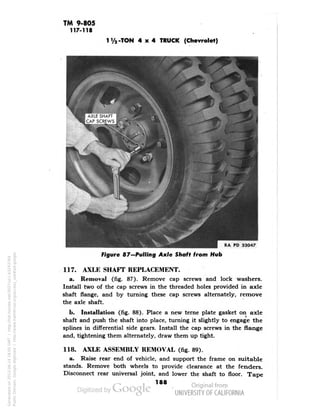
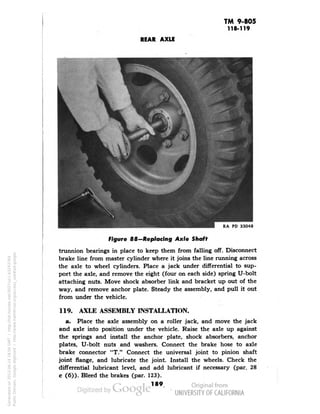
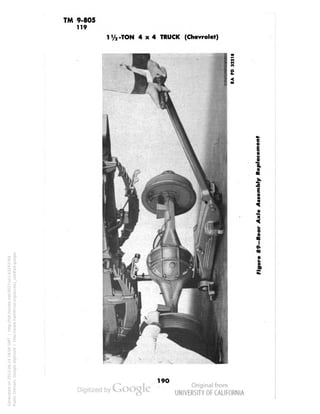
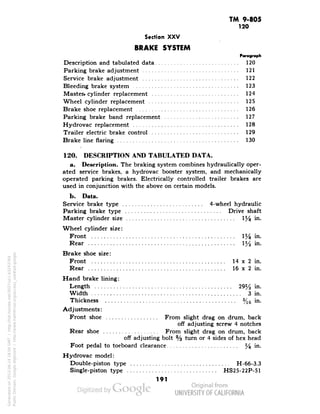
—• 
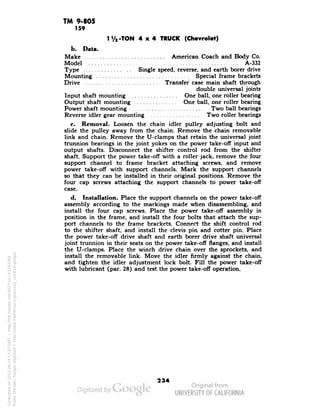
WAR DEPARTMENT TECHNICAL MANUAL 
"^^7 
UBRAF 
JUL111947 J 
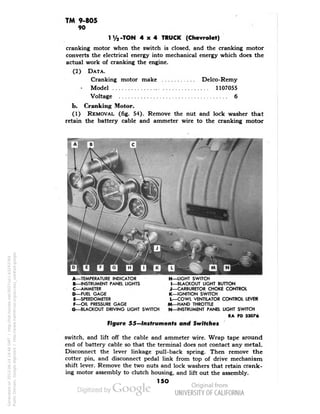
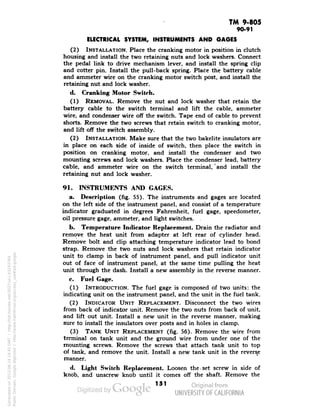
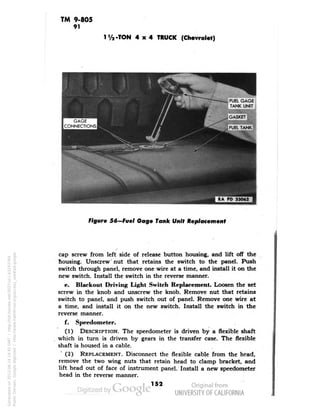
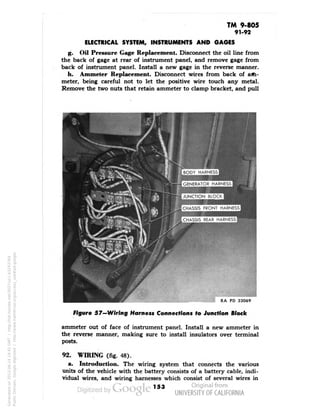
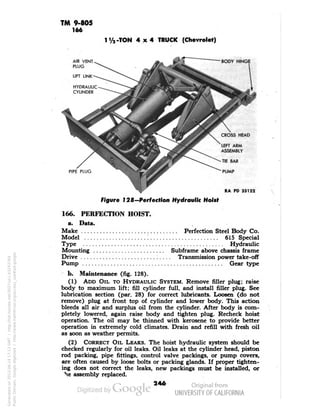
4x4 TRUCK 
(Chevrolet) 
'^s^?SsP 
'^t abo pat»g^Ph" 
to 
en-e 
such 
380-^, 
DEPARTMENT 
30 DECEMBER 1943 
Generated on 2013-06-13 17:14 GMT / http://hdl.handle.net/2027/uc1.b3243764 
Public Domain, Google-digitized / http://www.hathitrust.org/access_use#pd-google
WAR DEPARTMENT TECHNICAL MANUAL 
TM 9-805 
For supersession of Quartermaster Corps 10—series manuals, see paragraph 1 d 
1V2-TON 
4x4 TRUCK 
(Chevrolet) 
WAR DEPARTMENT • 30 DECEMBER 1943 
DISSEMINATION OF RESTRICTED MATTER— 
No person is entitled solely by virtue of his grade or position lo knowl-edge 
or possession of classified matter. Such matter is entrusted only 
to those individuals whose official duties require such knowledge or 
possession. (See also paragraph 234, AR 380-5, 15 March 19+4.) 
Generated on 2013-06-13 17:15 GMT / http://hdl.handle.net/2027/uc1.b3243764 
Public Domain, Google-digitized / http://www.hathitrust.org/access_use#pd-google
WAR DEPARTMENT 
Washington 25, D. C., 30 December 1943 
TM 9-805—IVi-ton 4x4 Truck (Chevrolet), is published for the 
information and guidance of all concerned. 
[A. G. 300.7 (22Nov 43)] 
BY ORDER OF THE SECRETARY OF WAR: 
G. C. MARSHALL, 
Chief of Staff. 
OFFICIAL: 
J. A. ULIO, 
Major General, 
The Adjutant General. 
DISTRIBUTION: X. 
(For explanation of symbols, see FM 21-6.) 
Generated on 2013-06-13 17:16 GMT / http://hdl.handle.net/2027/uc1.b3243764 
Public Domain, Google-digitized / http://www.hathitrust.org/access_use#pd-google
TM 9-805 
Ul 13 
U6-TON 4x4 TRUCK I < 4" 3 
(Chevrolet) 
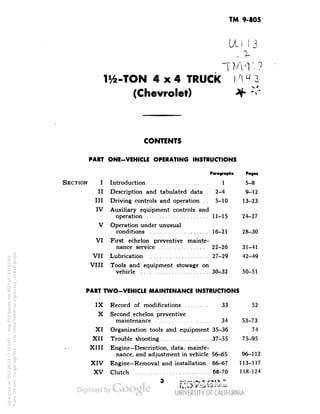
CONTENTS 
PART ONE-VEHICLE OPERATING INSTRUCTIONS 
Paragraph! Pagei 
SECTION I Introduction ................... 1 5-8 
II Description and tabulated data . 2-4 9-12 
III Driving controls and operation. . . 5-10 13-23 
IV Auxiliary equipment controls and 
operation .................... 11-15 24-27 
V Operation under unusual 
conditions ................... 16-21 28-30 
VI First echelon preventive mainte-nance 
service ................ 22-26 31-41 
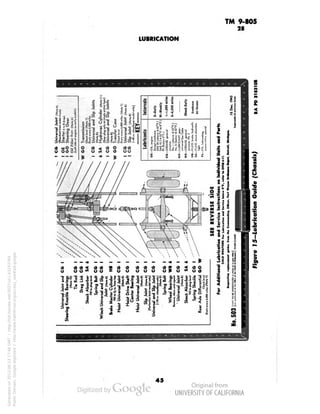
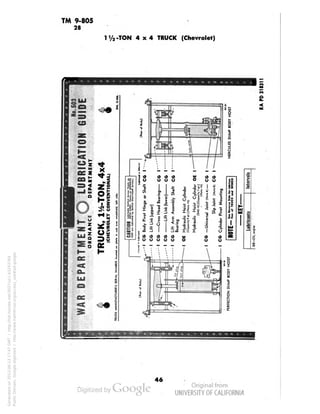
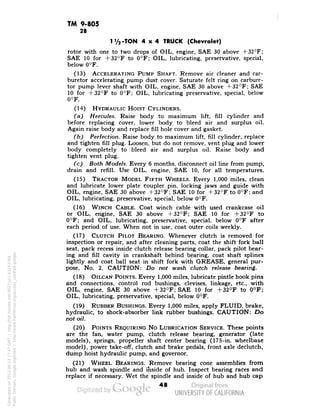
VII Lubrication ................... 27-29 42-49 
VIII Tools and equipment stowage on 
vehicle ...................... 30-32 50-51 
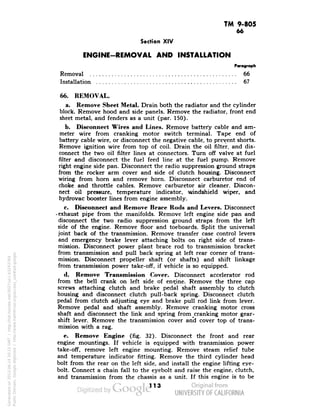
PART TWO-VEHICLE MAINTENANCE INSTRUCTIONS 
IX Record of modifications ......... 33 52 
X Second echelon preventive 
maintenance ................. 34 53-73 
XI Organization tools and equipment 35-36 74 
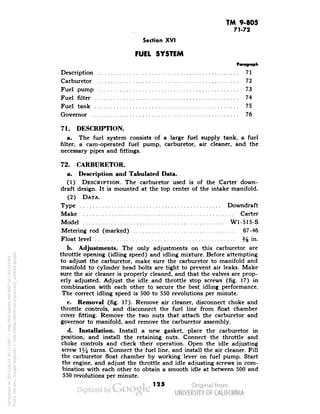
XII Trouble shooting ............... 37-55 75-95 
XIII Engine— Description, data, mainte-nance, 
and adjustment in vehicle 56-65 96-112 
XIV Engine-Removal and installation 66-67 113-117 
XV Clutch ........................ 68-70 118-124 
3 M5746M 
Generated on 2013-06-13 17:18 GMT / http://hdl.handle.net/2027/uc1.b3243764 
Public Domain, Google-digitized / http://www.hathitrust.org/access_use#pd-google
TM 9-805 
li/a-TON 4x4 TRUCK (Chevrolet) 
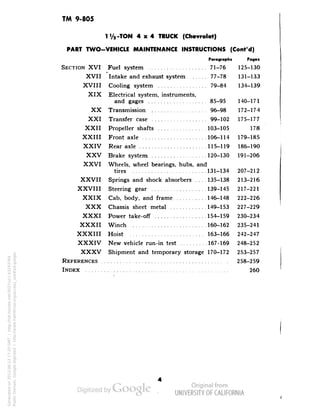
PART TWO-VEHICLE MAINTENANCE INSTRUCTIONS (Cont'd) 
Paragraphs Pages 
SECTION XVI Fuel system 71-76 125-130 
XVII Intake and exhaust system 77-78 131-133 
XVIII Cooling system 79-84 134-139 
XIX Electrical system, instruments, 
and gages 85-95 140-171 
XX Transmission 96-98 172-174 
XXI Transfer case 99-102 175-177 
XXII Propeller shafts 103-105 178 
XXIII Front axle 106-114 179-185 
XXIV Rear axle 115-119 186-190 
XXV Brake system 120-130 191-206 
XXVI Wheels, wheel bearings, hubs, and 
tires 131-134 207-212 
XXVII Springs and shock absorbers 135-138 213-216 
XXVIII Steering gear 139-145 217-221 
XXIX Cab, body, and frame 146-148 222-226 
XXX Chassis sheet metal 149-153 227-229 
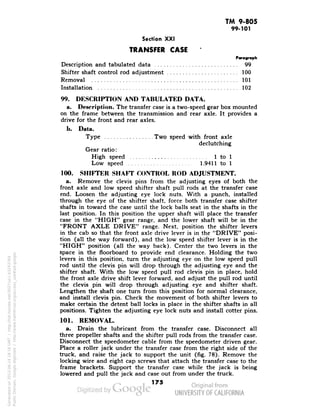
XXXI Power take-off 154-159 230-234 
XXXII Winch 160-162 235-241 
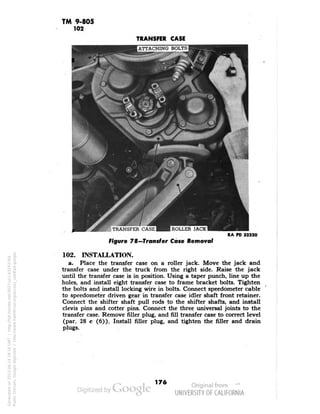
XXXIII Hoist 163-166 242-247 
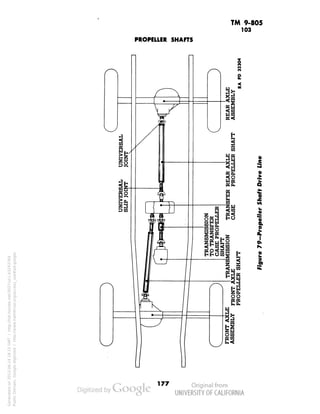
XXXIV New vehicle run-in test 167-169 248-252 
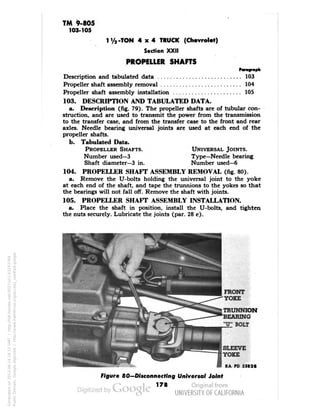
XXXV Shipment and temporary storage 170-172 253-257 
REFERENCES 258-259 
INDEX 260 
Generated on 2013-06-13 17:20 GMT / http://hdl.handle.net/2027/uc1.b3243764 
Public Domain, Google-digitized / http://www.hathitrust.org/access_use#pd-google
TM 9-805 
1 
PART ONE-VEHICLE OPERATING INSTRUCTIONS 
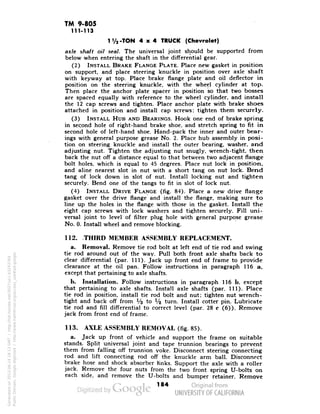
Section I 
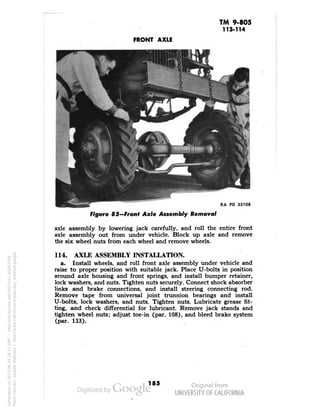
INTRODUCTION 
Scope 
Paragraph 
1 
1. SCOPE. 
a. This technical manual* is published for the information and 
guidance of the using arm personnel charged with the operation and 
maintenance of this materiel. 
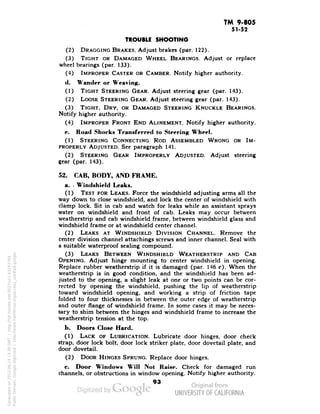
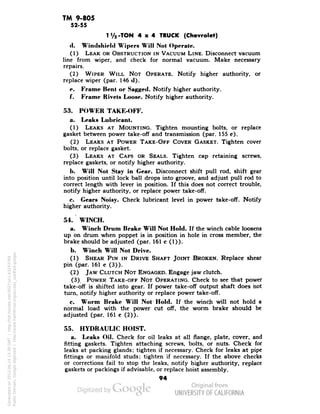
b. In addition to a description of l^-ton 4x4 truck (Chevrolet), 
this manual contains technical information required for the identifi-cation, 
use, and care of the materiel. This manual is divided into two 
parts. Part One, section I through section VIII, contains vehicle 
operating instructions. Part Two, section IX through section XXXV, 
contains vehicle maintenance instructions for using arm personnel 
charged with the responsibility of doing maintenance work within 
their jurisdiction. 
c. In all cases where the nature of the repair, modifications, or 
adjustment is beyond the scope or facilities of the unit, the respon-sible 
ordnance service should be informed so that trained personnel 
with suitable tools and equipment may be provided, or proper in-structions 
issued. 
d. This technical manual supersedes the organizational mainte-nance 
instructions in the following Quartermaster Corps publica-tions: 
TM 10-1127 
TM 10-1203 
Changes Nos. 
1 through 4 
TM 10-1431 
TM 10-1461 
TM 10-1557 
TM 10-1559 
Dote Nome 
1 March 1942 1^-ton Truck, 4x4 (Chevrolet) 
Generated on 2013-06-13 17:20 GMT / http://hdl.handle.net/2027/uc1.b3243764 
Public Domain, Google-digitized / http://www.hathitrust.org/access_use#pd-google 
28 June 1943 1^-ton Truck, 4x4 (Chevrolet) 
1 April 1942 l^-ton Truck, 4x4 panel 
(Chevrolet) 
15 July 1942 1^-ton Truck, 4x4 (Chevrolet) 
1 August 1942 1 j4-ton Truck, 4x4 (Chevrolet) 
*To provide operating instructions with the materiel, this technical manual has 
been published in advance of complete technical review. Any errors or 
omissions will be corrected by changes or, if extensive, by an early revision.
TM 9-805 
1 
t-TON 4x4 TRUCK (Chevrolet) 
RA PD 33077 
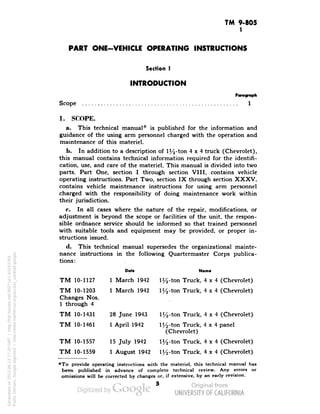
Figure 1 —Chevrolet I '/a -Ton, 4x4 Truck 
Model G-7103-Chassis with Cab 
Model 6-7113-Cab Tractor 
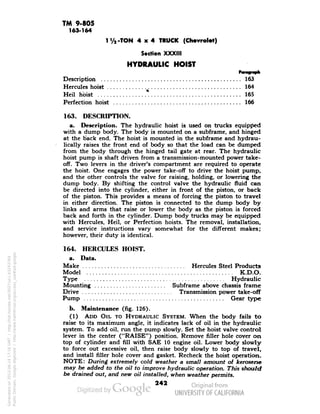
RA PD 33078 
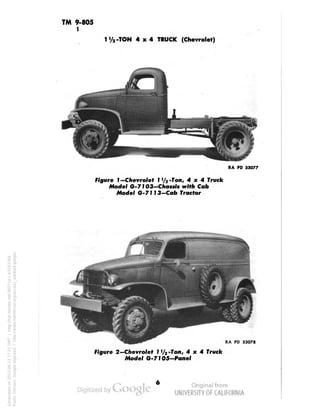
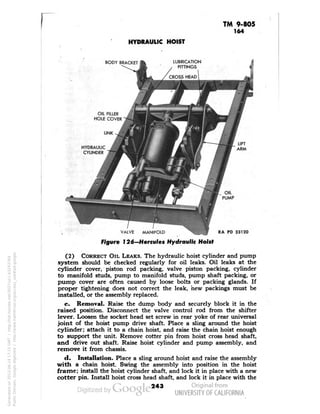
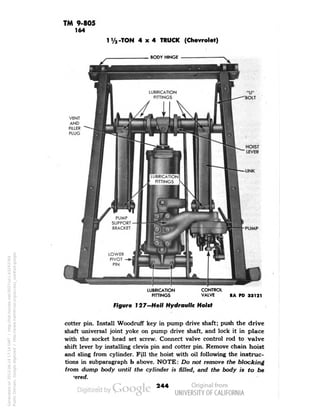
Figure 2—Chevrolet 1 '/2 -Ton, 4x4 Truck 
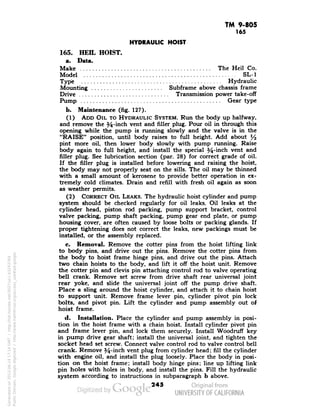
Model G-71 OS-Panel 
Generated on 2013-06-13 17:21 GMT / http://hdl.handle.net/2027/uc1.b3243764 
Public Domain, Google-digitized / http://www.hathitrust.org/access_use#pd-google
TM 9-805 
1 
INTRODUCTION 
RA 
33080 
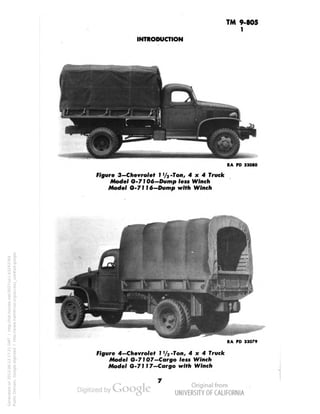
Figure 3—Chevrolet I '/2 -Ton, 4x4 Truck 
Model G-7106-Dump less Winch 
Model O-7116-Dump with Winch 
RA PD 33079 
Figure 4—Chevrolet 1 '/2 -Ton, 4x4 Truck 
Model G-7107-Cargo less Winch 
Model 6-7!17-Cargo with Winch 
Generated on 2013-06-13 17:21 GMT / http://hdl.handle.net/2027/uc1.b3243764 
Public Domain, Google-digitized / http://www.hathitrust.org/access_use#pd-google
TM 9-805 
1 
1V2-TON 4x4 TRUCK (Chevrolet) 
RA PD 33081 
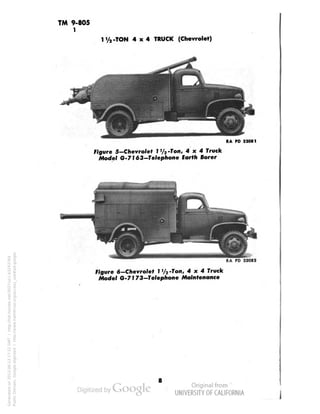
Figure 5-Chevrolet I '/2 -Ton, 4x4 Truck 
Model G-7J«3-Telephone Earth Borer 
RA PD 33082 
Figure 6—Chevrolet I '/2 -Ton/ 4x4 Truck 
Model G-7173—Telephone Maintenance 
8 
Generated on 2013-06-13 17:22 GMT / http://hdl.handle.net/2027/uc1.b3243764 
Public Domain, Google-digitized / http://www.hathitrust.org/access_use#pd-google
TM 9-805 
2-3 
Section II 
DESCRIPTION AND TABULATED DATA 
Paragraph 
Description 2 
Differences among models 3 
Data 4 
2. DESCRIPTION. 
a. General. The information in this manual covers several models 
of the Chevrolet 1%-ton 4x4 truck. These models all have 145-inch 
wheelbase and dual rear wheels. They use the same engine, trans-mission, 
transfer case, and front and rear axles, with the exception 
of the telephone earth borer and telephone maintenance trucks which 
use a different rear axle and transfer case. Each vehicle has a serial 
number and load data plate (fig. 7) located on the left side of the 
windshield header panel. The various models are identified as 
follows: 
Model Typ. of Vehicle 
G-7103 Chassis with cab 
G-7113 Cab tractor 
G-7105 Panel 
G-7106 Dump less winch 
G-7116 Dump with winch 
G-7107 Cargo less winch 
G-7117 Cargo with winch 
G-7163 Telephone earth borer 
G-7173 Telephone maintenance 
3. DIFFERENCES AMONG MODELS. 
a. Model G-7103—Chassis with Cab (fig. 1). This model does not 
have any body other than the cab mounted on it. 
b. Model G-7113-Cab Tractor (fig. 1). This vehicle is the same 
as model G-7103 except that it has a fifth wheel for hauling semi-trailers. 
c. Model G-7105—Panel (fig. 2). This model is equipped with a 
panel body constructed so that the cab is part of the body. There is 
no partition between the cab and the body, as it is a single unit. 
d. Model G-7106-Dump Less Winch (fig. 3). This vehicle is a 
chassis and cab (G-7103) with a body mounted behind the cab. A 
Generated on 2013-06-13 17:22 GMT / http://hdl.handle.net/2027/uc1.b3243764 
Public Domain, Google-digitized / http://www.hathitrust.org/access_use#pd-google 
hydraulic hoist is installed between the chassis and the body. The 
rear end of the body is pivoted to the frame so that the front of the 
body can be raised, and permit the operator to dump the load when 
desired. The body is provided with stake pockets to permit the 
installation of side racks, bows, and tarpaulin. 
e. Model G-7116-Dump with Winch (fig. 3). This vehicle is 
the same as model G-7106 but, in addition, it is equipped with a 
winch at the front of the frame.
TM 9-805 
3 
1 V2 -TON 4x4 TRUCK (Chevrolet) 
f. Model G-7107-Cargo Less Winch (fig. 4). This model is the 
same as the dump truck (G-7106), except that it does not have a 
hoist, and the body is mounted rigidly to the frame with U-bolts. 
g. Model G-7117—Cargo with Winch (fig. 4). This vehicle is the 
same as cargo truck G-7107, except that it is equipped with a winch 
mounted at the front of the frame. 
h. Model G-7163-Telephone Earth Borer (fig. 5). This vehicle 
has a special body, and is equipped with an earth boring machine 
for post hole digging and a center-mounted winch. 
i. Model G-7173—Telephone Maintenance (fig. 6). This vehicle 
has a specially designed body that has several compartments built 
into the side panels. These compartments are accessible through 
doors in the outside of the side panels. It is equipped with pole-setting 
equipment used in conjunction with a center-mounted winch. 
10 
Generated on 2013-06-13 17:23 GMT / http://hdl.handle.net/2027/uc1.b3243764 
Public Domain, Google-digitized / http://www.hathitrust.org/access_use#pd-google
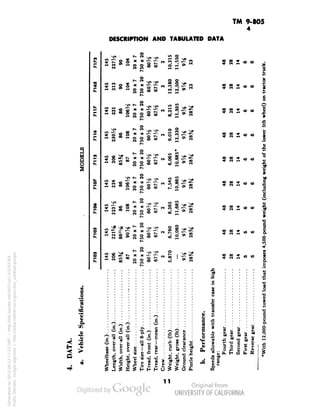
TM 9-805 
4 
DESCRIPTION AND TABULATED DATA 
ELS 
oM 
1-1 x o K Hm7^ 
N » -H o 0 g £ 
2 » 
2 * 
.5 7 J 
r- JB 
5 > 
Q 
" 
2 
B 
I 
V 
C. 
"5 -a 
11 
Generated on 2013-06-13 17:23 GMT / http://hdl.handle.net/2027/uc1.b3243764 
Public Domain, Google-digitized / http://www.hathitrust.org/access_use#pd-google
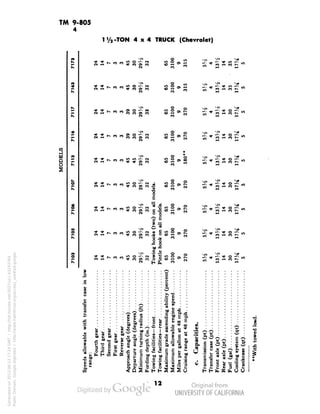
TM 9-805 
4 
1 Va-TON 4x4 TRUCK (Chevrolet) 
2 
u 
I 
8S" 
m o --^ c< 
5 01 **• 
$*£*xg-co 
« 
4. •!»{ 
"a •> o 
3l8s 
Tn 2 *" n 
m o —, 
10 —i °" 
co 
m co 
^" tN, 
E u ^ 
1 S S § 
o s o ^H 
H £" 
^ ^ 
CO IH CO t~ "* 
.s 
I 
X: 
a 
! 
•s" 
* 
lir 
£g|g(2| § 
P is 
aC'Bobb.S.Sgc 
<Q S fc H H S S S U 
I/I 
V 
Generated on 2013-06-13 17:24 GMT / http://hdl.handle.net/2027/uc1.b3243764 
Public Domain, Google-digitized / http://www.hathitrust.org/access_use#pd-google 
•r; /-x - 
I a. 
S, g s 
efi 
g S 
01 CD 
U U 
H H 
C ^-s n 
1^ S 
>> 1 
H • M O 
u s4 
3 7J "p § 
«£^6
TM 9-805 
5 
Section III 
DRIVING CONTROLS AND OPERATION 
Driving controls 5 
Instruments and miscellaneous controls 6 
Lighting controls 7 
Instruction plates 8 
Operation of the vehicle 9 
Towing the vehicle .- 10 
5. DRIVING CONTROLS. 
a. Introduction. The driver of one of these vehicles must be 
thoroughly familiar with the various controls and their proper use. 
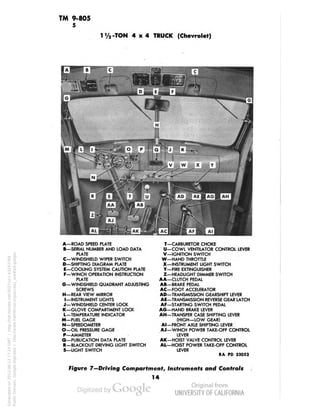
The instruments and driving controls are illustrated in figure 7, 
which should be referred to for the key letters shown in the follow-ing 
paragraphs. 
b. Carburetor Choke (T). This control is used when starting a 
cold engine. Pulling out choke control button shuts off the air to 
the carburetor, providing a rich mixture. The choke button must be 
pushed in when the engine starts. If the engine is warm, the use of 
the choke is unnecessary. 
c. Ignition Switch (V). This switch is to turn on the ignition 
when starting the engine. The switch is off when the lever is pointed 
straight down. 
d. Hand Throttle ( W). The hand throttle is located on the instru-strument 
panel to the right of the ignition switch; pulling this button 
opens the throttle. This control may be used when starting or, if it 
is desired, to run the engine at a constant speed. 
e. Clutch Pedal (AA). The clutch pedal is used to disengage the 
engine from the transmission when shifting gears. CAUTION: The 
clutch must never be engaged quickly when the vehicle is in gear. 
Driving with foot on pedal will cause wear of clutch facings and 
throwout bearing. There must be 1 inch of free travel of the clutch 
pedal before the clutch starts to disengage. 
f. Brake Pedal (AB). Pressing on the brake pedal applies the 
hydraulic brakes at all four wheels. Avoid driving with foot on brake 
pedal, as brakes will be partially applied and cause rapid wear of 
lining. 
g. Accelerator (AC). The accelerator is operated by the right 
foot to control the speed of the engine. 
h. Cranking Motor Switch Pedal (AF). Pressing down on pedal 
with foot engages the cranking motor and flywheel gears, and also 
closes the cranking motor switch, completing the electrical circuit 
between battery and cranking motor. Rotation of cranking motor 
armature through the gears, cranks the engine. When the engine 
starts, foot must be removed from pedal immediately. 
i. Transmission Gearshift Lever (AD). The transmission gear-shift 
lever is used to select various gear ratios provided in the trans- 
13 
Generated on 2013-06-13 17:24 GMT / http://hdl.handle.net/2027/uc1.b3243764 
Public Domain, Google-digitized / http://www.hathitrust.org/access_use#pd-google
TM 9-805 
5 
-TON 4x4 TRUCK (Chevrolet) 
A—ROAD SPEED PLATE 
B—SERIAL NUMBER AND LOAD DATA 
PLATE 
C—WINDSHIELD WIPER SWITCH 
D—SHIFTING DIAGRAM PLATE 
E—COOLING SYSTEM CAUTION PLATE 
F—WINCH OPERATION INSTRUCTION 
PLATE 
G—WINDSHIELD QUADRANT ADJUSTING 
SCREWS 
H—REAR VIEW MIRROR 
I—INSTRUMENT LIGHTS 
J—WINDSHIELD CENTER LOCK 
K—GLOVE COMPARTMENT LOCK 
L—TEMPERATURE INDICATOR 
M—FUEL GAGE 
N—SPEEDOMETER 
O—OIL PRESSURE GAGE 
P—AMMETER 
Q—PUBLICATION DATA PLATE 
R—BLACKOUT DRIVING LIGHT SWITCH 
S—LIGHT SWITCH 
T—CARBURETOR CHOKE 
U—COWL VENTILATOR CONTROL LEVER 
V—IGNITION SWITCH 
W—HAND THROTTLE 
X—INSTRUMENT LIGHT SWITCH 
Y—FIRE EXTINGUISHER 
Z—HEADLIGHT DIMMER SWITCH 
AA—CLUTCH PEDAL 
AB—BRAKE PEDAL 
AC—FOOT ACCELERATOR 
AD—TRANSMISSION GEARSHIFT LEVER 
AE—TRANSMISSION REVERSE GEAR LATCH 
AF—STARTING SWITCH PEDAL 
AG—HAND BRAKE LEVER 
AH—TRANSFER CASE SHIFTING LEVER 
(HIGH—LOW GEAR) 
Al—FRONT AXLE SHIFTING LEVER 
AJ—WINCH POWER TAKE-OFF CONTROL 
LEVER 
AK—HOIST VALVE CONTROL LEVER 
AL—HOIST POWER TAKE-OFF CONTROL 
LEVER 
RA PD 33052 
Figure 7—Driving Compartment, Instruments and Controls 
14 
Generated on 2013-06-13 17:24 GMT / http://hdl.handle.net/2027/uc1.b3243764 
Public Domain, Google-digitized / http://www.hathitrust.org/access_use#pd-google
TM 9-805 
5-6 
DRIVING CONTROLS AND OPERATION 
mission. There are four forward speeds and one reverse speed. Re-verse 
gear can only be engaged when latch (AE) on gearshift lever 
is raised. Lever positions for various gears are shown on shifting 
diagram plate (D). 
j. Hand Brake Lever (AC). The hand brake lever is used to 
control the parking brake at the rear of the transfer case. Pulling the 
hand brake lever toward the rear applies the parking brake, while 
pushing it forward releases the brake. Whenever the vehicle is 
parked, the lever must be pulled toward the rear as far as possible. 
Before moving the vehicle, lever must be pushed forward to the 
fully released position. 
k. Transfer Case Shifting Lever (AH). The transfer case shift-ing 
lever is used to select "HIGH" or "LOW" speed range, or 
^'NEUTRAL" in the transfer case. See shifting diagram plate (D). 
The shifting lever is linked to the front axle control lever in such 
a way that it is impossible to shift into the low speed in the transfer 
case without the drive to the front axle being engaged. 
I. Front Axle Shifting Lever (AI). The front axle shifting lever 
permits engaging or disengaging the front axle drive through the 
transfer case. When the lever is pushed forward, the front drive is 
engaged, and when it is pulled toward the rear, it is disengaged. 
The front axle drive should be disengaged when operating on dry, 
hard-surfaced roads. However, the front axle should be engaged 
when operating on soft-surfaced roads such as sand, dirt, gravel, 
or muddy roads, to prevent putting undue strain on the rear axle. 
Four-wheel drive should always be used when approaching uneven . 
terrain; do not allow vehicle to stall before going into four-wheel 
drive. 
m. Winch Power Take-off Control Lever (AJ). The winch 
power take-off control lever is the lever that controls the power 
winch through the power take-off attached to the transmission. 
When the winch is not in use, a hinged plate locks the winch control 
lever in the neutral position. For shifting positions refer to plate on 
windshield head panel (D). 
n. Hoist Valve Control Lever (AK). The hoist valve control - 
lever is used to control the valve in the hydraulic hoist. When the 
hoist is not being used, the lever is pulled back toward the seat. 
o. Hoist Power Take-off Control Lever (AL). The hoist power 
take-off control lever is used in connection with the hoist valve 
lever to operate the hydraulic hoist. Instructions covering the oper-ation 
of the winch and hoist controls are contained in paragraph 163. 
6. INSTRUMENTS AND MISCELLANEOUS CONTROLS. 
a. Temperature Indicator (L). The temperature indicator indi-cates 
the temperature of the liquid in the cooling system at all 
times. The dial of the instrument indicates temperature in degrees 
Fahrenheit. The driver must watch this instrument closely for any 
indication of excessive temperature. Whenever the indicator hand 
shows over 180 degrees, the driver must immediately investigate the 
15 
Generated on 2013-06-13 17:25 GMT / http://hdl.handle.net/2027/uc1.b3243764 
Public Domain, Google-digitized / http://www.hathitrust.org/access_use#pd-google
TM 9-805 
7 
1 V,-TON 4x4 TRUCK (Chevrolet) 
A—FOUR-SPEED TRANSMISSION 
AND TRANSFER CASE 
B—FOUR-SPEED TRANSMISSION, 
TRANSFER CASE AND WINCH 
SHIFTING DIAGRAM 
HOIST HOIST TRANSMISSION TRANSFER CASE 
NEUTRALH NEUT 
DISENGAGE FROM AXLE DRIVE WHEN 
OPERATING ON DRY HARD SURFACED RDS 
SHIFTING DIAGRAM ,_ 
HOIST TRANSMISSION TRANSFER C«SE 
DISENGAGE FRONT AXLE DRIVE WHEN 
OPERATING ON DRY HARD SURFACED RDS 
C—FOUR-SPEED TRANSMISSION, 
TRANSFER CASE AND HOIST 
D—FOUR-SPEED TRANSMISSION, 
WINCH AND HOIST 
SHIFTING DIAGRAM 
TRANSMISSION TRANSFER CASE 
. DISENGAGE FRONT AXLE DRIVE WHEN 
'OPERATING ON DRY HARD SURFACED RDS. 
E—FOUR-SPEED TRANSMISSION, 
TRANSFER CASE AND PERFECTION HOIST 
F—FOUR-SPEED TRANSMISSION, 
WINCH AND PERFECTION HOIST 
RA PD 33083 
Figure 10—Gearshlfting Instruction Plates 
18 
Generated on 2013-06-13 17:25 GMT / http://hdl.handle.net/2027/uc1.b3243764 
Public Domain, Google-digitized / http://www.hathitrust.org/access_use#pd-google
TM 9-805 
7-8 
DRIVING CONTROLS AND OPERATION 
turns on the blackout marker lights (fig. 9) and taillight. In addi-tion, 
this position permits turning on the blackout driving light when 
the blackout driving light switch is pulled out, and also the blackout 
stop light when the brakes are applied. To turn on the regular head-lights, 
depress the blackout safety button on top of the switch, and 
pull the control button out to the second position. In this position, 
circuits are established to the regular tail and stop lights. When the 
lighting switch button is pulled out to the third position, it provides 
a circuit for the service stop light during daylight driving. 
b. Blackout Driving Light Switch (K). The blackout driving 
light switch is used to turn on the blackout driving light located on 
the left front fender (fig. 9). The blackout driving light can be turned 
on only when the main light switch is pulled out to first position. 
c. Instrument Panel Light Switch (X). This switch is used to 
turn on the instrument lights (I) when the light switch is in the 
bright headlight position. These lights will not operate with the 
light switch in the blackout position. 
d. Headlight Dimmer Switch (Z). This is a foot-operated switch 
used to select the headlight beam (upper or lower) desired after the 
headlights are turned on, by depressing the switch button with the 
foot. CAUTION: Always use the lower beam when passing approach-ing 
vehicles. This is an important safety rule. 
8. INSTRUCTION PLATES. 
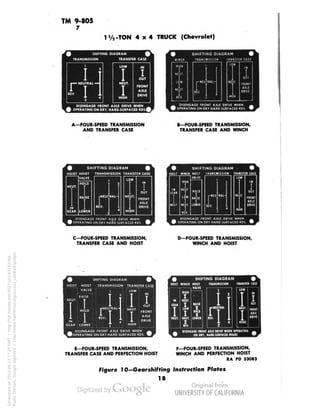
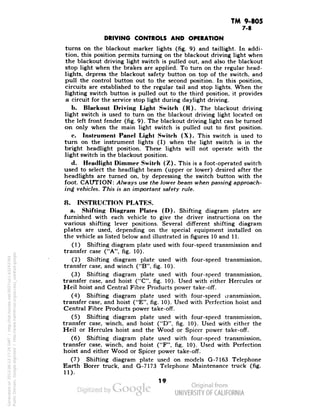
a. Shifting Diagram Plates (D). Shifting diagram plates are 
furnished with each vehicle to give the driver instructions on the 
various shifting lever positions. Several different shifting diagram 
plates are used, depending on the special equipment installed on 
the vehicle as listed below and illustrated in figures 10 and 11. 
(1) Shifting diagram plate used with four-speed transmission and 
transfer case ("A", fig. 10). 
(2) Shifting diagram plate used with four-speed transmission, 
transfer case, and winch ("B", fig. 10). 
(3) Shifting diagram plate used with four-speed transmission, 
transfer case, and hoist ("C", fig. 10). Used with either Hercules or 
Heil hoist and Central Fibre Products power take-off. 
(4) Shifting diagram plate used with four-speed transmission, 
transfer case, and hoist ("E", fig. 10). Used with Perfection hoist and 
Central Fibre Products power take-off. 
(5) Shifting diagram plate used with four-speed transmission, 
transfer case, winch, and hoist ("D", fig. 10). Used with either the 
Heil or Hercules hoist and the Wood or Spicer power take-off. 
(6) Shifting diagram plate used with four-speed transmission, 
transfer case, winch, and hoist ("F", fig. 10). Used with Perfection 
hoist and either Wood or Spicer power take-off. 
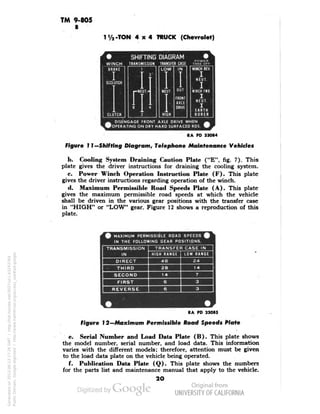
(7) Shifting diagram plate used on models G-7163 Telephone 
Earth Borer truck, and G-7173 Telephone Maintenance truck (fig. 
ID- 
19 
Generated on 2013-06-13 17:26 GMT / http://hdl.handle.net/2027/uc1.b3243764 
Public Domain, Google-digitized / http://www.hathitrust.org/access_use#pd-google
TM 9-805 
8 
T/2-TON 4x4 TRUCK (Chevrolet) 
SHIFTING DIAGRAM 
WINCH 
BRAKE 
TRANSMISSION 
TRANSFER CASE 
LOW I 
WINCH fWD 
I 
NEUT. 
DISENGAGE FRONT AXLE DRIVE WHEN 
OPERATING ON DRY HARD SURFACED RDS. 
RA PD 33084 
Figure 11 —Shifting Diagram, Telephone Maintenance Vehicles 
b. Cooling System Draining Caution Plate ("E", fig. 7). This 
plate gives the driver instructions for draining the cooling system. 
c. Power Winch Operation Instruction Plate (F). This plate 
gives the driver instructions regarding operation of the winch. 
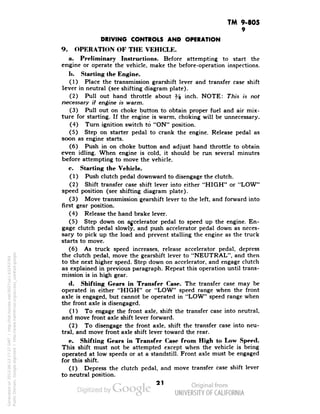
d. Maximum Permissible Road Speeds Plate (A). This plate 
gives the maximum permissible road speeds at which the vehicle 
shall be driven in the various gear positions with the transfer case 
in "HIGH" or "LOW" gear. Figure 12 shows a reproduction of this 
plate. 
RA PD 33085 
Figure 12—Maximum Permissible Road Speeds Plate 
e. Serial Number and Load Data Plate (B). This plate shows 
the model number, serial number, and load data. This information 
varies with the different models; therefore, attention must be given 
to the load data plate on the vehicle being operated. 
f. Publication Data Plate (Q). This plate shows the numbers 
for the parts list and maintenance manual that apply to the vehicle. 
20 
Generated on 2013-06-13 17:26 GMT / http://hdl.handle.net/2027/uc1.b3243764 
Public Domain, Google-digitized / http://www.hathitrust.org/access_use#pd-google
TM 9-805 
9 
DRIVING CONTROLS AND OPERATION 
9. OPERATION OF THE VEHICLE. 
a. Preliminary Instructions. Before attempting to start the 
engine or operate the vehicle, make the before-operation inspections. 
1). Starting the Engine. 
(1) Place the transmission gearshift lever and transfer case shift 
lever in neutral (see shifting diagram plate). 
(2) Pull out hand throttle about % inch. NOTE: This is not 
necessary if engine is warm. 
(3) Pull out on choke button to obtain proper fuel and air mix-ture 
for starting. If the engine is warm, choking will be unnecessary. 
(4) Turn ignition switch to "ON" position. 
(5) Step on starter pedal to crank the engine. Release pedal as 
soon as engine starts. 
(6) Push in on choke button and adjust hand throttle to obtain 
even idling. When engine is cold, it should be run several minutes 
before attempting to move the vehicle. 
c. Starting the Vehicle. 
(1) Push clutch pedal downward to disengage the clutch. 
(2) Shift transfer case shift lever into either "HIGH" or "LOW" 
speed position (see shifting diagram plate). 
(3) Move transmission gearshift lever to the left, and forward into 
first gear position. 
(4) Release the hand brake lever. 
(5) Step down on accelerator pedal to speed up the engine. En-gage 
clutch pedal slowly, and push accelerator pedal down as neces-sary 
to pick up the load and prevent stalling the engine as the truck 
starts to move. 
(6) As truck speed increases, release accelerator pedal, depress 
the clutch pedal, move the gearshift lever to "NEUTRAL", and then 
to the next higher speed. Step down on accelerator, and engage clutch 
as explained in previous paragraph. Repeat this operation until trans-mission 
is in high gear. 
d. Shifting Gears in Transfer Case. The transfer case may be 
operated in either "HIGH" or "LOW" speed range when the front 
axle is engaged, but cannot be operated in "LOW" speed range when 
the front axle is disengaged. 
(1) To engage the front axle, shift the transfer case into neutral, 
and move front axle shift lever forward. 
(2) To disengage the front axle, shift the transfer case into neu-tral, 
and move front axle shift lever toward the rear. 
e. Shifting Gears in Transfer Case from High to Low Speed. 
This shift must not be attempted except when the vehicle is being 
operated at low speeds or at a standstill. Front axle must be engaged 
for this shift. 
(1) Depress the clutch pedal, and move transfer case shift lever 
to neutral position. 
21 
Generated on 2013-06-13 17:27 GMT / http://hdl.handle.net/2027/uc1.b3243764 
Public Domain, Google-digitized / http://www.hathitrust.org/access_use#pd-google
TM 9-805 
9-10 
1 V2-TON 4x4 TRUCK (Chevrolet) 
(2) Engage clutch pedal, and accelerate engine to approximately 
twice that of vehicle speed. 
(3) Depress clutch pedal again, and move shift lever forward 
(without applying excessive pressure) into "LOW" speed position. 
Then release clutch and accelerate engine. 
f. Shifting Gears in Transfer Case from "LOW" to "HIGH" 
Speed. This shift may be accomplished at any time, regardless of 
vehicle speed. 
(1) Release accelerator, depress clutch pedal, and move shift 
lever to neutral position. 
(2) Release clutch pedal, and accelerate engine to synchronize 
engine speed with that of vehicle. 
(3) Depress clutch pedal, and move shift lever toward rear into 
"HIGH" speed position. 
g. Shifting to Lower Speed in Transmission. The transmission 
should always be shifted to the next lower speed before engine begins 
to labor, or before vehicle speed is reduced appreciably. Shifting to 
lower speed is accomplished as follows: 
(1) Depress the clutch pedal quickly, maintaining the same pres-sure 
on accelerator. Move gearshift lever to "NEUTRAL," and at 
the same instant engage the clutch. 
(2) Again depress the clutch pedal, and move the gearshift lever 
to the next lower speed. Engage the clutch slowly, and at the same 
time accelerate the engine speed to synchronize it with that of the 
vehicle. NOTE: Use the same transmission gear going downhill as 
would be required to climb the same hill. ^ 
h. Shifting into Reverse. Before attempting to shift into "RE-VERSE", 
the truck must be brought to a complete stop. 
(1) Push clutch pedal downward to disengage clutch. 
(2) Shift the transmission to "NEUTRAL," raise latch on 
gearshift lever, and move lever to left as far as possible, then toward 
the rear (see shifting diagram plate). 
(3) Engage clutch and accelerate the engine in the same manner 
as previously explained. 
i. Stopping the Truck. 
(1) Remove foot from accelerator pedal, and apply brake by 
pressing down on foot pedal. 
(2) When speed of truck has been reduced to idling speed of 
engine, disengage the clutch, and move transmission gearshift lever 
into "NEUTRAL" position. 
(3) When truck has come to a complete stop, release clutch pedal 
and apply hand brake. 
10. TOWING THE VEHICLE. 
a. Towing to Start Vehicle. Perform the Before-operation Service 
as instructed in paragraph 23; then place transfer case shifting lever 
in "HIGH" gear, and the front axle control lever so that it is out of 
22 
Generated on 2013-06-13 17:37 GMT / http://hdl.handle.net/2027/uc1.b3243764 
Public Domain, Google-digitized / http://www.hathitrust.org/access_use#pd-google
TM 9-805 
10 
DRIVING CONTROLS AND OPERATION 
front axle drive. Place the transmission gearshift lever in either third 
or high gear, then turn on the ignition switch, and hold the clutch 
pedal all the way down against the floorboard. Start towing the 
vehicle, and as soon as both vehicles attain a steady momentum of 
about 10 to 12 miles per hour, let the clutch out slowly and use the 
choke, if necessary, in the same manner as if starting the engine with 
the cranking motor. As soon as the engine starts, push in the clutch 
and place the transmission lever in "NEUTRAL", then stop both 
vehicles, and uncouple the tow car. 
b. Towing Disabled Vehicle. Place the front axle control lever 
so that it is out of front axle drive. Then place the transfer case shift-ing 
lever and the transmission gearshift lever in "NEUTRAL". Use 
the brakes on the vehicle being towed to slow up or stop the vehicle 
when towing it. 
Generated on 2013-06-13 17:38 GMT / http://hdl.handle.net/2027/uc1.b3243764 
Public Domain, Google-digitized / http://www.hathitrust.org/access_use#pd-google
TM 9-805 
11-14 
1 Va -TON 4x4 TRUCK (Chevrolet) 
Section IV 
AUXILIARY EQUIPMENT CONTROLS AND OPERATION 
Paragraph 
General U 
Fire extinguisher operation 12 
Hoist operation 13 
Front-mounted winch operation 14 
Center-mounted winch operation 15 
11. GENERAL. 
a. The auxiliary equipment referred to in this section consists of 
fire extinguisher, hoists, front-mounted winches, center-mounted 
winches, and the different types of power take-offs required for 
operation of this equipment. The operation of power take-offs will 
not be treated separately, as the power take-off is only used as a 
part of the operation of the other auxiliary equipment. 
12. FIRE EXTINGUISHER OPERATION. 
a. Release the spring-type lock, and remove extinguisher from the 
mounting bracket. Turn handle to the left, and work it in and out like 
a pump. Direct the stream of liquid at the base of flame unless used 
on burning liquid. When extinguisher is used on burning liquid, direct 
the stream against inside of liquid container above surface of liquid. 
CAUTION: Refill or exchange extinguisher for one that has been 
refilled at earliest possible moment after use, as this unit must be 
kept in operating condition. 
13. HOIST OPERATION. 
a. Start the engine (par. 9 b). Disengage the clutch and shift the 
hoist power take-off shift lever to the "IN GEAR" position as shown 
on the shifting diagram plate located on the windshield header. En-gage 
the clutch, and move the hoist valve control lever to the 
"RAISE" position as shown on the shifting diagram plate. This starts 
to raise dump body. Accelerate engine slightly to provide faster 
action. When the body reaches the desired angle, shift the hoist valve 
control lever to the "HOLD" position to hold the body in this posi-tion, 
and to the "LOWER" position to lower the body. When the 
body is firmly seated, shift the hoist valve control lever to the 
"HOLD" position; disengage the clutch, and shift the hoist power 
take-off shift lever to "NEUTRAL" position. The hoist may be oper-ated 
by following the above instructions when the vehicle is in motion. 
14. FRONT-MOUNTED WINCH OPERATION. 
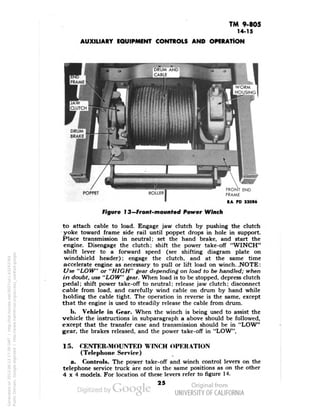
a. Vehicle Stationary (fig. 13). Disengage the jaw-type clutch on 
the winch drum shaft by pushing clutch yoke toward center of vehicle 
until poppet enters hole in support. Unreel sufficient cable from drum 
24 
Generated on 2013-06-13 17:38 GMT / http://hdl.handle.net/2027/uc1.b3243764 
Public Domain, Google-digitized / http://www.hathitrust.org/access_use#pd-google
TM 9-805 
14-15 
AUXILIARY EQUIPMENT CONTROLS AND OPERATION 
POPPET 
FRONT END 
FRAME 
RA PD 33086 
Figure 13—Front-mounted Power Winch 
to attach cable to load. Engage jaw clutch by pushing the clutch 
yoke toward frame side rail until poppet drops in hole in support. 
Place transmission in neutral; set the hand brake, and start the 
engine. Disengage the clutch; shift the power take-off "WINCH" 
shift lever to a forward speed (see shifting diagram plate on 
windshield header); engage the clutch, and at the same time 
accelerate engine as necessary to pull or lift load on winch. .NOTE: 
Use "LOW" or "HIGH" gear depending on load to be handled; when 
in doubt, use "LOW" gear. When load is to be stopped, depress clutch 
pedal; shift power take-off to neutral; release jaw clutch; disconnect 
cable from load, and carefully wind cable on drum by hand while 
holding the cable tight. The operation in reverse is the same, except 
that the engine is used to steadily release the cable from drum. 
b. Vehicle in Gear. When the winch is being used to assist the 
vehicle the instructions in subparagraph a above should be followed, 
except that the transfer case and transmission should be in "LOW" 
gear, the brakes released, and the power take-off in "LOW". 
15. CENTER-MOUNTED WINCH OPERATION 
(Telephone Service) 
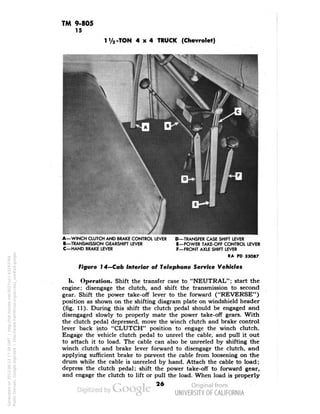
a. Controls. The power take-off and winch control levers on the 
telephone service truck are not in the same positions as on the other 
4x4 models. For location of these levers refer to figure 14. 
25 
Generated on 2013-06-13 17:39 GMT / http://hdl.handle.net/2027/uc1.b3243764 
Public Domain, Google-digitized / http://www.hathitrust.org/access_use#pd-google
TM 9-805 
15 
-TON 4x4 TRUCK (Chevrolet) 
A—WINCH CLUTCH AND BRAKE CONTROL LEVER 
B—TRANSMISSION GEARSHIFT LEVER 
C—HAND BRAKE LEVER 
D—TRANSFER CASE SHIR LEVER 
E—POWER TAKE-OFF CONTROL LEVER 
F—FRONT AXLE SHIFT LEVER 
RA PD 33087 
Figure 14—Cab Interior of Telephone Service Vehicles 
b. Operation. Shift the transfer case to "NEUTRAL"; start the 
engine; disengage the clutch, and shift the transmission to second 
gear. Shift the power take-off lever to the forward ("REVERSE") 
position as shown on the shifting diagram plate on windshield header 
(fig. 11). During this shift the clutch pedal should be engaged and 
disengaged slowly to properly mate the power take-off gears. With 
the clutch pedal depressed, move the winch clutch and brake control 
lever back into "CLUTCH" position to engage the winch clutch. 
Engage the vehicle clutch pedal to unreel the cable, and pull it out 
to attach it to load. The cable can also be unreeled by shifting the 
winch clutch and brake lever forward to disengage the clutch, and 
applying sufficient brake to prevent the cable from loosening on the 
drum while the cable is unreeled by hand. Attach the cable to load; 
depress the clutch pedal; shift the power take-off to forward gear, 
and engage the clutch to lift or pull the load. When load is properly 
26 
Generated on 2013-06-13 17:39 GMT / http://hdl.handle.net/2027/uc1.b3243764 
Public Domain, Google-digitized / http://www.hathitrust.org/access_use#pd-google
TM 9-805 
15 
AUXILIARY EQUIPMENT CONTROLS AND OPERATION 
positioned, depress clutch pedal; shift winch clutch and brake control 
lever to center (DECLUTCH) position; shift transmission to 
"NEUTRAL," release clutch pedal, and shift power take-off to 
"NEUTRAL." If the winch is not to be used again, shift transfer 
case to "HIGH" gear; disconnect cable from load, and tightly wind 
cable on drum (fig. 126). This winch is also used in connection with 
the pole derrick for setting poles. 
Generated on 2013-06-13 17:39 GMT / http://hdl.handle.net/2027/uc1.b3243764 
Public Domain, Google-digitized / http://www.hathitrust.org/access_use#pd-google
TM 9-805 
16-18 
1 y2-TON 4x4 TRUCK (Chevrolet) 
Section V 
OPERATION UNDER UNUSUAL CONDITIONS 
Paragraph 
Sand 16 
Mud and water 17 
Rough terrain 18 
Snow and ice 19 
Hot weather 20 
Cold weather 21 
16. SAND. 
a. When operating in sandy or dusty localities, it is necessary to 
clean the valve cover air cleaner and the carburetor air cleaner more 
frequently than usual. Under extreme conditions, it may be necessary 
to clean these air cleaners daily. This can be determined by removing 
the covers and rubbing a finger through the oil in the air cleaners to 
see if there is grit, sand, or dirt in the oil chamber. It will also be 
necessary to clean the hydrovac air cleaner about once a month or 
more often, depending on the conditions. This can be determined by 
removing the air cleaner cover and examining the wire gauze, and if 
dirty, remove, clean, and oil it. 
17. MUD AND WATER. 
a. Mud. When driving through mud it may be necessary to shift 
the front axle control lever to engage the front axle drive. Under 
extreme conditions it may also be necessary to use a lower transmis-sion 
speed. Very often when driving through soft mud, the mud will 
work its way into the brake drums, and get on the brake linings and 
shoes. This condition causes excessive wear on the brake linings and 
drums, and the mud should be removed as soon as conditions permit. 
It will be necessary to remove the brake drums so that the dirt can 
be washed out with water. 
1). Water. When driving through water, it is necessary to reduce 
the speed of the vehicle to as slow as 2 to 3 miles per hour under 
extreme conditions. If the depth of the water is above the lowest point 
of the flywheel housing underpan, the transmission should be shifted 
to the low or first speed, and the clutch should not be released until 
the vehicle is in shallower water, as water on the clutch facings will 
cause the clutch to slip. After the vehicle has passed through the 
water, the brakes should be tested by applying the brakes. If the 
brakes do not take hold properly, it will be necessary to "ride" the 
brake pedal a short distance to dry out the brake linings. 
18. ROUGH TERRAIN. 
a. When operating over rough terrain, the speed of the vehicle 
should be governed by the condition of the terrain. Do not attempt 
28 
Generated on 2013-06-13 17:40 GMT / http://hdl.handle.net/2027/uc1.b3243764 
Public Domain, Google-digitized / http://www.hathitrust.org/access_use#pd-google
TM 9-805 
18-20 
OPERATION UNDER UNUSUAL CONDITIONS 
to drive the vehicle so fast that it jumps over the rough spots. In 
extreme cases it will be necessary to shift the transmission to a lower 
speed so that the vehicle can follow the terrain without excessive 
jarring. 
19. SNOW AND ICE. 
a. Snow. Driving through snow is similar to driving through sand 
with two exceptions, one of which is the possibility of skidding, and 
the other is the fact that snow will not cause excessive brake lining 
wear. When stopping the vehicle in snow, do not apply the brakes 
suddenly, as this is liable to lock the wheels and cause the vehicle 
to skid. It will not be necessary to remove the drums to clean out 
any snow that might get into the brake mechanism unless the brakes 
get full of slush, which freezes and causes the brake shoes to become 
inoperative. 
b. Ice. Driving over ice is always hazardous, as too much power 
or sudden brake application will cause the vehicle to skid. Never 
drive the vehicle over ice at a speed that does not permit full control 
of the vehicle at all times. When applying the brakes, depress the 
brake pedal gradually, and do not release the clutch until the vehicle 
is practically stopped. 
20. HOT WEATHER. 
a. Introduction. Operation of these vehicles in high temperatures 
requires additional precautions, more frequent inspections, and closer 
observance of the instruments and gages. 
h. Cooling System. The formation of scale and rust occurs more 
readily in high temperatures; therefore, the water should be drained 
and the radiator and cooling system flushed, whenever the water be-comes 
rusty. If a rust preventive is available, it should be added to 
the water. Check the fan belt frequently to see that it is adjusted 
properly. Check the water pump frequently to see that it is operating 
properly and not leaking. Check the hose connections to see that they 
do not leak, and that they do not show signs of deterioration; if so, 
they should be replaced. Check the thermostat to see that it is open-ing 
properly. Check the radiator core to see that the air passages in 
the core are not congested with bugs, leaves, etc. If these passages 
are congested, they should be cleaned out. 
e. Battery. When the vehicle is being operated in extremely hot 
climates the distilled water in the battery electrolyte evaporates very 
rapidly. For this reason the battery should be checked daily, and 
distilled water added to bring the electrolyte % mcn above the top 
of plates. Battery electrolyte is much more active at high temperature 
than at low temperature. This highly active electrolyte causes rapid 
deterioration of the plates and separators, and more rapid "self-discharge" 
of idle batteries. CAUTION: Idle batteries must be 
stored in a cool place. Batteries can safely be used in hot climates 
with a weaker electrolyte solution, which will prolong battery life. 
When unusually short battery life is experienced in tropical climates, 
29 
Generated on 2013-06-13 17:40 GMT / http://hdl.handle.net/2027/uc1.b3243764 
Public Domain, Google-digitized / http://www.hathitrust.org/access_use#pd-google
TM 9-805 
20-21 
1V2-TON 4x4 TRUCK (Chevrolet) 
the batteries should be forwarded to a higher echelon for adjustment 
of electrolyte as recommended for use in hot climates. 
21. COLD WEATHER. 
a. Introduction. The operation and maintenance of these vehicles 
at low temperatures requires additional precautions and preparations 
that are not necessary in temperate climates. Low temperature ranges 
can generally be divided into three ranges, each requiring definite 
preparations and precautions: +32°F to 0°F; 0°F to — 20°F; below 
-20°F. 
1>. +32°F to 0°F. The cooling system must be protected with 
a sufficiently strong antifreeze solution to protect it against freezing 
at the lowest probable temperature. The battery must be kept in a 
fully charged condition. The fuel system must be kept free from 
dirt or water, and the engine should be kept properly tuned. SAE 10 
oil should be used in the engine. 
c. 0°F to —20°F. The cooling system must be filled with a perma-nent 
type antifreeze solution strong enough to protect the cooling 
system against freezing in temperatures as low as —20°F. A 166°F 
thermostat must be installed. The lower part of the radiator core, and 
the hood and fender skirt louvers must be covered. When parking the 
vehicle for any length of time, the front must be covered with a tar-paulin. 
The vehicle should be stored inside when facilities are avail-able. 
CAUTION: SAE 10 engine oil must be used. The battery must 
be kept fully charged, and the ignition system in good condition. To 
start the engine, the throttle should be from 1/3 to y2 open, the choke 
valve fully closed, and the clutch pedal fully depressed. When the 
engine starts, adjust the choke and throttle to obtain a smooth, fast 
idle. Run the engine at this speed until it is thoroughly warmed up, 
and the oil pressure drops to normal, before attempting to drive the 
vehicle. 
d. Below —20°F. Special winterizing equipment must be installed 
for satisfactory operation in these, temperatures. The operating in-structions 
in the winterizing equipment manual must be adhered to 
for satisfactory operation of the equipment and the vehicle. 
30 
Generated on 2013-06-13 17:41 GMT / http://hdl.handle.net/2027/uc1.b3243764 
Public Domain, Google-digitized / http://www.hathitrust.org/access_use#pd-google
TM 9-805 
22 
Section VI 
FIRST ECHELON PREVENTIVE MAINTENANCE SERVICE 
Paragraph 
Purpose 22 
Before-operation service -. 23 
During-operation service 24 
At-halt service 25 
After-operation and weekly service 26 
» 
22. PURPOSE. 
a. To insure mechanical efficiency, it is necessary that the vehicle 
be systematically inspected at intervals each day it is operated and 
weekly, so that defects may be discovered and corrected before they 
result in serious damage or failure. Certain scheduled maintenance 
services will be performed at these designated intervals. The services 
set forth in this section are those performed by driver or crew, before 
operation, during operation, at halt, and after operation and weekly. 
b. Driver preventive maintenance services are listed on the back 
of "Driver's Trip Ticket and Preventive Maintenance Service Record," 
W. D. Form No. 48, to cover vehicles of all types and models. Items 
peculiar to specific vehicles, but not listed on W. D. Form No. 48, are 
covered in manual procedures under items to which they are related. 
Certain items listed on the form, that do not pertain to the vehicle 
involved, are eliminated from the procedures as written into the 
manual. Every organization must thoroughly school each driver in 
performing the maintenance procedures set forth in manuals, whether 
or not. they are listed specifically on W. D. Form No. 48. 
c. The items listed on W. D. Form No. 48 that apply to this 
vehicle are expanded in this manual to provide specific procedures 
for accomplishment of the inspections and services. These services 
are arranged to facilitate inspection and conserve the time of the 
driver, and are not necessarily in the same numerical order as shown 
on W. D. Form No. 48. The item numbers, however, are identical with 
those shown on that form. 
<1. The general inspection of each item applies also to any sup-porting 
member or connection, and generally includes a check to see 
if the item is in good condition, correctly assembled, secure, or ex-cessively 
worn. 
(1) The inspection for "good condition" is usually an external 
visual inspection to determine if the unit is damaged beyond safe or 
serviceable limits. The term "good condition" is explained further by 
the following: not bent or twisted, not chafed or burned, not broken 
or cracked, not bare or frayed, not dented or collapsed, not torn or cut. 
(2) The inspection of a unit to see that it is "correctly assembled" 
is usually an external visual inspection to see if it is in its correctly 
assembled position in the vehicle. 
(3) The inspection of a unit to determine if it is "secure" is 
usually an external visual examination, wrench, hand-feel, or a pry- 
31 
Generated on 2013-06-13 17:41 GMT / http://hdl.handle.net/2027/uc1.b3243764 
Public Domain, Google-digitized / http://www.hathitrust.org/access_use#pd-google
TM 9-805 
22-23 
1V2-TON 4x4 TRUCK (Chevrolet) 
bar check for looseness. Such an inspection should include brackets, 
lock washers, lock nuts, locking wires, or cotter pins used in assembly. 
(4) "Excessively worn" will be understood to mean worn close to, 
or beyond, serviceable limits, and likely to result in a failure if not 
replaced before the next scheduled inspection. 
e. Any defects or unsatisfactory operating characteristics beyond 
the scope of first echelon to correct must be reported at the earliest 
opportunity to the designated individual in authority. 
23. BEFORE-OPERATION SERVICE. 
a. This inspection schedule is designed primarily as a check to 
see that the vehicle has not been damaged, tampered with, or sabo-taged 
since the After-operation Service was performed. Various com-bat 
conditions may have rendered the vehicle unsafe for operation, 
and it is the duty of the driver to determine if the vehicle is in con-dition 
to carry out any mission to which it may be assigned. This 
operation will not be entirely omitted, even in extreme tactical 
situations. 
b. Procedures. Before-operation Service consists of inspecting 
items listed below according to the procedure described, and correct-ing- 
or reporting any deficiencies. Upon completion of the service, 
results should be reported promptly to the designated individual in 
authority. 
(1) ITEM 1, TAMPERING AND DAMAGE. Look for injury to vehicle 
in general, its accessories or equipment, caused by tampering or 
sabotage, collision, falling debris, or shell fire. 
(2) ITEM 2, FIRE EXTINGUISHER. Inspect fire extinguisher for 
corrosion, full charge, clean nozzle, and secure mounting. 
(3) ITEM 3, FUEL, ENGINE OIL, AND WATER. Check amount of 
fuel, oil, and coolant. Add as needed. NOTE: Any appreciable drop 
in levels since After-operation Service should be investigated, and 
cause corrected or reported. When antifreeze solution is in use, if any 
appreciable addition of water is needed, have antifreeze value tested. 
Be sure spare fuel and water cans are full and securely mounted. 
(4) ITEM 4, ACCESSORIES AND DRIVES. Examine carburetor, gener-ator, 
regulator, cranking motor, fuel pump, fuel filter, air cleaner, and 
water pump for loose or damaged connections and loose mountings. 
Be sure fan and generator drive belt is in good condition and adjusted 
to have 34-inch finger pressure deflection. 
(5) ITEM 6, LEAKS, GENERAL. Look under vehicle and in engine 
compartment for fuel, coolant, and lubricant leaks; particularly at 
carburetor, fuel pump, fuel filter, radiator, and water pump. 
(6) ITEM 7, ENGINE WARM-UP. Start engine and observe if crank-ing 
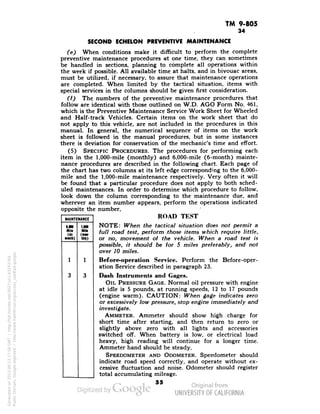
motor has adequate cranking speed and engages and disengages 
properly without unusual noise. Note any tendency toward difficult 
starting. If oil pressure gage does not register within 10 seconds, stop 
engine, and correct trouble or report to designated authority. Set hand 
throttle to fast idle speed, and during the warm-up period proceed 
32 
Generated on 2013-06-13 17:41 GMT / http://hdl.handle.net/2027/uc1.b3243764 
Public Domain, Google-digitized / http://www.hathitrust.org/access_use#pd-google
TM 9-805 
23 
FIRST ECHELON PREVENTIVE MAINTENANCE SERVICE 
with the following Before-operation Services (items 8 through 22). 
Listen for unusual noises; watch instrument indications, and note 
any unsatisfactory engine performance such as misfiring and rapid 
temperature rise. 
(7) ITEM 8, CHOKE. While starting engine, observe choke for 
satisfactory operation. As engine warms up, reset choke as required 
for smooth engine operation, and to prevent crankcase oil dilution. 
(8) ITEM 9, INSTRUMENTS. 
(a) OH Pressure Gage. Oil pressure gage should show normal 
reading of 5 pounds at idle, or 12 to 17 pounds at running speeds. 
(b) Ammeter. After engine starts and is running at fast idle, 
ammeter should show a high positive ( + ) charge rate for a short 
period until generator restores to battery the current used in starting. 
After this period ammeter should register a zero or slight positive 
( + ) charge with lights and accessories turned off. 
(c) Fuel Gage. Fuel gage should register approximate amount of 
fuel in tank. 
(d) Temperature Gage. Engine temperature should increase grad-ually 
during warm-up period. Temperature gage should register 
140°F to 170°F. CAUTION: Do not move vehicle until engine tem-perature 
reaches 135°F. 
(9) ITEM 10, HORN AND WINDSHIELD WIPERS. Test horn (tactical 
situation permitting) for proper operation and tone. Inspect wipers, 
arms, and blades for good condition. See if blades contact glass evenly 
throughout full stroke. 
(10) ITEM 11, GLASS AND REAR VIEW MIRRORS. Look for loose or 
damaged frames, brackets, or regulators. Clean windshield and door 
glass, and inspect for damage or discoloration. Clean mirror and aim 
properly. 
(11) ITEM 12, LAMPS (LIGHTS) AND REFLECTORS. Operate all 
switches (tactical situation permitting) and see if all lights respond 
properly. Be sure all lights and reflectors are secure, and lenses are 
clean and undamaged. 
(12) ITEM 13, WHEEL AND FLANGE NUTS. See that all wheel 
mounting and axle flange nuts are secure. 
(13) ITEM 14, TIRES. Inspect all tires for damage or low pres-sure. 
Inflate to 55 pounds pressure (tires cool), if time is available. 
Remove imbedded objects from treads and from between duals. Make 
sure spare is secure in carrier. 
(14) ITEM 15, SPRINGS AND SUSPENSION. Examine springs for 
abnormal sag, broken or shifted leaves, and loose or missing rebound 
clips. See that eyebolts, U-bolts, shackles, and shock absorbers are 
in good condition and tight. Examine shocks for leaks. 
(15) ITEM 16, STEERING LINKAGE. Examine steering gear, Pitman 
arm, rods, rod ends, and steering arms for looseness or damage and 
excessive lubricant leaks. 
(16) ITEM 17, FENDERS AND BUMPERS. Inspect fenders and 
bumpers for looseness and damage. 
33 
Generated on 2013-06-13 17:41 GMT / http://hdl.handle.net/2027/uc1.b3243764 
Public Domain, Google-digitized / http://www.hathitrust.org/access_use#pd-google
TM 9-805 
23-24 
1'/, -TON 4x4 TRUCK (Chevrolet) 
(17) ITEM 18, TOWING CONNECTIONS. Inspect tow hooks and 
pintle hook for looseness or damage, and see that pintle hook locking 
device is operating satisfactorily. 
(18) ITEM 19, BODY, LOAD, AND TARPAULINS. Inspect cab and 
top tarpaulin for damage. See that doors and latches operate properly. 
Inspect cab and body for looseness and damage. Inspect load for 
damage and see that it is properly distributed. On cargo bodies be 
sure tail gate is secure and tarpaulin (if used) is properly lashed to 
body hooks or loops. On dump bodies be sure body is fully lowered 
and alined on frame sill, and that tail gate is closed, and lever is 
in locked position. On panel bodies be sure rear doors are secure. 
On telephone maintenance or earth borer equipped vehicles, be 
sure materials are properly stowed, and stowage compartment doors 
are closed and secure. 
(19) ITEM 20, DECONTAMINATOR. Examine decontaminator for 
secure mounting, full charge, and closed valve. 
(20) ITEM 21, TOOLS AND EQUIPMENT. See that tools and equip-ment 
are present, serviceable, and properly mounted and stowed. 
(21) ITEM 22, ENGINE OPERATION. Engine may be assumed to 
be operating normally when it idles with choke button fully de-pressed 
and oil pressure is indicated on oil pressure gage (5 pounds 
at idle, 12 to 17 pounds at running speeds). Accelerate engine several 
times after it has reached normal operating temperature, and listen 
for any unusual noises, unsatisfactory operating characteristics, or 
excessive exhaust smoke. 
(22) ITEM 23, DRIVER'S PERMIT AND FORM No. 26. Make sure 
Driver's Permit, vehicle manual, Lubrication Guide, and Standard 
Accident Form No. 26 are present, legible, and safely stowed. 
(23) ITEM 25, DURING-OPERATION SERVICE. The During-operation 
Service should start as soon as vehicle is put in motion. 
24. DURING-OPERATION SERVICE. 
a. While vehicle is in motion, listen for such sounds as rattles, 
knocks, squeals, or hums that may indicate trouble. Look for indica-tions 
of trouble in cooling system, and smoke from any part of the 
vehicle. Be on the alert to detect any odor of overheated components 
or units such as generator, brakes, or clutch, fuel vapor from a leak 
in fuel system, exhaust gas, or other signs of trouble. Any time the 
brakes are used, gears shifted, or vehicle turned, consider this a test 
and notice any unsatisfactory or unusual performance. Watch the 
instruments constantly. Notice promptly unusual instrument indica-tion 
that may signify possible trouble in system to which that instru-ment 
pertains. 
b. Procedures. During-operation Service consists of observing 
items listed below according to the procedures following each item, 
and investigating any indications of serious trouble. Notice minor 
deficiencies to be corrected or reported at earliest opportunity, usually 
at next scheduled halt. 
34 
Generated on 2013-06-13 17:42 GMT / http://hdl.handle.net/2027/uc1.b3243764 
Public Domain, Google-digitized / http://www.hathitrust.org/access_use#pd-google
TM 9-805 
24 
FIRST ECHELON PREVENTIVE MAINTENANCE SERVICE 
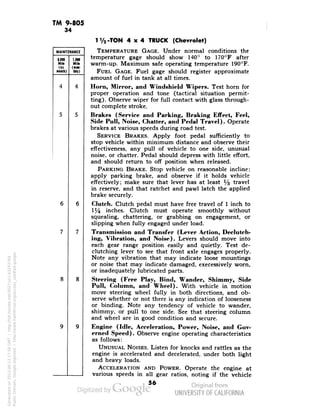
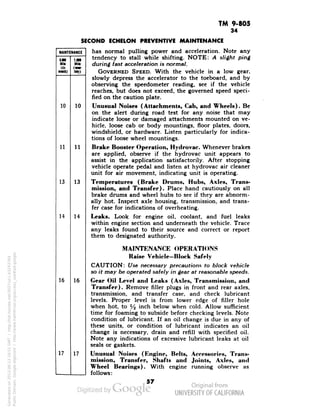
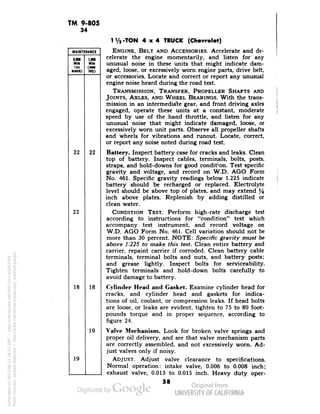
(1) ITEM 27, FOOT AND HAND BRAKES. The foot brake should 
have 1^-inch free pedal travel, and should operate smoothly and 
effectively without pulling vehicle to one side, leaving % reserve 
pedal travel available. If trailer is connected, note if electric brake 
controller action is satisfactory to operate trailer brakes effectively. 
When vehicle is stopped on a reasonable incline, hand brake should 
hold vehicle with 1/3 reserve lever travel available. 
(2) ITEM 28, CLUTCH. Inspect clutch pedal to see that it has 
1-inch to 1J4-inch free travel before it starts to disengage. Clutch 
should not chatter, squeal, or grab on engagement, or slip when fully 
engaged under load. 
(3) ITEM 29, TRANSMISSION. As transmission (and power take-off, 
if used) is operated, see that gears shift smoothly, operate quietly, 
and do not creep or jump out of mesh. 
(4) ITEM 30, TRANSFER. As transfer and declutching shift mecha-nism 
(and power take-off, if used) are operated, see that gears shift 
smoothly, operate quietly, and do not creep or jump out of mesh. 
(5) ITEM 31, ENGINE AND CONTROLS. Be on the alert for de-ficiencies 
in engine performance such as lack of usual power, mis-firing, 
unusual noise, stalling, indications of overheating, or unusual 
exhaust smoke. Note if engine responds to controls satisfactorily, and 
if controls appear to be in proper adjustment, and are not excessively 
loose or binding. 
(6) ITEM 32, INSTRUMENTS. Observe readings of all instruments 
frequently during operation to be sure units to which they pertain are 
functioning satisfactorily. 
(a) Temperature Gage. Temperature gage should read 140°F to 
170°F after warm-up. Investigate and report excessive engine heat 
over 190°F. 
(b) Oil Pressure Gage. Oil pressure gage should read 5 pounds 
at idle, and 12 to 17 pounds at running speeds. If there is unusual 
drop in pressure, or oil pressure is not registering, engine should be 
stopped immediately. 
(c) Ammeter. During operation, after battery has recovered from 
discharge caused by starting, ammeter should indicate a zero or 
slight positive (+ ) reading with needle steady. 
(d) Fuel Gage. Fuel gage should continue to indicate approxi-mate 
amount of fuel in tank. 
(e) Speedometer and Odometer. Speedometer should indicate 
vehicle speed. Odometer should record accumulating mileage. 
(7) ITEM 33, STEERING GEAR. Note any indication of looseness 
or binding, excessive pull to either side, shimmy, wheel tramp, or 
unusual noise. 
(8) ITEM 34, RUNNING GEAR. Listen for any unusual noises, such 
as knocking, clicking, or bumping sounds from wheels, axles, or sus-pension 
parts. 
(9) ITEM 35, BODY. Note any noise or abnormal condition that 
might indicate shifting, loose top tarpaulin or curtains, loose or dam- 
35 
Generated on 2013-06-13 17:42 GMT / http://hdl.handle.net/2027/uc1.b3243764 
Public Domain, Google-digitized / http://www.hathitrust.org/access_use#pd-google
TM 9-805 
24-25 
1V2-TON 4x4 TRUCK (Chevrolet) 
aged doors, hardware, floor or inspection plates, or mounted body 
attachments. 
25. AT-HALT SERVICE. 
a. At-halt Service may be regarded as minimum maintenance 
procedures and should be performed under all tactical conditions, 
even though more extensive maintenance services must be slighted 
or omitted altogether. 
b. Procedures. At-halt Service consists of investigating any 
deficiencies noted during operation, inspecting items listed below 
according to the procedures following the items, and correcting any 
deficiencies found. Deficiencies not corrected should be reported 
promptly to the designated individual in authority. 
(1) ITEM 38, FUEL, OIL, AND WATER. Check amount of fuel, oil, 
and coolant. Add as necessary. CAUTION: Do not turn radiator 
filler cap beyond safety stop until hissing has ceased. 
(2) ITEM 39, TEMPERATURES: HUBS, BRAKE DRUMS, TRANSFER, 
TRANSMISSION, AND AXLES. Place hand cautiously on each brake drum 
and wheel hub to determine if abnormally hot. Inspect transmission, 
transfer, and driving axles for overheating or excessive oil leaks. 
(3) ITEM 40, AXLE AND TRANSFER VENTS. Wipe clean and inspect 
vents for damage or clogging. Vents must be kept open. 
(4) ITEM 41, PROPELLER SHAFTS. Inspect all propeller shafts and 
universal joints for looseness, damage, or oil leaks. Remove any for-eign 
material wound around shaft or joints. 
(5) ITEM 42, SPRINGS AND SUSPENSION. Examine springs for 
broken or shifted leaves, damaged or loose clips, U-bolts, eyebolts, 
and shackles. See if shock absorbers and linkage are securely con-nected 
and mounted. 
(6) ITEM 43, STEERING LINKAGE. Examine steering control 
mechanism, arms, and linkage frictional joints for damage or loose-ness, 
and investigate any irregularities noted during operation. 
(7) ITEM 44, WHEEL AND FLANGE NUTS. See that wheel mounting 
and axle flange nuts are present and secure. 
(8) ITEM 45, TIRES. Examine tires for underinflation or damage. 
Remove imbedded objects from treads and from between duals. See 
that spare is inflated and secure in carrier. 
(9) ITEM 46, LEAKS, GENERAL. Look in engine compartment and 
under vehicle for indications of fuel, oil, coolant, or brake fluid leaks. 
Trace any found to their source and correct or report them to proper 
authority. 
(10) ITEM 47, ACCESSORIES AND BOLTS. Inspect fan and water 
pump pulley, and generator pulley for looseness. Examine fan belt 
for excessive wear or fraying and deflection of y$ inch midway be-tween 
fan and generator pulleys. 
(11) ITEM 48, AIR CLEANERS. When operating under extremely 
dusty or sandy conditions, see that air cleaners and breather caps 
are in condition to deliver clean air. Service as required. 
36 
Generated on 2013-06-13 17:43 GMT / http://hdl.handle.net/2027/uc1.b3243764 
Public Domain, Google-digitized / http://www.hathitrust.org/access_use#pd-google
TM 9-805 
25-26 
FIRST ECHELON PREVENTIVE MAINTENANCE SERVICE 
(12) ITEM 49, FENDERS AND BUMPERS. Inspect fenders or splash 
guards, and bumpers for looseness or damage. 
(13) ITEM 50, TOWING CONNECTIONS. See that tow hooks and 
pintle hook and fifth wheel (if used) are in good condition and 
securely mounted. See that pintle hook or fifth wheel is properly 
latched. If towing load, make sure trailer electrical connections are 
securely fastened. 
(14) ITEM 51, BODY, LOAD, AND TARPAULIN. Examine cab, body, 
equipment, or load for shifting. Be sure tarpaulin (if used) is properly 
secured and in good condition. 
(15) ITEM 52, GLASS. Clean windshield, door and window glass, 
rear view mirror, and light lenses; inspect for damage. 
26. AFTER-OPERATION AND WEEKLY SERVICE. 
a. After-operation Service is particularly important because at 
this time the driver inspects his vehicle to detect any deficiencies 
that may have developed, and corrects those he is permitted to 
handle. He should report promptly, to the designated individual in 
authority, the results of his inspection. If this schedule is performed 
thoroughly, the vehicle should be ready to roll again on a moment's 
notice. The Before-operation Service, with a few exceptions, is then 
necessary only to ascertain whether or not the vehicle is in the same 
condition in which it was left upon completion of the After-operation 
Service. The After-operation Service should never be entirely omitted, 
even in extreme tactical situations, but may be reduced to the bare 
fundamental services outlined for the At-halt Service, if necessary. 
b. Procedures. When performing the After-operation Service the 
driver must remember and consider any irregularities noticed during 
the day in the Before-operation, During-operation, and At-halt 
Services. The After-operation Service consists of inspecting and 
servicing the following items. Those items of the After-operation 
Service that are marked by an asterisk (*) require additional 
Weekly services, the procedures for which are indicated in sub-paragraph 
(b) of each applicable item. 
(1) ITEM 55, ENGINE OPERATION. See that engine idles satisfac-torily. 
Accelerate and decelerate engine and note any missing, back-firing, 
unusual noises, vibration, or exhaust smoke. Investigate any 
unusual condition noticed during operation. 
(2) ITEM 56, INSTRUMENTS. Check all pertinent instruments to 
be sure all are operating properly, and continue to register or indi-cate 
correct performance of the units to which they apply. 
(3) ITEM 54, FUEL, OIL, AND WATER. Check fuel, oil, and coolant 
levels; replenish as required. Leave sufficient space for expansion. 
Fill spare cans. When antifreeze is used and an appreciable amount 
of water is added to coolant, have value of antifreeze tested. 
CAUTION: Observe safety precautions for grounding static elec-tricity 
when handling gasoline. Do not add coolant when engine is 
too hot. 
37 
Generated on 2013-06-13 17:43 GMT / http://hdl.handle.net/2027/uc1.b3243764 
Public Domain, Google-digitized / http://www.hathitrust.org/access_use#pd-google
TM 9-805 
26 
1V2-TON 4x4 TRUCK (Chevrolet) 
(4) ITEM 57, HORN AND WINDSHIELD WIPERS. Inspect horn for 
secure mounting and tight connections. See if wiper arms and blades 
are in good condition; inspect wiper blades for even contact with 
glass throughout full stroke. 
(5) ITEM 58, GLASS AND REAR VIEW MIRROR. Clean rear view 
mirror, windshield, and other glass. Be sure glass and mountings are 
secure and undamaged. 
(6) ITEM 59, LAMPS (LIGHTS) AND REFLECTORS. Operate switches 
and see that lamps respond. During blackout, inspect lamps with 
switch in blackout position only. Be sure all lamps are off after 
completing inspection. Depress brake pedal and see that stop lights 
burn. Clean all lenses and warning reflectors, and inspect for 
damage. 
(7) ITEM 60, FIRE EXTINGUISHER. Inspect fire extinguisher for 
presence, full charge, proper mounting, and clear nozzle. Examine for 
corrosion or damage. If extinguisher has been used, report it for 
refill or replacement. 
(8) ITEM 61, DECONTAMINATOR. Inspect decontaminator for good 
condition, full charge, and secure mounting. If used, report for refill 
or replacement. 
(9) ITEM 62, *BATTERIES. 
(a) Inspect batteries to see that they are clean, secure, and not 
leaking or damaged. See that cell caps are finger-tight. 
(b) Weekly. Clean dirt from top of battery. If terminal connec-tions 
or posts are corroded, clean them thoroughly and apply fresh, 
thin coating of grease. Tighten terminal bolts if loose. Remove vent 
caps and check level of electrolyte. Add water if required, taking 
precautions so that battery will not be damaged during freezing 
temperatures. Battery should be secure, not bulging or cracked or 
leaking electrolyte; battery carrier should be secure, clean, free of 
rust, and well painted. If mountings are loose, tighten them cau-tiously 
so as not to damage the battery case. Report any defects. 
(10) ITEM 63, *ACCESSORIES AND BELTS. 
(a) Inspect all accessories such as carburetor, generator and 
regulator, cranking motor, and water pump for loose connections 
and loose mountings. Inspect carburetor, water pump and fuel filter 
for leaks. Inspect fan belt for good condition and deflection of 
% inch midway between pulleys. Investigate and correct or report 
any deficiencies of accessory units noticed during operation. 
(b) Weekly. Tighten any loose connections, linkage, or mount-ings. 
(11) ITEM 64, ELECTRICAL WIRING. Inspect all ignition wiring 
for looseness or damage; wipe off grease or moisture. Also make an 
inspection of all accessible low voltage wiling and connections for 
looseness or damage, and be sure all wiring is supported, so as not 
to chafe against other vehicle parts. 
(12) ITEM 65, *AiR CLEANERS AND BREATHER CAPS. 
(a) Inspect for looseness or damage. Examine oil in reservoirs 
38 
Generated on 2013-06-13 17:43 GMT / http://hdl.handle.net/2027/uc1.b3243764 
Public Domain, Google-digitized / http://www.hathitrust.org/access_use#pd-google
TM 9-805 
26 
FIRST ECHELON PREVENTIVE MAINTENANCE SERVICE 
for correct level and excessive dirt. When operating in sandy or 
dusty conditions, clean and service air cleaners and breather caps 
as often as necessary. 
(b) Weekly. Remove cleaner reservoirs and elements, wash in 
dry-cleaning solvent, refill reservoirs with oil, and reinstall securely. 
Be sure all gaskets seal properly, and that joints and connections 
are secure. 
(13) ITEM 66, *FUEL FILTERS. 
(a) Examine fuel filters for leakage, damage, and loose mounting. 
(b) Weekly. Remove drain plug; drain water and sediment from 
bowl. If fuel pump sediment bowl shows excessive dirt, remove bowl 
and clean element. 
(14) ITEM 67, ENGINE CONTROLS. Inspect engine controls for 
wear, damage, or disconnected linkage, and for adequate lubrication. 
(15) ITEM 68, *TIRES. 
(a) Examine all tires, including spares for damage and excessive 
wear. Remove all imbedded foreign matter, such as nails, glass, or 
stones, from treads and carcasses and from between duals. Check for 
low pressures and proper position of valve stem and presence of 
valve caps. Inflate to correct pressure, as needed (55 Ib maximum, 
cool). 
(b) Weekly. Replace badly worn or otherwise unserviceable tires. 
Serviceable tires, which show abnormal wear, should be relocated to 
other wheels to even the wear. Apparent mechanical deficiencies 
causing such wear should be reported to higher echelon for attention. 
(16) ITEM 69, SPRINGS AND SUSPENSION. Inspect springs for ab-normal 
sag, broken or shifted leaves, and loose or missing rebound 
clips. See that eyebolts, U-bolts, and shackles are tight, and that 
shock absorbers are secure and not leaking. Investigate any unusual 
noise or condition noticed during operation. 
(17) ITEM 70, STEERING LINKAGE. Inspect steering linkage for 
bent, loose, or inadequately lubricated parts. Investigate any unusual 
condition noticed during operation. 
(18) ITEM 71, PROPELLER SHAFTS. Inspect all drive shafts and 
universal joints for looseness or damage, and excessive oil leaks. 
Remove any foreign material wound around shafts or joints. 
(19) ITEM 72, *AXLE AND TRANSFER VENTS. 
(a) See that all axle housing and transfer vents are present, in 
good condition, secure, and not clogged. 
(b) Weekly. Remove and clean axle and transfer vents, and 
reinstall securely. 
(20) ITEM 73, LEAKS, GENERAL. Inspect around engine compart-ment 
and beneath vehicle for indications of fuel, oil, coolant, or 
brake fluid leaks. 
(21) ITEM 74, GEAR OIL LEVELS. After units have cooled, check 
lubricant level of differentials, transmission, and transfer; report if 
low. NOTE: Proper level with units cool is */2 inch below filler plug 
hole. 
39 
Generated on 2013-06-13 17:44 GMT / http://hdl.handle.net/2027/uc1.b3243764 
Public Domain, Google-digitized / http://www.hathitrust.org/access_use#pd-google
TM 9-805 
26 
1V2 -TON 4x4 TRUCK (Chevrolet) 
(22) ITEM 74, FENDERS AND BUMPERS. Examine for looseness or 
damage. 
(23) ITEM 77, *TOWING CONNECTIONS. 
(a) Inspect tow hooks (fifth wheel, if used) and pintle hool for 
looseness or damage. Inspect towed load (if any) electrical connec-tions 
for good condition and secure attachment. 
(b) Weekly. Lower the trailer landing gear, observing whether 
or not it operates properly, is adequately lubricated, not damaged, 
and secure. Unhitch the trailer. Clean the contacting surfaces of the 
fifth wheel, upper plate, and kingpin thoroughly. Inspect them for 
wear and damage, and apply a fresh coating of clean grease. Tighten 
all mounting bolts; rehitch the trailer, noticing if the hand lever 
works easily, and if the latching mechanism closes completely and 
latches securely. Tighten mounting bolts of tow hooks, pintle hook, 
or fifth wheel (if used), as required. 
(24) ITEM 78, BODY, LOAD, AND TARPAULIN, (HOIST, IF USED), 
Inspect cab and body carefully for damaged, loose, or missing 
parts. Make sure load is evenly distributed, and that load or equip-ment 
is secure. See that tarpaulin and curtains (if used) are in good 
condition, and that grommets and ropes are present and undamaged. 
All ropes should be lashed securely to hooks or rings. Examine hoist 
cylinder (where used) at pump and pump valve for leaks. 
(25) ITEM 79, *WINCH. 
(a) Examine winch assembly for looseness or damage, and ex-cessive 
oil leaks at worm gear housing. See that winch drive shaft 
shear pin is in good condition and secure. Be sure sliding clutch 
operates freely and locks securely. 
(b) Weekly. If vehicle has been operated in deep water, sample 
lubricant for contamination. If water is present, report condition. If 
winch cable was used recently, or is dry or wound unevenly, unwind 
entire length and clean. Rewind evenly on winch drum, applying a 
thin coat of engine oil while winding, and secure cable chain and 
hook securely to front tow hooks. NOTE: Clean, used oil is satis-factory. 
If winch is center-mounted, check drive chain adjustment. 
Idler should be set so that chain is tight. 
(26) ITEM 82, *TIGHTEN. 
(a) Tighten any mounting or external assembly nuts or screws 
where inspection of vehicle has indicated the necessity. 
(b) Weekly. Tighten wheel mounting and axle flange nuts and 
cap screws, spring U-bolts, eyebolts, shackles and rebound clips, 
torque rods, shock links, U-joint companion flanges, body mount-ings, 
engine mountings, accessories or special equipment mountings, 
transfer case mountings, steering arms, towing connections, or any 
other mountings or external assembly nuts or screws, where inspec-tion 
or experience indicates the necessity, on a weekly or mileage 
basis. 
(27) ITEM 83, *LUBRICATE AS NEEDED. 
(a) Lubricate all items such as shackles, hinges, latches, control 
40 
Generated on 2013-06-13 17:44 GMT / http://hdl.handle.net/2027/uc1.b3243764 
Public Domain, Google-digitized / http://www.hathitrust.org/access_use#pd-google
TM 9-805 
26 
FIRST ECHELON PREVENTIVE MAINTENANCE SERVICE 
linkage frictional joints, or any point where inspection has indicated 
oilcan or hand greasing is needed. 
(b) Weekly. Lubricate all points of the vehicle indicated on the 
Lubrication Guide as needing lubrication on a weekly or a mileage 
basis. 
(28) ITEM 84, *CLEAN ENGINE AND VEHICLE. 
(a) Clean dirt and grease or oil drippings from inside cab, and 
from engine compartment and exterior of engine. Wipe off excess 
dirt and grease from entire vehicle. 
(b) Weekly. Wash vehicle when possible. If not possible, wipe 
off thoroughly. Inspect paint or camouflage pattern for rust, or for 
bright spots which might cause light reflections. See that vehicle 
markings are legible, unless covered for tactical reasons. CAUTION: 
// vehicle is driven into water for washing, care must be taken to 
see that water or dirt does not get into wheel bearings, gear cases, 
or brakes, or on electrical units or wiring, 
(29) ITEM 85, *TOOLS AND EQUIPMENT. 
(a) Check vehicle stowage and tool lists to see that all items are 
present. Inspect items to see that they are in good condition, and 
properly mounted or stowed. 
(b) Weekly. Clean all tools and equipment of rust or dirt, and 
apply preservative where necessary, when possible. See that tools 
with cutting edge are sharp and properly protected, and that all 
items are securely mounted or stowed. NOTE: When services are 
completed, be sure all inspection plates are replaced securely. 
41 
Generated on 2013-06-13 17:44 GMT / http://hdl.handle.net/2027/uc1.b3243764 
Public Domain, Google-digitized / http://www.hathitrust.org/access_use#pd-google
TM 9-805 
27-28 
1 V2-TON 4x4 TRUCK (Chevrolet) 
Section VII 
LUBRICATION 
Introduction 27 
Lubrication Guide 28 
Reports and records 29 
27. INTRODUCTION. 
a. Lubrication is an essential part of preventive maintenance, de-termining 
to a great extent the serviceability of parts and assemblies. 
28. LUBRICATION GUIDE. 
a. General. Lubrication instructions for these vehicles are con-solidated 
in a Lubrication Guide (figs. 15 and 16). These specify 
the points to be lubricated, the periods of lubrication, and the lubri-cant 
to be used. In addition to the items on the Lubrication Guide, 
other small moving parts, such as hinges and latches, must be 
lubricated at frequent intervals. 
b. Supplies. In the field it may not be possible to supply a 
complete assortment of lubricants called for by the Lubrication 
Guide to meet the recommendations. It will be necessary to make 
the best use of those available, subject to inspection by the officer 
concerned, in consultation with responsible ordnance personnel. 
c. Lubrication Notes. The following instructions supplement 
and repeat for clarity those notes on the Lubrication Guide which 
pertain to lubrication and service of individual units and parts. All 
note references in the guide itself are to the subparagraphs below 
having the corresponding number. 
(1) FITTINGS. Clean before applying lubricant. Lubricate until 
new lubricant is forced from the bearing, unless otherwise specified. 
CAUTION: Lubricate chassis points after washing truck. 
(2) INTERVALS. Intervals indicated are for normal service. For 
extreme conditions of speed, heat, water, sand, mud, snow, rough 
roads, dust, etc., reduce interval by 1/& or y2, or more if conditions 
warrant. 
(3) CLEANING. Use SOLVENT, dry-cleaning, or OIL, fuel, Diesel, 
to clean or wash all parts. Use of gasoline for this purpose is pro-hibited. 
Dry all parts thoroughly before lubricating. 
(4) AIR CLEANERS. Daily, check engine air cleaner level and re-fill 
oil reservoir to bead level with used crankcase oil or OIL, engine, 
SAE 30 above + 32°F; SAE 10 for +30°F to 0°F. From 0°F to 
— 40°F, use FLUID, shock-absorber, light. Every 1,000 miles (daily 
under extreme dust conditions) remove and wash all parts. Below 
—40°F, remove oil and operate dry. Every 1,000 miles or more 
frequently if required, remove hydrovac cylinder air cleaner, located 
at rear of cylinder, wash all parts and reoil curled hair with used 
crankcase oil or OIL, engine, SAE 30 above +32°F; SAE 10 for 
+ 32°F to 0°F. From 0°F to -40°F, use FLUID, shock-absorber, 
42 
Generated on 2013-06-13 17:45 GMT / http://hdl.handle.net/2027/uc1.b3243764 
Public Domain, Google-digitized / http://www.hathitrust.org/access_use#pd-google
TM 9-805 
28 
LUBRICATION 
light. Below — 40°F, wash and replace dry. Every 1,000 miles, pr more 
frequently if required, clean and oil crankcase breather on late 
models. Breather is located on top of valve cover. Every 3,000 miles, 
or more frequently if required, remove, clean, and reoil governor 
cleaner with used crankcase oil or OIL, engine, SAE 30 above +32°F; 
SAE 10 for +32°F to 0°F. From 0°F to -40°F, use FLUID, shock-absorber, 
light. Below —40°F, wash and replace dry. 
(5) CRANKCASE. Drain only when engine is hot. Refill to "FULL" 
mark on gage. Run engine a few minutes and recheck oil level. CAU-TION: 
Be sure pressure gage indicates oil is circulating. 
(6) OIL FILTER. Every 1,000 miles, drain sediment. Every 6,000 
miles, or more often if filter becomes clogged, drain filter, clean inside 
and renew element. Run engine a few minutes, check crankcase level 
and add OIL, engine, to "FULL" mark on gage. (SAE 30 above 
+ 32°F; SAE 10 +32°F to 0°F; and refer to OFSB 6-11, below 
0°F.) 
(7) GEAR CASES. Weekly, check level with truck on level ground 
and, if necessary, add lubricant to within y2 inch of plug level when 
cold or to plug level when hot. Drain, and refill at inervals indicated 
on guide. Drain only after operation. Fill differentials to level of lower 
plug hole. Clean magnetic drain plug on transfer case before replac-ing. 
Keep all gear case breathers clean. 
(8) UNIVERSAL JOINTS AND SLIP JOINTS. 
(a) Winch and Dump Body Hoist. Apply GREASE, general pur-pose, 
No. 1, above +32°F and No. 0 below +32°F, to joint until 
lubricant appears at cross, and to slip joint until lubricant is forced 
from end of slip joint. 
(b) Truck. Apply GREASE, general purpose, No. 1, above +32°F 
and No. 0 below +32°F, to joint until it overflows at relief valve and 
to slip joint until lubricant is forced from vent at universal joint 
end of spline. 
(9) WINCH PROPELLER SHAFT SHEAR PIN. Every 6,000 miles, 
disconnect front universal joint, remove shear pin and universal joint 
from shaft, clean and coat end of shaft and inside of universal joint 
collar with GREASE, general purpose, No. 1 above +32°F, and 
No. 0 below +32°F, to prevent rusting. 
(10) FRONT WHEEL UNIVERSAL JOINTS. With vehicle on level 
ground, remove inspection plug on top of steering knuckle housing 
and add lubricant through fitting at bottom of steering knuckle hous-ing 
until it comes out inspection hole. Replace plug. Every 6,000 
miles, disassemble, clean, reassemble, and refill. 
(11) HYDROVAC CYLINDER. Every 6,000 miles, remove pipe plug 
from the cylinder at the relay valve end of the unit of single- and 
double-piston types. Also remove pipe plug at the center plate of 
double-piston type. Lubricate both types with about % ounce of 
FLUID, shock-absorber, light, through each opening. Replace plugs. 
(12) DISTRIBUTOR. Every 6,000 miles, wipe distributor breaker 
cam lightly with GREASE, general purpose, No. 1 above +32°F, and 
No. 0 below +32°F, and lubricate breaker arm pivot and wick under 
43 
Generated on 2013-06-13 17:45 GMT / http://hdl.handle.net/2027/uc1.b3243764 
Public Domain, Google-digitized / http://www.hathitrust.org/access_use#pd-google
TM 9-805 
28 
1i/2-TON 4x4 TRUCK (Chevrolet) 
UI 
oc 
Generated on 2013-06-13 17:46 GMT / http://hdl.handle.net/2027/uc1.b3243764 
Public Domain, Google-digitized / http://www.hathitrust.org/access_use#pd-google
TM 9-805 
LUBRICATION 
28 
45 
Generated on 2013-06-13 17:46 GMT / http://hdl.handle.net/2027/uc1.b3243764 
Public Domain, Google-digitized / http://www.hathitrust.org/access_use#pd-google
TM 9-805 
28 
1 i/2-TON 4x4 TRUCK (Chevrolet) 
|s"f I 
CD 
• 
B 
XX 
• 
SS «•< 
<T 
P* 
E 
I K 
I's 
-? 
J 
C 
kl J? 
nT^f 
s 
_ 
1 
1 
J B ^ 
IS 
S 
•s 
j 
i 
I .f I? 
Ja> 
1 e» 
j 
V 
1 
3 
I / 
2 
Generated on 2013-06-13 17:47 GMT / http://hdl.handle.net/2027/uc1.b3243764 
Public Domain, Google-digitized / http://www.hathitrust.org/access_use#pd-google 
1 fc 
Lft 
1 
9 
• <c 
5* 
_f— — tl 
L~T~ 
si * 
1 / 
', 
i 1 / 
1 
i 
«=* 5a 
• ~ 
— 
CA 
9 <9 
> O 
8 S 8 
C0£ < 
• P*liH •• 
1 
O 
U 
1 
1 
* orpoiiTi 
,^- zl 
I —4 iu f* t
TM 9-805 
28 
LUBRICATION 
1X1 
in 
M li 
III 1 
i^f 
1! 
$ S-2 »-£ S 
z _. = -- « o 
Will i 
:2-!ill*3 i 
*=i:;i!° . 
!5i^iJ*i 
0 *~ o -• i - '* 
la ill til Ji 
ill 
I III ,d'O^ 
||Jl S£J|J 
-ii Mils 
I] 
^" 
1 
1 
"> * 
Hi"' 111?4' 
11 
J^^-S n. > " » 2? 
§•:' 
l|JiJ Ji^l. 
**Zsg KjK 
« • 
SJEe,B S-"'" 
1 
I 
> Instruction 
• and S»rvic« b»lo 
iiu! m 
if 
II 
i'S S • I **1 ° 
j= 8-fs i? is~: 
h 
!*• ^•"° ; <^rs ES- 
•J] o 
Jt 
.{:t«:ii!^' 
s» • 
-3 
vMHIslil!i 
!+-;_ 
2 Van1 
!1±1 
1 
•FLUID. br*lt. hyc 
-FLUID. ihock-*b« 
ft, 
A 
1! 
pj 
j 
1 
J 
II 
a.22 _• 
jjSiC 
S o a 
I9ZZ 
;=• 
Generated on 2013-06-13 17:47 GMT / http://hdl.handle.net/2027/uc1.b3243764 
Public Domain, Google-digitized / http://www.hathitrust.org/access_use#pd-google
TM 9-805 
28 
-TON 4x4 TRUCK (Chevrolet) 
rotor with one to two drops of OIL, engine, SAE 30 above +32°F; 
SAE 10 for +32°F to 0°F; OIL, lubricating, preservative, special, 
below 0°F. 
(13) ACCELERATING PUMP SHAFT. Remove air cleaner and car-buretor 
accelerating pump dust cover. Saturate felt ring on carbure-tor 
pump lever shaft with OIL, engine, SAE 30 above +32°F; SAE 
10 for +32°F to 0°F; OIL, lubricating preservative, special, below 
0°F. 
(14) HYDRAULIC HOIST CYLINDERS. 
(a) Hercules. Raise body to maximum lift, fill cylinder and 
before replacing cover, lower body to bleed air and surplus oil. 
Again raise body and replace fill hole cover and gasket. 
(b) Perfection. Raise body to maximum lift, fill cylinder, replace 
and tighten fill plug. Loosen, but do not remove, vent plug and lower 
body completely to bleed air and surplus oil. Raise body and 
tighten vent plug. 
(c) Both Models. Every 6 months, disconnect oil line from pump, 
drain and refill. Use OIL, engine, SAE 10, for all temperatures. 
(15) TRACTOR MODEL FIFTH WHEELS. Every 1,000 miles, clean 
and lubricate lower plate coupler pin, locking jaws and guide with 
OIL, engine, SAE 30 above +32°F; SAE 10 for +32°F to 0°F; and 
OIL, lubricating, preservative, special, below 0°F. 
(16) WINCH CABLE. Coat winch cable with used crankcase oil 
or OIL, engine, SAE 30 above + 32°F; SAE 10 for +32°F to 
0°F; and OIL, lubricating, preservative, special, below 0°F after 
each period of use. When not in use, coat outer coils weekly. 
(17) CLUTCH PILOT BEARING. Whenever clutch is removed for 
inspection or repair, and after cleaning parts, coat the shift fork ball 
seat, pack recess inside clutch release bearing collar, pack pilot bear-ing 
and fill cavity in crankshaft behind bearing, coat shaft splines 
lightly and coat ball seat in shift fork with GREASE, general pur-pose, 
No. 2. CAUTION: Do not wash clutch release bearing. 
(18) OILCAN POINTS. Every 1,000 miles, lubricate pintle hook pins 
and connections, control rod bushings, clevises, linkage, etc., with 
OIL, engine, SAE 30 above +32°F; SAE 10 for +32°F to 0°F; 
OIL, lubricating, preservative, special, below 0°F. 
(19) RUBBER BUSHINGS. Every 1,000 miles, apply FLUID, brake, 
hydraulic, to shock-absorber link rubber bushings. CAUTION: Do 
not oil. 
(20) POINTS REQUIRING No LUBRICATION SERVICE. These points 
are the fan, water pump, clutch release bearing, generator (late 
models), springs, propeller shaft center bearing (175-in. wheelbase 
model), power take-off, clutch and brake pedals, front axle declutch, 
dump hoist hydraulic pump, and governor. 
(21) WHEEL BEARINGS. Remove bearing cone assemblies from 
hub and wash spindle and inside of hub. Inspect bearing races and 
replace if necessary. Wet the spindle and inside of hub and hub cap 
48 
Generated on 2013-06-13 17:47 GMT / http://hdl.handle.net/2027/uc1.b3243764 
Public Domain, Google-digitized / http://www.hathitrust.org/access_use#pd-google
TM 9-805 
28-29 
LUBRICATION 
with GREASE, general purpose, No. 2, to a miximum thickness of Vig-inch 
to retard rust. Wash bearing cones and grease seals and dry. 
Inspect and replace if necessary. Lubricate bearings with GREASE, 
general purpose, No. 2, with a packer or by hand, kneading lubricant 
into all spaces in the bearing. Use extreme care to protect bearings 
from dirt and immediately reassemble and replace wheel. The lubri-cant 
in the bearings is sufficient to provide lubrication until the next 
service period. Do not nil hub or hub cap. Any excess might result 
in leakage into the brake drum. 
29. REPORTS AND RECORDS. 
a. Reports. If lubrication instructions are closely followed, 
proper lubricants used, and satisfactory results are not obtained, 
make a report to the ordnance officer responsible for the mainte-nance 
of the materiel. 
b. Records. A complete record of lubrication may be kept for 
every vehicle in the Duty Roster (W.D. AGO Form 6). 
49 
Generated on 2013-06-13 17:48 GMT / http://hdl.handle.net/2027/uc1.b3243764 
Public Domain, Google-digitized / http://www.hathitrust.org/access_use#pd-google
TM 9-805 
30 
1V2-TON 4x4 TRUCK (Chevrolet) 
Section VIII 
TOOLS AND EQUIPMENT STOWAGE ON VEHICLE 
Vehicle tools 30 
Vehicle equipment 31 
Vehicle spare parts 32 
30. VEHICLE TOOLS. 
a. General. Each vehicle is equipped with the tools listed in sub-paragraph 
c below so that minor repairs can be performed by the 
driving personnel. The larger tools, and a tool bag containing small 
tools, are located on the several models as follows: 
Model . Too) Location 
G-7103—Chassis with cab Under driver's seat 
G-7105—Panel In back of driver's seat back 
G-7113—Cab tractor Tool box on right running board 
G-7106—Dump less winch I TT 
G-7116-Dump with winch f Under dnver s seat 
G-7107—Cargo less winch I In compartment under body tail 
G-7117—Cargo with winch f gate 
G-7163—Telephone earth borer I TT , 
G-7173-Telephone maintenance f Under dnvers seat 
b. Special Tools. A list of special tools for second echelon use 
will be found in section XI. 
c. Vehicular Tool List. , . ,, . ,, 
„ . . .. Federal Stock No. 
Crank, engine starting 
Hammer, machinist's, ball peen, 16-oz 41-H-523 
Handle, wheel bearing nut 
Handle, wheel wrench 
Pliers, combination slip joint, 6-in 41-P-1650 
Screwdriver, clutch head, %2-in 41-S-1117-4 
Screwdriver, clutch head, %-in 41-S-1117-6 
Screwdriver, clutch head, y16-in 41-S-1117-8 
Screwdriver, common, 6-in. blade 41-S-1104 
Wrench, adjustable, automobile type, 11-in 41-W-448 
Wrench, adjustable, crescent type, 8-in 41-W-486 
Wrench, engineer's, open-end, %- x 7/16-in 41-W-991 
Wrench, engineer's, open-end, l/2- x !%2-in 41-W-1003 
Wrench, engineer's, open-end, %6- x ] Vie-in 41-W-1005-5 
Wrench, engineers, open-end, %- x 2%2-in 41-W-1008-10 
Wrench, engineer's, open-end, %- x %-in 41-W-1012-5 
Wrench, spark plug 
Wrench, special hex socket (winch trucks only) 
Wrench, wheel 
Wrench, wheel bearing nut 
Wrench, clutch feed shaft coupling (earth borer only) 
Wrench, clutch shaft bearing nut lock (earth borer only) 
50 
Generated on 2013-06-13 17:48 GMT / http://hdl.handle.net/2027/uc1.b3243764 
Public Domain, Google-digitized / http://www.hathitrust.org/access_use#pd-google
TM 9-805 
30-32 
TOOLS AND EQUIPMENT STOWAGE ON VEHICLE 
Wrench, idler gear adjusting nut (earth borer only) 
Wrench, leveling ratchet (earth borer only) 
Wrench, leveling worm shaft bushing (earth borer only) 
31. VEHICLE EQUIPMENT. 
a. The following items of equipment are included with each 
vehicle, and are located on the various models as outlined in para-graph 
30 a. 
Chains, tire, 7.50 x 20 single, 7.50 x 20 dual 
Chain, utility tow (1) 
Extension, lubricating gun 
*Extinguisher, fire 
Gage, tire pressure 
Gun, lubrication 
Handle, jack 
Iron, tire changing 
Jack, auto assembly 
Oiler 
Pump, tire 
32. VEHICLE SPARE PARTS. 
a. General. A number of vehicle spare parts are contained in 
a kit attached to the dash above the fire extinguisher on the assistant 
driver's side. Whenever spare parts are removed from the kit and put 
into service, an equal quantity should be replaced in the kit at the 
first opportunity so they will be available when needed. 
b. Spare Parts Kit. The following parts are contained in the 
vehicle spare parts kit: 
Belt, fan and generator Pin, cotter (unit) 
Cap, tire valve (unit) Pin, winch drive shaft shear 
Lamp, incandescent, No. 63 type, Plug, spark (unit) 
3-cp Tape, friction (54-in. wide 8-oz 
Lamp-unit, taillight blackout tail roll) 
Lamp-unit, taillight blackout stop Valve, tire (unit) 
Lamp-unit, taillight service tail Wire, stove pipe 
and stop (2 units) 
*The fire extinguisher is installed on all models at the back of the dash on the 
assistant driver's side. 
51 
Generated on 2013-06-13 17:49 GMT / http://hdl.handle.net/2027/uc1.b3243764 
Public Domain, Google-digitized / http://www.hathitrust.org/access_use#pd-google
TM 9-805 
33 
1V5-TON 4x4 TRUCK (Chevrolet) 
PART TWO-VEHICLE MAINTENANCE INSTRUCTIONS 
Section IX 
RECORD OF MODIFICATIONS 
Paragraph 
FSMWO and major unit assembly replacement record 33 
33. FSMWO AND MAJOR UNIT ASSEMBLY REPLACEMENT 
RECORD. 
a. Description. Every vehicle is supplied with a copy of AGO 
Form No. 478, which provides a means of keeping a record of each 
FSMWO completed, or major unit assembly replaced. This form 
includes spaces for the 'vehicle name and U. S. A. Registration 
Number, instructions for use, and information pertinent to the work 
accomplished. It is very important that the form be used as directed, 
and that it remain with the vehicle until the vehicle is removed from 
service. 
b. Instructions for Use. Personnel performing modifications or 
major unit assembly replacements must record clearly on the form 
a description of the work completed, and must initial the form in 
the columns provided. When each modification is completed, record 
the date, hours and/or mileage, and FSMWO number. When major 
unit assemblies, such as engines, transmissions, transfer cases, are 
replaced, record the date, hours and/or mileage, and nomenclature 
of the unit assembly. Minor repairs, and minor parts and accessory 
replacements, need not be recorded. 
c. Early Modifications. Upon receipt by a third or fourth echelon 
repair facility of a vehicle for modification or repair, maintenance 
personnel will record the FSMWO numbers of modifications applied 
prior to the date of AGO Form No. 478. 
52 
Generated on 2013-06-13 17:49 GMT / http://hdl.handle.net/2027/uc1.b3243764 
Public Domain, Google-digitized / http://www.hathitrust.org/access_use#pd-google
TM 9-805 
34 
Section X 
SECOND ECHELON PREVENTIVE MAINTENANCE 
Paragraph 
Second echelon preventive maintenance services 34 
34. SECOND ECHELON PREVENTIVE MAINTENANCE 
SERVICES. 
a. Regular scheduled maintenance inspections and services are a 
preventive maintenance function of the using arms, and are the 
responsibility of commanders of operating organizations. 
(1) FREQUENCY. The frequency of the preventive maintenance 
services outlined herein is considered a minimum requirement for 
normal operation of vehicles. Under unusual operating conditions, 
such as extreme temperatures, dusty or sandy terrain, it may be 
necessary to perform certain maintenance services more frequently. 
(2) FIRST ECHELON PARTICIPATION. The drivers should accom-pany 
their vehicles and -assist the mechanics while periodic second 
echelon preventive maintenance services are performed. Ordinarily 
the driver should present the vehicle for a scheduled preventive 
maintenance service in a reasonably clean condition; that is, it should 
be dry, and not caked with mud or grease to such an extent that 
inspection and servicing will be seriously hampered. However, the 
vehicle should not be washed or wiped thoroughly clean, since cer-tain 
types of defects, such as cracks, leaks, and loose or shifted parts 
or assemblies are more evident if the surfaces are slightly soiled or 
dusty. 
(3) If instructions other than those contained in the general pro-cedures 
in subparagraph (4), or the specific procedures in subpara-graph 
(5) which follow, are required for the correct performance of 
a preventive maintenance service, or for correction of a deficiency, 
other sections of the vehicle operator's manual pertaining to the item 
involved, or a designated individual in authority, should be consulted. 
(4) GENERAL PROCEDURES. These general procedures are basic 
instructions which are to be followed when performing the services 
on the items listed in the specific procedures. NOTE: The second 
echelon personnel must be thoroughly trained in these procedures so 
that they will apply them automatically. 
(a) When new or overhauled subassemblies are installed to cor-rect 
deficiencies, care should be taken to see that they are clean, 
correctly installed, properly lubricated, and adjusted. 
(b) When installing new lubricant retainer seals, a coating of the 
lubricant should be wiped over the sealing surface of the lip of the 
seal. When the new seal is a leather seal, it should be soaked in SAE 
10 engine oil (warm if possible) for at least 30 minutes. Then the 
leather lip should be worked carefully by hand before installing the 
seal. The lip must not be scratched or marred. 
(c) The general inspection of each item applies also to any sup-porting 
member or connection, and usually includes a check to see 
53 
Generated on 2013-06-13 17:49 GMT / http://hdl.handle.net/2027/uc1.b3243764 
Public Domain, Google-digitized / http://www.hathitrust.org/access_use#pd-google
TM 9-805 
34 
1 Va-TON 4x4 TRUCK (Chevrolet) 
whether or not the item is in good condition, correctly assembled, 
secure, or excessively worn. The mechanic must be thoroughly 
trained in the following explanations of these terms: 
1. The inspection for "good condition" is usually an external 
visual inspection to determine if the unit is damaged beyond safe or 
serviceable limits. The term "good condition" is explained further by 
the following: not bent or twisted, not chafed or burned, not broken 
or cracked, not bare or frayed, not dented or collapsed, not torn or cut. 
2. The inspection of a unit to see that it is "correctly assembled" 
is usually an external visual inspection to see whether or net it is in 
its normal assembled position in the vehicle. 
3. The inspection of a unit to determine if it is "secure" is usually 
an external visual examination, a hand-feel, or a pry-bar check for 
looseness. Such an inspection should include any brackets, lock wash-ers, 
lock nuts, locking wires, or cotter pins used in assembly. 
4. "Excessively worn" will be understood to mean worn close to, 
or beyond, serviceable limits, and likely to result in a failure if not 
replaced before the next scheduled inspection. 
(d) Special Services. These are indicated by repeating the item 
numbers in the columns which show the interval at which the services 
are to be performed, and show that the parts,, or assemblies, are to 
receive certain mandatory services. For example, an item number in 
one or both columns opposite a Tighten procedure, means that the 
actual tightening of the object must be performed. The special serv-ices 
include: 
1. Adjust. Make all necessary adjustments in accordance with 
the pertinent section of this manual, special bulletins, or other cur-rent 
directives. 
2. Clean. Clean units of the vehicle with dry-cleaning solvent to 
remove excess lubricant, dirt, and other foreign material. After the 
parts are cleaned, rinse them in clean fluid and dry them thoroughly. 
Take care to keep the parts clean until reassembled, and be certain 
to keep cleaning fluid away from rubber or other material that it 
would damage. Clean the protective grease coating frorrj new parts, 
since this material is usually not a good lubricant. 
3. Special lubrication. This applies either to lubrication oper-ations 
that do not appear on the vehicle Lubricat'on Guide, and to 
items that do appear on such Guides, but should be performed in 
connection with the maintenance operations, if parts have been dis-assembled 
for inspection or service. 
4. Serve. This usually consists of performing special operations, 
such as replenishing battery water, draining and refilling units with 
oil, and cleaning or changing the oil filter or cartridge. 
5. Tighten. All tightening operations should be performed with 
sufficient wrench-torque (force on the wrench handle) to tighten the 
unit according to good mechanical practice. Use torque-indicating 
wrench where specified. Do not overtighten, as this may strip threads 
or cause distortion. Tightening will always be understood to include 
the correct installation of lock washers, lock nuts, and cotter pins 
provided to secure the tightening. 
54 
Generated on 2013-06-13 17:57 GMT / http://hdl.handle.net/2027/uc1.b3243764 
Public Domain, Google-digitized / http://www.hathitrust.org/access_use#pd-google
TM 9-805 
34 
SECOND ECHELON PREVENTIVE MAINTENANCE 
(e) When conditions make it difficult to perform the complete 
preventive maintenance procedures at one time, they can sometimes 
be handled in sections, planning to complete all operations within 
the week if possible. All available time at halts, and in bivouac areas, 
must be utilized, if necessary, to assure that maintenance operations 
are completed. When limited by the tactical situation, items with 
special services in the columns should be given first consideration. 
(f) The numbers of the preventive maintenance procedures that 
follow are identical with those outlined on W.D. AGO Form No. 461, 
which is the Preventive Maintenance Service Work Sheet for Wheeled 
and Half-track Vehicles. Certain items on the work sheet that do 
not apply to this vehicle, are not included in the procedures in this 
manual. In general, the numerical sequence of items on the work 
sheet is followed in the manual procedures, but in some instances 
there is deviation for conservation of the mechanic's time and effort. 
(5) SPECIFIC PROCEDURES. The procedures for performing each 
item in the 1,000-mile (monthly) and 6,000-mile (6-month) mainte-nance 
procedures are described in the following chart. Each page of 
the chart has two columns at its left edge corresponding to the 6,000- 
mile and the 1,000-mile maintenance respectively. Very often it will 
be found that a particular procedure does not apply to both sched-uled 
maintenances. In order to determine which procedure to follow, 
look down the column corresponding to the maintenance due, and 
wherever an item number appears, perform the operations indicated 
opposite the number. 
ROAD TEST 
NOTE: When the tactical situation does not permit a 
full road test, perform Jhose items which require little, 
or no, movement of the vehicle. When a road test is 
possible, it should be for 5 miles preferably, and not 
over 10 miles. 
Before-operation Service. Perform the Before-oper-ation 
Service described in paragraph 23. 
Dash Instruments and Cages. 
OIL PRESSURE GAGE. Normal oil pressure with engine 
at idle is 5 pounds, at running speeds, 12 to 17 pounds 
(engine warm). CAUTION: When gage indicates zero 
or excessively low pressure, stop engine immediately and 
investigate. 
AMMETER. Ammeter should show high charge for 
short time after starting, and then return to zero or 
slightly above zero with all lights and accessories 
switched off. When battery is low, or electrical load 
heavy, high reading will continue for a longer time. 
Ammeter hand should be steady. 
SPEEDOMETER AND ODOMETER. Speedometer should 
indicate road speed correctly, and operate without ex-cessive 
fluctuation and noise. Odometer should register 
total accumulating mileage. 
MAINTENANCE 
6.000 
Mill 
(si« 
ninth) 
1.000 
Mile 
(mon-thly) 
1 
1 
3 
3 
55 
Generated on 2013-06-13 17:58 GMT / http://hdl.handle.net/2027/uc1.b3243764 
Public Domain, Google-digitized / http://www.hathitrust.org/access_use#pd-google
TM 9-805 
34 
MAINTENANCE 
1,000 
Mile 
(mn- 
1V2-TON 4x4 TRUCK (Chevrolet) 
TEMPERATURE GAGE. Under normal conditions the 
temperature gage should show 140° to 170°F after 
warm-up. Maximum safe operating temperature 190°F. 
FUEL GAGE. Fuel gage should register approximate 
amount of fuel in tank at all times. 
Horn, Mirror, and Windshield Wipers. Test horn for 
proper operation and tone (tactical situation permit-ting). 
Observe wiper for full contact with glass through-out 
complete stroke. 
Brakes (Service and Parking, Braking Effect, Feel, 
Side Pull, Noise, Chatter, and Pedal Travel). Operate 
brakes at various speeds during road test. 
SERVICE BRAKES. Apply foot pedal sufficiently to 
stop vehicle within minimum distance and observe their 
effectiveness, any pull of vehicle to one side, unusual 
noise, or chatter. Pedal should depress with little effort, 
and should return to off position when released. 
PARKING BRAKE. Stop vehicle on reasonable incline; 
apply parking brake, and observe if it holds vehicle 
effectively; make sure that lever has at least 1/3 travel 
in reserve, and that ratchet and pawl latch the applied 
brake securely. 
Clutch. Clutch pedal must have free travel of 1 inch to 
1% inches. Clutch must operate smoothly without 
squealing, chattering, or grabbing on engagement, or 
slipping when fully engaged under load. 
Transmission and Transfer (Lever Action, Declutch-ing, 
Vibration, and Noise). Levers should move into 
each gear range position easily and quietly. Test de-clutching 
lever to see that front axle engages properly. 
Note any vibration that may indicate loose mountings 
or noise that may indicate damaged, execessively worn, 
or inadequately lubricated parts. 
Steering (Free Play, Bind, Wander, Shimmy, Side 
Pull, Column, and Wheel). With vehicle in motion 
move steering wheel fully in both directions, and ob-serve 
whether or not there is any indication of looseness 
or binding. Note any tendency of vehicle to wander, 
shimmy, or pull to one side. See that steering column 
and wheel are in good condition and secure. 
Engine (Idle, Acceleration, Power, Noise, and Gov-erned 
Speed). Observe engine operating characteristics 
as follows: 
UNUSUAL NOISES. Listen for knocks and rattles as the 
engine is accelerated and decelerated, under both light 
and heavy loads. 
ACCELERATION AND POWER. Operate the engine at 
various speeds in all gear ratios, noting if the vehicle 
56 
Generated on 2013-06-13 17:58 GMT / http://hdl.handle.net/2027/uc1.b3243764 
Public Domain, Google-digitized / http://www.hathitrust.org/access_use#pd-google
TM 9-805 
MAINTENANCE 
MM 
1.000 
Mill 
(KM-tMy) 
Mill 
<a 
•Hit) 
10 
10 
11 
11 
13 
13 
14 
14 
16 
16 
17 
17 
34 
SECOND ECHELON PREVENTIVE MAINTENANCE 
has normal pulling power and acceleration. Note any 
tendency to stall while shifting. NOTE: A slight ping 
during fast acceleration is normal. 
GOVERNED SPEED. With the vehicle in a low gear, 
slowly depress the accelerator to the toeboard, and by 
observing the speedometer reading, see if the vehicle 
reaches, but does not exceed, the governed speed speci-fied 
on the caution plate. 
Unusual Noises (Attachments, Cab, and Wheels). Be 
on the alert during road test for any noise that may 
indicate loose or damaged attachments mounted on ve-hicle, 
loose cab or body mountings, floor plates, doors, 
windshield, or hardware. Listen particularly for indica-tions 
of loose wheel mountings. 
Brake Booster Operation, Hydrovac. Whenever brakes 
Generated on 2013-06-13 18:51 GMT / http://hdl.handle.net/2027/uc1.b3243764 
Public Domain, Google-digitized / http://www.hathitrust.org/access_use#pd-google 
are applied, observe if the hydrovac unit appears to 
assist in the application satisfactorily. After stopping 
vehicle operate pedal and listen at hydrovac air cleaner 
unit for air movement, indicating unit is operating. 
Temperatures (Brake Drums, Hubs, Axles, Trans-mission, 
and Transfer). Place hand cautiously on all 
brake drums and wheel hubs to see if they are abnorm-ally 
hot. Inspect axle housing, transmission, and trans-fer 
case for indications of overheating. 
Leaks. Look for engine oil, coolant, and fuel leaks 
within engine section and underneath the vehicle. Trace 
any leaks found to their source and correct or report 
them to designated authority. 
MAINTENANCE OPERATIONS 
Raise Vehicle-Block Safely 
CAUTION: Use necessary precautions to block vehicle 
so it may be operated safely in gear at reasonable speeds. 
Gear Oil Level and Leaks (Axles, Transmission, and 
Transfer). Remove filler plugs in front and rear axles, 
transmission, and transfer case, and check lubricant 
levels. Proper level is from lower edge of filler hole 
when hot, to y2 inch below when cold. Allow sufficient 
time for foaming to subside before checking levels. Note 
condition of lubricant. If an oil change is due in any of 
these units, or condition of lubricant indicates an oil 
change is necessary, drain and refill with specified oil. 
Note any indications of excessive lubricant leaks at oil 
seals or gaskets. 
Unusual Noises (Engine, Belts, Accessories, Trans-mission, 
Transfer, Shafts and Joints, Axles, and 
Wheel Bearings). With engine running observe as
TM 9-805 
34 
MAINTENANCE 
6,000 
Mita 
(til 
•Htk} 
I.MI 
Mile 
(me«- 
Ikly) 
22 
22 
22 
18 
18 
19 
19 
1'/a-TON 4x4 TRUCK (Chevrolet) 
ENGINE, BELT AND ACCESSORIES. Accelerate and de-celerate 
the engine momentarily, and listen for any 
unusual noise in these units that might indicate dam-aged, 
loose, or excessively worn engine parts, drive belt, 
or accessories. Locate and correct or report any unusual 
engine noise heard during the road test. 
TRANSMISSION, TRANSFER, PROPELLER SHAFTS AND 
JOINTS, AXLES, AND WHEEL BEARINGS. With the trans-mission 
in an intermedia'te gear, and front driving axles 
engaged, operate these units at a constant, moderate 
speed by use of the hand throttle, and listen for any 
unusual noise that might indicate damaged, loose, or 
excessively worn unit parts. Observe all propeller shafts 
and wheels for vibrations and runout. Locate, correct, 
or report any noise noted during road test. 
Battery. Inspect battery case for cracks and leaks. Clean 
top of battery. Inspect cables, terminals, bolts, posts, 
straps, and hold-downs for good condit'on. Test specific 
gravity and voltage, and record on W.D. AGO Form 
No. 461. Specific gravity readings below 1.225 indicate 
battery should be recharged or replaced. Electrolyte 
level should be above top of plates, and may extend l/4 
inch above plates. Replenish by adding distilled or 
clean water. 
CONDITION TEST. Perform high-rate discharge test 
according to instructions for "condition" test which 
accompany test instrument, and record voltage on 
W.D. AGO Form No. 461. Cell variation should not be 
more than 30 percent. NOTE: Specific gravity must be 
above 1.225 to make this test. Clean entire battery and 
carrier, repaint carrier if corroded. Clean battery cable 
terminals, terminal bolts and nuts, and battery posts; 
and grease lightly. Inspect bolts for serviceability. 
Tighten terminals and hold-down bolts carefully to 
avoid damage to battery. 
Cylinder Head and Gasket. Examine cylinder head for 
cracks, and cylinder head and gaskets for indica-tions 
of oil, coolant, or compression leaks. If head bolts 
are loose, or leaks are evident, tighten to 75 to 80 foot-pounds 
torque and in proper sequence, according to 
figure 24. 
Valve Mechanism. Look for broken valve springs and 
proper oil delivery, and see that valve mechanism parts 
are correctly assembled, and not excessively worn. Ad-just 
valves only if noisy. 
ADJUST. Adjust valve clearance to specifications. 
Normal operation: intake valve, 0.006 to 0.008 inch; 
exhaust valve, 0.013 to 0.015 inch. Heavy duty oper- 
58 
Generated on 2013-06-13 18:52 GMT / http://hdl.handle.net/2027/uc1.b3243764 
Public Domain, Google-digitized / http://www.hathitrust.org/access_use#pd-google
TM 9-805 
MAINTENANCE 
MM 
1.0M 
Mill 
Mik 
(sl« 
•Htk) 
(me»- 
»l») 
20 
20 
20 
21 
23 
23 
24 
24 
24 
25 
25 
25 
26 
26 
34 
SECOND ECHELON PREVENTIVE MAINTENANCE 
ation: intake valve, 0.010 inch; exhaust valve, 0.020 
inch. CAUTION: Before adjusting valves, engine 
should run idle for at least 30 minutes until thoroughly 
warmed up. 
Spark Plugs. Inspect around insulators or gaskets for 
leaks. When operating conditions require, plugs may be 
removed for service. 
SERVE. Remove plugs, clean deposits from electrodes 
and insulators; inspect for cracks. Adjust gaps to 0.040 
inch by bending grounded electrodes only. Use torque-indicating 
wrench (15 ft-lb maximum) for installing 
plugs. NOTE: Replace plugs after completing item 21. 
Compression. Perform compression test on all cylinders 
Generated on 2013-06-13 18:53 GMT / http://hdl.handle.net/2027/uc1.b3243764 
Public Domain, Google-digitized / http://www.hathitrust.org/access_use#pd-google 
with spark plugs removed and throttle wide open. 
Minimum compression is 110 pounds, with 5 to 10 
pounds variation allowed between cylinders. Record 
results on W.D. AGO Form No. 461. 
Crankcase. With engine idling, look for oil leaks 
around crankcase, at timing-gear cover, valve cover, 
and clutch housing. With engine stopped, check oil 
level. If an oil change is due or condition of oil warrants 
a change, drain crankcase and refill to correct level 
with specified oil. Do not start engine again until item 
24 is completed. 
Oil Filter and Lines. See if oil filter, and all exterior oil 
lines and connections are in good condition, secure, and 
not leaking. Remove filter drain plug and drain water 
and dirt. 
SERVE. When cartridge replacement is due, or when 
filter is clogged, remove cover and oil filter cartridge. 
Clean filter case and install new cartridge, using new 
gaskets. 
Radiator (Core, Shell, Mountings, Hose, Cap and 
Gasket, Antifreeze Record, and Steam Relief Tube). 
Inspect all applicable items to see that they are in good 
condition, secure, and not leaking. Examine condition 
of coolant to see if it is so contaminated that cooling 
system should be cleaned. Clean all insects, dirt, or 
grease deposits from core air passages and inspect for 
bent cooling fins. CAUTION: Use only a suitably 
shaped piece of wood or blunt instrument to straighten 
fins. If antifreeze is in use, test its protective value, and 
record in space provided on back of work sheet Form 
No. 461.
TM 9-805 
34 
MAINTENANCE 
MM 
1,000 
Mile 
Mill 
(til 
•Nik) 
(Ml- 
27 
III)) 
29 
29 
31 
31 
31 
32 
32 
1%-TON 4x4 TRUCK (Chevrolet) 
blades for cracks and looseness at hub; and shroud for 
security and alinement with fan. Correct or report if 
water leaks continuously at drain hole. 
Generator, Cranking Motor, and Switch. Inspect for 
good condition, secure mounting, and clean, secure 
wiring connections; see that cranking motor linkage 
and retracting spring are correctly assembled, in good 
condition, and not excessively worn. 
SERVE. Remove generator and cranking motor inspec-tion 
covers; see that commutators and brushes are not 
excessively worn, that brushes are free in holders, have 
sufficient spring tension to hold them in contact with 
commutator, and that brush connecting wires are secure 
and not chafing. Clean commutator end of generator 
and cranking motor with compressed air. If commuta-tor 
is dirty, clean with flint paper 2/0 and blow out dust 
with compressed air. Tighten generator and cranking 
motor mounting bolts securely. 
Drive Belt and Pulleys. Inspect drive belt for evidence 
of excessive wear, cracks, or deterioration. Inspect all 
drive pulleys and hubs for good condition, alinement, 
and secure mountings. Adjust fan and generator drive 
belt to 54-inch finger-pressure deflection. 
Distributor. Inspect distributor assembly externally for 
secure mounting, cleanliness, condition of attachments, 
and tight connections. Examine cap and rotor for cracks 
or signs of electrical leakage; cap terminals and rotor 
conductor strap for corroded or burned condition. See 
that cap vent hole is open. Inspect breaker points for 
alinement, burning, or pitting, and proper gap adjust-ment 
(0.018 in.); check condenser lead for chafing, and 
breaker arm block for security. NOTE: // breaker points 
are badly pitted, install new set of points and con-denser. 
Check shaft for side-play looseness, to deter-mine 
amount of bushing wear. Test centrifugal-advance 
mechanism for normal range of movement by finger 
force against rotor. When finger is removed, shaft 
should return to original position without binding or 
sticking. 
SPECIAL LUBRICATION. Apply a small amount of 
grease to cam surfaces and movable breaker arm pin. 
CAUTION: Keep lubricant away from breaker points. 
Wipe cam clean before applying lubricant. 
ADJUST. Adjust breaker point gap (0.018 in.). 
Coil and Wiring. See that coil mounting is tight, and 
coil is clean and not damaged. Inspect high and low 
6O 
Generated on 2013-06-13 18:53 GMT / http://hdl.handle.net/2027/uc1.b3243764 
Public Domain, Google-digitized / http://www.hathitrust.org/access_use#pd-google
TM 9-805 
34 
SECOND ECHELON PREVENTIVE MAINTENANCE 
MAINTENANCE 
UN 
Mb 
(six 
Kith) 
MM 
Mill 
(UN-tun) 
33 
33 
34 
34 
36 
36 
37 
37 
37 
37 
38 
38 
39 
38 
39 
tension wiring in engine compartment for indications 
of chafing, cracking, swelling, or loose support mount-ing. 
If necessary, tighten connections. 
Manifolds and Heat Control. Inspect intake and 
exhaust manifolds for cracks, mounting nuts for pres-ence 
and security, and gaskets for good condition and 
indications of leaks. Tighten all manifold-assembly, 
mounting, exhaust pipe, and carburetor flange nuts 
evenly and securely. Inspect bimetal heat valve con-trol 
spring for correct assembly to heat control valve 
shaft, and shaft for freedom to operate. CAUTION: 
Bimetal spring should be wound only y2 turn at 70°F. 
Generated on 2013-06-13 18:54 GMT / http://hdl.handle.net/2027/uc1.b3243764 
Public Domain, Google-digitized / http://www.hathitrust.org/access_use#pd-google 
Air Cleaner. Inspect carburetor air cleaner to see that 
it is in good condition, securely mounted and connected, 
and not leaking. Remove reservoir and element, clean 
in dry-cleaning solvent, fill reservoir to proper level 
with clean engine oil, and reassemble. Be sure gaskets 
are in place and all joints and air horn connections are 
tight. 
Carburetor (Choke, Throttle, Linkage, and Gover-nor). 
See that these items are in good condition, cor-rectly 
assembled, and securely installed; that the carbu-retor 
does not leak; that the control linkage, including 
the choke and throttle shaft, is not excessively worn; 
that the choke valve opens- fully when the control is 
in its released position; that the throttle valve opens 
fully when the accelerator is fully depressed; and that 
the governor is secure and properly sealed. 
Fuel Filter and Lines. Inspect fuel filter and lines 
for leakage, looseness, and damage. 
CLEAN. Close fuel shut-off valve, drain sediment from 
filter bowl, and flush out bowl by opening shut-off valve 
briefly. Replace drain plug. Clean fuel pump filter bowl 
and screen, and open shut-off valve. 
CLEAN. Remove fuel filter bowl and element. Wash 
parts in dry-cleaning solvent. Reassemble filter, making 
sure gaskets are in good condition. NOTE: // element 
is damaged, replace. 
Fuel Pump (Pressure). Inspect pump to see that it is 
in good condition, securely mounted, and. not leaking. 
Remove sediment bowl, and wash bowl and screen in 
dry-cleaning solvent. NOTE: Be sure gasket is in place 
and serviceable when bowl is reinstalled.
TM 9-805 
34 
MAINTENANCE 
UM 1.M 
Mile Milt 
(sii (•» 
•Mik) tkly) 
40 
41 
41 
42 
43 
43 
47 
40 
41 
42 
43 
47 
1V2-TON 4x4 TRUCK (Chevrolet) 
gages and operates properly without excessive noise, 
and has adequate speed; and if the engine starts readily. 
As soon as the engine starts, note if the oil pressure gage 
and ammeter indications are satisfactory. 
Leaks (Engine Oil, Fuel, and Water). With engine 
running recheck all points of oil, fuel, and cooling sys-tem 
for leaks. Trace any found to source and correct 
or report them to proper authority. 
Ignition Timing. With octane selector set at zero, 
neon light connected, start engine and run at slow idle 
speed. Check ignition timing. Observe whether auto-matic 
control advances timing as engine is gradually 
accelerated. 
ADJUST. Adjust ignition timing (par. 86). 
Engine Idle and Vacuum Test. Inspect as follows: 
ADJUST. Connect a vacuum gage to the intake mani-fold 
at wiper connection, adjust the engine idle speed 
and idle mixture until the vacuum gage indicates a 
steady maximum reading. 
Public Domain, Google-digitized / http://www.hathitrust.org/access_use#pd-google 
Regulator Unit (Connections, Voltage, Current, and 
62 Generated on 2013-06-13 18:54 GMT / http://hdl.handle.net/2027/uc1.b3243764 
Cut-out). Inspect regulator unit to see that it is in good 
condition, securely mounted and connected, and clean. 
TEST. Connect the low-voltage circuit tester and 
observe if the voltage regulator, current regulator, and 
cut-out, control the generator output properly. Replace 
if test shows faulty operation. CAUTION: This test 
should be made only after the regulator unit has reached 
normal operating temperatures. 
Tires and Rims (Valve Stems and Caps, Condition, 
Direction, Matching, Spare Carrier). Inspect and 
service as follows: 
VALVE STEMS AND CAPS. Observe if all valve stems are 
in good condition and in correct position, and make sure 
that all valve caps are present and finger-tight. 
CONDITION. Examine all tires for cuts, bruises, breaks, 
and blisters. Remove imbedded glass, nails, and stones. 
Look for irregular tread wear, watching for any sign of 
flat spots, cupping, feather edges, and one-sided wear. 
Correct mechanical deficiencies causing such conditions. 
Remove tires worn thin at center of tread (or other 
unserviceable tires) and exchange for new or retreaded 
tires. Front tires, worn irregularly, should be moved to 
rear-wheel positions. 
DIRECTION. Directional tires and non-directional tires 
should not be installed on the same vehicle. Directional 
tires on rear wheels should be mounted so that the "V" 
of the chevron will point down when viewed from the 
front. Directional tires on front wheels will ordinarily
TM 9-805 
34 
MAINTENANCE 
UN 
1.100 
Mik 
(Mr 
IW») 
Mik 
(Hi 
•Hit) 
47 
47 
48 
49 
49 
SECOND ECHELON PREVENTIVE MAINTENANCE 
be mounted so that the "V" of the chevrons will point 
up when viewed from the front. 
MATCHING. With the tires properly inflated, inspect 
them to see if they are matched according to over-all 
circumference and type of tread. 
SPARE-TIRE CARRIERS. See if spare-tire carriers are 
in good condition and secure. 
RIMS. All rims and their clamp rings or flanges should 
be in good condition and secure. 
TIGHTEN. Tighten all wheel nuts securely. 
SERVE. With the tires properly inflated, measure the 
over-all circumference of all tires, including spares. 
Select the tires to be mounted on duals or on driving 
axles, so that they will not have differences in over-all 
circumference exceeding ^4 inch. Mount all dual tires 
with the larger tire outside. The valve stem on the inner 
wheel should point out and the valve stem on the 
outer wheel should point in, and should be opposite 
each other. NOTE: The spares must be matched prop-erly 
and mounted for use on one of the road wheels at 
intervals not exceeding 90 days. A convenient time to 
do this is during these maintenance services. CAU-TION: 
After performing the tire-matching service, do 
not reinstall the wheels until the wheel-bearing services 
are completed. 
Rear Brakes (Drums, Supports, Cylinders). Remove 
rear wheels, and inspect and service as follows: On 
6,000-mile maintenance several wheel bearing and brake 
items up to 52 are group services and overlap. Perform 
in best order for economy of time and orderly re-assembly. 
DRUM AND SUPPORTS. Clean dirt and grease from 
drums and supports (dust shields), keeping dry-clean-ing 
solvent away from linings. Examine drums and 
supports to see that they are in good condition, securely 
mounted, and if drums are excessively worn or scored. 
WHEEL CYLINDERS. Observe if wheel cylinders are in 
good condition and securely mounted. Examine for 
fluid leaks. If leaks are evident, replace wheel cylinder. 
TIGHTEN. Tighten brake support cap screws and hub 
to drum nuts securely. 
Rear Brake Shoes (Linings, Anchors, Springs). If 
vehicle has been operated in deep water, mud, or loose 
sand, remove right rear wheel and brake drum, and 
examine lining for damage. If this lm;ng must be re-placed, 
remove all wheels, check their brakes, and 
service as necessary. 
INSPECTION. Remove rear wheels and check linings 
to see if they are in good condition, tightly secured to 
63 
Generated on 2013-06-13 18:55 GMT / http://hdl.handle.net/2027/uc1.b3243764 
Public Domain, Google-digitized / http://www.hathitrust.org/access_use#pd-google
TM 9-805 
34 
MAINTENANCE 
6,000 
Mild 
(si« 
ninth) 
1,000 
Mile 
(m«- 
lhl») 
49 
49 
52 
52 
52 
52 
53 
53 
54 
54 
1V2-TON 4x4 TRUCK (Chevrolet) 
brake shoes, in good wearing contact with drums, free 
of dirt or lubricant, and not excessively worn. Also see 
that shoes are in good condition, properly secured to 
anchors, guides, and retracting springs and that springs 
have sufficient tension to return shoes properly to re-leased 
position. Thickness of linings at most worn point 
should be enough for at least 1,000 miles of service 
before rivet heads are likely to contact drums. 
CLEAN. Clean all dirt and grease from linings with 
wire brush, cloth, or compressed air. 
ADJUST. Perform rear brake shoe adjustment. Adjust 
to slight drag, back off adjusting pinion % turn or four 
sides of hex head of adjusting pinion. Adjust at each 
end of cylinder. 
Rear Wheels (Bearings, Seals, Drive Flanges, and 
Nuts). Inspect and service as follows: 
WHEELS. Inspect wheels to see that they are in good 
Generated on 2013-06-13 18:55 GMT / http://hdl.handle.net/2027/uc1.b3243764 
Public Domain, Google-digitized / http://www.hathitrust.org/access_use#pd-google 
condition and secure. 
BEARINGS AND SEALS. Check for looseness of wheel 
bearing adjustment. Revolve wheels and listen for evi-dence 
of dry or damaged bearings. Inspect around 
flanges and brake supports for lubricant leaks. 
DRIVE FLANGES AND NUTS. Note if these are in good 
condition, and if nuts are tightened securely. 
CLEAN. Disassemble rear wheel bearings and oil seals. 
Clean thoroughly in dry-cleaning solvent, and examine 
bearing cups and cones to see that they are in good 
condition; determine if machined surfaces they contact 
are in good condition, and that there is no excessive 
wear. 
SPECIAL LUBRICATION. When all of the related items 
are to the point where the wheel bearings are to be 
reinstalled, lubricate the bearings according to Lubrica-tion 
Guide (par. 28). 
ADJUST. After lubricating the wheel bearings, reassem-ble 
the hub and drum assemblies into place, and adjust 
the wheel bearings (par. 133). 
Front Brakes (Hose, Drums, Supports, and Cylin-ders). 
Inspect front brake hose and drums to see that 
they are in good condition, that hose is properly sup-ported, 
securely connected, and not chafing or leaking. 
Remove front wheels and inspect and service as follows: 
DRUMS AND SUPPORTS. Clean and inspect in same 
manner as in item 48. 
CYLINDERS. Inspect in sarm manner as in item 48. 
Front Brake Shoes (Linings, Anchors, and Springs). 
Inspect in same manner as in item 49. 
INSPECTION. Remove front wheels and brake drums
TM 9-805 
34 
MAINTENANCE 
E.100 
Mill 
(sii 
milk) 
1.080 
Mile 
(men 
IH») 
54 
54 
55 
55 
55 
55 
56 
56 
57 
57 
57 
SECOND ECHELON PREVENTIVE MAINTENANCE 
and inspect shoes, linings, anchors, and springs in same 
manner as in item 49 for 6,000-mile service. 
CLEAN. Clean in same manner as in item 49. 
ADJUST. Perform front brake shoe adjustment as 
described in paragraph 122 after subsequent related 
items to 60 inclusive, are completed. 
Steering Knuckles (Joints, Bearings, and Seals). 
Inspect to see that knuckle housings are in good condi-tion. 
Look particularly for cracks around steering arms. 
See that outside knuckle felt seals and seal flanges are 
in good condition and secure. Remove lubrication plug 
and examine sample of lubricant to see if it appears 
to be contaminated. 
CLEAN. Remove constant velocity universal joint 
assembly. Wash thoroughly in dry-cleaning solvent and, 
without disassembly, inspect parts to see that they are 
Generated on 2013-06-13 18:55 GMT / http://hdl.handle.net/2027/uc1.b3243764 
Public Domain, Google-digitized / http://www.hathitrust.org/access_use#pd-google 
in good condition and not excessively worn. Pay par-ticular 
attention to universal joint washers, balls and 
races, axle splines, flanges, and pivot bearings, or bush-ings. 
SPECIAL LUBRICATION. Pack new lubricant well into 
constant velocity universal joint until it fills all space 
between balls, cages, and races. Reassemble steering 
knuckle, taking care to replace any unserviceable lubri-cant 
retainer seals or gaskets. 
Front Springs (Clips, Leaves, U-bolts, Hangers, and 
Shackles). See that they are in good condition, cor-rectly 
assembled, and secure. Spring clips and bolts 
should be in place; spring leaves should not be shifted 
out of their correct position. NOTE: This may be an 
indication of a sheared center bolt. Note if the deflec-tion 
of both springs is normal and approximately the 
same. Test the hangers and bolts for excessive wear by 
means of a pry bar. 
TIGHTEN. Tighten all spring U-bolts securely and 
uniformly. 
Steering (Arms, Tie Rods, Drag Link, Seals and 
Boots, Pitman Arm, Gear, Column, and Wheel). See 
that these items are in good condition, correctly and 
securely assembled and mounted, whether or not the 
steering gear case is leaking lubricant, and that the 
lubricant is at the proper level. Pay particular attention 
to the Pitman arm to see that it is securely mounted 
and not bent out of its normal shape. Also observe if 
the steering system is in good adjustment. 
TIGHTEN. Tighten the Pitman arm shaft nut securely. 
Also tighten the steering gear case assembly and mount-
TM 9-805 
34 
MAINTENANCE 
6,000 
Mile 
(six 
mint*) 
1,000 
Mill 
(mo«- 
IhlO 
58 
58 
58 
60 
60 
60 
60 
60 
61 
61 
62 
62 
62 
63 
63 
TVa-TON 4x4 TRUCK (Chevrolet) 
ing nuts or screws, taking care not to disturb the adjust-ing 
screws and lock nuts. CAUTION: Loosen the steer-ing 
column bracket when tightening the steering case 
mounting nuts, so as not to distort the column. 
Front Shock Absorbers and Links. See that shock 
absorber bodies are securely mounted to frame. Ex-amine 
links and bushings for wear or loose connections. 
Look for fluid leaks. 
SERVE. Disconnect link from axle. Fill body with 
fluid. Work arm several times, allowing any excess fluid 
to run out. NOTE: // arm comes down easily part way, 
then comes to a stop and moves down slowly rest of 
Generated on 2013-06-13 18:56 GMT / http://hdl.handle.net/2027/uc1.b3243764 
Public Domain, Google-digitized / http://www.hathitrust.org/access_use#pd-google 
way, not enough fluid has been added. Too much re-sistance 
or no resistance may indicate broken or inoper-ative 
units. 
Front Wheels (Bearings, Seals, Flanges, Axle End 
Play, and Nuts). Inspect front wheels, bearings, seals, 
drive flanges, and nuts in same manner as in item 52 
for similar rear wheel items. 
CLEAN. Disassemble, clean, and inspect the front 
wheel bearings and oil seals in the same manner as 
described in item 52. 
SPECIAL LUBRICATION. Apply in same manner as 
described in item 52. 
ADJUST. Adjust wheel bearings in same manner as 
described in item 52, and adjust brake shoes as described 
in paragraph 122. 
Front Axle (Pinion End Play, Seal, Vent, and Aline-ment). 
Examine housing for cracks, leaks, and bent or 
sprung condition. Make sure that differential carrier 
cap screws are tight. Test pinion shaft for end play, and 
see that seal is not leaking. Inspect front axle alinement 
by comparing measurements from front spring eyebolt 
to center of axle spring pad, on each side. 
CLEAN. Remove and clean axle vent. 
Front Propeller Shafts (Joints, Alinement, Seals, 
and Yokes). Examine lock rings and U-bolts for pres-ence, 
security, and good condition. See that yoke is 
securely mounted and is not excessively worn at sleeve 
yoke. Look for indication of leaks at trunnion bearing 
seals and at sleeve yoke cap and gasket. 
TIGHTEN. Tighten all U-bolts and yoke nuts securely. 
Engine (Mountings, Ground Strap, and Side Pans).
TM 9-805 
MAINTENANCE 
up 
1,000 
Mik 
Mill 
(M« 
(iflM-ninth) 
IN« 
64 
64 
64 
65 
65 
65 
66 
66 
67 
67 
68 
68 
68 
71 
71 
71 
72 
72 
34 
SECOND ECHELON PREVENTIVE MAINTENANCE 
or damage. Examine side pans and ground strap for 
good condition and secure mounting. See if engine brace 
rod is in good condition and secure. 
Hand Brake (Ratchet and Pawl, Linkage, Drum, and 
Lining). Inspect hand brake for worn ratchet, pawl, or 
linkage; scored or oily drum; thin or oily shoe lining. 
See that all parts are securely mounted. 
ADJUST. Adjust hand brake lining clearance to 0.010 
to 0.012 inch between lining and drum at anchor; 0.010 
Generated on 2013-06-13 19:00 GMT / http://hdl.handle.net/2027/uc1.b3243764 
Public Domain, Google-digitized / http://www.hathitrust.org/access_use#pd-google 
inch between upper and lower ends of lining and drum. 
Clutch Pedal (Free Travel, Linkage, and Return 
Spring). Inspect shaft mounting and operating linkage 
for wear and free operation; see that adjustment locking 
devices are secure. Make sure pedal return spring brings 
pedal to correct released position. 
ADJUST. Adjust clutch pedal free travel to 1 to 1% 
inches. 
Brake Pedal (Free Travel, Linkage, and Return 
Spring). Check toeboard and brake pedal arm clear-ance; 
normal clearance is % m°h between brake pedal 
arm and underside of toeboard. Examine pedal oper-ating 
linkage for wear and secure connections. See that 
pedal retracting spring returns pedal against its stop. 
Brake Master Cylinder (Vent, Fluid Level, Leaks, 
and Switch). See that filler plug vent is open, that boot 
is properly installed, and that unit is securely mounted. 
Look for indications of leaks, and see that stop light 
switch is securely installed and terminals secure. Fill 
master cylinder reservoir to within % mch °f top. Clean 
vent hole and replace gasket when needed. 
Brake, Hydrovac Unit (Air Cleaner and Hose, Cylin-der). 
Look for fluid leaks. Test unit for secure mount-ing, 
and see that cylinder clamps, plugs, vents, hose, 
and connections are secure. Remove, disassemble, clean, 
and reoil air cleaner. 
SPECIAL LUBRICATION. Lubricate according to Lubri-cation 
Guide. 
Transmission (Mountings, Linkage, Seals, and Power 
Take-off). Examine transmission and power take-off 
unit (when so equipped), its controls and drives, for
TM 9-805 
34 
MAINTENANCE 
UN 
1,609 
Mill 
(n«- 
«*) 
Mile 
(sli 
month) 
72 
73 
73 
73 
75 
75 
77 
77 
78 
78 
78 
79 
79 
1 V2-TON 4x4 TRUCK (Chevrolet) 
if so equipped, for indications of cracks, leaks at seals 
and gaskets, misalinement, and insecure mounting. 
Clean vent and inspect for good condition. See that 
vent is securely mounted. Inspect linkage for wear and 
secure connections. Tighten all mounting bolts. 
TIGHTEN. Tighten all external case assembly cap 
screws and lock screws. 
Rear Propeller Shaft (Joints, Alinement, Seals, and 
Yokes). Examine lock rings and U-joint bolts for 
presence, security, and good condition. See that yoke 
is securely mounted, and is not excessively worn at 
sleeve yoke. Look for indication of leaks at trunnion 
bearing seals, and at sleeve yoke cap and gasket. 
TIGHTEN. Tighten all U-joint bolts, and yoke nuts 
Generated on 2013-06-13 20:03 GMT / http://hdl.handle.net/2027/uc1.b3243764 
Public Domain, Google-digitized / http://www.hathitrust.org/access_use#pd-google 
securely. 
Rear Axle (Pinion End Play, Seals, Vent, and Aline-ment). 
Examine rear axle housing for cracks, leaks, and 
bent or sprung condition. Test pinion shaft for end play, 
and check to see that seal is not leaking. Make sure 
differential carrier mounting cap screws are tight. 
Observe whether or not rear axle appears to be in 
alinement. Clean housing vent. 
Rear Springs (Clips, Leaves, U-bolls, Hangers, and 
Shackles). See that spring clips and bolts are in place, 
and spring leaves not shifted out of position. See that 
deflection of both springs is normal and approximately 
the same. Using a pry bar, test hangers, shackles, and 
bolts for excessive wear and looseness. Tighten all spring 
U-bolts uniformly and securely. 
Rear Shock Absorbers and Links. See that shock 
absorber bodies are securely mounted to frame. Ex-amine 
links and bushings for wear or loose connections. 
Look for fluid leaks. 
SERVE. Disconnect link from axle. Fill body with 
fluid. Work arm several times, allowing any excess 
fluid to run out. NOTE: // arm comes down easily 
part way, then comes to a stop and moves down slowly 
rest of way, not enough fluid has been added. Too much 
resistance or no resistance may indicate broken or 
inoperative units. 
Cab and Body Mountings. Examine cab three-point 
mountings. Inspect cab right and left front mountings 
for deteriorated, loose, or missing fabric rubber cush-ions; 
lock nuts for security on mounting bolts; cab rear 
mounting for cracked, broken, or loose U-springs; center
TM 9-805 
MAINTENANCE 
LM 
Ull 
Mite 
• 
(£ 
(Kl- 
MiU) 
wy> 
80 
80 
81 
81 
82 
82 
83 
83 
83 
84 
84 
85 
85 
86 
86 
87 
87 
34 
SECOND ECHELON PREVENTIVE MAINTENANCE 
bolts and cab mounting bolts securely, and adjust cab 
rear center mounting bolt. CAUTION: Loosen steering 
column bracket before alining cab, or tightening cab 
bolts; otherwise, column may become distorted. 
Frame (Rails and Cross Members). Examine side 
rails, cross members, and brackets for evidence of bent, 
cracked, or damaged condition. Look for loose rivets 
and apparent misalinement. 
Wiring, Conduits, and Crommets. Examine wiring and 
conduits under vehicle for loose supports, chafed or 
Generated on 2013-06-13 20:04 GMT / http://hdl.handle.net/2027/uc1.b3243764 
Public Domain, Google-digitized / http://www.hathitrust.org/access_use#pd-google 
worn-through insulation, pinched or damaged wiring 
harness, or loose connections. Check grommets for pres-ence 
and good condition. Inspect trailer connection 
socket and connections for good condition. 
Fuel Tank, Fittings, and Lines. Examine fuel tank for 
secure mounting, and indications of leaks; see that filler 
neck is secure and not leaking, and that cap seals 
properly. Inspect fuel lines for loose connections, loose 
mountings, and for leaks. 
SERVE. Remove plug from bottom of fuel tank to 
drain water and sediment. Drain only until fuel starts to 
run clear. Use necessary precautions against fire. 
Brake Lines (Fittings and Hose). Examine brake 
lines, fittings, and hose under the vehicle and at axle 
housings for leaks, secure mounting, and good condition. 
Exhaust Pipe and Muffler. Inspect exhaust pipe for 
Secure attachment to exhaust manifold and muffler. 
Look for exhaust leaks; see that muffler clamps are 
secure, muffler body is not cracked, dented, or leaking; 
and that tail pipe is unobstructed. 
VEHICLE LUBRICATION. If due, lubricate in accord-ance 
with Lubrication Guide, section VII, and current 
lubrication directives, using only clean lubricant and 
omitting items that have had special lubrication during 
this service. Replace damaged or missing fittings, vents, 
flexible lines, or plugs. 
LOWER VEHICLE TO GROUND 
Toe-in and Turning Stops. Use the toe-in gage to 
determine if toe-in is V16 inch. See that wheel turning 
stops are present and secure. Turn front wheels fully 
in both directions, and see if turn is limited by stops
TM 9-805 
34 
MAINTENANCE 
1,000 
Mite 
(* 
1,000 
Mil« 
(wt-tkly) 
•Nik) 
87 
87 
87 
87 
88 
88 
89 
89 
90 
90 
90 
1 V2 -TON 4x4 TRUCK (Chevrolet) 
cable from unreeling. Inspect worm gear case for secure 
mounting; assembly bolts, cap screws, and plugs for 
tightness. Inspect for leaks. Replace any improvised 
shear pins. Inspect cable for frayed ends, sharp kinks, 
or other damage, and see that it is evenly wound. Check 
guide roller for freedom to roll, cleanliness, and secure 
shaft. Lubricate sliding jaw clutch, shaft, and operating 
arm with engine oil. 
SERVE. Check winch worm gear case oil level, and add 
or drain lubricant as necessary to bring to correct level. 
ADJUST. Adjust center-mounted winch drive chain 
idler until any perceptible slack is eliminated. 
SERVE. Check winch worm gear case oil level and add 
as necessary to bring to correct level. If an oil change is 
due, or condition of lubricant warrants, drain and refill 
winch worm gear case with specified oil. 
Generated on 2013-06-13 20:04 GMT / http://hdl.handle.net/2027/uc1.b3243764 
Public Domain, Google-digitized / http://www.hathitrust.org/access_use#pd-google 
CLEAN. Unwind winch cable and clean entire length. 
As cable is rewound evenly and tightly, apply a coating 
of engine oil. 
Fifth Wheel (On Vehicles So Equipped). Inspect 
fifth-wheel rocker plate and bed plate for good condi-tion, 
proper assembly, and secure mounting. Inspect 
kingpin lock to see that it operates properly and locks 
securely. Inspect kingpin for excessive wear. Tighten 
all assembly and mounting bolts. Clean fifth-wheel 
plate and lubricate with chassis lubricant. Lubricate 
grease fittings and hand-pack lubricant into latching 
mechanism. 
Tractor-to-Trailer Brake Wiring and Connections 
(On Vehicles So Equipped). Inspect wiring for good 
condition and secure fastening so it will not chafe or 
interfere with working parts. Inspect connecting fittings 
to see that they are in good condition, securely mounted, 
and are not excessively worn. 
Hoist (Mounting, Drive, Controls, Pump, Lines, and 
Cylinder) (On Vehicles So Equipped). Raise body 
and inspect sills, subsills, hoist, pump, lines, drive 
shafts, and universal joints to see that they are in good 
condition, correctly assembled, and securely mounted. 
Inspect drive shaft joints, controls, and linkage for 
excessive wear. Look for oil leaks at cylinder, pump, 
and lines. Observe for cylinder piston leaks by noting 
whether or not body tends to drop. Fill cylinder with 
prescribed lubricant in manner indicated for specific 
make of hoist in section XXXIII. Lubricate grease 
fittings, and apply few drops of oil to pin joints of lift-ing 
and pump control mechanism.
TM 9-805 
34 
MAINTENANCE 
i 
Lin 
Mll 
(«« 
" 
•Mt) 
91 
91 
91 
92 
92 
93 
93 
94 
94 
95 
95 
96 
96 
98 
98 
99 
99 
100 
100 
SECOND ECHELON PREVENTIVE MAINTENANCE 
nuts securely. Tighten piston rod packing nut and any 
pump or control valve gland nuts, taking care not to 
overtighten them as this may score shafts and cause 
leaks. 
Lamps (Lights) (Head, Tail, Body, Stop, and Black-out). 
Inspect the head, tail, body, stop, and blackout 
lights for broken lenses and secure mounting. Tactical 
situation permitting, operate switches, and see that 
lights respond. Test foot switch high and low beam 
control. Test blackout Hghts to make sure they do not 
Generated on 2013-06-13 20:05 GMT / http://hdl.handle.net/2027/uc1.b3243764 
Public Domain, Google-digitized / http://www.hathitrust.org/access_use#pd-google 
illuminate any part of the vehicle. See that stop light 
burns when brake pedal is depressed. 
ADJUST. Aim headlight beams. Adjust blackout lamp-units 
so that their light does not shine on any part of 
vehicle. 
Safety Reflectors. Inspect for proper position, cleanli-ness, 
good condition, and secure mounting. 
Front Bumper, Tow Hooks, Brush Guards, and 
Grilles. Inspect for presence, good condition, and secure 
mounting. 
Hood, Hinges and Fasteners. See that hood is alined 
and secure when fastened, and is not bent or kinked. 
Make sure fasteners are present, secure, in good condi-tion, 
and properly lubricated. 
Front Fenders and Running Boards. Inspect for loose 
mounting, cracks, and dents. 
Cab (Doors, Hardware, Glass, Seat and Trim, Floor-boards, 
Ventilator, and Map Compartment). Inspect 
these items to see that they are in good condition and 
secure; that ventilator door and windshield hardware 
operates properly; that doors are alined in their open-ings; 
engage the bumpers and strikers, and latch prop-erly 
in closed position. 
Circuit Breaker. Examine thermal circuit breaker (30 
amp) located on main light switch to see that connec-tions 
are tight. Inspect the horn circuit breaker located 
between ignition switch and horn; gas gage circuit 
breaker located between ignition and gas gage instru-ment 
for any damage and for tight connections. 
Rear Fenders and Splash Guards. Inspect for secure 
mounting and good condition.
TM 9-805 
34 
MAINTENANCE 
1,000 
Mile 
(«i« 
mulk) 
1,000 
Mile 
(DIM-My) 
101 
101 
103 
103 
104 
104 
131 
131 
1 '/a-TON 4x4 TRUCK (Chevrolet) 
Compartments). Inspect all applicable above items on 
vehicle to see if they are in good condition, correctly 
assembled, and secure. 
CARGO BODIES. On cargo bodies be sure that tail gate 
closes and latches properly, that chains are intact, that 
top bows are secure and not damaged, and that tarpau-li- 
s and end curtains are properly installed and lashed 
to body hooks or rings. 
PANEL BODIES. On panel bodies be sure that doors fit 
openings, that they close and latch properly; that locks 
and strikers are adequately lubricated, and not exces-sively 
worn. 
TELEPHONE MAINTENANCE AND EARTH BORER 
VEHICLES. On telephone maintenance and earth borer 
vehicles see that all panels and stowage bins are secure 
and not damaged; that compartment doors fit, close, 
and latch properly; and that any special equipment 
and mounting brackets are in good condition and se-curely 
mounted. 
DUMP BODIES. On dump bodies see that tail gate 
closes and latches properly, that locking lever operates 
satisfactorily, and that body is properly alined on sills. 
Rear Bumper and Pintle Hook. Inspect these units for 
good condition and security. Examine pintle and latch 
for proper operation and adequate lubrication. See that 
spring is not broken, and that draw bar is not exces-sively 
worn. 
Paint and Markings. Examine the paint of entire ve-hicle 
to see that it is in good condition, paying par-ticular 
attention to any bright spots in finish that might 
cause glare or reflection. Inspect vehicle markings and 
identification for legibility. Include identification plates 
and their mountings, if furnished. 
Radio Bonding. Examine suppressors, filters, con-densers, 
shielding, and bonding for proper position, good 
condition, security, and cleanliness. NOTE: Report any 
irregularities, except cleaning and tightening, to signal 
corps personnel. 
TOOLS AND EQUIPMENT 
Tools (Vehicle and Pioneer). Inspect all the standard 
vehicle and Pioneer tools to see that they are all present 
(pars. 30 and 31), in good condition, clean, and properly 
stowed or securely mounted. Also examine the tools 
which have cutting edges to see that they are sharp. 
72 
Generated on 2013-06-13 20:05 GMT / http://hdl.handle.net/2027/uc1.b3243764 
Public Domain, Google-digitized / http://www.hathitrust.org/access_use#pd-google
TM 9-805 
34 
SECOND ECHELON PREVENTIVE MAINTENANCE 
MAINTENANCE 
MM 
•ulk) 
1,001 
tw» 
132 
133 
134 
135 
136 
137 
132 
133 
134 
135 
136 
137 
139 
141 
142 
139 
141 
142 
Any tools mounted on the outside of the vehicle which 
have bright or polished surfaces, should be painted or 
otherwise treated to prevent rust, glare, or reflection. 
Fire Extinguisher. See that they are in good condition, 
securely mounted, and fully charged. Also be sure the 
nozzles are free from corrosion. 
Decontaminator. See that decontaminator is in good 
condition, and securely mounted. Make the check for 
full charge by removing the filler plug. 
First Aid Kit (if Specified). See that it is in good con-dition, 
and that all of its items are present and properly 
packed. Report any deficiencies immediately. 
Publications and Form No. 26. The vehicle and equip-ment 
manuals, Lubrication Guide, and Standard Form 
No. 26 (Accident Report Form), should be present, 
legible, and properly stowed. 
Traction Devices (Chains). Examine tire chains to be 
sure they are in good condition, clean (if not in use), 
not excessively worn, protected against rust, and prop-erly 
mounted or stowed. 
Tow (Chains, Cables, Rope, and Snatch Blocks). See 
that the provided towing devices are in good condition, 
clean, and properly stowed. Tow chains or cables should 
be properly protected against rust when not in use. If 
snatch blocks are furnished, check to see that they 
operate freely. 
Fuel and Water Cans and Brackets. Observe whether 
or not fuel, water cans, and brackets are in good condi-tion 
and secure; see that caps fit tightly and are secured 
to can with a chain; and determine if the cans are 
leaking. 
Modifications (FSMWO's) Completed. Inspect the 
vehicle to determine whether or not all Field Service 
Modification Work Orders have been completed. 
Final Road Test. Recheck items 2 to 15-inclusive. Con-fine 
this test to minimum distance necessary to make 
satisfactory observations. Recheck transmission, trans-fer, 
and front and rear axles for lubricant level and for 
leaks. 
NOTE: Correct, or report all deficiencies found during 
final road test, to the proper authority. 
73 
Generated on 2013-06-13 20:05 GMT / http://hdl.handle.net/2027/uc1.b3243764 
Public Domain, Google-digitized / http://www.hathitrust.org/access_use#pd-google
TM 9-805 
35-36 
1 V2-TON 4x4 TRUCK (Chevrolet) 
Section XI 
ORGANIZATION TOOLS AND EQUIPMENT 
Special tool sets ..., 35 
Special tool set 36 
35. STANDARD TOOL SETS. 
a. The tool sets available to individuals (specialists) and organiza-tions, 
dependent upon the allocation in the tables of equipment are 
listed in SNL N-19. The components of these tool sets are also listed 
and illustrated. 
36. SPECIAL TOOL SET. 
a. The following special tools are allocated one each to a regi-mental 
or battalion maintenance platoon. 
Manufacturer's Federal 
Number Stock No. 
Flaring tool, brake tube KM-J-1280 14-T-3076-35 
Wrench, socket, cylinder head 
bolt (wide sweep) 54 m- hex, 
1/1. in. square drive KM-KMO-187-10 41-W-2965 
74 
Generated on 2013-06-13 20:06 GMT / http://hdl.handle.net/2027/uc1.b3243764 
Public Domain, Google-digitized / http://www.hathitrust.org/access_use#pd-google
TM 9-805 
37-38 
Section XII 
TROUBLE SHOOTING 
General 37 
Engine 38 
Clutch 39 
Fuel system 40 
Cooling system 41 
Electrical system 42 
Transmission 43 
Transfer case 44 
Propeller shafts 45 
Front axle 46 
Rear axle 47 
Brake system 48 
Wheels, wheel bearings, hubs, and tires 49 
Springs and shock absorbers 50 
Steering arm 51 
Cab, body, and frame 52 
Power take-off 53 
Winch ,. 54 
Hydraulic hoist 55 
37. GENERAL. 
a. The trouble shooting information given in this section will aid 
in determining the cause of troubles that may develop in the units 
or systems of the vehicle. A separate paragraph is used for trouble 
shooting on each vehicle unit or system. Each trouble symptom 
carries a subparagraph heading followed by itemized possible causes 
of the trouble and the tests or correction procedures. If it is not prac-tical 
to give the diagnosis or correction procedure under the specific 
symptom, a paragraph reference where complete information can 
be found, will be shown. 
38. ENGINE. 
a. Engine Will Not Turn. 
(1) ENGINE SEIZURE. Place transmission gearshift lever in neutral 
and attempt to turn the engine with the hand crank. If the engine 
cannot be turned with the hand crank, seizure is indicated. Notify 
higher authority. 
(2) STARTING SYSTEM INOPERATIVE. See paragraph 42 b. 
(3) INCORRECT OIL VISCOSITY. Drain and fill with proper grade 
(par. 28 c (4)). 
73 
Generated on 2013-06-13 20:06 GMT / http://hdl.handle.net/2027/uc1.b3243764 
Public Domain, Google-digitized / http://www.hathitrust.org/access_use#pd-google
TM 9-805 
38 
1 V2-TON 4x4 TRUCK (Chevrolet) 
b. Engine Turns but Will Not Start. 
(1) FUEL NOT REACHING COMBUSTION CHAMBERS. Disconnect 
fuel line from carburetor bowl, turn ignition switch off, and work 
fuel pump priming lever up and down several strokes. If fuel does 
not flow from fuel line, check for fuel supply in main tank, and see 
that valve at fuel filter is open. Refer to paragraph 40 for further 
checks. 
(2) INOPERATIVE IGNITION SYSTEM. Make sure ignition switch is 
turned on. Crank engine and watch ammeter hand; if ammeter hand 
does not move, there is trouble in the ignition system. See paragraph 
42 a. If ammeter hand moves, make further check by removing spark 
plug wire from one spark plug, holding wire terminal % mch from 
engine, and cranking engine. If spark does not jump gap, spark is 
probably inadequate. See paragraph 42 a (3) for further checks. 
(3) SLOW CRANKING SPEED. See paragraph 42 b (1). 
c. Engine Does Not Develop Full Power. 
(1) FAULTY IGNITION SYSTEM. See paragraph 42 a. 
(2) IMPROPER FUEL MIXTURE. See paragraph 40. 
(3) INCORRECT VALVE ADJUSTMENT. Adjust valves (par. 61). 
(4) LEAKING CYLINDER HEAD GASKET. Replace gasket (par. 60). 
(5) EXHAUST SYSTEM PARTLY RESTRICTED. Replace or clean 
restricted parts (par. 78). 
(6) AIR LEAKS AT CARBURETOR OR MANIFOLD GASKETS. With 
engine running, apply a small amount of oil to gaskets and note any 
change in engine speed, or any indication of the oil being drawn into 
manifold. Tighten attaching bolts, or replace leaking gaskets (par. 
62). 
(7) ENGINE OVERHEATING. Note temperature indicator for oper-ating 
temperature. Check cooling cystem (par. 41). Check for correct 
. grade of oil and fuel. 
(8) PREIGNITION. Check for correct grade of fuel. Check ignition 
timing (par.-57 k). Check cooling system (par. 57 n). Check spark 
plugs (par. 42 a (3)). If the above items are found satisfactory, it 
may be necessary to clean carbon (par. 59) and exchange the cylinder 
head, to assure satisfactory valve operation (par. 58). 
(9) INCORRECT GOVERNOR OPERATION. Remove carburetor air 
cleaner, and open carburetor throttle valve. Look down through the 
carburetor to check the position of the governor throttle valve, which 
should be 10 degrees from vertical. If in any other position, replace 
the governor (par. 76). 
(10) TRANSFER CASE IN FOUR-WHEEL DRIVE ON HARD SURFACE 
ROADS. Shift transfer case to two-wheel drive (par. 5 k). 
(11) POOR ENGINE COMPRESSION OR IMPROPER VALVE TIMING. 
Test compression (par. 57 b). If poor compression is caused by 
cylinder head gasket leak, replace the gasket. Report valve trouble 
to higher authority, or replace cylinder head with one having con-ditioned 
valves. Report other compression troubles, or improper 
valve timing, to higher authority. 
76 
Generated on 2013-06-13 20:06 GMT / http://hdl.handle.net/2027/uc1.b3243764 
Public Domain, Google-digitized / http://www.hathitrust.org/access_use#pd-google
TM 9-805 
38 
TROUBLE SHOOTING 
il. Engine Misfires. 
(1) FAULTY IGNITION SYSTEM. See paragraph 42 a. 
(2) Low ENGINE COMPRESSION. See subparagraph c (11) above. 
(3) INCORRECT FUEL MIXTURE. Check for air leaks. See sub-paragraph 
( (3) below. Adjust carburetor idling (par. 72 b). Car-buretor 
not functioning properly. Notify higher authority. 
(4) LEAKING CYLINDER HEAD GASKET. Replace head gasket 
(par. 60). 
e. Popping, Spitting, or Spark Knock. 
(1) OVERHEATED INTAKE MANIFOLD. Make sure manifold heat 
control valve shaft is free in manifold. Disconnect control valve 
thermostatic spring and check its tension. Spring must be wound up 
only y2 turn to hook over anchor pin at 70°F. Replace thermostatic 
spring or manifold if spring is damaged or valve shaft frozen in 
manifold. 
(2) FAULTY INGITION SYSTEM. See paragraph 42 a. 
(3) POOR CARBURETION. See paragraph 40. 
(4) VALVES NOT SEATING PROPERLY. Adjust valves (par. 61). 
Test engine compression (par 57 b). 
(5) ENGINE OVERHEATING. Thoroughly flush cooling system. 
Adjust fan belt. Tune engine (par. 57). 
(6) FAULTY SPARK PLUGS. Remove, inspect, clean, and adjust 
spark plugs (par. 42 a (3)). 
(7) Low OCTANE FUEL. Low octane fuel will cause spark knock. 
It is normal to get a slight knock on acceleration. If higher octane 
fuel is not available, excessive spark knock may be decreased by 
setting the distributor octane selector back a few degrees. 
(8) EXCESSIVE CARBON IN COMBUSTION CHAMBERS. Remove 
cylinder head. Clean carbon (par. 59), and inspect valve condition. 
f. Rough Engine Idling. 
(1) IMPROPER IDLING ADJUSTMENT. Adjust carburetor idling 
(par. 72 b). 
(2) CARBURETOR NEEDLE VALVE NOT SEATING. This condition 
usually causes fuel to leak out on body of carburetor. Notify higher 
authority, or replace carburetor. 
(3) AIR LEAKING INTO MANIFOLD. Disconnect hydrovac and 
windshield wiper vacuum lines, and plug manifold fittings. If engine 
idle is improved, a leak in one of these systems is indicated. Dis-connect 
line from crankcase ventilator metering valve, and plug end 
of valve. Improvement in engine idling indicates leak in crankcase 
ventilator line, or a sticking metering valve. Check carburetor and 
manifold gaskets for leak (subpar. c (6) above). 
(4) VALVES NOT SEATING PROPERLY. Adjust valves (par. 61). 
Check compression (par. 57 b). 
(5) CYLINDER HEAD GASKET LEAK. Test compression (par. 57 b). 
If necessary, replace gasket (par. 58). 
77 
Generated on 2013-06-13 20:41 GMT / http://hdl.handle.net/2027/uc1.b3243764 
Public Domain, Google-digitized / http://www.hathitrust.org/access_use#pd-google
TM 9-805 
38-39 
1V2-TON 4x4 TRUCK (Chevrolet) 
g. Excessive Oil Consumption. 
(1) EXTERNAL OIL LEAKS. Check oil pan drain plug for leaks. If 
necessary drain oil, replace plug gasket, and refill crankcase. Check 
for leaks along oil pan. Tighten oil pan bolts (par. 63) and replace 
gaskets if necessary. Check for leaks at timing gear cover. If leaks 
are detected, notify higher authority. Check for leaks at fuel pump 
gasket; tighten bolts, or replace gasket. Check for leaks at rocker 
arm cover and push rod cover. Replace gaskets if necessary. Check 
for leaks at oil lines or oil filter, and make necessary repairs. Check 
for oil leak at rear main bearing, which is indicated by engine oil 
running out of clutch housing. Notify higher authority. 
(2) BURNING OIL. Check by running engine at about % throttle 
opening and watch for excessive blue smoke in exhaust. Report to 
higher authority. 
li. Abnormal Oil Pressure. 
(1) Low OIL PRESSURE. Light oil at high operating temperatures 
will produce a rather low pressure. If pressure is too low, check for 
sufficient oil of good quality in crankcase, and check for oil leaks. 
If trouble cannot be located, notify higher authority. 
(2) No OIL PRESSURE. Stop engine and check for oil in crankcase. 
Disconnect oil line to oil gage, start engine, and check for oil being 
forced out of fitting on engine. If oil is not forced out of fitting, oil 
pump failure is indicated. Do not run engine. Notify higher authority. 
(3) HIGH OIL PRESSURE. Heavy or cold oil produces high oil 
pressure. Make sure correct grade of oil is being used. Run engine 
just above idling speed until oil is warmed up. If pressure still is 
abnormally high, oil lines are probably restricted. Notify higher 
authority. 
i. Engine Noises. It is often very difficult to determine the exact 
cause of engine noises. If unusual noises develop which the driver 
is unable to definitely locate and correct, the vehicle should not be 
driven until the engine has been inspected by higher authority, and 
instructions given regarding its use and repair. When unusual engine 
noises develop, check for low or no oil pressure, and abnormally high 
temperature reading. Check for sufficient oil in the crankcase and 
sufficient solution in the cooling system. 
j. Engine Tune-up. Many of the troubles referred to under 
trouble snooting can be corrected with a good engine tune-up. See 
paragraph 57. 
39. CLUTCH. 
a. Clutch Drag. With vehicle parked and engine idling, push 
clutch pedal clear down, hesitate slightly, and shift transmission into 
gear. If the gears clash, a "draggy" clutch is indicated.,Adjust clutch 
pedal to obtain 1% inches of free pedal travel (par. 69*). If this does 
not correct trouble, the clutch will have to be removed and inspected 
(par. 70). Replace damaged parts. 
78 
Generated on 2013-06-14 20:27 GMT / http://hdl.handle.net/2027/uc1.b3243764 
Public Domain, Google-digitized / http://www.hathitrust.org/access_use#pd-google
TM 9-805 
39-40 
TROUBLE SHOOTING 
1>. Clutch Slipping. This can be detected by placing the vehicle 
on a hard pull in high gear. Adjust clutch pedal to 1% inches free 
travel. If clutch pedal adjustment does not correct trouble, clutch 
must be disassembled (par. 70) to check for worn, oil-soaked, or 
loose facings. Also check for weak -clutch spring, damaged clutch 
pressure plate, or pressure plate lugs binding in cover. Replace 
damaged parts. 
c. Clutch Grabbing. It will be necessary to disassemble clutch 
(par. 70) and inspect the clutch facings for excessive wear, also for 
glazed or oil-soaked condition. Replace damaged parts. 
d. Clutch Chatter. Clutch chatter on engagement may be caused 
by loose engine mountings. Check engine mounting bolts. Dis-assemble 
clutch (par. 70), and inspect the disk facings for being 
glazed, worn, or oil-soaked. Check pressure plate lug fit in cover. 
Replace all damaged parts. 
e. Clutch Rattle. 
(1) WEAK RETRACTOR SPRINGS. Remove flywheel underpan, and 
replace the three retractor springs. 
(2) THROWOUT FORK LOOSE ON BALL, CLUTCH DISK CUSHION 
SPRINGS BROKEN, OR PRESSURE PLATE LUGS LOOSE IN CLUTCH 
COVER. Disassemble clutch and make necessary replacements (par. 
70). 
40. FUEL SYSTEM. 
a. Fuel Does Not Reach Carburetor. Disconnect fuel line from 
fitting on carburetor bowl, and crank engine or pump lever on fuel 
pump. If fuel is not forced out of fuel line, fuel is not being delivered 
to carburetor. 
(1) LACK OF FUEL. Check fuel supply in main tank. 
(2) VALVE TURNED OFF. Turn on fuel line valve at fuel filter on 
right side of frame. 
(3) GAS TANK CAP VENT PLUGGED. Clean vent or replace cap. 
(4) FUEL FILTER PLUGGED. Remove and clean filter (par. 74). 
(5) PLUGGED FUEL LINE. Remove fuel line and blow out with 
compressed air. 
(6) FUEL PUMP INOPERATIVE. Remove sediment bowl, clean 
thoroughly, and install bowl, using a new gasket. Work the fuel 
pump priming lever several strokes, which should fill the fuel 
pump. If fuel pump fails to operate, replace pump (par. 73), or notify 
higher authority. 
b. Excessive Fuel in Carburetor. This is caused by leaking 
needle valve in carburetor. Replace carburetor or notify higher 
authority. 
c. Fast Idling. 
(1) CARBURETOR CONTROLS STICKING. Check to see that throttle 
valve closes until stop screw rests on stop. Lubricate and free-up 
controls if necessary. 
79 
Generated on 2013-06-14 20:27 GMT / http://hdl.handle.net/2027/uc1.b3243764 
Public Domain, Google-digitized / http://www.hathitrust.org/access_use#pd-google
TM 9-805 
40-41 
1V2-TON 4x4 TRUCK (Chevrolet) 
(2) IMPROPER IDLING ADJUSTMENT. Adjust carburetor idling 
(par. 72 b). 
d. Will Not Idle. 
(1) IMPROPER IDLING ADJUSTMENT. Adjust carburetor idling 
(par. 72 b). 
(2) Low SPEED JET PLUGGED. Notify higher authority, or replace 
carburetor (par. 72). 
e. Rough Idling. See paragraph 38 f. 
f. Engine Misses or Cuts Out on Acceleration. Remove car-buretor 
air cleaner, look down into carburetor air horn, and open 
and close throttle valve. If accelerating pump is working, a small 
stream of fuel will be injected into carburetor from accelerating 
pump jet. If pump is not working, replace carburetor or notify 
higher authority. 
g. Hard Starting. 
(1) CHOKE VALVE NOT CLOSING. Remove air cleaner, and pull 
choke button on dash all the way out. If valve does not close, adjust 
by pushing choke button in, loosening choke lever to control screw, 
opening choke valve, and tightening screw. Recheck in choke position. 
(2) CHOKE VALVE SPRING BROKEN. Pull choke button all the 
way out, and check opening and closing of choke valve by pushing 
down on free side of choke valve. Replace carburetor, or notify higher 
authority, if the choke valve spring is broken. 
41. COOLING SYSTEM. 
a. Overheating. This condition is indicated by high temperature 
indicator reading, excessive spark knock, loss of power, or boiling of 
coolant. 
(1) LACK OF COOLANT. Fill cooling system (par. 80 e). 
(2) LOOSEN FAN BELT. Adjust fan belt (par. 82). 
(3) FAN BELT DAMAGED. Replace fan belt (par. 82). 
(4) THERMOSTAT NOT OPENING. Replace thermostat (par. 83). 
(5) COOLING SYSTEM CLOGGED. Thoroughly flush cooling system 
following instructions furnished with the flushing solution. 
(6) FAULTY IGNITION. See paragraph 42 a. 
(7) FAULTY WATER PUMP. Replace water pump (par. 81). 
b. Overcooling. Indicated by low temperature indicator reading 
and time required for engine to warm up. 
(1) THERMOSTAT FAILURE. Replace thermostat (par. 83). 
(2) WATER BYPASS SHUT-OFF COCK OPEN. Close shut-off cock 
on left side of cylinder head. See instructions on metal tag attached 
to shut-off cock (par. 6 m). 
c. Loss of Coolant. 
(1) LEAKING RADIATOR. Replace radiator (par. 80) or notify 
higher authority. 
80 
Generated on 2013-06-14 20:27 GMT / http://hdl.handle.net/2027/uc1.b3243764 
Public Domain, Google-digitized / http://www.hathitrust.org/access_use#pd-google
TM 9-805 
41-42 
TROUBLE SHOOTING 
(2) LOOSE OR DAMAGED HOSE CONNECTIONS. Tighten or replace 
hose connections. 
(3) LEAKY WATER PUMP. Replace pump (par. 81). 
(4) PRESSURE RADIATOR CAP NOT SEALING PROPERLY. Replace 
cap gasket. 
(5) LEAKS AT CYLINDER HEAD GASKET. Replace gasket (par. 58). 
(6) LEAKY CYLINDER EXPANSION PLUGS OR CRACKED CYLINDER 
BLOCK. Notify higher authority. 
(7) CRACKED CYLINDER HEAD. Replace cylinder head (par. 60). 
(8) OVERHEATING. See subparagraph a above. 
42. ELECTRICAL SYSTEM. 
a. Ignition System. 
(1) HARD STARTING. 
(a) Distributor Points Faulty. Remove distributor cap, clean 
points, replacing if badly pitted, and adjust gap to 0.018 inch (par. 
87 c). 
(b) Spark Plugs Faulty. Remove, clean, inspect, and adjust spark 
plugs (par. 42 a (3)). 
(c) High Tension Wires Faulty. Inspect high tension wires for 
poor insulation, shorting, and corroded terminals. Replace if neces-sary. 
(d) Loose Terminals in Primary Circuit. Clean and tighten all 
terminals in the primary ignition circuit between battery and dis-tributor. 
(e) Low Capacity Condenser. Test by trying a condenser that 
is known to be of standard capacity. 
(f) Battery Not Fully Charged or Faulty. This can usually be 
detected by slow cranking speed. Install fully charged battery (par. 
94). 
(g) Low Capacity Coil. Test by installing a coil that is known 
to be up to specifications. 
(h) Carburetor or Fuel System Faulty. See paragraph 40. 
(2) ENGINE FAILS TO START. 
(a) Starting System Trouble. Trouble in the starting system is 
usually detected by slow cranking speed (subpar. b below). 
(b) Fuel System Trouble. See paragraph 40. 
(c) Loose Connections in Primary Circuit. Clean and tighten all 
connections in the primary circuit between battery and distributor. 
(d) High Tension Wires Shorting. Check high tension wiring for 
damaged insulation. Replace damaged wires. 
(e) Distributor Faulty. Clean and adjust distributor points and 
time engine (par. 86). Check distributor cap and rotor for cracks 
or damage. Replace damaged parts. 
(f) Coil or Condenser Faulty. If facilities for testing are not 
available, replace these units (one at a time) with units known to 
be satisfactory (par. 87 d and 88 a). 
81 
Generated on 2013-06-14 20:28 GMT / http://hdl.handle.net/2027/uc1.b3243764 
Public Domain, Google-digitized / http://www.hathitrust.org/access_use#pd-google
TM 9-805 
42 
1 y2-TON 4x4 TRUCK (Chevrolet) 
(6) Ignition System Shorted. Check for wet high-tension wires, 
spark plugs, and distributor; if wet, dry them thoroughly. With igni-tion 
switch turned on, note the ammeter reading. If it is high, a short 
in the primary circuit is indicated. Check primary circuit wiring 
carefully to locate short circuit. 
(3) ENGINE MISFIRES. See paragraph 38 d. 
(a) Spark Plugs Faulty. Test by shorting spark plugs one by 
one to determine the cylinder that is misfiring. Remove spark plugs 
and check for cracked porcelains, badly burned electrodes, excessive 
deposits, or being fouled. Replace plugs if found in bad condition. 
Clean, adjust, and install spark plugs (par. 88 c). 
(b) High Tension Wires Faulty. Check condition of high tension 
wires. Replace all wires that have poor insulation. 
(c) Distributor Cap Faulty. Check distributor cap for cracks and 
damaged terminals. Replace distributor cap if damage is found. 
b. Battery and Starting System. 
(1) SLOW CRANKING SPEED. 
(a) Partially Discharged Battery. Check with hydrometer. If 
reading is below 1.250, charge or exchange battery (par. 94). 
(b) Low Capacity Battery. Test each cell with a high-discharge 
cell-testing voltmeter. If low capacity or shorted cell is found, replace 
battery (par. 94). 
(c) Loose or Corroded Terminals in Starting Circuit (fig. 48). 
Thoroughly clean and tighten all connections and terminals in the 
starting system. 
(d) Burned Cranking Motor Switch Contacts. Remove cranking 
motor switch and examine contacts; if they are burned, replace switch 
(par. 90). 
(e) Heavy Oil in Engine. Change to proper grade (par. 28 c (4)). 
(f) Cranking Motor Faulty. If the above checks did not reveal 
the trouble, the cranking motor is evidently at fault. Notify higher 
authority, or replace cranking motor (par. 90). 
(2) CRANKING MOTOR WILL NOT OPERATE. 
(a) Discharged Battery. Test with hydrometer; if below 1.250, 
replace or charge battery. 
(b) Battery Cables or Terminals Faulty. Inspect, clean, and 
tighten terminals. Replace damaged cables. 
(c) Faulty or Damaged Cranking Motor or Cranking Motor 
Drive. Notify higher authority, or replace cranking motor (par. 90). 
(3) STARTING SYSTEM TESTS OK BUT ENGINE DOES NOT TURN. 
(a) Transmission in Gear. Shift transmission to neutral. 
(b) Engine Seized. Attempt to turn engine with starting crank; 
if it will not turn, try turning water pump by fan blades. If pump 
will not turn, replace pump (par. 81). Remove pistons, and again 
try to turn engine with starting crank. If engine cannot be turned 
with spark plugs removed, notify higher authority. 
82 
Generated on 2013-06-14 20:28 GMT / http://hdl.handle.net/2027/uc1.b3243764 
Public Domain, Google-digitized / http://www.hathitrust.org/access_use#pd-google
TM 9-805 
42 
TROUBLE SHOOTING 
(4) BATTERY DISCHARGED. Test with battery hydrometer. The 
following items may cause a discharged battery. 
(a) Discharged Through Equipment. Check to see that the igni-tion, 
light, heater, or other accessory switches have not been left 
turned on. Install a fully charged battery. After connecting the posi-tive 
cable, touch ground strap to negative terminal of battery, and 
note carefully for any spark that would indicate a short or complete 
circuit in the system. Connect ground strap and watch ammeter for 
any signs of discharge. If any discharge is noted, a thorough check 
of the circuits must be made. 
(b) Low or No Charging Rate. See subparagraph c (4) below. 
(c) Generator-regulator Cutout Relay Points Sticking. This can 
be detected by a high rate discharge with engine idling or turned off. 
Replace regulator (par. 89 c). 
c. Generator and Regulator. 
(1) GENERAL. As the charging rate of the generator is governed 
by the state of charge of the battery, it is important that the battery 
be tested and the terminals checked (par. 94), before condemning 
the generator or the regulator. The following paragraphs outline 
several tests that will assist in determining whether the trouble is 
in the generator, the regulator, or the wiring. 
(2) FULLY CHARGED BATTERY AND A Low CHARGING RATE. This 
indicates normal voltage regulator operation. To check the current 
regulator, remove the battery wire from the battery ("BAT") 
terminal of the regulator. Connect the positive lead of an ammeter 
to the battery terminal of the regulator, and the negative lead to 
the battery wire. With the ignition switch in the "OFF" position, 
step on the starting switch, and crank the engine for about 15 
seconds. Then start the engine and, with it running at medium 
speed, turn on lights, radio, and other electrical accessories; note 
quickly the generator output, which should be approximately 40 
amperes. Now turn off the lights, radio, and other accessories, and 
allow the engine to continue running. As soon as the generator has 
replaced in the battery the current used in cranking, the voltage 
regulator, if operating properly, will taper the output down to a 
few amperes. 
(3) FULLY CHARGED BATTERY AND A HIGH CHARGING RATE. 
Disconnect the field wire from the field ("F") terminal of the 
regulator. This opens the generator field circuit, and the output 
should immediately drop off. If it does not, the generator and field 
wires are shorted together in the wiring harness. If the output drops 
off to "ZERO" with the field lead disconnected, the trouble has been 
isolated in the regulator. Notify higher authority, or replace the regu-lator 
(par. 89 c). 
(4) Low BATTERY AND A Low OR No CHARGING RATE. Check 
the circuit for loose connections, corroded battery terminals, loose 
or corroded ground strap, and frayed or damaged wires. The high 
resistance resulting from these conditions will prevent normal charge 
from reaching the battery. If the entire charging circuit is in good 
83 
Generated on 2013-06-14 20:29 GMT / http://hdl.handle.net/2027/uc1.b3243764 
Public Domain, Google-digitized / http://www.hathitrust.org/access_use#pd-google
TM 9-805 
42 
1 V2-TON 4x4 TRUCK (Chevrolet) 
condition, then either the regulator or generator is at fault. With a 
jumper wire connect the field and armature terminals together. 
Increase the generator speed, and check the output. If the output 
increases, the regulator requires attention and must be replaced 
(par. 89 c). If the output does not increase, the generator is not 
functioning properly. Check the fan belt for proper adjustment. 
Remove the cover band, and inspect the commutator for dirt, which 
can be cleaned with No. 00 flint paper, and the dirt blown out. If 
the output still does not increase, flash the armature terminal to 
ground with a screwdriver, with the generator operating at medium 
speed. If a spark does not occur, the trouble is in the generator. 
Notify higher authority, or replace generator (par. 89 h). 
(1. Temperature Indicator. 
(1) INDICATOR HAND STAYS IN "HOT" RANGE. This indicates 
damaged indicator caused by overheating. Replace indicator (par. 
91 b). 
(2) INDICATOR HAND STAYS IN "COLD" RANGE. If hand stays in 
"COLD" position it may indicate a damaged thermostat; remove 
thermostat and see if it is holding open (par. 83). If hand does not 
move on gage, check for a leak in the indicator line. Replace indi-cator 
(par. 91 b). 
e. Fuel Cage. The ignition switch must be turned on to provide 
a circuit for the fuel gage. The gage consists of a tank unit, dash unit, 
and the wiring. These three items must be taken into consideration 
when trouble shooting the fuel gage. 
(1) GAGE SHOWS EMPTY AT ALL TIMES. Check for loose con-nections 
at ignition switch and dash unit. Disconnect tank unit wire 
from dash unit; if gage shows full, dash unit is OK. If gage con-tinues 
to show empty, replace dash unit (par. 91 c (2)). Connect wire 
to dash unit, and disconnect wire from tank unit; if gage shows full, 
the tank unit is shorted and must be replaced (par. 91 c (3)). If 
gage does not show full, the wire is shorted. 
(2) GAGE SHOWS FULL AT ALL TIMES. Check for loose connec-tions 
or high resistance at the tank terminal of dash unit, at the 
tank unit terminal, and tank unit ground wire. If gage continues to 
show full, disconnect wire from tank unit, and ground end of wire 
to frame. If gage still shows full, there is an open circuit in the 
wiring. Repair or replace dash unit to tank wire. If gage shows 
empty with end of wire grounded, there is an open circuit in the 
tank unit and it must be replaced (par. 91 c (3)). 
f. Speedometer. 
(1) DOES NOT REGISTER SPEED OR MILEAGE. Disconnect cable 
from speedometer head, and drive vehicle or jack up rear wheels; 
start engine, and place controls in position for two-wheel drive. 
Check to see if end of speedometer cable is turning. If cable turns, 
speedometer head must be replaced (par. 91 f). If cable does not 
turn, disconnect cable from transfer case. If end of speedometer 
driven gear shaft in transfer case turns, cable is broken and should 
84 
Generated on 2013-06-14 20:29 GMT / http://hdl.handle.net/2027/uc1.b3243764 
Public Domain, Google-digitized / http://www.hathitrust.org/access_use#pd-google
TM 9-805 
42 
TROUBLE SHOOTING 
be replaced. If speedometer gear shaft in transfer case does not turn, 
the speedometer drive and driven gear must be replaced. Notify 
higher authority. 
(2) DOES NOT REGISTER SPEED. Replace speedometer (par. 
91 f). 
(3) DOES NOT REGISTER MILEAGE. Replace speedometer (par. 
91 fV 
(4) REGISTERS MILEAGE ACCURATELY BUT SPEED NOT ACCURATE. 
Replace speedometer, or notify higher authority. 
(5) SPEEDOMETER NOISE. Disconnect cable from speedometer 
head; if noise stops, replace speedometer head. If noise does not stop, 
. disconnect cable from fitting on transfer case; if noise stops, replace or 
lubricate cable. If noise does not stop, notify higher authority. 
g. Oil Pressure Gage. 
(1) GAGE SHOWS PRESSURE WITH ENGINE NOT RUNNING. Dis-connect 
line from back of gage; if gage does not return to zero, re-place 
gage (par. 91 g). If gage returns to zero, the line is restricted. 
Clean out line, or notify higher authority. 
(2) GAGE WILL NOT SHOW PRESSURE. This is an indication of 
engine trouble. Do not run engine. Check oil level in crankcase. Dis-connect 
pressure gage line from fitting on left side of engine; crank 
engine several revolutions. If oil is not forced out of fitting, notify 
higher authority. If oil is forced out of fitting, replace gage (par. 
91 g). 
h. Ammeter. If the ammeter is thought to be faulty, the simplest 
method of checking is to install an ammeter that is known to be 
satisfactory, and compare the reading under the same operating con-ditions. 
i. Lighting. 
(1) ALL LIGHTS BURN DIM. 
(a) Discharged Battery. Test battery with hydrometer, and if 
necessary test with voltmeter (par. 94 b). Replace or recharge low 
battery. 
(b) Loose or Corroded Connections. Check, tighten, and clean 
all connections between battery and lighting switch. 
(2) INDIVIDUAL LIGHT OR LIGHTS BURN DIM. Check the indi-vidual 
light circuit for loose or corroded connections. Check the light 
for poor ground connections. Make necessary corrections. 
(3) ALL LIGHTS Do NOT BURN. Check for discharged battery 
and poor connections between battery and lighting switch. With 
lighting switch turned on, check for open-circuited lighting switch 
circuit breaker by connecting the two terminals on circuit breaker 
with a jumper wire. If the lamps light with the jumper in place, the 
lighting switch assembly should be replaced. Check individual cir-cuits 
for short circuit. 
(4) INDIVIDUAL LIGHTS Do NOT BURN. Check for burned out 
lamp or lamps, loose connections in the individual circuit, and poor 
ground at the individual light. 
85 
Generated on 2013-06-14 20:29 GMT / http://hdl.handle.net/2027/uc1.b3243764 
Public Domain, Google-digitized / http://www.hathitrust.org/access_use#pd-google
TM 9-805 
42-43 
-TON 4x4 TRUCK (Chevrolet) 
(5) CIRCUIT BREAKER CLICKS ON AND OFF. This indicates a 
short circuit in the lighting system. Check the light switch in each 
position to isolate the short in an individual circuit. If necessary, 
disconnect the wires one-by-one from the switch until the short is 
traced to an individual circuit. Trace the wire, and insulate or 
replace the damaged wire or unit. 
j. Radio Suppression. 
(1) The radio suppression equipment is installed to control the 
radiation of radio interference by the electrical equipment of the 
truck. It is very important that the equipment have tight, clean 
connections. Periodically tighten all bond straps, filter, and con-denser 
connections. Tighten the plated bolts in front end sheet 
metal assembly. 
(2) RADIO INTERFERENCE. 
(a) Poor Bond Strap Connections. Tighten all bond strap attach-ing 
bolts or remove bolts; clean surfaces and reinstall bolts, using 
plated toothed lock washers. 
(b) Poor Bonds at Sheet Metal. Tighten all sheet metal attach-ing 
bolts, making sure that the toothed lock washers are used on all 
plated bolts. 
(c) Test for Continued Interference. Start the engine, and run 
at a fast idle to see if the above repairs corrected the trouble. If 
trouble still exists, speed up engine and turn off ignition switch. If 
noise continues, it is in generator and regulator system; however, 
if noise stops as soon as ignition is turned off, the noise is in the 
ignition system. 
(d) Noise in Generator-regulator System. Check the mounting 
and connections of the three filters at regulator, and the filter and 
condenser at the generator. Remove the generator band; inspect and 
clean the commutator. If commutator is badly burned or worn, 
replace the generator. Test the circuit as instructed in subparagraph 
(c) above. If noise still exists, change the filters and condenser one-by- 
one, testing after each installation until the faulty unit is located. 
(e) Noise in Ignition System. If the test in subparagraph (c) 
above indicated that the trouble was in the ignition system, check 
all electrical connections in the primary and secondary circuits to 
see that they are tight and clean. Check, clean, and adjust or replace 
distributor points (par. 87). Check, clean, and adjust or replace 
spark plugs (par. 88). Check for oil-soaked or damaged high ten-sion 
wires. Check for cracked or damaged distributor cap. Replace 
damaged parts. Check distributor and ignition coil filters for good 
connections and tight mounting. Start engine and test for radio 
interference. If interference exists, replace the two filters and seven 
suppressors one-by-one, testing between replacements until inter-ference 
is eliminated. 
43. TRANSMISSION (sec. XX). 
a. Slips Out of High Gear. 
(1) TRANSMISSION MOUNTING BOLTS LOOSE. Tighten the four 
bolts attaching the transmission to clutch housing. 
86 
Generated on 2013-06-14 20:32 GMT / http://hdl.handle.net/2027/uc1.b3243764 
Public Domain, Google-digitized / http://www.hathitrust.org/access_use#pd-google
TM 9-805 
43-44 
TROUBLE SHOOTING 
(2) SHIFT LOCK SPRING WEAK OR BROKEN. Disengage clutch and 
move shifting lever slowly between high gear, neutral, and third 
gear to check for lock ball dropping in shaft groove. If a pronounced 
locking action is not detected, the spring is weak or broken. Notify 
higher authority or replace transmission (pars. 97 and 98). 
(3) DAMAGED MAIN SHAFT PILOT BEARING. This can usually be 
detected by idling engine with clutch engaged, or driving in third 
gear and listening for bearing noise. Notify higher authority, or 
replace transmission. 
b. Slips Out of Low Gear. 
(1) SHIFT LOCK SPRING WEAK OR BROKEN. Test by shifting 
slowly between low gear, neutral, and second gear. If a pronounced 
locking action is not noted in the three positions, the spring is 
evidently weak or broken. Notify higher authority or replace trans-mission 
(pars. 97 and 98). 
(2) WORN Low SPEED GEARS. Usually results in gear noise as 
well as jumping out of gear. Notify higher authority, or replace trans-mission 
(pars. 97 and 98). 
c. Noisy Gears. Notify higher authority, or replace transmission 
(pars. 97 and 98). 
d. Difficulty in Shifting into Low Gear. When shifting into low 
or second gear, pull the lever to left as far as it will go, and attempt 
to-shift into low and second; if shifts cannot be made, move lever 
. slightly to right and try again; if shift can be made, the reverse 
latch on lower end of shift lever or interlock guide plate is worn. 
Notify higher authority, or replace transmission (pars. 97 and 98). 
e. Lubricant Leaks into Clutch Housing. 
(1) TRANSMISSION LUBRICANT LEVEL HIGH. Drain down to cor-rect 
level. 
(2) CLUTCH GEAR BEARING RETAINER LOOSE. Remove trans-mission, 
tighten retainer screws, and install transmission (par. 98). 
f. Lubricant Leaks at Rear of Transmission. 
(1) BEARING RETAINER LOOSE. Tighten bearing retainer screws. 
(2) BEARING RETAINER GASKET DAMAGED. Notify higher author-ity, 
or replace transmission (pars. 97 and 98). 
(3) IDLER GEAR SHAFT LOOSE. Notify higher authority, or replace 
transmission (pars. 97 and 98). 
44. TRANSFER CASE (sec. XXI). 
a. Lubricant Leaks. 
(1) BEARING RETAINERS LOOSE. Tighten bearing retainer cap 
screws. 
(2) BEARING RETAINER GASKETS DAMAGED. Replace gaskets or 
notify higher authority. 
(3) OIL SEALS DAMAGED. Notify higher authority, or replace 
transfer case (pars. 101 and 102). 
87 
Generated on 2013-06-14 20:32 GMT / http://hdl.handle.net/2027/uc1.b3243764 
Public Domain, Google-digitized / http://www.hathitrust.org/access_use#pd-google
TM 9-805 
44-46 
11/2-TON 4x4 TRUCK (Chevrolet) 
(4) CASE CRACKED. Notify higher authority, or replace transfer 
case (pars. 101 and 102). 
b. Slips Out of Gear. 
(1) SHIFT LOCK SPRING WEAK OR BROKEN. Notify higher author-ity, 
or replace transfer case (pars. 101 and 102). 
(2) MISALINEMENT OF MAIN SHAFT EXTENSION. Notify higher 
authority, or replace transfer case (pars. 101 and 102). 
(3) IMPROPER ADJUSTMENT OF SHIFTER SHAFT CONTROL RODS. 
Adjust control rods (par. 100). 
45. PROPELLER SHAFTS (sec. XXII). 
a. Vibration. 
(1) BENT PROPELLER SHAFT. Replace shaft (pars. 104 and 105). 
(2) SHAFT IMPROPERLY ASSEMBLED. Check to see that the slip 
joint is installed on the shaft with the sleeve yoke in the same plane 
as the yoke welded to the opposite end of shaft. 
(3) UNIVERSAL JOINTS BADLY WORN. Replace worn joint or 
propeller shaft (pars. 104 and 105). 
b. Excessive Backlash. 
(1) WORN UNIVERSAL JOINTS. Replace propeller shaft (pars. 
104 and 105). 
(2) UNIVERSAL JOINT U-CLAMPS LOOSE. Tighten U-clamps. 
c. Noisy Universal Joints. 
(1) LACK OF LUBRICANT. Lubricate joints. 
(2) WORN UNIVERSAL JOINT. Replace joint or propeller shaft 
(pars. 104 and 105). 
46. FRONT AXLE. 
a. Hard Steering. 
(1) STEERING GEAR TROUBLE. See paragraph 51. 
(2) LACK OF LUBRICANT. Lubricate tie rod ends and steering con-necting 
rod. 
(3) Low TIRE PRESSURE. Inflate front tires to 55 pounds. 
(4) TIE ROD BOLTS TIGHT. Adjust tie rod bolts by removing 
cotter pins, tightening nuts just wrench-tight, and backing them off 
y2 turn. Install cotter pins. 
(5) STEERING KNUCKLE BEARINGS DRY OR Too TIGHT. Notify 
higher authority. 
(6) IMPROPER TOE-IN. Adjust toe-in (par. 108). 
b. Lubricant Leaks. 
(1) LEAKS AT STEERING KNUCKLE SUPPORT. Replace seal and 
gasket (par. 110). 
(2) LEAKS AT AXLE HOUSING COVER GASKET. Tighten attaching 
screws; or, drain lubricant, remove cover, and replace gasket. 
88 
Generated on 2013-06-14 20:32 GMT / http://hdl.handle.net/2027/uc1.b3243764 
Public Domain, Google-digitized / http://www.hathitrust.org/access_use#pd-google
TM 9-805 
46-47 
TROUBLE SHOOTING 
(3) LEAKS AT DIFFERENTIAL CARRIER GASKET. Tighten carrier 
attaching bolts or replace gasket. See third member replacement 
(par. 112). 
c. Shimmy. 
(1) STEERING GEAR TROUBLE. See paragraph 51. 
(2) TIE ROD BUSHINGS WORN. Notify higher authority. 
(3) IMPROPER TIRE INFLATION. Inflate front tires to 55 pounds. 
(4) LOOSE FRONT WHEEL BEARINGS. Adjust front wheel bearings 
(par. 133). 
(5) STEERING KNUCKLE BEARINGS LOOSE. Notify higher 
authority. 
(6) IMPROPER CASTER. Notify higher authority. 
(7) WHEELS LOOSE ON HUBS. Tighten wheel attaching nuts. 
d. Wandering. 
(1) FRONT WHEEL BEARINGS OUT OF ADJUSTMENT. Adjust front 
wheel bearings (par. 133). 
(2) SPRING CENTER BOLT SHEARED AND AXLE SHIFTED. Replace 
center bolt and tighten U-bolts securely. 
(3) IMPROPER TOE-IN. Adjust toe-in (par. 108). 
e. Noisy Differential. 
(1) LACK OF LUBRICANT. Fill differential to correct level. 
(2) FAULTY GEARS OR BEARINGS. Report to higher authority. 
47. REAR AXLE. 
a. Lubricant Leaks. 
(1) LEAKS AT AXLE HOUSING COVER. Tighten cover retaining 
bolts; or, drain lubricant, remove cover, install new gasket, and 
install cover. 
(2) LEAKS AT DIFFERENTIAL CARRIER GASKET. Tighten carrier 
attaching bolts, or replace gasket. See third member assembly re-placement 
(par. 116). 
(3) LEAKS AT AXLE FLANGE. Install new gaskets and tighten 
bolts securely. 
b. Noisy Differential. 
(1) LACK OF LUBRICANT. Fill differential to correct level. 
(2) FAULTY GEARS OR BEARINGS. Report to higher authority. 
c. Excessive Backlash. 
(1) AXLE SHAFT FLANGES LOOSE. Install new terne plate gasket 
and tighten bolts securely. 
(2) WORN DIFFERENTIAL AND SIDE GEAR SPACERS. Notify higher 
authority. 
(3) WORN UNIVERSAL JOINTS. Replace propeller shaft, (par. 104). 
89 
Generated on 2013-06-14 13:37 GMT / http://hdl.handle.net/2027/uc1.b3243764 
Public Domain, Google-digitized / http://www.hathitrust.org/access_use#pd-google
TM 9-805 
48 
1 V2-TON 4x4 TRUCK (Chevrolet) 
48. BRAKE SYSTEM. 
a. Brake Pedal "Spongy." "Spongy" brake pedal action indi-cates 
air in hydraulic system. Bleed brakes (par. 123). 
b. AH Brakes Drag. 
(1) IMPROPER PEDAL TOEBOARD CLEARANCE. Adjust pedal toe-board 
clearance (par. 122 b). 
(2) DIRT IN MASTER CYLINDER COMPENSATING PORT. Replace 
master cylinder (par. 124). 
(3) MINERAL OIL IN SYSTEM. Replace master and wheel cylin-ders, 
flush system, and refill with correct fluid (pars. 124 and 125). 
c. One Brake Drags. 
(1) LOOSE WHEEL BEARINGS. Adjust wheel bearings (par. 133). 
(2) WEAK OR BROKEN RETRACTOR SPRING. Replace retractor 
spring (par. 126). 
(3) IMPROPER BRAKE SHOE ADJUSTMENT. Readjust brake shoes. 
d. Excessive Pedal Travel. 
(1) NORMAL LINING WEAR. Adjust brake (par. 122). 
(2) FLUID Low IN MASTER CYLINDER. Fill master cylinder and 
bleed all brakes (par. 123). 
e. Brake Pedal Applies Brakes but Pedal Gradually Goes to 
Floor. 
(1) EXTERNAL LEAKS. Apply brakes, force pedal on down to 
floor two or three times, and check for external leaks at master cylin-der, 
wheel cylinders, and all lines. Make necessary repairs or replace-ments. 
(2) MASTER CYLINDER LEAK PAST PRIMARY CUP. If external 
leaks were not found in the above test, it is evident that the master 
cylinder primary cup is leaking. Replace master cylinder (par. 124). 
f. Brakes Uneven. 
(1) OIL ON LININGS. Thoroughly clean brake mechanism and 
install new linings (par. 126). Correct cause of oil leaking on brake 
lining. 
(2) TIRES IMPROPERLY INFLATED. Inflate tires according to 
specifications (par. 131). 
(3) SPRING CENTER BOLT SHEARED AND SPRING SHIFTED ON 
AXLE. Replace center bolt and tighten U-bolts securely. 
g. Excessive Pedal Pressure Required, Poor Brakes. 
(1) GREASE, MUD OR WATER ON LININGS. Remove drums and 
clean linings. 
(2) FULL AREA OF LININGS NOT CONTACTING DRUMS. Free-up 
shoe linkage, sand lining, or replace shoes or drums if damaged. 
(3) SCORED BRAKE DRUMS. Replace drums (par. 126). 
(4) HYDROVAC SYSTEM NOT OPERATING PROPERLY. See sub-paragraph 
h below. 
9O 
Generated on 2013-06-14 13:38 GMT / http://hdl.handle.net/2027/uc1.b3243764 
Public Domain, Google-digitized / http://www.hathitrust.org/access_use#pd-google
TM 9-805 
48-50 
TROUBLE SHOOTING 
h. Hydrovac System Fails to Operate. 
(1) RESTRICTED HYDROVAC AIR CLEANER. Clean and lubricate 
air cleaner (par. 28 c (3)). 
(2) VACUUM LINE LEAKS. This generally produces a rough idling 
engine as well as hydrovac trouble. Correct air leaks. 
(3) HYDROVAC LINE CHECK VALVE STICKING. Remove valve, 
disassemble, and clean thoroughly. 
(4) LACK OF LUBRICANT IN HYDROVAC CYLINDER. Lubricate 
cylinder (par. 28 c (11)). 
(5) WORN OR DAMAGED PARTS IN HYDROVAC. Replace hydrovac 
(par. 128). 
49. WHEELS, WHEEL BEARINGS, HUBS, AND TIRES. 
a. Hard Steering. 
(1) TIRES UNDERINFLATED. Inflate tires to recommended pres-sure 
(par. 131 b (4)). 
(2) STEERING GEAR OR FRONT AXLE TROUBLES (pars. 46 and 51). 
b. Tires Leak Air. 
(1) VALVE CORE LEAKS. Tighten or replace valve core. 
(2) TUBE LEAKS. Remove tire and check tube for leaks (par. 
132). Patch or vulcanize tube. 
c. Uneven or Excessive Tire Wear. 
(1) IMPROPER TOE-IN. Adjust toe-in (par. 108). 
(2) IMPROPER TIRE PRESSURE. Maintain correct tire pressure. 
(3) IMPROPER CASTER OR CAMBER. If the caster or camber are 
thought to be incorrect, notify higher authority. 
(4) EXCESSIVE USE OF FOUR-WHEEL DRIVE. Use four-wheel drive 
only where additional traction is required. 
(5) SPRUNG WHEELS. Check wheels by jacking up vehicle and 
turning wheels. Replace wheels having excessive run-out. 
(6) AXLE SHIFTED ON SPRING SEAT. Replace spring center bolt if 
necessary, and tighten U-bolts. 
d. Wheels Loose on Hub Bolts. Improperly tightened or elon-gated 
holes in hub, due to running with loose wheel nuts. Tighten 
nuts, and if holes are elongated, replace wheel. 
e. Wheel Bearings Loose. 
(1) IMPROPERLY ADJUSTED. Adjust according to instructions in 
paragraph 133. 
(2) BEARINGS WORN OR DAMAGED. Replace bearings (par. 134). 
50. SPRINGS AND SHOCK ABSORBERS. 
a. Hard Riding. 
(1) INSUFFICIENT LUBRICATION. Lubricate chassis (par. 28). 
91 
Generated on 2013-06-14 13:39 GMT / http://hdl.handle.net/2027/uc1.b3243764 
Public Domain, Google-digitized / http://www.hathitrust.org/access_use#pd-google
TM 9-805 
50-51 
1 Va-TON 4x4 TRUCK (Chevrolet) 
(2) BROKEN SPRING HANGER, SHACKLE PIN, OR SPRING EYE. 
Replace broken part or notify higher authority. 
(3) No SHOCK ABSORBER ACTION. Disconnect shock absorber 
link and move arm up and down. If movement is not controlled, fill 
shock absorber (par. 138 b), and recheck. If condition is not corrected, 
replace shock absorber (par. 138 a). If shock absorber arm catches or 
binds, replace shock absorber. 
b. Excessive Flexibility. 
(1) BROKEN SPRING LEAVES. Replace spring (par. 137). 
(2) SHOCK ABSORBER FLUID Low. Fill shock absorber (par. 
138 b). 
(3) BROKEN SHOCK ABSORBER. Disconnect shock absorber link, 
and check absorber action. If shock absorber arm binds or moves 
without shock control, replace assembly (par. 138 a). 
c. Excessive Noise. 
(1) WORN SHACKLE PINS AND BUSHINGS. Replace worn parts 
(par. 136), or notify higher authority. 
(2) DRY SPRING LEAVES. Lubricate spring, or notify higher 
authority. 
(3) LOOSE SPRING CLIPS. Tighten spring clips. 
(4) LOOSE SPRING SHACKLES. Notify higher authority. 
(5) BROKEN SHOCK ABSORBER. Disconnect shock absorber link 
and work arm up and down; if there is free movement for a short 
distance, and the arm then comes to a definite stop, replace shock 
absorber. 
51. STEERING ARM. 
a. Hard Steering. 
(1) LACK OF LUBRICATION. Lubricate steering gear, tie rod ends, 
and steering connecting rod. 
(2) TIE ROD ADJUSTED Too TIGHT. Remove tie rod bolt cotter 
pin, tighten nut wrench-tight, and back off % turn. Install cotter pin. 
(3) UNDERINFLATED TIRES. Innate front tires to 55 pounds. 
(4) IMPROPER STEERING GEAR ADJUSTMENT. Adjust steering gear 
(par. 143). 
(5) TIGHT, DRY OR DAMAGED STEERING KNUCKLE BEARINGS. 
Notify higher authority. 
(6) IMPROPER FRONT AXLE ALINEMENT. See paragraph 106 b. 
b. Loose Steering. 
(1) IMPROPER STEERING GEAR ADJUSTMENT. Adjust steering gear 
(par. 143). 
(2) LOOSE STEERING CONNECTING ROD JOINTS. Adjust steering 
connecting rod ends (par. 141), or replace worn parts. 
(3) WORN TIE ROD BOLT BUSHINGS. Notify higher authority. 
c. Vehicle Pulls to One Side. 
(1) UNEQUAL TIRE PRESSURE. Innate front tires to 55 pounds. 
92 
Generated on 2013-06-14 13:39 GMT / http://hdl.handle.net/2027/uc1.b3243764 
Public Domain, Google-digitized / http://www.hathitrust.org/access_use#pd-google
TM 9-805 
51-52 
TROUBLE SHOOTING 
(2) DRAGGING BRAKES. Adjust brakes (par. 122). 
(3) TIGHT OR DAMAGED WHEEL BEARINGS. Adjust or replace 
wheel bearings (par. 133). 
(4) IMPROPER CASTER OR CAMBER. Notify higher authority. 
d. Wander or Weaving. 
(1) TIGHT STEERING GEAR. Adjust steering gear (par. 143). 
(2) LOOSE STEERING GEAR. Adjust steering gear (par. 143). 
(3) TIGHT, DRY, OR DAMAGED STEERING KNUCKLE BEARINGS. 
Notify higher authority. 
(4) IMPROPER FRONT END ALINEMENT. Notify higher authority. 
e. Road Shocks Transferred to Steering Wheel. 
(1) STEERING CONNECTING ROD ASSEMBLED WRONG OR IM-PROPERLY 
ADJUSTED. See paragraph 141. 
(2) STEERING GEAR IMPROPERLY ADJUSTED. Adjust steering 
gear (par. 143). 
52. CAB, BODY, AND FRAME. 
a. - Windshield Leaks. 
(1) TEST FOR LEAKS. Force the windshield adjusting arms all the 
way down to close windshield, and lock the center of windshield with 
clamp lock. Sit in cab and watch for leaks while an assistant sprays 
water on windshield and front of cab. Leaks may occur between 
weatherstrip and cab windshield frame, between windshield glass and 
windshield frame or at windshield center channel. 
(2) LEAKS AT WINDSHIELD DIVISION CHANNEL. Remove the 
center division channel attachings screws and inner channel. Seal with 
a suitable waterproof sealing compound. 
(3) LEAKS BETWEEN WINDSHIELD WEATHERSTRIP AND CAB 
OPENING. Adjust hinge mounting to center windshield in opening. 
Replace rubber weatherstrip if it is damaged (par. 146 c). When the 
weatherstrip is in good condition, and the windshield has been ad-justed 
to the opening, a slight leak at one or two points can be cor-rected 
by opening the windshield, pushing the lip of weatherstrip 
toward windshield opening, and working a strip of friction tape 
folded to four thicknesses in between the outer edge of weatherstrip 
and outer flange of windshield frame. In some cases it may be neces-sary 
to shim between the hinges and windshield frame to increase the 
weatherstrip tension at the top. 
b. Doors Close Hard. 
(1) LACK OF LUBRICATION. Lubricate door hinges, door check 
strap, door lock bolt, door lock striker plate, door dovetail plate, and 
door dovetail. 
(2) DOOR HINGES SPRUNG. Replace door hinges. 
c. Door Windows Will Not Raise. Check for damaged run 
channels, or obstructions in window opening. Notify higher authority. 
93 
Generated on 2013-06-14 13:39 GMT / http://hdl.handle.net/2027/uc1.b3243764 
Public Domain, Google-digitized / http://www.hathitrust.org/access_use#pd-google
TM 9-805 
52-55 
1V7 -TON 4x4 TRUCK (Chevrolet) 
(1. Windshield Wipers Will Not Operate. 
(1) LEAK OR OBSTRUCTION IN VACUUM LINE. Disconnect vacuum 
line from wiper, and check for normal vacuum. Make necessary 
repairs. 
(2) WIPER WILL NOT OPERATE. Notify higher authority, or 
replace wiper (par. 146 d). 
e. Frame Bent or Sagged. Notify higher authority. 
f. Frame Rivets Loose. Notify higher authority. 
53. POWER TAKE-OFF. 
a. Leaks Lubricant. 
(1) LEAKS AT MOUNTING. Tighten mounting bolts, or replace 
gasket between power take-off and transmission (par. 155 c). 
(2) LEAKS AT POWER TAKE-OFF COVER GASKET. Tighten cover 
bolts, or replace gasket. 
(3) LEAKS AT CAPS OR SEALS. Tighten cap retaining screws, 
replace gaskets, or notify higher authority. 
b. Will Not Stay in Gear. Disconnect shift pull rod, shift gear 
into position until lock ball drops into groove, and adjust pull rod to 
correct length with lever in position. If this does not correct trouble, 
notify higher authority, or replace power take-off. 
c. Gears Noisy. Check lubricant level in power take-off. Notify 
higher authority. 
54. WINCH. 
a. Winch Drum Brake Will Not Hold. If the winch cable loosens 
up on drum when poppet is in position in hole in cross member, the 
brake should be adjusted (par. 161 c (1)). 
b. Winch Will Not Drive. 
(1) SHEAR PIN IN DRIVE SHAFT JOINT BROKEN. Replace shear 
pin (par. 161 c (3)). 
(2) JAW CLUTCH NOT ENGAGED. Engage jaw clutch. 
(3); POWER TAKE-OFF NOT OPERATING. Check to see that power 
take-off is shifted into gear. If power take-off output shaft does hot 
turn, notify higher authority or replace power take-off. 
c. Worm Brake Will Not Hold. If the winch will not hold a 
normal load with the power cut off, the worm brake should be 
adjusted (par. 161 c (2)). 
55. HYDRAULIC HOIST. 
a. Leaks Oil. Check for oil leaks at all flange, plate, cover, and 
fitting gaskets. Tighten attaching screws, bolts, or nuts. Check for 
leaks at packing glands; tighten if necessary. Check for leaks at pipe 
fittings or manifold studs; tighten if necessary. If the above checks 
or corrections fail to stop the leaks, notify higher authority, replace 
gaskets or packings if advisable, or replace hoist assembly. 
94 
Generated on 2013-06-14 13:39 GMT / http://hdl.handle.net/2027/uc1.b3243764 
Public Domain, Google-digitized / http://www.hathitrust.org/access_use#pd-google
TM 9-805 
55 
TROUBLE SHOOTING 
b. Will Not Raise Body Clear Up. Check for lack of oil in 
system and fill system (pars. 164 b, 165 b, or 166 b). 
c. Will Not Hold in Desired Position. 
(1) CONTROL VALVE LINKAGE NOT ADJUSTED PROPERLY. Adjust 
control valve control rod length, and recheck until correct operation 
is obtained. 
(2) OIL LEAK PAST PISTON. Notify higher authority, or replace 
hoist assembly. , 
d. Will Not Raise Body. 
(1) LACK OF OIL. Fill system (pars. 164 b, 165 b, or 166 b). 
(2) PUMP GEARS NOT TURNING. Check for disconnected drive 
line or loose drive yoke on pump drive shaft. Make necessary repairs 
or replacement. 
95 
Generated on 2013-06-14 20:37 GMT / http://hdl.handle.net/2027/uc1.b3243764 
Public Domain, Google-digitized / http://www.hathitrust.org/access_use#pd-google
TM 9-805 
56 
TVa-TON 4x4 TRUCK (Chevrolet) 
Section XIII 
ENGINE-DESCRIPTION, DATA, MAINTENANCE, 
AND ADJUSTMENT IN VEHICLE 
Description and tabulated data 56 
Tune-up 57 
Cylinder head and gasket removal 58 
Carbon removal 59 
Cylinder head and gasket installation 60 
Valve tappet adjustment 61 
Intake and exhaust manifolds and gaskets 62 
Oil pan 63 
Oil filter ,... 64 
Crankcase ventilator 65 
56. DESCRIPTION AND TABULATED DATA. 
a. Description. The engine is a 4-cycle, gasoline, 6-cylinder, in-line, 
valve-in-head type. The engine number is stamped on a ma-chined 
surface in the right side of the block just back of the 
distributor. The cylinders are numbered consecutively from the fan, 
or front end of the engine. The engine runs in a clockwise direction, 
as viewed from the front. 
b. Data. 
Model Chevrolet BV 1001 up 
Number of cylinders 6 
Firing order 1-5-3-6-2-4 
Bore and stroke 3%6 in. x 3l%6 in. 
Piston displacement 235.5 cu in. 
Compression ratio 6.62 to 1 
Maximum brake horsepower—at 
3,100 rpm 93 
Rated horsepower (SAE) 30.4 
Weight of engine and clutch 574 Ib 
Torque, ft-lb 182 
Oil capacity 5 qt 
Oil filler location Right side 
Oil gage rod Right side, back of 
distributor 
Oil drain location Bottom, rear of pan 
96 
Generated on 2013-06-14 13:40 GMT / http://hdl.handle.net/2027/uc1.b3243764 
Public Domain, Google-digitized / http://www.hathitrust.org/access_use#pd-google
TM 9-805 
57 
ENGINE-DESCRIPTION, DATA, MAINTENANCE, 
AND ADJUSTMENT IN VEHICLE 
A—ROCKER ARM COVER AIR CLEANER 
B—CARBURETOR AIR CLEANER 
C—GENERATOR REGULATOR UNIT 
D—HORN 
E—CARBURETOR 
F—WATER BY-PASS SHUT-OFF COCK 
G—ENGINE GOVERNOR 
H—WINDSHIELD WIPER VACUUM LINE 
I—HYDROVAC VACUUM CHECK VALVE 
LINE 
J—MANIFOLD HEAT CONTROL VALVE 
K—CRANKCASE VENTILATION VACUUM 
LINE 
L—ACCELERATOR LEVER (BELL CRANK 
TO CARBURETOR) 
M—ACCELERATOR LEVER (BELL CRANK 
TO ACCELERATOR PEDAL) 
N—IDLE ADJUSTMENT -SCREW 
O—THROTTLE STOP SCREW 
RA PD 33073 
Figure 1 7—Engine in Chassis, Left Side 
57. TUNE-UP. 
a. General. One of the most important operations in the main-tenance 
of the engine is proper engine tune-up. This operation, more 
than any other, will determine whether or not the engine delivers 
the maximum in performance and economy. 
h. Compression Test (fig. 19). 
(1) Before making any checks on an engine, run it for several 
minutes to warm it up and lubricate the valve mechanism. The com-pression 
of the engine must be checked first when tuning an engine, 
because an engine with uneven compression cannot be tuned 
successfully. 
97 
Generated on 2013-06-14 13:40 GMT / http://hdl.handle.net/2027/uc1.b3243764 
Public Domain, Google-digitized / http://www.hathitrust.org/access_use#pd-google
TM 9-805 
57 
-TON 4x4 TRUCK (Chevrolet) 
A—OIL FILTER 
B—ROCKER ARM COVER AIR CLEANER 
C—PRIMARY LEAD—IGNITION SWITCH 
TO COIL 
D—IGNITION COIL 
E—OIL FILLER TUBE 
F—CRANKCASE VENTILATOR VACUUM 
LINE 
G—THERMOSTAT HOUSING 
H—FUEL PUMP TO CARBURETOR LINE 
I—WATER PUMP 
J—AMMETER TO CRANKING MOTOR 
'SWITCH WIRE 
K—CRANKING MOTOR SWITCH 
W—SPARK PLUG 
L—BATTERY POSITIVE CABLE 
M—CRANKING MOTOR CONDENSER 
N—CRANKING MOTOR 
O—OIL LEVEL GAGE ROD 
P—DISTRIBUTOR 
Q—DISTRIBUTOR FILTER 
R_PRIMARY LEAD—FILTER TO IGNITION 
POINTS 
S—PRIMARY LEAD—COIL TO 
DISTRIBUTOR FILTER 
T—SECONDARY LEAD—COIL TO 
DISTRIBUTOR 
U—SPARK PLUG WIRES 
V—FUEL PUMP 
SUPPRESSORS RA pD 33074 
Figure 18—Engine in Chassis, Right Side 
(2) Remove all spark plugs. Be sure the ignition is turned off, 
and the throttle valve is in the open position. 
(3) Insert the compression gage (41-G-124) in a spark plug 
hole, and hold it tightly. Crank the engine with the cranking motor 
until the gage reaches its highest reading. This requires only a few 
turns of the engine. Repeat the same test on all cylinders, and make 
a note of the compression on each cylinder. 
98 
Generated on 2013-06-14 13:41 GMT / http://hdl.handle.net/2027/uc1.b3243764 
Public Domain, Google-digitized / http://www.hathitrust.org/access_use#pd-google
TM 9-805 
57 
ENGINE-DESCRIPTION, DATA, MAINTENANCE, 
AND ADJUSTMENT IN VEHICLE 
COMPRESSION GAUGE 
RA PD 32290 
Figure 19—Checking Engine Compression, Using Gage 
(41-9-194} 
(4) The compression on all cylinders should be 110 pounds or 
better, and all cylinders should read alike, within 5 to 10 pounds, 
for satisfactory engine performance. 
(5) Should there be a low compression reading on two adjacent 
cylinders, it indicates a possible intercylinder leak, usually caused 
by a leak at a cylinder head gasket. 
(6) If the compression readings are low or vary widely, the 
cause of the trouble may be determined by injecting a liberal supply 
of engine oil on top of the pistons of the low-reading cylinders. 
(7) Crank the engine over several times, and then take a second 
compression test. If there is practically no difference in the readings 
when compared with the first test, it indicates sticky or poorly seat-ing 
valves. However, if the compression reading on the low-reading 
cylinders is about uniform with the other cylinders, it indicates 
compression loss past the pistons and rings. 
(8) The cause of low or uneven compression must be corrected 
before proceeding with an engine tune-up job. 
c. Spark Plugs (fig. 20). 
(1) Clean the spark plugs thoroughly, using an abrasive-type 
cleaner. If the porcelains are badly glazed or blistered, the spark 
99 
Generated on 2013-06-14 13:41 GMT / http://hdl.handle.net/2027/uc1.b3243764 
Public Domain, Google-digitized / http://www.hathitrust.org/access_use#pd-google
TM 9-805 
57 
1V2-TON 4x4 TRUCK (Chevrolet) 
.040 
RA PD 32272 
Figure 20—Setting Spark Plug Gap 
plugs should be replaced. All spark plugs must be of the same make 
and heat range. 
(2) Adjust the spark plug gaps to 0.040 inch, using a round 
feeler gage. CAUTION: Do not bend the center electrode. 
(3) Care must be used when installing the 10-millimeter spark 
plugs, or the gap setting may be changed. If a torque wrench is 
used when installing the plugs, the proper torque is 15 foot-pounds. 
tl. Battery Test. Connect the negative terminal of a voltmeter 
to the starting switch terminal, and the positive terminal of the 
voltmeter to a good ground. Close the cranking motor switch, and 
crank the engine for 15 seconds. If the cranking motor turns the 
engine over at a good rate of speed with the voltmeter reading 5 volts 
or better, it indicates a satisfactory starting circuit. This includes 
the condition of the battery, terminals, and cables. However, if the 
cranking speed is slow, or the voltmeter reading is under 5 volts, 
the cranking motor, battery, and battery cable terminals should be 
checked individually to locate the source of the trouble (par. 42 !>)• 
e. Distributor (fig. 18). 
(1) Remove the spark plug wires from the distributor cap, and 
examine the terminals for corrosion. The wires must also be checked 
for damaged insulation, and for being oil-soaked. 
1OO 
Generated on 2013-06-14 13:41 GMT / http://hdl.handle.net/2027/uc1.b3243764 
Public Domain, Google-digitized / http://www.hathitrust.org/access_use#pd-google
TM 9-805 
57 
ENGINE-DESCRIPTION, DATA, MAINTENANCE, 
AND ADJUSTMENT IN VEHICLE 
(2) Remove the distributor cap, and check the cap and dis-tributor 
rotor for cracks or burned contacts. 
(3) Check the automatic advance mechanism by turning the 
distributor cam in a clockwise direction as far as possible; then 
release the cam, and see if the springs return it to its retarded posi-tion. 
If the cam does not return readily, the distributor must be 
replaced. 
(4) Examine the distributor points. Dirty points should be 
cleaned, and pitted or worn points should be replaced. Check the 
points for alinement, and aline them if necessary. 
CONDENSER 
••K4H 
DISTRIBUTOR CAM 
BREAKER ARM 
IS" 
ECCENTRIC 
SCREW 
RA PD 33057 
Figure 21 —Distributor Point Adjustment 
(5) Hand-crank the engine until the cam follower rests on the 
peak of the cam. Adjust the point gap to 0.018 inch, using a feeler 
gage (fig. 21). This operation must be performed very accurately, 
as it affects point-dwell, or length of time points stay together. 
Hand-crank the engine until the cam follower is located between 
the cam peaks. Hook the end of a point scale over the movable 
101 
Generated on 2013-06-14 13:41 GMT / http://hdl.handle.net/2027/uc1.b3243764 
Public Domain, Google-digitized / http://www.hathitrust.org/access_use#pd-google
TM 9-805 
57 
1V2-TON 4x4 TRUCK (Chevrolet) 
point, and pull steadily on the spring scale until the points just 
start to open. At this point the reading on the scale should be 
between 17 and 21 ounces. 
(6) Set the octane selector at "0" on the scale. Reassemble dis-tributor 
cap and spark plug wires. Make sure that the terminals of 
the primary wire from thf ignition coil to the distributor are clean 
and tight. 
f. Coil and Condenser (figs. 18 and 21). Check ignition coil and 
condenser (pars. 87 d and 88 a). 
g. Fuel Pump (fig. 17). Remove the filter bowl and screen, and 
wash them thoroughly in dry-cleaning solvent. When reassembling, 
make sure _ that the cork gasket is in good condition and properly 
seated. Tighten all fuel pump connections. 
ROCKER ARM 
COVER 
AIR CLEANER 
RA PD 33066 
Figure 22-FiHing Oil Bath Air Cleaners 
h. Carburetor and Rocker Arm Cover Air Cleaners (fig. 17). 
(1) Remove the air cleaners from the carburetor and rocker arm 
cover. Remove the wing nut from the top, and remove the cover. 
Remove the filter element assembly. CAUTION: Do not pry the 
element loose if it sticks. The element must be removed by hand to 
avoid damaging the filter element flange, which must lie flat against 
1O2 
Generated on 2013-06-14 13:42 GMT / http://hdl.handle.net/2027/uc1.b3243764 
Public Domain, Google-digitized / http://www.hathitrust.org/access_use#pd-google
TM 9-805 
57 
ENGINE-DESCRIPTION, DATA, MAINTENANCE, 
AND ADJUSTMENT IN VEHICLE 
the body to insure a tight seat, and prevent air leaks when the cover 
is assembled. 
(2) Empty the oil out of the cleaner, and clean out all oil and 
accumulated dirt. Wash body with dry-cleaning solvent and wipe 
dry. Wash filter element by slushing up and down in dry-cleaning 
solvent. Dry thoroughly, either with an air hose, or by letting it 
stand until dry. Fill the body of the cleaner with engine oil, crank-case 
grade (fig. 22). 
(3) It is not necessary to reoil the filter element, as this is done 
automatically when the vehicle is driven. 
(4) Reassemble the filter element in the body of the cleaner, 
being sure that the flange sits flat against the top flange of the body. 
(5) Reassemble the cover, making sure that the gasket is clean 
and in good condition over its entire surface, so that a tight seal is 
obtained at this point. Install wing nut. 
(6) Reassemble the cleaners to the carburetor and rocker arm 
cover. The carburetor cleaner must be put on so that it rests against 
the carburetor to assure a good seat at this point; then tighten clamp. 
i. Carburetor (fig. 17). The only adjustments that should be 
attempted by the using arms are the throttle stop screw and idling 
adjusting screw (par. 72 !»)• 
j. Manifold Heal Control Valve (fig. 17). Unhook the thermo-static 
spring from its anchor pin, and check for correct installation. 
When properly installed it requires only % turn of the spring to 
slip it over its anchor pin. Should the thermostatic spring be dis-torted 
in any way it should be replaced. 
k. Ignition Timing. With the octane selector set at "0" attach 
one wire of the neon timing light to No. 1 spark plug, and the other 
wire to the No. 1 spark plug wire. Mark the steel ball imbedded in 
the flywheel with a piece of chalk. Start the engine and run it at 
idling speed. Loosen distributor clamp, and rotate distributor body 
clockwise or counterclockwise until the steel ball in the flywheel lines 
up with the pointer on the flywheel housing (fig. 49). Tighten the 
distributor clamp screw. 
1. Valve Adjustment. 
Generated on 2013-06-14 13:42 GMT / http://hdl.handle.net/2027/uc1.b3243764 
Public Domain, Google-digitized / http://www.hathitrust.org/access_use#pd-google 
(1) Start the engine and while it is warming up, tighten the 
cylinder head bolts, rocker arm shaft support bolts and nuts, and 
the manifold bolts and nuts. Where torque wrenches are available, 
the cylinder head bolts should be tightened to 75 or 80 foot-pounds, 
and the rocker arm shaft support bolts to 25 to 30 foot-pounds. 
(2) Normalize the engine and adjust the valves (par. 61). 
(3) Install the rocker arm cover, using a new gasket, and check 
for oil leaks. 
m. Idling Adjustment (fig. 17). Adjust the carburetor idle and 
throttle stop screws in combinations with each other to secure the 
best idling performance. Idling speed should be set at 500 to 550 
revolutions per minute. 
103
TM 9-805 
57-58 
1V2-TON 4x4 TRUCK (Chevrolet) 
n. Cooling System. Tighten all hose connections, and examine 
for any indications of water leaks. Check the fan belt for cracks, 
being oil-soaked, and for proper tension; and adjust it if necessary 
(par. 82). 
o. Road Test. After the completion of the above operations, the 
vehicle should be road-tested for performance. During this time the 
octane selector should be adjusted for the grade of fuel being used. 
For best performance and maximum gasoline economy, the octane 
selector should be set to produce a slight ping when accelerating at 
wide-open throttle. 
GUIDE PINS 
Figure 23—Cylinder Head Installation 
RA PD 32287 
58. CYLINDER HEAD AND GASKET REMOVAL. 
a. Disconnect Manifolds. Remove the carburetor air cleaner. 
Disconnect lower end of throttle rod. Disconnect the manifold from 
the engine. Pull the manifold and carburetor assembly to the left 
until it clears the cylinder head, and wire it to the radiator brace 
rod or block it up to support its weight. Remove fuel pump to 
carburetor line and the crankcase ventilator to manifold line. 
b. Remove Push Rod Cover. Drain cooling system. Remove 
rocker arm cover. Remove spark plugs. Remove push rod cover. 
c. Remove Rocker Arms. Disconnect steam relief tube hose and 
remove tube. Remove thermostat housing. Disconnect temperature 
indicator and oil line to rocker arm. Remove the two rocker arm 
""•rnblies by removing the four bolts and two nuts. 
104 
Generated on 2013-06-14 13:42 GMT / http://hdl.handle.net/2027/uc1.b3243764 
Public Domain, Google-digitized / http://www.hathitrust.org/access_use#pd-google
TM 9-805 
58 
ENGINE-DESCRIPTION, DATA, MAINTENANCE, 
AND ADJUSTMENT IN VEHICLE 
CO 
eo 
1O5 
Generated on 2013-06-14 13:42 GMT / http://hdl.handle.net/2027/uc1.b3243764 
Public Domain, Google-digitized / http://www.hathitrust.org/access_use#pd-google
TM 9-805 
58-60 
-TON 4x4 TRUCK (Chevrolet) 
(I. Remove Cylinder Head and Casket. Lift out the push rods, 
and remove the cylinder head bolts. Lift off the cylinder head and 
remove gasket. Remove temperature indicator fitting. 
59. CARBON REMOVAL. 
a. With an electric drill and carbon brush, remove all carbon 
from the combustion chambers and valve ports every time the head 
is removed. Scrape the carbon from the heads of the pistons and 
the top of the cylinder wall. Remove any sludge and gum forma-tions 
from the rocker arms and shafts. Clean all oil holes and pas-sages 
in the rocker arms and shafts. 
ROCKER ARM SHAFT ASSEMBLIES 
CONNECTOR ASSEMBLY 
RA PD 32289 
Figure 25— Installing Rocker Arms and Shafts 
60. CYLINDER HEAD AND GASKET INSTALLATION. 
a. Install Cylinder Head (fig. 23). Place the head gasket on the 
block with the markings "THIS SIDE UP," up and on the camshaft 
side of the engine. Install two cylinder head guide pins in the block, 
one in the front, and the other in the rear holes on the manifold side, 
to maintain alinement of the gasket while the head is being set in 
place. Install the cylinder head and tighten the 15 head bolts finger-tight. 
Then use a torque wrench and tighten all head bolts to 
between 75 and 80 foot-pounds, following the sequence shown in 
figure 24. It is important to follow this sequence when tightening 
head bolts to prevent water leaks into the cylinders, or compression 
leaks between cylinders, or into the water jacket. 
b. Install Push Rod Cover. Install rocker arm shafts with con-nector 
assembly between them (fig. 25), and tighten retaining bolts 
1O6 
Generated on 2013-06-14 13:43 GMT / http://hdl.handle.net/2027/uc1.b3243764 
Public Domain, Google-digitized / http://www.hathitrust.org/access_use#pd-google
TM 9-805 
60-61 
ENGINE-DESCRIPTION, DATA, MAINTENANCE, 
AND ADJUSTMENT IN VEHICLE 
and nuts. Attach and tighten rocker arm oil line to connector 
assembly. Install temperature indicator fitting. Install steam relief 
tube. Connect temperature indicator. Install thermostat housing. 
Install push rod cover. 
<•. Connec! Manifolds. Install spark plugs. Install rocker arm 
cover. Fill cooling systems. Connect manifold assembly and tighten 
securely. Install fuel pump to carburetor line and crankcase venti-lator 
to manifold line. 
RA PD 32257 
Figure 26"—Valve Adjustment 
61. VALVE TAPPET ADJUSTMENT. 
a. Normalize Engine. To normalize the expansion of all parts 
and stabilize oil temperature, run the engine at a fast idle (approxi-mately 
600 rpm) and check the oil temperature with a thermometer 
at the overflow pipe on the valve rocker shaft connector. When a 
constant oil temperature is reached for a period of 5 minutes, the 
engine is normalized and ready for valve adjustment. If a ther-mometer 
is not available for checking the oil temperature, the engine 
should be run at a fast idle for 30 minutes before making'the 
adjustment. 
107 
Generated on 2013-06-14 20:17 GMT / http://hdl.handle.net/2027/uc1.b3243764 
Public Domain, Google-digitized / http://www.hathitrust.org/access_use#pd-google
TM 9-805 
61-62 
1 V2-TON 4x4 TRUCK (Chevrolet) 
b. Adjustment (fig. 26). Lubricate valve stems to insure free 
movement of the valves in their guides. Adjust the clearance between 
the rocker arms and the valve stems as follows: 
Normal Operation 
Intake 0.006 to 0.008 in. 
Exhaust 0.013 to 0.015 in. 
Heavy-Duly Operation 
0.010 in. 
0.020 in. 
INTAKE 
MANIFOLD 
HEAT CONTROL 
VALVE 
EXHAUST 
MANIFOLD 
RA PD 32283 
Figure 2/-Manifold Heat Control Valve 
62. INTAKE AND EXHAUST MANIFOLDS AND GASKETS. 
a. General. The intake and exhaust manifolds are bolted together 
with a gasket between them, and should not be disassembled unless 
one of the manifolds or the gasket requires replacement. The thermo-statically 
controlled valve located in the exhaust manifold (fig. 27) 
controls the amount of hot exhaust gases to be directed into the 
intake heat chamber. This valve aids in "warming up" the engine, 
yet prevents overheating of the fuel mixture. The tension of the 
thermostatic spring is very important for proper engine operation. 
The spring should be wound up just enough for the end to slip over 
the pin in the manifold. This is approximately y2 turn of the spring 
at 70°F. 
b. Manifold Removal (fig. 28). Remove the two nuts attaching 
the exhaust pipe to the manifold. Remove air cleaner, carburetor, 
governor, and gaskets. Disconnect wires, and remove horn with 
-*cket. Disconnect hydrovac vacuum line, windshield wiper line, 
1O8 
Generated on 2013-06-14 20:17 GMT / http://hdl.handle.net/2027/uc1.b3243764 
Public Domain, Google-digitized / http://www.hathitrust.org/access_use#pd-google
TM 9-805 
62 
ENGINE-DESCRIPTION, DATA, MAINTENANCE, 
AND ADJUSTMENT IN VEHICLE 
RA PD 33060 
Figure 28—Manifold Replacement 
and crankcase ventilator line from four-way fitting on manifold. 
Remove crankcase ventilator line. Remove the two nuts and six cap 
screws attaching the manifolds to the cylinder head. Remove the 
manifolds and gaskets. Remove four-way fitting and metering valve 
from manifold. 
c. Manifold Installation. Place new gaskets in position, and 
install the manifolds. Tighten all nuts and cap screws evenly and 
securely to avoid possible gasket leaks. Install the governor and 
carburetor, using new gaskets. Install air cleaner. Fit exhaust pipe 
to manifold, using new packing if necessary. Install and tighten re-taining 
nuts. Install four-way fitting and metering valve in manifold. 
Connect ventilator pipe, windshield wiper line, and hydrovac vacuum 
line. Install horn and connect wires. 
109 
Generated on 2013-06-14 20:17 GMT / http://hdl.handle.net/2027/uc1.b3243764 
Public Domain, Google-digitized / http://www.hathitrust.org/access_use#pd-google
TM 9-805 
63-64 
1 1/2 -TON 4x4 TRUCK (Chevrolet) 
63. OIL PAN. 
a. General. The oil troughs in the oil pan are adjusted to the 
proper height so that the connecting rod dippers will dip into the 
oil, and supply lubrication at low engine speeds. As the engine 
speed is increased and the oil pressure builds up, the oil streams 
from the nozzles rise and are intercepted by the dippers, forcing the 
oil into the connecting rod bearings under high pressure. CAUTION: 
Care should be taken not to bend the oil nozzles so that the oil 
stream is directed into the connecting rod dippers. 
h. Removal. Drain oil from pan. Remove oil gage rod and 
guide tube. Remove oil pan cap screws. Bump the oil pan to loosen 
it from the gaskets and lower it to the floor, being careful not to 
damage the oil screen or oil troughs in the pan. 
RA PD 33065 
Figure 29—Oil Filter Element Replacement 
e. Installation. Tie or shellac new gaskets to the block. Install 
the new end seals. Work the oil pan up into position, being careful 
not to damage the suction screen. Install and tighten retaining cap 
screws. Install the oil gage tube and oil gage rod. Install the drain 
plug, and refill oil pan with seasonal grade engine oil. 
64. OIL FILTER. 
a. General. A replaceable-element type oil filter is used to re-move 
foreign matter from the oil. The element should be inspected 
and replaced periodically, depending on how frequently the oil is 
changed, type and quality oil used, severity of service, climatic con-ditions, 
etc. 
110 
Generated on 2013-06-14 20:16 GMT / http://hdl.handle.net/2027/uc1.b3243764 
Public Domain, Google-digitized / http://www.hathitrust.org/access_use#pd-google
TM 9-805 
64-65 
ENGINE-DESCRIPTION, DATA, MAINTENANCE, 
AND ADJUSTMENT IN VEHICLE 
b. Element Replacement (fig 29). Remove drain plug and drain 
oil. Remove cover and gasket. Lift out the element. Clean the oil 
filter body and cover with a clean rag. Install drain plug. Place new 
element into position in the body, and install gasket and cover. 
c. Filter Replacement. Disconnect oil lines. Remove upper and 
lower clamp to bracket bolts on one side of clamps, and loosen 
clamps sufficiently to permit withdrawal of filter. To install oil filter, 
slide it into position between the clamps and tighten the clamps. 
Reconnect oil lines. 
65. CRANKCASE VENTILATOR. 
a. Description. The crankcase and rocker arm cover are venti-lated 
by a positive suction through the crankcase, provided by con-necting 
a pipe from the oil filler tube to the intake manifold. Fresh 
air is drawn through an oil bath air cleaner mounted on the valve 
rocker cover, around the top of the engine, and down past the valve 
push rods into the crankcase. Air and any fumes in the crankcase are 
then drawn by suction up the oil filler tube through the connecting 
pipe and metering valve into the intake manifold. 
b. Maintenance. 
(1) The crankcase breather air cleaner on the valve rocker arm 
cover should be serviced periodically at the same time as the car-buretor 
air cleaner (par. 77 b). Both air cleaners use the same type 
oil as used in the engine. 
(2) Remove the crankcase breather air cleaner from the valve 
rocker arm cover, empty out the old oil, and clean out any accumu-lated 
dirt. Wash the cleaner body with dry-cleaning solvent and, 
wipe dry. 
(3) Wash the cleaner filter element in dry-cleaning solvent and 
wipe dry. 
(4) Fill the body of the crankcase breather air cleaner with 
engine oil of the viscosity used in the engine to the level indicated on 
the side of the cleaner body (fig. 22). The capacity of the crankcase 
breather air cleaner is % pint. 
(5) Approximately every 5,000 miles, remove the crankcase 
ventilator to metering valve pipe assembly, and the metering valve 
Generated on 2013-06-14 20:16 GMT / http://hdl.handle.net/2027/uc1.b3243764 
Public Domain, Google-digitized / http://www.hathitrust.org/access_use#pd-google 
assembly. Disassemble the meterine; valve, and clean all parts thor-oughly 
in dry-cleaning solvent. Wipe all parts dry, and reassemble 
the valve assembly. Blow out the crankcase ventilator to metering 
valve pipe assembly with compressed air, or clean out with dry-cleaning 
solvent. Dry thoroughly. 
(6) Reinstall the crankcase ventilator to metering valve pipe 
assembly and the metering valve on engine, being sure that all pipe 
connections are tight. Any air leak in the passage from the oil filler 
111
TM 9-805 
65 
lVa-TON 4x4 TRUCK (Chevrolet) 
tube to the inlet manifold will reduce the efficiency of the ventilating 
system. 
(7) Under extreme conditions of operation such as unusual 
amount of dust and dirt in the air, or where there are other types 
than heavy-duty oils being used, it may be necessary to clean the 
metering valve and pipe assembly more often. 
112 
Generated on 2013-06-14 20:16 GMT / http://hdl.handle.net/2027/uc1.b3243764 
Public Domain, Google-digitized / http://www.hathitrust.org/access_use#pd-google
TM 9-805 
66 
Section XIV 
ENGINE-REMOVAL AND INSTALLATION 
Paragraph 
Removal 66 
Installation 67 
66. REMOVAL. 
a. Remove Sheet Metal. Drain both the radiator and the cylinder 
block. Remove hood and side panels. Remove the radiator, front end 
sheet metal, and fenders as a unit (par. 150). 
b. Disconnect Wires and Lines. Remove battery cable and am-meter 
wire from cranking motor switch terminal. Tape end of 
battery cable wire, or disconnect the negative cable, to prevent shorts. 
Remove ignition wire from top of coil. Drain the oil filter, and dis-connect 
the two oil filter lines at connectors. Turn off valve at fuel 
filter and disconnect the fuel feed line at the fuel pump. Remove 
right engine side pan. Disconnect the radio suppression ground straps 
from the rocker arm cover and side of clutch housing. Disconnect 
wiring from horn and remove horn. Disconnect carburetor end of 
choke and throttle cables. Remove carburetor air cleaner. Discon-nect 
oil pressure, temperature indicator, windshield wiper, and 
hydrovac booster lines from engine assembly. 
c. Disconnect and Remove Brace Rods and Levers. Disconnect 
• exhaust pipe from the manifolds. Remove left engine side pan and 
disconnect the two radio suppression ground straps from the left 
side of the engine. Remove floor and toeboards. Split the universal 
joint back of the transmission. Remove transfer case control levers 
and emergency brake lever attaching bolts on right side of trans-mission. 
Disconnect power plant brace rod to transmission bracket 
from transmission and pull back spring at left rear corner of trans-mission. 
Disconnect propeller shaft (or shafts) and shift linkage 
from transmission power take-off, if vehicle is so equipped. 
d. Remove Transmission Cover. Disconnect accelerator rod 
from the bell crank on left side of engine. Remove the three cap 
screws attaching clutch and brake pedal shaft assembly to clutch 
housing and disconnect clutch pull-back spring. Disconnect clutch 
pedal from clutch adjusting eye and brake pull rod link from lever. 
Remove pedal and shaft assembly. Remove cranking motor cross 
Generated on 2013-06-14 20:15 GMT / http://hdl.handle.net/2027/uc1.b3243764 
Public Domain, Google-digitized / http://www.hathitrust.org/access_use#pd-google 
shaft and disconnect the link and spring from ^cranking motor gear-shift 
lever. Remove the transmission cover and cover top of trans-mission 
with a rag. 
e. Remove Engine (fig. 32). Disconnect the front and rear 
engine mountings. If vehicle is equipped with transmission power 
take-off, remove left engine mounting. Remove steam relief tube 
and temperature indicator fitting. Remove the third cylinder head 
bolt from the rear on the left side, and install the engine lifting eye-bolt. 
Connect a chain fall to the eyebolt and raise the engine, clutch, 
and transmission from the chassis as a unit. If this engine is to be 
113
TM 9-805 
66 
-TON 4x4 TRUCK (Chevrolet) 
01 
8 
« 
•I 
1 
114 
Generated on 2013-06-14 20:15 GMT / http://hdl.handle.net/2027/uc1.b3243764 
Public Domain, Google-digitized / http://www.hathitrust.org/access_use#pd-google
TM 9-805 
66 
ENGINE-REMOVAL AND INSTALLATION 
i 
V 
I 
! 
2 
« 
I 
115 
Generated on 2013-06-14 20:15 GMT / http://hdl.handle.net/2027/uc1.b3243764 
Public Domain, Google-digitized / http://www.hathitrust.org/access_use#pd-google
TM 9-805 
66-67 
1 Va -TON 4x4 TRUCK (Chevrolet) 
RA PD 33072 
Figure 32—Engine Assembly Removal 
replaced with a new or rebuilt engine, transfer all accessories, fit-tings, 
and equipment (which are not furnished) from the old to the 
new engine. 
67. INSTALLATION. 
a. Install Engine in Vehicle. Install a lifting eyebolt in the 
third cylinder head bolt hole from the rear on the left side of the 
engine, and raise the engine with a hoist. Swing it over the chassis 
and guide the assembly into place. Install left rear engine mounting 
if it was removed for engine removal. Install engine mounting bolts 
and nuts; tighten, and lock. Install transmission cover, placing the 
power plant brace rod bracket in position under the left rear two 
cover bolts. If these bolts will not drop through bracket and enter 
holes in cover, adjust length of brace rod so that they will enter 
without shifting the power plant. Install the two bolts that attach 
transfer case control levers and emergency brake lever mounting 
bracket to right side of transmission. Remove lifting eyebolt. 
Install cylinder head bolt temperature indicator fitting, temperature 
indicator, and steam relief tube. 
116 
Generated on 2013-06-14 20:14 GMT / http://hdl.handle.net/2027/uc1.b3243764 
Public Domain, Google-digitized / http://www.hathitrust.org/access_use#pd-google
TM 9-805 
67 
ENGINE-REMOVAL AND INSTALLATION 
b. Connect Shafts and Rods. Install cranking motor cross shaft 
and bolt the brackets securely. Hook up the cranking motor gearshift 
link. Place the clutch and brake pedal shaft with pedals in position, 
install the three retaining bolts, connect clutch pedal to adjusting 
eye, hook up clutch pull-back spring and brake pull rod. Hook the 
brake pedal pull-back spring to clip at left rear transmission cover 
bolt. Install the accelerator rod and attach it to bell crank on left 
side of engine. 
c. Connect Propeller Shaft. Place the universal joint in position 
and install the U-clamps, lock washers, and nuts. Connect drive 
shaft (or shafts) and shift linkage to transmission power take-off, 
if vehicle is so equipped. Install the floor and toe boards. Install left 
engine side pan, and attach the two radio suppression ground straps 
to left side of engine. Connect the exhaust pipe to exhaust manifold. 
Connect the hydrovac booster vacuum line and windshield wiper line. 
d. Connect Cages and Lines. Connect oil pressure gage and oil 
filter lines to connector on left side of engine. Connect choke and 
throttle cables. Install horn and attach horn wires. Connect the radio 
suppression ground straps to rocker arm cover stud and clutch hous-ing. 
Install right engine side pan and tighten screws. Attach gasoline 
supply line to fuel pump, and turn on valve at fuel filter. Attach the 
ignition wire to top of coil. Attach the battery cable and ammeter wire 
to cranking motor terminal. 
e. Install Sheet Metal. Install the radiator front end sheet metal 
and fenders as a unit (par. 151). Install air cleaner. Install hood and 
side panels. Fill crankcase and transmission. Lubricate the universal 
joint that was disassembled. Tune engine; test lights, horn, and gen-erator 
charging rate. Recheck oil level. 
117 
Generated on 2013-06-14 20:14 GMT / http://hdl.handle.net/2027/uc1.b3243764 
Public Domain, Google-digitized / http://www.hathitrust.org/access_use#pd-google
TM 9-805 
68 
1 V2-TON 4x4 TRUCK (Chevrolet) 
Section XV 
CLUTCH 
Paragraph 
Description and tabulated data 68 
Adjustment '69 
Clutch replacement 70 
CLUTCH 
PEDAL 
THROW 
OUT 
FORK 
CLUTCH PEDAL 
ADJUSTING LINK 
ADJUSTING 
NUT 
LOCK 
NUT 
PULL 
BACK 
SPRING 
•^•^•^^^£••••••••••••1 
RA PD 32247 
Figure 33—Clutch Free Pedal Travel Adjustment 
68. DESCRIPTION AND TABULATED DATA. 
a. Description. The clutch is a single-plate, dry-disk type, incor-porating 
a spring-mounted hub. The engagement pressure is supplied 
by a single diaphragm spring. The clutch is controlled by the clutch 
pedal, connecting link, throwout fork, and throwout bearing. 
b. Data. 
Type Single dry plate 
Facings: 
Outside diameter 10^4 in. 
Thickness 0.137 in. to 0.143 in. 
118 
Generated on 2013-06-14 20:14 GMT / http://hdl.handle.net/2027/uc1.b3243764 
Public Domain, Google-digitized / http://www.hathitrust.org/access_use#pd-google
TM 9-805 
68 
CLUTCH 
119 
Generated on 2013-06-14 20:13 GMT / http://hdl.handle.net/2027/uc1.b3243764 
Public Domain, Google-digitized / http://www.hathitrust.org/access_use#pd-google
TM 9-805 
68-70 
1'/2-TON 4x4 TRUCK (Chevrolet) 
Spring: 
Type Single diaphragm 
Diameter 9 in. 
Throwout Bearing: 
Type Sealed ball bearing 
Manufacturer's number New Departure CT-22 
Service Data: 
Clutch pedal adjustment 1 in. to 1% in. 
Clearance between: 
Driving lugs and cover 0.002 in. to 0.006 in. 
Splined hub and shaft '. 0.005 in to 0.0055 in. 
RETRACTING 
SPRING 
DRIVING 
LUGS 
SPECIAL 
CAP SCREW 
ALIGNMENT MARKS ^ RA PO 32248 
Figure 35—Retracting Spring Removal 
69. ADJUSTMENT. 
a. The free pedal travel before the throwout bearing contacts the 
diaphragm spring should be between 1 inch and 1% inches. To make 
this adjustment, loosen the adjusting lock nut (fig. 33), and turn 
the adjusting nut until 1%-inch free travel of the pedal is obtained. 
Tighten the lock nut. 
70. CLUTCH REPLACEMENT (fig. 34). 
a. Removal. 
(1) REMOVE TRANSMISSION ASSEMBLY (par. 97). 
12O 
Generated on 2013-06-14 20:13 GMT / http://hdl.handle.net/2027/uc1.b3243764 
Public Domain, Google-digitized / http://www.hathitrust.org/access_use#pd-google
TM 9-805 
70 
CLUTCH 
(2) REMOVE CLUTCH FORK. Remove throwout bearing from the 
fork. Disconnect pull-back spring, and remove adjusting link from 
the clutch fork. Remove the clutch fork by pressing it away from 
its mounting with a screwdriver until the fork snaps loose from the 
ball. The spring retainer may be removed from the fork by prying 
it out of the groove, one end at a time. Remove the throwout fork 
mounting ball stud from the clutch housing. 
(3) REMOVE COVER ASSEMBLY AND DISK. Loosen the nine clutch 
to flywheel bolts one turn at a time (to prevent cover distortion), 
until the diaphragm spring pressure is released. Remove the clutch 
cover assembly and disk from the clutch housing. 
THROW OUT 
FORK 
RA PO 32249 
Figure 36—Cheeking Fit of Ball In Throwout Fork 
(4) DISASSEMBLE COVER (fig. 35). Remove the three clutch pres-sure 
plate retracting springs, and remove the pressure plate from the 
clutch cover assembly. The clutch cover, diaphragm spring, and two 
pivot rings are riveted together and serviced as an assembly. 
b. Inspection. 
(1) Wash all parts (except the throwout bearing and disk) in 
dry-cleaning solvent. 
(2) Inspect the pressure plate and flywheel for scores or cracks 
that would affect normal clutch operation. 
121 
Generated on 2013-06-14 20:13 GMT / http://hdl.handle.net/2027/uc1.b3243764 
Public Domain, Google-digitized / http://www.hathitrust.org/access_use#pd-google
TM 9-805 
70 
lVa -TON 4x4 TRUCK (Chevrolet) 
(3) Check the three pressure plate drive lugs for excessive wear 
or burs. Check their fit in the cover. They should have from 0.002- 
inch to 0.009-inch clearance (fig. 35). 
(4) Check the throwout bearing for roughness and free fit on the 
extension of the transmission main drive gear bearing retainer. 
CAUTION: This is a permanently lubricated bearing, and must not 
be washed in dry-cleaning solvent. 
RA PD 32250 
Figure 37—Alining Cover Assembly with Flywheel 
(5) Check fit of the ball stud in the throwout fork (fig. 36). 
NOTE: This should be snug without side play. 
(6) Inspect the clutch disk for worn, loose, or oil-soaked facings, 
for broken disk springs, or loose hub rivets. Check to see that the 
splines are not excessively worn, and that they move freely on the 
splines of the clutch gear. If the splines are worn, the disk should be 
replaced. 
122 
Generated on 2013-06-14 20:12 GMT / http://hdl.handle.net/2027/uc1.b3243764 
Public Domain, Google-digitized / http://www.hathitrust.org/access_use#pd-google
TM 9-805 
70 
CLUTCH 
(7) Place clutch disk on clutch shaft, and turn shaft to check for 
sprung clutch disk. 
c. Clutch Reassembly. 
(1) ASSEMBLE CLUTCH COVER. Install the pressure plate in the 
cover assembly, making sure to mate the "O" mark on the pressure 
plate lug with the "O" mark on the cover (fig. 35). This is necessary 
to maintain proper balance. Install the three pressure plate retracting 
springs. The clutch is now ready to be reassembled to the engine. 
COAT THIS GROOVE 
PACK THIS RECESS » » »». 
Figure 38—Throwout Bearing Collar Lubrication 
(2) INSTALL COVER AND DISK. Hand-crank the engine until the 
"X" mark on the flywheel is at the bottom. Install the clutch disk, 
pressure plate, and cover assembly. Turn the clutch assembly until 
the "X" mark on the cover lines up with the "X" mark on the fly-wheel 
(fig. 37). Install the nine bolts, and tighten them each a turn 
at a time to prevent distorting the cover as the spring pressure is 
being taken up. 
123 
Generated on 2013-06-14 20:12 GMT / http://hdl.handle.net/2027/uc1.b3243764 
Public Domain, Google-digitized / http://www.hathitrust.org/access_use#pd-google
TM 9-805 
70 
1V2 -TON 4x4 TRUCK (Chevrolet) 
(3) INSTALL CLUTCH FORK. Install the throwout fork mounting 
ball in the clutch housing. Pack the ball seat in the fork with a small 
amount of ball and roller bearing grease. Install a new spring re-tainer 
in the groove in the clutch fork if the old retainer is worn or 
damaged. Make certain the retainer is installed with the high side 
of the retainer up, away from the ball bearing, and the open end of 
the retainer on the horizontal. Replace the fork in position in the 
clutch housing, and snap the fork onto the ball. 
(4) INSTALL THROWOUT BEARING. Lubricate the recess on inside 
of throwout bearing collar, and coat the throwout fork groove with 
a small amount of ball and roller bearing grease (fig. 38). Then 
install throwout bearing on the throwout fork. CAUTION: Be care-ful 
not to use too much lubricant. Install the adjustment link and 
pull-back spring. 
(5) INSTALL TRANSMISSION. Install the transmission (par. 98). 
(6) ADJUST CLUTCH PEDAL. Adjust the clutch pedal (par. 69). 
124 
Generated on 2013-06-14 20:11 GMT / http://hdl.handle.net/2027/uc1.b3243764 
Public Domain, Google-digitized / http://www.hathitrust.org/access_use#pd-google
TM 9-805 
71-72 
Section XVI 
FUEL SYSTEM 
Paragraph 
Description 71 
Carburetor 72 
Fuel pump 73 
Fuel filter 74 
Fuel tank 75 
Governor 76 
71. DESCRIPTION. 
a. The fuel system consists of a large fuel supply tank, a fuel 
filter, a cam-operated fuel pump, carburetor, air cleaner, and the 
necessary pipes and fittings. 
72. CARBURETOR. 
a. Description and Tabulated Data. 
(1) DESCRIPTION. The carburetor used is of the Carter down-draft 
design. It is mounted at the top center of the intake manifold. 
(2) DATA. 
Type Downdraft 
Make Carter 
Model W1-515-S 
Metering rod (marked) 67-46 
Float level % in. 
b. Adjustments. The only adjustments on this carburetor are 
throttle opening (idling speed) and idling mixture. Before attempting 
to adjust the carburetor, make sure the carburetor to manifold and 
manifold to cylinder head bolts are tight to prevent air leaks. Make 
sure the air cleaner is properly cleaned, and that the valves are prop-erly 
adjusted. Adjust the idle and throttle stop screws (fig. 17) in 
combination with each other to secure the best idling performance. 
The correct idling speed is 500 to 550 revolutions per minute. 
c. Removal (fig. 17). Remove air cleaner, disconnect choke and 
throttle controls, and disconnect the fuel line from float chamber 
cover fitting. Remove the two nuts that attach the carburetor and 
governor to manifold, and remove the carburetor assembly. 
d. Installation. Install a new gasket, place the carburetor in 
position, and install the retaining nuts. Connect the throttle and 
Generated on 2013-06-14 20:11 GMT / http://hdl.handle.net/2027/uc1.b3243764 
Public Domain, Google-digitized / http://www.hathitrust.org/access_use#pd-google 
choke controls and check their operation. Open the idle adjusting 
screw Y2 turns. Connect the fuel line, and install the air cleaner. Fill 
the carburetor float chamber by working lever on fuel pump. Start 
the engine, and adjust the throttle and idle adjusting screws in com-bination 
with each other to obtain a smooth idle at between 500 and 
550 revolutions per minute. 
125
TM 9-805 
72 
-TON 4x4 TRUCK (Chevrolet) 
BOWL 
RETAINER 
FILTER 
SCREEN 
INLET 
INLET 
VALVE 
DIAPHRAGM 
BOWL 
RETAINER 
NUT 
SEDIMENT 
OUTLET 
VALVE 
OUTLET 
RA PD 32296 
Figure 39—Fuel Pump 
126 
Generated on 2013-06-14 20:05 GMT / http://hdl.handle.net/2027/uc1.b3243764 
Public Domain, Google-digitized / http://www.hathitrust.org/access_use#pd-google
TM 9-805 
73 
FUEL SYSTEM 
73. FUEL PUMP. 
a. Description and Tabulated Data. 
(1) DESCRIPTION (fig. 18). The diaphragm-type fuel pump is 
mounted on the right side of the engine crankcase, and is operated 
by an eccentric on the camshaft. The float controlled needle valve 
in the carburetor controls the amount of fuel flow, and a coil spring 
in fuel pump maintains constant pressure in pump to carburetor fuel 
line. A lever on the pump provides a means of priming the pump and 
filling the carburetor bowl. 
Figure 40—Filling Carburetor Bowl 
(2) DATA. 
Type . Diaphragm 
Make AC No. 1537272 
Model AF 
Pressure 3^4 lb maximum 
127 
Generated on 2013-06-14 20:04 GMT / http://hdl.handle.net/2027/uc1.b3243764 
Public Domain, Google-digitized / http://www.hathitrust.org/access_use#pd-google
TM 9-805 
73-74 
1'/j-TON 4x4 TRUCK (Chevrolet) 
h. Maintenance. Keep the attaching cap screws and fuel line 
connections tight. Remove and clean glass sediment bowl on top of 
pump when presence of water or.sediment is noticed. 
c. Removal. Disconnect the fuel pump inlet and outlet lines. 
Disconnect the pump primer spring, remove the retaining cap screws, 
and remove fuel pump and gasket (fig. 39). 
d. Installation. Place a new gasket on the flange of fuel pump, 
place the pump in position against the engine crankcase, and install 
the attaching cap screws. Connect the inlet and outlet fuel lines 
securely, and attach the primer spring. Fill the fuel pump and lines 
with the primer lever (fig. 40). 
SHUT-OFF 
VALVE 
II DISC TYPE STRAINS! 
p MOOtt I., 
DRAIN 
PLUG 
RA PD 32298 
Figure 41-Fuel Filter 
74. FUEL FILTER. 
a. Description and Tabulated Data. 
(1) DESCRIPTION (fig. 41). The multiple-disk type fuel filter is 
mounted on the outside of the right frame side rail. It is connected 
in the fuel line between the fuel tank and fuel pump. A shut-off 
valve is located on the tank side of filter, and a drain plug is in the 
bottom of filter bowl. The fuel enters the filter, is filtered between 
the closely spaced disks of the filter element, and then passes to the 
fuel pump. Water and dirt that accumulate in the filter can be 
drained off by removing the drain plug. 
128 
Generated on 2013-06-14 20:04 GMT / http://hdl.handle.net/2027/uc1.b3243764 
Public Domain, Google-digitized / http://www.hathitrust.org/access_use#pd-google
TM 9-805 
74 
FUEL SYSTEM 
(2) DATA. 
Type Multiple-disk 
Make AC No. 1595134 
Model T-2 
1>. Maintenance (fig. 42). Make sure that all connections are 
kept tight to prevent fuel or air leaks. Drain and flush out the filter 
bowl regularly by closing the shut-off cock and removing the drain 
plug. After draining, flush bowl by opening valve and admitting a 
small amount of fuel. Install the drain plug and open shut-off valve. 
To clean the filter element close the shut-off valve, remove the cover 
bolt, bowl, and filter element. Wash all parts of the filter in dry-cleaning 
solvent. Slush the filter element back and forth in clean 
gasoline to remove all particles of dirt. Assemble the filter element, 
bowl, and cover bolt, using new gaskets. Open the shut-off valve. 
i RA PD 33067 
Figure 42—Fuel Filter Clement Replacement 
e. Removal. Drain fuel from main tank until fuel level is below 
outlet pipe. Disconnect the fuel inlet and outlet lines, and remove 
the two filter to frame attaching bolts. 
d. Installation. Place the filter assembly in position against the 
frame, and install the retaining bolts. Connect the fuel lines to the 
filter, open the shut-off valve, fill fuel tank, and check for fuel leaks. 
129 
Generated on 2013-06-14 20:04 GMT / http://hdl.handle.net/2027/uc1.b3243764 
Public Domain, Google-digitized / http://www.hathitrust.org/access_use#pd-google
TM 9-805 
75-76 
1V2-TON 4x4 TRUCK (Chevrolet) 
75. FUEL TANK. 
a. Description. The heavy steel seam-welded tank is fitted 
with baffle plates to prevent surging of the fuel and to give additional 
strength to the tank. It is mounted on two support brackets extend-ing 
to the left from the frame right side rail. The tank is held in place 
by two steel straps that go over the tank and attach to the support 
brackets. An L-section brace is attached to the two steel straps at 
the left side of tank. A heavy bracket extends from the frame left 
side rail and is attached to the center of the L-brace by one bolt. 
The capacity of the fuel tank is 30 gallons. 
b. Removal. Drain the fuel from tank and install drain plug. 
Disconnect the filler neck coupling hose, the tank to filter fuel line, 
and the fuel gage lead wire. Remove the support bracket to frame 
right side rail bolts, and the bolt that attaches the side support at 
left side of tank to support bracket. Lower the tank and bracket 
assembly until it rests on the propeller shaft, then tip outer edge of 
tank down to clear the frame side rail. Remove the nuts from strap 
to bracket anchor bolts, and swing the straps up away from tank. 
Lift tank off brackets. 
c. Installation. Place the tank in position on the brackets with 
the fuel line outlet on the side toward frame end of bracket. Securely 
tighten the anchor strap to support bracket nuts. Place the tank 
assembly in position, install the support bracket to frame bolts, and 
the left support bracket to tank side support bolt. Connect the filler 
neck hose, and tighten the clamp. Connect the fuel line to tank and 
the fuel gage lead to fuel gage tank unit. Fill the fuel tank, and 
check for leaks. 
76. GOVERNOR. 
a. Description and Tabulated Data. 
(1) DESCRIPTION (fig. 17). The adjustable governor is designed 
to provide control of the engine and vehicle speed. It is mounted 
between the carburetor and intake manifold. The governor throttle 
valve is opened by spring tension and closed by manifold vacuum 
and flow of fuel mixture, thus controlling the volume of fuel mixture 
admitted to the engine. 
(2) DATA. 
Generated on 2013-06-14 20:03 GMT / http://hdl.handle.net/2027/uc1.b3243764 
Public Domain, Google-digitized / http://www.hathitrust.org/access_use#pd-google 
Type Velocity 
Make Handy 
Model V5-160 
b. Removal. Remove carburetor (par. 72). Lift the governor and 
gasket off manifold flange studs. 
c. Installation. Place a new gasket in position on the manifold 
flange studs and place the governor in position. Install the carburetor 
(par. 72). 
130
TM 9-805 
77-78 
Section XVII 
INTAKE AND EXHAUST SYSTEM 
Paragraph 
Air cleaner 77 
Exhaust system 78 
77. AIR CLEANER, 
a. Description and Tabulated Data. 
(1) DESCRIPTION (fig. 17). The oil-bath type air cleaner mounts 
on the top of the carburetor, and filters dirt from the air before it 
enters the carburetor. 
(2) DATA. 
Make A.C. 
Type Oil-bath 
Part number 1542078 
h. Air Cleaner Maintenance (fig. 22). Loosen the clamp screw 
and remove air cleaner. Remove the wing nut from top of cleaner, 
and remove cover. Remove the filter element assembly. NOTE: Do 
not pry on filter element, or damage will result. Empty the oil out 
of the cleaner body and wash it thoroughly with dry-cleaning solvent. 
Wash filter element by slushing it up and down in dry-cleaning 
solvent. Dry the filter element with an air hose. Fill the cleaner 
with two pints of crankcase oil. Install the filter element, making 
sure that the flange seats on the top of the cleaner body. Install the 
gasket, cover, and wing nut, making sure that the gasket makes a 
good seal between cover and body. Install cleaner on carburetor and 
tighten clamp nut. 
78. EXHAUST SYSTEM. 
a. Description. The exhaust system consists of the exhaust pipe, 
muffler, and tail pipe. This system carries the exhaust gases from 
the manifold along the chassis frame, and out frpm under the left 
side or rear of body. The muffler employs the reverse-flow and 
diffusion principles to silence the exhaust. 
b. Exhaust Pipe Replacement (fig. 43). 
(1) REMOVAL. Disconnect the muffler suoport spring from ex-haust 
pipe clamp and remove clamp. Loosen the exhaust pipe clamp, 
remove the exhaust pipe to manifold stud nuts, and remove the 
exhaust pipe. 
Generated on 2013-06-14 20:03 GMT / http://hdl.handle.net/2027/uc1.b3243764 
Public Domain, Google-digitized / http://www.hathitrust.org/access_use#pd-google 
(2) INSTALLATION. Install muffler support spring anchor clamp. 
Place the exhaust pipe with packing flange in position, and hook the 
muffler support spring to exhaust pipe. Place a new exhaust pipe 
packing in position, and install the exhaust pipe to manifold stud 
nuts. Tighten the exhaust pipe clamp at muffler, and the exhaust 
pipe to manifold stud nuts securely. 
131
TM 9-805 
78 
-TON 4x4 TRUCK (Chevrolet) 
132 
Generated on 2013-06-14 20:02 GMT / http://hdl.handle.net/2027/uc1.b3243764 
Public Domain, Google-digitized / http://www.hathitrust.org/access_use#pd-google
TM 9-805 
78 
INTAKE AND EXHAUST SYSTEM 
r. Tail Pipe Replacement. Disconnect the tail pipe support at 
rear of tail pipe, and the two brackets at frame side rail. Loosen the 
tail pipe clamp at muffler, and pull the pipe off muffler. Place the 
new pipe in position, and install the tail pipe clamp brackets and 
support. 
d. Muffler Replacement. Remove the tail pipe (subpar. c above). 
Loosen the exhaust pipe clamp, and disconnect the muffler strap. 
Pull the muffler off the exhaust pipe. Place the new muffler in position 
and attach the muffler strap, but do not tighten it. Connect the 
exhaust and tail pipes. Rotate the muffler slightly, if necessary, to 
correctly position the inlet and outlet tubes. Tighten the muffler 
strap, exhaust pipe clamp, tail pipe clamp, tail pipe brackets, and 
tail pipe support. 
133 
Generated on 2013-06-14 20:02 GMT / http://hdl.handle.net/2027/uc1.b3243764 
Public Domain, Google-digitized / http://www.hathitrust.org/access_use#pd-google
TM 9-805 
79 
1V2-TON 4x4 TRUCK (Chevrolet) 
Section XVIII 
COOLING SYSTEM 
Description and tabulated data 79 
Radiator core 80 
Water pump 81 
Fan belt 82 
Thermostat replacement 83 
Steam relief tube 84 
79. DESCRIPTION AND TABULATED DATA. 
a. Description (fig. 44). The cooling system consists of a radi-ator, 
fan shroud, fan, thermostat, centrifugal water pump, fan belt, 
hose, and connections. 
RADIATOR CORE 
THERMOSTAT 
RA PD 33092 
Figure 44—Cooling System 
b. Data. 
Cooling system capacity 17/4 ^ 
Water pump type Centrifugal 
Water pump drive Belt 
Water pump bearings Permanently sealed and lubricated 
134 
Generated on 2013-06-14 20:02 GMT / http://hdl.handle.net/2027/uc1.b3243764 
Public Domain, Google-digitized / http://www.hathitrust.org/access_use#pd-google
TM 9-805 
79 
COOLING SYSTEM 
Fan belt deflection 3/$ in. 
Adjustment Moving generator 
Thermostat Starts to open at 140° to 147°F 
Fully opened, 170°F 
Number of fan blades 4 
RA PD 33068 
Figure 45—Radiator Core Removal 
Clearance fan to radiator Approximately ly^ in. 
Radiator type Fin and tube 
Frontal area 403.75 sq in. 
Core thickness 3y8 in. 
135 
Generated on 2013-06-14 20:01 GMT / http://hdl.handle.net/2027/uc1.b3243764 
Public Domain, Google-digitized / http://www.hathitrust.org/access_use#pd-google
TM 9-805 
79 
-TON 4x4 TRUCK (Chevrolet) 
FAN ASSEMBLY I WATER PUMP 
RA PD 32256 
Figure 46—Water Pump Removal 
136 
Generated on 2013-06-14 20:01 GMT / http://hdl.handle.net/2027/uc1.b3243764 
Public Domain, Google-digitized / http://www.hathitrust.org/access_use#pd-google
TM 9-805 
80-81 
COOLING SYSTEM 
80. RADIATOR CORE. 
a. Description. The radiator core is of the tube and fin construc-tion 
and is made of copper. The core is supported in a steel anchor-age 
and bolted in a support. The support is bolted to the front cross 
member through a rubber cushion. 
b. Radiator Core Removal (fig. 45). Remove radiator cap, drain 
the radiator, and remove all hose connections. Disconnect the steam 
relief tube from radiator. Remove the two bolts that attach radiator 
brace to the radiator support, loosen brace rod nuts at the dash, and 
tie front end of brace rod to hood. Remove the fan blades. Disconnect 
headlight wiring loom from the clips along the top and sides of 
radiator. Remove the six cap screws (three on each side) that hold 
fan shroud and radiator to the support. Push the fan shroud to one 
side, slipping it past bolt that attaches radiator support, and lift fan 
shroud up and out. Lift radiator core up and out, being careful not 
to damage pore. 
c. Radiator Core Installation. Lower the radiator core into place, 
and work fan shroud into position back of radiator. Install the six 
cap screws through fan shroud and radiator core to the support. 
Install headlight wiring loom in clips along top and sides of radiator. 
Install fan blades, and connect radiator brace to radiator support. 
Install all hose connections and clamps. Connect steam relief tube 
to radiator. Tighten nuts on brace rods at dash. Refill cooling system, 
and check to make sure there are no water leaks. 
d. Draining Cooling System. To drain the radiator, remove 
filler cap and open the valve located at bottom of radiator on the 
right side. To drain the cylinder block, open the valve located on 
left side of engine at the rear cylinder (fig. 30). 
e. Filling Cooling System. When cooling system has been 
drained, run engine at idling speed while filling radiator to prevent 
air pockets from forming in the cooling system. CAUTION: Never 
pour cold water into radiator when engine is unusually hot, as the 
cold water may crack the cylinder head. When using antifreeze, 
never fill the radiator full. Leave about 1 inch of air space between 
top of water and top of radiator to allow for expansion of the anti-freeze. 
This will prevent loss of antifreeze. 
Generated on 2013-06-14 20:01 GMT / http://hdl.handle.net/2027/uc1.b3243764 
Public Domain, Google-digitized / http://www.hathitrust.org/access_use#pd-google 
81. WATER PUMP. 
a. Description (fig. 44). The centrifugal-type water pump is 
mounted on the front of the cylinder block, and is belt-driven from 
the crankshaft. The pump shaft is ball-bearing mounted. The bear-ings 
are packed with a high melting point lubricant and require no 
additional lubrication. 
b. Water Pump Removal (fig. 46). Remove radiator cap and 
drain the radiator. Loosen hose clamps that secure hose to water 
pump and elbow. Slide hose away from water pump. Loosen bolt 
in slotted end of generator brace and mounting bracket, and loosen 
fan belt. Remove belt from water pump pulley. Remove the four cap 
137
TM 9-805 
81-82 
1V2-TON 4x4 TRUCK (Chevrolet) 
screws that attach pump to cylinder block, and remove pump and 
fan blades as an assembly by turning it as it is removed. 
c. Installation. Place pump and fan blade assembly in position, 
using a new gasket. Install the four cap screws that hold the pump 
to cylinder block. Install fan belt over the three pulleys, and adjust 
to proper tension. Slide hose connection over water pump opening, 
and tighten hose clamps. Close both drain cocks, fill the radiator, 
and make sure there are no water leaks. 
WATER 
PUMP 
FAN 
BELT 
CORRECT 3," 
TENSION * 
FAN BELT 
ADJUSTMENT 
BOLT 
GENERATOR 
BRACE 
GENERATOR 
RA PD 32255 
Figure 47—Fan Belt Adjustment 
82. FAN BELT. 
a. Description. The fan belt is of the V-type and drives the fan, 
water pump, and generator. 
b. Fan Belt Adjustment (fig. 47). Loosen bolt at generator 
mounting bracket and end of slotted brace. Rock the generator on 
its mounting bracket. Moving generator away from engine tightens 
the belt. Moving generator toward engine loosens the belt. The 
138 
Generated on 2013-06-14 20:00 GMT / http://hdl.handle.net/2027/uc1.b3243764 
Public Domain, Google-digitized / http://www.hathitrust.org/access_use#pd-google
TM 9-805 
82-84 
COOLING SYSTEM 
correct adjustment is obtained when the belt can be depressed ^ inch 
from normal. Tighten the bolt at generator mounting bracket and 
end of slotted brace, and recheck for proper tension. 
83. THERMOSTAT REPLACEMENT. 
a. Remove radiator cap, drain radiator, and loosen upper hose 
clamps. Remove cap screws that attach water outlet connection to 
thermostat housing (fig. 44). Remove water outlet connection and 
remove thermostat. Install thermostat, making sure exposed parts 
of bellows are to front and rear. Install new gasket and water outlet 
connection. Install hose connection and hose clamps. Fill cooling 
system. 
84. STEAM RELIEF TUBE (fig. 30). 
a. The steam relief tube is connected to the top of the radiator 
at the front and to the left side of cylinder head at the rear. It is for 
the purpose of relieving any air pockets that may be caused by steam 
or surging of water when the vehicle is descending steep grades. The 
steam relief tube requires no attention other than keeping it from 
leaking. If leaks occur at front end of tube, tighten or replace hose 
connection. If leak occurs at rear of tube, tighten packing nut to 
shut-off valve. Keep shut-off valve closed except when operating 
on extreme grades when the temperature is above 60°F. 
139 
Generated on 2013-06-14 20:00 GMT / http://hdl.handle.net/2027/uc1.b3243764 
Public Domain, Google-digitized / http://www.hathitrust.org/access_use#pd-google
TM 9-805 
85-87 
I'/,-TON 4x4 TRUCK (Chevrolet) 
Section XIX 
ELECTRICAL SYSTEM, INSTRUMENTS AND GAGES 
Description 85 
Ignition timing 86 
Distributor 87 
Ignition coil, ignition switch, and spark plugs 88 
Generator and regulator 89 
Cranking motor and switch 90 
Instruments and gages 91 
Wiring 92 
Lighting 93 
Battery 94 
Radio suppression equipment 95 
85. DESCRIPTION. 
a. The electrical system consists of the ignition system, gener-ator 
and regulator, cranking motor and switch, instruments and gages, 
lights, battery, radio suppression, and the necessary battery cables 
and wiring (fig. 48). 
86. IGNITION TIMING. 
a. Set Octane Selector. Set the octane selector so that center 
calibration mark on rear of distributor clamp is in line with the mark 
on machined surface of block. 
b. Set Timing (fig. 49). Connect a timing light to the No. 1 
spark plug, then start the engine and run it at idling speed. Loosen 
the distributor clamp, and turn the distributor body either in a 
clockwise or counterclockwise direction, until steel ball in flywheel 
lines up with pointer in flywheel housing. Tighten the distributor 
clamp. 
87. DISTRIBUTOR. 
a. Description (fig. 18). The distributor directs the high tension 
current to the various cylinders at exactly the proper time. 
b. Data. 
Make Delco-Remy 
Model 1110136 
Type of advance Centrifugal 
Firing order: 1-5-3-6-2-4 
Generated on 2013-06-14 19:59 GMT / http://hdl.handle.net/2027/uc1.b3243764 
Public Domain, Google-digitized / http://www.hathitrust.org/access_use#pd-google 
Breaker point gap 0.018 in. 
Breaker arm spring tension 17-21 oz 
Spark advance starts at 800 rpm 
140
TM 9-805 
87 
ELECTRICAL SYSTEM, INSTRUMENTS AND GAGES 
c. Breaker Points. . 
(1) CLEANING. Remove the distributor cap and rotor, and insert 
a fine-cut ignition point file between the points. File with a straight 
steady motion to keep the points flat. 
(2) ADJUSTMENT (fig. 21). Remove the distributor cap and rotor. 
Hand-crank the engine until the breaker arm cam follower is on 
the peak of one of the lobes. Loosen the stationary mount lock screw 
(the screw nearest the point), and turn the eccentric adjusting screw 
to the right or left until an 0.018-inch feeler gage just fits in the gap. 
Tighten the lock screw, and recheck the gap clearance. 
(3) REMOVAL (fig. 21). Remove the distributor cap and lift off 
the rotor. Loosen the nut that retains the movable arm spring to the 
terminal on the side of the distributor, and lift out the movable 
arm. Remove the stationary point lock screw and lift out the sta-tionary 
point. 
(4) INSTALLATION. Place stationary point in position in distrib-utor, 
and install the lock screw, but do not tighten it. Place the mov-able 
point in position, with the spring in place on the terminal on 
side of distributor. Tighten the terminal nut securely. Hand-crank 
the engine until the breaker arm cam follower is on the peak of one 
of the lobes, then turn the eccentric adjusting screw to the right or 
left until an 0.018-inch feeler gage just fits in the gap. Tighten the 
lock screw, and recheck the gap. 
d. Condenser. 
(1) REMOVAL. Remove the distributor cap and lift off the rotor. 
Loosen the nut that retains the condenser pigtail to the terminal, 
and lift the pigtail off the terminal. Remove the screw that retains 
the condenser to the distributor, and lift out the condenser. 
(2) INSTALLATION. Place the condenser in position in the dis-tributor 
and install the retaining screw and lock washer. Connect the 
pigtail to the terminal and tighten the nut securely. 
e. Distributor Replacement. 
(1) REMOVAL (fig. 18). 
(a) Mark Distributor for Installation. Remove the valve cover 
air cleaner and valve cover; then hand-crank the engine until No. 6 
cylinder exhaust valve opens, and continue to hand-crank the engine 
Generated on 2013-06-14 19:59 GMT / http://hdl.handle.net/2027/uc1.b3243764 
Public Domain, Google-digitized / http://www.hathitrust.org/access_use#pd-google 
until the exhaust valve just closes. Remove the cap from the dis-tributor, 
and scratch a mark on the distributor housing in line with 
the contact tip on the distributor rotor. NOTE: This procedure 
locates No. 1 cylinder firing position to insure that the timing will 
be correct when the distributor is installed. 
(b) Remove Distributor. Remove the nut and washer that 
attaches the primary lead to the primary terminal, and remove the 
wire. Loosen the distributor clamp screw, and then work the dis-tributor 
assembly up and out of the cylinder block. 
(2) INSTALLATION (fig. 50). 
(a) Install Spark Plug Wires. Obtain a new or rebuilt distributor 
assembly, and scratch a mark on the housing in the same location 
141
TM 9-805 
87 
1 '/, -TO 
N 4 x 4 TRUCK (Chevrolet) 
*.!?* DOTTED LINES S 
1 . ADDITIONAL CK 
i USED ON 
„ IX G-7113 MODELS 
HOW CHASSIS 
CUITS REAR HARNESS CHAS 
G-7H3 MODELS REA 
ONLY ONLY HARN 
SIS 
1 
s-s. rii . 
ss 
S.T. V— 10-, 
..O.T.L/a-1] 
TRAILER 
CONNECTOR , | | 
B.K. S.  
.^J~^f.^—i 
10 fe^ £ 
t1"1 
— M- 1 ne^ — /-I 
^-194" 
'Jit 9 — 1 
| S G T| j 
2  ~ 
'Xl? W" 
PE 
r— ^« _J 
'S i 
.s — ^ 
E!c 
~T 
3__ | —; 
1 |3 DIMM 
/TN SWITC 
Generated on 2013-06-14 19:59 GMT / http://hdl.handle.net/2027/uc1.b3243764 
Public Domain, Google-digitized / http://www.hathitrust.org/access_use#pd-google 
:s^^ 
ML 
-^4 — 
L 1 BL*C 
-*/Pf STOP'LAMP DRIVS'^ 
K-OUT x-x 
-ia 
3 LIGHT-— ( 3: 
ITCH ^— ^ 
FUEL GAGE 
TANK UNIT 
V — / SWITCH 
—6 '-•^>- 
12 
LOAD REGULATOR 
DOME LIGHT 
SWITCH 
- ye: 
I 
J HORN BUTTON — »-(JD— 3— 
— . TRAILER 
BRAKE 
CONTROLLER 
DOME LIGHT-B. 
O.T.[V 1 , 
•*p— S 
• ^,8"l 
"•asUr-^ o „ 8 
FUEL GAGE "J (, 
Jt 
U-10-
TM 9-805 
87 
ELECTRICAL SYSTEM, INSTRUMENTS AND GAGES 
B. O. DRIVING LIGHT. 
GENERATOR 
VOLTAGE WIRING HARNESS 
CURRENT 
REGULATOR 
SUPPRESORS 
DISTRIBUTOR FILTER 
-CRANKING MOTOR 
CONDENSER 
CRANKING MOTOR 
RA PD 33091 
Wiring Diagram 
143 
Generated on 2013-06-14 19:58 GMT / http://hdl.handle.net/2027/uc1.b3243764 
Public Domain, Google-digitized / http://www.hathitrust.org/access_use#pd-google
TM 9-805 
87 
-TON 4x4 TRUCK (Chevrolet) 
TIMING TIMING 
POINTER LIGHT 
NO. 1 SPARK NO. 1 SPARK 
PLUG WIRE PLUG 
RA PD 32269 
Figure 49—Setting Engine Timing 
DISTRIBUTOR LOCK | 
RA PD 33058 
Figure SO—Distributor Installation 
144 
Generated on 2013-06-14 19:47 GMT / http://hdl.handle.net/2027/uc1.b3243764 
Public Domain, Google-digitized / http://www.hathitrust.org/access_use#pd-google
TM 9-805 
87-88 
ELECTRICAL SYSTEM, INSTRUMENTS AND GAGES 
as the one placed on the distributor just removed. Remove the cap 
from the new distributor, and transfer the spark plug wires from the 
old cap to the new one, one at a time, to make sure the firing order 
will be correct. 
(b) Set Distributor for Installation. If the engine crankshaft has 
been turned, since the distributor was removed, hand-crank the 
engine to place the engine in No. 1 cylinder firing position. Turn the 
distributor shaft by the rotor in a clockwise direction until the con-tact 
tip on the rotor lines up with the scratch mark made on the 
housing, and then about y$ inch further. This is necessary to com-pensate 
for the angle of the distributor gear when it engages the 
gear on the camshaft. 
(c) Install Distributor. Install distributor through distributor 
clamp, and into opening in block with grease cup on distributor at 
right angles to cylinder block; continue to push distributor down 
until the gears are engaged. If the distributor bottoms before it is 
pushed all the way down, it will be necessary to crank the engine 
slowly, while at-the same time pressing down lightly on the dis-tributor, 
until the distributor moves all the way down. This is neces-sary 
in order to pick up the drive tang on the oil pump shaft. Tighten 
distributor clamp screw just snug while making sure that grease cup 
is at right angles to the cylinder block. 
(d) Install Distributor Cap. Install cap on distributor and clamp 
in place. Set octane selector so that center calibration mark on rear 
of distributor clamp is in line with mark on machined surface of the 
block. 
(e) Time Engine. Connect a timing light to the No. 1 spark plug; 
then start the engine and run it at idling speed. Loosen the distrib-utor 
clamp, and turn the distributor body either in a clockwise or 
counterclockwise direction, until steel ball in flywheel lines up with 
pointer in flywheel housing (fig. 49). Tighten the distributor clamp, 
and replace the valve cover and valve cover air cleaner. 
88. IGNITION COIL, IGNITION SWITCH, AND SPARK 
PLUGS. 
a. Ignition Coil. 
(1) REMOVAL (fig. 18). Remove the two nuts and lock washers 
Generated on 2013-06-14 19:58 GMT / http://hdl.handle.net/2027/uc1.b3243764 
Public Domain, Google-digitized / http://www.hathitrust.org/access_use#pd-google 
from the two terminals on top of the coil. Tag the wires "positive" 
(+) and "negative" ( —) so they can be installed on the proper 
terminals. Pull the high tension wire out of terminal at bottom of 
coil. Remove the two screws that retain coil to side of engine, and 
lift off the coil. 
(2) INSTALLATION. Place coil in position on engine, and install 
the two retaining screws and lock washers. Push the high tension 
wire in place in the lower terminal. Install positive wire on positive 
terminal, and negative wire on negative terminal on top of coil, and 
install the retaining nuts and lock washers. Tighten the nuts and 
mounting screws securely. 
145
TM 9-805 
88-89 
z-TON 4x4 TRUCK (Chevrolet) 
b. Ignition Switch Replacement. Unscrew the ignition switch 
retaining ring on face of instrument panel, and push the switch out 
of hole in panel. Reach under panel and bring the switch down as 
far as it will go, so that it will be accessible. Obtain a new switch, and 
change the wires from the old switch to the new switch. Place switch 
in panel, and install the retaining ring. 
c. Spark Plug Adjustment (fig. 20). Remove spark plugs, and 
use a round feeler gage to set the gap at 0.040 inch. Place a new 
gasket on plug and screw plug in finger-tight; then tighten % to ^ 
turn with a wrench. NOTE: // it is necessary fo use the old gasket, 
tighten Ye to y4 turn with a wrench. 
FAN BELT 
ADJUSTMENT 
BRACKET 
COMMUTATOR 
COVER BAND 
Figure 51— Generator Assembly 
89. GENERATOR AND REGULATOR, 
a. Description and Tabulated Data. 
(1) DESCRIPTION (fig. 51). The generator is mounted on a bracket 
at the left side of the engine near the front, and is driven by the fan 
belt. The function of the generator is to convert a small amount of 
mechanical energy from the engine into electrical energy which is 
stored in the battery. The output of the generator is controlled by 
a combination voltage and current regulator mounted on the dash. 
This regulator is adjusted to prevent the voltage rising above 7.5 
146 
Generated on 2013-06-14 19:47 GMT / http://hdl.handle.net/2027/uc1.b3243764 
Public Domain, Google-digitized / http://www.hathitrust.org/access_use#pd-google
TM 9-805 
89 
ELECTRICAL SYSTEM, INSTRUMENTS AND GAGES 
A—AMMETER FILTER 
B—CUT-OUT RELAY 
C—CURRENT REGULATOR 
D—VOLTAGE REGULATOR 
E—GENERATOR FIELD FILTER 
F—ARMATURE FILTER 
G—VACUUM LINE TO HYDROVAC 
H—LINE TO OIL PRESSURE GAGE 
I—OIL FILTER INLET LINE 
J—OIL FILTER OUTLET LINE 
K—WINDSHIELD WIPER VACUUM LINE 
L—HYDROVAC VACUUM CHECK VALVE 
M—VACUUM LINE TO CHECK VALVE 
N—WIRING HARNESS JUNCTION BLOCK 
RA PD 33070 
Figure 52—Voltage Regulator (Cover Removed) 
volts, and the current from rising above 40 amperes, thereby pre-venting 
damage to either the battery or generator. 
(2) DATA. 
(a) Generator. 
Make Delco-Remy 
Model 1105860 
Voltage 6 
147 
Generated on 2013-06-14 19:47 GMT / http://hdl.handle.net/2027/uc1.b3243764 
Public Domain, Google-digitized / http://www.hathitrust.org/access_use#pd-google
TM 9-805 
89 
Ty2-TON 4x4 TRUCK (Chevrolet) 
(b) Regulator. 
Make Delco-Remy 
Model 1118468 
Voltage setting 7.5 volts (hot) 
Current setting 40 amps (hot) 
b. Generator. 
(1) REMOVAL. Disconnect the three wires from terminals on top 
of generator. Identify each wire with a tag. Remove the cap screw 
from slotted brace on top of generator. Push generator toward engine, 
and lift the fan belt off generator pulley. Remove the two bolts and 
nuts at bottom of generator that retain generator to mounting 
bracket, and lift off the generator. 
COMMUTATOR 
COVER BAND 
RA PD 33O813 
Figure S3—Cranking Motor and Pedal Linkage 
(2) INSTALLATION. Place the generator in position on the mount-ing 
bracket and install the two retaining bolts, nuts, and lock 
washers. Install the bolt, flat washer, lock washer, and slotted brace, 
but do not tighten the bolt and nut. Place fan belt on generator pulley 
and adjust the fan belt (par. 82). Install the three wires on the same 
"rminals on generator from which they were removed. 
148 
Generated on 2013-06-14 19:46 GMT / http://hdl.handle.net/2027/uc1.b3243764 
Public Domain, Google-digitized / http://www.hathitrust.org/access_use#pd-google
TM 9-805 
89-90 
ELECTRICAL SYSTEM, INSTRUMENTS AND GAGES 
c. Regulator (fig. 52). 
(1) REMOVAL. Disconnect the four wires from the regulator. 
Identify each wire with a tag and tape end of wire that was removed 
from battery terminal to prevent it from touching metal, causing 
a short circuit. Remove the four nuts and lock washers attaching 
regulator to dash, and lift off the regulator. 
(2) INSTALLATION. Check and make sure the dash is clean at 
regulator mounting holes, and also that the four mounting legs on 
regulator are clean. Then place regulator in position on dash and 
install the four mounting bolts with a lock washer on each side of 
mounting legs. Connect the four wires on the same terminals from 
which they were removed. Start engine and check the operation by 
noting reading of ammeter. 
PEDAL LINK 
AMMETER WIRE r-BATTERY CABLE 
RA PD 330814 
Figure 54—Cranking Motor Removal 
90. CRANKING MOTOR AND SWITCH. 
a. Description and Tabulated Data. 
(1) DESCRIPTION (fig. 53). The starting system consists of the 
battery, cranking motor, cranking motor switch, battery cable, and 
ground strap. The battery supplies the electrical energy to turn the 
149 
Generated on 2013-06-14 19:46 GMT / http://hdl.handle.net/2027/uc1.b3243764 
Public Domain, Google-digitized / http://www.hathitrust.org/access_use#pd-google
TM 9-805 
90 
1Va-TON 4x4 TRUCK (Chevrolet) 
cranking motor when the switch is closed, and the cranking motor 
converts the electrical energy into mechanical energy which does the 
actual work of cranking the engine. 
(2) DATA. 
Cranking motor make Delco-Remy 
• Model 1107055 
Voltage 6 
b. Cranking Motor. 
(1) REMOVAL (fig. 54). Remove the nut and lock washer that 
retain the battery cable and ammeter wire to the cranking motor 
A—TEMPERATURE INDICATOR 
B—INSTRUMENT PANEL LIGHTS 
C—AMMETER 
D—FUEL GAGE 
E—SPEEDOMETER 
F—OIL PRESSURE GAGE 
H—LIGHT SWITCH 
I—BLACKOUT LIGHT BUTTON 
J—CARBURETOR CHOKE CONTROL 
K—IGNITION SWITCH 
L—COWL VENTILATOR CONTROL LEVER 
M—HAND THROTTLE 
G—BLACKOUT DRIVING LIGHT SWITCH N—INSTRUMENT PANEL LIGHT SWITCH 
RA PD 33076 
Figure 55—Instruments and Switches 
switch, and lift off the cable and ammeter wire. Wrap tape around 
end of battery cable so that the terminal does not contact any metal. 
Disconnect the lever linkage pull-back spring. Then remove the 
cotter pin, and disconnect pedal link from top of drive mechanism 
shift lever. Remove the two nuts and lock washers that retain crank-ing 
motor assembly to clutch housing, and lift out the assembly. 
150 
Generated on 2013-06-14 19:46 GMT / http://hdl.handle.net/2027/uc1.b3243764 
Public Domain, Google-digitized / http://www.hathitrust.org/access_use#pd-google
TM 9-805 
90-91 
ELECTRICAL SYSTEM, INSTRUMENTS AND GAGES 
(2) INSTALLATION. Place the cranking motor in position in clutch 
housing and install the two retaining nuts and lock washers. Connect 
the pedal link to drive mechanism lever, and install the spring clip 
and cotter pin. Install the pull-back spring. Place the battery cable 
and ammeter wire on the cranking motor switch post, and install the 
retaining nut and lock washer. 
d. Cranking Motor Switch. 
(1) REMOVAL. Remove the nut and lock washer that retain the 
battery cable to the switch terminal and lift the cable, ammeter 
wire, and condenser wire off the switch. Tape end of cable to prevent 
shorts. Remove the two screws that retain switch to cranking motor, 
and lift off the switch assembly. 
(2) INSTALLATION. Make sure that the two bakelite insulators are 
in place on each side of inside of switch, then place the switch in 
position on cranking motor, and install the condenser and two 
mounting screws and lock washers. Place the condenser lead, battery 
cable, and ammeter wire on the switch terminal,'and install the 
retaining nut and lock washer. 
91. INSTRUMENTS AND GAGES. 
a. Description (fig. 55). The instruments and gages are located 
on the left side of the instrument panel, and consist of a temperature 
indicator graduated in degrees Fahrenheit, fuel gage, speedometer, 
oil pressure gage, ammeter, and light switches. 
b. Temperature Indicator Replacement. Drain the radiator and 
remove the heat unit from adapter at left rear of cylinder head. 
Remove bolt and clip attaching temperature indicator lead to bond 
strap. Remove the two nuts and lock washers that retain indicator 
unit to clamp in back of instrument panel, and pull indicator unit 
out of face of instrument panel, at the same time pulling the heat 
unit through the dash. Install a new assembly in the reverse manner. 
c. Fuel Gage. 
(1) INTRODUCTION. The fuel gage is composed of two units: the 
indicating unit on the instrument panel, and the unit in the fuel tank. 
(2) INDICATOR UNIT REPLACEMENT. Disconnect the two wires 
from back of indicator unit. Remove the two nuts from back of unit, 
and lift out unit. Install a new unit in the reverse manner, making 
Generated on 2013-06-14 19:45 GMT / http://hdl.handle.net/2027/uc1.b3243764 
Public Domain, Google-digitized / http://www.hathitrust.org/access_use#pd-google 
sure to install the insulators over posts and in holes in clamp. 
(3) TANK UNIT REPLACEMENT (fig. 56). Remove the wire from 
terminal on tank unit and the ground wire from under one of the 
mounting screws. Remove the screws that attach tank unit to top 
of tank, and remove the unit. Install a new tank unit in the reverse 
manner. 
d. Light Switch Replacement. Loosen the-set screw in side of 
knob, and unscrew knob until it comes off the shaft. Remove the 
151
TM 9-805 
91 
-TON 4x4 TRUCK (Chevrolet) 
Figure 56—Fuel Gage Tank Unit Replacement 
cap screw from left side of release button housing, and lift off the 
housing. Unscrew nut that retains the switch to the panel. Push 
switch through panel, remove one wire at a time, and install it on the 
new switch. Install the switch in the reverse manner. 
e. Blackout Driving Light Switch Replacement. Loosen the set 
screw in the knob and unscrew the knob. Remove nut that retains 
switch to panel, and push switch out of panel. Remove one wire at 
a time, and install it on the new switch. Install the switch in the 
reverse manner. 
f. Speedometer. 
(1) DESCRIPTION. The speedometer is driven by a flexible shaft 
which in turn is driven by gears in the transfer case. The flexible 
shaft is housed in a cable. 
(2) REPLACEMENT. Disconnect the flexible cable from the head, 
remove the two wing nuts that retain head to clamp bracket, and 
lift head out of face of instrument panel. Install a new speedometer 
head in the reverse manner. 
152 
Generated on 2013-06-14 19:45 GMT / http://hdl.handle.net/2027/uc1.b3243764 
Public Domain, Google-digitized / http://www.hathitrust.org/access_use#pd-google
TM 9-805 
91-92 
ELECTRICAL SYSTEM, INSTRUMENTS AND GAGES 
g. Oil Pressure Gage Replacement. Disconnect the oil line from 
the back of gage at rear of instrument panel, and remove gage from 
back of instrument panel. Install a new gage in the reverse manner. 
h. Ammeter Replacement. Disconnect wires from back of alti-meter, 
being careful not to let the positive wire touch any metal. 
Remove the two nuts that retain ammeter to clamp bracket, and pull 
BODY HARNESS 
••••• 
GENERATOR HARNESS 
•••• 
JUNCTION BLOCK 
immgmm 
CHASSIS FRONT HARNESS 
•BMMM 
CHASSIS REAR HARNESS 
RA PD 33069 
Figure 57—Wiring Harness Connections to Junction Block 
ammeter out of face of instrument panel. Install a new ammeter in 
the reverse manner, making sure to install insulators over terminal 
posts. 
92. WIRING (fig. 48). 
a. Introduction. The wiring system that connects the various 
units of the vehicle with the battery consists of a battery cable, indi-vidual 
wires, and wiring harnesses which consist of several wires in 
153 
Generated on 2013-06-14 19:45 GMT / http://hdl.handle.net/2027/uc1.b3243764 
Public Domain, Google-digitized / http://www.hathitrust.org/access_use#pd-google
TM 9-805 
92 
1 Va -TON 4x4 TRUCK (Chevrolet) 
a loom. There are four main harnesses (fig. 57); namely, the front 
harness, rear harness, body harness, and the generator-to-regulator 
wiring harness. To assist in understanding the various electrical cir-ctiits, 
the major harnesses and junction block are explained and 
illustrated, giving the name of the circuit and color of the wire. 
(1) BODY HARNESS. The body harness leads from the switches, 
instrument panel lights, and instruments on the instrument panel 
to the junction block on the left side of the dash. 
(2) FRONT HARNESS. The front harness leads from the junction 
block on the left side of the dash to the headlight junction blocks on 
the lower hood side panels with leads taken off for the horn. 
14 
RA PD 33093 
Figure 58—Chassis Front Wiring Harness Connections 
to Junction Block 
(3) REAR HARNESS. The rear harness leads from the junction 
block on the left side of the dash to the taillight junctions at the left 
rear corner of the frame. A lead is also taken off for the fuel gage 
tank unit. 
(4) GENERATOR-TO-REGULATOR HARNESS. The generator-to-regulator 
harness contains three wires, connecting the armature, 
field, and ground terminals of the generator to the regulator on the 
dash. 
(5) CRANKING MOTOR TO AMMETER AND COIL WIRING. The 
cranking motor to ammeter and coil wires lead from the cranking 
motor switch to the ammeter, and also from the ignition switch to 
154 
Generated on 2013-06-14 19:44 GMT / http://hdl.handle.net/2027/uc1.b3243764 
Public Domain, Google-digitized / http://www.hathitrust.org/access_use#pd-google
TM 9-805 
92 
ELECTRICAL SYSTEM, INSTRUMENTS AND GAGES 
the coil, with a jumper wire to the fuel gage circuit breaker. The 
wire that leads from the cranking motor switch to the ammeter 
supplies the current to all of the instrument panel connections. 
(6) JUNCTION BLOCK (figs. 58, 59, and 60). The front and rear 
harnesses are connected to the body harness at the junction block 
on left side of dash under the hood. The terminals are not numbered, 
but for explanatory purposes, the terminals in the illustrations are 
numbered, and cross-referenced to the wiring diagram (fig. 48). In 
addition, the name of the circuit, and the color and size of the wires 
are given. These illustrations and explanations will simplify the 
replacement of the wiring harnesses, and checking the various circuits 
for short or open circuits. 
b. Front Wiring Harness Connection Table (fig. 58). 
Wir. Wire 
Sin No. Color 
16 Natural with red tracer 
16 Natural with green tracer 
12 Natural with black cross 
tracer 
14 Natural with black tracer 
14 Natural with red tracer 
14 Natural with green tracer 
Tormina! Connoctt 
No. lo 
1 Blackout driving light 
2 Blackout headlights 
4 Headlight upper beam 
5 Horn 
6 Horn 
7 Headlight lower beam 
II 12 13 14 
RA PD 33094 
figure 59—Chassis Rear Wiring Harness Connections 
to Junction Block 
155 
Generated on 2013-06-14 19:44 GMT / http://hdl.handle.net/2027/uc1.b3243764 
Public Domain, Google-digitized / http://www.hathitrust.org/access_use#pd-google
TM 9-805 
92 
1V2-TON 4x4 TRUCK (Chevrolet) 
c. Rear Wiring Harness Connection Table (fig. 59). 
Terminal Connects 
No. lo 
2 Blackout taillights 
3 Trailer connector BK ter-minal 
(G-7113 models 
only) 
Fuel gage 
Trailer connection taillight 
Service taillight 
Service stop light 
Blackout stop light 
8 
9 
10 
11 
12 
13 
14 
Wire Wire 
Sixe No. Color 
16 Natural with green tracer 
16 
16 
14 
16 
16 
16 
14 
Stop light switch 
Stop light switch and stop 
light terminal on trailer 
connection 14 
I 2 3 
Natural with green tracer 
Natural with black tracer 
Generated on 2013-06-14 19:43 GMT / http://hdl.handle.net/2027/uc1.b3243764 
Public Domain, Google-digitized / http://www.hathitrust.org/access_use#pd-google 
Black 
Natural with black cross 
tracer 
Natural 
Natural with green cross 
tracer 
Natural 
Natural with black tracer 
4 
RA PD 33095 
Figure 60—Chassis Body Wiring Harness Connections 
to Junction Block 
d. Body Wiring Harness Connection Table (fig. 60). 
Tormina! Connoctt 
No. to 
1 Blackout driving light 
Wire 
Sixe No. 
16 
Wir. 
Color 
Natural with red tracer 
156
TM 9-805 
92 
ELECTRICAL SYSTEM, INSTRUMENTS AND GAGES 
Wire 
Sixe No. 
Wire 
Color 
Terminal Connects 
No. to 
2 Lighting switch blackout 
headlight terminal 
"BHT" 16 Natural with green tracer 
3 Trailer brake controller BK 
terminal (G-7113 models 
only) 
4 Dimmer switch bright 
(upper beam) terminal 12 Natural with black cross 
tracer 
14 Natural with black tracer 
14 Natural with red tracer 
16 Natural with green tracer 
5 Horn button 
6 Horn circuit breaker 
7 Dimmer switch dim (lower 
beam) terminal 
8 Fuel gage 
9 Lighting switch trailer tail-light 
terminal "TT" 
10 Lighting switch terminal 
"HT," also center termi-nal 
on dimmer switch 
and instrument panel 
light switch 
11 "S" terminal on light 
switch 
12 "BS" terminal on light 
switch 
13 "SW" terminal on light 
switch 
Generated on 2013-06-14 19:43 GMT / http://hdl.handle.net/2027/uc1.b3243764 
Public Domain, Google-digitized / http://www.hathitrust.org/access_use#pd-google 
14 "SS" terminal on light 
switch 
14 Natural with green tracer 
16 Natural with black tracer 
14 Black 
12 Natural with black and 
red cross tracers 
16 Natural 
16 Natural with green cross 
tracer 
14 Natural 
14 Natural with black tracer 
e. Light Switch (fig. 61). The light switch has four positions. 
When the button is pushed in all the way, the switch is in the "OFF" 
position. Pulling the knob out to the first position turns on the black-out 
marker lights, the blackout taillights, and also provides a circuit 
for the blackout stop light and blackout driving light. Pulling the 
knob to the next position turns on the main driving lights and service 
tail and stop light. When the switch is all the way out, the service 
stop light is connected for use in daylight driving. The terminals are 
marked as shown in figure 61, and the connections to the junction 
block and ammeter are shown in the following table. 
157
TM 9-805 
92 
lVa -TON 4x4 TRUCK (Chevrolet) 
BHT B 
Figure 6 J-Main tight Switch 
MAIN LIGHT SWITCH CONNECTION TABLE 
Terminal 
Marking 
S 
BS 
HT 
Connection 
Service stop light 
Blackout stop light 
Head and taillight 
Connects lo 
No. 10 terminal on junction 
block 
No. 11 terminal on junction 
block 
No. 9 terminal on junction 
block 
SEALED BEAM 
UNIT 
CONNECTOR 
RA PD 32278 
Figure 62—Headlight Construction 
158 
Generated on 2013-06-14 19:43 GMT / http://hdl.handle.net/2027/uc1.b3243764 
Public Domain, Google-digitized / http://www.hathitrust.org/access_use#pd-google
TM 9-805 
92-93 
ELECTRICAL SYSTEM, INSTRUMENTS AND GAGES 
Terminal 
Marking Connection Connects to 
BHT Blackout head and taillights No. 1 terminal on junction 
block 
B Light switch supply Ammeter 
SS Stop light switch and stop No. 3 terminal on junction 
light wire to trailer con- block 
nector 
TT Trailer taillight No. 8 terminal on junction 
block 
SW Stop light-switch feed No. 12 terminal on junction 
block 
A No connections 
93. LIGHTING, 
a. Description. 
(1) HEADLIGHTS (fig. 62). The headlights are the "sealed beam" 
type; the reflector, lamp, and lens are a complete unit, and can only 
be replaced as a unit. The lower beam filament is positioned slightly 
to one side of the focal point in the reflector. This results in deflect-ing 
the lower beam to the right side of the road when approaching 
other vehicles going in the opposite direction. The headlights use 
a 6- to 8-volt, 45- to 35-watt triple-contact lamp. 
(2) BLACKOUT DRIVING LIGHT (fig. 9). The blackout driving 
light is mounted on the left front fender alongside the headlight. It 
is used when driving in a blackout. The diffused beam pattern does 
not have a hot spot concentrated on the road; it casts illumination 
from 30 to 100 feet in front of the vehicle. The blackout driving light 
is equipped with a "sealed" unit that has a 6-volt, 10-candlepower 
lamp, and a hood and mask that diffuse the beam and prevent 
detection from overhead. 
(3) BLACKOUT MARKER LIGHTS (fig. 9). The blackout marker 
lights are mounted on the front fenders; a dowel in the fender assures 
proper positioning of the light. These lights use a 6- to 8-volt, 3- 
candlepower, single-contact, bayonet-base lamp. 
(4) BLACKOUT TAIL AND STOP LIGHT. The blackout tail and 
stop light is mounted en the rear of chassis at the right side, and 
Generated on 2013-06-14 19:42 GMT / http://hdl.handle.net/2027/uc1.b3243764 
Public Domain, Google-digitized / http://www.hathitrust.org/access_use#pd-google 
contains two sealed units; one for the taillight, and the other for the 
stop light. Each unit consists of a housing, a lamp soldered to the 
housing, a filter, and lens. Both units use a 6- to 8-volt, 3-candle-power, 
single-contact lamp. 
(5) BLACKOUT TAIL, SERVICE TAIL AND STOP LIGHT. The black-out 
tail, service tail, and stop light is mounted at the rear of the 
chassis on the left side. It is constructed similar to the blackout tail 
and stop light, the difference being in the service tail and stoo light 
unit that contains a double-filament lamp, 3-candlepower for the 
taillight, and 21-candlepower for the stop light, and a lens made of 
ruby glass. 
159
TM 9-805 
93 
11/2-TON 4x4 TRUCK (Chevrolet) 
CENTER LINE AHEAD-Lr 
I nftlNU t«Mr v 
~ 
^CENTER LINE 
]/ OF TRUCK 
SPOT SHOULD BE^ 
rEREDUPAND 
N ON LINE A-A 
r 
^-CENTER LIN 
/ OF RIGHT HX 
^-HOT SPOT SHOULD 
/ BE CENTERED SIDEWAYS 
ON LINE B-B 
I/ 
,^-HEADLAMP 
/I 
f////////,/fr, 
- ^,"//i 
> 
~ • 
S//////////< 
s//, /'/'///,// 
V 
V| , 
3 FOR ALL 
AIM RIGHT Ht 
SAME AS LEF 
CENTER HOT 
LHOTSPO' 
- OF HEADLAMP 
SIDEWAYS O 
UPPER E 
EAM 
NO FURTHER ADJU 
STMENT IS 
Generated on 2013-06-14 19:42 GMT / http://hdl.handle.net/2027/uc1.b3243764 
Public Domain, Google-digitized / http://www.hathitrust.org/access_use#pd-google 
NEEDED FOR LOW,ER BEAM 
B 
c 
RA PD 32279 
Figure 63—Headlight Aiming Diagram 
b. Headlight Aiming. 
(1) INTRODUCTION (fig. 63). Headlights may be aimed by the use 
of a portable aiming screen which can be constructed very easily. 
Construct a frame approximately 5 feet high and 8 feet long. The 
frame can be constructed of common lumber approximately 1 inch 
x 3 inches. Cover the frame with a piece of light-colored cloth; make 
a narrow, dark, vertical stripe down the center, and two stripes, 18 
inches from each side of the center stripe and parallel to it, as shown 
by lines "B" and "C" in the illustration. Then place nails on the end 
upright of the frame so that the nails are 1 inch apart, beginning at 
about 2 feet from the bottom of the screen and continuing upward 
about 2 feet. Then secure a piece of black tape about yz- or 3^-inch 
wide and about 6 inches longer than screen is wide. Fasten a weight 
on each end of the tape to keep the tape stretched when laid across 
the nails as shown by line "A" in the illustration. 
(2) AIMING HEADLIGHTS. Place the screen against a wall in a 
fairly dark corner of room that is fairly level. Run the vehicle directly 
in front of the screen so that the headlights are 25 feet from the 
screen. Measure from the floor to the center of the headlights, and 
place the black tape across the screen so that it is 3 inches below 
the center of the headlights. Turn on the upper beam of the head-lights, 
and cover one of the lights. Check the location of the beam 
on the screen. The center of the hot spot should be centered on the 
intersection of the vertical and horizontal lines as shown in figure 63. 
If the aim is incorrect, loosen the nut on the headlight mounting 
bolt, and move the headlight body on its ball and socket joint until
TM 9-805 
93 
ELECTRICAL SYSTEM, INSTRUMENTS AND GAGES 
c. Headlight Replacement. Remove the two headlight harness 
leads and the ground lead from terminal block ort inside of hood side 
panel, and pull the three wires through hole in side of vehicle in 
under the front fender. Remove the nut and washer that retain light 
to mounting bracket; then lift off the light, and pull the wire harness 
through hole in fender. Install a new light in the reverse manner, 
and aim. 
d. Blackout Driving Light Replacement. Pull the sleeve con-nector 
apart on wire that leads from driving light to front wiring 
harness just inside of hood side panel. Pull the wire through hole 
in side of vehicle in under the front fender. Remove nut from bottom 
of light that secures light to fender, lift off the light, and pull the 
wire through hole in fender. Install a new light jn the reverse manner. 
e. Blackout Marker Light Replacement. The blackout marker 
lights are replaced in the same manner as the blackout driving light. 
f. Blackout Tail and Stop Light Replacement. Push the bayonet 
connections in the light, at the same time turning them counter-clockwise 
about l/$ of an inch; then pull the connection out of the 
lights. Remove the two nuts and lock washers that retain light to 
mounting bracket, and lift off the light. Install a new light in the 
reverse manner. 
g. Blackout Tail, Service Tail, and Stop Light Replacement. 
The blackout tail, service tail, and stop light is replaced in the same 
manner as the blackout tail and stop light. 
h. Headlight Sealed Beam Unit Replacement. Remove the three 
bolts that retain headlight mounting bracket to fender, and turn 
light away from the vehicle. Loosen the lens rim clamp screw, and 
lift off the rim. Remove the three screws that secure retainer ring to 
light body, and remove the ring. Pull the sealed beam unit out of the 
light body, and disconnect wiring connector from rear of the unit. 
Install a new sealed beam unit in the reverse manner. NOTE: By 
removing the three bracket mounting bolts to turn the headlight, 
it will not be necessary to reaim the headlight after replacing a 
sealed beam unit. 
i. Blackout Marker Light Lamp Replacement. Remove the 
light rim retaining screw, and pull the rim out at the bottom; then 
Generated on 2013-06-14 19:42 GMT / http://hdl.handle.net/2027/uc1.b3243764 
Public Domain, Google-digitized / http://www.hathitrust.org/access_use#pd-google 
raise it upward to release the stamped catch in cover from slot in 
top of light body. Push in the lamp and at the same time turn it 
counterclockwise about % °f an inch; then pull out the lamp. Install 
a new lamp in the reverse manner. 
j. Blackout Driving Light Unit Replacement. Remove rim 
retaining screw at bottom of rim, and pull out rim and light unit. 
Disconnect the two wires from the light. Release the spring retainers 
and remove the lamp-unit retainer and lamp unit. Install* a new 
sealed unit in the reverse manner. 
k. Blackout Tail and Stop Light Unit Replacement. Push in 
bayonet connection at rear of light, turn it counterclockwise about 
% of an inch, and pull out the bayonet connection. Remove the two 
screws that retain rim to light body, and lift off the light rim. Pull 
161
TM 9-805 
93-94 
1 V2-TON 4x4 TRUCK (Chevrolet) 
HYDROMETER 
GROUND 
STRAP 
CABLE 
BATTERY RA PD 32259 
Figure 64—Specific Gravity Test of Battery 
the lamp unit out of the socket and light body. Install a new lamp 
unit in the reverse manner. 
1. Blackout Tail, Service Tail, and Stop Light Unit Replace-ment. 
The blackout tail, service tail, and stop light units are replaced 
in the same manner as the blackout tail and stop light units. 
94. BATTERY. 
a. Description and Tabulated Data. 
(1) DESCRIPTION (fig. 64). The battery is mounted in a hanger 
located outside of the frame side rail to the rear of cab step on the 
right side of the truck. It is protected by a removable cover, attached 
by two thumb screws, that provides access for testing and filling the 
battery. 
162 
Generated on 2013-06-14 19:41 GMT / http://hdl.handle.net/2027/uc1.b3243764 
Public Domain, Google-digitized / http://www.hathitrust.org/access_use#pd-google
TM 9-805 
94-95 
ELECTRICAL SYSTEM, INSTRUMENTS AND GAGES 
(2) DATA. 
Make -. Delco 
Model 19C1 
Number of plates 19 
Ampere hour capacity at 20-hour rate 150 
b. Inspection and Maintenance. Operation of the vehicle in zero 
or subzero temperatures makes frequent checking of the specific 
gravity of the electrolyte imperative, as a discharged or partially 
discharged battery will freeze at a higher temperature than a fully 
charged battery. The temperatures at which electrolyte will freeze 
are as follows: 
Specific Gravity Temperature (Fahrenheit) 
1.180 -6° 
1.200 -17° 
1.220 -31° 
1.240 —51° 
After testing and filling the battery, install the three filler plugs, then 
check the terminals to see that they are tight and free of corrosion. 
If corrosion exists, scrape the terminal, and apply a coating of grease 
to the terminals. Check to see that the battery is tight in the hanger 
to prevent physical damage to the battery. Install the battery cover, 
and tighten the two wing nuts securely. 
c. Removal. Unscrew the two thumb screws, and lift off the 
terminal cover. Loosen nuts on cable clamp bolts several turns, and 
spread ends of clamps to loosen them; then lift the cables with 
clamps off the battery posts. Remove the two nuts and lock washers 
that retain the battery retainer, and lift off the retainer. Lift the 
battery out of the hanger. 
d. Installation. Place battery in hanger with positive or largest 
terminal post to the front. Place retainer on battery, install the two 
nuts and lock washers, and tighten them alternately until they are 
quite snug. Clean the terminal posts and cable terminals, and tap 
the cable clamps in position on the posts. Tighten the clamp bolts 
and nuts securely. Apply a coating of grease on the terminals; then 
install the terminal cover, and tighten the thumb screws securely. 
95. RADIO SUPPRESSION EQUIPMENT, 
Generated on 2013-06-14 19:40 GMT / http://hdl.handle.net/2027/uc1.b3243764 
Public Domain, Google-digitized / http://www.hathitrust.org/access_use#pd-google 
a. Introduction. 
(1) Radio suppression equipment is installed to control the 
radiation of radio interference by the electrical equipment of a 
vehicle, and also to control noise in the vehicle radio receiving set. 
It is important that the suppression system be maintained in perfect 
condition, as vehicles that radiate interference can be easily located 
by the use of short wave listening devices in the hands of the enemy. 
(2) Radio suppression is accomplished on these vehicles by the 
use of two systems: one using resistor suppressors, filters, condensers, 
and bonding; and the other using suppressors, shielding and con-densers. 
The first system is used on earlier production vehicles, and 
the second on later models. 
163
TM 9-805 
95 
-TON 4x4 TRUCK (Chevrolet) 
[SUPPRESSORS! 
| CONDENSER I 
^i RA PD 33096 
Figure 65—Suppressors, Distributor Filter, and Cranking 
Motor Condenser 
RA PD 33097 
Figure 66-Generator FHter and Condenser 
164 
Generated on 2013-06-14 19:41 GMT / http://hdl.handle.net/2027/uc1.b3243764 
Public Domain, Google-digitized / http://www.hathitrust.org/access_use#pd-google
TM 9-805 
95 
ELECTRICAL SYSTEM, INSTRUMENTS AND GAGES 
I BONDS 
RA PD 33096 
•^^•MBHM^mMM 
Figure 67—Armature, Ammeter, and Field Filters 
b. Early Production System. 
(1) GENERAL. Many early production models included radio sup-pression 
equipment of the first type mentioned in subparagraph a (2) 
above, consisting of 7 suppressors, 6 filters, 2 condensers, 13 flexible 
metal bond straps, a metal screen, and a number of plated bolts, 
nuts, and toothed lock washers. 
(2) SUPPRESSORS (fig. 65). Suppressors are used on each high 
tension lead to the spark plugs, and also on the high tension lead 
from the coil to the center of the distributor cap. When installing 
a suppressor on a high tension wire, the wire and insulation should 
be cut flush and the suppressor screwed on to the wire, making sure 
the screw enters in the center of the wire strands. The snap-on ter-minal^ 
must make a good contact with the spark plug. The resistance 
of the'se suppressors is approximately 10,000 ohms. 
(3) FILTERS (figs. 65, 66, 67, and 68). Six filters are used to pre-vent 
the continued transmission of any disturbance along the wires 
by bypassing it to ground. Four are used in the generator circuit, 
and two in the ignition circuit. When replacing a filter it is important 
that the terminal screws and mounting bolts be tightened securely. 
(4) CONDENSERS. Two condensers are used; one on the generator 
(fig. 66), and the other on the cranking motor (fig. 65), to accomplish 
165 
Generated on 2013-06-14 19:27 GMT / http://hdl.handle.net/2027/uc1.b3243764 
Public Domain, Google-digitized / http://www.hathitrust.org/access_use#pd-google
TM 9-805 
95 
-TON 4x4 TRUCK (Chevrolet) 
"A PD 33099 
Figure 68-fgnif/on Coil Filter 
LOCKWASHERS 
BOND STRAP 
METAL PANEL 
BOLT 
METAL PARTS 
LOCKWASHERS 
BOND STRAP 
INSTALLATION 
BONDING TWO METAL 
PARTS TOGETHER 
RA PO 33100 
Figure 69—Methods Used in Bonding 
166 
Generated on 2013-06-14 19:27 GMT / http://hdl.handle.net/2027/uc1.b3243764 
Public Domain, Google-digitized / http://www.hathitrust.org/access_use#pd-google
TM 9-805 
95 
ELECTRICAL SYSTEM, INSTRUMENTS AND GAGES 
RA PD 33101 
Figure 70—Front-end Bond Locations 
PD 33102 
Figure 71—Bonding at Fender and Hood 
the same purpose as the filters mentioned in subparagraph (3) above. 
The condenser retaining screws and terminals must be kept tight. 
(5) BONDING. Bonding is accomplished by the use of 13 flexible 
metal straps, a metal screen welded at the hood side panel louvers, 
and numerous plated bolts, nuts, and toothed lock washers. The 
purpose of bonding is to keep all metal parts at a common potential. 
The method used to install the flexible metal straps is illustrated in 
figure 69. The bond straps are located at the following points: 
167 
Generated on 2013-06-14 19:25 GMT / http://hdl.handle.net/2027/uc1.b3243764 
Public Domain, Google-digitized / http://www.hathitrust.org/access_use#pd-google
TM 9-805 
95 
1V2 -TON 4x4 TRUCK (Chevrolet) 
RA PD 33103 
Figure 72—Generator Condenser 
(a) Two bonds between the dash and hood. 
(b) One bond connecting speedometer cable, throttle control, and 
oil gage line to dash. 
(c) Two bonds, one between rear bolt on rocker arm cover and 
dash; the other connects the choke control and temperature indicator 
line to the dash. 
(d) Two bonds between radiator support bracket and radiator 
lower baffle. On trucks equipped with front winch, the lower ends 
of the bond straps are attached to the front cross member. 
(e) Two bonds, one on each side between the fender lower skirt 
and frame side rail. '. 
(f) Two bonds, one on each side between cab side sill and frame 
side rail. 
(£) One bond between clutch housing and left side pan rear 
bracket. 
(h) One bond between front of oil pan and frame front cross 
member left side. 
(i) The hood side panel louvers are shielded by welding a piece 
of metal screen to the inside of the side panel. It will be noted that 
toothed lock washers are placed under the head of the bolt and also 
the nut. 
(j) Whenever any of the bonded parts are removed, make sure 
that the metal surfaces are clean at the bolt locations before install-he 
bolts and toothed lock washers; also tighten the bolts and 
168 
Generated on 2013-06-14 18:19 GMT / http://hdl.handle.net/2027/uc1.b3243764 
Public Domain, Google-digitized / http://www.hathitrust.org/access_use#pd-google
TM 9-805 
95 
ELECTRICAL SYSTEM, INSTRUMENTS AND GAGES 
CONDENSER 
•^••M 
CONDENSER 
GROUND WIRE 
Figure 73—Regulator Condensers 
UPPER SHIELD ASSEMBLY 
PRIMARY LEAD 
CONDENSER 
TERMINAL POST 
LOWER SHIELD ASSEMBLY 
RA PD 33105 
Figure 74—Layout of Shielding Parts 
169 
Generated on 2013-06-14 18:19 GMT / http://hdl.handle.net/2027/uc1.b3243764 
Public Domain, Google-digitized / http://www.hathitrust.org/access_use#pd-google
TM 9-805 
95 
I1/a-TON 4x4 TRUCK (Chevrolet) 
A-SPECIAL STUD PART NO. 3679110 E—LOWER SHIELD ASSEMBLY 
B—BREATHER TUBE BRACKET F—NO. 1 SPARK PLUG WIRE 
C—SPECIAL STUD PART NO. 3679109 G—CRANKING MOTOR CONDENSER 
D—PRIMARY WIRE FROM IGNITION SWITCH 
Figure 75—Upper Shield Removed for Servicing 
nuts securely. Figures 70 and 71 show the locations at which plated 
bolts, nuts, and toothed lock washers are used. 
c. Late Production System. 
(1) GENERAL. The later production models are equipped with 
a radio suppression system consisting of seven suppressors, five con-densers, 
and a two-piece metal shield which encloses the ignition 
system. 
(2) SUPPRESSORS. Suppressors are used as outlined in subpara-graph 
b (2) above. 
(3) CONDENSERS. The five condensers used on this system are 
installed at the following points: a generator condenser mounted on 
the outside of the generator housing (fig. 72), two regulator con-densers 
located just below the generator regulator (fig. 73), an igni-tion 
condenser mounted on the lower half of the ignition shielding 
(fig. 74), and a starter condenser attached to the cranking motor 
housing (fig. 75). 
(4) SHIELDING (fig. 74). A two-piece metal shield is used to 
enclose the sp3rk plugs, distributor, coil, and wiring. The lower 
shield assembly is attached to the engine side cover by four bolts and 
eight lock washers, with a lock washer on each side of the bolting 
brackets. The primary ignition wire from the ignition switch is 
attached to the insulated terminal post, and the ignition primary 
circuit is completed to the coil by a lead from the terminal post to 
170 
Generated on 2013-06-14 18:18 GMT / http://hdl.handle.net/2027/uc1.b3243764 
Public Domain, Google-digitized / http://www.hathitrust.org/access_use#pd-google
TM 9-805 
95 
ELECTRICAL SYSTEM, INSTRUMENTS AND GAGES 
A—UPPER SHIELD 
B—THUMB SCREWS 
C—WING NUTS 
D—LOWER. SHIELD 
E—BREATHER TUBE 
BRACKET 
RA PD 33107 
Figure 76-Upper Shield Installed 
the primary lead terminal on top of the coil (fig. 75). The circuit 
completed in this manner permits the removal of the upper shield 
assembly for service inspection and adjustments, without disturbing 
the ignition primary circuit. The upper shield assembly is attached 
to the engine with two special studs (fig. 75) in the side cover attach-ing 
holes and two thumb screws (fig. 76). The upper shield is retained 
to the lower shield by three wing nuts and lock washers. 
171 
Generated on 2013-06-14 18:18 GMT / http://hdl.handle.net/2027/uc1.b3243764 
Public Domain, Google-digitized / http://www.hathitrust.org/access_use#pd-google
TM 9-805 
96-97 
1V2-TON 4x4 TRUCK (Chevrolet) 
Section XX 
TRANSMISSION 
Description and tabulated data 96 
Removal 97 
Installation 98 
96. DESCRIPTION AND TABULATED DATA. 
a. Description (figs. 30 and 31). The selective sliding-gear type 
transmission incorporates four forward speeds and one reverse speed. 
Provision is made on the left side of the case for mounting a power 
take-off when the vehicle is equipped with a winch or hoist. The 
transmission assembly is bolted to the clutch housing, and becomes 
a part of the unit power plant assembly. 
b. Data. 
Type Selective sliding gear 
Make Chevrolet 
Speeds 4 forward, 1 reverse 
Mounting Unit power plant 
Gear ratio: 
First speed 7.06 to 1 
Second speed 3.48 to 1 
Third speed 1.71 to 1 
Fourth speed 1.00 to 1 
Reverse speed 6.98 to 1 
97. REMOVAL (fig. 77). 
a. Disconnect Controls and Drain Lubricant. Remove the floor 
and toeboards. Drain the lubricant, and reinstall the drain plug. 
Remove the two right rear transmission cover bolts. Remove transfer 
case control lever and emergency brake bracket bolts from right side 
of transmission, and push control levers away from transmission. 
Install two cover bolts. Disconnect pull-back spring from transmis-sion. 
NOTE: // the transmission is equipped with a power take-off, 
disconnect the propeller shaft (or shafts) and controls, and remove 
power take-off (par. 155). 
b. Disconnect Propeller Shaft. Remove the U-clamps from the 
transmission to transfer case propeller shaft front universal joint. 
Hold the trunnion bearings in place and slide the .joint back on splines 
Generated on 2013-06-14 18:17 GMT / http://hdl.handle.net/2027/uc1.b3243764 
Public Domain, Google-digitized / http://www.hathitrust.org/access_use#pd-google 
of shaft. Leave the bearings on the trunnions, holding them in place 
with a piece of tape wrapped endwise over the bearings. 
c. Remove Transmission. Remove the flywheel underpan. Re-move 
the transmission to clutch housing attaching bolts. Slide the 
transmission back to clear the splines in the clutch disk, and lower 
the transmission to the floor. NOTE: It is very important that the 
weight of the transmission be supported until the end of the clutch 
gear splines are out of the splines in the clutch disk. 
172
TM 9-805 
TRANSMISSION 
97 
RA PD 32322 
Figure 77—Transmission Removal 
173 
Generated on 2013-06-14 18:17 GMT / http://hdl.handle.net/2027/uc1.b3243764 
Public Domain, Google-digitized / http://www.hathitrust.org/access_use#pd-google
TM 9-805 
98 
1 V2-TON 4x4 TRUCK (Chevrolet) 
98. INSTALLATION. 
a. Install Transmission. Clean the mating surfaces of the trans-mission 
and clutch housing. Raise the transmission until the main 
drive gear shaft lines up with the splines in clutch disk, and work 
the transmission forward until the case contacts clutch housing. 
NOTE: Do not release the weight of transmission until the main 
drive gear bearing retainer pilots into clutch housing, or the clutch 
disk will be damaged. Install the four transmission to clutch housing 
bolts and tighten securely. Install the flywheel underpan. 
b. Connect Propeller Shaft. Remove tape from trunnion bear-ings, 
and place the propeller shaft slip joint in position against the 
flange. Install the U-clamp and tighten securely. 
c. Connect Controls and Fill with Lubricant. Hook up the 
brake pedal pull-back spring. Remove the two right rear transmis-sion 
cover bolts. Place the emergency brake lever and transfer case 
shift levers with bracket in position on right side of transmission, and 
install the four attaching bolts. If vehicle is equipped with a power 
take-off, bolt it to transmission and connect propeller shaft (or 
shafts) and controls. Fill the transmission case to correct level (par. 
28 c (6)), lubricate the universal joint, and install the floorboards. 
Test the transmission for correct operation. 
174 
Generated on 2013-06-14 18:17 GMT / http://hdl.handle.net/2027/uc1.b3243764 
Public Domain, Google-digitized / http://www.hathitrust.org/access_use#pd-google
TM 9-805 
99-101 
Section XXI 
TRANSFER CASE 
Paragraph 
Description and tabulated data 99 
Shifter shaft control rod adjustment 100 
Removal 101 
Installation 102 
99. DESCRIPTION AND TABULATED DATA. 
a. Description. The transfer case is a two-speed gear box mounted 
on the frame between the transmission and rear axle. It provides a 
drive for the front and rear axles. 
b. Data. 
Type Two speed with front axle 
declutching 
Gear ratio: 
High speed 1 to 1 
Low speed 1.9411 to 1 
100. SHIFTER SHAFT CONTROL ROD ADJUSTMENT. 
a. Remove the clevis pins from the adjusting eyes of both the 
front axle and low speed shifter shaft pull rods at the transfer case 
end. Loosen the adjusting eye lock nuts. With a punch, installed 
through the eye of the shifter shaft, force both transfer case shifter 
shafts in toward the case until the lock balls seat in the shafts in the 
last position. In this position the upper shaft will place the transfer 
case in the "HIGH" gear range, and the lower shaft will be in the 
"FRONT AXLE DRIVE" range. Next, position the shifter levers 
in the cab so that the front axle drive lever is in the "DRIVE" posi-tion 
(all the way forward), and the low speed shifter lever is in the 
"HIGH" position (all the way back). Center the two levers in the 
space in the floorboard to provide end clearance. Holding the two 
levers in this position, turn the adjusting eye on the low speed pull 
rod until the clevis pin will drop through the adjusting eye and the 
shifter shaft. With the low speed pull rod clevis pin in place, hold 
the front axle drive shift lever forward, and adjust the pull rod until 
the clevis pin will drop through adjusting eye and shifter shaft. 
Lengthen the shaft one turn from this position for normal clearance, 
and install clevis pin. Check the movement of both shifter levers to 
Generated on 2013-06-14 18:16 GMT / http://hdl.handle.net/2027/uc1.b3243764 
Public Domain, Google-digitized / http://www.hathitrust.org/access_use#pd-google 
make certain the detent ball locks in place in the shifter shafts in all 
positions. Tighten the adjusting eye lock nuts and install cotter pins. 
101. REMOVAL. 
a. Drain the lubricant from the transfer case. Disconnect all 
three propeller shafts and the shifter pull rods from the transfer case. 
Disconnect the speedometer cable from the speedometer driven gear. 
Place a roller jack under the transfer case from the right side of the 
truck, and raise the jack to support the unit (fig. 78). Remove the 
locking wire and eight cap screws that attach the transfer case to the 
frame brackets. Support the transfer case while the jack is being 
lowered and pull the jack and case out from under the truck. 
175
TM 9-805 
102 
TRANSFER CASE 
{ATTACHING BOLTS! 
Figure 78—Transfer Case Removal 
RA PD 32320 
102. INSTALLATION. 
a. Place the transfer case on a roller jack. Move the jack and 
transfer case under the truck from the right side. Raise the jack 
until the transfer case is in position. Using a taper punch, line up the 
holes, and install eight transfer case to frame bracket bolts. Tighten 
the bolts and install locking wire in bolts. Connect speedometer cable 
to speedometer driven gear in transfer case idler shaft front retainer. 
Connect the shifter shaft pull rods to the shifter shafts, and install 
clevis pins and cotter pins. Connect the three universal joints to the 
transfer case. Remove filler plug, and fill transfer case to correct level 
(par. 28 c (6)). Install filler plug, and tighten the filler and drain 
plugs. 
176 
Generated on 2013-06-14 18:16 GMT / http://hdl.handle.net/2027/uc1.b3243764 
Public Domain, Google-digitized / http://www.hathitrust.org/access_use#pd-google
TM 9-805 
PROPELLER SHAFTS 
103 
i 
• 
V) 
1 
Is 
0) 
177 
Generated on 2013-06-14 18:15 GMT / http://hdl.handle.net/2027/uc1.b3243764 
Public Domain, Google-digitized / http://www.hathitrust.org/access_use#pd-google
TM 9-805 
103-105 
1'/,-TON 4x4 TRUCK (Chevrolet) 
Section XXII 
PROPELLER SHAFTS 
Description and tabulated data 103 
Propeller shaft assembly removal 104 
Propeller shaft assembly installation 105 
103. DESCRIPTION AND TABULATED DATA. 
a. Description (fig. 79). The propeller shafts are of tubular con-struction, 
and are used to transmit the power from the transmission 
to the transfer case, and from the transfer case to the front and rear 
axles. Needle bearing universal joints are used at each end of the 
propeller shafts. 
b. Tabulated Data. 
PROPELLER SHAFTS. UNIVERSAL JOINTS. 
Number used—3 Type—Needle bearing 
Shaft diameter—3 in. Number used—6 
104. PROPELLER SHAFT ASSEMBLY REMOVAL (fig. 80). 
a. Remove the U-bolts holding the universal joint to the yoke 
at each end of the shaft, and tape the trunnions to the yokes so that 
the bearings will not fall off. Remove the shaft with joints. 
105. PROPELLER SHAFT ASSEMBLY INSTALLATION. 
a. Place the shaft in position, install the U-bolts, and tighten 
the nuts securely. Lubricate the joints (par. 28 c). 
FRONT 
YOKE 
TRUNNION 
BEARING 
"U" BOLT 
SLEEVE 
YOKE 
RA PD 55828 
Figure 80—Disconnecting Universal Joint 
178 
Generated on 2013-06-14 18:15 GMT / http://hdl.handle.net/2027/uc1.b3243764 
Public Domain, Google-digitized / http://www.hathitrust.org/access_use#pd-google
TM 9-805 
106-107 
Section XXIII 
FRONT AXLE 
Paragraph 
Description and tabulated data 106 
Tie rod replacement 107 
Toe-in adjustment 108 
Steering arm replacement 109 
Axle housing outer end seal replacement: 110 
Axle shaft replacement Ill 
Third member assembly replacement 112 
Axle assembly removal 113 
Axle assembly installation 114 
106. DESCRIPTION AND TABULATED DATA. 
a. Description. The front axle assembly is a front wheel driving 
unit, consisting of a banjo-type housing, on which there is provision 
for mounting the steering knuckle, and a conventional type differ-ential. 
The front wheels are driven by axle shafts equipped with 
constant-velocity type universal joints that are enclosed in the steer-ing 
knuckle support housing. 
b. Data. 
Housing type Banjo 
Drive Through springs 
Drive type Hypoid 
Gear ratio 6.67 to 1 
Front wheel camber J4 to 1 degree 
Front wheel caster 1 degree, 30 min. to 
2 degrees 
Front wheel toe-in 0 in. to y% in. 
107. TIE ROD REPLACEMENT. 
a. Removal. Remove the two tie rod bolts, and remove the tie 
rod assembly with yokes. Remove the left tie rod yoke clamp bolt 
retaining the tie rod lock, and remove the lock. Loosen the three 
remaining tie rod yoke clamp bolts, and remove both tie rod yokes. 
b. Installation. Install the tie rod yokes on ends of tie rod, and 
turn them on an equal amount until tie rod -is 54% inches long 
(center to center of tie rod bolt holes). Place the tie rod in position 
with the end with coarse threads to the right, and install the tie rod 
Generated on 2013-06-14 18:14 GMT / http://hdl.handle.net/2027/uc1.b3243764 
Public Domain, Google-digitized / http://www.hathitrust.org/access_use#pd-google 
bolts. Install the two tie rod yoke clamp bolts loosely in each yoke, 
placing the tie rod lock on the inner bolt at left yoke. Turn the front 
wheels first to left, and then to right, until they hit the stops; and 
check clearance between tie rod and lower rib of differential at each 
side. If tie rod comes within *4 mcn of differential when wheels are 
turned to left, turn left tie rod yoke onto tie rod, and right yoke off 
an equal distance. If tie rod comes within l/s inch of the differential 
when wheels are turned to right, turn right tie rod end on further, 
and lift tie rod off an equal distance. Tighten tie rod yoke clamp bolts 
at right side and adjust toe-in (par. 108 b). 
179
TM 9-805 
108-109 
1 V2-TON 4x4 TRUCK (Chevrolet) 
TIE ROD YOKE LOCK »TIE ROD BOLT • YOKE CLAMP BOLT 
Figure 81 —Tie Rod Adjustment 
108. TOE-IN ADJUSTMENT. 
a. Checking Toe-In. To check toe-in, mark a fine chalk line at 
the center of the tread of both front tires. Set the two tires so that 
the chalk mark is toward the front of the vehicle on a line with the 
center of the wheel. Then carefully measure the distance from the 
center of one chalk line to the other. Now revolve the wheels so that 
the chalk lines are facing the back of the car and on center with the 
wheel. Again measure the distance between the chalk marks. For 
the correct toe-in setting the difference between the measurements 
obtained should be between 0 inch and y8 inch, with the shorter 
distance, if any, at the front. 
b. Adjusting Toe-In (fig. 81). Remove tie rod bolt. Remove the 
left tie rod yoke inner clamp bolt and washer, and loosen the outer 
clamp bolt. Turn the tie rod yoke onto rod to decrease toe-in, and 
off the rod to increase toe-in. If difficulty is experienced in securing 
proper toe-in, it may be necessary to disconnect the tie rod from 
the right steering arm and screw the end either on or off the tie rod 
one turn. Then screw the left tie rod end on or off the rod to secure 
the proper toe-in. Install the one tie rod and clamp bolt, and lock 
and tighten all clamp bolts. Install the nuts on the tie rod bolts. 
Tighten nuts wrench-tight, and back off 1/3 to 1/2 turn. Lock the 
nut with a cotter pin. 
109. STEERING ARM REPLACEMENT (fig. 82). 
a. Remove steering connecting rod end at arm by removing cot-ter 
pin and end plug. Then remove safety plug, tension spring, and 
ball seat. Lift steering connecting rod off arm ball. Remove the four 
nuts attaching arm to knuckle support. Remove the two studs near-est 
the brake drum, and remove steering arm. Install new arm, the 
two studs, four nuts and lock washers, and securely place the steer- 
180 
Generated on 2013-06-14 18:14 GMT / http://hdl.handle.net/2027/uc1.b3243764 
Public Domain, Google-digitized / http://www.hathitrust.org/access_use#pd-google
TM 9-805 
109-110 
FRONT AXLE 
RA PD 33053 
Figure 82—Steering Knuckle Arm Removal 
ing connecting rod on arm ball. When assembling the parts in the 
rod ends, make sure they are assembled in the order they were re-moved, 
as this method of assembly relieves steering gear from road 
shocks in both directions. To adjust the ball joint, screw end plug in 
tight, then back off % to one full turn. Lock the adjusting plugs 
with a new cotter pin. 
110. AXLE HOUSING OUTER END SEAL REPLACEMENT 
(fig. 83). 
a. Removal. Remove the 12 cap screws attaching inner retainer 
to steering knuckle support, and remove inner retainer. Slide the 
spring-loaded seal retainer and seal back on housing as the spring-loaded 
seal cannot be replaced without removing steering knuckle. 
Work the outer end seal (felt and rubber) out of the seal retainer, 
and remove it from housing, as this seal is split. Remove the seal 
retainer and gasket. 
181 
Generated on 2013-06-14 18:14 GMT / http://hdl.handle.net/2027/uc1.b3243764 
Public Domain, Google-digitized / http://www.hathitrust.org/access_use#pd-google
TM 9-805 
110-111 
1 Va -TON 4x4 TRUCK (Chevrolet) 
TA|NERGASKET 
OUTER Eh 
OUTER END SEAL (FELT AND RUBBER)) 
OUTER END SEAL (SPRIN< LOADED)] 
'SPRING LOADED SEAL RETAINER} 
OUTER END SEAL INNER RETAINER ^^^^ RA PD 33046 
Figure 83—Outer Seal Replacement 
b. Installation. Place a new seal retainer gasket on knuckle sup-port 
with the diagonal cut as close to top as possible, and make sure 
bolt holes line up. Install the seal retainer. Place the new outer end 
seal (felt and rubber) in the retainer so that the taper of seal fits 
the curvature of the axle outer end ball, and the diagonal cut will 
be at the top. Place the spring-loaded seal and seal retainer against 
the felt and rubber seal, and install the lower half of the inner 
retainer, holding it in place with two or three cap screws installed 
loosely. Position the spring-loaded seal uniformly around the 
spherical bolt with a small screwdriver, and install the upper half 
of the inner retainer. Install and tighten all of the retainer cap 
screws. 
111. AXLE SHAFT REPLACEMENT (EITHER SHAFT). 
a. Removal (fig. 84). 
(1) REMOVE WHEELS. Loosen the six wheel stud nuts on front 
wheel two turns. Raise front of vehicle until the wheel clears the 
ground, and support axle housing on jack stand or suitable blocks. 
Remove the six wheel stud nuts that were previously loosened, and 
remove the wheel. 
(2) REMOVE HUB. Remove the eight bolts and lock washers 
attaching drive flange to hub. Install two bolts in the tapped holes 
of flange; screw them in alternately to remove flange. Raise the tangs 
182 
Generated on 2013-06-14 18:13 GMT / http://hdl.handle.net/2027/uc1.b3243764 
Public Domain, Google-digitized / http://www.hathitrust.org/access_use#pd-google
TM 9-805 
111 
FRONT AXLE 
BRAKE BACKING PLATE 
AXLE SHAFT 
RA PD 55803 
Figure 84—Front Axle Shaft Removal 
that lock the wheel bearing outer lock nut and remove the nut, lock 
the inner lock nut, spacer washer, roller bearing assembly, and wheel 
hub. Install brake wheel cylinder clamp. 
(3) REMOVE FLANGE PLATE. Remove brake retracting spring. 
Remove the six cap screws that attach the brake shoe anchor plate to 
the steering knuckle, and remove anchor plate. Remove the 12 cap 
screws that attach brake shoe anchor plate spacer, inner oil deflector, 
brake flange plate, and steering knuckle to the steering knuckle 
support. Remove the spacer and oil deflector. Slide brake flange plate 
off the steering knuckle and support it with a piece of wire. This 
procedure saves removing the brake line hose and bleeding brakes 
after performing the repairs. 
(4) REMOVE AXLE SHAFT. Remove steering knuckle from support 
and pull the axle shaft from the housing, supporting it throughout 
its full length to prevent damaging oil seal in the end of housing. 
b. Installation. 
(1) INSTALL AXLE SHAFT. Pack axle shaft universal joint with 
general purpose grease No. 0, and rub a thin layer of grease on the 
surfaces that contact the bushing and thrust washer. CAUTION: 
When entering the axle shaft, care must be taken not to damage the 
183 
Generated on 2013-06-14 18:13 GMT / http://hdl.handle.net/2027/uc1.b3243764 
Public Domain, Google-digitized / http://www.hathitrust.org/access_use#pd-google
TM 9-805 
111-113 
1 Vj-TON 4x4 TRUCK (Chevrolet) 
axle shaft oil seal. The universal joint should be supported from 
below when entering the shaft in the differential gear. 
(2) INSTALL BRAKE FLANGE PLATE. Place new gasket in position 
on support, and place steering knuckle in position over axle shaft 
with keyway at top. Place brake flange plate and oil deflector in 
position on the steering knuckle, with the wheel cylinder at top. 
Then place the anchor plate spacer in position so that two bosses 
are spaced equally with reference to the wheel cylinder, and install 
the 12 cap screws and tighten. Place anchor plate with brake shoes 
attached in position and install cap screws; tighten them securely. 
(3) INSTALL HUB AND BEARINGS. Hook one end of brake spring 
in sec.ond hole of right-hand brake shoe, and stretch spring to fit in 
second hole of left-hand shoe. Hand-pack the inner and outer bear-ings 
with general purpose grease No. 2. Place hub assembly in posi-tion 
on steering knuckle and install the outer bearing, washer, and 
adjusting nut. Tighten the adjusting nut snugly, wrench-tight, then 
back the nut off a distance equal to that between two adjacent flange 
bolt holes, which is equal to 45 degrees. Place nut lock in position, 
and aline nearest slot in nut with a short tang on nut lock. Bend 
tang of lock down in slot of nut. Install locking nut and tighten 
securely. Bend one of the tangs to fit in slot of lock nut. 
(4) INSTALL DRIVE FLANGE (fig. 84). Place a new drive flange 
gasket over the drive flange and install the flange, making sure to 
line up the holes in the flange with those in the gasket. Install the 
eight cap screws with lock washers and tighten securely. Fill uni-versal 
joint to level of filter plug hole with general purpose grease 
No. 0. Install wheel and remove blocking. 
112. -THIRD MEMBER ASSEMBLY REPLACEMENT. 
a. Removal. Remove tie rod bolt at left end of tie rod and swing 
tie rod around out of the way. Pull both front axle shafts back to 
clear differential (par. 111). Jack up front end of frame to provide 
clearance at the oil pan. Follow instructions in paragraph 116 a, 
except that pertaining to axle shafts. 
b. Installation. Follow instructions in paragraph 116 b, except 
that pertaining to axle shafts. Install axle shafts (par. 111). Place 
tie rod in position, install tie rod bolt and nut; tighten nut wrench-tight 
Generated on 2013-06-14 18:13 GMT / http://hdl.handle.net/2027/uc1.b3243764 
Public Domain, Google-digitized / http://www.hathitrust.org/access_use#pd-google 
and back off from l/3 to l/z turn. Install cotter pin. Lubricate 
tie rod and fill differential to correct level (par. 28 c (6)). Remove 
jack from front end of frame. 
113. AXLE ASSEMBLY REMOVAL (fig. 85). 
a. Jack up front of vehicle and support the frame on suitable 
stands. Split universal joint and tape trunnion bearings to prevent 
them from falling off trunnion yoke. Disconnect steering connecting 
rod and lift connecting rod off the knuckle arm ball. Disconnect 
brake hose and shock absorber Hnks. Support the axle with a roller 
jack. Remove the four nuts from the two front spring U-bolts on 
each side, and remove the U-bolts and bumper retainer. Remove 
184
TM 9-805 
113-114 
FRONT AXLE 
RA PD 33108 
Figure 85—Front Axle Assembly Removal 
axle assembly by lowering jack carefully, and roll the entire front 
axle assembly out from under vehicle. Block up axle and remove 
the six wheel nuts from each wheel and remove wheels. 
114. AXLE ASSEMBLY INSTALLATION. 
a. Install wheels, and roll front axle assembly under vehicle and 
raise to proper position with suitable jack. Place U-bolts in position 
around axle housing and front springs, and install bumper retainer, 
lock washers, and nuts. Tighten nuts securely. Connect shock absorber 
links and brake connections, and install steering connecting rod. 
Remove tape from universal joint trunnion bearings and install 
U-bolts, lock washers, and nuts. Tighten nuts. Lubricate grease fit-ting, 
and check differential for lubricant. Remove jack stands and 
tighten wheel nuts; adjust toe-in (par. 108), and bleed brake system 
(par. 123). 
185 
Generated on 2013-06-14 18:12 GMT / http://hdl.handle.net/2027/uc1.b3243764 
Public Domain, Google-digitized / http://www.hathitrust.org/access_use#pd-google
TM 9-805 
115-116 
1 Va -TON 4x4 TRUCK (Chevrolet) 
Section XXIV 
REAR AXLE 
Paragraph 
Description and tabulated data 115 
Third member assembly replacement 116 
Axle shaft replacement 117 
Axle assembly removal 118 
Axle assembly installation 119 
115. DESCRIPTION AND TABULATED DATA. 
a. General. The rear axle is of the single-reduction, full-floating, 
hypoid type with a straddle-mounted pinion gear, and a high-traction 
type differential. Being of the full-floating type, the axle 
shafts can be removed with the weight of the vehicle on its wheels. 
h. Data. 
Housing type • Banjo 
Drive ~. Through springs 
Gear ratio 6.67 to 1 
Drive type Hypoid 
116. THIRD MEMBER ASSEMBLY REPLACEMENT. 
a. Removal (fig. 86). Drain the differential, remove the axle 
shaft cap screws, and pull both axle shafts out far enough to clear 
the differential. Remove rear universal joint U-clamps, tape the 
trunnion bearings to the trunnions, and tie the propeller shaft to a 
frame side rail. Remove the cap screws that retain third member 
assembly to axle housing. Before the last cap screw is removed, place 
a long drift punch through upper bolt hole in third member and 
housing to support third member. Place a roller jack under third 
member, and block it to support the assembly. Work the assembly 
forward until it clears the axle housing, steady third member on 
jack, remove drift, and lower the third member to floor. 
b. Installation. Place third member on jack and block it in posi-tion. 
Install a new gasket. Roll the assembly under vehicle, raise it 
in line with axle housing, and place a long drift punch through upper 
hole in third member and axle housing. Work the assembly into axle 
housing, being careful not to damage gasket. Install the cap screws, 
and tighten them securely. Remove tape from universal joint trun-nion 
Generated on 2013-06-14 18:12 GMT / http://hdl.handle.net/2027/uc1.b3243764 
Public Domain, Google-digitized / http://www.hathitrust.org/access_use#pd-google 
bearings, place the propeller shaft in position, and install the 
U-clamps. Install the axle shafts and retaining cap screws. Fill dif-ferential 
to correct level (par. 28 c (6)). 
186
TM 9-805 
116 
REAR AXLE 
01 
o> 
u 
0 
•3. 
w 
0) 
'5 
<o 
CO 
o 
187 
Generated on 2013-06-14 18:05 GMT / http://hdl.handle.net/2027/uc1.b3243764 
Public Domain, Google-digitized / http://www.hathitrust.org/access_use#pd-google
TM 9-805 
117-118 
-TON 4x4 TRUCK (Chevrolet) 
Figure 87-Pulling Axle Shaft from Hub 
117. AXLE SHAFT REPLACEMENT. 
a. Removal (fig. 87). Remove cap screws and lock washers. 
Install two of the cap screws in the threaded holes provided in axle 
shaft flange, and by turning these cap screws alternately, remove 
the axle shaft. 
b. Installation (fig. 88). Place a new terne plate gasket on axle 
shaft and push the shaft into place, turning it slightly to engage the 
splines in differential side gears. Install the cap screws in the flange 
and, tightening them alternately, draw them up tight. 
118. AXLE ASSEMBLY REMOVAL (fig. 89). 
a. Raise rear end of vehicle, and support the frame on suitable 
stands. Remove both wheels to provide clearance at the fenders. 
Disconnect rear universal joint, and lower the shaft to floor. Tape 
188 
Generated on 2013-06-14 18:05 GMT / http://hdl.handle.net/2027/uc1.b3243764 
Public Domain, Google-digitized / http://www.hathitrust.org/access_use#pd-google
TM 9-805 
118-119 
REAR AXLE 
PD 33048 
Figure 88—Replacing Axle Shaft 
trunnion bearings in place to keep them from falling off. Disconnect 
brake line from master cylinder where it joins the line running across 
the axle to wheel cylinders. Place a jack under differential to sup-port 
the axle, and remove the eight (four on each side) spring U-bolt 
attaching nuts. Move shock absorber link and bracket up out of the 
way, and remove anchor plate. Steady the assembly, and pull it out 
from under the vehicle. 
119. AXLE ASSEMBLY INSTALLATION. 
a. Place the axle assembly on a roller jack, and move the jack 
and axle into position under the vehicle. Raise the axle up against 
the springs and install the anchor plate, shock absorbers, anchor 
plates, U-bolt nuts and washers. Connect the brake hose to axle 
brake connector "T." Connect the universal joint to pinion shaft 
joint flange, and lubricate the joint. Install the wheels. Check the 
differential lubricant level, and add lubricant if necessary (par. 28 
c (6)). Bleed the brakes (par. 123). 
189 
Generated on 2013-06-14 18:04 GMT / http://hdl.handle.net/2027/uc1.b3243764 
Public Domain, Google-digitized / http://www.hathitrust.org/access_use#pd-google
TM 9-805 
119 
-TON 4x4 TRUCK (Chevrolet) 
4 
0 
5 
0 
<x 
os 
• 
01 
19O 
Generated on 2013-06-14 18:04 GMT / http://hdl.handle.net/2027/uc1.b3243764 
Public Domain, Google-digitized / http://www.hathitrust.org/access_use#pd-google
TM 9-805 
120 
Section XXV 
BRAKE SYSTEM 
Paragraph 
Description and tabulated data 120 
Parking brake adjustment 121 
Service brake adjustment 122 
Bleeding brake system 123 
Master, cylinder replacement 124 
Wheel cylinder replacement 125 
Brake shoe replacement 126 
Parking brake band replacement 127 
Hydrovac replacement 128 
Trailer electric brake control 129 
Brake line flaring 130 
120. DESCRIPTION AND TABULATED DATA. 
a. Description. The braking system combines hydraulically oper-ated 
service brakes, a hydrovac booster system, and mechanically 
operated parking brakes. Electrically controlled trailer brakes are 
used in conjunction with the above on certain models. 
b. Data. 
Service brake type 4-wheel hydraulic 
Parking brake type Drive shaft 
Master cylinder size 1% m- 
Wheel cylinder size: 
Front 1% in- 
Rear y2 in. 
Brake shoe size: 
Front 14 x 2 in. 
Rear 16 x 2 in. 
Hand brake lining: 
Length 29l/2 in. 
Width 3 in. 
Thickness 5/16 in. 
Adjustments: 
Front shoe From slight drag on drum, back 
off adjusting screw 4 notches 
Rear shoe : From slight drag on drum, back 
Generated on 2013-06-14 18:04 GMT / http://hdl.handle.net/2027/uc1.b3243764 
Public Domain, Google-digitized / http://www.hathitrust.org/access_use#pd-google 
off adjusting bolt % turn or 4 sides of hex head 
Foot pedal to toeboard clearance % "*• 
Hydrovac model: 
Double-piston type H-66-3.3 
Single-piston type HS25-22P-51 
191
TM 9-805 
121 
1V2-TON 4x4 TRUCK (Chevrolet) 
A-REAR ANCHOR SCREW 
B—BRAKE ANCHOR 
C—BRAKE BAND WITH LINING 
D-BRAKE DRUM 
E—BRAKE PULL ROD 
F—ADJUSTING BOLT 
G—OPERATING CAM 
H—ADJUSTING SCREW LOCK NUTS 
(LOWER SHOE) 
I—ADJUSTING SCREW (LOWER SHOE) 
J—SPRINGS (SHOE RELEASE) 
K—SPRING (UPPER SHOE ADJUSTING) 
L—ADJUSTING BOLT NUTS (UPPER 
SHOE) RA pD 33,09 
Figure 90—Parking Brake Adjustment 
121. PARKING BRAKE ADJUSTMENT (fig. 90). 
a. The parking brake adjustment should be checked each time 
the hydraulic service brakes are adjusted. Set hand brake lever in 
fully released position, then detach pull rod. Remove rear anchor 
screw lock wire, and turn the adjusting screw to secure 0.010-inch to 
0.015-inch clearance between the brake band and drum underneath 
brake anchor. Lock the anchor adjusting screw with a lock wire. 
Loosen lower shoe adjustment lock nut, and turn the adjusting 
screw to secure 0.020-inch clearance between the lower end of the 
band and drum. Tighten adjusting screw lock nut. Loosen lock nut 
on large adjusting bolt, and back it off until it is free of the adjust-ing 
nut. Turn adjusting nut on adjusting bolt to secure 0.020-inch 
clearance between upper end of band and the drum. Then tighten 
the lock nut securely while holding the adjusting nut. Check the 
pull rod adjustment by moving the operating cams forward until 
they contact the pad on brake band bracket. Set the brake pedal in 
the first notch from the fully released position. The pin hole in the 
192 
Generated on 2013-06-14 18:04 GMT / http://hdl.handle.net/2027/uc1.b3243764 
Public Domain, Google-digitized / http://www.hathitrust.org/access_use#pd-google
TM 9-805 
121 
BRAKE SYSTEM 
RA PD 32225 
Figure 91-Adjusting Brakes, Front Wheel 
Figure 92—Adjusting Brakes/ Rear Wheel 
RA PD 32226 
193 
Generated on 2013-06-14 18:03 GMT / http://hdl.handle.net/2027/uc1.b3243764 
Public Domain, Google-digitized / http://www.hathitrust.org/access_use#pd-google
TM 9-805 
121 
1 i/2-TON 4x4 TRUCK (Chevrolet) 
• 
1 
£ 
1 
t 
194 
Generated on 2013-06-14 18:03 GMT / http://hdl.handle.net/2027/uc1.b3243764 
Public Domain, Google-digitized / http://www.hathitrust.org/access_use#pd-google
TM 9-805 
121 
BRAKE SYSTEM 
195 
Generated on 2013-06-14 18:03 GMT / http://hdl.handle.net/2027/uc1.b3243764 
Public Domain, Google-digitized / http://www.hathitrust.org/access_use#pd-google
TM 9-805 
121-122 
-TON 4x4 TRUCK (Chevrolet) 
RA PD 32229 
Figure 95-Master Cylinder Filler 
pull rod should then line up with the holes in the operating cams 
for proper adjustment. If they do not line up, loosen the lock nut 
at the clevis on the brake pedal end of the pull rod, and turn the 
rod in the clevis until the proper adjustment as mentioned above, 
is obtained. Tighten lock nut at clevis, and install cotter pin in pull 
rod pin. Lubricate all frictional surfaces of the brake control linkage 
and anchor bolts with engine oil. 
122. SERVICE BRAKE ADJUSTMENT. 
a. Adjustment at Wheels. Raise the truck and place jack stands 
front and rear so that all four wheels rotate freely. Remove the 
adjusting hole covers from the front flange plates, insert a screw-driver 
through the adjusting hole, and engage the teeth on the 
adjusting cover of the wheel cylinder (fig. 91). Turn the adjusting 
cover in a clockwise direction, looking at the end of the cylinder, 
196 
Generated on 2013-06-14 18:02 GMT / http://hdl.handle.net/2027/uc1.b3243764 
Public Domain, Google-digitized / http://www.hathitrust.org/access_use#pd-google
TM 9-805 
122 
BRAKE SYSTEM 
RA PD 32230 
figure 96-Bleedlng Wheel Cylinder 
until the shoes cause a slight drag on the drum. Turn the adjusting 
cover back four notches. Backing off the adjusting cover moves the 
brake shoe away from the drum to insure proper running clearance 
of the shoes in the drum. Replace the adjusting hole covers. To 
adjust the rear brakes turn the adjusting pinion (fig. 92) in a clock-wise 
direction until shoe causes a slight drag on the drum. Turn the 
adjusting pinion back % of a turn, or four sides of the hexagon on 
pinion shaft, to provide running clearance. 
b. Toeboard Clearance (fig. 93). Toeboard clearance very seldom 
needs to be adjusted. The pedal stop, which is located in the brake 
main cylinder, is permanent. Before attempting to adjust toeboard 
clearance, be certain that the pedal returns to the full-released posi-tion 
freely, with no binding, and that the pedal retracting spring 
has not lost its tension. Loosen the check nut on the rear of the 
clevis on the master cylinder push rod. Remove clevis pin, and turn 
the clevis attached to the master cylinder push rod in the proper 
197 
Generated on 2013-06-14 18:02 GMT / http://hdl.handle.net/2027/uc1.b3243764 
Public Domain, Google-digitized / http://www.hathitrust.org/access_use#pd-google
TM 9-805 
122-123 
-TON 4x4 TRUCK (Chevrolet) 
direction to secure %-inch toeboard clearance, measurement being 
taken between pedal arm and underside of toe-pan. Tighten the 
check nut against the clevis. 
123. BLEEDING BRAKE SYSTEM. 
a. General. The hydraulic brake system must be bled whenever 
a pipe line has been disconnected, or when a leak has allowed air to 
enter the system. The hydrovac booster system should be bled first, 
and then the wheel cylinders; follow the bleeding sequence shown in 
figure 94. 
b. Install Automatic Filler (fig. 95). Clean all dirt from around 
the master cylinder filler plug. Remove the filler plug and install the 
bleeder adapter and automatic filler (41-F-2982). Open the auto-matic 
valve in the filler. 
MASTER CYLINDER 
PUSH ROD 
SWITCH 
WIRING 
HARNESS 
CONNECTIONS 
Figure 97—Brake Master Cylinder 
RA PD 33110 
c. Install Drain Tube (fig. 96). Remove the bleeder valve screw 
and attach the bleeder drain tube (41-T-4170) to the bleeder valve 
at the relay valve end of the hydrovac (No. 1, fig. 94). Place the 
end of the drain hose below the surface of brake fluid in a jar. 
d. Bleed System. Unscrew bleeder valve y2 to 54 turn. Depress 
the foot pedal by hand, allowing it to return slowly. Continuing this 
pumping action forces the fluid through the lines and out at the 
bleeder drain, carrying with it any air in the system. When bubbles 
198 
Generated on 2013-06-14 18:02 GMT / http://hdl.handle.net/2027/uc1.b3243764 
Public Domain, Google-digitized / http://www.hathitrust.org/access_use#pd-google
TM 9-805 
123-124 
BRAKE SYSTEM 
cease to appear at the end of the bleeder drain hose and the stream 
is a solid mass of fluid, tighten the bleeder valve and remove the 
drain hose. Replace and tighten the screw at the end of the bleeder 
valve. In numerical sequence, proceed in the same manner with the 
other bleeding points. After the bleeding operation has been com-pleted 
at the hydrovac and wheel cylinders, start the engine, and 
depress the brake pedal several times. Then bleed again at point 
BRAKE DRUM 
RETAINING SCREWS 
Figure 98—Brake Drum Replacement 
No. 3. After bleeding at all points, fill the master cylinder reservoir 
Y$ full and replace the filler plug. NQTE: Fluid withdrawn in the 
bleeding operation should not be used again. 
124. MASTER CYLINDER REPLACEMENT (fig. 97). 
a. Remove the clevis pin from the master cylinder link to idler 
lever. Disconnect the brake pipe from the master cylinder end plug. 
Disconnect wires from stop light switch. Remove the four bolts 
attaching the master cylinder and bracket to the frame, and lift off 
the cylinder. Remove cylinder from bracket. When installing a new 
cylinder, proceed in the reverse order of removal and fill the cylinder 
with fluid. It is then necessary to bleed the entire system (par. 123). 
199 
Generated on 2013-06-14 18:01 GMT / http://hdl.handle.net/2027/uc1.b3243764 
Public Domain, Google-digitized / http://www.hathitrust.org/access_use#pd-google
TM 9-805 
125-126 
-TON 4x4 TRUCK (Chevrolet) 
REVERSE ACTING BRAKE SHOE 
••••••I 
WHEEL CYLINDER 
BRAKE SHOE 
RETRACTING SPRING 
ANCHOR PLATE 
•••••• 
BRAKE SHOE GUIDE 
ARTICULATING LINK 
LINK PIN AND LOCK 
FORWARD ACTING 
BRAKE SHOE 
FRICTION PIN 
AND SPRING 
Figure 99—Brake Construction, Front Wheel 
125. WHEEL CYLINDER REPLACEMENT. 
a. Place vehicle on a level spot and remove the wheel. Remove 
the three brake drum attaching screws and brake drums (fig. 98). 
Disconnect pipe or hose from the wheel cylinder. Disconnect the 
brake shoe retracting spring with pliers (41-P-1579). Remove the two 
cap screws holding the cylinder to the flange plate and remove cyl-inder 
(figs. 99 and 100). Install a new wheel cylinder assembly in 
the reverse order of removal, and bleed the entire system (par. 123). 
126. BRAKE SHOE REPLACEMENT (figs. 99 and 100). 
a. Removal. Place vehicle in jack stands and remove all wheels. 
Remove the three screws that attach each brake drum (fig. 98), 
and remove the drums. Install wheel cylinder clamps (fig. 101) to 
prevent leakage of brake fluid. Using brake spring pliers (41-P-1579) 
remove the brake shoe retracting springs. Remove the brake shoe 
anchor pin lock and pin; one on front brakes, two on rear; and lift 
off brake shoes. Remove the articulating link friction spring pin 
lock, pin, and spring. Disassemble the articulating links from the 
shoes by removing pin lock and pin. 
200 
Generated on 2013-06-14 18:01 GMT / http://hdl.handle.net/2027/uc1.b3243764 
Public Domain, Google-digitized / http://www.hathitrust.org/access_use#pd-google
TM 9-805 
126 
BRAKE SYSTEM 
WHEEL CYLINDER™ BRAKE SHOE 
RETRACTING SPRING 
FORWARD ACTINGBRAKESHOE 
GREASE DEFLECTOR 
UUTING LINKS 
BRAKE DRUM 
BRAKE SHOE GUIDE 
FRICTION PIN 
AND SPRING 
RA PD 33051 
••• 
Figure I00—Brake Construction, Rear Wheel 
CLAMP 
RA PD 32214 
Figure 1OI-Brake Wheel Cylinder Clamp 
2O1 
Generated on 2013-06-14 18:01 GMT / http://hdl.handle.net/2027/uc1.b3243764 
Public Domain, Google-digitized / http://www.hathitrust.org/access_use#pd-google
TM 9-805 
176 
1 i/j-TON 4x4 TRUCK (Chevrolet) 
i 
202 
Generated on 2013-06-14 18:00 GMT / http://hdl.handle.net/2027/uc1.b3243764 
Public Domain, Google-digitized / http://www.hathitrust.org/access_use#pd-google
TM 9-805 
126-128 
BRAKE SYSTEM 
WHEEL CYLINDER 
ADJUSTING SCREW 
BRAKE SHOE 
BRAKE SHOE 
GUIDE 
RETRACTING 
SPRING 
LINK FIN 
FLANGE PLATE 
FRICTION PIN 
AND SPRING 
ARTICULATING LINKS 
ANCHOR PIN 
RA PD 32224 
Figure 103— Electric Trailer Brake Adjustment 
b. Installation. Assemble articulating links, pins, friction springs, 
and locks to the new brake shoes. Then assemble shoes to anchor 
plate and check fit of shoe in guide riveted to anchor plate. NOTE: 
The shoes should be free without excessive side movement. Install 
the brake shoe retracting spring, and remove wheel cylinder clamp. 
Install brake drums and wheels. Jack up vehicle and remove stands. 
127. PARKING BRAKE BAND REPLACEMENT. 
a. Remove lock nut, lock washer, adjusting nut, flat washer, and 
spring from the large adjusting bolt (fig. 90). Remove clevis pin 
from operating cam and adjusting bolt. Remove adjusting bolt and 
shoe springs. Remove lower shoe adjusting screw, nut, and washer. 
Remove the rear anchor screw lock wire and the screw. Then slide 
the band assembly off the anchor, and catch the release spring at 
anchor. Assemble the brake band to the drum, and form it as neces-sary 
to conform to the shape of the drum. Adjust according to in-structions 
given in paragraph 121. 
128. HYDRO VAC REPLACEMENT (fig. 102). 
a. Disconnect hydraulic brake lines from the hydrovac unit. 
Remove the hose connections to the air cleaner and the vacuum 
line. Remove the four bolts retaining the hydrovac unit to the frame 
203 
Generated on 2013-06-14 18:00 GMT / http://hdl.handle.net/2027/uc1.b3243764 
Public Domain, Google-digitized / http://www.hathitrust.org/access_use#pd-google
TM 9-805 
129-130 
1V2-TON 4x4 TRUCK (Chevrolet) 
side rail, and lift off the unit. Installation is the reverse of removal, 
except that the entire brake system must be bled (par. 123). 
129. TRAILER ELECTRIC BRAKE CONTROL. 
a. General (fig. 103). On certain vehicles an electric control unit 
for the trailer brakes is mounted under the driver compartment 
floorboards. The control unit is connected by an adjustable rod 
clamped to the foot brake pedal pull rod, so that when the truck 
foot brakes are applied, the trailer brakes also are applied. A stop 
light switch also is incorporated in this unit which controls both 
truck and trailer stop lights, according to main light switch position. 
b. Load Control. A load control unit mounted on the instrument 
panel has four positions for light, medium, medium-heavy, and heavy 
loads, designated by the numbers 1, 2, 3, and 4. If the load in the 
trailer is light, the load control should be set at No. 1; if it is heavy, 
it should be set at No. 4. In other words, the load control should be 
set in accordance with the weight of the load in the trailer. 
, CUTTER 
KMO-3A(KM) 
REAMER BLADE RAPO 32232 
Figure 7 04-Broke Tube Cutting Tool KM-KMO-3A (41-C-2825) 
c. Adjustment. Remove clevis pin from front clevis at clamp. 
Place control unit operating arm in full "OFF" position (toward 
rear). Adjust clevis so that with operating arm in full "OFF" posi-tion 
and foot brake pedal in released position, clevis pjn can be 
inserted without altering either the arm or pedal position. Install 
the clevis pin and cotter pin. Tighten clevis lock nut. The switch 
blade and contacts should be cleaned occasionally with No. 00 flint 
paper. 
130. BRAKE LINE FLARING. 
a. Cut Tube. Cut the tubing to the desired length, using tube 
cutter to prevent flattening the tubing (fig. 104). Square-off the end 
2O4 
Generated on 2013-06-14 18:00 GMT / http://hdl.handle.net/2027/uc1.b3243764 
Public Domain, Google-digitized / http://www.hathitrust.org/access_use#pd-google
TM 9-805 
130 
BRAKE SYSTEM 
with a fine-cut mill file, then ream the sharp edges with the reamer 
blade provided on the tube cutter. 
b. Install Tube in Die. Place new inverted flared tube nuts on 
the tubing. Dip end of tubing to be flared in hydraulic brake fluid. 
NOTE: This lubrication results in a better formation of the flare. 
Loosen the clamping nuts on the flaring tool (41-T-3076-35), and 
insert finished end of the tubing in the channel of the die until it 
bears against the stop pin (fig. 105). 
BRAKE 
TUBE 
STOP 
PIN 
M28O-KKM) 
RA PD 32233 
Figure 1 OS-Installing Tube In Tool KM-J-1280 (41-T-3076-35) 
J-1280-2(KM) 
RA PD 32234 
Figure 106—First Flare-forming Operation, Using Special 
Flaring Tool KM-J-1280 (41-T-3076-35) 
c. Install Tool in Vise. Tighten the clamping nuts by hand, and 
place the fixture in a bench vise. Then tighten down the clamping 
nuts firmly with a wrench, and remove the stop pin from the die. 
The tubing is now firmly gripped in the die, and ready for the first 
flare-forming operation. 
205 
Generated on 2013-06-14 17:57 GMT / http://hdl.handle.net/2027/uc1.b3243764 
Public Domain, Google-digitized / http://www.hathitrust.org/access_use#pd-google
TM 9-805 
130 
11/2-TON 4x4 TRUCK (Chevrolet) 
d. First Flare-forming Operation. Using the flare-forming tool 
(41-T-3076-35) having the concave die, insert the forming tool in 
the die and strike firm blows, using a 1-pound hammer, until the 
shoulder of the tool contacts the top of the die. The cross-section 
drawing (fig. 106) shows the first step in forming the double-flap 
flare. 
e. Second Flare-forming Operation. Next, using the flare-forming 
tool (41-T-3076-35) having the 46-degree die at its lower 
end, insert the tool in the die and strike firm blows, using a 1-pound 
hammer, until the shoulder of the tool contacts the top of the die. 
The cross-section drawing (fig. 107) shows the second and final 
forming operation in making a double-lap flare. 
;, 
M280-3(KM) 
RA PD 32235 
Figure 107—Final Flare-forming Operation, Using Special 
Flaring Tool KM-J-1280 (41-T-3076-35) 
2O6 
Generated on 2013-06-14 17:57 GMT / http://hdl.handle.net/2027/uc1.b3243764 
Public Domain, Google-digitized / http://www.hathitrust.org/access_use#pd-google
TM 9-805 
131 
Section XXVI 
WHEELS, WHEEL BEARINGS, HUBS, AND TIRES 
Description and tabulated data 131 
Wheel and tire replacement 132 
Wheel bearing adjustment 133 
Wheel bearing replacement 134 
131. DESCRIPTION AND TABULATED DATA. 
a. Description. 
(1) WHEELS. Interchangeable pierced-steel disk-type wheels are 
used both front and rear. The wheel is attached to the hub with six 
stud nuts. Dual wheels are used at the rear, and the construction is 
such that duals can be attached at the front for severe operating 
conditions. 
(2) WHEEL BEARINGS. Timken tapered roller bearings are used 
in the front wheel hubs, while Hyatt roller bearings are used in the 
rear wheel hubs. 
(3) HUBS. Each hub is fitted with an external flange for attaching 
the brake drum and wheel. These are machined to take the inner 
and outer wheel bearing cups and oil seal. The outer end of hub has 
eight tapped holes for bolting the axle flange or drive flange. 
(4) TIRES. Heavy-duty mud- and snow-type tires are used on all 
wheels. A removable clamp ring holds the tire on the wheel. 
b. Data. 
(1) WHEELS. 
Wheel size 20 x 7 
Rim size 20 x 5.005 (7 in.) 
Wheel offset 5% in. 
(2) WHEEL BEARINGS (FRONT). 
Inner cone and roller assembly Timken 33275 
Inner cup Timken 33472 
Outer cone and roller assembly Timken 399A 
Outer cup Timken 394A 
"(3) WHEEL BEARINGS (REAR). 
Inner assembly Hyatt KD-12051Z 
Outer assembly , Hyatt KB-11786Y 
(4) TIRES. 
Size 7.50 x 20 
Generated on 2013-06-14 17:56 GMT / http://hdl.handle.net/2027/uc1.b3243764 
Public Domain, Google-digitized / http://www.hathitrust.org/access_use#pd-google 
Number plies , 8 
Inflation: 
Front—with single wheels 55 Ib 
Front—with dual wheels 27% Ib 
Rear—with single wheels 55 Ib 
Rear—with dual wheels 40 Ib 
207
TM 9-805 
132-133 
-TON 4x4 TRUCK (Chevrolet) 
LOCK NUT 
W/OIL SEAL 
LOCK NUT 
LOCK 
BEARING 
ADJUSTING NUT 
RA PD 55816 
Figure 1 08— Wheel Bearing Adjustment Parts 
132. WHEEL AND TIRE REPLACEMENT. 
a. Removal. Set truck in level place, loosen wheel to hub retain-ing 
nuts one turn, and block wheel at opposite end of vehicle. NOTK: 
The wheel nuts on left side of vehicle have left-hand threads. Those 
on right side have right-hand threads. Raise axle until wheel is free; 
remove wheel nuts, and wheel and tire assembly. Deflate tire com-pletely. 
Force clamp ring in until it drops into groove in wheel. 
Insert a heavy screwdriver into the recess in the clamp ring, and 
pry this side of the ring out over the edge of wheel. Work the ring 
off wheel with tire irons, and remove the tire and tube assembly. 
b. Installation. Place the tube in tire, place the tire on wheel, 
and install clamp ring. NOTE: Make sure the clamp ring is seated 
against the rim of the wheel throughout its entire circumference 
before inflating the tire. Inflate tire slowly and watch to see that the 
ring stays in place. Install wheel, tighten nuts, and remove jack and 
wheel blocking. 
133. WHEEL BEARING ADJUSTMENT (front or rear wheels) . 
a. Remove Wheel and Axle Flange. Set emergency brake or 
block a wheel. Loosen the wheel stud nuts one turn on the wheel to 
208 
Generated on 2013-06-14 17:56 GMT / http://hdl.handle.net/2027/uc1.b3243764 
Public Domain, Google-digitized / http://www.hathitrust.org/access_use#pd-google
TM 9-805 
133-134 
WHEELS, WHEEL BEARINGS, HUBS, AND TIRES 
WHEEL BEARING 
NUT WRENCH 
RA PD 55802 
Figure 109—Wheel Bearing Adjustment 
be adjusted. Raise axle until wheel is free, remove wheel stud nuts 
and wheel assembly. Remove the rear axle shaft bolts or front axle 
drive flange bolts and axle shaft or flange. 
b. Adjust Bearing. Raise the tang of the lock nut lock (fig. 108), 
and remove lock nut and seal assembly and lock nut lock. Tighten 
the bearing adjusting nut wrench-tight (fig. 109). Then back the 
adjusting nut off 45 degrees, which is equal to the distance between 
two adjacent flange bolt holes. Install lock nut lock and aline 
nearest slot in adjusting nut with short tang on lock nut lock, and 
bend tang into slot. Install lock nut and seal, and tighten securely. 
Bend one long tang on lock into slot in nut. 
c. Install Flange or Axle and Wheel. Place a new terne plate 
gasket on the drive flange (fig. 110), or axle shaft (fig. 88), and 
install the shaft or flange. Install the lock washers and flange bolts. 
Install wheel assembly, and remove blocking and jack. Tighten axle 
flange bolts to a torque-load of 95 to 115 foot-pounds. 
134. WHEEL BEARING REPLACEMENT, 
a. Front Wheels. 
(1) REMOVAL. Remove the wheel and axle flange (par. Ill a). 
Remove the bearing adjusting lock nut and lock. Remove the bearing 
2O9 
Generated on 2013-06-14 17:55 GMT / http://hdl.handle.net/2027/uc1.b3243764 
Public Domain, Google-digitized / http://www.hathitrust.org/access_use#pd-google
TM 9-805 
134 
1 V2-TON 4x4 TRUCK (Chevrolet) 
TERNE PLATE 
GASKET 
-^J RA PD 32324 
Figure 110—Installing Drive Flange 
adjusting nut (fig. 108), spacer washer, roller bearing, and wheel 
hub. Pull the bearing and oil seal. Drive the outer bearing cup out 
of hub working from inner end of hub. Wash the bearings and inside 
of hub with dry-cleaning solvent and inspect the bearings for being 
worn, chipped, or cracked. Replace all damaged parts. 
(2) INSTALLATION. Start the bearing cups into hub with the bear-ing 
surface of cups facing away from center of hub. Drive or press 
the bearing cups into hub. Hand-pack the inner bearing roller as-sembly 
with grease (par. 28 c (10)). Install the bearing, coat the 
outside of oil seal lightly with sealing compound, and drive it into 
place against bearing cup. Coat the oil seal lightly with engine oil 
to lubricate it. Install the hub, hand-pack the outer bearing roller 
assembly, and place it over end of steering knuckle and into hub. 
Install spacer washer and adjusting nut. Adjust bearing and re-assemble 
(par. 133). 
b. Rear Wheels. 
(1) REMOVAL. Remove the wheel and axle shaft (par. 117 a and 
132). Remove the bea'ring adjusting lock nut and lock. Remove the 
bearing adjusting nut, spacer washer, and roller bearing and wheel 
hub assembly. Pull the bearing and oil seal. Tap the outer bearing 
cup away trom snap ring (fig. Ill), remove ring, and press or drive 
the cup out of hub; wash the bearings, inside of hub, and end of 
axle housing with dry-cleaning solvent, and inspect the bearings for 
wear, chips, and cracks. Replace all damaged parts. 
21O 
Generated on 2013-06-14 17:55 GMT / http://hdl.handle.net/2027/uc1.b3243764 
Public Domain, Google-digitized / http://www.hathitrust.org/access_use#pd-google
TM 9-805 
134 
WHEELS, WHEEL BEARINGS, HUBS, AND TIRES 
0) 
I 
o 
O 
01 
1 
4) 
0> 
211 
Generated on 2013-06-14 17:55 GMT / http://hdl.handle.net/2027/uc1.b3243764 
Public Domain, Google-digitized / http://www.hathitrust.org/access_use#pd-google
TM 9-805 
134 
1 V2-TON 4x4 TRUCK (Chevrolet) 
(2) INSTALLATION. Install the snap ring and press both bearing 
cups into the hub, with the thick edge of cups toward center of hub. 
Hand-pack the inner bearing with grease (par. 28 c 10). Install the 
bearing, coat the outside of oil seal lightly with sealing compound, 
and drive it into place against bearing cup. Lock the seal in place 
by prick-punching end of hub in three equally spaced places. Coat 
the oil seal lightly with engine oil to lubricate it. Install the hub, 
hand-pack the outer bearing roller assembly, and place it over end 
of steering knuckle and into hub. Install spacer washer and adjusting 
nut. Adjust bearings and reassemble (par. 133). 
212 
Generated on 2013-06-14 17:54 GMT / http://hdl.handle.net/2027/uc1.b3243764 
Public Domain, Google-digitized / http://www.hathitrust.org/access_use#pd-google
TM 9-805 
135 
Section XXVII 
SPRINGS AND SHOCK ABSORBERS 
Paragraph 
Description and tabulated data 135 
Shackle and hanger pin replacement 136 
Spring replacement 137 
Shock absorber 138 
135. DESCRIPTION AND TABULATED DATA. 
a. Description. 
(1) SPRINGS. The springs are the semielliptic type. Bronze bush-ings 
are pressed into the eyes at the ends of the springs. A Berlin 
eye is formed on the rear of the second leaf of the front spring as 
a. safety measure in case the main leaf should break. The front 
springs are shackled at the front end of the spring, and the rear 
springs are shackled at the rear end. On some models an auxiliary 
spring having six leaves is used in conjunction with the rear spring. 
(2) SHOCK ABSORBERS. The shock absorbers are the hydraulic 
double-acting, opposed-cylinder type, and are used to provide a 
smoother ride by dampening the spring vibration as the truck 
passes over irregularities in the road. 
b. Data. 
(1) FRONT SPRINGS. 
Length 40 in. 
Center of rear eye to seat center 2(% in. 
Width 2 in. 
Number of leaves 9 
(2) REAR SPRINGS. 
Length 45is/16 in. 
Front eye to center bolt 22!%2 in. 
Width :2% in. 
Number of leaves 10 
(3) AUXILIARY SPRINGS. 
Length (between frame brackets) 31 in. 
Width 2^ in. 
Number of leaves 6 
(4) SHACKLE PIN. 
Diameter 0.874 in. to 0.875 in. 
Generated on 2013-06-14 17:54 GMT / http://hdl.handle.net/2027/uc1.b3243764 
Public Domain, Google-digitized / http://www.hathitrust.org/access_use#pd-google 
Bushing diameter (I.D.) 0.876 in. to 0.880 in. 
(5) SHOCK ABSORBERS. 
Front Rear 
Make Delco Delco 
Type Hydraulic Hydraulic 
Action Double Double 
Rebound valve marking 2R 2J 
Compression valve marking. . LO G2 
213
TM 9-805 
136-138 
1 V2-TON 4x4 TRUCK (Chevrolet) 
SHACKLE 
SPRING EYE 
LUBRICATION 
FITTING 
RA PD 32313 
Figure 112—Spring Shackle 
136. SHACKLE AND HANGER PIN REPLACEMENT (fig. 112). 
a. Raise the truck until the weight is off the springs, and support 
the frame. Remove the bolt and nut that locks the shackle bolt in 
the shackle, and drive the shackle pin(s) out from the inside. When 
installing the shackle bolts, be sure to line up the groove in the bolt 
with the lock bolt hole. Lubricate the shackle pins. 
137. SPRING REPLACEMENT. 
a. Remove the shackle and hanger pins (par. 136), and remove 
the spring U-bolts. The spring can then be lifted from the axle. 
When installing the springs, be sure to place the spring center bolt 
in the hole in the spring seat, and the Berlin eye on the front spring 
toward the rear of the vehicle. Lubricate the shackle pins. 
138. SHOCK ABSORBER (figs. 82 and 113). 
a. Replacement. Disconnect the link from the shock absorber 
arm, and remove the four frame mounting bolts. Lift the shock 
214 
Generated on 2013-06-14 17:54 GMT / http://hdl.handle.net/2027/uc1.b3243764 
Public Domain, Google-digitized / http://www.hathitrust.org/access_use#pd-google
TM 9-805 
138 
SPRINGS AND SHOCK ABSORBERS 
SHOCK ABSORBER ARM - 
SHOCK ABSORBER 
ATTACHING BOLTS 
ABSORBER LINK!ANCHOR BOLT PLATE 
RA PD 32314 
Figure 113-Sfiock Absorber, Rear 
215 
Generated on 2013-06-14 17:53 GMT / http://hdl.handle.net/2027/uc1.b3243764 
Public Domain, Google-digitized / http://www.hathitrust.org/access_use#pd-google
TM 9-805 
138 
1 V2-TON 4x4 TRUCK (Chevrolet) 
absorber from the frame. Install the shock absorber in the reverse 
manner. 
b. Filling. Clean all dirt from around filler plug, and remove the 
plug. With a fluid injector, fill shock absorber full of fluid. Work 
shock absorber arm up and down while filling to eliminate trapped 
air. Withdraw a small quantity (about 2 tablespoonfuls) of fluid 
from the shock absorber after it is full to provide expansion space. 
216 
Generated on 2013-06-14 17:53 GMT / http://hdl.handle.net/2027/uc1.b3243764 
Public Domain, Google-digitized / http://www.hathitrust.org/access_use#pd-google
TM 9-805 
139 
Section XXVIII 
STEERING GEAR 
p______,__l. 
>r $jro grci p n 
Description 139 
Pitman arm replacement 140 
Steering connecting rod replacement 141 
Steering wheel replacement 142 
Steering gear adjustment 143 
Steering gear removal 144 
Steering gear installation 145 
PULLER 
STEERING 
GEAR 
MOUNTING 
BOLTS • 
PITMAN 
ARM 
CONNECTING 
ROD 
RA PD 32319 
Figure 114-Pitman Arm Removal, Using Puffer (4J-P-2952J 
139. DESCRIPTION. 
a. The steering gear is of the recirculating ball type, having a 
reduction ratio of 23.6 to 1. When the steering wheel is turned, helical 
grooves on the main shaft cause ball bearings to climb up or down 
the path carrying with them the ball nut. The rack teeth on the ball 
nut cause the sector teeth on the Pitman shaft to follow them, thus 
turning the Pitman shaft and Pitman arm. The steering connecting 
217 
Generated on 2013-06-14 17:53 GMT / http://hdl.handle.net/2027/uc1.b3243764 
Public Domain, Google-digitized / http://www.hathitrust.org/access_use#pd-google
TM 9-805 
139-142 
m 
11/,-TON 4x4 TRUCK (Chevrolet) 
rod is of the ball-and-socket type, having identical ball seats, springs, 
and adjusting plugs on the ends; but the safety plugs are of different 
lengths. The 20-inch steering wheel is of the three-spoke type which 
is serrated to the main shaft, and held in place with a retaining nut. 
The horn blowing mechanism is built into the mast jacket and 
steering wheel. 
140. PITMAN ARM REPLACEMENT (fig. 114). 
a. Remove the end plug from the rear end of the steering connect-ing 
rod, and pull the rod off the ball on the Pitman arm. Remove 
the nut and lock washer from the end of the Pitman shaft, and pull 
the Pitman arm off the Pitman shaft with puller (41-P-2952). Install 
the new Pitman arm, lock washer, and nut; and tighten the nut 
securely. Install the steering connecting rod on the Pitman arm ball, 
making sure that the ball seats are in the proper position around the 
ball (fig. 115). Then tighten the end plug until it bottoms, back it 
off y2 turn, and install a new cotter pin. Lubricate the fitting on the 
steering connecting rod. 
AXLE END 
PITMAN ARM END 
A B 
A—ADJUSTING PLUG 
B—TENSION SPRING 
C—SAFETY PLUG (SHORT) 
0—BALL SEAT 
E—STEERING CONNECTING ROD 
F—SAFETY PLUG (LONG) 
RA PD 33111 
Figure 115-Steering Connecting Rod 
141. 
STEERING CONNECTING ROD REPLACEMENT. 
a. Remove the end plugs from each end of the connecting rod, 
and pull the rod off the two ball ends. Install the steering connecting 
rod on the steering arm and Pitman arm ball with the springs, safety 
plugs, and ball seats in the correct position in the rod (fig. 115), 
making sure that the ball seats fit properly around the balls. Tighten 
Generated on 2013-06-14 17:52 GMT / http://hdl.handle.net/2027/uc1.b3243764 
Public Domain, Google-digitized / http://www.hathitrust.org/access_use#pd-google 
the end plugs in tight, back them off */2 turn, and install a new cotter 
pin. Lubricate the steering connecting rod. 
142. STEERING WHEEL REPLACEMENT. 
a. Remove the two screws that retain the horn button, and lift 
out the button. Remove the nut from the upper end of the main shaft 
and pull the steering wheel off the main shaft, using puller (41-P- 
2954). Place the steering wheel on the main shaft, and install the 
218
TM 9-805 
142-143 
STEERING GEAR 
STEERING GEAR 
MOUNTING BOLTS 
RA PD 33056 
Figure 116—Steering Gear Adjustment 
lock washer and nut. Tighten the nut securely. Install the horn button 
spring, insulator, contact plate, horn button, retainer plate, and 
screws. 
143. STEERING GEAR ADJUSTMENT (fig. 116). 
a. Remove Load from Worm Bearing. Disconnect the steering 
connecting rod from the Pitman arm (par. 141). Loosen the mast 
jacket to instrument panel clamp nuts at the instrument panel; then 
loosen the lash adjuster lock nut, and turn the lash adjuster two or 
three turns in a counterclockwise direction to remove any worm 
bearing load caused by close meshing of the rack and sector teeth. 
b. Adjust Worm Bearing Load. Turn the steering wheel slowly 
to the right or left until it stops; then turn it back one complete turn. 
CAUTION: Do not turn the wheel hard against the stop as damage 
to the ball guides may result. Loosen the worm bearing thrust screw 
lock nut at the bottom of the steering gear, and tighten the thrust 
screw until it requires between 1- and 1^-pcnind pull to keep the 
wheel in motion. After setting the thrust screw properly, tighten the 
lock nut, and check again to see that it requires between 1- and 
1%-pound pull to keep the wheel in motion. If there is a noticeable 
roughness when turning steering wheel after adjusting the bearings, 
the bearings are probably damaged, and the steering gear must be 
replaced. 
219 
Generated on 2013-06-14 17:42 GMT / http://hdl.handle.net/2027/uc1.b3243764 
Public Domain, Google-digitized / http://www.hathitrust.org/access_use#pd-google
TM 9-805 
143.144 
1V2-TON 4x4 TRUCK (Chevrolet) 
c. Tighten Mast Jacket Clamp. Tighten the mast jacket to in-strument 
panel clamp nuts, and again check the tension on the 
steering wheel to see that the shaft is not binding, caused by tighten-ing 
the clamp nuts. If it requires more than 1/^-pound pull to keep 
the wheel in motion, loosen the clamp nuts again; then loosen the 
four bolts that retain the steering gear to the frame side rail, and 
shift the steering gear so that the clamp nuts at the instrument panel 
will not cause the shaft to bind when the nuts are tightened. Then 
tighten the clamp nuts and the four mounting bolts, and again check 
the tension on the wheel. 
d. Centralize Rack and Sector Teeth. Locate the center of the 
sector shaft travel by turning the steering wheel gently from the left 
stop to the right stop while counting the number of turns the steering 
wheel travels. Then turn the wheel back % the number of turns; this 
will place the steering gear in the center position. Mark the steering 
wheel with a piece of tape. 
e. Lash Adjustment. Turn the lash adjuster clockwise to take 
out all of the lash in the gear teeth. Check the pull at the steering 
wheel while the wheel is passing through the center position. NOTE: 
It should now require between 2 and 2l/2 pounds to pull the wheel 
through the center position. Adjust the lash adjuster until all the 
lash in the gear teeth has been eliminated; then tighten the lock nut, 
and recheck the pull. 
f. Assemble Steering Connecting Rod. Install the steering con-necting 
rod over the ball on the Pitman arm, making sure the parts 
are assembled according to the sequence shown in figure 115. Then 
tighten the adjusting plug until it bottoms, and back it off y2 turn 
and install a new cotter pin. Lubricate the fitting on the steering 
connecting rod. 
144. STEERING GEAR REMOVAL. 
a. Remove Steering Wheel and Disconnect Horn Wire. Re-move 
the two screws that retain the horn button, and lift off the 
button. Remove the nut and washer and pull off the steering wheel, 
Woodruff key, and upper bearing tension spring. Remove the clamp 
that retains the mast jacket to the instrument panel. Remove the 
horn wire from the terminal on the mast jacket. 
Generated on 2013-06-14 17:42 GMT / http://hdl.handle.net/2027/uc1.b3243764 
Public Domain, Google-digitized / http://www.hathitrust.org/access_use#pd-google 
b. Disconnect Brake Pedal. Remove the floor and toeboards; 
then remove the clevis pin from the brake pedal pull rod at the 
master cylinder, arid pull the brake pedal back as far as it will go. 
c. Remove Steering Gear. Disconnect steering connecting rod. 
Remove the nut and lock washer from the Pitman shaft, and pull 
off the Pitman arm. Remove the left engine side pan bolts. Remove 
the four bolts that mount the steering gear to the frame side rail, 
lift the assembly up and out through the left door opening. 
22O
TM 9-805 
145 
STEERING GEAR 
"145. STEERING GEAR INSTALLATION. 
a. Install Steering Gear. Slide steering gear assembly in through 
the left door opening, and position the housing in frame side rail. 
Install the four bolts and two anchor plates, and start the four 
mounting bolt nuts. Install and tighten the clamp bracket at the 
instrument panel; then tighten the mounting bolt nuts securely, and 
install the lock nuts. 
b. Cheek Steering Gear Adjustment. Install the steering wheel 
and check to see that it requires between 2- and 2%-pound pull to 
pull the wheel through the center position. If not, it will be necessary 
to adjust the steering gear (par. 143). 
c. Install Steering Connecting Rod. Install the Pitman arm, 
lock washer, and nut; and tighten securely. Install the steering con-necting 
rod on the Pitman arm, making sure the ball seats fit around 
the Pitman arm ball properly; then tighten the end plug until it 
bottoms, and back it off % turn, and install a new cotter pin. Install 
the left engine side pan bolts. Connect the brake pedal to the master 
cylinder, and install the toeboard and floor board. 
d. Install Horn Button. Connect the horn wire to the terminal, 
and install the horn button. Lubricate the steering gear and steering 
connecting rod. 
221 
Generated on 2013-06-14 17:42 GMT / http://hdl.handle.net/2027/uc1.b3243764 
Public Domain, Google-digitized / http://www.hathitrust.org/access_use#pd-google
TM 9-805 
146 
1 V2-TON 4 x 4 TRUCK (Chevrolet) 
Section XXIX 
CAB, BODY, AND FRAME 
Cab 146 
Body 147 
Frame 148 
146. CAB. 
a. The cab is of all-steel construction fitted with a hinged V-type 
windshield, a cowl ventilator, adjustable door windows, and a sta-tionary 
back window. The three-point cab to frame mounting pro-vides 
a secure, yet flexible, cab mounting. 
b. Cushions, Seat and Seat Back. 
(1) ADJUSTMENT. The cab seat and seat back cushions are adjust-able 
to provide correct position for the individual driver. To adjust, 
lift front of seat and move seat forward or back to line up one of the 
four holes in the bottom of the seat frame with the pins (one on each 
side) of the seat riser brackets. The seat cushion is hooked to the 
seat back cushion; therefore, when the seat cushion is moved forward 
or back to obtain correct adjustment, the back cushion moves with it. 
(2) CUSHION REMOVAL. Raise the front edge of seat cushion and 
pull the cushion forward. Unhook the seat cushion from back cushion, 
and remove the cushion. Raise the seat back cushion to unhook it 
from the cab brackets, and remove back cushion. 
(3) CUSHION INSTALLATION. Place the seat cushion and seat back 
cushion in the Cab and hook the brackets on the bottom of back 
cushion to brackets at back edge of seat cushion. Raise the back 
cushion, and hook the brackets at the top of cushion in the brackets 
on cab. Slide the cushion assembly back to the desired position, and 
enter the seat adjuster holes over the seat riser bracket pins. 
c. Windshield Assembly and/or Weatherstrip Replacement. 
(1) REMOVAL. Release the windshield clamp at center of wind-shield. 
Remove the windshield adjusting arm bracket to windshield 
frame screws on each side of windshield. Remove the two screws 
attaching each hinge to windshield frame, and remove windshield 
assembly. Work the weatherstrip out of the groove in the windshield 
frame. 
(2) INSTALLATION. Coat the weatherstrip groove in windshield 
Generated on 2013-06-14 17:41 GMT / http://hdl.handle.net/2027/uc1.b3243764 
Public Domain, Google-digitized / http://www.hathitrust.org/access_use#pd-google 
frame with liquid soap, place the outer (front) edge of weatherstrip 
in groove, and push inside edge into place, using a putty knife. Care-fully 
position the windshield assembly in the windshield opening, 
line up the hinges with the windshield, and install the screws. Install 
222
TM 9-805 
146-147 
CAB, BODY, AND FRAME 
the windshield adjusting arm bracket screws. Push both windshield 
arms down to fully close the windshield, and hook the clamp at 
center of windshield. Check to see that windshield is properly 
centered in opening, and that the weatherstrip seals all the way 
around the windshield. 
d. Windshield Wiper Replacement. 
(1) REMOVAL. To remove either the left or right windshield 
wiper motor, remove the windshield header cover panel covering the 
wiper motor to be removed. Disconnect the hose from motor, remove 
the wiper blade and arm assembly, and remove the mounting nut on 
the front of header panel. 
(2) INSTALLATION. Place the wiper motor in position, and install 
the retaining nut. Install the wiper arm and blade assembly. Connect 
the hose to motor, start the engine, and check wiper operation. Install 
the windshield header cover plate. 
147. BODY. 
a. Description. 
(1) PANEL BODY (MODEL G-7105). The panel body is a single 
Unit, providing driver and passenger space, as well as a fully enclosed 
cargo space. The front end of the panel body is constructed like the 
conventional cab; however, the roof and side panels extend back to 
enclose the cargo space. The rear end of body is fitted with a large 
double door to provide convenience in loading. 
(2) CARGO BODY. The steel cargo body is fitted with five bows to 
support the tarpaulin. The tarpaulin when completely installed fully 
encloses the cargo space. Hooks are provided around the body for 
tying the tarpaulin in place. The tail gate is hinged at the bottom and 
can be held in any position with the end gate chains. The lower sec-tion 
of each side panel can be lowered to provide troop seats. A tool 
compartment is provided under the back end of body. 
(3) DUMP BODY. The dump body construction is very similar to 
the cargo body; however, it is mounted on a subframe above the 
chassis frame. The subframe is fitted with a hydraulic hoist so con-structed 
that the front end of body can be raised to automatically 
dump bulk material. The tail gate is so hinged that it can be re-leased 
and allowed to swing out as the body is raised. 
Generated on 2013-06-14 17:41 GMT / http://hdl.handle.net/2027/uc1.b3243764 
Public Domain, Google-digitized / http://www.hathitrust.org/access_use#pd-google 
(4) TELEPHONE EARTH BORER BODY (MODEL G-7163). This 
special body is designed primarily for mounting an earth borer (for 
drilling pole holes) and a rear-mounted winch to use in connection 
with the earth borer derrick for setting poles. Special supports are 
hinged at the rear corners of the body; these supports are to be 
adjusted to support the rear end of body when earth borer is in use. 
(5) TELEPHONE MAINTENANCE BODY (MODEL G-7173). This is 
a special body designed to provide for use of a rear-mounted winch, 
223
TM 9-805 
147-148 
1V2-TON 4x4 TRUCK (Chevrolet) 
pole derrick, and wire reels. Special lockers, compartments, and 
brackets are provided for carrying standard lineman's supplies, tools, 
and equipment. 
1». Cargo or Dump Body Tarpaulin Replacement. 
(1) REMOVAL. Untie the tarpaulin ropes from the hooks around 
the body. Remove tarpaulin assembly. Untie the front and rear 
curtains and remove them. Fold or roll the tarpaulin and end curtains. 
Do not leave the tarpaulin folded or rolled unless thoroughly dry. 
(2) INSTALLATION. Place the end curtains in position, and properly 
fasten them to end bows and body. Place the tarpaulin in position 
over top of body bows, and tie the ropes securely to hooks on body. 
c. Cargo or Dump Body Bows Replacement. Remove tarpaulin 
as explained in subparagrahp b above. Lift the complete top bow or 
bows out of the stake assemblies. Remove the eight bolts to separate 
the upper bow, side bows, and corner assemblies. Reverse this proce-dure 
when installing. 
d. Troop Seat Assembly Replacement. Remove the bolts that 
attach the seat hinge to the body, and remove the seat. Place the seat 
in position, and install the hinge bolts. 
148. FRAME. 
a. Description. The chassis frame is composed of heavy channel 
steel side rails having heavy cross members and brackets riveted to 
the side rails. A frame extension at the front end provides a mount-ing 
for the front bumper as well as the winch, on some models. A 
special reinforcement at the back end of frame provides for the 
mounting of a pintle hook. 
b. Towing Hook Replacement. Remove the three bolts that 
attach either towing hook to frame and front bumper, and remove 
hook. Place the new towing hook in position on frame and bumper, 
and install the three bolts. 
c. Front Bumper Replacement. 
(1) WINCH EQUIPPED MODELS. Remove the three towing hook 
bolts on each side and remove hooks. Remove the two winch support 
to bumper bolts, and cut the head from the four bumper to frame 
extension rivets on each side. Drive the rivets out and remove bumper. 
Place the new bumper in position, and install the towing hooks 
Generated on 2013-06-14 17:41 GMT / http://hdl.handle.net/2027/uc1.b3243764 
Public Domain, Google-digitized / http://www.hathitrust.org/access_use#pd-google 
loosely. Start the two winch support to bumper bolts. Install bolts, 
nuts, and lock washers where the eight rivets were removed. Tighten 
all attaching bolt nuts securely. 
(2) VEHICLES NOT EQUIPPED WITH WINCH. Remove the three 
bolts attaching each towing hook and remove hooks. Cut the heads 
from the six attaching rivets at each frame member, drive out the 
rivets, and remove the bumper. Remove the two rivets that attach 
224
TM 9-805 
148 
CAB, BODY, AND FRAME 
the starting crank support to center of bumper, and bolt the support 
to new bumper. Place the new bumper in position, and install the 
towing hooks loosely. Install ffc-inch bolts, nuts, and lock washers 
in the 12 bumper to frame holes, and tighten all attaching bolts and 
towing hook bolts securely. 
d. Rear Bumper Replacement. Remove the six bolts attaching 
each rear bumper to frame, and remove the bumpers. Place the 
bumpers in position at the rear corners of frame, and install the six 
bolts that attach each bumper. 
tNliTWWASHER i 
SPRING m BUSHING PINT 
PINTLE HOOK • 
CROSS MEMBER 
BRACE 
RA PD 33064 
Figure 117—Pintle Hook Replacement 
e. Pintle Hook Replacement (fig. 117). Remove the cotter pin, 
nut, and washer from front end of pintle hook, and pull the pintle 
hook out of bushings. Push the new pintle hook through the bush-ings, 
and install the washer and nut. Tighten the nut until there is 
just enough spring tension to hold the bushings tight in frame. In-stall 
cotter pin. 
f. Pintle Hook Spring and/or Bushings > Replacement. 
(1) REMOVAL. Remove cotter pin from end of pintle hook, and 
tighten nut to relieve spring tension from pintle hook cross member 
brace. Remove the six cross member brace bolts. Remove pintle hook 
nut, washer, pintle hook, brace, spring, and bushing. 
(2) INSTALLATION. Place the short end of one bushing through 
frame rear cross member with collar against front side of frame 
member. Place the long end of other bushing through pintle hook 
cross member brace so that the collar will be on rear side of brace. 
Place the spring over collar on rear bushing, and put cross member 
225 
Generated on 2013-06-14 17:40 GMT / http://hdl.handle.net/2027/uc1.b3243764 
Public Domain, Google-digitized / http://www.hathitrust.org/access_use#pd-google
TM 9-805 
148 
1V2-TON 4x4 TRUCK (Chevrolet) 
brace in position with short end of bushing piloting into spring. Push 
pintle hook through bushings, and install washer and nut. Tighten 
nut until cross member brace bolt holes are in position. Install six 
bolts and tighten securely. Loosen pintle nut until spring tension 
just tightens bushings in frame to prevent rattle. Install cotter pin. 
The position of the pintle hook can be extended back several inches 
farther away from the rear cross member by reversing the position 
of the two bushings. 
226 
Generated on 2013-06-14 17:40 GMT / http://hdl.handle.net/2027/uc1.b3243764 
Public Domain, Google-digitized / http://www.hathitrust.org/access_use#pd-google
TM 9-805 
149-151 
Section XXX 
CHASSIS SHEET METAL 
^ a 
rarofrapn 
Description 149 
Front-end sheet metal removal 150 
Front-end sheet metal installation 151 
Front fender replacement 152 
Running board replacement .' 153 
149. DESCRIPTION. 
a. The chassis sheet metal consists of front fenders, front fender 
skirts, rear fenders (some models), running boards, hood, and hood 
side panels. To facilitate manufacturing and service operations, the 
radiator, radiator guard, radiator support, fan shroud, front fenders, 
fender skirts, and headlights are assembled into a single unit known 
as the front-end sheet metal assembly. 
150. FRONT-END SHEET METAL REMOVAL. 
a. Remove Hood. Release the hood catches, raise the hood, and 
disconnect the radio suppression bond straps from the hood. Remove 
the hood brace rod anchor screws, the hood hinge pins, and the hood 
assembly. Remove the two hood side panels. 
b. Disconnect Cooling System. Disconnect the radiator brace 
rod from radiator support and cowl, and remove brace rod. Drain 
the cooling system, and remove radiator drain cock. Disconnect the 
top and bottom radiator hose, and the steam, relief tube. 
c. Disconnect Electrical Connections. Disconnect the electrical 
wiring at the junction block on each side, and the blackout wires at 
bayonet connectors. Remove wiring harnesses from clips on left 
fender skirt and radiator. Disconnect wiring harness from generator. 
Disconnect the radio suppression bond straps from rear end of each 
fender skirt, and the two from bottom of radiator support. 
d. Remove Sheet Metal Assembly. Remove the fender to run-ning 
board and fender to cowl bolts on each side. Remove the bolts 
attaching rear end of radiator diagonal support to cab bracket. Re-move 
the nuts from lower radiator anchorage to frame cross member 
bolts and remove the washers, springs, and bolts. Remove the fan 
blades if the vehicle is equipped with a front-mounted winch. Slide 
Generated on 2013-06-14 17:39 GMT / http://hdl.handle.net/2027/uc1.b3243764 
Public Domain, Google-digitized / http://www.hathitrust.org/access_use#pd-google 
the front end sheet metal assembly forward until the fan shroud 
clears the fan or fan hub, and lift the assembly off chassis (fig. 118). 
If any of the individual items of this assembly require repairs or 
replacement they can be removed from the assembly very easily. 
151. FRONT-END SHEET METAL INSTALLATION. 
a. Install Sheet Metal Assembly. Make sure the lower nose is 
securely clamped to radiator outlet. Place the sheet metal .issembly 
on the frame, and slide it back into position. Make sure the shroud 
clears the fan to prevent damage to the fan, shroud, or radiator. If 
the vehicle is equipped with a front-mounted winch it ''ill be neces- 
227
TM 9-805 
151 
1V2-TON 4x4 TRUCK (Chevrolet) 
RA PD 33112 
Figure 118—Front-end Sheet Metal Removal 
sary to have the fan blades removed when installing sheet metal 
assembly. Line up the holes in the radiator anchorage, insulator, 
and frame cross member. Install the mounting bolts, shims, springs, 
washers, nuts, and lock nuts. Install and tighten the fender to cowl 
and fender to running board bolts. Install the bolts attaching the 
diagonal brace to cab bracket, and tighten them securely. Install the 
fan if it was removed for sheet metal replacement. 
b. Connect Electrical Equipment. Connect the radio suppres-sion 
bond straps to lower radiator anchorage and fender skirts. 
Connect the wiring harness to generator. Place wiring harnesses in 
the clips on left fender skirt and radiator. Connect the electrical 
wiring at the junction blocks and the bayonet connectors. 
c. Connect Cooling System. Connect and tighten both radiator 
hoses and the steam relief tube. Fill the cooling system and check for 
228 
Generated on 2013-06-14 17:39 GMT / http://hdl.handle.net/2027/uc1.b3243764 
Public Domain, Google-digitized / http://www.hathitrust.org/access_use#pd-google
TM 9-805 
151-153 
CHASSIS SHEET METAL 
leaks. Check the operation of front lights. Start the engine and check 
the generator output. Install the radiator brace rod, but leave the 
nuts at dash loose. 
d. Install Hood. Install the hood side panels, and tighten the 
radiator brace rod nuts at dash evenly. Place the hood in position, 
and install the hood hinge pins. Install the hood brace rod anchor 
screws, and connect the radio suppression bond straps. 
152. FRONT FENDER REPLACEMENT. 
a. Removal. Raise the hood and place pin through hole in hood 
brace to lock the hood up. Disconnect electrical*wiring at junction 
block, and blackout wires at bayonet connectors. Disconnect wiring 
harnesses from clips on fender skirt if left fender is being removed. 
Remove the front and rear hood side panels from side on which fender 
is to be removed. Remove the fender to running board and fender 
to cowl bolts. Remove radio suppression ground strap from fender 
skirt. Remove the bolts attaching the fender to radiator guard. Re-move 
the fender and skirt assembly. Remove the bolts that attach 
fender skirt to fender. Remove lights from fender. 
b. Installation. Install the lights on the fender. Place the fender 
skirt in position on the fender, and install the attaching bolts. Place 
the fender assembly in position, and install the fender to radiator 
guard, fender to cowl, and fender to running board bolts. Connect the 
radio suppression ground strap to fender skirt. Install the hood side 
panels. Connect the electrical wiring, and place the harnesses in clips 
on left fender skirt. Test the operation of all front lights. Remove pin 
from hood brace and lower hood. 
153. RUNNING BOARD REPLACEMENT. 
a. Remove the five bolts attaching the running board to fender, 
and the two bolts attaching it to each step hanger. Remove the run-ning 
board. Place the new running board in position, and install the 
nine attaching bolts. 
229 
Generated on 2013-06-14 17:39 GMT / http://hdl.handle.net/2027/uc1.b3243764 
Public Domain, Google-digitized / http://www.hathitrust.org/access_use#pd-google
TM 9-805 
154-155 
1 '/a -TON 4x4 TRUCK (Chevrolet) 
Section XXXI 
POWER TAKE-OFF 
Description 154 
Hoist drive power take-off • 155 
Winch drive power take-off 156 
Winch and hoist drive power take-off 157 
Telephone service winch drive 158 
Telephone service winch and earth borer drive 159 
154. DESCRIPTION. 
a. The power take-off is an auxiliary gear case (fig. 30) driven by 
the transmission or transfer case, and provides a means of using 
engine power to operate winches, hoists, earth borers, and other 
auxiliary equipment used on certain vehicles. Due to the require-ments 
and mounting of certain auxiliary equipment, several different 
types and makes of power take-offs are required. 
155. HOIST DRIVE POWER TAKE-OFF (Central Fibre 
Products Co.). 
a. Description. This is a transmission-mounted, single-drive, one-speed 
power take-off having the power output shaft at the rear of 
case. The drive gear is shifted into or out of mesh with the transmis-sion 
countershaft gear by the use of a shift lever located just in front 
of the driver's seat on the left side of cab. A drive shaft connects 
the output shaft to the hoist pump shaft. 
b. Data. 
Make Central Fibre Products Co. 
Model 2-B-13 
Type Single speed 
Drive Sliding gear 
Mounting Left side of transmission 
Drive shaft mounting Bronze bushings 
c. Removal. Remove the set screw that retains the universal 
joint yoke on the power take-off output shaft, and slide the universal 
yoke off of drive shaft. Remove cotter pin and clevis pin from control 
lever link. Drain lubricant from transmission, remove the six power 
take-off attaching screws, and remove power take-off and gasket. 
d. Installation. Place a %2"mcn gasket between the power take-off 
Generated on 2013-06-14 17:38 GMT / http://hdl.handle.net/2027/uc1.b3243764 
Public Domain, Google-digitized / http://www.hathitrust.org/access_use#pd-google 
and transmission case, and install the six cap screws. Line up the 
keyway in drive shaft front universal joint yoke with key in output 
shaft, and slide the joint onto shaft. Install the set screw that retains 
the joint to output shaft. Connect the control lever link to shifter 
shaft. Fill the transmission to correct level (par. 28). 
23O
TM 9-805 
156-157 
POWER TAKE-OFF 
156. WINCH DRIVE POWER TAKE-OFF (Spicer or Gar Wood). 
a. Description. These are transmission-mounted, single-drive, 
two forward speeds and one reverse speed power take-offs having the 
power output shaft at the front of case. Although the internal con-struction 
of these two makes varies somewhat, the operating prin-ciples 
are identical, and they are interchangeable. The intermediate 
gear is constantly in mesh with a transmission countershaft gear 
and the "LOW" and "HIGH" speed gears on the idler shaft (front 
two gears). The winch drive sliding gear can be shifted to the differ-ent 
gear and neutral positions by use of the power take-off control 
lever in the cab. A drive shaft connects the output shaft to the winch 
worm shaft. 
b. Data. 
(1) Make . Gar Wood 
Model 69Y9000C-Rev. 
Type Two-speed and reverse 
Mounting Left side of transmission 
Drive Constant mesh gear 
Intermediate gear mounting Two roller bearings 
Idler gear shaft mounting Two needle bearings 
Low speed idler gear Roller bearing 
Winch drive shaft mounting Two ball bearings 
(2) Make Spicer Manufacturing Co. 
Model YAC7 
Type Two-speed and reverse 
Mounting Left side of transmission 
Drive Constant mesh gear 
c. Removal. Loosen set screw in shaft collar, and slide collar 
forward. Remove the set screw that holds the universal joint on the 
front end of power take-off winch drive shaft, and slide the joint off 
shaft. Remove the drive key from end of shaft. Remove the control 
rod to shifter shaft arm cotter pin and clevis pin. Drain the trans-mission 
lubricant, remove the six power take-off attaching cap screws, 
and remove the power take-off. 
d. Installation. Place two ':!L,-inch gaskets on the flange of power 
take-off, place the power take-off in position, and install the six 
Generated on 2013-06-14 17:38 GMT / http://hdl.handle.net/2027/uc1.b3243764 
Public Domain, Google-digitized / http://www.hathitrust.org/access_use#pd-google 
retaining cap screws. Install the key in winch drive shaft keyway. 
Line up the joint keyway with key, and push joint onto end of shaft. 
Install and tighten the set screw that attaches joint to shaft. Slide 
collar into position, and tighten set screw. Connect the control rod 
to shifter shaft arm, and install clevis pin and cotter pin. Fill the 
transmission to correct level (par. 28), and test power take-off 
operation. 
157. WINCH AND HOIST DRIVE POWER TAKE-OFF (Spicer 
or Gar Wood). 
a. Description. Both manufacturers use the winch drive power 
take-off described in paragraph 156 a with a special cover to provide 
231
TM 9-805 
157 
lVa -TON 4x4 TRUCK (Chevrolet) 
a hoist drive. This special cover incorporates a hoist drive shaft, hoist 
drive sliding gear, and hoist shifter shaft in addition to the standard 
shifter shaft. This provides an output shaft at the front for winch 
drive, and an output shaft at the rear for hoist drive. 
i 
b. Data. 
(1) Make Gar Wood 
Model 69Y9000CD-Rev. 
Type Two-speed and reverse, plus 
one speed hoist drive 
Mounting Left side of transmission 
Drive Constant mesh gear 
Intermediate gear mounting Two roller bearings 
Idler gear shaft mounting Two needle bearings 
Low speed idler gear mounting Roller bearing 
Winch drive shaft mounting Two ball bearings 
Hoist drive shaft mounting Two bushings in cover 
(2) Make Spicer Manufacturing Co. 
Model' YAC7M 
Type Two-speed and reverse, plus 
one speed hoist drive 
Mounting Left side of transmission 
Drive Constant mesh gear 
Intermediate gear mounting One roller bearing 
Idler gear shaft mounting . Two needle bearings 
Low speed idler gear mounting Roller bearing 
Winch'drive shaft mounting Two ball bearings 
Hoist drive shaft mounting . . Two needle bearings in cover 
c. Removal. Loosen collar set screw on winch drive shaft, and 
move collar forward. Remove the universal joint yoke to power take-off 
winch drive shaft set screw, slide the universal joint off shaft, and 
remove drive key. Remove the universal joint yoke to power take-off 
hoist drive shaft set screw. Slide the joint off shaft, and remove shaft 
key. Remove the cotter pins and clevis pins that attach the control 
rods to the shifter shafts. Drain the transmission and power take-off 
lubricant, and remove the two cap screws that retain the power take-off 
Generated on 2013-06-14 17:38 GMT / http://hdl.handle.net/2027/uc1.b3243764 
Public Domain, Google-digitized / http://www.hathitrust.org/access_use#pd-google 
brace. Remove the six power take-off attaching cap screws, and 
remove the power take-off and gasket. 
d. Installation. Place a new gasket on the flange of power take-off, 
place the power take-off in position, and install the six cap screws. 
Place the power take-off brace in position, and install the two retain-ing 
cap screws. Place the drive keys in the keyways in the winch and 
hoist drive shafts. Line up the keyways in universal joint yokes with 
keys in shafts, slide joints over shafts, and install set screws. Slide 
winch drive shaft collar into position, and tighten set screw. Place the 
winch and hoist control rods on their respective shifter shafts, and 
install the clevis pins and cotter pins. Fill the transmission (par. 28) 
and check the operation of power take-off. 
232
TM 9-805 
158-159 
POWER TAKE-OFF 
158. TELEPHONE SERVICE WINCH DRIVE. 
a. Description. This is a frame-mounted, single-drive one-speed 
and reverse power take-off having the output shaft at rear of case. 
It is shaft driven from the transfer case main shaft. The input shaft 
is fitted with a sliding gear that can be shifted along the shaft to 
provide "NEUTRAL," "REVERSE," and "FORWARD" speed. The 
shift is accomplished by use of a shift lever located in the cab to the 
right of transfer case shift levers. 
b. Data. 
Make :American Coach and Body Co. 
Model A-328 
Type Single speed and reverse 
Mounting Special frame brackets 
Drive Transfer case main shaft through 
double universal joint 
Input shaft mounting 1 ball and 1 roller bearing 
Power shaft mounting 2 ball bearings 
Reverse idler gear mounting 2 roller bearings 
c. Removal. Loosen the idler pulley adjusting bolt, and slide the 
pulley away from chain. Remove the winch drive chain removable 
link and remove chain. Remove the nuts and lock washers from the 
U-clamps that retain the universal joint trunnion bearings in the 
yoke attached to the power take-off input shaft. Remove the cotter 
pin and clevis pin that attach the shifter shaft. Place a jack under 
power take-off; remove the four bolts that attach the power take-off 
support channels to the frame brackets; lower the jack, and remove 
the power take-off with support channels attached. Mark the channels 
so that they can be installed in their original positions. Remove the 
four cap screws that attach the support channels to the power take-off 
case. 
d. Installation. Place the support channels on the power take-off 
assembly according to the marks made when disassembling, and 
install the four cap screws. Place the power take-off assembly in 
position. Install the four bolts that attach the support channels to 
the frame brackets. Connect the shift control rod to the shifter shaft. 
Place the power take-off drive shaft in position and install the U-clamps. 
Generated on 2013-06-14 17:37 GMT / http://hdl.handle.net/2027/uc1.b3243764 
Public Domain, Google-digitized / http://www.hathitrust.org/access_use#pd-google 
Place the winch drive chain over sprockets, and install the 
removable link. Move the idler firmly against the chain, and tighten 
the idler lock bolt. Fill the unit with lubricant (par. 28), and test 
the power take-off operation in all gears. 
159. TELEPHONE SERVICE WINCH AND EARTH BORER 
DRIVE. 
a. Description. The regular shift positions for this winch are the 
same as they are on the winch drive power take-off, but the shift 
lever can be pulled farther back, engaging the clutch gear with the 
gear on the output shaft. This drives the earth borer only. If the 
lever is pulled still farther back, the external teeth on the sliding 
gear engage the back gear on the power shaft, providing drive for 
the winch as well as the earth borer. 
233
TM 9-805 
159 
I i/2-TON 4x4 TRUCK (Chevrolet) 
b. Data. 
Make American Coach and Body Co. 
Model A-332 
Type Single speed, reverse, and earth borer drive 
Mounting Special frame brackets 
Drive Transfer case main shaft through 
double universal joints 
Input shaft mounting One ball, one roller bearing 
Output shaft mounting One ball, one roller bearing 
Power shaft mounting Two ball bearings 
Reverse idler gear mounting Two roller bearings 
c. Removal. Loosen the chain idler pulley adjusting bolt and 
slide the pulley away from the chain. Remove the chain removable 
link and chain. Remove the U-clamps that retain the universal joint 
trunnion bearings in the joint yokes on the power take-off input and 
output shafts. Disconnect the shifter control rod from the shifter 
shaft. Support the power take-off with a roller jack, remove the four 
support channel to frame bracket attaching screws, and remove 
power take-off with support channels. Mark the support channels 
so that they can be installed in their original positions. Remove the 
four cap screws attaching the support channels to power take-off 
case. 
d. Installation. Place the support channels on the power take-off 
assembly according to the markings made when disassembling, and 
install the four cap screws. Place the power take-off assembly in 
position in the frame, and install the four bolts that attach the sup-port 
channels to the frame brackets. Connect the shift control rod 
to the shifter shaft, and install the clevis pin and cotter pin. Place 
the power take-off drive shaft and earth borer drive shaft universal 
joint trunnion in their seats on the power take-off flanges, and install 
the U-clamps. Place the winch drive chain over the sprockets, and 
install the removable link. Move the idler firmly against the chain, 
and tighten the idler adjustment lock bolt. Fill the power take-off 
with lubricant (par. 28) and test the power take-off operation. 
234 
Generated on 2013-06-14 17:37 GMT / http://hdl.handle.net/2027/uc1.b3243764 
Public Domain, Google-digitized / http://www.hathitrust.org/access_use#pd-google
TM 9-805 
160-161 
Section XXXII 
WINCH 
Paragraph 
Description 160 
Front-mounted winch 161 
Center-mounted winch 162 
160. DESCRIPTION. 
a. Both the front- and center-mounted winches are power driven. 
The winch consists of the cable, drum, drum shaft, worm gear, worm, 
worm case brake, clutch, and miscellaneous component parts. 
161. FRONT-MOUNTED WINCH. 
a. Description (fig. 13). The jaw-clutch type power winch is 
mounted between the extended frame side rails in front of the front 
cross member. The winch is driven from the power take-off by a 
drive shaft.' The power take-off provides two speeds for pulling the 
winch cable in, and one speed (reverse) for paying out cable. The 
winch may be used when the vehicle is standing, or to assist the 
vehicle when in motion. By disengaging the jaw clutch the cable can 
be unreeled by hand. 
b. Data. 
Make Gar Wood 
Make Heil* 
Model 2-U-512 
Part number 22Y6222 
Drum drive Jaw clutch 
Power source Engine through transmission power take-off 
Mounting Frame extension 
c. Maintenance. 
(1) DRUM BRAKE ADJUSTMENT (fig. 119). The correct drum brake 
adjustment exists when there is sufficient drag on the drum to pre-vent 
the drum from spinning while the cable is being pulled out with 
the clutch disengaged. If it is necessary to make this adjustment, shift 
the clutch to the released position, and engage the poppet in the hole 
in frame member. Loosen the brake adjusting screw check nut, and 
turn the adjusting screw until the brake engages the drum flange with 
sufficient tension to prevent the cable from loosening up on drum. 
Tighten adjusting screw check nut. 
Generated on 2013-06-14 17:37 GMT / http://hdl.handle.net/2027/uc1.b3243764 
Public Domain, Google-digitized / http://www.hathitrust.org/access_use#pd-google 
(2) WORM BRAKE ADJUSTMENT (fig. 120). The worm brake is 
located in a case at the front end of the winch worm. Adjustment 
can be made by tightening or loosening the spring-loaded adjusting-nut 
located at the bottom of the brake case. Loosen the worm brake 
adjusting nut lock nut, and turn the adjusting nut % turn at a time 
until the brake is sufficiently tight to hold the load. When adjust-ment 
is completed, tighten adjusting nut lock nut. CAUTION: Avoid 
excessively tight brake adjustment, or overheating will result. It is 
•Identical with Gar Wood. All parts interchangeable. 
235
TM 9-805 
161 
1 i/a-TON 4x4 TRUCK (Chevrolet) 
RA PD 331 13 
Figure 119—Drum Broke Adjustment 
natural for the brake to heat up somewhat, especially in reverse 
operation; however, a check should be made after adjustment. If 
brake case gets so hot that the hand cannot be held on it, the brake 
adjusting nut should be loosened y2 turn, and the operation re-checked. 
(3) SHEAR PIN REPLACEMENT (fig. 121). The winch drive pro-peller 
shaft front universal joint is attached to the worm shaft by 
a soft iron shear pin to prevent overloading of the winch and possible 
breakage of the winch cable. When the winch is excessively over-loaded 
the pin will shear off, allowing the joint yoke to turn on the 
worm shaft, thereby releasing the load from the winch. The worm 
brake will hold the drum and prevent the cable from unreeling. To 
replace, drive the pieces of the old pin out of worm shaft and joint 
yoke, line up the hole in the yoke with the hole in shaft, and install 
a new shear pin and cotter pin. NOTE: Standard shear pins must 
be used, as rivets or bolts do not have correct tensile strength to pro-vide 
the required safety and efficiency. 
(4) DRIVE SHAFT REPLACEMENT. 
(a) Removal (fig. 121). Remove cotter pin and shear pin from 
front universal joint front yoke, loosen socket head set screw in 
thrust collar at power take-off end of shaft, and slide the drive shaft 
236 
Generated on 2013-06-14 17:36 GMT / http://hdl.handle.net/2027/uc1.b3243764 
Public Domain, Google-digitized / http://www.hathitrust.org/access_use#pd-google
TM 9-805 
161 
WINCH 
BRAKE 
BAND 
BRAKE 
DISK 
BRAKE 
LINING 
WORM 
BRAKE 
CASE 
BRAKE 
ADJUSTING 
NUT 
LOCK 
NUT 
RA PD 33114 
Figure 120—Worm Broke Adjustment 
back until front joint is off worm shaft. Remove the set screw that 
attaches the rear universal joint rear yoke to the power take-off 
winch drive shaft, and remove the drive shaft assembly. 
(b) Installation. Place the rear yoke of the splined joint on the 
end of power take-off winch drive shaft and install the set screw that 
retains the joint to shaft. Place the drive shaft in position, and line 
up the shear pin hole in front joint front yoke with the shear pin 
hole in winch worm shaft. Install the shear pin and cotter pin. Posi-tion 
the thrust collar on the drive shaft % m°h from the front end 
of rear universal joint sleeve, and tighten the set screw. 
d. Winch Removal. Remove cotter pin and shear pin from front 
universal joint front yoke. Loosen set screw in thrust collar on drive 
shaft at rear universal joint, and slide the front universal joint off the 
worm shaft. Place a sling around winch drum, attach sling to a chain 
hoist or wrecker crane, and raise just enough to support the winch. 
Remove winch to cross member cap screws and bolt at rear of winch. 
Remove winch to frame side rail attaching bolts and nuts, remove 
winch support bracket bolts at bumper, and remove brackets. Lower 
hoist and remove winch from vehicle. Remove sling from winch. 
237 
Generated on 2013-06-14 17:36 GMT / http://hdl.handle.net/2027/uc1.b3243764 
Public Domain, Google-digitized / http://www.hathitrust.org/access_use#pd-google
TM 9-805 
161 
-TON 4x4 TRUCK (Chevrolet) 
RA PD 33115 
Figure 121—Shear Pin Location 
WORM HOUSING 
1 
DRUM DRUM SHAFT 
TAKE-OFF RA PD 33116 
ADJUSTABLE 
IDLER 
Figure 122-Center-ntounted Winch 
238 
Generated on 2013-06-14 17:17 GMT / http://hdl.handle.net/2027/uc1.b3243764 
Public Domain, Google-digitized / http://www.hathitrust.org/access_use#pd-google
TM 9-805 
161-162 
WINCH 
RA PD 33117 
Figure 123—Adjusting Winch Brake Pressure Plate 
e. Winch Installation. Place winch under front of frame, place 
a sling around drum, attach a chain hoist or crane to sling, and raise 
winch into position in frame. Install the cap screws and bolt that 
attach winch to cross member at rear of winch, the bolts that attach 
winch and winch support bracket to frame side rail, and the bolts 
that attach winch support bracket to front bumper. Tighten all 
attaching bolts securely. Disconnect the chain hoist from winch and 
remove sling. Slide the winch drive shaft front universal on worm 
shaft, line up the shear pin hole in universal yoke with the hole in 
worm shaft, install the shear pin and cotter pin. Position the thrust 
collar on drive shaft % inch from splined yoke of rear universal, and 
tighten set screw. Fill the gear case to correct level with lubricant, 
and lubricate the assembly according to lubrication instructions 
(par. 28). 
162. CENTER-MOUNTED WINCH. 
a. Description (fig. 122). The center-mounted winch is used only 
on vehicles equipped for telephone service. The winch assembly with 
mounting sills is mounted on the frame just back of the cab. The 
winch is chain-driven from a frame-mounted power take-off that is 
driven by the transfer case through a short drive shaft. The power 
take-off provides a forward and a reverse gear. 
239 
Generated on 2013-06-14 17:17 GMT / http://hdl.handle.net/2027/uc1.b3243764 
Public Domain, Google-digitized / http://www.hathitrust.org/access_use#pd-google
TM 9-805 
162 
-TON 4x4 TRUCK (Chevrolet) 
RA PD 33118 
Figure I 24-Worm Brake Nut Stop Pin 
b. 
Data. 
Make American Coach 
Model L-18 
Part number 101W20 
Drum drive Jaw clutch 
Power source Engine through transfer case 
power take-off and chain 
Mounting Frame back of cab 
c. Maintenance. 
(1) WORM BRAKE ADJUSTMENT (fig. 123). The winch worm 
brake is located at the front end of the worm shaft. Adjustment is 
accomplished by loosening or tightening the six pressure plate adjust-ing 
screws. The brake is applied by end movement of the worm brake 
nut. Force the worm and worm brake nut forward (toward the pres-sure 
and brake lining plates) as far as it will go. The worm has a 
minimum of %G-inch and a maximum of %-inch end movement. 
Screw worm brake nut toward winch until pin hits stop (fig. 124). 
Adjust clearance between pressure plate and brake lining plate to 
provide uniform clearance of from ^2 to l/lf, inch. This is accom-plished 
by loosening the six adjusting bolt lock nuts, and turning 
the adjusting bolts. When the adjustment is completed, tighten the 
lock nuts. 
(2) DRIVE CHAIN REPLACEMENT (fig. 125). Loosen the idler 
pulley lock bolt, and slide the pulley away from chain. Remove 
cotter pins from chain removable link pins, and remove link from 
chain. Place the chain over the sprockets, install the removable link, 
and install new cotter pins in the link pins. Push the idler firmly 
against the chain, and tighten the lock bolt. 
24O 
Generated on 2013-06-14 17:17 GMT / http://hdl.handle.net/2027/uc1.b3243764 
Public Domain, Google-digitized / http://www.hathitrust.org/access_use#pd-google
TM 9-805 
162 
WINCH 
RA PD 33119 
Figure 125-Winch Drive Chain Adjustment 
d. Winch Removal. Loosen the idler pulley adjusting bolt, and 
slide the pulley away from the chain (fig. 125). Remove the cotter 
pins from removable chain link, and remove the link. Disconnect the 
winch clutch and brake control rod from clutch shifter yoke and 
lever, and remove control' rod. Remove the four mounting sill to 
frame attaching bolts. Place a sling around the winch drum, and 
connect the sling to a chain hoist or crane; slide the hoist to the right 
side of body; raise the left end of winch, and work it up and to the 
left until end of shaft clears side of body. Lower the chain hoist, 
disconnect it from sling, and remove sling from winch. 
e. Winch Installation. Place a sling around the winch, and raise 
it with a chain hoist. Lower shaft end of winch first, and thread end 
of shaft through opening in side of body as winch is lowered into 
position. Line up the four sill to frame mounting bolt holes; install 
the bolts and tighten securely. Install cotter pins. Disconnect hoist 
and sling from winch. Place winch clutch and brake control rod in 
position; install the clevis pins and cotter pins. Place drive chain 
over sprockets; install removable link, link plate, and cotter pins. 
Move the idler firmly against the chain, and tighten the lock bolt. 
Fill the worm housing to correct level with lubricant, and lubricate 
the winch (par. 28). 
241 
Generated on 2013-06-14 17:16 GMT / http://hdl.handle.net/2027/uc1.b3243764 
Public Domain, Google-digitized / http://www.hathitrust.org/access_use#pd-google
TM 9-805 
163-164 
1 Va -TON 4x4 TRUCK (Chevrolet) 
Section XXXIII 
HYDRAULIC HOIST 
Description 163 
Hercules hoist 164 
Heil hoist * 165 
Perfection hoist 166 
163. DESCRIPTION. 
a. Description. The hydraulic hoist is used on trucks equipped 
with a dump body. The body is mounted on a subframe, and hinged 
at the back end. The hoist is mounted in the subframe and hydrau-lically 
raises the front end of body so that the load can be dumped 
from the body through the hinged tail gate at rear. The hydraulic 
hoist pump is shaft driven from a transmission-mounted power take-off. 
Two levers in the driver's compartment are required to operate 
the hoist. One engages the power take-off to drive the hoist pump, 
and the other controls the valve for raising, holding, or lowering the 
dump body. By shifting the control valve the hydraulic fluid can 
be directed into the cylinder, either in front of the piston, or back 
of the piston. This provides a means of forcing the piston to travel 
in either direction. The piston is connected to the dump body by 
links and arms that raise or lower the body as the piston is forced 
back and forth in the cylinder. Dump body trucks may be equipped 
with Hercules, Heil, or Perfection hoists. The removal, installation, 
and service instructions vary somewhat for the different makes; 
however, their duty is identical. 
164. HERCULES HOIST. 
a. Data. 
Make Hercules Steel Products 
Model K.D.O. 
Type Hydraulic 
Mounting Subframe above chassis frame 
Drive Transmission power take-off 
Pump Gear type 
b. Maintenance (fig. 126). 
(1) ADD OIL TO HYDRAULIC SYSTEM. When the body fails to 
raise to its maximum angle, it indicates lack of oil in the hydraulic 
Generated on 2013-06-14 17:16 GMT / http://hdl.handle.net/2027/uc1.b3243764 
Public Domain, Google-digitized / http://www.hathitrust.org/access_use#pd-google 
system. To add oil, run the pump slowly. Set the hoist valve control 
lever in the center ("RAISE") position. Remove filler hole cover on 
top of cylinder and fill with SAE 10 engine oil. Lower body slowly 
to force out excessive oil, then raise body slowly to top of travel, 
and install filler hole cover and gasket. Recheck the hoist operation. 
NOTE: During extremely cold weather a small amount of kerosene 
may be added to the oil to improve hydraulic operation. This should 
be drained out, and new oil installed, when weather permits. 
242
TM 9-805 
164 
HYDRAULIC HOIST 
BODY BRACKET 
LIFT 
ARM 
VALVE MANIFOLD 
Figure 126-Hercules Hydraulic Hoist 
PD 33120 
(2) CORRECT OIL LEAKS. The hydraulic hoist cylinder and pump 
system should be checked regularly for oil leaks. Oil leaks at the 
cylinder cover, piston rod packing, valve piston packing, cylinder 
to manifold studs, pump to manifold studs, pump shaft packing, or 
pump cover are often caused by loose bolts or packing glands. If 
proper tightening does not correct the leak, hew packings must be 
installed, or the assembly replaced. 
c. Removal. Raise the dump body and securely block it in the 
raised position. Disconnect the valve control rod from the shifter 
lever. Loosen the socket head set screw in rear yoke of rear universal 
joint of the hoist pump drive shaft. Place a sling around the hoist 
cylinder; attach it to a chain hoist, and raise the chain hoist enough 
to support the unit. Remove cotter pin from hoist cross head shaft, 
and drive out shaft. Raise hoist cylinder and pump assembly, and 
remove it from chassis. 
d. Installation. Place a sling around hoist and raise the assembly 
with a chain hoist. Swing the assembly into position in the hoist 
frame; install the hoist cylinder shaft, and lock it in place with a new 
cotter pin. Install hoist cross head shaft, and lock it in place with the 
243 
Generated on 2013-06-14 17:15 GMT / http://hdl.handle.net/2027/uc1.b3243764 
Public Domain, Google-digitized / http://www.hathitrust.org/access_use#pd-google
TM 9-805 
164 
-TON 4x4 TRUCK (Chevrolet) 
BODY HINGE 
"U" 
BOLT 
VENT 
AND 
FILLER 
PLUG 
HOIST 
LEVER 
LUBRICATION 
FITTINGS 
CONTROL 
VALVE 
RA PD 33121 
Figure 127-Hell Hydraulic Hoist 
cotter pin. Install Woodruff key in pump drive shaft; push the drive 
shaft universal joint yoke on pump drive shaft, and lock it in place 
with the socket head set screw. Connect valve control rod to valve 
shift lever by installing clevis pin and cotter pin. Remove chain hoist 
and sling from cylinder. F;ll the hoist with oil following the instruc-tions 
in subparagraph b above. NOTE: Do not remove the blocking 
from dump body until the cylinder is filled, and the body is to be 
'ered. 
244 
Generated on 2013-06-14 17:14 GMT / http://hdl.handle.net/2027/uc1.b3243764 
Public Domain, Google-digitized / http://www.hathitrust.org/access_use#pd-google
TM 9-805 
165 
HYDRAULIC HOIST 
165. HEEL HOIST. 
a. Data. 
Make The Heil Co. 
Model SL-1 
Type Hydraulic 
Mounting . Subframe above chassis frame 
Drive Transmission power take-off 
Pump Gear type 
b. Maintenance (fig. 127). 
(1) ADD OIL TO HYDRAULIC SYSTEM. Run the body up halfway, 
and remove the 54-inch vent and filler plug. Pour oil in through this 
opening while the pump is running slowly and the valve is in the 
"RAISE" position, until body raises to full height. Add about l/2 
pint more oil, then lower body slowly with pump running. Raise 
body again to full height, and install the special 54-inch vent and 
filler plug. See lubrication section (par. 28) for correct grade of oil. 
If the filler plug is installed before lowering and raising the hoist, 
the body may not properly seat on the sills. The oil may be thinned 
with a small amount of kerosene to provide better operation in ex-tremely 
cold climates. Drain and refill with fresh oil again as soon 
as weather permits. 
(2) CORRECT OIL LEAKS. The hydraulic hoist cylinder and pump 
system should be checked regularly for oil leaks. Oil leaks at the 
cylinder head, piston rod packing, pump support bracket, control 
valve packing, pump shaft packing, pump gear end plate, or pump 
housing cover, are often caused by loose bolts or packing glands. If 
proper tightening does not correct the leaks, new packings must be 
installed, or the assembly replaced. 
c. Removal. Remove the cotter pins from the hoist lifting link 
to body pins, and drive out the pins. Remove the cotter pins from 
the body to hoist frame hinge pins, and drive out the pins. Attach 
two chain hoists to the body, and lift it off the hoist unit. Remove 
the cotter pin and clevis pin attaching control rod to valve operating 
bell crank. Remove set screw from drive shaft rear universal joint 
rear yoke, and slide the universal joint off the pump drive shaft. 
Place a sling around the hoist cylinder, and attach it to chain hoist 
Generated on 2013-06-14 17:14 GMT / http://hdl.handle.net/2027/uc1.b3243764 
Public Domain, Google-digitized / http://www.hathitrust.org/access_use#pd-google 
to support unit. Remove frame lever pin, cylinder pivot pin lock 
bolts, and pivot pin. Lift the cylinder and pump assembly out of 
hoist frame. 
d. Installation. Place the cylinder and pump assembly in posi-tion 
in the hoist frame with a chain hoist. Install cylinder pivot pin 
and frame lever pin, and lock them securely. Install Woodruff key 
in pump drive gear shaft; install the universal joint, and tighten the 
socket head set screw. Connect valve control rod to valve control bell 
crank. Remove %-inch vent plug from cylinder head; fill the cylinder 
with engine oil, and install the plug loosely. Place the body in posi-tion 
on the hoist frame; install body hinge pins; line up lifting link 
pin holes with holes in body, and install the pins. Fill the hydraulic 
system according to instructions in subparagraph b above. 
245
TM 9-805 
166 
-TON 4x4 TRUCK (Chevrolet) 
AIR VENT 
PLUG 
LIFT LINK 
PIPE PLUG 
TIE BAR 
PUMP 
RA PD 33122 
Figure 128-Perfectlon Hydraulic Hoist 
166. PERFECTION HOIST. 
a. Data. 
Make Perfection Steel Body Co. 
Model : 615 Special 
Type Hydraulic 
Mounting Subframe above chassis frame 
Drive Transmission power take-off 
Pump Gear type 
b. Maintenance (fig. 128). 
(1) ADD OIL TO HYDRAULIC SYSTEM. Remove filler plug; raise 
body to maximum lift; fill cylinder full, and install filler plug. See 
lubrication section (par. 28) for correct lubricants. Loosen (do not 
remove) plug at front top of cylinder and lower body. This action 
bleeds all air and surplus oil from the cylinder. After body is com-pletely 
lowered, again raise body and tighten plug. Recheck hoist 
operation. The oil may be thinned with kerosene to provide better 
operation in extremely cold climates. Drain and refill with fresh oil 
as soon as weather permits. 
(2) CORRECT OIL LEAKS. The hoist hydraulic system should be 
checked regularly for oil leaks. Oil leaks at the cylinder head, piston 
rod packing, pipe fittings, control valve packings, or pump covers, 
are often caused by loose bolts or packing glands. If proper tighten-ing 
does not correct the leaks, new packings must be installed, or 
he assembly replaced. 
246 
Generated on 2013-06-14 17:13 GMT / http://hdl.handle.net/2027/uc1.b3243764 
Public Domain, Google-digitized / http://www.hathitrust.org/access_use#pd-google
TM 9-805 
166 
HYDRAULIC HOIST 
c. Removal. Remove the cotter pins from the two lift link to 
body pins, and the two body hinge pins. Remove the four pins; 
attach chain hoist to body, and lift body from hoist unit. Disconnect 
valve control rod from control valve control lever. Remove set screw 
from drive shaft rear universal joint rear yoke, and slide universal 
joint off pump drive gear shaft. Remove the four hoist unit to chassis 
frame U-bolts, and the two guide bolts. Lift the hoist unit from 
chassis frame with chain hoist. 
d. Installation. Place the hoist assembly on the chassis frame. 
Install the two guide bolts and the four U-bolts. Place drive shaft 
rear universal joint on pump drive gear shaft. Install and tighten 
the set screw attaching universal joint to pump gear shaft. Place the 
valve control rod on the control valve control lever, and install clevis 
pin. Remove the filler plug and fill cylinder with engine oil; install 
filler plug loosely. Place the body on the hoist frame, and install 
the body hinge pins and lift to body pins. Fill and bleed the hydraulic 
system according to instructions in subparagraph b above. 
247 
Generated on 2013-06-14 17:12 GMT / http://hdl.handle.net/2027/uc1.b3243764 
Public Domain, Google-digitized / http://www.hathitrust.org/access_use#pd-google
TM 9-805 
167-169 
1 V2-TON 4x4 TRUCK (Chevrolet) 
Section XXXIV 
NEW VEHICLE RUN-IN TEST 
Paragraph 
Purpose 167 
Correction of deficiencies 168 
Run-in test procedures '. 169 
167. PURPOSE. 
a. When a new or reconditioned vehicle is first received at the 
using organization, it is necessary for second echelon personnel to 
determine whether or not the vehicle will operate satisfactorily when 
placed in service. For this purpose, inspect all accessories, sub-assemblies, 
assemblies, tools, and equipment to see that they are in 
place and correctly adjusted. In addition, they will perform a run-in 
test of at least 50 miles as directed in AR 850-15, paragraph 25, table 
III, according to procedure in paragraph 169 below. 
168. CORRECTION OF DEFICIENCIES. 
a. Deficiencies disclosed during the course of the run-in test will 
be treated as follows: 
(1) Correct any deficiencies within the scope of the maintenance 
echelon of the using organization before the vehicle is placed in 
service. 
(2) Refer deficiencies beyond the scope of the maintenance 
echelon of the using organization to a higher echelon for correction. 
(3) Bring deficiencies of serious nature to the attention of the 
supplying organization. 
169. RUN-IN TEST PROCEDURES, 
a. Preliminary Service. 
(1) FIRE EXTINGUISHER. See that portable extinguisher is present 
and in good condition. Test it momentarily for proper operation, and 
mount it securely. 
(2) FUEL, OIL, AND WATER. Fill fuel tank. Check crankcase oil 
and coolant supply, add oil and coolant as necessary to bring to 
correct levels. Allow room for expansion in fuel tank and radiator. 
During freezing weather, test value of antifreeze and add as neces-sary 
to protect cooling system against freezing. CAUTION: // there 
is a tag attached to filler cap or steering wheel concerning engine oil 
Generated on 2013-06-14 17:12 GMT / http://hdl.handle.net/2027/uc1.b3243764 
Public Domain, Google-digitized / http://www.hathitrust.org/access_use#pd-google 
in crankcase, follow instructions on tag before driving the vehicle. 
(3) FUEL FILTER. Inspect fuel filter for leaks, damage, and secure 
mountings and connections. Drain filter sediment bowl. If any appre-ciable 
amount of water or dirt is present, remove bowl, and clean 
bowl and element in dry-cleaning solvent. Also drain accumulated 
water or dirt from bottom of fuel tank. Drain only until fuel runs 
clean. 
248
TM 9-805 
169 
NEW VEHICLE RUN-IN TEST 
(4) BATTERY. Make hydrometer and voltage test of battery, and 
add clean water to bring electrolyte H mcr» above plates. 
(5) AIR CLEANER AND BREATHER CAP. Examine carburetor and 
crankcase ventilator breather cap to see if they are in good condition 
and secure. Remove elements from both units, and wash thoroughly 
in dry-cleaning solvent. Fill reservoirs to bead level with fresh oil, 
and reinstall securely. Be sure all gaskets are in good condition, and 
that ducts and air horn connections are tight. 
(6) ACCESSORIES AND BELT. See that accessories such as car-buretor, 
generator, regulator, cranking motor, distributor, water 
pump, fan, and oil filter, are securely mounted. Make sure that fan 
and generator drive belt is in good condition, and adjusted to have 
54-inch finger-pressure deflection. 
(7) ELECTRICAL WIRING. Examine all accessible wiring and con-duits 
to see if they are in good condition, securely connected, and 
properly supported. 
(8) TIRES. See that all tires, including spare, are properly inflated 
to 55 pounds, cool; that stems are in correct position; all valve caps 
present and finger-tight. Inspect for damage, and remove objects 
lodged in treads and carcasses and between duals. 
(9) WHEEL AND FLANGE NUTS. See that all wheel mounting and 
axle flange nuts are present and secure. 
(10) FENDERS AND BUMPER. Examine fenders and front bumper 
for looseness and damage. 
(11) TOWING CONNECTIONS. Inspect all towing shackles, pintle 
hook, and fifth wheel (where used), for looseness or damage. See 
that pintle, or fifth-wheel connecting mechanism operates properly, 
and latches securely. 
(12) BODY AND TARPAULINS. Inspect cab and body for looseness 
and damage. See that all attachments and items of special equip-ment 
are in good condition. On cargo bodies be sure tail gate oper-ates 
and latches properly, and that tarpaulin is in good condition; 
and if in use, securely lashed to body hooks. Inspect end curtains 
for damage and loose fastenings. On dump bodies test hoist for 
proper operation, and while raised examine mechanism for loose-ness, 
damage, and oil leaks. Be sure body when lowered is guided 
Generated on 2013-06-14 17:12 GMT / http://hdl.handle.net/2027/uc1.b3243764 
Public Domain, Google-digitized / http://www.hathitrust.org/access_use#pd-google 
to a correct alinement with frame sill, and that tail gate latching 
device locks securely. On panel bodies be sure rear doors fit, close, 
and latch properly- On all body types examine door and windshield 
glass for damage; see that lift mechanism and all hardware is in 
good operating condition and secure. Inspect drivers' and/or troop 
seats, safety straps, floors, skid strips, and stowage compartments, 
for good condition, correct assembly, and secure mounting. On tele-phone 
maintenance and earth-borer equipped vehicle see that 
the special boring or crane equipment is in proper position in vehicle, 
and securely assembled and attached, and that all loose items are 
properly stowed. 
249
TM 9-805 
169 
-TON 4x4 TRUCK (Chevrolet) 
(13) WINCH. Inspect winch for damage, secure mounting, and oil 
leaks. Test winch clutch mechanism for proper operation. Test drag 
brake to see if it holds drum from spinning as cable is unwound; 
inspect it for wear, damage, and adequate lubrication. Test winch 
automatic brake by placing vehicle at top of steep incline and attach-ing 
cable to another vehicle at bottom. While drawing towed vehicle 
up hill, release engine clutch; if towed vehicle backs down hill, brake 
needs adjustment. Start lowering vehicle down hill with winch; throw 
out engine clutch; if towed vehicle does not stop or drifts more than 
1 or 2 inches, brake needs adjustment. See paragraphs 161 and 162. 
After test, rewind cable evenly and tightly on drum and as winding, 
clean cable thoroughly, and apply a film of engine oil. If winch is 
center-mounted, inspect drive chain and sprockets to see that they 
are in good condition and not excessively worn. Chain idler should 
be adjusted so chain has no slack. 
(14) LUBRICATE. Perform a complete lubrication of the vehicle, 
covering all intervals, according to the instructions on the Lubrica-tion 
Guide, paragraph 28, except gear cases, wheel bearings, and 
other units covered in preceding procedures. Check all gear case oil 
levels, and add as necessary to bring to correct level. Change only 
if condition of oil indicates the necessity, or if gear oil is not of 
proper grade for existing atmospheric temperature. NOTE: Perform 
items (15) to (18) during lubrication. 
(15) SPRINGS AND SUSPENSIONS. Inspect front and rear springs 
and "shocks" to see that they are in good condition, correctly assem-bled, 
secure, and that bushings and shackle pins are not excessively 
loose, or damaged. 
(16) STEERING LINKAGE. See that all steering arms, rods, and 
connections are in good condition and secure; and that gear case is 
securely mounted and not leaking excessively. 
(17) PROPELER SHAFTS. Inspect all shafts and universal joints to 
see that they are in good condition, correctly assembled, alined, 
secure, and not leaking excessively. 
(18) AXLE AND TRANSFER VENTS. See that axle housing and 
transfer case vents are present, in good condition, and not clogged. 
(19) CHOKE. Examine choke to be sure it opens and closes fully 
Generated on 2013-06-14 17:11 GMT / http://hdl.handle.net/2027/uc1.b3243764 
Public Domain, Google-digitized / http://www.hathitrust.org/access_use#pd-google 
in response to operation of choke button. 
(20) ENGINE WARM-UP. Start engine and note if cranking motor 
action is satisfactory, and engine has any tendency toward difficult 
starting. Set hand throttle to run engine at fast idle during warm-up. 
During warm-up, reset choke button so that engine will run smoothly, 
and to prevent overchoking and oil dilution. 
(21) INSTRUMENTS. 
(a) OH Pressure Gage. Immediately after engine starts, observe 
if oil pressure is satisfactory. (Normal operating pressure, hot, at 
runnning speeds is 12 to 17 Ib; at idle, 5 Ib). Stop engine if pressure 
is not indicated in 30 seconds. 
250
TM 9-805 
169 
NEW VEHICLE RUN-IN TEST 
(b) Ammeter. Ammeter should show slight positive ( + ) charge. 
High charge may be indicated until generator restores to battery the 
current used in starting. 
(c) Temperature Gage. Engine temperature should rise gradu-ally 
during warm-up period to normal operating range, 140°F to 
170°F. 
(d) Fuel Gage. Fuel gage should register "FULL" if tank has 
been filled. 
(22) ENGINE CONTROLS. Observe if engine responds properly to 
controls, and if controls operate without excessive looseness or binding. 
(23) HORN AND WINDSHIELD WIPERS. See that these items are in 
good condition and secure. If tactical situation permits, test horn 
for proper operation and tone. See if wiper arms will operate through 
their full range, and that blade contacts glass evenly and firmly. 
(24) GLASS AND REAR VIEW MIRRORS. Clean all body glass and 
mirrors, and inspect for looseness and damage. Adjust rear view 
mirrors for correct vision. 
(25) LAMPS (LIGHTS) AND REFLECTORS. Clean lenses and inspect 
all units for looseness and damage. If tactical situation permits, open 
and close all light switches to see if lamps respond properly. 
(26) LEAKS, GENERAL. Look under vehicle, and within engine 
compartment, for indications of fuel, oil, coolant, and brake fluid 
leaks. Trace any leaks found to source, and correct or report them 
to designated authority. 
(27) TOOLS AND EQUIPMENT. Check tools and on vehicle stow-age 
lists, paragraphs 30 to 32, to be sure all items are present, and 
see that they are serviceable, and properly mounted or stowed. 
b. Run-in Test. Perform the following procedures, items (1) to 
(11) inclusive, during the road test of the vehicle. On vehicles which 
have been driven 50 miles or more in the course of delivery from the 
supplying to the using organization, reduce the length of the road 
test to the least mileage necessary to make observations listed below. 
CAUTION: Continuous operation of the vehicle at speeds approach-ing 
the maximums indicated on the caution plate should be avoided 
during the test. 
(1) DASH INSTRUMENTS AND GAGES. Do not move vehicle until 
Generated on 2013-06-14 17:11 GMT / http://hdl.handle.net/2027/uc1.b3243764 
Public Domain, Google-digitized / http://www.hathitrust.org/access_use#pd-google 
engine temperature reaches 135°F. Maximum safe operating tem-perature 
is 190°F. Observe readings of ammeter, oil, temperature, 
and fuel gages to be sure they are indicating the proper function 
of the units to which they apply. Also see that speedometer registers 
the vehicle speed, and that odometer registers accumulating mileage. 
(2) BRAKES: FOOT AND HAND. Test service brakes to see if they 
stop vehicle effectively, without side pull, chatter, or squealing; and 
observe if pedal free travel before meeting resistance is l/2 inches. 
Parking brake should hold vehicle on a reasonable incline, with l/3 
reserve lever travel available. Observe if hydrovac brake booster 
operates properly to assist in service brake application. CAUTION: 
Avoid long application of brakes until shoes become evenly seated 
to drums. 
251
TM 9-805 
169 
-TON 4x4 TRUCK (Chevrolet) 
(3) CLUTCH. Observe if clutch operates smoothly without grab, 
chatter, or squeal on engagement, or slippage (under load) when 
fully engaged. See that pedal has l'-inch free travel before meeting 
resistance. CAUTION: Do not ride clutch pedal at any time, and do 
not engage and disengage new clutch severely or unnecessarily, until 
driven and driving disks have become properly worn in. 
(4) TRANSMISSION AND TRANSFER. Gearshift mechanism should 
operate easily and smoothly, and gears should operate quietly, and 
not slip out of mesh. Test front axle declutching, and power take-off 
mechanism (on vehicles so equipped) for proper operation. 
(5) STEERING. Observe steering action for binding or looseness; 
and note any excessive pull to one side, wander, shimmy, or wheel 
tramp. See that column, bracket, and wheel are secure. 
(6) ENGINE. Be on the alert for any abnormal engine operating 
characteristics or unusual noise, such as lack of pulling power or 
acceleration, backfiring, misfiring, stalling, overheating, or excessive 
exhaust smoke. Observe if engine responds properly to all controls. 
(7) UNUSUAL NOISE. Be on the alert throughout road test for any 
unusual noise from body and attachments, running gear, suspensions, 
or wheels, that might indicate looseness, damage, wear, inadequate 
lubrication, or under-inflated tires. 
(8) ^HALT VEHICLE AT IO-MILE INTERVALS FOR SERVICES IN 
ITEMS "(9) TO (11) BELOW. 
(9) BRAKE BOOSTER OPERATION. Listen at the hydrovac air 
cleaner for air movement as the brake pedal is applied and released 
several times, as a quick test to determine if system is operating. 
(10) TEMPERATURES. Cautiously hand-feel each brake drum and 
wheel hub for abnormal temperatures. Examine transmission, trans-fer 
case, and differential housings for indications of overheating and 
excessive lubricant leaks at seals, gaskets, or vents. NOTE: Transfer 
case temperatures are normally higher than other gear cases. 
(11) LEAKS. With engine running, and fuel, engine oil, and cooling 
systems under pressure, look within engine compartment and under 
vehicle for indications of leaks. 
c. Upon completion of run-in test, correct or report any deficien-cies 
noted. Report general condition of vehicle to designated indi-vidual 
Generated on 2013-06-14 17:10 GMT / http://hdl.handle.net/2027/uc1.b3243764 
Public Domain, Google-digitized / http://www.hathitrust.org/access_use#pd-google 
in authority. i 
252
TM 9-805 
170-171 
Section XXXV 
SHIPMENT AND TEMPORARY STORAGE 
General instructions 170 
Preparation for temporary storage or domestic shipment 171 
Loading and blocking for rail shipment 172 
170. GENERAL INSTRUCTIONS. 
a. Preparation for domestic shipment of the vehicle is the same 
as preparation for temporary storage or bivouac. Preparation for 
shipment by rail includes instructions for loading and unloading the 
vehicle, blocking necessary to secure the vehicle on freight cars, 
number of vehicles per freight car, clearance, weight, and other infor-mation 
necessary to properly prepare the vehicle for rail shipment. 
For more detailed information, and for preparation for indefinite 
storage, refer to AR 850-18. 
171. PREPARATION FOR TEMPORARY STORAGE OR 
DOMESTIC SHIPMENT. 
a. Vehicles to be prepared for temporary storage or domestic 
shipment are those ready for immediate service, but not used for 
less than 30 days. If vehicles are to be indefinitely stored after ship-ment 
by rail, they will be prepared for such storage at their desti-nation. 
b. If the vehicles are to be temporarily stored or bivouacked, 
take the following precautions: 
(1) LUBRICATION. Lubricate the vehicle completely (par. 28). 
(2) COOLING SYSTEM. If freezing temperature may normally be 
expected during the limited storage or shipment period, test the 
coolant with a hydrometer and add the proper quantity of anti-freeze 
compound, to afford protection from freezing at the lowest 
temperature anticipated during the storage or shipping period. Com-pletely 
inspect the cooling system for leaks. 
(3) BATTERY. Check battery and terminals for corrosion and if 
necessary, clean and thoroughly service battery (par. 94). 
(4) TIRES. Clean, inspect, and properly inflate all tires. Replace 
with serviceable tires, all tires requiring retreading or repairing. Do 
not store vehicles on floors, cinders, or other surfaces which are 
soaked with oil or grease. Wash off immediately any oil, grease, gaso-line, 
or kerosene which comes in contact with the tires under any 
Generated on 2013-06-14 17:10 GMT / http://hdl.handle.net/2027/uc1.b3243764 
Public Domain, Google-digitized / http://www.hathitrust.org/access_use#pd-google 
circumstances. 
(5) ROAD TEST. The preparation for limited storage will include 
a road test of at least 5 miles, after the battery, cooling system, lubri-cation, 
and tire services, to check on general condition of the vehicle. 
Correct any defects noted in the vehicle operation, before the vehicle 
253
TM 9-805 
171 
T/2-TON 4x4 TRUCK (Chevrolet) 
is stored, or note on a tag attached to the steering wheel, stating 
the repairs needed, or describing the condition present. A written 
report of these items will then be made to the officer in charge. 
(6) FUEL IN TANKS. It is not necessary to remove the fuel from 
the tanks for shipment within the United States, nor to label the 
tanks under Interstate Commerce Commission Regulations. Leave 
fuel in the tanks except when storing in locations where Fire Ordi-nances, 
or other local regulations, require removal of all gasoline 
before storage. 
(7) EXTERIOR OF VEHICLE. Remove rust appearing on any part 
of the vehicle exterior with flint paper. Repaint painted surfaces 
whenever necessary to protect wood or metal from deterioration. 
Exposed polished metal surfaces which are susceptible to rust, such 
as winch cables, chains, and, in the case of track-laying vehicles, 
metal tracks, should be coated with a protective, medium-grade 
lubricating oil. Close firmly all cab doors, windows, and windshields. 
Vehicles equipped with open-type cabs with collapsible tops will 
have the tops raised, all curtains in place, and the windshield closed. 
Make sure tarpaulins and window curtains are in place and firmly 
secured. Leave rubber mats, such as floor mats, where provided, in 
an unrolled position on the floor, and not rolled or curled up. Equip-ment, 
such as Pioneer and truck tools, tire chains, and fire extin-guishers, 
will remain in place in the vehicle. 
(8) INSPECTION. Make a systematic inspection just before ship-ment 
or temporary storage, to insure that all above steps have been 
covered, and that the vehicle is ready for operation on call. Make 
a list of all missing or damaged items, and attach it to the steering 
wheel. Refer to Before-operation Service (par. 23). 
(9) ENGINE. To prepare the engine for storage, remove the air 
cleaner from the carburetor. Start the engine, and-set the throttle 
to run the engine at a fast idle. Pour 1 pint of medium-grade, pre-servative, 
lubricating oil, Ordnance Department Specification AXS- 
674, of the latest issue in effect, into the carburetor throat, being 
careful not to choke the engine. Turn off the ignition switch as 
quickly as possible after the oil has been poured into the carburetor. 
With the engine switch off, open the throttle wide, and turn the 
Generated on 2013-06-14 17:10 GMT / http://hdl.handle.net/2027/uc1.b3243764 
Public Domain, Google-digitized / http://www.hathitrust.org/access_use#pd-google 
engine five complete revolutions by means of the cranking motor. 
If the engine cannot be turned by the cranking motor with the switch 
off, turn it by hand, or disconnect the high-tension lead and ground 
it before turning the engine by means of the cranking motor. Then 
reinstall the air cleaner. 
(10) BRAKES. Release brakes and chock the wheels or tracks. 
c. Inspections in Limited Storage. Vehicles in limited storage 
will be inspected weekly for condition of tires and battery. If water 
is added when freezing weather is anticipated, recharge the battery 
with a portable charger, or remove the battery for charging. Do not 
attempt to charge the battery by running the engine. 
254
TM 9-805 
172 
SHIPMENT AND TEMPORARY STORAGE 
172. LOADING AND BLOCKING FOR RAIL SHIPMENT. 
a. Preparation. In addition to the preparation described in para-graph 
171, when ordnance vehicles are prepared for domestic ship-ment, 
the following preparations and precautions will be taken: 
(1) EXTERIOR. Cover the body of the vehicle with a canvas cover 
supplied as an accessory. 
(2) TIRES. Innate pneumatic tires from 5 to 10 pounds above 
normal pressure. 
(3) BATTERY. Disconnect the battery to prevent its discharge 
by vandalism or accident. This may be accomplished by disconnecting 
the positive lead, taping the end of the lead, and tying it back away 
from the battery. 
(4) BRAKES. The brakes must be applied and the transmission 
placed in low gear, after the vehicle has been placed in position with 
a brake wheel clearance of at least 6 inches ("A", fig. 129). The 
vehicles will be located on the car in such a manner as to prevent 
the car from carrying an unbalanced load. 
(5) All cars containing ordnance vehicles must be placarded 
"DO NOT HUMP". 
(6) Ordnance vehicles may be shipped on flat cars, end-door box 
cars, side-door box cars, or drop-end gondola cars, whichever type 
car is the most convenient. 
b. Facilities for Loading. Whenever possible, load and unload 
vehicles from open cars under their own power, using permanent end 
ramps and spanning platforms. Movement from one flat car to 
another along the length of the train is made possible by cross-over 
plates or spanning platforms. If no permanent end ramp is available, 
an improvised ramp can be made from railroad ties. Vehicles may 
be loaded in gondola cars without drop ends by using a crane. In 
case of shipment in side-door box cars, use a dolly-type jack to fit 
the vehicles into position within the car. 
c. Securing Vehicles. In securing or blocking a vehicle, three 
motions (lengthwise, sidewise, and bouncing), must be prevented. 
There are two approved methods of blocking the vehicles on freight 
cars, as described below. When blocking dual wheels, all blocking 
will be located against the outside wheel of the dual. 
Generated on 2013-06-14 17:09 GMT / http://hdl.handle.net/2027/uc1.b3243764 
Public Domain, Google-digitized / http://www.hathitrust.org/access_use#pd-google 
(1) METHOD 1 (fig. 129). Locate eight blocks "B", one to the 
front, and one to the rear of each wheel. Nail the heel of each block 
to the car floor, using five 40-penny nails to each block. That portion 
of the block under the tread will be toe-nailed to the car floor with 
two 40-penny nails to each block. Locate two blocks "D" against 
the outside face of each wheel. Nail the lower block to the car floor 
with three 40-penny nails, and the top block to the lower block with 
three 40-penny nails. Pass four strands, two wrappings, of No. 8 
gage, black annealed wire "C" through the holes in the wheels, and 
then through the stake pockets. Tighten the wires enough to remove 
slack. When a box car is used, this strapping must be applied in a 
255
TM 9-805 
172 
1Va-TON 4x4 TRUCK (Chevrolet) 
8 D C 6 
BLOCK-F- 
-Z" CHAMFER AT CONTACT POINT- 
§ 
-LENGTH TO SUIT 
BLOCK-G 
BLOCK-H 
RA PD 317186 
Figure 129—Blocking Requirements for Securing Wheeled 
Vehicles on Railroad Cars 
256 
Generated on 2013-06-14 17:09 GMT / http://hdl.handle.net/2027/uc1.b3243764 
Public Domain, Google-digitized / http://www.hathitrust.org/access_use#pd-google
TM 9-805 
172 
SHIPMENT AND TEMPORARY STORAGE 
similar fashion, and attached to the floor by the use of blocking or 
anchor plates. This strapping is not required when gondola cars are 
used. 
(2) METHOD 2 (fig. 129). Place four blocks "G", one to the front 
and one to the rear of each set of wheels. These blocks are to be at 
least 8 inches wider than the over-all width of the vehicle at the car 
floor. Using 16 blocks "F", locate two against blocks "G" to the 
front of each wheel, and two against blocks "G" to the rear of each 
wheel. Pass four strands, two wrappings, of No. 8 gage, black 
annealed wire "C" through the holes in the wheels, and secure as 
described in method 1 above. 
257 
Generated on 2013-06-14 17:08 GMT / http://hdl.handle.net/2027/uc1.b3243764 
Public Domain, Google-digitized / http://www.hathitrust.org/access_use#pd-google
TM 9-805 
1 V2-TON 4x4 TRUCK (Chevrolet) 
REFERENCES 
STANDARD NOMENCLATURE LISTS. 
Truck, li/2-ton, 4x4, (Chevrolet) SNL G-506 
Cleaning, preserving, and lubricating materials, re-coil 
fluids, special oils, and miscellaneous related 
items SNL K-l 
Soldering, brazing, and welding materials, gases, 
and related items SNL K-2 
Tool-sets-motor transport :. SNL N-19 
Intel-changeability chart of organizational special 
tools for combat vehicles SNL G-19 
Current Standard Nomenclature Lists are listed 
above. An up-to-date list of SNL's is maintained 
in the "Index to Ordnance Publications" OFSB 1-1 
EXPLANATORY PUBLICATIONS. 
List of Publications for Training FM 21-6 
Automotive Materiel. 
Automotive brakes TM 10-565 
Automotive electricity TM 10-580 
Automotive power transmission units TM 10-585 
Chassis, body, and trailer units TM 10-560 
Camouflage FM 5-20 
Driver's manual TM 10-460 
Electrical fundamentals TM 1-455 
Fuels and carburetion TM 10-550 
Motor transport FM 25-10 
Military motor vehicles AR 850-15 
Ordnance maintenance: Electrical equipment 
(Delco Remy) TM 9-1825A 
Ordnance maintenance: Carburetors (Carter) TM 9-1826A 
Ordnance maintenance: Vacuum power brake sys-tems 
(Bendix BK) TM 9-1827B 
Standard military motor vehicles TM 9-2800 
The internal combustion engine TM 10-570 
The motor vehicle TM 10-510 
Care and Preservation. 
Automotive lubrication TM 10-540 
Generated on 2013-06-13 20:47 GMT / http://hdl.handle.net/2027/uc1.b3243764 
Public Domain, Google-digitized / http://www.hathitrust.org/access_use#pd-google 
Cleaning, preserving, lubricating, and welding ma-terials, 
and similar items issued by the Ordnance 
Department TM 9-850 
258
TM 9-805 
REFERENCES 
Detailed lubrication instructions for Ordnance 
Materiel OFSB-series 
Explosives and demolitions FM 5-25 
Motor vehicle inspections and preventive mainte-nance 
services TM 9-2810 
Maintenance and care of pneumatic tires and 
rubber treads TM 31-200 
Decontamination. 
Chemical decontamination materials and equip-ment 
TM 3-220 
Decontamination of armored force vehicles FM 17-59 
Defense against chemical attack FM 21-40 
Military chemistry and chemical agents TM 3-215 
Storage and Shipment. 
Registration of motor vehicles AR 850-10 
Storage of motor vehicle equipment AR 850-18 
Rules governing the loading of mechanized and 
motorized army equipment; also, major caliber 
guns, for the United States Army and Navy, on 
open top equipment, published by Operations 
and Maintenance Department of Association of 
American Railroads. 
259 
Generated on 2013-06-13 20:46 GMT / http://hdl.handle.net/2027/uc1.b3243764 
Public Domain, Google-digitized / http://www.hathitrust.org/access_use#pd-google
TM 9-805 
1V2-TON 4x4 TRUCK (Chevrolet) 
INDEX 
A Page No. 
Auxiliary equipment controls and 
operation 
center-mounted winch operation. 25 
fire extinguisher operation 24 
front-mounted winch operation. . 24 
general 24 
hoist operation 24 
B 
Brake system 
bleeding brake system 
bleed system 198 
general 198 
install automatic filler 198 
install drain tube 198 
brake line flaring 205 
brake shoes 
installation 203 
removal 200 
data, tabulated 191 
description 191 
hydrovac replacement 203 
master cylinder replacement 199 
parking brake adjustment 192 
service brake adjustment 196 
trailer electric brake control 
adjustment 204 
general 204 
load control 204 
wheel cylinder replacement 200 
c 
Poa» No. 
Cab, body and frame 
body (description) 
cargo body 223 
dump body 223 
Generated on 2013-06-13 20:46 GMT / http://hdl.handle.net/2027/uc1.b3243764 
Public Domain, Google-digitized / http://www.hathitrust.org/access_use#pd-google 
panel body (Model G-710S). .. 223 
telephone earth borer body 
(Model G-7163) 223 
telephone maintenance body 
(Model G-7173) 223 
cab • 222 
cargo or dump body tarpaulin 
installation 224 
removal 224 
cushion, seat, and seat back 
adjustment 222 
installation 222 
removal 222 
frame 
description 224 
front bumper replacement 224 
pintle hook replacement 225 
pintle hook spring and bushing 
replacement 225 
rear bumper replacement 225 
towing hook replacement 224 
troop seat assembly replacement. 224 
windshield assembly and/or 
weatherstrip 
installation 222 
removal 222 
windshield wiper 
installation 223 
removal 223 
Chassis sheet metal 
description 227
TM 9-805 
INDEX 
No. 
11 
9 
9 
13 
13 
13 
13 
15 
13 
15 
13 
Page No. 
removal of regulator 149 
ignition coil, switch, and spark 
plugs 
installation of coil 145 
removal of coil 145 
spark plug adjustment 146 
switch replacement . . . 146 
ignition timing 140 
instruments and gages 
ammeter 153 
blackout driving light switch 
replacement 152 
description 151 
fuel gage 151 
light switch replacement 151 
oil pressure gage 153 
D Page 
Description of vehicle and tabulated 
data 
data 
description 
differences among models 
Driving controls and operation 
accelerator 
Generated on 2013-06-13 20:46 GMT / http://hdl.handle.net/2027/uc1.b3243764 
Public Domain, Google-digitized / http://www.hathitrust.org/access_use#pd-google 
brake pedal 
carburetor choke 
clutch pedal 
cranking motor switch pedal 
front axle shifting lever. . 
hand brake lever 
hand throttle 
hoist power take-off control lever. 
hoist valve control lever. 
ignition switch 
introduction 
transfer case shifting lever 
transmission gearshift lever 
winch power take-off control lever 
Electrical system, instruments, and 
gages 
battery 
data, tabulated 
description 
inspection and maintenance. . . 
installation 
removal 
cranking motor and switch 
data, tabulated 
description 
installation of cranking motor.. 
installation of switch 
removal of cranking motor.... 
removal of switch 
description 
distributor
TM 9-805 
1 '/2-TON 4x4 TRUCK (Chevrolet) 
E—Cont'd 
Engine—Cont'd 
Pag. No. 
oil filter 
element replacement 
filter replacement 
general • 
oil pan 
general 
installation 
removal 
removal 
tune-up 
battery test 
carburetor 
carburetor and rocker arm cover 
air cleaners 
coil and condenser 
compression test 
cooling system 
distributor 
fuel pump 
general 
idling adjustment 
ignition timing 
manifold heat control valve. . . 
road test 
spark plugs 
valve adjustment 
valve tappet adjustment 
First echelon preventive maintenance 
service 
after-operation and weekly service 
at-halt service 
before-operation service 
during-operation service 
purpose 
Generated on 2013-06-13 20:46 GMT / http://hdl.handle.net/2027/uc1.b3243764 
Public Domain, Google-digitized / http://www.hathitrust.org/access_use#pd-google 
Front axle 
axle assembly 
installation 
removal 
axle housing outer end seal 
installation. 
removal 
axle shaft 
installation 
removal 
data, tabulated 
description 
steering arm replacement 
Ill 
111 
110 
110 
110 
110 
113 
100 
103 
109 
102 
•7 
104 
100 
102 
97 
103 
103
TM 9-805 
INDEX 
Pag. No. 
fuel gage 16 
glove compartment lock 17 
instrument lights 17 
oil pressure gage 16 
speedometer 16 
temperature indicator 15 
water bypass shut-off cock ...... 17 
windshield wiper switches 16 
Intake and exhaust system 
air cleaner 
data, tabulated 131 
description 131 
maintenance 131 
exhaust system s 
description 131 
exhaust pipe replacement 131 
muffler replacement 133 
tail pipe replacement 133 
Lighting controls 
blackout driving light switch.... 19 
headlight dimmer switch 19 
instrument panel light switch.... 19 
light switch 17 
Lubrication 
introduction 42 
Lubrication Guide 
general 42 
lubrication notes 42 
supplies 42 
reports and records 49 
M 
Manual, scope of 5 
N 
New vehicle run-in test 
correction of deficiencies 248 
purpose 248 
Generated on 2013-06-13 20:45 GMT / http://hdl.handle.net/2027/uc1.b3243764 
Public Domain, Google-digitized / http://www.hathitrust.org/access_use#pd-google 
run-in test 251 
run-in test procedures 
preliminary service 248 
Operation of the vehicle 
preliminary instructions 
shifting gears in transfer case.. . . 
shifting into reverse 
shifting to lower speed in trans-mission 
H—Cont'd PoB. NO. 
Hydraulic hoist—Cont'd 
Perfection hoist 
data 246 
installation 247 
maintenance 246 
removal. 247 
Installation 
axle assembly 182, 189 
axle shaft 182, 188 
battery 163 
brake shoes 203 
carburetor 125 
cargo or dump body tarpaulin. .. 224 
clutch 123 
cranking motor 151 
cushion, seat, and seat back 222 
cylinder head and gasket 106 
engine 116 
front axle tie rod 179 
front end sheet metal 227 
front fender 229
TM 9-805 
No. R Page No. 
Rear axle 
21 axle assembly 
22 installation 189 
removal 188 
30 axle shaft 
29 installation 188 
28 removal 188 
28 data, tabulated 186 
28 description 186 
29 third member assembly 
installation 186 
74 removal 186 
74 Record of modifications 
FSMWO and major unit assembly 
replacement record 
description 52 
230 early modifications 52 
instructions for use 52 
230 References 
230 explanatory publications 
230 automotive material 258 
230 care and preservation 258 
decontamination 259 
storage and shipment 259 
234 standard nomenclature lists 258 
233 Removal 
234 axle assembly 182, 188 
23« axle shaft 182, 188 
battery 163 
233 brake shoes 200 
233 carburetor 125 
233 cargo or dump body tarpaulin... 224 
233 
232 
231 
231 
178 
Generated on 2013-06-13 20:45 GMT / http://hdl.handle.net/2027/uc1.b3243764 
Public Domain, Google-digitized / http://www.hathitrust.org/access_use#pd-google 
clutch 120 
cranking motor 150 
cushion, seat, and seat back 222 
cylinder head and gasket 104 
engine 113 
231 front axle tie rod 179 
232 front-end sheet metal 227 
232 front fender :229 
fuel filter 129 
231 fuel pump 128 
fuel tank 130 
231 generator 138 
governor 130 
hydraulic hoist 243-247 
ignition coil 145 
1 '/2-TON 4x4 TRUCK (Chevrolet) 
O — Cont'd Pag. 
Operation of the vehicle—Cont'd 
starting the vehicle 
stopping the truck 
Operation under unusual conditions 
cold weather 
hot weather 
mud and water 
rough terrain 
sand 
snow and ice 
Organizational tools and equipment 
special tool set :. . . 
standard tool sets 
Power take-off
TM 9-805 
INDEX 
R—Cont'd Page No. 
Removal—Cont 'd 
radiator core 137 
regulator 149 
steering gear 220 
transfer case 175 
transmission 172 
Second echelon preventive mainte-nance 
maintenance operations 57 
road test chart 55 
services 53 
tools and equipment 72 
Shipment and temporary storage 
general instructions 253 
loading and blocking for rail 
shipment 
facilities for loading 255 
preparation 255 
securing vehicles 255 
preparation for temporary storage 
or domestic shipment 253 
inspections in limited storage. . 254 
Specifications of vehicle 11 
Springs and shock absorbers 
data, tabulated 213 
description 213 
shackle and hanger pin replace-ment 
214 
shock absorbers 
filling.... 216 
replacement 214 
spring replacement 214 
Steering gear 
description 217 
installation 221 
Pitman arm replacement 218 
Generated on 2013-06-13 20:45 GMT / http://hdl.handle.net/2027/uc1.b3243764 
Public Domain, Google-digitized / http://www.hathitrust.org/access_use#pd-google 
removal 220 
steering connecting rod replace-ment 
218 
steering rear adjustment 219 
steering wheel replacement 218 
Tires, wheels, wheel bearings and 
hubs 207 
Tools and equipment stowage on 
vehicle 
vehicle equipment 51 
Page No. 
vehicle tools 
general 50 
special tools 50 
vehicular tool list 50 
vehicular spare parts 51 
Towing the vehicle 
disabled vehicle 23 
to start 22 
Transfer case • 
data, tabulated 175 
description 175 
installation 176 
removal 175 
shifter sh'aft control rod adjust-ment 
175 
Transmission 
data, tabulated 172 
description 172 
installation 174 
removal 172
TM 9-805 
1 Va-TON 4x4 TRUCK (Chevrolet) 
T —Cont'd Fog* 
Trouble shooting—Cont'd 
electrical system 
ammeter 
battery and starting system. . . 
fuel gage 
generator and regulator 
ignition system 
lighting 
oil pressure gage 
radio suppression 
speedometer 
temperature indicator 
engine 
abnormal oil pressure 
does not develop full power.... 
engine will not turn 
excessive oil consumption 
misfires: 
noises 
popping, spitting, or spark 
knock 
rough idling 
tune-up 
turns, but will not start 
front axle 
hard steering 
lubricant leaks 
noisy differential 
shimmy 
wandering 
fuel system 
engine misses or cuts out on 
acceleration 
excessive fuel in carburetor.... 
fast idling 
fuel does not reach carburetor. 
Generated on 2013-06-13 20:44 GMT / http://hdl.handle.net/2027/uc1.b3243764 
Public Domain, Google-digitized / http://www.hathitrust.org/access_use#pd-google 
hard starting 
rough idling 
will not idle 
general 
hydraulic hoist 
leaks oil 
will-not hold in desired position 
will not raise body 
power take-off 
gears noisy 
leaks lubricant 
will not stay in gear 
propeller shafts 
excessive backlash 
noisy universal joints 
No. Page No. 
vibration 88 
rear axle 
85 excessive backlash 89 
82 lubricant leaks 89 
g4 noisy differential 89 
83 springs and shock absorbers 
81 excessive flexibility 92 
85 excessive noise 92 
85 hard riding 91 
86 steering arm 
84 hard steering 92 
84 loose steering 92 
road shocks transferred to steer- 
7g ing wheel 93 
73 vehicle pulls to one side 92
TM 9-805 
INDEX 
V —Cont'd Pago No. 
Vehicle maintenance instructions — 
Cont'd 
hoist 242 
intake and exhaust system 131 
new vehicle run-in test 248 
organizational tools and equip-ment 
74 
power take-off 230 
propeller shafts 178 
rear axle 186 
record of modifications 52 
second echelon preventive mainte-nance 
53 
shipment and temporary storage. 253 
springs and shock absorbers 213 
steering gear 217 
transfer case 175 
transmission 172 
trouble shooting 75 
wheels, wheel bearings, hubs and 
tires 207 
winch 235 
Vehicle operating instructions 
auxiliary equipment controls and 
operation 24 
description and tabulated data... 9 
driving controls and operation... 13 
first echelon preventive mainte-nance 
service 31 
introduction 5 
Page No. 
lubrication 42 
operation under unusual condi-tions 
28 
tools and equipment stowage on 
vehicle 50 
w 
Generated on 2013-06-13 20:44 GMT / http://hdl.handle.net/2027/uc1.b3243764 
Public Domain, Google-digitized / http://www.hathitrust.org/access_use#pd-google 
Wheels, wheel bearings, hubs, and 
tires 
data, tabulated 207 
description 207 
wheel and tire 
installation 208 
removal 208 
wheel bearing adjustment 208 
wheel bearing replacement 209 
Winch 
center-mounted winch 
data 240 
description 239 
installation 241 
maintenance 240 
removal 241 
description 235 
front-mounted winch 
data 235 
description 235 
installation 239 
maintenance 235 
removal 237 
RAPDI4MAY4S-UMR 
267

TM 9-805

  • 1.
    —• WAR DEPARTMENTTECHNICAL MANUAL "^^7 UBRAF JUL111947 J 4x4 TRUCK (Chevrolet) '^s^?SsP '^t abo pat»g^Ph" to en-e such 380-^, DEPARTMENT 30 DECEMBER 1943 Generated on 2013-06-13 17:14 GMT / http://hdl.handle.net/2027/uc1.b3243764 Public Domain, Google-digitized / http://www.hathitrust.org/access_use#pd-google
  • 2.
    WAR DEPARTMENT TECHNICALMANUAL TM 9-805 For supersession of Quartermaster Corps 10—series manuals, see paragraph 1 d 1V2-TON 4x4 TRUCK (Chevrolet) WAR DEPARTMENT • 30 DECEMBER 1943 DISSEMINATION OF RESTRICTED MATTER— No person is entitled solely by virtue of his grade or position lo knowl-edge or possession of classified matter. Such matter is entrusted only to those individuals whose official duties require such knowledge or possession. (See also paragraph 234, AR 380-5, 15 March 19+4.) Generated on 2013-06-13 17:15 GMT / http://hdl.handle.net/2027/uc1.b3243764 Public Domain, Google-digitized / http://www.hathitrust.org/access_use#pd-google
  • 3.
    WAR DEPARTMENT Washington25, D. C., 30 December 1943 TM 9-805—IVi-ton 4x4 Truck (Chevrolet), is published for the information and guidance of all concerned. [A. G. 300.7 (22Nov 43)] BY ORDER OF THE SECRETARY OF WAR: G. C. MARSHALL, Chief of Staff. OFFICIAL: J. A. ULIO, Major General, The Adjutant General. DISTRIBUTION: X. (For explanation of symbols, see FM 21-6.) Generated on 2013-06-13 17:16 GMT / http://hdl.handle.net/2027/uc1.b3243764 Public Domain, Google-digitized / http://www.hathitrust.org/access_use#pd-google
  • 4.
    TM 9-805 Ul13 U6-TON 4x4 TRUCK I < 4" 3 (Chevrolet) CONTENTS PART ONE-VEHICLE OPERATING INSTRUCTIONS Paragraph! Pagei SECTION I Introduction ................... 1 5-8 II Description and tabulated data . 2-4 9-12 III Driving controls and operation. . . 5-10 13-23 IV Auxiliary equipment controls and operation .................... 11-15 24-27 V Operation under unusual conditions ................... 16-21 28-30 VI First echelon preventive mainte-nance service ................ 22-26 31-41 VII Lubrication ................... 27-29 42-49 VIII Tools and equipment stowage on vehicle ...................... 30-32 50-51 PART TWO-VEHICLE MAINTENANCE INSTRUCTIONS IX Record of modifications ......... 33 52 X Second echelon preventive maintenance ................. 34 53-73 XI Organization tools and equipment 35-36 74 XII Trouble shooting ............... 37-55 75-95 XIII Engine— Description, data, mainte-nance, and adjustment in vehicle 56-65 96-112 XIV Engine-Removal and installation 66-67 113-117 XV Clutch ........................ 68-70 118-124 3 M5746M Generated on 2013-06-13 17:18 GMT / http://hdl.handle.net/2027/uc1.b3243764 Public Domain, Google-digitized / http://www.hathitrust.org/access_use#pd-google
  • 5.
    TM 9-805 li/a-TON4x4 TRUCK (Chevrolet) PART TWO-VEHICLE MAINTENANCE INSTRUCTIONS (Cont'd) Paragraphs Pages SECTION XVI Fuel system 71-76 125-130 XVII Intake and exhaust system 77-78 131-133 XVIII Cooling system 79-84 134-139 XIX Electrical system, instruments, and gages 85-95 140-171 XX Transmission 96-98 172-174 XXI Transfer case 99-102 175-177 XXII Propeller shafts 103-105 178 XXIII Front axle 106-114 179-185 XXIV Rear axle 115-119 186-190 XXV Brake system 120-130 191-206 XXVI Wheels, wheel bearings, hubs, and tires 131-134 207-212 XXVII Springs and shock absorbers 135-138 213-216 XXVIII Steering gear 139-145 217-221 XXIX Cab, body, and frame 146-148 222-226 XXX Chassis sheet metal 149-153 227-229 XXXI Power take-off 154-159 230-234 XXXII Winch 160-162 235-241 XXXIII Hoist 163-166 242-247 XXXIV New vehicle run-in test 167-169 248-252 XXXV Shipment and temporary storage 170-172 253-257 REFERENCES 258-259 INDEX 260 Generated on 2013-06-13 17:20 GMT / http://hdl.handle.net/2027/uc1.b3243764 Public Domain, Google-digitized / http://www.hathitrust.org/access_use#pd-google
  • 6.
    TM 9-805 1 PART ONE-VEHICLE OPERATING INSTRUCTIONS Section I INTRODUCTION Scope Paragraph 1 1. SCOPE. a. This technical manual* is published for the information and guidance of the using arm personnel charged with the operation and maintenance of this materiel. b. In addition to a description of l^-ton 4x4 truck (Chevrolet), this manual contains technical information required for the identifi-cation, use, and care of the materiel. This manual is divided into two parts. Part One, section I through section VIII, contains vehicle operating instructions. Part Two, section IX through section XXXV, contains vehicle maintenance instructions for using arm personnel charged with the responsibility of doing maintenance work within their jurisdiction. c. In all cases where the nature of the repair, modifications, or adjustment is beyond the scope or facilities of the unit, the respon-sible ordnance service should be informed so that trained personnel with suitable tools and equipment may be provided, or proper in-structions issued. d. This technical manual supersedes the organizational mainte-nance instructions in the following Quartermaster Corps publica-tions: TM 10-1127 TM 10-1203 Changes Nos. 1 through 4 TM 10-1431 TM 10-1461 TM 10-1557 TM 10-1559 Dote Nome 1 March 1942 1^-ton Truck, 4x4 (Chevrolet) 1 March 1942 1^-ton Truck, 4x4 (Chevrolet) Generated on 2013-06-13 17:20 GMT / http://hdl.handle.net/2027/uc1.b3243764 Public Domain, Google-digitized / http://www.hathitrust.org/access_use#pd-google 28 June 1943 1^-ton Truck, 4x4 (Chevrolet) 1 April 1942 l^-ton Truck, 4x4 panel (Chevrolet) 15 July 1942 1^-ton Truck, 4x4 (Chevrolet) 1 August 1942 1 j4-ton Truck, 4x4 (Chevrolet) *To provide operating instructions with the materiel, this technical manual has been published in advance of complete technical review. Any errors or omissions will be corrected by changes or, if extensive, by an early revision.
  • 7.
    TM 9-805 1 t-TON 4x4 TRUCK (Chevrolet) RA PD 33077 Figure 1 —Chevrolet I '/a -Ton, 4x4 Truck Model G-7103-Chassis with Cab Model 6-7113-Cab Tractor RA PD 33078 Figure 2—Chevrolet 1 '/2 -Ton, 4x4 Truck Model G-71 OS-Panel Generated on 2013-06-13 17:21 GMT / http://hdl.handle.net/2027/uc1.b3243764 Public Domain, Google-digitized / http://www.hathitrust.org/access_use#pd-google
  • 8.
    TM 9-805 1 INTRODUCTION RA 33080 Figure 3—Chevrolet I '/2 -Ton, 4x4 Truck Model G-7106-Dump less Winch Model O-7116-Dump with Winch RA PD 33079 Figure 4—Chevrolet 1 '/2 -Ton, 4x4 Truck Model G-7107-Cargo less Winch Model 6-7!17-Cargo with Winch Generated on 2013-06-13 17:21 GMT / http://hdl.handle.net/2027/uc1.b3243764 Public Domain, Google-digitized / http://www.hathitrust.org/access_use#pd-google
  • 9.
    TM 9-805 1 1V2-TON 4x4 TRUCK (Chevrolet) RA PD 33081 Figure 5-Chevrolet I '/2 -Ton, 4x4 Truck Model G-7J«3-Telephone Earth Borer RA PD 33082 Figure 6—Chevrolet I '/2 -Ton/ 4x4 Truck Model G-7173—Telephone Maintenance 8 Generated on 2013-06-13 17:22 GMT / http://hdl.handle.net/2027/uc1.b3243764 Public Domain, Google-digitized / http://www.hathitrust.org/access_use#pd-google
  • 10.
    TM 9-805 2-3 Section II DESCRIPTION AND TABULATED DATA Paragraph Description 2 Differences among models 3 Data 4 2. DESCRIPTION. a. General. The information in this manual covers several models of the Chevrolet 1%-ton 4x4 truck. These models all have 145-inch wheelbase and dual rear wheels. They use the same engine, trans-mission, transfer case, and front and rear axles, with the exception of the telephone earth borer and telephone maintenance trucks which use a different rear axle and transfer case. Each vehicle has a serial number and load data plate (fig. 7) located on the left side of the windshield header panel. The various models are identified as follows: Model Typ. of Vehicle G-7103 Chassis with cab G-7113 Cab tractor G-7105 Panel G-7106 Dump less winch G-7116 Dump with winch G-7107 Cargo less winch G-7117 Cargo with winch G-7163 Telephone earth borer G-7173 Telephone maintenance 3. DIFFERENCES AMONG MODELS. a. Model G-7103—Chassis with Cab (fig. 1). This model does not have any body other than the cab mounted on it. b. Model G-7113-Cab Tractor (fig. 1). This vehicle is the same as model G-7103 except that it has a fifth wheel for hauling semi-trailers. c. Model G-7105—Panel (fig. 2). This model is equipped with a panel body constructed so that the cab is part of the body. There is no partition between the cab and the body, as it is a single unit. d. Model G-7106-Dump Less Winch (fig. 3). This vehicle is a chassis and cab (G-7103) with a body mounted behind the cab. A Generated on 2013-06-13 17:22 GMT / http://hdl.handle.net/2027/uc1.b3243764 Public Domain, Google-digitized / http://www.hathitrust.org/access_use#pd-google hydraulic hoist is installed between the chassis and the body. The rear end of the body is pivoted to the frame so that the front of the body can be raised, and permit the operator to dump the load when desired. The body is provided with stake pockets to permit the installation of side racks, bows, and tarpaulin. e. Model G-7116-Dump with Winch (fig. 3). This vehicle is the same as model G-7106 but, in addition, it is equipped with a winch at the front of the frame.
  • 11.
    TM 9-805 3 1 V2 -TON 4x4 TRUCK (Chevrolet) f. Model G-7107-Cargo Less Winch (fig. 4). This model is the same as the dump truck (G-7106), except that it does not have a hoist, and the body is mounted rigidly to the frame with U-bolts. g. Model G-7117—Cargo with Winch (fig. 4). This vehicle is the same as cargo truck G-7107, except that it is equipped with a winch mounted at the front of the frame. h. Model G-7163-Telephone Earth Borer (fig. 5). This vehicle has a special body, and is equipped with an earth boring machine for post hole digging and a center-mounted winch. i. Model G-7173—Telephone Maintenance (fig. 6). This vehicle has a specially designed body that has several compartments built into the side panels. These compartments are accessible through doors in the outside of the side panels. It is equipped with pole-setting equipment used in conjunction with a center-mounted winch. 10 Generated on 2013-06-13 17:23 GMT / http://hdl.handle.net/2027/uc1.b3243764 Public Domain, Google-digitized / http://www.hathitrust.org/access_use#pd-google
  • 12.
    TM 9-805 4 DESCRIPTION AND TABULATED DATA ELS oM 1-1 x o K Hm7^ N » -H o 0 g £ 2 » 2 * .5 7 J r- JB 5 > Q " 2 B I V C. "5 -a 11 Generated on 2013-06-13 17:23 GMT / http://hdl.handle.net/2027/uc1.b3243764 Public Domain, Google-digitized / http://www.hathitrust.org/access_use#pd-google
  • 13.
    TM 9-805 4 1 Va-TON 4x4 TRUCK (Chevrolet) 2 u I 8S" m o --^ c< 5 01 **• $*£*xg-co « 4. •!»{ "a •> o 3l8s Tn 2 *" n m o —, 10 —i °" co m co ^" tN, E u ^ 1 S S § o s o ^H H £" ^ ^ CO IH CO t~ "* .s I X: a ! •s" * lir £g|g(2| § P is aC'Bobb.S.Sgc <Q S fc H H S S S U I/I V Generated on 2013-06-13 17:24 GMT / http://hdl.handle.net/2027/uc1.b3243764 Public Domain, Google-digitized / http://www.hathitrust.org/access_use#pd-google •r; /-x - I a. S, g s efi g S 01 CD U U H H C ^-s n 1^ S >> 1 H • M O u s4 3 7J "p § «£^6
  • 14.
    TM 9-805 5 Section III DRIVING CONTROLS AND OPERATION Driving controls 5 Instruments and miscellaneous controls 6 Lighting controls 7 Instruction plates 8 Operation of the vehicle 9 Towing the vehicle .- 10 5. DRIVING CONTROLS. a. Introduction. The driver of one of these vehicles must be thoroughly familiar with the various controls and their proper use. The instruments and driving controls are illustrated in figure 7, which should be referred to for the key letters shown in the follow-ing paragraphs. b. Carburetor Choke (T). This control is used when starting a cold engine. Pulling out choke control button shuts off the air to the carburetor, providing a rich mixture. The choke button must be pushed in when the engine starts. If the engine is warm, the use of the choke is unnecessary. c. Ignition Switch (V). This switch is to turn on the ignition when starting the engine. The switch is off when the lever is pointed straight down. d. Hand Throttle ( W). The hand throttle is located on the instru-strument panel to the right of the ignition switch; pulling this button opens the throttle. This control may be used when starting or, if it is desired, to run the engine at a constant speed. e. Clutch Pedal (AA). The clutch pedal is used to disengage the engine from the transmission when shifting gears. CAUTION: The clutch must never be engaged quickly when the vehicle is in gear. Driving with foot on pedal will cause wear of clutch facings and throwout bearing. There must be 1 inch of free travel of the clutch pedal before the clutch starts to disengage. f. Brake Pedal (AB). Pressing on the brake pedal applies the hydraulic brakes at all four wheels. Avoid driving with foot on brake pedal, as brakes will be partially applied and cause rapid wear of lining. g. Accelerator (AC). The accelerator is operated by the right foot to control the speed of the engine. h. Cranking Motor Switch Pedal (AF). Pressing down on pedal with foot engages the cranking motor and flywheel gears, and also closes the cranking motor switch, completing the electrical circuit between battery and cranking motor. Rotation of cranking motor armature through the gears, cranks the engine. When the engine starts, foot must be removed from pedal immediately. i. Transmission Gearshift Lever (AD). The transmission gear-shift lever is used to select various gear ratios provided in the trans- 13 Generated on 2013-06-13 17:24 GMT / http://hdl.handle.net/2027/uc1.b3243764 Public Domain, Google-digitized / http://www.hathitrust.org/access_use#pd-google
  • 15.
    TM 9-805 5 -TON 4x4 TRUCK (Chevrolet) A—ROAD SPEED PLATE B—SERIAL NUMBER AND LOAD DATA PLATE C—WINDSHIELD WIPER SWITCH D—SHIFTING DIAGRAM PLATE E—COOLING SYSTEM CAUTION PLATE F—WINCH OPERATION INSTRUCTION PLATE G—WINDSHIELD QUADRANT ADJUSTING SCREWS H—REAR VIEW MIRROR I—INSTRUMENT LIGHTS J—WINDSHIELD CENTER LOCK K—GLOVE COMPARTMENT LOCK L—TEMPERATURE INDICATOR M—FUEL GAGE N—SPEEDOMETER O—OIL PRESSURE GAGE P—AMMETER Q—PUBLICATION DATA PLATE R—BLACKOUT DRIVING LIGHT SWITCH S—LIGHT SWITCH T—CARBURETOR CHOKE U—COWL VENTILATOR CONTROL LEVER V—IGNITION SWITCH W—HAND THROTTLE X—INSTRUMENT LIGHT SWITCH Y—FIRE EXTINGUISHER Z—HEADLIGHT DIMMER SWITCH AA—CLUTCH PEDAL AB—BRAKE PEDAL AC—FOOT ACCELERATOR AD—TRANSMISSION GEARSHIFT LEVER AE—TRANSMISSION REVERSE GEAR LATCH AF—STARTING SWITCH PEDAL AG—HAND BRAKE LEVER AH—TRANSFER CASE SHIFTING LEVER (HIGH—LOW GEAR) Al—FRONT AXLE SHIFTING LEVER AJ—WINCH POWER TAKE-OFF CONTROL LEVER AK—HOIST VALVE CONTROL LEVER AL—HOIST POWER TAKE-OFF CONTROL LEVER RA PD 33052 Figure 7—Driving Compartment, Instruments and Controls 14 Generated on 2013-06-13 17:24 GMT / http://hdl.handle.net/2027/uc1.b3243764 Public Domain, Google-digitized / http://www.hathitrust.org/access_use#pd-google
  • 16.
    TM 9-805 5-6 DRIVING CONTROLS AND OPERATION mission. There are four forward speeds and one reverse speed. Re-verse gear can only be engaged when latch (AE) on gearshift lever is raised. Lever positions for various gears are shown on shifting diagram plate (D). j. Hand Brake Lever (AC). The hand brake lever is used to control the parking brake at the rear of the transfer case. Pulling the hand brake lever toward the rear applies the parking brake, while pushing it forward releases the brake. Whenever the vehicle is parked, the lever must be pulled toward the rear as far as possible. Before moving the vehicle, lever must be pushed forward to the fully released position. k. Transfer Case Shifting Lever (AH). The transfer case shift-ing lever is used to select "HIGH" or "LOW" speed range, or ^'NEUTRAL" in the transfer case. See shifting diagram plate (D). The shifting lever is linked to the front axle control lever in such a way that it is impossible to shift into the low speed in the transfer case without the drive to the front axle being engaged. I. Front Axle Shifting Lever (AI). The front axle shifting lever permits engaging or disengaging the front axle drive through the transfer case. When the lever is pushed forward, the front drive is engaged, and when it is pulled toward the rear, it is disengaged. The front axle drive should be disengaged when operating on dry, hard-surfaced roads. However, the front axle should be engaged when operating on soft-surfaced roads such as sand, dirt, gravel, or muddy roads, to prevent putting undue strain on the rear axle. Four-wheel drive should always be used when approaching uneven . terrain; do not allow vehicle to stall before going into four-wheel drive. m. Winch Power Take-off Control Lever (AJ). The winch power take-off control lever is the lever that controls the power winch through the power take-off attached to the transmission. When the winch is not in use, a hinged plate locks the winch control lever in the neutral position. For shifting positions refer to plate on windshield head panel (D). n. Hoist Valve Control Lever (AK). The hoist valve control - lever is used to control the valve in the hydraulic hoist. When the hoist is not being used, the lever is pulled back toward the seat. o. Hoist Power Take-off Control Lever (AL). The hoist power take-off control lever is used in connection with the hoist valve lever to operate the hydraulic hoist. Instructions covering the oper-ation of the winch and hoist controls are contained in paragraph 163. 6. INSTRUMENTS AND MISCELLANEOUS CONTROLS. a. Temperature Indicator (L). The temperature indicator indi-cates the temperature of the liquid in the cooling system at all times. The dial of the instrument indicates temperature in degrees Fahrenheit. The driver must watch this instrument closely for any indication of excessive temperature. Whenever the indicator hand shows over 180 degrees, the driver must immediately investigate the 15 Generated on 2013-06-13 17:25 GMT / http://hdl.handle.net/2027/uc1.b3243764 Public Domain, Google-digitized / http://www.hathitrust.org/access_use#pd-google
  • 17.
    TM 9-805 7 1 V,-TON 4x4 TRUCK (Chevrolet) A—FOUR-SPEED TRANSMISSION AND TRANSFER CASE B—FOUR-SPEED TRANSMISSION, TRANSFER CASE AND WINCH SHIFTING DIAGRAM HOIST HOIST TRANSMISSION TRANSFER CASE NEUTRALH NEUT DISENGAGE FROM AXLE DRIVE WHEN OPERATING ON DRY HARD SURFACED RDS SHIFTING DIAGRAM ,_ HOIST TRANSMISSION TRANSFER C«SE DISENGAGE FRONT AXLE DRIVE WHEN OPERATING ON DRY HARD SURFACED RDS C—FOUR-SPEED TRANSMISSION, TRANSFER CASE AND HOIST D—FOUR-SPEED TRANSMISSION, WINCH AND HOIST SHIFTING DIAGRAM TRANSMISSION TRANSFER CASE . DISENGAGE FRONT AXLE DRIVE WHEN 'OPERATING ON DRY HARD SURFACED RDS. E—FOUR-SPEED TRANSMISSION, TRANSFER CASE AND PERFECTION HOIST F—FOUR-SPEED TRANSMISSION, WINCH AND PERFECTION HOIST RA PD 33083 Figure 10—Gearshlfting Instruction Plates 18 Generated on 2013-06-13 17:25 GMT / http://hdl.handle.net/2027/uc1.b3243764 Public Domain, Google-digitized / http://www.hathitrust.org/access_use#pd-google
  • 18.
    TM 9-805 7-8 DRIVING CONTROLS AND OPERATION turns on the blackout marker lights (fig. 9) and taillight. In addi-tion, this position permits turning on the blackout driving light when the blackout driving light switch is pulled out, and also the blackout stop light when the brakes are applied. To turn on the regular head-lights, depress the blackout safety button on top of the switch, and pull the control button out to the second position. In this position, circuits are established to the regular tail and stop lights. When the lighting switch button is pulled out to the third position, it provides a circuit for the service stop light during daylight driving. b. Blackout Driving Light Switch (K). The blackout driving light switch is used to turn on the blackout driving light located on the left front fender (fig. 9). The blackout driving light can be turned on only when the main light switch is pulled out to first position. c. Instrument Panel Light Switch (X). This switch is used to turn on the instrument lights (I) when the light switch is in the bright headlight position. These lights will not operate with the light switch in the blackout position. d. Headlight Dimmer Switch (Z). This is a foot-operated switch used to select the headlight beam (upper or lower) desired after the headlights are turned on, by depressing the switch button with the foot. CAUTION: Always use the lower beam when passing approach-ing vehicles. This is an important safety rule. 8. INSTRUCTION PLATES. a. Shifting Diagram Plates (D). Shifting diagram plates are furnished with each vehicle to give the driver instructions on the various shifting lever positions. Several different shifting diagram plates are used, depending on the special equipment installed on the vehicle as listed below and illustrated in figures 10 and 11. (1) Shifting diagram plate used with four-speed transmission and transfer case ("A", fig. 10). (2) Shifting diagram plate used with four-speed transmission, transfer case, and winch ("B", fig. 10). (3) Shifting diagram plate used with four-speed transmission, transfer case, and hoist ("C", fig. 10). Used with either Hercules or Heil hoist and Central Fibre Products power take-off. (4) Shifting diagram plate used with four-speed transmission, transfer case, and hoist ("E", fig. 10). Used with Perfection hoist and Central Fibre Products power take-off. (5) Shifting diagram plate used with four-speed transmission, transfer case, winch, and hoist ("D", fig. 10). Used with either the Heil or Hercules hoist and the Wood or Spicer power take-off. (6) Shifting diagram plate used with four-speed transmission, transfer case, winch, and hoist ("F", fig. 10). Used with Perfection hoist and either Wood or Spicer power take-off. (7) Shifting diagram plate used on models G-7163 Telephone Earth Borer truck, and G-7173 Telephone Maintenance truck (fig. ID- 19 Generated on 2013-06-13 17:26 GMT / http://hdl.handle.net/2027/uc1.b3243764 Public Domain, Google-digitized / http://www.hathitrust.org/access_use#pd-google
  • 19.
    TM 9-805 8 T/2-TON 4x4 TRUCK (Chevrolet) SHIFTING DIAGRAM WINCH BRAKE TRANSMISSION TRANSFER CASE LOW I WINCH fWD I NEUT. DISENGAGE FRONT AXLE DRIVE WHEN OPERATING ON DRY HARD SURFACED RDS. RA PD 33084 Figure 11 —Shifting Diagram, Telephone Maintenance Vehicles b. Cooling System Draining Caution Plate ("E", fig. 7). This plate gives the driver instructions for draining the cooling system. c. Power Winch Operation Instruction Plate (F). This plate gives the driver instructions regarding operation of the winch. d. Maximum Permissible Road Speeds Plate (A). This plate gives the maximum permissible road speeds at which the vehicle shall be driven in the various gear positions with the transfer case in "HIGH" or "LOW" gear. Figure 12 shows a reproduction of this plate. RA PD 33085 Figure 12—Maximum Permissible Road Speeds Plate e. Serial Number and Load Data Plate (B). This plate shows the model number, serial number, and load data. This information varies with the different models; therefore, attention must be given to the load data plate on the vehicle being operated. f. Publication Data Plate (Q). This plate shows the numbers for the parts list and maintenance manual that apply to the vehicle. 20 Generated on 2013-06-13 17:26 GMT / http://hdl.handle.net/2027/uc1.b3243764 Public Domain, Google-digitized / http://www.hathitrust.org/access_use#pd-google
  • 20.
    TM 9-805 9 DRIVING CONTROLS AND OPERATION 9. OPERATION OF THE VEHICLE. a. Preliminary Instructions. Before attempting to start the engine or operate the vehicle, make the before-operation inspections. 1). Starting the Engine. (1) Place the transmission gearshift lever and transfer case shift lever in neutral (see shifting diagram plate). (2) Pull out hand throttle about % inch. NOTE: This is not necessary if engine is warm. (3) Pull out on choke button to obtain proper fuel and air mix-ture for starting. If the engine is warm, choking will be unnecessary. (4) Turn ignition switch to "ON" position. (5) Step on starter pedal to crank the engine. Release pedal as soon as engine starts. (6) Push in on choke button and adjust hand throttle to obtain even idling. When engine is cold, it should be run several minutes before attempting to move the vehicle. c. Starting the Vehicle. (1) Push clutch pedal downward to disengage the clutch. (2) Shift transfer case shift lever into either "HIGH" or "LOW" speed position (see shifting diagram plate). (3) Move transmission gearshift lever to the left, and forward into first gear position. (4) Release the hand brake lever. (5) Step down on accelerator pedal to speed up the engine. En-gage clutch pedal slowly, and push accelerator pedal down as neces-sary to pick up the load and prevent stalling the engine as the truck starts to move. (6) As truck speed increases, release accelerator pedal, depress the clutch pedal, move the gearshift lever to "NEUTRAL", and then to the next higher speed. Step down on accelerator, and engage clutch as explained in previous paragraph. Repeat this operation until trans-mission is in high gear. d. Shifting Gears in Transfer Case. The transfer case may be operated in either "HIGH" or "LOW" speed range when the front axle is engaged, but cannot be operated in "LOW" speed range when the front axle is disengaged. (1) To engage the front axle, shift the transfer case into neutral, and move front axle shift lever forward. (2) To disengage the front axle, shift the transfer case into neu-tral, and move front axle shift lever toward the rear. e. Shifting Gears in Transfer Case from High to Low Speed. This shift must not be attempted except when the vehicle is being operated at low speeds or at a standstill. Front axle must be engaged for this shift. (1) Depress the clutch pedal, and move transfer case shift lever to neutral position. 21 Generated on 2013-06-13 17:27 GMT / http://hdl.handle.net/2027/uc1.b3243764 Public Domain, Google-digitized / http://www.hathitrust.org/access_use#pd-google
  • 21.
    TM 9-805 9-10 1 V2-TON 4x4 TRUCK (Chevrolet) (2) Engage clutch pedal, and accelerate engine to approximately twice that of vehicle speed. (3) Depress clutch pedal again, and move shift lever forward (without applying excessive pressure) into "LOW" speed position. Then release clutch and accelerate engine. f. Shifting Gears in Transfer Case from "LOW" to "HIGH" Speed. This shift may be accomplished at any time, regardless of vehicle speed. (1) Release accelerator, depress clutch pedal, and move shift lever to neutral position. (2) Release clutch pedal, and accelerate engine to synchronize engine speed with that of vehicle. (3) Depress clutch pedal, and move shift lever toward rear into "HIGH" speed position. g. Shifting to Lower Speed in Transmission. The transmission should always be shifted to the next lower speed before engine begins to labor, or before vehicle speed is reduced appreciably. Shifting to lower speed is accomplished as follows: (1) Depress the clutch pedal quickly, maintaining the same pres-sure on accelerator. Move gearshift lever to "NEUTRAL," and at the same instant engage the clutch. (2) Again depress the clutch pedal, and move the gearshift lever to the next lower speed. Engage the clutch slowly, and at the same time accelerate the engine speed to synchronize it with that of the vehicle. NOTE: Use the same transmission gear going downhill as would be required to climb the same hill. ^ h. Shifting into Reverse. Before attempting to shift into "RE-VERSE", the truck must be brought to a complete stop. (1) Push clutch pedal downward to disengage clutch. (2) Shift the transmission to "NEUTRAL," raise latch on gearshift lever, and move lever to left as far as possible, then toward the rear (see shifting diagram plate). (3) Engage clutch and accelerate the engine in the same manner as previously explained. i. Stopping the Truck. (1) Remove foot from accelerator pedal, and apply brake by pressing down on foot pedal. (2) When speed of truck has been reduced to idling speed of engine, disengage the clutch, and move transmission gearshift lever into "NEUTRAL" position. (3) When truck has come to a complete stop, release clutch pedal and apply hand brake. 10. TOWING THE VEHICLE. a. Towing to Start Vehicle. Perform the Before-operation Service as instructed in paragraph 23; then place transfer case shifting lever in "HIGH" gear, and the front axle control lever so that it is out of 22 Generated on 2013-06-13 17:37 GMT / http://hdl.handle.net/2027/uc1.b3243764 Public Domain, Google-digitized / http://www.hathitrust.org/access_use#pd-google
  • 22.
    TM 9-805 10 DRIVING CONTROLS AND OPERATION front axle drive. Place the transmission gearshift lever in either third or high gear, then turn on the ignition switch, and hold the clutch pedal all the way down against the floorboard. Start towing the vehicle, and as soon as both vehicles attain a steady momentum of about 10 to 12 miles per hour, let the clutch out slowly and use the choke, if necessary, in the same manner as if starting the engine with the cranking motor. As soon as the engine starts, push in the clutch and place the transmission lever in "NEUTRAL", then stop both vehicles, and uncouple the tow car. b. Towing Disabled Vehicle. Place the front axle control lever so that it is out of front axle drive. Then place the transfer case shift-ing lever and the transmission gearshift lever in "NEUTRAL". Use the brakes on the vehicle being towed to slow up or stop the vehicle when towing it. Generated on 2013-06-13 17:38 GMT / http://hdl.handle.net/2027/uc1.b3243764 Public Domain, Google-digitized / http://www.hathitrust.org/access_use#pd-google
  • 23.
    TM 9-805 11-14 1 Va -TON 4x4 TRUCK (Chevrolet) Section IV AUXILIARY EQUIPMENT CONTROLS AND OPERATION Paragraph General U Fire extinguisher operation 12 Hoist operation 13 Front-mounted winch operation 14 Center-mounted winch operation 15 11. GENERAL. a. The auxiliary equipment referred to in this section consists of fire extinguisher, hoists, front-mounted winches, center-mounted winches, and the different types of power take-offs required for operation of this equipment. The operation of power take-offs will not be treated separately, as the power take-off is only used as a part of the operation of the other auxiliary equipment. 12. FIRE EXTINGUISHER OPERATION. a. Release the spring-type lock, and remove extinguisher from the mounting bracket. Turn handle to the left, and work it in and out like a pump. Direct the stream of liquid at the base of flame unless used on burning liquid. When extinguisher is used on burning liquid, direct the stream against inside of liquid container above surface of liquid. CAUTION: Refill or exchange extinguisher for one that has been refilled at earliest possible moment after use, as this unit must be kept in operating condition. 13. HOIST OPERATION. a. Start the engine (par. 9 b). Disengage the clutch and shift the hoist power take-off shift lever to the "IN GEAR" position as shown on the shifting diagram plate located on the windshield header. En-gage the clutch, and move the hoist valve control lever to the "RAISE" position as shown on the shifting diagram plate. This starts to raise dump body. Accelerate engine slightly to provide faster action. When the body reaches the desired angle, shift the hoist valve control lever to the "HOLD" position to hold the body in this posi-tion, and to the "LOWER" position to lower the body. When the body is firmly seated, shift the hoist valve control lever to the "HOLD" position; disengage the clutch, and shift the hoist power take-off shift lever to "NEUTRAL" position. The hoist may be oper-ated by following the above instructions when the vehicle is in motion. 14. FRONT-MOUNTED WINCH OPERATION. a. Vehicle Stationary (fig. 13). Disengage the jaw-type clutch on the winch drum shaft by pushing clutch yoke toward center of vehicle until poppet enters hole in support. Unreel sufficient cable from drum 24 Generated on 2013-06-13 17:38 GMT / http://hdl.handle.net/2027/uc1.b3243764 Public Domain, Google-digitized / http://www.hathitrust.org/access_use#pd-google
  • 24.
    TM 9-805 14-15 AUXILIARY EQUIPMENT CONTROLS AND OPERATION POPPET FRONT END FRAME RA PD 33086 Figure 13—Front-mounted Power Winch to attach cable to load. Engage jaw clutch by pushing the clutch yoke toward frame side rail until poppet drops in hole in support. Place transmission in neutral; set the hand brake, and start the engine. Disengage the clutch; shift the power take-off "WINCH" shift lever to a forward speed (see shifting diagram plate on windshield header); engage the clutch, and at the same time accelerate engine as necessary to pull or lift load on winch. .NOTE: Use "LOW" or "HIGH" gear depending on load to be handled; when in doubt, use "LOW" gear. When load is to be stopped, depress clutch pedal; shift power take-off to neutral; release jaw clutch; disconnect cable from load, and carefully wind cable on drum by hand while holding the cable tight. The operation in reverse is the same, except that the engine is used to steadily release the cable from drum. b. Vehicle in Gear. When the winch is being used to assist the vehicle the instructions in subparagraph a above should be followed, except that the transfer case and transmission should be in "LOW" gear, the brakes released, and the power take-off in "LOW". 15. CENTER-MOUNTED WINCH OPERATION (Telephone Service) a. Controls. The power take-off and winch control levers on the telephone service truck are not in the same positions as on the other 4x4 models. For location of these levers refer to figure 14. 25 Generated on 2013-06-13 17:39 GMT / http://hdl.handle.net/2027/uc1.b3243764 Public Domain, Google-digitized / http://www.hathitrust.org/access_use#pd-google
  • 25.
    TM 9-805 15 -TON 4x4 TRUCK (Chevrolet) A—WINCH CLUTCH AND BRAKE CONTROL LEVER B—TRANSMISSION GEARSHIFT LEVER C—HAND BRAKE LEVER D—TRANSFER CASE SHIR LEVER E—POWER TAKE-OFF CONTROL LEVER F—FRONT AXLE SHIFT LEVER RA PD 33087 Figure 14—Cab Interior of Telephone Service Vehicles b. Operation. Shift the transfer case to "NEUTRAL"; start the engine; disengage the clutch, and shift the transmission to second gear. Shift the power take-off lever to the forward ("REVERSE") position as shown on the shifting diagram plate on windshield header (fig. 11). During this shift the clutch pedal should be engaged and disengaged slowly to properly mate the power take-off gears. With the clutch pedal depressed, move the winch clutch and brake control lever back into "CLUTCH" position to engage the winch clutch. Engage the vehicle clutch pedal to unreel the cable, and pull it out to attach it to load. The cable can also be unreeled by shifting the winch clutch and brake lever forward to disengage the clutch, and applying sufficient brake to prevent the cable from loosening on the drum while the cable is unreeled by hand. Attach the cable to load; depress the clutch pedal; shift the power take-off to forward gear, and engage the clutch to lift or pull the load. When load is properly 26 Generated on 2013-06-13 17:39 GMT / http://hdl.handle.net/2027/uc1.b3243764 Public Domain, Google-digitized / http://www.hathitrust.org/access_use#pd-google
  • 26.
    TM 9-805 15 AUXILIARY EQUIPMENT CONTROLS AND OPERATION positioned, depress clutch pedal; shift winch clutch and brake control lever to center (DECLUTCH) position; shift transmission to "NEUTRAL," release clutch pedal, and shift power take-off to "NEUTRAL." If the winch is not to be used again, shift transfer case to "HIGH" gear; disconnect cable from load, and tightly wind cable on drum (fig. 126). This winch is also used in connection with the pole derrick for setting poles. Generated on 2013-06-13 17:39 GMT / http://hdl.handle.net/2027/uc1.b3243764 Public Domain, Google-digitized / http://www.hathitrust.org/access_use#pd-google
  • 27.
    TM 9-805 16-18 1 y2-TON 4x4 TRUCK (Chevrolet) Section V OPERATION UNDER UNUSUAL CONDITIONS Paragraph Sand 16 Mud and water 17 Rough terrain 18 Snow and ice 19 Hot weather 20 Cold weather 21 16. SAND. a. When operating in sandy or dusty localities, it is necessary to clean the valve cover air cleaner and the carburetor air cleaner more frequently than usual. Under extreme conditions, it may be necessary to clean these air cleaners daily. This can be determined by removing the covers and rubbing a finger through the oil in the air cleaners to see if there is grit, sand, or dirt in the oil chamber. It will also be necessary to clean the hydrovac air cleaner about once a month or more often, depending on the conditions. This can be determined by removing the air cleaner cover and examining the wire gauze, and if dirty, remove, clean, and oil it. 17. MUD AND WATER. a. Mud. When driving through mud it may be necessary to shift the front axle control lever to engage the front axle drive. Under extreme conditions it may also be necessary to use a lower transmis-sion speed. Very often when driving through soft mud, the mud will work its way into the brake drums, and get on the brake linings and shoes. This condition causes excessive wear on the brake linings and drums, and the mud should be removed as soon as conditions permit. It will be necessary to remove the brake drums so that the dirt can be washed out with water. 1). Water. When driving through water, it is necessary to reduce the speed of the vehicle to as slow as 2 to 3 miles per hour under extreme conditions. If the depth of the water is above the lowest point of the flywheel housing underpan, the transmission should be shifted to the low or first speed, and the clutch should not be released until the vehicle is in shallower water, as water on the clutch facings will cause the clutch to slip. After the vehicle has passed through the water, the brakes should be tested by applying the brakes. If the brakes do not take hold properly, it will be necessary to "ride" the brake pedal a short distance to dry out the brake linings. 18. ROUGH TERRAIN. a. When operating over rough terrain, the speed of the vehicle should be governed by the condition of the terrain. Do not attempt 28 Generated on 2013-06-13 17:40 GMT / http://hdl.handle.net/2027/uc1.b3243764 Public Domain, Google-digitized / http://www.hathitrust.org/access_use#pd-google
  • 28.
    TM 9-805 18-20 OPERATION UNDER UNUSUAL CONDITIONS to drive the vehicle so fast that it jumps over the rough spots. In extreme cases it will be necessary to shift the transmission to a lower speed so that the vehicle can follow the terrain without excessive jarring. 19. SNOW AND ICE. a. Snow. Driving through snow is similar to driving through sand with two exceptions, one of which is the possibility of skidding, and the other is the fact that snow will not cause excessive brake lining wear. When stopping the vehicle in snow, do not apply the brakes suddenly, as this is liable to lock the wheels and cause the vehicle to skid. It will not be necessary to remove the drums to clean out any snow that might get into the brake mechanism unless the brakes get full of slush, which freezes and causes the brake shoes to become inoperative. b. Ice. Driving over ice is always hazardous, as too much power or sudden brake application will cause the vehicle to skid. Never drive the vehicle over ice at a speed that does not permit full control of the vehicle at all times. When applying the brakes, depress the brake pedal gradually, and do not release the clutch until the vehicle is practically stopped. 20. HOT WEATHER. a. Introduction. Operation of these vehicles in high temperatures requires additional precautions, more frequent inspections, and closer observance of the instruments and gages. h. Cooling System. The formation of scale and rust occurs more readily in high temperatures; therefore, the water should be drained and the radiator and cooling system flushed, whenever the water be-comes rusty. If a rust preventive is available, it should be added to the water. Check the fan belt frequently to see that it is adjusted properly. Check the water pump frequently to see that it is operating properly and not leaking. Check the hose connections to see that they do not leak, and that they do not show signs of deterioration; if so, they should be replaced. Check the thermostat to see that it is open-ing properly. Check the radiator core to see that the air passages in the core are not congested with bugs, leaves, etc. If these passages are congested, they should be cleaned out. e. Battery. When the vehicle is being operated in extremely hot climates the distilled water in the battery electrolyte evaporates very rapidly. For this reason the battery should be checked daily, and distilled water added to bring the electrolyte % mcn above the top of plates. Battery electrolyte is much more active at high temperature than at low temperature. This highly active electrolyte causes rapid deterioration of the plates and separators, and more rapid "self-discharge" of idle batteries. CAUTION: Idle batteries must be stored in a cool place. Batteries can safely be used in hot climates with a weaker electrolyte solution, which will prolong battery life. When unusually short battery life is experienced in tropical climates, 29 Generated on 2013-06-13 17:40 GMT / http://hdl.handle.net/2027/uc1.b3243764 Public Domain, Google-digitized / http://www.hathitrust.org/access_use#pd-google
  • 29.
    TM 9-805 20-21 1V2-TON 4x4 TRUCK (Chevrolet) the batteries should be forwarded to a higher echelon for adjustment of electrolyte as recommended for use in hot climates. 21. COLD WEATHER. a. Introduction. The operation and maintenance of these vehicles at low temperatures requires additional precautions and preparations that are not necessary in temperate climates. Low temperature ranges can generally be divided into three ranges, each requiring definite preparations and precautions: +32°F to 0°F; 0°F to — 20°F; below -20°F. 1>. +32°F to 0°F. The cooling system must be protected with a sufficiently strong antifreeze solution to protect it against freezing at the lowest probable temperature. The battery must be kept in a fully charged condition. The fuel system must be kept free from dirt or water, and the engine should be kept properly tuned. SAE 10 oil should be used in the engine. c. 0°F to —20°F. The cooling system must be filled with a perma-nent type antifreeze solution strong enough to protect the cooling system against freezing in temperatures as low as —20°F. A 166°F thermostat must be installed. The lower part of the radiator core, and the hood and fender skirt louvers must be covered. When parking the vehicle for any length of time, the front must be covered with a tar-paulin. The vehicle should be stored inside when facilities are avail-able. CAUTION: SAE 10 engine oil must be used. The battery must be kept fully charged, and the ignition system in good condition. To start the engine, the throttle should be from 1/3 to y2 open, the choke valve fully closed, and the clutch pedal fully depressed. When the engine starts, adjust the choke and throttle to obtain a smooth, fast idle. Run the engine at this speed until it is thoroughly warmed up, and the oil pressure drops to normal, before attempting to drive the vehicle. d. Below —20°F. Special winterizing equipment must be installed for satisfactory operation in these, temperatures. The operating in-structions in the winterizing equipment manual must be adhered to for satisfactory operation of the equipment and the vehicle. 30 Generated on 2013-06-13 17:41 GMT / http://hdl.handle.net/2027/uc1.b3243764 Public Domain, Google-digitized / http://www.hathitrust.org/access_use#pd-google
  • 30.
    TM 9-805 22 Section VI FIRST ECHELON PREVENTIVE MAINTENANCE SERVICE Paragraph Purpose 22 Before-operation service -. 23 During-operation service 24 At-halt service 25 After-operation and weekly service 26 » 22. PURPOSE. a. To insure mechanical efficiency, it is necessary that the vehicle be systematically inspected at intervals each day it is operated and weekly, so that defects may be discovered and corrected before they result in serious damage or failure. Certain scheduled maintenance services will be performed at these designated intervals. The services set forth in this section are those performed by driver or crew, before operation, during operation, at halt, and after operation and weekly. b. Driver preventive maintenance services are listed on the back of "Driver's Trip Ticket and Preventive Maintenance Service Record," W. D. Form No. 48, to cover vehicles of all types and models. Items peculiar to specific vehicles, but not listed on W. D. Form No. 48, are covered in manual procedures under items to which they are related. Certain items listed on the form, that do not pertain to the vehicle involved, are eliminated from the procedures as written into the manual. Every organization must thoroughly school each driver in performing the maintenance procedures set forth in manuals, whether or not. they are listed specifically on W. D. Form No. 48. c. The items listed on W. D. Form No. 48 that apply to this vehicle are expanded in this manual to provide specific procedures for accomplishment of the inspections and services. These services are arranged to facilitate inspection and conserve the time of the driver, and are not necessarily in the same numerical order as shown on W. D. Form No. 48. The item numbers, however, are identical with those shown on that form. <1. The general inspection of each item applies also to any sup-porting member or connection, and generally includes a check to see if the item is in good condition, correctly assembled, secure, or ex-cessively worn. (1) The inspection for "good condition" is usually an external visual inspection to determine if the unit is damaged beyond safe or serviceable limits. The term "good condition" is explained further by the following: not bent or twisted, not chafed or burned, not broken or cracked, not bare or frayed, not dented or collapsed, not torn or cut. (2) The inspection of a unit to see that it is "correctly assembled" is usually an external visual inspection to see if it is in its correctly assembled position in the vehicle. (3) The inspection of a unit to determine if it is "secure" is usually an external visual examination, wrench, hand-feel, or a pry- 31 Generated on 2013-06-13 17:41 GMT / http://hdl.handle.net/2027/uc1.b3243764 Public Domain, Google-digitized / http://www.hathitrust.org/access_use#pd-google
  • 31.
    TM 9-805 22-23 1V2-TON 4x4 TRUCK (Chevrolet) bar check for looseness. Such an inspection should include brackets, lock washers, lock nuts, locking wires, or cotter pins used in assembly. (4) "Excessively worn" will be understood to mean worn close to, or beyond, serviceable limits, and likely to result in a failure if not replaced before the next scheduled inspection. e. Any defects or unsatisfactory operating characteristics beyond the scope of first echelon to correct must be reported at the earliest opportunity to the designated individual in authority. 23. BEFORE-OPERATION SERVICE. a. This inspection schedule is designed primarily as a check to see that the vehicle has not been damaged, tampered with, or sabo-taged since the After-operation Service was performed. Various com-bat conditions may have rendered the vehicle unsafe for operation, and it is the duty of the driver to determine if the vehicle is in con-dition to carry out any mission to which it may be assigned. This operation will not be entirely omitted, even in extreme tactical situations. b. Procedures. Before-operation Service consists of inspecting items listed below according to the procedure described, and correct-ing- or reporting any deficiencies. Upon completion of the service, results should be reported promptly to the designated individual in authority. (1) ITEM 1, TAMPERING AND DAMAGE. Look for injury to vehicle in general, its accessories or equipment, caused by tampering or sabotage, collision, falling debris, or shell fire. (2) ITEM 2, FIRE EXTINGUISHER. Inspect fire extinguisher for corrosion, full charge, clean nozzle, and secure mounting. (3) ITEM 3, FUEL, ENGINE OIL, AND WATER. Check amount of fuel, oil, and coolant. Add as needed. NOTE: Any appreciable drop in levels since After-operation Service should be investigated, and cause corrected or reported. When antifreeze solution is in use, if any appreciable addition of water is needed, have antifreeze value tested. Be sure spare fuel and water cans are full and securely mounted. (4) ITEM 4, ACCESSORIES AND DRIVES. Examine carburetor, gener-ator, regulator, cranking motor, fuel pump, fuel filter, air cleaner, and water pump for loose or damaged connections and loose mountings. Be sure fan and generator drive belt is in good condition and adjusted to have 34-inch finger pressure deflection. (5) ITEM 6, LEAKS, GENERAL. Look under vehicle and in engine compartment for fuel, coolant, and lubricant leaks; particularly at carburetor, fuel pump, fuel filter, radiator, and water pump. (6) ITEM 7, ENGINE WARM-UP. Start engine and observe if crank-ing motor has adequate cranking speed and engages and disengages properly without unusual noise. Note any tendency toward difficult starting. If oil pressure gage does not register within 10 seconds, stop engine, and correct trouble or report to designated authority. Set hand throttle to fast idle speed, and during the warm-up period proceed 32 Generated on 2013-06-13 17:41 GMT / http://hdl.handle.net/2027/uc1.b3243764 Public Domain, Google-digitized / http://www.hathitrust.org/access_use#pd-google
  • 32.
    TM 9-805 23 FIRST ECHELON PREVENTIVE MAINTENANCE SERVICE with the following Before-operation Services (items 8 through 22). Listen for unusual noises; watch instrument indications, and note any unsatisfactory engine performance such as misfiring and rapid temperature rise. (7) ITEM 8, CHOKE. While starting engine, observe choke for satisfactory operation. As engine warms up, reset choke as required for smooth engine operation, and to prevent crankcase oil dilution. (8) ITEM 9, INSTRUMENTS. (a) OH Pressure Gage. Oil pressure gage should show normal reading of 5 pounds at idle, or 12 to 17 pounds at running speeds. (b) Ammeter. After engine starts and is running at fast idle, ammeter should show a high positive ( + ) charge rate for a short period until generator restores to battery the current used in starting. After this period ammeter should register a zero or slight positive ( + ) charge with lights and accessories turned off. (c) Fuel Gage. Fuel gage should register approximate amount of fuel in tank. (d) Temperature Gage. Engine temperature should increase grad-ually during warm-up period. Temperature gage should register 140°F to 170°F. CAUTION: Do not move vehicle until engine tem-perature reaches 135°F. (9) ITEM 10, HORN AND WINDSHIELD WIPERS. Test horn (tactical situation permitting) for proper operation and tone. Inspect wipers, arms, and blades for good condition. See if blades contact glass evenly throughout full stroke. (10) ITEM 11, GLASS AND REAR VIEW MIRRORS. Look for loose or damaged frames, brackets, or regulators. Clean windshield and door glass, and inspect for damage or discoloration. Clean mirror and aim properly. (11) ITEM 12, LAMPS (LIGHTS) AND REFLECTORS. Operate all switches (tactical situation permitting) and see if all lights respond properly. Be sure all lights and reflectors are secure, and lenses are clean and undamaged. (12) ITEM 13, WHEEL AND FLANGE NUTS. See that all wheel mounting and axle flange nuts are secure. (13) ITEM 14, TIRES. Inspect all tires for damage or low pres-sure. Inflate to 55 pounds pressure (tires cool), if time is available. Remove imbedded objects from treads and from between duals. Make sure spare is secure in carrier. (14) ITEM 15, SPRINGS AND SUSPENSION. Examine springs for abnormal sag, broken or shifted leaves, and loose or missing rebound clips. See that eyebolts, U-bolts, shackles, and shock absorbers are in good condition and tight. Examine shocks for leaks. (15) ITEM 16, STEERING LINKAGE. Examine steering gear, Pitman arm, rods, rod ends, and steering arms for looseness or damage and excessive lubricant leaks. (16) ITEM 17, FENDERS AND BUMPERS. Inspect fenders and bumpers for looseness and damage. 33 Generated on 2013-06-13 17:41 GMT / http://hdl.handle.net/2027/uc1.b3243764 Public Domain, Google-digitized / http://www.hathitrust.org/access_use#pd-google
  • 33.
    TM 9-805 23-24 1'/, -TON 4x4 TRUCK (Chevrolet) (17) ITEM 18, TOWING CONNECTIONS. Inspect tow hooks and pintle hook for looseness or damage, and see that pintle hook locking device is operating satisfactorily. (18) ITEM 19, BODY, LOAD, AND TARPAULINS. Inspect cab and top tarpaulin for damage. See that doors and latches operate properly. Inspect cab and body for looseness and damage. Inspect load for damage and see that it is properly distributed. On cargo bodies be sure tail gate is secure and tarpaulin (if used) is properly lashed to body hooks or loops. On dump bodies be sure body is fully lowered and alined on frame sill, and that tail gate is closed, and lever is in locked position. On panel bodies be sure rear doors are secure. On telephone maintenance or earth borer equipped vehicles, be sure materials are properly stowed, and stowage compartment doors are closed and secure. (19) ITEM 20, DECONTAMINATOR. Examine decontaminator for secure mounting, full charge, and closed valve. (20) ITEM 21, TOOLS AND EQUIPMENT. See that tools and equip-ment are present, serviceable, and properly mounted and stowed. (21) ITEM 22, ENGINE OPERATION. Engine may be assumed to be operating normally when it idles with choke button fully de-pressed and oil pressure is indicated on oil pressure gage (5 pounds at idle, 12 to 17 pounds at running speeds). Accelerate engine several times after it has reached normal operating temperature, and listen for any unusual noises, unsatisfactory operating characteristics, or excessive exhaust smoke. (22) ITEM 23, DRIVER'S PERMIT AND FORM No. 26. Make sure Driver's Permit, vehicle manual, Lubrication Guide, and Standard Accident Form No. 26 are present, legible, and safely stowed. (23) ITEM 25, DURING-OPERATION SERVICE. The During-operation Service should start as soon as vehicle is put in motion. 24. DURING-OPERATION SERVICE. a. While vehicle is in motion, listen for such sounds as rattles, knocks, squeals, or hums that may indicate trouble. Look for indica-tions of trouble in cooling system, and smoke from any part of the vehicle. Be on the alert to detect any odor of overheated components or units such as generator, brakes, or clutch, fuel vapor from a leak in fuel system, exhaust gas, or other signs of trouble. Any time the brakes are used, gears shifted, or vehicle turned, consider this a test and notice any unsatisfactory or unusual performance. Watch the instruments constantly. Notice promptly unusual instrument indica-tion that may signify possible trouble in system to which that instru-ment pertains. b. Procedures. During-operation Service consists of observing items listed below according to the procedures following each item, and investigating any indications of serious trouble. Notice minor deficiencies to be corrected or reported at earliest opportunity, usually at next scheduled halt. 34 Generated on 2013-06-13 17:42 GMT / http://hdl.handle.net/2027/uc1.b3243764 Public Domain, Google-digitized / http://www.hathitrust.org/access_use#pd-google
  • 34.
    TM 9-805 24 FIRST ECHELON PREVENTIVE MAINTENANCE SERVICE (1) ITEM 27, FOOT AND HAND BRAKES. The foot brake should have 1^-inch free pedal travel, and should operate smoothly and effectively without pulling vehicle to one side, leaving % reserve pedal travel available. If trailer is connected, note if electric brake controller action is satisfactory to operate trailer brakes effectively. When vehicle is stopped on a reasonable incline, hand brake should hold vehicle with 1/3 reserve lever travel available. (2) ITEM 28, CLUTCH. Inspect clutch pedal to see that it has 1-inch to 1J4-inch free travel before it starts to disengage. Clutch should not chatter, squeal, or grab on engagement, or slip when fully engaged under load. (3) ITEM 29, TRANSMISSION. As transmission (and power take-off, if used) is operated, see that gears shift smoothly, operate quietly, and do not creep or jump out of mesh. (4) ITEM 30, TRANSFER. As transfer and declutching shift mecha-nism (and power take-off, if used) are operated, see that gears shift smoothly, operate quietly, and do not creep or jump out of mesh. (5) ITEM 31, ENGINE AND CONTROLS. Be on the alert for de-ficiencies in engine performance such as lack of usual power, mis-firing, unusual noise, stalling, indications of overheating, or unusual exhaust smoke. Note if engine responds to controls satisfactorily, and if controls appear to be in proper adjustment, and are not excessively loose or binding. (6) ITEM 32, INSTRUMENTS. Observe readings of all instruments frequently during operation to be sure units to which they pertain are functioning satisfactorily. (a) Temperature Gage. Temperature gage should read 140°F to 170°F after warm-up. Investigate and report excessive engine heat over 190°F. (b) Oil Pressure Gage. Oil pressure gage should read 5 pounds at idle, and 12 to 17 pounds at running speeds. If there is unusual drop in pressure, or oil pressure is not registering, engine should be stopped immediately. (c) Ammeter. During operation, after battery has recovered from discharge caused by starting, ammeter should indicate a zero or slight positive (+ ) reading with needle steady. (d) Fuel Gage. Fuel gage should continue to indicate approxi-mate amount of fuel in tank. (e) Speedometer and Odometer. Speedometer should indicate vehicle speed. Odometer should record accumulating mileage. (7) ITEM 33, STEERING GEAR. Note any indication of looseness or binding, excessive pull to either side, shimmy, wheel tramp, or unusual noise. (8) ITEM 34, RUNNING GEAR. Listen for any unusual noises, such as knocking, clicking, or bumping sounds from wheels, axles, or sus-pension parts. (9) ITEM 35, BODY. Note any noise or abnormal condition that might indicate shifting, loose top tarpaulin or curtains, loose or dam- 35 Generated on 2013-06-13 17:42 GMT / http://hdl.handle.net/2027/uc1.b3243764 Public Domain, Google-digitized / http://www.hathitrust.org/access_use#pd-google
  • 35.
    TM 9-805 24-25 1V2-TON 4x4 TRUCK (Chevrolet) aged doors, hardware, floor or inspection plates, or mounted body attachments. 25. AT-HALT SERVICE. a. At-halt Service may be regarded as minimum maintenance procedures and should be performed under all tactical conditions, even though more extensive maintenance services must be slighted or omitted altogether. b. Procedures. At-halt Service consists of investigating any deficiencies noted during operation, inspecting items listed below according to the procedures following the items, and correcting any deficiencies found. Deficiencies not corrected should be reported promptly to the designated individual in authority. (1) ITEM 38, FUEL, OIL, AND WATER. Check amount of fuel, oil, and coolant. Add as necessary. CAUTION: Do not turn radiator filler cap beyond safety stop until hissing has ceased. (2) ITEM 39, TEMPERATURES: HUBS, BRAKE DRUMS, TRANSFER, TRANSMISSION, AND AXLES. Place hand cautiously on each brake drum and wheel hub to determine if abnormally hot. Inspect transmission, transfer, and driving axles for overheating or excessive oil leaks. (3) ITEM 40, AXLE AND TRANSFER VENTS. Wipe clean and inspect vents for damage or clogging. Vents must be kept open. (4) ITEM 41, PROPELLER SHAFTS. Inspect all propeller shafts and universal joints for looseness, damage, or oil leaks. Remove any for-eign material wound around shaft or joints. (5) ITEM 42, SPRINGS AND SUSPENSION. Examine springs for broken or shifted leaves, damaged or loose clips, U-bolts, eyebolts, and shackles. See if shock absorbers and linkage are securely con-nected and mounted. (6) ITEM 43, STEERING LINKAGE. Examine steering control mechanism, arms, and linkage frictional joints for damage or loose-ness, and investigate any irregularities noted during operation. (7) ITEM 44, WHEEL AND FLANGE NUTS. See that wheel mounting and axle flange nuts are present and secure. (8) ITEM 45, TIRES. Examine tires for underinflation or damage. Remove imbedded objects from treads and from between duals. See that spare is inflated and secure in carrier. (9) ITEM 46, LEAKS, GENERAL. Look in engine compartment and under vehicle for indications of fuel, oil, coolant, or brake fluid leaks. Trace any found to their source and correct or report them to proper authority. (10) ITEM 47, ACCESSORIES AND BOLTS. Inspect fan and water pump pulley, and generator pulley for looseness. Examine fan belt for excessive wear or fraying and deflection of y$ inch midway be-tween fan and generator pulleys. (11) ITEM 48, AIR CLEANERS. When operating under extremely dusty or sandy conditions, see that air cleaners and breather caps are in condition to deliver clean air. Service as required. 36 Generated on 2013-06-13 17:43 GMT / http://hdl.handle.net/2027/uc1.b3243764 Public Domain, Google-digitized / http://www.hathitrust.org/access_use#pd-google
  • 36.
    TM 9-805 25-26 FIRST ECHELON PREVENTIVE MAINTENANCE SERVICE (12) ITEM 49, FENDERS AND BUMPERS. Inspect fenders or splash guards, and bumpers for looseness or damage. (13) ITEM 50, TOWING CONNECTIONS. See that tow hooks and pintle hook and fifth wheel (if used) are in good condition and securely mounted. See that pintle hook or fifth wheel is properly latched. If towing load, make sure trailer electrical connections are securely fastened. (14) ITEM 51, BODY, LOAD, AND TARPAULIN. Examine cab, body, equipment, or load for shifting. Be sure tarpaulin (if used) is properly secured and in good condition. (15) ITEM 52, GLASS. Clean windshield, door and window glass, rear view mirror, and light lenses; inspect for damage. 26. AFTER-OPERATION AND WEEKLY SERVICE. a. After-operation Service is particularly important because at this time the driver inspects his vehicle to detect any deficiencies that may have developed, and corrects those he is permitted to handle. He should report promptly, to the designated individual in authority, the results of his inspection. If this schedule is performed thoroughly, the vehicle should be ready to roll again on a moment's notice. The Before-operation Service, with a few exceptions, is then necessary only to ascertain whether or not the vehicle is in the same condition in which it was left upon completion of the After-operation Service. The After-operation Service should never be entirely omitted, even in extreme tactical situations, but may be reduced to the bare fundamental services outlined for the At-halt Service, if necessary. b. Procedures. When performing the After-operation Service the driver must remember and consider any irregularities noticed during the day in the Before-operation, During-operation, and At-halt Services. The After-operation Service consists of inspecting and servicing the following items. Those items of the After-operation Service that are marked by an asterisk (*) require additional Weekly services, the procedures for which are indicated in sub-paragraph (b) of each applicable item. (1) ITEM 55, ENGINE OPERATION. See that engine idles satisfac-torily. Accelerate and decelerate engine and note any missing, back-firing, unusual noises, vibration, or exhaust smoke. Investigate any unusual condition noticed during operation. (2) ITEM 56, INSTRUMENTS. Check all pertinent instruments to be sure all are operating properly, and continue to register or indi-cate correct performance of the units to which they apply. (3) ITEM 54, FUEL, OIL, AND WATER. Check fuel, oil, and coolant levels; replenish as required. Leave sufficient space for expansion. Fill spare cans. When antifreeze is used and an appreciable amount of water is added to coolant, have value of antifreeze tested. CAUTION: Observe safety precautions for grounding static elec-tricity when handling gasoline. Do not add coolant when engine is too hot. 37 Generated on 2013-06-13 17:43 GMT / http://hdl.handle.net/2027/uc1.b3243764 Public Domain, Google-digitized / http://www.hathitrust.org/access_use#pd-google
  • 37.
    TM 9-805 26 1V2-TON 4x4 TRUCK (Chevrolet) (4) ITEM 57, HORN AND WINDSHIELD WIPERS. Inspect horn for secure mounting and tight connections. See if wiper arms and blades are in good condition; inspect wiper blades for even contact with glass throughout full stroke. (5) ITEM 58, GLASS AND REAR VIEW MIRROR. Clean rear view mirror, windshield, and other glass. Be sure glass and mountings are secure and undamaged. (6) ITEM 59, LAMPS (LIGHTS) AND REFLECTORS. Operate switches and see that lamps respond. During blackout, inspect lamps with switch in blackout position only. Be sure all lamps are off after completing inspection. Depress brake pedal and see that stop lights burn. Clean all lenses and warning reflectors, and inspect for damage. (7) ITEM 60, FIRE EXTINGUISHER. Inspect fire extinguisher for presence, full charge, proper mounting, and clear nozzle. Examine for corrosion or damage. If extinguisher has been used, report it for refill or replacement. (8) ITEM 61, DECONTAMINATOR. Inspect decontaminator for good condition, full charge, and secure mounting. If used, report for refill or replacement. (9) ITEM 62, *BATTERIES. (a) Inspect batteries to see that they are clean, secure, and not leaking or damaged. See that cell caps are finger-tight. (b) Weekly. Clean dirt from top of battery. If terminal connec-tions or posts are corroded, clean them thoroughly and apply fresh, thin coating of grease. Tighten terminal bolts if loose. Remove vent caps and check level of electrolyte. Add water if required, taking precautions so that battery will not be damaged during freezing temperatures. Battery should be secure, not bulging or cracked or leaking electrolyte; battery carrier should be secure, clean, free of rust, and well painted. If mountings are loose, tighten them cau-tiously so as not to damage the battery case. Report any defects. (10) ITEM 63, *ACCESSORIES AND BELTS. (a) Inspect all accessories such as carburetor, generator and regulator, cranking motor, and water pump for loose connections and loose mountings. Inspect carburetor, water pump and fuel filter for leaks. Inspect fan belt for good condition and deflection of % inch midway between pulleys. Investigate and correct or report any deficiencies of accessory units noticed during operation. (b) Weekly. Tighten any loose connections, linkage, or mount-ings. (11) ITEM 64, ELECTRICAL WIRING. Inspect all ignition wiring for looseness or damage; wipe off grease or moisture. Also make an inspection of all accessible low voltage wiling and connections for looseness or damage, and be sure all wiring is supported, so as not to chafe against other vehicle parts. (12) ITEM 65, *AiR CLEANERS AND BREATHER CAPS. (a) Inspect for looseness or damage. Examine oil in reservoirs 38 Generated on 2013-06-13 17:43 GMT / http://hdl.handle.net/2027/uc1.b3243764 Public Domain, Google-digitized / http://www.hathitrust.org/access_use#pd-google
  • 38.
    TM 9-805 26 FIRST ECHELON PREVENTIVE MAINTENANCE SERVICE for correct level and excessive dirt. When operating in sandy or dusty conditions, clean and service air cleaners and breather caps as often as necessary. (b) Weekly. Remove cleaner reservoirs and elements, wash in dry-cleaning solvent, refill reservoirs with oil, and reinstall securely. Be sure all gaskets seal properly, and that joints and connections are secure. (13) ITEM 66, *FUEL FILTERS. (a) Examine fuel filters for leakage, damage, and loose mounting. (b) Weekly. Remove drain plug; drain water and sediment from bowl. If fuel pump sediment bowl shows excessive dirt, remove bowl and clean element. (14) ITEM 67, ENGINE CONTROLS. Inspect engine controls for wear, damage, or disconnected linkage, and for adequate lubrication. (15) ITEM 68, *TIRES. (a) Examine all tires, including spares for damage and excessive wear. Remove all imbedded foreign matter, such as nails, glass, or stones, from treads and carcasses and from between duals. Check for low pressures and proper position of valve stem and presence of valve caps. Inflate to correct pressure, as needed (55 Ib maximum, cool). (b) Weekly. Replace badly worn or otherwise unserviceable tires. Serviceable tires, which show abnormal wear, should be relocated to other wheels to even the wear. Apparent mechanical deficiencies causing such wear should be reported to higher echelon for attention. (16) ITEM 69, SPRINGS AND SUSPENSION. Inspect springs for ab-normal sag, broken or shifted leaves, and loose or missing rebound clips. See that eyebolts, U-bolts, and shackles are tight, and that shock absorbers are secure and not leaking. Investigate any unusual noise or condition noticed during operation. (17) ITEM 70, STEERING LINKAGE. Inspect steering linkage for bent, loose, or inadequately lubricated parts. Investigate any unusual condition noticed during operation. (18) ITEM 71, PROPELLER SHAFTS. Inspect all drive shafts and universal joints for looseness or damage, and excessive oil leaks. Remove any foreign material wound around shafts or joints. (19) ITEM 72, *AXLE AND TRANSFER VENTS. (a) See that all axle housing and transfer vents are present, in good condition, secure, and not clogged. (b) Weekly. Remove and clean axle and transfer vents, and reinstall securely. (20) ITEM 73, LEAKS, GENERAL. Inspect around engine compart-ment and beneath vehicle for indications of fuel, oil, coolant, or brake fluid leaks. (21) ITEM 74, GEAR OIL LEVELS. After units have cooled, check lubricant level of differentials, transmission, and transfer; report if low. NOTE: Proper level with units cool is */2 inch below filler plug hole. 39 Generated on 2013-06-13 17:44 GMT / http://hdl.handle.net/2027/uc1.b3243764 Public Domain, Google-digitized / http://www.hathitrust.org/access_use#pd-google
  • 39.
    TM 9-805 26 1V2 -TON 4x4 TRUCK (Chevrolet) (22) ITEM 74, FENDERS AND BUMPERS. Examine for looseness or damage. (23) ITEM 77, *TOWING CONNECTIONS. (a) Inspect tow hooks (fifth wheel, if used) and pintle hool for looseness or damage. Inspect towed load (if any) electrical connec-tions for good condition and secure attachment. (b) Weekly. Lower the trailer landing gear, observing whether or not it operates properly, is adequately lubricated, not damaged, and secure. Unhitch the trailer. Clean the contacting surfaces of the fifth wheel, upper plate, and kingpin thoroughly. Inspect them for wear and damage, and apply a fresh coating of clean grease. Tighten all mounting bolts; rehitch the trailer, noticing if the hand lever works easily, and if the latching mechanism closes completely and latches securely. Tighten mounting bolts of tow hooks, pintle hook, or fifth wheel (if used), as required. (24) ITEM 78, BODY, LOAD, AND TARPAULIN, (HOIST, IF USED), Inspect cab and body carefully for damaged, loose, or missing parts. Make sure load is evenly distributed, and that load or equip-ment is secure. See that tarpaulin and curtains (if used) are in good condition, and that grommets and ropes are present and undamaged. All ropes should be lashed securely to hooks or rings. Examine hoist cylinder (where used) at pump and pump valve for leaks. (25) ITEM 79, *WINCH. (a) Examine winch assembly for looseness or damage, and ex-cessive oil leaks at worm gear housing. See that winch drive shaft shear pin is in good condition and secure. Be sure sliding clutch operates freely and locks securely. (b) Weekly. If vehicle has been operated in deep water, sample lubricant for contamination. If water is present, report condition. If winch cable was used recently, or is dry or wound unevenly, unwind entire length and clean. Rewind evenly on winch drum, applying a thin coat of engine oil while winding, and secure cable chain and hook securely to front tow hooks. NOTE: Clean, used oil is satis-factory. If winch is center-mounted, check drive chain adjustment. Idler should be set so that chain is tight. (26) ITEM 82, *TIGHTEN. (a) Tighten any mounting or external assembly nuts or screws where inspection of vehicle has indicated the necessity. (b) Weekly. Tighten wheel mounting and axle flange nuts and cap screws, spring U-bolts, eyebolts, shackles and rebound clips, torque rods, shock links, U-joint companion flanges, body mount-ings, engine mountings, accessories or special equipment mountings, transfer case mountings, steering arms, towing connections, or any other mountings or external assembly nuts or screws, where inspec-tion or experience indicates the necessity, on a weekly or mileage basis. (27) ITEM 83, *LUBRICATE AS NEEDED. (a) Lubricate all items such as shackles, hinges, latches, control 40 Generated on 2013-06-13 17:44 GMT / http://hdl.handle.net/2027/uc1.b3243764 Public Domain, Google-digitized / http://www.hathitrust.org/access_use#pd-google
  • 40.
    TM 9-805 26 FIRST ECHELON PREVENTIVE MAINTENANCE SERVICE linkage frictional joints, or any point where inspection has indicated oilcan or hand greasing is needed. (b) Weekly. Lubricate all points of the vehicle indicated on the Lubrication Guide as needing lubrication on a weekly or a mileage basis. (28) ITEM 84, *CLEAN ENGINE AND VEHICLE. (a) Clean dirt and grease or oil drippings from inside cab, and from engine compartment and exterior of engine. Wipe off excess dirt and grease from entire vehicle. (b) Weekly. Wash vehicle when possible. If not possible, wipe off thoroughly. Inspect paint or camouflage pattern for rust, or for bright spots which might cause light reflections. See that vehicle markings are legible, unless covered for tactical reasons. CAUTION: // vehicle is driven into water for washing, care must be taken to see that water or dirt does not get into wheel bearings, gear cases, or brakes, or on electrical units or wiring, (29) ITEM 85, *TOOLS AND EQUIPMENT. (a) Check vehicle stowage and tool lists to see that all items are present. Inspect items to see that they are in good condition, and properly mounted or stowed. (b) Weekly. Clean all tools and equipment of rust or dirt, and apply preservative where necessary, when possible. See that tools with cutting edge are sharp and properly protected, and that all items are securely mounted or stowed. NOTE: When services are completed, be sure all inspection plates are replaced securely. 41 Generated on 2013-06-13 17:44 GMT / http://hdl.handle.net/2027/uc1.b3243764 Public Domain, Google-digitized / http://www.hathitrust.org/access_use#pd-google
  • 41.
    TM 9-805 27-28 1 V2-TON 4x4 TRUCK (Chevrolet) Section VII LUBRICATION Introduction 27 Lubrication Guide 28 Reports and records 29 27. INTRODUCTION. a. Lubrication is an essential part of preventive maintenance, de-termining to a great extent the serviceability of parts and assemblies. 28. LUBRICATION GUIDE. a. General. Lubrication instructions for these vehicles are con-solidated in a Lubrication Guide (figs. 15 and 16). These specify the points to be lubricated, the periods of lubrication, and the lubri-cant to be used. In addition to the items on the Lubrication Guide, other small moving parts, such as hinges and latches, must be lubricated at frequent intervals. b. Supplies. In the field it may not be possible to supply a complete assortment of lubricants called for by the Lubrication Guide to meet the recommendations. It will be necessary to make the best use of those available, subject to inspection by the officer concerned, in consultation with responsible ordnance personnel. c. Lubrication Notes. The following instructions supplement and repeat for clarity those notes on the Lubrication Guide which pertain to lubrication and service of individual units and parts. All note references in the guide itself are to the subparagraphs below having the corresponding number. (1) FITTINGS. Clean before applying lubricant. Lubricate until new lubricant is forced from the bearing, unless otherwise specified. CAUTION: Lubricate chassis points after washing truck. (2) INTERVALS. Intervals indicated are for normal service. For extreme conditions of speed, heat, water, sand, mud, snow, rough roads, dust, etc., reduce interval by 1/& or y2, or more if conditions warrant. (3) CLEANING. Use SOLVENT, dry-cleaning, or OIL, fuel, Diesel, to clean or wash all parts. Use of gasoline for this purpose is pro-hibited. Dry all parts thoroughly before lubricating. (4) AIR CLEANERS. Daily, check engine air cleaner level and re-fill oil reservoir to bead level with used crankcase oil or OIL, engine, SAE 30 above + 32°F; SAE 10 for +30°F to 0°F. From 0°F to — 40°F, use FLUID, shock-absorber, light. Every 1,000 miles (daily under extreme dust conditions) remove and wash all parts. Below —40°F, remove oil and operate dry. Every 1,000 miles or more frequently if required, remove hydrovac cylinder air cleaner, located at rear of cylinder, wash all parts and reoil curled hair with used crankcase oil or OIL, engine, SAE 30 above +32°F; SAE 10 for + 32°F to 0°F. From 0°F to -40°F, use FLUID, shock-absorber, 42 Generated on 2013-06-13 17:45 GMT / http://hdl.handle.net/2027/uc1.b3243764 Public Domain, Google-digitized / http://www.hathitrust.org/access_use#pd-google
  • 42.
    TM 9-805 28 LUBRICATION light. Below — 40°F, wash and replace dry. Every 1,000 miles, pr more frequently if required, clean and oil crankcase breather on late models. Breather is located on top of valve cover. Every 3,000 miles, or more frequently if required, remove, clean, and reoil governor cleaner with used crankcase oil or OIL, engine, SAE 30 above +32°F; SAE 10 for +32°F to 0°F. From 0°F to -40°F, use FLUID, shock-absorber, light. Below —40°F, wash and replace dry. (5) CRANKCASE. Drain only when engine is hot. Refill to "FULL" mark on gage. Run engine a few minutes and recheck oil level. CAU-TION: Be sure pressure gage indicates oil is circulating. (6) OIL FILTER. Every 1,000 miles, drain sediment. Every 6,000 miles, or more often if filter becomes clogged, drain filter, clean inside and renew element. Run engine a few minutes, check crankcase level and add OIL, engine, to "FULL" mark on gage. (SAE 30 above + 32°F; SAE 10 +32°F to 0°F; and refer to OFSB 6-11, below 0°F.) (7) GEAR CASES. Weekly, check level with truck on level ground and, if necessary, add lubricant to within y2 inch of plug level when cold or to plug level when hot. Drain, and refill at inervals indicated on guide. Drain only after operation. Fill differentials to level of lower plug hole. Clean magnetic drain plug on transfer case before replac-ing. Keep all gear case breathers clean. (8) UNIVERSAL JOINTS AND SLIP JOINTS. (a) Winch and Dump Body Hoist. Apply GREASE, general pur-pose, No. 1, above +32°F and No. 0 below +32°F, to joint until lubricant appears at cross, and to slip joint until lubricant is forced from end of slip joint. (b) Truck. Apply GREASE, general purpose, No. 1, above +32°F and No. 0 below +32°F, to joint until it overflows at relief valve and to slip joint until lubricant is forced from vent at universal joint end of spline. (9) WINCH PROPELLER SHAFT SHEAR PIN. Every 6,000 miles, disconnect front universal joint, remove shear pin and universal joint from shaft, clean and coat end of shaft and inside of universal joint collar with GREASE, general purpose, No. 1 above +32°F, and No. 0 below +32°F, to prevent rusting. (10) FRONT WHEEL UNIVERSAL JOINTS. With vehicle on level ground, remove inspection plug on top of steering knuckle housing and add lubricant through fitting at bottom of steering knuckle hous-ing until it comes out inspection hole. Replace plug. Every 6,000 miles, disassemble, clean, reassemble, and refill. (11) HYDROVAC CYLINDER. Every 6,000 miles, remove pipe plug from the cylinder at the relay valve end of the unit of single- and double-piston types. Also remove pipe plug at the center plate of double-piston type. Lubricate both types with about % ounce of FLUID, shock-absorber, light, through each opening. Replace plugs. (12) DISTRIBUTOR. Every 6,000 miles, wipe distributor breaker cam lightly with GREASE, general purpose, No. 1 above +32°F, and No. 0 below +32°F, and lubricate breaker arm pivot and wick under 43 Generated on 2013-06-13 17:45 GMT / http://hdl.handle.net/2027/uc1.b3243764 Public Domain, Google-digitized / http://www.hathitrust.org/access_use#pd-google
  • 43.
    TM 9-805 28 1i/2-TON 4x4 TRUCK (Chevrolet) UI oc Generated on 2013-06-13 17:46 GMT / http://hdl.handle.net/2027/uc1.b3243764 Public Domain, Google-digitized / http://www.hathitrust.org/access_use#pd-google
  • 44.
    TM 9-805 LUBRICATION 28 45 Generated on 2013-06-13 17:46 GMT / http://hdl.handle.net/2027/uc1.b3243764 Public Domain, Google-digitized / http://www.hathitrust.org/access_use#pd-google
  • 45.
    TM 9-805 28 1 i/2-TON 4x4 TRUCK (Chevrolet) |s"f I CD • B XX • SS «•< <T P* E I K I's -? J C kl J? nT^f s _ 1 1 J B ^ IS S •s j i I .f I? Ja> 1 e» j V 1 3 I / 2 Generated on 2013-06-13 17:47 GMT / http://hdl.handle.net/2027/uc1.b3243764 Public Domain, Google-digitized / http://www.hathitrust.org/access_use#pd-google 1 fc Lft 1 9 • <c 5* _f— — tl L~T~ si * 1 / ', i 1 / 1 i «=* 5a • ~ — CA 9 <9 > O 8 S 8 C0£ < • P*liH •• 1 O U 1 1 * orpoiiTi ,^- zl I —4 iu f* t
  • 46.
    TM 9-805 28 LUBRICATION 1X1 in M li III 1 i^f 1! $ S-2 »-£ S z _. = -- « o Will i :2-!ill*3 i *=i:;i!° . !5i^iJ*i 0 *~ o -• i - '* la ill til Ji ill I III ,d'O^ ||Jl S£J|J -ii Mils I] ^" 1 1 "> * Hi"' 111?4' 11 J^^-S n. > " » 2? §•:' l|JiJ Ji^l. **Zsg KjK « • SJEe,B S-"'" 1 I > Instruction • and S»rvic« b»lo iiu! m if II i'S S • I **1 ° j= 8-fs i? is~: h !*• ^•"° ; <^rs ES- •J] o Jt .{:t«:ii!^' s» • -3 vMHIslil!i !+-;_ 2 Van1 !1±1 1 •FLUID. br*lt. hyc -FLUID. ihock-*b« ft, A 1! pj j 1 J II a.22 _• jjSiC S o a I9ZZ ;=• Generated on 2013-06-13 17:47 GMT / http://hdl.handle.net/2027/uc1.b3243764 Public Domain, Google-digitized / http://www.hathitrust.org/access_use#pd-google
  • 47.
    TM 9-805 28 -TON 4x4 TRUCK (Chevrolet) rotor with one to two drops of OIL, engine, SAE 30 above +32°F; SAE 10 for +32°F to 0°F; OIL, lubricating, preservative, special, below 0°F. (13) ACCELERATING PUMP SHAFT. Remove air cleaner and car-buretor accelerating pump dust cover. Saturate felt ring on carbure-tor pump lever shaft with OIL, engine, SAE 30 above +32°F; SAE 10 for +32°F to 0°F; OIL, lubricating preservative, special, below 0°F. (14) HYDRAULIC HOIST CYLINDERS. (a) Hercules. Raise body to maximum lift, fill cylinder and before replacing cover, lower body to bleed air and surplus oil. Again raise body and replace fill hole cover and gasket. (b) Perfection. Raise body to maximum lift, fill cylinder, replace and tighten fill plug. Loosen, but do not remove, vent plug and lower body completely to bleed air and surplus oil. Raise body and tighten vent plug. (c) Both Models. Every 6 months, disconnect oil line from pump, drain and refill. Use OIL, engine, SAE 10, for all temperatures. (15) TRACTOR MODEL FIFTH WHEELS. Every 1,000 miles, clean and lubricate lower plate coupler pin, locking jaws and guide with OIL, engine, SAE 30 above +32°F; SAE 10 for +32°F to 0°F; and OIL, lubricating, preservative, special, below 0°F. (16) WINCH CABLE. Coat winch cable with used crankcase oil or OIL, engine, SAE 30 above + 32°F; SAE 10 for +32°F to 0°F; and OIL, lubricating, preservative, special, below 0°F after each period of use. When not in use, coat outer coils weekly. (17) CLUTCH PILOT BEARING. Whenever clutch is removed for inspection or repair, and after cleaning parts, coat the shift fork ball seat, pack recess inside clutch release bearing collar, pack pilot bear-ing and fill cavity in crankshaft behind bearing, coat shaft splines lightly and coat ball seat in shift fork with GREASE, general pur-pose, No. 2. CAUTION: Do not wash clutch release bearing. (18) OILCAN POINTS. Every 1,000 miles, lubricate pintle hook pins and connections, control rod bushings, clevises, linkage, etc., with OIL, engine, SAE 30 above +32°F; SAE 10 for +32°F to 0°F; OIL, lubricating, preservative, special, below 0°F. (19) RUBBER BUSHINGS. Every 1,000 miles, apply FLUID, brake, hydraulic, to shock-absorber link rubber bushings. CAUTION: Do not oil. (20) POINTS REQUIRING No LUBRICATION SERVICE. These points are the fan, water pump, clutch release bearing, generator (late models), springs, propeller shaft center bearing (175-in. wheelbase model), power take-off, clutch and brake pedals, front axle declutch, dump hoist hydraulic pump, and governor. (21) WHEEL BEARINGS. Remove bearing cone assemblies from hub and wash spindle and inside of hub. Inspect bearing races and replace if necessary. Wet the spindle and inside of hub and hub cap 48 Generated on 2013-06-13 17:47 GMT / http://hdl.handle.net/2027/uc1.b3243764 Public Domain, Google-digitized / http://www.hathitrust.org/access_use#pd-google
  • 48.
    TM 9-805 28-29 LUBRICATION with GREASE, general purpose, No. 2, to a miximum thickness of Vig-inch to retard rust. Wash bearing cones and grease seals and dry. Inspect and replace if necessary. Lubricate bearings with GREASE, general purpose, No. 2, with a packer or by hand, kneading lubricant into all spaces in the bearing. Use extreme care to protect bearings from dirt and immediately reassemble and replace wheel. The lubri-cant in the bearings is sufficient to provide lubrication until the next service period. Do not nil hub or hub cap. Any excess might result in leakage into the brake drum. 29. REPORTS AND RECORDS. a. Reports. If lubrication instructions are closely followed, proper lubricants used, and satisfactory results are not obtained, make a report to the ordnance officer responsible for the mainte-nance of the materiel. b. Records. A complete record of lubrication may be kept for every vehicle in the Duty Roster (W.D. AGO Form 6). 49 Generated on 2013-06-13 17:48 GMT / http://hdl.handle.net/2027/uc1.b3243764 Public Domain, Google-digitized / http://www.hathitrust.org/access_use#pd-google
  • 49.
    TM 9-805 30 1V2-TON 4x4 TRUCK (Chevrolet) Section VIII TOOLS AND EQUIPMENT STOWAGE ON VEHICLE Vehicle tools 30 Vehicle equipment 31 Vehicle spare parts 32 30. VEHICLE TOOLS. a. General. Each vehicle is equipped with the tools listed in sub-paragraph c below so that minor repairs can be performed by the driving personnel. The larger tools, and a tool bag containing small tools, are located on the several models as follows: Model . Too) Location G-7103—Chassis with cab Under driver's seat G-7105—Panel In back of driver's seat back G-7113—Cab tractor Tool box on right running board G-7106—Dump less winch I TT G-7116-Dump with winch f Under dnver s seat G-7107—Cargo less winch I In compartment under body tail G-7117—Cargo with winch f gate G-7163—Telephone earth borer I TT , G-7173-Telephone maintenance f Under dnvers seat b. Special Tools. A list of special tools for second echelon use will be found in section XI. c. Vehicular Tool List. , . ,, . ,, „ . . .. Federal Stock No. Crank, engine starting Hammer, machinist's, ball peen, 16-oz 41-H-523 Handle, wheel bearing nut Handle, wheel wrench Pliers, combination slip joint, 6-in 41-P-1650 Screwdriver, clutch head, %2-in 41-S-1117-4 Screwdriver, clutch head, %-in 41-S-1117-6 Screwdriver, clutch head, y16-in 41-S-1117-8 Screwdriver, common, 6-in. blade 41-S-1104 Wrench, adjustable, automobile type, 11-in 41-W-448 Wrench, adjustable, crescent type, 8-in 41-W-486 Wrench, engineer's, open-end, %- x 7/16-in 41-W-991 Wrench, engineer's, open-end, l/2- x !%2-in 41-W-1003 Wrench, engineer's, open-end, %6- x ] Vie-in 41-W-1005-5 Wrench, engineers, open-end, %- x 2%2-in 41-W-1008-10 Wrench, engineer's, open-end, %- x %-in 41-W-1012-5 Wrench, spark plug Wrench, special hex socket (winch trucks only) Wrench, wheel Wrench, wheel bearing nut Wrench, clutch feed shaft coupling (earth borer only) Wrench, clutch shaft bearing nut lock (earth borer only) 50 Generated on 2013-06-13 17:48 GMT / http://hdl.handle.net/2027/uc1.b3243764 Public Domain, Google-digitized / http://www.hathitrust.org/access_use#pd-google
  • 50.
    TM 9-805 30-32 TOOLS AND EQUIPMENT STOWAGE ON VEHICLE Wrench, idler gear adjusting nut (earth borer only) Wrench, leveling ratchet (earth borer only) Wrench, leveling worm shaft bushing (earth borer only) 31. VEHICLE EQUIPMENT. a. The following items of equipment are included with each vehicle, and are located on the various models as outlined in para-graph 30 a. Chains, tire, 7.50 x 20 single, 7.50 x 20 dual Chain, utility tow (1) Extension, lubricating gun *Extinguisher, fire Gage, tire pressure Gun, lubrication Handle, jack Iron, tire changing Jack, auto assembly Oiler Pump, tire 32. VEHICLE SPARE PARTS. a. General. A number of vehicle spare parts are contained in a kit attached to the dash above the fire extinguisher on the assistant driver's side. Whenever spare parts are removed from the kit and put into service, an equal quantity should be replaced in the kit at the first opportunity so they will be available when needed. b. Spare Parts Kit. The following parts are contained in the vehicle spare parts kit: Belt, fan and generator Pin, cotter (unit) Cap, tire valve (unit) Pin, winch drive shaft shear Lamp, incandescent, No. 63 type, Plug, spark (unit) 3-cp Tape, friction (54-in. wide 8-oz Lamp-unit, taillight blackout tail roll) Lamp-unit, taillight blackout stop Valve, tire (unit) Lamp-unit, taillight service tail Wire, stove pipe and stop (2 units) *The fire extinguisher is installed on all models at the back of the dash on the assistant driver's side. 51 Generated on 2013-06-13 17:49 GMT / http://hdl.handle.net/2027/uc1.b3243764 Public Domain, Google-digitized / http://www.hathitrust.org/access_use#pd-google
  • 51.
    TM 9-805 33 1V5-TON 4x4 TRUCK (Chevrolet) PART TWO-VEHICLE MAINTENANCE INSTRUCTIONS Section IX RECORD OF MODIFICATIONS Paragraph FSMWO and major unit assembly replacement record 33 33. FSMWO AND MAJOR UNIT ASSEMBLY REPLACEMENT RECORD. a. Description. Every vehicle is supplied with a copy of AGO Form No. 478, which provides a means of keeping a record of each FSMWO completed, or major unit assembly replaced. This form includes spaces for the 'vehicle name and U. S. A. Registration Number, instructions for use, and information pertinent to the work accomplished. It is very important that the form be used as directed, and that it remain with the vehicle until the vehicle is removed from service. b. Instructions for Use. Personnel performing modifications or major unit assembly replacements must record clearly on the form a description of the work completed, and must initial the form in the columns provided. When each modification is completed, record the date, hours and/or mileage, and FSMWO number. When major unit assemblies, such as engines, transmissions, transfer cases, are replaced, record the date, hours and/or mileage, and nomenclature of the unit assembly. Minor repairs, and minor parts and accessory replacements, need not be recorded. c. Early Modifications. Upon receipt by a third or fourth echelon repair facility of a vehicle for modification or repair, maintenance personnel will record the FSMWO numbers of modifications applied prior to the date of AGO Form No. 478. 52 Generated on 2013-06-13 17:49 GMT / http://hdl.handle.net/2027/uc1.b3243764 Public Domain, Google-digitized / http://www.hathitrust.org/access_use#pd-google
  • 52.
    TM 9-805 34 Section X SECOND ECHELON PREVENTIVE MAINTENANCE Paragraph Second echelon preventive maintenance services 34 34. SECOND ECHELON PREVENTIVE MAINTENANCE SERVICES. a. Regular scheduled maintenance inspections and services are a preventive maintenance function of the using arms, and are the responsibility of commanders of operating organizations. (1) FREQUENCY. The frequency of the preventive maintenance services outlined herein is considered a minimum requirement for normal operation of vehicles. Under unusual operating conditions, such as extreme temperatures, dusty or sandy terrain, it may be necessary to perform certain maintenance services more frequently. (2) FIRST ECHELON PARTICIPATION. The drivers should accom-pany their vehicles and -assist the mechanics while periodic second echelon preventive maintenance services are performed. Ordinarily the driver should present the vehicle for a scheduled preventive maintenance service in a reasonably clean condition; that is, it should be dry, and not caked with mud or grease to such an extent that inspection and servicing will be seriously hampered. However, the vehicle should not be washed or wiped thoroughly clean, since cer-tain types of defects, such as cracks, leaks, and loose or shifted parts or assemblies are more evident if the surfaces are slightly soiled or dusty. (3) If instructions other than those contained in the general pro-cedures in subparagraph (4), or the specific procedures in subpara-graph (5) which follow, are required for the correct performance of a preventive maintenance service, or for correction of a deficiency, other sections of the vehicle operator's manual pertaining to the item involved, or a designated individual in authority, should be consulted. (4) GENERAL PROCEDURES. These general procedures are basic instructions which are to be followed when performing the services on the items listed in the specific procedures. NOTE: The second echelon personnel must be thoroughly trained in these procedures so that they will apply them automatically. (a) When new or overhauled subassemblies are installed to cor-rect deficiencies, care should be taken to see that they are clean, correctly installed, properly lubricated, and adjusted. (b) When installing new lubricant retainer seals, a coating of the lubricant should be wiped over the sealing surface of the lip of the seal. When the new seal is a leather seal, it should be soaked in SAE 10 engine oil (warm if possible) for at least 30 minutes. Then the leather lip should be worked carefully by hand before installing the seal. The lip must not be scratched or marred. (c) The general inspection of each item applies also to any sup-porting member or connection, and usually includes a check to see 53 Generated on 2013-06-13 17:49 GMT / http://hdl.handle.net/2027/uc1.b3243764 Public Domain, Google-digitized / http://www.hathitrust.org/access_use#pd-google
  • 53.
    TM 9-805 34 1 Va-TON 4x4 TRUCK (Chevrolet) whether or not the item is in good condition, correctly assembled, secure, or excessively worn. The mechanic must be thoroughly trained in the following explanations of these terms: 1. The inspection for "good condition" is usually an external visual inspection to determine if the unit is damaged beyond safe or serviceable limits. The term "good condition" is explained further by the following: not bent or twisted, not chafed or burned, not broken or cracked, not bare or frayed, not dented or collapsed, not torn or cut. 2. The inspection of a unit to see that it is "correctly assembled" is usually an external visual inspection to see whether or net it is in its normal assembled position in the vehicle. 3. The inspection of a unit to determine if it is "secure" is usually an external visual examination, a hand-feel, or a pry-bar check for looseness. Such an inspection should include any brackets, lock wash-ers, lock nuts, locking wires, or cotter pins used in assembly. 4. "Excessively worn" will be understood to mean worn close to, or beyond, serviceable limits, and likely to result in a failure if not replaced before the next scheduled inspection. (d) Special Services. These are indicated by repeating the item numbers in the columns which show the interval at which the services are to be performed, and show that the parts,, or assemblies, are to receive certain mandatory services. For example, an item number in one or both columns opposite a Tighten procedure, means that the actual tightening of the object must be performed. The special serv-ices include: 1. Adjust. Make all necessary adjustments in accordance with the pertinent section of this manual, special bulletins, or other cur-rent directives. 2. Clean. Clean units of the vehicle with dry-cleaning solvent to remove excess lubricant, dirt, and other foreign material. After the parts are cleaned, rinse them in clean fluid and dry them thoroughly. Take care to keep the parts clean until reassembled, and be certain to keep cleaning fluid away from rubber or other material that it would damage. Clean the protective grease coating frorrj new parts, since this material is usually not a good lubricant. 3. Special lubrication. This applies either to lubrication oper-ations that do not appear on the vehicle Lubricat'on Guide, and to items that do appear on such Guides, but should be performed in connection with the maintenance operations, if parts have been dis-assembled for inspection or service. 4. Serve. This usually consists of performing special operations, such as replenishing battery water, draining and refilling units with oil, and cleaning or changing the oil filter or cartridge. 5. Tighten. All tightening operations should be performed with sufficient wrench-torque (force on the wrench handle) to tighten the unit according to good mechanical practice. Use torque-indicating wrench where specified. Do not overtighten, as this may strip threads or cause distortion. Tightening will always be understood to include the correct installation of lock washers, lock nuts, and cotter pins provided to secure the tightening. 54 Generated on 2013-06-13 17:57 GMT / http://hdl.handle.net/2027/uc1.b3243764 Public Domain, Google-digitized / http://www.hathitrust.org/access_use#pd-google
  • 54.
    TM 9-805 34 SECOND ECHELON PREVENTIVE MAINTENANCE (e) When conditions make it difficult to perform the complete preventive maintenance procedures at one time, they can sometimes be handled in sections, planning to complete all operations within the week if possible. All available time at halts, and in bivouac areas, must be utilized, if necessary, to assure that maintenance operations are completed. When limited by the tactical situation, items with special services in the columns should be given first consideration. (f) The numbers of the preventive maintenance procedures that follow are identical with those outlined on W.D. AGO Form No. 461, which is the Preventive Maintenance Service Work Sheet for Wheeled and Half-track Vehicles. Certain items on the work sheet that do not apply to this vehicle, are not included in the procedures in this manual. In general, the numerical sequence of items on the work sheet is followed in the manual procedures, but in some instances there is deviation for conservation of the mechanic's time and effort. (5) SPECIFIC PROCEDURES. The procedures for performing each item in the 1,000-mile (monthly) and 6,000-mile (6-month) mainte-nance procedures are described in the following chart. Each page of the chart has two columns at its left edge corresponding to the 6,000- mile and the 1,000-mile maintenance respectively. Very often it will be found that a particular procedure does not apply to both sched-uled maintenances. In order to determine which procedure to follow, look down the column corresponding to the maintenance due, and wherever an item number appears, perform the operations indicated opposite the number. ROAD TEST NOTE: When the tactical situation does not permit a full road test, perform Jhose items which require little, or no, movement of the vehicle. When a road test is possible, it should be for 5 miles preferably, and not over 10 miles. Before-operation Service. Perform the Before-oper-ation Service described in paragraph 23. Dash Instruments and Cages. OIL PRESSURE GAGE. Normal oil pressure with engine at idle is 5 pounds, at running speeds, 12 to 17 pounds (engine warm). CAUTION: When gage indicates zero or excessively low pressure, stop engine immediately and investigate. AMMETER. Ammeter should show high charge for short time after starting, and then return to zero or slightly above zero with all lights and accessories switched off. When battery is low, or electrical load heavy, high reading will continue for a longer time. Ammeter hand should be steady. SPEEDOMETER AND ODOMETER. Speedometer should indicate road speed correctly, and operate without ex-cessive fluctuation and noise. Odometer should register total accumulating mileage. MAINTENANCE 6.000 Mill (si« ninth) 1.000 Mile (mon-thly) 1 1 3 3 55 Generated on 2013-06-13 17:58 GMT / http://hdl.handle.net/2027/uc1.b3243764 Public Domain, Google-digitized / http://www.hathitrust.org/access_use#pd-google
  • 55.
    TM 9-805 34 MAINTENANCE 1,000 Mile (mn- 1V2-TON 4x4 TRUCK (Chevrolet) TEMPERATURE GAGE. Under normal conditions the temperature gage should show 140° to 170°F after warm-up. Maximum safe operating temperature 190°F. FUEL GAGE. Fuel gage should register approximate amount of fuel in tank at all times. Horn, Mirror, and Windshield Wipers. Test horn for proper operation and tone (tactical situation permit-ting). Observe wiper for full contact with glass through-out complete stroke. Brakes (Service and Parking, Braking Effect, Feel, Side Pull, Noise, Chatter, and Pedal Travel). Operate brakes at various speeds during road test. SERVICE BRAKES. Apply foot pedal sufficiently to stop vehicle within minimum distance and observe their effectiveness, any pull of vehicle to one side, unusual noise, or chatter. Pedal should depress with little effort, and should return to off position when released. PARKING BRAKE. Stop vehicle on reasonable incline; apply parking brake, and observe if it holds vehicle effectively; make sure that lever has at least 1/3 travel in reserve, and that ratchet and pawl latch the applied brake securely. Clutch. Clutch pedal must have free travel of 1 inch to 1% inches. Clutch must operate smoothly without squealing, chattering, or grabbing on engagement, or slipping when fully engaged under load. Transmission and Transfer (Lever Action, Declutch-ing, Vibration, and Noise). Levers should move into each gear range position easily and quietly. Test de-clutching lever to see that front axle engages properly. Note any vibration that may indicate loose mountings or noise that may indicate damaged, execessively worn, or inadequately lubricated parts. Steering (Free Play, Bind, Wander, Shimmy, Side Pull, Column, and Wheel). With vehicle in motion move steering wheel fully in both directions, and ob-serve whether or not there is any indication of looseness or binding. Note any tendency of vehicle to wander, shimmy, or pull to one side. See that steering column and wheel are in good condition and secure. Engine (Idle, Acceleration, Power, Noise, and Gov-erned Speed). Observe engine operating characteristics as follows: UNUSUAL NOISES. Listen for knocks and rattles as the engine is accelerated and decelerated, under both light and heavy loads. ACCELERATION AND POWER. Operate the engine at various speeds in all gear ratios, noting if the vehicle 56 Generated on 2013-06-13 17:58 GMT / http://hdl.handle.net/2027/uc1.b3243764 Public Domain, Google-digitized / http://www.hathitrust.org/access_use#pd-google
  • 56.
    TM 9-805 MAINTENANCE MM 1.000 Mill (KM-tMy) Mill <a •Hit) 10 10 11 11 13 13 14 14 16 16 17 17 34 SECOND ECHELON PREVENTIVE MAINTENANCE has normal pulling power and acceleration. Note any tendency to stall while shifting. NOTE: A slight ping during fast acceleration is normal. GOVERNED SPEED. With the vehicle in a low gear, slowly depress the accelerator to the toeboard, and by observing the speedometer reading, see if the vehicle reaches, but does not exceed, the governed speed speci-fied on the caution plate. Unusual Noises (Attachments, Cab, and Wheels). Be on the alert during road test for any noise that may indicate loose or damaged attachments mounted on ve-hicle, loose cab or body mountings, floor plates, doors, windshield, or hardware. Listen particularly for indica-tions of loose wheel mountings. Brake Booster Operation, Hydrovac. Whenever brakes Generated on 2013-06-13 18:51 GMT / http://hdl.handle.net/2027/uc1.b3243764 Public Domain, Google-digitized / http://www.hathitrust.org/access_use#pd-google are applied, observe if the hydrovac unit appears to assist in the application satisfactorily. After stopping vehicle operate pedal and listen at hydrovac air cleaner unit for air movement, indicating unit is operating. Temperatures (Brake Drums, Hubs, Axles, Trans-mission, and Transfer). Place hand cautiously on all brake drums and wheel hubs to see if they are abnorm-ally hot. Inspect axle housing, transmission, and trans-fer case for indications of overheating. Leaks. Look for engine oil, coolant, and fuel leaks within engine section and underneath the vehicle. Trace any leaks found to their source and correct or report them to designated authority. MAINTENANCE OPERATIONS Raise Vehicle-Block Safely CAUTION: Use necessary precautions to block vehicle so it may be operated safely in gear at reasonable speeds. Gear Oil Level and Leaks (Axles, Transmission, and Transfer). Remove filler plugs in front and rear axles, transmission, and transfer case, and check lubricant levels. Proper level is from lower edge of filler hole when hot, to y2 inch below when cold. Allow sufficient time for foaming to subside before checking levels. Note condition of lubricant. If an oil change is due in any of these units, or condition of lubricant indicates an oil change is necessary, drain and refill with specified oil. Note any indications of excessive lubricant leaks at oil seals or gaskets. Unusual Noises (Engine, Belts, Accessories, Trans-mission, Transfer, Shafts and Joints, Axles, and Wheel Bearings). With engine running observe as
  • 57.
    TM 9-805 34 MAINTENANCE 6,000 Mita (til •Htk} I.MI Mile (me«- Ikly) 22 22 22 18 18 19 19 1'/a-TON 4x4 TRUCK (Chevrolet) ENGINE, BELT AND ACCESSORIES. Accelerate and de-celerate the engine momentarily, and listen for any unusual noise in these units that might indicate dam-aged, loose, or excessively worn engine parts, drive belt, or accessories. Locate and correct or report any unusual engine noise heard during the road test. TRANSMISSION, TRANSFER, PROPELLER SHAFTS AND JOINTS, AXLES, AND WHEEL BEARINGS. With the trans-mission in an intermedia'te gear, and front driving axles engaged, operate these units at a constant, moderate speed by use of the hand throttle, and listen for any unusual noise that might indicate damaged, loose, or excessively worn unit parts. Observe all propeller shafts and wheels for vibrations and runout. Locate, correct, or report any noise noted during road test. Battery. Inspect battery case for cracks and leaks. Clean top of battery. Inspect cables, terminals, bolts, posts, straps, and hold-downs for good condit'on. Test specific gravity and voltage, and record on W.D. AGO Form No. 461. Specific gravity readings below 1.225 indicate battery should be recharged or replaced. Electrolyte level should be above top of plates, and may extend l/4 inch above plates. Replenish by adding distilled or clean water. CONDITION TEST. Perform high-rate discharge test according to instructions for "condition" test which accompany test instrument, and record voltage on W.D. AGO Form No. 461. Cell variation should not be more than 30 percent. NOTE: Specific gravity must be above 1.225 to make this test. Clean entire battery and carrier, repaint carrier if corroded. Clean battery cable terminals, terminal bolts and nuts, and battery posts; and grease lightly. Inspect bolts for serviceability. Tighten terminals and hold-down bolts carefully to avoid damage to battery. Cylinder Head and Gasket. Examine cylinder head for cracks, and cylinder head and gaskets for indica-tions of oil, coolant, or compression leaks. If head bolts are loose, or leaks are evident, tighten to 75 to 80 foot-pounds torque and in proper sequence, according to figure 24. Valve Mechanism. Look for broken valve springs and proper oil delivery, and see that valve mechanism parts are correctly assembled, and not excessively worn. Ad-just valves only if noisy. ADJUST. Adjust valve clearance to specifications. Normal operation: intake valve, 0.006 to 0.008 inch; exhaust valve, 0.013 to 0.015 inch. Heavy duty oper- 58 Generated on 2013-06-13 18:52 GMT / http://hdl.handle.net/2027/uc1.b3243764 Public Domain, Google-digitized / http://www.hathitrust.org/access_use#pd-google
  • 58.
    TM 9-805 MAINTENANCE MM 1.0M Mill Mik (sl« •Htk) (me»- »l») 20 20 20 21 23 23 24 24 24 25 25 25 26 26 34 SECOND ECHELON PREVENTIVE MAINTENANCE ation: intake valve, 0.010 inch; exhaust valve, 0.020 inch. CAUTION: Before adjusting valves, engine should run idle for at least 30 minutes until thoroughly warmed up. Spark Plugs. Inspect around insulators or gaskets for leaks. When operating conditions require, plugs may be removed for service. SERVE. Remove plugs, clean deposits from electrodes and insulators; inspect for cracks. Adjust gaps to 0.040 inch by bending grounded electrodes only. Use torque-indicating wrench (15 ft-lb maximum) for installing plugs. NOTE: Replace plugs after completing item 21. Compression. Perform compression test on all cylinders Generated on 2013-06-13 18:53 GMT / http://hdl.handle.net/2027/uc1.b3243764 Public Domain, Google-digitized / http://www.hathitrust.org/access_use#pd-google with spark plugs removed and throttle wide open. Minimum compression is 110 pounds, with 5 to 10 pounds variation allowed between cylinders. Record results on W.D. AGO Form No. 461. Crankcase. With engine idling, look for oil leaks around crankcase, at timing-gear cover, valve cover, and clutch housing. With engine stopped, check oil level. If an oil change is due or condition of oil warrants a change, drain crankcase and refill to correct level with specified oil. Do not start engine again until item 24 is completed. Oil Filter and Lines. See if oil filter, and all exterior oil lines and connections are in good condition, secure, and not leaking. Remove filter drain plug and drain water and dirt. SERVE. When cartridge replacement is due, or when filter is clogged, remove cover and oil filter cartridge. Clean filter case and install new cartridge, using new gaskets. Radiator (Core, Shell, Mountings, Hose, Cap and Gasket, Antifreeze Record, and Steam Relief Tube). Inspect all applicable items to see that they are in good condition, secure, and not leaking. Examine condition of coolant to see if it is so contaminated that cooling system should be cleaned. Clean all insects, dirt, or grease deposits from core air passages and inspect for bent cooling fins. CAUTION: Use only a suitably shaped piece of wood or blunt instrument to straighten fins. If antifreeze is in use, test its protective value, and record in space provided on back of work sheet Form No. 461.
  • 59.
    TM 9-805 34 MAINTENANCE MM 1,000 Mile Mill (til •Nik) (Ml- 27 III)) 29 29 31 31 31 32 32 1%-TON 4x4 TRUCK (Chevrolet) blades for cracks and looseness at hub; and shroud for security and alinement with fan. Correct or report if water leaks continuously at drain hole. Generator, Cranking Motor, and Switch. Inspect for good condition, secure mounting, and clean, secure wiring connections; see that cranking motor linkage and retracting spring are correctly assembled, in good condition, and not excessively worn. SERVE. Remove generator and cranking motor inspec-tion covers; see that commutators and brushes are not excessively worn, that brushes are free in holders, have sufficient spring tension to hold them in contact with commutator, and that brush connecting wires are secure and not chafing. Clean commutator end of generator and cranking motor with compressed air. If commuta-tor is dirty, clean with flint paper 2/0 and blow out dust with compressed air. Tighten generator and cranking motor mounting bolts securely. Drive Belt and Pulleys. Inspect drive belt for evidence of excessive wear, cracks, or deterioration. Inspect all drive pulleys and hubs for good condition, alinement, and secure mountings. Adjust fan and generator drive belt to 54-inch finger-pressure deflection. Distributor. Inspect distributor assembly externally for secure mounting, cleanliness, condition of attachments, and tight connections. Examine cap and rotor for cracks or signs of electrical leakage; cap terminals and rotor conductor strap for corroded or burned condition. See that cap vent hole is open. Inspect breaker points for alinement, burning, or pitting, and proper gap adjust-ment (0.018 in.); check condenser lead for chafing, and breaker arm block for security. NOTE: // breaker points are badly pitted, install new set of points and con-denser. Check shaft for side-play looseness, to deter-mine amount of bushing wear. Test centrifugal-advance mechanism for normal range of movement by finger force against rotor. When finger is removed, shaft should return to original position without binding or sticking. SPECIAL LUBRICATION. Apply a small amount of grease to cam surfaces and movable breaker arm pin. CAUTION: Keep lubricant away from breaker points. Wipe cam clean before applying lubricant. ADJUST. Adjust breaker point gap (0.018 in.). Coil and Wiring. See that coil mounting is tight, and coil is clean and not damaged. Inspect high and low 6O Generated on 2013-06-13 18:53 GMT / http://hdl.handle.net/2027/uc1.b3243764 Public Domain, Google-digitized / http://www.hathitrust.org/access_use#pd-google
  • 60.
    TM 9-805 34 SECOND ECHELON PREVENTIVE MAINTENANCE MAINTENANCE UN Mb (six Kith) MM Mill (UN-tun) 33 33 34 34 36 36 37 37 37 37 38 38 39 38 39 tension wiring in engine compartment for indications of chafing, cracking, swelling, or loose support mount-ing. If necessary, tighten connections. Manifolds and Heat Control. Inspect intake and exhaust manifolds for cracks, mounting nuts for pres-ence and security, and gaskets for good condition and indications of leaks. Tighten all manifold-assembly, mounting, exhaust pipe, and carburetor flange nuts evenly and securely. Inspect bimetal heat valve con-trol spring for correct assembly to heat control valve shaft, and shaft for freedom to operate. CAUTION: Bimetal spring should be wound only y2 turn at 70°F. Generated on 2013-06-13 18:54 GMT / http://hdl.handle.net/2027/uc1.b3243764 Public Domain, Google-digitized / http://www.hathitrust.org/access_use#pd-google Air Cleaner. Inspect carburetor air cleaner to see that it is in good condition, securely mounted and connected, and not leaking. Remove reservoir and element, clean in dry-cleaning solvent, fill reservoir to proper level with clean engine oil, and reassemble. Be sure gaskets are in place and all joints and air horn connections are tight. Carburetor (Choke, Throttle, Linkage, and Gover-nor). See that these items are in good condition, cor-rectly assembled, and securely installed; that the carbu-retor does not leak; that the control linkage, including the choke and throttle shaft, is not excessively worn; that the choke valve opens- fully when the control is in its released position; that the throttle valve opens fully when the accelerator is fully depressed; and that the governor is secure and properly sealed. Fuel Filter and Lines. Inspect fuel filter and lines for leakage, looseness, and damage. CLEAN. Close fuel shut-off valve, drain sediment from filter bowl, and flush out bowl by opening shut-off valve briefly. Replace drain plug. Clean fuel pump filter bowl and screen, and open shut-off valve. CLEAN. Remove fuel filter bowl and element. Wash parts in dry-cleaning solvent. Reassemble filter, making sure gaskets are in good condition. NOTE: // element is damaged, replace. Fuel Pump (Pressure). Inspect pump to see that it is in good condition, securely mounted, and. not leaking. Remove sediment bowl, and wash bowl and screen in dry-cleaning solvent. NOTE: Be sure gasket is in place and serviceable when bowl is reinstalled.
  • 61.
    TM 9-805 34 MAINTENANCE UM 1.M Mile Milt (sii (•» •Mik) tkly) 40 41 41 42 43 43 47 40 41 42 43 47 1V2-TON 4x4 TRUCK (Chevrolet) gages and operates properly without excessive noise, and has adequate speed; and if the engine starts readily. As soon as the engine starts, note if the oil pressure gage and ammeter indications are satisfactory. Leaks (Engine Oil, Fuel, and Water). With engine running recheck all points of oil, fuel, and cooling sys-tem for leaks. Trace any found to source and correct or report them to proper authority. Ignition Timing. With octane selector set at zero, neon light connected, start engine and run at slow idle speed. Check ignition timing. Observe whether auto-matic control advances timing as engine is gradually accelerated. ADJUST. Adjust ignition timing (par. 86). Engine Idle and Vacuum Test. Inspect as follows: ADJUST. Connect a vacuum gage to the intake mani-fold at wiper connection, adjust the engine idle speed and idle mixture until the vacuum gage indicates a steady maximum reading. Public Domain, Google-digitized / http://www.hathitrust.org/access_use#pd-google Regulator Unit (Connections, Voltage, Current, and 62 Generated on 2013-06-13 18:54 GMT / http://hdl.handle.net/2027/uc1.b3243764 Cut-out). Inspect regulator unit to see that it is in good condition, securely mounted and connected, and clean. TEST. Connect the low-voltage circuit tester and observe if the voltage regulator, current regulator, and cut-out, control the generator output properly. Replace if test shows faulty operation. CAUTION: This test should be made only after the regulator unit has reached normal operating temperatures. Tires and Rims (Valve Stems and Caps, Condition, Direction, Matching, Spare Carrier). Inspect and service as follows: VALVE STEMS AND CAPS. Observe if all valve stems are in good condition and in correct position, and make sure that all valve caps are present and finger-tight. CONDITION. Examine all tires for cuts, bruises, breaks, and blisters. Remove imbedded glass, nails, and stones. Look for irregular tread wear, watching for any sign of flat spots, cupping, feather edges, and one-sided wear. Correct mechanical deficiencies causing such conditions. Remove tires worn thin at center of tread (or other unserviceable tires) and exchange for new or retreaded tires. Front tires, worn irregularly, should be moved to rear-wheel positions. DIRECTION. Directional tires and non-directional tires should not be installed on the same vehicle. Directional tires on rear wheels should be mounted so that the "V" of the chevron will point down when viewed from the front. Directional tires on front wheels will ordinarily
  • 62.
    TM 9-805 34 MAINTENANCE UN 1.100 Mik (Mr IW») Mik (Hi •Hit) 47 47 48 49 49 SECOND ECHELON PREVENTIVE MAINTENANCE be mounted so that the "V" of the chevrons will point up when viewed from the front. MATCHING. With the tires properly inflated, inspect them to see if they are matched according to over-all circumference and type of tread. SPARE-TIRE CARRIERS. See if spare-tire carriers are in good condition and secure. RIMS. All rims and their clamp rings or flanges should be in good condition and secure. TIGHTEN. Tighten all wheel nuts securely. SERVE. With the tires properly inflated, measure the over-all circumference of all tires, including spares. Select the tires to be mounted on duals or on driving axles, so that they will not have differences in over-all circumference exceeding ^4 inch. Mount all dual tires with the larger tire outside. The valve stem on the inner wheel should point out and the valve stem on the outer wheel should point in, and should be opposite each other. NOTE: The spares must be matched prop-erly and mounted for use on one of the road wheels at intervals not exceeding 90 days. A convenient time to do this is during these maintenance services. CAU-TION: After performing the tire-matching service, do not reinstall the wheels until the wheel-bearing services are completed. Rear Brakes (Drums, Supports, Cylinders). Remove rear wheels, and inspect and service as follows: On 6,000-mile maintenance several wheel bearing and brake items up to 52 are group services and overlap. Perform in best order for economy of time and orderly re-assembly. DRUM AND SUPPORTS. Clean dirt and grease from drums and supports (dust shields), keeping dry-clean-ing solvent away from linings. Examine drums and supports to see that they are in good condition, securely mounted, and if drums are excessively worn or scored. WHEEL CYLINDERS. Observe if wheel cylinders are in good condition and securely mounted. Examine for fluid leaks. If leaks are evident, replace wheel cylinder. TIGHTEN. Tighten brake support cap screws and hub to drum nuts securely. Rear Brake Shoes (Linings, Anchors, Springs). If vehicle has been operated in deep water, mud, or loose sand, remove right rear wheel and brake drum, and examine lining for damage. If this lm;ng must be re-placed, remove all wheels, check their brakes, and service as necessary. INSPECTION. Remove rear wheels and check linings to see if they are in good condition, tightly secured to 63 Generated on 2013-06-13 18:55 GMT / http://hdl.handle.net/2027/uc1.b3243764 Public Domain, Google-digitized / http://www.hathitrust.org/access_use#pd-google
  • 63.
    TM 9-805 34 MAINTENANCE 6,000 Mild (si« ninth) 1,000 Mile (m«- lhl») 49 49 52 52 52 52 53 53 54 54 1V2-TON 4x4 TRUCK (Chevrolet) brake shoes, in good wearing contact with drums, free of dirt or lubricant, and not excessively worn. Also see that shoes are in good condition, properly secured to anchors, guides, and retracting springs and that springs have sufficient tension to return shoes properly to re-leased position. Thickness of linings at most worn point should be enough for at least 1,000 miles of service before rivet heads are likely to contact drums. CLEAN. Clean all dirt and grease from linings with wire brush, cloth, or compressed air. ADJUST. Perform rear brake shoe adjustment. Adjust to slight drag, back off adjusting pinion % turn or four sides of hex head of adjusting pinion. Adjust at each end of cylinder. Rear Wheels (Bearings, Seals, Drive Flanges, and Nuts). Inspect and service as follows: WHEELS. Inspect wheels to see that they are in good Generated on 2013-06-13 18:55 GMT / http://hdl.handle.net/2027/uc1.b3243764 Public Domain, Google-digitized / http://www.hathitrust.org/access_use#pd-google condition and secure. BEARINGS AND SEALS. Check for looseness of wheel bearing adjustment. Revolve wheels and listen for evi-dence of dry or damaged bearings. Inspect around flanges and brake supports for lubricant leaks. DRIVE FLANGES AND NUTS. Note if these are in good condition, and if nuts are tightened securely. CLEAN. Disassemble rear wheel bearings and oil seals. Clean thoroughly in dry-cleaning solvent, and examine bearing cups and cones to see that they are in good condition; determine if machined surfaces they contact are in good condition, and that there is no excessive wear. SPECIAL LUBRICATION. When all of the related items are to the point where the wheel bearings are to be reinstalled, lubricate the bearings according to Lubrica-tion Guide (par. 28). ADJUST. After lubricating the wheel bearings, reassem-ble the hub and drum assemblies into place, and adjust the wheel bearings (par. 133). Front Brakes (Hose, Drums, Supports, and Cylin-ders). Inspect front brake hose and drums to see that they are in good condition, that hose is properly sup-ported, securely connected, and not chafing or leaking. Remove front wheels and inspect and service as follows: DRUMS AND SUPPORTS. Clean and inspect in same manner as in item 48. CYLINDERS. Inspect in sarm manner as in item 48. Front Brake Shoes (Linings, Anchors, and Springs). Inspect in same manner as in item 49. INSPECTION. Remove front wheels and brake drums
  • 64.
    TM 9-805 34 MAINTENANCE E.100 Mill (sii milk) 1.080 Mile (men IH») 54 54 55 55 55 55 56 56 57 57 57 SECOND ECHELON PREVENTIVE MAINTENANCE and inspect shoes, linings, anchors, and springs in same manner as in item 49 for 6,000-mile service. CLEAN. Clean in same manner as in item 49. ADJUST. Perform front brake shoe adjustment as described in paragraph 122 after subsequent related items to 60 inclusive, are completed. Steering Knuckles (Joints, Bearings, and Seals). Inspect to see that knuckle housings are in good condi-tion. Look particularly for cracks around steering arms. See that outside knuckle felt seals and seal flanges are in good condition and secure. Remove lubrication plug and examine sample of lubricant to see if it appears to be contaminated. CLEAN. Remove constant velocity universal joint assembly. Wash thoroughly in dry-cleaning solvent and, without disassembly, inspect parts to see that they are Generated on 2013-06-13 18:55 GMT / http://hdl.handle.net/2027/uc1.b3243764 Public Domain, Google-digitized / http://www.hathitrust.org/access_use#pd-google in good condition and not excessively worn. Pay par-ticular attention to universal joint washers, balls and races, axle splines, flanges, and pivot bearings, or bush-ings. SPECIAL LUBRICATION. Pack new lubricant well into constant velocity universal joint until it fills all space between balls, cages, and races. Reassemble steering knuckle, taking care to replace any unserviceable lubri-cant retainer seals or gaskets. Front Springs (Clips, Leaves, U-bolts, Hangers, and Shackles). See that they are in good condition, cor-rectly assembled, and secure. Spring clips and bolts should be in place; spring leaves should not be shifted out of their correct position. NOTE: This may be an indication of a sheared center bolt. Note if the deflec-tion of both springs is normal and approximately the same. Test the hangers and bolts for excessive wear by means of a pry bar. TIGHTEN. Tighten all spring U-bolts securely and uniformly. Steering (Arms, Tie Rods, Drag Link, Seals and Boots, Pitman Arm, Gear, Column, and Wheel). See that these items are in good condition, correctly and securely assembled and mounted, whether or not the steering gear case is leaking lubricant, and that the lubricant is at the proper level. Pay particular attention to the Pitman arm to see that it is securely mounted and not bent out of its normal shape. Also observe if the steering system is in good adjustment. TIGHTEN. Tighten the Pitman arm shaft nut securely. Also tighten the steering gear case assembly and mount-
  • 65.
    TM 9-805 34 MAINTENANCE 6,000 Mile (six mint*) 1,000 Mill (mo«- IhlO 58 58 58 60 60 60 60 60 61 61 62 62 62 63 63 TVa-TON 4x4 TRUCK (Chevrolet) ing nuts or screws, taking care not to disturb the adjust-ing screws and lock nuts. CAUTION: Loosen the steer-ing column bracket when tightening the steering case mounting nuts, so as not to distort the column. Front Shock Absorbers and Links. See that shock absorber bodies are securely mounted to frame. Ex-amine links and bushings for wear or loose connections. Look for fluid leaks. SERVE. Disconnect link from axle. Fill body with fluid. Work arm several times, allowing any excess fluid to run out. NOTE: // arm comes down easily part way, then comes to a stop and moves down slowly rest of Generated on 2013-06-13 18:56 GMT / http://hdl.handle.net/2027/uc1.b3243764 Public Domain, Google-digitized / http://www.hathitrust.org/access_use#pd-google way, not enough fluid has been added. Too much re-sistance or no resistance may indicate broken or inoper-ative units. Front Wheels (Bearings, Seals, Flanges, Axle End Play, and Nuts). Inspect front wheels, bearings, seals, drive flanges, and nuts in same manner as in item 52 for similar rear wheel items. CLEAN. Disassemble, clean, and inspect the front wheel bearings and oil seals in the same manner as described in item 52. SPECIAL LUBRICATION. Apply in same manner as described in item 52. ADJUST. Adjust wheel bearings in same manner as described in item 52, and adjust brake shoes as described in paragraph 122. Front Axle (Pinion End Play, Seal, Vent, and Aline-ment). Examine housing for cracks, leaks, and bent or sprung condition. Make sure that differential carrier cap screws are tight. Test pinion shaft for end play, and see that seal is not leaking. Inspect front axle alinement by comparing measurements from front spring eyebolt to center of axle spring pad, on each side. CLEAN. Remove and clean axle vent. Front Propeller Shafts (Joints, Alinement, Seals, and Yokes). Examine lock rings and U-bolts for pres-ence, security, and good condition. See that yoke is securely mounted and is not excessively worn at sleeve yoke. Look for indication of leaks at trunnion bearing seals and at sleeve yoke cap and gasket. TIGHTEN. Tighten all U-bolts and yoke nuts securely. Engine (Mountings, Ground Strap, and Side Pans).
  • 66.
    TM 9-805 MAINTENANCE up 1,000 Mik Mill (M« (iflM-ninth) IN« 64 64 64 65 65 65 66 66 67 67 68 68 68 71 71 71 72 72 34 SECOND ECHELON PREVENTIVE MAINTENANCE or damage. Examine side pans and ground strap for good condition and secure mounting. See if engine brace rod is in good condition and secure. Hand Brake (Ratchet and Pawl, Linkage, Drum, and Lining). Inspect hand brake for worn ratchet, pawl, or linkage; scored or oily drum; thin or oily shoe lining. See that all parts are securely mounted. ADJUST. Adjust hand brake lining clearance to 0.010 to 0.012 inch between lining and drum at anchor; 0.010 Generated on 2013-06-13 19:00 GMT / http://hdl.handle.net/2027/uc1.b3243764 Public Domain, Google-digitized / http://www.hathitrust.org/access_use#pd-google inch between upper and lower ends of lining and drum. Clutch Pedal (Free Travel, Linkage, and Return Spring). Inspect shaft mounting and operating linkage for wear and free operation; see that adjustment locking devices are secure. Make sure pedal return spring brings pedal to correct released position. ADJUST. Adjust clutch pedal free travel to 1 to 1% inches. Brake Pedal (Free Travel, Linkage, and Return Spring). Check toeboard and brake pedal arm clear-ance; normal clearance is % m°h between brake pedal arm and underside of toeboard. Examine pedal oper-ating linkage for wear and secure connections. See that pedal retracting spring returns pedal against its stop. Brake Master Cylinder (Vent, Fluid Level, Leaks, and Switch). See that filler plug vent is open, that boot is properly installed, and that unit is securely mounted. Look for indications of leaks, and see that stop light switch is securely installed and terminals secure. Fill master cylinder reservoir to within % mch °f top. Clean vent hole and replace gasket when needed. Brake, Hydrovac Unit (Air Cleaner and Hose, Cylin-der). Look for fluid leaks. Test unit for secure mount-ing, and see that cylinder clamps, plugs, vents, hose, and connections are secure. Remove, disassemble, clean, and reoil air cleaner. SPECIAL LUBRICATION. Lubricate according to Lubri-cation Guide. Transmission (Mountings, Linkage, Seals, and Power Take-off). Examine transmission and power take-off unit (when so equipped), its controls and drives, for
  • 67.
    TM 9-805 34 MAINTENANCE UN 1,609 Mill (n«- «*) Mile (sli month) 72 73 73 73 75 75 77 77 78 78 78 79 79 1 V2-TON 4x4 TRUCK (Chevrolet) if so equipped, for indications of cracks, leaks at seals and gaskets, misalinement, and insecure mounting. Clean vent and inspect for good condition. See that vent is securely mounted. Inspect linkage for wear and secure connections. Tighten all mounting bolts. TIGHTEN. Tighten all external case assembly cap screws and lock screws. Rear Propeller Shaft (Joints, Alinement, Seals, and Yokes). Examine lock rings and U-joint bolts for presence, security, and good condition. See that yoke is securely mounted, and is not excessively worn at sleeve yoke. Look for indication of leaks at trunnion bearing seals, and at sleeve yoke cap and gasket. TIGHTEN. Tighten all U-joint bolts, and yoke nuts Generated on 2013-06-13 20:03 GMT / http://hdl.handle.net/2027/uc1.b3243764 Public Domain, Google-digitized / http://www.hathitrust.org/access_use#pd-google securely. Rear Axle (Pinion End Play, Seals, Vent, and Aline-ment). Examine rear axle housing for cracks, leaks, and bent or sprung condition. Test pinion shaft for end play, and check to see that seal is not leaking. Make sure differential carrier mounting cap screws are tight. Observe whether or not rear axle appears to be in alinement. Clean housing vent. Rear Springs (Clips, Leaves, U-bolls, Hangers, and Shackles). See that spring clips and bolts are in place, and spring leaves not shifted out of position. See that deflection of both springs is normal and approximately the same. Using a pry bar, test hangers, shackles, and bolts for excessive wear and looseness. Tighten all spring U-bolts uniformly and securely. Rear Shock Absorbers and Links. See that shock absorber bodies are securely mounted to frame. Ex-amine links and bushings for wear or loose connections. Look for fluid leaks. SERVE. Disconnect link from axle. Fill body with fluid. Work arm several times, allowing any excess fluid to run out. NOTE: // arm comes down easily part way, then comes to a stop and moves down slowly rest of way, not enough fluid has been added. Too much resistance or no resistance may indicate broken or inoperative units. Cab and Body Mountings. Examine cab three-point mountings. Inspect cab right and left front mountings for deteriorated, loose, or missing fabric rubber cush-ions; lock nuts for security on mounting bolts; cab rear mounting for cracked, broken, or loose U-springs; center
  • 68.
    TM 9-805 MAINTENANCE LM Ull Mite • (£ (Kl- MiU) wy> 80 80 81 81 82 82 83 83 83 84 84 85 85 86 86 87 87 34 SECOND ECHELON PREVENTIVE MAINTENANCE bolts and cab mounting bolts securely, and adjust cab rear center mounting bolt. CAUTION: Loosen steering column bracket before alining cab, or tightening cab bolts; otherwise, column may become distorted. Frame (Rails and Cross Members). Examine side rails, cross members, and brackets for evidence of bent, cracked, or damaged condition. Look for loose rivets and apparent misalinement. Wiring, Conduits, and Crommets. Examine wiring and conduits under vehicle for loose supports, chafed or Generated on 2013-06-13 20:04 GMT / http://hdl.handle.net/2027/uc1.b3243764 Public Domain, Google-digitized / http://www.hathitrust.org/access_use#pd-google worn-through insulation, pinched or damaged wiring harness, or loose connections. Check grommets for pres-ence and good condition. Inspect trailer connection socket and connections for good condition. Fuel Tank, Fittings, and Lines. Examine fuel tank for secure mounting, and indications of leaks; see that filler neck is secure and not leaking, and that cap seals properly. Inspect fuel lines for loose connections, loose mountings, and for leaks. SERVE. Remove plug from bottom of fuel tank to drain water and sediment. Drain only until fuel starts to run clear. Use necessary precautions against fire. Brake Lines (Fittings and Hose). Examine brake lines, fittings, and hose under the vehicle and at axle housings for leaks, secure mounting, and good condition. Exhaust Pipe and Muffler. Inspect exhaust pipe for Secure attachment to exhaust manifold and muffler. Look for exhaust leaks; see that muffler clamps are secure, muffler body is not cracked, dented, or leaking; and that tail pipe is unobstructed. VEHICLE LUBRICATION. If due, lubricate in accord-ance with Lubrication Guide, section VII, and current lubrication directives, using only clean lubricant and omitting items that have had special lubrication during this service. Replace damaged or missing fittings, vents, flexible lines, or plugs. LOWER VEHICLE TO GROUND Toe-in and Turning Stops. Use the toe-in gage to determine if toe-in is V16 inch. See that wheel turning stops are present and secure. Turn front wheels fully in both directions, and see if turn is limited by stops
  • 69.
    TM 9-805 34 MAINTENANCE 1,000 Mite (* 1,000 Mil« (wt-tkly) •Nik) 87 87 87 87 88 88 89 89 90 90 90 1 V2 -TON 4x4 TRUCK (Chevrolet) cable from unreeling. Inspect worm gear case for secure mounting; assembly bolts, cap screws, and plugs for tightness. Inspect for leaks. Replace any improvised shear pins. Inspect cable for frayed ends, sharp kinks, or other damage, and see that it is evenly wound. Check guide roller for freedom to roll, cleanliness, and secure shaft. Lubricate sliding jaw clutch, shaft, and operating arm with engine oil. SERVE. Check winch worm gear case oil level, and add or drain lubricant as necessary to bring to correct level. ADJUST. Adjust center-mounted winch drive chain idler until any perceptible slack is eliminated. SERVE. Check winch worm gear case oil level and add as necessary to bring to correct level. If an oil change is due, or condition of lubricant warrants, drain and refill winch worm gear case with specified oil. Generated on 2013-06-13 20:04 GMT / http://hdl.handle.net/2027/uc1.b3243764 Public Domain, Google-digitized / http://www.hathitrust.org/access_use#pd-google CLEAN. Unwind winch cable and clean entire length. As cable is rewound evenly and tightly, apply a coating of engine oil. Fifth Wheel (On Vehicles So Equipped). Inspect fifth-wheel rocker plate and bed plate for good condi-tion, proper assembly, and secure mounting. Inspect kingpin lock to see that it operates properly and locks securely. Inspect kingpin for excessive wear. Tighten all assembly and mounting bolts. Clean fifth-wheel plate and lubricate with chassis lubricant. Lubricate grease fittings and hand-pack lubricant into latching mechanism. Tractor-to-Trailer Brake Wiring and Connections (On Vehicles So Equipped). Inspect wiring for good condition and secure fastening so it will not chafe or interfere with working parts. Inspect connecting fittings to see that they are in good condition, securely mounted, and are not excessively worn. Hoist (Mounting, Drive, Controls, Pump, Lines, and Cylinder) (On Vehicles So Equipped). Raise body and inspect sills, subsills, hoist, pump, lines, drive shafts, and universal joints to see that they are in good condition, correctly assembled, and securely mounted. Inspect drive shaft joints, controls, and linkage for excessive wear. Look for oil leaks at cylinder, pump, and lines. Observe for cylinder piston leaks by noting whether or not body tends to drop. Fill cylinder with prescribed lubricant in manner indicated for specific make of hoist in section XXXIII. Lubricate grease fittings, and apply few drops of oil to pin joints of lift-ing and pump control mechanism.
  • 70.
    TM 9-805 34 MAINTENANCE i Lin Mll («« " •Mt) 91 91 91 92 92 93 93 94 94 95 95 96 96 98 98 99 99 100 100 SECOND ECHELON PREVENTIVE MAINTENANCE nuts securely. Tighten piston rod packing nut and any pump or control valve gland nuts, taking care not to overtighten them as this may score shafts and cause leaks. Lamps (Lights) (Head, Tail, Body, Stop, and Black-out). Inspect the head, tail, body, stop, and blackout lights for broken lenses and secure mounting. Tactical situation permitting, operate switches, and see that lights respond. Test foot switch high and low beam control. Test blackout Hghts to make sure they do not Generated on 2013-06-13 20:05 GMT / http://hdl.handle.net/2027/uc1.b3243764 Public Domain, Google-digitized / http://www.hathitrust.org/access_use#pd-google illuminate any part of the vehicle. See that stop light burns when brake pedal is depressed. ADJUST. Aim headlight beams. Adjust blackout lamp-units so that their light does not shine on any part of vehicle. Safety Reflectors. Inspect for proper position, cleanli-ness, good condition, and secure mounting. Front Bumper, Tow Hooks, Brush Guards, and Grilles. Inspect for presence, good condition, and secure mounting. Hood, Hinges and Fasteners. See that hood is alined and secure when fastened, and is not bent or kinked. Make sure fasteners are present, secure, in good condi-tion, and properly lubricated. Front Fenders and Running Boards. Inspect for loose mounting, cracks, and dents. Cab (Doors, Hardware, Glass, Seat and Trim, Floor-boards, Ventilator, and Map Compartment). Inspect these items to see that they are in good condition and secure; that ventilator door and windshield hardware operates properly; that doors are alined in their open-ings; engage the bumpers and strikers, and latch prop-erly in closed position. Circuit Breaker. Examine thermal circuit breaker (30 amp) located on main light switch to see that connec-tions are tight. Inspect the horn circuit breaker located between ignition switch and horn; gas gage circuit breaker located between ignition and gas gage instru-ment for any damage and for tight connections. Rear Fenders and Splash Guards. Inspect for secure mounting and good condition.
  • 71.
    TM 9-805 34 MAINTENANCE 1,000 Mile («i« mulk) 1,000 Mile (DIM-My) 101 101 103 103 104 104 131 131 1 '/a-TON 4x4 TRUCK (Chevrolet) Compartments). Inspect all applicable above items on vehicle to see if they are in good condition, correctly assembled, and secure. CARGO BODIES. On cargo bodies be sure that tail gate closes and latches properly, that chains are intact, that top bows are secure and not damaged, and that tarpau-li- s and end curtains are properly installed and lashed to body hooks or rings. PANEL BODIES. On panel bodies be sure that doors fit openings, that they close and latch properly; that locks and strikers are adequately lubricated, and not exces-sively worn. TELEPHONE MAINTENANCE AND EARTH BORER VEHICLES. On telephone maintenance and earth borer vehicles see that all panels and stowage bins are secure and not damaged; that compartment doors fit, close, and latch properly; and that any special equipment and mounting brackets are in good condition and se-curely mounted. DUMP BODIES. On dump bodies see that tail gate closes and latches properly, that locking lever operates satisfactorily, and that body is properly alined on sills. Rear Bumper and Pintle Hook. Inspect these units for good condition and security. Examine pintle and latch for proper operation and adequate lubrication. See that spring is not broken, and that draw bar is not exces-sively worn. Paint and Markings. Examine the paint of entire ve-hicle to see that it is in good condition, paying par-ticular attention to any bright spots in finish that might cause glare or reflection. Inspect vehicle markings and identification for legibility. Include identification plates and their mountings, if furnished. Radio Bonding. Examine suppressors, filters, con-densers, shielding, and bonding for proper position, good condition, security, and cleanliness. NOTE: Report any irregularities, except cleaning and tightening, to signal corps personnel. TOOLS AND EQUIPMENT Tools (Vehicle and Pioneer). Inspect all the standard vehicle and Pioneer tools to see that they are all present (pars. 30 and 31), in good condition, clean, and properly stowed or securely mounted. Also examine the tools which have cutting edges to see that they are sharp. 72 Generated on 2013-06-13 20:05 GMT / http://hdl.handle.net/2027/uc1.b3243764 Public Domain, Google-digitized / http://www.hathitrust.org/access_use#pd-google
  • 72.
    TM 9-805 34 SECOND ECHELON PREVENTIVE MAINTENANCE MAINTENANCE MM •ulk) 1,001 tw» 132 133 134 135 136 137 132 133 134 135 136 137 139 141 142 139 141 142 Any tools mounted on the outside of the vehicle which have bright or polished surfaces, should be painted or otherwise treated to prevent rust, glare, or reflection. Fire Extinguisher. See that they are in good condition, securely mounted, and fully charged. Also be sure the nozzles are free from corrosion. Decontaminator. See that decontaminator is in good condition, and securely mounted. Make the check for full charge by removing the filler plug. First Aid Kit (if Specified). See that it is in good con-dition, and that all of its items are present and properly packed. Report any deficiencies immediately. Publications and Form No. 26. The vehicle and equip-ment manuals, Lubrication Guide, and Standard Form No. 26 (Accident Report Form), should be present, legible, and properly stowed. Traction Devices (Chains). Examine tire chains to be sure they are in good condition, clean (if not in use), not excessively worn, protected against rust, and prop-erly mounted or stowed. Tow (Chains, Cables, Rope, and Snatch Blocks). See that the provided towing devices are in good condition, clean, and properly stowed. Tow chains or cables should be properly protected against rust when not in use. If snatch blocks are furnished, check to see that they operate freely. Fuel and Water Cans and Brackets. Observe whether or not fuel, water cans, and brackets are in good condi-tion and secure; see that caps fit tightly and are secured to can with a chain; and determine if the cans are leaking. Modifications (FSMWO's) Completed. Inspect the vehicle to determine whether or not all Field Service Modification Work Orders have been completed. Final Road Test. Recheck items 2 to 15-inclusive. Con-fine this test to minimum distance necessary to make satisfactory observations. Recheck transmission, trans-fer, and front and rear axles for lubricant level and for leaks. NOTE: Correct, or report all deficiencies found during final road test, to the proper authority. 73 Generated on 2013-06-13 20:05 GMT / http://hdl.handle.net/2027/uc1.b3243764 Public Domain, Google-digitized / http://www.hathitrust.org/access_use#pd-google
  • 73.
    TM 9-805 35-36 1 V2-TON 4x4 TRUCK (Chevrolet) Section XI ORGANIZATION TOOLS AND EQUIPMENT Special tool sets ..., 35 Special tool set 36 35. STANDARD TOOL SETS. a. The tool sets available to individuals (specialists) and organiza-tions, dependent upon the allocation in the tables of equipment are listed in SNL N-19. The components of these tool sets are also listed and illustrated. 36. SPECIAL TOOL SET. a. The following special tools are allocated one each to a regi-mental or battalion maintenance platoon. Manufacturer's Federal Number Stock No. Flaring tool, brake tube KM-J-1280 14-T-3076-35 Wrench, socket, cylinder head bolt (wide sweep) 54 m- hex, 1/1. in. square drive KM-KMO-187-10 41-W-2965 74 Generated on 2013-06-13 20:06 GMT / http://hdl.handle.net/2027/uc1.b3243764 Public Domain, Google-digitized / http://www.hathitrust.org/access_use#pd-google
  • 74.
    TM 9-805 37-38 Section XII TROUBLE SHOOTING General 37 Engine 38 Clutch 39 Fuel system 40 Cooling system 41 Electrical system 42 Transmission 43 Transfer case 44 Propeller shafts 45 Front axle 46 Rear axle 47 Brake system 48 Wheels, wheel bearings, hubs, and tires 49 Springs and shock absorbers 50 Steering arm 51 Cab, body, and frame 52 Power take-off 53 Winch ,. 54 Hydraulic hoist 55 37. GENERAL. a. The trouble shooting information given in this section will aid in determining the cause of troubles that may develop in the units or systems of the vehicle. A separate paragraph is used for trouble shooting on each vehicle unit or system. Each trouble symptom carries a subparagraph heading followed by itemized possible causes of the trouble and the tests or correction procedures. If it is not prac-tical to give the diagnosis or correction procedure under the specific symptom, a paragraph reference where complete information can be found, will be shown. 38. ENGINE. a. Engine Will Not Turn. (1) ENGINE SEIZURE. Place transmission gearshift lever in neutral and attempt to turn the engine with the hand crank. If the engine cannot be turned with the hand crank, seizure is indicated. Notify higher authority. (2) STARTING SYSTEM INOPERATIVE. See paragraph 42 b. (3) INCORRECT OIL VISCOSITY. Drain and fill with proper grade (par. 28 c (4)). 73 Generated on 2013-06-13 20:06 GMT / http://hdl.handle.net/2027/uc1.b3243764 Public Domain, Google-digitized / http://www.hathitrust.org/access_use#pd-google
  • 75.
    TM 9-805 38 1 V2-TON 4x4 TRUCK (Chevrolet) b. Engine Turns but Will Not Start. (1) FUEL NOT REACHING COMBUSTION CHAMBERS. Disconnect fuel line from carburetor bowl, turn ignition switch off, and work fuel pump priming lever up and down several strokes. If fuel does not flow from fuel line, check for fuel supply in main tank, and see that valve at fuel filter is open. Refer to paragraph 40 for further checks. (2) INOPERATIVE IGNITION SYSTEM. Make sure ignition switch is turned on. Crank engine and watch ammeter hand; if ammeter hand does not move, there is trouble in the ignition system. See paragraph 42 a. If ammeter hand moves, make further check by removing spark plug wire from one spark plug, holding wire terminal % mch from engine, and cranking engine. If spark does not jump gap, spark is probably inadequate. See paragraph 42 a (3) for further checks. (3) SLOW CRANKING SPEED. See paragraph 42 b (1). c. Engine Does Not Develop Full Power. (1) FAULTY IGNITION SYSTEM. See paragraph 42 a. (2) IMPROPER FUEL MIXTURE. See paragraph 40. (3) INCORRECT VALVE ADJUSTMENT. Adjust valves (par. 61). (4) LEAKING CYLINDER HEAD GASKET. Replace gasket (par. 60). (5) EXHAUST SYSTEM PARTLY RESTRICTED. Replace or clean restricted parts (par. 78). (6) AIR LEAKS AT CARBURETOR OR MANIFOLD GASKETS. With engine running, apply a small amount of oil to gaskets and note any change in engine speed, or any indication of the oil being drawn into manifold. Tighten attaching bolts, or replace leaking gaskets (par. 62). (7) ENGINE OVERHEATING. Note temperature indicator for oper-ating temperature. Check cooling cystem (par. 41). Check for correct . grade of oil and fuel. (8) PREIGNITION. Check for correct grade of fuel. Check ignition timing (par.-57 k). Check cooling system (par. 57 n). Check spark plugs (par. 42 a (3)). If the above items are found satisfactory, it may be necessary to clean carbon (par. 59) and exchange the cylinder head, to assure satisfactory valve operation (par. 58). (9) INCORRECT GOVERNOR OPERATION. Remove carburetor air cleaner, and open carburetor throttle valve. Look down through the carburetor to check the position of the governor throttle valve, which should be 10 degrees from vertical. If in any other position, replace the governor (par. 76). (10) TRANSFER CASE IN FOUR-WHEEL DRIVE ON HARD SURFACE ROADS. Shift transfer case to two-wheel drive (par. 5 k). (11) POOR ENGINE COMPRESSION OR IMPROPER VALVE TIMING. Test compression (par. 57 b). If poor compression is caused by cylinder head gasket leak, replace the gasket. Report valve trouble to higher authority, or replace cylinder head with one having con-ditioned valves. Report other compression troubles, or improper valve timing, to higher authority. 76 Generated on 2013-06-13 20:06 GMT / http://hdl.handle.net/2027/uc1.b3243764 Public Domain, Google-digitized / http://www.hathitrust.org/access_use#pd-google
  • 76.
    TM 9-805 38 TROUBLE SHOOTING il. Engine Misfires. (1) FAULTY IGNITION SYSTEM. See paragraph 42 a. (2) Low ENGINE COMPRESSION. See subparagraph c (11) above. (3) INCORRECT FUEL MIXTURE. Check for air leaks. See sub-paragraph ( (3) below. Adjust carburetor idling (par. 72 b). Car-buretor not functioning properly. Notify higher authority. (4) LEAKING CYLINDER HEAD GASKET. Replace head gasket (par. 60). e. Popping, Spitting, or Spark Knock. (1) OVERHEATED INTAKE MANIFOLD. Make sure manifold heat control valve shaft is free in manifold. Disconnect control valve thermostatic spring and check its tension. Spring must be wound up only y2 turn to hook over anchor pin at 70°F. Replace thermostatic spring or manifold if spring is damaged or valve shaft frozen in manifold. (2) FAULTY INGITION SYSTEM. See paragraph 42 a. (3) POOR CARBURETION. See paragraph 40. (4) VALVES NOT SEATING PROPERLY. Adjust valves (par. 61). Test engine compression (par 57 b). (5) ENGINE OVERHEATING. Thoroughly flush cooling system. Adjust fan belt. Tune engine (par. 57). (6) FAULTY SPARK PLUGS. Remove, inspect, clean, and adjust spark plugs (par. 42 a (3)). (7) Low OCTANE FUEL. Low octane fuel will cause spark knock. It is normal to get a slight knock on acceleration. If higher octane fuel is not available, excessive spark knock may be decreased by setting the distributor octane selector back a few degrees. (8) EXCESSIVE CARBON IN COMBUSTION CHAMBERS. Remove cylinder head. Clean carbon (par. 59), and inspect valve condition. f. Rough Engine Idling. (1) IMPROPER IDLING ADJUSTMENT. Adjust carburetor idling (par. 72 b). (2) CARBURETOR NEEDLE VALVE NOT SEATING. This condition usually causes fuel to leak out on body of carburetor. Notify higher authority, or replace carburetor. (3) AIR LEAKING INTO MANIFOLD. Disconnect hydrovac and windshield wiper vacuum lines, and plug manifold fittings. If engine idle is improved, a leak in one of these systems is indicated. Dis-connect line from crankcase ventilator metering valve, and plug end of valve. Improvement in engine idling indicates leak in crankcase ventilator line, or a sticking metering valve. Check carburetor and manifold gaskets for leak (subpar. c (6) above). (4) VALVES NOT SEATING PROPERLY. Adjust valves (par. 61). Check compression (par. 57 b). (5) CYLINDER HEAD GASKET LEAK. Test compression (par. 57 b). If necessary, replace gasket (par. 58). 77 Generated on 2013-06-13 20:41 GMT / http://hdl.handle.net/2027/uc1.b3243764 Public Domain, Google-digitized / http://www.hathitrust.org/access_use#pd-google
  • 77.
    TM 9-805 38-39 1V2-TON 4x4 TRUCK (Chevrolet) g. Excessive Oil Consumption. (1) EXTERNAL OIL LEAKS. Check oil pan drain plug for leaks. If necessary drain oil, replace plug gasket, and refill crankcase. Check for leaks along oil pan. Tighten oil pan bolts (par. 63) and replace gaskets if necessary. Check for leaks at timing gear cover. If leaks are detected, notify higher authority. Check for leaks at fuel pump gasket; tighten bolts, or replace gasket. Check for leaks at rocker arm cover and push rod cover. Replace gaskets if necessary. Check for leaks at oil lines or oil filter, and make necessary repairs. Check for oil leak at rear main bearing, which is indicated by engine oil running out of clutch housing. Notify higher authority. (2) BURNING OIL. Check by running engine at about % throttle opening and watch for excessive blue smoke in exhaust. Report to higher authority. li. Abnormal Oil Pressure. (1) Low OIL PRESSURE. Light oil at high operating temperatures will produce a rather low pressure. If pressure is too low, check for sufficient oil of good quality in crankcase, and check for oil leaks. If trouble cannot be located, notify higher authority. (2) No OIL PRESSURE. Stop engine and check for oil in crankcase. Disconnect oil line to oil gage, start engine, and check for oil being forced out of fitting on engine. If oil is not forced out of fitting, oil pump failure is indicated. Do not run engine. Notify higher authority. (3) HIGH OIL PRESSURE. Heavy or cold oil produces high oil pressure. Make sure correct grade of oil is being used. Run engine just above idling speed until oil is warmed up. If pressure still is abnormally high, oil lines are probably restricted. Notify higher authority. i. Engine Noises. It is often very difficult to determine the exact cause of engine noises. If unusual noises develop which the driver is unable to definitely locate and correct, the vehicle should not be driven until the engine has been inspected by higher authority, and instructions given regarding its use and repair. When unusual engine noises develop, check for low or no oil pressure, and abnormally high temperature reading. Check for sufficient oil in the crankcase and sufficient solution in the cooling system. j. Engine Tune-up. Many of the troubles referred to under trouble snooting can be corrected with a good engine tune-up. See paragraph 57. 39. CLUTCH. a. Clutch Drag. With vehicle parked and engine idling, push clutch pedal clear down, hesitate slightly, and shift transmission into gear. If the gears clash, a "draggy" clutch is indicated.,Adjust clutch pedal to obtain 1% inches of free pedal travel (par. 69*). If this does not correct trouble, the clutch will have to be removed and inspected (par. 70). Replace damaged parts. 78 Generated on 2013-06-14 20:27 GMT / http://hdl.handle.net/2027/uc1.b3243764 Public Domain, Google-digitized / http://www.hathitrust.org/access_use#pd-google
  • 78.
    TM 9-805 39-40 TROUBLE SHOOTING 1>. Clutch Slipping. This can be detected by placing the vehicle on a hard pull in high gear. Adjust clutch pedal to 1% inches free travel. If clutch pedal adjustment does not correct trouble, clutch must be disassembled (par. 70) to check for worn, oil-soaked, or loose facings. Also check for weak -clutch spring, damaged clutch pressure plate, or pressure plate lugs binding in cover. Replace damaged parts. c. Clutch Grabbing. It will be necessary to disassemble clutch (par. 70) and inspect the clutch facings for excessive wear, also for glazed or oil-soaked condition. Replace damaged parts. d. Clutch Chatter. Clutch chatter on engagement may be caused by loose engine mountings. Check engine mounting bolts. Dis-assemble clutch (par. 70), and inspect the disk facings for being glazed, worn, or oil-soaked. Check pressure plate lug fit in cover. Replace all damaged parts. e. Clutch Rattle. (1) WEAK RETRACTOR SPRINGS. Remove flywheel underpan, and replace the three retractor springs. (2) THROWOUT FORK LOOSE ON BALL, CLUTCH DISK CUSHION SPRINGS BROKEN, OR PRESSURE PLATE LUGS LOOSE IN CLUTCH COVER. Disassemble clutch and make necessary replacements (par. 70). 40. FUEL SYSTEM. a. Fuel Does Not Reach Carburetor. Disconnect fuel line from fitting on carburetor bowl, and crank engine or pump lever on fuel pump. If fuel is not forced out of fuel line, fuel is not being delivered to carburetor. (1) LACK OF FUEL. Check fuel supply in main tank. (2) VALVE TURNED OFF. Turn on fuel line valve at fuel filter on right side of frame. (3) GAS TANK CAP VENT PLUGGED. Clean vent or replace cap. (4) FUEL FILTER PLUGGED. Remove and clean filter (par. 74). (5) PLUGGED FUEL LINE. Remove fuel line and blow out with compressed air. (6) FUEL PUMP INOPERATIVE. Remove sediment bowl, clean thoroughly, and install bowl, using a new gasket. Work the fuel pump priming lever several strokes, which should fill the fuel pump. If fuel pump fails to operate, replace pump (par. 73), or notify higher authority. b. Excessive Fuel in Carburetor. This is caused by leaking needle valve in carburetor. Replace carburetor or notify higher authority. c. Fast Idling. (1) CARBURETOR CONTROLS STICKING. Check to see that throttle valve closes until stop screw rests on stop. Lubricate and free-up controls if necessary. 79 Generated on 2013-06-14 20:27 GMT / http://hdl.handle.net/2027/uc1.b3243764 Public Domain, Google-digitized / http://www.hathitrust.org/access_use#pd-google
  • 79.
    TM 9-805 40-41 1V2-TON 4x4 TRUCK (Chevrolet) (2) IMPROPER IDLING ADJUSTMENT. Adjust carburetor idling (par. 72 b). d. Will Not Idle. (1) IMPROPER IDLING ADJUSTMENT. Adjust carburetor idling (par. 72 b). (2) Low SPEED JET PLUGGED. Notify higher authority, or replace carburetor (par. 72). e. Rough Idling. See paragraph 38 f. f. Engine Misses or Cuts Out on Acceleration. Remove car-buretor air cleaner, look down into carburetor air horn, and open and close throttle valve. If accelerating pump is working, a small stream of fuel will be injected into carburetor from accelerating pump jet. If pump is not working, replace carburetor or notify higher authority. g. Hard Starting. (1) CHOKE VALVE NOT CLOSING. Remove air cleaner, and pull choke button on dash all the way out. If valve does not close, adjust by pushing choke button in, loosening choke lever to control screw, opening choke valve, and tightening screw. Recheck in choke position. (2) CHOKE VALVE SPRING BROKEN. Pull choke button all the way out, and check opening and closing of choke valve by pushing down on free side of choke valve. Replace carburetor, or notify higher authority, if the choke valve spring is broken. 41. COOLING SYSTEM. a. Overheating. This condition is indicated by high temperature indicator reading, excessive spark knock, loss of power, or boiling of coolant. (1) LACK OF COOLANT. Fill cooling system (par. 80 e). (2) LOOSEN FAN BELT. Adjust fan belt (par. 82). (3) FAN BELT DAMAGED. Replace fan belt (par. 82). (4) THERMOSTAT NOT OPENING. Replace thermostat (par. 83). (5) COOLING SYSTEM CLOGGED. Thoroughly flush cooling system following instructions furnished with the flushing solution. (6) FAULTY IGNITION. See paragraph 42 a. (7) FAULTY WATER PUMP. Replace water pump (par. 81). b. Overcooling. Indicated by low temperature indicator reading and time required for engine to warm up. (1) THERMOSTAT FAILURE. Replace thermostat (par. 83). (2) WATER BYPASS SHUT-OFF COCK OPEN. Close shut-off cock on left side of cylinder head. See instructions on metal tag attached to shut-off cock (par. 6 m). c. Loss of Coolant. (1) LEAKING RADIATOR. Replace radiator (par. 80) or notify higher authority. 80 Generated on 2013-06-14 20:27 GMT / http://hdl.handle.net/2027/uc1.b3243764 Public Domain, Google-digitized / http://www.hathitrust.org/access_use#pd-google
  • 80.
    TM 9-805 41-42 TROUBLE SHOOTING (2) LOOSE OR DAMAGED HOSE CONNECTIONS. Tighten or replace hose connections. (3) LEAKY WATER PUMP. Replace pump (par. 81). (4) PRESSURE RADIATOR CAP NOT SEALING PROPERLY. Replace cap gasket. (5) LEAKS AT CYLINDER HEAD GASKET. Replace gasket (par. 58). (6) LEAKY CYLINDER EXPANSION PLUGS OR CRACKED CYLINDER BLOCK. Notify higher authority. (7) CRACKED CYLINDER HEAD. Replace cylinder head (par. 60). (8) OVERHEATING. See subparagraph a above. 42. ELECTRICAL SYSTEM. a. Ignition System. (1) HARD STARTING. (a) Distributor Points Faulty. Remove distributor cap, clean points, replacing if badly pitted, and adjust gap to 0.018 inch (par. 87 c). (b) Spark Plugs Faulty. Remove, clean, inspect, and adjust spark plugs (par. 42 a (3)). (c) High Tension Wires Faulty. Inspect high tension wires for poor insulation, shorting, and corroded terminals. Replace if neces-sary. (d) Loose Terminals in Primary Circuit. Clean and tighten all terminals in the primary ignition circuit between battery and dis-tributor. (e) Low Capacity Condenser. Test by trying a condenser that is known to be of standard capacity. (f) Battery Not Fully Charged or Faulty. This can usually be detected by slow cranking speed. Install fully charged battery (par. 94). (g) Low Capacity Coil. Test by installing a coil that is known to be up to specifications. (h) Carburetor or Fuel System Faulty. See paragraph 40. (2) ENGINE FAILS TO START. (a) Starting System Trouble. Trouble in the starting system is usually detected by slow cranking speed (subpar. b below). (b) Fuel System Trouble. See paragraph 40. (c) Loose Connections in Primary Circuit. Clean and tighten all connections in the primary circuit between battery and distributor. (d) High Tension Wires Shorting. Check high tension wiring for damaged insulation. Replace damaged wires. (e) Distributor Faulty. Clean and adjust distributor points and time engine (par. 86). Check distributor cap and rotor for cracks or damage. Replace damaged parts. (f) Coil or Condenser Faulty. If facilities for testing are not available, replace these units (one at a time) with units known to be satisfactory (par. 87 d and 88 a). 81 Generated on 2013-06-14 20:28 GMT / http://hdl.handle.net/2027/uc1.b3243764 Public Domain, Google-digitized / http://www.hathitrust.org/access_use#pd-google
  • 81.
    TM 9-805 42 1 y2-TON 4x4 TRUCK (Chevrolet) (6) Ignition System Shorted. Check for wet high-tension wires, spark plugs, and distributor; if wet, dry them thoroughly. With igni-tion switch turned on, note the ammeter reading. If it is high, a short in the primary circuit is indicated. Check primary circuit wiring carefully to locate short circuit. (3) ENGINE MISFIRES. See paragraph 38 d. (a) Spark Plugs Faulty. Test by shorting spark plugs one by one to determine the cylinder that is misfiring. Remove spark plugs and check for cracked porcelains, badly burned electrodes, excessive deposits, or being fouled. Replace plugs if found in bad condition. Clean, adjust, and install spark plugs (par. 88 c). (b) High Tension Wires Faulty. Check condition of high tension wires. Replace all wires that have poor insulation. (c) Distributor Cap Faulty. Check distributor cap for cracks and damaged terminals. Replace distributor cap if damage is found. b. Battery and Starting System. (1) SLOW CRANKING SPEED. (a) Partially Discharged Battery. Check with hydrometer. If reading is below 1.250, charge or exchange battery (par. 94). (b) Low Capacity Battery. Test each cell with a high-discharge cell-testing voltmeter. If low capacity or shorted cell is found, replace battery (par. 94). (c) Loose or Corroded Terminals in Starting Circuit (fig. 48). Thoroughly clean and tighten all connections and terminals in the starting system. (d) Burned Cranking Motor Switch Contacts. Remove cranking motor switch and examine contacts; if they are burned, replace switch (par. 90). (e) Heavy Oil in Engine. Change to proper grade (par. 28 c (4)). (f) Cranking Motor Faulty. If the above checks did not reveal the trouble, the cranking motor is evidently at fault. Notify higher authority, or replace cranking motor (par. 90). (2) CRANKING MOTOR WILL NOT OPERATE. (a) Discharged Battery. Test with hydrometer; if below 1.250, replace or charge battery. (b) Battery Cables or Terminals Faulty. Inspect, clean, and tighten terminals. Replace damaged cables. (c) Faulty or Damaged Cranking Motor or Cranking Motor Drive. Notify higher authority, or replace cranking motor (par. 90). (3) STARTING SYSTEM TESTS OK BUT ENGINE DOES NOT TURN. (a) Transmission in Gear. Shift transmission to neutral. (b) Engine Seized. Attempt to turn engine with starting crank; if it will not turn, try turning water pump by fan blades. If pump will not turn, replace pump (par. 81). Remove pistons, and again try to turn engine with starting crank. If engine cannot be turned with spark plugs removed, notify higher authority. 82 Generated on 2013-06-14 20:28 GMT / http://hdl.handle.net/2027/uc1.b3243764 Public Domain, Google-digitized / http://www.hathitrust.org/access_use#pd-google
  • 82.
    TM 9-805 42 TROUBLE SHOOTING (4) BATTERY DISCHARGED. Test with battery hydrometer. The following items may cause a discharged battery. (a) Discharged Through Equipment. Check to see that the igni-tion, light, heater, or other accessory switches have not been left turned on. Install a fully charged battery. After connecting the posi-tive cable, touch ground strap to negative terminal of battery, and note carefully for any spark that would indicate a short or complete circuit in the system. Connect ground strap and watch ammeter for any signs of discharge. If any discharge is noted, a thorough check of the circuits must be made. (b) Low or No Charging Rate. See subparagraph c (4) below. (c) Generator-regulator Cutout Relay Points Sticking. This can be detected by a high rate discharge with engine idling or turned off. Replace regulator (par. 89 c). c. Generator and Regulator. (1) GENERAL. As the charging rate of the generator is governed by the state of charge of the battery, it is important that the battery be tested and the terminals checked (par. 94), before condemning the generator or the regulator. The following paragraphs outline several tests that will assist in determining whether the trouble is in the generator, the regulator, or the wiring. (2) FULLY CHARGED BATTERY AND A Low CHARGING RATE. This indicates normal voltage regulator operation. To check the current regulator, remove the battery wire from the battery ("BAT") terminal of the regulator. Connect the positive lead of an ammeter to the battery terminal of the regulator, and the negative lead to the battery wire. With the ignition switch in the "OFF" position, step on the starting switch, and crank the engine for about 15 seconds. Then start the engine and, with it running at medium speed, turn on lights, radio, and other electrical accessories; note quickly the generator output, which should be approximately 40 amperes. Now turn off the lights, radio, and other accessories, and allow the engine to continue running. As soon as the generator has replaced in the battery the current used in cranking, the voltage regulator, if operating properly, will taper the output down to a few amperes. (3) FULLY CHARGED BATTERY AND A HIGH CHARGING RATE. Disconnect the field wire from the field ("F") terminal of the regulator. This opens the generator field circuit, and the output should immediately drop off. If it does not, the generator and field wires are shorted together in the wiring harness. If the output drops off to "ZERO" with the field lead disconnected, the trouble has been isolated in the regulator. Notify higher authority, or replace the regu-lator (par. 89 c). (4) Low BATTERY AND A Low OR No CHARGING RATE. Check the circuit for loose connections, corroded battery terminals, loose or corroded ground strap, and frayed or damaged wires. The high resistance resulting from these conditions will prevent normal charge from reaching the battery. If the entire charging circuit is in good 83 Generated on 2013-06-14 20:29 GMT / http://hdl.handle.net/2027/uc1.b3243764 Public Domain, Google-digitized / http://www.hathitrust.org/access_use#pd-google
  • 83.
    TM 9-805 42 1 V2-TON 4x4 TRUCK (Chevrolet) condition, then either the regulator or generator is at fault. With a jumper wire connect the field and armature terminals together. Increase the generator speed, and check the output. If the output increases, the regulator requires attention and must be replaced (par. 89 c). If the output does not increase, the generator is not functioning properly. Check the fan belt for proper adjustment. Remove the cover band, and inspect the commutator for dirt, which can be cleaned with No. 00 flint paper, and the dirt blown out. If the output still does not increase, flash the armature terminal to ground with a screwdriver, with the generator operating at medium speed. If a spark does not occur, the trouble is in the generator. Notify higher authority, or replace generator (par. 89 h). (1. Temperature Indicator. (1) INDICATOR HAND STAYS IN "HOT" RANGE. This indicates damaged indicator caused by overheating. Replace indicator (par. 91 b). (2) INDICATOR HAND STAYS IN "COLD" RANGE. If hand stays in "COLD" position it may indicate a damaged thermostat; remove thermostat and see if it is holding open (par. 83). If hand does not move on gage, check for a leak in the indicator line. Replace indi-cator (par. 91 b). e. Fuel Cage. The ignition switch must be turned on to provide a circuit for the fuel gage. The gage consists of a tank unit, dash unit, and the wiring. These three items must be taken into consideration when trouble shooting the fuel gage. (1) GAGE SHOWS EMPTY AT ALL TIMES. Check for loose con-nections at ignition switch and dash unit. Disconnect tank unit wire from dash unit; if gage shows full, dash unit is OK. If gage con-tinues to show empty, replace dash unit (par. 91 c (2)). Connect wire to dash unit, and disconnect wire from tank unit; if gage shows full, the tank unit is shorted and must be replaced (par. 91 c (3)). If gage does not show full, the wire is shorted. (2) GAGE SHOWS FULL AT ALL TIMES. Check for loose connec-tions or high resistance at the tank terminal of dash unit, at the tank unit terminal, and tank unit ground wire. If gage continues to show full, disconnect wire from tank unit, and ground end of wire to frame. If gage still shows full, there is an open circuit in the wiring. Repair or replace dash unit to tank wire. If gage shows empty with end of wire grounded, there is an open circuit in the tank unit and it must be replaced (par. 91 c (3)). f. Speedometer. (1) DOES NOT REGISTER SPEED OR MILEAGE. Disconnect cable from speedometer head, and drive vehicle or jack up rear wheels; start engine, and place controls in position for two-wheel drive. Check to see if end of speedometer cable is turning. If cable turns, speedometer head must be replaced (par. 91 f). If cable does not turn, disconnect cable from transfer case. If end of speedometer driven gear shaft in transfer case turns, cable is broken and should 84 Generated on 2013-06-14 20:29 GMT / http://hdl.handle.net/2027/uc1.b3243764 Public Domain, Google-digitized / http://www.hathitrust.org/access_use#pd-google
  • 84.
    TM 9-805 42 TROUBLE SHOOTING be replaced. If speedometer gear shaft in transfer case does not turn, the speedometer drive and driven gear must be replaced. Notify higher authority. (2) DOES NOT REGISTER SPEED. Replace speedometer (par. 91 f). (3) DOES NOT REGISTER MILEAGE. Replace speedometer (par. 91 fV (4) REGISTERS MILEAGE ACCURATELY BUT SPEED NOT ACCURATE. Replace speedometer, or notify higher authority. (5) SPEEDOMETER NOISE. Disconnect cable from speedometer head; if noise stops, replace speedometer head. If noise does not stop, . disconnect cable from fitting on transfer case; if noise stops, replace or lubricate cable. If noise does not stop, notify higher authority. g. Oil Pressure Gage. (1) GAGE SHOWS PRESSURE WITH ENGINE NOT RUNNING. Dis-connect line from back of gage; if gage does not return to zero, re-place gage (par. 91 g). If gage returns to zero, the line is restricted. Clean out line, or notify higher authority. (2) GAGE WILL NOT SHOW PRESSURE. This is an indication of engine trouble. Do not run engine. Check oil level in crankcase. Dis-connect pressure gage line from fitting on left side of engine; crank engine several revolutions. If oil is not forced out of fitting, notify higher authority. If oil is forced out of fitting, replace gage (par. 91 g). h. Ammeter. If the ammeter is thought to be faulty, the simplest method of checking is to install an ammeter that is known to be satisfactory, and compare the reading under the same operating con-ditions. i. Lighting. (1) ALL LIGHTS BURN DIM. (a) Discharged Battery. Test battery with hydrometer, and if necessary test with voltmeter (par. 94 b). Replace or recharge low battery. (b) Loose or Corroded Connections. Check, tighten, and clean all connections between battery and lighting switch. (2) INDIVIDUAL LIGHT OR LIGHTS BURN DIM. Check the indi-vidual light circuit for loose or corroded connections. Check the light for poor ground connections. Make necessary corrections. (3) ALL LIGHTS Do NOT BURN. Check for discharged battery and poor connections between battery and lighting switch. With lighting switch turned on, check for open-circuited lighting switch circuit breaker by connecting the two terminals on circuit breaker with a jumper wire. If the lamps light with the jumper in place, the lighting switch assembly should be replaced. Check individual cir-cuits for short circuit. (4) INDIVIDUAL LIGHTS Do NOT BURN. Check for burned out lamp or lamps, loose connections in the individual circuit, and poor ground at the individual light. 85 Generated on 2013-06-14 20:29 GMT / http://hdl.handle.net/2027/uc1.b3243764 Public Domain, Google-digitized / http://www.hathitrust.org/access_use#pd-google
  • 85.
    TM 9-805 42-43 -TON 4x4 TRUCK (Chevrolet) (5) CIRCUIT BREAKER CLICKS ON AND OFF. This indicates a short circuit in the lighting system. Check the light switch in each position to isolate the short in an individual circuit. If necessary, disconnect the wires one-by-one from the switch until the short is traced to an individual circuit. Trace the wire, and insulate or replace the damaged wire or unit. j. Radio Suppression. (1) The radio suppression equipment is installed to control the radiation of radio interference by the electrical equipment of the truck. It is very important that the equipment have tight, clean connections. Periodically tighten all bond straps, filter, and con-denser connections. Tighten the plated bolts in front end sheet metal assembly. (2) RADIO INTERFERENCE. (a) Poor Bond Strap Connections. Tighten all bond strap attach-ing bolts or remove bolts; clean surfaces and reinstall bolts, using plated toothed lock washers. (b) Poor Bonds at Sheet Metal. Tighten all sheet metal attach-ing bolts, making sure that the toothed lock washers are used on all plated bolts. (c) Test for Continued Interference. Start the engine, and run at a fast idle to see if the above repairs corrected the trouble. If trouble still exists, speed up engine and turn off ignition switch. If noise continues, it is in generator and regulator system; however, if noise stops as soon as ignition is turned off, the noise is in the ignition system. (d) Noise in Generator-regulator System. Check the mounting and connections of the three filters at regulator, and the filter and condenser at the generator. Remove the generator band; inspect and clean the commutator. If commutator is badly burned or worn, replace the generator. Test the circuit as instructed in subparagraph (c) above. If noise still exists, change the filters and condenser one-by- one, testing after each installation until the faulty unit is located. (e) Noise in Ignition System. If the test in subparagraph (c) above indicated that the trouble was in the ignition system, check all electrical connections in the primary and secondary circuits to see that they are tight and clean. Check, clean, and adjust or replace distributor points (par. 87). Check, clean, and adjust or replace spark plugs (par. 88). Check for oil-soaked or damaged high ten-sion wires. Check for cracked or damaged distributor cap. Replace damaged parts. Check distributor and ignition coil filters for good connections and tight mounting. Start engine and test for radio interference. If interference exists, replace the two filters and seven suppressors one-by-one, testing between replacements until inter-ference is eliminated. 43. TRANSMISSION (sec. XX). a. Slips Out of High Gear. (1) TRANSMISSION MOUNTING BOLTS LOOSE. Tighten the four bolts attaching the transmission to clutch housing. 86 Generated on 2013-06-14 20:32 GMT / http://hdl.handle.net/2027/uc1.b3243764 Public Domain, Google-digitized / http://www.hathitrust.org/access_use#pd-google
  • 86.
    TM 9-805 43-44 TROUBLE SHOOTING (2) SHIFT LOCK SPRING WEAK OR BROKEN. Disengage clutch and move shifting lever slowly between high gear, neutral, and third gear to check for lock ball dropping in shaft groove. If a pronounced locking action is not detected, the spring is weak or broken. Notify higher authority or replace transmission (pars. 97 and 98). (3) DAMAGED MAIN SHAFT PILOT BEARING. This can usually be detected by idling engine with clutch engaged, or driving in third gear and listening for bearing noise. Notify higher authority, or replace transmission. b. Slips Out of Low Gear. (1) SHIFT LOCK SPRING WEAK OR BROKEN. Test by shifting slowly between low gear, neutral, and second gear. If a pronounced locking action is not noted in the three positions, the spring is evidently weak or broken. Notify higher authority or replace trans-mission (pars. 97 and 98). (2) WORN Low SPEED GEARS. Usually results in gear noise as well as jumping out of gear. Notify higher authority, or replace trans-mission (pars. 97 and 98). c. Noisy Gears. Notify higher authority, or replace transmission (pars. 97 and 98). d. Difficulty in Shifting into Low Gear. When shifting into low or second gear, pull the lever to left as far as it will go, and attempt to-shift into low and second; if shifts cannot be made, move lever . slightly to right and try again; if shift can be made, the reverse latch on lower end of shift lever or interlock guide plate is worn. Notify higher authority, or replace transmission (pars. 97 and 98). e. Lubricant Leaks into Clutch Housing. (1) TRANSMISSION LUBRICANT LEVEL HIGH. Drain down to cor-rect level. (2) CLUTCH GEAR BEARING RETAINER LOOSE. Remove trans-mission, tighten retainer screws, and install transmission (par. 98). f. Lubricant Leaks at Rear of Transmission. (1) BEARING RETAINER LOOSE. Tighten bearing retainer screws. (2) BEARING RETAINER GASKET DAMAGED. Notify higher author-ity, or replace transmission (pars. 97 and 98). (3) IDLER GEAR SHAFT LOOSE. Notify higher authority, or replace transmission (pars. 97 and 98). 44. TRANSFER CASE (sec. XXI). a. Lubricant Leaks. (1) BEARING RETAINERS LOOSE. Tighten bearing retainer cap screws. (2) BEARING RETAINER GASKETS DAMAGED. Replace gaskets or notify higher authority. (3) OIL SEALS DAMAGED. Notify higher authority, or replace transfer case (pars. 101 and 102). 87 Generated on 2013-06-14 20:32 GMT / http://hdl.handle.net/2027/uc1.b3243764 Public Domain, Google-digitized / http://www.hathitrust.org/access_use#pd-google
  • 87.
    TM 9-805 44-46 11/2-TON 4x4 TRUCK (Chevrolet) (4) CASE CRACKED. Notify higher authority, or replace transfer case (pars. 101 and 102). b. Slips Out of Gear. (1) SHIFT LOCK SPRING WEAK OR BROKEN. Notify higher author-ity, or replace transfer case (pars. 101 and 102). (2) MISALINEMENT OF MAIN SHAFT EXTENSION. Notify higher authority, or replace transfer case (pars. 101 and 102). (3) IMPROPER ADJUSTMENT OF SHIFTER SHAFT CONTROL RODS. Adjust control rods (par. 100). 45. PROPELLER SHAFTS (sec. XXII). a. Vibration. (1) BENT PROPELLER SHAFT. Replace shaft (pars. 104 and 105). (2) SHAFT IMPROPERLY ASSEMBLED. Check to see that the slip joint is installed on the shaft with the sleeve yoke in the same plane as the yoke welded to the opposite end of shaft. (3) UNIVERSAL JOINTS BADLY WORN. Replace worn joint or propeller shaft (pars. 104 and 105). b. Excessive Backlash. (1) WORN UNIVERSAL JOINTS. Replace propeller shaft (pars. 104 and 105). (2) UNIVERSAL JOINT U-CLAMPS LOOSE. Tighten U-clamps. c. Noisy Universal Joints. (1) LACK OF LUBRICANT. Lubricate joints. (2) WORN UNIVERSAL JOINT. Replace joint or propeller shaft (pars. 104 and 105). 46. FRONT AXLE. a. Hard Steering. (1) STEERING GEAR TROUBLE. See paragraph 51. (2) LACK OF LUBRICANT. Lubricate tie rod ends and steering con-necting rod. (3) Low TIRE PRESSURE. Inflate front tires to 55 pounds. (4) TIE ROD BOLTS TIGHT. Adjust tie rod bolts by removing cotter pins, tightening nuts just wrench-tight, and backing them off y2 turn. Install cotter pins. (5) STEERING KNUCKLE BEARINGS DRY OR Too TIGHT. Notify higher authority. (6) IMPROPER TOE-IN. Adjust toe-in (par. 108). b. Lubricant Leaks. (1) LEAKS AT STEERING KNUCKLE SUPPORT. Replace seal and gasket (par. 110). (2) LEAKS AT AXLE HOUSING COVER GASKET. Tighten attaching screws; or, drain lubricant, remove cover, and replace gasket. 88 Generated on 2013-06-14 20:32 GMT / http://hdl.handle.net/2027/uc1.b3243764 Public Domain, Google-digitized / http://www.hathitrust.org/access_use#pd-google
  • 88.
    TM 9-805 46-47 TROUBLE SHOOTING (3) LEAKS AT DIFFERENTIAL CARRIER GASKET. Tighten carrier attaching bolts or replace gasket. See third member replacement (par. 112). c. Shimmy. (1) STEERING GEAR TROUBLE. See paragraph 51. (2) TIE ROD BUSHINGS WORN. Notify higher authority. (3) IMPROPER TIRE INFLATION. Inflate front tires to 55 pounds. (4) LOOSE FRONT WHEEL BEARINGS. Adjust front wheel bearings (par. 133). (5) STEERING KNUCKLE BEARINGS LOOSE. Notify higher authority. (6) IMPROPER CASTER. Notify higher authority. (7) WHEELS LOOSE ON HUBS. Tighten wheel attaching nuts. d. Wandering. (1) FRONT WHEEL BEARINGS OUT OF ADJUSTMENT. Adjust front wheel bearings (par. 133). (2) SPRING CENTER BOLT SHEARED AND AXLE SHIFTED. Replace center bolt and tighten U-bolts securely. (3) IMPROPER TOE-IN. Adjust toe-in (par. 108). e. Noisy Differential. (1) LACK OF LUBRICANT. Fill differential to correct level. (2) FAULTY GEARS OR BEARINGS. Report to higher authority. 47. REAR AXLE. a. Lubricant Leaks. (1) LEAKS AT AXLE HOUSING COVER. Tighten cover retaining bolts; or, drain lubricant, remove cover, install new gasket, and install cover. (2) LEAKS AT DIFFERENTIAL CARRIER GASKET. Tighten carrier attaching bolts, or replace gasket. See third member assembly re-placement (par. 116). (3) LEAKS AT AXLE FLANGE. Install new gaskets and tighten bolts securely. b. Noisy Differential. (1) LACK OF LUBRICANT. Fill differential to correct level. (2) FAULTY GEARS OR BEARINGS. Report to higher authority. c. Excessive Backlash. (1) AXLE SHAFT FLANGES LOOSE. Install new terne plate gasket and tighten bolts securely. (2) WORN DIFFERENTIAL AND SIDE GEAR SPACERS. Notify higher authority. (3) WORN UNIVERSAL JOINTS. Replace propeller shaft, (par. 104). 89 Generated on 2013-06-14 13:37 GMT / http://hdl.handle.net/2027/uc1.b3243764 Public Domain, Google-digitized / http://www.hathitrust.org/access_use#pd-google
  • 89.
    TM 9-805 48 1 V2-TON 4x4 TRUCK (Chevrolet) 48. BRAKE SYSTEM. a. Brake Pedal "Spongy." "Spongy" brake pedal action indi-cates air in hydraulic system. Bleed brakes (par. 123). b. AH Brakes Drag. (1) IMPROPER PEDAL TOEBOARD CLEARANCE. Adjust pedal toe-board clearance (par. 122 b). (2) DIRT IN MASTER CYLINDER COMPENSATING PORT. Replace master cylinder (par. 124). (3) MINERAL OIL IN SYSTEM. Replace master and wheel cylin-ders, flush system, and refill with correct fluid (pars. 124 and 125). c. One Brake Drags. (1) LOOSE WHEEL BEARINGS. Adjust wheel bearings (par. 133). (2) WEAK OR BROKEN RETRACTOR SPRING. Replace retractor spring (par. 126). (3) IMPROPER BRAKE SHOE ADJUSTMENT. Readjust brake shoes. d. Excessive Pedal Travel. (1) NORMAL LINING WEAR. Adjust brake (par. 122). (2) FLUID Low IN MASTER CYLINDER. Fill master cylinder and bleed all brakes (par. 123). e. Brake Pedal Applies Brakes but Pedal Gradually Goes to Floor. (1) EXTERNAL LEAKS. Apply brakes, force pedal on down to floor two or three times, and check for external leaks at master cylin-der, wheel cylinders, and all lines. Make necessary repairs or replace-ments. (2) MASTER CYLINDER LEAK PAST PRIMARY CUP. If external leaks were not found in the above test, it is evident that the master cylinder primary cup is leaking. Replace master cylinder (par. 124). f. Brakes Uneven. (1) OIL ON LININGS. Thoroughly clean brake mechanism and install new linings (par. 126). Correct cause of oil leaking on brake lining. (2) TIRES IMPROPERLY INFLATED. Inflate tires according to specifications (par. 131). (3) SPRING CENTER BOLT SHEARED AND SPRING SHIFTED ON AXLE. Replace center bolt and tighten U-bolts securely. g. Excessive Pedal Pressure Required, Poor Brakes. (1) GREASE, MUD OR WATER ON LININGS. Remove drums and clean linings. (2) FULL AREA OF LININGS NOT CONTACTING DRUMS. Free-up shoe linkage, sand lining, or replace shoes or drums if damaged. (3) SCORED BRAKE DRUMS. Replace drums (par. 126). (4) HYDROVAC SYSTEM NOT OPERATING PROPERLY. See sub-paragraph h below. 9O Generated on 2013-06-14 13:38 GMT / http://hdl.handle.net/2027/uc1.b3243764 Public Domain, Google-digitized / http://www.hathitrust.org/access_use#pd-google
  • 90.
    TM 9-805 48-50 TROUBLE SHOOTING h. Hydrovac System Fails to Operate. (1) RESTRICTED HYDROVAC AIR CLEANER. Clean and lubricate air cleaner (par. 28 c (3)). (2) VACUUM LINE LEAKS. This generally produces a rough idling engine as well as hydrovac trouble. Correct air leaks. (3) HYDROVAC LINE CHECK VALVE STICKING. Remove valve, disassemble, and clean thoroughly. (4) LACK OF LUBRICANT IN HYDROVAC CYLINDER. Lubricate cylinder (par. 28 c (11)). (5) WORN OR DAMAGED PARTS IN HYDROVAC. Replace hydrovac (par. 128). 49. WHEELS, WHEEL BEARINGS, HUBS, AND TIRES. a. Hard Steering. (1) TIRES UNDERINFLATED. Inflate tires to recommended pres-sure (par. 131 b (4)). (2) STEERING GEAR OR FRONT AXLE TROUBLES (pars. 46 and 51). b. Tires Leak Air. (1) VALVE CORE LEAKS. Tighten or replace valve core. (2) TUBE LEAKS. Remove tire and check tube for leaks (par. 132). Patch or vulcanize tube. c. Uneven or Excessive Tire Wear. (1) IMPROPER TOE-IN. Adjust toe-in (par. 108). (2) IMPROPER TIRE PRESSURE. Maintain correct tire pressure. (3) IMPROPER CASTER OR CAMBER. If the caster or camber are thought to be incorrect, notify higher authority. (4) EXCESSIVE USE OF FOUR-WHEEL DRIVE. Use four-wheel drive only where additional traction is required. (5) SPRUNG WHEELS. Check wheels by jacking up vehicle and turning wheels. Replace wheels having excessive run-out. (6) AXLE SHIFTED ON SPRING SEAT. Replace spring center bolt if necessary, and tighten U-bolts. d. Wheels Loose on Hub Bolts. Improperly tightened or elon-gated holes in hub, due to running with loose wheel nuts. Tighten nuts, and if holes are elongated, replace wheel. e. Wheel Bearings Loose. (1) IMPROPERLY ADJUSTED. Adjust according to instructions in paragraph 133. (2) BEARINGS WORN OR DAMAGED. Replace bearings (par. 134). 50. SPRINGS AND SHOCK ABSORBERS. a. Hard Riding. (1) INSUFFICIENT LUBRICATION. Lubricate chassis (par. 28). 91 Generated on 2013-06-14 13:39 GMT / http://hdl.handle.net/2027/uc1.b3243764 Public Domain, Google-digitized / http://www.hathitrust.org/access_use#pd-google
  • 91.
    TM 9-805 50-51 1 Va-TON 4x4 TRUCK (Chevrolet) (2) BROKEN SPRING HANGER, SHACKLE PIN, OR SPRING EYE. Replace broken part or notify higher authority. (3) No SHOCK ABSORBER ACTION. Disconnect shock absorber link and move arm up and down. If movement is not controlled, fill shock absorber (par. 138 b), and recheck. If condition is not corrected, replace shock absorber (par. 138 a). If shock absorber arm catches or binds, replace shock absorber. b. Excessive Flexibility. (1) BROKEN SPRING LEAVES. Replace spring (par. 137). (2) SHOCK ABSORBER FLUID Low. Fill shock absorber (par. 138 b). (3) BROKEN SHOCK ABSORBER. Disconnect shock absorber link, and check absorber action. If shock absorber arm binds or moves without shock control, replace assembly (par. 138 a). c. Excessive Noise. (1) WORN SHACKLE PINS AND BUSHINGS. Replace worn parts (par. 136), or notify higher authority. (2) DRY SPRING LEAVES. Lubricate spring, or notify higher authority. (3) LOOSE SPRING CLIPS. Tighten spring clips. (4) LOOSE SPRING SHACKLES. Notify higher authority. (5) BROKEN SHOCK ABSORBER. Disconnect shock absorber link and work arm up and down; if there is free movement for a short distance, and the arm then comes to a definite stop, replace shock absorber. 51. STEERING ARM. a. Hard Steering. (1) LACK OF LUBRICATION. Lubricate steering gear, tie rod ends, and steering connecting rod. (2) TIE ROD ADJUSTED Too TIGHT. Remove tie rod bolt cotter pin, tighten nut wrench-tight, and back off % turn. Install cotter pin. (3) UNDERINFLATED TIRES. Innate front tires to 55 pounds. (4) IMPROPER STEERING GEAR ADJUSTMENT. Adjust steering gear (par. 143). (5) TIGHT, DRY OR DAMAGED STEERING KNUCKLE BEARINGS. Notify higher authority. (6) IMPROPER FRONT AXLE ALINEMENT. See paragraph 106 b. b. Loose Steering. (1) IMPROPER STEERING GEAR ADJUSTMENT. Adjust steering gear (par. 143). (2) LOOSE STEERING CONNECTING ROD JOINTS. Adjust steering connecting rod ends (par. 141), or replace worn parts. (3) WORN TIE ROD BOLT BUSHINGS. Notify higher authority. c. Vehicle Pulls to One Side. (1) UNEQUAL TIRE PRESSURE. Innate front tires to 55 pounds. 92 Generated on 2013-06-14 13:39 GMT / http://hdl.handle.net/2027/uc1.b3243764 Public Domain, Google-digitized / http://www.hathitrust.org/access_use#pd-google
  • 92.
    TM 9-805 51-52 TROUBLE SHOOTING (2) DRAGGING BRAKES. Adjust brakes (par. 122). (3) TIGHT OR DAMAGED WHEEL BEARINGS. Adjust or replace wheel bearings (par. 133). (4) IMPROPER CASTER OR CAMBER. Notify higher authority. d. Wander or Weaving. (1) TIGHT STEERING GEAR. Adjust steering gear (par. 143). (2) LOOSE STEERING GEAR. Adjust steering gear (par. 143). (3) TIGHT, DRY, OR DAMAGED STEERING KNUCKLE BEARINGS. Notify higher authority. (4) IMPROPER FRONT END ALINEMENT. Notify higher authority. e. Road Shocks Transferred to Steering Wheel. (1) STEERING CONNECTING ROD ASSEMBLED WRONG OR IM-PROPERLY ADJUSTED. See paragraph 141. (2) STEERING GEAR IMPROPERLY ADJUSTED. Adjust steering gear (par. 143). 52. CAB, BODY, AND FRAME. a. - Windshield Leaks. (1) TEST FOR LEAKS. Force the windshield adjusting arms all the way down to close windshield, and lock the center of windshield with clamp lock. Sit in cab and watch for leaks while an assistant sprays water on windshield and front of cab. Leaks may occur between weatherstrip and cab windshield frame, between windshield glass and windshield frame or at windshield center channel. (2) LEAKS AT WINDSHIELD DIVISION CHANNEL. Remove the center division channel attachings screws and inner channel. Seal with a suitable waterproof sealing compound. (3) LEAKS BETWEEN WINDSHIELD WEATHERSTRIP AND CAB OPENING. Adjust hinge mounting to center windshield in opening. Replace rubber weatherstrip if it is damaged (par. 146 c). When the weatherstrip is in good condition, and the windshield has been ad-justed to the opening, a slight leak at one or two points can be cor-rected by opening the windshield, pushing the lip of weatherstrip toward windshield opening, and working a strip of friction tape folded to four thicknesses in between the outer edge of weatherstrip and outer flange of windshield frame. In some cases it may be neces-sary to shim between the hinges and windshield frame to increase the weatherstrip tension at the top. b. Doors Close Hard. (1) LACK OF LUBRICATION. Lubricate door hinges, door check strap, door lock bolt, door lock striker plate, door dovetail plate, and door dovetail. (2) DOOR HINGES SPRUNG. Replace door hinges. c. Door Windows Will Not Raise. Check for damaged run channels, or obstructions in window opening. Notify higher authority. 93 Generated on 2013-06-14 13:39 GMT / http://hdl.handle.net/2027/uc1.b3243764 Public Domain, Google-digitized / http://www.hathitrust.org/access_use#pd-google
  • 93.
    TM 9-805 52-55 1V7 -TON 4x4 TRUCK (Chevrolet) (1. Windshield Wipers Will Not Operate. (1) LEAK OR OBSTRUCTION IN VACUUM LINE. Disconnect vacuum line from wiper, and check for normal vacuum. Make necessary repairs. (2) WIPER WILL NOT OPERATE. Notify higher authority, or replace wiper (par. 146 d). e. Frame Bent or Sagged. Notify higher authority. f. Frame Rivets Loose. Notify higher authority. 53. POWER TAKE-OFF. a. Leaks Lubricant. (1) LEAKS AT MOUNTING. Tighten mounting bolts, or replace gasket between power take-off and transmission (par. 155 c). (2) LEAKS AT POWER TAKE-OFF COVER GASKET. Tighten cover bolts, or replace gasket. (3) LEAKS AT CAPS OR SEALS. Tighten cap retaining screws, replace gaskets, or notify higher authority. b. Will Not Stay in Gear. Disconnect shift pull rod, shift gear into position until lock ball drops into groove, and adjust pull rod to correct length with lever in position. If this does not correct trouble, notify higher authority, or replace power take-off. c. Gears Noisy. Check lubricant level in power take-off. Notify higher authority. 54. WINCH. a. Winch Drum Brake Will Not Hold. If the winch cable loosens up on drum when poppet is in position in hole in cross member, the brake should be adjusted (par. 161 c (1)). b. Winch Will Not Drive. (1) SHEAR PIN IN DRIVE SHAFT JOINT BROKEN. Replace shear pin (par. 161 c (3)). (2) JAW CLUTCH NOT ENGAGED. Engage jaw clutch. (3); POWER TAKE-OFF NOT OPERATING. Check to see that power take-off is shifted into gear. If power take-off output shaft does hot turn, notify higher authority or replace power take-off. c. Worm Brake Will Not Hold. If the winch will not hold a normal load with the power cut off, the worm brake should be adjusted (par. 161 c (2)). 55. HYDRAULIC HOIST. a. Leaks Oil. Check for oil leaks at all flange, plate, cover, and fitting gaskets. Tighten attaching screws, bolts, or nuts. Check for leaks at packing glands; tighten if necessary. Check for leaks at pipe fittings or manifold studs; tighten if necessary. If the above checks or corrections fail to stop the leaks, notify higher authority, replace gaskets or packings if advisable, or replace hoist assembly. 94 Generated on 2013-06-14 13:39 GMT / http://hdl.handle.net/2027/uc1.b3243764 Public Domain, Google-digitized / http://www.hathitrust.org/access_use#pd-google
  • 94.
    TM 9-805 55 TROUBLE SHOOTING b. Will Not Raise Body Clear Up. Check for lack of oil in system and fill system (pars. 164 b, 165 b, or 166 b). c. Will Not Hold in Desired Position. (1) CONTROL VALVE LINKAGE NOT ADJUSTED PROPERLY. Adjust control valve control rod length, and recheck until correct operation is obtained. (2) OIL LEAK PAST PISTON. Notify higher authority, or replace hoist assembly. , d. Will Not Raise Body. (1) LACK OF OIL. Fill system (pars. 164 b, 165 b, or 166 b). (2) PUMP GEARS NOT TURNING. Check for disconnected drive line or loose drive yoke on pump drive shaft. Make necessary repairs or replacement. 95 Generated on 2013-06-14 20:37 GMT / http://hdl.handle.net/2027/uc1.b3243764 Public Domain, Google-digitized / http://www.hathitrust.org/access_use#pd-google
  • 95.
    TM 9-805 56 TVa-TON 4x4 TRUCK (Chevrolet) Section XIII ENGINE-DESCRIPTION, DATA, MAINTENANCE, AND ADJUSTMENT IN VEHICLE Description and tabulated data 56 Tune-up 57 Cylinder head and gasket removal 58 Carbon removal 59 Cylinder head and gasket installation 60 Valve tappet adjustment 61 Intake and exhaust manifolds and gaskets 62 Oil pan 63 Oil filter ,... 64 Crankcase ventilator 65 56. DESCRIPTION AND TABULATED DATA. a. Description. The engine is a 4-cycle, gasoline, 6-cylinder, in-line, valve-in-head type. The engine number is stamped on a ma-chined surface in the right side of the block just back of the distributor. The cylinders are numbered consecutively from the fan, or front end of the engine. The engine runs in a clockwise direction, as viewed from the front. b. Data. Model Chevrolet BV 1001 up Number of cylinders 6 Firing order 1-5-3-6-2-4 Bore and stroke 3%6 in. x 3l%6 in. Piston displacement 235.5 cu in. Compression ratio 6.62 to 1 Maximum brake horsepower—at 3,100 rpm 93 Rated horsepower (SAE) 30.4 Weight of engine and clutch 574 Ib Torque, ft-lb 182 Oil capacity 5 qt Oil filler location Right side Oil gage rod Right side, back of distributor Oil drain location Bottom, rear of pan 96 Generated on 2013-06-14 13:40 GMT / http://hdl.handle.net/2027/uc1.b3243764 Public Domain, Google-digitized / http://www.hathitrust.org/access_use#pd-google
  • 96.
    TM 9-805 57 ENGINE-DESCRIPTION, DATA, MAINTENANCE, AND ADJUSTMENT IN VEHICLE A—ROCKER ARM COVER AIR CLEANER B—CARBURETOR AIR CLEANER C—GENERATOR REGULATOR UNIT D—HORN E—CARBURETOR F—WATER BY-PASS SHUT-OFF COCK G—ENGINE GOVERNOR H—WINDSHIELD WIPER VACUUM LINE I—HYDROVAC VACUUM CHECK VALVE LINE J—MANIFOLD HEAT CONTROL VALVE K—CRANKCASE VENTILATION VACUUM LINE L—ACCELERATOR LEVER (BELL CRANK TO CARBURETOR) M—ACCELERATOR LEVER (BELL CRANK TO ACCELERATOR PEDAL) N—IDLE ADJUSTMENT -SCREW O—THROTTLE STOP SCREW RA PD 33073 Figure 1 7—Engine in Chassis, Left Side 57. TUNE-UP. a. General. One of the most important operations in the main-tenance of the engine is proper engine tune-up. This operation, more than any other, will determine whether or not the engine delivers the maximum in performance and economy. h. Compression Test (fig. 19). (1) Before making any checks on an engine, run it for several minutes to warm it up and lubricate the valve mechanism. The com-pression of the engine must be checked first when tuning an engine, because an engine with uneven compression cannot be tuned successfully. 97 Generated on 2013-06-14 13:40 GMT / http://hdl.handle.net/2027/uc1.b3243764 Public Domain, Google-digitized / http://www.hathitrust.org/access_use#pd-google
  • 97.
    TM 9-805 57 -TON 4x4 TRUCK (Chevrolet) A—OIL FILTER B—ROCKER ARM COVER AIR CLEANER C—PRIMARY LEAD—IGNITION SWITCH TO COIL D—IGNITION COIL E—OIL FILLER TUBE F—CRANKCASE VENTILATOR VACUUM LINE G—THERMOSTAT HOUSING H—FUEL PUMP TO CARBURETOR LINE I—WATER PUMP J—AMMETER TO CRANKING MOTOR 'SWITCH WIRE K—CRANKING MOTOR SWITCH W—SPARK PLUG L—BATTERY POSITIVE CABLE M—CRANKING MOTOR CONDENSER N—CRANKING MOTOR O—OIL LEVEL GAGE ROD P—DISTRIBUTOR Q—DISTRIBUTOR FILTER R_PRIMARY LEAD—FILTER TO IGNITION POINTS S—PRIMARY LEAD—COIL TO DISTRIBUTOR FILTER T—SECONDARY LEAD—COIL TO DISTRIBUTOR U—SPARK PLUG WIRES V—FUEL PUMP SUPPRESSORS RA pD 33074 Figure 18—Engine in Chassis, Right Side (2) Remove all spark plugs. Be sure the ignition is turned off, and the throttle valve is in the open position. (3) Insert the compression gage (41-G-124) in a spark plug hole, and hold it tightly. Crank the engine with the cranking motor until the gage reaches its highest reading. This requires only a few turns of the engine. Repeat the same test on all cylinders, and make a note of the compression on each cylinder. 98 Generated on 2013-06-14 13:41 GMT / http://hdl.handle.net/2027/uc1.b3243764 Public Domain, Google-digitized / http://www.hathitrust.org/access_use#pd-google
  • 98.
    TM 9-805 57 ENGINE-DESCRIPTION, DATA, MAINTENANCE, AND ADJUSTMENT IN VEHICLE COMPRESSION GAUGE RA PD 32290 Figure 19—Checking Engine Compression, Using Gage (41-9-194} (4) The compression on all cylinders should be 110 pounds or better, and all cylinders should read alike, within 5 to 10 pounds, for satisfactory engine performance. (5) Should there be a low compression reading on two adjacent cylinders, it indicates a possible intercylinder leak, usually caused by a leak at a cylinder head gasket. (6) If the compression readings are low or vary widely, the cause of the trouble may be determined by injecting a liberal supply of engine oil on top of the pistons of the low-reading cylinders. (7) Crank the engine over several times, and then take a second compression test. If there is practically no difference in the readings when compared with the first test, it indicates sticky or poorly seat-ing valves. However, if the compression reading on the low-reading cylinders is about uniform with the other cylinders, it indicates compression loss past the pistons and rings. (8) The cause of low or uneven compression must be corrected before proceeding with an engine tune-up job. c. Spark Plugs (fig. 20). (1) Clean the spark plugs thoroughly, using an abrasive-type cleaner. If the porcelains are badly glazed or blistered, the spark 99 Generated on 2013-06-14 13:41 GMT / http://hdl.handle.net/2027/uc1.b3243764 Public Domain, Google-digitized / http://www.hathitrust.org/access_use#pd-google
  • 99.
    TM 9-805 57 1V2-TON 4x4 TRUCK (Chevrolet) .040 RA PD 32272 Figure 20—Setting Spark Plug Gap plugs should be replaced. All spark plugs must be of the same make and heat range. (2) Adjust the spark plug gaps to 0.040 inch, using a round feeler gage. CAUTION: Do not bend the center electrode. (3) Care must be used when installing the 10-millimeter spark plugs, or the gap setting may be changed. If a torque wrench is used when installing the plugs, the proper torque is 15 foot-pounds. tl. Battery Test. Connect the negative terminal of a voltmeter to the starting switch terminal, and the positive terminal of the voltmeter to a good ground. Close the cranking motor switch, and crank the engine for 15 seconds. If the cranking motor turns the engine over at a good rate of speed with the voltmeter reading 5 volts or better, it indicates a satisfactory starting circuit. This includes the condition of the battery, terminals, and cables. However, if the cranking speed is slow, or the voltmeter reading is under 5 volts, the cranking motor, battery, and battery cable terminals should be checked individually to locate the source of the trouble (par. 42 !>)• e. Distributor (fig. 18). (1) Remove the spark plug wires from the distributor cap, and examine the terminals for corrosion. The wires must also be checked for damaged insulation, and for being oil-soaked. 1OO Generated on 2013-06-14 13:41 GMT / http://hdl.handle.net/2027/uc1.b3243764 Public Domain, Google-digitized / http://www.hathitrust.org/access_use#pd-google
  • 100.
    TM 9-805 57 ENGINE-DESCRIPTION, DATA, MAINTENANCE, AND ADJUSTMENT IN VEHICLE (2) Remove the distributor cap, and check the cap and dis-tributor rotor for cracks or burned contacts. (3) Check the automatic advance mechanism by turning the distributor cam in a clockwise direction as far as possible; then release the cam, and see if the springs return it to its retarded posi-tion. If the cam does not return readily, the distributor must be replaced. (4) Examine the distributor points. Dirty points should be cleaned, and pitted or worn points should be replaced. Check the points for alinement, and aline them if necessary. CONDENSER ••K4H DISTRIBUTOR CAM BREAKER ARM IS" ECCENTRIC SCREW RA PD 33057 Figure 21 —Distributor Point Adjustment (5) Hand-crank the engine until the cam follower rests on the peak of the cam. Adjust the point gap to 0.018 inch, using a feeler gage (fig. 21). This operation must be performed very accurately, as it affects point-dwell, or length of time points stay together. Hand-crank the engine until the cam follower is located between the cam peaks. Hook the end of a point scale over the movable 101 Generated on 2013-06-14 13:41 GMT / http://hdl.handle.net/2027/uc1.b3243764 Public Domain, Google-digitized / http://www.hathitrust.org/access_use#pd-google
  • 101.
    TM 9-805 57 1V2-TON 4x4 TRUCK (Chevrolet) point, and pull steadily on the spring scale until the points just start to open. At this point the reading on the scale should be between 17 and 21 ounces. (6) Set the octane selector at "0" on the scale. Reassemble dis-tributor cap and spark plug wires. Make sure that the terminals of the primary wire from thf ignition coil to the distributor are clean and tight. f. Coil and Condenser (figs. 18 and 21). Check ignition coil and condenser (pars. 87 d and 88 a). g. Fuel Pump (fig. 17). Remove the filter bowl and screen, and wash them thoroughly in dry-cleaning solvent. When reassembling, make sure _ that the cork gasket is in good condition and properly seated. Tighten all fuel pump connections. ROCKER ARM COVER AIR CLEANER RA PD 33066 Figure 22-FiHing Oil Bath Air Cleaners h. Carburetor and Rocker Arm Cover Air Cleaners (fig. 17). (1) Remove the air cleaners from the carburetor and rocker arm cover. Remove the wing nut from the top, and remove the cover. Remove the filter element assembly. CAUTION: Do not pry the element loose if it sticks. The element must be removed by hand to avoid damaging the filter element flange, which must lie flat against 1O2 Generated on 2013-06-14 13:42 GMT / http://hdl.handle.net/2027/uc1.b3243764 Public Domain, Google-digitized / http://www.hathitrust.org/access_use#pd-google
  • 102.
    TM 9-805 57 ENGINE-DESCRIPTION, DATA, MAINTENANCE, AND ADJUSTMENT IN VEHICLE the body to insure a tight seat, and prevent air leaks when the cover is assembled. (2) Empty the oil out of the cleaner, and clean out all oil and accumulated dirt. Wash body with dry-cleaning solvent and wipe dry. Wash filter element by slushing up and down in dry-cleaning solvent. Dry thoroughly, either with an air hose, or by letting it stand until dry. Fill the body of the cleaner with engine oil, crank-case grade (fig. 22). (3) It is not necessary to reoil the filter element, as this is done automatically when the vehicle is driven. (4) Reassemble the filter element in the body of the cleaner, being sure that the flange sits flat against the top flange of the body. (5) Reassemble the cover, making sure that the gasket is clean and in good condition over its entire surface, so that a tight seal is obtained at this point. Install wing nut. (6) Reassemble the cleaners to the carburetor and rocker arm cover. The carburetor cleaner must be put on so that it rests against the carburetor to assure a good seat at this point; then tighten clamp. i. Carburetor (fig. 17). The only adjustments that should be attempted by the using arms are the throttle stop screw and idling adjusting screw (par. 72 !»)• j. Manifold Heal Control Valve (fig. 17). Unhook the thermo-static spring from its anchor pin, and check for correct installation. When properly installed it requires only % turn of the spring to slip it over its anchor pin. Should the thermostatic spring be dis-torted in any way it should be replaced. k. Ignition Timing. With the octane selector set at "0" attach one wire of the neon timing light to No. 1 spark plug, and the other wire to the No. 1 spark plug wire. Mark the steel ball imbedded in the flywheel with a piece of chalk. Start the engine and run it at idling speed. Loosen distributor clamp, and rotate distributor body clockwise or counterclockwise until the steel ball in the flywheel lines up with the pointer on the flywheel housing (fig. 49). Tighten the distributor clamp screw. 1. Valve Adjustment. Generated on 2013-06-14 13:42 GMT / http://hdl.handle.net/2027/uc1.b3243764 Public Domain, Google-digitized / http://www.hathitrust.org/access_use#pd-google (1) Start the engine and while it is warming up, tighten the cylinder head bolts, rocker arm shaft support bolts and nuts, and the manifold bolts and nuts. Where torque wrenches are available, the cylinder head bolts should be tightened to 75 or 80 foot-pounds, and the rocker arm shaft support bolts to 25 to 30 foot-pounds. (2) Normalize the engine and adjust the valves (par. 61). (3) Install the rocker arm cover, using a new gasket, and check for oil leaks. m. Idling Adjustment (fig. 17). Adjust the carburetor idle and throttle stop screws in combinations with each other to secure the best idling performance. Idling speed should be set at 500 to 550 revolutions per minute. 103
  • 103.
    TM 9-805 57-58 1V2-TON 4x4 TRUCK (Chevrolet) n. Cooling System. Tighten all hose connections, and examine for any indications of water leaks. Check the fan belt for cracks, being oil-soaked, and for proper tension; and adjust it if necessary (par. 82). o. Road Test. After the completion of the above operations, the vehicle should be road-tested for performance. During this time the octane selector should be adjusted for the grade of fuel being used. For best performance and maximum gasoline economy, the octane selector should be set to produce a slight ping when accelerating at wide-open throttle. GUIDE PINS Figure 23—Cylinder Head Installation RA PD 32287 58. CYLINDER HEAD AND GASKET REMOVAL. a. Disconnect Manifolds. Remove the carburetor air cleaner. Disconnect lower end of throttle rod. Disconnect the manifold from the engine. Pull the manifold and carburetor assembly to the left until it clears the cylinder head, and wire it to the radiator brace rod or block it up to support its weight. Remove fuel pump to carburetor line and the crankcase ventilator to manifold line. b. Remove Push Rod Cover. Drain cooling system. Remove rocker arm cover. Remove spark plugs. Remove push rod cover. c. Remove Rocker Arms. Disconnect steam relief tube hose and remove tube. Remove thermostat housing. Disconnect temperature indicator and oil line to rocker arm. Remove the two rocker arm ""•rnblies by removing the four bolts and two nuts. 104 Generated on 2013-06-14 13:42 GMT / http://hdl.handle.net/2027/uc1.b3243764 Public Domain, Google-digitized / http://www.hathitrust.org/access_use#pd-google
  • 104.
    TM 9-805 58 ENGINE-DESCRIPTION, DATA, MAINTENANCE, AND ADJUSTMENT IN VEHICLE CO eo 1O5 Generated on 2013-06-14 13:42 GMT / http://hdl.handle.net/2027/uc1.b3243764 Public Domain, Google-digitized / http://www.hathitrust.org/access_use#pd-google
  • 105.
    TM 9-805 58-60 -TON 4x4 TRUCK (Chevrolet) (I. Remove Cylinder Head and Casket. Lift out the push rods, and remove the cylinder head bolts. Lift off the cylinder head and remove gasket. Remove temperature indicator fitting. 59. CARBON REMOVAL. a. With an electric drill and carbon brush, remove all carbon from the combustion chambers and valve ports every time the head is removed. Scrape the carbon from the heads of the pistons and the top of the cylinder wall. Remove any sludge and gum forma-tions from the rocker arms and shafts. Clean all oil holes and pas-sages in the rocker arms and shafts. ROCKER ARM SHAFT ASSEMBLIES CONNECTOR ASSEMBLY RA PD 32289 Figure 25— Installing Rocker Arms and Shafts 60. CYLINDER HEAD AND GASKET INSTALLATION. a. Install Cylinder Head (fig. 23). Place the head gasket on the block with the markings "THIS SIDE UP," up and on the camshaft side of the engine. Install two cylinder head guide pins in the block, one in the front, and the other in the rear holes on the manifold side, to maintain alinement of the gasket while the head is being set in place. Install the cylinder head and tighten the 15 head bolts finger-tight. Then use a torque wrench and tighten all head bolts to between 75 and 80 foot-pounds, following the sequence shown in figure 24. It is important to follow this sequence when tightening head bolts to prevent water leaks into the cylinders, or compression leaks between cylinders, or into the water jacket. b. Install Push Rod Cover. Install rocker arm shafts with con-nector assembly between them (fig. 25), and tighten retaining bolts 1O6 Generated on 2013-06-14 13:43 GMT / http://hdl.handle.net/2027/uc1.b3243764 Public Domain, Google-digitized / http://www.hathitrust.org/access_use#pd-google
  • 106.
    TM 9-805 60-61 ENGINE-DESCRIPTION, DATA, MAINTENANCE, AND ADJUSTMENT IN VEHICLE and nuts. Attach and tighten rocker arm oil line to connector assembly. Install temperature indicator fitting. Install steam relief tube. Connect temperature indicator. Install thermostat housing. Install push rod cover. <•. Connec! Manifolds. Install spark plugs. Install rocker arm cover. Fill cooling systems. Connect manifold assembly and tighten securely. Install fuel pump to carburetor line and crankcase venti-lator to manifold line. RA PD 32257 Figure 26"—Valve Adjustment 61. VALVE TAPPET ADJUSTMENT. a. Normalize Engine. To normalize the expansion of all parts and stabilize oil temperature, run the engine at a fast idle (approxi-mately 600 rpm) and check the oil temperature with a thermometer at the overflow pipe on the valve rocker shaft connector. When a constant oil temperature is reached for a period of 5 minutes, the engine is normalized and ready for valve adjustment. If a ther-mometer is not available for checking the oil temperature, the engine should be run at a fast idle for 30 minutes before making'the adjustment. 107 Generated on 2013-06-14 20:17 GMT / http://hdl.handle.net/2027/uc1.b3243764 Public Domain, Google-digitized / http://www.hathitrust.org/access_use#pd-google
  • 107.
    TM 9-805 61-62 1 V2-TON 4x4 TRUCK (Chevrolet) b. Adjustment (fig. 26). Lubricate valve stems to insure free movement of the valves in their guides. Adjust the clearance between the rocker arms and the valve stems as follows: Normal Operation Intake 0.006 to 0.008 in. Exhaust 0.013 to 0.015 in. Heavy-Duly Operation 0.010 in. 0.020 in. INTAKE MANIFOLD HEAT CONTROL VALVE EXHAUST MANIFOLD RA PD 32283 Figure 2/-Manifold Heat Control Valve 62. INTAKE AND EXHAUST MANIFOLDS AND GASKETS. a. General. The intake and exhaust manifolds are bolted together with a gasket between them, and should not be disassembled unless one of the manifolds or the gasket requires replacement. The thermo-statically controlled valve located in the exhaust manifold (fig. 27) controls the amount of hot exhaust gases to be directed into the intake heat chamber. This valve aids in "warming up" the engine, yet prevents overheating of the fuel mixture. The tension of the thermostatic spring is very important for proper engine operation. The spring should be wound up just enough for the end to slip over the pin in the manifold. This is approximately y2 turn of the spring at 70°F. b. Manifold Removal (fig. 28). Remove the two nuts attaching the exhaust pipe to the manifold. Remove air cleaner, carburetor, governor, and gaskets. Disconnect wires, and remove horn with -*cket. Disconnect hydrovac vacuum line, windshield wiper line, 1O8 Generated on 2013-06-14 20:17 GMT / http://hdl.handle.net/2027/uc1.b3243764 Public Domain, Google-digitized / http://www.hathitrust.org/access_use#pd-google
  • 108.
    TM 9-805 62 ENGINE-DESCRIPTION, DATA, MAINTENANCE, AND ADJUSTMENT IN VEHICLE RA PD 33060 Figure 28—Manifold Replacement and crankcase ventilator line from four-way fitting on manifold. Remove crankcase ventilator line. Remove the two nuts and six cap screws attaching the manifolds to the cylinder head. Remove the manifolds and gaskets. Remove four-way fitting and metering valve from manifold. c. Manifold Installation. Place new gaskets in position, and install the manifolds. Tighten all nuts and cap screws evenly and securely to avoid possible gasket leaks. Install the governor and carburetor, using new gaskets. Install air cleaner. Fit exhaust pipe to manifold, using new packing if necessary. Install and tighten re-taining nuts. Install four-way fitting and metering valve in manifold. Connect ventilator pipe, windshield wiper line, and hydrovac vacuum line. Install horn and connect wires. 109 Generated on 2013-06-14 20:17 GMT / http://hdl.handle.net/2027/uc1.b3243764 Public Domain, Google-digitized / http://www.hathitrust.org/access_use#pd-google
  • 109.
    TM 9-805 63-64 1 1/2 -TON 4x4 TRUCK (Chevrolet) 63. OIL PAN. a. General. The oil troughs in the oil pan are adjusted to the proper height so that the connecting rod dippers will dip into the oil, and supply lubrication at low engine speeds. As the engine speed is increased and the oil pressure builds up, the oil streams from the nozzles rise and are intercepted by the dippers, forcing the oil into the connecting rod bearings under high pressure. CAUTION: Care should be taken not to bend the oil nozzles so that the oil stream is directed into the connecting rod dippers. h. Removal. Drain oil from pan. Remove oil gage rod and guide tube. Remove oil pan cap screws. Bump the oil pan to loosen it from the gaskets and lower it to the floor, being careful not to damage the oil screen or oil troughs in the pan. RA PD 33065 Figure 29—Oil Filter Element Replacement e. Installation. Tie or shellac new gaskets to the block. Install the new end seals. Work the oil pan up into position, being careful not to damage the suction screen. Install and tighten retaining cap screws. Install the oil gage tube and oil gage rod. Install the drain plug, and refill oil pan with seasonal grade engine oil. 64. OIL FILTER. a. General. A replaceable-element type oil filter is used to re-move foreign matter from the oil. The element should be inspected and replaced periodically, depending on how frequently the oil is changed, type and quality oil used, severity of service, climatic con-ditions, etc. 110 Generated on 2013-06-14 20:16 GMT / http://hdl.handle.net/2027/uc1.b3243764 Public Domain, Google-digitized / http://www.hathitrust.org/access_use#pd-google
  • 110.
    TM 9-805 64-65 ENGINE-DESCRIPTION, DATA, MAINTENANCE, AND ADJUSTMENT IN VEHICLE b. Element Replacement (fig 29). Remove drain plug and drain oil. Remove cover and gasket. Lift out the element. Clean the oil filter body and cover with a clean rag. Install drain plug. Place new element into position in the body, and install gasket and cover. c. Filter Replacement. Disconnect oil lines. Remove upper and lower clamp to bracket bolts on one side of clamps, and loosen clamps sufficiently to permit withdrawal of filter. To install oil filter, slide it into position between the clamps and tighten the clamps. Reconnect oil lines. 65. CRANKCASE VENTILATOR. a. Description. The crankcase and rocker arm cover are venti-lated by a positive suction through the crankcase, provided by con-necting a pipe from the oil filler tube to the intake manifold. Fresh air is drawn through an oil bath air cleaner mounted on the valve rocker cover, around the top of the engine, and down past the valve push rods into the crankcase. Air and any fumes in the crankcase are then drawn by suction up the oil filler tube through the connecting pipe and metering valve into the intake manifold. b. Maintenance. (1) The crankcase breather air cleaner on the valve rocker arm cover should be serviced periodically at the same time as the car-buretor air cleaner (par. 77 b). Both air cleaners use the same type oil as used in the engine. (2) Remove the crankcase breather air cleaner from the valve rocker arm cover, empty out the old oil, and clean out any accumu-lated dirt. Wash the cleaner body with dry-cleaning solvent and, wipe dry. (3) Wash the cleaner filter element in dry-cleaning solvent and wipe dry. (4) Fill the body of the crankcase breather air cleaner with engine oil of the viscosity used in the engine to the level indicated on the side of the cleaner body (fig. 22). The capacity of the crankcase breather air cleaner is % pint. (5) Approximately every 5,000 miles, remove the crankcase ventilator to metering valve pipe assembly, and the metering valve Generated on 2013-06-14 20:16 GMT / http://hdl.handle.net/2027/uc1.b3243764 Public Domain, Google-digitized / http://www.hathitrust.org/access_use#pd-google assembly. Disassemble the meterine; valve, and clean all parts thor-oughly in dry-cleaning solvent. Wipe all parts dry, and reassemble the valve assembly. Blow out the crankcase ventilator to metering valve pipe assembly with compressed air, or clean out with dry-cleaning solvent. Dry thoroughly. (6) Reinstall the crankcase ventilator to metering valve pipe assembly and the metering valve on engine, being sure that all pipe connections are tight. Any air leak in the passage from the oil filler 111
  • 111.
    TM 9-805 65 lVa-TON 4x4 TRUCK (Chevrolet) tube to the inlet manifold will reduce the efficiency of the ventilating system. (7) Under extreme conditions of operation such as unusual amount of dust and dirt in the air, or where there are other types than heavy-duty oils being used, it may be necessary to clean the metering valve and pipe assembly more often. 112 Generated on 2013-06-14 20:16 GMT / http://hdl.handle.net/2027/uc1.b3243764 Public Domain, Google-digitized / http://www.hathitrust.org/access_use#pd-google
  • 112.
    TM 9-805 66 Section XIV ENGINE-REMOVAL AND INSTALLATION Paragraph Removal 66 Installation 67 66. REMOVAL. a. Remove Sheet Metal. Drain both the radiator and the cylinder block. Remove hood and side panels. Remove the radiator, front end sheet metal, and fenders as a unit (par. 150). b. Disconnect Wires and Lines. Remove battery cable and am-meter wire from cranking motor switch terminal. Tape end of battery cable wire, or disconnect the negative cable, to prevent shorts. Remove ignition wire from top of coil. Drain the oil filter, and dis-connect the two oil filter lines at connectors. Turn off valve at fuel filter and disconnect the fuel feed line at the fuel pump. Remove right engine side pan. Disconnect the radio suppression ground straps from the rocker arm cover and side of clutch housing. Disconnect wiring from horn and remove horn. Disconnect carburetor end of choke and throttle cables. Remove carburetor air cleaner. Discon-nect oil pressure, temperature indicator, windshield wiper, and hydrovac booster lines from engine assembly. c. Disconnect and Remove Brace Rods and Levers. Disconnect • exhaust pipe from the manifolds. Remove left engine side pan and disconnect the two radio suppression ground straps from the left side of the engine. Remove floor and toeboards. Split the universal joint back of the transmission. Remove transfer case control levers and emergency brake lever attaching bolts on right side of trans-mission. Disconnect power plant brace rod to transmission bracket from transmission and pull back spring at left rear corner of trans-mission. Disconnect propeller shaft (or shafts) and shift linkage from transmission power take-off, if vehicle is so equipped. d. Remove Transmission Cover. Disconnect accelerator rod from the bell crank on left side of engine. Remove the three cap screws attaching clutch and brake pedal shaft assembly to clutch housing and disconnect clutch pull-back spring. Disconnect clutch pedal from clutch adjusting eye and brake pull rod link from lever. Remove pedal and shaft assembly. Remove cranking motor cross Generated on 2013-06-14 20:15 GMT / http://hdl.handle.net/2027/uc1.b3243764 Public Domain, Google-digitized / http://www.hathitrust.org/access_use#pd-google shaft and disconnect the link and spring from ^cranking motor gear-shift lever. Remove the transmission cover and cover top of trans-mission with a rag. e. Remove Engine (fig. 32). Disconnect the front and rear engine mountings. If vehicle is equipped with transmission power take-off, remove left engine mounting. Remove steam relief tube and temperature indicator fitting. Remove the third cylinder head bolt from the rear on the left side, and install the engine lifting eye-bolt. Connect a chain fall to the eyebolt and raise the engine, clutch, and transmission from the chassis as a unit. If this engine is to be 113
  • 113.
    TM 9-805 66 -TON 4x4 TRUCK (Chevrolet) 01 8 « •I 1 114 Generated on 2013-06-14 20:15 GMT / http://hdl.handle.net/2027/uc1.b3243764 Public Domain, Google-digitized / http://www.hathitrust.org/access_use#pd-google
  • 114.
    TM 9-805 66 ENGINE-REMOVAL AND INSTALLATION i V I ! 2 « I 115 Generated on 2013-06-14 20:15 GMT / http://hdl.handle.net/2027/uc1.b3243764 Public Domain, Google-digitized / http://www.hathitrust.org/access_use#pd-google
  • 115.
    TM 9-805 66-67 1 Va -TON 4x4 TRUCK (Chevrolet) RA PD 33072 Figure 32—Engine Assembly Removal replaced with a new or rebuilt engine, transfer all accessories, fit-tings, and equipment (which are not furnished) from the old to the new engine. 67. INSTALLATION. a. Install Engine in Vehicle. Install a lifting eyebolt in the third cylinder head bolt hole from the rear on the left side of the engine, and raise the engine with a hoist. Swing it over the chassis and guide the assembly into place. Install left rear engine mounting if it was removed for engine removal. Install engine mounting bolts and nuts; tighten, and lock. Install transmission cover, placing the power plant brace rod bracket in position under the left rear two cover bolts. If these bolts will not drop through bracket and enter holes in cover, adjust length of brace rod so that they will enter without shifting the power plant. Install the two bolts that attach transfer case control levers and emergency brake lever mounting bracket to right side of transmission. Remove lifting eyebolt. Install cylinder head bolt temperature indicator fitting, temperature indicator, and steam relief tube. 116 Generated on 2013-06-14 20:14 GMT / http://hdl.handle.net/2027/uc1.b3243764 Public Domain, Google-digitized / http://www.hathitrust.org/access_use#pd-google
  • 116.
    TM 9-805 67 ENGINE-REMOVAL AND INSTALLATION b. Connect Shafts and Rods. Install cranking motor cross shaft and bolt the brackets securely. Hook up the cranking motor gearshift link. Place the clutch and brake pedal shaft with pedals in position, install the three retaining bolts, connect clutch pedal to adjusting eye, hook up clutch pull-back spring and brake pull rod. Hook the brake pedal pull-back spring to clip at left rear transmission cover bolt. Install the accelerator rod and attach it to bell crank on left side of engine. c. Connect Propeller Shaft. Place the universal joint in position and install the U-clamps, lock washers, and nuts. Connect drive shaft (or shafts) and shift linkage to transmission power take-off, if vehicle is so equipped. Install the floor and toe boards. Install left engine side pan, and attach the two radio suppression ground straps to left side of engine. Connect the exhaust pipe to exhaust manifold. Connect the hydrovac booster vacuum line and windshield wiper line. d. Connect Cages and Lines. Connect oil pressure gage and oil filter lines to connector on left side of engine. Connect choke and throttle cables. Install horn and attach horn wires. Connect the radio suppression ground straps to rocker arm cover stud and clutch hous-ing. Install right engine side pan and tighten screws. Attach gasoline supply line to fuel pump, and turn on valve at fuel filter. Attach the ignition wire to top of coil. Attach the battery cable and ammeter wire to cranking motor terminal. e. Install Sheet Metal. Install the radiator front end sheet metal and fenders as a unit (par. 151). Install air cleaner. Install hood and side panels. Fill crankcase and transmission. Lubricate the universal joint that was disassembled. Tune engine; test lights, horn, and gen-erator charging rate. Recheck oil level. 117 Generated on 2013-06-14 20:14 GMT / http://hdl.handle.net/2027/uc1.b3243764 Public Domain, Google-digitized / http://www.hathitrust.org/access_use#pd-google
  • 117.
    TM 9-805 68 1 V2-TON 4x4 TRUCK (Chevrolet) Section XV CLUTCH Paragraph Description and tabulated data 68 Adjustment '69 Clutch replacement 70 CLUTCH PEDAL THROW OUT FORK CLUTCH PEDAL ADJUSTING LINK ADJUSTING NUT LOCK NUT PULL BACK SPRING •^•^•^^^£••••••••••••1 RA PD 32247 Figure 33—Clutch Free Pedal Travel Adjustment 68. DESCRIPTION AND TABULATED DATA. a. Description. The clutch is a single-plate, dry-disk type, incor-porating a spring-mounted hub. The engagement pressure is supplied by a single diaphragm spring. The clutch is controlled by the clutch pedal, connecting link, throwout fork, and throwout bearing. b. Data. Type Single dry plate Facings: Outside diameter 10^4 in. Thickness 0.137 in. to 0.143 in. 118 Generated on 2013-06-14 20:14 GMT / http://hdl.handle.net/2027/uc1.b3243764 Public Domain, Google-digitized / http://www.hathitrust.org/access_use#pd-google
  • 118.
    TM 9-805 68 CLUTCH 119 Generated on 2013-06-14 20:13 GMT / http://hdl.handle.net/2027/uc1.b3243764 Public Domain, Google-digitized / http://www.hathitrust.org/access_use#pd-google
  • 119.
    TM 9-805 68-70 1'/2-TON 4x4 TRUCK (Chevrolet) Spring: Type Single diaphragm Diameter 9 in. Throwout Bearing: Type Sealed ball bearing Manufacturer's number New Departure CT-22 Service Data: Clutch pedal adjustment 1 in. to 1% in. Clearance between: Driving lugs and cover 0.002 in. to 0.006 in. Splined hub and shaft '. 0.005 in to 0.0055 in. RETRACTING SPRING DRIVING LUGS SPECIAL CAP SCREW ALIGNMENT MARKS ^ RA PO 32248 Figure 35—Retracting Spring Removal 69. ADJUSTMENT. a. The free pedal travel before the throwout bearing contacts the diaphragm spring should be between 1 inch and 1% inches. To make this adjustment, loosen the adjusting lock nut (fig. 33), and turn the adjusting nut until 1%-inch free travel of the pedal is obtained. Tighten the lock nut. 70. CLUTCH REPLACEMENT (fig. 34). a. Removal. (1) REMOVE TRANSMISSION ASSEMBLY (par. 97). 12O Generated on 2013-06-14 20:13 GMT / http://hdl.handle.net/2027/uc1.b3243764 Public Domain, Google-digitized / http://www.hathitrust.org/access_use#pd-google
  • 120.
    TM 9-805 70 CLUTCH (2) REMOVE CLUTCH FORK. Remove throwout bearing from the fork. Disconnect pull-back spring, and remove adjusting link from the clutch fork. Remove the clutch fork by pressing it away from its mounting with a screwdriver until the fork snaps loose from the ball. The spring retainer may be removed from the fork by prying it out of the groove, one end at a time. Remove the throwout fork mounting ball stud from the clutch housing. (3) REMOVE COVER ASSEMBLY AND DISK. Loosen the nine clutch to flywheel bolts one turn at a time (to prevent cover distortion), until the diaphragm spring pressure is released. Remove the clutch cover assembly and disk from the clutch housing. THROW OUT FORK RA PO 32249 Figure 36—Cheeking Fit of Ball In Throwout Fork (4) DISASSEMBLE COVER (fig. 35). Remove the three clutch pres-sure plate retracting springs, and remove the pressure plate from the clutch cover assembly. The clutch cover, diaphragm spring, and two pivot rings are riveted together and serviced as an assembly. b. Inspection. (1) Wash all parts (except the throwout bearing and disk) in dry-cleaning solvent. (2) Inspect the pressure plate and flywheel for scores or cracks that would affect normal clutch operation. 121 Generated on 2013-06-14 20:13 GMT / http://hdl.handle.net/2027/uc1.b3243764 Public Domain, Google-digitized / http://www.hathitrust.org/access_use#pd-google
  • 121.
    TM 9-805 70 lVa -TON 4x4 TRUCK (Chevrolet) (3) Check the three pressure plate drive lugs for excessive wear or burs. Check their fit in the cover. They should have from 0.002- inch to 0.009-inch clearance (fig. 35). (4) Check the throwout bearing for roughness and free fit on the extension of the transmission main drive gear bearing retainer. CAUTION: This is a permanently lubricated bearing, and must not be washed in dry-cleaning solvent. RA PD 32250 Figure 37—Alining Cover Assembly with Flywheel (5) Check fit of the ball stud in the throwout fork (fig. 36). NOTE: This should be snug without side play. (6) Inspect the clutch disk for worn, loose, or oil-soaked facings, for broken disk springs, or loose hub rivets. Check to see that the splines are not excessively worn, and that they move freely on the splines of the clutch gear. If the splines are worn, the disk should be replaced. 122 Generated on 2013-06-14 20:12 GMT / http://hdl.handle.net/2027/uc1.b3243764 Public Domain, Google-digitized / http://www.hathitrust.org/access_use#pd-google
  • 122.
    TM 9-805 70 CLUTCH (7) Place clutch disk on clutch shaft, and turn shaft to check for sprung clutch disk. c. Clutch Reassembly. (1) ASSEMBLE CLUTCH COVER. Install the pressure plate in the cover assembly, making sure to mate the "O" mark on the pressure plate lug with the "O" mark on the cover (fig. 35). This is necessary to maintain proper balance. Install the three pressure plate retracting springs. The clutch is now ready to be reassembled to the engine. COAT THIS GROOVE PACK THIS RECESS » » »». Figure 38—Throwout Bearing Collar Lubrication (2) INSTALL COVER AND DISK. Hand-crank the engine until the "X" mark on the flywheel is at the bottom. Install the clutch disk, pressure plate, and cover assembly. Turn the clutch assembly until the "X" mark on the cover lines up with the "X" mark on the fly-wheel (fig. 37). Install the nine bolts, and tighten them each a turn at a time to prevent distorting the cover as the spring pressure is being taken up. 123 Generated on 2013-06-14 20:12 GMT / http://hdl.handle.net/2027/uc1.b3243764 Public Domain, Google-digitized / http://www.hathitrust.org/access_use#pd-google
  • 123.
    TM 9-805 70 1V2 -TON 4x4 TRUCK (Chevrolet) (3) INSTALL CLUTCH FORK. Install the throwout fork mounting ball in the clutch housing. Pack the ball seat in the fork with a small amount of ball and roller bearing grease. Install a new spring re-tainer in the groove in the clutch fork if the old retainer is worn or damaged. Make certain the retainer is installed with the high side of the retainer up, away from the ball bearing, and the open end of the retainer on the horizontal. Replace the fork in position in the clutch housing, and snap the fork onto the ball. (4) INSTALL THROWOUT BEARING. Lubricate the recess on inside of throwout bearing collar, and coat the throwout fork groove with a small amount of ball and roller bearing grease (fig. 38). Then install throwout bearing on the throwout fork. CAUTION: Be care-ful not to use too much lubricant. Install the adjustment link and pull-back spring. (5) INSTALL TRANSMISSION. Install the transmission (par. 98). (6) ADJUST CLUTCH PEDAL. Adjust the clutch pedal (par. 69). 124 Generated on 2013-06-14 20:11 GMT / http://hdl.handle.net/2027/uc1.b3243764 Public Domain, Google-digitized / http://www.hathitrust.org/access_use#pd-google
  • 124.
    TM 9-805 71-72 Section XVI FUEL SYSTEM Paragraph Description 71 Carburetor 72 Fuel pump 73 Fuel filter 74 Fuel tank 75 Governor 76 71. DESCRIPTION. a. The fuel system consists of a large fuel supply tank, a fuel filter, a cam-operated fuel pump, carburetor, air cleaner, and the necessary pipes and fittings. 72. CARBURETOR. a. Description and Tabulated Data. (1) DESCRIPTION. The carburetor used is of the Carter down-draft design. It is mounted at the top center of the intake manifold. (2) DATA. Type Downdraft Make Carter Model W1-515-S Metering rod (marked) 67-46 Float level % in. b. Adjustments. The only adjustments on this carburetor are throttle opening (idling speed) and idling mixture. Before attempting to adjust the carburetor, make sure the carburetor to manifold and manifold to cylinder head bolts are tight to prevent air leaks. Make sure the air cleaner is properly cleaned, and that the valves are prop-erly adjusted. Adjust the idle and throttle stop screws (fig. 17) in combination with each other to secure the best idling performance. The correct idling speed is 500 to 550 revolutions per minute. c. Removal (fig. 17). Remove air cleaner, disconnect choke and throttle controls, and disconnect the fuel line from float chamber cover fitting. Remove the two nuts that attach the carburetor and governor to manifold, and remove the carburetor assembly. d. Installation. Install a new gasket, place the carburetor in position, and install the retaining nuts. Connect the throttle and Generated on 2013-06-14 20:11 GMT / http://hdl.handle.net/2027/uc1.b3243764 Public Domain, Google-digitized / http://www.hathitrust.org/access_use#pd-google choke controls and check their operation. Open the idle adjusting screw Y2 turns. Connect the fuel line, and install the air cleaner. Fill the carburetor float chamber by working lever on fuel pump. Start the engine, and adjust the throttle and idle adjusting screws in com-bination with each other to obtain a smooth idle at between 500 and 550 revolutions per minute. 125
  • 125.
    TM 9-805 72 -TON 4x4 TRUCK (Chevrolet) BOWL RETAINER FILTER SCREEN INLET INLET VALVE DIAPHRAGM BOWL RETAINER NUT SEDIMENT OUTLET VALVE OUTLET RA PD 32296 Figure 39—Fuel Pump 126 Generated on 2013-06-14 20:05 GMT / http://hdl.handle.net/2027/uc1.b3243764 Public Domain, Google-digitized / http://www.hathitrust.org/access_use#pd-google
  • 126.
    TM 9-805 73 FUEL SYSTEM 73. FUEL PUMP. a. Description and Tabulated Data. (1) DESCRIPTION (fig. 18). The diaphragm-type fuel pump is mounted on the right side of the engine crankcase, and is operated by an eccentric on the camshaft. The float controlled needle valve in the carburetor controls the amount of fuel flow, and a coil spring in fuel pump maintains constant pressure in pump to carburetor fuel line. A lever on the pump provides a means of priming the pump and filling the carburetor bowl. Figure 40—Filling Carburetor Bowl (2) DATA. Type . Diaphragm Make AC No. 1537272 Model AF Pressure 3^4 lb maximum 127 Generated on 2013-06-14 20:04 GMT / http://hdl.handle.net/2027/uc1.b3243764 Public Domain, Google-digitized / http://www.hathitrust.org/access_use#pd-google
  • 127.
    TM 9-805 73-74 1'/j-TON 4x4 TRUCK (Chevrolet) h. Maintenance. Keep the attaching cap screws and fuel line connections tight. Remove and clean glass sediment bowl on top of pump when presence of water or.sediment is noticed. c. Removal. Disconnect the fuel pump inlet and outlet lines. Disconnect the pump primer spring, remove the retaining cap screws, and remove fuel pump and gasket (fig. 39). d. Installation. Place a new gasket on the flange of fuel pump, place the pump in position against the engine crankcase, and install the attaching cap screws. Connect the inlet and outlet fuel lines securely, and attach the primer spring. Fill the fuel pump and lines with the primer lever (fig. 40). SHUT-OFF VALVE II DISC TYPE STRAINS! p MOOtt I., DRAIN PLUG RA PD 32298 Figure 41-Fuel Filter 74. FUEL FILTER. a. Description and Tabulated Data. (1) DESCRIPTION (fig. 41). The multiple-disk type fuel filter is mounted on the outside of the right frame side rail. It is connected in the fuel line between the fuel tank and fuel pump. A shut-off valve is located on the tank side of filter, and a drain plug is in the bottom of filter bowl. The fuel enters the filter, is filtered between the closely spaced disks of the filter element, and then passes to the fuel pump. Water and dirt that accumulate in the filter can be drained off by removing the drain plug. 128 Generated on 2013-06-14 20:04 GMT / http://hdl.handle.net/2027/uc1.b3243764 Public Domain, Google-digitized / http://www.hathitrust.org/access_use#pd-google
  • 128.
    TM 9-805 74 FUEL SYSTEM (2) DATA. Type Multiple-disk Make AC No. 1595134 Model T-2 1>. Maintenance (fig. 42). Make sure that all connections are kept tight to prevent fuel or air leaks. Drain and flush out the filter bowl regularly by closing the shut-off cock and removing the drain plug. After draining, flush bowl by opening valve and admitting a small amount of fuel. Install the drain plug and open shut-off valve. To clean the filter element close the shut-off valve, remove the cover bolt, bowl, and filter element. Wash all parts of the filter in dry-cleaning solvent. Slush the filter element back and forth in clean gasoline to remove all particles of dirt. Assemble the filter element, bowl, and cover bolt, using new gaskets. Open the shut-off valve. i RA PD 33067 Figure 42—Fuel Filter Clement Replacement e. Removal. Drain fuel from main tank until fuel level is below outlet pipe. Disconnect the fuel inlet and outlet lines, and remove the two filter to frame attaching bolts. d. Installation. Place the filter assembly in position against the frame, and install the retaining bolts. Connect the fuel lines to the filter, open the shut-off valve, fill fuel tank, and check for fuel leaks. 129 Generated on 2013-06-14 20:04 GMT / http://hdl.handle.net/2027/uc1.b3243764 Public Domain, Google-digitized / http://www.hathitrust.org/access_use#pd-google
  • 129.
    TM 9-805 75-76 1V2-TON 4x4 TRUCK (Chevrolet) 75. FUEL TANK. a. Description. The heavy steel seam-welded tank is fitted with baffle plates to prevent surging of the fuel and to give additional strength to the tank. It is mounted on two support brackets extend-ing to the left from the frame right side rail. The tank is held in place by two steel straps that go over the tank and attach to the support brackets. An L-section brace is attached to the two steel straps at the left side of tank. A heavy bracket extends from the frame left side rail and is attached to the center of the L-brace by one bolt. The capacity of the fuel tank is 30 gallons. b. Removal. Drain the fuel from tank and install drain plug. Disconnect the filler neck coupling hose, the tank to filter fuel line, and the fuel gage lead wire. Remove the support bracket to frame right side rail bolts, and the bolt that attaches the side support at left side of tank to support bracket. Lower the tank and bracket assembly until it rests on the propeller shaft, then tip outer edge of tank down to clear the frame side rail. Remove the nuts from strap to bracket anchor bolts, and swing the straps up away from tank. Lift tank off brackets. c. Installation. Place the tank in position on the brackets with the fuel line outlet on the side toward frame end of bracket. Securely tighten the anchor strap to support bracket nuts. Place the tank assembly in position, install the support bracket to frame bolts, and the left support bracket to tank side support bolt. Connect the filler neck hose, and tighten the clamp. Connect the fuel line to tank and the fuel gage lead to fuel gage tank unit. Fill the fuel tank, and check for leaks. 76. GOVERNOR. a. Description and Tabulated Data. (1) DESCRIPTION (fig. 17). The adjustable governor is designed to provide control of the engine and vehicle speed. It is mounted between the carburetor and intake manifold. The governor throttle valve is opened by spring tension and closed by manifold vacuum and flow of fuel mixture, thus controlling the volume of fuel mixture admitted to the engine. (2) DATA. Generated on 2013-06-14 20:03 GMT / http://hdl.handle.net/2027/uc1.b3243764 Public Domain, Google-digitized / http://www.hathitrust.org/access_use#pd-google Type Velocity Make Handy Model V5-160 b. Removal. Remove carburetor (par. 72). Lift the governor and gasket off manifold flange studs. c. Installation. Place a new gasket in position on the manifold flange studs and place the governor in position. Install the carburetor (par. 72). 130
  • 130.
    TM 9-805 77-78 Section XVII INTAKE AND EXHAUST SYSTEM Paragraph Air cleaner 77 Exhaust system 78 77. AIR CLEANER, a. Description and Tabulated Data. (1) DESCRIPTION (fig. 17). The oil-bath type air cleaner mounts on the top of the carburetor, and filters dirt from the air before it enters the carburetor. (2) DATA. Make A.C. Type Oil-bath Part number 1542078 h. Air Cleaner Maintenance (fig. 22). Loosen the clamp screw and remove air cleaner. Remove the wing nut from top of cleaner, and remove cover. Remove the filter element assembly. NOTE: Do not pry on filter element, or damage will result. Empty the oil out of the cleaner body and wash it thoroughly with dry-cleaning solvent. Wash filter element by slushing it up and down in dry-cleaning solvent. Dry the filter element with an air hose. Fill the cleaner with two pints of crankcase oil. Install the filter element, making sure that the flange seats on the top of the cleaner body. Install the gasket, cover, and wing nut, making sure that the gasket makes a good seal between cover and body. Install cleaner on carburetor and tighten clamp nut. 78. EXHAUST SYSTEM. a. Description. The exhaust system consists of the exhaust pipe, muffler, and tail pipe. This system carries the exhaust gases from the manifold along the chassis frame, and out frpm under the left side or rear of body. The muffler employs the reverse-flow and diffusion principles to silence the exhaust. b. Exhaust Pipe Replacement (fig. 43). (1) REMOVAL. Disconnect the muffler suoport spring from ex-haust pipe clamp and remove clamp. Loosen the exhaust pipe clamp, remove the exhaust pipe to manifold stud nuts, and remove the exhaust pipe. Generated on 2013-06-14 20:03 GMT / http://hdl.handle.net/2027/uc1.b3243764 Public Domain, Google-digitized / http://www.hathitrust.org/access_use#pd-google (2) INSTALLATION. Install muffler support spring anchor clamp. Place the exhaust pipe with packing flange in position, and hook the muffler support spring to exhaust pipe. Place a new exhaust pipe packing in position, and install the exhaust pipe to manifold stud nuts. Tighten the exhaust pipe clamp at muffler, and the exhaust pipe to manifold stud nuts securely. 131
  • 131.
    TM 9-805 78 -TON 4x4 TRUCK (Chevrolet) 132 Generated on 2013-06-14 20:02 GMT / http://hdl.handle.net/2027/uc1.b3243764 Public Domain, Google-digitized / http://www.hathitrust.org/access_use#pd-google
  • 132.
    TM 9-805 78 INTAKE AND EXHAUST SYSTEM r. Tail Pipe Replacement. Disconnect the tail pipe support at rear of tail pipe, and the two brackets at frame side rail. Loosen the tail pipe clamp at muffler, and pull the pipe off muffler. Place the new pipe in position, and install the tail pipe clamp brackets and support. d. Muffler Replacement. Remove the tail pipe (subpar. c above). Loosen the exhaust pipe clamp, and disconnect the muffler strap. Pull the muffler off the exhaust pipe. Place the new muffler in position and attach the muffler strap, but do not tighten it. Connect the exhaust and tail pipes. Rotate the muffler slightly, if necessary, to correctly position the inlet and outlet tubes. Tighten the muffler strap, exhaust pipe clamp, tail pipe clamp, tail pipe brackets, and tail pipe support. 133 Generated on 2013-06-14 20:02 GMT / http://hdl.handle.net/2027/uc1.b3243764 Public Domain, Google-digitized / http://www.hathitrust.org/access_use#pd-google
  • 133.
    TM 9-805 79 1V2-TON 4x4 TRUCK (Chevrolet) Section XVIII COOLING SYSTEM Description and tabulated data 79 Radiator core 80 Water pump 81 Fan belt 82 Thermostat replacement 83 Steam relief tube 84 79. DESCRIPTION AND TABULATED DATA. a. Description (fig. 44). The cooling system consists of a radi-ator, fan shroud, fan, thermostat, centrifugal water pump, fan belt, hose, and connections. RADIATOR CORE THERMOSTAT RA PD 33092 Figure 44—Cooling System b. Data. Cooling system capacity 17/4 ^ Water pump type Centrifugal Water pump drive Belt Water pump bearings Permanently sealed and lubricated 134 Generated on 2013-06-14 20:02 GMT / http://hdl.handle.net/2027/uc1.b3243764 Public Domain, Google-digitized / http://www.hathitrust.org/access_use#pd-google
  • 134.
    TM 9-805 79 COOLING SYSTEM Fan belt deflection 3/$ in. Adjustment Moving generator Thermostat Starts to open at 140° to 147°F Fully opened, 170°F Number of fan blades 4 RA PD 33068 Figure 45—Radiator Core Removal Clearance fan to radiator Approximately ly^ in. Radiator type Fin and tube Frontal area 403.75 sq in. Core thickness 3y8 in. 135 Generated on 2013-06-14 20:01 GMT / http://hdl.handle.net/2027/uc1.b3243764 Public Domain, Google-digitized / http://www.hathitrust.org/access_use#pd-google
  • 135.
    TM 9-805 79 -TON 4x4 TRUCK (Chevrolet) FAN ASSEMBLY I WATER PUMP RA PD 32256 Figure 46—Water Pump Removal 136 Generated on 2013-06-14 20:01 GMT / http://hdl.handle.net/2027/uc1.b3243764 Public Domain, Google-digitized / http://www.hathitrust.org/access_use#pd-google
  • 136.
    TM 9-805 80-81 COOLING SYSTEM 80. RADIATOR CORE. a. Description. The radiator core is of the tube and fin construc-tion and is made of copper. The core is supported in a steel anchor-age and bolted in a support. The support is bolted to the front cross member through a rubber cushion. b. Radiator Core Removal (fig. 45). Remove radiator cap, drain the radiator, and remove all hose connections. Disconnect the steam relief tube from radiator. Remove the two bolts that attach radiator brace to the radiator support, loosen brace rod nuts at the dash, and tie front end of brace rod to hood. Remove the fan blades. Disconnect headlight wiring loom from the clips along the top and sides of radiator. Remove the six cap screws (three on each side) that hold fan shroud and radiator to the support. Push the fan shroud to one side, slipping it past bolt that attaches radiator support, and lift fan shroud up and out. Lift radiator core up and out, being careful not to damage pore. c. Radiator Core Installation. Lower the radiator core into place, and work fan shroud into position back of radiator. Install the six cap screws through fan shroud and radiator core to the support. Install headlight wiring loom in clips along top and sides of radiator. Install fan blades, and connect radiator brace to radiator support. Install all hose connections and clamps. Connect steam relief tube to radiator. Tighten nuts on brace rods at dash. Refill cooling system, and check to make sure there are no water leaks. d. Draining Cooling System. To drain the radiator, remove filler cap and open the valve located at bottom of radiator on the right side. To drain the cylinder block, open the valve located on left side of engine at the rear cylinder (fig. 30). e. Filling Cooling System. When cooling system has been drained, run engine at idling speed while filling radiator to prevent air pockets from forming in the cooling system. CAUTION: Never pour cold water into radiator when engine is unusually hot, as the cold water may crack the cylinder head. When using antifreeze, never fill the radiator full. Leave about 1 inch of air space between top of water and top of radiator to allow for expansion of the anti-freeze. This will prevent loss of antifreeze. Generated on 2013-06-14 20:01 GMT / http://hdl.handle.net/2027/uc1.b3243764 Public Domain, Google-digitized / http://www.hathitrust.org/access_use#pd-google 81. WATER PUMP. a. Description (fig. 44). The centrifugal-type water pump is mounted on the front of the cylinder block, and is belt-driven from the crankshaft. The pump shaft is ball-bearing mounted. The bear-ings are packed with a high melting point lubricant and require no additional lubrication. b. Water Pump Removal (fig. 46). Remove radiator cap and drain the radiator. Loosen hose clamps that secure hose to water pump and elbow. Slide hose away from water pump. Loosen bolt in slotted end of generator brace and mounting bracket, and loosen fan belt. Remove belt from water pump pulley. Remove the four cap 137
  • 137.
    TM 9-805 81-82 1V2-TON 4x4 TRUCK (Chevrolet) screws that attach pump to cylinder block, and remove pump and fan blades as an assembly by turning it as it is removed. c. Installation. Place pump and fan blade assembly in position, using a new gasket. Install the four cap screws that hold the pump to cylinder block. Install fan belt over the three pulleys, and adjust to proper tension. Slide hose connection over water pump opening, and tighten hose clamps. Close both drain cocks, fill the radiator, and make sure there are no water leaks. WATER PUMP FAN BELT CORRECT 3," TENSION * FAN BELT ADJUSTMENT BOLT GENERATOR BRACE GENERATOR RA PD 32255 Figure 47—Fan Belt Adjustment 82. FAN BELT. a. Description. The fan belt is of the V-type and drives the fan, water pump, and generator. b. Fan Belt Adjustment (fig. 47). Loosen bolt at generator mounting bracket and end of slotted brace. Rock the generator on its mounting bracket. Moving generator away from engine tightens the belt. Moving generator toward engine loosens the belt. The 138 Generated on 2013-06-14 20:00 GMT / http://hdl.handle.net/2027/uc1.b3243764 Public Domain, Google-digitized / http://www.hathitrust.org/access_use#pd-google
  • 138.
    TM 9-805 82-84 COOLING SYSTEM correct adjustment is obtained when the belt can be depressed ^ inch from normal. Tighten the bolt at generator mounting bracket and end of slotted brace, and recheck for proper tension. 83. THERMOSTAT REPLACEMENT. a. Remove radiator cap, drain radiator, and loosen upper hose clamps. Remove cap screws that attach water outlet connection to thermostat housing (fig. 44). Remove water outlet connection and remove thermostat. Install thermostat, making sure exposed parts of bellows are to front and rear. Install new gasket and water outlet connection. Install hose connection and hose clamps. Fill cooling system. 84. STEAM RELIEF TUBE (fig. 30). a. The steam relief tube is connected to the top of the radiator at the front and to the left side of cylinder head at the rear. It is for the purpose of relieving any air pockets that may be caused by steam or surging of water when the vehicle is descending steep grades. The steam relief tube requires no attention other than keeping it from leaking. If leaks occur at front end of tube, tighten or replace hose connection. If leak occurs at rear of tube, tighten packing nut to shut-off valve. Keep shut-off valve closed except when operating on extreme grades when the temperature is above 60°F. 139 Generated on 2013-06-14 20:00 GMT / http://hdl.handle.net/2027/uc1.b3243764 Public Domain, Google-digitized / http://www.hathitrust.org/access_use#pd-google
  • 139.
    TM 9-805 85-87 I'/,-TON 4x4 TRUCK (Chevrolet) Section XIX ELECTRICAL SYSTEM, INSTRUMENTS AND GAGES Description 85 Ignition timing 86 Distributor 87 Ignition coil, ignition switch, and spark plugs 88 Generator and regulator 89 Cranking motor and switch 90 Instruments and gages 91 Wiring 92 Lighting 93 Battery 94 Radio suppression equipment 95 85. DESCRIPTION. a. The electrical system consists of the ignition system, gener-ator and regulator, cranking motor and switch, instruments and gages, lights, battery, radio suppression, and the necessary battery cables and wiring (fig. 48). 86. IGNITION TIMING. a. Set Octane Selector. Set the octane selector so that center calibration mark on rear of distributor clamp is in line with the mark on machined surface of block. b. Set Timing (fig. 49). Connect a timing light to the No. 1 spark plug, then start the engine and run it at idling speed. Loosen the distributor clamp, and turn the distributor body either in a clockwise or counterclockwise direction, until steel ball in flywheel lines up with pointer in flywheel housing. Tighten the distributor clamp. 87. DISTRIBUTOR. a. Description (fig. 18). The distributor directs the high tension current to the various cylinders at exactly the proper time. b. Data. Make Delco-Remy Model 1110136 Type of advance Centrifugal Firing order: 1-5-3-6-2-4 Generated on 2013-06-14 19:59 GMT / http://hdl.handle.net/2027/uc1.b3243764 Public Domain, Google-digitized / http://www.hathitrust.org/access_use#pd-google Breaker point gap 0.018 in. Breaker arm spring tension 17-21 oz Spark advance starts at 800 rpm 140
  • 140.
    TM 9-805 87 ELECTRICAL SYSTEM, INSTRUMENTS AND GAGES c. Breaker Points. . (1) CLEANING. Remove the distributor cap and rotor, and insert a fine-cut ignition point file between the points. File with a straight steady motion to keep the points flat. (2) ADJUSTMENT (fig. 21). Remove the distributor cap and rotor. Hand-crank the engine until the breaker arm cam follower is on the peak of one of the lobes. Loosen the stationary mount lock screw (the screw nearest the point), and turn the eccentric adjusting screw to the right or left until an 0.018-inch feeler gage just fits in the gap. Tighten the lock screw, and recheck the gap clearance. (3) REMOVAL (fig. 21). Remove the distributor cap and lift off the rotor. Loosen the nut that retains the movable arm spring to the terminal on the side of the distributor, and lift out the movable arm. Remove the stationary point lock screw and lift out the sta-tionary point. (4) INSTALLATION. Place stationary point in position in distrib-utor, and install the lock screw, but do not tighten it. Place the mov-able point in position, with the spring in place on the terminal on side of distributor. Tighten the terminal nut securely. Hand-crank the engine until the breaker arm cam follower is on the peak of one of the lobes, then turn the eccentric adjusting screw to the right or left until an 0.018-inch feeler gage just fits in the gap. Tighten the lock screw, and recheck the gap. d. Condenser. (1) REMOVAL. Remove the distributor cap and lift off the rotor. Loosen the nut that retains the condenser pigtail to the terminal, and lift the pigtail off the terminal. Remove the screw that retains the condenser to the distributor, and lift out the condenser. (2) INSTALLATION. Place the condenser in position in the dis-tributor and install the retaining screw and lock washer. Connect the pigtail to the terminal and tighten the nut securely. e. Distributor Replacement. (1) REMOVAL (fig. 18). (a) Mark Distributor for Installation. Remove the valve cover air cleaner and valve cover; then hand-crank the engine until No. 6 cylinder exhaust valve opens, and continue to hand-crank the engine Generated on 2013-06-14 19:59 GMT / http://hdl.handle.net/2027/uc1.b3243764 Public Domain, Google-digitized / http://www.hathitrust.org/access_use#pd-google until the exhaust valve just closes. Remove the cap from the dis-tributor, and scratch a mark on the distributor housing in line with the contact tip on the distributor rotor. NOTE: This procedure locates No. 1 cylinder firing position to insure that the timing will be correct when the distributor is installed. (b) Remove Distributor. Remove the nut and washer that attaches the primary lead to the primary terminal, and remove the wire. Loosen the distributor clamp screw, and then work the dis-tributor assembly up and out of the cylinder block. (2) INSTALLATION (fig. 50). (a) Install Spark Plug Wires. Obtain a new or rebuilt distributor assembly, and scratch a mark on the housing in the same location 141
  • 141.
    TM 9-805 87 1 '/, -TO N 4 x 4 TRUCK (Chevrolet) *.!?* DOTTED LINES S 1 . ADDITIONAL CK i USED ON „ IX G-7113 MODELS HOW CHASSIS CUITS REAR HARNESS CHAS G-7H3 MODELS REA ONLY ONLY HARN SIS 1 s-s. rii . ss S.T. V— 10-, ..O.T.L/a-1] TRAILER CONNECTOR , | | B.K. S. .^J~^f.^—i 10 fe^ £ t1"1 — M- 1 ne^ — /-I ^-194" 'Jit 9 — 1 | S G T| j 2 ~ 'Xl? W" PE r— ^« _J 'S i .s — ^ E!c ~T 3__ | —; 1 |3 DIMM /TN SWITC Generated on 2013-06-14 19:59 GMT / http://hdl.handle.net/2027/uc1.b3243764 Public Domain, Google-digitized / http://www.hathitrust.org/access_use#pd-google :s^^ ML -^4 — L 1 BL*C -*/Pf STOP'LAMP DRIVS'^ K-OUT x-x -ia 3 LIGHT-— ( 3: ITCH ^— ^ FUEL GAGE TANK UNIT V — / SWITCH —6 '-•^>- 12 LOAD REGULATOR DOME LIGHT SWITCH - ye: I J HORN BUTTON — »-(JD— 3— — . TRAILER BRAKE CONTROLLER DOME LIGHT-B. O.T.[V 1 , •*p— S • ^,8"l "•asUr-^ o „ 8 FUEL GAGE "J (, Jt U-10-
  • 142.
    TM 9-805 87 ELECTRICAL SYSTEM, INSTRUMENTS AND GAGES B. O. DRIVING LIGHT. GENERATOR VOLTAGE WIRING HARNESS CURRENT REGULATOR SUPPRESORS DISTRIBUTOR FILTER -CRANKING MOTOR CONDENSER CRANKING MOTOR RA PD 33091 Wiring Diagram 143 Generated on 2013-06-14 19:58 GMT / http://hdl.handle.net/2027/uc1.b3243764 Public Domain, Google-digitized / http://www.hathitrust.org/access_use#pd-google
  • 143.
    TM 9-805 87 -TON 4x4 TRUCK (Chevrolet) TIMING TIMING POINTER LIGHT NO. 1 SPARK NO. 1 SPARK PLUG WIRE PLUG RA PD 32269 Figure 49—Setting Engine Timing DISTRIBUTOR LOCK | RA PD 33058 Figure SO—Distributor Installation 144 Generated on 2013-06-14 19:47 GMT / http://hdl.handle.net/2027/uc1.b3243764 Public Domain, Google-digitized / http://www.hathitrust.org/access_use#pd-google
  • 144.
    TM 9-805 87-88 ELECTRICAL SYSTEM, INSTRUMENTS AND GAGES as the one placed on the distributor just removed. Remove the cap from the new distributor, and transfer the spark plug wires from the old cap to the new one, one at a time, to make sure the firing order will be correct. (b) Set Distributor for Installation. If the engine crankshaft has been turned, since the distributor was removed, hand-crank the engine to place the engine in No. 1 cylinder firing position. Turn the distributor shaft by the rotor in a clockwise direction until the con-tact tip on the rotor lines up with the scratch mark made on the housing, and then about y$ inch further. This is necessary to com-pensate for the angle of the distributor gear when it engages the gear on the camshaft. (c) Install Distributor. Install distributor through distributor clamp, and into opening in block with grease cup on distributor at right angles to cylinder block; continue to push distributor down until the gears are engaged. If the distributor bottoms before it is pushed all the way down, it will be necessary to crank the engine slowly, while at-the same time pressing down lightly on the dis-tributor, until the distributor moves all the way down. This is neces-sary in order to pick up the drive tang on the oil pump shaft. Tighten distributor clamp screw just snug while making sure that grease cup is at right angles to the cylinder block. (d) Install Distributor Cap. Install cap on distributor and clamp in place. Set octane selector so that center calibration mark on rear of distributor clamp is in line with mark on machined surface of the block. (e) Time Engine. Connect a timing light to the No. 1 spark plug; then start the engine and run it at idling speed. Loosen the distrib-utor clamp, and turn the distributor body either in a clockwise or counterclockwise direction, until steel ball in flywheel lines up with pointer in flywheel housing (fig. 49). Tighten the distributor clamp, and replace the valve cover and valve cover air cleaner. 88. IGNITION COIL, IGNITION SWITCH, AND SPARK PLUGS. a. Ignition Coil. (1) REMOVAL (fig. 18). Remove the two nuts and lock washers Generated on 2013-06-14 19:58 GMT / http://hdl.handle.net/2027/uc1.b3243764 Public Domain, Google-digitized / http://www.hathitrust.org/access_use#pd-google from the two terminals on top of the coil. Tag the wires "positive" (+) and "negative" ( —) so they can be installed on the proper terminals. Pull the high tension wire out of terminal at bottom of coil. Remove the two screws that retain coil to side of engine, and lift off the coil. (2) INSTALLATION. Place coil in position on engine, and install the two retaining screws and lock washers. Push the high tension wire in place in the lower terminal. Install positive wire on positive terminal, and negative wire on negative terminal on top of coil, and install the retaining nuts and lock washers. Tighten the nuts and mounting screws securely. 145
  • 145.
    TM 9-805 88-89 z-TON 4x4 TRUCK (Chevrolet) b. Ignition Switch Replacement. Unscrew the ignition switch retaining ring on face of instrument panel, and push the switch out of hole in panel. Reach under panel and bring the switch down as far as it will go, so that it will be accessible. Obtain a new switch, and change the wires from the old switch to the new switch. Place switch in panel, and install the retaining ring. c. Spark Plug Adjustment (fig. 20). Remove spark plugs, and use a round feeler gage to set the gap at 0.040 inch. Place a new gasket on plug and screw plug in finger-tight; then tighten % to ^ turn with a wrench. NOTE: // it is necessary fo use the old gasket, tighten Ye to y4 turn with a wrench. FAN BELT ADJUSTMENT BRACKET COMMUTATOR COVER BAND Figure 51— Generator Assembly 89. GENERATOR AND REGULATOR, a. Description and Tabulated Data. (1) DESCRIPTION (fig. 51). The generator is mounted on a bracket at the left side of the engine near the front, and is driven by the fan belt. The function of the generator is to convert a small amount of mechanical energy from the engine into electrical energy which is stored in the battery. The output of the generator is controlled by a combination voltage and current regulator mounted on the dash. This regulator is adjusted to prevent the voltage rising above 7.5 146 Generated on 2013-06-14 19:47 GMT / http://hdl.handle.net/2027/uc1.b3243764 Public Domain, Google-digitized / http://www.hathitrust.org/access_use#pd-google
  • 146.
    TM 9-805 89 ELECTRICAL SYSTEM, INSTRUMENTS AND GAGES A—AMMETER FILTER B—CUT-OUT RELAY C—CURRENT REGULATOR D—VOLTAGE REGULATOR E—GENERATOR FIELD FILTER F—ARMATURE FILTER G—VACUUM LINE TO HYDROVAC H—LINE TO OIL PRESSURE GAGE I—OIL FILTER INLET LINE J—OIL FILTER OUTLET LINE K—WINDSHIELD WIPER VACUUM LINE L—HYDROVAC VACUUM CHECK VALVE M—VACUUM LINE TO CHECK VALVE N—WIRING HARNESS JUNCTION BLOCK RA PD 33070 Figure 52—Voltage Regulator (Cover Removed) volts, and the current from rising above 40 amperes, thereby pre-venting damage to either the battery or generator. (2) DATA. (a) Generator. Make Delco-Remy Model 1105860 Voltage 6 147 Generated on 2013-06-14 19:47 GMT / http://hdl.handle.net/2027/uc1.b3243764 Public Domain, Google-digitized / http://www.hathitrust.org/access_use#pd-google
  • 147.
    TM 9-805 89 Ty2-TON 4x4 TRUCK (Chevrolet) (b) Regulator. Make Delco-Remy Model 1118468 Voltage setting 7.5 volts (hot) Current setting 40 amps (hot) b. Generator. (1) REMOVAL. Disconnect the three wires from terminals on top of generator. Identify each wire with a tag. Remove the cap screw from slotted brace on top of generator. Push generator toward engine, and lift the fan belt off generator pulley. Remove the two bolts and nuts at bottom of generator that retain generator to mounting bracket, and lift off the generator. COMMUTATOR COVER BAND RA PD 33O813 Figure S3—Cranking Motor and Pedal Linkage (2) INSTALLATION. Place the generator in position on the mount-ing bracket and install the two retaining bolts, nuts, and lock washers. Install the bolt, flat washer, lock washer, and slotted brace, but do not tighten the bolt and nut. Place fan belt on generator pulley and adjust the fan belt (par. 82). Install the three wires on the same "rminals on generator from which they were removed. 148 Generated on 2013-06-14 19:46 GMT / http://hdl.handle.net/2027/uc1.b3243764 Public Domain, Google-digitized / http://www.hathitrust.org/access_use#pd-google
  • 148.
    TM 9-805 89-90 ELECTRICAL SYSTEM, INSTRUMENTS AND GAGES c. Regulator (fig. 52). (1) REMOVAL. Disconnect the four wires from the regulator. Identify each wire with a tag and tape end of wire that was removed from battery terminal to prevent it from touching metal, causing a short circuit. Remove the four nuts and lock washers attaching regulator to dash, and lift off the regulator. (2) INSTALLATION. Check and make sure the dash is clean at regulator mounting holes, and also that the four mounting legs on regulator are clean. Then place regulator in position on dash and install the four mounting bolts with a lock washer on each side of mounting legs. Connect the four wires on the same terminals from which they were removed. Start engine and check the operation by noting reading of ammeter. PEDAL LINK AMMETER WIRE r-BATTERY CABLE RA PD 330814 Figure 54—Cranking Motor Removal 90. CRANKING MOTOR AND SWITCH. a. Description and Tabulated Data. (1) DESCRIPTION (fig. 53). The starting system consists of the battery, cranking motor, cranking motor switch, battery cable, and ground strap. The battery supplies the electrical energy to turn the 149 Generated on 2013-06-14 19:46 GMT / http://hdl.handle.net/2027/uc1.b3243764 Public Domain, Google-digitized / http://www.hathitrust.org/access_use#pd-google
  • 149.
    TM 9-805 90 1Va-TON 4x4 TRUCK (Chevrolet) cranking motor when the switch is closed, and the cranking motor converts the electrical energy into mechanical energy which does the actual work of cranking the engine. (2) DATA. Cranking motor make Delco-Remy • Model 1107055 Voltage 6 b. Cranking Motor. (1) REMOVAL (fig. 54). Remove the nut and lock washer that retain the battery cable and ammeter wire to the cranking motor A—TEMPERATURE INDICATOR B—INSTRUMENT PANEL LIGHTS C—AMMETER D—FUEL GAGE E—SPEEDOMETER F—OIL PRESSURE GAGE H—LIGHT SWITCH I—BLACKOUT LIGHT BUTTON J—CARBURETOR CHOKE CONTROL K—IGNITION SWITCH L—COWL VENTILATOR CONTROL LEVER M—HAND THROTTLE G—BLACKOUT DRIVING LIGHT SWITCH N—INSTRUMENT PANEL LIGHT SWITCH RA PD 33076 Figure 55—Instruments and Switches switch, and lift off the cable and ammeter wire. Wrap tape around end of battery cable so that the terminal does not contact any metal. Disconnect the lever linkage pull-back spring. Then remove the cotter pin, and disconnect pedal link from top of drive mechanism shift lever. Remove the two nuts and lock washers that retain crank-ing motor assembly to clutch housing, and lift out the assembly. 150 Generated on 2013-06-14 19:46 GMT / http://hdl.handle.net/2027/uc1.b3243764 Public Domain, Google-digitized / http://www.hathitrust.org/access_use#pd-google
  • 150.
    TM 9-805 90-91 ELECTRICAL SYSTEM, INSTRUMENTS AND GAGES (2) INSTALLATION. Place the cranking motor in position in clutch housing and install the two retaining nuts and lock washers. Connect the pedal link to drive mechanism lever, and install the spring clip and cotter pin. Install the pull-back spring. Place the battery cable and ammeter wire on the cranking motor switch post, and install the retaining nut and lock washer. d. Cranking Motor Switch. (1) REMOVAL. Remove the nut and lock washer that retain the battery cable to the switch terminal and lift the cable, ammeter wire, and condenser wire off the switch. Tape end of cable to prevent shorts. Remove the two screws that retain switch to cranking motor, and lift off the switch assembly. (2) INSTALLATION. Make sure that the two bakelite insulators are in place on each side of inside of switch, then place the switch in position on cranking motor, and install the condenser and two mounting screws and lock washers. Place the condenser lead, battery cable, and ammeter wire on the switch terminal,'and install the retaining nut and lock washer. 91. INSTRUMENTS AND GAGES. a. Description (fig. 55). The instruments and gages are located on the left side of the instrument panel, and consist of a temperature indicator graduated in degrees Fahrenheit, fuel gage, speedometer, oil pressure gage, ammeter, and light switches. b. Temperature Indicator Replacement. Drain the radiator and remove the heat unit from adapter at left rear of cylinder head. Remove bolt and clip attaching temperature indicator lead to bond strap. Remove the two nuts and lock washers that retain indicator unit to clamp in back of instrument panel, and pull indicator unit out of face of instrument panel, at the same time pulling the heat unit through the dash. Install a new assembly in the reverse manner. c. Fuel Gage. (1) INTRODUCTION. The fuel gage is composed of two units: the indicating unit on the instrument panel, and the unit in the fuel tank. (2) INDICATOR UNIT REPLACEMENT. Disconnect the two wires from back of indicator unit. Remove the two nuts from back of unit, and lift out unit. Install a new unit in the reverse manner, making Generated on 2013-06-14 19:45 GMT / http://hdl.handle.net/2027/uc1.b3243764 Public Domain, Google-digitized / http://www.hathitrust.org/access_use#pd-google sure to install the insulators over posts and in holes in clamp. (3) TANK UNIT REPLACEMENT (fig. 56). Remove the wire from terminal on tank unit and the ground wire from under one of the mounting screws. Remove the screws that attach tank unit to top of tank, and remove the unit. Install a new tank unit in the reverse manner. d. Light Switch Replacement. Loosen the-set screw in side of knob, and unscrew knob until it comes off the shaft. Remove the 151
  • 151.
    TM 9-805 91 -TON 4x4 TRUCK (Chevrolet) Figure 56—Fuel Gage Tank Unit Replacement cap screw from left side of release button housing, and lift off the housing. Unscrew nut that retains the switch to the panel. Push switch through panel, remove one wire at a time, and install it on the new switch. Install the switch in the reverse manner. e. Blackout Driving Light Switch Replacement. Loosen the set screw in the knob and unscrew the knob. Remove nut that retains switch to panel, and push switch out of panel. Remove one wire at a time, and install it on the new switch. Install the switch in the reverse manner. f. Speedometer. (1) DESCRIPTION. The speedometer is driven by a flexible shaft which in turn is driven by gears in the transfer case. The flexible shaft is housed in a cable. (2) REPLACEMENT. Disconnect the flexible cable from the head, remove the two wing nuts that retain head to clamp bracket, and lift head out of face of instrument panel. Install a new speedometer head in the reverse manner. 152 Generated on 2013-06-14 19:45 GMT / http://hdl.handle.net/2027/uc1.b3243764 Public Domain, Google-digitized / http://www.hathitrust.org/access_use#pd-google
  • 152.
    TM 9-805 91-92 ELECTRICAL SYSTEM, INSTRUMENTS AND GAGES g. Oil Pressure Gage Replacement. Disconnect the oil line from the back of gage at rear of instrument panel, and remove gage from back of instrument panel. Install a new gage in the reverse manner. h. Ammeter Replacement. Disconnect wires from back of alti-meter, being careful not to let the positive wire touch any metal. Remove the two nuts that retain ammeter to clamp bracket, and pull BODY HARNESS ••••• GENERATOR HARNESS •••• JUNCTION BLOCK immgmm CHASSIS FRONT HARNESS •BMMM CHASSIS REAR HARNESS RA PD 33069 Figure 57—Wiring Harness Connections to Junction Block ammeter out of face of instrument panel. Install a new ammeter in the reverse manner, making sure to install insulators over terminal posts. 92. WIRING (fig. 48). a. Introduction. The wiring system that connects the various units of the vehicle with the battery consists of a battery cable, indi-vidual wires, and wiring harnesses which consist of several wires in 153 Generated on 2013-06-14 19:45 GMT / http://hdl.handle.net/2027/uc1.b3243764 Public Domain, Google-digitized / http://www.hathitrust.org/access_use#pd-google
  • 153.
    TM 9-805 92 1 Va -TON 4x4 TRUCK (Chevrolet) a loom. There are four main harnesses (fig. 57); namely, the front harness, rear harness, body harness, and the generator-to-regulator wiring harness. To assist in understanding the various electrical cir-ctiits, the major harnesses and junction block are explained and illustrated, giving the name of the circuit and color of the wire. (1) BODY HARNESS. The body harness leads from the switches, instrument panel lights, and instruments on the instrument panel to the junction block on the left side of the dash. (2) FRONT HARNESS. The front harness leads from the junction block on the left side of the dash to the headlight junction blocks on the lower hood side panels with leads taken off for the horn. 14 RA PD 33093 Figure 58—Chassis Front Wiring Harness Connections to Junction Block (3) REAR HARNESS. The rear harness leads from the junction block on the left side of the dash to the taillight junctions at the left rear corner of the frame. A lead is also taken off for the fuel gage tank unit. (4) GENERATOR-TO-REGULATOR HARNESS. The generator-to-regulator harness contains three wires, connecting the armature, field, and ground terminals of the generator to the regulator on the dash. (5) CRANKING MOTOR TO AMMETER AND COIL WIRING. The cranking motor to ammeter and coil wires lead from the cranking motor switch to the ammeter, and also from the ignition switch to 154 Generated on 2013-06-14 19:44 GMT / http://hdl.handle.net/2027/uc1.b3243764 Public Domain, Google-digitized / http://www.hathitrust.org/access_use#pd-google
  • 154.
    TM 9-805 92 ELECTRICAL SYSTEM, INSTRUMENTS AND GAGES the coil, with a jumper wire to the fuel gage circuit breaker. The wire that leads from the cranking motor switch to the ammeter supplies the current to all of the instrument panel connections. (6) JUNCTION BLOCK (figs. 58, 59, and 60). The front and rear harnesses are connected to the body harness at the junction block on left side of dash under the hood. The terminals are not numbered, but for explanatory purposes, the terminals in the illustrations are numbered, and cross-referenced to the wiring diagram (fig. 48). In addition, the name of the circuit, and the color and size of the wires are given. These illustrations and explanations will simplify the replacement of the wiring harnesses, and checking the various circuits for short or open circuits. b. Front Wiring Harness Connection Table (fig. 58). Wir. Wire Sin No. Color 16 Natural with red tracer 16 Natural with green tracer 12 Natural with black cross tracer 14 Natural with black tracer 14 Natural with red tracer 14 Natural with green tracer Tormina! Connoctt No. lo 1 Blackout driving light 2 Blackout headlights 4 Headlight upper beam 5 Horn 6 Horn 7 Headlight lower beam II 12 13 14 RA PD 33094 figure 59—Chassis Rear Wiring Harness Connections to Junction Block 155 Generated on 2013-06-14 19:44 GMT / http://hdl.handle.net/2027/uc1.b3243764 Public Domain, Google-digitized / http://www.hathitrust.org/access_use#pd-google
  • 155.
    TM 9-805 92 1V2-TON 4x4 TRUCK (Chevrolet) c. Rear Wiring Harness Connection Table (fig. 59). Terminal Connects No. lo 2 Blackout taillights 3 Trailer connector BK ter-minal (G-7113 models only) Fuel gage Trailer connection taillight Service taillight Service stop light Blackout stop light 8 9 10 11 12 13 14 Wire Wire Sixe No. Color 16 Natural with green tracer 16 16 14 16 16 16 14 Stop light switch Stop light switch and stop light terminal on trailer connection 14 I 2 3 Natural with green tracer Natural with black tracer Generated on 2013-06-14 19:43 GMT / http://hdl.handle.net/2027/uc1.b3243764 Public Domain, Google-digitized / http://www.hathitrust.org/access_use#pd-google Black Natural with black cross tracer Natural Natural with green cross tracer Natural Natural with black tracer 4 RA PD 33095 Figure 60—Chassis Body Wiring Harness Connections to Junction Block d. Body Wiring Harness Connection Table (fig. 60). Tormina! Connoctt No. to 1 Blackout driving light Wire Sixe No. 16 Wir. Color Natural with red tracer 156
  • 156.
    TM 9-805 92 ELECTRICAL SYSTEM, INSTRUMENTS AND GAGES Wire Sixe No. Wire Color Terminal Connects No. to 2 Lighting switch blackout headlight terminal "BHT" 16 Natural with green tracer 3 Trailer brake controller BK terminal (G-7113 models only) 4 Dimmer switch bright (upper beam) terminal 12 Natural with black cross tracer 14 Natural with black tracer 14 Natural with red tracer 16 Natural with green tracer 5 Horn button 6 Horn circuit breaker 7 Dimmer switch dim (lower beam) terminal 8 Fuel gage 9 Lighting switch trailer tail-light terminal "TT" 10 Lighting switch terminal "HT," also center termi-nal on dimmer switch and instrument panel light switch 11 "S" terminal on light switch 12 "BS" terminal on light switch 13 "SW" terminal on light switch Generated on 2013-06-14 19:43 GMT / http://hdl.handle.net/2027/uc1.b3243764 Public Domain, Google-digitized / http://www.hathitrust.org/access_use#pd-google 14 "SS" terminal on light switch 14 Natural with green tracer 16 Natural with black tracer 14 Black 12 Natural with black and red cross tracers 16 Natural 16 Natural with green cross tracer 14 Natural 14 Natural with black tracer e. Light Switch (fig. 61). The light switch has four positions. When the button is pushed in all the way, the switch is in the "OFF" position. Pulling the knob out to the first position turns on the black-out marker lights, the blackout taillights, and also provides a circuit for the blackout stop light and blackout driving light. Pulling the knob to the next position turns on the main driving lights and service tail and stop light. When the switch is all the way out, the service stop light is connected for use in daylight driving. The terminals are marked as shown in figure 61, and the connections to the junction block and ammeter are shown in the following table. 157
  • 157.
    TM 9-805 92 lVa -TON 4x4 TRUCK (Chevrolet) BHT B Figure 6 J-Main tight Switch MAIN LIGHT SWITCH CONNECTION TABLE Terminal Marking S BS HT Connection Service stop light Blackout stop light Head and taillight Connects lo No. 10 terminal on junction block No. 11 terminal on junction block No. 9 terminal on junction block SEALED BEAM UNIT CONNECTOR RA PD 32278 Figure 62—Headlight Construction 158 Generated on 2013-06-14 19:43 GMT / http://hdl.handle.net/2027/uc1.b3243764 Public Domain, Google-digitized / http://www.hathitrust.org/access_use#pd-google
  • 158.
    TM 9-805 92-93 ELECTRICAL SYSTEM, INSTRUMENTS AND GAGES Terminal Marking Connection Connects to BHT Blackout head and taillights No. 1 terminal on junction block B Light switch supply Ammeter SS Stop light switch and stop No. 3 terminal on junction light wire to trailer con- block nector TT Trailer taillight No. 8 terminal on junction block SW Stop light-switch feed No. 12 terminal on junction block A No connections 93. LIGHTING, a. Description. (1) HEADLIGHTS (fig. 62). The headlights are the "sealed beam" type; the reflector, lamp, and lens are a complete unit, and can only be replaced as a unit. The lower beam filament is positioned slightly to one side of the focal point in the reflector. This results in deflect-ing the lower beam to the right side of the road when approaching other vehicles going in the opposite direction. The headlights use a 6- to 8-volt, 45- to 35-watt triple-contact lamp. (2) BLACKOUT DRIVING LIGHT (fig. 9). The blackout driving light is mounted on the left front fender alongside the headlight. It is used when driving in a blackout. The diffused beam pattern does not have a hot spot concentrated on the road; it casts illumination from 30 to 100 feet in front of the vehicle. The blackout driving light is equipped with a "sealed" unit that has a 6-volt, 10-candlepower lamp, and a hood and mask that diffuse the beam and prevent detection from overhead. (3) BLACKOUT MARKER LIGHTS (fig. 9). The blackout marker lights are mounted on the front fenders; a dowel in the fender assures proper positioning of the light. These lights use a 6- to 8-volt, 3- candlepower, single-contact, bayonet-base lamp. (4) BLACKOUT TAIL AND STOP LIGHT. The blackout tail and stop light is mounted en the rear of chassis at the right side, and Generated on 2013-06-14 19:42 GMT / http://hdl.handle.net/2027/uc1.b3243764 Public Domain, Google-digitized / http://www.hathitrust.org/access_use#pd-google contains two sealed units; one for the taillight, and the other for the stop light. Each unit consists of a housing, a lamp soldered to the housing, a filter, and lens. Both units use a 6- to 8-volt, 3-candle-power, single-contact lamp. (5) BLACKOUT TAIL, SERVICE TAIL AND STOP LIGHT. The black-out tail, service tail, and stop light is mounted at the rear of the chassis on the left side. It is constructed similar to the blackout tail and stop light, the difference being in the service tail and stoo light unit that contains a double-filament lamp, 3-candlepower for the taillight, and 21-candlepower for the stop light, and a lens made of ruby glass. 159
  • 159.
    TM 9-805 93 11/2-TON 4x4 TRUCK (Chevrolet) CENTER LINE AHEAD-Lr I nftlNU t«Mr v ~ ^CENTER LINE ]/ OF TRUCK SPOT SHOULD BE^ rEREDUPAND N ON LINE A-A r ^-CENTER LIN / OF RIGHT HX ^-HOT SPOT SHOULD / BE CENTERED SIDEWAYS ON LINE B-B I/ ,^-HEADLAMP /I f////////,/fr, - ^,"//i > ~ • S//////////< s//, /'/'///,// V V| , 3 FOR ALL AIM RIGHT Ht SAME AS LEF CENTER HOT LHOTSPO' - OF HEADLAMP SIDEWAYS O UPPER E EAM NO FURTHER ADJU STMENT IS Generated on 2013-06-14 19:42 GMT / http://hdl.handle.net/2027/uc1.b3243764 Public Domain, Google-digitized / http://www.hathitrust.org/access_use#pd-google NEEDED FOR LOW,ER BEAM B c RA PD 32279 Figure 63—Headlight Aiming Diagram b. Headlight Aiming. (1) INTRODUCTION (fig. 63). Headlights may be aimed by the use of a portable aiming screen which can be constructed very easily. Construct a frame approximately 5 feet high and 8 feet long. The frame can be constructed of common lumber approximately 1 inch x 3 inches. Cover the frame with a piece of light-colored cloth; make a narrow, dark, vertical stripe down the center, and two stripes, 18 inches from each side of the center stripe and parallel to it, as shown by lines "B" and "C" in the illustration. Then place nails on the end upright of the frame so that the nails are 1 inch apart, beginning at about 2 feet from the bottom of the screen and continuing upward about 2 feet. Then secure a piece of black tape about yz- or 3^-inch wide and about 6 inches longer than screen is wide. Fasten a weight on each end of the tape to keep the tape stretched when laid across the nails as shown by line "A" in the illustration. (2) AIMING HEADLIGHTS. Place the screen against a wall in a fairly dark corner of room that is fairly level. Run the vehicle directly in front of the screen so that the headlights are 25 feet from the screen. Measure from the floor to the center of the headlights, and place the black tape across the screen so that it is 3 inches below the center of the headlights. Turn on the upper beam of the head-lights, and cover one of the lights. Check the location of the beam on the screen. The center of the hot spot should be centered on the intersection of the vertical and horizontal lines as shown in figure 63. If the aim is incorrect, loosen the nut on the headlight mounting bolt, and move the headlight body on its ball and socket joint until
  • 160.
    TM 9-805 93 ELECTRICAL SYSTEM, INSTRUMENTS AND GAGES c. Headlight Replacement. Remove the two headlight harness leads and the ground lead from terminal block ort inside of hood side panel, and pull the three wires through hole in side of vehicle in under the front fender. Remove the nut and washer that retain light to mounting bracket; then lift off the light, and pull the wire harness through hole in fender. Install a new light in the reverse manner, and aim. d. Blackout Driving Light Replacement. Pull the sleeve con-nector apart on wire that leads from driving light to front wiring harness just inside of hood side panel. Pull the wire through hole in side of vehicle in under the front fender. Remove nut from bottom of light that secures light to fender, lift off the light, and pull the wire through hole in fender. Install a new light jn the reverse manner. e. Blackout Marker Light Replacement. The blackout marker lights are replaced in the same manner as the blackout driving light. f. Blackout Tail and Stop Light Replacement. Push the bayonet connections in the light, at the same time turning them counter-clockwise about l/$ of an inch; then pull the connection out of the lights. Remove the two nuts and lock washers that retain light to mounting bracket, and lift off the light. Install a new light in the reverse manner. g. Blackout Tail, Service Tail, and Stop Light Replacement. The blackout tail, service tail, and stop light is replaced in the same manner as the blackout tail and stop light. h. Headlight Sealed Beam Unit Replacement. Remove the three bolts that retain headlight mounting bracket to fender, and turn light away from the vehicle. Loosen the lens rim clamp screw, and lift off the rim. Remove the three screws that secure retainer ring to light body, and remove the ring. Pull the sealed beam unit out of the light body, and disconnect wiring connector from rear of the unit. Install a new sealed beam unit in the reverse manner. NOTE: By removing the three bracket mounting bolts to turn the headlight, it will not be necessary to reaim the headlight after replacing a sealed beam unit. i. Blackout Marker Light Lamp Replacement. Remove the light rim retaining screw, and pull the rim out at the bottom; then Generated on 2013-06-14 19:42 GMT / http://hdl.handle.net/2027/uc1.b3243764 Public Domain, Google-digitized / http://www.hathitrust.org/access_use#pd-google raise it upward to release the stamped catch in cover from slot in top of light body. Push in the lamp and at the same time turn it counterclockwise about % °f an inch; then pull out the lamp. Install a new lamp in the reverse manner. j. Blackout Driving Light Unit Replacement. Remove rim retaining screw at bottom of rim, and pull out rim and light unit. Disconnect the two wires from the light. Release the spring retainers and remove the lamp-unit retainer and lamp unit. Install* a new sealed unit in the reverse manner. k. Blackout Tail and Stop Light Unit Replacement. Push in bayonet connection at rear of light, turn it counterclockwise about % of an inch, and pull out the bayonet connection. Remove the two screws that retain rim to light body, and lift off the light rim. Pull 161
  • 161.
    TM 9-805 93-94 1 V2-TON 4x4 TRUCK (Chevrolet) HYDROMETER GROUND STRAP CABLE BATTERY RA PD 32259 Figure 64—Specific Gravity Test of Battery the lamp unit out of the socket and light body. Install a new lamp unit in the reverse manner. 1. Blackout Tail, Service Tail, and Stop Light Unit Replace-ment. The blackout tail, service tail, and stop light units are replaced in the same manner as the blackout tail and stop light units. 94. BATTERY. a. Description and Tabulated Data. (1) DESCRIPTION (fig. 64). The battery is mounted in a hanger located outside of the frame side rail to the rear of cab step on the right side of the truck. It is protected by a removable cover, attached by two thumb screws, that provides access for testing and filling the battery. 162 Generated on 2013-06-14 19:41 GMT / http://hdl.handle.net/2027/uc1.b3243764 Public Domain, Google-digitized / http://www.hathitrust.org/access_use#pd-google
  • 162.
    TM 9-805 94-95 ELECTRICAL SYSTEM, INSTRUMENTS AND GAGES (2) DATA. Make -. Delco Model 19C1 Number of plates 19 Ampere hour capacity at 20-hour rate 150 b. Inspection and Maintenance. Operation of the vehicle in zero or subzero temperatures makes frequent checking of the specific gravity of the electrolyte imperative, as a discharged or partially discharged battery will freeze at a higher temperature than a fully charged battery. The temperatures at which electrolyte will freeze are as follows: Specific Gravity Temperature (Fahrenheit) 1.180 -6° 1.200 -17° 1.220 -31° 1.240 —51° After testing and filling the battery, install the three filler plugs, then check the terminals to see that they are tight and free of corrosion. If corrosion exists, scrape the terminal, and apply a coating of grease to the terminals. Check to see that the battery is tight in the hanger to prevent physical damage to the battery. Install the battery cover, and tighten the two wing nuts securely. c. Removal. Unscrew the two thumb screws, and lift off the terminal cover. Loosen nuts on cable clamp bolts several turns, and spread ends of clamps to loosen them; then lift the cables with clamps off the battery posts. Remove the two nuts and lock washers that retain the battery retainer, and lift off the retainer. Lift the battery out of the hanger. d. Installation. Place battery in hanger with positive or largest terminal post to the front. Place retainer on battery, install the two nuts and lock washers, and tighten them alternately until they are quite snug. Clean the terminal posts and cable terminals, and tap the cable clamps in position on the posts. Tighten the clamp bolts and nuts securely. Apply a coating of grease on the terminals; then install the terminal cover, and tighten the thumb screws securely. 95. RADIO SUPPRESSION EQUIPMENT, Generated on 2013-06-14 19:40 GMT / http://hdl.handle.net/2027/uc1.b3243764 Public Domain, Google-digitized / http://www.hathitrust.org/access_use#pd-google a. Introduction. (1) Radio suppression equipment is installed to control the radiation of radio interference by the electrical equipment of a vehicle, and also to control noise in the vehicle radio receiving set. It is important that the suppression system be maintained in perfect condition, as vehicles that radiate interference can be easily located by the use of short wave listening devices in the hands of the enemy. (2) Radio suppression is accomplished on these vehicles by the use of two systems: one using resistor suppressors, filters, condensers, and bonding; and the other using suppressors, shielding and con-densers. The first system is used on earlier production vehicles, and the second on later models. 163
  • 163.
    TM 9-805 95 -TON 4x4 TRUCK (Chevrolet) [SUPPRESSORS! | CONDENSER I ^i RA PD 33096 Figure 65—Suppressors, Distributor Filter, and Cranking Motor Condenser RA PD 33097 Figure 66-Generator FHter and Condenser 164 Generated on 2013-06-14 19:41 GMT / http://hdl.handle.net/2027/uc1.b3243764 Public Domain, Google-digitized / http://www.hathitrust.org/access_use#pd-google
  • 164.
    TM 9-805 95 ELECTRICAL SYSTEM, INSTRUMENTS AND GAGES I BONDS RA PD 33096 •^^•MBHM^mMM Figure 67—Armature, Ammeter, and Field Filters b. Early Production System. (1) GENERAL. Many early production models included radio sup-pression equipment of the first type mentioned in subparagraph a (2) above, consisting of 7 suppressors, 6 filters, 2 condensers, 13 flexible metal bond straps, a metal screen, and a number of plated bolts, nuts, and toothed lock washers. (2) SUPPRESSORS (fig. 65). Suppressors are used on each high tension lead to the spark plugs, and also on the high tension lead from the coil to the center of the distributor cap. When installing a suppressor on a high tension wire, the wire and insulation should be cut flush and the suppressor screwed on to the wire, making sure the screw enters in the center of the wire strands. The snap-on ter-minal^ must make a good contact with the spark plug. The resistance of the'se suppressors is approximately 10,000 ohms. (3) FILTERS (figs. 65, 66, 67, and 68). Six filters are used to pre-vent the continued transmission of any disturbance along the wires by bypassing it to ground. Four are used in the generator circuit, and two in the ignition circuit. When replacing a filter it is important that the terminal screws and mounting bolts be tightened securely. (4) CONDENSERS. Two condensers are used; one on the generator (fig. 66), and the other on the cranking motor (fig. 65), to accomplish 165 Generated on 2013-06-14 19:27 GMT / http://hdl.handle.net/2027/uc1.b3243764 Public Domain, Google-digitized / http://www.hathitrust.org/access_use#pd-google
  • 165.
    TM 9-805 95 -TON 4x4 TRUCK (Chevrolet) "A PD 33099 Figure 68-fgnif/on Coil Filter LOCKWASHERS BOND STRAP METAL PANEL BOLT METAL PARTS LOCKWASHERS BOND STRAP INSTALLATION BONDING TWO METAL PARTS TOGETHER RA PO 33100 Figure 69—Methods Used in Bonding 166 Generated on 2013-06-14 19:27 GMT / http://hdl.handle.net/2027/uc1.b3243764 Public Domain, Google-digitized / http://www.hathitrust.org/access_use#pd-google
  • 166.
    TM 9-805 95 ELECTRICAL SYSTEM, INSTRUMENTS AND GAGES RA PD 33101 Figure 70—Front-end Bond Locations PD 33102 Figure 71—Bonding at Fender and Hood the same purpose as the filters mentioned in subparagraph (3) above. The condenser retaining screws and terminals must be kept tight. (5) BONDING. Bonding is accomplished by the use of 13 flexible metal straps, a metal screen welded at the hood side panel louvers, and numerous plated bolts, nuts, and toothed lock washers. The purpose of bonding is to keep all metal parts at a common potential. The method used to install the flexible metal straps is illustrated in figure 69. The bond straps are located at the following points: 167 Generated on 2013-06-14 19:25 GMT / http://hdl.handle.net/2027/uc1.b3243764 Public Domain, Google-digitized / http://www.hathitrust.org/access_use#pd-google
  • 167.
    TM 9-805 95 1V2 -TON 4x4 TRUCK (Chevrolet) RA PD 33103 Figure 72—Generator Condenser (a) Two bonds between the dash and hood. (b) One bond connecting speedometer cable, throttle control, and oil gage line to dash. (c) Two bonds, one between rear bolt on rocker arm cover and dash; the other connects the choke control and temperature indicator line to the dash. (d) Two bonds between radiator support bracket and radiator lower baffle. On trucks equipped with front winch, the lower ends of the bond straps are attached to the front cross member. (e) Two bonds, one on each side between the fender lower skirt and frame side rail. '. (f) Two bonds, one on each side between cab side sill and frame side rail. (£) One bond between clutch housing and left side pan rear bracket. (h) One bond between front of oil pan and frame front cross member left side. (i) The hood side panel louvers are shielded by welding a piece of metal screen to the inside of the side panel. It will be noted that toothed lock washers are placed under the head of the bolt and also the nut. (j) Whenever any of the bonded parts are removed, make sure that the metal surfaces are clean at the bolt locations before install-he bolts and toothed lock washers; also tighten the bolts and 168 Generated on 2013-06-14 18:19 GMT / http://hdl.handle.net/2027/uc1.b3243764 Public Domain, Google-digitized / http://www.hathitrust.org/access_use#pd-google
  • 168.
    TM 9-805 95 ELECTRICAL SYSTEM, INSTRUMENTS AND GAGES CONDENSER •^••M CONDENSER GROUND WIRE Figure 73—Regulator Condensers UPPER SHIELD ASSEMBLY PRIMARY LEAD CONDENSER TERMINAL POST LOWER SHIELD ASSEMBLY RA PD 33105 Figure 74—Layout of Shielding Parts 169 Generated on 2013-06-14 18:19 GMT / http://hdl.handle.net/2027/uc1.b3243764 Public Domain, Google-digitized / http://www.hathitrust.org/access_use#pd-google
  • 169.
    TM 9-805 95 I1/a-TON 4x4 TRUCK (Chevrolet) A-SPECIAL STUD PART NO. 3679110 E—LOWER SHIELD ASSEMBLY B—BREATHER TUBE BRACKET F—NO. 1 SPARK PLUG WIRE C—SPECIAL STUD PART NO. 3679109 G—CRANKING MOTOR CONDENSER D—PRIMARY WIRE FROM IGNITION SWITCH Figure 75—Upper Shield Removed for Servicing nuts securely. Figures 70 and 71 show the locations at which plated bolts, nuts, and toothed lock washers are used. c. Late Production System. (1) GENERAL. The later production models are equipped with a radio suppression system consisting of seven suppressors, five con-densers, and a two-piece metal shield which encloses the ignition system. (2) SUPPRESSORS. Suppressors are used as outlined in subpara-graph b (2) above. (3) CONDENSERS. The five condensers used on this system are installed at the following points: a generator condenser mounted on the outside of the generator housing (fig. 72), two regulator con-densers located just below the generator regulator (fig. 73), an igni-tion condenser mounted on the lower half of the ignition shielding (fig. 74), and a starter condenser attached to the cranking motor housing (fig. 75). (4) SHIELDING (fig. 74). A two-piece metal shield is used to enclose the sp3rk plugs, distributor, coil, and wiring. The lower shield assembly is attached to the engine side cover by four bolts and eight lock washers, with a lock washer on each side of the bolting brackets. The primary ignition wire from the ignition switch is attached to the insulated terminal post, and the ignition primary circuit is completed to the coil by a lead from the terminal post to 170 Generated on 2013-06-14 18:18 GMT / http://hdl.handle.net/2027/uc1.b3243764 Public Domain, Google-digitized / http://www.hathitrust.org/access_use#pd-google
  • 170.
    TM 9-805 95 ELECTRICAL SYSTEM, INSTRUMENTS AND GAGES A—UPPER SHIELD B—THUMB SCREWS C—WING NUTS D—LOWER. SHIELD E—BREATHER TUBE BRACKET RA PD 33107 Figure 76-Upper Shield Installed the primary lead terminal on top of the coil (fig. 75). The circuit completed in this manner permits the removal of the upper shield assembly for service inspection and adjustments, without disturbing the ignition primary circuit. The upper shield assembly is attached to the engine with two special studs (fig. 75) in the side cover attach-ing holes and two thumb screws (fig. 76). The upper shield is retained to the lower shield by three wing nuts and lock washers. 171 Generated on 2013-06-14 18:18 GMT / http://hdl.handle.net/2027/uc1.b3243764 Public Domain, Google-digitized / http://www.hathitrust.org/access_use#pd-google
  • 171.
    TM 9-805 96-97 1V2-TON 4x4 TRUCK (Chevrolet) Section XX TRANSMISSION Description and tabulated data 96 Removal 97 Installation 98 96. DESCRIPTION AND TABULATED DATA. a. Description (figs. 30 and 31). The selective sliding-gear type transmission incorporates four forward speeds and one reverse speed. Provision is made on the left side of the case for mounting a power take-off when the vehicle is equipped with a winch or hoist. The transmission assembly is bolted to the clutch housing, and becomes a part of the unit power plant assembly. b. Data. Type Selective sliding gear Make Chevrolet Speeds 4 forward, 1 reverse Mounting Unit power plant Gear ratio: First speed 7.06 to 1 Second speed 3.48 to 1 Third speed 1.71 to 1 Fourth speed 1.00 to 1 Reverse speed 6.98 to 1 97. REMOVAL (fig. 77). a. Disconnect Controls and Drain Lubricant. Remove the floor and toeboards. Drain the lubricant, and reinstall the drain plug. Remove the two right rear transmission cover bolts. Remove transfer case control lever and emergency brake bracket bolts from right side of transmission, and push control levers away from transmission. Install two cover bolts. Disconnect pull-back spring from transmis-sion. NOTE: // the transmission is equipped with a power take-off, disconnect the propeller shaft (or shafts) and controls, and remove power take-off (par. 155). b. Disconnect Propeller Shaft. Remove the U-clamps from the transmission to transfer case propeller shaft front universal joint. Hold the trunnion bearings in place and slide the .joint back on splines Generated on 2013-06-14 18:17 GMT / http://hdl.handle.net/2027/uc1.b3243764 Public Domain, Google-digitized / http://www.hathitrust.org/access_use#pd-google of shaft. Leave the bearings on the trunnions, holding them in place with a piece of tape wrapped endwise over the bearings. c. Remove Transmission. Remove the flywheel underpan. Re-move the transmission to clutch housing attaching bolts. Slide the transmission back to clear the splines in the clutch disk, and lower the transmission to the floor. NOTE: It is very important that the weight of the transmission be supported until the end of the clutch gear splines are out of the splines in the clutch disk. 172
  • 172.
    TM 9-805 TRANSMISSION 97 RA PD 32322 Figure 77—Transmission Removal 173 Generated on 2013-06-14 18:17 GMT / http://hdl.handle.net/2027/uc1.b3243764 Public Domain, Google-digitized / http://www.hathitrust.org/access_use#pd-google
  • 173.
    TM 9-805 98 1 V2-TON 4x4 TRUCK (Chevrolet) 98. INSTALLATION. a. Install Transmission. Clean the mating surfaces of the trans-mission and clutch housing. Raise the transmission until the main drive gear shaft lines up with the splines in clutch disk, and work the transmission forward until the case contacts clutch housing. NOTE: Do not release the weight of transmission until the main drive gear bearing retainer pilots into clutch housing, or the clutch disk will be damaged. Install the four transmission to clutch housing bolts and tighten securely. Install the flywheel underpan. b. Connect Propeller Shaft. Remove tape from trunnion bear-ings, and place the propeller shaft slip joint in position against the flange. Install the U-clamp and tighten securely. c. Connect Controls and Fill with Lubricant. Hook up the brake pedal pull-back spring. Remove the two right rear transmis-sion cover bolts. Place the emergency brake lever and transfer case shift levers with bracket in position on right side of transmission, and install the four attaching bolts. If vehicle is equipped with a power take-off, bolt it to transmission and connect propeller shaft (or shafts) and controls. Fill the transmission case to correct level (par. 28 c (6)), lubricate the universal joint, and install the floorboards. Test the transmission for correct operation. 174 Generated on 2013-06-14 18:17 GMT / http://hdl.handle.net/2027/uc1.b3243764 Public Domain, Google-digitized / http://www.hathitrust.org/access_use#pd-google
  • 174.
    TM 9-805 99-101 Section XXI TRANSFER CASE Paragraph Description and tabulated data 99 Shifter shaft control rod adjustment 100 Removal 101 Installation 102 99. DESCRIPTION AND TABULATED DATA. a. Description. The transfer case is a two-speed gear box mounted on the frame between the transmission and rear axle. It provides a drive for the front and rear axles. b. Data. Type Two speed with front axle declutching Gear ratio: High speed 1 to 1 Low speed 1.9411 to 1 100. SHIFTER SHAFT CONTROL ROD ADJUSTMENT. a. Remove the clevis pins from the adjusting eyes of both the front axle and low speed shifter shaft pull rods at the transfer case end. Loosen the adjusting eye lock nuts. With a punch, installed through the eye of the shifter shaft, force both transfer case shifter shafts in toward the case until the lock balls seat in the shafts in the last position. In this position the upper shaft will place the transfer case in the "HIGH" gear range, and the lower shaft will be in the "FRONT AXLE DRIVE" range. Next, position the shifter levers in the cab so that the front axle drive lever is in the "DRIVE" posi-tion (all the way forward), and the low speed shifter lever is in the "HIGH" position (all the way back). Center the two levers in the space in the floorboard to provide end clearance. Holding the two levers in this position, turn the adjusting eye on the low speed pull rod until the clevis pin will drop through the adjusting eye and the shifter shaft. With the low speed pull rod clevis pin in place, hold the front axle drive shift lever forward, and adjust the pull rod until the clevis pin will drop through adjusting eye and shifter shaft. Lengthen the shaft one turn from this position for normal clearance, and install clevis pin. Check the movement of both shifter levers to Generated on 2013-06-14 18:16 GMT / http://hdl.handle.net/2027/uc1.b3243764 Public Domain, Google-digitized / http://www.hathitrust.org/access_use#pd-google make certain the detent ball locks in place in the shifter shafts in all positions. Tighten the adjusting eye lock nuts and install cotter pins. 101. REMOVAL. a. Drain the lubricant from the transfer case. Disconnect all three propeller shafts and the shifter pull rods from the transfer case. Disconnect the speedometer cable from the speedometer driven gear. Place a roller jack under the transfer case from the right side of the truck, and raise the jack to support the unit (fig. 78). Remove the locking wire and eight cap screws that attach the transfer case to the frame brackets. Support the transfer case while the jack is being lowered and pull the jack and case out from under the truck. 175
  • 175.
    TM 9-805 102 TRANSFER CASE {ATTACHING BOLTS! Figure 78—Transfer Case Removal RA PD 32320 102. INSTALLATION. a. Place the transfer case on a roller jack. Move the jack and transfer case under the truck from the right side. Raise the jack until the transfer case is in position. Using a taper punch, line up the holes, and install eight transfer case to frame bracket bolts. Tighten the bolts and install locking wire in bolts. Connect speedometer cable to speedometer driven gear in transfer case idler shaft front retainer. Connect the shifter shaft pull rods to the shifter shafts, and install clevis pins and cotter pins. Connect the three universal joints to the transfer case. Remove filler plug, and fill transfer case to correct level (par. 28 c (6)). Install filler plug, and tighten the filler and drain plugs. 176 Generated on 2013-06-14 18:16 GMT / http://hdl.handle.net/2027/uc1.b3243764 Public Domain, Google-digitized / http://www.hathitrust.org/access_use#pd-google
  • 176.
    TM 9-805 PROPELLERSHAFTS 103 i • V) 1 Is 0) 177 Generated on 2013-06-14 18:15 GMT / http://hdl.handle.net/2027/uc1.b3243764 Public Domain, Google-digitized / http://www.hathitrust.org/access_use#pd-google
  • 177.
    TM 9-805 103-105 1'/,-TON 4x4 TRUCK (Chevrolet) Section XXII PROPELLER SHAFTS Description and tabulated data 103 Propeller shaft assembly removal 104 Propeller shaft assembly installation 105 103. DESCRIPTION AND TABULATED DATA. a. Description (fig. 79). The propeller shafts are of tubular con-struction, and are used to transmit the power from the transmission to the transfer case, and from the transfer case to the front and rear axles. Needle bearing universal joints are used at each end of the propeller shafts. b. Tabulated Data. PROPELLER SHAFTS. UNIVERSAL JOINTS. Number used—3 Type—Needle bearing Shaft diameter—3 in. Number used—6 104. PROPELLER SHAFT ASSEMBLY REMOVAL (fig. 80). a. Remove the U-bolts holding the universal joint to the yoke at each end of the shaft, and tape the trunnions to the yokes so that the bearings will not fall off. Remove the shaft with joints. 105. PROPELLER SHAFT ASSEMBLY INSTALLATION. a. Place the shaft in position, install the U-bolts, and tighten the nuts securely. Lubricate the joints (par. 28 c). FRONT YOKE TRUNNION BEARING "U" BOLT SLEEVE YOKE RA PD 55828 Figure 80—Disconnecting Universal Joint 178 Generated on 2013-06-14 18:15 GMT / http://hdl.handle.net/2027/uc1.b3243764 Public Domain, Google-digitized / http://www.hathitrust.org/access_use#pd-google
  • 178.
    TM 9-805 106-107 Section XXIII FRONT AXLE Paragraph Description and tabulated data 106 Tie rod replacement 107 Toe-in adjustment 108 Steering arm replacement 109 Axle housing outer end seal replacement: 110 Axle shaft replacement Ill Third member assembly replacement 112 Axle assembly removal 113 Axle assembly installation 114 106. DESCRIPTION AND TABULATED DATA. a. Description. The front axle assembly is a front wheel driving unit, consisting of a banjo-type housing, on which there is provision for mounting the steering knuckle, and a conventional type differ-ential. The front wheels are driven by axle shafts equipped with constant-velocity type universal joints that are enclosed in the steer-ing knuckle support housing. b. Data. Housing type Banjo Drive Through springs Drive type Hypoid Gear ratio 6.67 to 1 Front wheel camber J4 to 1 degree Front wheel caster 1 degree, 30 min. to 2 degrees Front wheel toe-in 0 in. to y% in. 107. TIE ROD REPLACEMENT. a. Removal. Remove the two tie rod bolts, and remove the tie rod assembly with yokes. Remove the left tie rod yoke clamp bolt retaining the tie rod lock, and remove the lock. Loosen the three remaining tie rod yoke clamp bolts, and remove both tie rod yokes. b. Installation. Install the tie rod yokes on ends of tie rod, and turn them on an equal amount until tie rod -is 54% inches long (center to center of tie rod bolt holes). Place the tie rod in position with the end with coarse threads to the right, and install the tie rod Generated on 2013-06-14 18:14 GMT / http://hdl.handle.net/2027/uc1.b3243764 Public Domain, Google-digitized / http://www.hathitrust.org/access_use#pd-google bolts. Install the two tie rod yoke clamp bolts loosely in each yoke, placing the tie rod lock on the inner bolt at left yoke. Turn the front wheels first to left, and then to right, until they hit the stops; and check clearance between tie rod and lower rib of differential at each side. If tie rod comes within *4 mcn of differential when wheels are turned to left, turn left tie rod yoke onto tie rod, and right yoke off an equal distance. If tie rod comes within l/s inch of the differential when wheels are turned to right, turn right tie rod end on further, and lift tie rod off an equal distance. Tighten tie rod yoke clamp bolts at right side and adjust toe-in (par. 108 b). 179
  • 179.
    TM 9-805 108-109 1 V2-TON 4x4 TRUCK (Chevrolet) TIE ROD YOKE LOCK »TIE ROD BOLT • YOKE CLAMP BOLT Figure 81 —Tie Rod Adjustment 108. TOE-IN ADJUSTMENT. a. Checking Toe-In. To check toe-in, mark a fine chalk line at the center of the tread of both front tires. Set the two tires so that the chalk mark is toward the front of the vehicle on a line with the center of the wheel. Then carefully measure the distance from the center of one chalk line to the other. Now revolve the wheels so that the chalk lines are facing the back of the car and on center with the wheel. Again measure the distance between the chalk marks. For the correct toe-in setting the difference between the measurements obtained should be between 0 inch and y8 inch, with the shorter distance, if any, at the front. b. Adjusting Toe-In (fig. 81). Remove tie rod bolt. Remove the left tie rod yoke inner clamp bolt and washer, and loosen the outer clamp bolt. Turn the tie rod yoke onto rod to decrease toe-in, and off the rod to increase toe-in. If difficulty is experienced in securing proper toe-in, it may be necessary to disconnect the tie rod from the right steering arm and screw the end either on or off the tie rod one turn. Then screw the left tie rod end on or off the rod to secure the proper toe-in. Install the one tie rod and clamp bolt, and lock and tighten all clamp bolts. Install the nuts on the tie rod bolts. Tighten nuts wrench-tight, and back off 1/3 to 1/2 turn. Lock the nut with a cotter pin. 109. STEERING ARM REPLACEMENT (fig. 82). a. Remove steering connecting rod end at arm by removing cot-ter pin and end plug. Then remove safety plug, tension spring, and ball seat. Lift steering connecting rod off arm ball. Remove the four nuts attaching arm to knuckle support. Remove the two studs near-est the brake drum, and remove steering arm. Install new arm, the two studs, four nuts and lock washers, and securely place the steer- 180 Generated on 2013-06-14 18:14 GMT / http://hdl.handle.net/2027/uc1.b3243764 Public Domain, Google-digitized / http://www.hathitrust.org/access_use#pd-google
  • 180.
    TM 9-805 109-110 FRONT AXLE RA PD 33053 Figure 82—Steering Knuckle Arm Removal ing connecting rod on arm ball. When assembling the parts in the rod ends, make sure they are assembled in the order they were re-moved, as this method of assembly relieves steering gear from road shocks in both directions. To adjust the ball joint, screw end plug in tight, then back off % to one full turn. Lock the adjusting plugs with a new cotter pin. 110. AXLE HOUSING OUTER END SEAL REPLACEMENT (fig. 83). a. Removal. Remove the 12 cap screws attaching inner retainer to steering knuckle support, and remove inner retainer. Slide the spring-loaded seal retainer and seal back on housing as the spring-loaded seal cannot be replaced without removing steering knuckle. Work the outer end seal (felt and rubber) out of the seal retainer, and remove it from housing, as this seal is split. Remove the seal retainer and gasket. 181 Generated on 2013-06-14 18:14 GMT / http://hdl.handle.net/2027/uc1.b3243764 Public Domain, Google-digitized / http://www.hathitrust.org/access_use#pd-google
  • 181.
    TM 9-805 110-111 1 Va -TON 4x4 TRUCK (Chevrolet) TA|NERGASKET OUTER Eh OUTER END SEAL (FELT AND RUBBER)) OUTER END SEAL (SPRIN< LOADED)] 'SPRING LOADED SEAL RETAINER} OUTER END SEAL INNER RETAINER ^^^^ RA PD 33046 Figure 83—Outer Seal Replacement b. Installation. Place a new seal retainer gasket on knuckle sup-port with the diagonal cut as close to top as possible, and make sure bolt holes line up. Install the seal retainer. Place the new outer end seal (felt and rubber) in the retainer so that the taper of seal fits the curvature of the axle outer end ball, and the diagonal cut will be at the top. Place the spring-loaded seal and seal retainer against the felt and rubber seal, and install the lower half of the inner retainer, holding it in place with two or three cap screws installed loosely. Position the spring-loaded seal uniformly around the spherical bolt with a small screwdriver, and install the upper half of the inner retainer. Install and tighten all of the retainer cap screws. 111. AXLE SHAFT REPLACEMENT (EITHER SHAFT). a. Removal (fig. 84). (1) REMOVE WHEELS. Loosen the six wheel stud nuts on front wheel two turns. Raise front of vehicle until the wheel clears the ground, and support axle housing on jack stand or suitable blocks. Remove the six wheel stud nuts that were previously loosened, and remove the wheel. (2) REMOVE HUB. Remove the eight bolts and lock washers attaching drive flange to hub. Install two bolts in the tapped holes of flange; screw them in alternately to remove flange. Raise the tangs 182 Generated on 2013-06-14 18:13 GMT / http://hdl.handle.net/2027/uc1.b3243764 Public Domain, Google-digitized / http://www.hathitrust.org/access_use#pd-google
  • 182.
    TM 9-805 111 FRONT AXLE BRAKE BACKING PLATE AXLE SHAFT RA PD 55803 Figure 84—Front Axle Shaft Removal that lock the wheel bearing outer lock nut and remove the nut, lock the inner lock nut, spacer washer, roller bearing assembly, and wheel hub. Install brake wheel cylinder clamp. (3) REMOVE FLANGE PLATE. Remove brake retracting spring. Remove the six cap screws that attach the brake shoe anchor plate to the steering knuckle, and remove anchor plate. Remove the 12 cap screws that attach brake shoe anchor plate spacer, inner oil deflector, brake flange plate, and steering knuckle to the steering knuckle support. Remove the spacer and oil deflector. Slide brake flange plate off the steering knuckle and support it with a piece of wire. This procedure saves removing the brake line hose and bleeding brakes after performing the repairs. (4) REMOVE AXLE SHAFT. Remove steering knuckle from support and pull the axle shaft from the housing, supporting it throughout its full length to prevent damaging oil seal in the end of housing. b. Installation. (1) INSTALL AXLE SHAFT. Pack axle shaft universal joint with general purpose grease No. 0, and rub a thin layer of grease on the surfaces that contact the bushing and thrust washer. CAUTION: When entering the axle shaft, care must be taken not to damage the 183 Generated on 2013-06-14 18:13 GMT / http://hdl.handle.net/2027/uc1.b3243764 Public Domain, Google-digitized / http://www.hathitrust.org/access_use#pd-google
  • 183.
    TM 9-805 111-113 1 Vj-TON 4x4 TRUCK (Chevrolet) axle shaft oil seal. The universal joint should be supported from below when entering the shaft in the differential gear. (2) INSTALL BRAKE FLANGE PLATE. Place new gasket in position on support, and place steering knuckle in position over axle shaft with keyway at top. Place brake flange plate and oil deflector in position on the steering knuckle, with the wheel cylinder at top. Then place the anchor plate spacer in position so that two bosses are spaced equally with reference to the wheel cylinder, and install the 12 cap screws and tighten. Place anchor plate with brake shoes attached in position and install cap screws; tighten them securely. (3) INSTALL HUB AND BEARINGS. Hook one end of brake spring in sec.ond hole of right-hand brake shoe, and stretch spring to fit in second hole of left-hand shoe. Hand-pack the inner and outer bear-ings with general purpose grease No. 2. Place hub assembly in posi-tion on steering knuckle and install the outer bearing, washer, and adjusting nut. Tighten the adjusting nut snugly, wrench-tight, then back the nut off a distance equal to that between two adjacent flange bolt holes, which is equal to 45 degrees. Place nut lock in position, and aline nearest slot in nut with a short tang on nut lock. Bend tang of lock down in slot of nut. Install locking nut and tighten securely. Bend one of the tangs to fit in slot of lock nut. (4) INSTALL DRIVE FLANGE (fig. 84). Place a new drive flange gasket over the drive flange and install the flange, making sure to line up the holes in the flange with those in the gasket. Install the eight cap screws with lock washers and tighten securely. Fill uni-versal joint to level of filter plug hole with general purpose grease No. 0. Install wheel and remove blocking. 112. -THIRD MEMBER ASSEMBLY REPLACEMENT. a. Removal. Remove tie rod bolt at left end of tie rod and swing tie rod around out of the way. Pull both front axle shafts back to clear differential (par. 111). Jack up front end of frame to provide clearance at the oil pan. Follow instructions in paragraph 116 a, except that pertaining to axle shafts. b. Installation. Follow instructions in paragraph 116 b, except that pertaining to axle shafts. Install axle shafts (par. 111). Place tie rod in position, install tie rod bolt and nut; tighten nut wrench-tight Generated on 2013-06-14 18:13 GMT / http://hdl.handle.net/2027/uc1.b3243764 Public Domain, Google-digitized / http://www.hathitrust.org/access_use#pd-google and back off from l/3 to l/z turn. Install cotter pin. Lubricate tie rod and fill differential to correct level (par. 28 c (6)). Remove jack from front end of frame. 113. AXLE ASSEMBLY REMOVAL (fig. 85). a. Jack up front of vehicle and support the frame on suitable stands. Split universal joint and tape trunnion bearings to prevent them from falling off trunnion yoke. Disconnect steering connecting rod and lift connecting rod off the knuckle arm ball. Disconnect brake hose and shock absorber Hnks. Support the axle with a roller jack. Remove the four nuts from the two front spring U-bolts on each side, and remove the U-bolts and bumper retainer. Remove 184
  • 184.
    TM 9-805 113-114 FRONT AXLE RA PD 33108 Figure 85—Front Axle Assembly Removal axle assembly by lowering jack carefully, and roll the entire front axle assembly out from under vehicle. Block up axle and remove the six wheel nuts from each wheel and remove wheels. 114. AXLE ASSEMBLY INSTALLATION. a. Install wheels, and roll front axle assembly under vehicle and raise to proper position with suitable jack. Place U-bolts in position around axle housing and front springs, and install bumper retainer, lock washers, and nuts. Tighten nuts securely. Connect shock absorber links and brake connections, and install steering connecting rod. Remove tape from universal joint trunnion bearings and install U-bolts, lock washers, and nuts. Tighten nuts. Lubricate grease fit-ting, and check differential for lubricant. Remove jack stands and tighten wheel nuts; adjust toe-in (par. 108), and bleed brake system (par. 123). 185 Generated on 2013-06-14 18:12 GMT / http://hdl.handle.net/2027/uc1.b3243764 Public Domain, Google-digitized / http://www.hathitrust.org/access_use#pd-google
  • 185.
    TM 9-805 115-116 1 Va -TON 4x4 TRUCK (Chevrolet) Section XXIV REAR AXLE Paragraph Description and tabulated data 115 Third member assembly replacement 116 Axle shaft replacement 117 Axle assembly removal 118 Axle assembly installation 119 115. DESCRIPTION AND TABULATED DATA. a. General. The rear axle is of the single-reduction, full-floating, hypoid type with a straddle-mounted pinion gear, and a high-traction type differential. Being of the full-floating type, the axle shafts can be removed with the weight of the vehicle on its wheels. h. Data. Housing type • Banjo Drive ~. Through springs Gear ratio 6.67 to 1 Drive type Hypoid 116. THIRD MEMBER ASSEMBLY REPLACEMENT. a. Removal (fig. 86). Drain the differential, remove the axle shaft cap screws, and pull both axle shafts out far enough to clear the differential. Remove rear universal joint U-clamps, tape the trunnion bearings to the trunnions, and tie the propeller shaft to a frame side rail. Remove the cap screws that retain third member assembly to axle housing. Before the last cap screw is removed, place a long drift punch through upper bolt hole in third member and housing to support third member. Place a roller jack under third member, and block it to support the assembly. Work the assembly forward until it clears the axle housing, steady third member on jack, remove drift, and lower the third member to floor. b. Installation. Place third member on jack and block it in posi-tion. Install a new gasket. Roll the assembly under vehicle, raise it in line with axle housing, and place a long drift punch through upper hole in third member and axle housing. Work the assembly into axle housing, being careful not to damage gasket. Install the cap screws, and tighten them securely. Remove tape from universal joint trun-nion Generated on 2013-06-14 18:12 GMT / http://hdl.handle.net/2027/uc1.b3243764 Public Domain, Google-digitized / http://www.hathitrust.org/access_use#pd-google bearings, place the propeller shaft in position, and install the U-clamps. Install the axle shafts and retaining cap screws. Fill dif-ferential to correct level (par. 28 c (6)). 186
  • 186.
    TM 9-805 116 REAR AXLE 01 o> u 0 •3. w 0) '5 <o CO o 187 Generated on 2013-06-14 18:05 GMT / http://hdl.handle.net/2027/uc1.b3243764 Public Domain, Google-digitized / http://www.hathitrust.org/access_use#pd-google
  • 187.
    TM 9-805 117-118 -TON 4x4 TRUCK (Chevrolet) Figure 87-Pulling Axle Shaft from Hub 117. AXLE SHAFT REPLACEMENT. a. Removal (fig. 87). Remove cap screws and lock washers. Install two of the cap screws in the threaded holes provided in axle shaft flange, and by turning these cap screws alternately, remove the axle shaft. b. Installation (fig. 88). Place a new terne plate gasket on axle shaft and push the shaft into place, turning it slightly to engage the splines in differential side gears. Install the cap screws in the flange and, tightening them alternately, draw them up tight. 118. AXLE ASSEMBLY REMOVAL (fig. 89). a. Raise rear end of vehicle, and support the frame on suitable stands. Remove both wheels to provide clearance at the fenders. Disconnect rear universal joint, and lower the shaft to floor. Tape 188 Generated on 2013-06-14 18:05 GMT / http://hdl.handle.net/2027/uc1.b3243764 Public Domain, Google-digitized / http://www.hathitrust.org/access_use#pd-google
  • 188.
    TM 9-805 118-119 REAR AXLE PD 33048 Figure 88—Replacing Axle Shaft trunnion bearings in place to keep them from falling off. Disconnect brake line from master cylinder where it joins the line running across the axle to wheel cylinders. Place a jack under differential to sup-port the axle, and remove the eight (four on each side) spring U-bolt attaching nuts. Move shock absorber link and bracket up out of the way, and remove anchor plate. Steady the assembly, and pull it out from under the vehicle. 119. AXLE ASSEMBLY INSTALLATION. a. Place the axle assembly on a roller jack, and move the jack and axle into position under the vehicle. Raise the axle up against the springs and install the anchor plate, shock absorbers, anchor plates, U-bolt nuts and washers. Connect the brake hose to axle brake connector "T." Connect the universal joint to pinion shaft joint flange, and lubricate the joint. Install the wheels. Check the differential lubricant level, and add lubricant if necessary (par. 28 c (6)). Bleed the brakes (par. 123). 189 Generated on 2013-06-14 18:04 GMT / http://hdl.handle.net/2027/uc1.b3243764 Public Domain, Google-digitized / http://www.hathitrust.org/access_use#pd-google
  • 189.
    TM 9-805 119 -TON 4x4 TRUCK (Chevrolet) 4 0 5 0 <x os • 01 19O Generated on 2013-06-14 18:04 GMT / http://hdl.handle.net/2027/uc1.b3243764 Public Domain, Google-digitized / http://www.hathitrust.org/access_use#pd-google
  • 190.
    TM 9-805 120 Section XXV BRAKE SYSTEM Paragraph Description and tabulated data 120 Parking brake adjustment 121 Service brake adjustment 122 Bleeding brake system 123 Master, cylinder replacement 124 Wheel cylinder replacement 125 Brake shoe replacement 126 Parking brake band replacement 127 Hydrovac replacement 128 Trailer electric brake control 129 Brake line flaring 130 120. DESCRIPTION AND TABULATED DATA. a. Description. The braking system combines hydraulically oper-ated service brakes, a hydrovac booster system, and mechanically operated parking brakes. Electrically controlled trailer brakes are used in conjunction with the above on certain models. b. Data. Service brake type 4-wheel hydraulic Parking brake type Drive shaft Master cylinder size 1% m- Wheel cylinder size: Front 1% in- Rear y2 in. Brake shoe size: Front 14 x 2 in. Rear 16 x 2 in. Hand brake lining: Length 29l/2 in. Width 3 in. Thickness 5/16 in. Adjustments: Front shoe From slight drag on drum, back off adjusting screw 4 notches Rear shoe : From slight drag on drum, back Generated on 2013-06-14 18:04 GMT / http://hdl.handle.net/2027/uc1.b3243764 Public Domain, Google-digitized / http://www.hathitrust.org/access_use#pd-google off adjusting bolt % turn or 4 sides of hex head Foot pedal to toeboard clearance % "*• Hydrovac model: Double-piston type H-66-3.3 Single-piston type HS25-22P-51 191
  • 191.
    TM 9-805 121 1V2-TON 4x4 TRUCK (Chevrolet) A-REAR ANCHOR SCREW B—BRAKE ANCHOR C—BRAKE BAND WITH LINING D-BRAKE DRUM E—BRAKE PULL ROD F—ADJUSTING BOLT G—OPERATING CAM H—ADJUSTING SCREW LOCK NUTS (LOWER SHOE) I—ADJUSTING SCREW (LOWER SHOE) J—SPRINGS (SHOE RELEASE) K—SPRING (UPPER SHOE ADJUSTING) L—ADJUSTING BOLT NUTS (UPPER SHOE) RA pD 33,09 Figure 90—Parking Brake Adjustment 121. PARKING BRAKE ADJUSTMENT (fig. 90). a. The parking brake adjustment should be checked each time the hydraulic service brakes are adjusted. Set hand brake lever in fully released position, then detach pull rod. Remove rear anchor screw lock wire, and turn the adjusting screw to secure 0.010-inch to 0.015-inch clearance between the brake band and drum underneath brake anchor. Lock the anchor adjusting screw with a lock wire. Loosen lower shoe adjustment lock nut, and turn the adjusting screw to secure 0.020-inch clearance between the lower end of the band and drum. Tighten adjusting screw lock nut. Loosen lock nut on large adjusting bolt, and back it off until it is free of the adjust-ing nut. Turn adjusting nut on adjusting bolt to secure 0.020-inch clearance between upper end of band and the drum. Then tighten the lock nut securely while holding the adjusting nut. Check the pull rod adjustment by moving the operating cams forward until they contact the pad on brake band bracket. Set the brake pedal in the first notch from the fully released position. The pin hole in the 192 Generated on 2013-06-14 18:04 GMT / http://hdl.handle.net/2027/uc1.b3243764 Public Domain, Google-digitized / http://www.hathitrust.org/access_use#pd-google
  • 192.
    TM 9-805 121 BRAKE SYSTEM RA PD 32225 Figure 91-Adjusting Brakes, Front Wheel Figure 92—Adjusting Brakes/ Rear Wheel RA PD 32226 193 Generated on 2013-06-14 18:03 GMT / http://hdl.handle.net/2027/uc1.b3243764 Public Domain, Google-digitized / http://www.hathitrust.org/access_use#pd-google
  • 193.
    TM 9-805 121 1 i/2-TON 4x4 TRUCK (Chevrolet) • 1 £ 1 t 194 Generated on 2013-06-14 18:03 GMT / http://hdl.handle.net/2027/uc1.b3243764 Public Domain, Google-digitized / http://www.hathitrust.org/access_use#pd-google
  • 194.
    TM 9-805 121 BRAKE SYSTEM 195 Generated on 2013-06-14 18:03 GMT / http://hdl.handle.net/2027/uc1.b3243764 Public Domain, Google-digitized / http://www.hathitrust.org/access_use#pd-google
  • 195.
    TM 9-805 121-122 -TON 4x4 TRUCK (Chevrolet) RA PD 32229 Figure 95-Master Cylinder Filler pull rod should then line up with the holes in the operating cams for proper adjustment. If they do not line up, loosen the lock nut at the clevis on the brake pedal end of the pull rod, and turn the rod in the clevis until the proper adjustment as mentioned above, is obtained. Tighten lock nut at clevis, and install cotter pin in pull rod pin. Lubricate all frictional surfaces of the brake control linkage and anchor bolts with engine oil. 122. SERVICE BRAKE ADJUSTMENT. a. Adjustment at Wheels. Raise the truck and place jack stands front and rear so that all four wheels rotate freely. Remove the adjusting hole covers from the front flange plates, insert a screw-driver through the adjusting hole, and engage the teeth on the adjusting cover of the wheel cylinder (fig. 91). Turn the adjusting cover in a clockwise direction, looking at the end of the cylinder, 196 Generated on 2013-06-14 18:02 GMT / http://hdl.handle.net/2027/uc1.b3243764 Public Domain, Google-digitized / http://www.hathitrust.org/access_use#pd-google
  • 196.
    TM 9-805 122 BRAKE SYSTEM RA PD 32230 figure 96-Bleedlng Wheel Cylinder until the shoes cause a slight drag on the drum. Turn the adjusting cover back four notches. Backing off the adjusting cover moves the brake shoe away from the drum to insure proper running clearance of the shoes in the drum. Replace the adjusting hole covers. To adjust the rear brakes turn the adjusting pinion (fig. 92) in a clock-wise direction until shoe causes a slight drag on the drum. Turn the adjusting pinion back % of a turn, or four sides of the hexagon on pinion shaft, to provide running clearance. b. Toeboard Clearance (fig. 93). Toeboard clearance very seldom needs to be adjusted. The pedal stop, which is located in the brake main cylinder, is permanent. Before attempting to adjust toeboard clearance, be certain that the pedal returns to the full-released posi-tion freely, with no binding, and that the pedal retracting spring has not lost its tension. Loosen the check nut on the rear of the clevis on the master cylinder push rod. Remove clevis pin, and turn the clevis attached to the master cylinder push rod in the proper 197 Generated on 2013-06-14 18:02 GMT / http://hdl.handle.net/2027/uc1.b3243764 Public Domain, Google-digitized / http://www.hathitrust.org/access_use#pd-google
  • 197.
    TM 9-805 122-123 -TON 4x4 TRUCK (Chevrolet) direction to secure %-inch toeboard clearance, measurement being taken between pedal arm and underside of toe-pan. Tighten the check nut against the clevis. 123. BLEEDING BRAKE SYSTEM. a. General. The hydraulic brake system must be bled whenever a pipe line has been disconnected, or when a leak has allowed air to enter the system. The hydrovac booster system should be bled first, and then the wheel cylinders; follow the bleeding sequence shown in figure 94. b. Install Automatic Filler (fig. 95). Clean all dirt from around the master cylinder filler plug. Remove the filler plug and install the bleeder adapter and automatic filler (41-F-2982). Open the auto-matic valve in the filler. MASTER CYLINDER PUSH ROD SWITCH WIRING HARNESS CONNECTIONS Figure 97—Brake Master Cylinder RA PD 33110 c. Install Drain Tube (fig. 96). Remove the bleeder valve screw and attach the bleeder drain tube (41-T-4170) to the bleeder valve at the relay valve end of the hydrovac (No. 1, fig. 94). Place the end of the drain hose below the surface of brake fluid in a jar. d. Bleed System. Unscrew bleeder valve y2 to 54 turn. Depress the foot pedal by hand, allowing it to return slowly. Continuing this pumping action forces the fluid through the lines and out at the bleeder drain, carrying with it any air in the system. When bubbles 198 Generated on 2013-06-14 18:02 GMT / http://hdl.handle.net/2027/uc1.b3243764 Public Domain, Google-digitized / http://www.hathitrust.org/access_use#pd-google
  • 198.
    TM 9-805 123-124 BRAKE SYSTEM cease to appear at the end of the bleeder drain hose and the stream is a solid mass of fluid, tighten the bleeder valve and remove the drain hose. Replace and tighten the screw at the end of the bleeder valve. In numerical sequence, proceed in the same manner with the other bleeding points. After the bleeding operation has been com-pleted at the hydrovac and wheel cylinders, start the engine, and depress the brake pedal several times. Then bleed again at point BRAKE DRUM RETAINING SCREWS Figure 98—Brake Drum Replacement No. 3. After bleeding at all points, fill the master cylinder reservoir Y$ full and replace the filler plug. NQTE: Fluid withdrawn in the bleeding operation should not be used again. 124. MASTER CYLINDER REPLACEMENT (fig. 97). a. Remove the clevis pin from the master cylinder link to idler lever. Disconnect the brake pipe from the master cylinder end plug. Disconnect wires from stop light switch. Remove the four bolts attaching the master cylinder and bracket to the frame, and lift off the cylinder. Remove cylinder from bracket. When installing a new cylinder, proceed in the reverse order of removal and fill the cylinder with fluid. It is then necessary to bleed the entire system (par. 123). 199 Generated on 2013-06-14 18:01 GMT / http://hdl.handle.net/2027/uc1.b3243764 Public Domain, Google-digitized / http://www.hathitrust.org/access_use#pd-google
  • 199.
    TM 9-805 125-126 -TON 4x4 TRUCK (Chevrolet) REVERSE ACTING BRAKE SHOE ••••••I WHEEL CYLINDER BRAKE SHOE RETRACTING SPRING ANCHOR PLATE •••••• BRAKE SHOE GUIDE ARTICULATING LINK LINK PIN AND LOCK FORWARD ACTING BRAKE SHOE FRICTION PIN AND SPRING Figure 99—Brake Construction, Front Wheel 125. WHEEL CYLINDER REPLACEMENT. a. Place vehicle on a level spot and remove the wheel. Remove the three brake drum attaching screws and brake drums (fig. 98). Disconnect pipe or hose from the wheel cylinder. Disconnect the brake shoe retracting spring with pliers (41-P-1579). Remove the two cap screws holding the cylinder to the flange plate and remove cyl-inder (figs. 99 and 100). Install a new wheel cylinder assembly in the reverse order of removal, and bleed the entire system (par. 123). 126. BRAKE SHOE REPLACEMENT (figs. 99 and 100). a. Removal. Place vehicle in jack stands and remove all wheels. Remove the three screws that attach each brake drum (fig. 98), and remove the drums. Install wheel cylinder clamps (fig. 101) to prevent leakage of brake fluid. Using brake spring pliers (41-P-1579) remove the brake shoe retracting springs. Remove the brake shoe anchor pin lock and pin; one on front brakes, two on rear; and lift off brake shoes. Remove the articulating link friction spring pin lock, pin, and spring. Disassemble the articulating links from the shoes by removing pin lock and pin. 200 Generated on 2013-06-14 18:01 GMT / http://hdl.handle.net/2027/uc1.b3243764 Public Domain, Google-digitized / http://www.hathitrust.org/access_use#pd-google
  • 200.
    TM 9-805 126 BRAKE SYSTEM WHEEL CYLINDER™ BRAKE SHOE RETRACTING SPRING FORWARD ACTINGBRAKESHOE GREASE DEFLECTOR UUTING LINKS BRAKE DRUM BRAKE SHOE GUIDE FRICTION PIN AND SPRING RA PD 33051 ••• Figure I00—Brake Construction, Rear Wheel CLAMP RA PD 32214 Figure 1OI-Brake Wheel Cylinder Clamp 2O1 Generated on 2013-06-14 18:01 GMT / http://hdl.handle.net/2027/uc1.b3243764 Public Domain, Google-digitized / http://www.hathitrust.org/access_use#pd-google
  • 201.
    TM 9-805 176 1 i/j-TON 4x4 TRUCK (Chevrolet) i 202 Generated on 2013-06-14 18:00 GMT / http://hdl.handle.net/2027/uc1.b3243764 Public Domain, Google-digitized / http://www.hathitrust.org/access_use#pd-google
  • 202.
    TM 9-805 126-128 BRAKE SYSTEM WHEEL CYLINDER ADJUSTING SCREW BRAKE SHOE BRAKE SHOE GUIDE RETRACTING SPRING LINK FIN FLANGE PLATE FRICTION PIN AND SPRING ARTICULATING LINKS ANCHOR PIN RA PD 32224 Figure 103— Electric Trailer Brake Adjustment b. Installation. Assemble articulating links, pins, friction springs, and locks to the new brake shoes. Then assemble shoes to anchor plate and check fit of shoe in guide riveted to anchor plate. NOTE: The shoes should be free without excessive side movement. Install the brake shoe retracting spring, and remove wheel cylinder clamp. Install brake drums and wheels. Jack up vehicle and remove stands. 127. PARKING BRAKE BAND REPLACEMENT. a. Remove lock nut, lock washer, adjusting nut, flat washer, and spring from the large adjusting bolt (fig. 90). Remove clevis pin from operating cam and adjusting bolt. Remove adjusting bolt and shoe springs. Remove lower shoe adjusting screw, nut, and washer. Remove the rear anchor screw lock wire and the screw. Then slide the band assembly off the anchor, and catch the release spring at anchor. Assemble the brake band to the drum, and form it as neces-sary to conform to the shape of the drum. Adjust according to in-structions given in paragraph 121. 128. HYDRO VAC REPLACEMENT (fig. 102). a. Disconnect hydraulic brake lines from the hydrovac unit. Remove the hose connections to the air cleaner and the vacuum line. Remove the four bolts retaining the hydrovac unit to the frame 203 Generated on 2013-06-14 18:00 GMT / http://hdl.handle.net/2027/uc1.b3243764 Public Domain, Google-digitized / http://www.hathitrust.org/access_use#pd-google
  • 203.
    TM 9-805 129-130 1V2-TON 4x4 TRUCK (Chevrolet) side rail, and lift off the unit. Installation is the reverse of removal, except that the entire brake system must be bled (par. 123). 129. TRAILER ELECTRIC BRAKE CONTROL. a. General (fig. 103). On certain vehicles an electric control unit for the trailer brakes is mounted under the driver compartment floorboards. The control unit is connected by an adjustable rod clamped to the foot brake pedal pull rod, so that when the truck foot brakes are applied, the trailer brakes also are applied. A stop light switch also is incorporated in this unit which controls both truck and trailer stop lights, according to main light switch position. b. Load Control. A load control unit mounted on the instrument panel has four positions for light, medium, medium-heavy, and heavy loads, designated by the numbers 1, 2, 3, and 4. If the load in the trailer is light, the load control should be set at No. 1; if it is heavy, it should be set at No. 4. In other words, the load control should be set in accordance with the weight of the load in the trailer. , CUTTER KMO-3A(KM) REAMER BLADE RAPO 32232 Figure 7 04-Broke Tube Cutting Tool KM-KMO-3A (41-C-2825) c. Adjustment. Remove clevis pin from front clevis at clamp. Place control unit operating arm in full "OFF" position (toward rear). Adjust clevis so that with operating arm in full "OFF" posi-tion and foot brake pedal in released position, clevis pjn can be inserted without altering either the arm or pedal position. Install the clevis pin and cotter pin. Tighten clevis lock nut. The switch blade and contacts should be cleaned occasionally with No. 00 flint paper. 130. BRAKE LINE FLARING. a. Cut Tube. Cut the tubing to the desired length, using tube cutter to prevent flattening the tubing (fig. 104). Square-off the end 2O4 Generated on 2013-06-14 18:00 GMT / http://hdl.handle.net/2027/uc1.b3243764 Public Domain, Google-digitized / http://www.hathitrust.org/access_use#pd-google
  • 204.
    TM 9-805 130 BRAKE SYSTEM with a fine-cut mill file, then ream the sharp edges with the reamer blade provided on the tube cutter. b. Install Tube in Die. Place new inverted flared tube nuts on the tubing. Dip end of tubing to be flared in hydraulic brake fluid. NOTE: This lubrication results in a better formation of the flare. Loosen the clamping nuts on the flaring tool (41-T-3076-35), and insert finished end of the tubing in the channel of the die until it bears against the stop pin (fig. 105). BRAKE TUBE STOP PIN M28O-KKM) RA PD 32233 Figure 1 OS-Installing Tube In Tool KM-J-1280 (41-T-3076-35) J-1280-2(KM) RA PD 32234 Figure 106—First Flare-forming Operation, Using Special Flaring Tool KM-J-1280 (41-T-3076-35) c. Install Tool in Vise. Tighten the clamping nuts by hand, and place the fixture in a bench vise. Then tighten down the clamping nuts firmly with a wrench, and remove the stop pin from the die. The tubing is now firmly gripped in the die, and ready for the first flare-forming operation. 205 Generated on 2013-06-14 17:57 GMT / http://hdl.handle.net/2027/uc1.b3243764 Public Domain, Google-digitized / http://www.hathitrust.org/access_use#pd-google
  • 205.
    TM 9-805 130 11/2-TON 4x4 TRUCK (Chevrolet) d. First Flare-forming Operation. Using the flare-forming tool (41-T-3076-35) having the concave die, insert the forming tool in the die and strike firm blows, using a 1-pound hammer, until the shoulder of the tool contacts the top of the die. The cross-section drawing (fig. 106) shows the first step in forming the double-flap flare. e. Second Flare-forming Operation. Next, using the flare-forming tool (41-T-3076-35) having the 46-degree die at its lower end, insert the tool in the die and strike firm blows, using a 1-pound hammer, until the shoulder of the tool contacts the top of the die. The cross-section drawing (fig. 107) shows the second and final forming operation in making a double-lap flare. ;, M280-3(KM) RA PD 32235 Figure 107—Final Flare-forming Operation, Using Special Flaring Tool KM-J-1280 (41-T-3076-35) 2O6 Generated on 2013-06-14 17:57 GMT / http://hdl.handle.net/2027/uc1.b3243764 Public Domain, Google-digitized / http://www.hathitrust.org/access_use#pd-google
  • 206.
    TM 9-805 131 Section XXVI WHEELS, WHEEL BEARINGS, HUBS, AND TIRES Description and tabulated data 131 Wheel and tire replacement 132 Wheel bearing adjustment 133 Wheel bearing replacement 134 131. DESCRIPTION AND TABULATED DATA. a. Description. (1) WHEELS. Interchangeable pierced-steel disk-type wheels are used both front and rear. The wheel is attached to the hub with six stud nuts. Dual wheels are used at the rear, and the construction is such that duals can be attached at the front for severe operating conditions. (2) WHEEL BEARINGS. Timken tapered roller bearings are used in the front wheel hubs, while Hyatt roller bearings are used in the rear wheel hubs. (3) HUBS. Each hub is fitted with an external flange for attaching the brake drum and wheel. These are machined to take the inner and outer wheel bearing cups and oil seal. The outer end of hub has eight tapped holes for bolting the axle flange or drive flange. (4) TIRES. Heavy-duty mud- and snow-type tires are used on all wheels. A removable clamp ring holds the tire on the wheel. b. Data. (1) WHEELS. Wheel size 20 x 7 Rim size 20 x 5.005 (7 in.) Wheel offset 5% in. (2) WHEEL BEARINGS (FRONT). Inner cone and roller assembly Timken 33275 Inner cup Timken 33472 Outer cone and roller assembly Timken 399A Outer cup Timken 394A "(3) WHEEL BEARINGS (REAR). Inner assembly Hyatt KD-12051Z Outer assembly , Hyatt KB-11786Y (4) TIRES. Size 7.50 x 20 Generated on 2013-06-14 17:56 GMT / http://hdl.handle.net/2027/uc1.b3243764 Public Domain, Google-digitized / http://www.hathitrust.org/access_use#pd-google Number plies , 8 Inflation: Front—with single wheels 55 Ib Front—with dual wheels 27% Ib Rear—with single wheels 55 Ib Rear—with dual wheels 40 Ib 207
  • 207.
    TM 9-805 132-133 -TON 4x4 TRUCK (Chevrolet) LOCK NUT W/OIL SEAL LOCK NUT LOCK BEARING ADJUSTING NUT RA PD 55816 Figure 1 08— Wheel Bearing Adjustment Parts 132. WHEEL AND TIRE REPLACEMENT. a. Removal. Set truck in level place, loosen wheel to hub retain-ing nuts one turn, and block wheel at opposite end of vehicle. NOTK: The wheel nuts on left side of vehicle have left-hand threads. Those on right side have right-hand threads. Raise axle until wheel is free; remove wheel nuts, and wheel and tire assembly. Deflate tire com-pletely. Force clamp ring in until it drops into groove in wheel. Insert a heavy screwdriver into the recess in the clamp ring, and pry this side of the ring out over the edge of wheel. Work the ring off wheel with tire irons, and remove the tire and tube assembly. b. Installation. Place the tube in tire, place the tire on wheel, and install clamp ring. NOTE: Make sure the clamp ring is seated against the rim of the wheel throughout its entire circumference before inflating the tire. Inflate tire slowly and watch to see that the ring stays in place. Install wheel, tighten nuts, and remove jack and wheel blocking. 133. WHEEL BEARING ADJUSTMENT (front or rear wheels) . a. Remove Wheel and Axle Flange. Set emergency brake or block a wheel. Loosen the wheel stud nuts one turn on the wheel to 208 Generated on 2013-06-14 17:56 GMT / http://hdl.handle.net/2027/uc1.b3243764 Public Domain, Google-digitized / http://www.hathitrust.org/access_use#pd-google
  • 208.
    TM 9-805 133-134 WHEELS, WHEEL BEARINGS, HUBS, AND TIRES WHEEL BEARING NUT WRENCH RA PD 55802 Figure 109—Wheel Bearing Adjustment be adjusted. Raise axle until wheel is free, remove wheel stud nuts and wheel assembly. Remove the rear axle shaft bolts or front axle drive flange bolts and axle shaft or flange. b. Adjust Bearing. Raise the tang of the lock nut lock (fig. 108), and remove lock nut and seal assembly and lock nut lock. Tighten the bearing adjusting nut wrench-tight (fig. 109). Then back the adjusting nut off 45 degrees, which is equal to the distance between two adjacent flange bolt holes. Install lock nut lock and aline nearest slot in adjusting nut with short tang on lock nut lock, and bend tang into slot. Install lock nut and seal, and tighten securely. Bend one long tang on lock into slot in nut. c. Install Flange or Axle and Wheel. Place a new terne plate gasket on the drive flange (fig. 110), or axle shaft (fig. 88), and install the shaft or flange. Install the lock washers and flange bolts. Install wheel assembly, and remove blocking and jack. Tighten axle flange bolts to a torque-load of 95 to 115 foot-pounds. 134. WHEEL BEARING REPLACEMENT, a. Front Wheels. (1) REMOVAL. Remove the wheel and axle flange (par. Ill a). Remove the bearing adjusting lock nut and lock. Remove the bearing 2O9 Generated on 2013-06-14 17:55 GMT / http://hdl.handle.net/2027/uc1.b3243764 Public Domain, Google-digitized / http://www.hathitrust.org/access_use#pd-google
  • 209.
    TM 9-805 134 1 V2-TON 4x4 TRUCK (Chevrolet) TERNE PLATE GASKET -^J RA PD 32324 Figure 110—Installing Drive Flange adjusting nut (fig. 108), spacer washer, roller bearing, and wheel hub. Pull the bearing and oil seal. Drive the outer bearing cup out of hub working from inner end of hub. Wash the bearings and inside of hub with dry-cleaning solvent and inspect the bearings for being worn, chipped, or cracked. Replace all damaged parts. (2) INSTALLATION. Start the bearing cups into hub with the bear-ing surface of cups facing away from center of hub. Drive or press the bearing cups into hub. Hand-pack the inner bearing roller as-sembly with grease (par. 28 c (10)). Install the bearing, coat the outside of oil seal lightly with sealing compound, and drive it into place against bearing cup. Coat the oil seal lightly with engine oil to lubricate it. Install the hub, hand-pack the outer bearing roller assembly, and place it over end of steering knuckle and into hub. Install spacer washer and adjusting nut. Adjust bearing and re-assemble (par. 133). b. Rear Wheels. (1) REMOVAL. Remove the wheel and axle shaft (par. 117 a and 132). Remove the bea'ring adjusting lock nut and lock. Remove the bearing adjusting nut, spacer washer, and roller bearing and wheel hub assembly. Pull the bearing and oil seal. Tap the outer bearing cup away trom snap ring (fig. Ill), remove ring, and press or drive the cup out of hub; wash the bearings, inside of hub, and end of axle housing with dry-cleaning solvent, and inspect the bearings for wear, chips, and cracks. Replace all damaged parts. 21O Generated on 2013-06-14 17:55 GMT / http://hdl.handle.net/2027/uc1.b3243764 Public Domain, Google-digitized / http://www.hathitrust.org/access_use#pd-google
  • 210.
    TM 9-805 134 WHEELS, WHEEL BEARINGS, HUBS, AND TIRES 0) I o O 01 1 4) 0> 211 Generated on 2013-06-14 17:55 GMT / http://hdl.handle.net/2027/uc1.b3243764 Public Domain, Google-digitized / http://www.hathitrust.org/access_use#pd-google
  • 211.
    TM 9-805 134 1 V2-TON 4x4 TRUCK (Chevrolet) (2) INSTALLATION. Install the snap ring and press both bearing cups into the hub, with the thick edge of cups toward center of hub. Hand-pack the inner bearing with grease (par. 28 c 10). Install the bearing, coat the outside of oil seal lightly with sealing compound, and drive it into place against bearing cup. Lock the seal in place by prick-punching end of hub in three equally spaced places. Coat the oil seal lightly with engine oil to lubricate it. Install the hub, hand-pack the outer bearing roller assembly, and place it over end of steering knuckle and into hub. Install spacer washer and adjusting nut. Adjust bearings and reassemble (par. 133). 212 Generated on 2013-06-14 17:54 GMT / http://hdl.handle.net/2027/uc1.b3243764 Public Domain, Google-digitized / http://www.hathitrust.org/access_use#pd-google
  • 212.
    TM 9-805 135 Section XXVII SPRINGS AND SHOCK ABSORBERS Paragraph Description and tabulated data 135 Shackle and hanger pin replacement 136 Spring replacement 137 Shock absorber 138 135. DESCRIPTION AND TABULATED DATA. a. Description. (1) SPRINGS. The springs are the semielliptic type. Bronze bush-ings are pressed into the eyes at the ends of the springs. A Berlin eye is formed on the rear of the second leaf of the front spring as a. safety measure in case the main leaf should break. The front springs are shackled at the front end of the spring, and the rear springs are shackled at the rear end. On some models an auxiliary spring having six leaves is used in conjunction with the rear spring. (2) SHOCK ABSORBERS. The shock absorbers are the hydraulic double-acting, opposed-cylinder type, and are used to provide a smoother ride by dampening the spring vibration as the truck passes over irregularities in the road. b. Data. (1) FRONT SPRINGS. Length 40 in. Center of rear eye to seat center 2(% in. Width 2 in. Number of leaves 9 (2) REAR SPRINGS. Length 45is/16 in. Front eye to center bolt 22!%2 in. Width :2% in. Number of leaves 10 (3) AUXILIARY SPRINGS. Length (between frame brackets) 31 in. Width 2^ in. Number of leaves 6 (4) SHACKLE PIN. Diameter 0.874 in. to 0.875 in. Generated on 2013-06-14 17:54 GMT / http://hdl.handle.net/2027/uc1.b3243764 Public Domain, Google-digitized / http://www.hathitrust.org/access_use#pd-google Bushing diameter (I.D.) 0.876 in. to 0.880 in. (5) SHOCK ABSORBERS. Front Rear Make Delco Delco Type Hydraulic Hydraulic Action Double Double Rebound valve marking 2R 2J Compression valve marking. . LO G2 213
  • 213.
    TM 9-805 136-138 1 V2-TON 4x4 TRUCK (Chevrolet) SHACKLE SPRING EYE LUBRICATION FITTING RA PD 32313 Figure 112—Spring Shackle 136. SHACKLE AND HANGER PIN REPLACEMENT (fig. 112). a. Raise the truck until the weight is off the springs, and support the frame. Remove the bolt and nut that locks the shackle bolt in the shackle, and drive the shackle pin(s) out from the inside. When installing the shackle bolts, be sure to line up the groove in the bolt with the lock bolt hole. Lubricate the shackle pins. 137. SPRING REPLACEMENT. a. Remove the shackle and hanger pins (par. 136), and remove the spring U-bolts. The spring can then be lifted from the axle. When installing the springs, be sure to place the spring center bolt in the hole in the spring seat, and the Berlin eye on the front spring toward the rear of the vehicle. Lubricate the shackle pins. 138. SHOCK ABSORBER (figs. 82 and 113). a. Replacement. Disconnect the link from the shock absorber arm, and remove the four frame mounting bolts. Lift the shock 214 Generated on 2013-06-14 17:54 GMT / http://hdl.handle.net/2027/uc1.b3243764 Public Domain, Google-digitized / http://www.hathitrust.org/access_use#pd-google
  • 214.
    TM 9-805 138 SPRINGS AND SHOCK ABSORBERS SHOCK ABSORBER ARM - SHOCK ABSORBER ATTACHING BOLTS ABSORBER LINK!ANCHOR BOLT PLATE RA PD 32314 Figure 113-Sfiock Absorber, Rear 215 Generated on 2013-06-14 17:53 GMT / http://hdl.handle.net/2027/uc1.b3243764 Public Domain, Google-digitized / http://www.hathitrust.org/access_use#pd-google
  • 215.
    TM 9-805 138 1 V2-TON 4x4 TRUCK (Chevrolet) absorber from the frame. Install the shock absorber in the reverse manner. b. Filling. Clean all dirt from around filler plug, and remove the plug. With a fluid injector, fill shock absorber full of fluid. Work shock absorber arm up and down while filling to eliminate trapped air. Withdraw a small quantity (about 2 tablespoonfuls) of fluid from the shock absorber after it is full to provide expansion space. 216 Generated on 2013-06-14 17:53 GMT / http://hdl.handle.net/2027/uc1.b3243764 Public Domain, Google-digitized / http://www.hathitrust.org/access_use#pd-google
  • 216.
    TM 9-805 139 Section XXVIII STEERING GEAR p______,__l. >r $jro grci p n Description 139 Pitman arm replacement 140 Steering connecting rod replacement 141 Steering wheel replacement 142 Steering gear adjustment 143 Steering gear removal 144 Steering gear installation 145 PULLER STEERING GEAR MOUNTING BOLTS • PITMAN ARM CONNECTING ROD RA PD 32319 Figure 114-Pitman Arm Removal, Using Puffer (4J-P-2952J 139. DESCRIPTION. a. The steering gear is of the recirculating ball type, having a reduction ratio of 23.6 to 1. When the steering wheel is turned, helical grooves on the main shaft cause ball bearings to climb up or down the path carrying with them the ball nut. The rack teeth on the ball nut cause the sector teeth on the Pitman shaft to follow them, thus turning the Pitman shaft and Pitman arm. The steering connecting 217 Generated on 2013-06-14 17:53 GMT / http://hdl.handle.net/2027/uc1.b3243764 Public Domain, Google-digitized / http://www.hathitrust.org/access_use#pd-google
  • 217.
    TM 9-805 139-142 m 11/,-TON 4x4 TRUCK (Chevrolet) rod is of the ball-and-socket type, having identical ball seats, springs, and adjusting plugs on the ends; but the safety plugs are of different lengths. The 20-inch steering wheel is of the three-spoke type which is serrated to the main shaft, and held in place with a retaining nut. The horn blowing mechanism is built into the mast jacket and steering wheel. 140. PITMAN ARM REPLACEMENT (fig. 114). a. Remove the end plug from the rear end of the steering connect-ing rod, and pull the rod off the ball on the Pitman arm. Remove the nut and lock washer from the end of the Pitman shaft, and pull the Pitman arm off the Pitman shaft with puller (41-P-2952). Install the new Pitman arm, lock washer, and nut; and tighten the nut securely. Install the steering connecting rod on the Pitman arm ball, making sure that the ball seats are in the proper position around the ball (fig. 115). Then tighten the end plug until it bottoms, back it off y2 turn, and install a new cotter pin. Lubricate the fitting on the steering connecting rod. AXLE END PITMAN ARM END A B A—ADJUSTING PLUG B—TENSION SPRING C—SAFETY PLUG (SHORT) 0—BALL SEAT E—STEERING CONNECTING ROD F—SAFETY PLUG (LONG) RA PD 33111 Figure 115-Steering Connecting Rod 141. STEERING CONNECTING ROD REPLACEMENT. a. Remove the end plugs from each end of the connecting rod, and pull the rod off the two ball ends. Install the steering connecting rod on the steering arm and Pitman arm ball with the springs, safety plugs, and ball seats in the correct position in the rod (fig. 115), making sure that the ball seats fit properly around the balls. Tighten Generated on 2013-06-14 17:52 GMT / http://hdl.handle.net/2027/uc1.b3243764 Public Domain, Google-digitized / http://www.hathitrust.org/access_use#pd-google the end plugs in tight, back them off */2 turn, and install a new cotter pin. Lubricate the steering connecting rod. 142. STEERING WHEEL REPLACEMENT. a. Remove the two screws that retain the horn button, and lift out the button. Remove the nut from the upper end of the main shaft and pull the steering wheel off the main shaft, using puller (41-P- 2954). Place the steering wheel on the main shaft, and install the 218
  • 218.
    TM 9-805 142-143 STEERING GEAR STEERING GEAR MOUNTING BOLTS RA PD 33056 Figure 116—Steering Gear Adjustment lock washer and nut. Tighten the nut securely. Install the horn button spring, insulator, contact plate, horn button, retainer plate, and screws. 143. STEERING GEAR ADJUSTMENT (fig. 116). a. Remove Load from Worm Bearing. Disconnect the steering connecting rod from the Pitman arm (par. 141). Loosen the mast jacket to instrument panel clamp nuts at the instrument panel; then loosen the lash adjuster lock nut, and turn the lash adjuster two or three turns in a counterclockwise direction to remove any worm bearing load caused by close meshing of the rack and sector teeth. b. Adjust Worm Bearing Load. Turn the steering wheel slowly to the right or left until it stops; then turn it back one complete turn. CAUTION: Do not turn the wheel hard against the stop as damage to the ball guides may result. Loosen the worm bearing thrust screw lock nut at the bottom of the steering gear, and tighten the thrust screw until it requires between 1- and 1^-pcnind pull to keep the wheel in motion. After setting the thrust screw properly, tighten the lock nut, and check again to see that it requires between 1- and 1%-pound pull to keep the wheel in motion. If there is a noticeable roughness when turning steering wheel after adjusting the bearings, the bearings are probably damaged, and the steering gear must be replaced. 219 Generated on 2013-06-14 17:42 GMT / http://hdl.handle.net/2027/uc1.b3243764 Public Domain, Google-digitized / http://www.hathitrust.org/access_use#pd-google
  • 219.
    TM 9-805 143.144 1V2-TON 4x4 TRUCK (Chevrolet) c. Tighten Mast Jacket Clamp. Tighten the mast jacket to in-strument panel clamp nuts, and again check the tension on the steering wheel to see that the shaft is not binding, caused by tighten-ing the clamp nuts. If it requires more than 1/^-pound pull to keep the wheel in motion, loosen the clamp nuts again; then loosen the four bolts that retain the steering gear to the frame side rail, and shift the steering gear so that the clamp nuts at the instrument panel will not cause the shaft to bind when the nuts are tightened. Then tighten the clamp nuts and the four mounting bolts, and again check the tension on the wheel. d. Centralize Rack and Sector Teeth. Locate the center of the sector shaft travel by turning the steering wheel gently from the left stop to the right stop while counting the number of turns the steering wheel travels. Then turn the wheel back % the number of turns; this will place the steering gear in the center position. Mark the steering wheel with a piece of tape. e. Lash Adjustment. Turn the lash adjuster clockwise to take out all of the lash in the gear teeth. Check the pull at the steering wheel while the wheel is passing through the center position. NOTE: It should now require between 2 and 2l/2 pounds to pull the wheel through the center position. Adjust the lash adjuster until all the lash in the gear teeth has been eliminated; then tighten the lock nut, and recheck the pull. f. Assemble Steering Connecting Rod. Install the steering con-necting rod over the ball on the Pitman arm, making sure the parts are assembled according to the sequence shown in figure 115. Then tighten the adjusting plug until it bottoms, and back it off y2 turn and install a new cotter pin. Lubricate the fitting on the steering connecting rod. 144. STEERING GEAR REMOVAL. a. Remove Steering Wheel and Disconnect Horn Wire. Re-move the two screws that retain the horn button, and lift off the button. Remove the nut and washer and pull off the steering wheel, Woodruff key, and upper bearing tension spring. Remove the clamp that retains the mast jacket to the instrument panel. Remove the horn wire from the terminal on the mast jacket. Generated on 2013-06-14 17:42 GMT / http://hdl.handle.net/2027/uc1.b3243764 Public Domain, Google-digitized / http://www.hathitrust.org/access_use#pd-google b. Disconnect Brake Pedal. Remove the floor and toeboards; then remove the clevis pin from the brake pedal pull rod at the master cylinder, arid pull the brake pedal back as far as it will go. c. Remove Steering Gear. Disconnect steering connecting rod. Remove the nut and lock washer from the Pitman shaft, and pull off the Pitman arm. Remove the left engine side pan bolts. Remove the four bolts that mount the steering gear to the frame side rail, lift the assembly up and out through the left door opening. 22O
  • 220.
    TM 9-805 145 STEERING GEAR "145. STEERING GEAR INSTALLATION. a. Install Steering Gear. Slide steering gear assembly in through the left door opening, and position the housing in frame side rail. Install the four bolts and two anchor plates, and start the four mounting bolt nuts. Install and tighten the clamp bracket at the instrument panel; then tighten the mounting bolt nuts securely, and install the lock nuts. b. Cheek Steering Gear Adjustment. Install the steering wheel and check to see that it requires between 2- and 2%-pound pull to pull the wheel through the center position. If not, it will be necessary to adjust the steering gear (par. 143). c. Install Steering Connecting Rod. Install the Pitman arm, lock washer, and nut; and tighten securely. Install the steering con-necting rod on the Pitman arm, making sure the ball seats fit around the Pitman arm ball properly; then tighten the end plug until it bottoms, and back it off % turn, and install a new cotter pin. Install the left engine side pan bolts. Connect the brake pedal to the master cylinder, and install the toeboard and floor board. d. Install Horn Button. Connect the horn wire to the terminal, and install the horn button. Lubricate the steering gear and steering connecting rod. 221 Generated on 2013-06-14 17:42 GMT / http://hdl.handle.net/2027/uc1.b3243764 Public Domain, Google-digitized / http://www.hathitrust.org/access_use#pd-google
  • 221.
    TM 9-805 146 1 V2-TON 4 x 4 TRUCK (Chevrolet) Section XXIX CAB, BODY, AND FRAME Cab 146 Body 147 Frame 148 146. CAB. a. The cab is of all-steel construction fitted with a hinged V-type windshield, a cowl ventilator, adjustable door windows, and a sta-tionary back window. The three-point cab to frame mounting pro-vides a secure, yet flexible, cab mounting. b. Cushions, Seat and Seat Back. (1) ADJUSTMENT. The cab seat and seat back cushions are adjust-able to provide correct position for the individual driver. To adjust, lift front of seat and move seat forward or back to line up one of the four holes in the bottom of the seat frame with the pins (one on each side) of the seat riser brackets. The seat cushion is hooked to the seat back cushion; therefore, when the seat cushion is moved forward or back to obtain correct adjustment, the back cushion moves with it. (2) CUSHION REMOVAL. Raise the front edge of seat cushion and pull the cushion forward. Unhook the seat cushion from back cushion, and remove the cushion. Raise the seat back cushion to unhook it from the cab brackets, and remove back cushion. (3) CUSHION INSTALLATION. Place the seat cushion and seat back cushion in the Cab and hook the brackets on the bottom of back cushion to brackets at back edge of seat cushion. Raise the back cushion, and hook the brackets at the top of cushion in the brackets on cab. Slide the cushion assembly back to the desired position, and enter the seat adjuster holes over the seat riser bracket pins. c. Windshield Assembly and/or Weatherstrip Replacement. (1) REMOVAL. Release the windshield clamp at center of wind-shield. Remove the windshield adjusting arm bracket to windshield frame screws on each side of windshield. Remove the two screws attaching each hinge to windshield frame, and remove windshield assembly. Work the weatherstrip out of the groove in the windshield frame. (2) INSTALLATION. Coat the weatherstrip groove in windshield Generated on 2013-06-14 17:41 GMT / http://hdl.handle.net/2027/uc1.b3243764 Public Domain, Google-digitized / http://www.hathitrust.org/access_use#pd-google frame with liquid soap, place the outer (front) edge of weatherstrip in groove, and push inside edge into place, using a putty knife. Care-fully position the windshield assembly in the windshield opening, line up the hinges with the windshield, and install the screws. Install 222
  • 222.
    TM 9-805 146-147 CAB, BODY, AND FRAME the windshield adjusting arm bracket screws. Push both windshield arms down to fully close the windshield, and hook the clamp at center of windshield. Check to see that windshield is properly centered in opening, and that the weatherstrip seals all the way around the windshield. d. Windshield Wiper Replacement. (1) REMOVAL. To remove either the left or right windshield wiper motor, remove the windshield header cover panel covering the wiper motor to be removed. Disconnect the hose from motor, remove the wiper blade and arm assembly, and remove the mounting nut on the front of header panel. (2) INSTALLATION. Place the wiper motor in position, and install the retaining nut. Install the wiper arm and blade assembly. Connect the hose to motor, start the engine, and check wiper operation. Install the windshield header cover plate. 147. BODY. a. Description. (1) PANEL BODY (MODEL G-7105). The panel body is a single Unit, providing driver and passenger space, as well as a fully enclosed cargo space. The front end of the panel body is constructed like the conventional cab; however, the roof and side panels extend back to enclose the cargo space. The rear end of body is fitted with a large double door to provide convenience in loading. (2) CARGO BODY. The steel cargo body is fitted with five bows to support the tarpaulin. The tarpaulin when completely installed fully encloses the cargo space. Hooks are provided around the body for tying the tarpaulin in place. The tail gate is hinged at the bottom and can be held in any position with the end gate chains. The lower sec-tion of each side panel can be lowered to provide troop seats. A tool compartment is provided under the back end of body. (3) DUMP BODY. The dump body construction is very similar to the cargo body; however, it is mounted on a subframe above the chassis frame. The subframe is fitted with a hydraulic hoist so con-structed that the front end of body can be raised to automatically dump bulk material. The tail gate is so hinged that it can be re-leased and allowed to swing out as the body is raised. Generated on 2013-06-14 17:41 GMT / http://hdl.handle.net/2027/uc1.b3243764 Public Domain, Google-digitized / http://www.hathitrust.org/access_use#pd-google (4) TELEPHONE EARTH BORER BODY (MODEL G-7163). This special body is designed primarily for mounting an earth borer (for drilling pole holes) and a rear-mounted winch to use in connection with the earth borer derrick for setting poles. Special supports are hinged at the rear corners of the body; these supports are to be adjusted to support the rear end of body when earth borer is in use. (5) TELEPHONE MAINTENANCE BODY (MODEL G-7173). This is a special body designed to provide for use of a rear-mounted winch, 223
  • 223.
    TM 9-805 147-148 1V2-TON 4x4 TRUCK (Chevrolet) pole derrick, and wire reels. Special lockers, compartments, and brackets are provided for carrying standard lineman's supplies, tools, and equipment. 1». Cargo or Dump Body Tarpaulin Replacement. (1) REMOVAL. Untie the tarpaulin ropes from the hooks around the body. Remove tarpaulin assembly. Untie the front and rear curtains and remove them. Fold or roll the tarpaulin and end curtains. Do not leave the tarpaulin folded or rolled unless thoroughly dry. (2) INSTALLATION. Place the end curtains in position, and properly fasten them to end bows and body. Place the tarpaulin in position over top of body bows, and tie the ropes securely to hooks on body. c. Cargo or Dump Body Bows Replacement. Remove tarpaulin as explained in subparagrahp b above. Lift the complete top bow or bows out of the stake assemblies. Remove the eight bolts to separate the upper bow, side bows, and corner assemblies. Reverse this proce-dure when installing. d. Troop Seat Assembly Replacement. Remove the bolts that attach the seat hinge to the body, and remove the seat. Place the seat in position, and install the hinge bolts. 148. FRAME. a. Description. The chassis frame is composed of heavy channel steel side rails having heavy cross members and brackets riveted to the side rails. A frame extension at the front end provides a mount-ing for the front bumper as well as the winch, on some models. A special reinforcement at the back end of frame provides for the mounting of a pintle hook. b. Towing Hook Replacement. Remove the three bolts that attach either towing hook to frame and front bumper, and remove hook. Place the new towing hook in position on frame and bumper, and install the three bolts. c. Front Bumper Replacement. (1) WINCH EQUIPPED MODELS. Remove the three towing hook bolts on each side and remove hooks. Remove the two winch support to bumper bolts, and cut the head from the four bumper to frame extension rivets on each side. Drive the rivets out and remove bumper. Place the new bumper in position, and install the towing hooks Generated on 2013-06-14 17:41 GMT / http://hdl.handle.net/2027/uc1.b3243764 Public Domain, Google-digitized / http://www.hathitrust.org/access_use#pd-google loosely. Start the two winch support to bumper bolts. Install bolts, nuts, and lock washers where the eight rivets were removed. Tighten all attaching bolt nuts securely. (2) VEHICLES NOT EQUIPPED WITH WINCH. Remove the three bolts attaching each towing hook and remove hooks. Cut the heads from the six attaching rivets at each frame member, drive out the rivets, and remove the bumper. Remove the two rivets that attach 224
  • 224.
    TM 9-805 148 CAB, BODY, AND FRAME the starting crank support to center of bumper, and bolt the support to new bumper. Place the new bumper in position, and install the towing hooks loosely. Install ffc-inch bolts, nuts, and lock washers in the 12 bumper to frame holes, and tighten all attaching bolts and towing hook bolts securely. d. Rear Bumper Replacement. Remove the six bolts attaching each rear bumper to frame, and remove the bumpers. Place the bumpers in position at the rear corners of frame, and install the six bolts that attach each bumper. tNliTWWASHER i SPRING m BUSHING PINT PINTLE HOOK • CROSS MEMBER BRACE RA PD 33064 Figure 117—Pintle Hook Replacement e. Pintle Hook Replacement (fig. 117). Remove the cotter pin, nut, and washer from front end of pintle hook, and pull the pintle hook out of bushings. Push the new pintle hook through the bush-ings, and install the washer and nut. Tighten the nut until there is just enough spring tension to hold the bushings tight in frame. In-stall cotter pin. f. Pintle Hook Spring and/or Bushings > Replacement. (1) REMOVAL. Remove cotter pin from end of pintle hook, and tighten nut to relieve spring tension from pintle hook cross member brace. Remove the six cross member brace bolts. Remove pintle hook nut, washer, pintle hook, brace, spring, and bushing. (2) INSTALLATION. Place the short end of one bushing through frame rear cross member with collar against front side of frame member. Place the long end of other bushing through pintle hook cross member brace so that the collar will be on rear side of brace. Place the spring over collar on rear bushing, and put cross member 225 Generated on 2013-06-14 17:40 GMT / http://hdl.handle.net/2027/uc1.b3243764 Public Domain, Google-digitized / http://www.hathitrust.org/access_use#pd-google
  • 225.
    TM 9-805 148 1V2-TON 4x4 TRUCK (Chevrolet) brace in position with short end of bushing piloting into spring. Push pintle hook through bushings, and install washer and nut. Tighten nut until cross member brace bolt holes are in position. Install six bolts and tighten securely. Loosen pintle nut until spring tension just tightens bushings in frame to prevent rattle. Install cotter pin. The position of the pintle hook can be extended back several inches farther away from the rear cross member by reversing the position of the two bushings. 226 Generated on 2013-06-14 17:40 GMT / http://hdl.handle.net/2027/uc1.b3243764 Public Domain, Google-digitized / http://www.hathitrust.org/access_use#pd-google
  • 226.
    TM 9-805 149-151 Section XXX CHASSIS SHEET METAL ^ a rarofrapn Description 149 Front-end sheet metal removal 150 Front-end sheet metal installation 151 Front fender replacement 152 Running board replacement .' 153 149. DESCRIPTION. a. The chassis sheet metal consists of front fenders, front fender skirts, rear fenders (some models), running boards, hood, and hood side panels. To facilitate manufacturing and service operations, the radiator, radiator guard, radiator support, fan shroud, front fenders, fender skirts, and headlights are assembled into a single unit known as the front-end sheet metal assembly. 150. FRONT-END SHEET METAL REMOVAL. a. Remove Hood. Release the hood catches, raise the hood, and disconnect the radio suppression bond straps from the hood. Remove the hood brace rod anchor screws, the hood hinge pins, and the hood assembly. Remove the two hood side panels. b. Disconnect Cooling System. Disconnect the radiator brace rod from radiator support and cowl, and remove brace rod. Drain the cooling system, and remove radiator drain cock. Disconnect the top and bottom radiator hose, and the steam, relief tube. c. Disconnect Electrical Connections. Disconnect the electrical wiring at the junction block on each side, and the blackout wires at bayonet connectors. Remove wiring harnesses from clips on left fender skirt and radiator. Disconnect wiring harness from generator. Disconnect the radio suppression bond straps from rear end of each fender skirt, and the two from bottom of radiator support. d. Remove Sheet Metal Assembly. Remove the fender to run-ning board and fender to cowl bolts on each side. Remove the bolts attaching rear end of radiator diagonal support to cab bracket. Re-move the nuts from lower radiator anchorage to frame cross member bolts and remove the washers, springs, and bolts. Remove the fan blades if the vehicle is equipped with a front-mounted winch. Slide Generated on 2013-06-14 17:39 GMT / http://hdl.handle.net/2027/uc1.b3243764 Public Domain, Google-digitized / http://www.hathitrust.org/access_use#pd-google the front end sheet metal assembly forward until the fan shroud clears the fan or fan hub, and lift the assembly off chassis (fig. 118). If any of the individual items of this assembly require repairs or replacement they can be removed from the assembly very easily. 151. FRONT-END SHEET METAL INSTALLATION. a. Install Sheet Metal Assembly. Make sure the lower nose is securely clamped to radiator outlet. Place the sheet metal .issembly on the frame, and slide it back into position. Make sure the shroud clears the fan to prevent damage to the fan, shroud, or radiator. If the vehicle is equipped with a front-mounted winch it ''ill be neces- 227
  • 227.
    TM 9-805 151 1V2-TON 4x4 TRUCK (Chevrolet) RA PD 33112 Figure 118—Front-end Sheet Metal Removal sary to have the fan blades removed when installing sheet metal assembly. Line up the holes in the radiator anchorage, insulator, and frame cross member. Install the mounting bolts, shims, springs, washers, nuts, and lock nuts. Install and tighten the fender to cowl and fender to running board bolts. Install the bolts attaching the diagonal brace to cab bracket, and tighten them securely. Install the fan if it was removed for sheet metal replacement. b. Connect Electrical Equipment. Connect the radio suppres-sion bond straps to lower radiator anchorage and fender skirts. Connect the wiring harness to generator. Place wiring harnesses in the clips on left fender skirt and radiator. Connect the electrical wiring at the junction blocks and the bayonet connectors. c. Connect Cooling System. Connect and tighten both radiator hoses and the steam relief tube. Fill the cooling system and check for 228 Generated on 2013-06-14 17:39 GMT / http://hdl.handle.net/2027/uc1.b3243764 Public Domain, Google-digitized / http://www.hathitrust.org/access_use#pd-google
  • 228.
    TM 9-805 151-153 CHASSIS SHEET METAL leaks. Check the operation of front lights. Start the engine and check the generator output. Install the radiator brace rod, but leave the nuts at dash loose. d. Install Hood. Install the hood side panels, and tighten the radiator brace rod nuts at dash evenly. Place the hood in position, and install the hood hinge pins. Install the hood brace rod anchor screws, and connect the radio suppression bond straps. 152. FRONT FENDER REPLACEMENT. a. Removal. Raise the hood and place pin through hole in hood brace to lock the hood up. Disconnect electrical*wiring at junction block, and blackout wires at bayonet connectors. Disconnect wiring harnesses from clips on fender skirt if left fender is being removed. Remove the front and rear hood side panels from side on which fender is to be removed. Remove the fender to running board and fender to cowl bolts. Remove radio suppression ground strap from fender skirt. Remove the bolts attaching the fender to radiator guard. Re-move the fender and skirt assembly. Remove the bolts that attach fender skirt to fender. Remove lights from fender. b. Installation. Install the lights on the fender. Place the fender skirt in position on the fender, and install the attaching bolts. Place the fender assembly in position, and install the fender to radiator guard, fender to cowl, and fender to running board bolts. Connect the radio suppression ground strap to fender skirt. Install the hood side panels. Connect the electrical wiring, and place the harnesses in clips on left fender skirt. Test the operation of all front lights. Remove pin from hood brace and lower hood. 153. RUNNING BOARD REPLACEMENT. a. Remove the five bolts attaching the running board to fender, and the two bolts attaching it to each step hanger. Remove the run-ning board. Place the new running board in position, and install the nine attaching bolts. 229 Generated on 2013-06-14 17:39 GMT / http://hdl.handle.net/2027/uc1.b3243764 Public Domain, Google-digitized / http://www.hathitrust.org/access_use#pd-google
  • 229.
    TM 9-805 154-155 1 '/a -TON 4x4 TRUCK (Chevrolet) Section XXXI POWER TAKE-OFF Description 154 Hoist drive power take-off • 155 Winch drive power take-off 156 Winch and hoist drive power take-off 157 Telephone service winch drive 158 Telephone service winch and earth borer drive 159 154. DESCRIPTION. a. The power take-off is an auxiliary gear case (fig. 30) driven by the transmission or transfer case, and provides a means of using engine power to operate winches, hoists, earth borers, and other auxiliary equipment used on certain vehicles. Due to the require-ments and mounting of certain auxiliary equipment, several different types and makes of power take-offs are required. 155. HOIST DRIVE POWER TAKE-OFF (Central Fibre Products Co.). a. Description. This is a transmission-mounted, single-drive, one-speed power take-off having the power output shaft at the rear of case. The drive gear is shifted into or out of mesh with the transmis-sion countershaft gear by the use of a shift lever located just in front of the driver's seat on the left side of cab. A drive shaft connects the output shaft to the hoist pump shaft. b. Data. Make Central Fibre Products Co. Model 2-B-13 Type Single speed Drive Sliding gear Mounting Left side of transmission Drive shaft mounting Bronze bushings c. Removal. Remove the set screw that retains the universal joint yoke on the power take-off output shaft, and slide the universal yoke off of drive shaft. Remove cotter pin and clevis pin from control lever link. Drain lubricant from transmission, remove the six power take-off attaching screws, and remove power take-off and gasket. d. Installation. Place a %2"mcn gasket between the power take-off Generated on 2013-06-14 17:38 GMT / http://hdl.handle.net/2027/uc1.b3243764 Public Domain, Google-digitized / http://www.hathitrust.org/access_use#pd-google and transmission case, and install the six cap screws. Line up the keyway in drive shaft front universal joint yoke with key in output shaft, and slide the joint onto shaft. Install the set screw that retains the joint to output shaft. Connect the control lever link to shifter shaft. Fill the transmission to correct level (par. 28). 23O
  • 230.
    TM 9-805 156-157 POWER TAKE-OFF 156. WINCH DRIVE POWER TAKE-OFF (Spicer or Gar Wood). a. Description. These are transmission-mounted, single-drive, two forward speeds and one reverse speed power take-offs having the power output shaft at the front of case. Although the internal con-struction of these two makes varies somewhat, the operating prin-ciples are identical, and they are interchangeable. The intermediate gear is constantly in mesh with a transmission countershaft gear and the "LOW" and "HIGH" speed gears on the idler shaft (front two gears). The winch drive sliding gear can be shifted to the differ-ent gear and neutral positions by use of the power take-off control lever in the cab. A drive shaft connects the output shaft to the winch worm shaft. b. Data. (1) Make . Gar Wood Model 69Y9000C-Rev. Type Two-speed and reverse Mounting Left side of transmission Drive Constant mesh gear Intermediate gear mounting Two roller bearings Idler gear shaft mounting Two needle bearings Low speed idler gear Roller bearing Winch drive shaft mounting Two ball bearings (2) Make Spicer Manufacturing Co. Model YAC7 Type Two-speed and reverse Mounting Left side of transmission Drive Constant mesh gear c. Removal. Loosen set screw in shaft collar, and slide collar forward. Remove the set screw that holds the universal joint on the front end of power take-off winch drive shaft, and slide the joint off shaft. Remove the drive key from end of shaft. Remove the control rod to shifter shaft arm cotter pin and clevis pin. Drain the trans-mission lubricant, remove the six power take-off attaching cap screws, and remove the power take-off. d. Installation. Place two ':!L,-inch gaskets on the flange of power take-off, place the power take-off in position, and install the six Generated on 2013-06-14 17:38 GMT / http://hdl.handle.net/2027/uc1.b3243764 Public Domain, Google-digitized / http://www.hathitrust.org/access_use#pd-google retaining cap screws. Install the key in winch drive shaft keyway. Line up the joint keyway with key, and push joint onto end of shaft. Install and tighten the set screw that attaches joint to shaft. Slide collar into position, and tighten set screw. Connect the control rod to shifter shaft arm, and install clevis pin and cotter pin. Fill the transmission to correct level (par. 28), and test power take-off operation. 157. WINCH AND HOIST DRIVE POWER TAKE-OFF (Spicer or Gar Wood). a. Description. Both manufacturers use the winch drive power take-off described in paragraph 156 a with a special cover to provide 231
  • 231.
    TM 9-805 157 lVa -TON 4x4 TRUCK (Chevrolet) a hoist drive. This special cover incorporates a hoist drive shaft, hoist drive sliding gear, and hoist shifter shaft in addition to the standard shifter shaft. This provides an output shaft at the front for winch drive, and an output shaft at the rear for hoist drive. i b. Data. (1) Make Gar Wood Model 69Y9000CD-Rev. Type Two-speed and reverse, plus one speed hoist drive Mounting Left side of transmission Drive Constant mesh gear Intermediate gear mounting Two roller bearings Idler gear shaft mounting Two needle bearings Low speed idler gear mounting Roller bearing Winch drive shaft mounting Two ball bearings Hoist drive shaft mounting Two bushings in cover (2) Make Spicer Manufacturing Co. Model' YAC7M Type Two-speed and reverse, plus one speed hoist drive Mounting Left side of transmission Drive Constant mesh gear Intermediate gear mounting One roller bearing Idler gear shaft mounting . Two needle bearings Low speed idler gear mounting Roller bearing Winch'drive shaft mounting Two ball bearings Hoist drive shaft mounting . . Two needle bearings in cover c. Removal. Loosen collar set screw on winch drive shaft, and move collar forward. Remove the universal joint yoke to power take-off winch drive shaft set screw, slide the universal joint off shaft, and remove drive key. Remove the universal joint yoke to power take-off hoist drive shaft set screw. Slide the joint off shaft, and remove shaft key. Remove the cotter pins and clevis pins that attach the control rods to the shifter shafts. Drain the transmission and power take-off lubricant, and remove the two cap screws that retain the power take-off Generated on 2013-06-14 17:38 GMT / http://hdl.handle.net/2027/uc1.b3243764 Public Domain, Google-digitized / http://www.hathitrust.org/access_use#pd-google brace. Remove the six power take-off attaching cap screws, and remove the power take-off and gasket. d. Installation. Place a new gasket on the flange of power take-off, place the power take-off in position, and install the six cap screws. Place the power take-off brace in position, and install the two retain-ing cap screws. Place the drive keys in the keyways in the winch and hoist drive shafts. Line up the keyways in universal joint yokes with keys in shafts, slide joints over shafts, and install set screws. Slide winch drive shaft collar into position, and tighten set screw. Place the winch and hoist control rods on their respective shifter shafts, and install the clevis pins and cotter pins. Fill the transmission (par. 28) and check the operation of power take-off. 232
  • 232.
    TM 9-805 158-159 POWER TAKE-OFF 158. TELEPHONE SERVICE WINCH DRIVE. a. Description. This is a frame-mounted, single-drive one-speed and reverse power take-off having the output shaft at rear of case. It is shaft driven from the transfer case main shaft. The input shaft is fitted with a sliding gear that can be shifted along the shaft to provide "NEUTRAL," "REVERSE," and "FORWARD" speed. The shift is accomplished by use of a shift lever located in the cab to the right of transfer case shift levers. b. Data. Make :American Coach and Body Co. Model A-328 Type Single speed and reverse Mounting Special frame brackets Drive Transfer case main shaft through double universal joint Input shaft mounting 1 ball and 1 roller bearing Power shaft mounting 2 ball bearings Reverse idler gear mounting 2 roller bearings c. Removal. Loosen the idler pulley adjusting bolt, and slide the pulley away from chain. Remove the winch drive chain removable link and remove chain. Remove the nuts and lock washers from the U-clamps that retain the universal joint trunnion bearings in the yoke attached to the power take-off input shaft. Remove the cotter pin and clevis pin that attach the shifter shaft. Place a jack under power take-off; remove the four bolts that attach the power take-off support channels to the frame brackets; lower the jack, and remove the power take-off with support channels attached. Mark the channels so that they can be installed in their original positions. Remove the four cap screws that attach the support channels to the power take-off case. d. Installation. Place the support channels on the power take-off assembly according to the marks made when disassembling, and install the four cap screws. Place the power take-off assembly in position. Install the four bolts that attach the support channels to the frame brackets. Connect the shift control rod to the shifter shaft. Place the power take-off drive shaft in position and install the U-clamps. Generated on 2013-06-14 17:37 GMT / http://hdl.handle.net/2027/uc1.b3243764 Public Domain, Google-digitized / http://www.hathitrust.org/access_use#pd-google Place the winch drive chain over sprockets, and install the removable link. Move the idler firmly against the chain, and tighten the idler lock bolt. Fill the unit with lubricant (par. 28), and test the power take-off operation in all gears. 159. TELEPHONE SERVICE WINCH AND EARTH BORER DRIVE. a. Description. The regular shift positions for this winch are the same as they are on the winch drive power take-off, but the shift lever can be pulled farther back, engaging the clutch gear with the gear on the output shaft. This drives the earth borer only. If the lever is pulled still farther back, the external teeth on the sliding gear engage the back gear on the power shaft, providing drive for the winch as well as the earth borer. 233
  • 233.
    TM 9-805 159 I i/2-TON 4x4 TRUCK (Chevrolet) b. Data. Make American Coach and Body Co. Model A-332 Type Single speed, reverse, and earth borer drive Mounting Special frame brackets Drive Transfer case main shaft through double universal joints Input shaft mounting One ball, one roller bearing Output shaft mounting One ball, one roller bearing Power shaft mounting Two ball bearings Reverse idler gear mounting Two roller bearings c. Removal. Loosen the chain idler pulley adjusting bolt and slide the pulley away from the chain. Remove the chain removable link and chain. Remove the U-clamps that retain the universal joint trunnion bearings in the joint yokes on the power take-off input and output shafts. Disconnect the shifter control rod from the shifter shaft. Support the power take-off with a roller jack, remove the four support channel to frame bracket attaching screws, and remove power take-off with support channels. Mark the support channels so that they can be installed in their original positions. Remove the four cap screws attaching the support channels to power take-off case. d. Installation. Place the support channels on the power take-off assembly according to the markings made when disassembling, and install the four cap screws. Place the power take-off assembly in position in the frame, and install the four bolts that attach the sup-port channels to the frame brackets. Connect the shift control rod to the shifter shaft, and install the clevis pin and cotter pin. Place the power take-off drive shaft and earth borer drive shaft universal joint trunnion in their seats on the power take-off flanges, and install the U-clamps. Place the winch drive chain over the sprockets, and install the removable link. Move the idler firmly against the chain, and tighten the idler adjustment lock bolt. Fill the power take-off with lubricant (par. 28) and test the power take-off operation. 234 Generated on 2013-06-14 17:37 GMT / http://hdl.handle.net/2027/uc1.b3243764 Public Domain, Google-digitized / http://www.hathitrust.org/access_use#pd-google
  • 234.
    TM 9-805 160-161 Section XXXII WINCH Paragraph Description 160 Front-mounted winch 161 Center-mounted winch 162 160. DESCRIPTION. a. Both the front- and center-mounted winches are power driven. The winch consists of the cable, drum, drum shaft, worm gear, worm, worm case brake, clutch, and miscellaneous component parts. 161. FRONT-MOUNTED WINCH. a. Description (fig. 13). The jaw-clutch type power winch is mounted between the extended frame side rails in front of the front cross member. The winch is driven from the power take-off by a drive shaft.' The power take-off provides two speeds for pulling the winch cable in, and one speed (reverse) for paying out cable. The winch may be used when the vehicle is standing, or to assist the vehicle when in motion. By disengaging the jaw clutch the cable can be unreeled by hand. b. Data. Make Gar Wood Make Heil* Model 2-U-512 Part number 22Y6222 Drum drive Jaw clutch Power source Engine through transmission power take-off Mounting Frame extension c. Maintenance. (1) DRUM BRAKE ADJUSTMENT (fig. 119). The correct drum brake adjustment exists when there is sufficient drag on the drum to pre-vent the drum from spinning while the cable is being pulled out with the clutch disengaged. If it is necessary to make this adjustment, shift the clutch to the released position, and engage the poppet in the hole in frame member. Loosen the brake adjusting screw check nut, and turn the adjusting screw until the brake engages the drum flange with sufficient tension to prevent the cable from loosening up on drum. Tighten adjusting screw check nut. Generated on 2013-06-14 17:37 GMT / http://hdl.handle.net/2027/uc1.b3243764 Public Domain, Google-digitized / http://www.hathitrust.org/access_use#pd-google (2) WORM BRAKE ADJUSTMENT (fig. 120). The worm brake is located in a case at the front end of the winch worm. Adjustment can be made by tightening or loosening the spring-loaded adjusting-nut located at the bottom of the brake case. Loosen the worm brake adjusting nut lock nut, and turn the adjusting nut % turn at a time until the brake is sufficiently tight to hold the load. When adjust-ment is completed, tighten adjusting nut lock nut. CAUTION: Avoid excessively tight brake adjustment, or overheating will result. It is •Identical with Gar Wood. All parts interchangeable. 235
  • 235.
    TM 9-805 161 1 i/a-TON 4x4 TRUCK (Chevrolet) RA PD 331 13 Figure 119—Drum Broke Adjustment natural for the brake to heat up somewhat, especially in reverse operation; however, a check should be made after adjustment. If brake case gets so hot that the hand cannot be held on it, the brake adjusting nut should be loosened y2 turn, and the operation re-checked. (3) SHEAR PIN REPLACEMENT (fig. 121). The winch drive pro-peller shaft front universal joint is attached to the worm shaft by a soft iron shear pin to prevent overloading of the winch and possible breakage of the winch cable. When the winch is excessively over-loaded the pin will shear off, allowing the joint yoke to turn on the worm shaft, thereby releasing the load from the winch. The worm brake will hold the drum and prevent the cable from unreeling. To replace, drive the pieces of the old pin out of worm shaft and joint yoke, line up the hole in the yoke with the hole in shaft, and install a new shear pin and cotter pin. NOTE: Standard shear pins must be used, as rivets or bolts do not have correct tensile strength to pro-vide the required safety and efficiency. (4) DRIVE SHAFT REPLACEMENT. (a) Removal (fig. 121). Remove cotter pin and shear pin from front universal joint front yoke, loosen socket head set screw in thrust collar at power take-off end of shaft, and slide the drive shaft 236 Generated on 2013-06-14 17:36 GMT / http://hdl.handle.net/2027/uc1.b3243764 Public Domain, Google-digitized / http://www.hathitrust.org/access_use#pd-google
  • 236.
    TM 9-805 161 WINCH BRAKE BAND BRAKE DISK BRAKE LINING WORM BRAKE CASE BRAKE ADJUSTING NUT LOCK NUT RA PD 33114 Figure 120—Worm Broke Adjustment back until front joint is off worm shaft. Remove the set screw that attaches the rear universal joint rear yoke to the power take-off winch drive shaft, and remove the drive shaft assembly. (b) Installation. Place the rear yoke of the splined joint on the end of power take-off winch drive shaft and install the set screw that retains the joint to shaft. Place the drive shaft in position, and line up the shear pin hole in front joint front yoke with the shear pin hole in winch worm shaft. Install the shear pin and cotter pin. Posi-tion the thrust collar on the drive shaft % m°h from the front end of rear universal joint sleeve, and tighten the set screw. d. Winch Removal. Remove cotter pin and shear pin from front universal joint front yoke. Loosen set screw in thrust collar on drive shaft at rear universal joint, and slide the front universal joint off the worm shaft. Place a sling around winch drum, attach sling to a chain hoist or wrecker crane, and raise just enough to support the winch. Remove winch to cross member cap screws and bolt at rear of winch. Remove winch to frame side rail attaching bolts and nuts, remove winch support bracket bolts at bumper, and remove brackets. Lower hoist and remove winch from vehicle. Remove sling from winch. 237 Generated on 2013-06-14 17:36 GMT / http://hdl.handle.net/2027/uc1.b3243764 Public Domain, Google-digitized / http://www.hathitrust.org/access_use#pd-google
  • 237.
    TM 9-805 161 -TON 4x4 TRUCK (Chevrolet) RA PD 33115 Figure 121—Shear Pin Location WORM HOUSING 1 DRUM DRUM SHAFT TAKE-OFF RA PD 33116 ADJUSTABLE IDLER Figure 122-Center-ntounted Winch 238 Generated on 2013-06-14 17:17 GMT / http://hdl.handle.net/2027/uc1.b3243764 Public Domain, Google-digitized / http://www.hathitrust.org/access_use#pd-google
  • 238.
    TM 9-805 161-162 WINCH RA PD 33117 Figure 123—Adjusting Winch Brake Pressure Plate e. Winch Installation. Place winch under front of frame, place a sling around drum, attach a chain hoist or crane to sling, and raise winch into position in frame. Install the cap screws and bolt that attach winch to cross member at rear of winch, the bolts that attach winch and winch support bracket to frame side rail, and the bolts that attach winch support bracket to front bumper. Tighten all attaching bolts securely. Disconnect the chain hoist from winch and remove sling. Slide the winch drive shaft front universal on worm shaft, line up the shear pin hole in universal yoke with the hole in worm shaft, install the shear pin and cotter pin. Position the thrust collar on drive shaft % inch from splined yoke of rear universal, and tighten set screw. Fill the gear case to correct level with lubricant, and lubricate the assembly according to lubrication instructions (par. 28). 162. CENTER-MOUNTED WINCH. a. Description (fig. 122). The center-mounted winch is used only on vehicles equipped for telephone service. The winch assembly with mounting sills is mounted on the frame just back of the cab. The winch is chain-driven from a frame-mounted power take-off that is driven by the transfer case through a short drive shaft. The power take-off provides a forward and a reverse gear. 239 Generated on 2013-06-14 17:17 GMT / http://hdl.handle.net/2027/uc1.b3243764 Public Domain, Google-digitized / http://www.hathitrust.org/access_use#pd-google
  • 239.
    TM 9-805 162 -TON 4x4 TRUCK (Chevrolet) RA PD 33118 Figure I 24-Worm Brake Nut Stop Pin b. Data. Make American Coach Model L-18 Part number 101W20 Drum drive Jaw clutch Power source Engine through transfer case power take-off and chain Mounting Frame back of cab c. Maintenance. (1) WORM BRAKE ADJUSTMENT (fig. 123). The winch worm brake is located at the front end of the worm shaft. Adjustment is accomplished by loosening or tightening the six pressure plate adjust-ing screws. The brake is applied by end movement of the worm brake nut. Force the worm and worm brake nut forward (toward the pres-sure and brake lining plates) as far as it will go. The worm has a minimum of %G-inch and a maximum of %-inch end movement. Screw worm brake nut toward winch until pin hits stop (fig. 124). Adjust clearance between pressure plate and brake lining plate to provide uniform clearance of from ^2 to l/lf, inch. This is accom-plished by loosening the six adjusting bolt lock nuts, and turning the adjusting bolts. When the adjustment is completed, tighten the lock nuts. (2) DRIVE CHAIN REPLACEMENT (fig. 125). Loosen the idler pulley lock bolt, and slide the pulley away from chain. Remove cotter pins from chain removable link pins, and remove link from chain. Place the chain over the sprockets, install the removable link, and install new cotter pins in the link pins. Push the idler firmly against the chain, and tighten the lock bolt. 24O Generated on 2013-06-14 17:17 GMT / http://hdl.handle.net/2027/uc1.b3243764 Public Domain, Google-digitized / http://www.hathitrust.org/access_use#pd-google
  • 240.
    TM 9-805 162 WINCH RA PD 33119 Figure 125-Winch Drive Chain Adjustment d. Winch Removal. Loosen the idler pulley adjusting bolt, and slide the pulley away from the chain (fig. 125). Remove the cotter pins from removable chain link, and remove the link. Disconnect the winch clutch and brake control rod from clutch shifter yoke and lever, and remove control' rod. Remove the four mounting sill to frame attaching bolts. Place a sling around the winch drum, and connect the sling to a chain hoist or crane; slide the hoist to the right side of body; raise the left end of winch, and work it up and to the left until end of shaft clears side of body. Lower the chain hoist, disconnect it from sling, and remove sling from winch. e. Winch Installation. Place a sling around the winch, and raise it with a chain hoist. Lower shaft end of winch first, and thread end of shaft through opening in side of body as winch is lowered into position. Line up the four sill to frame mounting bolt holes; install the bolts and tighten securely. Install cotter pins. Disconnect hoist and sling from winch. Place winch clutch and brake control rod in position; install the clevis pins and cotter pins. Place drive chain over sprockets; install removable link, link plate, and cotter pins. Move the idler firmly against the chain, and tighten the lock bolt. Fill the worm housing to correct level with lubricant, and lubricate the winch (par. 28). 241 Generated on 2013-06-14 17:16 GMT / http://hdl.handle.net/2027/uc1.b3243764 Public Domain, Google-digitized / http://www.hathitrust.org/access_use#pd-google
  • 241.
    TM 9-805 163-164 1 Va -TON 4x4 TRUCK (Chevrolet) Section XXXIII HYDRAULIC HOIST Description 163 Hercules hoist 164 Heil hoist * 165 Perfection hoist 166 163. DESCRIPTION. a. Description. The hydraulic hoist is used on trucks equipped with a dump body. The body is mounted on a subframe, and hinged at the back end. The hoist is mounted in the subframe and hydrau-lically raises the front end of body so that the load can be dumped from the body through the hinged tail gate at rear. The hydraulic hoist pump is shaft driven from a transmission-mounted power take-off. Two levers in the driver's compartment are required to operate the hoist. One engages the power take-off to drive the hoist pump, and the other controls the valve for raising, holding, or lowering the dump body. By shifting the control valve the hydraulic fluid can be directed into the cylinder, either in front of the piston, or back of the piston. This provides a means of forcing the piston to travel in either direction. The piston is connected to the dump body by links and arms that raise or lower the body as the piston is forced back and forth in the cylinder. Dump body trucks may be equipped with Hercules, Heil, or Perfection hoists. The removal, installation, and service instructions vary somewhat for the different makes; however, their duty is identical. 164. HERCULES HOIST. a. Data. Make Hercules Steel Products Model K.D.O. Type Hydraulic Mounting Subframe above chassis frame Drive Transmission power take-off Pump Gear type b. Maintenance (fig. 126). (1) ADD OIL TO HYDRAULIC SYSTEM. When the body fails to raise to its maximum angle, it indicates lack of oil in the hydraulic Generated on 2013-06-14 17:16 GMT / http://hdl.handle.net/2027/uc1.b3243764 Public Domain, Google-digitized / http://www.hathitrust.org/access_use#pd-google system. To add oil, run the pump slowly. Set the hoist valve control lever in the center ("RAISE") position. Remove filler hole cover on top of cylinder and fill with SAE 10 engine oil. Lower body slowly to force out excessive oil, then raise body slowly to top of travel, and install filler hole cover and gasket. Recheck the hoist operation. NOTE: During extremely cold weather a small amount of kerosene may be added to the oil to improve hydraulic operation. This should be drained out, and new oil installed, when weather permits. 242
  • 242.
    TM 9-805 164 HYDRAULIC HOIST BODY BRACKET LIFT ARM VALVE MANIFOLD Figure 126-Hercules Hydraulic Hoist PD 33120 (2) CORRECT OIL LEAKS. The hydraulic hoist cylinder and pump system should be checked regularly for oil leaks. Oil leaks at the cylinder cover, piston rod packing, valve piston packing, cylinder to manifold studs, pump to manifold studs, pump shaft packing, or pump cover are often caused by loose bolts or packing glands. If proper tightening does not correct the leak, hew packings must be installed, or the assembly replaced. c. Removal. Raise the dump body and securely block it in the raised position. Disconnect the valve control rod from the shifter lever. Loosen the socket head set screw in rear yoke of rear universal joint of the hoist pump drive shaft. Place a sling around the hoist cylinder; attach it to a chain hoist, and raise the chain hoist enough to support the unit. Remove cotter pin from hoist cross head shaft, and drive out shaft. Raise hoist cylinder and pump assembly, and remove it from chassis. d. Installation. Place a sling around hoist and raise the assembly with a chain hoist. Swing the assembly into position in the hoist frame; install the hoist cylinder shaft, and lock it in place with a new cotter pin. Install hoist cross head shaft, and lock it in place with the 243 Generated on 2013-06-14 17:15 GMT / http://hdl.handle.net/2027/uc1.b3243764 Public Domain, Google-digitized / http://www.hathitrust.org/access_use#pd-google
  • 243.
    TM 9-805 164 -TON 4x4 TRUCK (Chevrolet) BODY HINGE "U" BOLT VENT AND FILLER PLUG HOIST LEVER LUBRICATION FITTINGS CONTROL VALVE RA PD 33121 Figure 127-Hell Hydraulic Hoist cotter pin. Install Woodruff key in pump drive shaft; push the drive shaft universal joint yoke on pump drive shaft, and lock it in place with the socket head set screw. Connect valve control rod to valve shift lever by installing clevis pin and cotter pin. Remove chain hoist and sling from cylinder. F;ll the hoist with oil following the instruc-tions in subparagraph b above. NOTE: Do not remove the blocking from dump body until the cylinder is filled, and the body is to be 'ered. 244 Generated on 2013-06-14 17:14 GMT / http://hdl.handle.net/2027/uc1.b3243764 Public Domain, Google-digitized / http://www.hathitrust.org/access_use#pd-google
  • 244.
    TM 9-805 165 HYDRAULIC HOIST 165. HEEL HOIST. a. Data. Make The Heil Co. Model SL-1 Type Hydraulic Mounting . Subframe above chassis frame Drive Transmission power take-off Pump Gear type b. Maintenance (fig. 127). (1) ADD OIL TO HYDRAULIC SYSTEM. Run the body up halfway, and remove the 54-inch vent and filler plug. Pour oil in through this opening while the pump is running slowly and the valve is in the "RAISE" position, until body raises to full height. Add about l/2 pint more oil, then lower body slowly with pump running. Raise body again to full height, and install the special 54-inch vent and filler plug. See lubrication section (par. 28) for correct grade of oil. If the filler plug is installed before lowering and raising the hoist, the body may not properly seat on the sills. The oil may be thinned with a small amount of kerosene to provide better operation in ex-tremely cold climates. Drain and refill with fresh oil again as soon as weather permits. (2) CORRECT OIL LEAKS. The hydraulic hoist cylinder and pump system should be checked regularly for oil leaks. Oil leaks at the cylinder head, piston rod packing, pump support bracket, control valve packing, pump shaft packing, pump gear end plate, or pump housing cover, are often caused by loose bolts or packing glands. If proper tightening does not correct the leaks, new packings must be installed, or the assembly replaced. c. Removal. Remove the cotter pins from the hoist lifting link to body pins, and drive out the pins. Remove the cotter pins from the body to hoist frame hinge pins, and drive out the pins. Attach two chain hoists to the body, and lift it off the hoist unit. Remove the cotter pin and clevis pin attaching control rod to valve operating bell crank. Remove set screw from drive shaft rear universal joint rear yoke, and slide the universal joint off the pump drive shaft. Place a sling around the hoist cylinder, and attach it to chain hoist Generated on 2013-06-14 17:14 GMT / http://hdl.handle.net/2027/uc1.b3243764 Public Domain, Google-digitized / http://www.hathitrust.org/access_use#pd-google to support unit. Remove frame lever pin, cylinder pivot pin lock bolts, and pivot pin. Lift the cylinder and pump assembly out of hoist frame. d. Installation. Place the cylinder and pump assembly in posi-tion in the hoist frame with a chain hoist. Install cylinder pivot pin and frame lever pin, and lock them securely. Install Woodruff key in pump drive gear shaft; install the universal joint, and tighten the socket head set screw. Connect valve control rod to valve control bell crank. Remove %-inch vent plug from cylinder head; fill the cylinder with engine oil, and install the plug loosely. Place the body in posi-tion on the hoist frame; install body hinge pins; line up lifting link pin holes with holes in body, and install the pins. Fill the hydraulic system according to instructions in subparagraph b above. 245
  • 245.
    TM 9-805 166 -TON 4x4 TRUCK (Chevrolet) AIR VENT PLUG LIFT LINK PIPE PLUG TIE BAR PUMP RA PD 33122 Figure 128-Perfectlon Hydraulic Hoist 166. PERFECTION HOIST. a. Data. Make Perfection Steel Body Co. Model : 615 Special Type Hydraulic Mounting Subframe above chassis frame Drive Transmission power take-off Pump Gear type b. Maintenance (fig. 128). (1) ADD OIL TO HYDRAULIC SYSTEM. Remove filler plug; raise body to maximum lift; fill cylinder full, and install filler plug. See lubrication section (par. 28) for correct lubricants. Loosen (do not remove) plug at front top of cylinder and lower body. This action bleeds all air and surplus oil from the cylinder. After body is com-pletely lowered, again raise body and tighten plug. Recheck hoist operation. The oil may be thinned with kerosene to provide better operation in extremely cold climates. Drain and refill with fresh oil as soon as weather permits. (2) CORRECT OIL LEAKS. The hoist hydraulic system should be checked regularly for oil leaks. Oil leaks at the cylinder head, piston rod packing, pipe fittings, control valve packings, or pump covers, are often caused by loose bolts or packing glands. If proper tighten-ing does not correct the leaks, new packings must be installed, or he assembly replaced. 246 Generated on 2013-06-14 17:13 GMT / http://hdl.handle.net/2027/uc1.b3243764 Public Domain, Google-digitized / http://www.hathitrust.org/access_use#pd-google
  • 246.
    TM 9-805 166 HYDRAULIC HOIST c. Removal. Remove the cotter pins from the two lift link to body pins, and the two body hinge pins. Remove the four pins; attach chain hoist to body, and lift body from hoist unit. Disconnect valve control rod from control valve control lever. Remove set screw from drive shaft rear universal joint rear yoke, and slide universal joint off pump drive gear shaft. Remove the four hoist unit to chassis frame U-bolts, and the two guide bolts. Lift the hoist unit from chassis frame with chain hoist. d. Installation. Place the hoist assembly on the chassis frame. Install the two guide bolts and the four U-bolts. Place drive shaft rear universal joint on pump drive gear shaft. Install and tighten the set screw attaching universal joint to pump gear shaft. Place the valve control rod on the control valve control lever, and install clevis pin. Remove the filler plug and fill cylinder with engine oil; install filler plug loosely. Place the body on the hoist frame, and install the body hinge pins and lift to body pins. Fill and bleed the hydraulic system according to instructions in subparagraph b above. 247 Generated on 2013-06-14 17:12 GMT / http://hdl.handle.net/2027/uc1.b3243764 Public Domain, Google-digitized / http://www.hathitrust.org/access_use#pd-google
  • 247.
    TM 9-805 167-169 1 V2-TON 4x4 TRUCK (Chevrolet) Section XXXIV NEW VEHICLE RUN-IN TEST Paragraph Purpose 167 Correction of deficiencies 168 Run-in test procedures '. 169 167. PURPOSE. a. When a new or reconditioned vehicle is first received at the using organization, it is necessary for second echelon personnel to determine whether or not the vehicle will operate satisfactorily when placed in service. For this purpose, inspect all accessories, sub-assemblies, assemblies, tools, and equipment to see that they are in place and correctly adjusted. In addition, they will perform a run-in test of at least 50 miles as directed in AR 850-15, paragraph 25, table III, according to procedure in paragraph 169 below. 168. CORRECTION OF DEFICIENCIES. a. Deficiencies disclosed during the course of the run-in test will be treated as follows: (1) Correct any deficiencies within the scope of the maintenance echelon of the using organization before the vehicle is placed in service. (2) Refer deficiencies beyond the scope of the maintenance echelon of the using organization to a higher echelon for correction. (3) Bring deficiencies of serious nature to the attention of the supplying organization. 169. RUN-IN TEST PROCEDURES, a. Preliminary Service. (1) FIRE EXTINGUISHER. See that portable extinguisher is present and in good condition. Test it momentarily for proper operation, and mount it securely. (2) FUEL, OIL, AND WATER. Fill fuel tank. Check crankcase oil and coolant supply, add oil and coolant as necessary to bring to correct levels. Allow room for expansion in fuel tank and radiator. During freezing weather, test value of antifreeze and add as neces-sary to protect cooling system against freezing. CAUTION: // there is a tag attached to filler cap or steering wheel concerning engine oil Generated on 2013-06-14 17:12 GMT / http://hdl.handle.net/2027/uc1.b3243764 Public Domain, Google-digitized / http://www.hathitrust.org/access_use#pd-google in crankcase, follow instructions on tag before driving the vehicle. (3) FUEL FILTER. Inspect fuel filter for leaks, damage, and secure mountings and connections. Drain filter sediment bowl. If any appre-ciable amount of water or dirt is present, remove bowl, and clean bowl and element in dry-cleaning solvent. Also drain accumulated water or dirt from bottom of fuel tank. Drain only until fuel runs clean. 248
  • 248.
    TM 9-805 169 NEW VEHICLE RUN-IN TEST (4) BATTERY. Make hydrometer and voltage test of battery, and add clean water to bring electrolyte H mcr» above plates. (5) AIR CLEANER AND BREATHER CAP. Examine carburetor and crankcase ventilator breather cap to see if they are in good condition and secure. Remove elements from both units, and wash thoroughly in dry-cleaning solvent. Fill reservoirs to bead level with fresh oil, and reinstall securely. Be sure all gaskets are in good condition, and that ducts and air horn connections are tight. (6) ACCESSORIES AND BELT. See that accessories such as car-buretor, generator, regulator, cranking motor, distributor, water pump, fan, and oil filter, are securely mounted. Make sure that fan and generator drive belt is in good condition, and adjusted to have 54-inch finger-pressure deflection. (7) ELECTRICAL WIRING. Examine all accessible wiring and con-duits to see if they are in good condition, securely connected, and properly supported. (8) TIRES. See that all tires, including spare, are properly inflated to 55 pounds, cool; that stems are in correct position; all valve caps present and finger-tight. Inspect for damage, and remove objects lodged in treads and carcasses and between duals. (9) WHEEL AND FLANGE NUTS. See that all wheel mounting and axle flange nuts are present and secure. (10) FENDERS AND BUMPER. Examine fenders and front bumper for looseness and damage. (11) TOWING CONNECTIONS. Inspect all towing shackles, pintle hook, and fifth wheel (where used), for looseness or damage. See that pintle, or fifth-wheel connecting mechanism operates properly, and latches securely. (12) BODY AND TARPAULINS. Inspect cab and body for looseness and damage. See that all attachments and items of special equip-ment are in good condition. On cargo bodies be sure tail gate oper-ates and latches properly, and that tarpaulin is in good condition; and if in use, securely lashed to body hooks. Inspect end curtains for damage and loose fastenings. On dump bodies test hoist for proper operation, and while raised examine mechanism for loose-ness, damage, and oil leaks. Be sure body when lowered is guided Generated on 2013-06-14 17:12 GMT / http://hdl.handle.net/2027/uc1.b3243764 Public Domain, Google-digitized / http://www.hathitrust.org/access_use#pd-google to a correct alinement with frame sill, and that tail gate latching device locks securely. On panel bodies be sure rear doors fit, close, and latch properly- On all body types examine door and windshield glass for damage; see that lift mechanism and all hardware is in good operating condition and secure. Inspect drivers' and/or troop seats, safety straps, floors, skid strips, and stowage compartments, for good condition, correct assembly, and secure mounting. On tele-phone maintenance and earth-borer equipped vehicle see that the special boring or crane equipment is in proper position in vehicle, and securely assembled and attached, and that all loose items are properly stowed. 249
  • 249.
    TM 9-805 169 -TON 4x4 TRUCK (Chevrolet) (13) WINCH. Inspect winch for damage, secure mounting, and oil leaks. Test winch clutch mechanism for proper operation. Test drag brake to see if it holds drum from spinning as cable is unwound; inspect it for wear, damage, and adequate lubrication. Test winch automatic brake by placing vehicle at top of steep incline and attach-ing cable to another vehicle at bottom. While drawing towed vehicle up hill, release engine clutch; if towed vehicle backs down hill, brake needs adjustment. Start lowering vehicle down hill with winch; throw out engine clutch; if towed vehicle does not stop or drifts more than 1 or 2 inches, brake needs adjustment. See paragraphs 161 and 162. After test, rewind cable evenly and tightly on drum and as winding, clean cable thoroughly, and apply a film of engine oil. If winch is center-mounted, inspect drive chain and sprockets to see that they are in good condition and not excessively worn. Chain idler should be adjusted so chain has no slack. (14) LUBRICATE. Perform a complete lubrication of the vehicle, covering all intervals, according to the instructions on the Lubrica-tion Guide, paragraph 28, except gear cases, wheel bearings, and other units covered in preceding procedures. Check all gear case oil levels, and add as necessary to bring to correct level. Change only if condition of oil indicates the necessity, or if gear oil is not of proper grade for existing atmospheric temperature. NOTE: Perform items (15) to (18) during lubrication. (15) SPRINGS AND SUSPENSIONS. Inspect front and rear springs and "shocks" to see that they are in good condition, correctly assem-bled, secure, and that bushings and shackle pins are not excessively loose, or damaged. (16) STEERING LINKAGE. See that all steering arms, rods, and connections are in good condition and secure; and that gear case is securely mounted and not leaking excessively. (17) PROPELER SHAFTS. Inspect all shafts and universal joints to see that they are in good condition, correctly assembled, alined, secure, and not leaking excessively. (18) AXLE AND TRANSFER VENTS. See that axle housing and transfer case vents are present, in good condition, and not clogged. (19) CHOKE. Examine choke to be sure it opens and closes fully Generated on 2013-06-14 17:11 GMT / http://hdl.handle.net/2027/uc1.b3243764 Public Domain, Google-digitized / http://www.hathitrust.org/access_use#pd-google in response to operation of choke button. (20) ENGINE WARM-UP. Start engine and note if cranking motor action is satisfactory, and engine has any tendency toward difficult starting. Set hand throttle to run engine at fast idle during warm-up. During warm-up, reset choke button so that engine will run smoothly, and to prevent overchoking and oil dilution. (21) INSTRUMENTS. (a) OH Pressure Gage. Immediately after engine starts, observe if oil pressure is satisfactory. (Normal operating pressure, hot, at runnning speeds is 12 to 17 Ib; at idle, 5 Ib). Stop engine if pressure is not indicated in 30 seconds. 250
  • 250.
    TM 9-805 169 NEW VEHICLE RUN-IN TEST (b) Ammeter. Ammeter should show slight positive ( + ) charge. High charge may be indicated until generator restores to battery the current used in starting. (c) Temperature Gage. Engine temperature should rise gradu-ally during warm-up period to normal operating range, 140°F to 170°F. (d) Fuel Gage. Fuel gage should register "FULL" if tank has been filled. (22) ENGINE CONTROLS. Observe if engine responds properly to controls, and if controls operate without excessive looseness or binding. (23) HORN AND WINDSHIELD WIPERS. See that these items are in good condition and secure. If tactical situation permits, test horn for proper operation and tone. See if wiper arms will operate through their full range, and that blade contacts glass evenly and firmly. (24) GLASS AND REAR VIEW MIRRORS. Clean all body glass and mirrors, and inspect for looseness and damage. Adjust rear view mirrors for correct vision. (25) LAMPS (LIGHTS) AND REFLECTORS. Clean lenses and inspect all units for looseness and damage. If tactical situation permits, open and close all light switches to see if lamps respond properly. (26) LEAKS, GENERAL. Look under vehicle, and within engine compartment, for indications of fuel, oil, coolant, and brake fluid leaks. Trace any leaks found to source, and correct or report them to designated authority. (27) TOOLS AND EQUIPMENT. Check tools and on vehicle stow-age lists, paragraphs 30 to 32, to be sure all items are present, and see that they are serviceable, and properly mounted or stowed. b. Run-in Test. Perform the following procedures, items (1) to (11) inclusive, during the road test of the vehicle. On vehicles which have been driven 50 miles or more in the course of delivery from the supplying to the using organization, reduce the length of the road test to the least mileage necessary to make observations listed below. CAUTION: Continuous operation of the vehicle at speeds approach-ing the maximums indicated on the caution plate should be avoided during the test. (1) DASH INSTRUMENTS AND GAGES. Do not move vehicle until Generated on 2013-06-14 17:11 GMT / http://hdl.handle.net/2027/uc1.b3243764 Public Domain, Google-digitized / http://www.hathitrust.org/access_use#pd-google engine temperature reaches 135°F. Maximum safe operating tem-perature is 190°F. Observe readings of ammeter, oil, temperature, and fuel gages to be sure they are indicating the proper function of the units to which they apply. Also see that speedometer registers the vehicle speed, and that odometer registers accumulating mileage. (2) BRAKES: FOOT AND HAND. Test service brakes to see if they stop vehicle effectively, without side pull, chatter, or squealing; and observe if pedal free travel before meeting resistance is l/2 inches. Parking brake should hold vehicle on a reasonable incline, with l/3 reserve lever travel available. Observe if hydrovac brake booster operates properly to assist in service brake application. CAUTION: Avoid long application of brakes until shoes become evenly seated to drums. 251
  • 251.
    TM 9-805 169 -TON 4x4 TRUCK (Chevrolet) (3) CLUTCH. Observe if clutch operates smoothly without grab, chatter, or squeal on engagement, or slippage (under load) when fully engaged. See that pedal has l'-inch free travel before meeting resistance. CAUTION: Do not ride clutch pedal at any time, and do not engage and disengage new clutch severely or unnecessarily, until driven and driving disks have become properly worn in. (4) TRANSMISSION AND TRANSFER. Gearshift mechanism should operate easily and smoothly, and gears should operate quietly, and not slip out of mesh. Test front axle declutching, and power take-off mechanism (on vehicles so equipped) for proper operation. (5) STEERING. Observe steering action for binding or looseness; and note any excessive pull to one side, wander, shimmy, or wheel tramp. See that column, bracket, and wheel are secure. (6) ENGINE. Be on the alert for any abnormal engine operating characteristics or unusual noise, such as lack of pulling power or acceleration, backfiring, misfiring, stalling, overheating, or excessive exhaust smoke. Observe if engine responds properly to all controls. (7) UNUSUAL NOISE. Be on the alert throughout road test for any unusual noise from body and attachments, running gear, suspensions, or wheels, that might indicate looseness, damage, wear, inadequate lubrication, or under-inflated tires. (8) ^HALT VEHICLE AT IO-MILE INTERVALS FOR SERVICES IN ITEMS "(9) TO (11) BELOW. (9) BRAKE BOOSTER OPERATION. Listen at the hydrovac air cleaner for air movement as the brake pedal is applied and released several times, as a quick test to determine if system is operating. (10) TEMPERATURES. Cautiously hand-feel each brake drum and wheel hub for abnormal temperatures. Examine transmission, trans-fer case, and differential housings for indications of overheating and excessive lubricant leaks at seals, gaskets, or vents. NOTE: Transfer case temperatures are normally higher than other gear cases. (11) LEAKS. With engine running, and fuel, engine oil, and cooling systems under pressure, look within engine compartment and under vehicle for indications of leaks. c. Upon completion of run-in test, correct or report any deficien-cies noted. Report general condition of vehicle to designated indi-vidual Generated on 2013-06-14 17:10 GMT / http://hdl.handle.net/2027/uc1.b3243764 Public Domain, Google-digitized / http://www.hathitrust.org/access_use#pd-google in authority. i 252
  • 252.
    TM 9-805 170-171 Section XXXV SHIPMENT AND TEMPORARY STORAGE General instructions 170 Preparation for temporary storage or domestic shipment 171 Loading and blocking for rail shipment 172 170. GENERAL INSTRUCTIONS. a. Preparation for domestic shipment of the vehicle is the same as preparation for temporary storage or bivouac. Preparation for shipment by rail includes instructions for loading and unloading the vehicle, blocking necessary to secure the vehicle on freight cars, number of vehicles per freight car, clearance, weight, and other infor-mation necessary to properly prepare the vehicle for rail shipment. For more detailed information, and for preparation for indefinite storage, refer to AR 850-18. 171. PREPARATION FOR TEMPORARY STORAGE OR DOMESTIC SHIPMENT. a. Vehicles to be prepared for temporary storage or domestic shipment are those ready for immediate service, but not used for less than 30 days. If vehicles are to be indefinitely stored after ship-ment by rail, they will be prepared for such storage at their desti-nation. b. If the vehicles are to be temporarily stored or bivouacked, take the following precautions: (1) LUBRICATION. Lubricate the vehicle completely (par. 28). (2) COOLING SYSTEM. If freezing temperature may normally be expected during the limited storage or shipment period, test the coolant with a hydrometer and add the proper quantity of anti-freeze compound, to afford protection from freezing at the lowest temperature anticipated during the storage or shipping period. Com-pletely inspect the cooling system for leaks. (3) BATTERY. Check battery and terminals for corrosion and if necessary, clean and thoroughly service battery (par. 94). (4) TIRES. Clean, inspect, and properly inflate all tires. Replace with serviceable tires, all tires requiring retreading or repairing. Do not store vehicles on floors, cinders, or other surfaces which are soaked with oil or grease. Wash off immediately any oil, grease, gaso-line, or kerosene which comes in contact with the tires under any Generated on 2013-06-14 17:10 GMT / http://hdl.handle.net/2027/uc1.b3243764 Public Domain, Google-digitized / http://www.hathitrust.org/access_use#pd-google circumstances. (5) ROAD TEST. The preparation for limited storage will include a road test of at least 5 miles, after the battery, cooling system, lubri-cation, and tire services, to check on general condition of the vehicle. Correct any defects noted in the vehicle operation, before the vehicle 253
  • 253.
    TM 9-805 171 T/2-TON 4x4 TRUCK (Chevrolet) is stored, or note on a tag attached to the steering wheel, stating the repairs needed, or describing the condition present. A written report of these items will then be made to the officer in charge. (6) FUEL IN TANKS. It is not necessary to remove the fuel from the tanks for shipment within the United States, nor to label the tanks under Interstate Commerce Commission Regulations. Leave fuel in the tanks except when storing in locations where Fire Ordi-nances, or other local regulations, require removal of all gasoline before storage. (7) EXTERIOR OF VEHICLE. Remove rust appearing on any part of the vehicle exterior with flint paper. Repaint painted surfaces whenever necessary to protect wood or metal from deterioration. Exposed polished metal surfaces which are susceptible to rust, such as winch cables, chains, and, in the case of track-laying vehicles, metal tracks, should be coated with a protective, medium-grade lubricating oil. Close firmly all cab doors, windows, and windshields. Vehicles equipped with open-type cabs with collapsible tops will have the tops raised, all curtains in place, and the windshield closed. Make sure tarpaulins and window curtains are in place and firmly secured. Leave rubber mats, such as floor mats, where provided, in an unrolled position on the floor, and not rolled or curled up. Equip-ment, such as Pioneer and truck tools, tire chains, and fire extin-guishers, will remain in place in the vehicle. (8) INSPECTION. Make a systematic inspection just before ship-ment or temporary storage, to insure that all above steps have been covered, and that the vehicle is ready for operation on call. Make a list of all missing or damaged items, and attach it to the steering wheel. Refer to Before-operation Service (par. 23). (9) ENGINE. To prepare the engine for storage, remove the air cleaner from the carburetor. Start the engine, and-set the throttle to run the engine at a fast idle. Pour 1 pint of medium-grade, pre-servative, lubricating oil, Ordnance Department Specification AXS- 674, of the latest issue in effect, into the carburetor throat, being careful not to choke the engine. Turn off the ignition switch as quickly as possible after the oil has been poured into the carburetor. With the engine switch off, open the throttle wide, and turn the Generated on 2013-06-14 17:10 GMT / http://hdl.handle.net/2027/uc1.b3243764 Public Domain, Google-digitized / http://www.hathitrust.org/access_use#pd-google engine five complete revolutions by means of the cranking motor. If the engine cannot be turned by the cranking motor with the switch off, turn it by hand, or disconnect the high-tension lead and ground it before turning the engine by means of the cranking motor. Then reinstall the air cleaner. (10) BRAKES. Release brakes and chock the wheels or tracks. c. Inspections in Limited Storage. Vehicles in limited storage will be inspected weekly for condition of tires and battery. If water is added when freezing weather is anticipated, recharge the battery with a portable charger, or remove the battery for charging. Do not attempt to charge the battery by running the engine. 254
  • 254.
    TM 9-805 172 SHIPMENT AND TEMPORARY STORAGE 172. LOADING AND BLOCKING FOR RAIL SHIPMENT. a. Preparation. In addition to the preparation described in para-graph 171, when ordnance vehicles are prepared for domestic ship-ment, the following preparations and precautions will be taken: (1) EXTERIOR. Cover the body of the vehicle with a canvas cover supplied as an accessory. (2) TIRES. Innate pneumatic tires from 5 to 10 pounds above normal pressure. (3) BATTERY. Disconnect the battery to prevent its discharge by vandalism or accident. This may be accomplished by disconnecting the positive lead, taping the end of the lead, and tying it back away from the battery. (4) BRAKES. The brakes must be applied and the transmission placed in low gear, after the vehicle has been placed in position with a brake wheel clearance of at least 6 inches ("A", fig. 129). The vehicles will be located on the car in such a manner as to prevent the car from carrying an unbalanced load. (5) All cars containing ordnance vehicles must be placarded "DO NOT HUMP". (6) Ordnance vehicles may be shipped on flat cars, end-door box cars, side-door box cars, or drop-end gondola cars, whichever type car is the most convenient. b. Facilities for Loading. Whenever possible, load and unload vehicles from open cars under their own power, using permanent end ramps and spanning platforms. Movement from one flat car to another along the length of the train is made possible by cross-over plates or spanning platforms. If no permanent end ramp is available, an improvised ramp can be made from railroad ties. Vehicles may be loaded in gondola cars without drop ends by using a crane. In case of shipment in side-door box cars, use a dolly-type jack to fit the vehicles into position within the car. c. Securing Vehicles. In securing or blocking a vehicle, three motions (lengthwise, sidewise, and bouncing), must be prevented. There are two approved methods of blocking the vehicles on freight cars, as described below. When blocking dual wheels, all blocking will be located against the outside wheel of the dual. Generated on 2013-06-14 17:09 GMT / http://hdl.handle.net/2027/uc1.b3243764 Public Domain, Google-digitized / http://www.hathitrust.org/access_use#pd-google (1) METHOD 1 (fig. 129). Locate eight blocks "B", one to the front, and one to the rear of each wheel. Nail the heel of each block to the car floor, using five 40-penny nails to each block. That portion of the block under the tread will be toe-nailed to the car floor with two 40-penny nails to each block. Locate two blocks "D" against the outside face of each wheel. Nail the lower block to the car floor with three 40-penny nails, and the top block to the lower block with three 40-penny nails. Pass four strands, two wrappings, of No. 8 gage, black annealed wire "C" through the holes in the wheels, and then through the stake pockets. Tighten the wires enough to remove slack. When a box car is used, this strapping must be applied in a 255
  • 255.
    TM 9-805 172 1Va-TON 4x4 TRUCK (Chevrolet) 8 D C 6 BLOCK-F- -Z" CHAMFER AT CONTACT POINT- § -LENGTH TO SUIT BLOCK-G BLOCK-H RA PD 317186 Figure 129—Blocking Requirements for Securing Wheeled Vehicles on Railroad Cars 256 Generated on 2013-06-14 17:09 GMT / http://hdl.handle.net/2027/uc1.b3243764 Public Domain, Google-digitized / http://www.hathitrust.org/access_use#pd-google
  • 256.
    TM 9-805 172 SHIPMENT AND TEMPORARY STORAGE similar fashion, and attached to the floor by the use of blocking or anchor plates. This strapping is not required when gondola cars are used. (2) METHOD 2 (fig. 129). Place four blocks "G", one to the front and one to the rear of each set of wheels. These blocks are to be at least 8 inches wider than the over-all width of the vehicle at the car floor. Using 16 blocks "F", locate two against blocks "G" to the front of each wheel, and two against blocks "G" to the rear of each wheel. Pass four strands, two wrappings, of No. 8 gage, black annealed wire "C" through the holes in the wheels, and secure as described in method 1 above. 257 Generated on 2013-06-14 17:08 GMT / http://hdl.handle.net/2027/uc1.b3243764 Public Domain, Google-digitized / http://www.hathitrust.org/access_use#pd-google
  • 257.
    TM 9-805 1V2-TON 4x4 TRUCK (Chevrolet) REFERENCES STANDARD NOMENCLATURE LISTS. Truck, li/2-ton, 4x4, (Chevrolet) SNL G-506 Cleaning, preserving, and lubricating materials, re-coil fluids, special oils, and miscellaneous related items SNL K-l Soldering, brazing, and welding materials, gases, and related items SNL K-2 Tool-sets-motor transport :. SNL N-19 Intel-changeability chart of organizational special tools for combat vehicles SNL G-19 Current Standard Nomenclature Lists are listed above. An up-to-date list of SNL's is maintained in the "Index to Ordnance Publications" OFSB 1-1 EXPLANATORY PUBLICATIONS. List of Publications for Training FM 21-6 Automotive Materiel. Automotive brakes TM 10-565 Automotive electricity TM 10-580 Automotive power transmission units TM 10-585 Chassis, body, and trailer units TM 10-560 Camouflage FM 5-20 Driver's manual TM 10-460 Electrical fundamentals TM 1-455 Fuels and carburetion TM 10-550 Motor transport FM 25-10 Military motor vehicles AR 850-15 Ordnance maintenance: Electrical equipment (Delco Remy) TM 9-1825A Ordnance maintenance: Carburetors (Carter) TM 9-1826A Ordnance maintenance: Vacuum power brake sys-tems (Bendix BK) TM 9-1827B Standard military motor vehicles TM 9-2800 The internal combustion engine TM 10-570 The motor vehicle TM 10-510 Care and Preservation. Automotive lubrication TM 10-540 Generated on 2013-06-13 20:47 GMT / http://hdl.handle.net/2027/uc1.b3243764 Public Domain, Google-digitized / http://www.hathitrust.org/access_use#pd-google Cleaning, preserving, lubricating, and welding ma-terials, and similar items issued by the Ordnance Department TM 9-850 258
  • 258.
    TM 9-805 REFERENCES Detailed lubrication instructions for Ordnance Materiel OFSB-series Explosives and demolitions FM 5-25 Motor vehicle inspections and preventive mainte-nance services TM 9-2810 Maintenance and care of pneumatic tires and rubber treads TM 31-200 Decontamination. Chemical decontamination materials and equip-ment TM 3-220 Decontamination of armored force vehicles FM 17-59 Defense against chemical attack FM 21-40 Military chemistry and chemical agents TM 3-215 Storage and Shipment. Registration of motor vehicles AR 850-10 Storage of motor vehicle equipment AR 850-18 Rules governing the loading of mechanized and motorized army equipment; also, major caliber guns, for the United States Army and Navy, on open top equipment, published by Operations and Maintenance Department of Association of American Railroads. 259 Generated on 2013-06-13 20:46 GMT / http://hdl.handle.net/2027/uc1.b3243764 Public Domain, Google-digitized / http://www.hathitrust.org/access_use#pd-google
  • 259.
    TM 9-805 1V2-TON4x4 TRUCK (Chevrolet) INDEX A Page No. Auxiliary equipment controls and operation center-mounted winch operation. 25 fire extinguisher operation 24 front-mounted winch operation. . 24 general 24 hoist operation 24 B Brake system bleeding brake system bleed system 198 general 198 install automatic filler 198 install drain tube 198 brake line flaring 205 brake shoes installation 203 removal 200 data, tabulated 191 description 191 hydrovac replacement 203 master cylinder replacement 199 parking brake adjustment 192 service brake adjustment 196 trailer electric brake control adjustment 204 general 204 load control 204 wheel cylinder replacement 200 c Poa» No. Cab, body and frame body (description) cargo body 223 dump body 223 Generated on 2013-06-13 20:46 GMT / http://hdl.handle.net/2027/uc1.b3243764 Public Domain, Google-digitized / http://www.hathitrust.org/access_use#pd-google panel body (Model G-710S). .. 223 telephone earth borer body (Model G-7163) 223 telephone maintenance body (Model G-7173) 223 cab • 222 cargo or dump body tarpaulin installation 224 removal 224 cushion, seat, and seat back adjustment 222 installation 222 removal 222 frame description 224 front bumper replacement 224 pintle hook replacement 225 pintle hook spring and bushing replacement 225 rear bumper replacement 225 towing hook replacement 224 troop seat assembly replacement. 224 windshield assembly and/or weatherstrip installation 222 removal 222 windshield wiper installation 223 removal 223 Chassis sheet metal description 227
  • 260.
    TM 9-805 INDEX No. 11 9 9 13 13 13 13 15 13 15 13 Page No. removal of regulator 149 ignition coil, switch, and spark plugs installation of coil 145 removal of coil 145 spark plug adjustment 146 switch replacement . . . 146 ignition timing 140 instruments and gages ammeter 153 blackout driving light switch replacement 152 description 151 fuel gage 151 light switch replacement 151 oil pressure gage 153 D Page Description of vehicle and tabulated data data description differences among models Driving controls and operation accelerator Generated on 2013-06-13 20:46 GMT / http://hdl.handle.net/2027/uc1.b3243764 Public Domain, Google-digitized / http://www.hathitrust.org/access_use#pd-google brake pedal carburetor choke clutch pedal cranking motor switch pedal front axle shifting lever. . hand brake lever hand throttle hoist power take-off control lever. hoist valve control lever. ignition switch introduction transfer case shifting lever transmission gearshift lever winch power take-off control lever Electrical system, instruments, and gages battery data, tabulated description inspection and maintenance. . . installation removal cranking motor and switch data, tabulated description installation of cranking motor.. installation of switch removal of cranking motor.... removal of switch description distributor
  • 261.
    TM 9-805 1'/2-TON 4x4 TRUCK (Chevrolet) E—Cont'd Engine—Cont'd Pag. No. oil filter element replacement filter replacement general • oil pan general installation removal removal tune-up battery test carburetor carburetor and rocker arm cover air cleaners coil and condenser compression test cooling system distributor fuel pump general idling adjustment ignition timing manifold heat control valve. . . road test spark plugs valve adjustment valve tappet adjustment First echelon preventive maintenance service after-operation and weekly service at-halt service before-operation service during-operation service purpose Generated on 2013-06-13 20:46 GMT / http://hdl.handle.net/2027/uc1.b3243764 Public Domain, Google-digitized / http://www.hathitrust.org/access_use#pd-google Front axle axle assembly installation removal axle housing outer end seal installation. removal axle shaft installation removal data, tabulated description steering arm replacement Ill 111 110 110 110 110 113 100 103 109 102 •7 104 100 102 97 103 103
  • 262.
    TM 9-805 INDEX Pag. No. fuel gage 16 glove compartment lock 17 instrument lights 17 oil pressure gage 16 speedometer 16 temperature indicator 15 water bypass shut-off cock ...... 17 windshield wiper switches 16 Intake and exhaust system air cleaner data, tabulated 131 description 131 maintenance 131 exhaust system s description 131 exhaust pipe replacement 131 muffler replacement 133 tail pipe replacement 133 Lighting controls blackout driving light switch.... 19 headlight dimmer switch 19 instrument panel light switch.... 19 light switch 17 Lubrication introduction 42 Lubrication Guide general 42 lubrication notes 42 supplies 42 reports and records 49 M Manual, scope of 5 N New vehicle run-in test correction of deficiencies 248 purpose 248 Generated on 2013-06-13 20:45 GMT / http://hdl.handle.net/2027/uc1.b3243764 Public Domain, Google-digitized / http://www.hathitrust.org/access_use#pd-google run-in test 251 run-in test procedures preliminary service 248 Operation of the vehicle preliminary instructions shifting gears in transfer case.. . . shifting into reverse shifting to lower speed in trans-mission H—Cont'd PoB. NO. Hydraulic hoist—Cont'd Perfection hoist data 246 installation 247 maintenance 246 removal. 247 Installation axle assembly 182, 189 axle shaft 182, 188 battery 163 brake shoes 203 carburetor 125 cargo or dump body tarpaulin. .. 224 clutch 123 cranking motor 151 cushion, seat, and seat back 222 cylinder head and gasket 106 engine 116 front axle tie rod 179 front end sheet metal 227 front fender 229
  • 263.
    TM 9-805 No.R Page No. Rear axle 21 axle assembly 22 installation 189 removal 188 30 axle shaft 29 installation 188 28 removal 188 28 data, tabulated 186 28 description 186 29 third member assembly installation 186 74 removal 186 74 Record of modifications FSMWO and major unit assembly replacement record description 52 230 early modifications 52 instructions for use 52 230 References 230 explanatory publications 230 automotive material 258 230 care and preservation 258 decontamination 259 storage and shipment 259 234 standard nomenclature lists 258 233 Removal 234 axle assembly 182, 188 23« axle shaft 182, 188 battery 163 233 brake shoes 200 233 carburetor 125 233 cargo or dump body tarpaulin... 224 233 232 231 231 178 Generated on 2013-06-13 20:45 GMT / http://hdl.handle.net/2027/uc1.b3243764 Public Domain, Google-digitized / http://www.hathitrust.org/access_use#pd-google clutch 120 cranking motor 150 cushion, seat, and seat back 222 cylinder head and gasket 104 engine 113 231 front axle tie rod 179 232 front-end sheet metal 227 232 front fender :229 fuel filter 129 231 fuel pump 128 fuel tank 130 231 generator 138 governor 130 hydraulic hoist 243-247 ignition coil 145 1 '/2-TON 4x4 TRUCK (Chevrolet) O — Cont'd Pag. Operation of the vehicle—Cont'd starting the vehicle stopping the truck Operation under unusual conditions cold weather hot weather mud and water rough terrain sand snow and ice Organizational tools and equipment special tool set :. . . standard tool sets Power take-off
  • 264.
    TM 9-805 INDEX R—Cont'd Page No. Removal—Cont 'd radiator core 137 regulator 149 steering gear 220 transfer case 175 transmission 172 Second echelon preventive mainte-nance maintenance operations 57 road test chart 55 services 53 tools and equipment 72 Shipment and temporary storage general instructions 253 loading and blocking for rail shipment facilities for loading 255 preparation 255 securing vehicles 255 preparation for temporary storage or domestic shipment 253 inspections in limited storage. . 254 Specifications of vehicle 11 Springs and shock absorbers data, tabulated 213 description 213 shackle and hanger pin replace-ment 214 shock absorbers filling.... 216 replacement 214 spring replacement 214 Steering gear description 217 installation 221 Pitman arm replacement 218 Generated on 2013-06-13 20:45 GMT / http://hdl.handle.net/2027/uc1.b3243764 Public Domain, Google-digitized / http://www.hathitrust.org/access_use#pd-google removal 220 steering connecting rod replace-ment 218 steering rear adjustment 219 steering wheel replacement 218 Tires, wheels, wheel bearings and hubs 207 Tools and equipment stowage on vehicle vehicle equipment 51 Page No. vehicle tools general 50 special tools 50 vehicular tool list 50 vehicular spare parts 51 Towing the vehicle disabled vehicle 23 to start 22 Transfer case • data, tabulated 175 description 175 installation 176 removal 175 shifter sh'aft control rod adjust-ment 175 Transmission data, tabulated 172 description 172 installation 174 removal 172
  • 265.
    TM 9-805 1Va-TON 4x4 TRUCK (Chevrolet) T —Cont'd Fog* Trouble shooting—Cont'd electrical system ammeter battery and starting system. . . fuel gage generator and regulator ignition system lighting oil pressure gage radio suppression speedometer temperature indicator engine abnormal oil pressure does not develop full power.... engine will not turn excessive oil consumption misfires: noises popping, spitting, or spark knock rough idling tune-up turns, but will not start front axle hard steering lubricant leaks noisy differential shimmy wandering fuel system engine misses or cuts out on acceleration excessive fuel in carburetor.... fast idling fuel does not reach carburetor. Generated on 2013-06-13 20:44 GMT / http://hdl.handle.net/2027/uc1.b3243764 Public Domain, Google-digitized / http://www.hathitrust.org/access_use#pd-google hard starting rough idling will not idle general hydraulic hoist leaks oil will-not hold in desired position will not raise body power take-off gears noisy leaks lubricant will not stay in gear propeller shafts excessive backlash noisy universal joints No. Page No. vibration 88 rear axle 85 excessive backlash 89 82 lubricant leaks 89 g4 noisy differential 89 83 springs and shock absorbers 81 excessive flexibility 92 85 excessive noise 92 85 hard riding 91 86 steering arm 84 hard steering 92 84 loose steering 92 road shocks transferred to steer- 7g ing wheel 93 73 vehicle pulls to one side 92
  • 266.
    TM 9-805 INDEX V —Cont'd Pago No. Vehicle maintenance instructions — Cont'd hoist 242 intake and exhaust system 131 new vehicle run-in test 248 organizational tools and equip-ment 74 power take-off 230 propeller shafts 178 rear axle 186 record of modifications 52 second echelon preventive mainte-nance 53 shipment and temporary storage. 253 springs and shock absorbers 213 steering gear 217 transfer case 175 transmission 172 trouble shooting 75 wheels, wheel bearings, hubs and tires 207 winch 235 Vehicle operating instructions auxiliary equipment controls and operation 24 description and tabulated data... 9 driving controls and operation... 13 first echelon preventive mainte-nance service 31 introduction 5 Page No. lubrication 42 operation under unusual condi-tions 28 tools and equipment stowage on vehicle 50 w Generated on 2013-06-13 20:44 GMT / http://hdl.handle.net/2027/uc1.b3243764 Public Domain, Google-digitized / http://www.hathitrust.org/access_use#pd-google Wheels, wheel bearings, hubs, and tires data, tabulated 207 description 207 wheel and tire installation 208 removal 208 wheel bearing adjustment 208 wheel bearing replacement 209 Winch center-mounted winch data 240 description 239 installation 241 maintenance 240 removal 241 description 235 front-mounted winch data 235 description 235 installation 239 maintenance 235 removal 237 RAPDI4MAY4S-UMR 267