Establishing a molecular breeding program
based on the aluminum tolerance gene AltSB
and the P efficiency QTL Pup-1, for
increasing sorghum production in Sub-
Saharan Africa
GCP GRM 27-30 September, 2013
Fred Rattunde with
Willmar Leiser, Bob Schaffert, Jurandhir
Magalhaes, Sam Gudu, Soumana
Souley, Tom Hash, Eva Weltzien
Goal and Objectives
• Goal: Enhance sorghum resilience and
productivity in low-P and high Al
saturation environments in Africa
• Objectives:
– Create random-mating (ms3) source
populations with diversity for low-P
adaptation and Al tolerance combined with
required grain, glume, and plant traits
– Apply molecular marker selection tools for
Low-P and Al tolerance to effectively derive
superior lines from the random-mated
populations for the predominant low-input
production systems in Sub-Saharan Africa
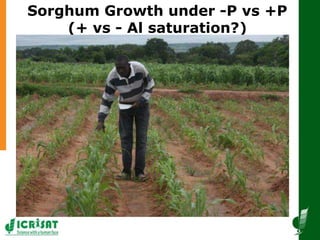
Sorghum Growth under -P vs +P
(+ vs - Al saturation?)
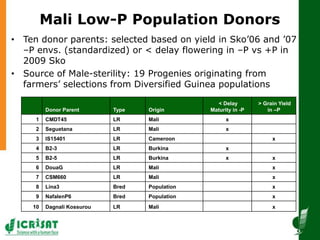
Mali Low-P Population Donors
Donor Parent Type Origin
< Delay
Maturity in -P
> Grain Yield
in –P
1 CMDT45 LR Mali x
2 Seguetana LR Mali x
3 IS15401 LR Cameroon x
4 B2-3 LR Burkina x
5 B2-5 LR Burkina x x
6 DouaG LR Mali x
7 CSM660 LR Mali x
8 Lina3 Bred Population x
9 NafalenP6 Bred Population x
10 Dagnali Kossurou LR Mali x
• Ten donor parents: selected based on yield in Sko’06 and ’07
–P envs. (standardized) or < delay flowering in –P vs +P in
2009 Sko
• Source of Male-sterility: 19 Progenies originating from
farmers’ selections from Diversified Guinea populations
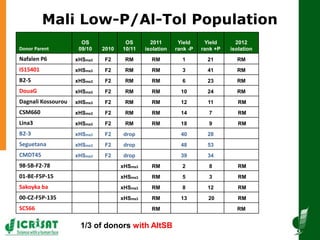
Mali Low-P/Al-Tol Population
Donor Parent
OS
09/10 2010
OS
10/11
2011
isolation
Yield
rank -P
Yield
rank +P
2012
isolation
Nafalen P6 xHSms3 F2 RM RM 1 21 RM
IS15401 xHSms3 F2 RM RM 3 41 RM
B2-5 xHSms3 F2 RM RM 6 23 RM
DouaG xHSms3 F2 RM RM 10 24 RM
Dagnali Kossourou xHSms3 F2 RM RM 12 11 RM
CSM660 xHSms3 F2 RM RM 14 7 RM
Lina3 xHSms3 F2 RM RM 18 9 RM
B2-3 xHSms3 F2 drop 40 28
Seguetana xHSms3 F2 drop 48 53
CMDT45 xHSms3 F2 drop 39 34
98-SB-F2-78 xHSms3 RM 2 8 RM
01-BE-F5P-15 xHSms3 RM 5 3 RM
Sakoyka ba xHSms3 RM 8 12 RM
00-CZ-F5P-135 xHSms3 RM 13 20 RM
SC566 RM RM
1/3 of donors with AltSB
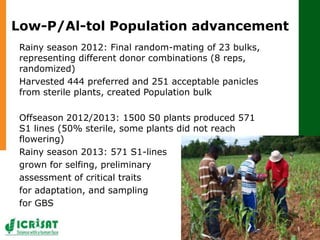
Low-P/Al-tol Population advancement
Rainy season 2012: Final random-mating of 23 bulks,
representing different donor combinations (8 reps,
randomized)
Harvested 444 preferred and 251 acceptable panicles
from sterile plants, created Population bulk
Offseason 2012/2013: 1500 S0 plants produced 571
S1 lines (50% sterile, some plants did not reach
flowering)
Rainy season 2013: 571 S1-lines
grown for selfing, preliminary
assessment of critical traits
for adaptation, and sampling
for GBS
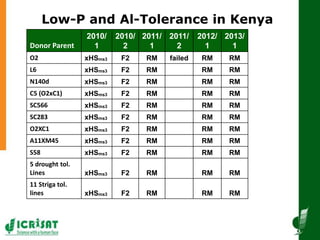
Low-P and Al-Tolerance in Kenya
Donor Parent
2010/
1
2010/
2
2011/
1
2011/
2
2012/
1
2013/
1
O2 xHSms3 F2 RM failed RM RM
L6 xHSms3 F2 RM RM RM
N140d xHSms3 F2 RM RM RM
C5 (O2xC1) xHSms3 F2 RM RM RM
SC566 xHSms3 F2 RM RM RM
SC283 xHSms3 F2 RM RM RM
O2XC1 xHSms3 F2 RM RM RM
A11XM45 xHSms3 F2 RM RM RM
S58 xHSms3 F2 RM RM RM
5 drought tol.
Lines xHSms3 F2 RM RM RM
11 Striga tol.
lines xHSms3 F2 RM RM RM
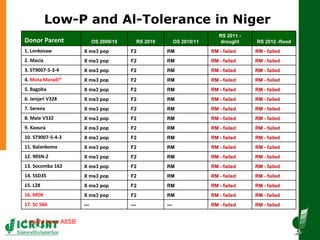
Low-P and Al-Tolerance in Niger
Donor Parent OS 2009/10 RS 2010 OS 2010/11
RS 2011 -
drought RS 2012 -flood
1. Lonkosaw X ms3 pop F2 RM RM - failed RM - failed
2. Macia X ms3 pop F2 RM RM - failed RM - failed
3. ST9007-5-3-4 X ms3 pop F2 RM RM - failed RM - failed
4. Mota Maradi* X ms3 pop F2 RM RM - failed RM - failed
5. Bagoba X ms3 pop F2 RM RM - failed RM - failed
6. Jenjari V328 X ms3 pop F2 RM RM - failed RM - failed
7. Serena X ms3 pop F2 RM RM - failed RM - failed
8. Male V332 X ms3 pop F2 RM RM - failed RM - failed
9. Kaoura X ms3 pop F2 RM RM - failed RM - failed
10. ST9007-5-4-3 X ms3 pop F2 RM RM - failed RM - failed
11. Balankoma X ms3 pop F2 RM RM - failed RM - failed
12. 90SN-2 X ms3 pop F2 RM RM - failed RM - failed
13. Socomba 162 X ms3 pop F2 RM RM - failed RM - failed
14. SSD35 X ms3 pop F2 RM RM - failed RM - failed
15. L28 X ms3 pop F2 RM RM - failed RM - failed
16. MDK X ms3 pop F2 RM RM - failed RM - failed
17. SC 566 --- --- --- RM - failed RM - failed
* might have AltSB
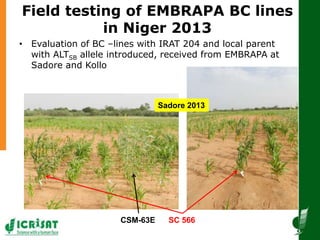
Field testing of EMBRAPA BC lines
in Niger 2013
• Evaluation of BC –lines with IRAT 204 and local parent
with ALTSB allele introduced, received from EMBRAPA at
Sadore and Kollo
Sadore 2013
SC 566CSM-63E
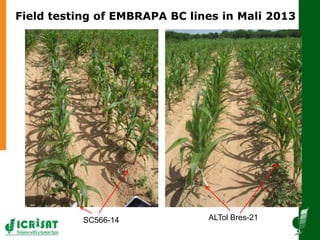
SC566-14 ALTol Bres-21
Field testing of EMBRAPA BC lines in Mali 2013
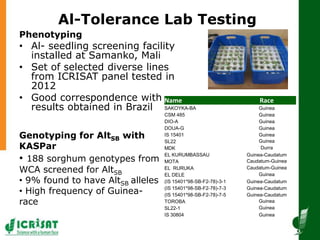
Al-Tolerance Lab Testing
Phenotyping
• Al- seedling screening facility
installed at Samanko, Mali
• Set of selected diverse lines
from ICRISAT panel tested in
2012
• Good correspondence with
results obtained in Brazil
Genotyping for AltSB with
KASPar
• 188 sorghum genotypes from
WCA screened for AltSB
• 9% found to have AltSB alleles
• High frequency of Guinea-
race
Name Race
SAKOYKA-BA Guinea
CSM 485 Guinea
DIO-A Guinea
DOUA-G Guinea
IS 15401 Guinea
SL22 Guinea
MDK Durra
EL KURUMBASSAU Guinea-Caudatum
MOTA Caudatum-Guinea
EL RURUKA Caudatum-Guinea
EL DELE Guinea
(IS 15401*98-SB-F2-78)-3-1 Guinea-Caudatum
(IS 15401*98-SB-F2-78)-7-3 Guinea-Caudatum
(IS 15401*98-SB-F2-78)-7-5 Guinea-Caudatum
TOROBA Guinea
SL22-1 Guinea
IS 30804 Guinea
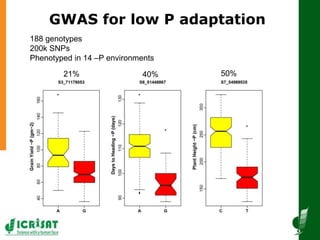
GWAS for low P adaptation
21% 40% 50%
188 genotypes
200k SNPs
Phenotyped in 14 –P environments
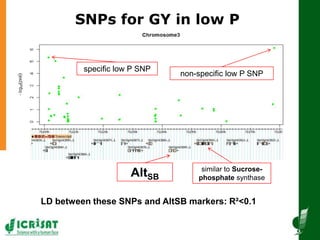
SNPs for GY in low P
similar to Sucrose-
phosphate synthaseAltSB
specific low P SNP
non-specific low P SNP
LD between these SNPs and AltSB markers: R²<0.1
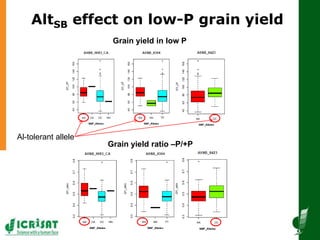
AltSB effect on low-P grain yield
Grain yield in low P
Grain yield ratio –P/+P
Al-tolerant allele
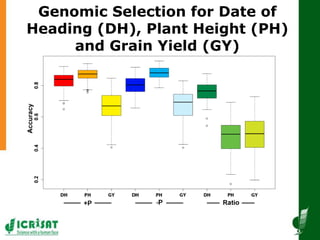
Genomic Selection for Date of
Heading (DH), Plant Height (PH)
and Grain Yield (GY)
Proposed Population Progeny Testing
• 571 S1s derived from lowP and Al-Tol Mali
Population to be genotyped by GBS and
allele specific markers (AltSB and Pup-1)
to:
– Determine Allele freq Altsb and Pup-1
– Conduct genomic selection (best and worst
genotypes) using marker effects from
previous prediction set to validate utility in
independent population
– Conduct selection using AltSB, Pup-1 and the
SNPs identified with GWAS
– Compare effectiveness of different approaches
based on 2014 field phenotyping
Conclusions: Implementing molecular
breeding for LowP/Al_tol
(from Genetic Resource to Farmers’ Field)
• Sorghum RM Populations with diversity for
lowP and AltSB and key traits for varietal
adoption available in Mali and Kenya
• Field phenotyping for LowP established,
successful, but # of sites limited
• EMBRAPA Lab Al_tol screening method
established in Mali
• Molecular approaches for selecting LowP
adaptation showing potential
• Phenotyping and genotyping LowP
Population derived progenies: test molecular
methods (GS & MAS) for applied breeding
for Low-P production conditions
Publications and Acknowledgements
• Leiser W, Rattunde F, Piepho HP,
Parzies H. 2011 Getting the
most out of sorghum low-
input field trials in West-
Africa using spatial
adjustment.
• Leiser, W.L., H.F.W. Rattunde, H.-
P. Piepho, E. Weltzien, A. Diallo,
A.E. Melchinger, H.K. Parzies, and
B.I.G. Haussmann. 2012.
Selection Strategy for
Sorghum Targeting
Phosphorus-limited
Environments in West Africa:
Analysis of Multi-environment
Experiments. Crop Science
52(6): 2517.
• IER: Abdoulaye Diallo,
• IPR: Chiaka Diallo
• INRAN: Soumana Souley
• Moi University: Sam Gudu
• University Hohenheim:
Willmar Leiser, H.-P. Piepho,
• Embrapa: Jurandhir
Magalhaes, R. Schaffert, soil
science
• ICRISAT: F.Rattunde,
E.Weltzien
• Cornell University: Sharon
Mitchell
Funding:
 GCP – ALTFIELD, CG CI
 McKnight Foundation: WA CoP
 BMZ: Abiotic Stress Project

GRM2013: Establishing a molecular breeding program based on the aluminum tolerance gene AltSB and the P efficiency QTL Pup-1, for increasing sorghum production in Sub-Saharan Africa -- F Rattunde

  • 1.
    Establishing a molecularbreeding program based on the aluminum tolerance gene AltSB and the P efficiency QTL Pup-1, for increasing sorghum production in Sub- Saharan Africa GCP GRM 27-30 September, 2013 Fred Rattunde with Willmar Leiser, Bob Schaffert, Jurandhir Magalhaes, Sam Gudu, Soumana Souley, Tom Hash, Eva Weltzien
  • 2.
    Goal and Objectives •Goal: Enhance sorghum resilience and productivity in low-P and high Al saturation environments in Africa • Objectives: – Create random-mating (ms3) source populations with diversity for low-P adaptation and Al tolerance combined with required grain, glume, and plant traits – Apply molecular marker selection tools for Low-P and Al tolerance to effectively derive superior lines from the random-mated populations for the predominant low-input production systems in Sub-Saharan Africa
  • 3.
    Sorghum Growth under-P vs +P (+ vs - Al saturation?)
  • 4.
    Mali Low-P PopulationDonors Donor Parent Type Origin < Delay Maturity in -P > Grain Yield in –P 1 CMDT45 LR Mali x 2 Seguetana LR Mali x 3 IS15401 LR Cameroon x 4 B2-3 LR Burkina x 5 B2-5 LR Burkina x x 6 DouaG LR Mali x 7 CSM660 LR Mali x 8 Lina3 Bred Population x 9 NafalenP6 Bred Population x 10 Dagnali Kossurou LR Mali x • Ten donor parents: selected based on yield in Sko’06 and ’07 –P envs. (standardized) or < delay flowering in –P vs +P in 2009 Sko • Source of Male-sterility: 19 Progenies originating from farmers’ selections from Diversified Guinea populations
  • 5.
    Mali Low-P/Al-Tol Population DonorParent OS 09/10 2010 OS 10/11 2011 isolation Yield rank -P Yield rank +P 2012 isolation Nafalen P6 xHSms3 F2 RM RM 1 21 RM IS15401 xHSms3 F2 RM RM 3 41 RM B2-5 xHSms3 F2 RM RM 6 23 RM DouaG xHSms3 F2 RM RM 10 24 RM Dagnali Kossourou xHSms3 F2 RM RM 12 11 RM CSM660 xHSms3 F2 RM RM 14 7 RM Lina3 xHSms3 F2 RM RM 18 9 RM B2-3 xHSms3 F2 drop 40 28 Seguetana xHSms3 F2 drop 48 53 CMDT45 xHSms3 F2 drop 39 34 98-SB-F2-78 xHSms3 RM 2 8 RM 01-BE-F5P-15 xHSms3 RM 5 3 RM Sakoyka ba xHSms3 RM 8 12 RM 00-CZ-F5P-135 xHSms3 RM 13 20 RM SC566 RM RM 1/3 of donors with AltSB
  • 6.
    Low-P/Al-tol Population advancement Rainyseason 2012: Final random-mating of 23 bulks, representing different donor combinations (8 reps, randomized) Harvested 444 preferred and 251 acceptable panicles from sterile plants, created Population bulk Offseason 2012/2013: 1500 S0 plants produced 571 S1 lines (50% sterile, some plants did not reach flowering) Rainy season 2013: 571 S1-lines grown for selfing, preliminary assessment of critical traits for adaptation, and sampling for GBS
  • 7.
    Low-P and Al-Tolerancein Kenya Donor Parent 2010/ 1 2010/ 2 2011/ 1 2011/ 2 2012/ 1 2013/ 1 O2 xHSms3 F2 RM failed RM RM L6 xHSms3 F2 RM RM RM N140d xHSms3 F2 RM RM RM C5 (O2xC1) xHSms3 F2 RM RM RM SC566 xHSms3 F2 RM RM RM SC283 xHSms3 F2 RM RM RM O2XC1 xHSms3 F2 RM RM RM A11XM45 xHSms3 F2 RM RM RM S58 xHSms3 F2 RM RM RM 5 drought tol. Lines xHSms3 F2 RM RM RM 11 Striga tol. lines xHSms3 F2 RM RM RM
  • 8.
    Low-P and Al-Tolerancein Niger Donor Parent OS 2009/10 RS 2010 OS 2010/11 RS 2011 - drought RS 2012 -flood 1. Lonkosaw X ms3 pop F2 RM RM - failed RM - failed 2. Macia X ms3 pop F2 RM RM - failed RM - failed 3. ST9007-5-3-4 X ms3 pop F2 RM RM - failed RM - failed 4. Mota Maradi* X ms3 pop F2 RM RM - failed RM - failed 5. Bagoba X ms3 pop F2 RM RM - failed RM - failed 6. Jenjari V328 X ms3 pop F2 RM RM - failed RM - failed 7. Serena X ms3 pop F2 RM RM - failed RM - failed 8. Male V332 X ms3 pop F2 RM RM - failed RM - failed 9. Kaoura X ms3 pop F2 RM RM - failed RM - failed 10. ST9007-5-4-3 X ms3 pop F2 RM RM - failed RM - failed 11. Balankoma X ms3 pop F2 RM RM - failed RM - failed 12. 90SN-2 X ms3 pop F2 RM RM - failed RM - failed 13. Socomba 162 X ms3 pop F2 RM RM - failed RM - failed 14. SSD35 X ms3 pop F2 RM RM - failed RM - failed 15. L28 X ms3 pop F2 RM RM - failed RM - failed 16. MDK X ms3 pop F2 RM RM - failed RM - failed 17. SC 566 --- --- --- RM - failed RM - failed * might have AltSB
  • 9.
    Field testing ofEMBRAPA BC lines in Niger 2013 • Evaluation of BC –lines with IRAT 204 and local parent with ALTSB allele introduced, received from EMBRAPA at Sadore and Kollo Sadore 2013 SC 566CSM-63E
  • 10.
    SC566-14 ALTol Bres-21 Fieldtesting of EMBRAPA BC lines in Mali 2013
  • 11.
    Al-Tolerance Lab Testing Phenotyping •Al- seedling screening facility installed at Samanko, Mali • Set of selected diverse lines from ICRISAT panel tested in 2012 • Good correspondence with results obtained in Brazil Genotyping for AltSB with KASPar • 188 sorghum genotypes from WCA screened for AltSB • 9% found to have AltSB alleles • High frequency of Guinea- race Name Race SAKOYKA-BA Guinea CSM 485 Guinea DIO-A Guinea DOUA-G Guinea IS 15401 Guinea SL22 Guinea MDK Durra EL KURUMBASSAU Guinea-Caudatum MOTA Caudatum-Guinea EL RURUKA Caudatum-Guinea EL DELE Guinea (IS 15401*98-SB-F2-78)-3-1 Guinea-Caudatum (IS 15401*98-SB-F2-78)-7-3 Guinea-Caudatum (IS 15401*98-SB-F2-78)-7-5 Guinea-Caudatum TOROBA Guinea SL22-1 Guinea IS 30804 Guinea
  • 12.
    GWAS for lowP adaptation 21% 40% 50% 188 genotypes 200k SNPs Phenotyped in 14 –P environments
  • 13.
    SNPs for GYin low P similar to Sucrose- phosphate synthaseAltSB specific low P SNP non-specific low P SNP LD between these SNPs and AltSB markers: R²<0.1
  • 14.
    AltSB effect onlow-P grain yield Grain yield in low P Grain yield ratio –P/+P Al-tolerant allele
  • 15.
    Genomic Selection forDate of Heading (DH), Plant Height (PH) and Grain Yield (GY)
  • 16.
    Proposed Population ProgenyTesting • 571 S1s derived from lowP and Al-Tol Mali Population to be genotyped by GBS and allele specific markers (AltSB and Pup-1) to: – Determine Allele freq Altsb and Pup-1 – Conduct genomic selection (best and worst genotypes) using marker effects from previous prediction set to validate utility in independent population – Conduct selection using AltSB, Pup-1 and the SNPs identified with GWAS – Compare effectiveness of different approaches based on 2014 field phenotyping
  • 17.
    Conclusions: Implementing molecular breedingfor LowP/Al_tol (from Genetic Resource to Farmers’ Field) • Sorghum RM Populations with diversity for lowP and AltSB and key traits for varietal adoption available in Mali and Kenya • Field phenotyping for LowP established, successful, but # of sites limited • EMBRAPA Lab Al_tol screening method established in Mali • Molecular approaches for selecting LowP adaptation showing potential • Phenotyping and genotyping LowP Population derived progenies: test molecular methods (GS & MAS) for applied breeding for Low-P production conditions
  • 18.
    Publications and Acknowledgements •Leiser W, Rattunde F, Piepho HP, Parzies H. 2011 Getting the most out of sorghum low- input field trials in West- Africa using spatial adjustment. • Leiser, W.L., H.F.W. Rattunde, H.- P. Piepho, E. Weltzien, A. Diallo, A.E. Melchinger, H.K. Parzies, and B.I.G. Haussmann. 2012. Selection Strategy for Sorghum Targeting Phosphorus-limited Environments in West Africa: Analysis of Multi-environment Experiments. Crop Science 52(6): 2517. • IER: Abdoulaye Diallo, • IPR: Chiaka Diallo • INRAN: Soumana Souley • Moi University: Sam Gudu • University Hohenheim: Willmar Leiser, H.-P. Piepho, • Embrapa: Jurandhir Magalhaes, R. Schaffert, soil science • ICRISAT: F.Rattunde, E.Weltzien • Cornell University: Sharon Mitchell Funding:  GCP – ALTFIELD, CG CI  McKnight Foundation: WA CoP  BMZ: Abiotic Stress Project