TISSUES
GIRISH CHANDRA M S
SRI NIRAVAVNASWAMY COLLEGE OF NURSING
KANAKAPURA
DEFINITION
• Tissue may refer to a group of biological
cells that perform a similar way to
function.
•Histology: It is a branch of medical
science which deal with the study of
tissue.
TISSUE
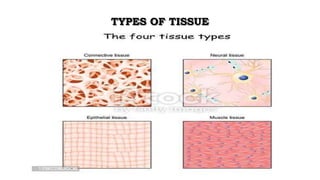
• Tissue is divided/Classified into four groups according to its structure and
function. The tissue is a cluster of cells, these cells work similarly, and their
nature and structure are the same. The tissue is the structure between cells
and organs. All types of body tissue are developed by three primary germ
layers (Ectoderm, Mesoderm, and Endoderm).
1. Epithelial Tissue
2. Connective Tissue
3. Muscle Tissue
4. Nervous tissue
TYPES OF TISSUE
TYPES OF TISSUES
• TYPES OF TISSUE
• 1. Epithelial Tissue –
• Epithelial tissue or epithelium is arranged as a continuous sheet. Less space
between two cells, this tissue is an avascular tissue, but nerve supply is present in
the epithelial tissue, and it’s divided into two types.
• (A) Covering & Lining Epithelial Tissue
• (B) Glandular Epithelial Tissue
• (A) Covering & Lining Epithelial Tissue –
• This type of tissue covering of skin & body cavities also lines the ducts. it again
divided into two types –
I. Simple Epithelium
II. Stratified Epithelium (Multiple Layers)
TYPES OF EPITHELIAL TISSUES
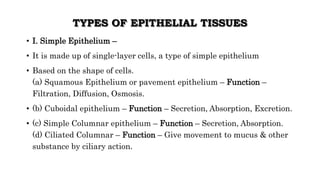
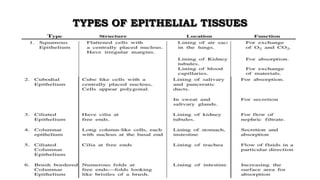
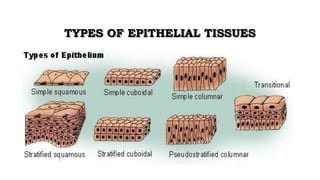
• I. Simple Epithelium –
• It is made up of single-layer cells, a type of simple epithelium
• Based on the shape of cells.
(a) Squamous Epithelium or pavement epithelium – Function –
Filtration, Diffusion, Osmosis.
• (b) Cuboidal epithelium – Function – Secretion, Absorption, Excretion.
• (c) Simple Columnar epithelium – Function – Secretion, Absorption.
(d) Ciliated Columnar – Function – Give movement to mucus & other
substance by ciliary action.
TYPES OF EPITHELIAL TISSUES
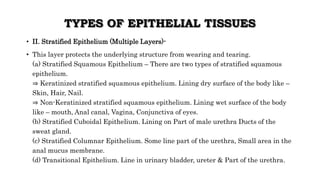
• II. Stratified Epithelium (Multiple Layers)-
• This layer protects the underlying structure from wearing and tearing.
(a) Stratified Squamous Epithelium – There are two types of stratified squamous
epithelium.
⇒ Keratinized stratified squamous epithelium. Lining dry surface of the body like –
Skin, Hair, Nail.
⇒ Non-Keratinized stratified squamous epithelium. Lining wet surface of the body
like – mouth, Anal canal, Vagina, Conjunctiva of eyes.
(b) Stratified Cuboidal Epithelium. Lining on Part of male urethra Ducts of the
sweat gland.
(c) Stratified Columnar Epithelium. Some line part of the urethra, Small area in the
anal mucus membrane.
(d) Transitional Epithelium. Line in urinary bladder, ureter & Part of the urethra.
TYPES OF EPITHELIAL TISSUES
• (B) Glandular Epithelial Tissue –
• This type of tissue produce secretion, situated in
glands made by goblet cells these cells specialize to
produce chemicals. glandular epithelial tissue is
multi-functional epithelial tissue.
TYPES OF EPITHELIAL TISSUES
CONNECTIVE TISSUES & TYPES
• 2. Connective Tissue –
This type of tissue is the largest amount in the body.
Function – Provide Support Strength and connect other
tissue, Protect & insulate internal organs,
Transportation, storage, the main site of immune
reaction.
It consists of two basic elements
I. Cell
II. Matrix
CONNECTIVE TISSUES & TYPES
• I. Cell –
• few connective tissue cells are
• Fibroblast cells
• Adipose cells or Fat cell or Adipocytes
• Mast cells
• Macrophages
• Plasma cells
• WBC
CONNECTIVE TISSUES & TYPES
• II. Matrix –
• Space Between the cells filed by matrix, matrix made by
fibrous and ground substance (The material between cells
and fiber called ground substance Ex. H2O, Hyaluronic
acids.
Fibers – There are three types of fiber found in the matrix
• Collagen fibers
• Elastic fibers
• Reticular Fibers
CONNECTIVE TISSUES & TYPES
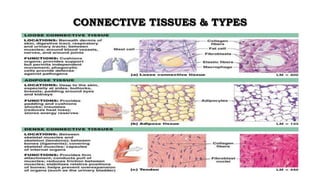
• Classification of connective tissue
• (a) Lose Connective tissue
• Areolar Connective tissue
• Adipose connective tissue
• Reticular connective tissue
• (b) Dense connective tissue
• The dense Regular connective tissue
• Dense irregular connective tissue
• Elastic connective tissue
CONNECTIVE TISSUES & TYPES
• (c) Cartilage connective tissue
• Hyaline cartilage connective tissue
• Fibrocartilage connective tissue
• Elastic cartilage connective tissue
• (d) Bone
(e) Blood
(f) Lymph
CONNECTIVE TISSUES & TYPES
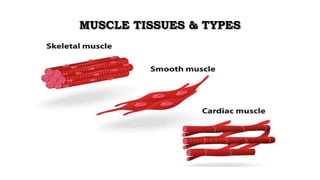
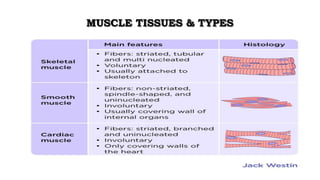
MUSCLE TISSUES & TYPES
• 3. Muscle Tissue –
• Muscle tissue is made up of elongated cells called muscle
fiber. In this tissue heaving contraction & relaxation
property then muscle tissue provides body movement. Types
of muscle tissue – Based on location, structure & function is
classified into three categories –
(a) Skeleton muscle tissue
(b) Smooth muscles
(c) Cardiac muscles tissue
MUSCLE TISSUES & TYPES
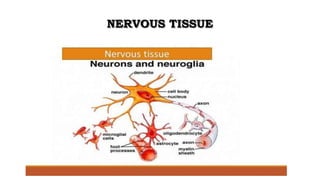
NERVOUS TISSUE
• Nervous or the nerve tissue is the main tissue of our
nervous system. It monitors and regulates the
functions of the body. Nervous tissue consists of two
cells: nerve cells or neurons and glial cells, which
helps transmit nerve impulses and also provides
nutrients to neurons. Brain, Spinal Cord, and nerves
are composed of nervous tissue, they are specialized
for being stimulated to transmit stimulus from one
to another part of the body rapidly.
FUNCTION OF NERVOUS TISSUE
• Neurons generate and carry out nerve impulses. They
produce electrical signals that are transmitted across
distances, they do so by secreting chemical
neurotransmitters.
• Responds to stimuli
• Carries out communication and integration
• Provides electrical insulations to nerve cells and removes
debris
• Carries messages from other neurons to the cell body
NERVOUS TISSUE
GLANDS
• Glands are important organs located
throughout the body. They produce and release
substances that perform certain functions.
Though you have many glands throughout
your body, they fall into two types: endocrine
and exocrine.
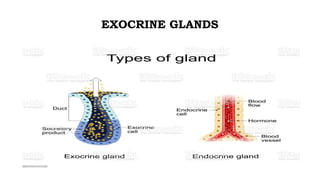
TYPES OF GLANDS
•Endocrine glands
•Exocrine glands.
EXOCRINE GLANDS
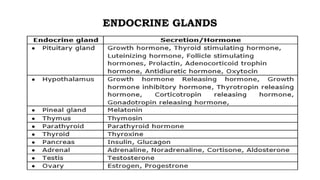
ENDOCRINE GLANDS
• Endocrine glands are part of your endocrine system.
They make hormones and release them into your
bloodstream. These hormones control a number of
important functions in your body, such as:
• growth and development
• metabolism
• mood
• reproduction
ENDOCRINE GLANDS
• Your endocrine glands include:
• adrenal glands
• pituitary gland
• hypothalamus
• thyroid
• pineal gland
• There are also organs that contain endocrine tissue and act as glands. These include the:
• pancreas
• kidneys
• ovaries
• testes
ENDOCRINE GLANDS
EXOCRINE GLANDS
• Exocrine glands
• Exocrine glands produce other substances — not hormones
— that are released through ducts to the exterior of the
body, such as sweat, saliva, and tears.
• The substances released by your exocrine glands play
important roles in your body. They do things like help
regulate your body temperature, protect your skin and eyes,
and even help mothers feed babies by producing breast
milk.
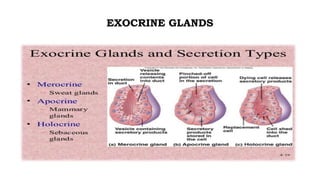
EXOCRINE GLANDS
• Exocrine glands include:
• salivary
• sweat
• mammary
• sebaceous
• lacrimal
• Lymph nodes are often referred to as glands, but they’re not true glands. They’re
part of your immune system and help your body fight infection.
EXOCRINE GLANDS
ASSIGNMENT
• CELL & STRUCTURE
• FUNCTIONS OF CELL
• EPITHELIUM TISSUE
• CONNECTIVE TISSUE
• SKELETAL MUSCLE
• CARDIAC MUSCLE
• ENDOCRINE GLANDS WITH ELUCIDATION OF
HORMONES

TISSUES.pptx

  • 1.
    TISSUES GIRISH CHANDRA MS SRI NIRAVAVNASWAMY COLLEGE OF NURSING KANAKAPURA
  • 2.
    DEFINITION • Tissue mayrefer to a group of biological cells that perform a similar way to function. •Histology: It is a branch of medical science which deal with the study of tissue.
  • 3.
    TISSUE • Tissue isdivided/Classified into four groups according to its structure and function. The tissue is a cluster of cells, these cells work similarly, and their nature and structure are the same. The tissue is the structure between cells and organs. All types of body tissue are developed by three primary germ layers (Ectoderm, Mesoderm, and Endoderm). 1. Epithelial Tissue 2. Connective Tissue 3. Muscle Tissue 4. Nervous tissue
  • 4.
  • 5.
    TYPES OF TISSUES •TYPES OF TISSUE • 1. Epithelial Tissue – • Epithelial tissue or epithelium is arranged as a continuous sheet. Less space between two cells, this tissue is an avascular tissue, but nerve supply is present in the epithelial tissue, and it’s divided into two types. • (A) Covering & Lining Epithelial Tissue • (B) Glandular Epithelial Tissue • (A) Covering & Lining Epithelial Tissue – • This type of tissue covering of skin & body cavities also lines the ducts. it again divided into two types – I. Simple Epithelium II. Stratified Epithelium (Multiple Layers)
  • 6.
    TYPES OF EPITHELIALTISSUES • I. Simple Epithelium – • It is made up of single-layer cells, a type of simple epithelium • Based on the shape of cells. (a) Squamous Epithelium or pavement epithelium – Function – Filtration, Diffusion, Osmosis. • (b) Cuboidal epithelium – Function – Secretion, Absorption, Excretion. • (c) Simple Columnar epithelium – Function – Secretion, Absorption. (d) Ciliated Columnar – Function – Give movement to mucus & other substance by ciliary action.
  • 7.
    TYPES OF EPITHELIALTISSUES • II. Stratified Epithelium (Multiple Layers)- • This layer protects the underlying structure from wearing and tearing. (a) Stratified Squamous Epithelium – There are two types of stratified squamous epithelium. ⇒ Keratinized stratified squamous epithelium. Lining dry surface of the body like – Skin, Hair, Nail. ⇒ Non-Keratinized stratified squamous epithelium. Lining wet surface of the body like – mouth, Anal canal, Vagina, Conjunctiva of eyes. (b) Stratified Cuboidal Epithelium. Lining on Part of male urethra Ducts of the sweat gland. (c) Stratified Columnar Epithelium. Some line part of the urethra, Small area in the anal mucus membrane. (d) Transitional Epithelium. Line in urinary bladder, ureter & Part of the urethra.
  • 8.
    TYPES OF EPITHELIALTISSUES • (B) Glandular Epithelial Tissue – • This type of tissue produce secretion, situated in glands made by goblet cells these cells specialize to produce chemicals. glandular epithelial tissue is multi-functional epithelial tissue.
  • 9.
  • 10.
  • 11.
    CONNECTIVE TISSUES &TYPES • 2. Connective Tissue – This type of tissue is the largest amount in the body. Function – Provide Support Strength and connect other tissue, Protect & insulate internal organs, Transportation, storage, the main site of immune reaction. It consists of two basic elements I. Cell II. Matrix
  • 12.
    CONNECTIVE TISSUES &TYPES • I. Cell – • few connective tissue cells are • Fibroblast cells • Adipose cells or Fat cell or Adipocytes • Mast cells • Macrophages • Plasma cells • WBC
  • 13.
    CONNECTIVE TISSUES &TYPES • II. Matrix – • Space Between the cells filed by matrix, matrix made by fibrous and ground substance (The material between cells and fiber called ground substance Ex. H2O, Hyaluronic acids. Fibers – There are three types of fiber found in the matrix • Collagen fibers • Elastic fibers • Reticular Fibers
  • 14.
    CONNECTIVE TISSUES &TYPES • Classification of connective tissue • (a) Lose Connective tissue • Areolar Connective tissue • Adipose connective tissue • Reticular connective tissue • (b) Dense connective tissue • The dense Regular connective tissue • Dense irregular connective tissue • Elastic connective tissue
  • 15.
    CONNECTIVE TISSUES &TYPES • (c) Cartilage connective tissue • Hyaline cartilage connective tissue • Fibrocartilage connective tissue • Elastic cartilage connective tissue • (d) Bone (e) Blood (f) Lymph
  • 16.
  • 17.
    MUSCLE TISSUES &TYPES • 3. Muscle Tissue – • Muscle tissue is made up of elongated cells called muscle fiber. In this tissue heaving contraction & relaxation property then muscle tissue provides body movement. Types of muscle tissue – Based on location, structure & function is classified into three categories – (a) Skeleton muscle tissue (b) Smooth muscles (c) Cardiac muscles tissue
  • 18.
  • 19.
  • 20.
    NERVOUS TISSUE • Nervousor the nerve tissue is the main tissue of our nervous system. It monitors and regulates the functions of the body. Nervous tissue consists of two cells: nerve cells or neurons and glial cells, which helps transmit nerve impulses and also provides nutrients to neurons. Brain, Spinal Cord, and nerves are composed of nervous tissue, they are specialized for being stimulated to transmit stimulus from one to another part of the body rapidly.
  • 21.
    FUNCTION OF NERVOUSTISSUE • Neurons generate and carry out nerve impulses. They produce electrical signals that are transmitted across distances, they do so by secreting chemical neurotransmitters. • Responds to stimuli • Carries out communication and integration • Provides electrical insulations to nerve cells and removes debris • Carries messages from other neurons to the cell body
  • 22.
  • 23.
    GLANDS • Glands areimportant organs located throughout the body. They produce and release substances that perform certain functions. Though you have many glands throughout your body, they fall into two types: endocrine and exocrine.
  • 24.
    TYPES OF GLANDS •Endocrineglands •Exocrine glands.
  • 25.
  • 26.
    ENDOCRINE GLANDS • Endocrineglands are part of your endocrine system. They make hormones and release them into your bloodstream. These hormones control a number of important functions in your body, such as: • growth and development • metabolism • mood • reproduction
  • 27.
    ENDOCRINE GLANDS • Yourendocrine glands include: • adrenal glands • pituitary gland • hypothalamus • thyroid • pineal gland • There are also organs that contain endocrine tissue and act as glands. These include the: • pancreas • kidneys • ovaries • testes
  • 28.
  • 29.
    EXOCRINE GLANDS • Exocrineglands • Exocrine glands produce other substances — not hormones — that are released through ducts to the exterior of the body, such as sweat, saliva, and tears. • The substances released by your exocrine glands play important roles in your body. They do things like help regulate your body temperature, protect your skin and eyes, and even help mothers feed babies by producing breast milk.
  • 30.
    EXOCRINE GLANDS • Exocrineglands include: • salivary • sweat • mammary • sebaceous • lacrimal • Lymph nodes are often referred to as glands, but they’re not true glands. They’re part of your immune system and help your body fight infection.
  • 31.
  • 32.
    ASSIGNMENT • CELL &STRUCTURE • FUNCTIONS OF CELL • EPITHELIUM TISSUE • CONNECTIVE TISSUE • SKELETAL MUSCLE • CARDIAC MUSCLE • ENDOCRINE GLANDS WITH ELUCIDATION OF HORMONES