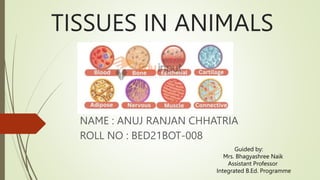
TISSUES IN ANIMALS
NAME : ANUJ RANJAN CHHATRIA
ROLL NO : BED21BOT-008
Guided by:
Mrs. Bhagyashree Naik
Assistant Professor
Integrated B.Ed. Programme
ANIMAL TISSUE :
Cells, specialized in one function are often grouped
together.
The group of cells, which are similar in structure and
work together to achieve a particular function
animals forms animal tissue.
 These tissues performs functions like protection,
storage, movement, and coordination.
Types of Animal Tissues :
EPITHELIAL TISSUE
CONNECTIVE TISSUE
MUSCULAR TISSUE
NERVOUS TISSUE
EPITHELIAL TISSUE
The covering or protective tissues in the animal body.
Epithelium covers most of the organs & cavities
within the body.
The skin, lining of mouth & blood vessels, kidney
tubules covered with epithelial tissues.
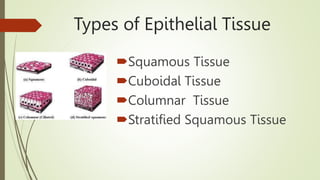
Types of Epithelial Tissue
Squamous Tissue
Cuboidal Tissue
Columnar Tissue
Stratified Squamous Tissue
CONNECTIVE TISSUE
These tissues contribute to numerous body
functions, like supports organs, transports nutrients,
defends against pathogen, stores fat, repaired
damaged cells.
They are able to reproduce but not rapidly as
epithelial cells.
Types of Connective Tissue
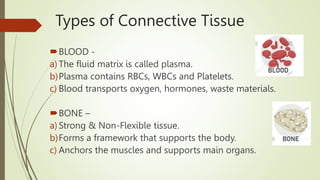
BLOOD -
a) The fluid matrix is called plasma.
b)Plasma contains RBCs, WBCs and Platelets.
c) Blood transports oxygen, hormones, waste materials.
BONE –
a) Strong & Non-Flexible tissue.
b)Forms a framework that supports the body.
c) Anchors the muscles and supports main organs.
Types Of Connective Tissue
LIGAMENT-
a) connects two bones together
b)is elastic and has considerable strength
TENDON-
a) connects muscles to bones
b) has great strength but limited flexibility
CARTILAGE-
a) smoothens bone surfaces at joints
b)Present in nose, ears, trachea, etc.
MUSCULAR TISSUE
Responsible for movement in our body.
Cells have special ability to contract and relax
to produce movements.
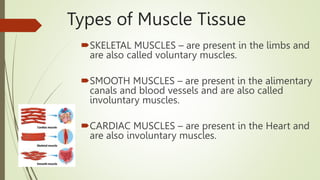
Types of Muscle Tissue
SKELETAL MUSCLES – are present in the limbs and
are also called voluntary muscles.
SMOOTH MUSCLES – are present in the alimentary
canals and blood vessels and are also called
involuntary muscles.
CARDIAC MUSCLES – are present in the Heart and
are also involuntary muscles.
NERVOUS TISSUE
 cells are called nerve cells or neurons.
are highly specialized for being stimulated
and then transmitting the stimulus
Brain, Spinal cord, Nerves contain nerve
tissues
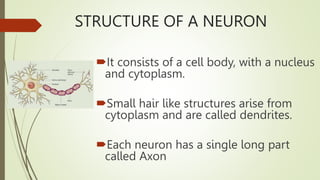
STRUCTURE OF A NEURON
It consists of a cell body, with a nucleus
and cytoplasm.
Small hair like structures arise from
cytoplasm and are called dendrites.
Each neuron has a single long part
called Axon
References:
 https://byjus.com/
 https://ncert.nic.in/textbook.php
 https://www.google.com
 https://en.wikipedia.org/wiki

TISSUES IN ANIMALS botany project ug.pptx

  • 1.
    TISSUES IN ANIMALS NAME: ANUJ RANJAN CHHATRIA ROLL NO : BED21BOT-008 Guided by: Mrs. Bhagyashree Naik Assistant Professor Integrated B.Ed. Programme
  • 2.
    ANIMAL TISSUE : Cells,specialized in one function are often grouped together. The group of cells, which are similar in structure and work together to achieve a particular function animals forms animal tissue.  These tissues performs functions like protection, storage, movement, and coordination.
  • 3.
    Types of AnimalTissues : EPITHELIAL TISSUE CONNECTIVE TISSUE MUSCULAR TISSUE NERVOUS TISSUE
  • 4.
    EPITHELIAL TISSUE The coveringor protective tissues in the animal body. Epithelium covers most of the organs & cavities within the body. The skin, lining of mouth & blood vessels, kidney tubules covered with epithelial tissues.
  • 5.
    Types of EpithelialTissue Squamous Tissue Cuboidal Tissue Columnar Tissue Stratified Squamous Tissue
  • 6.
    CONNECTIVE TISSUE These tissuescontribute to numerous body functions, like supports organs, transports nutrients, defends against pathogen, stores fat, repaired damaged cells. They are able to reproduce but not rapidly as epithelial cells.
  • 7.
    Types of ConnectiveTissue BLOOD - a) The fluid matrix is called plasma. b)Plasma contains RBCs, WBCs and Platelets. c) Blood transports oxygen, hormones, waste materials. BONE – a) Strong & Non-Flexible tissue. b)Forms a framework that supports the body. c) Anchors the muscles and supports main organs.
  • 8.
    Types Of ConnectiveTissue LIGAMENT- a) connects two bones together b)is elastic and has considerable strength TENDON- a) connects muscles to bones b) has great strength but limited flexibility CARTILAGE- a) smoothens bone surfaces at joints b)Present in nose, ears, trachea, etc.
  • 9.
    MUSCULAR TISSUE Responsible formovement in our body. Cells have special ability to contract and relax to produce movements.
  • 10.
    Types of MuscleTissue SKELETAL MUSCLES – are present in the limbs and are also called voluntary muscles. SMOOTH MUSCLES – are present in the alimentary canals and blood vessels and are also called involuntary muscles. CARDIAC MUSCLES – are present in the Heart and are also involuntary muscles.
  • 11.
    NERVOUS TISSUE  cellsare called nerve cells or neurons. are highly specialized for being stimulated and then transmitting the stimulus Brain, Spinal cord, Nerves contain nerve tissues
  • 12.
    STRUCTURE OF ANEURON It consists of a cell body, with a nucleus and cytoplasm. Small hair like structures arise from cytoplasm and are called dendrites. Each neuron has a single long part called Axon
  • 13.
    References:  https://byjus.com/  https://ncert.nic.in/textbook.php https://www.google.com  https://en.wikipedia.org/wiki