ANIMAL
TISSUES AND
IT'S TYPES
CLASS 9th
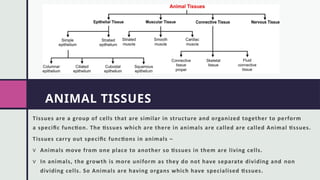
ANIMAL TISSUES
Tissues are a group of cells that are similar in structure and organized together to perform
a specific function. The tissues which are there in animals are called are called Animal tissues.
Tissues carry out specific functions in animals –
v Animals move from one place to another so tissues in them are living cells.
v In animals, the growth is more uniform as they do not have separate dividing and non
dividing cells. So Animals are having organs which have specialised tissues.
EPITHILIAL TISSUE
Epithelial tissue is formed by cells which cover the external parts of the
body organs and the lines on organ surfaces such as the surface of the
skin, the reproductive tract, the airways, and the inner lining of the
digestive tract.
Epithelial tissues are involved in secreting hormones, enzymes, mucus
and other products from ducts and transporting it to the circulatory
system.
TYPES OF EPITHILIAL TISSUE
Structure Location Function
Simple
squamous
A single layer of flat cells having
irregular boundaries
Blood vessel lining, air
sac lining of lungs
Transport by diffusion and where
minimal protection is required
Simple
Cuboidal
A single layer of short cylindrical cells.
It may have microvilli as in proximal
convoluted tubules
The tubular lining of
kidneys, glandular ducts
Absorption and secretion
Simple
Columnar
A single layer of columnar cells (tall
and slender) and often ciliated
Digestive tract and
upper respiratory tract
lining
Protection, absorption, mucus
secretion and movement in a
specific direction
Stratified
Squamous
Made up of several layers of cells,
continuously sloughed off and
regenerated. The older layer of cells is
pushed upwards and becomes flat. The
lower layer is columnar and
The lining of the mouth
and vagina
Protection
MUSCULAR
TISSUE
They consists of elongated
cells called muscle fibers.
This tissue helps in
movement of our body.
They are of three types –
• VOLUNTARY MUSCLES
• INVOLUNTARY MUSCLES
• CARDIAC MUSCLES
Characteristics Voluntary Muscles​
(Striated or
Skeletal muscles)​
Involuntary
Muscles
(Unstriated or
Smooth muscles)​
Cardiac Muscles ​
Structure​ The cells of this
tissue are long,
cylindrical,
unbranched
and multinucleated.
The cells of this
tissue are long,
spindle shaped
and uninucleate. ​
The cells of this
tissue are long,
cylindrical,
branched
and uninucleate.​
Location​ They are present in
limbs and are mostly
also attached to
bones.​
They are present in
Iris of eye, in ureter
and in the bronchi
of lungs.​
They are present
in the heart of a
human or
an animal body.​
Function​ They help in
movement of the
body parts which
are under our
control.​
They help in
movement of food
in alimentary canal
and in contraction
and relaxation
of blood vessels. ​
They help in
rhythmic
contraction
and relaxation of
heart muscles.​
CONNECTIVE TISSUES
• Connective Tissue supports, protects, and
gives structure to the body. It is made up
of cells, fibres, and a gel-like substance.
• Types of connective tissue Include Blood,
Bone, Cartilage, Tendon, Ligament,
Adipose And Areolar Tissue
TYPES OF CONNECTIVE TISSUES
1. Blood has a fluid (liquid) matrix called plasma, in which red blood
corpuscles (RBCs), white blood corpuscles (WBCs) and platelets
2. Bone is another example of a connective tissue. It forms the
framework that supports the body. It also anchors the muscles
and supports the main organs of the body. It is a strong and
nonflexible tissue
3. Ligament. This tissue is very elastic. It has considerable strength.
Ligaments contain very little matrix and connect bones with bones.
4. Tendons connect muscles to bones and are another type of
connective tissue. Tendons are fibrous tissue with great strength
but limited flexibility.
5. Cartilage, has widely spaced cells. The solid matrix is composed of
proteins and sugars. Cartilage smoothens bone surfaces at
joints and is also present in the nose, ear, trachea and larynx.
INFORMATION ABOUT NERVOUS
TISSUES
Nervous tissue is found in the brain, spinal cord,
and nerves. It is responsible for coordinating and
controlling many body activities. The cells
in nervous tissue that generate and conduct impulses
are called neurons or nerve cells. These cells have
three principal parts: the dendrites, the cell body, and
one axon.
TYPES OF NERVOUS TISSUES
• Neurons
Neurons are highly specialized nerve cells that generate and conduct nerve
impulses. A typical neuron consists of dendrites, the cell body, and an axon.
• Dendrites
Dendrites are responsible for responding to stimuli; they receive incoming
signals towards the cell body. The axons are responsible for transmitting
impulses over long distances from cell body. The cell body is like a factory for
the neuron. It produces all the proteins and contains specialized organelles such
as nucleus, granules.
THANK YOU

Animal Tissues.pptx @@@@@@@@@@@@@@@#####

  • 1.
  • 2.
    ANIMAL TISSUES Tissues area group of cells that are similar in structure and organized together to perform a specific function. The tissues which are there in animals are called are called Animal tissues. Tissues carry out specific functions in animals – v Animals move from one place to another so tissues in them are living cells. v In animals, the growth is more uniform as they do not have separate dividing and non dividing cells. So Animals are having organs which have specialised tissues.
  • 3.
    EPITHILIAL TISSUE Epithelial tissueis formed by cells which cover the external parts of the body organs and the lines on organ surfaces such as the surface of the skin, the reproductive tract, the airways, and the inner lining of the digestive tract. Epithelial tissues are involved in secreting hormones, enzymes, mucus and other products from ducts and transporting it to the circulatory system.
  • 4.
    TYPES OF EPITHILIALTISSUE Structure Location Function Simple squamous A single layer of flat cells having irregular boundaries Blood vessel lining, air sac lining of lungs Transport by diffusion and where minimal protection is required Simple Cuboidal A single layer of short cylindrical cells. It may have microvilli as in proximal convoluted tubules The tubular lining of kidneys, glandular ducts Absorption and secretion Simple Columnar A single layer of columnar cells (tall and slender) and often ciliated Digestive tract and upper respiratory tract lining Protection, absorption, mucus secretion and movement in a specific direction Stratified Squamous Made up of several layers of cells, continuously sloughed off and regenerated. The older layer of cells is pushed upwards and becomes flat. The lower layer is columnar and The lining of the mouth and vagina Protection
  • 5.
    MUSCULAR TISSUE They consists ofelongated cells called muscle fibers. This tissue helps in movement of our body. They are of three types – • VOLUNTARY MUSCLES • INVOLUNTARY MUSCLES • CARDIAC MUSCLES Characteristics Voluntary Muscles​ (Striated or Skeletal muscles)​ Involuntary Muscles (Unstriated or Smooth muscles)​ Cardiac Muscles ​ Structure​ The cells of this tissue are long, cylindrical, unbranched and multinucleated. The cells of this tissue are long, spindle shaped and uninucleate. ​ The cells of this tissue are long, cylindrical, branched and uninucleate.​ Location​ They are present in limbs and are mostly also attached to bones.​ They are present in Iris of eye, in ureter and in the bronchi of lungs.​ They are present in the heart of a human or an animal body.​ Function​ They help in movement of the body parts which are under our control.​ They help in movement of food in alimentary canal and in contraction and relaxation of blood vessels. ​ They help in rhythmic contraction and relaxation of heart muscles.​
  • 7.
    CONNECTIVE TISSUES • ConnectiveTissue supports, protects, and gives structure to the body. It is made up of cells, fibres, and a gel-like substance. • Types of connective tissue Include Blood, Bone, Cartilage, Tendon, Ligament, Adipose And Areolar Tissue
  • 8.
    TYPES OF CONNECTIVETISSUES 1. Blood has a fluid (liquid) matrix called plasma, in which red blood corpuscles (RBCs), white blood corpuscles (WBCs) and platelets 2. Bone is another example of a connective tissue. It forms the framework that supports the body. It also anchors the muscles and supports the main organs of the body. It is a strong and nonflexible tissue 3. Ligament. This tissue is very elastic. It has considerable strength. Ligaments contain very little matrix and connect bones with bones. 4. Tendons connect muscles to bones and are another type of connective tissue. Tendons are fibrous tissue with great strength but limited flexibility. 5. Cartilage, has widely spaced cells. The solid matrix is composed of proteins and sugars. Cartilage smoothens bone surfaces at joints and is also present in the nose, ear, trachea and larynx.
  • 9.
    INFORMATION ABOUT NERVOUS TISSUES Nervoustissue is found in the brain, spinal cord, and nerves. It is responsible for coordinating and controlling many body activities. The cells in nervous tissue that generate and conduct impulses are called neurons or nerve cells. These cells have three principal parts: the dendrites, the cell body, and one axon.
  • 10.
    TYPES OF NERVOUSTISSUES • Neurons Neurons are highly specialized nerve cells that generate and conduct nerve impulses. A typical neuron consists of dendrites, the cell body, and an axon. • Dendrites Dendrites are responsible for responding to stimuli; they receive incoming signals towards the cell body. The axons are responsible for transmitting impulses over long distances from cell body. The cell body is like a factory for the neuron. It produces all the proteins and contains specialized organelles such as nucleus, granules.
  • 12.