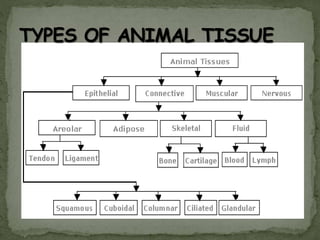
TISSUES
A group or collection of similar cells
performing or help to perform same
function and arise from the same origin
are called tissues.
The tissues are of different types depending
on the functions of the organism, they are
mainly of two categories PLANT TISSUES
and ANIMAL TISSUES.
Plants perform functions which are different
from animals and also their structure is
different , hence they have tissues which are
different from animals. They are further
classified into many sub categories which is
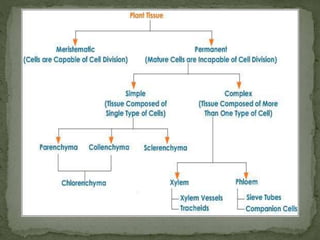
shown in the table below:
The main characteristic of this
tissue is that it is responsible for
the growth of plants.
The cells of this tissue continuously
divide and later differentiate ( i.e.
get converted ) into permanent
tissue.
The cells are made of thin & elastic cell wall
made of cellulose.
The cells may be round , oval, polygonal or
rectangular in shape.
They are compact, having no intercellular space.
There is a large nucleus and abundant cytoplasm.
The protoplasm contains very few or no vacuoles
at all.
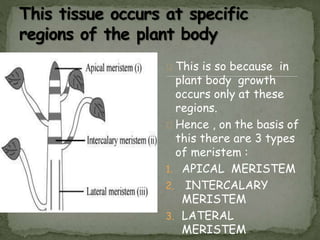
This is so because in
plant body growth
occurs only at these
regions.
Hence , on the basis of
this there are 3 types
of meristem :
1. APICAL MERISTEM
2. INTERCALARY
MERISTEM
3. LATERAL
MERISTEM
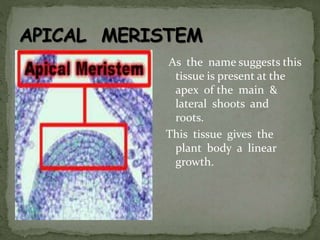
As the name suggests this
tissue is present at the
apex of the main &
lateral shoots and
roots.
This tissue gives the
plant body a linear
growth.
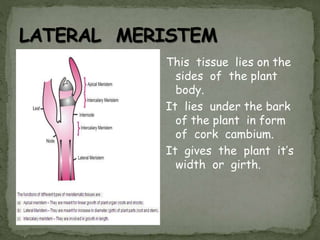
This tissue lies on the
sides of the plant
body.
It lies under the bark
of the plant in form
of cork cambium.
It gives the plant it’s
width or girth.
This tissue is present at the base of the
nodes, internodes, leaves etc.
They are also present in between the
permanent tissue.
They give the plant growth in length.
These tissues arise from the meristematic
tissue.
The cells of this tissue gradually loose their
power to divide and acquire a definite shape,
size and function.
These tissues may be living or dead.
There are 2 types of permanent tissues
1. Simple permanent tissue
2. Complex permanent tissue.
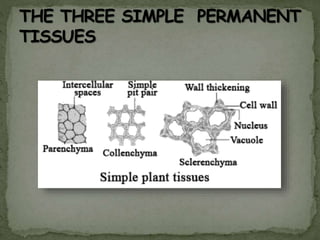
This tissue comprises of same type of cells which
perform the same function and all arise from the
same origin. There are three categories of simple
permanent tissues: Parenchyma, Collenchyma, &
Sclerenchyma.
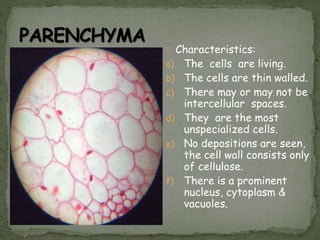
Characteristics:
a) The cells are living.
b) The cells are thin walled.
c) There may or may not be
intercellular spaces.
d) They are the most
unspecialized cells.
e) No depositions are seen,
the cell wall consists only
of cellulose.
f) There is a prominent
nucleus, cytoplasm &
vacuoles.
There are some special types of parenchyma
tissues :
Storage parenchyma : The cells enlarge to store
nutrients & water.
Aerenchyma : Air cavities are present in the
parenchyma tissue to provide buoyancy to the
aquatic plants.
Chlorenchyma : These parenchyma cells have
presence of chlorophyll & hence can perform the
function of photosynthesis.
Parenchyma tissue is found generally in all parts of
the plant body. It forms the Ground tissue in
leaves, stem, roots & fruits etc.
a) To store materials such as starch, proteins,
hormones etc and waste products such as gum,
tannin, resin etc.
b) Parenchyma cells perform the metabolic
activities of the plant.
c) Forms the packaging tissue between the
specialized tissue.
d) By providing turgidity , they provide mechanical
strength.
e) Chlorenchyma helps in performing
photosynthesis.
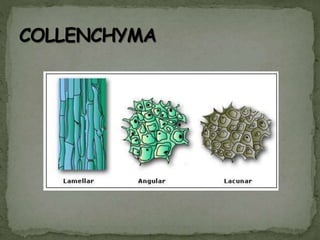
Characteristics:
a) It has cells which are
somewhat elongated.
b) The cell walls are thin
except at the angular
region ( where the cells
join). The thickenings
are caused due to
deposition of cellulose
or pectin.
c) There is o or less
intercellular space.
d) The cells are living, have
distinct nucleus &
dense protoplasm.
e) They often contain
chlorophyll.
Functions :
a) Providing mechanical
strength is the
primary function.
b) Provide flexibility.
c) Photosynthesis, as
they contain
chlorophyll.
They are present below
the epidermis in dicot
stems and leaves.
They absent in dicot
roots and all parts
of monocot plants.
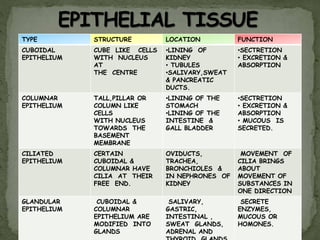
TYPE STRUCTURE LOCATION FUNCTION
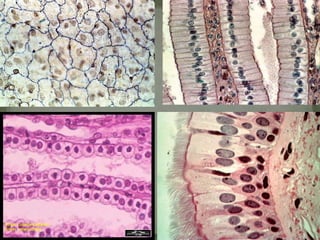
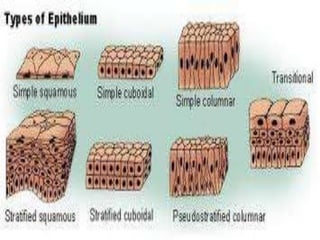
CUBOIDAL
EPITHELIUM
CUBE LIKE CELLS
WITH NUCLEUS
AT
THE CENTRE
•LINING OF
KIDNEY
• TUBULES
•SALIVARY,SWEAT
& PANCREATIC
DUCTS.
•SECTRETION
• EXCRETION &
ABSORPTION
COLUMNAR
EPITHELIUM
TALL,PILLAR OR
COLUMN LIKE
CELLS
WITH NUCLEUS
TOWARDS THE
BASEMENT
MEMBRANE
•LINING OF THE
STOMACH
•LINING OF THE
INTESTINE &
GALL BLADDER
•SECTRETION
• EXCRETION &
ABSORPTION
• MUCOUS IS
SECRETED.
CILIATED
EPITHELIUM
CERTAIN
CUBOIDAL &
COLUMNAR HAVE
CILIA AT THEIR
FREE END.
OVIDUCTS,
TRACHEA,
BRONCHIOLES &
IN NEPHRONES OF
KIDNEY
MOVEMENT OF
CILIA BRINGS
ABOUT
MOVEMENT OF
SUBSTANCES IN
ONE DIRECTION
GLANDULAR
EPITHELIUM
CUBOIDAL &
COLUMNAR
EPITHELIUM ARE
MODIFIED INTO
GLANDS
SALIVARY,
GASTRIC,
INTESTINAL ,
SWEAT GLANDS,
ADRENAL AND
SECRETE
ENZYMES,
MUCOUS OR
HOMONES.
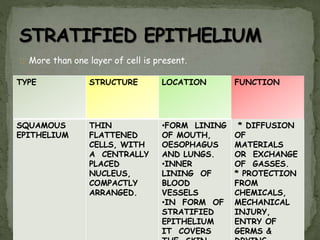
More than one layer of cell is present.
TYPE STRUCTURE LOCATION FUNCTION
SQUAMOUS
EPITHELIUM
THIN
FLATTENED
CELLS, WITH
A CENTRALLY
PLACED
NUCLEUS,
COMPACTLY
ARRANGED.
•FORM LINING
OF MOUTH,
OESOPHAGUS
AND LUNGS.
•INNER
LINING OF
BLOOD
VESSELS
•IN FORM OF
STRATIFIED
EPITHELIUM
IT COVERS
* DIFFUSION
OF
MATERIALS
OR EXCHANGE
OF GASSES.
* PROTECTION
FROM
CHEMICALS,
MECHANICAL
INJURY,
ENTRY OF
GERMS &
They have the basic characteristics as :
Cells, which are loosely packed, fibres which are
scattered in between the cells and matrix which is
the ground tissue.
It may be jelly like fluid, dense and/ or rigid.
They are located widely throughout the body,
present between different tissues and organs.
They mainly function in binding , packaging &
other functions as storing fats, transporting
substances etc.
Our body contains two liquid connective tissues:
1) blood
2) lymph
Blood is the major liquid connective tissue. It’s
constituents are divided into two types
Liquid : plasma
Solid : corpuscles [ cells]
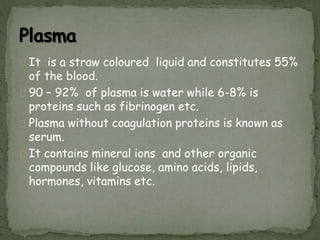
It is a straw coloured liquid and constitutes 55%
of the blood.
90 – 92% of plasma is water while 6-8% is
proteins such as fibrinogen etc.
Plasma without coagulation proteins is known as
serum.
It contains mineral ions and other organic
compounds like glucose, amino acids, lipids,
hormones, vitamins etc.
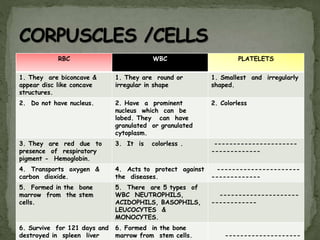
RBC WBC PLATELETS
1. They are biconcave &
appear disc like concave
structures.
1. They are round or
irregular in shape
1. Smallest and irregularly
shaped.
2. Do not have nucleus. 2. Have a prominent
nucleus which can be
lobed. They can have
granulated or granulated
cytoplasm.
2. Colorless
3. They are red due to
presence of respiratory
pigment - Hemoglobin.
3. It is colorless . ----------------------
-------------
4. Transports oxygen &
carbon dioxide.
4. Acts to protect against
the diseases.
----------------------
-------------
5. Formed in the bone
marrow from the stem
cells.
5. There are 5 types of
WBC NEUTROPHILS,
ACIDOPHILS, BASOPHILS,
LEUCOCYTES &
MONOCYTES.
---------------------
------------
6. Survive for 121 days and
destroyed in spleen liver
6. Formed in the bone
marrow from stem cells. --------------------

Tissues

  • 1.
  • 2.
    A group orcollection of similar cells performing or help to perform same function and arise from the same origin are called tissues. The tissues are of different types depending on the functions of the organism, they are mainly of two categories PLANT TISSUES and ANIMAL TISSUES.
  • 3.
    Plants perform functionswhich are different from animals and also their structure is different , hence they have tissues which are different from animals. They are further classified into many sub categories which is shown in the table below:
  • 5.
    The main characteristicof this tissue is that it is responsible for the growth of plants. The cells of this tissue continuously divide and later differentiate ( i.e. get converted ) into permanent tissue.
  • 6.
    The cells aremade of thin & elastic cell wall made of cellulose. The cells may be round , oval, polygonal or rectangular in shape. They are compact, having no intercellular space. There is a large nucleus and abundant cytoplasm. The protoplasm contains very few or no vacuoles at all.
  • 7.
    This is sobecause in plant body growth occurs only at these regions. Hence , on the basis of this there are 3 types of meristem : 1. APICAL MERISTEM 2. INTERCALARY MERISTEM 3. LATERAL MERISTEM
  • 8.
    As the namesuggests this tissue is present at the apex of the main & lateral shoots and roots. This tissue gives the plant body a linear growth.
  • 9.
    This tissue lieson the sides of the plant body. It lies under the bark of the plant in form of cork cambium. It gives the plant it’s width or girth.
  • 10.
    This tissue ispresent at the base of the nodes, internodes, leaves etc. They are also present in between the permanent tissue. They give the plant growth in length.
  • 11.
    These tissues arisefrom the meristematic tissue. The cells of this tissue gradually loose their power to divide and acquire a definite shape, size and function. These tissues may be living or dead. There are 2 types of permanent tissues 1. Simple permanent tissue 2. Complex permanent tissue.
  • 12.
    This tissue comprisesof same type of cells which perform the same function and all arise from the same origin. There are three categories of simple permanent tissues: Parenchyma, Collenchyma, & Sclerenchyma.
  • 14.
    Characteristics: a) The cellsare living. b) The cells are thin walled. c) There may or may not be intercellular spaces. d) They are the most unspecialized cells. e) No depositions are seen, the cell wall consists only of cellulose. f) There is a prominent nucleus, cytoplasm & vacuoles.
  • 15.
    There are somespecial types of parenchyma tissues : Storage parenchyma : The cells enlarge to store nutrients & water. Aerenchyma : Air cavities are present in the parenchyma tissue to provide buoyancy to the aquatic plants. Chlorenchyma : These parenchyma cells have presence of chlorophyll & hence can perform the function of photosynthesis. Parenchyma tissue is found generally in all parts of the plant body. It forms the Ground tissue in leaves, stem, roots & fruits etc.
  • 16.
    a) To storematerials such as starch, proteins, hormones etc and waste products such as gum, tannin, resin etc. b) Parenchyma cells perform the metabolic activities of the plant. c) Forms the packaging tissue between the specialized tissue. d) By providing turgidity , they provide mechanical strength. e) Chlorenchyma helps in performing photosynthesis.
  • 18.
    Characteristics: a) It hascells which are somewhat elongated. b) The cell walls are thin except at the angular region ( where the cells join). The thickenings are caused due to deposition of cellulose or pectin. c) There is o or less intercellular space. d) The cells are living, have distinct nucleus & dense protoplasm. e) They often contain chlorophyll. Functions : a) Providing mechanical strength is the primary function. b) Provide flexibility. c) Photosynthesis, as they contain chlorophyll. They are present below the epidermis in dicot stems and leaves. They absent in dicot roots and all parts of monocot plants.
  • 22.
    TYPE STRUCTURE LOCATIONFUNCTION CUBOIDAL EPITHELIUM CUBE LIKE CELLS WITH NUCLEUS AT THE CENTRE •LINING OF KIDNEY • TUBULES •SALIVARY,SWEAT & PANCREATIC DUCTS. •SECTRETION • EXCRETION & ABSORPTION COLUMNAR EPITHELIUM TALL,PILLAR OR COLUMN LIKE CELLS WITH NUCLEUS TOWARDS THE BASEMENT MEMBRANE •LINING OF THE STOMACH •LINING OF THE INTESTINE & GALL BLADDER •SECTRETION • EXCRETION & ABSORPTION • MUCOUS IS SECRETED. CILIATED EPITHELIUM CERTAIN CUBOIDAL & COLUMNAR HAVE CILIA AT THEIR FREE END. OVIDUCTS, TRACHEA, BRONCHIOLES & IN NEPHRONES OF KIDNEY MOVEMENT OF CILIA BRINGS ABOUT MOVEMENT OF SUBSTANCES IN ONE DIRECTION GLANDULAR EPITHELIUM CUBOIDAL & COLUMNAR EPITHELIUM ARE MODIFIED INTO GLANDS SALIVARY, GASTRIC, INTESTINAL , SWEAT GLANDS, ADRENAL AND SECRETE ENZYMES, MUCOUS OR HOMONES.
  • 23.
    More than onelayer of cell is present. TYPE STRUCTURE LOCATION FUNCTION SQUAMOUS EPITHELIUM THIN FLATTENED CELLS, WITH A CENTRALLY PLACED NUCLEUS, COMPACTLY ARRANGED. •FORM LINING OF MOUTH, OESOPHAGUS AND LUNGS. •INNER LINING OF BLOOD VESSELS •IN FORM OF STRATIFIED EPITHELIUM IT COVERS * DIFFUSION OF MATERIALS OR EXCHANGE OF GASSES. * PROTECTION FROM CHEMICALS, MECHANICAL INJURY, ENTRY OF GERMS &
  • 27.
    They have thebasic characteristics as : Cells, which are loosely packed, fibres which are scattered in between the cells and matrix which is the ground tissue. It may be jelly like fluid, dense and/ or rigid. They are located widely throughout the body, present between different tissues and organs. They mainly function in binding , packaging & other functions as storing fats, transporting substances etc.
  • 28.
    Our body containstwo liquid connective tissues: 1) blood 2) lymph Blood is the major liquid connective tissue. It’s constituents are divided into two types Liquid : plasma Solid : corpuscles [ cells]
  • 29.
    It is astraw coloured liquid and constitutes 55% of the blood. 90 – 92% of plasma is water while 6-8% is proteins such as fibrinogen etc. Plasma without coagulation proteins is known as serum. It contains mineral ions and other organic compounds like glucose, amino acids, lipids, hormones, vitamins etc.
  • 30.
    RBC WBC PLATELETS 1.They are biconcave & appear disc like concave structures. 1. They are round or irregular in shape 1. Smallest and irregularly shaped. 2. Do not have nucleus. 2. Have a prominent nucleus which can be lobed. They can have granulated or granulated cytoplasm. 2. Colorless 3. They are red due to presence of respiratory pigment - Hemoglobin. 3. It is colorless . ---------------------- ------------- 4. Transports oxygen & carbon dioxide. 4. Acts to protect against the diseases. ---------------------- ------------- 5. Formed in the bone marrow from the stem cells. 5. There are 5 types of WBC NEUTROPHILS, ACIDOPHILS, BASOPHILS, LEUCOCYTES & MONOCYTES. --------------------- ------------ 6. Survive for 121 days and destroyed in spleen liver 6. Formed in the bone marrow from stem cells. --------------------