TISSUE ANALYSIS
SUNIL RAGHAVENDHER
101114042
VIMAL KUMAR A
101114049
K SABARATHINAM
101114012
NIT TRICHY
WhatisTissue
Analysis?
 A technique that overlays a known and understood scale
plan or aerial photograph of existing buildings, lots, blocks
and street patterns onto a vacant site as a rapid means of
generating design options.
 These plans, aerial photographs or maps are often referred
to as an ‘urban tissue’.
Whatit’s
useful for?
 Rapid generation of initial design options for
sites and neighborhoods that promote
informed design discussion.
 Because the density, activity and physical
characteristics are known, measurable, and
can even be visited, there is a degree of
certainty about the feasibility and effects of
different configurations of development.
Urban
Morphologhy
 To understand the concept of suburban tissue, it is first
necessary to understand the concept of urban
morphology, or the study of the physical form of cities
over time. According to Matthew Carmona, there are
essentially two main types of urban form: ‘traditional’ and
‘modernist,’ with the former consisting of urban blocks
that define and enclose space, and the latter consisting of
free-standing ‘pavilion’ buildings in landscape settings
 there are several key elements: land uses, building
structures, plot patterns and street patterns, with each
exhibiting different degrees of stability
 Together, according to Gianfranco Caniggia, these four
elements combine to form patterns with similar
characteristics and congruencies, patterns known as
‘urban tissues’
UrbanTissues
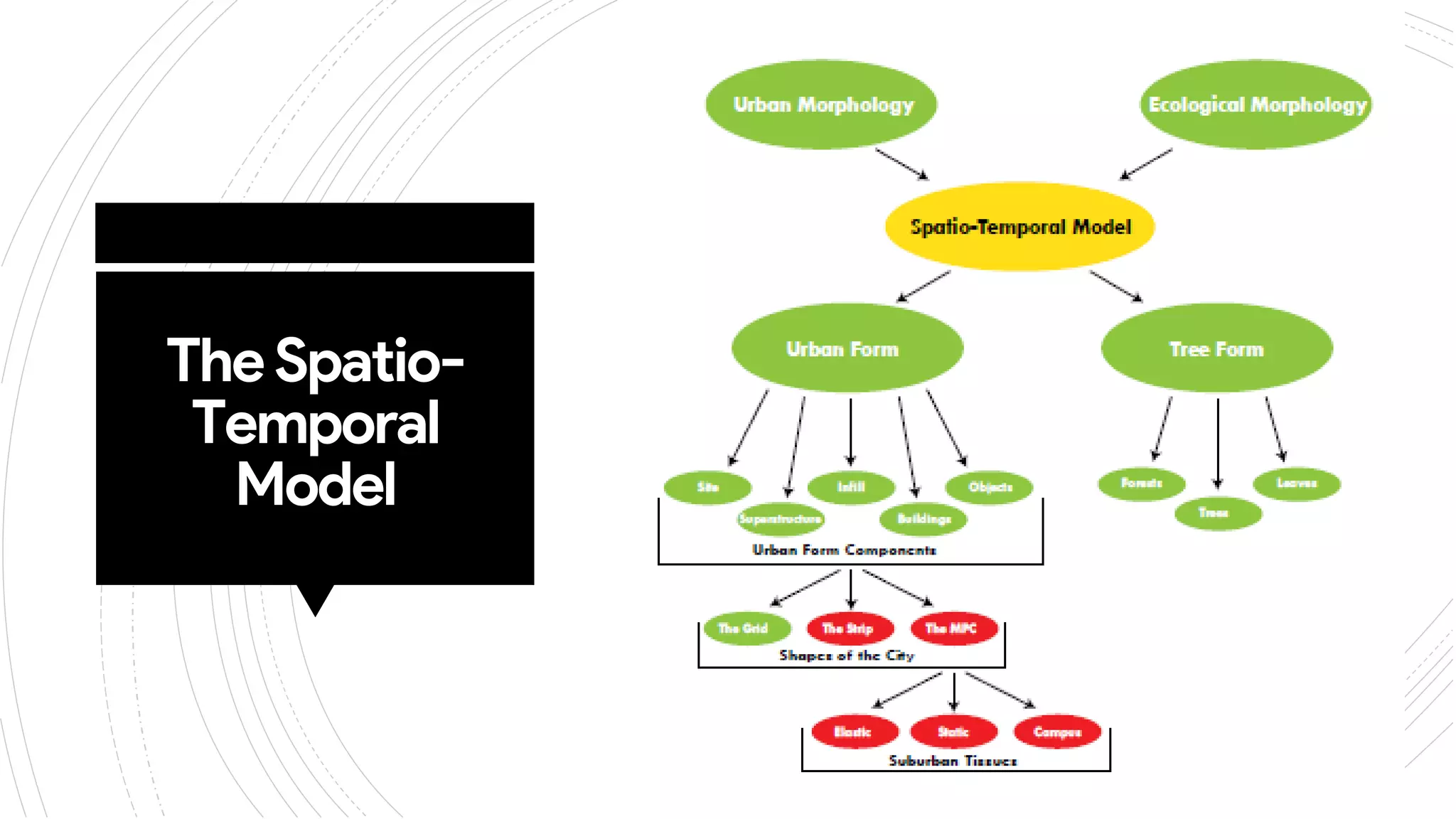
 Break down the built environment into the elemental forms
of buildings, lots and streets.
 Identifies the elemental parts of the site, superstructure,
infill, buildings and objects.
 These elemental parts come together to form the basic
shapes of the city: the grid, the strip and the master
planned community, with the latter two forming the
shapes of the suburbs.
Typesof
Tissues
 The suburbs, according to Scheer, can in turn be broken
down into three distinct “tissues” that change over time at
different rates and at different scales. She labels these
tissues as static, elastic, and campus tissue.
1. Static Tissue
2. Elastic Tissue
3. Campus Tissue
Tissue
 Overall, it implies a process of transformations. When this
notion of tissue is applied to the city, it can be thought of
as the “superimposition of several structures acting at
different scales, but which appears as a system with
linkages in each part of the city.
 It is in effect the culmination of three logical systems:
1. The logic of roads: movement and distribution
2. The logic of plot subdivisions: where private and
public initiatives take place
3. The logic of buildings: containing different activities
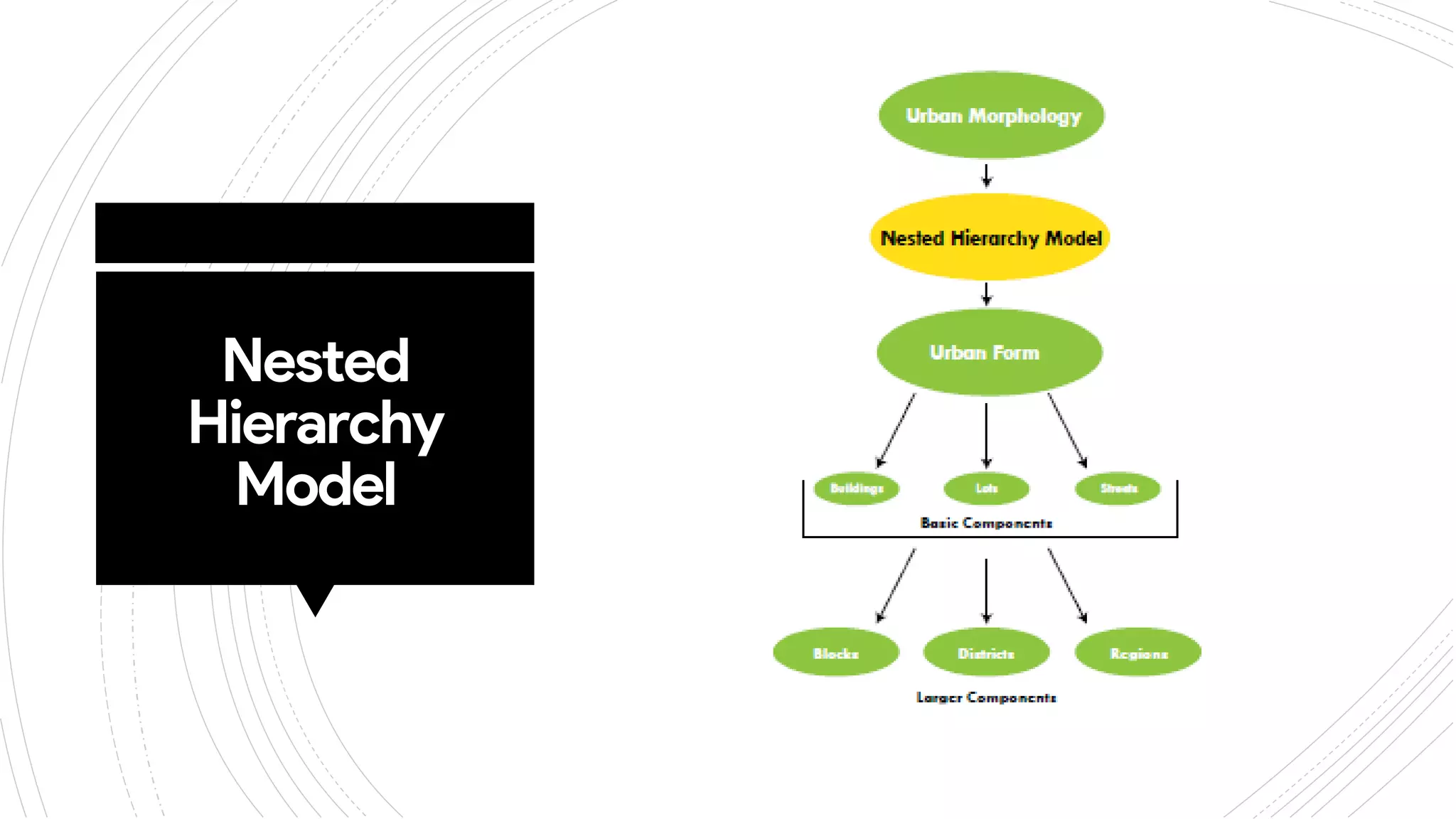
Urban Tissue Models
Nested
Hierarchy
Model
TheSpatio-
Temporal
Model
TheSpatio-
Temporal
Model
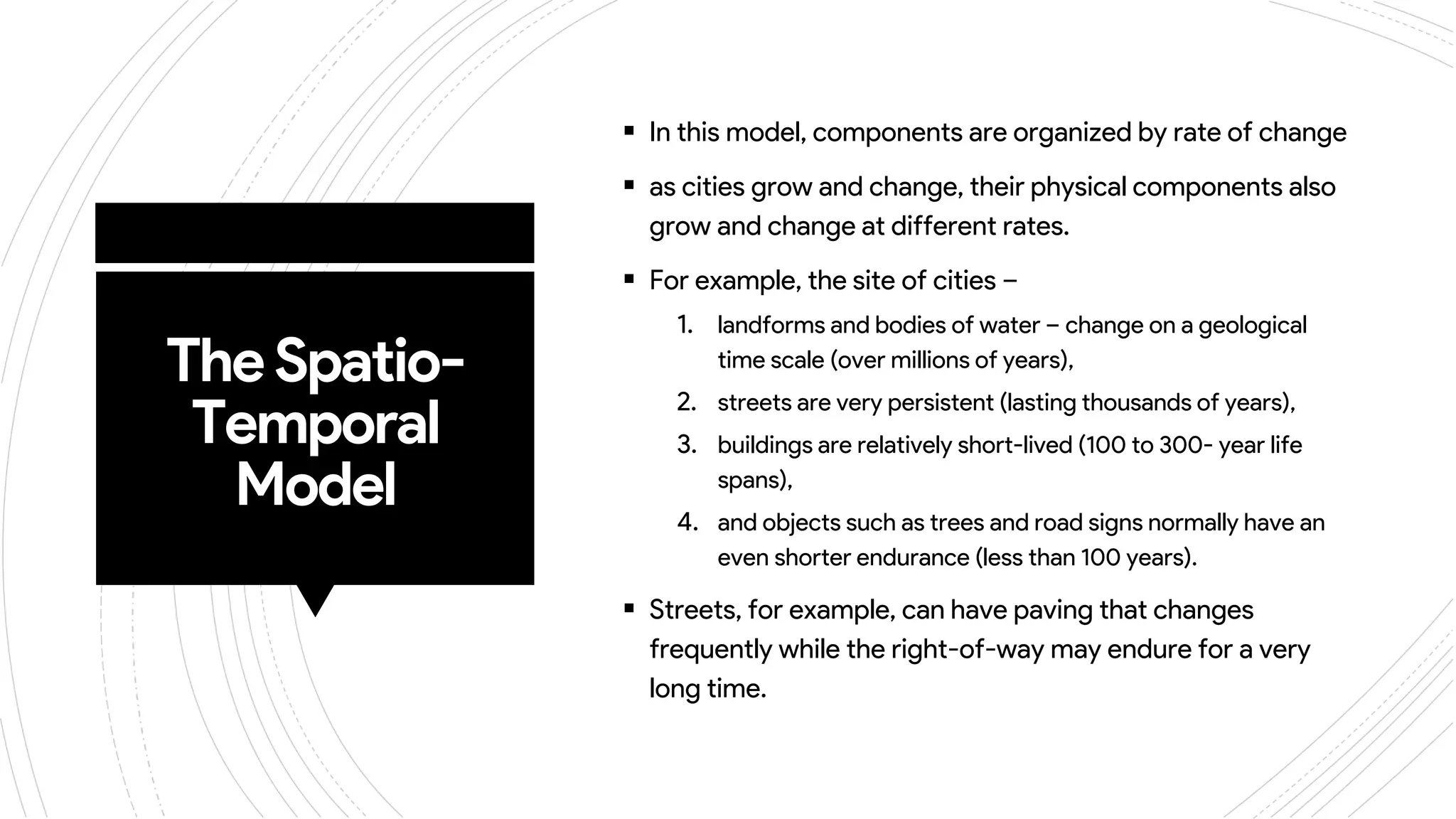
 In this model, components are organized by rate of change
 as cities grow and change, their physical components also
grow and change at different rates.
 For example, the site of cities –
1. landforms and bodies of water – change on a geological
time scale (over millions of years),
2. streets are very persistent (lasting thousands of years),
3. buildings are relatively short-lived (100 to 300- year life
spans),
4. and objects such as trees and road signs normally have an
even shorter endurance (less than 100 years).
 Streets, for example, can have paving that changes
frequently while the right-of-way may endure for a very
long time.
TheSpatio-
Temporal
Model
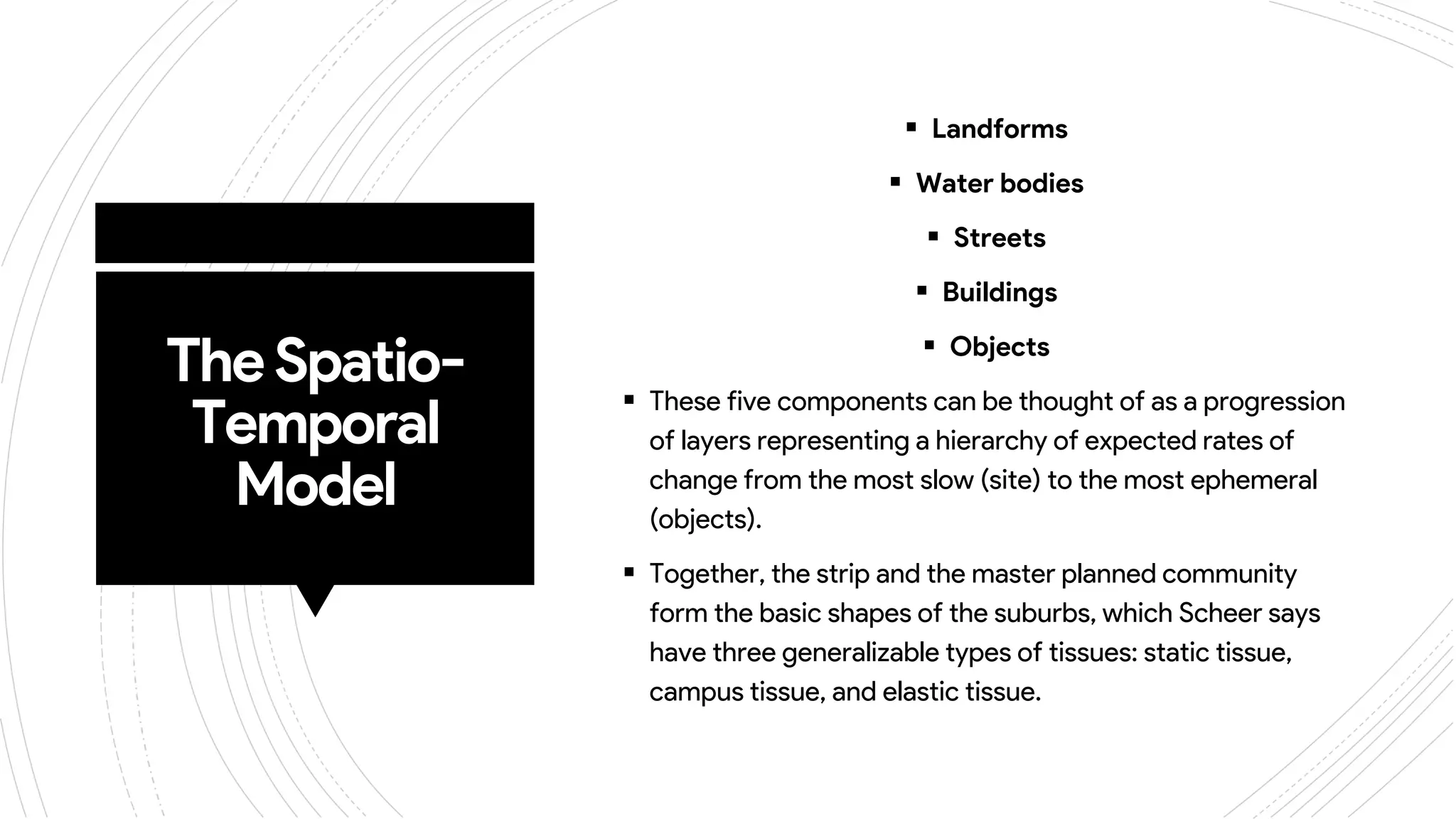
 Landforms
 Water bodies
 Streets
 Buildings
 Objects
 These five components can be thought of as a progression
of layers representing a hierarchy of expected rates of
change from the most slow (site) to the most ephemeral
(objects).
 Together, the strip and the master planned community
form the basic shapes of the suburbs, which Scheer says
have three generalizable types of tissues: static tissue,
campus tissue, and elastic tissue.
Types of Tissues
StaticTissue
 Static tissues are characteristically more ordered than
other tissues, forming a consistent pattern.
 Most urban grids and all planned single-family subdivisions
are examples of static tissue.
 These tissues have lots and streets that were planned
together, surveyed around the same time, and built on
within a period of roughly 10 to 20 years.
 The lot sizes are relatively small and about the same size.
 Because of highly protected property ownership, static
tissue is a very stable and persistent element of urban
form.
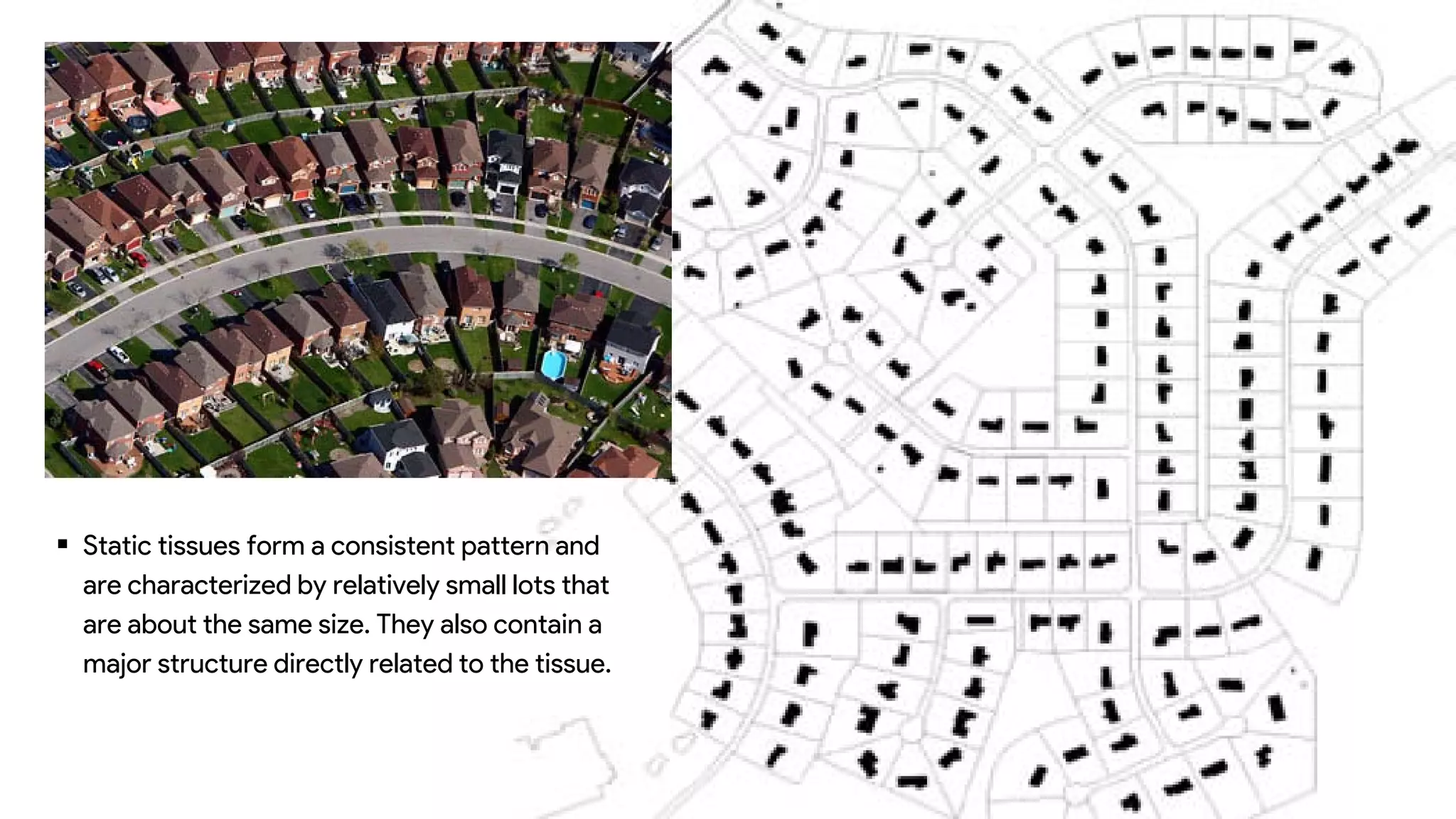
 Static tissues form a consistent pattern and
are characterized by relatively small lots that
are about the same size. They also contain a
major structure directly related to the tissue.
ElasticTissue
 Elastic tissue, according to Scheer, is the least stable of the three
tissues.
 It typically forms along arterial roads and has a rapid change rate
compared to the other tissues.
 It is characterized by a great variety of lot sizes, many different
building types in close proximity, and general lack of street
networks. Scheer remarks that elastic tissues “pose a great many
problems since they are so fundamentally disordered” (Scheer
2010).
 For example, lots tend to range from very large to very small, with
little semblance of a pattern since they are created by subdivision
of individual farm fields or aggregation of small preurban roadside
houses, without the establishment of a street network.
 In effect, development depends heavily on a single arterial road,
resulting in high traffic.
 Lastly, highly varied lot sizes lead to a wide variety of building
types that are not only inconsistent with each other but also have
no logical orientation or relationship to the lot and street.
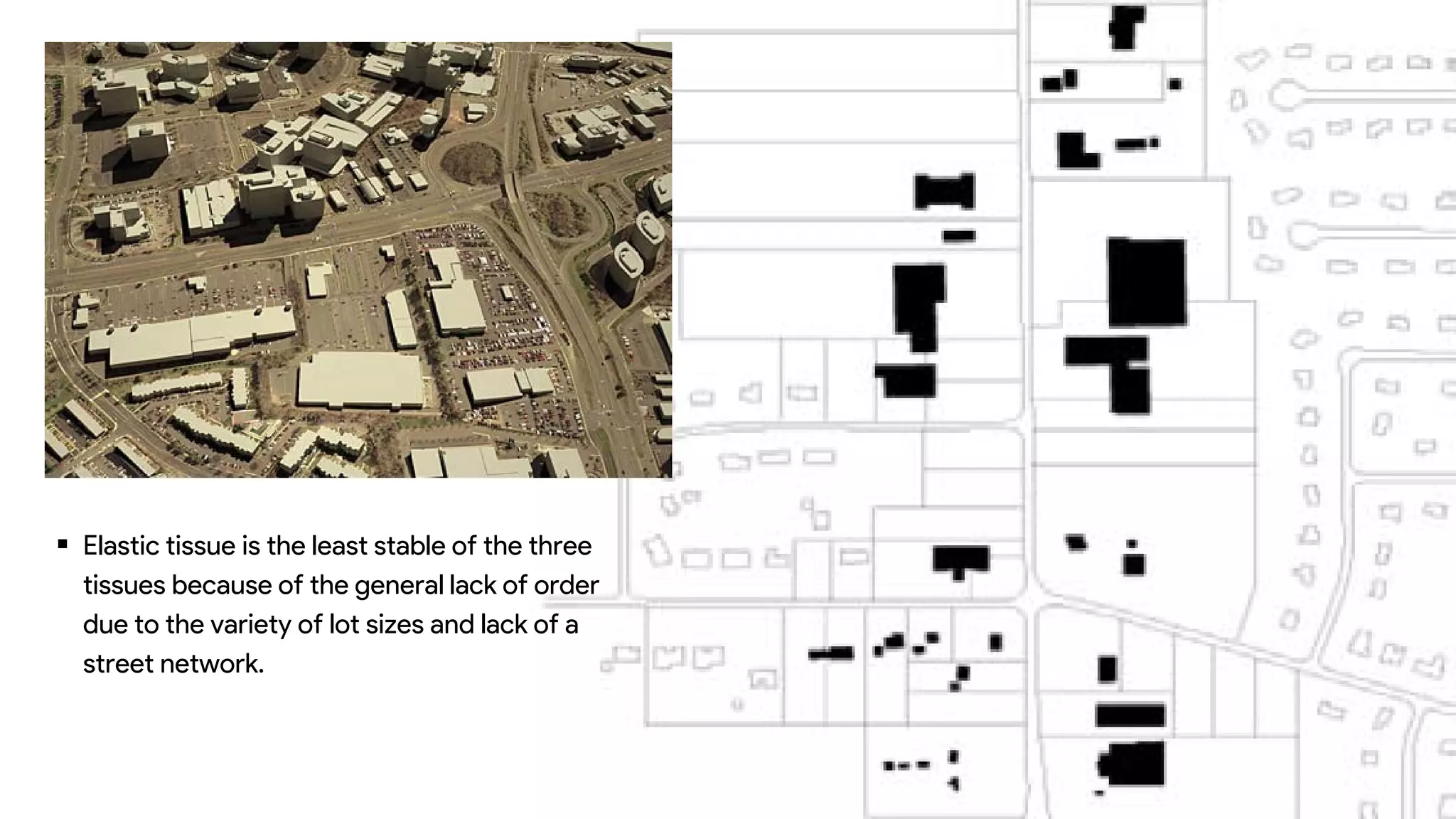
 Elastic tissue is the least stable of the three
tissues because of the general lack of order
due to the variety of lot sizes and lack of a
street network.
Campus
Tissue
 Campus tissue, along with elastic tissue which will be discussed in
the next section, reached a zenith in the 20th century, according
to Scheer.
 This tissue is characterized by a large tract of land with multiple
buildings, owned by a single entity.
 Examples are apartment complexes (Figure 2-7), universities,
airports, large hospitals, industrial parks, and shopping centers
(Scheer 2010).
 According to Scheer, the defining characteristic of campus tissue
is that the lot is not subdivided when new buildings are added or
changed.
 Additionally, campus tissues contain more than one significant
building and usually have an internal circulation system of roads
and paths that connect the buildings.
 In general, they are somewhat physically isolated from nearby
tissues because most of the time there is no network of streets
that connect to the outside, except at limited entrances.
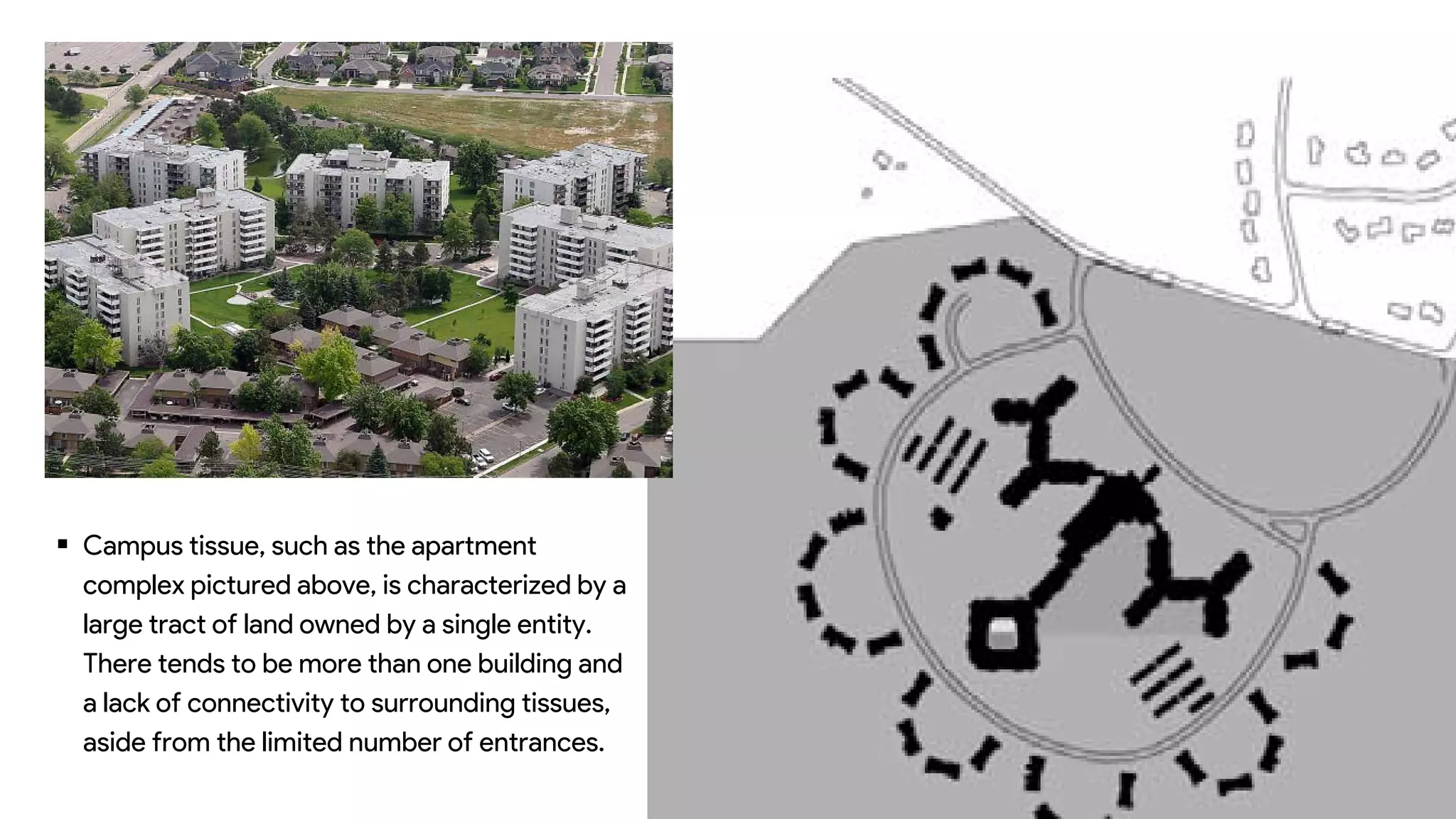
 Campus tissue, such as the apartment
complex pictured above, is characterized by a
large tract of land owned by a single entity.
There tends to be more than one building and
a lack of connectivity to surrounding tissues,
aside from the limited number of entrances.
CASE STUDY – I
ANSLEY MALL
ANSLEY
MALL
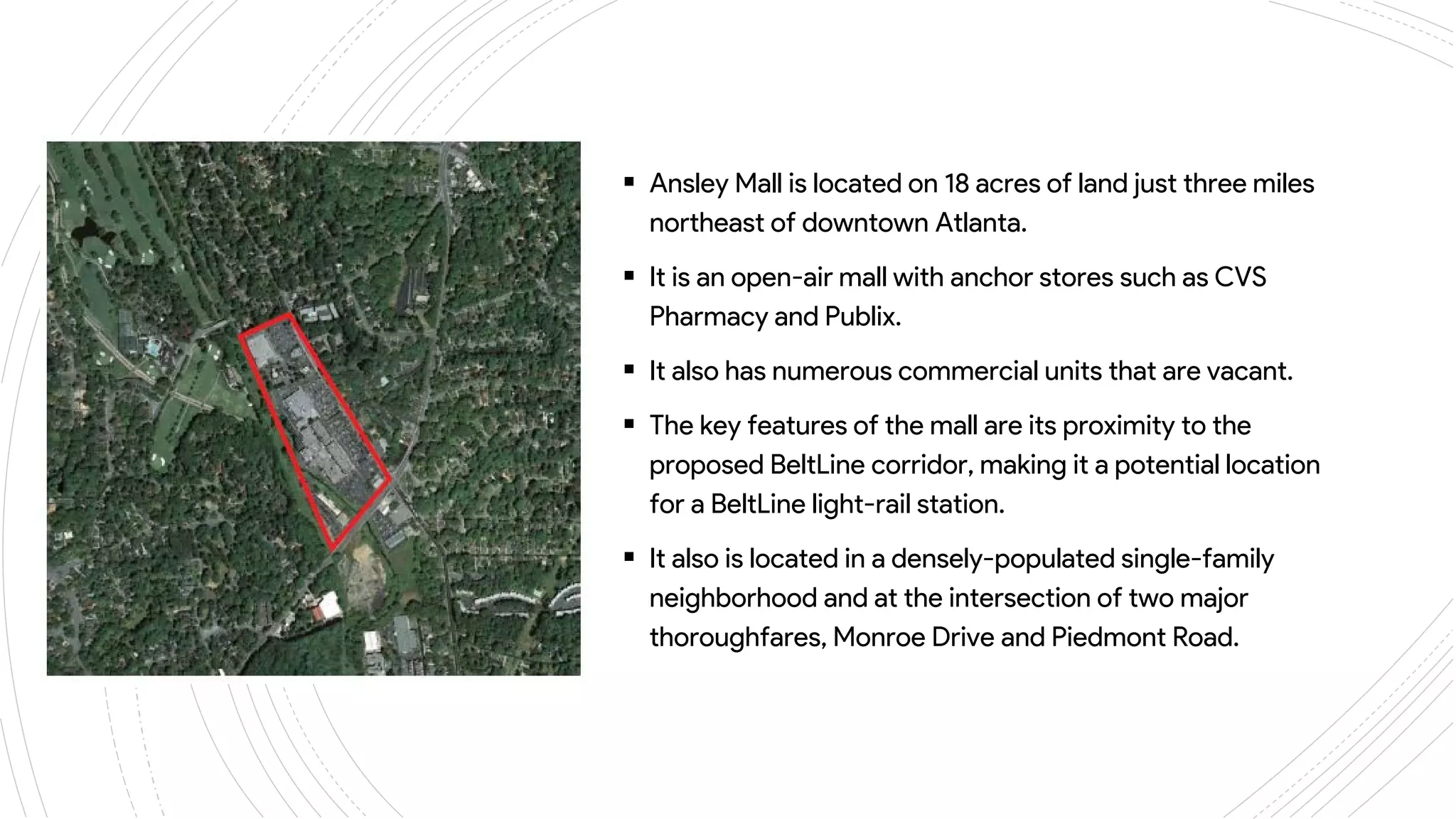
 Ansley Mall is located on 18 acres of land just three miles
northeast of downtown Atlanta.
 It is an open-air mall with anchor stores such as CVS
Pharmacy and Publix.
 It also has numerous commercial units that are vacant.
 The key features of the mall are its proximity to the
proposed BeltLine corridor, making it a potential location
for a BeltLine light-rail station.
 It also is located in a densely-populated single-family
neighborhood and at the intersection of two major
thoroughfares, Monroe Drive and Piedmont Road.
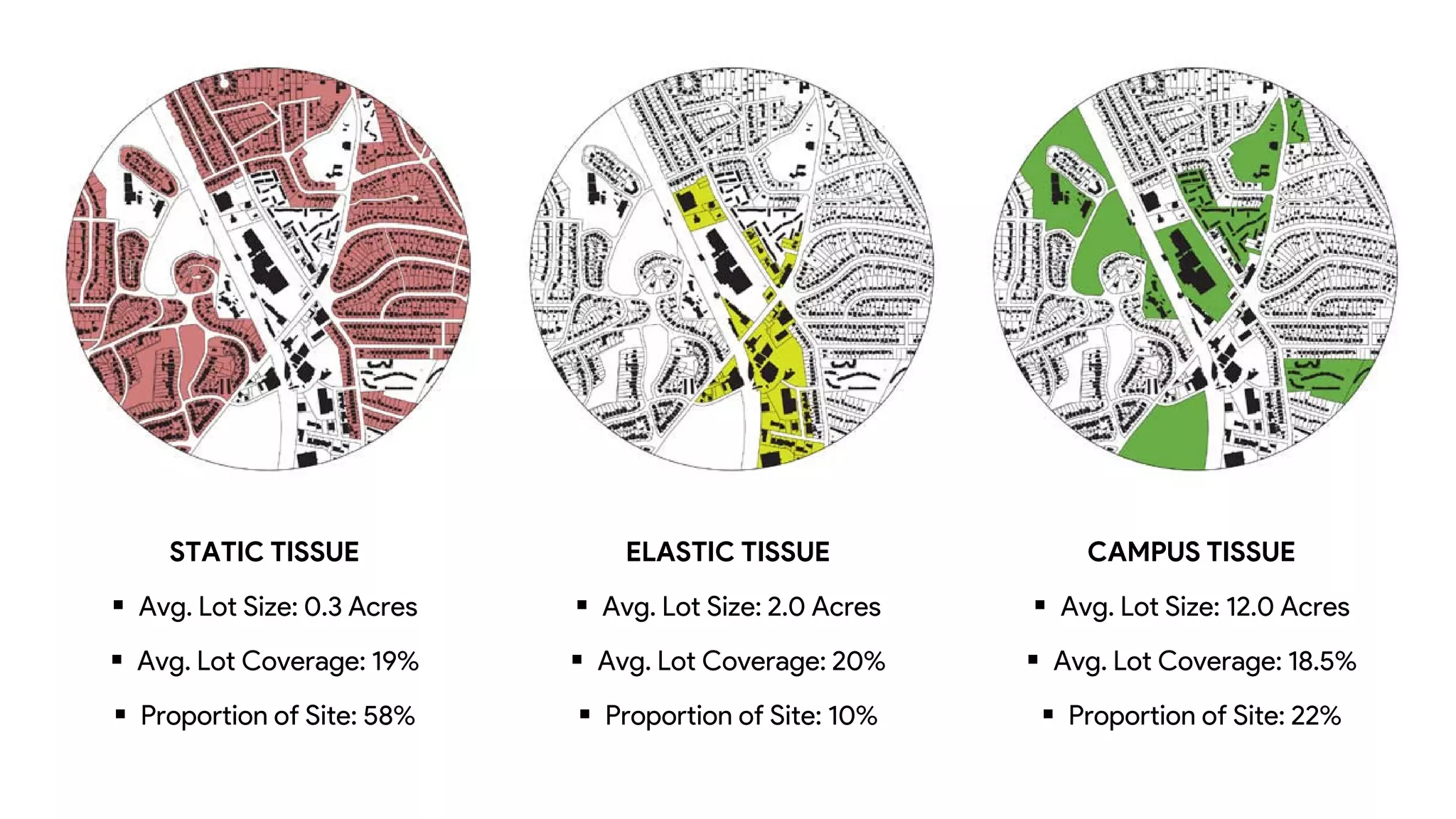
STATIC TISSUE
 Avg. Lot Size: 0.3 Acres
 Avg. Lot Coverage: 19%
 Proportion of Site: 58%
ELASTIC TISSUE
 Avg. Lot Size: 2.0 Acres
 Avg. Lot Coverage: 20%
 Proportion of Site: 10%
CAMPUS TISSUE
 Avg. Lot Size: 12.0 Acres
 Avg. Lot Coverage: 18.5%
 Proportion of Site: 22%
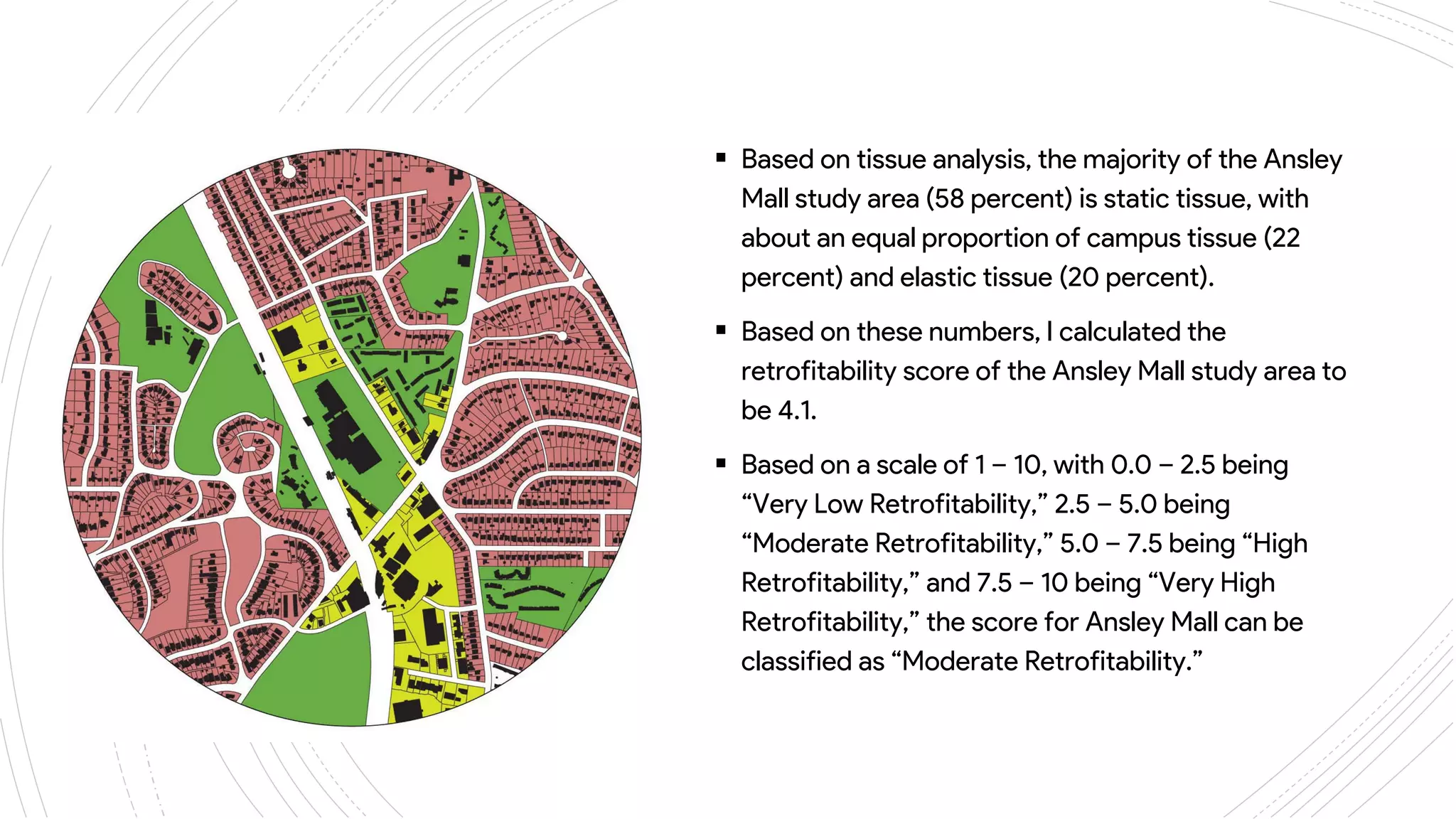
 Based on tissue analysis, the majority of the Ansley
Mall study area (58 percent) is static tissue, with
about an equal proportion of campus tissue (22
percent) and elastic tissue (20 percent).
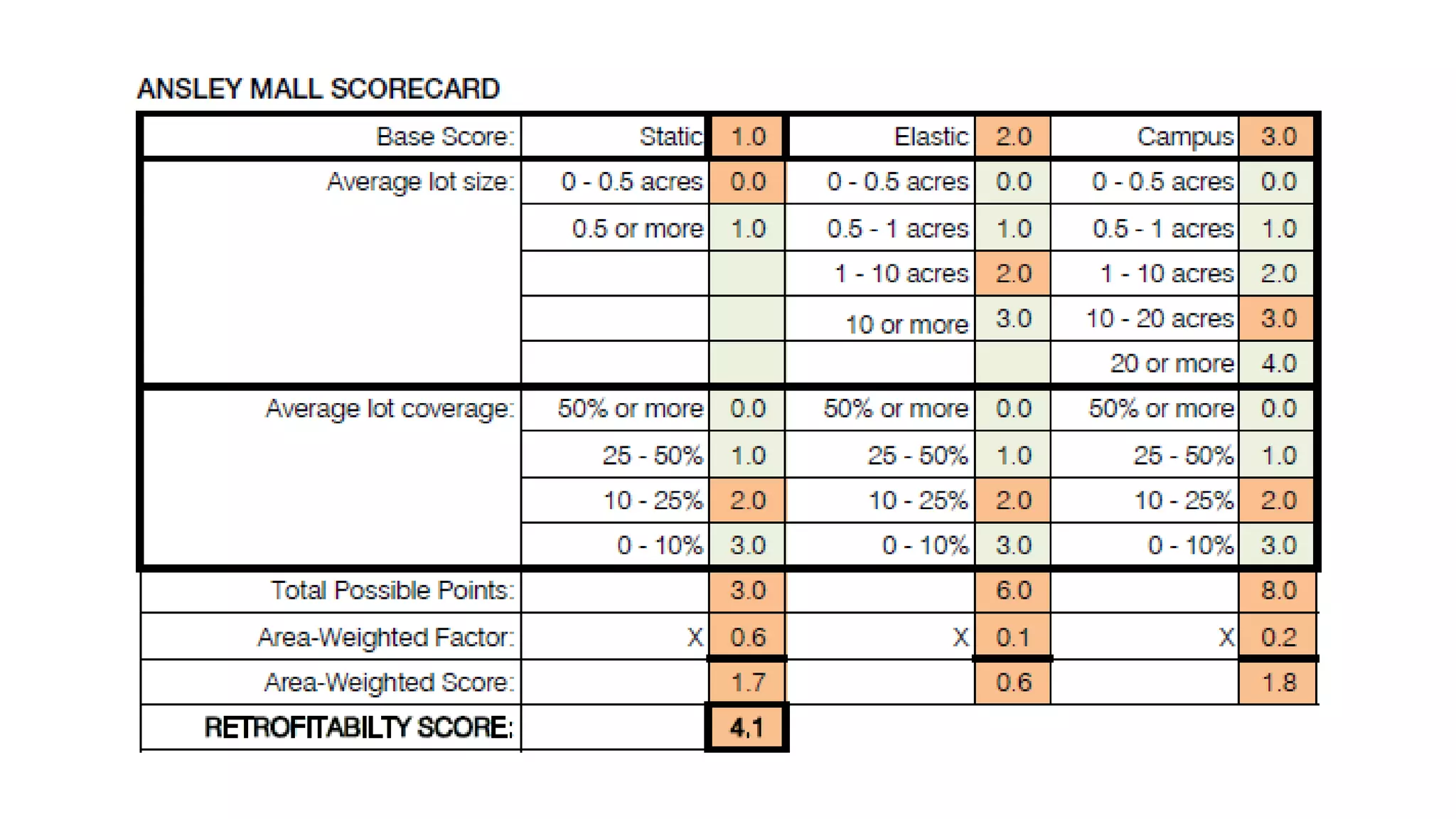
 Based on these numbers, I calculated the
retrofitability score of the Ansley Mall study area to
be 4.1.
 Based on a scale of 1 – 10, with 0.0 – 2.5 being
“Very Low Retrofitability,” 2.5 – 5.0 being
“Moderate Retrofitability,” 5.0 – 7.5 being “High
Retrofitability,” and 7.5 – 10 being “Very High
Retrofitability,” the score for Ansley Mall can be
classified as “Moderate Retrofitability.”
CASE STUDY – II
PERIMETERPOINTSHOPPING
CENTER
ANSLEY
MALL
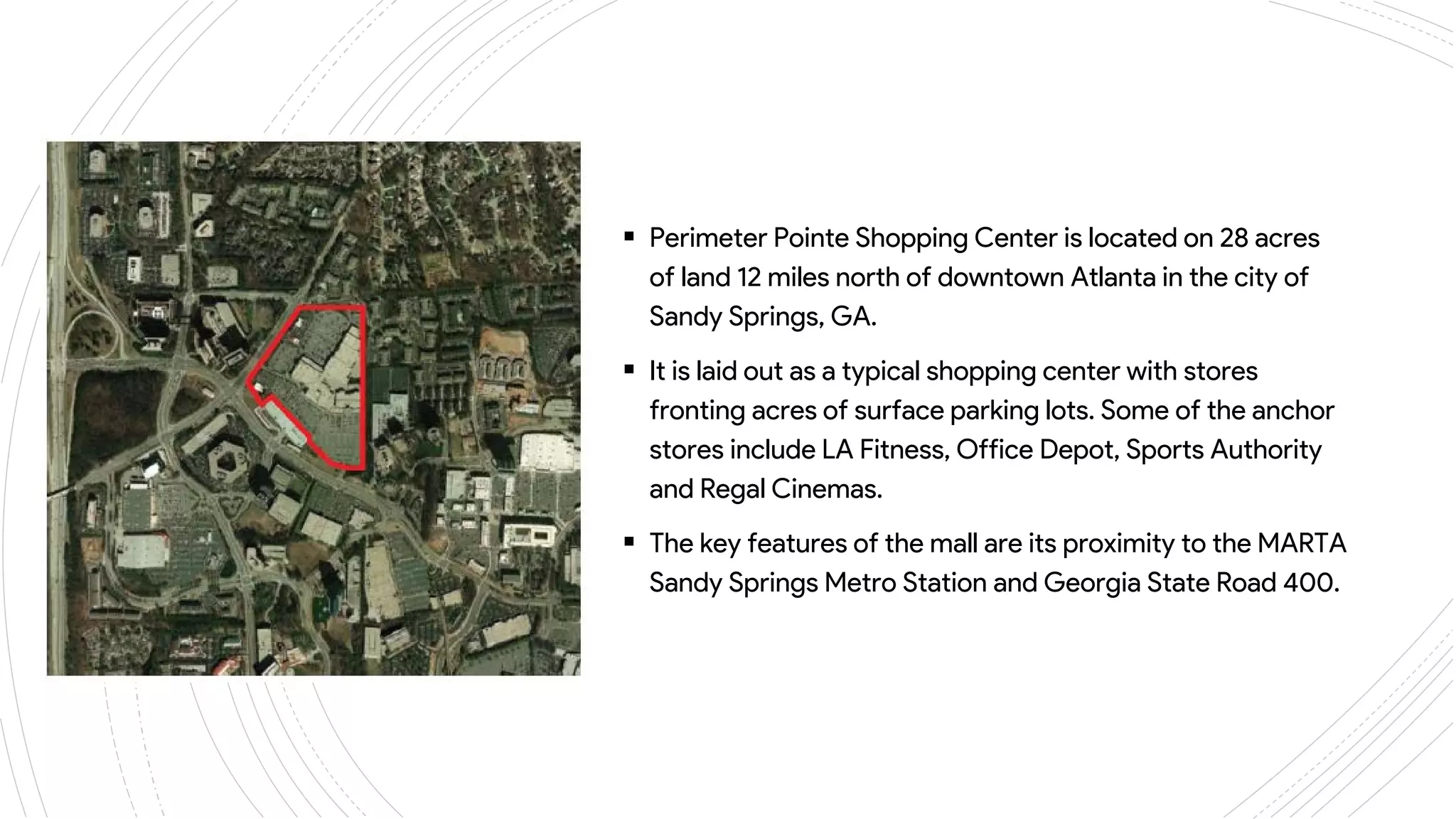
 Perimeter Pointe Shopping Center is located on 28 acres
of land 12 miles north of downtown Atlanta in the city of
Sandy Springs, GA.
 It is laid out as a typical shopping center with stores
fronting acres of surface parking lots. Some of the anchor
stores include LA Fitness, Office Depot, Sports Authority
and Regal Cinemas.
 The key features of the mall are its proximity to the MARTA
Sandy Springs Metro Station and Georgia State Road 400.
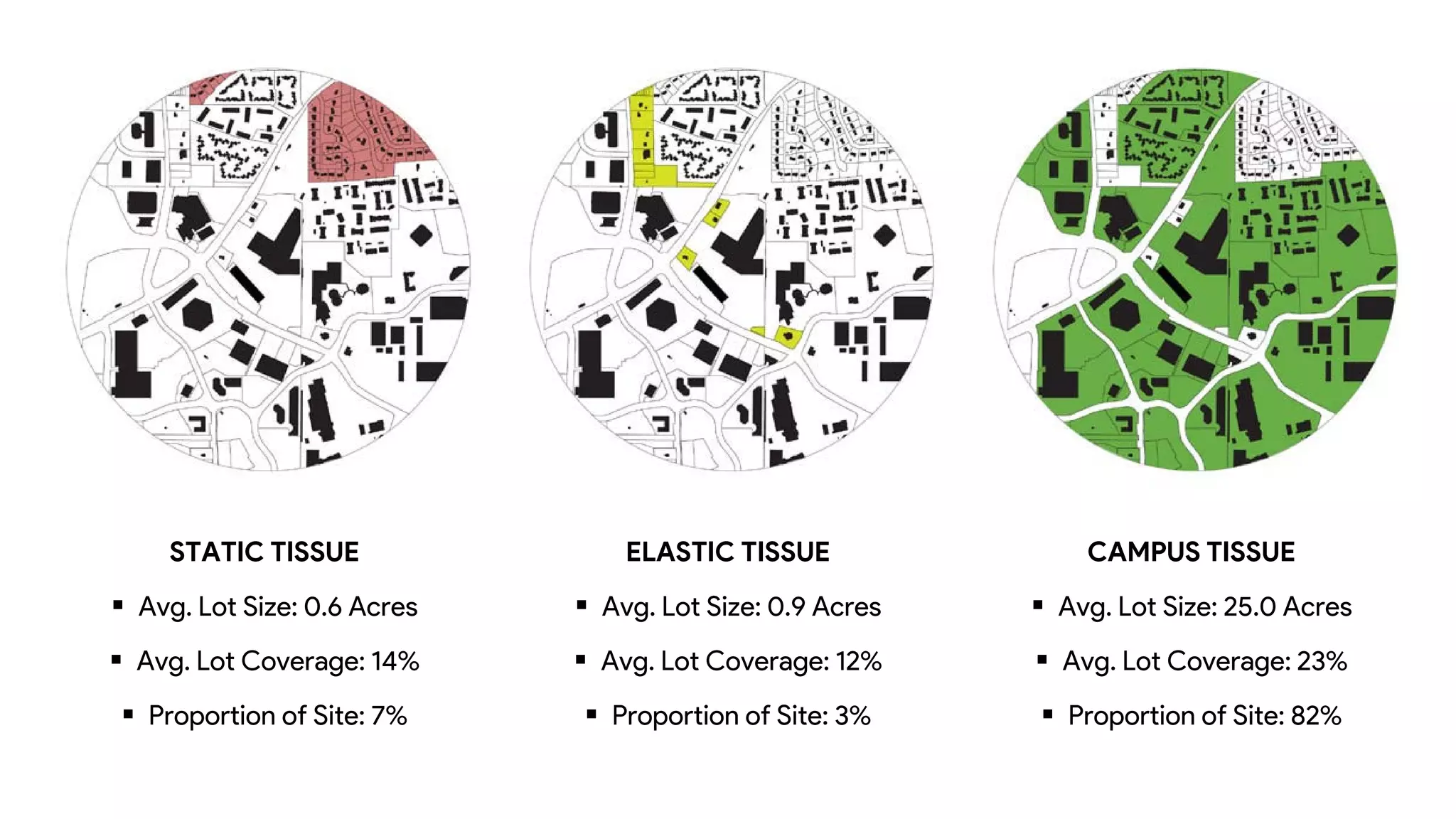
STATIC TISSUE
 Avg. Lot Size: 0.6 Acres
 Avg. Lot Coverage: 14%
 Proportion of Site: 7%
ELASTIC TISSUE
 Avg. Lot Size: 0.9 Acres
 Avg. Lot Coverage: 12%
 Proportion of Site: 3%
CAMPUS TISSUE
 Avg. Lot Size: 25.0 Acres
 Avg. Lot Coverage: 23%
 Proportion of Site: 82%
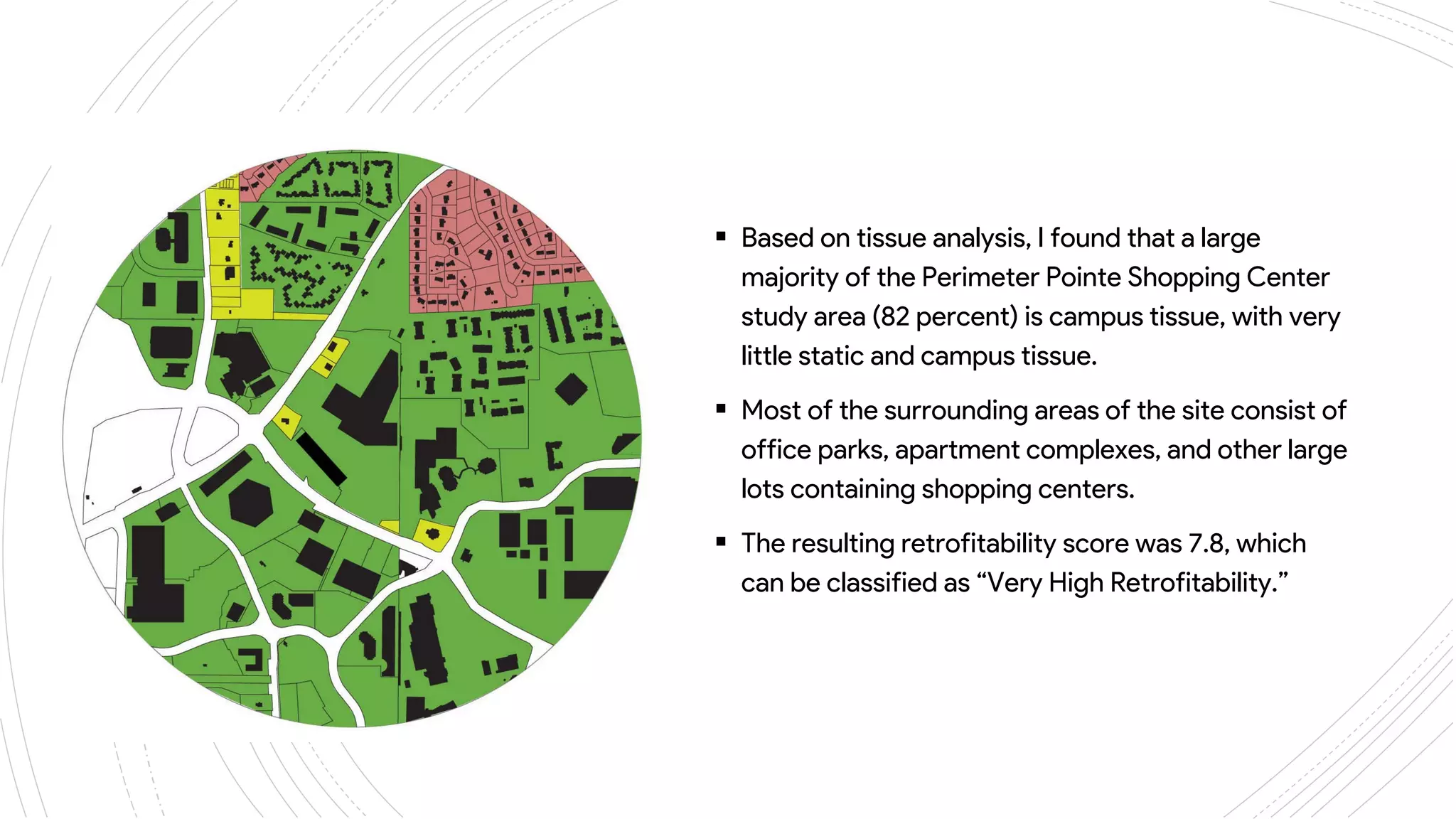
 Based on tissue analysis, I found that a large
majority of the Perimeter Pointe Shopping Center
study area (82 percent) is campus tissue, with very
little static and campus tissue.
 Most of the surrounding areas of the site consist of
office parks, apartment complexes, and other large
lots containing shopping centers.
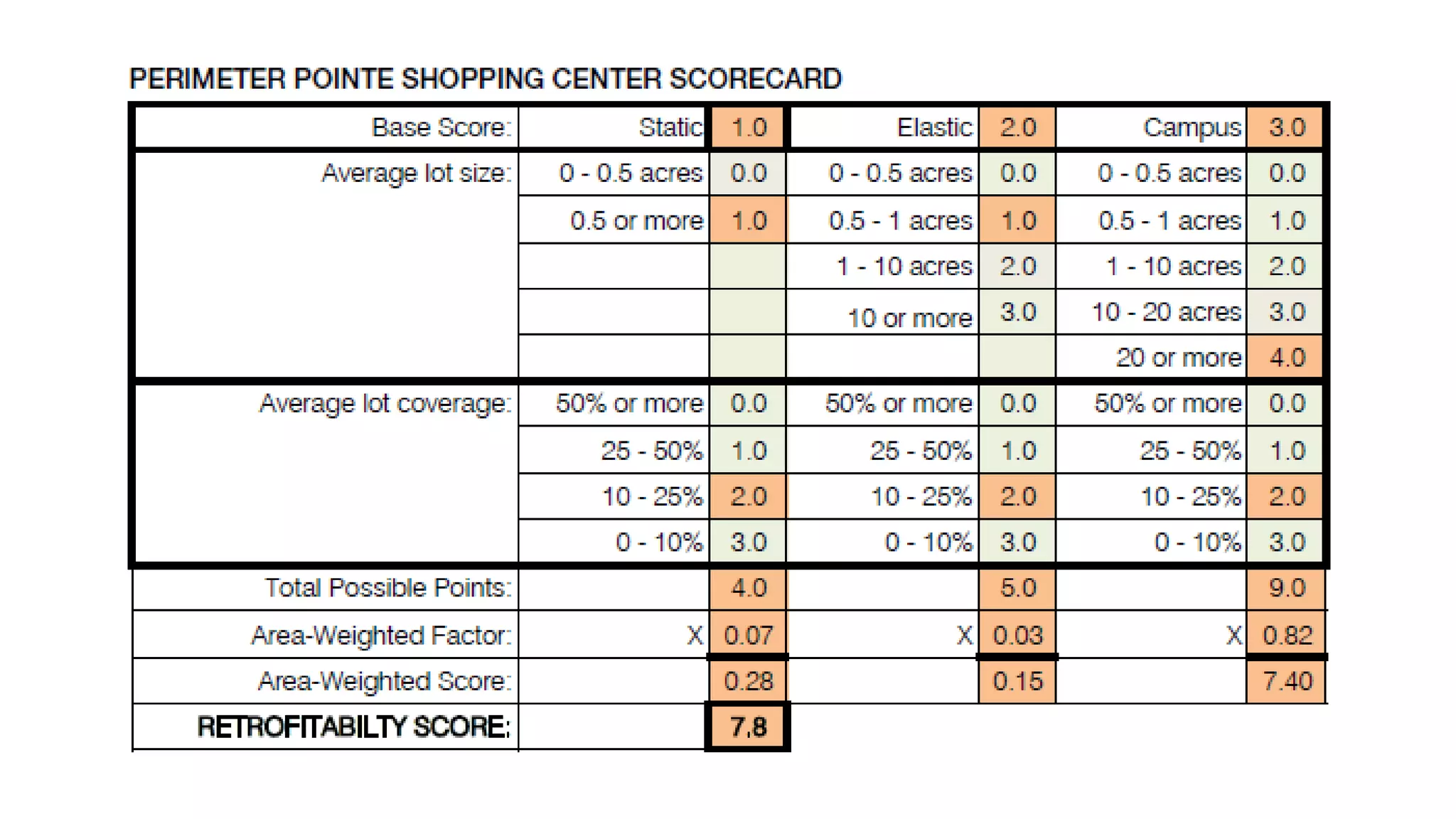
 The resulting retrofitability score was 7.8, which
can be classified as “Very High Retrofitability.”
CASE STUDY – III
UNION STATION MALL
ANSLEY
MALL
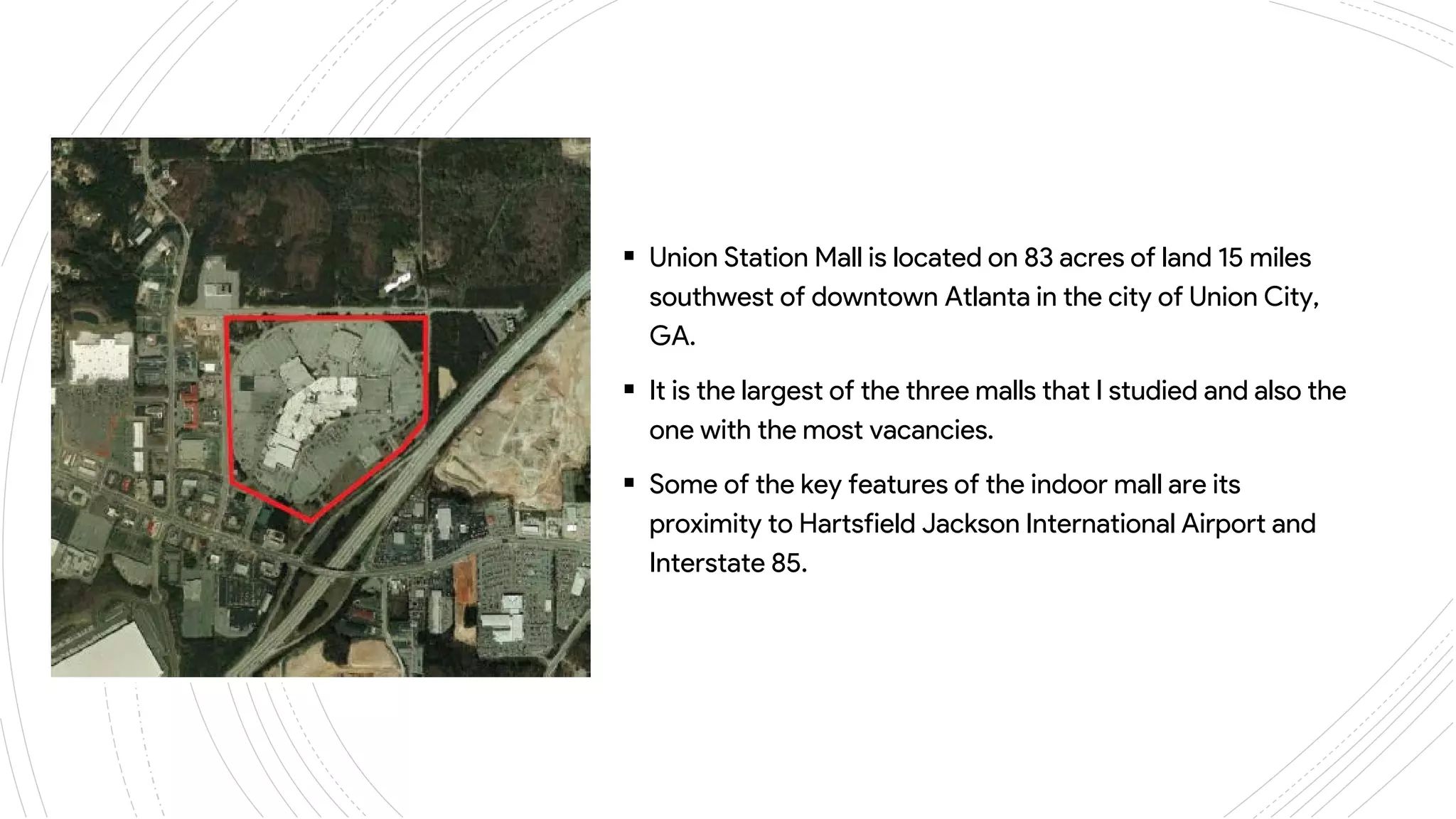
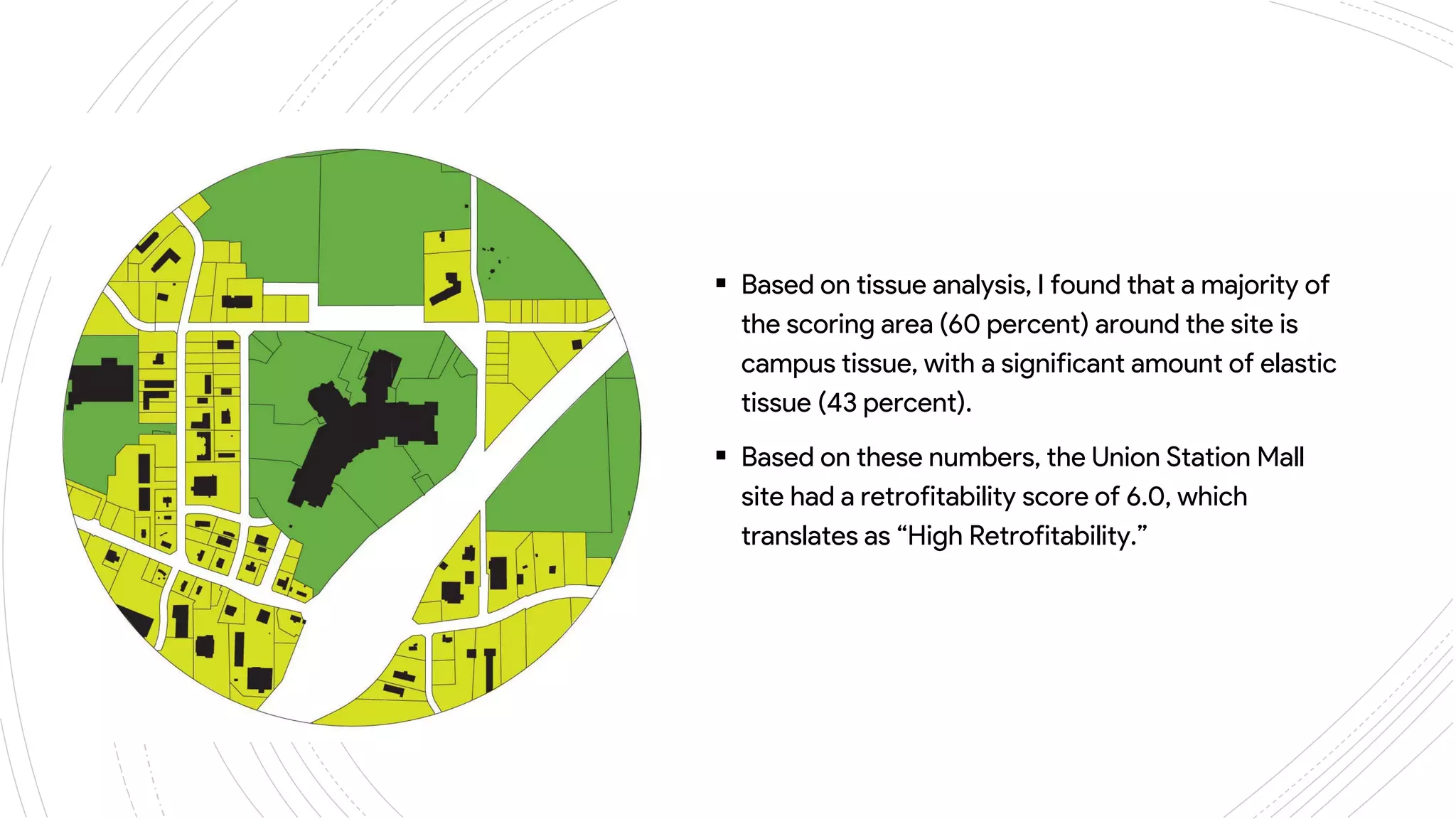
 Union Station Mall is located on 83 acres of land 15 miles
southwest of downtown Atlanta in the city of Union City,
GA.
 It is the largest of the three malls that I studied and also the
one with the most vacancies.
 Some of the key features of the indoor mall are its
proximity to Hartsfield Jackson International Airport and
Interstate 85.
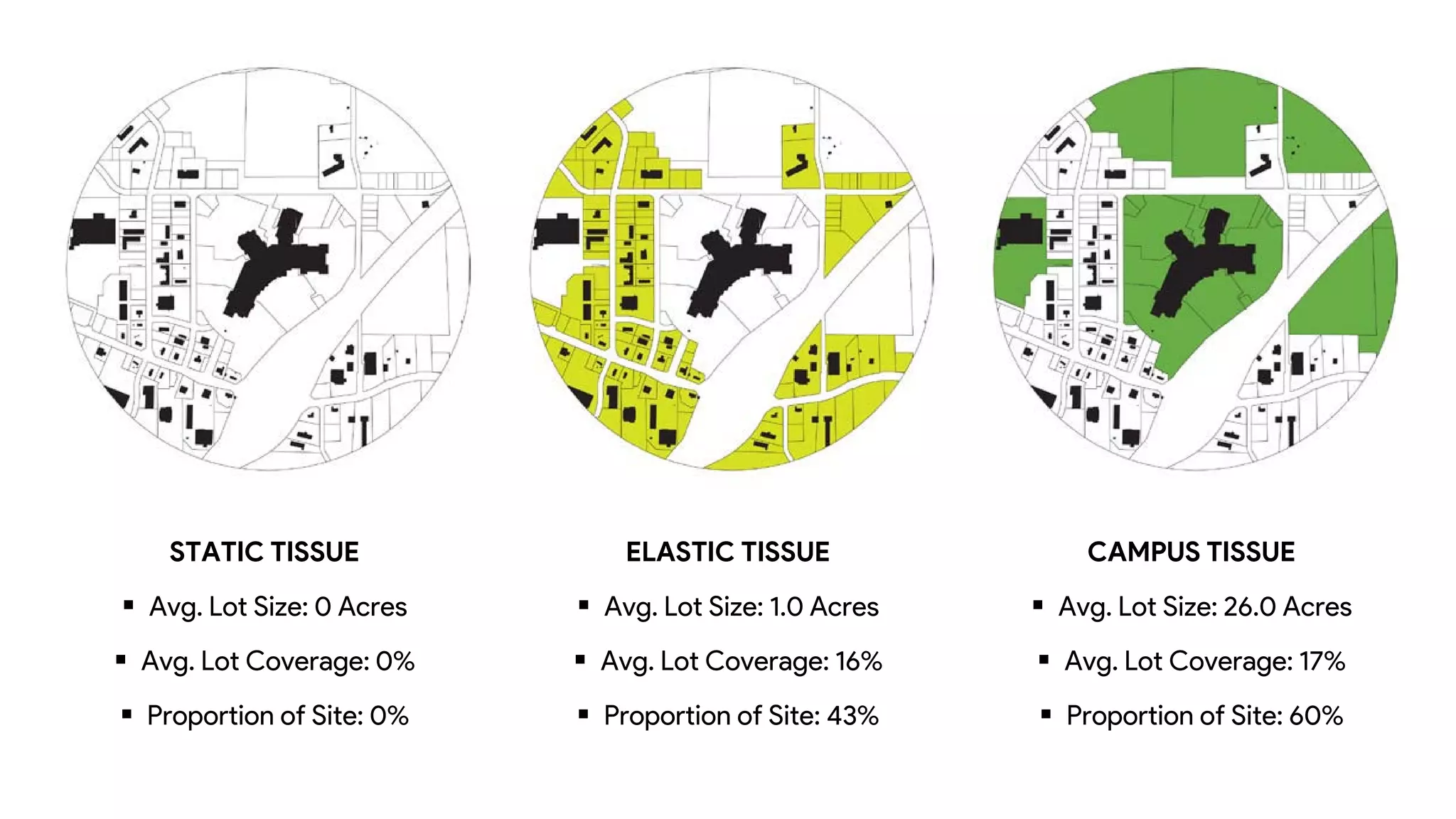
STATIC TISSUE
 Avg. Lot Size: 0 Acres
 Avg. Lot Coverage: 0%
 Proportion of Site: 0%
ELASTIC TISSUE
 Avg. Lot Size: 1.0 Acres
 Avg. Lot Coverage: 16%
 Proportion of Site: 43%
CAMPUS TISSUE
 Avg. Lot Size: 26.0 Acres
 Avg. Lot Coverage: 17%
 Proportion of Site: 60%
 Based on tissue analysis, I found that a majority of
the scoring area (60 percent) around the site is
campus tissue, with a significant amount of elastic
tissue (43 percent).
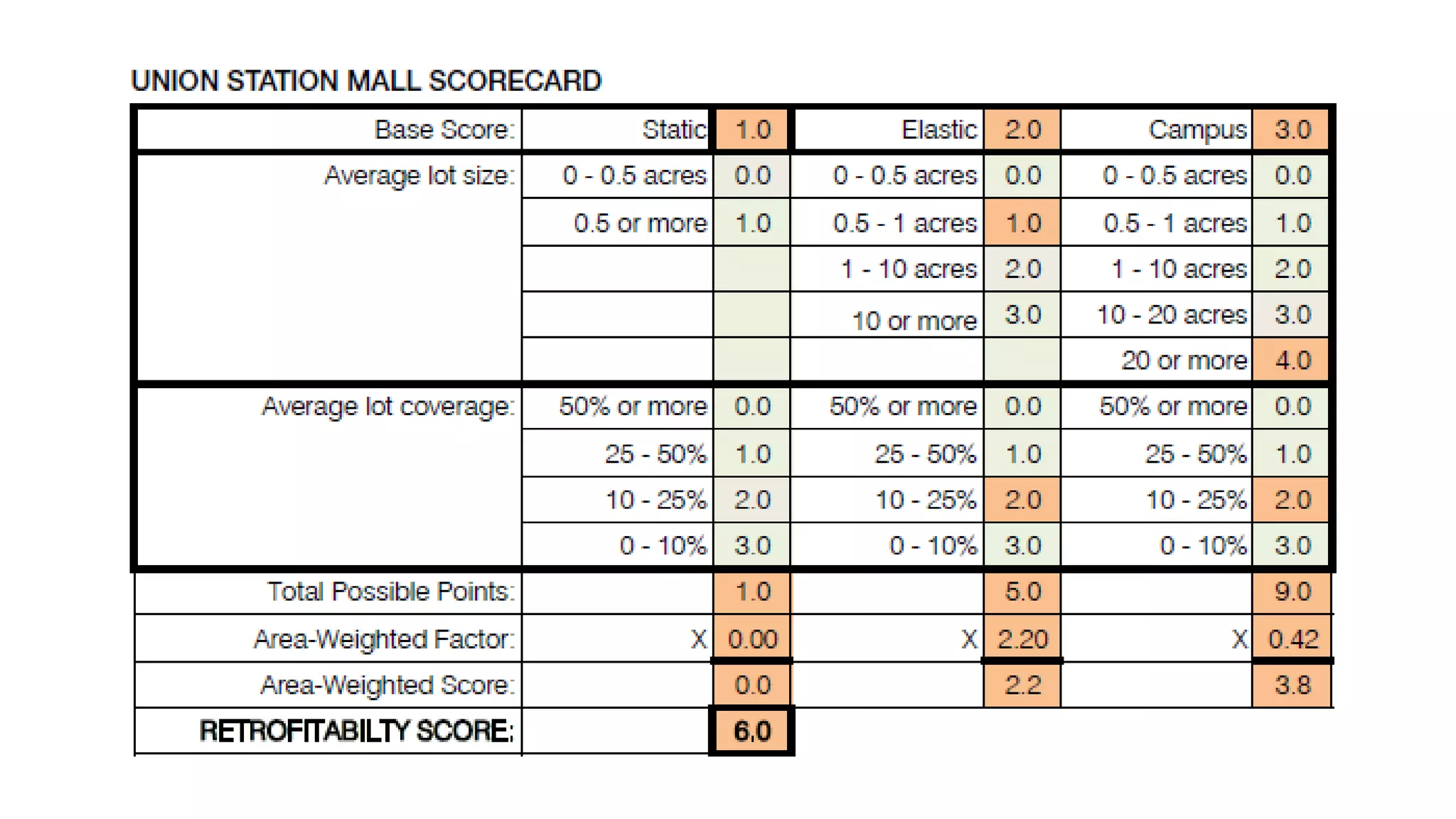
 Based on these numbers, the Union Station Mall
site had a retrofitability score of 6.0, which
translates as “High Retrofitability.”
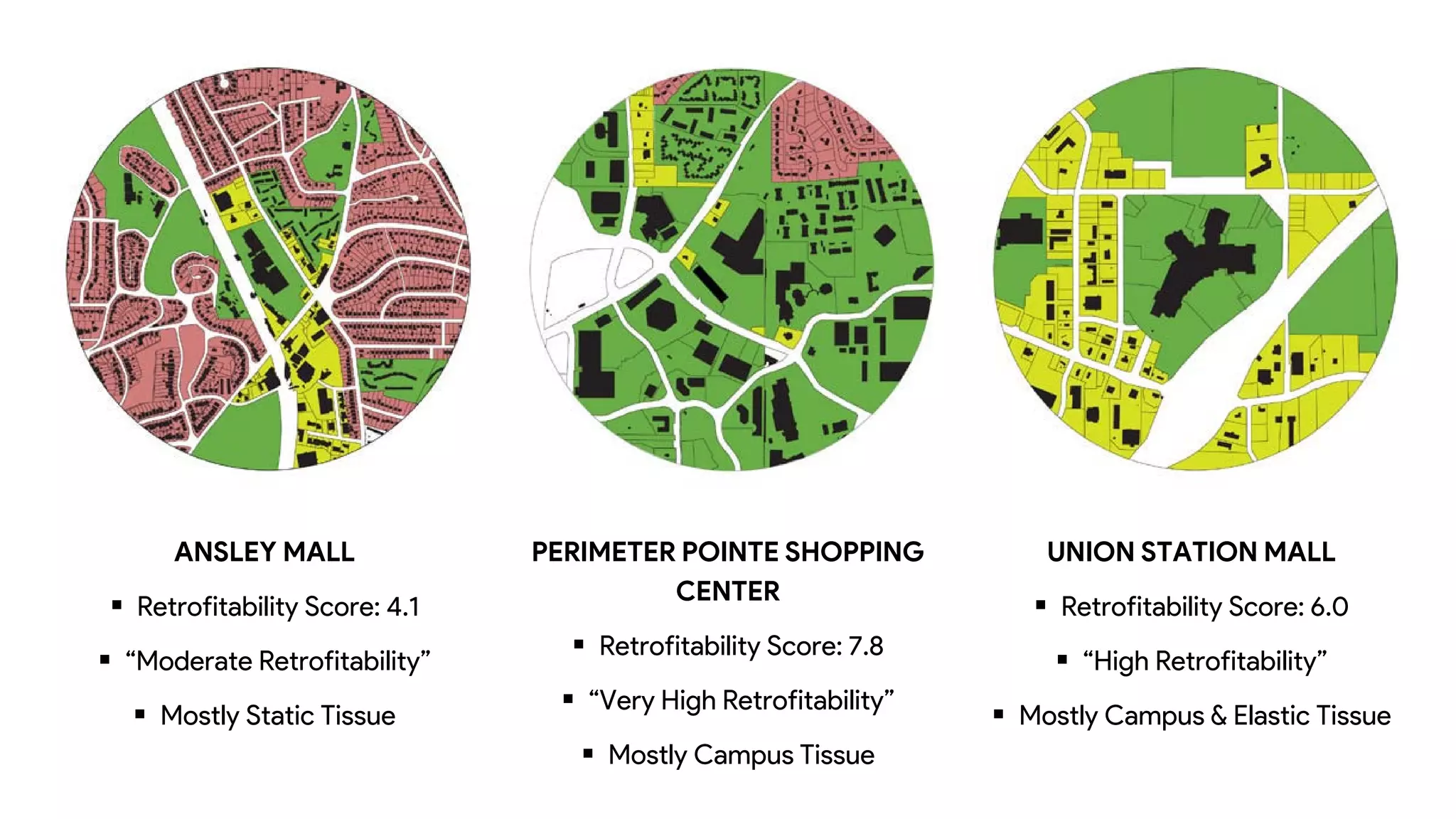
Comparison
ANSLEY MALL
 Retrofitability Score: 4.1
 “Moderate Retrofitability”
 Mostly Static Tissue
PERIMETER POINTE SHOPPING
CENTER
 Retrofitability Score: 7.8
 “Very High Retrofitability”
 Mostly Campus Tissue
UNION STATION MALL
 Retrofitability Score: 6.0
 “High Retrofitability”
 Mostly Campus & Elastic Tissue
UrbanTissue
Experiment
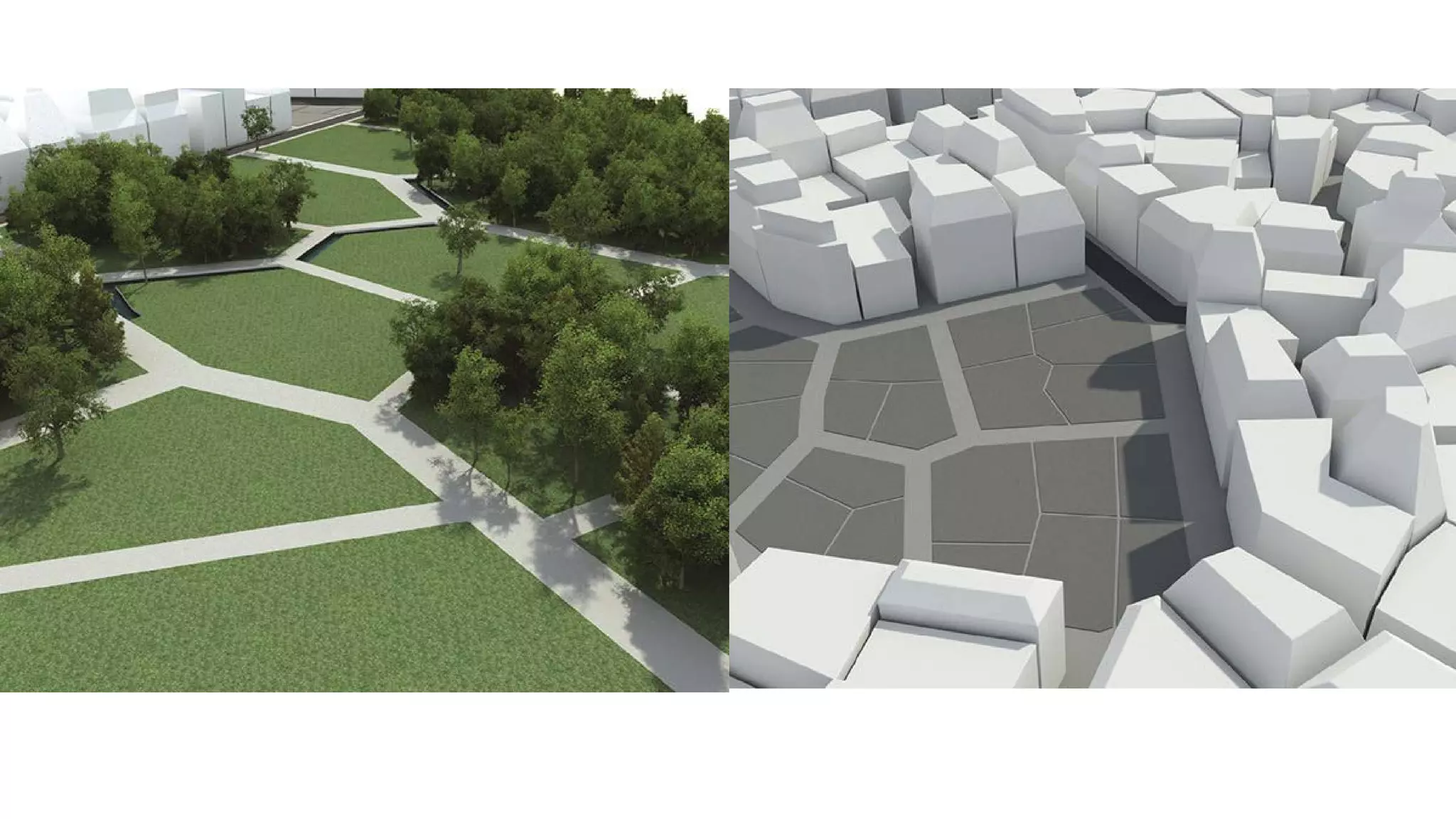
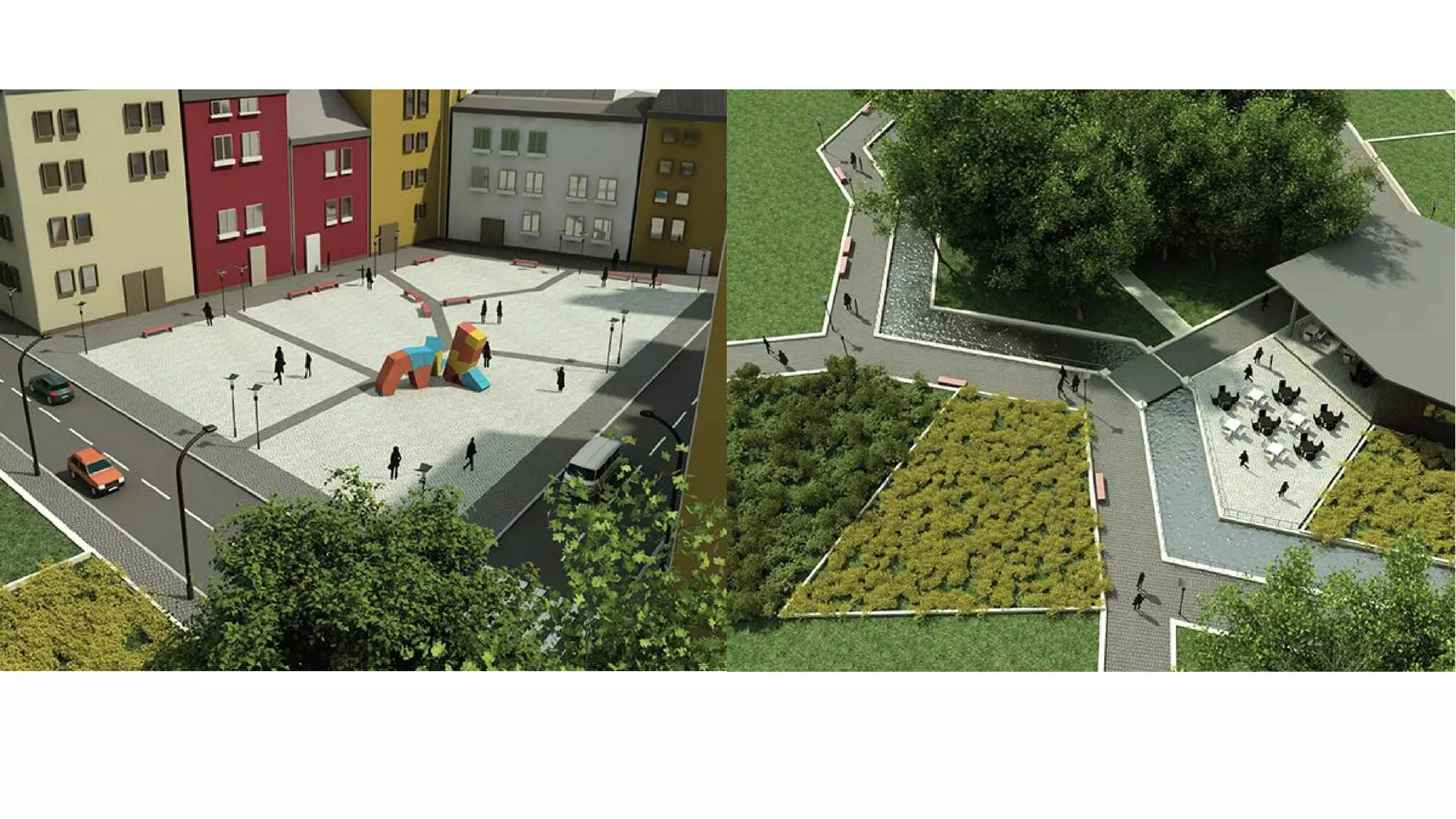
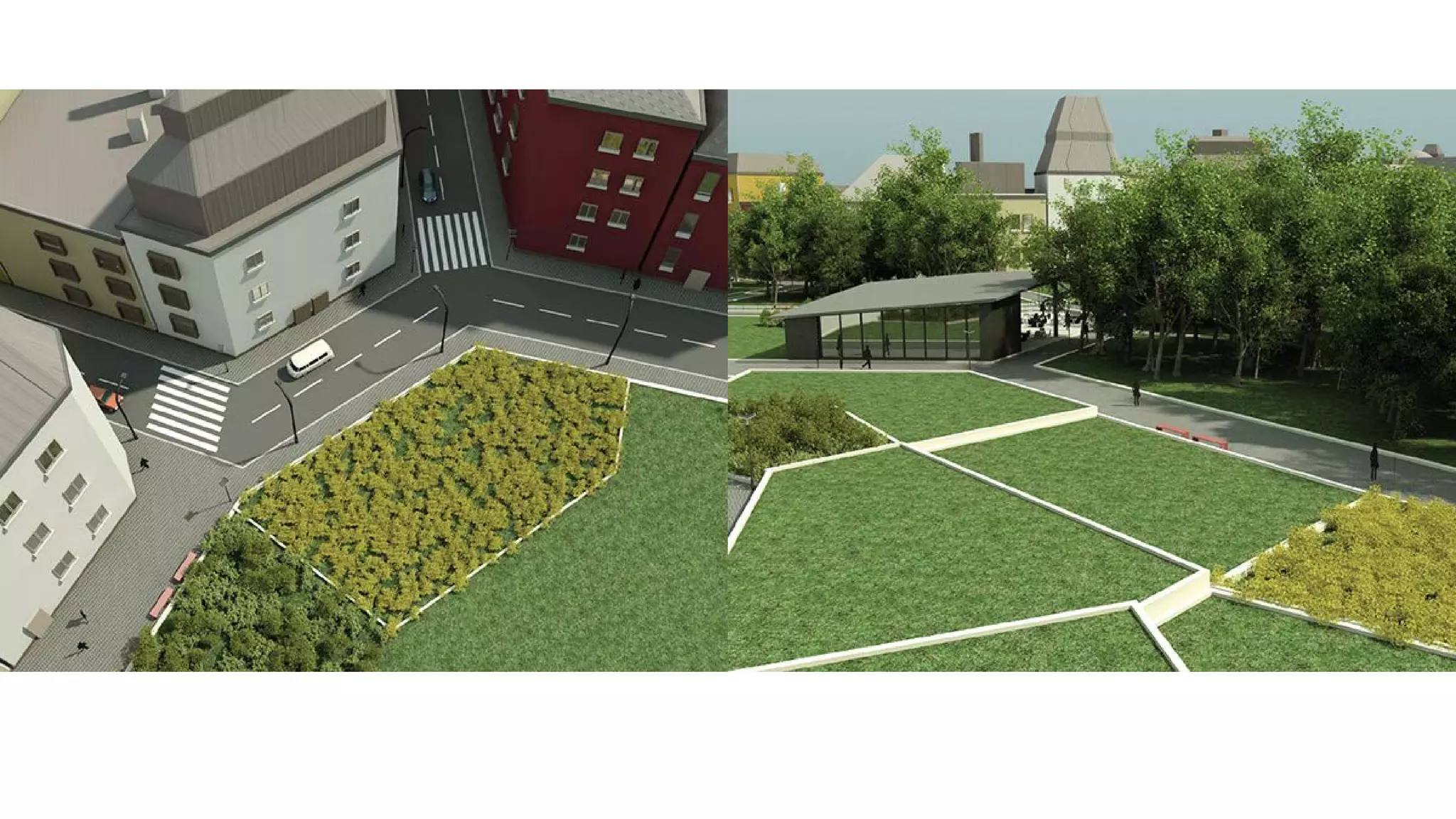
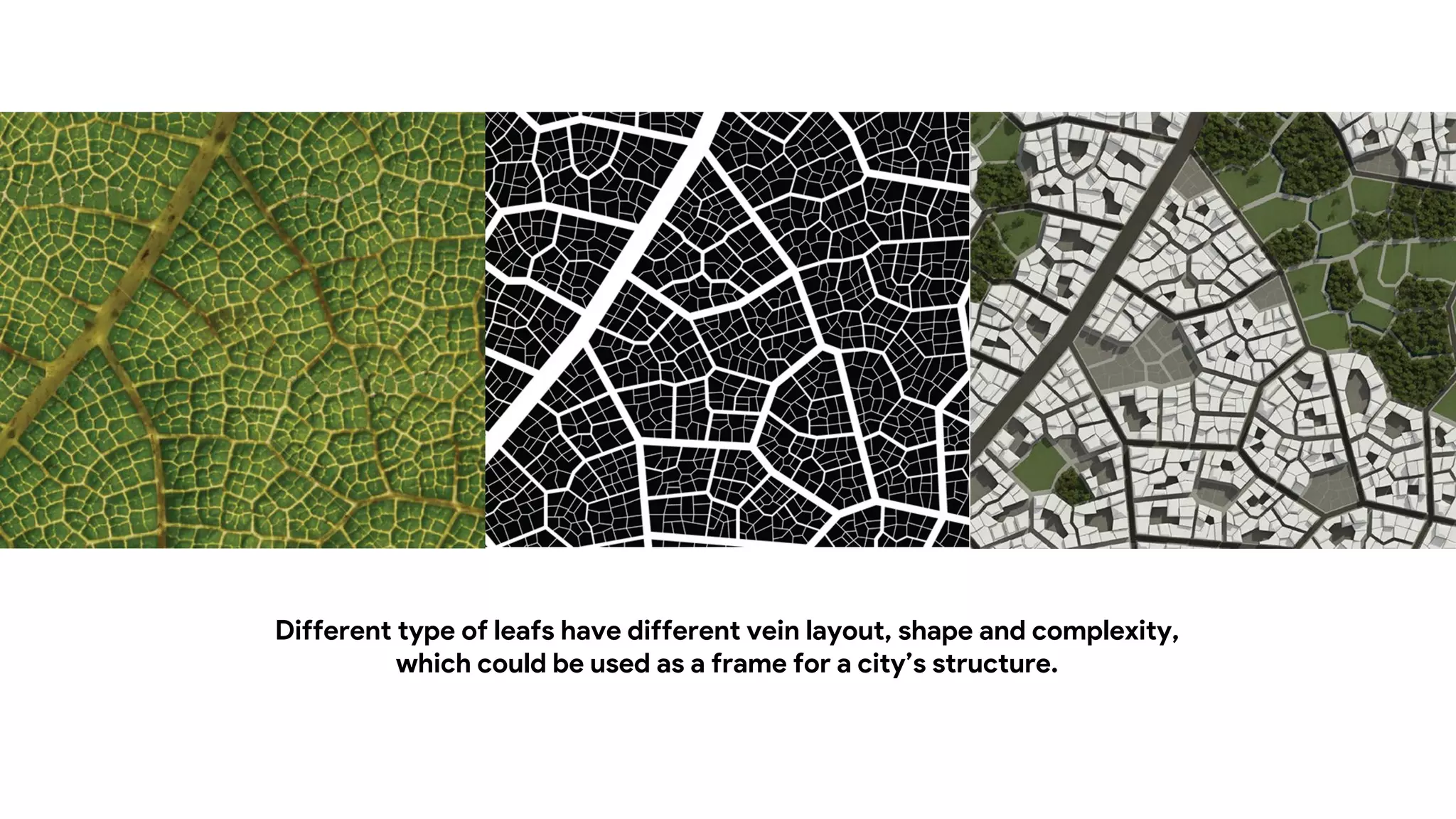
 An attempt to transfer a leafs vein system to a functioning
urban tissue.
 A fig of leafs nutrient supply is very similar to a urban
structure, fits more or less the functional requirements,
and looks great.
 Different type of leafs have different vein layout, shape
and complexity, which could be used as a frame for a city’s
structure.
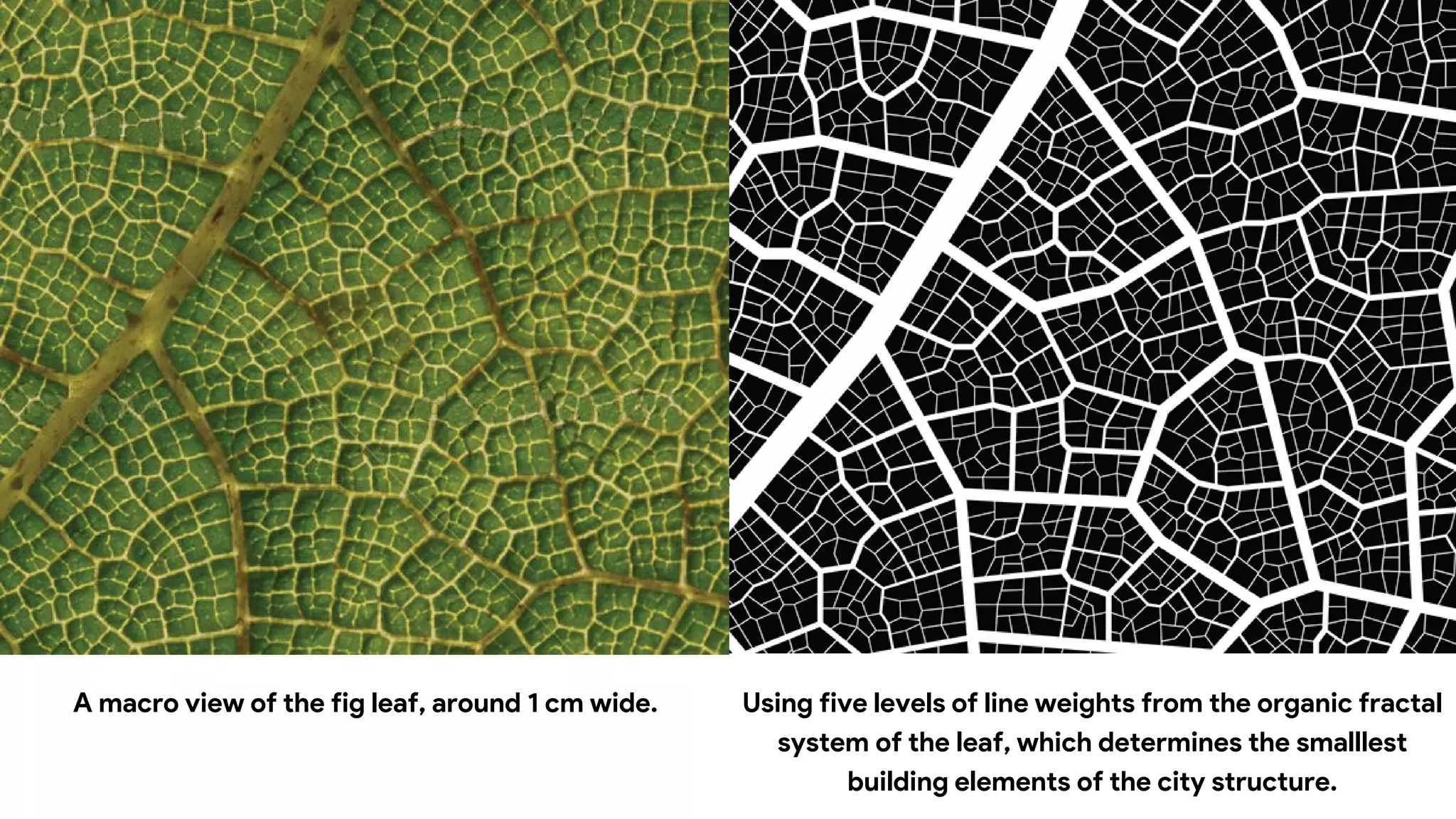
A macro view of the fig leaf, around 1 cm wide. Using five levels of line weights from the organic fractal
system of the leaf, which determines the smalllest
building elements of the city structure.
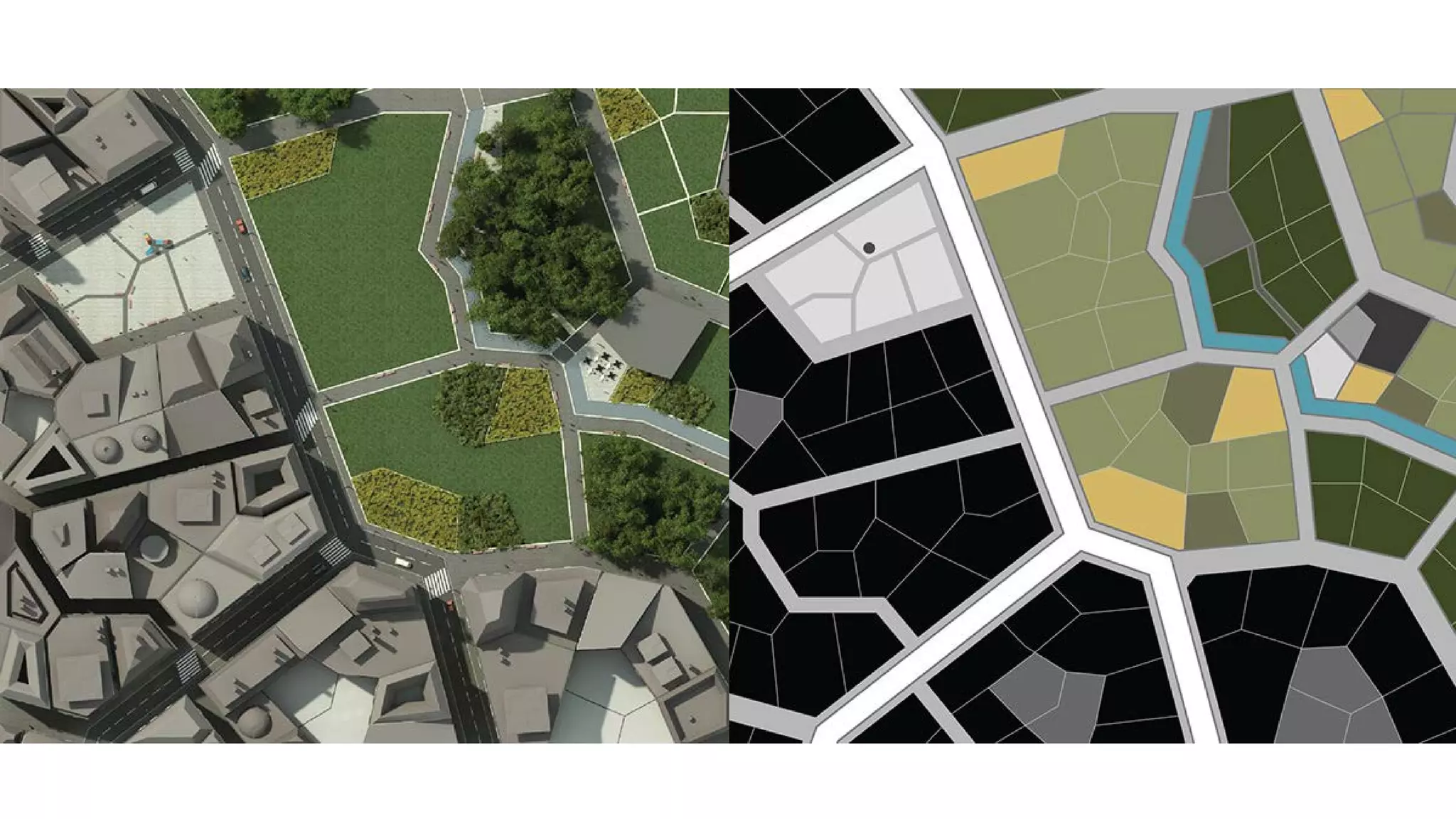
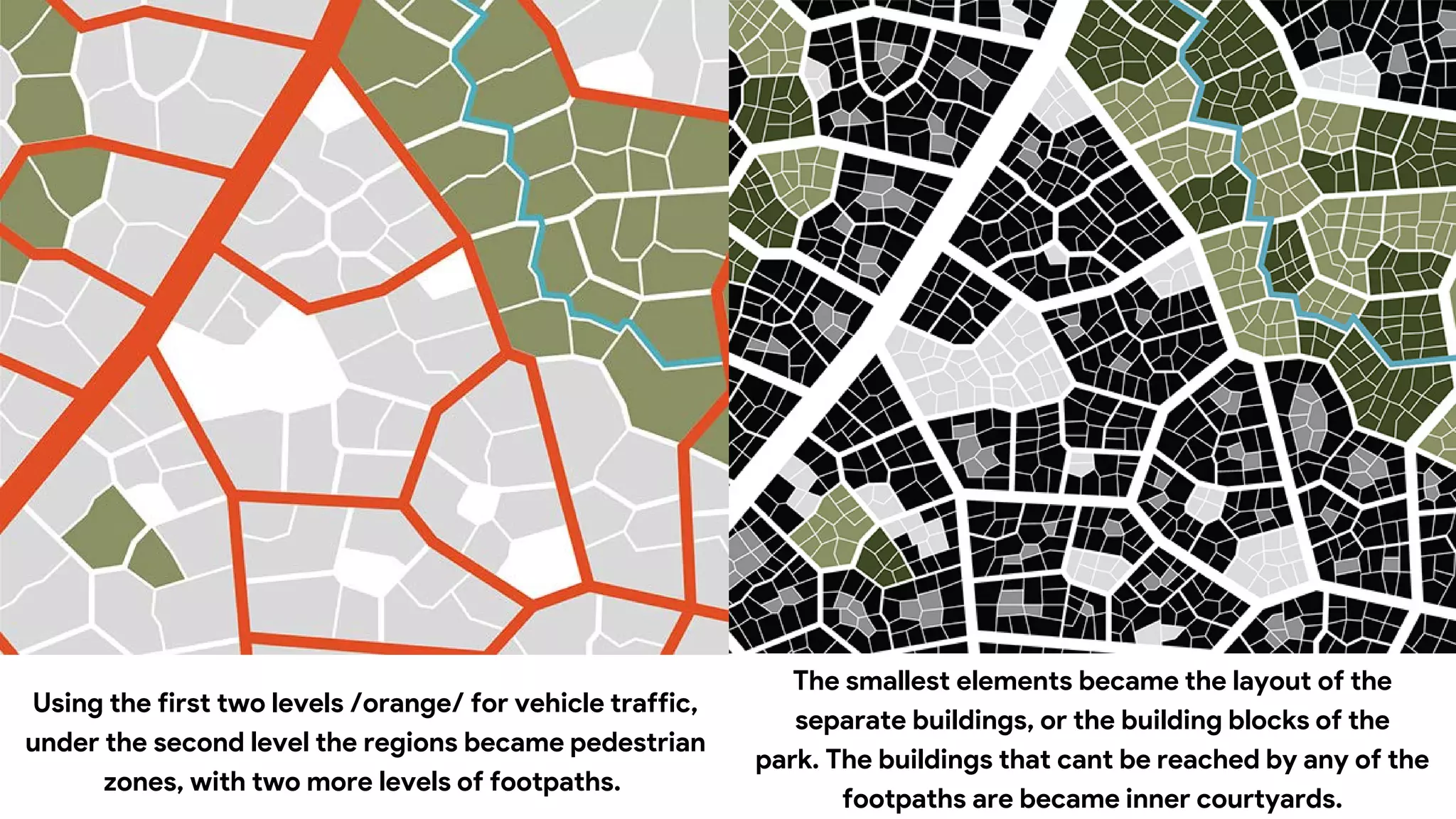
Using the first two levels /orange/ for vehicle traffic,
under the second level the regions became pedestrian
zones, with two more levels of footpaths.
The smallest elements became the layout of the
separate buildings, or the building blocks of the
park. The buildings that cant be reached by any of the
footpaths are became inner courtyards.
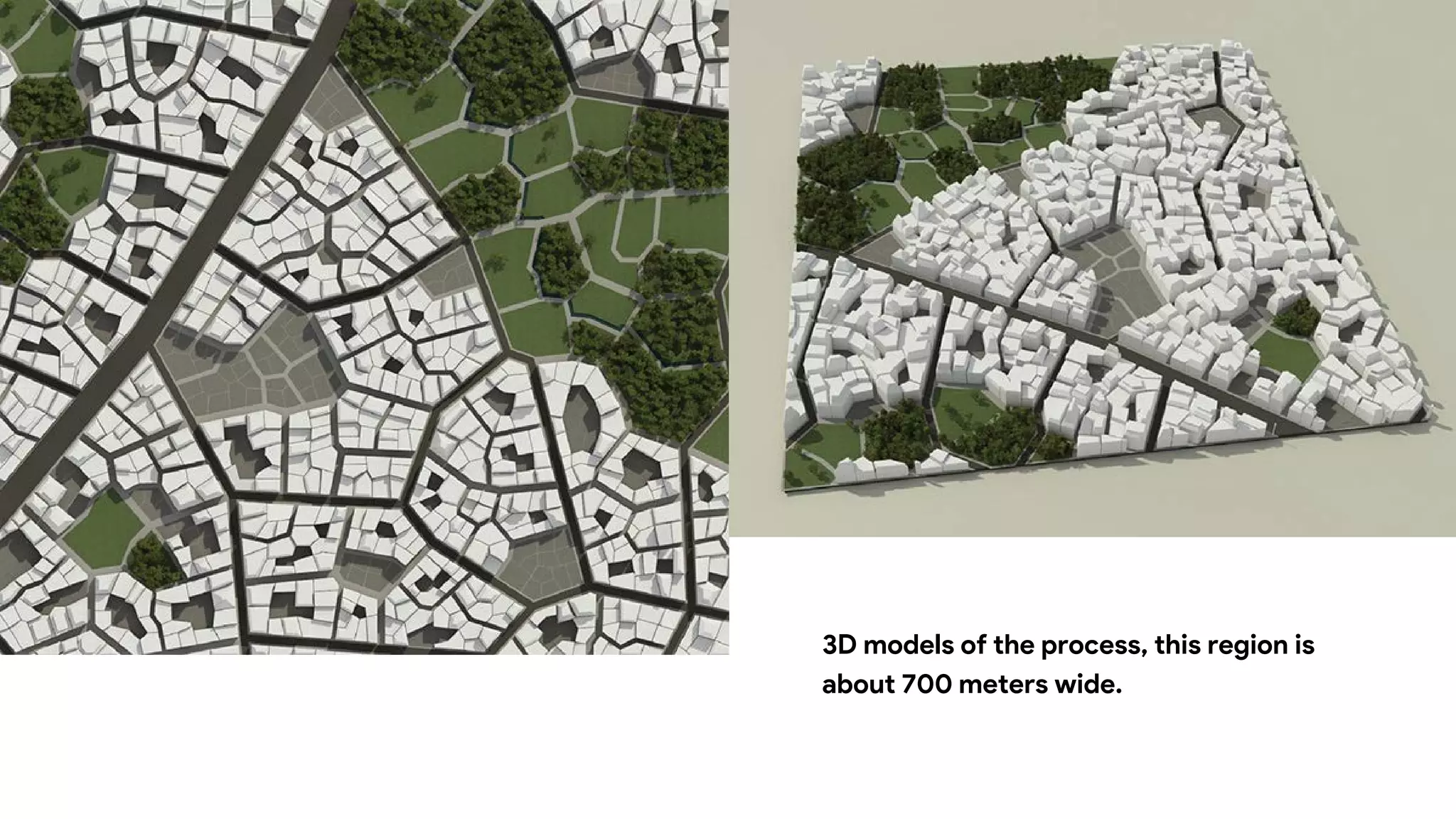
3D models of the process, this region is
about 700 meters wide.
Different type of leafs have different vein layout, shape and complexity,
which could be used as a frame for a city’s structure.

Tissue Analysis - Urban Design - Architecture

  • 1.
    TISSUE ANALYSIS SUNIL RAGHAVENDHER 101114042 VIMALKUMAR A 101114049 K SABARATHINAM 101114012 NIT TRICHY
  • 2.
    WhatisTissue Analysis?  A techniquethat overlays a known and understood scale plan or aerial photograph of existing buildings, lots, blocks and street patterns onto a vacant site as a rapid means of generating design options.  These plans, aerial photographs or maps are often referred to as an ‘urban tissue’.
  • 3.
    Whatit’s useful for?  Rapidgeneration of initial design options for sites and neighborhoods that promote informed design discussion.  Because the density, activity and physical characteristics are known, measurable, and can even be visited, there is a degree of certainty about the feasibility and effects of different configurations of development.
  • 4.
    Urban Morphologhy  To understandthe concept of suburban tissue, it is first necessary to understand the concept of urban morphology, or the study of the physical form of cities over time. According to Matthew Carmona, there are essentially two main types of urban form: ‘traditional’ and ‘modernist,’ with the former consisting of urban blocks that define and enclose space, and the latter consisting of free-standing ‘pavilion’ buildings in landscape settings  there are several key elements: land uses, building structures, plot patterns and street patterns, with each exhibiting different degrees of stability  Together, according to Gianfranco Caniggia, these four elements combine to form patterns with similar characteristics and congruencies, patterns known as ‘urban tissues’
  • 5.
    UrbanTissues  Break downthe built environment into the elemental forms of buildings, lots and streets.  Identifies the elemental parts of the site, superstructure, infill, buildings and objects.  These elemental parts come together to form the basic shapes of the city: the grid, the strip and the master planned community, with the latter two forming the shapes of the suburbs.
  • 6.
    Typesof Tissues  The suburbs,according to Scheer, can in turn be broken down into three distinct “tissues” that change over time at different rates and at different scales. She labels these tissues as static, elastic, and campus tissue. 1. Static Tissue 2. Elastic Tissue 3. Campus Tissue
  • 7.
    Tissue  Overall, itimplies a process of transformations. When this notion of tissue is applied to the city, it can be thought of as the “superimposition of several structures acting at different scales, but which appears as a system with linkages in each part of the city.  It is in effect the culmination of three logical systems: 1. The logic of roads: movement and distribution 2. The logic of plot subdivisions: where private and public initiatives take place 3. The logic of buildings: containing different activities
  • 8.
  • 9.
  • 10.
  • 11.
    TheSpatio- Temporal Model  In thismodel, components are organized by rate of change  as cities grow and change, their physical components also grow and change at different rates.  For example, the site of cities – 1. landforms and bodies of water – change on a geological time scale (over millions of years), 2. streets are very persistent (lasting thousands of years), 3. buildings are relatively short-lived (100 to 300- year life spans), 4. and objects such as trees and road signs normally have an even shorter endurance (less than 100 years).  Streets, for example, can have paving that changes frequently while the right-of-way may endure for a very long time.
  • 12.
    TheSpatio- Temporal Model  Landforms  Waterbodies  Streets  Buildings  Objects  These five components can be thought of as a progression of layers representing a hierarchy of expected rates of change from the most slow (site) to the most ephemeral (objects).  Together, the strip and the master planned community form the basic shapes of the suburbs, which Scheer says have three generalizable types of tissues: static tissue, campus tissue, and elastic tissue.
  • 13.
  • 14.
    StaticTissue  Static tissuesare characteristically more ordered than other tissues, forming a consistent pattern.  Most urban grids and all planned single-family subdivisions are examples of static tissue.  These tissues have lots and streets that were planned together, surveyed around the same time, and built on within a period of roughly 10 to 20 years.  The lot sizes are relatively small and about the same size.  Because of highly protected property ownership, static tissue is a very stable and persistent element of urban form.
  • 15.
     Static tissuesform a consistent pattern and are characterized by relatively small lots that are about the same size. They also contain a major structure directly related to the tissue.
  • 16.
    ElasticTissue  Elastic tissue,according to Scheer, is the least stable of the three tissues.  It typically forms along arterial roads and has a rapid change rate compared to the other tissues.  It is characterized by a great variety of lot sizes, many different building types in close proximity, and general lack of street networks. Scheer remarks that elastic tissues “pose a great many problems since they are so fundamentally disordered” (Scheer 2010).  For example, lots tend to range from very large to very small, with little semblance of a pattern since they are created by subdivision of individual farm fields or aggregation of small preurban roadside houses, without the establishment of a street network.  In effect, development depends heavily on a single arterial road, resulting in high traffic.  Lastly, highly varied lot sizes lead to a wide variety of building types that are not only inconsistent with each other but also have no logical orientation or relationship to the lot and street.
  • 17.
     Elastic tissueis the least stable of the three tissues because of the general lack of order due to the variety of lot sizes and lack of a street network.
  • 18.
    Campus Tissue  Campus tissue,along with elastic tissue which will be discussed in the next section, reached a zenith in the 20th century, according to Scheer.  This tissue is characterized by a large tract of land with multiple buildings, owned by a single entity.  Examples are apartment complexes (Figure 2-7), universities, airports, large hospitals, industrial parks, and shopping centers (Scheer 2010).  According to Scheer, the defining characteristic of campus tissue is that the lot is not subdivided when new buildings are added or changed.  Additionally, campus tissues contain more than one significant building and usually have an internal circulation system of roads and paths that connect the buildings.  In general, they are somewhat physically isolated from nearby tissues because most of the time there is no network of streets that connect to the outside, except at limited entrances.
  • 19.
     Campus tissue,such as the apartment complex pictured above, is characterized by a large tract of land owned by a single entity. There tends to be more than one building and a lack of connectivity to surrounding tissues, aside from the limited number of entrances.
  • 20.
    CASE STUDY –I ANSLEY MALL
  • 21.
    ANSLEY MALL  Ansley Mallis located on 18 acres of land just three miles northeast of downtown Atlanta.  It is an open-air mall with anchor stores such as CVS Pharmacy and Publix.  It also has numerous commercial units that are vacant.  The key features of the mall are its proximity to the proposed BeltLine corridor, making it a potential location for a BeltLine light-rail station.  It also is located in a densely-populated single-family neighborhood and at the intersection of two major thoroughfares, Monroe Drive and Piedmont Road.
  • 22.
    STATIC TISSUE  Avg.Lot Size: 0.3 Acres  Avg. Lot Coverage: 19%  Proportion of Site: 58% ELASTIC TISSUE  Avg. Lot Size: 2.0 Acres  Avg. Lot Coverage: 20%  Proportion of Site: 10% CAMPUS TISSUE  Avg. Lot Size: 12.0 Acres  Avg. Lot Coverage: 18.5%  Proportion of Site: 22%
  • 24.
     Based ontissue analysis, the majority of the Ansley Mall study area (58 percent) is static tissue, with about an equal proportion of campus tissue (22 percent) and elastic tissue (20 percent).  Based on these numbers, I calculated the retrofitability score of the Ansley Mall study area to be 4.1.  Based on a scale of 1 – 10, with 0.0 – 2.5 being “Very Low Retrofitability,” 2.5 – 5.0 being “Moderate Retrofitability,” 5.0 – 7.5 being “High Retrofitability,” and 7.5 – 10 being “Very High Retrofitability,” the score for Ansley Mall can be classified as “Moderate Retrofitability.”
  • 25.
    CASE STUDY –II PERIMETERPOINTSHOPPING CENTER
  • 26.
    ANSLEY MALL  Perimeter PointeShopping Center is located on 28 acres of land 12 miles north of downtown Atlanta in the city of Sandy Springs, GA.  It is laid out as a typical shopping center with stores fronting acres of surface parking lots. Some of the anchor stores include LA Fitness, Office Depot, Sports Authority and Regal Cinemas.  The key features of the mall are its proximity to the MARTA Sandy Springs Metro Station and Georgia State Road 400.
  • 27.
    STATIC TISSUE  Avg.Lot Size: 0.6 Acres  Avg. Lot Coverage: 14%  Proportion of Site: 7% ELASTIC TISSUE  Avg. Lot Size: 0.9 Acres  Avg. Lot Coverage: 12%  Proportion of Site: 3% CAMPUS TISSUE  Avg. Lot Size: 25.0 Acres  Avg. Lot Coverage: 23%  Proportion of Site: 82%
  • 29.
     Based ontissue analysis, I found that a large majority of the Perimeter Pointe Shopping Center study area (82 percent) is campus tissue, with very little static and campus tissue.  Most of the surrounding areas of the site consist of office parks, apartment complexes, and other large lots containing shopping centers.  The resulting retrofitability score was 7.8, which can be classified as “Very High Retrofitability.”
  • 30.
    CASE STUDY –III UNION STATION MALL
  • 31.
    ANSLEY MALL  Union StationMall is located on 83 acres of land 15 miles southwest of downtown Atlanta in the city of Union City, GA.  It is the largest of the three malls that I studied and also the one with the most vacancies.  Some of the key features of the indoor mall are its proximity to Hartsfield Jackson International Airport and Interstate 85.
  • 32.
    STATIC TISSUE  Avg.Lot Size: 0 Acres  Avg. Lot Coverage: 0%  Proportion of Site: 0% ELASTIC TISSUE  Avg. Lot Size: 1.0 Acres  Avg. Lot Coverage: 16%  Proportion of Site: 43% CAMPUS TISSUE  Avg. Lot Size: 26.0 Acres  Avg. Lot Coverage: 17%  Proportion of Site: 60%
  • 34.
     Based ontissue analysis, I found that a majority of the scoring area (60 percent) around the site is campus tissue, with a significant amount of elastic tissue (43 percent).  Based on these numbers, the Union Station Mall site had a retrofitability score of 6.0, which translates as “High Retrofitability.”
  • 35.
  • 36.
    ANSLEY MALL  RetrofitabilityScore: 4.1  “Moderate Retrofitability”  Mostly Static Tissue PERIMETER POINTE SHOPPING CENTER  Retrofitability Score: 7.8  “Very High Retrofitability”  Mostly Campus Tissue UNION STATION MALL  Retrofitability Score: 6.0  “High Retrofitability”  Mostly Campus & Elastic Tissue
  • 37.
    UrbanTissue Experiment  An attemptto transfer a leafs vein system to a functioning urban tissue.  A fig of leafs nutrient supply is very similar to a urban structure, fits more or less the functional requirements, and looks great.  Different type of leafs have different vein layout, shape and complexity, which could be used as a frame for a city’s structure.
  • 38.
    A macro viewof the fig leaf, around 1 cm wide. Using five levels of line weights from the organic fractal system of the leaf, which determines the smalllest building elements of the city structure.
  • 39.
    Using the firsttwo levels /orange/ for vehicle traffic, under the second level the regions became pedestrian zones, with two more levels of footpaths. The smallest elements became the layout of the separate buildings, or the building blocks of the park. The buildings that cant be reached by any of the footpaths are became inner courtyards.
  • 40.
    3D models ofthe process, this region is about 700 meters wide.
  • 45.
    Different type ofleafs have different vein layout, shape and complexity, which could be used as a frame for a city’s structure.