J. CHRISTOPHER RAY
LANDSCAPE ARCHITECTURE PORTFOLIO
“Every place has a personality. My task is to make their voice and
function clear. In creating ideas through space and form there is a
reaction, a personal response. The goal is to create the right harmony
within this response. Every project has the ability to exhibit it’s unique
voice reconnecting space and form with user and nature. It must inspire
even if only on a humble scale.This is the true identity of an
areas, it’s form, it’s function, and it’s harmony of response.”
All content created in pursuit of a Master of Landscape Architecture
degree at Chatham University, Pittsburgh Pennsylvania 2010-2013.
DESIGN PHILOSOPHYDESIGN PHILOSOPHY
Precedent &
Hazelwood
Mercy
Meeder’s
Cotter
Transit
Process
Archetype
Hospital
Grove
Park
Circle
1-2
3-8
11-12
13-16
17-18
19-22
J. Christopher Ray
341 S. Highland Ave. apt 18
Pittsburgh, PA 15206
J.CHRISRAYDESIGN@GMAIL.COM
1
2
3
4
5
6
Precedent
1
While working as a
Horticulturalist for
the City of Cincinnati
Parks Division and for the Keep Cincinnati
Beautiful organization, I learned the
influence of garden design on public space
through administrative responsibilities,
thus leading to a pursuit of a
Master’s of Landscape Architecture
degree. The pictured to the right
are several designs
installed in 2007 and
photographed in 2012.
Process
2
FUNCTION + SKETCH(FORM)
= DESIGN
The formula above is an equation of my process. It starts with the function of a space. This will define the design problems
and perimeters. From there, I sketch out the space relations. The forms lead me to material choices, rhythms implementations,
and size arrangement. For the last several years I have been freelance designing residental properties while finishing graduate
school. The coneptual drawing below is one of recent, The Muller House.
outside Oakland, PA. It’s
located between a recently
torn down multi-story
apartment buildings so
efforts were concentrated
on working with side lots
to expand newly visible
areas that were
previously
fenced off.
Vegetation was
chosen to direct
attention to new
walkable areas
creating room
like pathways.
The site is a
shotgun style
starter house
The Hazelwood Archetype is a small scattered
site urban infill redevelopment design application
that focuses on vacant and under used property
located near a large scale developed area. Infill
development interweaves new redevelopment
with old structural integrity. The design of the
Hazelwood Archetype is to create a pedestrian
core in order to preserve the existing identity
of the neighborhood while connecting it any
new larger development plans. Currently, the
neighborhood of Hazelwood has been chosen to
receive a 178 acre redevelopment project boarding
the Riverfront to Second Ave by The Almono
Partners.
The Archetype is designed to reuse three existing
area, creating a vertical pedestrian infrastructure
through the neighborhood. This will allow
closer connectivity to the current streetscape
which in turn will deliver local gradual growth,
an important component to the longevity of a
successful redevelopment design.
Given the large size of the neighborhood and the dramatic
change in slope throughout the residential and business area, the
decision was made to focus redevelopment efforts in one channel
of area. This area is highlighted in red on the lower left color
illustration of the neighborhood Hazelwood, Pittsburgh, Pa.
Hazelwood Archetype
3
4
Site Plan
LEWIS PLAYGROUND HAZELWOOD YMCA HIDDEN STAIRCASE
Below is an enlarged
view of the three
designed areas of the
pedestrian corridor.
5
lewisplayground
The Lewis Playground is the redeveloped of an existing playground
to become the neighborhood gateway. The playground is designed
to allow street visibility, visual activity, and entrance from main
roadway.
6
7
HAZELWOODYMCA
The existing side staircase of the Hazelwood YMCA
has been redeveloped as a place in flux. This pedestrian
connection is designed to frame the river and hillside views
with seasonal vegetative amenities.
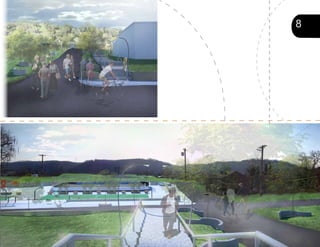
8
hiddenstaircase
9
The Hidden Staircase is a connection between the residential
area of the neighborhood and the existing greenway. The
staircase has been redeveloped with two small observational
landings in order to utilizing the neighborhood vista and lateral
connection for commercial growth.
10
Mercy
Hospital
ANALYSIS AND SYNTHESIS
In the summer of 2012, myself and
two fellow Landscape Architecture
student were the recipient winners of
the UPMC-sponsored Living Visual
Barrier Student Design Competition
for their design for UPMC Mercy
Hospital. The design draws on the
environmental context and rock
outcroppings of the Monongahela
River, developing an efficient
retaining wall system for the corner
of the Mercy Hospital campus.
12
Site Plan
Patient view
Perspective
Section
Plantscape
Hardscape
The designed terrace rock walls proposed are set in a double helix pattern
that guides the eye and references to the flow of the river below and the wind
currently on the site. The design met two primary objectives: blocking the
view of the loading dock operations from passersby and providing a visual
respite to patients, doctors, and visitors.
13
Meeder’s Grove Cranberry Township is a 22.8 sq. mile
suburban area north of Pittsburgh, Pa. As of
the census in 2010, Cranberry’s population has
grown to 28,098 making it the fastest growing area in the Pittsburgh metropolitan area with
projections to hit 50,000 pop. by 2030. Much of this growth can be attributed to several key
factors, close proximity to large highway arteries such as US Route 19 and the Pennsylvania
Turnpike via Interstate 76, spacial new land development, and thriving business growth.
However, like many modern new suburban boomtowns the growth has was not
monitored nor planned and elements of sprawl has claimed most of the town
arrangement. To combat this phenomena the Township adopted new zoning
ordinances like a Traditional Neighborhood Development (TND) plan into their
2009 Township pattern plan. This design centers around 59-acre donated farmland
that was projected to hold a new civic center and community college area.
The objectives of the design, aside from creating the civic and community college
areas, were to allow a set number of commercial and new residential units in order
to finance the project, however the TND-3 zoning ordinance clashed with the main
focus. This created a design paradox where the zoning called for a lot of parking
and hardscaping but the Township wanted a lot of greenspace.
Meeder’s Grove refers to the Meeder family which donated the farmland to the
Township and the Grove of trees which were salvaged in the center of the design.
Both harken to the historical aspect of the site however the name also hints to the
green infrastructure. Clearly, most of the existing vegetation could not be saved due
to parking needs, so a street tree network and parking tree island were adopted to
connect to the larger existing tree clusters that were saved as greenways. These large
greenways were strategically placed around the residential, civic, and educational
areas to act not only as screening from the commercial traffic but also as walking
trails to promote alternative scenic exercise.
14
Site Master Plan
Residential: 116 Units
Mix Use: 181,000 sq ft
Commercial: 272,000 sq ft
Institutional: 130,000 sq ft
The design consists of a
commercial corridor at
the souther end of the site
leading to a mixed-use
boulevard, opening to the
greenways, the Civic Center/
Community College, and
residential areas. The Civic
Center and Community
College are connected via
skyway in to pull resources
and take advantage of the
vista over the
grove.
Residential Site Plan
15
16
Residential Design
The concept behind the residential
development was to surround the Civic
Center and Community College area with
mixed use housing and small shotgun
style single family attached and detached
row houses with shared backyards.
Buffering these areas are the greenway
to add a sense of larger private yard
usage. Larger single family American
Craftsman housing plots with shared
backyards are positioned on the outer
realm of the single housing.
Each house has a walkout balcony above
the single garages from the master bedroom
for lighting and personal connection to the
greenway vistas. The housing themselves are
set back from the street to incorperate more
privacey for the residents.
Cotter’s Park
17
Cotter Park is a 8,100sq. foot
small community park design for a
mixed income housing redevelopment
area in Seneca, South Carolina. The site was an
aging ,unkept baseball infield dating from the
mid-1970’s that is now unused due to the newer baseball
fields that were developed near by. Given the urban
environment surrounding the existing sports field the design took
on a natural playscape approach.
This approach tries to share the amusement of nature in one of it’s
simplest forms, the hillside.The design is a series of small different sized
18
hills with smooth concrete slides implemented into the slope. The hills
do not exceed five feet in height nor 40% in slope. There are no step to
the top of the implemented slides so the applicant must climb up the
hillside in order to slide down. Surrounding the hillsides is a walking
track with tree shaded seated areas.
Transit
Circle
19
The image to the right is of the
existing Chapel Hill courtyard at
Chatham University’s Woodland
Campus in Pittsburgh, Pa. Aside
from being the main road for
students and faculty transporters
it is also the main
public transit stop for
the university. The
current design is a pre-existing rectangular chapel
courtyard with limited space for bus turn around
and alternative transit.
The Transit Circle is designed to expand the
courtyard for automotive turn around, alternative
transit use, and covered passenger waiting area. The
passenger waiting area is designed to be a gateway
information center for visitors and a social hub for
students. The retaining walls have been lined with
anchored benches around a large centered kiosk.
A gently curved ADA accessible ramp has been
added to the backside of the retaining wall to
affirm the notion of this being the
main entrance.
1040
1042
1046
1044
1038
1045
1041
1043
1039
1037
1036
LA3.1
16
LA3.1
7
LA3.1
9
LA3.1
5
LA3.1
14
LA3.1
18
LA3.1
13
LA3.1
15
LA3.1
6
LA3.1
2
LA3.1
4
LA3.1
14
LA3.1
10
LA3.1
11
PRODUCEDBYANAUTODESKEDUCATIONALPRODUCT
20
GRADING PLAN
1040
1042
1046
1044
1038
1045
1041
1043
1039
1037
1036
PENNSYLVANIA ONE-CALL NOTE
SCALE 1'=10"
106 WOO
PITTSBURG
CHAT
UNIVE
TRANSIT
BRAUN
MAIN EN
PRODUCED BY AN AUTODESK EDUCATIONAL PRODUCT
PLANTING PLAN
22
DETAILS & ELEVATION
J.christopher ray sample_portfolio 2013

J.christopher ray sample_portfolio 2013

  • 1.
    J. CHRISTOPHER RAY LANDSCAPEARCHITECTURE PORTFOLIO
  • 2.
    “Every place hasa personality. My task is to make their voice and function clear. In creating ideas through space and form there is a reaction, a personal response. The goal is to create the right harmony within this response. Every project has the ability to exhibit it’s unique voice reconnecting space and form with user and nature. It must inspire even if only on a humble scale.This is the true identity of an areas, it’s form, it’s function, and it’s harmony of response.” All content created in pursuit of a Master of Landscape Architecture degree at Chatham University, Pittsburgh Pennsylvania 2010-2013. DESIGN PHILOSOPHYDESIGN PHILOSOPHY
  • 3.
  • 4.
    Precedent 1 While working asa Horticulturalist for the City of Cincinnati Parks Division and for the Keep Cincinnati Beautiful organization, I learned the influence of garden design on public space through administrative responsibilities, thus leading to a pursuit of a Master’s of Landscape Architecture degree. The pictured to the right are several designs installed in 2007 and photographed in 2012.
  • 5.
    Process 2 FUNCTION + SKETCH(FORM) =DESIGN The formula above is an equation of my process. It starts with the function of a space. This will define the design problems and perimeters. From there, I sketch out the space relations. The forms lead me to material choices, rhythms implementations, and size arrangement. For the last several years I have been freelance designing residental properties while finishing graduate school. The coneptual drawing below is one of recent, The Muller House. outside Oakland, PA. It’s located between a recently torn down multi-story apartment buildings so efforts were concentrated on working with side lots to expand newly visible areas that were previously fenced off. Vegetation was chosen to direct attention to new walkable areas creating room like pathways. The site is a shotgun style starter house
  • 6.
    The Hazelwood Archetypeis a small scattered site urban infill redevelopment design application that focuses on vacant and under used property located near a large scale developed area. Infill development interweaves new redevelopment with old structural integrity. The design of the Hazelwood Archetype is to create a pedestrian core in order to preserve the existing identity of the neighborhood while connecting it any new larger development plans. Currently, the neighborhood of Hazelwood has been chosen to receive a 178 acre redevelopment project boarding the Riverfront to Second Ave by The Almono Partners. The Archetype is designed to reuse three existing area, creating a vertical pedestrian infrastructure through the neighborhood. This will allow closer connectivity to the current streetscape which in turn will deliver local gradual growth, an important component to the longevity of a successful redevelopment design. Given the large size of the neighborhood and the dramatic change in slope throughout the residential and business area, the decision was made to focus redevelopment efforts in one channel of area. This area is highlighted in red on the lower left color illustration of the neighborhood Hazelwood, Pittsburgh, Pa. Hazelwood Archetype 3
  • 7.
    4 Site Plan LEWIS PLAYGROUNDHAZELWOOD YMCA HIDDEN STAIRCASE Below is an enlarged view of the three designed areas of the pedestrian corridor.
  • 8.
    5 lewisplayground The Lewis Playgroundis the redeveloped of an existing playground to become the neighborhood gateway. The playground is designed to allow street visibility, visual activity, and entrance from main roadway.
  • 9.
  • 10.
    7 HAZELWOODYMCA The existing sidestaircase of the Hazelwood YMCA has been redeveloped as a place in flux. This pedestrian connection is designed to frame the river and hillside views with seasonal vegetative amenities.
  • 11.
  • 12.
    hiddenstaircase 9 The Hidden Staircaseis a connection between the residential area of the neighborhood and the existing greenway. The staircase has been redeveloped with two small observational landings in order to utilizing the neighborhood vista and lateral connection for commercial growth.
  • 13.
  • 14.
    Mercy Hospital ANALYSIS AND SYNTHESIS Inthe summer of 2012, myself and two fellow Landscape Architecture student were the recipient winners of the UPMC-sponsored Living Visual Barrier Student Design Competition for their design for UPMC Mercy Hospital. The design draws on the environmental context and rock outcroppings of the Monongahela River, developing an efficient retaining wall system for the corner of the Mercy Hospital campus.
  • 15.
    12 Site Plan Patient view Perspective Section Plantscape Hardscape Thedesigned terrace rock walls proposed are set in a double helix pattern that guides the eye and references to the flow of the river below and the wind currently on the site. The design met two primary objectives: blocking the view of the loading dock operations from passersby and providing a visual respite to patients, doctors, and visitors.
  • 16.
    13 Meeder’s Grove CranberryTownship is a 22.8 sq. mile suburban area north of Pittsburgh, Pa. As of the census in 2010, Cranberry’s population has grown to 28,098 making it the fastest growing area in the Pittsburgh metropolitan area with projections to hit 50,000 pop. by 2030. Much of this growth can be attributed to several key factors, close proximity to large highway arteries such as US Route 19 and the Pennsylvania Turnpike via Interstate 76, spacial new land development, and thriving business growth. However, like many modern new suburban boomtowns the growth has was not monitored nor planned and elements of sprawl has claimed most of the town arrangement. To combat this phenomena the Township adopted new zoning ordinances like a Traditional Neighborhood Development (TND) plan into their 2009 Township pattern plan. This design centers around 59-acre donated farmland that was projected to hold a new civic center and community college area. The objectives of the design, aside from creating the civic and community college areas, were to allow a set number of commercial and new residential units in order to finance the project, however the TND-3 zoning ordinance clashed with the main focus. This created a design paradox where the zoning called for a lot of parking and hardscaping but the Township wanted a lot of greenspace. Meeder’s Grove refers to the Meeder family which donated the farmland to the Township and the Grove of trees which were salvaged in the center of the design. Both harken to the historical aspect of the site however the name also hints to the green infrastructure. Clearly, most of the existing vegetation could not be saved due to parking needs, so a street tree network and parking tree island were adopted to connect to the larger existing tree clusters that were saved as greenways. These large greenways were strategically placed around the residential, civic, and educational areas to act not only as screening from the commercial traffic but also as walking trails to promote alternative scenic exercise.
  • 17.
    14 Site Master Plan Residential:116 Units Mix Use: 181,000 sq ft Commercial: 272,000 sq ft Institutional: 130,000 sq ft The design consists of a commercial corridor at the souther end of the site leading to a mixed-use boulevard, opening to the greenways, the Civic Center/ Community College, and residential areas. The Civic Center and Community College are connected via skyway in to pull resources and take advantage of the vista over the grove.
  • 18.
  • 19.
    16 Residential Design The conceptbehind the residential development was to surround the Civic Center and Community College area with mixed use housing and small shotgun style single family attached and detached row houses with shared backyards. Buffering these areas are the greenway to add a sense of larger private yard usage. Larger single family American Craftsman housing plots with shared backyards are positioned on the outer realm of the single housing. Each house has a walkout balcony above the single garages from the master bedroom for lighting and personal connection to the greenway vistas. The housing themselves are set back from the street to incorperate more privacey for the residents.
  • 20.
    Cotter’s Park 17 Cotter Parkis a 8,100sq. foot small community park design for a mixed income housing redevelopment area in Seneca, South Carolina. The site was an aging ,unkept baseball infield dating from the mid-1970’s that is now unused due to the newer baseball fields that were developed near by. Given the urban environment surrounding the existing sports field the design took on a natural playscape approach. This approach tries to share the amusement of nature in one of it’s simplest forms, the hillside.The design is a series of small different sized
  • 21.
    18 hills with smoothconcrete slides implemented into the slope. The hills do not exceed five feet in height nor 40% in slope. There are no step to the top of the implemented slides so the applicant must climb up the hillside in order to slide down. Surrounding the hillsides is a walking track with tree shaded seated areas.
  • 22.
    Transit Circle 19 The image tothe right is of the existing Chapel Hill courtyard at Chatham University’s Woodland Campus in Pittsburgh, Pa. Aside from being the main road for students and faculty transporters it is also the main public transit stop for the university. The current design is a pre-existing rectangular chapel courtyard with limited space for bus turn around and alternative transit. The Transit Circle is designed to expand the courtyard for automotive turn around, alternative transit use, and covered passenger waiting area. The passenger waiting area is designed to be a gateway information center for visitors and a social hub for students. The retaining walls have been lined with anchored benches around a large centered kiosk. A gently curved ADA accessible ramp has been added to the backside of the retaining wall to affirm the notion of this being the main entrance.
  • 23.
  • 24.
    1040 1042 1046 1044 1038 1045 1041 1043 1039 1037 1036 PENNSYLVANIA ONE-CALL NOTE SCALE1'=10" 106 WOO PITTSBURG CHAT UNIVE TRANSIT BRAUN MAIN EN PRODUCED BY AN AUTODESK EDUCATIONAL PRODUCT PLANTING PLAN
  • 25.