Teacher Education Council
Department of Education
2007
TTEEAACCHHEERR IINNDDUUCCTTIIOONN
PPRROOGGRRAAMM
IImmpplleemmeennttaattiioonn MMaannuuaall
TEACHER INDUCTION PROGRAM
Implementation Manual
All rights reserved. This Manual may not be reproduced in any
form without the permission of the Teacher Education Council,
Department of Education.
Foreword
Together with the Commission on Higher Education (CHED), the Department
endorses a “unified teacher training approach that will put in place a demand-driven
teacher education program with public schools as laboratories for extensive internship
program.” The DepEd shall “institutionalize the Teacher Induction Program in the
division and school levels” as mandated in the Medium-Term Philippine Development
Plan. (MTPDP 2004-2010).
Self-instructional modules were piloted in fifteen school divisions, and after a
year of monitoring and evaluation the final version of the materials were ready for
mass implementation to “systematize, structure and organize” the Teacher Induction
Program (TIP). The TEC action is in accordance with the implementation of the
Teacher Empowerment to Achieve Competence and Humaneness (Project TEACH),
one of the recommendations in the Philippine Agenda for Educational Reform (PCER).
The TIP Implementation Manual is intended for the use of key school officials
and other personnel who will be involved in the mass implementation of the Induction
Program of the Department of Education. It explains the rationale, goals and
objectives of the Program and outlines the proposed details of implementation. It also
gives an overview of the design and contents of the different modules.
The DepEd envisions an organized TIP as a structure to strengthen the link
between preservice and inservice education and a continuing professional
development to enhance teacher effectiveness in accordance with the Teacher
Education and Development Program (TEDP) and National Competency – Based
Teacher Standards (NCBTS).
I trust that this mass Implementation Manual will bring us closer to our goal of
providing quality education for all.
JESLI A. LAPUS
Secretary, Department of Education
Chairman, Teacher Education Council
i
Message
The Teacher Induction Program (TIP) is a vital component of the Teacher
Education and Development Program (TEDP) which provides a continuum from
preservice to inservice training. While the TIP modules are designed to be self-
instructional, the beginning teachers may need mentoring as integral component of the
support system in the division and school levels. The DepEd envisions that mentoring
shall enhance teacher leadership and empowerment of school heads as they
institutionalize the induction program in the long term.
The modules shall be made available to all elementary and secondary schools
in the country as we implement a structured and organized induction program for the
beginning teachers.
Hopefully, we shall have empowered and trained professional teachers imbued
with the genuine sense of dedication and commitment and who internalize that…
The task of the teacher today is not to complete the learning process
But to continue it;
Not to cover the whole subject
But to help students understand the process of acquiring knowledge;
Not to encourage the answering of questions
But to question the answer;
Not to stress remembering and reviewing
But to build a program of practical applications for students so that they
will remember and review;
Not to dictate
But to guide students toward living fuller and more responsible
lives.(Sharkan and Goodman)
Let us live by the dictum that teaching is “lifelong learning”.
Undersecretary for Programs and Projects
ii
Acknowledgment
The Teacher Education Council (TEC) acknowledges the collaborative support
for the Teacher Induction Program (TIP): the Former Secretaries of the Department of
Education Hon. Edilberto de Jesus, Hon. Florencio B. Abad and the Officer-in-Charge,
Undersecretary Fe A. Hidalgo; Hon. Jesli A. Lapus, Incumbent Secretary;
Undersecretary Vilma L. Labrador and Chair, NCCA; the ex-officio and regular
members of the TEC: the Commission on Higher Education (CHED), Professional
Regulation Commission (PRC), National Commission for Culture and the Arts
(NCCA);and former zonal and teacher group representatives in the Council, namely:
Dr. Rosita L. Navarro, Dr. Teresita T. Tumapon, Dr. Nilo E. Colinares, ASDS Priscila
C. de Sagun, and Ms. Jean B. Borlagdan.
The expertise of the module writers is gratefully acknowledged: Lydia Agno,
Pierangelo Alejo, Lolita Andrada, Remedios Avellona, Purita Bilbao, Wilhelmina Borjal,
Allan Canonigo, Helen Caparas, Emiliana dela Cruz, Leny delos Reyes, Luz de Leon,
Ofelia Flojo, Carolina Guerrero, Avelina Llagas, Melchora Lamorena, Ester Lozada,
Isabelo Magbitang, Miguela Marasigan, Jocelyn Marcial, Grace Estela Mateo, Gladys
Nivera, Aida Orosa,Twila Punsalan, Lidinila Luis-Santos, Narcisa Sta. Ana, Rosita
Tadena, and Crisanto Tomas.
We extend our appreciation to the reviewers: Lourdes Baello, Luzonia Bayot,
Priscila de Sagun, Aurora Franco, George Garma, Paraluman Giron, Vilma Labrador,
Avelina Llagas, Jocelyn Marcial, Grace Estela Mateo, Bernadette Pablo, Eva Robles,
Luz Rojo, Minda Sutaria, Antonio Torralba, and Teresita TUmapon. To the editors
Bernadette Pablo and Cecilia Alip, our appreciation for their untiring efforts and
guidance in the completion of all the modules.
Our sincerest gratitude to the fifteen school divisions for their participation in
the TIP Pilot Implementation, namely: Bulacan, Pampanga, Nueva Ecija, Cavite, Rizal,
Laguna, Bohol, Cebu, Negros Oriental, Cotabato, General Santos City, Sultan
Kudarat, BEAM, Quezon City, Pasig City/San Juan, and Caloocan City. The TIP
managers composed of the Schools Division Superintendents and their Assistants, the
division supervisors, district supervisors and school heads gave their all-out support
for the TIP pilot implementation. Special participation of the private basic education
schools in Iloilo City, Cagayan de Oro City and in Manila are also acknowledged.
Likewise, the Educational Program Supervisors from the concerned regions supported
the monitoring and evaluation of the try-out activities.
iii
Our gratitude to the UNICEF, the TEEP-CPISU and the BEAM for their
generous support to the TIP; and to the teacher education institutions and participants
in the zonal consultative conferences for their inputs to the TIP.
To the TEC-TIP Consultant, Dr. Avelina T. Llagas, our sincere appreciation for
her untiring efforts and guidance in the completion of this Implementation Manual.
The lean staff of the TEC Secretariat managed to complete the encoding,
formating and layouting of the manuscripts: Llova O. Balanon, Rex Augus M.
Fernandez, Vivien R. Gacula, Jun M. Garcia, Frederick S. Gregorio, Christian V.
Maliwat and Lemuel C. Valles.
BEATRIZ G. TORNO
Project Director, Teacher Induction Program
Executive Director II, Teacher Education Council
iv
TABLEOFCONTENTS
Page
Foreword i
Message ii
Acknowledgment iii
Background and Rationale for the Teacher Induction Program (TIP) 1
The TIP Pilot Implementation 2
• Monitoring and Evaluation 3
• Best Practices 4
• Highlights of the Focus Group Discussions (FGDs) 7
Program Overview 12
Module Contents 14
• Module 1- Educational Laws and Surveys
Programs and Projects of the Department of Education 14
• Module 2 -The Philippine Basic Education Curriculum 16
Module 2.1 - Multigrade Teaching 17
Module 2.2 - Alternative Learning System 18
Module 2.3 - Grading for Performance 19
• Module 3 -Responsibility and Accountability of a Filipino Teacher 19
• Module 4 -Professionalism and Personal Welfare 20
• Module 5 -School and Community Partnership 20
• Module 6 -Curriculum and Instruction 22
Module 6.1 - The Teaching of English 26
Module 6.2 - The Teaching of Filipino 28
Module 6.3 - The Teaching of Mathematics 29
v
Module 6.4 - The Teaching of Science 31
Module 6.5 - The Teaching of Makabayan 32
Module 6.6 - The Teaching of Araling Panlipunan 33
Module 6.7 - The Teaching of Edukasyon sa Pagpapahalaga
at Edukasyong Pagpapakatao 34
Module 6.8 - The Teaching of Music, Arts, Physical Education
and Health (MAPEH) 36
Module 6.9 - The Teaching of Technology and Livelihood
Education (TLE) 37
Module Design 38
Module Structure 38
The TIP Mass Implementation 39
A. Delivery Mode for Mass Implementation 39
B. Program Workload and Time Schedule 42
C. Assessment of Learning Outcomes 42
TIP Form No. 01 – Personal Information of Teacher Inductees 46
TIP Form No. 01-A – Self-Rating Scale for Teacher Inductees 47
TIP Form No. 02 – Personal Information of the Mentor 50
TIP Form No. 03 – Performance Evaluation of Inductees 51
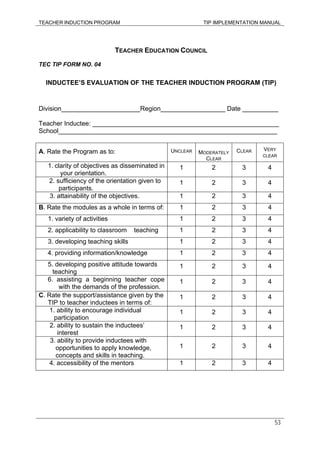
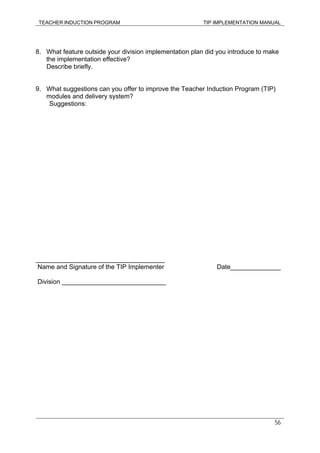
TIP Form No. 04 – Inductee’s Evaluation of the Teacher
Induction Program (TIP) 53
TIP Form No. 05 – Monitoring and Evaluation of the Teacher
Induction Program Mass Implementation 55
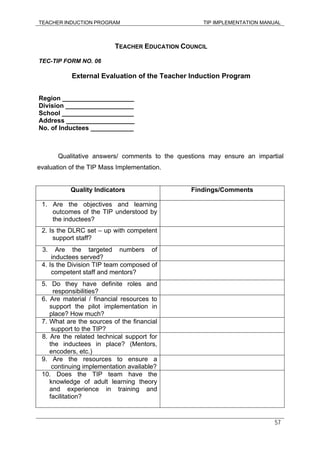
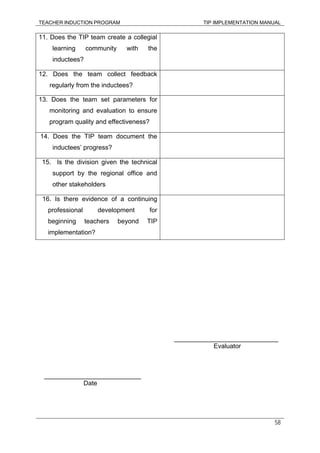
TIP Form No. 06 – External Evaluation of the Teacher
Induction Program 57
D. Monitoring and Evaluation 59
Mentoring : A Component of TIP 61
Challenges in Operationalizing the Teacher Induction Program 64
Acronym 69
Glossary 69-a
Bibliography 70
vi
vii
Appendices 72
• Appendix A
DepEd Order No.36, s. 2006
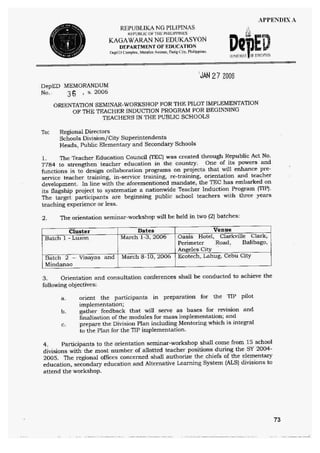
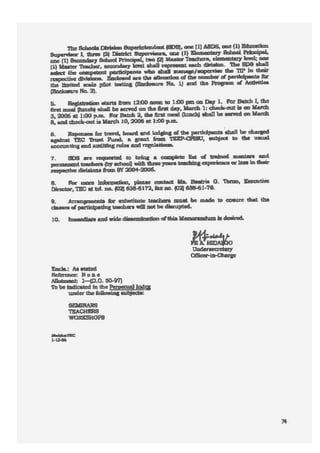
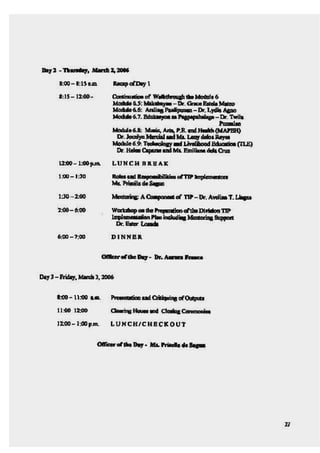
Orientation Seminar - Workshop for the Pilot Implementation
of the Teacher Induction Program for Beginning Teachers in the
Public Schools. 73
• Appendix B
DepEd Order No.66, s. 2006
Corrigendúm to DepEd Memorandum No.36, S. 2006
Orientation Seminar - Workshop for the Pilot Implementation
of the Teacher Induction Program for Beginning Teachers in the
Public Schools. 78
• Appendix C
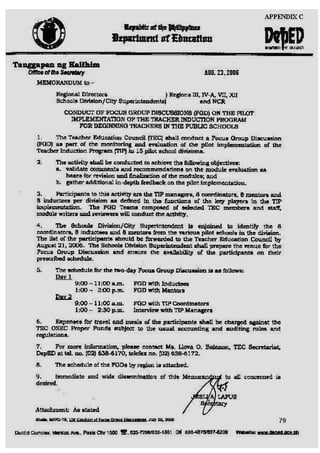
DepEd Memorandum dated August 23, 2006
Conduct of Focus Group Discussion (FGD) on the Pilot
Implementation of the Teacher Induction Program for
Beginning Teachers in the Public Schools. 79
• Appendix D
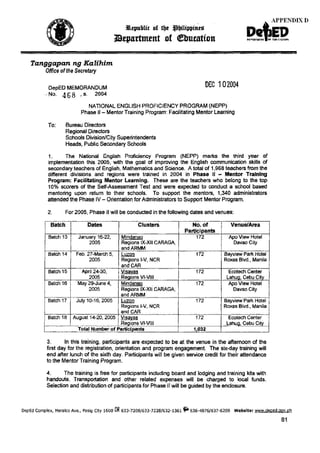
DepEd Memorandum No. 468, S. 2004 dated December 10, 2004
National English Proficiency Program (NEPP)
Phase II Mentor Training Program:
Facilitating Mentor Learning 81
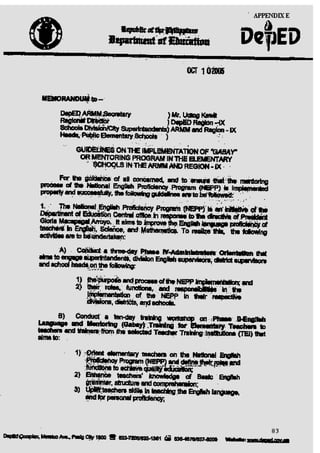
• Appendix E
DepEd Memorandum dated October 10, 2005
Guidelines on the Implementation of “Gabay” or Mentoring Program
in the Elementary Schools in the ARMM and Region IX. 83
• Appendix F
Sample Division TIP Plans 85
• Appendix G
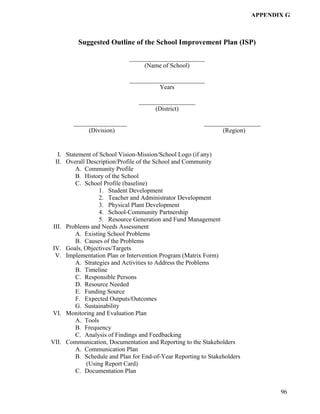
Sample School Improvement Plan 96
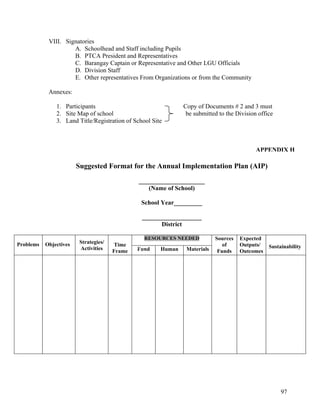
• Appendix H
Sample Annual Implementation Plan 97
TEACHER INDUCTION PROGRAM TIP IMPLEMENTATION MANUAL
1
The Teacher Induction Program (TIP)
Background and Rationale
The first year of teaching is usually a time of considerable stress and burnout.
This is true particularly in some schools where the first year of teaching is considered
a form of initiation to test the mettle of neophyte teachers. They are posted to the
more remote schools of the division and assigned to teach the “problem classes”. In
addition they are given co-curricular responsibilities and other non-teaching tasks in
the community. As a result some beginning teachers resort to questionable tactics to
survive, and some potentially valuable members of the profession are disheartened
and quit. Substantial teacher preparation resources are thus put to waste (Huling-
Agustin, 1990; Hatton, Watson, Squires and Soliman, 1991).
While it is true that preservice training includes one or two semesters of
practice teaching, the term itself seems to suggest that the practicum is only a
rehearsal. It is in their first teaching assignment that new teachers are confronted by
the realities of the classroom an experience that can be bewildering or even
traumatic. The literature on beginning teachers notes that they are often “hired at the
last moment, left isolated in their classrooms and given little help – a true example of
the ‘sink or swim’ attitude towards those newly hired”.
The Teacher Education Council created by virtue of R.A. No. 7784 is
mandated to strengthen teacher education in the country. One of its functions is to
“design collaboration programs and projects that would enhance pre-service and in-
service teacher training, retraining, orientation and teacher development”. Pursuant to
this mandate the TEC has embarked on a project to systematize teacher induction
nationwide.
Induction activities are not really new to basic education schools. School
administrators profess that they provide activities to assist and support beginning
teachers. They may take the form of orientation seminars, attendance in professional
meetings, conferences and School Learning Action Cell (SLAC) sessions and
mentoring by master teachers. These efforts, while commendable, are not formal
programs and appear to be localized to individual schools or school divisions.
TEACHER INDUCTION PROGRAM TIP IMPLEMENTATION MANUAL
2
The Council conceptualized the Teacher Induction Program (TIP) during the
2003 Strategic Workshop after a series of zonal conferences with teacher education
institutions and the field offices of the Department of Education. The results of the
consultations further validated the findings of the Third Elementary Education Project
(TEEP) that induction programs were conducted in the division and school levels but
there was a need to “systematize, structure and organize” the program for teachers
with 0-3 years experience. Related studies reviewed by the Council reinforced the
need for a structured teacher support. There was the consensus that the beginning
teacher should not develop a “curve of disenchantment” especially in their first three
years of teaching.
The principle of shared governance is operationalized in the concept of
School-Based Management (SBM). The past and incumbent leadership of the
Department of Education underscored the importance of a systematic and organized
induction program, preferably on the school level, as part of the institutionalization of
SBM. The truism is “empowered schools shall be in the best position to create
dramatic improvements in the basic education with school heads playing crucial roles
in ensuring the effective learning of students and overall school performance.”
(Lapus,2006)
The TIP Pilot Implementation
The TIP modules are intended to be used as resource base for the Teacher
Induction Program (TIP) to be institutionalized by the DepEd. However, the quality of
its outcomes will depend not only on the learning resources but also on the quality of
the delivery system.
• Delivery System
The delivery system refers to all the services provided the inductees in order to
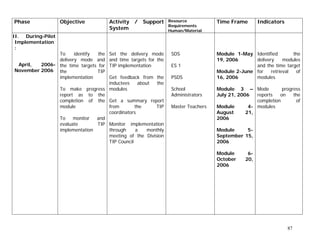
achieve the goals of the program. A comprehensive delivery system covers
information dissemination about the program, orientation, learner support,
management and evaluation.
TEACHER INDUCTION PROGRAM TIP IMPLEMENTATION MANUAL
3
The Teacher Education Council (TEC) is the lead agency tasked with the
conceptualization, development and monitoring of the Teacher Induction Program
before its institutionalization by the DepEd. The support and cooperation of key
officials and the teachers are crucial to the success of the mass implementation of
TIP.
The purpose of the limited pilot implementation of the Teacher Induction
Program was to serve as a dry run for the proposed delivery system and to validate
the usefulness of the modules in terms of helping the new teachers adjust to their job.
A random sample of administrators and facilitators from 15 pilot school divisions
where there was a concentration of new teachers were invited to react to the proposal
and to craft the pilot implementor’s implementation plan on the Division level during
the orientation seminar – workshop for the pilot implementation of the TIP (DepEd
Memo No. 36, s. 2006 and DepEd Memo No. 66, s. 2006).
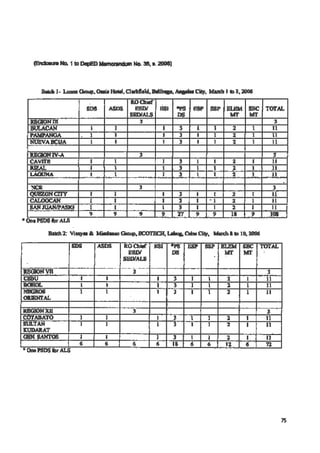
The 15 pilot school/city divisions were the following: Region III- Bulacan,
Pampanga, Nueva Ecija; Region IV-A – Cavite, Laguna, Rizal; Region VII- Bohol,
Cebu, Negros Oriental; Region XII- Cotabato, General Santos, Sultan Kudarat; NCR
– Caloocan City, Pasig City/ San Juan, Quezon City.
Parallel try-outs were conducted by the Basic Education Assistance in
Mindanao (BEAM) and in selected private schools in Iloilo City, Cagayan de Oro City,
and Manila. The try-out was supervised by TEC in collaboration with West Visayas
State University, Iloilo City; Liceo de Cagayan, Cagayan de Oro City; Centro Escolar
University and University of Santo Tomas, Manila.
• Monitoring and Evaluation
Monitoring and evaluation was integral to the TIP pilot implementation. The
TEC conducted Focus Group Discussions (FGDs) as part of the monitoring and
evaluation of the pilot implementation in the 15 pilot school divisions and in the
parallel try out schools. The activities aimed to: (1) validate comments and
recommendations on the module evaluation as bases for the revision and finalization
of the modules, and (2) gather indepth feedback on the pilot implementation.
Feedback from the FGDs, the module evaluation and interview with the TIP
managers, coordinators, mentors, and inductees were the bases of the revision and
TEACHER INDUCTION PROGRAM TIP IMPLEMENTATION MANUAL
4
finalization of the writers. It was gratifying to note in the monitoring and evaluation
process, the participants were unanimous that the TIP should be institutionalized by
DepEd. They envisioned a more structured and systematic teacher induction
program with the availability of modules in every school.
Feedback from inductees and mentors provided invaluable insights into the
need of a structured induction program expressed spontaneously during the FGDs
and in the module evaluation, as follows:
• Induction helps new teachers build their self-confidence and self-esteem.
• It decreases unproductive stress in the learning environment/work place.
• The mentors found the modules very helpful in their work; they learned and
relearned concepts/practices of their responsibility and accountability.
• The mentoring component led to productive professional relationships as trust
developed through regular meetings and the sharing of expertise.
• Strong leadership at the division and school level is a key to successful
implementation of the TIP.
• The inductees and their mentors viewed themselves as continuous learners
and acknowledged that time allocation for the modules, providing support and
on-going feedback were important components of TIP.
• Best Practices
Best practices were shared and observed during the monitoring and evaluation
of the pilot implementation. A school division gathered the inductees and mentors for
17 Saturdays with joint funding from the schools of the inductees and the local
government unit. The overview and objectives of the modules were discussed; the
inductees brought home the modules and worked on their own pace. Assistance of
mentors was available when needed, including class observations. Collegiality among
the school heads, mentors who were mostly division supervisors and the inductees
was developed and better teaching performance of inductees was observed.
TEACHER INDUCTION PROGRAM TIP IMPLEMENTATION MANUAL
5
Another pilot division recorded the preassessment and postassessment results
of the inductees for each module they worked on. Significant improvement was
reported. The inductees felt confident that they had their mentors to approach when
they needed support.
The teachers expressed that the modules were not only for beginning teachers
but also for experienced teachers for their continuing professional development.
There was a unanimous endorsement for the TIP Mass Implementation.
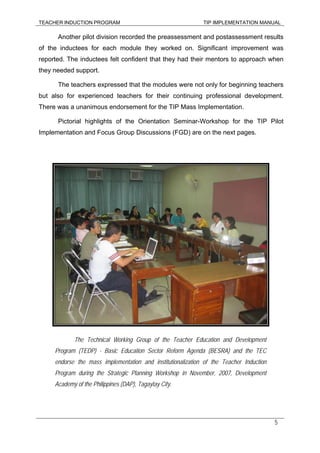
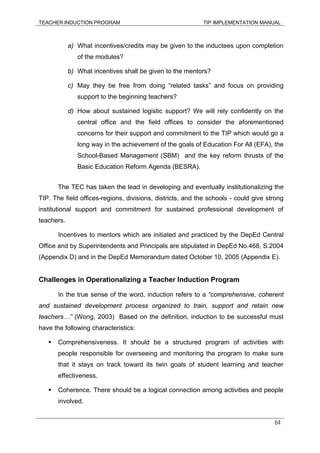
Pictorial highlights of the Orientation Seminar-Workshop for the TIP Pilot
Implementation and Focus Group Discussions (FGD) are on the next pages.
The Technical Working Group of the Teacher Education and Development
Program (TEDP) - Basic Education Sector Reform Agenda (BESRA) and the TEC
endorse the mass implementation and institutionalization of the Teacher Induction
Program during the Strategic Planning Workshop in November, 2007, Development
Academy of the Philippines (DAP), Tagaytay City.
TEACHER INDUCTION PROGRAM TIP IMPLEMENTATION MANUAL
6
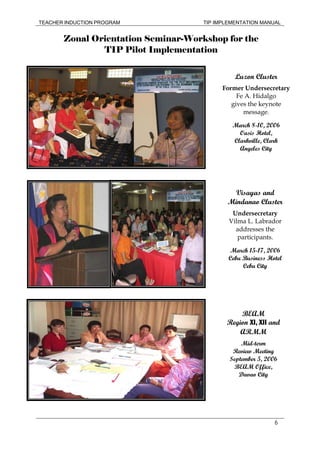
Zonal Orientation Seminar-Workshop for the
TIP Pilot Implementation
Luzon Cluster
Former Undersecretary
Fe A. Hidalgo
gives the keynote
message.
March 8-10, 2006
Oasis Hotel,
Clarkville, Clark
Angeles City
Visayas and
Mindanao Cluster
Undersecretary
Vilma L. Labrador
addresses the
participants.
March 15-17, 2006
Cebu Business Hotel
Cebu City
BEAM
Region XI, XII and
ARMM
Mid-term
Review Meeting
September 5, 2006
BEAM Office,
Davao City
TEACHER INDUCTION PROGRAM TIP IMPLEMENTATION MANUAL
7
Highlights of Focus Group Discussions (FGDs)
The set of Modules are informative,
interactive and user- friendly. Our mentors are
very supportive.
The Inductees
Division of Pasig City/San Juan
We taught in the private schools for
sometime. The Modules familiarized us on the
culture of the public school system and our
responsibility and accountability as teachers.
The Inductees
Division of Caloocan City
The spirit of collegiality is very much
alive among the inductees, mentors,
coordinators and the TIP Work Team. They
are mutually inspiring.
The Inductees
Division of Quezon City
The Modules are not only useful for
the beginning teachers but also for the
experienced teachers. We request for ample
time to work on the Modules. Summer break is
recommended.
The Mentors
Division of Bulacan
TEACHER INDUCTION PROGRAM TIP IMPLEMENTATION MANUAL
8
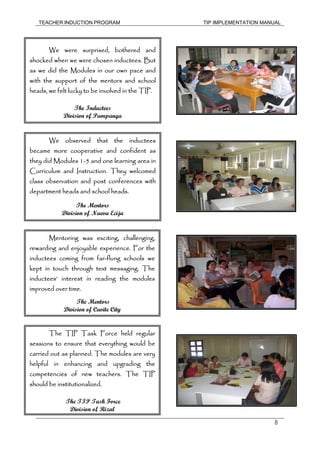
We were surprised, bothered and
shocked when we were chosen inductees. But
as we did the Modules in our own pace and
with the support of the mentors and school
heads, we felt lucky to be involved in the TIP.
The Inductees
Division of Pampanga
We observed that the inductees
became more cooperative and confident as
they did Modules 1-5 and one learning area in
Curriculum and Instruction. They welcomed
class observation and post conferences with
department heads and school heads.
The Mentors
Division of Nueva Ecija
Mentoring was exciting, challenging,
rewarding and enjoyable experience. For the
inductees coming from far-flung schools we
kept in touch through text messaging. The
inductees’ interest in reading the modules
improved over time.
The Mentors
Division of Cavite City
The TIP Task Force held regular
sessions to ensure that everything would be
carried out as planned. The modules are very
helpful in enhancing and upgrading the
competencies of new teachers. The TIP
should be institutionalized.
The TIP Task Force
Division of Rizal
TEACHER INDUCTION PROGRAM TIP IMPLEMENTATION MANUAL
9
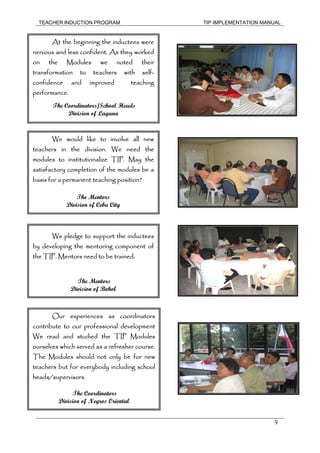
At the beginning the inductees were
nervous and less confident. As they worked
on the Modules we noted their
transformation to teachers with self-
confidence and improved teaching
performance.
The Coordinators/School Heads
Division of Laguna
We would like to involve all new
teachers in the division. We need the
modules to institutionalize TIP. May the
satisfactory completion of the modules be a
basis for a permanent teaching position?
The Mentors
Division of Cebu City
We pledge to support the inductees
by developing the mentoring component of
the TIP. Mentors need to be trained.
The Mentors
Division of Bohol
Our experiences as coordinators
contribute to our professional development
We read and studied the TIP Modules
ourselves which served as a refresher course.
The Modules should not only be for new
teachers but for everybody including school
heads/supervisors.
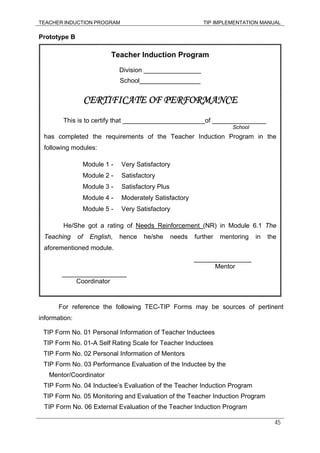
The Coordinators
Division of Negros Oriental
TEACHER INDUCTION PROGRAM TIP IMPLEMENTATION MANUAL
10
Our co-teachers borrowed the TIP
Modules from us so they could also learn.
Our principal was very understanding; we
were deloaded to give more time to work on
the modules.
The Inductees
Division of Sultan Kudarat
Commitment and proper attitude to
implement the TIP, not resources, are what
matters. We have the needed manpower even
for mass implementation.
The TIP Managers
Division of Cotabato
Our experience as TIP Coordinators
was fulfilling and satisfying but demanding
with respect to time management. May we
have the Modules in CDs?
The Coordinators
Division of General Santos
The Modules are a great help not
only to novice teachers but also to
experienced mentors. If used in the private
schools the linkage and networking of the
private with the public schools would be
enhanced and not compartmentalized.
Private School Inductees
Venue: Liceo de Cagayan University
Cagayan de Oro City
TEACHER INDUCTION PROGRAM TIP IMPLEMENTATION MANUAL
11
The Modules are complete and
appropriate in content; provided us with
current teaching strategies and are very good
review materials for LET. Our problem was
time allocation on the modules in addition to
our teaching loads.
Private School Inductees
Venue: West Visayas State University
Iloilo
The Modules (revised) need to be
made available to schools, to the school
heads, mentors and inductees. School
MOOEs could contribute to the
reproduction. Delivery of the program could
be considered during the summer vacation.
Basic Education Assistance for Mindanao
Induction is important to help teachers
build their self-confidence and self-esteem,
hence decreasing unproductive stress. Newly
appointed teachers, reappointed teachers
who heve left teaching and returning,
transferees from the private sector and from
other schools, districts, division and regions
need to undergo the TIP.
Technical Working Group
Division of Davao del Norte
We express deep gratitude for the
BEAM project in funding our involvement in the
TIP Pilot Implementation and the ongoing
support to the Technical Working Group).
Technical Working Group
Division of Davao Oriental
TEACHER INDUCTION PROGRAM TIP IMPLEMENTATION MANUAL
12
Program Overview
The Teacher Education Council (TEC) has packaged a set of 17 self-
instructional modules and Implementation Manual to serve as knowledge, skill, and
attitude inputs for an induction program for beginning teachers with three years
experience or less. This flagship project is in consonance with the Teacher
Education Development map linking preservice education, licensure of teachers,
recruitment, deployment, recognition system and continuing inservice training of the
DepEd. The TEC envisioned a systematized nationwide TIP for beginning public
school teachers and may be expanded to include private basic education schools.
The Teacher Induction Program is in consonance with the Teacher Education
and Development Program (TEDP), a Key Reform Thrust of the Department of
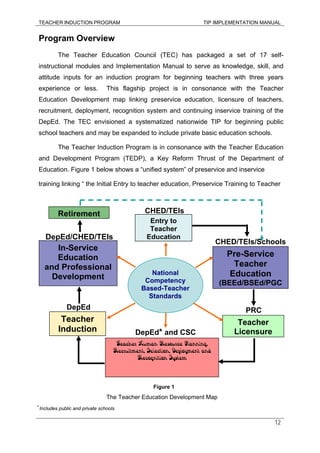
Education. Figure 1 below shows a “unified system” of preservice and inservice
training linking “ the Initial Entry to teacher education, Preservice Training to Teacher
Retirement CHED/TEIs
Entry to
Teacher
Education
National
Competency
Based-Teacher
Standards
Pre-Service
Teacher
Education
(BEEd/BSEd/PGC
Teacher
Licensure
In-Service
Education
and Professional
Development
Teacher
Induction
Teacher Human Resource Planning,
Recruitment, Selection, Deployment and
Recognition System
DepEd* and CSC
DepEd PRC
Figure 1
The Teacher Education Development Map
DepEd/CHED/TEIs
* Includes public and private schools
CHED/TEIs/Schools
TEACHER INDUCTION PROGRAM TIP IMPLEMENTATION MANUAL
13
Licensure, Recruitment and Development within the system, Induction Training,
Inservice and Professional Development and finally, Retirement. The agencies with
primary responsibility for implementing each stage in the cycle are also shown in the
map….” (Bernardo, 2006).
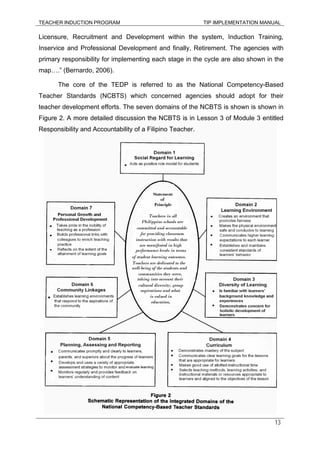
The core of the TEDP is referred to as the National Competency-Based
Teacher Standards (NCBTS) which concerned agencies should adopt for their
teacher development efforts. The seven domains of the NCBTS is shown is shown in
Figure 2. A more detailed discussion the NCBTS is in Lesson 3 of Module 3 entitled
Responsibility and Accountability of a Filipino Teacher.
TEACHER INDUCTION PROGRAM TIP IMPLEMENTATION MANUAL
14
Module Contents
The set of self-instructional materials consists of the following modules:
Module I has two parts: Part I deals with the constitutional mandate, legal
bases and various laws on education that clarify the rights, responsibilities and
accountabilities of a teacher. It also focuses on the mission/vision and organizational
structure of the Department. It is important that beginning teachers internalize their
roles, rights, obligations and accountability as they perform their functions as a
professional teacher.
Part II focuses on the programs and projects of the Department through the
years to achieve the goal of improving the quality of basic education. The various
programs and projects that are foreign-assisted as well as the national initiatives are
discussed in the second part. The detailed description of each project will help the
teachers to identify which project is being implemented in their school and to clarify
their role as implementors.
The lesson on the school culture inherent in the system and structure of the
Department gives the new teachers a perspective and insight into the organization
they are about to join in and reality check in the learning environment.
Part I – Educational Laws and Surveys
Lesson 1 – Legal Bases of Education
Lesson 2 – Excerpts of Educational
Laws and Surveys
Lesson 3 – Organizational Structure and
Governance of Basic Education
Lesson 4 – School Culture
MODULE 1 Educational Laws and Surveys Programs
and Projects of the Department of Education
TEACHER INDUCTION PROGRAM TIP IMPLEMENTATION MANUAL
15
Part II – Programs and Projects
Lesson 1 – Foreign-Assisted Programs / Projects
• International Cooperation Administration-NationalEconomic Assistance
Project (ICA-NEC)
• Program for Decentralized Educational Development (PRODED)
• Secondary Education Development Project (SEDP)
• Secondary Education Development Improvement Project (SEDIP)
• Philippines-Australia Project in Basic Education (PROBE)
• Basic Education Assistance for Mindanao (BEAM)
• Third Elementary Education Project (TEEP)
• Child-Friendly Schools System (CFSS)
• 2003 Trends in Mathematics and Science Study (TIMSS)
Lesson 2 – National Initiatives
• Science and Technology Education Plan (STEP 2)
• Accreditation of Public Elementary Schools
• Accreditation of Public High Schools
• High School Bridge Program
• Every Child A Reader Program (ECARP)
• National English Proficiency Program (NEPP)
• Strong Republic Schools-Distance Learning Programs (SRS-DLP)
• Brigada Eskwela
• Adopt-A-School Program
• Schools First Initiative (SFI)
• School – Based Management (SBM)
• Strengthening Basic Education in the Visayas (STRIVE)
• Library Hub
• Basic Education Sector Reform Agenda (BESRA)
• Redesigned Technical-Vocational Education Program (RTVEP)
TEACHER INDUCTION PROGRAM TIP IMPLEMENTATION MANUAL
16
This module is about the Basic Education Curriculum (BEC) which sets the
standards for what students should learn in basic education, which in the Philippines
includes from Grades I-VI and First year –Fourth Year High School, a total of ten
years in all.
The BEC spells out the knowledge, skills, habits and attitudes the students
should learn. It guides the teachers on the subject matter content for every
grade/year level.
Lesson 1 How Do You Know where You Want To Go? Know Your Curriculum
Lesson Objectives
The EFA 2005-2015 Plan of Action
Goals of EFA
EFA’s Critical Tasks
What is a Curriculum?
Why Do We Need a Curriculum?
Why Do We Have a National Curriculum?
How Do We Indigenize/Localize the Curriculum?
Why Do We Have a Bilingual Policy?
Lesson 2 Why Restructure the Curriculum: A Little Bit of History
Lesson Objectives
The National Elementary School Curriculum (NESC)
The New Secondary Education Curriculum (NSEC)
Evaluation of the NESC & NSEC
The Rationale for the Basic Education Curriculum (BEC)
Lesson 3 I Know the BEC: How Do I Make It Alive?
Lesson Objectives
Features of the BEC
The Structure of the 2002 Basic Education Curriculum
The Philippine Elementary Learning Competencies (PELC) and the Philippine
Secondary Learning Competencies (PSLC)
MODULE 2 The Philippine Basic Education Curriculum
TEACHER INDUCTION PROGRAM TIP IMPLEMENTATION MANUAL
17
Lesson 4 Alive! But How Do I Make, The Curriculum Work?
The Curriculum, Instruction and Assessment Model (CIA)
You and the Instructional System
The Role of Textbooks and Other Instructional Materials
You and Your Mastery of Subject Matter
The module on Multigrade Teaching is divided into four parts:
Part I compares and contrasts teaching in a multigrade classroom and teaching in a
single-grade classroom.
Part II describes the components of a multigrade classroom as a learning
environment and explains the various roles of the teacher, the learners and other
stakeholders who are a source of support for the multigrade classroom.
Part III outlines the learning areas.
Part IV describes the different strategies that have been found effective in a
multigrade classroom.
Part I – The Multigrade Program
Lesson I – The Multigrade Program in the Philippines
Lesson 2 – Basic Principles Underlying Multigrade Teaching
Part II – The Components of a Multigrade Classroom
Lesson 1 – The Human Resources in a Multigrade Classroom
Lesson 2 – The Physical Environment
PART III – Teaching and Learning Processes in the Multigrade Classroom
Lesson 1 – The Curriculum
Lesson 2 – Organizing Curriculum
PART IV – Teaching Strategies for Multigrade Classes
Lesson 1 – Methods Commonly Used
Lesson 2 – Group Work and Grouping as an Instructional Strategy
Lesson 3 – Self-Directed Learning and Peer Teaching
MODULE 2.1 Multigrade Teaching
TEACHER INDUCTION PROGRAM TIP IMPLEMENTATION MANUAL
18
This module describes the alternative learning system (ALS) provided by the
Department of Education to help those who cannot “go to school to learn “or who do
not want to “go to school to learn“. Its clientele include those who have never
attended school and those who have dropped out of school. Their reasons for staying
out of school are varied (e.g. absence of a school in the community, need to work to
augment family income, lack of money for school related expenses, gender
discrimination, disability, etc.) but generally the reasons are linked to poverty.
The module also includes a brief overview of ALS in the Philippine setting and
in the context of global development.
Lesson 1 - Historical Context of ALS
Lesson 2 - The ALS and Formal Education
Fig. 1 The Two Paths to Basic Education
Fig. 2 A Conceptual Framework on the Relationship Between Formal Education and
the Alternative Learning System
Major Aspects of Comparison
Fig. 3 The Learning Programs
Fig. 4 The Setting for Learning
Fig. 5 The Teacher
Fig. 6 The Age of the Learner
Fig. 7 The Curriculum
Fig. 8 The Learning Materials
Fig. 9 The Teaching Methodology
Fig. 10 Assessment of Learning
MODULE 2.2 Alternative Learning System
TEACHER INDUCTION PROGRAM TIP IMPLEMENTATION MANUAL
19
This module aims to explain the rationale and principles of performance-based
assessment. It also defines the implementing guidelines as contained in DepEd
Order No. 33, S.2004.
Lesson 1- Assessment in the Curriculum
Lesson 2- Rationale and Principles of Performance-based Assessment
Lesson 3- Implementing Guidelines
Lesson 4- Use of Rubrics
Module 3 focuses on the most important determinant in the entire school
system, the Filipino teacher. This module deals with his/her roles, responsibilities and
accountabilities based on the Filipino core values and the principles of teaching and
learning.
Key concepts on Magna Carta for Teachers, Teacher Education Development
Program (TEDP) and the National Competency – Based Teacher Standards
(NCBTS) will also be discussed thoroughly.
Lesson 1- Roles, Duties, and Responsibilities of a Teacher
Characteristics of a Teacher
Qualifications, Rights, and Privileges of a Teacher in the Magna Carta for School
Teachers
Lesson 2- Code of Ethics
The Teacher and the State
The Teacher and the Profession
The Teacher and the Learners
Lesson 3- Professional Development Guide for Teachers
Teacher Education and Development Program (TEDP)
National Competency – Based Teacher Standards (NCBTS)
Performance Appraisal System for Teachers (PAST)
Lesson 4- Record Management
Anecdotal Record and Communication to Parents
Pupils’/Students’ Records
MODULE 2.3 Grading for Performance
MODULE 3 Roles, Responsibilities and Accountabilities
of a Filipino Teacher
TEACHER INDUCTION PROGRAM TIP IMPLEMENTATION MANUAL
20
This module is all about the teacher as a person and as a professional. It deals
with the benefits and privileges teachers enjoy. Providing a support system to
beginning teachers is very crucial in the light of the increasing demands of the
profession.
What makes a good teacher? What qualities must he/she have? What are the
rewards of teaching? These are some of the questions new teachers usually ask.
This module attempts to answer such questions. It will help new teachers reflect and
clarify their personal and professional attributes. It may even open doors for their
professional growth and development.
Lesson 1 – The Teacher as a Person
Lesson 2 – My Career Path as a Teacher
Lesson 3 – The Teacher as a Professional
Lesson 4 – Personal and Professional Welfare of a Teacher
Lesson 5 – Empowering Teachers through Active
Participation in Professional Organization
This module identifies the various community resources that can serve as
context for learning and teaching. It discusses how teachers can establish linkages
between the school and the community for mutual benefits and describes the different
roles of teachers in the community where the school is situated. It explains how the
school can harness the support of the Local School Board, the Parent-Teacher-
Community Association as well as the various GO’s and NGO’s.
Lesson I – Community as a Context of Teaching and Learning
Lesson I-A – The Community: Its Sociological, Economic and Cultural Features
Lesson I-B – The Community Resources
Lesson I-C – Teaching and Learning from and in the Community
MODULE 4 Professionalism and Personal Welfare
MODULE 5 School and Community Partnership
TEACHER INDUCTION PROGRAM TIP IMPLEMENTATION MANUAL
21
Lesson II – Community-Based Roles of the Teacher
Lesson II-A – Community Expectations of Teachers
Lesson II-B – Teachers as Members of the Community
Lesson II-C – Teachers as Citizens of the Country
Lesson III – The School and Community Partnership
Lesson III-A – The Role of the School Community
Lesson III-B – The School Partners and Key Stakeholders
Lesson III-C - Achieving Child-Friendly School Through School
and Community Partnership
Lesson IV – Parent-Teacher-Community Association (PTCA) As School Partner
Lesson IV-A – What PTCA Is
Lesson IV-B – Harnessing School Support from the PTCA
Instruments for every school to assess its capabilities and
performance in attaining EFA goals are developed, introduced, propagated
and adopted. Stakeholders at every school – school head, teachers,
students, parents, community leaders - use the process and results of
school assessment as their platform for identifying and implementing school
or community actions for continuous (and accountable) improvement of
school quality. The assessment process leads to the formulation of a “social
contract” between the school and the community, with the support of the
educational authorities. Activities are geared to get stakeholders at every
school in the country to take collective responsibility for their own school’s
educational performance.
Philippine-EFA 2015 Plan
TEACHER INDUCTION PROGRAM TIP IMPLEMENTATION MANUAL
22
Educational accountability is anchored on a clear
understanding of the concepts and implementation of the
curriculum, instruction and student achievement/
performance. The series of TIP Modules include a
discussion of the Basic Education Curriculum (BEC)
(Module 2); Instruction and Assessment are integral in
each of Modules 6.1 to 6.9. A separate module on
Grading for Performance (Module 2.3) guides the
beginning teachers in assessing student achievement.
• Curriculum
The framework of the Basic Education Curriculum
includes the four pillars of learning: learning to be, learning
to know, learning to do, and learning to live together
(Delors, 1998) in its vision of educating a Filipino learner
who is nationalistic, critical and creative, productive and
service-oriented, functionally literate, and equipped with
life-long skills (2002 BEC).
Module 6
Curriculum
and
Instruction
As Educators, as
teachers of the Filipino
youth and the future of
our great nation, we
have the moral duty to
ensure that our youth is
given the education
they deserve…
(Secretary Jesli A. Lapus,
2006)
Learning to Know, by combining a sufficiently
broad general knowledge with the opportunity to work in
depth on a small number of subjects; this also means
learning to learn…
Learning to Do, in order to acquire not only an
occupation skill but also, more broadly, the competence to
deal with many situations and work in teams.
Learning to Live Together, by developing an
understanding of other people and an appreciation of
interdependence – carrying out joint projects and learning
to manage conflicts – in a spirit of pluralism, mutual
understanding and peace.
Learning to Be, so as to better develop one’s
personality and be able to act with greater autonomy
judgement and personal responsibility. (Delors, 1998)
TEACHER INDUCTION PROGRAM TIP IMPLEMENTATION MANUAL
23
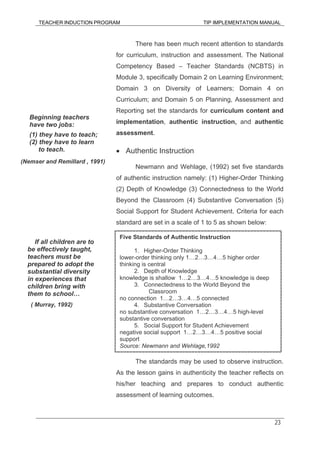
There has been much recent attention to standards
for curriculum, instruction and assessment. The National
Competency Based – Teacher Standards (NCBTS) in
Module 3, specifically Domain 2 on Learning Environment;
Domain 3 on Diversity of Learners; Domain 4 on
Curriculum; and Domain 5 on Planning, Assessment and
Reporting set the standards for curriculum content and
implementation, authentic instruction, and authentic
assessment.
• Authentic Instruction
Newmann and Wehlage, (1992) set five standards
of authentic instruction namely: (1) Higher-Order Thinking
(2) Depth of Knowledge (3) Connectedness to the World
Beyond the Classroom (4) Substantive Conversation (5)
Social Support for Student Achievement. Criteria for each
standard are set in a scale of 1 to 5 as shown below:
The standards may be used to observe instruction.
As the lesson gains in authenticity the teacher reflects on
his/her teaching and prepares to conduct authentic
assessment of learning outcomes.
Five Standards of Authentic Instruction
1. Higher-Order Thinking
lower-order thinking only 1…2…3…4…5 higher order
thinking is central
2. Depth of Knowledge
knowledge is shallow 1…2…3…4…5 knowledge is deep
3. Connectedness to the World Beyond the
Classroom
no connection 1…2…3…4…5 connected
4. Substantive Conversation
no substantive conversation 1…2…3…4…5 high-level
substantive conversation
5. Social Support for Student Achievement
negative social support 1…2…3…4…5 positive social
support
Source: Newmann and Wehlage,1992
Beginning teachers
have two jobs:
(1) they have to teach;
(2) they have to learn
to teach.
(Nemser and Remillard , 1991)
If all children are to
be effectively taught,
teachers must be
prepared to adopt the
substantial diversity
in experiences that
children bring with
them to school…
( Murray, 1992)
TEACHER INDUCTION PROGRAM TIP IMPLEMENTATION MANUAL
24
• Authentic Achievement
TIP Modules 6.1 to 6.9 present teaching strategies
and performance assessment for each learning area.
Authentic assessments are characterized by tasks and
activities to enhance higher-order thinking, real-life
interdisciplinary tasks, and self-assessment. The teacher
sets high expectations for the class and moves instruction
toward more authentic forms of instruction.
In planning an instructional activity the teacher may
consider concepts he/she wants students to learn
(content), how those topics fit with other topics
(curriculum), how appropriate the activity is for a particular
group of students (learners), what might be difficult for
them (learning), and what students do and do not
understand or perform (assessment). Assessment of
learning outcomes shall aim to align and modify instruction
and design teaching strategies which are integral part of
instruction.
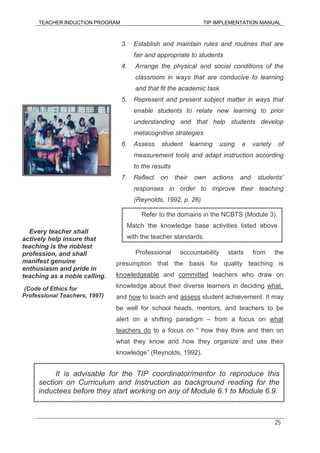
• Knowledge Base
Reynolds (1992) prepared a synthesis of research
reviews on effective teaching and learning to teach. She
used it to frame a set of teaching tasks that beginning
teachers should be able to perform. Having an adequate
knowledge base means being able to do the following:
1. Plan lessons that enable students to relate new
learning to prior understanding and experience
2. Develop rapport and personal interactions with
students
Knowledge is the
primary source of
professional expertise
contributing to the
clinical ability of teachers
rather than as a source of
systems and standard
operating procedures.
(Donmoyer, 1992)
TEACHER INDUCTION PROGRAM TIP IMPLEMENTATION MANUAL
25
3. Establish and maintain rules and routines that are
fair and appropriate to students
4. Arrange the physical and social conditions of the
classroom in ways that are conducive to learning
and that fit the academic task
5. Represent and present subject matter in ways that
enable students to relate new learning to prior
understanding and that help students develop
metacognitive strategies
6. Assess student learning using a variety of
measurement tools and adapt instruction according
to the results
7. Reflect on their own actions and students’
responses in order to improve their teaching
(Reynolds, 1992, p. 26)
Professional accountability starts from the
presumption that the basis for quality teaching is
knowledgeable and committed teachers who draw on
knowledge about their diverse learners in deciding what
and how to teach and assess student achievement. It may
be well for school heads, mentors, and teachers to be
alert on a shifting paradigm – from a focus on what
teachers do to a focus on “ how they think and then on
what they know and how they organize and use their
knowledge” (Reynolds, 1992).
Every teacher shall
actively help insure that
teaching is the noblest
profession, and shall
manifest genuine
enthusiasm and pride in
teaching as a noble calling.
(Code of Ethics for
Professional Teachers, 1997)
Refer to the domains in the NCBTS (Module 3).
Match the knowledge base activities listed above
with the teacher standards.
It is advisable for the TIP coordinator/mentor to reproduce this
section on Curriculum and Instruction as background reading for the
inductees before they start working on any of Module 6.1 to Module 6.9.
TEACHER INDUCTION PROGRAM TIP IMPLEMENTATION MANUAL
26
This module presents a systematic program of study intended for teachers of
English in the BEC. It maintains a consistent link between theory and practice by
providing learning activities to illustrate and test theoretical ideas. It consists of five
lessons.
Lesson I focuses on teaching listening--what listening is, why we do listening,
and what the different types of listening are. It also provides sample activities for
listening comprehension.
Lesson 2 deals with the nature of the oral communication process, the barriers
to effective communication, and suggestions to improve one’s speaking ability.
Lesson 3 focuses on teaching reading which anchors on the five areas of
reading instruction, namely, phonemic awareness, phonics and decoding, vocabulary
and word recognition, fluency, and comprehension. Each of these elements, together
with the development of higher order thinking skills, is vital if children are to become
successful, thinking, and literate adults. Varied strategies are provided that illustrate
effective classroom practices to enable students to read for meaning. It also stresses
the role of reading in the content areas. The sample lesson plans show how these
strategies work to foster active and engaged reading.
Lesson 4 deals with the teaching of writing and how it can be made more
interesting and meaningful to students. It discusses the nature of writing and explains
the writing process. It also gives suggestions for marking written compositions.
Lesson 5 focuses on assessment, both traditional and authentic. It provides
sample assessment and evaluation instruments for classroom use. Sample tests are
included to serve as models in constructing language tests.
Lesson 1 Teaching Listening
Why Listen
The Listening Process
How People Listen
Choosing the listening texts
Integrating Listening with Other Macro Skills
MODULE 6.1 The Teaching of English
TEACHER INDUCTION PROGRAM TIP IMPLEMENTATION MANUAL
27
Lesson 2 Teaching Speaking
The Nature of the Oral Communication Process
Barriers to Effective Communication
Successful Oral Fluency Practice
Oral Communication Strategies
Lesson 3 Teaching Reading
Five Areas of Reading Instruction
Phonemic Awareness
Phonics and Decoding
Vocabulary Instruction
Fluency
Comprehension
Profile of a Proficient Reader
Three Stages of Teaching Reading Instruction
Prereading Strategies
Activating Prior Knowledge and Building Background Information
Developing Concept and Vocabulary
Motivation and Setting the Purpose
During Reading Strategies
Post-Reading Strategies
Discussion
Engagement Activities
Reading-Writing Link
Reading Intervention and Remediation
Building Literacy: A Classroom Intervention Program
Lesson 4 Teaching Writing
Principles of Teaching Writing
The Process-Oriented Approach to Writing
Pre-writing stage
Techniques in Prewriting
Writing
Techniques for Composing and Drafting Paragraphs
Revising and Proofreading
Techniques for Revising and Proofreading
Post Writing
Marking Written Composition
TEACHER INDUCTION PROGRAM TIP IMPLEMENTATION MANUAL
28
Lesson 5 Assessment
Purposes of Assessment
Forms of Assessments
Traditional Assessment
Non-Traditional or Authentic Assessment
Some Beliefs that Support the Use of Authentic Assessment
Learning Targets
Types of Learning Targets
Authentic Assessment Practices to Try
Traditional Testing Compared to Performance Assessment
Scoring and Recording Assessment
Ang modyul na ito ay sadyang isinulat para sa mga gurong bago pa lamang
magtuturo ng Filipino. Matatagpuan dito ang mga batayang kaalaman at konseptong
kailangang taglayin ng isang guro ng Sining ng Komunikasyon. Tinatalakay sa
modyul ang mahahalagang teorya at simulaing pinagbabatayan ng mga lapit
(approaches) at pagdulog sa pagtuturo ng wika. Inilalarawan din ang mga angkop na
stratehiya sa pagtuturo ng wika at s pagtataya ng pagkatuto.
Aralin 1 Paano Ba Tayo Natututo ng Wika?
Ano nga ba ang Wika?
Mahalagang Salik sa Pagkatuto ng Wika
Aralin 2 Ugnayan: Mga Teorya at Simulaing Pangwika sa mga Lapit at Pagdulog
Ang Simula …Mga Tradisyunal na Teorya sa Pagkatuto Ng Wika
Ang Kasalukuyan: Mga Pagbabago sa Teoryang Pangwika
Mga Batayang Simulain sa Pagtuturo ng Wika
Mga Lapit at Pagdulog… Tugon sa mga Teorya at Simulain
Inobasyon… Pagpapatuloy at Pagbabago ng Tradisyon
Kontemporaryo: Ang Kasanayang Komunikatibo sa Pagtuturo ng Wika
Aralin 3 Sa Unang Araw ng Pagtuturo…Paano Ka Magsisimula
Bakit mahalaga ang banghay-aralin?
MODULE 6.2 Ang Pagtuturo ng Filipino
TEACHER INDUCTION PROGRAM TIP IMPLEMENTATION MANUAL
29
Paggawa ng Banghay Aralin
Aralin 4 Ang Batayang Kurikulum, Mga Makrong Kasanayan
at mga Istratehiyang Pampagtuturo
Ang Batayang Kurikulum sa Pagtuturo ng Pilipino
Ang Apat na Makrong Kasanayan
Mga Istratehiyang Pampagtuturo sa Elementarya at Sekundarya
Pinatnubayang Pakikinig para sa Elementarya at Sekundarya
Mga Istratehiya sa Pagtuturo ng Pagsasalita
Ang Pagtuturo ng Pagbasa
Ang Pagtuturo ng Pagsulat
Aralin 5 Pagtataya at Ebalwasyon: Naging Matagumpay ba ang
Proseso ng Pagkatuto?
Ang Pagtataya sa Klasrum
Paghahanda ng Pagsusulit na Batay sa Performans
Ano ang rubriks?
Paghahanda ng Eksaminasyong Oral
The module is designed to provide beginning mathematics teachers with
background knowledge and understanding of some basic contemporary issues in
mathematics education. It focuses on the framework of teaching mathematics and on
instructional strategies and assessment approaches.
Van de Walle (2003) identifies four basic requirements for teachers of math to
be effective. This module tries to cover all four grounds.
An appreciation of the discipline of mathematics itself--what it means to “do
mathematics”
An understanding of how students learn and construct ideas
An ability to design and select tasks so that students learn mathematics in a
problem-solving environment
The ability to integrate assessment with the teaching process in order to
enhance learning and improve daily instruction
MODULE 6.3 The Teaching of Mathematics
TEACHER INDUCTION PROGRAM TIP IMPLEMENTATION MANUAL
30
LESSON 1 Foundations of Mathematics Teaching and Learning
The Nature of Mathematics
The Goals of Mathematics Education
Teaching Styles
Behaviorism vs Cognitivism
Constructivism
Philosophy of 2002 Basic Education Curriculum
LESSON 2 Strategies in Teaching Mathematics
Research-Based Strategies
Deductive vs Inductive Methods
Factors in Choosing a Method or Strategy
Interactive Direct Instruction
Powerful Questions
Rathmell Triangle Model
Cooperative Learning
Inquiry Method
Problem-based Learning (PBL)
Concept Attainment Strategy
Concept Formation Strategy
Peer Practice Strategy
LESSON 3 Assessment
Assessment, Evaluation and Testing
Tests
Criticisms against Multiple Choice Testing
Recommendations for Student Assessment
Authentic Assessment
Balanced Assessment
Performance Assessment
Rubrics
Portfolio Assessment
TEACHER INDUCTION PROGRAM TIP IMPLEMENTATION MANUAL
31
This module is intended to help novice teachers retrieve the scientific
knowledge and pedagogy they learned in college and use them to enable their
students to learn science in a meaningful way.
It hopes to make the initial years of teaching easier for the beginning teachers.
First it provides the teachers a way of getting relevant information regarding the kind
of learners in their class. This information will help them plan their lessons and decide
on the strategies to use. The module also describes a repertoire of teaching
strategies and ways of assessing student learning. Another useful feature of the
module is the inclusion of sample lesson plans and a list of useful readings for the
teachers.
Lesson 1 Foundations of Science Teaching and Learning
Lesson 1.1 What to Teach
Lesson 1.2 Learners: A Second Look
Lesson 1.3 Implications to Teaching
Lesson 1.4 Management Tips
Lesson 2 Teaching Strategies
Lesson 2.1 Constructivist Learning: A Closer Look
Lesson 2.2 Constructivist Strategies
2.2.1 - Discovery Approach
2.2.2 - Inquiry Approach
2.2.3 - Reflective Teaching
2.2.4 - Integrative Teaching
2.2.5 -Cooperative Learning
Lesson 3 Other Teaching Strategies
Lesson 3.1 Lecture and Student Recitation
Lesson 3.2 Role Playing and Simulation
Lesson 3.3 Field Trips
Lesson 3.4 Concept Mapping
Lesson 4 Incorporating Research in the Classroom
Lesson 4.1 The Scientific Method
Lesson 5 Classroom Assessment
Lesson 6 Scoring Authentic Assessment Through Rubrics
MODULE 6.4 The Teaching of Science
TEACHER INDUCTION PROGRAM TIP IMPLEMENTATION MANUAL
32
Dalawa ang aralin na nakapaloob sa monograph na ito. Ang una ay ang
pagpapakilala kung ano ang Makabayan, ang kahalagahan nito, ang mga
komponente at asignatura nito, at kung ano ang takdang oras at sistema ng
markahan nito. Ang pangalawa ay pagpapakita kung paano isinasagawa ang
pagtuturo ng Makabayan partikular kung paano nagkakaroon ng integrasyon sa mga
sabjek o asignatura nito.
Aralin 1 Ang Makabayan Bilang Saklaw na Aralin
Introduksyon
Ang Makabayan sa 2002 BEC
Kahulugan at Kahalagahan ng Makabayan
Mga Komponente o Asignatura ng Makabayan
Paksa sa Bawat Asignatura ng Makabayan sa Elementaryang Antas
Paksa sa Bawat Asignatura ng Makabayan sa Sekundaryang Antas
Wikang Gamit sa Pagtuturo (Medium of Instruction) ng Makabayan
Takdang Oras sa Pagtuturo ng Makabayan
Sistema ng Markahan sa Makabayan
Aralin 2 Ang Integrasyon sa Makabayan
Introduksyon
Kahulugan ng Integradong Pagtuturo
Iba’t Ibang Pamamaraan ng Integradong Pagtuturo
Pagkakaiba ng Integrasyon sa Makabayan sa Elementarya at Sekundarya
Iba’t Ibang Antas ng Integrasyon
Mga Halimbawa ng Integradong Banghay-Aralin sa Makabayan
Banghay-Aralin sa Elementaryang Antas ng Makabayan
Banghay-Aralin sa Sekundaryang Antas ng Makabayan
Banghay-Aralin sa Elementaryang Antas ng Makabayan Gamit ang
Content-Based Instruction (CBI)
MODULE 6.5 Ang Pagtuturo ng Makabayan
TEACHER INDUCTION PROGRAM TIP IMPLEMENTATION MANUAL
33
Nangunguna sa mga komponente ng Makabayan ang Araling Panlipunan
(AP) sa mataas na paaralan, gayundin ang Sibika at Kultura (SK) 1-3, at Heograpiya,
Kasaysayan at Sibika (HKS) 4-6 sa mababang paaralan. Karaniwang ginagamit ang
mga ito bilang core sa pagpaplano ng instruksyon sa Makabayan. Paano’y malawak
ang saklaw ng Araling Panlipunan (AP). Mayaman sa nilalaman ng instruksyon ang
Araling Panlipunan pagkat humahango ito ng mga paksang-aralin, konsepto at tema
mula sa mga disiplina ng agham panlipunan (social sciences), natural na agham
(natural sciences), humanidades (humanities) at sa iba pang mga nauugnay na
sangay ng kaalaman. Bukod sa mayamang nilalaman ng instruksyon, gumagamit din
ang Araling Panlipunan ng iba-ibang lapit (approaches) na nagbibigay buhay at kulay
sa talakayan ng mga aralin sa silid-aralan. Bukod dito, may mga pamamaraan sa
pagtataya (assessment) na susi sa epektibong instruksyon. Lahat ng mga ito ay alay
sa mga gurong kalahok sa Induction Program sa pagtuturo ng Araling Panlipunan.
Alay rin ito sa mga guro ng Araling Panlipunan na nais makilahok sa continuing
education na ibinabahagi ng Modyul 6.6 Pagtuturo ng Araling Panlipunan sa
Batayang Edukasyon.
Aralin 1 Ang Edukasyong Araling Panlipunan
Introduksyon
Mga Layunin
Pundasyong Historikal ng Araling Panlipunan
Mga Depinisyon ng Araling Panlipunan
Mga Layunin ng Sibika at Kultura (SK), Heograpiya,
Kasaysayan at Sibika (HKS) at Araling Panlipunan (AP)
Aralin 2 Pagpaplano ng Instruksyon sa Araling Panlipunan
Introduksyon
Mga Layunin
Pagpaplano ng Instruksyon
Pagsulat ng mga Layuning Instruksyunal
Pag-oorganisa ng Nilalaman ng Instruksyon
Mga Modelong Estratehiya sa Pagtuturo
Mga Graphic Organizers
MODULE 6.6 Ang Pagtuturo ng Araling Panlipunan
TEACHER INDUCTION PROGRAM TIP IMPLEMENTATION MANUAL
34
Aralin 3 Mga Modelong Banghay-Aralin sa Araling Panlipunan
Introduksyon
Mga Layunin
Modelong Banghay-Aralin na Ginagamitan ng Concept
Development Model Para sa HKS 4
Modelong Banghay-Aralin sa Araling Panlipunan na
Ginagamitan ng Modelong Pagsusuring Panlipunan
Aralin 4 Ang Araling Panlipunan, bilang Core ng Makabayan
Introduksyon
Mga Layunin
Modelong Yunit Tematiko Para sa Makabayan I*
Tema: Ang Pambansang Teritoryo ng Pilipinas
Integrado ang AP, TLE, EP, Musika at Sining
(Apat na Araw) Unang Taon
Aralin 5 Assessment sa Araling Panlipunan
Introduksyon
Mga Layunin
Mga Layunin ng Pagtatasa
Mga Prinsipyo ng Pagtatasa
Mga Paraan ng Pagtatasa
Pormal na Pagtatasa
Ang module sa Pagpapahalaga at Wastong Pag-uugali ay kusang itinuon sa
pangangailangan ng mga bagong guro na magsisimula pa lamang sa kanilang
pagtuturo. Binibigyang diin ang kahalagahan ng pagiging huwaran ng kagandahang
asal at mabuting pag-uugali ang mga guro sa dahilang “values are caught’”.
Mahalaga at makabuluhan ang pagtatalakay sa Modyul ng pilosopiyang
batayan ng pagtuturo ng pagpapahalaga. Makakatulong din ng malaki sa mga
bagong guro sa paghahanda ng kanilang mga aralin, ang mga pamaraan ng
pagtuturo/pagsasanib at pagtaya ng pagkatuto ng mga mag-aaral.
MODULE 6.7 Ang Pagtuturo ng Edukasyon sa Pagpapahalaga
at Edukasyong Pagpapakatao
TEACHER INDUCTION PROGRAM TIP IMPLEMENTATION MANUAL
35
Aralin 1 Mga Batayan ng Pagtuturo ng Pagpapahalaga
Panimula
Paksa: Batayan ng Pambansang Programa ng Edukasyon sa
Pagpapahalaga (EP)
Paksa: Ang Batayan ng DepEd Para Pagtuturo ng Pagpapahalga
Paksa: Kahulugan ng Pitong (7) Pangunahing Pagpapahalaga
Aralin 2 Ang Pilosopiya ng Tao at ang Paghubog ng Pagpapahalaga
Panimula
Paksa: Ang Pilosopiya ng Tao
Paksa: Mga Pilosopiya ng Pagpapahalaga
Paksa: Ang Kalikasang Materyal at Ispiritwal ng Tao
Paksa: Pagpapahalaga: Kahulugan at Uri
Paksa: Batas Moral: Batayan ng Pagpapahalaga
Aralin 3 Ang Proseso ng Pagpapahalaga (Valuing Process)
Bilang Estratehiya ng Pagtuturo
Panimula/Layunin
Paksa: Mga Pamantayan at Elemento ng Proseso ng Pagpapahalaga
Paksa: Ang Proseso Bilang Estratehiya ng Pagtuturo
Paksa: Ang Paraan ng Pagtatanong sa Proseso ng Pagpapahalaga
Aralin 4 Ang Mga Pamamaraan at Estratehiya ng Pagtuturo sa EP at Edukasyong
Pagpapakatao
Panimula/Layunin
Paksa: Mga Pangunahing Estratehiya sa Pagtuturo at Pagpapahalaga
Paksa: PNU-ACES Approach: Pamamaraan sa Pagtuturo ng Pagpapapahalaga
Paksa: Pagtuturo ng Pagpapahalaga sa Pamamagitan ng Child-Friendly School
System
Paksa: Pagsasanib ng Pagpapahalaga
Pagsanib sa pamamagitan ng Pagtatanong o “Value Processing”
Aralin 5 Ang Pagtataya Sa Apektibong Pagkatuto
Panimula
Paksa: Pagtataya ng Pagpapahalaga
Paksa: Mga Estratehiya ng Pagtataya
Paksa: Ang Pamamaraang Portfolio at Rubrics
TEACHER INDUCTION PROGRAM TIP IMPLEMENTATION MANUAL
36
This module in MAPEH/MSEP deals with three big areas, namely: Teaching
Methods in Music, Content/Activities in Art, and Teaching Strategies in Physical
Education and Health Education.
The varied teaching methods in Music will help the new teachers present their
lessons in the most interesting and easiest way possible. In Art, the contents and
activities provide opportunities for individual and group work that will develop deeper
appreciation of Philippine culture as well as those of other countries. The teaching
strategies in Physical Education and Health Education provide different approaches
in presenting and developing the lessons to make them relevant and meaningful to
life.
Sample activities and lesson plans are included to serve as models.
Music/Musika Teaching Methods
Lesson 1 The Kodaly Method
Lesson 2 The Orff-Schulwerk Method
Lesson 3 The Dalcroze Eurythmic Method
Lesson 4 The Carabo-Cone Method
Lesson 5 Justine Ward Method
Art / Sining Contents/Activities
Lesson 1 Art and Life
Rubric on Rating a Creative Drawing
Lesson 2 Art in Religious Beliefs and Traditions
Lesson 3 Texture
Lesson 4 Appreciation of Paintings
Physical Education / Edukasyon sa Pagpapalakas Ng Katawan: Teaching Strategies
Lesson 1 Rank Order
Lesson 2 Guided Discovery Approach
Lesson 3 Self-Appraisal Approach
Lesson 4 Mind Mapping
MODULE 6.8 The Teaching of Music, Arts, Physical Education
and Health (MAPEH)
TEACHER INDUCTION PROGRAM TIP IMPLEMENTATION MANUAL
37
Lesson 5 Peer Support and Collaborative
Teaching/Learning Strategy
Health Education / Edukasyong Pangkalusugan: Teaching Strategies
Lesson 1 Values Whip
Lesson 2 Modified TV Activity “Dream…Believe…Survive”
Lesson 3 Loop-A-Word or Crossword Puzzles
Lesson 4 Projective Technique
Lesson 5 Bubble Dialogue
This module will serve as a guide in the teaching of the different components
of TLE such as Industrial Arts, Home Economics, Computer and Entrepreneurship,
and Agriculture and Fishery Arts.
Lesson 1 The Shoproom
1.1 Shoproom Layout
1.2 Tools, equipment and materials
1.3 Safety precautions
Lesson 2 Industrial Arts and Home Economics
2.1 Implementation of Industrial Arts and Home Economics under the 2002 BEC
2.2 Component Areas of Industrial Arts and Home Economics
2.3 Strategies for Teaching Industrial Arts and Home Economics
Lesson 3 Agriculture and Fishery Arts
3.1 Laboratory Requirement for Agriculture and Fishery Arts
3.2 Strategies for Teaching Agriculture and Fishery Arts
Lesson 4 Introduction to Computers and Entrepreneurship
4.1 Laboratory Requirements and Shoproom Layout
4.2 Competencies to be developed
4.3 Entrepreneurship and Computer
4.4 Strategies for Teaching Entrepreneurship
MODULE 6.9 The Teaching of Technology and
Livelihood Education (TLE)
TEACHER INDUCTION PROGRAM TIP IMPLEMENTATION MANUAL
38
Module Design
The modules serve as self-instructional courses to address the knowledge gap
of beginning teachers. The design incorporates the following key features:
A preassessment is provided to diagnose the inductees’ prior learning and
experiences.
Lessons are presented with Knowles theory of adult learning in mind:
• Adult learners prefer to be involved.
• They tend to be more self-directing.
• They expect their previous experiences and knowledge to be
respected.
• They tend to be present-oriented rather than future-oriented.
A combination of introductory materials with self-managed activities and varied
assessment procedures are provided to enable the inductees to do the four
A’s:
Do the Activity.
Do Analysis.
Do Abstraction.
Do Apply learnings and insights gained.
The use of a theory-action-reflection praxis will encourage the application of
learning in the participant’s own context.
A postassessment is provided as a summative evaluation of the inductee’s
performance.
Module Structure
The modules are self-contained and lend themselves to flexible learning. A
module consists of several lessons and each lesson has the following features
signaled by distinctive icons:
Introduction
Instructional Objectives
Presentation Text
Self-check Questions ( SCQ )
TEACHER INDUCTION PROGRAM TIP IMPLEMENTATION MANUAL
39
Activities
Comments to Activities
Points to Remember
Bibliography
The Answers to the Self- Check Questions (SCQ’s) and Activities are found at
the end of each module. The inductee shall keep a journal for the answers to
Preassessment, SCQ’s and Activities. A separate postassessment booklet shall be
provided each inductee and shall be corrected by the mentor/coordinator. Answer
Key to the postassessment shall be provided to the mentor/coordinator. Results of
the pre and postassessments shall be part of the monitoring and evaluation of the
inductee’s program/performance.
The TIP Mass Implementation
A. Delivery Mode for Mass Implementation
A TIP Manager for each Division will be designated by the Schools Division
Superintendent from among the Assistant Schools Division Superintendent (ASDS)
and Education Supervisors. He/She will be responsible for the following tasks:
1. Developing a TIP Division Plan which later cascades to the School Improvement
Plan (SIP) and the Annual Implementation Plan (AIP) integral to School-Based
Management;
2. Distributing of the TIP Materials to the assigned TIP Coordinators in the
elementary and secondary schools in the Division;
3. Planning and organizing focus group discussions (FGD) with the TIP managers,
mentors, and coordinators;
4. Monitoring the implementation of the TIP in the divisions/schools;
5. Preparing assessment results and other reports that may be needed by the region
and TEC-DepEd;
6. Safekeeping of the TIP materials (modules, answer booklets, evaluation forms,
etc.);
7. Coordinating with the regional office on the needed support to the Division; and
TEACHER INDUCTION PROGRAM TIP IMPLEMENTATION MANUAL
40
8. Awarding of certificate of performance and recognition to successful inductees at
the end of the Program.
9. Awarding of certificate of recognition and giving other incentives to the members
and school heads.
The School Improvement Plan (SIP) in the SBM program shall include the mass TIP
implementation. The TIP Coordinator at the school level is the School Head. He/She
will be responsible for the following tasks:
1. Arranging for mentoring of inductees;
2. Providing opportunity for inductees to work with each other and other fellow
teachers;
3. Providing a learning resource center or comfortable space where inductees can
work and/or meet with mentors to discuss the lessons;
4. Administering and checking of the posttest;
5. Evaluation of inductees’ portfolio (if required) with the assistance of the mentor;
6. Retrieval and turnover of TIP materials from the inductees to the TIP Manager of
the Division;
7. Certification of inductees who have satisfactorily completed the Program; and
8. Submission of a summary report of the TIP implementation in his/her school to
the TIP Manager.
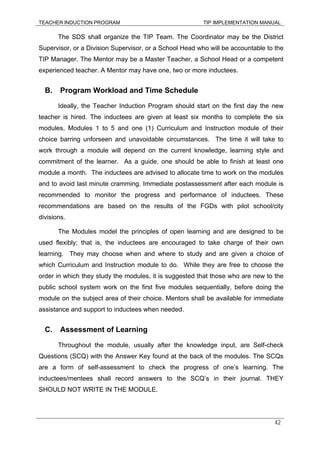
On the next page, it shows the Flow Chart for the TIP Delivery Mode. The TEC
– DepEd takes charge of the printing and distribution of modules to the School/City
Divisions with copies furnished the Regional Office. The Schools Division
Superintendent (SDS) has the option to distribute the modules to the District Office or
direct to the elementary and secondary schools. A learning resource center should be
in place in the division/district/school to facilitate the meetings of the mentors and the
inductees. It may also happen that inductees from the elementary and high schools
be convened together depending on the number of inductees and availability of
mentors and coordinators.
TEACHER INDUCTION PROGRAM TIP IMPLEMENTATION MANUAL
41
Regional
Office
Provincial/
City
Schools
Division
District
Elem.
School
Inductees
Mentors
Secondary
Schools
Inductees
Mentors
TEC DepEd
Figure 3
Flow Chart for TIP Delivery Mode
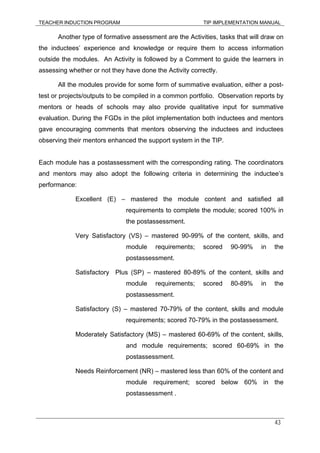
The Delivery Mode includes a support system to the TIP. The Accountability
Framework of the Support System is shown in Figure 4.
C1 C2 C3 C4 CnC1 C2 C3 C4 Cn
Regional Office
TIP Manager (SDS/ASDS)
(Manager)
PSDS/ES I
School Head
(Coordinator)
M1 M2 M3 Mn M1 M2 M3 MnM1 M2 M3 Mn M1 M2 M3 Mn
Master Teacher
School Head
Experienced Teacher
(Mentor)
Beginning Teacher
(Inductee)
I1 I2 In I1 I2 I3 InI1 I2 In I1 I2 I3 In
Legend:
C - Coordinator
M - Mentor
I - Inductee
Figure 4
Accountability Framework of the TIP Support System
TEACHER INDUCTION PROGRAM TIP IMPLEMENTATION MANUAL
42
The SDS shall organize the TIP Team. The Coordinator may be the District
Supervisor, or a Division Supervisor, or a School Head who will be accountable to the
TIP Manager. The Mentor may be a Master Teacher, a School Head or a competent
experienced teacher. A Mentor may have one, two or more inductees.
B. Program Workload and Time Schedule
Ideally, the Teacher Induction Program should start on the first day the new
teacher is hired. The inductees are given at least six months to complete the six
modules, Modules 1 to 5 and one (1) Curriculum and Instruction module of their
choice barring unforseen and unavoidable circumstances. The time it will take to
work through a module will depend on the current knowledge, learning style and
commitment of the learner. As a guide, one should be able to finish at least one
module a month. The inductees are advised to allocate time to work on the modules
and to avoid last minute cramming. Immediate postassessment after each module is
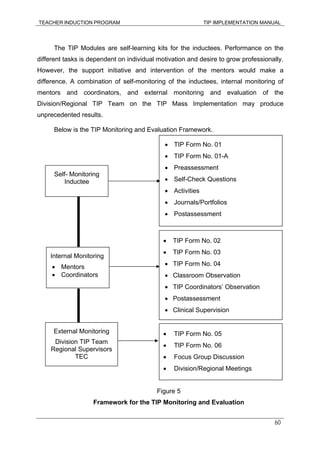
recommended to monitor the progress and performance of inductees. These
recommendations are based on the results of the FGDs with pilot school/city
divisions.
The Modules model the principles of open learning and are designed to be
used flexibly; that is, the inductees are encouraged to take charge of their own
learning. They may choose when and where to study and are given a choice of
which Curriculum and Instruction module to do. While they are free to choose the
order in which they study the modules, it is suggested that those who are new to the
public school system work on the first five modules sequentially, before doing the
module on the subject area of their choice. Mentors shall be available for immediate
assistance and support to inductees when needed.
C. Assessment of Learning
Throughout the module, usually after the knowledge input, are Self-check
Questions (SCQ) with the Answer Key found at the back of the modules. The SCQs
are a form of self-assessment to check the progress of one’s learning. The
inductees/mentees shall record answers to the SCQ’s in their journal. THEY
SHOULD NOT WRITE IN THE MODULE.
TEACHER INDUCTION PROGRAM TIP IMPLEMENTATION MANUAL
43
Another type of formative assessment are the Activities, tasks that will draw on
the inductees’ experience and knowledge or require them to access information
outside the modules. An Activity is followed by a Comment to guide the learners in
assessing whether or not they have done the Activity correctly.
All the modules provide for some form of summative evaluation, either a post-
test or projects/outputs to be compiled in a common portfolio. Observation reports by
mentors or heads of schools may also provide qualitative input for summative
evaluation. During the FGDs in the pilot implementation both inductees and mentors
gave encouraging comments that mentors observing the inductees and inductees
observing their mentors enhanced the support system in the TIP.
Each module has a postassessment with the corresponding rating. The coordinators
and mentors may also adopt the following criteria in determining the inductee’s
performance:
Excellent (E) – mastered the module content and satisfied all
requirements to complete the module; scored 100% in
the postassessment.
Very Satisfactory (VS) – mastered 90-99% of the content, skills, and
module requirements; scored 90-99% in the
postassessment.
Satisfactory Plus (SP) – mastered 80-89% of the content, skills and
module requirements; scored 80-89% in the
postassessment.
Satisfactory (S) – mastered 70-79% of the content, skills and module
requirements; scored 70-79% in the postassessment.
Moderately Satisfactory (MS) – mastered 60-69% of the content, skills,
and module requirements; scored 60-69% in the
postassessment.
Needs Reinforcement (NR) – mastered less than 60% of the content and
module requirement; scored below 60% in the
postassessment .
TEACHER INDUCTION PROGRAM TIP IMPLEMENTATION MANUAL
44
There may be a need to reinforce the support system for inductees who will
get below 60% in the postassessment, and have not mastered the content, skills, and
module requirements. Inductees will be required to repeat the specific module where
the rating obtained is NR. Classroom observation, systematic mentoring and keeping
track of the inductee’s performance would certainly enhance the interventions.
A certificate of performance shall be given to those who complete the
Program.
Prototype Certificates of Performance follow:
Prototype A
Teacher Induction Program
Division ________________
School_________________
CERTIFICATE OF PERFORMANCE
This is to certify that _______________________of _______________
School
has completed the requirements of the Teacher Induction Program in the
following modules:
Module 1 - Very Satisfactory
Module 2 - Satisfactory
Module 3 - Satisfactory Plus
Module 4 - Moderately Satisfactory
Module 5 - Very Satisfactory
Module 6.1 - Very Satisfactory
Module 6.3 - Satisfactory
Module 6.4 - Satisfactory
________________
Mentor
__________________
Coordinator
Date ______________
TEACHER INDUCTION PROGRAM TIP IMPLEMENTATION MANUAL
45
Prototype B
For reference the following TEC-TIP Forms may be sources of pertinent
information:
TIP Form No. 01 Personal Information of Teacher Inductees
TIP Form No. 01-A Self Rating Scale for Teacher Inductees
TIP Form No. 02 Personal Information of Mentors
TIP Form No. 03 Performance Evaluation of the Inductee by the
Mentor/Coordinator
TIP Form No. 04 Inductee’s Evaluation of the Teacher Induction Program
TIP Form No. 05 Monitoring and Evaluation of the Teacher Induction Program
TIP Form No. 06 External Evaluation of the Teacher Induction Program
Teacher Induction Program
Division ________________
School_________________
CERTIFICATE OF PERFORMANCE
This is to certify that _______________________of _______________
School
has completed the requirements of the Teacher Induction Program in the
following modules:
Module 1 - Very Satisfactory
Module 2 - Satisfactory
Module 3 - Satisfactory Plus
Module 4 - Moderately Satisfactory
Module 5 - Very Satisfactory
He/She got a rating of Needs Reinforcement (NR) in Module 6.1 The
Teaching of English, hence he/she needs further mentoring in the
aforementioned module.
________________
Mentor
__________________
Coordinator
TEACHER INDUCTION PROGRAM TIP IMPLEMENTATION MANUAL
46
TEACHER EDUCATION COUNCIL
TEC TIP FORM NO. 01
PERSONAL INFORMATION OF TEACHER INDUCTEES
NAME___________________________________________________Sex______________
Age_____Civil Status_______ No of Children ______ School______________________
_____________________District__________________ Division_____________________
Length of Teaching Experience in Public Schools (Yrs. & Mo.)_____________________
Private Schools (Yrs. & Mo.)____________________
College Degree Earned __________________Major/Specialization__________________
College/University Graduated From ______________Year Graduated_______________
Honors Received in College___________________Other Distinctions_______________
No. of Units earned for the Master’s Degree____________________________________
Graduate School Enrolled in_________________________________________________
Licensure Examination Passed_______________Date_________ Rating ___________
Subjects Currently Teaching_________________________________________________
_________________________________________________________________________
No of Teaching Loads _______ Other Teaching Assignments _____________________
Subjects Previously Taught__________________________________________________
_________________________________________________________________________
_______________________________________________________
Signature of Teacher Inductee
TEACHER INDUCTION PROGRAM TIP IMPLEMENTATION MANUAL
47
TEACHER EDUCATION COUNCIL
TEC TIP FORM NO.01-A
SELF-RATING SCALE FOR TEACHER INDUCTEES
Name of Inductee_____________________________Division__________________
Directions: Read each item very carefully. Check the column which corresponds to the
extent of your knowledge/understanding and competence/skills on the following
topics using the legend below
Legend: 1- To a little extent 3- To a moderate extent
2.-To some extent 4- To a great extent
A. Knowledge of
1. Educational laws and surveys
2. DepEd programs and projects
3. Features of 2002 BEC
4. Multigrade teaching
5. Evaluation of learning outcomes
6. Alternative learning system
7. Roles, responsibilities and
accountabilities of a teacher
8. Professionalism and personal welfare
9. School and community partnership
10. Subject /s you are teaching (enumerate
below)
10.1._____________________
10.2._____________________
10.3_____________________
10.4._____________________
11. Teaching strategies you are using
(enumerate)
11.1_____________________
11.2_____________________
11.3_____________________
11.4 _____________________
To a
little
Extent
1
To
some
Extent
2
To a
moderate
Extent
3
To a
great
Extent
4
TEACHER INDUCTION PROGRAM TIP IMPLEMENTATION MANUAL
48
B. Skills and Competencies in
1. Communicating with
1.1 Students/Learners
1.2 Parents
1.3 Principals/Department Heads
1.4 Supervisors
1.5 Community (LGU’s, NGO’s, etc.)
2. Assessing/Evaluating learning outcomes
2.1 Determining the index of mastery
2.2 Utilizing test results in making
decisions
3. Classroom Management
3.1. Class discipline
3.2. Coping with learners having
behavioral problems; and
3.3 . Learning disabilities
4. Implementing DepEd programs/projects
Ex. Brigada Eskwela, Child Friendly
School (CFS), etc.
_____________________________
_____________________________
_____________________________
5. Operationalizing the features of the 2002
BEC
5.1 Using PELC/PSSLC in planning
lessons
5.2 Utilizing integrative mode of teaching
5.3 Utilizing interactive/cooperative mode
of teaching
5.4 Utilizing Learner-centered approaches
to teaching
1 2 3 4
TEACHER INDUCTION PROGRAM TIP IMPLEMENTATION MANUAL
49
C. ATTITUDE
Reflect on each of the following items and check the column which
corresponds to your feeling/opinion.
1. I take pride in being a teacher.
2. I behave in a manner that upholds the
dignity of the profession.
3. As a teacher, I am a surrogate parent and
should not inflict corporal punishment.
4. I see teaching as my lifetime career.
5. I welcome advice from my peers and
superiors.
6. Home visitation is a risky endeavor hence
should be least considered.
7. Parents are my partners in educating their
children.
8. Getting involved in community activities is
not among my task as a teacher.
9. As a teacher, I should follow first my
superiors and ask questions later.
10.Supervisory visits are done to help
teachers improve instruction.
11.Accepting gifts from parents/children is a
form of bribery.
12.Promptness and punctuality are values
that should be upheld by all teachers.
13.I owe it to myself to improve my personal
and professional life.
14.It is government responsibility to improve
the professional qualifications of teachers.
15.The quality of students’ performance is
determined by their own capacities and
capabilities.
Strongly
Disagree
Disagree Agree Strongly
Agree
TEACHER INDUCTION PROGRAM TIP IMPLEMENTATION MANUAL
50
TEACHER EDUCATION COUNCIL
TEC TIP FORM NO. 02
PERSONAL INFORMATION OF THE MENTOR
NAME___________________________________________________Sex______________
Age_____Civil Status_______ No of Children ______ School______________________
_____________________District__________________ Division_____________________
Length of Teaching Experience in Public Schools (Yrs. & Mo.)_____________________
Private Schools (Yrs. & Mo.)____________________
College Degree Earned __________________Major/Specialization__________________
College/University Graduated From ______________Year Graduated_______________
Honors Received in College___________________Other Distinctions_______________
No. of Units earned for the Master’s Degree____________________________________
No. of Units earned for the Doctoral Degree____________________________________
Graduate School Enrolled in_________________________________________________
Licensure Examination Passed_______________Date_________ Rating ___________
Subjects Currently Teaching_________________________________________________
_________________________________________________________________________
No of Teaching Loads _______ Other Assignments _____________________________
Subjects Previously Taught__________________________________________________
_________________________________________________________________________
MENTORING ASSIGNMENT
Name of Mentee/Mentees Subject(s) Taught
______________________________ _____________________________
______________________________ _____________________________
______________________________ _____________________________
TEACHER INDUCTION PROGRAM TIP IMPLEMENTATION MANUAL
51
TEACHER EDUCATION COUNCIL
TEC TIP FORM NO. 03
PERFORMANCE EVALUATION OF INDUCTEES
(To be accomplished by Mentor/Coordinator)
Name of Inductee _________________________________
Division _________________________
Subject(s) Taught _________________
School ______________________________
Address _____________________________
Module No.___________________________
Date Started____________________
Date Completed_________________
Directions: Check the column which corresponds to the performance of the inductee
while working on the module and upon its completion.
Legend: 1- To a little extent 3- To a moderate extent
2.-To some extent 4- To a great extent
A. While working on the module the
inductee demonstrated
1. Prior knowledge of the module as a
result of the preassessment
2. Interest in the content of the module
3. Openness to comments/suggestions
4. Desire for assistance of
mentor/coordinator
5. Willingness to complete the module as
scheduled
6. Desire to write reflections in a
portfolio/journal
Qualitative Comments:
To a
little
Extent
1
To
some
Extent
2
To a
moderate
Extent
3
To a
great
Extent
4
TEACHER INDUCTION PROGRAM TIP IMPLEMENTATION MANUAL
52
B. Upon completion of the module the
inductee
1. Expressed willingness to confer
with the mentor/coordinator
2. Invited mentor/coordinator to
observe his/her class
3. Took the initiative to choose the
next Module for study
4. Demonstrated improved teaching
performance
5. Formulated better learning
assessments
6. Seriously worked on the
postassessment
Performance: ____________________________
Preassessment:_____________________
Postassessment:____________________
Qualitative Comments by Mentor/Coordinator:
You may include comments like observable change/improvement in classroom
management, class discipline, decision making, interpersonal relationship with peers,
superiors and parents, professional attitude, etc.
________________________
Mentor/Coordinator
Date:________________
To a
little
Extent
1
To
some
Extent
2
To a
moderate
Extent
3
To a
great
Extent
4
TEACHER INDUCTION PROGRAM TIP IMPLEMENTATION MANUAL
53
TEACHER EDUCATION COUNCIL
TEC TIP FORM NO. 04
INDUCTEE’S EVALUATION OF THE TEACHER INDUCTION PROGRAM (TIP)
Division______________________Region__________________ Date __________
Teacher Inductee: ____________________________________________________
School_____________________________________________________________
A. Rate the Program as to: UNCLEAR MODERATELY
CLEAR
CLEAR VERY
CLEAR
1. clarity of objectives as disseminated in
your orientation.
1 2 3 4
2. sufficiency of the orientation given to
participants.
1 2 3 4
3. attainability of the objectives. 1 2 3 4
B. Rate the modules as a whole in terms of: 1 2 3 4
1. variety of activities 1 2 3 4
2. applicability to classroom teaching 1 2 3 4
3. developing teaching skills 1 2 3 4
4. providing information/knowledge 1 2 3 4
5. developing positive attitude towards
teaching
1 2 3 4
6. assisting a beginning teacher cope
with the demands of the profession.
1 2 3 4
C. Rate the support/assistance given by the
TIP to teacher inductees in terms of:
1 2 3 4
1. ability to encourage individual
participation
1 2 3 4
2. ability to sustain the inductees’
interest
1 2 3 4
3. ability to provide inductees with
opportunities to apply knowledge,
concepts and skills in teaching.
1 2 3 4
4. accessibility of the mentors 1 2 3 4
TEACHER INDUCTION PROGRAM TIP IMPLEMENTATION MANUAL
54
D. Comments:
1. As a beginning teacher or inductee, what have you gained from the
Teacher Induction Program (TIP)?
2. What are some suggestions that you can offer to improve the Teacher
Induction Program (TIP)?
a. On the modules
b. On the procedure of the implementation.
c. On the length of time to accomplish the modules.
d. On the roles of the mentors.
e. Others
TEACHER INDUCTION PROGRAM TIP IMPLEMENTATION MANUAL
55
TEACHER EDUCATION COUNCIL
TEC-TIP FORM NO. 05
MONITORING AND EVALUATION OF THE TEACHER INDUCTION PROGRAM
MASS IMPLEMENTATION
(To be accomplished by the TIP Managers and Coordinators)
DIRECTIONS: As a TIP implementer, please provide the necessary information
asked in each of the items.
1. Are the objectives of the Teacher Induction Program clearly understood by both
the inductees and implementers?
Yes_______ No______
Comments:
2. Has the program implementation progressed as scheduled?
Yes_______ No_______
Comments:
3. Has the program gained financial support?
Yes________No_____Source___________________Amount__________
Comments:
4. Aside from the identified TIP implementers, who else provided technical support
to the inductees?
Yes______ No________ From whom?______________________________
What kind?____________________________________________________
Comments:
5. Was there a regular feedbacking process to monitor inductees” progress,
problems and concerns?
Yes________ No________
Describe briefly.
6. Are there observable evidences demonstrated or shown by the inductees to
indicate achievement of the program objectives?
Yes________ No_________
Describe briefly.
7. Do you find the modules with mentoring as effective mode of delivery for the
Teacher Induction Program?
Yes________ No__________
Comments:
TEACHER INDUCTION PROGRAM TIP IMPLEMENTATION MANUAL
56
8. What feature outside your division implementation plan did you introduce to make
the implementation effective?
Describe briefly.
9. What suggestions can you offer to improve the Teacher Induction Program (TIP)
modules and delivery system?
Suggestions:
____________________________________
Name and Signature of the TIP Implementer Date______________
Division _____________________________
TEACHER INDUCTION PROGRAM TIP IMPLEMENTATION MANUAL
57
TEACHER EDUCATION COUNCIL
TEC-TIP FORM NO. 06
External Evaluation of the Teacher Induction Program
Region ____________________
Division ___________________
School ____________________
Address ___________________
No. of Inductees ____________
Qualitative answers/ comments to the questions may ensure an impartial
evaluation of the TIP Mass Implementation.
Quality Indicators Findings/Comments
1. Are the objectives and learning
outcomes of the TIP understood by
the inductees?
2. Is the DLRC set – up with competent
support staff?
3. Are the targeted numbers of
inductees served?
4. Is the Division TIP team composed of
competent staff and mentors?
5. Do they have definite roles and
responsibilities?
6. Are material / financial resources to
support the pilot implementation in
place? How much?
7. What are the sources of the financial
support to the TIP?
8. Are the related technical support for
the inductees in place? (Mentors,
encoders, etc.)
9. Are the resources to ensure a
continuing implementation available?
10. Does the TIP team have the
knowledge of adult learning theory
and experience in training and
facilitation?
TEACHER INDUCTION PROGRAM TIP IMPLEMENTATION MANUAL
58
11. Does the TIP team create a collegial
learning community with the
inductees?
12. Does the team collect feedback
regularly from the inductees?
13. Does the team set parameters for
monitoring and evaluation to ensure
program quality and effectiveness?
14. Does the TIP team document the
inductees’ progress?
15. Is the division given the technical
support by the regional office and
other stakeholders
16. Is there evidence of a continuing
professional development for
beginning teachers beyond TIP
implementation?
_____________________________
Evaluator
___________________________
Date
TEACHER INDUCTION PROGRAM TIP IMPLEMENTATION MANUAL
59
D. Monitoring and Evaluation
A continuing and systematic monitoring and evaluation (M&E) system is
embedded in the TIP Mass Implementation. The data and results gathered during the
M& E process should give information on the following:
• Are we in the right track?
• Are we progressing as planned?
• Are we on time?
• Are there incremental gains achieved?
• Are there things to be revised?
(Procedure, timetables, costing, management, etc)
• Is TIP working?
Formative evaluation is a continuous process to determine how the different
processes are working. Records of preassessment, answers to SCQs , Activities and
journals of the inductees are a part of the formative evaluation. Mentors may observe
the inductees in the classroom. Pre and post conferences are integral parts of the
continuing monitoring and formative evaluation.
Summative evaluation is conducted at the end of the activity to determine if
the objectives have been achieved based on the postassessment and portfolios of
the inductees. The following questions may guide the TIP managers, coordinators
and mentors during the summative evaluation:
1. Have the objectives set at the beginning of the program been
achieved?
2. Are the inductees better teachers now than before?
3. Can the gains or the positive changes in the inductees be attributed to
the intervention? (Modules in particular and TIP in general).
4. Are the gains reflected in the improved achievement level of the
learners?
The TIP team may set up a monitoring and evaluation system based on the
conditions obtaining in their schools/divisions.
TEACHER INDUCTION PROGRAM TIP IMPLEMENTATION MANUAL
60
The TIP Modules are self-learning kits for the inductees. Performance on the
different tasks is dependent on individual motivation and desire to grow professionally.
However, the support initiative and intervention of the mentors would make a
difference. A combination of self-monitoring of the inductees, internal monitoring of
mentors and coordinators, and external monitoring and evaluation of the
Division/Regional TIP Team on the TIP Mass Implementation may produce
unprecedented results.
Below is the TIP Monitoring and Evaluation Framework.
TI
Figure 5
Framework for the TIP Monitoring and Evaluation
Self- Monitoring
Inductee
External Monitoring
Division TIP Team
Regional Supervisors
TEC
• TIP Form No. 05
• TIP Form No. 06
• Focus Group Discussion
• Division/Regional Meetings
• TIP Form No. 02
• TIP Form No. 03
• TIP Form No. 04
• Classroom Observation
• TIP Coordinators’ Observation
• Postassessment
• Clinical Supervision
Internal Monitoring
• Mentors
• Coordinators
• TIP Form No. 01
• TIP Form No. 01-A
• Preassessment
• Self-Check Questions
• Activities
• Journals/Portfolios
• Postassessment
TEACHER INDUCTION PROGRAM TIP IMPLEMENTATION MANUAL
61
Mentoring: A Component of Teacher Induction Program (TIP)
Induction is a comprehensive process of sustained training and support for
new teachers (Wong, 2004). It is viewed as a “lifeline” for professional development
of effective and competent teachers which leads to lifelong learning.
Mentoring is an important component of the induction process. For the mentor
to be effective he/she must be trained. A good number of programs and projects of
the Department of Education trained trainers and mentors who can provide the
necessary support system for beginning teachers. A roster of trained mentors should
be available in every school/division. It is important that when beginning teachers
stumble on some difficult concepts in the modules, mentors are available to the
inductees/mentees. Studies show that mentoring creates a positive and supportive
school culture for beginning teachers
As a component of the induction program mentoring proved to be a successful
strategy both “to support new teachers and keep competent experienced teachers in
place” (Alliance for Excellent Education, 2002). The Alliance listed benefits of
induction programs with comprehensive mentoring as a component to wit:
• New and experienced teachers stay longer in the teaching positions.
• New teachers become effective in the classroom.
• Experienced (Veteran) teachers become happier in their jobs as they gain a
sense of renewal and job satisfaction.
• Mentors go on to have additional leadership roles in their
schools/districts/divisions.
Effective mentors are usually (but not necessarily) veteran teachers who are:
• knowledgeable of the vision and mission of the school system.
• successful in their own classrooms.
• trained in peer coaching skill.
• updated in curricular change and instruction.
• skillful in analyzing assessment data.
• updated in data management.
TEACHER INDUCTION PROGRAM TIP IMPLEMENTATION MANUAL
62
To help the new teachers apply the knowledge they have learned from the
modules, the TIP includes mentoring as an induction component. However, since
context and resources vary from school to school, the planning and implementation of
mentoring strategies have to be done in consultation with the school administrators,
school districts and division heads.
A developmental view of teaching gives particular attention to the early years
of the teacher’s career. Beginning teachers move forward in the profession in a
variety of ways, developing at different areas of teaching, just as students develop
individual rates in different learning areas. Supervisory support, mentoring,
assessment, and continuing professional development would make a difference for
beginning teachers who, hopefully, would remain dedicated and committed to the
profession.
A holistic developmental view on the preservice and inservice education and
training would certainly enhance professionalism in teaching. Holistic in the sense
that we see the total person in a total learning-teaching environment. Developmental
because teaching as a craft is viewed as a step by step, task by task, and stage by
stage process as we educate and train future teachers and develop professionalism
through the years. The professional practice of teaching needs to be seen
comprehensively as “a complex-dynamic process in which practical and conceptual
elements are woven together as a seamless fabric”.
Researches further revealed that: mentorship experiences prepare
experienced teachers for educational leadership positions outside the classroom.
Training and coaching new teachers, demonstrating and observing in classrooms
build mentors’ capacity for leadership. They feel recognized for their knowledge and
expertise…
Furthermore, enhanced teacher quality leads to greater student achievement,
and when teachers are more effective in the classroom they tend to stay longer in
their positions, which greatly helps the overall school culture. (Wong.2003)
Mentoring is not a only support for what and how to teach. More importantly it
is integral to the professional development and empowerment of the mentors and
inductees to imbibe the true meaning of professional consultation, collegiality, and
collaboration in the workplace. It embraces intellectual, moral, and emotional support
TEACHER INDUCTION PROGRAM TIP IMPLEMENTATION MANUAL
63
for “colleagueship” characterized by professional sharing, working in teams and
observing peers.
The mentoring role is a unique relationship between a beginning and a more
experienced teacher. This relationship should be built on mutual trust and respect,
a reciprocity anchored on professionalism. The mentor does not assume the role of a
“know-it-all” or a “follow me” peer but takes leadership in building a relationship
among colleagues who are inquiring into what is effective and reflective teaching.
Each member of that relationship, the mentor and the inductee, brings important
knowledge and skills in building a structure within the context of the culture of each
school or cluster of schools.
The TIP sets these objectives of mentoring as follows:
1. Provide appropriate support for beginning teachers as they “navigate” their first
three years.
2. Establish collegial relationships between the experienced mentors and the
beginning teachers over time.
3. Retain experienced teachers in the system by giving proper recognition and
incentives.
4. Improve the academic achievement of learners while teachers (mentors and
inductees) learn from each other.
5. Systematize the professional development of both inductees and mentors.
The TEC aims to make the TIP acculturate beginning teachers in the academic
standards envisioned by DepED. This would avoid the pitfall of quality education
becoming a cliché. Hopefully, the TIP, with mentoring as a component in the process,
would encourage a strong sense of commitment on the regional, division and school
levels incorporating the strong administrative support and involvement as envisioned
in the School-Based Management and the empowerment of school heads, clarified in
Republic Act 9155, Governance Act of Basic Education.
The Teacher Education Council (TEC) has high hopes that the TIP shall be the
“lifeline” for the nurturing of beginning teachers and recognizing the coordinators and
mentors. However, concerns were expressed in the zonal fora:
TEACHER INDUCTION PROGRAM TIP IMPLEMENTATION MANUAL
64
a) What incentives/credits may be given to the inductees upon completion
of the modules?
b) What incentives shall be given to the mentors?
c) May they be free from doing “related tasks” and focus on providing
support to the beginning teachers?
d) How about sustained logistic support? We will rely confidently on the
central office and the field offices to consider the aforementioned
concerns for their support and commitment to the TIP which would go a
long way in the achievement of the goals of Education For All (EFA), the
School-Based Management (SBM) and the key reform thrusts of the
Basic Education Reform Agenda (BESRA).
The TEC has taken the lead in developing and eventually institutionalizing the
TIP. The field offices-regions, divisions, districts, and the schools - could give strong
institutional support and commitment for sustained professional development of
teachers.
Incentives to mentors which are initiated and practiced by the DepEd Central
Office and by Superintendents and Principals are stipulated in DepEd No.468, S.2004
(Appendix D) and in the DepEd Memorandum dated October 10, 2005 (Appendix E).
Challenges in Operationalizing a Teacher Induction Program
In the true sense of the word, induction refers to a “comprehensive, coherent
and sustained development process organized to train, support and retain new
teachers…” (Wong, 2003) Based on the definition, induction to be successful must
have the following characteristics:
Comprehensiveness. It should be a structured program of activities with
people responsible for overseeing and monitoring the program to make sure
that it stays on track toward its twin goals of student learning and teacher
effectiveness.
Coherence. There should be a logical connection among activities and people
involved.
TEACHER INDUCTION PROGRAM TIP IMPLEMENTATION MANUAL
65
Sustainability. The program should continue for several years and seamlessly
progress to the professional development of the teachers as they mature in the
service.
The literature on teacher induction has identified problems that are germane to
local situations. Among them is the thorny issue of pinpointing responsibility for
managing and maintaining the induction program. It will likely be a collaborative
responsibility between the school administrators and the school divisions.
Another is the problem of providing time for support activities. Think of the
typical situation where both the inductee and the support giver carry the normal
teaching load together with co-curricular and other non- teaching assignments. The
problem is further complicated when they have conflicting schedules and are
assigned to different grade levels. When can they find the time for mentoring and
other support activities? With a structured program in place, the school should
provide time within the working hours or incentives for important support activities.
Otherwise teachers may be deprived of time for their personal lives. In the absence
of incentives most teachers will shy away from serving as support providers.
There is also the problem of identifying and training teachers who will serve as
support providers for the TIP. The Dep Ed has had several programs for the training
of trainors of teachers nationwide, the most recent of which is the National English
Proficiency Program (NEPP). However, these various training programs may have
different goals and priorities. To maximize limited resources, the challenge is how to
tap the expertise of these trainers for the Teacher Induction Program. In addition
every school should identify potential school-based mentors to be trained as support
providers.
Still another problem is managing the balance between the support and the
evaluation activities of the system. At the conception of the induction program the
relationship between teacher support and teacher evaluation must be clarified.
Ideally they should be distinct and separate. For instance, detailed information about
an inductee’s performance in a support activity may not be used for evaluation
purposes. Mentors should observe strict confidentiality to gain their
inductees’/mentees’ trust.
The criteria used in support programs and those used for year-end evaluation
should be the same. Minimum criteria for beginners must be set and made clear to
TEACHER INDUCTION PROGRAM TIP IMPLEMENTATION MANUAL
66
the inductees. It is unfair to use the same criteria for neophytes and veterans in the
service.
There is much to learn from researches done regarding components that make
for an effective induction program. Among those that are reasonably doable in the
local setting are the following:
Long term planning aligned with the vision and mission of the educational
system
A strong institutional commitment coupled with strong administrative support
and involvement in all aspects of the induction program
Regular demonstration classes across subject areas and grade levels
Use of study groups focusing on team building and problem solving strategies
Adequate time and resources for implementation
Ongoing assessment to determine whether the program is producing the
desired results
Developing a workable and effective teacher induction program is a challenge
in a system where teachers are overworked and underpaid and where resources are
always lacking. With the continuing exodus of good teachers to greener pastures
abroad, a good induction program in the public and private Basic Education Schools
(BES) becomes imperative to develop promising novice teachers and convince them
to stay in the profession and remain in the country.
A Seminar-Workshop on the TEC Action Plan, 2007-2010, Selection of
Centers of Training for DepEd Certification Program and Continuing INSET,
Finalization of the TIP Mass Implementation Manual and Comments on CMO # 30, s.
2004 was held on May 3-4, 2007, Las Brisas Hotel, Antipolo City. The activities
validated the TIP Implementation Manual for nationwide implementation.
Institutionalizing a good program takes time; getting the desired results takes
longer. The dynamics involved to sustain induction activities is tricky and realities of
context and availability of resources have to be reckoned with. May the TIP make a
difference in the professionalization of teaching.
TEACHER INDUCTION PROGRAM TIP IMPLEMENTATION MANUAL
67
Photos show the participants to the seminar-workshop on the finalization of the
TIP Implementation Manual. The complete list of participants follows:
LIST OF PARTICIPANTS
A. TEC Members and Module Writers
1. Dr. Paz I. Lucido - TEC Member for Luzon
2. Dr. Purita P. Bilbao - TEC Member for Visayas
3. Dr. Amor Q. de Torres - TEC Member for Mindanao
4. Dr. Grace Estela C. Mateo - TEC Rep. for Social Science
5. Dr. Aurora A. Franco - TEC Rep. for Science
6. Dr. Gladys Nivera - TEC Rep. for Mathematics
7. Dr. Josephine M. Cruz - TEC Rep. for Language
8. Dr. Gloria Salandanan - Chair, BPT-PRC
9. Dr. Carolina Guerrero - TIP Module Writer
Director IV, BALS
10. Dr. Avelina T. Llagas - TIP Module Writer/Reviewer
11. Dr. Ester C. Lozada - TIP Module Writer
TEACHER INDUCTION PROGRAM TIP IMPLEMENTATION MANUAL
68
B. Commission on Higher Education
1. Dr. Cristina Padolina - Chair, TPTE-CHED
2. Dr. Teoticia C. Taguibao - Chief, OPS-CHED
C. Regional Offices and Division Offices
1. Dr. Paraluman R. Giron - Director IV R-IV-B, Mimaropa
2. Dr. Jesus L. Nieves - Director IV R-IX
3. Dr. Isabelita M. Borres - Asst. Regional Director, CARAGA
4. Dr. Teofila R. Villanueva - Asst. Regional Director, Region III
5. Dir. Somerado M. Pandapatan - OIC Director II, Bureau of Elem.
Educ. ARMM
6. Dr. Rosalinda Luna - SDS Region III, Div. of Pampanga
7. Dr. Emma Bautista - SDS Region IV-A, Div. of
Batangas
8. Dr. Veneranda S. Atienza - SDS Region IV-B, Div. of Calapan
9. Dr. Habib Adzhar H. Sarahadil - SDS Div. of Zamboanga del Norte
10. Dr. Lucia S. Castro - SDS Div. of Bislig, CARAGA
11. Dr. Lorna Manauis - ASDS Region II, Div. of Cagayan
D. Secretariat
1. Dr. Beatriz G. Torno - Executive Director II
2. Rex Augus M. Fernandez - DEMO II
3. Frederick S. Gregorio - Artist Illustrator II
4. Jun M. Garcia - REMO II
5. Vivien R. Gacula - Administrative Aide
6. Marian Anclote - SPES
Preservice education of teachers is a key to achieving sustainable
quality basic education.Since DepEd has the biggest stakes in teachers’
preservice program, it should demand for more rigorous classroom-based
training for future teachers. The DepEd shall institutionalize the Teacher
Induction Program in the division and school levels of DepEd and promote
the welfare of teachers and related personnel the next six years of the Plan
period.
Upgrading the Quality of Preservice
Teacher Education and Providing
Continuum with Inservice Training
Medium-Term Philippine
Development Plan 2004-2010
TEACHER INDUCTION PROGRAM TIP IMPLEMENTATION MANUAL
69
ACRONYMS
AIP – Annual Implementation Plan
BEAM – Basic Education Assistance for Mindanao
BESRA – Basic Education Sector Reform Agenda
CHED – Commission on Higher Education
FGD – Focus Group Discussion
LET – Licensure Examination for Teachers
LGU – Local Government Unit
MTPDP – Medium-Term Philippine Development Plan
NCBTS – National Competency-Based Teacher Standards
NCCA – National Commission on Culture and the Arts
NEPP – National English Proficiency Program
PCER - Presidential Commission on Educational Reform
PRC – Professional Regulation Commission
R. A. No. 7784 – An Act Strengthening Teacher Education in the Philippines by
Establishing Centers of Excellence, Creating a Teacher Education Council for the
Purpose, Appropriating Fund Therefore and for Other Purposes
SBM – School-Based Management
SCQ – Self-Check Question
SIP - School Improvement Plan
SLAC – School Learning Action Cell
TEI – Teacher Education Institution
TEEP – Third Elementary Education Project
TEDP – Teacher Education Development Program
UNICEF – United Nations Children’s Fund
TEACHER INDUCTION PROGRAM TIP IMPLEMENTATION MANUAL
70
GLOSSARY
Alternative Learning System is a parallel learning system to provide a viable
alternative to the existing formal education instruction. It encompasses both the non-
formal and informal sources of knowledge and skills.
Basic Education is the education intended to meet basic learning needs which lay
the foundation on which subsequent learning can be based. It encompasses early
childhood, elementary, and high school education as well as alternative learning
systems for out-of-school youth and adult learners and includes education for those
with special needs.
DepEd Memoranda are issuances containing certain instructions and information
which are temporary in nature and are usually applicable only during the year of
issuance. These include announcement of conferences, seminars, examinations,
surveys, competitions, and deliberations.
DepEd Orders are issuances on policies, guidelines or regulations which are
generally permanent in nature and are in effect until rescinded.
Formal Education is the systematic and deliberate process of hierarchically
structured and sequential learning corresponding to the general concept of
elementary and secondary level of schooling. At the end of each level, the learner
needs a certification in order to enter or advance to the next level.
Inductee/Mentee refers to teachers with 0-3 years experience.
Induction Program refers to the program for new entrants in government to develop
their pride, sense of belonging, and commitment to public service. (DECS Service
Manual, p.173).
Informal Education is a lifelong process of learning by which every person acquires
and accumulates knowledge, skills, attitudes, and insights from daily experiences at
home, at work, at play, and from life itself.
Learner is any individual seeking basic literacy skills and functional life skills or
support services for the improvement of the quality of his/her life.
Learning Facilitator is the key-learning support person who is responsible for
supervising/facilitating the learning process and activities of the learner.
Mentor is a competent experienced teacher/department head/school head who trains
and coaches beginning teachers and conducts clinical supervision to support the
inductee. He/She may do demonstration teaching and observe classes of the
inductee.
Mission refers to the mandate of the Department of Education to achieve its goals
and objectives through the implementation of programs and projects.
TEACHER INDUCTION PROGRAM TIP IMPLEMENTATION MANUAL
71
BIBLIOGRAPHY
Alliance for Excellent Education. (2004a). Tapping the potential: Retaining and
developing high-quality new teachers. Washington, DC: Author, p.2. Retrieved
September 10, 2004, from www.New Teachers.com
Bernardo, Allan B.I. Teacher education and development program (TEDP), Final
Report. Department of Education, September 15, 2006.
Education for All , 2015. Department of Education.
Breaux, A., & Wong, H. (2003) New Teacher Induction: How to train, support, and
retain new teachers. Mountain View,CA: Harry K. Wong,p.23.
Ingersoll, R., & Kralik, J. (2004), February). The impact of mentoring on teacher
retention: What the research says. Education Commission of the States
Report. Document Number: 5036,p. 15.
Mentor training program handbook. (2003). National English Proficiency Program.
Department of Education. Meralco Avenue, Pasig City.
Murray, Frank B. (ed.) (1996). The Teacher Educator’s Handbook. Building a
Knowledge Base for the Preparation of Teachers. A publication sponsored by
the American Association of Colleges for Teacher Education. Jossey-Bass
Publishers. San Francisco.
Newmann, Fred M. and Gary G. Wehlage. (1992).Five standards of authentic
instruction. Educational Leadership. Association for Supervision and
Curriculum Development.
Operations manual on school-based management and its support systems. TEEP –
Department of Education. Revised January 2006.
Proceedings during the focus group discussions of the TIP pilot implementation.
(2006) Teacher Education Council, Department of Education.
Reynolds, M.C. (ed.) (1989). Knowledge base for the beginning teacher. Elmsford,
New York. : Pergamon Press.
TEACHER INDUCTION PROGRAM TIP IMPLEMENTATION MANUAL
72
Teacher effectiveness (2002). Final draft of the DepEd –TEEP. Third Elementary
Education Project . Department of Education.
Transforming education on the ground. Fifty studies of school-based management
under the TEEP. (2006) Third Elementary Education Project. Department of
Education.
Wong, H. (2003b). Induction: How to train, support and retain new teachers. Paper
presented at the National Staff Development Council, December 10, 2003.
Available at www. New Teacher.com
TEACHER INDUCTION PROGRAM TIP IMPLEMENTATION MANUAL
73
APPENDICES
Enclosure No. 1 to DepED Memo No. - s. 2006
SCHEDULE OF FOCUS GROUP DISCUSSION
Nov. 23- 24, 2006 Region IV - A , Cavite Imus Pilot Elementary School,
Imus Avenue
* Avelina Llagas , Gladys Nivera , Narcisa Sta.Ana, Emmanuel
Villamarin , Rex Fernandez & Vivien Gacula
Nov. 28- 29, 2006 Region III , Bulacan Division Office Conference Hall * Ester Lozada , Gladys Nivera , Avelina Llagas , Rex
Fernandez, Jun Garcia & Frederick Gregorio
Date Region/ Pilot Division Venue of the FGD FGD Team
Aug. 31- Sept. 1,
2006
Region VII , Cebu Nutrition Center, Banilad ,Cebu *Amor de Torres, Purita Bilbao, Josephine Cruz, Beatriz G. Torno
, Emmanuel Villamarin & Vivien Gacula
Sept. 12- 13, 2006 Region IV – A , Rizal Division Conference Hall, Taytay *Aurora Franco, Lidinila Santos, Helen Caparas, Gladys Nivera ,
Beatriz G. Torno & Vivien Gacula
Sept. 12- 13, 2006 NCR , Quezon City Commonwealth High School,
Quezon City
*Avelina Llagas, Cecilia Alip, Leny delos Reyes, Llova Balanon &
Jun Garcia
Sept. 21- 22, 2006 Region IV –A, Laguna Pedro Guevarra MNHS, Sta. Cruz,
Laguna
*Paz Lucido/ Amor Torres, Josephine Cruz , Melchora
Lamorena, Beatriz G. Torno, Emmanuel Villamarin & Jun Garcia
September 27-29,
2006
Region XI, BEAM Davao Mati , Davao Oriental
Tagum , Davao del Norte
* Grace Mateo, Aurora Franco and Beatriz G. Torno
Oct. 5- 6, 2006 Region XII , General Santos City Dadiangas South Central
Elementary
* Wilhelmina Borjal, Helen Caparas, Gladys Nivera , Beatriz G.
Torno , Rex Fernandez & Jun Garcia
October 9-10 , 2006 Region X , Cagayan de Oro Xavier University *Amor de Torres, Teresita Tumapon, Melchora Lamorena ,
Beatriz G. Torno and Jun Garcia
Oct. 12- 13, 2006 NCR , Pasig City/ San Juan Pinaglabanan Elem. School, San
Juan, Metro Manila
* Avelina Llagas , Paz Lucido , Gladys Nivera, Bernadette Pablo ,
Emmanuel Villamarin & Llova Balanon
Oct. 12- 13, 2006 Region XII , Sultan Kudarat Division Office Conference Hall *Aurora Franco , Grace Mateo, Jocelyn Marcial, Beatriz G. Torno
Frederick Gregorio & Vivien Gacula
Oct. 18-19, 2006 Region VII , Bohol Cooperative Training Center,
Cooperative Bank of Bohol
* Grace Mateo , Twila Punzalan, Josephine Cruz , Beatriz G.
Torno , Llova Balanon , Jun Garcia & Vivien Gacula
Nov. 6- 7, 2006 Region VII , Negros Oriental Division Office Conference Hall *Grace Mateo , Narcisa Sta. Ana, , Lidinila Santos , Vivien
Gacula & Rex Fernandez
Nov. 9-10 , 2006 NCR , Caloocan City Division Office Conference Hall *Paz Lucido , Cecilia Alip, Ofelia O. Flojo , Bernadette Pablo ,
Llova Balanon & Frederick Gregorio
Nov. 9-10, 2006 Region XII , Cotabato City Division Office Conference Hall * Grace Mateo , Purita Bilbao, Ofelia Flojo , Emmanuel
Villamarin & Jun Garcia
Nov. 15-16, 2006 Region III , Pampanga Sta. Ana Elem. School, Sta. Ana
Pampanga
*Lidinila Santos , Wilhelmina Borjal , Avelina Llagas, Beatriz G.
Torno, Vivien Gacula & Jun M. Garcia
November 20-21 ,
2006
Region VI , Iloilo West Visayas State University *Purita Bilbao, Gladys Nivera, Lidinila, Edna Dominguez ,
Beatriz G. Torno, Rex Fernandez & Vivien Gacula
Nov. 23- 24, 2006 Region III , Nueva Ecija Division Office Conference Hall *Amor de Torres , Lidinila Santos , Jocelyn Marcial, Beatriz G.
Torno , Frederick Gregorio & Jun Garcia
Legend - * Team Leader
Blue – Private Schools
80
Sample A
DIVISION PLAN FOR TIP PILOT IMPLEMENTATION
Phase Objective Activity / Support
System
Resource
Requirements
Human/Materi
al
Time
Frame
Indicators
I.Pre-Pilot
Implementation:
March 18 –
April 15, 2006
a. To establish
Division Learning
Resource Center
b. To identify the
Division TIP Council
c. To orient the
mentors/facilitators
of their duties and
responsibilities
d. To identify the 12
inductees in the
elementary and 4
inductees in the
secondary
e. To distribute TIP
materials
*Set up the Division
Learning Resource Center
considering the safety of
the TIP materials
* Identified the Division:
TIP Pampanga Council
• TIP manager/ Supt.
Rosalinda G. Luna
• TIP Asst. Mgr.- ES1
Rafaelita B.
Pallasigui
• TIP Coordinators:
• District
Coordinators
-Mrs. Carmelita Sotto
- Ms. Filipinas Garcia
- Dr. Gertrudes Santos
-Dr. Honorata
Kabigting
*Cluster Coordinators:
Dr. Leonardo Canlas
Ms. Emilia Nucum
SDS
ES
PSDS
School
Principals
Master
Teachers
March
23,
2006
March
18,
2006
Organized the
Division TIP Council
Set up the Division
Learning Resource
Center
Identified the
inductees both in
the elementary and
secondary
Distributed the TIP
materials
Oriented the TIP
mentors/facilitators
of their duties and
responsibilities
APPENDIX F
85
*TIP inductees
-Oriented the TIP
mentors/facilitators of
their duties and
responsibilities
-Identified the 12
inductees in the
elementary and 4 in
the secondary
*Distributed TIP
materials
April
10,
2006
March
23,
2006
April
10,
2006
86
Phase Objective Activity / Support
System
Resource
Requirements
Human/Material
Time Frame Indicators
II. During-Pilot
Implementation
:
April, 2006-
November 2006
To identify the
delivery mode and
the time targets for
the TIP
implementation
To make progress
report as to the
completion of the
module
To monitor and
evaluate TIP
implementation
Set the delivery mode
and time targets for the
TIP implementation
Get feedback from the
inductees about the
modules
Get a summary report
from the TIP
coordinators
Monitor implementation
through a monthly
meeting of the Division
TIP Council
SDS
ES 1
PSDS
School
Administrators
Master Teachers
Module 1-May
19, 2006
Module 2-June
16, 2006
Module 3 –
July 21, 2006
Module 4-
August 21,
2006
Module 5-
September 15,
2006
Module 6-
October 20,
2006
Identified the
delivery modules
and the time target
for retrieval of
modules
Mode progress
reports on the
completion of
modules
87
Phase Objective Activity / Support
System
Resource
Requirements
Human/Material
Time Frame Indicators
III. Post-Pilot
Implementation
:
December,
2006
To give/provide
incentives to
inductees
Awarding of certificate of
completion
Provision for cash
incentives
TIP manager
TIP Coordinators
Mentors
December
2006
Completion of all
the activities in the
modules and
accomplishment of
the post
assessment
88
Sample C
DIVISION PLAN for TIP PILOT IMPLEMENTATION
No. of Inductees : _______________________
Elementary : _______________________
Secondary : _______________________
ALS Mobile Teachers : ____________________
No. of Mentors / Facilitators : ________________
Phase OBJECTIVES Activity / Support
System
Resource
Requirements
Time Frame Indicators
I. Pre- Pilot
Implementation
June – Nov. 2006
1. Plan the
Implementati
on of the
Division TIP
2. Put up
objectives
DLRC
3. Identify
mentors and
inductees
4. organize the
division TIP
management
staff
5. orient the
inductees/
mentors
1. Scout the best
center for DLRC
2. Formulate criteria
for selection
3. confer with the
TIP board
4.1 distribute the kit
4.2 Orient the
inductees and mentors
(Focus Group
Discussion)
TIP Managers
Coordinators
Mentors
Inductees
May 22 – June
1,2005
¤DLRC, Selected
¤Mentors and inductees
identified
¤Division TIP
management staff
organized
¤Orientation
successfully handled
93
DIVISION PLAN for TIP PILOT IMPLEMENTATION
No. of Inductees : _______________________
Elementary : _______________________
Secondary : _______________________
ALS Mobile Teachers : ____________________
No. of Mentors / Facilitators : ________________
Phase OBJECTIVES Activity / Support
System
Resource
Requirements
Time Frame Indicators
II. During- Pilot
Implementation
April – Nov. 2006
1.Set deadlines
for completion,
submission,
assessment of
forms and others
2.Monitor
individual
progress of
inductees
1.1 Reporting 1.2
1.2 Consultation 1.1
2.1 Monitoring
2.2 Follow-up
activities/discussion
on modules
2.3 Evaluation of each
individual report/post
assessment
2.4 Convene inductees
as follow up and
sharing insights
TIP Managers
Coordinators
Mentors
Inductees
June –Nov.
2006
100% of the modules
were completely properly
accomplished
100% of the individual
gained a more explicit
knowledge of their duties
and developed better
teaching skills
94
95
DIVISION PLAN for TIP PILOT IMPLEMENTATION
No. of Inductees : _______________________
Elementary : _______________________
Secondary : _______________________
ALS Mobile Teachers : ____________________
No. of Mentors / Facilitators : ________________
Phase OBJECTIVES Activity / Support
System
Resource
Requirements
Time Frame Indicators
III.Post- Pilot
Implementation
December 2006
1.Evaluate the
effectivity of
the program
2. Recommend
Suggestions
3. Recognize
inductees and
mentors
1.Post Test
2.Collation of
recommendations by
module
3. Giving award or
any incentive
TIP Managers
Coordinators
Mentors
Inductees
December
2006
- 100% of the Division
TIP Implementation
plan realized
- More competent,
dedicated, and
committed new
teachers developed
APPENDIX G
Suggested Outline of the School Improvement Plan (ISP)
________________________
(Name of School)
________________________
Years
__________________
(District)
_________________ __________________
(Division) (Region)
I. Statement of School Vision-Mission/School Logo (if any)
II. Overall Description/Profile of the School and Community
A. Community Profile
B. History of the School
C. School Profile (baseline)
1. Student Development
2. Teacher and Administrator Development
3. Physical Plant Development
4. School-Community Partnership
5. Resource Generation and Fund Management
III. Problems and Needs Assessment
A. Existing School Problems
B. Causes of the Problems
IV. Goals, Objectives/Targets
V. Implementation Plan or Intervention Program (Matrix Form)
A. Strategies and Activities to Address the Problems
B. Timeline
C. Responsible Persons
D. Resource Needed
E. Funding Source
F. Expected Outputs/Outcomes
G. Sustainability
VI. Monitoring and Evaluation Plan
A. Tools
B. Frequency
C. Analysis of Findings and Feedbacking
VII. Communication, Documentation and Reporting to the Stakeholders
A. Communication Plan
B. Schedule and Plan for End-of-Year Reporting to Stakeholders
(Using Report Card)
C. Documentation Plan
96
VIII. Signatories
A. Schoolhead and Staff including Pupils
B. PTCA President and Representatives
C. Barangay Captain or Representative and Other LGU Officials
D. Division Staff
E. Other representatives From Organizations or from the Community
Annexes:
1. Participants Copy of Documents # 2 and 3 must
2. Site Map of school be submitted to the Division office
3. Land Title/Registration of School Site
APPENDIX H
Suggested Format for the Annual Implementation Plan (AIP)
_____________________
(Name of School)
School Year_________
___________________
District
RESOURCES NEEDED
Problems Objectives Strategies/
Activities
Time
Frame Fund Human Materials
Sources
of
Funds
Expected
Outputs/
Outcomes
Sustainability
97
TEACHER EDUCATION COUNCIL
Hon. JESLI A. LAPUS
Secretary
Department of Education
Ex-Officio Chairman, TEC
EX-OFFICIO MEMBERS
Hon. NENALYN P. DEFENSOR
Commissioner, Commission on Higher Education
Hon. LEONOR T. ROSERO Hon. VILMA L. LABRADOR
Chairman Chairman, National Commission
Professional Regulation Commission on Culture and the Arts
Undersecretary, DepEd
ZONAL REPRESENTATIVES
Dr. PAZ I. LUCIDO Dr. PURITA P. BILBAO Dr. AMOR Q. DE TORRES
Luzon Representative Visayas Representative Mindanao Representative
TEACHER GROUP REPRESENTATIVES
Dr. GRACE ESTELA C. MATEO Dr. JOSEPHINE M. CRUZ
Social Studies Language
Dr. AURORA A. FRANCO Prof. GLADYS C. NIVERA
Science Mathematics
SECRETARIAT
Dr. BEATRIZ G. TORNO
Executive Director II
LLOVA O. BALANON JUN M. GARCIA
Education Program Specialist II REMO III
FREDERICK S. GREGORIO REX AUGUS M. FERNANDEZ
Artist Illustrator II DEMO II
VIVIEN R. GACULA
Admin Aide

Tip implementation manual

  • 1.
    Teacher Education Council Departmentof Education 2007 TTEEAACCHHEERR IINNDDUUCCTTIIOONN PPRROOGGRRAAMM IImmpplleemmeennttaattiioonn MMaannuuaall
  • 2.
  • 3.
    All rights reserved.This Manual may not be reproduced in any form without the permission of the Teacher Education Council, Department of Education.
  • 4.
    Foreword Together with theCommission on Higher Education (CHED), the Department endorses a “unified teacher training approach that will put in place a demand-driven teacher education program with public schools as laboratories for extensive internship program.” The DepEd shall “institutionalize the Teacher Induction Program in the division and school levels” as mandated in the Medium-Term Philippine Development Plan. (MTPDP 2004-2010). Self-instructional modules were piloted in fifteen school divisions, and after a year of monitoring and evaluation the final version of the materials were ready for mass implementation to “systematize, structure and organize” the Teacher Induction Program (TIP). The TEC action is in accordance with the implementation of the Teacher Empowerment to Achieve Competence and Humaneness (Project TEACH), one of the recommendations in the Philippine Agenda for Educational Reform (PCER). The TIP Implementation Manual is intended for the use of key school officials and other personnel who will be involved in the mass implementation of the Induction Program of the Department of Education. It explains the rationale, goals and objectives of the Program and outlines the proposed details of implementation. It also gives an overview of the design and contents of the different modules. The DepEd envisions an organized TIP as a structure to strengthen the link between preservice and inservice education and a continuing professional development to enhance teacher effectiveness in accordance with the Teacher Education and Development Program (TEDP) and National Competency – Based Teacher Standards (NCBTS). I trust that this mass Implementation Manual will bring us closer to our goal of providing quality education for all. JESLI A. LAPUS Secretary, Department of Education Chairman, Teacher Education Council i
  • 5.
    Message The Teacher InductionProgram (TIP) is a vital component of the Teacher Education and Development Program (TEDP) which provides a continuum from preservice to inservice training. While the TIP modules are designed to be self- instructional, the beginning teachers may need mentoring as integral component of the support system in the division and school levels. The DepEd envisions that mentoring shall enhance teacher leadership and empowerment of school heads as they institutionalize the induction program in the long term. The modules shall be made available to all elementary and secondary schools in the country as we implement a structured and organized induction program for the beginning teachers. Hopefully, we shall have empowered and trained professional teachers imbued with the genuine sense of dedication and commitment and who internalize that… The task of the teacher today is not to complete the learning process But to continue it; Not to cover the whole subject But to help students understand the process of acquiring knowledge; Not to encourage the answering of questions But to question the answer; Not to stress remembering and reviewing But to build a program of practical applications for students so that they will remember and review; Not to dictate But to guide students toward living fuller and more responsible lives.(Sharkan and Goodman) Let us live by the dictum that teaching is “lifelong learning”. Undersecretary for Programs and Projects ii
  • 6.
    Acknowledgment The Teacher EducationCouncil (TEC) acknowledges the collaborative support for the Teacher Induction Program (TIP): the Former Secretaries of the Department of Education Hon. Edilberto de Jesus, Hon. Florencio B. Abad and the Officer-in-Charge, Undersecretary Fe A. Hidalgo; Hon. Jesli A. Lapus, Incumbent Secretary; Undersecretary Vilma L. Labrador and Chair, NCCA; the ex-officio and regular members of the TEC: the Commission on Higher Education (CHED), Professional Regulation Commission (PRC), National Commission for Culture and the Arts (NCCA);and former zonal and teacher group representatives in the Council, namely: Dr. Rosita L. Navarro, Dr. Teresita T. Tumapon, Dr. Nilo E. Colinares, ASDS Priscila C. de Sagun, and Ms. Jean B. Borlagdan. The expertise of the module writers is gratefully acknowledged: Lydia Agno, Pierangelo Alejo, Lolita Andrada, Remedios Avellona, Purita Bilbao, Wilhelmina Borjal, Allan Canonigo, Helen Caparas, Emiliana dela Cruz, Leny delos Reyes, Luz de Leon, Ofelia Flojo, Carolina Guerrero, Avelina Llagas, Melchora Lamorena, Ester Lozada, Isabelo Magbitang, Miguela Marasigan, Jocelyn Marcial, Grace Estela Mateo, Gladys Nivera, Aida Orosa,Twila Punsalan, Lidinila Luis-Santos, Narcisa Sta. Ana, Rosita Tadena, and Crisanto Tomas. We extend our appreciation to the reviewers: Lourdes Baello, Luzonia Bayot, Priscila de Sagun, Aurora Franco, George Garma, Paraluman Giron, Vilma Labrador, Avelina Llagas, Jocelyn Marcial, Grace Estela Mateo, Bernadette Pablo, Eva Robles, Luz Rojo, Minda Sutaria, Antonio Torralba, and Teresita TUmapon. To the editors Bernadette Pablo and Cecilia Alip, our appreciation for their untiring efforts and guidance in the completion of all the modules. Our sincerest gratitude to the fifteen school divisions for their participation in the TIP Pilot Implementation, namely: Bulacan, Pampanga, Nueva Ecija, Cavite, Rizal, Laguna, Bohol, Cebu, Negros Oriental, Cotabato, General Santos City, Sultan Kudarat, BEAM, Quezon City, Pasig City/San Juan, and Caloocan City. The TIP managers composed of the Schools Division Superintendents and their Assistants, the division supervisors, district supervisors and school heads gave their all-out support for the TIP pilot implementation. Special participation of the private basic education schools in Iloilo City, Cagayan de Oro City and in Manila are also acknowledged. Likewise, the Educational Program Supervisors from the concerned regions supported the monitoring and evaluation of the try-out activities. iii
  • 7.
    Our gratitude tothe UNICEF, the TEEP-CPISU and the BEAM for their generous support to the TIP; and to the teacher education institutions and participants in the zonal consultative conferences for their inputs to the TIP. To the TEC-TIP Consultant, Dr. Avelina T. Llagas, our sincere appreciation for her untiring efforts and guidance in the completion of this Implementation Manual. The lean staff of the TEC Secretariat managed to complete the encoding, formating and layouting of the manuscripts: Llova O. Balanon, Rex Augus M. Fernandez, Vivien R. Gacula, Jun M. Garcia, Frederick S. Gregorio, Christian V. Maliwat and Lemuel C. Valles. BEATRIZ G. TORNO Project Director, Teacher Induction Program Executive Director II, Teacher Education Council iv
  • 8.
    TABLEOFCONTENTS Page Foreword i Message ii Acknowledgmentiii Background and Rationale for the Teacher Induction Program (TIP) 1 The TIP Pilot Implementation 2 • Monitoring and Evaluation 3 • Best Practices 4 • Highlights of the Focus Group Discussions (FGDs) 7 Program Overview 12 Module Contents 14 • Module 1- Educational Laws and Surveys Programs and Projects of the Department of Education 14 • Module 2 -The Philippine Basic Education Curriculum 16 Module 2.1 - Multigrade Teaching 17 Module 2.2 - Alternative Learning System 18 Module 2.3 - Grading for Performance 19 • Module 3 -Responsibility and Accountability of a Filipino Teacher 19 • Module 4 -Professionalism and Personal Welfare 20 • Module 5 -School and Community Partnership 20 • Module 6 -Curriculum and Instruction 22 Module 6.1 - The Teaching of English 26 Module 6.2 - The Teaching of Filipino 28 Module 6.3 - The Teaching of Mathematics 29 v
  • 9.
    Module 6.4 -The Teaching of Science 31 Module 6.5 - The Teaching of Makabayan 32 Module 6.6 - The Teaching of Araling Panlipunan 33 Module 6.7 - The Teaching of Edukasyon sa Pagpapahalaga at Edukasyong Pagpapakatao 34 Module 6.8 - The Teaching of Music, Arts, Physical Education and Health (MAPEH) 36 Module 6.9 - The Teaching of Technology and Livelihood Education (TLE) 37 Module Design 38 Module Structure 38 The TIP Mass Implementation 39 A. Delivery Mode for Mass Implementation 39 B. Program Workload and Time Schedule 42 C. Assessment of Learning Outcomes 42 TIP Form No. 01 – Personal Information of Teacher Inductees 46 TIP Form No. 01-A – Self-Rating Scale for Teacher Inductees 47 TIP Form No. 02 – Personal Information of the Mentor 50 TIP Form No. 03 – Performance Evaluation of Inductees 51 TIP Form No. 04 – Inductee’s Evaluation of the Teacher Induction Program (TIP) 53 TIP Form No. 05 – Monitoring and Evaluation of the Teacher Induction Program Mass Implementation 55 TIP Form No. 06 – External Evaluation of the Teacher Induction Program 57 D. Monitoring and Evaluation 59 Mentoring : A Component of TIP 61 Challenges in Operationalizing the Teacher Induction Program 64 Acronym 69 Glossary 69-a Bibliography 70 vi
  • 10.
    vii Appendices 72 • AppendixA DepEd Order No.36, s. 2006 Orientation Seminar - Workshop for the Pilot Implementation of the Teacher Induction Program for Beginning Teachers in the Public Schools. 73 • Appendix B DepEd Order No.66, s. 2006 Corrigendúm to DepEd Memorandum No.36, S. 2006 Orientation Seminar - Workshop for the Pilot Implementation of the Teacher Induction Program for Beginning Teachers in the Public Schools. 78 • Appendix C DepEd Memorandum dated August 23, 2006 Conduct of Focus Group Discussion (FGD) on the Pilot Implementation of the Teacher Induction Program for Beginning Teachers in the Public Schools. 79 • Appendix D DepEd Memorandum No. 468, S. 2004 dated December 10, 2004 National English Proficiency Program (NEPP) Phase II Mentor Training Program: Facilitating Mentor Learning 81 • Appendix E DepEd Memorandum dated October 10, 2005 Guidelines on the Implementation of “Gabay” or Mentoring Program in the Elementary Schools in the ARMM and Region IX. 83 • Appendix F Sample Division TIP Plans 85 • Appendix G Sample School Improvement Plan 96 • Appendix H Sample Annual Implementation Plan 97
  • 11.
    TEACHER INDUCTION PROGRAMTIP IMPLEMENTATION MANUAL 1 The Teacher Induction Program (TIP) Background and Rationale The first year of teaching is usually a time of considerable stress and burnout. This is true particularly in some schools where the first year of teaching is considered a form of initiation to test the mettle of neophyte teachers. They are posted to the more remote schools of the division and assigned to teach the “problem classes”. In addition they are given co-curricular responsibilities and other non-teaching tasks in the community. As a result some beginning teachers resort to questionable tactics to survive, and some potentially valuable members of the profession are disheartened and quit. Substantial teacher preparation resources are thus put to waste (Huling- Agustin, 1990; Hatton, Watson, Squires and Soliman, 1991). While it is true that preservice training includes one or two semesters of practice teaching, the term itself seems to suggest that the practicum is only a rehearsal. It is in their first teaching assignment that new teachers are confronted by the realities of the classroom an experience that can be bewildering or even traumatic. The literature on beginning teachers notes that they are often “hired at the last moment, left isolated in their classrooms and given little help – a true example of the ‘sink or swim’ attitude towards those newly hired”. The Teacher Education Council created by virtue of R.A. No. 7784 is mandated to strengthen teacher education in the country. One of its functions is to “design collaboration programs and projects that would enhance pre-service and in- service teacher training, retraining, orientation and teacher development”. Pursuant to this mandate the TEC has embarked on a project to systematize teacher induction nationwide. Induction activities are not really new to basic education schools. School administrators profess that they provide activities to assist and support beginning teachers. They may take the form of orientation seminars, attendance in professional meetings, conferences and School Learning Action Cell (SLAC) sessions and mentoring by master teachers. These efforts, while commendable, are not formal programs and appear to be localized to individual schools or school divisions.
  • 12.
    TEACHER INDUCTION PROGRAMTIP IMPLEMENTATION MANUAL 2 The Council conceptualized the Teacher Induction Program (TIP) during the 2003 Strategic Workshop after a series of zonal conferences with teacher education institutions and the field offices of the Department of Education. The results of the consultations further validated the findings of the Third Elementary Education Project (TEEP) that induction programs were conducted in the division and school levels but there was a need to “systematize, structure and organize” the program for teachers with 0-3 years experience. Related studies reviewed by the Council reinforced the need for a structured teacher support. There was the consensus that the beginning teacher should not develop a “curve of disenchantment” especially in their first three years of teaching. The principle of shared governance is operationalized in the concept of School-Based Management (SBM). The past and incumbent leadership of the Department of Education underscored the importance of a systematic and organized induction program, preferably on the school level, as part of the institutionalization of SBM. The truism is “empowered schools shall be in the best position to create dramatic improvements in the basic education with school heads playing crucial roles in ensuring the effective learning of students and overall school performance.” (Lapus,2006) The TIP Pilot Implementation The TIP modules are intended to be used as resource base for the Teacher Induction Program (TIP) to be institutionalized by the DepEd. However, the quality of its outcomes will depend not only on the learning resources but also on the quality of the delivery system. • Delivery System The delivery system refers to all the services provided the inductees in order to achieve the goals of the program. A comprehensive delivery system covers information dissemination about the program, orientation, learner support, management and evaluation.
  • 13.
    TEACHER INDUCTION PROGRAMTIP IMPLEMENTATION MANUAL 3 The Teacher Education Council (TEC) is the lead agency tasked with the conceptualization, development and monitoring of the Teacher Induction Program before its institutionalization by the DepEd. The support and cooperation of key officials and the teachers are crucial to the success of the mass implementation of TIP. The purpose of the limited pilot implementation of the Teacher Induction Program was to serve as a dry run for the proposed delivery system and to validate the usefulness of the modules in terms of helping the new teachers adjust to their job. A random sample of administrators and facilitators from 15 pilot school divisions where there was a concentration of new teachers were invited to react to the proposal and to craft the pilot implementor’s implementation plan on the Division level during the orientation seminar – workshop for the pilot implementation of the TIP (DepEd Memo No. 36, s. 2006 and DepEd Memo No. 66, s. 2006). The 15 pilot school/city divisions were the following: Region III- Bulacan, Pampanga, Nueva Ecija; Region IV-A – Cavite, Laguna, Rizal; Region VII- Bohol, Cebu, Negros Oriental; Region XII- Cotabato, General Santos, Sultan Kudarat; NCR – Caloocan City, Pasig City/ San Juan, Quezon City. Parallel try-outs were conducted by the Basic Education Assistance in Mindanao (BEAM) and in selected private schools in Iloilo City, Cagayan de Oro City, and Manila. The try-out was supervised by TEC in collaboration with West Visayas State University, Iloilo City; Liceo de Cagayan, Cagayan de Oro City; Centro Escolar University and University of Santo Tomas, Manila. • Monitoring and Evaluation Monitoring and evaluation was integral to the TIP pilot implementation. The TEC conducted Focus Group Discussions (FGDs) as part of the monitoring and evaluation of the pilot implementation in the 15 pilot school divisions and in the parallel try out schools. The activities aimed to: (1) validate comments and recommendations on the module evaluation as bases for the revision and finalization of the modules, and (2) gather indepth feedback on the pilot implementation. Feedback from the FGDs, the module evaluation and interview with the TIP managers, coordinators, mentors, and inductees were the bases of the revision and
  • 14.
    TEACHER INDUCTION PROGRAMTIP IMPLEMENTATION MANUAL 4 finalization of the writers. It was gratifying to note in the monitoring and evaluation process, the participants were unanimous that the TIP should be institutionalized by DepEd. They envisioned a more structured and systematic teacher induction program with the availability of modules in every school. Feedback from inductees and mentors provided invaluable insights into the need of a structured induction program expressed spontaneously during the FGDs and in the module evaluation, as follows: • Induction helps new teachers build their self-confidence and self-esteem. • It decreases unproductive stress in the learning environment/work place. • The mentors found the modules very helpful in their work; they learned and relearned concepts/practices of their responsibility and accountability. • The mentoring component led to productive professional relationships as trust developed through regular meetings and the sharing of expertise. • Strong leadership at the division and school level is a key to successful implementation of the TIP. • The inductees and their mentors viewed themselves as continuous learners and acknowledged that time allocation for the modules, providing support and on-going feedback were important components of TIP. • Best Practices Best practices were shared and observed during the monitoring and evaluation of the pilot implementation. A school division gathered the inductees and mentors for 17 Saturdays with joint funding from the schools of the inductees and the local government unit. The overview and objectives of the modules were discussed; the inductees brought home the modules and worked on their own pace. Assistance of mentors was available when needed, including class observations. Collegiality among the school heads, mentors who were mostly division supervisors and the inductees was developed and better teaching performance of inductees was observed.
  • 15.
    TEACHER INDUCTION PROGRAMTIP IMPLEMENTATION MANUAL 5 Another pilot division recorded the preassessment and postassessment results of the inductees for each module they worked on. Significant improvement was reported. The inductees felt confident that they had their mentors to approach when they needed support. The teachers expressed that the modules were not only for beginning teachers but also for experienced teachers for their continuing professional development. There was a unanimous endorsement for the TIP Mass Implementation. Pictorial highlights of the Orientation Seminar-Workshop for the TIP Pilot Implementation and Focus Group Discussions (FGD) are on the next pages. The Technical Working Group of the Teacher Education and Development Program (TEDP) - Basic Education Sector Reform Agenda (BESRA) and the TEC endorse the mass implementation and institutionalization of the Teacher Induction Program during the Strategic Planning Workshop in November, 2007, Development Academy of the Philippines (DAP), Tagaytay City.
  • 16.
    TEACHER INDUCTION PROGRAMTIP IMPLEMENTATION MANUAL 6 Zonal Orientation Seminar-Workshop for the TIP Pilot Implementation Luzon Cluster Former Undersecretary Fe A. Hidalgo gives the keynote message. March 8-10, 2006 Oasis Hotel, Clarkville, Clark Angeles City Visayas and Mindanao Cluster Undersecretary Vilma L. Labrador addresses the participants. March 15-17, 2006 Cebu Business Hotel Cebu City BEAM Region XI, XII and ARMM Mid-term Review Meeting September 5, 2006 BEAM Office, Davao City
  • 17.
    TEACHER INDUCTION PROGRAMTIP IMPLEMENTATION MANUAL 7 Highlights of Focus Group Discussions (FGDs) The set of Modules are informative, interactive and user- friendly. Our mentors are very supportive. The Inductees Division of Pasig City/San Juan We taught in the private schools for sometime. The Modules familiarized us on the culture of the public school system and our responsibility and accountability as teachers. The Inductees Division of Caloocan City The spirit of collegiality is very much alive among the inductees, mentors, coordinators and the TIP Work Team. They are mutually inspiring. The Inductees Division of Quezon City The Modules are not only useful for the beginning teachers but also for the experienced teachers. We request for ample time to work on the Modules. Summer break is recommended. The Mentors Division of Bulacan
  • 18.
    TEACHER INDUCTION PROGRAMTIP IMPLEMENTATION MANUAL 8 We were surprised, bothered and shocked when we were chosen inductees. But as we did the Modules in our own pace and with the support of the mentors and school heads, we felt lucky to be involved in the TIP. The Inductees Division of Pampanga We observed that the inductees became more cooperative and confident as they did Modules 1-5 and one learning area in Curriculum and Instruction. They welcomed class observation and post conferences with department heads and school heads. The Mentors Division of Nueva Ecija Mentoring was exciting, challenging, rewarding and enjoyable experience. For the inductees coming from far-flung schools we kept in touch through text messaging. The inductees’ interest in reading the modules improved over time. The Mentors Division of Cavite City The TIP Task Force held regular sessions to ensure that everything would be carried out as planned. The modules are very helpful in enhancing and upgrading the competencies of new teachers. The TIP should be institutionalized. The TIP Task Force Division of Rizal
  • 19.
    TEACHER INDUCTION PROGRAMTIP IMPLEMENTATION MANUAL 9 At the beginning the inductees were nervous and less confident. As they worked on the Modules we noted their transformation to teachers with self- confidence and improved teaching performance. The Coordinators/School Heads Division of Laguna We would like to involve all new teachers in the division. We need the modules to institutionalize TIP. May the satisfactory completion of the modules be a basis for a permanent teaching position? The Mentors Division of Cebu City We pledge to support the inductees by developing the mentoring component of the TIP. Mentors need to be trained. The Mentors Division of Bohol Our experiences as coordinators contribute to our professional development We read and studied the TIP Modules ourselves which served as a refresher course. The Modules should not only be for new teachers but for everybody including school heads/supervisors. The Coordinators Division of Negros Oriental
  • 20.
    TEACHER INDUCTION PROGRAMTIP IMPLEMENTATION MANUAL 10 Our co-teachers borrowed the TIP Modules from us so they could also learn. Our principal was very understanding; we were deloaded to give more time to work on the modules. The Inductees Division of Sultan Kudarat Commitment and proper attitude to implement the TIP, not resources, are what matters. We have the needed manpower even for mass implementation. The TIP Managers Division of Cotabato Our experience as TIP Coordinators was fulfilling and satisfying but demanding with respect to time management. May we have the Modules in CDs? The Coordinators Division of General Santos The Modules are a great help not only to novice teachers but also to experienced mentors. If used in the private schools the linkage and networking of the private with the public schools would be enhanced and not compartmentalized. Private School Inductees Venue: Liceo de Cagayan University Cagayan de Oro City
  • 21.
    TEACHER INDUCTION PROGRAMTIP IMPLEMENTATION MANUAL 11 The Modules are complete and appropriate in content; provided us with current teaching strategies and are very good review materials for LET. Our problem was time allocation on the modules in addition to our teaching loads. Private School Inductees Venue: West Visayas State University Iloilo The Modules (revised) need to be made available to schools, to the school heads, mentors and inductees. School MOOEs could contribute to the reproduction. Delivery of the program could be considered during the summer vacation. Basic Education Assistance for Mindanao Induction is important to help teachers build their self-confidence and self-esteem, hence decreasing unproductive stress. Newly appointed teachers, reappointed teachers who heve left teaching and returning, transferees from the private sector and from other schools, districts, division and regions need to undergo the TIP. Technical Working Group Division of Davao del Norte We express deep gratitude for the BEAM project in funding our involvement in the TIP Pilot Implementation and the ongoing support to the Technical Working Group). Technical Working Group Division of Davao Oriental
  • 22.
    TEACHER INDUCTION PROGRAMTIP IMPLEMENTATION MANUAL 12 Program Overview The Teacher Education Council (TEC) has packaged a set of 17 self- instructional modules and Implementation Manual to serve as knowledge, skill, and attitude inputs for an induction program for beginning teachers with three years experience or less. This flagship project is in consonance with the Teacher Education Development map linking preservice education, licensure of teachers, recruitment, deployment, recognition system and continuing inservice training of the DepEd. The TEC envisioned a systematized nationwide TIP for beginning public school teachers and may be expanded to include private basic education schools. The Teacher Induction Program is in consonance with the Teacher Education and Development Program (TEDP), a Key Reform Thrust of the Department of Education. Figure 1 below shows a “unified system” of preservice and inservice training linking “ the Initial Entry to teacher education, Preservice Training to Teacher Retirement CHED/TEIs Entry to Teacher Education National Competency Based-Teacher Standards Pre-Service Teacher Education (BEEd/BSEd/PGC Teacher Licensure In-Service Education and Professional Development Teacher Induction Teacher Human Resource Planning, Recruitment, Selection, Deployment and Recognition System DepEd* and CSC DepEd PRC Figure 1 The Teacher Education Development Map DepEd/CHED/TEIs * Includes public and private schools CHED/TEIs/Schools
  • 23.
    TEACHER INDUCTION PROGRAMTIP IMPLEMENTATION MANUAL 13 Licensure, Recruitment and Development within the system, Induction Training, Inservice and Professional Development and finally, Retirement. The agencies with primary responsibility for implementing each stage in the cycle are also shown in the map….” (Bernardo, 2006). The core of the TEDP is referred to as the National Competency-Based Teacher Standards (NCBTS) which concerned agencies should adopt for their teacher development efforts. The seven domains of the NCBTS is shown is shown in Figure 2. A more detailed discussion the NCBTS is in Lesson 3 of Module 3 entitled Responsibility and Accountability of a Filipino Teacher.
  • 24.
    TEACHER INDUCTION PROGRAMTIP IMPLEMENTATION MANUAL 14 Module Contents The set of self-instructional materials consists of the following modules: Module I has two parts: Part I deals with the constitutional mandate, legal bases and various laws on education that clarify the rights, responsibilities and accountabilities of a teacher. It also focuses on the mission/vision and organizational structure of the Department. It is important that beginning teachers internalize their roles, rights, obligations and accountability as they perform their functions as a professional teacher. Part II focuses on the programs and projects of the Department through the years to achieve the goal of improving the quality of basic education. The various programs and projects that are foreign-assisted as well as the national initiatives are discussed in the second part. The detailed description of each project will help the teachers to identify which project is being implemented in their school and to clarify their role as implementors. The lesson on the school culture inherent in the system and structure of the Department gives the new teachers a perspective and insight into the organization they are about to join in and reality check in the learning environment. Part I – Educational Laws and Surveys Lesson 1 – Legal Bases of Education Lesson 2 – Excerpts of Educational Laws and Surveys Lesson 3 – Organizational Structure and Governance of Basic Education Lesson 4 – School Culture MODULE 1 Educational Laws and Surveys Programs and Projects of the Department of Education
  • 25.
    TEACHER INDUCTION PROGRAMTIP IMPLEMENTATION MANUAL 15 Part II – Programs and Projects Lesson 1 – Foreign-Assisted Programs / Projects • International Cooperation Administration-NationalEconomic Assistance Project (ICA-NEC) • Program for Decentralized Educational Development (PRODED) • Secondary Education Development Project (SEDP) • Secondary Education Development Improvement Project (SEDIP) • Philippines-Australia Project in Basic Education (PROBE) • Basic Education Assistance for Mindanao (BEAM) • Third Elementary Education Project (TEEP) • Child-Friendly Schools System (CFSS) • 2003 Trends in Mathematics and Science Study (TIMSS) Lesson 2 – National Initiatives • Science and Technology Education Plan (STEP 2) • Accreditation of Public Elementary Schools • Accreditation of Public High Schools • High School Bridge Program • Every Child A Reader Program (ECARP) • National English Proficiency Program (NEPP) • Strong Republic Schools-Distance Learning Programs (SRS-DLP) • Brigada Eskwela • Adopt-A-School Program • Schools First Initiative (SFI) • School – Based Management (SBM) • Strengthening Basic Education in the Visayas (STRIVE) • Library Hub • Basic Education Sector Reform Agenda (BESRA) • Redesigned Technical-Vocational Education Program (RTVEP)
  • 26.
    TEACHER INDUCTION PROGRAMTIP IMPLEMENTATION MANUAL 16 This module is about the Basic Education Curriculum (BEC) which sets the standards for what students should learn in basic education, which in the Philippines includes from Grades I-VI and First year –Fourth Year High School, a total of ten years in all. The BEC spells out the knowledge, skills, habits and attitudes the students should learn. It guides the teachers on the subject matter content for every grade/year level. Lesson 1 How Do You Know where You Want To Go? Know Your Curriculum Lesson Objectives The EFA 2005-2015 Plan of Action Goals of EFA EFA’s Critical Tasks What is a Curriculum? Why Do We Need a Curriculum? Why Do We Have a National Curriculum? How Do We Indigenize/Localize the Curriculum? Why Do We Have a Bilingual Policy? Lesson 2 Why Restructure the Curriculum: A Little Bit of History Lesson Objectives The National Elementary School Curriculum (NESC) The New Secondary Education Curriculum (NSEC) Evaluation of the NESC & NSEC The Rationale for the Basic Education Curriculum (BEC) Lesson 3 I Know the BEC: How Do I Make It Alive? Lesson Objectives Features of the BEC The Structure of the 2002 Basic Education Curriculum The Philippine Elementary Learning Competencies (PELC) and the Philippine Secondary Learning Competencies (PSLC) MODULE 2 The Philippine Basic Education Curriculum
  • 27.
    TEACHER INDUCTION PROGRAMTIP IMPLEMENTATION MANUAL 17 Lesson 4 Alive! But How Do I Make, The Curriculum Work? The Curriculum, Instruction and Assessment Model (CIA) You and the Instructional System The Role of Textbooks and Other Instructional Materials You and Your Mastery of Subject Matter The module on Multigrade Teaching is divided into four parts: Part I compares and contrasts teaching in a multigrade classroom and teaching in a single-grade classroom. Part II describes the components of a multigrade classroom as a learning environment and explains the various roles of the teacher, the learners and other stakeholders who are a source of support for the multigrade classroom. Part III outlines the learning areas. Part IV describes the different strategies that have been found effective in a multigrade classroom. Part I – The Multigrade Program Lesson I – The Multigrade Program in the Philippines Lesson 2 – Basic Principles Underlying Multigrade Teaching Part II – The Components of a Multigrade Classroom Lesson 1 – The Human Resources in a Multigrade Classroom Lesson 2 – The Physical Environment PART III – Teaching and Learning Processes in the Multigrade Classroom Lesson 1 – The Curriculum Lesson 2 – Organizing Curriculum PART IV – Teaching Strategies for Multigrade Classes Lesson 1 – Methods Commonly Used Lesson 2 – Group Work and Grouping as an Instructional Strategy Lesson 3 – Self-Directed Learning and Peer Teaching MODULE 2.1 Multigrade Teaching
  • 28.
    TEACHER INDUCTION PROGRAMTIP IMPLEMENTATION MANUAL 18 This module describes the alternative learning system (ALS) provided by the Department of Education to help those who cannot “go to school to learn “or who do not want to “go to school to learn“. Its clientele include those who have never attended school and those who have dropped out of school. Their reasons for staying out of school are varied (e.g. absence of a school in the community, need to work to augment family income, lack of money for school related expenses, gender discrimination, disability, etc.) but generally the reasons are linked to poverty. The module also includes a brief overview of ALS in the Philippine setting and in the context of global development. Lesson 1 - Historical Context of ALS Lesson 2 - The ALS and Formal Education Fig. 1 The Two Paths to Basic Education Fig. 2 A Conceptual Framework on the Relationship Between Formal Education and the Alternative Learning System Major Aspects of Comparison Fig. 3 The Learning Programs Fig. 4 The Setting for Learning Fig. 5 The Teacher Fig. 6 The Age of the Learner Fig. 7 The Curriculum Fig. 8 The Learning Materials Fig. 9 The Teaching Methodology Fig. 10 Assessment of Learning MODULE 2.2 Alternative Learning System
  • 29.
    TEACHER INDUCTION PROGRAMTIP IMPLEMENTATION MANUAL 19 This module aims to explain the rationale and principles of performance-based assessment. It also defines the implementing guidelines as contained in DepEd Order No. 33, S.2004. Lesson 1- Assessment in the Curriculum Lesson 2- Rationale and Principles of Performance-based Assessment Lesson 3- Implementing Guidelines Lesson 4- Use of Rubrics Module 3 focuses on the most important determinant in the entire school system, the Filipino teacher. This module deals with his/her roles, responsibilities and accountabilities based on the Filipino core values and the principles of teaching and learning. Key concepts on Magna Carta for Teachers, Teacher Education Development Program (TEDP) and the National Competency – Based Teacher Standards (NCBTS) will also be discussed thoroughly. Lesson 1- Roles, Duties, and Responsibilities of a Teacher Characteristics of a Teacher Qualifications, Rights, and Privileges of a Teacher in the Magna Carta for School Teachers Lesson 2- Code of Ethics The Teacher and the State The Teacher and the Profession The Teacher and the Learners Lesson 3- Professional Development Guide for Teachers Teacher Education and Development Program (TEDP) National Competency – Based Teacher Standards (NCBTS) Performance Appraisal System for Teachers (PAST) Lesson 4- Record Management Anecdotal Record and Communication to Parents Pupils’/Students’ Records MODULE 2.3 Grading for Performance MODULE 3 Roles, Responsibilities and Accountabilities of a Filipino Teacher
  • 30.
    TEACHER INDUCTION PROGRAMTIP IMPLEMENTATION MANUAL 20 This module is all about the teacher as a person and as a professional. It deals with the benefits and privileges teachers enjoy. Providing a support system to beginning teachers is very crucial in the light of the increasing demands of the profession. What makes a good teacher? What qualities must he/she have? What are the rewards of teaching? These are some of the questions new teachers usually ask. This module attempts to answer such questions. It will help new teachers reflect and clarify their personal and professional attributes. It may even open doors for their professional growth and development. Lesson 1 – The Teacher as a Person Lesson 2 – My Career Path as a Teacher Lesson 3 – The Teacher as a Professional Lesson 4 – Personal and Professional Welfare of a Teacher Lesson 5 – Empowering Teachers through Active Participation in Professional Organization This module identifies the various community resources that can serve as context for learning and teaching. It discusses how teachers can establish linkages between the school and the community for mutual benefits and describes the different roles of teachers in the community where the school is situated. It explains how the school can harness the support of the Local School Board, the Parent-Teacher- Community Association as well as the various GO’s and NGO’s. Lesson I – Community as a Context of Teaching and Learning Lesson I-A – The Community: Its Sociological, Economic and Cultural Features Lesson I-B – The Community Resources Lesson I-C – Teaching and Learning from and in the Community MODULE 4 Professionalism and Personal Welfare MODULE 5 School and Community Partnership
  • 31.
    TEACHER INDUCTION PROGRAMTIP IMPLEMENTATION MANUAL 21 Lesson II – Community-Based Roles of the Teacher Lesson II-A – Community Expectations of Teachers Lesson II-B – Teachers as Members of the Community Lesson II-C – Teachers as Citizens of the Country Lesson III – The School and Community Partnership Lesson III-A – The Role of the School Community Lesson III-B – The School Partners and Key Stakeholders Lesson III-C - Achieving Child-Friendly School Through School and Community Partnership Lesson IV – Parent-Teacher-Community Association (PTCA) As School Partner Lesson IV-A – What PTCA Is Lesson IV-B – Harnessing School Support from the PTCA Instruments for every school to assess its capabilities and performance in attaining EFA goals are developed, introduced, propagated and adopted. Stakeholders at every school – school head, teachers, students, parents, community leaders - use the process and results of school assessment as their platform for identifying and implementing school or community actions for continuous (and accountable) improvement of school quality. The assessment process leads to the formulation of a “social contract” between the school and the community, with the support of the educational authorities. Activities are geared to get stakeholders at every school in the country to take collective responsibility for their own school’s educational performance. Philippine-EFA 2015 Plan
  • 32.
    TEACHER INDUCTION PROGRAMTIP IMPLEMENTATION MANUAL 22 Educational accountability is anchored on a clear understanding of the concepts and implementation of the curriculum, instruction and student achievement/ performance. The series of TIP Modules include a discussion of the Basic Education Curriculum (BEC) (Module 2); Instruction and Assessment are integral in each of Modules 6.1 to 6.9. A separate module on Grading for Performance (Module 2.3) guides the beginning teachers in assessing student achievement. • Curriculum The framework of the Basic Education Curriculum includes the four pillars of learning: learning to be, learning to know, learning to do, and learning to live together (Delors, 1998) in its vision of educating a Filipino learner who is nationalistic, critical and creative, productive and service-oriented, functionally literate, and equipped with life-long skills (2002 BEC). Module 6 Curriculum and Instruction As Educators, as teachers of the Filipino youth and the future of our great nation, we have the moral duty to ensure that our youth is given the education they deserve… (Secretary Jesli A. Lapus, 2006) Learning to Know, by combining a sufficiently broad general knowledge with the opportunity to work in depth on a small number of subjects; this also means learning to learn… Learning to Do, in order to acquire not only an occupation skill but also, more broadly, the competence to deal with many situations and work in teams. Learning to Live Together, by developing an understanding of other people and an appreciation of interdependence – carrying out joint projects and learning to manage conflicts – in a spirit of pluralism, mutual understanding and peace. Learning to Be, so as to better develop one’s personality and be able to act with greater autonomy judgement and personal responsibility. (Delors, 1998)
  • 33.
    TEACHER INDUCTION PROGRAMTIP IMPLEMENTATION MANUAL 23 There has been much recent attention to standards for curriculum, instruction and assessment. The National Competency Based – Teacher Standards (NCBTS) in Module 3, specifically Domain 2 on Learning Environment; Domain 3 on Diversity of Learners; Domain 4 on Curriculum; and Domain 5 on Planning, Assessment and Reporting set the standards for curriculum content and implementation, authentic instruction, and authentic assessment. • Authentic Instruction Newmann and Wehlage, (1992) set five standards of authentic instruction namely: (1) Higher-Order Thinking (2) Depth of Knowledge (3) Connectedness to the World Beyond the Classroom (4) Substantive Conversation (5) Social Support for Student Achievement. Criteria for each standard are set in a scale of 1 to 5 as shown below: The standards may be used to observe instruction. As the lesson gains in authenticity the teacher reflects on his/her teaching and prepares to conduct authentic assessment of learning outcomes. Five Standards of Authentic Instruction 1. Higher-Order Thinking lower-order thinking only 1…2…3…4…5 higher order thinking is central 2. Depth of Knowledge knowledge is shallow 1…2…3…4…5 knowledge is deep 3. Connectedness to the World Beyond the Classroom no connection 1…2…3…4…5 connected 4. Substantive Conversation no substantive conversation 1…2…3…4…5 high-level substantive conversation 5. Social Support for Student Achievement negative social support 1…2…3…4…5 positive social support Source: Newmann and Wehlage,1992 Beginning teachers have two jobs: (1) they have to teach; (2) they have to learn to teach. (Nemser and Remillard , 1991) If all children are to be effectively taught, teachers must be prepared to adopt the substantial diversity in experiences that children bring with them to school… ( Murray, 1992)
  • 34.
    TEACHER INDUCTION PROGRAMTIP IMPLEMENTATION MANUAL 24 • Authentic Achievement TIP Modules 6.1 to 6.9 present teaching strategies and performance assessment for each learning area. Authentic assessments are characterized by tasks and activities to enhance higher-order thinking, real-life interdisciplinary tasks, and self-assessment. The teacher sets high expectations for the class and moves instruction toward more authentic forms of instruction. In planning an instructional activity the teacher may consider concepts he/she wants students to learn (content), how those topics fit with other topics (curriculum), how appropriate the activity is for a particular group of students (learners), what might be difficult for them (learning), and what students do and do not understand or perform (assessment). Assessment of learning outcomes shall aim to align and modify instruction and design teaching strategies which are integral part of instruction. • Knowledge Base Reynolds (1992) prepared a synthesis of research reviews on effective teaching and learning to teach. She used it to frame a set of teaching tasks that beginning teachers should be able to perform. Having an adequate knowledge base means being able to do the following: 1. Plan lessons that enable students to relate new learning to prior understanding and experience 2. Develop rapport and personal interactions with students Knowledge is the primary source of professional expertise contributing to the clinical ability of teachers rather than as a source of systems and standard operating procedures. (Donmoyer, 1992)
  • 35.
    TEACHER INDUCTION PROGRAMTIP IMPLEMENTATION MANUAL 25 3. Establish and maintain rules and routines that are fair and appropriate to students 4. Arrange the physical and social conditions of the classroom in ways that are conducive to learning and that fit the academic task 5. Represent and present subject matter in ways that enable students to relate new learning to prior understanding and that help students develop metacognitive strategies 6. Assess student learning using a variety of measurement tools and adapt instruction according to the results 7. Reflect on their own actions and students’ responses in order to improve their teaching (Reynolds, 1992, p. 26) Professional accountability starts from the presumption that the basis for quality teaching is knowledgeable and committed teachers who draw on knowledge about their diverse learners in deciding what and how to teach and assess student achievement. It may be well for school heads, mentors, and teachers to be alert on a shifting paradigm – from a focus on what teachers do to a focus on “ how they think and then on what they know and how they organize and use their knowledge” (Reynolds, 1992). Every teacher shall actively help insure that teaching is the noblest profession, and shall manifest genuine enthusiasm and pride in teaching as a noble calling. (Code of Ethics for Professional Teachers, 1997) Refer to the domains in the NCBTS (Module 3). Match the knowledge base activities listed above with the teacher standards. It is advisable for the TIP coordinator/mentor to reproduce this section on Curriculum and Instruction as background reading for the inductees before they start working on any of Module 6.1 to Module 6.9.
  • 36.
    TEACHER INDUCTION PROGRAMTIP IMPLEMENTATION MANUAL 26 This module presents a systematic program of study intended for teachers of English in the BEC. It maintains a consistent link between theory and practice by providing learning activities to illustrate and test theoretical ideas. It consists of five lessons. Lesson I focuses on teaching listening--what listening is, why we do listening, and what the different types of listening are. It also provides sample activities for listening comprehension. Lesson 2 deals with the nature of the oral communication process, the barriers to effective communication, and suggestions to improve one’s speaking ability. Lesson 3 focuses on teaching reading which anchors on the five areas of reading instruction, namely, phonemic awareness, phonics and decoding, vocabulary and word recognition, fluency, and comprehension. Each of these elements, together with the development of higher order thinking skills, is vital if children are to become successful, thinking, and literate adults. Varied strategies are provided that illustrate effective classroom practices to enable students to read for meaning. It also stresses the role of reading in the content areas. The sample lesson plans show how these strategies work to foster active and engaged reading. Lesson 4 deals with the teaching of writing and how it can be made more interesting and meaningful to students. It discusses the nature of writing and explains the writing process. It also gives suggestions for marking written compositions. Lesson 5 focuses on assessment, both traditional and authentic. It provides sample assessment and evaluation instruments for classroom use. Sample tests are included to serve as models in constructing language tests. Lesson 1 Teaching Listening Why Listen The Listening Process How People Listen Choosing the listening texts Integrating Listening with Other Macro Skills MODULE 6.1 The Teaching of English
  • 37.
    TEACHER INDUCTION PROGRAMTIP IMPLEMENTATION MANUAL 27 Lesson 2 Teaching Speaking The Nature of the Oral Communication Process Barriers to Effective Communication Successful Oral Fluency Practice Oral Communication Strategies Lesson 3 Teaching Reading Five Areas of Reading Instruction Phonemic Awareness Phonics and Decoding Vocabulary Instruction Fluency Comprehension Profile of a Proficient Reader Three Stages of Teaching Reading Instruction Prereading Strategies Activating Prior Knowledge and Building Background Information Developing Concept and Vocabulary Motivation and Setting the Purpose During Reading Strategies Post-Reading Strategies Discussion Engagement Activities Reading-Writing Link Reading Intervention and Remediation Building Literacy: A Classroom Intervention Program Lesson 4 Teaching Writing Principles of Teaching Writing The Process-Oriented Approach to Writing Pre-writing stage Techniques in Prewriting Writing Techniques for Composing and Drafting Paragraphs Revising and Proofreading Techniques for Revising and Proofreading Post Writing Marking Written Composition
  • 38.
    TEACHER INDUCTION PROGRAMTIP IMPLEMENTATION MANUAL 28 Lesson 5 Assessment Purposes of Assessment Forms of Assessments Traditional Assessment Non-Traditional or Authentic Assessment Some Beliefs that Support the Use of Authentic Assessment Learning Targets Types of Learning Targets Authentic Assessment Practices to Try Traditional Testing Compared to Performance Assessment Scoring and Recording Assessment Ang modyul na ito ay sadyang isinulat para sa mga gurong bago pa lamang magtuturo ng Filipino. Matatagpuan dito ang mga batayang kaalaman at konseptong kailangang taglayin ng isang guro ng Sining ng Komunikasyon. Tinatalakay sa modyul ang mahahalagang teorya at simulaing pinagbabatayan ng mga lapit (approaches) at pagdulog sa pagtuturo ng wika. Inilalarawan din ang mga angkop na stratehiya sa pagtuturo ng wika at s pagtataya ng pagkatuto. Aralin 1 Paano Ba Tayo Natututo ng Wika? Ano nga ba ang Wika? Mahalagang Salik sa Pagkatuto ng Wika Aralin 2 Ugnayan: Mga Teorya at Simulaing Pangwika sa mga Lapit at Pagdulog Ang Simula …Mga Tradisyunal na Teorya sa Pagkatuto Ng Wika Ang Kasalukuyan: Mga Pagbabago sa Teoryang Pangwika Mga Batayang Simulain sa Pagtuturo ng Wika Mga Lapit at Pagdulog… Tugon sa mga Teorya at Simulain Inobasyon… Pagpapatuloy at Pagbabago ng Tradisyon Kontemporaryo: Ang Kasanayang Komunikatibo sa Pagtuturo ng Wika Aralin 3 Sa Unang Araw ng Pagtuturo…Paano Ka Magsisimula Bakit mahalaga ang banghay-aralin? MODULE 6.2 Ang Pagtuturo ng Filipino
  • 39.
    TEACHER INDUCTION PROGRAMTIP IMPLEMENTATION MANUAL 29 Paggawa ng Banghay Aralin Aralin 4 Ang Batayang Kurikulum, Mga Makrong Kasanayan at mga Istratehiyang Pampagtuturo Ang Batayang Kurikulum sa Pagtuturo ng Pilipino Ang Apat na Makrong Kasanayan Mga Istratehiyang Pampagtuturo sa Elementarya at Sekundarya Pinatnubayang Pakikinig para sa Elementarya at Sekundarya Mga Istratehiya sa Pagtuturo ng Pagsasalita Ang Pagtuturo ng Pagbasa Ang Pagtuturo ng Pagsulat Aralin 5 Pagtataya at Ebalwasyon: Naging Matagumpay ba ang Proseso ng Pagkatuto? Ang Pagtataya sa Klasrum Paghahanda ng Pagsusulit na Batay sa Performans Ano ang rubriks? Paghahanda ng Eksaminasyong Oral The module is designed to provide beginning mathematics teachers with background knowledge and understanding of some basic contemporary issues in mathematics education. It focuses on the framework of teaching mathematics and on instructional strategies and assessment approaches. Van de Walle (2003) identifies four basic requirements for teachers of math to be effective. This module tries to cover all four grounds. An appreciation of the discipline of mathematics itself--what it means to “do mathematics” An understanding of how students learn and construct ideas An ability to design and select tasks so that students learn mathematics in a problem-solving environment The ability to integrate assessment with the teaching process in order to enhance learning and improve daily instruction MODULE 6.3 The Teaching of Mathematics
  • 40.
    TEACHER INDUCTION PROGRAMTIP IMPLEMENTATION MANUAL 30 LESSON 1 Foundations of Mathematics Teaching and Learning The Nature of Mathematics The Goals of Mathematics Education Teaching Styles Behaviorism vs Cognitivism Constructivism Philosophy of 2002 Basic Education Curriculum LESSON 2 Strategies in Teaching Mathematics Research-Based Strategies Deductive vs Inductive Methods Factors in Choosing a Method or Strategy Interactive Direct Instruction Powerful Questions Rathmell Triangle Model Cooperative Learning Inquiry Method Problem-based Learning (PBL) Concept Attainment Strategy Concept Formation Strategy Peer Practice Strategy LESSON 3 Assessment Assessment, Evaluation and Testing Tests Criticisms against Multiple Choice Testing Recommendations for Student Assessment Authentic Assessment Balanced Assessment Performance Assessment Rubrics Portfolio Assessment
  • 41.
    TEACHER INDUCTION PROGRAMTIP IMPLEMENTATION MANUAL 31 This module is intended to help novice teachers retrieve the scientific knowledge and pedagogy they learned in college and use them to enable their students to learn science in a meaningful way. It hopes to make the initial years of teaching easier for the beginning teachers. First it provides the teachers a way of getting relevant information regarding the kind of learners in their class. This information will help them plan their lessons and decide on the strategies to use. The module also describes a repertoire of teaching strategies and ways of assessing student learning. Another useful feature of the module is the inclusion of sample lesson plans and a list of useful readings for the teachers. Lesson 1 Foundations of Science Teaching and Learning Lesson 1.1 What to Teach Lesson 1.2 Learners: A Second Look Lesson 1.3 Implications to Teaching Lesson 1.4 Management Tips Lesson 2 Teaching Strategies Lesson 2.1 Constructivist Learning: A Closer Look Lesson 2.2 Constructivist Strategies 2.2.1 - Discovery Approach 2.2.2 - Inquiry Approach 2.2.3 - Reflective Teaching 2.2.4 - Integrative Teaching 2.2.5 -Cooperative Learning Lesson 3 Other Teaching Strategies Lesson 3.1 Lecture and Student Recitation Lesson 3.2 Role Playing and Simulation Lesson 3.3 Field Trips Lesson 3.4 Concept Mapping Lesson 4 Incorporating Research in the Classroom Lesson 4.1 The Scientific Method Lesson 5 Classroom Assessment Lesson 6 Scoring Authentic Assessment Through Rubrics MODULE 6.4 The Teaching of Science
  • 42.
    TEACHER INDUCTION PROGRAMTIP IMPLEMENTATION MANUAL 32 Dalawa ang aralin na nakapaloob sa monograph na ito. Ang una ay ang pagpapakilala kung ano ang Makabayan, ang kahalagahan nito, ang mga komponente at asignatura nito, at kung ano ang takdang oras at sistema ng markahan nito. Ang pangalawa ay pagpapakita kung paano isinasagawa ang pagtuturo ng Makabayan partikular kung paano nagkakaroon ng integrasyon sa mga sabjek o asignatura nito. Aralin 1 Ang Makabayan Bilang Saklaw na Aralin Introduksyon Ang Makabayan sa 2002 BEC Kahulugan at Kahalagahan ng Makabayan Mga Komponente o Asignatura ng Makabayan Paksa sa Bawat Asignatura ng Makabayan sa Elementaryang Antas Paksa sa Bawat Asignatura ng Makabayan sa Sekundaryang Antas Wikang Gamit sa Pagtuturo (Medium of Instruction) ng Makabayan Takdang Oras sa Pagtuturo ng Makabayan Sistema ng Markahan sa Makabayan Aralin 2 Ang Integrasyon sa Makabayan Introduksyon Kahulugan ng Integradong Pagtuturo Iba’t Ibang Pamamaraan ng Integradong Pagtuturo Pagkakaiba ng Integrasyon sa Makabayan sa Elementarya at Sekundarya Iba’t Ibang Antas ng Integrasyon Mga Halimbawa ng Integradong Banghay-Aralin sa Makabayan Banghay-Aralin sa Elementaryang Antas ng Makabayan Banghay-Aralin sa Sekundaryang Antas ng Makabayan Banghay-Aralin sa Elementaryang Antas ng Makabayan Gamit ang Content-Based Instruction (CBI) MODULE 6.5 Ang Pagtuturo ng Makabayan
  • 43.
    TEACHER INDUCTION PROGRAMTIP IMPLEMENTATION MANUAL 33 Nangunguna sa mga komponente ng Makabayan ang Araling Panlipunan (AP) sa mataas na paaralan, gayundin ang Sibika at Kultura (SK) 1-3, at Heograpiya, Kasaysayan at Sibika (HKS) 4-6 sa mababang paaralan. Karaniwang ginagamit ang mga ito bilang core sa pagpaplano ng instruksyon sa Makabayan. Paano’y malawak ang saklaw ng Araling Panlipunan (AP). Mayaman sa nilalaman ng instruksyon ang Araling Panlipunan pagkat humahango ito ng mga paksang-aralin, konsepto at tema mula sa mga disiplina ng agham panlipunan (social sciences), natural na agham (natural sciences), humanidades (humanities) at sa iba pang mga nauugnay na sangay ng kaalaman. Bukod sa mayamang nilalaman ng instruksyon, gumagamit din ang Araling Panlipunan ng iba-ibang lapit (approaches) na nagbibigay buhay at kulay sa talakayan ng mga aralin sa silid-aralan. Bukod dito, may mga pamamaraan sa pagtataya (assessment) na susi sa epektibong instruksyon. Lahat ng mga ito ay alay sa mga gurong kalahok sa Induction Program sa pagtuturo ng Araling Panlipunan. Alay rin ito sa mga guro ng Araling Panlipunan na nais makilahok sa continuing education na ibinabahagi ng Modyul 6.6 Pagtuturo ng Araling Panlipunan sa Batayang Edukasyon. Aralin 1 Ang Edukasyong Araling Panlipunan Introduksyon Mga Layunin Pundasyong Historikal ng Araling Panlipunan Mga Depinisyon ng Araling Panlipunan Mga Layunin ng Sibika at Kultura (SK), Heograpiya, Kasaysayan at Sibika (HKS) at Araling Panlipunan (AP) Aralin 2 Pagpaplano ng Instruksyon sa Araling Panlipunan Introduksyon Mga Layunin Pagpaplano ng Instruksyon Pagsulat ng mga Layuning Instruksyunal Pag-oorganisa ng Nilalaman ng Instruksyon Mga Modelong Estratehiya sa Pagtuturo Mga Graphic Organizers MODULE 6.6 Ang Pagtuturo ng Araling Panlipunan
  • 44.
    TEACHER INDUCTION PROGRAMTIP IMPLEMENTATION MANUAL 34 Aralin 3 Mga Modelong Banghay-Aralin sa Araling Panlipunan Introduksyon Mga Layunin Modelong Banghay-Aralin na Ginagamitan ng Concept Development Model Para sa HKS 4 Modelong Banghay-Aralin sa Araling Panlipunan na Ginagamitan ng Modelong Pagsusuring Panlipunan Aralin 4 Ang Araling Panlipunan, bilang Core ng Makabayan Introduksyon Mga Layunin Modelong Yunit Tematiko Para sa Makabayan I* Tema: Ang Pambansang Teritoryo ng Pilipinas Integrado ang AP, TLE, EP, Musika at Sining (Apat na Araw) Unang Taon Aralin 5 Assessment sa Araling Panlipunan Introduksyon Mga Layunin Mga Layunin ng Pagtatasa Mga Prinsipyo ng Pagtatasa Mga Paraan ng Pagtatasa Pormal na Pagtatasa Ang module sa Pagpapahalaga at Wastong Pag-uugali ay kusang itinuon sa pangangailangan ng mga bagong guro na magsisimula pa lamang sa kanilang pagtuturo. Binibigyang diin ang kahalagahan ng pagiging huwaran ng kagandahang asal at mabuting pag-uugali ang mga guro sa dahilang “values are caught’”. Mahalaga at makabuluhan ang pagtatalakay sa Modyul ng pilosopiyang batayan ng pagtuturo ng pagpapahalaga. Makakatulong din ng malaki sa mga bagong guro sa paghahanda ng kanilang mga aralin, ang mga pamaraan ng pagtuturo/pagsasanib at pagtaya ng pagkatuto ng mga mag-aaral. MODULE 6.7 Ang Pagtuturo ng Edukasyon sa Pagpapahalaga at Edukasyong Pagpapakatao
  • 45.
    TEACHER INDUCTION PROGRAMTIP IMPLEMENTATION MANUAL 35 Aralin 1 Mga Batayan ng Pagtuturo ng Pagpapahalaga Panimula Paksa: Batayan ng Pambansang Programa ng Edukasyon sa Pagpapahalaga (EP) Paksa: Ang Batayan ng DepEd Para Pagtuturo ng Pagpapahalga Paksa: Kahulugan ng Pitong (7) Pangunahing Pagpapahalaga Aralin 2 Ang Pilosopiya ng Tao at ang Paghubog ng Pagpapahalaga Panimula Paksa: Ang Pilosopiya ng Tao Paksa: Mga Pilosopiya ng Pagpapahalaga Paksa: Ang Kalikasang Materyal at Ispiritwal ng Tao Paksa: Pagpapahalaga: Kahulugan at Uri Paksa: Batas Moral: Batayan ng Pagpapahalaga Aralin 3 Ang Proseso ng Pagpapahalaga (Valuing Process) Bilang Estratehiya ng Pagtuturo Panimula/Layunin Paksa: Mga Pamantayan at Elemento ng Proseso ng Pagpapahalaga Paksa: Ang Proseso Bilang Estratehiya ng Pagtuturo Paksa: Ang Paraan ng Pagtatanong sa Proseso ng Pagpapahalaga Aralin 4 Ang Mga Pamamaraan at Estratehiya ng Pagtuturo sa EP at Edukasyong Pagpapakatao Panimula/Layunin Paksa: Mga Pangunahing Estratehiya sa Pagtuturo at Pagpapahalaga Paksa: PNU-ACES Approach: Pamamaraan sa Pagtuturo ng Pagpapapahalaga Paksa: Pagtuturo ng Pagpapahalaga sa Pamamagitan ng Child-Friendly School System Paksa: Pagsasanib ng Pagpapahalaga Pagsanib sa pamamagitan ng Pagtatanong o “Value Processing” Aralin 5 Ang Pagtataya Sa Apektibong Pagkatuto Panimula Paksa: Pagtataya ng Pagpapahalaga Paksa: Mga Estratehiya ng Pagtataya Paksa: Ang Pamamaraang Portfolio at Rubrics
  • 46.
    TEACHER INDUCTION PROGRAMTIP IMPLEMENTATION MANUAL 36 This module in MAPEH/MSEP deals with three big areas, namely: Teaching Methods in Music, Content/Activities in Art, and Teaching Strategies in Physical Education and Health Education. The varied teaching methods in Music will help the new teachers present their lessons in the most interesting and easiest way possible. In Art, the contents and activities provide opportunities for individual and group work that will develop deeper appreciation of Philippine culture as well as those of other countries. The teaching strategies in Physical Education and Health Education provide different approaches in presenting and developing the lessons to make them relevant and meaningful to life. Sample activities and lesson plans are included to serve as models. Music/Musika Teaching Methods Lesson 1 The Kodaly Method Lesson 2 The Orff-Schulwerk Method Lesson 3 The Dalcroze Eurythmic Method Lesson 4 The Carabo-Cone Method Lesson 5 Justine Ward Method Art / Sining Contents/Activities Lesson 1 Art and Life Rubric on Rating a Creative Drawing Lesson 2 Art in Religious Beliefs and Traditions Lesson 3 Texture Lesson 4 Appreciation of Paintings Physical Education / Edukasyon sa Pagpapalakas Ng Katawan: Teaching Strategies Lesson 1 Rank Order Lesson 2 Guided Discovery Approach Lesson 3 Self-Appraisal Approach Lesson 4 Mind Mapping MODULE 6.8 The Teaching of Music, Arts, Physical Education and Health (MAPEH)
  • 47.
    TEACHER INDUCTION PROGRAMTIP IMPLEMENTATION MANUAL 37 Lesson 5 Peer Support and Collaborative Teaching/Learning Strategy Health Education / Edukasyong Pangkalusugan: Teaching Strategies Lesson 1 Values Whip Lesson 2 Modified TV Activity “Dream…Believe…Survive” Lesson 3 Loop-A-Word or Crossword Puzzles Lesson 4 Projective Technique Lesson 5 Bubble Dialogue This module will serve as a guide in the teaching of the different components of TLE such as Industrial Arts, Home Economics, Computer and Entrepreneurship, and Agriculture and Fishery Arts. Lesson 1 The Shoproom 1.1 Shoproom Layout 1.2 Tools, equipment and materials 1.3 Safety precautions Lesson 2 Industrial Arts and Home Economics 2.1 Implementation of Industrial Arts and Home Economics under the 2002 BEC 2.2 Component Areas of Industrial Arts and Home Economics 2.3 Strategies for Teaching Industrial Arts and Home Economics Lesson 3 Agriculture and Fishery Arts 3.1 Laboratory Requirement for Agriculture and Fishery Arts 3.2 Strategies for Teaching Agriculture and Fishery Arts Lesson 4 Introduction to Computers and Entrepreneurship 4.1 Laboratory Requirements and Shoproom Layout 4.2 Competencies to be developed 4.3 Entrepreneurship and Computer 4.4 Strategies for Teaching Entrepreneurship MODULE 6.9 The Teaching of Technology and Livelihood Education (TLE)
  • 48.
    TEACHER INDUCTION PROGRAMTIP IMPLEMENTATION MANUAL 38 Module Design The modules serve as self-instructional courses to address the knowledge gap of beginning teachers. The design incorporates the following key features: A preassessment is provided to diagnose the inductees’ prior learning and experiences. Lessons are presented with Knowles theory of adult learning in mind: • Adult learners prefer to be involved. • They tend to be more self-directing. • They expect their previous experiences and knowledge to be respected. • They tend to be present-oriented rather than future-oriented. A combination of introductory materials with self-managed activities and varied assessment procedures are provided to enable the inductees to do the four A’s: Do the Activity. Do Analysis. Do Abstraction. Do Apply learnings and insights gained. The use of a theory-action-reflection praxis will encourage the application of learning in the participant’s own context. A postassessment is provided as a summative evaluation of the inductee’s performance. Module Structure The modules are self-contained and lend themselves to flexible learning. A module consists of several lessons and each lesson has the following features signaled by distinctive icons: Introduction Instructional Objectives Presentation Text Self-check Questions ( SCQ )
  • 49.
    TEACHER INDUCTION PROGRAMTIP IMPLEMENTATION MANUAL 39 Activities Comments to Activities Points to Remember Bibliography The Answers to the Self- Check Questions (SCQ’s) and Activities are found at the end of each module. The inductee shall keep a journal for the answers to Preassessment, SCQ’s and Activities. A separate postassessment booklet shall be provided each inductee and shall be corrected by the mentor/coordinator. Answer Key to the postassessment shall be provided to the mentor/coordinator. Results of the pre and postassessments shall be part of the monitoring and evaluation of the inductee’s program/performance. The TIP Mass Implementation A. Delivery Mode for Mass Implementation A TIP Manager for each Division will be designated by the Schools Division Superintendent from among the Assistant Schools Division Superintendent (ASDS) and Education Supervisors. He/She will be responsible for the following tasks: 1. Developing a TIP Division Plan which later cascades to the School Improvement Plan (SIP) and the Annual Implementation Plan (AIP) integral to School-Based Management; 2. Distributing of the TIP Materials to the assigned TIP Coordinators in the elementary and secondary schools in the Division; 3. Planning and organizing focus group discussions (FGD) with the TIP managers, mentors, and coordinators; 4. Monitoring the implementation of the TIP in the divisions/schools; 5. Preparing assessment results and other reports that may be needed by the region and TEC-DepEd; 6. Safekeeping of the TIP materials (modules, answer booklets, evaluation forms, etc.); 7. Coordinating with the regional office on the needed support to the Division; and
  • 50.
    TEACHER INDUCTION PROGRAMTIP IMPLEMENTATION MANUAL 40 8. Awarding of certificate of performance and recognition to successful inductees at the end of the Program. 9. Awarding of certificate of recognition and giving other incentives to the members and school heads. The School Improvement Plan (SIP) in the SBM program shall include the mass TIP implementation. The TIP Coordinator at the school level is the School Head. He/She will be responsible for the following tasks: 1. Arranging for mentoring of inductees; 2. Providing opportunity for inductees to work with each other and other fellow teachers; 3. Providing a learning resource center or comfortable space where inductees can work and/or meet with mentors to discuss the lessons; 4. Administering and checking of the posttest; 5. Evaluation of inductees’ portfolio (if required) with the assistance of the mentor; 6. Retrieval and turnover of TIP materials from the inductees to the TIP Manager of the Division; 7. Certification of inductees who have satisfactorily completed the Program; and 8. Submission of a summary report of the TIP implementation in his/her school to the TIP Manager. On the next page, it shows the Flow Chart for the TIP Delivery Mode. The TEC – DepEd takes charge of the printing and distribution of modules to the School/City Divisions with copies furnished the Regional Office. The Schools Division Superintendent (SDS) has the option to distribute the modules to the District Office or direct to the elementary and secondary schools. A learning resource center should be in place in the division/district/school to facilitate the meetings of the mentors and the inductees. It may also happen that inductees from the elementary and high schools be convened together depending on the number of inductees and availability of mentors and coordinators.
  • 51.
    TEACHER INDUCTION PROGRAMTIP IMPLEMENTATION MANUAL 41 Regional Office Provincial/ City Schools Division District Elem. School Inductees Mentors Secondary Schools Inductees Mentors TEC DepEd Figure 3 Flow Chart for TIP Delivery Mode The Delivery Mode includes a support system to the TIP. The Accountability Framework of the Support System is shown in Figure 4. C1 C2 C3 C4 CnC1 C2 C3 C4 Cn Regional Office TIP Manager (SDS/ASDS) (Manager) PSDS/ES I School Head (Coordinator) M1 M2 M3 Mn M1 M2 M3 MnM1 M2 M3 Mn M1 M2 M3 Mn Master Teacher School Head Experienced Teacher (Mentor) Beginning Teacher (Inductee) I1 I2 In I1 I2 I3 InI1 I2 In I1 I2 I3 In Legend: C - Coordinator M - Mentor I - Inductee Figure 4 Accountability Framework of the TIP Support System
  • 52.
    TEACHER INDUCTION PROGRAMTIP IMPLEMENTATION MANUAL 42 The SDS shall organize the TIP Team. The Coordinator may be the District Supervisor, or a Division Supervisor, or a School Head who will be accountable to the TIP Manager. The Mentor may be a Master Teacher, a School Head or a competent experienced teacher. A Mentor may have one, two or more inductees. B. Program Workload and Time Schedule Ideally, the Teacher Induction Program should start on the first day the new teacher is hired. The inductees are given at least six months to complete the six modules, Modules 1 to 5 and one (1) Curriculum and Instruction module of their choice barring unforseen and unavoidable circumstances. The time it will take to work through a module will depend on the current knowledge, learning style and commitment of the learner. As a guide, one should be able to finish at least one module a month. The inductees are advised to allocate time to work on the modules and to avoid last minute cramming. Immediate postassessment after each module is recommended to monitor the progress and performance of inductees. These recommendations are based on the results of the FGDs with pilot school/city divisions. The Modules model the principles of open learning and are designed to be used flexibly; that is, the inductees are encouraged to take charge of their own learning. They may choose when and where to study and are given a choice of which Curriculum and Instruction module to do. While they are free to choose the order in which they study the modules, it is suggested that those who are new to the public school system work on the first five modules sequentially, before doing the module on the subject area of their choice. Mentors shall be available for immediate assistance and support to inductees when needed. C. Assessment of Learning Throughout the module, usually after the knowledge input, are Self-check Questions (SCQ) with the Answer Key found at the back of the modules. The SCQs are a form of self-assessment to check the progress of one’s learning. The inductees/mentees shall record answers to the SCQ’s in their journal. THEY SHOULD NOT WRITE IN THE MODULE.
  • 53.
    TEACHER INDUCTION PROGRAMTIP IMPLEMENTATION MANUAL 43 Another type of formative assessment are the Activities, tasks that will draw on the inductees’ experience and knowledge or require them to access information outside the modules. An Activity is followed by a Comment to guide the learners in assessing whether or not they have done the Activity correctly. All the modules provide for some form of summative evaluation, either a post- test or projects/outputs to be compiled in a common portfolio. Observation reports by mentors or heads of schools may also provide qualitative input for summative evaluation. During the FGDs in the pilot implementation both inductees and mentors gave encouraging comments that mentors observing the inductees and inductees observing their mentors enhanced the support system in the TIP. Each module has a postassessment with the corresponding rating. The coordinators and mentors may also adopt the following criteria in determining the inductee’s performance: Excellent (E) – mastered the module content and satisfied all requirements to complete the module; scored 100% in the postassessment. Very Satisfactory (VS) – mastered 90-99% of the content, skills, and module requirements; scored 90-99% in the postassessment. Satisfactory Plus (SP) – mastered 80-89% of the content, skills and module requirements; scored 80-89% in the postassessment. Satisfactory (S) – mastered 70-79% of the content, skills and module requirements; scored 70-79% in the postassessment. Moderately Satisfactory (MS) – mastered 60-69% of the content, skills, and module requirements; scored 60-69% in the postassessment. Needs Reinforcement (NR) – mastered less than 60% of the content and module requirement; scored below 60% in the postassessment .
  • 54.
    TEACHER INDUCTION PROGRAMTIP IMPLEMENTATION MANUAL 44 There may be a need to reinforce the support system for inductees who will get below 60% in the postassessment, and have not mastered the content, skills, and module requirements. Inductees will be required to repeat the specific module where the rating obtained is NR. Classroom observation, systematic mentoring and keeping track of the inductee’s performance would certainly enhance the interventions. A certificate of performance shall be given to those who complete the Program. Prototype Certificates of Performance follow: Prototype A Teacher Induction Program Division ________________ School_________________ CERTIFICATE OF PERFORMANCE This is to certify that _______________________of _______________ School has completed the requirements of the Teacher Induction Program in the following modules: Module 1 - Very Satisfactory Module 2 - Satisfactory Module 3 - Satisfactory Plus Module 4 - Moderately Satisfactory Module 5 - Very Satisfactory Module 6.1 - Very Satisfactory Module 6.3 - Satisfactory Module 6.4 - Satisfactory ________________ Mentor __________________ Coordinator Date ______________
  • 55.
    TEACHER INDUCTION PROGRAMTIP IMPLEMENTATION MANUAL 45 Prototype B For reference the following TEC-TIP Forms may be sources of pertinent information: TIP Form No. 01 Personal Information of Teacher Inductees TIP Form No. 01-A Self Rating Scale for Teacher Inductees TIP Form No. 02 Personal Information of Mentors TIP Form No. 03 Performance Evaluation of the Inductee by the Mentor/Coordinator TIP Form No. 04 Inductee’s Evaluation of the Teacher Induction Program TIP Form No. 05 Monitoring and Evaluation of the Teacher Induction Program TIP Form No. 06 External Evaluation of the Teacher Induction Program Teacher Induction Program Division ________________ School_________________ CERTIFICATE OF PERFORMANCE This is to certify that _______________________of _______________ School has completed the requirements of the Teacher Induction Program in the following modules: Module 1 - Very Satisfactory Module 2 - Satisfactory Module 3 - Satisfactory Plus Module 4 - Moderately Satisfactory Module 5 - Very Satisfactory He/She got a rating of Needs Reinforcement (NR) in Module 6.1 The Teaching of English, hence he/she needs further mentoring in the aforementioned module. ________________ Mentor __________________ Coordinator
  • 56.
    TEACHER INDUCTION PROGRAMTIP IMPLEMENTATION MANUAL 46 TEACHER EDUCATION COUNCIL TEC TIP FORM NO. 01 PERSONAL INFORMATION OF TEACHER INDUCTEES NAME___________________________________________________Sex______________ Age_____Civil Status_______ No of Children ______ School______________________ _____________________District__________________ Division_____________________ Length of Teaching Experience in Public Schools (Yrs. & Mo.)_____________________ Private Schools (Yrs. & Mo.)____________________ College Degree Earned __________________Major/Specialization__________________ College/University Graduated From ______________Year Graduated_______________ Honors Received in College___________________Other Distinctions_______________ No. of Units earned for the Master’s Degree____________________________________ Graduate School Enrolled in_________________________________________________ Licensure Examination Passed_______________Date_________ Rating ___________ Subjects Currently Teaching_________________________________________________ _________________________________________________________________________ No of Teaching Loads _______ Other Teaching Assignments _____________________ Subjects Previously Taught__________________________________________________ _________________________________________________________________________ _______________________________________________________ Signature of Teacher Inductee
  • 57.
    TEACHER INDUCTION PROGRAMTIP IMPLEMENTATION MANUAL 47 TEACHER EDUCATION COUNCIL TEC TIP FORM NO.01-A SELF-RATING SCALE FOR TEACHER INDUCTEES Name of Inductee_____________________________Division__________________ Directions: Read each item very carefully. Check the column which corresponds to the extent of your knowledge/understanding and competence/skills on the following topics using the legend below Legend: 1- To a little extent 3- To a moderate extent 2.-To some extent 4- To a great extent A. Knowledge of 1. Educational laws and surveys 2. DepEd programs and projects 3. Features of 2002 BEC 4. Multigrade teaching 5. Evaluation of learning outcomes 6. Alternative learning system 7. Roles, responsibilities and accountabilities of a teacher 8. Professionalism and personal welfare 9. School and community partnership 10. Subject /s you are teaching (enumerate below) 10.1._____________________ 10.2._____________________ 10.3_____________________ 10.4._____________________ 11. Teaching strategies you are using (enumerate) 11.1_____________________ 11.2_____________________ 11.3_____________________ 11.4 _____________________ To a little Extent 1 To some Extent 2 To a moderate Extent 3 To a great Extent 4
  • 58.
    TEACHER INDUCTION PROGRAMTIP IMPLEMENTATION MANUAL 48 B. Skills and Competencies in 1. Communicating with 1.1 Students/Learners 1.2 Parents 1.3 Principals/Department Heads 1.4 Supervisors 1.5 Community (LGU’s, NGO’s, etc.) 2. Assessing/Evaluating learning outcomes 2.1 Determining the index of mastery 2.2 Utilizing test results in making decisions 3. Classroom Management 3.1. Class discipline 3.2. Coping with learners having behavioral problems; and 3.3 . Learning disabilities 4. Implementing DepEd programs/projects Ex. Brigada Eskwela, Child Friendly School (CFS), etc. _____________________________ _____________________________ _____________________________ 5. Operationalizing the features of the 2002 BEC 5.1 Using PELC/PSSLC in planning lessons 5.2 Utilizing integrative mode of teaching 5.3 Utilizing interactive/cooperative mode of teaching 5.4 Utilizing Learner-centered approaches to teaching 1 2 3 4
  • 59.
    TEACHER INDUCTION PROGRAMTIP IMPLEMENTATION MANUAL 49 C. ATTITUDE Reflect on each of the following items and check the column which corresponds to your feeling/opinion. 1. I take pride in being a teacher. 2. I behave in a manner that upholds the dignity of the profession. 3. As a teacher, I am a surrogate parent and should not inflict corporal punishment. 4. I see teaching as my lifetime career. 5. I welcome advice from my peers and superiors. 6. Home visitation is a risky endeavor hence should be least considered. 7. Parents are my partners in educating their children. 8. Getting involved in community activities is not among my task as a teacher. 9. As a teacher, I should follow first my superiors and ask questions later. 10.Supervisory visits are done to help teachers improve instruction. 11.Accepting gifts from parents/children is a form of bribery. 12.Promptness and punctuality are values that should be upheld by all teachers. 13.I owe it to myself to improve my personal and professional life. 14.It is government responsibility to improve the professional qualifications of teachers. 15.The quality of students’ performance is determined by their own capacities and capabilities. Strongly Disagree Disagree Agree Strongly Agree
  • 60.
    TEACHER INDUCTION PROGRAMTIP IMPLEMENTATION MANUAL 50 TEACHER EDUCATION COUNCIL TEC TIP FORM NO. 02 PERSONAL INFORMATION OF THE MENTOR NAME___________________________________________________Sex______________ Age_____Civil Status_______ No of Children ______ School______________________ _____________________District__________________ Division_____________________ Length of Teaching Experience in Public Schools (Yrs. & Mo.)_____________________ Private Schools (Yrs. & Mo.)____________________ College Degree Earned __________________Major/Specialization__________________ College/University Graduated From ______________Year Graduated_______________ Honors Received in College___________________Other Distinctions_______________ No. of Units earned for the Master’s Degree____________________________________ No. of Units earned for the Doctoral Degree____________________________________ Graduate School Enrolled in_________________________________________________ Licensure Examination Passed_______________Date_________ Rating ___________ Subjects Currently Teaching_________________________________________________ _________________________________________________________________________ No of Teaching Loads _______ Other Assignments _____________________________ Subjects Previously Taught__________________________________________________ _________________________________________________________________________ MENTORING ASSIGNMENT Name of Mentee/Mentees Subject(s) Taught ______________________________ _____________________________ ______________________________ _____________________________ ______________________________ _____________________________
  • 61.
    TEACHER INDUCTION PROGRAMTIP IMPLEMENTATION MANUAL 51 TEACHER EDUCATION COUNCIL TEC TIP FORM NO. 03 PERFORMANCE EVALUATION OF INDUCTEES (To be accomplished by Mentor/Coordinator) Name of Inductee _________________________________ Division _________________________ Subject(s) Taught _________________ School ______________________________ Address _____________________________ Module No.___________________________ Date Started____________________ Date Completed_________________ Directions: Check the column which corresponds to the performance of the inductee while working on the module and upon its completion. Legend: 1- To a little extent 3- To a moderate extent 2.-To some extent 4- To a great extent A. While working on the module the inductee demonstrated 1. Prior knowledge of the module as a result of the preassessment 2. Interest in the content of the module 3. Openness to comments/suggestions 4. Desire for assistance of mentor/coordinator 5. Willingness to complete the module as scheduled 6. Desire to write reflections in a portfolio/journal Qualitative Comments: To a little Extent 1 To some Extent 2 To a moderate Extent 3 To a great Extent 4
  • 62.
    TEACHER INDUCTION PROGRAMTIP IMPLEMENTATION MANUAL 52 B. Upon completion of the module the inductee 1. Expressed willingness to confer with the mentor/coordinator 2. Invited mentor/coordinator to observe his/her class 3. Took the initiative to choose the next Module for study 4. Demonstrated improved teaching performance 5. Formulated better learning assessments 6. Seriously worked on the postassessment Performance: ____________________________ Preassessment:_____________________ Postassessment:____________________ Qualitative Comments by Mentor/Coordinator: You may include comments like observable change/improvement in classroom management, class discipline, decision making, interpersonal relationship with peers, superiors and parents, professional attitude, etc. ________________________ Mentor/Coordinator Date:________________ To a little Extent 1 To some Extent 2 To a moderate Extent 3 To a great Extent 4
  • 63.
    TEACHER INDUCTION PROGRAMTIP IMPLEMENTATION MANUAL 53 TEACHER EDUCATION COUNCIL TEC TIP FORM NO. 04 INDUCTEE’S EVALUATION OF THE TEACHER INDUCTION PROGRAM (TIP) Division______________________Region__________________ Date __________ Teacher Inductee: ____________________________________________________ School_____________________________________________________________ A. Rate the Program as to: UNCLEAR MODERATELY CLEAR CLEAR VERY CLEAR 1. clarity of objectives as disseminated in your orientation. 1 2 3 4 2. sufficiency of the orientation given to participants. 1 2 3 4 3. attainability of the objectives. 1 2 3 4 B. Rate the modules as a whole in terms of: 1 2 3 4 1. variety of activities 1 2 3 4 2. applicability to classroom teaching 1 2 3 4 3. developing teaching skills 1 2 3 4 4. providing information/knowledge 1 2 3 4 5. developing positive attitude towards teaching 1 2 3 4 6. assisting a beginning teacher cope with the demands of the profession. 1 2 3 4 C. Rate the support/assistance given by the TIP to teacher inductees in terms of: 1 2 3 4 1. ability to encourage individual participation 1 2 3 4 2. ability to sustain the inductees’ interest 1 2 3 4 3. ability to provide inductees with opportunities to apply knowledge, concepts and skills in teaching. 1 2 3 4 4. accessibility of the mentors 1 2 3 4
  • 64.
    TEACHER INDUCTION PROGRAMTIP IMPLEMENTATION MANUAL 54 D. Comments: 1. As a beginning teacher or inductee, what have you gained from the Teacher Induction Program (TIP)? 2. What are some suggestions that you can offer to improve the Teacher Induction Program (TIP)? a. On the modules b. On the procedure of the implementation. c. On the length of time to accomplish the modules. d. On the roles of the mentors. e. Others
  • 65.
    TEACHER INDUCTION PROGRAMTIP IMPLEMENTATION MANUAL 55 TEACHER EDUCATION COUNCIL TEC-TIP FORM NO. 05 MONITORING AND EVALUATION OF THE TEACHER INDUCTION PROGRAM MASS IMPLEMENTATION (To be accomplished by the TIP Managers and Coordinators) DIRECTIONS: As a TIP implementer, please provide the necessary information asked in each of the items. 1. Are the objectives of the Teacher Induction Program clearly understood by both the inductees and implementers? Yes_______ No______ Comments: 2. Has the program implementation progressed as scheduled? Yes_______ No_______ Comments: 3. Has the program gained financial support? Yes________No_____Source___________________Amount__________ Comments: 4. Aside from the identified TIP implementers, who else provided technical support to the inductees? Yes______ No________ From whom?______________________________ What kind?____________________________________________________ Comments: 5. Was there a regular feedbacking process to monitor inductees” progress, problems and concerns? Yes________ No________ Describe briefly. 6. Are there observable evidences demonstrated or shown by the inductees to indicate achievement of the program objectives? Yes________ No_________ Describe briefly. 7. Do you find the modules with mentoring as effective mode of delivery for the Teacher Induction Program? Yes________ No__________ Comments:
  • 66.
    TEACHER INDUCTION PROGRAMTIP IMPLEMENTATION MANUAL 56 8. What feature outside your division implementation plan did you introduce to make the implementation effective? Describe briefly. 9. What suggestions can you offer to improve the Teacher Induction Program (TIP) modules and delivery system? Suggestions: ____________________________________ Name and Signature of the TIP Implementer Date______________ Division _____________________________
  • 67.
    TEACHER INDUCTION PROGRAMTIP IMPLEMENTATION MANUAL 57 TEACHER EDUCATION COUNCIL TEC-TIP FORM NO. 06 External Evaluation of the Teacher Induction Program Region ____________________ Division ___________________ School ____________________ Address ___________________ No. of Inductees ____________ Qualitative answers/ comments to the questions may ensure an impartial evaluation of the TIP Mass Implementation. Quality Indicators Findings/Comments 1. Are the objectives and learning outcomes of the TIP understood by the inductees? 2. Is the DLRC set – up with competent support staff? 3. Are the targeted numbers of inductees served? 4. Is the Division TIP team composed of competent staff and mentors? 5. Do they have definite roles and responsibilities? 6. Are material / financial resources to support the pilot implementation in place? How much? 7. What are the sources of the financial support to the TIP? 8. Are the related technical support for the inductees in place? (Mentors, encoders, etc.) 9. Are the resources to ensure a continuing implementation available? 10. Does the TIP team have the knowledge of adult learning theory and experience in training and facilitation?
  • 68.
    TEACHER INDUCTION PROGRAMTIP IMPLEMENTATION MANUAL 58 11. Does the TIP team create a collegial learning community with the inductees? 12. Does the team collect feedback regularly from the inductees? 13. Does the team set parameters for monitoring and evaluation to ensure program quality and effectiveness? 14. Does the TIP team document the inductees’ progress? 15. Is the division given the technical support by the regional office and other stakeholders 16. Is there evidence of a continuing professional development for beginning teachers beyond TIP implementation? _____________________________ Evaluator ___________________________ Date
  • 69.
    TEACHER INDUCTION PROGRAMTIP IMPLEMENTATION MANUAL 59 D. Monitoring and Evaluation A continuing and systematic monitoring and evaluation (M&E) system is embedded in the TIP Mass Implementation. The data and results gathered during the M& E process should give information on the following: • Are we in the right track? • Are we progressing as planned? • Are we on time? • Are there incremental gains achieved? • Are there things to be revised? (Procedure, timetables, costing, management, etc) • Is TIP working? Formative evaluation is a continuous process to determine how the different processes are working. Records of preassessment, answers to SCQs , Activities and journals of the inductees are a part of the formative evaluation. Mentors may observe the inductees in the classroom. Pre and post conferences are integral parts of the continuing monitoring and formative evaluation. Summative evaluation is conducted at the end of the activity to determine if the objectives have been achieved based on the postassessment and portfolios of the inductees. The following questions may guide the TIP managers, coordinators and mentors during the summative evaluation: 1. Have the objectives set at the beginning of the program been achieved? 2. Are the inductees better teachers now than before? 3. Can the gains or the positive changes in the inductees be attributed to the intervention? (Modules in particular and TIP in general). 4. Are the gains reflected in the improved achievement level of the learners? The TIP team may set up a monitoring and evaluation system based on the conditions obtaining in their schools/divisions.
  • 70.
    TEACHER INDUCTION PROGRAMTIP IMPLEMENTATION MANUAL 60 The TIP Modules are self-learning kits for the inductees. Performance on the different tasks is dependent on individual motivation and desire to grow professionally. However, the support initiative and intervention of the mentors would make a difference. A combination of self-monitoring of the inductees, internal monitoring of mentors and coordinators, and external monitoring and evaluation of the Division/Regional TIP Team on the TIP Mass Implementation may produce unprecedented results. Below is the TIP Monitoring and Evaluation Framework. TI Figure 5 Framework for the TIP Monitoring and Evaluation Self- Monitoring Inductee External Monitoring Division TIP Team Regional Supervisors TEC • TIP Form No. 05 • TIP Form No. 06 • Focus Group Discussion • Division/Regional Meetings • TIP Form No. 02 • TIP Form No. 03 • TIP Form No. 04 • Classroom Observation • TIP Coordinators’ Observation • Postassessment • Clinical Supervision Internal Monitoring • Mentors • Coordinators • TIP Form No. 01 • TIP Form No. 01-A • Preassessment • Self-Check Questions • Activities • Journals/Portfolios • Postassessment
  • 71.
    TEACHER INDUCTION PROGRAMTIP IMPLEMENTATION MANUAL 61 Mentoring: A Component of Teacher Induction Program (TIP) Induction is a comprehensive process of sustained training and support for new teachers (Wong, 2004). It is viewed as a “lifeline” for professional development of effective and competent teachers which leads to lifelong learning. Mentoring is an important component of the induction process. For the mentor to be effective he/she must be trained. A good number of programs and projects of the Department of Education trained trainers and mentors who can provide the necessary support system for beginning teachers. A roster of trained mentors should be available in every school/division. It is important that when beginning teachers stumble on some difficult concepts in the modules, mentors are available to the inductees/mentees. Studies show that mentoring creates a positive and supportive school culture for beginning teachers As a component of the induction program mentoring proved to be a successful strategy both “to support new teachers and keep competent experienced teachers in place” (Alliance for Excellent Education, 2002). The Alliance listed benefits of induction programs with comprehensive mentoring as a component to wit: • New and experienced teachers stay longer in the teaching positions. • New teachers become effective in the classroom. • Experienced (Veteran) teachers become happier in their jobs as they gain a sense of renewal and job satisfaction. • Mentors go on to have additional leadership roles in their schools/districts/divisions. Effective mentors are usually (but not necessarily) veteran teachers who are: • knowledgeable of the vision and mission of the school system. • successful in their own classrooms. • trained in peer coaching skill. • updated in curricular change and instruction. • skillful in analyzing assessment data. • updated in data management.
  • 72.
    TEACHER INDUCTION PROGRAMTIP IMPLEMENTATION MANUAL 62 To help the new teachers apply the knowledge they have learned from the modules, the TIP includes mentoring as an induction component. However, since context and resources vary from school to school, the planning and implementation of mentoring strategies have to be done in consultation with the school administrators, school districts and division heads. A developmental view of teaching gives particular attention to the early years of the teacher’s career. Beginning teachers move forward in the profession in a variety of ways, developing at different areas of teaching, just as students develop individual rates in different learning areas. Supervisory support, mentoring, assessment, and continuing professional development would make a difference for beginning teachers who, hopefully, would remain dedicated and committed to the profession. A holistic developmental view on the preservice and inservice education and training would certainly enhance professionalism in teaching. Holistic in the sense that we see the total person in a total learning-teaching environment. Developmental because teaching as a craft is viewed as a step by step, task by task, and stage by stage process as we educate and train future teachers and develop professionalism through the years. The professional practice of teaching needs to be seen comprehensively as “a complex-dynamic process in which practical and conceptual elements are woven together as a seamless fabric”. Researches further revealed that: mentorship experiences prepare experienced teachers for educational leadership positions outside the classroom. Training and coaching new teachers, demonstrating and observing in classrooms build mentors’ capacity for leadership. They feel recognized for their knowledge and expertise… Furthermore, enhanced teacher quality leads to greater student achievement, and when teachers are more effective in the classroom they tend to stay longer in their positions, which greatly helps the overall school culture. (Wong.2003) Mentoring is not a only support for what and how to teach. More importantly it is integral to the professional development and empowerment of the mentors and inductees to imbibe the true meaning of professional consultation, collegiality, and collaboration in the workplace. It embraces intellectual, moral, and emotional support
  • 73.
    TEACHER INDUCTION PROGRAMTIP IMPLEMENTATION MANUAL 63 for “colleagueship” characterized by professional sharing, working in teams and observing peers. The mentoring role is a unique relationship between a beginning and a more experienced teacher. This relationship should be built on mutual trust and respect, a reciprocity anchored on professionalism. The mentor does not assume the role of a “know-it-all” or a “follow me” peer but takes leadership in building a relationship among colleagues who are inquiring into what is effective and reflective teaching. Each member of that relationship, the mentor and the inductee, brings important knowledge and skills in building a structure within the context of the culture of each school or cluster of schools. The TIP sets these objectives of mentoring as follows: 1. Provide appropriate support for beginning teachers as they “navigate” their first three years. 2. Establish collegial relationships between the experienced mentors and the beginning teachers over time. 3. Retain experienced teachers in the system by giving proper recognition and incentives. 4. Improve the academic achievement of learners while teachers (mentors and inductees) learn from each other. 5. Systematize the professional development of both inductees and mentors. The TEC aims to make the TIP acculturate beginning teachers in the academic standards envisioned by DepED. This would avoid the pitfall of quality education becoming a cliché. Hopefully, the TIP, with mentoring as a component in the process, would encourage a strong sense of commitment on the regional, division and school levels incorporating the strong administrative support and involvement as envisioned in the School-Based Management and the empowerment of school heads, clarified in Republic Act 9155, Governance Act of Basic Education. The Teacher Education Council (TEC) has high hopes that the TIP shall be the “lifeline” for the nurturing of beginning teachers and recognizing the coordinators and mentors. However, concerns were expressed in the zonal fora:
  • 74.
    TEACHER INDUCTION PROGRAMTIP IMPLEMENTATION MANUAL 64 a) What incentives/credits may be given to the inductees upon completion of the modules? b) What incentives shall be given to the mentors? c) May they be free from doing “related tasks” and focus on providing support to the beginning teachers? d) How about sustained logistic support? We will rely confidently on the central office and the field offices to consider the aforementioned concerns for their support and commitment to the TIP which would go a long way in the achievement of the goals of Education For All (EFA), the School-Based Management (SBM) and the key reform thrusts of the Basic Education Reform Agenda (BESRA). The TEC has taken the lead in developing and eventually institutionalizing the TIP. The field offices-regions, divisions, districts, and the schools - could give strong institutional support and commitment for sustained professional development of teachers. Incentives to mentors which are initiated and practiced by the DepEd Central Office and by Superintendents and Principals are stipulated in DepEd No.468, S.2004 (Appendix D) and in the DepEd Memorandum dated October 10, 2005 (Appendix E). Challenges in Operationalizing a Teacher Induction Program In the true sense of the word, induction refers to a “comprehensive, coherent and sustained development process organized to train, support and retain new teachers…” (Wong, 2003) Based on the definition, induction to be successful must have the following characteristics: Comprehensiveness. It should be a structured program of activities with people responsible for overseeing and monitoring the program to make sure that it stays on track toward its twin goals of student learning and teacher effectiveness. Coherence. There should be a logical connection among activities and people involved.
  • 75.
    TEACHER INDUCTION PROGRAMTIP IMPLEMENTATION MANUAL 65 Sustainability. The program should continue for several years and seamlessly progress to the professional development of the teachers as they mature in the service. The literature on teacher induction has identified problems that are germane to local situations. Among them is the thorny issue of pinpointing responsibility for managing and maintaining the induction program. It will likely be a collaborative responsibility between the school administrators and the school divisions. Another is the problem of providing time for support activities. Think of the typical situation where both the inductee and the support giver carry the normal teaching load together with co-curricular and other non- teaching assignments. The problem is further complicated when they have conflicting schedules and are assigned to different grade levels. When can they find the time for mentoring and other support activities? With a structured program in place, the school should provide time within the working hours or incentives for important support activities. Otherwise teachers may be deprived of time for their personal lives. In the absence of incentives most teachers will shy away from serving as support providers. There is also the problem of identifying and training teachers who will serve as support providers for the TIP. The Dep Ed has had several programs for the training of trainors of teachers nationwide, the most recent of which is the National English Proficiency Program (NEPP). However, these various training programs may have different goals and priorities. To maximize limited resources, the challenge is how to tap the expertise of these trainers for the Teacher Induction Program. In addition every school should identify potential school-based mentors to be trained as support providers. Still another problem is managing the balance between the support and the evaluation activities of the system. At the conception of the induction program the relationship between teacher support and teacher evaluation must be clarified. Ideally they should be distinct and separate. For instance, detailed information about an inductee’s performance in a support activity may not be used for evaluation purposes. Mentors should observe strict confidentiality to gain their inductees’/mentees’ trust. The criteria used in support programs and those used for year-end evaluation should be the same. Minimum criteria for beginners must be set and made clear to
  • 76.
    TEACHER INDUCTION PROGRAMTIP IMPLEMENTATION MANUAL 66 the inductees. It is unfair to use the same criteria for neophytes and veterans in the service. There is much to learn from researches done regarding components that make for an effective induction program. Among those that are reasonably doable in the local setting are the following: Long term planning aligned with the vision and mission of the educational system A strong institutional commitment coupled with strong administrative support and involvement in all aspects of the induction program Regular demonstration classes across subject areas and grade levels Use of study groups focusing on team building and problem solving strategies Adequate time and resources for implementation Ongoing assessment to determine whether the program is producing the desired results Developing a workable and effective teacher induction program is a challenge in a system where teachers are overworked and underpaid and where resources are always lacking. With the continuing exodus of good teachers to greener pastures abroad, a good induction program in the public and private Basic Education Schools (BES) becomes imperative to develop promising novice teachers and convince them to stay in the profession and remain in the country. A Seminar-Workshop on the TEC Action Plan, 2007-2010, Selection of Centers of Training for DepEd Certification Program and Continuing INSET, Finalization of the TIP Mass Implementation Manual and Comments on CMO # 30, s. 2004 was held on May 3-4, 2007, Las Brisas Hotel, Antipolo City. The activities validated the TIP Implementation Manual for nationwide implementation. Institutionalizing a good program takes time; getting the desired results takes longer. The dynamics involved to sustain induction activities is tricky and realities of context and availability of resources have to be reckoned with. May the TIP make a difference in the professionalization of teaching.
  • 77.
    TEACHER INDUCTION PROGRAMTIP IMPLEMENTATION MANUAL 67 Photos show the participants to the seminar-workshop on the finalization of the TIP Implementation Manual. The complete list of participants follows: LIST OF PARTICIPANTS A. TEC Members and Module Writers 1. Dr. Paz I. Lucido - TEC Member for Luzon 2. Dr. Purita P. Bilbao - TEC Member for Visayas 3. Dr. Amor Q. de Torres - TEC Member for Mindanao 4. Dr. Grace Estela C. Mateo - TEC Rep. for Social Science 5. Dr. Aurora A. Franco - TEC Rep. for Science 6. Dr. Gladys Nivera - TEC Rep. for Mathematics 7. Dr. Josephine M. Cruz - TEC Rep. for Language 8. Dr. Gloria Salandanan - Chair, BPT-PRC 9. Dr. Carolina Guerrero - TIP Module Writer Director IV, BALS 10. Dr. Avelina T. Llagas - TIP Module Writer/Reviewer 11. Dr. Ester C. Lozada - TIP Module Writer
  • 78.
    TEACHER INDUCTION PROGRAMTIP IMPLEMENTATION MANUAL 68 B. Commission on Higher Education 1. Dr. Cristina Padolina - Chair, TPTE-CHED 2. Dr. Teoticia C. Taguibao - Chief, OPS-CHED C. Regional Offices and Division Offices 1. Dr. Paraluman R. Giron - Director IV R-IV-B, Mimaropa 2. Dr. Jesus L. Nieves - Director IV R-IX 3. Dr. Isabelita M. Borres - Asst. Regional Director, CARAGA 4. Dr. Teofila R. Villanueva - Asst. Regional Director, Region III 5. Dir. Somerado M. Pandapatan - OIC Director II, Bureau of Elem. Educ. ARMM 6. Dr. Rosalinda Luna - SDS Region III, Div. of Pampanga 7. Dr. Emma Bautista - SDS Region IV-A, Div. of Batangas 8. Dr. Veneranda S. Atienza - SDS Region IV-B, Div. of Calapan 9. Dr. Habib Adzhar H. Sarahadil - SDS Div. of Zamboanga del Norte 10. Dr. Lucia S. Castro - SDS Div. of Bislig, CARAGA 11. Dr. Lorna Manauis - ASDS Region II, Div. of Cagayan D. Secretariat 1. Dr. Beatriz G. Torno - Executive Director II 2. Rex Augus M. Fernandez - DEMO II 3. Frederick S. Gregorio - Artist Illustrator II 4. Jun M. Garcia - REMO II 5. Vivien R. Gacula - Administrative Aide 6. Marian Anclote - SPES Preservice education of teachers is a key to achieving sustainable quality basic education.Since DepEd has the biggest stakes in teachers’ preservice program, it should demand for more rigorous classroom-based training for future teachers. The DepEd shall institutionalize the Teacher Induction Program in the division and school levels of DepEd and promote the welfare of teachers and related personnel the next six years of the Plan period. Upgrading the Quality of Preservice Teacher Education and Providing Continuum with Inservice Training Medium-Term Philippine Development Plan 2004-2010
  • 79.
    TEACHER INDUCTION PROGRAMTIP IMPLEMENTATION MANUAL 69 ACRONYMS AIP – Annual Implementation Plan BEAM – Basic Education Assistance for Mindanao BESRA – Basic Education Sector Reform Agenda CHED – Commission on Higher Education FGD – Focus Group Discussion LET – Licensure Examination for Teachers LGU – Local Government Unit MTPDP – Medium-Term Philippine Development Plan NCBTS – National Competency-Based Teacher Standards NCCA – National Commission on Culture and the Arts NEPP – National English Proficiency Program PCER - Presidential Commission on Educational Reform PRC – Professional Regulation Commission R. A. No. 7784 – An Act Strengthening Teacher Education in the Philippines by Establishing Centers of Excellence, Creating a Teacher Education Council for the Purpose, Appropriating Fund Therefore and for Other Purposes SBM – School-Based Management SCQ – Self-Check Question SIP - School Improvement Plan SLAC – School Learning Action Cell TEI – Teacher Education Institution TEEP – Third Elementary Education Project TEDP – Teacher Education Development Program UNICEF – United Nations Children’s Fund
  • 80.
    TEACHER INDUCTION PROGRAMTIP IMPLEMENTATION MANUAL 70 GLOSSARY Alternative Learning System is a parallel learning system to provide a viable alternative to the existing formal education instruction. It encompasses both the non- formal and informal sources of knowledge and skills. Basic Education is the education intended to meet basic learning needs which lay the foundation on which subsequent learning can be based. It encompasses early childhood, elementary, and high school education as well as alternative learning systems for out-of-school youth and adult learners and includes education for those with special needs. DepEd Memoranda are issuances containing certain instructions and information which are temporary in nature and are usually applicable only during the year of issuance. These include announcement of conferences, seminars, examinations, surveys, competitions, and deliberations. DepEd Orders are issuances on policies, guidelines or regulations which are generally permanent in nature and are in effect until rescinded. Formal Education is the systematic and deliberate process of hierarchically structured and sequential learning corresponding to the general concept of elementary and secondary level of schooling. At the end of each level, the learner needs a certification in order to enter or advance to the next level. Inductee/Mentee refers to teachers with 0-3 years experience. Induction Program refers to the program for new entrants in government to develop their pride, sense of belonging, and commitment to public service. (DECS Service Manual, p.173). Informal Education is a lifelong process of learning by which every person acquires and accumulates knowledge, skills, attitudes, and insights from daily experiences at home, at work, at play, and from life itself. Learner is any individual seeking basic literacy skills and functional life skills or support services for the improvement of the quality of his/her life. Learning Facilitator is the key-learning support person who is responsible for supervising/facilitating the learning process and activities of the learner. Mentor is a competent experienced teacher/department head/school head who trains and coaches beginning teachers and conducts clinical supervision to support the inductee. He/She may do demonstration teaching and observe classes of the inductee. Mission refers to the mandate of the Department of Education to achieve its goals and objectives through the implementation of programs and projects.
  • 81.
    TEACHER INDUCTION PROGRAMTIP IMPLEMENTATION MANUAL 71 BIBLIOGRAPHY Alliance for Excellent Education. (2004a). Tapping the potential: Retaining and developing high-quality new teachers. Washington, DC: Author, p.2. Retrieved September 10, 2004, from www.New Teachers.com Bernardo, Allan B.I. Teacher education and development program (TEDP), Final Report. Department of Education, September 15, 2006. Education for All , 2015. Department of Education. Breaux, A., & Wong, H. (2003) New Teacher Induction: How to train, support, and retain new teachers. Mountain View,CA: Harry K. Wong,p.23. Ingersoll, R., & Kralik, J. (2004), February). The impact of mentoring on teacher retention: What the research says. Education Commission of the States Report. Document Number: 5036,p. 15. Mentor training program handbook. (2003). National English Proficiency Program. Department of Education. Meralco Avenue, Pasig City. Murray, Frank B. (ed.) (1996). The Teacher Educator’s Handbook. Building a Knowledge Base for the Preparation of Teachers. A publication sponsored by the American Association of Colleges for Teacher Education. Jossey-Bass Publishers. San Francisco. Newmann, Fred M. and Gary G. Wehlage. (1992).Five standards of authentic instruction. Educational Leadership. Association for Supervision and Curriculum Development. Operations manual on school-based management and its support systems. TEEP – Department of Education. Revised January 2006. Proceedings during the focus group discussions of the TIP pilot implementation. (2006) Teacher Education Council, Department of Education. Reynolds, M.C. (ed.) (1989). Knowledge base for the beginning teacher. Elmsford, New York. : Pergamon Press.
  • 82.
    TEACHER INDUCTION PROGRAMTIP IMPLEMENTATION MANUAL 72 Teacher effectiveness (2002). Final draft of the DepEd –TEEP. Third Elementary Education Project . Department of Education. Transforming education on the ground. Fifty studies of school-based management under the TEEP. (2006) Third Elementary Education Project. Department of Education. Wong, H. (2003b). Induction: How to train, support and retain new teachers. Paper presented at the National Staff Development Council, December 10, 2003. Available at www. New Teacher.com
  • 83.
    TEACHER INDUCTION PROGRAMTIP IMPLEMENTATION MANUAL 73 APPENDICES
  • 91.
    Enclosure No. 1to DepED Memo No. - s. 2006 SCHEDULE OF FOCUS GROUP DISCUSSION Nov. 23- 24, 2006 Region IV - A , Cavite Imus Pilot Elementary School, Imus Avenue * Avelina Llagas , Gladys Nivera , Narcisa Sta.Ana, Emmanuel Villamarin , Rex Fernandez & Vivien Gacula Nov. 28- 29, 2006 Region III , Bulacan Division Office Conference Hall * Ester Lozada , Gladys Nivera , Avelina Llagas , Rex Fernandez, Jun Garcia & Frederick Gregorio Date Region/ Pilot Division Venue of the FGD FGD Team Aug. 31- Sept. 1, 2006 Region VII , Cebu Nutrition Center, Banilad ,Cebu *Amor de Torres, Purita Bilbao, Josephine Cruz, Beatriz G. Torno , Emmanuel Villamarin & Vivien Gacula Sept. 12- 13, 2006 Region IV – A , Rizal Division Conference Hall, Taytay *Aurora Franco, Lidinila Santos, Helen Caparas, Gladys Nivera , Beatriz G. Torno & Vivien Gacula Sept. 12- 13, 2006 NCR , Quezon City Commonwealth High School, Quezon City *Avelina Llagas, Cecilia Alip, Leny delos Reyes, Llova Balanon & Jun Garcia Sept. 21- 22, 2006 Region IV –A, Laguna Pedro Guevarra MNHS, Sta. Cruz, Laguna *Paz Lucido/ Amor Torres, Josephine Cruz , Melchora Lamorena, Beatriz G. Torno, Emmanuel Villamarin & Jun Garcia September 27-29, 2006 Region XI, BEAM Davao Mati , Davao Oriental Tagum , Davao del Norte * Grace Mateo, Aurora Franco and Beatriz G. Torno Oct. 5- 6, 2006 Region XII , General Santos City Dadiangas South Central Elementary * Wilhelmina Borjal, Helen Caparas, Gladys Nivera , Beatriz G. Torno , Rex Fernandez & Jun Garcia October 9-10 , 2006 Region X , Cagayan de Oro Xavier University *Amor de Torres, Teresita Tumapon, Melchora Lamorena , Beatriz G. Torno and Jun Garcia Oct. 12- 13, 2006 NCR , Pasig City/ San Juan Pinaglabanan Elem. School, San Juan, Metro Manila * Avelina Llagas , Paz Lucido , Gladys Nivera, Bernadette Pablo , Emmanuel Villamarin & Llova Balanon Oct. 12- 13, 2006 Region XII , Sultan Kudarat Division Office Conference Hall *Aurora Franco , Grace Mateo, Jocelyn Marcial, Beatriz G. Torno Frederick Gregorio & Vivien Gacula Oct. 18-19, 2006 Region VII , Bohol Cooperative Training Center, Cooperative Bank of Bohol * Grace Mateo , Twila Punzalan, Josephine Cruz , Beatriz G. Torno , Llova Balanon , Jun Garcia & Vivien Gacula Nov. 6- 7, 2006 Region VII , Negros Oriental Division Office Conference Hall *Grace Mateo , Narcisa Sta. Ana, , Lidinila Santos , Vivien Gacula & Rex Fernandez Nov. 9-10 , 2006 NCR , Caloocan City Division Office Conference Hall *Paz Lucido , Cecilia Alip, Ofelia O. Flojo , Bernadette Pablo , Llova Balanon & Frederick Gregorio Nov. 9-10, 2006 Region XII , Cotabato City Division Office Conference Hall * Grace Mateo , Purita Bilbao, Ofelia Flojo , Emmanuel Villamarin & Jun Garcia Nov. 15-16, 2006 Region III , Pampanga Sta. Ana Elem. School, Sta. Ana Pampanga *Lidinila Santos , Wilhelmina Borjal , Avelina Llagas, Beatriz G. Torno, Vivien Gacula & Jun M. Garcia November 20-21 , 2006 Region VI , Iloilo West Visayas State University *Purita Bilbao, Gladys Nivera, Lidinila, Edna Dominguez , Beatriz G. Torno, Rex Fernandez & Vivien Gacula Nov. 23- 24, 2006 Region III , Nueva Ecija Division Office Conference Hall *Amor de Torres , Lidinila Santos , Jocelyn Marcial, Beatriz G. Torno , Frederick Gregorio & Jun Garcia Legend - * Team Leader Blue – Private Schools 80
  • 96.
    Sample A DIVISION PLANFOR TIP PILOT IMPLEMENTATION Phase Objective Activity / Support System Resource Requirements Human/Materi al Time Frame Indicators I.Pre-Pilot Implementation: March 18 – April 15, 2006 a. To establish Division Learning Resource Center b. To identify the Division TIP Council c. To orient the mentors/facilitators of their duties and responsibilities d. To identify the 12 inductees in the elementary and 4 inductees in the secondary e. To distribute TIP materials *Set up the Division Learning Resource Center considering the safety of the TIP materials * Identified the Division: TIP Pampanga Council • TIP manager/ Supt. Rosalinda G. Luna • TIP Asst. Mgr.- ES1 Rafaelita B. Pallasigui • TIP Coordinators: • District Coordinators -Mrs. Carmelita Sotto - Ms. Filipinas Garcia - Dr. Gertrudes Santos -Dr. Honorata Kabigting *Cluster Coordinators: Dr. Leonardo Canlas Ms. Emilia Nucum SDS ES PSDS School Principals Master Teachers March 23, 2006 March 18, 2006 Organized the Division TIP Council Set up the Division Learning Resource Center Identified the inductees both in the elementary and secondary Distributed the TIP materials Oriented the TIP mentors/facilitators of their duties and responsibilities APPENDIX F 85
  • 97.
    *TIP inductees -Oriented theTIP mentors/facilitators of their duties and responsibilities -Identified the 12 inductees in the elementary and 4 in the secondary *Distributed TIP materials April 10, 2006 March 23, 2006 April 10, 2006 86
  • 98.
    Phase Objective Activity/ Support System Resource Requirements Human/Material Time Frame Indicators II. During-Pilot Implementation : April, 2006- November 2006 To identify the delivery mode and the time targets for the TIP implementation To make progress report as to the completion of the module To monitor and evaluate TIP implementation Set the delivery mode and time targets for the TIP implementation Get feedback from the inductees about the modules Get a summary report from the TIP coordinators Monitor implementation through a monthly meeting of the Division TIP Council SDS ES 1 PSDS School Administrators Master Teachers Module 1-May 19, 2006 Module 2-June 16, 2006 Module 3 – July 21, 2006 Module 4- August 21, 2006 Module 5- September 15, 2006 Module 6- October 20, 2006 Identified the delivery modules and the time target for retrieval of modules Mode progress reports on the completion of modules 87
  • 99.
    Phase Objective Activity/ Support System Resource Requirements Human/Material Time Frame Indicators III. Post-Pilot Implementation : December, 2006 To give/provide incentives to inductees Awarding of certificate of completion Provision for cash incentives TIP manager TIP Coordinators Mentors December 2006 Completion of all the activities in the modules and accomplishment of the post assessment 88
  • 104.
    Sample C DIVISION PLANfor TIP PILOT IMPLEMENTATION No. of Inductees : _______________________ Elementary : _______________________ Secondary : _______________________ ALS Mobile Teachers : ____________________ No. of Mentors / Facilitators : ________________ Phase OBJECTIVES Activity / Support System Resource Requirements Time Frame Indicators I. Pre- Pilot Implementation June – Nov. 2006 1. Plan the Implementati on of the Division TIP 2. Put up objectives DLRC 3. Identify mentors and inductees 4. organize the division TIP management staff 5. orient the inductees/ mentors 1. Scout the best center for DLRC 2. Formulate criteria for selection 3. confer with the TIP board 4.1 distribute the kit 4.2 Orient the inductees and mentors (Focus Group Discussion) TIP Managers Coordinators Mentors Inductees May 22 – June 1,2005 ¤DLRC, Selected ¤Mentors and inductees identified ¤Division TIP management staff organized ¤Orientation successfully handled 93
  • 105.
    DIVISION PLAN forTIP PILOT IMPLEMENTATION No. of Inductees : _______________________ Elementary : _______________________ Secondary : _______________________ ALS Mobile Teachers : ____________________ No. of Mentors / Facilitators : ________________ Phase OBJECTIVES Activity / Support System Resource Requirements Time Frame Indicators II. During- Pilot Implementation April – Nov. 2006 1.Set deadlines for completion, submission, assessment of forms and others 2.Monitor individual progress of inductees 1.1 Reporting 1.2 1.2 Consultation 1.1 2.1 Monitoring 2.2 Follow-up activities/discussion on modules 2.3 Evaluation of each individual report/post assessment 2.4 Convene inductees as follow up and sharing insights TIP Managers Coordinators Mentors Inductees June –Nov. 2006 100% of the modules were completely properly accomplished 100% of the individual gained a more explicit knowledge of their duties and developed better teaching skills 94
  • 106.
    95 DIVISION PLAN forTIP PILOT IMPLEMENTATION No. of Inductees : _______________________ Elementary : _______________________ Secondary : _______________________ ALS Mobile Teachers : ____________________ No. of Mentors / Facilitators : ________________ Phase OBJECTIVES Activity / Support System Resource Requirements Time Frame Indicators III.Post- Pilot Implementation December 2006 1.Evaluate the effectivity of the program 2. Recommend Suggestions 3. Recognize inductees and mentors 1.Post Test 2.Collation of recommendations by module 3. Giving award or any incentive TIP Managers Coordinators Mentors Inductees December 2006 - 100% of the Division TIP Implementation plan realized - More competent, dedicated, and committed new teachers developed
  • 107.
    APPENDIX G Suggested Outlineof the School Improvement Plan (ISP) ________________________ (Name of School) ________________________ Years __________________ (District) _________________ __________________ (Division) (Region) I. Statement of School Vision-Mission/School Logo (if any) II. Overall Description/Profile of the School and Community A. Community Profile B. History of the School C. School Profile (baseline) 1. Student Development 2. Teacher and Administrator Development 3. Physical Plant Development 4. School-Community Partnership 5. Resource Generation and Fund Management III. Problems and Needs Assessment A. Existing School Problems B. Causes of the Problems IV. Goals, Objectives/Targets V. Implementation Plan or Intervention Program (Matrix Form) A. Strategies and Activities to Address the Problems B. Timeline C. Responsible Persons D. Resource Needed E. Funding Source F. Expected Outputs/Outcomes G. Sustainability VI. Monitoring and Evaluation Plan A. Tools B. Frequency C. Analysis of Findings and Feedbacking VII. Communication, Documentation and Reporting to the Stakeholders A. Communication Plan B. Schedule and Plan for End-of-Year Reporting to Stakeholders (Using Report Card) C. Documentation Plan 96
  • 108.
    VIII. Signatories A. Schoolheadand Staff including Pupils B. PTCA President and Representatives C. Barangay Captain or Representative and Other LGU Officials D. Division Staff E. Other representatives From Organizations or from the Community Annexes: 1. Participants Copy of Documents # 2 and 3 must 2. Site Map of school be submitted to the Division office 3. Land Title/Registration of School Site APPENDIX H Suggested Format for the Annual Implementation Plan (AIP) _____________________ (Name of School) School Year_________ ___________________ District RESOURCES NEEDED Problems Objectives Strategies/ Activities Time Frame Fund Human Materials Sources of Funds Expected Outputs/ Outcomes Sustainability 97
  • 109.
    TEACHER EDUCATION COUNCIL Hon.JESLI A. LAPUS Secretary Department of Education Ex-Officio Chairman, TEC EX-OFFICIO MEMBERS Hon. NENALYN P. DEFENSOR Commissioner, Commission on Higher Education Hon. LEONOR T. ROSERO Hon. VILMA L. LABRADOR Chairman Chairman, National Commission Professional Regulation Commission on Culture and the Arts Undersecretary, DepEd ZONAL REPRESENTATIVES Dr. PAZ I. LUCIDO Dr. PURITA P. BILBAO Dr. AMOR Q. DE TORRES Luzon Representative Visayas Representative Mindanao Representative TEACHER GROUP REPRESENTATIVES Dr. GRACE ESTELA C. MATEO Dr. JOSEPHINE M. CRUZ Social Studies Language Dr. AURORA A. FRANCO Prof. GLADYS C. NIVERA Science Mathematics SECRETARIAT Dr. BEATRIZ G. TORNO Executive Director II LLOVA O. BALANON JUN M. GARCIA Education Program Specialist II REMO III FREDERICK S. GREGORIO REX AUGUS M. FERNANDEZ Artist Illustrator II DEMO II VIVIEN R. GACULA Admin Aide