TIME MANAGEMENT
LETS REFLECT
WHAT IS TIME MANAGEMENT?
LITERAL DIFINITIONS
WHAT IS TIME MANAGEMENT?
• It refers to managing time effectively, so that the right time is allocated to
right activity.
• It is a predictable control an individual can exercise over a series of events.
• Its is the act or practice of managing and supervising time.
MYTHS ABOUT TIME MANAGEMENT
COMMON MYTHS
• “I’ve done well in school, so I’ll do well in college too > I’ve done well in college
so I’ll do well at the work too.”
• “No matter what I do, I wont have enough time.”
• “Time management? I work better under pressure.”
• “It takes all the fun out of life.”
WHY DO WE NEED TIME MANAGEMENT?
• To save time.
• To reduce stress.
• To function effectively.
• To increase our work output.
• To have more (and better) control of our lives.
WHERE DO WE START?
BASICS COME FIRST
IT STARTS WITH…
• Costing your time.
• Making activity goals.
• Goal setting.
• Planning.
• Prioritizing.
• Scheduling.
COSTING YOUR TIME
UNDERSTAND YOUR TRUE VALUE BY CALCULATING YOU COST PER YEAR
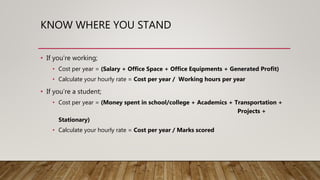
KNOW WHERE YOU STAND
• If you’re working;
• Cost per year = (Salary + Office Space + Office Equipments + Generated Profit)
• Calculate your hourly rate = Cost per year / Working hours per year
• If you’re a student;
• Cost per year = (Money spent in school/college + Academics + Transportation +
Projects +
Stationary)
• Calculate your hourly rate = Cost per year / Marks scored
MAKING ACTIVITY LOGS
• Make a realistic estimate of the time spend during the day on specific work.
• Pinpoint the critical areas - time spent on low value jobs.
• Finding the high yielding time of our day.
GOAL SETTING
• Set lifetime goals, help yourself to chart your life course & your career path.
• Breakup your lifetime goal in smaller goals .
• Make a daily TO-DO list.
• Revise and update your list on daily bases & judge your performance.
PLANNING
DRAW AN ACTION PLAN – A LIST OF THINGS THAT NEED TO BE DONE TO
ACHIEVE YOUR GOALS.
PRIORITIZING
• Consider the value of the task before you do it-
• Is it worth spending you time and resources?
• Prioritize your task-
• The most important tasks should be completed first followed by others.
THROUGH TIME MANAGEMENT
YOU MANAGE YOURSELF, YOUR WORK AND OTHERS
QUESTIONS?
WE’RE THROUGH
PARTH SHAH
17BECEM093
CE-2
GUIDED BY : MISS FORAM PATEL

Time Management (Communication Skills - SVIT)

  • 1.
  • 2.
    WHAT IS TIMEMANAGEMENT? LITERAL DIFINITIONS
  • 3.
    WHAT IS TIMEMANAGEMENT? • It refers to managing time effectively, so that the right time is allocated to right activity. • It is a predictable control an individual can exercise over a series of events. • Its is the act or practice of managing and supervising time.
  • 4.
    MYTHS ABOUT TIMEMANAGEMENT
  • 5.
    COMMON MYTHS • “I’vedone well in school, so I’ll do well in college too > I’ve done well in college so I’ll do well at the work too.” • “No matter what I do, I wont have enough time.” • “Time management? I work better under pressure.” • “It takes all the fun out of life.”
  • 6.
    WHY DO WENEED TIME MANAGEMENT? • To save time. • To reduce stress. • To function effectively. • To increase our work output. • To have more (and better) control of our lives.
  • 7.
    WHERE DO WESTART? BASICS COME FIRST
  • 8.
    IT STARTS WITH… •Costing your time. • Making activity goals. • Goal setting. • Planning. • Prioritizing. • Scheduling.
  • 9.
    COSTING YOUR TIME UNDERSTANDYOUR TRUE VALUE BY CALCULATING YOU COST PER YEAR
  • 10.
    KNOW WHERE YOUSTAND • If you’re working; • Cost per year = (Salary + Office Space + Office Equipments + Generated Profit) • Calculate your hourly rate = Cost per year / Working hours per year • If you’re a student; • Cost per year = (Money spent in school/college + Academics + Transportation + Projects + Stationary) • Calculate your hourly rate = Cost per year / Marks scored
  • 11.
    MAKING ACTIVITY LOGS •Make a realistic estimate of the time spend during the day on specific work. • Pinpoint the critical areas - time spent on low value jobs. • Finding the high yielding time of our day.
  • 12.
    GOAL SETTING • Setlifetime goals, help yourself to chart your life course & your career path. • Breakup your lifetime goal in smaller goals . • Make a daily TO-DO list. • Revise and update your list on daily bases & judge your performance.
  • 13.
    PLANNING DRAW AN ACTIONPLAN – A LIST OF THINGS THAT NEED TO BE DONE TO ACHIEVE YOUR GOALS.
  • 14.
    PRIORITIZING • Consider thevalue of the task before you do it- • Is it worth spending you time and resources? • Prioritize your task- • The most important tasks should be completed first followed by others.
  • 15.
    THROUGH TIME MANAGEMENT YOUMANAGE YOURSELF, YOUR WORK AND OTHERS
  • 16.
  • 17.