Time Management
DEFINITION:
Time
management is the act of
taking conscious control
over the amount of time
spent on specific activities.
Time for Everything
• Take time to work, it is the price of success.
• Take time to think, it is the source of power.
• Take time to play, it is the source of youth.
• Take time to read, it is the source of wisdom.
• Take time to serve, it is the purpose of life.
• Take time to Laugh, it is the music of soul.
Why Do We Need TM?
To save time.
To reduce stress.
To increase our work output.
To have more control over our job
responsibilities.
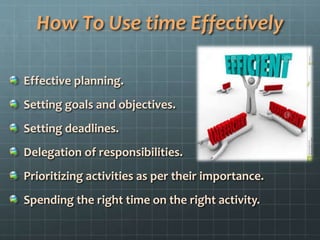
How To Use time Effectively
Effective planning.
Setting goals and objectives.
Setting deadlines.
Delegation of responsibilities.
Prioritizing activities as per their importance.
Spending the right time on the right activity.
Delegation of responsibilities.
 Delegation is the assignment of
any responsibility or authority to
another person to carry out
specific activities,
Prioritizing activities as per
their importance.
 Prioritizing skills are your ability to see
what tasks are more important at each
moment and give those tasks more of
your attention, energy, and time.
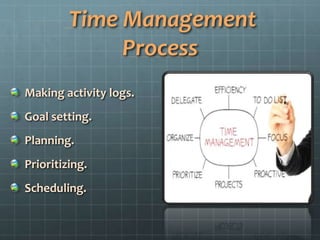
Time Management
Process
Making activity logs.
Goal setting.
Planning.
Prioritizing.
Scheduling.
1,Making Activity Logs
Make a realistic estimate of time spend
during day on job orders.
Pinpoint the critical areas.
Finding the high yeilding time of our
day.
2,Goal Setting
Setting lifetime goals help to chart your life
course and your career path.
Breakup your lifetime goal in smaller goals.
Make a daily To-Do list.
Revise and update your list on daily bases and
judge your performance.
3,Planning
Draw an action plan –A list of things that
need to be done to achieve your goals
4,Prioritizing
Make a To-Do List.
Consider the value of the task before to do it-
Is it worth spending your
time and company resources.
Prioritize your task-
The most important jobs should be
completed first followed by other jobs.
5,Scheduling
Make a realistic estimate of how much you
can do.
Plan to make the best use of the available
time.
Reserve some contingency time to deal with
‘unexpected jobs’.
Minimize stress by avoiding commitment by
yourself and others.
How To Manage Time
1.Prepare yourself first,
Assign realistic priorities to
each task.
How To Manage Time
2.Balance your effort.
3.Focus on your most productive time of day.
Some people work better in the
morning, and some are more focused in the
evening.
4.Manage time in increments.
Play a game with yourself by competing against the
clock.
5.Take a break.
Clear your mind
and refresh yourself to refocus. Decide
beforehand on a 5, 10 or 15 minute break and
stick to that decision
6.Keep track of your progress.
Cross things off the list as they are
completed.
7.Reassess the list.
Rewrite and prioritize your
list on a regular basis.
8.Leave time for fun.
While there are times when we just need to
power through a large project, it's
important to give yourself time to let loose
9.Sleep for 7-9 hours everynight.
Getting the proper amount of sleep will
help keep you alert and energetic, able
to think clearly, and function at a high
level
Here are 7 time management tips
for students:
Eliminate distractions.
Be focused at the task at hand. ...
Use a calendar. ...
Use a checklist. ...
Get organised. ...
Schedule rewards. ...
Get a good night's sleep.
Time management

Time management

  • 3.
    Time Management DEFINITION: Time management isthe act of taking conscious control over the amount of time spent on specific activities.
  • 4.
    Time for Everything •Take time to work, it is the price of success. • Take time to think, it is the source of power. • Take time to play, it is the source of youth. • Take time to read, it is the source of wisdom. • Take time to serve, it is the purpose of life. • Take time to Laugh, it is the music of soul.
  • 6.
    Why Do WeNeed TM? To save time. To reduce stress. To increase our work output. To have more control over our job responsibilities.
  • 7.
    How To Usetime Effectively Effective planning. Setting goals and objectives. Setting deadlines. Delegation of responsibilities. Prioritizing activities as per their importance. Spending the right time on the right activity.
  • 8.
    Delegation of responsibilities. Delegation is the assignment of any responsibility or authority to another person to carry out specific activities,
  • 9.
    Prioritizing activities asper their importance.  Prioritizing skills are your ability to see what tasks are more important at each moment and give those tasks more of your attention, energy, and time.
  • 10.
    Time Management Process Making activitylogs. Goal setting. Planning. Prioritizing. Scheduling.
  • 11.
    1,Making Activity Logs Makea realistic estimate of time spend during day on job orders. Pinpoint the critical areas. Finding the high yeilding time of our day.
  • 12.
    2,Goal Setting Setting lifetimegoals help to chart your life course and your career path. Breakup your lifetime goal in smaller goals. Make a daily To-Do list. Revise and update your list on daily bases and judge your performance.
  • 13.
    3,Planning Draw an actionplan –A list of things that need to be done to achieve your goals
  • 14.
    4,Prioritizing Make a To-DoList. Consider the value of the task before to do it- Is it worth spending your time and company resources. Prioritize your task- The most important jobs should be completed first followed by other jobs.
  • 15.
    5,Scheduling Make a realisticestimate of how much you can do. Plan to make the best use of the available time. Reserve some contingency time to deal with ‘unexpected jobs’. Minimize stress by avoiding commitment by yourself and others.
  • 16.
    How To ManageTime 1.Prepare yourself first, Assign realistic priorities to each task.
  • 17.
    How To ManageTime 2.Balance your effort.
  • 18.
    3.Focus on yourmost productive time of day. Some people work better in the morning, and some are more focused in the evening.
  • 19.
    4.Manage time inincrements. Play a game with yourself by competing against the clock.
  • 20.
    5.Take a break. Clearyour mind and refresh yourself to refocus. Decide beforehand on a 5, 10 or 15 minute break and stick to that decision
  • 21.
    6.Keep track ofyour progress. Cross things off the list as they are completed.
  • 22.
    7.Reassess the list. Rewriteand prioritize your list on a regular basis.
  • 23.
    8.Leave time forfun. While there are times when we just need to power through a large project, it's important to give yourself time to let loose
  • 24.
    9.Sleep for 7-9hours everynight. Getting the proper amount of sleep will help keep you alert and energetic, able to think clearly, and function at a high level
  • 25.
    Here are 7time management tips for students: Eliminate distractions. Be focused at the task at hand. ... Use a calendar. ... Use a checklist. ... Get organised. ... Schedule rewards. ... Get a good night's sleep.