Time Management By Dr Sally EL-AKKAD
Are you a time manager ? exercise
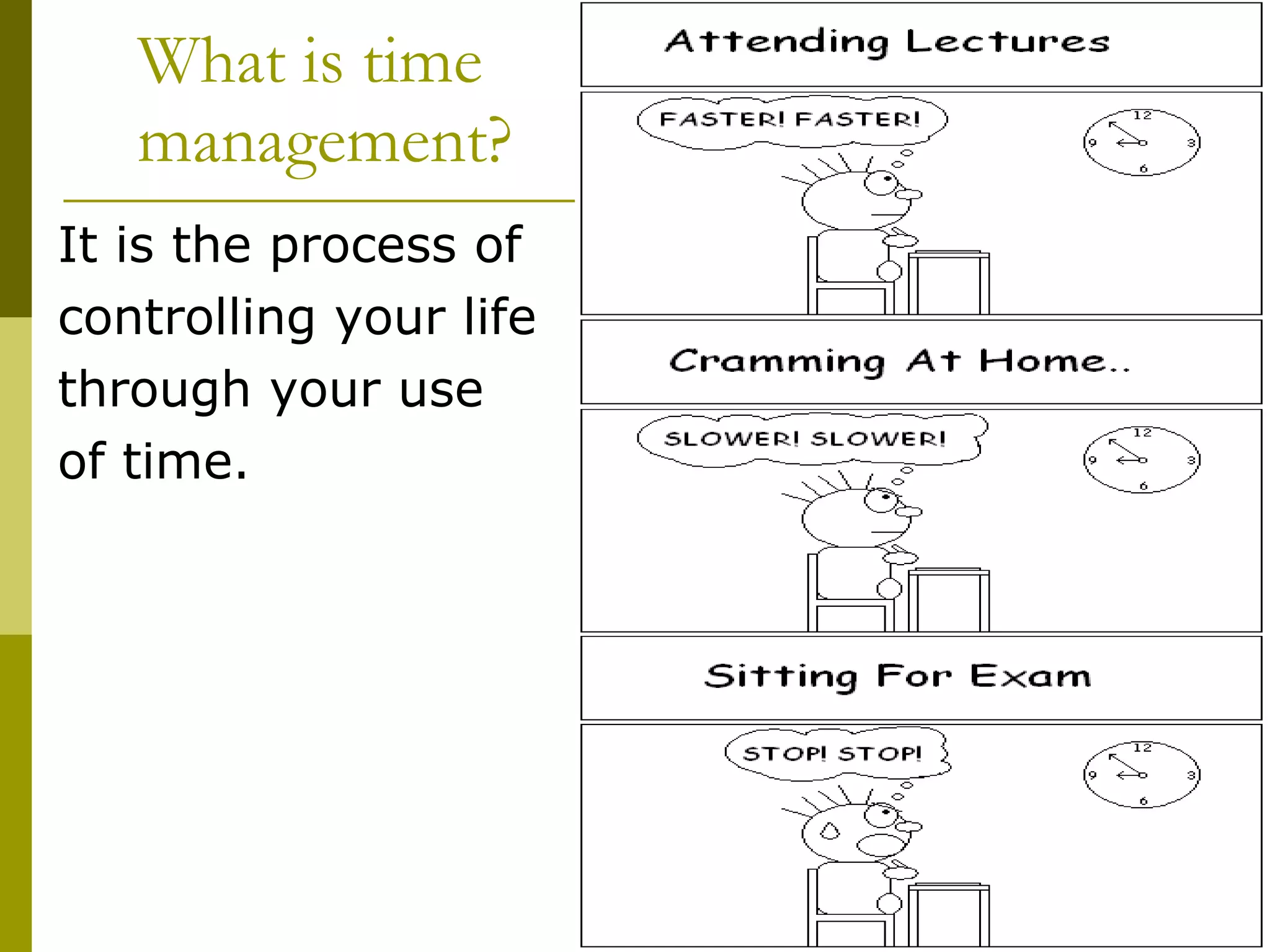
What is time management? It is the process of controlling your life  through your use of time.
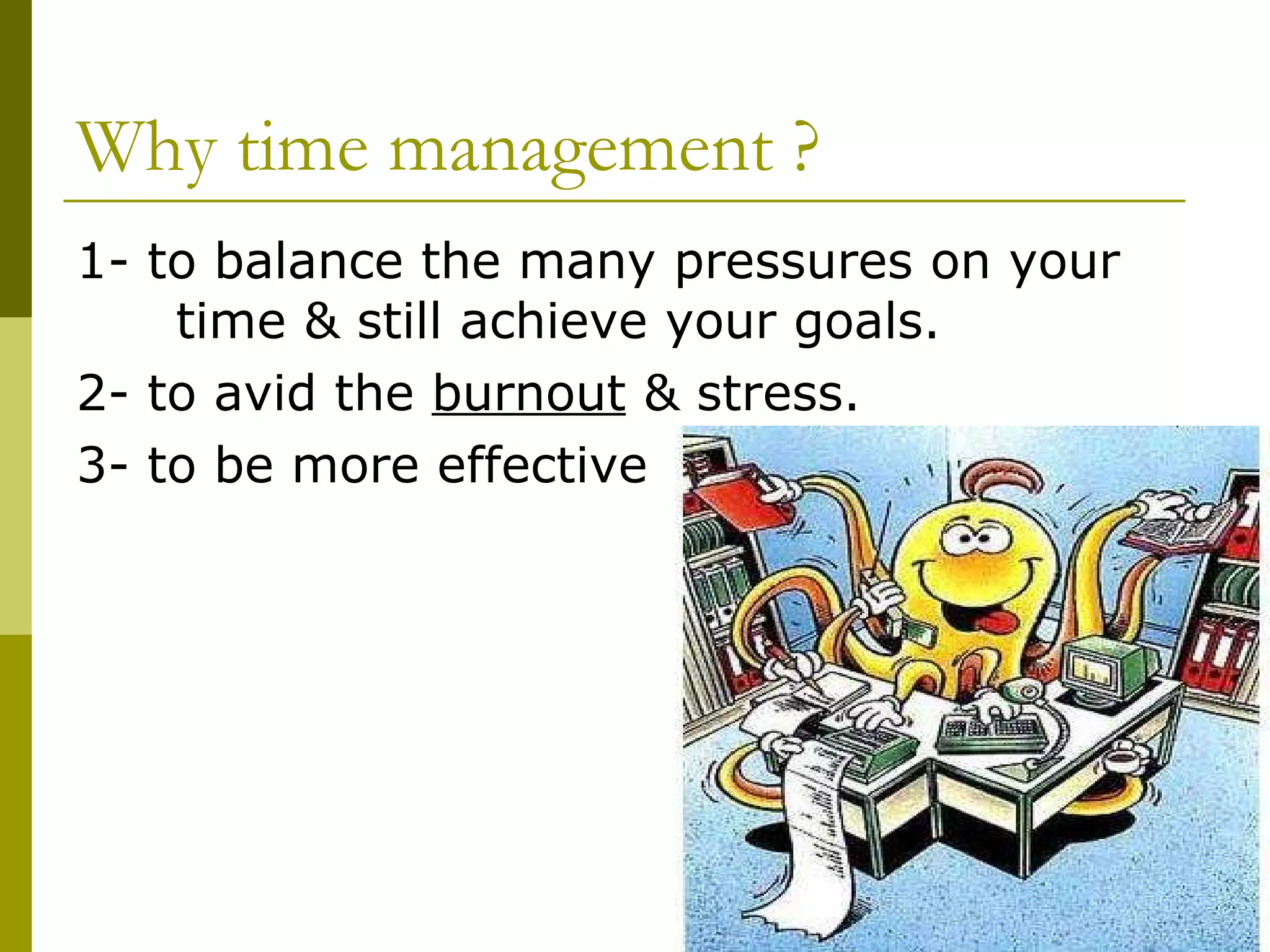
Why time management ? 1- to balance the many pressures on your  time & still achieve your goals. 2- to avid the  burnout  & stress. 3- to be more effective
Phases of time management ? 1- analysis 2- planning 3-follow-up & evaluation
1-analysis Where does your time goes ? Discover interruptions Develop strategies
2-planning Review your goals, outline tasks required to achieve them. How much time you will allocate to each task ? Plan for the expected & the unexpected Tools !!!
3-follow-up & evaluation Step back & reflect Did you achieve your goals ? How well did your schedule work ? What could be done better next time ?
Where does your time go ? * Everyone has the same 168 hours a week. * Only you can judge whether you are using  your time wisely. * Sometimes we underestimate how long  things really take.  * Also people have different daily rhythms.
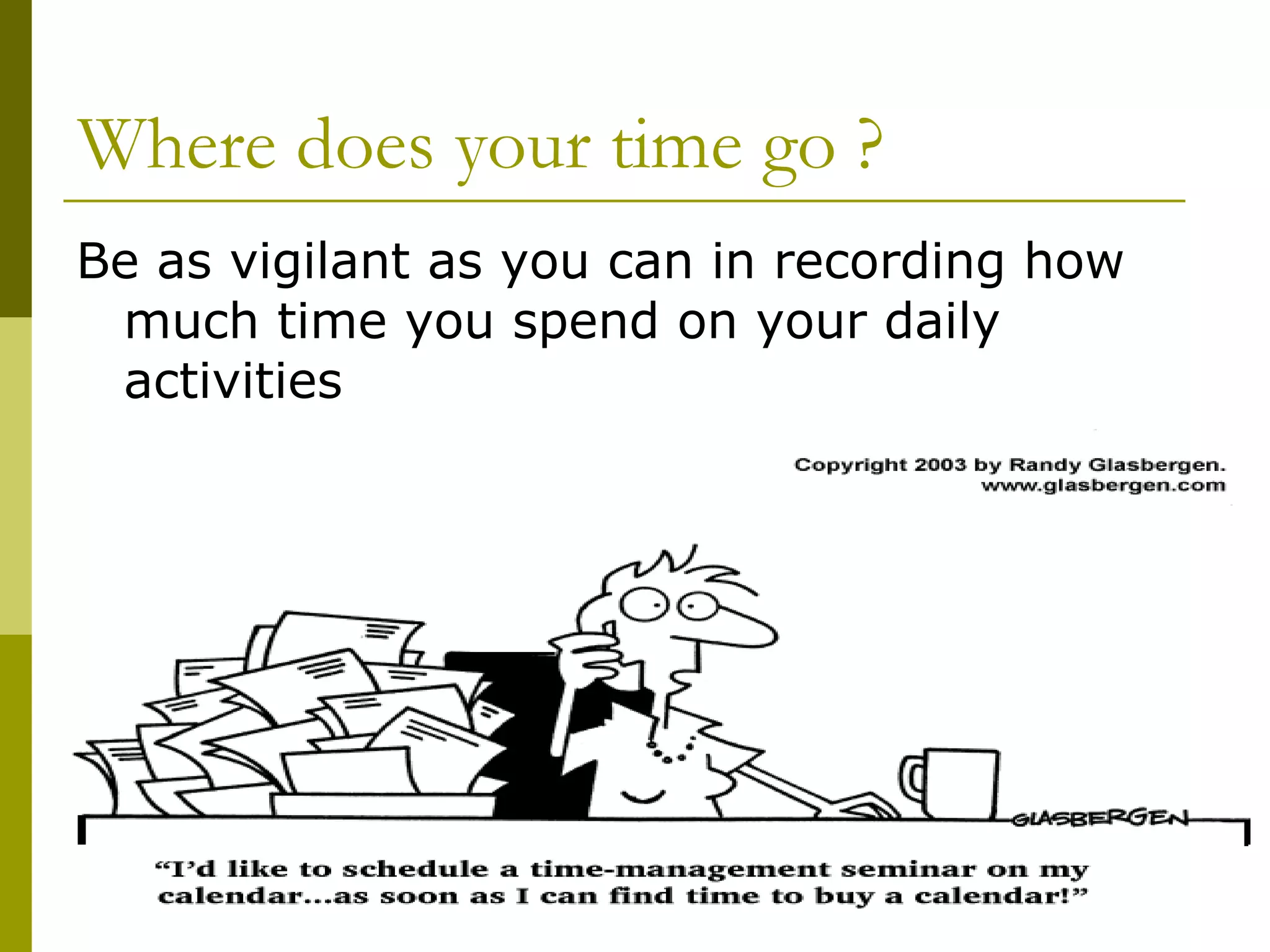
Where does your time go ? Be as vigilant as you can in recording how much time you spend on your daily activities
Finding a pattern Examine the time log to identify general patterns of time usage * Does your time usage match your key  responsibilities ?  * How is the payoff ? * What can be delegated ?
Think about whether each activity you pursued supported your goals and priorities or whether it was a time waster
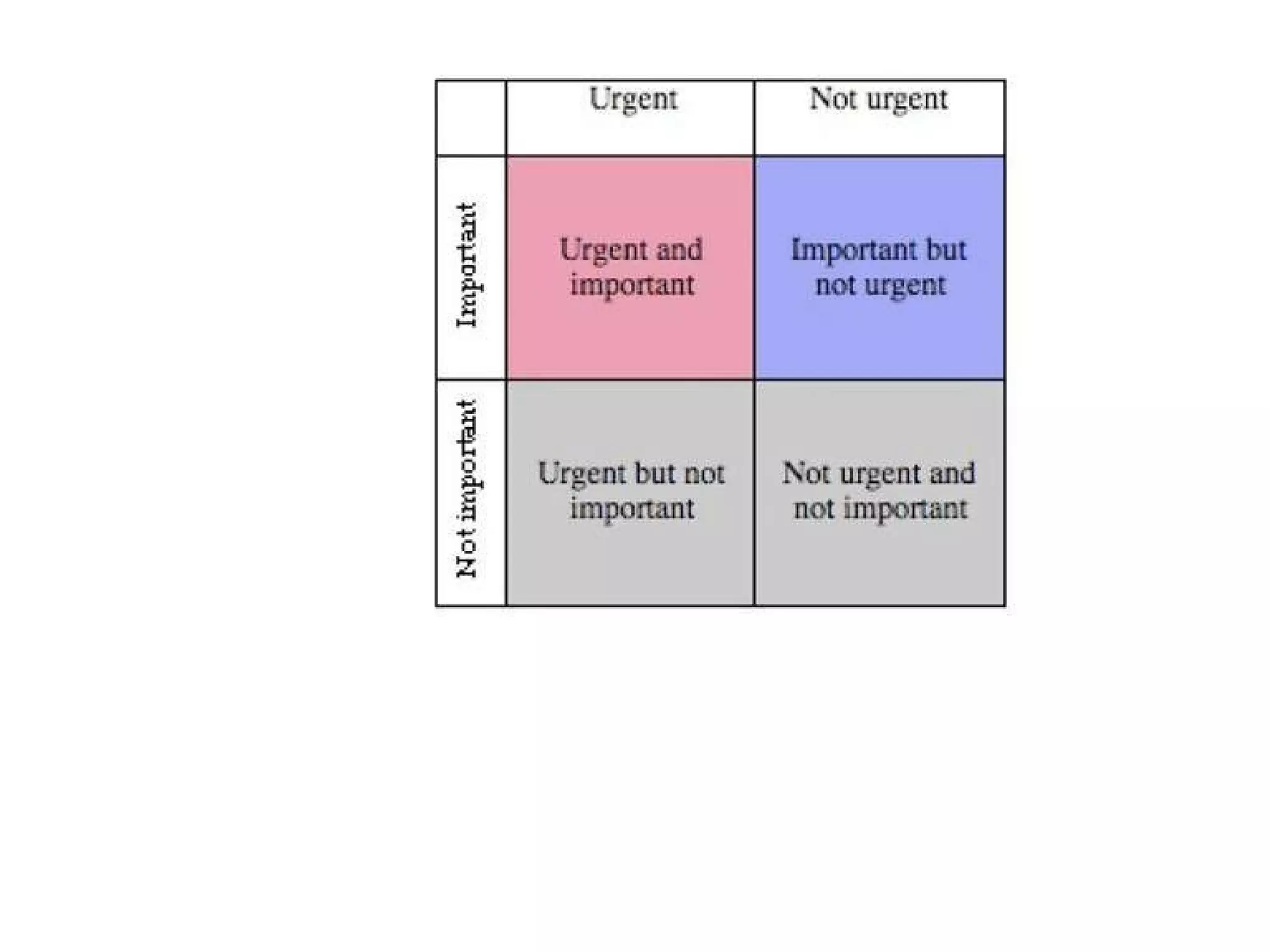
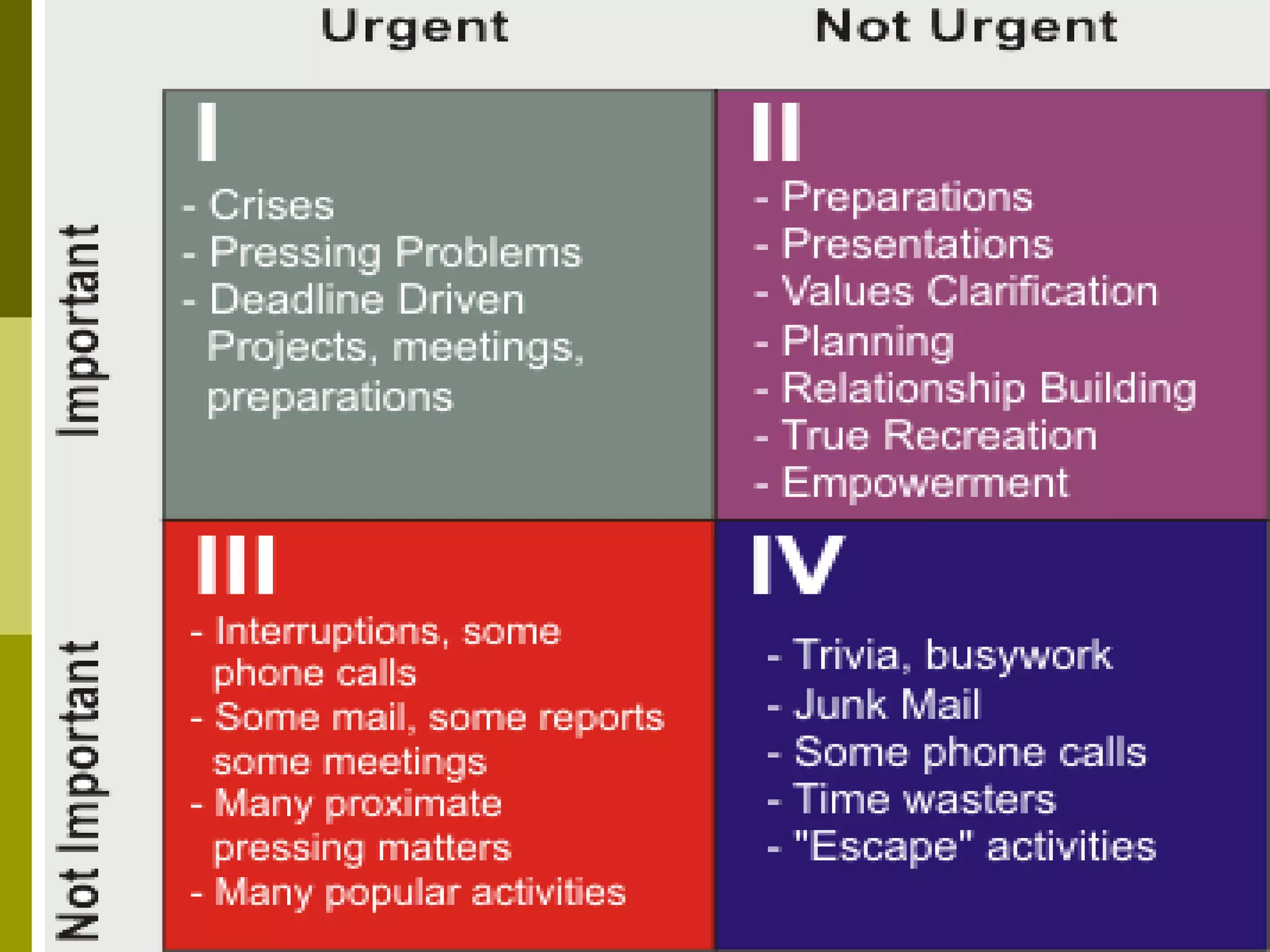
Goals as guideposts Goals   critical to effective time management how you should spend your time ? identify the specific task identify which tasks should not be pursuing With set goals  you identify what is most important to accomplish on a daily & weekly basis.
 
 
Breaking goals into manageable task 1- review each of your goals individually. 2- list all of the key tasks required to  achieve each goal.  3- estimate how much of your time each task or activity will require. 4- establish a deadline for the completion of each task or activity.
Breaking goals into manageable task 5-  assign priorities to each task & that  should reflect the priority of the goal that each task supports: *  Priority A:   goals having  HIGH  value  PRIMARY  importance * Priority B:  goals having  MEDIUM  value  SECONDARY  importance * Priority c:  goals having  LITTLE  value  LITTLE  importance
Attempting too much Trying to do too much has a negative impact on all areas of your life.
Avoid falling into this trap 1- know your key responsibilities & focus on  your top priority goals. 2- ask for feedback (from your boss) 3- learn to delegate 4- avoid pursuing low priority goals 5- resist the urge to step in & take over 6- don’t assume everything has to get done
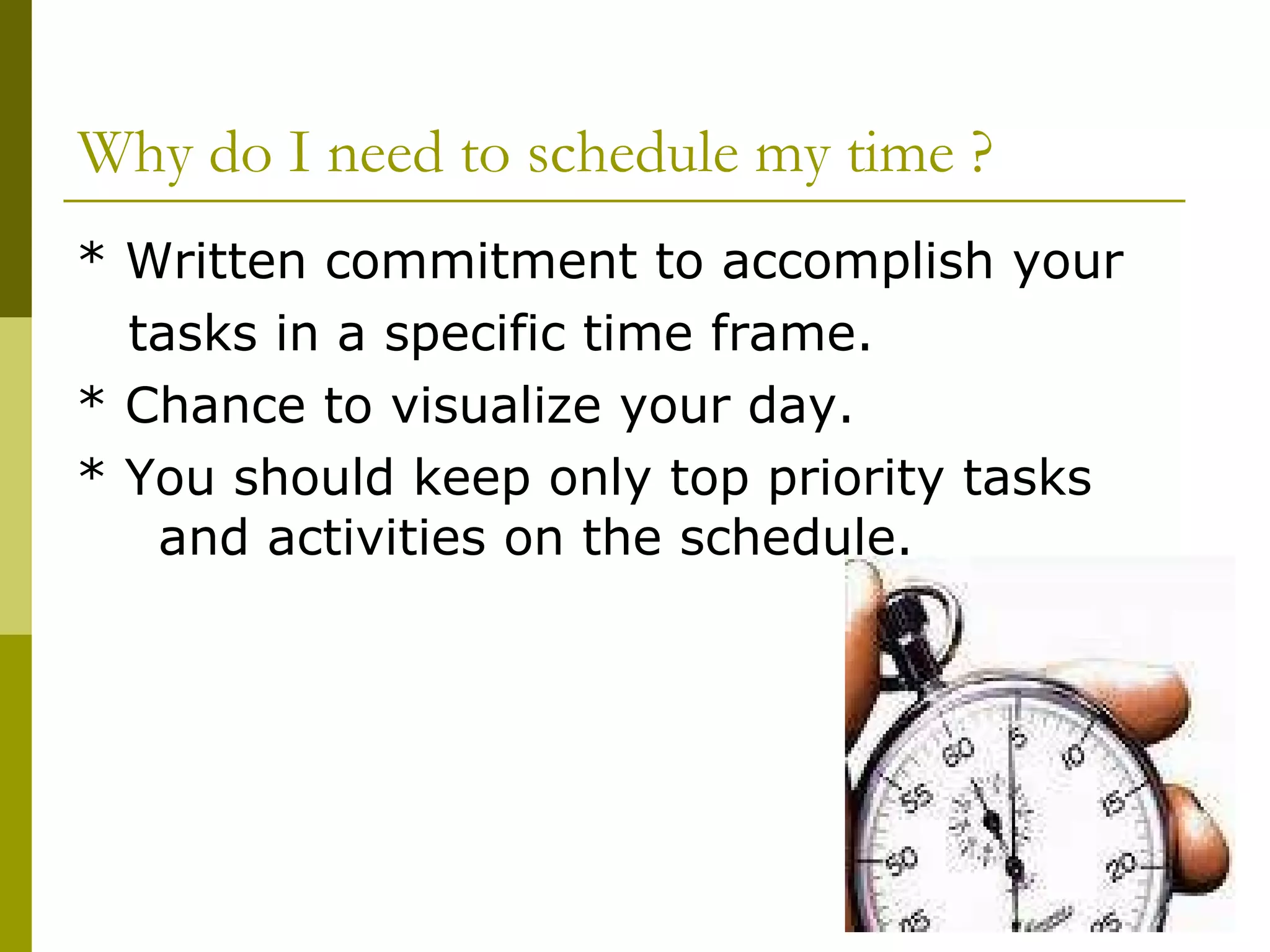
Why do I need to schedule my time ? * Written commitment to accomplish your  tasks in a specific time frame. * Chance to visualize your day. * You should keep only top priority tasks  and activities on the schedule.
 
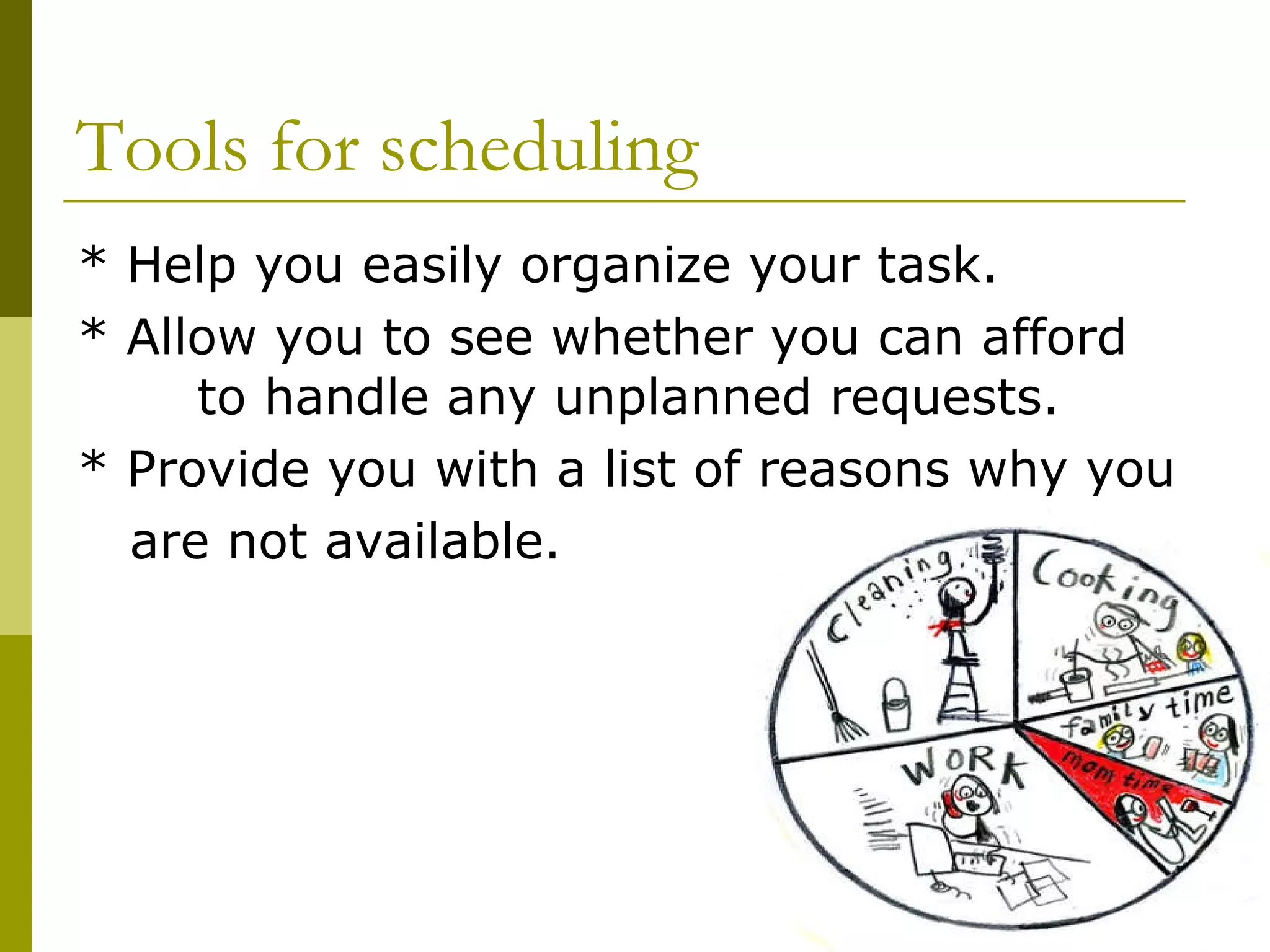
Tools for scheduling * Help you easily organize your task. * Allow you to see whether you can afford  to handle any unplanned requests.  * Provide you with a list of reasons why you  are not available.
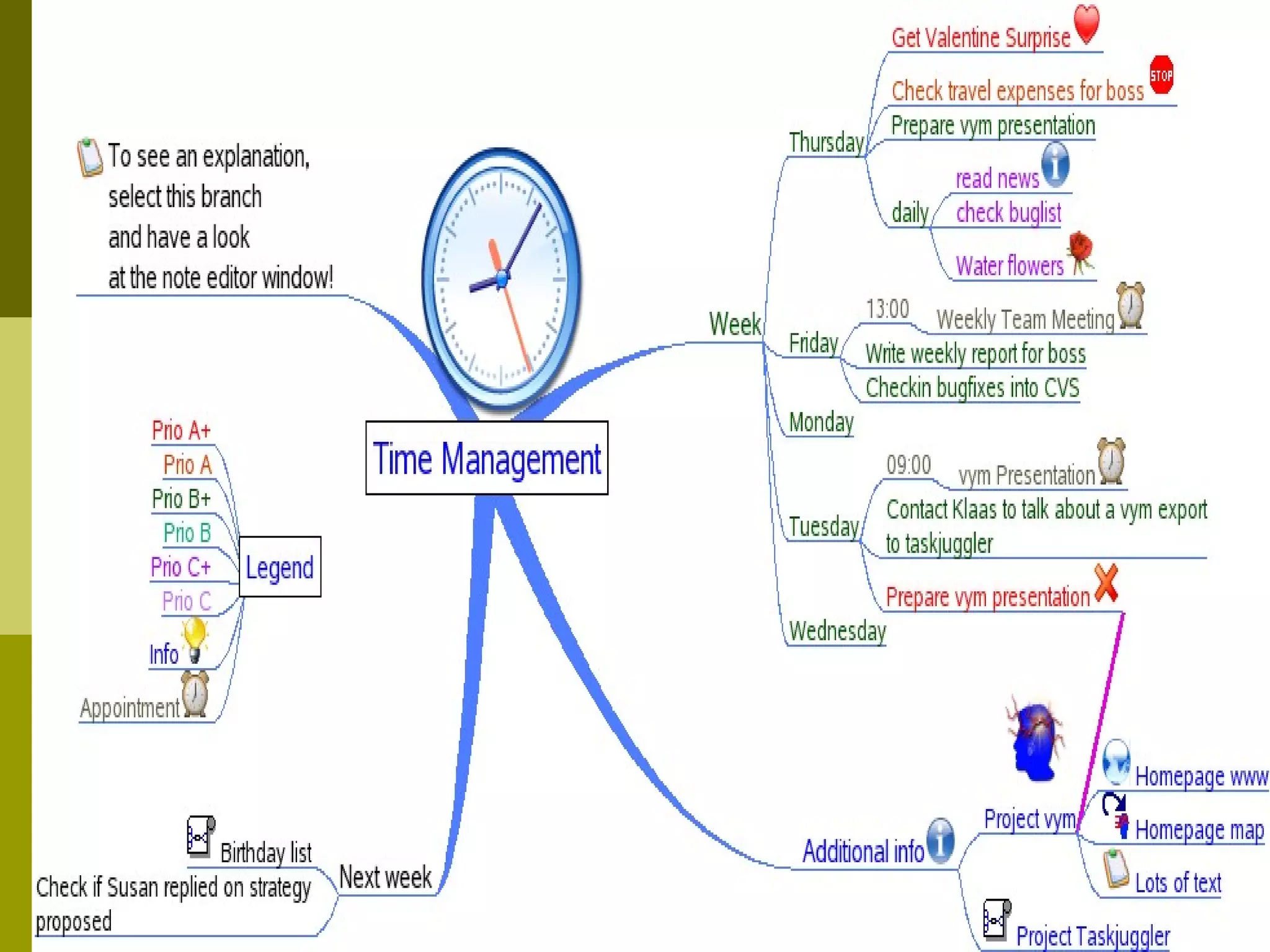
Tools for scheduling to-do list Appointment calendars Daily & weekly planning guides Daily management software & hardware Wall calendars Company standard scheduling tools Software graphics program Mind map
 
Creating your schedule 1- keep in mind when your energy is at its  peak ? When you are most alert ? 2- schedule only part of your day, leaving  time to deal with the unexpected. 3- combine tasks. 4- consolidate similar activities. 5- identify tasks to work on when you have  unexpected free time.
Creating your schedule 6- try scheduling backward, put in the most  important things first.  7- as the week progress, move uncompleted  priority tasks to the days still left in the  week. 8- when your schedule changes; record  what really occurred, if you begin to  see a trend, rework your future  schedule. 9- keep it accessible.
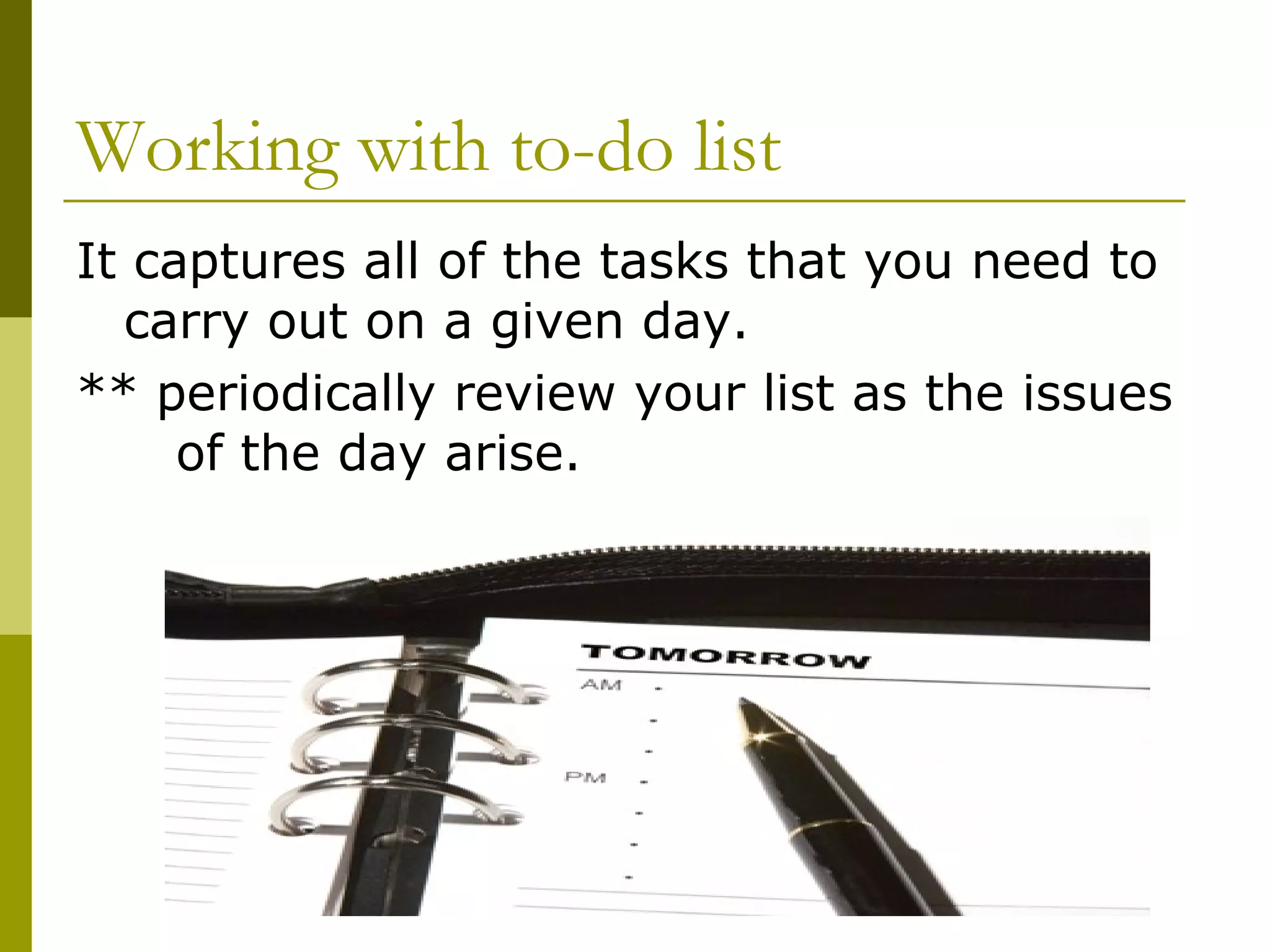
Working with to-do list It captures all of the tasks that you need to carry out on a given day. ** periodically review your list as the issues  of the day arise.
To-do list includes: Tasks in priority order Meetings you are scheduled to attend Decisions you need to make Information you are waiting for Calls you need to make or expect to receive Memos, letters & e-mails u need to write Any unfinished business
Strategies for creating your list 1- be realistic about how many things you  can do. 2- include time required & completion date  for each task. 3- don’t worry about putting items on the  list in a particular order.  4- cross off each item as you complete it. 5- save old lists
 
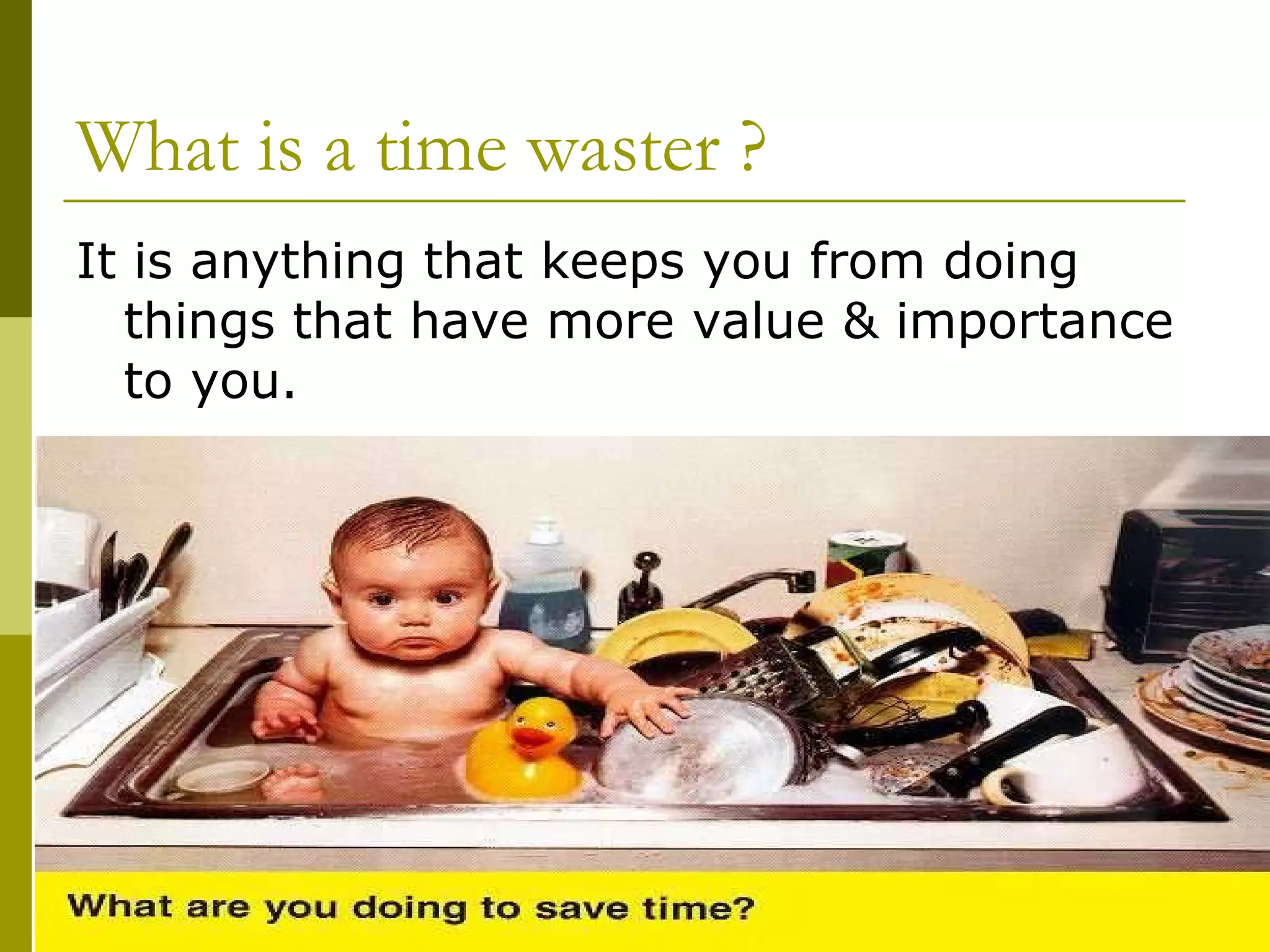
What is a time waster ? It is anything that keeps you from doing things that have more value & importance to you.
Common time wasters Interruptions Unexpected visitors Telephone calls Paperwork Procrastination Meetings Travel
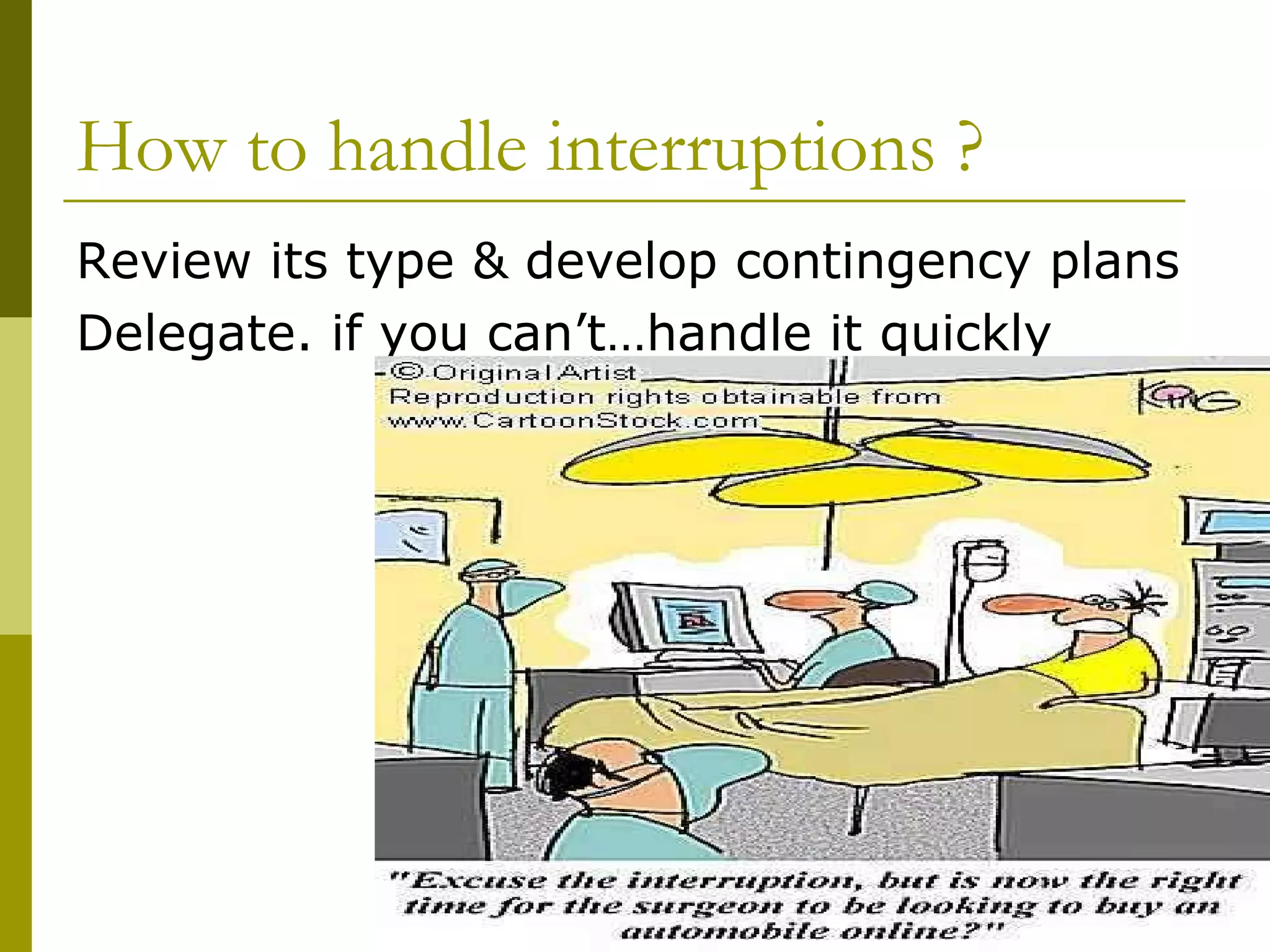
How to handle interruptions ? Review its type & develop contingency plans Delegate. if you can’t…handle it quickly
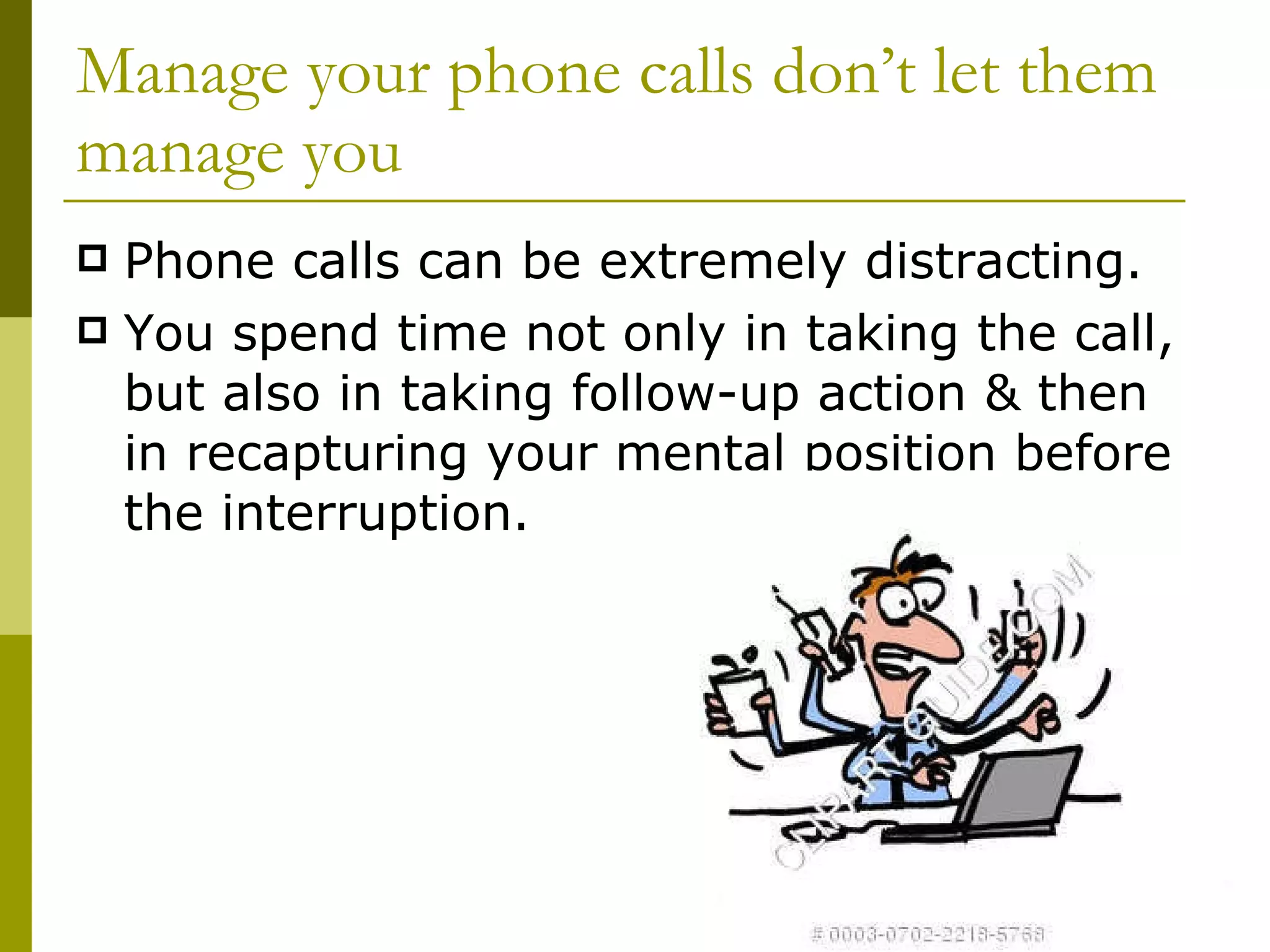
How to handle unexpected visitors? Deal with him quickly (if it is an immediate crisis or serious issue) Schedule another time to meet with the visitor, if possible. Refer the unexpected visitor to another appropriate person
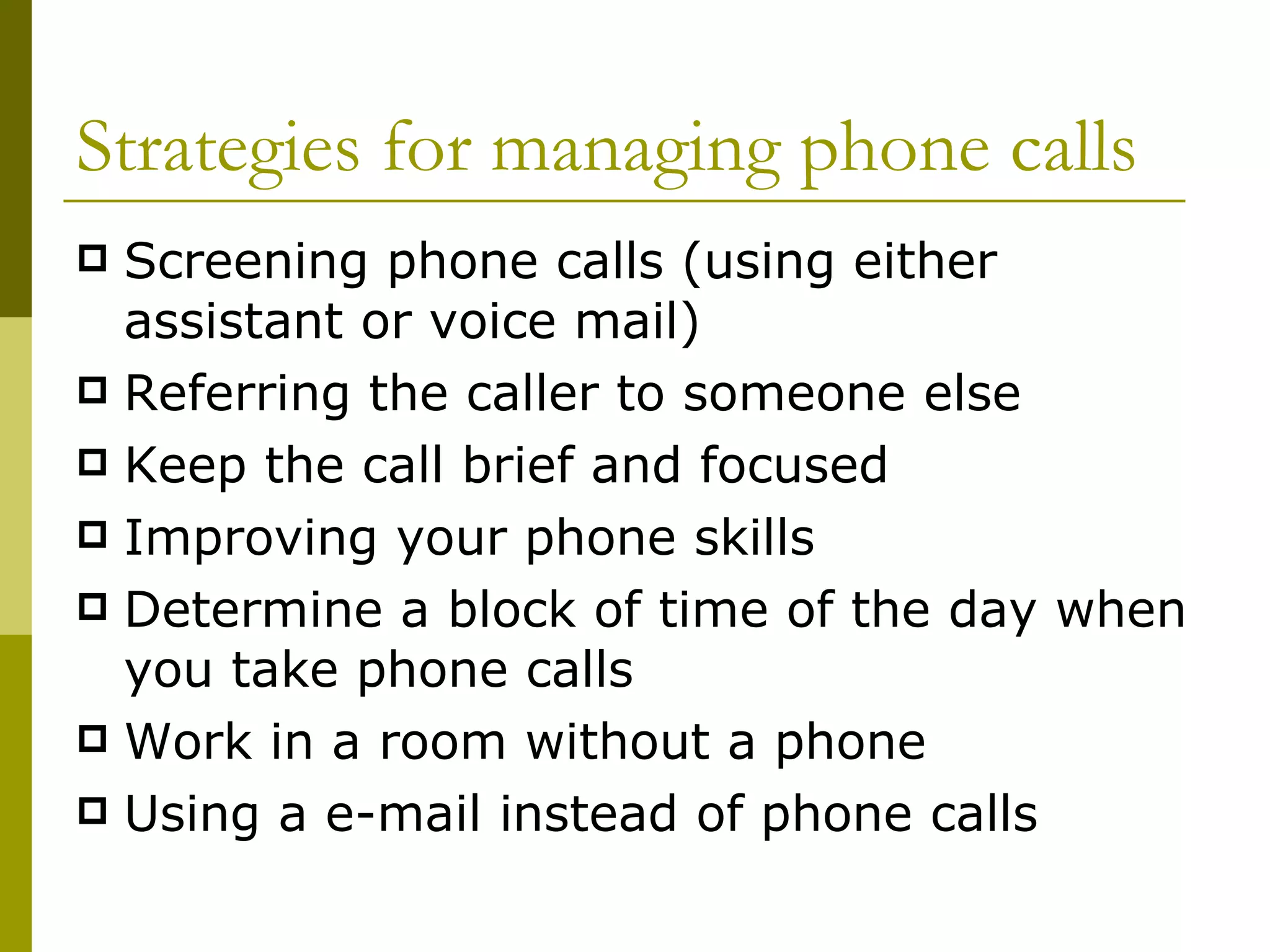
Manage your phone calls don’t let them manage you Phone calls can be extremely distracting. You spend time not only in taking the call, but also in taking follow-up action & then  in recapturing your mental position before the interruption.
Strategies for managing phone calls Screening phone calls (using either assistant or voice mail) Referring the caller to someone else Keep the call brief and focused Improving your phone skills Determine a block of time of the day when you take phone calls Work in a room without a phone Using a e-mail instead of phone calls
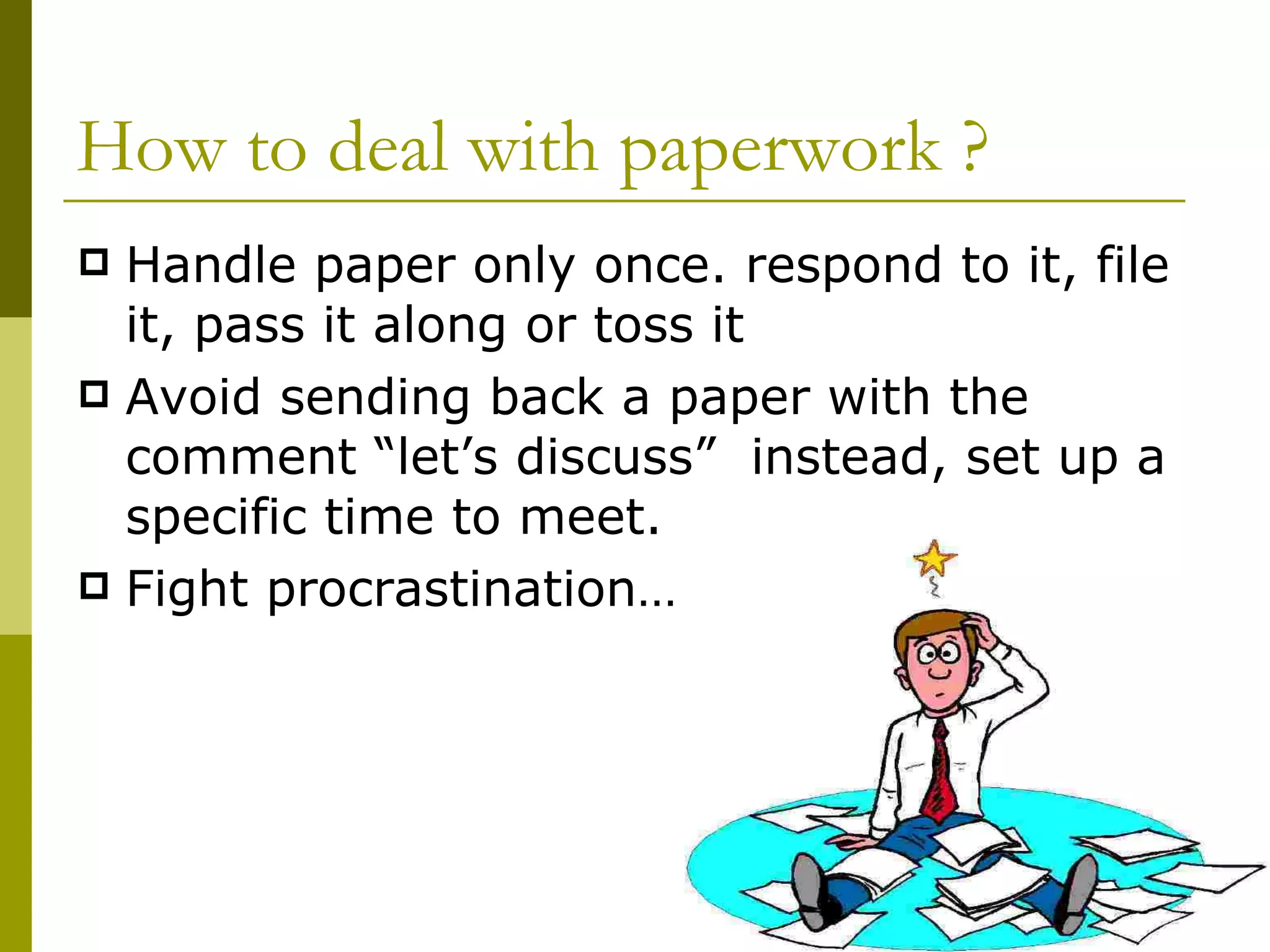
How to deal with paperwork ? Handle paper only once. respond to it, file it, pass it along or toss it Avoid sending back a paper with the comment “let’s discuss”  instead, set up a specific time to meet. Fight procrastination…
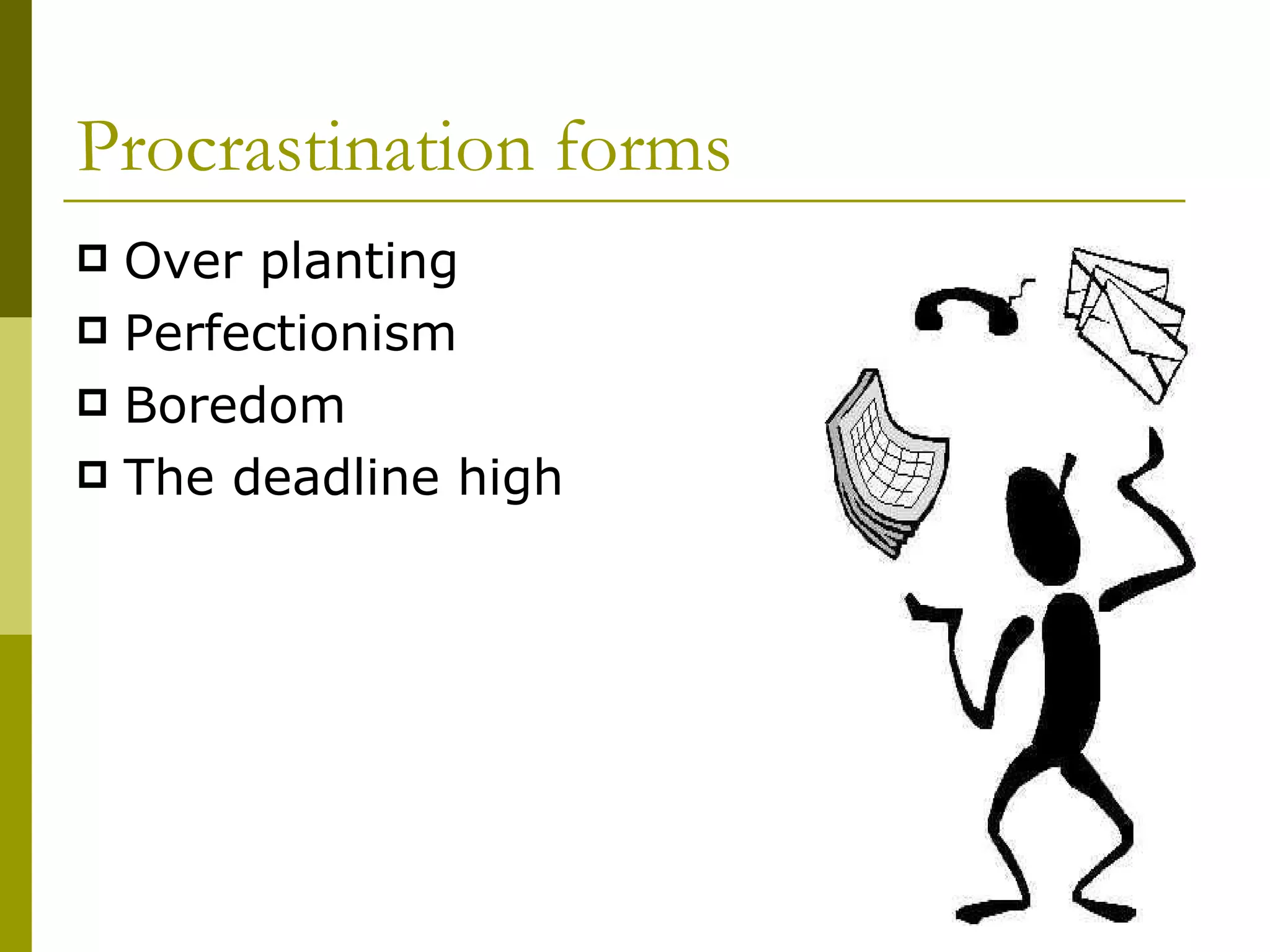
Procrastination forms Over planting Perfectionism Boredom The deadline high
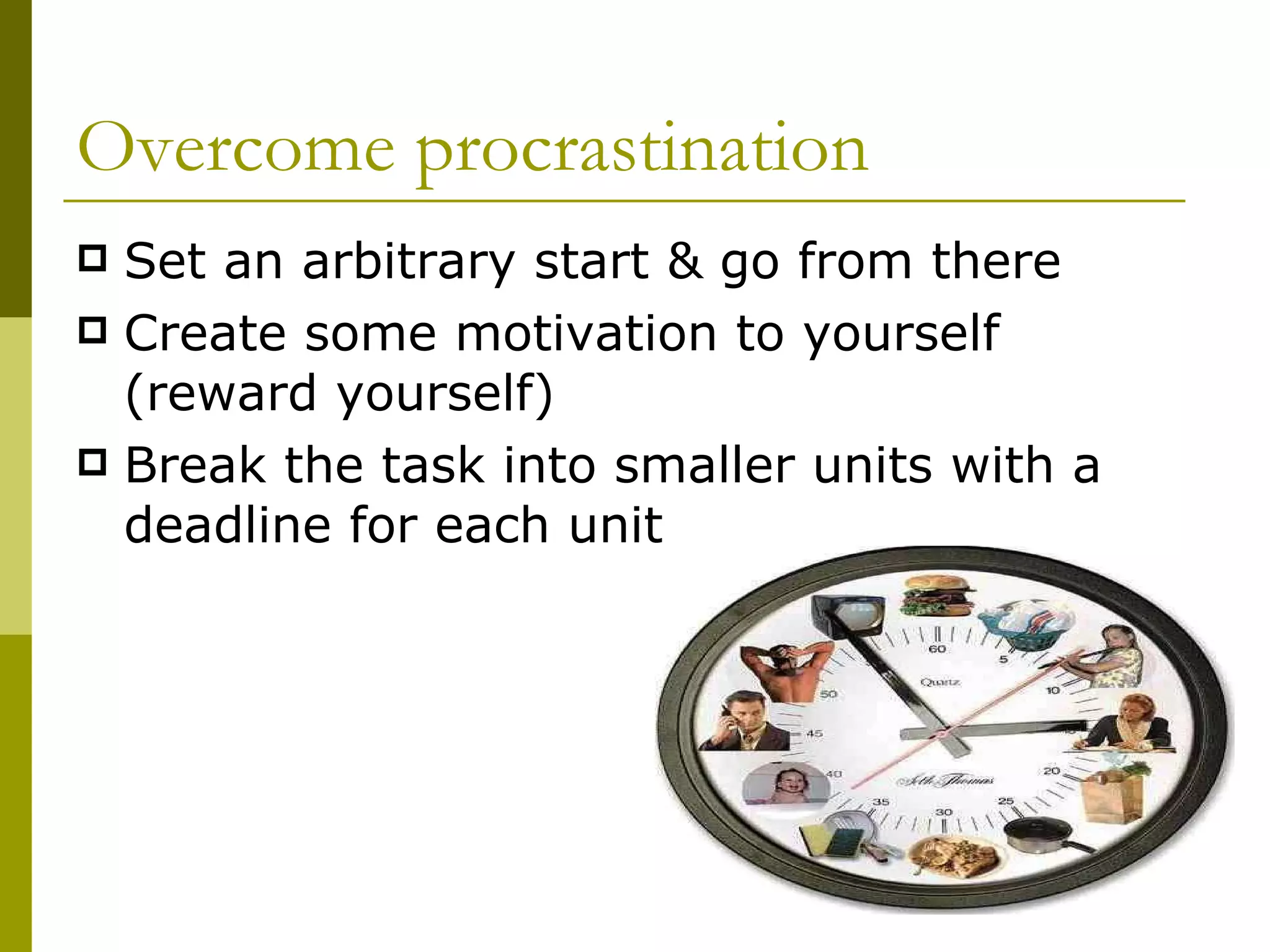
Overcome procrastination Set an arbitrary start & go from there Create some motivation to yourself (reward yourself) Break the task into smaller units with a deadline for each unit
How to Handle meetings Decide whether you are the best representative Request to see the  agenda  in advance Arrange to attend only the part of the meeting that is relevant to you If you are running the meeting ;send out the agenda & points to consider before the meeting
Make travel time productive Make sure that it is truly necessary to hold the meetings face-to-face rather than via conference call. Then make sure that you are the best person to make the trip, if not, send someone else. Take a well organized briefcase with you.
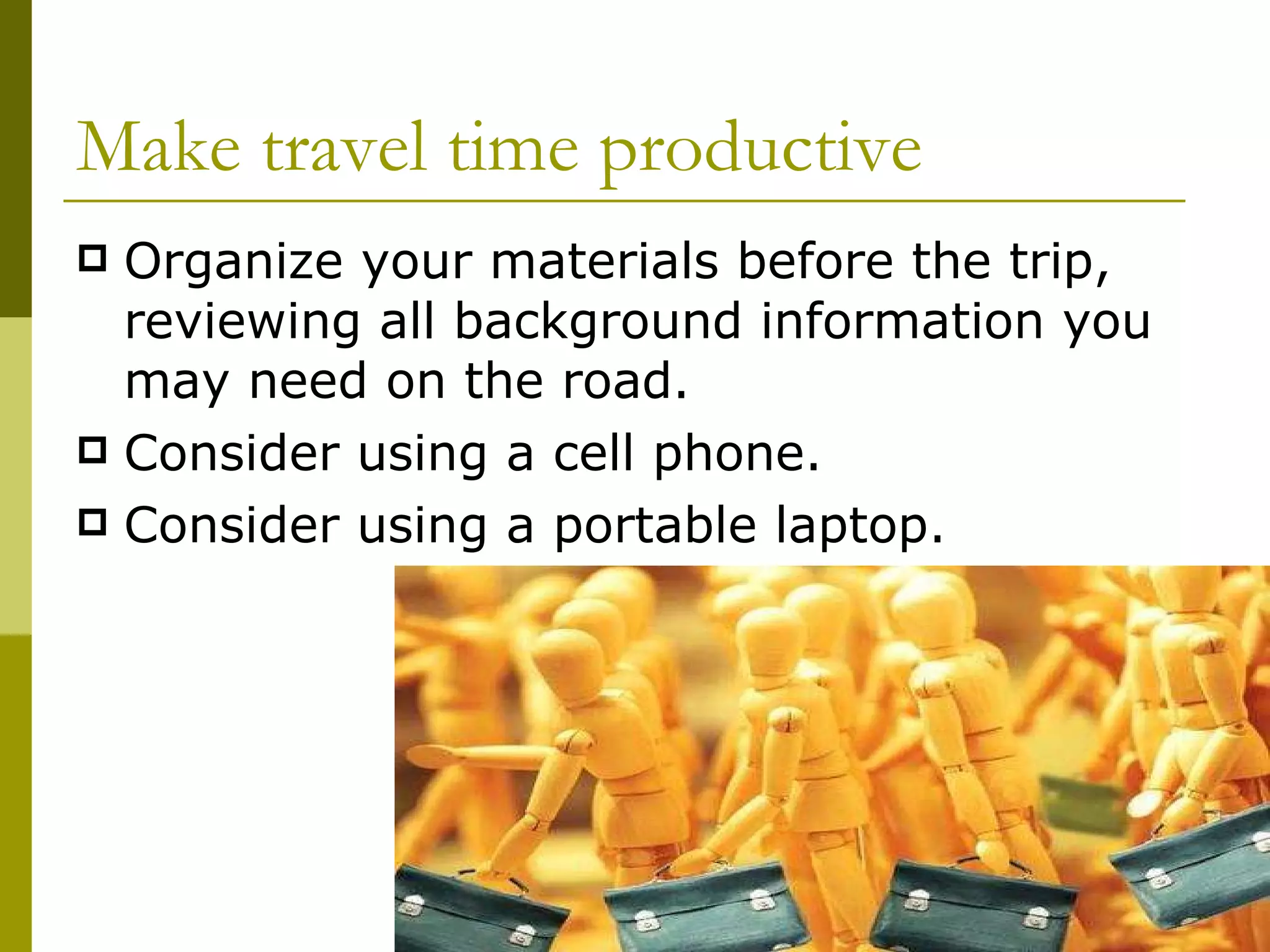
Make travel time productive Organize your materials before the trip, reviewing all background information you may need on the road. Consider using a cell phone. Consider using a portable laptop.
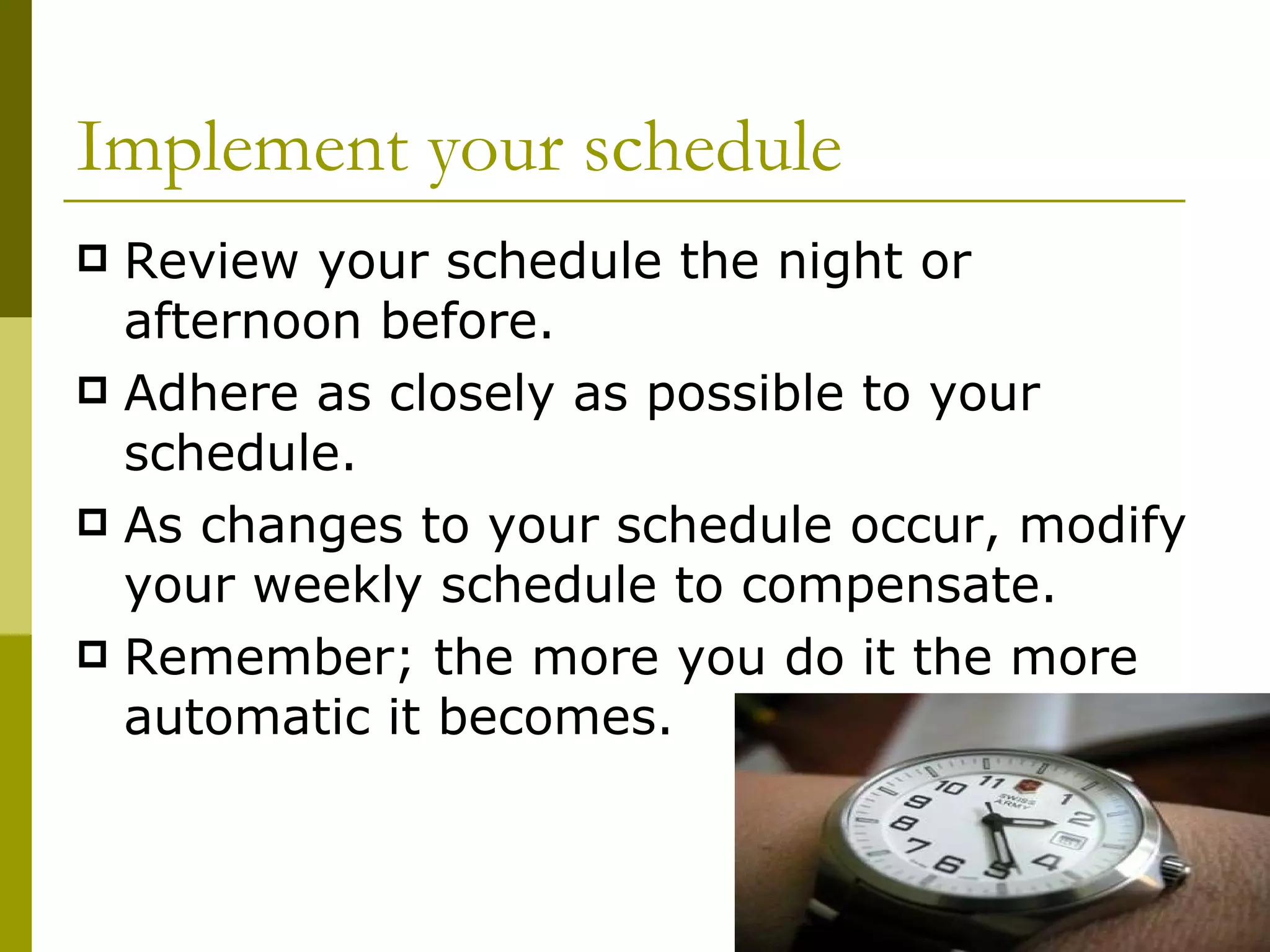
Implement your schedule Review your schedule the night or afternoon before. Adhere as closely as possible to your schedule. As changes to your schedule occur, modify your weekly schedule to compensate. Remember; the more you do it the more automatic it becomes.
Monitor & evaluate your schedule Check your progress against your schedule at least once a day. Are you completing the tasks you set for the week ? Are you making progress on achieving your goals ? Do you feel better prepared & focused ? What was the impact of not doing some tasks ?
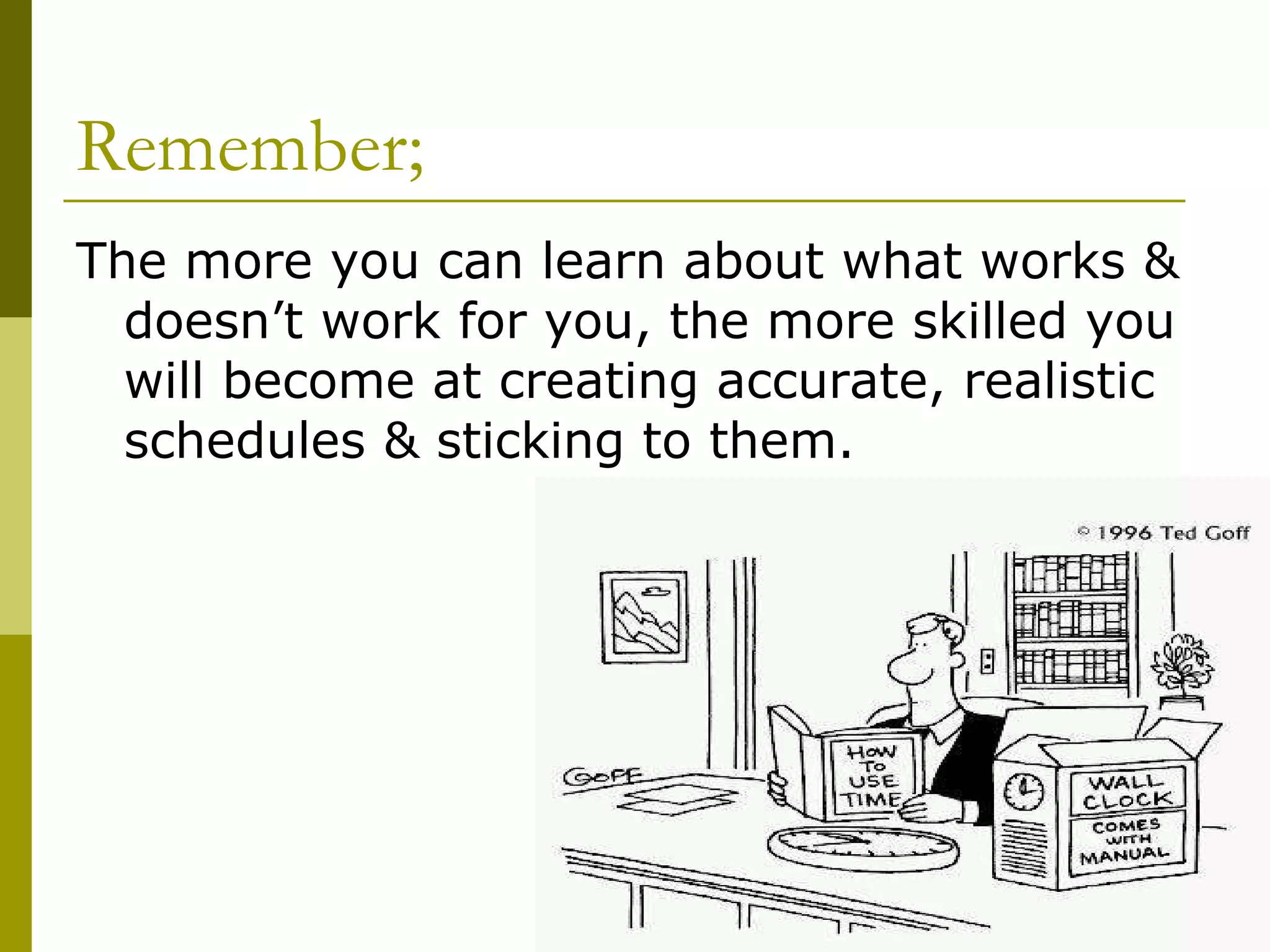
Remember; The more you can learn about what works & doesn’t work for you, the more skilled you will become at creating accurate, realistic schedules & sticking to them.
Steps for managing your time Analyze how you currently spend your time. Review your goals. Break your goals into manageable tasks. Schedule your time. Identify your time wasters & outline strategies to deal with them. Implement your schedule. Evaluate your schedule & make adjustments.
Tips for scheduling time Take both a long term & short term perspective When your schedule changes, mark what really occurred in your day for future reference. Learn when your “high-energy”   & “glow-energy” times occur & schedule your day accordingly.
Tips for scheduling time Balance your activities-schedule time to allow yourself to unwind (include time for physical exercise, recreation & social activities ) Remember Parkinson’s law:  work tends to expand to fill the time allotted.

Time Management

  • 1.
    Time Management ByDr Sally EL-AKKAD
  • 2.
    Are you atime manager ? exercise
  • 3.
    What is timemanagement? It is the process of controlling your life through your use of time.
  • 4.
    Why time management? 1- to balance the many pressures on your time & still achieve your goals. 2- to avid the burnout & stress. 3- to be more effective
  • 5.
    Phases of timemanagement ? 1- analysis 2- planning 3-follow-up & evaluation
  • 6.
    1-analysis Where doesyour time goes ? Discover interruptions Develop strategies
  • 7.
    2-planning Review yourgoals, outline tasks required to achieve them. How much time you will allocate to each task ? Plan for the expected & the unexpected Tools !!!
  • 8.
    3-follow-up & evaluationStep back & reflect Did you achieve your goals ? How well did your schedule work ? What could be done better next time ?
  • 9.
    Where does yourtime go ? * Everyone has the same 168 hours a week. * Only you can judge whether you are using your time wisely. * Sometimes we underestimate how long things really take. * Also people have different daily rhythms.
  • 10.
    Where does yourtime go ? Be as vigilant as you can in recording how much time you spend on your daily activities
  • 11.
    Finding a patternExamine the time log to identify general patterns of time usage * Does your time usage match your key responsibilities ? * How is the payoff ? * What can be delegated ?
  • 12.
    Think about whethereach activity you pursued supported your goals and priorities or whether it was a time waster
  • 13.
    Goals as guidepostsGoals critical to effective time management how you should spend your time ? identify the specific task identify which tasks should not be pursuing With set goals you identify what is most important to accomplish on a daily & weekly basis.
  • 14.
  • 15.
  • 16.
    Breaking goals intomanageable task 1- review each of your goals individually. 2- list all of the key tasks required to achieve each goal. 3- estimate how much of your time each task or activity will require. 4- establish a deadline for the completion of each task or activity.
  • 17.
    Breaking goals intomanageable task 5- assign priorities to each task & that should reflect the priority of the goal that each task supports: * Priority A: goals having HIGH value PRIMARY importance * Priority B: goals having MEDIUM value SECONDARY importance * Priority c: goals having LITTLE value LITTLE importance
  • 18.
    Attempting too muchTrying to do too much has a negative impact on all areas of your life.
  • 19.
    Avoid falling intothis trap 1- know your key responsibilities & focus on your top priority goals. 2- ask for feedback (from your boss) 3- learn to delegate 4- avoid pursuing low priority goals 5- resist the urge to step in & take over 6- don’t assume everything has to get done
  • 20.
    Why do Ineed to schedule my time ? * Written commitment to accomplish your tasks in a specific time frame. * Chance to visualize your day. * You should keep only top priority tasks and activities on the schedule.
  • 21.
  • 22.
    Tools for scheduling* Help you easily organize your task. * Allow you to see whether you can afford to handle any unplanned requests. * Provide you with a list of reasons why you are not available.
  • 23.
    Tools for schedulingto-do list Appointment calendars Daily & weekly planning guides Daily management software & hardware Wall calendars Company standard scheduling tools Software graphics program Mind map
  • 24.
  • 25.
    Creating your schedule1- keep in mind when your energy is at its peak ? When you are most alert ? 2- schedule only part of your day, leaving time to deal with the unexpected. 3- combine tasks. 4- consolidate similar activities. 5- identify tasks to work on when you have unexpected free time.
  • 26.
    Creating your schedule6- try scheduling backward, put in the most important things first. 7- as the week progress, move uncompleted priority tasks to the days still left in the week. 8- when your schedule changes; record what really occurred, if you begin to see a trend, rework your future schedule. 9- keep it accessible.
  • 27.
    Working with to-dolist It captures all of the tasks that you need to carry out on a given day. ** periodically review your list as the issues of the day arise.
  • 28.
    To-do list includes:Tasks in priority order Meetings you are scheduled to attend Decisions you need to make Information you are waiting for Calls you need to make or expect to receive Memos, letters & e-mails u need to write Any unfinished business
  • 29.
    Strategies for creatingyour list 1- be realistic about how many things you can do. 2- include time required & completion date for each task. 3- don’t worry about putting items on the list in a particular order. 4- cross off each item as you complete it. 5- save old lists
  • 30.
  • 31.
    What is atime waster ? It is anything that keeps you from doing things that have more value & importance to you.
  • 32.
    Common time wastersInterruptions Unexpected visitors Telephone calls Paperwork Procrastination Meetings Travel
  • 33.
    How to handleinterruptions ? Review its type & develop contingency plans Delegate. if you can’t…handle it quickly
  • 34.
    How to handleunexpected visitors? Deal with him quickly (if it is an immediate crisis or serious issue) Schedule another time to meet with the visitor, if possible. Refer the unexpected visitor to another appropriate person
  • 35.
    Manage your phonecalls don’t let them manage you Phone calls can be extremely distracting. You spend time not only in taking the call, but also in taking follow-up action & then in recapturing your mental position before the interruption.
  • 36.
    Strategies for managingphone calls Screening phone calls (using either assistant or voice mail) Referring the caller to someone else Keep the call brief and focused Improving your phone skills Determine a block of time of the day when you take phone calls Work in a room without a phone Using a e-mail instead of phone calls
  • 37.
    How to dealwith paperwork ? Handle paper only once. respond to it, file it, pass it along or toss it Avoid sending back a paper with the comment “let’s discuss” instead, set up a specific time to meet. Fight procrastination…
  • 38.
    Procrastination forms Overplanting Perfectionism Boredom The deadline high
  • 39.
    Overcome procrastination Setan arbitrary start & go from there Create some motivation to yourself (reward yourself) Break the task into smaller units with a deadline for each unit
  • 40.
    How to Handlemeetings Decide whether you are the best representative Request to see the agenda in advance Arrange to attend only the part of the meeting that is relevant to you If you are running the meeting ;send out the agenda & points to consider before the meeting
  • 41.
    Make travel timeproductive Make sure that it is truly necessary to hold the meetings face-to-face rather than via conference call. Then make sure that you are the best person to make the trip, if not, send someone else. Take a well organized briefcase with you.
  • 42.
    Make travel timeproductive Organize your materials before the trip, reviewing all background information you may need on the road. Consider using a cell phone. Consider using a portable laptop.
  • 43.
    Implement your scheduleReview your schedule the night or afternoon before. Adhere as closely as possible to your schedule. As changes to your schedule occur, modify your weekly schedule to compensate. Remember; the more you do it the more automatic it becomes.
  • 44.
    Monitor & evaluateyour schedule Check your progress against your schedule at least once a day. Are you completing the tasks you set for the week ? Are you making progress on achieving your goals ? Do you feel better prepared & focused ? What was the impact of not doing some tasks ?
  • 45.
    Remember; The moreyou can learn about what works & doesn’t work for you, the more skilled you will become at creating accurate, realistic schedules & sticking to them.
  • 46.
    Steps for managingyour time Analyze how you currently spend your time. Review your goals. Break your goals into manageable tasks. Schedule your time. Identify your time wasters & outline strategies to deal with them. Implement your schedule. Evaluate your schedule & make adjustments.
  • 47.
    Tips for schedulingtime Take both a long term & short term perspective When your schedule changes, mark what really occurred in your day for future reference. Learn when your “high-energy” & “glow-energy” times occur & schedule your day accordingly.
  • 48.
    Tips for schedulingtime Balance your activities-schedule time to allow yourself to unwind (include time for physical exercise, recreation & social activities ) Remember Parkinson’s law: work tends to expand to fill the time allotted.