Download to read offline


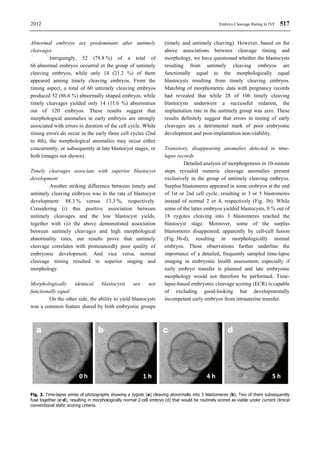


This study analyzed the timing of early cell divisions in 180 human embryos using time-lapse imaging. Embryos with uniform timing of cleavages and interphases were more likely to develop into high-quality blastocysts and result in pregnancies, while abnormalities in timing predicted poor development and implantation failure. Specifically, embryos with shortened or prolonged cell cycles showed higher rates of morphological anomalies, lower blastocyst formation rates, and zero implantation, even when blastocyst formation occurred. The study demonstrates that time-lapse imaging can identify viable embryos with high specificity by analyzing cleavage uniformity and rule out non-viable embryos with 100% specificity.


