











Londonwomensclinic.com
• Quality in ART
• Giles Palmer
• Senior Clinical Embryologist
• Business & Quality Manager
Londonwomensclinic.com
Key learning
objectives
• Quality Management & the role of the Quality
Manager
• HFEA Code of Practice & requirements placed on
clinics
• Inspection process
Londonwomensclinic.com
Quality Standards
Londonwomensclinic.com
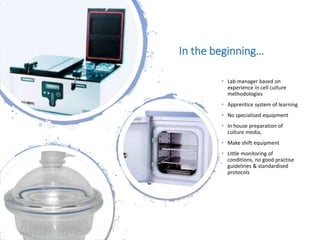
In the beginning…
• Lab manager based on
experience in cell culture
methodologies
• Apprentice system of learning
• No specialised equipment
• In house preparation of
culture media,
• Make shift equipment
• Little monitoring of
conditions, no good practise
guidelines & standardised
protocols
Londonwomensclinic.com
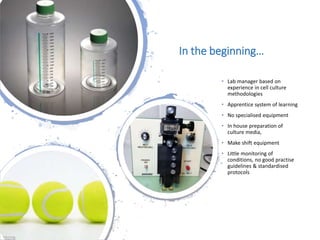
In the beginning…
• Lab manager based on
experience in cell culture
methodologies
• Apprentice system of learning
• No specialised equipment
• In house preparation of
culture media,
• Make shift equipment
• Little monitoring of
conditions, no good practise
guidelines & standardised
protocols
Londonwomensclinic.com
Rise of
Quality….
• “Continuous improvement through observation
& corrective action after testing & monitoring
laboratory equipment (Quality control or QC) has
led to improved culture conditions & increase IVF
success, moving clinical embryology from being
observational & subjective to an objective clinical
science “ Matson et al, 1998.
• Peer led guidelines
• Regulations & Legal framework
• International standards ( e.g. ISO)
• Consensus meetings & KPIs
Londonwomensclinic.com
Palermo et al. 1992, Devroey et al 1995
Present day
Highly qualified Embryologists
Structured learning
Strict regulation
Quality Management has become a cornerstone of modern embryology
Targets, success, excellence
QMS, QA, QC, Risk assessment, Audits, Document control etc.
Londonwomensclinic.com
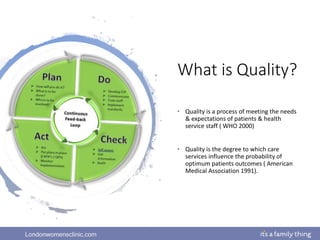
What is Quality?
• Quality is a process of meeting the needs
& expectations of patients & health
service staff ( WHO 2000)
• Quality is the degree to which care
services influence the probability of
optimum patients outcomes ( American
Medical Association 1991).
Londonwomensclinic.com
What is
Quality? The
definitions
• QMS: Quality management system ensures the
quality of services. To achieve you need: Strategy,
policy, planning, objective setting, control &
assurance records, audit, evaluation &
improvement
• QA: Quality Assurance, the standards & processes in
laboratory practice.
• QC: Quality Control, continuous improvement
through observation & corrective action after
testing & monitoring laboratory equipment
• SOP: Standard Operating Procedure
• NCD: Non Conformity/Deviation from protocol.
• AI: Adverse incident
• CAPA: Corrective & Preventive Action, an important
part of a Quality Management System. Central to all
control points.
• Risk Assessment: a proactive measure of identifying
possible problems causing NCD or AI.
Londonwomensclinic.com
Tools of
Quality?
• Monthly clinical governance meetings
• Process mapping & SOPs
• NCD & AI: logged & reportable
• QA: Internal, External
• Quarterly QMR
• Complaint procedure, Patient surveys
• Review of QMS: Improvement
• Inspections
Londonwomensclinic.com
Role of
Quality
Manager?
• The QM ensures that the QMS is appropriately
established & functional.
• Reports to the PR.
• Works closely with the HFEA.
• Actively seeks to improve the system & ensures
the effectiveness of the QMS
• Communicates the strategy with staff & users
• Is not responsible for carrying out all quality
tasks.
Londonwomensclinic.com
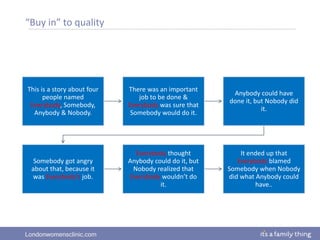
“Buy in” to quality
This is a story about four
people named
Everybody, Somebody,
Anybody & Nobody.
There was an important
job to be done &
Everybody was sure that
Somebody would do it.
Anybody could have
done it, but Nobody did
it.
Somebody got angry
about that, because it
was Everybody’s job.
Everybody thought
Anybody could do it, but
Nobody realized that
Everybody wouldn’t do
it.
It ended up that
Everybody blamed
Somebody when Nobody
did what Anybody could
have..
Londonwomensclinic.com
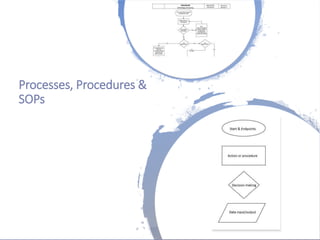
Processes, Procedures &
SOPs
Londonwomensclinic.com
Monitoring
performance
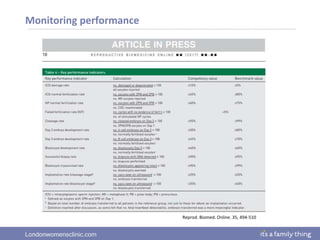
• Key Performance Indicators or KPIs are an universal tool to help
you manage your business, clinic, laboratory.
• It is a piece of information about your work that you repeatedly
measure to check if it is changing or remaining constant
• Blastocyst Utilisation Rate = The percentage of 2PN embryos
that are either transferred or cryo-stored on day 5 or day 6
• ESHRE Special Interest Group of Embryology and Alpha Scientists in Reproductive Medicine,
2017. The Vienna consensus: report of an expert meeting on the development of ART
laboratory performance indicators. Reprod. Biomed. Online. 35, 494-510.
• Alpha Scientists In Reproductive Medicine. The Alpha consensus meeting on cryopreservation
key performance indicators and benchmarks: proceedings of an expert meeting. Reprod
Biomed Online. 2012 Aug;25(2):146-67
Londonwomensclinic.com
Monitoring performance
Reprod. Biomed. Online. 35, 494-510
Londonwomensclinic.com
Monitoring performance
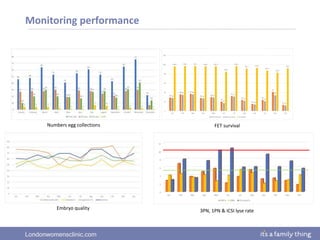
Numbers egg collections FET survival
Embryo quality 3PN, 1PN & ICSI lyse rate
Londonwomensclinic.com
Document
control
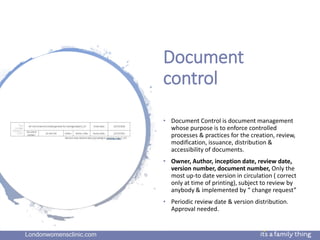
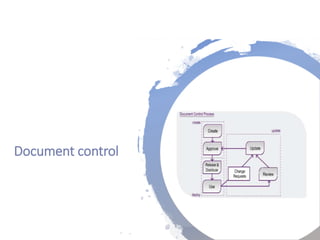
• Document Control is document management
whose purpose is to enforce controlled
processes & practices for the creation, review,
modification, issuance, distribution &
accessibility of documents.
• Owner, Author, inception date, review date,
version number, document number, Only the
most up-to date version in circulation ( correct
only at time of printing), subject to review by
anybody & implemented by “ change request”
• Periodic review date & version distribution.
Approval needed.
Londonwomensclinic.com
Document control
Londonwomensclinic.com
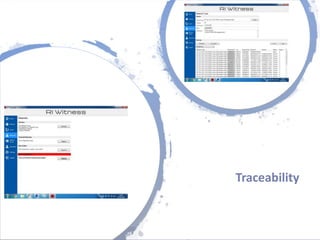
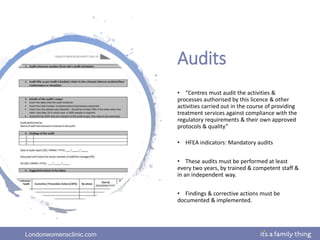
Traceability
Londonwomensclinic.com
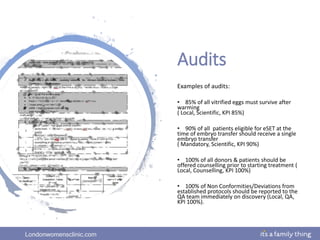
Audits
• “Centres must audit the activities &
processes authorised by this licence & other
activities carried out in the course of providing
treatment services against compliance with the
regulatory requirements & their own approved
protocols & quality”
• HFEA indicators: Mandatory audits
• These audits must be performed at least
every two years, by trained & competent staff &
in an independent way.
• Findings & corrective actions must be
documented & implemented.
Londonwomensclinic.com
Audits
Examples of audits:
• 85% of all vitrified eggs must survive after
warming
( Local, Scientific, KPI 85%)
• 90% of all patients eligible for eSET at the
time of embryo transfer should receive a single
embryo transfer
( Mandatory, Scientific, KPI 90%)
• 100% of all donors & patients should be
offered counselling prior to starting treatment (
Local, Counselling, KPI 100%)
• 100% of Non Conformities/Deviations from
established protocols should be reported to the
QA team immediately on discovery (Local, QA,
KPI 100%).
Londonwomensclinic.com
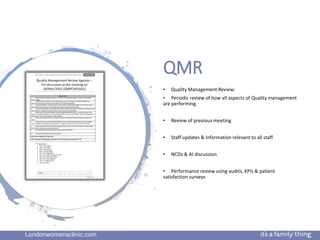
QMR
• Quality Management Review:
• Periodic review of how all aspects of Quality management
are performing.
• Review of previous meeting
• Staff updates & Information relevant to all staff
• NCDs & AI discussion
• Performance review using audits, KPIs & patient
satisfaction surveys
Londonwomensclinic.com
Risk Assessment
• Hazards: situations that have the potential to cause
harm;
• Risks: which are defined as the probability that a
specific adverse event will occur in a specific time
period or as a result of a specific situation
• Clinical Risk: is the chance of an adverse outcome
resulting from clinical investigation, treatment or
patient care.
• Identify all the individuals that are at risk of this hazard.
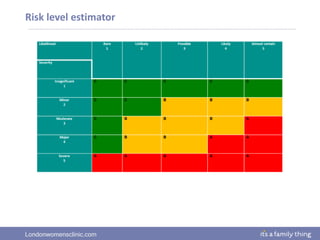
• Calculate the Risk Score Rating by multiplying score A &
score B.
• If the rating is over 4, immediate action is required to
improve existing control measures.
• If the rating is 4 or under, the risks are under adequate
control but should be carefully monitored.
Londonwomensclinic.com
Risk Assessment
• Hazards: situations that have the potential to cause
harm
• Risks: which are defined as the probability that a
specific adverse event will occur in a specific time
period or as a result of a specific situation
• Clinical Risk: is the chance of an adverse outcome
resulting from clinical investigation, treatment or
patient care.
• Identify all the individuals that are at risk of this hazard.
• Calculate the Risk Score Rating by multiplying score A &
score B.
• If the rating is over 4, immediate action is required to
improve existing control measures.
• If the rating is 4 or under, the risks are under adequate
control but should be carefully monitored.
Londonwomensclinic.com
Benefits of
External
Quality
Assessment
(EQA)
• Provides laboratory management with an insight
into their performance.
• Improves both national & local standards.
• Reveals unsuspected areas of difficulty.
• Provides an educational stimulus for improvement.
• Acts as a check on the efficacy of internal quality
control procedures.
• Demonstrates to colleagues & customers a
commitment to quality.
• Provides method performance evaluation (scheme
dependant).
• Provides independent evidence of performance for
accreditation bodies.
• EQA is an educational tool that allows participants
to monitor, evaluate & improve their own
performance.
Londonwomensclinic.com
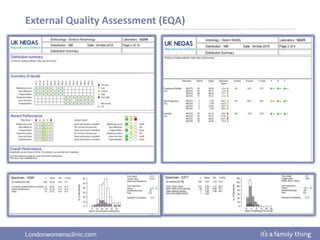
External Quality
Assessment (EQA)
• Distributions
• Participants will receive four distributions a
year.
• Each distribution consists of:
• 4 semen samples for Concentration &
Morphology assessment.
• 4 online Motility videos (hosted by
http://gamete-expert.com).
• 24 online Morphology images (hosted by
http://gamete-expert.com)
Londonwomensclinic.com
External Quality
Assessment (EQA)
• Distributions Andrology and Embryology
• Promotes best practice.
• Comprehensive external quality assessment
• Ensures results are reliable and comparable
Londonwomensclinic.com
External Quality Assessment (EQA)
Londonwomensclinic.com
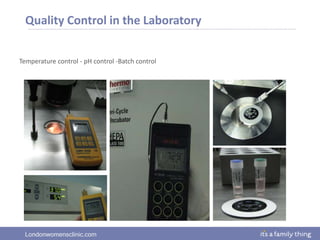
Quality Control in the Laboratory
Temperature control - pH control -Batch control
Londonwomensclinic.com
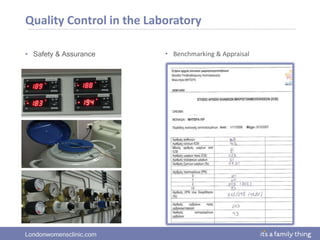
Quality Control in the Laboratory
• Safety & Assurance • Benchmarking & Appraisal
Londonwomensclinic.com
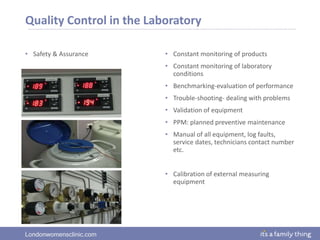
Quality Control in the Laboratory
• Safety & Assurance • Constant monitoring of products
• Constant monitoring of laboratory
conditions
• Benchmarking-evaluation of performance
• Trouble-shooting- dealing with problems
• Validation of equipment
• PPM: planned preventive maintenance
• Manual of all equipment, log faults,
service dates, technicians contact number
etc.
• Calibration of external measuring
equipment
Londonwomensclinic.com
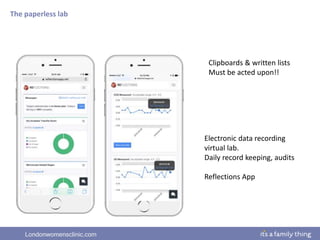
The paperless lab
Clipboards & written lists
Must be acted upon!!
Electronic data recording
virtual lab.
Daily record keeping, audits
Fluctuation reports
e.g. Reflections App
Londonwomensclinic.com
Clipboards & written lists
Must be acted upon!!
Electronic data recording
virtual lab.
Daily record keeping, audits
Reflections App
The paperless lab
Londonwomensclinic.com
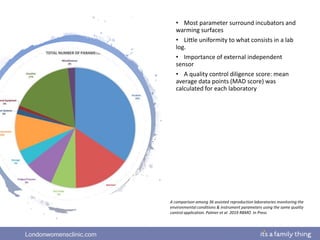
• Most parameter surround incubators and
warming surfaces
• Little uniformity to what consists in a lab
log.
• Importance of external independent
sensor
• A quality control diligence score: mean
average data points (MAD score) was
calculated for each laboratory
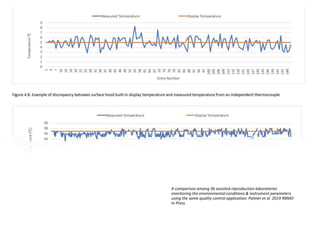
A comparison among 36 assisted reproduction laboratories monitoring the
environmental conditions & instrument parameters using the same quality
control application. Palmer et al 2019 RBMO In Press
Londonwomensclinic.com
A comparison among 36 assisted reproduction laboratories
monitoring the environmental conditions & instrument parameters
using the same quality control application. Palmer et al 2019 RBMO
In Press
Londonwomensclinic.com
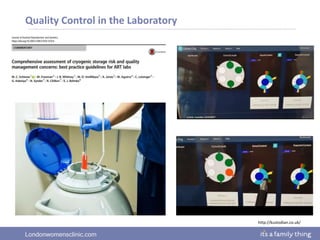
Quality Control in the Laboratory
http://kustodian.co.uk/
Londonwomensclinic.com
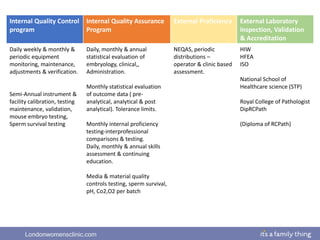
Internal Quality Control
program
Internal Quality Assurance
Program
External Proficiency External Laboratory
inspection, Validation
& Accreditation
Daily weekly & monthly &
periodic equipment
monitoring, maintenance,
adjustments & verification.
Semi-Annual instrument &
facility calibration, testing
maintenance, validation,
mouse embryo testing,
Sperm survival testing
Daily, monthly & annual
statistical evaluation of
embryology, clinical,,
Administration.
Monthly statistical evaluation
of outcome data ( pre-
analytical, analytical & post
analytical). Tolerance limits.
Monthly internal proficiency
testing-interprofessional
comparisons & testing.
Daily, monthly & annual skills
assessment & continuing
education.
Media & material quality
controls testing, sperm survival,
pH, Co2,O2 per batch
NEQAS, periodic
distributions –
operator & clinic based
assessment.
HIW
HFEA
ISO
National School of
Healthcare science (STP)
Royal College of Pathologist
DipRCPath
(Diploma of RCPath)
Londonwomensclinic.com
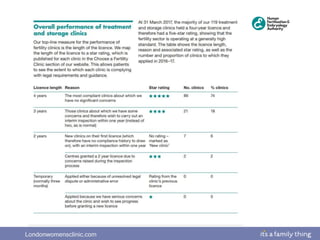
HFEA
• Regulation making sure fertility clinics &
research centres comply with the law & the
rules & standards we set to ensure high
quality care & research.
• All fertility clinics & human embryo research
centres in the UK must comply with: the
Human Fertilisation & Embryology (HFE) Act
1990 (as amended) the HFE Act 2008, & a
number of related pieces of legislation.
• HFEA provide guidance to clinics & research
centres on how to meet their legal
requirements in our Code of Practice.
Londonwomensclinic.com
HFEA
• Clinics must have a licence from HFEA to
operate.
• Grant licences for up to four years.
• Inspections are carried out every two years.
• Set standards to ensure high quality care.
• Before granting a new licence, or renewing an
existing one, HFEA conduct an inspection to
make sure their services are up to standard in
line with our Code of Practice.
• The findings are presented to our Licence
Committee, which makes a decision on
whether to grant a licence (& if so for how
long), refuse the licence, or, if they feel the
quality of service needs to be better, put
conditions on the licence which ensure it only
remains in place if improvements are made.
Londonwomensclinic.com
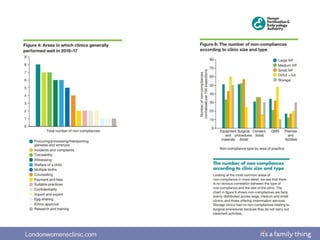
Quality Management System (HFEA):
• A Quality Management System ensures that patients receive an agreed
standard of care throughout their treatment & that centres continually
improve the way the service is delivered, ensuring consistency throughout
• Relevant provisions of Quality review (quality management system,
investigations, corrective action, and reviews)
• The centre must put in place a quality management system & implement
this system to continually improve the quality & effectiveness of the
service provided in accordance with the conditions of this licence & the
guidance on good practice as set out in the HFEA’s Code of Practice.
Londonwomensclinic.com
HFEA & Quality
• The following documentation must form part
of the quality management system:
• a. a quality manual
• b. standard operating procedures (SOPs) for
all activities authorised by this licence &
other activities carried out in the course of
providing treatment services that do not
require a licence
• c. guidelines
• d. training & reference manuals
• e. reporting forms.
• Required standards of quality & safety, in the
form of quality indicators for all activities
authorised by this licence & other activities
carried out in the course of providing
treatment services that do not require a
licence, must be established.
Londonwomensclinic.com
Risk Grading
Matrix
• Incident Reporting
• Legal requirement
• Duty of PR to notify the HFEA of any incident &
near miss.
• Duty of PR to provide the HFEA with a report
analysing the cause & the outcome.
• Risk level estimator
Londonwomensclinic.com
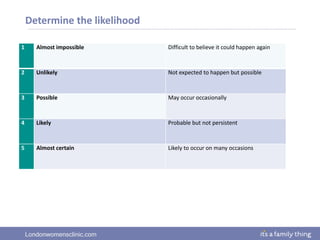
Determine the likelihood
1 Almost impossible Difficult to believe it could happen again
2 Unlikely Not expected to happen but possible
3 Possible May occur occasionally
4 Likely Probable but not persistent
5 Almost certain Likely to occur on many occasions
Londonwomensclinic.com
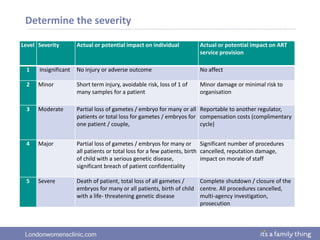
Determine the severity
Level Severity Actual or potential impact on individual Actual or potential impact on ART
service provision
1 Insignificant No injury or adverse outcome No affect
2 Minor Short term injury, avoidable risk, loss of 1 of
many samples for a patient
Minor damage or minimal risk to
organisation
3 Moderate Partial loss of gametes / embryo for many or all
patients or total loss for gametes / embryos for
one patient / couple,
Reportable to another regulator,
compensation costs (complimentary
cycle)
4 Major Partial loss of gametes / embryos for many or
all patients or total loss for a few patients, birth
of child with a serious genetic disease,
significant breach of patient confidentiality
Significant number of procedures
cancelled, reputation damage,
impact on morale of staff
5 Severe Death of patient, total loss of all gametes /
embryos for many or all patients, birth of child
with a life- threatening genetic disease
Complete shutdown / closure of the
centre. All procedures cancelled,
multi-agency investigation,
prosecution
Londonwomensclinic.com
Risk level estimator
Londonwomensclinic.com
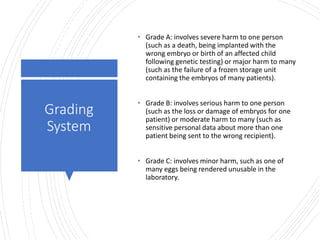
Grading
System
• Grade A: involves severe harm to one person
(such as a death, being implanted with the
wrong embryo or birth of an affected child
following genetic testing) or major harm to many
(such as the failure of a frozen storage unit
containing the embryos of many patients).
• Grade B: involves serious harm to one person
(such as the loss or damage of embryos for one
patient) or moderate harm to many (such as
sensitive personal data about more than one
patient being sent to the wrong recipient).
• Grade C: involves minor harm, such as one of
many eggs being rendered unusable in the
laboratory.
Londonwomensclinic.com
Grades of
Incidents
• HFEA classify incidents in clinics into three
grades of severity: A, B & C.
• Hold information about ‘near misses’ in which
only luck prevented an incident from occurring.
• Incidents deemed serious must be reported to
HFEA within 12 hours of detection & all other
incidents & near misses must be reported within
24 hours.
• HFEA require this reporting to encourage a
culture of openness, transparency & learning.
• HFEA monitor the number & nature of
incidents/near misses & have a rigorous process
for reporting, handling & investigating them.
• Ensures that clinics understand the ‘root cause’
of the incident & think about how clinics can
change their practice to prevent a recurrence.
Londonwomensclinic.com
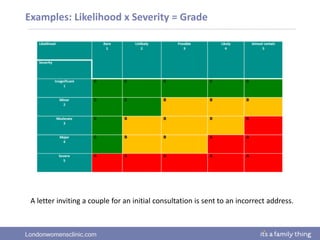
Examples: Likelihood x Severity = Grade
A letter inviting a couple for an initial consultation is sent to an incorrect address.
Londonwomensclinic.com
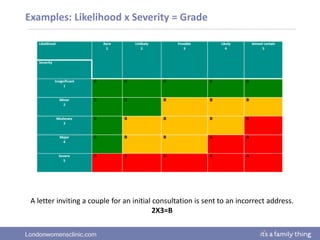
Examples: Likelihood x Severity = Grade
A letter inviting a couple for an initial consultation is sent to an incorrect address.
2X3=B
Londonwomensclinic.com
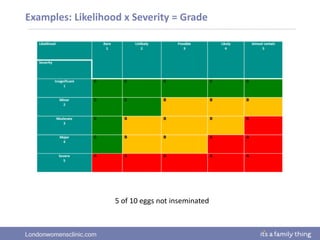
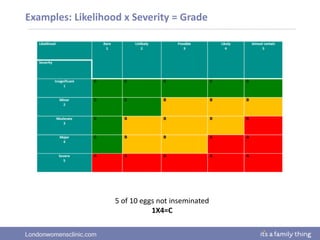
Examples: Likelihood x Severity = Grade
5 of 10 eggs not inseminated
Londonwomensclinic.com
Examples: Likelihood x Severity = Grade
5 of 10 eggs not inseminated
1X4=C
Londonwomensclinic.com
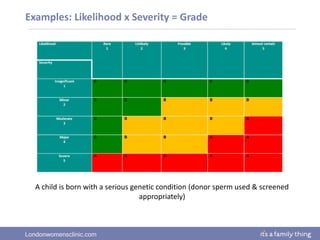
Examples: Likelihood x Severity = Grade
A child is born with a serious genetic condition (donor sperm used & screened
appropriately)
Londonwomensclinic.com
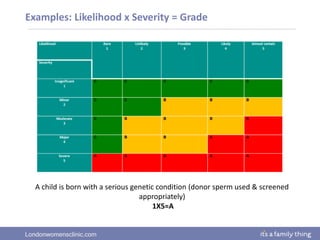
Examples: Likelihood x Severity = Grade
A child is born with a serious genetic condition (donor sperm used & screened
appropriately)
1X5=A
Londonwomensclinic.com
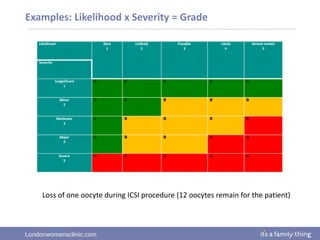
Examples: Likelihood x Severity = Grade
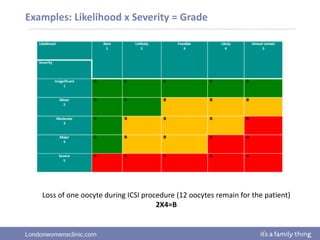
Loss of one oocyte during ICSI procedure (12 oocytes remain for the patient)
Londonwomensclinic.com
Examples: Likelihood x Severity = Grade
Loss of one oocyte during ICSI procedure (12 oocytes remain for the patient)
2X4=B
Londonwomensclinic.com
Examples: Likelihood x Severity = Grade
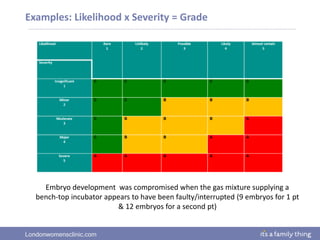
Embryo development was compromised when the gas mixture supplying a
bench-top incubator appears to have been faulty/interrupted (9 embryos for 1 pt
& 12 embryos for a second pt)
Londonwomensclinic.com
Examples: Likelihood x Severity = Grade
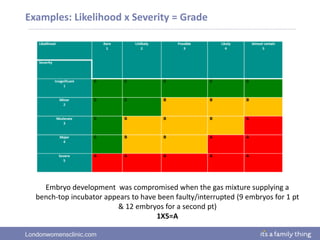
Embryo development was compromised when the gas mixture supplying a
bench-top incubator appears to have been faulty/interrupted (9 embryos for 1 pt
& 12 embryos for a second pt)
1X5=A
Londonwomensclinic.com
Adverse
incidence
• 517 adverse incidents reported to the HFEA in
2015:
• No Grade A: events such as the death of a
patient, being implanted with the wrong
embryo, or something that affects a large
number of patients such as a storage unit
malfunction
• 200 classed Grade B, which include loss of
embryos, breaches of confidentiality or
equipment failure
• Administration errors accounted for 141 cases.
HFEA notes in its report that there has been a
significant change in the number of times
patient confidentiality has been breached,
increasing from 59 out of 102 administrative
errors in 2014 to 124 in 2015.
Londonwomensclinic.com
Information
Governance
& GDPR
• General Data Protection Regulation ( GDPR): Law
came into force 25th May 2018
• Handling of sensitive information:
…Processed in a manner that ensures
appropriate security of the personal data,
including protection against unauthorised or
unlawful processing & against accidental loss,
destruction or damage, using appropriate
technical or organisational measures
• Penalties for non compliance
• There are two tiers of administrative fines that
can be levied:
• 1) Up to €10 million, or 2% annual global
turnover – whichever is higher.
• 2) Up to €20 million, or 4% annual global
turnover – whichever is higher.
Londonwomensclinic.com
Take home messages
• Cornerstone of Clinical Embryology
• Continuing cycle of Plan -Do -Check -Act
• Not an expensive additional burden
• Ensures reproducibility & consistency throughout Clinic
• Picks up problems before they affect your program
• Benefits the whole team, involves whole team
Londonwomensclinic.com
References:
• Books:
• Elder, K., Van den Bergh, M., Woodward, B., 2015. Troubleshooting
and Problem-Solving in the IVF Laboratory. Cambridge University
Press.
• Esteves, S., Sandro, C., Agarwal, A. (Eds.) Quality Management in
ART Clinics A Practical Guide. Springer Publications. New York,
pp.79-127.
• Hreinnson, J., 2013. Quality Management, in: Vargese, A.,C.,
Sjoblom, P., Jayaprakasan, K. (Eds), A Practical Guide to Setting Up
an IVF Lab, Embryo Culture Systems and Running the Unit. Jaypee
Publishers, New Delhi, pp 87-93.
• Mortimer, D., Mortimer, S.T., 2015. Quality and Risk Management
in the IVF Laboratory latest. Cambridge University Press
• Pool, T.B., Schoolfield, J., D Han, D., 2012. Human Embryo Culture
Media Comparisons, in: Smith G., D., Swain, J., E., Pool, T., B. (Eds),
Embryo Culture: Methods and Protocols, Humana Press, New York.
367-386. DOI 10.1007/978-1-61779-971-6_21
• Wiemer, K.L., 2017. Setup Procedures for optimizing performance
in the IVF laboratory, in: Montag, M.H.M., Morbeck, D.E., (Eds.),
Principles of IVF Laboratory Practice: Optimizing Performance and
Outcomes, Cambridge University Press pp. 88-96.
• Guidelines:
• ASRM Practice committee, 2008. Revised guidelines for human
embryology and andrology laboratories. Fertil.Steril. 90, S45-59.
• ASRM Practice committee, 2014. Revised minimum standards for
practices offering assisted reproductive technologies: a committee
opinion. Fertil. Steril. 102, 682-686.
• De los Santos , M.J., Apter, S., Coticchio, G., Debrock, S., Lundin, K.,
Plancha, C.E., Prados, F., Rienzi, L., Verheyen, G., Woodward, B.,
Vermeulen, N., 2015. Revised guidelines for good practice in IVF
laboratories. Hum. Reprod. 31, 685- 686.
http://humrep.oxfordjournals.org/
• ESHRE Special Interest Group of Embryology and Alpha Scientists in
Reproductive Medicine, 2017. The Vienna consensus: report of an
expert meeting on the development of ART laboratory
performance indicators. Reprod. Biomed. Online. 35, 494-510.
• Gianaroli, L., Plachot, M., van Kooij, R., Al-Hasani, S., Dawson, K.,
DeVos, A., Magli, M.C., Mandelbaum, J., Selva, J., van Inzen, W.,
2000. ESHRE guidelines for good practice in IVF laboratories.
Committee of the Special Interest Group on Embryology of the
European Society of Human Reproduction and Embryology. Hum.
Reprod. 10, 2241-2246.
• Magli,C., Van den Abbeel, E., Lundin, K., Royere,D., Van der Elst, J.,
Gianaroli, L., 2008. Revised guidelines for good practice in IVF
laboratories. Hum. Reprod. 23, 1253–1262.
• Mortimer, D., Cohen, J., Mortimer, S.T., Fawzy, M., McCulloh,
D.H., Morbeck, D.E., Pollet-Villard, X., Mansour, R.T., Brison, D.R.,
Doshi, A., Harper, J.C., Swain, J.C., Gilligan, A.V., 2018. Cairo
consensus on the IVF laboratory environment and air quality:
report of an expert meeting. Reprod. Biomed. Online. 36, 658-674.
Londonwomensclinic.com
References:
• Regulations:
• Anonymous, 2004. Directive 2004/23/EC of the European
Parliament and the Council on Setting Standards of quality
and safety for the donation, procurement, testing,
processing, preservation, storage and distribution of human
tissues and cells. Official Journal of the European Union, 102,
48-58.
•
• Human Fertilisation and Embryology Authority, 2017. Code
of Practice Edition 8.0 https://www.hfea.gov.uk/code-of-
practice/
• Human Fertilisation and Embryology Act 2008
https://www.legislation.gov.uk/ukpga/2008/22/contents
• Human Fertilisation & Embryology (HFE) Act 1990
http://www.legislation.gov.uk/ukpga/1990/37/contents
• Miscellaneous:
• Anifanis, G., 2013. Temperature variations inside commercial
IVF incubators. J. Assist. Reprod. Genet. 30, 1587–1588
Dawson, K.J., 1997. Quality control and quality assurance in
IVF laboratories in the UK. Hum. Reprod. 12, 2590–2591.
• Matson, P.L., 1998. Internal quality control and external
quality assurance in the IVF laboratory. Hum. Reprod. 13,
156-164.
• Morbeck, D.E, 2015. Air quality in the assisted reproduction
laboratory: a mini-review. J Assist Reprod Genet 2015 Jul;
32(7): 1019–1024.
• Pool, T.B., Schoolfield, J., D Han, D., 2012. Human Embryo
Culture Media Comparisons, in: Smith G., D., Swain, J., E.,
Pool, T., B. (Eds), Embryo Culture: Methods and Protocols,
Humana Press, New York. 367-386. DOI 10.1007/978-1-
61779-971-6_21
• https://www.hfea.gov.uk/media/2437/hfea_state_of_the_s
ector_report_tagged.pdf
• http://www.fertaid.com/IVFBenchMark/BEnchMark_AboutK
PI.asp
• A comparison among 36 assisted reproduction laboratories
monitoring the environmental conditions and instrument
parameters using the same quality control application.
Palmer et al 2019 RBMO In Press

Quality in ART by Giles Palmer

  • 1.
    Londonwomensclinic.com • Quality inART • Giles Palmer • Senior Clinical Embryologist • Business & Quality Manager
  • 2.
    Londonwomensclinic.com Key learning objectives • QualityManagement & the role of the Quality Manager • HFEA Code of Practice & requirements placed on clinics • Inspection process
  • 3.
  • 4.
    Londonwomensclinic.com In the beginning… •Lab manager based on experience in cell culture methodologies • Apprentice system of learning • No specialised equipment • In house preparation of culture media, • Make shift equipment • Little monitoring of conditions, no good practise guidelines & standardised protocols
  • 5.
    Londonwomensclinic.com In the beginning… •Lab manager based on experience in cell culture methodologies • Apprentice system of learning • No specialised equipment • In house preparation of culture media, • Make shift equipment • Little monitoring of conditions, no good practise guidelines & standardised protocols
  • 6.
    Londonwomensclinic.com Rise of Quality…. • “Continuousimprovement through observation & corrective action after testing & monitoring laboratory equipment (Quality control or QC) has led to improved culture conditions & increase IVF success, moving clinical embryology from being observational & subjective to an objective clinical science “ Matson et al, 1998. • Peer led guidelines • Regulations & Legal framework • International standards ( e.g. ISO) • Consensus meetings & KPIs
  • 7.
  • 8.
    Londonwomensclinic.com Palermo et al.1992, Devroey et al 1995 Present day Highly qualified Embryologists Structured learning Strict regulation Quality Management has become a cornerstone of modern embryology Targets, success, excellence QMS, QA, QC, Risk assessment, Audits, Document control etc.
  • 9.
    Londonwomensclinic.com What is Quality? •Quality is a process of meeting the needs & expectations of patients & health service staff ( WHO 2000) • Quality is the degree to which care services influence the probability of optimum patients outcomes ( American Medical Association 1991).
  • 10.
    Londonwomensclinic.com What is Quality? The definitions •QMS: Quality management system ensures the quality of services. To achieve you need: Strategy, policy, planning, objective setting, control & assurance records, audit, evaluation & improvement • QA: Quality Assurance, the standards & processes in laboratory practice. • QC: Quality Control, continuous improvement through observation & corrective action after testing & monitoring laboratory equipment • SOP: Standard Operating Procedure • NCD: Non Conformity/Deviation from protocol. • AI: Adverse incident • CAPA: Corrective & Preventive Action, an important part of a Quality Management System. Central to all control points. • Risk Assessment: a proactive measure of identifying possible problems causing NCD or AI.
  • 11.
    Londonwomensclinic.com Tools of Quality? • Monthlyclinical governance meetings • Process mapping & SOPs • NCD & AI: logged & reportable • QA: Internal, External • Quarterly QMR • Complaint procedure, Patient surveys • Review of QMS: Improvement • Inspections
  • 12.
    Londonwomensclinic.com Role of Quality Manager? • TheQM ensures that the QMS is appropriately established & functional. • Reports to the PR. • Works closely with the HFEA. • Actively seeks to improve the system & ensures the effectiveness of the QMS • Communicates the strategy with staff & users • Is not responsible for carrying out all quality tasks.
  • 13.
    Londonwomensclinic.com “Buy in” toquality This is a story about four people named Everybody, Somebody, Anybody & Nobody. There was an important job to be done & Everybody was sure that Somebody would do it. Anybody could have done it, but Nobody did it. Somebody got angry about that, because it was Everybody’s job. Everybody thought Anybody could do it, but Nobody realized that Everybody wouldn’t do it. It ended up that Everybody blamed Somebody when Nobody did what Anybody could have..
  • 14.
  • 15.
    Londonwomensclinic.com Monitoring performance • Key PerformanceIndicators or KPIs are an universal tool to help you manage your business, clinic, laboratory. • It is a piece of information about your work that you repeatedly measure to check if it is changing or remaining constant • Blastocyst Utilisation Rate = The percentage of 2PN embryos that are either transferred or cryo-stored on day 5 or day 6 • ESHRE Special Interest Group of Embryology and Alpha Scientists in Reproductive Medicine, 2017. The Vienna consensus: report of an expert meeting on the development of ART laboratory performance indicators. Reprod. Biomed. Online. 35, 494-510. • Alpha Scientists In Reproductive Medicine. The Alpha consensus meeting on cryopreservation key performance indicators and benchmarks: proceedings of an expert meeting. Reprod Biomed Online. 2012 Aug;25(2):146-67
  • 16.
  • 17.
    Londonwomensclinic.com Monitoring performance Numbers eggcollections FET survival Embryo quality 3PN, 1PN & ICSI lyse rate
  • 18.
    Londonwomensclinic.com Document control • Document Controlis document management whose purpose is to enforce controlled processes & practices for the creation, review, modification, issuance, distribution & accessibility of documents. • Owner, Author, inception date, review date, version number, document number, Only the most up-to date version in circulation ( correct only at time of printing), subject to review by anybody & implemented by “ change request” • Periodic review date & version distribution. Approval needed.
  • 19.
  • 20.
  • 21.
    Londonwomensclinic.com Audits • “Centres mustaudit the activities & processes authorised by this licence & other activities carried out in the course of providing treatment services against compliance with the regulatory requirements & their own approved protocols & quality” • HFEA indicators: Mandatory audits • These audits must be performed at least every two years, by trained & competent staff & in an independent way. • Findings & corrective actions must be documented & implemented.
  • 22.
    Londonwomensclinic.com Audits Examples of audits: •85% of all vitrified eggs must survive after warming ( Local, Scientific, KPI 85%) • 90% of all patients eligible for eSET at the time of embryo transfer should receive a single embryo transfer ( Mandatory, Scientific, KPI 90%) • 100% of all donors & patients should be offered counselling prior to starting treatment ( Local, Counselling, KPI 100%) • 100% of Non Conformities/Deviations from established protocols should be reported to the QA team immediately on discovery (Local, QA, KPI 100%).
  • 23.
    Londonwomensclinic.com QMR • Quality ManagementReview: • Periodic review of how all aspects of Quality management are performing. • Review of previous meeting • Staff updates & Information relevant to all staff • NCDs & AI discussion • Performance review using audits, KPIs & patient satisfaction surveys
  • 24.
    Londonwomensclinic.com Risk Assessment • Hazards:situations that have the potential to cause harm; • Risks: which are defined as the probability that a specific adverse event will occur in a specific time period or as a result of a specific situation • Clinical Risk: is the chance of an adverse outcome resulting from clinical investigation, treatment or patient care. • Identify all the individuals that are at risk of this hazard. • Calculate the Risk Score Rating by multiplying score A & score B. • If the rating is over 4, immediate action is required to improve existing control measures. • If the rating is 4 or under, the risks are under adequate control but should be carefully monitored.
  • 25.
    Londonwomensclinic.com Risk Assessment • Hazards:situations that have the potential to cause harm • Risks: which are defined as the probability that a specific adverse event will occur in a specific time period or as a result of a specific situation • Clinical Risk: is the chance of an adverse outcome resulting from clinical investigation, treatment or patient care. • Identify all the individuals that are at risk of this hazard. • Calculate the Risk Score Rating by multiplying score A & score B. • If the rating is over 4, immediate action is required to improve existing control measures. • If the rating is 4 or under, the risks are under adequate control but should be carefully monitored.
  • 26.
    Londonwomensclinic.com Benefits of External Quality Assessment (EQA) • Provideslaboratory management with an insight into their performance. • Improves both national & local standards. • Reveals unsuspected areas of difficulty. • Provides an educational stimulus for improvement. • Acts as a check on the efficacy of internal quality control procedures. • Demonstrates to colleagues & customers a commitment to quality. • Provides method performance evaluation (scheme dependant). • Provides independent evidence of performance for accreditation bodies. • EQA is an educational tool that allows participants to monitor, evaluate & improve their own performance.
  • 27.
    Londonwomensclinic.com External Quality Assessment (EQA) •Distributions • Participants will receive four distributions a year. • Each distribution consists of: • 4 semen samples for Concentration & Morphology assessment. • 4 online Motility videos (hosted by http://gamete-expert.com). • 24 online Morphology images (hosted by http://gamete-expert.com)
  • 28.
    Londonwomensclinic.com External Quality Assessment (EQA) •Distributions Andrology and Embryology • Promotes best practice. • Comprehensive external quality assessment • Ensures results are reliable and comparable
  • 29.
  • 30.
    Londonwomensclinic.com Quality Control inthe Laboratory Temperature control - pH control -Batch control
  • 31.
    Londonwomensclinic.com Quality Control inthe Laboratory • Safety & Assurance • Benchmarking & Appraisal
  • 32.
    Londonwomensclinic.com Quality Control inthe Laboratory • Safety & Assurance • Constant monitoring of products • Constant monitoring of laboratory conditions • Benchmarking-evaluation of performance • Trouble-shooting- dealing with problems • Validation of equipment • PPM: planned preventive maintenance • Manual of all equipment, log faults, service dates, technicians contact number etc. • Calibration of external measuring equipment
  • 33.
  • 34.
    Londonwomensclinic.com The paperless lab Clipboards& written lists Must be acted upon!! Electronic data recording virtual lab. Daily record keeping, audits Fluctuation reports e.g. Reflections App
  • 35.
    Londonwomensclinic.com Clipboards & writtenlists Must be acted upon!! Electronic data recording virtual lab. Daily record keeping, audits Reflections App The paperless lab
  • 36.
    Londonwomensclinic.com • Most parametersurround incubators and warming surfaces • Little uniformity to what consists in a lab log. • Importance of external independent sensor • A quality control diligence score: mean average data points (MAD score) was calculated for each laboratory A comparison among 36 assisted reproduction laboratories monitoring the environmental conditions & instrument parameters using the same quality control application. Palmer et al 2019 RBMO In Press
  • 37.
    Londonwomensclinic.com A comparison among36 assisted reproduction laboratories monitoring the environmental conditions & instrument parameters using the same quality control application. Palmer et al 2019 RBMO In Press
  • 38.
    Londonwomensclinic.com Quality Control inthe Laboratory http://kustodian.co.uk/
  • 39.
    Londonwomensclinic.com Internal Quality Control program InternalQuality Assurance Program External Proficiency External Laboratory inspection, Validation & Accreditation Daily weekly & monthly & periodic equipment monitoring, maintenance, adjustments & verification. Semi-Annual instrument & facility calibration, testing maintenance, validation, mouse embryo testing, Sperm survival testing Daily, monthly & annual statistical evaluation of embryology, clinical,, Administration. Monthly statistical evaluation of outcome data ( pre- analytical, analytical & post analytical). Tolerance limits. Monthly internal proficiency testing-interprofessional comparisons & testing. Daily, monthly & annual skills assessment & continuing education. Media & material quality controls testing, sperm survival, pH, Co2,O2 per batch NEQAS, periodic distributions – operator & clinic based assessment. HIW HFEA ISO National School of Healthcare science (STP) Royal College of Pathologist DipRCPath (Diploma of RCPath)
  • 40.
    Londonwomensclinic.com HFEA • Regulation makingsure fertility clinics & research centres comply with the law & the rules & standards we set to ensure high quality care & research. • All fertility clinics & human embryo research centres in the UK must comply with: the Human Fertilisation & Embryology (HFE) Act 1990 (as amended) the HFE Act 2008, & a number of related pieces of legislation. • HFEA provide guidance to clinics & research centres on how to meet their legal requirements in our Code of Practice.
  • 41.
    Londonwomensclinic.com HFEA • Clinics musthave a licence from HFEA to operate. • Grant licences for up to four years. • Inspections are carried out every two years. • Set standards to ensure high quality care. • Before granting a new licence, or renewing an existing one, HFEA conduct an inspection to make sure their services are up to standard in line with our Code of Practice. • The findings are presented to our Licence Committee, which makes a decision on whether to grant a licence (& if so for how long), refuse the licence, or, if they feel the quality of service needs to be better, put conditions on the licence which ensure it only remains in place if improvements are made.
  • 42.
  • 43.
    Londonwomensclinic.com Quality Management System(HFEA): • A Quality Management System ensures that patients receive an agreed standard of care throughout their treatment & that centres continually improve the way the service is delivered, ensuring consistency throughout • Relevant provisions of Quality review (quality management system, investigations, corrective action, and reviews) • The centre must put in place a quality management system & implement this system to continually improve the quality & effectiveness of the service provided in accordance with the conditions of this licence & the guidance on good practice as set out in the HFEA’s Code of Practice.
  • 44.
    Londonwomensclinic.com HFEA & Quality •The following documentation must form part of the quality management system: • a. a quality manual • b. standard operating procedures (SOPs) for all activities authorised by this licence & other activities carried out in the course of providing treatment services that do not require a licence • c. guidelines • d. training & reference manuals • e. reporting forms. • Required standards of quality & safety, in the form of quality indicators for all activities authorised by this licence & other activities carried out in the course of providing treatment services that do not require a licence, must be established.
  • 45.
  • 46.
    Londonwomensclinic.com Risk Grading Matrix • IncidentReporting • Legal requirement • Duty of PR to notify the HFEA of any incident & near miss. • Duty of PR to provide the HFEA with a report analysing the cause & the outcome. • Risk level estimator
  • 47.
    Londonwomensclinic.com Determine the likelihood 1Almost impossible Difficult to believe it could happen again 2 Unlikely Not expected to happen but possible 3 Possible May occur occasionally 4 Likely Probable but not persistent 5 Almost certain Likely to occur on many occasions
  • 48.
    Londonwomensclinic.com Determine the severity LevelSeverity Actual or potential impact on individual Actual or potential impact on ART service provision 1 Insignificant No injury or adverse outcome No affect 2 Minor Short term injury, avoidable risk, loss of 1 of many samples for a patient Minor damage or minimal risk to organisation 3 Moderate Partial loss of gametes / embryo for many or all patients or total loss for gametes / embryos for one patient / couple, Reportable to another regulator, compensation costs (complimentary cycle) 4 Major Partial loss of gametes / embryos for many or all patients or total loss for a few patients, birth of child with a serious genetic disease, significant breach of patient confidentiality Significant number of procedures cancelled, reputation damage, impact on morale of staff 5 Severe Death of patient, total loss of all gametes / embryos for many or all patients, birth of child with a life- threatening genetic disease Complete shutdown / closure of the centre. All procedures cancelled, multi-agency investigation, prosecution
  • 49.
  • 50.
    Londonwomensclinic.com Grading System • Grade A:involves severe harm to one person (such as a death, being implanted with the wrong embryo or birth of an affected child following genetic testing) or major harm to many (such as the failure of a frozen storage unit containing the embryos of many patients). • Grade B: involves serious harm to one person (such as the loss or damage of embryos for one patient) or moderate harm to many (such as sensitive personal data about more than one patient being sent to the wrong recipient). • Grade C: involves minor harm, such as one of many eggs being rendered unusable in the laboratory.
  • 51.
    Londonwomensclinic.com Grades of Incidents • HFEAclassify incidents in clinics into three grades of severity: A, B & C. • Hold information about ‘near misses’ in which only luck prevented an incident from occurring. • Incidents deemed serious must be reported to HFEA within 12 hours of detection & all other incidents & near misses must be reported within 24 hours. • HFEA require this reporting to encourage a culture of openness, transparency & learning. • HFEA monitor the number & nature of incidents/near misses & have a rigorous process for reporting, handling & investigating them. • Ensures that clinics understand the ‘root cause’ of the incident & think about how clinics can change their practice to prevent a recurrence.
  • 52.
    Londonwomensclinic.com Examples: Likelihood xSeverity = Grade A letter inviting a couple for an initial consultation is sent to an incorrect address.
  • 53.
    Londonwomensclinic.com Examples: Likelihood xSeverity = Grade A letter inviting a couple for an initial consultation is sent to an incorrect address. 2X3=B
  • 54.
    Londonwomensclinic.com Examples: Likelihood xSeverity = Grade 5 of 10 eggs not inseminated
  • 55.
    Londonwomensclinic.com Examples: Likelihood xSeverity = Grade 5 of 10 eggs not inseminated 1X4=C
  • 56.
    Londonwomensclinic.com Examples: Likelihood xSeverity = Grade A child is born with a serious genetic condition (donor sperm used & screened appropriately)
  • 57.
    Londonwomensclinic.com Examples: Likelihood xSeverity = Grade A child is born with a serious genetic condition (donor sperm used & screened appropriately) 1X5=A
  • 58.
    Londonwomensclinic.com Examples: Likelihood xSeverity = Grade Loss of one oocyte during ICSI procedure (12 oocytes remain for the patient)
  • 59.
    Londonwomensclinic.com Examples: Likelihood xSeverity = Grade Loss of one oocyte during ICSI procedure (12 oocytes remain for the patient) 2X4=B
  • 60.
    Londonwomensclinic.com Examples: Likelihood xSeverity = Grade Embryo development was compromised when the gas mixture supplying a bench-top incubator appears to have been faulty/interrupted (9 embryos for 1 pt & 12 embryos for a second pt)
  • 61.
    Londonwomensclinic.com Examples: Likelihood xSeverity = Grade Embryo development was compromised when the gas mixture supplying a bench-top incubator appears to have been faulty/interrupted (9 embryos for 1 pt & 12 embryos for a second pt) 1X5=A
  • 62.
    Londonwomensclinic.com Adverse incidence • 517 adverseincidents reported to the HFEA in 2015: • No Grade A: events such as the death of a patient, being implanted with the wrong embryo, or something that affects a large number of patients such as a storage unit malfunction • 200 classed Grade B, which include loss of embryos, breaches of confidentiality or equipment failure • Administration errors accounted for 141 cases. HFEA notes in its report that there has been a significant change in the number of times patient confidentiality has been breached, increasing from 59 out of 102 administrative errors in 2014 to 124 in 2015.
  • 63.
    Londonwomensclinic.com Information Governance & GDPR • GeneralData Protection Regulation ( GDPR): Law came into force 25th May 2018 • Handling of sensitive information: …Processed in a manner that ensures appropriate security of the personal data, including protection against unauthorised or unlawful processing & against accidental loss, destruction or damage, using appropriate technical or organisational measures • Penalties for non compliance • There are two tiers of administrative fines that can be levied: • 1) Up to €10 million, or 2% annual global turnover – whichever is higher. • 2) Up to €20 million, or 4% annual global turnover – whichever is higher.
  • 64.
    Londonwomensclinic.com Take home messages •Cornerstone of Clinical Embryology • Continuing cycle of Plan -Do -Check -Act • Not an expensive additional burden • Ensures reproducibility & consistency throughout Clinic • Picks up problems before they affect your program • Benefits the whole team, involves whole team
  • 65.
    Londonwomensclinic.com References: • Books: • Elder,K., Van den Bergh, M., Woodward, B., 2015. Troubleshooting and Problem-Solving in the IVF Laboratory. Cambridge University Press. • Esteves, S., Sandro, C., Agarwal, A. (Eds.) Quality Management in ART Clinics A Practical Guide. Springer Publications. New York, pp.79-127. • Hreinnson, J., 2013. Quality Management, in: Vargese, A.,C., Sjoblom, P., Jayaprakasan, K. (Eds), A Practical Guide to Setting Up an IVF Lab, Embryo Culture Systems and Running the Unit. Jaypee Publishers, New Delhi, pp 87-93. • Mortimer, D., Mortimer, S.T., 2015. Quality and Risk Management in the IVF Laboratory latest. Cambridge University Press • Pool, T.B., Schoolfield, J., D Han, D., 2012. Human Embryo Culture Media Comparisons, in: Smith G., D., Swain, J., E., Pool, T., B. (Eds), Embryo Culture: Methods and Protocols, Humana Press, New York. 367-386. DOI 10.1007/978-1-61779-971-6_21 • Wiemer, K.L., 2017. Setup Procedures for optimizing performance in the IVF laboratory, in: Montag, M.H.M., Morbeck, D.E., (Eds.), Principles of IVF Laboratory Practice: Optimizing Performance and Outcomes, Cambridge University Press pp. 88-96. • Guidelines: • ASRM Practice committee, 2008. Revised guidelines for human embryology and andrology laboratories. Fertil.Steril. 90, S45-59. • ASRM Practice committee, 2014. Revised minimum standards for practices offering assisted reproductive technologies: a committee opinion. Fertil. Steril. 102, 682-686. • De los Santos , M.J., Apter, S., Coticchio, G., Debrock, S., Lundin, K., Plancha, C.E., Prados, F., Rienzi, L., Verheyen, G., Woodward, B., Vermeulen, N., 2015. Revised guidelines for good practice in IVF laboratories. Hum. Reprod. 31, 685- 686. http://humrep.oxfordjournals.org/ • ESHRE Special Interest Group of Embryology and Alpha Scientists in Reproductive Medicine, 2017. The Vienna consensus: report of an expert meeting on the development of ART laboratory performance indicators. Reprod. Biomed. Online. 35, 494-510. • Gianaroli, L., Plachot, M., van Kooij, R., Al-Hasani, S., Dawson, K., DeVos, A., Magli, M.C., Mandelbaum, J., Selva, J., van Inzen, W., 2000. ESHRE guidelines for good practice in IVF laboratories. Committee of the Special Interest Group on Embryology of the European Society of Human Reproduction and Embryology. Hum. Reprod. 10, 2241-2246. • Magli,C., Van den Abbeel, E., Lundin, K., Royere,D., Van der Elst, J., Gianaroli, L., 2008. Revised guidelines for good practice in IVF laboratories. Hum. Reprod. 23, 1253–1262. • Mortimer, D., Cohen, J., Mortimer, S.T., Fawzy, M., McCulloh, D.H., Morbeck, D.E., Pollet-Villard, X., Mansour, R.T., Brison, D.R., Doshi, A., Harper, J.C., Swain, J.C., Gilligan, A.V., 2018. Cairo consensus on the IVF laboratory environment and air quality: report of an expert meeting. Reprod. Biomed. Online. 36, 658-674.
  • 66.
    Londonwomensclinic.com References: • Regulations: • Anonymous,2004. Directive 2004/23/EC of the European Parliament and the Council on Setting Standards of quality and safety for the donation, procurement, testing, processing, preservation, storage and distribution of human tissues and cells. Official Journal of the European Union, 102, 48-58. • • Human Fertilisation and Embryology Authority, 2017. Code of Practice Edition 8.0 https://www.hfea.gov.uk/code-of- practice/ • Human Fertilisation and Embryology Act 2008 https://www.legislation.gov.uk/ukpga/2008/22/contents • Human Fertilisation & Embryology (HFE) Act 1990 http://www.legislation.gov.uk/ukpga/1990/37/contents • Miscellaneous: • Anifanis, G., 2013. Temperature variations inside commercial IVF incubators. J. Assist. Reprod. Genet. 30, 1587–1588 Dawson, K.J., 1997. Quality control and quality assurance in IVF laboratories in the UK. Hum. Reprod. 12, 2590–2591. • Matson, P.L., 1998. Internal quality control and external quality assurance in the IVF laboratory. Hum. Reprod. 13, 156-164. • Morbeck, D.E, 2015. Air quality in the assisted reproduction laboratory: a mini-review. J Assist Reprod Genet 2015 Jul; 32(7): 1019–1024. • Pool, T.B., Schoolfield, J., D Han, D., 2012. Human Embryo Culture Media Comparisons, in: Smith G., D., Swain, J., E., Pool, T., B. (Eds), Embryo Culture: Methods and Protocols, Humana Press, New York. 367-386. DOI 10.1007/978-1- 61779-971-6_21 • https://www.hfea.gov.uk/media/2437/hfea_state_of_the_s ector_report_tagged.pdf • http://www.fertaid.com/IVFBenchMark/BEnchMark_AboutK PI.asp • A comparison among 36 assisted reproduction laboratories monitoring the environmental conditions and instrument parameters using the same quality control application. Palmer et al 2019 RBMO In Press

Editor's Notes

  • #16 KPIs
  • #26 New incubator, getting rid of big box incubators Phoned Britannia on Sunday morning who instructed on various checks of the logger hardware. No Vodafone signal Lone worker Clinic moving – fate of liquid Nitrogen
  • #33 .