Control Systems
Lecture - 8
E. Ramkumar
Assistant Professor / EEE
12-04-2022 UEEC004 - Control Systems 1
Time response of Second Order System
• 𝐶 𝑆 =
ω𝑛 2
𝑆2
+2δω𝑛𝑆+ω𝑛 2
•
𝐶(𝑆)
𝑅(𝑆)
=
100
𝑆2
+0𝑆+100
ω𝑛 2 = 100
ω𝑛 = 10
2δω𝑛 = 0
2δ = 0
δ = 0
12-04-2022 UEEC004 - Control Systems 2
Time response of Second Order System
• 𝐶 𝑆 =
ω𝑛 2
𝑆2
+2δω𝑛𝑆+ω𝑛 2
•
𝐶(𝑆)
𝑅(𝑆)
=
100
𝑆2
+10𝑆+100
ω𝑛 2 = 100
ω𝑛 = 10
2δω𝑛 = 10
2δ = 1
δ = 0.5
12-04-2022 UEEC004 - Control Systems 3
Time response of Second Order System
• 𝐶 𝑆 =
ω𝑛 2
𝑆2
+2δω𝑛𝑆+ω𝑛 2
•
𝐶(𝑆)
𝑅(𝑆)
=
100
𝑆2
+20𝑆+100
ω𝑛 2 = 100
ω𝑛 = 10
2δω𝑛 = 20
2δ = 2
δ = 1
12-04-2022 UEEC004 - Control Systems 4
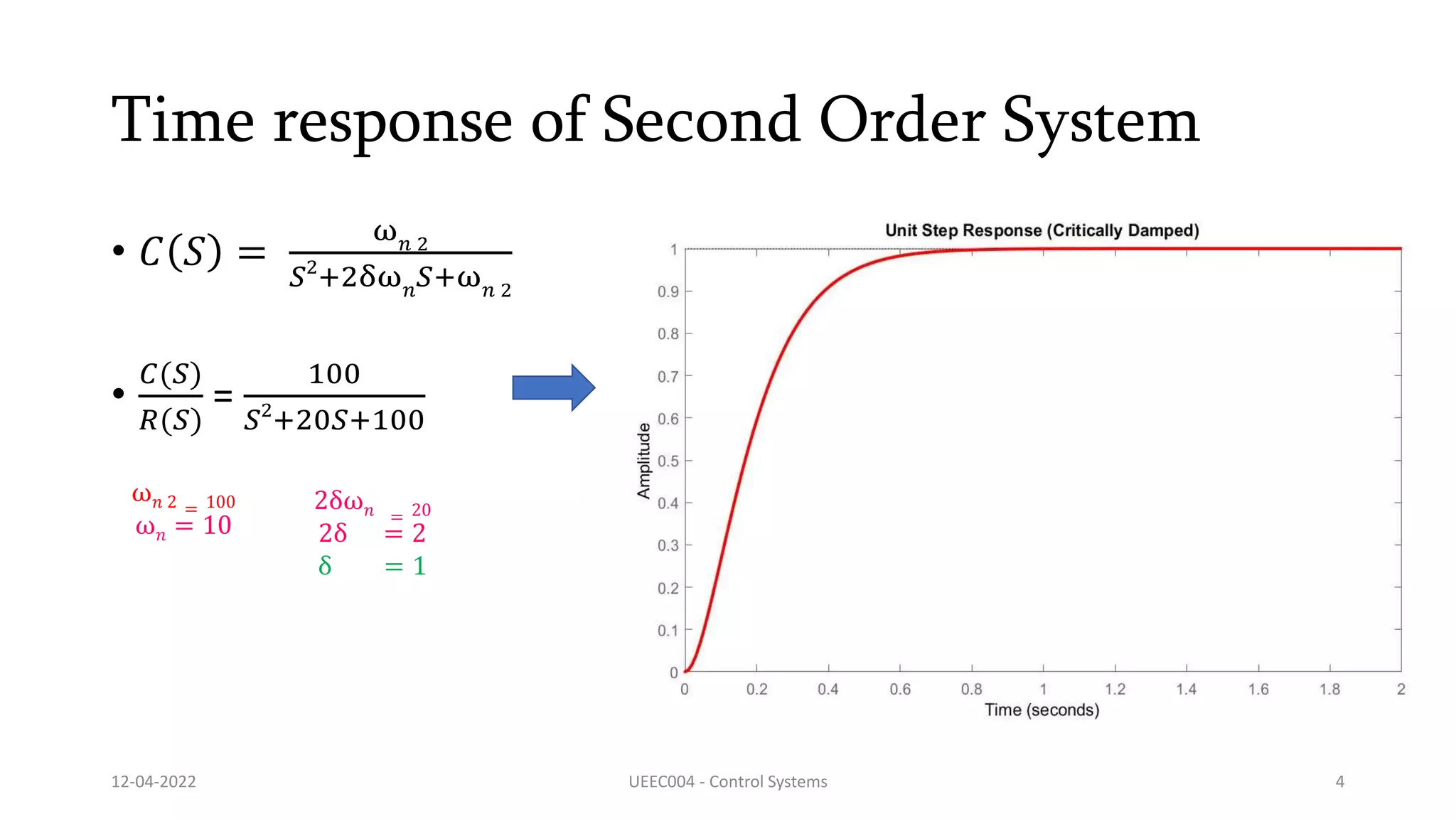
Time response of Second Order System
• 𝐶 𝑆 =
ω𝑛 2
𝑆2
+2δω𝑛𝑆+ω𝑛 2
•
𝐶(𝑆)
𝑅(𝑆)
=
100
𝑆2
+40𝑆+100
ω𝑛 2 = 100
ω𝑛 = 10
2δω𝑛 = 40
2δ = 4
δ = 2
12-04-2022 UEEC004 - Control Systems 5
Time Response Specifications
12-04-2022 UEEC004 - Control Systems 6
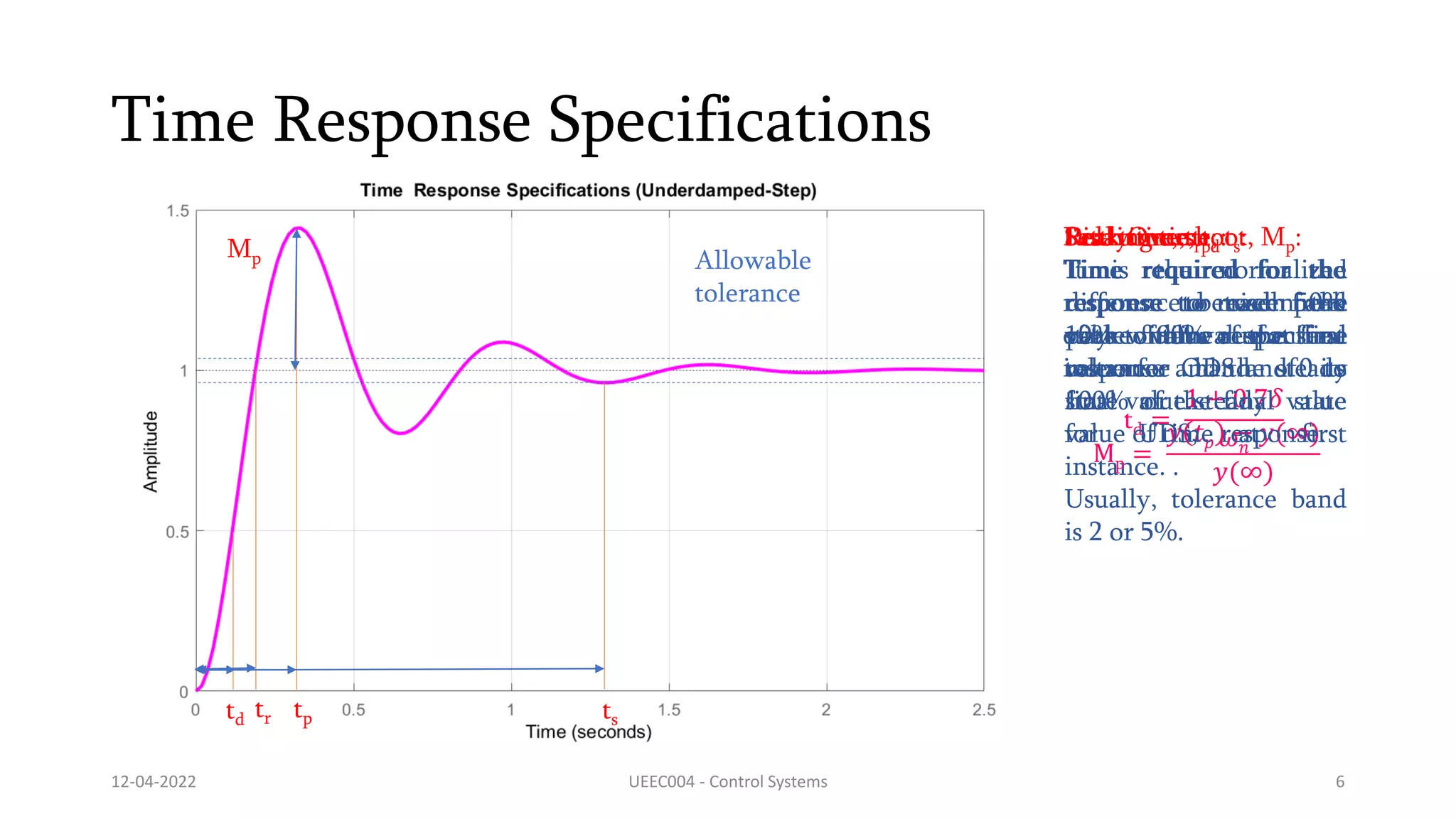
Delay time, td:
Time required for the
response to reach 50%
of the final value at first
instance.
td =
1 + 0.7𝛿
𝜔𝑛
Rise time, tr:
Time required for the
response to rise from
10% to 90% of the final
value for ODS and 0 to
100% of the final value
for UDS, at first
instance. .
Peak time, tp:
Time required for the
response to reach peak
value of time response.
Peak Overshoot, Mp:
It is the normalized
difference between the
peak value of time
response and the steady
state value.
Mp =
𝑦 𝑡𝑝 − 𝑦(∞)
𝑦(∞)
Settling time, ts:
Time required for the
response to reach and
stay within a specified
tolerance band of its
final or steady state
value of time response.
Usually, tolerance band
is 2 or 5%.
td tr tp
Mp
ts
Allowable
tolerance
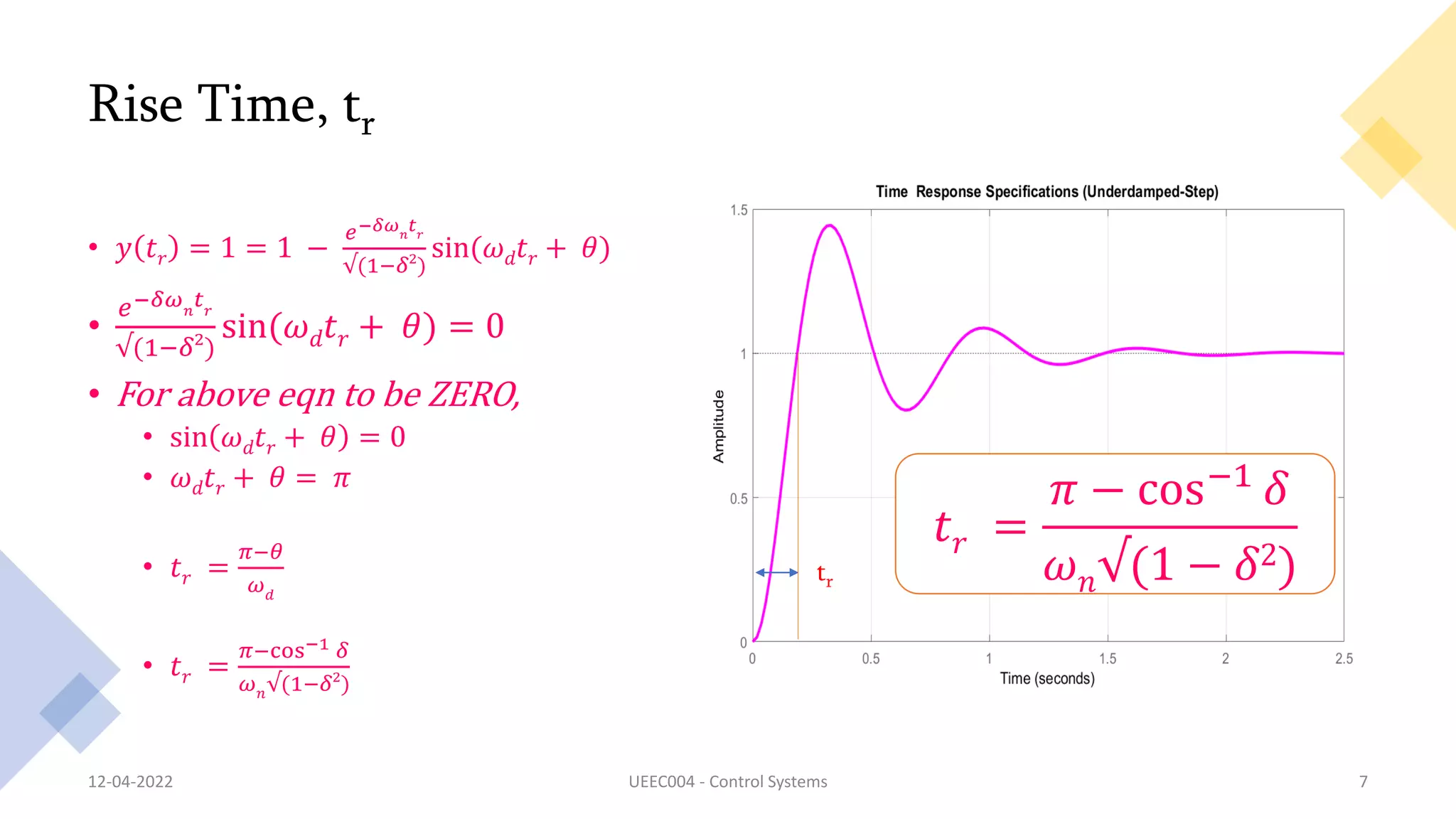
Rise Time, tr
• 𝑦 𝑡𝑟 = 1 = 1 −
𝑒−𝛿𝜔𝑛
𝑡𝑟
√(1−𝛿2
)
sin(𝜔𝑑𝑡𝑟 + 𝜃)
•
𝑒−𝛿𝜔𝑛
𝑡𝑟
√(1−𝛿2
)
sin(𝜔𝑑𝑡𝑟 + 𝜃) = 0
• For above eqn to be ZERO,
• sin 𝜔𝑑𝑡𝑟 + 𝜃 = 0
• 𝜔𝑑𝑡𝑟 + 𝜃 = 𝜋
• 𝑡𝑟 =
𝜋−𝜃
𝜔𝑑
• 𝑡𝑟 =
𝜋−cos−1 𝛿
𝜔𝑛
√(1−𝛿2
)
12-04-2022 UEEC004 - Control Systems 7
tr
𝑡𝑟 =
𝜋 − cos−1
𝛿
𝜔𝑛√(1 − 𝛿2)
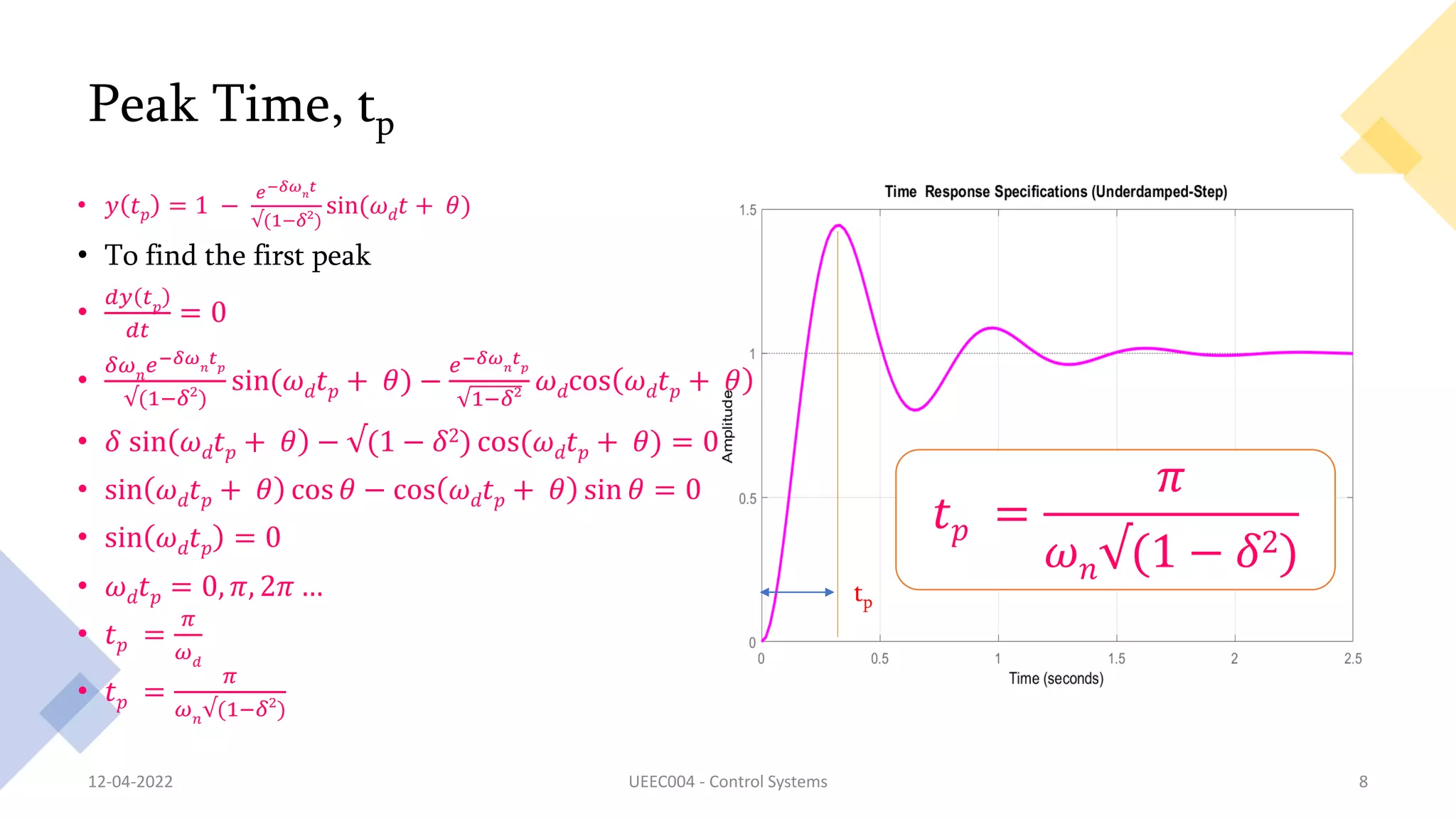
Peak Time, tp
12-04-2022 UEEC004 - Control Systems 8
tp
• 𝑦 𝑡𝑝 = 1 −
𝑒−𝛿𝜔𝑛
𝑡
√(1−𝛿2
)
sin(𝜔𝑑𝑡 + 𝜃)
• To find the first peak
•
𝑑𝑦 𝑡𝑝
𝑑𝑡
= 0
•
𝛿𝜔𝑛
𝑒−𝛿𝜔𝑛
𝑡𝑝
√(1−𝛿2
)
sin(𝜔𝑑𝑡𝑝 + 𝜃) −
𝑒−𝛿𝜔𝑛
𝑡𝑝
1−𝛿2 𝜔𝑑cos 𝜔𝑑𝑡𝑝 + 𝜃
• 𝛿 sin 𝜔𝑑𝑡𝑝 + 𝜃 − √(1 − 𝛿2) cos(𝜔𝑑𝑡𝑝 + 𝜃) = 0
• sin 𝜔𝑑𝑡𝑝 + 𝜃 cos 𝜃 − cos 𝜔𝑑𝑡𝑝 + 𝜃 sin 𝜃 = 0
• sin 𝜔𝑑𝑡𝑝 = 0
• 𝜔𝑑𝑡𝑝 = 0, 𝜋, 2𝜋 …
• 𝑡𝑝 =
𝜋
𝜔𝑑
• 𝑡𝑝 =
𝜋
𝜔𝑛
√(1−𝛿2
)
𝑡𝑝 =
𝜋
𝜔𝑛√(1 − 𝛿2)
Peak Overshoot, Mp
12-04-2022 UEEC004 - Control Systems 9
Mp
• 𝑀𝑝 =
𝑦 𝑡𝑝
−1
1
• 𝑦 𝑡𝑝 − 1 = 1 −
𝑒−𝛿𝜔𝑛
𝑡𝑝
1−𝛿2 sin 𝜔𝑑𝑡𝑝 + 𝜃 − 1
• 𝑦 𝑡𝑝 = −
𝑒−𝛿𝜔𝑛
𝑡𝑝
√(1−𝛿2
)
sin(𝜔𝑑𝑡𝑝 + 𝜃)
• 𝑡𝑝 =
𝜋
𝜔𝑑
• 𝑀𝑝 = −
𝑒
−𝛿𝜔𝑛
𝜋
𝜔𝑑
√(1−𝛿2
)
sin(𝜔𝑑
𝜋
𝜔𝑑
+ 𝜃)
• 𝑀𝑝 =
𝑒
−
𝛿𝜋
√(1−𝛿
2
)
√(1−𝛿2
)
sin( 𝜃)
• 𝑀𝑝 = 𝑒
−
𝛿𝜋
√(1−𝛿2
)
𝑀𝑝 = 100𝑒
𝛿𝜋
√(1−𝛿2
)%

Time Domain Specifications

  • 1.
    Control Systems Lecture -8 E. Ramkumar Assistant Professor / EEE 12-04-2022 UEEC004 - Control Systems 1
  • 2.
    Time response ofSecond Order System • 𝐶 𝑆 = ω𝑛 2 𝑆2 +2δω𝑛𝑆+ω𝑛 2 • 𝐶(𝑆) 𝑅(𝑆) = 100 𝑆2 +0𝑆+100 ω𝑛 2 = 100 ω𝑛 = 10 2δω𝑛 = 0 2δ = 0 δ = 0 12-04-2022 UEEC004 - Control Systems 2
  • 3.
    Time response ofSecond Order System • 𝐶 𝑆 = ω𝑛 2 𝑆2 +2δω𝑛𝑆+ω𝑛 2 • 𝐶(𝑆) 𝑅(𝑆) = 100 𝑆2 +10𝑆+100 ω𝑛 2 = 100 ω𝑛 = 10 2δω𝑛 = 10 2δ = 1 δ = 0.5 12-04-2022 UEEC004 - Control Systems 3
  • 4.
    Time response ofSecond Order System • 𝐶 𝑆 = ω𝑛 2 𝑆2 +2δω𝑛𝑆+ω𝑛 2 • 𝐶(𝑆) 𝑅(𝑆) = 100 𝑆2 +20𝑆+100 ω𝑛 2 = 100 ω𝑛 = 10 2δω𝑛 = 20 2δ = 2 δ = 1 12-04-2022 UEEC004 - Control Systems 4
  • 5.
    Time response ofSecond Order System • 𝐶 𝑆 = ω𝑛 2 𝑆2 +2δω𝑛𝑆+ω𝑛 2 • 𝐶(𝑆) 𝑅(𝑆) = 100 𝑆2 +40𝑆+100 ω𝑛 2 = 100 ω𝑛 = 10 2δω𝑛 = 40 2δ = 4 δ = 2 12-04-2022 UEEC004 - Control Systems 5
  • 6.
    Time Response Specifications 12-04-2022UEEC004 - Control Systems 6 Delay time, td: Time required for the response to reach 50% of the final value at first instance. td = 1 + 0.7𝛿 𝜔𝑛 Rise time, tr: Time required for the response to rise from 10% to 90% of the final value for ODS and 0 to 100% of the final value for UDS, at first instance. . Peak time, tp: Time required for the response to reach peak value of time response. Peak Overshoot, Mp: It is the normalized difference between the peak value of time response and the steady state value. Mp = 𝑦 𝑡𝑝 − 𝑦(∞) 𝑦(∞) Settling time, ts: Time required for the response to reach and stay within a specified tolerance band of its final or steady state value of time response. Usually, tolerance band is 2 or 5%. td tr tp Mp ts Allowable tolerance
  • 7.
    Rise Time, tr •𝑦 𝑡𝑟 = 1 = 1 − 𝑒−𝛿𝜔𝑛 𝑡𝑟 √(1−𝛿2 ) sin(𝜔𝑑𝑡𝑟 + 𝜃) • 𝑒−𝛿𝜔𝑛 𝑡𝑟 √(1−𝛿2 ) sin(𝜔𝑑𝑡𝑟 + 𝜃) = 0 • For above eqn to be ZERO, • sin 𝜔𝑑𝑡𝑟 + 𝜃 = 0 • 𝜔𝑑𝑡𝑟 + 𝜃 = 𝜋 • 𝑡𝑟 = 𝜋−𝜃 𝜔𝑑 • 𝑡𝑟 = 𝜋−cos−1 𝛿 𝜔𝑛 √(1−𝛿2 ) 12-04-2022 UEEC004 - Control Systems 7 tr 𝑡𝑟 = 𝜋 − cos−1 𝛿 𝜔𝑛√(1 − 𝛿2)
  • 8.
    Peak Time, tp 12-04-2022UEEC004 - Control Systems 8 tp • 𝑦 𝑡𝑝 = 1 − 𝑒−𝛿𝜔𝑛 𝑡 √(1−𝛿2 ) sin(𝜔𝑑𝑡 + 𝜃) • To find the first peak • 𝑑𝑦 𝑡𝑝 𝑑𝑡 = 0 • 𝛿𝜔𝑛 𝑒−𝛿𝜔𝑛 𝑡𝑝 √(1−𝛿2 ) sin(𝜔𝑑𝑡𝑝 + 𝜃) − 𝑒−𝛿𝜔𝑛 𝑡𝑝 1−𝛿2 𝜔𝑑cos 𝜔𝑑𝑡𝑝 + 𝜃 • 𝛿 sin 𝜔𝑑𝑡𝑝 + 𝜃 − √(1 − 𝛿2) cos(𝜔𝑑𝑡𝑝 + 𝜃) = 0 • sin 𝜔𝑑𝑡𝑝 + 𝜃 cos 𝜃 − cos 𝜔𝑑𝑡𝑝 + 𝜃 sin 𝜃 = 0 • sin 𝜔𝑑𝑡𝑝 = 0 • 𝜔𝑑𝑡𝑝 = 0, 𝜋, 2𝜋 … • 𝑡𝑝 = 𝜋 𝜔𝑑 • 𝑡𝑝 = 𝜋 𝜔𝑛 √(1−𝛿2 ) 𝑡𝑝 = 𝜋 𝜔𝑛√(1 − 𝛿2)
  • 9.
    Peak Overshoot, Mp 12-04-2022UEEC004 - Control Systems 9 Mp • 𝑀𝑝 = 𝑦 𝑡𝑝 −1 1 • 𝑦 𝑡𝑝 − 1 = 1 − 𝑒−𝛿𝜔𝑛 𝑡𝑝 1−𝛿2 sin 𝜔𝑑𝑡𝑝 + 𝜃 − 1 • 𝑦 𝑡𝑝 = − 𝑒−𝛿𝜔𝑛 𝑡𝑝 √(1−𝛿2 ) sin(𝜔𝑑𝑡𝑝 + 𝜃) • 𝑡𝑝 = 𝜋 𝜔𝑑 • 𝑀𝑝 = − 𝑒 −𝛿𝜔𝑛 𝜋 𝜔𝑑 √(1−𝛿2 ) sin(𝜔𝑑 𝜋 𝜔𝑑 + 𝜃) • 𝑀𝑝 = 𝑒 − 𝛿𝜋 √(1−𝛿 2 ) √(1−𝛿2 ) sin( 𝜃) • 𝑀𝑝 = 𝑒 − 𝛿𝜋 √(1−𝛿2 ) 𝑀𝑝 = 100𝑒 𝛿𝜋 √(1−𝛿2 )%