Food and Public Health
Tim Lang

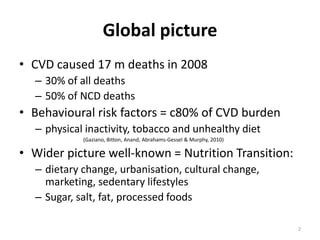
Centre for Food Policy, City University London, UK
e: t.lang@city.ac.uk

Paper to Sustainable Food Trust ‘Truce-Cost Accounting in Food and Farming
conference, held at the Royal Geographical Society, London on December 6 2013

1
Global picture
• CVD caused 17 m deaths in 2008
– 30% of all deaths
– 50% of NCD deaths

• Behavioural risk factors = c80% of CVD burden
– physical inactivity, tobacco and unhealthy diet
(Gaziano, Bitton, Anand, Abrahams-Gessel & Murphy, 2010)

• Wider picture well-known = Nutrition Transition:
– dietary change, urbanisation, cultural change,
marketing, sedentary lifestyles
– Sugar, salt, fat, processed foods
2
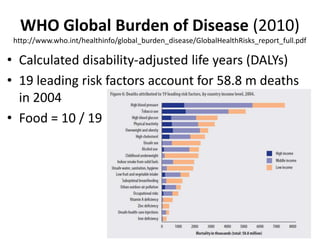
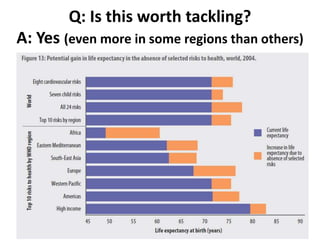
WHO Global Burden of Disease (2010)
http://www.who.int/healthinfo/global_burden_disease/GlobalHealthRisks_report_full.pdf

• Calculated disability-adjusted life years (DALYs)
• 19 leading risk factors account for 58.8 m deaths
in 2004
• Food = 10 / 19

3
Q: Is this worth tackling?

A: Yes (even more in some regions than others)

4
Costs

5
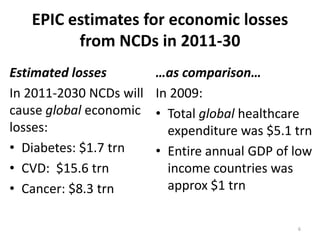
EPIC estimates for economic losses
from NCDs in 2011-30
Estimated losses
In 2011-2030 NCDs will
cause global economic
losses:
• Diabetes: $1.7 trn
• CVD: $15.6 trn
• Cancer: $8.3 trn

…as comparison…
In 2009:
• Total global healthcare
expenditure was $5.1 trn
• Entire annual GDP of low
income countries was
approx $1 trn
6
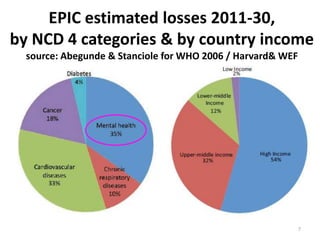
EPIC estimated losses 2011-30,
by NCD 4 categories & by country income
source: Abegunde & Stanciole for WHO 2006 / Harvard& WEF

7
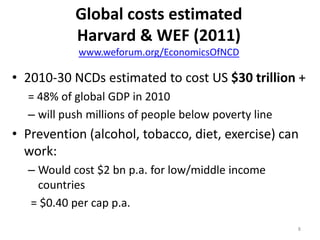
Global costs estimated
Harvard & WEF (2011)
www.weforum.org/EconomicsOfNCD

• 2010-30 NCDs estimated to cost US $30 trillion +
= 48% of global GDP in 2010
– will push millions of people below poverty line

• Prevention (alcohol, tobacco, diet, exercise) can
work:
– Would cost $2 bn p.a. for low/middle income
countries
= $0.40 per cap p.a.
8
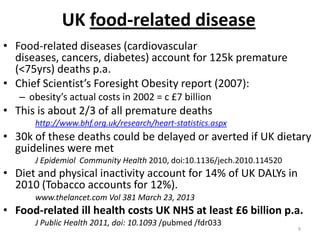
UK food-related disease
• Food-related diseases (cardiovascular
diseases, cancers, diabetes) account for 125k premature
(<75yrs) deaths p.a.
• Chief Scientist’s Foresight Obesity report (2007):
– obesity’s actual costs in 2002 = c £7 billion

• This is about 2/3 of all premature deaths
http://www.bhf.org.uk/research/heart-statistics.aspx

• 30k of these deaths could be delayed or averted if UK dietary
guidelines were met
J Epidemiol Community Health 2010, doi:10.1136/jech.2010.114520

• Diet and physical inactivity account for 14% of UK DALYs in
2010 (Tobacco accounts for 12%).
www.thelancet.com Vol 381 March 23, 2013

• Food-related ill health costs UK NHS at least £6 billion p.a.
J Public Health 2011, doi: 10.1093 /pubmed /fdr033

9
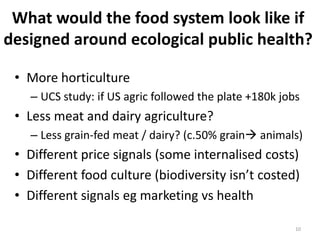
What would the food system look like if
designed around ecological public health?
• More horticulture
– UCS study: if US agric followed the plate +180k jobs

• Less meat and dairy agriculture?
– Less grain-fed meat / dairy? (c.50% grain animals)

• Different price signals (some internalised costs)
• Different food culture (biodiversity isn’t costed)
• Different signals eg marketing vs health
10
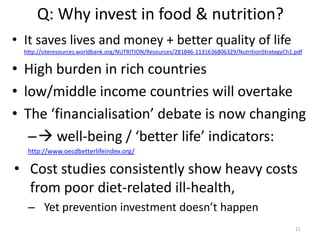
Q: Why invest in food & nutrition?
• It saves lives and money + better quality of life
http://siteresources.worldbank.org/NUTRITION/Resources/281846-1131636806329/NutritionStrategyCh1.pdf

• High burden in rich countries
• low/middle income countries will overtake
• The ‘financialisation’ debate is now changing
– well-being / ‘better life’ indicators:
http://www.oecdbetterlifeindex.org/

• Cost studies consistently show heavy costs
from poor diet-related ill-health,
– Yet prevention investment doesn’t happen
11

Tim lang

  • 1.
    Food and PublicHealth Tim Lang Centre for Food Policy, City University London, UK e: t.lang@city.ac.uk Paper to Sustainable Food Trust ‘Truce-Cost Accounting in Food and Farming conference, held at the Royal Geographical Society, London on December 6 2013 1
  • 2.
    Global picture • CVDcaused 17 m deaths in 2008 – 30% of all deaths – 50% of NCD deaths • Behavioural risk factors = c80% of CVD burden – physical inactivity, tobacco and unhealthy diet (Gaziano, Bitton, Anand, Abrahams-Gessel & Murphy, 2010) • Wider picture well-known = Nutrition Transition: – dietary change, urbanisation, cultural change, marketing, sedentary lifestyles – Sugar, salt, fat, processed foods 2
  • 3.
    WHO Global Burdenof Disease (2010) http://www.who.int/healthinfo/global_burden_disease/GlobalHealthRisks_report_full.pdf • Calculated disability-adjusted life years (DALYs) • 19 leading risk factors account for 58.8 m deaths in 2004 • Food = 10 / 19 3
  • 4.
    Q: Is thisworth tackling? A: Yes (even more in some regions than others) 4
  • 5.
  • 6.
    EPIC estimates foreconomic losses from NCDs in 2011-30 Estimated losses In 2011-2030 NCDs will cause global economic losses: • Diabetes: $1.7 trn • CVD: $15.6 trn • Cancer: $8.3 trn …as comparison… In 2009: • Total global healthcare expenditure was $5.1 trn • Entire annual GDP of low income countries was approx $1 trn 6
  • 7.
    EPIC estimated losses2011-30, by NCD 4 categories & by country income source: Abegunde & Stanciole for WHO 2006 / Harvard& WEF 7
  • 8.
    Global costs estimated Harvard& WEF (2011) www.weforum.org/EconomicsOfNCD • 2010-30 NCDs estimated to cost US $30 trillion + = 48% of global GDP in 2010 – will push millions of people below poverty line • Prevention (alcohol, tobacco, diet, exercise) can work: – Would cost $2 bn p.a. for low/middle income countries = $0.40 per cap p.a. 8
  • 9.
    UK food-related disease •Food-related diseases (cardiovascular diseases, cancers, diabetes) account for 125k premature (<75yrs) deaths p.a. • Chief Scientist’s Foresight Obesity report (2007): – obesity’s actual costs in 2002 = c £7 billion • This is about 2/3 of all premature deaths http://www.bhf.org.uk/research/heart-statistics.aspx • 30k of these deaths could be delayed or averted if UK dietary guidelines were met J Epidemiol Community Health 2010, doi:10.1136/jech.2010.114520 • Diet and physical inactivity account for 14% of UK DALYs in 2010 (Tobacco accounts for 12%). www.thelancet.com Vol 381 March 23, 2013 • Food-related ill health costs UK NHS at least £6 billion p.a. J Public Health 2011, doi: 10.1093 /pubmed /fdr033 9
  • 10.
    What would thefood system look like if designed around ecological public health? • More horticulture – UCS study: if US agric followed the plate +180k jobs • Less meat and dairy agriculture? – Less grain-fed meat / dairy? (c.50% grain animals) • Different price signals (some internalised costs) • Different food culture (biodiversity isn’t costed) • Different signals eg marketing vs health 10
  • 11.
    Q: Why investin food & nutrition? • It saves lives and money + better quality of life http://siteresources.worldbank.org/NUTRITION/Resources/281846-1131636806329/NutritionStrategyCh1.pdf • High burden in rich countries • low/middle income countries will overtake • The ‘financialisation’ debate is now changing – well-being / ‘better life’ indicators: http://www.oecdbetterlifeindex.org/ • Cost studies consistently show heavy costs from poor diet-related ill-health, – Yet prevention investment doesn’t happen 11