THYROID NEOPLASMS &
SOLITARY THYROID
NODULE
PREPARED BY : DR. MOHAMED ELWARFALLI
BMC,BENGHAZI-LIBYA
DEPARTMENT OF SURGERY
APRIL 5, 2018
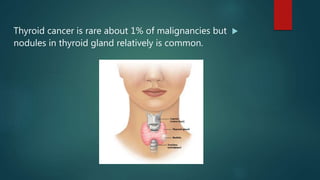
Thyroid cancer is rare about 1% of malignancies but
nodules in thyroid gland relatively is common.
Thyroid nodule;
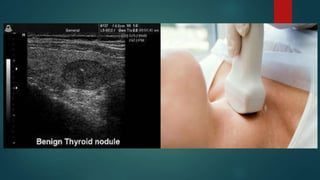
A discrete swelling within the thyroid gland that is
palpable or radiologically distinct from surrounding
thyroid parenchyma.
It is may be symptomatic or be an incidental finding .
Clinical examination can detect asymptomatic thyroid
nodule in about 5% of the population.
This figure is increased to 25% using Ultrasound.
In any patient with a solitary thyroid nodule ,
MALIGNANCY needs to be excluded by investigation,
and fine needle aspiration cytology or needle core
biopsy is the first step in doing so.
Less than 10% of true solitary nodules are malignant ,
this rises to about 40% in patient who have undergone
previous neck irradiation.
Common causes of Solitary thyroid nodule;
BENIGN
Thyroiditis
Multinodular goiter
Simple/ Hgic cyst
Follicular adenoma
MALIGNANT
Primary
Papillary thyroid cancer
Follicular thyroid cancer
Hurthle cell cancer
Anaplastic thyroid cancer
Medullary thyroid cancer
Thyroid lymphoma
Secondary
Metastatic cancer
Thyroid Neoplasm :
Thyroid gland contains follicular & parafollicular ( C ) cells.
Tumors of the thyroid gland can be classified as :
1. Tumors arising from follicular epithelium:
BENIGN Follicular adenoma.
MALIGNANT Differentiated Papillary carcinoma 80%
Follicular carcinoma 10%
Hurthle cell carcinoma 4%
Undifferentiated Anaplastic carcinoma 1%
2.Tumors from parafollicular ep. : Medullary carcinoma 5%
3.Tumors from lymphoid elements: Malignant lymphoma.
4.Rarely the thyroid gland infiltrated by metastatic deposits or by local
infiltration from a nearby lesion.
Presentation;
Benign and malignant thyroid nodules usually present as 1.
Neck LUMP
2. Painful swelling : *Hge. *Thyroiditis. *Malignancy.
3. Toxic manifestation in toxic nodules.
4. Criteria of malignancy in malignant nodules.
Other clinical manifestations are :
Neck discomfort , difficulty in swallowing or breathing ,
change in voice , History of rapid growth , cervical lymph
nodes.
Findings that raise suspicion of malignancy
in a solitary nodule:
1.History of previous irradiation.
2.Young and elderly patients.
3.Male sex.
4.F/H of MEN2.
5.Recent onset , and rapid growth.
6.Painful , Hard , Irregular nodule with limited mobility.
7.Local invasion or lymphatic , blood borne metastasis.
Clinical examination;
A complete physical examination is necessary , with
emphasis on the inspection and palpation of the neck ,
including the thyroid and the lymph node compartments in
the neck.
Investigations;
1. Suspicion of TOXICITY , Thyroid function tests are
performed.
2. Calcium , calcitonin , thyroglobulin, Autoantibody status
should be checked.
3. Thyroid isotope scan.
4.Ultrasound ; differentiate b/w a cyst and solid nodule.
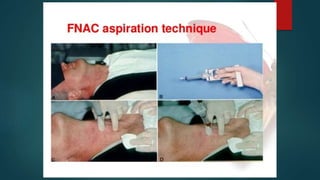
5. FNAC ; simple, fast, inexpensive but can’t differentiate b/w
follicular adenoma and follicular carcinoma.
6. True cut needle biopsy.
7. Excision biopsy ; the surest method of diagnosis is to do
lobectomy of the affected side and then frozen section.
Treatment scheme :
a. Multiple : Subtotal
thyroidectomy.
b. Solitary :
1. CYSTIC : aspiration = Simple
cyst OR suspicion of
Malignancy ( ttt accordingly ).
2. Solid : Thyroid scan =
-HOT = Toxic nodule.
-Warm = adenoma (hem-
thyroidectomy & biobsy)
-COLD = biobsy , Benign (
hemi-thyroidectomy ) .
Malignant ( treat
accordingly ).
Pathological variants of malignant
neoplasms :
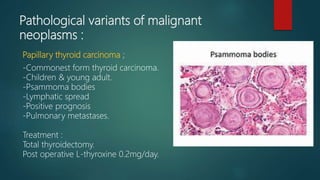
Papillary thyroid carcinoma ;
-Commonest form thyroid carcinoma.
-Children & young adult.
-Psammoma bodies
-Lymphatic spread
-Positive prognosis
-Pulmonary metastases.
Treatment :
Total thyroidectomy.
Post operative L-thyroxine 0.2mg/day.
Follicular thyroid carcinoma ;
-Middle age female
-FNA can’t diagnose cancer
-Capsular or vascular invasion
-Mainly blood spread
-Favorable prognosis
Treatment:
Total thyroidectomy.
Post op. L-thyroxine.
Anaplastic carcinoma ;
-Uncommon 1% .
-Elderly.
-Aggressive , prognosis poor ( most patients die within 1 year
-Spindle cells , Giant cells
-Mainly direct invasion, Lymphatic or blood spread.
Treatment:
Small tumor : Total thyroidectomy + XRT/Chemo
Large tumor : Debulking surgery and tracheostomy,
XRT/Chemo.
Medullary carcinoma ;
-Rare tumor.
-Sporadic or familial (children and young adult).
-MEN2, secrete calcitonin.
-Hyaline stroma contain amyloid material.
-Lymphatic/Blood spread.
Treatment :
Total thyroidectomy and L.N resection.
Lymphoma :
-Arise in a pre-existing longstanding Hashimoto’s thyroiditis.
-Elderly woman.
Treatment:
XRT / Chemo.
Thyroid nodule & neoplasms

Thyroid nodule & neoplasms

  • 1.
    THYROID NEOPLASMS & SOLITARYTHYROID NODULE PREPARED BY : DR. MOHAMED ELWARFALLI BMC,BENGHAZI-LIBYA DEPARTMENT OF SURGERY APRIL 5, 2018
  • 2.
    Thyroid cancer israre about 1% of malignancies but nodules in thyroid gland relatively is common.
  • 3.
    Thyroid nodule; A discreteswelling within the thyroid gland that is palpable or radiologically distinct from surrounding thyroid parenchyma. It is may be symptomatic or be an incidental finding . Clinical examination can detect asymptomatic thyroid nodule in about 5% of the population. This figure is increased to 25% using Ultrasound.
  • 4.
    In any patientwith a solitary thyroid nodule , MALIGNANCY needs to be excluded by investigation, and fine needle aspiration cytology or needle core biopsy is the first step in doing so. Less than 10% of true solitary nodules are malignant , this rises to about 40% in patient who have undergone previous neck irradiation.
  • 5.
    Common causes ofSolitary thyroid nodule; BENIGN Thyroiditis Multinodular goiter Simple/ Hgic cyst Follicular adenoma MALIGNANT Primary Papillary thyroid cancer Follicular thyroid cancer Hurthle cell cancer Anaplastic thyroid cancer Medullary thyroid cancer Thyroid lymphoma Secondary Metastatic cancer
  • 6.
    Thyroid Neoplasm : Thyroidgland contains follicular & parafollicular ( C ) cells. Tumors of the thyroid gland can be classified as : 1. Tumors arising from follicular epithelium: BENIGN Follicular adenoma. MALIGNANT Differentiated Papillary carcinoma 80% Follicular carcinoma 10% Hurthle cell carcinoma 4% Undifferentiated Anaplastic carcinoma 1% 2.Tumors from parafollicular ep. : Medullary carcinoma 5% 3.Tumors from lymphoid elements: Malignant lymphoma. 4.Rarely the thyroid gland infiltrated by metastatic deposits or by local infiltration from a nearby lesion.
  • 7.
    Presentation; Benign and malignantthyroid nodules usually present as 1. Neck LUMP 2. Painful swelling : *Hge. *Thyroiditis. *Malignancy. 3. Toxic manifestation in toxic nodules. 4. Criteria of malignancy in malignant nodules. Other clinical manifestations are : Neck discomfort , difficulty in swallowing or breathing , change in voice , History of rapid growth , cervical lymph nodes.
  • 8.
    Findings that raisesuspicion of malignancy in a solitary nodule: 1.History of previous irradiation. 2.Young and elderly patients. 3.Male sex. 4.F/H of MEN2. 5.Recent onset , and rapid growth. 6.Painful , Hard , Irregular nodule with limited mobility. 7.Local invasion or lymphatic , blood borne metastasis.
  • 9.
    Clinical examination; A completephysical examination is necessary , with emphasis on the inspection and palpation of the neck , including the thyroid and the lymph node compartments in the neck.
  • 10.
    Investigations; 1. Suspicion ofTOXICITY , Thyroid function tests are performed. 2. Calcium , calcitonin , thyroglobulin, Autoantibody status should be checked. 3. Thyroid isotope scan. 4.Ultrasound ; differentiate b/w a cyst and solid nodule. 5. FNAC ; simple, fast, inexpensive but can’t differentiate b/w follicular adenoma and follicular carcinoma. 6. True cut needle biopsy. 7. Excision biopsy ; the surest method of diagnosis is to do lobectomy of the affected side and then frozen section.
  • 13.
    Treatment scheme : a.Multiple : Subtotal thyroidectomy. b. Solitary : 1. CYSTIC : aspiration = Simple cyst OR suspicion of Malignancy ( ttt accordingly ). 2. Solid : Thyroid scan = -HOT = Toxic nodule. -Warm = adenoma (hem- thyroidectomy & biobsy) -COLD = biobsy , Benign ( hemi-thyroidectomy ) . Malignant ( treat accordingly ).
  • 14.
    Pathological variants ofmalignant neoplasms : Papillary thyroid carcinoma ; -Commonest form thyroid carcinoma. -Children & young adult. -Psammoma bodies -Lymphatic spread -Positive prognosis -Pulmonary metastases. Treatment : Total thyroidectomy. Post operative L-thyroxine 0.2mg/day.
  • 15.
    Follicular thyroid carcinoma; -Middle age female -FNA can’t diagnose cancer -Capsular or vascular invasion -Mainly blood spread -Favorable prognosis Treatment: Total thyroidectomy. Post op. L-thyroxine.
  • 16.
    Anaplastic carcinoma ; -Uncommon1% . -Elderly. -Aggressive , prognosis poor ( most patients die within 1 year -Spindle cells , Giant cells -Mainly direct invasion, Lymphatic or blood spread. Treatment: Small tumor : Total thyroidectomy + XRT/Chemo Large tumor : Debulking surgery and tracheostomy, XRT/Chemo.
  • 17.
    Medullary carcinoma ; -Raretumor. -Sporadic or familial (children and young adult). -MEN2, secrete calcitonin. -Hyaline stroma contain amyloid material. -Lymphatic/Blood spread. Treatment : Total thyroidectomy and L.N resection.
  • 18.
    Lymphoma : -Arise ina pre-existing longstanding Hashimoto’s thyroiditis. -Elderly woman. Treatment: XRT / Chemo.