Made By:
k.manikanth
BIODIVERSITY
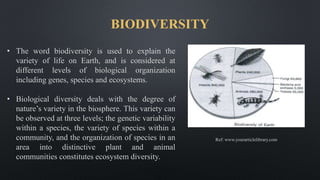
• The word biodiversity is used to explain the
variety of life on Earth, and is considered at
different levels of biological organization
including genes, species and ecosystems.
• Biological diversity deals with the degree of
nature’s variety in the biosphere. This variety can
be observed at three levels; the genetic variability
within a species, the variety of species within a
community, and the organization of species in an
area into distinctive plant and animal
communities constitutes ecosystem diversity.
Ref: www.yourarticlelibrary.com
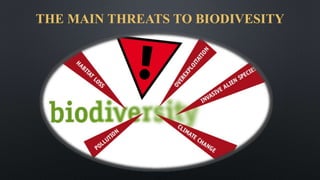
THE MAIN THREATS TO BIODIVESITY
HABITAT LOSS
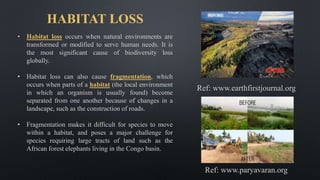
• Habitat loss occurs when natural environments are
transformed or modified to serve human needs. It is
the most significant cause of biodiversity loss
globally.
• Habitat loss can also cause fragmentation, which
occurs when parts of a habitat (the local environment
in which an organism is usually found) become
separated from one another because of changes in a
landscape, such as the construction of roads.
• Fragmentation makes it difficult for species to move
within a habitat, and poses a major challenge for
species requiring large tracts of land such as the
African forest elephants living in the Congo basin.
Ref: www.earthfirstjournal.org
Ref: www.paryavaran.org
WHAT CAN WE DO
• Learn more about the natural habitats in your area, and help to educate others
about their importance.
• Help reduce pollution that can damage wildlife and habitat.
• By using proactive shoreline and streamside development techniques, you may be
able to simultaneously preserve habitat and reduce erosion and flood damage.
• Preserve existing wetland and salt marsh vegetation on your property, as it
provides valuable habitat for birds, fish, amphibians and mammals.
• Help to prevent the spread of invasive species in natural habitats.
CLIMATE CHANGE
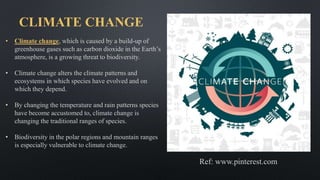
• Climate change, which is caused by a build-up of
greenhouse gases such as carbon dioxide in the Earth’s
atmosphere, is a growing threat to biodiversity.
• Climate change alters the climate patterns and
ecosystems in which species have evolved and on
which they depend.
• By changing the temperature and rain patterns species
have become accustomed to, climate change is
changing the traditional ranges of species.
• Biodiversity in the polar regions and mountain ranges
is especially vulnerable to climate change.
Ref: www.pinterest.com
WHAT CAN WE DO
• Buy energy efficient products.
• Conserve energy at home and at work.
• Plant trees.
• Reduce, reuse and recycle.
• Make wise transportation choices (Like riding a bicycle instead of driving in a
car)
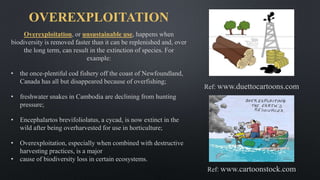
OVEREXPLOITATION
Overexploitation, or unsustainable use, happens when
biodiversity is removed faster than it can be replenished and, over
the long term, can result in the extinction of species. For
example:
• the once-plentiful cod fishery off the coast of Newfoundland,
Canada has all but disappeared because of overfishing;
• freshwater snakes in Cambodia are declining from hunting
pressure;
• Encephalartos brevifoliolatus, a cycad, is now extinct in the
wild after being overharvested for use in horticulture;
• Overexploitation, especially when combined with destructive
harvesting practices, is a major
• cause of biodiversity loss in certain ecosystems.
Ref: www.duettocartoons.com
Ref: www.cartoonstock.com
WHAT CAN WE DO
• ADVERTISEMENT CAMPAIGNS
• COMMUNITY & GOVERNMENT GROUPS
• POLICIES/LEGISLATIONS
• NATIONAL PARKS
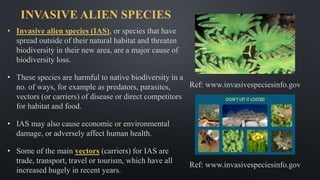
INVASIVE ALIEN SPECIES
• Invasive alien species (IAS), or species that have
spread outside of their natural habitat and threaten
biodiversity in their new area, are a major cause of
biodiversity loss.
• These species are harmful to native biodiversity in a
no. of ways, for example as predators, parasites,
vectors (or carriers) of disease or direct competitors
for habitat and food.
• IAS may also cause economic or environmental
damage, or adversely affect human health.
• Some of the main vectors (carriers) for IAS are
trade, transport, travel or tourism, which have all
increased hugely in recent years.
Ref: www.invasivespeciesinfo.gov
WHAT CAN WE DO
• Serving as a lead partner in the National Environmental Coalition on Invasive Species, a
national partnership that provides a scientific voice on invasive species policy.
• Establishing and strengthening federal policy restricting the importation of potentially
damaging plant and animal species.
• Advocating for new legislation to require treatment of ballast water in ocean-going vessels, a
primary introduction pathway for damaging aquatic invasive species.
• Advocating for robust restoration funding in the Great Lakes and other major ecosystems to
repair the damage caused by existing invasive species.
• Leading the charge to prevent Asian carp from entering and decimating the Great Lakes.
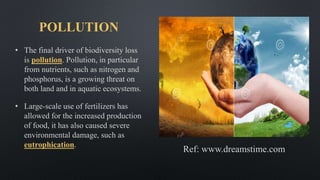
POLLUTION
• The final driver of biodiversity loss
is pollution. Pollution, in particular
from nutrients, such as nitrogen and
phosphorus, is a growing threat on
both land and in aquatic ecosystems.
• Large-scale use of fertilizers has
allowed for the increased production
of food, it has also caused severe
environmental damage, such as
eutrophication.
Ref: www.dreamstime.com
WHAT CAN WE DO
• Making Sustainable Transportation Choices
• Making Sustainable Food Choices
• Making Sustainable Energy Choices
• Recycling, Reusing, and Reducing
• Keeping Chemicals Out of the Water Supply
• Getting Involved and Educating Others
CASE STUDY
Kokkare Bellure – Karnataka: Co-existence (Man and Wildlife) The pelican, which is an
endangered species breeds in large numbers at Kokkare Bellur which is one of the ten
known breeding sites in India. Kokkare Bellure is a village in Karnataka in Southern
India. In December every year, hundreds of spot billed pelicans, painted storks, ibis and
other birds migrate to this area to establish breeding colonies on the tall tamarind trees in
the center of the village. The local people have protected the birds, believing that they
bring good luck with regard to rain and crops. The villagers collect a rich supply of the
natural fertilizer that collects below the nests – the guano. The droppings of fish-eating
birds are rich in nitrates. The owners of the trees inhabited by the birds dig deep pits
under the trees, into which the guano falls. Silt from nearby lakes and ponds is mixed
with the guano which is used in their fields and sold as fertilizer. They have now planted
trees around their homes to encourage nesting
THE RIGHT OF SPECIES
We do not see all the varied functions that biodiversity plays in our
lives because they are not obvious. We rarely see how they are
controlling our environment unless we study nature. Thus we tend to
take short-term actions that can have serious impacts on biodiversity
leading to even extinction of species by disturbing their habitats. Man
has no right to do so. We only share this planet with millions of other
species that also have a right to survive on earth. It is morally wrong
to allow man’s actions to lead to the extinction of species.
Threats to bioiversity

Threats to bioiversity

  • 1.
  • 2.
    BIODIVERSITY • The wordbiodiversity is used to explain the variety of life on Earth, and is considered at different levels of biological organization including genes, species and ecosystems. • Biological diversity deals with the degree of nature’s variety in the biosphere. This variety can be observed at three levels; the genetic variability within a species, the variety of species within a community, and the organization of species in an area into distinctive plant and animal communities constitutes ecosystem diversity. Ref: www.yourarticlelibrary.com
  • 3.
    THE MAIN THREATSTO BIODIVESITY
  • 4.
    HABITAT LOSS • Habitatloss occurs when natural environments are transformed or modified to serve human needs. It is the most significant cause of biodiversity loss globally. • Habitat loss can also cause fragmentation, which occurs when parts of a habitat (the local environment in which an organism is usually found) become separated from one another because of changes in a landscape, such as the construction of roads. • Fragmentation makes it difficult for species to move within a habitat, and poses a major challenge for species requiring large tracts of land such as the African forest elephants living in the Congo basin. Ref: www.earthfirstjournal.org Ref: www.paryavaran.org
  • 5.
    WHAT CAN WEDO • Learn more about the natural habitats in your area, and help to educate others about their importance. • Help reduce pollution that can damage wildlife and habitat. • By using proactive shoreline and streamside development techniques, you may be able to simultaneously preserve habitat and reduce erosion and flood damage. • Preserve existing wetland and salt marsh vegetation on your property, as it provides valuable habitat for birds, fish, amphibians and mammals. • Help to prevent the spread of invasive species in natural habitats.
  • 6.
    CLIMATE CHANGE • Climatechange, which is caused by a build-up of greenhouse gases such as carbon dioxide in the Earth’s atmosphere, is a growing threat to biodiversity. • Climate change alters the climate patterns and ecosystems in which species have evolved and on which they depend. • By changing the temperature and rain patterns species have become accustomed to, climate change is changing the traditional ranges of species. • Biodiversity in the polar regions and mountain ranges is especially vulnerable to climate change. Ref: www.pinterest.com
  • 7.
    WHAT CAN WEDO • Buy energy efficient products. • Conserve energy at home and at work. • Plant trees. • Reduce, reuse and recycle. • Make wise transportation choices (Like riding a bicycle instead of driving in a car)
  • 8.
    OVEREXPLOITATION Overexploitation, or unsustainableuse, happens when biodiversity is removed faster than it can be replenished and, over the long term, can result in the extinction of species. For example: • the once-plentiful cod fishery off the coast of Newfoundland, Canada has all but disappeared because of overfishing; • freshwater snakes in Cambodia are declining from hunting pressure; • Encephalartos brevifoliolatus, a cycad, is now extinct in the wild after being overharvested for use in horticulture; • Overexploitation, especially when combined with destructive harvesting practices, is a major • cause of biodiversity loss in certain ecosystems. Ref: www.duettocartoons.com Ref: www.cartoonstock.com
  • 9.
    WHAT CAN WEDO • ADVERTISEMENT CAMPAIGNS • COMMUNITY & GOVERNMENT GROUPS • POLICIES/LEGISLATIONS • NATIONAL PARKS
  • 10.
    INVASIVE ALIEN SPECIES •Invasive alien species (IAS), or species that have spread outside of their natural habitat and threaten biodiversity in their new area, are a major cause of biodiversity loss. • These species are harmful to native biodiversity in a no. of ways, for example as predators, parasites, vectors (or carriers) of disease or direct competitors for habitat and food. • IAS may also cause economic or environmental damage, or adversely affect human health. • Some of the main vectors (carriers) for IAS are trade, transport, travel or tourism, which have all increased hugely in recent years. Ref: www.invasivespeciesinfo.gov Ref: www.invasivespeciesinfo.gov
  • 11.
    WHAT CAN WEDO • Serving as a lead partner in the National Environmental Coalition on Invasive Species, a national partnership that provides a scientific voice on invasive species policy. • Establishing and strengthening federal policy restricting the importation of potentially damaging plant and animal species. • Advocating for new legislation to require treatment of ballast water in ocean-going vessels, a primary introduction pathway for damaging aquatic invasive species. • Advocating for robust restoration funding in the Great Lakes and other major ecosystems to repair the damage caused by existing invasive species. • Leading the charge to prevent Asian carp from entering and decimating the Great Lakes.
  • 12.
    POLLUTION • The finaldriver of biodiversity loss is pollution. Pollution, in particular from nutrients, such as nitrogen and phosphorus, is a growing threat on both land and in aquatic ecosystems. • Large-scale use of fertilizers has allowed for the increased production of food, it has also caused severe environmental damage, such as eutrophication. Ref: www.dreamstime.com
  • 13.
    WHAT CAN WEDO • Making Sustainable Transportation Choices • Making Sustainable Food Choices • Making Sustainable Energy Choices • Recycling, Reusing, and Reducing • Keeping Chemicals Out of the Water Supply • Getting Involved and Educating Others
  • 14.
    CASE STUDY Kokkare Bellure– Karnataka: Co-existence (Man and Wildlife) The pelican, which is an endangered species breeds in large numbers at Kokkare Bellur which is one of the ten known breeding sites in India. Kokkare Bellure is a village in Karnataka in Southern India. In December every year, hundreds of spot billed pelicans, painted storks, ibis and other birds migrate to this area to establish breeding colonies on the tall tamarind trees in the center of the village. The local people have protected the birds, believing that they bring good luck with regard to rain and crops. The villagers collect a rich supply of the natural fertilizer that collects below the nests – the guano. The droppings of fish-eating birds are rich in nitrates. The owners of the trees inhabited by the birds dig deep pits under the trees, into which the guano falls. Silt from nearby lakes and ponds is mixed with the guano which is used in their fields and sold as fertilizer. They have now planted trees around their homes to encourage nesting
  • 15.
    THE RIGHT OFSPECIES We do not see all the varied functions that biodiversity plays in our lives because they are not obvious. We rarely see how they are controlling our environment unless we study nature. Thus we tend to take short-term actions that can have serious impacts on biodiversity leading to even extinction of species by disturbing their habitats. Man has no right to do so. We only share this planet with millions of other species that also have a right to survive on earth. It is morally wrong to allow man’s actions to lead to the extinction of species.