Pooja Sen
Nursing Lecturer (MHN)
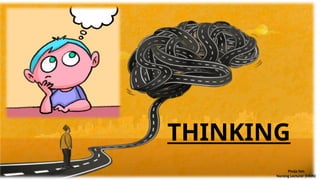
THINKING
Thinking is also known as cognition,
refers to the ability to process
information, hold attention ,store &
retrievals memories and select
appropriate response & action.
Pooja Sen
Nursing Lecturer (MHN)
1. ACCORDING TO
WOOD WORTH
Thinking is a mental
exploration for finding
out the solution of the
problems.
2. ACCORDING TO
GILMER
Thinking is a problem
solving process, in which
we use ideas or symbols in
places of overt activity.
Pooja Sen
Nursing Lecturer (MHN)
3. ACCORDING TO
MAIER
Thinking is the
perceptual relationship
which provides for the
solution of the problem.
4. ACCORDING TO
MOHSIN
“Thinking is an
implicit problem
solving
behaviour”.
Pooja Sen
Nursing Lecturer (MHN)
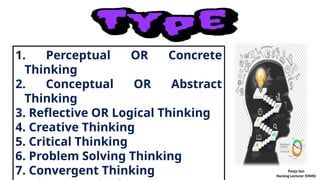
1. Perceptual OR Concrete
Thinking
2. Conceptual OR Abstract
Thinking
3. Reflective OR Logical Thinking
4. Creative Thinking
5. Critical Thinking
6. Problem Solving Thinking
7. Convergent Thinking Pooja Sen
Nursing Lecturer (MHN)
1.PERCEPTUAL OR CONCRETE
THINKING –
• Perceptual thinking is the simplest form
of thinking.
• The basis of this type of thinking is
perception that is interpretation of
sensation according to one’s experience.
• It is also called as concrete thinking.
• Perceptual thinking is essential in early
development & learning.
Pooja Sen
Nursing Lecturer (MHN)
EXAMPLE – a child might follow traffic rules such as stopping red
light only because they see adults stopping or because someone told
them to.
Pooja Sen
Nursing Lecturer (MHN)
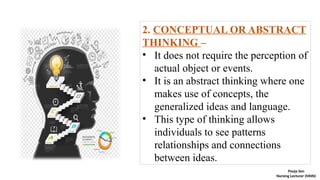
2. CONCEPTUAL OR ABSTRACT
THINKING –
• It does not require the perception of
actual object or events.
• It is an abstract thinking where one
makes use of concepts, the
generalized ideas and language.
• This type of thinking allows
individuals to see patterns
relationships and connections
between ideas.
Pooja Sen
Nursing Lecturer (MHN)
EXAMPLE- They might plan to save 20% of their income
monthly for retirement recognizing the long term values.
Pooja Sen
Nursing Lecturer (MHN)
3. REFLECTIVE THINKING OR
LOGICAL THINKING –
• Reflective thinking aims to solving
complex problems rather then simple
problems. It requires reorganization of
all the relevant experiences and finding
new ways of reacting to a situation.
• Mental activity in reflective Thinking
does not undergo any mechanical trial
and error type of effort.
Pooja Sen
Nursing Lecturer (MHN)
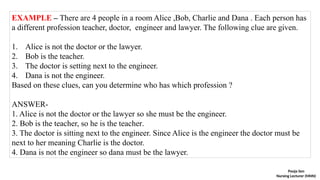
EXAMPLE – There are 4 people in a room Alice ,Bob, Charlie and Dana . Each person has
a different profession teacher, doctor, engineer and lawyer. The following clue are given.
1. Alice is not the doctor or the lawyer.
2. Bob is the teacher.
3. The doctor is setting next to the engineer.
4. Dana is not the engineer.
Based on these clues, can you determine who has which profession ?
ANSWER-
1. Alice is not the doctor or the lawyer so she must be the engineer.
2. Bob is the teacher, so he is the teacher.
3. The doctor is sitting next to the engineer. Since Alice is the engineer the doctor must be
next to her meaning Charlie is the doctor.
4. Dana is not the engineer so dana must be the lawyer.
Pooja Sen
Nursing Lecturer (MHN)
4. CREATIVE THINKING –
• Creative thinking is chiefly aimed at
creating something new .
• The individual himself usually
formulates the problems and is free
to collect evidence and invent tools
for its solutions.
• In other words cognitive activity
directed towards some creative work
refers to creative thinking.
Pooja Sen
Nursing Lecturer (MHN)
EXAMPLE – Painting Portrait, Composting a music , writing a
novel , Architectural design.
Pooja Sen
Nursing Lecturer (MHN)
5. CRITICAL THINKING –
• Critical thinking is a higher order well
disciplined thought process which
involves use of cognitive skills like
conceptualization , interpretation,
analysis and evaluation valid and
reliable judgement.
EXAMPLE - CPR at the time of
emergency situation .
Pooja Sen
Nursing Lecturer (MHN)
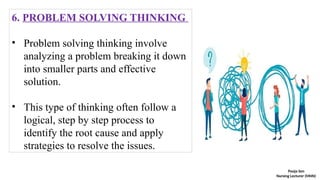
6. PROBLEM SOLVING THINKING
• Problem solving thinking involve
analyzing a problem breaking it down
into smaller parts and effective
solution.
• This type of thinking often follow a
logical, step by step process to
identify the root cause and apply
strategies to resolve the issues.
Pooja Sen
Nursing Lecturer (MHN)
EXAMPLE - A person is often late for work
in the mornings which causes stress and
affects productivity related throughout the
day.
Possible solution –
1. set alarm
2. Prepare clothes lunch and work materials
the night before to reduce morning tasks.
3. Create Morning routine.
4. Limit distractions in morning like
watching TV or checking phone.
Pooja Sen
Nursing Lecturer (MHN)
7. CONVERGENT THINKING
Convergent thinking focuses on finding a single, correct solution to a
problem. It involves narrowing down multiple ideas or possibilities to
find the most appropriate or correct answer.
EXAMPLE - Imagine you're solving a math problem like "What is
17 × 9?" The correct answer is 153, and convergent thinking would
lead you directly to this solution through logical steps.
Pooja Sen
Nursing Lecturer (MHN)
8. DIVERGENT THINKING
Divergent thinking involves exploring multiple possible solutions or
ideas in a creative, free-flowing way. It emphasizes thinking in many
different directions and generating multiple alternatives.
Pooja Sen
Nursing Lecturer (MHN)
EXAMPLE –
Task: Imagine your part of a team looking to improve mental health
and well-being for employees in a company. Instead of focusing on
one solution, you brainstorm multiple possible strategies.
• Flexible working hours to help employees balance work and
personal life.
• On-site meditation or yoga classes to reduce stress.
• Employee counseling programs, providing access to therapists or
support groups.
• Team-building activities such as group hikes or creative
workshops to encourage social interaction.
Pooja Sen
Nursing Lecturer (MHN)
NATURE
OF
THINKIN
G Pooja Sen
Nursing Lecturer (MHN)
1. It is essential
and important
type of cognitive
activity.
Pooja Sen
Nursing Lecturer (MHN)
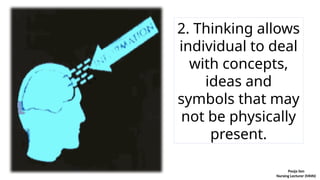
2. Thinking allows
individual to deal
with concepts,
ideas and
symbols that may
not be physically
present.
Pooja Sen
Nursing Lecturer (MHN)
3. Thinking
connects
different ideas ,
concepts and
memories.
Pooja Sen
Nursing Lecturer (MHN)
4. Thinking is
dynamic and
flexible type of
cognitive
function. It can
shift rapidly.
Pooja Sen
Nursing Lecturer (MHN)
5. It is
describe as
problem
solving
behaviour.
Pooja Sen
Nursing Lecturer (MHN)
6. Emotion or
society and
cultural practices
influenced the or
provide the shape
of thinking.
Pooja Sen
Nursing Lecturer (MHN)
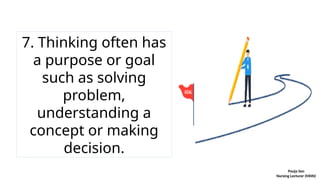
7. Thinking often has
a purpose or goal
such as solving
problem,
understanding a
concept or making
decision.
Pooja Sen
Nursing Lecturer (MHN)
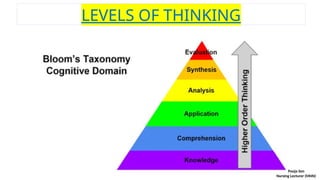
LEVELS OF THINKING
Pooja Sen
Nursing Lecturer (MHN)
1. KNOWLEDGE – Recalling memorized
information
Pooja Sen
Nursing Lecturer (MHN)
2. COPREHENSION – The ability to grasp
the meaning of material, translating or
interpreting information
3. APPLICATION – The ability to use
learned material in new & concrete
situations, applying rules methods &
concept.
Pooja Sen
Nursing Lecturer (MHN)
4. SYNTHESIS & ANALYSIS – The ability to
put parts together to form a new whole.
5. EVALUATION – The ability to judge the
value of material for given purpose.
Pooja Sen
Nursing Lecturer (MHN)
Pooja Sen
Nursing Lecturer (MHN)

THINKING ITS TYPES WITH EXAMPLE & ITS LEVELS.pptx

  • 1.
  • 2.
    Thinking is alsoknown as cognition, refers to the ability to process information, hold attention ,store & retrievals memories and select appropriate response & action. Pooja Sen Nursing Lecturer (MHN)
  • 3.
    1. ACCORDING TO WOODWORTH Thinking is a mental exploration for finding out the solution of the problems. 2. ACCORDING TO GILMER Thinking is a problem solving process, in which we use ideas or symbols in places of overt activity. Pooja Sen Nursing Lecturer (MHN)
  • 4.
    3. ACCORDING TO MAIER Thinkingis the perceptual relationship which provides for the solution of the problem. 4. ACCORDING TO MOHSIN “Thinking is an implicit problem solving behaviour”. Pooja Sen Nursing Lecturer (MHN)
  • 5.
    1. Perceptual ORConcrete Thinking 2. Conceptual OR Abstract Thinking 3. Reflective OR Logical Thinking 4. Creative Thinking 5. Critical Thinking 6. Problem Solving Thinking 7. Convergent Thinking Pooja Sen Nursing Lecturer (MHN)
  • 6.
    1.PERCEPTUAL OR CONCRETE THINKING– • Perceptual thinking is the simplest form of thinking. • The basis of this type of thinking is perception that is interpretation of sensation according to one’s experience. • It is also called as concrete thinking. • Perceptual thinking is essential in early development & learning. Pooja Sen Nursing Lecturer (MHN)
  • 7.
    EXAMPLE – achild might follow traffic rules such as stopping red light only because they see adults stopping or because someone told them to. Pooja Sen Nursing Lecturer (MHN)
  • 8.
    2. CONCEPTUAL ORABSTRACT THINKING – • It does not require the perception of actual object or events. • It is an abstract thinking where one makes use of concepts, the generalized ideas and language. • This type of thinking allows individuals to see patterns relationships and connections between ideas. Pooja Sen Nursing Lecturer (MHN)
  • 9.
    EXAMPLE- They mightplan to save 20% of their income monthly for retirement recognizing the long term values. Pooja Sen Nursing Lecturer (MHN)
  • 10.
    3. REFLECTIVE THINKINGOR LOGICAL THINKING – • Reflective thinking aims to solving complex problems rather then simple problems. It requires reorganization of all the relevant experiences and finding new ways of reacting to a situation. • Mental activity in reflective Thinking does not undergo any mechanical trial and error type of effort. Pooja Sen Nursing Lecturer (MHN)
  • 11.
    EXAMPLE – Thereare 4 people in a room Alice ,Bob, Charlie and Dana . Each person has a different profession teacher, doctor, engineer and lawyer. The following clue are given. 1. Alice is not the doctor or the lawyer. 2. Bob is the teacher. 3. The doctor is setting next to the engineer. 4. Dana is not the engineer. Based on these clues, can you determine who has which profession ? ANSWER- 1. Alice is not the doctor or the lawyer so she must be the engineer. 2. Bob is the teacher, so he is the teacher. 3. The doctor is sitting next to the engineer. Since Alice is the engineer the doctor must be next to her meaning Charlie is the doctor. 4. Dana is not the engineer so dana must be the lawyer. Pooja Sen Nursing Lecturer (MHN)
  • 12.
    4. CREATIVE THINKING– • Creative thinking is chiefly aimed at creating something new . • The individual himself usually formulates the problems and is free to collect evidence and invent tools for its solutions. • In other words cognitive activity directed towards some creative work refers to creative thinking. Pooja Sen Nursing Lecturer (MHN)
  • 13.
    EXAMPLE – PaintingPortrait, Composting a music , writing a novel , Architectural design. Pooja Sen Nursing Lecturer (MHN)
  • 14.
    5. CRITICAL THINKING– • Critical thinking is a higher order well disciplined thought process which involves use of cognitive skills like conceptualization , interpretation, analysis and evaluation valid and reliable judgement. EXAMPLE - CPR at the time of emergency situation . Pooja Sen Nursing Lecturer (MHN)
  • 15.
    6. PROBLEM SOLVINGTHINKING • Problem solving thinking involve analyzing a problem breaking it down into smaller parts and effective solution. • This type of thinking often follow a logical, step by step process to identify the root cause and apply strategies to resolve the issues. Pooja Sen Nursing Lecturer (MHN)
  • 16.
    EXAMPLE - Aperson is often late for work in the mornings which causes stress and affects productivity related throughout the day. Possible solution – 1. set alarm 2. Prepare clothes lunch and work materials the night before to reduce morning tasks. 3. Create Morning routine. 4. Limit distractions in morning like watching TV or checking phone. Pooja Sen Nursing Lecturer (MHN)
  • 17.
    7. CONVERGENT THINKING Convergentthinking focuses on finding a single, correct solution to a problem. It involves narrowing down multiple ideas or possibilities to find the most appropriate or correct answer. EXAMPLE - Imagine you're solving a math problem like "What is 17 × 9?" The correct answer is 153, and convergent thinking would lead you directly to this solution through logical steps. Pooja Sen Nursing Lecturer (MHN)
  • 18.
    8. DIVERGENT THINKING Divergentthinking involves exploring multiple possible solutions or ideas in a creative, free-flowing way. It emphasizes thinking in many different directions and generating multiple alternatives. Pooja Sen Nursing Lecturer (MHN)
  • 19.
    EXAMPLE – Task: Imagineyour part of a team looking to improve mental health and well-being for employees in a company. Instead of focusing on one solution, you brainstorm multiple possible strategies. • Flexible working hours to help employees balance work and personal life. • On-site meditation or yoga classes to reduce stress. • Employee counseling programs, providing access to therapists or support groups. • Team-building activities such as group hikes or creative workshops to encourage social interaction. Pooja Sen Nursing Lecturer (MHN)
  • 20.
  • 21.
    1. It isessential and important type of cognitive activity. Pooja Sen Nursing Lecturer (MHN)
  • 22.
    2. Thinking allows individualto deal with concepts, ideas and symbols that may not be physically present. Pooja Sen Nursing Lecturer (MHN)
  • 23.
    3. Thinking connects different ideas, concepts and memories. Pooja Sen Nursing Lecturer (MHN)
  • 24.
    4. Thinking is dynamicand flexible type of cognitive function. It can shift rapidly. Pooja Sen Nursing Lecturer (MHN)
  • 25.
    5. It is describeas problem solving behaviour. Pooja Sen Nursing Lecturer (MHN)
  • 26.
    6. Emotion or societyand cultural practices influenced the or provide the shape of thinking. Pooja Sen Nursing Lecturer (MHN)
  • 27.
    7. Thinking oftenhas a purpose or goal such as solving problem, understanding a concept or making decision. Pooja Sen Nursing Lecturer (MHN)
  • 28.
    LEVELS OF THINKING PoojaSen Nursing Lecturer (MHN)
  • 29.
    1. KNOWLEDGE –Recalling memorized information Pooja Sen Nursing Lecturer (MHN) 2. COPREHENSION – The ability to grasp the meaning of material, translating or interpreting information
  • 30.
    3. APPLICATION –The ability to use learned material in new & concrete situations, applying rules methods & concept. Pooja Sen Nursing Lecturer (MHN) 4. SYNTHESIS & ANALYSIS – The ability to put parts together to form a new whole.
  • 31.
    5. EVALUATION –The ability to judge the value of material for given purpose. Pooja Sen Nursing Lecturer (MHN)
  • 32.