VALUES
A Value isa beliefs about the worth of something. It is
the importance a person attached to various endeavors
such as amount of time, passion & money you devote to
relationship, work study, fitness activities etc.
A person's values influence beliefs about human needs,
health and illness the practice of health behavior and
human response to illness.
MS. POOJA SEN
NURSING LECTURER(MHN)
3.
VALUES IN NURSING
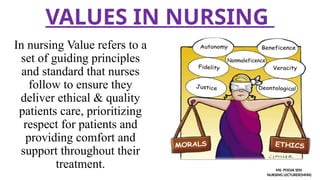
Innursing Value refers to a
set of guiding principles
and standard that nurses
follow to ensure they
deliver ethical & quality
patients care, prioritizing
respect for patients and
providing comfort and
support throughout their
treatment. MS. POOJA SEN
NURSING LECTURER(MHN)
4.
DEVELOPMENT OF VALUES
Nobodyis born with values rather values are formed
during a lifetime from information available in the
environment, family & culture. A child observe the
action of others & quickly learns what has high and
low value for family members
MS. POOJA SEN
NURSING LECTURER(MHN)
5.
DEVELOPMENT OF VALUES
Thecommon modes of development of values are…..
Modeling
Moralizing
Laissez Faire
Rewarding & Punishing
Responsible Choice
MS. POOJA SEN
NURSING LECTURER(MHN)
6.
DEVELOPMENT OF VALUES
1.Modeling: Learning values by observing the behavior of others,
particularly role models.
Example: A child learns generosity by watching their parents'
volunteer.
2. Moralizing: Teaching values through direct instruction about right
and wrong.
Example: A teacher explains the importance of honesty to students.
3. Laissez-Faire: Allowing individuals to develop values
independently, with minimal guidance or interference.
Example: A teacher gives students the freedom to choose their own
projects, fostering responsibility.
MS. POOJA SEN
NURSING LECTURER(MHN)
7.
DEVELOPMENT OF VALUES
MS.POOJA SEN
NURSING LECTURER(MHN)
4. Rewarding & Punishing: Reinforcing behaviors by rewarding
good actions and punishing undesirable ones.
Example: A parent rewards a child for finishing homework on time,
reinforcing responsibility.
5. Responsible Choice: Encouraging individuals to make decisions
and learn from the consequences, fostering self-reflection and
accountability.
Example: A student chooses between two research projects, learning
to make responsible choices.
8.
VALUES ESSENTIAL IN
PROFESSIONALNURSING
In order to encourage health care professional to respect & accept the
individuality of the patients. Some educators have advised that
professional be value neutral of nonjudgmental in their professional role.
The nurse does not assume that her personal values are right and should
not judge the patients values as right or wrong depending on his/her
congruence with the personal value system. This encourages effective
care for patients with personal values system. This encourages effective
care foe patients with values different from the nurses.
MS. POOJA SEN
NURSING LECTURER(MHN)
9.
VALUES ESSENTIAL IN
PROFESSIONALNURSING
In 1998 the American Association of colleges for
nursing identified 5 values that epitomize the caring.
These professional values provides the foundation for
nursing practice & guide the nurses interactions with
patients, colleagues and public
MS. POOJA SEN
NURSING LECTURER(MHN)
1. ALTRUISM
Definition: Altruismin nursing refers to selflessly caring for patients
without expecting anything in return. It involves putting the needs of others
before your own, especially in times of vulnerability or distress.
Example: A nurse staying after their shift to ensure that a critically ill
patient is comfortable and well-cared for, even though the nurse is
exhausted, demonstrates altruism. They act out of a deep sense of duty and
compassion, prioritizing the patient’s well-being.
MS. POOJA SEN
NURSING LECTURER(MHN)
12.
2. AUTONOMY
Definition: Autonomyrefers to respecting a patient’s right to make
their own decisions about their healthcare, including the right to
refuse treatment or choose among treatment options. It recognizes the
individual’s capacity to make informed choices.
Example: A nurse educating a patient about different pain
management options and fully supporting the patient's decision to
either proceed with an option or choose to delay treatment, even if the
nurse believes an immediate intervention is necessary. This respects
the patient's right to make decisions about their care.
MS. POOJA SEN
NURSING LECTURER(MHN)
13.
3. HUMAN DIGNITY
Definition:Human dignity means treating each patient with respect
and recognizing their inherent worth as individuals. It involves
providing care in a manner that acknowledges the patient’s uniqueness
and maintaining their privacy and self-esteem.
Example: A nurse ensures that a patient is properly covered when
assisting with personal hygiene and always asks for consent before
performing procedures, thereby preserving the patient's dignity. This
would be important in cases such as assisting a patient with
undressing for a procedure or managing their intimate needs.
MS. POOJA SEN
NURSING LECTURER(MHN)
14.
4. INTEGRITY
Definition: Integrityin nursing refers to being honest, ethical, and
transparent in all actions. It involves practicing what you preach,
being truthful in-patient care, and upholding high moral standards.
Example: If a nurse accidentally administers the wrong dosage of a
medication, they report it immediately to the healthcare team and take
integrity because it shows honesty and a commitment to Appropriate
steps to ensure patient safety. This action accountability.
MS. POOJA SEN
NURSING LECTURER(MHN)
15.
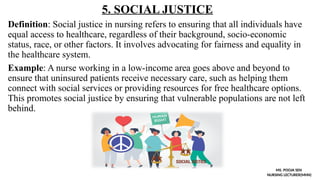
5. SOCIAL JUSTICE
Definition:Social justice in nursing refers to ensuring that all individuals have
equal access to healthcare, regardless of their background, socio-economic
status, race, or other factors. It involves advocating for fairness and equality in
the healthcare system.
Example: A nurse working in a low-income area goes above and beyond to
ensure that uninsured patients receive necessary care, such as helping them
connect with social services or providing resources for free healthcare options.
This promotes social justice by ensuring that vulnerable populations are not left
behind.
MS. POOJA SEN
NURSING LECTURER(MHN)
16.
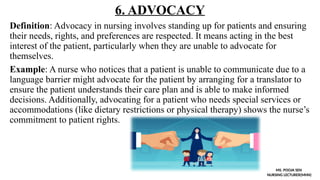
6. ADVOCACY
Definition: Advocacyin nursing involves standing up for patients and ensuring
their needs, rights, and preferences are respected. It means acting in the best
interest of the patient, particularly when they are unable to advocate for
themselves.
Example: A nurse who notices that a patient is unable to communicate due to a
language barrier might advocate for the patient by arranging for a translator to
ensure the patient understands their care plan and is able to make informed
decisions. Additionally, advocating for a patient who needs special services or
accommodations (like dietary restrictions or physical therapy) shows the nurse’s
commitment to patient rights.
MS. POOJA SEN
NURSING LECTURER(MHN)