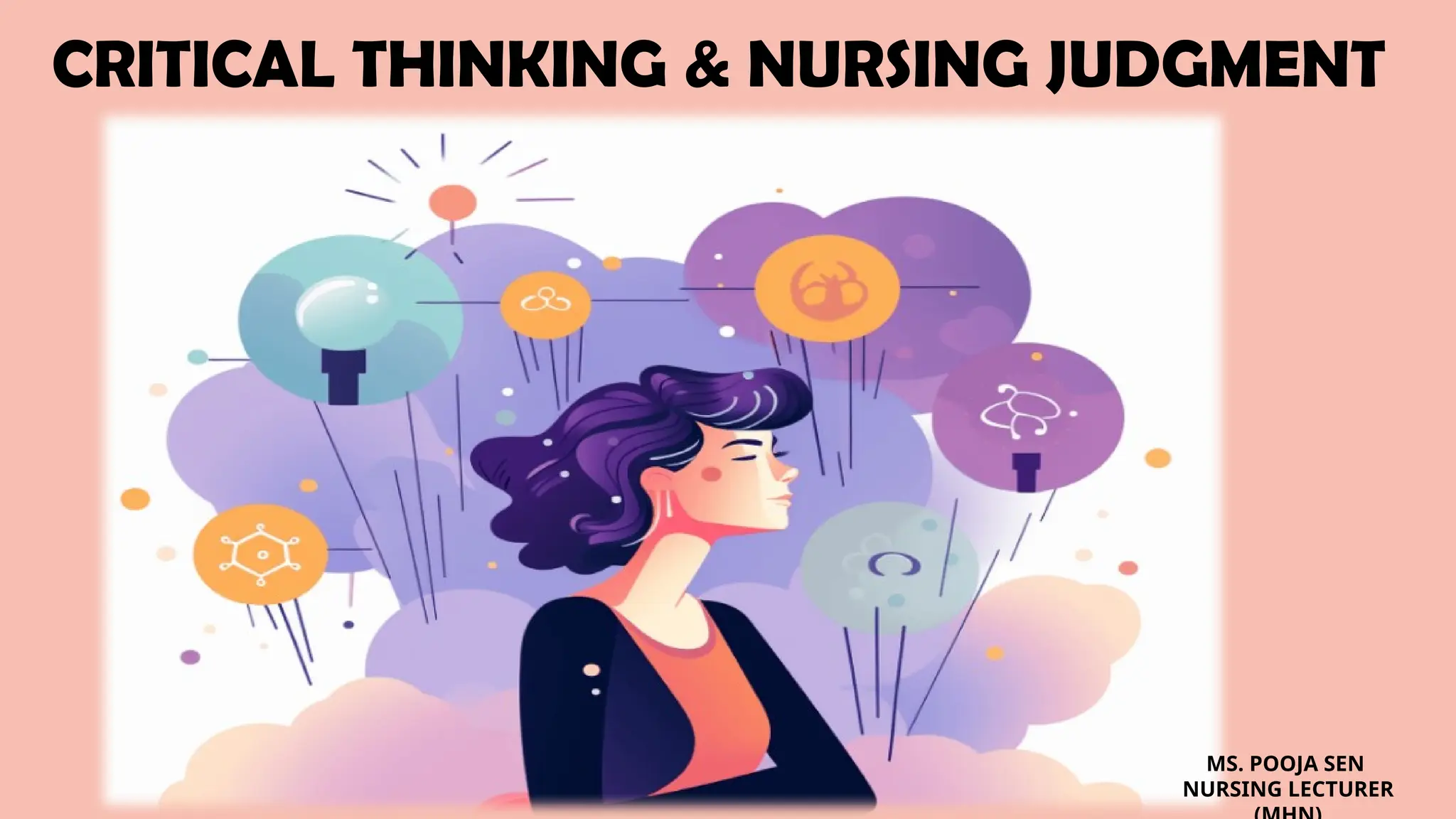
CRITICAL THINKING & NURSING JUDGMENT
MS. POOJA SEN
NURSING LECTURER
INTRODUCTION
Every day all of us utilize
critical thinking in our lives,
which helps us in facing the
realities or tough situations in
our lives. Critical thinking is
directed, purposeful, mental
activity by which ideas are
evaluated, plans are constructed
and desired outcome are
decided.
MS. POOJA SEN
NURSING LECTURER (MHN)
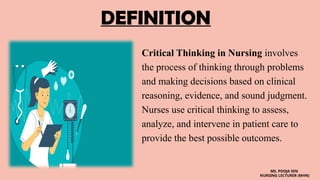
DEFINITION
Critical Thinking in Nursing involves
the process of thinking through problems
and making decisions based on clinical
reasoning, evidence, and sound judgment.
Nurses use critical thinking to assess,
analyze, and intervene in patient care to
provide the best possible outcomes.
MS. POOJA SEN
NURSING LECTURER (MHN)
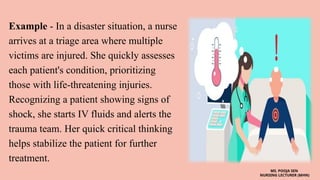
Example - In a disaster situation, a nurse
arrives at a triage area where multiple
victims are injured. She quickly assesses
each patient's condition, prioritizing
those with life-threatening injuries.
Recognizing a patient showing signs of
shock, she starts IV fluids and alerts the
trauma team. Her quick critical thinking
helps stabilize the patient for further
treatment.
MS. POOJA SEN
NURSING LECTURER (MHN)
SKILLS FOR CRITICAL THINKING
Critical Thinking involves a variety of skills, which are...
♥ Reading Skills
♥ Writing Skills
♥ Alternative Listening
♥ Effective Communication
MS. POOJA SEN
NURSING LECTURER (MHN)
Many more skills and attributes
found in the critical thinker are
ability to……….
 Separate relevant or irrelevant
data gathered.
 Recognize inconsistencies in
data gathered.
 Recognize one’s own bias &
limitation.
 Be persistent in seeking
solution. MS. POOJA SEN
NURSING LECTURER (MHN)
 Identify missing information.
 Consider all possibilities.
 Use an organized & systematic
approach to problems.
 Set priorities and make careful
decision.
 Be flexible, realistic, humble,
honest and insightful. MS. POOJA SEN
NURSING LECTURER (MHN)
LEVELS OF CRITICAL THINKING
The level of critical thinking grows as new knowledge is gained. According
to Kataoka – Yahiro & Saylor (1994)
critical thinking model has three level……………..
 Basic Critical Thinking
 Complex Critical Thinking
 Commitment
MS. POOJA SEN
NURSING LECTURER (MHN)
LEVELS OF CRITICAL THINKING
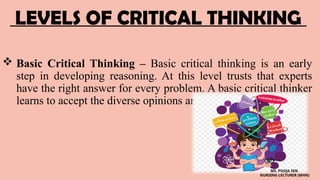
 Basic Critical Thinking – Basic critical thinking is an early
step in developing reasoning. At this level trusts that experts
have the right answer for every problem. A basic critical thinker
learns to accept the diverse opinions and values of experts.
MS. POOJA SEN
NURSING LECTURER (MHN)
LEVELS OF CRITICAL THINKING
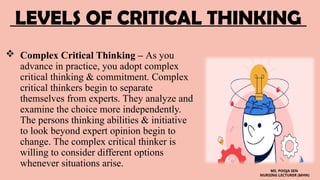
 Complex Critical Thinking – As you
advance in practice, you adopt complex
critical thinking & commitment. Complex
critical thinkers begin to separate
themselves from experts. They analyze and
examine the choice more independently.
The persons thinking abilities & initiative
to look beyond expert opinion begin to
change. The complex critical thinker is
willing to consider different options
whenever situations arise.
MS. POOJA SEN
NURSING LECTURER (MHN)
LEVELS OF CRITICAL THINKING
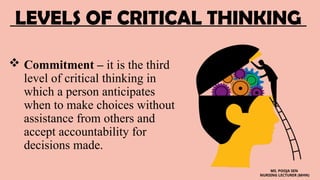
 Commitment – it is the third
level of critical thinking in
which a person anticipates
when to make choices without
assistance from others and
accept accountability for
decisions made.
MS. POOJA SEN
NURSING LECTURER (MHN)
ATTITUDES FOR CRITICAL THINKING
Critical thinking attitude comprises the
guidelines for how to approach a problem
or decision making situation. An
important part of critical thinking is
interpreting, evaluating and making
judgment about the adequacy of various
argument & available data. Knowing
when you need more information,
knowing when information is misleading
and recognizing your own knowledge
limits, are the example of how critical
thinking attitudes guides decision making.
MS. POOJA SEN
NURSING LECTURER (MHN)
1. Confidence – when you are confident,
you feel certain about accomplishing a task
or goal. It grows with experience.
When you are not confident in carrying out
certain tasks, you became anxious about
not knowing what to do. This prevents you
from giving attention to patients. When
you show confidence, your patients
recognize it & it helps in building trust in
your patients.
MS. POOJA SEN
NURSING LECTURER (MHN)
2. Thinking Independently – It
helps you to challenge the ways
others think & looks for rational
& logical answer to problems.
When nurses ask question and
look for the evidence behind
clinical problems, they are
thinking independently. This is an
important steps in evidence-based
practice.
MS. POOJA SEN
NURSING LECTURER (MHN)
3. Fairness – A critical thinking deals with situations without bias.
Look the situations objectively and consider all viewpoints to
understand the situation completely before making a decisions.
MS. POOJA SEN
NURSING LECTURER (MHN)
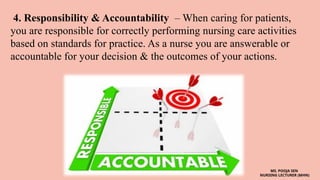
4. Responsibility & Accountability – When caring for patients,
you are responsible for correctly performing nursing care activities
based on standards for practice. As a nurse you are answerable or
accountable for your decision & the outcomes of your actions.
MS. POOJA SEN
NURSING LECTURER (MHN)
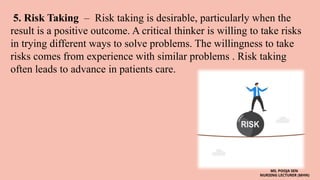
5. Risk Taking – Risk taking is desirable, particularly when the
result is a positive outcome. A critical thinker is willing to take risks
in trying different ways to solve problems. The willingness to take
risks comes from experience with similar problems . Risk taking
often leads to advance in patients care.
MS. POOJA SEN
NURSING LECTURER (MHN)
6. Discipline – A disciplined thinker misses few details & follow an
orderly or systematic approach when collecting information, making
decisions, or taking action. Being disciplined helps the nurse to
identify problems more accurately and select the most appropriate
interventions.
MS. POOJA SEN
NURSING LECTURER (MHN)
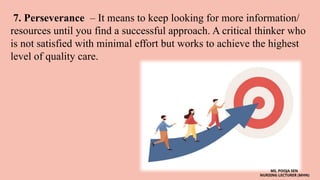
7. Perseverance – It means to keep looking for more information/
resources until you find a successful approach. A critical thinker who
is not satisfied with minimal effort but works to achieve the highest
level of quality care.
MS. POOJA SEN
NURSING LECTURER (MHN)
8. Creativity – It Creativity involves
original thinking . It motivates you to think
of options & unique approaches.
9. Curiosity – A critical thinker is favorite
question is why. Having a sense of curiosity
motivates to inquire further & investigate a
critical situations to get all the information
you need to make a desions.
MS. POOJA SEN
NURSING LECTURER (MHN)
10. Integrity – A person of integrity is honest and willing to admit
mistakes or inconsistences inn her own behavior, ideas and beliefs.
Your personal integrity as a nurse builds trust from your co – worker.
MS. POOJA SEN
NURSING LECTURER (MHN)
11. Humility – A critical thinker admits to any limitations in his/her
knowledge or skill. A nurse may be expert to one area of clinical
practice but a novices in another. There for it is important for
patients' safety & welfare, that you must admit your inability to deal
with a practical problems.
MS. POOJA SEN
NURSING LECTURER (MHN)
CRITICAL THINKING IN NURSING
Critical thinking is applied to setting priorities for patients care. Priorities setting
involves placing nursing diagnosis or nursing interventions in order of importance.
• Life threating problems are of high priority.
• Problem that threaten health or coping abilities are of medium priority.
• Low priority problems.
Priorities constantly change because patients need and conditions change
frequently. Critical thinking helps nurses to mange each patients care scientifically.
MS. POOJA SEN
NURSING LECTURER (MHN)

CRITICAL THINKING AND NURSING JUDGEMENT.pptx

  • 1.
    CRITICAL THINKING &NURSING JUDGMENT MS. POOJA SEN NURSING LECTURER
  • 2.
    INTRODUCTION Every day allof us utilize critical thinking in our lives, which helps us in facing the realities or tough situations in our lives. Critical thinking is directed, purposeful, mental activity by which ideas are evaluated, plans are constructed and desired outcome are decided. MS. POOJA SEN NURSING LECTURER (MHN)

  • 3.
    DEFINITION Critical Thinking inNursing involves the process of thinking through problems and making decisions based on clinical reasoning, evidence, and sound judgment. Nurses use critical thinking to assess, analyze, and intervene in patient care to provide the best possible outcomes. MS. POOJA SEN NURSING LECTURER (MHN)
  • 4.
    Example - Ina disaster situation, a nurse arrives at a triage area where multiple victims are injured. She quickly assesses each patient's condition, prioritizing those with life-threatening injuries. Recognizing a patient showing signs of shock, she starts IV fluids and alerts the trauma team. Her quick critical thinking helps stabilize the patient for further treatment. MS. POOJA SEN NURSING LECTURER (MHN)
  • 5.
    SKILLS FOR CRITICALTHINKING Critical Thinking involves a variety of skills, which are... ♥ Reading Skills ♥ Writing Skills ♥ Alternative Listening ♥ Effective Communication MS. POOJA SEN NURSING LECTURER (MHN)
  • 6.
    Many more skillsand attributes found in the critical thinker are ability to……….  Separate relevant or irrelevant data gathered.  Recognize inconsistencies in data gathered.  Recognize one’s own bias & limitation.  Be persistent in seeking solution. MS. POOJA SEN NURSING LECTURER (MHN)
  • 7.
     Identify missinginformation.  Consider all possibilities.  Use an organized & systematic approach to problems.  Set priorities and make careful decision.  Be flexible, realistic, humble, honest and insightful. MS. POOJA SEN NURSING LECTURER (MHN)
  • 8.
    LEVELS OF CRITICALTHINKING The level of critical thinking grows as new knowledge is gained. According to Kataoka – Yahiro & Saylor (1994) critical thinking model has three level……………..  Basic Critical Thinking  Complex Critical Thinking  Commitment MS. POOJA SEN NURSING LECTURER (MHN)
  • 9.
    LEVELS OF CRITICALTHINKING  Basic Critical Thinking – Basic critical thinking is an early step in developing reasoning. At this level trusts that experts have the right answer for every problem. A basic critical thinker learns to accept the diverse opinions and values of experts. MS. POOJA SEN NURSING LECTURER (MHN)
  • 10.
    LEVELS OF CRITICALTHINKING  Complex Critical Thinking – As you advance in practice, you adopt complex critical thinking & commitment. Complex critical thinkers begin to separate themselves from experts. They analyze and examine the choice more independently. The persons thinking abilities & initiative to look beyond expert opinion begin to change. The complex critical thinker is willing to consider different options whenever situations arise. MS. POOJA SEN NURSING LECTURER (MHN)
  • 11.
    LEVELS OF CRITICALTHINKING  Commitment – it is the third level of critical thinking in which a person anticipates when to make choices without assistance from others and accept accountability for decisions made. MS. POOJA SEN NURSING LECTURER (MHN)
  • 12.
    ATTITUDES FOR CRITICALTHINKING Critical thinking attitude comprises the guidelines for how to approach a problem or decision making situation. An important part of critical thinking is interpreting, evaluating and making judgment about the adequacy of various argument & available data. Knowing when you need more information, knowing when information is misleading and recognizing your own knowledge limits, are the example of how critical thinking attitudes guides decision making. MS. POOJA SEN NURSING LECTURER (MHN)
  • 13.
    1. Confidence –when you are confident, you feel certain about accomplishing a task or goal. It grows with experience. When you are not confident in carrying out certain tasks, you became anxious about not knowing what to do. This prevents you from giving attention to patients. When you show confidence, your patients recognize it & it helps in building trust in your patients. MS. POOJA SEN NURSING LECTURER (MHN)
  • 14.
    2. Thinking Independently– It helps you to challenge the ways others think & looks for rational & logical answer to problems. When nurses ask question and look for the evidence behind clinical problems, they are thinking independently. This is an important steps in evidence-based practice. MS. POOJA SEN NURSING LECTURER (MHN)
  • 15.
    3. Fairness –A critical thinking deals with situations without bias. Look the situations objectively and consider all viewpoints to understand the situation completely before making a decisions. MS. POOJA SEN NURSING LECTURER (MHN)
  • 16.
    4. Responsibility &Accountability – When caring for patients, you are responsible for correctly performing nursing care activities based on standards for practice. As a nurse you are answerable or accountable for your decision & the outcomes of your actions. MS. POOJA SEN NURSING LECTURER (MHN)
  • 17.
    5. Risk Taking– Risk taking is desirable, particularly when the result is a positive outcome. A critical thinker is willing to take risks in trying different ways to solve problems. The willingness to take risks comes from experience with similar problems . Risk taking often leads to advance in patients care. MS. POOJA SEN NURSING LECTURER (MHN)
  • 18.
    6. Discipline –A disciplined thinker misses few details & follow an orderly or systematic approach when collecting information, making decisions, or taking action. Being disciplined helps the nurse to identify problems more accurately and select the most appropriate interventions. MS. POOJA SEN NURSING LECTURER (MHN)
  • 19.
    7. Perseverance –It means to keep looking for more information/ resources until you find a successful approach. A critical thinker who is not satisfied with minimal effort but works to achieve the highest level of quality care. MS. POOJA SEN NURSING LECTURER (MHN)
  • 20.
    8. Creativity –It Creativity involves original thinking . It motivates you to think of options & unique approaches. 9. Curiosity – A critical thinker is favorite question is why. Having a sense of curiosity motivates to inquire further & investigate a critical situations to get all the information you need to make a desions. MS. POOJA SEN NURSING LECTURER (MHN)
  • 21.
    10. Integrity –A person of integrity is honest and willing to admit mistakes or inconsistences inn her own behavior, ideas and beliefs. Your personal integrity as a nurse builds trust from your co – worker. MS. POOJA SEN NURSING LECTURER (MHN)

  • 22.
    11. Humility –A critical thinker admits to any limitations in his/her knowledge or skill. A nurse may be expert to one area of clinical practice but a novices in another. There for it is important for patients' safety & welfare, that you must admit your inability to deal with a practical problems. MS. POOJA SEN NURSING LECTURER (MHN)
  • 23.
    CRITICAL THINKING INNURSING Critical thinking is applied to setting priorities for patients care. Priorities setting involves placing nursing diagnosis or nursing interventions in order of importance. • Life threating problems are of high priority. • Problem that threaten health or coping abilities are of medium priority. • Low priority problems. Priorities constantly change because patients need and conditions change frequently. Critical thinking helps nurses to mange each patients care scientifically. MS. POOJA SEN NURSING LECTURER (MHN)