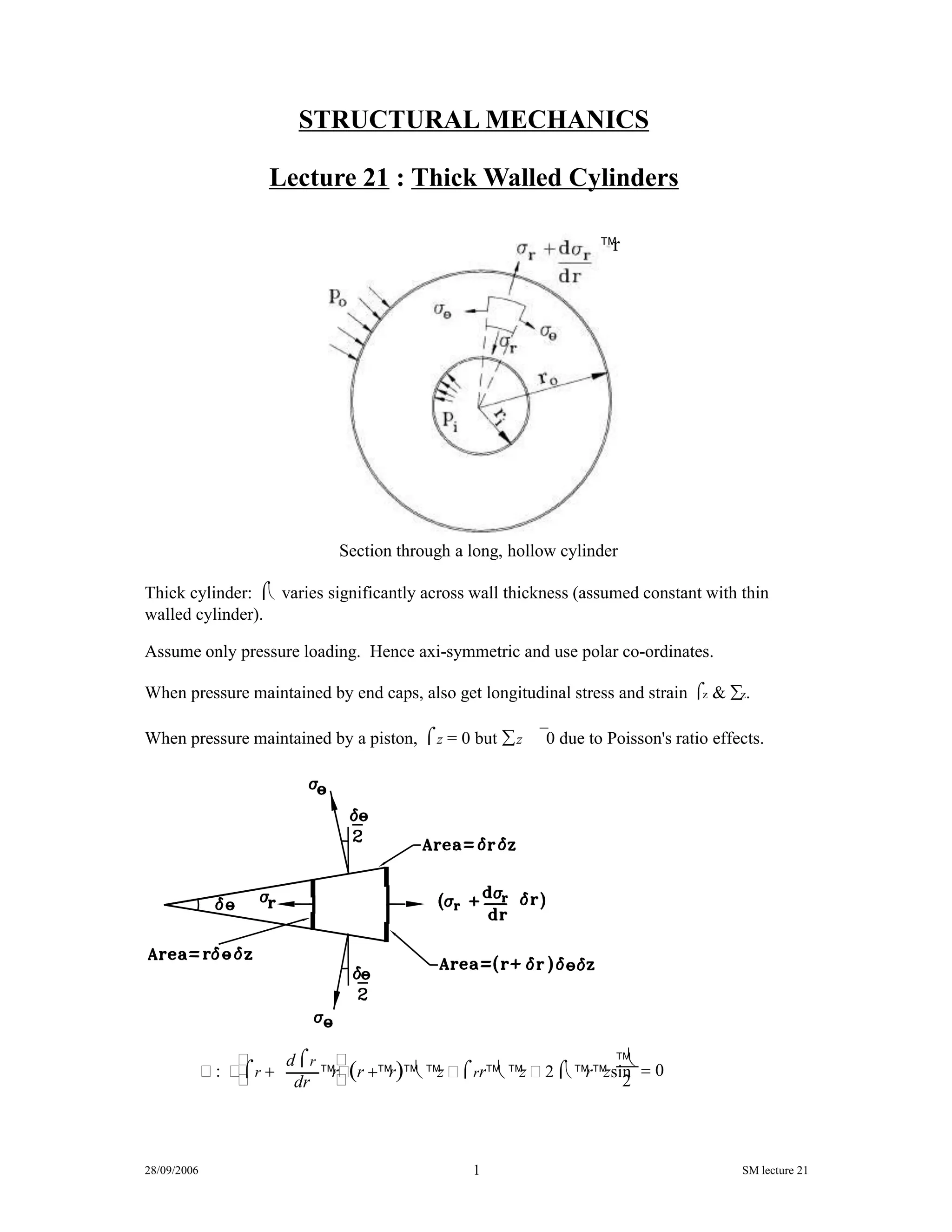
 : r + r(r +r) z rr z  2 rzsin
28/09/2006 1 SM lecture 21




dr
dr

2
= 0
STRUCTURAL MECHANICS
Lecture 21 : Thick Walled Cylinders
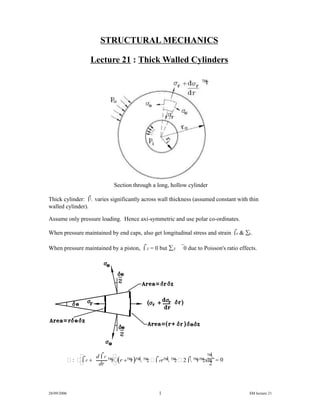
r
Section through a long, hollow cylinder
Thick cylinder:  varies significantly across wall thickness (assumed constant with thin
walled cylinder).
Assume only pressure loading. Hence axi-symmetric and use polar co-ordinates.
When pressure maintained by end caps, also get longitudinal stress and strain z & z.
When pressure maintained by a piston, z = 0 but z  0 due to Poisson's ratio effects.
r  u
z 
28/09/2006 2 SM lecture 21
In the limit sin

2

2
= and we get
r
dr
dr
+r  = 0
du
dr
r
du
dr
r =
u +
= (2)
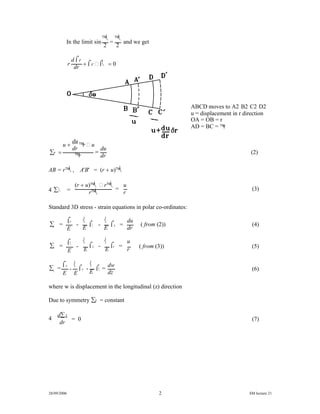
AB = r , A'B' = (r + u)
=  =
(r + u)  r
r
u
r
(3)
Standard 3D stress - strain equations in polar co-ordinates:
 =r
 =
-
-
r
E

E

E

E

E

E
du
dr
u
r
 -
z -
z =
r =
( from (2))
( from (3))
(4)
(5)
-
dw
dzE E
 =

E
r - =z
(6)
where w is displacement in the longitudinal (z) direction
Due to symmetry z = constant

dz
dr
= 0 (7)
ABCD moves to A B C D
u = displacement in r direction
OA = OB = r
AD = BC = r
ro i r2
(pi o i o 2 p )r r
r2(ro i r2)
(pi o i o 2 p )r r
ro i r
r2 pi ro
r2k 1r
ro i r2
r2 pi r2
28/09/2006 3 SM lecture 21
Using Eq. 1, 4, 5, 6, 7 it can be shown that (see standard texts):
r = A
B
r2
(8)
and  = A+
B
r2
(9)
where A and B are constants found from boundary conditions.
If pi and po are the internal and external applied pressures, then from Eq. 8:
pi = A
B
ri2
(10)
and po = A
B
ro 2
(11)
Note: -pi and -po because compressive (-ve) stresses.
Eq. 10 & 11 can be solved for A and B, which can then be substituted back into Eq. 8 & 9
giving:
2
r =
 =
-
+
2
piri2  poro
2
piri2  poro
ro 2  ri2
2
2
2
r2(ro 2 ri2)
(12)
(13)
Eq. 12 & 13 are known as Lame's equations, first derived in 1833.
In the special case when the external pressure is atmospheric and can be considered to be
negligible compared with the internal pressure, then:
r = )
pi i r2
2 2
(1 o ) = (1
2 2
(14)
 =
piri2
2
(1+ o ) =
r2 k2 1
(1+ o )
r2
(15)
where k = ro/ri
Note: both r and  are a max at inner surface (r = ri).
r0  ri
k 1
28/09/2006 4 SM lecture 21
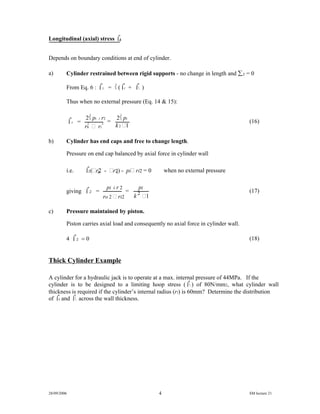
Longitudinal (axial) stress z
Depends on boundary conditions at end of cylinder.
a) Cylinder restrained between rigid supports - no change in length and z = 0
From Eq. 6 : z = (r +  )
Thus when no external pressure (Eq. 14 & 15):
z = =
2pi i r2
2 2
2pi
k2 1
(16)
b) Cylinder has end caps and free to change length.
Pressure on end cap balanced by axial force in cylinder wall
i.e. o iz(r2 - r2) - pi ri2 = 0 when no external pressure
giving z = =
pi
2
pi i r 2
ro 2  ri2
(17)
c) Pressure maintained by piston.
Piston carries axial load and consequently no axial force in cylinder wall.
 z = 0 (18)
Thick Cylinder Example
A cylinder for a hydraulic jack is to operate at a max. internal pressure of 44MPa. If the
cylinder is to be designed to a limiting hoop stress ( ) of 80N/mm2, what cylinder wall
thickness is required if the cylinder’s internal radius (ri) is 60mm? Determine the distribution
of r and  across the wall thickness.
Thank you for evaluating AnyBizSoft PDF to PowerPoint.
You can only convert 5 pages with the trial version.
To get all the pages converted, you need to purchase the software from:
http://www.anypdftools.com/buy/buy-pdf-to-powerpoint.html

thick cylinder

  • 1.
     : r+ r(r +r) z rr z  2 rzsin 28/09/2006 1 SM lecture 21     dr dr  2 = 0 STRUCTURAL MECHANICS Lecture 21 : Thick Walled Cylinders r Section through a long, hollow cylinder Thick cylinder:  varies significantly across wall thickness (assumed constant with thin walled cylinder). Assume only pressure loading. Hence axi-symmetric and use polar co-ordinates. When pressure maintained by end caps, also get longitudinal stress and strain z & z. When pressure maintained by a piston, z = 0 but z  0 due to Poisson's ratio effects.
  • 2.
    r  u z 28/09/2006 2 SM lecture 21 In the limit sin  2  2 = and we get r dr dr +r  = 0 du dr r du dr r = u + = (2) AB = r , A'B' = (r + u) =  = (r + u)  r r u r (3) Standard 3D stress - strain equations in polar co-ordinates:  =r  = - - r E  E  E  E  E  E du dr u r  - z - z = r = ( from (2)) ( from (3)) (4) (5) - dw dzE E  =  E r - =z (6) where w is displacement in the longitudinal (z) direction Due to symmetry z = constant  dz dr = 0 (7) ABCD moves to A B C D u = displacement in r direction OA = OB = r AD = BC = r
  • 3.
    ro i r2 (pio i o 2 p )r r r2(ro i r2) (pi o i o 2 p )r r ro i r r2 pi ro r2k 1r ro i r2 r2 pi r2 28/09/2006 3 SM lecture 21 Using Eq. 1, 4, 5, 6, 7 it can be shown that (see standard texts): r = A B r2 (8) and  = A+ B r2 (9) where A and B are constants found from boundary conditions. If pi and po are the internal and external applied pressures, then from Eq. 8: pi = A B ri2 (10) and po = A B ro 2 (11) Note: -pi and -po because compressive (-ve) stresses. Eq. 10 & 11 can be solved for A and B, which can then be substituted back into Eq. 8 & 9 giving: 2 r =  = - + 2 piri2  poro 2 piri2  poro ro 2  ri2 2 2 2 r2(ro 2 ri2) (12) (13) Eq. 12 & 13 are known as Lame's equations, first derived in 1833. In the special case when the external pressure is atmospheric and can be considered to be negligible compared with the internal pressure, then: r = ) pi i r2 2 2 (1 o ) = (1 2 2 (14)  = piri2 2 (1+ o ) = r2 k2 1 (1+ o ) r2 (15) where k = ro/ri Note: both r and  are a max at inner surface (r = ri).
  • 4.
    r0  ri k1 28/09/2006 4 SM lecture 21 Longitudinal (axial) stress z Depends on boundary conditions at end of cylinder. a) Cylinder restrained between rigid supports - no change in length and z = 0 From Eq. 6 : z = (r +  ) Thus when no external pressure (Eq. 14 & 15): z = = 2pi i r2 2 2 2pi k2 1 (16) b) Cylinder has end caps and free to change length. Pressure on end cap balanced by axial force in cylinder wall i.e. o iz(r2 - r2) - pi ri2 = 0 when no external pressure giving z = = pi 2 pi i r 2 ro 2  ri2 (17) c) Pressure maintained by piston. Piston carries axial load and consequently no axial force in cylinder wall.  z = 0 (18) Thick Cylinder Example A cylinder for a hydraulic jack is to operate at a max. internal pressure of 44MPa. If the cylinder is to be designed to a limiting hoop stress ( ) of 80N/mm2, what cylinder wall thickness is required if the cylinder’s internal radius (ri) is 60mm? Determine the distribution of r and  across the wall thickness.
  • 5.
    Thank you forevaluating AnyBizSoft PDF to PowerPoint. You can only convert 5 pages with the trial version. To get all the pages converted, you need to purchase the software from: http://www.anypdftools.com/buy/buy-pdf-to-powerpoint.html