BY
K.CHANDRAN, TECH:SUPDT:[P],
IIHTKANNUR.
Eco friendly dyeing process and
eco- labeling
The meaning of ecofriendlyness?
The objects of
1.limiting the use of harmful products in textiles
2.minimising pollution in air, water, and land
during production and usage of textiles……..
For effecting this objectives govt: of india through
an extraordinary gazette notification dated 26-3-97
has banned certain dyes and chemicals containing
21 amines in india…….and afterwards this
discussion started.
Requirements for ecofriendlyness
Absence of banned amines or amine releasing
agents in textiles.
Very low levels of [such as below 30ppm] of
formaldehyde in different uses in textiles.
Absence of chlorinated compounds.
Extremely low levels of heavy metals such as
mercury,cadmium,copper,nickel,cobalt,arsenic,lea
d, chromium etc:
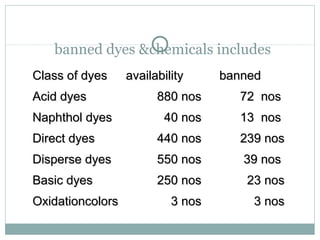
banned dyes &chemicals includes
Class of dyesClass of dyes availabilityavailability bannedbanned
Acid dyesAcid dyes 880 nos880 nos 72 nos72 nos
Naphthol dyesNaphthol dyes 40 nos40 nos 13 nos13 nos
Direct dyesDirect dyes 440 nos440 nos 239 nos239 nos
Disperse dyesDisperse dyes 550 nos550 nos 39 nos39 nos
Basic dyesBasic dyes 250 nos250 nos 23 nos23 nos
OxidationcolorsOxidationcolors 3 nos3 nos 3 nos3 nos
List of chemicals
Chlorinated compounds
Formaldehyde
Sodium sulphide
Penta chlorophenol[pcp]
Dibutyl phthalate
Tributyl phosphate
Nonyphenol ethoxylate
Dichloro toluene
Trichloro benzene
DDT, ALDRIN,DIALDRIN,ENDRIN ETC:
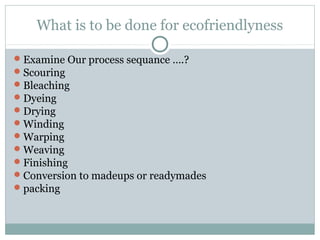
What is to be done for ecofriendlyness
Examine Our process sequance ….?
Scouring
Bleaching
Dyeing
Drying
Winding
Warping
Weaving
Finishing
Conversion to madeups or readymades
packing
scouring
This is the process of removing chemical
impurities from the raw material-the yarn
Conventionally we do it with boiling yarn using
caustic soda+soda ash+soap oil[or any detergent]
in vomitting kiers.
This increases BOD,COD levels of effluent water
If enzyme scouring is used this problem can be
avoided.protease,pectinase,lipase etc: are
examples.
Scourenz SBWB is such a product from rossari
bleaching
Normally we do it with bleaching powder-that is
calcium hypochlorite- is a redlisted chemicals
Better solution is to use hydrogen peroxide method
in bleaching.
In absence of neutralisation sometimes it gives
patchy shades in subsequant dyeing
It increases TDS level of effluent water also.
So may be incorporate a neutralisation process
using an enzyme peroxide killer-for example the
ULTROX EPN 50 of rossari.
dyeing
Eventhough many dye classes such as direct,basic,
naphthols,sulphur etc are available in industry we
are using only the most ecofriendly dyes of vat &
reactive dyes in our textiles.
So basically on dyeing process we are not having
problems related with finished products
But what about the effluents coming out?
Reactive dyes
 Have a tendancy to hydrolyse during dyeing and as a result it bleeds in
subsequant washings.
 It produces water insoluble colour producing compounds in drainouts
thereby aggrevating the effluent problems
 Enzymes like laccases,ligninperoxidases,manganeseperoxidases etc:
has a property to destroy colour producing compounds
 and so if such enzymes are used in washing off reactive dyed materials
under 55-60 C temp: it will improve fastness as well as leaves rinse bath
clear .
 Alongwith prescribed effluent treatment plant will ensure
ecofriendlyness.
sizing
Sizing process is carried out here only very small
quantity because of our product range and its
limitations.
In our conventional sizing only biodegradable
materials are used.
But if the dothy and saree warps are sourced from
outside it should ensure not to use PCP in size
mixture which is added as a preservative.
Finishing
Normally it is outsourced. printing, softening,
wrinkle free, fire retardancy, anti-microbial,
stainguard and such finishes are done.
Most red listed chemicals are to be used in this
sector.
Care should be taken to ensure to use safe
chemicals.
Enzymatic treatments are available in most cases
such as biopolishing, print washing and other
finishings.
packing
Plastic materials are on the rise in consumer
packaging. It should be avoided as far as possible.
Many alternative packaging materials are available
having biodegradables and to minimise
plastics.alternate production strategies are also to be
adopted such as conversion of inhouse waste into
packages as done by m/s aysha hosiery.
Eco labels
Eco labels are used to guarantee to consumer an
ecofriendly product and to distinguish the
product from normal product in a positive way.
It also refers to a products collective overall
environmental performance in the lifecycle of
that product.
It also ensures that the manufacturing process of
that product has been made environment
friendly.
Reasons for ecology concerns for textile industry
1.various demands from consumer origin organizations
regarding environmental issues.
2. growing influences of environmental organizations in
consumers mindset driven by environmental issues.
3.growth in market share achieved by ecofriendly
products.
4.initiative taken by some research institutions in
addressing health and environment issues faced by
people.
5.initiative taken by governments in developed nations
in adopting environmental protection policy.
Eco-labelling in India
A voluntary scheme of labeling environmentally
friendly products has been introduced by ministry of
environment & forests , govt: of India and the bureau
of Indian standards.
The ECOMARK scheme covers products which are
manufactured , used, or disposed of in an
environmentally way.
Criteria for labeling textiles as environmentally
friendly products have been specified in gazette
notification no . 157,may 4th
, 1996.
Major criteria for eco-labeling
Levels of pH.
Low permissible levels of formaldehyde.
Restriction on use of certain pesticides.
Extremely low levels of some heavy metals.
Prohibition on pentachlorophenol [PCP].
Absence of chlorinated , aliphatic/aromatic
compounds.
Absence of azo dyes which can liberate any one of
the 21 banned arylamines listed by German govt:
Types of eco labels
There are two types of ecolabeling demands from
consumers point of view.
1. ecological and biological textiles [that is fully
natural textiles].
2. ecologically optimized textile products [green
products].
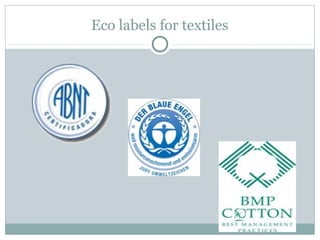
Eco labels for textiles
Eco labels
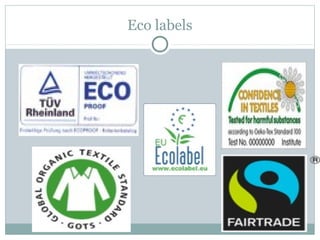
Eco labels
Thank you and
Let us thrive for the best in attaining ecofriendlyness
in our industry and get the “ ECOMARK”.

Ecofriedly dyeing process and ecolabels

  • 1.
  • 2.
    The meaning ofecofriendlyness? The objects of 1.limiting the use of harmful products in textiles 2.minimising pollution in air, water, and land during production and usage of textiles…….. For effecting this objectives govt: of india through an extraordinary gazette notification dated 26-3-97 has banned certain dyes and chemicals containing 21 amines in india…….and afterwards this discussion started.
  • 3.
    Requirements for ecofriendlyness Absenceof banned amines or amine releasing agents in textiles. Very low levels of [such as below 30ppm] of formaldehyde in different uses in textiles. Absence of chlorinated compounds. Extremely low levels of heavy metals such as mercury,cadmium,copper,nickel,cobalt,arsenic,lea d, chromium etc:
  • 4.
    banned dyes &chemicalsincludes Class of dyesClass of dyes availabilityavailability bannedbanned Acid dyesAcid dyes 880 nos880 nos 72 nos72 nos Naphthol dyesNaphthol dyes 40 nos40 nos 13 nos13 nos Direct dyesDirect dyes 440 nos440 nos 239 nos239 nos Disperse dyesDisperse dyes 550 nos550 nos 39 nos39 nos Basic dyesBasic dyes 250 nos250 nos 23 nos23 nos OxidationcolorsOxidationcolors 3 nos3 nos 3 nos3 nos
  • 5.
    List of chemicals Chlorinatedcompounds Formaldehyde Sodium sulphide Penta chlorophenol[pcp] Dibutyl phthalate Tributyl phosphate Nonyphenol ethoxylate Dichloro toluene Trichloro benzene DDT, ALDRIN,DIALDRIN,ENDRIN ETC:
  • 6.
    What is tobe done for ecofriendlyness Examine Our process sequance ….? Scouring Bleaching Dyeing Drying Winding Warping Weaving Finishing Conversion to madeups or readymades packing
  • 7.
    scouring This is theprocess of removing chemical impurities from the raw material-the yarn Conventionally we do it with boiling yarn using caustic soda+soda ash+soap oil[or any detergent] in vomitting kiers. This increases BOD,COD levels of effluent water If enzyme scouring is used this problem can be avoided.protease,pectinase,lipase etc: are examples. Scourenz SBWB is such a product from rossari
  • 8.
    bleaching Normally we doit with bleaching powder-that is calcium hypochlorite- is a redlisted chemicals Better solution is to use hydrogen peroxide method in bleaching. In absence of neutralisation sometimes it gives patchy shades in subsequant dyeing It increases TDS level of effluent water also. So may be incorporate a neutralisation process using an enzyme peroxide killer-for example the ULTROX EPN 50 of rossari.
  • 9.
    dyeing Eventhough many dyeclasses such as direct,basic, naphthols,sulphur etc are available in industry we are using only the most ecofriendly dyes of vat & reactive dyes in our textiles. So basically on dyeing process we are not having problems related with finished products But what about the effluents coming out?
  • 10.
    Reactive dyes  Havea tendancy to hydrolyse during dyeing and as a result it bleeds in subsequant washings.  It produces water insoluble colour producing compounds in drainouts thereby aggrevating the effluent problems  Enzymes like laccases,ligninperoxidases,manganeseperoxidases etc: has a property to destroy colour producing compounds  and so if such enzymes are used in washing off reactive dyed materials under 55-60 C temp: it will improve fastness as well as leaves rinse bath clear .  Alongwith prescribed effluent treatment plant will ensure ecofriendlyness.
  • 11.
    sizing Sizing process iscarried out here only very small quantity because of our product range and its limitations. In our conventional sizing only biodegradable materials are used. But if the dothy and saree warps are sourced from outside it should ensure not to use PCP in size mixture which is added as a preservative.
  • 12.
    Finishing Normally it isoutsourced. printing, softening, wrinkle free, fire retardancy, anti-microbial, stainguard and such finishes are done. Most red listed chemicals are to be used in this sector. Care should be taken to ensure to use safe chemicals. Enzymatic treatments are available in most cases such as biopolishing, print washing and other finishings.
  • 13.
    packing Plastic materials areon the rise in consumer packaging. It should be avoided as far as possible. Many alternative packaging materials are available having biodegradables and to minimise plastics.alternate production strategies are also to be adopted such as conversion of inhouse waste into packages as done by m/s aysha hosiery.
  • 14.
    Eco labels Eco labelsare used to guarantee to consumer an ecofriendly product and to distinguish the product from normal product in a positive way. It also refers to a products collective overall environmental performance in the lifecycle of that product. It also ensures that the manufacturing process of that product has been made environment friendly.
  • 15.
    Reasons for ecologyconcerns for textile industry 1.various demands from consumer origin organizations regarding environmental issues. 2. growing influences of environmental organizations in consumers mindset driven by environmental issues. 3.growth in market share achieved by ecofriendly products. 4.initiative taken by some research institutions in addressing health and environment issues faced by people. 5.initiative taken by governments in developed nations in adopting environmental protection policy.
  • 16.
    Eco-labelling in India Avoluntary scheme of labeling environmentally friendly products has been introduced by ministry of environment & forests , govt: of India and the bureau of Indian standards. The ECOMARK scheme covers products which are manufactured , used, or disposed of in an environmentally way. Criteria for labeling textiles as environmentally friendly products have been specified in gazette notification no . 157,may 4th , 1996.
  • 17.
    Major criteria foreco-labeling Levels of pH. Low permissible levels of formaldehyde. Restriction on use of certain pesticides. Extremely low levels of some heavy metals. Prohibition on pentachlorophenol [PCP]. Absence of chlorinated , aliphatic/aromatic compounds. Absence of azo dyes which can liberate any one of the 21 banned arylamines listed by German govt:
  • 18.
    Types of ecolabels There are two types of ecolabeling demands from consumers point of view. 1. ecological and biological textiles [that is fully natural textiles]. 2. ecologically optimized textile products [green products].
  • 19.
  • 20.
  • 21.
  • 22.
    Thank you and Letus thrive for the best in attaining ecofriendlyness in our industry and get the “ ECOMARK”.