Thesis: Throughout history mankind in western civilization have used new inventions to make their lives easier.By Michael Fairchild
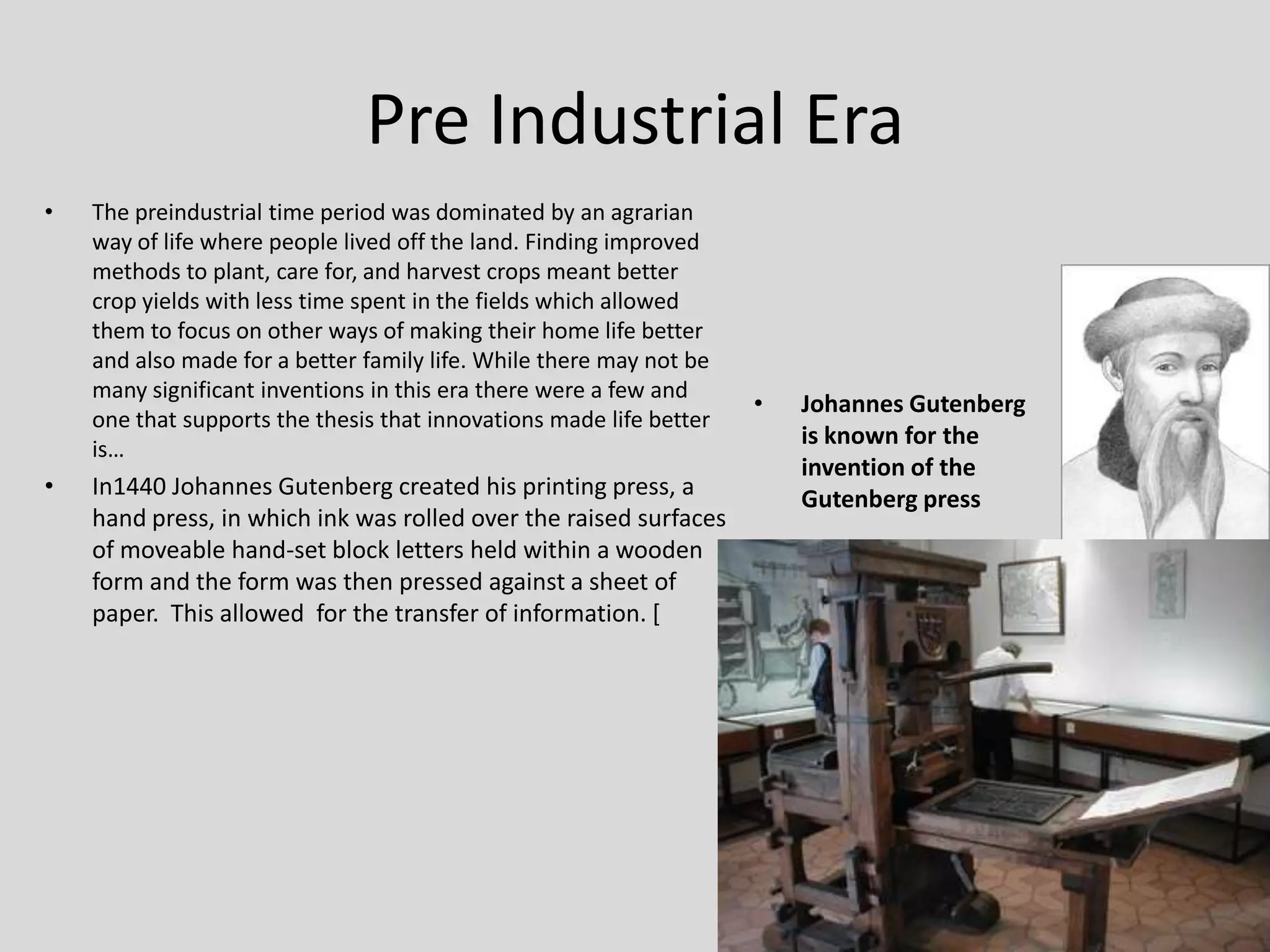
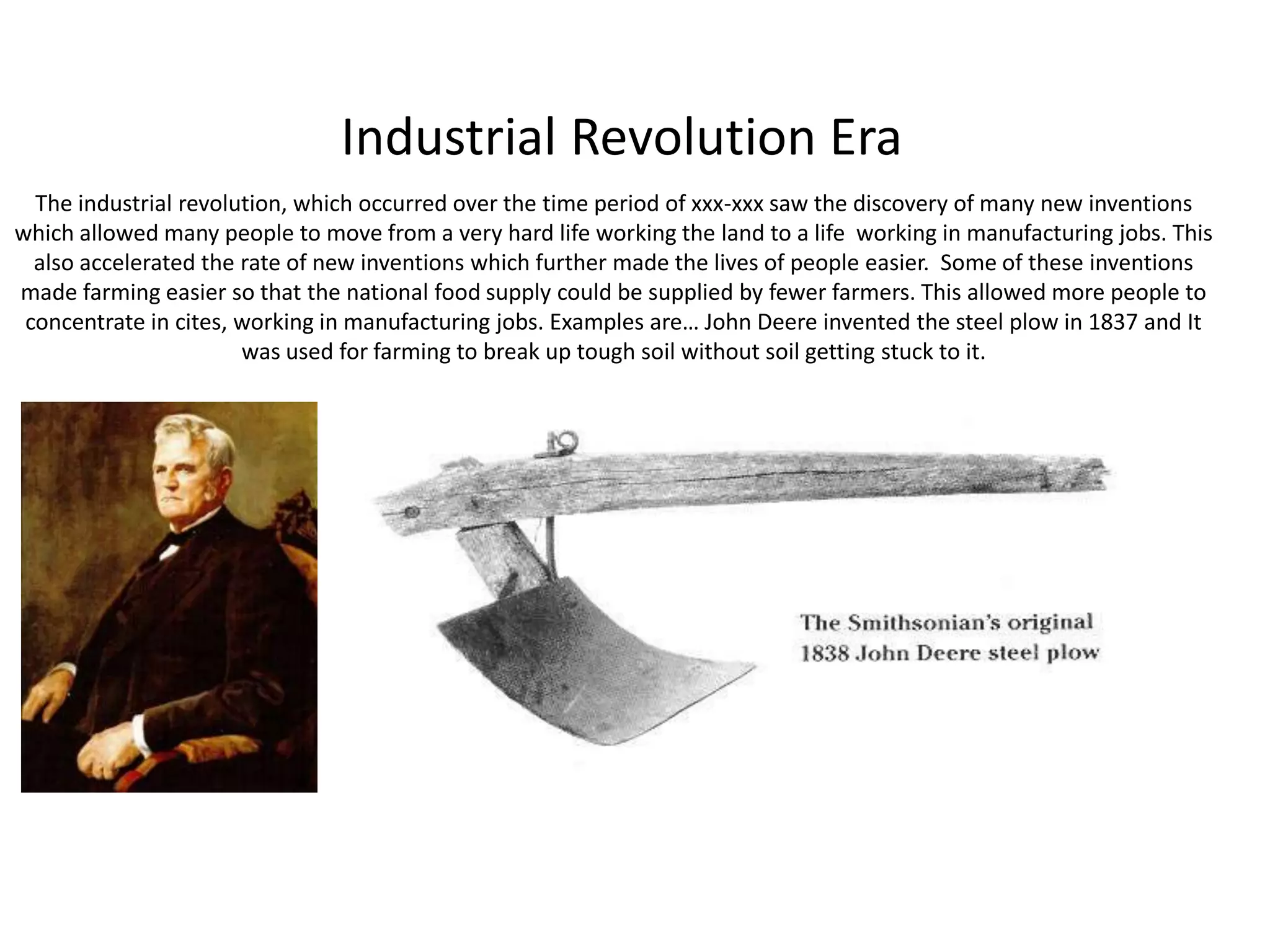
Pre Industrial EraThe preindustrial time period was dominated by an agrarian way of life where people lived off the land. Finding improved methods to plant, care for, and harvest crops meant better crop yields with less time spent in the fields which allowed them to focus on other ways of making their home life better and also made for a better family life. While there may not be many significant inventions in this era there were a few and one that supports the thesis that innovations made life better is…In1440 Johannes Gutenberg created his printing press, a hand press, in which ink was rolled over the raised surfaces of moveable hand-set block letters held within a wooden form and the form was then pressed against a sheet of paper.  This allowed  for the transfer of information. [Johannes Gutenberg is known for the invention of the Gutenberg pressIndustrial Revolution EraThe industrial revolution, which occurred over the time period of xxx-xxx saw the discovery of many new inventions which allowed many people to move from a very hard life working the land to a life  working in manufacturing jobs. This also accelerated the rate of new inventions which further made the lives of people easier.  Some of these inventions made farming easier so that the national food supply could be supplied by fewer farmers. This allowed more people to concentrate in cites, working in manufacturing jobs. Examples are… John Deere invented the steel plow in 1837 and It was used for farming to break up tough soil without soil getting stuck to it.
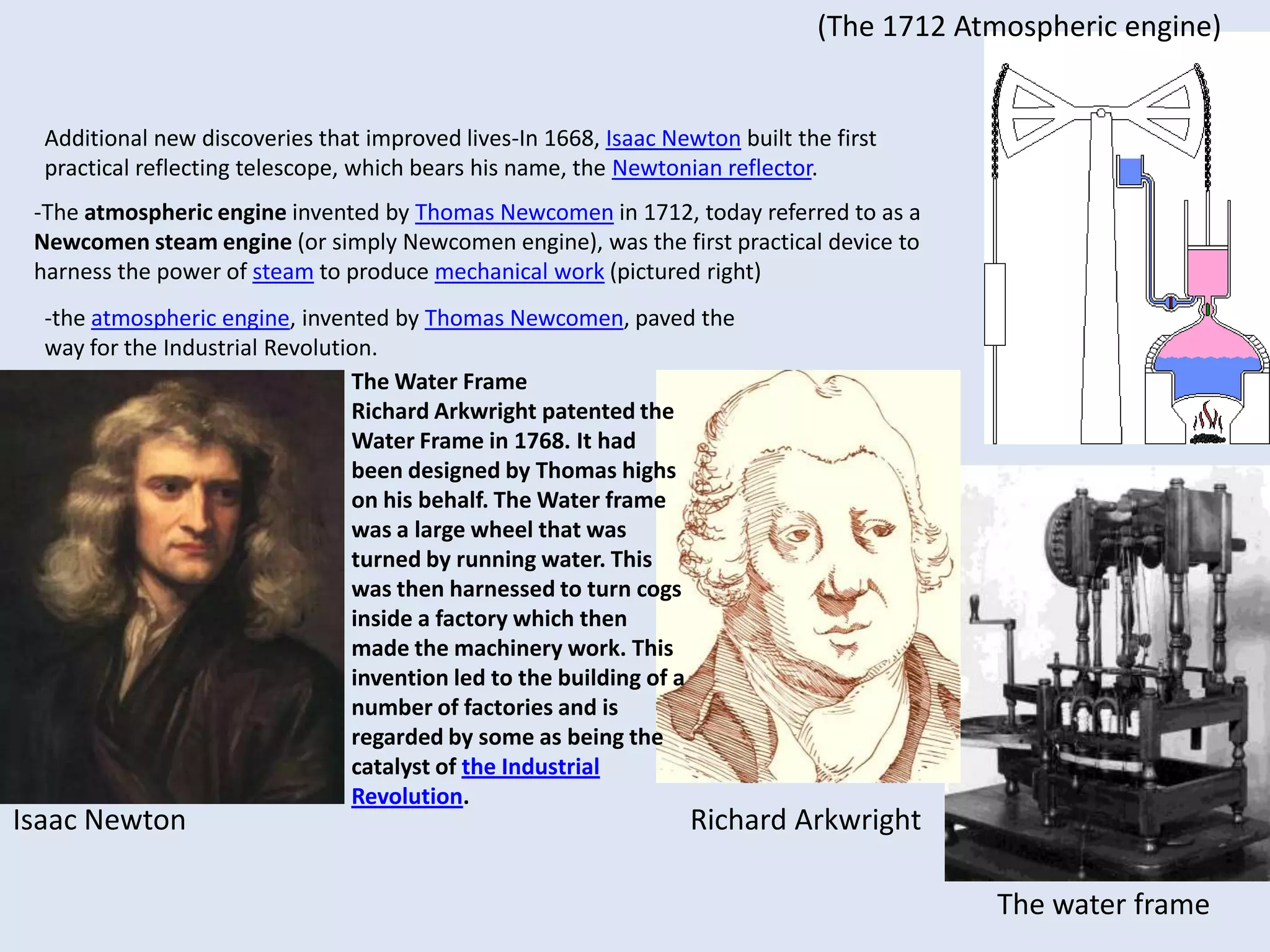
(The 1712 Atmospheric engine)Additional new discoveries that improved lives-In 1668, Isaac Newton built the first practical reflecting telescope, which bears his name, the Newtonian reflector.-The atmospheric engine invented by Thomas Newcomen in 1712, today referred to as a Newcomen steam engine (or simply Newcomen engine), was the first practical device to harness the power of steam to produce mechanical work (pictured right)-the atmospheric engine, invented by Thomas Newcomen, paved the way for the Industrial Revolution.The Water FrameRichard Arkwright patented the Water Frame in 1768. It had been designed by Thomas highs on his behalf. The Water frame was a large wheel that was turned by running water. This was then harnessed to turn cogs inside a factory which then made the machinery work. This invention led to the building of a number of factories and is regarded by some as being the catalyst of the Industrial Revolution.Richard ArkwrightIsaac NewtonThe water frame
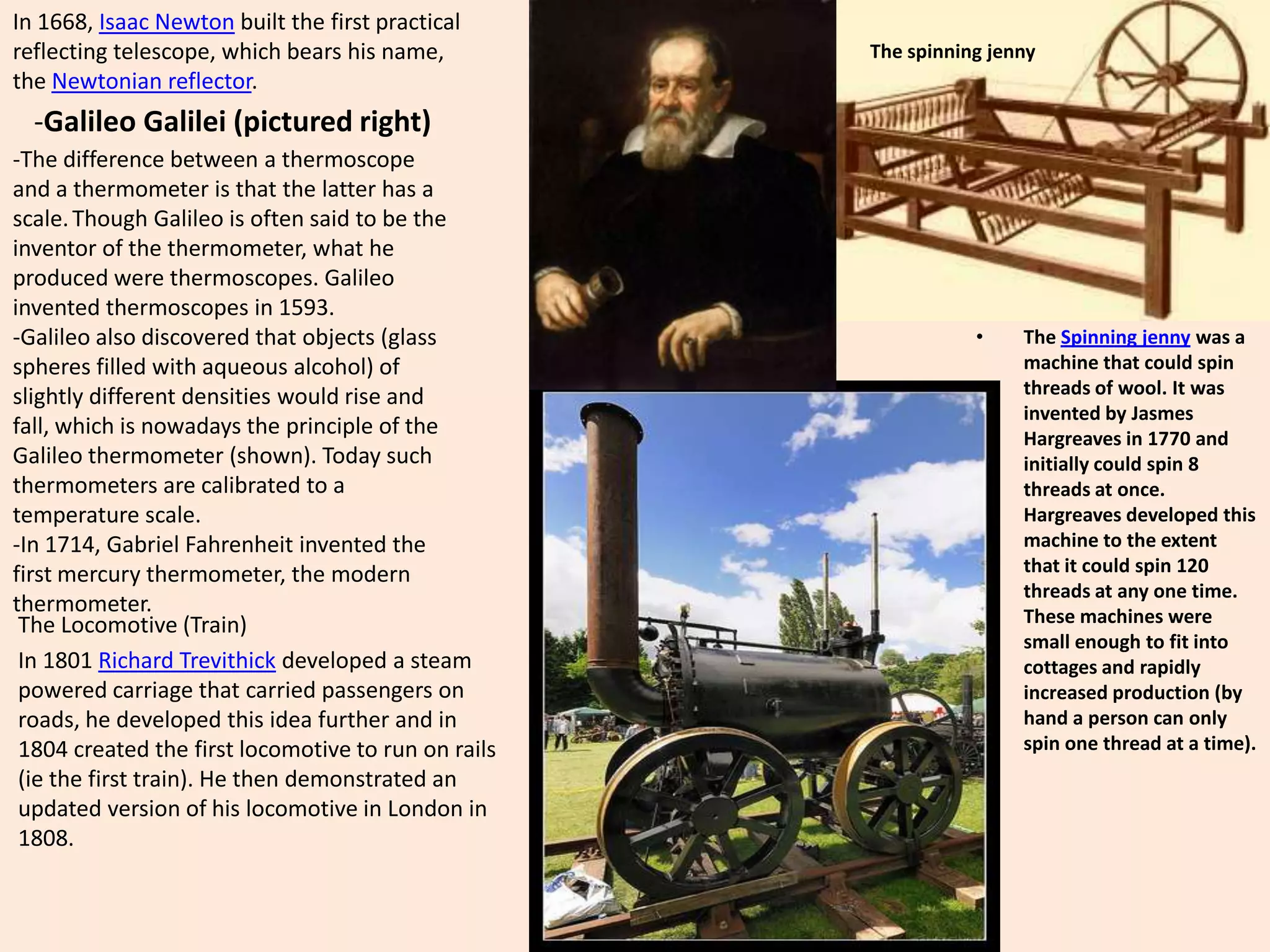
In 1668, Isaac Newton built the first practical reflecting telescope, which bears his name, the Newtonian reflector.The spinning jenny-Galileo Galilei (pictured right)-The difference between a thermoscope and a thermometer is that the latter has a scale.Though Galileo is often said to be the inventor of the thermometer, what he produced were thermoscopes. Galileo invented thermoscopes in 1593.-Galileo also discovered that objects (glass spheres filled with aqueous alcohol) of slightly different densities would rise and fall, which is nowadays the principle of the Galileo thermometer (shown). Today such thermometers are calibrated to a temperature scale. -In 1714, Gabriel Fahrenheit invented the first mercury thermometer, the modern thermometer. The Spinning jenny was a machine that could spin threads of wool. It was invented by JasmesHargreaves in 1770 and initially could spin 8 threads at once. Hargreaves developed this machine to the extent that it could spin 120 threads at any one time. These machines were small enough to fit into cottages and rapidly increased production (by hand a person can only spin one thread at a time).The Locomotive (Train)In 1801 Richard Trevithick developed a steam powered carriage that carried passengers on roads, he developed this idea further and in 1804 created the first locomotive to run on rails (ie the first train). He then demonstrated an updated version of his locomotive in London in 1808.
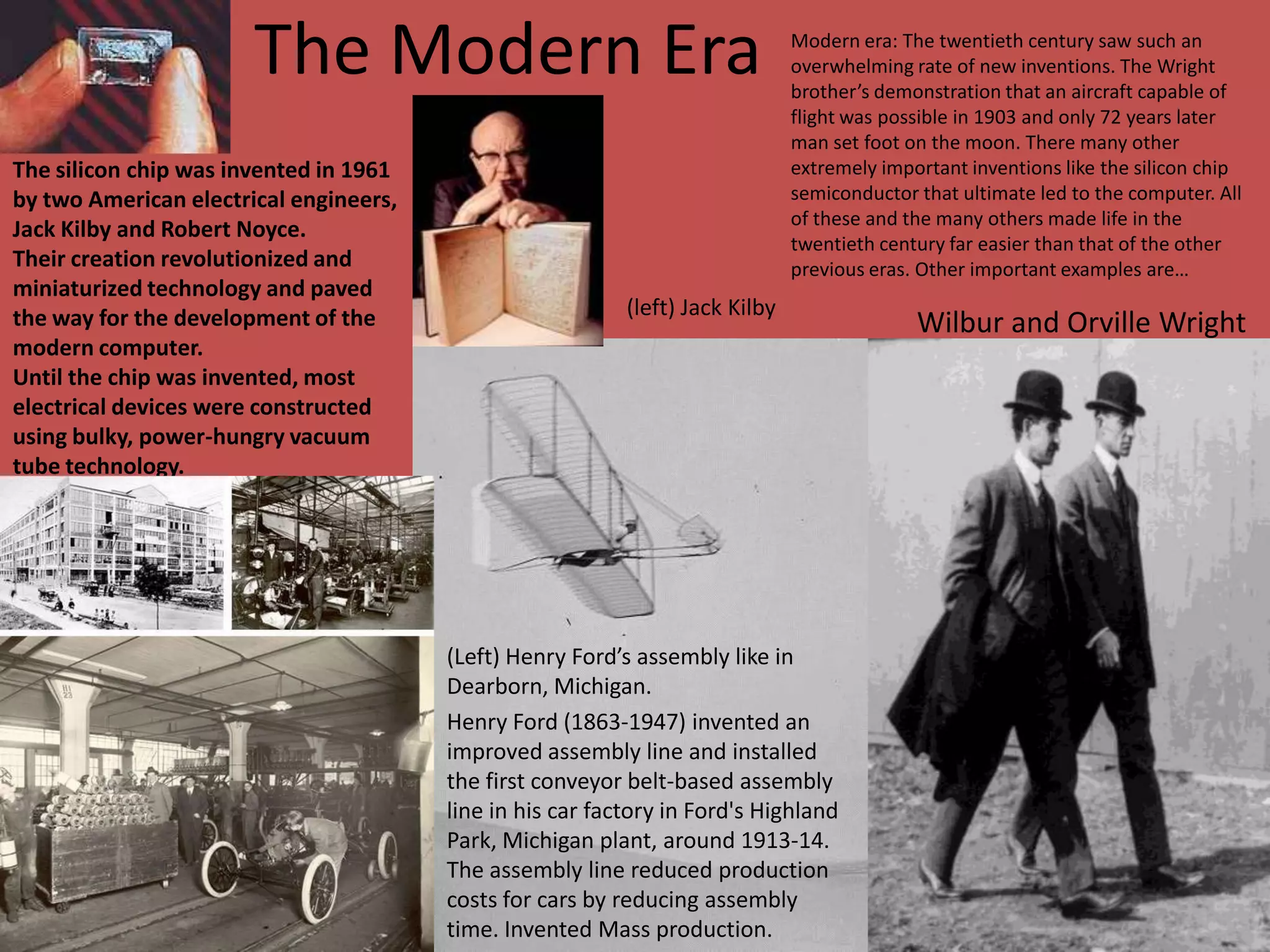
The Modern EraModern era: The twentieth century saw such an overwhelming rate of new inventions. The Wright brother’s demonstration that an aircraft capable of flight was possible in 1903 and only 72 years later man set foot on the moon. There many other extremely important inventions like the silicon chip semiconductor that ultimate led to the computer. All of these and the many others made life in the twentieth century far easier than that of the other previous eras. Other important examples are…The silicon chip was invented in 1961 by two American electrical engineers, Jack Kilby and Robert Noyce.Their creation revolutionized and miniaturized technology and paved the way for the development of the modern computer.Until the chip was invented, most electrical devices were constructed using bulky, power-hungry vacuum tube technology.(left) Jack KilbyWilbur and Orville Wright (Left) Henry Ford’s assembly like in Dearborn, Michigan.Henry Ford (1863-1947) invented an improved assembly line and installed the first conveyor belt-based assembly line in his car factory in Ford's Highland Park, Michigan plant, around 1913-14. The assembly line reduced production costs for cars by reducing assembly time. Invented Mass production.
Sources- Slide 2 sources- http://communication.ucsd.edu/bjones/Books/printech.htmlhttp://www.fecha.org/gutenbergbio.htmlhttp://www.ideafinder.com/history/inventions/printpress.htmhttp://en.wikipedia.org/wiki/Johannes_GutenbergSlide 3 sources-  http://inventors.about.com/library/inventors/bldeere.htmlhttp://www.antiquefarming.com/john-deere-history-1.htmlSlide 4 sources-  http://library.thinkquest.org/16541/eng/learn/library/content/arkwright.htm http://inventors.about.com/library/inventors/blsteamengine.htm http://www.teachersfirst.com/lessons/inventor/text2.htmSlide 5 sources- http://www.enchantedlearning.com/inventors/indexh.shtmlhttp://en.wikipedia.org/wiki/Galileo_Galileihttp://en.wikipedia.org/wiki/Spinning_jennySlide 6 sources-http://inventors.about.com/library/weekly/aacarsassemblya.htm  http://www.ideafinder.com/history/inventions/integratedcircuit.htm
Thesis

Thesis

  • 1.
    Thesis: Throughout historymankind in western civilization have used new inventions to make their lives easier.By Michael Fairchild
  • 2.
    Pre Industrial EraThepreindustrial time period was dominated by an agrarian way of life where people lived off the land. Finding improved methods to plant, care for, and harvest crops meant better crop yields with less time spent in the fields which allowed them to focus on other ways of making their home life better and also made for a better family life. While there may not be many significant inventions in this era there were a few and one that supports the thesis that innovations made life better is…In1440 Johannes Gutenberg created his printing press, a hand press, in which ink was rolled over the raised surfaces of moveable hand-set block letters held within a wooden form and the form was then pressed against a sheet of paper. This allowed for the transfer of information. [Johannes Gutenberg is known for the invention of the Gutenberg pressIndustrial Revolution EraThe industrial revolution, which occurred over the time period of xxx-xxx saw the discovery of many new inventions which allowed many people to move from a very hard life working the land to a life working in manufacturing jobs. This also accelerated the rate of new inventions which further made the lives of people easier. Some of these inventions made farming easier so that the national food supply could be supplied by fewer farmers. This allowed more people to concentrate in cites, working in manufacturing jobs. Examples are… John Deere invented the steel plow in 1837 and It was used for farming to break up tough soil without soil getting stuck to it.
  • 3.
    (The 1712 Atmosphericengine)Additional new discoveries that improved lives-In 1668, Isaac Newton built the first practical reflecting telescope, which bears his name, the Newtonian reflector.-The atmospheric engine invented by Thomas Newcomen in 1712, today referred to as a Newcomen steam engine (or simply Newcomen engine), was the first practical device to harness the power of steam to produce mechanical work (pictured right)-the atmospheric engine, invented by Thomas Newcomen, paved the way for the Industrial Revolution.The Water FrameRichard Arkwright patented the Water Frame in 1768. It had been designed by Thomas highs on his behalf. The Water frame was a large wheel that was turned by running water. This was then harnessed to turn cogs inside a factory which then made the machinery work. This invention led to the building of a number of factories and is regarded by some as being the catalyst of the Industrial Revolution.Richard ArkwrightIsaac NewtonThe water frame
  • 4.
    In 1668, IsaacNewton built the first practical reflecting telescope, which bears his name, the Newtonian reflector.The spinning jenny-Galileo Galilei (pictured right)-The difference between a thermoscope and a thermometer is that the latter has a scale.Though Galileo is often said to be the inventor of the thermometer, what he produced were thermoscopes. Galileo invented thermoscopes in 1593.-Galileo also discovered that objects (glass spheres filled with aqueous alcohol) of slightly different densities would rise and fall, which is nowadays the principle of the Galileo thermometer (shown). Today such thermometers are calibrated to a temperature scale. -In 1714, Gabriel Fahrenheit invented the first mercury thermometer, the modern thermometer. The Spinning jenny was a machine that could spin threads of wool. It was invented by JasmesHargreaves in 1770 and initially could spin 8 threads at once. Hargreaves developed this machine to the extent that it could spin 120 threads at any one time. These machines were small enough to fit into cottages and rapidly increased production (by hand a person can only spin one thread at a time).The Locomotive (Train)In 1801 Richard Trevithick developed a steam powered carriage that carried passengers on roads, he developed this idea further and in 1804 created the first locomotive to run on rails (ie the first train). He then demonstrated an updated version of his locomotive in London in 1808.
  • 5.
    The Modern EraModernera: The twentieth century saw such an overwhelming rate of new inventions. The Wright brother’s demonstration that an aircraft capable of flight was possible in 1903 and only 72 years later man set foot on the moon. There many other extremely important inventions like the silicon chip semiconductor that ultimate led to the computer. All of these and the many others made life in the twentieth century far easier than that of the other previous eras. Other important examples are…The silicon chip was invented in 1961 by two American electrical engineers, Jack Kilby and Robert Noyce.Their creation revolutionized and miniaturized technology and paved the way for the development of the modern computer.Until the chip was invented, most electrical devices were constructed using bulky, power-hungry vacuum tube technology.(left) Jack KilbyWilbur and Orville Wright (Left) Henry Ford’s assembly like in Dearborn, Michigan.Henry Ford (1863-1947) invented an improved assembly line and installed the first conveyor belt-based assembly line in his car factory in Ford's Highland Park, Michigan plant, around 1913-14. The assembly line reduced production costs for cars by reducing assembly time. Invented Mass production.
  • 6.
    Sources- Slide 2sources- http://communication.ucsd.edu/bjones/Books/printech.htmlhttp://www.fecha.org/gutenbergbio.htmlhttp://www.ideafinder.com/history/inventions/printpress.htmhttp://en.wikipedia.org/wiki/Johannes_GutenbergSlide 3 sources- http://inventors.about.com/library/inventors/bldeere.htmlhttp://www.antiquefarming.com/john-deere-history-1.htmlSlide 4 sources- http://library.thinkquest.org/16541/eng/learn/library/content/arkwright.htm http://inventors.about.com/library/inventors/blsteamengine.htm http://www.teachersfirst.com/lessons/inventor/text2.htmSlide 5 sources- http://www.enchantedlearning.com/inventors/indexh.shtmlhttp://en.wikipedia.org/wiki/Galileo_Galileihttp://en.wikipedia.org/wiki/Spinning_jennySlide 6 sources-http://inventors.about.com/library/weekly/aacarsassemblya.htm http://www.ideafinder.com/history/inventions/integratedcircuit.htm