"Those Who Do Not Learn History Are
Doomed To Repeat It."
- Sir Winston Churchill
• It is defined as a precursor to the unfolding or existence of
something.
• Antecedents of science and technology are factors that paved
way for the presence of advanced and sophisticated scientific
and technological innovations today.
• We can use the historical developments of science and
technology to come up with proper decisions and applications
of science and technology to daily life.
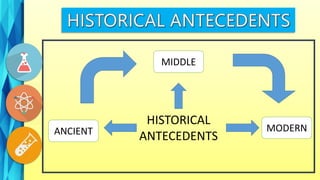
HISTORICAL
ANTECEDENTS
ANCIENT
MIDDLE
MODERN
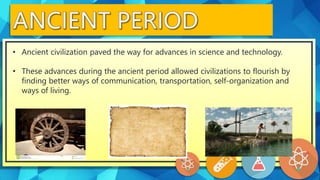
• Ancient civilization paved the way for advances in science and technology.
• These advances during the ancient period allowed civilizations to flourish by
finding better ways of communication, transportation, self-organization and
ways of living.
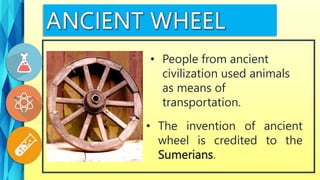
• The invention of ancient
wheel is credited to the
Sumerians.
• People from ancient
civilization used animals
as means of
transportation.
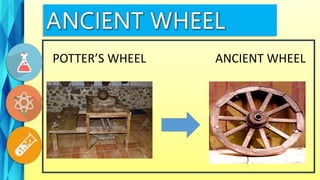
POTTER’S WHEEL ANCIENT WHEEL
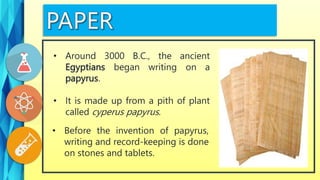
• Before the invention of papyrus,
writing and record-keeping is done
on stones and tablets.
• Around 3000 B.C., the ancient
Egyptians began writing on a
papyrus.
• It is made up from a pith of plant
called cyperus papyrus.
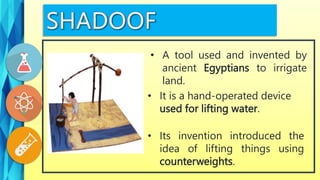
• It is a hand-operated device
used for lifting water.
• A tool used and invented by
ancient Egyptians to irrigate
land.
• Its invention introduced the
idea of lifting things using
counterweights.
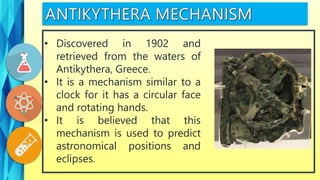
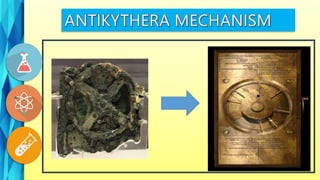
• Discovered in 1902 and
retrieved from the waters of
Antikythera, Greece.
• It is a mechanism similar to a
clock for it has a circular face
and rotating hands.
• It is believed that this
mechanism is used to predict
astronomical positions and
eclipses.
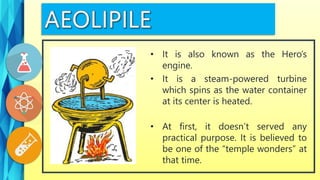
• It is a steam-powered turbine
which spins as the water container
at its center is heated.
• It is also known as the Hero’s
engine.
• At first, it doesn’t served any
practical purpose. It is believed to
be one of the “temple wonders” at
that time.
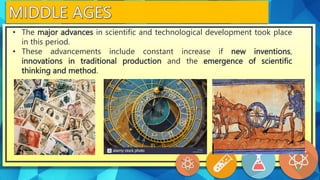
• The major advances in scientific and technological development took place
in this period.
• These advancements include constant increase if new inventions,
innovations in traditional production and the emergence of scientific
thinking and method.
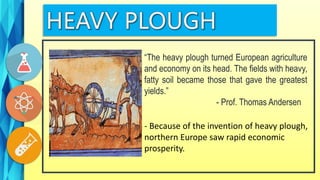
“The heavy plough turned European agriculture
and economy on its head. The fields with heavy,
fatty soil became those that gave the greatest
yields.”
- Prof. Thomas Andersen
- Because of the invention of heavy plough,
northern Europe saw rapid economic
prosperity.
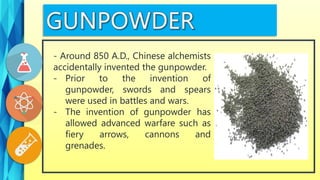
- Around 850 A.D., Chinese alchemists
accidentally invented the gunpowder.
- Prior to the invention of
gunpowder, swords and spears
were used in battles and wars.
- The invention of gunpowder has
allowed advanced warfare such as
fiery arrows, cannons and
grenades.
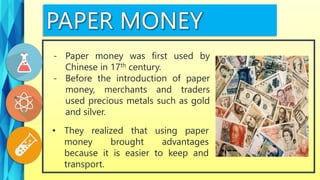
• They realized that using paper
money brought advantages
because it is easier to keep and
transport.
- Paper money was first used by
Chinese in 17th century.
- Before the introduction of paper
money, merchants and traders
used precious metals such as gold
and silver.
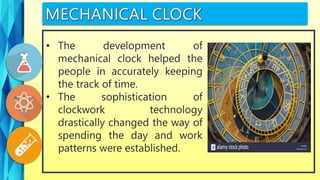
• The development of
mechanical clock helped the
people in accurately keeping
the track of time.
• The sophistication of
clockwork technology
drastically changed the way of
spending the day and work
patterns were established.
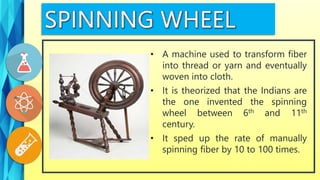
• A machine used to transform fiber
into thread or yarn and eventually
woven into cloth.
• It is theorized that the Indians are
the one invented the spinning
wheel between 6th and 11th
century.
• It sped up the rate of manually
spinning fiber by 10 to 100 times.
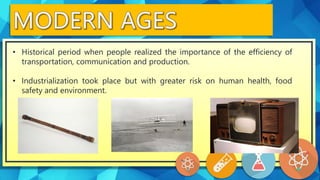
• Historical period when people realized the importance of the efficiency of
transportation, communication and production.
• Industrialization took place but with greater risk on human health, food
safety and environment.
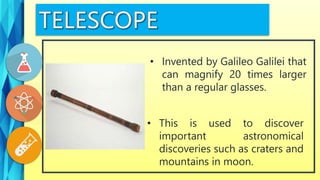
• This is used to discover
important astronomical
discoveries such as craters and
mountains in moon.
• Invented by Galileo Galilei that
can magnify 20 times larger
than a regular glasses.
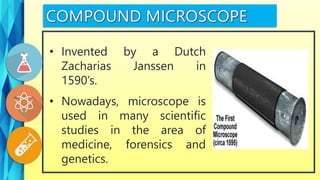
• Nowadays, microscope is
used in many scientific
studies in the area of
medicine, forensics and
genetics.
• Invented by a Dutch
Zacharias Janssen in
1590’s.
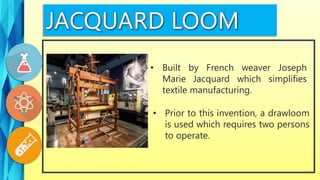
• Prior to this invention, a drawloom
is used which requires two persons
to operate.
• Built by French weaver Joseph
Marie Jacquard which simplifies
textile manufacturing.
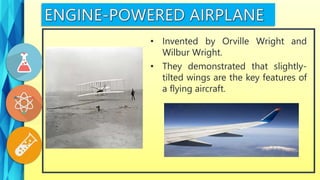
• They demonstrated that slightly-
tilted wings are the key features of
a flying aircraft.
• Invented by Orville Wright and
Wilbur Wright.
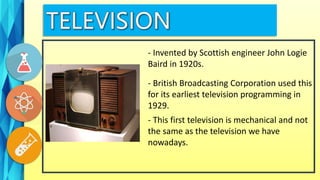
- Invented by Scottish engineer John Logie
Baird in 1920s.
- British Broadcasting Corporation used this
for its earliest television programming in
1929.
- This first television is mechanical and not
the same as the television we have
nowadays.
Inventions by
Filipino Scientists
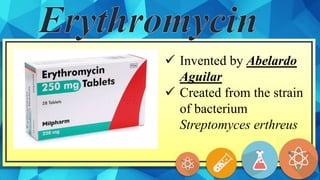
 Invented by Abelardo
Aguilar
 Created from the strain
of bacterium
Streptomyces erthreus
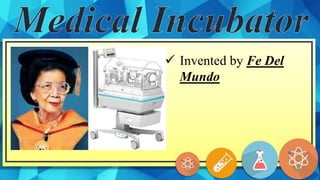
 Invented by Fe Del
Mundo
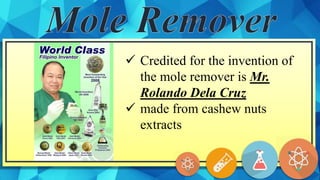
 Credited for the invention of
the mole remover is Mr.
Rolando Dela Cruz
 made from cashew nuts
extracts
 Invented by the
Maria Y. Orosa
1. What is defined as a precursor to unfolding or
existence of something?
2.What is the name of the plant used in creating
the first paper?
3.Who invented the black powder?
4.What century is the first version of paper
money is introduced?
5.Who invented the compound microscope?
6. Who states that the modern science is a discovery as
well as inventions?
7. What is the application of the scientific knowledge
and principles?
8. What is the academic field that seeks to remove the
gap of traditional exclusive cultures and natural
science?
9. What is Latin noun used to describe society?
10. What is the ancient precursor of the steam-engines?
11. What is the most important technological
invention of modern ages in the study of astronomy?
12. What is the year for the first moving object is
projected to the television?
13. What do the Wright brothers call the slightly tilted-
wings?
14. What was used to produce the mole remover?
15. Who is the first woman pediatrician that entered
the Harvard University’s School of Medicine?

Science Technology and Society (PPT Presentation)

  • 2.
    "Those Who DoNot Learn History Are Doomed To Repeat It." - Sir Winston Churchill
  • 3.
    • It isdefined as a precursor to the unfolding or existence of something. • Antecedents of science and technology are factors that paved way for the presence of advanced and sophisticated scientific and technological innovations today. • We can use the historical developments of science and technology to come up with proper decisions and applications of science and technology to daily life.
  • 4.
  • 5.
    • Ancient civilizationpaved the way for advances in science and technology. • These advances during the ancient period allowed civilizations to flourish by finding better ways of communication, transportation, self-organization and ways of living.
  • 6.
    • The inventionof ancient wheel is credited to the Sumerians. • People from ancient civilization used animals as means of transportation.
  • 7.
  • 8.
    • Before theinvention of papyrus, writing and record-keeping is done on stones and tablets. • Around 3000 B.C., the ancient Egyptians began writing on a papyrus. • It is made up from a pith of plant called cyperus papyrus.
  • 9.
    • It isa hand-operated device used for lifting water. • A tool used and invented by ancient Egyptians to irrigate land. • Its invention introduced the idea of lifting things using counterweights.
  • 10.
    • Discovered in1902 and retrieved from the waters of Antikythera, Greece. • It is a mechanism similar to a clock for it has a circular face and rotating hands. • It is believed that this mechanism is used to predict astronomical positions and eclipses.
  • 12.
    • It isa steam-powered turbine which spins as the water container at its center is heated. • It is also known as the Hero’s engine. • At first, it doesn’t served any practical purpose. It is believed to be one of the “temple wonders” at that time.
  • 13.
    • The majoradvances in scientific and technological development took place in this period. • These advancements include constant increase if new inventions, innovations in traditional production and the emergence of scientific thinking and method.
  • 14.
    “The heavy ploughturned European agriculture and economy on its head. The fields with heavy, fatty soil became those that gave the greatest yields.” - Prof. Thomas Andersen - Because of the invention of heavy plough, northern Europe saw rapid economic prosperity.
  • 15.
    - Around 850A.D., Chinese alchemists accidentally invented the gunpowder. - Prior to the invention of gunpowder, swords and spears were used in battles and wars. - The invention of gunpowder has allowed advanced warfare such as fiery arrows, cannons and grenades.
  • 16.
    • They realizedthat using paper money brought advantages because it is easier to keep and transport. - Paper money was first used by Chinese in 17th century. - Before the introduction of paper money, merchants and traders used precious metals such as gold and silver.
  • 17.
    • The developmentof mechanical clock helped the people in accurately keeping the track of time. • The sophistication of clockwork technology drastically changed the way of spending the day and work patterns were established.
  • 18.
    • A machineused to transform fiber into thread or yarn and eventually woven into cloth. • It is theorized that the Indians are the one invented the spinning wheel between 6th and 11th century. • It sped up the rate of manually spinning fiber by 10 to 100 times.
  • 19.
    • Historical periodwhen people realized the importance of the efficiency of transportation, communication and production. • Industrialization took place but with greater risk on human health, food safety and environment.
  • 20.
    • This isused to discover important astronomical discoveries such as craters and mountains in moon. • Invented by Galileo Galilei that can magnify 20 times larger than a regular glasses.
  • 21.
    • Nowadays, microscopeis used in many scientific studies in the area of medicine, forensics and genetics. • Invented by a Dutch Zacharias Janssen in 1590’s.
  • 22.
    • Prior tothis invention, a drawloom is used which requires two persons to operate. • Built by French weaver Joseph Marie Jacquard which simplifies textile manufacturing.
  • 23.
    • They demonstratedthat slightly- tilted wings are the key features of a flying aircraft. • Invented by Orville Wright and Wilbur Wright.
  • 24.
    - Invented byScottish engineer John Logie Baird in 1920s. - British Broadcasting Corporation used this for its earliest television programming in 1929. - This first television is mechanical and not the same as the television we have nowadays.
  • 25.
  • 27.
     Invented byAbelardo Aguilar  Created from the strain of bacterium Streptomyces erthreus
  • 28.
     Invented byFe Del Mundo
  • 29.
     Credited forthe invention of the mole remover is Mr. Rolando Dela Cruz  made from cashew nuts extracts
  • 30.
     Invented bythe Maria Y. Orosa
  • 31.
    1. What isdefined as a precursor to unfolding or existence of something? 2.What is the name of the plant used in creating the first paper? 3.Who invented the black powder? 4.What century is the first version of paper money is introduced? 5.Who invented the compound microscope?
  • 32.
    6. Who statesthat the modern science is a discovery as well as inventions? 7. What is the application of the scientific knowledge and principles? 8. What is the academic field that seeks to remove the gap of traditional exclusive cultures and natural science? 9. What is Latin noun used to describe society? 10. What is the ancient precursor of the steam-engines?
  • 33.
    11. What isthe most important technological invention of modern ages in the study of astronomy? 12. What is the year for the first moving object is projected to the television? 13. What do the Wright brothers call the slightly tilted- wings? 14. What was used to produce the mole remover? 15. Who is the first woman pediatrician that entered the Harvard University’s School of Medicine?