Unit No:01
Thermodynamics
Prof. Yash B. Parikh
M.Tech (Computer Integrated Manufacturing)
B.E.(Mechanical Engineering)
Assistant Professor
Department of Mechanical Engineering
Homogeneous & Heterogeneous Systems
2
Homogeneous system: - if a system consists of
homogeneous matter
throughout in chemical
composition & physical
structure.
e.g. ice, water, superheated steam, tea
Heterogeneous system: - if a system consists of matter
of different chemical
composition & physical
structure.
e.g. mixture of ice & water, mixture of two or more
non-miscible liquids (petrol & water)
Pure Substance
3
 It has a homogeneous & invariable chemical
composition even though there is a change of phase.
e.g. liquid water, mixture of water & steam.
Dimensions & Units
4
 Any physical quantity can be characterized by
dimensions.
 Dimension is defined as a measurable quantity.
 The magnitudes assigned to the dimensions are
called as units.
 Some basic dimensions such as mass m, length L,
time t , and temperature T are selected as Primary or
Fundamental dimensions.
 Whereas, velocity V, energy E, and volume v , are
selected as Secondary or Derived dimensions.
Units
5
 No of unit systems have been developed over the years.
1. English system : (United States Customary System)
It has no apparent systematic numerical base.
Various units are related to each other arbitrarily.
e.g. 12 in = 1 ft, 1 mile = 5280 ft , 4qt = 1 gal, etc.
In U.S. it’s still acceptable.
2. SI system : (International System) (Metric System)
It’s a simple & logical system based on a decimal
relationship between various units.
e.g. mm, cm, m, km, etc
It’s used in most of the nations for scientific &
engineering work.
Energy
6
 Energy is capacity to produce an effect, especially that
of change in motion of bodies.
Internal Energy :
Present in a system due to molecular motion,
arrangement of atomic structure, & it’s chemical
composition.
Various types of internal energies are :
a) Chemical Energy : released due to change in chemical
composition.
b) Atomic Energy : released due to change in atomic
structure of matter such as nuclear
fusion or fission.
c) Molecular Internal Energy : energy due to molecular
motion.
External Energy
7
a) Potential Energy : energy of position of mass w.r.t.
earth.
b) Kinetic Energy : energy arising due to motion of the
mass.
Total Energy = Internal Energy + External Energy
Properties of a System
8
 Any characteristic of a system is called a property.
 Pressure, volume, temperature, mass are few known
properties whereas viscosity, electrical resistivity are
less familiar.
 Properties are of two types,
1. Intensive : independent of the mass of the system.
e.g. temp, pressure, density.
2. Extensive : value depends on the size of the system.
e.g. length, volume, all forms of energies.
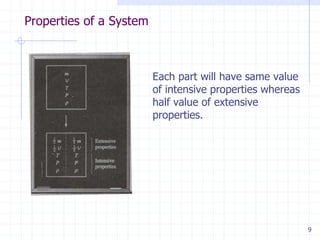
 An easy way to determine whether a property is
intensive or extensive is to divide the system into two
equal parts with a an imaginary partition.
Properties of a System
9
Each part will have same value
of intensive properties whereas
half value of extensive
properties.
Specific Properties
10
 Extensive properties per unit mass are called as
specific properties.
e.g. specific volume = volume/mass
specific total energy = total energy/mass
State of a System
11
 A set of properties that completely describes the
condition of the system is known as State.
 At a given state, all properties of a system have fixed
values.
 If the value of even one property changes, the state
will change to a different one.
Equilibrium
12
 Thermodynamics deals with the equilibrium states.
 Word equilibrium means state of balance.
 In an equilibrium state there are no unbalanced
potentials within the system.
 Types of equilibrium :
1. Thermal equilibrium – (if temp is same)
2. Mechanical equilibrium – (if press is same)
3. Chemical equilibrium – (if chemical compo is same )
Processes & Cycles
13
 Any change that system undergoes from one
equilibrium state to another is called a process.
 The series of states through which a system passes
during a process is called the path of the process.
 To describe a process completely, one requires,
- Initial & final states of the process
- Path it follows
Processes & Cycles
14
 When a process proceeds in a manner that the
system remains infinitesimally close to an equilibrium
state, it’s called as a quasi-static process.
 It’s a sufficiently slow process. (Allows the system to
adjust itself internally)
 Quasi-static process is an idealized process.
Note : -
We are interested in this process because,
1. Easy to analyze
2. Work – producing devices deliver most work when
they operate on it.
Processes & Cycles
15
 The prefix iso- is often used to designate a process
for which particular property remains constant.
 An isothermal process, is a process during which
temperature T remains constant.
 Similarly isobaric process (P const) & isometric
process (Specific V Const).

Thermal 02

  • 1.
    Unit No:01 Thermodynamics Prof. YashB. Parikh M.Tech (Computer Integrated Manufacturing) B.E.(Mechanical Engineering) Assistant Professor Department of Mechanical Engineering
  • 2.
    Homogeneous & HeterogeneousSystems 2 Homogeneous system: - if a system consists of homogeneous matter throughout in chemical composition & physical structure. e.g. ice, water, superheated steam, tea Heterogeneous system: - if a system consists of matter of different chemical composition & physical structure. e.g. mixture of ice & water, mixture of two or more non-miscible liquids (petrol & water)
  • 3.
    Pure Substance 3  Ithas a homogeneous & invariable chemical composition even though there is a change of phase. e.g. liquid water, mixture of water & steam.
  • 4.
    Dimensions & Units 4 Any physical quantity can be characterized by dimensions.  Dimension is defined as a measurable quantity.  The magnitudes assigned to the dimensions are called as units.  Some basic dimensions such as mass m, length L, time t , and temperature T are selected as Primary or Fundamental dimensions.  Whereas, velocity V, energy E, and volume v , are selected as Secondary or Derived dimensions.
  • 5.
    Units 5  No ofunit systems have been developed over the years. 1. English system : (United States Customary System) It has no apparent systematic numerical base. Various units are related to each other arbitrarily. e.g. 12 in = 1 ft, 1 mile = 5280 ft , 4qt = 1 gal, etc. In U.S. it’s still acceptable. 2. SI system : (International System) (Metric System) It’s a simple & logical system based on a decimal relationship between various units. e.g. mm, cm, m, km, etc It’s used in most of the nations for scientific & engineering work.
  • 6.
    Energy 6  Energy iscapacity to produce an effect, especially that of change in motion of bodies. Internal Energy : Present in a system due to molecular motion, arrangement of atomic structure, & it’s chemical composition. Various types of internal energies are : a) Chemical Energy : released due to change in chemical composition. b) Atomic Energy : released due to change in atomic structure of matter such as nuclear fusion or fission. c) Molecular Internal Energy : energy due to molecular motion.
  • 7.
    External Energy 7 a) PotentialEnergy : energy of position of mass w.r.t. earth. b) Kinetic Energy : energy arising due to motion of the mass. Total Energy = Internal Energy + External Energy
  • 8.
    Properties of aSystem 8  Any characteristic of a system is called a property.  Pressure, volume, temperature, mass are few known properties whereas viscosity, electrical resistivity are less familiar.  Properties are of two types, 1. Intensive : independent of the mass of the system. e.g. temp, pressure, density. 2. Extensive : value depends on the size of the system. e.g. length, volume, all forms of energies.  An easy way to determine whether a property is intensive or extensive is to divide the system into two equal parts with a an imaginary partition.
  • 9.
    Properties of aSystem 9 Each part will have same value of intensive properties whereas half value of extensive properties.
  • 10.
    Specific Properties 10  Extensiveproperties per unit mass are called as specific properties. e.g. specific volume = volume/mass specific total energy = total energy/mass
  • 11.
    State of aSystem 11  A set of properties that completely describes the condition of the system is known as State.  At a given state, all properties of a system have fixed values.  If the value of even one property changes, the state will change to a different one.
  • 12.
    Equilibrium 12  Thermodynamics dealswith the equilibrium states.  Word equilibrium means state of balance.  In an equilibrium state there are no unbalanced potentials within the system.  Types of equilibrium : 1. Thermal equilibrium – (if temp is same) 2. Mechanical equilibrium – (if press is same) 3. Chemical equilibrium – (if chemical compo is same )
  • 13.
    Processes & Cycles 13 Any change that system undergoes from one equilibrium state to another is called a process.  The series of states through which a system passes during a process is called the path of the process.  To describe a process completely, one requires, - Initial & final states of the process - Path it follows
  • 14.
    Processes & Cycles 14 When a process proceeds in a manner that the system remains infinitesimally close to an equilibrium state, it’s called as a quasi-static process.  It’s a sufficiently slow process. (Allows the system to adjust itself internally)  Quasi-static process is an idealized process. Note : - We are interested in this process because, 1. Easy to analyze 2. Work – producing devices deliver most work when they operate on it.
  • 15.
    Processes & Cycles 15 The prefix iso- is often used to designate a process for which particular property remains constant.  An isothermal process, is a process during which temperature T remains constant.  Similarly isobaric process (P const) & isometric process (Specific V Const).