PRESENTATION BY DR.KAINAT KASI(PT)
WHAT IS PHYSIOTHERAPY?
Physical therapy, also known as physiotherapy, is one of the
allied health professions. Physiotherapy is a dynamic profession,
which uses a range of treatment techniques to restore movement
and function within the body.
“Physiotherapy helps restore movement and function when
someone is affected by injury, illness or disability”.
AIM OF PHYSIOTHERAPY
 The aim of physiotherapy is to optimize someone's range of
movement and function whilst at the same time reducing pain
and preventing recurrence. Physiotherapy as described by
World Physiotherapy is a health care profession concerned
with human function and movement and maximizing physical
potential. It is concerned with identifying and maximizing
quality of life and movement potential within the spheres of
promotion, prevention, treatment/intervention, habilitation and
rehabilitation. It uses physical approaches to promote,
maintain and restore physical, psychological and social well-
being, taking into account variations in health status. It is
science-based, committed to extending, applying, evaluating
and reviewing the evidence that underpins and informs its
practice and delivery. The exercise of clinical judgment and
informed interpretation is at its core.
WHAT IS THE ROLE OF PHYSIOTHERAPIST?
 Physiotherapists help people affected by injury,
illness or disability through movement and exercise,
manual therapy, education and advice.
 They maintain health for people of all ages, helping
patients to manage pain and prevent disease.
 Physiotherapists have a role in advising and
assisting the population to use physical activity to
keep active and keep healthy. Their specific
knowledge of function, movement, specific exercise
and activation with knowledge of the effect of
disease and disability on function is central in
exercise prescribing.
WHY PHYSIOTHERAPY?
Physiotherapy is a degree-based healthcare profession.
Physiotherapists use their knowledge and skills to improve
a range of conditions associated with different systems of
the body, such as:
 Neurological (stroke, multiple sclerosis, Parkinson's)
 Neuromusculoskeletal (back pain, whiplash
associated disorder, sports injuries, arthritis)
 Cardiovascular (chronic heart disease, rehabilitation
after heart attack)
 Respiratory (asthma, chronic obstructive pulmonary
disease, cystic fibrosis).
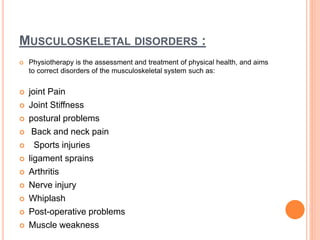
MUSCULOSKELETAL DISORDERS :
 Physiotherapy is the assessment and treatment of physical health, and aims
to correct disorders of the musculoskeletal system such as:
 joint Pain
 Joint Stiffness
 postural problems
 Back and neck pain
 Sports injuries
 ligament sprains
 Arthritis
 Nerve injury
 Whiplash
 Post-operative problems
 Muscle weakness
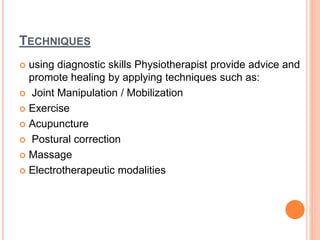
TECHNIQUES
 using diagnostic skills Physiotherapist provide advice and
promote healing by applying techniques such as:
 Joint Manipulation / Mobilization
 Exercise
 Acupuncture
 Postural correction
 Massage
 Electrotherapeutic modalities
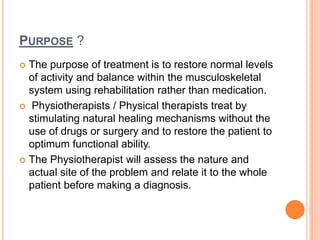
PURPOSE ?
 The purpose of treatment is to restore normal levels
of activity and balance within the musculoskeletal
system using rehabilitation rather than medication.
 Physiotherapists / Physical therapists treat by
stimulating natural healing mechanisms without the
use of drugs or surgery and to restore the patient to
optimum functional ability.
 The Physiotherapist will assess the nature and
actual site of the problem and relate it to the whole
patient before making a diagnosis.
Physiotherapy service has its applications in all most all disciplines of
modern medicine-
• Orthopedics
• Neurology
• Cardio thoracic
• Oncology
• Obstetrics and Gynecology
• Gerontology [Geriatrics]
• Pediatrics and Neonatology
• General Surgery
• Plastic surgery and Cosmetic surgery
• Dermatology
• Diabitology
• Rheumatology
• psychiatry
• Sports Medicine

WHAT IS PHYSIOTHERAPY

  • 1.
    PRESENTATION BY DR.KAINATKASI(PT) WHAT IS PHYSIOTHERAPY? Physical therapy, also known as physiotherapy, is one of the allied health professions. Physiotherapy is a dynamic profession, which uses a range of treatment techniques to restore movement and function within the body. “Physiotherapy helps restore movement and function when someone is affected by injury, illness or disability”.
  • 2.
    AIM OF PHYSIOTHERAPY The aim of physiotherapy is to optimize someone's range of movement and function whilst at the same time reducing pain and preventing recurrence. Physiotherapy as described by World Physiotherapy is a health care profession concerned with human function and movement and maximizing physical potential. It is concerned with identifying and maximizing quality of life and movement potential within the spheres of promotion, prevention, treatment/intervention, habilitation and rehabilitation. It uses physical approaches to promote, maintain and restore physical, psychological and social well- being, taking into account variations in health status. It is science-based, committed to extending, applying, evaluating and reviewing the evidence that underpins and informs its practice and delivery. The exercise of clinical judgment and informed interpretation is at its core.
  • 3.
    WHAT IS THEROLE OF PHYSIOTHERAPIST?  Physiotherapists help people affected by injury, illness or disability through movement and exercise, manual therapy, education and advice.  They maintain health for people of all ages, helping patients to manage pain and prevent disease.  Physiotherapists have a role in advising and assisting the population to use physical activity to keep active and keep healthy. Their specific knowledge of function, movement, specific exercise and activation with knowledge of the effect of disease and disability on function is central in exercise prescribing.
  • 4.
    WHY PHYSIOTHERAPY? Physiotherapy isa degree-based healthcare profession. Physiotherapists use their knowledge and skills to improve a range of conditions associated with different systems of the body, such as:  Neurological (stroke, multiple sclerosis, Parkinson's)  Neuromusculoskeletal (back pain, whiplash associated disorder, sports injuries, arthritis)  Cardiovascular (chronic heart disease, rehabilitation after heart attack)  Respiratory (asthma, chronic obstructive pulmonary disease, cystic fibrosis).
  • 5.
    MUSCULOSKELETAL DISORDERS : Physiotherapy is the assessment and treatment of physical health, and aims to correct disorders of the musculoskeletal system such as:  joint Pain  Joint Stiffness  postural problems  Back and neck pain  Sports injuries  ligament sprains  Arthritis  Nerve injury  Whiplash  Post-operative problems  Muscle weakness
  • 6.
    TECHNIQUES  using diagnosticskills Physiotherapist provide advice and promote healing by applying techniques such as:  Joint Manipulation / Mobilization  Exercise  Acupuncture  Postural correction  Massage  Electrotherapeutic modalities
  • 7.
    PURPOSE ?  Thepurpose of treatment is to restore normal levels of activity and balance within the musculoskeletal system using rehabilitation rather than medication.  Physiotherapists / Physical therapists treat by stimulating natural healing mechanisms without the use of drugs or surgery and to restore the patient to optimum functional ability.  The Physiotherapist will assess the nature and actual site of the problem and relate it to the whole patient before making a diagnosis.
  • 8.
    Physiotherapy service hasits applications in all most all disciplines of modern medicine- • Orthopedics • Neurology • Cardio thoracic • Oncology • Obstetrics and Gynecology • Gerontology [Geriatrics] • Pediatrics and Neonatology • General Surgery • Plastic surgery and Cosmetic surgery • Dermatology • Diabitology • Rheumatology • psychiatry • Sports Medicine