ERNESTINE
WEIDENBACH
THE HELPING ART OF CLINICAL NURSING
By: Rommel Luis C. Israel III
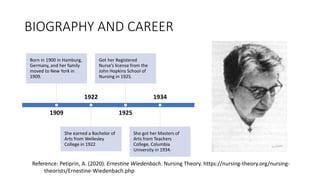
BIOGRAPHY AND CAREER
1909
Born in 1900 in Hamburg,
Germany, and her family
moved to New York in
1909.
1922
She earned a Bachelor of
Arts from Wellesley
College in 1922
1925
Got her Registered
Nurse’s license from the
John Hopkins School of
Nursing in 1925.
1934
She got her Masters of
Arts from Teachers
College, Columbia
University in 1934.
Reference: Petiprin, A. (2020). Ernestine Wiedenbach. Nursing Theory. https://nursing-theory.org/nursing-
theorists/Ernestine-Wiedenbach.php
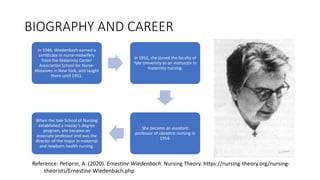
BIOGRAPHY AND CAREER
In 1946, Wiedenbach earned a
certificate in nurse-midwifery
from the Maternity Center
Association School for Nurse-
Midwives in New York, and taught
there until 1951.
In 1952, she joined the faculty of
Yale University as an instructor in
maternity nursing.
She became an assistant
professor of obstetric nursing in
1954.
When the Yale School of Nursing
established a master’s degree
program, she became an
associate professor and was the
director of the major in maternal
and newborn health nursing.
Reference: Petiprin, A. (2020). Ernestine Wiedenbach. Nursing Theory. https://nursing-theory.org/nursing-
theorists/Ernestine-Wiedenbach.php
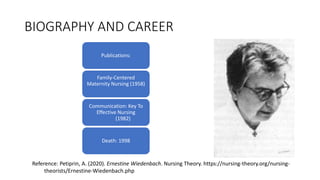
BIOGRAPHY AND CAREER
Publications:
Family-Centered
Maternity Nursing (1958)
Communication: Key To
Effective Nursing
(1982)
Death: 1998
Reference: Petiprin, A. (2020). Ernestine Wiedenbach. Nursing Theory. https://nursing-theory.org/nursing-
theorists/Ernestine-Wiedenbach.php
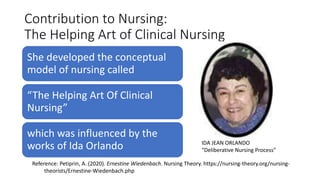
Contribution to Nursing:
The Helping Art of Clinical Nursing
She developed the conceptual
model of nursing called
“The Helping Art Of Clinical
Nursing”
which was influenced by the
works of Ida Orlando
Reference: Petiprin, A. (2020). Ernestine Wiedenbach. Nursing Theory. https://nursing-theory.org/nursing-
theorists/Ernestine-Wiedenbach.php
IDA JEAN ORLANDO
“Deliberative Nursing Process”
The Helping Art of
Clinical Nursing
Nursing is the practice of identification of a
patient’s need for help through:
• the observation of presenting behaviors and
symptoms,
• exploration of the meaning of those symptoms
with the patient,
• determining the cause of discomfort,
• determining the patient’s ability to resolve the
discomfort (or if the patient has a need for help
from the nurse or other health care
professionals.)
• Reference: Petiprin, A. (2020). Ernestine Wiedenbach. Nursing Theory.
https://nursing-theory.org/nursing-theorists/Ernestine-Wiedenbach.php
•
The Helping Art of Clinical Nursing
The goal of nursing:
It consists primarily
of identifying a
patient’s need for
help.
Reference: Petiprin, A. (2020). Ernestine Wiedenbach. Nursing Theory. https://nursing-theory.org/nursing-
theorists/Ernestine-Wiedenbach.php
The Helping Art
of Clinical
Nursing
The need for help is defined as:
• “any measure desired by the patient
that has the potential to restore or
extend the ability to cope with various
life situations that affect health and
wellness.”
• Need-for-help must be based on the
individual patient’s perception of his or
her own situation.
Reference: Petiprin, A. (2020). Ernestine Wiedenbach. Nursing Theory.
https://nursing-theory.org/nursing-theorists/Ernestine-Wiedenbach.php
•
The Helping Art of Clinical
Nursing
Wiedenbach’s theory identifies the
patient as:
• “any individual who is receiving
help of some kind, be it care,
instruction or advice from a
member of the health profession
or from a worker in the field of
health.”
• A patient is any person who has
entered the healthcare system
and is receiving help, which
means he or she does not need to
be ill. A person receiving health-
related education would qualify as
a patient.
Reference: Petiprin, A. (2020). Ernestine Wiedenbach. Nursing
Theory. https://nursing-theory.org/nursing-theorists/Ernestine-
Wiedenbach.php
•
The Helping
Art of Clinical
Nursing
The theory identifies four
main elements in clinical
nursing:
•a philosophy
•a purpose
•a practice, and
•the art
Reference: Petiprin, A. (2020). Ernestine Wiedenbach. Nursing Theory.
https://nursing-theory.org/nursing-theorists/Ernestine-Wiedenbach.php
•
The Nurse’s
Philosophy
• It is his or her attitude and belief
about life, and how that affects reality
for him or her.
• The three essential components
Wiedenbach associated with a nursing
philosophy are:
1.reverence for life
2.respect for the dignity, worth,
autonomy, and individuality of
each human being
3.the resolution to act on personally
and professionally held beliefs.
Reference: Petiprin, A. (2020). Ernestine Wiedenbach. Nursing Theory.
https://nursing-theory.org/nursing-theorists/Ernestine-Wiedenbach.php
•
The Nurse’s
Purpose
•It is that which the nurse
wants to accomplish
through her actions.
•It encompasses all of the
activities directed toward
the overall good of the
patient.
Reference: Petiprin, A. (2020). Ernestine Wiedenbach. Nursing Theory.
https://nursing-theory.org/nursing-theorists/Ernestine-
Wiedenbach.php
•
The Practice of
Nursing
•It consists of the
observable nursing actions
affected by beliefs and
feelings about meeting the
patient’s need for help.
Reference: Petiprin, A. (2020). Ernestine Wiedenbach. Nursing Theory. https://nursing-
theory.org/nursing-theorists/Ernestine-Wiedenbach.php
•
The Art of Nursing
• It includes understanding the patient’s
needs, developing goals and actions
intended to enhance the patient’s
ability, and directing the activities
related to the medical plan to improve
the patient’s condition.
• The nurse’s focus is also on the
prevention of complications related to
reoccurrence or the development of
new concerns.
Reference: Petiprin, A. (2020). Ernestine Wiedenbach. Nursing Theory.
https://nursing-theory.org/nursing-theorists/Ernestine-Wiedenbach.php
•
Three Factors of
Wiedenbach’s
Prescriptive Theory
• The central purpose which the
practitioner recognizes as
essential to the particular
discipline.
• The prescription for the
fulfillment of the central
purpose.
• The realities in the immediate
situation that influence the
central purpose.
Reference: Petiprin, A. (2020). Ernestine Wiedenbach. Nursing
Theory. https://nursing-theory.org/nursing-theorists/Ernestine-
Wiedenbach.php
•
CLINICAL
JUDGEMENT/SOUND
JUDGEMENT
• Wiedenbach explains that clinical
judgment represents the nurse’s
likeliness to make sound decisions,
which are based on differentiating fact
from assumption, and relating them to
cause and effect.
• Sound judgment is the result of
disciplined functioning of mind and
emotions, and improves with
expanded knowledge, as well as
increased clarity of professional
purpose.
Reference: Wiedenbach’s Helping Art of Clinical Nursing - Nursing
Theory. (2019). Nursing Theory. https://nursing-theory.org/theories-
and-models/wiedenbach-the-helping-art-of-clinical-nursing.php
•
NURSING SKILLS
• In the theory, nursing skills are
carried out in order to achieve a
specific patient-centered
purpose rather than the
completion of the skill itself
being the end goal.
• Skills are made up of a variety of
actions, and are characterized by
harmony of movement,
precision, and the effective use
of self.
Reference: Wiedenbach’s Helping Art of Clinical Nursing - Nursing Theory.
(2019). Nursing Theory. https://nursing-theory.org/theories-and-
models/wiedenbach-the-helping-art-of-clinical-nursing.php
•
THE HELPING
ART OF
CLINICAL
NURSING:
DEFINITION OF
A PERSON
• The person, whether a nurse or
patient, has a unique potential to
develop self-sustaining resources.
• People tend to be independent and
fulfill their own responsibilities.
• In Wiedenbach’s theory, self-
awareness and self-acceptance are
essential to personal integrity and self-
worth; whatever an individual does at
any given moment is representative of
the best judgment available for that
person in that moment.
Reference: Wiedenbach’s Helping Art of Clinical Nursing -
Nursing Theory. (2019). Nursing Theory. https://nursing-
theory.org/theories-and-models/wiedenbach-the-helping-art-
of-clinical-nursing.php
CONTRIBUTION
TO THE
DEVELOPMENT
OF CLINICAL
NURSING
PRACTICE
 by influencing core concepts in
practice, such as the nursing process,
 by contributing to the goal of
nursing, which is to attend to a
patient's needs by assessing their
need for help in the clinical setting
• The helping art of nursing is seen in all
nursing practice involving the individual,
and it uses the basis of nursing practice,
the basis being the nursing process.
Reference:
Ernestine Wiedenbach’s Contribution To the Development... | 123 Help Me. (n.d.). Www.123helpme.com. Retrieved November 18,
2022, from https://www.123helpme.com/essay/Ernestine-Wiedenbachs-Contribution-To-the-Development-of-
188806#:~:text=Ernestine%20Wiedenbach%27s%20theory%20has%20contributed%20to%20the%20development
THE NURSING
PROCESS
•It is a systematic problem-
solving approach first
applied by Orlando in 1961
•It involved four key steps
which includes assessment,
planning, intervention and
evaluation
Reference:
Ernestine Wiedenbach’s Contribution To the Development... | 123 Help Me. (n.d.). Www.123helpme.com.
Retrieved November 18, 2022, from https://www.123helpme.com/essay/Ernestine-Wiedenbachs-
Contribution-To-the-Development-of-
188806#:~:text=Ernestine%20Wiedenbach%27s%20theory%20has%20contributed%20to%20the%20dev
elopment
•
ORLANDO’S THEORY
AND WIEDENBACH
THEORY
they both follow the same care trajectory from
initial observation and assessment to
intervention and evaluation.
Since these two theories follow the same
trajectory, they can be applied in similar
situations in clinical nursing practice.
• Wiedenbach's process of identifying a patient's
need for help can be applied when a nurse is
directly providing care for a patient. Richard and
Johnson (2007) used Wiedenbach's nursing
theory to guide. Her theory is a guide to nursing
practice, where the nurse identifies the needs of
the patient and their need for help.
Reference:
Ernestine Wiedenbach’s Contribution To the Development... | 123 Help Me. (n.d.).
Www.123helpme.com. Retrieved November 18, 2022, from
https://www.123helpme.com/essay/Ernestine-Wiedenbachs-Contribution-To-the-
Development-of-
188806#:~:text=Ernestine%20Wiedenbach%27s%20theory%20has%20contributed%20to%20
the%20development

ERNESTINE WIEDENBACH

  • 1.
    ERNESTINE WEIDENBACH THE HELPING ARTOF CLINICAL NURSING By: Rommel Luis C. Israel III
  • 2.
    BIOGRAPHY AND CAREER 1909 Bornin 1900 in Hamburg, Germany, and her family moved to New York in 1909. 1922 She earned a Bachelor of Arts from Wellesley College in 1922 1925 Got her Registered Nurse’s license from the John Hopkins School of Nursing in 1925. 1934 She got her Masters of Arts from Teachers College, Columbia University in 1934. Reference: Petiprin, A. (2020). Ernestine Wiedenbach. Nursing Theory. https://nursing-theory.org/nursing- theorists/Ernestine-Wiedenbach.php
  • 3.
    BIOGRAPHY AND CAREER In1946, Wiedenbach earned a certificate in nurse-midwifery from the Maternity Center Association School for Nurse- Midwives in New York, and taught there until 1951. In 1952, she joined the faculty of Yale University as an instructor in maternity nursing. She became an assistant professor of obstetric nursing in 1954. When the Yale School of Nursing established a master’s degree program, she became an associate professor and was the director of the major in maternal and newborn health nursing. Reference: Petiprin, A. (2020). Ernestine Wiedenbach. Nursing Theory. https://nursing-theory.org/nursing- theorists/Ernestine-Wiedenbach.php
  • 4.
    BIOGRAPHY AND CAREER Publications: Family-Centered MaternityNursing (1958) Communication: Key To Effective Nursing (1982) Death: 1998 Reference: Petiprin, A. (2020). Ernestine Wiedenbach. Nursing Theory. https://nursing-theory.org/nursing- theorists/Ernestine-Wiedenbach.php
  • 5.
    Contribution to Nursing: TheHelping Art of Clinical Nursing She developed the conceptual model of nursing called “The Helping Art Of Clinical Nursing” which was influenced by the works of Ida Orlando Reference: Petiprin, A. (2020). Ernestine Wiedenbach. Nursing Theory. https://nursing-theory.org/nursing- theorists/Ernestine-Wiedenbach.php IDA JEAN ORLANDO “Deliberative Nursing Process”
  • 6.
    The Helping Artof Clinical Nursing Nursing is the practice of identification of a patient’s need for help through: • the observation of presenting behaviors and symptoms, • exploration of the meaning of those symptoms with the patient, • determining the cause of discomfort, • determining the patient’s ability to resolve the discomfort (or if the patient has a need for help from the nurse or other health care professionals.) • Reference: Petiprin, A. (2020). Ernestine Wiedenbach. Nursing Theory. https://nursing-theory.org/nursing-theorists/Ernestine-Wiedenbach.php •
  • 7.
    The Helping Artof Clinical Nursing The goal of nursing: It consists primarily of identifying a patient’s need for help. Reference: Petiprin, A. (2020). Ernestine Wiedenbach. Nursing Theory. https://nursing-theory.org/nursing- theorists/Ernestine-Wiedenbach.php
  • 8.
    The Helping Art ofClinical Nursing The need for help is defined as: • “any measure desired by the patient that has the potential to restore or extend the ability to cope with various life situations that affect health and wellness.” • Need-for-help must be based on the individual patient’s perception of his or her own situation. Reference: Petiprin, A. (2020). Ernestine Wiedenbach. Nursing Theory. https://nursing-theory.org/nursing-theorists/Ernestine-Wiedenbach.php •
  • 9.
    The Helping Artof Clinical Nursing Wiedenbach’s theory identifies the patient as: • “any individual who is receiving help of some kind, be it care, instruction or advice from a member of the health profession or from a worker in the field of health.” • A patient is any person who has entered the healthcare system and is receiving help, which means he or she does not need to be ill. A person receiving health- related education would qualify as a patient. Reference: Petiprin, A. (2020). Ernestine Wiedenbach. Nursing Theory. https://nursing-theory.org/nursing-theorists/Ernestine- Wiedenbach.php •
  • 10.
    The Helping Art ofClinical Nursing The theory identifies four main elements in clinical nursing: •a philosophy •a purpose •a practice, and •the art Reference: Petiprin, A. (2020). Ernestine Wiedenbach. Nursing Theory. https://nursing-theory.org/nursing-theorists/Ernestine-Wiedenbach.php •
  • 11.
    The Nurse’s Philosophy • Itis his or her attitude and belief about life, and how that affects reality for him or her. • The three essential components Wiedenbach associated with a nursing philosophy are: 1.reverence for life 2.respect for the dignity, worth, autonomy, and individuality of each human being 3.the resolution to act on personally and professionally held beliefs. Reference: Petiprin, A. (2020). Ernestine Wiedenbach. Nursing Theory. https://nursing-theory.org/nursing-theorists/Ernestine-Wiedenbach.php •
  • 12.
    The Nurse’s Purpose •It isthat which the nurse wants to accomplish through her actions. •It encompasses all of the activities directed toward the overall good of the patient. Reference: Petiprin, A. (2020). Ernestine Wiedenbach. Nursing Theory. https://nursing-theory.org/nursing-theorists/Ernestine- Wiedenbach.php •
  • 13.
    The Practice of Nursing •Itconsists of the observable nursing actions affected by beliefs and feelings about meeting the patient’s need for help. Reference: Petiprin, A. (2020). Ernestine Wiedenbach. Nursing Theory. https://nursing- theory.org/nursing-theorists/Ernestine-Wiedenbach.php •
  • 14.
    The Art ofNursing • It includes understanding the patient’s needs, developing goals and actions intended to enhance the patient’s ability, and directing the activities related to the medical plan to improve the patient’s condition. • The nurse’s focus is also on the prevention of complications related to reoccurrence or the development of new concerns. Reference: Petiprin, A. (2020). Ernestine Wiedenbach. Nursing Theory. https://nursing-theory.org/nursing-theorists/Ernestine-Wiedenbach.php •
  • 15.
    Three Factors of Wiedenbach’s PrescriptiveTheory • The central purpose which the practitioner recognizes as essential to the particular discipline. • The prescription for the fulfillment of the central purpose. • The realities in the immediate situation that influence the central purpose. Reference: Petiprin, A. (2020). Ernestine Wiedenbach. Nursing Theory. https://nursing-theory.org/nursing-theorists/Ernestine- Wiedenbach.php •
  • 16.
    CLINICAL JUDGEMENT/SOUND JUDGEMENT • Wiedenbach explainsthat clinical judgment represents the nurse’s likeliness to make sound decisions, which are based on differentiating fact from assumption, and relating them to cause and effect. • Sound judgment is the result of disciplined functioning of mind and emotions, and improves with expanded knowledge, as well as increased clarity of professional purpose. Reference: Wiedenbach’s Helping Art of Clinical Nursing - Nursing Theory. (2019). Nursing Theory. https://nursing-theory.org/theories- and-models/wiedenbach-the-helping-art-of-clinical-nursing.php •
  • 17.
    NURSING SKILLS • Inthe theory, nursing skills are carried out in order to achieve a specific patient-centered purpose rather than the completion of the skill itself being the end goal. • Skills are made up of a variety of actions, and are characterized by harmony of movement, precision, and the effective use of self. Reference: Wiedenbach’s Helping Art of Clinical Nursing - Nursing Theory. (2019). Nursing Theory. https://nursing-theory.org/theories-and- models/wiedenbach-the-helping-art-of-clinical-nursing.php •
  • 18.
    THE HELPING ART OF CLINICAL NURSING: DEFINITIONOF A PERSON • The person, whether a nurse or patient, has a unique potential to develop self-sustaining resources. • People tend to be independent and fulfill their own responsibilities. • In Wiedenbach’s theory, self- awareness and self-acceptance are essential to personal integrity and self- worth; whatever an individual does at any given moment is representative of the best judgment available for that person in that moment. Reference: Wiedenbach’s Helping Art of Clinical Nursing - Nursing Theory. (2019). Nursing Theory. https://nursing- theory.org/theories-and-models/wiedenbach-the-helping-art- of-clinical-nursing.php
  • 19.
    CONTRIBUTION TO THE DEVELOPMENT OF CLINICAL NURSING PRACTICE by influencing core concepts in practice, such as the nursing process,  by contributing to the goal of nursing, which is to attend to a patient's needs by assessing their need for help in the clinical setting • The helping art of nursing is seen in all nursing practice involving the individual, and it uses the basis of nursing practice, the basis being the nursing process. Reference: Ernestine Wiedenbach’s Contribution To the Development... | 123 Help Me. (n.d.). Www.123helpme.com. Retrieved November 18, 2022, from https://www.123helpme.com/essay/Ernestine-Wiedenbachs-Contribution-To-the-Development-of- 188806#:~:text=Ernestine%20Wiedenbach%27s%20theory%20has%20contributed%20to%20the%20development
  • 20.
    THE NURSING PROCESS •It isa systematic problem- solving approach first applied by Orlando in 1961 •It involved four key steps which includes assessment, planning, intervention and evaluation Reference: Ernestine Wiedenbach’s Contribution To the Development... | 123 Help Me. (n.d.). Www.123helpme.com. Retrieved November 18, 2022, from https://www.123helpme.com/essay/Ernestine-Wiedenbachs- Contribution-To-the-Development-of- 188806#:~:text=Ernestine%20Wiedenbach%27s%20theory%20has%20contributed%20to%20the%20dev elopment •
  • 21.
    ORLANDO’S THEORY AND WIEDENBACH THEORY theyboth follow the same care trajectory from initial observation and assessment to intervention and evaluation. Since these two theories follow the same trajectory, they can be applied in similar situations in clinical nursing practice. • Wiedenbach's process of identifying a patient's need for help can be applied when a nurse is directly providing care for a patient. Richard and Johnson (2007) used Wiedenbach's nursing theory to guide. Her theory is a guide to nursing practice, where the nurse identifies the needs of the patient and their need for help. Reference: Ernestine Wiedenbach’s Contribution To the Development... | 123 Help Me. (n.d.). Www.123helpme.com. Retrieved November 18, 2022, from https://www.123helpme.com/essay/Ernestine-Wiedenbachs-Contribution-To-the- Development-of- 188806#:~:text=Ernestine%20Wiedenbach%27s%20theory%20has%20contributed%20to%20 the%20development