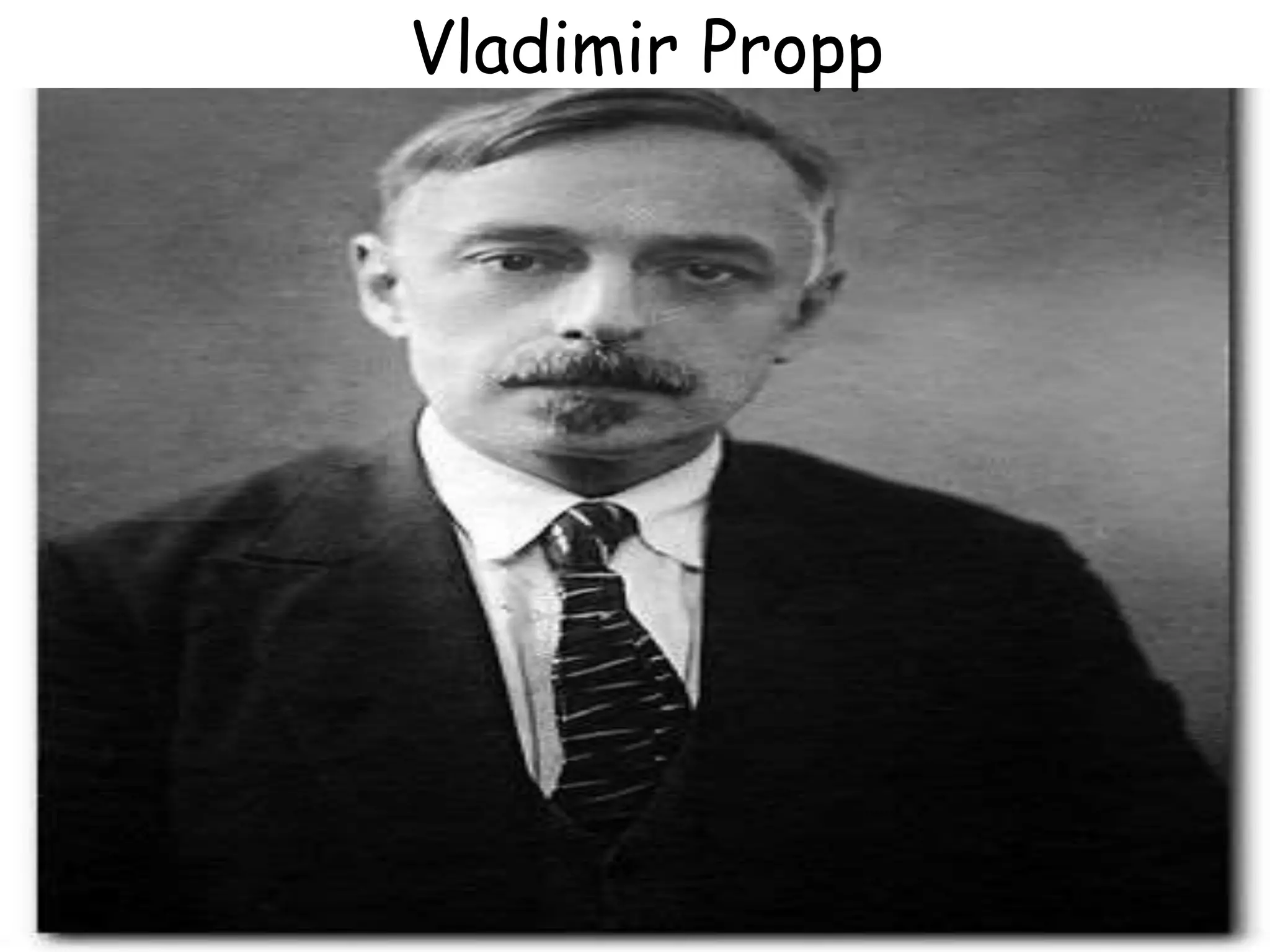
Vladimir Propp
Biography 
Vladimir Propp was born on April the 17th, 1895 in St. 
Petersburg to a German family. He attended St. Petersburg 
University where he studied Russian and 
German philology. After graduating from St. Petersburg he 
choose to start his career by 
teaching Russian and German at a secondary school. He 
then became a college teacher of German. He then wrote 
and published a book which he named Morphology of the 
Folktale , the book was published in Russian 1928. The 
book revolutionised a breakthrough in both 
folkloristic and morphology while simultaneously 
influencing people like Claude Lévi-Strauss and Roland 
Barthes. The book was unnoticed in the West until it was 
translated in 1958. His character types are used in Media 
education and can be applied to almost any story, be it in 
literature, theatre, film, television series, games, etc.
The Character Theory 
(Movie Order) 
The character theory states that every successful movie somewhat follows 
this order: 
ABSENTATION INTERDICTION VIOLATION of INTERDICTION RECONNAISSANCE 
DELIVERY TRICKERY COMPLICITY VILLAINY or LACK MEDIATION 
BEGINNING COUNTER-ACTION DEPARTURE FIRST FUNCTION OF THE DONOR 
HERO'S REACTION RECEIPT OF A MAGICAL AGENT GUIDANCE STRUGGLE 
BRANDING VICTORY RETURN PURSUIT RESCUE UNRECOGNIZED ARRIVAL 
UNFOUNDED CLAIMS DIFFICULT TASK SOLUTION RECOGNITION EXPOSURE 
TRANSFIGURATION PUNISHMENT WEDDING
The Character Theory 
(Character List) 
The character theory states that every successful movie somewhat follows this 
character list: 
• The villain: struggles against the hero. 
• The dispatcher: character who makes the lack known and sends the hero off. 
• The (magical) helper: helps the hero in their quest. 
• The princess or prize and her father: the hero deserves her throughout the 
story but is unable to marry her because of an unfair evil, usually because of 
the villain. The hero's journey is often ended when he marries the princess, 
thereby beating the villain. 
• The donor: prepares the hero or gives the hero some magical object. 
• The hero or victim/seeker hero: reacts to the donor, weds the princess. 
• The false hero: takes credit for the hero’s actions or tries to marry the princess.
Music Video Analysis 
You can also apply these rules to a female music video, one being for example 
Katy Perry – Last Friday Night: 
• The video has a princess who is Katy 
• A hero who’s the geeky boy 
• The false hero who is the popular guy 
• The helper who gives Katy the makeover 
• The dispatcher who encourages Katy to party 
• The donor who gives Katy the makeover etc

Theories - Vladimir Propp

  • 1.
  • 2.
    Biography Vladimir Proppwas born on April the 17th, 1895 in St. Petersburg to a German family. He attended St. Petersburg University where he studied Russian and German philology. After graduating from St. Petersburg he choose to start his career by teaching Russian and German at a secondary school. He then became a college teacher of German. He then wrote and published a book which he named Morphology of the Folktale , the book was published in Russian 1928. The book revolutionised a breakthrough in both folkloristic and morphology while simultaneously influencing people like Claude Lévi-Strauss and Roland Barthes. The book was unnoticed in the West until it was translated in 1958. His character types are used in Media education and can be applied to almost any story, be it in literature, theatre, film, television series, games, etc.
  • 3.
    The Character Theory (Movie Order) The character theory states that every successful movie somewhat follows this order: ABSENTATION INTERDICTION VIOLATION of INTERDICTION RECONNAISSANCE DELIVERY TRICKERY COMPLICITY VILLAINY or LACK MEDIATION BEGINNING COUNTER-ACTION DEPARTURE FIRST FUNCTION OF THE DONOR HERO'S REACTION RECEIPT OF A MAGICAL AGENT GUIDANCE STRUGGLE BRANDING VICTORY RETURN PURSUIT RESCUE UNRECOGNIZED ARRIVAL UNFOUNDED CLAIMS DIFFICULT TASK SOLUTION RECOGNITION EXPOSURE TRANSFIGURATION PUNISHMENT WEDDING
  • 4.
    The Character Theory (Character List) The character theory states that every successful movie somewhat follows this character list: • The villain: struggles against the hero. • The dispatcher: character who makes the lack known and sends the hero off. • The (magical) helper: helps the hero in their quest. • The princess or prize and her father: the hero deserves her throughout the story but is unable to marry her because of an unfair evil, usually because of the villain. The hero's journey is often ended when he marries the princess, thereby beating the villain. • The donor: prepares the hero or gives the hero some magical object. • The hero or victim/seeker hero: reacts to the donor, weds the princess. • The false hero: takes credit for the hero’s actions or tries to marry the princess.
  • 5.
    Music Video Analysis You can also apply these rules to a female music video, one being for example Katy Perry – Last Friday Night: • The video has a princess who is Katy • A hero who’s the geeky boy • The false hero who is the popular guy • The helper who gives Katy the makeover • The dispatcher who encourages Katy to party • The donor who gives Katy the makeover etc