RECAP
CLARIFICTION
An interesting EPOC protocol
Theories models and frameworks
Implementation science workshop
Hawassa University, August 21-25, 2017
E-mail: anna.bergstrom@kbh.uu.se
Today
 THE RATIONAL FOR USING
THEORIES/FRAMEWORKS/MODELS
 A FEW EXAMPLES
THE RATIONAL FOR USING THEORIES,
FRAMEWORKS AND MODELS
Using or not using theory
 An expensive versions of trial and error,
providing little or no knowledge about which
factors successfully influenced implementation
efforts.
Eccles et al., 2005
 Transferring theory to the design of studies is
not straightforward and there are many theories
and it is not clear which ones should be given
primacy.
Bhattacharyya et al., 2006
Whether one uses theory or not, one needs to identify
 how an innovation and the implementation strategy produces
certain outcomes,
 explore by which processes change is brought about, and
Why we do this
 Helps practitioners plan implementation
and think ahead
 Guides researchers to decide which data
to gather to describe and explain
implementation
 May include hypotheses or theory about
action steps needed and critical
contextual influences
Theories, frameworks and models
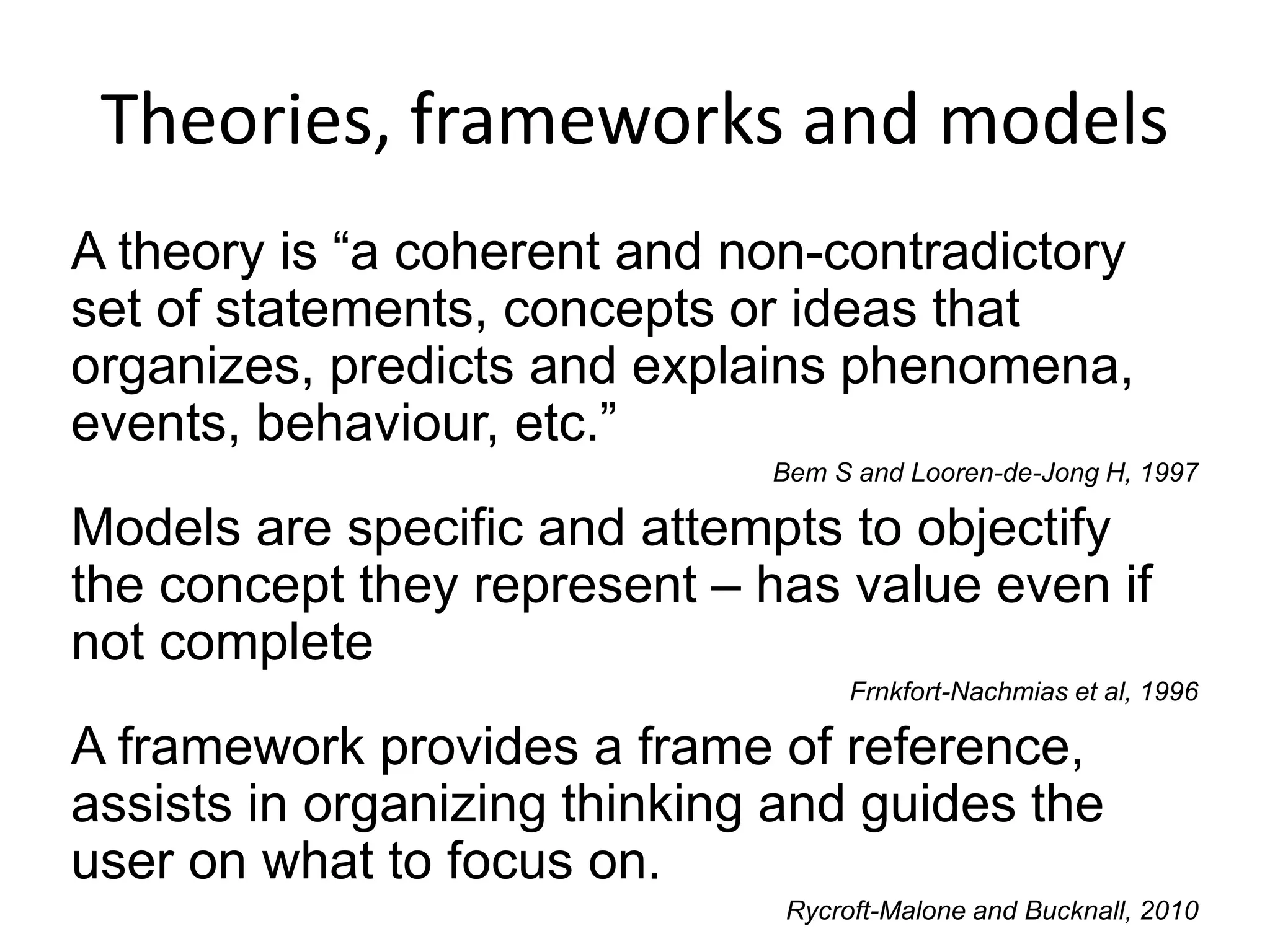
A theory is “a coherent and non-contradictory
set of statements, concepts or ideas that
organizes, predicts and explains phenomena,
events, behaviour, etc.”
Bem S and Looren-de-Jong H, 1997
Models are specific and attempts to objectify
the concept they represent – has value even if
not complete
Frnkfort-Nachmias et al, 1996
A framework provides a frame of reference,
assists in organizing thinking and guides the
user on what to focus on.
Rycroft-Malone and Bucknall, 2010
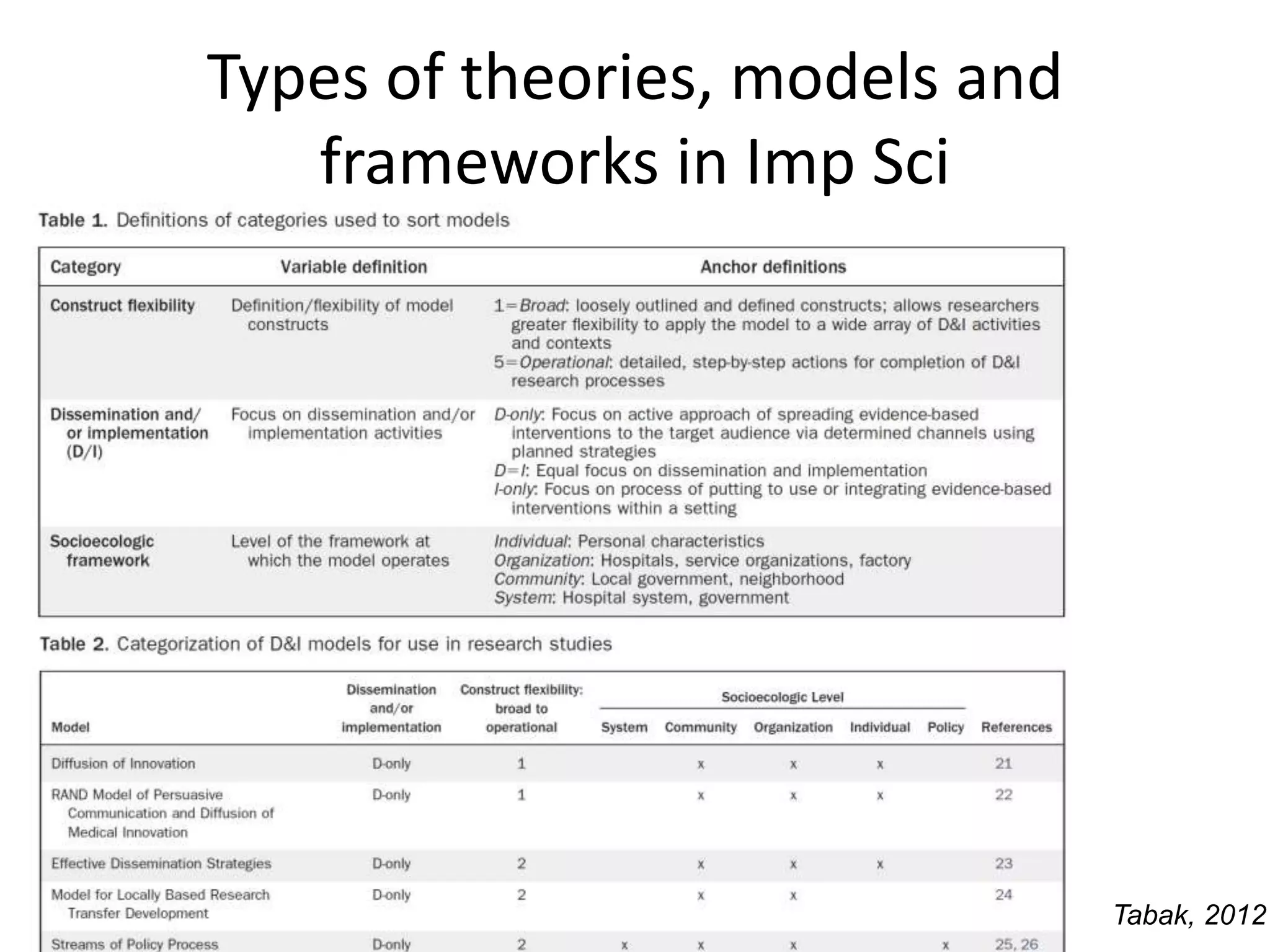
Types of theories, models and
frameworks in Imp Sci
Tabak, 2012
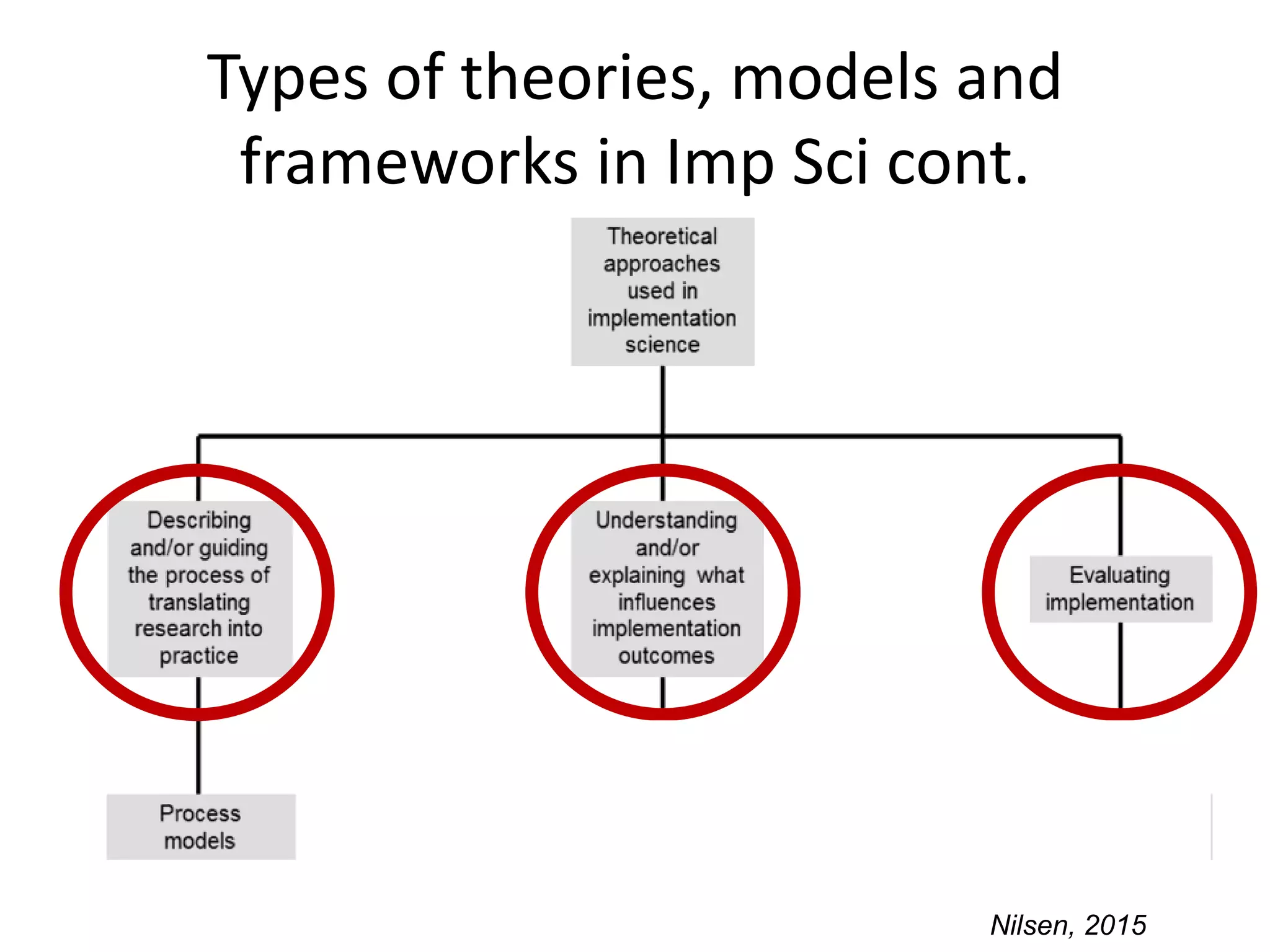
Types of theories, models and
frameworks in Imp Sci cont.
Nilsen, 2015
A FEW EXAMPLES
Some examples
 Theory of diffusion - Classic (determinant)
 Theory of planned behavior - Classic
(determinant)
 Promoting Action on Research
Implementation in Health Services
framework – Determinant
 Integrated-Promoting Action on Research
Implementation in Health Services
framework – Determinant (but some
process)
THE GODFATHER
a classic theory/determinant –
more towards passive spread
Mr. Rogers
 This theory seeks to explain how
innovations are taken up in a
population.
 An innovation is an idea, behavior, or
object that is perceived as new by its
audience.
 Diffusion is the process in which the
innovation is communicated through
certain channels over time among
members of a social system.
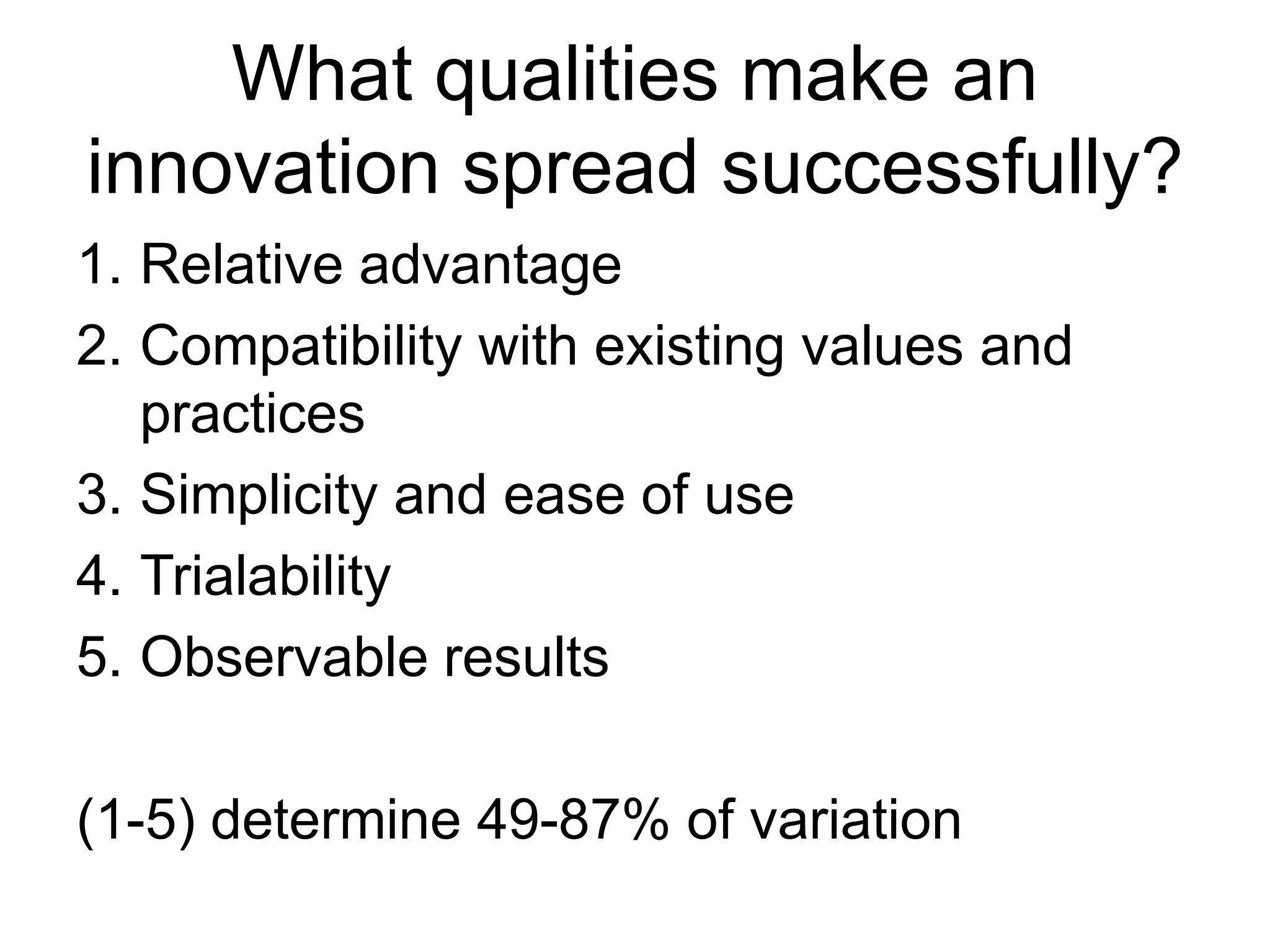
What qualities make an
innovation spread successfully?
1. Relative advantage
2. Compatibility with existing values and
practices
3. Simplicity and ease of use
4. Trialability
5. Observable results
(1-5) determine 49-87% of variation
Social system: Adopter categories
Time
The effect of time
Knowledg
e
Persuasi
on
Decisio
n
Implementati
on
Confirmatio
n
Adoption
Rejection
Continued adoption
Discontinuance
Later adoption
Continued rejection
Prior
conditions
Time
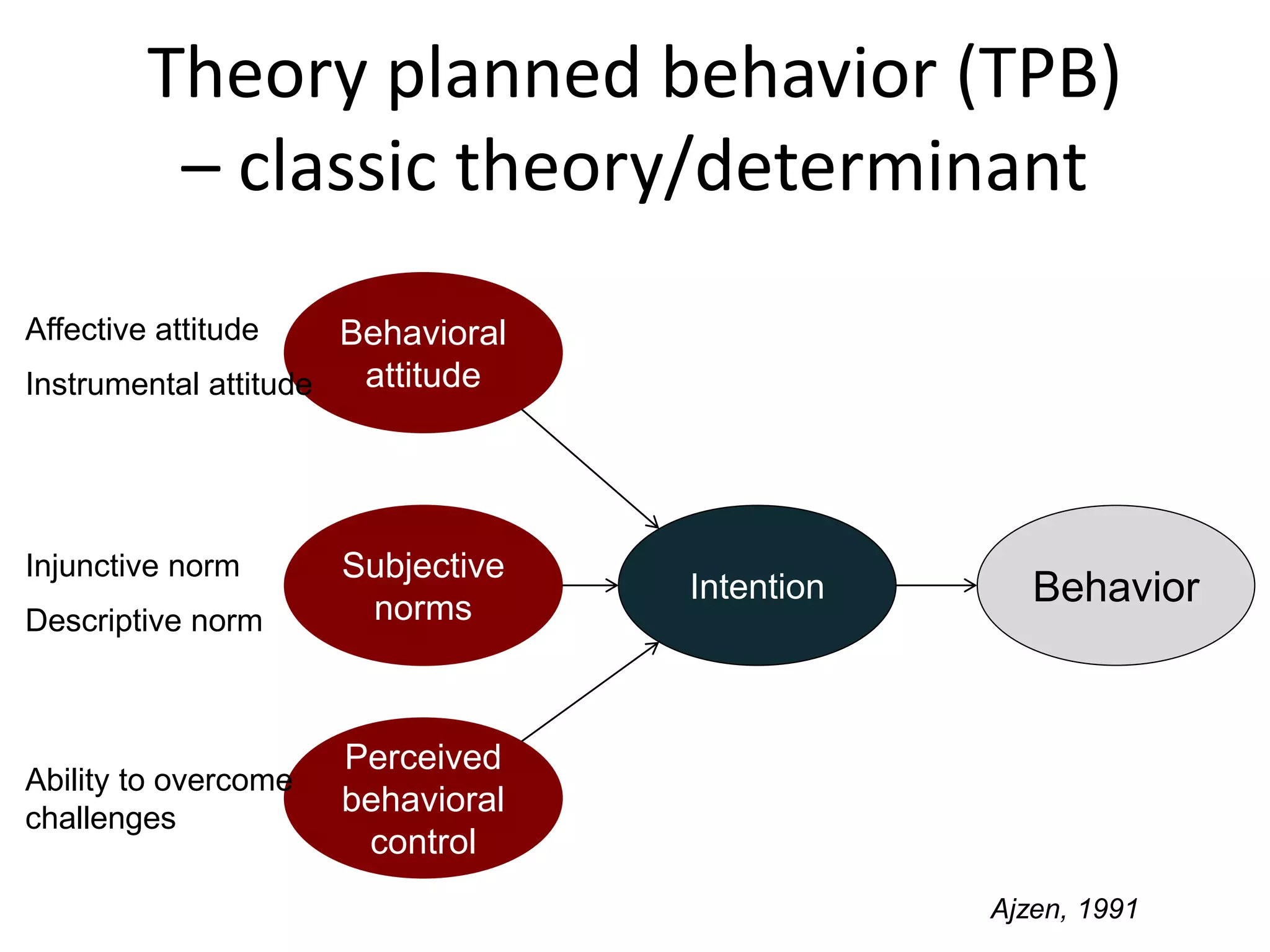
Theory planned behavior (TPB)
– classic theory/determinant
Behavioral
attitude
Subjective
norms
Perceived
behavioral
control
Intention Behavior
Ajzen, 1991
Affective attitude
Instrumental attitude
Injunctive norm
Descriptive norm
Ability to overcome
challenges
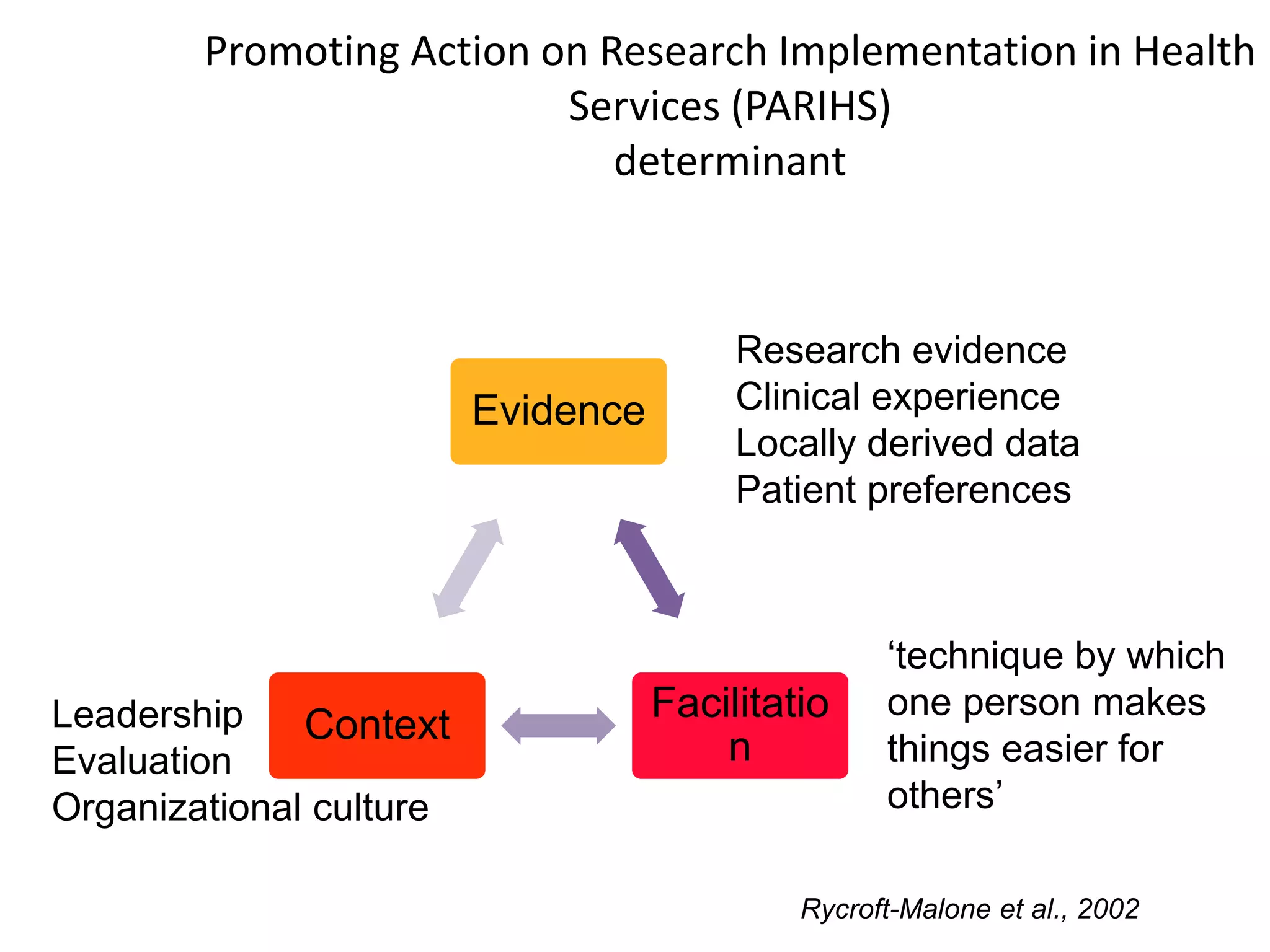
Promoting Action on Research Implementation in Health
Services (PARIHS)
determinant
Evidence
Facilitatio
n
Context
‘technique by which
one person makes
things easier for
others’
Leadership
Evaluation
Organizational culture
Research evidence
Clinical experience
Locally derived data
Patient preferences
Rycroft-Malone et al., 2002
i-PARIHS
Innovation
Recipients
Inner
context
Outer context
Harvey and Kitson, 2015
Facilitation
Look at the slides
from yesterday
presenting the
characteristics of
these constructs!
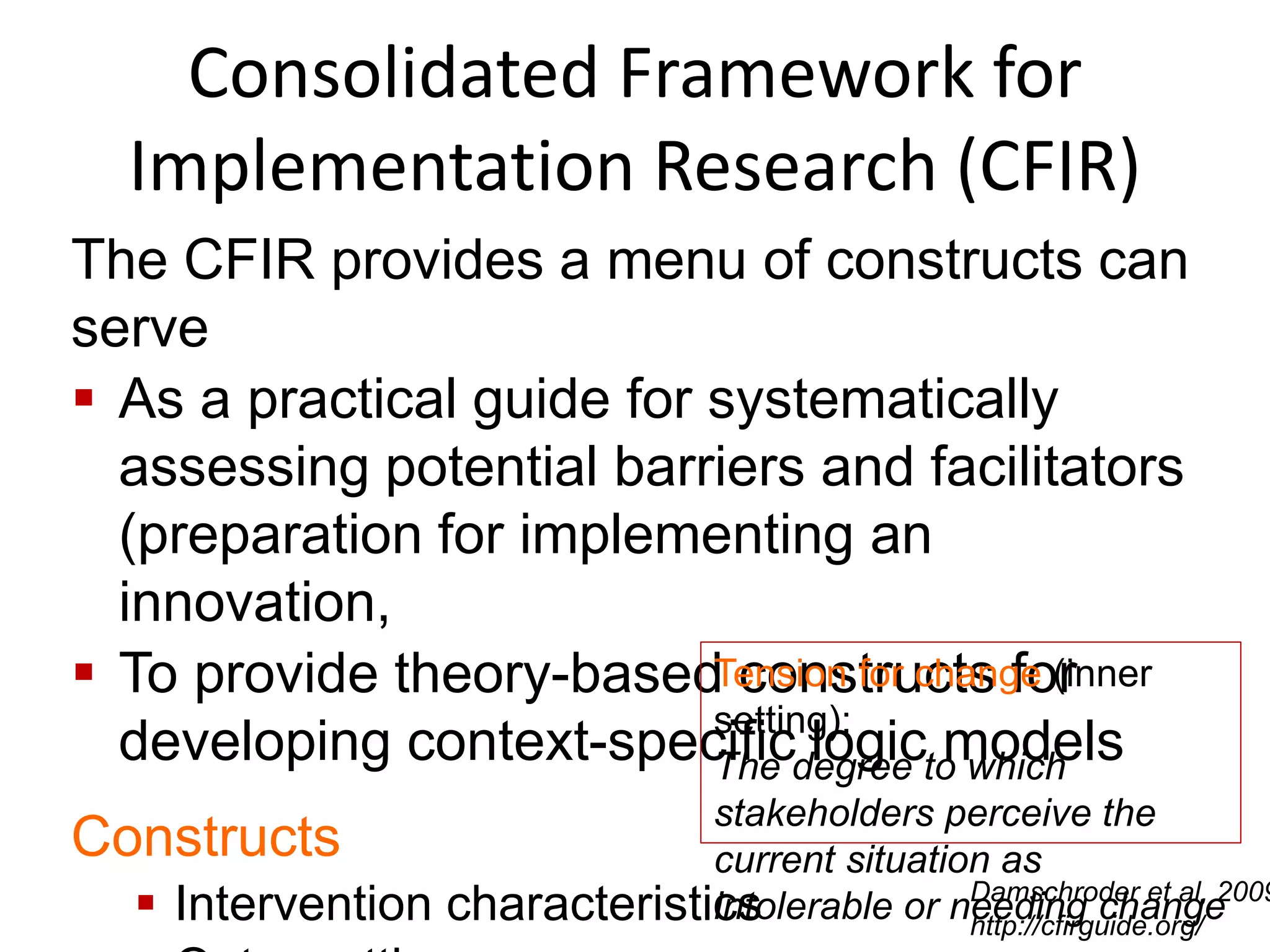
Consolidated Framework for
Implementation Research (CFIR)
The CFIR provides a menu of constructs can
serve
 As a practical guide for systematically
assessing potential barriers and facilitators
(preparation for implementing an
innovation,
 To provide theory-based constructs for
developing context-specific logic models
Constructs
 Intervention characteristics
Tension for change (inner
setting):
The degree to which
stakeholders perceive the
current situation as
intolerable or needing changeDamschroder et al, 2009
http://cfirguide.org/
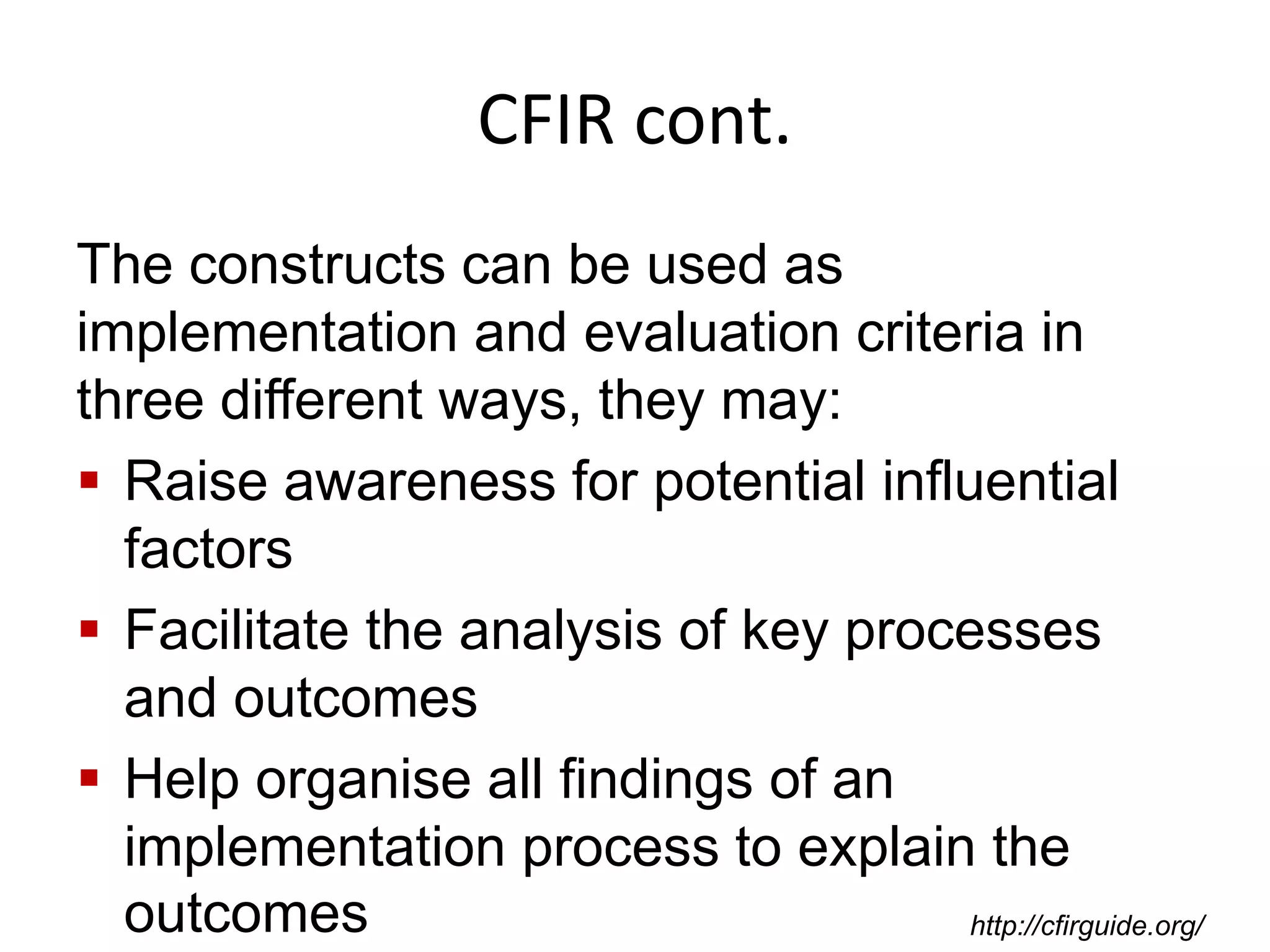
CFIR cont.
The constructs can be used as
implementation and evaluation criteria in
three different ways, they may:
 Raise awareness for potential influential
factors
 Facilitate the analysis of key processes
and outcomes
 Help organise all findings of an
implementation process to explain the
outcomes http://cfirguide.org/
CHOOSING YOUR THEORY, MODEL
OR FRAMEWORK
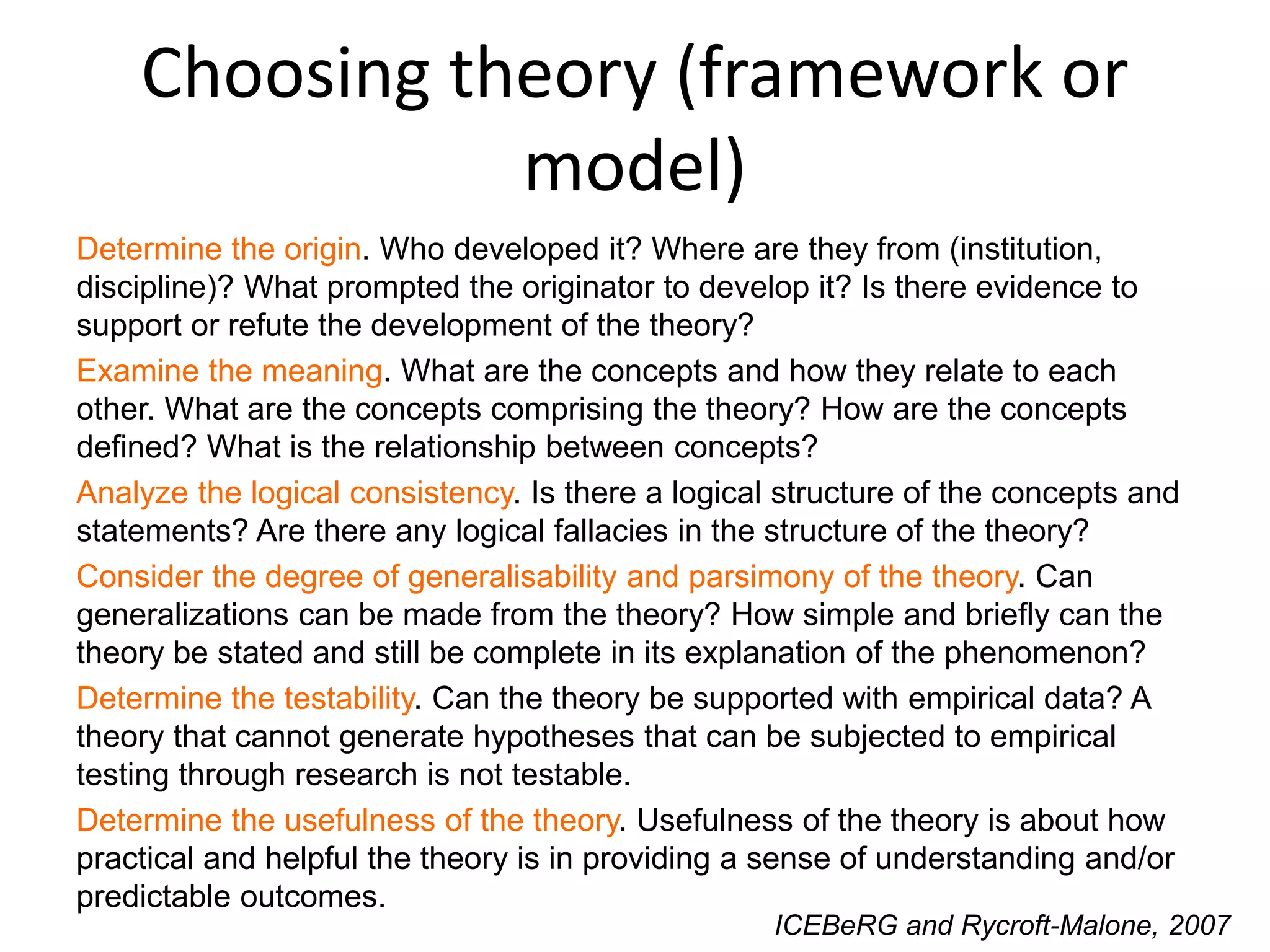
Choosing theory (framework or
model)
Determine the origin. Who developed it? Where are they from (institution,
discipline)? What prompted the originator to develop it? Is there evidence to
support or refute the development of the theory?
Examine the meaning. What are the concepts and how they relate to each
other. What are the concepts comprising the theory? How are the concepts
defined? What is the relationship between concepts?
Analyze the logical consistency. Is there a logical structure of the concepts and
statements? Are there any logical fallacies in the structure of the theory?
Consider the degree of generalisability and parsimony of the theory. Can
generalizations can be made from the theory? How simple and briefly can the
theory be stated and still be complete in its explanation of the phenomenon?
Determine the testability. Can the theory be supported with empirical data? A
theory that cannot generate hypotheses that can be subjected to empirical
testing through research is not testable.
Determine the usefulness of the theory. Usefulness of the theory is about how
practical and helpful the theory is in providing a sense of understanding and/or
predictable outcomes.
ICEBeRG and Rycroft-Malone, 2007
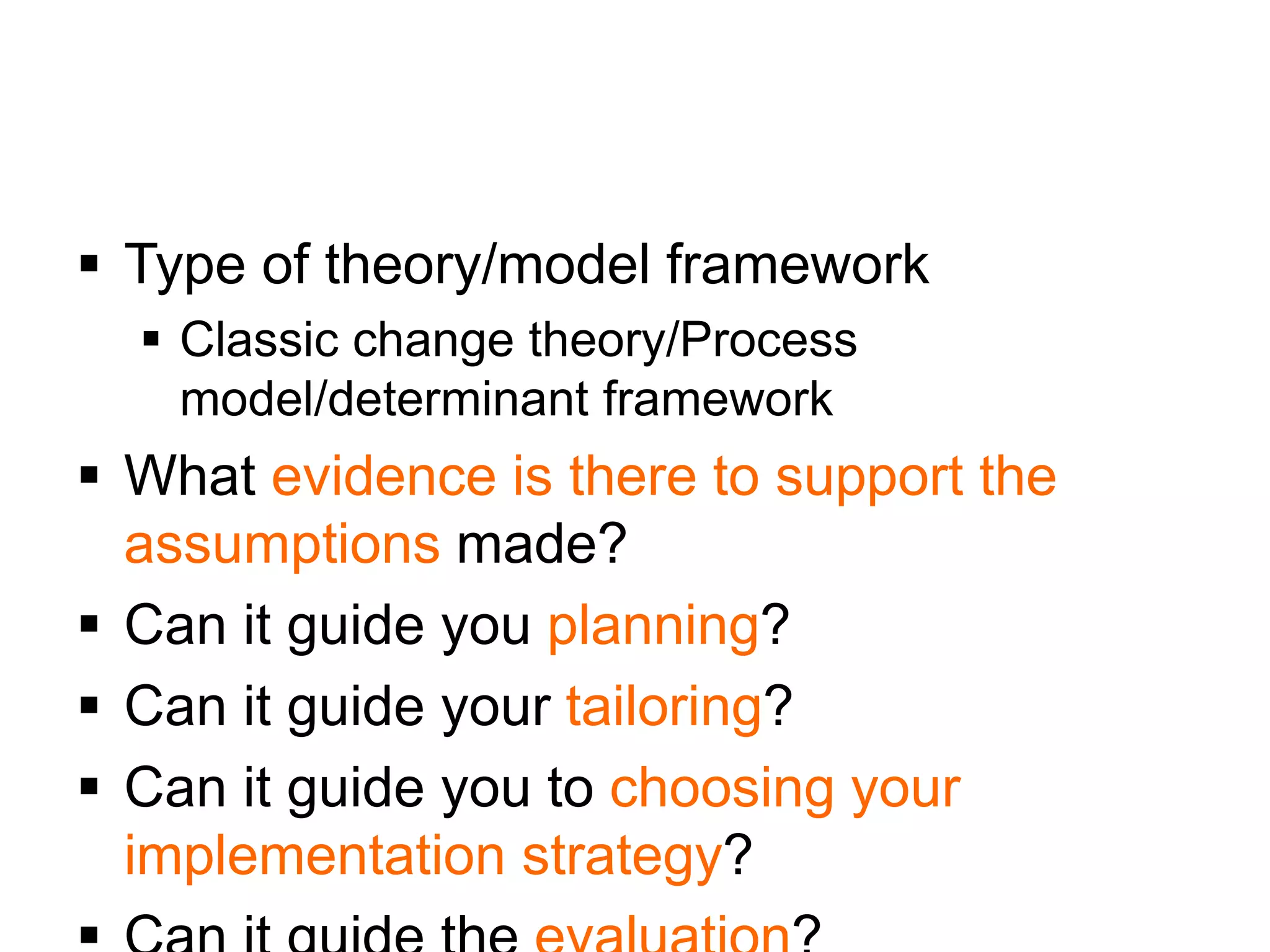
 Type of theory/model framework
 Classic change theory/Process
model/determinant framework
 What evidence is there to support the
assumptions made?
 Can it guide you planning?
 Can it guide your tailoring?
 Can it guide you to choosing your
implementation strategy?
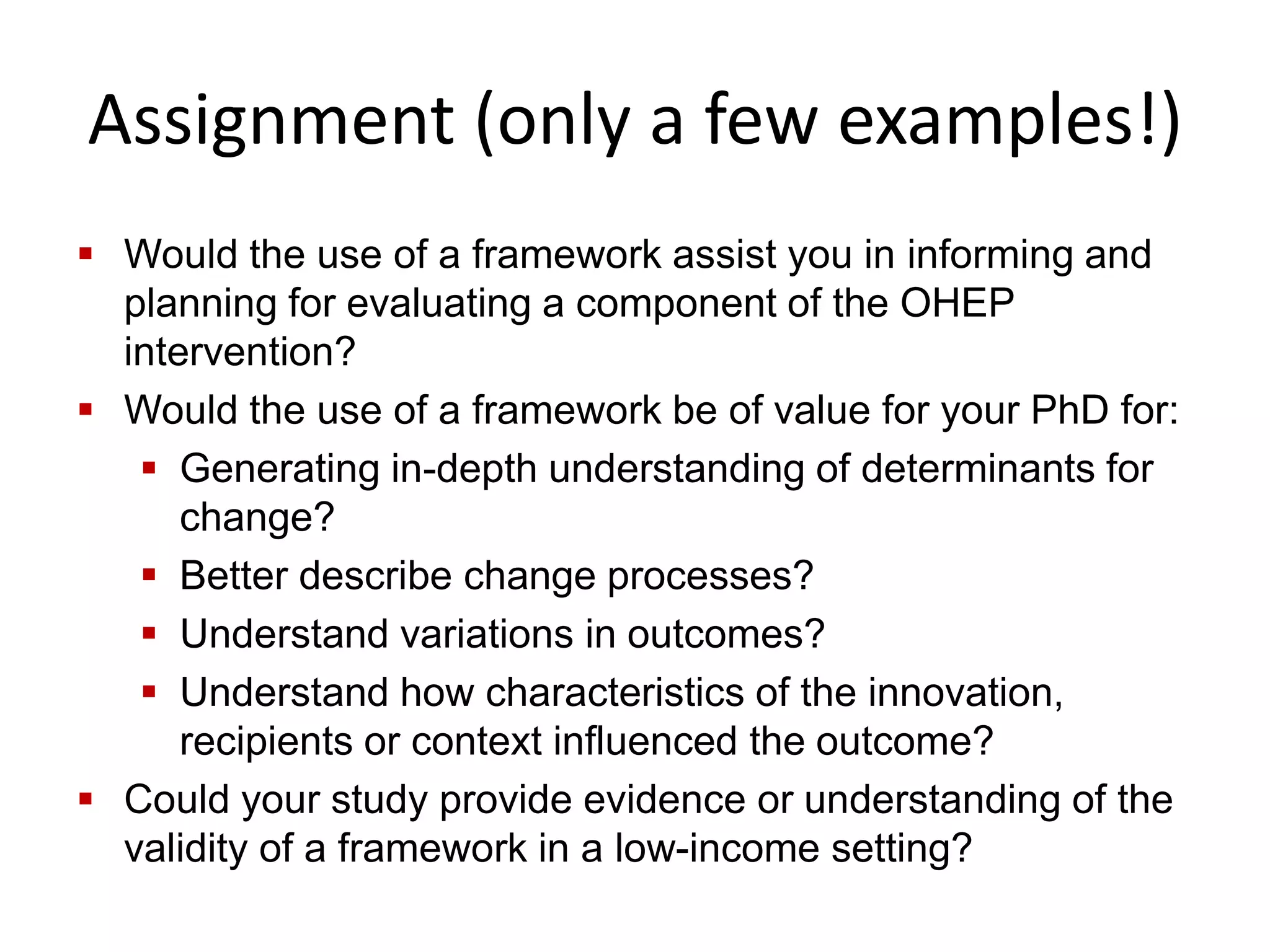
Assignment (only a few examples!)
 Would the use of a framework assist you in informing and
planning for evaluating a component of the OHEP
intervention?
 Would the use of a framework be of value for your PhD for:
 Generating in-depth understanding of determinants for
change?
 Better describe change processes?
 Understand variations in outcomes?
 Understand how characteristics of the innovation,
recipients or context influenced the outcome?
 Could your study provide evidence or understanding of the
validity of a framework in a low-income setting?

Theories, models and frameworks 2017

  • 1.
  • 2.
  • 3.
    Theories models andframeworks Implementation science workshop Hawassa University, August 21-25, 2017 E-mail: anna.bergstrom@kbh.uu.se
  • 4.
    Today  THE RATIONALFOR USING THEORIES/FRAMEWORKS/MODELS  A FEW EXAMPLES
  • 5.
    THE RATIONAL FORUSING THEORIES, FRAMEWORKS AND MODELS
  • 6.
    Using or notusing theory  An expensive versions of trial and error, providing little or no knowledge about which factors successfully influenced implementation efforts. Eccles et al., 2005  Transferring theory to the design of studies is not straightforward and there are many theories and it is not clear which ones should be given primacy. Bhattacharyya et al., 2006 Whether one uses theory or not, one needs to identify  how an innovation and the implementation strategy produces certain outcomes,  explore by which processes change is brought about, and
  • 7.
    Why we dothis  Helps practitioners plan implementation and think ahead  Guides researchers to decide which data to gather to describe and explain implementation  May include hypotheses or theory about action steps needed and critical contextual influences
  • 8.
    Theories, frameworks andmodels A theory is “a coherent and non-contradictory set of statements, concepts or ideas that organizes, predicts and explains phenomena, events, behaviour, etc.” Bem S and Looren-de-Jong H, 1997 Models are specific and attempts to objectify the concept they represent – has value even if not complete Frnkfort-Nachmias et al, 1996 A framework provides a frame of reference, assists in organizing thinking and guides the user on what to focus on. Rycroft-Malone and Bucknall, 2010
  • 9.
    Types of theories,models and frameworks in Imp Sci Tabak, 2012
  • 10.
    Types of theories,models and frameworks in Imp Sci cont. Nilsen, 2015
  • 11.
  • 12.
    Some examples  Theoryof diffusion - Classic (determinant)  Theory of planned behavior - Classic (determinant)  Promoting Action on Research Implementation in Health Services framework – Determinant  Integrated-Promoting Action on Research Implementation in Health Services framework – Determinant (but some process)
  • 13.
    THE GODFATHER a classictheory/determinant – more towards passive spread
  • 14.
    Mr. Rogers  Thistheory seeks to explain how innovations are taken up in a population.  An innovation is an idea, behavior, or object that is perceived as new by its audience.  Diffusion is the process in which the innovation is communicated through certain channels over time among members of a social system.
  • 15.
    What qualities makean innovation spread successfully? 1. Relative advantage 2. Compatibility with existing values and practices 3. Simplicity and ease of use 4. Trialability 5. Observable results (1-5) determine 49-87% of variation
  • 16.
    Social system: Adoptercategories Time
  • 17.
    The effect oftime Knowledg e Persuasi on Decisio n Implementati on Confirmatio n Adoption Rejection Continued adoption Discontinuance Later adoption Continued rejection Prior conditions Time
  • 18.
    Theory planned behavior(TPB) – classic theory/determinant Behavioral attitude Subjective norms Perceived behavioral control Intention Behavior Ajzen, 1991 Affective attitude Instrumental attitude Injunctive norm Descriptive norm Ability to overcome challenges
  • 19.
    Promoting Action onResearch Implementation in Health Services (PARIHS) determinant Evidence Facilitatio n Context ‘technique by which one person makes things easier for others’ Leadership Evaluation Organizational culture Research evidence Clinical experience Locally derived data Patient preferences Rycroft-Malone et al., 2002
  • 20.
    i-PARIHS Innovation Recipients Inner context Outer context Harvey andKitson, 2015 Facilitation Look at the slides from yesterday presenting the characteristics of these constructs!
  • 21.
    Consolidated Framework for ImplementationResearch (CFIR) The CFIR provides a menu of constructs can serve  As a practical guide for systematically assessing potential barriers and facilitators (preparation for implementing an innovation,  To provide theory-based constructs for developing context-specific logic models Constructs  Intervention characteristics Tension for change (inner setting): The degree to which stakeholders perceive the current situation as intolerable or needing changeDamschroder et al, 2009 http://cfirguide.org/
  • 22.
    CFIR cont. The constructscan be used as implementation and evaluation criteria in three different ways, they may:  Raise awareness for potential influential factors  Facilitate the analysis of key processes and outcomes  Help organise all findings of an implementation process to explain the outcomes http://cfirguide.org/
  • 23.
    CHOOSING YOUR THEORY,MODEL OR FRAMEWORK
  • 24.
    Choosing theory (frameworkor model) Determine the origin. Who developed it? Where are they from (institution, discipline)? What prompted the originator to develop it? Is there evidence to support or refute the development of the theory? Examine the meaning. What are the concepts and how they relate to each other. What are the concepts comprising the theory? How are the concepts defined? What is the relationship between concepts? Analyze the logical consistency. Is there a logical structure of the concepts and statements? Are there any logical fallacies in the structure of the theory? Consider the degree of generalisability and parsimony of the theory. Can generalizations can be made from the theory? How simple and briefly can the theory be stated and still be complete in its explanation of the phenomenon? Determine the testability. Can the theory be supported with empirical data? A theory that cannot generate hypotheses that can be subjected to empirical testing through research is not testable. Determine the usefulness of the theory. Usefulness of the theory is about how practical and helpful the theory is in providing a sense of understanding and/or predictable outcomes. ICEBeRG and Rycroft-Malone, 2007
  • 25.
     Type oftheory/model framework  Classic change theory/Process model/determinant framework  What evidence is there to support the assumptions made?  Can it guide you planning?  Can it guide your tailoring?  Can it guide you to choosing your implementation strategy?
  • 26.
    Assignment (only afew examples!)  Would the use of a framework assist you in informing and planning for evaluating a component of the OHEP intervention?  Would the use of a framework be of value for your PhD for:  Generating in-depth understanding of determinants for change?  Better describe change processes?  Understand variations in outcomes?  Understand how characteristics of the innovation, recipients or context influenced the outcome?  Could your study provide evidence or understanding of the validity of a framework in a low-income setting?